Article

Compatibilizing Effects of Poly(lactic acid) (PLA)/Poly(vinyl butyral) (PVB)/Mica Composites

Department of Materials Science and Engineering, Division of Chemical and Materials Engineering, The University of Suwon, Hwaseong 18323, Gyeonggi-do, Republic of Korea
*
Author to whom correspondence should be addressed.
These authors contributed equally to this work.
Polymers 2026, 18(1), 40; https://doi.org/10.3390/polym18010040
Submission received: 9 November 2025 / Revised: 18 December 2025 / Accepted: 19 December 2025 / Published: 23 December 2025

Abstract

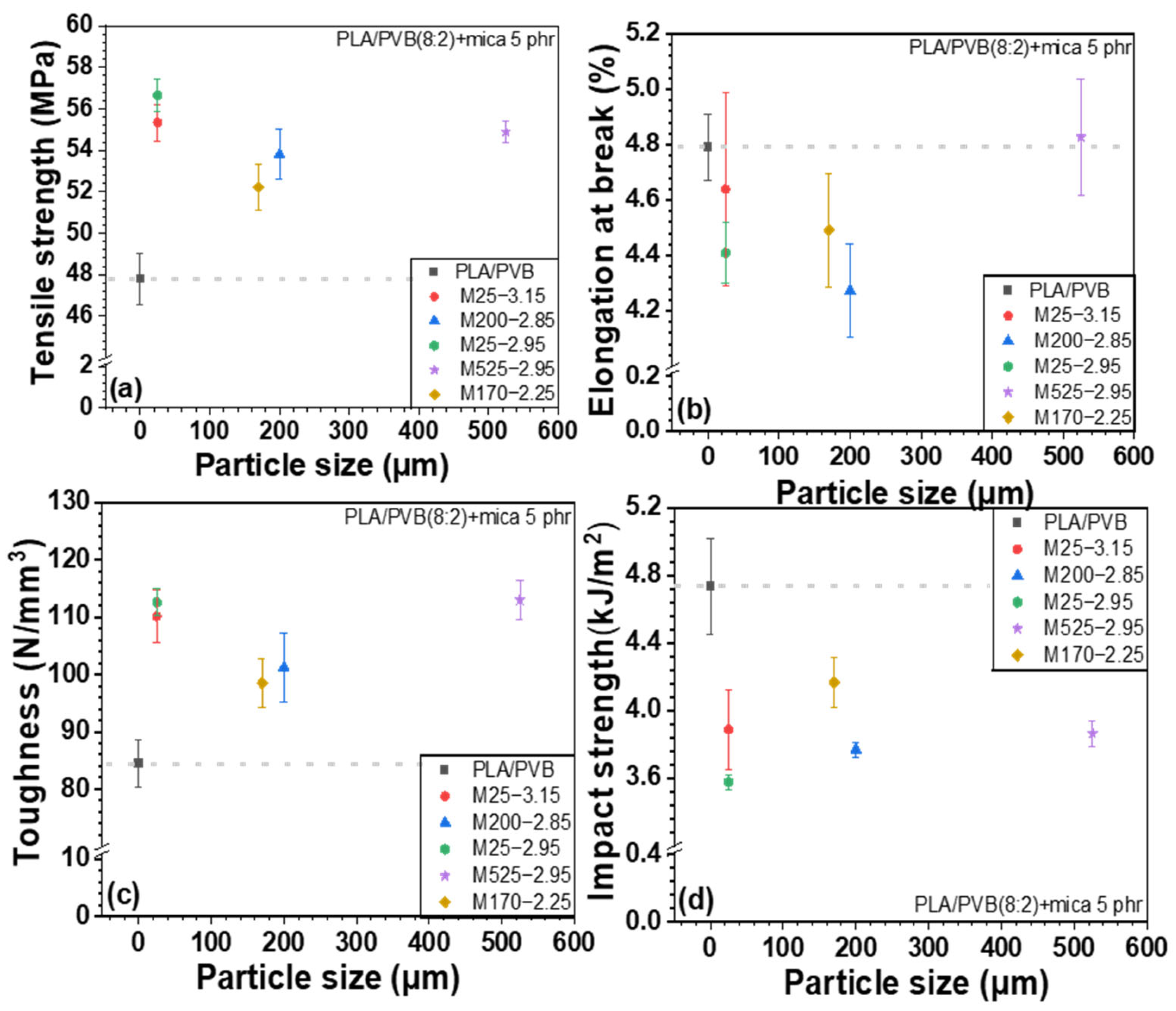
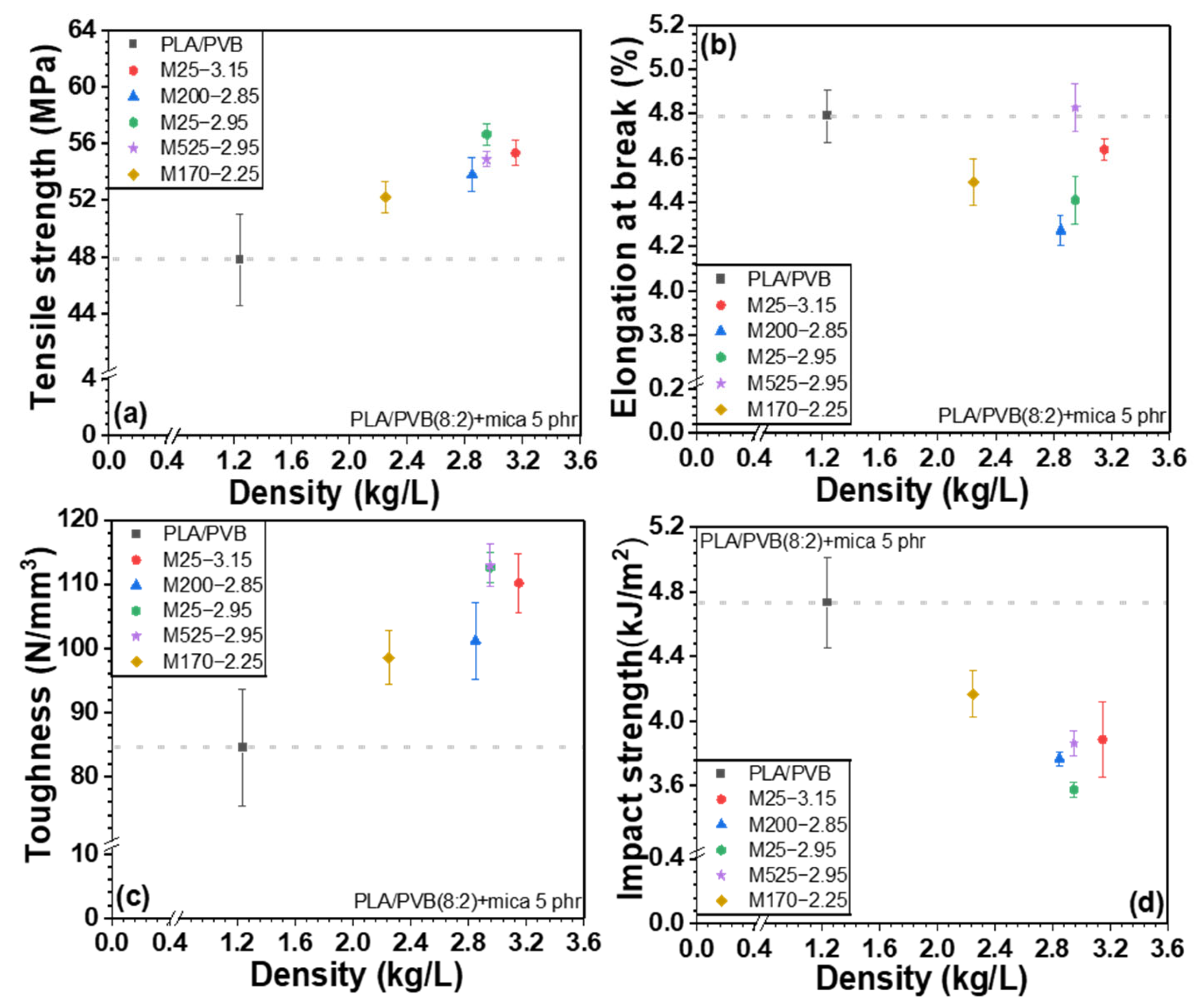
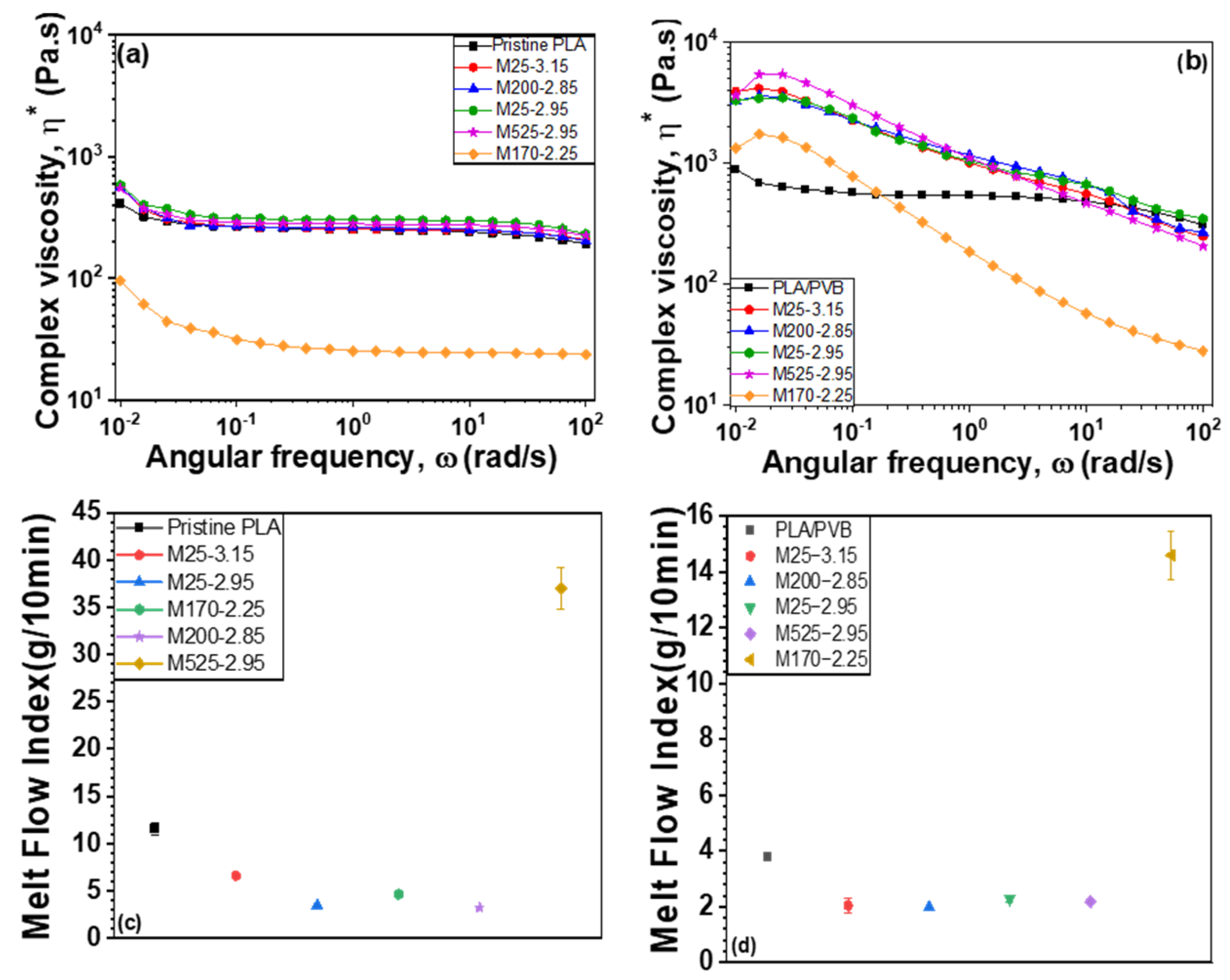
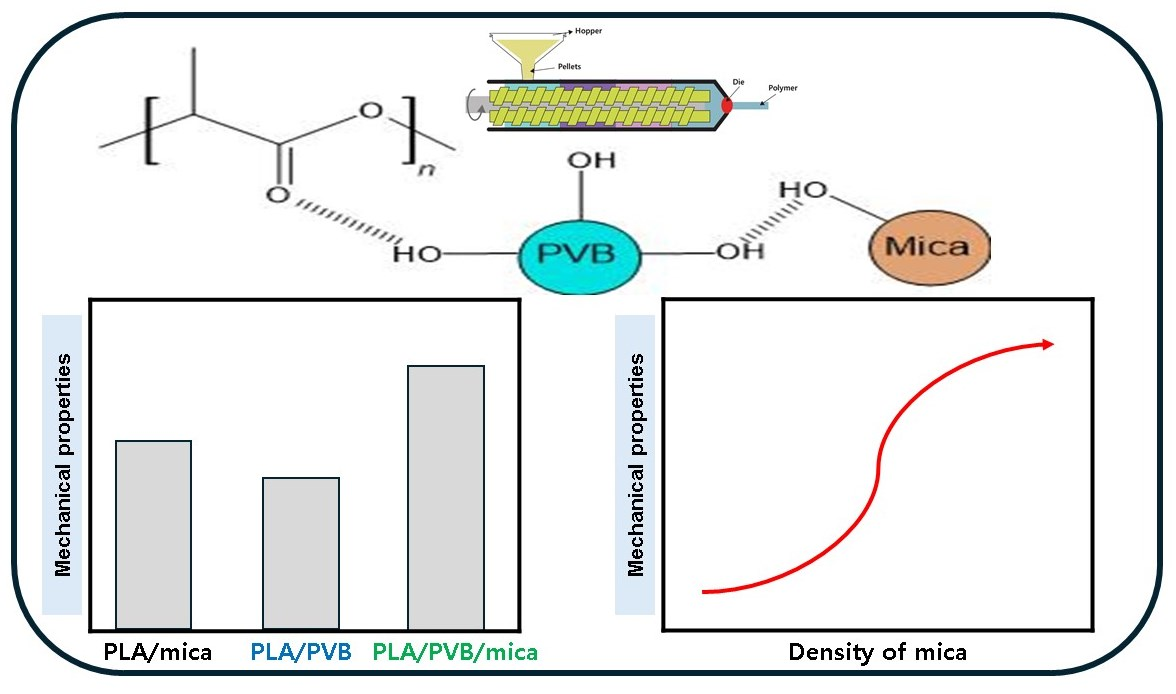
Poly(lactic acid) (PLA) has strong potential for use in sustainable packaging, automotive components, and structural materials; however, its inherent brittleness and limited thermal stability restrict broader application. To overcome these drawbacks, this study developed PLA-based composites reinforced with mica and compatibilized using poly(vinyl butyral) (PVB). To overcome the inherent brittleness and limited thermal stability of poly(lactic acid) (PLA), this study investigated the incorporation of mica as a reinforcing filler into PLA and PLA/poly(vinyl butyral) (PVB) composite systems. Five types of mica with varying particle sizes and densities were examined to evaluate their influence on the mechanical, thermal, and rheological properties of the composites. The PLA/PVB blend was prepared in an 8:2 weight ratio, and mica was added at 5 phr (35 g). PLA/mica composites showed limited improvement in mechanical performance due to poor interfacial compatibility between PLA and mica, resulting in decreased tensile strength and non-uniform filler dispersion. In contrast, the addition of PVB, a tough and flexible polymer containing hydroxyl groups (ca. 20 mol%) remaining after polymerization, significantly enhanced the interfacial interaction with mica and improved filler dispersion within the matrix. As a result, PLA/PVB/mica composites exhibited increased tensile strength and toughness. Thermal analysis revealed that mica restricted polymer chain mobility, leading to higher glass transition temperatures, while PVB promoted a more uniform crystalline structure. Rheological studies indicated that PLA/PVB/mica composites had higher complex viscosity and lower melt flow index (MFI) due to increased molecular interactions and reduced chain mobility. Notably, certain mica types containing Ca2+ ions catalyzed chain scission during melt processing, leading to reduced molecular weight and increased MFI. These findings demonstrate that the synergistic combination of PVB and mica can effectively improve the processability and performance of PLA-based composites, offering a promising route for developing sustainable materials for advanced applications.
Keywords: poly(lactic acid); poly(vinyl butyral); mica; mechanical properties; thermal properties poly(lactic acid); poly(vinyl butyral); mica; mechanical properties; thermal properties
Graphical Abstract