Article

A Rapid Quantitative Analysis of Bicomponent Fibers Based on Cross-Sectional In-Situ Observation


1
School of Textile Materials and Engineering, Wuyi University, Jiangmen 529020, China
2
College of Innovation and Entrepreneurship, Wuyi University, Jiangmen 529020, China
3
College of Intelligent Manufacturing, Wuyi University, Jiangmen 529020, China
*
Authors to whom correspondence should be addressed.
Polymers 2023, 15(4), 842; https://doi.org/10.3390/polym15040842
Submission received: 12 January 2023 / Revised: 1 February 2023 / Accepted: 3 February 2023 / Published: 8 February 2023
(This article belongs to the Special Issue Advances in Fiber Materials and Manufacturing)

Abstract

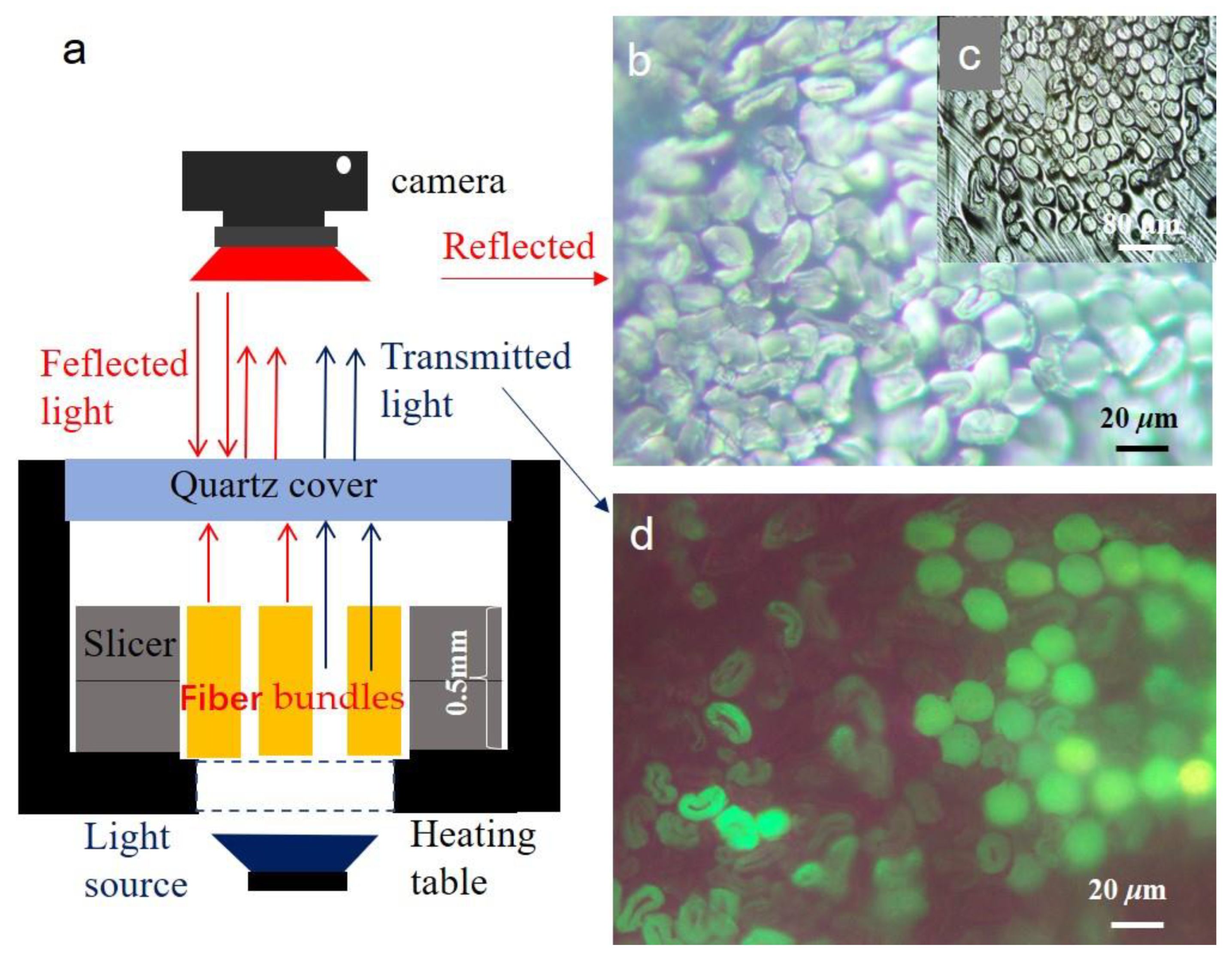
To accelerate the industrialization of bicomponent fibers, fiber-based flexible devices, and other technical fibers and to protect the property rights of inventors, it is necessary to develop fast, economical, and easy-to-test methods to provide some guidance for formulating relevant testing standards. A quantitative method based on cross-sectional in-situ observation and image processing was developed in this study. First, the cross-sections of the fibers were rapidly prepared by the non-embedding method. Then, transmission and reflection metallographic microscopes were used for in-situ observation and to capture the cross-section images of fibers. This in-situ observation allows for the rapid identification of the type and spatial distribution structure of the bicomponent fiber. Finally, the mass percentage content of each component was calculated rapidly by AI software according to its density, cross-section area, and total test samples of each component. By comparing the ultra-depth of field microscope, differential scanning calorimetry (DSC), and chemical dissolution method, the quantitative analysis was fast, accurate, economical, simple to operate, energy-saving, and environmentally friendly. This method will be widely used in the intelligent qualitative identification and quantitative analysis of bicomponent fibers, fiber-based flexible devices, and blended textiles.
Keywords: bicomponent fibers; quantitative analysis; melting and dissolving; cross-sectional in-situ observation; image processing; artificial intelligence (AI) bicomponent fibers; quantitative analysis; melting and dissolving; cross-sectional in-situ observation; image processing; artificial intelligence (AI)