1. Introduction
Stainless steel is a multipurpose and sustainable material that plays a crucial role in various industries. Its unique properties, including corrosion resistance, strength, and hygiene, make it indispensable in several applications, such as healthcare and the medical industry, due to its sterility, non-reactive surface, and ease of cleaning. Owing to its non-reactive nature, making it safe for contact with food and beverages, stainless steel is recommended for the food and beverage industry. Due to its high-temperature resistance and high pressure, the oil and gas industry requires corrosion-resistant materials such as stainless steel. Stainless steel is also used in the automotive and aerospace industries. The need for durable and corrosion-resistant materials like stainless steel is expected to increase. Additionally, as industries move towards more sustainable practices, the recyclability of stainless steel adds to its appeal as an environmentally friendly material. Stainless-steel production is constantly evolving, with new grades and treatments being developed to enhance its properties. Stainless steel is an alloy broadly composed of iron, chromium, and carbon, along with other elements such as nickel and molybdenum. The defining feature of stainless steel is its high chromium content (usually at least 10.5%), which forms a thin, protective oxide layer on the surface that prevents rust and corrosion. Austenitic stainless steels are often used in applications that require corrosion resistance at high temperatures [
1,
2,
3].
TIG is a fusion process where an arc is produced between a non-consumable electrode and a workpiece. This technique is the most often used in different industries owing to the equipment costs and the fact that it is easy to learn. TIG can be used in a large range of base material thicknesses in several welding positions and is suitable for all industrially relevant ferrous and non-ferrous materials [
4,
5]. The arc generates intense heat, melting the base metal and forming a weld. A shielding gas, usually argon or helium, protects the weld from contamination. This method is widely used for welding thin metals, stainless steel, aluminum, and many other alloys. A filler rod can be used in some applications to fill depth joints.
Solidification cracking is the most harmful type of cracking and is more commonly observed than other types. Hot cracking occurs during or just after welding, while the metal is still hot. The crack is located in the weld or at HAZ as the molten metal freezes. Solidification and liquation hot cracks are the two foremost hot crack types. Hot cracking is a type of cracking that occurs in certain types of alloys, particularly those that contain multiple phases with different melting points. As the weld solidifies and shrinks, tensile stresses are generated in the metal that can cause cracking. This process takes place in the fusion zone of a weld. It occurs when the supply of liquid weld metal available is not enough to fill the spaces between the solidifying weld metal [
6]. Hot cracking compromises and reduces structural integrity and decreases the usable life of stainless-steel components. Hot cracking can appear in various forms, including longitudinal cracks, transverse cracks, and crater cracks, depending on the direction and location of the crack in the weld.
Several factors contribute to the occurrence of hot cracking in stainless-steel welds, such as, first, the chemical composition of the stainless steel. High levels of sulfur content, phosphorus, and other impurities can intensify the problem by promoting localized melting and reducing the material’s ductility. Also, using the wrong filler metal might be the origin of the formation of a hot crack. The second factor consists of welding parameters such as high current intensity and high welding speeds, so that excessive heat input or fast cooling rates increase the thermal stresses and raise the hot cracking risks, or using the wrong filler metal. High temperatures affect the cracking of stainless steel, as the expansion of stainless steel due to an increase in temperature can lead to thermal stresses, particularly when parts are constrained or engaged with other materials. Moreover, stainless steel can experience sensitization between 800 and 1600 °F (427–870 °C). Chromium will react with C to form chromium carbides at the edges of the grains and will further reduce the resistance to corrosion, therefore increasing intergranular cracking [
7].
Consideration of aspects, like temperature, material selection, TIG welding parameters, and other welding technique parameters, cannot be neglected, as an increase or decrease in thermal cycling leads to stretches and contractions, which produce stress that may develop cracks. The welds need to be made with very strict controls on the heat input, cooling rates, and other relevant factors of the environment. Moreover, stress can occur during welding owing to a weak fixture, which creates further stresses, leading to the risk of hot cracking. Understanding the interconnection between the welding process and the material’s properties is the key to achieving quality welds. Every material has a restricted response to heat and stress, which affects the welding technique selected. Prevention of weld cracking requires an understanding of the mechanism of cracking formation and the conditions of its occurrence [
8,
9].
The aim of this review paper is to enhance knowledge on hot cracking in TIG stainless-steel welds. This review paper gives an introduction to solidification cracking in stainless-steel welds, the weldability of the austenite stainless steel, and possible circumstances where solidification cracking may occur. This paper systematically reviews hot cracking proposed to date, structured into microstructure solidification, main factors influencing hot cracking for austenite stainless steel, and the main tests conducted on hot cracking. Finally, it addresses mitigation strategies to avoid cracks. The aim of this review is to consolidate current knowledge on hot cracking in TIG-welded stainless steel.
2. Review Methodology
The literature search was conducted using the Scopus database, covering the period from 1960 to 2026. Using the user’s query and related prompts (solidification cracking mechanisms, weldability tests, impurity effects, comparative weldability of 304/316 vs. 308/310, and nondestructive test), 1085 records were identified, 733 were screened after de-duplication, 429 were deemed eligible, and the 160 most relevant were included based on direct relevance to hot cracking testing of austenitic stainless steels, especially 304, 316, 308/310 and closely related grades. The articles were marked using “yes” or “no”. Three stages of article screening were used. In the first stage, articles were screened only with their titles. In the second stage, articles categorized as not adequate were marked (no), while adequate articles were marked (yes). The full text of the adequate articles was reviewed in the third stage. The strong correlated articles were then used in the present review.
3. Microstructural Characteristics of Stainless Steel Welds
In the 1980s, it was shown that the presence of ferrite alone is insufficient to prevent the risk of cracking, as this risk is linked to the primary solidification mode of the molten zone in the form of austenite. This solidification mode depends primarily on the chemical composition of the stainless steel. The effect of alloying elements on solidification modes in austenitic stainless steels is important [
10,
11].
The presence of elements like molybdenum (Mo) in class AISI 300 series of stainless steels enhances its corrosion resistance and affects the solidification modes. The solidification modes can be classified as ferrite–austenite (FA), austenite (A), or austenite–ferrite (AF) based on the primary phase that nucleates and grows during solidification. The solidification modes are influenced by the alloy composition, cooling rate, and the balance between austenite-promoting elements and ferrite promoters. These factors determine the microstructural morphology and the properties of the solidified material. Austenitic stainless steels with a multicomponent system are simplified into the Fe–Cr–Ni ternary system. The interpretation and analysis of weld microstructures in austenitic stainless steels are complicated and may occur on four possible solidification modes in the Fe-Cr-Ni system, as shown in
Table 1.
Depending on the composition of the filler metal, elements such as carbon (C), nickel (Ni), and manganese (Mn) are considered as the principal austenite-forming elements. In sufficient quantities, Ni or Mn can maintain the austenitic structure even at room temperature. The Fe-Ni equilibrium diagram illustrates this relationship clearly, showing that a 10% Ni alloy becomes a complete austenitic structure at 700 °C. On the other hand, other elements, such as chromium (Cr), silicon (Si), molybdenum (Mo), tungsten (W), and aluminum (Al), are considered as ferrite-promoting elements [
12,
13].
The solidification mode of austenitic stainless steel can be divided into four types according to the value of Creq./Nieq. Depending on the conditions of solidification, the factors for the elements in the expressions of chromium and nickel can vary widely, and some elements do not influence the expressions, depending on the composition and cooling rate [
14].
The solidification mode using Creq./Nieq. is largely used. A small quantity of δ-ferrite in the austenite reduces hot cracking [
15]. The δ-ferrite level is important in preventing solidification cracking occurrences; this, in turn, is related to the Creq. and Nieq. values calculated from the weld metal composition. Furthermore, a small amount of δ-ferrite mitigates the hazardous role of sulfur atoms trapped in the ferrite. Several studies have focused on solidification mode prediction and estimation of the amount of δ-ferrite. These predicted formulae are constructed on the concepts of chromium and nickel equivalents calculated from the weight percentages of the most significant elements. These formulae are essential for engineers and metallurgists in designing and selecting materials for various applications, particularly in welding. Several expressions have been suggested in the literature incorporating chemical compositions, using other solidification conditions to predict the phases occurring during solidification. Strauss and Maurer [
16] introduced the first diagram for forecasting the metallographic phases of rolled stainless steels. Additionally, Newell and Fleischman [
17] established a mathematical equation to describe the boundary between a pure austenitic microstructure and a mixed microstructure with δ-ferrite content. The first major contribution to the field of hot cracking prediction was developed by Schaeffler [
18], as described and depicted in
Table 2. The chromium equivalent equation was modified by Seferian [
19]. The main differences between the original and modified Schaeffler equations are the new coefficients for the influence of molybdenum, silicon and niobium in the chromium equivalent equation. De Long et al. [
20] studied the influence of nitrogen on the reduction in δ-ferrite content in welded metals (see
Table 2). Hull [
21] added new coefficients and new elements to establish a new (Creq., Nieq.) equations set, such as cobalt, copper, vanadium, tungsten, titanium, tantalum and aluminum, as reported in
Table 2. After a few years, Hammar and Svensson [
22] suggested reformulating these formulae by including silicon in the Creq. equation. According to this formula, the transition from the primary austenite (AF) to the primary ferrite (FA) mode occurs at a Creq./Nieq. ratio of 1.55.
Additionally, Kujanpaa [
23] suggested the new models listed in
Table 2 by removing titanium for Creq. and removing nitrogen and copper elements from the Nieq. equation. Brooks et al. [
24] proposed that Creq./Nieq. ratios greater than 1.5 render the metal resistant to hot cracking. Kotecki et al. [
25] made a modification to the WRC equations by adding a new coefficient for copper in the nickel equivalent equation (see
Table 2) to improve the accuracy of the FN prediction. WRC-1992 equations, which were modified from the Schaeffler equations, provide more accurate ferrite predictions. Based on Kotecki and Sievert, in conventional welding processes, such as gas metal arc welding (GMAW), the change in the solidification mode from primary austenite (AF) to primary ferrite (FA) occurs at a Creq./Nieq. ratio between 1.4 and 1.5. Values 1.5 < Creq./Nieq. < 1.9 correspond to the FA mode. A Creq./Nieq. ratio greater than 2 also corresponds to a ferritic solidification mode.
In industry and academia for predicting the phase balance in stainless steels, the Schaeffler, De Long, and WRC-1992 formulae are the most commonly used for calculating Creq. and Nieq. Both sets of equations allow the selection of appropriate welding materials. Creq./Nieq. ratios are crucial for determining the hot cracking susceptibility of stainless steels [
27,
28].
Most austenitic stainless-steel weld and cast metals are designed to solidify with the primary ferrite and secondary austenite in order to minimize the occurrence of hot cracks. This solidification mode is known as the ferritic–austenitic solidification mode (FA mode) [
29,
30,
31], where the formation of the austenite takes place following the primary ferrite via the eutectic or peritectic reaction. Phase transformations are a crucial aspect of material joining and welding, as they significantly impact the microstructure and properties of the weld. In welding, phase transformations occur during the heating and cooling cycles, influencing the microstructure and properties of the weld metal and heat-affected zone (HAZ) [
32].
The microstructures resulting from the phase change are related to the arrangement of the phase diagram and to the Creq./Nieq. ratio but are also affected by cooling rate [
33,
34]. In fully austenitic stainless steels, according to them, the interdendritic regions are slightly enriched in both Cr and Ni, while in AF-mode weld metal, significant enrichment of Cr and depletion of Ni occur in the interdendritic regions. Ferrite nucleates in the Cr-rich and Ni-depleted regions as a non-equilibrium phase. When FA and F-mode solidification takes place, the dendrite core is significantly enriched in Cr and depleted in Ni. The segregation of Cr to ferrite and Ni to austenite during solidification plays a major role in stabilizing the ferrite during subsequent solid-state transformation.
While considering cracking susceptibility, in addition to the room-temperature ferrite content, information on the solidification mode is more relevant [
26].
Extensive work conducted by Suutala et al. [
35] and Suutala [
36] confirmed that the equivalent formulae proposed by Hammar et al. predict the solidification mode.
According to this formula, the transition from AF to FA mode occurs at a Creq./Nieq. ratio of 1:55.
4. Estimation of δ-Ferrite in Weld Metal
The effect of varying ferrite contents on cracking in stainless steels was studied by Hull [
37] using the cast pin tear test. Hull found that, while the cracking susceptibility was high for fully austenitic compositions, specimens with 5–20% ferrite were quite resistant to cracking. When ferrite content increased further, the cracking sensitivity again increased. Masumoto et al. [
38] claimed that the FA/F solidification mode is essential to reduce cracking rather than residual ferrite content after welding. Afterward, various investigations were conducted using hot cracking tests for different compositions of austenite weld metal and analyzed. The presence of ferrite in stainless steels tends to improve their mechanical properties. It has been shown that steels with sufficient ferrite content are generally less susceptible to hot cracking than fully austenitic steels. It is definitely accepted that the risk of cracking is reduced if the structure of the weld zone contains between 5 and 10% (by volume) of ferrite in a steel, depending on its composition.
Broadly, as shown by Masumoto et al. [
38], austenitic stainless steels tend to be less susceptible to solidification cracking if the primary solidification phase (the first solid to form from the liquid) is δ-ferrite (bcc). At least 5% δ-ferrite is typically required to prevent solidification cracking [
39]. At the same time, it is well known that the solidification cracking susceptibility increases with increasing δ-ferrite content above 20%. Thus, high δ-ferrite content increases the solidification cracking susceptibility, even though the δ-ferrite phase has high solubility of the impurity elements [
40,
41,
42].
A number of factors have been advanced to justify the beneficial effects of δ-ferrite on cracking behavior [
39].
- -
Higher solubility for impurity elements in δ-ferrite leads to less interdendritic segregation and reduces cracking tendency.
- -
The ductility of ferrite at high temperatures is greater than that of austenite, allowing relaxation of thermal stresses.
- -
A lower thermal expansion coefficient of ferrite as compared to austenite results in fewer contraction stresses and fissuring tendencies.
- -
Higher coefficients for impurity diffusion in ferrite as compared with austenite allow for faster homogenization in ferrite and less tendency for cracking.
5. Hot Cracking in TIG Welding of Stainless Steel
There are two types of hot cracking. One is a solidification hot cracking process, which occurs at the fusion zone. The other one is a liquation hot cracking process, which appears in the heat-affected zone.
5.1. Solidification Hot Cracking
Solidification cracking is a type of crack that initiates and propagates generally along solidified grain boundaries or solidified sub-grain boundaries due to two important factors, metallurgical and mechanical ones.
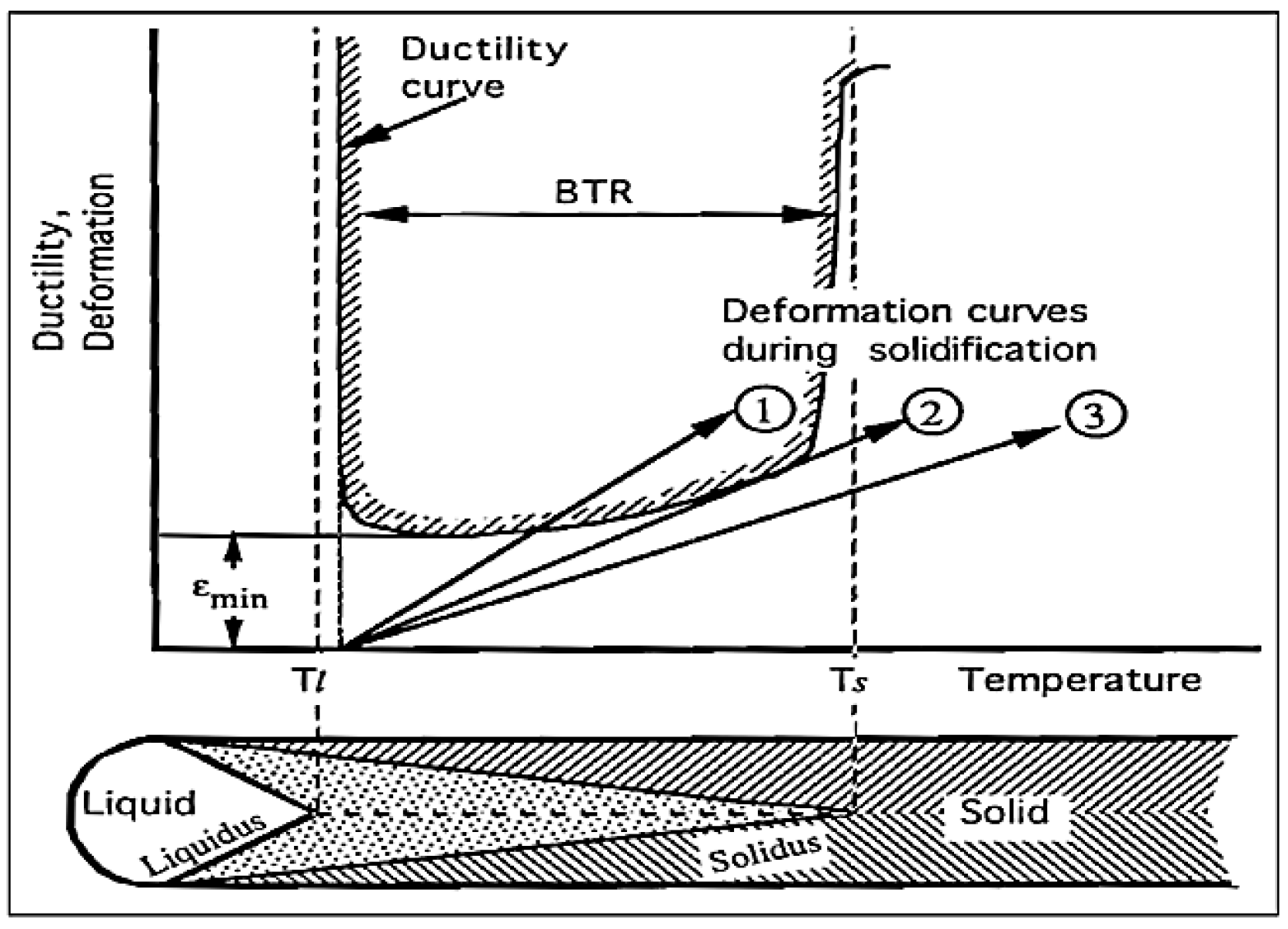
During a fusion welding process and in the last stage of the solidification process of the welded material, a low melting point will exist, causing the formation of some segregation between the resulting dendritic grains and leading to some liquid films between the dendrite interface. This formation of a liquid film with solid co-existence is known as the Brittle Range Temperature (BTR), where the mechanical strength of the material and ductility can be very low to handle the resulting built-up stress–strain at the same time due to metal solidification shrinkage and thermal contraction.
Figure 1 shows the BTR region on the weld line and it is within the mushy zone of the weld pool, and if the strain is higher than the minimum strain (critical strain), the crack will exist in the weld line like arrow (1), while arrows (2 and 3) are out of the BTR region and the crack is not forming [
43].
Solidification hot cracking originates during the final stages of solidification when a metal is in a partially liquid state. Most alloys cool through a solidification range where solid crystals, called dendrites, coexist with liquid metal in a “mushy zone”. As these dendrites grow, they push impurity elements like sulfur and phosphorus into the remaining liquid. This segregation process enriches the liquid between the solid grains.
These impurity-rich liquids form thin, weak films along the boundaries of the new solid grains. As the metal part cools and contracts, it creates tensile stresses that pull the structure apart. Because the solidifying grain structure has low ductility, it cannot stretch to accommodate these strains, and the weak liquid films are pulled apart. A crack forms if there is not enough liquid metal to flow in and heal the separation.
The main causes leading to cracking defects are high cooling rates in the weld metal owing to high welding speeds, high travel speeds or high currents, high thermal conductivity, incompatible thermal expansion coefficients between the weld metal and the base metal, and using the wrong filler metal. Moreover, if cooling is too rapid, solute diffusion is limited. There is, therefore, an excess of solute at the interface, which can cause the phenomenon of constitutional supercooling [
44].
YU et al. [
45] claimed in their work that the austenitic stainless steel 304 has good resistance to solidification owing to the L + δ + γ reaction, which helps resist solidification cracking by forming continuous γ to bond δ-ferrite dendrites together early during solidification and consuming the interdendritic liquid to make it less continuous and, hence, less able to separate the dendrites.
Hot (solidification) cracking in austenitic stainless-steel welds is strongly affected by alloy composition (especially solidification mode), impurities, microstructure, and weld restraint; modern tests consistently show 304/304L and 316/316L are relatively resistant, whereas fully austenitic 310/310S and 308/310-type fillers are much more susceptible to hot cracking [
46,
47,
48,
49]. A key mechanistic distinction is that 304/316 generally solidify in FA mode (primary δ-ferrite, then austenite), giving isolated interdendritic liquid and early bonding, while 310-type alloys solidify in A mode (primary γ), leaving continuous liquid films and long straight grain boundaries that favor cracking.
5.2. Liquation Cracking (in the Heat-Affected Zone—HAZ)
Liquation cracking occurs in the heat-affected zone (HAZ), specifically in the partially melted zone (PMZ) immediately adjacent to the fusion boundary. Liquation cracking is more accurately associated with incipient melting along grain boundaries, segregation of low-melting constituents, constitutional liquation of precipitates, and thermal strain during welding.
As the alloy cools, the different phases begin to solidify at their specific temperatures. If the cooling rate is too fast, the temperature of the alloy may drop below the solidus temperature of one of the phases before the other phase solidifies. This causes the solidification to occur in two steps: the first phase solidifies and the second one liquidates. The liquid phase that forms as a result of liquation has a higher volume than the solid phase, leading to high internal stress, which can cause cracking. Liquation cracking is most commonly found in alloys that contain eutectic compositions, which are alloys that have a specific composition that results in the lowest possible melting point. The low-melting-point phases around the grain boundaries are considered a source of liquation crack formation [
49,
50,
51], inclusions at grain boundaries in the HAZ, and finally crack propagation. Liquation cracks initiate at the melt pool’s boundary. Solidification shrinkage and thermal contraction cause weld metal to compress during cooling. Weld metal is weak and prone to cracking when subjected to tensile stresses/strains.
6. Factors Influencing Hot Cracking Susceptibility During TIG Welding
Stainless steel is a versatile and commonly used material. Stainless steel is an alloy made largely of iron, with various other elements added to enhance its properties, such as corrosion resistance and strength. The key elements in stainless steel include iron, chromium, nickel, molybdenum, carbon, manganese, silicon, and nitrogen. Each element affects the steel’s properties. Each of these factors contributes significantly to the performance of stainless steel.
6.1. Influence of Alloying Elements on Hot Cracking Susceptibility During TIG Welding
Based on previous works, sulfur, phosphorus, boron, niobium, titanium and silicon were identified as most detrimental for welding due to their low solubilities in the molten weld pool, which allow the formation of compounds with low-melting eutectics. It appears that cracks formed at the end of solidification are always connected to the presence of low-melting-point elements that promote the formation of a liquid film persisting into the final solidification phase. Thus, the addition of elements such as sulfur, phosphorus, or boron at grain boundaries can have a detrimental effect on resistance to solidification cracking.
6.1.1. Sulfur and Phosphorus
By working on 48 stainless steels, Kujanpaa et al. [
40] demonstrated that the effect of sulfur is not linear with its concentration (its effect does not worsen beyond 0.02% by mass), and that to rule out the risk of hot cracking, the sum of sulfur and phosphorus contents must be less than 0.01% by mass. By lowering the solidus temperature, sulfur also influences the rate of disappearance of the liquid towards the end of solidification. The disappearance kinetics of the liquid is slower as the sulfur content is high, which increases the risk of embrittlement. Many authors reported the deleterious effect of sulfur on resistance to hot cracking welds. This element acts through micro-segregation. Sulfur is strongly rejected in the liquid during the solidification of austenite, rapidly lowering the melting point of the interdendritic liquid.
Matsuda et al. [
52] established that sulfur is 1.8-times more harmful than phosphorus with respect to hot cracking for a low-alloy steel made of chromium (0.55% by mass) and molybdenum (0.25% by mass). Brooks et al. [
53] showed that phosphorus and sulfur have different roles depending on the mode of primary solidification. For primary austenitic solidification, they reduce the ferrite content and, therefore, have a harmful role with respect to hot cracking. On the other hand, during ferritic solidification, they promote the appearance of ferrite. In this case, the role of these elements with respect to hot cracking depends on the final amount of ferrite. Minimizing P and S impurities can reduce solidification cracking susceptibility of fully austenitic 310-type weld metals to levels comparable with type 304. New techniques used in the fabrication of steel and refining industries have been improved to control alloying elements and limit detrimental impurities in metals. Impurity elements such as sulfur, phosphorus, and minor alloy elements such as silicon and titanium can be hazardous for materials by promoting cracking [
54,
55].
Almomani et al. [
56] confirmed in their study on 310 ASS that the sulfur (S) and phosphorus (P) combine with iron to form low-melting compounds, which, as a result, can form low-melting eutectics, segregating at the austenitic grain boundaries during solidification. Hence, in line with the literature, adequate control of S and P to less than 0.002%, and Si changed from 1.5 to 2.5%, was found to be key in minimizing the susceptibility of 310S welding joints to hot cracking. The presence of sulfur (S) and phosphorus (P) in stainless steels, particularly in austenitic grades like 310S, can significantly increase the susceptibility to hot cracking. These impurities can form low-melting compounds with iron, leading to segregation at grain boundaries during solidification. This segregation can result in cracks, especially in the heat-affected zone (HAZ) of the weld metal. To mitigate these risks, it is recommended to maintain sulfur and phosphorus levels within critical ranges and to use materials with lower contents of these elements to avoid hot cracking. The FCC structure disturbs rapid diffusion of impurity elements (low-melting elements such as S and P) in stainless steels [
57,
58]. The segregation tendency of impurity elements along weld metal grain boundaries increases the volume fraction of liquid films coating the grain boundaries at the end of solidification. An increase in the volume fraction of liquid films accelerates the propagation of solidification cracking.
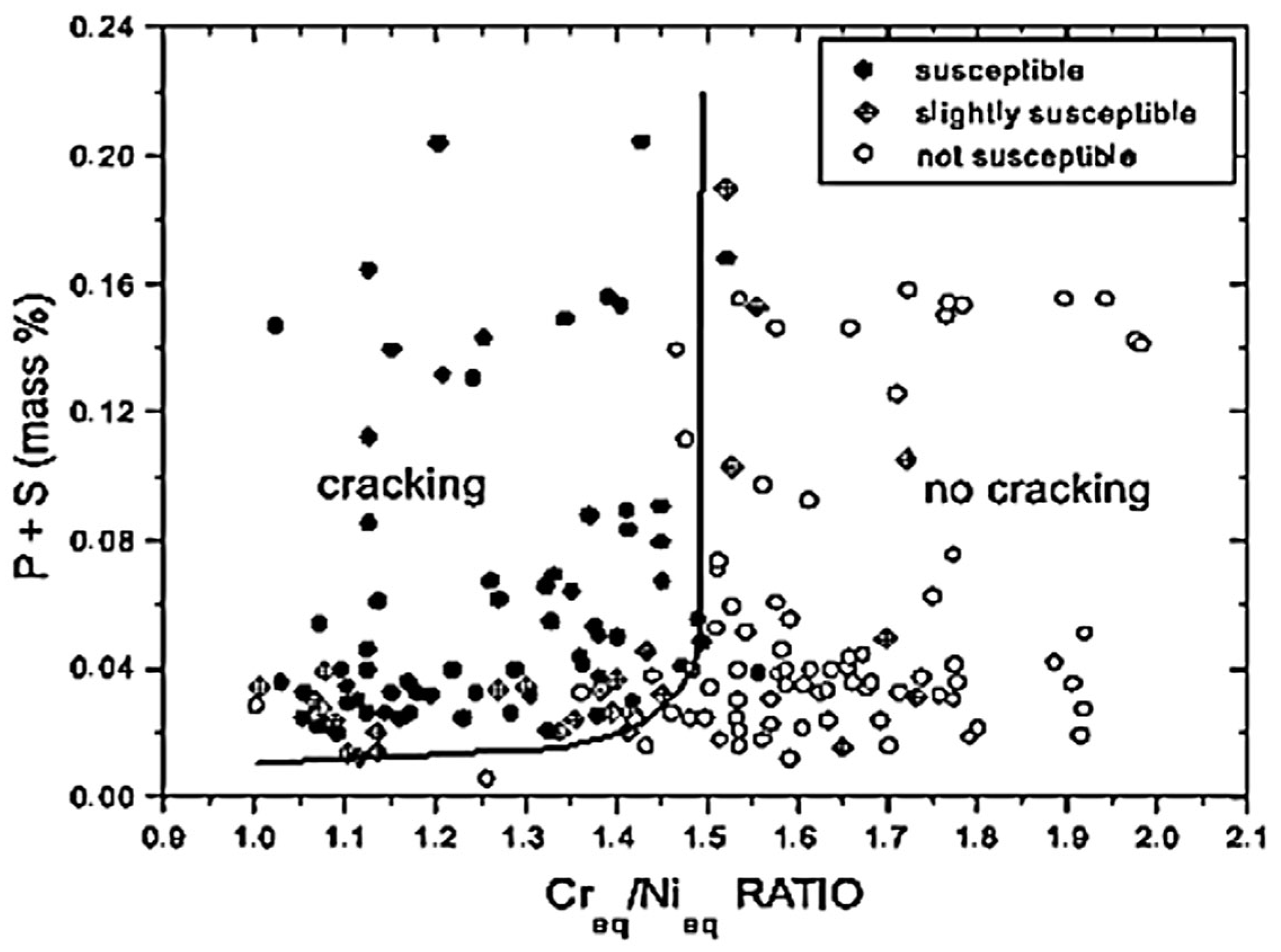
Kujanpaa et al. [
59] presented cracking data from the literature on a map of the P+S vs. Creq./Nieq. ratio. They used the Schaeffler equivalent formulae for Cr and Ni to calculate the ratio (see
Figure 2).
Huge efforts in the steel reefing industry limited the percentages of detrimental elements such as sulfur (S) and phosphorus (P) to prevent the occurrence of cracks, which can preserve the integrity of structures [
60].
6.1.2. The Role of Boron
Borides cannot be re-dissolved during the high-temperature process. Boron lowers the melting point of the eutectic film (the melting temperature is that of the eutectic formed, i.e., 1180 °C instead of 1300 °C), which is particularly detrimental to hot cracking. Tran van et al. [
61] claimed in their study, where seven AISI-type 316L austenitic stainless steels were used, that the higher the boron content, the more susceptible to hot cracking. If the boron content is above 35 ppm, the AISI-type 316L austenitic stainless is susceptible to liquation cracking near the fusion zone boundary, cracking along grain boundaries.
6.1.3. The Role of Silicon
Weld hot cracking occurred due to the silicon-enriched phase, which tends to form under primary austenitic solidification, and can be prevented by fully ferritic solidification, even with a silicon content of approx. 3.5% [
62]. Ogawa et al. [
63] determined from a study on austenitic steels that silicon has a similar effect to phosphorus and sulfur on hot cracking in welding. Sensitivity to cracking increases linearly with silicon content up to about 1.5 mass% [
63]. Kota et al. [
64] claimed in their work on the solidification crack susceptibility of 18%Cr stainless steel with various nickel concentrations that the specimens containing higher concentrations of carbon exhibited higher BTRs than those containing silicon. It is considered that the solidification segregation corresponding to the partition coefficient of carbon to the δ-ferrite phase induces an increase in cracking susceptibility. In addition, the formation of austenite during solidification reduces cracking susceptibility owing to the higher solubility of carbon.
6.1.4. The Role of Niobium
Lundin demonstrates that niobium segregates along the grain boundaries by forming a liquid film during solidification in a type-347 steel, which forms a eutectic NbC-austenite that can play an important role in the self-healing phenomenon of the material [
65]. The sensitivity to hot cracking in the melted area is largely accentuated when the content of niobium exceeds 0.3% by mass. Increasing Nb beyond ~0.3 wt% significantly increases hot cracking susceptibility in fully austenitic weld metal and HAZ, even when δ-ferrite is present. For Nb-stabilized grades like 347 or 304HCu, constitutional liquation of Nb-rich precipitates in the HAZ drives liquation cracking; however, careful control of Nb, C and δ-ferrite can restore good weldability [
66,
67]. Niobium additions (in weld metal or as powder) have a dual effect: excessive Nb increases hot cracking susceptibility.
6.1.5. The Role of Nitrogen
Since nitrogen is a marked austenite prone element, it tends to lead to a primary solidification structure in austenite and, therefore, promotes hot embrittlement during welding. The addition of nitrogen promotes the formation of an austenitic phase at high temperatures and keeps it at room temperature. Addition of N to 304-type weld metals can change solidification mode and, in some regimes, reduce solidification cracking by promoting favorable microstructures, but higher N plus high solidification rates tend to push toward primary austenite mode and increased cracking [
68].
6.1.6. The Role of Titanium
The results of the study conducted by Vignesh et al. [
69] show that titanium increases cracking in the fusion zone by 15 to 20 pct in the range of the Ti levels studied. There is a negative effect of titanium with respect to hot cracking of stainless steels. The titanium promotes the formation of ferrite due to its affinity with carbon and nitrogen and must, therefore, be taken into account in the Creq./Nieq. report.
6.1.7. The Role of Manganese
Manganese modifies the morphology of sulfides and tends to increase their melting point by preferentially forming MnS sulfides whose end-of-precipitation temperature is higher than that of, for example, FeS or CrS sulfides. The risk of cracking is lower when the manganese/sulfur ratio is high. High manganese contents prevent the risk occurrence.
The quantification of hot cracking susceptibility (HCS) for various specifications of types 304L and 316L stainless steels can be accomplished using the following formula advanced in [
70]:
For optimal results, it is advisable to maintain the chemical composition within the following parameters: sulfur content below 0.035%, nickel content below 1.0%, manganese content above 0.8%, carbon content below 0.15%, and a manganese-to-sulfur ratio greater than 35.
This hot crack sensitivity formula considers the complex interactions between various alloying elements and their influence on the material’s susceptibility to hot cracking. The formula demonstrates that elements in the numerator (S, P, Si, Ni) increase hot cracking susceptibility, while elements in the denominator (Mn, Cr, Mo, V) improve hot cracking resistance. This quantitative approach enables engineers to predict and compare the relative hot cracking susceptibility of different steel specifications.
The calculated values depicted in
Table 3 of hot crack sensitivity for given specifications reveal significant variations between different steel grades. Results demonstrate that HCS for typical SA240-304L is found to be the lowest, while SA 312 (pipe) 316L exhibits the maximum hot cracking susceptibility.
Hot cracking susceptibility increases markedly when phosphorus and sulfur contents exceed 0.015%. The lowest HCS value of 0.053 is observed for compositions with minimal phosphorus and sulfur contents, directly illustrating the significant effect of P+S on hot crack sensitivity. As the combined phosphorus and sulfur content increases, the hot cracking susceptibility correspondingly increases.
Srikakulapu et al. [
71] recently conducted a study on a commercial material with low C high alloyed austenitic stainless steel (ASS), having C ≤ 0.03, Cr (18–20), Ni (10–15), and Mo (2–3) (wt. %), tested in single and multi-pass modes using the gas metal arc welding process. They used atom probe tomography (APT) and confirmed that the segregating elements such as sulfur, titanium and niobium are the main reason for weld metal crack occurrences. The results showed predominantly ~32 at. % S segregation at single pass at the opening crack, whereas the multi-pass weld metal crack consisted of ~28 at. % S, 14 at. % C, 0.4 at. % Ti and 0.4 at. % Nb. Also, they attest that the alloy is disposed for cracks owing to the absence of primary ferrite during solidification.
6.2. Welding Parameters
Numerous investigations have been carried out on the effects of welding parameters on microstructural and mechanical properties for similar weld joints of conventional 314 SS [
72,
73]. It can be concluded from the literature that a higher welding speed provides a faster cooling rate (low heat input), leading to a fine dendritic structure and subsequently improving the mechanical properties. However, this higher welding speed enhances the probability of solidification cracking and lack of penetration. Higher heat inputs and slower cooling rates can increase the risk of hot cracking by enlarging the solidification temperature range and promoting columnar grain growth. According to Wang et al. [
47,
48], a welding speed range from 0.5 to 2 m/min reduces hot cracking susceptibility drastically for grade 310 and 310S. However, the hot cracking susceptibility increases when the welding speed ranges from 1 to 2 m/min for 304.
6.3. Joint Design
Solidification-induced cracking of load bearing structures can be ascribed to design factors. When solidification shrinkage and thermal contraction of the weld joint occur, the surrounding solids are obstructed, leading to significant premature failures [
74]. In order to enhance the balance of productivity with the material’s desired crack resistance, the progress of the steel refining processes should be accompanied by a similar advancement in the field of welding. Solidification cracking as per the American Society of Materials (ASM) [
75] is a fracture caused by internal stresses that develop during cooling and post-solidification from an elevated temperature.
7. Characterization and Detection of Hot Cracking
7.1. Nondestructive Testing (NDT) Methods
Manufacturing sectors, particularly aerospace, automotive, and energy infrastructure, are demanding more sophisticated inspection technologies capable of detecting nucleating cracks that could lead to irreversible structural damage. The shift toward predictive maintenance strategies has further amplified the need for reliable crack detection systems that can identify defects before they compromise structural integrity. Aerospace and defense industries represent the largest market segment for advanced crack detection technologies, where component failure can result in significant safety risks and financial losses. The industry’s focus on preventing environmental disasters and maintaining operational continuity has led to increased investment in automated inspection technologies capable of detecting sub-millimeter defects. The safe pipeline integrity and offshore platform maintenance in the oil and gas industry constitute other major factors, requiring permanent, effective, and reliable assessment methods [
76]. Nondestructive testing (NDT) is a new potential technique used in early crack detection of structures in many power plant stations and industries to evaluate a material’s integrity without destroying the structures [
77,
78].
Eddy current testing (ECT) [
79], magnetic particle testing (MPT) [
80], penetrant testing (PT), radiographic testing (RT) [
81,
82], ultrasonic testing (UT), and Acoustic Emission Testing (AET) have been extensively utilized for the detection of metal cracks. Ultrasound testing (UT) is renowned for its proficiency in detecting subsurface anomalies; this technique relies on high-frequency sound waves to evaluate the internal structure of welds and materials [
83]. UT involves using a transducer that emits ultrasonic waves into the material, and the reflected waves are analyzed to detect flaws and discontinuities [
84,
85].
Radiographic testing offers unparalleled insight into internal structures. Commonly known as X-ray or gamma-ray testing, it uses penetrating radiation to create images of the internal structure of welds and materials. This technique offers detailed images of the welds, allowing inspectors to evaluate the quality and integrity of the welds [
86]. Radiographic testing is still one of the most fundamental volumetric methods used to detect internal weld defects in metallic structures, using X-rays or γ-rays [
87]. Conformable flexible DDAs (digital detector arrays) are designed to permit direct contact with the weld being assessed. Flexible DDAs can be bent around pipe welds of varying sizes, improving image quality and productivity relative to the film in pipeline inspection [
88].
The ECT technique is adept at detecting surface and near-surface imperfections.
ECT utilizes electromagnetic induction to generate eddy currents in the material, and any changes in conductivity due to defects result in detectable signals [
89]. Subsurface cracks in structural steels are detectable at depths of up to ~10 mm in 12 mm plates with optimized pulsed or swept-frequency probes [
90,
91]. Recent work on ECT for steel emphasizes the following: (1) better sensitivity to small/deep cracks, (2) orientation-independent detection, and (3) array/robotic systems with advanced signal processing. Surface cracks in steels can now be detected down to tens to hundreds of micrometers in depth/width using AMR/TMR sensors and optimized low-frequency excitation [
92,
93,
94].
Nowadays, advanced signal processing (ECPT, chirp features, neural networks) and arrays/robotics are turning ECT into a high-resolution, quantitative, and automatable method for steel crack detection and sizing [
95,
96,
97]. Magnetic particle testing is a surface-based NDT method used to detect surface and near-surface defects in ferromagnetic materials. The process involves applying magnetic particles to the surface of the weld, and the presence of defects creates magnetic fields that attract the particles, making the defects visible [
98,
99,
100]. Acoustic Emission Testing (AET) offers real-time monitoring capabilities during welding. This real-time monitoring allows inspectors to detect any anomalies or deviations from expected weld quality as they occur. Acoustic Emission Testing is a passive NDT method that detects and analyzes acoustic signals emitted by materials when subjected to stress or deformation [
101].
AET is highly sensitive to micro-crack initiation, detecting changes well before macroscopic failure [
102,
103,
104,
105,
106]. It provides continuous, passive, real-time monitoring over large areas (bridges, rails, pipelines, landing gear, insulated piping) with relatively sparse sensors [
107,
108,
109]. Neural network localization with multi-sensor feature chains predicts crack coordinates on a steel plate with about 82% more accuracy than classical triangulation [
110].
Quantitative relationships between AET energy/counts and crack length or crack growth rate are increasingly demonstrated for structural steels, stainless steels, and coated systems [
111]. Overall, recent work shows AET evolving from qualitative “event counting” to a quantitative, noise-robust method for early crack detection, localization, and crack growth characterization in steel and its alloys.
Phased-array ultrasonic testing (PAUT) has emerged as a versatile and advanced nondestructive testing (NDT) technique with widespread applications across various industries, particularly in manufacturing. PAUT is extensively utilized in the manufacturing sector for weld inspection. Its ability to generate detailed and accurate images of welds helps in identifying and characterizing weld defects such as cracks. This ensures the integrity of welded structures, contributing to the overall safety and reliability of manufacturing processes. PAUT has proven to be an invaluable asset in the manufacturing industry, offering precise and efficient inspection capabilities. Its applications range from weld inspection to the examination of aerospace components, composite materials, and pressure vessels, contributing significantly to the quality assurance and safety standards in industrial processes [
112,
113,
114]. In infrared thermography testing, variation in the temperature of the surface of the object can be visualized from the thermal image of an object. Deviations from normal temperature can be detected. Temperature differentials with time are related to the heat flow pattern and can be used to detect cracks [
115]. Computed tomography (CT) has emerged as an invaluable tool for investigating internal structures and defects in materials without compromising sample integrity. Crack lengths were measured in every solder joint across all eight sensor packages. The expected solder lifetime is then calculated from the crack propagation speed [
116]. The liquid penetrant testing (LP) method is defined as a physical–chemical NDT procedure designed to detect and expose surface cracks in nonporous materials.
NDT techniques face the challenge of adapting to the unique properties of these materials. For instance, the anisotropy of crystalline materials may affect the propagation path in ultrasonic testing and the attenuation characteristics in radiographic testing, necessitating the development of more advanced algorithms and calibration techniques to ensure accuracy in the detection application of new crystalline materials. Utilizing and merging machine learning (ML) and artificial intelligence (AI) into NDT processes facilitate the diagnosis of welding crack defects. These technologies deal with a huge amount of information, facilitating the predictive capabilities of NDT.
Table 4 depicts the scope of use of each NDT technique, including its advantages and disadvantages.
7.2. Hot Cracking Tests in Welding
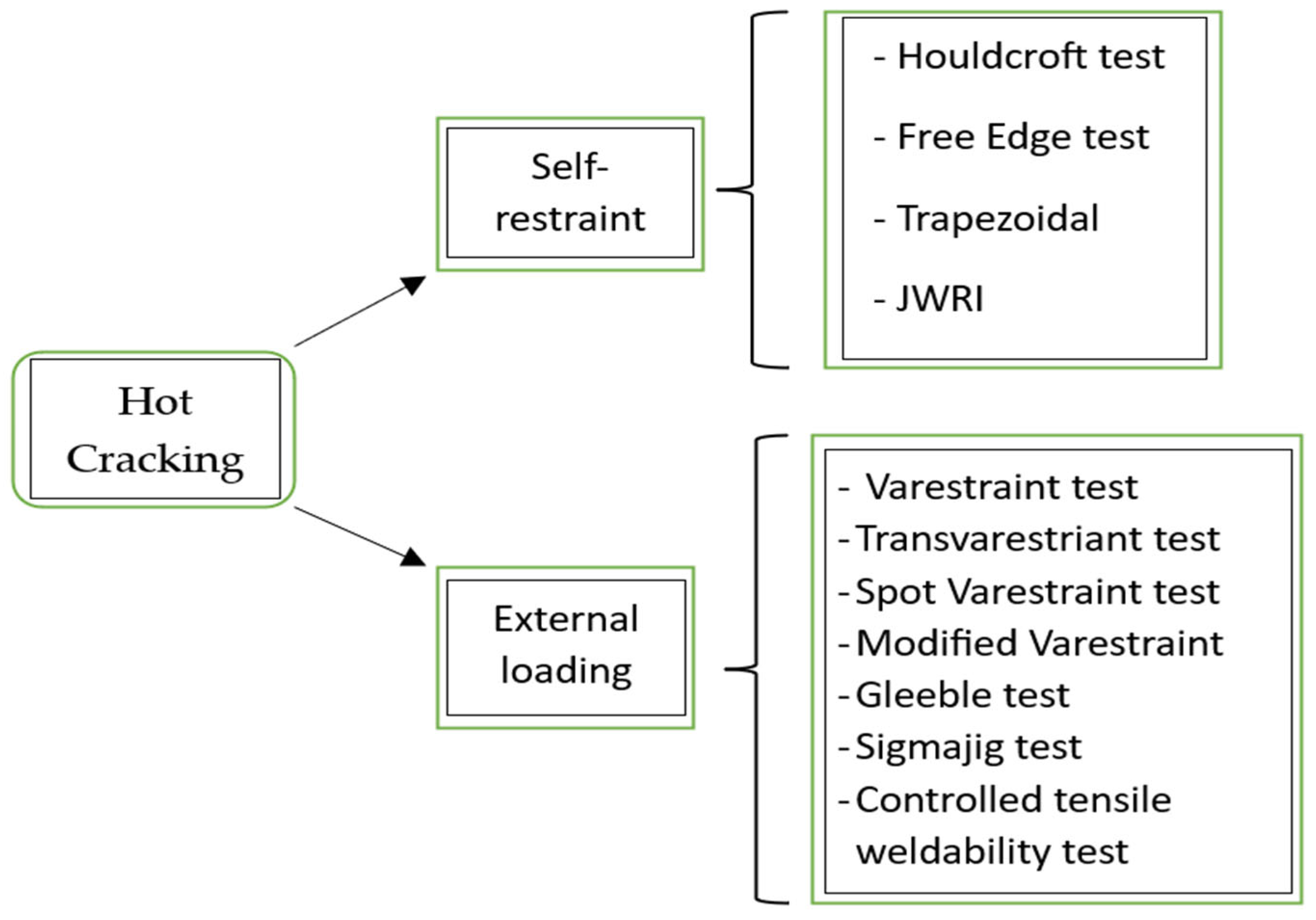
Weldability is defined as the ability to join materials without prominence of harmful defects such as cracks and with soundness weld joints. Welding tests are used to assess the weld joint capabilities in order to select different materials in similar or dissimilar welding and to classify the testing of various welding process methods, different filler materials, fluxes, shielding gases, and welding parameters. More than 140 hot cracking test procedures have hitherto been developed and documented for determining hot cracking resistance. They are divided into around 95 different self-restraint and 45 externally loaded hot cracking tests with diverse process variants [
117,
118,
119,
120,
121]. The characterization of the sensitivity to hot cracking is performed via metallurgical examination of the cracked zone in terms of number, maximum length and cumulative length of cracks. This test also makes it possible to classify materials with respect to their sensitivity to hot cracking and determine a hot cracking criterion by identifying the conditions of the appearance of defects.
These families of tests allow for the assessment of hot cracking (see
Figure 3) [
122,
123,
124]:
- -
Self-clamping tests: The specimen is clamped during welding. The strains to cause cracking are provided by the restraint of the weldment due to its own contraction.
- -
Tests with mechanical stress: A special device is used to apply an external load to the specimen. The strains to cause cracking are provided by external loading on the test specimen. These tests are reproducible and allow for comparisons between materials. External loading tests (Varestraint, Gleeble, Sigmajig, Murex) are welding tests with mechanical stress applied to the specimen by a specific device. Thermal simulation tests (Gleeble test), which require sophisticated equipment, are likely to reproduce thermal welding cycles on tensile specimens [
125].
7.2.1. The JWRI
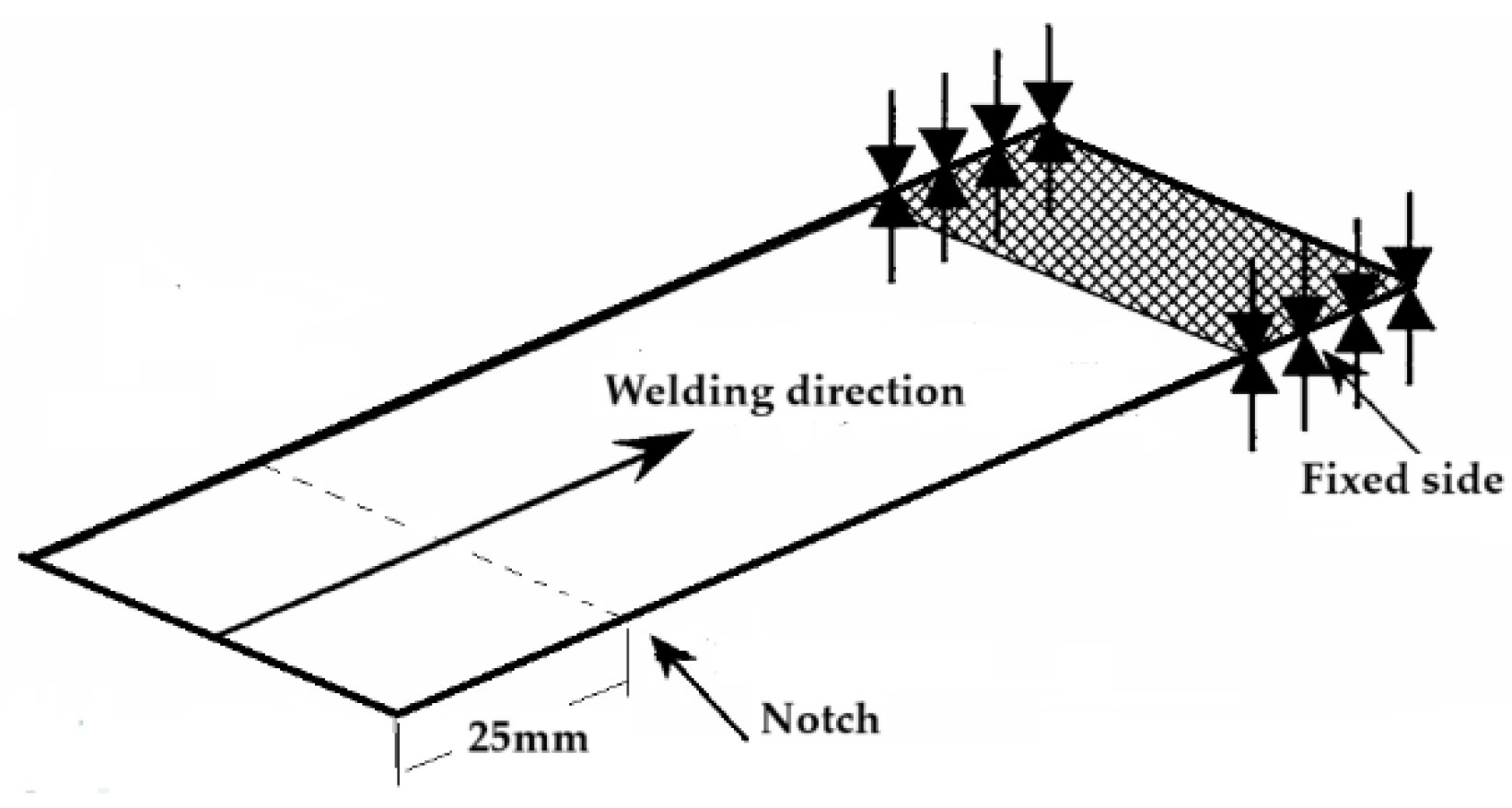
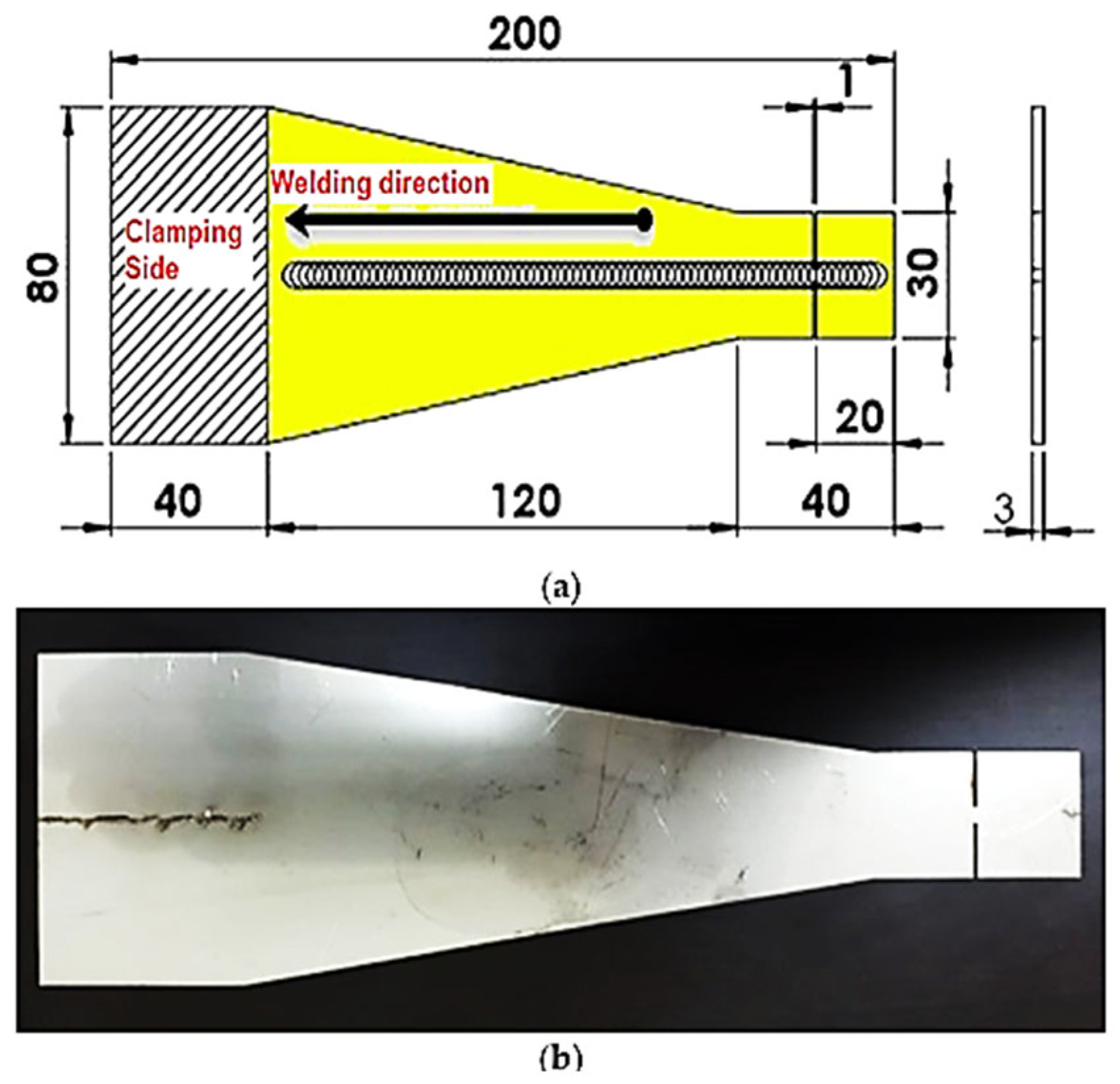
The Joining and Welding Research Institute (JWRI) developed a test to establish a hot cracking criterion more easily than with the Varestraint test. A test that can be numerically simulated in two dimensions is currently being developed at the JWRI. The JWRI test involves creating a fusion line on a rectangular coupon [
126]. The flat specimen is fixed at one end while the other end is free. The fusion line is initiated at the edge of the specimen (free end), as shown in
Figure 4. In the tarting test, the fusion zone passes through the width reduction (notch in the coupon). At this moment, the 25 mm long appendix detaches while an overheated zone and an enlarged fusion zone are generated temporarily, which favors the initiation of an axial crack. Transverse displacements can cause longitudinal cracking of the weld bead during solidification. The risk of cracking increases if the width of the test specimen decreases. Similarly, if the welding speed or the power applied to the sheet metal increases, the plates are also more susceptible to cracking.
7.2.2. Trapezoidal Hot Cracking Test
Trapezoidal hot cracking tests are self-restrained specimens [
67,
127,
128]. The trapezoidal hot cracking test uses a plate whose plan view is a trapezoid; the weld runs from the narrow to the wide side, so restraint gradually increases along the bead. During welding, relatively higher weld stress will occur at the rear of the melt pool, perpendicular to the direction of the temperature gradient, as a result of thermal expansion produced along with the centerline of the weld bead. In the “Trapezoidal hot” cracking test, the arc started from the tab plate (narrow part), as shown in
Figure 5. When the fusion reached the bridge (ligament), the tab plate (tailpiece) fell, and a steady fusion continued on the test specimen. Then, the hot cracking defect appeared as soon as the bead was initiated. The crack stopped when the width of the specimen reached a critical width. The weld metal was strained in a direction transverse to the welding direction.
For austenitic stainless steels, the works show fully austenitic 310 as far more crack-susceptible than 304/3164. The solidification cracking rate, which represents crack length/weld length as an indicator, evaluates the crack susceptibility. They consistently show fully austenitic 310 as far more crack-susceptible than 304/316. Types 316 and 304 solidify in FA mode with δ-ferrite + austenite lead to better liquid feeding and lower cracking; 304 typically has more ferrite and, thus, the lowest susceptibility. On the other hand, 310/310S solidify as single-phase austenite (A-mode) with continuous interdendritic liquid films and strong segregation, leading to high cracking.
7.2.3. Houldcroft Fishbone Test
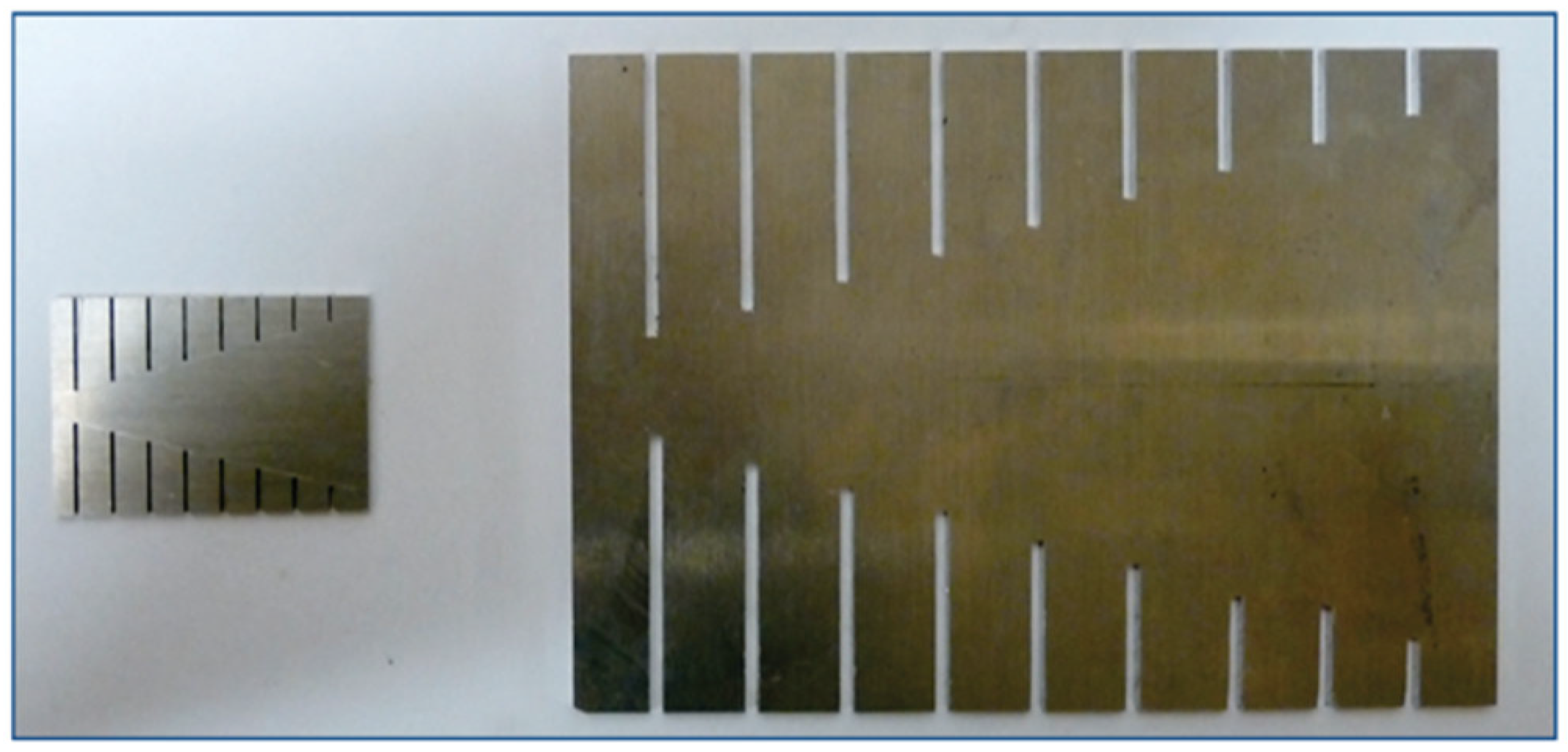
The fishbone test is very useful to test the hot cracking susceptibility of base metal with different filler materials, weld design, and welding variables. The fishbone test (see
Figure 6) is useful for selecting the filler material. This test method is mainly used for TIG welding and other similar welding processes. It is applicable for thin plates and sheet materials. Transverse stress built up by the progressive fusion weld, with serious saw cuts increasing saw depth. The saw depth is based on the thermal conductivity of the material. The weldability is measured by the extension of length of cracks throughout the specimen [
129].
The welding starts from the small saw cut to maximum saw cut distance to build stress. Susceptibility can be measured via the total extension of the crack to the total length of the specimen. This test can be performed with or without filler material using a thin plate with transverse slots; a bead-on-plate weld is run from a highly restrained region toward lower restraint. Cracking index = crack length/weld length [
130].
For stainless steels, recent work used Houldcroft on SS310 with TIG and ER310 filler; hot-cracking sensitivity is minimized by optimizing the current and argon flow and adding ultrasonic vibration, achieving 0% cracking and good hardness [
131].
7.2.4. The Varestraint
The Varestraint method can be classified into three types, which are longitudinal test, spot test, and transverse test. The Varestraint (variable restraint) test was developed by Savage and Lundin in 1965 [
132] to measure the susceptibility to hot solidification cracking of alloys. The Varestraint test uses a parallelepiped specimen held on a bending die. The Varestraint test is a comparative test. The Varestraint test allows one to compare the effect of different welding parameters on a given alloy or to compare the behaviors of different alloys with fixed welding parameters. Thus, the variables welding intensity, welding speed and sample thickness have an influence on the results given by the test. This test is known to cause hot cracking of a material, whatever its sensitivity to this phenomenon, by imposing adapted strain rates and, thus, to classify them based on their hot cracking sensitivity. The significance of this test is used for the analytic investigation of the hot crack sensitivity of fused base metal and the effect of specific alloying elements on this sensitivity and the basic mechanisms of hot cracking [
133].
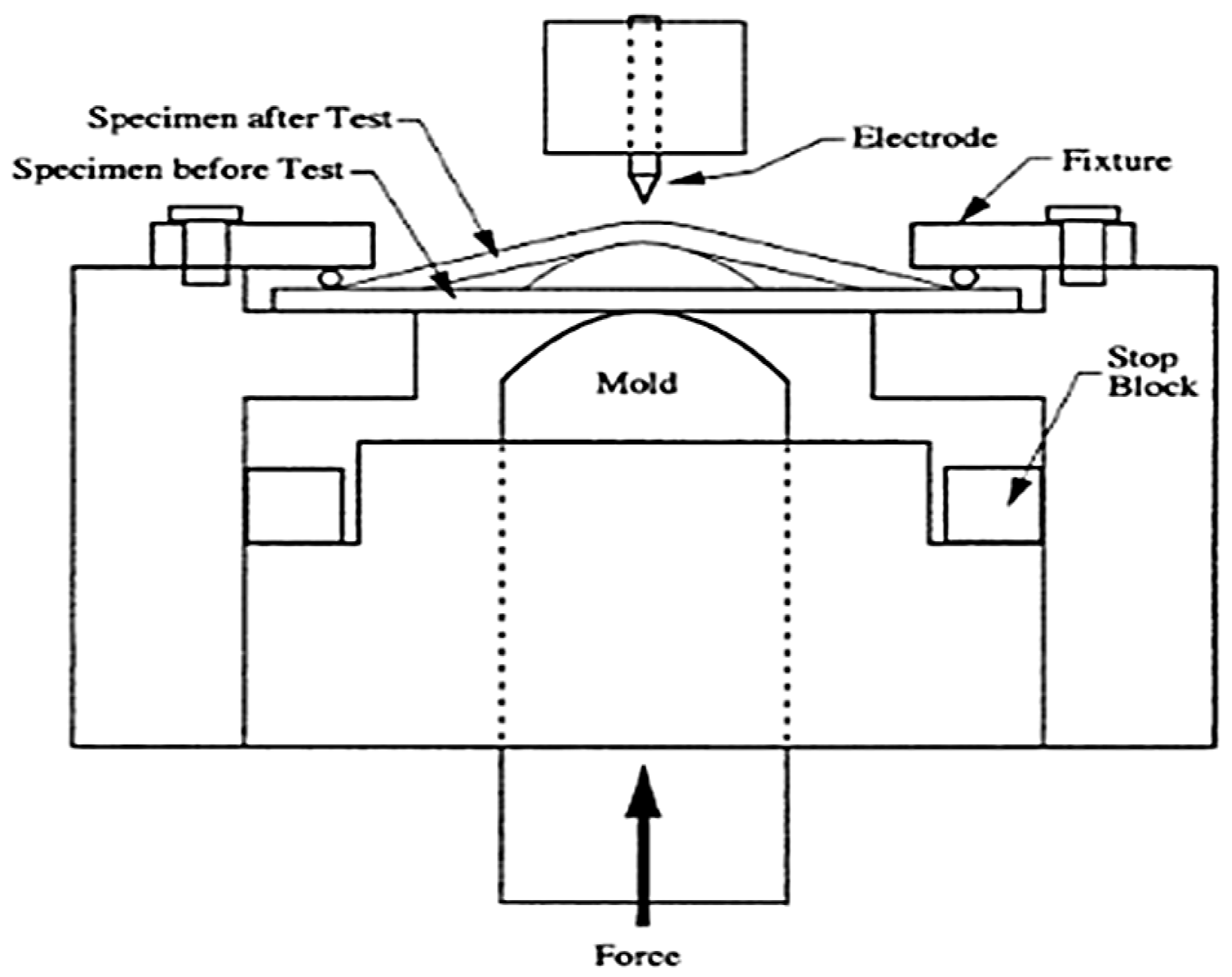
The spot Varestraint test (see
Figure 7) generates cracks in the ZAT. The technique developed by Lin et al. [
134] used both an “on-heating” and “on cooling” approach to quantify HAZ liquation cracking.
The Trans-Varestraint test [
136,
137] is a variant of the Varestraint test, which generates cracks only in the ZF. For fully austenitic weld metals, Varestraint tests showed susceptibility increases sharply when P > 0.015 wt% and S > 0.010 wt%; conversely, an extra-low-P/S 310S-type alloy (both <0.002 wt%) exhibited hot cracking resistance similar to type 304 [
138].
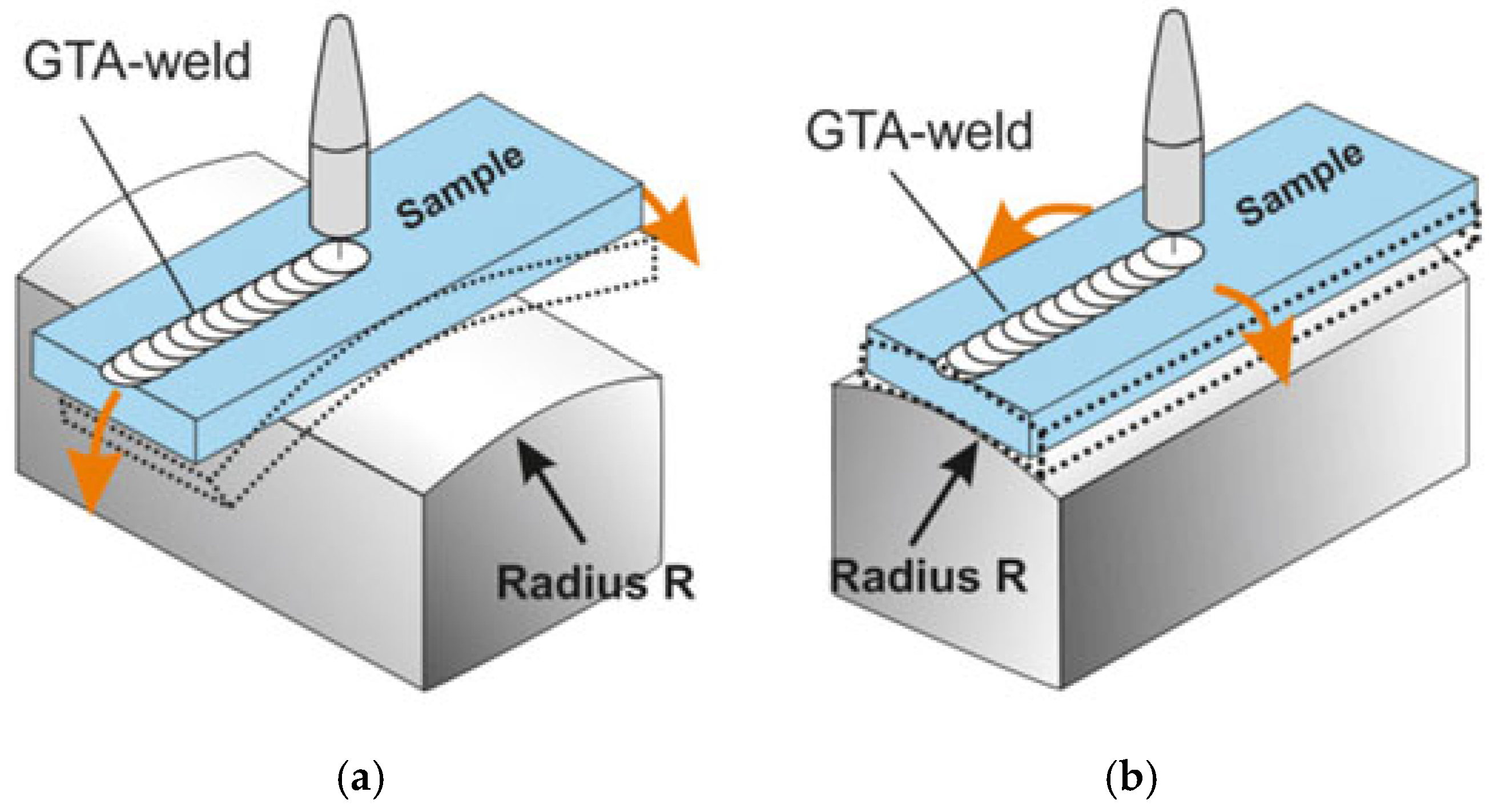
Varestraint (see
Figure 8a) and modified/Trans-Varestraint (see
Figure 8b) tests are standard ways to quantify weld hot cracking in austenitic stainless steels. For 304, 316 and 308/310-type alloys, they clearly separate relatively crack-resistant FA-mode grades from highly susceptible fully austenitic 310/310S and related fillers.
Trans-Varestraint testing allows for reducing the size of the specimens. Grades 304 and balanced 316/316L (and 308 fillers with some δ-ferrite) show comparatively short crack lengths and narrow BTR, while fully austenitic 310/310S and high-Ni weld metals exhibit large BTR and long fusion-zone cracks. Controlling P and S (and, for some alloys, Nb) can bring even 310-type steels closer to 304-like weldability, but without such control, Varestraint data consistently rank 310 ASS as more sensitive to solidification hot cracking than grade 316 ASS, followed by 309 and, finally, grade 304 ASS [
139].
Longitudinal and transverse Varestraint tests bend a weld bead to impose a controlled augmented strain; total crack length (TCL), maximum crack length (MCL) and sometimes brittle temperature range (BTR) are taken as indices [
140].
7.2.5. The MUREX Test
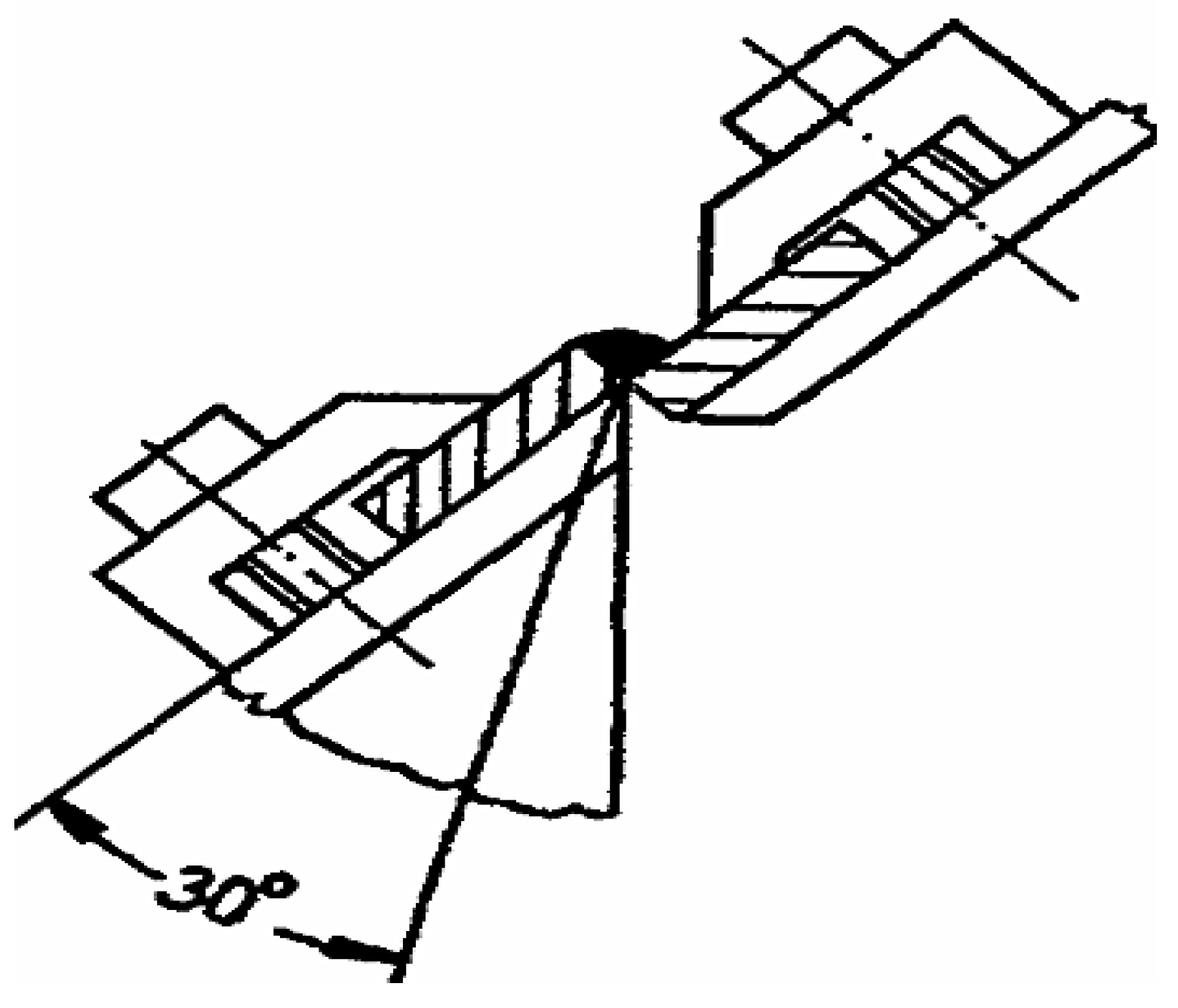
This test involves producing a filet weld between two small plates rigidly held by clamping flanges [
141,
142]. After initiation of the arc, one of the plates is rotated around the axis formed by the root of the weld. This rotation continues at a constant speed until the mobile plate has reached an angle of 30° (see
Figure 9). Several rotation speeds are possible. The cracks obtained are longitudinal cracks of solidification whose initiation depends on the strain rate. The operation of the test is carried out by measuring the length of cracks.
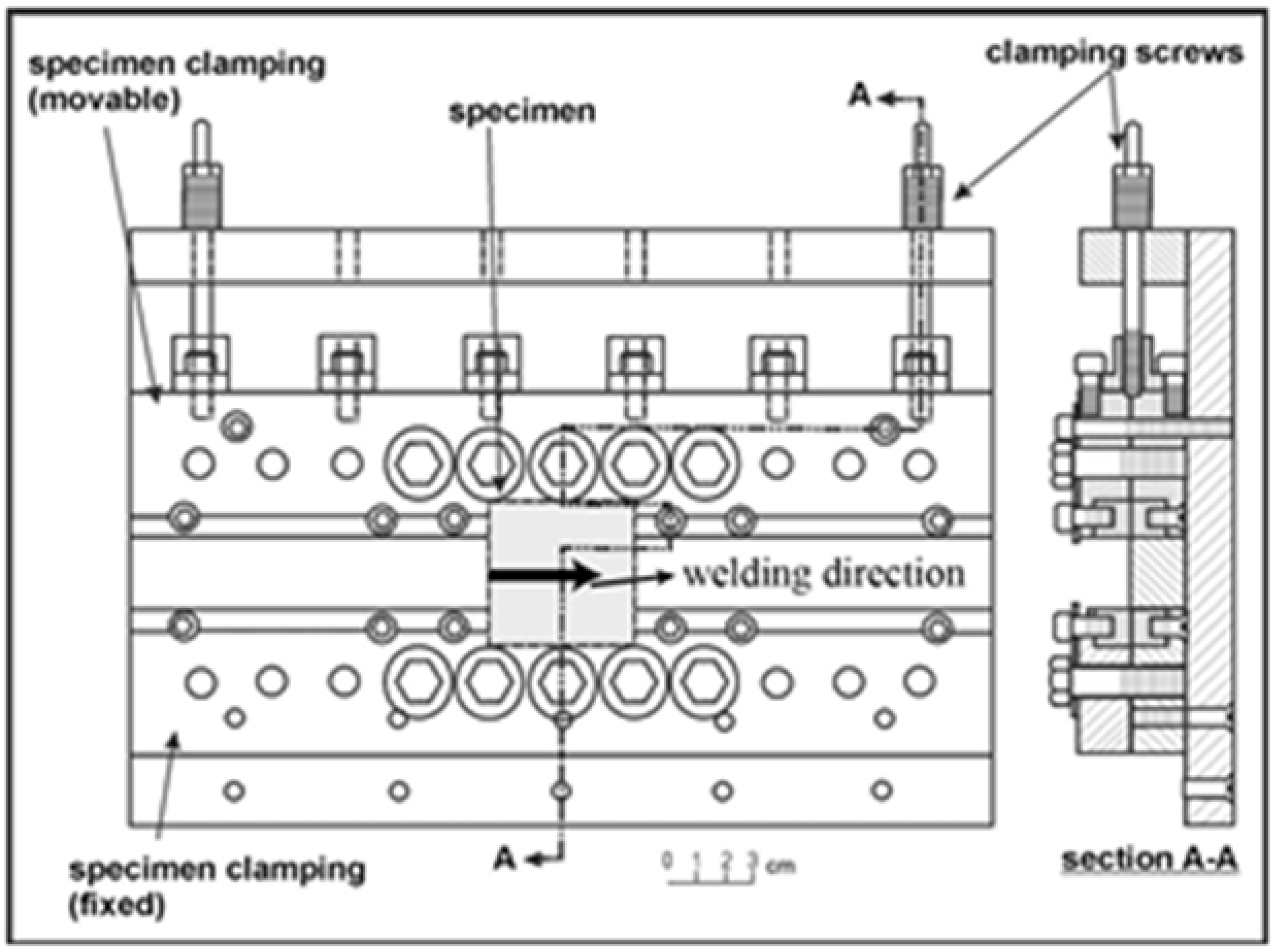
7.2.6. CRW Hot Cracking Test
Solidification cracking susceptibility was studied by means of the newly developed controlled restraint weldability (CRW) test shown in
Figure 10, proposed by Coniglio et al. [
143].
7.2.7. Butterfly Hot Cracking Test
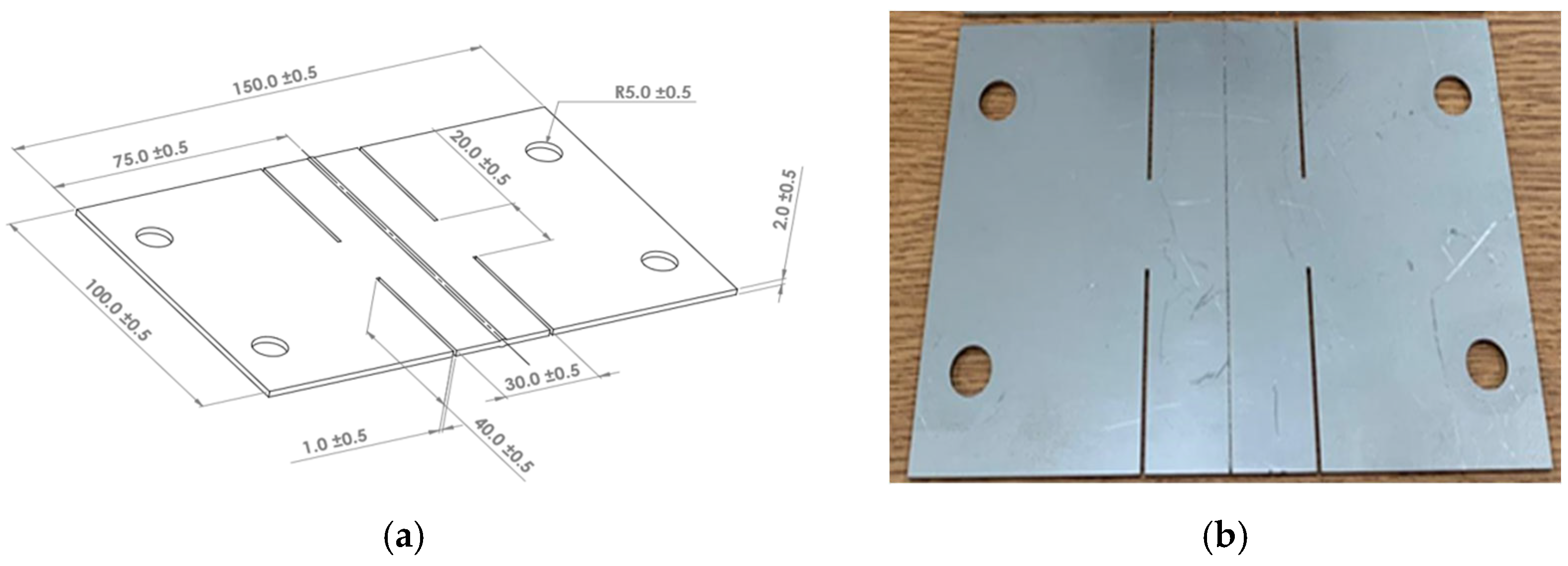
The tests presented use the same principle as CRW tests but with a more compact specimen shape, requiring less material, and are easier to machine. The transverse force is applied by bolts at the bores, and the notches concentrate the stress in the central zone.
Figure 11a,b describe the shapes used for preliminary tests. For a given alloy, the principle of the test is to find the level of external stress required to initiate and then stop a solidification crack during a TIG weld [
144]. The force applied to the specimen is measured continuously as the torch advances. At the beginning of the TIG torch movement, the experimental setup is similar to that of a self-clamped JWRI test. Also, the distance between the notches (30 mm) allows for the monitoring of any potential crack initiation. Then, as the torch advances towards the area subjected to the transverse force, the local thermomechanical conditions may be sufficient to allow crack propagation.
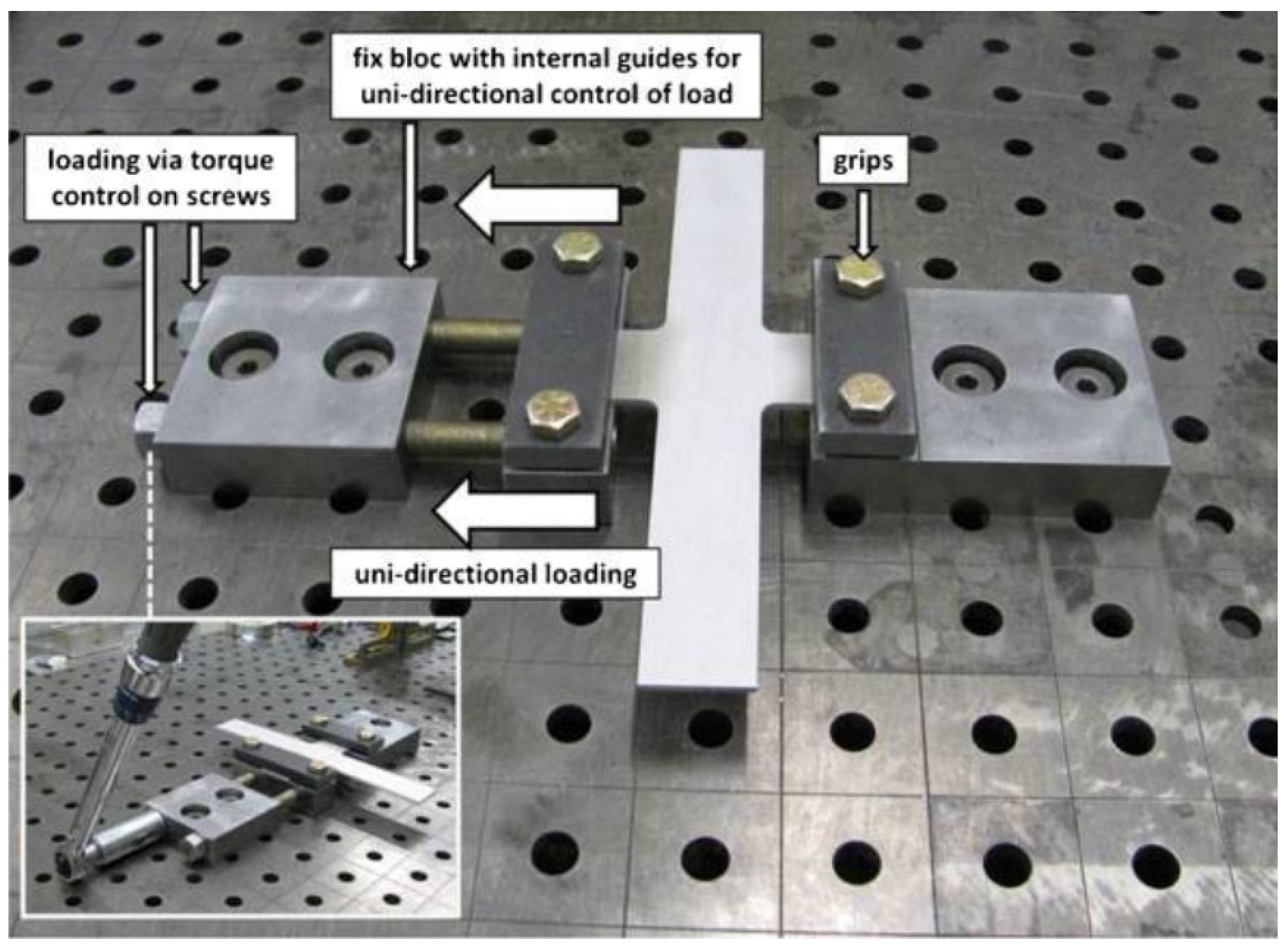
7.2.8. Sigmajig Test [145]
The Sigmajig test is also a test with external solicitation (see
Figure 12). Its purpose is to determine the level of prestress for which a central crack is created at the end of the melt. It consists of applying prestress on a sample before welding (the loading system is of course calibrated). After loading, welding is carried out with fixed parameters for the entire series of tests. The prestress is increased with each new test until cracking starts. For a square-sheet GTA weld with pre-applied transverse stress, originally developed for type 304 and 316 thin sheets, threshold stress at crack onset ranged from 103 to 365 MPa. For Sigmajig, as for other test tests, the same trend arises, where fully austenitic 310/308-type weld metals are significantly more hot-crack-susceptible than ferrite-containing 304 and conventional 316.
7.2.9. Transverse Motion Weldability (TMW) Testing
The TMW test is newer. During the MVT test, the specimens can be bent not only longitudinally to the welding direction, as in the original Varestraint test, but also transversely. Externally loaded weldability testing is used to rank solidification cracking susceptibility [
146]. It has been applied directly to austenitic stainless steels, including 304L, 316L, and 310, and its results align well with classic Varestraint data.
Lap-weld configuration: The lower sheet is driven transversely during welding to impose tensile strain in the mushy zone and trigger cracking.
Two variants are used: one-speed (crack initiation focus) and two-speed (crack propagation). Susceptibility is evaluated from the transition range of transverse speed between no cracking and full cracking; lower transition V indicates higher susceptibility. In a systematic study on austenitic, ferritic and duplex steels, 304L and 316L were the least susceptible, while 310 was “much more susceptible” to solidification cracking.
Both one-speed and two-speed TMW variants show that grade 310 is more prone to both crack initiation and propagation than that of 316L grade, followed by grade 304L. TMW results show that 304L/316L solidify in columnar δ-ferrite primary solidification (FA mode) with discontinuous, isolated interdendritic liquid, allowing early bonding between dendrites. However, grade 310 solidifies in fully austenitic (A-mode) solidification with continuous liquid films between γ dendrites, preventing early bonding and promoting cracking. Quenching during welding confirmed that skeletal/lacy δ in 304/316 forms after solidification and does not control cracking resistance; mushy-zone liquid continuity is key [
147].
Since fully austenitic 308/310-type fillers solidify similarly to 310, TMW results for 310 strongly imply higher cracking susceptibility for fully austenitic 308/310 weld metals than for balanced 304L/316L welds. TMW testing clearly shows that grades 304L and 316L exhibit low solidification cracking susceptibility, whereas 310 (and, by extension, fully austenitic 308/310 weld metals) is much more crack-prone, due to continuous interdendritic liquid and coarse γ dendrites in the mushy zone.
To evaluate and moderate this risk, a wide range of hot cracking test methods and estimation techniques have been developed. These methods are essential for the selection of materials, optimizing welding parameters, and understanding the interaction between material composition, welding process, and restraint conditions that lead to cracking. The most widely used tests include the Varestraint and Trans-Varestraint tests, Houldcroft (fishbone) test, self-restraint and externally loaded tests, and advanced in situ and modeling approaches.
Multiple weldability tests such as Varestraint, TMW, and trapezoidal hot cracking tests have been used to quantify and compare susceptibility in these grades and to explore the effects of welding speed, impurity level, and minor alloying additions.
Table 5 summarizes some of the hot cracking tests, categorizing self-strained tests and externally loading tests.
8. Mitigation Strategies for Hot Cracking During TIG Welding
Crack mitigation refers to the strategies and techniques employed to prevent the propagation of cracks and to enhance the damage tolerance of materials.
Controlling the cooling rate of the weld: This can be achieved by slowing the welding speed, reducing the travel speed, or decreasing the current. Additionally, preheating the base metal or using post-weld heat treatment can help slow the cooling rate and reduce the stress generated in the metal. Optimized welding parameters (heat input, speed, pulsed current, electromagnetic/ultrasonic vibration) can significantly reduce hot cracking susceptibility, even in relatively crack-prone grades such as 310 [
148].
The shape of the weld cross-section plays a crucial role in hot crack susceptibility. A weld with a large depth-to-width ratio (deep and narrow) promotes the formation of columnar grains perpendicular to the weld centerline. This arrangement is particularly susceptible to hot cracking because the liquid film is concentrated in a smaller area, increasing the stress intensity.
Managing restraint: This includes reducing the amount of restraint on the welded joint by using proper joint design and welding techniques, such as using backstep welding or using a low-hydrogen welding process. Selecting the right welding process: Some welding processes, such as Gas Tungsten Arc Welding (GTAW) and gas metal arc welding (GMAW), are less prone to solidification cracking than others, such as Submerged Arc Welding (SAW).
Using adequate filler metal: It is advisable to use low-carbon steel variants of grades 302, 304, and 316, which limits the precipitation of chromium carbide during welding; the above-cited grades help avoid cracking. Grades. Moreover, controlling silicon in filler metal leads to the mitigation of the cracking occurrence in austenitic stainless steel. Fully austenitic 310/310S and 308/310-type fillers are much more susceptible to hot cracking. When welding austenitic stainless steels, use filler metals containing ferrite (normally 3–10% in weld metal) in the austenitic matrix. For cryogenic temperature uses, where a fully austenitic weld metal is required, use a filler metal containing low sulfur and phosphorus with increased manganese content. This includes selecting the correct filler metal. The filler metal should have similar properties to the base metal, such as similar thermal expansion coefficients. Weld at the correct temperature and ensure proper joint preparation. Use filler metals with specific compositions to counteract cracking (e.g., higher Mn, Si content in some cases). Control chemical composition (e.g., low S, P; balancing austenite and ferrite stabilizers). Strict limitations on the concentrations of harmful elements like C, P, and S in both the base material and welding consumables are essential. For ASS welds, controlling the volume fraction of ferrite has been reported to be vital to prevent solidification cracking.
Improving weld microstructure: Modifying the weld’s microstructure through alloying additions can significantly enhance its resistance to hot cracking. For carbon and low-alloy steels, elements like molybdenum (Mo), vanadium (V), and titanium (Ti) refine the grain structure, increasing strength and toughness. In stainless steels, adding ferritic-forming elements like chromium (Cr) and molybdenum (Mo) promotes the formation of ferrite, reducing the segregation of harmful elements at grain boundaries and refining the grain size.
Nondestructive testing (NDT): Regular inspections and NDT are crucial for early detection and timely remediation. Methods like liquid penetrant testing (LPT), magnetic particle testing (MT), and radiographic testing (RT) can detect both surface and subsurface cracks.
9. Outlook on Future Advancements and the Need for Continued Research
Recommendations are needed to guarantee the integrity and durability of the structures. Continued research and development on materials and welding techniques are essential to improve our ability to limit hot cracking and optimize the overall quality of welds. The areas to be developed are as follows:
- -
Standardization of hot cracking tests (geometry, strain application, imaging and metrics) across laboratories is incomplete in the quantification of hot cracking susceptibility in austenitic stainless steels.
- -
There are relatively few systematic comparisons of 308/309/310 fillers on 304/316 base metals under identical restraint.
- -
Integrated models that couple fluid flow, solidification micro-segregation, mushy-zone mechanics and evolving grain structure are still under development and only rarely validated against multiple test types.
- -
Optimization algorithms, such as neural networks tuned by swarm/whale and other related metaheuristics methods, excel in finding global optima (input welding parameters, heat input, filler metals…) in complex, multi-dimensional spaces; it is clear that modern algorithms are well suited for crack detection in steel and related materials. Metaheuristic algorithms refine the model’s parameters to better reflect the actual welding cracks. This approach helps in identifying the most critical factors for crack detection, ensuring that the model’s focus is on accurately capturing these key influences, leading to more precise quantification of weld cracks in terms of their occurrence and crack size. This approach provides a solid foundation for further research and practical applications in detecting and preventing cracks.
- -
Most existing work focuses on autogenous or simple butt welds; industrially relevant multi-pass, highly restrained geometries for thick sections are less thoroughly characterized.
10. Conclusions
Hot cracking sensitivity in welding represents a complex phenomenon influenced by multiple factors, including chemical composition, thermal cycles, and mechanical restraint. This work is a brief review on hot cracking austenitic stainless-steel welds. The following main key points summarize this study:
Understanding the relationships between alloying elements and hot cracking susceptibility enables engineers to make informed decisions regarding material selection and welding procedure development, ultimately ensuring the production of high-quality welded joints with enhanced structural integrity.
In the welding of austenitic stainless steels, the formation of an approximately 5% δ-ferrite phase is often used to decrease the susceptibility to solidification cracking.
The most widely used tests include the Varestraint and Trans-Varestraint tests, Houldcroft (fishbone) test, and advanced in situ and modeling approaches. The longitudinal Varestraint test (LVT) and Trans-Varestraint test (TVT) are widely used for the assessment of weld metal cracking susceptibility. The TVT is preferred over the LVT for studying weld metal cracking.
Controlling P and S (and, for some alloys, Nb) can bring even 310-type steels closer to 304, like weldability, but without such control, Varestraint test results confirm the high hot cracking susceptibility of ASS 310 in comparison to ASS 316 and ASS 304. Fully austenitic 310 and 308 weld metals are significantly more hot-crack-susceptible than ferrite-containing 304 and conventional 316.
To reduce the risk of hot cracking, preheating, using a suitable welding technique, selecting an appropriate filler material, controlling the welding parameters, and post-weld heat treatment can be effective strategies, and preheating the base metals before welding can help to reduce the temperature gradient across the weld zone and minimize the stresses that lead to cracking.
NDT inspection methods are continuously expanding, more efficiently and with greater accuracy. Future developments may focus on integrating real-time monitoring and control systems and robotic inspection during welding. These systems can detect micro cracks, allowing one to reduce the risk of damage. Techniques like phased-array ultrasonic testing, infrared thermography, and digital radiography become more sensitive, reliable, and faster. Familiarity with optimization and algorithm efficiency can significantly reduce computational inference and make neural networks more suitable for real-time applications in nondestructive testing in hot cracking tests.
Author Contributions
Conceptualization, S.M., T.K., and M.M.Z.A.; methodology, S.M., T.K., and M.M.Z.A.; software, S.M., T.K., and M.M.Z.A.; validation, S.M., T.K., and M.M.Z.A.; formal analysis, S.M., T.K., and M.M.Z.A.; investigation, S.M., T.K., and M.M.Z.A.; resources, S.M., T.K., and M.M.Z.A.; data curation, S.M., T.K., and M.M.Z.A.; writing—original draft preparation, S.M., T.K., and M.M.Z.A.; writing—review and editing, S.M., T.K., and M.M.Z.A.; visualization, S.M., T.K., and M.M.Z.A.; supervision, S.M., T.K., and M.M.Z.A.; project administration, S.M., T.K., and M.M.Z.A.; funding acquisition, S.M., T.K., and M.M.Z.A. All authors have read and agreed to the published version of the manuscript.
Funding
The authors extend their appreciation to Prince Sattam bin Abdulaziz University for funding this research work through project number (PSAU/2025/01/36715).
Data Availability Statement
The data used to support the findings of this study are included within the article.
Conflicts of Interest
The authors declare no conflicts of interest.
References
- Lippold, J.C.; Kotechi, D.J. Welding Metallurgy and Weld ability of Stainless Steels, 1st ed.; Wiley: Hoboken, NJ, USA, 2005; pp. 141–188. [Google Scholar]
- Lancaster, J.F. Metallurgy of Welding, 6th ed.; Woodhead Publishing Limited: Cambridge, UK, 1999; pp. 310–322. [Google Scholar]
- Lippold, J.C. Solidification behavior and cracking susceptibility of pulsed-laser welds in austenitic stainless steels. Weld. Res. Suppl. 1994, 73, 129s–139s. [Google Scholar]
- Serindağ, H.T.; Çam, G. Multi-pass butt welding of thick AISI 316L plates by gas tungsten arc welding: Microstructural and mechanical characterization. Int. J. Press. Vessel. Pip. 2022, 200, 104842. [Google Scholar] [CrossRef]
- Tabrizi, T.R.; Sabzi, M.; Anijdan, S.M.; Eivani, A.R.; Park, N.; Jafarian, H.R. Comparing the effect of continuous and pulsed current in the GTAW process of AISI 316L stainless steel welded joint: Microstructural evolution, phase equilibrium, mechanical. J. Mater. Res. Technol. 2021, 15, 199–212. [Google Scholar] [CrossRef]
- Hsuan-Han, L.; Hoyen, H.; Chen-Yen, K.; Weite, W. Solidification cracking nature and sequence of different stainless steels. J. Mater. Res. Technol. 2023, 25, 1030–1040. [Google Scholar] [CrossRef]
- Yamashita, S.; Yamauchi, R.; Saida, K. Influence mechanism of solidification mode on solidification cracking susceptibility of stainless steel. Weld. Int. 2022, 36, 693–704. [Google Scholar] [CrossRef]
- Brooks, J.A.; Williams, J.C.; Thompson, A.W. Microstructural origin of the skeletal ferrite morphology of austenitic stainless steel welds. Metall. Trans. A 1983, 14, 1271–1281. [Google Scholar] [CrossRef]
- Takayuki, O.; Atsushi, K.; Tatsumi, H.; Yasuhiro, H.; Kotaro, K. Effects of Alloying Elements on Solidification Structures in Cr-Mn-Ni Austenitic Stainless Steels. Iron Steel Inst. Jpn. 2006, 92, 372–377. [Google Scholar][Green Version]
- Apolinario, L.H.R.; Wallerstein, D.; Montealegre, M.A.; Urtiga Filho, S.L.; Torres, E.A.; Hermenegildo, T.F.C.; Santos, T.F.A. Predominant Solidification Modes of 316 Austenitic Stainless Steel Coatings Deposited by Laser Cladding on 304 Stainless Steel Substrates. Metall. Mater. Trans. A 2019, 50, 3617–3628. [Google Scholar] [CrossRef]
- Lippold, J.C.; Savage, W.F. Solidification of austenitic stainless steel weldments. II: The effect of alloy composition on ferrite morphology. Weld. J. 1980, 59, 48s–58s. [Google Scholar]
- Tsuk, T.; Hubert, M.; Messager, C. Revue de Métallurgie; EDP Sciences: Les Ulis, France, 1971; Volume 68, pp. 829–837. [Google Scholar]
- Quitzke, C.; Hauser, M.; Krüger, L.; Volkova, O.; Wendler, M. Solidification of Tungsten Inert Gas–Welded Austenitic Stainless Steel with 0.17 wt% N. Steel Res. Int. 2024, 96, 2400244. [Google Scholar] [CrossRef]
- Koseki, T.; Flemings, M.C. Solidification of undercooled Fe-Cr-Ni alloys. Part 2: Microstructural evolution. Metall. Mater. Trans. A Phys. Metall. Mater. Sci. 1996, 27, 3226–3240. [Google Scholar] [CrossRef]
- Mizukami, H.; Suzuki, T.; Umeda, T.; Kurz, W. Initial stage of rapid solidification of 18-8 stainless steel. Mater. Sci. Eng. A 1993, 173, 361–364. [Google Scholar] [CrossRef]
- Strauss, B.; Maurer, E. Die Hochlegierten chrom nickelstahle as nichtrostenden stahle. Naturwissenschaften 1920, 8, 812–814. [Google Scholar]
- Newell, H.D.; Fleischmann, M. Hot Rolled Metal Article and Method of Making Same. U.S. Patent No. 2 118 683, 25 May 1938. [Google Scholar]
- Schaeffler, A.L. Constitution diagram for stainless steel weld metal. Met. Prog. 1947, 56, 680. [Google Scholar]
- Seferian, D. Metallurgie de la Soudure; Dunod: Paris, France, 1959. [Google Scholar]
- De Long, W.T.; Reid, H.F. Properties of austenitic chromiun in austenitic chromium–manganese stainless steel weld metal. Weld. J. 1957, 37, 1–8. [Google Scholar]
- Hull, F.C. Delta ferrite and martensite formation in stainless steels. Weld. J. 1973, 51, 193–203. [Google Scholar]
- Hammar, O.; Svensson, U. Influence of steel com position on segregation and microstructure during solidification of austenitic stainless steels. In Solidification and Casting of Metals; The Metals Society: London, UK, 1979. [Google Scholar]
- Kujanpaa, V.P. Solidification cracking—Estimation of the susceptibility of austenitic and austenitic–ferritic stain less steel weld. Met. Constr. 1979, 12, 282–285. [Google Scholar]
- Brooks, J.A.; Thompson, W. Microstructural development and solidification cracking susceptibility of austenitic stainless steel welds. Int. Mater. Rev. 1991, 36, 16–44. [Google Scholar] [CrossRef]
- Kotecki, D.; Sievert, T.A. WRC-1992 Constitution diagram for stainless steel weld metal: A modification of the WRC-1988 diagram. Weld. J. 1992, 71, 171–178. [Google Scholar]
- Rajasekhar, K.; Harendranath, C.S.; Raman, R.; Kulkarni, S.D. Microstructural evolution during solidification of austenitic stainless steel weld metals: A color metallographic and electron microprobe analysis study. Mater. Charact. 1997, 38, 53–65. [Google Scholar] [CrossRef]
- Suutala, N.; Takalo, T.; Moisio, T. Ferritic-austenitic solidification mode in austenitic stainless steel welds. Metall. Trans. A 1980, 11, 717–725. [Google Scholar] [CrossRef]
- Jasper, R.; Ritwik, B.; George Vander, V.; Gururaj, B. A comprehensive study on solidification (hot) cracking in austenitic stainless steel welds from a microstructural approach. Int. J. Press. Vessel. Pip. 2021, 194, 104560. [Google Scholar] [CrossRef]
- Hiroshige, I.; Toshihiko, K. Solidification mechanism of austenitic stainless steels solidified with primary ferrite. Acta Mater. 2017, 124, 430–436. [Google Scholar] [CrossRef]
- Lippold, J.C.; Savage, W.F. Solidification of austenitic stainless steel weldments: Part III—The effect of solidification behavior on hot cracking susceptibility. Weld. J. 1982, 61, 388s–396s. [Google Scholar]
- Hossein, N.S.; Yildiz, M.; Saboori, A. Solidification behaviour of austenitic stainless steels during welding and directed energy deposition. Sci. Technol. Weld. Join. 2023, 28, 1–17. [Google Scholar] [CrossRef]
- David, S.D. Ferrite Morphology and Variations in Ferrite Content in Austenitic Stainless Steel Welds. Weld. J. 1981, 60, 63s–71s. [Google Scholar]
- Hammar, O.; Svensson, U. Proc. Conf. Solidification and Casting of Metals; Hunt, J., Ed.; The Metals Society: London, UK, 1979; Volume 401. [Google Scholar]
- Ku, S. Welding Metallurgy; John Wiley & Sons: Hoboken, NJ, USA, 2005. [Google Scholar]
- Suutala, N.; Takalo, T.; Moisio, T. The relationship between solidification and microstructure in austenitic and austenitic-ferritic stainless steel welds. Metall. Trans. A 1979, 10, 512–514. [Google Scholar] [CrossRef]
- Suutala, N. Effect of solidification conditions on the solidification mode in austenitic stainless steels. Metall. Mater. Trans. A 1983, 14, 191–197. [Google Scholar] [CrossRef]
- Hull, F.C. The effect of-ferrite on the hot cracking of stainless steel. Weld. J. 1967, 46, 399s–409s. [Google Scholar]
- Masumoto, I.; Takami, K.; Kutsuna, M. Hot cracking of austenitic stainless steel weld metal. J. Jpn. Weld. Soc. 1972, 41, 1306–1314. [Google Scholar]
- Shankar, V.; Gill, T.; Mannan, S.; Sundaresan, S. Solidification cracking in austenitic stainless steel welds. Sadhana 2003, 28, 359–382. [Google Scholar] [CrossRef]
- Lundin, C.D.; Chou, C.P.D.; Sullivan, C.J. Hot cracking resistance of austenitic stainless steel weld metals. Weld. J. 1980, 59 226s–232s. [Google Scholar]
- Matsuda, F.; Nakagawa, H.; Kato, I.; Murata, Y. Effects of ferrite content and microsegregation on solidification crack susceptibility of duplex stainless steel weld metals. Weld. Int. 1988, 2, 529–535. [Google Scholar] [CrossRef]
- Brooks, J.A.; Thompson, A.W.; Williams, J.C. A Fundamental Study of the Beneficial Effects of Δ-ferrite in Reducing Weld Cracking. Weld. J. 1984, 63, 71s–83s. [Google Scholar]
- Zhili, F. A Methodology for Quantifying the Thermal and Mechanical Conditions for Weld Metal Solidification Cracking. Ph.D. Thesis, The Ohio State University, Columbus, OH, USA, 1993. [Google Scholar]
- Yu, P.; Thompson, K.J.; MCcarthy, J.; Kou, S. Microstructure Evolution and Solidification Cracking in Austenitic Stainless Steel Welds. Weld. J. 2018, 97, 301s–314s. [Google Scholar] [CrossRef]
- Liu, K.; Yu, P.; Kou, S. Solidification Cracking Susceptibility of Stainless Steels: New Test and Explanation. Weld. J. 2020, 99, 255s–270s. [Google Scholar] [CrossRef]
- Soysal, T.; Erk, B. Solidification Cracking Susceptibility Predictions for Stainless Steels. J. Mater. Eng. Perform. 2023, 32, 7991–7997. [Google Scholar] [CrossRef]
- Wang, W.; Xiong, L.; Wang, D.; Ma, Q.; Hu, Y.; Hu, G.; Lei, Y. A New Test Method for Evaluation of Solidification Cracking Susceptibility of Stainless Steel during Laser Welding. Materials 2020, 13, 3178. [Google Scholar] [CrossRef] [PubMed]
- Safari, A.; Forouzan, M.; Shamanian, M. Hot cracking in stainless steel 310s, numerical study and experimental verification. Comput. Mater. Sci. 2012, 63, 182–190. [Google Scholar] [CrossRef]
- Yu, P.; Morrow, J.; Kou, S. Resistance of Austenitic Stainless Steels to Ductility-Dip Cracking: Mechanisms. Weld. J. 2021, 100, 291–301. [Google Scholar] [CrossRef]
- Khalil, A.M.; Ibrahim, M.; Solonin, A.N. Understanding the effect of low melting-point phases and homogenization annealing on the liquation cracks formation in the Al-Cu binary system during laser melting process. Mater. Lett. 2023, 334, 133715. [Google Scholar] [CrossRef]
- Saida, K.; Okabe, Y.; Hata, K.; Nishimoto, K.; Kiuchi, K.; Nakayama, J. Hot cracking behaviour and susceptibility of extra high purity type 310 stainless steels. Sci. Technol. Weld. Join. 2010, 15, 87–96. [Google Scholar] [CrossRef]
- Matsuda, F.; Katayama, S.; Arata, Y. Solidification Crack Susceptibility in Weld Metals of Fully Austenitic Stainless Steels Solidification Crack Susceptibility and Amount of Phosphide and Sulphide in SUS 310 Weld Metal. Trans. JWRI 1981, 10, 201–212. [Google Scholar]
- Brooks, J.A.; Thompson, A.W.; Williams, J. Variations in weld ferrite content due to P and S. Weld. J. 1983, 62, 220.S–225.S. [Google Scholar]
- Vicente, A.A.; Silva, A.C.S.; Torres Lopez, E.A.; Pereira, M.; Santos, T.F.A.; Tenório, J.A.S. The possible solidification modes of austenitic stainless steels joints according to different chemical compositions and cooling rates. Weld. Int. 2024, 38, 187–197. [Google Scholar] [CrossRef]
- Hull, F.C. Effects of Alloying Additions on Hot Cracking of Austenitic Chromium-nickel Stainless Steels. Pro. Amer. Soc. Test. Mater. 1960, 60, 667–690. [Google Scholar]
- Almomani, A.F.; Alhaj, H.; Ismail Mourad, A. The Influence of Low Melting Point Elements on Hot-Cracking of 310 Austenitic Stainless Steel. In Proceedings of the Volume 4: Materials and Fabrication, Virtual, Online, 13–15 July 2021. [Google Scholar] [CrossRef]
- Nishimoto, K.; Saida, K.; Kiuchi, K.; Nakayama, J. Influence of Minor and Impurity Elements on Hot Cracking Susceptibility of Extra High-Purity Type 310 Stainless Steels. In Hot Cracking Phenomena in Welds III; Böllinghaus, T., Lippold, J., Cross, C., Eds.; Springer: Berlin/Heidelberg, Germany, 2011. [Google Scholar] [CrossRef] [PubMed]
- Han, C.; Liu, Q.; Cai, Z.; Huo, X.; Fan, M.; Li, K.; Pan, J. Effect of Solidification Segregation on Microstructure and Mechanical Properties of a Ni-Cr-Mo-V Steel Weld Metal. Metall. Mater. Trans. A 2022, 53, 1394–1406. [Google Scholar] [CrossRef]
- Kujanpaa, V.; Suutala, N.; Takalo, T.; Moisio, T. Correlation between solidification cracking and microstructure in austenitic and austenitic-ferritic stainless steel welds. Weld. Res. Int. 1979, 9, 55–76. [Google Scholar]
- Almomani, A.; Mourad, A.H.I.; Barsoum, I. Effect of sulfur, phosphorus, silicon, and δ-ferrite on weld solidification cracking of AISI 310S austenitic stainless steel. Eng. Fail. Anal. 2022, 139, 106488. [Google Scholar] [CrossRef]
- Tran Van, G.; Carron, D.; Le Masson, P.; Robin, V.; Andrieu, A.; Stodolna, J. Effect of Boron Content on Hot Ductility and Hot Cracking Susceptibility in 316L Austenitic Stainless Steel for Welding Components. J. Mater. Eng. Perform. 2018, 27, 5114–5123. [Google Scholar] [CrossRef]
- Kazuhiro, O.; Minoru, M.; Haruhiko, K. Study on welding of high silicon containing stainless steels. Weld hot cracking and corrosion resistance of high silicon containing stainless steels. Q. J. Jpn. Weld. Soc. 1989, 7, 485–490. [Google Scholar] [CrossRef]
- Ogawa, T.; Tsunetomi, E. Hot cracking susceptibility of austenitic stainless steels. Weld. J. 1982, 61, 82s–88s. [Google Scholar]
- Kota, K.; Seiya, U.; Hiroshige, I. Effects of ferrite content and concentrations of carbon and silicon on weld solidification cracking susceptibility of stainless steels. J. Mater. Res. Technol. 2023, 25, 1314–1321. [Google Scholar] [CrossRef]
- Lundin, C.D.; Qiao, C.Y.P.; Lee, C.H. Evaluation of backfilled solidification cracks in austenitic stainless welds in relationship to evaluation of hot cracking. Weld. J. 1993, 72, 321–328. [Google Scholar]
- Divya, M.; Prasanthi, T.N.; Das, C.R.; Sudha, C.; Vasudevan, M. Weldability study of 304HCu stainless steel using varestraint and “Gleeble” based hot ductility tests. Mater. Today Commun. 2023, 37, 106938. [Google Scholar] [CrossRef]
- Touileb, K.; Ouis, A.; Hedhibi, A.; Ibrahim, A.; Abdo, H. Effects of Metal and Fluoride Powders Deposition on Hot-Cracking Susceptibility of 316L Stainless Steel in TIG Welding. Metals 2022, 12, 1225. [Google Scholar] [CrossRef]
- Nishimoto, K.; Mori, H. Hot cracking susceptibility in laser weld metal of high nitrogen stainless steels. Sci. Technol. Adv. Mater. 2004, 5, 231–240. [Google Scholar] [CrossRef]
- Vignesh, S.; Gill, T.P.S.; Mannan, S.L.; Terrance, A.L.E.; Swathy, S. Relation between microstructure, composition, and hot cracking in Ti-stabilized austenitic stainless steel weldments. Metall. Mater. Trans. A 2000, 31, 3109–3122. [Google Scholar] [CrossRef]
- Rati, S.; Khwaja, M. The emphasis of phase transformations and alloying constituents on hot cracking susceptibility of type 304L and 316L stainless steel welds. Int. J. Eng. Sci. Technol. 2012, 4, 2206–2212. [Google Scholar]
- Srikakulapu, K.; Andreas, L.; Thomas, W.; Oleksandr, G.; Ronald, S. Insights into weld metal hot cracking of austenitic stainless steels: Atomistic characterization of crack surfaces. Appl. Surf. Sci. 2025, 706, 163580. [Google Scholar] [CrossRef]
- Sukhdeep, S.; Kjell, H.; Joel, A. Investigation on effect of welding parameters on solidification cracking of austenitic stainless steel 314. Procedia Manuf. 2018, 25, 351–357. [Google Scholar] [CrossRef]
- Jae-Hyeong, L.; Shotaro, Y.; Tomo, O.; Kazuyoshi, S. Effects of cooling rate on solidification cracking behaviour in 310S stainless steel. J. Adv. Join. Process. 2021, 3, 100044. [Google Scholar] [CrossRef]
- Mehrdad, Y.; Mohammad, H.F.; Ali, F. Investigate the causes of cracks in welded 310 stainless steel used in the Flare tip. Eng. Fail. Anal. 2015, 53, 138–147. [Google Scholar] [CrossRef]
- James, M.N.; Matthews, L.; Hattingh, D.G. Weld solidification cracking in a 304L stainless steel water tank. Eng. Fail. Anal. 2020, 115, 104614. [Google Scholar] [CrossRef]
- Bolaji, I.O.; Joachim, O.G.; Akeeb, A.F.; Blessed, A.E.; Nwakamma, N.E. Jonathan Izuchukwu Okparaeke, Review of advanced welding and testing for safety in offshore oil and gas. Mater. Corros. 2023, 4, 37–43. [Google Scholar]
- Silva, M.I.; Malitckii, E.; Santos, T.G.; Vilaça, P. Review of Conventional and Advanced Non-destructive Testing Techniques for Detection and Characterization of Small-scale Defects. Prog. Mater. Sci. 2023, 138, 101155. [Google Scholar]
- Jiang, F.; Liu, S.; Xin, S.; Zhang, H. Electromagnetic Nondestructive Testing Model and Surface Magnetic Field Analysis for Circumferential Cracks on Metal Rod. J. Nondestruct. Eval. Diagn. Progn. Eng. Syst. 2019, 2, 044501. [Google Scholar] [CrossRef]
- Piao, G.; Zou, Z.; Li, L.; Li, J. A Chirp-Waveform-Based Eddy Current Method for Defects Detection in Ferromagnetic Materials. In Proceedings of the 2025 IEEE International Conference on Prognostics and Health Management (ICPHM), Denver, CO, USA, 9–11 June 2025; IEEE: New York, NY, USA, 2025; pp. 1–7. [Google Scholar] [CrossRef]
- Li, E.; Guo, W.; Cao, X.; Zhu, J. A magnetic head-based eddy current array for defect detection in ferromagnetic steels. Sens. Actuators A Phys. 2024, 379, 115862. [Google Scholar] [CrossRef]
- Yahaghi, E.; Garcia, J.A.M.; Movafeghi, A. Fracture and Internal Structure Detection of Ceramic Objects Using Improved Digital Radiography Images. J. Cult. Herit. 2020, 44, 152–162. [Google Scholar] [CrossRef]
- Chen, Z.H.; Juang, J.C. YOLOv4 Object Detection Model for Nondestructive Radiographic Testing in Aviation Maintenance Tasks. AIAA J. 2021, 60, 526–531. [Google Scholar] [CrossRef]
- Drinkwater, B.W.; Wilcox, P.D. Ultrasonic arrays for non-destructive evaluation: A review. NDT E Int. 2006, 39, 525–541. [Google Scholar] [CrossRef]
- Mirmahdi, E.; Afshari, D.; Karimi, I.M. A review of ultrasonic testing applications in spot welding: Defect evaluation in experimental and simulation results. Trans. Indian Inst. Met. 2023, 76, 1381–1392. [Google Scholar] [CrossRef]
- Zhang, Z.; Li, Q.; Cao, A.; Yeoh, W.; Liu, M.; Yang, W. Defect identification in thick porous and wavy composites with hybrid use of ultrasound non-reciprocity and scattering. Compos. Sci. Technol. 2020, 225, 109514. [Google Scholar]
- Naddaf, S.; Naddaf, S.S.; Zargarzadeh, H.; Zahiri, S.M.; Dalton, M.; Elpers, G.; Kashani, A.R. Defect detection and classification in welding using deep learning and digital radiography. In Fault Diagnosis and Prognosis Techniques for Complex Engineering Systems; Academic Press: Amsterdam, The Netherlands, 2021; Volume 327–352. [Google Scholar]
- Shen, X.; Lu, X.; Guo, J.; Liu, Y.; Qi, J.; Lev, Z. Nondestructive Testing of Metal Cracks: Contemporary Methods and Emerging Challenges. Crystals 2024, 14, 54. [Google Scholar] [CrossRef]
- White, B. Exposure Factors for Film and Digital Detector Array Radiography. In Proceedings of the 20th World Conference on Nondestructive Testing, Seoul, Republic of Korea, 8–12 June 2020. [Google Scholar]
- Munir, N.; Huang, J.; Wong, C.N.; Song, S.J. Machine learning based eddy current testing: A review. Results Eng. 2025, 25, 103724. [Google Scholar]
- Leung, C.; Wu, K.; Liu, M.; Yang, J. Advancing eddy current detection probes with magnetoelectric composite Materials: Enhancing crack detection in conductive materials. J. Magn. Magn. Mater. 2024, 592, 171816. [Google Scholar] [CrossRef]
- Praphaphankul, N.; Akutsu, A.; Sasaki, E. Numerical study for development of subsurface crack detection using pulsed eddy current and swept frequency eddy current. Struct. Infrastruct. Eng. 2023, 21, 477–492. [Google Scholar] [CrossRef]
- Xi, T.; Wang, P.; Shi, Y.; Zhan, C.; Zhou, W. Characterization and Quantitative Evaluation of Surface Cracks on Steel Plates Based on Eddy Current Pulsed Thermography. IEEE Trans. Instrum. Meas. 2025, 74, 1–14. [Google Scholar] [CrossRef]
- Betta, G.; Ferrigno, L.; Laracca, M.; Burrascano, P.; Ricci, M. Optimized Complex Signals for Eddy Current Testing. In Proceedings of the 2014 IEEE International Instrumentation and Measurement Technology Conference (I2MTC) Proceedings, Montevideo, Uruguay, 12–15 May 2014. [Google Scholar]
- Nadzri, N.; Saari, M.; Zaini, M.; Halil, A.; Ishak, M.; Tsukada, K. Anisotropy magnetoresistance differential probe for characterization of sub-millimeter surface defects on galvanized steel plate. Meas. Contr. 2021, 54, 1273–1285. [Google Scholar] [CrossRef]
- Kosaka, D.; Hanawa, H.; Hirano, K. Method for Estimating Crack Length and Depth Using Radial Basis Function in Eddy Current Testing. In Proceedings of the 2025 Joint MMM-Intermag Conference (INTERMAG), New Orleans, LA, USA, 13–17 January 2025; IEEE: New York, NY, USA, 2025; pp. 1–6. [Google Scholar] [CrossRef]
- Foster, E.; Bolton, G.; Bernard, R.; McInnes, M.; McKnight, S.; Nicolson, E.; Loukas, C.; Vasilev, M.; Lines, D.; Mohseni, E.; et al. Automated Real-Time Eddy Current Array Inspection of Nuclear Assets. Sensors 2022, 22, 6036. [Google Scholar] [CrossRef] [PubMed]
- Trung, L.; Khuong, N.; Dung, T.; Kasai, N.; Kiet, T.; Sekino, K.; Fukuda, H. Flexible eddy current array measurement system for crack detection in weld zones of steel structures. Commun. Eng. 2025, 4, 132. [Google Scholar] [CrossRef] [PubMed]
- Qiang, W.; Kang, D.; Xunpeng, Q.; Zeqi, H.; Xiaochen, X. Magnetic particle inspection: Status, advances, and challenges—Demands for automatic non-destructive testing. NDT E Int. 2024, 143, 103030. [Google Scholar]
- Pydi, H.P.; Pradeep, A.; Vijayakumar, S.; Srinivasan, R. Examination of Various Weld Process Parameters in MIG Welding of Carbon Steel on Weld Quality Using Radiography & Magnetic Particle Testing. Mater. Today Proc. 2022, 62, 1909–1912. [Google Scholar] [CrossRef]
- Chen, Y.; Feng, B.; Kang, Y.; Liu, B.; Wang, S.; Duan, Z. A Novel Thermography-Based Dry Magnetic Particle Testing Method. IEEE Trans. Instrum. Meas. 2022, 71, 9505309. [Google Scholar] [CrossRef]
- Nicolas, O.; Eleni, K.; Kalliopi, A.K.; Gerlinde, L.; Eleni, T.; Dimitrios, G.A. Recent developments in acoustic emission for better performance of structural materials. Dev. Built Environ. 2023, 13, 100106. [Google Scholar]
- Li, J.; Fei, S.; Xiao, Z.; Zhu, L.; Lan, C.; Wei, Z. Investigation into fatigue micro-crack identification of steel bridge decks based on acoustic emission detection technology. PLoS ONE 2025, 20, e0317969. [Google Scholar] [CrossRef] [PubMed]
- Seleznev, M.; Weidner, A.; Biermann, H. Detection of early fatigue damage during ultrasonic fatigue testing of steel by acoustic emission monitoring. Int. J. Fatigue 2024, 185, 108367. [Google Scholar] [CrossRef]
- Xu, J.; Wang, K.; Li, H.; Wang, P.; Chen, R.; Qian, Y.; Zeng, D. Study on acoustic emission properties and crack growth rate identification of rail steels under different fatigue loading conditions. Int. J. Fatigue 2023, 172, 107638. [Google Scholar] [CrossRef]
- Abeln, B.; Bartsch, H.; Sanchez, P.; Kianfar, A.; Geers, T.; Feldmann, M.; Clausen, E. Prediction of Micro-Cracks in Steel Structures Subjected to Fatigue by Means of Acoustic Emission. J. Nondestruct. Eval. 2025, 44, 118. [Google Scholar] [CrossRef]
- Shi, S.; Yao, D.; Wu, G.; Chen, H.; Zhang, S. Characterization of Fatigue Damage in Hadfield Steel Using Acoustic Emission and Machine Learning-Based Methods. Sensors 2024, 24, 275. [Google Scholar] [CrossRef] [PubMed]
- Quy, T.; Kim, J. Crack detection and localization in a fluid pipeline based on acoustic emission signals. Mech. Syst. Signal Process. 2021, 150, 107254. [Google Scholar] [CrossRef]
- Suwansin, W.; Phasukkit, P. Deep Learning-Based Acoustic Emission Scheme for Nondestructive Localization of Cracks in Train Rails under a Load. Sensors 2021, 21, 272. [Google Scholar] [CrossRef] [PubMed]
- Gou, B.; Chen, Y.; Xu, S.; Sun, J.; Lookman, T.; Salje, E.; Ding, X. Detecting deformation mechanisms of metals from acoustic emission signals through knowledge-driven unsupervised learning. Nat. Commun. 2025, 16, 6877. [Google Scholar] [CrossRef] [PubMed]
- Banerjee, A.; Mukherjee, A. Acoustic Emission Signal Localization in Steel Specimen Using Neural Networks with Multi-Sensor Feature Concatenation. In Proceedings of the 2025 International Conference on Emerging Smart Computing and Informatics (ESCI), Pune, India, 5–7 March 2025; IEEE: New York, NY, USA, 2025; pp. 1–6. [Google Scholar] [CrossRef]
- Shehadeh, M.; Osman, A.; Elbatran, A.; Steel, J.; Reuben, R. Experimental Investigation Using Acoustic Emission Technique for Quasi-Static Cracks in Steel Pipes Assessment. Machines 2021, 9, 73. [Google Scholar] [CrossRef]
- Yao, Y.; Tung, S.T.E.; Glisic, B. Crack Detection and Characterization Techniques-An Overview. Struct. Control Health Monit. 2014, 21, 1387–1413. [Google Scholar] [CrossRef]
- Madhur, S. Advanced Ultrasonic Inspection Techniques For Weld Quality Assurance In Ferrous Plate And Piping Butt Joints: A Comprehensive Approach Incorporating TOFD, Phased Array, And Manual UT. Int. J. Creat. Res. Thoughts (IJCRT) 2024, 12, l465–l531. [Google Scholar]
- Tie, G.; Dazhao, C. Ultrasonic TOFD Testing Model for Crack Measurement in Thick Wall Weldment. In Proceedings of the 17th World Conference on Nondestructive Testing, Shanghai, China, 25–28 October 2008. [Google Scholar]
- Dorafshan, S.; Maguire, M.; Collins, W. Infrared Thermography for Weld Inspection: Feasibility and Application. Infrastructures 2018, 3, 45. [Google Scholar] [CrossRef]
- Roumanille, P.; Lesseur, J.; Uzanu, J.; Le Trong, H.; Ben Romdhane, E.; Guédon-Gracia, A.; Frémont, H. Using X-ray imaging for the study of crack development in solder reliability testing. Micro-Electron. Reliab. 2023, 150, 115079. [Google Scholar] [CrossRef]
- Thomas, K.; Thomas, B. Hot cracking tests—An overview of present technologies and applications. Weld. World 2014, 58, 397–421. [Google Scholar] [CrossRef]
- Czerwinski, F.; Cho, J.; Brodtka, A.; Zielińska-Lipiec, A.; Sunwoo, J.; Szpunar, J. The edge-cracking of AISI 304 stainless steel during hot-rolling. J. Mater. Sci. 1999, 34, 4727–4735. [Google Scholar] [CrossRef]
- Hull, F.C. Cast-pin tear test for susceptibility to hot cracking. Weld. J. 1959, 38, 176s–181s. [Google Scholar]
- Ando, K.; Nakata, S.; Kishida, K.; Tohei, Y. Occurring and Developing Mechanism of Transverse Hot Cracking due to Rotational Deformation of Specimen and the Method of Assessment of Hot Cracking Susceptibility, including Criticism on Houldcroft Hot Cracking Test. Q. J. Jpn. Weld. Soc. 1973, 42, 879–889. [Google Scholar] [CrossRef]
- Archunan, P.; VinothBabu, R.; Sundar, R. Study on Hot Cracking Weldability Testing Methods. Int. J. Sci. Res. Dev. 2019, 7, 660–664. [Google Scholar]
- Lin, W.; Lippold, J.C.; Baeslack, W.A. An investigation of heat-affected zone liquation cracking, part 1—A methodology for quantification. Weld. J. 1993, 71, 135s–153s. [Google Scholar]
- Arne, K.; Maximilian, T.; Thomas, K.; Jens, G. On the interpretation of Varestraint and Transvarestraint hot cracking test results. Weld. World 2024, 68, 715–727. [Google Scholar] [CrossRef]
- Yamashita, S.; Saida, K. Interpretation of evaluation indices based on solidification cracking behavior by in situ observation in Trans-Varestraint test. Weld. World 2022, 66, 341–349. [Google Scholar] [CrossRef]
- Lundin, C.D.; Qiao, C.Y.P.; Gill, T.P.S.; Goodwin, G.M. Hot ductility and hot cracking behavior of Modified 316 Stainless Steels designed for high temperature service. Weld. J. Res. Suppl. 1993, 72, 189–200. [Google Scholar]
- Kerrouault, N. Fissuration à Chaud en Soudage d’un Acier Inoxydable Austenitique. Ph.D. Work, Ecole Centrale de Paris, Châtenay-Malabry, France, 2000. [Google Scholar]
- Abu-Aesh, M.; Taha, M.; El-Sabbagh, A.S.; Dorn, L. Hot-cracking susceptibility of fully austenitic stainless steel using pulsed-current gas tungsten arc-welding process. Eng. Rep. 2021, 3, e12308. [Google Scholar] [CrossRef]
- Wang, D.; Zhang, F.; Warinsiriruk, E.; Zhu, Q.; Li, T.; Li, H.; Xu, N.; Han, K.; Wang, Z.; Yang, S. A novel method for evaluating solidification cracking susceptibility of austenitic stainless steel using trapezoidal hot cracking test during laser welding. Opt. Laser Technol. 2024, 175, 110789. [Google Scholar] [CrossRef]
- Kolarik, L.; Kovanda, K.; Valova, M.; Vondrous, P.; Dunovsky, J. Weldability Test of Precipitation Hardenable Aluminium Alloy EN AW 6082 T6. MM Sci. J. 2011, 2011, 243–247. [Google Scholar] [CrossRef]
- Shibahara, M.; Serizawa, H.; Murakawa, H. Finite Element Method for Hot Cracking Using Temperature Dependent Interface Element (Report II): Mechanical Study of Houldcroft Test (Mechanics, Strength & Structure Design). Trans. JWRI 2000, 29, 59–64. [Google Scholar]
- Nampoothiri, E.A.A.; Ganesan, P. Mitigating hot cracking in ss310: Bp-pso-based prediction and optimization of tig welding parameters using houldcroft weldability test. Phys. Scr. 2025, 100, 086003. [Google Scholar] [CrossRef]
- Savage, W.F.; Lundin, C.D. The Varestraint Test. Weld. J. 1965, 44, 433s–442s. [Google Scholar]
- Giorjao, R.; Riffel, K.C.; Brizes, E.; Sebeck, K.; Ramirez, A.J. Heat affected zone liquation cracking evaluation on FeMnAl alloys. Sci. Technol. Adv. Mater. 2024, 25, 2342232. [Google Scholar] [PubMed]
- Lin, W.; Lippold, J.C.; Nelson, T. Quantifying Weld Solidification Cracking Susceptibility Using the Varestraint Test; American Welding Society (AWS): Miami, FL, USA, 1994. Available online: https://www.osti.gov/biblio/115495 (accessed on 10 January 2025).
- Hsieh, C.-C.; Pao, C.-Y.; Wu, W. Hot Cracking Susceptibility of 800H and 825 Nickel-Base Superalloys during Welding via Spot Varestraint Test. J. Met. Mater. Res. 2019, 2, 19–29. [Google Scholar] [CrossRef]
- Shotaro, Y.; Shigetaka, O.; Masahito, M.; Kazuyoshi, S. Quantitative evaluation of augmented strain at the weld metal during the Trans-Varestraint test. Weld. World 2021, 65, 2013–2021. [Google Scholar] [CrossRef]
- Zou, Y.; Liu, K.; Xu, Z.; Luo, X.; Zhang, J.; Li, J. Weld solidification cracking of austenitic stainless steels: Mechanisms, testing methods, and controlling factors and strategies. J. Mater. Sci. 2026, 61, 2067–2121. [Google Scholar] [CrossRef]
- Arata, Y.; Matsuda, F.; Katayama, S. Solidification crack susceptibility in weld metals of fully austenitic stainless steels (Report II): Effect of Ferrite, P, S, C, Si and Mn on Ductility Properties of Solidification Brittleness. Trans. JWRI 1977, 6, 105–116. [Google Scholar]
- Kujanpaa, V.P.; David, S.A.; White, C.L. Formation of hot cracks in austenitic stainless steel welds–solidification cracking. Weld. J. 1986, 65, 203s–212s. [Google Scholar]
- Johansson, M.M.; Stenvall, P.; Karlsson, L.; Andersson, J. Evaluation of test results and ranking criteria for Varestraint testing of an austenitic high-temperature alloy. Weld. World 2020, 64, 903–912. [Google Scholar] [CrossRef]
- Jones, P.W. A summary of recent work on the murex hot cracking test. Brit. Weld. J. 1957, 4, 189–197. [Google Scholar]
- Keizo, I.; Takeshi, N. Some Experiments on Murex Hot Crack Testing Machine. Q. J. Jpn. Weld. Soc. 1958, 27, 671–676. [Google Scholar] [CrossRef][Green Version]
- Coniglio, N.; Patry, M. Measuring laser weldability of aluminum alloys using controlled restraint weldability test. Sci. Technol. Weld. Join. 2013, 18, 573–580. [Google Scholar]
- Gao, Y.; Cadiou, B.; Ayrault, D.; Asserina, O.; Pilvin, P. Développement d’un essai de fissuration à chaud pour les aciers: The Butterfly Test. In Proceedings of the 23ème Congrès Français de Mécanique, Lille, France, 28 August–1 September 2017. [Google Scholar]
- Goodwin, G.M. Development of a new hot-cracking test—The sigmajig. Weld. J. Res. Suppl. 1987, 66, 33s–38s. [Google Scholar]
- Neumann, M.; Liepold, P.; Hoefer, K.; Kromm, A.; Kannengiesser, T.; Hensel, J. Determination of Hot Cracking Susceptibility Using a Large Scale Modified TMW Test. In Cracking Phenomena in Welding and Additive Manufacturing V. CPWAM 2025; Lippold, J.C., Valiente Bermejo, M.A., Fink, C., Westin, E.M., Eds.; Springer: Cham, Switzerland, 2026. [Google Scholar] [CrossRef]
- Konadu, D.; Pistorius, P.G.H.; Du Toit, M.; Griesche, A. Solidification cracking susceptibility of ferritic stainless steels using Modified Varestraint Transvarestraint (MVT) method. Sādhanā 2019, 44, 194. [Google Scholar] [CrossRef]
- Sabzi, M.; Dezfuli, S.M. Drastic improvement in mechanical properties and weldability of 316L stainless steel weld joints by using electromagnetic vibration during GTAW process. J. Manuf. Process. 2018, 33, 74–85. [Google Scholar] [CrossRef]
| Disclaimer/Publisher’s Note: The statements, opinions and data contained in all publications are solely those of the individual author(s) and contributor(s) and not of MDPI and/or the editor(s). MDPI and/or the editor(s) disclaim responsibility for any injury to people or property resulting from any ideas, methods, instructions or products referred to in the content. |