


Abstract
Roman amphorae are among the most frequently excavated archaeological ceramics and provide valuable information on ancient manufacturing techniques and trade networks. This work presents a comparative Mössbauer spectroscopy study of amphora sherds recovered from kiln sites in the Roman provinces of Hispania Lusitania and Baetica in order to reconstruct firing procedures and assess the influence of raw material composition on ceramic appearance and iron speciation. Three representative samples—São Lourenço (Lusitania), Lebrija (Baetica), and Arva (Baetica)—were investigated by 57Fe Mössbauer spectroscopy at room temperature and 4.2 K, complemented by X-ray diffraction (XRD), X-ray fluorescence (XRF), and controlled laboratory re-firing experiments under reducing and oxidising atmospheres. The Mössbauer results reveal that all studied amphorae were originally fired under variable redox conditions, involving a reducing stage followed by partial oxidation during the final stages of firing and cooling. Re-firing experiments reproduced the original spectra and demonstrated that the observed iron phase assemblages reflect primary technological processes rather than post-depositional alteration. Low-calcium ceramics developed abundant hematite and characteristic red colours after oxidation, whereas calcium-rich ceramics favoured incorporation of iron into gehlenite and vitreous phases, producing buff or grey colouration. The Arva samples further illustrate how incomplete oxygen penetration generated red oxidised surfaces surrounding partially reduced cores. These results demonstrate that Roman amphora production at the kiln sites studied relied on empirically controlled firing regimes in open updraught kilns and that calcium content was a major factor governing both iron mineralogy and final ceramic appearance.
1. Introduction
Amphorae were the standard ceramic vessels of antiquity for large-scale maritime transport of agricultural products—wine, olive oil, garum, honey, and others—from the provinces to Rome and to military garrisons [1,2]. Their fragments, virtually indestructible once fired, constitute one of the most abundant material categories at Roman archaeological sites and provide crucial information on commercial routes and legionary supply networks [3,4].
The Dressel typology—established from the Monte Testaccio deposits—documented the remarkable variety of forms produced across the Empire [5]: from Dressel 1 (Italian wine, late Republic) [6], to Dressel 7–12 (fish products from Baetica and the Atlantic coast), to Dressel 20 (olive oil from the Guadalquivir valley), and Lusitanian garum forms [7]. In Hispania, this typological richness reflects the diversity of agricultural production and the intensity of commercial exchange [5,6,7].
Among these classes, the Haltern 70 amphora occupies a prominent place in archaeometric research. Standing approximately 0.95 m tall with a maximum diameter of ~0.35 m, it is characterised by an irregular cylindrical body, a band rim, two handles of elliptical section, and a pointed base filled with a clay ball [8,9]. Production is documented from the late Republic to the Flavian dynasty, and the type is especially well attested in the northwest of the Iberian Peninsula, where it accounts for ~80% of amphorae recovered from Roman-period sites [10]. Hispania Baetica—in particular the Guadalquivir valley—is traditionally identified as the principal production region [11,12], though centres in Lusitania (Algarve coast, Sado and Tagus valleys, and Emerita Augusta) have also been identified or proposed [13,14,15].
The geographical and administrative context of Haltern 70 production is illustrated in Figure 1, which shows the three Roman provinces of Hispania—Baetica in the south, Lusitania in the west and centre, and Tarraconensis in the north and east—together with the principal road network and the locations of the kiln sites investigated in the present study.
Excavations at Castro do Vieito (CV), in the Alto Minho, between 2004 and 2005, yielded the largest known assemblage of Haltern 70 amphorae from a single site in the Roman world [16]. The subsequent archaeometric programme has proceeded along several complementary lines: Mössbauer spectroscopy (MS) combined with XRD and EDX, which demonstrated firing under a reducing atmosphere with terminal oxidation [17]; characterisation by XRD and SEM/EDX [18]; and XRF and XRD analysis of ~100 sherds from CV and from kiln sites in the Guadalquivir valley, Bay of Cádiz, Río Tinto valley, and Algarve coast [19]. PCA applied to the XRF dataset showed that CV sherds form a well-separated cluster from all Baetican reference groups, including the Guadalquivir valley, and that only Olhos de S. Bartolomeu (Algarve, Lusitania) shows partial compositional overlap—subsequently rejected on the basis of differing XRD patterns. Notably, an anomalously high niobium (Nb) content was recorded in a subset of CV sherds, consistent with the Nb-rich geology of the northwest Iberian Peninsula, suggesting a possible local origin for at least part of the raw materials [19].
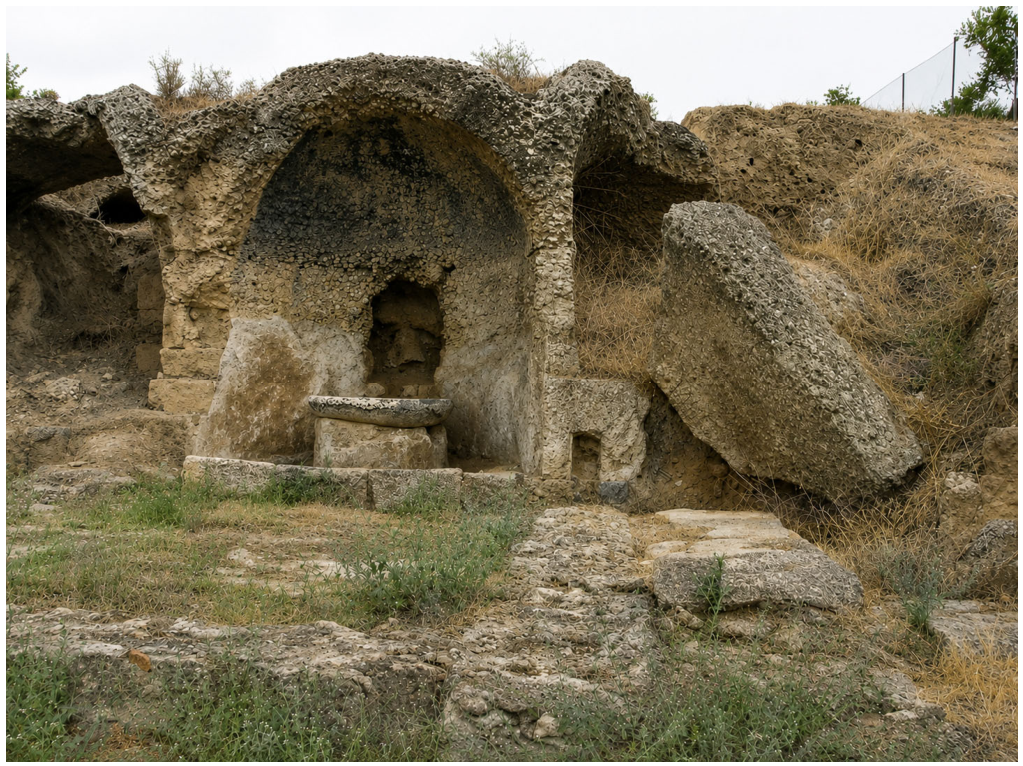
The kilns at Arva, representative of those used throughout the province, are of circular plan, built in part from broken amphora sherds, and could reach heights of up to 6 m (Figure 2). Their open-topped, updraught design did not permit hermetic control of the firing atmosphere: air could enter freely through the base and structural gaps while the operator could also introduce charcoal or other organic fuel to induce locally reducing conditions. Firing under changing redox conditions is therefore probable for all the kiln sites studied here, a hypothesis directly tested by the Mössbauer evidence presented below.
The technological aspects of amphora manufacture—particularly firing procedures at kiln sites in Baetica and Lusitania—nonetheless remain insufficiently constrained. The present work aims to reconstruct these procedures through a comparative archaeometric study combining 57Fe Mössbauer spectroscopy, XRD, XRF, and laboratory re-firing experiments, on three representative ceramic fabrics: a low-calcium red ceramic from São Lourenço (Lusitania), a calcium-rich buff ceramic from Lebrija (Baetica), and a bicoloured amphora from Arva (Baetica).
Figure 1.
Map of Roman Hispania [https://museovillanuevadecordoba.com, accessed on 4 June 2026].
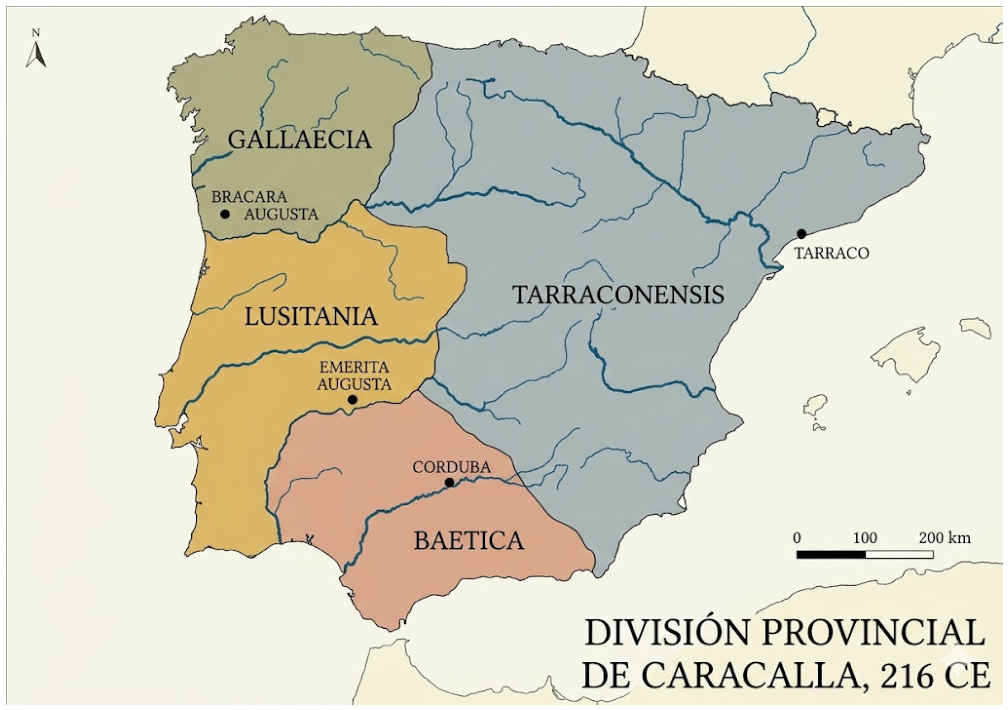
Figure 2.
Kilns for the production of amphorae at Arva on the Rio Guadalquivir in the province of Baetica (photograph taken by A.J. Silva).
2. Samples and Experimental Methods
The present investigation considered amphora sherds recovered from kiln sites located in the Roman provinces of Lusitania and Baetica, including Marim, São Lourenço and Olhos de São Bartolomeu in Lusitania, and Arva, Orippo–Torre de los Herberos, Lebrija, Puerto Real and Pinguele in Baetica. Previous archaeometric studies of these materials indicated that the specimens from each kiln site share broad compositional and mineralogical similarities, although clear differences exist between production centres. Several sherds from each locality were therefore selected for Mössbauer analysis in order to evaluate technological variability associated with firing conditions.
Macroscopic inspection revealed that many specimens display colour heterogeneity across the ceramic body, ranging from buff and pink tones to deep brick-red layers. These chromatic variations were analysed separately because they frequently correspond to distinct iron-bearing phase assemblages in the Mössbauer spectra, thereby providing important information on local redox conditions during firing and cooling.
For the purposes of the present discussion, three representative examples were selected: São Lourenço 1 (SL1), Lebrija 2 (L2) and Arva 11 (A11), whose kiln locations are indicated in Figure 3. The archaeological inventory codes are retained throughout the paper. A related amphora fragment from Olhos de São Bartolomeu has already been discussed in detail elsewhere [17].
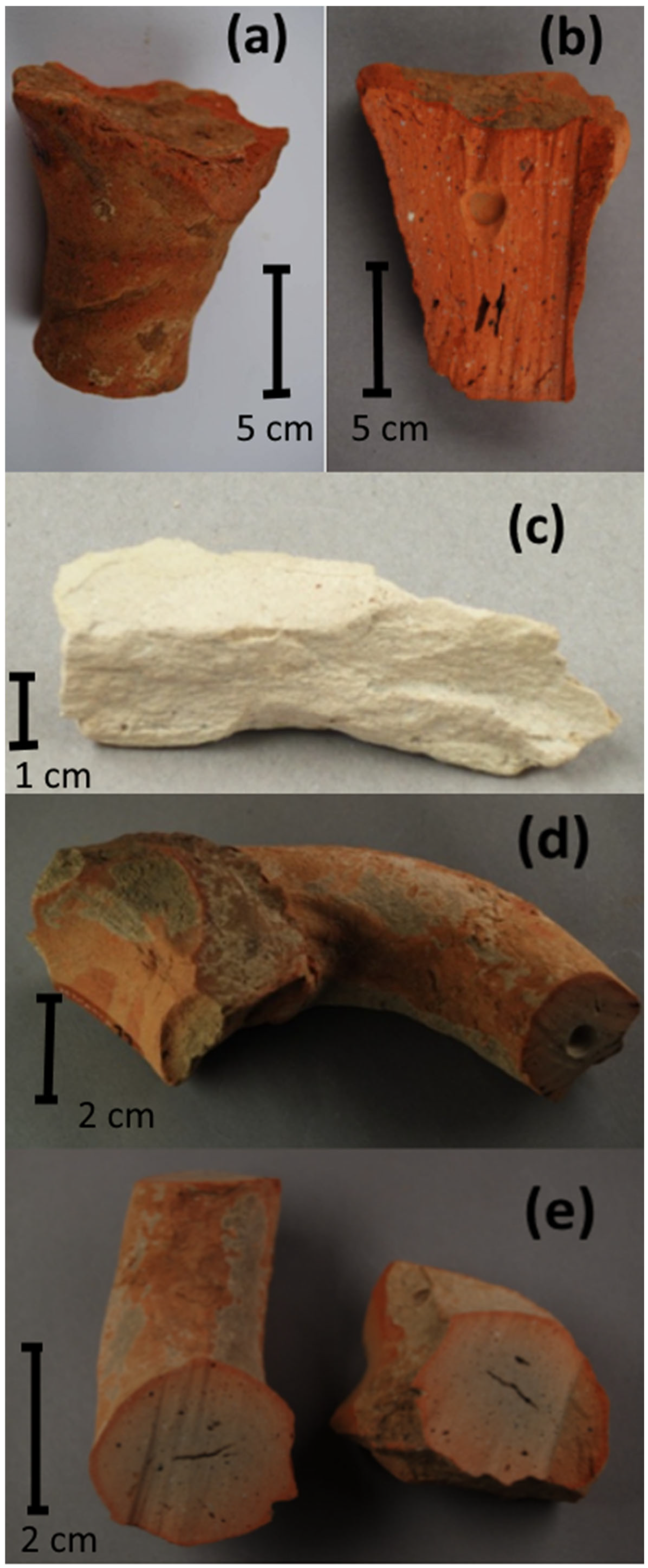
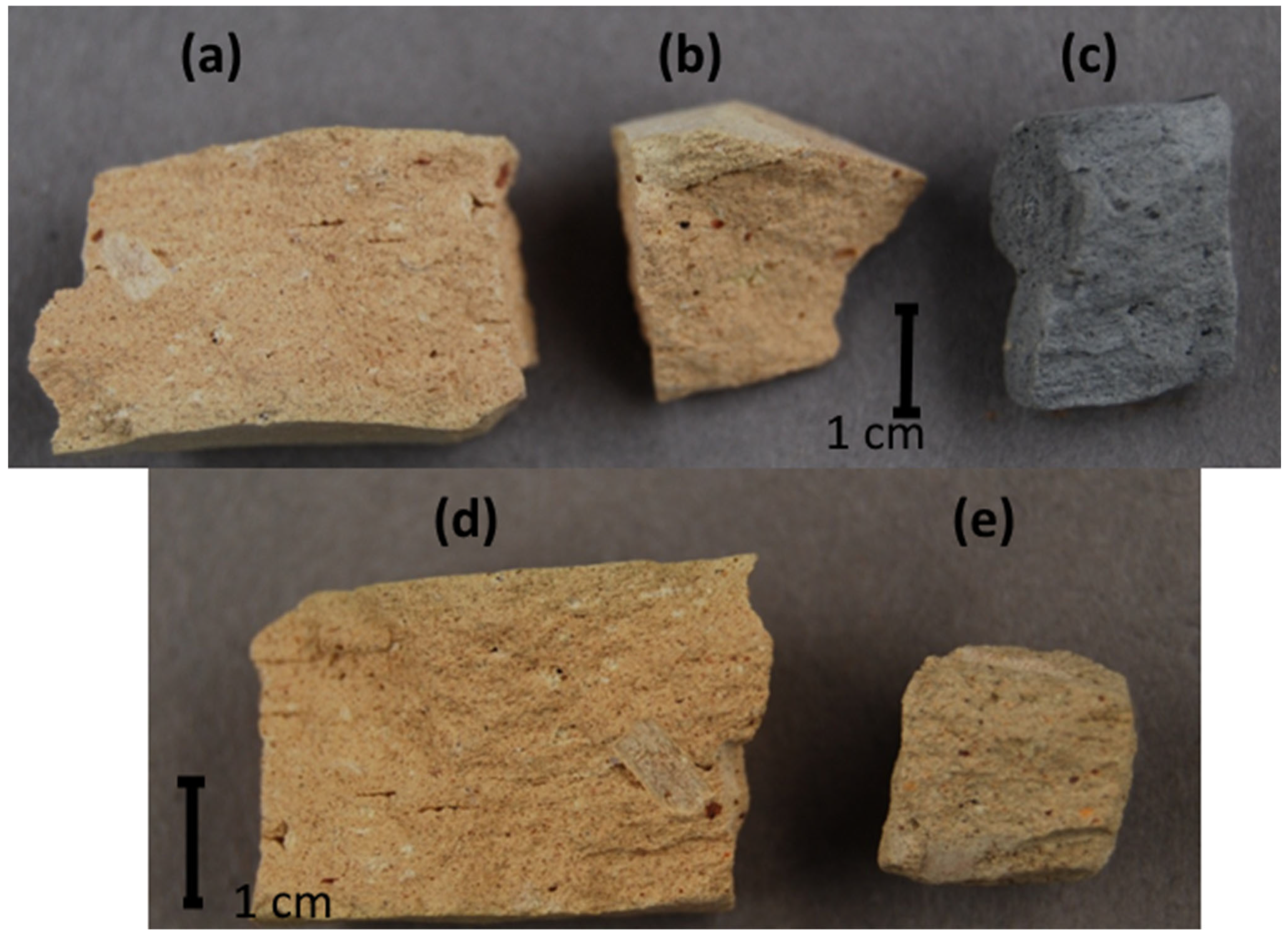
Photographs of the analysed sherds are presented in Figure 4. Sample SL1 corresponds to the foot of a uniformly brick-red amphora. Sample L2 is a wall fragment approximately 11 mm thick with a homogeneous buff-cream appearance. Sample A11 derives from a handle and adjoining neck fragment characterised by a red exterior surface surrounding a grey core.
The specimens were sectioned using a diamond saw and subsequently ground in an agate mortar to obtain powders suitable for Mössbauer spectroscopy, powder X-ray diffraction (XRD) and X-ray fluorescence (XRF) analyses.
57Fe Mössbauer spectra were collected in transmission geometry at room temperature and at 4.2 K using a conventional spectrometer equipped with a liquid-helium cryostat (WisseL, Stanberg, Germany). Spectral fitting employed combinations of Lorentzian quadrupole doublets, magnetic sextets and distributed hyperfine-field or quadrupole-splitting components when required. All isomer shifts reported in this work are referenced to α-Fe at room temperature.
Statistical uncertainties on the hyperfine parameters (isomer shift, quadrupole splitting, hyperfine field) returned directly by the fitting routine are given in parentheses in Tables S1–S4, following standard Mössbauer convention (e.g., 0.34(1) mm/s corresponds to 0.34 ± 0.01 mm/s). The relative spectral area of each fitted component, which underlies the phase-abundance estimates discussed throughout this work, carries an additional uncertainty that is not adequately captured by the formal least-squares fitting error alone, because spectra comprising multiple overlapping sub-spectra with closely similar hyperfine parameters (e.g., hematite, maghemite and nanophase hematite/maghemite, all with isomer shifts in the range 0.32–0.39 mm/s) are subject to correlation between fitted parameters and to a degree of non-uniqueness in the choice of fitting model. Based on repeated fits using alternative starting parameters and alternative numbers of sub-spectra for the more complex spectra (e.g., Table S2, SL1 reduced), we estimate a representative uncertainty of ±2 percentage points (absolute) on individual component areas; this value is used throughout when propagating uncertainty into derived quantities. We return to the question of fitting ambiguity and its implications for the phase assignments discussed in Section 3.1 and Section 3.2.
Powder XRD measurements were carried out with a Philips PW1070 diffractometer fitted with a graphite monochromator and Co Kα radiation (Å) (PANalytical, Almelo, The Netherlands). Diffraction patterns were recorded over the interval 5–60°, using step increments of 0.02° and counting times of 5 s per step. Quartz naturally present in the samples was employed as an internal standard for correction of peak positions. Elemental compositions were determined by portable XRF using a Niton XL3t-980He spectrometer (Thermo Scientific, Munich, Germany).
Re-firing experiments were carried out in a furnace (homemade, Munich, Germany) set to the indicated peak temperature, atmosphere (air or charcoal) and dwell time; heating and cooling rates were not continuously logged, and the reported conditions therefore characterise the peak thermal treatment rather than the complete thermal trajectory. Although this precludes a detailed comparison of heating/cooling rates with the original firing conditions, the consistency of peak temperature, dwell time and atmosphere is sufficient to test whether the observed phase assemblages are compatible with primary firing, as discussed below.
Figure 3.
Locations of the kilns from which samples were studied.
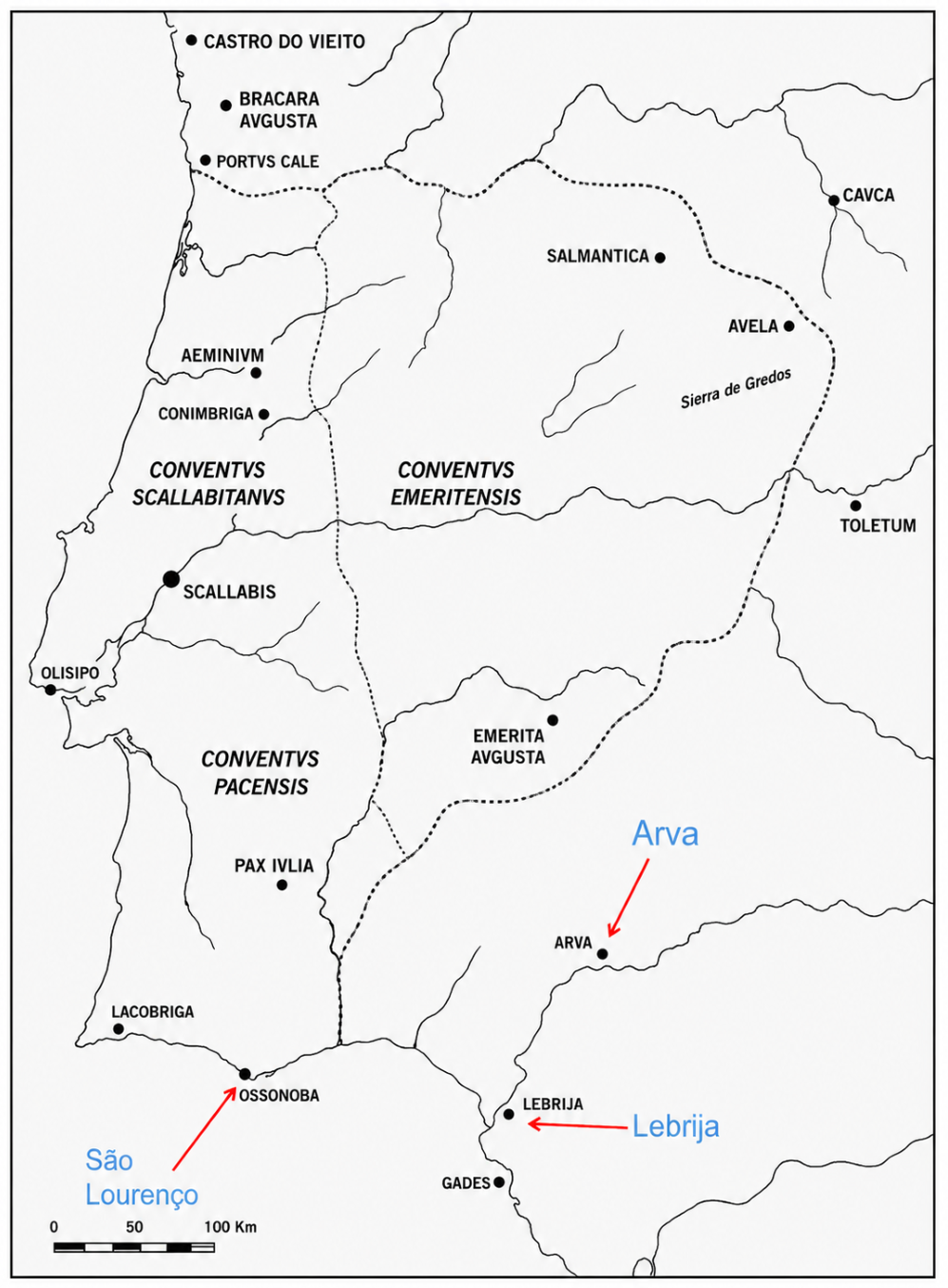
Figure 4.
Kiln site sherds from: (a,b) São Lourenço 1, (c) Lebrija 2, (d,e) Arva 11.
3. Results and Discussion
The elemental compositions obtained by XRF analysis are summarised in Table 1. Silicon is the dominant constituent in all analysed sherds, while iron and aluminium concentrations remain broadly comparable among the samples. Calcium exhibits the largest compositional variation, accompanied by significant differences in magnesium content, which generally increases in samples richer in calcium. This variation is expected to influence both mineral transformations during firing and final colour development.
Table 1.
XRF data for element contents [18]. Uncertainties 1%.
Mössbauer spectra obtained from sherds belonging to the same kiln site display greater similarity to one another than to spectra from different production centres. This observation suggests that each workshop employed relatively consistent firing procedures, although part of the spectral variability must also reflect differences in the original clay composition, as previously demonstrated by XRD and XRF studies [18,19], and for selected sherds in Table 1. Despite these compositional differences, the present data indicate that broadly comparable firing strategies were adopted across the studied kiln sites.
Table 2 describes the relationship between bulk composition and Mössbauer-derived phase distribution (see Table 1 and Table S1). The bulk Ca/Fe ratio (from Table 1) increases from 1.6 in SL1 to 3.1 in A11 to 5.6 in L2, while the combined room-temperature spectral area assigned to crystalline and nanophase iron-oxide components (hematite + maghemite + np-Hem/Mag; Table S1) decreases correspondingly from 69% (SL1) to 44%/28% (A11 red surface/grey core) to 17% (L2). Conversely, the Fe2+-bearing fraction, essentially absent in low-Ca SL1, rises to 11–14% in the higher-Ca L2 and A11 grey core. This inverse relationship between bulk Ca/Fe ratio and the fraction of iron partitioned into oxide phases provides a direct, quantitative link between bulk composition (XRF) and phase distribution (Mössbauer), and is consistent with the XRD identification of gehlenite specifically in the higher-Ca samples. With only three sherds analysed in full Mössbauer detail, this comparison should be regarded as illustrative of the compositional control rather than as a statistically robust correlation; testing it rigorously would require Mössbauer analysis of a larger sample set matched against the more extensive existing XRF/XRD dataset [18,19].
This comparison, however, conflates the effect of calcium with that of total iron content, which also varies appreciably across the three fabrics (4.1, 3.4 and 2.4 wt% Fe in SL1, A11 and L2, respectively; Table 1). To isolate the calcium effect, Table 2 also reports the absolute amount of Fe partitioned into oxide phases, expressed as wt% of the whole ceramic (Fe-total × Fe-oxide area fraction). This absolute measure decreases monotonically with increasing Ca/Fe (2.83 ± 0.11 wt% in SL1, to 1.50 ± 0.08/0.95 ± 0.07 wt% in the A11 red surface/grey core, to 0.41 ± 0.05 wt% in L2, with uncertainties propagated from the ±1% absolute uncertainty on Fe-total and the ±2 percentage-point uncertainty on the Fe-oxide area fraction, Section 2), confirming that the suppression of hematite in calcium-rich fabrics is not an artefact of normalising against a smaller bulk Fe pool: even on an absolute basis, and well outside the propagated uncertainties, calcium-rich pastes retain markedly less iron in oxide form. Total Fe content nonetheless remains a secondary contributing variable—for instance, it partly accounts for the roughly two-fold difference in absolute Fe-oxide content between SL1 and the A11 red surface despite their more modest difference in Ca/Fe—and is therefore factored out explicitly here rather than left implicit in the area-fraction comparison alone.
Table 2.
Cross-comparison of bulk Ca/Fe ratio (XRF, Table 1) with the room-temperature Mössbauer-derived fraction of iron in oxide phases and in Fe2+ (Table S1), the corresponding absolute Fe content partitioned into oxide phases, and dominant Ca-bearing secondary phase identified by XRD (Figure 6).
Representative Mössbauer spectra measured at room temperature and at 4.2 K for samples SL1, L2 and A11 are shown in Figure 5, while the corresponding fitting parameters are listed in Table S1.
At room temperature, all spectra are dominated by ferric components accompanied by variable contributions from hematite, broad magnetic distributions and minor ferrous phases. Specifically, the simultaneous presence of well-crystallised hematite (IS ≈ 0.33–0.38 mm/s, H ≈ 51–53 T), partially disordered maghemite/hematite-like sextets with reduced hyperfine fields (H ≈ 43–49 T), and a residual Fe3+ paramagnetic doublet (IS ≈ 0.34–0.37 mm/s, QS ≈ 0.86–0.92 mm/s) within the same spectrum indicates a heterogeneous, non-fully oxidised iron speciation incompatible with firing under a single, constant atmosphere. The detection of minor Fe2+ contributions (e.g., IS ≈ 0.32 mm/s, QS ≈ 1.64 mm/s in L2, and IS ≈ 0.15 mm/s, QS ≈ 1.87 mm/s in the A11 grey core; Table S1) further confirms that reducing conditions were locally retained, rather than the assemblage representing a single oxidising firing event.
The combined spectral evidence instead points to firing under variable redox conditions, most likely involving a reducing stage followed by partial oxidation during cooling. This interpretation is particularly consistent with sample SL1 and with the contrasting red surface and grey core observed in sample A11.
Cooling the samples to 4.2 K results in partial magnetic ordering of the broad room-temperature components, leading to the appearance of better-resolved hematite contributions. The remaining distributed magnetic component is attributed to an iron-bearing vitreous phase generated during reducing firing at temperatures of approximately 800 °C or above [18,20,21]. The marked reduction in the ferric doublet area at low temperature further indicates the presence of superparamagnetic hematite particles at room temperature. This temperature-dependent behaviour—the growth of resolved hematite sextets at the expense of the room-temperature ferric doublet—is itself diagnostic of a fine-grained, poorly crystalline hematite population, which typically forms during the secondary, partial-oxidation stage of firing rather than during prolonged primary oxidising conditions, when coarser and better-crystallised hematite would be expected.
Although maghemite, an oxidised Fe3+ phase, often forms through low-temperature oxidation of magnetite and could therefore be taken to imply an intermediate magnetite-forming reducing stage, no magnetite component—characterised by its distinctive two-sextet Mössbauer pattern arising from tetrahedral and octahedral Fe sites—was resolved in any of the spectra. The maghemite observed here is therefore more plausibly interpreted as a direct product of hematite-maghemite intergrowth or of the oxidation of an intermediate, poorly crystalline ferric/ferrous precursor phase formed during firing, rather than as residual evidence of a discrete magnetite-forming stage.
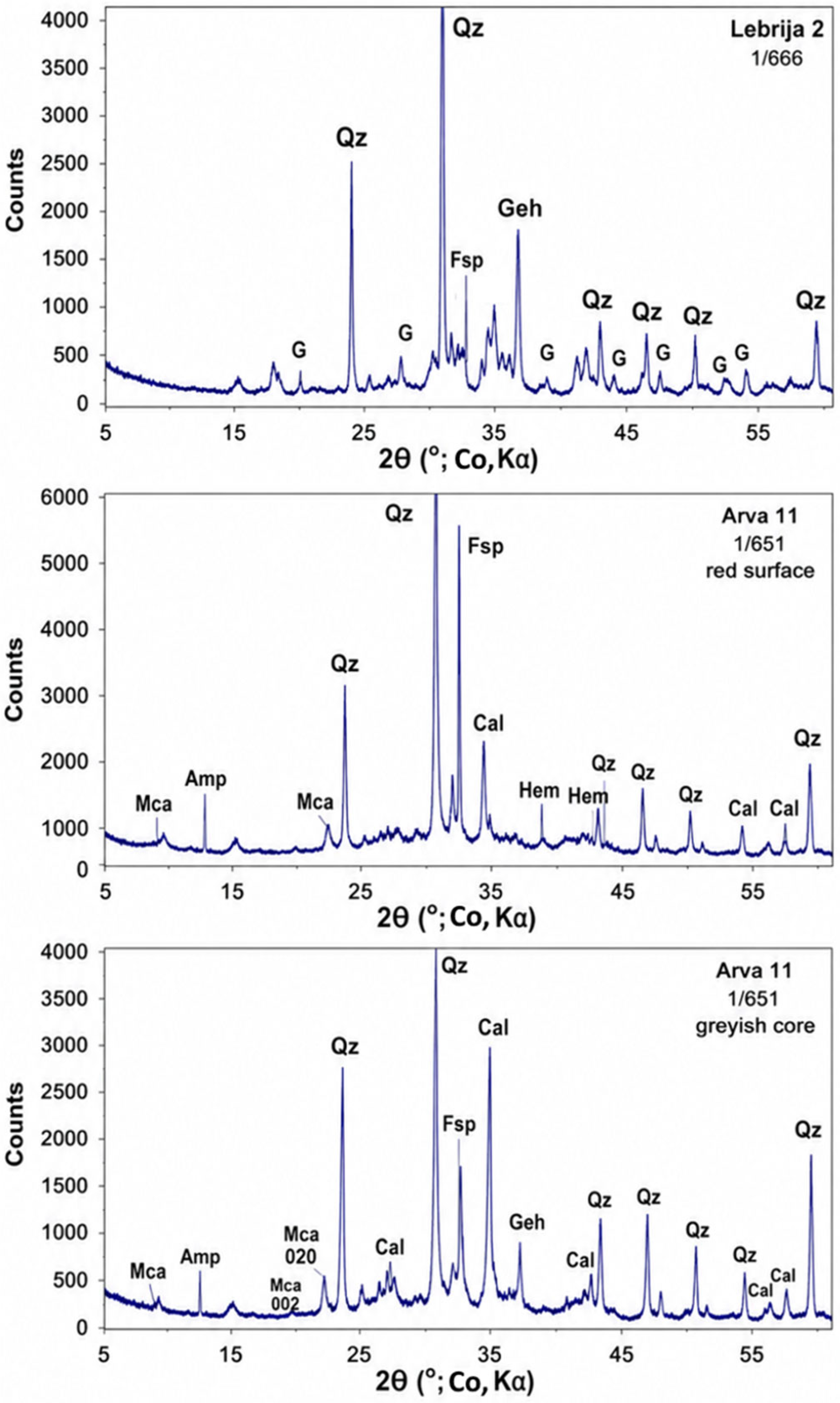
Sample L2 displays a distinct behaviour in that the hematite fraction changes only slightly between room temperature and 4.2 K measurements. In this case, the broad magnetic distribution centred near 20 T may be associated with iron-bearing gehlenite, Ca2(Al, Fe)2SiO7, which crystallises from calcareous ceramic pastes fired at temperatures around 850–900 °C [22,23,24]. The room-temperature doublet characterised by QS ≈ 1.6 mm/s and IS ≈ 0.22 mm/s is likewise compatible with Fe-bearing gehlenite, although the individual crystallographic iron sites [25] cannot be resolved, probably owing to poor crystallinity. At 4.2 K they split into a broad magnetically ordered sextet. Similar features are also observed in the grey core of sample A11. In Figure 6 the relative Mössbauer spectral area is shown for the samples. The presence of gehlenite in both cases is confirmed by the XRD patterns presented in Figure 7.
In this sample, the comparatively small hematite fraction (≤10% at both RT and 4.2 K; Table S1) combined with the dominance of the broad, poorly resolved magnetic distribution and the gehlenite-compatible doublet demonstrates that iron was preferentially retained in calcium-bearing phases rather than oxidised to hematite, even though some reduced character (the Fe2+ component, A ≈ 11%) persists—again pointing to incomplete or variable oxidation rather than a uniformly oxidising firing regime.
The presence of locally reduced iron in a ceramic body is not, by itself, unambiguous evidence of a reducing kiln atmosphere. A mineralogically distinct mechanism, well documented for clays rich in organic matter (humic acids), produces a so-called black core or “black heart”, in which residual organic carbon trapped within the paste consumes available oxygen during firing and locally reduces ferric to ferrous iron, independently of the bulk firing atmosphere; this process is well established in the ceramic and brick-manufacturing literature [26,27] and has been documented archaeometrically, including by Mössbauer spectroscopy, in other ancient ceramic traditions that used plastic, organic-rich clays [28,29]. We did not measure the organic-carbon content of the present pastes, and this mechanism cannot therefore be excluded a priori for any individual sherd. However, several features of the present dataset argue against it as the dominant explanation for the reduced iron observed here. First, organic-carbon-driven reduction is typically associated with iron oxide and spinel phases such as magnetite, wüstite or poorly aluminous spinel, reflecting locally strongly reducing, carbon-controlled conditions [28,29], whereas the reduced components identified in the present sherds (hercynite in the re-fired material, and the gehlenite-hosted Fe2+ in the L2 and A11 grey-core spectra) are instead associated with calcium-aluminosilicate phases that only crystallise at firing temperatures of 850–950 °C [22,23,24,25], by which point any organic carbon originally present in the clay would normally already have been consumed. Second, in the A11 grey core the same gehlenite-compatible doublet and broad magnetic distribution that we attribute to firing under variable kiln redox conditions (rather than to atmospheric oxidation alone) closely match those of the high-calcium L2 fabric, which lacks a visible black core or comparable colour zonation and was selected, like SL1, on the basis of macroscopic colour uniformity; this correspondence is more readily explained by a shared, composition-dependent response to kiln atmosphere than by an independent, organic-matter-driven mechanism specific to A11. Direct measurement of total organic carbon and its spatial distribution across the red–grey transition in A11—for instance by elemental analysis or loss-on-ignition on samples bracketing the colour boundary—would provide a more conclusive test between the two mechanisms and is identified here as a specific target for future work on this material.
These observations indicate that Roman amphora firing involved a reducing stage at elevated temperature followed by variable re-oxidation during cooling. The extent of re-oxidation depends not only on oxygen access but also on ceramic composition, particularly calcium content.
Getting back to Figure 7, it is observed that the Arva 11 red surface and Arva grey core contain calcite and mica. Therefore, the maximal heating temperature was 750 to 800 °C because the decomposition temperature of calcite is in the range of 700 to 800 °C. The Lebrija sample was higher burnt. No mica is present in the sample. mica decomposes between 900 and 950 °C. Therefore, the burning temperature is higher than 950 °C. The XRD scans of Lebrija and Lebrija re-fired by 950 °C in oxidation atmosphere are nearly identical. Further unidentified high-temperature minerals are present, mainly the mineral Hedenbergite (CaFe2+Si2O6). This mineral has Fe2+ consistent with findings with Mössbauer spectroscopy where a small amount of Fe2+ was found (see Table S1).
Figure 5.
57Fe Mössbauer spectra of indicated sample sherds: SL 1- São Lourenço 1, L 2- Lebrija 2, A 11- Arva 11. RT spectra are shown on the left, 4.2 K spectra on the right.
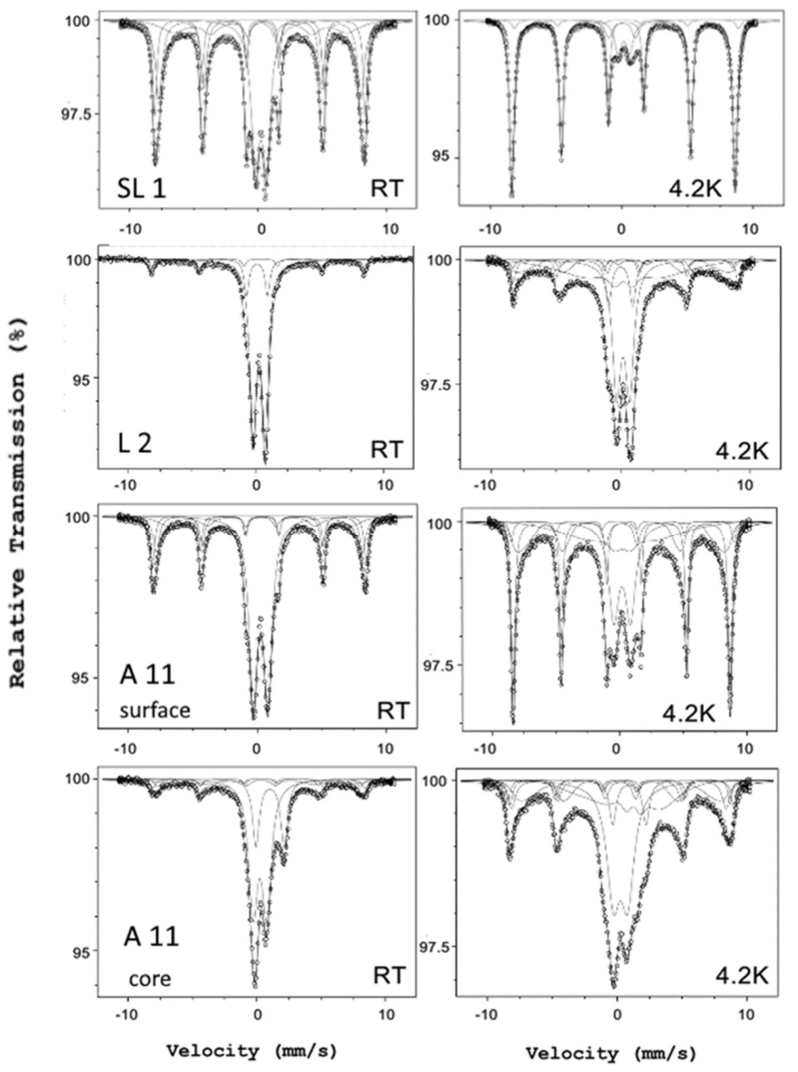
Figure 6.
Relative Mössbauer spectral area (%) by phase, at room temperature and 4.2 K, for the original sherds (SL1, A11 red surface, A11 grey core, L2). Full fitting parameters underlying this plot are given in Table S1 (Supplementary Information).
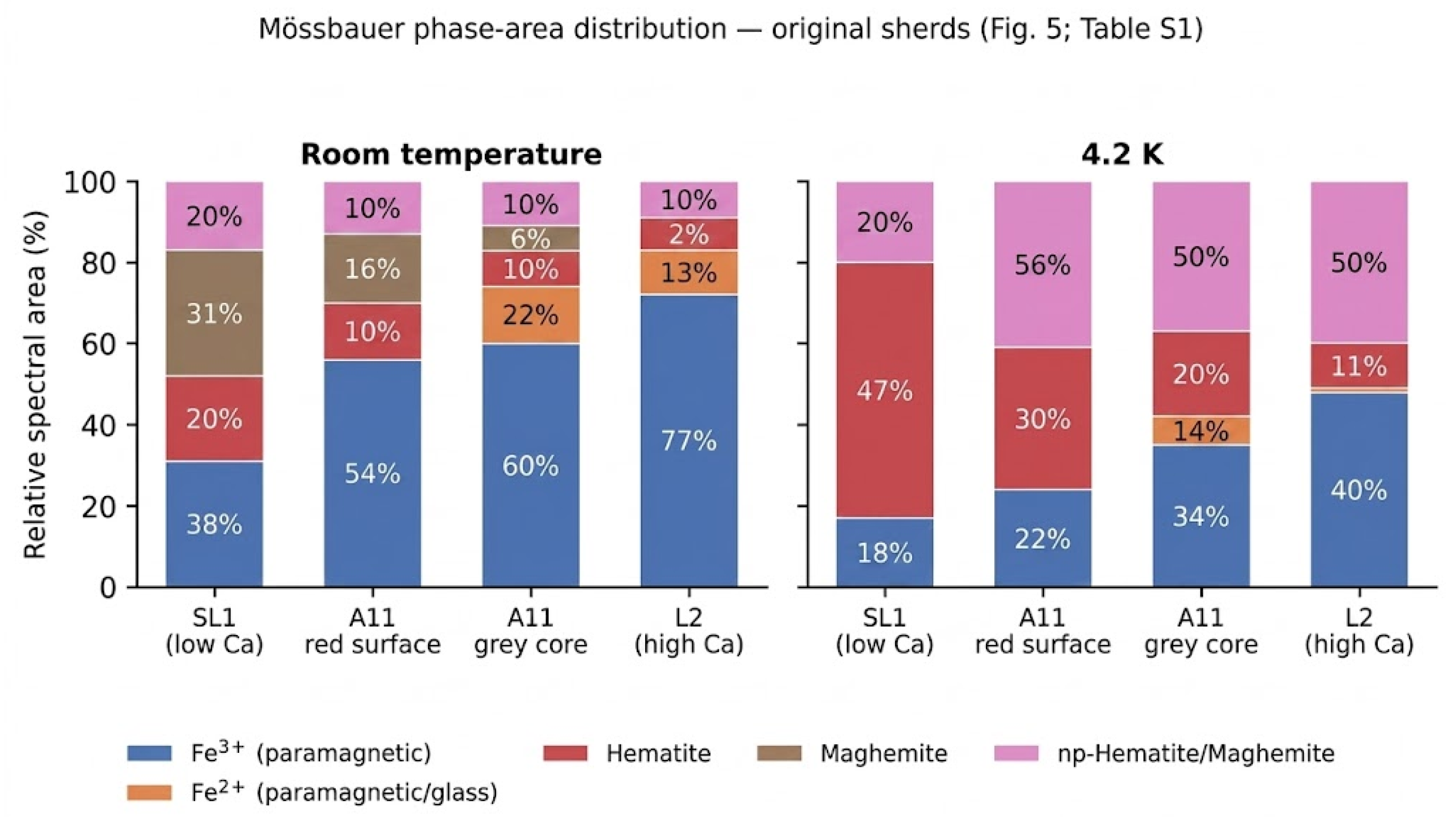
Figure 7.
XRD patterns of the indicated samples: from top to bottom- Lebrija 2, Arva 11 red surface, Arva 11 greyish core. Mineral labels follow the standardised nomenclature of the International Mineralogical Association (IMA 2021–2024). Qz = quartz, Fsp = feldspar group, Cal = calcite, Geh = gehlenite, Mca = mica, Amp = amphibole, Hem = hematite. The peak around 16° is a peak produced by the XRD equipment when the Quartz content is high.
3.1. Re-Firing Experiments in the Laboratory
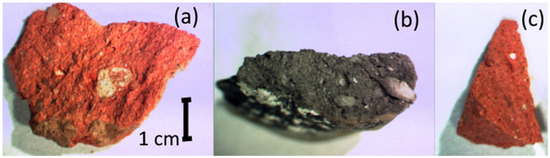
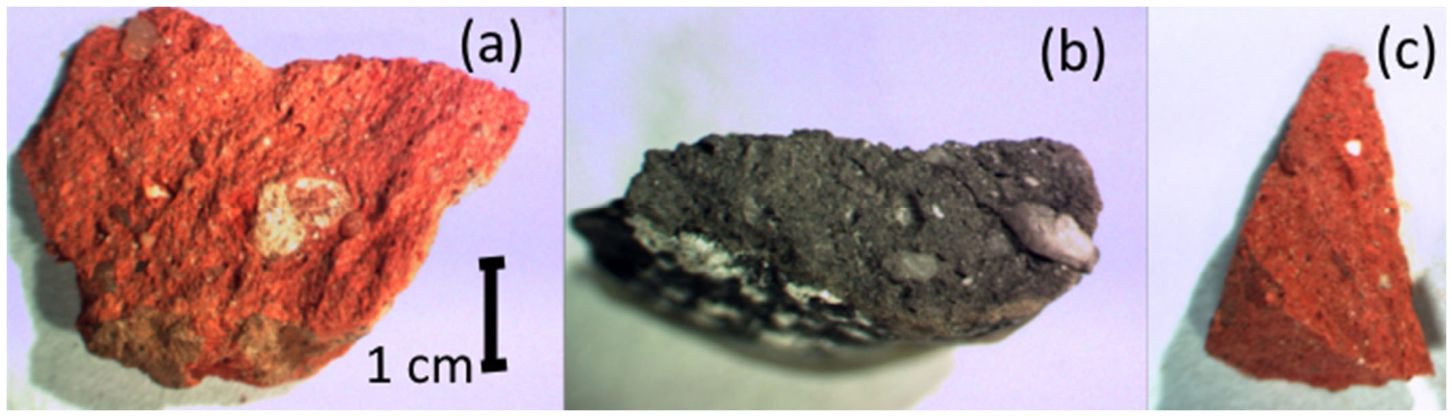
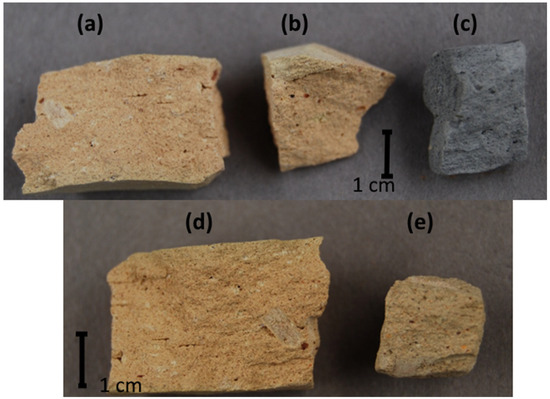
Re-firing experiments on already-fired ceramics provide valuable information on the original firing conditions, since changes in the Mössbauer spectra only occur when the original firing temperature is exceeded [30]. The three selected sherds were re-fired under both reducing and oxidising atmospheres, and their pictures are shown in Figure 8.
Figure 8.
São Lourenço 1 sherds: (a) original; (b) reduced in charcoal at 800 °C for 3 h; (c) re-oxidised in air at 800 °C for 3 h. The scale bar shown in (a) is for all the pictures.
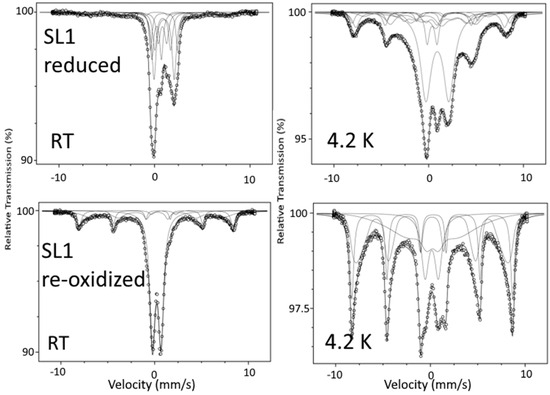
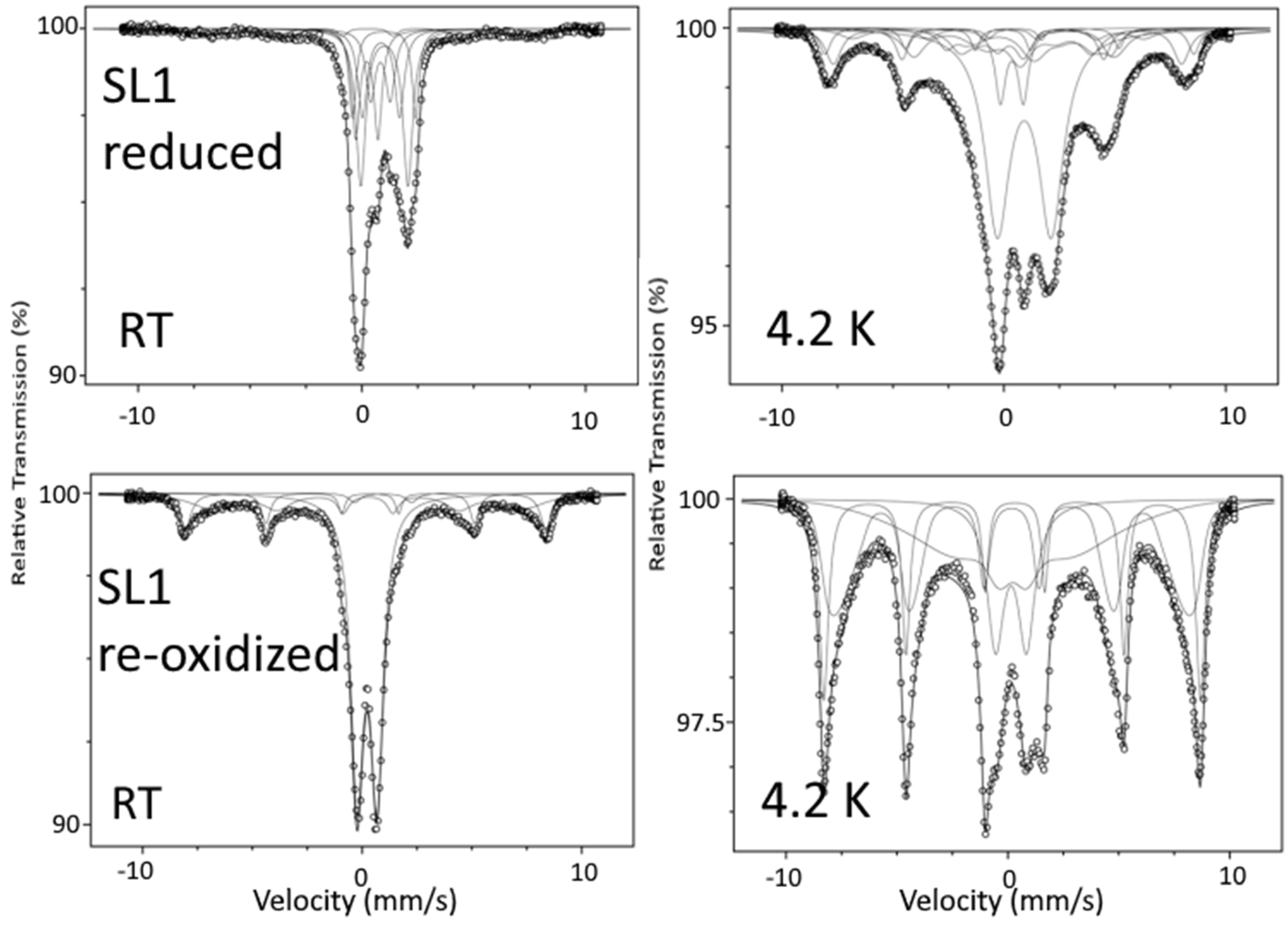
Figure 9 shows the Mössbauer spectra recorded at RT and 4.2 K for these re-fired sherds; the corresponding fitting parameters are listed in Table S2.
Figure 9.
57Fe Mössbauer spectra of São Lourenço 1 sherd. On the top, spectra of samples reduced at 800 °C for 3 h. On the bottom, spectra of the samples reduced and then re-oxidised at 800 °C for 3 h. RT spectra are shown on the left, 4.2 K spectra on the right.
The sherd reduced in charcoal at 800 °C for 3 h shows spectra of typical hercynite [31,32] at RT, that magnetically splits at 4.2 K [32]. A vitreous phase containing Fe2+ is also observed. These phases are typical formations under reducing firing conditions of clays.
The reduced sherd was subsequently re-fired in air at 800 °C for 3 h; the resulting spectrum is identical to that of the original SL1 sherd (Figure 5 and Table S1). At room temperature, 65% of the spectral area is paramagnetic; at 4.2 K, crystallised hematite accounts for 22% of the total spectral area.
In the case of Lebrija 2 sherds, a different procedure of re-firings was done. Figure 10 shows photographs of the original sherd and when sherds were re-fired under different conditions.
Figure 10.
Lebrija 2 sherds: (a,d) original; (b) re-fired in air at 950 °C for 24 h; (c) re-fired in charcoal at 950 °C for 24 h; (e) re-fired in charcoal at 950 °C for 24 h then in air at 800 °C for 3 h. The scale bar shown in (a) is also for (b,c) pictures; the scale bar shown in (d) is also for (e).
A L2 sherd was first re-fired in air at 950 °C for 24 h. The resulting Mössbauer spectra at RT and 4.2 K are shown in Figure 11a and closely resemble those of the original sherd (Figure 5 and Table S1). The Mössbauer parameters are given in Table S3. The XRD pattern is also similar to that of the original non-re-fired sherd (Figure 7).
Another L2 sherd was reduced in charcoal at 950 °C for 24 h. The spectra are shown in Figure 11b and the parameters of the resulting fit are given in Table S3. The spectra reveal hercynite, a vitreous phase containing Fe2+ and that Fe3+ in gehlenite resists reduction (see also Figure 12).
This reduced sherd was then re-fired in air at 800 °C for 3 h. It is observed that the spectra (shown in Figure 11c) resemble the original spectra (Figure 5). The Mössbauer parameters are given in Table S3.
For the red Arva 11 sherd from the neck of the amphora, the same re-firing procedures as those applied to L2 were also performed. Figure 13 presents photographs of the original and re-fired sherds. The oxidised sherd (Figure 14a) shows Mössbauer spectra similar to those of the original non-re-fired sherd (Figure 5). Mössbauer parameters from the spectral fits are presented in Table S4.
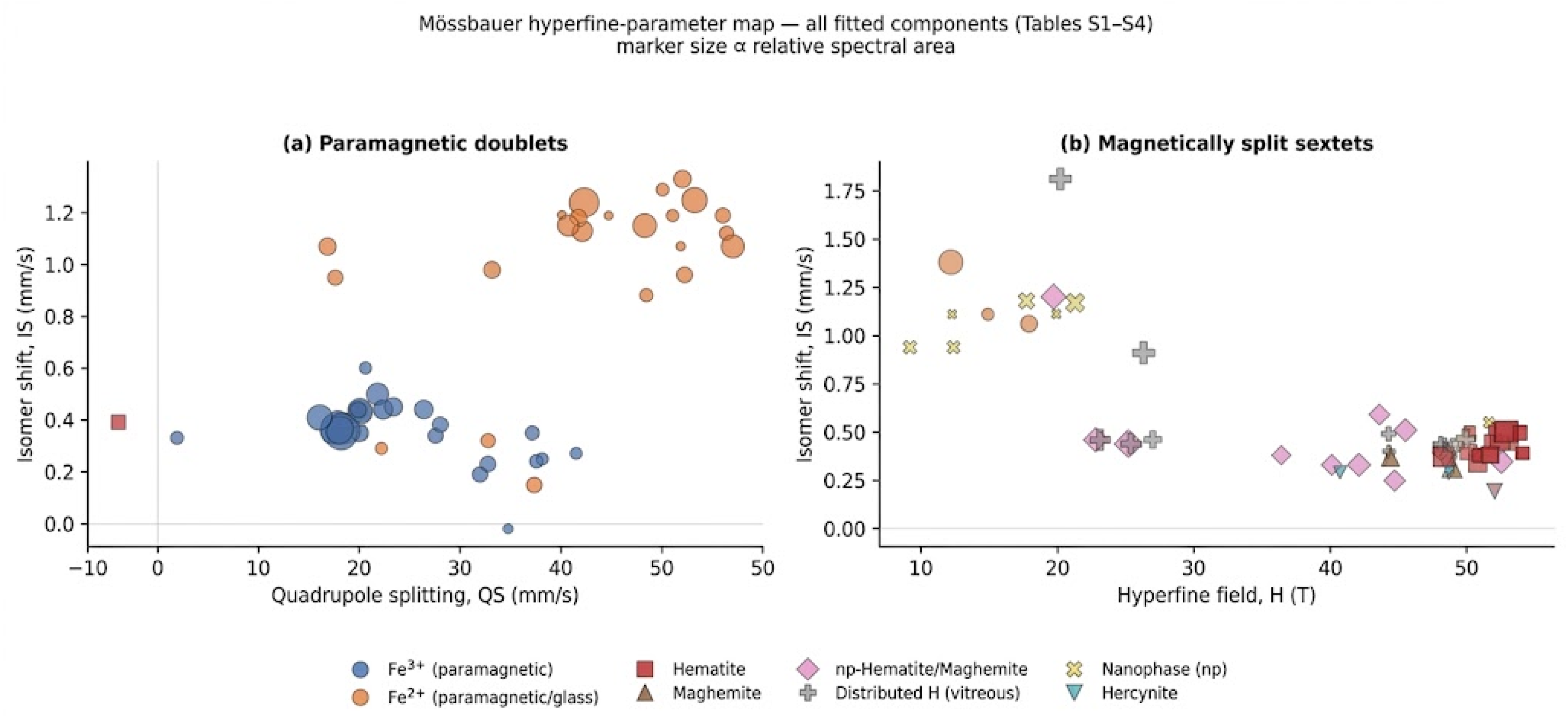
Another A11 sherd was re-fired in charcoal at 950 °C for 24 h and after that was oxidised at 800 °C for 3 h. The Mössbauer spectra are shown in Figure 14 and Mössbauer parameters are presented in Table S4. It is observed that the final spectra are similar to the original ones (Figure 5). Figure 15 presents the relative spectral area for these samples, while Figure 16 represents the hyperfine parameters presented in Tables S1–S4.
Figure 11.
57Fe Mössbauer spectra of Lebrija 2 sherd: (a) re-fired in air at 950 °C for 24 h; (b) reduced in charcoal at 950 °C for 24 h; (c) reduced at 950 °C for 24 h and then re-oxidised at 800 °C for 3 h. RT spectra are shown on the left, 4.2 K spectra on the right.
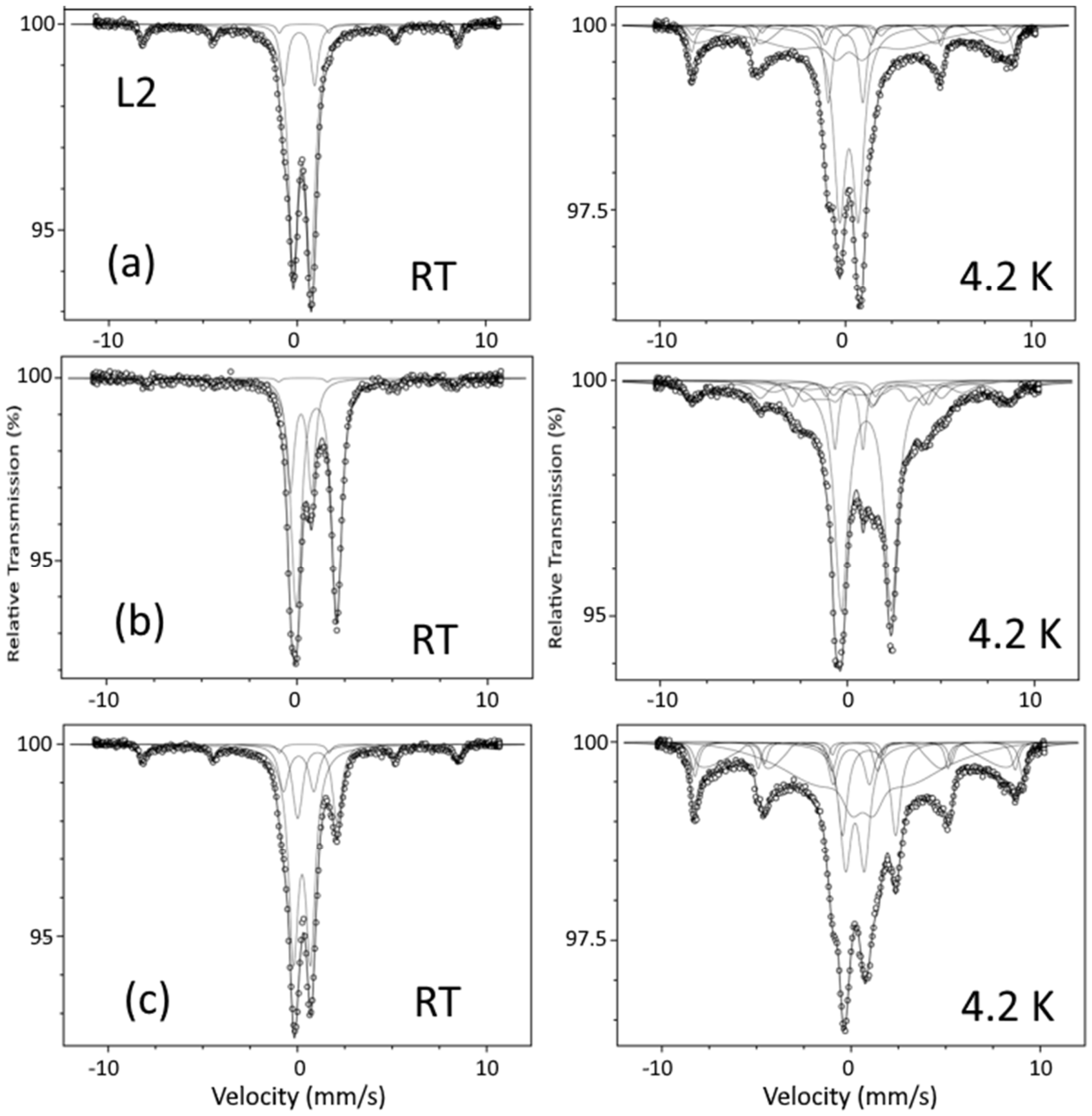
Figure 12.
XRD pattern of Lebrija 2 sherd re-fired in air at 950 °C for 24 h. Mineral labels follow the standardised nomenclature of the International Mineralogical Association (IMA 2021–2024). Qz = quatz, G » gehlenite, Feldspars = feldspar group.
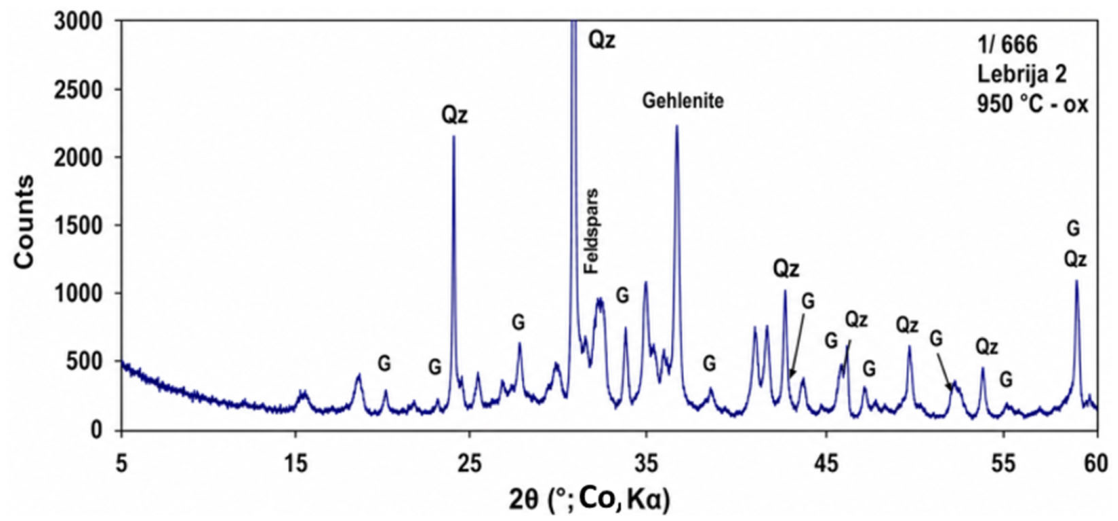
Figure 13.
Arva 11 sherds: (a,d) original flake from neck; (b) re-fired in air at 950 °C for 24 h; (c) re-fired in charcoal at 950 °C for 24 h; (e) re-fired in charcoal at 950 °C for 24 h then in air at 800 °C for 3 h. The scale bar on the top is for figures (a–c). The scale bar on the bottom is for figures (d,e).
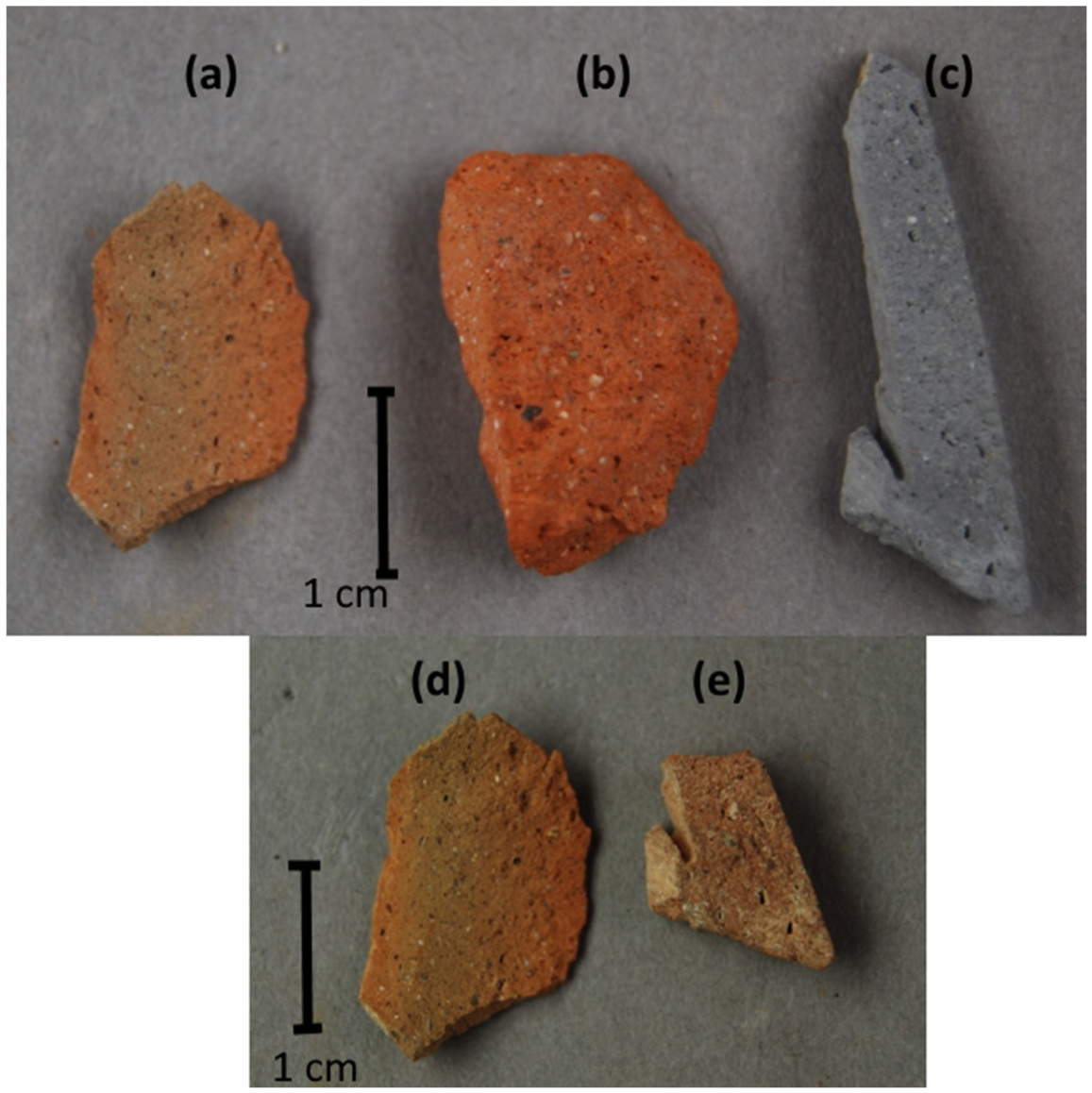
Figure 14.
57Fe Mössbauer spectra of Arva 11 sherds from the neck of the amphora: (a) re-fired in air at 950 °C for 24 h; (b) reduced in charcoal at 950 °C for 24 h; (c) reduced at 950 °C for 24 h and then re-oxidised at 800 °C for 3 h. RT spectra are shown on the left, 4.2 K spectra on the right.
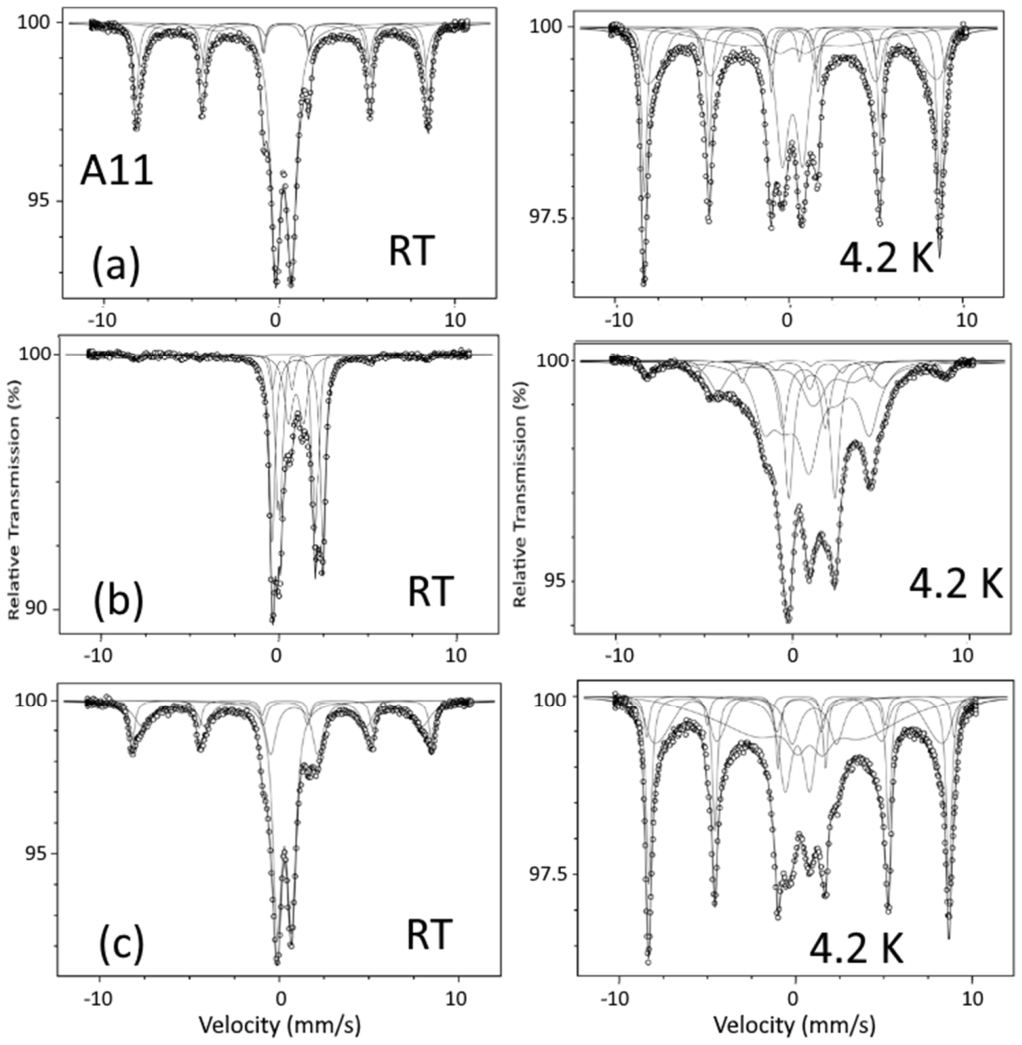
Figure 15.
Relative Mössbauer spectral area (%) by phase, at room temperature and 4.2 K, for the laboratory re-firing experiments on São Lourenço 1 (SL1), Lebrija 2 (L2) and Arva 11 (A11) sherds under the indicated reducing, oxidising and reduced-then-oxidised conditions. Full fitting parameters underlying this plot are given in Tables S2–S4 (Supplementary Information).
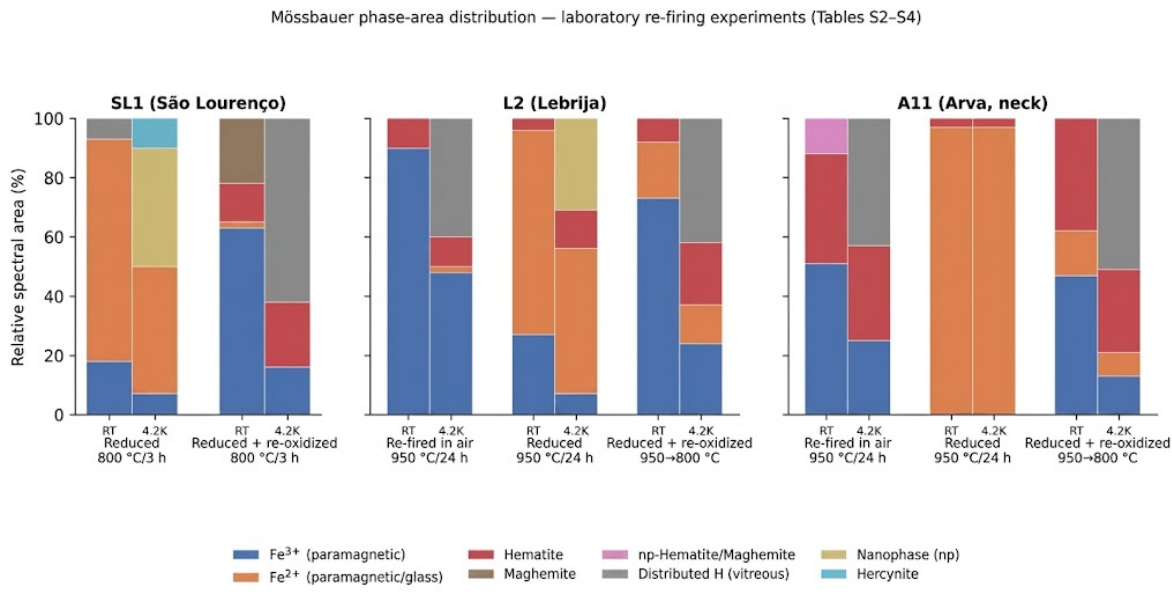
Figure 16.
Mössbauer hyperfine-parameter map for all fitted components across Tables S1–S4: (a) isomer shift (IS) vs. quadrupole splitting (QS) for paramagnetic doublets; (b) isomer shift (IS) vs. hyperfine field (H) for magnetically split sextets. Marker size is proportional to relative spectral area. The clear separation between Fe3+ and Fe2+ doublets in (a), and the clustering of hematite/maghemite-type sextets at H ≈ 48–54 T versus the lower-field, glass/np-related components in (b), illustrate the basis for the phase assignments used throughout this work.
3.2. The Role of Calcium Content in Firing Behaviour and Colour Development
The re-firing experiments demonstrate that the mineralogical state preserved in the archaeological ceramics is reversible and reproducible under controlled thermal treatment. In all three representative fabrics, reduction followed by re-oxidation generated Mössbauer spectra closely matching those of the original sherds, indicating that the observed phase assemblages are primary technological signatures rather than post-depositional alteration products.
Although all samples appear to have experienced comparable firing sequences, their response to oxidation differs markedly as a function of calcium content.
In the low-calcium São Lourenço ceramic, iron remains comparatively mobile during firing and oxidation. Reducing treatment promotes formation of Fe2+-rich vitreous phases and hercynite, whereas subsequent oxidation readily produces hematite. Because little calcium is available to incorporate ferric iron into competing crystalline phases, hematite precipitation becomes the dominant pathway during cooling, generating the characteristic red appearance.
In contrast, the calcium-rich Lebrija ceramic follows a different mineralogical pathway. Calcium released during firing promotes formation of gehlenite and related calcium aluminosilicates that act as iron reservoirs. Iron incorporated into these phases is less available for hematite crystallisation, suppressing development of red colour even after prolonged oxidising treatment. The persistence of gehlenite-related spectral contributions after reduction indicates that these phases remain stable under variable kiln atmospheres and exert a strong control over final ceramic appearance.
Arva occupies an intermediate position and provides direct evidence of spatial heterogeneity during firing. The red external layer and grey internal core correspond to different oxygen histories within the same ceramic body. Oxidation progressed preferentially from the surface inward, producing hematite-rich outer layers while preserving partially reduced iron and calcium-bearing phases in the core.
The Lebrija and Arva samples contain lower total iron concentrations and higher calcium content than SL1. Elevated calcium concentrations are known to favour buff or cream ceramic colours after firing [33,34], which is consistent with the macroscopic appearance of these sherds.
The compositional argument outlined above should be understood as operating jointly with redox kinetics and grain-size effects, both of which are evident in the present Mössbauer data even though they were not previously discussed as an explicit framework. The room-temperature ferric doublet, which loses spectral area on cooling to 4.2 K as the corresponding hematite sextet becomes resolved, indicates that a substantial fraction of the Fe3+ in all three fabrics is held in superparamagnetic, i.e., very fine-grained, hematite particles rather than in fully crystallised hematite. This is consistent with the short dwell times used both in the original firing and in the re-firing experiments (3–24 h at 800–950 °C), which are likely insufficient for complete nucleation and grain growth of hematite even where thermodynamic conditions favour its formation. Calcium therefore does not act as the sole controller of hematite abundance: it sets the thermodynamic competition between hematite and gehlenite for available Fe and Al, while redox kinetics and the limited dwell time of the firing cycle jointly determine how far that competition proceeds toward well-crystallised end products within a single firing event. Direct microstructural evidence (e.g., SEM or TEM imaging of hematite particle size and distribution) was not obtained in this study and would be required to decouple the kinetic and compositional contributions with confidence; we return to this point in Section 3.3.
Taken together, these observations indicate that colour development in Roman amphorae cannot be interpreted simply as an indicator of firing atmosphere. Instead, the final appearance emerges from the interaction between oxygen availability, temperature, cooling conditions and bulk composition, with calcium exerting a major influence through its capacity to redirect iron from hematite into calcium-bearing crystalline and vitreous phases.
It is also appropriate to address explicitly the interpretative ambiguity inherent in fitting the more complex spectra discussed above. Several of the room-temperature spectra (e.g., SL1 and A11, Table S1) were fitted with three or four overlapping ferric sub-spectra—a crystalline hematite sextet, a maghemite-like sextet, a nanophase hematite/maghemite component, and a residual paramagnetic doublet—whose hyperfine parameters differ only modestly from one another (isomer shifts within 0.32–0.39 mm/s; hyperfine fields within 43–53 T for the magnetically split components). Spectra of this kind are not free of fitting ambiguity: alternative models (e.g., two broad hyperfine-field distributions in place of one sextet plus one distribution, or a different partition between maghemite and nanophase hematite) can in some cases reproduce the observed line shape with comparable statistical quality, while redistributing area between components by several percentage points. We addressed this by holding the number and identity of components fixed across all spectra of a given fabric wherever physically motivated (i.e., guided by the low-temperature spectra, where superparamagnetic components become resolved into sextets and the resulting line shape is less ambiguous, and by the XRD phase identification in Figure 6), and by adopting the ±2 percentage-point area uncertainty (Section 2) as a conservative envelope for this model-dependence. We emphasise that this ambiguity affects mainly the partition of area among the hematite-related sub-spectra (hematite vs. maghemite vs. nanophase hematite/maghemite); it does not affect the much larger, qualitatively unambiguous contrast between samples—for instance, the presence versus absence of a resolvable Fe2+ component, or the gehlenite-compatible doublet specific to the high-Ca fabrics—on which the principal conclusions of this work rest. Similarly, the detection limit of the present Mössbauer measurements (typically of the order of 1–2% of spectral area for a well-resolved component under these counting statistics) sets a lower bound below which minor phases cannot be reliably distinguished from fitting noise; components reported here with areas at or below this limit (e.g., the 1% np component in Table S2) should accordingly be regarded as indicative rather than firmly established.
3.3. Implications for Amphora-Production Technology
The case for variable redox firing rests not on a single spectral feature but on the convergence of several independent indicators across the studied sherds: the coexistence of ferric and ferrous iron within individual spectra, the presence of both well-ordered and disordered magnetic hematite/maghemite components, and—in the re-firing experiments—the appearance of hercynite and Fe2+-bearing glass phases under controlled reducing conditions that disappear upon re-oxidation (Section 3.1; Tables S2–S4).
The combined evidence from the Mössbauer study and the re-firing experiments allows a coherent, though necessarily model-dependent, reconstruction of the firing technology employed in the Roman kilns of Baetica and Lusitania. Across all production centres studied, the ceramics were fired under variable and predominantly reducing atmospheres, with oxidation occurring chiefly during the terminal stage of the firing cycle. This is consistent with the open-topped, updraught kiln design documented archaeologically at Arva and at other kiln sites along the Guadalquivir valley and the Lusitanian coast. In such furnaces, temperature and atmosphere were controlled empirically by regulating fuel supply—the introduction of charcoal or organic matter creating locally reducing pockets within the kiln chamber—and by timing the opening of the kiln for cooling. We do not have direct evidence from the Roman kilns themselves on how this control was exercised in practice; the inference draws instead on ethnoarchaeological and experimental studies of updraught-kiln operation, which document that potters firing similar open-kiln types rely on visual and sensory cues—flame colour, smoke behaviour, the glow of the ware—learned through repeated practice rather than instrumented monitoring [35,36]. By comparison with this body of work, the potter or kiln master at the sites studied here would plausibly have relied on similar practical experience in judging the colour and behaviour of the ware to determine the appropriate moment for each stage of the firing, although this remains an inference by analogy rather than a conclusion supported by direct evidence from the present material.
It should be emphasised that these inferences rest primarily on mineralogical and re-firing evidence rather than on independent physical validation of in-kiln conditions, such as direct thermal monitoring or computational modelling of gas flow and temperature gradients within the kiln structure. Such approaches have been applied to other ancient updraught-kiln traditions—for instance, computational fluid dynamics modelling of temperature distribution in Aegean Bronze Age kilns [37], and instrumented experimental firings with continuous thermocouple monitoring of a reconstructed updraught kiln [38]—and illustrate the kind of independent evidence that would be needed to test the redox scenario proposed here directly, rather than by analogy. The archaeological evidence for open, updraught-kiln architecture at Arva (Section 1; Figure 2) is compatible with the redox scenario proposed here, but the present study does not itself provide an independent reconstruction of the spatial or temporal evolution of the firing atmosphere. The correspondence between laboratory re-firing experiments and the original Mössbauer signatures (Section 3.1) demonstrates that the observed phase assemblages can be produced under specific, controlled redox sequences, but it does not uniquely exclude alternative firing histories capable of producing similar mineral assemblages. Future work combining thermal modelling of kiln atmospheres, along the lines of [37,38], with the mineralogical record would help to constrain more tightly the firing protocols proposed here. Two further limitations of the present compositional argument should be noted. First, the relative contributions of redox kinetics and grain size to hematite abundance (Section 3.2) were assessed only indirectly, through the temperature dependence of the Mössbauer spectra; direct microstructural imaging (e.g., SEM or TEM) of hematite particle size and distribution was not performed and would allow these contributions to be separated from the purely compositional (Ca, Fe) control discussed above. Second, ceramic colour is described throughout this study in qualitative, macroscopic terms (e.g., brick-red, buff-cream, grey) rather than through standardised colorimetric measurement. A quantitative colorimetric study, expressing sherd colour through CIE L*a*b* or equivalent colour coordinates and correlating these directly with the Mössbauer-derived hematite and gehlenite fractions reported here, would provide a more rigorous, quantitative link between phase composition and final ceramic appearance than the qualitative correspondence drawn in this work. Such measurements were not possible in the context of the present revision, as the analysed sherds are held in archaeological collections to which renewed physical access was not available; we identify this as a specific and tractable target for future work on this sherd assemblage.
The calcium content of the local raw clay materials exerted a decisive influence on the character of the finished amphora. Workshops in Lusitania, such as São Lourenço, exploited clay deposits relatively poor in calcium (Ca ≈ 6–7 wt%) and rich in iron, which consistently yielded brick-red vessels after the standard firing procedure. This colour was not merely an aesthetic outcome: it served as a reliable visual indicator that the ceramic had reached the target firing temperature and that the cooling stage had proceeded under sufficient Ca conditions to convert the iron-bearing glassy phase into hematite throughout the fabric. A uniformly red product could therefore be regarded as a quality marker recognisable to both the producer and the commercial buyer.
In Baetica, the geological setting of the Guadalquivir valley provided access to clay sources with markedly higher calcium contents (Ca ≈ 10–14 wt% in the kiln sites studied here), which fundamentally altered the ceramic response to firing. In calcareous pastes, the formation of gehlenite between approximately 850 and 950 °C acts as a sink for both aluminium and iron, reducing the proportion of iron available for hematite crystallisation and thereby suppressing the development of red colour. The resulting buff-cream to pale-orange tones characteristic of Baetican workshops such as Lebrija are a direct mineralogical consequence of this compositional difference rather than of any deliberate choice by the potters to fire under different atmospheric conditions. The elevated magnesium contents associated with high-Ca sherds (Table 1) suggest that the calcareous clays of Baetica were derived from marl-rich geological formations in which both calcite and dolomite contributed to the bulk composition, providing simultaneously the CaO and MgO required for the stabilisation of calcium-magnesium silicate phases at elevated temperatures.
Additional measurements were performed on a set of samples from São Lourenço, Arva, and Lebrija using prompt gamma activation analysis (PGAA). The irradiation was carried out at the MLZ in Garching, Germany. The results for calcium and iron clearly support the results of the XRF analysis. The calcium content of five samples from the Lusitanian site of São Lourenço ranges from 3.1 to 7.4 wt%, with comparatively high iron values of 3.0–4.6. For Baetica, four samples from Lebrija and five from Arva were analysed using Prompt-gamma neutron activation analysis (PGAA). The samples from Lebrija show 11.4–13.8 wt% Ca and 2.7–3.4 wt% Fe, while the results for the samples from Arva are in the ranges of 6.5–14.6 wt% Ca and 2.5–4.2 wt% Fe. For these measurements, the relative uncertainties are mostly between 2% and 4%.
The temperature range inferred from the combined XRD and Mössbauer evidence—approximately 800–950 °C for both Lusitanian and Baetican kilns—is consistent with what would be achievable in wood- or charcoal-fuelled updraught kilns of the dimensions documented at Arva, where structures of up to 6 m in height could sustain prolonged high-temperature firing of large vessel batches. At these temperatures, the decomposition of calcium carbonate is complete, and the sintering of the ceramic matrix is well advanced, yielding a dense, durable fabric suited to the transport of liquid commodities over long sea routes. The production of Haltern 70 amphorae at an industrial scale implies that the kilns were operated in repeated cycles with relatively standardised loading patterns and fuel management procedures, at least at the production centres examined here. The Mössbauer data are consistent with this scenario: while individual sherds from the same kiln site show some spectral variability, the overall patterns of iron speciation and colour are reproducible across the assemblage. This reproducibility is compatible with the potters having achieved practical mastery of firing conditions suited to their local clay, in a sense documented ethnographically for other pre-industrial pottery traditions, where consistent product quality is achieved through experience-based control of fuel and timing rather than instrumented measurement [35,39]; the present data, however, demonstrate reproducibility of outcome rather than directly evidencing the cognitive or sensory basis of that control.
The bicoloured sherds from Arva merit particular attention in the context of production technology, as they provide a direct record of the thermal and atmospheric gradient within the kiln during a single firing event. The grey-cored, red-surfaced morphology observed in A11 implies that the outer layers of the vessel reached oxidising conditions during cooling before oxygen had penetrated to the interior (Section 3.2 discusses, and argues against, an alternative mechanism in which the grey core reflects organic-matter-driven reduction rather than kiln atmosphere), a situation that would naturally arise in densely loaded kilns where closely stacked vessels shielded their neighbours from the flow of air entering through the kiln walls and floor vents. In industrial-scale production, where maximising kiln capacity was an economic imperative, such atmospheric gradients were probably unavoidable. The observation that grey-cored sherds were recovered at the kiln site itself, alongside uniformly oxidised material, confirms that the Arva workshops accepted a degree of colour variability in their output as an inherent consequence of large-batch firing. This practical tolerance is itself informative about the commercial standards governing amphora production in the Roman world: the primary requirement was structural integrity and impermeability rather than strict colour uniformity, and the calcium-rich clay of Baetica delivered both qualities reliably across a range of firing conditions. A directly comparable quality-control logic has been documented archaeometrically for other pre-modern ceramic industries, where wasters discarded at the kiln site show that potters tolerated cosmetic variation while actively selecting against vessels that failed to meet a functional firing-temperature threshold [40]; the Arva material is consistent with the same kind of functional, rather than aesthetic, quality criterion, although this comparison is offered here as an analogy rather than as evidence independently established from the Roman material itself.
The present study is based on three representative specimens, selected for detailed Mössbauer characterisation from a broader archaeometric dataset comprising compositional (XRF, PGAA) and mineralogical (XRD) data on a larger number of sherds from the same kiln sites [18,19]. The firing-technology conclusions drawn here at the level of individual kiln sites are therefore well supported, but their extension to the regional scale of Baetica and Lusitania, and a fortiori to Roman amphora production in general, should be regarded as a working hypothesis consistent with the broader compositional dataset rather than as a conclusion independently demonstrated by the Mössbauer evidence itself. Confirmation at the regional scale would require Mössbauer analysis of a statistically representative sample set spanning the full range of kiln sites and clay sources already characterised by XRF and XRD [19], together with complementary microstructural techniques (e.g., SEM imaging of phase distributions) capable of testing the generality of the redox sequence proposed here.
4. Conclusions
This study demonstrates that Mössbauer spectroscopy combined with XRD, XRF and controlled laboratory re-firing provides a robust framework for reconstructing firing procedures in Roman amphora production.
Comparison of original and experimentally treated sherds indicates that amphorae from Lusitania and Baetica were not fired under strictly oxidising or reducing conditions but under dynamic redox regimes involving reduction at elevated temperature followed by partial re-oxidation during the final stages of firing and cooling.
The re-firing experiments reproduced the original Mössbauer signatures under simple, controlled peak-temperature/atmosphere/duration sequences, demonstrating that the preserved iron-phase assemblages are fully consistent with primary manufacturing processes and do not require post-depositional alteration to explain them. As detailed heating and cooling curves were not recorded in these experiments, we cannot exclude that alternative thermal trajectories might produce comparable mineral assemblages; however, the agreement between re-fired and original spectra, combined with the absence of any mineralogical indicator typically associated with prolonged burial alteration (e.g., goethite, secondary clay minerals), supports a primary technological origin as the most parsimonious interpretation.
Calcium content emerged as a key parameter controlling firing response and ceramic appearance, acting jointly with total iron content and the redox kinetics of hematite crystallisation (Section 3.2). Low-calcium fabrics favoured hematite formation and developed red colours after oxidation, whereas calcium-rich fabrics stabilised iron within gehlenite and vitreous phases, limiting hematite precipitation and producing buff or grey colours.
These findings further indicate that ceramic colour cannot be interpreted as a direct proxy for firing atmosphere alone, but instead reflects the combined effects of oxygen availability, firing temperature, cooling conditions and bulk composition, with calcium playing a central role by limiting hematite formation through incorporation of iron into calcium-bearing crystalline and vitreous phases.
The bicoloured Arva ceramics further demonstrate that oxygen penetration within the ceramic body was spatially heterogeneous and generated distinct mineral assemblages between surface and core.
These results show that the potters represented in this study achieved reproducible ceramic properties not through strict atmospheric control but through empirical management of firing cycles combined with deliberate exploitation of local raw materials.
Supplementary Materials
The following supporting information can be downloaded at: https://www.mdpi.com/article/10.3390/cryst16070434/s1, Table S1: Mössbauer parameters obtained by fitting the spectra of Figure 5; Table S2 Mössbauer parameters obtained by fitting the re-fired São Lourenço spectra of Figure 8; Table S3 Mössbauer parameters obtained by fitting the re-fired Lebrija 2 spectra of Figure 10; Table S4: Mössbauer parameters obtained by fitting the re-fired Arva 11 spectra of Figure 13.
Author Contributions
Conceptualization, B.F.O.C. and F.E.W.; methodology, B.F.O.C., U.W. and F.E.W.; validation, B.F.O.C., F.E.W., U.W., W.H., C.S. and A.J.S.; formal analysis, B.F.O.C., U.W., F.E.W. and W.H.; investigation, B.F.O.C., U.W., F.E.W. and A.J.S.; resources, A.J.S.; writing—original draft preparation, B.F.O.C.; writing—review and editing, B.F.O.C., W.H., C.S. and A.J.S.; funding acquisition, B.F.O.C. and A.J.S.; data curation: B.F.O.C., W.H. and C.S. All authors have read and agreed to the published version of the manuscript.
Funding
This work was supported by national funds from FCT—Fundação para a Ciência e a Tecnologia, I.P., within the projects UIDB/04564/2020 and UIDP/04564/2020, with DOI identifiers 10.54499/UIDB/04564/2020 and 10.54499/UIDP/04564/2020, respectively.
Data Availability Statement
The original contributions presented in the study are included in the article; further inquiries can be directed to the corresponding author.
Acknowledgments
A.J.S. acknowledges the Program Contract signed between the Ministry of Science, Technology and Higher Education, through the General Directorate of Higher Education, the Foundation for Science and Technology, the Regional Government of Madeira, the Regional Agency for the Development of Research, Technology and Innovation, the Association for the Development of the International Research Centre for the Atlantic—Air Centre and the University of Madeira.
Conflicts of Interest
The authors declare no conflicts of interest.
References
- Peacock, D.P.S. Pottery in the Roman World: An Ethnoarchaeological Approach; Longman: London, UK, 1982. [Google Scholar] [CrossRef] [Scilit]
- Peacock, D.P.S.; Williams, D.F. Amphorae and the Roman Economy. An Introductory Guide; Longman: London, UK; New York, NY, USA, 1991; Available online: http://eprints.soton.ac.uk/id/eprint/345301 (accessed on 4 April 2026).
- Tchernia, A. The Romans and Trade; Oxford University Press: Oxford, UK, 2016. [Google Scholar] [CrossRef] [Scilit]
- Van Oyen, A. The Socio-Economics of Roman Storage: Agriculture, Trade, and Family; Cambridge University Press: Cambridge, UK, 2020. [Google Scholar] [CrossRef] [Scilit]
- Koehler, C.G.; Wallace Matheson, P. (Eds.) Amphoras and the Ancient Wine Trade; American School of Classical Studies at Athens: Princeton, NJ, USA, 1992. [Google Scholar]
- Dressel, H. Corpus Inscriptionum Latinarum; De Gruyter: Berlin, Germany, 1899; Volume XV. [Google Scholar]
- Lagostena Barrios, L.; Bernal Casasola, D.; Arevalo Gonzalez, A. (Eds.) CETARIAE 2005. Salsas y Salazones de Pescado en Occidente Durante la Antiguedad; Archaeopress: Oxford, UK, 2007. [Google Scholar] [CrossRef] [Scilit]
- Etienne, R.; Mayet, F. Le Vin Hispanique. Trois cles de L’Economie de L’Hispanie Romaine; Diffusion E. de Boccard: Paris, France, 2000. [Google Scholar]
- Berni Millet, P. Tipologia de la Haltern 70 betica. In Anforas Romanas de Lugo; Traballos de Arqueoloxia 3; Carreras Monfort, C., Morais, R., Gonzalez Fernandez, E., Eds.; Concello de Lugo, Servizo Municipal de Arqueologiía: Lugo, Spain, 2011; pp. 80–107. [Google Scholar]
- Naveiro Lopez, J.L. Registo ceramico e intercambio en el noroeste en la epoca romana. In Los Finisterres Atlanticos en la Antiguedad. Epoca Prerromana y Romana; Fernandez Ochoa, C., Ed.; Electa/Ayuntamiento de Gijon: Gijon, Spain, 1996; pp. 201–204. [Google Scholar]
- Carreras Monfort, C. Produccion de Haltern 70 y Dressel 7–11 en las inmediaciones del Lacus Ligustinus (Las Marismas, Bajo Guadalquivir). In Congreso Internacional Ex Baetica Amphora; Editorial Gráficas Sol: Ecija, Spain, 2000; pp. 419–426. [Google Scholar]
- Garcia Vargas, E.; de Almeida, R.R.; Gonzalez Cesteros, H. Los tipos anforicos del Guadalquivir en el marco de los envases hispanos del siglo I a.C. Un universo heterogeneo entre la imitacion y la estandarizacion. SPAL 2011, 20, 185–283. [Google Scholar] [CrossRef] [Scilit]
- Morais, R.; Fabiao, C. Novas producoes de fabrico lusitano: Problematicas e importancia economica. In Cetariae 2005. Salsas y Salazones de Pescado en Occidente Durante la Antiguedad; Lagostena Barrios, L., Bernal Casasola, D., Arevalo Gonzalez, A., Eds.; Archaeopress: Oxford, UK, 2007; pp. 127–138. [Google Scholar]
- Bustamante Alvarez, M.; Heras Mora, F.J. Produccion anforica en Augusta Emerita (Merida, Badajoz) y los nuevos hallazgos del solar de la escuela de hosteleria. In Actas del I Congreso Internacional de la Sociedad de Estudios de la Ceramica Antigua en Hispania; Bernal Casasola, D., Juan Tovar, L., Bustamante Álvarez, M.d.l.S., Díaz Rodríguez, J.J., Sáez Romero, A.M., Eds.; Ex Officina Hispana: Cadix, Spain, 2013; Volume 1, pp. 331–345. Available online: https://dialnet.unirioja.es/servlet/articulo?codigo=4571448 (accessed on 4 April 2026).
- Filipe, V.M.S. Haltern 70 (Western Lusitania). Amphorae ex Hispania. Landscapes of Production and Consumption. 2016. Available online: http://amphorae.icac.cat/amphora/haltern-70-western-lusitania (accessed on 4 April 2026).
- de Silva, A.J.M. Vivre Au-Dela du Fleuve de l’oubli. Portrait de la Communaute Villageoise du Castro do Vieito au Moment de l’integration du NO de la Peninsule Iberique dans l’orbis Romanum (Estuaire du Rio Lima, NO du Portugal); Archaeopress: Oxford, UK, 2012. [Google Scholar]
- Costa, B.F.O.; Silva, A.J.M.; Wagner, F.E.; Wagner, U. Mossbauer studies of Haltern 70 amphorae from Castro do Vieito, North of Portugal, and of amphora sherds from kilns in the Roman provinces Hispania Baetica and Lusitania. Hyperfine Interact. 2011, 202, 81–87. [Google Scholar] [CrossRef] [Scilit]
- Costa, B.F.O.; Silva, A.J.M.; Ramalho, A.; Pereira, G.; Ramos Silva, M. X-ray compositional microanalysis and diffraction studies of Haltern 70 amphorae sherds. X-Ray Spectrom. 2012, 41, 69–74. [Google Scholar] [CrossRef] [Scilit]
- Pinheiro, D.; Guerra, M.; Silva, A.J.M.; Stieghorst, C.; Costa, B.F.O. X-ray compositional microanalysis and X-ray diffraction of Haltern 70 amphorae sherds. Appl. Phys. A 2025, 131, 231. [Google Scholar] [CrossRef] [Scilit]
- Friederich, J.; Gebhard, R.; Krause, R.; Wagner, F.E.; Wagner, U. Mössbauer studies of Celtic pottery from Bopfingen, Baden-Württemberg, Germany. J. Phys. Conf. Ser. 2010, 217, 012064. [Google Scholar] [CrossRef] [Scilit]
- Costa, B.F.O.; Wagner, F.E.; Häusler, W.; Stieghorst, C.; Silva, A.J.M.d. Mössbauer studies of Haltern 70 amphorae from Castro do Vieito, Norwest of Portugal. Crystals 2024, 14, 786. [Google Scholar] [CrossRef] [Scilit]
- Cultrone, G.; Rodriguez-Navarro, C.; Sebastian, E.; Cazalla, O.; De La Torre, M.J. Carbonate and silicate phase reactions during ceramic firing. Eur. J. Mineral. 2001, 13, 621–634. [Google Scholar] [CrossRef] [Scilit]
- Maniatis, Y.; Simopoulos, A.; Kostikas, A. Mossbauer Study of the Effect of Calcium Content on Iron Oxide Transformations in Fired Clays. J. Am. Ceram. Soc. 1981, 64, 263. [Google Scholar] [CrossRef] [Scilit]
- Maniatis, Y.; Simopoulos, A.; Kostikas, A.; Perdikatsis, V. Effect of Reducing Atmosphere on Minerals and Iron Oxides Developed in Fired Clays: The Role of Ca. J. Am. Ceram. Soc. 1983, 66, 773. [Google Scholar] [CrossRef] [Scilit]
- Akasaka, M.; Ohashi, H. 57Fe Mössbauer study of synthetic Fe3+-melilites. Phys. Chem. Miner. 1985, 12, 13–18. [Google Scholar] [CrossRef] [Scilit]
- Maritan, L.; Nodari, L.; Mazzoli, C.; Milano, A.; Russo, U. Influence of Firing Conditions on Ceramic Products: Experimental Study on Clay Rich in Organic Matter. Appl. Clay Sci. 2006, 31, 1–15. [Google Scholar] [CrossRef] [Scilit]
- Loan, N.T.; Thuy, U.T.D.; Duong, L.V.; Huong, T.T.T.; Toan, B.T.; Saladino, M.L.; Armetta, F.; Colomban, P.; Hreniak, D.; Liem, N.Q. Likely Technology Making the Ancient Cham Bricks Lightweight, Carvable, and Durable for Constructing Big Engraved Towers Lasting Thousands of Years: A Case Study of the Po Nagar Towers, Nhatrang, Vietnam. Heritage 2025, 8, 173. [Google Scholar] [CrossRef] [Scilit]
- Nodari, L.; Maritan, L.; Mazzoli, C.; Russo, U. Sandwich Structures in the Etruscan-Padan Type Pottery. Appl. Clay Sci. 2004, 27, 119–128. [Google Scholar] [CrossRef] [Scilit]
- Colomban, P.; Doan, N.K.; Nguyen, Q.L.; Roche, C.; Sagon, G. Sa Huynh and Cham Potteries: Microstructure and Likely Processing. J. Cult. Herit. 2004, 5, 149–155. [Google Scholar] [CrossRef]
- Wagner, F.E.; Wagner, U. Mössbauer spectra of clays and ceramics. Hyperfine Interact. 2004, 154, 35–82. [Google Scholar] [CrossRef] [Scilit]
- Jastrzebska, I.; Szczerba, J.; Blachowsky, A.; Stoch, P. Structure and microstructure evolution of hercynite spinel after annealing treatment. Eur. J. Mineral. 2017, 29, 63–72. [Google Scholar] [CrossRef] [Scilit]
- Hayashida, F.M.; Killick, D.; Shimada, I.; Hauesler, W.; Wagner, F.E.; Wagner, U. A Pre-Columbian Copper Alloy Smelting Furnace: Mössbauer and XRD Study of the Firing Conditions. Hyperfine Interact. 2014, 224, 161–170. [Google Scholar] [CrossRef] [Scilit]
- Maniatis, Y.; Simopoulos, A.; Jones, R.E.; Karakalos Ch Whitbread, I.K.; Williams, C.K.; Kostikas, A. Punic Amphoras Found at Corinth, Greece: An Investigation of their Origin and Technology. J. Field Archaeol. 1984, 11, 207. [Google Scholar] [CrossRef] [Scilit]
- Wagner, F.E.; Kyek, A. Mössbauer Spectroscopy in Archaeology: Introduction and Experimental Considerations. Hyperfine Interact. 2004, 154, 5–33. [Google Scholar] [CrossRef] [Scilit]
- Whitbread, I.; Dawson, D. Kiln Construction and Use in Greece. Communicating Technical Knowledge. In The Transmission of Technical Knowledge in the Production of Ancient Mediterranean Pottery; Sonderschriften Band 54; Gauß, W., Klebinder-Gauß, G., von Rüden, C., Eds.; Österreichisches Archäologisches Institut: Vienna, Austria, 2015; pp. 333–350. [Google Scholar]
- Prillwitz, S.; Hein, A. A Closer Look at Updraft Pottery Kiln Constructions Based on Middle Helladic to Iron Age Examples in the Aegean. In The Transmission of Technical Knowledge in the Production of Ancient Mediterranean Pottery; Sonderschriften Band 54; Gauß, W., Klebinder-Gauß, G., von Rüden, C., Eds.; Österreichisches Archäologisches Institut: Vienna, Austria, 2015; pp. 351–365. [Google Scholar]
- Hein, A.; Müller, N.S.; Kilikoglou, V. In and Out: CFD Modelling of the Temperature Distribution Inside an Ancient Updraft Pottery Kiln. In Digital Pasts for the Present. Proceedings of the 2nd Conference on Computer Applications and Quantitative Methods in Archaeology, Greek Chapter (CAA-GR), Athens, Greece, 20–21 December 2016; Vavouranakis, G., Katsianis, M., Papadatos, Y., Mouliou, M., Petridis, P., Eds.; National and Kapodistrian University of Athens: Athens, Greece, 2017; pp. 99–104. [Google Scholar]
- Amicone, S.; Memmesheimer, A.; Solard, B.; Gur-Arieh, S.; Rogier, M.; Qarni, A.M.; Seidler, J.; Sconzo, P.; Heinze, L.; Morandi, L.F.; et al. An Interdisciplinary Approach to the Study of Kiln Firing: A Case Study from the Campus Galli Open-Air Museum (Southern Germany). Archaeol. Anthropol. Sci. 2023, 15, 111. [Google Scholar] [CrossRef] [Scilit]
- Gosselain, O.P. Roads, Markets, Migrants. The Historical Trajectory of a Male Hausa Pottery Tradition in Southern Niger. In The Transmission of Technical Knowledge in the Production of Ancient Mediterranean Pottery; Sonderschriften Band 54; Gauß, W., Klebinder-Gauß, G., von Rüden, C., Eds.; Österreichisches Archäologisches Institut: Vienna, Austria, 2015; pp. 277–296. [Google Scholar]
- Travé Allepuz, E.; Quinn, P.S.; Álvaro Rueda, K. Another One Bites the Dust: Quality Control and Firing Technology in the Production of Medieval Greyware Ceramics in Catalonia, Spain. Archaeometry 2019, 61, 1280–1295. [Google Scholar] [CrossRef] [Scilit]

Disclaimer/Publisher’s Note: The statements, opinions and data contained in all publications are solely those of the individual author(s) and contributor(s) and not of MDPI and/or the editor(s). MDPI and/or the editor(s) disclaim responsibility for any injury to people or property resulting from any ideas, methods, instructions or products referred to in the content. |
© 2026 by the authors. Licensee MDPI, Basel, Switzerland. This article is an open access article distributed under the terms and conditions of the Creative Commons Attribution (CC BY) license.