Article

Discrete Phase Selection Driven by Evaporation-Induced Off-Stoichiometry in Melt-Grown CsPbBr3

1
Institute of Materials for Electronics and Energy Technology (i-MEET), Friedrich-Alexander-Universität Erlangen-Nürnberg, Martensstraße 7, 91058 Erlangen, Germany
2
Forschungszentrum Jülich GmbH, Helmholtz-Institute Erlangen-Nürnberg (HI ERN), Immerwahrstraße 2, 91058 Erlangen, Germany
3
GeoZentrum Nordbayern, Paleontology, Friedrich-Alexander-Universität Erlangen-Nürnberg, Loewenichstraße 28, 91054 Erlangen, Germany
4
Institute for Nanotechnology and Correlative Microscopy gGmbH (INAM), Fraunhofer Institute for Ceramic Technologies and Systems IKTS, Äußere Nürnberger Strasse 62, 91301 Forchheim, Germany
5
Institute for Experimental Physics, Free University of Berlin, Arnimallee 14, 14195 Berlin, Germany
6
Department of Optoelectronic Materials, Institute of Physics, Kazimierz Wielki University in Bydgoszcz, 2, Powstanców Wielkopolskich, 2, 85090 Bydgoszcz, Poland
*
Author to whom correspondence should be addressed.
Crystals 2026, 16(7), 429; https://doi.org/10.3390/cryst16070429
Submission received: 14 April 2026 / Revised: 25 June 2026 / Accepted: 26 June 2026 / Published: 30 June 2026

Abstract

We show that halide evaporation during melt growth of CsPbBr 3 on polycrystalline FTO under partially open conditions drives discrete phase selection between the line compounds of the CsBr–PbBr2 system, producing a sharp CsPbBr 3 / CsPb 2 Br 5 bilayer instead of compositional grading. In situ optical imaging shows that solidification begins with nucleation and lateral growth of a planar CsPbBr 3 single crystal while the melt layer is still thick enough to average over the FTO relief. As the crystal thickens, the residual melt then becomes inhomogeneous and unstable, producing a buried porous layer of faceted CsPb 2 Br 5 grains with a characteristic in-plane spacing of 1–10 μ m ). This morphology is consistent with a faceted Mullins–Sekerka-type instability under a non-conservative evaporative boundary condition. Beneath the single-crystal cap, the first-formed faceted islands are large and become progressively smaller as the advancing front approaches the FTO pyramids, while elevated ambient halide partial pressure suppresses the instability, consistent with diffusion–capillarity selection under decreasing residual melt thickness and steepening local gradients, modified by evaporative flux. Oxygen associated with microvoids or the oxide substrate enables a secondary reaction–diffusion pathway forming Pb–Br–O crystallites without altering the primary length scale. These results identify evaporation as an active control parameter coupling phase equilibria and interfacial stability in volatile halide melts. In the buried, porous bilayer morphology observed here, the secondary phases and porosity reduce the active CsPbBr 3 volume and are expected to degrade scintillation through increased trapping, nonradiative recombination, and light scattering.

1. Introduction

Halide perovskites, and CsPbBr 3 in particular, have emerged as promising scintillator materials because they combine high light yield, short response times, and tunable emission [1,2,3,4,5,6,7]. These advantages, however, are not intrinsic in a simple sense. They depend strongly on the structural and chemical state established during growth. Phase purity, crystalline perfection, and defect chemistry are therefore decisive: wherever secondary phases form, the composition becomes nonuniform, or the microstructure becomes defective, non-radiative recombination and carrier trapping increase, leading to deterioration of scintillation yield and timing [6,7].
In solution-processed films, halide perovskites offer broad compositional tunability. Substitution on the halide and A-site sublattices allows the optical gap, emission energy, carrier transport, and device response to be varied over a wide range [8,9,10,11,12]. Because ion diffusion and precursor intermixing remain active during low-temperature processing, continuous compositional profiles, and graded band-gap structures can be deliberately produced or may arise through interdiffusion [11,13,14,15,16]. This picture, however, is not directly transferable to the melt growth in the CsBr–PbBr2 pseudobinary system, where the relevant crystalline products are distinct stoichiometric compounds rather than arbitrary off-stoichiometric variants of CsPbBr 3 .
Solidification morphologies are usually formulated as mass-conserving interfacial transport problems, where heat flow, attachment kinetics, solute diffusion, and capillarity select the morphology and its characteristic length scale [17,18]. In this picture, interfacial perturbations grow when diffusive destabilization overcomes capillary smoothing, producing cellular, dendritic, or, in faceted systems, zigzag morphologies. Direct in situ observations of Si(100) melt growth, for example, show that a planar crystal–melt interface can transform into wavy perturbations and then into zigzag facets at sufficiently high growth velocity [19]. Such descriptions implicitly assume a closed or nearly closed solid–liquid system, in which the local composition evolves mainly by redistribution within the condensed phase rather than by loss to the surrounding atmosphere.
Volatile bromide melts challenge this assumption. In Cs–Pb–Br systems, thermal processing under covered but non-hermetically sealed conditions can be accompanied by non-congruent evaporation of Cs-, Pb-, and Br-containing species, so that the condensed phase exchanges matter with the surrounding vapor/headspace rather than evolving as a strictly closed system [20,21]. Importantly, this volatility is not restricted to PbBr 2 . Knudsen-effusion mass spectrometry of CsPbBr 3 shows that single-source CsPbBr 3 evaporation is only partially congruent and is accompanied by CsBr-related vapor species, including Cs 2 Br + , which was assigned to evaporated (CsBr)x clusters [20]. These results indicate that heated CsPbBr 3 can partially decompose into CsBr and PbBr 2 containing volatile components, which evaporate at different rates and cause both the vapor composition and the residual source composition to evolve with time [20]. Such vapor-driven stoichiometric shifts are also consistent with reports that evaporated CsPbBr 3 precursors can produce mixtures of CsPbBr 3 , CsPb 2 Br 5 , and Cs 4 PbBr 6 because of composition gradients during evaporation [21].
This complication acquires a specific character in systems governed by line-compound equilibria. In the CsBr–PbBr2 phase field, CsPbBr 3 , CsPb 2 Br 5 , and Cs 4 PbBr 6 are distinct stoichiometric compounds [22,23,24,25]. When evaporation displaces the melt from the nominal CsPbBr 3 composition, the perturbation therefore need not be recorded as a continuous compositional gradient. Instead, it may be accommodated by the coexistence of secondary phases or by discrete switching between stoichiometric compounds. Stoichiometric CsPbBr 3 growth may persist while the local melt composition remains within the stability range of this phase, but once this condition is no longer satisfied, solidification may switch locally to CsPb 2 Br 5 or Cs 4 PbBr 6 .
In this context, CsPbBr 3 melt growth under covered but unsealed conditions provides a useful model system for examining how evaporation-induced off-stoichiometry influences phase selection during solidification. It also raises a separate question of how substrate topography, such as the pyramidal relief of polycrystalline SnO 2 (FTO), perturbs the local morphology of the advancing front. Distinguishing these effects is essential for separating phase selection driven by melt composition from morphology changes associated with substrate-induced thermal or geometrical inhomogeneity.

2. Materials and Methods

2.1. Substrates and Precursor Preparation

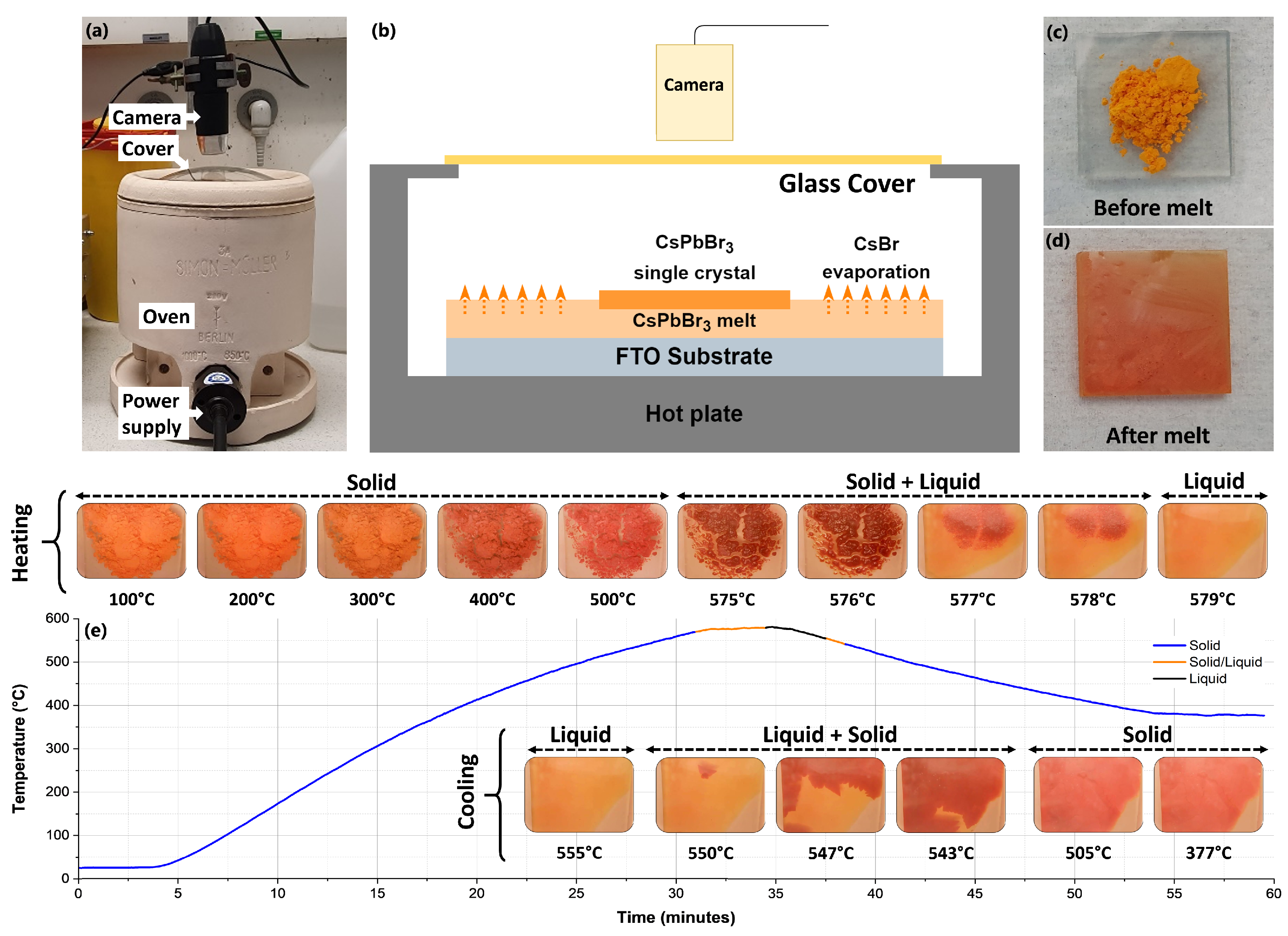
Commercial fluorine-doped tin oxide glass substrates, SnO 2 (FTO), with a standard size of (25 × 25 mm 2 ) and a polycrystalline pyramidal surface relief were sequentially cleaned in acetone and isopropanol, rinsed in deionized water, and dried in filtered air. Microcrystalline CsPbBr 3 powder was synthesized from equimolar CsBr and PbBr 2 precursors, both 99.999% trace-metal basis, following the solution route of Stoumpos et al. [4,26]. The powder was spread homogeneously onto the FTO surface by gentle sieving and leveled with a clean blade, yielding continuous coverage without solvent or binder [Figure 1c]. The areal loading was adjusted such that melting and coalescence produced a film of several tens of micrometers thick over the pyramidal FTO relief [Figure 1d].

2.2. Melt Recrystallization and In Situ Optical Imaging

Melting experiments were carried out in ambient air using a type 3A muffle oven (Simon Müller, Berlin, Germany) with a compact cylindrical heating volume of approximately 95 mm in diameter and 85 mm in height [Figure 1a,b]. The substrate temperature was monitored by an internal thermocouple connected to an LTR 2500 laboratory temperature controller, (Juchheim GmbH & Co. KG, Bernkastel-Kues, Germany). Samples were heated to the melt dwell temperature, held until complete liquefaction and wetting of the FTO relief were achieved, and subsequently cooled slowly to room temperature [Figure 1e].
The reported temperature corresponds to the nominal furnace/controller temperature. No additional thermocouple was placed directly at the sample or melt/substrate interface; therefore, the exact local melt temperature may differ from the recorded furnace temperature.
In situ optical imaging of the melting and solidification sequence was performed in top-view geometry using a Jiusion handheld USB microscope (Jiusion, Shenzhen, China) mounted above a viewport. Video frames were recorded at fixed exposure under diffuse white LED illumination located outside the hot zone to minimize thermal-emission artifacts. Frame timestamps were synchronized with the oven temperature log. Because the oven was covered but not hermetically sealed, volatile halide species could exchange with the ambient headspace during the thermal cycle. Here, covered but unsealed ambient air means that the sample was physically covered, but the enclosure was not gas-tight. Oxygen and moisture partial pressures were not measured and may vary with the laboratory and furnace environment. The solidified samples were transferred to dry storage and characterized without further post-treatment.

2.3. Evaporative Boundary Condition

The net evaporative flux of a volatile species (i) at the melt/gas surface was described by the Hertz–Knudsen relation,
J ev = α i p i , eq ( T ) p i 2 π m i k B T
where ( J ev ) is the net evaporation flux, ( α i ) is the evaporation coefficient, ( p i , eq ( T ) ) is the equilibrium vapor pressure at temperature (T), ( p i ) is the partial pressure in the headspace, ( m i ) is the molecular mass, and ( k B ) is the Boltzmann constant. This expression was used to describe the non-conservative boundary condition at the open melt/gas interface. Order-of-magnitude estimates were based on the literature vapor-pressure data and Knudsen-effusion measurements cited in the main text.

2.4. X-Ray Diffraction

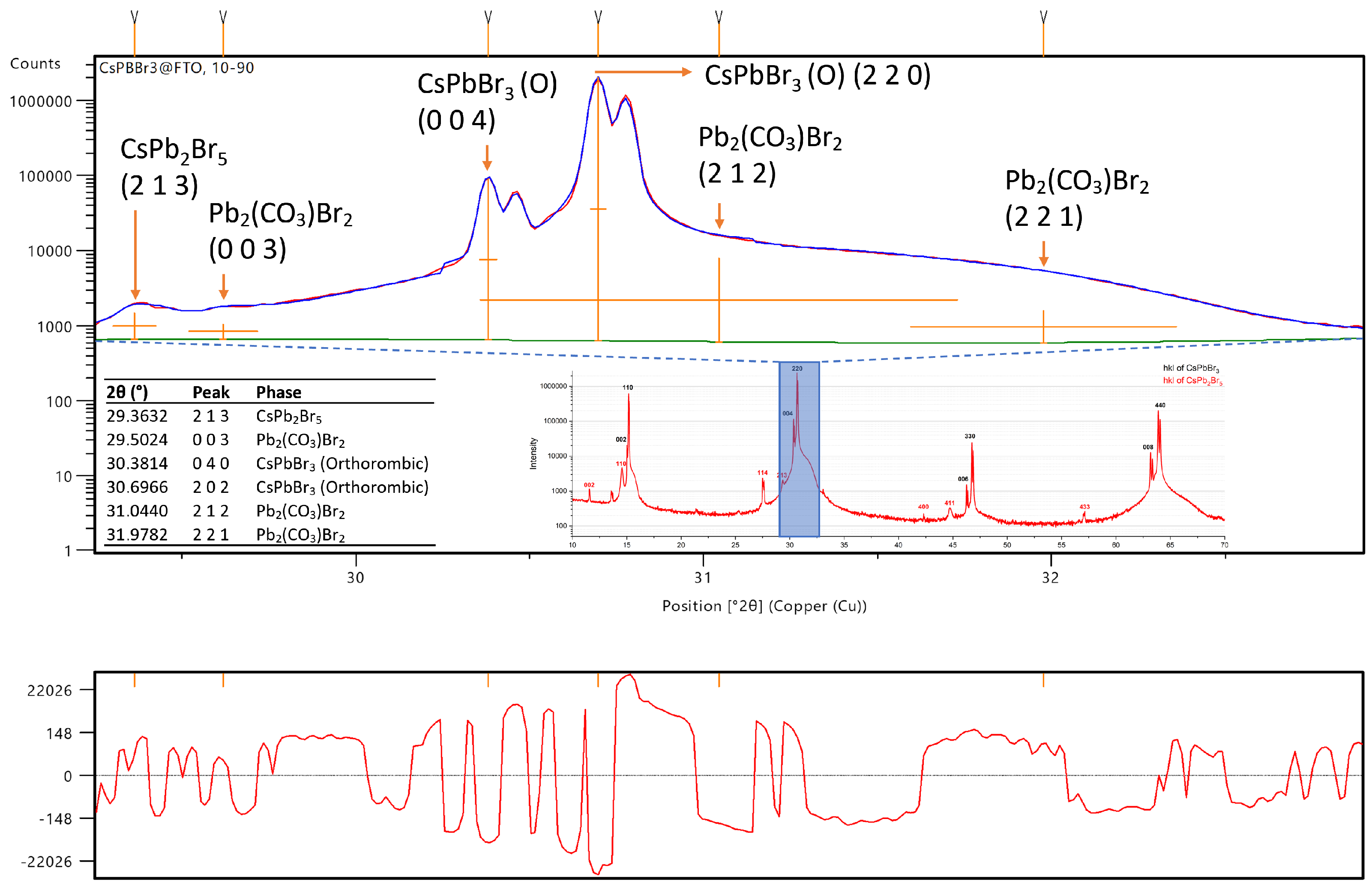
X-ray diffraction was performed on the as-recrystallized surface using a PANalytical Empyrean diffractometer, (Malvern Panalytical, Almelo, The Netherlands) in Bragg–Brentano reflection geometry. ( θ 2 θ ) scans were collected in the range of ( 10 ° 70 ° ) and plotted on a logarithmic intensity scale. Phase assignment was based on database matching in HighScore, with peak fitting restricted to the dominant ( 29 ° 33 ° ) region. The main reflections were assigned to orthorhombic CsPbBr 3 and CsPb 2 Br 5 ; weaker features were evaluated within the instrumental detection limit. Because the recrystallized films are single-crystalline or strongly textured, the measured intensities do not satisfy powder-statistical requirements, and Rietveld refinement was not applied.

2.5. Scanning Electron Microscopy and Microanalysis

2.5.1. SEM Imaging Geometry and Sample Preparation

Main SEM imaging was performed on a JEOL JSM-7610F (JEOL Ltd., Akishima, Tokyo, Japan) operated at 5–15 kV. Cross sections were prepared by mechanical cleavage of delaminated films. Both the top surface and the FTO-facing side of the delaminated film were examined to distinguish the free-surface morphology from the buried morphology formed near the substrate. Layer thicknesses were measured from calibrated cross-sectional SEM micrographs and reported as mean (±) one standard deviation.

2.5.2. SE and BSE Imaging

Low-voltage secondary-electron imaging at 5 kV was used to resolve surface topography, terraces, and inverted steps. Backscattered-electron imaging at 15 kV was used for phase discrimination by Z-contrast and to guide EDX point, line, and map analyses. The abrupt CsPbBr 3 / CsPb 2 Br 5 layers were therefore evaluated both morphologically and by SEM-BSE contrast.

2.5.3. EDX Point, Line, and Map Analysis

EDX analysis was performed on the JEOL JSM-7610F. Point spectra and line scans were used to determine Cs, Pb, and Br stoichiometries in at% across the CsPbBr 3 / CsPb 2 Br 5 boundary, within the compact and porous CsPb 2 Br 5 regions, and on secondary Pb–Br-rich crystallites. Quantification was restricted to Cs, Pb, and Br; O was treated qualitatively because of the limitations of EDX for light-element quantification.

2.5.4. SEM-BSE Contrast Estimation

BSE contrast was estimated using a Reimer–Castaing summing procedure to support phase assignment in SEM-BSE images. For each element (i), the elemental backscattering coefficient was calculated as:
η ( Z i ) = 0.0254 + 0.016 Z i 1.86 × 10 4 Z i 2 + 8.3 × 10 7 Z i 3 ,
where ( Z i ) is the atomic number of element (i). For a compound, ( n i ) is the stoichiometric coefficient of element (i), and ( A i ) is its atomic weight. The molecular weight of the compound is
M = j n j A j ,
where the index (j) runs over all elements in the formula unit. The mass fraction of element (i) is then
c i = n i A i M = n i A i j n j A j .
The weighted BSE contribution of element (i) is
p i = c i · η ( Z i ) ,
and the effective BSE coefficient of the compound is obtained by summing all elemental contributions:
η HR = i p i = i c i · η ( Z i )
Table 1 reports the calculation for each candidate phase, listing the element, (Z_i), stoichiometric coefficient ( n i ), atomic weight ( A i ), mass fraction ( c i ), elemental Reimer coefficient ( η ( Z i ) ), and weighted contribution ( p i = c i · η ( Z i ) ). The total row gives ( η HR ). These values support, but do not by themselves determine, phase assignment because measured BSE intensity also depends on topography, crystallite size, edge effects, detector geometry, beam energy, and crystal orientation.

2.5.5. Cathodoluminescence Imaging

Panchromatic CL imaging was performed at 5 kV on a Tescan Vega II (Brno, Czech Republic) equipped with a tungsten thermionic source. SE reference images were recorded from the same regions to correlate with luminescence contrast with morphology and phase distribution, and compare the radiative response of CsPbBr 3 and CsPb 2 Br 5 regions.

2.5.6. TOF-SIMS Light-Element Mapping

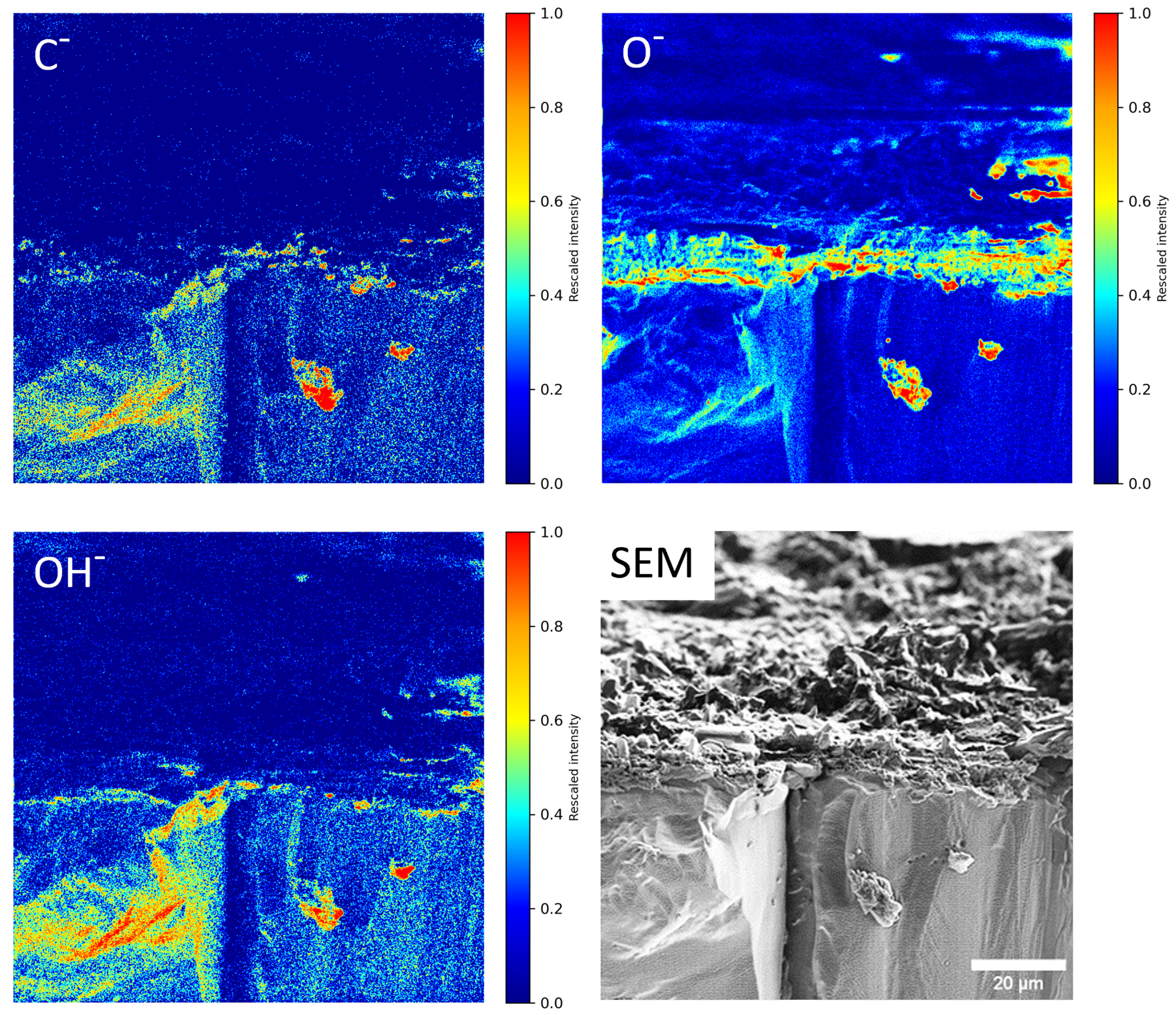
TOF-SIMS measurements were carried out on a Zeiss Crossbeam Auriga (Carl Zeiss NTS GmbH, Oberkochen, Germany) equipped with a TOFWERK TOF-SIMS system (TOFWERK AG, Thun, Switzerland). Negative-ion maps were acquired for ( C ) at (m/z = 12), ( O ) at (m/z = 16), and ( OH ) at (m/z = 17). These channels were used to complement EDX and assess the spatial distribution of carbon-, oxygen-, and hydroxyl-containing species near Pb–Br-rich secondary features.

2.6. Thermodynamic Phase Diagrams

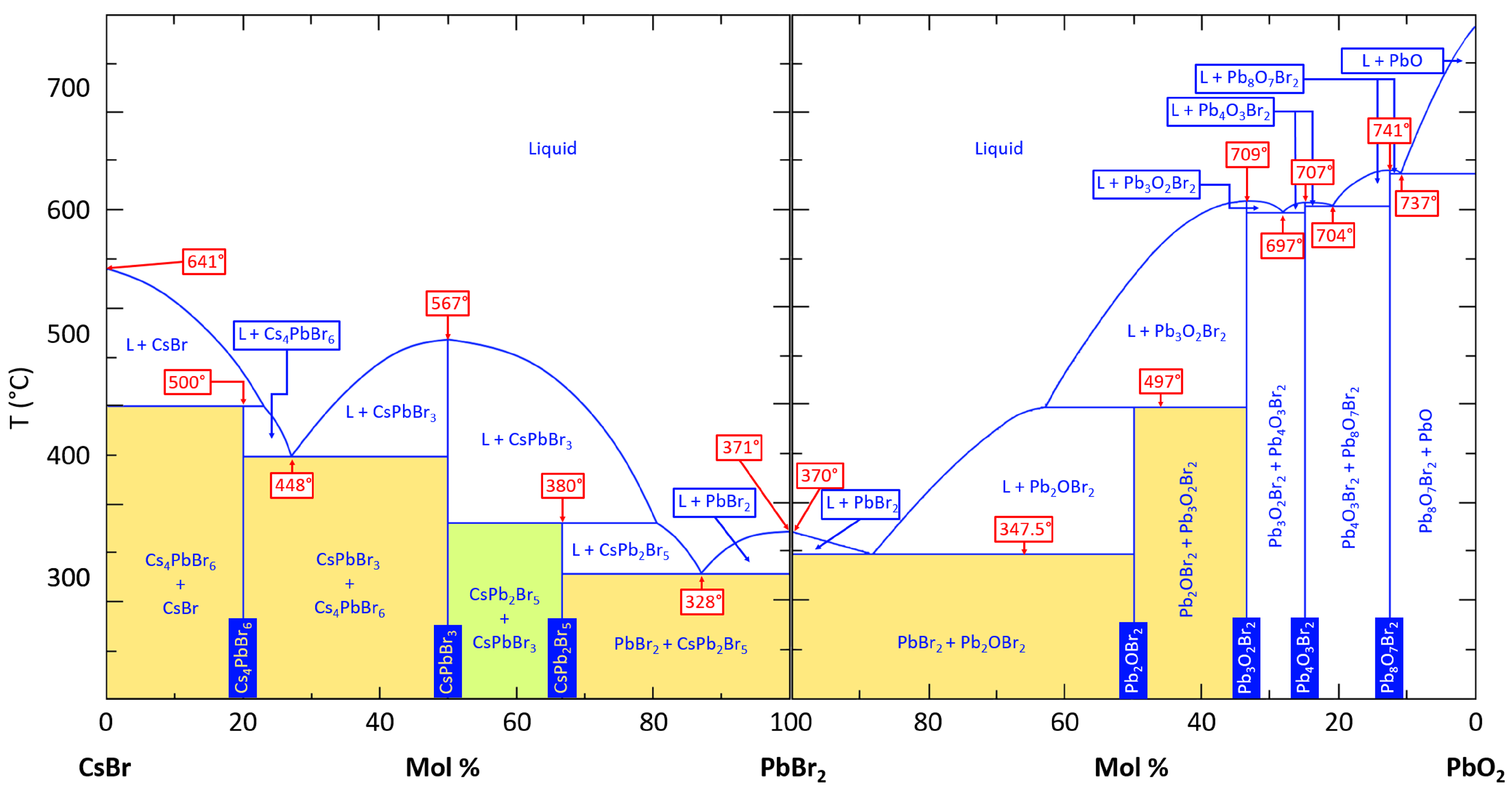
For interpretation of phase selection, the CsBr–PbBr2 binary phase diagram, including the peritectic region near 560–570 (°C), and the PbBr 2 –PbO binary system were used as thermodynamic references. These diagrams were used to relate the observed CsPbBr 3 , CsPb 2 Br 5 , PbBr 2 –rich, and Pb–Br–O phases to the expected compositional pathways during evaporation, decomposition, precipitation, and late-stage reaction at the FTO-facing side.

3. Results

3.1. Non-Conservative Boundary Conditions Established by Halide Evaporation

Figure 1e shows the temperature-time profile together with in situ optical frames of the melting and recrystallization sequences. Upon heating, the powder bed evolves from solid to solid + liquid and finally to a continuous liquid film; upon cooling, the sequence reverses as the advancing solidification front wets the pyramidal FTO relief.
Because the oven was covered but not hermetically sealed, the melt remained in continuous exchange with the ambient headspace. Evaporation from heated CsPbBr 3 is only partially congruent: Knudsen-effusion mass spectrometry shows CsBr-related vapor species, including (CsBr)x clusters detected through Cs 2 Br + , together with PbBr 2 –containing volatiles, so that both the vapor composition and the residual condensed source evolve with time [20]. PbBr 2 also has a measurable vapor pressure in this temperature range [27], and evaporation of CsPbBr 3 precursors has been reported to yield mixtures of CsPbBr 3 , CsPb 2 Br 5 , and Cs 4 PbBr 6 because of composition gradients during evaporation [21]. In our setup, visible salt condensate on the oven cover after high-temperature operation provides direct evidence for halide loss, consistent with previous reports of volatile halide transport in CsPbBr 3 -based processing [23,28].
Together, these observations show that solidification proceeds under a non-conservative boundary condition at the melt/gas interface. The melt therefore cannot be treated as a closed CsBr–PbBr2 system: its local composition is governed not only by diffusion, phase equilibria, and interface motion, but also by continuous evaporative mass loss to the headspace.

3.2. Evidence for Discrete Phase Selection

X-ray diffraction reveals the structural response to evaporation-induced compositional drift (Figure 2). The ( 10 ° 70 ° ) scan identifies orthorhombic CsPbBr 3 as the dominant phase and CsPb 2 Br 5 as the principal secondary phase, as confirmed by fitting the intense ( 29 ° 33 ° ) region [23,24,25,26,29,30,31]. No separate off-stoichiometric CsPbBr 3 phase is detected within the experimental resolution. Weak near-background reflections may originate from minor Pb 2 ( CO 3 ) Br 2 -type secondary crystallites, but this assignment remains tentative and is discussed in Section 3.5.
Because the recrystallized film is single-crystalline or strongly textured, the XRD intensities were used only for qualitative phase identification and not for quantitative phase-fraction analysis.
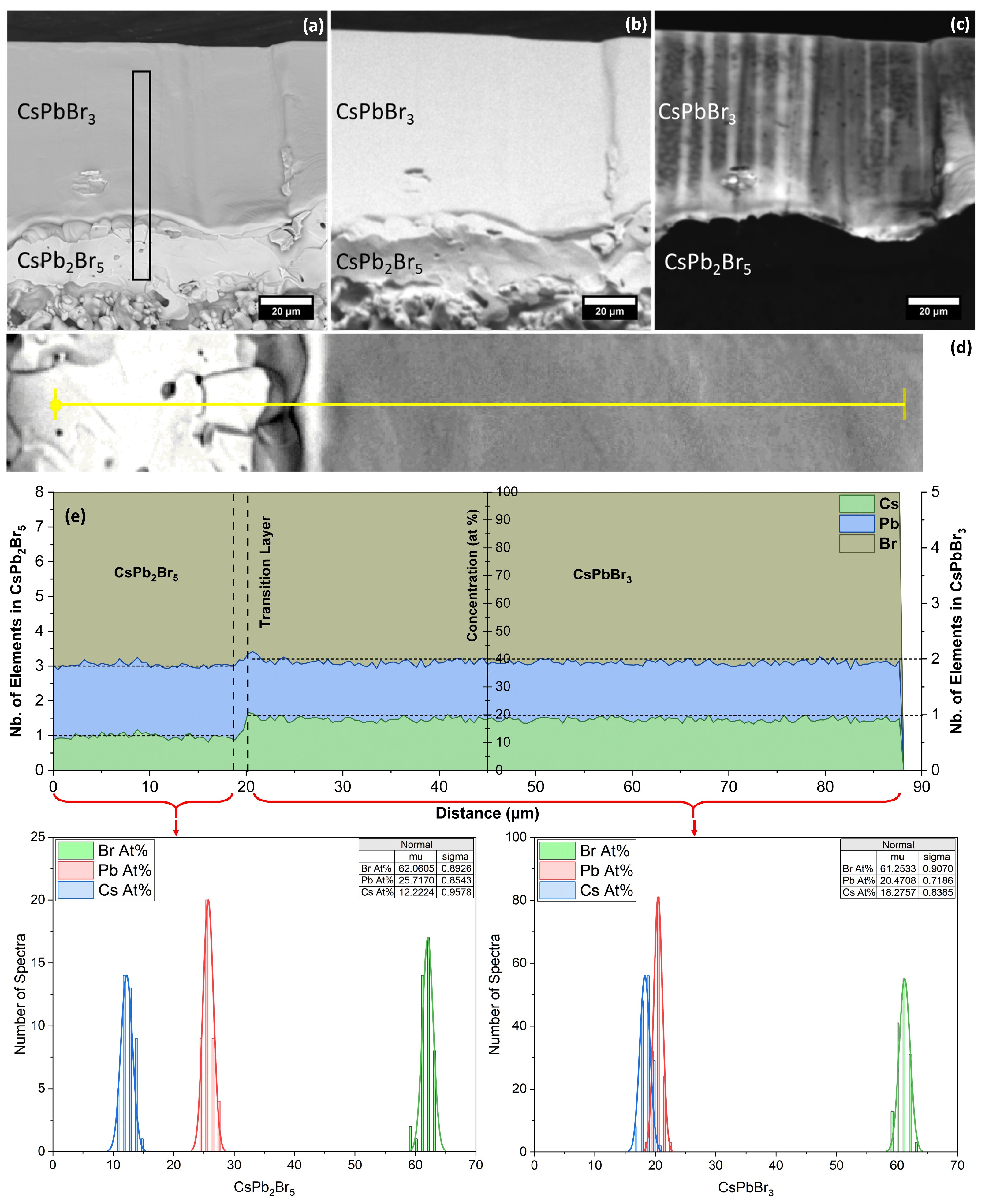
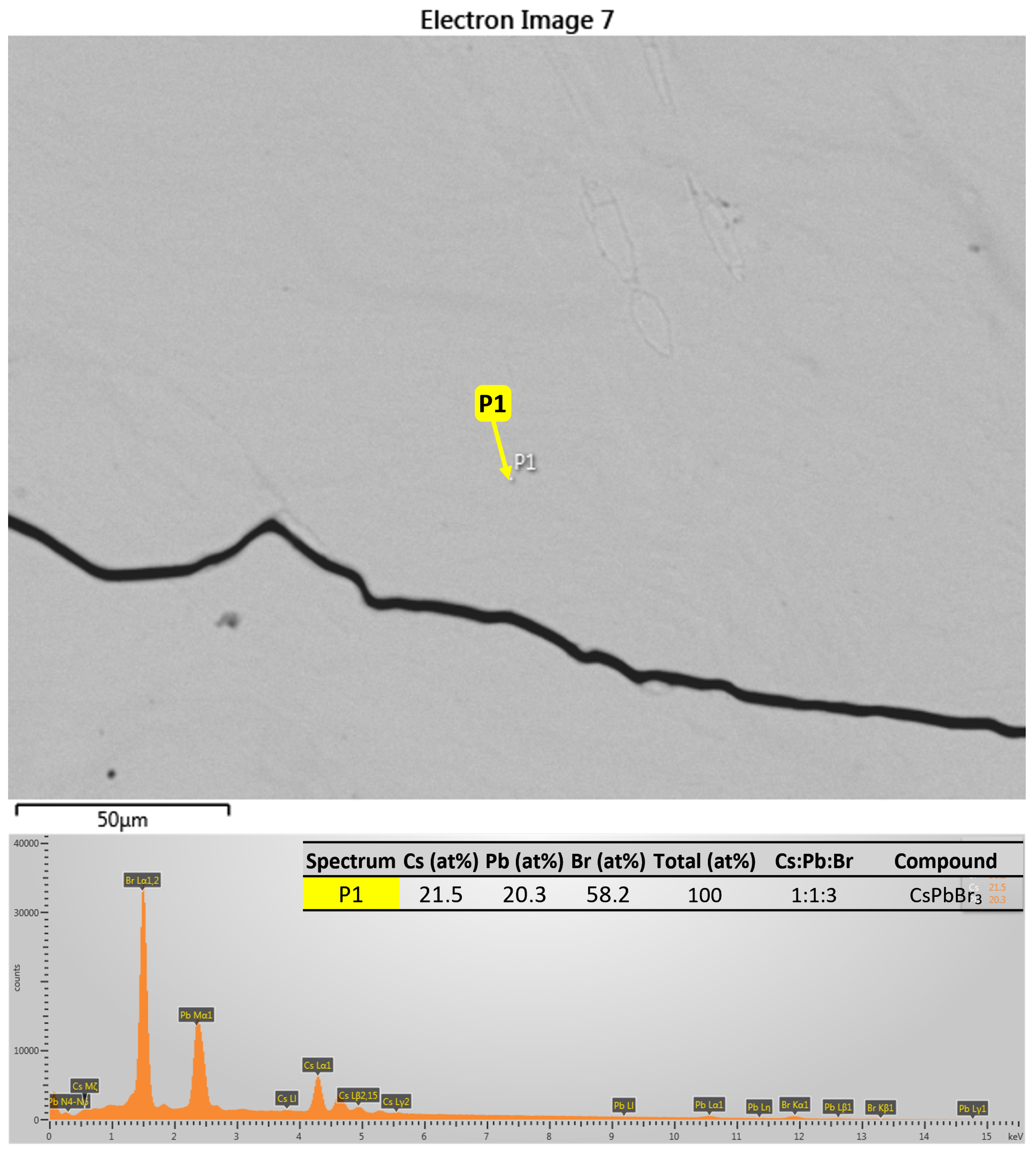
Cross-sectional SEM shows a layered structure composed of an (80–100 μ m ) CsPbBr 3 top layer, a (10–20 μ m ) compact CsPb 2 Br 5 interlayer, and a porous CsPb 2 Br 5 sublayer conforming to the FTO relief [Figure 3a,b]. These layers are clearly distinguished in SEM-BSE images by Z-contrast. Panchromatic CL imaging shows strong luminescence quenching in the CsPb 2 Br 5 region [Figure 3c], consistent with the weak radiative response expected for this phase [32,33]. EDX point spectra from the upper crystal give the expected (1:1:3) Cs:Pb:Br ratio, with no detectable O or Sn, confirming that the cap is chemically consistent with CsPbBr 3 (Figure A2). Based on this cross-sectional morphology, CsPbBr 3 remains the dominant phase by thickness, whereas CsPb 2 Br 5 forms a significant FTO-facing fraction. This estimate should be regarded as semi-quantitative rather than as a true volume fraction, because the lower CsPb 2 Br 5 -rich region is porous and laterally non-uniform.
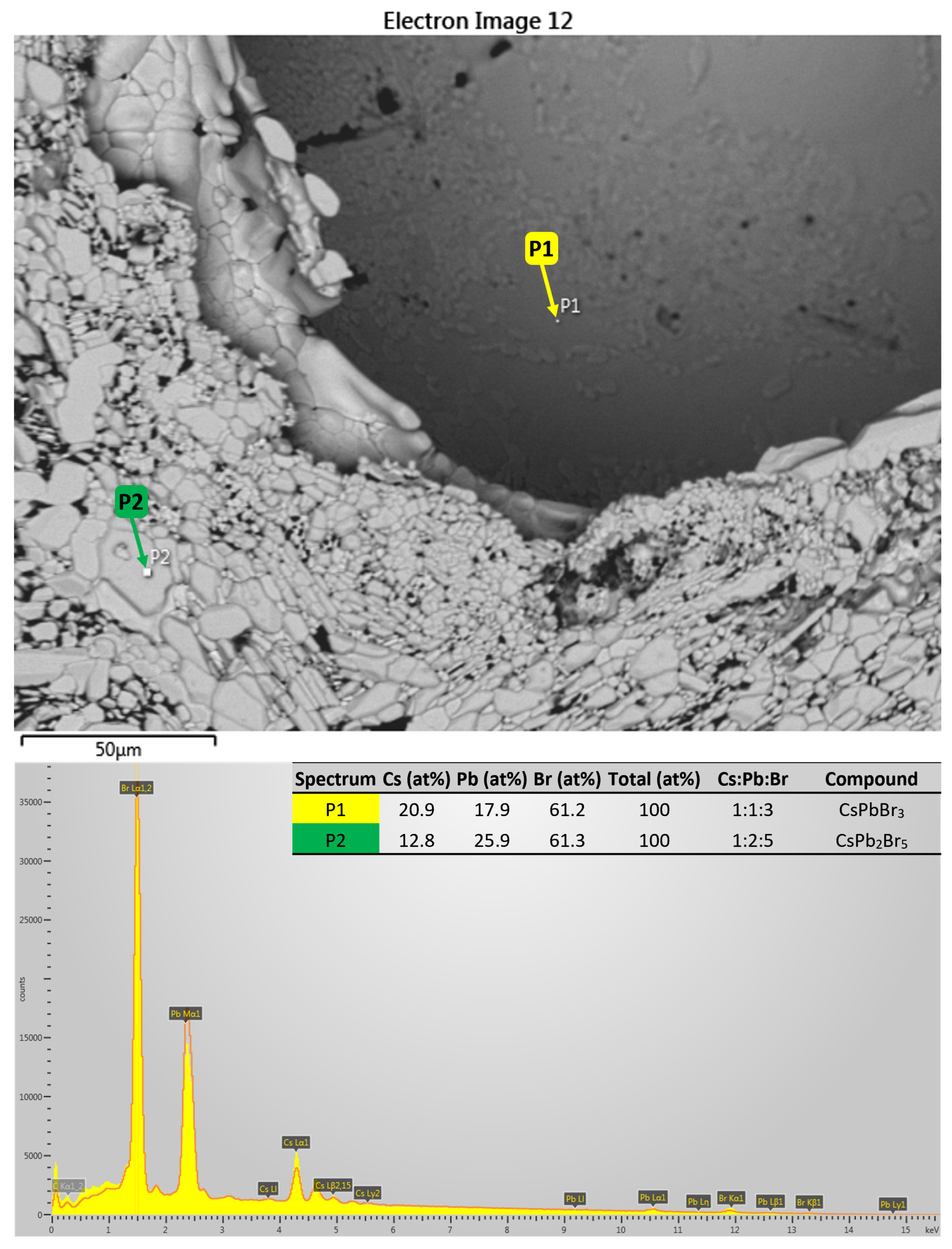
EDX line scans across the CsPbBr 3 / CsPb 2 Br 5 boundary show an abrupt compositional jump without a resolvable graded region [Figure 3d,e]. Point spectra acquired from laterally adjacent domains at the FTO-facing side show the same discreteness: the compositions correspond either to (1:1:3) CsPbBr 3 or to (1:2:5) CsPb 2 Br 5 , with no intermediate stoichiometries (Figure A3), indicating that the transition is abrupt rather than compositionally graded within the spatial resolution of SEM-EDX.
In the CsBr–PbBr2 pseudobinary representation, two limiting pathways can explain the formation of CsPb 2 Br 5 :
  • In the first pathway, selective CsBr evaporation directly shifts CsPbBr 3 toward the PbBr 2 -richer line compound:
2 C s P b B r 3 C s P b 2 B r 5 + C s B r evap
If this CsBr-loss process occurs broadly through the residual melt, it may produce a more distributed compositional shift. However, because CsPbBr 3 and CsPb 2 Br 5 are line compounds, this does not necessarily lead to a graded CsPbBr 3 solid solution; instead, the phase response is still expected to occur by switching from CsPbBr 3 to CsPb 2 Br 5 once the local stability limit is crossed.
  • In the second pathway, CsBr evaporation is accompanied by local accumulation or precipitation of PbBr 2 -rich residual material, particularly at the FTO-facing side, as supported by the observed traces of PbBr 2 on FTO. This PbBr 2 -rich material can subsequently react with adjacent CsPbBr 3 to form CsPb 2 Br 5 :
C s P b B r 3 + P b B r 2 C s P b 2 B r 5
This second pathway provides a natural explanation for the abrupt CsPbBr 3 / CsPb 2 Br 5 boundary observed by SEM-EDX, because the reaction is localized where PbBr 2 -rich residual material is available. Thus, the first pathway explains the overall evaporation-driven shift toward PbBr 2 -richer conditions, whereas the second pathway better explains the spatial localization and sharpness of the FTO-facing transition. The absence of Cs 4 PbBr 6 , located on the CsBr-rich side of the phase field, further supports a net shift toward PbBr 2 -rich rather than CsBr-rich conditions. The system therefore accommodates evaporation-induced off-stoichiometry by switching between line compounds, C s P b B r 3 C s P b 2 B r 5 , rather than by forming a resolvable graded CsPbBr 3 solid solution.

3.3. Emergence of a Faceted Instability at the Buried Interface

Beyond discrete phase selection, the delaminated films reveal a faceted instability localized at the FTO-facing side. In situ optical imaging shows that solidification begins by nucleation and lateral growth of a planar CsPbBr 3 front while the melt is still thick (Figure 1). In this stage, the advancing front is effectively screened from the pyramidal FTO relief. As the CsPbBr 3 cap grows and the residual melt thins, the FTO topography imposes stronger local variations in melt thickness, interface curvature, and thermal gradient. These perturbations provide the geometric trigger for the FTO-facing instability. Thus, the FTO relief is not interpreted as a direct template that fixes the terrace spacing. Instead, it acts as a local geometrical and thermal perturbation that becomes important only during the final thin-melt stage, when the residual liquid can no longer screen the pyramidal substrate topography.
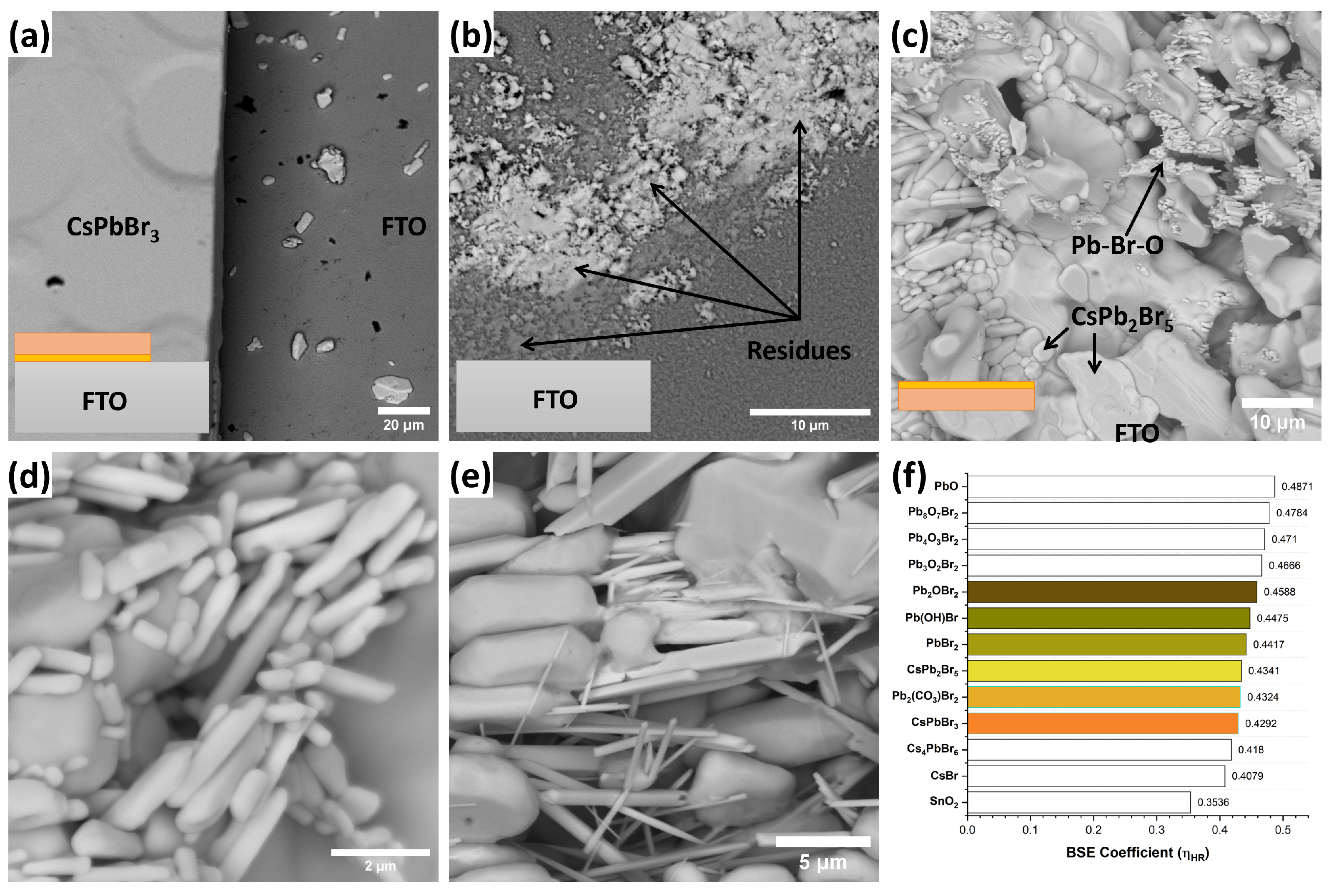
The morphology was accessed by mechanical delamination of the recrystallized film (Figure 4). BSE imaging shows the delaminated CsPbBr 3 film and exposed FTO surface [Figure 4a], residual material remaining on FTO [Figure 4b], and the FTO-facing side of the flipped film [Figure 4c]. This side consists of coarse and fine CsPb 2 Br 5 grains decorated by sub- μ m Pb–Br–O secondary crystallites. The secondary crystallites are discussed separately in Section 3.5.
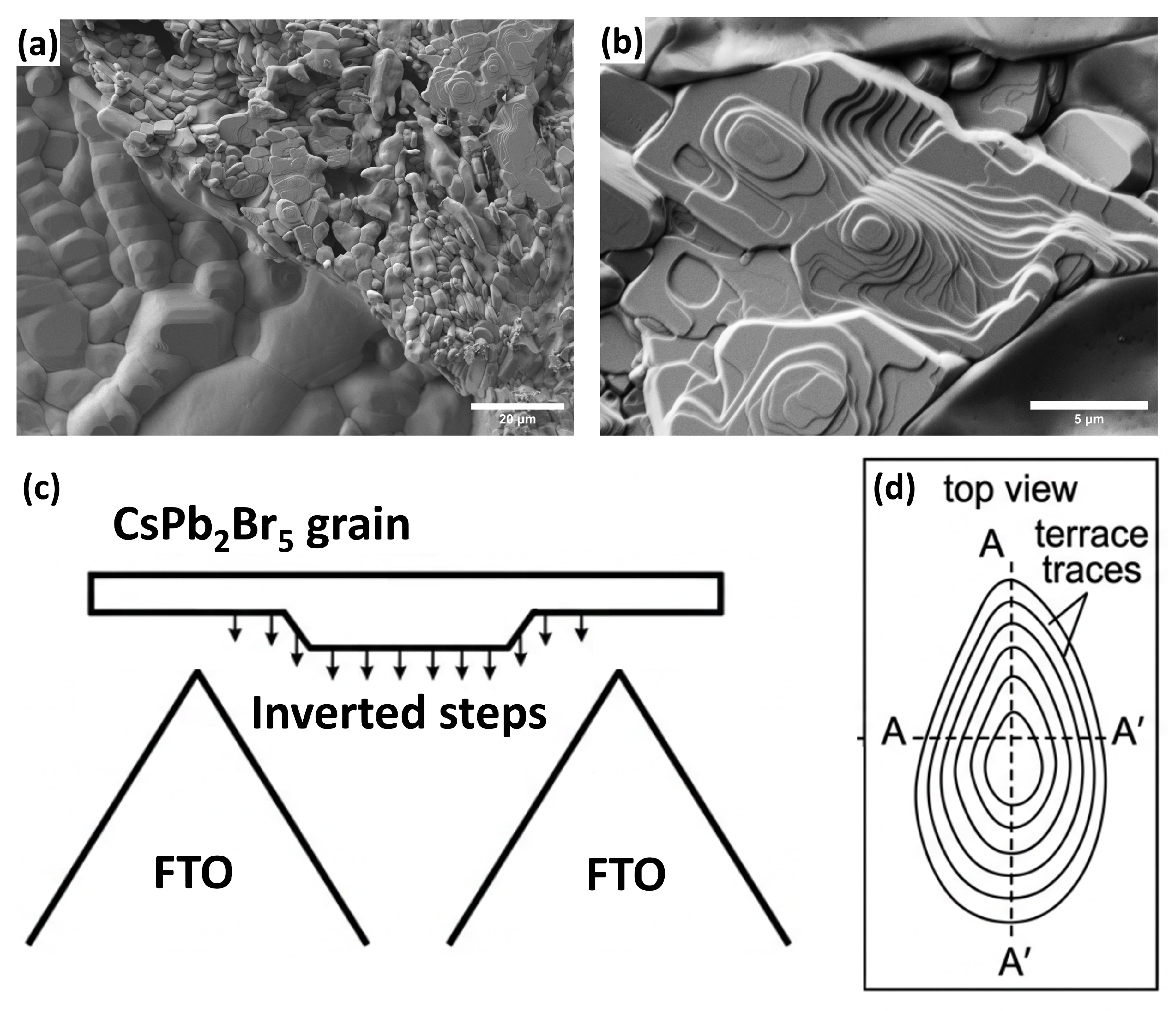
Low-voltage SE imaging resolves the faceted topography of this region (Figure 5). Coarse CsPb 2 Br 5 grains contain broad inverted steps, whereas smaller grains show steeper and more closely spaced terraces [Figure 5a,b]. The corresponding height map confirms that the contrast is dominated by terrace-like height modulation rather than by compositional variation [Figure 5d]. EDX point spectra from the compact base and from internal grains of the porous layer give the same (1:2:5) CsPb 2 Br 5 stoichiometry (Figure A4). Thus, the coarse-to-fine hierarchy is primarily morphological, not compositional.
The characteristic lateral spacing of the faceted features is (1–10 μ m ), much smaller than the total film thickness, λ h 100 μ m .
Together with the absence of hexagonal or roll-like planforms, this scale separation argues against a hydrodynamic convection origin. Instead, the stepped faceted morphology is consistent with a diffusion-controlled solidification instability of Mullins–Sekerka type, modified by anisotropic interface kinetics [17,18]. In this picture, diffusion–capillarity competition selects the spacing, while crystallographic anisotropy produces the faceted terraces of Figure 5c.

3.4. Coarse-to-Fine Evolution of the FTO-Facing Morphology

The spatial evolution of the FTO-facing microstructure provides an additional constraint on the growth mechanism. Beneath the CsPbBr 3 single-crystal cap, the CsPb 2 Br 5 grains are coarse and exhibit large, widely spaced inverted steps. Closer to the FTO relief, where the residual melt was thinner during the final stage of solidification, the grains become smaller and the terraces become steeper and more closely spaced [Figure 5a,b,d]. This trend is consistent with growth under a decreasing effective transport length. In a diffusion-limited description,
D D R
where (D) is the relevant diffusivity and (R) is the local interface velocity. As the melt thins, local variations in (R), interface curvature, and the thermal gradient imposed by the pyramidal FTO surface becomes stronger, favoring a finer faceted morphology.
The same interpretation is consistent with the sensitivity of the porous faceted microstructure to the openness of the melt/gas boundary. Conditions that reduce evaporative exchange with the headspace suppress the porous, faceted morphology, whereas stronger evaporative loss promotes it. This behavior links the instability to evaporation-induced compositional drift, rather than to a purely geometrical imprint of the substrate.
The compact CsPbBr 3 cap thickness does not set the characteristic in-plane spacing, and the FTO relief does not act as a direct template with a fixed pitch. Instead, the substrate topography localizes and perturbs the final solidification front, while the selected morphology is governed by transport, capillarity, faceted interface kinetics, and the evaporative boundary condition.

3.5. Secondary Light-Element Chemistry in Confined Microenvironments

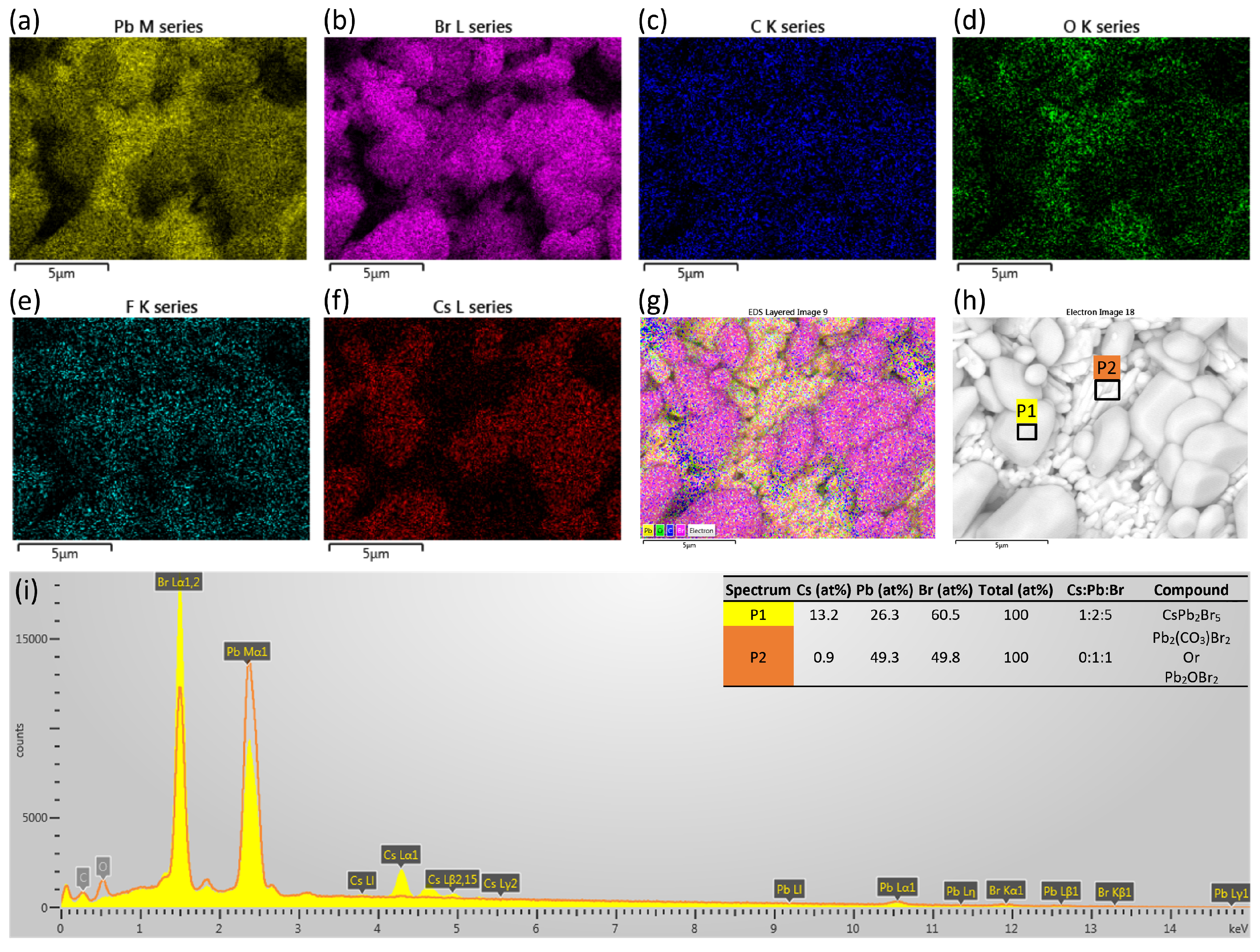
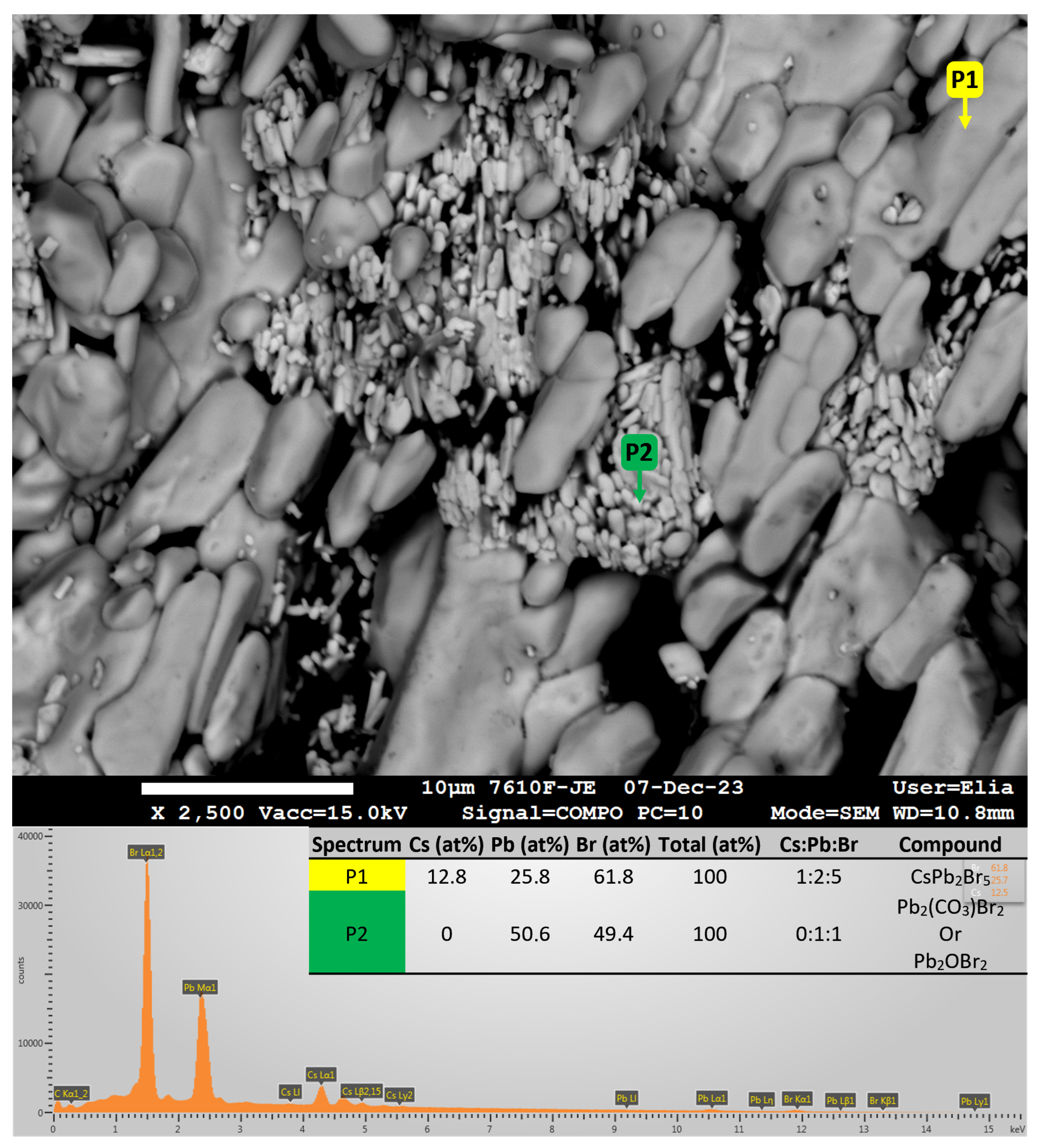
Sub- μ m rice-shaped crystallites decorate the porous CsPb 2 Br 5 region at the FTO-facing side [Figure 4c and Figure 6]. EDX maps show that these features are Pb–Br-rich and locally enriched in O, with weaker C and F signals (Figure 6). The C and F signals are minor and are, therefore, treated as trace contributions. Point spectra give ( Pb 1 ) and no detectable Cs, excluding CsPbBr 3 and CsPb 2 Br 5 and indicating a secondary Pb–Br phase containing light elements (Figure A5). Negative-ion TOF-SIMS maps confirm that ( C ), ( O ), and ( OH ) are concentrated in the same reacted regions (Figure 7).
The phase assignment is constrained but not unique. The rice-shaped crystallites are compatible with a Pb 2 ( CO 3 ) Br 2 -type phase, based on their morphology, Pb–Br-rich composition, C signal, weak near-background XRD features, and calculated BSE coefficient, which is higher than that of CsPb 2 Br 5 [Figure 4f]. Nanowire-like crystallites with ( Pb : Br a t o m i c r a t i o 1 : 1 ) are additionally compatible with Pb(OH)Br-type phases. Lead oxybromides such as Pb 2 OBr 2 also remain possible, because the PbBr 2 –PbO phase diagram contains stable Pb–O–Br compositions near the measured Pb ratio (Figure A1) [34,35]. We, therefore, denote these products as Pb–Br–O secondary phases. Local diffraction, micro-Raman spectroscopy, or TEM-based analysis would be required for definitive identification.
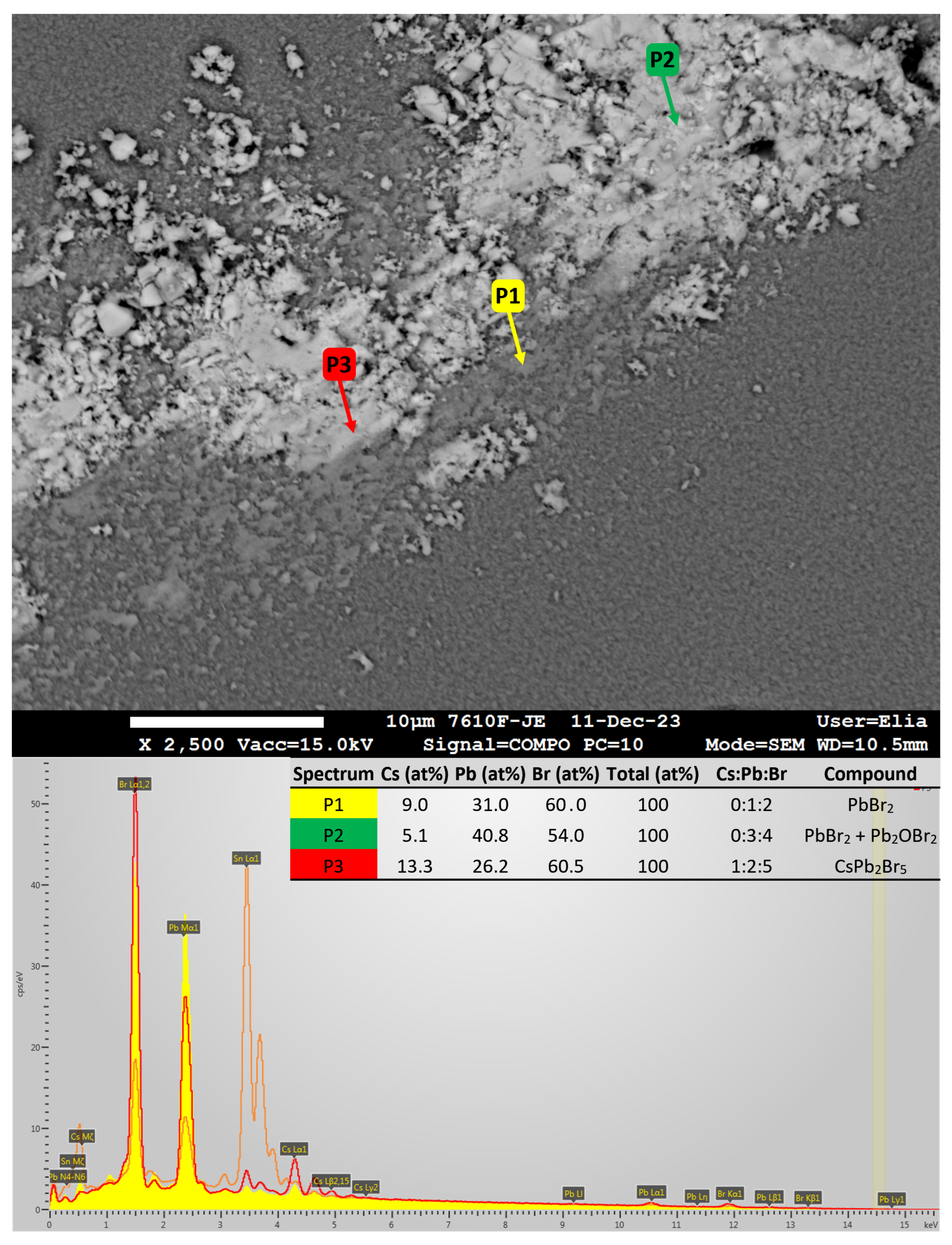
Their formation is consistent with late-stage enrichment of PbBr 2 -rich residual material. CsBr loss and partial melt decomposition shift the system from CsPbBr 3 toward CsPb 2 Br 5 and finally toward PbBr 2 -rich compositions. The residual fragments on FTO record this sequence, with PbBr 2 -rich material near the substrate and CsPb 2 Br 5 above (Figure A6). Because PbBr 2 -rich material is denser than the CsPbBr 3 -rich melt, it may precipitate at the FTO-facing side during the final solidification stage. Reaction of this residual material with O-, OH-, or carbonate-containing species can then produce the observed Pb–Br–O crystallites in confined voids or pockets.
These reactions are secondary to the primary faceted solidification instability. They decorate the internal porous FTO-facing morphology and record the chemistry of the last residual liquid, but they do not set the grain or terrace spacing.

3.6. Mechanistic Constraints

The observations constrain the mechanism to a coupled sequence. First, the covered but non-hermetic geometry imposes a non-conservative melt/gas boundary. Second, evaporation and partial decomposition shift the CsBr–PbBr2 balance toward PbBr 2 -rich conditions, producing discrete line-compound selection, C s P b B r 3 C s P b 2 B r 5 .
Third, during the final thin-melt stage, the FTO relief localizes a faceted instability at the FTO-facing side, expressed as a coarse-to-fine grain and terrace hierarchy. Finally, PbBr 2 -rich residual material reacts locally with O-, OH-, and C-containing species to form Pb–Br–O secondary crystallites.
The candidate mechanisms are compared in Table 2. Spinodal dewetting and nucleation-limited solidification can be excluded because they do not reproduce the thick-melt geometry, crystallographic faceting, and ordered terrace hierarchy. Pure substrate templating and Marangoni/Bénard convection is also unlikely: the first would lock the spacing to the FTO pitch, whereas the second would generate roll or cellular platforms with wavelengths comparable to the liquid thickness. Reaction–diffusion chemistry is present but secondary; it accounts for the local Pb–Br–O crystallites without setting the primary grain or terrace spacing.
The mechanism most consistent with the observations is a faceted Mullins–Sekerka-type solidification instability modified by evaporation-induced compositional drift. Diffusion and capillarity select the characteristic length scale, anisotropic interface kinetics produce faceting, and the open evaporative boundary shifts the melt toward PbBr 2 -rich line-compound equilibria [17,18]. Thus, the FTO relief perturbs and localizes the instability, but the primary pattern is governed by transport, capillarity, and evaporative boundary conditions rather than by hydrodynamic flow or direct geometrical templating.

4. Discussion

Our results show that slow cooling of a CsPbBr 3 melt on polycrystalline SnO 2 (FTO), under covered but non-hermetic conditions, produces an open-boundary solidification regime in which evaporation, discrete phase selection, and faceted interfacial instability are coupled.
The key condition is non-conservative mass loss at the melt/gas surface. Evaporation of Cs–Br-related, PbBr 2 -containing, and Br-containing species changes the local CsBr–PbBr2 balance during solidification. In a line-compound system, this drift is not accommodated by continuous off-stoichiometry of CsPbBr 3 . Instead, the phase response is discrete from CsPbBr 3 to CsPb 2 Br 5 , corresponding to reduced CsBr activity and/or relative PbBr 2 enrichment. This distinguishes the present case from the classical Mullins–Sekerka problem, where the interface is usually treated with conserved mass transport and continuous compositional variation [17,18].
The instability appears when the residual melt becomes thin. During the early stage, the melt thickness is sufficient to screen the advancing front from the pyramidal FTO relief, allowing lateral growth of a planar CsPbBr 3 single-crystal cap. As solidification proceeds, the liquid layer thins and the FTO relief imposes local variations in melt thickness, curvature, and thermal gradient. At the same time, evaporation and partial decomposition shift the remaining liquid toward CsPb 2 Br 5 and PbBr 2 -rich compositions. The resulting FTO-facing morphology consists of coarse CsPb 2 Br 5 grains with broad inverted steps, followed by finer grains with steeper and more closely spaced terraces. This coarse-to-fine evolution is consistent with a decreasing effective diffusion length.
D D R , a leading to a morphology consistent with a Mullins–Sekerka-type instability modified by an anisotropic interface kinetics and by the evaporative boundary condition.
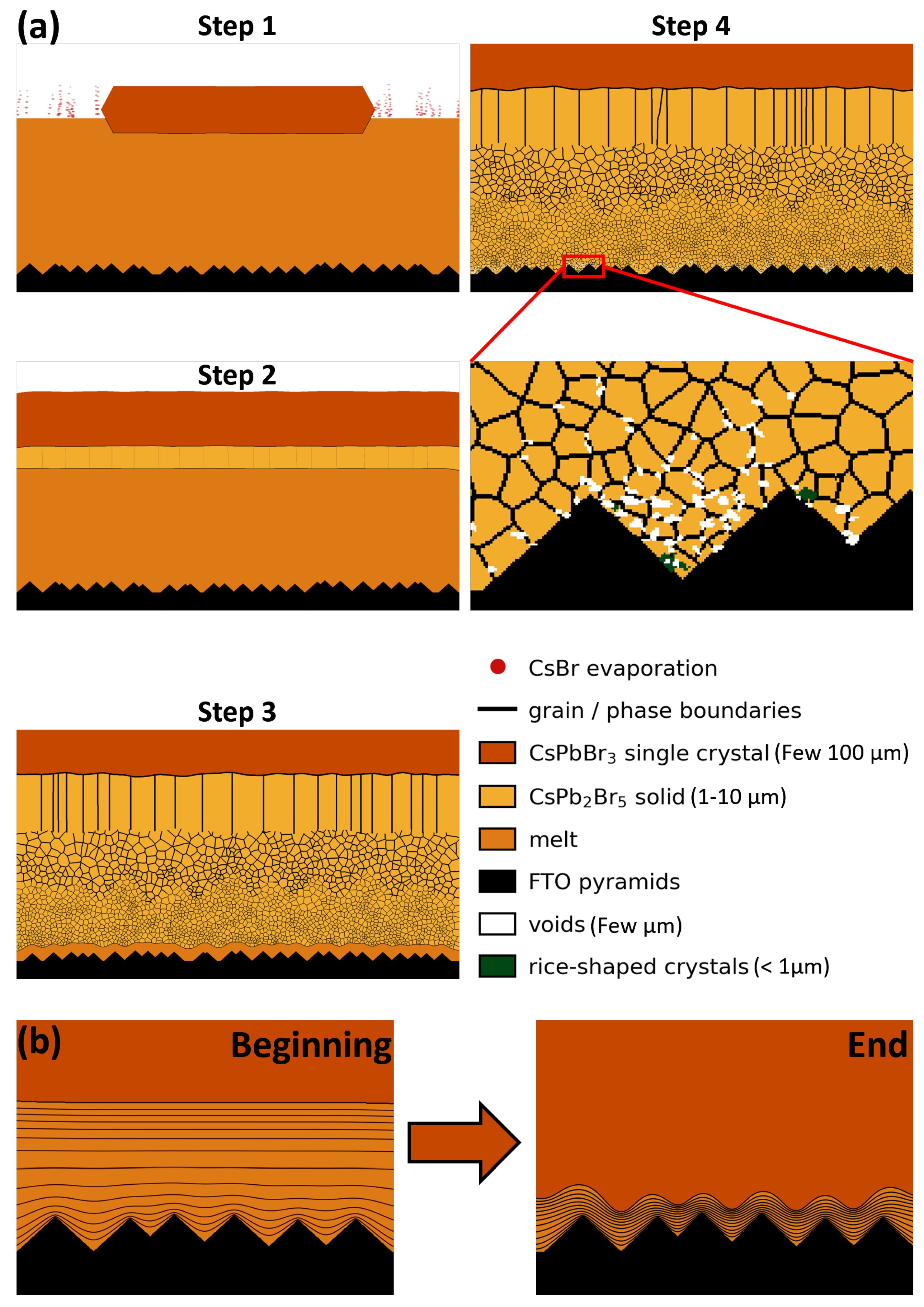
The proposed evolution is summarized schematically in Figure 8. In step 1, small nuclei form while Cs–Br-related species evaporate from the melt. In step 2, lateral growth produces a CsPbBr 3 cap, while the lower melt shifts toward CsPb 2 Br 5 formation because of reduced CsBr activity and/or relative PbBr 2 enrichment. In step 3, as the residual melt thins, temperature-gradient inhomogeneities imposed by the pyramidal FTO relief promote a more polycrystalline and porous CsPb 2 Br 5 morphology at the FTO–facing side. In step 4, after final melt consumption, voids and PbBr 2 -rich residual pockets remain between grains, where local reaction with O-, OH-, or carbonate-containing species produces Pb–Br–O secondary crystallites.
The thermochemical pathway is constrained by the CsBr–PbBr2 and PbBr 2 –PbO phase diagrams (Figure A1):
C s P b B r 3 C s P b 2 B r 5 P b B r 2 P b 2 O B r 2 P b 3 O 2 B r 2
The PbBr 2 -rich residual fragments on FTO (Figure A6) support this sequence. Because PbBr 2 -rich material is denser than the CsPbBr 3 -rich melt, it may precipitate near the FTO-facing side during the final stages of solidification, particularly when the upper single-crystalline film partially restricts evaporation from the lower melt. This provides a plausible route from discrete phase selection to the late secondary chemistry.
The secondary Pb–Br–O chemistry is local and subordinate to the primary instability. EDX and TOF-SIMS show that the rice-shaped and nanowire-like crystallites contain Pb, Br, O, OH, and locally C, but the grain and terrace hierarchy is already defined by the CsPb 2 Br 5 morphology. These secondary phases decorate the porous FTO-facing region and record the chemistry of the last residual liquid; they do not set the primary in-plane spacing.
Several limitations remain. The evaporative boundary condition is treated using order-of-magnitude Hertz–Knudsen-type estimates rather than a fully coupled transport model. The EDX profiles bound any transition width only within the spatial resolution of the measurement. The source of the light elements in the secondary crystallites cannot be assigned uniquely; possible contributions include trapped gas, the SnO 2 substrate, residual humidity, CO 2 , and post-growth ambient exposure. The phase identity of the secondary Pb–Br–O crystallites also remains tentative. Pb 2 ( CO 3 ) Br 2 -type, Pb(OH)Br-type, and lead oxybromide phases remain plausible if there is a reaction with C or H from the surrounding atmosphere at the processing temperature, and definitive assignment requires local diffraction, micro-Raman spectroscopy, or TEM-based analysis of individual crystallites [36,37].
The results suggest practical control parameters. Increasing (G/R) should stabilize the solidification front. Reducing the evaporation drive, for example, by increasing the halide partial pressure or improving enclosure of the melt should suppress the PbBr 2 -rich shift and reduce formation of the porous faceted morphology. The FTO relief controls where the instability develops by modulating local melt thickness, curvature, and thermal gradient, but it does not by itself set the characteristic in-plane spacing. Oxygen-, hydroxyl-, and carbonate-containing species control secondary phase formation without determining the primary morphology. A practical route to suppress CsPb 2 Br 5 formation is therefore to reduce the evaporation-driven shift toward PbBr 2 -rich conditions. A slight excess of CsBr in the starting composition could compensate for partial CsBr loss during heating and solidification, thereby maintaining the local composition closer to the CsPbBr 3 stability range. However, this excess must be optimized carefully, because too much CsBr could promote CsBr-rich residues or Cs 4 PbBr 6 formation. Additional strategies include improving enclosure of the melt, increasing the local halide partial pressure, reducing the dwell time at high temperature, and stabilizing the thermal gradient during cooling.
From an application perspective, suppressing the extended CsPb 2 Br 5 region is more important than eliminating the localized Pb–Br–O crystallites, because CsPb 2 Br 5 reduces the continuous scintillating CsPbBr 3 volume, whereas the secondary crystallites are localized and sub- μ m in size.
More generally, these results identify a solidification regime in which open-boundary evaporation and discrete line-compound equilibria jointly control pattern formation. Such behavior should be relevant to other volatile halide and oxide-halide melts where evaporation, phase selection, and interfacial stability remain coupled during cooling.

5. Conclusions

We have shown that slow cooling of CsPbBr 3 on polycrystalline SnO 2 :F (FTO) under covered but non-hermetic conditions produces an open-boundary solidification pathway. Evaporation drives the melt away from mass-conserved behavior and converts compositional drift into discrete phase selection. Instead of forming a continuously off-stoichiometric perovskite, the film separates into abrupt CsPbBr 3 and CsPb 2 Br 5 regions, consistent with the line-compound character of the CsBr–PbBr2 system. At the FTO-facing side, the remaining melt develops a porous, faceted CsPb 2 Br 5 morphology with inverted-step terraces. The coarse-to-fine evolution of the grains and terraces is consistent with late-stage thin-melt solidification, where the FTO relief enhances local variations in thermal gradient, curvature, and transport length. The morphology is therefore best described as a faceted Mullins–Sekerka-type instability modified by evaporative compositional drift, rather than by hydrodynamic convection or direct substrate templating. Secondary Pb–Br–O crystallites form locally in PbBr 2 -rich residual pockets at the FTO-facing side. EDX, TOF-SIMS, and BSE-contrast estimates constrain these products to Pb–Br phases containing O, OH, and locally C, with Pb 2 ( CO 3 ) Br 2 -type, Pb(OH)Br-type, and lead oxybromide phases remaining plausible. These crystallites record late residual-melt chemistry but do not set the primary grain or terrace spacing. These results identify an open-boundary solidification regime in which evaporation, discrete phase equilibria, and interfacial stability are coupled. Control of halide partial pressure, enclosure, (G/R), film thickness, and substrate relief should therefore provide routes to tune phase selection and buried morphology in volatile halide melts. Future optimization should therefore focus on suppressing CsBr loss through slight CsBr excess, improved enclosure, shorter high-temperature dwell time, and better control of the thermal gradient during solidification.

Author Contributions

Conceptualization, J.E.E. and A.T.; Methodology, J.E.E., A.T., G.J.M., I.L., and A.P.; Software, A.T.; Validation, G.J.M., J.E.E., and A.T.; Formal analysis, J.E.E., A.T., A.P., and Y.Z.; Investigation, J.E.E., A.T., C.S., A.P., E.D., and I.L.; Resources, A.T., E.D., I.L., G.S., and S.C.; Data curation, A.T. and G.J.M.; Writing—original draft preparation, J.E.E.; Writing—review and editing, J.E.E., J.Z., Y.Z., G.J.M., A.O., S.C., C.J.B., and M.B.; Visualization, J.E.E. and A.P.; Supervision, G.J.M., I.L., A.O., G.S., S.C., C.J.B., and M.B.; Project administration, G.J.M., A.O., C.J.B., and M.B.; Funding acquisition, C.J.B. and M.B. All authors have read and agreed to the published version of the manuscript.

Funding

This research was funded by the Erlangen Graduate School in Advanced Optical Technologies (SAOT), funded by the Bavarian State Ministry for Science and Art; the German Research Foundation (DFG) through MC-Multi (ID: 560044314), INST 90/973-1 FUGG, the Cluster of Excellence Engineering of Advanced Materials (EAM, EXC 315, Bridge Funding), GRK 1896 In Situ Microscopy with Electrons, X-rays and Scanning Probes, GRK 2495/E Energy Conversion Systems: From Materials to Devices, FOR 1878 Functional Molecular Structures on Complex Oxide Surfaces (UN 267/8-2), and SFB 1719 ChemPrint; the German Federal Ministry of Education and Research (BMBF) through NaNi-Batt (ID: 03XP0520A) and project 05K16WE1; the German Federal Ministry for Economic Affairs and Climate Action (BMWK) through 3DPrintBatt (ID: 16BZF351D); and the Freistaat Bayern and the European Union through the project Analytiktechnikum für Gesundheits- und Umweltforschung AGEUM (ID: StMWi-43-6623-22/1/3).

Data Availability Statement

Dataset available on request from the authors. The raw data supporting the conclusions of this article will be made available by the authors on request.

Acknowledgments

The authors gratefully acknowledge Joachim Mayer at (RWTH Aachen University/Ernst Ruska-Centre) and Yicheng Zhao (University of Electronic Science and Technology of China, UESTC) for their kind support and valuable advices.

Conflicts of Interest

Authors Albert These, Jiyun Zhang, and Christoph J. Brabec were employed by the company Helmholtz-Institute Erlangen-Nürnberg (HI ERN). Authors Amir Pourjafar, George Sarau, and Silke Christiansen were employed by the company Institute for Nanotechnology and Correlative Microscopy gGmbH (INAM). The remaining authors declare that the research was conducted in the absence of any commercial or financial relationships that could be construed as a potential conflict of interest.

Abbreviations

The following abbreviations are used in this manuscript:
BSEBackscattered electrons
CLCathodoluminescence
EDXEnergy-dispersive X-ray spectroscopy
FTOFluorine-doped tin oxide
LEDLight-emitting diode
SESecondary electrons
SEMScanning electron microscopy
SIMSSecondary-ion mass spectrometry
TEMTransmission electron microscopy
TOFTime of flight
XRDX-ray diffraction

Appendix A

Figure A1. Composite phase diagram constructed by merging the CsBr–PbBr2 and PbBr 2 –PbO binary sections, with PbBr 2 serving as the central reference composition. On the left, the CsBr–PbBr2 subsystem (redrawn from Cola et al. [22]), shows the peritectic formation of CsPbBr 3 and CsPb 2 Br 5 near 560–570 °C, illustrating the Cs-deficient pathway under halide loss. On the right, the PbBr 2 –PbO subsystem (redrawn from Knowles J. [35]) depicts the sequence of Pb-oxy-bromide phases—primarily Pb 2 OBr 2 , Pb 4 O 3 Br 2 , and PbO–stabilized by increasing oxygen activity. The combined diagram highlights the chemical continuity across these binaries: volatile-driven CsBr loss in the halide melt leads from CsPbBr 3 CsPb 2 Br 5 PbBr 2 , while subsequent oxidation at the PbBr 2 interface yields Pb 2 OBr 2 and higher oxybromides, defining the full thermochemical hierarchy observed in the melt-recrystallized films.
Crystals 16 00429 g0a1
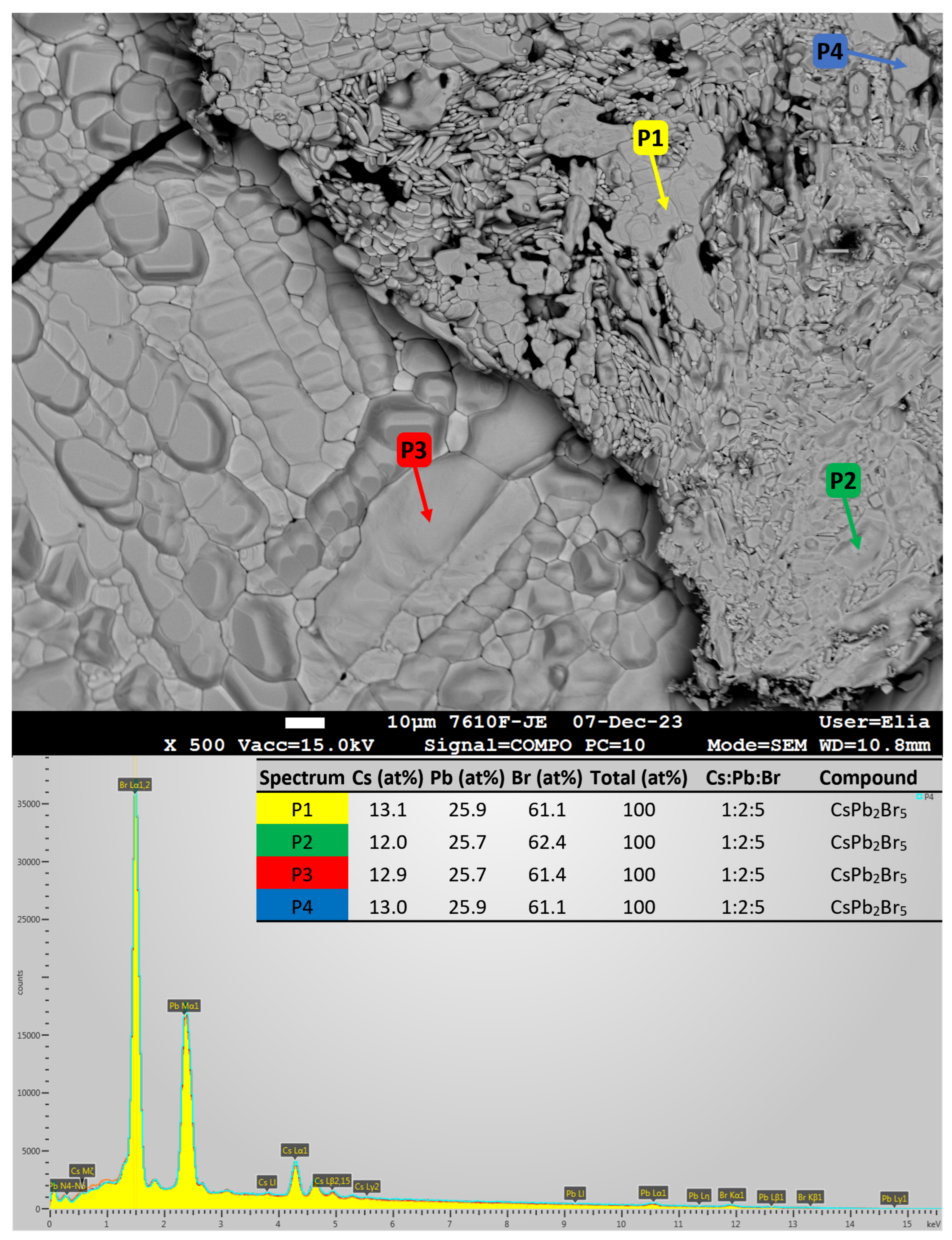
Figure A2. EDX point spectrum acquired from the uppermost region of the CsPbBr 3 single crystal grown on the film, showing the characteristic Cs, Pb, and Br peaks with relative intensities consistent with the stoichiometric 1:1:3 composition of CsPbBr 3 . The absence of detectable oxygen or tin signals confirms the measurement originates from the pure perovskite phase rather than the underlying FTO substrate or interfacial oxybromides.
Crystals 16 00429 g0a2
Figure A3. EDX point spectra acquired from the buried FTO-facing region of the delaminated film, showing discrete compositions in adjacent domains. The P1 spectrum displays the near-stoichiometric (1:1:3) Cs:Pb ratio characteristic of CsPbBr 3 , whereas the P2 spectrum shows a Cs-deficient (1:2:5) composition consistent with CsPb 2 Br 5 . The absence of intermediate stoichiometries supports discrete phase selection from CsPbBr 3 to CsPb 2 Br 5 during melt processing, consistent with line-compound equilibria in the CsBr–PbBr2 system.
Crystals 16 00429 g0a3
Figure A4. EDX point spectra acquired from four distinct regions of the delaminated film—one from the compact base beneath the CsPb 2 Br 5 single crystal and three from the internal islands of the porous layer—demonstrate consistent elemental ratios corresponding to the stoichiometric 1:2:5 composition of CsPb 2 Br 5 . Despite the pronounced morphological contrast between the dense and porous regions, all spectra confirm a chemically homogeneous CsPb 2 Br 5 phase without measurable Pb- or Cs-enrichment, indicating uniform phase composition across the delaminated structure.
Crystals 16 00429 g0a4
Figure A5. EDX point spectra collected from porous CsPb 2 Br 5 grains (P1) and rice-shaped crystallites (P2). The P2 spectra show a Pb atomic ratio close to 1:1, only a very weak Cs contribution, and clear C and O signals. This excludes CsPbBr 3 and CsPb 2 Br 5 and indicates a secondary Pb–Br phase containing light elements. The combined Pb–Br-rich composition, C/O signal, morphology, and BSE contrast are consistent with a Pb 2 ( CO 3 ) Br 2 -type carbonate bromide phase, although Pb–O–Br compounds cannot be fully excluded from EDX alone. In contrast, the P1 spectra retain the 1:2:5 stoichiometry of CsPb 2 Br 5 , supporting that the P2 crystallites are localized secondary products decorating the porous CsPb 2 Br 5 layer.
Crystals 16 00429 g0a5
Figure A6. EDX point spectra obtained from residual film fragments adhering to the FTO substrate, showing a compositional sequence across the buried FTO-facing residual layer. The lowest region (P1), directly adjacent to the substrate, is Pb–Br-rich and is consistent with PbBr 2 -rich residual material. The intermediate region (P2) remains Pb–Br-rich but shows an additional oxygen signal, indicating partial reaction toward Pb–Br–O secondary products. The upper region (P3) contains Cs, Pb, and Br in a ratio consistent with CsPb 2 Br 5 , corresponding to the overlying crystalline phase. Together, these spectra support a late-stage hierarchy from PbBr 2 -rich residual material near FTO to CsPb 2 Br 5 above, with locally formed Pb–Br–O products in between. The exact identity of the oxidized phase remains tentative, but the data are consistent with partial reaction of PbBr 2 -rich residual material within confined voids or residual pockets in the buried FTO-facing region.
Crystals 16 00429 g0a6

References

  1. Moseley, O.D.I.; Doherty, T.A.S.; Parmee, R.; Anaya, M.; Stranks, S.D. Halide perovskites scintillators: Unique promise and current limitations. J. Mater. Chem. C 2021, 9, 11588–11604. [Google Scholar] [CrossRef] [PubMed]
  2. Mykhaylyk, V.B.; Kraus, H.; Saliba, M. Bright and fast scintillation of organolead perovskite MAPbBr3 at low temperatures. Mater. Horiz. 2019, 6, 1740–1747. [Google Scholar] [CrossRef]
  3. Heiss, W.; Brabec, C. Perovskites target X-ray detection. Nat. Photonics 2016, 10, 288–289. [Google Scholar] [CrossRef]
  4. Matt, G.J.; Levchuk, I.; Knüttel, J.; Dallmann, J.; Osvet, A.; Sytnyk, M.; Tang, X.; Elia, J.; Hock, R.; Heiss, W.; et al. Sensitive Direct Converting X-Ray Detectors Utilizing Crystalline CsPbBr3 Perovskite Films Fabricated via Scalable Melt Processing. Adv. Mater. Interfaces 2020, 7, 1901575. [Google Scholar] [CrossRef]
  5. Shrestha, S.; Fischer, R.; Matt, G.J.; Feldner, P.; Michel, T.; Osvet, A.; Levchuk, I.; Merle, B.; Golkar, S.; Chen, H.; et al. High-performance direct conversion X-ray detectors based on sintered hybrid lead triiodide perovskite wafers. Nat. Photonics 2017, 11, 436–440. [Google Scholar] [CrossRef]
  6. Wibowo, A.; Sheikh, M.A.K.; Diguna, L.J.; Ananda, M.B.; Marsudi, M.A.; Arramel, A.; Zeng, S.; Wong, L.J.; Birowosuto, M.D. Development and Challenges in Perovskite Scintillators for High-Resolution Imaging and Timing Applications. Commun. Mater. 2023, 4, 21. [Google Scholar] [CrossRef]
  7. Wang, T.; Zeng, G.; Yang, Y.M.; Yang, Z.; Wang, T.; Li, H.; Han, L.; Yu, X.; Xu, X.; Ouyang, X. Advances in Metal Halide Perovskite Scintillators for X-Ray Detection. Nano-Micro Lett. 2025, 17, 275. [Google Scholar] [CrossRef] [PubMed]
  8. Noh, J.H.; Im, S.H.; Heo, J.H.; Mandal, T.N.; Seok, S.I. Chemical Management for Colorful, Efficient, and Stable Inorganic–Organic Hybrid Nanostructured Solar Cells. Nano Lett. 2013, 13, 1764–1769. [Google Scholar] [CrossRef] [PubMed]
  9. Jeon, N.J.; Noh, J.H.; Yang, W.S.; Kim, Y.C.; Ryu, S.; Seo, J.; Seok, S.I. Compositional engineering of perovskite materials for high-performance solar cells. Nature 2015, 517, 476–480. [Google Scholar] [CrossRef] [PubMed]
  10. Saliba, M.; Matsui, T.; Seo, J.Y.; Domanski, K.; Correa-Baena, J.P.; Nazeeruddin, M.K.; Zakeeruddin, S.M.; Tress, W.; Abate, A.; Hagfeldt, A.; et al. Cesium-containing triple cation perovskite solar cells: Improved stability, reproducibility and high efficiency. Energy Environ. Sci. 2016, 9, 1989–1997. [Google Scholar] [CrossRef] [PubMed]
  11. Elia, J.; Levchuk, I.; Hou, Y.; Matt, G.J.; These, A.; Zhao, Y.; Zhang, J.; Forberich, K.; Osvet, A.; Götz, K.; et al. Solution-Growth Liquid-Phase Epitaxy of CsPbBr3 on NaCl by Optimizing the Substrate Dissolution. J. Phys. Chem. C 2023, 127, 22412–22424. [Google Scholar] [CrossRef]
  12. Eperon, G.E.; Stranks, S.D.; Menelaou, C.; Johnston, M.B.; Herz, L.M.; Snaith, H.J. Formamidinium lead trihalide: A broadly tunable perovskite for efficient planar heterojunction solar cells. Energy Environ. Sci. 2014, 7, 982. [Google Scholar] [CrossRef]
  13. Moradi, S.; Kundu, S.; Rezazadeh, M.; Yeddu, V.; Voznyy, O.; Saidaminov, M.I. High-throughput exploration of halide perovskite compositionally-graded films and degradation mechanisms. Commun. Mater. 2022, 3, 13. [Google Scholar] [CrossRef]
  14. Li, J.; Han, Z.; Liu, J.; Zou, Y.; Xu, X. Compositional gradient engineering and applications in halide perovskites. Chem. Commun. 2023, 59, 5156–5173. [Google Scholar] [CrossRef] [PubMed]
  15. Zuo, C.; Zhang, L.; Pan, X.; Tian, H.; Yan, K.; Cheng, Y.; Jin, Z.; Yi, C.; Zhang, X.; Wu, W.Q.; et al. Perovskite films with gradient bandgap for self-powered multiband photodetectors and spectrometers. Nano Res. 2023, 16, 10256–10262. [Google Scholar] [CrossRef]
  16. Bian, H.; Bai, D.; Jin, Z.; Wang, K.; Liang, L.; Wang, H.; Zhang, J.; Wang, Q.; Liu, S.F. Graded Bandgap CsPbI2+xBr1-x Perovskite Solar Cells with a Stabilized Efficiency of 14.4%. Joule 2018, 2, 1500–1510. [Google Scholar] [CrossRef]
  17. Mullins, W.W.; Sekerka, R.F. Stability of a Planar Interface During Solidification of a Dilute Binary Alloy. J. Appl. Phys. 1964, 35, 444–451. [Google Scholar] [CrossRef]
  18. Langer, J.S. Instabilities and pattern formation in crystal growth. Rev. Mod. Phys. 1980, 52, 1–28. [Google Scholar] [CrossRef]
  19. Tokairin, M.; Fujiwara, K.; Kutsukake, K.; Usami, N.; Nakajima, K. Formation mechanism of a faceted interface:In situobservation of the Si(100) crystal-melt interface during crystal growth. Phys. Rev. B 2009, 80, 174108. [Google Scholar] [CrossRef]
  20. Musálek, T.; Liška, P.; Morsa, A.; Arregi, J.A.; Klok, P.; Kratochvíl, M.; Sergeev, D.; Müller, M.; Šikola, T.; Kolíbal, M. Single- vs dual-source vapor deposition of inorganic halide perovskites: A case study of CsPbBr3. APL Mater. 2025, 13, 031118. [Google Scholar] [CrossRef]
  21. Nasi, L.; Calestani, D.; Mezzadri, F.; Mariano, F.; Listorti, A.; Ferro, P.; Mazzeo, M.; Mosca, R. All-Inorganic CsPbBr3 Perovskite Films Prepared by Single Source Thermal Ablation. Front. Chem. 2020, 8, 313. [Google Scholar] [CrossRef] [PubMed]
  22. Cola, M.; Massarotti, V.; Riccardi, R.; Sinistri, C. Binary systems formed by lead bromide with (Li, Na, K, Rb, Cs and Tl) Br: A DTA and diffractometric study. Z. Naturforsch. A 1971, 26, 1328–1332. [Google Scholar] [CrossRef]
  23. Palazon, F.; Dogan, S.; Marras, S.; Locardi, F.; Nelli, I.; Rastogi, P.; Ferretti, M.; Prato, M.; Krahne, R.; Manna, L. From CsPbBr3 Nano-Inks to Sintered CsPbBr3-CsPb2Br5 Films via Thermal Annealing: Implications on Optoelectronic Properties. J. Phys. Chem. C 2017, 121, 11956–11961. [Google Scholar] [CrossRef] [PubMed]
  24. Caicedo-Dávila, S.; Funk, H.; Lovrinčić, R.; Müller, C.; Sendner, M.; Cojocaru-Mirédin, O.; Lehmann, F.; Gunder, R.; Franz, A.; Levcenco, S.; et al. Spatial Phase Distributions in Solution-Based and Evaporated Cs–Pb–Br Thin Films. J. Phys. Chem. C 2019, 123, 17666–17677. [Google Scholar] [CrossRef]
  25. Cho, S.; Yun, S.H. Structure and optical properties of perovskite-embedded dual-phase microcrystals synthesized by sonochemistry. Commun. Chem. 2020, 3, 15. [Google Scholar] [CrossRef] [PubMed]
  26. Stoumpos, C.C.; Malliakas, C.D.; Peters, J.A.; Liu, Z.; Sebastian, M.; Im, J.; Chasapis, T.C.; Wibowo, A.C.; Chung, D.Y.; Freeman, A.J.; et al. Crystal Growth of the Perovskite Semiconductor CsPbBr3: A New Material for High-Energy Radiation Detection. Cryst. Growth Des. 2013, 13, 2722–2727. [Google Scholar] [CrossRef]
  27. Iizuka, A.; Shibata, E.; Sato, M.; Nakamura, T. Vapor pressure measurements of PbBr2 by the Knudsen effusion method and identification of its vapor species. Thermochim. Acta 2015, 622, 103–106. [Google Scholar] [CrossRef]
  28. Bai, T.; Liu, Y.; Zhang, H.; Li, X.; Zhang, Y.; Zhang, J. Vapor Deposition of CsPbBr3 Thin Films by Evaporation of CsBr and PbBr2. J. Vac. Sci. Technol. A 2021, 39, 043415. [Google Scholar] [CrossRef]
  29. Lin, C.; Zhang, J.; Li, W.; Jin, Y. Facile Synthesis of Dual-Phase CsPbBr3–CsPb2Br5 Single-Crystal Microsheets. RSC Adv. 2020, 10, 10716–10722. [Google Scholar] [CrossRef] [PubMed]
  30. Huang, Z.P.; Ma, B.; Wang, H.; Li, N.; Liu, R.T.; Zhang, Z.Q.; Zhang, X.D.; Zhao, J.H.; Zheng, P.Z.; Wang, Q.; et al. In Situ Growth of 3D/2D (CsPbBr3/CsPb2Br5) Perovskite Heterojunctions toward Optoelectronic Devices. J. Phys. Chem. Lett. 2020, 11, 6007–6015. [Google Scholar] [CrossRef] [PubMed]
  31. Pellegrino, A.L.; Malandrino, G. Surfactant-Free Synthesis of the Full Inorganic Perovskite CsPbBr3: Evolution and Phase Stability of CsPbBr3 vs. CsPb2Br5 and Their Photocatalytic Properties. ACS Appl. Energy Mater. 2021, 4, 9431–9439. [Google Scholar] [CrossRef]
  32. Dursun, I.; De Bastiani, M.; Turedi, B.; Alamer, B.; Shkurenko, A.; Ainla, A.; Zhumekenov, A.A.; Saidaminov, M.A.; Begum, R.; Baranov, D.; et al. CsPb2Br5 Single Crystals: Synthesis and Characterization. ChemSusChem 2017, 10, 3746–3749. [Google Scholar] [CrossRef] [PubMed]
  33. Acharyya, P.; Pal, P.; Samanta, P.K.; Sarkar, A.; Pati, S.K.; Biswas, K. Single-pot synthesis of indirect band gap 2D CsPb2Br5 nanosheets from direct band gap 3D CsPbBr3 nanocrystals and the origin of their luminescence properties. Nanoscale 2019, 11, 4001–4007. [Google Scholar] [CrossRef] [PubMed]
  34. Lamb, F.W.; Niebylski, L.M. Phase Study of the PbO—PbBr2 System by X-Ray Diffraction. J. Am. Chem. Soc. 1953, 75, 511–518. [Google Scholar] [CrossRef]
  35. Knowles, L.M. Thermal Analysis of the System PbBr2–PbO. J. Chem. Phys. 1951, 19, 1128–1130. [Google Scholar] [CrossRef]
  36. Sillén, L.G.; Petterson, R. Die Kristallstruktur von Pb2Cl2CO3 (Phosgenit) und Pb2Br2CO3. Naturwissenschaften 1944, 32, 41. [Google Scholar] [CrossRef]
  37. Wang, W.; Yu, Y.; Attique, S.; Hou, J.; Jun, F.; Xie, Y.; Mao, L.; Yu, X.; Zhang, X.; Wang, S.; et al. Sustainable fabrication of ultralong Pb(OH)Br nanowires and their conversion to luminescent CH3NH3PbBr3 nanowires. Green Chem. 2021, 23, 7956–7962. [Google Scholar] [CrossRef]
Figure 1. Experimental setup and thermal processing sequence for CsPbBr3 melting and recrystallization. (a) Photograph of the Simon–Müller muffle oven used for the experiment. (b) Schematic sketch of the oven interior, showing the sample position, thermocouple-based temperature monitoring, covered but unsealed configuration, and ambient-air processing conditions. (c) Optical images of the CsPbBr3 sample before melting and (d) after melting and recrystallization, illustrating the transition from powder to melt during heating and subsequent recrystallization during cooling. (e) Temperature profile recorded during the experiment, with blue regions indicating the solid phase, orange regions representing coexistence of solid and liquid phases, and black regions corresponding to the fully liquid phase.
Crystals 16 00429 g001
Figure 2. X–ray diffraction (XRD) pattern of a CsPbBr3 recrystallized film shown on a logarithmic intensity scale. The full diffraction pattern from 10° to 70° provides an overview of the crystalline phases present in the sample, while the fitting was performed on the dominant diffraction region between 29° and 33°. The fitted peaks confirm orthorhombic CsPbBr3 as the dominant phase and CsPb2Br5 as the second dominant phase, indicating significant partial phase transformation. The labeled Miller indices (hkl) and the inset table summarize the relevant fitted reflections and their phase assignments. Additional very weak features close to the background may correspond to Pb2(CO3)Br2; however, because these peaks are weak and partly hidden by the background, this assignment remains tentative.
Crystals 16 00429 g002
Figure 3. (a,b) Backscattered-electron (BSE) and secondary-electron (SE) images showing a homogeneous CsPbBr 3 single crystal overlying a single-crystalline CsPb 2 Br 5 layer and a porous CsPb 2 Br 5 sublayer. (c) Panchromatic CL image showing strong luminescence quenching in CsPb 2 Br 5 . (d,e) EDX line scan across the interface in (a), confirming stoichiometric homogeneity and distinct phase selection between CsPb 2 Br 5 and CsPbBr 3 . Statistical analysis of EDX point spectra acquired from the CsPb 2 Br 5 and CsPbBr 3 regions is included as mean composition ± standard deviation, supporting the reproducibility of the phase assignments.
Crystals 16 00429 g003
Figure 4. Buried morphology and secondary Pb–Br phases after delamination. (a) BSE image of the delaminated CsPbBr 3 film and exposed FTO substrate. (b) Residual material remaining on the FTO surface after delamination. (c) Internal morphology of the flipped film, showing coarse and fine CsPb 2 Br 5 grains at the former substrate-facing side. (d) BSE image of rice-shaped secondary crystallites appearing brighter than the surrounding CsPb 2 Br 5 , with contrast and composition consistent with Pb 2 ( CO 3 ) Br 2 . (e) Nanowire-like secondary crystallites with a Pb:Br ratio close to 1, morphologically similar to reported Pb(OH)Br–type phases. (f) Calculated BSE coefficients of the possible compounds, sorted from lower to higher contrast, using the Reimer empirical formula.
Crystals 16 00429 g004
Figure 5. (a) SEM image acquired in topographic mode using low-angle secondary electrons (SE), showing large inverted steps on coarse grains and finer-stepped morphology on smaller grains. (b) Larger topographic SEM view of the smaller grains, where the terraces are more clearly resolved and appear steeper and more closely spaced than those on the coarse grains. (c) Schematic illustration of the proposed origin of the inverted-step morphology. Local temperature gradients across the rough FTO surface, caused by the pyramidal substrate relief, may induce spatially non-uniform solidification and promote step inversion. The FTO pyramids are drawn with equal height for simplicity, although their actual heights are expected to vary. (d) Corresponding topographic map highlighting the terrace-like height modulation associated with the inverted steps.
Crystals 16 00429 g005
Figure 6. EDX elemental maps of Pb, Br, C, O, K, F, and Cs are shown in (af). The composite elemental map of Pb, O, C, and Br is shown in (g). The corresponding BSE image in (h) indicates the locations of the analyzed EDX spots P1 and P2 (rich-shaped crystallites), assigned to CsPb 2 Br 5 and a Pb–Br–O phase, respectively. The combined EDX spectra of P1 and P2 are shown in (i).
Crystals 16 00429 g006
Figure 7. Complementary negative ToF-SIMS maps of light-element fragments. The C, O, and OH signals at m/z = 12, 16, and 17 complement the EDX maps by confirming the presence of carbon-, oxygen-, and hydroxyl-containing species in the reacted CsPbBr 3 /FTO region. Their co-localization with the Pb–Br-rich areas observed by EDX supports, but does not by itself prove, the formation of oxidized or hydroxylated Pb–Br secondary phases.
Crystals 16 00429 g007
Figure 8. (a) Schematic evolution of the CsPbBr 3 melt on FTO. In step 1, nucleation occurs while Cs–Br species evaporate from the melt. In step 2, a compact CsPb 2 Br 5 layer forms as the CsBr activity decreases or PbBr 2 becomes relatively enriched. In step 3, final melt thinning, together with local thickness variations and temperature-gradient effects induced by the pyramidal FTO relief, promotes the formation of a porous, polycrystalline CsPb 2 Br 5 morphology at the buried interface. In step 4, after solidification, voids and Pb–Br–O rice-shaped crystallites remain preferentially within the FTO-facing porous region. (b) Approximate sketch illustrating the evolution of the thermal gradient at the beginning of crystallization and near the end of the process, before complete solidification.
Crystals 16 00429 g008
Table 1. Detailed calculation of the Reimer-Castaing effective SEM-BSE coefficients for candidate phases. For each element (i), ( Z i ) is the atomic number, ( n i ) is the stoichiometric coefficient, ( A i ) is the atomic weight, ( c i = n i A i / j n j A j ) is the mass fraction, ( η ( Z i ) ) is the elemental Reimer coefficient, and ( p i = c i · η ( Z i ) ) is the weighted elemental contribution. The total row gives ( η HR = i p i ), used here only as a relative BSE contrast indicator.
PhaseElement Z i n i A i c i η ( Z i ) p i η HR
PbOPb821207.2000.92830.51810.48090.4871
O8115.9990.07170.08530.0061
Pb 8 O 7 Br 2 Pb828207.2000.85910.51810.44510.4784
O8715.9990.05800.08530.0050
Br35279.9040.08280.34260.0284
Pb 4 O 3 Br 2 Pb824207.2000.79950.51810.41420.4710
O8315.9990.04630.08530.0039
Br35279.9040.15420.34260.0528
Pb 3 O 2 Br 2 Pb823207.2000.76420.51810.39590.4666
O8215.9990.03930.08530.0034
Br35279.9040.19650.34260.0673
Pb 2 OBr 2 Pb822207.2000.70210.51810.36380.4588
O8115.9990.02710.08530.0023
Br35279.9040.27080.34260.0928
Pb(OH)BrPb821207.2000.68130.51810.35300.4475
O8115.9990.05260.08530.0045
H111.0080.00330.00760.0000
Br35179.9040.26270.34260.0900
PbBr 2 Pb821207.2000.56460.51810.29250.4417
Br35279.9040.43540.34260.1492
CsPb 2 Br 5 Cs551132.9050.14040.44710.06280.4341
Pb822207.2000.43770.51810.2267
Br35579.9040.42200.34260.1445
Pb 2 ( CO 3 ) Br 2 Pb822207.2000.65340.51810.33850.4324
C6112.0110.01890.05850.0011
O8315.9990.07570.08530.0065
Br35279.9040.25200.34260.0863
CsPbBr 3 Cs551132.9050.22920.44710.10250.4292
Pb821207.2000.35740.51810.1851
Br35379.9040.41340.34260.1416
Cs 4 PbBr 6 Cs554132.9050.43640.44710.19510.4180
Pb821207.2000.17010.51810.0881
Br35679.9040.39350.34260.1348
CsBrCs551132.9050.62450.44710.27920.4079
Br35179.9040.37550.34260.1286
SnO 2 Sn501118.7100.78770.42590.33550.3536
O8215.9990.21230.08530.0181
Table 2. Candidate models for the FTO-facing faceted microstructure. Epitaxial growth models are excluded a priori because the observed morphology develops in the recrystallized melt film rather than by vapor-phase epitaxy.
ModelExpected SignatureAssessment
Spinodal dewetting (ultrathin film)Holes, rims, coarsening, non-faceted morphologyUnlikely: the melt is thick, the structures are faceted, and no rim–hole morphology is observed.
Nucleation-limited solidificationBroad, stochastic island spacing and orientation distributionUnlikely: the morphology shows an ordered grain/terrace hierarchy rather than random nucleation.
Substrate-templated geometric focusingFeatures pinned to the substrate relief with spacing fixed by the FTO pitchUnlikely: the FTO relief localizes the morphology but does not alone define the spacing.
Marangoni/Bénard convectionHexagonal or roll-like cells with wavelength comparable to the liquid thicknessUnlikely: no roll/cell planform is observed and the spacing is much smaller than the film thickness.
Reaction–diffusion (oxidation/
precipitation)
Local O-, OH-, or C-containing Pb–Br secondary crystallites appearing late and locallySecondary: explains the Pb–Br–O crystallites but not the primary grain or terrace spacing.
Faceted Mullins–Sekerka with evaporation-induced undercoolingMicrometer-scale faceted pattern selected by diffusion–capillarity balance and modified by open-boundary mass lossConsistent: explains the faceted morphology, coarse-to-fine hierarchy, and coupling to evaporation-driven PbBr 2 -rich conditions.
Disclaimer/Publisher’s Note: The statements, opinions and data contained in all publications are solely those of the individual author(s) and contributor(s) and not of MDPI and/or the editor(s). MDPI and/or the editor(s) disclaim responsibility for any injury to people or property resulting from any ideas, methods, instructions or products referred to in the content.