This is an early access version, the complete PDF, HTML, and XML versions will be available soon.
Article

High-Temperature Degradation and Microstructural Evolution of 310S Stainless Steel in Carburizing Furnace Service


Mechanical Engineering Department, Southern Taiwan University of Science and Technology, Tainan 71005, Taiwan
*
Author to whom correspondence should be addressed.
Crystals 2026, 16(7), 428; https://doi.org/10.3390/cryst16070428
Submission received: 8 June 2026 / Revised: 24 June 2026 / Accepted: 28 June 2026 / Published: 30 June 2026
(This article belongs to the Section Crystalline Metals and Alloys)

Abstract

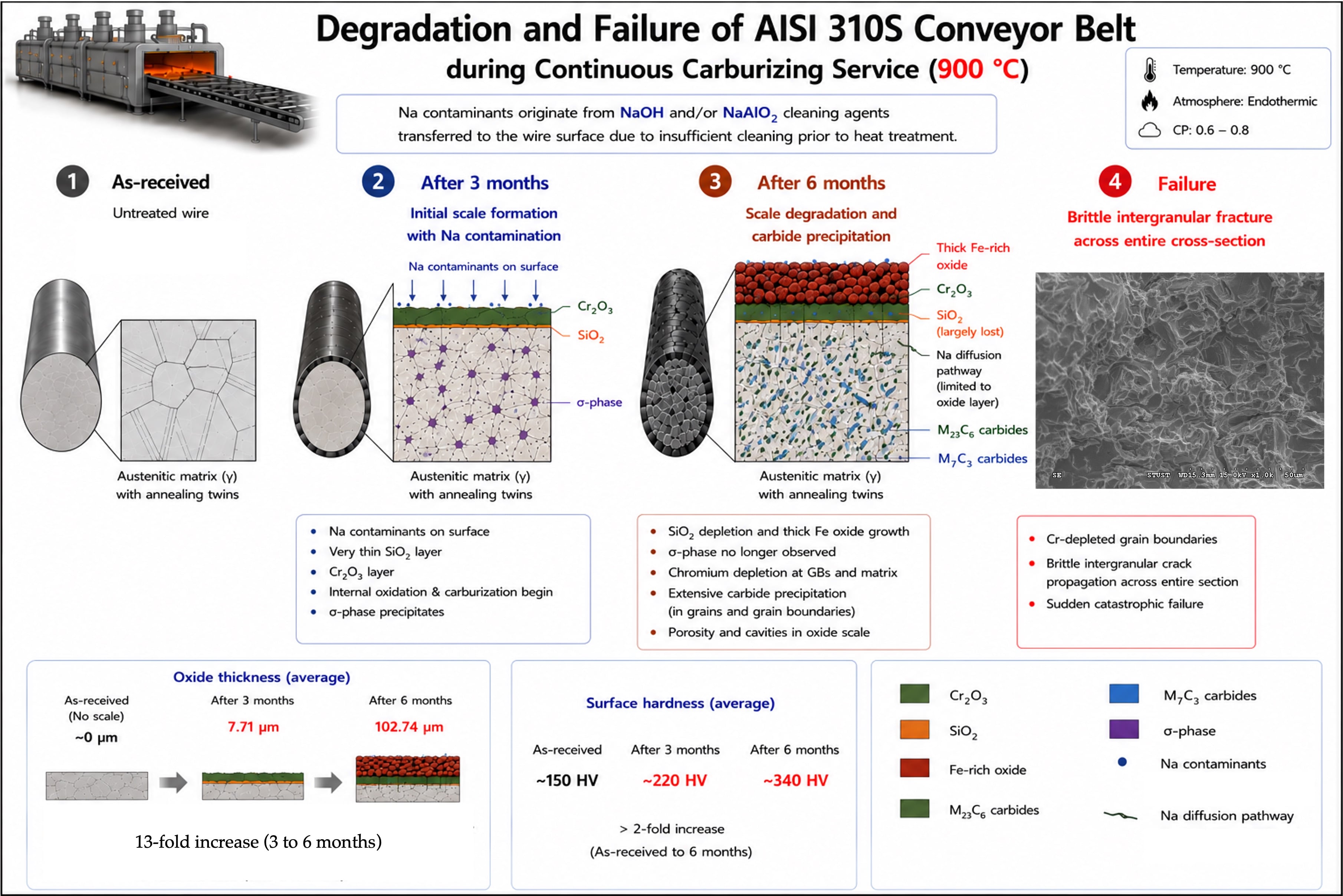
This study investigates the degradation and failure mechanisms of AISI 310S stainless steel conveyor belt wires operating under cyclic conditions up to 900 °C in a continuous carburizing furnace. Microstructural evolution and mechanical responses after service exposure were evaluated using optical microscopy, scanning electron microscopy (SEM) equipped with energy-dispersive X-ray spectroscopy (EDS), X-ray diffraction (XRD), and Vickers microhardness testing. Results indicate that initial exposure led to σ-phase nucleation and the formation of a protective Cr2O3-SiO2 oxide scale. However, prolonged service led to scale degradation driven by Na-containing residues from pre-cleaning agents, which reacted to form Na2SiO3 and NaAlSiO4 phases. This degradation accelerated the growth of non-protective iron oxides (Fe2O3, Fe3O4). Simultaneously, the σ-phase decomposed into massive, continuous M23C6 and M7C3 carbide networks along grain boundaries, inducing severe chromium sensitization. Consequently, the matrix embrittled significantly, with Vickers hardness increasing from 150 HV to 290–340 HV. Fracture analysis confirmed that brittle intergranular cracking initiated at these carbide networks, oxide inclusions, and matrix pores. Ultimately, the synergistic effects of oxide scale degradation, extensive carbide precipitation, and grain boundary depletion caused the premature catastrophic failure of the conveyor mesh under cyclic operational stress.
Keywords: AISI 310S stainless steel; high temperature oxidation; carbide precipitation; σ-phase transformation; contaminant induced degradation; failure analysis AISI 310S stainless steel; high temperature oxidation; carbide precipitation; σ-phase transformation; contaminant induced degradation; failure analysis
Graphical Abstract