Article

Correlation Between Crystalline Order, Micro-Morphology, and Thermal Stability in “Heijin” (Black Gold) Seal Stone from Changhua, China: A Pyrite-Bearing Dickite Aggregate


1
School of Gemmology, China University of Geosciences, Beijing 100083, China
2
Hebei Key Laboratory of Green Development of Rock Mineral Materials, Hebei GEO University, Shijiazhuang 050031, China
*
Author to whom correspondence should be addressed.
Crystals 2026, 16(3), 165; https://doi.org/10.3390/cryst16030165
Submission received: 29 January 2026 / Revised: 25 February 2026 / Accepted: 26 February 2026 / Published: 27 February 2026

Abstract

“Heijin” (the literal translation from Chinese being “Black Gold”) seal stone represents a unique variety of sulfur-rich, dickite-dominant jade, yet its mineralogical genesis and structural properties remain insufficiently characterized. This study utilizes a multi-analytical approach comprising polarized light microscopy, X-Ray diffraction (XRD), Raman spectroscopy, Fourier-transform infrared spectroscopy (FTIR), Scanning Electron Microscopy coupled with Energy-Dispersive X-Ray Spectroscopy (SEM-EDS), Electron Probe Microanalysis (EPMA), and Thermogravimetry and Differential Scanning Calorimetry (TG-DSC) to investigate the phase composition, crystalline order, and thermal evolution of this material. The results demonstrate that “Heijin” stone is primarily composed of highly ordered 2M1 dickite with a Hinckley index (HI) ranging from 0.92 to 1.50. Its distinctive black appearance originates from the disseminated distribution of micrometer-scale pyrite, which is accompanied by trace amounts of svanbergite. This aluminum phosphate–sulfate (APS) mineral serves as a critical indicator of high sulfur fugacity and acidic hydrothermal alteration environments. Furthermore, a significant correlation exists between the crystalline order of dickite, its micro-morphology, and its thermal stability. Samples characterized by high crystallinity (HI ≈ 1.50) exhibit well-developed, euhedral book-like aggregates and elevated dehydroxylation temperatures (Tm ≈ 665 °C), whereas samples with lower crystalline order correspond to fragmented microstructures and reduced thermal stability. This research defines the mineralogical identity of “Heijin” stone and provides a scientific basis for employing thermal analysis to evaluate the crystalline quality of dickite-based jade materials.

1. Introduction

Chinese seal stones, such as Shoushan stone and Changhua stone, are highly esteemed in East Asian culture for their mellow texture and vibrant aesthetic appeal. From a mineralogical perspective, these stones are essentially fine-grained clay mineral aggregates formed through the hydrothermal alteration of intermediate-to-acidic volcanic rocks. The primary constituents are kaolinite-group minerals (KGMs), including kaolinite, dickite, nacrite, and their various polytypes [1,2,3,4,5]. Although kaolinite (1Tc) and dickite (2M1) share the same chemical formula (Al2Si2O5(OH)4), differences in their layer-stacking sequences result in distinct physical and structural properties. Dickite typically forms under higher-temperature or -pressure conditions relative to kaolinite and is regarded as the more structurally stable and crystalline end-member within the KGM group [6,7,8].
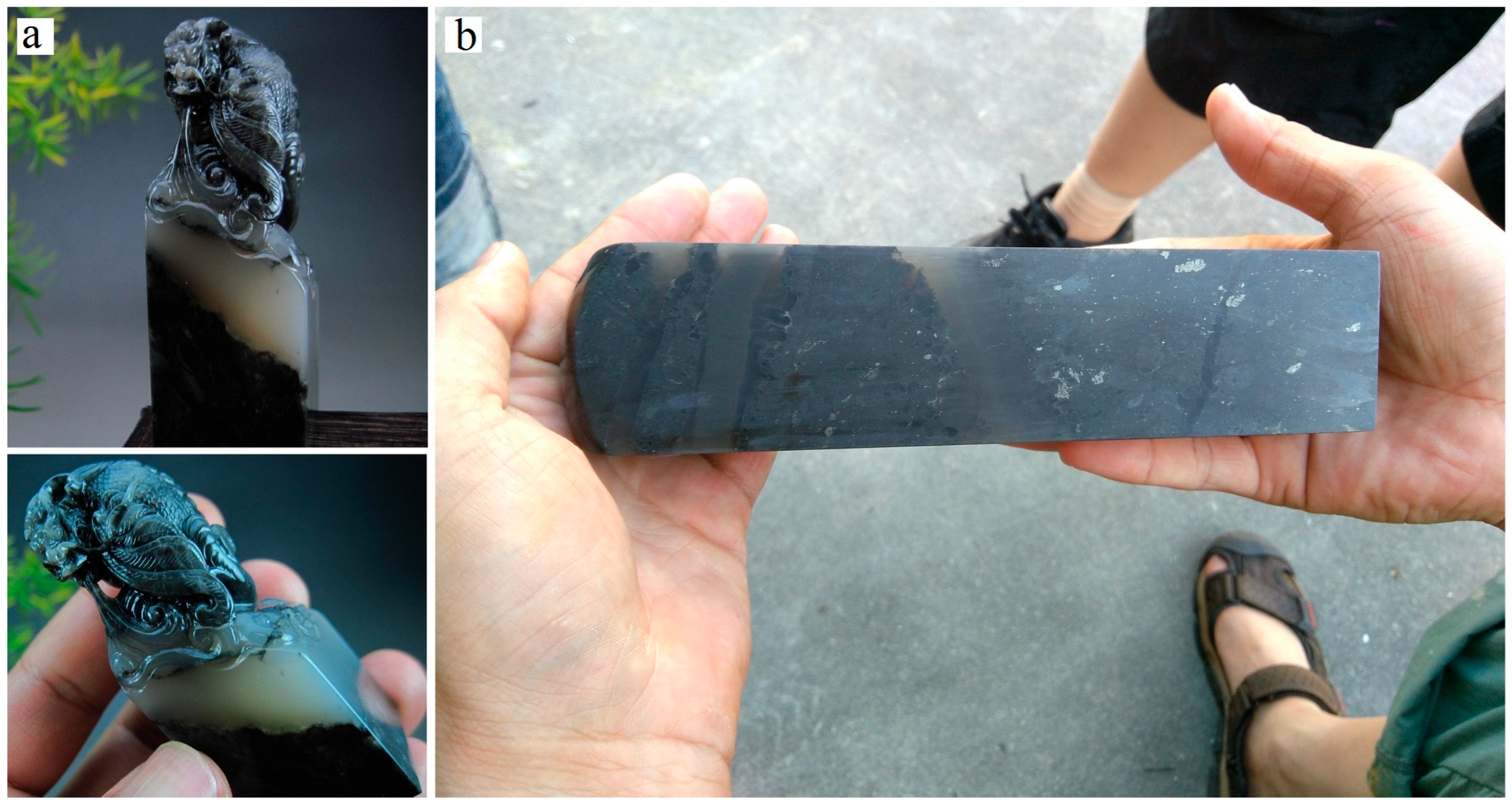
Among the diverse varieties of seal stones, a variety commercially termed “Heijin” (or Black Gold) has garnered significant attention due to its unique “black-and-white” symbiotic texture. On polished surfaces, the disseminated opaque mineral aggregates exhibit a distinct golden, sub-metallic luster, contrasting sharply with the waxy luster of the translucent matrix (Figure 1). Unlike traditional “Chicken-blood stone,” which is colored by cinnabar (HgS) [9,10], the chromogenic mechanism of “Heijin” stone and the crystallographic characteristics of its matrix remain poorly understood. Furthermore, as a product of specific hydrothermal fluid interactions, the mineral assemblage may harbor critical indicators of the ore-forming environment, such as pH and sulfur fugacity, which warrant further investigation.
Critically, current research on gem-grade dickite has focused predominantly on spectroscopic identification [9,10,11,12]. However, a significant research gap remains regarding the quantitative link between the long-range lattice order and the macroscopic quality of these stones. While it is known that dickite possesses higher stability than kaolinite, there is a lack of systematic study on how the Hinckley Index (HI), acting as a quantitative indicator of crystallographic ordering, directly governs the evolution of microscopic growth habits and the subsequent thermodynamic decomposition behavior. Understanding this structural–morphological–thermal coupling is essential not only for mineralogical science but also for establishing objective criteria for the quality grading and provenance of clay-based gemstones.
To address this gap, the present study characterizes the mineralogical composition and coloration of the newly discovered “Heijin” stone using a multi-analytical approach. By establishing a systematic XRD-SEM-DSC framework, we elucidate the intrinsic relationship between the structural ordering of the dickite matrix and its physical attributes. This research provides a novel scientific methodology for assessing the genetic maturity and aesthetic value of dickite-based jades, offering insights that transcend simple mineral identification.

2. Materials and Methods

2.1. Samples and Geological Provenance

The “Heijin” (Black Gold) seal stone specimens investigated in this study were collected from the Xianling mining area (PD878 adit: 30°14.499′ N, 118°57.719′ E; elevation 878 m), located in Longgang Town, Changhua, Zhejiang Province, China. This locality represents a significant new find in the eastern segment of the classic Changhua bloodstone deposit. The host rock of the deposit is identified as Mesozoic rhyolitic crystal–vitric tuff, a silica-rich acidic volcanic lithology. Five representative specimens, designated as HJ-1 through HJ-5, were selected for multi-analytical characterization based on their distinct macroscopic textures.
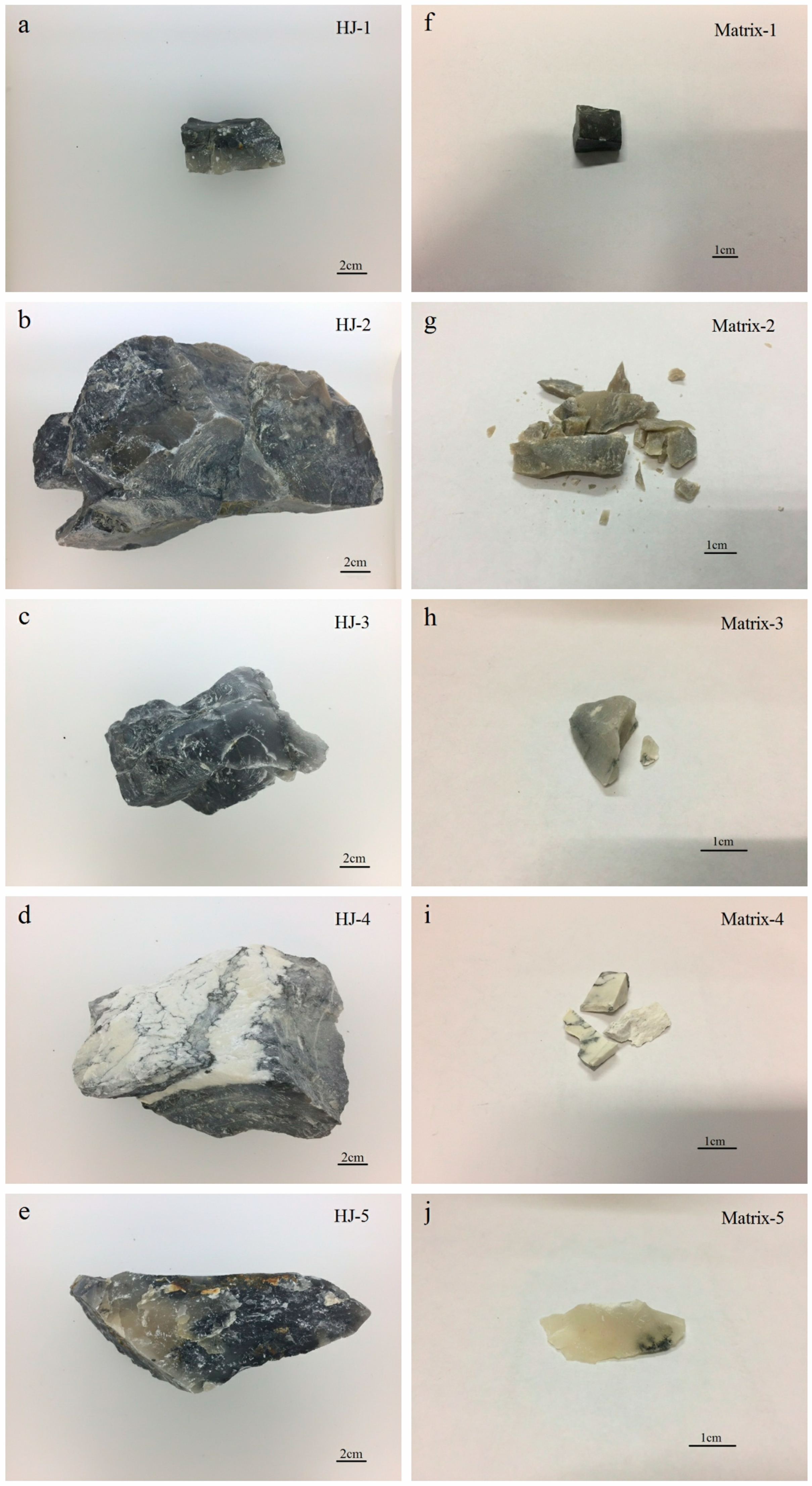
These samples typically exhibit a black to dark gray coloration with a white to light gray translucent matrix. Fracture surfaces display a characteristic greasy-to-waxy luster (Figure 2). Physical testing indicates a Mohs hardness of 2.5–3.0, which is characteristic of compact, high-purity dickite aggregates and provides the ideal workability for manual seal carving. Macroscopic observations reveal that opaque black minerals occur as disseminated specks or micro-veinlets within the semi-transparent white “frozen” (jelly-like) matrix. Significant textural variations are observed among the specimens: HJ-5 is the most fine-grained and highly translucent (top-grade “glassy-frozen” variety), while HJ-4 is comparatively coarse-grained and opaque. Specimens HJ-1, HJ-2, and HJ-3 exhibit intermediate textural and optical characteristics. Representative matrix portions from each specimen were extracted and prepared as powders for bulk analysis to ensure mineralogical consistency.

2.2. Methods

Standard petrographic thin sections were prepared to examine the microstructure and mineral assemblages. Observations were conducted using an Olympus BX51 polarized light microscope (Tokyo, Japan) at the Laboratory of Structural and Morphological Observation, Gemology Experimental Teaching Center, China University of Geosciences, Beijing (CUGB).
Powder XRD analysis was performed at the X-Ray Powder Diffraction Laboratory, Science Research Institute, China University of Geosciences (Beijing, China). Measurements were conducted on a Rigaku Smart-Lab 9kW diffractometer (Tokyo, Japan) utilizing Cu Kα radiation. The instrument operated at a voltage of 45 kV and a current of 200 mA, equipped with a graphite monochromator. Data were collected in continuous scanning mode with a scan speed of 10°/min. The slit settings were fixed at IS(DS) = RS1(SS) = 2/3° and RS1(RS) = 0.3 mm. Phase identification was performed by comparison with the International Centre for Diffraction Data (ICDD) JCPDS database. The experimental environment was maintained at 25 °C and 57% relative humidity.
Infrared absorption spectra were recorded using a Bruker Tensor 27 spectrometer (Ettlingen, Germany). Samples were prepared using the KBr pellet technique. The spectra were collected over the range of 4000–400 cm−1 with a resolution of 4 cm−1 and 32 scans per sample.
Raman measurements were performed using a Horiba LabRAM HR Evolution micro-Raman spectrometer (Villeneuve d’Ascq, France). A 532 nm laser was used as the excitation source with an output power of 50 mW. The system was equipped with a 600 gr/mm grating and a confocal aperture of 100 µm. Each spectrum was acquired with an integration time of 5 s and 2 accumulations over a spectral range of 100–4000 cm−1.
Morphological and semi-quantitative chemical analyses were conducted using a Phenom ProX desktop SEM (Eindhoven, The Netherlands) at the Phenom Beijing Laboratory. The instrument operated at an accelerating voltage of 5–15 kV with a resolution of 8 nm. Fresh fracture surfaces and polished thin sections were carbon-coated prior to observation to ensure conductivity.
Chemical compositions were determined using a JEOL JXA-8100 electron probe microanalyzer (Tokyo, Japan) at the Probe Laboratory of the Chinese Academy of Geological Sciences. The analytical conditions consisted of an accelerating voltage of 20 kV and a beam current of 1 × 10⁻⁸ A. Since light elements (H, C) cannot be accurately quantified by EDS/EPMA, the contents of volatile components (H2O, CO2) were calculated based on the stoichiometric constraints of the identified mineral phases.

3. Results

3.1. Petrography and Microstructural Characteristics

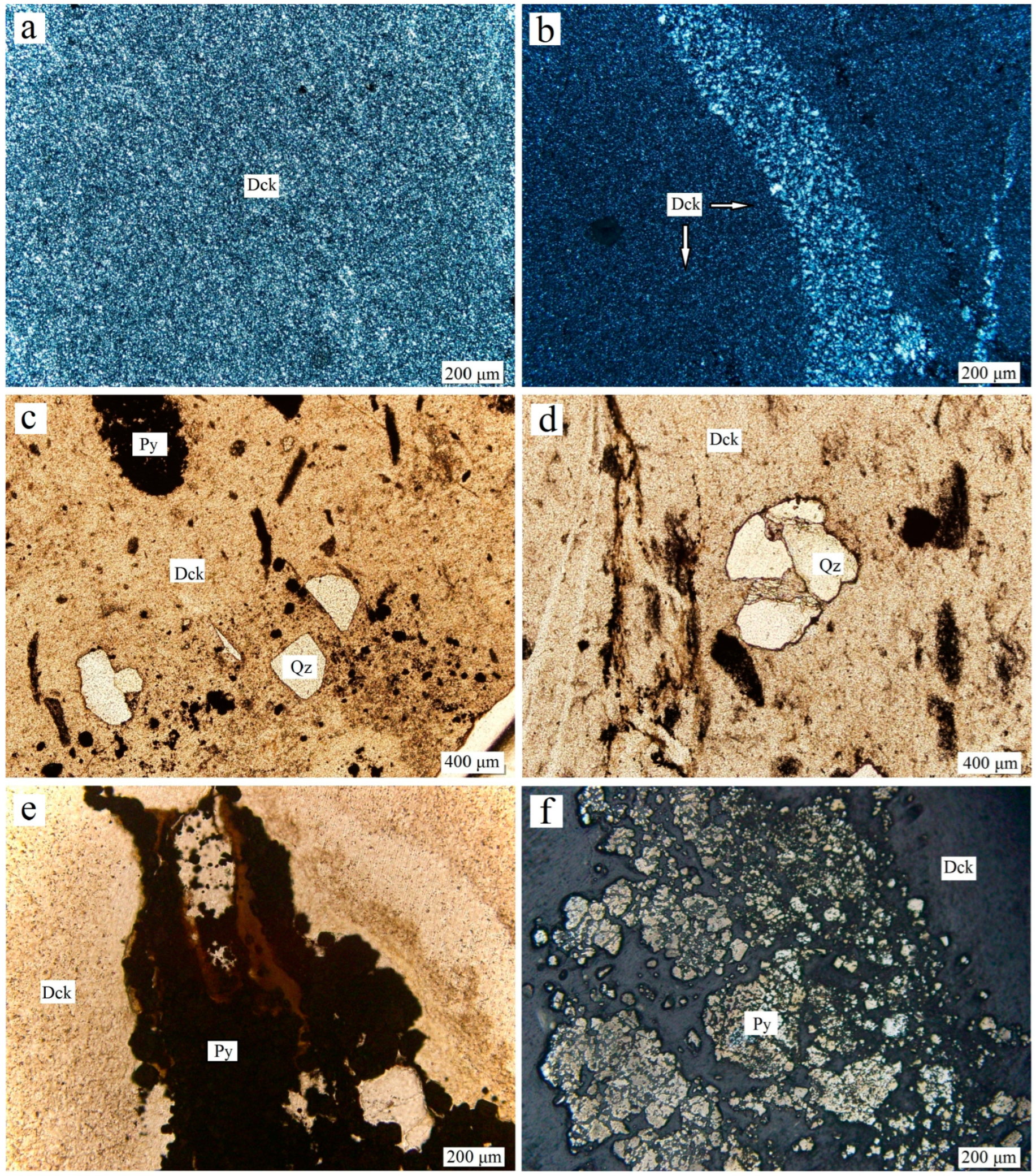
Polarized light microscopy reveals that the matrix of the “Heijin” samples is composed predominantly of kaolinite-group minerals (KGMs), exhibiting gray-white to pale gray-blue interference colors. Due to the low birefringence of dickite, the interference colors are relatively weak, manifesting as subtle gray tones. The mineral grains are extremely fine, displaying a micro-cryptocrystalline texture. A faint blue hue observed in the background is likely a pseudochromatic effect resulting from the interaction between the optical system and the thickness of the mineral thin section (Figure 3a).
The microstructure preserves distinct evidence of multi-stage hydrothermal activity. The early-formed matrix is frequently crosscut or replaced by later-stage KGM veinlets, forming a vein-like texture (Figure 3b). Some samples contain quartz crystal clasts; while some retain euhedral forms (Figure 3c), others exhibit strong cataclastic textures, indicating significant hydrothermal metasomatism and tectonic stress. Fine-grained clay minerals, such as dickite, not only constitute the matrix but also fill micro-fractures within the quartz, forming a stockwork or reticulated distribution (Figure 3d). Opaque minerals occur primarily as dark aggregates or fine veinlets disseminated throughout the matrix (Figure 3c–e). Reflected light microscopy confirms that these dark minerals are pyrite, exhibiting a bright metallic luster and concentrated as disseminated spots or clusters (Figure 3f), which acts as the direct chromogenic agent responsible for the black appearance of the samples.

3.2. X-Ray Diffraction (XRD) Analysis

3.2.1. Phase Identification

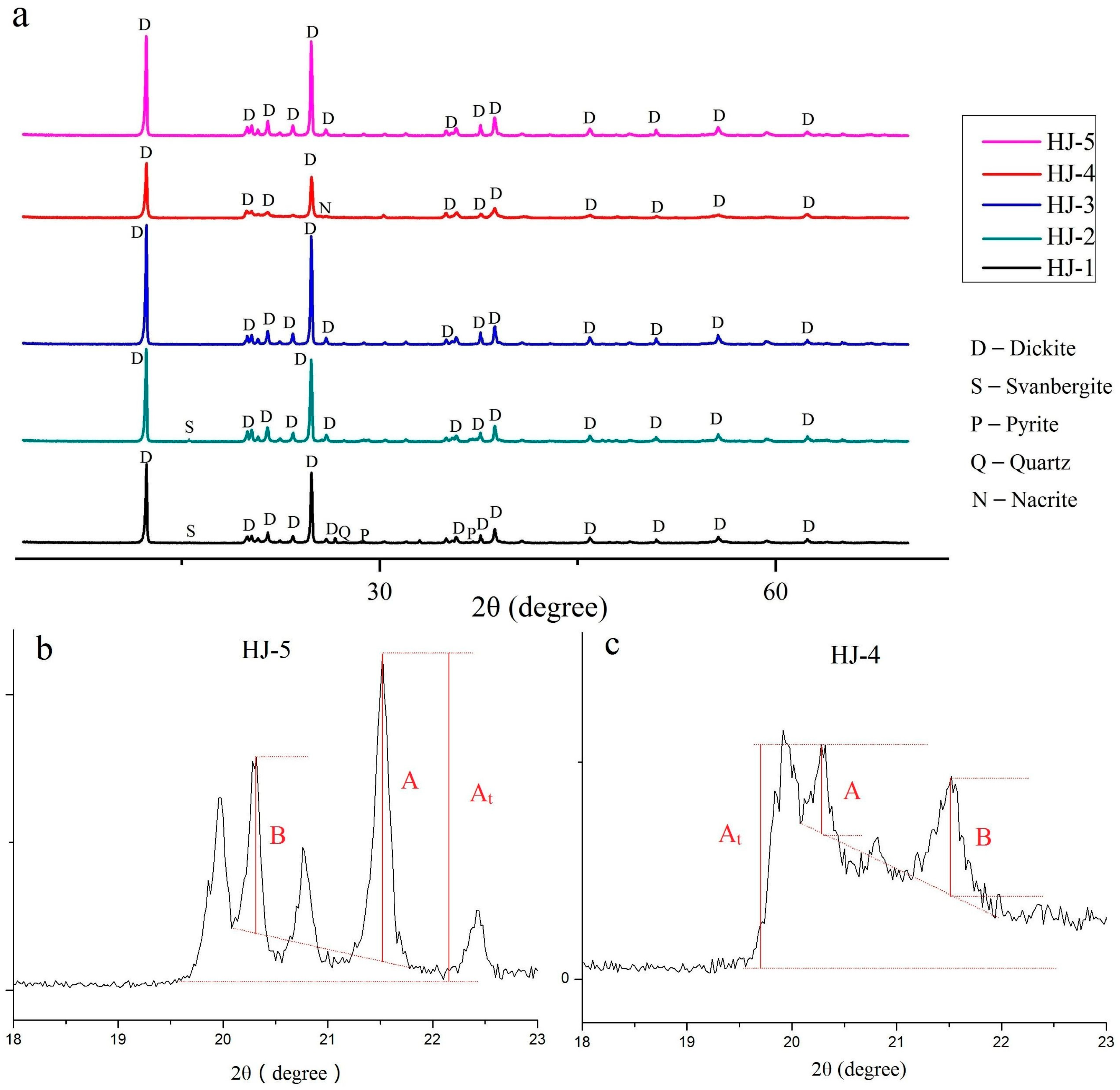
X-Ray diffraction (XRD) analysis of the “Heijin” samples (HJ-1 to HJ-5) is presented in Figure 4a. Combined with standard ICDD card comparisons, the results confirm that the primary ore-forming minerals in all samples belong to the kaolinite group. Intense diagnostic reflections were observed at d-spacings of approximately 7.15 Å, 3.57 Å, and 2.33 Å. To accurately distinguish between polytypes, the peak profiles in the 2θ ranges of 19–24° and 35–40° were examined in detail. The results show a characteristic doublet at 3.95 Å and 3.79 Å in the 19–24° range, and a typical “finger-like” profile composed of four distinct diffraction peaks in the 35–40° region, which is distinct from the “mountain-shaped” six-peak profile of kaolinite [6,14,15,16]. Based on these diagnostic features, the dominant mineral in all five samples was identified as dickite (2M1).
Significant variations were observed in the accessory mineral assemblages among different samples. Samples HJ-3 and HJ-5 are the most mineralogically pure, consisting almost exclusively of dickite. In contrast, sample HJ-4 exhibits additional diffraction peaks at 3.47 Å, 3.06 Å, and 2.43 Å within the 25–40° (2θ) range, which were identified as the associated polymorph nacrite (2M2) [17]. The mineral compositions of HJ-1 and HJ-2 are more complex: HJ-1 displays distinct peaks for quartz (3.35 Å) and pyrite (3.13 Å, 2.42 Å, 1.92 Å) [18]. Furthermore, weak diffraction signals at 5.69 Å and 2.95 Å were detected in the 10–20° and ~30° regions for both HJ-1 and HJ-2, which were identified as trace svanbergite [19].
The investigation reveals that the macroscopic coloration of the “Heijin” stone is intimately coupled with its mineralogical constitution. Specimens exhibiting a white, translucent appearance (e.g., HJ-5) are characterized by a predominant composition of high-purity dickite, being effectively devoid of pyrite or other detectable impurities. Conversely, in darker-toned samples (ranging from dark gray to black), the concentrations of both pyrite and svanbergite are significantly elevated. In summary, while dickite constitutes the fundamental mineral matrix of the “Heijin” stone, the micro-dissemination of pyrite and svanbergite is identified as the primary chromogenic mechanism responsible for the dark hues observed in these gemstones.

3.2.2. Structural Order (Hinckley Index)

The structural order of the dickite was semi-quantitatively evaluated using the Hinckley Index (HI) [20]. The crystallinity index was calculated based on the characteristic diffraction peaks at d ≈ 4.36 Å (110) and d ≈ 4.12 Å (11 1 ¯ ) within the 2θ range of 19–24° (Figure 4b,c). The calculation followed the formula HI = (A + B)/At, where A and B represent the heights of the (110) and (11 1 ¯ ) peaks above the inter-peak background, respectively, and At corresponds to the total height of the strongest diffraction peak within this range above the general background.
The HI values for HJ-1, HJ-2, HJ-3, and HJ-5 are 1.41, 1.44, 1.46, and 1.50, respectively. According to established classification standards, these values fall within the “highly ordered” category (HI ≥ 1.3). Sample HJ-4 yielded an HI of 0.92, classifying it as “poorly ordered” (HI ≥ 0.5) [21]. Notably, unlike the highly ordered samples (e.g., HJ-5, Figure 4b) where the (11 1 ¯ ) reflection dominates, HJ-4 exhibits an intensity reversal with a stronger (110) peak (Figure 4c), which further corroborates its lower structural order and potential lattice defects. These results indicate that, with the exception of the relatively loosely textured HJ-4, the dickite matrix in the “Heijin” samples possesses a high degree of crystallinity and structural order.

3.3. Vibrational Spectroscopy

3.3.1. Fourier-Transform Infrared Spectroscopy (FTIR)

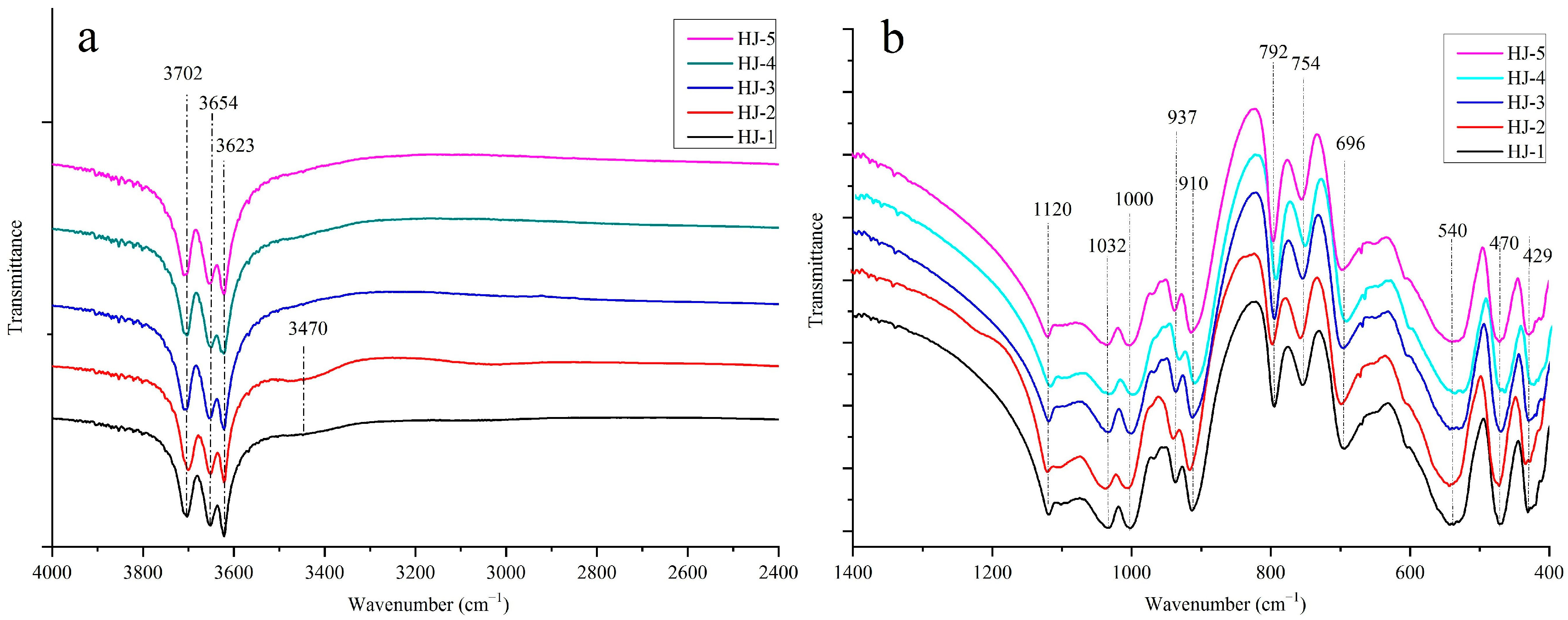
The FTIR spectra of samples HJ-1 through HJ-5 (Figure 5) exhibit a high degree of similarity. In the high-frequency hydroxyl stretching vibration region (3600–3750 cm−1), all samples display three characteristic absorption bands at approximately 3702, 3654, and 3623 cm−1 (Figure 5a). These peaks are sharp and well-resolved (deep splitting), consistent with the typical infrared signature of dickite. Additionally, absorption bands in the fingerprint region at 1120, 1032, 1000, 937, and 429 cm−1 match the standard spectra for dickite [22,23,24]. A weak, broad absorption band near 3470 cm−1 observed in some samples is attributed to trace adsorbed water molecules on the sample powder rather than structural hydroxyls. Detailed peak assignments are listed in Table 1.
Regarding structural order, the FTIR features corroborate the high crystallinity indicated by the XRD HI values (1.41–1.50 for most samples). Specifically, the intensity of the 3702 cm−1 peak is distinctively weaker than that of the 3623 cm−1 peak, the absorption band near 795 cm−1 is prominent, and the doublet at 1032 and 1000 cm−1 is clearly resolved (Figure 5b) [25,26]. These are hallmarks of a well-ordered crystal structure. The consistency between the XRD crystallinity indices and the infrared spectral criteria confirms that the dickite matrix in “Heijin” stone possesses excellent structural order.

3.3.2. Raman Spectroscopy

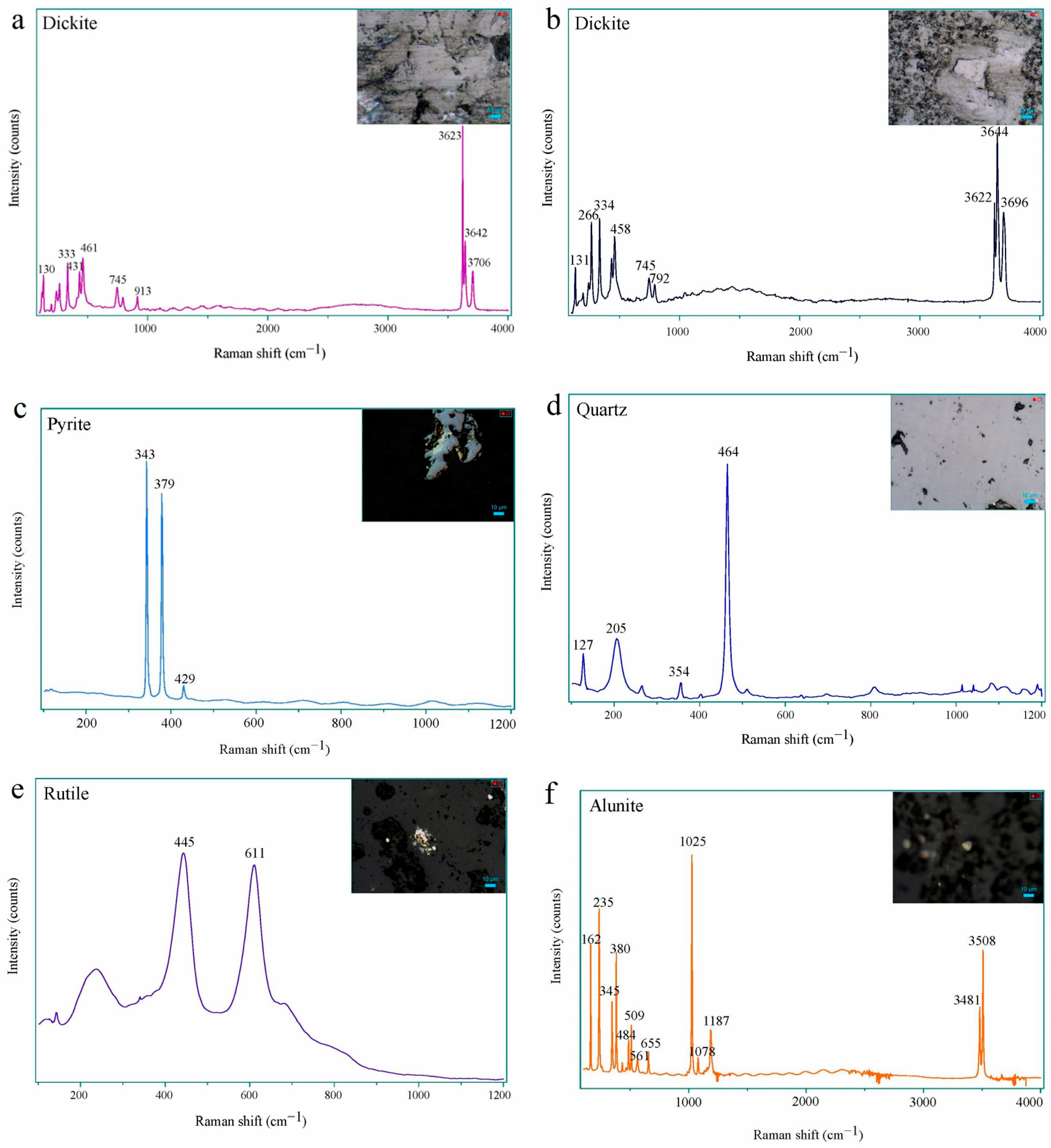
Micro-Raman spectroscopy reveals significant structural heterogeneity within the dickite matrix at the microscopic scale. Two distinct types of spectral features were observed across the tested spots, reflecting variations in lattice order:
Type I (Ordered State): In the majority of well-crystallized micro-areas (Figure 6a), the spectra exhibit features typical of ordered dickite. The OH stretching region displays a clear triplet (3622, 3642, and 3706 cm−1), where the 3622 cm−1 band is the strongest and the 3706 cm−1 peak is sharp. This spectral signature corresponds to dickite regions with complete lattice development and regular 2M1 stacking sequences [15,27,28].
Type II (Disordered State): In certain micro-areas, significant spectral variations were observed (Figure 6b), indicating local structural disorder or defects. Key features include a red-shift of the high-frequency peak from 3706 to 3696 cm−1 (approaching the kaolinite position) and an anomalous increase in the intensity of the 3644 cm−1 band (intensity inversion). These features suggest that, although the matrix is primarily dickite, there is a local admixture of stacking disorder or intercalation of kaolinite-group polytypes at the microscopic scale [22,29].
Spectra obtained from the black metallic inclusions (Figure 6c) display strong scattering peaks at 343 and 379 cm−1, which perfectly match the standard Raman shifts of pyrite (FeS2) [30], confirming it as the chromogenic mineral responsible for the unique black color. Additionally, several trace accessory minerals were identified: Figure 6d shows the Si-O-Si symmetric stretching peak of quartz at 464 cm−1; Figure 6e corresponds to the characteristic peaks of rutile at 445 and 611 cm−1; and Figure 6f identifies a mineral belonging to the alunite supergroup. The spectrum exhibits a prominent symmetric stretching vibration of the sulfate group ν1 ( S O 4 2 ) at 1025 cm−1, accompanied by weaker antisymmetric stretching modes (ν3) at 1078 cm−1 and 1187 cm−1. Crucially, the high-frequency region displays a distinct doublet at 3481 and 3508 cm−1, corresponding to the OH-stretching vibrations. These spectral features are diagnostic of alunite (KAl3(SO4)2(OH)6) [31]. It is noteworthy that while svanbergite was identified by EDS as the predominant APS phase forming filamentous veinlets (see Section 3.4), its Raman signals were largely masked by the intense fluorescence and scattering of the surrounding dickite matrix due to its extremely fine-grained, crypto-crystalline texture (<5 μm). In contrast, the alunite occurs as discrete, larger grains, allowing for the acquisition of high-quality diagnostic spectra.

3.4. Micro-Morphology (SEM)

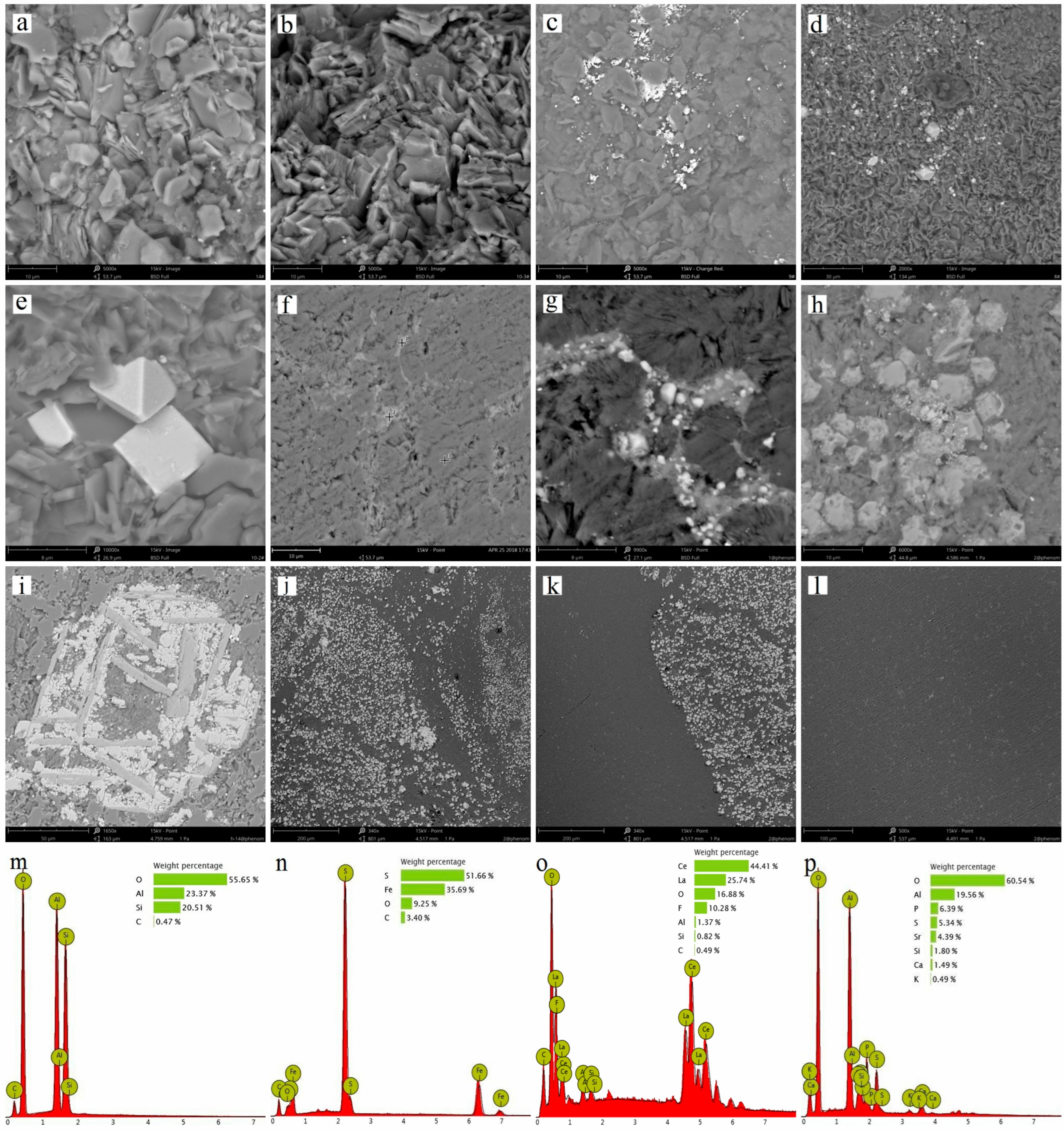
SEM observations reveal that all samples exhibit the platy structural characteristics typical of kaolinite-group minerals [7,16,32]. However, the integrity of the crystal morphology shows a significant correlation with the previously determined Hinckley Index (HI). In the high-crystallinity sample HJ-5 (HI = 1.50), the crystals are most well-developed, presenting clear and regular book-like aggregates. The individual crystals are predominantly pseudo-hexagonal platelets with straight, distinct grain boundaries, substantial thickness, and tight stacking, indicating an extremely high degree of internal structural order (Figure 7a). Sample HJ-3 (HI = 1.46) maintains a generally good euhedral degree and platy character, although the interlayer stacking is slightly looser than in HJ-5, with minor dissolution features and fine impurity particles attached to some crystal edges (Figure 7b). In contrast, the low-crystallinity sample HJ-4 (HI = 0.92) exhibits the most disordered micro-morphology. It lacks the typical thick “book-like” appearance; instead, the crystal grains are significantly finer with severely fragmented edges, mostly accumulating as irregular debris. This fragmented and chaotic microstructure aligns perfectly with its macroscopic physical properties of coarse texture, loose structure, and low translucency (Figure 7c). In the matrix, abundant pyrite is observed as granules of varying sizes, with occasional euhedral cubes, octahedrons, and pyritohedrons (Figure 7d,e).
Combined Back-Scattered Electron (BSE) imaging and Energy-Dispersive Spectroscopy (EDS) analysis further characterizes the micro-composition. The matrix consists primarily of dickite (typical Al-Si spectrum shown in Figure 7m), associated with various accessory minerals. Svanbergite frequently occurs as veinlets or filamentous networks cutting through the matrix, with some veinlets encapsulating micron-sized pyrite particles (Figure 7f,g). The chemical identity of these phases was confirmed by EDS, which revealed strong Fe and S peaks for pyrite (Figure 7n) and characteristic Sr, Al, P, and S signals for svanbergite (Figure 7p). In the vicinity of some pyrite grains, fine minerals (<1 μm) rich in Ce, La, and F were detected. Based on EDS analysis (Figure 7o) and their paragenetic relationship with pyrite, these are identified as bastnäsite-(Ce) (Figure 7h). Additionally, acicular or columnar rutile crystals, approximately 20 μm in length, were observed within pyrite in certain locations (Figure 7i).
Comparative BSE imaging of different colored regions reveals distinct micro-textures. The black region (Figure 7j) is characterized by a high density of disseminated fine-grained pyrite. The interface between the black and white regions (Figure 7k) exhibits a sharp boundary, clearly delineating the pyrite-rich side from the pure dickite matrix, which is devoid of significant impurities. The gray region (Figure 7l), in contrast, presents a unique texture characterized by dense, filamentous svanbergite veins distributed throughout the matrix. Consequently, the dissemination of fine-grained pyrite is the primary cause of the black coloration, while the gray tone is closely related to the presence of vein-like svanbergite, and the white portions represent high-purity dickite aggregates.

3.5. Mineral Chemistry (EPMA)

The chemical compositions of ore-stage minerals, including dickite, svanbergite, quartz, rutile, bastnäsite-(Ce), and pyrite, were determined by EPMA. Representative analytical results are presented in Table 2 and Table 3. To provide a more accurate representation of the mineral chemistry, the contents of light elements (H2O and CO2) were calculated based on ideal mineral stoichiometry and included in the empirical totals (Table 2).
Silicates and Oxides: Dickite crystals exhibit a chemically pure composition close to the ideal stoichiometry of Al2Si2O5(OH)4. By incorporating the calculated stoichiometric water (H2O*), the analytical totals reach an excellent range of 96.6–99.4 wt% (Table 2). Quartz is characterized by high purity (SiO2 > 98.9 wt%) with only trace amounts of Al detected. Rutile grains contain minor amounts of Fe and V (V2O3 up to 1.68 wt%). The analytical totals for rutile (91.2–92.6 wt%) are relatively low; this is likely attributed to the presence of undetermined elements such as Nb and Ta, which are common trace components in hydrothermal rutile but were not included in the analytical routine.
Phosphates and Sulfates: Svanbergite grains display a complex solid-solution relationship with woodhouseite. The structural formulae indicate a coupled substitution mechanism involving Sr2+ + P5+ ↔ Ca2+ + S6+. The calculated P/S and Sr/Ca ratios confirm their intermediate compositions within the svanbergite–woodhouseite series, accompanied by appreciable LREE incorporation (Ce, La). The updated analytical totals (~82 wt%), which include calculated structural water (H2O) and oxygen equivalent deductions (O ≡ F, Cl), reflect the characteristic porosity of the fine-grained filamentous svanbergite aggregates.
REE Minerals: Rare earth element (REE) minerals, such as bastnäsite-(Ce), occur as fine-grained inclusions. As shown in Table 2, both raw analytical data (Raw) and matrix-corrected results (Recalculated) are provided to ensure data transparency. In the raw analysis, the detected Si and Al are attributed to electron beam overlap with the surrounding dickite matrix. To rigorously characterize the carbonate phase, the Recalculated column was generated by: (1) subtracting the SiO2 and Al2O3 as matrix contamination; (2) computing the stoichiometric CO2 * based on REE contents; and (3) normalizing the remaining species-determining components to 100%. The results reveal high concentrations of Ce and La (Ce > La), confirming the chemical maturity of the REE-bearing phases within the “Heijin” stone.
Sulfides: The EPMA data presented in Table 3 show that the pyrite has a near-stoichiometric composition (FeS2), with calculated S/Fe atomic ratios ranging from 1.99 to 2.00. While most trace elements (Zn, Cu, Se) are low or below detection limits, anomalous Au contents (up to 0.03 wt%) were detected in specific grains, suggesting the presence of lattice-bound invisible gold or nano-inclusions of native gold.

3.6. Thermal Analysis (TG-DSC)

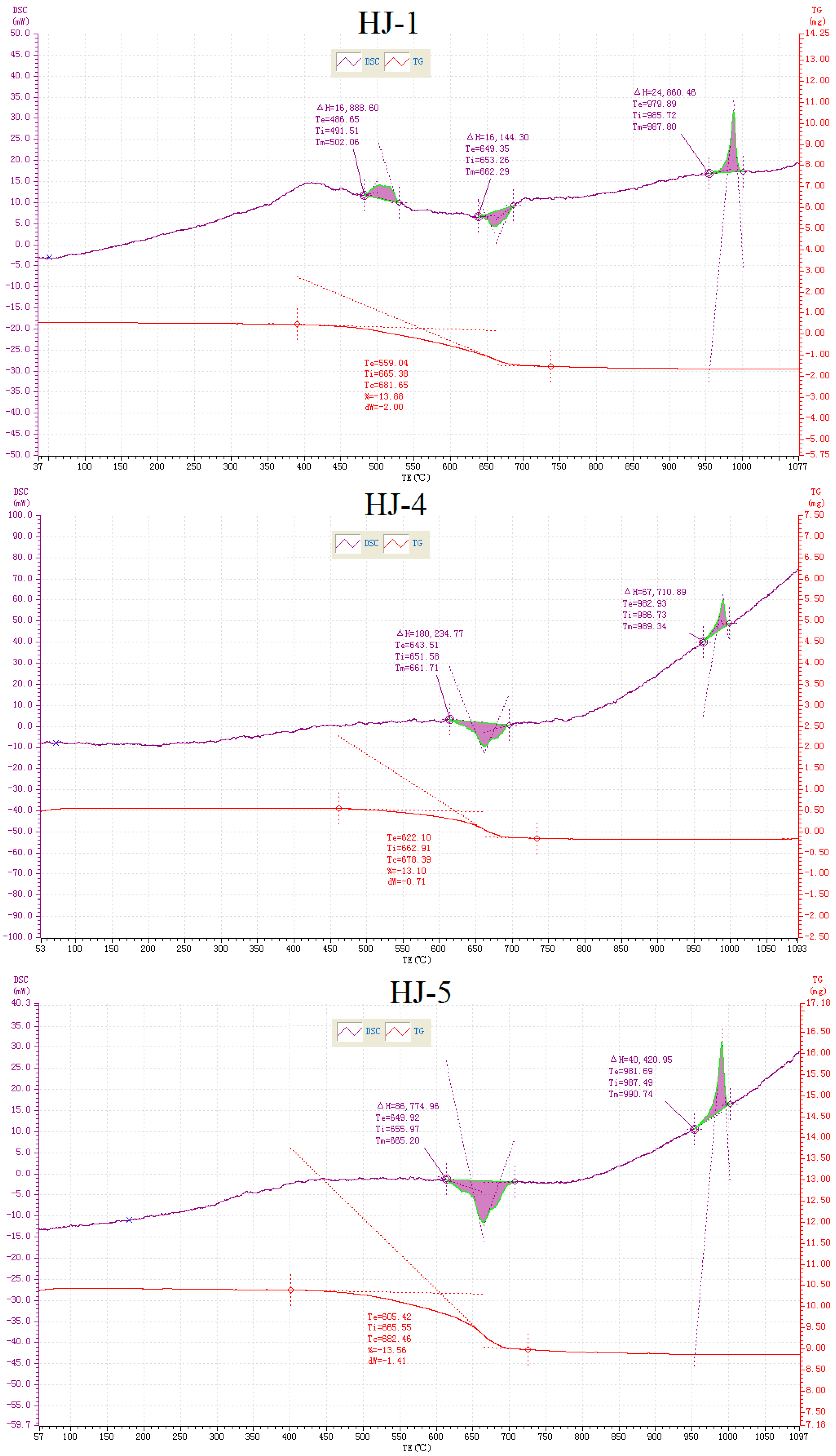
The thermal stability of the samples was investigated using simultaneous Thermogravimetry and Differential Scanning Calorimetry (TG-DSC) (Figure 8). The characteristic thermal parameters are listed in Table 4. The Thermogravimetry (TG) curves indicate that the major mass loss occurs between 500 °C and 750 °C, corresponding to the dehydroxylation of kaolinite-group minerals [33,34,35,36,37]. The total mass loss for sample HJ-5 is 13.56%, and for HJ-1 it is 13.88%, both of which are very close to the theoretical value for ideal kaolinite minerals (13.96%), confirming their high purity and crystallinity. Sample HJ-4 exhibits the lowest mass loss (13.10%), likely due to a lower content of structural water associated with its lower crystallinity and impurity dilution.
The DSC curves display two characteristic thermal events: a major endothermic peak attributed to dehydroxylation and an exothermic peak associated with the formation of high-temperature phases [35]. A systematic shift in the dehydroxylation peak temperature (Tm1) was observed: HJ-5 (665.20 °C) > HJ-1 (662.29 °C) > HJ-4 (661.71 °C). The sample with the highest crystallinity (HJ-5) exhibits the highest thermal stability and the sharpest endothermic peak, suggesting that a more ordered crystal lattice requires higher activation energy to remove structural hydroxyls. The structural order of dickite directly governs the concentration of the dehydroxylation reaction. High-order samples (e.g., HJ-5, HI = 1.50) display a high rate of weight loss (dW), indicating structural integrity and concerted chemical bond breaking. Conversely, the low-order HJ-4 (HI = 0.92) shows a lower weight loss rate (derivative peak minimum at −0.71%/°C), indicating a slower and more dispersed reaction process.
In the high-temperature region of the DSC curves, all samples exhibit an exothermic peak representing the phase transformation from metakaolinite to Al-Si spinel [38,39]. The peak temperatures (Tm2) for all samples are concentrated in the range of 980 to 990 °C.

4. Discussion

4.1. Mineralogical Essence and Unique Assemblage of “Heijin” Stone

This study confirms that “Heijin” seal stone is a rare variety of gemstone consisting of a dickite matrix with disseminated pyrite inclusions. Distinct from traditional Shoushan or Changhua stones, which are typically colored by cinnabar or composed of pure clay aggregates [1,2,3,4,5,9,10], the “Heijin” stone exhibits a unique sulfide–silicate paragenetic system. Both XRD and Raman data consistently identify the matrix as the 2M1 polytype of dickite rather than kaolinite. From a petrogenetic perspective, the transformation of kaolinite to dickite generally requires elevated diagenetic temperatures (>120 °C) or significant burial depths. Consequently, the predominance of dickite in “Heijin” stone suggests that it formed during a more mature stage of hydrothermal alteration or within a more stable crystallization environment compared to typical kaolinite-based jades [40,41].
Regarding the chromogenic mechanism, petrographic and Raman analyses explicitly exclude carbonaceous organic matter or graphite as coloring agents. Its characteristic black to dark-gray appearance results from the absorption and scattering of light by micrometer-scale (typically < 10 μm) pyrite grains within the translucent dickite matrix. This high-contrast “black (pyrite)–white (dickite)” architecture not only imparts a unique sub-metallic luster to the stone but also indicates that the ore-forming fluids were characterized by high sulfur fugacity ( f S 2 ) and reducing geochemical conditions. Furthermore, the identification of svanbergite (an aluminum phosphate–sulfate (APS) mineral) via EPMA and SEM in the dark and gray regions further corroborates that this mineral assemblage formed through the metasomatism of volcanic host rocks by acidic sulfate-rich hydrothermal fluids.

4.2. Control of Structural Order (HI) on Microscopic Growth Habits

A pivotal finding of this research is the significant intrinsic link between the Hinckley Index (HI) of dickite and its micro-morphology. The HI serves as a robust proxy for the long-range structural order of layer stacking within kaolinite-group minerals. XRD data indicate that sample HJ-5 possesses an HI of 1.50, signifying an exceptionally high degree of structural order, whereas the coarse-textured HJ-4 yields an HI of only 0.92, indicating substantial stacking disorder. This crystallographic discrepancy is directly manifested in the SEM observations. In high-HI samples (e.g., HJ-5 and HJ-3), dickite crystals exhibit perfect euhedralism, developing thick, compact book-like aggregates along the c-axis. This microstructure suggests that under the guidance of an ordered lattice, the tetrahedral and octahedral sheets undergo long-range, ordered face-to-face stacking unimpeded by structural defects.
Conversely, the low-HI sample (HJ-4) displays fragmented, worm-like, or detrital structures with irregular edges and a lack of well-defined crystal faces. This demonstrates that the presence of translational or rotational defects within the lattice inhibits macroscopic crystal growth, leading to fine-grained and disordered arrangements. These microstructural variations directly dictate the macroscopic texture of the stone: the dense book-like stacking minimizes light scattering at grain boundaries, granting HJ-5 its superior translucency (the “jelly-like” or “frozen” quality), while the loose, fragmented structure results in the dry and opaque appearance of HJ-4.

4.3. Thermodynamic Coupling Between Crystal Structure and Thermal Stability

The TG-DSC results further elucidate the mechanisms by which the structural stability of dickite governs its thermal evolution. A clear positive correlation was observed between the dehydroxylation peak temperature (Tm1) and the HI value. The high-crystallinity sample (HJ-5, HI = 1.50) exhibits a Tm1 of 665.20 °C with a sharp, symmetrical endothermic peak, whereas the low-crystallinity HJ-4 (HI = 0.92) shows a reduced Tm1 of 661.71 °C. From a crystal-chemical standpoint, the dehydroxylation of dickite involves the breaking of interlayer hydroxyl (–OH) bonds and the subsequent diffusion of water molecules. In highly ordered lattices, the interlayer hydrogen-bond network is regularly arranged with strong binding forces and fewer defects. Breaking this stable structure and driving water out of the lattice requires overcoming a higher activation energy barrier, manifesting as an elevated dehydroxylation temperature. In contrast, dislocations and stacking faults in low-order crystals lower the lattice energy, allowing hydroxyls to be removed at lower temperatures [41,42,43].
In the high-temperature region of the DSC curves, the morphology of the exothermic peak associated with phase transformation is also strongly coupled with the HI value. In high-HI samples (HJ-5 and HJ-1), the exothermic peaks are remarkably sharp and narrow, indicating that the energy release during atomic reorganization from disordered metakaolinite to an ordered high-temperature phase is instantaneous and intense. In the low-HI sample (HJ-4), the peak is noticeably broadened and flattened, reflecting a slower and more heterogeneous energy release process due to the presence of lattice defects [15,43].
Additionally, the mass loss variations in the TG curves reflect the influence of mineral purity and impurities. The mass loss of HJ-5 (13.56%) and HJ-1 (13.88%) are both close to the theoretical value for dickite (13.96%), verifying high purity and structural integrity. Notably, HJ-1, which contains a higher pyrite content, exhibits a slightly higher mass loss than the purer HJ-5. This is attributed to the oxidative decomposition of pyrite in the 400–600 °C range (4FeS2 + 11O2 → 2Fe2O3 + 8SO2↑), where the release of SO2 gas provides an additive effect to the mass loss from dehydroxylation. This result underscores the necessity of considering the combined thermal effects of the silicate matrix and sulfide accessories when evaluating the thermal stability of “Heijin” stone.

4.4. Genetic Implications and Hydrothermal Evolution

The mineral assemblage of “Heijin” stone, predominantly consisting of dickite, pyrite, and svanbergite, provides critical insights into its hydrothermal origins. According to the geological provenance described in Section 2.1, the deposit is hosted within Mesozoic rhyolitic tuffs that have undergone intense advanced argillic alteration within a high-sulfidation hydrothermal system. The transition from the host rhyolitic tuff to “Heijin” jade is characterized by a significant geochemical gradient. The depletion of SiO2 and the intensive leaching of alkalis (K, Na, Ca, Mg), coupled with the enrichment of Al2O3, reflect a high-strain fluid–rock interaction under low-pH conditions. Based on the mineralogical stability fields and the regional geological framework [44], we estimate the formation occurred within a temperature window of 100–150 °C and low-pressure conditions (<1 kPa). We acknowledge that purely mineralogical evidence provides a temperature constraint rather than a definitive measurement. Future work employing stable isotope geochemistry (δD and δ18O) will be essential to further refine these thermometric conditions and elucidate the fluid sources.
We propose a two-stage genetic model for the evolution of “Heijin” stone:
Stage I (Sulfide Precipitation): During the initial phase of volcanic exhalation, magmatic fluids enriched in H2S and SO2 created an acidic-reducing environment. The high sulfur fugacity ( f S 2 ) promoted the reaction between sulfur species and Fe2+ ions leached from the tuff, resulting in the disseminated crystallization of pyrite. This stage is responsible for the characteristic dark coloration observed in the matrix.
Stage II (Dickitization and Structural Ordering): In the waning stages of volcanic activity, the circulation of meteoric-derived hydrothermal fluids through tectonic fractures became dominant. As H+ was consumed through continuous metasomatism, the fluid pH gradually shifted toward a weakly acidic state. Under these stable, long-duration hydrothermal conditions, the alumino-silicate precursors were transformed into highly ordered 2M1 dickite.
The exceptional structural order (HI ≈ 1.50) of the “Heijin” matrix, despite the relatively low formation temperature, suggests that the crystallinity was primarily governed by the thermodynamic stability of the hydrothermal field and a high fluid–rock ratio. This stable environment allowed for the slow, concerted growth of dickite crystals, leading to the premium “frozen” textures identified in samples such as HJ-5.

5. Conclusions

This study systematically characterized the mineralogical and structural properties of “Heijin” seal stone, leading to the following conclusions:
1.
Identity and Genesis: “Heijin” stone is a unique variety of 2M1 dickite-based jade. Its distinctive black coloration is caused by the dissemination of micrometer-scale pyrite. The presence of an APS mineral assemblage (predominantly svanbergite) indicates a genetic environment characterized by high sulfur fugacity ( f S 2 ), low pH, and reducing hydrothermal conditions.
2.
Structural–Morphological Correlation: A rigorous correspondence exists between the Hinckley Index (HI) and microscopic growth habits. High structural order (HI = 1.41–1.50) results in dense, euhedral “book-like” aggregates, providing the physical basis for the premium “frozen” (translucent) texture. In contrast, marginal crystallinity (HI ≈ 0.92) correlates with fragmented, disordered micro-morphologies and an opaque macroscopic appearance.
3.
Thermodynamic Coupling: The thermal stability of the dickite matrix is lattice-governed. The dehydroxylation peak temperature (Tm1) exhibits a systematic positive correlation with the HI value (ranging from 661.71 to 665.20 °C), demonstrating that higher crystalline order significantly elevates the activation energy required for structural decomposition.
4.
Scientific Significance and Methodological Framework: Beyond the specific characterization of “Heijin” stone, this study establishes a robust “XRD crystallinity–SEM morphology–DSC stability” coupling model. This multi-analytical framework serves as a universal tool for evaluating the quality and genetic maturity of other clay-based gemstones (e.g., Shoushan stone, Qingtian stone). By linking micro-lattice ordering to macroscopic texture, this approach offers a quantitative scientific basis for gemstone grading. Future investigations utilizing stable isotopes (e.g., H, O, and S) are recommended to further refine the specific fluid sources and formation temperatures of these hydrothermal systems.

Author Contributions

Conceptualization, Y.Y. and M.S.; methodology, Y.Y. and M.S.; software, Y.Y. and J.Y.; validation, Y.Y. and M.S.; formal analysis, Y.Y. and M.S.; investigation, Y.Y., J.Y., and S.W.; resources, M.S.; data curation, Y.Y. and M.S.; writing—original draft preparation, Y.Y.; writing—review and editing, Y.Y. and M.S.; visualization, Y.Y. and J.Y.; funding acquisition, M.S. All authors have read and agreed to the published version of the manuscript.

Funding

The research was funded by the National Natural Science Foundation of China (Grant No. 42002156), the Excellent youth project of Hebei GEO University (Grant No. YQ202404), and the Doctoral research start-up fund project of Hebei GEO University (Grant No. BQ2024008). The APC was funded by the Doctoral research start-up fund project of Hebei GEO University, grant number (BQ2024008).

Data Availability Statement

The original contributions presented in this study are included in the article. Further inquiries can be directed to the corresponding author(s).

Acknowledgments

We thank the Gemology Experimental Teaching Center, China University of Geosciences (Beijing) for its help in sample testing. We sincerely appreciate the valuable feedback and constructive suggestions provided by the reviewers, which have greatly enhanced the quality of our work. We used AI-based translation tools (DeepL Translator web version and Youdao AI Translation v11.0.0) to assist with translating the manuscript into English and polishing the language. All scientific content and interpretations were verified and edited by the authors.

Conflicts of Interest

The authors declare no conflicts of interest.

References

  1. Wu, J.-X.; Chen, T.; Zheng, J.-Y.; Zhuang, Y.; Tian, J.-L.; Huang, Z.-Y. Research on the Metallogenic Process and Color Origin of Purple “Shanzilai Stone”. Acta Petrol. Mineral. 2023, 42, 263–274, (In Chinese with English abstract). [Google Scholar]
  2. Li, Y.-J.; Zhu, L.-Y.; Xu, W.; Meng, W.; Lin, M.; Yang, Z.; Chen, R.-S. Stratigraphic Section and Geochronological Studies of the Shoushan Basin, Fujian Province, South China, and Its Implications for the Mineralization of Shoushan Stone. Minerals 2022, 12, 1542. [Google Scholar] [CrossRef]
  3. Li, Y. Study on the Metallogenic Geological Characteristics and Genesis of Tianhuang from Fujian Province. J. Gems Gemmol. 2022, 24, 12–22, (In Chinese with English abstract). [Google Scholar]
  4. Yuan, Y.; Shi, G.; He, M.; Liu, Y. Application of Spectroscopy to the Signet Stones: Case Study of the Changhua Stone. J. Mineral. Petrol. 2011, 31, 18–24, (In Chinese with English abstract). [Google Scholar]
  5. Yuan, Y.; Shi, G.; Yang, M.; Wu, Y.; Zhang, Z.; Huang, A.; Zhang, J. Formation of a Hydrothermal Kaolinite Deposit from Rhyolitic Tuff in Jiangxi, China. J. Earth Sci. 2014, 25, 495–505. [Google Scholar] [CrossRef]
  6. Bailey, S.W. Structures of layer silicates. In Crystal Structures of Clay Minerals and Their X-Ray Identification; Brindley, G.W., Brown, G., Eds.; Mineralogical Society: London, UK, 1980; pp. 1–124. [Google Scholar]
  7. Ece, Ö.I.; Ercan, H.Ü. Global Occurrence, Geology and Characteristics of Hydrothermal-Origin Kaolin Deposits. Minerals 2024, 14, 353. [Google Scholar] [CrossRef]
  8. Beaufort, D.; Cassagnabere, A.; Petit, S.; Lanson, B.; Berger, G.; Lacharpagne, J.C.; Johansen, H. Kaolinite-to-Dickite Reaction in Sandstone Reservoirs. Clay Miner. 1998, 33, 297–316. [Google Scholar] [CrossRef]
  9. Chen, Q.; Chen, T.; Yan, X.; Wang, C.; Zheng, J.; Li, M. Mineralogical and Spectroscopic Study on the Similar Species of Chicken-Blood Stone. Spectrosc. Spectr. Anal. 2020, 40, 3179–3184, (In Chinese with English abstract). [Google Scholar]
  10. Chen, Q.; Chen, T.; Xu, X.; Kang, B.-Y.; Zheng, J.-Y.; Li, M.-Y. Gemmological and Spectroscopic Studies of the Jade Looked Like “Frozen Matrix” Chicken-Blood Stone. Spectrosc. Spectr. Anal. 2021, 41, 1920–1925, (In Chinese with English abstract). [Google Scholar]
  11. Susawee, N. Dickite: A Gem Material for Carving from Thailand. J. Gemmol. 2009, 31, 211–225. [Google Scholar] [CrossRef]
  12. Tang, D.; Zhen, D.; Zhen, Z.; Huang, S. Comparison between Laos Stone and Shoushan Stone. J. Gems Gemmol. 2017, 19, 1–13, (In Chinese with English abstract). [Google Scholar]
  13. Whitney, D.L.; Evans, B.W. Abbreviations for names of rock-forming minerals. Am. Mineral. 2010, 95, 185–187. [Google Scholar] [CrossRef]
  14. García-Vicente, A.; Lorenzo, A.; Morales, J.; García-Romero, E.; Suárez, M. Field Spectroscopy Applied to the Kaolinite Polytypes Identification. Environ. Sci. Proc. 2021, 6, 16. [Google Scholar] [CrossRef]
  15. Wu, S.; He, M.; Yang, M.; Peng, B. Near-Infrared Spectroscopic Study of OH Stretching Modes in Kaolinite and Dickite. Crystals 2022, 12, 907. [Google Scholar] [CrossRef]
  16. Yang, Y.; Zhang, N. Clay Minerals of China; Geological Publishing House: Beijing, China, 1994; pp. 20–56. (In Chinese) [Google Scholar]
  17. Chen, P.Y.; Wang, M.K.; Yang, D.S. Mineralogy of Dickite and Nacrite from Northern Taiwan. Clays Clay Miner. 2001, 49, 586–595. [Google Scholar] [CrossRef]
  18. International Union of Crystallography. International Tables for Crystallography Volume C: Mathematical and Physical Crystallography, 3rd ed.; Wiley-Blackwell: Chester, UK, 2004. [Google Scholar]
  19. Küster, D.; Kaufhold, S.; Limam, E.; Jatlaoui, O.; Ba, O.; Maham Zein Mohamed, A.; Pohlmann-Lortz, M.; Ranneberg, M.; Ufer, K. Investigation of Unexplored Kaolin Occurrences in Southern Mauritania and Preliminary Assessment of Possible Applications. Clay Miner. 2021, 56, 126–139. [Google Scholar] [CrossRef]
  20. Hinckley, D.N. Variability in “Crystallinity” Values among the Kaolin Deposits of the Coastal Plain of Georgia and South Carolina. Clays Clay Miner. 1962, 11, 229–235. [Google Scholar] [CrossRef]
  21. Liu, C.; Liu, Q. Advance on the Relation of Orders of Kaolinite Crystallization in Coal Series to the Origin. Contrib. Geol. Miner. Resour. Res. 2002, 17, 73–81, (In Chinese with English abstract). [Google Scholar]
  22. Drits, V.A.; Zviagina, B.B.; Sakharov, B.A.; Dorzhieva, O.V.; Savichev, A.T. New Insight into the Relationships Between Structural and FTIR Spectroscopic Features of Kaolinites. Clays Clay Miner. 2021, 69, 366–388. [Google Scholar] [CrossRef]
  23. Madejová, J. FTIR Techniques in Clay Mineral Studies. Vib. Spectrosc. 2003, 31, 1–10. [Google Scholar] [CrossRef]
  24. Balan, E.; Saitta, A.M.; Mauri, F.; Calas, G. First-Principles Modeling of the Infrared Spectrum of Kaolinite. Am. Mineral. 2001, 86, 1321–1330. [Google Scholar] [CrossRef]
  25. Farmer, V.C. Differing Effects of Particle Size and Shape in the Infrared and Raman Spectra of Kaolinite. Clay Miner. 1998, 33, 601–604. [Google Scholar] [CrossRef]
  26. Diko, M.; Ekosse, G.; Ogola, J. Fourier Transform Infrared Spectroscopy and Thermal Analyses of Kaolinitic Clays from South Africa and Cameroon. Acta Geodyn. Geomater. 2016, 13, 149–158. [Google Scholar] [CrossRef]
  27. Frost, R.L. Fourier Transform Raman Spectroscopy of Kaolinite, Dickite and Halloysite. Clays Clay Miner. 1995, 43, 191–195. [Google Scholar] [CrossRef]
  28. Johnston, C.T.; Helsen, J.; Schoonheydt, R.A.; Bish, D.L.; Agnew, S.F. Single-Crystal Raman Spectroscopy Study of Dickite. Am. Mineral. 1998, 83, 75–84. [Google Scholar] [CrossRef]
  29. Frost, R.L.; Tran, T.H.; Rintoul, L.; Kristof, J. Raman Microscopy of Dickite, Kaolinite and Their Intercalates. Analyst 1998, 123, 611–616. [Google Scholar] [CrossRef]
  30. Kleppe, A.K.; Jephcoat, A.P. High-Pressure Raman Spectroscopic Studies of FeS2 Pyrite. Mineral. Mag. 2004, 68, 433–441. [Google Scholar] [CrossRef]
  31. Maubec, N.; Lahfid, A.; Lerouge, C.; Wille, G.; Michel, K. Characterization of Alunite Supergroup Minerals by Raman Spectroscopy. Spectrochim. Acta Part A Mol. Biomol. Spectrosc. 2012, 96, 925–939. [Google Scholar] [CrossRef]
  32. Keller, W.D. Classification of Kaolins Exemplified by Their Textures in Scan Electron Micrographs. Clays Clay Miner. 1978, 26, 1–20. [Google Scholar] [CrossRef]
  33. Stoch, L.; Wacławska, I. Dehydroxylation of kaolinite group minerals—II. Kinetics of dickite dehydroxylation. J. Therm. Anal. 1981, 20, 305–310. [Google Scholar] [CrossRef]
  34. Yeskis, D.; Koster van Groos, A.F.; Guggenheim, S. The dehydroxylation of kaolinite. Am. Mineral. 1985, 70, 159–164. [Google Scholar]
  35. Liu, X.; Liu, X.; Hu, Y. Investigation of the thermal behaviour and decomposition kinetics of kaolinite. Clay Miner. 2015, 50, 199–209. [Google Scholar] [CrossRef]
  36. Zhang, A.; Kang, L.; Zhang, Y.; Ding, D.; Zhang, Y. Thermal behaviors and kinetic analysis of two natural kaolinite samples selected from Qingshuihe region in Inner Mongolia in China. J. Therm. Anal. Calorim. 2021, 145, 3281–3291. [Google Scholar] [CrossRef]
  37. Daou, I.; Mocuta, C.; Lecomte-Nana, G.L.; Tessier-Doyen, N.; Peyratout, C.; Guinebretière, R.; Thiaudière, D. Dehydroxylation of Kaolinite and Halloysite-Rich Samples: An In Situ Study of the Texture and Structural Evolutions. Minerals 2023, 13, 1418. [Google Scholar] [CrossRef]
  38. Alfonso, P.; Penedo, L.A.; García-Valles, M.; Canaviri, H.C.; Tomasa, A.C. Thermal Behaviour of Kaolinitic Raw Materials from San José (Oruro, Bolivia). J. Therm. Anal. Calorim. 2022, 147, 5413–5421. [Google Scholar] [CrossRef]
  39. Chauffeton, C.; Wallez, G. Crystal-Chemical Investigation of the “Cubic Al–Si Spinel” Issued from the Thermal Transformation of Kaolinite and Halloysite. J. Am. Ceram. Soc. 2022, 105, 4986–4993. [Google Scholar] [CrossRef]
  40. Ehrenberg, S.N.; Aagaard, P.; Wilson, M.J.; Fraser, A.R.; Duthie, D.M.L. Depth-Dependent Transformation of Kaolinite to Dickite in Sandstones of the Norwegian Continental Shelf. Clay Miner. 1993, 28, 325–352. [Google Scholar] [CrossRef]
  41. Lanson, B.; Beaufort, D.; Berger, G.; Bauer, A.; Cassagnabère, A.; Meunier, A. Authigenic Kaolin and Illitic Minerals During Burial Diagenesis of Sandstones: A Review. Clay Miner. 2002, 37, 1–22. [Google Scholar] [CrossRef]
  42. Ptáček, P.; Opravil, T.; Šoukal, F.; Wasserbauer, J.; Másilko, J.; Baráček, J. The Influence of Structure Order on the Kinetics of Dehydroxylation of Kaolinite. J. Eur. Ceram. Soc. 2013, 33, 2793–2799. [Google Scholar] [CrossRef]
  43. Izadifar, M.; Thissen, P.; Steudel, A.; Leypold, M.; Schampera, B.; Schuhmann, R.; Lagaly, G.; Emmerich, K. Comprehensive Examination of Dehydroxylation of Kaolinite, Disordered Kaolinite, and Dickite: Experimental Studies and Density Functional Theory. Clays Clay Miner. 2020, 68, 319–333. [Google Scholar] [CrossRef]
  44. Yuan, Y.; Shi, G.-H.; Lou, F.-S.; Shi, M. Mineralization and Metallogenic Model of Chinese Seal Stone Deposits. Acta Petrol. Mineral. 2014, 33, 146–152. [Google Scholar]
Figure 1. Macroscopic appearance and artistic applications of the “Heijin” (Black Gold) seal stone. (a) A carved decorative seal (Niu-zhang) featuring a traditional mythical beast, showcasing the intricate lapidary work; (b) A plain seal (Su-zhang) demonstrating the symbiotic “black-and-white” texture, where localized metallic inclusions display a characteristic sub-metallic luster against the translucent matrix.
Crystals 16 00165 g001
Figure 2. Macroscopic characteristics of the “Heijin” seal stone samples used in this study. (ae) Original hand specimens (HJ-1 to HJ-5) exhibiting the characteristic “black-and-white” symbiotic texture and greasy luster; (fj) Corresponding matrix fragments extracted for analytical characterization. Note the gradient in translucency: (j) HJ-5 exhibits a premium “frozen” texture with high transparency, whereas (i) HJ-4 displays a relatively coarse and opaque texture.
Crystals 16 00165 g002
Figure 3. Petrography and microstructures of the “Heijin” seal stone. (a) Micro-cryptocrystalline dickite matrix (XPL); (b) Dickite veinlets crosscutting the early-stage matrix (XPL); (c) Euhedral quartz clasts and disseminated opaque aggregates (PPL); (d) Stockwork dickite filling micro-fractures in quartz (PPL); (e) Opaque pyrite aggregates and veinlets within the dickite matrix (PPL); (f) Pyrite clusters showing metallic luster (RL). XPL: cross-polarized light; PPL: Plane-polarized light; RL: Reflected light. Mineral abbreviations are after Whitney & Evans [13]: Dck = dickite, Py = pyrite, Qz = quartz.
Crystals 16 00165 g003
Figure 4. XRD analysis and crystallinity evaluation of the “Heijin” samples. (a) Stacked full-range XRD patterns of samples HJ-1 to HJ-5. (b) Hinckley Index (HI) calculation schematic for the highly ordered sample HJ-5 (HI = 1.50), showing well-resolved (110) and (11 1 ¯ ) peaks. (c) HI calculation for the poorly ordered sample HJ-4 (HI = 0.92), highlighting the intensity reversal ( I 110 > I 11 1 ¯ ).
Crystals 16 00165 g004
Figure 5. FTIR spectra of the “Heijin” samples. (a) High-frequency region (2400–4000 cm−1) highlighting the hydroxyl stretching bands in the 3600–3750 cm−1 range; (b) Low-frequency fingerprint region (400–1400 cm−1) showing characteristic absorption bands of dickite.
Crystals 16 00165 g005
Figure 6. Representative Raman spectra of the dickite matrix and inclusions. (a) Type I: Ordered dickite with characteristic OH-stretching triplet. (b) Type II: Disordered dickite showing red-shift (3696 cm−1) and intensity inversion (3644 cm−1). (c) Pyrite inclusions (doublet at 345 and 381 cm−1). (df) Accessory minerals: (d) Quartz (464 cm−1); (e) Rutile (445 and 611 cm−1); (f) Alunite (alunite supergroup), distinguished by the sulfate peak at 1025 cm−1 and OH-stretching doublet at 3481/3508 cm−1. The faint blue scale bar in the bottom-right corner of each inset represents 10 µm.
Crystals 16 00165 g006
Figure 7. SEM morphologies, BSE textures, and EDS spectra. (ac) Dickite aggregates with varying crystallinity: (a) Well-developed “book-like” stacks (HJ-5, HI = 1.50); (b) Intermediate form (HJ-3, HI = 1.46); (c) Disordered, fragmented particles (HJ-4, HI = 0.92). (d,e) Euhedral pyrite granules. (f,g) Filamentous svanbergite veins encapsulating pyrite (BSE). (h) Fine-grained bastnäsite-(Ce) associated with pyrite. (i) Acicular rutile within pyrite. (jl) Texture-color correlation (BSE): (j) Pyrite-dense black region; (k) Sharp black–white boundary; (l) Svanbergite-rich gray region. (mp) Corresponding EDS spectra for dickite, pyrite, bastnäsite-(Ce), and svanbergite.
Crystals 16 00165 g007
Figure 8. TG-DSC curves of representative “Heijin” samples. The green shaded areas represent the integrated peaks for enthalpy (ΔH) calculations, and the dashed lines indicate the tangential constructions used to determine the onset (Te) and offset (Tc) temperatures.
Crystals 16 00165 g008
Table 1. Main infrared absorption bands and functional group assignments for the “Heijin” samples (cm−1).
Band AssignmentVibration ModeHJ-1HJ-2HJ-3HJ-4HJ-5
Al-OH Stretchingν (Al-OH)37043699370537043705
36543652365436533654
36213621362236223621
Si-O Stretchingν (Si-O)11191120112111221121
11011102110111011101
795795795797795
Si-O-Si Stretchingν (Si-O-Si)10321033103210321032
Si-O-Al Vibrationν (Si-O-Al)1001999100110011000
754753753753753
696696696694697
Al-OH Bendingδ (Al-OH)937939937937936
913913913912912
Si-O-Al Bendingδ (Si-O- Si)537540537539539
Si-O Bendingδ (Si-O)471475475478477
431430429429430
Note: Assignments are based on standard mineralogical infrared data. Abbreviations: ν = stretching vibration; δ = bending vibration.
Table 2. Representative EPMA compositions (wt%) of oxide, silicate, sulfate, and REE minerals.
MineralDickiteDickiteSvanbergiteSvanbergiteQuartzRutileBastnäsite-(Ce) (Raw)Bastnäsite-(Ce) (Recalculated)
F0.000.000.180.173.233.50
Na2O0.050.000.340.090.020.230.000.00
MgO0.000.000.030.000.010.000.040.04
Al2O335.9837.5228.3530.150.050.209.29
SiO247.0047.810.420.2499.850.0813.02
CaO0.010.001.832.250.010.010.190.21
P2O50.000.0110.8711.800.010.040.240.26
SO30.000.0414.5514.210.000.000.340.37
K2O0.010.014.532.330.010.040.220.24
FeO a0.020.141.510.680.050.451.001.08
TiO20.000.000.793.440.0089.280.000.00
V2O30.051.15
Cr2O30.030.020.240.230.010.200.000.00
La2O30.650.6110.1611.02
Nd2O30.330.500.000.00
Cl0.000.000.010.000.000.010.070.08
SrO0.000.006.174.470.000.00
MnO0.000.000.000.010.010.040.000.00
Ce2O31.211.1259.4064.41
PbO0.110.150.000.00
H2O *13.5013.879.6610.09
CO2 *20.29
O ≡ (F, Cl)0.080.071.381.50
Total96.6099.4281.70 b82.46100.0891.73 c95.82 d100.00 d
Notes: – = not analyzed; * H2O and CO2 contents were calculated based on the ideal stoichiometry of the respective minerals. a Total iron is reported as FeO. b The relatively lower totals for svanbergite (~82%) are attributed to the highly porous nature of its fine-grained filamentous aggregates. c Low totals for rutile are likely due to the presence of undetermined elements (e.g., Nb, Ta); d For bastnäsite-(Ce), both raw data (Raw) and matrix-corrected data (Recalculated) are presented. The recalculated column was generated by subtracting the SiO2 and Al2O3 matrix contamination, calculating the stoichiometric CO2 based on REE contents, and normalizing the remaining phase-specific components to 100%.
Table 3. Representative EPMA compositions (wt%) of pyrite in “Heijin” stone.
ElementHJ-1HJ-2HJ-3
S53.2352.9353.44
Fe46.6346.1346.65
Se0.000.000.01
Zn0.000.000.00
Cu0.000.010.00
Au0.030.010.01
Total99.8999.08100.10
Table 4. Summary of TG-DSC thermal analysis parameters for representative “Heijin” samples.
Sample No.Hinckley Index (HI)Tm1 (°C)Tm2 (°C)Total Mass Loss (%)dW (%/min)
HJ51.50665.20990.7413.56−1.41
HJ11.41662.29987.8013.88−2.00
HJ40.92661.71989.3413.10−0.71
Disclaimer/Publisher’s Note: The statements, opinions and data contained in all publications are solely those of the individual author(s) and contributor(s) and not of MDPI and/or the editor(s). MDPI and/or the editor(s) disclaim responsibility for any injury to people or property resulting from any ideas, methods, instructions or products referred to in the content.