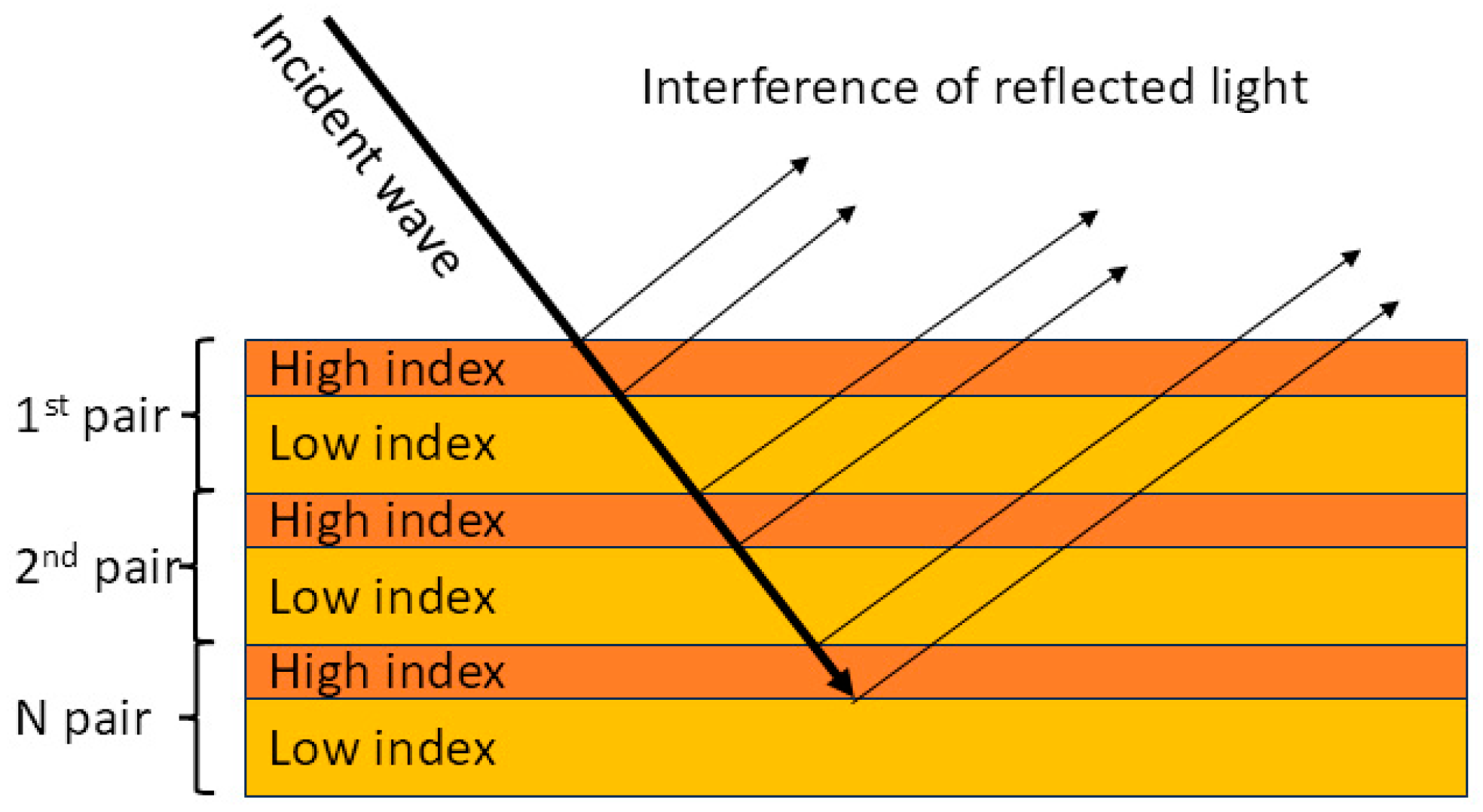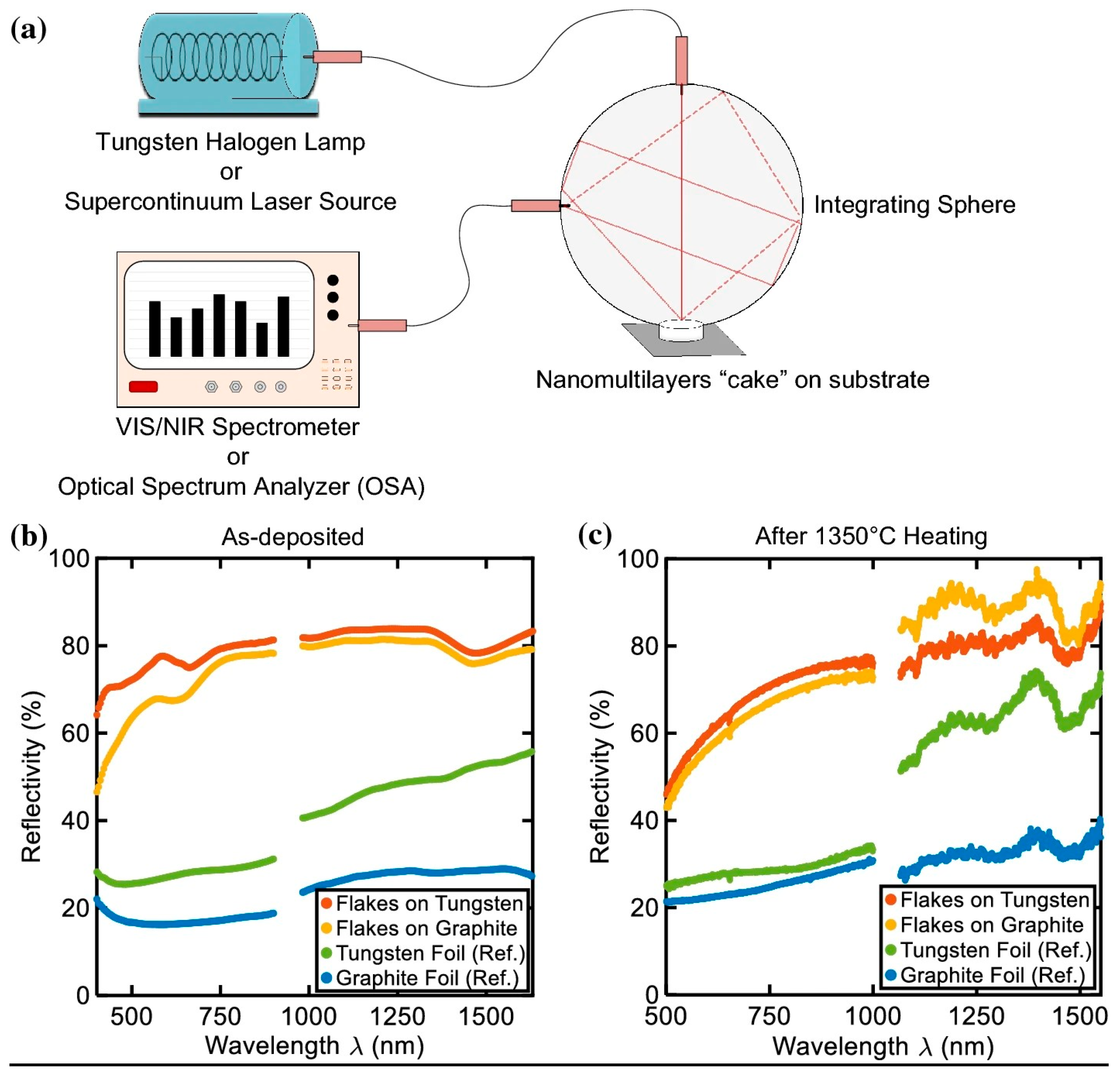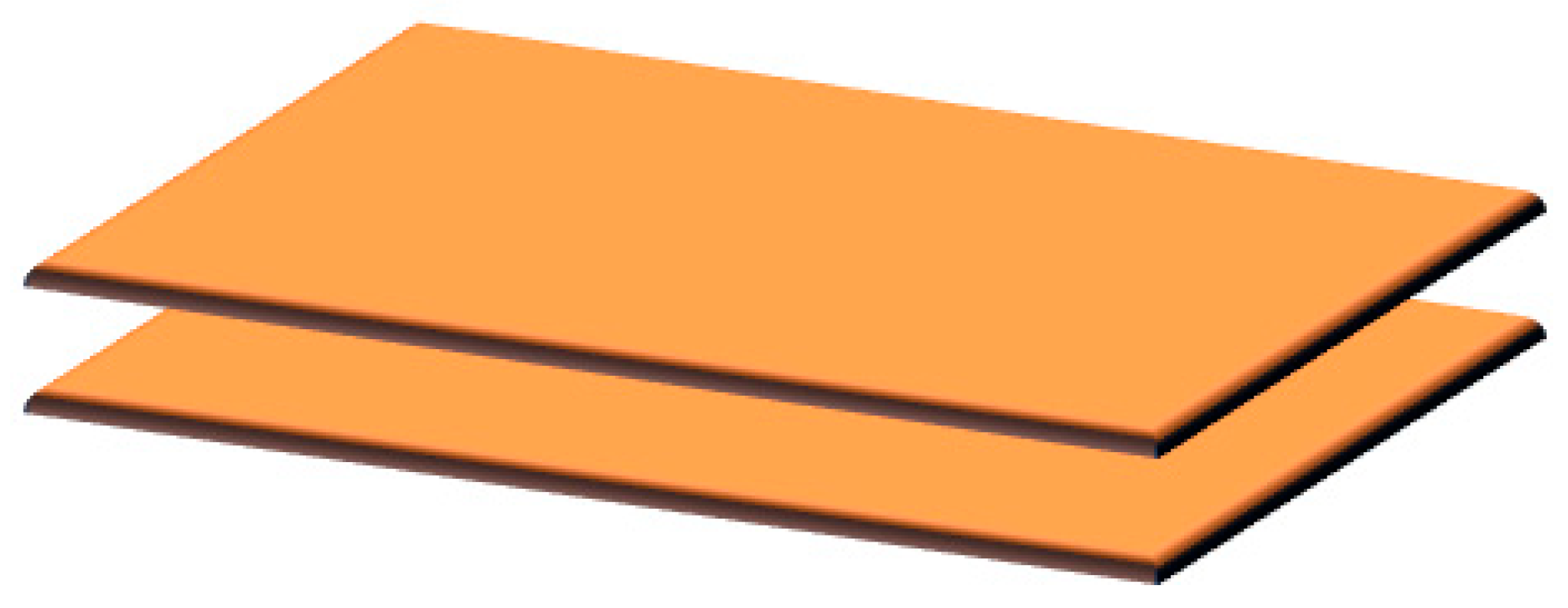


Metal Oxide Thin Films for Advanced Photonic Applications
 ,
,  , and
, and 
Abstract
1. Introduction
2. Oxide Materials and Their Subsequent Functionalization for Dielectric Coatings
2.1. Thin-Film Processing of Oxide Materials for Dielectric Mirrors

| Deposition Process | Advantages | Limitations/ Disadvantages | Scalability | Optical Performance | References |
|---|---|---|---|---|---|
| PVD | High temperatures are not necessary; high-density coatings; good adhesion to various substrates | Poor coverage on complicated geometric shapes; low deposition rate; vacuum equipment | Suitable for large area coatings, but requires high-energy sources and high-vacuum pumping systems, which can limit the throughput | Produces high-density, stoichiometric films with superior crystallinity and high refractive indices; essential for high-Q microcavities | [143,144,145,146,147] |
| CVD | Uniform, high-purity and high-density coatings; excellent coverage, even on irregular shapes; good substrate adhesion to various substrates | High operating temperatures; expensive equipment and manufacturing costs; incompatible with high-temperature-sensitive materials | A standard industrial process capable of large-scale production with excellent throughput for semiconductor and coating industries | Offers exceptional conformal coverage and precise atomic-level thickness control, resulting in high-quality films with low scattering | |
| Solution-based | Cheap; no vacuum or sophisticated equipment required; large area coverage; decent substrate adhesion on any type of substrates, including flexible ones—can be improved | Poor quality interface; material limitation due to the orthogonal solvents; defects induced by solvent | Cost-effective and compatible with high-throughput methods like roll-to-roll or dip-coating for large-area applications | Allows for easy tuning of optical constants through chemistry, though films often exhibit higher porosity and lower refractive indices than PVD methods |
2.2. Thin Film Properties for Dielectric Mirrors
| Material | Refractive Index n @ Wavelength λ | Technique | References |
|---|---|---|---|
| Silicon dioxide (SiO2) | n = 1.46–1.52 @ λ = 633 nm | PLD | [158] |
| n = 1.41–1.52 @ λ = 633 nm | RF magnetron sputtering | [159] | |
| n = 1.43–1.49 @ λ = 633 nm | E-beam evaporation | [149] | |
| Titanium dioxide (TiO2) | n = 2.6 @ λ = 550 nm | PLD | [160] |
| n = 2.57–2.74 @ λ = 550 nm | RF magnetron sputtering | [161] | |
| n = 2.06–2.08 @ λ = 550 nm | E-beam evaporation | [162] |
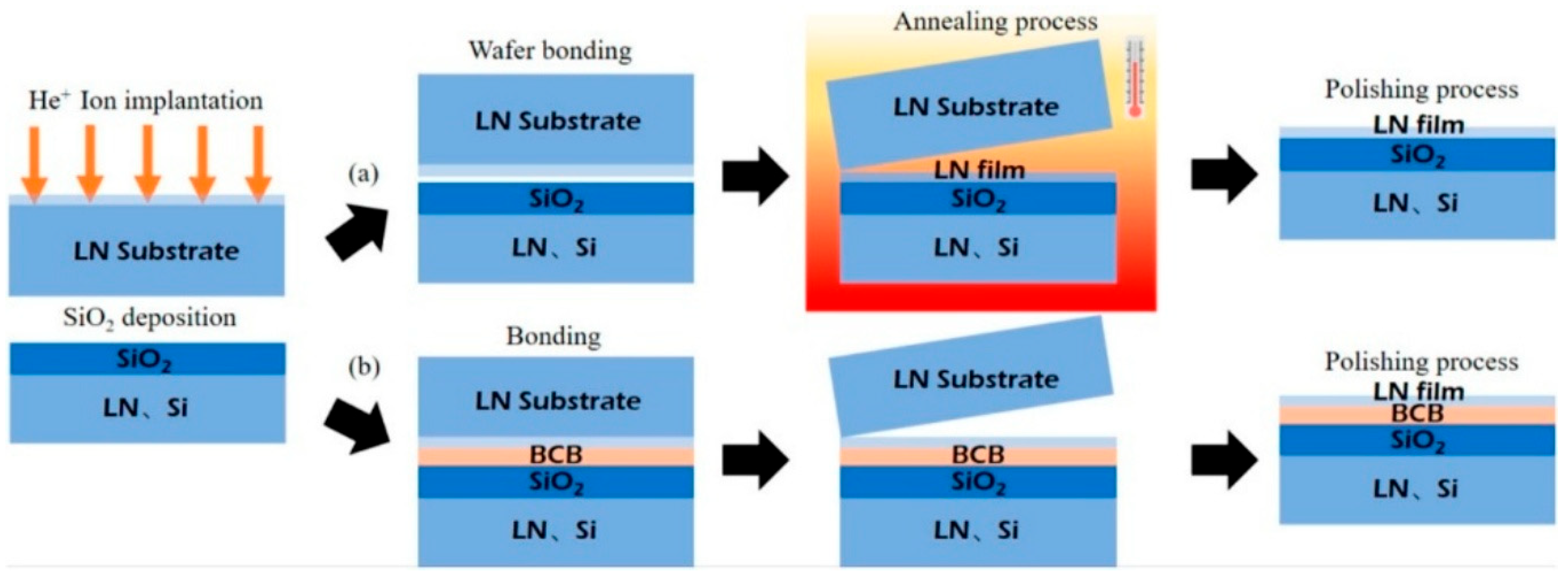
2.3. Stoichiometrically Complex Oxides with Optically Tunable Properties Under Electrical, Mechanical or Acoustic Excitation
3. Oxide Dielectric Coatings Applications: Mirrors and Their Role in Planar Optical Cavities
DBR-Based Optical Microcavities
4. Conclusions and Perspectives
Author Contributions
Funding
Data Availability Statement
Conflicts of Interest
References
- Banning, M. Practical Methods of Making and Using Multilayer Filters. J. Opt. Soc. Am. 1947, 37, 792–797. [Google Scholar] [CrossRef] [PubMed]
- Zhang, C.; ElAfandy, R.; Han, J. Distributed Bragg Reflectors for GaN-Based Vertical-Cavity Surface-Emitting Lasers. Appl. Sci. 2019, 9, 1593. [Google Scholar] [CrossRef]
- Sahoo, P.; Das, S.K.; Paulo Davim, J. Surface Finish Coatings. In Comprehensive Materials Finishing; Yilbas, B.S., Ed.; Elsevier: Amsterdam, The Netherlands, 2017; Volume 3, pp. 38–55. ISBN 9780128032503. [Google Scholar]
- Esposito, S.; D’Angelo, A.; Diletto, C.; Guglielmo, A.; Lanchi, M.; Rossi, G. Solar Coatings Based on Ag Infrared Reflector with High Stability at Medium and High Temperature. Energies 2021, 14, 5910. [Google Scholar] [CrossRef]
- Ji, C.; Liu, W.; Bao, Y.; Chen, X.; Yang, G.; Wei, B.; Yang, F.; Wang, X. Recent Applications of Antireflection Coatings in Solar Cells. Photonics 2022, 9, 906. [Google Scholar] [CrossRef]
- Law, A.M.; Jones, L.O.; Walls, J.M. The Performance and Durability of Anti-Reflection Coatings for Solar Module Cover Glass—A Review. Sol. Energy 2023, 261, 85–95. [Google Scholar] [CrossRef]
- Silva, M.F.; Rodrigues, J.A.; Ghaderi, M.; Goncalves, L.M.; De Graaf, G.; Wolffenbuttel, R.F.; Correia, J.H. NBI Optical Filters in Minimally Invasive Medical Devices. IEEE J. Sel. Top. Quantum Electron. 2016, 22, 165–171. [Google Scholar] [CrossRef]
- Lequime, M. Tunable Thin Film Filters: Review and Perspectives. Adv. Opt. Thin Film. 2004, 5250, 302. [Google Scholar] [CrossRef]
- Chen, J.; Li, X.; Ye, A.; Wu, G. Digitally Tunable Optical Filter Based on DWDM Thin Film Filters and Semiconductor Optical Amplifiers. Opt. Express 2005, 13, 1346–1350. [Google Scholar] [CrossRef]
- Grèzes-Besset, C.; Chauveau, G. Optical Coatings for Large Facilities. In Optical Thin Films and Coatings; Woodhead Publishing: Cambridge, UK, 2013; pp. 695–717. [Google Scholar] [CrossRef]
- Hu, C.; Guo, K.; Li, Y.; Gu, Z.; Quan, J.; Zhang, S.; Zheng, W. Optical Coatings of Durability Based on Transition Metal Nitrides. Thin Solid Films 2019, 688, 137339. [Google Scholar] [CrossRef]
- Sun, H. Basic Optical Engineering for Engineers and Scientists; SPIE-Intl Soc Optical Eng: Bellingham, WA, USA, 2019. [Google Scholar] [CrossRef]
- Wu, H.Y.; Huang, S.R.; Shih, C.H.; Hsiao, L.J.; Chen, H.W.; Cheng, M.C.; Hsu, J.C. Highly Reflective Silver-Enhanced Coating with High Adhesion and Sulfurization Resistance for Telescopes. Nanomaterials 2022, 12, 1054. [Google Scholar] [CrossRef]
- Filipe, M.; Costa, P.C.M.; Franco, S.; Lamoso, I.R.; Preu, S. High Reflectivity, Compact, and Widely Tunable Distributed Bragg Reflector Based on Silicon-Rich SiNx-SiOy at 80 °C PECVD. Appl. Sci. 2025, 15, 3330. [Google Scholar] [CrossRef]
- Ristau, D.; Jupé, M.; Starke, K. Laser Damage Thresholds of Optical Coatings. Thin Solid Films 2009, 518, 1607–1613. [Google Scholar] [CrossRef]
- Dong, S.; Jiao, H.; Wang, Z.; Zhang, J.; Cheng, X. Interface and Defects Engineering for Multilayer Laser Coatings. Prog. Surf. Sci. 2022, 97, 100663. [Google Scholar] [CrossRef]
- Wu, H.Y.; Chen, H.W.; Huang, S.R.; Hsiao, L.J.; Cheng, C.L.; Yu, G.Y.; Sun, Y.S.; Hsu, J.C. Highly Reflective Silver Mirror Enhanced by Several Dielectric Films Prepared under the Low Substrate Temperature. Heliyon 2024, 10, e35507. [Google Scholar] [CrossRef]
- Stenzel, O. Optical Coatings; Springer Nature: Durham, NC, USA, 2014; Volume 54. [Google Scholar] [CrossRef]
- Gao, B.; Beeckman, J.; Neyts, K.; George, J.P. Design, Fabrication and Characterization of a Distributed Bragg Reflector for Reducing the Étendue of a Wavelength Converting System. Opt. Express 2020, 28, 12837–12846. [Google Scholar] [CrossRef]
- Motamedi, M.; Crisostomo, F.; Yao, Y.; Mofarah, S.S.; Chen, W.F.; Koshy, P.; Taylor, R.A. Single-Layer, Anti-Reflective Thin Films of Porous MgF2 for Solar Thermal Applications. J. Phys. D Appl. Phys. 2019, 52, 315501. [Google Scholar] [CrossRef]
- Jacob, D.; Peiró, F.; Quesnel, E.; Ristau, D. Microstructure and Composition of MgF2 Optical Coatings Grown on Si Substrate by PVD and IBS Processes. Thin Solid Films 2000, 360, 133–138. [Google Scholar] [CrossRef]
- Zahid, M.A.; Hussain, S.Q.; Cho, Y.H.; Yi, J. Optical Properties of CaF2 Thin Film Deposited on Borosilicate Glass and Its Electrical Performance in PV Module Applications. Appl. Sci. 2020, 10, 5647. [Google Scholar] [CrossRef]
- Zai, M.I.; Lalau, I.; Manica, M.; Chiriacescu, L.; Antohe, V.A.; Gheorghiu, C.C.; Iftimie, S.; Toma, O.; Suchea, M.P.; Antohe, Ș. Morphological and Functional Evolution of Amorphous AlN Thin Films Deposited by RF-Magnetron Sputtering. Surfaces 2025, 8, 51. [Google Scholar] [CrossRef]
- Chinnasamy, M.; Rathanasamy, R.; Sivaraj, S.; Velu Kaliyannan, G.; Anbupalani, M.S.; Jaganathan, S.K. Influence of ZnSe Surface Coatings for Enhancing the Performance of Multicrystalline Silicon Solar Cells. J. Electron. Mater. 2022, 51, 2833–2842. [Google Scholar] [CrossRef]
- Southwell, W.H.; Sankur, H. Broadband Gradient-Index Antireflection Coating for ZnSe. Appl. Opt. 1984, 23, 2770–2773. [Google Scholar] [CrossRef] [PubMed]
- Leftheriotis, G.; Yianoulis, P.; Patrikios, D. Deposition and Optical Properties of Optimised ZnS/Ag/ZnS Thin Films for Energy Saving Applications. Thin Solid Films 1997, 306, 92–99. [Google Scholar] [CrossRef]
- Manikanta, R.V.; Mahesh, C.U.; Yepuri, V. Light Matters: Fabrication and Investigation of Optical and Wetting Properties of TiO2/SiO2 Multilayer Structure. J. Opt. 2025. [Google Scholar] [CrossRef]
- Chichibu, S.F.; Ohmori, T.; Shibata, N.; Koyama, T. Dielectric SiO2/ZrO2 Distributed Bragg Reflectors for ZnO Microcavities Prepared by the Reactive Helicon-Wave-Excited-Plasma Sputtering Method. Appl. Phys. Lett. 2006, 88, 161914. [Google Scholar] [CrossRef]
- Cui, M.; Guo, C.; Yang, Z.; Chen, L.; Dai, Y.; Xu, H.; Guo, W.; Ye, J. Conductive SiO2/HfO2 distributed Bragg Reflector Achieved by Electrical Breakdown and Its Application in GaN-Based Light Emitters. J. Appl. Phys. 2022, 131, 045301. [Google Scholar] [CrossRef]
- Robinson, J.M.; Milner, W.R.; Oelker, E.; Legero, T.; Sterr, U.; Zhang, W.; Matei, D.G.; Kedar, D.; Riehle, F.; Häfner, S.; et al. Thermal Noise and Mechanical Loss of SiO2/Ta2O5 Optical Coatings at Cryogenic Temperatures. Opt. Lett. 2021, 46, 592–595. [Google Scholar] [CrossRef]
- Kim, S.; In, J.H.; Kim, S.H.; Han, K.; Lim, D.; Hwang, Y.S.; Lee, K.M.; Choi, J.H. Study of High Transmittance of SiO2/Nb2O5 Multilayer Thin Films Deposited by Plasma-Assisted Reactive Magnetron Sputtering. Appl. Sci. 2023, 13, 13271. [Google Scholar] [CrossRef]
- Grilli, M.L.; Menchini, F.; Piegari, A.; Alderighi, D.; Toci, G.; Vannini, M. Al2O3/SiO2 and HfO2/SiO2 Dichroic Mirrors for UV Solid-State Lasers. Thin Solid Films 2009, 517, 1731–1735. [Google Scholar] [CrossRef]
- Jiang, Y.; You, D.; Cao, Y.; Guo, W.; Tan, M. High-Performance SiO2-SiNx Distributed Bragg Reflectors Fabricated by Ion-Assisted Reactive Magnetron Sputtering. Vacuum 2024, 220, 112775. [Google Scholar] [CrossRef]
- Steinlechner, J.; Khalaidovski, A.; Schnabel, R. Optical Absorption Measurement at 1550nm on a Highly-Reflective Si/SiO2 Coating Stack. Class. Quantum Gravity 2014, 31, 105005. [Google Scholar] [CrossRef]
- Han, K.; Kim, J.H. Reflectance Modulation of Transparent Multilayer Thin Films for Energy Efficient Window Applications. Mater. Lett. 2011, 65, 2466–2469. [Google Scholar] [CrossRef]
- Shen, J.; Tang, S.H.; Zhang, Z.; Ma, G.; Hua, Z. Ultrafast All-Optical Switching in One-Dimensional Photonic Crystal with Two Defects. Opt. Express 2006, 14, 858–865. [Google Scholar] [CrossRef]
- Persano, L.; Del Carro, P.; Mele, E.; Cingolani, R.; Pisignano, D.; Zavelani-Rossi, M.; Longhi, S.; Lanzani, G. Monolithic Polymer Microcavity Lasers with On-Top Evaporated Dielectric Mirrors. Appl. Phys. Lett. 2006, 88, 121110. [Google Scholar] [CrossRef]
- Boucher, Y.G.; Chiasera, A.; Ferrari, M.; Righini, G.C. Extended Transfer Matrix Modeling of an Erbium-Doped Cavity with SiO2/TiO2 Bragg Reflectors. Opt. Mater. 2009, 31, 1306–1309. [Google Scholar] [CrossRef]
- Chen, K.-N.; Hsu, C.-M.; Liu, J.; Liou, Y.-C.; Yang, C.-F.; Chang, J.; Prior, S.D.; Donald, A.; Lam, K.-T. Investigation of Antireflection Nb2O5 Thin Films by the Sputtering Method under Different Deposition Parameters. Micromachines 2016, 7, 151. [Google Scholar] [CrossRef]
- Szymanowski, H.; Zabeida, O.; Klemberg-Sapieha, J.E.; Martinu, L. Optical Properties and Microstructure of Plasma Deposited Ta2O5 and Nb2O5 Films. J. Vac. Sci. Technol. A 2005, 23, 241–247. [Google Scholar] [CrossRef]
- Yuan, Z.S.; Jhang, J.M.; Yu, P.H.; Jiang, C.M.; Huang, Y.C.; Wu, Y.L.; Lin, J.J.; Yang, C.F. Comparisons of Theoretical and Experimental Results of Blue Light SiO2–Nb2O5 Distributed Bragg Reflector Fabricated Using E-Beam Deposition. Vacuum 2020, 182, 109782. [Google Scholar] [CrossRef]
- Richter, F.; Kupfer, H.; Schlott, P.; Gessner, T.; Kaufmann, C. Optical Properties and Mechanical Stress in SiO2/Nb2O5 Multilayers. Thin Solid Films 2001, 389, 278–283. [Google Scholar] [CrossRef]
- Zeng, T.; Zhu, M.; Yin, C.; Cui, Y.; Zhao, J.; Wang, Y.; Hu, G.; Chai, Y.; Shao, J. Strategy to Improve the Long-Term Stability of Low-Stress e-Beam Coatings. Opt. Mater. Express 2020, 10, 2738–2748. [Google Scholar] [CrossRef]
- Venkataraj, S.; Drese, R.; Kappertz, O.; Jayavel, R.; Wuttig, M. Characterization of Niobium Oxide Films Prepared by Reactive DC Magnetron Sputtering. Phys. Status Solidi A Appl. Res. 2001, 188, 1047–1058. [Google Scholar] [CrossRef]
- Belt, M.; Davenport, M.L.; Bowers, J.E.; Blumenthal, D.J. Ultra-Low-Loss Ta2O5-Core/SiO2-Clad Planar Waveguides on Si Substrates. Optica 2017, 4, 532–536. [Google Scholar] [CrossRef]
- Pal, S.; Kamparath, R.; Subrahmanyam, V.V.V.; Sharma, N.; Jana, S.; Karwal, S.; Rajput, P.; Shaikh, A.; Mukherjee, C.; Jha, S.N.; et al. Sol-Gel Prepared Amorphous Ta2O5 Thin Film for Application in High LIDT Antireflection Coating and UV Photodetection. Opt. Mater. 2023, 142, 114097. [Google Scholar] [CrossRef]
- Hála, M.; Vernhes, R.; Zabeida, O.; Klemberg-Sapieha, J.E.; Martinu, L. Reactive HiPIMS Deposition of SiO2/Ta2O5 Optical Interference Filters. J. Appl. Phys. 2014, 116, 213302. [Google Scholar] [CrossRef]
- Pal, S.; Kamparath, R.; Subrahmanyam, V.V.V.; Sharma, N.; Biswas, A.K.; Singh, R.; Tiwari, S.; Kumar, Y.P.; Benerji, N.S. Sol-Gel Dip Coating of Ta2O5/SiO2 Anti-Reflection Films on Fused Silica for Developing Laser Optics with High Laser Induced Damage Threshold. J. Solgel Sci. Technol. 2025, 115, 115–129. [Google Scholar] [CrossRef]
- Bassiri, R.; Evans, K.; Borisenko, K.B.; Fejer, M.M.; Hough, J.; MacLaren, I.; Martin, I.W.; Route, R.K.; Rowan, S. Correlations between the Mechanical Loss and Atomic Structure of Amorphous TiO2-Doped Ta2O5 Coatings. Acta Mater. 2013, 61, 1070–1077. [Google Scholar] [CrossRef]
- Amato, A.; Magnozzi, M.; Wöhler, J. Mirror Coating Research and Developments for Current and Future Gravitational-Wave Detectors. Adv. Photonics Res. 2025, 6, 2400117. [Google Scholar] [CrossRef]
- Amato, A.; Magnozzi, M.; Shcheblanov, N.; Lemaître, A.; Cagnoli, G.; Granata, M.; Michel, C.; Gemme, G.; Pinard, L.; Canepa, M. Enhancing Titania-Tantala Amorphous Materials as High-Index Layers in Bragg Reflectors of Gravitational-Wave Detectors. ACS Appl. Opt. Mater. 2023, 1, 395–402. [Google Scholar] [CrossRef]
- Ribeaud, A.; Pistner, J.; Vela-Perez, I.; Lumeau, J.; Gallais, L.; Benz, R.; Sturzenegger, C.; Eiermann, B.; Mühlig, C. Accurate Measurement and Reduction of Losses in Ion Beam Sputtering Coatings. In Proceedings of the SPIE—The International Society for Optical Engineering, Volume 13020: Advances in Optical Thin Films VIII, Strasbourg, France, 7–11 April 2024; SPIE: Philadelphia, PA, USA, 2024; Volume 13020, pp. 150–155. [Google Scholar] [CrossRef]
- Wei, D.T. Ion Beam Interference Coating for Ultralow Optical Loss. Opt. Soc. Am. 1989, 28, 2813–2816. [Google Scholar] [CrossRef]
- Sakiew, W.; Schrameyer, S.; Schwerdtner, P.; Erhart, N.; Starke, K. Large Area Precision Optical Coatings by Reactive Ion Beam Sputtering. Appl. Opt. 2020, 59, 4296–4302. [Google Scholar] [CrossRef]
- Chang, J.P.; Lin, Y.-S.; Chu, K. Rapid Thermal Chemical Vapor Deposition of Zirconium Oxide for Metal-Oxide-Semiconductor Field Effect Transistor Application. J. Vac. Sci. Technol. B Microelectron. Nanometer Struct. Process. Meas. Phenom. 2001, 19, 1782–1787. [Google Scholar] [CrossRef]
- Chen, H.-C.; Chen, H.-C.; Chang, C.-H.; Chen, K.-H. Optical and Stress Properties of ZrO2/SiO2 and TiO2/SiO2 Anti-Reflective Coatings Deposited by Ion-Beam-Assisted Deposition on a Flexible Substrate. Appl. Opt. 2024, 63, 8280–8287. [Google Scholar] [CrossRef]
- Dogra, V.; Kishore, C.; Mishra, A.; Gaur, A.; Verma, A. Fabrication and Characterisation of SiO2-ZrO2 Double-Layer Nano-Coating with Potential Usage as Hydrophobic and Antireflective Coatings for Solar Applications. Mater. Res. Innov. 2025, 30, 123–134. [Google Scholar] [CrossRef]
- Sepah Mansoor, M.; Talebzadeh, N.; O’Brien, P.G. Comparative Analysis of Graded-Index and Quarter-Wave One-Dimensional Photonic Crystal Filters for GaSb Thermophotovoltaic Cells. Energy Technol. 2025, 13, 2402273. [Google Scholar] [CrossRef]
- Jiang, C.; Cheng, X.; Ji, Y.; Wang, L.; Yang, Y.; Liu, H.; Liu, D.; Jiang, Y. Optical and Interfacial Layer Properties of SiO2 Films Deposited on Different Substrates. Appl. Opt. 2014, 53, A83–A87. [Google Scholar] [CrossRef]
- Yusoh, R.; Horprathum, M.; Eiamchai, P.; Chindaudom, P.; Aiempanakit, K. Determination of Optical and Physical Properties of ZrO2 Films by Spectroscopic Ellipsometry. Procedia Eng. 2012, 32, 745–751. [Google Scholar] [CrossRef]
- Zhang, Q.; Shen, J.; Wang, J.; Wu, G.; Chen, L. Sol–Gel Derived ZrO2–SiO2 Highly Reflective Coatings. Int. J. Inorg. Mater. 2000, 2, 319–323. [Google Scholar] [CrossRef]
- Woo, S.H.; Hwangbo, C.K. Effects of Annealing on the Optical, Structural, and Chemical Properties of TiO2 and MgF2 Thin Films Prepared by Plasma Ion-Assisted Deposition. Appl. Opt. 2006, 45, 1447–1455. [Google Scholar] [CrossRef]
- Matero, R.; Ritala, M.; Leskelä, M.; Jones, A.C.; Williams, P.A.; Bickley, J.F.; Steiner, A.; Leedham, T.J.; Davies, H.O. Atomic Layer Deposition of ZrO2 Thin Films Using a New Alkoxide Precursor. J. Non. Cryst. Solids 2002, 303, 24–28. [Google Scholar] [CrossRef]
- Al-Kuhaili, M.F.; Durrani, S.M.A.; Khawaja, E.E. Characterization of Hafnium Oxide Thin Films Prepared by Electron Beam Evaporation. J. Phys. D Appl. Phys. 2004, 37, 1254. [Google Scholar] [CrossRef]
- Sun, L.; Jones, J.G.; Grant, J.T.; Murphy, N.R.; Ramana, C.V.; Eyink, K.G.; Vernon, J.P.; Stevenson, P.R. Nanoscale-Thick Thin Films of High-Density HfO2 for Bulk-like Optical Responses. ACS Appl. Nano Mater. 2021, 4, 10836–10844. [Google Scholar] [CrossRef]
- Bellum, J.; Kletecka, D.; Potter, J.; Rambo, P.; Smith, I.; Schwarz, J.; Atherton, B. Comparisons of Hafnia/Silica Anti-Reflection Coatings. In Optical Interference Coatings; Optica Publishing Group: Washington, DC, USA, 2010; p. FA8. [Google Scholar] [CrossRef]
- Balogh-Michels, Z.; Stevanovic, I.; Borzi, A.; Bächli, A.; Schachtler, D.; Gischkat, T.; Neels, A.; Stuck, A.; Botha, R. Crystallization Behavior of Ion Beam Sputtered HfO2 Thin Films and Its Effect on the Laser-Induced Damage Threshold. J. Eur. Opt. Soc.-Rapid Publ. 2021, 17, 3. [Google Scholar] [CrossRef]
- Kahro, T.; Tarre, A.; Käämbre, T.; Piirsoo, H.M.; Kozlova, J.; Ritslaid, P.; Kasikov, A.; Jõgiaas, T.; Vinuesa, G.; Dueñas, S.; et al. Hafnium Oxide/Graphene/Hafnium Oxide-Stacked Nanostructures as Resistive Switching Media. ACS Appl. Nano Mater. 2021, 4, 5152–5163. [Google Scholar] [CrossRef]
- Joh, H.; Jung, M.; Hwang, J.; Goh, Y.; Jung, T.; Jeon, S. Flexible Ferroelectric Hafnia-Based Synaptic Transistor by Focused-Microwave Annealing. ACS Appl. Mater. Interfaces 2021, 14, 1326–1333. [Google Scholar] [CrossRef] [PubMed]
- Li, Y.; Qi, Y.; Zhang, H.; Xia, Z.; Xie, T.; Li, W.; Zhong, D.; Zhu, H.; Zhou, M. Gram-Scale Synthesis of Highly Biocompatible and Intravenous Injectable Hafnium Oxide Nanocrystal with Enhanced Radiotherapy Efficacy for Cancer Theranostic. Biomaterials 2020, 226, 119538. [Google Scholar] [CrossRef]
- Gong, H.; Gong, H.; Liu, X.; Liu, X.; Tao, C.; Zhao, Y.; Zhao, Y.; Shuai, K.; Shuai, K.; Li, D.; et al. Investigation on Nano-Absorbing Precursors in the Picosecond Regime via the Comparative Study of HfO2/SiO2 and Ta2O5/SiO2 High-Reflectivity Coating Damage. Opt. Mater. Express 2023, 13, 1820–1835. [Google Scholar] [CrossRef]
- Gier, C.; Ben Yaala, M.; Wiseman, C.; MacFoy, S.; Chicoine, M.; Schiettekatte, F.; Hough, J.; Rowan, S.; Martin, I.; MacKay, P.; et al. Controlling the Optical Properties of Hafnium Dioxide Thin Films Deposited with Electron Cyclotron Resonance Ion Beam Deposition. Thin Solid Films 2023, 771, 139781. [Google Scholar] [CrossRef]
- Kumar, M.; Kumari, N.; Kumar, P.; Karar, V.; Sharma, A.L. Determination of Optical Constants of Tantalum Oxide Thin Film Deposited by Electron Beam Evaporation. Mater. Today Proc. 2018, 5, 3764–3769. [Google Scholar] [CrossRef]
- Cheikh, A.; Gonçalves, J.; Labbé, C.; Portier, X.; Marie, P.; Frilay, C.; Debieu, O.; Duprey, S.; Jadwisienczak, W.; Ingram, D.; et al. Tailoring Structural and Optical Properties of Ta2O5 Thin Films via Radio Frequency Magnetron Sputtering for High-Refractive Index Transparent Materials. J. Alloys Compd. 2025, 1040, 183273. [Google Scholar] [CrossRef]
- Zhang, J.Y.; Boyd, I.W. Thin Tantalum and Tantalum Oxide Films Grown by Pulsed Laser Deposition. Appl. Surf. Sci. 2000, 168, 234–238. [Google Scholar] [CrossRef]
- Henke, T.; Knaut, M.; Geidel, M.; Winkler, F.; Albert, M.; Bartha, J.W. Atomic Layer Deposition of Tantalum Oxide Thin Films Using the Precursor Tert-Butylimido-Tris-Ethylmethylamido-Tantalum and Water: Process Characteristics and Film Properties. Thin Solid Films 2017, 627, 94–105. [Google Scholar] [CrossRef]
- Masse, J.P.; Szymanowski, H.; Zabeida, O.; Amassian, A.; Klemberg-Sapieha, J.E.; Martinu, L. Stability and Effect of Annealing on the Optical Properties of Plasma-Deposited Ta2O5 and Nb2O5 Films. Thin Solid Films 2006, 515, 1674–1682. [Google Scholar] [CrossRef]
- Tepehan, F.Z.; Ghodsi, F.E.; Ozer, N.; Tepehan, G.G. Optical Properties of Sol–Gel Dip-Coated Ta2O5 Films for Electrochromic Applications. Sol. Energy Mater. Sol. Cells 1999, 59, 265–275. [Google Scholar] [CrossRef]
- Castillo-Saenz, J.; Nedev, N.; Valdez-Salas, B.; Curiel-Alvarez, M.; Mendivil-Palma, M.I.; Hernandez-Como, N.; Martinez-Puente, M.; Mateos, D.; Perez-Landeros, O.; Martinez-Guerra, E. Properties of Al2O3 Thin Films Grown by PE-ALD at Low Temperature Using H2O and O2 Plasma Oxidants. Coatings 2021, 11, 1266. [Google Scholar] [CrossRef]
- Shamala, K.S.; Murthy, L.C.S.; Radhakrishna, M.C.; Rao, K.N. Characterization of Al2O3 Thin Films Prepared by Spray Pyrolysis Method for Humidity Sensor. Sens. Actuators A Phys. 2007, 135, 552–557. [Google Scholar] [CrossRef]
- Barbos, C.; Blanc-Pelissier, D.; Fave, A.; Botella, C.; Regreny, P.; Grenet, G.; Blanquet, E.; Crisci, A.; Lemiti, M. Al2O3 Thin Films Deposited by Thermal Atomic Layer Deposition: Characterization for Photovoltaic Applications. Thin Solid Films 2016, 617, 108–113. [Google Scholar] [CrossRef]
- Kumar, P.; Wiedmann, M.K.; Winter, C.H.; Avrutsky, I. Optical Properties of Al2O3 Thin Films Grown by Atomic Layer Deposition. Appl. Opt. 2009, 48, 5407–5412. [Google Scholar] [CrossRef]
- Jo, J.W.; Kim, K.H.; Kim, J.; Ban, S.G.; Kim, Y.H.; Park, S.K. High-Mobility and Hysteresis-Free Flexible Oxide Thin-Film Transistors and Circuits by Using Bilayer Sol–Gel Gate Dielectrics. ACS Appl. Mater. Interfaces 2018, 10, 2679–2687. [Google Scholar] [CrossRef]
- Praveen Kumar, V.S.; Kumar, M.; Kumari, N.; Sharma, A.L. Optical and Morphological Studies of Aluminium Oxide Films Fabricated at Different Leaning Angles Using Ion Assisted E-Beam Deposition Technique. Optik 2020, 222, 165376. [Google Scholar] [CrossRef]
- Balakrishnan, G.; Tripura Sundari, S.; Ramaseshan, R.; Thirumurugesan, R.; Mohandas, E.; Sastikumar, D.; Kuppusami, P.; Kim, T.G.; Song, J.I. Effect of Substrate Temperature on Microstructure and Optical Properties of Nanocrystalline Alumina Thin Films. Ceram. Int. 2013, 39, 9017–9023. [Google Scholar] [CrossRef]
- Praveen Kumar, V.S.R.S.; Kumar, M.; Kumari, N.; Karar, V.; Sharma, A.L. Fabrication of Al2O3/SiO2 Multilayer Reflective Filters with Excellent Uniformity for Demanding Optical Interference Filters. Mater. Res. Express 2019, 6, 066410. [Google Scholar] [CrossRef]
- Briones, E.; Tapia-Contreras, M.; Briones, J.; Cortes-Mestizo, I.; Gutierrez, A. Antireflective Properties of Al2O3/SiO2 Multilayer Stacks for GaAs Solar Cells. Appl. Opt. 2023, 62, 6007–6015. [Google Scholar] [CrossRef] [PubMed]
- Shamala, K.S.; Murthy, L.C.S.; Rao, K.N. Studies on Optical and Dielectric Properties of Al2O3 Thin Films Prepared by Electron Beam Evaporation and Spray Pyrolysis Method. Mater. Sci. Eng. B 2004, 106, 269–274. [Google Scholar] [CrossRef]
- Lohner, T.; Serényi, M.; Petrik, P. Characterization of Sputtered Aluminum Oxide Films Using Spectroscopic Ellipsometry. Int. J. New Horiz. Phys. 2015, 2, 1–4. [Google Scholar] [CrossRef]
- Balakrishnan, G.; Kuppusami, P.; Sundari, S.T.; Thirumurugesan, R.; Ganesan, V.; Mohandas, E.; Sastikumar, D. Structural and Optical Properties of γ-Alumina Thin Films Prepared by Pulsed Laser Deposition. Thin Solid Films 2010, 518, 3898–3902. [Google Scholar] [CrossRef]
- Schmidt, B.W.; Sweet, W.J.; Bierschenk, E.J.; Gren, C.K.; Hanusa, T.P.; Rogers, B.R. Metal-Organic Chemical Vapor Deposition of Aluminum Oxide Thin Films via Pyrolysis of Dimethylaluminum Isopropoxide. J. Vac. Sci. Technol. A 2010, 28, 238–243. [Google Scholar] [CrossRef]
- Hu, B.; Yao, M.; Xiao, R.; Chen, J.; Yao, X. Optical Properties of Amorphous Al2O3 Thin Films Prepared by a Sol–Gel Process. Ceram. Int. 2014, 40, 14133–14139. [Google Scholar] [CrossRef]
- Huang, J.Y.; Wang, Y.; Tao Fei, G.; Xu, S.H.; Zeng, Z.; Wang, B. TiO2/ZnO Double-Layer Broadband Antireflective and down-Shifting Coatings for Solar Applications. Ceram. Int. 2023, 49, 11091–11100. [Google Scholar] [CrossRef]
- Moszak, K.; Szczurek, A.; Babiarczuk, B.; Borak, B.; Krzak, J. ZnO Sol-Gel Oxide Coatings as Materials for UV Optical Filters. Adv. Mater. Lett. 2017, 8, 542–545. [Google Scholar] [CrossRef]
- Li, Y.; Huang, X.; Ding, K.; Sheriff, H.K.M.; Ye, L.; Liu, H.; Li, C.Z.; Ade, H.; Forrest, S.R. Non-Fullerene Acceptor Organic Photovoltaics with Intrinsic Operational Lifetimes over 30 Years. Nat. Commun. 2021, 12, 5419. [Google Scholar] [CrossRef]
- Gartner, M.; Stroescu, H.; Mitrea, D.; Nicolescu, M. Various Applications of ZnO Thin Films Obtained by Chemical Routes in the Last Decade. Molecules 2023, 28, 4674. [Google Scholar] [CrossRef]
- Jia, C.-L.; Wang, K.-M.; Wang, X.-L.; Zhang, X.-J.; Lu, F.; Chen, Y.F.; Bagnall, D.M.; Ko Park, H.K.; Hiraga, K.; Zhu, Z.; et al. Formation of C-Axis Oriented ZnO Optical Waveguides by Radio-Frequency Magnetron Sputtering. Opt. Express 2005, 13, 5093–5099. [Google Scholar] [CrossRef] [PubMed]
- Madhavanunni Rekha, S.; Vadakke Neelamana, H.; Bhat, S.V. Recent Advances in Solution-Processed Zinc Oxide Thin Films for Ultraviolet Photodetectors. ACS Appl. Electron. Mater. 2023, 5, 4051–4066. [Google Scholar] [CrossRef]
- Wang, Q.; Yan, Y.; Qin, F.; Xu, C.; Liu, X.; Tan, P.; Shi, N.; Hu, S.; Li, L.; Zeng, Y.; et al. A Novel Ultra-Thin-Walled ZnO Microtube Cavity Supporting Multiple Optical Modes for Bluish-Violet Photoluminescence, Low-Threshold Ultraviolet Lasing and Microfluidic Photodegradation. NPG Asia Mater. 2017, 9, e442. [Google Scholar] [CrossRef]
- Dong, H.; Zhou, B.; Li, J.; Zhan, J.; Zhang, L. Ultraviolet Lasing Behavior in ZnO Optical Microcavities. J. Mater. 2017, 3, 255–266. [Google Scholar] [CrossRef]
- Lai, Y.Y.; Lan, Y.P.; Lu, T.C. Strong Light–Matter Interaction in ZnO Microcavities. Light. Sci. Appl. 2013, 2, e76. [Google Scholar] [CrossRef]
- Shimada, R.; Xie, J.; Avrutin, V.; Özgür, Ü.; Morkoč, H. Cavity Polaritons in ZnO-Based Hybrid Microcavities. Appl. Phys. Lett. 2008, 92, 11127. [Google Scholar] [CrossRef]
- Abdallah, B.; Zetoun, W.; Tello, A. Deposition of ZnO Thin Films with Different Powers Using RF Magnetron Sputtering Method: Structural, Electrical and Optical Study. Heliyon 2024, 10, e27606. [Google Scholar] [CrossRef]
- Kaim, P.; Lukaszkowicz, K.; Szindler, M.; Szindler, M.M.; Basiaga, M.; Hajduk, B. The Influence of Magnetron Sputtering Process Temperature on ZnO Thin-Film Properties. Coatings 2021, 11, 1507. [Google Scholar] [CrossRef]
- Ondo-Ndong, R.; Essone-Obame, H.; Moussambi, Z.H.; Koumba, N. Capacitive Properties of Zinc Oxide Thin Films by Radiofrequency Magnetron Sputtering. J. Theor. Appl. Phys. 2018, 12, 309–317. [Google Scholar] [CrossRef]
- Skowronski, L.; Ciesielski, A.; Olszewska, A.; Szczesny, R.; Naparty, M.; Trzcinski, M.; Bukaluk, A. Microstructure and Optical Properties of E-Beam Evaporated Zinc Oxide Films—Effects of Decomposition and Surface Desorption. Materials 2020, 13, 3510. [Google Scholar] [CrossRef]
- Chakraborty, B.; Saha, R.; Chattopadhyay, S.; De, D.; Das, R.D.; Mukhopadhyay, M.K.; Palit, M.; RoyChaudhuri, C. Impact of Surface Defects in Electron Beam Evaporated ZnO Thin Films on FET Biosensing Characteristics towards Reliable PSA Detection. Appl. Surf. Sci. 2021, 537, 147895. [Google Scholar] [CrossRef]
- Ciolan, M.A.; Motrescu, I. Pulsed Laser Ablation: A Facile and Low-Temperature Fabrication of Highly Oriented n-Type Zinc Oxide Thin Films. Appl. Sci. 2022, 12, 917. [Google Scholar] [CrossRef]
- Tsoutsouva, M.G.; Panagopoulos, C.N.; Papadimitriou, D.; Fasaki, I.; Kompitsas, M. ZnO Thin Films Prepared by Pulsed Laser Deposition. Mater. Sci. Eng. B 2011, 176, 480–483. [Google Scholar] [CrossRef]
- Sulaiman, A.A.; Ali, G.G.; Thanon, A.I. Synthesis and Study of ZnO Thin Films Using CVD Technique For Waveguide Sensor Applications. J. Nanostruct. 2022, 12, 1–11. [Google Scholar] [CrossRef]
- Rojano Chávez, S.M.; Ayala, L.M.; Karthik, T.V.K.; Maldonado, A.; Gómez-Pozos, H. Zinc Oxide Thin Films Deposited by Sol–Gel Spin-Coating Technique for Propane and Carbon Monoxide Sensing Applications. J. Mater. Sci. Mater. Electron. 2024, 35, 797. [Google Scholar] [CrossRef]
- Toma, F.T.Z.; Rahman, M.S.; Maria, K.H. A Review of Recent Advances in ZnO Nanostructured Thin Films by Various Deposition Techniques. Discov. Mater. 2025, 5, 60. [Google Scholar] [CrossRef]
- Di Mauro, A.; Fragalà, M.E.; Privitera, V.; Impellizzeri, G. ZnO for Application in Photocatalysis: From Thin Films to Nanostructures. Mater. Sci. Semicond. Process. 2017, 69, 44–51. [Google Scholar] [CrossRef]
- Kumar, R.; Kumar, G.; Al-Dossary, O.; Umar, A. ZnO Nanostructured Thin Films: Depositions, Properties and Applications—A Review. Mater. Express 2015, 5, 3–23. [Google Scholar] [CrossRef]
- Chen, J.R.; Lu, T.C.; Wu, Y.C.; Lin, S.C.; Liu, W.R.; Hsieh, W.F.; Kuo, C.C.; Lee, C.C. Large Vacuum Rabi Splitting in ZnO-Based Hybrid Microcavities Observed at Room Temperature. Appl. Phys. Lett. 2009, 94, 061103. [Google Scholar] [CrossRef]
- Sturm, C.; Hilmer, H.; Schmidt-Grund, R.; Grundmann, M. Observation of Strong Exciton–Photon Coupling at Temperatures up to 410 K. New J. Phys. 2009, 11, 073044. [Google Scholar] [CrossRef]
- Wu, Y.-C.; Lin, S.-C.; Lu, T.-C.; Wang, S.-C.; Chen, J.-R.; Deng, H.; Hsieh, W.-F. Characteristics of Exciton-Polaritons in ZnO-Based Hybrid Microcavities. Opt. Express 2011, 19, 4101–4112. [Google Scholar] [CrossRef]
- Orosz, L.; Réveret, F.; Bouchoule, S.; Zúñiga-Pérez, J.; Leymarie, F.M.J.; Disseix, P.; Mihailovic, M.; Frayssinet, E.; Semond, F.; Leroux, M.; et al. Fabrication and Optical Properties of a Fully-Hybrid Epitaxial ZnO-Based Microcavity in the Strong-Coupling Regime. Appl. Phys. Express 2011, 4, 072001. [Google Scholar] [CrossRef]
- Guillet, T.; Mexis, M.; Levrat, J.; Rossbach, G.; Brimont, C.; Bretagnon, T.; Gil, B.; Butté, R.; Grandjean, N.; Orosz, L.; et al. Polariton Lasing in a Hybrid Bulk ZnO Microcavity. Appl. Phys. Lett. 2011, 99, 161104. [Google Scholar] [CrossRef]
- Franke, H.; Sturm, C.; Schmidt-Grund, R.; Wagner, G.; Grundmann, M. Ballistic Propagation of Exciton–Polariton Condensates in a ZnO-Based Microcavity. New J. Phys. 2012, 14, 013037. [Google Scholar] [CrossRef]
- Lai, Y.Y.; Lan, Y.P.; Lu, T.C. High-Temperature Polariton Lasing in a Strongly Coupled ZnO Microcavity. Appl. Phys. Express 2012, 5, 082801. [Google Scholar] [CrossRef]
- Wu, Y.-C.; Lai, Y.-Y.; Lu, T.-C.; Lan, Y.-P.; Chen, J.-R.; Deng, H.; Huang, S.-W.; Hsieh, W.-F. Room Temperature Polariton Lasing vs. Photon Lasing in a ZnO-Based Hybrid Microcavity. Opt. Express 2012, 20, 5530–5537. [Google Scholar] [CrossRef]
- Zamfirescu, M.; Kavokin, A.; Gil, B.; Malpuech, G.; Kaliteevski, M. ZnO as a Material Mostly Adapted for the Realization of Room-Temperature Polariton Lasers. Phys. Rev. B 2002, 65, 161205. [Google Scholar] [CrossRef]
- Oh, S.H.; Lee, T.H.; Son, K.R.; Kim, T.G. Fabrication of HfO2/TiO2–Based Conductive Distributed Bragg Reflectors: Its Application to GaN-Based near-Ultraviolet Micro-Light-Emitting Diodes. J. Alloys Compd. 2019, 773, 490–495. [Google Scholar] [CrossRef]
- Sellmann, J.; Sturm, C.; Schmidt-Grund, R.; Czekalla, C.; Lenzner, J.; Hochmuth, H.; Rheinländer, B.; Lorenz, M.; Grundmann, M. Structural and Optical Properties of ZrO2 and Al2O3 Thin Films and Bragg Reflectors Grown by Pulsed Laser Deposition. Phys. Status Solidi (C) Curr. Top. Solid. State Phys. 2008, 5, 1240–1243. [Google Scholar] [CrossRef]
- Lorenz, M.; Hochmuth, H.; Grüner, C.; Hilmer, H.; Lajn, A.; Spemann, D.; Brandt, M.; Zippel, J.; Schmidt-Grund, R.; Von Wenckstern, H.; et al. Oxide Thin Film Heterostructures on Large Area, with Flexible Doping, Low Dislocation Density, and Abrupt Interfaces: Grown by Pulsed Laser Deposition. Laser Chem. 2010, 2010, 140976. [Google Scholar] [CrossRef]
- Liu, J.; Lin, C.Y.; Tzou, W.C.; Hsueh, N.K.; Yang, C.F.; Chen, Y. Reflection of Blue Light Using Bi-Layer Al2O3–TiO2 E-Beam Coating Films. Cryst. Growth Des. 2018, 18, 5426–5433. [Google Scholar] [CrossRef]
- Kim, S.S.; Talghader, J.J.; Gabriel, N.T. Control of Thermal Deformation in Dielectric Mirrors Using Mechanical Design and Atomic Layer Deposition. Opt. Lett. 2009, 34, 1958–1960. [Google Scholar] [CrossRef] [PubMed]
- Dubey, R.S.; Ganesan, V. Visible and Near-Infrared Wavelength-Selective Dielectric Reflectors for Light Management Applications. Superlattices Microstruct. 2018, 122, 228–234. [Google Scholar] [CrossRef]
- Megahd, H.; Comoretto, D.; Lova, P. (INVITED)Planar Microcavities: Materials and Processing for Light Control. Opt. Mater. X 2022, 13, 100130. [Google Scholar] [CrossRef]
- Chao, S.; Lee, C.-C.; Wang, W.-H. Low-Loss Dielectric Mirror with Ion-Beam-Sputtered TiO2–SiO2 Mixed Films. Appl. Opt. 2001, 40, 2177–2182. [Google Scholar] [CrossRef]
- Schubert, E.F.; Hunt, N.E.J.; Micovic, M.; Malik, R.J.; Sivco, D.L.; Cho, A.Y.; Zydzik, G.J. Highly Efficient Light-Emitting Diodes with Microcavities. Science 1994, 265, 943–945. [Google Scholar] [CrossRef]
- Xu, Q.; Piermarocchi, C.; Pershin, Y.V.; Salamo, G.J.; Xiao, M.; Wang, X.; Shih, C.K. Giant Up-Conversion Efficiency of InGaAs Quantum Dots in a Planar Microcavity. Sci. Rep. 2014, 4, 3953. [Google Scholar] [CrossRef]
- Sebald, K.; Seyfried, M.; Klembt, S.; Kruse, C. Optical Properties of Photonic Molecules and Elliptical Pillars Made of ZnSe-Based Microcavities. Opt. Express 2011, 19, 19422. [Google Scholar] [CrossRef]
- Butté, R.; Feltin, E.; Dorsaz, J.; Christmann, G.; Carlin, J.F.; Grandjean, N.; Ilegems, M. Recent Progress in the Growth of Highly Reflective Nitride-Based Distributed Bragg Reflectors and Their Use in Microcavities. Jpn. J. Appl. Phys. 2005, 44, 7207. [Google Scholar] [CrossRef]
- Adawi, A.M.; Cadby, A.; Connolly, L.G.; Hung, W.C.; Dean, R.; Tahraoui, A.; Fox, A.M.; Cullis, A.G.; Sanvitto, D.; Skolnick, M.S.; et al. Spontaneous Emission Control in Micropillar Cavities Containing a Fluorescent Molecular Dye. Adv. Mater. 2006, 18, 742–747. [Google Scholar] [CrossRef]
- Shang, J.; Cong, C.; Wang, Z.; Peimyoo, N.; Wu, L.; Zou, C.; Chen, Y.; Chin, X.Y.; Wang, J.; Soci, C.; et al. Room-Temperature 2D Semiconductor Activated Vertical-Cavity Surface-Emitting Lasers. Nat. Commun. 2017, 8, 543. [Google Scholar] [CrossRef] [PubMed]
- Andrews, J.H.; Crescimanno, M.; Singer, K.D.; Baer, E. Melt-Processed Polymer Multilayer Distributed Feedback Lasers: Progress and Prospects. J. Polym. Sci. B Polym. Phys. 2014, 52, 251–271. [Google Scholar] [CrossRef]
- Lova, P.; Grande, V.; Manfredi, G.; Patrini, M.; Herbst, S.; Würthner, F.; Comoretto, D. All-Polymer Photonic Microcavities Doped with Perylene Bisimide J-Aggregates. Adv. Opt. Mater. 2017, 5, 1700523. [Google Scholar] [CrossRef]
- Song, J.; Kumar, P.; Raouf, I.; Kim, H.S. Advancements and Challenges in Anti-Reflective Coatings: A Comprehensive Review. J. Mater. Res. Technol. 2025, 39, 2926–2938. [Google Scholar] [CrossRef]
- Deng, Y.; Chen, W.; Li, B.; Wang, C.; Kuang, T.; Li, Y. Physical Vapor Deposition Technology for Coated Cutting Tools: A Review. Ceram. Int. 2020, 46, 18373–18390. [Google Scholar] [CrossRef]
- Kment, Š.; Gregora, I.; Kmentová, H.; Novotná, P.; Hubička, Z.; Krýsa, J.; Sajdl, P.; Dejneka, A.; Brunclíková, M.; Jastrabík, L.; et al. Raman Spectroscopy of Dip-Coated and Spin-Coated Sol–Gel TiO2 Thin Films on Different Types of Glass Substrate. J. Solgel Sci. Technol. 2012, 63, 294–306. [Google Scholar] [CrossRef]
- Sakthinathan, S.; Meenakshi, G.A.; Vinothini, S.; Yu, C.L.; Chen, C.L.; Chiu, T.W.; Vittayakorn, N. A Review of Thin-Film Growth, Properties, Applications, and Future Prospects. Processes 2025, 13, 587. [Google Scholar] [CrossRef]
- Toma, F.T.Z.; Rahman, S.; Hussain, K.M.A.; Ahmed, S. Thin Film Deposition Techniques: A Comprehensive Review. J. Mod. Nanotechnol. 2024, 4, 6. [Google Scholar] [CrossRef]
- Nimalan, T.; Begam, M.R. Physical and Chemical Methods: A Review on the Analysis of Deposition Parameters of Thin Film Preparation Methods. Int. J. Thin Film Sci. Technol. 2024, 13, 59–66. [Google Scholar] [CrossRef]
- Glynn, C.; O’Dwyer, C. Solution Processable Metal Oxide Thin Film Deposition and Material Growth for Electronic and Photonic Devices. Adv. Mater. Interfaces 2017, 4, 1600610. [Google Scholar] [CrossRef]
- Manica, D.; Ion, V.; Sopronyi, M.; Andrei, F.; Bonciu, A.; Scarisoreanu, N. Mechanical Properties Characterization for Thin Layers Oxide (Al2O3), Deposited by PLD-Large Area. Appl. Phys. A Mater. Sci. Process. 2022, 128, 983. [Google Scholar] [CrossRef]
- Becker, J.; Scheuer, V. Coatings for Optical Applications Produced by Ion Beam Sputter Deposition. Appl. Opt. 1990, 29, 4303–4309. [Google Scholar] [CrossRef] [PubMed]
- Jerman, M.; Qiao, Z.; Mergel, D. Refractive Index of Thin Films of SiO2, ZrO2, and HfO2 as a Function of the Films’ Mass Density. Appl. Opt. 2005, 44, 3006–3012. [Google Scholar] [CrossRef] [PubMed]
- Zhao, Z.; Tay, B.K.; Yu, G. Room-Temperature Deposition of Amorphous Titanium Dioxide Thin Film with High Refractive Index by a Filtered Cathodic Vacuum Arc Technique. Appl. Opt. 2004, 43, 1281–1285. [Google Scholar] [CrossRef]
- Sun, D.; Sun, Q.; Xing, W.; Sun, Z.; Shang, H.; Chang, L.; Wang, X.; Liu, P.; Hall, T. Investigation for the Structural Stress of SiO2 Thin Films and Its Distribution on the Large-Wafer Created by Plasma Enhanced Chemical Vapor Deposition. AIP Adv. 2018, 8, 085217. [Google Scholar] [CrossRef]
- Chason, E.; Shin, J.W.; Hearne, S.J.; Freund, L.B. Kinetic Model for Dependence of Thin Film Stress on Growth Rate, Temperature, and Microstructure. J. Appl. Phys. 2012, 111, 083520. [Google Scholar] [CrossRef]
- Chason, E.; Karlson, M.; Colin, J.J.; Magnfält, D.; Sarakinos, K.; Abadias, G. A Kinetic Model for Stress Generation in Thin Films Grown from Energetic Vapor Fluxes. J. Appl. Phys. 2016, 119, 145307. [Google Scholar] [CrossRef]
- Choi, J.-K.; Lee, J.; Yoo, J.-B.; Maeng, J.-S.; Kim, Y.-M. Residual Stress Analysis of SiO2 Films Deposited by Plasma-Enhanced Chemical Vapor Deposition. Surf. Coat. Technol. 2000, 131, 153–157. [Google Scholar] [CrossRef]
- Maeda, M.; Itsumi, M. Stress Evaluation of Chemical Vapor Deposited Silicon Dioxide Films. Phys. B Condens. Matter 2002, 324, 167–172. [Google Scholar] [CrossRef]
- Wostbrock, N.; Busani, T. Stress and Refractive Index Control of SiO2 Thin Films for Suspended Waveguides. Nanomaterials 2020, 10, 2105. [Google Scholar] [CrossRef]
- Huang, M.; Yan, X. Analytical Solutions to Estimate the Stress Induced Polarization Shift and the Temperature Sensitivity of Optical Waveguides. J. Appl. Phys. 2004, 95, 2820–2826. [Google Scholar] [CrossRef]
- He, X.; Wu, J.; Li, X.; Gao, X.; Zhao, L.; Wu, L. Synthesis and Properties of Silicon Dioxide Films Prepared by Pulsed Laser Deposition Using Ceramic SiO2 Target. Appl. Surf. Sci. 2009, 256, 231–234. [Google Scholar] [CrossRef]
- Hossain, M.I.; Aïssa, B.; Samara, A.; Mansour, S.A.; Broussillou, C.A.; Benito, V.B. Hydrophilic Antireflection and Antidust Silica Coatings. ACS Omega 2021, 6, 5276–5286. [Google Scholar] [CrossRef] [PubMed]
- Farkas, B.; Budai, J.; Kabalci, I.; Heszler, P.; Geretovszky, Z. Optical Characterization of PLD Grown Nitrogen-Doped TiO2 Thin Films. Appl. Surf. Sci. 2008, 254, 3484–3488. [Google Scholar] [CrossRef]
- Tanemura, S.; Miao, L.; Jin, P.; Kaneko, K.; Terai, A.; Nabatova-Gabain, N. Optical Properties of Polycrystalline and Epitaxial Anatase and Rutile TiO2 Thin Films by Rf Magnetron Sputtering. Appl. Surf. Sci. 2003, 212–213, 654–660. [Google Scholar] [CrossRef]
- Selhofer, H.; Ritter, E.; Linsbod, R. Properties of Titanium Dioxide Films Prepared by Reactive Electron-Beam Evaporation from Various Starting Materials. Appl. Opt. 2002, 41, 756–762. [Google Scholar] [CrossRef]
- Hu, Y.; Zhu, D.; Lu, S.; Zhu, X.; Song, Y.; Renaud, D.; Assumpcao, D.; Cheng, R.; Xin, C.J.; Yeh, M.; et al. Integrated Electro-Optics on Thin-Film Lithium Niobate. Nat. Rev. Phys. 2025, 7, 237–254. [Google Scholar] [CrossRef]
- Chelladurai, D.; Kohli, M.; Winiger, J.; Moor, D.; Messner, A.; Fedoryshyn, Y.; Eleraky, M.; Liu, Y.; Wang, H.; Leuthold, J. Barium Titanate and Lithium Niobate Permittivity and Pockels Coefficients from Megahertz to Sub-Terahertz Frequencies. Nat. Mater. 2025, 24, 868–875. [Google Scholar] [CrossRef]
- Wang, C.; Li, Z.; Riemensberger, J.; Lihachev, G.; Churaev, M.; Kao, W.; Ji, X.; Zhang, J.; Blesin, T.; Davydova, A.; et al. Lithium Tantalate Photonic Integrated Circuits for Volume Manufacturing. Nature 2024, 629, 784–790. [Google Scholar] [CrossRef]
- Matthias, B.T.; Remeika, J.P. Ferroelectricity in the Ilmenite Structure. Phys. Rev. 1949, 76, 1886–1887. [Google Scholar] [CrossRef]
- Ballman, A.A. Growth of Piezoelectric and Ferroelectric Materials by the CzochraIski Technique. J. Am. Ceram. Soc. 1965, 48, 112–113. [Google Scholar] [CrossRef]
- Murali, M.; Banerjee, A.; Basu, T. Lithium Niobate on Insulator: An Emerging Nanophotonic Crystal for Optimized Light Control. Beilstein J. Nanotechnol. 2024, 15, 1415–1426. [Google Scholar] [CrossRef] [PubMed]
- Sarabalis, C.J.; McKenna, T.P.; Patel, R.N.; Van Laer, R.; Safavi-Naeini, A.H. Acousto-Optic Modulation in Lithium Niobate on Sapphire. APL Photonics 2020, 5, 086104. [Google Scholar] [CrossRef]
- Bain, J.; Mahmoud, M.; Cai, L.; Khan, M.; Piazza, G.; Mukherjee, T.; Mahmoud, A. Acousto-Optical Modulation of Thin Film Lithium Niobate Waveguide Devices. Photonics Res. 2019, 7, 1003–1013. [Google Scholar] [CrossRef]
- Sauze, L.C.; Vaxelaire, N.; Templier, R.; Rouchon, D.; Pierre, F.; Guedj, C.; Remiens, D.; Rodriguez, G.; Bousquet, M.; Dupont, F. Homo-Epitaxial Growth of LiNbO3 Thin Films by Pulsed Laser Deposition. J. Cryst. Growth 2023, 601, 126950. [Google Scholar] [CrossRef]
- Zeng, X.; Pelenovich, V.; Xu, C.; Neena, D.; Jiang, Y.; Zhang, X.; Pogrebnjak, A.; Rakhimov, R.; Zhang, J.; Yang, B.; et al. Morphology of Lithium Niobium Oxide Thin Film Ultrasonic Transducers Deposited by RF Magnetron Sputtering. Ceram. Int. 2023, 49, 16297–16304. [Google Scholar] [CrossRef]
- Lo Presti, F.; Pellegrino, A.L.; Micard, Q.; Condorelli, G.G.; Margueron, S.; Bartasyte, A.; Malandrino, G. LiNbO3 Thin Films through a Sol–Gel/Spin-Coating Approach Using a Novel Heterobimetallic Lithium–Niobium Precursor. Nanomaterials 2024, 14, 345. [Google Scholar] [CrossRef]
- Zhu, D.; Shao, L.; Yu, M.; Cheng, R.; Desiatov, B.; Xin, C.J.; Hu, Y.; Holzgrafe, J.; Ghosh, S.; Shams-Ansari, A.; et al. Integrated Photonics on Thin-Film Lithium Niobate. Adv. Opt. Photonics 2021, 13, 242–352. [Google Scholar] [CrossRef]
- Boes, A.; Chang, L.; Langrock, C.; Yu, M.; Zhang, M.; Lin, Q.; Lončar, M.; Fejer, M.; Bowers, J.; Mitchell, A. Lithium Niobate Photonics: Unlocking the Electromagnetic Spectrum. Science 2023, 379, eabj4396. [Google Scholar] [CrossRef]
- Chen, G.; Li, N.; Da Ng, J.; Lin, H.-L.; Zhou, Y.; Fu, Y.H.; Lee, L.Y.T.; Yu, Y.; Liu, A.-Q.; Danner, A.J. Advances in Lithium Niobate Photonics: Development Status and Perspectives. Adv. Photonics 2022, 4, 034003. [Google Scholar] [CrossRef]
- Kuznetsov, I.; Perin, A.; Gulyaeva, A.; Krutov, V. Sputtered LiNbO3 Thin Films for Application in Integrated Photonics: A Review. Crystals 2025, 15, 270. [Google Scholar] [CrossRef]
- Vazimali, M.G.; Fathpour, S. Applications of Thin-Film Lithium Niobate in Nonlinear Integrated Photonics. Adv. Photonics 2022, 4, 034001. [Google Scholar] [CrossRef]
- Labbé, F.; Ekici, Ç.; Zhdanov, I.; Muthali, A.L.; Oxenløwe, L.K.; Ding, Y. Thin-Film Lithium Niobate Quantum Photonics: Review and Perspectives. Adv. Photonics 2025, 7, 044022. [Google Scholar] [CrossRef]
- Wen, Y.; Chen, H.; Wu, Z.; Li, W.; Zhang, Y. Fabrication and Photonic Applications of Si-Integrated LiNbO3 and BaTiO3 Ferroelectric Thin Films. APL Mater. 2024, 12, 020601. [Google Scholar] [CrossRef]
- Xiao, X.; Liang, S.; Si, J.; Xu, Q.; Zhang, H.; Ma, L.; Yang, C.; Zhang, X. Performance of LiTaO3 Crystals and Thin Films and Their Application. Crystals 2023, 13, 1233. [Google Scholar] [CrossRef]
- Yan, Y.; Huang, K.; Zhou, H.; Zhao, X.; Li, W.; Li, Z.; Yi, A.; Huang, H.; Lin, J.; Zhang, S.; et al. Wafer-Scale Fabrication of 42° Rotated Y-Cut LiTaO3-on-Insulator (LTOI) Substrate for a SAW Resonator. ACS Appl. Electron. Mater. 2019, 1, 1660–1666. [Google Scholar] [CrossRef]
- Li, M.; Qi, M.; Chen, Y.; Cheng, Y.; Cao, L.; Mu, X. Suppression of Transverse Modes in 50°YX-LiTaO3/SiO2/Si POI SAW Resonator with Groove Configuration. ACS Appl. Mater. Interfaces 2024, 16, 46872–46878. [Google Scholar] [CrossRef]
- Gruber, M.; Konetschnik, R.; Popov, M.; Spitaler, J.; Supancic, P.; Kiener, D.; Bermejo, R. Atomistic Origins of the Differences in Anisotropic Fracture Behaviour of LiTaO3 and LiNbO3 Single Crystals. Acta Mater. 2018, 150, 373–380. [Google Scholar] [CrossRef]
- Zanatta, A.R. The Optical Bandgap of Lithium Niobate (LiNbO3) and Its Dependence with Temperature. Results Phys. 2022, 39, 105736. [Google Scholar] [CrossRef]
- Fejer, M.M.; Meyn, J.-P. Tunable Ultraviolet Radiation by Second-Harmonic Generation in Periodically Poled Lithium Tantalate. Opt. Lett. 1997, 22, 1214–1216. [Google Scholar] [CrossRef]
- Yang, R.Y.; Su, Y.K.; Weng, M.H.; Hung, C.Y.; Wu, H.W. Characteristics of Coplanar Waveguide on Lithium Niobate Crystals as a Microwave Substrate. J. Appl. Phys. 2007, 101, 014101. [Google Scholar] [CrossRef]
- Jacob, M.V.; Hartnett, J.G.; Mazierska, J.; Giordano, V.; Krupka, J.; Tobar, M.E. Temperature Dependence of Permittivity and Loss Tangent of Lithium Tantalate at Microwave Frequencies. IEEE Trans. Microw. Theory Tech. 2004, 52, 536–541. [Google Scholar] [CrossRef]
- Han, X.; Han, X.; Fu, W.; Zou, C.-L.; Jiang, L.; Tang, H.X.; Tang, H.X. Microwave-Optical Quantum Frequency Conversion. Optica 2021, 8, 1050–1064. [Google Scholar] [CrossRef]
- Javerzac-Galy, C.; Plekhanov, K.; Bernier, N.R.; Toth, L.D.; Feofanov, A.K.; Kippenberg, T.J. On-Chip Microwave-to-Optical Quantum Coherent Converter Based on a Superconducting Resonator Coupled to an Electro-Optic Microresonator. Phys. Rev. A 2016, 94, 053815. [Google Scholar] [CrossRef]
- Tormo-Marquez, V.; Shur, V.Y.; Carrascosa, M.; Díaz-Hijar, M.; Olivares, J. Low Loss Optical Waveguides Fabricated in LiTaO3 by Swift Heavy Ion Irradiation. Opt. Express 2019, 27, 8696–8708. [Google Scholar] [CrossRef]
- Li, Z.; Wang, R.N.; Lihachev, G.; Zhang, J.; Tan, Z.; Churaev, M.; Kuznetsov, N.; Siddharth, A.; Bereyhi, M.J.; Riemensberger, J.; et al. High Density Lithium Niobate Photonic Integrated Circuits. Nat. Commun. 2023, 14, 4856. [Google Scholar] [CrossRef]
- Cheng, S.D.; Zhou, Y.; Kam, C.H.; Han, X.Q.; Que, W.X.; Lam, Y.L.; Chan, Y.C.; Oh, J.T.; Gan, W.S. LiTaO3 Films with C-Axis Preferred Orientation Prepared on Si(111) Substrate by Sol–Gel Method. Mater. Lett. 2000, 44, 125–129. [Google Scholar] [CrossRef]
- Youssef, S.; Al Asmar, R.; Podlecki, J.; Pascal Delannoy, F.; Zaatar, Y.; Foucaran, A. Characterization of LiTaO3 Thin Films Fabricated by Sol–Gel Technique. Microelectron. J. 2007, 38, 63–66. [Google Scholar] [CrossRef]
- Nougaret, L.; Combette, P.; Pascal-Delannoy, F. Growth of Lithium Tantalate Thin Films by Radio-Frequency Magnetron Sputtering with Lithium Enriched Target. Thin Solid Films 2009, 517, 1784–1789. [Google Scholar] [CrossRef]
- Combette, P.; Nougaret, L.; Giani, A.; Pascal-delannoy, F. RF Magnetron-Sputtering Deposition of Pyroelectric Lithium Tantalate Thin Films on Ruthenium Dioxide. J. Cryst. Growth 2007, 304, 90–96. [Google Scholar] [CrossRef]
- Gitmans, F.; Sitar, Z.; Günter, P. Growth of Tantalum Oxide and Lithium Tantalate Thin Films by Molecular Beam Epitaxy. Vacuum 1995, 46, 939–942. [Google Scholar] [CrossRef]
- Tao, Y.; Gitmans, F.; Sitar, Z.; Pierhöfer, H.; Kündig, A.; Gamboni, I.; Günter, P. Dielectric, Pyroelectric and Structural Properties of LiTaO3 Thin Films Grown on Silicon by a Modified Molecular Beam Epitaxy. Ferroelectrics 1997, 201, 245–253. [Google Scholar] [CrossRef]
- Yamamoto, T.; Wakiya, N.; Mizutani, N.; Shinozaki, K. Preparation of Epitaxial LiTaO3 Thin Films by Metal Organic Chemical Vapor Deposition and Its Electrical and Optical Properties. Key Eng. Mater. 2006, 320, 57–60. [Google Scholar] [CrossRef]
- Miyazawa, S.; Fushimi, S.; Kondo, S. Optical Waveguide of LiNbO3 Thin Film Grown by Liquid Phase Epitaxy. Appl. Phys. Lett. 1975, 26, 8–10. [Google Scholar] [CrossRef]
- Balestrino, G.; Martellucci, S.; Medaglia, P.G.; Paoletti, A.; Petrocelli, G.; Tebano, A.; Tucciarone, A.; Gelli, F.; Giorgetti, E.; Sottini, S.; et al. Epitaxial LiNbO3 Thin Films Grown by Pulsed Laser Deposition for Optical Waveguides. Appl. Phys. Lett. 2001, 78, 1204–1206. [Google Scholar] [CrossRef]
- Abel, S.; Stöferle, T.; Marchiori, C.; Rossel, C.; Rossell, M.D.; Erni, R.; Caimi, D.; Sousa, M.; Chelnokov, A.; Offrein, B.J.; et al. A Strong Electro-Optically Active Lead-Free Ferroelectric Integrated on Silicon. Nat. Commun. 2013, 4, 1671. [Google Scholar] [CrossRef]
- Ion, V.; Teodorescu, V.; Birjega, R.; Dinescu, M.; Mitterbauer, C.; Alexandrou, I.; Ghitiu, I.; Craciun, F.; Scarisoreanu, N.D. Lead-Free Perovskite Thin Films with Tailored Pockels-Kerr Effects for Photonics. ACS Appl. Mater. Interfaces 2023, 15, 38039–38048. [Google Scholar] [CrossRef]
- Reynaud, M.; Waqar, M.; Du, C.; Posadas, A.B.; Pan, X.; Demkov, A.A. Enhancement of Electro-Optic Response in BaTiO3 Films Integrated on Si via Heating and Cooling Rate Control. Commun. Mater. 2025, 6, 176. [Google Scholar] [CrossRef]
- Eltes, F.; Caimi, D.; Fallegger, F.; Sousa, M.; O’Connor, E.; Rossell, M.D.; Offrein, B.; Fompeyrine, J.; Abel, S. Low-Loss BaTiO3–Si Waveguides for Nonlinear Integrated Photonics. ACS Photonics 2016, 3, 1698–1703. [Google Scholar] [CrossRef]
- Acosta, M.; Novak, N.; Rojas, V.; Patel, S.; Vaish, R.; Koruza, J.; Rossetti, G.A.; Rödel, J. BaTiO3-Based Piezoelectrics: Fundamentals, Current Status, and Perspectives. Appl. Phys. Rev. 2017, 4, 041305. [Google Scholar] [CrossRef]
- Gao, J.; Xue, D.; Liu, W.; Zhou, C.; Ren, X. Recent Progress on BaTiO3-Based Piezoelectric Ceramics for Actuator Applications. Actuators 2017, 6, 24. [Google Scholar] [CrossRef]
- Posadas, A.B.; Park, H.; Reynaud, M.; Cao, W.; Reynolds, J.D.; Guo, W.; Jeyaselvan, V.; Beskin, I.; Mashanovich, G.Z.; Warner, J.H.; et al. Thick BaTiO3 Epitaxial Films Integrated on Si by RF Sputtering for Electro-Optic Modulators in Si Photonics. ACS Appl. Mater. Interfaces 2021, 13, 51230–51244. [Google Scholar] [CrossRef] [PubMed]
- Sagirli, F.Z.E.; Kayali, E.S.; Sarac, A.S.; Nakamura, T.; Sano, H.; Mazet, L.; Yang, S.M.; Kalinin, S.V.; Schamm-Chardon, S.; Dubourdieu, C. A Review of Molecular Beam Epitaxy of Ferroelectric BaTiO3 Films on Si, Ge and GaAs Substrates and Their Applications. Sci. Technol. Adv. Mater. 2015, 16, 036005. [Google Scholar] [CrossRef]
- McKee, R.A.; Walker, F.J.; Conner, J.R.; Specht, E.D.; Zelmon, D.E. Molecular Beam Epitaxy Growth of Epitaxial Barium Silicide, Barium Oxide, and Barium Titanate on Silicon. Appl. Phys. Lett. 1991, 59, 782–784. [Google Scholar] [CrossRef]
- Nashimoto, K.; Fork, D.K.; Geballe, T.H. Epitaxial Growth of MgO on GaAs(001) for Growing Epitaxial BaTiO3 Thin Films by Pulsed Laser Deposition. Appl. Phys. Lett. 1992, 60, 1199–1201. [Google Scholar] [CrossRef]
- Norton, M.G.; Cracknell, K.P.B.; Carter, C.B. Pulsed-Laser Deposition of Barium Titanate Thin Films. J. Am. Ceram. Soc. 1992, 75, 1999–2002. [Google Scholar] [CrossRef]
- Kormondy, K.J.; Popoff, Y.; Sousa, M.; Eltes, F.; Caimi, D.; Rossell, M.D.; Fiebig, M.; Hoffmann, P.; Marchiori, C.; Reinke, M.; et al. Microstructure and Ferroelectricity of BaTiO3 Thin Films on Si for Integrated Photonics. Nanotechnology 2017, 28, 075706. [Google Scholar] [CrossRef]
- Vayunandana Reddy, Y.K.; Mergel, D.; Reuter, S.; Buck, V.; Sulkowski, M. Structural and Optical Properties of BaTiO3 Thin Films Prepared by Radio-Frequency Magnetron Sputtering at Various Substrate Temperatures. J. Phys. D Appl. Phys. 2006, 39, 1161. [Google Scholar] [CrossRef]
- Scigaj, M.; Dix, N.; Fina, I.; Bachelet, R.; Warot-Fonrose, B.; Fontcuberta, J.; Sánchez, F. Ultra-Flat BaTiO3 Epitaxial Films on Si(001) with Large out-of-Plane Polarization. Appl. Phys. Lett. 2013, 102, 112905. [Google Scholar] [CrossRef]
- Xiong, C.; Pernice, W.H.P.; Ngai, J.H.; Reiner, J.W.; Kumah, D.; Walker, F.J.; Ahn, C.H.; Tang, H.X. Active Silicon Integrated Nanophotonics: Ferroelectric BaTiO3 Devices. Nano Lett. 2014, 14, 1419–1425. [Google Scholar] [CrossRef]
- Abel, S.; Eltes, F.; Ortmann, J.E.; Messner, A.; Castera, P.; Wagner, T.; Urbonas, D.; Rosa, A.; Gutierrez, A.M.; Tulli, D.; et al. Large Pockels Effect in Micro- and Nanostructured Barium Titanate Integrated on Silicon. Nat. Mater. 2018, 18, 42–47. [Google Scholar] [CrossRef]
- Geiss, R.; Grange, R.; Sergeyev, A.; Tünnermann, A.; Saravi, S.; Schrempel, F.; Setzpfandt, F.; Diziain, S.; Kley, E.-B.; Pertsch, T. Fabrication of Nanoscale Lithium Niobate Waveguides for Second-Harmonic Generation. Opt. Lett. 2015, 40, 2715–2718. [Google Scholar] [CrossRef]
- Matsuda, H.; Kobayashi, N.; Kobayashi, T.; Miyazawa, K.; Kuwabara, M. Room-Temperature Synthesis of Crystalline Barium Titanate Thin Films by High-Concentration Sol–Gel Method. J. Non. Cryst. Solids 2000, 271, 162–166. [Google Scholar] [CrossRef]
- Erdem, D.; Shi, Y.; Heiligtag, F.J.; Kandemir, A.C.; Tervoort, E.; Rupp, J.L.M.; Niederberger, M. Liquid-Phase Deposition of Ferroelectrically Switchable Nanoparticle-Based BaTiO3 Films of Macroscopically Controlled Thickness. J. Mater. Chem. C Mater. 2015, 3, 9833–9841. [Google Scholar] [CrossRef]
- Xin, C.; Xu, Y.; Zhang, Z.; Li, M. Micro-Opto-Electro-Mechanical Systems for High-Precision Displacement Sensing: A Review. Micromachines 2024, 15, 1011. [Google Scholar] [CrossRef] [PubMed]
- Scarisoreanu, N.D.; Craciun, F.; Birjega, R.; Ion, V.; Teodorescu, V.S.; Ghica, C.; Negrea, R.; Dinescu, M. Joining Chemical Pressure and Epitaxial Strain to Yield Y-Doped BiFeO3 Thin Films with High Dielectric Response. Sci. Rep. 2016, 6, 25535. [Google Scholar] [CrossRef] [PubMed]
- Andrei, F.; Ion, V.; Bîrjega, R.; Dinescu, M.; Enea, N.; Pantelica, D.; Mihai, M.D.; Maraloiu, V.-A.; Teodorescu, V.S.; Marcu, I.-C.; et al. Thickness-Dependent Photoelectrochemical Water Splitting Properties of Self-Assembled Nanostructured LaFeO3 Perovskite Thin Films. Nanomaterials 2021, 11, 1371. [Google Scholar] [CrossRef]
- Tao, X. Wearable Photonics Based on Integrative Polymeric Photonic Fibres. In Wearable Electronics and Photonics; Woodhead Publishing: Cambridge, UK, 2005; pp. 136–154. [Google Scholar] [CrossRef]
- Gryga, M.; Ciprian, D.; Hlubina, P. Distributed Bragg Reflectors Employed in Sensors and Filters Based on Cavity-Mode Spectral-Domain Resonances. Sensors 2022, 22, 3627. [Google Scholar] [CrossRef]
- Dai, J.; Gao, W.; Liu, B.; Cao, X.; Tao, T.; Xie, Z.; Zhao, H.; Chen, D.; Ping, H.; Zhang, R. Design and Fabrication of UV Band-Pass Filters Based on SiO2/Si3N4 Dielectric Distributed Bragg Reflectors. Appl. Surf. Sci. 2016, 364, 886–891. [Google Scholar] [CrossRef]
- Dubey, R.S.; Ganesan, V. Fabrication and Characterization of TiO2/SiO2 Based Bragg Reflectors for Light Trapping Applications. Results Phys. 2017, 7, 2271–2276. [Google Scholar] [CrossRef]
- Chakaroun, M.; Coens, A.; Fabre, N.; Gourdon, F.; Solard, J.; Fischer, A.; Boudrioua, A.; Lee, C.; Baldo, A.; Thompson, M.E.; et al. Optimal Design of a Microcavity Organic Laser Device under Electrical Pumping. Opt. Express 2011, 19, 493–505. [Google Scholar] [CrossRef] [PubMed]
- Hu, Y.; Lin, J.; Song, L.; Lu, Q.; Zhu, W.; Liu, X. Vertical Microcavity Organic Light-Emitting Field-Effect Transistors. Sci. Rep. 2016, 6, 23210. [Google Scholar] [CrossRef] [PubMed]
- Isabella, O.; Dobrovolskiy, S.; Kroon, G.; Zeman, M. Design and Application of Dielectric Distributed Bragg Back Reflector in Thin-Film Silicon Solar Cells. J. Non Cryst. Solids 2012, 358, 2295–2298. [Google Scholar] [CrossRef]
- Gangalakurti, L.; Venugopal Reddy, K.; Chhabra, I.M. Optimization of Dielectric Films with Dual Ion Beam Sputtering Deposition for High Reflectivity Mirrors. Mater. Today Proc. 2021, 43, 400–406. [Google Scholar] [CrossRef]
- Yuan, Z.; Wu, P.C.; Chen, Y.C. Optical Resonator Enhanced Photovoltaics and Photocatalysis: Fundamental and Recent Progress. Laser Photonics Rev. 2022, 16, 2100202. [Google Scholar] [CrossRef]
- Afsharipour, E.; Park, B.; Shafai, C. Determination of Reactive RF-Sputtering Parameters for Fabrication of SiOx Films with Specified Refractive Index, for Highly Reflective SiOx Distributed Bragg Reflector. IEEE Photonics J. 2017, 9, 2700116. [Google Scholar] [CrossRef]
- Heiss, W.; Schwarzl, T.; Roither, J.; Springholz, G.; Aigle, M.; Pascher, H.; Biermann, K.; Reimann, K. Epitaxial Bragg Mirrors for the Mid-Infrared and Their Applications. Prog. Quantum Electron. 2001, 25, 193–228. [Google Scholar] [CrossRef]
- Calvo, M.E.; Colodrero, S.; Rojas, T.C.; Anta, J.A.; Ocaña, M.; Míguez, H. Photoconducting Bragg Mirrors Based on TiO2 Nanoparticle Multilayers. Adv. Funct. Mater. 2008, 18, 2708–2715. [Google Scholar] [CrossRef]
- Wilmsen, C.W.; Temkin, H.; Coldren, L.A. Vertical-Cavity Surface-Emitting Lasers: Design, Fabrication, Characterization, and Applications; Cambridge University Press: Cambridge, UK, 2001; p. 480. ISBN 9780521006293. [Google Scholar]
- Lova, P.; Manfredi, G.; Comoretto, D. Advances in Functional Solution Processed Planar 1D Photonic Crystals. Adv. Opt. Mater. 2018, 6, 1800730. [Google Scholar] [CrossRef]
- Feng, I.-W.; Jin, S.; Li, J.; Lin, J.; Jiang, H. SiO2/TiO2 Distributed Bragg Reflector near 1.5 μ m Fabricated by e-Beam Evaporation. J. Vac. Sci. Technol. A 2013, 31, 061514. [Google Scholar] [CrossRef]
- Lee, G.J.; Hong, I.Y.; Kim, T.K.; Park, H.J.; Oh, S.K.; Cha, Y.J.; Park, M.J.; Choi, K.J.; Kwak, J.S. Design of ITO/SiO2/TiO2 Distributed Bragg Reflectors as a p-Type Electrode in GaN-Based Flip-Chip Light Emitting Diodes. Appl. Surf. Sci. 2019, 477, 220–225. [Google Scholar] [CrossRef]
- Zhmakin, A.I. Enhancement of Light Extraction from Light Emitting Diodes. Phys. Rep. 2011, 498, 189–241. [Google Scholar] [CrossRef]
- Drikvand, T.; Zadsar, M.; Neghabi, M.; Amighian, J. Design, Fabrication and Characterization of Nanostructured SiO2/TiO2/ITO Conductive Bragg Reflectors for Optoelectronic Applications. Optik 2022, 270, 169990. [Google Scholar] [CrossRef]
- Coles, D.M.; Somaschi, N.; Michetti, P.; Clark, C.; Lagoudakis, P.G.; Savvidis, P.G.; Lidzey, D.G. Polariton-Mediated Energy Transfer between Organic Dyes in a Strongly Coupled Optical Microcavity. Nat. Mater. 2014, 13, 712–719. [Google Scholar] [CrossRef]
- Grant, R.T.; Michetti, P.; Musser, A.J.; Gregoire, P.; Virgili, T.; Vella, E.; Cavazzini, M.; Georgiou, K.; Galeotti, F.; Clark, C.; et al. Efficient Radiative Pumping of Polaritons in a Strongly Coupled Microcavity by a Fluorescent Molecular Dye. Adv. Opt. Mater. 2016, 4, 1615–1623. [Google Scholar] [CrossRef]
- Klaassen, T.; Van Exter, M.P.; Woerdman, J.P. Characterization of Scattering in an Optical Fabry-Perot Resonator. Appl. Opt. 2007, 46, 5210–5215. [Google Scholar] [CrossRef]
- Christidis, G.; Fabrichnaya, O.B.; Koepfli, S.M.; Poloni, E.; Winiger, J.; Fedoryshyn, Y.M.; Gusarov, A.V.; Ilatovskaia, M.; Saenko, I.; Savinykh, G.; et al. Photonic Response and Temperature Evolution of SiO2/TiO2 Multilayers. J. Mater. Sci. 2021, 56, 18440–18452. [Google Scholar] [CrossRef]
- Réveret, F.; Bignet, L.; Zhigang, W.; Lafosse, X.; Patriarche, G.; Disseix, P.; Médard, F.; Mihailovic, M.; Leymarie, J.; Zúñiga-Pérez, J.; et al. High Reflectance Dielectric Distributed Bragg Reflectors for near Ultra-Violet Planar Microcavities: SiO2/HfO2 versus SiO2/SiNx. J. Appl. Phys. 2016, 120, 093107. [Google Scholar] [CrossRef]
- Perot, A.; Fabry, C. On the Application of Interference Phenomena to the Solution of Various Problems of Spectroscopy and Metrology. Astrophys. J. 1899, 9, 87. [Google Scholar] [CrossRef]
- Yokoyama, H. Physics and Device Applications of Optical Microcavities. Science 1992, 256, 66–70. [Google Scholar] [CrossRef]
- Vahala, K.J. Optical Microcavities. Nature 2003, 424, 839–846. [Google Scholar] [CrossRef] [PubMed]
- Monifi, F.; Kaya Özdemir, Ş.; Yang, L. Tunable Add-Drop Filter Using an Active Whispering Gallery Mode Microcavity. Appl. Phys. Lett. 2013, 103, 181103. [Google Scholar] [CrossRef]
- Lei, Y.; Hu, Z.G.; Wang, M.; Gao, Y.M.; Zuo, Z.; Xu, X.; Li, B.B. Free Spectral Range Magnetic Tuning of an Integrated Microcavity. Fundam. Res. 2023, 3, 351–355. [Google Scholar] [CrossRef] [PubMed]
- Choquette, K.D. Vertical Cavity Surface Emitting Lasers (VCSELs). In Semiconductor Lasers: Fundamentals and Applications; Woodhead Publishing: Cambridge, UK, 2013; pp. 316–340. ISBN 9780857091215. [Google Scholar][Green Version]
- Chen, W.; Özdemir, Ş.K.; Zhao, G.; Wiersig, J.; Yang, L. Exceptional Points Enhance Sensing in an Optical Microcavity. Nature 2017, 548, 192–196. [Google Scholar] [CrossRef]
- Qiagedeer, A.; Yamagishi, H.; Hayashi, S.; Yamamoto, Y. Polymer Optical Microcavity Sensor for Volatile Organic Compounds with Distinct Selectivity toward Aromatic Hydrocarbons. ACS Omega 2021, 6, 21066–21070. [Google Scholar] [CrossRef]
- Annabi Milani, E.; Piralaee, M.; Asgari, A. Improving Efficiency of Semitransparent Organic Solar Cells by Constructing Semitransparent Microcavity. Sci. Rep. 2023, 13, 9508. [Google Scholar] [CrossRef]
- Morozov, K.M.; Ivanov, K.A.; Belonovski, A.V.; Girshova, E.I.; Pereira, D.D.S.; Menelaou, C.; Pander, P.; Franca, L.G.; Monkman, A.P.; Pozina, G.; et al. Efficient UV Luminescence from Organic-Based Tamm Plasmon Structures Emitting in the Strong-Coupling Regime. J. Phys. Chem. C 2020, 124, 21656–21663. [Google Scholar] [CrossRef]
- Kar, C.; Jena, S.; Udupa, D.V.; Rao, K.D. Tamm Plasmon Polariton in Planar Structures: A Brief Overview and Applications. Opt. Laser Technol. 2023, 159, 108928. [Google Scholar] [CrossRef]
- Lidzey, D.G.; Bradley, D.D.C.; Armitage, A.; Walker, S.; Skolnick, M.S. Photon-Mediated Hybridization of Frenkel Excitons in Organic Semiconductor Microcavities. Science 2000, 288, 1620–1623. [Google Scholar] [CrossRef]
- Esteso, V.; Caliò, L.; Espinós, H.; Lavarda, G.; Torres, T.; Feist, J.; García-Vidal, F.J.; Bottari, G.; Míguez, H. Light-Harvesting Properties of a Subphthalocyanine Solar Absorber Coupled to an Optical Cavity. Sol. RRL 2021, 5, 2100308. [Google Scholar] [CrossRef]
- Feng, L.; Ge, L.; Schwefel, H.G.L. Optical Microcavities: New Understandings and Developments. Photonics Res. 2017, 5, OM1–OM3. [Google Scholar] [CrossRef]
- Jewell, J.L.; Lee, Y.H.; Walker, S.; Scherer, A.; Harbison, J.P.; Florez, L.T.; Springs Rd, N.; Bank, R.; Mccall, S.L.; Simpson, T.B. Low Threshold Electrically Pumped Vertical Cavity Surface Emitting Microlasers. In Proceedings of the OSA Annual Meeting 1989, Orlando, FL, USA, 15–20 October 1989. [Google Scholar] [CrossRef]
- Granizo, E.; Samokhvalov, P.; Nabiev, I. Functionalized Optical Microcavities for Sensing Applications. Nanomaterials 2025, 15, 206. [Google Scholar] [CrossRef] [PubMed]
- Nakayama, M.; Miyazaki, K.; Kawase, T.; Kim, D. Control of Rabi Splitting Energies in CuCl Microcavities with HfO2/SiO2 Distributed Bragg Reflectors. Phys. Procedia 2012, 29, 6–11. [Google Scholar] [CrossRef][Green Version]
- Georgakilas, I.; Tiede, D.; Urbonas, D.; Mirek, R.; Bujalance, C.; Caliò, L.; Oddi, V.; Tao, R.; Dirin, D.N.; Rainò, G.; et al. Room-Temperature Cavity Exciton-Polariton Condensation in Perovskite Quantum Dots. Nat. Commun. 2025, 16, 5228. [Google Scholar] [CrossRef] [PubMed]
- Tang, J.; Zhang, J.; Lv, Y.; Wang, H.; Xu, F.F.; Zhang, C.; Sun, L.; Yao, J.; Zhao, Y.S. Room Temperature Exciton–Polariton Bose–Einstein Condensation in Organic Single-Crystal Microribbon Cavities. Nat. Commun. 2021, 12, 3265. [Google Scholar] [CrossRef]
- Daskalakis, K.S.; Maier, S.A.; Murray, R.; Kéna-Cohen, S. Nonlinear Interactions in an Organic Polariton Condensate. Nat. Mater. 2014, 13, 271–278. [Google Scholar] [CrossRef]
- Plumhof, J.D.; Stöferle, T.; Mai, L.; Scherf, U.; Mahrt, R.F. Room-Temperature Bose–Einstein Condensation of Cavity Exciton–Polaritons in a Polymer. Nat. Mater. 2013, 13, 247–252. [Google Scholar] [CrossRef]
- Kéna-Cohen, S.; Forrest, S.R. Room-Temperature Polariton Lasing in an Organic Single-Crystal Microcavity. Nat. Photonics 2010, 4, 371–375. [Google Scholar] [CrossRef]
- Bhattacharya, P.; Frost, T.; Deshpande, S.; Baten, M.Z.; Hazari, A.; Das, A. Room Temperature Electrically Injected Polariton Laser. Phys. Rev. Lett. 2014, 112, 236802. [Google Scholar] [CrossRef]
- Zou, C.; Cao, X.; Wang, Z.; Yang, Y.; Lian, Y.; Zhao, B.; Di, D. Continuous-Wave Perovskite Polariton Lasers. Sci. Adv. 2025, 11, 8826. [Google Scholar] [CrossRef]
- Li, B.; Yuan, Z.; Williams, J.; Jin, W.; Beckert, A.; Xie, T.; Guo, J.; Feshali, A.; Paniccia, M.; Faraon, A.; et al. Down-Converted Photon Pairs in a High-Q Silicon Nitride Microresonator. Nature 2025, 639, 922–927. [Google Scholar] [CrossRef]
- Rahmouni, A.; Wang, R.; Li, J.; Tang, X.; Gerrits, T.; Slattery, O.; Li, Q.; Ma, L. Entangled Photon Pair Generation in an Integrated SiC Platform. Light. Sci. Appl. 2024, 13, 110. [Google Scholar] [CrossRef]
- Mahmudlu, H.; Johanning, R.; van Rees, A.; Khodadad Kashi, A.; Epping, J.P.; Haldar, R.; Boller, K.J.; Kues, M. Fully On-Chip Photonic Turnkey Quantum Source for Entangled Qubit/Qudit State Generation. Nat. Photonics 2023, 17, 518–524. [Google Scholar] [CrossRef]
- Ding, F. Quantum Dots Get a Bright Upgrade. Light Sci. Appl. 2024, 13, 267. [Google Scholar] [CrossRef] [PubMed]
- Meng, Y.; Chan, M.L.; Nielsen, R.B.; Appel, M.H.; Liu, Z.; Wang, Y.; Bart, N.; Wieck, A.D.; Ludwig, A.; Midolo, L.; et al. Deterministic Photon Source of Genuine Three-Qubit Entanglement. Nat. Commun. 2024, 15, 7774. [Google Scholar] [CrossRef] [PubMed]
- Bamba, M.; Ishihara, H. Generation of Entangled-Photon Pairs from Biexcitons in CuCl Thin Films: Nano-to-Bulk Crossover Regime. Phys. Rev. B 2011, 84, 045125. [Google Scholar] [CrossRef]
- Nakayama, M.; Miyazaki, K.; Kawase, T.; Kim, D. Control of Exciton-Photon Interactions in CuCl Microcavities. Phys. Rev. B 2011, 83, 075318. [Google Scholar] [CrossRef]
- Chénais, S.; Forget, S. Recent Advances in Solid-State Organic Lasers. Polym. Int. 2012, 61, 390. [Google Scholar] [CrossRef]
- Canazza, G.; Scotognella, F.; Lanzani, G.; De Silvestri, S.; Zavelani-Rossi, M.; Comoretto, D. Lasing from All-Polymer Microcavities. Laser Phys. Lett. 2014, 11, 035804. [Google Scholar] [CrossRef]
- Coccioli, R.; Boroditsky, M.; Kim, K.W.; Rahmat-Samii, Y.; Yablonovitch, E. Smallest Possible Electromagnetic Volume in a Dielectric Cavity. IEE Proc.-Optoelectron. 1998, 145, 391–396. [Google Scholar] [CrossRef]
- Muller, A.; Flagg, E.B.; Lawall, J.R.; Gershoni, D.; Solomon, G.S. Ultrahigh-Finesse, Low-Mode-Volume Fabry–Perot Microcavity. Opt. Lett. 2010, 35, 2293–2295. [Google Scholar] [CrossRef]
- Srinivasan, K.; Borselli, M.; Painter, O.; Stintz, A.; Krishna, S. Cavity Q, Mode Volume, and Lasing Threshold in Small Diameter AlGaAs Microdisks with Embedded Quantum Dots. Opt. Express 2006, 14, 1094. [Google Scholar] [CrossRef]
- Benisty, H.; De Neve, H.; Weisbuch, C. Impact of Planar Microcavity Effects on Light Extraction—Part I: Basic Concepts and Analytical Trends. IEEE J. Quantum Electron. 1998, 34, 1612–1631. [Google Scholar] [CrossRef]
- Dahal, E.; Allemeier, D.; Isenhart, B.; Cianciulli, K.; White, M.S. Characterization of Higher Harmonic Modes in Fabry–Pérot Microcavity Organic Light Emitting Diodes. Sci. Rep. 2021, 11, 8456. [Google Scholar] [CrossRef] [PubMed]
- Stanley, R.P.; Houdré, R.; Oesterle, U.; Gailhanou, M.; Ilegems, M. Ultrahigh Finesse Microcavity with Distributed Bragg Reflectors. Appl. Phys. Lett. 1994, 65, 1883–1885. [Google Scholar] [CrossRef]
- Gérard, J.M. Solid-State Cavity-Quantum Electrodynamics with Self-Assembled Quantum Dots. In Single Quantum Dots; Springer Nature: Durham, NC, USA, 2003; Volume 90. [Google Scholar] [CrossRef]
- Yogesh, N.; Subramanian, V. Field Confinement and Quality Factor of the Multilayer Cavity Resonators. J. Appl. Phys. 2011, 110, 114519. [Google Scholar] [CrossRef]
- Li, F.; Orosz, L.; Kamoun, O.; Bouchoule, S.; Brimont, C.; Disseix, P.; Guillet, T.; Lafosse, X.; Leroux, M.; Leymarie, J.; et al. Fabrication and Characterization of a Room-Temperature ZnO Polariton Laser. Appl. Phys. Lett. 2013, 102, 191118. [Google Scholar] [CrossRef]
- Zuniga-Perez, J.; Kappei, L.; Deparis, C.; Reveret, F.; Grundmann, M.; De Prado, E.; Jamadi, O.; Leymarie, J.; Chenot, S.; Leroux, M. Homoepitaxial Nonpolar (10-10) ZnO/ZnMgO Monolithic Microcavities: Towards Reduced Photonic Disorder. Appl. Phys. Lett. 2016, 108, 251904. [Google Scholar] [CrossRef]
- Orosz, L.; Réveret, F.; Médard, F.; Disseix, P.; Leymarie, J.; Mihailovic, M.; Solnyshkov, D.; Malpuech, G.; Zuniga-Pérez, J.; Semond, F.; et al. LO-Phonon-Assisted Polariton Lasing in a ZnO-Based Microcavity. Phys. Rev. B 2012, 85, 121201. [Google Scholar] [CrossRef]
- Nakayama, M.; Komura, S.; Kawase, T.; Kim, D.G. Observation of Exciton Polaritons in a ZnO Microcavity with HfO2/SiO2 Distributed Bragg Reflectors. J. Phys. Soc. Jpn. 2008, 77, 093705. [Google Scholar] [CrossRef]
- Witt, J.; Mischok, A.; Le Roux, F.; Gather, M.C. A Highly Stable and Efficient Organic Microcavity Polariton Laser. MRS Commun. 2024, 14, 184–189. [Google Scholar] [CrossRef]
- Chen, K.M.; Sparks, A.W.; Luan, H.C.; Lim, D.R.; Wada, K.; Kimerling, L.C. SiO2/TiO2 Omnidirectional Reflector and Microcavity Resonator via the Sol-Gel Method. Appl. Phys. Lett. 1999, 75, 3805–3807. [Google Scholar] [CrossRef]
- Valligatla, S.; Chiasera, A.; Varas, S.; Bazzanella, N.; Rao, D.N.; Righini, G.C.; Ferrari, M. High Quality Factor 1-D Er3+-Activated Dielectric Microcavity Fabricated by RF-Sputtering. Opt. Express 2012, 20, 21214. [Google Scholar] [CrossRef]
- Boucher, Y.G.; Chiasera, A.; Ferrari, M.; Righini, G.C. Photoluminescence Spectra of an Optically Pumped Erbium-Doped Micro-Cavity with SiO2/TiO2 Distributed Bragg Reflectors. J. Lumin. 2009, 129, 1989–1993. [Google Scholar] [CrossRef]


| Process | Technique | n@550 nm | k@550 nm | References |
|---|---|---|---|---|
| PVD | Ion beam sputtering (IBS) | 2.12 | ≤2 × 10⁻⁴ | [54] |
| Electron beam evaporation (e-beam) | 2.0419 | - | [55] | |
| Radio frequency magnetron sputtering (RF magnetron) | <2.2 | - | [56] | |
| Pulsed laser deposition (PLD) | >2.2 | >5 × 10⁻⁴ | [57] | |
| CVD | Atomic layer deposition (ALD) | 2.17 | - | [58] |
| Plasma-enhanced chemical vapour deposition (PECVD) | 2.13 | <1 × 10⁻⁴ | [59] | |
| Solution-based | Sol–gel/dip coating | 1.70–1.72 | <1 × 10⁻⁴ | [60] |
| Process | Technique | n@550 nm | k@550 nm | References |
|---|---|---|---|---|
| PVD | Electron beam evaporation (e-beam) | >1.76–2.02 | - | [62] |
| DC magnetron sputtering | 2.13–2.05 | - | [61] | |
| Pulsed laser deposition (PLD) | >2.2 | >5 × 10⁻⁴ | [57] | |
| CVD | Atomic layer deposition (ALD) | 1.8–2.10 | - | [63] |
| Solution-based | Sol–gel/dip coating | 1.70–1.72 | <1 × 10⁻⁴ | [60] |
| Process | Technique | n@550 nm | k@550 nm | References |
|---|---|---|---|---|
| PVD | Electron cyclotron resonance ion beam deposition | 1.74–1.95 | [72] | |
| Electron beam evaporation (e-beam) | 2.0419 | - | [73] | |
| Radio frequency magnetron sputtering (RF magnetron) | <2.2 | - | [74] | |
| Pulsed laser deposition (PLD) | >2.2 | >5 × 10⁻⁴ | [75] | |
| CVD | Atomic layer deposition (ALD) | 2.17 | - | [76] |
| Plasma-enhanced chemical vapour deposition (PECVD) | 2.13 | <1 × 10⁻⁴ | [77] | |
| Solution-based | Sol–gel/dip coating | 1.70–1.72 | <1 × 10⁻⁴ | [78] |
| Process | Technique | n@550 nm | k@550 nm | References |
|---|---|---|---|---|
| PVD | Electron beam evaporation (e-beam) | <1.61 | <0.003 | [88] |
| Radio frequency magnetron sputtering (RF magnetron) | 1.634–1.667 | 0.0004–1.6651 | [89] | |
| Pulsed laser deposition (PLD) | >1.732–1.805 | <0.01 | [90] | |
| CVD | Atomic layer deposition (ALD) | >1.64–1.67 | - | [82] |
| Plasma-enhanced chemical vapour deposition (PECVD) | >1.65–1.69 | <1 × 10⁻⁴ | [91] | |
| Solution-based | Sol–gel/dip coating | 1.51/1.52 | <1 × 10⁻⁴ | [92] |
| Pair | DBR Capability | Substrate Dimensions | Technique | References |
|---|---|---|---|---|
| SiO2/ZrO2 | R ≥ 95% (at 366 nm) & PGB* = 82 nm for eight-pair structure | Si wafer (its size is omitted) | Reactive helicon wave-excited plasma sputtering method | [28] |
| SiO2/Al2O3 | R ≥ 97% at 290 nm | The dimensions of the substrate are not mentioned | Radio frequency sputtering method | [32] |
| HfO2/TiO2 | R ~ 80% at 385 nm | - | Radio frequency sputtering method | [124] |
| Al2O3/ZrO2 | R = 99.8% at 377 nm for a 12.5-thin film pair structure | Si wafer (its size is omitted) | Pulsed laser deposition | [125] |
| Al2O3/YSZ | R = 99.7% for 10-period bilayer films | 3-inch Si substrate | Pulsed laser deposition | [126] |
| Al2O3/TiO2 | R = 98.1% (at 471 nm) & PBG* of 79 nm for six-period bilayer films | 2 × 2 cm2 | E-beam method | [127] |
| Al2O3/HfO2 | 85.7% at 541.7 nm | At least 10 cm of silicon substrate | ALD | [128] |
| SiO2/TiO2 | 99.99% & tuneable PBG* from visible to NIR due to the solution ageing | Glass substrates | Sol–gel—spin coating | [129] |
| Bottom DBR | Active/Passive Layer | Top DBR | Deposition Technique | References | |
|---|---|---|---|---|---|
| SiO2/HfO2/Al | ZnO | SiO2/HfO2 | Ion beam-assisted electron beam vacuum evaporation/polished substrate/ion beam-assisted electron beam vacuum evaporation | 4250 | [288] |
| SiO2/HfO2 | HfO2 | SiO2/HfO2 | Ion beam-assisted electron-gun vacuum evaporation | 3700 | [246] |
| Al2O3/YSZ | ZnO | Al2O3/YSZ | Pulsed laser deposition—monolithic integration | 1000 | [120] |
| SiO2/Si3N4 | ZnO | SiO2/Si3N4/AlN/AlGaN | Molecular beam epitaxy/molecular beam epitaxy/radio frequency plasma-enhanced chemical vapour deposition (RF-PECVD) | 675 | [118] |
| ZnO/ZnMgO | ZnO | ZnO/ZnMgO | Oxygen plasma-assisted molecular beam epitaxy | 670 | [289] |
| AlN/AlGaN | ZnO | SiO2/HfO2 | Molecular beam epitaxy/molecular beam epitaxy/ion beam-assisted electron beam vacuum evaporation | 650 | [290] |
| SiO2/HfO2 | ZnO | SiO2/HfO2 | RF magnetron sputtering/pulsed laser deposition/rf magnetron sputtering | 500 | [291] |
| AlN/AlGaN | ZnO | SiO2/HfO2 | Low-pressure metal–organic chemical vapour deposition/plasma assisted molecular beam epitaxy/electron beam evaporation | 100 | [115] |
| AlGaN//GaN | ZnO | SiO2/Si3N4 | Low-pressure metal–organic chemical vapour deposition/plasma assisted molecular beam epitaxy/remote plasma-enhanced ultra-high vacuum chemical vapour deposition | 100 | [102] |
| SiO2/Ta2O5 | Organics (CBP:BSBCz) | Ta2O5/SiO2 | Radio frequency magnetron sputtering/vacuum sublimation/ radio frequency magnetron sputtering | 1000 | [292] |
| SiO2/TiO2 | TiO2 | SiO2/TiO2 | Spin coating—monolithic Integration | 35 | [293] |
| SiO2/TiO2 | Er3+dopedSiO2 | SiO2/TiO2 | RF sputtering technique—monolithic integration | 890 | [294] |
| SiO2/TiO2 | Er3+dopedSiO2 | SiO2/TiO2 | RF sputtering technique—monolithic integration | 171 | [295] |
Disclaimer/Publisher’s Note: The statements, opinions and data contained in all publications are solely those of the individual author(s) and contributor(s) and not of MDPI and/or the editor(s). MDPI and/or the editor(s) disclaim responsibility for any injury to people or property resulting from any ideas, methods, instructions or products referred to in the content. |
© 2026 by the authors. Licensee MDPI, Basel, Switzerland. This article is an open access article distributed under the terms and conditions of the Creative Commons Attribution (CC BY) license.
Share and Cite
Stîngescu, M.-L.; Șopronyi, M.-A.; Antohe, Ș.; Scărișoreanu, N.-D. Metal Oxide Thin Films for Advanced Photonic Applications. Crystals 2026, 16, 164. https://doi.org/10.3390/cryst16030164
Stîngescu M-L, Șopronyi M-A, Antohe Ș, Scărișoreanu N-D. Metal Oxide Thin Films for Advanced Photonic Applications. Crystals. 2026; 16(3):164. https://doi.org/10.3390/cryst16030164
Chicago/Turabian StyleStîngescu, Maria-Luiza, Mihai-Adrian Șopronyi, Ștefan Antohe, and Nicu-Doinel Scărișoreanu. 2026. "Metal Oxide Thin Films for Advanced Photonic Applications" Crystals 16, no. 3: 164. https://doi.org/10.3390/cryst16030164
APA StyleStîngescu, M.-L., Șopronyi, M.-A., Antohe, Ș., & Scărișoreanu, N.-D. (2026). Metal Oxide Thin Films for Advanced Photonic Applications. Crystals, 16(3), 164. https://doi.org/10.3390/cryst16030164