Article

Jadeite from Guatemala: New Observations and Distinctions Among Lavender and Black Jade

1
National Mineral, Rock and Fossil Resource Center, and Deep Space Exploration Laboratory, China University of Geosciences (Beijing), Beijing 100083, China
2
School of Gemology, China University of Geosciences (Beijing), Beijing 100083, China
*
Authors to whom correspondence should be addressed.
Crystals 2026, 16(2), 130; https://doi.org/10.3390/cryst16020130
Submission received: 14 January 2026 / Revised: 28 January 2026 / Accepted: 3 February 2026 / Published: 11 February 2026

Abstract

This study systematically investigates the mineralogical, spectral, and geochemical characteristics of Guatemalan lavender jadeite and black omphacite to elucidate their coloration mechanisms and genetic origins. Lavender samples are primarily composed of jadeite, which derives its color from synergistic effects involving Mn3+ and Fe2+-Ti4+ charge transfer (554–614 nm). In contrast, black samples are dominated by omphacite, which owes its dark hue to Cr3+ (670 nm) and Fe2+-Fe3+ charge transfer (857 nm). Chemically, lavender jadeite exhibits higher Na2O and Al2O3, approaching the jadeite end-member composition, whereas black omphacite is enriched in CaO, MgO, and FeO. Trace element analyses reveal low overall abundances, with black omphacite showing synchronous LREE and HREE depletion forming a “bulge-shaped” pattern, while lavender jadeite displays N-MORB-like REE distributions. Guatemalan jadeites are distinguished from Myanmar counterparts by Y enrichment. The identification of graphite and CH4 and CO2 fluid inclusions indicates formation in an organic-rich reducing environment. Cathodoluminescence zoning and abundant fluid inclusions support a direct crystallization genesis from high-pressure fluids (P-type) in subduction zones. This study establishes key constraints for origin discrimination and genetic classification of Guatemalan lavender jadeite and black omphacite.

1. Introduction

Jadeite (NaAlSi2O6) typically forms in high-pressure, low-temperature (HP-LT) environments (0.5–1.1 GPa, 150–400 °C) in the subduction process [1], serving as a crucial record of fluid-mediated transport across channel boundaries and the tectonics of mélange exhumation, thereby enhancing our understanding of the subduction process. Since Coleman [2] identified six “pure jadeite ore bodies”, 19 jadeite occurrences have been reported within four major orogenic belts—the Caribbean, Alps–Himalayan, Caledonian, and circum-Pacific. These belts host jadeitite deposits formed in subduction channels during various periods from the Late Paleozoic to the Cenozoic [3]. Jadeite in Japan is primarily found in serpentinite bodies along the Hida–Gaien belt, which formed during the Late Paleozoic [4]. In contrast, the formation of jadeite in Myanmar is directly linked to the collision between the Indian Plate and the Eurasian Plate, with chronological data indicating its formation during the Mesozoic era [5]. Meanwhile, jadeite deposits in Guatemala are located at the boundary between the Caribbean Plate and the North American Plate, closely associated with subduction processes, and formed during the Mesozoic to Cenozoic eras [6]. Among these, Guatemalan jadeitite has attracted academic interest due to its unique geological setting, distinct mineralization characteristics, and significant archaeological importance. Furthermore, Guatemala is the world’s second-largest producer of jadeite.
Recent studies on Guatemalan jadeite have primarily concentrated on green and blue varieties, encompassing gemological characterization [7], color-causing mechanisms [8], non-destructive provenance determination [9], and detection of imitations [10]. Comparative studies between Guatemalan and Myanmar jadeite reveal distinct chromogenic mechanisms and mineralogical profiles [11,12]. Current research generally believes that green is mostly caused by Fe3+. Meanwhile, Cr3+ also influences the coloration—a small amount of Cr3+ leads to an emerald-green hue, while a larger amount results in a dark green color [13]. The color origin of Guatemalan blue jadeite is primarily attributed to crystal-field transitions dominated by Fe2+-Ti4+ charge transfer. Moreover, the color intensity exhibits a positive correlation with the concentrations of Fe and Ti [14], while Myanmar’s blue jadeite primarily relies on Fe2+-Fe3+ charge transfer with negligible Ti content, reflecting contrasting geological formation conditions [15]. Mineralogically, blue and green varieties of Myanmar jadeite exhibit higher relative contents of Na+ and Al3+, and its chemical composition is closer to NaAlSi2O6 (Jd endmember) [8,13,16,17]. However, the mineralogical characteristics of lavender and black varieties, which are also inherent colors, remain insufficiently explored. Systematic comparisons with Myanmar jadeite have not yet been conducted, and deficiencies persist in understanding the coloration mechanisms and provenance identification of lavender jadeite. The formation models of jadeitite typically involve two scenarios: P-type, where hydrous fluids released during the dehydration process of subduction zones precipitate directly into the overlying mantle wedge, or R-type, where metasomatic alteration occurs on the pre-existing igneous or sedimentary protoliths within the mélange. It is currently believed that almost every jadeitite deposit is a mixture of P-type and R-type [1,18], with the Guatemalan deposits predominantly being P-type. Therefore, the mineralogical characteristics and origins of lavender and black jade require further investigation.
This study analyzes the appearance characteristics, coloration mechanisms, mineral composition, and chemical composition of Guatemalan lavender and black jade, and compares them with similar jade from Myanmar. This study addresses critical gaps in chromogenic–provenance relationships of Guatemalan lavender and black jade, establishing petrogenetic evidence for primary crystallization while advancing diagnostic criteria for origin authentication.

2. Geological Setting

The jadeitite deposits in Guatemala are primarily distributed within the Guatemala Suture Zone (GSZ), which is a major left-lateral strike-slip boundary between the North American Plate and the Caribbean Plate [19]. The core structures of the GSZ include three approximately east–west trending strike-slip fault systems: the Motagua Fault, the Polochíc Fault, and the Jocotón Fault [20]. The Motagua Fault System (MFS) fully records the subduction history from the Cretaceous to the Cenozoic [21,22]. Its multi-phase tectonic activities not only generate regional tectonic stress but also create fracture networks within serpentinite bodies through shear deformation, providing critical pathways for fluid migration and jadeite crystallization [23].
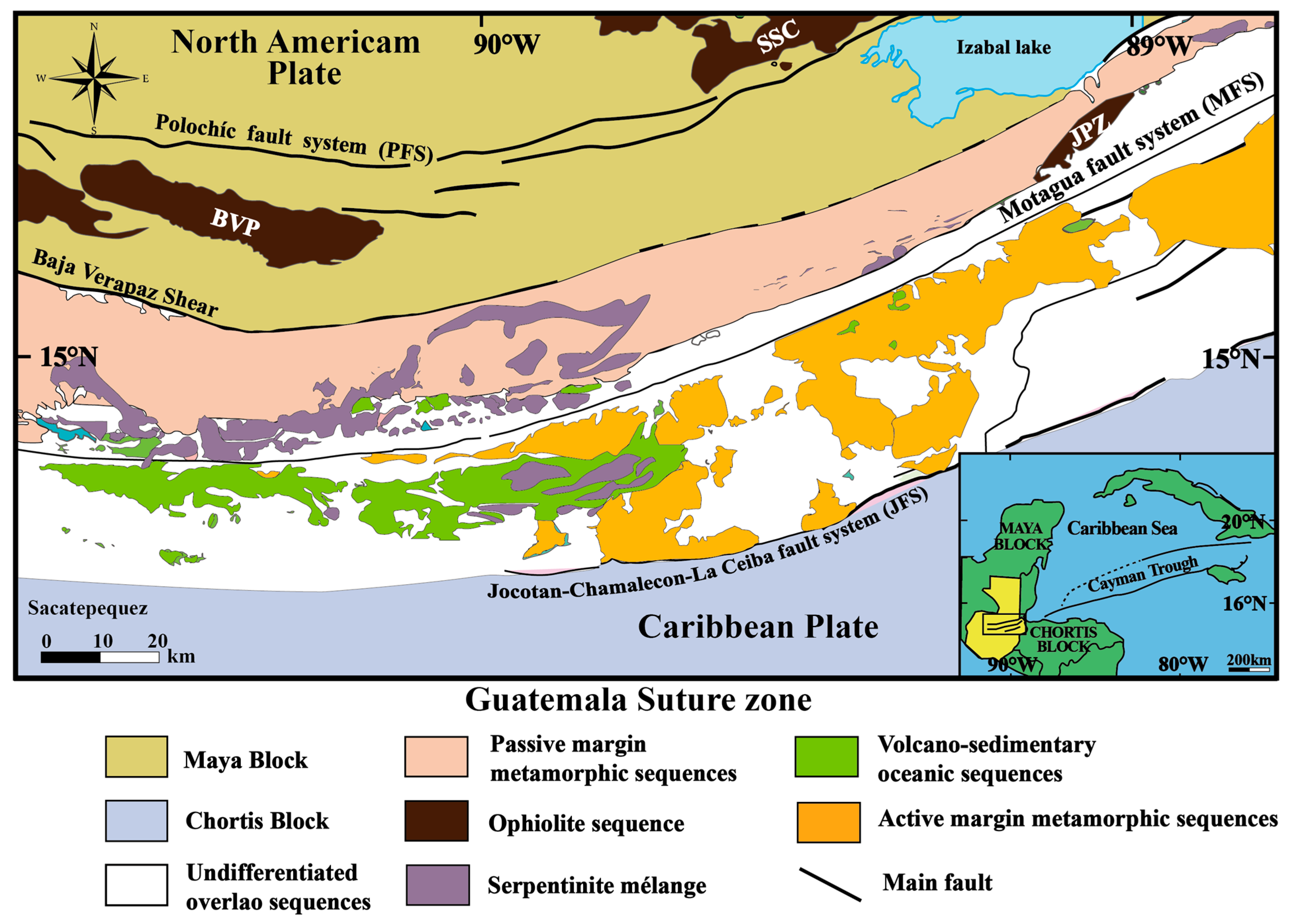
Jadeitite formation depends on high-pressure, low-temperature (HP-LT) conditions, characteristic of subduction zones [18]. Guatemalan jadeitite deposits are closely associated with the Motagua Fault System (Figure 1) [21,24]. These deposits are distributed along the boundary between the North American and Caribbean plates, forming during the Late Cretaceous to Cenozoic oblique subduction–collision processes [25,26]. They typically occur as vein-like jadeitite bodies within serpentinized peridotites, often coexisting with high-pressure metamorphic rocks such as blueschists and eclogites [19]. On this basis, Harlow et al. [6] first conceptually proposed two tectonic units on the northern and southern sides of the Motagua Fault Zone, which were later formally named the North Motagua Mélange (NMM) and South Motagua Mélange (SMM) by Flores et al. [21], further clarifying the geological structural framework of the region.
The northern ore bodies contain substantial jadeitite, omphacitite, albitite, garnet-amphibolite, and minor eclogite. The outermost matrix consists of weathered serpentinite (with magnesite clumps and quartz veins), within which the jadeitite bodies are surrounded by a chlorite layer (blackwall) penetrated by actinolite veins. Beneath the chlorite layer lies a relatively thick albitite zone, which encloses a jadeitite core as the primary ore body [28]. The jadeite within the jadeitite contains inclusions or veins of albite + omphacite ± analcime ± paragonite ± nepheline, frequently exhibiting extensive albitization and typically appearing white to light gray or pale green. Near Saltán in the west, white to light purple jadeite has been discovered, while medium-green jadeite occurs in the eastern areas [12].
Systematic research on jadeitite south of the Motagua Fault (locally the San Agustín fault) did not commence until the early 21st century. The southern ore bodies are hosted in serpentinite as tectonic blocks of jadeitite along with mafic blocks, such as eclogite, blueschist, lawsonite eclogite, and glaucophane eclogite. The jade resources in this region are mainly distributed across three major areas: near Carrizal Grande, La Ceiba, and La Ensenada. In the Carrizal Grande area, jadeitite is found as blocks in serpentinite or as float along with blocks of lawsonite eclogite and blueschist. Jadeitite is constituted of massive jadeite containing quartz, omphacite, phengite, and fluid inclusions, transected by minor quartz or albite veins. The jadeite produced here ranges from light to medium and dark green, occasionally exhibiting deep blue–green veins composed of omphacite. The jadeitite in the La Ceiba area is similar to that of Carrizal Grande, but it occurs in omphacite gneiss rather than eclogite and does not contain lawsonite. The jadeite is generally medium to dark green, sometimes with vibrant green hues, but tends to be heavily fractured. Near La Ensenada, the serpentinite contain fragmented blocks of grayish-white jadeitite (≤3 m) with green, blue, orange, and light purple streaks and spots; much of the rock contains sufficient pumpellyite and grossular to not be considered jadeitites, sensu stricto [12].

3. Materials and Methods

3.1. Sample Description

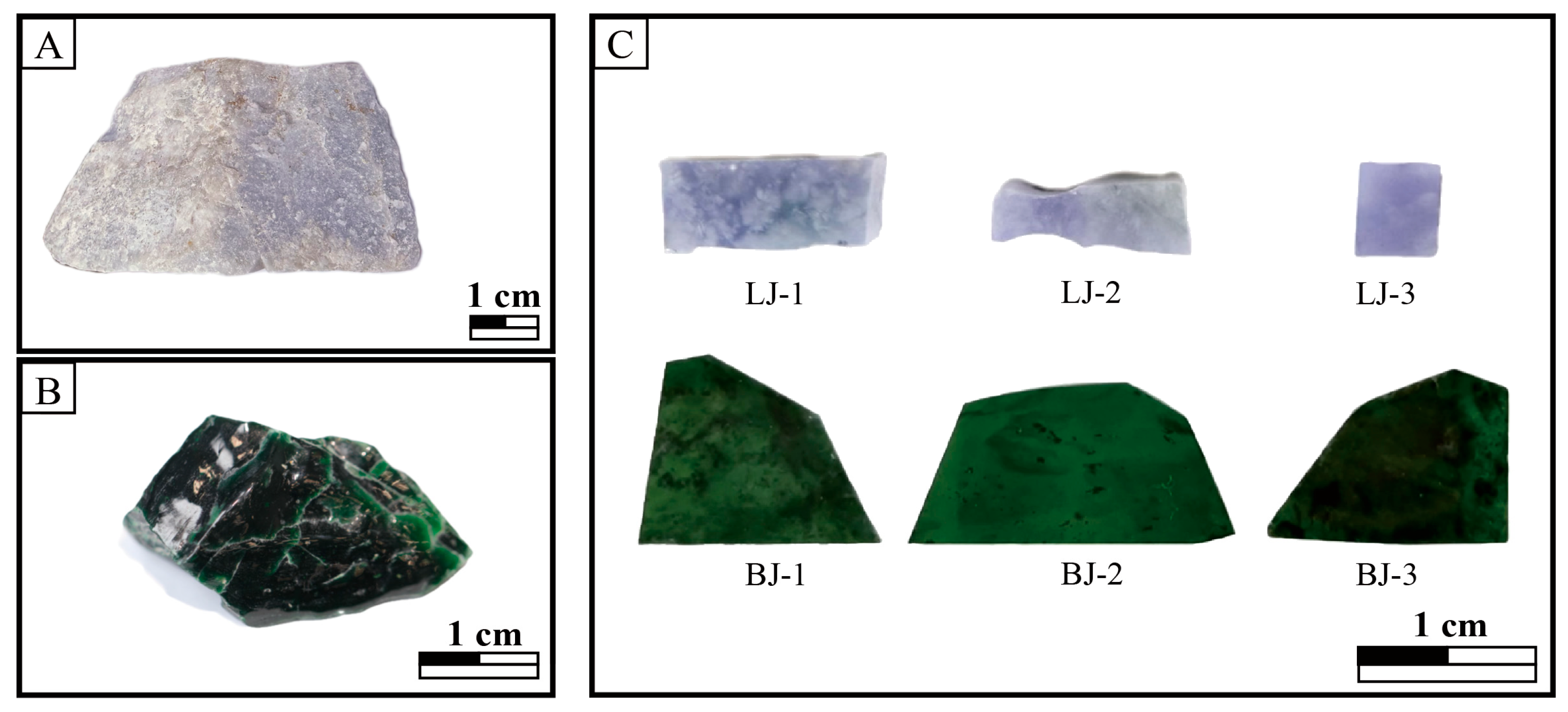
The samples used in this study were sourced from the northern region of the Motagua Fault Zone in Guatemala, including three pieces each of Guatemalan lavender and black jade (Figure 2). The lavender samples exhibit a pale purple hue in both transmitted and reflected light, with an opaque to semi-transparent appearance. In contrast, the black samples show an oily black color in reflected light and a dark green color in transmitted light. This “hidden” characteristic enhances its allure, and it is commercially known in the Chinese jewelry market as “Inky Black Omphacite Jade” [29]. In LJ samples, white minerals predominantly exhibit snowflake-like distribution intergrown with host crystals. In BJ samples, green components display vein-like distribution patterns, with BJ-2 showing scattered spotty distribution of dark green coloration and BJ-3 demonstrating patchy distribution patterns.

3.2. Analytical Methods

Gemological tests were conducted at the Gemological Experimental Teaching Center of the School of Jewelry, China University of Geosciences (Beijing). A gemstone refractometer was used to measure the refractive index (RI) of the samples. This study utilized the hydrostatic weighing method to determine the specific gravity (SG) of Guatemalan jadeite samples by measuring their weight differences in air and water and calculating the corresponding relative density values. To minimize measurement errors, samples with compact structures and uniform color distribution were strictly selected (confirmed by polarizing microscopy to exhibit no significant internal fissures). Each sample group underwent triplicate measurements, and the arithmetic mean was adopted as the result. A Chelsea filter was used to assist in identifying chromium-bearing gemstones. Fluorescence was detected by exposing the jadeites to UV radiation with wavelengths of 365 nm (longwave) and 254 nm (shortwave).
The surface and internal features of the samples were observed under transmitted light with a magnification ranging from 10 to 40 times, using a GI-MP22 binocular microscope from Nanjing Baoguang Technology Co., Ltd. in Nanjing, China.
A UV-3600 UV-Vis spectrophotometer from Shimadzu Corporation (Kyoto, Japan) was utilized to measure the UV-Vis spectrum of samples, employing the reflection method with a wavelength range of 300–900 nm and a sampling interval of 1 s.
A BRUKER TENSOR 27 Fourier Transform Infrared (FTIR) spectrometer (Bruker Corporation, Billerica, MA, USA) was employed to assess the infrared spectrum of the sample, analyzing it via the reflectance method. The experimental setup included a resolution of 4 cm−1, 64 scans, a scanning range spanning from 2000 to 400 cm−1, and a scanning speed of 10 kHz.
A Horiba HR Evolution micro laser confocal Raman spectrometer (Villeneuve d’Ascq, France) was used to acquire the Raman spectra of the samples. The experimental conditions were set as follows: laser wavelength at 532 nm, laser output power at 100 mW, laser spot size ranging from 1 to 5 µm, and a resolution of 1 cm−1. Each scan lasted for 20 s with three integrations. The data collection range spanned from 100 to 2000 cm−1.
The chemical data for major elements were acquired through Electron Probe Micro-Analysis (EPMA). EPMA was conducted with a JAL JXA-8230 instrument (Shandong Institute of Geological Sciences, Jinan, China), with a 0.001% detection limit. During the analysis, an accelerating voltage of 20 kV, an accelerating current of 2 × 10⁻⁸ A, and a beam spot diameter of 5 μm were employed.
Trace-element and in situ rare earth element analysis was conducted at the Key Laboratory of Paleomagnetism and Paleotectonic Reconstruction, Institute of Geomechanics, Chinese Academy of Geological Sciences (Beijing, China), using a Laser Ablation–Inductively Coupled Plasma (LA-ICP) system. The mass spectrometer used was a quadrupole ICP-MS produced by Agilent Technologies, model Agilent 7900 (Santa Clara, CA, USA). The laser ablation system was a GeoLas HD ArF 193 nm excimer laser manufactured by Coherent, Santa Clara, CA, USA [30]. The samples NIST 610 and NIST 612 were used as external standards to test the rare earth element contents.
The CL images were obtained at the Resource Exploration Laboratory, China University of Geosciences (Beijing), using a model MK-CL-5200 cathodoluminescence instrument (Gatan, Inc., Pleasanton, CA, USA), with stable operating parameters of 13–15 kV voltage, 250 µA current, a vacuum level of 0.003 mBar, and a Nikon Ds-Fi3 imaging system.

4. Results

4.1. Gemological Characteristics

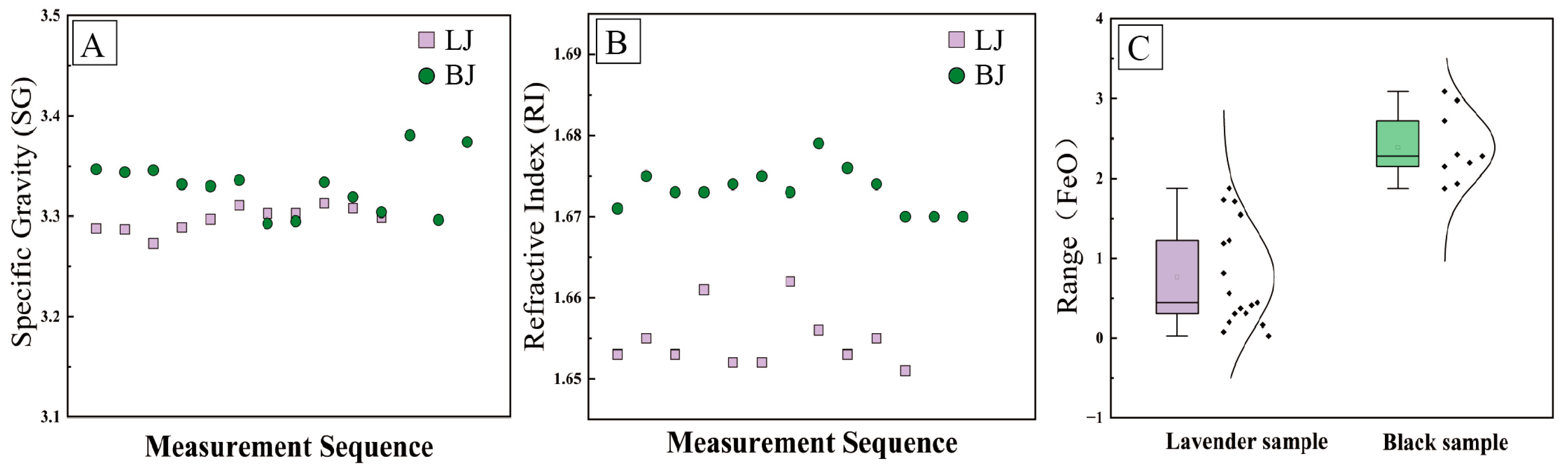
The specific gravity values of the Guatemalan jadeite samples range from 3.273 to 3.347 (Figure 3A), consistent with typical jadeite density ranges but slightly lower than conventional values reported for Myanmar jadeite (~3.34) [31]. The measurements of the lavender samples are overall somewhat lower than those of the black samples, but some data points overlap with each other, indicating a certain degree of crossover in density characteristics between the two types of samples and a lack of distinct separation. The refractive indices of the lavender jadeite samples (Figure 3B) were determined to be 1.65–1.66, while the black omphacite samples exhibited a higher refractive index of 1.67–1.68. Combined with the EMPA data (Table 1), this phenomenon is attributed to the isomorphic substitution of Fe in the mineral, which alters optical properties. Additionally, the higher iron content in black samples (Figure 3C) explains its relatively higher density (average: 3.332 vs. 3.298).

4.2. Microstructure

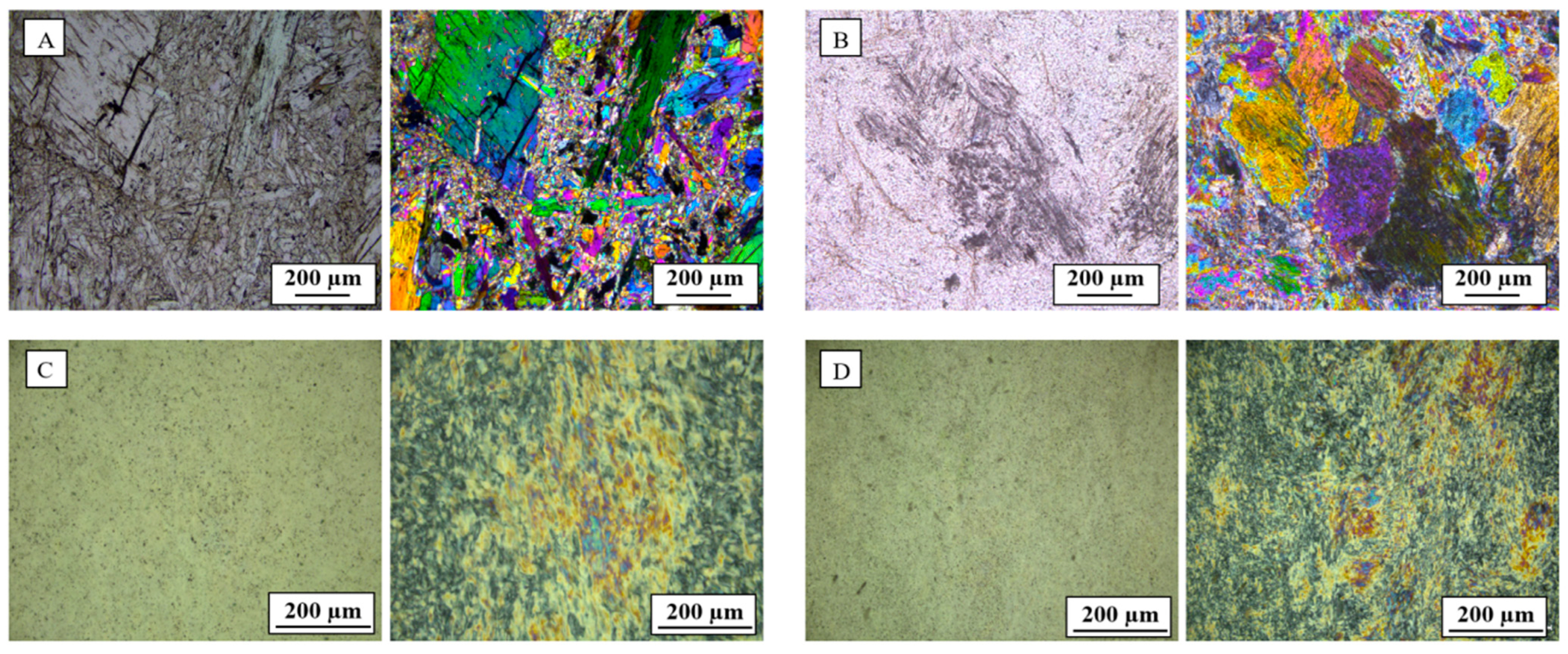
The Guatemalan lavender samples exhibit a dominant blue–purple hue with relatively uniform color distribution, displaying a translucent to semi-translucent transparency and vitreous luster. Intact crystalline grains and irregular white cloud-like inclusions of albite occur as clustered masses (Figure 2). The primary constituent mineral is jadeite, demonstrating a distinct fibrous interlocking structure. It exhibits a heteroblastic texture, characterized by grains of unequal sizes, including both coarse and fine crystals (Figure 4A). The coarse grains appear patchy or elongated and are roughly arranged in an interwoven pattern. In specific areas, due to fracturing and recrystallization, fine-grained jadeite crystals display blurred grain boundaries. Bent crystal deformations and fragmented microstructure provide evidence of dynamic metamorphism. The porphyroblastic microstructure (Figure 4B) is coarse-grained, disordered in arrangement, and exhibits embayed boundaries.
The black samples display a dark greenish-black coloration in reflected light, appearing semi-translucent with vitreous luster. It contains strongly metallic-lustrous black inclusions identified as irregularly shaped graphite particles (Figure 2). Primarily composed of omphacite, this variety exhibits a compact microstructure with cryptocrystalline microstructure. Polarizing microscope analysis revealed that the black jade matrix has a finer microstructure, with no coarse-grained blastic structure observed. The common structures are cryptocrystalline blastic microstructure and fine-grained blastic microstructure, characterized by intensely deformed crystalline aggregates without distinct crystal boundaries.

4.3. Spectroscopy

4.3.1. UV-Vis-NIR Spectra

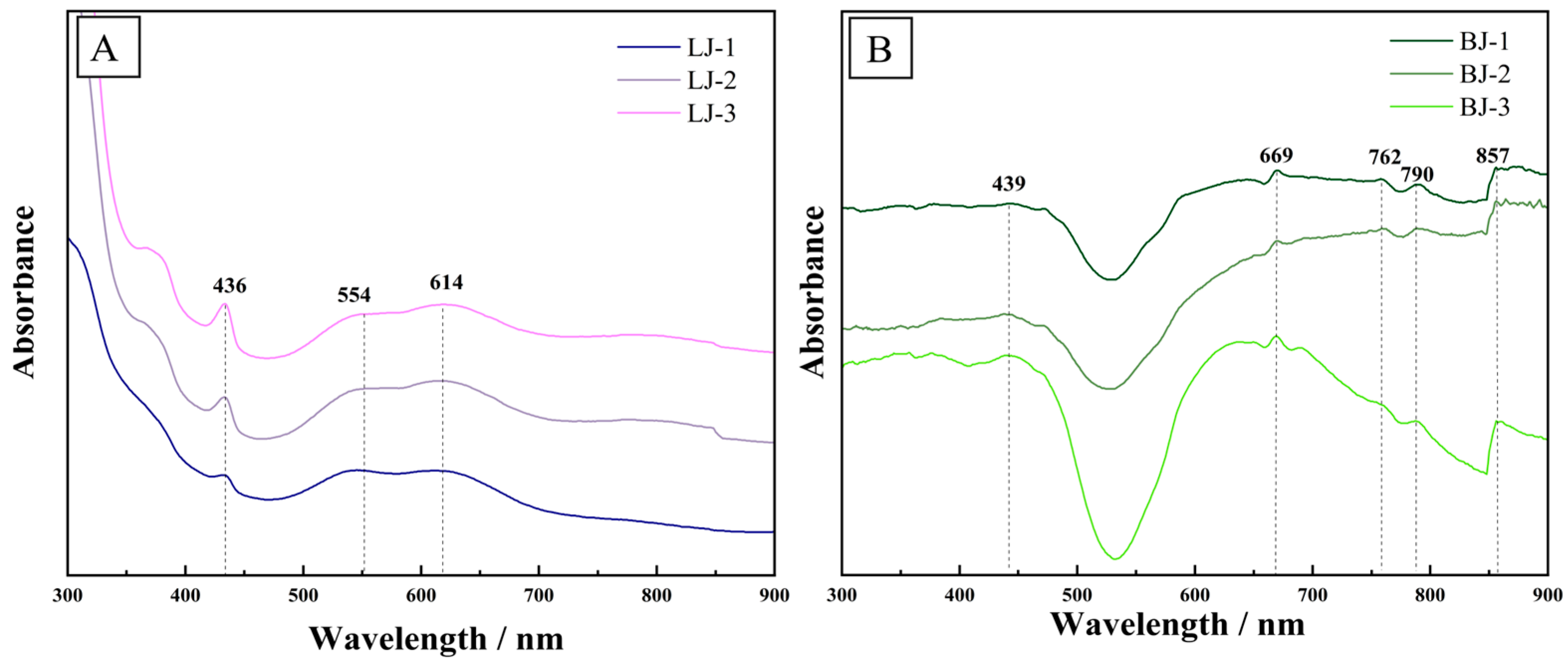
Figure 5 presents a comparative analysis of the characteristic ultraviolet–visible (UV-Vis) absorption spectral features between lavender and black samples from Guatemala. The spectral curve of lavender samples exhibits three primary absorption features: a narrow, sharp, symmetric absorption peak at 436 nm, accompanied by two weaker broad absorption bands between 500–700 nm centered at 554 nm and 614 nm.
In contrast, the black samples show several strong absorption peaks in the ultraviolet and blue ultraviolet regions. The main absorption peak is located at 438 nm, showing a slight positional shift compared to the lavender variety, along with significant changes in the peak profile. Furthermore, an independent absorption peak is observed in the long-wavelength region at 670 nm. Additionally, distinct absorption peaks are detected near 798 nm and 857 nm, respectively.
These spectral features correspond to electronic transitions between different energy levels within the jadeite structure, providing key spectral evidence for elucidating the coloring mechanism of lavender jadeite. At the same time, these spectral features explain the unique deep green–black appearance of black omphacite.

4.3.2. FTIR Spectra

The pyroxene group minerals are chain-structured silicates, in which the [SiO4] tetrahedra form an infinitely extending single-chain structure along the c-axis by sharing two apical oxygen atoms. In terms of infrared spectroscopic characteristics, pyroxene group minerals predominantly exhibit three major absorption regions: the 400–600 cm−1 range corresponds to the coupling effect between Si–O bending vibrations and metal–oxygen (M–O) bond stretching vibrations; the 600–800 cm−1 region originates from bending vibration modes of Si–O–Si bridging oxygen; while the broad spectral band at 800–1100 cm−1 encompasses superimposed effects of symmetric and asymmetric stretching vibrations from Ot–Si–Ot and Si–Ob–Si groups [32]. Notably, substitution of Ca2+ for Na+ in the crystal structure induces contraction of Si–O–Si chain bond angles, leading to systematic shifts in characteristic spectral bands. Additionally, the ionic radius disparity between substituting cations (e.g., Ca2+, Mg2+, Fe2+, Fe3+) and original cations (Na+, Al3+) significantly influences vibrational frequencies: when the substituting cation has a smaller ionic radius than the replaced ion, characteristic peaks shift toward lower frequencies; conversely, substitution with larger cations results in high-frequency displacement phenomena.
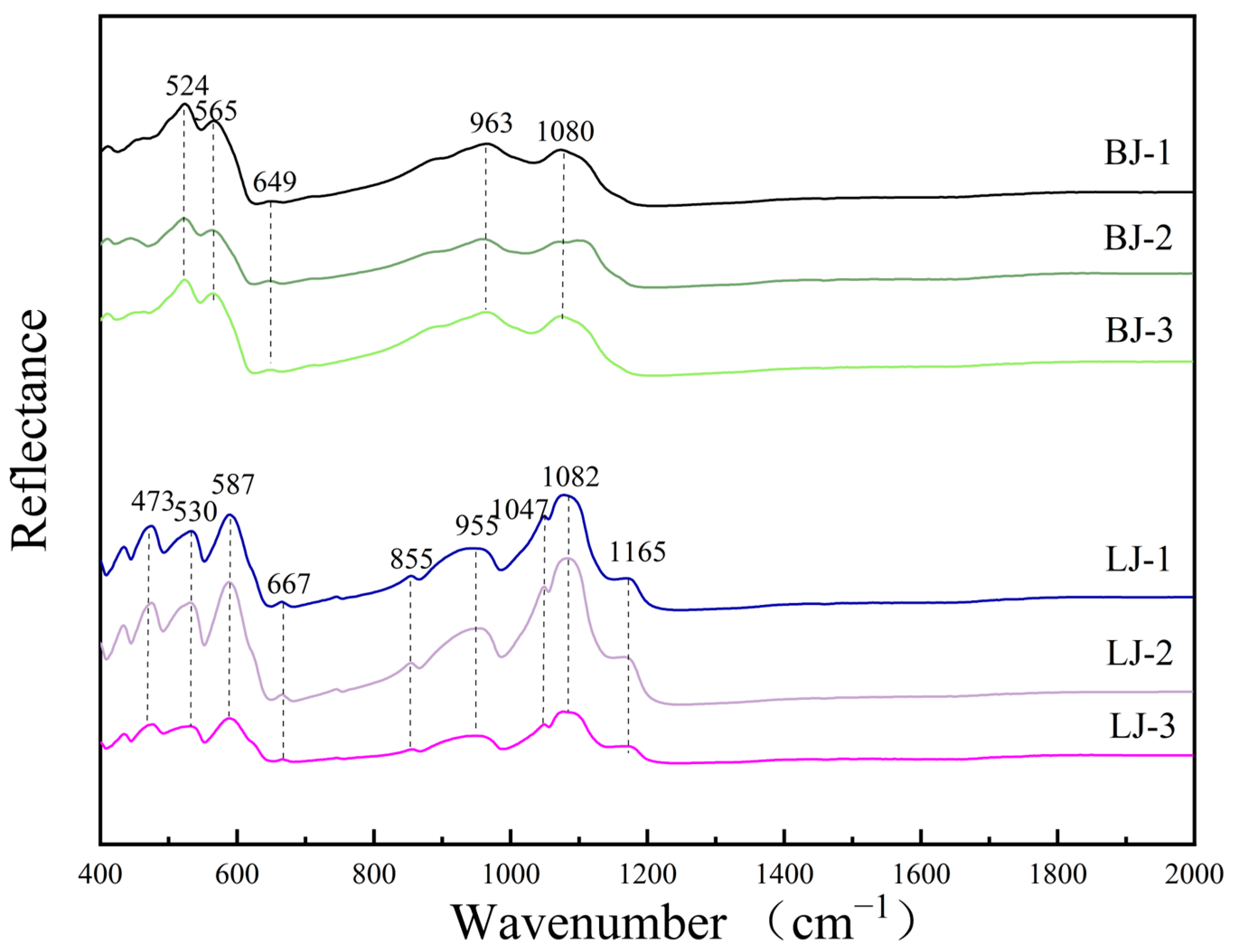
All lavender samples exhibited similar infrared reflectance spectra (Figure 6). Within the 400–600 cm−1 range, the absorption peaks at 473, 530, and 587 cm−1 are attributed to vibrational absorption from M-ligand coordination and vibrations of metal cations and O2− ions. In the 600–900 cm−1 range, peaks at 667 and 855 cm−1 arise from bending and stretching vibrations of SiO4 tetrahedra. Characteristic peaks observed at 955, 1047, 1082, and 1165 cm−1 within the 900–1200 cm−1 range indicate that these samples are primarily composed of jadeite [9,13,17].
In contrast, the group of black samples displays distinct peaks at 524, 565, 963, and 1080 cm−1, along with an extremely weak peak at 649 cm−1. Compared with the lavender variety, the infrared spectral peaks of black samples exhibit a shift toward lower wave numbers. Based on these peak positions, it is interpreted that the dominant mineral constituent in these samples is likely omphacite [29].

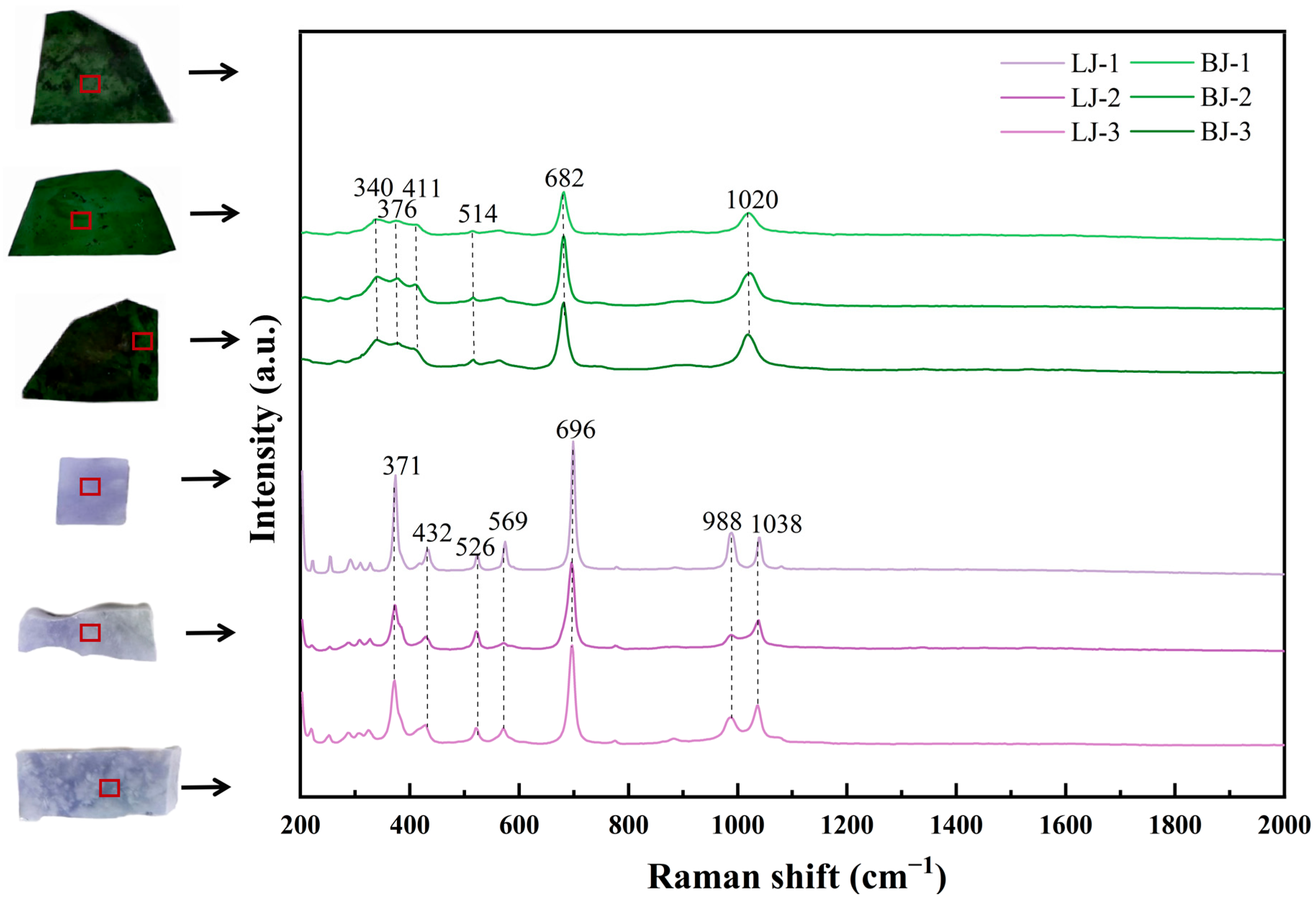
4.3.3. Raman Spectra

The Raman spectrum of lavender samples exhibits seven strongest bands located near 1038, 988, 696, 569, 526, 432, and 371 cm−1 (Figure 7). After comparison with the RRUFF database, these characteristic peaks were found to match those of jadeite [33]. Among these, the peaks at 1038 and 988 cm−1 are attributed to the symmetric stretching vibrations of Si–O bonds in the [Si2O6]4− group. The 696 cm−1 band arises from symmetric bending vibrations of Si–O–Si bridges, while the 371 cm−1 peak corresponds to asymmetric bending vibrations of Si–O–Si linkages. Weaker peaks observed at 569, 526, and 432 cm−1 are characteristic of jadeite, resulting from ionic M–O stretching vibrations (where M represents metal cations) and their coupling with Si–O–Si bending vibrations [34,35].
In contrast, black samples demonstrate distinct Raman shifts primarily at 1020, 682, 514, 411, 376, and 340 cm−1 (Figure 7). The most intense peak occurs at 682 cm−1, followed by the 1020 cm−1 band. Notably, the 376 cm−1 peak displays weaker intensity with an expanded full width at half maximum. Based on vibrational spectroscopy assignments for chain silicates [36,37], the 1020 cm−1 band corresponds to Si–Ot (terminal oxygen ion) stretching vibrations. The 678 and 374 cm−1 bands are associated with Si–O–Si bending vibrations, serving as characteristic Raman features of omphacite.
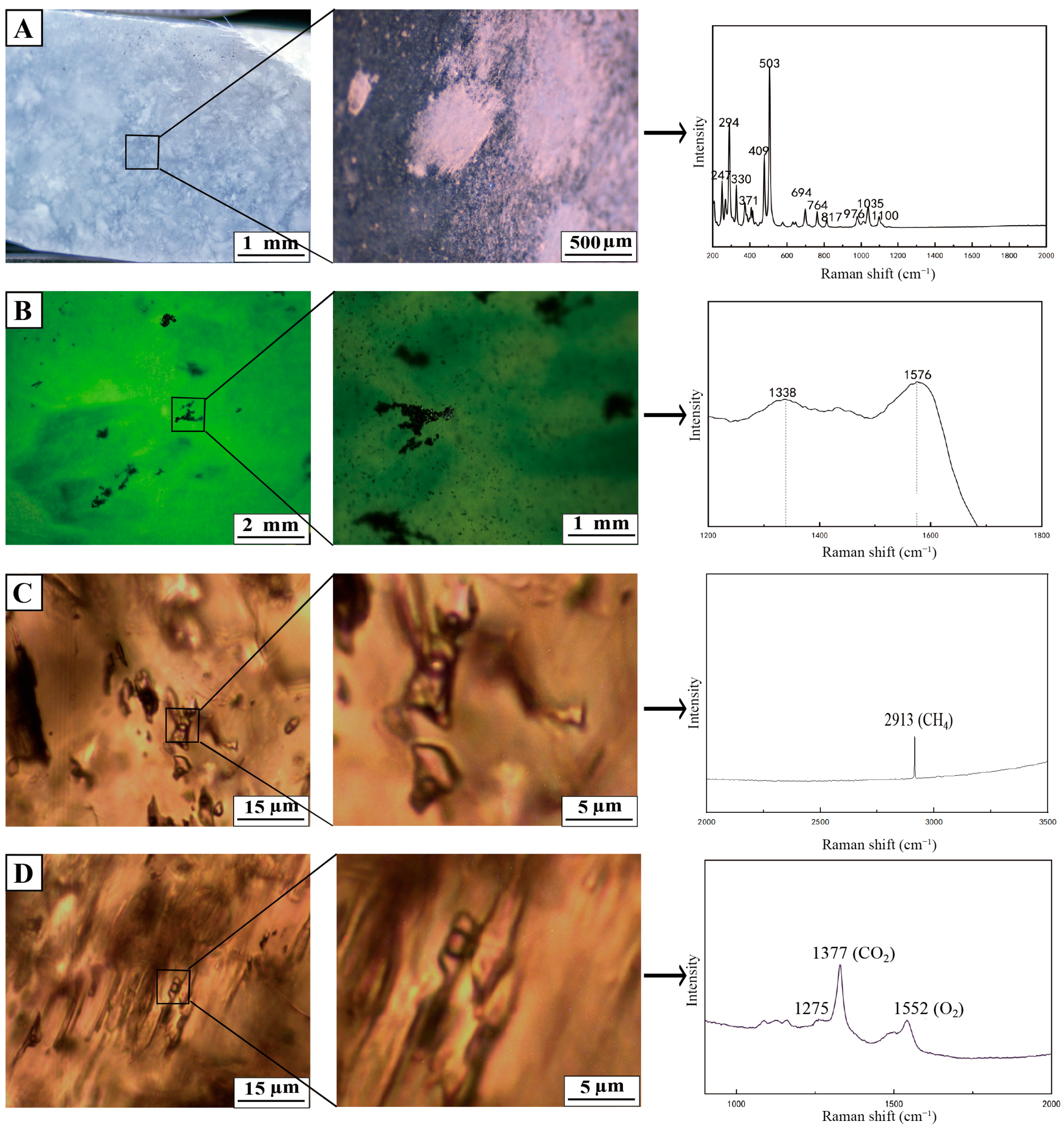
The lavender jadeite contains a significant amount of cotton-like white inclusions with relatively large dimensions, while the black omphacite also exhibits small granular white inclusions (Figure 8). Raman analysis reveals that the light-colored semi-transparent mineral inclusions exhibit distinct spectroscopic characteristics of albite. Sharp Raman peaks were detected at shifts of 247, 294, 330, 371, 409, 503, 694, 764, 817, 976, 1035, and 1100 cm−1, which show excellent consistency with standard albite Raman spectra (Figure 8A). The sharp peak morphology indicates well-crystallized albite minerals.
In black omphacite, pervasive dark metallic-luster minerals were observed, predominantly occurring as clustered or stellate distributions within the matrix. Taking sample BJ-2 as an example (Figure 8B), point analysis of three typical mineral grains revealed Raman spectra exhibiting characteristic doublet peaks at 1338 cm−1 and 1576 cm−1: the former corresponds to the D-band of carbon, reflecting disordered sp2 hybridized amorphous carbon structures, while the latter represents the G-band, indicative of short-range ordered graphitized sp2-bonded carbon [38,39,40]. Notably, similar carbonaceous spectral features were consistently identified in the irregular dark minerals within all examined black samples from this study. Specifically, Raman spectroscopy revealed the presence of amorphous carbon with relatively low D-band to G-band intensity ratios (ID/IG), indicating a less defective and more ordered structure. Furthermore, it is noteworthy that graphite inclusions with identical Raman characteristics were also detected in a lavender-colored sample, linking this carbonaceous material beyond just black omphacite. These findings strongly suggest that specific types of carbonaceous inclusions may serve as significant identifier characteristics for Guatemalan jade, particularly black omphacite. This implies the potential involvement of organic-rich reducing geological environments during the formation of the NMM.
Additionally, laser Raman spectroscopy identified numerous fluid inclusions that can be classified into two types: Type I methane inclusions display characteristic C–H bond vibrational features in Raman spectra, exhibiting a high-intensity single peak at 2913 cm−1 corresponding to symmetric stretching vibration mode (Figure 8C). CH4-bearing fluid inclusions have been abundantly identified in both lavender jadeite and black omphacite. Additionally, another type of fluid inclusion has only been discovered in lavender jadeite. Type II carbon dioxide inclusions manifest the distinctive Fermi resonance doublet peaks of CO2 molecules, showing characteristic peaks at 1275 cm−1 and 1377 cm−1 respectively (Figure 8D). The co-occurrence of these two types of fluid inclusions suggests the jadeite underwent complex fluid environment evolution during its formation process, providing crucial evidence for studying its paragenetic conditions [41,42].

4.4. Chemical Composition

4.4.1. Appearance and Chemical Composition

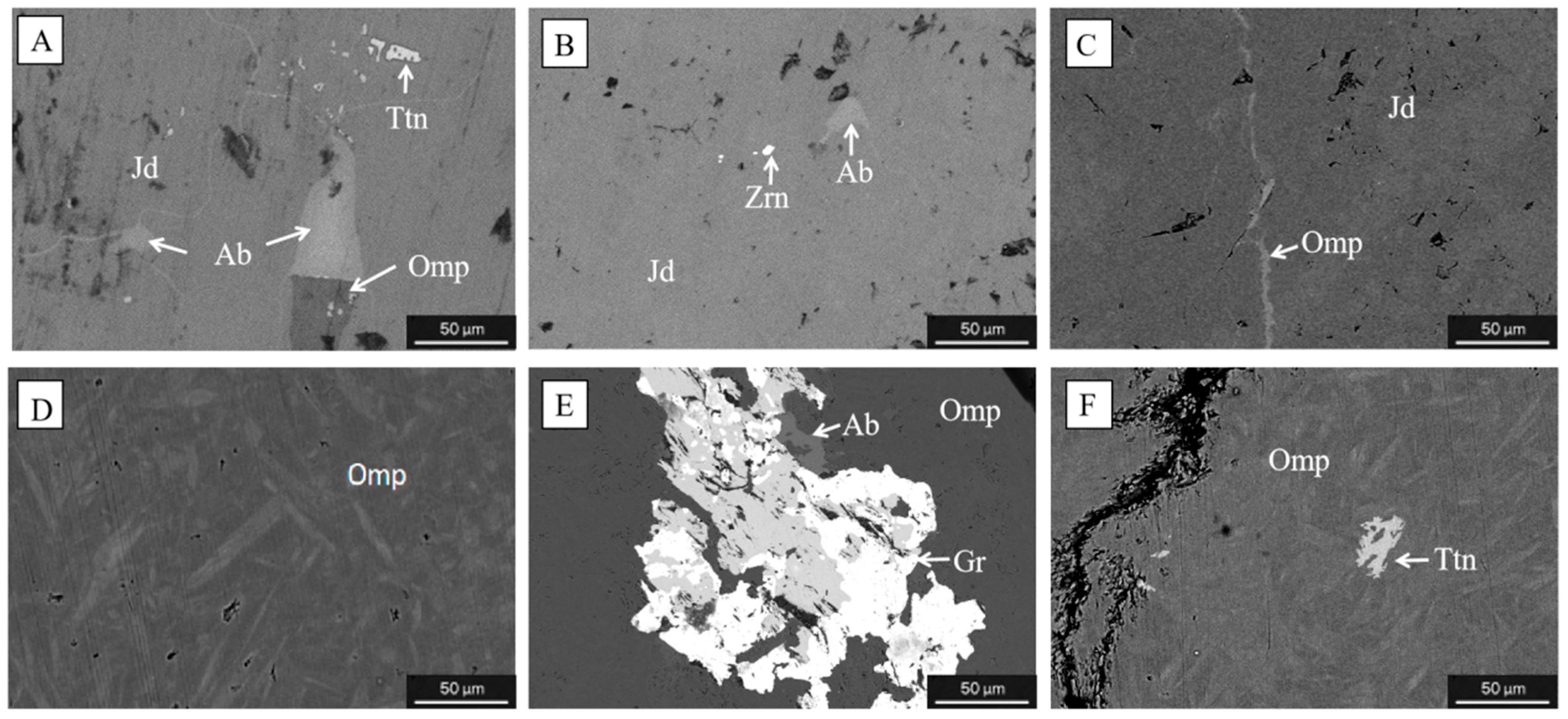
As shown in Figure 9, this study presents the microstructure and mineral composition of lavender-colored jadeite and black samples from Guatemala. The lavender-colored sample is primarily composed of jadeite, with veined omphacite interspersed within it (Figure 9C), consistent with observations under polarized light microscopy. The sample also contains fine-grained titanite (Figure 9A), zircon (Figure 9B), and isolated albite grains (Figure 9A,B).
The black sample from Guatemala is mainly composed of omphacite, displaying a distinct fibrous interlocking texture with both light and dark colored areas. Energy-dispersive spectroscopy analysis confirms that both are omphacite, but the lighter regions contain higher concentrations of elements such as Ca and Mg compared to the darker parts. The omphacite forms columnar or fibrous clusters with no obvious orientation (Figure 9D). Additionally, minerals such as amorphous carbon (Figure 9E), albite (Figure 9E), and titanite (Figure 9F) were identified in the black sample.

4.4.2. Mineral Major Element Analysis

Electron probe microanalysis was conducted on lavender jadeite and black omphacite samples, and the results are shown in Table 1. The theoretical contents of SiO2, Al2O3, and Na2O in the chemical composition of end-member jadeite are 59.40%, 25.20%, and 15.40%, respectively. The chemical composition of the lavender samples is comparable to that of end-member jadeite, which confirms that the main mineral component of Guatemalan lavender samples is jadeite. However, the content of each oxide in the lavender samples deviates slightly from this value—with Na2O showing the most prominent variation. This indicates that a certain degree of ionic substitution has occurred within its crystal structure. In contrast, the compositional values of the black samples all exhibit significant deviations from those of standard jadeite. When combined with analysis results from techniques such as FTIR spectroscopy and Raman spectroscopy, this verifies that the main mineral composition of Guatemalan black samples is omphacite.
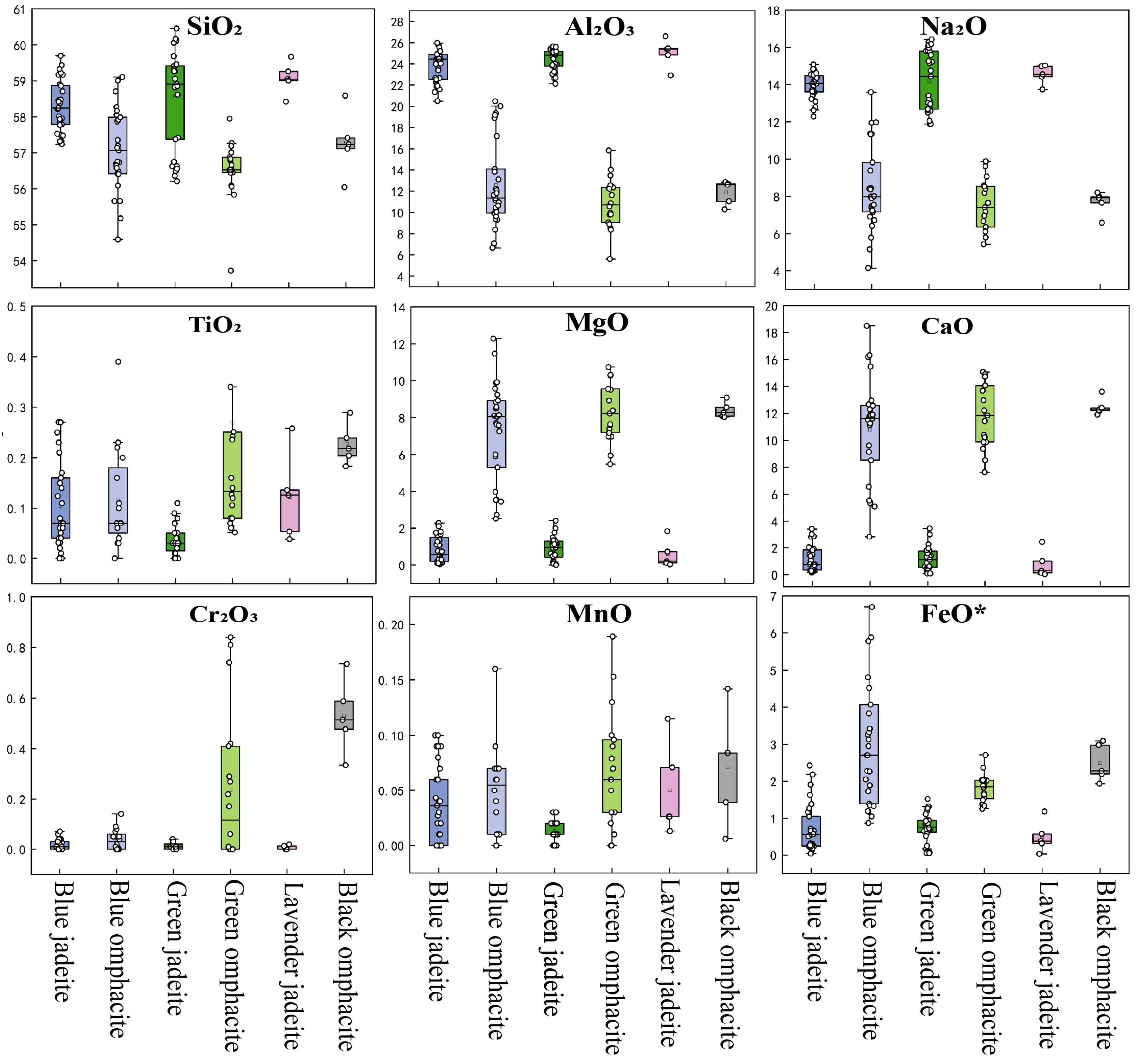
Figure 10 illustrates the differences in the major element composition of jade samples with different colors and compositions. Within the same color category, omphacitic jade generally exhibits higher Fe, Mg, and Ca contents, while jadeitic jade is distinguished by higher Al, Si, and Na contents. Further analysis from the perspective of consistent composition reveals significant differences in the elemental distribution among jades of different colors. Lavender jadeite demonstrates the highest chemical purity, with not only the highest Al, Si, and Na contents but also the smallest fluctuation range, reflecting fewer impurities in its composition. Traditionally, Mn has been considered the key element responsible for the purple color in jadeite, particularly when Fe content is low, as the coloring effect of Mn becomes more pronounced. However, data from this study show no abnormally elevated Mn concentration in lavender jadeite. Moreover, the Fe content in green jadeite is similar to that in lavender jadeite, suggesting that the cause of the purple color may not rely solely on Mn. In contrast, black omphacite exhibits significantly higher Cr content, followed by green omphacite. This result further supports the contribution of Cr3+ as a primary chromophore to the formation of the green hue in jadeite.

4.4.3. Mineral Trace Element Analysis

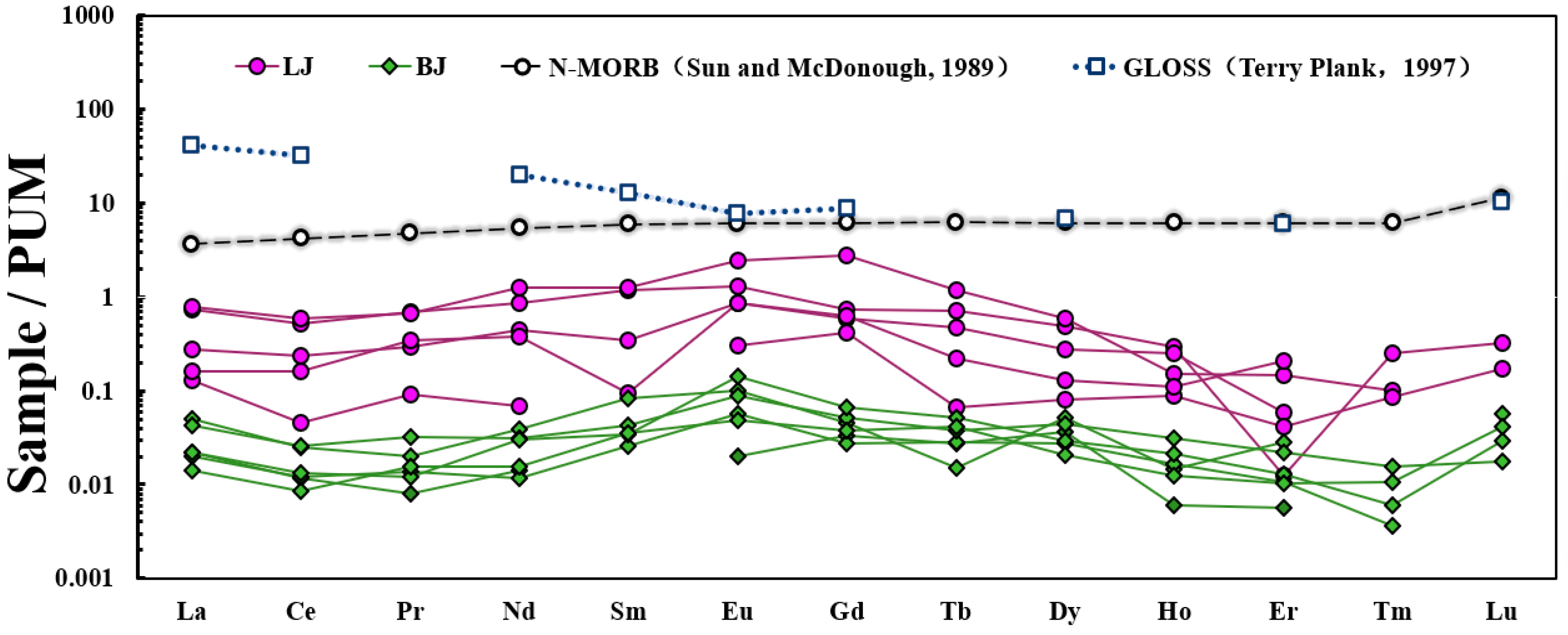
Trace elements are highly sensitive to geological processes. Their abundances, associations, and ratios can faithfully record the formation conditions and evolutionary pathways of rocks [43,44,45,46,47]. As shown in Figure 11, this study systematically characterized the rare earth element (REE) distribution patterns of lavender and black omphacite (Table 2) using the Primitive Upper Mantle (PUM) [48] standardization scheme, and compared them with major marine rock reservoirs, including normal mid ocean ridge basalt (N-MORB) representing depleted mantle melting products [49], and global subduction sediments (GLOSS) reflecting subduction zone material cycling [50] for geochemical fingerprinting. This provides important tracing evidence for analyzing the tectonic magmatic activity in different source areas in Guatemala, such as the Motagua Fault Zone-related deposits, suggesting that the formation of jadeite deposits may have undergone complex dynamic processes such as mantle melting, crust mantle interactions, or subduction sediment mixing.
Compared with the PUM, the REEs in Guatemalan jadeite rocks exhibit significant depletion characteristics, especially in black omphacite. The rare earth element (REE) distribution pattern of the lavender sample shows relative enrichment in middle rare earth elements (MREE), with slight positive anomalies of Eu and Gd. The light rare earth elements (LREE) and heavy rare earth elements (HREE) are both relatively depleted, forming a distinct convex distribution pattern. The overall REE distribution of the black sample is lower than that of LJ, with a more pronounced decrease in HREE, showing a slight left-leaning trend. Unlike the GLOSS REE distribution pattern—which exhibits strong LREE enrichment, characterized by a high-left and low-right trend—the REE distribution of these samples is more similar to that of N-MORB, suggesting that their formation may have been influenced by material transport mediated by subduction zone fluids.

5. Discussion

5.1. Chemical Composition and Coloring Mechanism

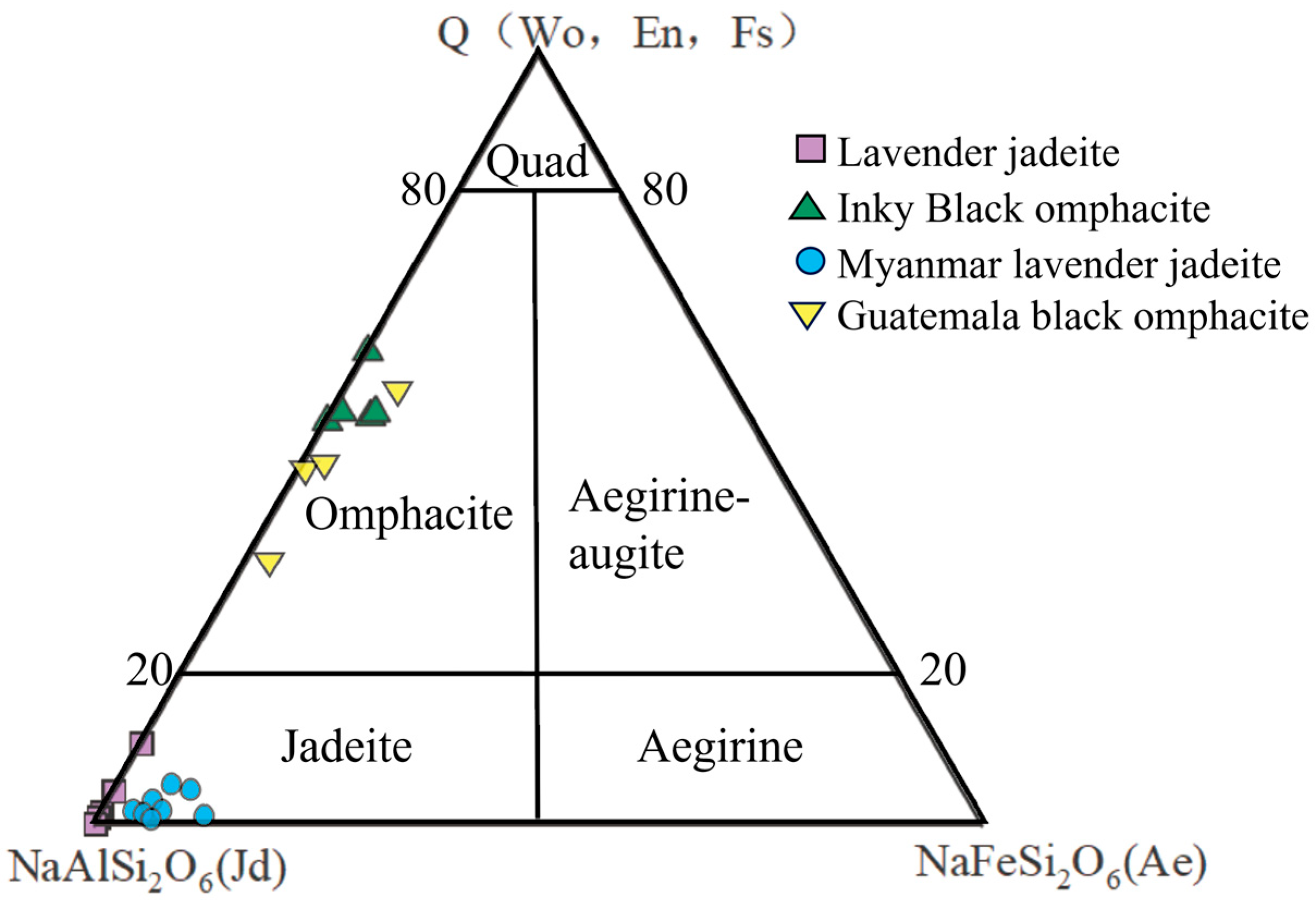
Chemical composition analyses reveal distinct compositional trends between Guatemala and Myanmar jadeite (Figure 12). Guatemalan lavender jadeite exhibits near Jadeite end-member purity (89.368–99.814%), demonstrating limited solid-solution isomorphic substitution. Compared to its Myanmar counterparts, it shows elevated Quad versus lower Aegirine content. In the analysis of black omphacite, the Jadeite endmember decreased to 25.826–30.094%, while the Quad endmember exhibited a notable increase, ranging from 33.245% to 41.347%, fundamentally altering its mineralogical classification to omphacite composition.
The UV-Vis spectroscopic measurements conducted on primary lavender jadeite and black omphacite reveal distinct differences in their chromogenic mechanisms. For lavender samples, the 436 nm absorption peak can be attributed to d-electron transitions of Fe3+ from the ground state 6A1 level to excited states 4A1g and 4Eg levels [53]. This transition pattern is commonly observed in iron oxide systems, reflecting the octahedral coordination of Fe3+ in the crystal lattice. The broad absorption band at 554–614 nm can be attributed to the charge transfer between Mn3+ and Fe2+-Ti4+ [54]. Mn3+ ions contribute to the purple hue, while the charge transfer between Fe2+-Ti4+ further adds a blue component. Currently, it is generally accepted in the academic community that the purple coloration in gemstones is typically attributed to the presence of Mn3+. Lavender jadeite from Myanmar often exhibits a distinct absorption peak at around 570 nm due to manganese, resulting in a visually richer purple appearance [55], whereas lavender jadeite from Guatemala usually displays a bluish-purple hue.
In comparison, the black sample exhibits characteristic absorption peaks at 438 nm, 670 nm, and 857 nm. Among these, the 438 nm peak is similarly associated with the electron transition of Fe3+, confirming the high iron content in black omphacite. The broad absorption features at 670 nm and 857 nm suggest more complex mechanisms: the 670 nm absorption band may correspond to the 4A24T2 transition of Cr3+, where Cr3+ substitutes for Al3+ ions in omphacite through isomorphic substitution; while the 857 nm characteristic peak likely originates from the d-d electron transition of Fe2+ [56]. According to previous studies on the origin of green color, as little as 0.3 wt% Cr can produce a vivid green hue, whereas higher Cr content leads to a darkening of the green [17]. Integrating the UV-Vis spectroscopy and EMPA results, it is concluded that the black omphacite is primarily attributed to the presence of Cr.

5.2. Origin Identification

Identifying the origin of jadeite between Guatemala and Myanmar has become increasingly important from both mineral resource and metamorphic geology perspectives. In recent years, the rise of high-quality jadeite from Guatemala has posed a challenge to the market position of jadeite from Myanmar. The difficulty of distinguishing jadeite from the two regions has shifted from traditional appearance observation to in-depth analysis of mineralogy and geochemistry. In addition to the comparison of chemical composition and coloring mechanisms in the previous text, the analysis of trace element further reveals the differences in geochemical fingerprints of jadeite between the two regions.
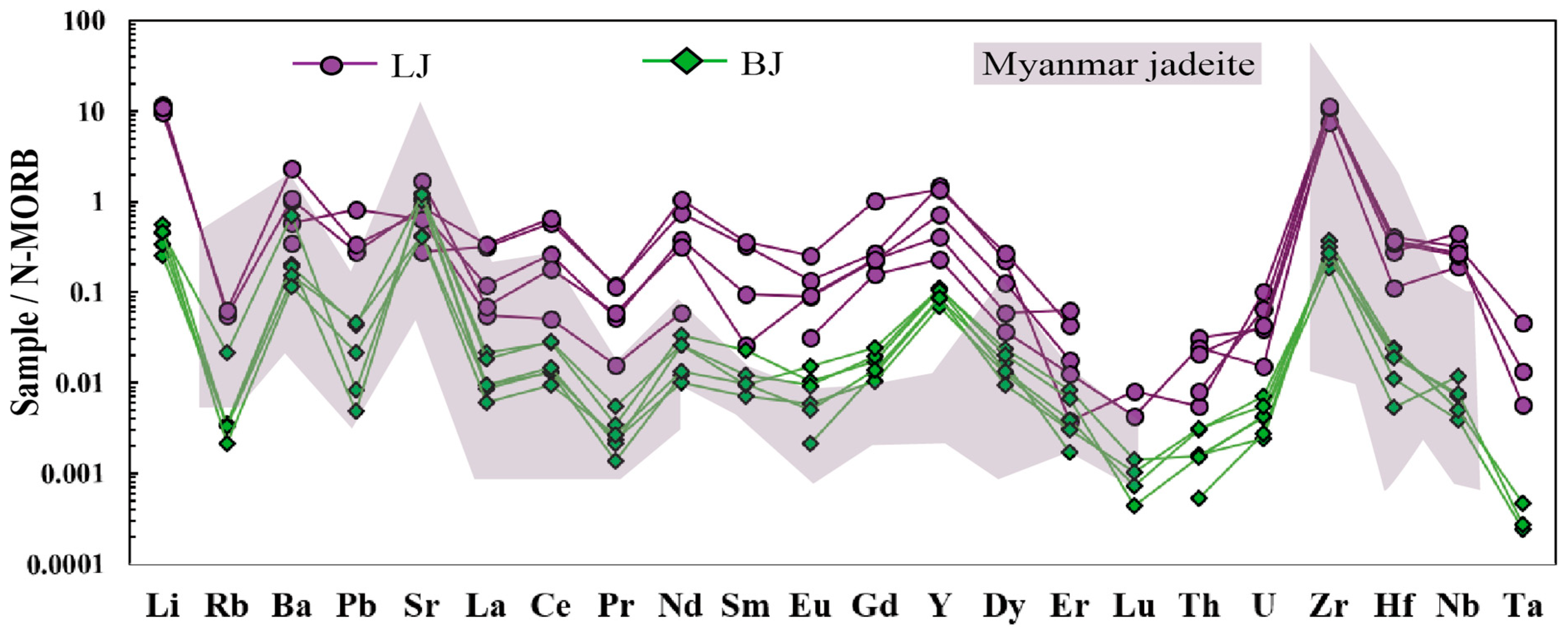
A comparative study of the trace element geochemical characteristics between the two sources reveals that the Guatemalan samples exhibit a relatively consistent trend (Figure 13), typically showing more pronounced enrichment trends in LILE and HFSE compared to the heavy rare earth elements (HREE). This not only elucidates the general pattern of elemental differences during the formation of jadeite but also provides key geochemical discriminants for tracing the provenance of different jade varieties. In contrast to the Guatemalan lavender-colored samples, the trace element abundances in black–green jadeite are generally lower. This phenomenon is partly controlled by pyroxene crystal chemistry, specifically the lack of suitable REE sites in low-calcium jadeite, unlike in omphacite. Detectable amounts of large ion lithophile elements (LILE) and high field strength elements (HFSE) are still present, with elements such as Ba, Sr, Nb, and Zr showing mild enrichment.
There are significant differences in trace element composition between Guatemalan jadeite and Myanmar jadeite. Overall, the elemental abundance of Guatemalan jadeite is slightly higher than that of Myanmar jadeite, which is particularly evident in elements such as LREE. Both types of jadeite exhibit notable enrichment of Sr and Zr. Guatemalan jadeite shows exceptionally high Y values, resulting in lower Gd/Y ratios and higher Y/Dy ratios. In contrast, Myanmar jadeite displays relatively flat Gd/Y ratios close to 1 and lower Y/Dy ratios. These regional differences may be attributed to variations in ore-forming fluid activities and wall rock compositions between the two regions.

5.3. The Genesis of Guatemalan Jadeitites

Since Coleman [57] first proposed that jadeitite forms through the metasomatic interaction of Na- and Al-rich fluids with ultramafic rocks under high-pressure and low-temperature conditions, significant progress has been made in the study of its genesis. Subsequent scholars have since developed the genetic mechanisms of jadeitite into two main types: P-type, where jadeitite is formed by direct precipitation from aqueous fluids derived from subduction zone dehydration in the mantle wedge; and R-type, which posits that jadeitite results from the metasomatic alteration of rocks such as oceanic plagiogranite, limestone, or metamorphic rocks by fluids rich in Na, Al, Si, and other elements [1,18].
However, some aspects of the genesis of Guatemalan jadeitites remain debated. Fu et al. posited, based on zircon ages and δ18O isotope characteristics, that the zircons in the SMM jadeitite of Guatemala were inherited from the protolith [58]. However, subsequent studies involving systematic geochemical analyses of zircons in Guatemalan jadeitites refuted this inference [21]. Currently, in most reviews on jadeitite, the origin of Guatemalan jadeitite remains marked as uncertain [58].
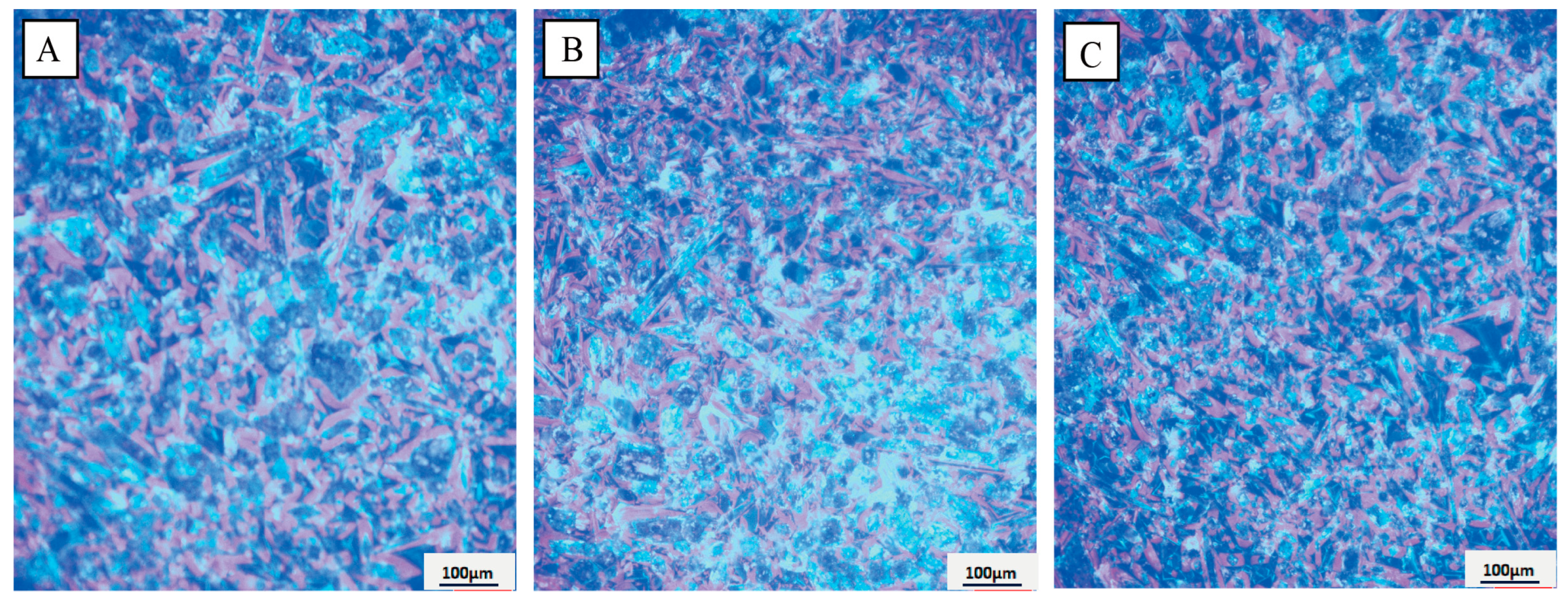
Under the cathodoluminescence microscope (Figure 14), the fluorescence color of Guatemalan lavender jadeites is consistent, indicating that jadeite was formed in the same generation. The structure of jadeite is a fine-grained crystalline structure, which was formed in a relatively stable environment. Black omphacite does not exhibit visible luminescence under the microscope due to its high Cr3+ content. As the concentration of Cr3+ increases, the red fluorescence intensifies until it is quenched [59]. As shown in Figure 14, sample LJ exhibits purplish-red to bluish-white luminescence with relatively high intensity. The purplish-red luminescent zones are subsequently formed, along grain boundaries, while the blue luminescent zones represent prior-grown jadeite with varied grain size. These zones predominantly exhibit a rhomboid-like geometry, though only a minority of them remain well-preserved, primarily due to post-formational geological processes such as metasomatism and structural deformation. The red fluorescence is mainly associated with the increased abundance of Cr3+, Mn2+, Fe2+, Fe3+, and Ni2+ solid solutions away from jadeite composition. The blue fluorescence is related to the abundance of Al3+ and Ti4+ elements [60].
Furthermore, fluid inclusions in jadeite provide important constraints on the composition of metamorphic fluids present during its formation. CH4-rich fluid inclusions are found in Guatemalan lavender and black samples (Figure 8C), with CO2 inclusions also identified in lavender jadeite (Figure 8D). Harlow [61] and Johnson [62] reported aqueous fluid inclusions containing up to 8.7 wt% equivalent NaCl in jadeite. They proposed that these fluids may have originated from seawater and were trapped within the minerals during subduction processes. The entrapment of CH4 fluid inclusions occurred during the formation of Guatemalan jadeitite. CH4 is generally considered a common fluid in hydrothermal systems of oceanic crust, formed either through reactions involving magmatic CO2 or during serpentinization of mafic phases involving CO2-rich fluids [63]. Based on these characteristics, it is concluded that Guatemalan jadeitite belongs to the P-type formed by direct crystallization from fluids.

6. Conclusions

This study systematically elucidates some mineralogical, geochemical, and genetic characteristics of Guatemalan lavender and black jade. Lavender samples, dominated by jadeite, appear to derive their color from the synergistic effects of Mn3+ and Fe2+-Ti4+ intervalence charge transfer (554–614 nm) rather than from Mn. In contrast, black samples, primarily composed of omphacite, exhibit a dark hue attributed to Cr3+ (670 nm) and Fe2+-Fe3+ intervalence charge transfer (857 nm). Chemically, lavender jadeite has compositions close to end-member jadeite composition, whereas black omphacite is enriched in FeO, Cr2O3, and TiO2. Trace element analyses reveal generally low abundances in Guatemalan jade. Black jade exhibits depletion of both LREE and HREE compared to the primitive upper mantle, forming a distinctive “hump-shaped” REE pattern, while lavender jades display a similar shape but are relatively enriched, closer to N-MORB REE distributions. Compared to Myanmar jadeite, Guatemalan samples are characterized by Y. The identification of graphite inclusions and methane–carbon dioxide fluid inclusions underscores formation in an organic-rich reducing environment. Evidence from cathodoluminescence zoning and abundant fluid inclusions supports a direct crystallization genesis from high-pressure fluids (P-type) in subduction zones. This research provides critical benchmarks for the origin discrimination and genetic classification of Guatemalan lavender and black jadeite.

Supplementary Materials

The following supporting information can be downloaded at: https://www.mdpi.com/article/10.3390/cryst16020130/s1, Table S1: The main elements of jade with different colors.

Author Contributions

M.Z.: Writing—review & editing, Writing—original draft, Validation, Software, Methodology, Investigation, Formal analysis, and Data curation. B.X.: Writing—review & editing, Funding acquisition, Conceptualization, and Supervision. S.Z.: Writing—review & editing, Supervision. Y.L.: Methodology, Investigation, and Formal analysis. Z.L.: Investigation, Formal analysis. All authors have read and agreed to the published version of the manuscript.

Funding

This research was funded by the National Mineral, Rock and Fossil Resource Center, and the Deep Space Exploration Laboratory, China University of Geosciences, Beijing 100083, China; the National Natural Science Foundation of China (42222304). The author is very grateful for the following lab technical support: School of Gemology, China University of Geosciences, Beijing; Resources Exploration Laboratory, China University of Geosciences, Beijing; Shandong Institute of Geological Sciences; Key Laboratory of Paleomagnetism and Paleotectonic Reconstruction, Institute of Geomechanics, Chinese Academy of Geological Sciences (Beijing, China); Resource Exploration Laboratory, China University of Geosciences (Beijing).

Data Availability Statement

The original contributions presented in this study are included in the article and Supplementary Material. Further inquiries can be directed to the corresponding authors.

Conflicts of Interest

The authors declare no conflicts of interest.

References

  1. Tsujimori, T.; Harlow, G.E. Petrogenetic relationships between jadeitite and associated high-pressure and low-temperature metamorphic rocks in worldwide jadeitite localities: A review. Eur. J. Mineral. 2012, 24, 371–390. [Google Scholar] [CrossRef]
  2. Coleman, R.G. Petrologic and geophysical nature of serpentinites. Geol. Soc. Am. Bull. 1971, 82, 897–918. [Google Scholar] [CrossRef]
  3. Stern, R.J.; Tsujimori, T.; Harlow, G.; Groat, L.A. Plate tectonic gemstones. Geology 2013, 41, 723–726. [Google Scholar] [CrossRef]
  4. Tsujimori, T. Prograde and retrograde PT paths of the late Paleozoic glaucophane eclogite from the Renge metamorphic belt, Hida Mountains, southwestern Japan. Int. Geol. Rev. 2002, 44, 797–818. [Google Scholar] [CrossRef]
  5. Shi, G.H.; Cui, W.; Cao, S.; Jiang, N.; Jian, P.; Liu, D.; Chu, B. Ion microprobe zircon U–Pb age and geochemistry of the Myanmar jadeitite. J. Geol. Soc. 2008, 165, 221–234. [Google Scholar] [CrossRef]
  6. Harlow, G.E.; Hemming, S.R.; Lallemant, H.G.A.; Sisson, V.B.; Sorensen, S.S. Two high-pressure–low-temperature serpentinite-matrix mélange belts, Motagua fault zone, Guatemala: A record of Aptian and Maastrichtian collisions. Geology 2004, 32, 17–20. [Google Scholar] [CrossRef]
  7. Xue, H.Y.; Chen, T.; Li, Z. Mineralogical comparison between omphacite-bearing jadeite from Guatemala and that from Myanmar. Acta Petrol. Mineral. 2020, 39, 481–494, (Abstract in English). [Google Scholar]
  8. Li, T.; Zhang, C.; Lv, L.; Zhang, H.; Chen, Y.; Li, Z.; Liu, Y. Color-causing mechanisms of guatemala jadeite jade: Constraints from spectroscopy and chemical compositions. Crystals 2023, 13, 1535. [Google Scholar] [CrossRef]
  9. Viggiano, A.M.; Sil, J.L.R.; Ortega, M.D.M.; Berdasco, V.C. Non-destructive micro-chemical and micro-luminescence characterization of jadeite. Microsc. Microanal. 2016, 22, 1304–1315. [Google Scholar] [CrossRef] [PubMed]
  10. Zheng, B.; Li, K.; Zhang, Y. Gemological Characteristics and Chemical Composition of a New Type of Black Jadeite and Three Imitations. Crystals 2022, 12, 658. [Google Scholar] [CrossRef]
  11. Chen, Q.L.; Yin, Z.W.; Bu, Y.W.; Zhong, Z.Q. Raman spectroscopy study on the mineral composition of the Guatemalan jade. Spectrosc. Spectr. Anal. 2012, 32, 2447–2451. [Google Scholar]
  12. Harlow, G.E.; Sisson, V.B.; Sorensen, S.S. Jadeitite from Guatemala: New observations and distinctions among multiple occurrences. Geol. Acta 2011, 9, 363–387. [Google Scholar] [CrossRef]
  13. Zhang, Y.; Shi, G.H.; Wen, J. Chromite and Its Thin Kosmochlor and Cr-Omphacite Cortex in Amphibolite from the Myanmar Jadeite Deposits. Crystals 2025, 15, 79. [Google Scholar] [CrossRef]
  14. Liu, Y.; Xu, B.; Zhao, S.; Zhao, M.; Li, Z.; Hao, W. New Insights into Chromogenic Mechanism and the Genesis of Blue Jadeite from Guatemala. Minerals 2025, 15, 963. [Google Scholar] [CrossRef]
  15. Ding, Y.H. Comparative Study of Burmese Blue Water Jadeite and Guatemalan Blue Water Jadeite. Master’s Thesis, Guilin University of Technology, Guilin, China, 2021. (Abstract in English). [Google Scholar]
  16. Zhang, Y.; Shi, G.H.; Wen, J. Manganese-Rich Chromite in Myanmar Jadeite Jade: A Critical Source of Chromium and Manganese and Its Role in Coloration. Crystals 2025, 15, 704. [Google Scholar] [CrossRef]
  17. Shi, G.H.; Stockhert, B.; Cui, W.Y. Kosmochlor and chromian jadeite aggregates from the Myanmar jadeitite area. Mineral. Mag. 2005, 69, 1059–1075. [Google Scholar] [CrossRef]
  18. Harlow, G.E.; Tsujimori, T.; Sorensen, S.S. Jadeitites and plate tectonics. Annu. Rev. Earth Planet. Sci. 2015, 43, 105–138. [Google Scholar] [CrossRef]
  19. Brueckner, H.K.; Avé Lallemant, H.G.; Sisson, V.B.; Harlow, G.E.; Hemming, S.R.; Martens, U.; Tsujimori, T.; Sorensen, S.S. Metamorphic reworking of a high pressure-low temperature mélange along the Motagua fault, Guatemala: A record of Neocomian and Maastrichtian transpressional tectonics. Earth Planet. Sci. Lett. 2009, 284, 228–235. [Google Scholar] [CrossRef]
  20. Harlow, G.E.; Sisson, V.B.; Tsujimori, T.; Sorensen, S.S.; Brueckner, H.K. P–T Conditions of Eclogite/Garnet–Amphibolite from Serpentinite Mélanges along the Motagua Fault Zone, Guatemala. In Abstracts with Programs of the Geological Society of America Annual Meeting. 2008. Available online: http://acs.confex.com/crops/2008am/webprogram/Paper50090.html (accessed on 13 January 2026).
  21. Flores, K.E.; Martens, U.C.; Harlow, G.E.; Brueckner, H.K.; Pearson, N.J. Jadeitite formed during subduction: In situ zircon geochronology constraints from two different tectonic events within the Guatemala Suture Zone. Earth Planet. Sci. Lett. 2013, 371, 67–81. [Google Scholar] [CrossRef]
  22. Ratschbacher, L.; Franz, L.; Min, M.; Bachmann, R.; Martens, U.; Stanek, K.; Stübner, K.; Nelson, B.K.; Herrmann, U.; Weber, B.; et al. The North American-Caribbean Plate boundary in Mexico-Guatemala-Honduras. Geol. Soc. Lond. Spec. Publ. 2010, 328, 219–293. [Google Scholar] [CrossRef]
  23. Tatsuki, T.; Sisson, V.; Liou, J.; Harlow, G.E. Petrologic characterization of Guatemalan lawsonite eclogite: Eclogitization of subducted oceanic crust in a cold subduction zone. Geol. Soc. Am. Spec. Pap. 2006, 403, 147–168. [Google Scholar]
  24. Authemayou, C.; Brocard, G.; Teyssier, C.; Suski, B.; Cosenza, B.; Morán-Ical, S.; González-Véliz, C.W.; Aguilar-Hengstenberg, M.A.; Holliger, K. Quaternary seismo-tectonic activity of the Polochic Fault, Guatemala. J. Geophys. Res. Solid Earth 2012, 117, B07403–B07423. [Google Scholar] [CrossRef]
  25. Solari, L.A.; Gómez-Tuena, A.; Ortega-Gutiérrez, F.; Ortega-Obregón, C. The Chuacús Metamorphic Complex, central Guatemala: Geochronological and geochemical constraints on its Paleozoic-Mesozoic evolution. Geol. Acta 2011, 9, 329–350. [Google Scholar] [CrossRef]
  26. Ortega-Obregón, C.; Solari, L.A.; Keppie, J.D.; Ortega-Gutiérrez, F.; Solé, J.; Morán-Ical, S. Middle-Late Ordovician magmatism and Late Cretaceous collision in the southern Maya block, Rabinal-Salamá area, central Guatemala. Geol. Soc. Am. Bull. 2008, 120, 556–570. [Google Scholar] [CrossRef]
  27. Harlow, G.E.; Flores, K.E.; Marschall, H.R. Fluid-mediated mass transfer from a paleosubduction channel to its mantle wedge: Evidence from jadeitite and related rocks from the Guatemala Suture Zone. Lithos 2016, 258, 15–36. [Google Scholar] [CrossRef]
  28. Harlow, G.E. Jadeitites, albitites and related rocks from the Motagua Fault Zone, Guatemala. J. Metamorph. Geol. 1994, 12, 49–68. [Google Scholar] [CrossRef]
  29. Ouyang, Q.M.; Li, H.S.; Guo, X. Mineralogy study of Mocui green pyroxene jade (in Chinese with abstract in English). J. Gems Gemmol. 2002, 3, 1–5. [Google Scholar]
  30. Wang, S.; Zhang, Q.H.; Zhang, Q.Q.; Liang, X.; Kong, L.H.; Hu, G.H.; Wang, K.; Wang, H.Y.; Cai, Y.H. In-situ zircon U-Pb dating method by LA-ICP-MS and discussions on the effect of different beam spot diameters on the dating results (in Chinese with abstract in English). J. Geomech. 2022, 28, 642–652. [Google Scholar]
  31. Hughes, R.W.; Galibert, O.; Bosshart, G.; Ward, F.; Oo, T.; Smith, M.; Harlow, G.E. Burmese jade: The inscrutable gem. Gems Gemol. 2000, 36, 2–26. [Google Scholar] [CrossRef]
  32. Ostrooumov, M.; Ostroumov, M.N. Espectrometría infrarroja de Reflexión en Mineralogía Avanzada, Geomología y Arqueometría; UNAM: Windhoek, Namibia, 2007. [Google Scholar]
  33. Lafuente, B.; Downs, R.T.; Yang, H.; Stone, N. The power of databases: The RRUFF project. In Highlights in Mineralogical Crystallography; De Gruyter (O): Berlin, Germany, 2016; pp. 1–29. [Google Scholar]
  34. Lin, C.L.; He, X.M.; Lu, Z.Y.; Yao, Y.W. Phase composition and genesis of pyroxenic jadeite from Guatemala: Insights from cathodoluminescence. RSC Adv. 2020, 10, 15937–15946. [Google Scholar] [CrossRef]
  35. Huang, Z.; Chen, T.; Zheng, J.; Xu, Z. “ICE JADE” FROM GUATEMALA. Gems Gemol. 2024, 60, 26–41. [Google Scholar] [CrossRef]
  36. Gendron, F.; Smith, D.C.; Gendron-Badou, A. Discovery of jadeite-jade in Guatemala confirmed by non-destructive Raman microscopy. J. Archaeol. Sci. 2002, 9, 837–851. [Google Scholar] [CrossRef]
  37. Coccato, A.; Karampelas, S.; Wörle, M.; van Willigen, S.; Pétrequin, P. Gem quality and archeological green ‘jadeite jade’versus ‘omphacite jade’. J. Raman Spectrosc. 2014, 45, 1260–1265. [Google Scholar] [CrossRef]
  38. Shi, G.; Jiang, N.; Wang, Y.; Zhao, X.; Wang, X.; Li, G.; Cui, W. Ba minerals in clinopyroxene rocks from the Myanmar jadeitite area: Implications for Ba recycling in subduction zones. Eur. J. Mineral. 2010, 22, 199–214. [Google Scholar] [CrossRef]
  39. Ferrari, A.C.; Robertson, J. Interpretation of Raman spectra of disordered and amorphous carbon. Phys. Rev. B 2000, 61, 14095. [Google Scholar] [CrossRef]
  40. Beyssac, O.; Rouzaud, J.N.; Goffe, B.; Brunet, F.; Chopin, C. Graphitization in a high-pressure, low-temperature metamorphic gradient: A Raman microspectroscopy and HRTEM study. Contrib. Mineral. Petrol. 2002, 143, 19–31. [Google Scholar] [CrossRef]
  41. Shi, G.U.; Tropper, P.; Cui, W.; Tan, J.; Wang, C. Methane (CH4)-bearing fluid inclusions in the Myanmar jadeitite. Geochem. J. 2005, 39, 503–516. [Google Scholar] [CrossRef]
  42. Frezzotti, M.L.; Tecce, F.; Casagli, A. Raman spectroscopy for fluid inclusion analysis. J. Geochem. Explor. 2012, 112, 1–20. [Google Scholar] [CrossRef]
  43. Xu, B.; Yin, R.S.; Chiaradia, M.; Miao, Z.; Griffin, W.L.; Hou, Z.Q.; Yang, Z.M.; O’Reilly, S.Y. Mercury isotope evidence for the importance of recycled fluids in collisional ore systems. Sci. Adv. 2024, 10, eadp7383. [Google Scholar] [CrossRef]
  44. Xu, B.; Hou, Z.Q.; Griffin, W.L.; Zheng, Y.C.; Wang, T.; Guo, Z.; Hou, J.; Santosh, M.; O’Reilly, S.Y. Cenozoic lithospheric architecture and metallogenesis in Southeastern Tibet. Earth-Sci. Rev. 2021, 214, 103472. [Google Scholar] [CrossRef]
  45. Xu, B.; Hou, Z.Q.; Griffin, W.L.; Lu, Y.; Belousova, E.; Xu, J.F.; O’Reilly, S.Y. Recycled volatiles determine fertility of porphyry deposits in collisional settings. Am. Mineral. 2021, 106, 656–661. [Google Scholar] [CrossRef]
  46. Xu, B.; Griffin, W.L.; Xiong, Q.; Hou, Z.Q.; O’Reilly, S.Y.; Guo, Z.; Pearson, N.; Greau, Y.; Zheng, Y.C. Ultrapotassic rocks and xenoliths from South Tibet: Contrasting styles of interaction between lithospheric mantle and asthenosphere during continental collision. Geology 2017, 45, 51–54. [Google Scholar] [CrossRef]
  47. Xu, B.; Hou, Z.Q.; Griffin, W.L.; O’Reilly, S.Y. Apatite halogens and Sr–O and zircon Hf–O isotopes: Recycled volatiles in Jurassic porphyry ore systems in southern Tibet. Chem. Geol. 2022, 605, 120924. [Google Scholar] [CrossRef]
  48. McDonough, W.F.; Sun, S.-S. The composition of the earth. Chem. Geol. 1995, 120, 223–253. [Google Scholar] [CrossRef]
  49. Sun, S.S.; McDonough, W.F. Chemical and isotopic systematics of oceanic basalts: Implications for mantle composition and processes. Geol. Soc. Lond. Spec. Publ. 1989, 42, 313–345. [Google Scholar] [CrossRef]
  50. Plank, T.; Langmuir, C.H. The chemical composition of subducting sediment and its consequences for the crust and mantle. Chem. Geol. 1998, 145, 325–394. [Google Scholar] [CrossRef]
  51. Tang, M.H. Analysis of Gemological Mineralogy Characteristics of Purple Jadeite. Master’s Thesis, Guilin University of Technology, Guilin, China, 2023. (Abstract in English). [Google Scholar]
  52. Chen, Z.Q.; Lan, Y.; Chen, M.Y.; Liang, R.; Li, H.H.; Zhang, T.Y. Study on the mineralogical characteristics of rocks in Mochui, Guatemala. In Proceedings of the China International Jewelry Academic Exchange Conference, Beijing, China, 9–13 November 2017. (Abstract in English). [Google Scholar]
  53. Rossman, G.R. Lavender jade. The optical spectrum of Fe3+ and Fe2+⤍ Fe3+ intervalence charge transfer in jadeite from Burma. Am. Mineral. J. Earth Planet. Mater. 1974, 59, 868–870. [Google Scholar]
  54. Abduriyim, A.; Saruwatari, K.; Katsurada, Y. Japanese jadeite: History, characteristics, and comparison with other sources. Gems Gemol. 2017, 53, 48–67. [Google Scholar] [CrossRef]
  55. Ren, L. Color origin of lavender jadeite: An alternative approach. Gems Gemol. 2012, 48, 273–283. [Google Scholar] [CrossRef]
  56. Liu, H.; Chen, P. Nursery in the warehouse Spectral characteristics and coloring mechanism of jadeite. Guangdong Chem. Ind. 2013, 16, 247–248. [Google Scholar]
  57. Li, X. The Color Causing Mechanism and Influencing Factors of Lavender Feicui in Myanmar. Master’s Thesis, China University of Geosciences, Beijing, China, 2012. [Google Scholar]
  58. Coleman, R.G. Jadeite deposits of the Clear Creek area, New Idria district, San Benito County, California. J. Petrol. 1961, 2, 209–247. [Google Scholar] [CrossRef]
  59. Fu, B.; Valley, J.W. Multiple origins of zircons in jadeitite. Contrib. Mineral. Petrol. 2010, 159, 769–780. [Google Scholar] [CrossRef]
  60. Zhang, X.H. Research on Jadeite under Cathodoluminescence Microscopy. Master’s Thesis, China University of Geosciences, Beijing, China, 2001. (Abstract in English). [Google Scholar]
  61. Harlow, G.E. Jadeitites and their fluid inclusions from Rio Motagua, Guatemala (abstract). In Proceedings of the 14th International Mineralogical Association (IMA) General Meeting, Stanford, CA, USA, 13–18 July 1986. [Google Scholar]
  62. Johnson, C.A.; Harlow, G.E. Guatemala jadeitites and albitites were formed by deuterium-rich serpentinizing fluids deep within a subduction-channel. Geology 1999, 7, 629–632. [Google Scholar] [CrossRef]
  63. Kelley, D.S.; Früh-Green, G.L. Abiogenic methane in deep-seated mid-ocean ridge environments: Insights from stable isotope analyses. J. Geophys. Res. Solid Earth 1999, 104, 10439–10460. [Google Scholar] [CrossRef]
Figure 1. A simplified geological map depicts the distribution of major formations within the Central Guatemala Suture Zone (GSZ) (modified from [27]). Abbreviations for the main units are SSC (Sierra de Santa Cruz ophiolite), BVP (Baja Verapaz ophiolite), and JPZ (Juan de Paz ophiolite).
Crystals 16 00130 g001
Figure 2. Photographs of Guatemalan jadeite samples: lavender Guatemalan jade rough samples (A); black Guatemalan jade rough samples (B); six polished slabs showing photos of samples with different color characteristics (C). LJ: lavender jadeite jade; BJ: inky black omphacite jade.
Crystals 16 00130 g002
Figure 3. (A) Specific gravity plot of the jade samples; (B) refractive indices of the jade samples; (C) FeO* contents of lavender and black samples. Each data point in the graph represents an independent measurement.
Crystals 16 00130 g003
Figure 4. (A) LJ-1 exhibits a heterogranoblastic microstructure; (B) LJ-2 displays a porphyroblastic microstructure; (C) BJ-2 is cryptocrystalline; (D) BJ-3 is cryptocrystalline. Microscopic images under plane light (left) and the corresponding images under crossed polarizers (right).
Crystals 16 00130 g004
Figure 5. UV–visible absorption spectra of lavender samples (A) and black samples (B).
Crystals 16 00130 g005
Figure 6. FTIR spectra of Guatemalan jade samples.
Crystals 16 00130 g006
Figure 7. The Raman testing areas (marked with red boxes) and corresponding Raman spectra of six Guatemalan jade samples. The Raman spectrum of the lavender sample is consistent with jadeite bands, and the Raman spectrum of the black sample is consistent with omphacite bands.
Crystals 16 00130 g007
Figure 8. (A) Albite inclusions in LJ-1; (B) graphite inclusions in BJ-3; (C) methane fluid inclusions observed under a 50× transmitted light objective lens (LJ-2); (D) carbon dioxide fluid inclusions (LJ-1). Overall microscopic images (left), locally magnified images (middle), and corresponding Raman spectra (right).
Crystals 16 00130 g008
Figure 9. (AC) BSE images of lavender jadeite jade. (DF) BSE images of inky black omphacite jade. Jd: jadeite; Zrn: Zircon; Ab: Albite; Omp: Omphacite; Gr: Graphite; Ttn: Titanite.
Crystals 16 00130 g009
Figure 10. Box diagram comparing the main elements of jade with different colors. All oxide contents are presented in wt%. (Please refer to the Supplementary Materials for detailed data sources).
Crystals 16 00130 g010
Figure 11. REE plot of Guatemalan lavender and black samples. PUM data are from [48]. N-MORB data are from [49]; GLOSS data are from [50].
Crystals 16 00130 g011
Figure 12. The Q–Jd–Ae ternary diagram of lavender and black samples. Myanmar lavender jadeite from the literature [51]. Guatemala black omphacite from the literature [52].
Crystals 16 00130 g012
Figure 13. Primitive upper mantle normalized trace element spider diagram of different samples from Guatemala and Myanmar, where the lavender line represents lavender jadeite (LJ), the green line represents black omphacite (BJ), and the gray background represents data for Myanmar from [52].
Crystals 16 00130 g013
Figure 14. (AC) The CL image (20×) of Guatemala lavender jadeite shows obvious luminescent structures.
Crystals 16 00130 g014
Table 1. The major elements values of lavender and black samples in wt.%.
Sample
Number
LJ-1-1LJ-1-2LJ-2-2LJ-3-1LJ-3-2BJ-2-1BJ-2-2BJ-2-3BJ-2-4BJ-2-5
SiO259.0559.0159.2659.6758.4358.5957.4256.0557.1157.24
TiO20.13bdlbdl0.260.140.240.200.180.220.29
Al2O325.4025.4724.8422.9226.6112.8512.6810.2912.6211.05
Cr2O3bdlbdlbdlbdlbdl0.590.340.510.480.74
FeO*0.370.310.561.180.031.942.202.982.283.09
MnObdl0.030.030.070.120.08bdl0.080.140.04
MgO0.200.120.731.830.038.088.049.098.288.56
CaO0.280.141.002.430.0311.9112.2113.6112.2512.40
Na2O14.4314.9814.5513.7515.028.217.986.597.937.66
K2Obdlbdlbdl0.01bdl0.01bdlbdl0.02bdl
Total99.87100.09101.02102.14100.41102.50101.0799.39101.33101.06
Quad1.6090.9834.45510.6040.17545.36946.37154.52046.36948.260
Jd98.38199.00795.53589.38699.81554.62053.01345.47050.72948.329
Ae0.0100.0100.0100.0100.0100.0110.6160.0112.9023.411
NameJdJdJdJdJdOmpOmpOmpOmpOmp
Note: bdl, below detection level. The cation numbers are calculated on the basis of six oxygen atoms and four cations. FeO*: Total iron expressed as FeO. Quad: quadrilateral pyroxene, i.e., Wo (wollastonite, Ca2Si2O6) + En (enstatite, Mg2Si2O6) + Fs (ferrosilite, Fe2Si2O6).; Jd (Jadeite); Ae (Aegirine); Omp (Omphacite).
Table 2. The trace element data of lavender and black samples in ppm.
LJ-1-01LJ-1-02LJ-1-03LJ-1-04LJ-1-05BJ-1-01BJ-1-02BJ-1-03BJ-1-04BJ-2-01BJ-2-02
Li15.82818.67115.30718.22517.5340.7220.4060.8830.5400.5450.739
Rbb.d.0.0890.101b.d.b.d.0.0340.0060.0050.005b.d.0.003
Ba0.5621.6523.6830.9231.7381.1100.3220.2170.3040.2420.182
Pbb.d.0.4480.5351.294b.d.0.0130.008b.d.0.0680.0730.035
Sr0.4451.4081.2361.0102.7281.7401.9881.6281.8970.6610.641
La0.5120.5410.1880.0880.1090.0150.0340.0140.0290.0150.010
Ce0.9341.0410.4220.0820.2860.0210.0450.0220.0450.0230.015
Pr0.1910.1830.0820.0250.0960.0020.0050.0040.0090.0030.004
Nd1.1811.6990.6010.0940.5050.0190.0530.0160.0420.0410.021
Sm0.5200.5650.153b.d.0.042b.d.0.0370.0120.0190.0150.016
Eu0.2170.4090.1430.0500.1450.0030.0170.0090.0150.0240.008
Gd0.4351.6320.3540.2490.3700.0200.0270.0170.0310.0390.022
Y2.3912.1311.1650.3630.6470.1320.1700.1100.1810.1700.138
Dy0.3560.4300.2020.0590.0940.0270.0380.0200.0320.0220.015
Er0.0060.0690.0280.0200.0990.0030.0130.0050.0110.0060.005
Lu0.013b.d.b.d.0.007b.d.b.d.0.002b.d.0.0010.0010.002
Th0.0090.0130.0500.0400.0330.0030.0030.0010.0020.0050.005
U0.1640.1040.0630.0240.0700.0040.0070.0040.0070.0120.009
Zr17.06817.25811.88217.33517.8140.5860.2940.5900.5110.3670.428
Hf0.6540.4400.1790.5580.5880.0310.0090.0390.0180.0380.030
Nb0.4980.7210.3010.3990.4310.0110.0190.0080.0060.0080.012
Ta0.072b.d.b.d.0.0220.009b.d.b.d.b.d.b.d.0.001b.d.
Note: b.d. (below detection limit).
Disclaimer/Publisher’s Note: The statements, opinions and data contained in all publications are solely those of the individual author(s) and contributor(s) and not of MDPI and/or the editor(s). MDPI and/or the editor(s) disclaim responsibility for any injury to people or property resulting from any ideas, methods, instructions or products referred to in the content.