Article

Optimizing Sintering Temperature for Enhanced Piezoelectric Performance in PMT-PNT-PZT Ceramics

1
School of Science, Harbin University of Science and Technology, Harbin 150080, China
2
Harbin Kaina Technology Co., Ltd., Harbin 150080, China
3
Harbin Hatran Navigation Technology Co., Ltd., Harbin 150080, China
*
Authors to whom correspondence should be addressed.
Crystals 2026, 16(3), 163; https://doi.org/10.3390/cryst16030163
Submission received: 23 January 2026 / Revised: 15 February 2026 / Accepted: 25 February 2026 / Published: 27 February 2026
(This article belongs to the Special Issue Recent Research on Piezoelectric Ceramics)

Abstract

The 0.006Pb(Mn1/3Ta2/3)O3-0.114Pb(Ni1/3Ta2/3)O3-0.43PbZrO3-0.45PbTiO3 lead-based ceramics (PMT-PNT-PZT) were synthesized via the solid-state reaction at different sintering temperatures to study their effects on phase structure, microstructure, and electrical properties. The maximum mechanical quality factor (Qm) and relative permittivity (εr) were achieved at the sintering temperature of 1200 °C. The piezoelectric constant d33 of 400 pC/N was obtained at 1180 °C, which is attributed to the high grain density and the significant contribution from the remanent polarization and permittivity product (Prεr = 39,115 μC/cm2). Compared with commercial PZT4 ceramics, the present composition sintered at 1180 °C exhibits an optimal balance between d33 and Qm, together with the superior figure of merit (FOM = 2.04 × 10⁵ pC/N). Furthermore, it demonstrates excellent temperature stability in electromechanical coupling performance.

1. Introduction

Piezoelectric materials enable efficient interconversion between electrical and mechanical energy, making them essential functional components in transducers, actuators, sensors, and energy harvesters [1,2,3,4,5,6]. Among them, lead-based ceramics such as PZT have been widely adopted owing to their excellent electrical properties [7,8,9,10,11,12,13,14]. To further enhance piezoelectric performance, lead-based relaxor ceramics have been developed, utilizing their unique microstructures to attain improved functional behavior.
PZT-based solid-solution piezoelectric ceramics are often modified or doped for specific applications. The introduction of rare earth elements Sm3+ and Eu3+ in PMN-PT ceramics has proven effective in improving dielectric properties [15,16,17]. Similarly, the incorporation of Mn and Fe has been reported to effectively enhance the mechanical quality factor [18,19,20,21]. Another strategy involves forming relaxor solid solutions, such as Pb(Ni1/3Nb2/3)O3-PbZrO3-PbTiO3 [22], Pb(Sn1/3Nb2/3)O3-Pb(Zn1/3Nb2/3)O3-Pb(Zr,TiO3) [23], and Pb(Sc1/2Nb1/2)O3-PbTiO3 [24] to enhance piezoelectric performance. While many studies on PZT-based ceramics focus on increasing the piezoelectric constant d33 or the planar electromechanical coupling factor kp, only a limited number aim to achieve a balanced improvement in both d33 and Qm. This balance is crucial for high-power applications, as d33 influences the sensitivity of ultrasonic transducers, while Qm is associated with heat generation under high-drive conditions [25,26]. Therefore, the coordination of d33 and Qm is of great significance for high-power application materials. [27]. In this work, 0.006Pb(Mn1/3Ta2/3)O3-0.114Pb(Ni1/3Ta2/3)O3-0.43PbZrO3-0.45PbTiO3 (PMT-PNT-PZ-PT) is designed to simultaneously enhance d33 and Qm, showing promising potential for high-power device applications.
Sintering temperature plays a critical role in determining the properties of piezoelectric ceramics. MnO2-doped PZT-PZN ceramics were meticulously prepared at a high temperature of 900 °C, exhibiting an impressive d33 of 330 pCN−1 and a remarkable Qm of 1000 [28]. The Pb(Mn1/3Nb2/3)O3-Pb(Ni1/3Nb2/3)O3-Pb(Zr0.50Ti0.50)O3 (PMN-PNN-PZT) ceramics were sintered at 900 °C, exhibiting a d33 of 346 pCN−1 and a Qm of 1130 [29]. The PMN-PZT-Li2CO3 ceramics were sintered at a temperature of 940 °C, exhibiting a high quality factor Qm (2264), a high Curie temperature Tc (317 °C) and an impressive dielectric constant (1216) [30]. The PSNT-Mn with LiBiO2 ceramics were sintered at 950 °C, resulting in d33 = 340 pCN−1, Qm = 800, Tc = 263 °C [31]. PNN-PZN-PMN-PZ-PT ceramics were sintered at 950 °C, exhibit excellent piezoelectric properties d33* = 503 pmV−1, Qm = 471 [32]. By exploring the influence of the sintering temperature (Ts) on the structure of PMT-PNT-PZ-PT ceramic, the best Ts was found to obtain good electrical properties.
In this work, 0.4Pb(Ni1/3Ta2/3)O3-0.6PbTiO3 exhibits high dielectric properties. It induces lead vacancies by incorporating Ni2+ and Ta5+ into the B site of PZT, which facilitates domain switching and effectively enhances the piezoelectric performance of the ceramic, 0.006Pb(Mn1/3Ta2/3)O3-0.114Pb(Ni1/3Ta2/3)O3-0.43PbZrO3-0.45PbTiO3 (PMT -PNT-PZ-PT) is designed to simultaneously enhance d33 and Qm, showing promising potential for high-power device applications.

2. Materials and Methods

0.006Pb(Mn1/3Ta2/3)O3-0.114Pb(Ni1/3Ta2/3)O3-0.43PbZrO3-0.45PbTiO3 (abbreviated as PMT-PNT-PZ-PT) ceramics were fabricated via the conventional solid-state method. The starting materials used were PbO (99.9%), ZrO2 (99.99%), NiO (99%), Ta2O5 (99.99%), and MnO2 (99%). All starting materials were weighed according to the stoichiometric ratio and then milled in alcohol with zirconia balls for 12 h. The resulting mixture was dried and pre-burned at 750 °C for 2.5 h, and the calcined powder was ball-milled for 24 h again. The powder was mixed with 7 wt.% polyvinyl alcohol (PVA) as a binder, which provided cohesion and green strength for shaping. The mixture was then uniaxially pressed into gray disks with a diameter of 13 mm. Subsequently, the prepared disks underwent a debinding process at 550 °C to completely remove the PVA. Finally, the disks were embedded in a sacrificial powder with the same composition as the ceramic matrix to prevent reaction and deformation, followed by sintering for 2.5 h at different temperatures (Ts = 1180, 1200, 1250, and 1270 °C). To facilitate the characterization of electrical properties, the samples were polished and coated with silver to serve as electrodes.
The crystalline phases of the ceramics were identified using XRD (D/max-rB 12kW X-ray diffractometer). The fractured surface micromorphology of the sintered samples was examined by scanning electron microscopy (SEM, SU5000). The temperature dependence of the dielectric constant and loss was measured with an LCR test instrument (Agilent, E4980A, Santa Clara, CA, USA) from room temperature to 450 °C at 0.1 kHz, 1 kHz, 10 kHz, 100 kHz, 1 MHz. For piezoelectric properties, the ceramics were poled in a silicone oil bath at 150 °C under a DC field of 3 kV/mm for 15 min. Poling at this elevated temperature lowers the coercive field, thereby facilitating domain alignment under the applied electric field. The piezoelectric coefficient d33 was measured by a quasi-static meter (ZJ-4A). The ferroelectric hysteresis loops of the ceramic samples were measured using a ferroelectric test system (Premier II, Radiant Tech, Albuquerque, NM, USA). The mechanical quality factor (Qm) and electromechanical coupling factor (kp) were calculated based on IEEE standards using an Agilent 4294A Precision Impedance Analyzer, as follows:
Q m = 1 4 π ( f a f r ) R 1 ( C 0 + C 1 )
1 k p 2 = 0.395 × f r f a f r + 0.574

3. Results and Discussion

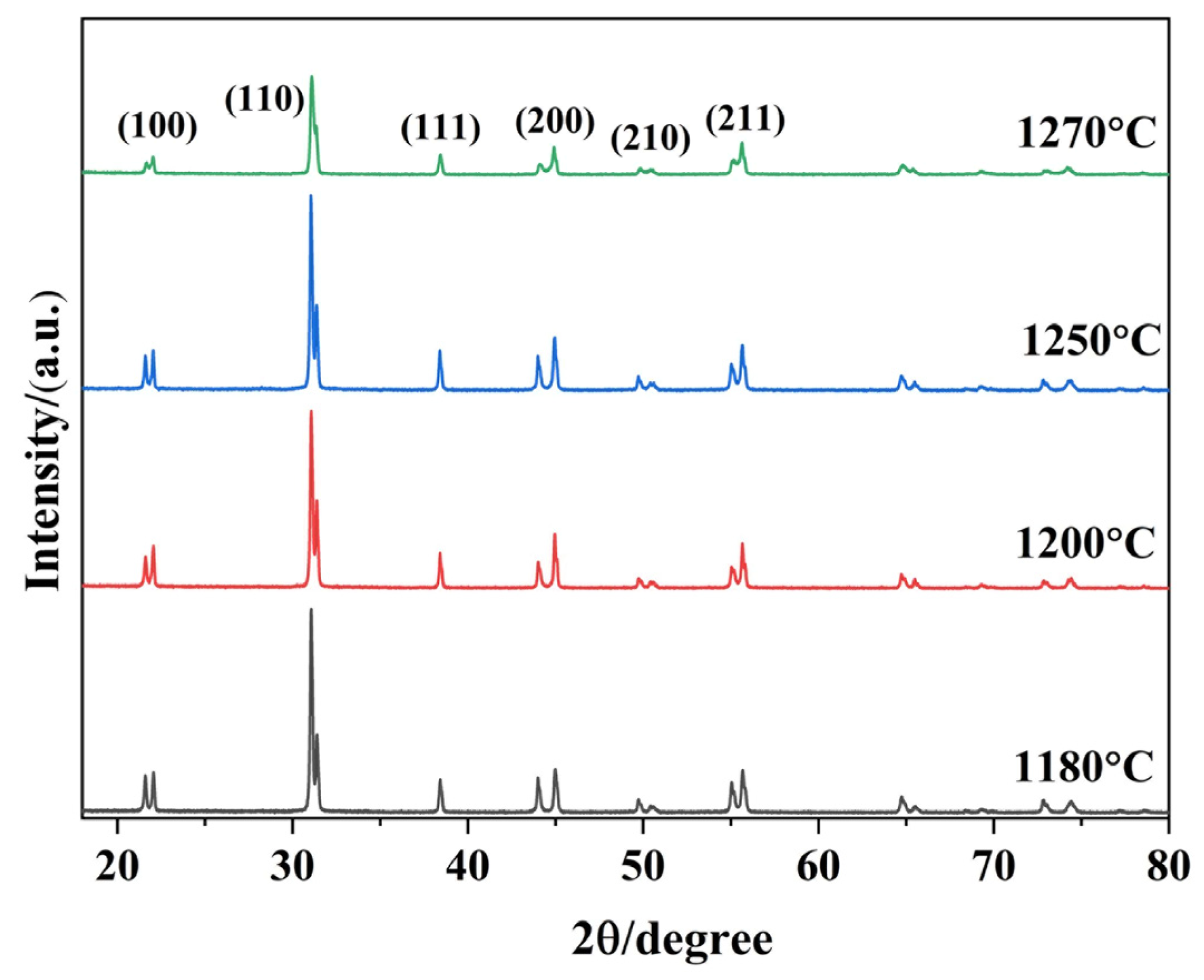
Figure 1 presents the XRD patterns of PMT-PNT-PZ-PT ceramics sintered at different temperatures (1180 °C, 1200 °C, 1250 °C, and 1270 °C). The positions of the main diffraction peaks remain essentially unchanged with sintering temperature, indicating that the perovskite structure is maintained and no secondary phases appear. Although this observation alone does not directly prove dopant incorporation into the lattice, the subsequent variations in electrical properties (discussed below) are consistent with the expected effects of Mn, Ni, and Ta entering the B-site of the perovskite lattice, as widely documented for similar PZT-based systems. All diffraction peaks were indexed based on the tetragonal perovskite structure (JCPDS No. 70-4260), and no peaks corresponding to secondary phases were observed, indicating the formation of a pure perovskite solid solution. The crystal structure is identified as tetragonal for the PMT-PNT-PZ-PT ceramics, as evidenced by a (200)/(002) peak intensity ratio of approximately 1:2. Furthermore, the (110) diffraction peak shows a subtle variation in intensity with sintering temperature, with the highest intensity observed at 1200 °C. This trend is consistent with literature reports on PZT-based ceramics, where intermediate sintering temperatures promote optimal crystallinity, while excessive temperatures may introduce lattice distortion or lead loss that reduces peak intensity.
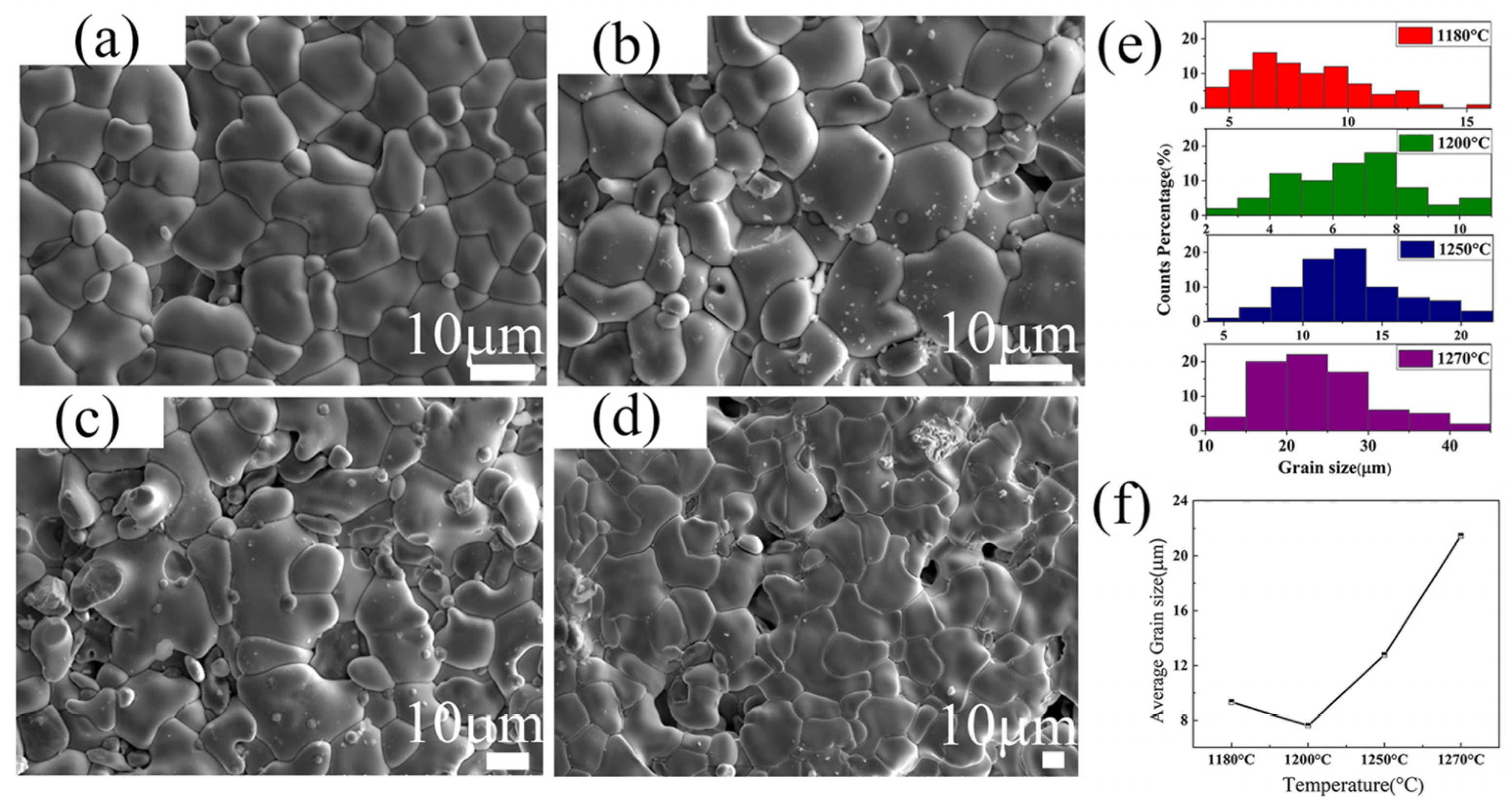
Figure 2a–d displays the SEM micrographs of PMT-PNT-PZ-PT ceramics sintered at different temperatures. The samples sintered at 1180 °C and 1200 °C exhibit a dense microstructure, well-developed grains, and no visible pores or abnormal grain growth, suggesting excellent ceramic quality and optimal electrical properties at these temperatures. The grain size as a function of sintering temperature is summarized in Figure 2e,f. As the sintering temperature increases, the average grain size shows a clear upward trend, indicating that higher temperatures promote grain growth. However, the emergence of pores at elevated temperatures likely reduces the densification of the ceramics, thereby degrading their electrical performance. In the sample sintered at 1270 °C, the grains are closely bonded and exhibit a tendency to coalesce, which can be attributed to the partial melting of over-sintered grains.
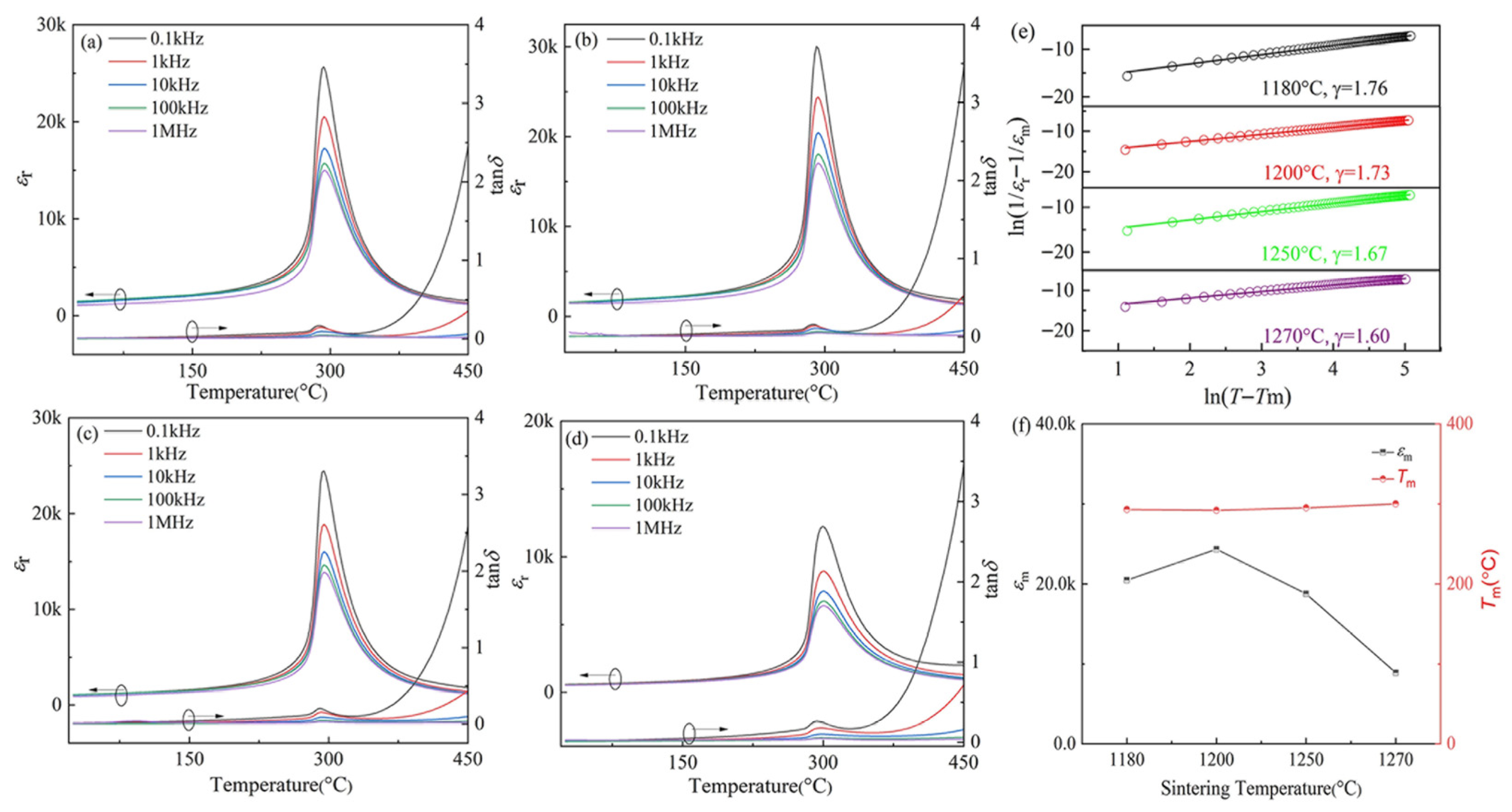
Figure 3a–d illustrates the temperature dependence of the dielectric constant and loss for PMT-PNT-PZ-PT ceramics measured from room temperature to 450 °C at frequencies of 0.1 kHz, 1 kHz, 10 kHz, 100 kHz, 1MHz. A single permittivity peak is observed near the Curie temperature (approximately 300 °C) for all compositions, indicating a ferroelectric–paraelectric phase transition. At room temperature, the ceramics exhibit a purely tetragonal phase, which is consistent with the XRD analysis. The decrease in tanδ with increasing frequency is characteristic of dipolar relaxation, which in perovskite ferroelectrics is often associated with the presence of oxygen-vacancy-related defect dipoles [33,34]. At the low frequency, tanδ start to rapidly increase beyond Tc due to thermally activated space charge conduction behavior [35].
To further analyze the dielectric behavior, a modified empirical formula was employed to evaluate the dielectric dispersion and diffusivity (γ) of the phase transition. The calculation of γ based on the Curie–Weiss law can be formulated as follows:
1 ε 1 ε m = ( T T m ) γ C
where εm is the maximum dielectric constant at Tm. Figure 3e further reveals that all samples exhibit characteristic relaxor ferroelectric behavior with a diffuse phase transition, regardless of sintering temperature. As the sintering temperature increases, the diffuseness parameter γ gradually decreases, suggesting that grain growth tends to suppress the relaxor characteristics. Notably, in the sample sintered at 1180 °C, the dielectric loss (tanδ) remains below 0.02 at 10 kHz. This low-loss profile is highly favorable for applications such as ultrasonic transducers.
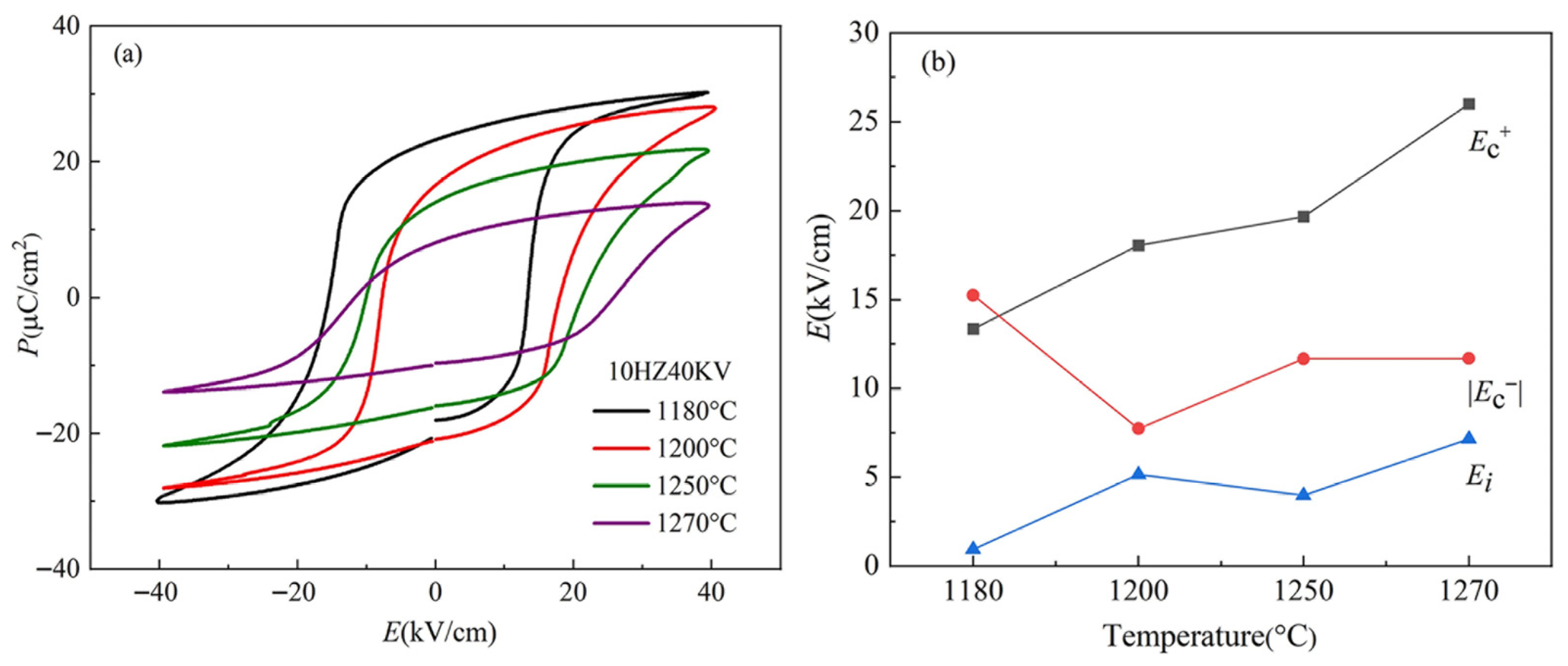
The P-E loops of PMT-PNT-PZ-PT measured at room temperature are shown in Figure 4. With the increase of sintering temperature, P-E loops gradually become asymmetrical. The presence of acceptor–oxygen-vacancy defect dipoles leads to the generation of an internal bias field [36,37,38]. The internal bias field can be calculated by
E i = E c + E c 2
Figure 4b shows the changing rule of E c + , E c and Ei as a function of sintering temperature. The Ei increases proportionally with the sintering temperature, whereby higher temperatures lead to elevated concentrations of oxygen vacancies and defect dipoles, ultimately resulting in an augmented internal bias field. Here, ‘defect dipole’ refers to the association between an acceptor ion and an oxygen vacancy, which aligns under an electric field and gives rise to an internal bias field. The increase in Ei with sintering temperature suggests a higher density of such defect dipoles, likely due to enhanced oxygen vacancy concentration at elevated temperatures.
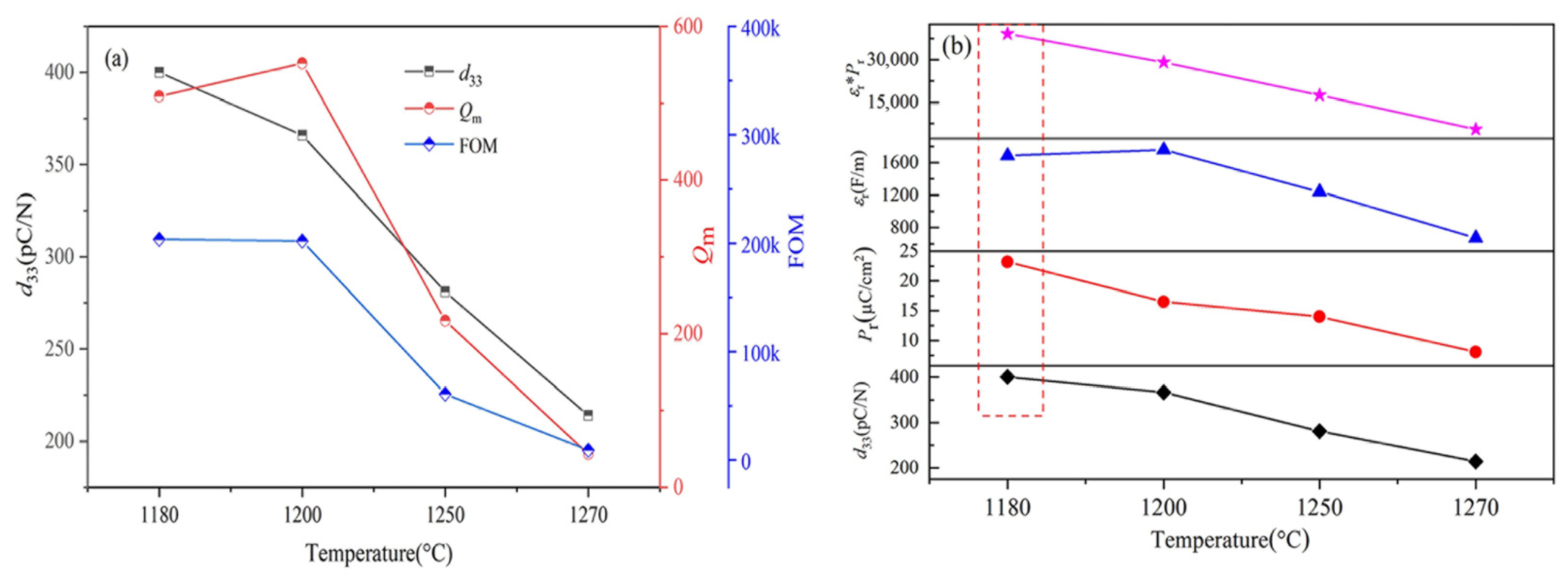
Figure 5 describes the relationship between d33, Qm and sintering temperature. The d33 value gradually decreases with the sintering temperature, while the Qm value initially increases and then subsequently decreases. In order to assess the optimal comprehensive properties of PMT-PNT-PZ-PT ceramics, figure of merit (FOM) is defined as FOM = d33 × Qm [39,40]. According to Figure 5, the optimum integrated performances of d33 (400 pC/N), Qm (509), and FOM (203,600 pC/N) were found for the sintering temperature of 1180 °C. The observed trends can be explained by the incorporation of Mn ions and the associated generation of oxygen vacancies for charge compensation. These point defects act as pinning centers for domain walls, restricting their motion [41,42]. This pinning effect is responsible for the gradual decrease in d33 and the initial increase in Qm with sintering temperature, as domain wall contributions to dielectric and piezoelectric responses are reduced while mechanical losses are minimized. For perovskite ferroelectrics, the piezoelectric coefficient d33 can be expressed as [43]:
d 33 = 2 P r Q ε 0 ε r
where Pr is residual polarization, εr is the dielectric constant, ε0 is the dielectric constant in vacuum, and Q is the electrostrictive coefficient (for the same material Q is the same). When the sintering temperature is 1180 °C, the ceramics have the largest piezoelectric constant (d33). Combined with Figure 5b, the variation of d33 and Prεr is consistent, so the large d33 comes from Prεr. The analysis shows that the Mn enters the lattice at higher temperatures. To uphold the electrical neutrality of the cell, a greater number of oxygen vacancies are generated within the material. The existence of oxygen vacancies hinders the mobility of the domain wall, resulting in a decrease in d33 and kp, while Qm exhibits an increase. Incorporation of Mn ions into the system induces ceramic “strengthening” effects, leading to an enhancement in Qm.
The properties of the ceramics are compared with those of commercial PZT4 ceramics and other ceramics, as presented in Table 1. We effectively reconcile the trade-off between d33 and Qm, thereby presenting a novel approach to enhance the sensitivity of ultrasonic transducers while minimizing heat generation. Manganese ions can exist in multiple valence states (Mn2+, Mn3+, Mn4+). In the PZT lattice, Mn preferentially occupies B-sites (Zr4+, Ti4+). If Mn enters as Mn2+ or Mn3+, it acts as an acceptor, creating negative effective charges (e.g., Mn″Zr for Mn2+ on Zr4+ site, or Mn′Zr for Mn3+). To maintain electroneutrality, oxygen vacancies (VO••) with effective positive charges are formed. These acceptor–oxygen vacancy pairs (Mn″Zr-VO••) constitute defect dipoles that pin domain walls, leading to increased Qm and reduced d33. The degrees of acceptor incorporation and oxygen vacancy concentration increase with sintering temperature, explaining the observed trends. Furthermore, it reveals significant advantages in various other properties compared to the aforementioned piezoelectric ceramics.

4. Conclusions

The effects of sintering temperature on the phase structure and electrical properties of 0.006Pb(Mn1/3Ta2/3)O3-0.114Pb(Ni1/3Ta2/3)O3-0.43PbZrO3-0.45PbTiO3 (PMT-PNT-PZ-PT) ceramics were comprehensively investigated. The sintering temperature plays a critical role in tailoring the microstructure and electrical performance of PMT-PNT-PZ-PT ceramics. The ceramic sintered at 1200 °C exhibited the smallest grain size along with the highest mechanical quality factor (Qm) and relative permittivity (εr). The piezoelectric constant d33 (400 pC/N) is achieved at 1180 °C, accompanied by a significant Prεr (39,115 μCcm−2). Compared to commercial PZT-4 ceramics, the composition sintered at 1180 °C attained an optimal balance between d33 and Qm, resulting in a superior comprehensive figure of merit (FOM = 2.04 × 10⁵ pC/N). These results not only provide a viable candidate material for high-power and temperature-stable piezoelectric devices but also offer valuable insights into the processing–property relationships in complex perovskite ceramics.

Author Contributions

Conceptualization, J.W.; data curation, S.Y. and Y.M.; formal analysis, S.Y., L.L., Y.J. and Y.M.; software, Y.J., J.H. and Y.M.; writing—original draft, S.Y., J.W., Y.J. and Y.M.; writing—review and editing, J.W. and F.W. All authors have read and agreed to the published version of the manuscript.

Funding

This study is supported by the Heilongjiang Provincial Natural Science Foundation of China (No. PL2024A005).

Data Availability Statement

The original contributions presented in the study are included in the article, further inquiries can be directed to the corresponding authors.

Conflicts of Interest

Authors Junjun Wang and Junjun He were employed by the company Harbin Kaina Technology Co., Ltd., and Liqiang Liu was employed by the company Harbin Hatran Navigation Technology Co., Ltd. The remaining authors declare that the research was conducted in the absence of any commercial or financial relationships that could be construed as a potential conflict of interest.

References

  1. Yang, X.R.; Li, W.L.; Qiao, Y.L.; Zhang, Y.L.; He, J.; Fei, W.D. High Energy-Storage Density of Lead-Free (Sr1−1.5xBix)Ti0.99Mn0.01O3 Thin Films Induced by Bi3+-VSr Dipolar Defects. Phys. Chem. Chem. Phys. 2019, 21, 16359–16366. [Google Scholar] [CrossRef]
  2. Clementi, G.; Lombardi, G.; Margueron, S.; Suarez, M.A.; Lebrasseur, E.; Ballandras, S.; Imbaud, J.; Lardet-Vieudrin, F.; Gauthier-Manuel, L.; Dulmet, B.; et al. LiNbO3 films-A low-cost alternative lead-free piezoelectric material for vibrational energy harvesters. Mech. Syst. Signal Process. 2020, 149, 107171. [Google Scholar] [CrossRef]
  3. Brusa, E.; Carrera, A.; Delprete, C. A Review of Piezoelectric Energy Harvesting: Materials, Design, and Readout Circuits. Actuators 2023, 12, 457. [Google Scholar] [CrossRef]
  4. Yan, Y.; Zhou, J.E.; Maurya, D.; Wang, Y.U.; Priya, S. Giant Piezoelectric Voltage Coefficient in Grain-Oriented Modified PbTiO3 Material. Nat. Commun. 2016, 7, 13089. [Google Scholar] [CrossRef]
  5. Tressler, J.F.; Alkoy, S.; Newnham, R.E. Piezoelectric Sensors and Sensor Materials. J. Electroceram. 1998, 2, 257–272. [Google Scholar] [CrossRef]
  6. Yang, X.; Li, W.; Zhang, Y.; Qiao, Y.; Yang, Y.; Fei, W. High Energy Storage Density Achieved in Bi3+-Li+ Co-Doped SrTi0.99Mn0.01O3 Thin Film via Ionic Pair Dooping-Engineering. J. Eur. Ceram. Soc. 2020, 40, 706–711. [Google Scholar] [CrossRef]
  7. Bartasyte, A.; Clementi, G.; Micard, Q.; Labbaveettil, I.; Moreira, A.S.L.; Boujnah, S.; Ouhabaz, M.; Verma, A.; Ichangi, A.; Malandrino, G.; et al. Material strategies to enhance the performance of piezoelectric energy harvesters based on lead-free materials. J. Micromech. Microeng. 2023, 33, 053001. [Google Scholar] [CrossRef]
  8. Yang, L.; Huang, H.; Xi, Z.; Zheng, L.; Xu, S.; Tian, G.; Zhai, Y.; Guo, F.; Kong, L.; Wang, Y.; et al. Simultaneously Achieving Giant Piezoelectricity and Record Coercive Field Enhancement in Relaxor-Based Ferroelectric Crystals. Nat. Commun. 2022, 13, 2444. [Google Scholar] [CrossRef]
  9. Wu, H.; Fu, S.; Wang, S.; Pan, H.; Zha, B.; Gao, A.; Li, L.; Liu, Z.; Liu, L.; Jiao, J.; et al. Electrical Current Visualization Sensor Based on Magneto-Electrochromic Effect. Nano Energy 2022, 98, 107226. [Google Scholar] [CrossRef]
  10. Zhang, Y.; Jie, W.; Chen, P.; Liu, W.; Hao, J. Ferroelectric and Piezoelectric Effects on the Optical Process in Advanced Materials and Devices. Adv. Mater. 2018, 30, 1707007. [Google Scholar] [CrossRef]
  11. Wang, Y.; Wang, S.; Meng, Y.; Liu, Z.; Li, D.; Bai, Y.; Yuan, G.; Wang, Y.; Zhang, X.; Li, X.; et al. Pyro-Catalysis for Tooth Whitening via Oral Temperature Fluctuation. Nat. Commun. 2022, 13, 4419. [Google Scholar] [CrossRef] [PubMed]
  12. Li, Z.; Yi, X.; Yang, J.; Bian, L.; Yu, Z.; Dong, S. Designing Artificial Vibration Modes of Piezoelectric Devices Using Programmable, 3D Ordered Structure with Piezoceramic Strain Units. Adv. Mater. 2022, 34, 2107236. [Google Scholar] [CrossRef]
  13. Li, Q.; Dong, G.; Zhao, Y.; Liu, R.; Zhang, J.; Lin, X.; Huang, S. High piezoelectric properties and excellent thermal stability in PNN-modified lead zirconate titanate piezoceramics. J. Am. Ceram. Soc. 2025, 108, 20643. [Google Scholar] [CrossRef]
  14. Li, D.; Zeng, X.; Li, Z.; Shen, Z.-Y.; Hao, H.; Luo, W.; Wang, X.; Song, F.; Wang, Z.; Li, Y. Progress and Perspectives in Dielectric Energy Storage Ceramics. J. Adv. Ceram. 2021, 10, 675–703. [Google Scholar] [CrossRef]
  15. Li, F.; Lin, D.; Chen, Z.; Cheng, Z.; Wang, J.; Li, C.; Xu, Z.; Huang, Q.; Liao, X.; Chen, L.-Q.; et al. Ultrahigh Piezoelectricity in Ferroelectric Ceramics by Design. Nat. Mater. 2018, 17, 349–354. [Google Scholar] [CrossRef] [PubMed]
  16. Yimnirun, R.; Ananta, S.; Laoratanakul, P. Dielectric and Ferroelectric Properties of Lead Magnesium Niobate-Lead Zirconate Titanate Ceramics Prepared by Mixed-Oxide Method. J. Eur. Ceram. Soc. 2005, 25, 3235–3242. [Google Scholar] [CrossRef]
  17. Wang, H.; Zhang, F.; Chen, Y.; Huang, C.; Wang, X.; Wu, X.; Chen, Y.; Xu, Y.; Guan, S.; Zhu, J.; et al. Giant Piezoelectric Coefficient of PNN-PZT-Based Relaxor Piezoelectric Ceramics by Constructing an RT MPB. Ceram. Int. 2021, 47, 12284–12291. [Google Scholar] [CrossRef]
  18. He, C.; Li, X.; Wang, Z.; Liu, Y.; Shen, D.; Li, T.; Long, X.; Ye, Z.-G. Growth of Pb(Fe1/2Nb1/2)O3-Pb(Yb1/2Nb1/2)O3-PbTiO3 Piezo-/Ferroelectric Crystals for High Power and High Temperature Applications. CrystEngComm 2012, 14, 4407–4413. [Google Scholar] [CrossRef]
  19. Zhang, S.; Lee, S.-M.; Kim, D.-H.; Lee, H.-Y.; Shrout, T.R. Characterization of Mn-Modified Pb(Mg1/3Nb2/3)O3-PbZrO3-PbTiO3 Single Crystals for High Power Broad Bandwidth Transducers. Appl. Phys. Lett. 2008, 93, 122908. [Google Scholar] [CrossRef]
  20. Xia, Z.; Li, Q. Structural Phase Transformation and Electrical Properties of (0.90-x)Pb(Mg1/3Nb2/3)O3-xPbTiO3-0.10Pb(Fe1/2Nb1/2)O3 Ferroelectric Ceramics Near the Morphotropic Phase Boundary. Acta Mater. 2007, 55, 6176–6181. [Google Scholar] [CrossRef]
  21. Hou, Y.; Zhu, M.; Gao, F.; Wang, H.; Wang, B.; Yan, H.; Tian, C. Effect of MnO2 Addition on the Structure and Electrical Properties of Pb(Zn1/3Nb2/3)0.20(Zr0.50Ti0.50)0.80O3 Ceramics. J. Am. Ceram. Soc. 2004, 87, 847–850. [Google Scholar]
  22. Gao, X.; Wu, J.; Yu, Y.; Chu, Z.; Shi, H.; Dong, S. Giant Piezoelectric Coefficients in Relaxor Piezoelectric Ceramic PNN-PZT for Vibration Energy Harvesting. Adv. Funct. Mater. 2018, 28, 1706895. [Google Scholar]
  23. Zhao, S.; Wu, H.; Sun, Q. Study on PSN-PZN-PZT Quaternary Piezoelectric Ceramics Near the Morphotropic Phase Boundary. Mater. Sci. Eng. B 2005, 123, 203–210. [Google Scholar]
  24. Wang, Z.; Li, X.; He, C.; Liu, Y.; Han, S.; Pan, S.; Long, X. Characteristic Electrical Properties of Pb(Sc1/2Nb1/2)O3-PbTiO3 Ferroelectric Crystals. J. Mater. Sci. 2015, 50, 3970–3975. [Google Scholar]
  25. Huang, T.; Fu, J.; Zuo, R. A Pb(Zr,Ti)O3-Pb(Zn1/3Nb2/3)O3-Bi(Mn2/3Sb1/3)O3 Quaternary Solid Solution Ceramic with Low Sintering Temperature, High Piezoelectric Coefficient and Large Mechanical Quality Factor. J. Mater. Sci. Mater. Electron. 2019, 30, 9540–9546. [Google Scholar] [CrossRef]
  26. Zhang, H.; Shen, J.; Tian, J.; Zhou, J.; Chen, W. Elastic, Dielectric and Piezoelectric Properties of Fe2O3 Doped PMnS-PZN-PZT Ceramics. Ferroelectrics 2016, 491, 15–26. [Google Scholar] [CrossRef]
  27. Lee, H.J.; Zhang, S. Design of Low-Loss 1-3 Piezoelectric Composites for High-Power Transducer Applications. IEEE Trans. Ultrason. Ferroelectr. Freq. Control. 2012, 59, 1969–1975. [Google Scholar] [PubMed]
  28. Lee, S.M.; Lee, S.H.; Yoon, C.B.; Kim, H.E.; Lee, K.W. Low-Temperature Sintering of MnO2-Doped PZT-PZN Piezoelectric Ceramics. J. Electroceram. 2007, 18, 311–315. [Google Scholar]
  29. Dabas, S.; Kumar, M.; Chaudhary, P.; Thakur, O.P. Enhanced Magneto-Electric Coupling and Energy Storage Analysis in Mn-Modified Lead Free BiFeO3-BaTiO3 Solid Solutions. J. Appl. Phys. 2019, 126, 134102. [Google Scholar] [CrossRef]
  30. Yoo, J.; Lee, C.; Jeong, Y.; Chung, K.; Lee, D.; Paik, D. Microstructural and Piezoelectric Properties of Low Temperature Sintering PMN-PZT Ceramics with the Amount of Li2CO3 Addition. Mater. Chem. Phys. 2005, 90, 386–390. [Google Scholar] [CrossRef]
  31. Zhang, S.; Xia, R.; Shrout, T.R. Low Temperature Sintering and Properties of Piezoelectric Ceramics PSNT-Mn with LiBiO2 Addition. Mater. Sci. Eng. B 2006, 129, 131–134. [Google Scholar] [CrossRef]
  32. Tan, C.K.I.; Sharifzadeh Mirshekarloo, M.; Lai, S.C.; Zhang, L.; Yao, K. PNN-PZN-PMN-PZ-PT Multilayer Piezoelectric Ceramic with Low Sintering Temperature. Int. J. Appl. Ceram. Technol. 2016, 13, 889–895. [Google Scholar] [CrossRef]
  33. Li, Z.; Fan, H. Polaron Relaxation Associated with the Localized Oxygen Vacancies in Ba0.85Sr0.15TiO3 Ceramics at High Temperatures. J. Appl. Phys. 2009, 106, 054102. [Google Scholar] [CrossRef]
  34. Guiffard, B.; Boucher, E.; Eyraud, L.; Lebrun, L.; Guyomar, D. Influence of donor co-doping by niobium or fluorine on the conductivity of Mn doped and Mg doped PZT ceramics. J. Eur. Ceram. Soc. 2005, 25, 2487–2490. [Google Scholar] [CrossRef]
  35. Chen, Y.; Li, L.; Zhou, Z.; Wang, Y.; Chen, Q.; Wang, Q. La2O3-Modified BiYbO3-Pb(Zr,Ti)O3 Ternary Piezoelectric Ceramics with Enhanced Electrical Properties and Thermal Depolarization Temperature. J. Adv. Ceram. 2023, 12, 1593–1611. [Google Scholar] [CrossRef]
  36. Zhang, S.; Lebrun, L.; Randall, C.A.; Shrout, T.R. Growth and Electrical Properties of (Mn, F) Co-Doped 0.92Pb(Zn1/3Nb2/3)O3-0.08PbTiO3 Single Crystal. J. Cryst. Growth 2004, 267, 204–212. [Google Scholar] [CrossRef]
  37. Chen, X.; Liao, Y.; Wang, H.; Mao, L.; Xiao, D.; Zhu, J.; Chen, Q. Phase Structure and Electric Properties of Bi0.5(Na0.825K0.175)0.5TiO3 Ceramics Prepared by a Sol-Gel Method. J. Alloys Compd. 2010, 493, 368–371. [Google Scholar] [CrossRef]
  38. Chauhan, A.; Patel, S.; Vaish, R. Mechanical Confinement for Improved Energy Storage Density in BNT-BT-KNN Lead-Free Ceramic Capacitors. AIP Adv. 2014, 4, 087106. [Google Scholar] [CrossRef]
  39. Kim, S.W.; Lee, H.C. Development of PZN-PMN-PZT Piezoelectric Ceramics with High d33 and Qm Values. Materials 2022, 15, 7070. [Google Scholar] [CrossRef] [PubMed]
  40. Yang, Y.; Sun, E.; Xu, Z.; Zheng, H.; Yang, B.; Zhang, R.; Cao, W. Sm and Mn co-doped PMN-PT piezoelectric ceramics: Defect engineering strategy to achieve large d33 and high Qm. J. Mater. Sci. Technol. 2023, 137, 143–151. [Google Scholar] [CrossRef]
  41. Kamboj, B.; Tanwar, V.; Yadav, A.K.; Yadav, S.; Ghosh, D.; Ingole, P.P. Site-Specific Selenium Substitution Enhances Charge Storage Performance in Solid-State Flexible MnFe2O4-Based Supercapacitor Devices via Modulated d-States. Adv. Funct. Mater. 2025, 36, 16045. [Google Scholar]
  42. Wu, Y.; Cheng, Y.; Guan, S.; Wang, X.; Shi, W.; Xu, H.; Lang, R.; Xing, J.; Zhu, J.; Chen, Q. KNN-Based Lead-Free Piezoelectric Ceramics with High Qm and Enhanced d33 via a Donor-Acceptor Codoping Strategy. Inorg. Chem. 2023, 62, 15094–15103. [Google Scholar] [CrossRef]
  43. Bian, L.; Zhu, K.; Wang, Q.; Ma, J.; Fan, J.; Qi, X.; Jiang, G.; Zhao, B.; Zhang, R.; Yang, B.; et al. Performance Enhancement of Ultrasonic Transducer Made of Textured PNN-PZT Ceramic. J. Adv. Dielectr. 2022, 12, 2244003. [Google Scholar] [CrossRef]
  44. Haertling, G.H. Ferroelectric Ceramics: History and Technology. J. Am. Ceram. Soc. 1999, 82, 797–818. [Google Scholar] [CrossRef]
  45. Zhang, S.; Lee, S.M.; Kim, D.H.; Lee, H.-Y.; Shrout, T.R. Temperature Dependence of the Dielectric, Piezoelectric, and Elastic Constants for Pb(Mg1/3Nb2/3)O3-PbZrO3-PbTiO3 Piezocrystals. J. Appl. Phys. 2007, 102, 114103. [Google Scholar]
  46. Feng, Y.; Yang, C.; Guo, X.; Sun, W.; Wang, W.; Lin, X.; Huang, S. Achieving Both Large Piezoelectric Constant and Low Dielectric Loss in BiScO3-PbTiO3–Bi(Mn2/3Sb1/3)O3 High-Temperature Piezoelectric Ceramics. J. Adv. Dielectr. 2022, 12, 2250017. [Google Scholar] [CrossRef]
  47. Zhou, C.; Zhang, J.; Yao, W.; Liu, D.; He, G. Remarkably Strong Piezoelectricity, Rhombohedral-Orthorhombic-Tetragonal Phase Coexistence and Domain Structure of (K,Na)(Nb,Sb)O3-(Bi,Na)ZrO3-BaZrO3 Ceramics. J. Alloys Compd. 2020, 820, 153411. [Google Scholar] [CrossRef]
Figure 1. XRD pattern of PMT-PNT-PZ-PT ceramics at different sintering temperatures.
Crystals 16 00163 g001
Figure 2. SEM microstructure of calcined ceramic at different sintering temperatures (a) 1180 °C, (b) 1200 °C, (c) 1250 °C, (d) 1270 °C, (e) Grain size distribution, (f) Variations of average grain size.
Crystals 16 00163 g002
Figure 3. Temperature dependence of dielectric constant and dielectric loss of PMT-PNT-PZ-PT ceramics with different frequencies at different sintering temperatures: (a) 1180 °C, (b) 1200 °C, (c) 1250 °C, (d) 1270 °C, (e) Modified Curie–Weiss fitting curves of PMT-PNT-PZ-PT ceramics sintered at different temperatures, (f) Variations of εm, Tm.
Crystals 16 00163 g003
Figure 4. Ferroelectric properties of PMT-PNT-PZ-PT ceramics: (a) P-E hysteresis loops, (b) The coercive field of positive electric field ( E c + ), negative electric field ( E c ), and the internal bias field (Ei).
Crystals 16 00163 g004
Figure 5. (a) Values of Qm, d33 and FOM with the sintering temperatures, (b) The electrical properties of PMT-PNT-PZ-PT ceramics sintered at different temperatures.
Crystals 16 00163 g005
Table 1. Comparison of electrical properties between the present PMT-PNT-PZ-PT ceramic (sintered at 1180 °C) and other representative piezoelectric ceramics.
MaterialεrkpktTc (°C)d33 (pC/N)QmFOM(pC/N)Ref.
PMT-PNT-PZ-PT (1180 °C)16860.65 3044005092.04 × 105This work
PZT413000.58 3282895001.50 × 105[44]
PMN-PZT 21615301001.53 × 105[45]
BS–yPT–xBMS13840.50 410330842.80 × 104[46]
KNNS-BNZ-xBZ34600.580.45 610342.10 × 104[47]
Disclaimer/Publisher’s Note: The statements, opinions and data contained in all publications are solely those of the individual author(s) and contributor(s) and not of MDPI and/or the editor(s). MDPI and/or the editor(s) disclaim responsibility for any injury to people or property resulting from any ideas, methods, instructions or products referred to in the content.