Article

Spectroscopic Ellipsometry and Luminescence Properties of Low Temperature Sputter-Deposited Zinc Oxide Thin Films: Cryogenic Self-Stress-Induced Crystallization


1
Department of Chemistry & Physics, Alcorn State University, Lorman, MS 39096, USA
2
Department of Physics and Astronomy, Ohio University, Athens, OH 45701, USA
3
School of Electrical Engineering and Computer Science, Ohio University, Athens, OH 45701, USA
4
Center for Smart, Sustainable & Resilient Infrastructure (CSSRI), Department of Civil and Architectural Engineering and Construction Management, University of Cincinnati, Cincinnati, OH 45221, USA
5
Center for Photovoltaics Innovation and Commercialization, Department of Physics and Astronomy, University of Toledo, Toledo, OH 43606, USA
6
Kelly Education, Vicksburg, MS 39180, USA
*
Author to whom correspondence should be addressed.
Crystals 2025, 15(12), 1031; https://doi.org/10.3390/cryst15121031
Submission received: 27 October 2025 / Revised: 24 November 2025 / Accepted: 27 November 2025 / Published: 2 December 2025
(This article belongs to the Section Inorganic Crystalline Materials)

Abstract

Zinc oxide (ZnO) thin films were deposited by radio-frequency reactive magnetron sputtering at a cryogenic substrate temperature of −78 °C to explore a novel low-thermal-budget route for semiconductor growth. Despite the extremely low temperature, X-ray diffraction revealed spontaneous partial crystallization of wurtzite ZnO upon warming to room temperature, driven by strain relaxation and stress coupling at the ZnO/SiO2 interface. Atomic-force and scanning-electron microscopies confirmed nanoscale hillock and ridge morphologies that correlate with in-plane compressive stress and out-of-plane tensile strain. Spectroscopic ellipsometry, modeled using a general oscillator (GO) mathematical model approach, determined a film thickness of 60.81 nm, surface roughness of 3.75 nm, and a direct optical bandgap of 3.40 eV. Photoluminescence spectra exhibited strong near-band-edge emission modulated with LO-phonon replicas at 300 K, indicating robust exciton–phonon coupling. This study demonstrates that ZnO films grown at cryogenic conditions can undergo substrate-induced self-crystallize upon warming, which eliminates the need for thermal annealing. The introduced cryogenic self-crystallization regime offers a new pathway for depositing crystalline semiconductors on thermally sensitive or flexible substrates where heating is undesirable, enabling future optoelectronic and photonic device fabrication under ultra-low thermal-budget conditions.

1. Introduction

Zinc oxide (ZnO) is a II–VI semiconductor that has attracted sustained attention because of its direct wide bandgap of about 3.3 eV at room temperature and large exciton binding energy of 60 meV [1,2,3]. These properties distinguish ZnO from other wide bandgap semiconductors such as GaN, enabling efficient excitonic processes even at room temperature [4,5]. The combination of optical transparency in the visible range, strong ultraviolet (UV) absorption, and the ability to form stable thin films makes ZnO a promising material for optoelectronic applications, including UV light-emitting diodes, laser diodes, photodetectors, and transparent electronics [6,7,8]. ZnO is also abundant, inexpensive, and compatible with low-temperature, large-area deposition techniques such as sputtering, pulsed-laser deposition, and solution processing, further enhancing its technological importance [9,10,11]. The fundamental optical properties of ZnO are dominated by excitonic effects. Because of its unusually large binding energy, ZnO exhibits stable free excitons (FX), donor- and acceptor-bound excitons (BX), and donor–acceptor pair (DAP) transitions [12,13]. These excitonic features dominate the near-band-edge (NBE) luminescence even at or above room temperature [14,15]. Historically, the role of excitons in ZnO was emphasized through both steady-state and time-resolved photoluminescence (PL) studies, which revealed discrete zero-phonon lines (ZPLs) and their phonon-assisted replicas [16,17]. Such strong excitonic signatures, which are typically well resolved at low temperatures, lose their spectral resolution and become strongly convoluted at elevated temperatures due to thermalization and strong phonon coupling processes. Therefore, the ZnO system is unusual among oxide semiconductors, and it provides an excellent model system for studying light–matter interactions in the excitonic regime [18].
A defining aspect of ZnO’s optical physics is its strong exciton–phonon coupling. The longitudinal optical (LO) phonon in ZnO has an energy of about 70–80 meV, and it couples strongly with both FX and BX states [19,20]. This interaction produces a ladder of exciton–phonon complexes (EPCs), giving rise to phonon sidebands in absorption and PL spectra [21,22,23]. Some theoretical models predicted that EPC replicas should appear below and above the exciton resonance, and experiments confirmed the prominence of both Stokes-shifted (−mLO) and anti-Stokes (+mLO) sidebands in emission [24,25,26,27,28,29]. These observations challenge the traditional picture of EPC processes and suggest the presence of complex non-adiabatic interactions, phonon dressing of excitons, or recombination from localized exciton–phonon polaron states [30,31,32]. The nature of EPC in ZnO is further complicated by microstructural effects. In high-quality single crystals or epitaxial films, excitonic transitions and their LO-phonon replicas are sharp and well resolved [9]. In contrast, thin films and nanostructures grown under non-equilibrium conditions often display a coexistence of relaxed and strained grains, defects, and disordered regions. Low-temperature growth, in particular, tends to favor amorphous or nanocrystalline morphologies. Such heterogeneity profoundly affects EPC: strained domains can modify the phonon energies or selection rules, while relaxed grains may favor conventional exciton–LO transitions [33,34,35,36,37,38,39,40,41]. Recent experimental studies highlight this sensitivity. Morphology-dependent PL studies have shown that the strength and visibility of LO phonon replicas vary systematically with grain size, surface orientation, and nanostructure geometry [42,43]. Ellipsometry and ultrafast pump–probe experiments have directly resolved how hot carriers in ZnO rapidly relax toward the band edge, where exciton–phonon interactions shape the transient dielectric response [44,45,46]. In addition, plasmonic and cavity-enhanced ZnO systems demonstrate that the local electromagnetic environment can selectively amplify EPC sidebands, providing a new diagnostic tool for exciton–phonon interactions [47]. Collectively, these findings establish that EPC in ZnO is not only an intrinsic property of the polar lattice but also strongly dependent on growth conditions, strain, and the surrounding environment.
In this work, we focus on ZnO thin films deposited at cryogenic temperatures, where the growth conditions often favor amorphous structures. Despite the low-temperature growth, we observe a strong NBE band at 300 K modulated with phonon replica features. Analysis of the PL spectra reveals NBE exciton–phonon lines coupling in a form of a ladder of phonon replicas. These findings contribute to the growing body of evidence that ZnO serves as an archetypal material system for the study of exciton–phonon complexes, and they highlight the importance of strain and domain heterogeneity in defining optical properties. Accordingly, we introduce a new experimental regime for semiconductor thin film deposition, based on cryogenic low-temperature sputtering followed by spontaneous self-crystallization upon warming to ambient conditions. In this approach, the adatom mobility during deposition is initially suppressed, producing a dense amorphous or nanostructured layer that subsequently undergoes stress-driven recrystallization as the interfacial strain is released with temperature recovery. This cryogenic self-crystallization pathway offers a fundamentally different growth mechanism compared with conventional thermally assisted crystallization. It enables the formation of crystalline semiconductors and dielectric films at ultra-low thermal-budget conditions, making it especially attractive for applications where substrate heating is undesirable or impractical, such as for flexible electronics, polymeric substrates, or integrated photonic structures on temperature-sensitive dielectrics. The ability to achieve crystalline ordering without external heating introduces a new paradigm for semiconductor fabrication, expanding the design space for low-power and thermally constrained optoelectronic technologies.

2. Materials and Methods

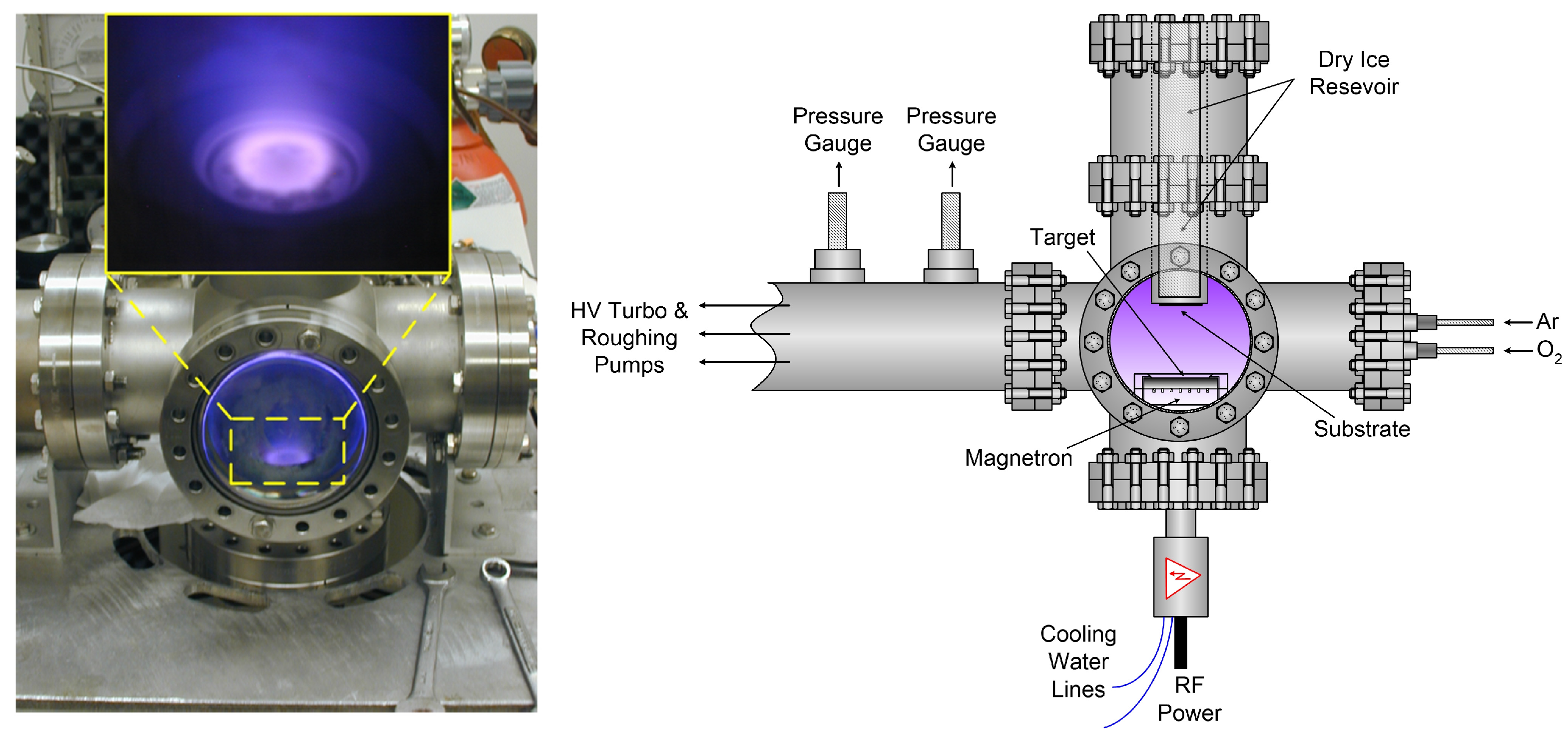
ZnO thin films of thickness < 100 nm were successfully deposited at a cryogenic dry ice temperature of 195 K (−78 °C) using high-vacuum (HV) radio frequency (RF) reactive magnetron sputtering. The sputtering deposition chamber was specifically designed to clamp substrates to a holder that is externally cooled with CO2 dry ice, which limits the growth temperature to 195 K (−78 °C), as shown in Figure 1. Sputtering was achieved using a 2-inch-diameter zinc (Zn) target with 99.999% purity in a pure atmosphere under the flow of oxygen and argon, and the films were deposited onto thermally oxidized SiO2/c-Si(100) and fused silica clean substrates. Before starting deposition, the chamber was evacuated to a base pressure of 5 × 10⁻⁷ Torr, while the deposition total pressure of Ar/O2 was kept at 10 mTorr. To reduce the plasma-induced heat transfer to the substrates during deposition, the sputtering RF power was fixed to 25 W with an average reflected power of 1 W.
The structure of the grown films was characterized by X-ray diffraction (XRD) in the θ-2θ mode using a Rigaku X-ray diffractometer (Rigaku, Tokyo, Japan) with Cu Kα (1.5406 Å) incident radiation. The diffraction angle 2θ scanning range was 15–75°. Samples were characterized using energy-dispersive X-ray spectroscopy (EDX) on a JEOL JSM-5300 scanning electron microscope (JEOL, Tokyo, Japan). The surface morphology was examined using a JEOL JSM-6490 SEM (JEOL, Tokyo, Japan) equipped with a tungsten filament and a secondary electron detector operated in SEI mode. The acceleration voltage was set to 25 kV, and the working distance was maintained at 22 mm to ensure optimal imaging conditions. Prior to imaging, the samples were coated with a thin gold layer to prevent surface charging and enhance secondary electron emission, thereby improving surface contrast and image sharpness. The surface morphology of the ZnO films was further analyzed by atomic force microscopy (AFM) using a Nanosurf NaioAFM system (Nanosurf AG, Liestal, Switzerland) operated in dynamic (tapping) mode. A MikroMasch HQ:NSC18/Al BS silicon cantilever (MikroMasch, Watsonville, CA, USA) with a nominal tip radius of approximately 8 nm was employed, providing a lateral resolution of about 5 nm. The surface was scanned over an area of 5 µm × 5 µm with a resolution of 256 × 256 pixels, enabling high-fidelity topographical imaging and roughness analysis. The photoluminescence (PL) spectra of the ZnO thin films were recorded in air at room temperature using a JASCO FP-8200 spectrofluorometer (JASCO Corp., Tokyo, Japan) equipped with a 150 W xenon arc lamp as the excitation source and a photomultiplier tube (PMT) detector for high-sensitivity emission detection. The excitation wavelength was set to 300 nm. Finally, and for accurate determination of the dielectric functions, bandgap, and thickness, a high-resolution rotating-analyzer variable-angle spectroscopic ellipsometry (RA-VASETM, J. A. Woollam Co. (Lincoln, NE, USA)) equipped with auto-retarder was employed. The spectroscopic ellipsometry (SE) spectra were analyzed using the J. A. Woollam Co. ellipsometry software CompleteEase v6.75b. To reduce the correlation between fitting parameters, the ellipsometric spectra were measured at three angles of incidence (65°, 70° and 75°) in the energy range of 1.0–4.5 eV (275–1240) nm.

3. Results and Discussion

3.1. Elemental Analysis

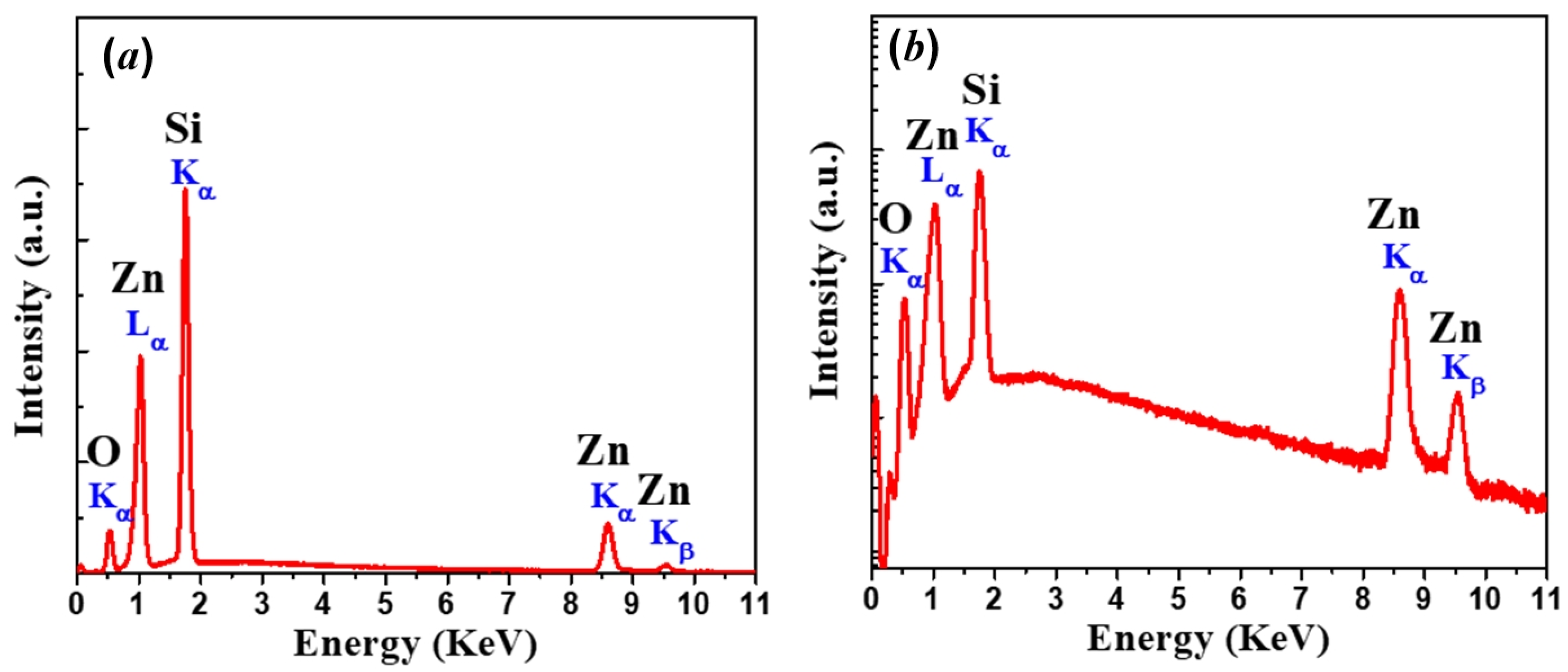
Figure 2 presents the EDX spectrum of the ZnO thin film deposited on 528 nm-SiO2/c-Si(100) substrate. The spectrum reveals distinct peaks corresponding to the constituent elements oxygen (O), zinc (Zn), and silicon (Si), confirming the formation of a ZnO layer on the oxidized silicon substrate. The emission lines are (O Kα), (Zn Lα), (Si Kα), (Zn Kα), and (Zn Kβ). The coexistence of both Zn Lα and the higher-energy Zn Kα and Zn Kβ lines provides compelling evidence that Zn is distributed throughout the entire ZnO film rather than confined to the surface. The high-energy K lines are generated from deeper excitation volumes and have longer attenuation lengths, meaning they can only arise if Zn exists across the full film thickness. The intense Si Kα peak originates from the underlying Si substrate, which is detected despite the 528 nm SiO2 interlayer due to the penetration depth of the incident electron beam, typically in the range of several hundred nanometers to a few micrometers. The moderate Si signal indicates partial beam transmission through the oxide layer and X-ray emission from the substrate, while no separate SiO2-related peaks appear because the oxygen and silicon peaks overlap with those from ZnO and Si, respectively.
Importantly, the absence of any additional peaks in the EDX spectrum (such as carbon or metallic contaminants) verifies the chemical purity of the deposited ZnO film and the cleanliness of the interface with the SiO2 layer. Therefore, the results confirm that ZnO was successfully grown on the thermally oxidized Si substrate, maintaining the expected composition, which is consistent with XRD and SEM observations.

3.2. Structural Analysis

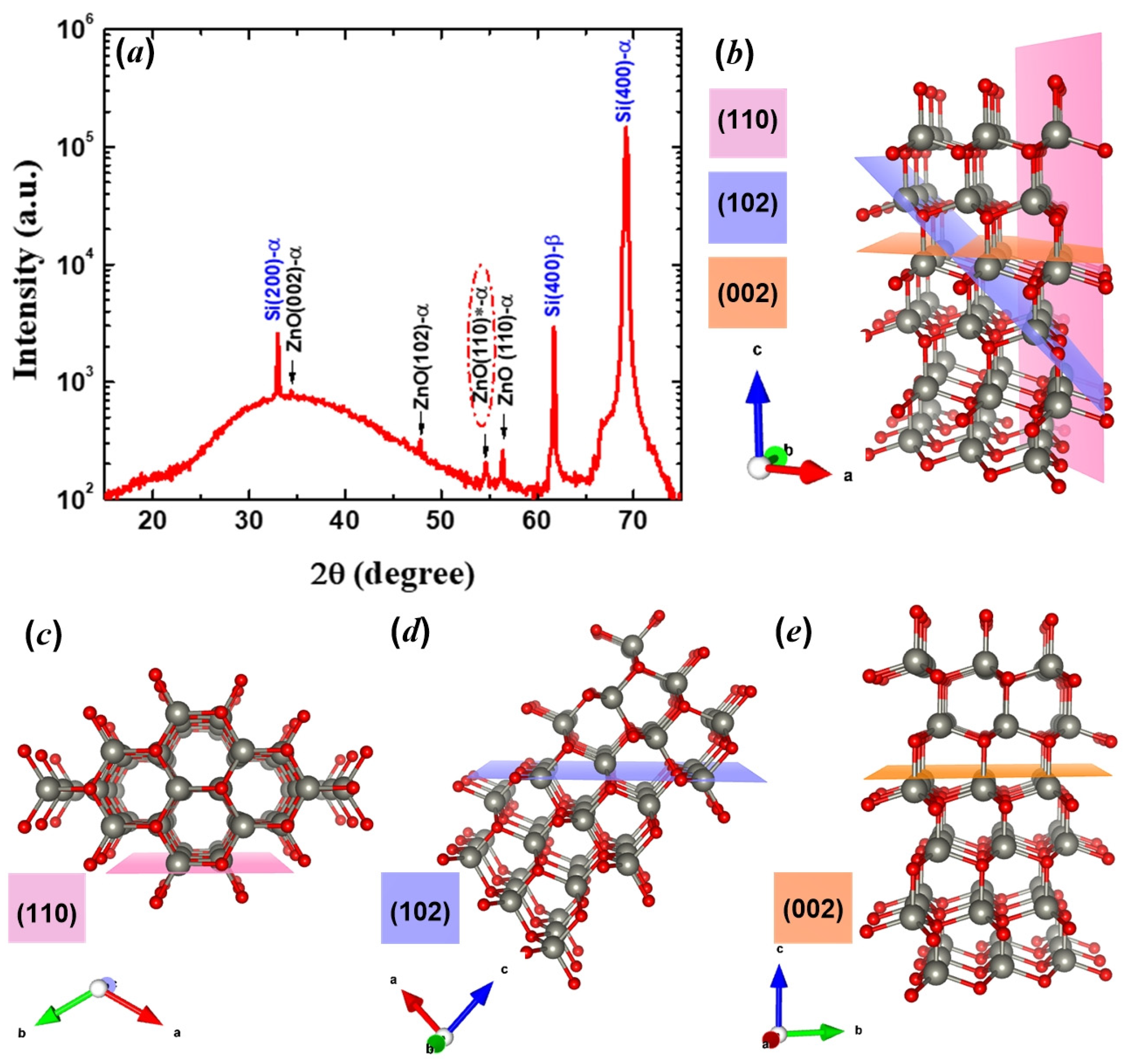
Figure 3a displays the room-temperature XRD pattern of the ZnO thin film deposited at −78 °C on 528 nm-SiO2/c-Si(100) substrate. The XRD (θ-2θ) spectrum exhibits a broad diffuse background between 20° and 40°, which arises from both the SiO2 thick buffer layer and the partially amorphous fraction of the ZnO film. However, weak ZnO reflections corresponding to the (002), (102), and (110) planes of the wurtzite phase are visible, confirming the emergence of nanocrystalline domains embedded in the amorphous matrix. Distinct reflections of the crystalline Si substrate appear at 33° for Si(200) and 69.2° for Si(400) due the Cu Kα incident radiation, as well as Si(400) at 61.7° due to unfiltered Cu Kβ X-ray incident radiation. The absence of additional phases such as Zn2SiO4, Zn, or Zn(OH)2 confirms that the deposited layer is a single-phase ZnO film. Figure 3b–e show the atomic planes (110), (102), and (002) deduced from the relaxed ZnO atomic structure phase (ZnO wurtzite structure from Materials Project, visualized in VESTA [48,49]).
In our XRD pattern, shown in Figure 3a, the (002) peak demonstrates that a fraction of the crystallites are preferentially c-axis oriented, while the coexistence of (102) and (110) reflections indicates the presence of polycrystalline grains with multiple orientations. In addition, the (002) and (110) peaks indicate the coexistence of grains aligned both parallel and oblique to the c-axis of the ZnO unit cell, respectively. Of particular interest is the ZnO (110)* reflection, circled in red in Figure 3a, which appears to be slightly shifted toward a lower 2θ value compared to the other (110) peak. This represents a splitting of the ZnO (110) reflection into two separate peaks at 56.4° and 54.6°. The separation between these peaks is far larger than the instrumental Kα1–Kα2 doublet (~0.1°) and therefore cannot originate from the X-ray source itself. Instead, this splitting indicates the coexistence of two distinct sets of (110)-oriented nanocrystalline domains within the film. One set, appearing at 56.4°, is closer to the bulk position and represents grains that experienced a partial relaxation of stress during recrystallization upon warming from the deposition temperature of −78 °C to room temperature. The second set, shifted to 54.6°, exhibits a noticeably enlarged interplanar spacing, revealing that these grains carry significant out-of-plane tensile deformation and thus remain in a highly strained state.
To fully analyze the strain/stress self-induced crystallization observed in our XRD spectrum, we first analyze the out-of-plane tensile strain of all observed ZnO peaks. Using Bragg’s law
d m e a s = λ   2 s i n ( θ )   ,      
the interplanar spacings dmeas were extracted for each reflection using λ = 1.5406 Å (Cu Kα). The resulting dmeas spacings are summarized in Table 1, along with the corresponding unstrained (fully relaxed) interplanar spacings d0 for the ZnO wurtzite structure, which were calculated using the following equation:
1   d 0 2 = 4 3   ( h 2 + h k + k 2 )   a 0 2 +     l 2   c 0 2   ,      
where h, k, and l are the Miller indices of the corresponding crystallographic plane, and a0 and c0 are the ZnO unstrained lattice constants (a0 = 3.252 Å, c0 = 5.213 Å) [1]. Accordingly, the out-of-plane tensile strain ( ε ), the in-plane compressive strain ( ε ) , and the in-plane stress ( σ ) were all calculated using the following equations for each observed peak, and the results are listed in Table 1:
ε = d m e a s d 0 d 0   ,    
ε = 1 ν 2 ν   ε ,    
σ = E 2 ν   ε ,    
where E is the Young’s modulus, and ν is Poisson’s ratio. E ≈ 140 GPa and ν ≈ 0.34 were used for ZnO.
As can be seen from Table 1, the (002) reflection corresponds to an out-of-plane tensile strain of approximately ε = +4.05%, indicating pronounced elongation along the c-axis in the crystallites oriented normal to the substrate. The (110) reflections show two distinct strain states: the relaxed component exhibits a modest out-of-plane tensile strain of about ε = +0.25%, whereas the strained component shows a much larger value of ε   = +3.26%. In contrast, the (102) peak exhibits a slight compressive plane-normal strain of ε = −0.63%. As an indicator, the sum of these tensile strains leads to a value of ε sum = +6.93%, which clearly indicates that the ZnO film experiences substantial net out-of-plane tensile strain. Under the out-of-plane stress condition appropriate for thin films, where the surface is free and the out-of-plane stress vanishes, the measured out-of-plane strain can be directly related to the in-plane strain and stress using Equations (4) and (5), respectively. The corresponding in-plane strains and stresses were calculated and are listed in Table 1 for each XRD reflection.
The in-plane strain values in Table 1 show the same overall trend as the out-of-plane strains with the consistent opposite sign. The (002) and strained (110)* reflections carry large compressive in-plane components (ε = −3.91% and −3.16%, respectively), whereas the semi-relaxed (110) grain is nearly strain-free (ε = −0.24%) and the (102) grain exhibits only a small tensile contribution (ε = +0.61%). If we simply use the sum of these in-plane strains as an indicator, the total in-plane strain amounts to εsum = −6.70%, which mirrors the positive εsum and confirms that the ZnO crystallites experience substantial in-plane compression strain. This net lateral compression is fully consistent with the strong out-of-plane tensile strain.
Correspondingly, the in-plane stresses extracted from the XRD peak shifts further clarify the mechanical state of the ZnO film. As listed in Table 1, the (002) reflection exhibits a large compressive in-plane stress of σ = −8.33 GPa, indicating strong in-plane contraction associated with the pronounced out-of-plane tensile elongation along the c-axis. The (102) peak, in contrast, shows a small tensile in-plane stress of σ = +1.29 GPa. In addition, the semi-relaxed (110) component yields a modest compressive stress of σ = −0.51 GPa, whereas the highly strained (110)* component shows a much larger compressive value of σ = −6.71 GPa. When considered together, the sum of all measured in-plane stresses is σsum = −14.26 GPa, which clearly demonstrates that the polycrystalline ZnO film is dominated by strong net compressive in-plane stress. This significant in-plane compressive stress state is fully consistent with the out-of-plane tensile strains previously discussed, as required by the elastic compatibility in thin films with constrained in-plane dimensions. Such significant in-plane stress represents the signature of the thermal expansion mismatch between ZnO and the underlying SiO2/Si structure.
The sample incorporates a 528 nm thermally grown SiO2 layer between ZnO and the Si substrate. This thick oxide layer acts as a spacer amorphous buffer that largely decouples ZnO from the crystalline Si substrate. Consequently, the dominant source of strain and stress is the thermal expansion mismatch between ZnO (α ≈ [2.9–4.75] × 10−6 K−1) [1] and SiO2 (α ≈ 0.24 × 10⁻⁶ K−1) [50], while the smaller mismatch with Si (α ≈ 3.59 × 10⁻⁶ K−1) [1,51,52] is not expected to contribute to stress transmission to the ZnO film due to the sufficiently large thickness of the SiO2 buffer layer. The low cryogenic deposition temperature of −78 °C cannot produce any crystallized structure, because the atoms lack the thermal energy needed to move, diffuse, and rearrange into an ordered lattice. Forming a crystalline structure requires atoms to migrate to specific low-energy sites, but at such low temperatures their mobility is essentially frozen, so they remain trapped in random disordered positions. This suppresses nucleation and prevents the growth of well-defined grains, leading instead to an amorphous structure. Thus, the self-crystallization of our ZnO thin film is induced by the in-plane stress upon warming the film to room temperature after deposition. This stress primarily originates at the ZnO–SiO2 interface. Differential thermal contraction upon warming from −78 °C to room temperature (ΔT = +100 °C) produces localized lattice distortion and partial recrystallization, which explain the origin of the partial crystallization of our ZnO deposited at such low crygenic temperature of −78 °C, with an overall out-of-plane tensile strain and in-plane compressive strain and stress.
The high in-plane stress drives the partial crystallization because the strained amorphous structure is in a higher-energy unstable state, which seeks to relax. When the film experiences significant in-plane compressive stress upon warming to room temperature after deposition, the atomic network becomes energetically unfavorable. As the temperature increases, the stored elastic energy provides an additional driving force for atoms to reorganize into a lower-energy crystalline arrangement. In other words, the film relieves its accumulated in-plane stress by allowing atoms to diffuse short distances and form ordered grains. This stress-assisted relaxation lowers the total free energy of the system, making crystallization energetically favorable and enabling the transition from an amorphous state to a polycrystalline structure upon warming to room temperature. The effect of compression on the film surface morphology can be clearly seen in the SEM and AFM images discussed next.

3.3. Morphological Analysis

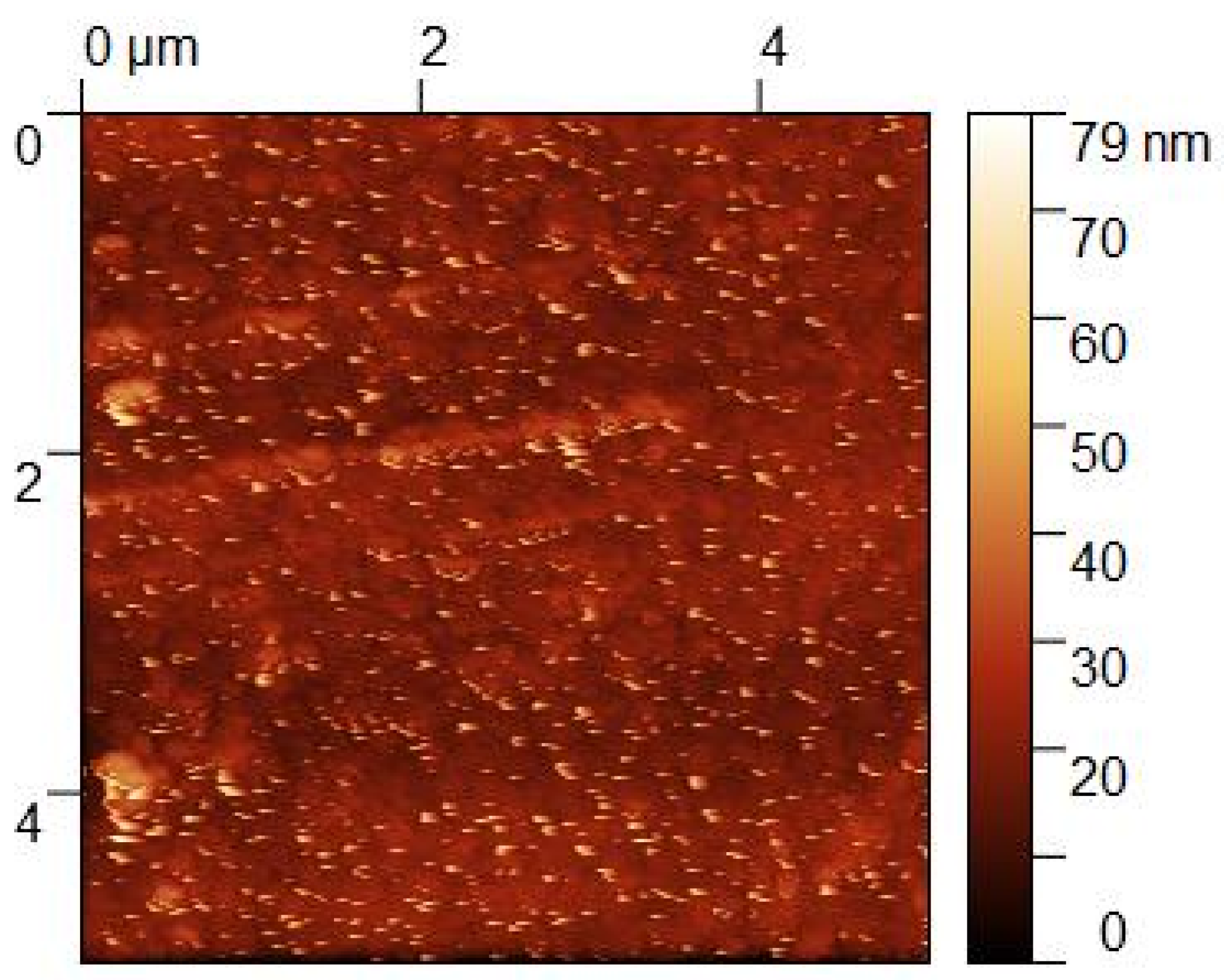
The surface morphology of the ZnO thin film deposited at −78 °C on thermally grown SiO2/Si was examined using both atomic force microscopy (AFM) and scanning electron microscopy (SEM). The AFM topography (5 × 5 µm2 area) in Figure 4 reveals a continuous, compact film with nanoscale hillocks and ridges distributed across the surface. Quantitative roughness parameters show an rms roughness (Sq) of ≈ 6.6 nm and mean roughness (Sa) of ≈ 4.3 nm. The positive skewness (Ssk = +2.31) and high kurtosis (Sku = 7.76) indicate a surface dominated by peaks and sharp height variations rather than valleys, confirming the presence of elongated nanohillocks extending above the mean plane, which is consistent with localized nanocrystalline hillocks distributed over an otherwise flat matrix, as observed in the XRD analysis. In addition, the AFM roughness agrees well with the surface roughness obtained from spectroscopic ellipsometry (3.75 nm).
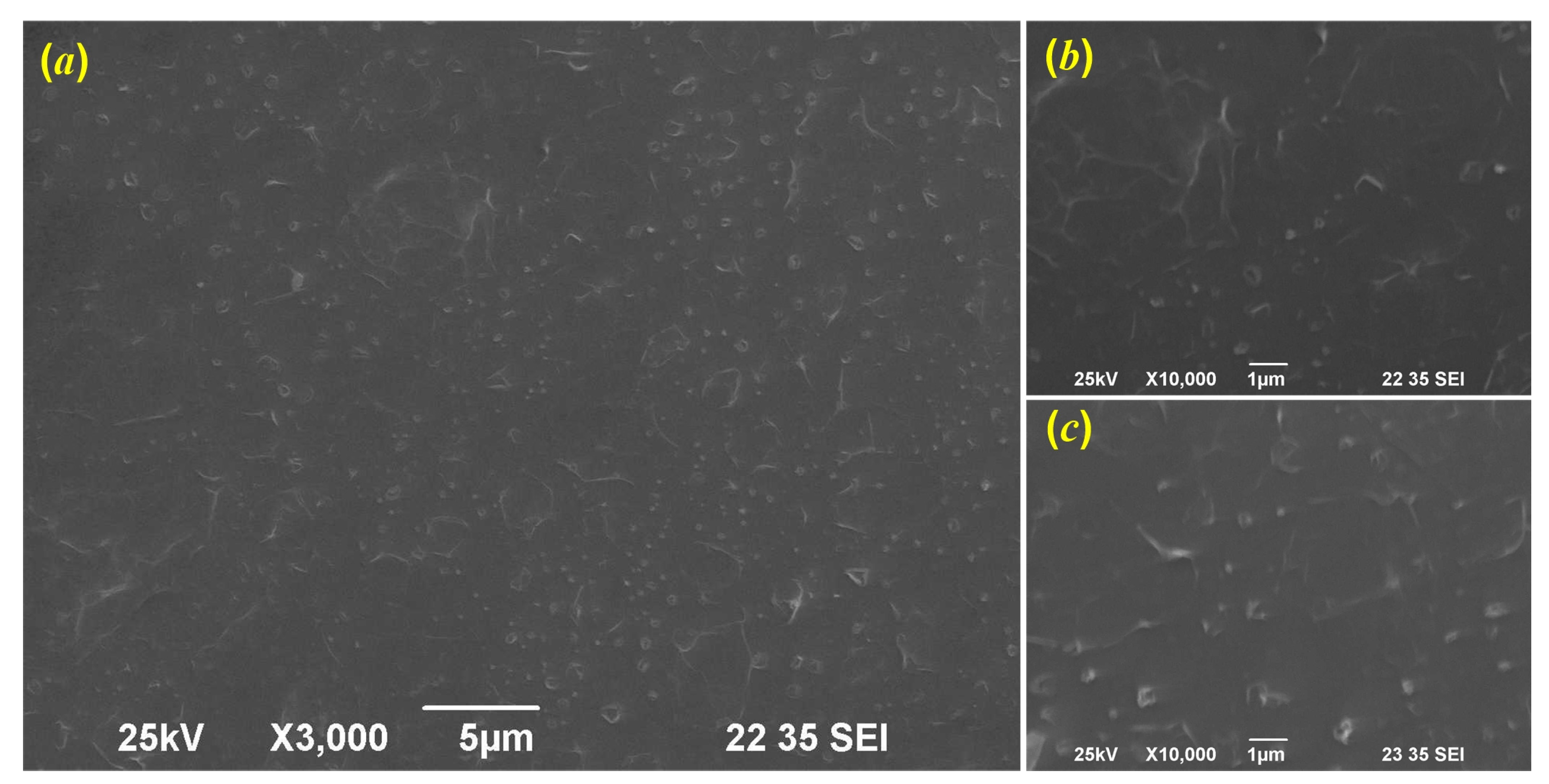
Figure 5 shows the SEM images taken for the ZnO film at two different magnifications. The SEM micrographs complement the AFM data, showing a laterally uniform, fully covered ZnO surface free from cracks or pinholes. At higher magnification (≈10,000×), the surface exhibits faint, interconnected ridges and thread-like features oriented randomly across the film. These ridges are direct morphological evidence of in-plane compressive stress accumulated during the thermal transition from the deposition temperature (−78 °C) to room temperature, reflecting the onset of partial crystallization and strain redistribution within the ZnO matrix. The mismatch between the thermal expansion coefficients of ZnO and the underlying SiO2 layer produces a strong lateral compression upon heating, which forces the film to expand slightly in the out-of-plane direction (normal to the surface). This expansion generates a ripple-like surface modulation, producing the nanoscale hillocks and ridges seen in AFM and SEM images. Accordingly, the morphological results correlate strongly with the XRD findings, confirming that the nanoscale topography is primarily a manifestation of internal stress formation rather than random growth roughness.

3.4. Spectroscopic Ellipsometry: Optical Modeling and Dielectric Function Analysis

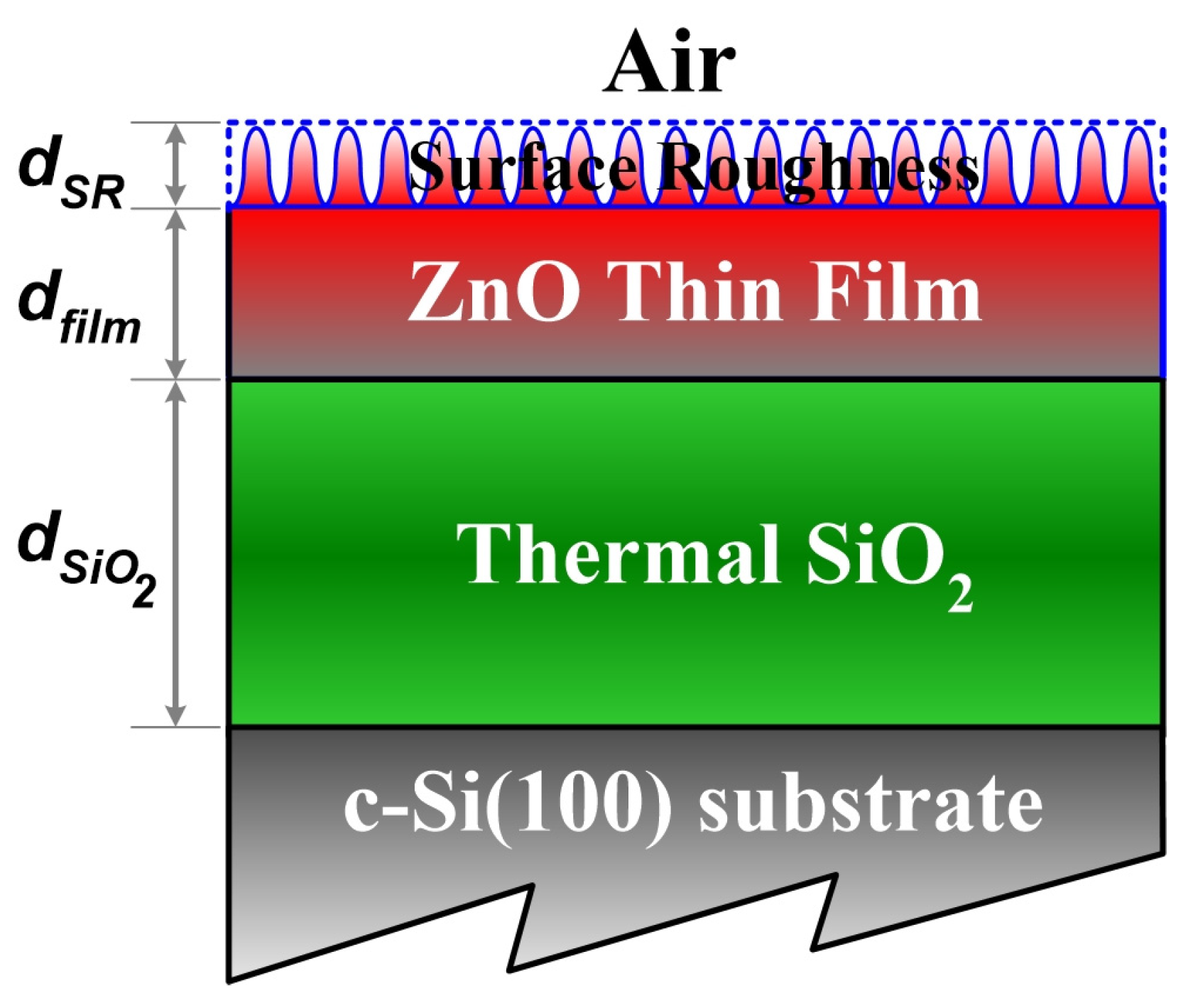
Spectroscopic ellipsometry is a powerful model-based optical technique for measuring the thickness and optical response of nanoscale thin films [51,52]. To model the optical response of the deposited ZnO, a multilayered structure was first built, which consists of four layers: (1) surface roughness, (2) ZnO layer, (3) thermally grown SiO2 buffer layer, and the Si(100) substrate. The complete structure is in the form of SR/ZnO/SiO2/Si, as shown in Figure 6. The SiO2 layer serves as an interference enhancement buffer layer for enhancing the ellipsometry model fitting accuracy [51]. First, the ellipsometric spectra of the uncoated SiO2/Si substrate were measured independently to determine the thickness and optical response of the SiO2 buffer layer using four parameter Sellmeier dispersion relations [51,53,54], which resulted in a SiO2 layer thickness of 528 ± 0.29 nm, and excellent fitting agreement. The obtained optical functions and thickness of the SiO2 layer were then kept constant for ellipsometry modeling and fitting after the ZnO film deposition. This separate pre-characterization of the oxide layer ensured a fixed, non-correlated parameter set for regression after ZnO deposition.
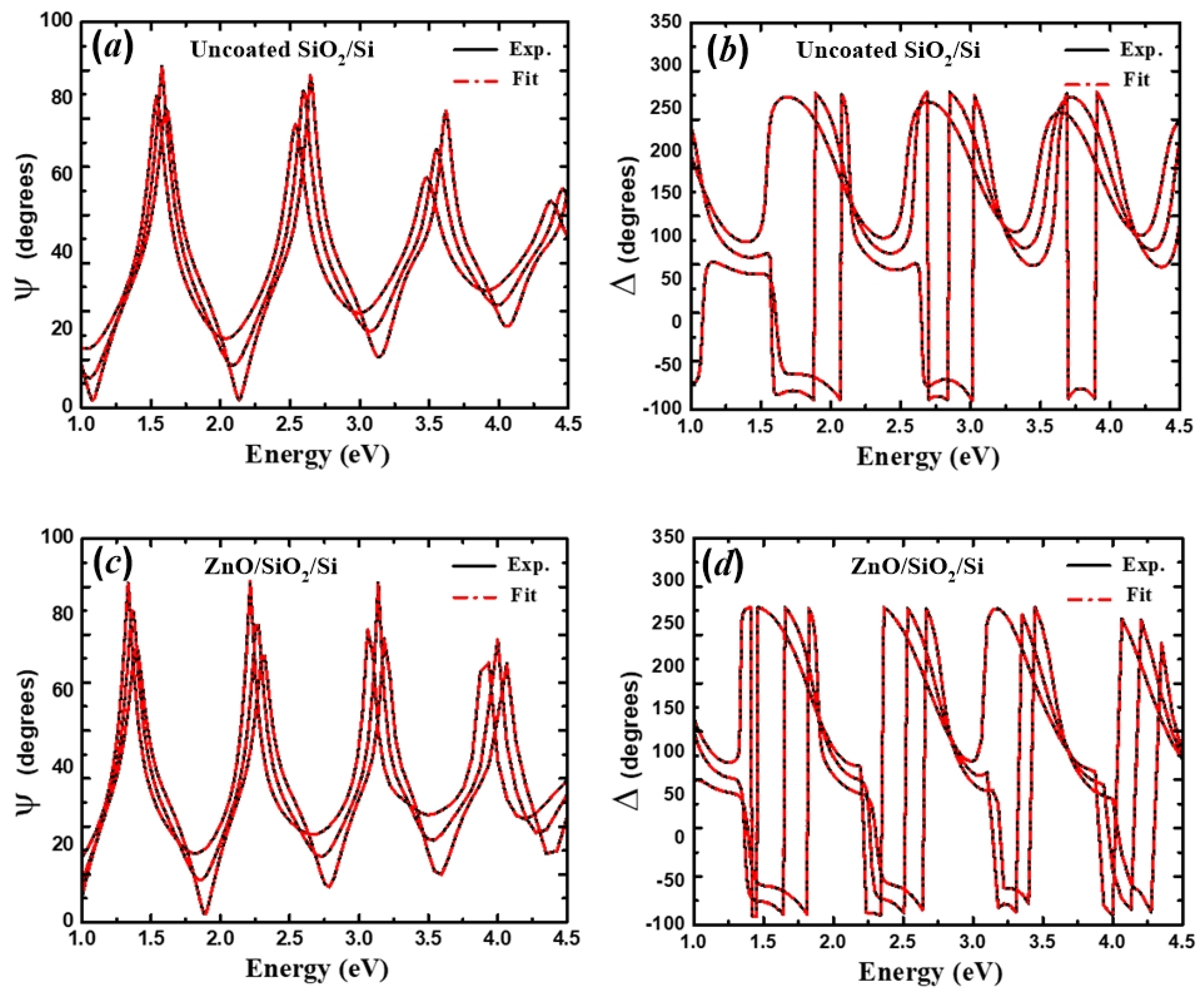
Figure 7a,b display the experimental and model fit ellipsometric spectra of Ψ and Δ for the uncoated SiO2/Si substrate, which were measured at three angles of incidence (65°, 70°, and 75°) in the energy range of 1.0–4.5 eV. For the bare SiO2/Si substrate, the model reproduces the characteristic interference fringes of the transparent oxide layer, and this confirms the accuracy of the 528 nm SiO2 thickness. After completing the optical characterization of the SiO2/Si substrate, the ZnO film was deposited on the SiO2/Si substrate at −78 °C, and the ellipsometry spectra were measured for the deposited film at room temperature, as shown in Figure 7c,d. It is evident that after the ZnO layer deposition, the interference pattern becomes strongly modulated, and the fitting curves fit the measured spectra perfectly over the entire spectral range, resulting in an excellent agreement between the model fit and experimental spectra, with a mean squared error (MSE) of 6.57. The excellent agreement at multiple angles demonstrates that the fitted thickness and dielectric parameters are self-consistent and angle-independent, indicating a unique determination of fitting parameters and the absence of overfitting.
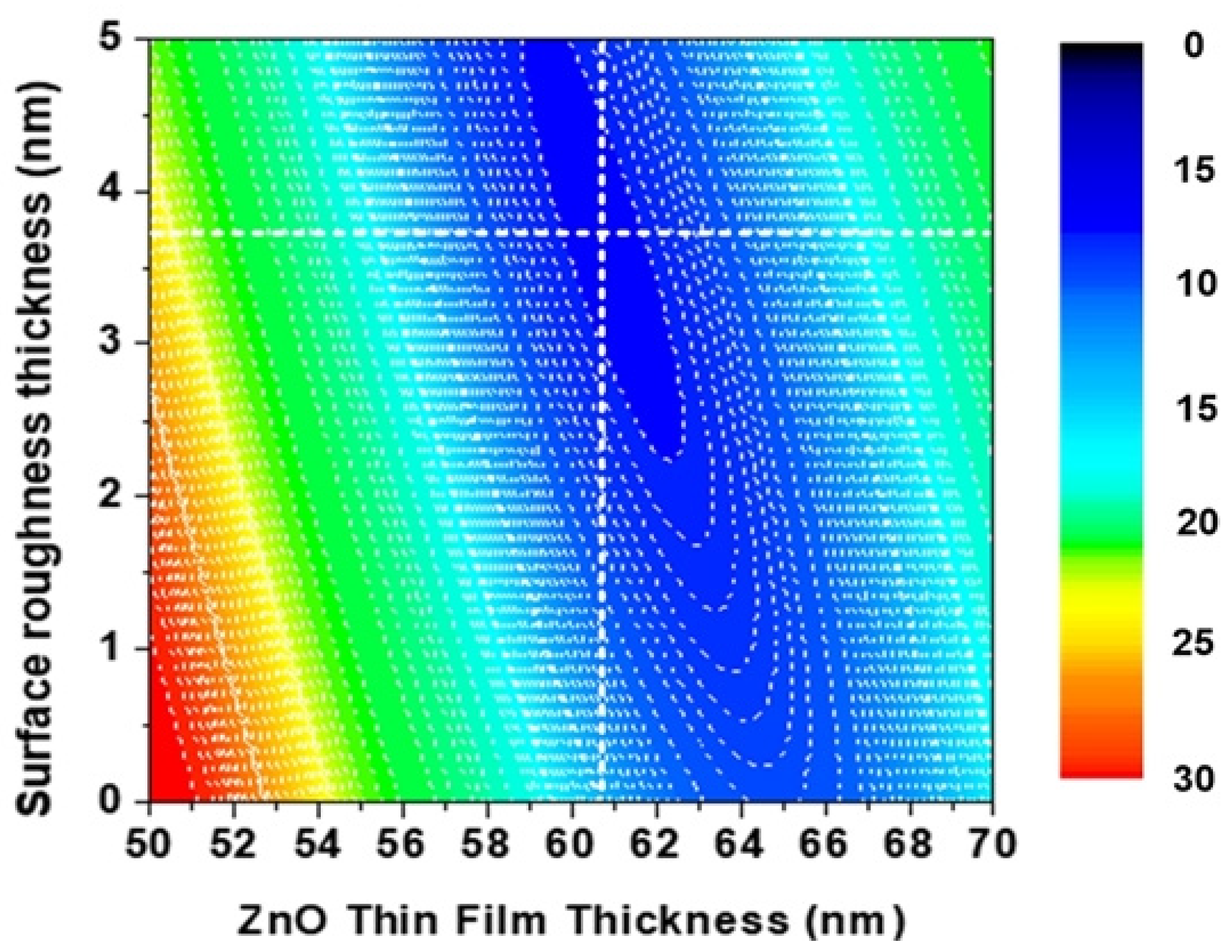
The accurate determination of thin film thickness is intrinsically important to the accurate determination of the optical and dielectric functions. The fittings in Figure 7c,d resulted in an accurate thickness determination of the ZnO layer and its surface roughness. Figure 8 illustrates the contour plot of the fitting MSE as a function of both the ZnO layer and its surface roughness thickness. The contour plot was obtained by varying the thicknesses of the ZnO layer and surface roughness layer while fitting the ellipsometric spectra and calculating the MSE. All other parameters of the ZnO layer were set as free fitting parameters during the fitting. A well-defined single minimum point appears at (dZnO, dSR) = (60.81 ± 0.66 nm, 3.75 ± 0.51 nm), confirming the uniqueness and stability of the solution. The narrow contour valley indicates weak parameter coupling between thickness and roughness, which is a consequence of fixing the SiO2 oxide layer. The formula used for MSE is as follows:
M S E = 1 3 Q R i = 1 n     N e x p i N c a l i 0.001 2 + C e x p i C c a l i 0.001 2 + S e x p i S c a l i 0.001 2
where Q is the number of measured data points, R is the number of fitting parameters, N = c o s 2 Ψ ,     C = s i n 2 Ψ c o s ( Δ ) , and S = s i n 2 Ψ s i n Δ . The subscripts “cal” and “exp” represent the calculated and experimental values of the corresponding parameters, respectively. The fitting was performed by minimizing the MSE using a Levenberg–Marquardt algorithm.
The optical response of the ZnO layer was analyzed using a physically constrained general oscillator (GO) model [53], and its complex dielectric function was expressed as follows:
ε ( E ) = ε 1 ( E ) + i ε 2 ( E ) = ε + ε C P P B ( E ) + ε T L ( E )
where E is the photon energy, ε   is the high-frequency dielectric constant, and each other term describes a distinct physical contribution to the overall dispersion. The second term represents the critical-point parabolic-band (CPPB) oscillator, which was used to model the principal near-band-edge transition of the crystalline phase of ZnO in the film [55]:
ε C P P B ( E ) = A e i ϕ E E C P + i Γ μ
where A is the amplitude, E C P is the critical-point energy, Γ is the broadening factor, ϕ is the phase, and μ defines the transition dimensionality. This oscillator describes the sharp excitonic absorption associated with the fundamental direct transition of wurtzite ZnO. The third term is Tauc–Lorentz (TL) oscillator, which was added to account for the interband transition contribution caused by the amorphous phase in the ZnO film. The TL imaginary and real parts of the dielectric function are given by [56]:
ε 2 , T L ( E ) = A E 0 C E E g 2 E E 2 E 0 2 2 + C 2 E 2 , E > E g 0 , E E g
ε 1 , T L ( E ) = 1 + 2 π P E g   E ε 2 , T L ( E ) E 2 E 2 d E
The integral in Equation (10) ensures consistency in the Kramers–Kronig (KK) transformation, where P denotes the Cauchy principal part of the integral avoiding the pole at E = E′, A is the oscillator amplitude, E 0 is the resonance energy, C is the broadening parameter, and E g is the optical bandgap energy. In addition, the surface roughness was modeled using Bruggeman effective-medium approximation (BEMA), combining equal ZnO and void phases [53,54,57]. The fitting parameters are listed in Table 2. During the fitting, the two parameters E C P and E g were coupled together for consistency.
Spectroscopic ellipsometry (SE) corroborates the structural picture obtained from XRD, SEM, and AFM for the ZnO film deposited at −78 °C. Although such a cryogenic temperature would normally favor amorphous growth, the θ-2θ XRD scan shows wurtzite ZnO reflections [(002), (102), and a split (110) peak]. The AFM/SEM findings reveal a continuous surface with nanohillocks and faint ridge-like features; the roughness statistics (Sq ≈ 6.6 nm, Sa ≈ 4.3 nm with positive skewness/kurtosis) are consistent with strain/stress-induced recrystallization and ripple formation upon warm-up from −78 °C. SE retrieves a film thickness of 60.81 ± 0.66 nm and a surface-roughness thickness of 3.75 ± 0.51 nm with a global MSE ≈ 6.57, with excellent multi-angle fitting agreement. The EMA roughness (≈3.8 nm) is naturally lower than AFM Sq because the BEMA layer encodes an optically effective interface thickness (typically 0.4–0.6 × of the topographic rms), while AFM captures the full peak–valley morphology; this proportionality aligns with the observed AFM/SE pair. Fixing the thermally grown SiO2 underlayer at 528 nm (pre-measured before ZnO deposition) decouples parameters and yields a narrow, unique minimum in the thickness–roughness MSE contour, indicating weak correlation and a stable solution.
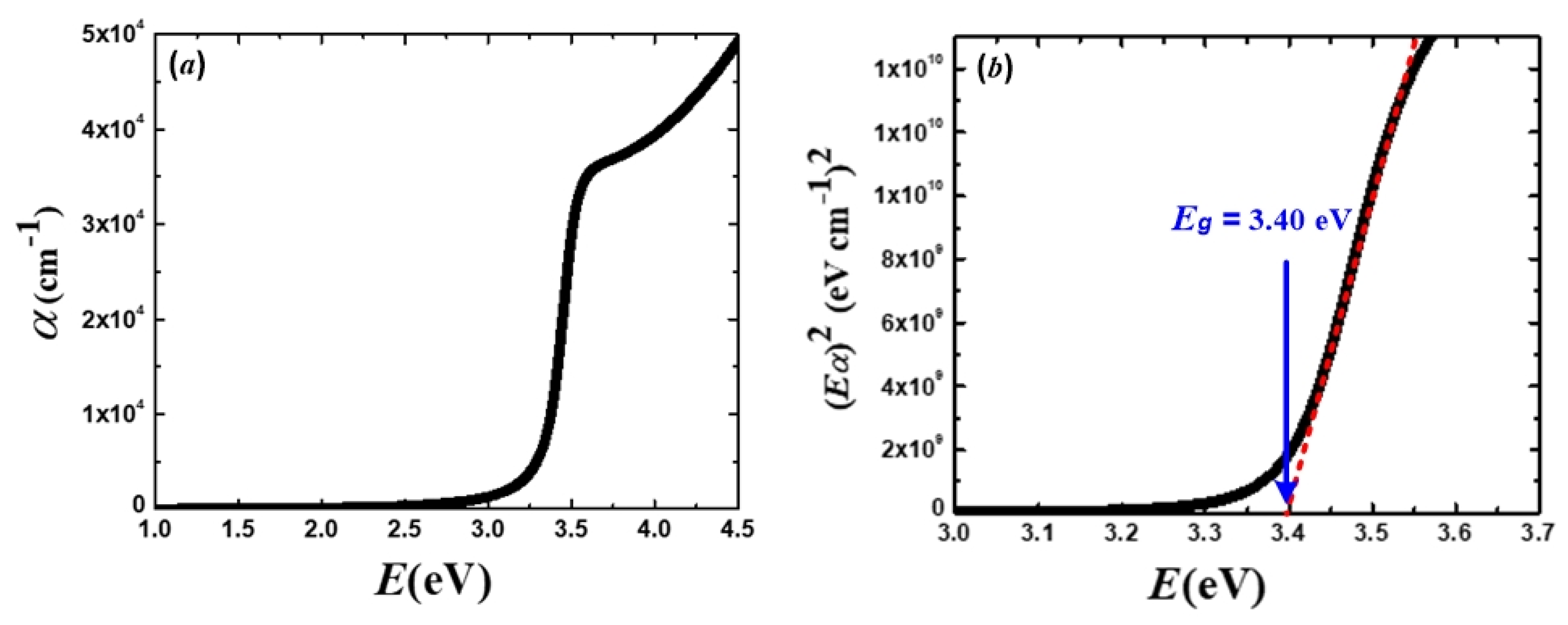
The XRD, SEM, and AFM analyses clearly revealed the polycrystalline microstructure of the ZnO film, where the crystallinity is attributed to the strain and stress coupling between the ZnO layer and the underlying thermally grown SiO2/Si substrate. In the ellipsometric model, both amorphous and crystalline components were represented using a general oscillator (GO) mathematical model approach. The TL oscillator accounts for the amorphous fraction in the film and its interband background of disordered regions, while the CPPB critical point oscillator represents the crystalline phase and its direct band-to-band transitions. The CP’s dominant transition energy ECP = 3.417 eV was coupled to the TL bandgap Eg = 3.417 eV during the fitting. The CP broadening Γ ≈ 0.16 eV is modest, and it is indicative of a well-formed crystalline phase at room temperature. Crucially, the CP dimensionality exponent μ ≈ 0.18 ± 0.03 lies close to the two-dimensional (M1-type) limit (μ = 0), pointing to quasi-2D critical-point behavior. This is physically reasonable for a columnar polycrystalline film where anisotropy at grain boundaries and surface/interface fields can enhance the 2D-like joint density-of-states features. The fitted phase factor φ (small, negative) introduces only slight asymmetry, and with standard passivity constraints (ε2 ≥ 0), the derived absorption coefficient α(E) remains non-negative below the gap and rises steeply above 3.3–3.4 eV, as expected for direct wurtzite ZnO.
Figure 9a displays the absorption coefficient α(E) derived from the modeled dielectric function. The spectrum exhibits a steep absorption onset near 3.3 eV, confirming the presence of a direct allowed transition typical of crystalline wurtzite ZnO. A small hump or shoulder appears just below the main edge, centered around 3.30–3.50 eV, which corresponds to the exciton absorption feature associated with the excitonic transitions of ZnO. This feature represents the optical counterpart of the NBE emission band observed in the photoluminescence spectrum discussed later. Its clear appearance indicates strong exciton–photon coupling and further supports that the film retains a significant degree of crystalline ordering, consistent with the CPPB oscillator’s description of the direct band-to-band transition in the ellipsometric model. The presence of this excitonic hump also agrees with the quasi-two-dimensional critical-point dimensionality (μ ≈ 0.18) extracted from SE fitting, since excitonic resonances are often enhanced in strained or anisotropic domains of polycrystalline thin films. Below the optical bandgap, α(E) is not exactly zero but shows a weak absorption tail extending into the sub-gap region. This residual absorption is attributed to disordered regions and localized states within the amorphous fraction of the film. The coexistence of this low-energy tail and the sharp excitonic onset confirms that the ZnO layer possesses a mixed amorphous–crystalline microstructure, with the amorphous component contributing to the tail states and the crystalline domains dominating the near-edge excitonic response. Figure 9b presents the Tauc plot, ()2 versus E, using the direct-transition form. A linear fit to the plotted data extrapolates to a bandgap of Eg = 3.40 eV. This Tauc bandgap agrees well with the ellipsometry-derived edge from the coupled CPPB–TL model (ECP = 3.42 eV). The Tauc plot’s linear fitting confirms a direct bandgap of 3.40 eV for the film, which supports the presence of a dominant direct transition that is anticipated from the crystalline phase. It is important to note that ellipsometry provides different types of valid bandgap information, in contrast to photoluminescence (PL), as discussed below. In principle, SE measures how light is reflected, primarily providing information on optical absorption, intrinsic bandgap, and band structure by analyzing the onset of absorption from the ground state. In contrast, PL spectra, when excited with photon energy above the bandgap, measures the energy of emitted photons. This often reflects an effective material bandgap, which can be lower than the true bandgap due to defect states in the forbidden energy gap, band tail (i.e., Urbach tail), and other non-radiative transitions. Therefore, one can expect that the bandgap from SE is larger than the one from PL. It is known that SE is a more direct measure of the intrinsic bandgap and is sensitive to direct and indirect transitions [57,58].
Overall, the absorption-edge behavior in Figure 9 confirms that the ZnO film, though deposited at −78 °C, where amorphous growth is normally expected, exhibits a well-defined direct bandgap, excitonic absorption, and a bandgap tail. Together, these features provide strong optical evidence that substrate-induced strain/stress drove partial recrystallization, yielding a stress-stabilized polycrystalline ZnO layer with disordered regions.
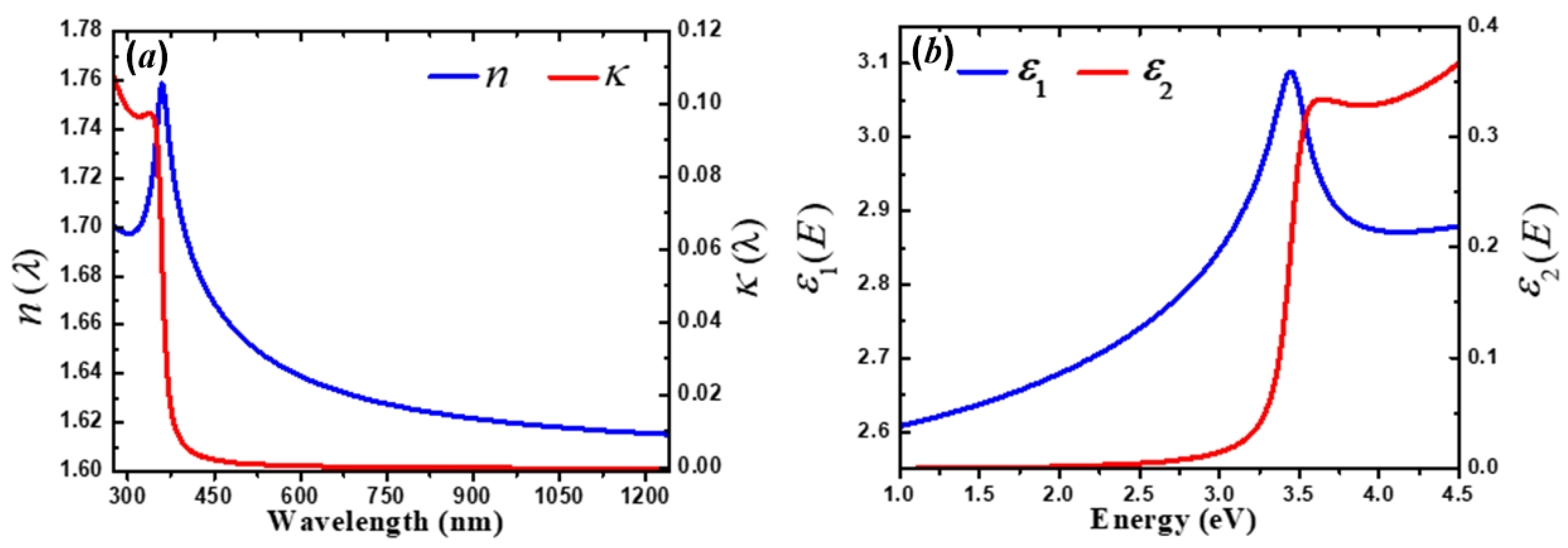
Figure 10 presents the SE model-extracted dispersion relations of the refractive index n(λ), extinction coefficient κ(λ), and the corresponding real (ε1) and imaginary (ε2) parts of the dielectric function for the ZnO thin film. In Figure 10a, the refractive index exhibits a gradual decrease with increasing wavelength, typical of normal dispersion behavior, approaching a constant value n ≈ 1.61 in the near-infrared region. The refractive index reaches its maximum around 358 nm, near the fundamental absorption edge, indicating strong optical transitions associated with the near-band-edge region. The extinction coefficient, on the other hand, remains nearly zero throughout the transparent region below the absorption edge. A faint sub-bandgap tail can be observed below the bandgap, which is attributed to localized defect states and structural disorder percentage. The extinction coefficient then starts to gradually increase with decreasing wavelength, and it reaches its maximum around 358 nm, marking the fundamental absorption edge and the onset of strong interband transitions. Notably, a small hump is observed near this wavelength in the κ(λ) spectrum, corresponding to excitonic absorption. This feature indicates the presence of bound electron–hole pairs (excitons) formed by Coulomb interactions near the band edge, which is characteristic of crystalline ZnO with a well-defined wurtzite structure. Figure 10b displays the real and imaginary parts of the dielectric function, ε1(E) and ε2(E), derived from the fitted model. The ε2(E) spectrum closely follows the absorption behavior, remaining near zero below the bandgap and rising steeply at the onset of optical transitions. The small shoulder-like feature near 3.4 eV again reflects the presence of excitonic transitions, confirming the crystalline structure and the presence of well-defined electronic states. The real part, ε1(E), shows the corresponding anomalous dispersion in the same energy range, with a peak around the excitonic resonance and a gradual decrease beyond that, which is consistent with Kramers–Kronig relations. Overall, these optical trends reinforce the structural and morphological findings: the ZnO film, although deposited at the extremely low temperature of −78 °C, demonstrates clear excitonic behavior and a direct band-edge transition typical of crystalline wurtzite ZnO. This confirms that partial crystallization occurred due to the strain and stress effects induced by the SiO2/Si substrate, as previously discussed in the XRD and AFM/SEM sections. The coexistence of a sharp excitonic resonance and a small sub-gap tail in ε2(E) further confirms that the film contains both crystalline and disordered regions, consistent with the mixed-phase (polycrystalline–partially disordered) nature inferred from the combined optical and structural analyses.

3.5. Photoluminescence Spectra Analysis

Room-temperature photoluminescence (PL) was measured for the ZnO film deposited on fused silica (a-SiO2) to avoid background emission from the crystalline Si substrate and to ensure that the recorded luminescence originates solely from the ZnO layer. Fused silica is optically transparent and luminescence-inactive in the near-UV region, enabling the intrinsic optical response of ZnO to be examined without substrate contributions. The ZnO film deposited on fused silica was grown under the same cryogenic conditions as the ZnO film on the 528 nm-SiO2/Si substrate used for XRD, AFM, and ellipsometry. Because the SiO2 buffer layer in the main sample is sufficiently thick to behave optically like fused silica, the ZnO/fused-silica film provides an accurate complementary representation of the optical behavior of the cryogenically grown ZnO layer. Thus, using fused silica ensures a clean PL spectrum free from Si-related background while faithfully reflecting the ZnO PL expected from the ZnO/thick-SiO2/Si structure.
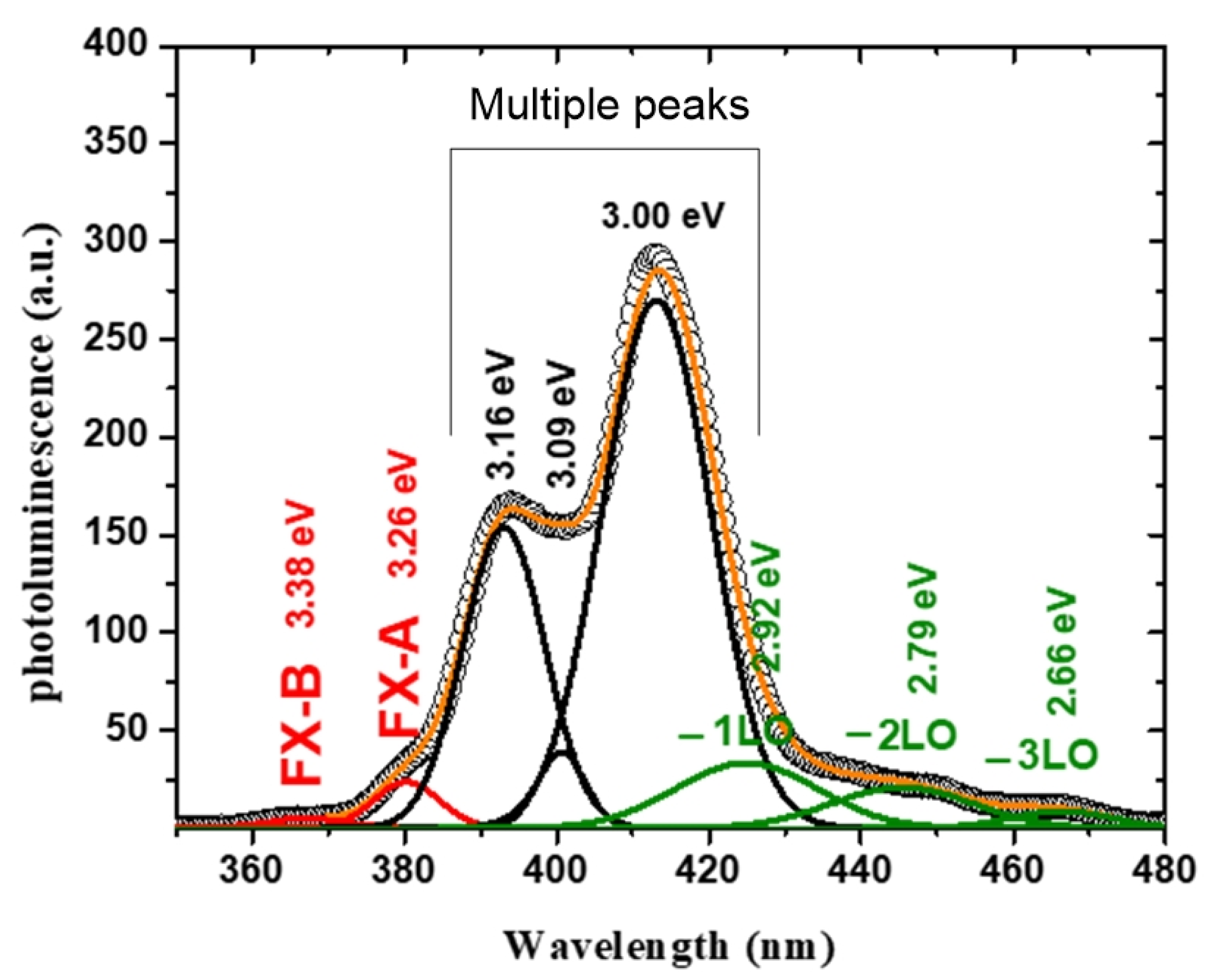
Figure 11 shows the room-temperature PL spectrum of the ZnO film excited at 300 nm. Instead of exhibiting a single sharp near-band-edge (NBE) peak, the spectrum contains several partially resolved features extending from 3.40 eV to 2.60 eV. The dominant emission appears at 3.00 eV, which is characteristic of defect-assisted or band-tail-mediated recombination in nanocrystalline ZnO. In partially disordered or strained ZnO films, localized excitons and tail states formed by internal strain and structural disorder often shift the NBE luminescence to lower energies relative to the intrinsic bandgap. This behavior agrees with the 3.40 eV optical bandgap determined by spectroscopic ellipsometry. To clarify the nature of the emission components, the PL spectrum was deconvolved into multiple Gaussian contributions. Two higher-energy features at approximately 3.26 eV and 3.38 eV were assigned to A- and B-free exciton transitions (FX-A and FX-B), indicating that portions of the film possess sufficient crystalline order for excitons to remain stable at room temperature. These excitonic signatures corroborate the partial crystallinity observed in XRD, including the presence of both relaxed and strained wurtzite domains. Typically, the NBE emission at high temperature (e.g., 300 K) does not demonstrate well defined and spectrally resolved peaks allowing unambiguous identification of the electron–hole recombination. However, it is generally accepted that FX emissions dominate at room temperature in ZnO due to their exceptionally high exciton-binding energy, which makes the excitons stable enough to avoid being thermally dissociated at 300 K. The high binding energy allows excitons to survive and recombine, leading to strong excitonic emissions involving intrinsic donors and/or acceptors specific to ZnO morphology (i.e., quantum confinement due to the presence of low-dimensional structures) and structural defects [59]. Furthermore, it was demonstrated that the sharp, well resolved emission lines of ZnO FX phonon replicas are thermally broadened and evolve into an asymmetric featureless PL curve at 300 K [60].
Below the observed excitonic energies, the spectrum displays a complex region in the interval labeled as “multiple peaks”, extending from roughly 3.16 to 3.00 eV. The experimental curve in this range is clearly not a single Gaussian-like band, but it demonstrates that at least two major distinct emissive components contribute to this interval. However, because the individual contributions strongly overlap, the deconvolution in this region is not mathematically unique. Different Gaussian fittings can reproduce the measured spectrum with acceptable residuals. The PL spectrum deconvolution adopted here should therefore be regarded as a representative physical interpretation rather than a unique line-by-line assignment. Despite this non-uniqueness, a consistent picture emerges when the multiple-peaks region is considered together with the lower-energy side of the spectrum. A sequence of partially resolved spectral features is observed at approximately 2.92 eV, 2.79 eV, and 2.66 eV. The nearly constant energy separation of about 0.13 eV between these peaks indicates that they form a ladder of longitudinal–optical (LO) phonon replicas associated with excitonic recombination. The extracted LO phonon spacing of roughly 130 meV is significantly larger than the canonical A1(LO) phonon energy of bulk wurtzite ZnO (72–74 meV). Such an enhanced effective LO energy can be understood in terms of strain-induced phonon hardening and confinement effects in nanocrystalline material. XRD analysis reveals an out-of-plane tensile strain accompanied by in-plane compressive strain, which indicates that a fraction of the crystalline grains is strongly strained. In such strained nanocrystalline domains, the vibrational spectrum is modified by lattice distortion and boundary conditions, which can shift and broaden the LO modes. The enlarged apparent LO spacing observed here is therefore consistent with the strain state inferred from the structural analysis.
We believe that the vast majority of the published experimental evidence confirming the excitonic nature of the NBE in ZnO at room temperature, as well as the observation of the spectral features identified here as phonon replicas, justify the proposed interpretation of the deconvoluted PL spectrum. It is also important to note that all resolved LO replicas lie on the low-energy (Stokes) side of the excitonic transitions. No reliable anti-Stokes (+mLO) phonon sidebands above the exciton energies were identified in this work. Therefore, our measured PL spectrum follows the conventional pattern of Stokes-only phonon-assisted recombination at room temperature, where excitons relax through LO–phonon emissions before radiative decay. The persistence of distinct 1LO, 2LO, and 3LO features at 300 K is nevertheless remarkable, since thermal broadening typically washes out this fine structure in ZnO films of low crystalline quality. Their visibility here indicates strong exciton–phonon coupling in the intermediate Fröhlich regime and supports the conclusion drawn from ellipsometry that the film contains well-formed wurtzite domains embedded in a disordered matrix.
Furthermore, the higher bandgap obtained from ellipsometry (≈3.40 eV) and the lower PL emission energies are mutually consistent. The optical bandgap obtained from spectroscopic ellipsometry (Eg ≈ 3.40 eV) represents the intrinsic absorption edge of the crystalline fraction of the ZnO film. In contrast, the photoluminescence spectrum reflects the emission energies of excitons and defect-mediated recombination pathways after carrier relaxation. The free-exciton peaks observed at 3.26 and 3.38 eV lie below the SE bandgap, while the dominant PL emission near 3.00 eV originates from localized exciton and band-tail states caused by strain and nanocrystalline disorder. Therefore, the higher bandgap obtained from ellipsometry and the lower PL emission energies are mutually consistent and reflect the distinction between absorption-based and emission-based measurements.

4. Conclusions

In conclusion, the cryogenic deposition of ZnO at −78 °C, followed by natural self-crystallization during warming, represents a new regime for semiconductor thin film growth without external heating. Structural, morphological, and optical analyses confirm that strain relaxation at the ZnO/SiO2 interface drives spontaneous crystallization into mixed relaxed and strained wurtzite domains. The films exhibit a direct optical bandgap of 3.40 eV, low surface roughness, and strong exciton–phonon coupling, reflecting enhanced excitonic stability at room temperature. This cryogenic self-crystallization process enables the growth of crystalline ZnO under ultra-low thermal-budget conditions, opening a promising route for depositing semiconductors and dielectric films on flexible, polymeric, or heat-sensitive substrates where conventional thermal processes are prohibitive. The demonstrated mechanism bridges low-temperature sputtering with strain-driven recrystallization, providing both fundamental insights and technological potential for next generation flexible and integrated optoelectronic devices.

Author Contributions

Conceptualization, M.A.E.; Data curation, M.A.E.; Formal analysis, M.A.E., W.M.J., M.D.N., A.I. and K.S.A.-i.; Investigation, M.A.E., M.E.K., W.Y., W.M.J. and S.K.; Methodology, M.A.E. and M.E.K.; Project administration, M.A.E. and M.E.K.; Resources, M.A.E., M.E.K., W.M.J., S.K. and M.D.N.; Supervision, M.A.E. and M.E.K.; Validation, M.A.E., M.E.K., W.Y., W.M.J., S.K., M.D.N., A.I. and K.S.A.-i.; Visualization, M.A.E.; Writing—original draft, M.A.E.; Writing—review and editing, M.A.E. and W.M.J. All authors have read and agreed to the published version of the manuscript.

Funding

This research received no external funding.

Data Availability Statement

The original contributions presented in this study are included in the article. Further inquiries can be directed to the corresponding author.

Acknowledgments

W.Y. recognizes assistance provided in part by the ASCENT-Intel Graduate Student Fellowship, the Nanoscale & Quantum Phenomena Institute (NQPI), and the EECS Department at Ohio University. The manuscript text was rephrased and grammar-checked using ChatGPT-5.1 (OpenAI) to improve clarity and language flow. All scientific content, interpretations, data analysis, and conclusions were developed entirely by the authors.

Conflicts of Interest

The author K. S. Al-iqdah is an author who contributed to this manuscript with no conflict of interest with her teaching education employing company. No co-author have any commercial or financial conflict of interest.

References

  1. Özgür, Ü.; Alivov, Y.I.; Liu, C.; Teke, A.; Reshchikov, M.A.; Doğan, S.; Avrutin, V.; Cho, S.-J.; Morkoç, H. A comprehensive review of ZnO materials and devices. J. Appl. Phys. 2005, 98, 041301. [Google Scholar] [CrossRef]
  2. Klingshirn, C. ZnO: From basics towards applications. Phys. Status Solidi B 2007, 244, 3027–3073. [Google Scholar] [CrossRef]
  3. Janotti, A.; Van de Walle, C.G. Fundamentals of zinc oxide as a semiconductor. Rep. Prog. Phys. 2009, 72, 126501. [Google Scholar] [CrossRef]
  4. Reynolds, D.C.; Look, D.C.; Jogai, B. Valence-band ordering in ZnO. Phys. Rev. B 1999, 60, 2340–2344. [Google Scholar] [CrossRef]
  5. Look, D.C. Recent advances in ZnO materials. Mater. Sci. Eng. B 2001, 80, 383–387. [Google Scholar] [CrossRef]
  6. Jagadish, C.; Pearton, S.J. Zinc Oxide Bulk, Thin Films and Nanostructures; Elsevier: Amsterdam, The Netherlands, 2006. [Google Scholar] [CrossRef]
  7. Fortunato, E.M.C.; Barquinha, P.M.C.; Pimentel, A.C.M.B.G.; Gonçalves, A.M.F.; Marques, A.J.S.; Pereira, L.M.N.; Martins, R.F.P. Fully transparent ZnO thin-film transistor produced at room temperature. Adv. Mater. 2005, 17, 590–594. [Google Scholar] [CrossRef]
  8. Nomura, K.; Ohta, H.; Takagi, A.; Kamiya, T.; Hirano, M.; Hosono, H. Room-temperature fabrication of transparent flexible thin-film transistors using amorphous oxide semiconductors. Nature 2004, 432, 488–492. [Google Scholar] [CrossRef]
  9. Meyer, B.K.; Alves, H.; Hofmann, D.M.; Kriegseis, W.; Forster, D.; Bertram, F.; Christen, J.; Hoffmann, A.; Straßburg, M.; Dworzak, M.; et al. Bound exciton and donor–acceptor pair recombinations in ZnO. Phys. Status Solidi B 2004, 241, 231–260. [Google Scholar] [CrossRef]
  10. Myong, S.Y.; Lim, K.S. Universal single-phonon variable range hopping conduction for inorganic semiconducting polycrystalline films. Appl. Phys. Lett. 2006, 88, 222110. [Google Scholar] [CrossRef]
  11. Wagner, M.R.; Callsen, G.; Reparaz, J.S.; Schulze, J.-H.; Kirste, R.; Cobet, M.; Ostapenko, I.A.; Rodt, S.; Nenstiel, C.; Kaiser, M.; et al. Bound excitons in ZnO: Structural defect complexes versus shallow impurity centers. Phys. Rev. B 2011, 84, 035313. [Google Scholar] [CrossRef]
  12. Mohanta, A.; Thareja, R.K. Photoluminescence study of ZnO nanowires grown by thermal evaporation on pulsed-laser-deposited ZnO buffer layer. J. Appl. Phys. 2008, 104, 044906. [Google Scholar] [CrossRef]
  13. Thonke, K.; Gruber, T.; Teofilov, N.; Schönfelder, R.; Waag, A.; Sauer, R. Donor–acceptor pair transitions in ZnO substrate material. Phys. B Condens. Matter 2001, 308–310, 945–948. [Google Scholar] [CrossRef]
  14. Mosquera, A.A.; Horwat, D.; Rashkovskiy, A.; Kovalev, A.; Miska, P.; Wainstein, D.; Albella, J.M.; Endrino, J.L. Exciton and core-level electron confinement effects in transparent ZnO thin films. Sci. Rep. 2013, 3, 1714. [Google Scholar] [CrossRef]
  15. Giles, N.C.; Xu, C.; Callahan, M.J.; Wang, B.; Neal, J.S.; Boatner, L.A. Effects of phonon coupling and free carriers on band-edge emission at room temperature in n-type ZnO crystals. Appl. Phys. Lett. 2006, 89, 251906. [Google Scholar] [CrossRef]
  16. Sun, H.D.; Segawa, Y.; Kawasaki, M.; Ohtomo, A.; Tamura, K.; Koinuma, H. Phonon replicas in ZnO/ZnMgO multiquantum wells. J. Appl. Phys. 2002, 91, 6457–6460. [Google Scholar] [CrossRef]
  17. Reynolds, D.C.; Look, D.C.; Jogai, B.; Hoelscher, J.E.; Sherriff, R.E.; Harris, M.T.; Callahan, M.J. Time-resolved photoluminescence lifetime measurements of the Γ5 and Γ6 free excitons in ZnO. J. Appl. Phys. 2000, 88, 2152–2153. [Google Scholar] [CrossRef]
  18. Mendelsberg, R.J.; Allen, M.W.; Durbin, S.M.; Reeves, R.J. Photoluminescence and the exciton–phonon coupling in hydrothermally grown ZnO. Phys. Rev. B 2011, 83, 205202. [Google Scholar] [CrossRef]
  19. Makino, T.; Tamura, K.; Chia, C.H.; Segawa, Y.; Kawasaki, M.; Ohtomo, A.; Koinuma, H. Size dependence of exciton–longitudinal-optical-phonon coupling in ZnO/Mg0.27Zn0.73O quantum wells. Phys. Rev. B 2002, 66, 233305. [Google Scholar] [CrossRef]
  20. Ursaki, V.V.; Tiginyanu, I.M.; Zalamaï, V.V.; Masalov, V.M.; Samarov, E.N.; Emelchenko, G.A.; Briones, F. Photoluminescence and resonant Raman scattering from ZnO-opal structures. J. Appl. Phys. 2004, 96, 1001–1006. [Google Scholar] [CrossRef]
  21. Hsu, H.-C.; Hsieh, W.-F. Excitonic Polaron and Phonon Assisted Photoluminescence of ZnO Nanowires. Solid State Commun. 2004, 131, 371–375. [Google Scholar] [CrossRef]
  22. Cho, Y.-H.; Kim, J.-Y.; Kwack, H.-S.; Kwon, B.-J.; Dang, L.S.; Ko, H.-J.; Yao, T. Depth-Resolved Optical Studies of Excitonic and Phonon-Assisted Transitions in ZnO Epilayers. Appl. Phys. Lett. 2006, 89, 201903. [Google Scholar] [CrossRef]
  23. Shi, S.L.; Xu, S.J. Determination of Effective Mass of Heavy Hole from Phonon-Assisted Excitonic Luminescence Spectra in ZnO. J. Appl. Phys. 2011, 109, 053510. [Google Scholar] [CrossRef]
  24. Xu, S.J.; Xiong, S.-J.; Shi, S.-L. Resonant coupling of bound excitons with LO phonons in ZnO: Excitonic polaron states and Fano interference. J. Chem. Phys. 2005, 123, 221105. [Google Scholar] [CrossRef] [PubMed]
  25. Antonius, G.; Louie, S.G. Theory of Exciton–Phonon Coupling. Phys. Rev. B 2022, 105, 085111. [Google Scholar] [CrossRef]
  26. Dai, Z.; Lian, C.; Lafuente-Bartolome, J.; Giustino, F. Theory of Excitonic Polarons: From Models to First-Principles Calculations. Phys. Rev. B 2024, 109, 045202. [Google Scholar] [CrossRef]
  27. Hannewald, K.; Bobbert, P.A. Nonperturbative Theory of Exciton–Phonon Resonances in Semiconductor Absorption. Phys. Rev. B 2005, 72, 113202. [Google Scholar] [CrossRef]
  28. Vuong, T.Q.P.; Cassabois, G.; Valvin, P.; Liu, S.; Edgar, J.H.; Gil, B. Exciton–Phonon Interaction in the Strong-Coupling Regime in Hexagonal Boron Nitride. Phys. Rev. B 2017, 95, 201202. [Google Scholar] [CrossRef]
  29. Han, P.; Bester, G. Determination of the Phonon Sidebands in the Photoluminescence Spectrum of Semiconductor Nanoclusters from ab initio Calculations. Phys. Rev. B 2022, 106, 245404. [Google Scholar] [CrossRef]
  30. Pollmann, J.; Büttner, H. Effective Hamiltonians and Binding Energies of Wannier Excitons in Polar Semiconductors. Phys. Rev. B 1977, 16, 4480–4493. [Google Scholar] [CrossRef]
  31. Segall, B.; Mahan, G.D. Phonon-Assisted Recombination of Excitons. Phys. Rev. 1968, 171, 935–948. [Google Scholar] [CrossRef]
  32. Senger, R.T.; Bajaj, K.K. Optical Properties of Confined Polaronic Excitons in Spherical Ionic Quantum Dots. Phys. Rev. B 2003, 68, 045313. [Google Scholar] [CrossRef]
  33. Yan, B.; Chen, R.; Zhou, W.; Zhang, J.; Sun, H.; Gong, H.; Yu, T. Localized Suppression of Longitudinal-Optical-Phonon–Exciton Coupling in Bent ZnO Nanowires. Nanotechnology 2010, 21, 445706. [Google Scholar] [CrossRef]
  34. Liao, Z.-M.; Wu, H.-C.; Fu, Q.; Fu, X.; Zhu, X.; Xu, J.; Shvets, I.V.; Zhang, Z.; Guo, W.; Leprince-Wang, Y.; et al. Strain-Induced Exciton Fine-Structure Splitting and Shift in Bent ZnO Microwires. Sci. Rep. 2012, 2, 452. [Google Scholar] [CrossRef]
  35. Wei, B.; Ji, Y.; Gauvin, R.; Zhang, Z.; Zou, J.; Han, X. Strain Gradient Modulated Exciton Evolution and Emission in ZnO Fibers. Sci. Rep. 2017, 7, 40658. [Google Scholar] [CrossRef] [PubMed]
  36. Liu, Z.; Fu, X.; Zhang, D.-B. Strain Gradient Induced Spatially Indirect Excitons in Single Crystalline ZnO Nanowires. Nanoscale 2020, 12, 18705–18712. [Google Scholar] [CrossRef] [PubMed]
  37. Han, X.; Kou, L.; Zhang, Z.; Zhang, Z.; Zhu, X.; Xu, J.; Liao, Z.; Guo, W.; Yu, D. Strain-Gradient Effect on Energy Bands in Bent ZnO Microwires. Adv. Mater. 2012, 24, 4707–4711. [Google Scholar] [CrossRef]
  38. Fu, X.-W.; Fu, Q.; Kou, L.-Z.; Zhu, X.-L.; Zhu, R.; Xu, J.; Liao, Z.-M.; Zhao, Q.; Guo, W.-L.; Yu, D.-P. Modifying Optical Properties of ZnO Nanowires via Strain-Gradient. Front. Phys. 2013, 8, 509–515. [Google Scholar] [CrossRef]
  39. Adeagbo, W.A.; Thomas, S.; Nayak, S.K.; Ernst, A.; Hergert, W. First-Principles Study of Uniaxial Strained and Bent ZnO Wires. Phys. Rev. B 2014, 89, 195135. [Google Scholar] [CrossRef]
  40. Shao, R.-W.; Zheng, K.; Wei, B.; Zhang, Y.-F.; Li, Y.-J.; Han, X.-D.; Zhang, Z.; Zou, J. Bandgap Engineering and Manipulating Electronic and Optical Properties of ZnO Nanowires by Uniaxial Strain. Nanoscale 2014, 6, 4936–4941. [Google Scholar] [CrossRef]
  41. Volnianska, O.; Ivanov, V.; Wachnicki, Ł.; Guziewicz, E. Effect of Strain and Surface Proximity on the Acceptor Grouping in ZnO. ACS Omega 2023, 8, 43099–43108. [Google Scholar] [CrossRef]
  42. Galdámez-Martínez, A.; Santana, G.; Güell, F.; Martínez-Alanis, P.R.; Dutt, A. Photoluminescence of ZnO Nanowires: A Review. Nanomaterials 2020, 10, 857. [Google Scholar] [CrossRef]
  43. Gandhi, A.C.; Liao, C.-H.; Yeh, W.-L.; Huang, Y.-L. Non-Monotonous Size-Dependent Photoluminescence and Excitonic Relaxations in Nanostructured ZnO Thin Films. RSC Adv. 2019, 9, 7545–7555. [Google Scholar] [CrossRef]
  44. Herrfurth, O.; Richter, S.; Rebarz, M.; Espinoza, S.; Zúñiga-Pérez, J.; Deparis, C.; Leveillee, J.; Schleife, A.; Grundmann, M.; Andreasson, J.; et al. Transient Birefringence and Dichroism in ZnO Studied with fs-Time-Resolved Spectroscopic Ellipsometry. Phys. Rev. Res. 2021, 3, 013246. [Google Scholar] [CrossRef]
  45. Versteegh, M.A.M.; Kuis, T.; Stoof, H.T.C.; Dijkhuis, J.I. Ultrafast Screening and Carrier Dynamics in ZnO: Theory and Experiment. Phys. Rev. B 2011, 84, 035207. [Google Scholar] [CrossRef]
  46. Acharya, S.; Chouthe, S.; Graener, H.; Böntgen, T.; Sturm, C.; Schmidt-Grund, R.; Grundmann, M.; Seifert, G. Ultrafast Dynamics of the Dielectric Functions of ZnO and BaTiO3 Thin Films after Intense Femtosecond Laser Excitation. J. Appl. Phys. 2014, 115, 053508. [Google Scholar] [CrossRef]
  47. Lu, J.; Zhu, Q.; Zhu, Z.; Liu, Y.; Wei, M.; Shi, Z.; Xu, C. Plasmon-Mediated Exciton–Phonon Coupling in a ZnO Microtower Cavity. J. Mater. Chem. C 2016, 4, 7718–7723. [Google Scholar] [CrossRef]
  48. Materials Project. ZnO (mp-2133), Wurtzite Structure; Materials Project Database; Lawrence Berkeley National Laboratory: Berkeley, CA, USA, 2013; Available online: https://materialsproject.org/materials/mp-2133/ (accessed on 22 October 2025).
  49. Momma, K.; Izumi, F. VESTA 3 for Three-Dimensional Visualization of Crystal, Volumetric and Morphology Data. J. Appl. Crystallogr. 2011, 44, 1272–1276. [Google Scholar] [CrossRef]
  50. Tsou, C.; Huang, Y.-S.; Li, H.-C.; Lai, T.-H. Determination of thermal expansion coefficient of thermal oxide (SiO2) film. Sens. Mater. 2005, 17, 441–451. Available online: https://sensors.myu-group.co.jp/sm_pdf/SM622.pdf (accessed on 15 January 2025).
  51. Ebdah, M.A.; Kordesch, M.E.; Jadwisienczak, W.M.; Ibdah, A. Spectroscopic Ellipsometry and Optimized B-Spline Coefficients of Non-hydrogenated Amorphous Silicon for Amorphous Silicon-Based Semiconductors. J. Electron. Mater. 2025, 54, 5630–5643. [Google Scholar] [CrossRef]
  52. Ebdah, M.A.; Kordesch, M.E.; Ingram, D.C.; AlBrithen, H.; Ibdah, A.-R.A.; Cooper, K. Optical and Spectroscopic Ellipsometric Study of Indium Boron Nitride Sputtered Thin Films with Low Boron Concentration. MRS Online Proc. Libr. 2011, 1307, 802. [Google Scholar] [CrossRef]
  53. Hilfiker, J.N.; Singh, N.; Tiwald, T.; Convey, D.; Smith, S.M.; Baker, J.H.; Tompkins, H.G. Survey of Methods to Characterize Thin Absorbing Films with Spectroscopic Ellipsometry. Thin Solid Film. 2008, 516, 7979–7989. [Google Scholar] [CrossRef]
  54. Herzinger, C.M.; Johs, B.; McGahan, W.A.; Woollam, J.A.; Paulson, W. Ellipsometric determination of optical constants for silicon and SiO2. J. Appl. Phys. 1998, 83, 3323–3336. [Google Scholar] [CrossRef]
  55. Adachi, S. Model dielectric constants of Si and Ge. Phys. Rev. B 1988, 38, 12345–12352. [Google Scholar] [CrossRef]
  56. Jellison, G.E.; Modine, F.A. Parameterization of the Optical Functions of Amorphous Materials in the Interband Region. Appl. Phys. Lett. 1996, 69, 371–373. [Google Scholar] [CrossRef]
  57. Liu, Y.C.; Hsieh, J.H.; Tung, S.K. Extraction of Optical Constants of Zinc Oxide Thin Films by Ellipsometry with Various Models. Thin Solid Film. 2006, 510, 32–38. [Google Scholar] [CrossRef]
  58. Bouzourâa, M.-B.; Battie, Y.; Dalmasso, S.; Zaïbi, M.-A.; Oueslati, M.; En Naciri, A. Temperature-Dependent Optical Properties of ZnO Thin Film Using Ellipsometry and Photoluminescence. Superlattices Microstruct. 2018, 117, 457–468. [Google Scholar] [CrossRef]
  59. Mahesh, A.; Kumar, G.P.; Jawahar, I.N.; Biju, V. Temperature Dependent Photoluminescence Spectra of Nanocrystalline Zinc Oxide: Effect of Processing Condition on the Excitonic and Defect Mediated Emissions. Chem. Phys. Impact 2024, 8, 100456. [Google Scholar] [CrossRef]
  60. Shan, W.; Walukiewicz, W.; Ager, J.W., III; Yu, K.M.; Yuan, H.B.; Xin, H.P.; Cantwell, G.; Song, J.J. Nature of Room-Temperature Photoluminescence in ZnO. Appl. Phys. Lett. 2005, 86, 191911. [Google Scholar] [CrossRef]
Figure 1. (Left) A photo of the HV-RF reactive magnetron sputtering growth chamber during deposition of the ZnO thin films using a substrate holder externally cooled with CO2 dry ice at 195 K (−78 °C). Insert shows the plasma during the deposition. (Right) A schematic drawing of the experimental HV-RF system used for the deposition.
Crystals 15 01031 g001
Figure 2. EDX spectra of ZnO deposited on 528 nm-SiO2/c-Si(100) substrate showing the characteristic peaks of (O Kα), (Zn Lα), (Si Kα), (Zn Kα), and (Zn Kβ), and thus confirming the formation and elemental purity of the ZnO layer: (a) Linear-scale EDX spectrum, and (b) Log-scale EDX spectrum.
Crystals 15 01031 g002
Figure 3. (a) The (θ-2θ) XRD pattern of ZnO deposited on 528 nm-SiO2/c-Si(100) substrate showing the characteristic diffraction peaks of our wurtzite ZnO and crystalline Si. The observed ZnO reflections correspond to the (002), (102), and (110) planes. The (110)* reflection, circled in dashed red line, represents a highly strained second (110) reflection. (be) are the three atomic planes (110), (102), and (002) with respect to the relaxed ZnO atomic structure (ZnO wurtzite structure from Materials Project, visualized in VESTA [48,49]).
Crystals 15 01031 g003
Figure 4. Atomic force microscopy (AFM) surface topography of ZnO thin film deposited at −78 °C on SiO2/Si substrate over a 5 × 5 µm2 scan area. The surface exhibits nanoscale hillocks and ridges indicating partial crystallization due to localized out-of-plane deformation driven by in-plane compressive stress.
Crystals 15 01031 g004
Figure 5. SEM micrographs of ZnO thin film deposited at −78 °C on SiO2/Si substrate, showing surface morphology at different magnifications: (a) low magnification; (b,c) higher magnifications.
Crystals 15 01031 g005
Figure 6. The multilayered structure constructed for modeling the optical response of ZnO grown on 528 nm-SiO2/c-Si(100).
Crystals 15 01031 g006
Figure 7. Experimental (black solid lines) and fitted (red dashed lines) ellipsometric spectra of Ψ and Δ for (a,b) the uncoated SiO2/Si substrate and (c,d) the ZnO/SiO2/Si thin-film structure at multiple angles of incidence.
Crystals 15 01031 g007
Figure 8. Contour plot of the mean square error (MSE) as a function of ZnO thin-film thickness and surface-roughness thickness, showing a distinct minimum that identifies the optimized optical-model parameters at a ZnO film thickness of 60.81 ± 0.66 nm and a surface roughness thickness of 3.75 ± 0.51 nm. The white dashed lines represent contours of equal MSE values across the thickness–roughness parameter space.
Crystals 15 01031 g008
Figure 9. (a) The absorption coefficient of the ZnO layer obtained for the ellipsometry fitting and modeling, and (b) Tauc plot (Eα)2 versus photon energy E, used to determine the optical bandgap of the ZnO film, yielding Eg = 3.40 eV, characteristic of a direct-allowed transition in crystalline ZnO. The red dashed line represents the linear extrapolation used to extract the optical bandgap value.
Crystals 15 01031 g009
Figure 10. (a) Dispersion of the refractive index n(λ) and extinction coefficient κ(λ) of the ZnO/SiO2/Si thin film extracted from spectroscopic ellipsometry modeling. (b) The corresponding real ε1(E) and imaginary ε2(E) parts of the complex dielectric function as a function of photon energy, E.
Crystals 15 01031 g010
Figure 11. Room-temperature PL spectrum of the ZnO/fused silica thin film excited at 300 nm deconvolved using Gaussian function. The Yellow line represents the sum of all deconvoluted single peaks used in the fitting, while circles represent the experimental measured data.
Crystals 15 01031 g011
Table 1. Summary of structural parameters, out-of-plane strain ε , in-plane strain ε, and biaxial in-plane stress σ for the ZnO film, calculated from the measured XRD peak positions using the unstrained wurtzite lattice constants a0 = 3.252 Å and c0 = 5.213 Å [1]. For calculation of stress and strain, the isotropic elastic constants E = 140 GPa and ν = 0.34 were used. The superscript (*) indicates the second (110) highly strained reflection peak.
Reflection2θ (°)d0 (Å)dmeas (Å)ε (%)ε (%)σ (GPa)
(002)33.02.6072.7124.048−3.909−8.33
(102)47.81.9131.901−0.6270.6091.29
(110)56.41.6261.6300.246−0.239−0.51
(110)*54.61.6261.6793.260−3.164−6.71
Table 2. Summary of the best-fit ellipsometric model parameters for the ZnO thin film deposited on SiO2/Si substrate. The model combines CPPB and TL oscillators to produce the complex dielectric function. The AFM mean roughness (Sa) of = 4.3 nm is added to the table for comparison.
CategoryParameterSymbolFitted Value±Error
MetrologyMean square errorMSE6.57-
ZnO thickness (NM)dZnO60.81±0.66
Surf. Roughness-SE (nm)dSR-SE 3.75±0.51
Surf. Roughness-AFM (nm)dSR-AFM4.30-
SiO2 thickness (nm) d SiO 2 528Fixed
High-frequency constantε1.162±0.040
CPPB oscillatorAmplitudeA0.838±0.087
Broadening (eV)Γ0.159±0.006
Critical-point energy (eV)ECP3.417±0.006
Phase (rad)φ−0.399±0.044
Dimensionality exponentμ0.180±0.029
TL oscillatorAmplitudeA52.316±1.227
Broadening (eV)C43.910±3.437
Resonance energy (eV)E015.690±2.564
Optical bandgap (eV)Eg3.417±0.015
Disclaimer/Publisher’s Note: The statements, opinions and data contained in all publications are solely those of the individual author(s) and contributor(s) and not of MDPI and/or the editor(s). MDPI and/or the editor(s) disclaim responsibility for any injury to people or property resulting from any ideas, methods, instructions or products referred to in the content.