Article

The Role of Pluronic Copolymer on the Physicochemical Characteristics of ZnO-CeO2 Photocatalysts


1
Institute of Mineralogy and Crystallography, “Acad. I. Kostov”, Bulgarian Academy of Sciences, “Acad. G. Bonchev” St., Block 107, 1113 Sofia, Bulgaria
2
Institute of General and Inorganic Chemistry, Bulgarian Academy of Sciences, “Acad. G. Bonchev” St., Bl. 11, 1113 Sofia, Bulgaria
3
Institute of Catalysis, Bulgarian Academy of Sciences, “Acad. G. Bonchev” St., Bl. 11, 1113 Sofia, Bulgaria
4
Institute of Electrochemistry and Energy Systems, “Acad. Evgeni Budevski”, Bulgarian Academy of Sciences, “Acad. G. Bonchev” St., Block 10, 1113 Sofia, Bulgaria
5
Institute of Polymers, Bulgarian Academy of Sciences, “Akad. G. Bonchev” St., Block 103A, 1113 Sofia, Bulgaria
*
Author to whom correspondence should be addressed.
Crystals 2025, 15(12), 1032; https://doi.org/10.3390/cryst15121032
Submission received: 30 October 2025 / Revised: 28 November 2025 / Accepted: 30 November 2025 / Published: 3 December 2025
(This article belongs to the Section Inorganic Crystalline Materials)

Abstract

CeO2-ZnO nanocrystalline powders were prepared using Pluronic-assisted precipitation, followed by calcination at 500 °C. Different amounts of tri-block Pluronic copolymer (P123—2.5 g (P2.5), 5 g (P5), and 0 g (P0)) were used. PXRD, XPS, TEM, EDS, DRS, EPR, FT-IR spectroscopy, and the BET method were performed to determine the physicochemical characteristics of the prepared samples. They showed that the increased amount of P123 leads to an increased degree of crystallinity and polarity. The addition of the polymer in appropriate quantity plays a role as a structure-directing agent, thus preventing agglomeration processes and leading to changes in the structural features of the composites, which result in an increase in the band gap values. The adsorption edges of P0, P2.5, and P5 are 389.5 nm, 386.2 nm, and ~385.3 nm, which prove a blue shift. The photocatalytic discoloration of the Reactive Black 5 dye in the presence of all powders under UV-A illumination was studied. The P5 powder possessed the highest degree of discoloration (86% for 2 h illumination). These results could be assigned to the increased band gap value, polarity, and degree of crystallinity, as well as the increased quantity of Ce3+, oxygen vacancies, and hydroxyl groups of the Pluronic-modified powders.

1. Introduction

Semiconductor oxide nanomaterials are widely studied due to their excellent optical, electrical, catalytical, photocatalytic, mechanical, and thermal properties. Among them zinc oxide is a multipurpose material with uses in various fields of industry, human life, and medicine/biomedicine. It is known that ZnO is a wide band gap semiconductor as well as a low-cost material with high chemical activity, high thermal stability, excellent electrical/optical properties, etc. Cerium oxide (CeO2) is an abundant rare earth wide band gap oxide well known as a good electron acceptor and a high oxygen/storage carrier. Both CeO2 and ZnO have strong potential as UV–Vis light-responsive photocatalysts, which are used for the removal of toxic compounds in polluted wastewaters and water splitting. The good adsorption properties, well-matched energy-level structures of both oxides, and existence of surface defects (oxygen vacancies, zinc interstitials, presence of Ce3+/Ce4+, etc.) on the ZnO-CeO2 composites attract huge attention from researchers. Many research groups obtained zinc oxide–ceria composites by co-precipitation, which exhibit enhanced ability towards photocatalytic removal of various model dyes in a water solution [1,2,3,4]. S. Murugesan et al. reported that ZnO–CeO2 (1:1 wt. ratio) nanocomposites degrade about 85% of the Reactive Black dye within 90 min under UV illumination [5]. Habibi et al. have proved the synergetic effect of the composite CeO2/ZnO for dye degradation, which occurs due to the improved separation of photogenerated e/h+ charges in comparison to that of pure CeO2 or ZnO [1,2]. Pathak et al. revealed that the composite Ce:Zn (1:3) possesses the highest photocatalytic efficiency for methylene blue (MB) dye degradation [4]. Other research groups have also reported that the ZnO/CeO2 nanocomposite exhibits enhanced photocatalytic activity for degradation of various dyes, including methyl orange, methylene blue, phenol, and rhodamine B [6,7,8,9].
It is known that several morphological features (surface area, crystallite size, and aggregate size) and structural characteristics (degree of crystallinity and presence of lattice defects) of the semiconductor powders can positively influence both dye adsorption and the rate of the photocatalytic reactions. In order to modify these parameters, different approaches can be used. Various types of surfactants such as Polyvinylpyrrolidone (PVP) [10], polyethylene glycol (PEG) [11], Pluronic F127 [12], Pluronic P123 [13], and cetrimonium bromide (CTAB) [13] can successfully modify the abovementioned physicochemical features, thus improving their photocatalytic activity.
It was established that the addition of the non-ionic tri-block copolymer P123 leads to an increased surface area, a low tendency of agglomeration, and the formation of defect-rich structures, as well as controlled crystal size and shape. The positive role of CTAB and Pluronic F127 on the textural, morphological, and photocatalytic properties of sol–gel ZnO nanoparticles was investigated by Soli et al. [13]. It was demonstrated that the application of surfactants in the synthesis of mesoporous MnOx–CeO2 hollow nanospheres results in decreased agglomeration of the particles, higher specific areas, more uniform pores, and a larger pore volume [10]. Ma et al. have investigated the effect of Pluronic F127 on the photocatalytic activity of hydrangea-like ZnO-CeO2 mesoporous materials for RhB dye degradation and CO oxidation [14]. The authors have revealed that the coexistence of Ce3+/Ce4+ pairs and a notable redshift in the absorption edge has an influence on the photocatalytic efficiency of the bicomponent composite.
The impact of the amount of Pluronic surfactant on the surface area, morphology, and polarity of zinc oxide photocatalysts was investigated by Silva et al. [15]. Their study proved that participation of Pluronic P123 in the synthesis method leads to domination of (002) polar planes over (100) planes, as well as formation of flower-like structures and an enhanced surface area. The more reactive polar surfaces ensure a higher number of defects (oxygen vacancies), resulting in higher photocatalytic activity for dye decomposition.
Therefore, in our study, we have investigated the effect of different quantities of the Pluronic P123 polymer in ZnO-CeO2 composites on the physicochemical characteristics and photocatalytic efficiency towards the discoloration of the Reactive Black 5 dye. Reactive Black 5 is a toxic dye with a chemical formula of C26H21N5Na4O19S6, and it has a negative influence on the health of humans and ecosystems. This dye could cause bladder cancer, skin rashes, respiratory and kidney failure, blindness, chromosomal aberration, cardiovascular collapse, and shock asthma [16]. For these reasons, the removal of the RB5 dye from polluted waters is very important for the environment, so we chose it as a model contaminant in our study.

2. Materials and Methods

2.1. Synthesis of the Nanosized CeO2-ZnO Materials

The CeO2-ZnO samples were prepared using 0.09 M aqueous solutions of Ce (NO3)3·6H2O (Alfa Aesar, Ward Hill, MA, USA) and Zn (NO3)2·6H2O (Valerus Co., Ltd., Sofia, Bulgaria) mixed in 1:1 wt.% ratio with constant stirring for 10 min. The different amounts of the tri-block copolymer Pluronic P123 (Sigma-Aldrich, St. Louis, MO, USA, Mw = 5800)—2.5 and 5 g—were dissolved in 50 mL of distilled water with constant stirring for 1 h, and then added to the mixture of nitrate precursors. The prepared mixture with nitrate precursors and Pluronic P123 was stirred for 10 min. The precipitant 2M NaOH (Valerus Co., Ltd., Sofia, Bulgaria) was added drop by drop in the mixture of aqueous solutions of nitrate precursors and Pluronic P123 until the pH value reached 11 with continuous stirring. After precipitation the suspension was stirred for about 30 min at room temperature and for one hour at 55 °C. The precipitates were filtered and washed several times with distilled water. The obtained precipitates were dried at 35 °C and calcined at 500 °C for 5 h in an air atmosphere. The CeO2-ZnO samples prepared using 2.5 and 5 g of Pluronic P123 were labeled as P2.5 and P5. The CeO2-ZnO referent sample (P0) was prepared using the same experimental procedure described above without the presence of Pluronic P123.

2.2. Physicochemical Characterization of Prepared Nanosized CeO2-ZnO Materials

The powder X-ray diffraction (PXRD) patterns were measured with a Bruker D2 Phaser diffractometer (Bruker AXS GmbH, Karlsruhe, Germany) within the 2θ range of 20° and 100° using Cu Kα radiation (λ = 0.154056 nm) at 40 kV. The presence of the phases in the prepared materials was determined by the ICDD database. The Debye–Scherrer equation (Equation (1)) was used to estimate the crystallite sizes of the synthesized samples,
D = K × λ β × cos θ
where D is the average crystallite size in angstroms; K is a constant, which is accepted to be 0.89 here; λ is the wavelength of the X-ray radiation (Cu Kα, 0.15406 nm); β is the corrected band broadening (FWHM) after subtraction of equipment broadening; and θ is the diffraction angle.
The structure of the resulting diffraction patterns was determined by Rietveld refinement performed using the CIF (Crystallographic Information File) from the COD (Crystallography Open Database). The MAUD software, version 2.999, was used for this investigation.
The degree of crystallinity was determined using the following equation:
%Crystallinity = [(area under the crystalline peaks)/(total area)] × 100
X-ray photoelectron spectroscopy (XPS) was carried out to study the surface composition and electronic structure. The measurements were performed on an AXIS Supra electron spectrometer (Kratos Analitycal Ltd., Manchester, UK) using achromatic AlKα radiation with a photon energy of 1486.6 eV and a charge-neutralization system. The binding energies (BEs) were established with an accuracy of ±0.1 eV. The deep chemical compositions of the films were determined by monitoring the areas and binding energies of the C1s, O1s, Zn2p, and Ce3d photoelectron peaks. The commercial data-processing software ESCApeTM 1.2.0.1325 by Kratos Analytical Ltd. was used, and the concentrations of the different chemical elements (in atomic %) were determined by normalizing the areas of the photoelectron peaks to their relative sensitivity factors.
The electronic paramagnetic resonance (EPR) spectra of CeO2-ZnO materials were recorded at room temperature on a JEOL JES-FA 100 EPR spectrometer (JEOL Ltd., Tokyo, Japan) operating in the X–band with a standard TE011 cylindrical resonator. The EPR spectra were recorded at the following conditions: modulation frequency: 100 kHz, microwave power: 5 mW, modulation amplitude: 0.2 mT, and time constant: 0.1 s.
Diffuse reflectance spectroscopy (DRS) was used to determine the band gap energy (Eg). The DRS values were recorded on a Thermo Evolution 300 UV-VIS spectrometer (Thermo Fisher Scientific, Waltham, MA, USA) within the wavelength range of 190 nm up to 1100 nm. The Tauc equation with the Kubelka–Munk transformation was used to evaluate the optical band:
(hvF (R∞))1/n = A(hvEg)
where Equation (3) F (R∞) is the Kubelka–Munk function, A is the proportionality constant, h is the Planck constant, ν is the frequency of the photon, and Eg is the band gap energy.
The specific surface area was measured by the express BET method, which is based on the low-temperature adsorption of nitrogen. The relative error of the method is about 8%. Investigations on the specific surface area and pore size distribution were performed on an automated apparatus NOVA Win—CFR Quantachrom—Gas Sorption System. The evaluation of the surface area was performed using the BET equation, where the pore size distribution and average pore diameter were estimated by the DFT method while assuming a cylindrical model of the pores. The total pore volume was evaluated in accordance with Gurvich’s rule at a relative pressure of 0.96.
Fourier-transform infrared spectroscopy was carried out on Bruker-Vector 22 apparatus in the range of 400–4000 cm−1 and using KBr pellets.
The electron-dispersive spectroscopy (EDS) probe Oxford Ultim Max 40 (Oxford Instruments, Abingdon, UK) was used to study the chemical composition of the surface. The obtained results were compiled with the AZtec software (version 6.1 HF4).
The morphology of the powders was investigated using Transmission Electron Microscopy (TEM) by means of HR STEM JEOL JEM 2100 (JEOL, Tokyo, Japan), CCD Camera: GATAN Orius 832 SC1000 (Gatan, Ametek group, Berwyn, PA, USA).

2.3. Photocatalytic Ability Tests

Photocatalytic discoloration of Reactive Black 5 (RB5) as a model pollutant (in a 5 ppm aqueous solution of the dye) was performed under UV-A light using CeO2-ZnO as photocatalysts. During the photocatalytic experiments, a UV-A light lamp with maximum emission at 365 nm, a power of 18 W, and an illumination intensity of 2.6 mW/cm2 was used. The photocatalytic investigations were performed in a semi-batch slurry photocatalytic reactor with two frits blowing tiny bubbles of air (continuous flow) in order to saturate the solution with dissolved oxygen, using 0.15 g of the photocatalyst powder and 150 mL of the dye solution in the presence of 1 M NaOH (pH about 8) under constant stirring and air flow. To establish the adsorption–desorption equilibrium state, the investigated systems were left in the dark for 30 min before switching on the UV illuminator for 2 h. The study of the photocatalytic efficiency of the CeO2-ZnO powders was carried out by taking aliquot samples of the suspension out of the reaction vessel at regular time intervals. The powder was separated from the aliquot solution by a centrifuge. Then the change in absorbance during the photocatalytic tests was monitored by the UV-1600PC (VWR International, Radnor, PA, USA) apparatus within the wavelength range from 200 to 800 nm (λmax = 599 nm for RB5). After that, the photocatalyst sample, together with the aliquot solution, was returned back into the reaction vessel, which ensured operation under constant volume and amount of the photocatalyst (to maintain the mg ratio of the catalyst: ml of the solution). The degree of discoloration was determined using the following equation:
Degree of discoloration (%) = ((C0C)/C0) × 100
where C0 and C are, respectively, the initial concentration before turning on the illuminator and the residual concentration of the dye solution after illumination over a given time interval.
The apparent rate constants (kapp) were evaluated using the following pseudo-first-order kinetic reaction:
ln C 0 C = t k a p p
where C0 and C are, respectively, the initial concentration before turning on the illuminator and the residual concentration of the dye solution after irradiation over the given time interval t.
The adsorption capacity (in darkness for about 30 min) of the materials was determined using the following formula:
Q = ( C 0 C ) V m
where C0 is the initial dye concentration, C is the dye concentration after 30 min, V is the solution volume, and m is the sample mass.
Three consecutive cycles of photocatalytic discoloration of RB5 were performed in order to study the stability of the powders. After the first cycle, the investigated sample was removed from the dye solution, washed with distilled water, and dried at room temperature in air. After that the dried photocatalyst was added into the reaction vessel with a fresh dye solution for the second photocatalytic test. The recycling experiments were repeated 3 times.

3. Results and Discussion

3.1. Characterization of Nanosized CeO2-ZnO Materials

3.1.1. PXRD Study

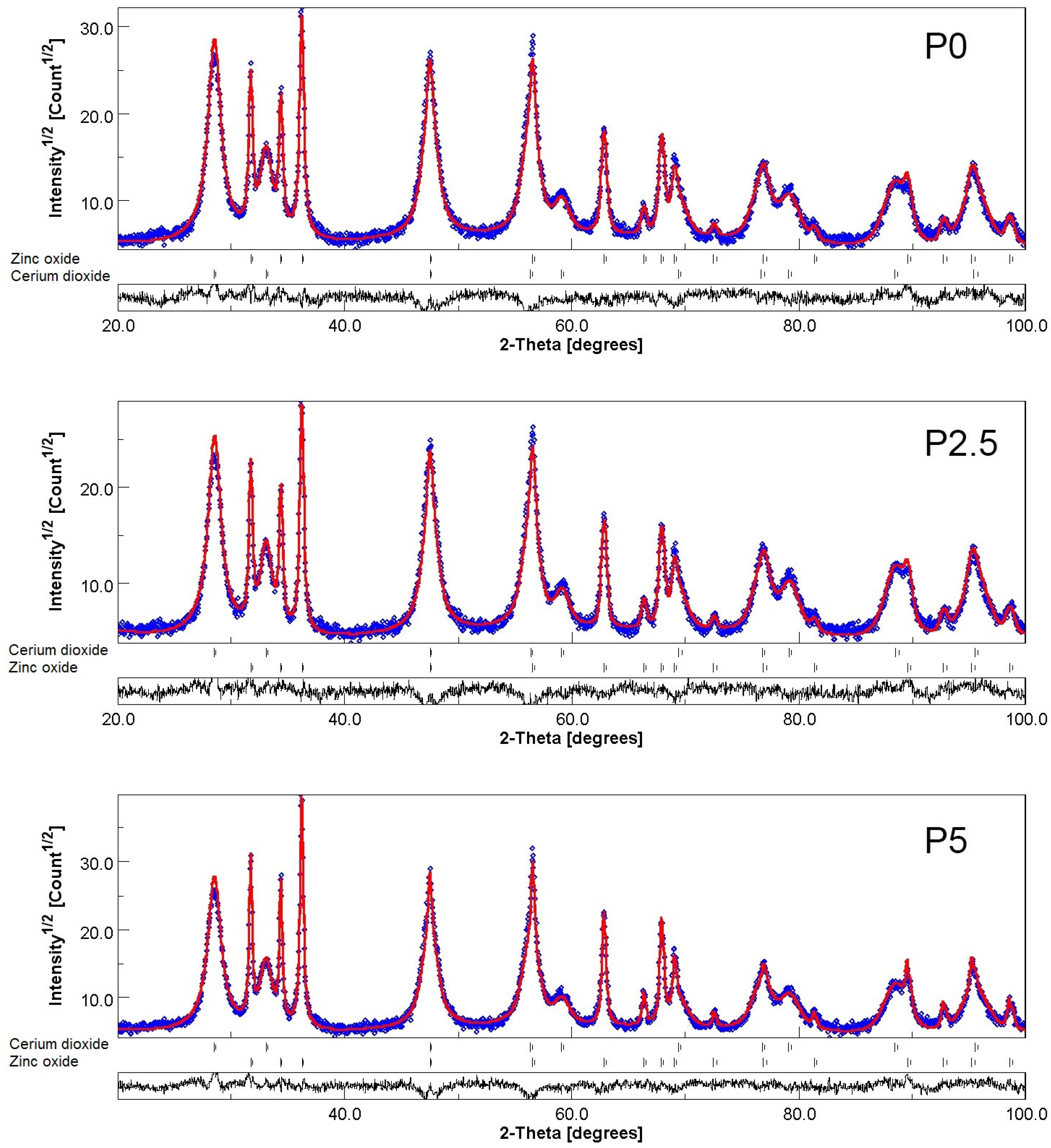
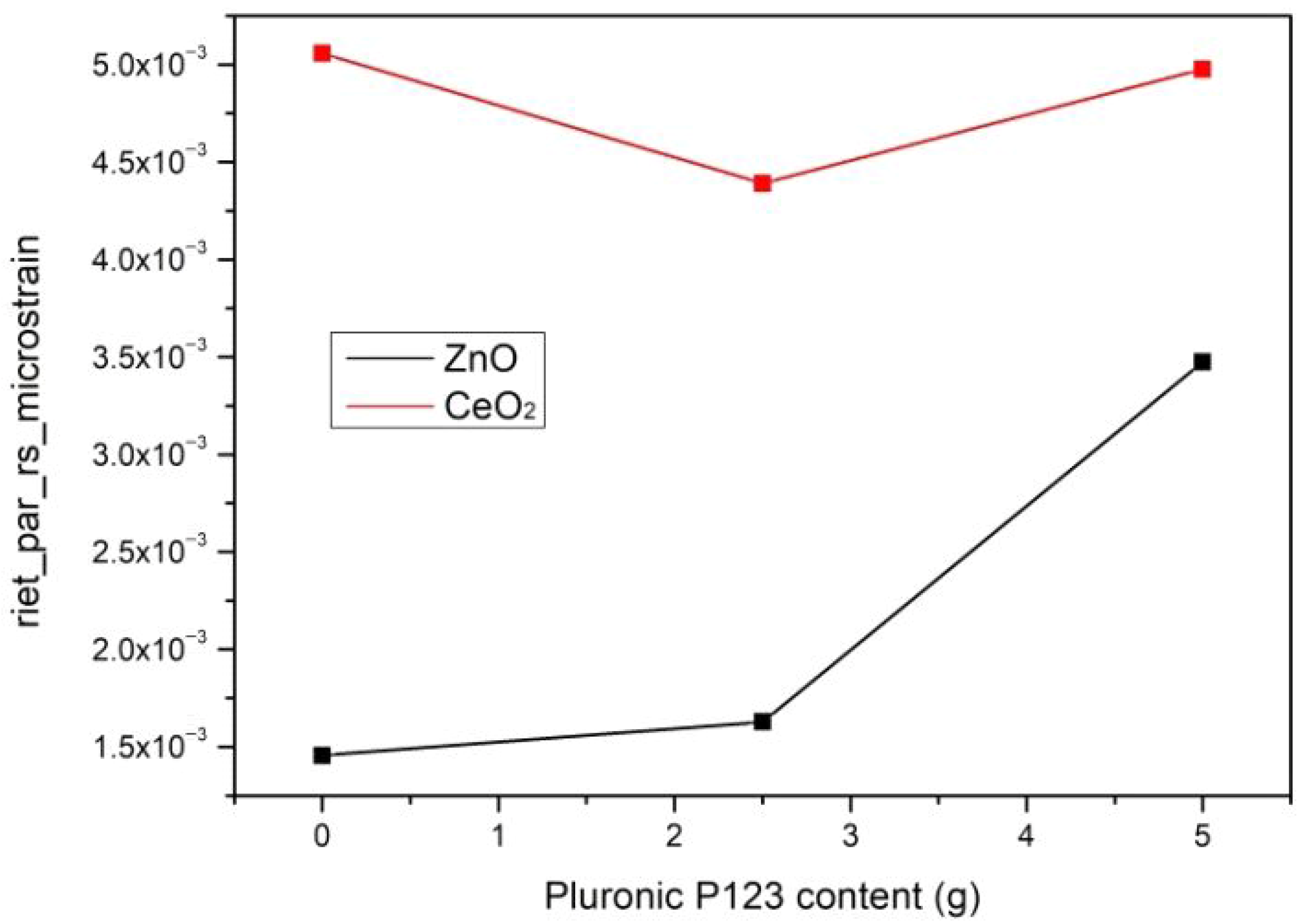
Figure 1 shows the powder X-ray diffraction patterns of the synthesized CeO2-ZnO materials. The diffraction peaks of the ZnO (PDF-361451) and CeO2 (PDF-810792) phases were registered for all investigated samples, with no displacement of the main peaks—an indication that neither ion incorporation into the main crystal lattice nor formation of solid solutions took place. The Rietveld refinement plots for all samples are shown in Figure 2. The fit parameters obtained by Rietveld refinement are summarized in Table 1. All samples exhibit good refinement quality, with weighted-profile R-factor (Rwp) values ranging from 11.49% to 12.43% and goodness of fit (GOF, χ2) values ranging from 1.30 to 1.42. This indicates good agreement between the experimental and calculated diffraction profiles. The profile factor (Rp) with a maximum value of 0.10% confirms the reliable overall match of the models. The data of the crystal structure of the composites from the Rietveld refinement presented in Table 2 show that the amount of ZnO increases with increasing polymer content. Pluronic P123 has no significant effect on the ZnO unit’s cell parameters, with the volume remaining virtually unchanged (47.74 → 47.72 Å3). However, an increase in microstrain was observed (ε = 1.46 × 10⁻³ → 3.48 × 10⁻³), which suggests the accumulation of structural defects and increased internal deformation caused by crystallite growth (29 nm for P2.5 and 39 nm for P5) within the polymeric environment (Figure 3). More pronounced structural changes are observed in CeO2. The lattice parameter decreases from 5.4106 Å for the sample without Pluronic to 5.4087 Å with the addition of 2.5 g, and then recovers slightly to 5.4093 Å with the addition of 5 g of the polymer. This is accompanied by changes in cell volume (from 158.39 to 158.25 Å3) and microstrain (a decrease to 4.39 × 10⁻³ followed by a slight increase to 4.98 × 10⁻³). These fluctuations suggest that CeO2 responds more sensitively to the presence of the organic template, likely due to the formation of more finely dispersed nanocrystallites (7 nm for all samples) and the emergence of additional defects at the ZnO–CeO2 interfaces. While ZnO retains structural stability, CeO2 shows slight lattice contraction accompanied by increased defectivity.
The calculated crystallite sizes in the dominant orientation (t(hkl)) for the CeO2-ZnO samples (P0, P2.5, and P5) are presented in the inset of Figure 1. Unit cell parameters, microstrain (ε), degree of crystallinity (χ), polarity (I(002)/I(100)), and average crystallite sizes (D), obtained from the Rietveld refinement are presented in Table 2. It can be seen that the trend remains the same. Table 2 reveals that the average crystallite sizes of CeO2 remain very small (12 nm), and the increased concentration of P123 does not lead to any changes. On the contrary, ZnO shows a tendency of increasing the average crystallite sizes (50–78 nm). According to other researchers, it could be proposed that both Zn2+ and Ce4+ can coordinate with the ether oxygen in PEO groups of Pluronic P123. Cerium cations become anchored to the polymer matrix, thus inhibiting their mobility and aggregation during the synthesis process. The P123 matrix hinders diffusion and coalescence of particles. As a result the grain growth rate decreases and promotes the formation of smaller particles. On the other hand, Zn2+ ions are partially immobilized along the P123 tri-block chain, thus reducing the concentration of the free zinc cations and subsequently the formation of a lower number of nuclei proceeds. Then these nuclei can growth into larger crystallites. A similar explanation of the role of Pluronic as a structure-directing agent on the morphology of Alumina–ceria systems is presented by Mitra et al. [17]. The authors have also observed the formation of small crystallites in pure CeO2 films.
It can be seen that increasing the quantity of polymer leads to larger ZnO wurtzite-phase crystallite sizes. The degree of crystallinity (%χ) was also calculated by integrating the area under the diffraction peaks relative to the total area. The results show an initial increase in crystallinity upon the addition of the polymer (77.09% → 78.74%), followed by a subsequent decrease as its content rises (76.92%). However, EDS analysis shows the presence of carbon in the reference sample. Although the carbon content increases slightly with the increase in Pluronic P123 amount (from 5.17 to 6.33 wt.%), this difference is insignificant and cannot explain the changes in crystallinity degree. XRD analysis shows no sharpening of the ZnO peaks but rather a gradual increase in microstrain. This suggests that Pluronic’s effect is mainly related to controlling morphology and dispersion rather than improving the crystal structure through residual carbon. The polymer additive induces an increase in the ratio of the relative intensities of the polar and non-polar planes (I(002)/I(100)) from 0.72 for P0 to 0.81 for P5, indicating enhanced preferential orientation along the polar c-axis of the wurtzite structure [15]. At the same time, the CeO2 phase exhibits measurable variations in its lattice parameters and microstrain, indicating that it responds more sensitively to the polymer environment. Overall, the influence of Pluronic P123 appears to be twofold: it enhances the polar orientation of ZnO crystallites while inducing structural relaxation and defect formation in the CeO2 phase.

3.1.2. XPS Study

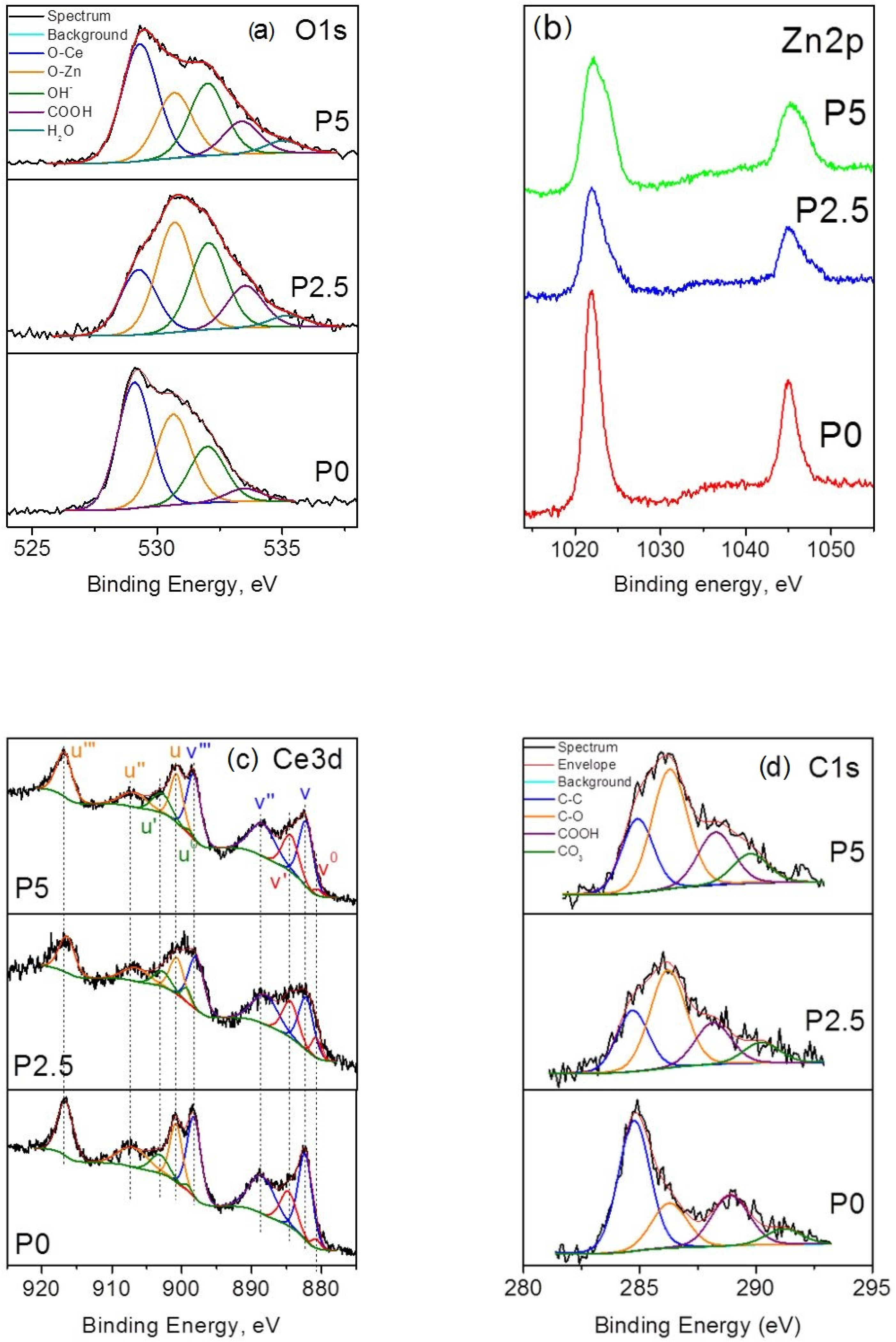
The surface composition and chemical state of the ZnO-CeO2 powders were investigated by XPS. It can be found that the powders contain Zn, Ce, O, and C. To understand the chemical state of Ce, Zn, and O in ZnO-CeO2 powders, the Ce3d, Zn2p, and O1s core levels were measured, as shown in Figure 4. The O1s spectra of the samples are shown on Figure 4a. The O1s spectra are wide, asymmetric, and correspond to several peaks—a result of metal oxides (O-Ce at ~529.2 eV and O-Zn at ~530.7 eV), hydroxyl groups (~532.0 eV), carboxyl groups (~533.5 eV), and water (535.2 eV). The Zn2p photoelectron spectra show peaks with binding energy levels of 1022.0 eV for Zn2p3/2 and 1045.0 eV for Zn2p1/2 (Figure 4b). The observed positions of the peaks, a doublet separation between the 2p3/2 and 2p1/2 peaks of ~23 eV, are characteristic of ZnO. Similar results have been reported in the literature for Zn2+ in ZnO [6,18]. Asymmetry is noticed in the higher binding energies at the zinc spectrum (samples P2.5 and P5), which may be due to the formation of the zinc hydroxide phase. The C1s spectra are decomposed with Lorentz–Gaussian curves fitting into four peaks corresponding to adventitious carbon at 284.8 eV, C-O at 286.2 eV, carboxyl groups at ~288.2 eV, and carbonates at 290.5 eV ± 0.6 (Figure 4d).
Figure 4c shows the XPS signals of Ce3d. The Ce3d spectrum exhibits well-resolved spin–orbital components (V0, V, V′, V″, and V‴ peaks for Ce3d5/2 and U0, U, U′, U″, and U‴ peaks for Ce3d3/2) with an energy-splitting value of approximately Δ ≈ 18.5 eV, which is characteristic for this element. The binding energy at 882.4 eV for Ce3d5/2 (V) peaks and the peaks U‴ (916.9 eV) is ascribed to CeO2. The peaks V0 and V′ and U0 and U′ are associated with Ce3+ [19,20]. In order to determine the oxidation state of cerium, a method reported in the literature was applied, which establishes a linear correlation between the relative percentage of the U‴ components and the content of Ce4+. The percentage of Ce4+ was calculated according to the following expression [21]:
Ce4+% = (U‴%/14) × 100%
where U‴% represents the relative area of the U‴ peak with respect to the total Ce3d spectral area. According to this formula and the performed calculations, the results clearly confirm that the cerium in the studied samples is predominantly present in the +4 oxidation state, which is consistent with the formation of CeO2 as the main phase. Small amounts of Ce3+ (3.8% (P0), 5.2% (P2.5), and 2.6% (P5)) were also calculated. The atomic concentrations of the chemical elements on the surface of the ZnO-CeO2 composites and the OL/OH ratio are presented in Table 3. An increase in the content of hydroxyl groups is observed when increasing the quantity of the polymer Pluronic P123. It is known that Ov favors the formation of reactive hydroxyl radicals, which participate in the oxidation reactions associated with the degradation of organic pollutants.

3.1.3. EPR Spectroscopy

Electron paramagnetic resonance (EPR) spectroscopy is a very sensitive method that allows us to identify paramagnetic defects, free radicals, and ionic states in solid materials. For catalysts containing cerium and zinc oxides, EPR spectroscopy is used to characterize oxygen vacancies, the valence states of Ce3+/Ce4+, and the interaction between the active phase and the support. This information is crucial for understanding the catalytic properties and mechanism of the redox processes.
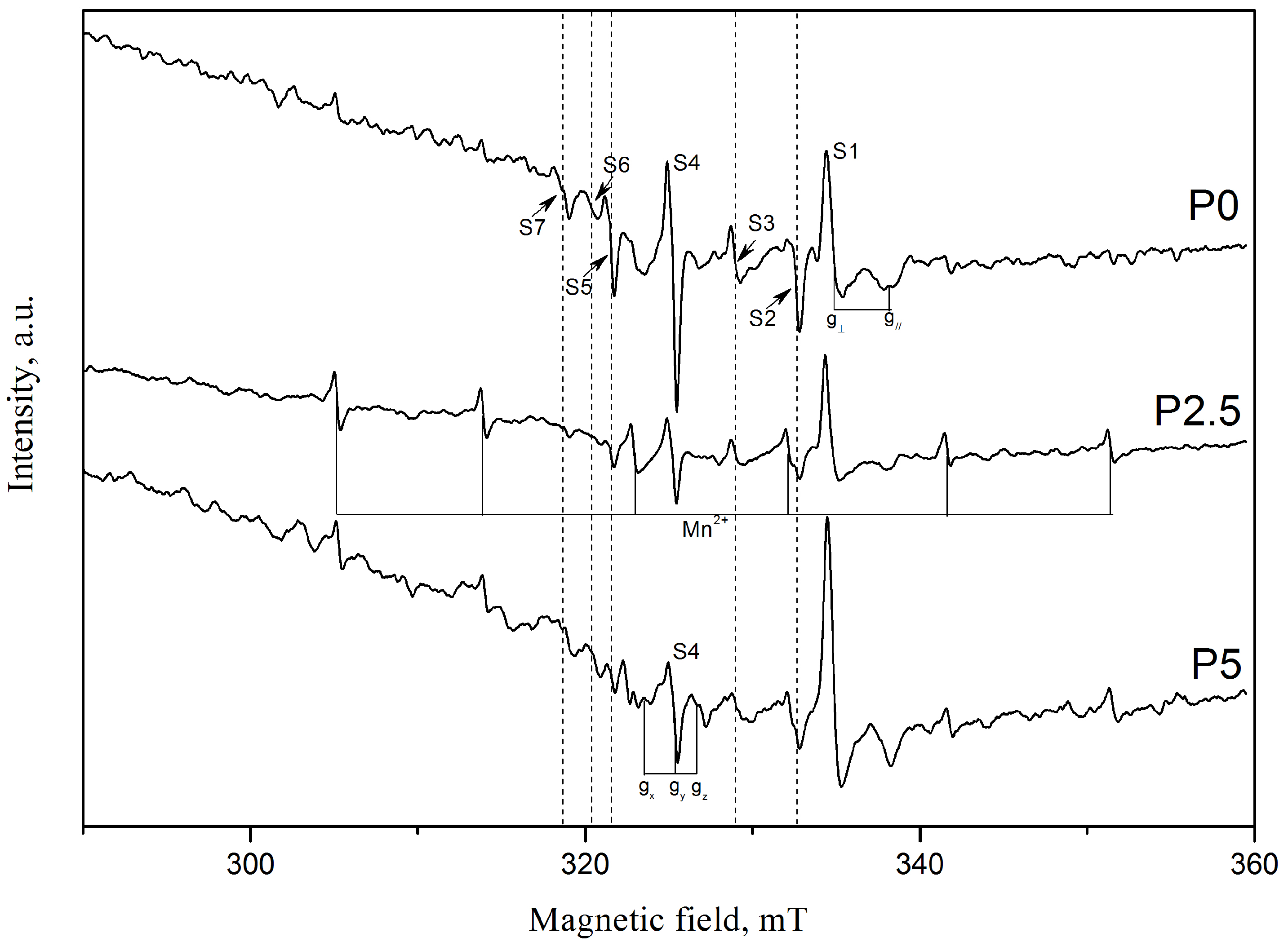
Figure 5 shows the room-temperature EPR spectra of the ZnO-CeO2 (P0) and ZnO-CeO2 samples (P2.5 and P5) incorporated with various amounts of Pluronic P123 (2.5 and 5 g). The spectra exhibit a sharp, asymmetric, and intense signal (denoted as S1) with axial g-tensor values of g = 1.959 and g// = 1.94. According to the literature, this signal is attributed to Ce3+ ions with low symmetry and is associated with anion vacancies [Ce3+-O-Ce4+] (S = 1/2) localized on the surface of ceria particles [22,23,24,25]. Upon incorporation of Pluronic P123 (2.5 g) into ZnO-CeO2, the EPR signal intensity slightly decreases, probably due to oxidation of Ce3+ to Ce4+. However, when the amount of Pluronic P123 is increased to 5 g, an approximately twofold increase in EPR signal intensity is observed in sample P5. The results obtained by EPR are different from those obtained by XPS analyses due to the following reasons: (i) The low concentration: Ce3+ is usually present in small amounts relative to Ce4+. If the content is below the detection threshold of XPS (~0.1 at.%), it may not be detected. (ii) Small energy gap: The difference in binding energies between Ce3+ and Ce4+ (e.g., in the Ce3d spectrum) is small—about 1.5–2 eV. This sometimes makes peak separation difficult, especially in contaminated or broad spectra. (iii) Surface oxidation: Ce3+ is easily oxidized to Ce4+ in air or under X-ray irradiation during analysis, which obscures its presence using XPS. The advantage of the EPR method is its possibility to detect Ce3+ due to its high sensitivity to unpaired electrons, while XPS cannot always distinguish Ce3+ from Ce4+, especially if Ce3+ ions are in small amounts or hidden in the bulk rather than on the surface. Surface Ce3+ ions are generally correlated with high catalytic activity, as they contribute to the formation of oxygen vacancies [23].
A second signal (S2) with g = 1.973 superimposed with the fourth manganese line was also detected, and it is associated with defect centers destabilized by the Pluronic P123. A similar signal was observed in CeO2 and Rh/CeO2 systems, although its origin was not clarified [25]. It is possible that S2 arises from Zn-related defects. According to the literature, in the ZnO- and CeO2-doped ZnO materials, a singlet signal at g = 1.96–1.97 is typically attributed to shallow donor centers associated with Zn-related defects, interstitial Zni, or oxygen vacancies [26].
A weak anisotropic signal (denoted as S3) centered at g = 1.994 with variable intensity was recorded in all samples. Two possible origins are proposed for this S3 signal: (1) hole-type defects (O centers) or (2) electrons trapped in the oxygen vacancy (F+ centers) [27,28]. Our observation—namely, the increase in Ce3+ in sample P5 and a slight decrease in the intensity of S3 after Pluronic P123 addition to ZnO-CeO2—is consistent with surface hole-type O centers, which are neutralized upon adsorption or electron donation by the polymer. If the S3 signal was instead an F+ center, its intensity would be expected to increase with increasing Ce3+ concentration; however, the opposite trend is observed here.
A signal with gx = 2.029, gy = 2.017, and gz = 2.01 (denoted as S4) assigned to superoxide ions adsorbed on surface Ce4+ ions (Ce4+-O2 species) was detected in all samples [25,29]. In samples P0 and P5, the spectra appear more complex, probably due to the superposition of two signals attributed to O2 species, which are adsorbed on Ce4+ and Zn2+ sites [28]. The dominant species are Ce4+ and O2, and their concentration decreases after modification with Pluronic P123, which is more significant in sample P2.5, likely due to surface modification or reduced availability of active adsorption sites.
A resonance signal at 322 mT with g = 2.04 (denoted as S5) was detected. A similar signal (g = 2.03) has been reported in other studies and is associated with coupled defects such as negatively charged zinc vacancy–interstitial zinc (V-Zn:Zni0) complexes [30]. The intensity of S5 significantly decreases after modification with Pluronic.
Weak signals at g = 2.047 (denoted as S6) and g = 2.059 (denoted as S7) were also recorded in all samples and can be assigned to adsorbed water, OH radicals, or absorbed oxygen (O2) [31,32,33]. The modification with 2.5 g of Pluronic P123 slightly reduced their intensity in sample P2.5.
All studied samples exhibit the six-line pattern typical for EPR of Mn2+ ions with g = ~ 2. The intensity of the manganese hyperfine lines increases with incorporation of the polymer, likely due to minor contamination originating from the Pluronic additive.
These findings suggest that Pluronic acts as a structural and electronic modifier, influencing the defect chemistry of the ZnO-CeO2 composites and thereby potentially altering their redox and catalytic properties.

3.1.4. DRS Analyses

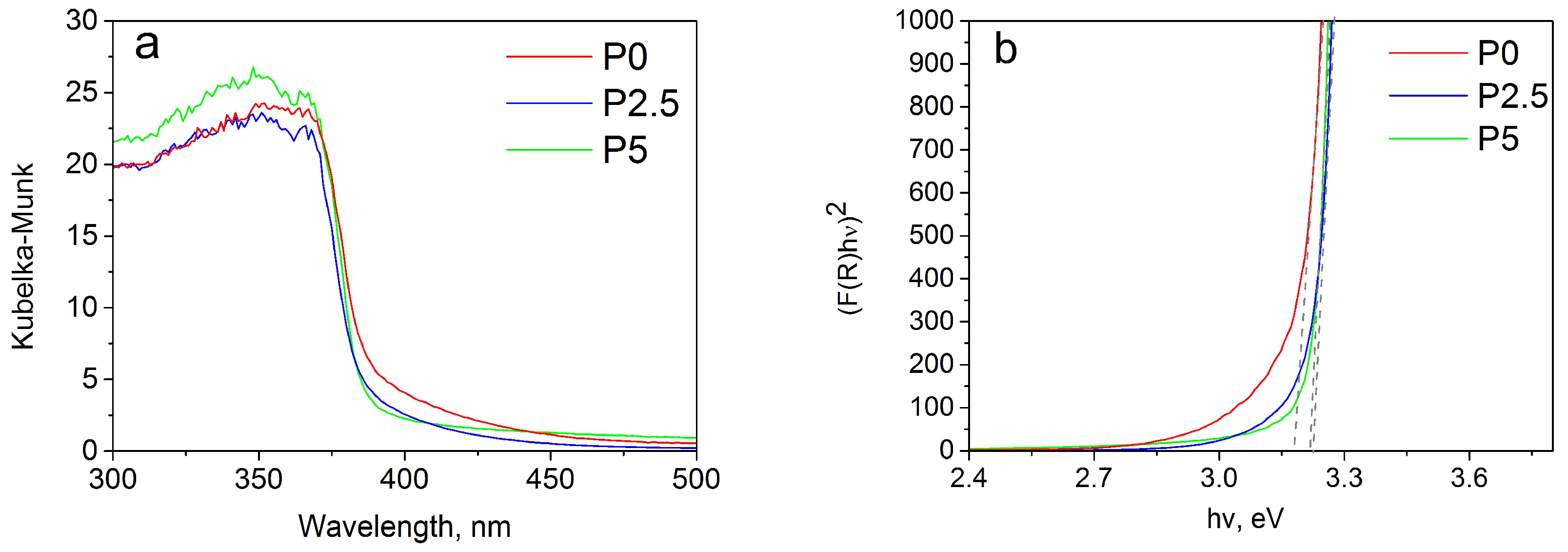
The optical properties of the synthesized ZnO-CeO2 nanomaterials were studied by DRS analyses. An absorbance spectrum with the Kubelka–Munk transformation for the ZnO-CeO2 powders is presented on Figure 6a. The band gap energy of the samples was evaluated on the basis of the plot in Figure 6b. For the reference ZnO-CeO2 powder (P0), the band gap energy is 3.18 eV, and with the addition of the Pluronic P123 polymer, the value is changed: 3.22 eV for P2.5 and 3.23 eV for P5. This is in correspondence with the values published by other researchers. The increased band gap value of the samples, P2.5 and P5, modified with Pluronic P123 compared to that of the P0 material (without the polymer) could be explained by the different particle sizes and the generation of defects (in our case Zn-related defects and oxygen vacancies, as determined by EPR spectroscopy). S. Suwanboon et al. have also proved that the size of particles and the presence of defects are significant factors that have an influence on the band gap value [34].
The absorption edge of the reference ZnO-CeO2 powder (P0) lies in the UV region with a wavelength of 389.5 nm. The corresponding wavelengths for samples P2.5 and P5 are ~386.2 nm and 385.3 nm, respectively, and have a blue shift relative to the pure P0 powder.

3.1.5. Textural Characteristics of the Prepared ZnO-CeO2 Samples

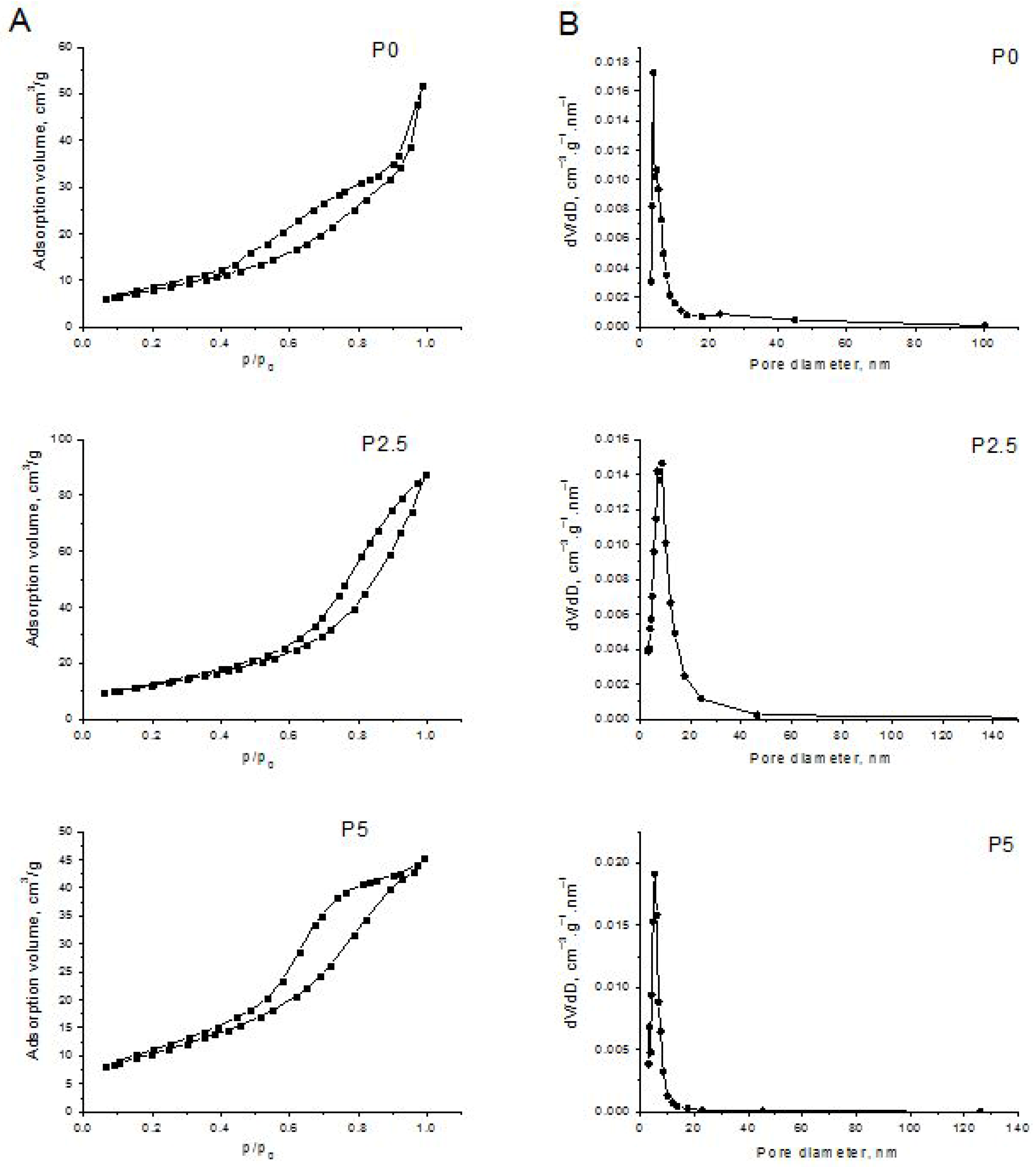
The hysteresis loop in the adsorption–desorption isotherms of both samples (P0 and P2.5) could be interpreted as one belonging to the H3 type (Figure 7). This type of isotherm could be due to the presence of aggregates, which consist of plate-like particles. These particles form slit-like pores. The isotherm of sample P5 can be classified as a mixed type between type III and type IV of the IUPAC nomenclature, which proves the existence of ink-bottle pores with narrow mouths [35]. Interestingly, the samples obtained by surfactant-modified precipitation exhibited a slightly decreased size of the pores in comparison to the reference material (P0). The BET surface areas are as follows: P0 = 30 m2·g−1, P2.5 = 46 m2·g−1, and P5 = 38 m2·g−1. Similar results about the influence of the polymers P123 and PVP on the increased surface area of MnOx–CeO2 materials are reported by other authors [10]. The average pore size of P0 is 11 nm, while the P2.5 and P5 samples have pore sizes of 12 nm and 7 nm, respectively. This is probably due to the copolymer Pluronic filling the available pores of the P5 material, leading to the decrease in pore size, while in sample P2.5, the pore size remains unchanged in comparison to the reference sample.

3.1.6. FT-IR Spectroscopy of the Synthesized ZnO-CeO2 Powders

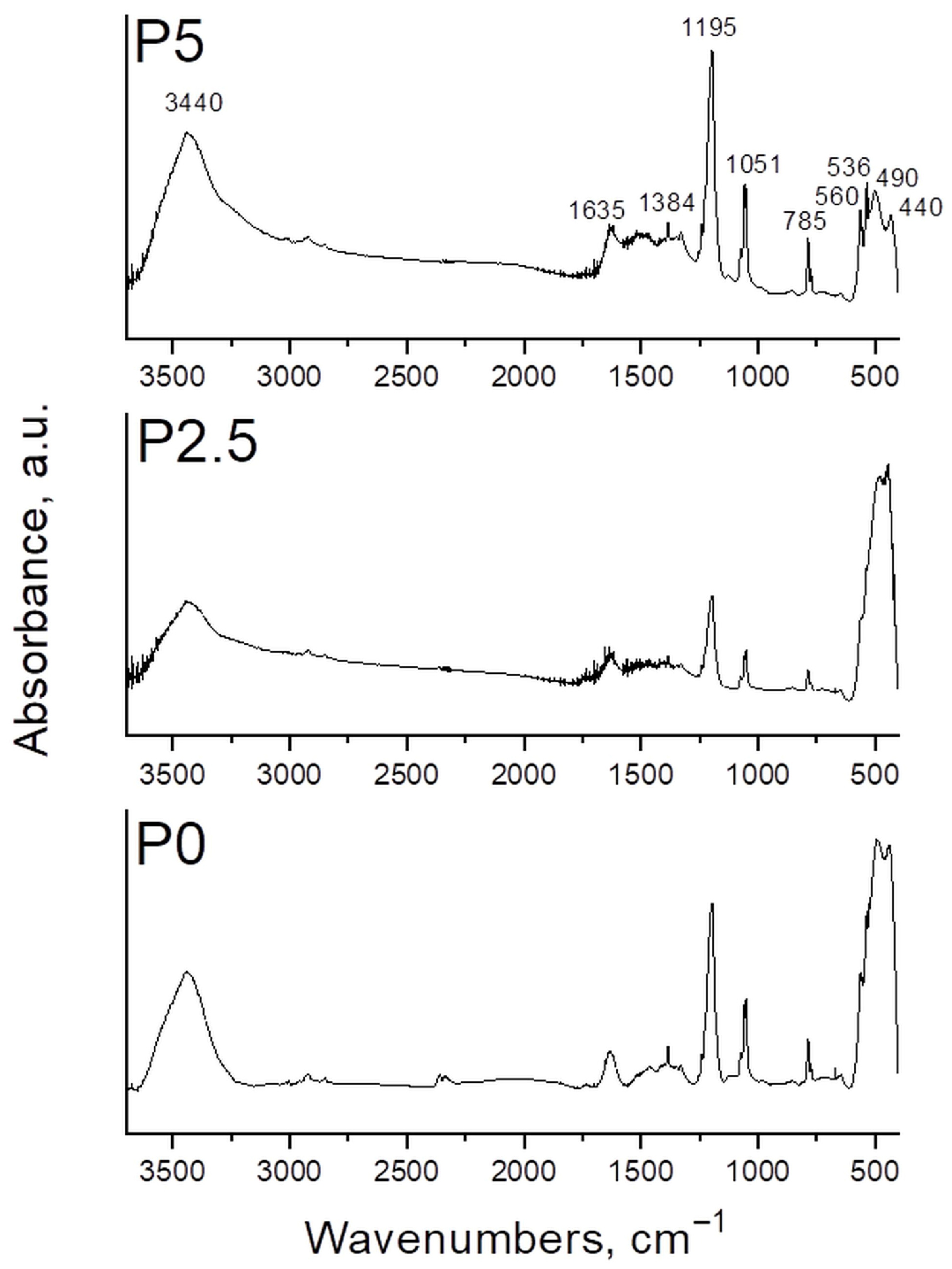
The FT-IR spectra of the synthesized ZnO-CeO2 materials are recorded in the range 400–4000 cm−1 (Figure 8). The broad band around 3440 cm−1 is attributed to the O-H stretching vibration in OH groups. The bending vibrations observed at about 1635 cm−1 are characteristics for the presence of the hydroxyl (O-H) group. The bands located around 785 and 1051 cm−1 are attributed to the CO32− bending vibration and C-O stretching vibration. The vibrations at about 1195 cm−1 suggest the presence of carbon- or oxygen-containing functional groups. The band positioned at 1384 cm−1 is due to the absorption of CO2 molecules. The peaks positioned at around 440 cm−1 and 490 cm−1 are an indication of Zn-O and Ce-O stretching vibrations [36,37,38,39]. In the FT-IR spectrum of the P5 sample (modified with the highest amount of Pluronic P123), additional peaks are observed. They are positioned at 536 and 560 cm−1 and assumed to be related to oxygen vacancies (Ce3+) and interstitial Zni (also proved by the EPR and XPS investigations). It is known that the lone pairs on the ether oxygen in PEO groups coordinate to metal cations. This leads to the shifting of symmetric C-O-C stretching bands of PEO (normally around 1060 cm−1) to lower wavenumbers when coordinated to metal salts. The peak at 1051 cm−1 could probably be assigned to the C-O-C band of PEO, which is coordinated with metal ions.

3.1.7. TEM Analysis and EDS Mapping/Spectra of the Prepared ZnO-CeO2 Materials

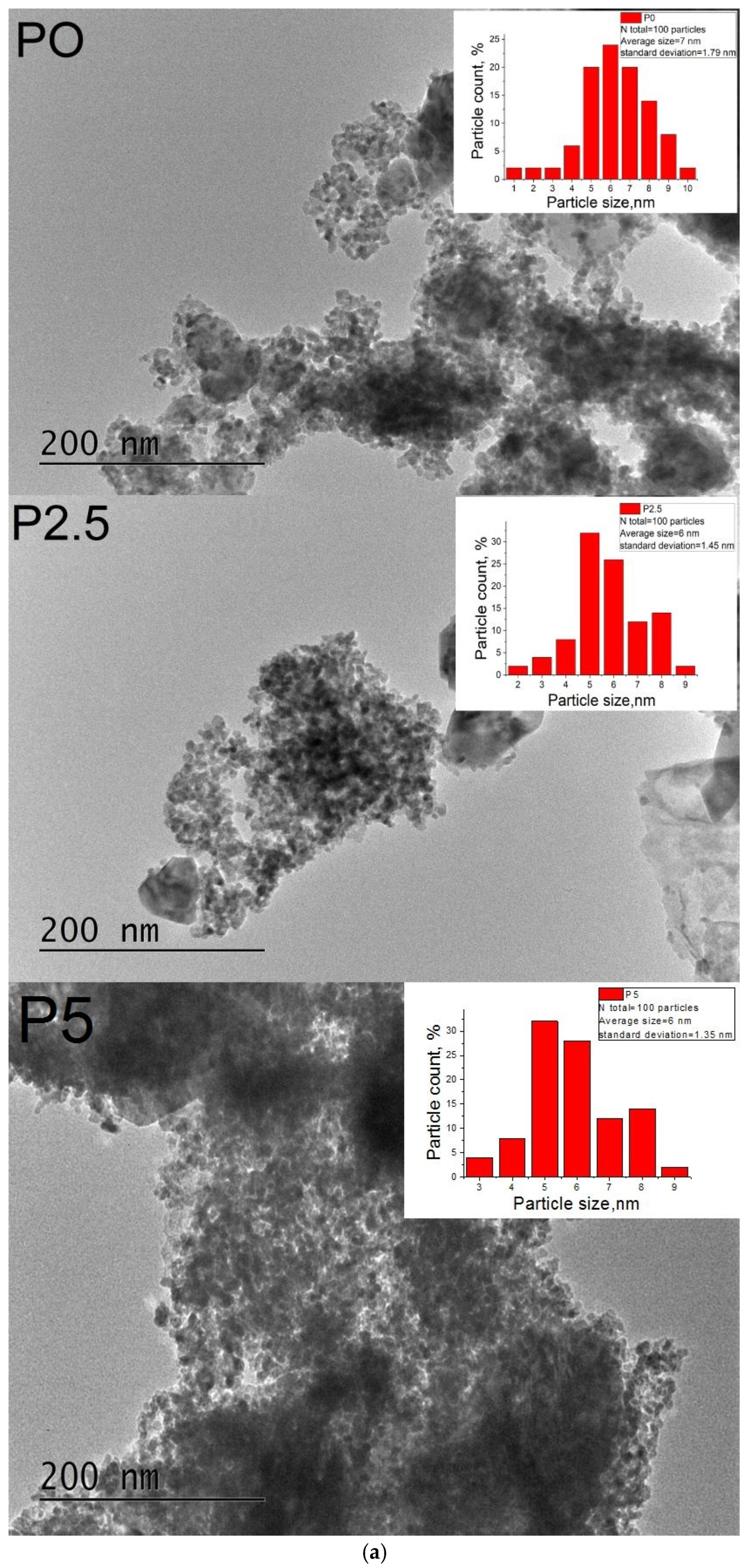
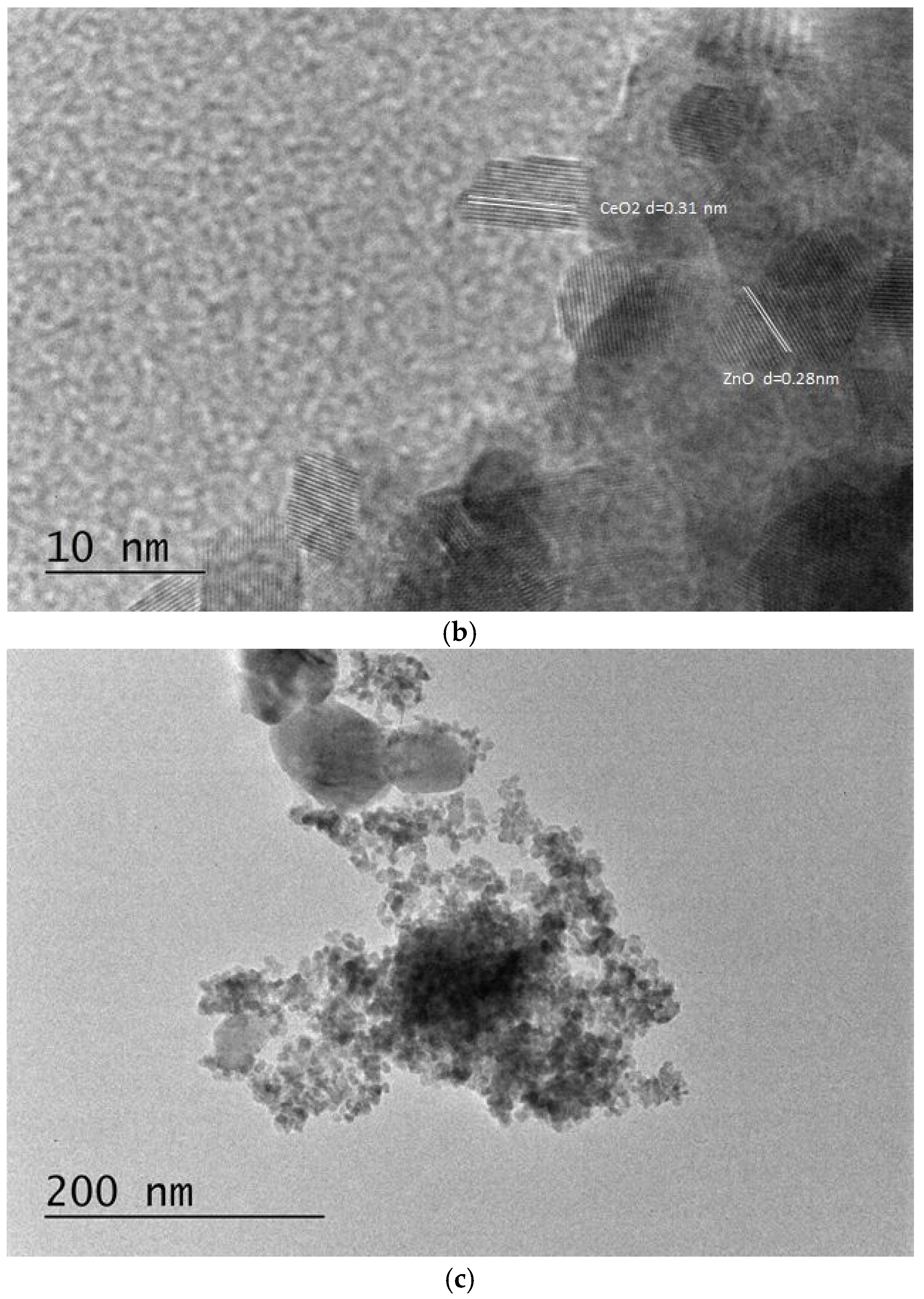
Figure 9a,b display TEM photographs with the particle size distribution of CeO2 particles as an inset and the HR-TEM photograph of both ZnO and CeO2 particles with interplanar distances of ZnO-CeO2 samples, which were determined based on TEM analyses. The histogram of the reference sample without the surfactant (P0) shows broad distribution of the particles. It is visible that it presents a prevailing part of the particles with sizes in the interval from 1 to 10 nm. The addition of the polymer P123 leads to an increased share of the small particles with sizes of about 6 nm. Figure 9b presents both CeO2 and ZnO particles with corresponding interplanar distances (d). The Rietveld measurements (based on the XRD diffractograms) reveal the size of the crystallites, which are constituents of the particles. The particle sizes on the other hand can be estimated by TEM micrographs. Figure 9 is clearly showing much larger ZnO particles in comparison to the fine-grained CeO2 sample. The particle sizes of both oxides evaluated by TEM are in accordance with the estimated average crystallite sizes by Rietveld analyses (ZnO is in the range 50–78 nm, while CeO2 is 12 nm for all samples).
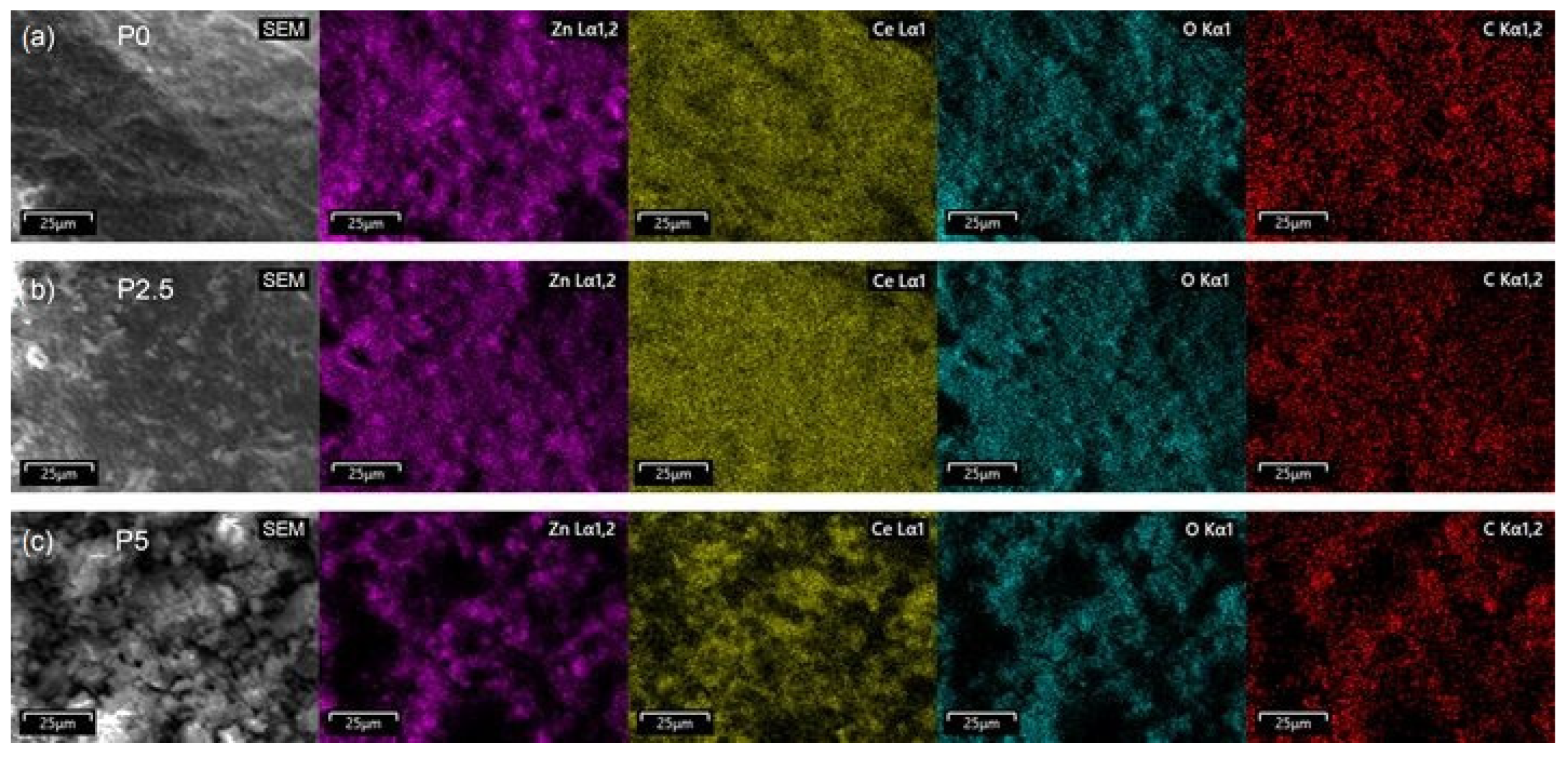
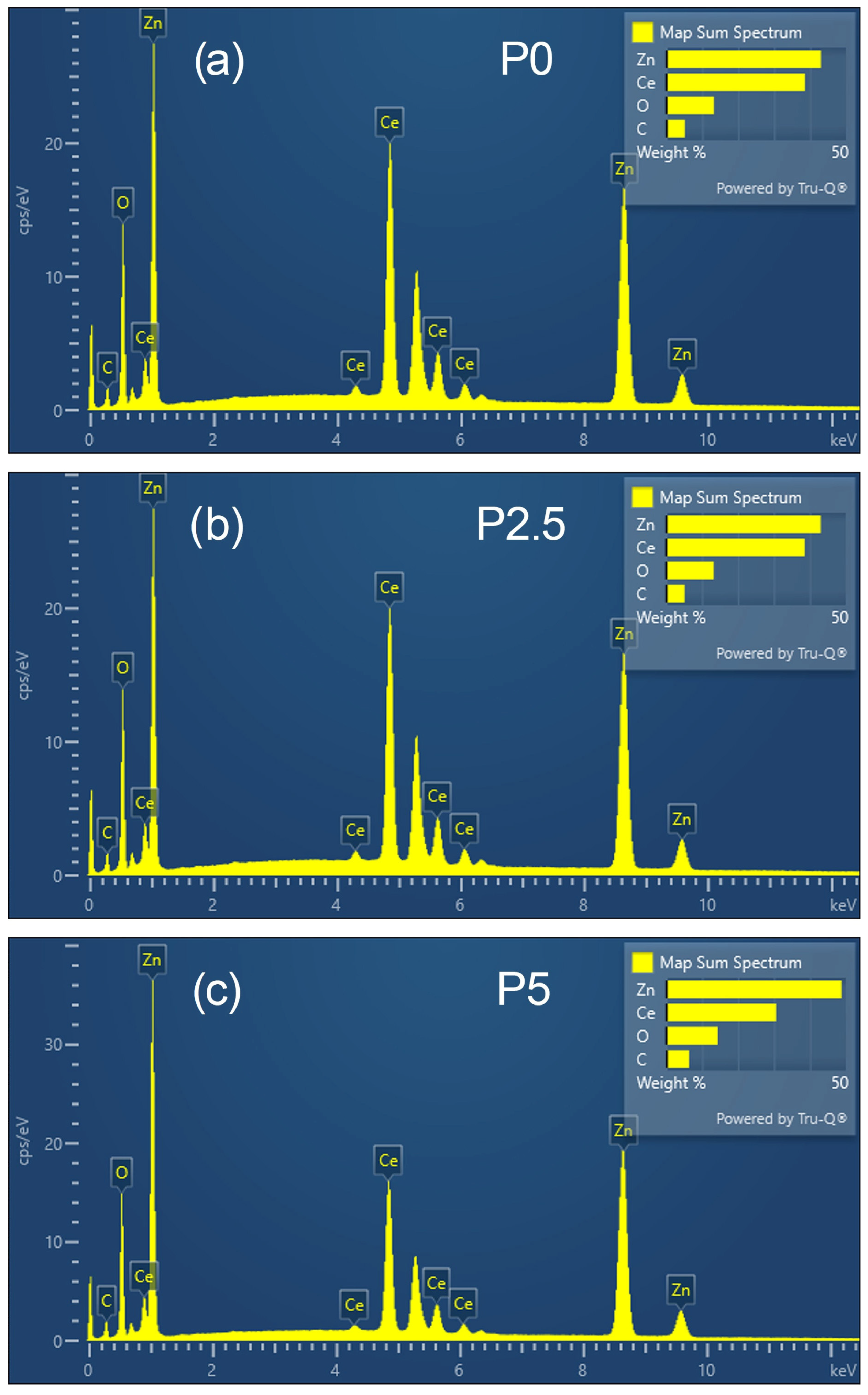
In order to quantify the amount of Zn, Ce, O, and C on the surface of the composites, EDS and mapping analyses were performed with the corresponding images and spectra on display in Figure 10 and Figure 11. All EDS spectra reveal the characteristic X-ray Lα line (1.01 keV) of zinc and the Lα line (4.839 keV) of cerium, indicating their relative presence in the powders between 27–31 at.% for Zn and 9–12 at.% for Ce. Oxygen and carbon are detected via their characteristic Kα lines (0.525 keV for O and 0.277 keV for C), which correspond to the relative presence of ∼38 at.% for O and between 19 and 23 at.% for C. The detection of carbon is most probably attributed to the adventitious carbon adsorbed on the surface of the ZnO-CeO2 nanocomposites. The chemical compositions of all powders are presented in Table 4.

3.2. Photocatalytic Activity of the Synthesized ZnO-CeO2 Nanomaterials

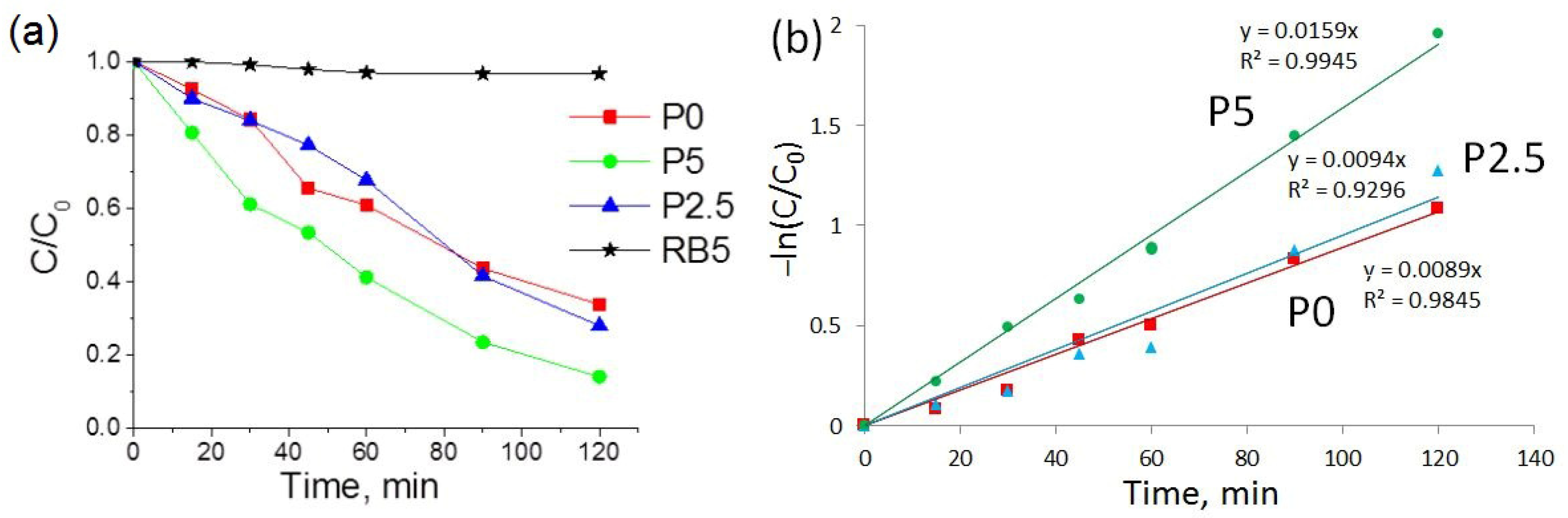
Figure 12a,b present the concentration ratio (C/C0) of the Reactive Black 5 dye during the photocatalytic discoloration process under UV irradiation, as well as the kinetic curves of discoloration.
Both Pluronic-modified ZnO-CeO2 composites show increased photocatalytic efficiency towards discoloration of the RB5 dye under UV illumination as compared to the reference material (P0). It has to be noted that the changes in the polymer amount lead to enhanced catalytic activity of both powders prepared with Pluronic (P5: 86% and P2.5: 72% vs. P0: 66%) after 120 min of UV-light illumination (Table 5). For comparison, another research group, which studied the same composite and the degradation of the same azo dye under UV light, achieved 62% RB5 dye degradation after 120 min of irradiation time [36].
The adsorption capacities of the tested ZnO-CeO2 nanophotocatalysts decrease in the following order: 0.026 mg/g (reference sample P0) > 0.021 mg/g (P2.5) > 0.018 mg/g (P5). The catalytic results show that adsorption capacity influences photocatalytic ability: the decrease in adsorption capacity leads to an increase in photocatalytic activity. The rate constant of the Pluronic-produced ZnO-CeO2 sample (P5) increases approximately ~50%, compared to that of the reference sample (P0) (Table 5).
The enhanced photocatalytic efficiency of the ZnO-CeO2 nanomaterials could be related to three factors: (1) The heterojunction of a ZnO-CeO2 composite significantly improved the efficient separation of photogenerated electron–hole pairs, thereby reducing the likelihood of charge recombination and increasing the availability of charge carriers for redox reactions. (2) The Ce3+/Ce4+ redox couple and the high capacity to store oxygen: The Ce4+ and Ce3+ ions coexisting on the surface of ZnO-CeO2 photocatalysts, as revealed by both EPR and XPS analyses, affect the photoreaction by altering the electron–hole pair recombination rate. Ce4+ is a scavenger of electrons and easily traps the electron. The electrons trapped in a Ce4+/Ce3+ site are subsequently transferred to the surrounding adsorbed O2, and hence the lifetime of the electron–hole pair is extended [14,40,41,42,43,44]. (3) The surface of the ZnO-CeO2 material displayed increased the adsorption capacity for oxygen molecules, which led to enhanced production of superoxide radicals (⋅O2) via the reduction of O2 [45]. The Pluronic-modified sample (P5) possesses more OH groups and more oxygen vacancies (contributed from Ce3+- and Zn-related defects) than the reference P0 sample. Consequently, it could be concluded that the Pluronic copolymer contributes to the formation of oxygen vacancy-related defects as well as the increased quantity of Ce3+ cations. (4) The XRD analyses also proved that the Pluronic P123 polymer significantly influenced the polarity (surface is dominated by (002) polar planes vs. (100) planes) of the ZnO-CeO2 powders. A similar effect of copolymer modification in ZnO powders has been demonstrated in [15]. The authors obtained ZnO with a higher (002)/(100) ratio, showing higher photocatalytic performance as compared to the non-polar ZnO materials. The final photocatalytic activity is the result of the suitable combination of all factors. The highest photocatalytic efficiency of the P5 sample is due to the efficient separation of electron–hole pairs and a higher quantity of oxygen lattice defects (Vo) and OH groups, as well as higher polarity (a higher ratio of (002)/(100) planes).
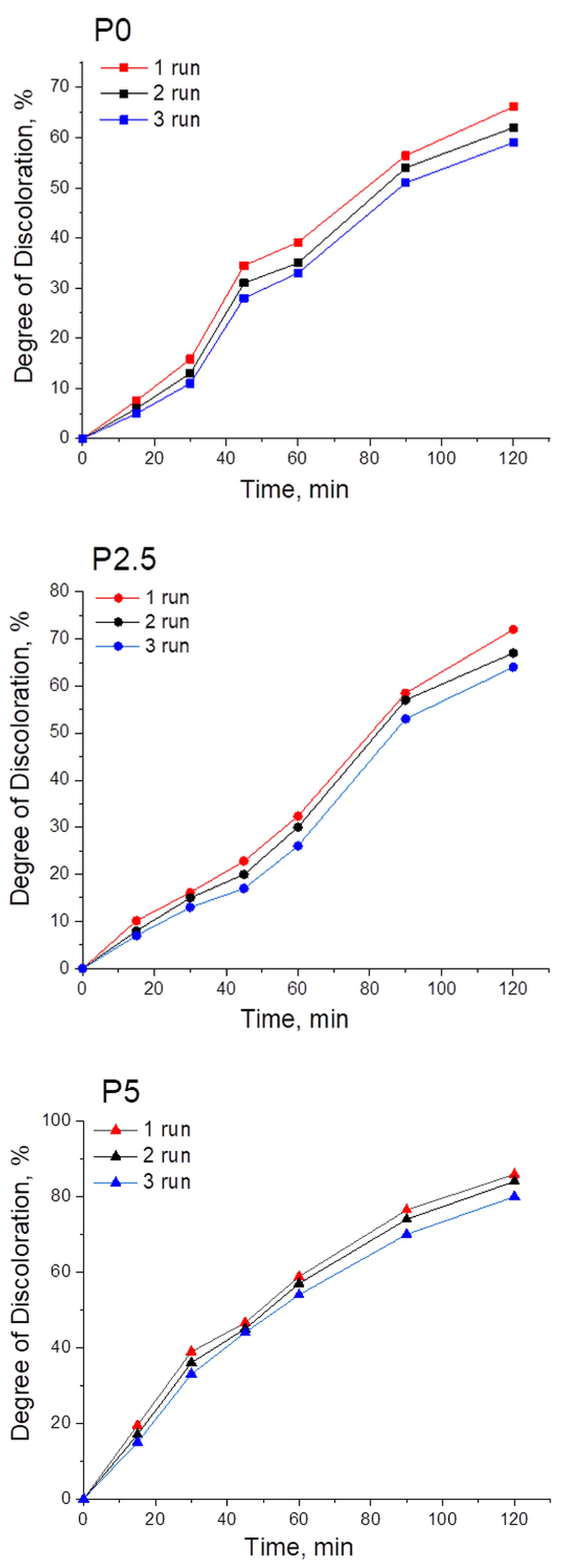
The reusability tests of the investigated photocatalysts have revealed that all ZnO-CeO2 composite samples maintain their photocatalytic efficiency after three working cycles, which confirmed their sustainability (Figure 13).

4. Conclusions

The influence of Pluronic P123 on the photocatalytic and physicochemical features of CeO2-ZnO nanocrystalline powders was investigated. Different amounts of the tri-block copolymer Pluronic P123—2.5 g (P2.5), 5 g (P5), and 0 g (P0)—were used. It was established that the increased amount of P123 leads to an increased degree of crystallinity and polarity (a higher ratio of (002)/(100) planes). It was revealed that the band gap of the Pluronic-modified samples increases (P2.5 and P5—3.22 eV and 3.23 eV, respectively) in comparison with the non-modified sample (3.18 eV). The P5 powder showed the highest degree of discoloration of the Reactive Black 5 dye (86%). Both XPS and EPR analyses proved that when the amount of P123 increases, the quantity of oxygen vacancies, Ce3+, and hydroxyl groups also increases. The presence of lattice defects, increased band gap values, and higher polarity is responsible for the increased catalytic discoloration rate of RB5 by Pluronic-modified ZnO-CeO2 samples.

Author Contributions

Conceptualization, K.Z.; methodology, K.Z.; validation, K.Z. and I.S.; formal analysis, K.Z., M.S., R.M., O.D., P.M., D.S. and S.D.; investigation, K.Z., I.S., D.S., M.S., R.M., O.D., P.M., M.D. and S.D.; resources, K.Z. and I.S.; data curation, K.Z., I.S., M.S. and R.M.; writing—original draft preparation, K.Z., I.S., D.S., M.S., S.D., O.D., M.D. and R.M.; writing—review and editing, K.Z., I.S. and O.D.; visualization, K.Z.; supervision, K.Z. and I.S.; project administration, K.Z. and I.S.; funding acquisition, K.Z. and I.S. All authors have read and agreed to the published version of the manuscript.

Funding

This research was funded by the Bulgarian National Science Fund, grant number KP-06-N69/8.

Data Availability Statement

The original contributions presented in this study are included in the article material. Further inquiries can be directed to the corresponding author.

Acknowledgments

The authors express their gratitude to the project funded by the Bulgarian National Science Fund, KP-06-N69/8 (KΠ-06-H69/8), “Novel polymer-hybrid materials containing (bio)synthesized metal oxide particles with improved photocatalytic and antimicrobial potential” for the financial support.

Conflicts of Interest

The authors declare no conflicts of interest.

References

  1. Habibi, M.H.; Fakhrpor, M. Synthesis, Characterization and Application of Pure Ceria, Pure Zinc Oxide, Ceria Zinc Oxide Nano Composite: Synergetic Effect on Photo-Catalytic Degradation of Amido Black 10B in Water. Desalination Water Treat. 2017, 60, 276–284. [Google Scholar] [CrossRef]
  2. Habibi, M.H.; Fakhrpor, M. Enhanced Photo-Catalytic Activity of CeO2-ZnO Nano-Structure for Degradation of Textile Dye Pollutants in Water. Desalination Water Treat. 2017, 60, 269–275. [Google Scholar] [CrossRef]
  3. Shah, N.; Bhangaonkar, K.; Pinjari, D.V.; Mhaske, S.T. Ultrasound and Conventional Synthesis of CeO2/ZnO Nanocomposites and Their Application in the Photocatalytic Degradation of Rhodamine B Dye. J. Adv. Nanomater. 2017, 2, 133–145. [Google Scholar] [CrossRef]
  4. Pathak, V.; Lad, P.; Thakkar, A.B.; Thakor, P.; Deshpande, M.P.; Pandya, S. CeO2-ZnO Nano Composites: Dual-Functionality for Enhanced Photocatalysis and Biomedical Applications. Inorg. Chem. Commun. 2024, 159, 111738. [Google Scholar] [CrossRef]
  5. Murugesan, S.; Sasibabu, V.; Jegadeesan, G.B.; Venkatachalam, P. Photocatalytic Degradation of Reactive Black Dye Using ZnO–CeO2 Nanocomposites. Environ. Sci. Pollut. Res. 2022, 30, 42713–42727. [Google Scholar] [CrossRef] [PubMed]
  6. Rajendran, S.; Khan, M.M.; Gracia, F.; Qin, J.; Gupta, V.K.; Arumainathan, S. Ce3+-Ion-Induced Visible-Light Photocatalytic Degradation and Electrochemical Activity of ZnO/CeO2 Nanocomposite. Sci. Rep. 2016, 6, 31641. [Google Scholar] [CrossRef]
  7. Cerrato, E.; Gonçalves, N.P.F.; Calza, P.; Paganini, M.C. Comparison of the Photocatalytic Activity of ZnO/CeO2 and ZnO/Yb2O3 Mixed Systems in the Phenol Removal from Water: A Mechanicistic Approach. Catalysts 2020, 10, 1222. [Google Scholar] [CrossRef]
  8. Khan, M.G.I.; Nurfitria, R.; Anggraini, T.; Aini, Q.; Hanifah, I.R.; Nurfani, E.; Aflaha, R.; Triyana, K.; Taher, T.; Rianjanu, A. Hydrothermal Synthesis of CeO2/ZnO Heterojunctions for Effective Photocatalytic Degradation of Organic Pollutants. Mater. Sci. Eng. B 2025, 322, 118630. [Google Scholar] [CrossRef]
  9. Kumari, V.; Yadav, S.; Mittal, A.; Sharma, S.; Kumari, K.; Kumar, N. Hydrothermally Synthesized Nano-Carrots ZnO with CeO2 Heterojunctions and Their Photocatalytic Activity towards Different Organic Pollutants. J. Mater. Sci. Mater. Electron. 2020, 31, 5227–5240. [Google Scholar] [CrossRef]
  10. Wang, H.; Jiang, H.; Kuang, L.; Zhang, M. Synthesis of Highly Dispersed MnOx–CeO2 Nanospheres by Surfactant-Assisted Supercritical Anti-Solvent (SAS) Technique: The Important Role of the Surfactant. J. Supercrit. Fluids 2014, 92, 84–92. [Google Scholar] [CrossRef]
  11. Anandan, M.; Dinesh, S.; Krishnakumar, N.; Balamurugan, K. Improved Photocatalytic Properties and Anti-Bacterial Activity of Size Reduced ZnO Nanoparticles via PEG-Assisted Precipitation Route. J. Mater. Sci. Mater. Electron. 2016, 27, 12517–12526. [Google Scholar] [CrossRef]
  12. Yu, Z.; Chouchene, B.; Liu, M.; Moussa, H.; Schneider, R.; Moliere, M.; Liao, H.; Chen, Y.; Sun, L. Influence of Laminated Architectures of Heterostructured CeO2-ZnO and Fe2O3-ZnO Films on Photodegradation Performances. Surf. Coat. Technol. 2020, 403, 126367. [Google Scholar] [CrossRef]
  13. Soli, J.; Kachbouri, S.; Elaloui, E.; Charnay, C. Role of Surfactant Type on Morphological, Textural, Optical, and Photocatalytic Properties of ZnO Nanoparticles Obtained by Modified Sol–Gel. J. Sol-Gel Sci. Technol. 2021, 100, 271–285. [Google Scholar] [CrossRef]
  14. Ma, T.; Yuan, Z.; Cao, J. Hydrangea—Like Meso—/Macroporous ZnO—CeO2 Binary Oxide Materials: Synthesis, Photocatalysis and CO Oxidation. Eur. J. Inorg. Chem. 2010, 2010, 716–724. [Google Scholar] [CrossRef]
  15. Silva, H.; Mateos-Pedrero, C.; Magén, C.; Pacheco Tanaka, D.A.; Mendes, A. Simple Hydrothermal Synthesis Method for Tailoring the Physicochemical Properties of ZnO: Morphology, Surface Area and Polarity. RSC Adv. 2014, 4, 31166. [Google Scholar] [CrossRef]
  16. Jalali Sarvestani, M.R.; Doroudi, Z. Removal of Reactive Black 5 from Waste Waters by Adsorption: A Comprehensive Review. J. Water Environ. Nanotechnol. 2020, 5, 180–190. [Google Scholar] [CrossRef]
  17. Mitra, A.; Mishra, M.K.; Saha, J.; De, G. Design of Mesoporous Alumina–Ceria Films on Glass: Compositional Tuning Leads to Mesoscopic Transformations. Microporous Mesoporous Mater. 2015, 203, 151–162. [Google Scholar] [CrossRef]
  18. Ahmad, R.; Tripathy, N.; Khan, M.Y.; Bhat, K.S.; Ahn, M.; Hahn, Y.-B. Ammonium Ion Detection in Solution Using Vertically Grown ZnO Nanorod Based Field-Effect Transistor. RSC Adv. 2016, 6, 54836–54840. [Google Scholar] [CrossRef]
  19. Rojas-Buzo, S.; Concepción, P.; Olloqui-Sariego, J.L.; Moliner, M.; Corma, A. Metalloenzyme-Inspired Ce-MOF Catalyst for Oxidative Halogenation Reactions. ACS Appl. Mater. Interfaces 2021, 13, 31021–31030. [Google Scholar] [CrossRef]
  20. Vazirov, A.; Sokovnin, S.Y.; Ilves, V.G.; Bazhukova, I.N.; Pizurova, N.; Kuznetsov, M.V. Physicochemical characterization and antioxidant properties of cerium oxide nanoparticles. IOP Conf. Ser. J. Phys. Conf. Ser. 2018, 1115, 032094. [Google Scholar] [CrossRef]
  21. Yu, X.; Li, G. XPS Study of Cerium Conversion Coating on the Anodized 2024 Aluminum Alloy. J. Alloys Compd. 2004, 364, 193–198. [Google Scholar] [CrossRef]
  22. Papadopoulos, C.; Kappis, K.; Papavasiliou, J.; Vakros, J.; Kuśmierz, M.; Gac, W.; Georgiou, Y.; Deligiannakis, Y.; Avgouropoulos, G. Copper-Promoted Ceria Catalysts for CO Oxidation Reaction. Catal. Today 2020, 355, 647–653. [Google Scholar] [CrossRef]
  23. Kappis, K.; Papadopoulos, C.; Papavasiliou, J.; Vakros, J.; Georgiou, Y.; Deligiannakis, Y.; Avgouropoulos, G. Tuning the Catalytic Properties of Copper-Promoted Nanoceria via a Hydrothermal Method. Catalysts 2019, 9, 138. [Google Scholar] [CrossRef]
  24. Li, L.; Lin, X.; Li, G.; Inomata, H. Solid Solubility and Transport Properties of Ce 1− x NdxO2−δ Nanocrystalline Solid Solutions by a Sol-Gel Route. J. Mater. Res. 2001, 16, 3207–3213. [Google Scholar] [CrossRef]
  25. Soria, J.; Martínez-Arias, A.; Conesa, J. Effect of Oxidized Rhodium on Oxygen Adsorption on Cerium Oxide. Vacuum 1992, 43, 437–440. [Google Scholar] [CrossRef]
  26. Ammar, A.U.; Yildirim, I.D.; Aleinawi, M.H.; Buldu-Akturk, M.; Turhan, N.S.; Nadupalli, S.; Rostas, A.M.; Erdem, E. Multifrequency EPR Spectroscopy Study of Mn, Fe, and Cu Doped Nanocrystalline ZnO. Mater. Res. Bull. 2023, 160, 112117. [Google Scholar] [CrossRef]
  27. Aškrabić, S.; Dohčević-Mitrović, Z.D.; Araújo, V.D.; Ionita, G.; De Lima, M.M.; Cantarero, A. F-Centre Luminescence in Nanocrystalline CeO2. J. Phys. D Appl. Phys. 2013, 46, 495306. [Google Scholar] [CrossRef]
  28. Cerrato, E.; Gionco, C.; Paganini, M.C.; Giamello, E. Photoactivity Properties of ZnO Doped with Cerium Ions: An EPR Study. J. Phys. Condens. Matter 2017, 29, 444001. [Google Scholar] [CrossRef]
  29. Zhang, X.; Klabunde, K.J. Superoxide (O2−) on the Surface of Heat-Treated Ceria. Intermediates in the Reversible Oxygen to Oxide Transformation. Inorg. Chem. 1992, 31, 1706–1709. [Google Scholar] [CrossRef]
  30. Stan, M.; Popa, A.; Toloman, D.; Dehelean, A.; Lung, I.; Katona, G. Enhanced Photocatalytic Degradation Properties of Zinc Oxide Nanoparticles Synthesized by Using Plant Extracts. Mater. Sci. Semicond. Process. 2015, 39, 23–29. [Google Scholar] [CrossRef]
  31. Kumar, C.P.; Gopal, N.O.; Wang, T.C.; Wong, M.-S.; Ke, S.C. EPR Investigation of TiO2 Nanoparticles with Temperature-Dependent Properties. J. Phys. Chem. B 2006, 110, 5223–5229. [Google Scholar] [CrossRef]
  32. Micic, O.I.; Zhang, Y.; Cromack, K.R.; Trifunac, A.D.; Thurnauer, M.C. Trapped Holes on Titania Colloids Studied by Electron Paramagnetic Resonance. J. Phys. Chem. 1993, 97, 7277–7283. [Google Scholar] [CrossRef]
  33. Brückner, A.; Bentrup, U.; Zanthoff, H.; Maschmeyer, D. The Role of Different Ni Sites in Supported Nickel Catalysts for Butene Dimerization under Industry-like Conditions. J. Catal. 2009, 266, 120–128. [Google Scholar] [CrossRef]
  34. Suwanboon, S.; Amornpitoksuk, P.; Bangrak, P.; Sukolrat, A.; Muensit, N. The Dependence of Optical Properties on the Morphology and Defects of Nanocrystalline ZnO Powders and Their Antibacterial Activity. J. Ceram. Process. Res. 2010, 11, 547–551. [Google Scholar]
  35. Vlaev, L.T. Adsorption and Catalysis; Baltika-2002: Burgas, Bulgaria, 2015; p. 86. [Google Scholar]
  36. Syed, A.; Yadav, L.S.R.; Bahkali, A.H.; Elgorban, A.M.; Abdul Hakeem, D.; Ganganagappa, N. Effect of CeO2-ZnO Nanocomposite for Photocatalytic and Antibacterial Activities. Crystals 2020, 10, 817. [Google Scholar] [CrossRef]
  37. Farahmandjou, M.; Zarinkamar, M.; Firoozabadi, T.P. Synthesis of Cerium Oxide (CeO2) Nanoparticles Using Simple CO-Precipitation Method. Rev. Mex. Física 2016, 62, 496–499. [Google Scholar]
  38. Spasov, S.; Arnaudov, M. Application of Spectroscopy in Organic Chemistry; Science and Art: Sofia, Bulgaria, 1978; p. 384. [Google Scholar]
  39. Khan, M.A.M.; Khan, W.; Ahamed, M.; Alhazaa, A.N. Microstructural Properties and Enhanced Photocatalytic Performance of Zn Doped CeO2 Nanocrystals. Sci. Rep. 2017, 7, 12560. [Google Scholar] [CrossRef] [PubMed]
  40. Liu, I.-T.; Hon, M.-H.; Teoh, L.G. The Preparation, Characterization and Photocatalytic Activity of Radical-Shaped CeO2/ZnO Microstructures. Ceram. Int. 2014, 40, 4019–4024. [Google Scholar] [CrossRef]
  41. Xiong, Z.; Lei, Z.; Xu, Z.; Chen, X.; Gong, B.; Zhao, Y.; Zhao, H.; Zhang, J.; Zheng, C. Flame Spray Pyrolysis Synthesized ZnO/CeO2 Nanocomposites for Enhanced CO2 Photocatalytic Reduction under UV–Vis Light Irradiation. J. CO2 Util. 2017, 18, 53–61. [Google Scholar] [CrossRef]
  42. Saravanan, R.; Agarwal, S.; Gupta, V.K.; Khan, M.M.; Gracia, F.; Mosquera, E.; Narayanan, V.; Stephen, A. Line Defect Ce3+ Induced Ag/CeO2/ZnO Nanostructure for Visible-Light Photocatalytic Activity. J. Photochem. Photobiol. A Chem. 2018, 353, 499–506. [Google Scholar] [CrossRef]
  43. Lamba, R.; Umar, A.; Mehta, S.K.; Kansal, S.K. CeO2ZnO Hexagonal Nanodisks: Efficient Material for the Degradation of Direct Blue 15 Dye and Its Simulated Dye Bath Effluent under Solar Light. J. Alloys Compd. 2015, 620, 67–73. [Google Scholar] [CrossRef]
  44. Zhang, X.; Qin, J.; Xue, Y.; Yu, P.; Zhang, B.; Wang, L.; Liu, R. Effect of Aspect Ratio and Surface Defects on the Photocatalytic Activity of ZnO Nanorods. Sci. Rep. 2014, 4, 4596. [Google Scholar] [CrossRef] [PubMed]
  45. Li, H.; Wu, R.; Ji, J.; Liu, Y.; Zhao, J.; Sahar, S.; Zeb, A. Efficient CeO2/ZnO Heterojunction for Enhanced Heterogeneous Photocatalytic Application. Inorg. Chem. Commun. 2025, 171, 113553. [Google Scholar] [CrossRef]
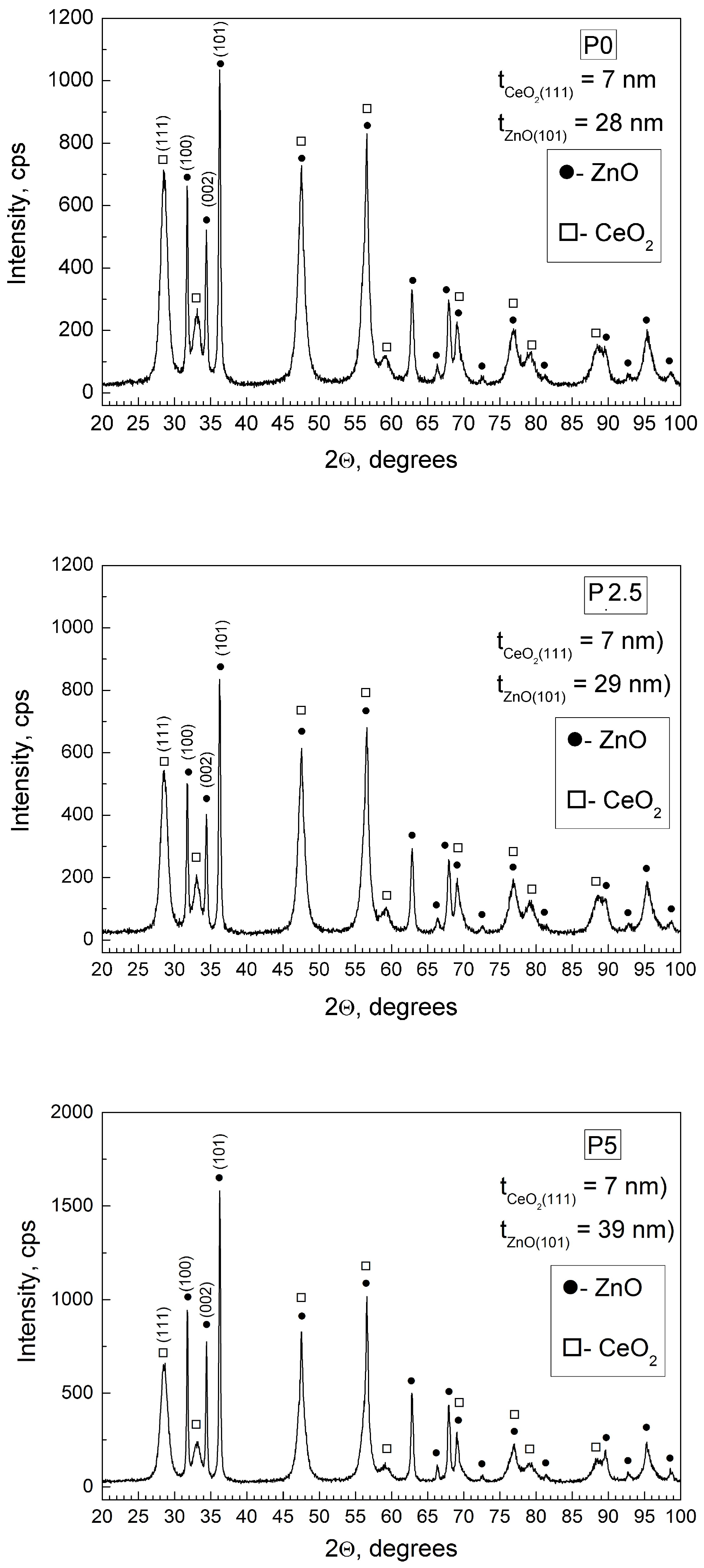
Figure 1. PXRD patterns of ZnO-CeO2 nanomaterials (P0, P2.5, and P5).
Crystals 15 01032 g001
Figure 2. Rietveld refinement plot of ZnO-CeO2 materials (P0, P2.5, and P5) with observed (blue diamonds) and calculated (red) XRD patterns, differences (black curves) and Bragg positions (black bars).
Crystals 15 01032 g002
Figure 3. Microstrain (ε) variation of CeO2-ZnO samples as a function of Pluronic P123 content.
Crystals 15 01032 g003
Figure 4. Deconvolution of the (a) O1s, (c) Ce3d, (d) C1s, and (b) Zn2p core-level spectra of the ZnO-CeO2 powders.
Crystals 15 01032 g004
Figure 5. X-band EPR spectra of ZnO-CeO2 materials (P0, P2.5, and P5).
Crystals 15 01032 g005
Figure 6. Absorbance spectrum with the Kubelka–Munk transformation (a) and comparative diagram of (F (R) hν)2 as a function of hν (b) of the ZnO-CeO2 powders.
Crystals 15 01032 g006
Figure 7. (A) Nitrogen adsorption–desorption isotherms and (B) pore size distribution of the obtained ZnO-CeO2 materials (P0, P2.5, and P5).
Crystals 15 01032 g007
Figure 8. FT-IR spectra of the synthesized ZnO-CeO2 materials (P0, P2.5, and P5).
Crystals 15 01032 g008
Figure 9. (a) TEM photographs and particle size distribution of CeO2 particles as insets. (b) HR-TEM photograph of ZnO-CeO2 samples, showing ZnO and CeO2 particles with their interplanar distances. (c) Typical TEM photograph, illustrating the characteristic morphology of the composites, including large ZnO particles and smaller CeO2 particles.
Crystals 15 01032 g009aCrystals 15 01032 g009b
Figure 10. SEM-EDS elemental mapping of ZnO-CeO2 materials: (a) P0, (b) P2.5, and (c) P5.
Crystals 15 01032 g010
Figure 11. EDS spectra of ZnO-CeO2 materials: (a) P0, (b) P2.5, and (c) P5.
Crystals 15 01032 g011
Figure 12. (a) The concentration changes in the RB5 dye vs. time of UV irradiation and (b) kinetic curves of discoloration with ZnO-CeO2 composite photocatalysts (P0, P2.5, and P5).
Crystals 15 01032 g012
Figure 13. Reusability tests of the ZnO-CeO2 composite photocatalysts, repeated 3 times, presenting the degree of RB5 dye discoloration under UV irradiation.
Crystals 15 01032 g013
Table 1. Rietveld refinement fitting parameters: profile R-factor (Rp), expected R (Rexp), weighted-profile R-factor (Rwp), and goodness of fit (GOF).
SampleRp (%)Rwp (%)Rexp (%)GOF (χ2)
P00.0911.729.821.42
P2.50.1012.4310.891.30
P50.0911.499.181.36
Table 2. Unit cell parameters: microstrain (ε), degree of crystallinity (χ), polarity (I(002)/I(100)), and average crystallite sizes (D) of CeO2-ZnO samples.
PhaseSampleQuantity [wt.%]Unit Cell ParametersD
[nm]
εΧ [%]
I(002)/I(100)
a [Å]b [Å]c [Å]V [Å3]
ZnOP051.683.25253.25255.210847.74501.46 × 10−3P0
Χ = 77.09
I = 0.72
P2.551.473.25243.25245.210647.73631.63 × 10−3
P557.123.25213.25215.210247.72783.48 × 10−3P2.5
Χ = 78.74
I = 0.79
CeO2P0 48.325.41065.41065.4106158.39125.06 × 10−3
P2.548.535.40875.40875.4087158.25124.39 × 10−3P5
Χ = 76.92
I = 0.81
P542.885.40935.40935.4093158.28124.98 × 10−3
Table 3. XPS results on the surface of the ZnO-CeO2 composites (P0, P2.5, and P5).
SamplesO, at.%Ce, at.%Zn, at.%Ce3+/Ce4+ OL/OH
P062.013.824.20.0392.7
P2.555.611.033.40.0541.7
P563.917.918.20.0271.8
OL—lattice oxygen; OH—hydroxyl groups.
Table 4. Surface chemical composition of the obtained ZnO-CeO2 composites (P0, P2.5, and P5) as determined by the EDS measurement.
Element,
Atomic %
P0P2.5P5Element,
Wt.%
P0P2.5P5
C19.6323.0022.07C5.176.516.33
O37.8538.6837.59O13.2814.5714.36
Zn29.9727.0131.21Zn42.9741.5848.74
Ce12.5511.329.13Ce38.5837.3430.57
Total100.00100.00100.00Total100.00100.00100.00
Table 5. The adsorption capacities (Q) after a 30 min dark period, discoloration at 120 min, and apparent rate constants (k) of photocatalytic discoloration of RB5.
SamplesQ (mg/g)Degree of Discoloration (%)kapp × 10−3 (min−1)
P00.026668.9
P2.50.021729.4
P50.0188615.9
Disclaimer/Publisher’s Note: The statements, opinions and data contained in all publications are solely those of the individual author(s) and contributor(s) and not of MDPI and/or the editor(s). MDPI and/or the editor(s) disclaim responsibility for any injury to people or property resulting from any ideas, methods, instructions or products referred to in the content.