Article

Response Surface Optimization of Jackfruit Seed Starch Hydrolysis Using Bacillus licheniformis Alpha-Amylase for the Preparation of Maltose-Rich Starch Hydrolysate


1
Faculty of Natural Sciences and Technology, Tay Nguyen University, Ea Kao Ward, Dak Lak 630000, Vietnam
2
Department of Chemistry, Tamkang University, New Taipei City 25137, Taiwan
3
Life Science Development Center, Tamkang University, New Taipei City 25137, Taiwan
*
Authors to whom correspondence should be addressed.
Catalysts 2026, 16(7), 587; https://doi.org/10.3390/catal16070587
Submission received: 20 May 2026 / Revised: 8 June 2026 / Accepted: 25 June 2026 / Published: 27 June 2026
(This article belongs to the Special Issue Enzyme: Catalytic Mechanism and Applications)

Abstract

Jackfruit seeds, a by-product of the jackfruit processing industry, comprise a substantial proportion of starch. As a result, jackfruit seeds are emerging as a viable source of fermentable sugars for fermentation processes. In this study, α-amylase from Bacillus licheniformis TKU004 was employed to hydrolyze gelatinized jackfruit seed starch slurry, and the hydrolysis conditions were systematically optimized using the Box–Behnken design (BBD) coupled with response surface methodology (RSM). Three independent variables, including incubation temperature (40–60 °C), enzyme-to-substrate ([E]/[S]) ratio (5–10 U/g), and reaction time (2–6 h), were evaluated, with dextrose equivalent (DE, %) as the response. The optimal hydrolysis parameters were determined to be 47 °C, an [E]/[S] ratio of 10 U/g, and a reaction time of 5.1 h, yielding a predicted DE of 31.72%. Experimental validation confirmed a DE of 32.85 ± 1.12%, in close agreement with the model prediction. HPLC (high-performance liquid chromatography) analysis of the hydrolysate revealed a composition of 14.20% glucose, 56.51% maltose, and 29.29% maltooligosaccharides, indicating that this process is well-suited for producing high-maltose syrup. In short, this study demonstrates the feasibility of valorizing jackfruit seed waste into value-added carbohydrate products through enzymatic hydrolysis with B. licheniformis α-amylase.

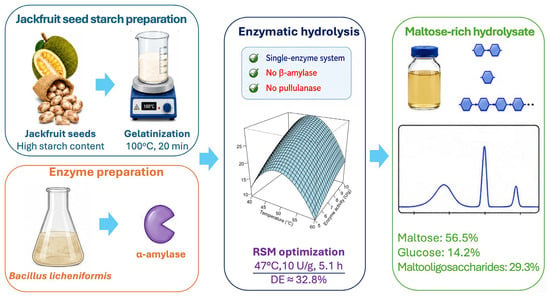
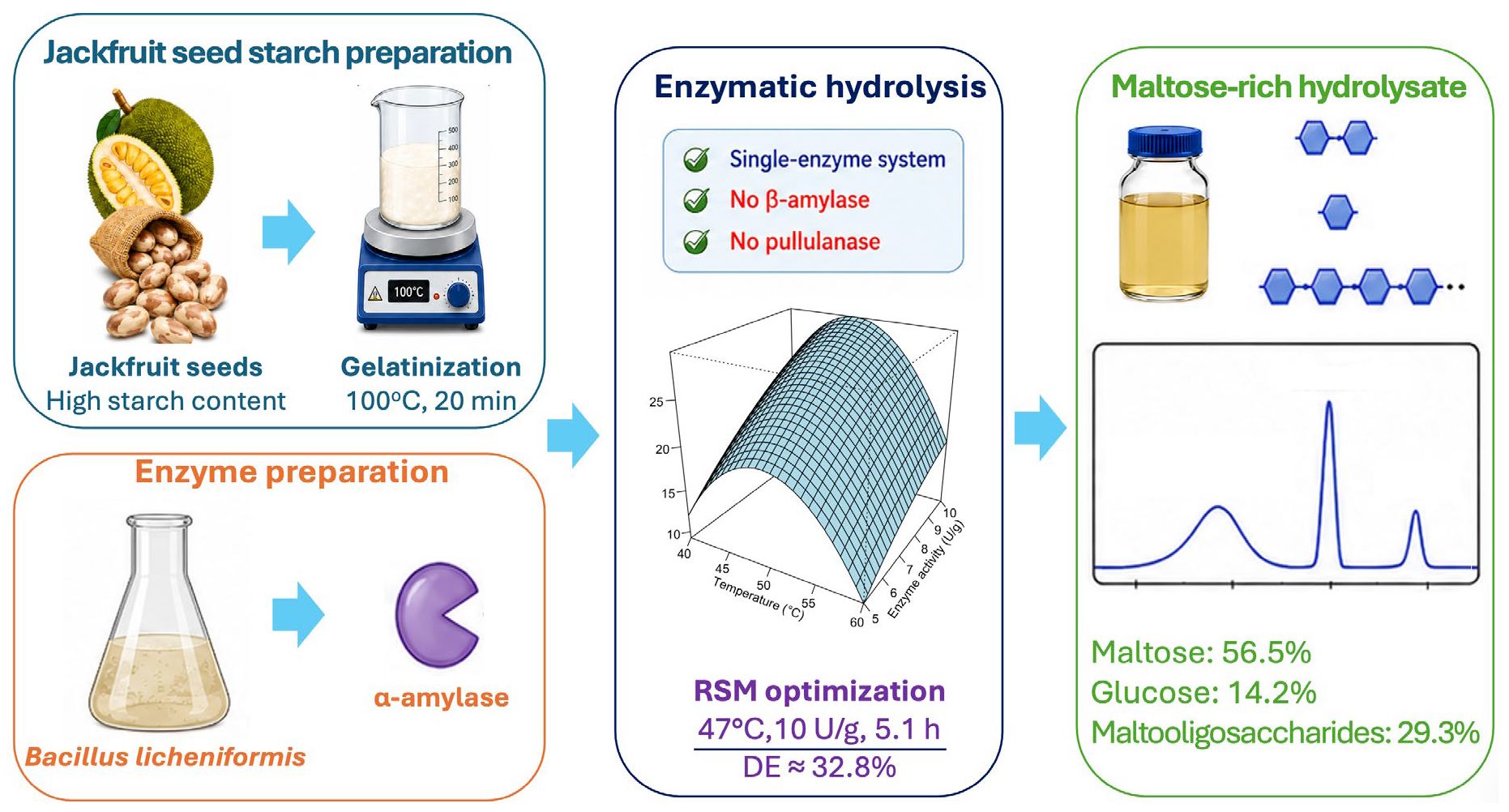
Graphical Abstract

1. Introduction

The jackfruit tree (Artocarpus heterophyllus L.) is notable for its ability to produce large fruits directly from its stems. These fruits are uniquely versatile, serving as vegetables when unripe and as sweet fruit when ripe [1]. Jackfruit trees thrive and are widely cultivated throughout South and Southeast Asia, playing a significant role in agriculture and diets in these regions. FAO reports that global jackfruit exports rose from USD 2 billion in 2012 to USD 3.7 billion in 2023, with Vietnam holding a 25% market share [2]. Nevertheless, only a small proportion of the fruit is consumed directly, whereas a significant fraction is discarded during processing. Previous reviews suggest that approximately 60–70% of the fruit mass may be residual as by-products or waste, primarily comprising peel, rind, central core, fibrous rags, latex, and seeds. This substantial waste stream underscores the need for valorization strategies targeting specific fractions with industrial potential [1,3]. In industrial jackfruit processing, fruits are typically peeled, the central core is removed, and the edible bulbs are separated manually or mechanically. During this operation, seeds are detached from the bulbs as a secondary by-product and are commonly discarded or underutilized despite their valuable composition [1]. Indeed, jackfruit seeds account for 8–15% of the entire fruit’s weight [4] and are high in protein, vitamins, minerals, and carbohydrates (mainly starch) [5]. Thus, jackfruit seed starch has recently attracted attention as a renewable material for food, fermentation, and packaging applications. Le et al. (2024) used jackfruit seed starch in lactic acid fermentation with a combination of Lactobacillus plantarum and Bacillus subtilis [6]. Van et al. (2023) evaluated the effects of jackfruit seed flour and jackfruit seed starch in cookie production [7]. In addition, jackfruit seed starch has been incorporated into biodegradable composite films due to its high amylose content, confirming its relevance as a plant-derived starch material for food-related applications [8,9].
Although jackfruit seed starch constitutes a promising renewable carbohydrate source, native starch is not readily assimilated in numerous biological processes due to its polymeric structure and limited direct bioavailability to microorganisms. Hydrolysis is therefore a vital step as it transforms starch into smaller saccharides, such as glucose, maltose, and maltooligosaccharides, which exhibit increased solubility and are more readily employed in fermentation and other bioconversion processes [10,11]. From this perspective, the production of defined starch hydrolysates from jackfruit seed starch is crucial for broadening the utilization of this agricultural by-product. Surprisingly, compared with other agricultural by-product starches, the enzymatic conversion of jackfruit seed starch into defined starch hydrolysates has received limited study. Several studies indicate that the starch in jackfruit seeds can be hydrolyzed using acids such as HCl [12] and H2SO4 [13] as well as amylase [12,14]. This represents a potential gap in expanding the use of jackfruit waste in fermentation, biofuel, and food industries.
The enzymatic method provides a more efficient, controlled, and environmentally friendly approach to starch hydrolysis than the acid method [15]. Amylase primarily hydrolyzes starch to produce shorter units (maltodextrin, maltose, and glucose) and is classified into α-amylase (EC 3.2.1.1), β-amylase (EC 3.2.1.2), and glucoamylase (EC 3.2.1.3) [16,17]. Among them, α-amylase acts as an endo-enzyme that randomly cleaves internal α-1,4-glycosidic linkages in amylose and amylopectin, producing soluble dextrins, maltose, maltotriose, and other maltooligosaccharides. It has been extensively studied for its applications in many industries, including food, pharmaceuticals, and biofuels [17,18], and accounts for 30% of the global enzyme market [19]. Bacterial sources of α-amylase, especially those from the genus Bacillus, are of particular interest for their excellent properties [20]. Among these enzymes, α-amylase from Bacillus licheniformis is widely used in enzymatic processes due to its efficient activity under relatively high temperatures and near-neutral pH [21]. These characteristics make them attractive biocatalysts for starch liquefaction and controlled hydrolysis processes [19]. Indeed, α-amylase from B. licheniformis is a commercially important thermostable enzyme widely used in starch processing, particularly for liquefying starch-rich substrates [22]. However, conventional production of glucose- or maltose-enriched syrups generally relies on a two-step liquefaction–saccharification strategy, in which α-amylase is combined with glucoamylase, β-amylase, pullulanase, or other amylolytic enzymes to enhance the formation of target sugars [23,24,25,26]. Thus, compared with multi-enzyme systems, the production of maltose-rich hydrolysates using a single B. licheniformis α-amylase remains underexplored.
In this study, α-amylase from B. licheniformis TKU004 was chosen because it shows good activity at 50 °C and pH 7 and produces maltose as the major product during starch hydrolysis. These properties suggested that the enzyme was suitable for developing a mild enzymatic process to produce a maltose-rich hydrolysate from jackfruit seed starch. Previous studies have examined the enzymatic hydrolysis of starchy wastes, such as bread waste [24] and mango kernel [25]. However, although α-amylase from Bacillus licheniformis has been employed in the hydrolysis of jackfruit seed, to the best of our knowledge, no systematic statistical optimization (e.g., using RSM) for the enzymatic hydrolysis of jackfruit seed specifically using this α-amylase source has been reported to date. Addressing this gap, the present study aimed to explore optimal conditions for maximizing DE generated from jackfruit seed hydrolysis through systematic experiments and statistical analysis using RSM with a BBD. The final hydrolysate was analyzed by HPLC to determine its saccharide composition. The novelty of this work lies in demonstrating that jackfruit seed starch, an underutilized agricultural by-product, can be converted into a maltose-rich starch hydrolysate using only α-amylase. Importantly, this result shows that a high-maltose hydrolysate can be produced without additional saccharifying or debranching enzymes such as β-amylase or pullulanase, which are typically required in conventional methods. This suggests a simpler, more cost-effective enzymatic system for industrial applications.

2. Results and Discussion

2.1. Proximate Composition of Jackfruit Seed

The proximate analysis and chemical composition of fresh jackfruit seeds are presented in Table 1. Overall, the results confirm that jackfruit seeds contain a substantial carbohydrate fraction and a moderate protein content, while lipid and ash contents are relatively low. This compositional profile is generally consistent with previous reports on jackfruit seeds, although some variation has been observed among studies. Such differences have been attributed to cultivar, growing conditions, seed maturity, and analytical or extraction procedures [27,28,29,30,31].
Of particular importance in the present study is the starch fraction, which represents a major component of the seeds and supports their potential use as a substrate for enzymatic conversion. Although the starch content obtained here was lower than that reported in some earlier studies, it remained within the broad range described in the literature for jackfruit seeds [29,30,31,32]. This variability is not unexpected, as previous studies have shown that starch yield and composition can differ substantially depending on both the jackfruit variety and the starch isolation method [30].
The relatively high starch content observed in jackfruit seeds also compares favorably with other tropical seed by-products investigated as alternative starch sources, such as longan, durian, and avocado seeds [33,34,35]. Therefore, beyond their nutritional relevance, jackfruit seeds can be regarded as a promising low-cost agricultural residue for valorization through starch-based bioprocessing. In the context of the present work, this compositional characteristic provides a strong rationale for their use as feedstocks for producing fermentable saccharides and maltose-rich hydrolysates.

2.2. Box–Behnken Design and Response Surface Methodology

To explore the impact of reaction conditions on the hydrolysis of jackfruit seed by B. licheniformis amylase, RSM was used to optimize the independent variables: temperature (A, °C), [E]/[S] ratio (B, U/g), and reaction time (C, h). The dextrose equivalent (DE, %) is used to measure the impact of those independent variables. Table 2 shows the experimental settings and DE following the Box–Behnken design of RSM. The DE from 15 runs ranged from 5.28% to 29.19%. Significant shifts in DE were detected across all combinations, indicating that the studied factors had a significant impact. The three center points (runs 5, 9, and 12) exhibit DE values of 25.02%, 26.24%, and 25.93%, respectively, indicating satisfactory repeatability in the experiment.
The quadratic regression model was constructed to describe the relationship among variables A, B, C, and the response (DE). The regression coefficients, standard errors, t-values, and statistical significance levels are presented in Table 3. Based on the regression results in Table 3, the model equation with encoded variables is written as follows:
Y (DE, %) = 25.730 − 2.255 × A + 4.735 × B + 4.800 × C − 0.848 × A × B − 1.673 × A × C + 0.983 × B × C − 9.339 × A2 − 1.009 × B2 − 5.064 × C2
As shown in Table 3, the positive linear coefficients for the [E]/[S] ratio (β2 = 4.735, p < 0.001) and reaction time (β3 = 4.800, p < 0.001) indicate that increasing either factor within the investigated range significantly improved DE. Conversely, the negative linear coefficient for temperature (β1 = −2.255, p = 0.0068) suggests that DE decreased as temperature increased toward the upper end. The large negative quadratic coefficient for temperature (β11 = −9.339, p < 0.001) and the significant negative quadratic term for time (β33 = −5.064, p = 0.0011) confirm a nonlinear, curved relationship between these variables and DE, indicating that optimal values lie within the range studied. In contrast, none of the two-factor interaction terms (AB, AC, BC) were statistically significant (p > 0.05), indicating that the effects of temperature, enzyme/substrate ratio, and reaction time on DE are mostly independent within the examined range.
The ANOVA results in Table 4 revealed that the linear component FO has a highly significant impact (F = 65.33; p = 0.0002), showing that all three examined factors significantly influence DE. The quadratic component PQ also has high statistical significance (F = 63.36; p = 0.0002), confirming that the DE response has a clearly curved shape and that a quadratic model is necessary to describe the hydrolysis system. Conversely, the interaction component between two factors, TWI, is not statistically significant (p = 0.1411), suggesting that within the examined range, the effects of the factors on DE are mainly independent rather than strongly interactive.
According to Table 4, the lack of fit was not statistically significant (p = 0.1146), indicating that the deviation between the model and the experimental data is not significantly greater than the experimental error. Therefore, the quadratic model obtained was suitable for describing the amylase-catalyzed starch hydrolysis of jackfruit seeds within the examined range.
R2 and adjusted-R2 further confirmed the model’s precision. The model, which is recommended to be well-fit, must have an R2 over 80% [36]. Based on the R2 value, 98.75% of the variance in the model can be explained. The model’s goodness of fit, as indicated by the adjusted R2 value, is very high at 96.49%. This means the model can explain up to 96.49% of the variability in the response, confirming its significance. In conjunction with the non-significant results observed in the lack of fit test (Table 4), this statistical model may be utilized to predict the optimal conditions, namely temperature, [E]/[S] ratio, and reaction time for the hydrolysis process of jackfruit seed starch.
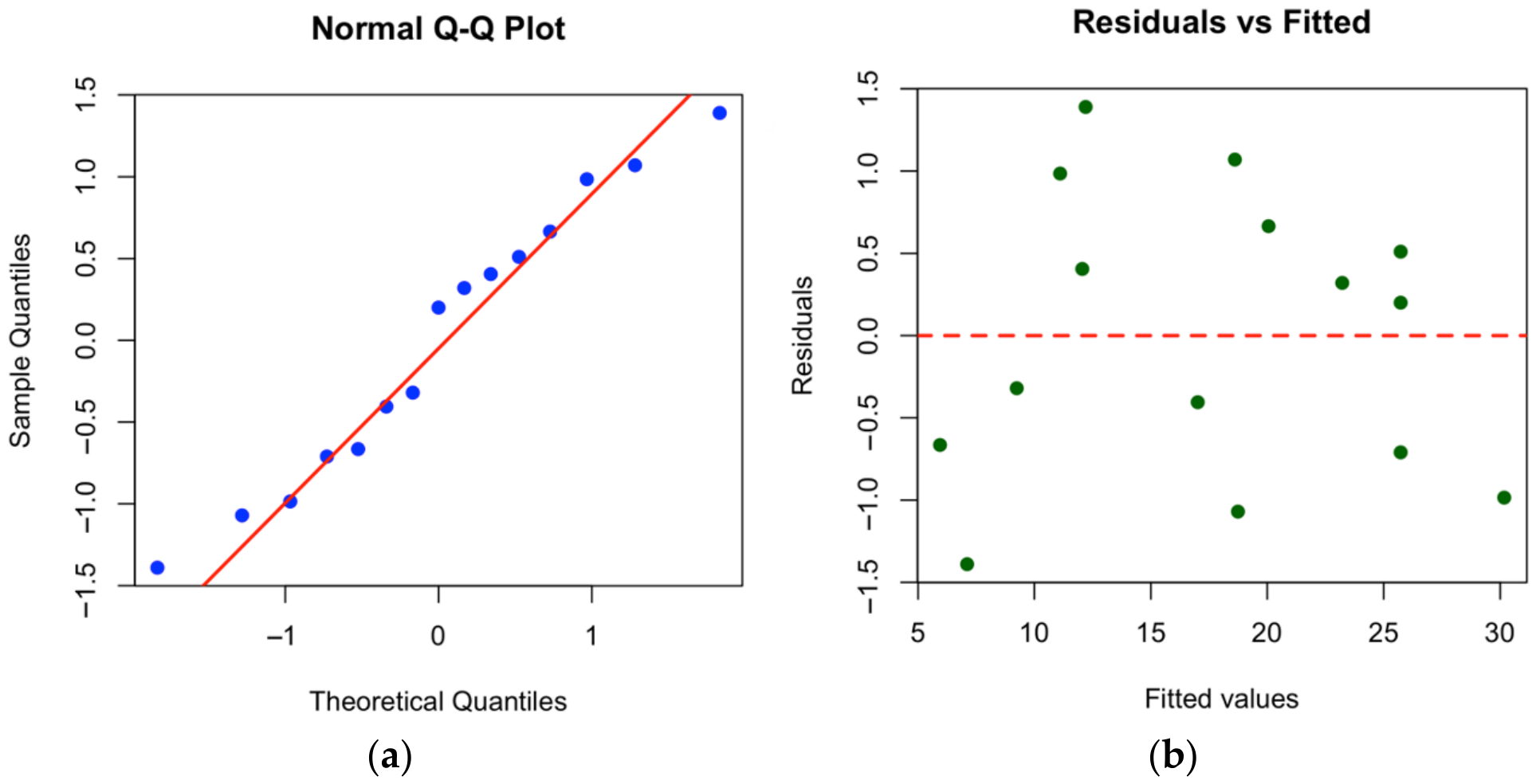
To evaluate the suitability of the quadratic regression model, the model residuals were examined through a normal Q–Q plot and a residual plot against predicted values. The results are presented in Figure 1. Figure 1a shows that the residual points are relatively close to the theoretical line on the normal Q–Q plot. This suggests that the model residuals approximately follow a normal distribution, satisfying an important assumption of regression analysis and ANOVA. Figure 1b shows that the residuals are randomly distributed around the zero line, without forming funnel shapes, curved patterns, or obvious abnormal clusters. This indicates that the variance of the residuals is relatively homogeneous across the entire range of predicted values. Additionally, no extreme outliers with residuals much larger than those of the other points were observed. These results further support the conclusion from the lack-of-fit test in Table 4 that the quadratic model is appropriate for describing the relationship between temperature, enzyme activity, hydrolysis time, and DE. Therefore, it can be concluded that the RSM model obtained has strong predictive and optimization capabilities for the amylase-mediated starch hydrolysis of jackfruit seeds within the surveyed range.

2.3. Response Surface Plots and Contour Plots

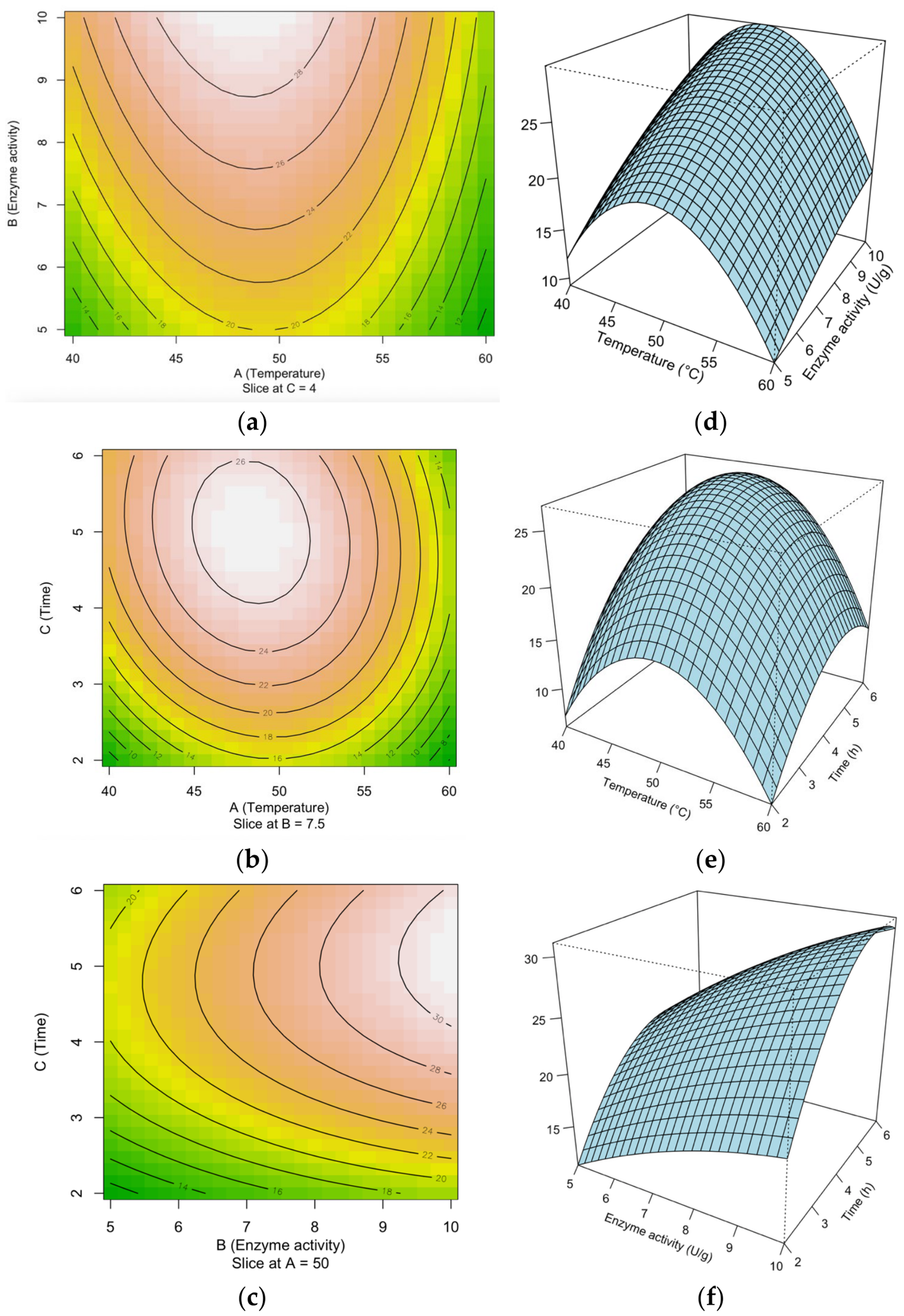
Three-dimensional response surface and contour plots were generated to visually evaluate the combined effects of the factors on DE (Figure 2). In the pairing of temperature and the [E]/[S] ratio, DE exhibited an increase as [E]/[S] increased; however, it only attained elevated values within the intermediate temperature range of approximately 46–50 °C. When the temperature reached 60 °C, a notable decrease in DE was observed, indicating a detrimental effect of high temperature on amylase activity (Figure 2a,d). This finding was consistent with the large negative quadratic coefficient for temperature (in Table 3) and with previously reported thermal inactivation profiles for B. licheniformis TKU004 α-amylase [37]. In the pairing of temperature and reaction time, high DE values were concentrated at intermediate temperatures (46–50 °C) and hydrolysis times of about 4.5–5.5 h (Figure 2b,e). Prolonged reaction at elevated temperatures likely accelerates enzyme denaturation, thereby limiting the increase in DE. For the [E]/[S] ratio–time pair (Figure 2c,f), DE increased when both factors were elevated simultaneously, with the highest response observed near 10 U/g and 4–6 h. A slight downward curvature along the time axis suggests that DE could plateau or marginally decline at extended reaction times. Overall, Figure 2 demonstrated that optimal conditions for achieving high DE were a moderate temperature, a high enzyme/substrate ratio, and a moderate-to-long reaction time. These findings were consistent with the ANOVA results in Table 4, in which both linear and quadratic components were statistically significant, whereas the interaction between the two factors was not.

2.4. Model Validation

The quadratic equation identified the optimal conditions as 47 °C, a [E]/[S] ratio of 10 U/g, and an incubation period of 5.1 h, yielding a DE value of 31.72%. An experiment was conducted in triplicate to validate the model under these predicted optimal conditions. The results showed that the DE value was 32.85 ± 1.12%, which closely corresponds to the predicted values. In addition, the 95% prediction interval of the fitted quadratic model at this validation point was estimated to be 27.00–35.94%. The experimental mean value fell within this interval, further supporting the model’s predictive reliability. Although no additional independent validation points beyond the original experimental design were included, the combination of experimental confirmation and prediction interval analysis indicates that the model adequately describes the hydrolysis system within the studied range. In comparison, the DE value here was similar to that of α-amylase–starch liquefaction systems for sweet potato starch, which produced about 30.52% DE [38].

2.5. Hydrolysate Analysis

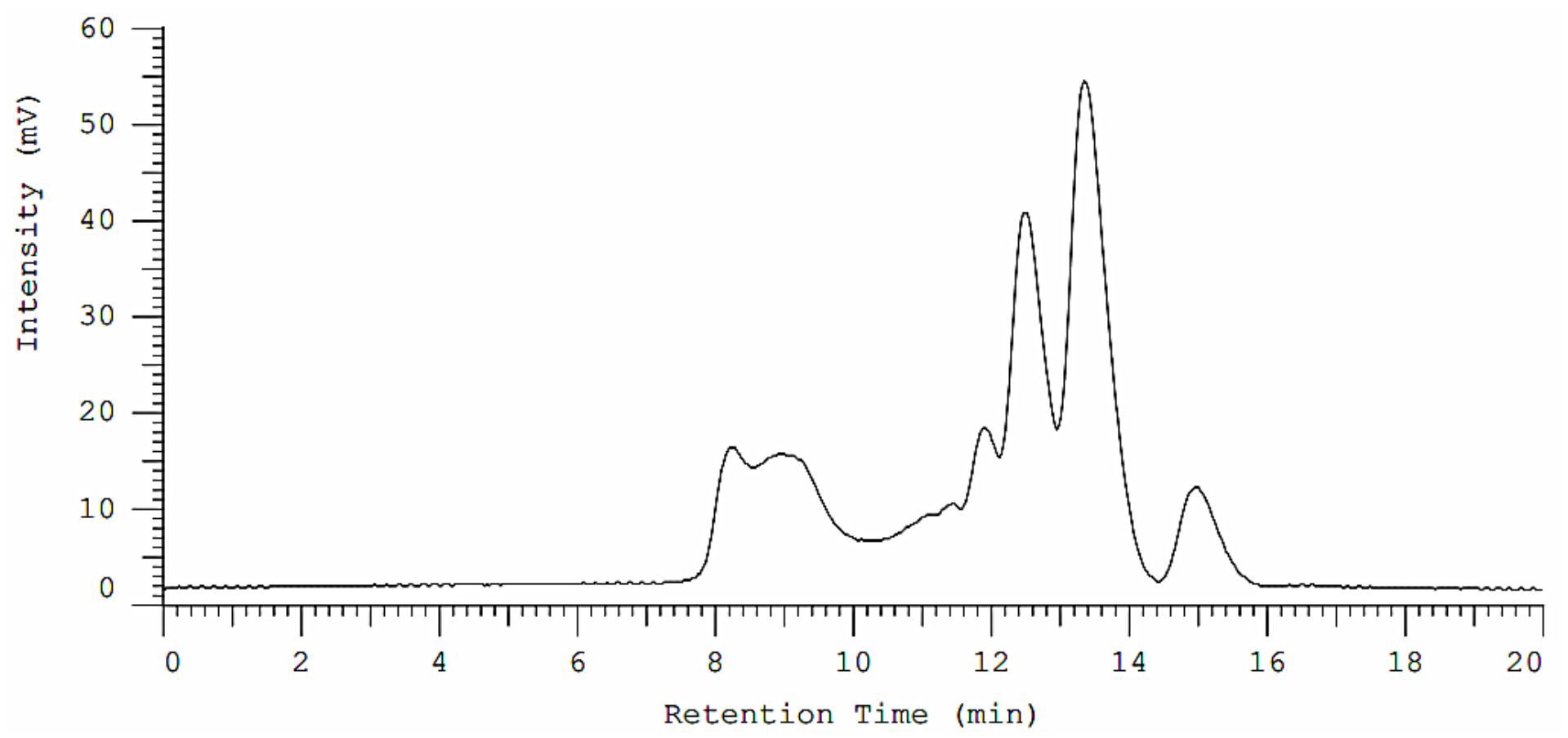
The results of HPLC analysis (Figure 3) showed that the jackfruit seed starch hydrolysate product included some distinct peaks as follows: 14.98 min, 13.35 min, 12.5 min, 11.9 min, 11.43 min. The peaks at the positions of 14.98 min and 13.35 min were identified as glucose and maltose (respectively). The peaks at 12.5 min, 11.9 min, and 11.43 min may be maltooligosaccharides. This result indicated that the products in the jackfruit seed starch hydrolysate included: 14.196% glucose, 56.514% maltose, and 29.289% maltooligosaccharides. In a previous report, α-amylase from B. licheniformis TKU004 hydrolyzed starch, releasing maltose as the major product. Because maltose accounted for the majority of the hydrolysate (ratio > 50%), the jackfruit seed starch hydrolysate process in this study was well suited to preparing high-maltose syrup [39]. In short, jackfruit seeds, a by-product of jackfruit processing, can be used to produce maltose syrup by enzymatic hydrolysis using α-amylase from B. licheniformis TKU004.
The performance of the present process was compared with selected studies on the enzymatic hydrolysis of starch-rich substrates and by-products. Diopol et al. (2023) produced high-maltose syrup from rice bran starch through sequential liquefaction with α-amylase and saccharification with β-amylase, achieving a liquefaction DE of 15.6% and a final maltose content of 47.78% [26]. Araujo-Silva et al. (2018) obtained approximately 70% maltose conversion from cassava bagasse starch using β-amylase after 4 h at a substrate DE of 15.88 [40]. Although the maltose yield in the Araujo-Silva et al. (2018) study [40] was higher, this difference is expected, given that β-amylase is an exo-acting enzyme specifically releasing maltose from the non-reducing end of starch chains, whereas α-amylase is an endo-acting enzyme that generates a mixture of maltose, maltotriose, and higher oligosaccharides. Achieving a maltose content of 56.51% with a single α-amylase under the present optimized conditions can therefore be considered a favorable result, particularly given that no supplementary debranching enzyme (such as pullulanase) or β-amylase was employed. Furthermore, a previous report on enzymatic hydrolysis of jackfruit seed starch using glucoamylase achieved a reducing sugar concentration of 9.286 ± 0.228 mg/mL at 70.75 °C over 4.8 h [14], with glucose as the predominant product, a profile fundamentally different from the maltose-enriched hydrolysate obtained in the present work. The ability of B. licheniformis TKU004 α-amylase to convert jackfruit seed starch into a maltose-rich hydrolysate (DE = 32.85%) under mild conditions highlights its potential as a biocatalyst for producing high-maltose syrup, a commercially important sweetener used in confectionery, beverages, and infant formula manufacture.

3. Materials and Methods

3.1. Materials

Jackfruits were purchased from local markets in Buon Ma Thuot, Vietnam. Seeds were manually extracted, washed with distilled water, and ground with deionized water at a ratio of 100 g seeds per 500 mL water using a laboratory blender. The resulting slurry was filtered through a double layer of cheesecloth to remove the solid residues. The filtered slurry was then heated at 100 °C for 20 min to achieve complete starch gelatinization, yielding a homogeneous starch paste that was used directly as the substrate for enzymatic hydrolysis. This condition was selected based on the typical gelatinization temperatures of jackfruit seed starch, which are generally below 100 °C [41], ensuring disruption of the granular structure and formation of a homogeneous paste suitable for enzymatic hydrolysis. The initial pH of the gelatinized jackfruit seed starch slurry was approximately 6.15. No buffer solution was added, and the hydrolysis reactions were conducted under the natural pH of the substrate system.
The strain Bacillus licheniformis TKU004 was detailed in a previous study [37,42,43]. The methodology for cultivating bacteria to produce amylase, as well as the purification process for the enzyme, followed Tran et al. (2025) [37]. The α-amylase was purified via ammonium sulfate precipitation and ion-exchange chromatography (High Q column, Bio-Rad Laboratories, Hercules, CA, USA), yielding an activity of about 560 U/mg and a 320-fold purification. The enzyme in this work is the purified α-amylase, with no other amylolytic enzymes added.

3.2. Proximate Composition Analysis

The moisture content was determined by dividing the mass of the jackfruit seeds after drying to a constant weight at 105 °C by the initial mass of the fresh jackfruit seeds. The ash content assay followed the method reported by Wong et al. (2021) [44]. Lipid content was determined by the Soxhlet method [44]. Protein content was determined by the Kjeldahl method [44]. The carbohydrate content assay followed the method reported by Thanh et al. (2020) [28]. The total starch content assay followed the method reported by Wong et al. (2021) [44].

3.3. Dextrose Equivalent Assay

The concentration of reducing sugars in the hydrolysate was determined by the 3,5-dinitrosalicylic acid (DNS) colorimetric method [11]. Briefly, 1 mL of appropriately diluted hydrolysate was mixed with 2 mL of DNS reagent and incubated in a boiling water bath for 5 min. After cooling, the absorbance was measured at 540 nm using a UV–Vis spectrophotometer. Glucose was used as the standard to construct a calibration curve. The DE (%) was calculated as follows [45]:
DE (%) = (the reducing sugar content/the total solid content) × 100%
where DE is the dextrose equivalent (%), the reducing sugar content is determined by the DNS method (mg), and the total solids content is the dry mass of the substrate used in the hydrolysis system (mg).

3.4. HPLC Analysis

The saccharide composition of the hydrolysate was analyzed by HPLC according to the method of Tran et al. (2025) [37] with minor modifications. Separation was performed on a KS-803 column maintained at 80 °C, using a flow rate of 1.0 mL/min and an injection volume of 10 µL. Sugars were detected with a refractive index (RI) detector. Glucose and maltose were identified by comparison of their retention times with those of authentic standards, and their relative proportions were estimated from the corresponding peak areas. Peaks eluting before maltose were assigned as maltooligosaccharides based on their retention behavior relative to the sugar standards.

3.5. Box–Behnken Design and Response Surface Methodology

The BBD was used to optimize three factors: incubation temperature, [E]/[S] ratio, and reaction time. Each factor was investigated at three levels: −1, 0, +1. Specifically, for temperature, the reaction temperatures were 40 °C (−1), 50 °C (0), and 60 °C (+1); for the [E]/[S] ratio, the levels were 5 U/g (−1), 7.5 U/g (0), and 10 U/g (+1); and for reaction time, the durations are 2 h (−1), 4 h (0), and 6 h (+1). The experiment is designed with 15 runs, with three replicates at the central point. The output variable used is the DE (%). The quadratic regression equation is as follows:
Y (DE, %) = β + β1 × A + β2 × B + β3 × C + β12 × A × B + β13 × A × C + β23 × B × C + β11 × A2 + β22 × B2 + β33 × C2
where
-
Y is the response (DE, %).
-
A, B, and C represent the independent variables: temperature, [E]/[S] ratio, and reaction time (respectively).
-
β0 is the constant.
-
β1–3 are the linear coefficients.
-
β11, β22, and β33 are the quadratic coefficients.
-
β12, β13, and β23 are the interaction coefficients.

3.6. Statistical Analysis

Analysis of variance (ANOVA) and regression analysis for the RSM model were performed using R (version 4.4.3) with the ‘rsm’ package.

4. Conclusions

This study demonstrated that gelatinized jackfruit seed starch can be efficiently hydrolyzed using α-amylase from Bacillus licheniformis TKU004, and that the process can be effectively modeled and optimized using Box–Behnken design coupled with response surface methodology. The fitted quadratic polynomial model exhibited high predictive reliability (R2 = 0.9875, adjusted R2 = 0.9649) with a non-significant lack-of-fit (p = 0.1146). The optimal conditions were identified as 47 °C, [E]/[S] = 10 U/g, and a reaction time of 5.1 h, yielding an experimentally validated DE of 32.85 ± 1.12%, in excellent agreement with the model prediction of 31.72%. Notably, HPLC characterization of the hydrolysate revealed a maltose-dominant saccharide profile (56.51% maltose, 14.20% glucose, 29.29% maltooligosaccharides), demonstrating that jackfruit seed starch can be converted into a high-maltose syrup using a single α-amylase without additional saccharifying or debranching enzymes. This finding is particularly significant, as conventional production of maltose-rich syrups typically requires multi-enzyme systems. Therefore, the present study provides a simplified and potentially more cost-effective enzymatic approach for industrial applications. These results highlight the potential of B. licheniformis TKU004 α-amylase as an efficient biocatalyst for valorizing jackfruit seed waste into high-value carbohydrate products, contributing to a more sustainable and economically viable food processing chain. Future work should evaluate the performance of the obtained maltose-rich hydrolysate as a substrate in fermentation or other bioprocesses to further validate its practical applicability.

Author Contributions

Conceptualization and methodology, C.T.D. and S.-L.W.; software, validation, formal analysis, investigation, resources, and data curation, C.T.D., T.N.T., T.T.N., T.H.P. and S.-L.W.; writing—original draft preparation, writing—review and editing and visualization, C.T.D., S.-L.W. and T.N.T.; supervision, project administration, and funding acquisition, C.T.D. and S.-L.W. All authors have read and agreed to the published version of the manuscript.

Funding

This research was funded by a grant from the National Science and Technology Council, Taiwan (NSTC 114-2320-B-032-001-).

Data Availability Statement

The original contributions presented in this study are included in the article. Further inquiries can be directed to the corresponding authors.

Acknowledgments

During the preparation of this manuscript, the authors used GPT-5.5 Thinking (OpenAI, San Francisco, CA, USA) for the purposes of writing assistance. The authors have reviewed and edited the output and take full responsibility for the content of this publication.

Conflicts of Interest

The authors declare no conflicts of interest.

References

  1. Sarangi, P.K.; Srivastava, R.K.; Singh, A.K.; Sahoo, U.K.; Prus, P.; Dziekański, P. The Utilization of jackfruit (Artocarpus heterophyllus L.) waste towards sustainable energy and biochemicals: The attainment of zero-waste technologies. Sustainability 2023, 15, 12520. [Google Scholar] [CrossRef] [Scilit]
  2. FAO. Bangladesh: Jackfruit; One country one priority product—Market intelligence series; FAO Regional Office for Asia and the Pacific: Bangkok, Thailand, 2025. [Google Scholar]
  3. Suo, H.; Xiao, S.; Wang, B.; Cai, Y.-X.; Wang, J.-H. Waste to Wealth: Dynamics and metabolic profiles of the conversion of jackfruit flake into value-added products by different fermentation methods. Food Chem. X 2024, 21, 101164. [Google Scholar] [CrossRef] [Scilit] [PubMed]
  4. Santhosh, R.; Sarkar, P. Jackfruit seed starch/tamarind kernel xyloglucan/zinc oxide nanoparticles-based composite films: Preparation, characterization, and application on tomato (Solanum lycopersicum) fruits. Food Hydrocoll. 2022, 133, 107917. [Google Scholar] [CrossRef] [Scilit]
  5. Fabil, M.; Dubey, P.K.; Roy, S.; Sharma, M. Jackfruit seed valorization: A comprehensive review of nutritional potential, value addition, and industrial applications. Food Humanit. 2024, 3, 100406. [Google Scholar] [CrossRef] [Scilit]
  6. Le, T.A.N.; Lee, J.J.L.; Chen, W.N. Stimulation of lactic acid production and Lactobacillus plantarum growth in the coculture with Bacillus subtilis using jackfruit seed starch. J. Funct. Foods 2023, 104, 105535. [Google Scholar] [CrossRef] [Scilit]
  7. Van, C.K.; Nguyen, T.H.; Nguyen, T.T.N.H.; Nguyen, P.T.N.; Tran, T.T.; Hoang, Q.B. Comparison of the effects of jackfruit seed flour and jackfruit seed starch in the cookie manufacturing process. Processes 2023, 11, 3194. [Google Scholar] [CrossRef] [Scilit]
  8. Fatima, S.; Khan, M.R.; Ahmad, I.; Sadiq, M.B. Recent advances in modified starch based biodegradable food packaging: A review. Heliyon 2024, 10, e27453. [Google Scholar] [CrossRef] [Scilit] [PubMed]
  9. Dewi, R.; Sylvia, N.; Riza, M. Effect of polylactic acid (PLA) as reinforcement for jackfruit seed starch-based degradable plastic. Eng. Proc. 2025, 84, 14. [Google Scholar] [CrossRef] [Scilit]
  10. Ramandani, A.A.; Rachmadona, N.; Munawaroh, H.S.H.; Lan, J.C.-W.; Kataria, N.; Khoo, K.S. Sustaining food waste for energy conversion: A mini review. Green Energy Fuel Res. 2025, 2, 34–47. [Google Scholar]
  11. Wang, X.; Gou, C.; Zheng, H.; Guo, N.; Li, Y.; Liao, A.; Liu, N.; Tian, H.; Huang, J. Optimization of consolidated bioprocessing fermentation of uncooked sweet potato residue for bioethanol production by using a recombinant amylolytic Saccharomyces cerevisiae strain via the orthogonal experimental design method. Fermentation 2024, 10, 471. [Google Scholar] [CrossRef] [Scilit]
  12. Nuriana, W.; Wuryantoro. Ethanol synthesis from jackfruit (Artocarpus heterophyllus Lam.) stone waste as renewable energy source. Energy Procedia 2015, 65, 372–377. [Google Scholar] [CrossRef] [Scilit]
  13. Arif, A.R.; Natsir, H.; Rohani, H.; Karim, A. Effect of pH fermentation on production bioethanol from jackfruit seeds (Artocarpus heterophyllus) through separate fermentation hydrolysis method. J. Phys. Conf. Ser. 2018, 979, 012015. [Google Scholar] [CrossRef] [Scilit]
  14. Đoàn, C.T.; Nông, T.M.L.; Trần, T.N. Optimization of jackfruit seed starch hydrolysis process using glucoamylase: Response surface methodology approach. Tay Nguyen J. Sci. 2025, 19, 1–6. Available online: https://tnjos.vn/index.php/tckh/article/view/642 (accessed on 15 May 2026).
  15. Bangar, S.P.; Ashogbon, A.O.; Singh, A.; Chaudhary, V.; Whiteside, W.S. Enzymatic modification of starch: A green approach for starch applications. Carbohydr. Polym. 2022, 287, 119265. [Google Scholar] [CrossRef] [Scilit]
  16. Kaur, M.; Singh, A.K.; Singh, A. Bioconversion of food industry waste to value added products: Current technological trends and prospects. Food Biosci. 2023, 55, 102935. [Google Scholar] [CrossRef] [Scilit]
  17. Liu, G.; Montalbán-López, M.; Wei, D.; Wang, L.; Wu, X.; Li, X.; Mu, D. α-Amylase: Its structure, molecular modification, and application in the food field. Foods 2026, 15, 1555. [Google Scholar] [CrossRef] [Scilit] [PubMed]
  18. Yang, W.; Lu, F.; Liu, Y. Recent advances of enzymes in the food industry. Foods 2023, 12, 4506. [Google Scholar] [CrossRef] [Scilit] [PubMed]
  19. Kholikov, A.; Vokhidov, K.; Murtozoyev, A.; Tóth, Z.S.; Nagy, G.N.; Vértessy, B.G.; Makhsumkhanov, A. Characterization of a thermostable α-amylase from Bacillus licheniformis 104.K for industrial applications. Microorganisms 2025, 13, 1757. [Google Scholar] [CrossRef] [Scilit] [PubMed]
  20. Liao, S.M.; Liang, G.; Zhu, J.; Lu, B.; Peng, L.X.; Wang, Q.Y.; Wei, Y.T.; Zhou, G.P.; Huang, R.B. Influence of calcium ions on the thermal characteristics of α-amylase from Thermophilic anoxybacillus sp. GXS-BL. Protein Pept. Lett. 2019, 26, 148–157. [Google Scholar] [CrossRef] [Scilit] [PubMed]
  21. Fan, S.; Lü, X.; Wei, X.; Lü, R.; Feng, C.; Jin, Y.; Yan, M.; Yang, Z. Computational design of α-amylase from Bacillus licheniformis to increase its activity and stability at high temperatures. Comput. Struct. Biotechnol. J. 2024, 23, 982–989. [Google Scholar] [CrossRef] [Scilit] [PubMed]
  22. Vrsalović Presečki, A.; Findrik Blažević, Z.; Vasić-Rački, Đ. Mathematical modeling of maize starch liquefaction catalyzed by α-amylases from Bacillus licheniformis: Effect of calcium, pH and temperature. Bioprocess Biosyst. Eng. 2013, 36, 117–126. [Google Scholar] [CrossRef] [Scilit]
  23. Li, Z.; Kong, H.; Li, Z.; Gu, Z.; Ban, X.; Hong, Y.; Cheng, L.; Li, C. Designing liquefaction and saccharification processes of highly concentrated starch slurry: Challenges and recent advances. Compr. Rev. Food Sci. Food Saf. 2023, 22, 1597–1612. [Google Scholar] [CrossRef] [Scilit] [PubMed]
  24. Sigüenza-Andrés, T.; Pando, V.; Gómez, M.; Rodríguez-Nogales, J.M. Optimization of a simultaneous enzymatic hydrolysis to obtain a high-glucose slurry from bread waste. Foods 2022, 11, 1793. [Google Scholar] [CrossRef] [Scilit] [PubMed]
  25. Chowdary, G.V.; Hari Krishna, S.; Hanumantha Rao, G. Optimization of enzymatic hydrolysis of mango kernel starch by response surface methodology. Process Biochem. 2000, 23, 681–685. [Google Scholar] [CrossRef] [Scilit]
  26. Diopol, G.A.; Elegado, F.B.; Castillo-Israel, K.A.T.; Torio, M.A.O.; Uy, L.Y.C. Production of high-maltose syrup from selected rice (Oryza sativa L.) bran by enzymatic method. Philipp. J. Sci. 2023, 152, 571–583. [Google Scholar] [CrossRef] [Scilit]
  27. Bemmo, U.L.K.; Bindzi, J.M.; Kamseu, P.R.T.; Ndomou, S.C.H.; Tambo, S.T.; Zambou, F.N. physicochemical properties, nutritional value, and antioxidant potential of jackfruit (Artocarpus heterophyllus) pulp and seeds from Cameroon eastern forests. Food Sci. Nutr. 2023, 11, 4510–4522. [Google Scholar] [CrossRef] [Scilit]
  28. Thanh, V.T.; Khang, V.C.; Nhan, N.P.T.; Nguyen, D.T.; Nhi, T.T.B.; Quoc, N.T. Effect of wet milling and purification process on yield and color of jackfruit seed starch. IOP Conf. Ser. Mater. Sci. Eng. 2020, 991, 012030. [Google Scholar] [CrossRef] [Scilit]
  29. Madrigal-Aldana, D.L.; Tovar-Gómez, B.; de Oca, M.M.M.; Sáyago-Ayerdi, S.G.; Gutierrez-Meraz, F.; Bello-Pérez, L.A. Isolation and characterization of Mexican jackfruit (Artocarpus heterophyllus L.) seeds starch in two mature stages. Starch-Stärke 2011, 63, 364–372. [Google Scholar] [CrossRef] [Scilit]
  30. Ho, T.H.; Dang, M.N.; Mac, T.H.T. Jackfruit seed starch characterisation in three popular varieties from Vietnam. Int. Food Res. J. 2025, 32, 530–540. [Google Scholar] [CrossRef] [Scilit]
  31. Abedin, M.S.; Nuruddin, M.M.; Ahmed, K.U.; Hossain, A. Nutritive compositions of locally available jackfruit seeds (Artocarpus heterophyllus) in Bangladesh. Int. J. Biosci. 2012, 2, 1–7. [Google Scholar]
  32. Nguyen, T.T.T.; Truong, N.L.Q.; Chiem, T.N.Q.; Truong, L.D.P.; Nguyen, T.T.T.; Tran, T.V. Development of intelligent films based on jackfruit seed starch/polyvinyl alcohol incorporated with purple sweet potato peel anthocyanin as an indicator. Int. J. Biol. Macromol. 2025, 319, 145436. [Google Scholar] [CrossRef] [Scilit] [PubMed]
  33. Hu, Z.; Zhao, L.; Hu, Z.; Wang, K. Hierarchical structure, gelatinization, and digestion characteristics of starch from longan (Dimocarpus longan Lour.) Seeds. Molecules 2018, 23, 3262. [Google Scholar] [CrossRef] [Scilit] [PubMed]
  34. Nguyen, H.V.; Huynh, P.X.; Kha, T.C. Ultrasound-induced modification of durian starch (Durio zibethinus) for gel-based applications: Physicochemical and thermal properties. Gels 2025, 11, 296. [Google Scholar] [CrossRef] [Scilit] [PubMed]
  35. Muñoz-Gimena, P.F.; Aragón-Gutiérrez, A.; Blázquez-Blázquez, E.; Arrieta, M.P.; Rodríguez, G.; Peponi, L.; López, D. Avocado seed starch-based films reinforced with starch nanocrystals. Polymers 2024, 16, 2868. [Google Scholar] [CrossRef] [Scilit] [PubMed]
  36. Ahmed, T.; Rana, M.R.; Zzaman, W.; Ara, R.; Aziz, M.G. Optimization of substrate composition for pectinase production from satkara (Citrus macroptera) peel using Aspergillus niger-ATCC 1640 in solid-state fermentation. Heliyon 2021, 7, e08133. [Google Scholar] [CrossRef] [Scilit] [PubMed]
  37. Tran, T.N.; Chen, S.-C.; Doan, C.T.; Wang, S.-L. Unlocking the potential of pomelo albedo: A novel substrate for alpha-amylase production using Bacillus licheniformis. Fermentation 2025, 11, 336. [Google Scholar] [CrossRef] [Scilit]
  38. Ega, L. Enzymatic liquification pattern of superior sweet potato starch of CIP-type. Food Res. 2023, 7, 230–235. [Google Scholar] [CrossRef] [Scilit]
  39. Kleinhout, T.; Koops, B.C.; Kooy, F.K.; Lee, S.H.; Shetty, J.K.; Strohm, B.A. Method for Making High Maltose Syrup. International Patent Application WO2013148152A1, 3 October 2013. [Google Scholar]
  40. Araujo-Silva, R.; Mafra, A.C.O.; Rojas, M.J.; Kopp, W.; Giordano, R.D.C.; Fernandez-Lafuente, R.; Tardioli, P.W. Maltose production using starch from cassava bagasse catalyzed by cross-linked β-amylase aggregates. Catalysts 2018, 8, 170. [Google Scholar] [CrossRef] [Scilit]
  41. Santos, L.S.; Bonomo, R.C.F.; Fontan, R.C.I.; Santos, W.O.; Silva, A.A.L. Gelatinization temperature and acid resistance of jackfruit seed starch. CyTA J. Food 2009, 7, 1–5. [Google Scholar] [CrossRef] [Scilit]
  42. Wang, S.-L.; Kao, T.-Y.; Wang, C.-L.; Yen, Y.-H.; Chern, M.-K.; Chen, Y.-H. A Solvent stable metalloprotease produced by Bacillus sp. TKU004 and its application in the deproteinization of squid pen for β-chitin preparation. Enzym. Microb. Technol. 2006, 39, 724–731. [Google Scholar] [CrossRef] [Scilit]
  43. Chen, Y.-C.; Chiang, T.-J.; Liang, T.-W.; Wang, I.-L.; Wang, S.-L. Reclamation of squid pen by Bacillus licheniformis TKU004 for the production of thermally stable and antimicrobial biosurfactant. Biocatal. Agric. Biotechnol. 2012, 1, 62–69. [Google Scholar] [CrossRef] [Scilit]
  44. Wong, K.T.; Poh, G.Y.Y.; Goh, K.K.T.; Wee, M.S.M.; Henry, C.J. Comparison of physicochemical properties of jackfruit seed starch with potato and rice starches. Int. J. Food Prop. 2021, 24, 364–379. [Google Scholar] [CrossRef] [Scilit]
  45. Ge, Z.; Liu, C.; Li, P.; Zeng, J.; Tang, X.; Zhou, P.; Zhao, Z.; Deng, Y.; Liu, G. Effect of pre-hydrolyzed rice extrudates with different dextrose equivalent values on stability of emulsion-type food for special medical purposes. Gels 2026, 12, 166. [Google Scholar] [CrossRef] [Scilit] [PubMed]
Figure 1. Diagnostic plots of the quadratic regression model: Normal Q–Q plot of residuals (a) and residuals versus fitted values (b). In the Normal Q-Q plot, blue dots are residuals, and the red line is the normal reference. In the residuals vs. fitted plot, green dots are residuals, and the dashed line marks zero residuals.
Catalysts 16 00587 g001
Figure 2. Contour plots and 3D response surface plots for the effects of three variates on DE formation: (a) contour plot for temperature (A, °C) vs. [E]/[S] ratio (B, U/g); (b) contour plot for temperature (A, °C) vs. reaction time (C, h); (c) contour plot for [E]/[S] ratio (B, U/g) vs. reaction time (C, h); (d) 3D response surface plot for temperature (A, °C) vs. [E]/[S] ratio; (e) 3D response surface plot for temperature (A, °C) vs. reaction time (C, h); and (f) 3D response surface plot for [E]/[S] ratio (B, U/g) vs. reaction time (C, h). The color gradient in contour plots represents the predicted DE (%), with green indicating lower values and light pink/white indicating higher values.
Catalysts 16 00587 g002
Figure 3. HPLC profile of jackfruit starch hydrolysate catalyzed by α-amylase from B. licheniformis TKU004.
Catalysts 16 00587 g003
Table 1. The proximate analysis and chemical composition of fresh jackfruit seeds.
ParameterFresh Jackfruit Seeds
Moisture (%)43.75 ± 2.65
Total lipid (%)2.32 ± 1.52
Total protein (%)18.02 ± 0.98
Carbohydrate (%)34.01 ± 2.70
Starch (%)25.48 ± 0.98
Ash (%)1.89 ± 0.36
Table 2. Box–Behnken design matrix showing observed DE values at different combinations of temperature, [E]/[S] ratio, and reaction time.
Run OrderA (°C)B (U/g)C (h)DE (%)
1407.5620.72%
2505212.09%
35010629.19%
4405412.46%
5507.5425.02%
6607.525.28%
7407.525.72%
8607.5613.59%
9507.5426.24%
1060548.92%
115010219.68%
12507.5425.93%
13505617.67%
144010423.54%
156010416.61%
A = temperature (°C); B = enzyme-to-substrate ratio ([E]/[S], U/g); C = reaction time (h).
Table 3. Regression coefficients and statistical analysis of the quadratic model.
Model TermCoefficient EstimateStandard Errort-Valuep-ValueSignificance
Intercept25.7300.82931.026<0.0001***
Linear
A−2.2550.508−4.4400.0068**
B4.7350.5089.3240.0002***
C4.8000.5089.4520.0002***
Interaction
AB−0.8480.718−1.1800.2911
AC−1.6730.718−2.3290.0673
BC0.9830.7181.3680.2296
Quadratic
A2−9.3390.748−12.493<0.0001***
B2−1.0090.748−1.3500.2351
C2−5.0640.748−6.7740.0011**
A = temperature (°C); B = enzyme-to-substrate ratio ([E]/[S], U/g); C = reaction time (h). Significance codes: *** p < 0.001; ** p < 0.01.
Table 4. Analysis of variance (ANOVA) for the fitted quadratic polynomial model.
Sum of SquaresdfMean SquareF-Valuep-ValueSignificance
Model814.43990.4943.860.0003***
Linear (FO)404.363134.7965.330.0002***
Interaction (TWI)17.9235.972.900.1411
Quadratic (PQ)392.153130.7263.360.0002***
Residual10.3252.06
Lack of Fit9.5133.177.890.1146
Pure Error0.8020.40
Total824.7514
Significance codes: *** p < 0.001.
Disclaimer/Publisher’s Note: The statements, opinions and data contained in all publications are solely those of the individual author(s) and contributor(s) and not of MDPI and/or the editor(s). MDPI and/or the editor(s) disclaim responsibility for any injury to people or property resulting from any ideas, methods, instructions or products referred to in the content.