Article

Citric Acid-Assisted Stabilization of Cu–La/Al2O3 Catalysts for Catalytic Wet Peroxide Oxidation of Phenol


by
Nicolás A. Sacco
*,
Victoria Salinas
,
Constanza Pierantoni
,
Emerson Burna
,
Fernanda Miranda Zoppas
and
Fernanda Albana Marchesini
*
Instituto de Investigaciones en Catálisis y Petroquímica, INCAPE (UNL-CONICET), Facultad de Ingeniería Química, Universidad Nacional del Litoral, Santiago del Estero 2829, Santa Fe 3000, Argentina
*
Authors to whom correspondence should be addressed.
Catalysts 2026, 16(7), 588; https://doi.org/10.3390/catal16070588
Submission received: 8 April 2026 / Revised: 22 April 2026 / Accepted: 27 April 2026 / Published: 27 June 2026

Abstract

Copper-based catalysts supported on γ-Al2O3 were prepared by wet impregnation and evaluated for the catalytic wet peroxide oxidation (CWPO) of phenol. Citric acid was used as a complexing agent to enhance copper stabilization, and lanthanum was incorporated as a structural promoter. The effects of calcination temperature, heating rate, Cu loading, and La incorporation route on catalyst structure and performance were systematically investigated. Thermal treatment and La incorporation-controlled phase evolution and copper oxidation state. Calcination at 900 °C promoted the development of CuAl2O4- and CuAlO2-type phases, as suggested by XRD, while XPS showed that the Cu2+/Cu+ ratio increased progressively with temperature, consistent with stronger metal–support interactions. Citric acid, incorporated at a CA:Cu molar ratio of 1:1, reduced copper leaching by up to 50% compared to catalysts prepared without the complexing agent, regardless of calcination temperature. Co-impregnated Cu–La catalysts achieved complete phenol conversion within 20–30 min and TOC removals of 84–95%, depending on synthesis conditions. The combination of La incorporation, calcination at 900 °C, and citric acid-assisted impregnation yielded the best stability–activity balance, with Cu5.0/La-A-900-1 showing 91% TOC removal and only 18% Cu leaching after 2 h of reaction. XPS, catalytic performance, and leaching results indicate that CWPO activity is governed by the balance between redox accessibility (Cu2+/Cu+) and structural stabilization of copper species. The results indicate that CWPO proceeds through a combined surface-mediated and homogeneous Fenton-like pathway, where the relative contribution of each depends on copper stabilization and leaching.

1. Introduction

Water pollution caused by persistent organic compounds remains a major environmental challenge, largely associated with industrial effluents from petrochemical, pharmaceutical, and agrochemical processes. Among these pollutants, phenol and its derivatives are of particular concern due to their high solubility in water, chemical stability, and resistance to biological degradation. Even at low concentrations, phenolic compounds pose significant risks to aquatic ecosystems and human health, which has stimulated the development of efficient treatment technologies for their removal.
Advanced oxidation processes (AOPs) have emerged as effective strategies for the degradation of refractory organic pollutants in water. In particular, catalytic wet peroxide oxidation (CWPO) has received considerable attention because it operates under relatively mild conditions and employs hydrogen peroxide as an environmentally compatible oxidant [1,2].
In this process, the activation of H2O2 on the catalyst surface generates highly reactive oxygen species capable of oxidizing phenol and its intermediates toward complete mineralization.
Copper-based catalysts supported on γ-Al2O3 are widely studied for CWPO applications due to the redox flexibility of Cu2+/Cu+ species and their ability to activate hydrogen peroxide efficiently. However, their practical application is often limited by copper leaching under reaction conditions, which reduces catalyst stability and may contribute to secondary contamination of the treated effluent. In addition, thermal treatment during catalyst preparation can lead to agglomeration of copper species or the formation of poorly dispersed CuO particles, affecting both catalytic activity and stability under reaction conditions [1,3,4].
Lanthanum can modify the γ-Al2O3 surface and improve copper anchoring. It promotes stronger metal–support interactions and can lead to the formation of La-containing phases (e.g., LaAlO3) during calcination, which contribute to stabilizing copper species and reducing their susceptibility to leaching under CWPO conditions [5]. As a result, La incorporation not only improves textural stability of the alumina carrier but also modifies the bonding geometry of copper species, leading to reduced metal leaching during oxidation reactions [6,7,8,9].
Despite these advances, the combined effect of La incorporation and citric acid-assisted wet impregnation on copper stabilization in CWPO has not been systematically investigated. Studies addressing La-promoted alumina supports have focused primarily on thermal stability in high-temperature reactions such as Fischer–Tropsch synthesis or catalytic combustion, not on the redox-driven leaching that governs CWPO performance. Similarly, citric acid has been used in impregnation synthesis of Hydrodesulfurization (HDS) catalysts [10,11] and combustion routes [6], but its mechanistic role in controlling copper–support bonding geometry in CWPO systems, particularly when combined with rare-earth promotion, remains uncharacterized. In particular, how the interplay between calcination temperature, Cu loading, La incorporation route, and complexing agent controls the Cu2+/Cu+ surface redox state and its stability during the acidic, oxidizing CWPO environment is not yet established. In previous work on Cu–La/Al2O3 catalysts, both phenol conversion and TOC removal were maintained over multiple cycles despite progressive copper leaching, highlighting the need for improved metal stabilization strategies [5]. In this work, a series of Cu- and Cu–La-based catalysts supported on γ-Al2O3 were synthesized by a modified wet impregnation method incorporating citric acid as a complexing/combustion agent. The influence of calcination temperature, heating ramp, Cu loading, and La incorporation strategy on catalyst structure and catalytic performance in CWPO was systematically evaluated. The materials were characterized by XRD, BET, SEM–EDS, and XPS, and their catalytic behavior was assessed through phenol degradation experiments together with copper leaching and mineralization analyses. This approach allowed direct assessment of how synthesis conditions govern the stabilization, surface redox state, and catalytic behavior of copper species in CWPO systems. A central question addressed here is whether high CWPO activity can be achieved while preserving copper as a truly heterogeneous redox phase, through control of its structural environment by citric acid and lanthanum.

2. Results

2.1. Phase Composition and Cu/La Interaction Analyzed by X-Ray Diffraction (XRD)

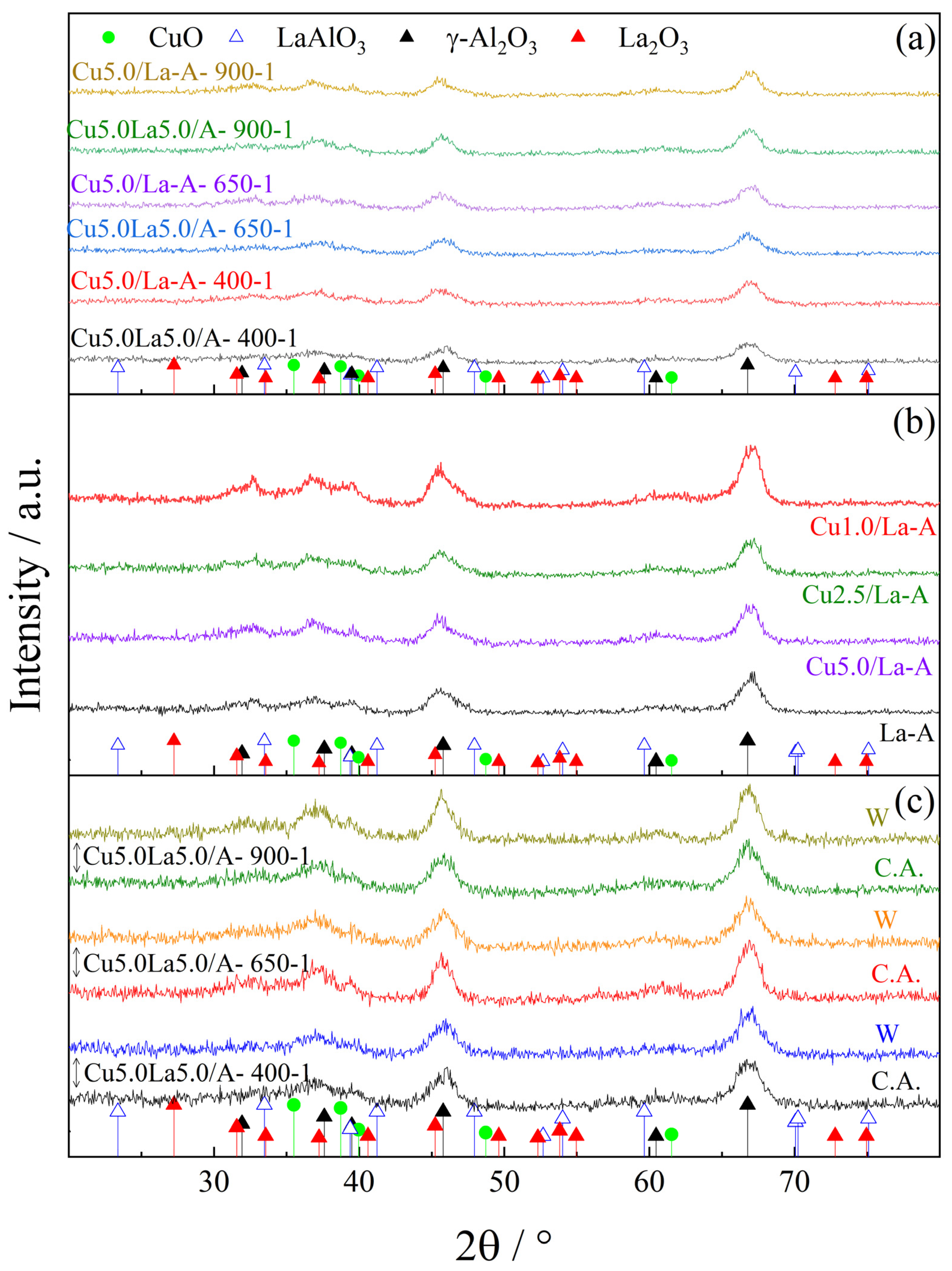
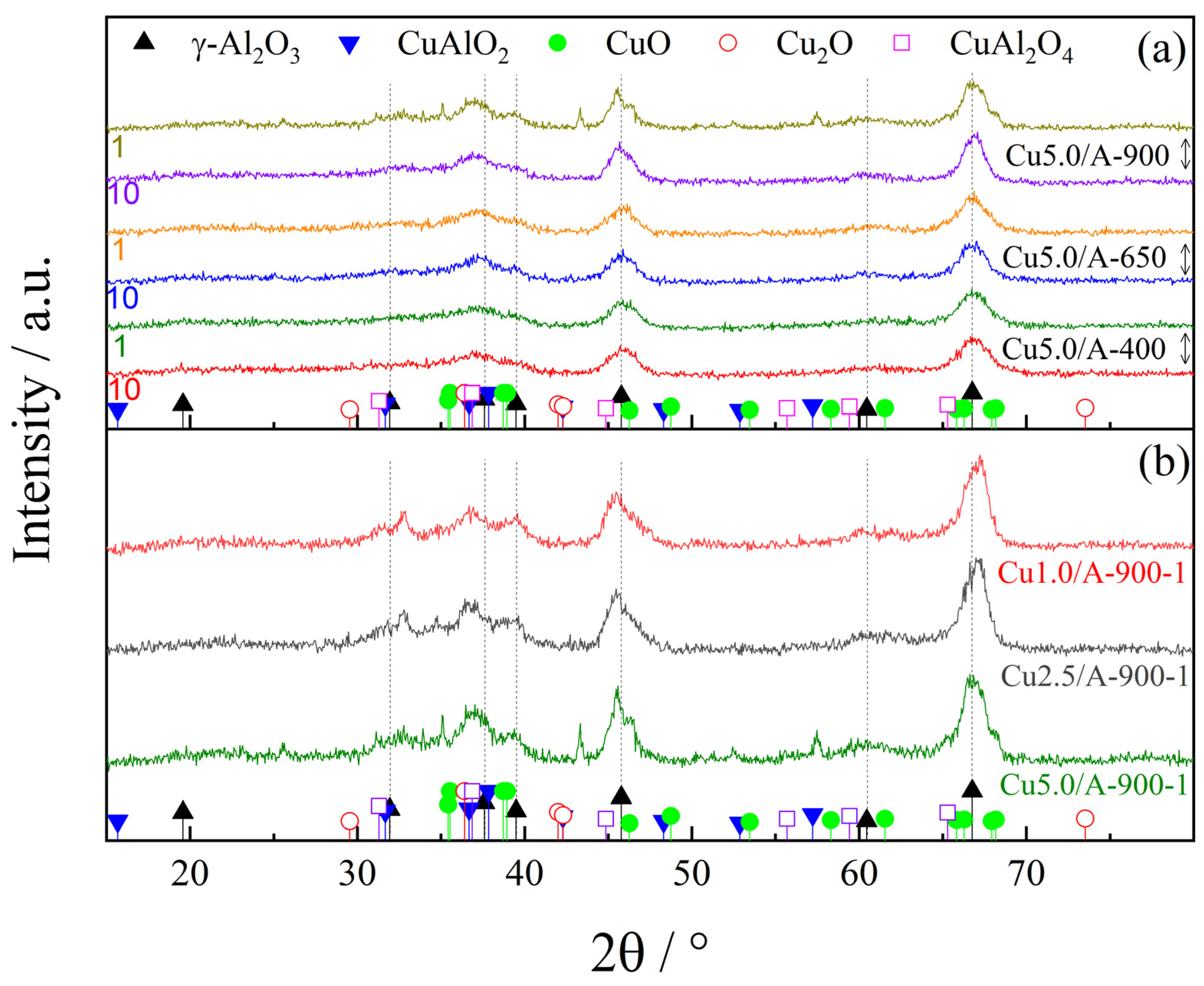
X-ray diffraction patterns of the calcined catalysts are shown in Figure 1. Figure 1a compares the effect of calcination temperature and heating ramp for the Cu5.0/A series, whereas Figure 1b shows the influence of Cu loading for catalysts calcined at 900 °C and 1 °C·min−1. All catalysts displayed the characteristic Bragg reflections of the γ-Al2O3 support, with broad peaks at 2θ ≈ 37.5°, 45.8°, and 67.0°, corresponding to the (311), (400), and (440) planes, respectively (JCPDS 10-0425). The preservation of these reflections indicates that the γ-Al2O3 structure remains unchanged after metal incorporation and calcination. For Cu-containing catalysts, additional peaks associated with CuO (JCPDS 48-1548) were observed at 2θ ≈ 35.5° and 38.7°, with intensity increasing with Cu loading and calcination temperature.
For the Cu/A series, calcination temperature strongly affected phase evolution. In samples calcined at 650 and 900 °C, reflections that may be attributed to CuAl2O4 spinel (2θ ≈ 31.3°, 36.9°, 59.5°; JCPDS 01-1151) and CuAlO2 (2θ ≈ 33.1° and 39.3°; JCPDS 35-1400) were observed, suggesting the possible formation of mixed oxide phases. These features are consistent with a transition from segregated CuO domains to copper species more strongly interacting with the alumina matrix.
In this context, the presence of CuAl2O4 and CuAlO2 phases may be associated with partial incorporation of copper into alumina-derived environments, which could reduce the fraction of weakly bound CuO species and contribute to improved resistance to copper leaching under CWPO conditions [10,11].
For La-containing catalysts (Figure 2), weak reflections appeared at 2θ ≈ 27.5°, 39.2°, and 47.3°, which can be associated with La2O3 (JCPDS 05-0602), and in some cases, low-intensity signals compatible with LaAlO3 perovskite (JCPDS 31-0022) were also observed. These features indicate interaction between lanthanum species and the alumina matrix during calcination [5]. When catalysts with identical nominal Cu and La contents were compared, co-impregnated Cu–La catalysts exhibited weaker and broader CuO reflections than their successively impregnated counterparts. This behavior indicates that simultaneous introduction of Cu and La hinders CuO crystallite growth and strengthens Cu–support interactions [7,12,13].
Calcination temperature and lanthanum incorporation control the evolution of copper-containing crystalline phases and the stabilization of copper species on alumina.

2.2. Surface Area and Porosity Evolution with Cu and La Incorporation (BET Analysis)

Table 1 summarizes the BET specific surface areas of the catalysts as a function of calcination temperature, Cu loading, La incorporation route, and heating rate.
For the Cu/A series, increasing calcination temperature caused a marked decrease in surface area, from 176 m2·g−1 at 400 °C to 86 m2·g−1 at 900 °C for samples treated at 1 °C·min−1. This reduction is attributed to thermal sintering and partial collapse of the mesoporous structure of γ-Al2O3 at elevated calcination temperatures. At constant calcination temperature (900 °C), decreasing Cu loading led to higher surface areas, increasing from 86 m2·g−1 for Cu5.0/A-900-1 to 118 m2·g−1 for Cu1.0/A-900-1.
Lanthanum incorporation also influenced the textural properties of the catalysts, depending on the preparation route. Sequentially impregnated Cu5.0/La-A catalysts exhibited lower surface areas than the corresponding Cu/A materials. In contrast, co-impregnated Cu–La catalysts retained higher surface areas under comparable conditions (e.g., 138 m2·g−1 for Cu5.0La5.0/A-400-1 versus 100 m2·g−1 for Cu5.0/La-A-400-1).
Catalysts calcined with a faster heating ramp (10 °C·min−1) consistently exhibited slightly higher surface areas than those treated at 1 °C·min−1 (e.g., 157 m2·g−1 for Cu5.0/A-650-10 versus 142 m2·g−1 for Cu5.0/A-650-1). Shorter exposure times at intermediate temperatures preserve the porous structure more effectively during calcination.
Although catalysts calcined at lower temperatures exhibited larger surface areas, these materials also showed higher copper leaching during CWPO (see Section 3.3). Catalytic stability is therefore governed more strongly by the nature and anchoring of copper species than by surface area alone. A higher textural surface does not translate into improved catalytic robustness when copper is not sufficiently stabilized on the support.

2.3. Morphological and Compositional Analysis (SEM/EDS)

The morphology and surface composition of the catalysts were examined by scanning electron microscopy (SEM) coupled with energy-dispersive X-ray spectroscopy (EDS). Representative SEM micrographs and corresponding elemental maps are provided in the Supplementary Material. Figures S2 and S3 correspond to the Cu-based catalysts, whereas Figures S4 and S5 correspond to the La-containing materials. The surface compositions obtained from EDS analyses are summarized in Table S3.
SEM micrographs of the Cu-based catalysts (Cu5.0/A-650-CA-1 and Cu5.0/A-650-CA-10) show aggregates of irregular particles characteristic of γ-Al2O3-supported materials (Figures S2 and S3). Both samples display similar particle morphology at the micrometric scale, showing that variations in the calcination heating ramp do not significantly modify the macroscopic structure of the alumina-supported solids. This observation is consistent with the comparable textural properties determined by BET analysis (Table 1).
EDS elemental maps collected from the same regions confirm the presence of Cu distributed across the catalyst surface without the appearance of large Cu-rich segregated domains (Figures S2 and S3). The surface compositions obtained by EDS (Table S3) indicate that both metals are present in proportions consistent with their nominal loadings. Together with the absence of micrometric Cu- or La-rich segregated domains in Figures S2–S5, these results confirm that the synthesis procedures incorporate Cu and La on the alumina-supported materials with a comparatively homogeneous distribution at the SEM/EDS scale.
For the La-containing catalysts (Cu5La5/A-650-CA-1 and Cu5.0/La-A-650-CA-1), SEM micrographs also reveal aggregates of irregular particles with morphologies comparable to those observed for the Cu-only catalysts (Figures S4 and S5). No distinct micrometric phases attributable to lanthanum oxides are observed in the SEM micrographs. However, EDS elemental maps clearly show the presence of both Cu and La in the analyzed regions, confirming the successful incorporation of lanthanum into the catalyst surface.
The surface compositions obtained by EDS (Table S3) indicate that both metals are present in proportions consistent with their nominal loadings. Overall, these results confirm that the synthesis procedures incorporate Cu and La on the alumina-supported materials without generating large segregated domains detectable at the SEM scale, in agreement with the broader and less intense copper oxide reflections observed by XRD in the more stabilized formulations.

2.4. Surface Chemical States (XPS)

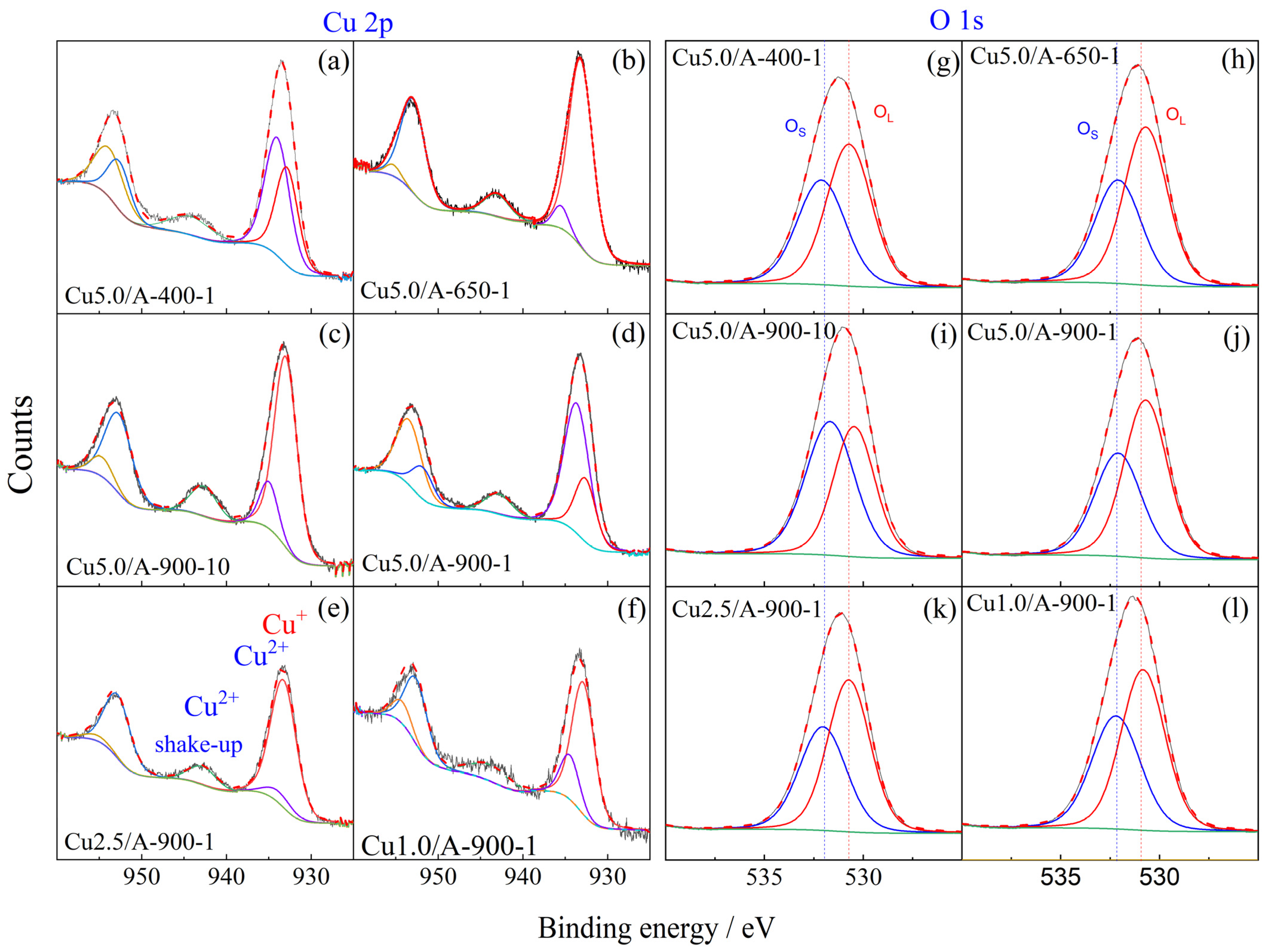
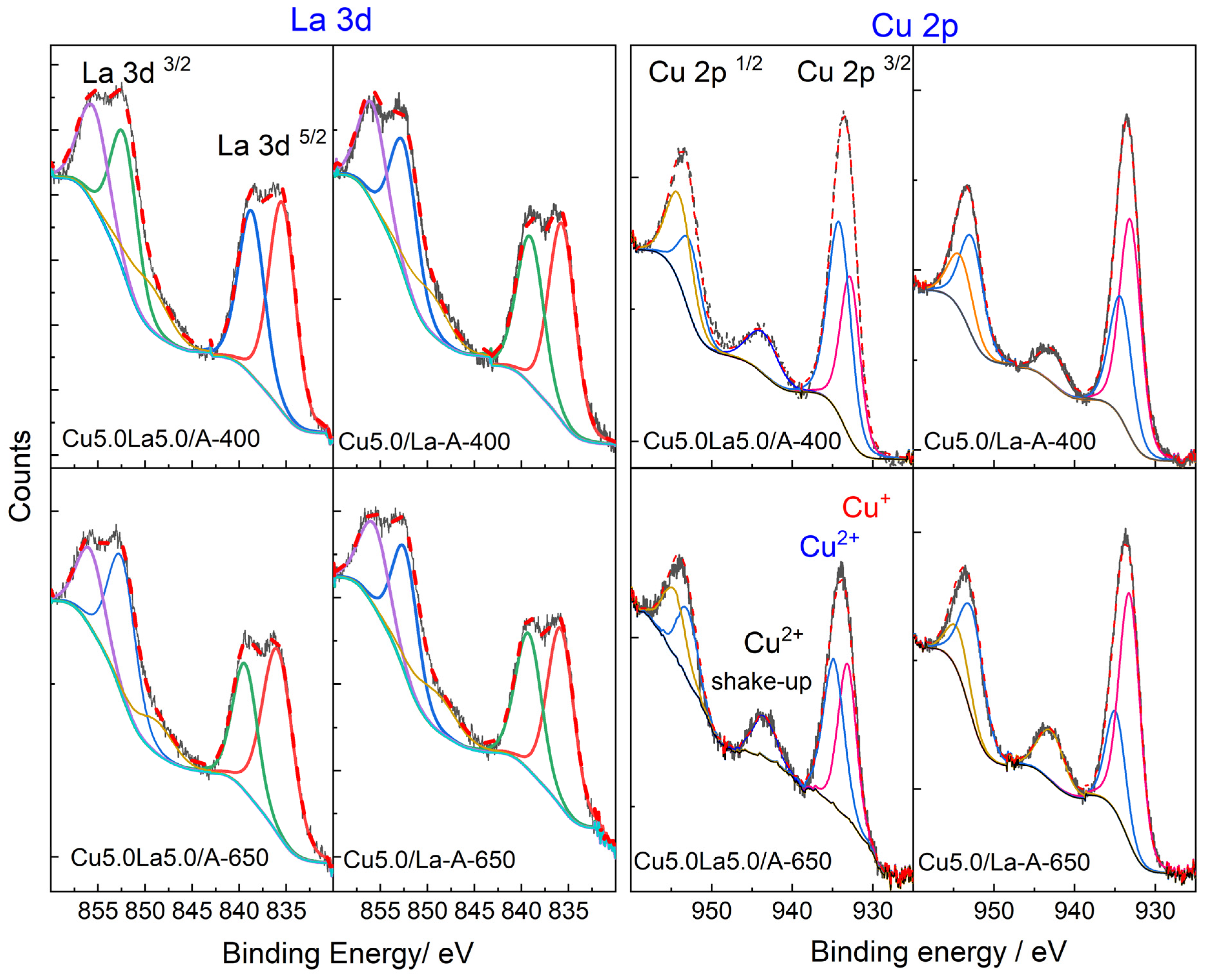
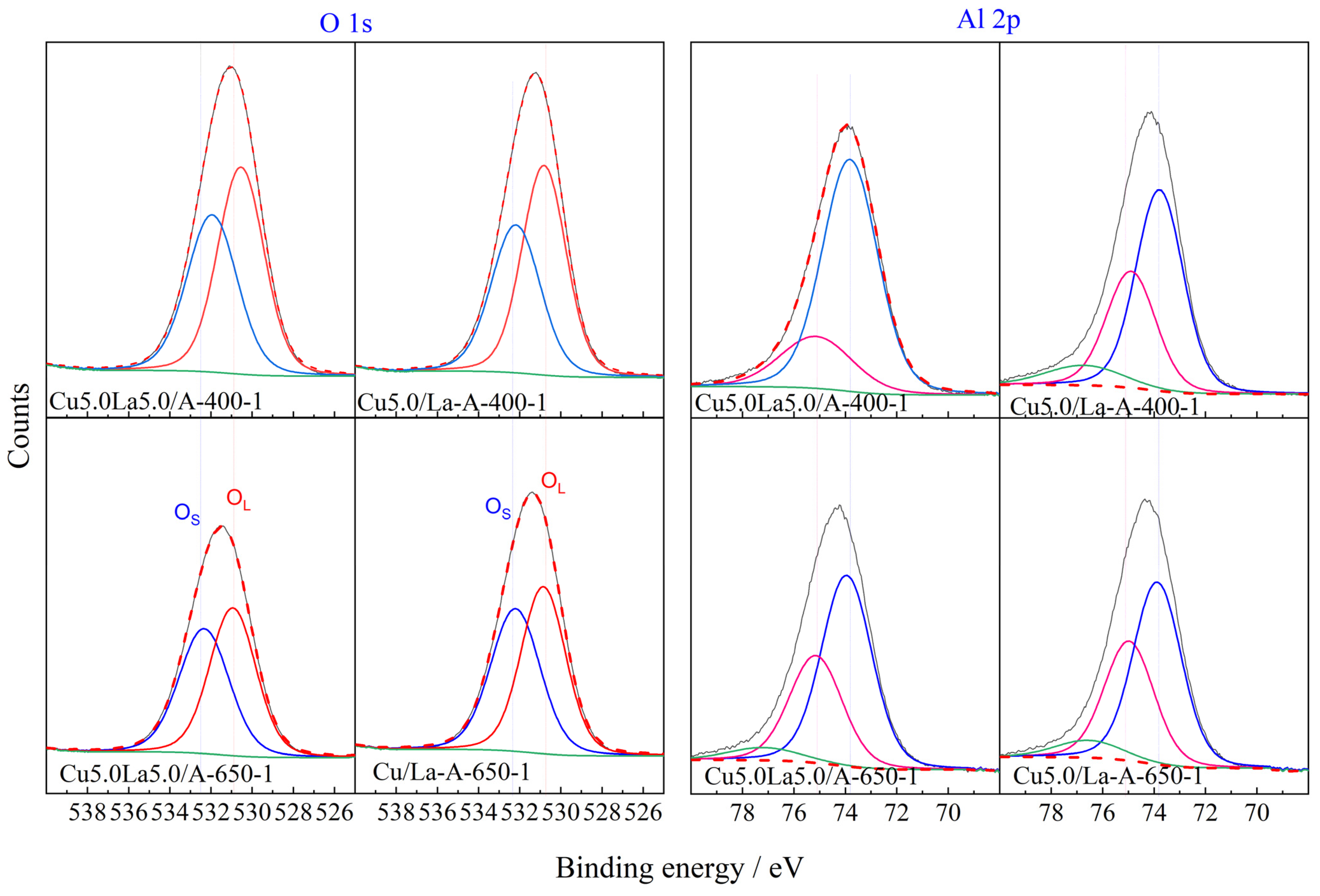
X-ray photoelectron spectroscopy (XPS) was used to determine surface composition and copper oxidation states, focusing on the effects of calcination temperature, heating rate, and La incorporation. High-resolution spectra of Cu 2p, O 1s, La 3d, and Al 2p were collected. Surface atomic percentages and Cu2+/Cu+ ratios are summarized in Table 2. Representative spectra are shown in Figure 3, Figure 4 and Figure 5, and fitting parameters (binding energies and FWHM) are provided in Table S4 (Supplementary Information).
In Cu-based catalysts, the Cu 2p3/2 region shows contributions at ~932.5–933.1 eV (Cu+) and ~933.8–934.5 eV (Cu2+), together with shake-up satellites of Cu2+ at ~943–944 eV (Figure 3). Increasing calcination temperature results in a higher relative contribution of Cu2+, consistent with stronger metal–support interactions and possible Cu–Al mixed oxide environments (e.g., CuAl2O4). This trend suggests that thermal treatment promotes copper stabilization within the support, although catalytic performance depends on maintaining accessible redox-active sites and preventing copper loss under reaction conditions.
In contrast, faster heating rates (10 °C·min−1) and lower Cu loadings favor Cu+, indicating a higher proportion of dispersed copper species interacting with the alumina surface. Thus, dispersion favors Cu+ species, whereas stronger metal–support interactions at high temperature shift the surface toward Cu2+-dominated environments.
La-containing catalysts exhibit distinct behavior. At similar temperatures, co-impregnated samples show higher Cu2+/Cu+ ratios than successively impregnated ones, indicating that the incorporation route influences copper stabilization.
This behavior indicates that La modifies the electronic environment of Cu through La-containing surface domains, tuning the balance between copper stabilization and redox accessibility rather than acting as an active site itself.
Complementary Cu LMM Auger spectra (Figure S6) showed systematic line-shape changes as a function of calcination temperature, Cu loading, and La incorporation. Catalysts calcined at higher temperatures exhibited more defined envelopes, consistent with stronger Cu-support interaction and progressive stabilization of oxidized Cu species. In contrast, lower Cu loadings and La-containing samples displayed broader or multi-feature profiles, indicating a wider distribution of Cu surface environments.
From a catalytic standpoint, the Cu2+/Cu+ redox pair is relevant for H2O2 activation, although the XPS-derived ratio reflects the initial surface redox environment prior to reaction. Catalytic performance is expected to depend on the interplay between two opposing requirements: sufficient Cu+ to initiate H2O2 decomposition (step 1 of the Fenton-like cycle) and sufficient stable Cu2+ to sustain the redox cycle (step 2), while keeping copper structurally bound under reaction conditions. The relationship between the Cu2+/Cu+ ratio and catalytic behavior is discussed in Section 3.3 in the context of copper stabilization and leaching effects.
The La 3d spectra confirm La3+ as the only oxidation state, indicating its stability under all conditions (Figure 4). The O 1s region shows lattice oxygen (OL, ~529.4–529.8 eV) and surface oxygen species (OS, ~531.0–531.8 eV), in agreement with previous reports on oxide catalysts [14,15,16]. Higher OL/OS ratios were observed for La-containing and high-temperature catalysts (Figure 5), suggesting a lower relative abundance of hydroxylated/adsorbed surface oxygen species and a more stabilized oxide framework. The Al 2p region (~74–77 eV) corresponds to Al3+ in γ-Al2O3, with slight shifts and broadening at high temperatures, suggesting the formation of Cu–Al mixed environments. Variations in FWHM (Table S4) further support differences in surface heterogeneity and metal–support interaction strength.
Overall, calcination conditions and La incorporation control both the oxidation state and the surface environment of copper species. The catalytic relevance of the Cu2+/Cu+ redox pair is therefore linked to its stabilization within the solid matrix, although its actual role under reaction conditions may differ due to copper leaching.

2.5. Catalytic Performance

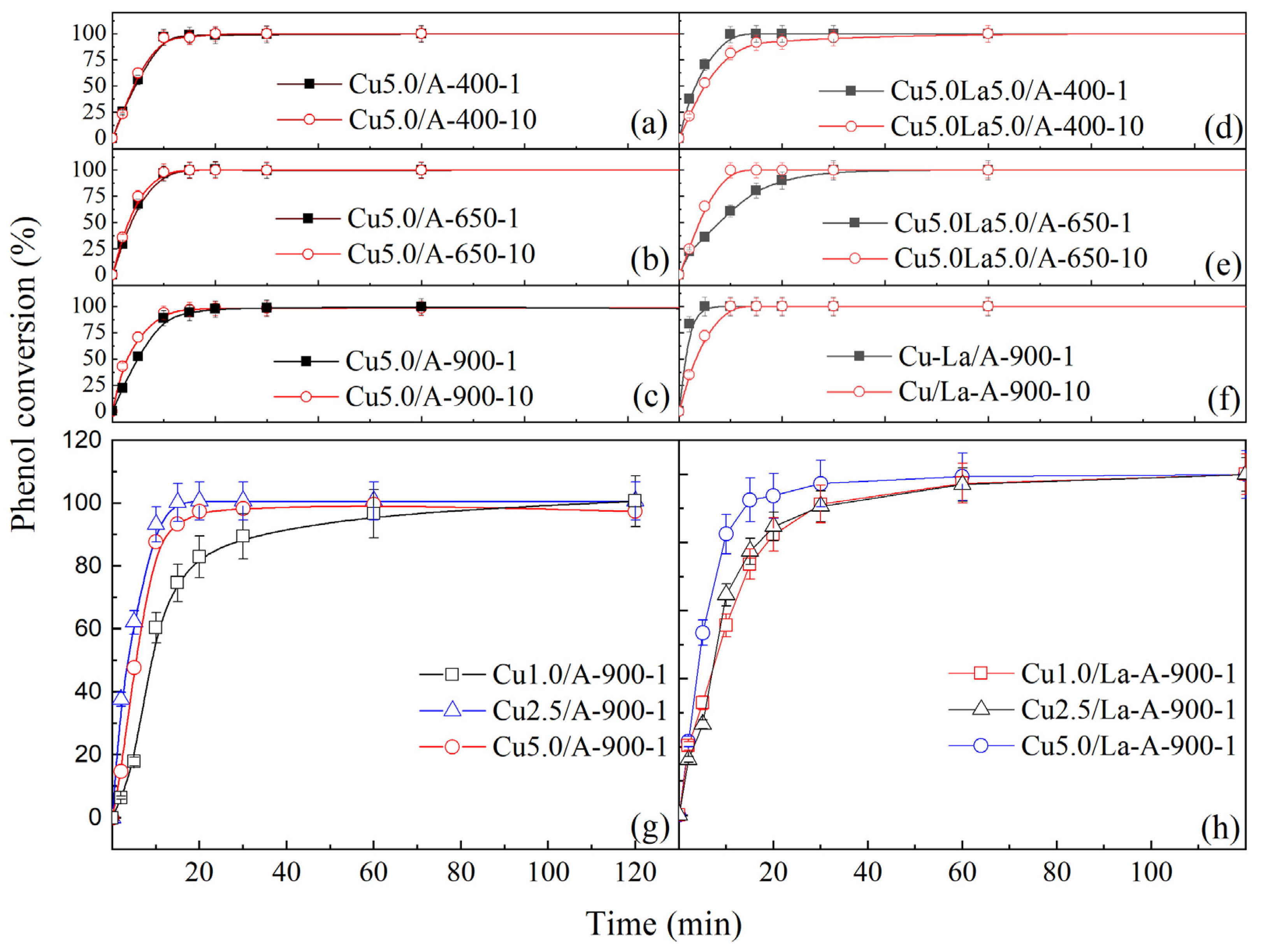
The catalytic activity of the materials was evaluated through the catalytic wet peroxide oxidation (CWPO) of phenol at 60 °C. Figure 6 shows the phenol conversion profiles as a function of reaction time for Cu-based catalysts prepared under different synthesis conditions. Catalytic performance is discussed in relation to copper oxidation state and metal–support interactions derived from XRD and XPS. Figure 6a–c correspond to the Cu/A series at fixed Cu loading, Figure 6d–f to the co-impregnated Cu–La catalysts, Figure 6g to the effect of Cu loading in the Cu/A series, and Figure 6h to the Cu/La-A series.
For the Cu/A series containing 5 wt.% Cu (Figure 6a–c), the calcination temperature significantly affected catalytic activity. The catalyst calcined at 900 °C (Cu5.0/A-900-1) showed the highest reaction rate, reaching nearly complete phenol conversion within about 20 min, whereas samples calcined at 400 and 650 °C displayed slower kinetics. This behavior is consistent with the progressive strengthening of metal–support interactions at higher calcination temperatures, as evidenced by XRD and XPS.
The formation of Cu–Al mixed oxide environments and the higher Cu2+/Cu+ ratios suggest that copper species become more strongly anchored and structurally stabilized, while catalytic performance depends on maintaining accessible redox-active sites in addition to copper stabilization.
Under these conditions, the Cu2+/Cu+ redox pair remains available at the surface, promoting efficient H2O2 activation while minimizing copper loss. By contrast, catalysts calcined at lower temperatures retain higher surface area but also a larger fraction of labile copper species, which compromises their stability under reaction conditions.
The heating ramp also influenced catalytic performance. Catalysts calcined at 10 °C·min−1 generally exhibited slightly faster initial reaction rates than those prepared at 1 °C·min−1, although the effect of calcination temperature was more pronounced than that of the heating ramp. This effect is consistent with differences in copper dispersion and surface heterogeneity, which influence the accessibility of redox-active sites.
The effect of copper loading was evaluated using catalysts calcined at 900 °C (Figure 6g). Increasing Cu loading from 1.0 to 5.0 wt.% progressively accelerated phenol oxidation because the availability of surface Cu species controls the rate of H2O2 activation in the CWPO reaction. However, this trend must be interpreted together with copper leaching, since the least-loaded catalysts exhibited the lowest stability. Therefore, high apparent activity at low Cu loading does not necessarily reflect improved heterogeneous catalysis, because it is coupled to severe copper loss and a larger homogeneous contribution. Highly dispersed copper species favor activity but lack sufficient stabilization, whereas higher loadings promote more stable surface environments capable of sustaining the Cu2+/Cu+ redox cycle.
These results define a trade-off between copper dispersion and stability: the most dispersed species are also the most prone to dissolution.
Lanthanum incorporation also altered catalytic activity. Co-impregnated Cu–La catalysts (Figure 6d–f) showed rapid phenol conversion, particularly for the sample calcined at 900 °C. In contrast, sequentially impregnated catalysts (Cu5.0/La-A, Figure 6h) displayed slower reaction rates, indicating that the metal incorporation route influences catalytic performance. These differences are consistent with XPS results, which show that co-impregnation favors higher Cu2+/Cu+ ratios and a more homogeneous distribution of copper species. Lanthanum does not act as an active site itself but modifies the structural environment of copper, promoting stronger anchoring and stabilizing redox-active Cu species at the surface, thereby improving the balance between activity and stability.

2.6. Copper Leaching

2.6.1. Copper Leaching and Correlation with Textural Properties

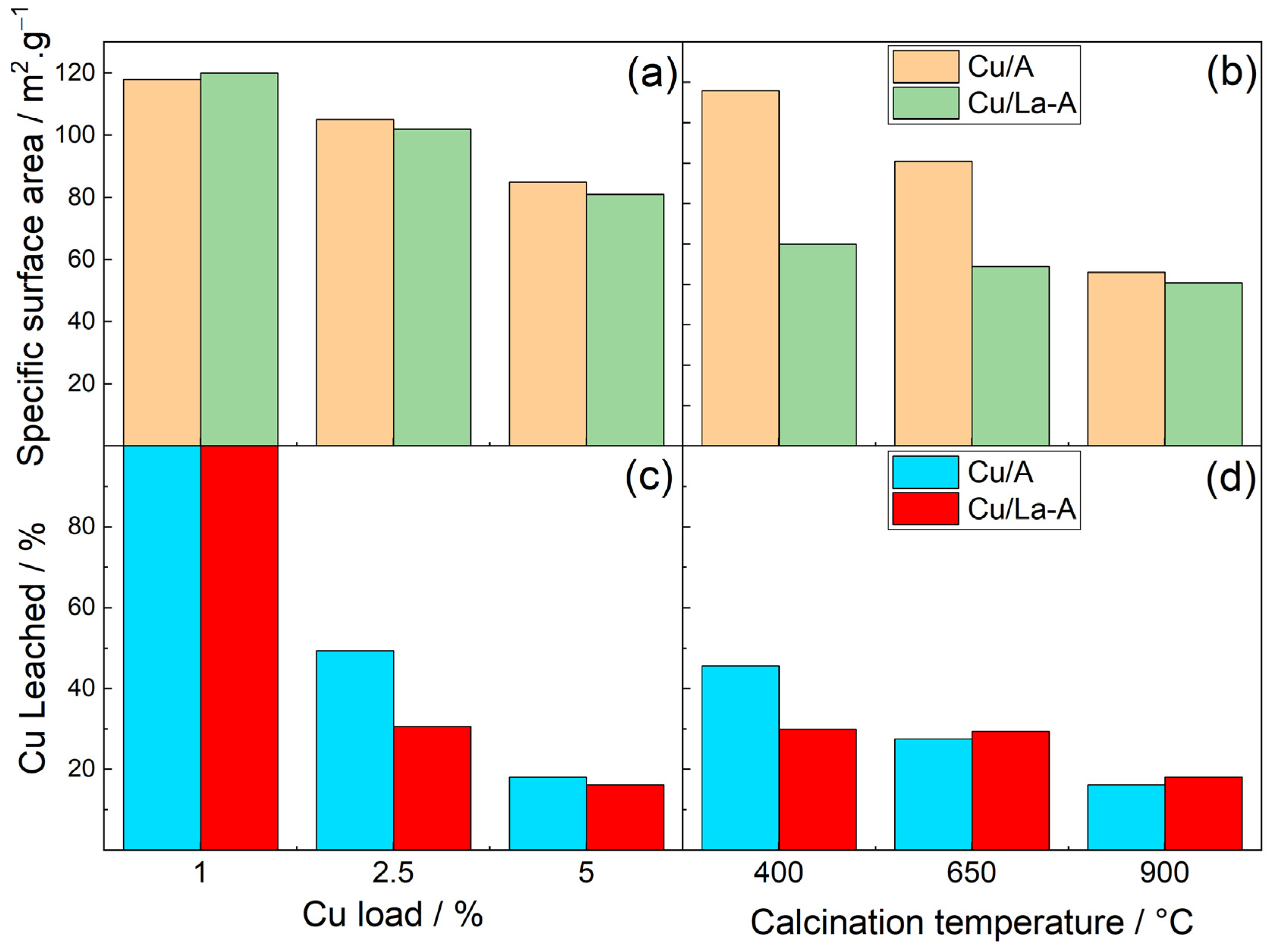
Copper leaching was quantified after each CWPO reaction to evaluate catalyst stability and the influence of synthesis parameters. The relationship between copper leaching and synthesis parameters is summarized in Figure 7a–d, allowing discrimination between heterogeneous catalysis and contributions from dissolved copper species. Figure 7a,b show the evolution of the BET surface area, whereas Figure 7c,d present the corresponding copper leaching values.
A clear dependence of copper leaching on Cu loading was observed. Catalysts containing 1.0 wt.% Cu exhibited very high copper loss, exceeding 85% in most cases, whereas samples with 5.0 wt.% Cu retained more than 80% of the initial copper. At low loadings, copper is predominantly present as highly dispersed and weakly coordinated surface species, which are more susceptible to dissolution under CWPO conditions. Thus, high dispersion alone does not ensure catalyst stability when copper–support interactions are weak. This behavior is consistent with XPS results, which indicate a higher relative contribution of Cu+ species at low loadings, associated with less stabilized copper environments. Increasing Cu loading favors the development of more stable copper-containing surface domains and therefore improves metal retention [17].
Calcination temperature also had a strong influence on catalyst stability. For both Cu/A and Cu–La catalysts, increasing the calcination temperature from 400 to 900 °C led to a progressive decrease in Cu leaching. This trend follows the structural evolution observed by XRD and XPS, where higher calcination temperatures strengthen metal–support interactions and stabilize copper species more effectively. In particular, the formation of Cu–Al mixed oxide phases (e.g., CuAl2O4 spinel) and the increase in Cu2+/Cu+ ratio indicate that copper becomes structurally integrated into the support, reducing its mobility and susceptibility to dissolution.
Calcination at 900 °C promotes the transition from labile copper species to more strongly bound environments.
Although catalysts calcined at lower temperatures displayed higher BET surface areas, they also showed greater Cu leaching. In contrast, catalysts treated at higher temperatures exhibited lower surface areas but significantly improved copper retention. This indicates that catalytic stability is governed by copper coordination and metal–support interactions rather than by surface area.
Lanthanum incorporation also enhanced copper stabilization. When catalysts with comparable Cu loading and calcination temperature were compared, La-containing samples generally exhibited lower Cu leaching than their La-free counterparts, indicating that lanthanum promotes stronger anchoring of copper species on the support and modifies the structural environment in which copper is stabilized.
This behavior is consistent with XPS results, which show more stabilized copper environments in the presence of La, leading to reduced susceptibility to dissolution.
These results show that catalytic performance must be interpreted together with catalyst stability. Systems exhibiting high conversion but severe copper loss cannot be considered purely heterogeneous, as a significant fraction of the activity arises from dissolved copper species.
In addition to specific surface area, pore volume and pore size distribution (BJH method) were analyzed to better assess the textural properties of the catalysts. All samples exhibited predominantly mesoporous structures, with pore diameters within the 2–50 nm range. Catalysts calcined at higher temperatures showed a moderate reduction in pore volume and broader pore size distributions, consistent with partial sintering and structural densification. In contrast, lower-temperature samples retained higher pore volumes and more open mesoporosity. These textural changes can influence reactant diffusion and accessibility of Cu active sites during CWPO.
Additional reuse tests were conducted for the Cu5.0/La-A-900-1 catalyst using three consecutive CWPO cycles with intermediate washing and thermal treatment at 900 °C with a heating ramp of 1 °C·min−1, matching the original synthesis conditions. Complete phenol conversion was achieved within the first 20 min in all cycles, while TOC conversion remained above 90%. Copper leaching was mainly observed during the first cycle (18%), whereas Cu concentration remained below the detection limit in the subsequent treated cycles. These results indicate that, after removal of the initially labile copper fraction and surface residues, the remaining catalyst preserves its catalytic performance under the studied regeneration protocol.

2.6.2. Effect of Citric Acid on Copper Retention

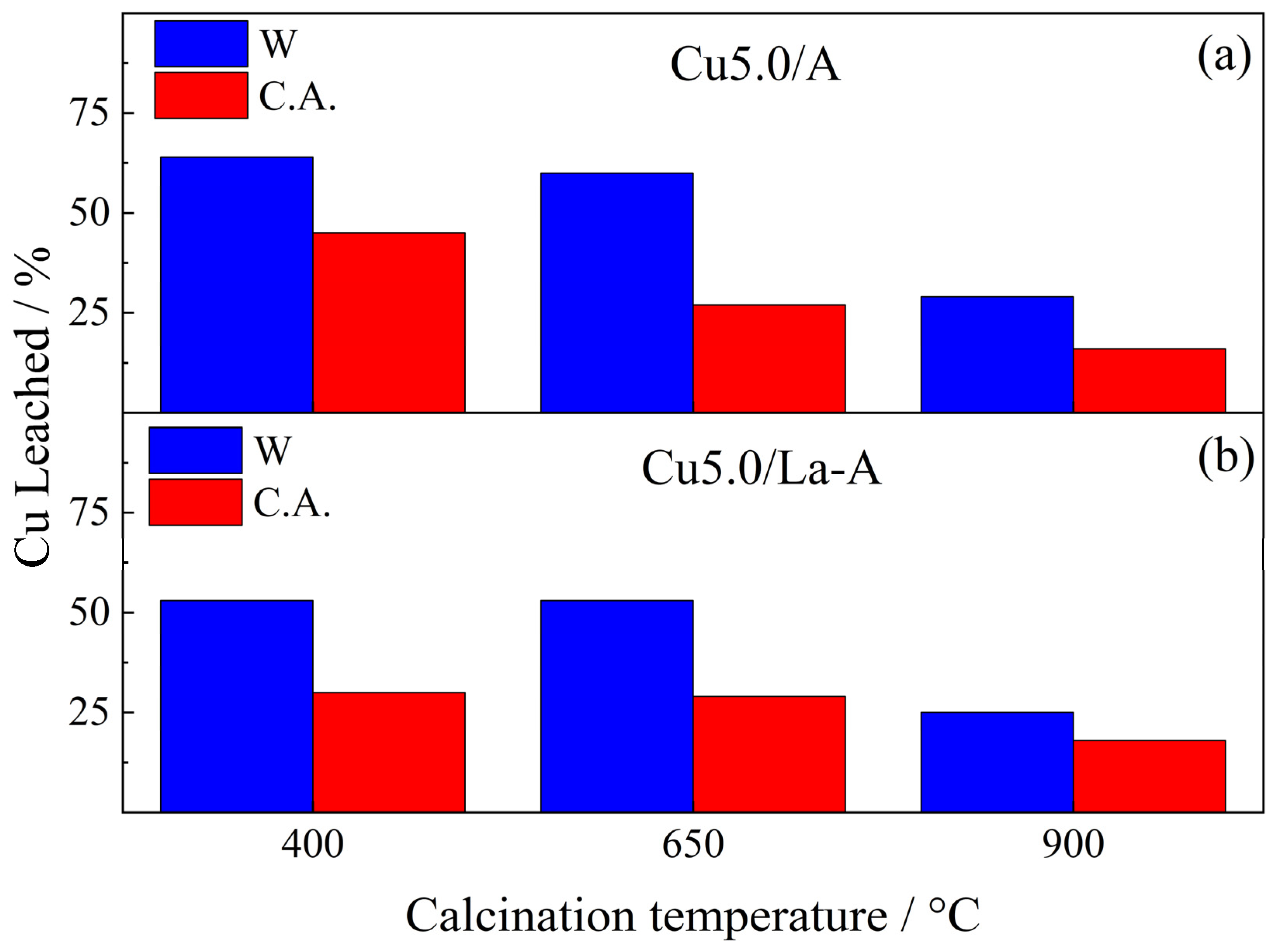
To further evaluate the influence of synthesis parameters on catalyst stability, the role of citric acid (CA) during catalyst preparation was investigated by comparing samples synthesized with and without its addition [5,9]. Figure 8 presents the percentage of copper leached after 2 h of CWPO for Cu/A and Cu/La-A catalysts calcined at different temperatures. Figure 8a corresponds to the Cu/A series and Figure 8b to the Cu/La-A series, in both cases comparing catalysts prepared with and without citric acid.
For both catalyst series, the incorporation of citric acid during synthesis led to a significant decrease in copper leaching. For Cu/A catalysts, Cu loss decreased from approximately 60% to below 30% for samples calcined at 650 °C when CA was included. A comparable trend was observed for the Cu/La-A catalysts, where materials prepared with citric acid consistently showed lower copper dissolution across the entire calcination temperature range.
This stabilization effect can be attributed to the chelating behavior of citric acid during impregnation. The formation of Cu–citrate complexes is expected to modify precursor chemistry, suppresses local copper enrichment during drying, and promotes the development of more strongly bound copper environments during calcination. As a result, the fraction of weakly bound copper species decreases, and copper becomes more firmly anchored to the alumina surface, thereby limiting its mobility and dissolution under CWPO conditions.
Although calcination temperature remained the dominant parameter controlling catalyst stability, the addition of citric acid systematically enhanced copper retention under otherwise identical synthesis conditions. Precursor chemistry therefore plays a decisive role in the final stability of copper species.
Overall, these results demonstrate that the combined use of citric acid during synthesis and appropriate thermal treatment provides an effective strategy to improve the structural stability of Cu-based CWPO catalysts by limiting metal leaching during operation.

2.6.3. Homogeneous Contribution

To evaluate the possible contribution of dissolved metal species to the overall catalytic performance, control experiments were carried out using aqueous Cu2+ and La3+ solutions at concentrations equivalent to those measured after CWPO reactions. The corresponding phenol conversion profiles are shown in Figure S7 (Supplementary Information). This figure compares the homogeneous oxidation promoted by dissolved Cu2+ and La3+ under concentrations representative of the post-reaction liquid phase.
The results indicate that Cu2+ ions are able to promote phenol oxidation through homogeneous Fenton-like reactions. Under the tested conditions, Cu2+ solutions rapidly oxidized phenol, reaching nearly complete conversion within short reaction times despite the absence of a solid catalyst. This confirms that leached copper species contribute significantly to phenol degradation and reinforces the need to interpret catalytic activity together with copper stability.
In contrast, La3+ showed very limited catalytic activity. Phenol conversion remained below 20% even after extended reaction times, indicating that lanthanum does not actively participate in homogeneous oxidation reactions under the studied conditions. Its role in the catalyst is therefore mainly structural, contributing to the stabilization of copper species and improving catalyst durability.
These results demonstrate that homogeneous Cu2+ can account for a substantial fraction of the observed activity when leaching is significant, and therefore catalytic performance must be interpreted as the result of a coupled heterogeneous–homogeneous system governed by copper stabilization. Previous recycling studies on Cu–La/Al2O3 without citric acid showed that sustained phenol conversion and TOC removal can occur despite progressive metal leaching, reinforcing that catalytic performance must be interpreted together with copper stability [5].

2.7. H2O2 Consumption and pH Evolution

The time-resolved pH and H2O2 concentration profiles for selected catalysts are provided in Figures S8 and S9. In all experiments, pH decreased rapidly during the initial 20–30 min of reaction, from an initial value of approximately 5.5–6.0 to values in the range of 3.0–3.5 at the end of the experiment. This acidification reflects both the generation of H+ in the Cu2+/Cu+–H2O2 cycle (Cu2+ + H2O2 → Cu+ + HO2• + H+) and the accumulation of short-chain carboxylic acid intermediates—primarily oxalic, maleic, and acetic acids—produced during phenol ring-opening [2,18]. The acidification is faster in catalysts with higher initial leaching rates, consistent with positive feedback due to Cu dissolution, decreasing pH, and further leaching. H2O2 was consumed predominantly during the first 30 min, coinciding with the period of fastest phenol conversion. Differences in total H2O2 consumption among catalysts at equivalent phenol conversion levels reflect differences in oxidant utilization efficiency: catalysts with significant homogeneous contribution (high leaching) consume H2O2 less selectively, because dissolved Cu2+ can catalyze H2O2 decomposition to O2 (non-productive pathway) in addition to generate •OH radicals. In contrast, well-stabilized heterogeneous catalysts channel a higher fraction of H2O2 toward productive •OH generation. This distinction is mechanistically important: high phenol conversion alone does not guarantee efficient H2O2 utilization, and catalysts achieving comparable conversions with lower H2O2 consumption are more suitable for practical applications.

2.8. Mineralization Performance (TOC and COD)

The evolution of total organic carbon (TOC) and chemical oxygen demand (COD) during CWPO was monitored to evaluate the extent of mineralization. The time-resolved TOC and COD profiles are shown in Figures S10 and S11, respectively, whereas the overall conversions after reaction are summarized in Table 3. In all cases, TOC and COD values decreased progressively with reaction time, reflecting the degradation of phenol and its oxidation intermediates. Catalysts calcined at higher temperatures and those containing higher Cu loadings generally showed faster TOC and COD removal, in agreement with their higher catalytic activity. Mineralization results must be interpreted together with Cu leaching, since catalysts exhibiting extensive copper dissolution also promote oxidation through homogeneous pathways. Catalysts showing very high copper loss cannot be considered purely heterogeneous, as mineralization in these cases is strongly coupled to homogeneous copper reactivity.
Based on its favorable activity–stability balance, Cu5.0/La-A-900-1 was selected for reusability tests. Complete phenol conversion was achieved within the first 20 min in three consecutive cycles, while TOC conversion remained above 90%. Copper leaching was mainly associated with the first cycle, whereas Cu concentration remained below the detection limit after regeneration in subsequent cycles. In addition, the temporal evolution of Cu loss during CWPO (Figure S12) showed that most copper release occurred during the initial reaction stage, followed by progressive stabilization. This behavior is consistent with the dissolution of a minor fraction of weakly bound surface Cu species during the early acidic and highly oxidative period of the reaction, after which the remaining copper species remain more strongly stabilized on the support.

3. Discussion

The structural, surface, and catalytic data presented above converge on a coherent picture of how synthesis conditions govern copper stabilization and catalytic performance in CWPO. The central argument is that neither surface area, copper loading, nor Cu2+/Cu+ ratio alone determines performance: what matters is how these variables interact to control the density of surface-accessible, structurally anchored redox-active Cu sites that remain bound to the support during the acidic, oxidizing CWPO environment.

3.1. From Precursor Chemistry to Surface Structure: The Role of Citric Acid and Calcination Temperature

During wet impregnation, citric acid is expected to form Cu–citrate complexes that modify precursor speciation and promote a more homogeneous distribution of copper over the alumina surface. This suppresses local copper enrichment during drying and leads to a more uniform distribution, as supported by EDS observations (Figures S2–S5). Upon calcination, this is associated with a higher fraction of structurally integrated copper species, consistent with XRD and XPS results and the reduced Cu leaching observed experimentally [10,11]. The net effect is a higher fraction of structurally integrated copper after calcination, consistent with the XRD and XPS results, which show that citric acid-prepared samples may promote the formation of CuAl2O4 and CuAlO2 phases at lower calcination temperatures and retain lower Cu leaching across the entire temperature range (Figure 8). At 900 °C, calcination likely promotes solid-state reactions CuO + Al2O3 → CuAl2O4 and Cu2O + Al2O3 → 2CuAlO2, incorporating copper into the spinel and delafossite structures detected by XRD. These phases are more stable under CWPO conditions [17]. The progressive decrease in Cu leaching from ~60–74% at 400 °C to ~16–29% at 900 °C is consistent with this structural evolution.

3.2. The Mechanistic Role of Lanthanum in Copper Anchoring

Lanthanum functions as a structural modifier at three levels. First, La3+ species are expected to interact with surface sites on the γ-Al2O3 surface during the impregnation step, increasing the availability of hydroxyl groups that can act as anchoring points for Cu2+ during subsequent impregnation [7]. This higher OH density provides more anchoring sites for Cu2+, which is consistent with the more uniform Cu distribution and lower leaching observed in co-impregnated samples, where Cu and La are deposited simultaneously and interact during drying and early calcination. In the sequential route, La is calcined onto the support before Cu is added, which may partially consume surface OH groups that would otherwise serve as Cu anchoring sites, generating a partially dehydroxylated La–alumina surface that interacts less effectively with the Cu precursor.
Second, at temperatures above 600 °C, lanthanum reacts with the alumina surface to form LaAlO3 nanoparticles (as suggested by XRD, Figure 2), which are likely located at high-energy surface sites where CuO nucleation and sintering preferentially occur. By occupying these sites, LaAlO3 may hinder CuO crystallite growth, consistent with the XRD observation that La-containing samples show weaker and broader CuO reflections than La-free catalysts at comparable calcination temperatures.
Third, the presence of La3+ in the local environment of Cu2+ appears to modify the local oxygen environment. XPS results show that La-containing samples exhibit lower O 1s surface oxygen (OS) fractions and higher lattice oxygen (OL) fractions relative to La-free counterparts at the same calcination temperature (Figure 5). Higher OL/OS ratios are consistent with a more ordered surface oxygen environment, in which Cu2+ occupies more stable positions within the mixed oxide framework. This stabilization is consistent with the higher Cu2+/Cu+ ratios observed in co-impregnated samples (Table 2) and may contribute to reducing the susceptibility of copper species to dissolution under acidic CWPO conditions.

3.3. The CWPO Reaction Mechanism and the Heterogeneous/Homogeneous Balance

Phenol oxidation by CWPO over Cu-based catalysts proceeds through a heterogeneous Fenton-like cycle at the catalyst surface: (1) Cu2+(s) + H2O2 → Cu+(s) + HO2• + H+ (2) Cu+(s) + H2O2 → Cu2+(s) + •OH + OH (3) •OH + C6H5OH → ring-opening intermediates → CO2 + H2O. Step (1) is likely rate-limiting in well-stabilized catalysts, where Cu2+ is the predominant initial surface species, consistent with the high Cu2+/Cu+ ratio inferred from XPS. Step (2) regenerates Cu2+ and produces the •OH radical responsible for phenol oxidation. The pH decrease observed during reaction (Figure S8), together with the temporal Cu loss profile, is consistent with this cycle: H+ generation in step (1) and the accumulation of short-chain carboxylic acid intermediates (oxalic, maleic, and acetic acids) during ring-opening acidify the medium, which in turn accelerates further Cu2+ dissolution from weakly bound surface sites, creating positive feedback between leaching and pH drop that is most pronounced in catalysts calcined at low temperatures. The progressive decrease in pH coincides with the period of highest H2O2 consumption (Figure S9) and fastest phenol conversion (Figure 6), confirming that radicals are generated most rapidly in the initial stage, when H2O2 is in excess and the Cu2+/Cu+ cycle operates at maximum rate. As H2O2 is depleted, radical generation slows, and the remaining organic carbon is oxidized more slowly to CO2—consistent with the continued but slower TOC decrease observed in Figures S10 and S11. This framework helps explain the trends observed in Table 3. Catalysts with 100% Cu leaching (Cu1.0/A-900-1, Cu1.0/La-A-900-1) achieve 91–95% TOC removal because essentially all copper enters solution, where it promotes homogeneous Fenton-like oxidation at concentrations sufficient for near-complete phenol degradation (shown by Figure S7). In contrast, catalysts such as Cu5.0La5.0/A-900-1 (28% leaching, 86% TOC) or Cu5.0La5.0/A-650-1 (28% leaching, 84% TOC) achieve somewhat lower TOC despite lower leaching, because a fraction of their copper is associated with CuAl2O4/CuAlO2-type phases that are catalytically less accessible for the redox cycle. The trade-off is therefore not simply between more and less leaching, but between the fraction of copper that is (a) too labile (leaches and contributes homogeneously), (b) optimally stabilized (surface-accessible redox-active Cu2+/Cu+), and (c) over-stabilized (buried in mixed oxide phases, redox-inaccessible). Catalysts such as Cu5.0/La-A-900-1 (18% leaching, 91% TOC) represent the best compromise because La pre-modification of the support creates an anchoring environment that retains Cu at the surface in a structurally accessible Cu2+/Cu+ form, without burying it in bulk spinel environments. The color change sequence observed during CWPO (Figure S13) is consistent with the transient formation of reaction intermediates. The initial darkening is commonly associated with catechol-, hydroquinone-, and benzoquinone-type species reported in analogous CWPO studies [2,3]. Subsequent decolorization is consistent with ring opening to short-chain acids and their further oxidation to CO2.
The results suggest the coexistence of three types of copper species: (i) labile species prone to dissolution and contributing predominantly to homogeneous oxidation, (ii) surface-accessible redox-active species responsible for surface-mediated reactions, and (iii) structurally over-stabilized species with limited redox accessibility. Under these conditions, the distinction between heterogeneous and homogeneous catalysis is not absolute, but depends on the extent of copper stabilization. Catalyst design, therefore, controls the fraction of copper that remains surface-bound versus that which participates in solution-phase Fenton-like reactions, defining the overall catalytic regime.

3.4. Synthesis Parameters as Design Levers

The combined results define a clear hierarchy of synthesis variables in controlling CWPO performance: Calcination temperature is the dominant variable. It influences the fraction of copper converted from labile CuO to structurally integrated CuAl2O4/CuAlO2 phases, and it governs the final Cu2+/Cu+ ratio. At 900 °C, leaching drops below 30% for all La-free catalysts and below 20% for the best La-containing formulations. The incorporation route determines the effectiveness of lanthanum promotion. Co-impregnation (simultaneous Cu and La deposition) consistently outperforms sequential impregnation in terms of Cu retention and activity, because it allows Cu–La–O interactions to develop during the shared calcination step. Sequential impregnation loses the synergy because La occupies and partially deactivates Cu anchoring sites before Cu is added. Citric acid provides an additive, temperature-independent stabilization effect. Its contribution is most significant at lower calcination temperatures (400–650 °C), where it compensates partially for the weaker metal–support interactions of less thermally treated samples. At 900 °C, the thermal stabilization dominates and the CA effect is less pronounced but still measurable. Copper loading determines the local density and aggregation tendency of Cu species. Below 2.5 wt.%, copper exists predominantly as isolated, highly dispersed species that are active but unstable. Above 5 wt.%, the development of CuO domains and eventually spinel phases provides structural stability at the cost of some redox accessibility. These design relationships define a practical synthesis window for catalysts targeting the activity–stability optimum: calcination at 900 °C, co-impregnation of Cu and La at 5 wt.% each, with citric acid as a complexing agent. The resulting Cu5.0La5.0/A-900-1 and Cu5.0/La-A-900-1 catalysts exemplify this window, combining low leaching (18–28%) with high phenol conversion and TOC removal (86–91%), with activity arising from a balance between surface-mediated reactions and contributions from dissolved copper species.
Representative Cu-based catalysts reported for phenol CWPO under heterogeneous Fenton-like conditions are compared in Table 4. The comparison shows that rapid phenol conversion is frequently achieved, but this does not always correlate with high mineralization or catalyst stability. Several reported systems exhibit moderate TOC removal, unavailable mineralization data, or significant Cu dissolution during operation. In contrast, the catalyst developed in this work, Cu5.0/La-A-900-1, achieved complete phenol conversion, 91% TOC removal, and only 18% Cu leaching after 2 h at an initial phenol concentration of 1000 mg L−1. These results indicate a favorable balance between oxidation efficiency and copper retention under relatively demanding reaction conditions. The improved behavior is attributed to the combined effect of La promotion, citric acid-assisted synthesis, and thermal stabilization of Cu species on the alumina surface.

4. Materials and Methods

4.1. Chemicals and Reagents

All reagents were of analytical grade and used as received without further purification. Copper(II) nitrate trihydrate (Cu(NO3)2·3H2O), lanthanum(III) nitrate hexahydrate (La(NO3)3·6H2O), and citric acid monohydrate (C6H8O7·H2O) were purchased from Sigma-Aldrich.

4.2. Catalysts Synthesis

Catalysts containing Cu and La were prepared using γ-Al2O3 (PURALOX® SBA 320, Sasol, Brunsbüttel, Germany; particle size: 100–200 μm; surface area: 200 m2·g−1) as the support. Cu(NO3)2·3H2O and La(NO3)3·6H2O were used as copper and lanthanum precursors, respectively. Citric acid (Cicarelli) was employed as a combustion/complexing agent due to its ability to promote metal–support interaction and improve catalyst stability.
Citric acid was added to the precursor solution using an equimolar molar ratio with respect to the metal nitrate salts (CA:metal salt = 1:1). This molar ratio was selected based on prior work on citric acid-assisted impregnation of supported metal catalysts, where ratios in the range 0.5–2 have been reported to improve metal dispersion, with 1:1 providing sufficient complexation of the metal precursor without excess organic residue that could inhibit surface interaction [10,11]. The acid was dissolved together with the metal precursor before the impregnation step in order to promote the formation of metal–citrate complexes.

4.2.1. Copper-Based Catalysts

Cu-based catalysts were synthesized by wet impregnation. The required amount of copper precursor was dissolved in deionized water to obtain a nominal Cu loading of 5 wt.%. Citric acid was then added to the solution according to the CA:Cu(NO3)2 molar ratio described above.
The solution was heated to 80 °C under constant stirring, and the alumina support was gradually added. The suspension was stirred for 1 h and then dried overnight at 110 °C. The resulting solids were calcined in static air at 400, 650, or 900 °C using two heating ramps (1 or 10 °C·min−1), as detailed in Figure S1.
The catalyst nomenclature follows the format CuX/A-T-R, where X represents the Cu loading (wt.%), A represents γ-Al2O3, T the calcination temperature (°C), and R the heating ramp (°C·min−1). To isolate the effect of calcination conditions, this series was first studied at a fixed Cu loading of 5 wt.%. Copper loading was varied only for catalysts calcined at 900 °C using a heating ramp of 1 °C·min−1.

4.2.2. Copper-Lanthanum-Based Catalysts

Two series of Cu–La catalysts were synthesized by wet impregnation using γ-Al2O3 as the support: (i) co-impregnation of Cu and La precursors, and (ii) successive impregnation, in which La was first deposited on the support, followed by Cu loading.
For co-impregnated samples, aqueous solutions containing Cu(NO3)2·3H2O and La(NO3)3·6H2O were prepared to obtain nominal metal loadings of 5 wt.% Cu and 5 wt.% La. After impregnation, the materials were dried overnight at 110 °C and calcined in air at 400, 650, or 900 °C using a heating ramp of 1 °C·min−1. One catalyst was additionally prepared at 900 °C using a ramp of 10 °C·min−1 for comparison. These catalysts are denoted Cu5.0La5.0/A-T-R.
In the successive impregnation route, lanthanum was first deposited onto γ-Al2O3 to obtain a nominal loading of 5 wt.% La. After calcination, the resulting La-modified support was impregnated with copper. These catalysts are denoted CuX/La-A-T, where X represents the Cu loading (wt.%) and T the calcination temperature (°C). For this series, Cu loading was varied from 1.0 to 5.0 wt.% for catalysts calcined at 900 °C.
A summary of synthesis parameters and catalyst nomenclature is provided in Tables S1 and S2 of the Supplementary Material.

4.3. Characterization

The catalysts were characterized by using a combination of structural, textural, morphological, and surface chemical techniques.
X-ray diffraction (XRD): Crystalline phases were identified by powder XRD using a PANalytical X’Pert PRO diffractometer equipped with CuKα radiation (λ = 1.5405 Å). Diffraction patterns were collected over a 2θ range of 20–90° with a step size of 0.04°·s−1. Phase identification was carried out by comparing the experimental profiles with the JCPDS database.
Surface area and porosity: Nitrogen adsorption–desorption isotherms were recorded at −196 °C using a Micromeritics ASAP 2020 analyzer. The specific surface area was calculated using the BET (Brunauer–Emmett–Teller) method. Total pore volume was determined at P/P0 = 0.99, and the pore size distribution was estimated using the BJH (Barrett–Joyner–Halenda) model from the desorption branch.
Scanning electron microscopy (SEM) and energy-dispersive X-ray spectroscopy (EDS): Catalyst morphology and elemental mapping were analyzed using a ZEISS EVO 15 SEM coupled with an Oxford X-MAX 50 mm2 EDS detector. Micrographs and EDS maps were collected from representative regions to evaluate surface dispersion and metal loading.
X-ray photoelectron spectroscopy (XPS): Surface elemental composition and oxidation states were analyzed using a PHI 5000 VersaProbe III instrument (Physical Electronics, Chanhassen, MN, USA). High-resolution spectra were collected for the Cu 2p, O 1s, Al 2p, and La 3d regions. Charge correction was performed by setting the adventitious C 1s peak to 284.8 eV. Survey spectra were acquired with a pass energy of 187.85 eV and a step size of 0.8 eV. High-resolution spectra were recorded with a pass energy of 23.5 eV, a step size of 0.1 eV, and at least 10 scans per region. All spectra were processed using CasaXPS software (version 2.3.23, Casa Software Ltd., Teignmouth, UK). Binding energies are reported with an estimated uncertainty of ±0.1 eV. Peak deconvolution was performed using a Shirley background and mixed Gaussian–Lorentzian line shapes. Surface atomic concentrations were estimated from sensitivity-factor-corrected peak areas.

4.4. Catalytic Activity Evaluation

Catalytic activity was evaluated in the oxidation of phenol using hydrogen peroxide as the oxidant. Reactions were carried out in a 250 mL three-necked round-bottom flask equipped with a reflux condenser and magnetic stirring. In each test, 100 mL of an aqueous phenol solution (1000 mg·L−1) was pre-heated to 60 °C. Once thermal equilibrium was reached, 100 mg of catalyst was added, followed by the rapid addition of 10 mL of H2O2 (110 vol.%), which marked the starting time of the reaction (t0).
Aliquots were withdrawn at selected time intervals, immediately filtered through 0.22 μm membranes, and analyzed. The concentrations of residual phenol and leached copper were determined by Vis spectrophotometry. Phenol was quantified using the standard colorimetric method 5530-D [23] with 4-aminoantipyrine as the chromogenic reagent. Absorbance was measured at 510 nm using a UV–Vis spectrophotometer (JASCO V-530). The calibration range was 0.05–10 mg·L−1 (R2 > 0.999). Samples with higher concentrations were diluted prior to analysis. Copper concentration in filtered aliquots was determined spectrophotometrically using the neocuproine (2,9-dimethyl-1,10-phenanthroline) method, 3500-CuB [23], measuring absorbance at 454 nm. The detection limit was 0.05 mg·L−1 (equivalent to 0.05% of the initial Cu loading of 100 mg catalyst at 5 wt.% Cu), and samples were diluted as required to remain within the linear range (0.05–5 mg·L−1, R2 > 0.999). The H2O2:phenol molar ratio in all experiments was approximately 17:1 (10 mL of 110 vol.% H2O2, corresponding to ~3.3 mol·L−1 H2O2, in 100 mL of 1000 mg·L−1 phenol solution, corresponding to 1.06 × 10⁻¹ mol·L−1 phenol), which is stoichiometrically in excess relative to the theoretical requirement for complete mineralization of phenol to CO2 and H2O (C6H5OH + 14H2O2 → 6CO2 + 17H2O, molar ratio 14:1).
All reactions were conducted in triplicate to ensure reproducibility. Representative error bars are shown in selected catalytic figures. In multi-curve plots, they were omitted when smaller than the symbol size or when their inclusion reduced figure clarity.

5. Conclusions

This work shows that the performance of Cu/Al2O3-based catalysts in CWPO is governed not by surface area or total copper content, but by the structural environment of copper species, specifically, the fraction of surface Cu that exists in a structurally anchored, redox-accessible Cu2+/Cu+ state under acidic reaction conditions. Calcination at 900 °C was the dominant synthesis variable, promoting the development of CuAl2O4 spinel- and CuAlO2-type phases that reduce copper mobility and leaching while maintaining accessible redox-active Cu species. Lanthanum incorporation, particularly through co-impregnation, enhanced copper anchoring by modifying the γ-Al2O3 surface chemistry. These effects are amplified in the co-impregnation route, where Cu and La interact during the shared calcination step, relative to sequential impregnation, where La pre-calcination may partially reduce the availability of Cu anchoring sites. Citric acid, added at a CA:Cu molar ratio of 1:1, contributed to improved stabilization, likely through Cu–citrate complex formation that homogenized copper distribution during drying and generated a more strongly interacting Cu–support interface upon calcination. This effect was most significant at lower calcination temperatures and resulted in a 30–50% reduction in copper leaching relative to samples prepared without the complexing agent. The CWPO reaction proceeds through a surface-mediated Fenton-like cycle (Cu2+ + H2O2 → Cu+ + HO2• → Cu2+ + •OH), with phenol degraded via catechol/hydroquinone intermediates to short-chain carboxylic acids and ultimately CO2. A homogeneous contribution from dissolved Cu2+ becomes dominant when leaching exceeds ~50% of initial Cu, as shown by control experiments with Cu2+ solutions. Catalysts showing lower Cu leaching and high mineralization, such as Cu5.0/La-A-900-1 (18% leaching, 91% TOC removal) and Cu5.0La5.0/A-900-1 (28% leaching, 86% TOC removal), represent the best compromise between catalytic activity and copper retention under the studied conditions, represent the best compromise between catalytic activity and copper retention under the studied conditions, although extended long-term stability under practical operating conditions remains to be demonstrated. The synthesis strategy developed here, co-impregnation of Cu and La with citric acid assistance, calcined at 900 °C, defines a practical route to Cu/Al2O3 CWPO catalysts that balance activity and stability. Future work should address the long-term stability of these catalysts across multiple reaction cycles, the effect of real effluent matrices (competing anions, variable pH) on leaching behavior, and the applicability of the citric acid–La co-impregnation strategy to other supported transition metal systems in AOPs.

Supplementary Materials

The following supporting information can be downloaded at: https://www.mdpi.com/article/10.3390/catal16070588/s1, Figure S1: Temperature ramps used for the synthesis of copper-based and copper–lanthanum catalysts; Table S1: Prepared copper-based catalysts and synthesis parameters; Table S2: Prepared copper–lanthanum-based catalysts and synthesis parameters; Table S3: Surface composition obtained by SEM–EDS; Figure S2: SEM micrographs and EDS mapping of Cu5.0/A-650-CA-1; Figure S3: SEM micrographs and EDS mapping of Cu5.0/A-650-CA-10; Figure S4: SEM micrographs and EDS mapping of Cu5.0La5.0/A-650-CA-1; Figure S5: SEM micrographs and EDS mapping of Cu5.0/La-A-650-CA-1; Figure S6: Cu LMM Auger spectra of selected catalysts; Table S4: XPS fitting parameters (binding energies and FWHM); Figure S7: Homogeneous CWPO tests using Cu2+ and La3+ solutions; Figure S8: pH evolution during CWPO; Figure S9: Hydrogen peroxide consumption profiles; Figure S10: TOC and COD evolution for Cu/A catalysts; Figure S11: TOC and COD evolution for Cu–La catalysts; Figure S12: Time evolution of pH and cumulative Cu loss during CWPO over Cu5.0/La-A-900-1. Copper loss was concentrated in the initial reaction stage and progressively approached the final experimentally measured value of 18% after 120 min. Reaction conditions: 100 mL phenol solution (1000 mg·L−1), 100 mg catalyst, 10 mL H2O2 (110 vol.%), 60 °C; Figure S13: Photographic sequence of phenol oxidation.

Author Contributions

Conceptualization, methodology, formal analysis, investigation, visualization, and writing—original draft preparation: N.A.S.; investigation: V.S., C.P., E.B., and F.M.Z.; supervision, project administration, funding acquisition, and writing—review and editing: F.A.M. All authors have read and agreed to the published version of the manuscript.

Funding

Agencia Nacional de Promoción Científica y Tecnológica (ANPCyT, PICT 2019-02970); CAI + D 2024 (Project No. 85520240100123LI); Consejo Nacional de Investigaciones Científicas y Técnicas (CONICET, PIP 11220210100060CO); CYTED (Project No. 323RT0143).

Data Availability Statement

The data presented in this study are available in the article and Supplementary Materials.

Acknowledgments

The authors acknowledge the institutional support provided by Facultad de Ingeniería Química, Universidad Nacional del Litoral (FIQ-UNL), and Instituto de Investigaciones en Catálisis y Petroquímica (INCAPE, UNL–CONICET).

Conflicts of Interest

The authors declare no conflicts of interest.

Abbreviations

The following abbreviations are used in this manuscript:
CWPOCatalytic wet peroxide oxidation
BETBrunauer–Emmett–Teller
XRDX-ray diffraction
XPSX-ray photoelectron spectroscopy
SEMScanning electron microscopy
EDSEnergy-dispersive X-ray spectroscopy
TOCTotal organic carbon
CODChemical oxygen demand
CACitric acid
OLLattice oxygen
OSSurface oxygen species

References

  1. Assila, O.; Zouheir, M.; Tanji, K.; Haounati, R.; Zerrouq, F.; Kherbeche, A. Copper Nickel Co-Impregnation of Moroccan Yellow Clay as Promising Catalysts for the Catalytic Wet Peroxide Oxidation of Caffeine. Heliyon 2021, 7, e06069. [Google Scholar] [CrossRef] [Scilit] [PubMed]
  2. Zhang, W.; Zhuang, H.; Guo, Y.; Chi, H.; Ding, Q.; Wang, L.; Xi, Y.; Lin, X. Wet Peroxide Oxidation Process Catalyzed by Cu/Al2O3: Phenol Degradation and Cu2+ Dissolution Behavior. Environ. Sci. Pollut. Res. 2024, 31, 26916–26927. [Google Scholar] [CrossRef] [Scilit] [PubMed]
  3. Jiang, S.; Zhao, Z.; Cui, K.; Tang, Y.; Du, X.; He, B.; Li, M.; Feng, J.; Yu, B.; Xiong, W. Catalytic Wet Peroxide Oxidation of Phenolic Wastewater on Novel Cu/Mn-UiO-66@Al2O3 Ceramic Tube Membrane Catalysts. Chem. Eng. J. 2022, 430, 132787. [Google Scholar] [CrossRef] [Scilit]
  4. El Gaidoumi, A.; Doña-Rodríguez, J.M.; Pulido Melián, E.; González-Díaz, O.M.; Navío, J.A.; El Bali, B.; Kherbeche, A. Catalytic Efficiency of Cu-Supported Pyrophyllite in Heterogeneous Catalytic Oxidation of Phenol. Arab. J. Sci. Eng. 2019, 44, 6313–6325. [Google Scholar] [CrossRef] [Scilit]
  5. Sacco, N.A.; Lovato, M.E.; Marchesini, F.A.; Devard, A.V. Synthesis Design of Cu/Al2O3 Catalysts to Decrease Copper Leaching in the Catalytic Wet Peroxide Oxidation of Phenol. J. Hazard. Mater. Lett. 2022, 3, 100059. [Google Scholar] [CrossRef] [Scilit]
  6. Zeng, J.; Zhou, G.; Ai, Y.; Li, N.; Zhang, G. Catalytic Wet Peroxide Oxidation of Chlorophenol Over a Ce0.86Cu0.14−xO2 Catalyst. Int. J. Chem. React. Eng. 2013, 11, 577–585. [Google Scholar] [CrossRef] [Scilit]
  7. Nishio, Y.; Ozawa, M. Microstructure of La-Modified Al2O3 Support with LaAlO3 Nano-Particles. J. Ceram. Soc. Jpn. 2008, 116, 1295–1298. [Google Scholar] [CrossRef] [Scilit]
  8. Siddiqui, N.; Pendem, C.; Goyal, R.; Khatun, R.; Khan, T.S.; Samanta, C.; Chiang, K.; Shah, K.; Ali Haider, M.; Bal, R. Study of γ-Valerolactone Production from Hydrogenation of Levulinic Acid over Nanostructured Pt-Hydrotalcite Catalysts at Low Temperature. Fuel 2022, 323, 124272. [Google Scholar] [CrossRef] [Scilit]
  9. Devard, A.; Brussino, P.; Marchesini, F.A.; Ulla, M.A. Cu(5%)/Al2O3 Catalytic Performance on the Phenol Wet Oxidation with H2O2: Influence of the Calcination Temperature. J. Environ. Chem. Eng. 2019, 7, 103201. [Google Scholar] [CrossRef] [Scilit]
  10. Chen, J.; Mi, J.; Li, K.; Wang, X.; Dominguez Garcia, E.; Cao, Y.; Jiang, L.; Oliviero, L.; Maugé, F. Role of Citric Acid in Preparing Highly Active CoMo/Al2O3 Catalyst: From Aqueous Impregnation Solution to Active Site Formation. Ind. Eng. Chem. Res. 2017, 56, 14172–14181. [Google Scholar] [CrossRef] [Scilit]
  11. Suárez-Toriello, V.A.; Santolalla-Vargas, C.E.; de los Reyes, J.A.; Vázquez-Zavala, A.; Vrinat, M.; Geantet, C. Influence of the Solution PH in Impregnation with Citric Acid and Activity of Ni/W/Al2O3 Catalysts. J. Mol. Catal. A Chem. 2015, 404–405, 36–46. [Google Scholar] [CrossRef] [Scilit]
  12. Hemmati, M.R.; Kazemeini, M.; Zarkesh, J.; Khorasheh, F. Effect of Lanthanum Doping on the Lifetime of Co/γ-Al2O3 Catalysts in Fischer-Tropsch Synthesis. J. Taiwan Inst. Chem. Eng. 2012, 43, 704–710. [Google Scholar] [CrossRef] [Scilit]
  13. Zhang, C.; Li, W.; Kang, J.; Lin, L.; Li, C.; Li, L.; Zou, H.; Zhu, H. Catalytic Performance of La-Modified Cu/SiO2 in the Hydrogenation of Methyl Acetate. J. Fuel Chem. Technol. 2024, 52, 131–139. [Google Scholar] [CrossRef] [Scilit]
  14. Yan, Y.; Yin, K.; Ouyang, M.; Tian, J.; Li, H.; Tang, K.; Yang, C.; Yang, W.; Chen, P.; Liu, P.; et al. Modulating Co Species Charge Distribution in Co3O4 for Boosted Low-Temperature Complete Oxidation of VOCs: Surface Co2+–O Sites Induced Reactant Adsorption and Activation. Environ. Sci. Technol. 2026, 60, 8603–8617. [Google Scholar] [CrossRef] [Scilit] [PubMed]
  15. Zhang, B.; Ma, L.; Shen, J.; Tian, X.; Zhang, R.; Ding, M. Engineering of Metal–Support Interfaces and Cun-Ov Synergistic Sites in Cu/CeO2 Catalyst for Enhanced Low-Temperature CO2 Hydrogenation. ACS Catal. 2026, 16, 491–503. [Google Scholar] [CrossRef] [Scilit]
  16. Banabdwin, K.M.; Abahussain, A.A.M.; BaQais, A.; Bhran, A.A.; Saeed, A.M.M.; Alotaibi, N.N.; Al Sudairi, M.A.; Ibrahim, A.A.; Singh, S.K.; Al-Fatesh, A.S. Effect of Promoters on Co/Al2O3 Catalysts for Partial Oxidation of Methane: Structure–Activity Correlations. Catalysts 2025, 15, 1176. [Google Scholar] [CrossRef] [Scilit]
  17. Sánchez-Trinidad, C.; del Angel, G.; Torres-Torres, G.; Cervantes-Uribe, A.; Pavón, A.A.S.; Guerra-Que, Z.; Arévalo-Pérez, J.C.; Tzompantzi-Morales, F.J. Effect of the CuAl2O4 and CuAlO2 Phases in Catalytic Wet Air Oxidation of ETBE and TAME Using CuO/Γ-Al2O3 Catalysts. ChemistryOpen 2019, 8, 1143–1150. [Google Scholar] [CrossRef] [Scilit] [PubMed]
  18. Panagiotopoulou, P.; Antoniadou, M.; Kondarides, D.I.; Lianos, P. Aldol Condensation Products during Photocatalytic Oxidation of Ethanol in a Photoelectrochemical Cell. Appl. Catal. B 2010, 100, 124–132. [Google Scholar] [CrossRef] [Scilit]
  19. Lozano, L.A.; Devard, A.; Ulla, M.A.; Zamaro, J.M. Cu/UiO-66: A Novel Nanocatalyst Obtained by a Microwave-Assisted Protocol in DMF-Free Media for the Efficient Phenol Removal via Catalytic Wet Peroxide Oxidation. J. Environ. Chem. Eng. 2020, 8, 104332. [Google Scholar] [CrossRef] [Scilit]
  20. Jiang, S.; Zhang, H.; Yan, Y. Cu-MFI Zeolite Supported on Paper-like Sintered Stainless Fiber for Catalytic Wet Peroxide Oxidation of Phenol in a Batch Reactor. Sep. Purif. Technol. 2018, 190, 243–251. [Google Scholar] [CrossRef] [Scilit]
  21. Jiang, S.; Zhang, H.; Yan, Y. Catalytic Wet Peroxide Oxidation of Phenol Wastewater over a Novel Cu–ZSM-5 Membrane Catalyst. Catal. Commun. 2015, 71, 28–31. [Google Scholar] [CrossRef] [Scilit]
  22. Wu, Y.; Ke, Z. Novel Cu-Doped Zeolitic Imidazolate Framework-8 Membranes Supported on Copper Foam for Highly Efficient Catalytic Wet Peroxide Oxidation of Phenol. Mater. Today Chem. 2022, 24, 100787. [Google Scholar] [CrossRef] [Scilit]
  23. American Public Health Association (APHA); American Water Works Association (AWWA); Water Environment Federation (WEF). Standard Methods for the Examination of Water and Wastewater, 23rd ed.; APHA Press: Washington, DC, USA, 2017. [Google Scholar]
Figure 1. X-ray diffractograms of copper-based catalysts: (a) catalysts prepared at different calcination temperatures and using different heating programs; (b) catalysts calcined at 900 °C with different Cu loadings at 1 °C·min−1.
Catalysts 16 00588 g001
Figure 2. X-ray diffractograms of Cu–La-based catalysts: (a) catalysts prepared at different calcination temperatures at 1 °C·min−1; (b) catalysts calcined at 900 °C with different Cu loadings; (c) catalysts prepared at different calcination temperatures in the presence or absence of citric acid.
Catalysts 16 00588 g002
Figure 3. High-resolution XPS spectra of the Cu 2p (af) and O 1s (gl) regions for Cu-based catalysts. The gray solid line represents the experimental spectra, the red dashed line the overall fitted envelope, and the colored solid lines the individual fitted components. In the Cu 2p region, the main fitted components correspond to Cu+ (red), Cu2+ (blue), and the Cu2+ shake-up satellite (green), while the remaining-colored curves correspond to additional fitting components. In the O 1s region, the fitted components correspond to lattice oxygen (O_L, red) and surface oxygen species (O_S, blue). Samples in (ad) correspond to Cu5.0/A-x calcined at 400–900 °C with different heating rates; (e,f) correspond to Cu2.5/A-900-1 and Cu1.0/A-900-1.
Catalysts 16 00588 g003
Figure 4. High-resolution XPS spectra of the La 3d and Cu 2p regions for La-containing catalysts calcined at 400 and 650 °C. The gray solid line represents the experimental spectra, the red dashed line the overall fitted envelope, and the colored solid lines the individual fitted components. The La 3d5/2 and La 3d3/2 spectra were deconvoluted considering the final-state multiplet components, while the Cu 2p3/2 spectra include contributions from Cu+, Cu2+, and Cu2+ shake-up satellites.
Catalysts 16 00588 g004
Figure 5. High-resolution XPS spectra of the O 1s (left) and Al 2p (right) regions for La-containing catalysts calcined at 400 and 650 °C. The gray solid line represents the experimental spectra, the red dashed line the overall fitted envelope, and the colored solid lines the individual fitted components. In the O 1s region, the red and blue components correspond to lattice oxygen (OL) and surface oxygen species (OS), respectively. In the Al 2p region, the fitted components are associated with tetrahedral and octahedral Al environments.
Catalysts 16 00588 g005
Figure 6. Phenol conversion as a function of reaction time during CWPO over Cu-based catalysts. (ac) Cu/A catalysts containing 5 wt.% Cu calcined at 400, 650 and 900 °C using heating ramps of 1 and 10 °C·min−1. (df) Cu–La/A catalysts prepared by co-impregnation (Cu 5 wt.% + La 5 wt.%) under the same calcination conditions. (g) Cu/A catalysts calcined at 900 °C with different Cu loadings (1.0–5.0 wt.%). (h) Cu/La-A catalysts with varying Cu loadings (1.0–5.0 wt.%) and fixed La loading of 5 wt.%. Reaction conditions as described in Section 2.
Catalysts 16 00588 g006
Figure 7. Specific surface area (a,b) and copper leaching percentage (c,d) for Cu/A and Cu/La-A catalysts as a function of Cu loading (left) and calcination temperature (right). CWPO conditions: 100 mL phenol (1000 mg·L−1), 100 mg catalyst, 10 mL H2O2 (110 vol.%), 60 °C.
Catalysts 16 00588 g007
Figure 8. Leached Cu (%) after 2 h of phenol oxidation on (a) Cu/A and (b) Cu/La-A catalysts calcined at different temperatures and prepared with (red) and without (blue) citric acid (C.A.). Data from this work are compared with those reported by Devard et al. [5,9] for catalysts synthesized using only water. All samples were prepared by successive impregnation.
Catalysts 16 00588 g008
Table 1. BET specific surface area of Cu-based catalysts as a function of calcination temperature, La doping, and Cu loading.
CatalystBET Specific Surface Area (m2·g−1)
Cu5.0/A-400-10180
Cu5.0/A-400-1176
Cu5.0/A-650-10157
Cu5.0/A-650-1142
Cu5.0/A-900-10111
Cu5.0/A-900-186
Cu2.5/A-900-1105
Cu1.0/A-900-1118
Cu5.0/La-A-400-1100
Cu5.0La5.0/A-400-1138
Cu5.0/La-A-650-189
Cu5.0La5.0/A-650-1146
Cu5.0/La-A-900-186
Cu5.0La5.0/A-900-183
Cu2.5/La-A-900-1103
Cu1.0/La-A-900-1120
La-A126
Table 2. Surface atomic concentration and Cu2+/Cu+ ratio determined by XPS analysis.
CatalystCu At.%Cu2+/Cu+La At.%
Cu5.0/A-400-10.511.7-
Cu5.0/A-650-10.600.2-
Cu5.0/A-900-100.710.4-
Cu5.0/A-900-10.732.8-
Cu2.5/A-900-10.420.2-
Cu1.0/A-900-10.260.5-
Cu5.0La5.0/A-400-10.571.80.43
Cu5.0/La-A-400-10.680.90.29
Cu5.0La5.0/A-650-10.381.40.30
Cu5.0/La-A-650-10.620.60.24
Table 3. TOC, COD conversions and Leached Cu%, for all the reactions studied.
CatalystTOC Conversion/%COD Conversion/%Leached Cu/%
Cu5.0/A-400-1959445
Cu5.0/A-400-10959474
Cu5.0/A-650-1918827
Cu5.0/A-650-10868855
Cu5.0/A-900-1959416
Cu5.0/A-900-10868829
Cu2.5/A-900-1868830
Cu1.0/A-900-19594100
Cu5.0La5.0/A-400-1959456
Cu5.0/La-A-400-1959430
Cu5.0La5.0/A-650-1848628
Cu5.0/La-A-650-1868829
Cu5.0La5.0/A-900-1868828
Cu5.0La5.0/A-900-10957525
Cu5.0/La-A-900-1919418
Cu2.5/La-A-900-1959450
Cu1.0/La-A-900-19194100
Table 4. Comparison of reported performance of representative heterogeneous Cu-based catalysts for phenol removal under Fenton-like conditions.
CatalystCu Load (wt.%)Phenol Conversion (%)/Time (min)H2O2
Conversion (%)
Cu
Leaching
mg·L−1
Mineralization (%)Ref.
Cu/Al2O3-4005100/107529.190[5]
Cu/La-Al2O3-9005100/153811.486
Cu/Mn-Al2O3-650597/12010013.294
Cu/UiO-664.598/1806555 mg L−188[19]
Si/Cu-MFI-8080100/80991.0 mg L−1n.r.[20]
Cu-ZSM-5/PSSF25100/609815 mg L−165[21]
Cu-doped ZIF-8 membrane596/6090n.r.n.r.[22]
Cu5.0/La-A-900-1 (this work)5100/120948.291This work
n.r., not reported. Leached Cu values are expressed as mg L−1 unless indicated as percentage of the initial Cu content released. For Si/Cu-MFI catalysts, the reported Cu load corresponds to the atomic proportion between Si and Cu.
Disclaimer/Publisher’s Note: The statements, opinions and data contained in all publications are solely those of the individual author(s) and contributor(s) and not of MDPI and/or the editor(s). MDPI and/or the editor(s) disclaim responsibility for any injury to people or property resulting from any ideas, methods, instructions or products referred to in the content.