Review

Non-Radical Catalytic Ozonation for Wastewater Treatment: Evidence Standards, Bromate Trade-Offs, and Scale-Up Constraints


1
Cold Region Wetland Ecology and Environment Research Key Laboratory of Heilongjiang Province, Harbin University, Harbin 150086, China
2
State Key Laboratory of Urban Water Resource and Environment, Harbin Institute of Technology, Harbin 150086, China
3
School of Environment and Chemical Engineering, Heilongjiang University of Science and Technology, Harbin 150022, China
*
Authors to whom correspondence should be addressed.
Catalysts 2026, 16(5), 478; https://doi.org/10.3390/catal16050478
Submission received: 20 April 2026 / Revised: 12 May 2026 / Accepted: 15 May 2026 / Published: 20 May 2026
(This article belongs to the Special Issue Advanced Catalysts for Wastewater/Sewage Treatment)

Abstract

Heterogeneous catalytic ozonation has attracted increasing research attention as a strategy for advanced wastewater polishing; yet the recent literature has advanced the attribution of non-radical pathways at a pace that has outstripped rigorous demonstration of their practical process advantage. This article constitutes an evidence-centered critical review—rather than a formal systematic review—organized around a central evaluative question: under what conditions are non-radical mechanistic claims in catalytic ozonation sufficiently persuasive, wastewater-relevant, and defensible to warrant consideration for process translation. Recent studies, drawn primarily from the period 2023–2026, are evaluated through an explicit evidence-grading framework that distinguishes among radical, singlet-oxygen-mediated, surface-bound oxygen-transfer, direct electron-transfer, and high-valent metal-oxo pathways. The review further examines whether reported parent-compound removal is corroborated by complementary lines of evidence encompassing bromate formation, transformation product characterization, effluent toxicity assessment, catalyst leaching quantification, operational durability, and reactor-scale performance. The synthesis reveals that single-atom catalysts currently provide the most robust active-site mechanistic evidence; however, even these systems remain constrained by their reliance on simplified aqueous matrices, incomplete transformation byproduct accounting, and unresolved long-term stability. Accordingly, the article proposes standardized reporting protocols and benchmark performance metrics—including a bromate-normalized treatment benefit index—to delineate mechanistic elegance from process realism.

1. Introduction

Heterogeneous catalytic ozonation has become an important candidate for advanced wastewater polishing because it can improve ozone utilization and extend oxidation beyond the limits of single ozonation, particularly for recalcitrant organics, complex pharmaceutical mixtures, and saline or industrial effluents [1,2,3,4,5,6,7,8,9,10]. The field has expanded rapidly in the last three years, driven by single-atom catalysts, oxygen-vacancy engineering, carbonaceous catalysts, structured reactors, and membrane-coupled systems. This expansion has been scientifically productive, but it has also produced a more serious interpretive problem: mechanistic claims are now often stronger than the evidence supporting them. Wastewater polishing, however, also relies on complementary non-oxidative or hybrid treatment strategies, such as bio flocculation for metal removal, highlighting that catalytic ozonation should be evaluated within a broader treatment-train context [11,12].
The central controversy is therefore not whether catalytic ozonation can degrade pollutants, but whether the recent emphasis on non-radical pathways has been justified. Radical-based catalytic ozonation typically relies on freely diffusing or weakly surface-associated oxidants such as •OH and O2, which can drive fast, broad-spectrum degradation but are vulnerable to scavenging and nonselective oxidant loss in complex waters [6,13,14,15,16,17]. Non-radical regimes instead invoke singlet-oxygen-like oxidation, surface-bound oxygen transfer, direct electron transfer, or high-valent metal-oxo species. In direct electron-transfer descriptions, the electron source is not an undefined pool of solution electrons; it is the catalyst/adsorbate interface, including reduced metal centers, oxygen vacancies, doped carbon states, M-Nx coordination environments, or adsorbed organic donors that transfer electron density to ozone or ozone-derived surface intermediates [18,19,20,21,22,23,24,25]. This distinction matters because each route has different evidence requirements and different implications for bromate, transformation products, and matrix tolerance.
The recent review literature is already crowded, yet much of it remains organized by catalyst category or pollutant class rather than by the quality of the evidence supporting pathway claims. As a result, materials accumulation has outpaced critical discrimination between more and less defensible mechanism assignments. The novelty of this review is therefore not that catalytic ozonation has not been reviewed, but that recent reviews rarely combine pathway-evidence grading, wastewater realism, byproduct risk, and reactor translation in one evaluative framework [1,2,3,4,5,6,7,8,9,10]. This review is not intended as an exhaustive catalog of catalyst materials. Rather, it is an evidence-centered critical synthesis focused on when non-radical claims in heterogeneous catalytic ozonation are mechanistically persuasive, operationally meaningful, and transferable to realistic wastewater treatment contexts.
The review first positions the question within the recent literature landscape, then examines evidence standards for pathway assignment, compares representative catalyst families, evaluates real-wastewater and bromate constraints, and closes with reporting protocols for publishable progress. This structure is deliberately restrictive: radical chemistry is discussed only as a comparator needed to interpret non-radical claims, not as a parallel main topic. Figure 1 summarizes the scope and logic of the review.
The literature considered in this review was selected primarily from studies published between 2023 and 2026, because this interval captures the rapid expansion of non-radical claims, atomically defined active sites, and reactor-oriented catalytic ozonation studies. Earlier landmark papers were retained where necessary for mechanistic or process context. Database-oriented searches were centered on Web of Science Core Collection, Scopus, and Google Scholar and were updated through 1 April 2026 using combinations of terms related to heterogeneous catalytic ozonation, non-radical pathways, radical pathways, high-valent metal-oxo species, singlet oxygen, real wastewater, bromate, byproducts, toxicity, reactor scale-up, monolithic reactors, and membrane-coupled systems.
Across these database-oriented searches, the working pool comprised 826 candidate records. For transparency checks, records were normalized by title and DOI, and where a journal article and a preprint shared the same normalized title, the peer-reviewed journal version was retained for interpretation. Titles and abstracts were then screened manually, followed by targeted full-text assessment of studies most relevant to pathway identification, active-site definition, authentic-matrix validation, bromate or byproduct formation, toxicity-related endpoints, catalyst stability, or reactor/process translation. Representative studies were defined purposively as those that either set an evidential benchmark for mechanism assignment, stress-tested claims under authentic wastewater chemistry, or exposed process constraints that materially changed interpretation.
Priority was given to peer-reviewed original studies and recent reviews, while studies focused only on non-catalytic ozonation, purely homogeneous ozone activation, or systems lacking mechanistic or wastewater relevance were not emphasized. Hybrid photo-ozonation or electro-ozonation studies were considered only when the catalytic ozonation component remained mechanistically interpretable and relevant to the central question of the review. This review does not claim the procedures or aims of a formal systematic or scoping review; instead, it uses a transparent search-backed but purposive evidence-centered strategy to compare studies that are most informative for mechanism assignment, wastewater realism, and process translation. The cited set was therefore narrowed toward interpretive relevance rather than expanded toward exhaustive bibliometric coverage. Records from 2026 were retained only when peer-reviewed journal assignment and DOI information were available by the cutoff date.
Terminology is also standardized here because matrix labels otherwise drift across the recent literature. In this review, model water refers to single-solute or buffered laboratory systems; synthetic wastewater refers to laboratory-prepared multi-solute matrices; wastewater-relevant refers to synthetic or partially authentic matrices chosen to reproduce specific ionic or organic stresses; and authentic wastewater or real wastewater refers to collected municipal or industrial effluents. These terms are used to prevent a common evidence-conclusion mismatch: a catalyst that performs well in model water has not thereby demonstrated wastewater robustness.
This framing leads directly to the next section: the value of a pathway claim changes when the matrix changes. The review therefore treats wastewater chemistry as part of the mechanism test rather than as a late-stage application detail.

2. Why Pathway Claims Must Be Wastewater-Bounded

Radical pathways are introduced here only as a reference case for interpreting non-radical claims. The recent review literature is already sufficiently dense such that a new synthesis is most useful when it resolves an organizing problem. Most recent syntheses classify catalytic ozonation by catalyst composition, support type, pollutant class, or operational parameter. That framing is useful for inventorying the field, but it does not answer the question that determines whether a mechanism claim is valuable: does the claimed pathway confer an advantage under chemically complex wastewater conditions rather than only in a clean probe system [1,2,3,4,5,6,7,8,9,10,26,27,28,29,30,31,32,33,34,35,36,37,38,39,40,41,42,43,44,45,46,47]?
A useful way to see this gap is to look beyond reviews and examine the diversity of recent application papers. The field now spans pilot-scale continuous-flow micropollutant removal, coking wastewater, textile wastewater, membrane-coupled pharmaceutical wastewater treatment, petrochemical and saline streams, high-chlorine matrices, and real urine wastewater [26,27,28,29,30,31,32,33,34,35,36,37,38,39,40,41,42,43,44,45,46,47]. This diversity is often cited as evidence that catalytic ozonation has become broadly transferable. But breadth of applications is not the same thing as transferability of mechanism. The underlying reasons one catalyst performs well in textile wastewater may differ substantially from why another performs in coking or saline pharmaceutical wastewater. Without stronger comparative logic, the literature risks confusing domain expansion with mechanistic convergence.
The wastewater context matters because it changes not only reaction rates but the meaning of the mechanism. In a model solution containing one pollutant and negligible scavengers, a non-radical or surface-bound oxidation route may appear desirable because it improves selectivity and avoids indiscriminate oxidant consumption. In a real secondary effluent, however, selectivity can become a liability if the pathway loses efficacy against a chemically diverse contaminant mixture. Conversely, a radical-rich system may appear less selective yet outperform in matrixes where electron-transfer pathways are blocked by natural organic matter, inorganic anions, or site poisoning. The literature has therefore reached a point where the binary question, radical versus non-radical, is less useful than the more difficult question, under which matrix and endpoint combinations does one pathway become preferable to the other?
This distinction becomes especially important once the endpoint moves beyond parent-compound disappearance. Wastewater applications increasingly require simultaneous attention to mineralization, biodegradability improvement, toxicity reduction, ammonia or COD co-removal, and byproduct suppression. A catalyst that lowers absorbance or parent concentration in a model system may still promote oxidative polymerization, accumulate intermediate species, or generate bromate in bromide-bearing waters. That is why the most relevant cross-cutting critiques in the current literature are no longer confined to catalyst synthesis reviews. They now come from practice-oriented AOP guidance papers, mechanistic essays that question reactive-species identification, and byproduct-focused analyses that force the field to confront the difference between nominal oxidation and safer treatment [13,14,15,16,17,48,49,50].
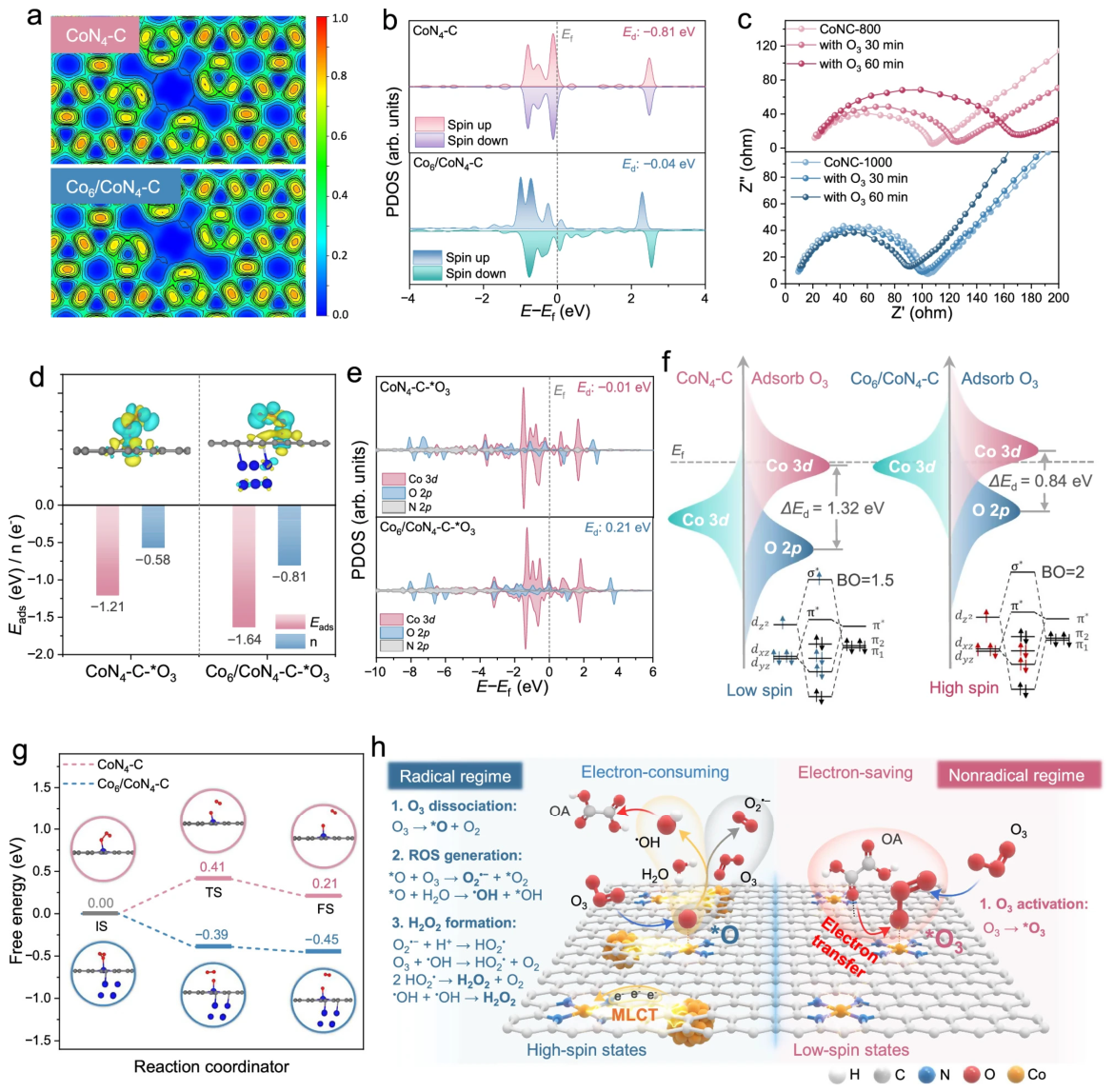
This literature positioning also suggests a practical implication for review design. A manuscript centered only on “advanced catalysts for wastewater treatment” becomes difficult to evaluate unless it offers a clear organizing principle. The more defensible contribution is to focus on a question where catalyst design, mechanism, and process translation intersect. The non-radical controversy satisfies that criterion because it links high-profile active-site work to real wastewater constraints and because the answer remains unsettled. Table 1 summarizes representative recent reviews and shows that, despite their value, the field still lacks a synthesis built around evidence thresholds and wastewater-relevant trade-offs rather than materials accumulation. Figure 2 is used only as a representative literature example of pathway switching, not as a universal mechanism diagram.

3. Conceptual Taxonomy and Evidence Standards for Non-Radical Claims

3.1. Non-Radical Is Not One Mechanism

A recurring source of conceptual ambiguity in catalytic ozonation literature concerns the treatment of “non-radical” oxidation as a unified mechanistic category, when it is more rigorously understood as a family of mechanistically distinct pathways. Four principal subtypes warrant separate consideration: singlet-oxygen-like pathways, surface-bound oxygen-transfer pathways, direct electron-transfer (DET) pathways, and high-valent metal-oxo pathways [13,14,15,16,17,18,19,20,21,22,23,24,25,48,49,50,51]. Singlet-oxygen-like pathways require experimental evidence that 1O2 or an 1O2-equivalent oxidant is generated and participates directly in pollutant transformation. Surface-bound oxygen-transfer pathways require demonstration that oxidation occurs at or proximal to the catalyst interface, rather than through the release of homogeneous oxidants into bulk solution. DET pathways require a mechanistically plausible electron-donor route from the catalyst or adsorbate interface to ozone. High-valent metal-oxo pathways require site-specific evidence for the formation of the proposed metal-oxo intermediate and characterization of its substrate selectivity.
These subtypes do not share equivalent minimum evidential standards and conflating them risks systematic misattribution. Singlet-oxygen-like mechanistic claims are particularly susceptible to misassignment when they rest primarily on scavenger logic, furfuryl alcohol consumption, or single-probe-compound responses, as these diagnostic indicators are subject to interference from adsorption effects, pH variation, carbonate competition, natural organic matter, and catalyst-mediated side reactions [15,16,17]. DET claims are subject to a distinct and more demanding evidential threshold: they require demonstration of interfacial ozone activation, measurable changes in catalyst oxidation state or electronic structure, a plausible mechanistic electron-flow pathway, and suppression or exclusion of faster competing radical routes. Consequently, DET and 1O2 pathways may yield superficially consistent degradation profiles yet require fundamentally different diagnostic frameworks for their substantiation.
Three recurrent patterns of mechanistic misassignment emerge from this taxonomic analysis. First, quenching experiments or probe-compound data are frequently invoked to infer singlet-oxygen involvement, even when the same observations remain equally consistent with mixed surface-mediated oxidation [15,16,17,52,53]. Second, vacancy-rich or defect-engineered catalysts are often described as operating through non-radical mechanisms by default, despite evidence more appropriately supporting a mixed radical/non-radical regime [54,55,56,57,58,59,60]. Third, the structural definition afforded by single-atom or otherwise site-resolved catalysts can lead investigators to infer direct applicability to practical treatment contexts from active-site clarity alone, overlooking the additional matrix compatibility, target endpoint, and long-term stability evidence required for wastewater-relevant validation [19,20,21,22,23,24,25,51,61,62].
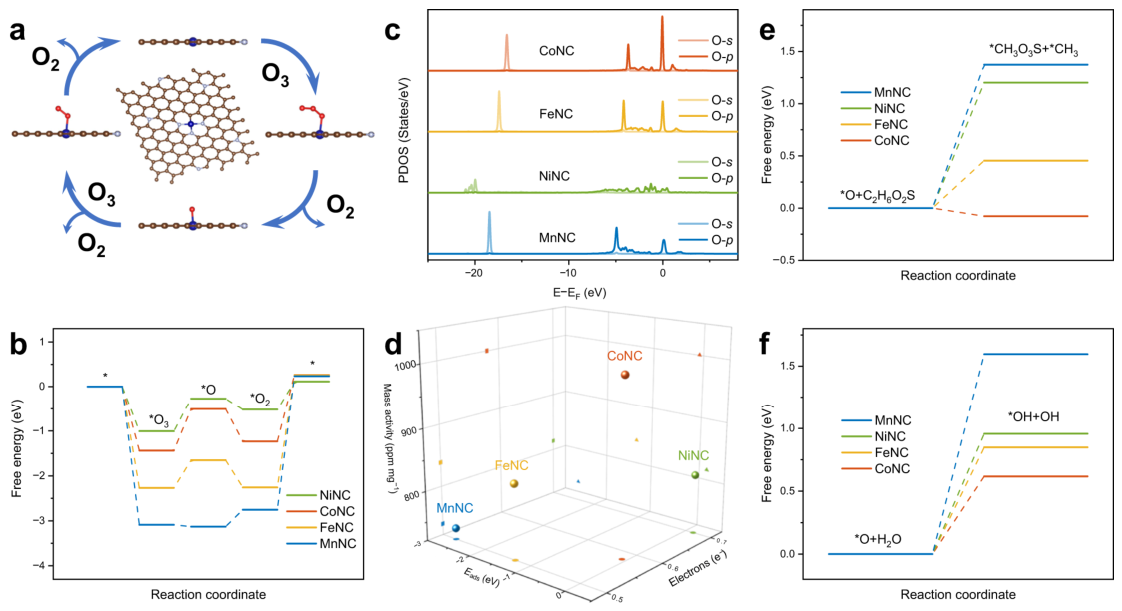
Figure 3 is included as a representative active-site case study rather than as a general mechanistic taxonomy. It illustrates how M–N3C1 single-atom coordination environments can modulate ozone adsorption geometry, reshape intermediate free-energy profiles, and alter electronic-state signatures—thereby demonstrating why site-resolved mechanistic studies are valuable for mechanistic resolution while nonetheless remaining insufficient, in isolation, to establish performance under wastewater conditions or against diverse transformation endpoints.
As shown in Figure 3, distinct free-energy profiles and electronic-state characteristics appear for different single-atom sites, directly influencing ozone activation preferences. The point is not that every non-radical catalyst follows the same path, but that convincing mechanism claims require an internally consistent chain from site structure to ozone activation intermediate to pollutant transformation endpoint [19,20,21,22,23,24,25].

3.2. Operational Evidence Scoring

A recurring weakness in the recent catalytic ozonation literature is not catalyst activity itself, but the tendency for mechanistic interpretation to outrun evidential support. To reduce purely impressionistic grading, this review applies a simple coding matrix to representative original studies. Active-site definition and mechanistic evidence are each scored from zero to three, where 0–1 indicates weak definition or a single-line mechanism package, two indicates convergent but still incomplete support, and three indicates site-resolved or operando-supported evidence. Matrix realism is also scored from zero to three, and endpoint and reactor relevance are scored from zero to two. The scoring is semi-quantitative and intended for transparency, not as a formal effect-size meta-analysis.
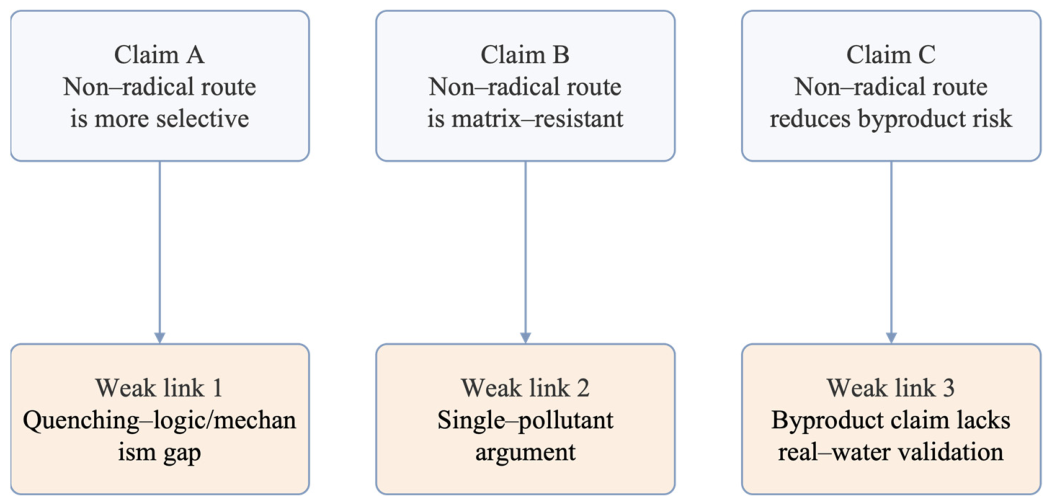
Quenching experiments remain the most common entry point for reactive-species attribution because they are simple, rapid, and inexpensive. Yet their convenience also creates interpretive vulnerability. The basic assumption underlying quencher logic is that a scavenger selectively suppresses one reactive species without altering adsorption equilibria, catalyst surface chemistry, ozone decomposition kinetics, or the behavior of coexisting solutes. In realistic aqueous systems, that assumption is rarely fully met. pH, inorganic anions, dissolved organic matter, catalyst leaching, radical interconversion, and pollutant-specific adsorption can all perturb the result, sometimes enough to alter the apparent hierarchy of reactive species. A quencher result can therefore be informative as an initial signal, but it is seldom sufficient evidence for a dominant pathway claim on its own [13,15].
Spin-trapping and EPR analysis offer a second layer of evidence, but here too the recent literature has become more critical. Metal oxides can themselves distort spin-trapping interpretation through surface-mediated reactions, transient intermediate conversion, or non-innocent interactions with the trapping agent. The consequence is not that EPR is useless, but that EPR signals over heterogeneous catalysts must be interpreted as part of a broader mechanism package rather than as a stand-alone proof. This point is especially important in oxygen-vacancy-rich or redox-flexible catalysts, where the same electronic features invoked to explain performance can also complicate the analytical tools used to assign pathways [15,16,17].
The stronger recent studies share a common logic. They do not rely on one indicator alone. Instead, they combine active-site characterization, ozone activation signatures, multiple mechanistic probes, competitive or matrix-dependent controls, product analysis, and occasionally in situ or operando evidence. In the best single-atom catalyst papers, for example, the argument does not rest only on quenching. It is supported by well-defined coordination structures, measurable differences in adsorbed oxygen intermediates, and coherent structure–activity relationships that explain why one site stabilizes a selective pathway more effectively than another [18,19,20,21,22,23,24,25]. Even then, the conclusion should remain conditional if the evidence is generated only in model solutions, if transformation products are not tracked, or if long-term site evolution is ignored.
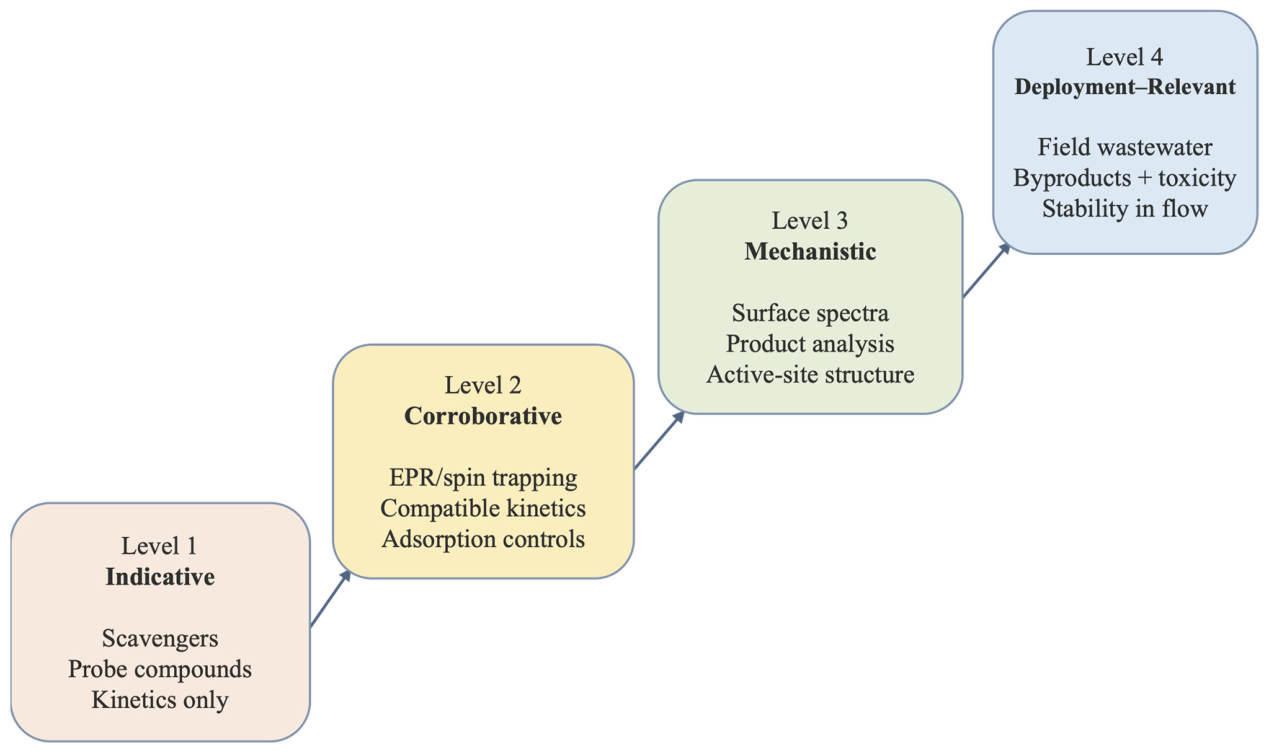
A further—and frequently overlooked—requirement is that of endpoint alignment. A mechanistic pathway claim acquires substantially greater credibility when the measured analytical endpoints are themselves mechanistically diagnostic. In the context of catalytic ozonation, parent-compound removal alone constitutes an insufficiently informative endpoint. At minimum, such measurements should be paired with mineralization assessment or COD/TOC reduction data, and wherever halides, nitrogen-containing intermediates, or bioactive transformation products are plausible, the study should incorporate bromate and oxyhalide reporting, LC–MS/MS or high-resolution mass spectrometric screening of transformation products, and at least one toxicity or biodegradability endpoint [48,49,50,51,63,64,65,66,67]. Absent such complementary evidence, an apparently favorable non-radical pathway may simply displace risk from the parent compound to unmeasured or uncharacterized intermediates. Figure 4 and Table 2 translate this principle into a pragmatic evidential ladder for study design and reporting.

3.3. Data Uncertainty, Publication Bias, and Benchmarking

The coding framework is deliberately conservative, given that the underlying literature is not immune to publication bias or methodological bias. Positive catalytic effects are more likely to be reported than null or weak effects, and highly active materials are more often accompanied by elaborate mechanistic narratives. Moreover, assignments of radical and non-radical pathways are influenced by laboratory-specific choices, including scavenger concentration, spin-trapping agent, ozone dosage, pH control, dissolved organic matter, ionic strength, and sampling time. These sources of heterogeneity mean that a cross-study score should be interpreted as a descriptor of evidence strength rather than as a direct quantitative comparison of intrinsic catalyst activity.
Accordingly, the scoring matrix is most defensibly used for benchmarking. A study is treated as a benchmark only when it provides an unusually clear evidence package, an unusually realistic wastewater test, or a useful warning regarding translational limitations. Table 3 presents the highest-value benchmark cases in the main text, while the full representative coding is retained in the Supplementary File, enabling readers to examine the basis for the scores and, where appropriate, disagree with individual judgments.

4. What Recent Catalyst Design Studies Actually Demonstrate

In the following sections, representative catalyst families are compared not only by reported activity, but also by the evidential strength of pathway assignment, the realism of the tested water matrix, the inclusion of risk-relevant treatment endpoints, and the degree of reactor or process relevance. This comparative logic is used to distinguish performance enhancement from stronger claims about pathway exclusivity or wastewater transferability.

4.1. Single-Atom Catalysts

Among the catalyst families investigated in recent years, single-atom catalysts (SACs) offer the most compelling mechanistic foundation for reaction pathway attribution, primarily because they address one of the longstanding methodological limitations inherent to catalytic ozonation research: the structural ambiguity of active sites. The systematic investigations of Fe–N4, M1–N3C1, Co–Nx, and Cu@carbon configurations, together with studies examining phosphorus-coordination-disrupted iron centers and the interplay between nanoparticle and SAC architectures, collectively demonstrate that catalytic ozonation can now be interrogated at the level of site geometry, electronic structure, adsorbed ozone intermediates, and mechanistic pathway switching—transcending the earlier paradigm in which discussion was largely confined to apparent rate enhancement [18,19,20,21,22,23,24,25,51,68]. This is a real advance over catalyst inventories that infer mechanism mainly from removal curves.
Nevertheless, the interpretive authority of single-atom catalyst studies should not be overstated. Many of the most mechanistically elegant investigations remain confined to one or a few probe contaminants in simplified aqueous matrices, and a considerable number provide incomplete characterization of transformation products, effluent toxicity, metal leaching, or operational stability under prolonged conditions. Their conclusions carry greatest weight with respect to catalyst-site chemistry, but do not yet extend with comparable confidence to wastewater treatment in the rigorous engineering sense. A site that exhibits an optimal oxygen binding energy or favorable electronic asymmetry under model water conditions may nonetheless underperform once bicarbonate scavenges reactive oxygen species, natural organic matter competitively occupies active sites, or the presence of chloride and bromide redirects the prevailing oxidation chemistry toward alternative—and potentially undesirable—pathways [19,20,21,22,23,24,25,48,49,50,51,52,53,63,64,80].

4.2. Oxygen Vacancies and Defect-Rich Oxides

Oxygen-vacancy engineering has emerged as one of the most actively pursued strategies in catalytic ozonation, owing to the capacity of vacancy defects to modify ozone adsorption energetics, facilitate interfacial electron transfer, alter surface hydroxylation states, and govern the balance between surface-confined oxidants and freely diffusing radical species. Recent investigations into vacancy-enriched CeO2/Al2O3–SiC composites, Co/Mg–biochar and MgO/biochar defect systems, electron-enriched Cu–Mn active centers, carbon-intercalated Mn–O–Si frameworks, and systems featuring labile oxygen or surface-peroxide intermediates have consistently reported substantial activity enhancements, which are frequently interpreted as mechanistic evidence for non-radical or surface-dominated ozone activation pathways [54,55,56,57,58,59,60,80,81].
The principal limitation, however, is that “oxygen vacancy” frequently functions as an overextended explanatory variable. Vacancy density is conventionally assessed through ex situ characterization, and its structural persistence under humid, oxidative, and compositionally complex reaction conditions is seldom directly demonstrated. More critically, the mechanistic contribution of oxygen vacancies is rarely decoupled from the confounding effects of concomitant changes in surface hydroxyl group density, Lewis acid site strength, adsorbate binding affinity, local pH microenvironments, or trace metal redox cycling—factors that may independently or synergistically govern catalytic activity [54,55,56,57,58,59,60]. Consequently, while a reported vacancy effect may be genuine, claims of exclusive non-radical dominance frequently remain only partially substantiated. More robust mechanistic attribution requires operando vacancy tracking, isotopic labeling or intermediate trapping evidence where experimentally feasible, and systematic matrix-controlled trials designed to decouple vacancy-mediated ozone activation from competing contributions of conventional adsorption or radical scavenging.

4.3. Carbonaceous and Biochar Catalysts

Carbonaceous catalysts—particularly heteroatom-doped biochars and carbon–mineral hybrid materials—have garnered considerable attention owing to their combination of low-cost and renewable precursors, tunable surface chemistry, inherent electrical conductivity, and versatile support functionality. Recent investigations have encompassed a diverse array of such materials, including nitrogen-doped carbons derived from waste metal–organic frameworks, biochars synthesized from tea leaves or leguminous biomass, doped chars produced from sewage sludge or mixed biomass feedstocks, magnetically separable activated carbons, nanographite, field-spent granular activated carbon subjected to catalytic regeneration, and composite carbon systems co-derived from sludge and cyanobacterial biomass [81,82,83,84,85,86,87,88,89,90,91,92,93,94]. These systems hold considerable value from both a synthesis and circular-economy standpoint; however, unambiguous mechanistic assignment remains inherently challenging, given that adsorption phenomena, local pH microenvironments, ash-derived metal impurities, defect states, and residual mineral constituents may each contribute—independently or in combination—to the observed apparent catalytic performance.
The recent biochar-centered literature thus serves as an instructive illustration of the central thesis advanced in this review. A subset of studies genuinely suggests that heteroatom doping, surface curvature, defect engineering, or synergistic metal–carbon active sites meaningfully alter the ozone activation mechanism [81,82,83,84,85,86,87,89,90]. Others, however, likely conflate adsorption enhancement, mineral-phase participation, and reactive oxygen species generation into a single, undifferentiated mechanistic narrative. For practical wastewater treatment applications, this distinction may be of secondary importance provided the catalyst demonstrates adequate robustness, economic viability, and environmental safety; however, from a scientific standpoint, it is of considerable consequence—since favorable synthesis economics cannot substitute for rigorous pathway evidence, comprehensive leaching control, and demonstrated reusability under compositionally realistic treatment matrices.
The expanded coding matrix presented in Table 4 translates this evaluative logic into explicit study-level ratings. Within this rubric, active-site and mechanistic scores of three correspond to atomically resolved or operando-supported evidence packages; scores of two denote convergent yet still incomplete mechanistic support; and scores of 0–1 indicate weakly resolved or single-line evidence. The interpretive designations assigned in the final column are directly anchored to these scores: a rating of “supported” requires both active-site and mechanistic scores of at least two, whereas “tentative” signifies that the reported catalytic performance may be credible even though pathway exclusivity remains insufficiently determined.
That mismatch becomes even clearer when one steps beyond the highest-profile active-site papers and surveys the broader implementation literature. Recent studies on bifunctional MIL-100(Fe), catalytic ceramic membranes, manganese-dioxide membrane channels, phenol-responsive catalytic surfaces, magnetic activated carbons, Mn-Ce oxides, zeolite molecular nests, co-doped carbon surfaces, and mixed metal–carbon composites collectively show that the field is experimenting with many different ways to merge ozone activation, adsorption, and interfacial transport [59,85,86,87,88,95,96,97,98,99,100,101,102,103,104,105,106,107,108,109,110,111,112,113]. This diversity is scientifically valuable. But it also means the term “non-radical pathway” is often used to cover mechanistically distinct phenomena that should not be collapsed into one category. Some systems likely rely on surface-bound oxygen transfer, some on high-valent metal-oxo chemistry, some on hybrid radical/non-radical operation, and some on transport-enhanced ozone exposure mislabeled as pathway selectivity.
Supplementary Table S1 provide the study-level rationale behind these scores, including the benchmark cases summarized in Table 3 and the wastewater-translation cases summarized later in Table 5.

5. Real Wastewater, Bromate, and the Risk of Mistaking Disappearance for Safer Treatment

The hardest test for any claimed pathway advantage is not whether it raises apparent degradation rates in a clean model system, but whether the advantage survives wastewater complexity. Recent catalytic ozonation studies have expanded from dyes and single pharmaceuticals into coking wastewater, textile wastewater, pharmaceutical wastewater, high-salinity industrial streams, pulp and paper mill effluents, municipal secondary effluent, hospital wastewater, and urine-related matrices [26,27,28,29,30,31,32,33,34,35,36,37,38,39,40,41,42,43,44,45,46,47,61,65,66,67,69,70,71,72,73,74,75,76,77,78,79]. This broader application base is encouraging, but it has not yet eliminated a major interpretive problem: many real-wastewater papers still report treatment gains without fully resolving whether those gains reflect a durable non-radical pathway, better ozone transfer, adsorption, or a train-level effect.
These examples are therefore used here as stress tests rather than as evidence that the field has already solved wastewater translation. Authentic matrices make the claims more relevant, but they also make mechanism assignment harder because carbonate, chloride, bromide, dissolved organic matter, suspended solids, ammonia, and salinity can change both oxidant chemistry and analytical recovery [48,52,53,61,65,66,67,69,70,71,72,73,74,75,76,77,78,79].
In practice, three issues repeatedly determine whether an apparent pathway advantage remains meaningful: matrix interference, byproduct risk, and the adequacy of ozonation-only benchmarking. These are not optional add-ons. They determine whether a catalyst improves treatment quality or merely accelerates disappearance of a selected parent compound [48,49,50,61,63,64,65,66,67,69,70,71,72,73,74,75,76,77,78,79,80].
Matrix stressors are often decisive. Bromide and chloride alter the oxidative network in different ways; bicarbonate and carbonate can redirect radical chemistry and change ozone decomposition outcomes; natural organic matter competes for oxidants, complexes metal sites, and can obscure mechanistic probes; suspended solids influence both mass transfer and catalyst fouling; and high salinity changes not only ionic strength but frequently the relative economics of oxidation versus alternative treatment steps [6,48,51,52,53,79]. For that reason, statements such as “the catalyst favors a non-radical route and is therefore matrix-resistant” should generally be interpreted cautiously until they have been demonstrated in multiple authentic waters.
Bromate risk is a direct test of whether pathway language remains chemically meaningful, especially in bromide-bearing municipal, saline, industrial, or reuse-relevant waters. A non-radical label is insufficient unless it is paired with bromide/bromate accounting under the same ozone dose, pH, alkalinity, and matrix conditions used to claim improved removal.
The recent bromate literature makes clear that bromate formation is governed by a complex network involving ozone, hydroxyl radicals, bromide availability, dissolved organic matter, carbonate chemistry, pH, and reactor-level ozone mass-transfer conditions [48]. A non-radical claim does not by itself guarantee low bromate formation, because a catalyst can still alter ozone availability, residence time, or intermediate steps in ways that do not map cleanly onto a simple radical-versus-non-radical picture.
Byproduct analysis poses the same problem in a different form. The recent paper on byproduct formation in heterogeneous catalytic ozonation, the perspective on mineralization versus polymerization, and newer application papers that include byproducts or toxicity endpoints all point to the same conclusion: treatment success cannot be inferred from parent disappearance alone [48,49,50,52,53,63,64,67]. Partial oxidation, oxidative coupling, and intermediate accumulation remain plausible possibilities, especially in aromatic or nitrogen-containing contaminants.
This is where some of the strongest catalyst papers become methodologically vulnerable. A catalyst may be presented as “safer” because it relies less on hydroxyl radicals, yet if toxicity, bromate, and persistent intermediates are not measured, that safety inference remains insufficiently supported. LC-MS/MS or high-resolution MS screening of transformation products is especially important for pharmaceuticals, dyes, phenolics, nitrogen-containing organics, and saline waters, where partial oxidation can plausibly create persistent or more bioactive intermediates [49,50,63,64,65,66,67].
A practical way to make the bromate trade-off comparable is to report a bromate-normalized treatment benefit, for example EBr = ΔCtarget/ΔBrO3 or ΔTOC/ΔBrO3 under a fixed transferred ozone dose, with a clear convention when bromate is below quantification. This ratio should not replace mechanistic evidence, but it forces authors to show whether an apparent non-radical advantage is accompanied by a measurable safety benefit rather than only by faster parent-compound loss.
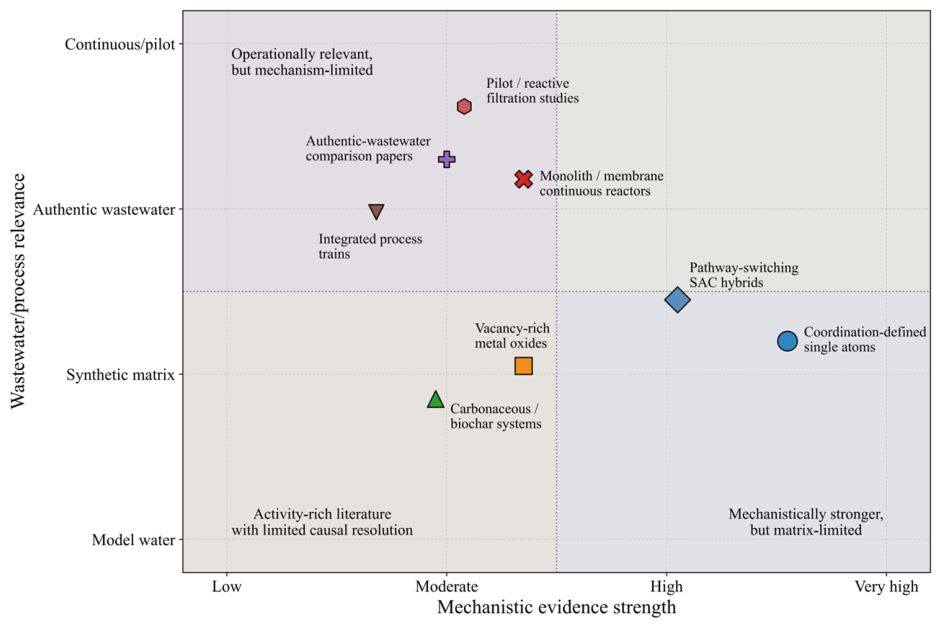
As shown in Figure 5, the x-axis is anchored to a 1–4 conceptual scale derived from active-site and mechanistic evidence scores, the y-axis is anchored to a 1–4 conceptual scale derived from matrix realism, endpoint inclusion, and reactor relevance, and symbol size tracks the average degree of risk-endpoint inclusion within each stream. Exact stream codings, representative references, and DOI links are provided in the Supplementary Data S1 [18,19,20,21,22,23,24,25,51,52,53,54,55,56,57,58,61,62,63,64,65,66,67,69,70,71,72,73,74,75,76,77,78,79,80,81].
This figure should therefore be read as a coded synthesis rather than as a formal meta-analysis or a claim about the frequency of each research stream among all 826 screened records. Its purpose is comparative: to show which streams currently combine stronger pathway evidence with stronger wastewater and translation relevance, and which remain imbalanced across those dimensions. The screening pool supports the literature boundary, whereas the plotted streams are representative evidence classes.
Benchmarking against pure ozonation remains unusually informative. In many catalyst papers the relevant question is not whether the system removes the target pollutant; it is whether the catalyst meaningfully outperforms pure ozonation under the same wastewater conditions once ozone dose, mineralization, and risk endpoints are accounted for. That control is still missing too often. Where it is present, the results are more informative, because they allow authors to distinguish a real catalytic effect from a reactor or dosage effect. Future evaluations should place greater emphasis on matched ozonation-only baselines, especially in manuscripts claiming new catalytic pathways or broad wastewater applicability.
Process integration is increasingly part of the catalytic ozonation literature. Recent work couples catalytic ozonation with electrocoagulation, nanofiltration, membrane separation, bio-contact oxidation, microbubbles, and structured reactors [68,89,114,115,116,117,118,119,120,121,122,123,124,125]. This is a rational direction because wastewater-treatment plants optimize trains, not single unit operations. It creates a second interpretive risk: as process integration becomes more sophisticated, it becomes easier to attribute system-level gains to catalyst chemistry alone. Future evaluations should place greater emphasis on clear attribution. If the benefit derives mainly from ozone mass-transfer enhancement, membrane retention, or upstream coagulation, the paper should say so. Catalyst novelty should not eclipse process causality.
Seen this way, the bottleneck becomes more visible. In Table 5, all twelve-representative wastewater-translation studies use authentic matrices, and most report TOC or COD at least partly. However, only three explicitly include an ozone-only comparator, none clearly report oxyhalides, and only two partly include transformation-product or toxicity information. The literature is therefore stronger in demonstrating that catalytic ozonation can work in difficult waters than in demonstrating that a specific non-radical mechanism remains dominant, safer, and operationally superior once those waters are introduced.
At this stage, it is useful to distinguish mechanism-level uncertainty from process-level constraints. The former concerns whether a claimed non-radical pathway is convincingly established and whether it persists in realistic water chemistry. The latter concerns whether any catalytic advantage survives ozone-transfer limitations, hydrodynamic nonuniformity, fouling, pressure drop, catalyst aging, and integration into continuous treatment systems. These two forms of limitation often interact, but they are not identical and should not be conflated.

6. Reactor Translation, Durability, and Cost Constraints

Catalytic ozonation is unusually vulnerable to evidence-conclusion mismatch because it couples surface chemistry to gas–liquid mass transfer. A catalyst can be genuinely superior at the active-site level and still fail to produce a deployable process if ozone utilization, residence-time distribution, hydraulic loading, or fouling dynamics are unfavorable. This is one reason why a large fraction of the catalyst literature remains bench-bound: the transition from slurry or batch systems to monolithic, membrane, packed-bed, or high-gravity reactors changes the dominant limitation [10,61,62,64,74,126,127,128]. At that point, the decisive variable may no longer be whether the pathway is radical or non-radical; it may be whether ozone reaches the active site efficiently, whether solids or scaling shield the catalyst, and whether the process remains operationally coherent under continuous treatment conditions.
Once reactors and flow become central, three constraints recur repeatedly: ozone utilization, hydrodynamic uniformity, and catalyst durability. Structured reactors make previously hidden physical constraints visible. Monolithic packing, ceramic-membrane, reactive-filtration, high-gravity, and continuous-flow studies are instructive because they expose constraints that conventional beaker studies hide: gas–liquid flow pattern, interfacial area, head loss, catalyst attrition, pressure drop, site accessibility, and long-term ozone-transfer efficiency [61,62,64,72,73,74,114,126,127,128].
That shift is healthy, but it also makes the literature less forgiving. Claims of scale-up potential should not be based on catalyst performance alone; they should be based on a demonstrated pathway from catalyst performance to reactor performance. Papers that explicitly compare flow regimes or investigate monolithic packing operations can be as scientifically informative as more elaborate catalyst papers because they address the actual bottlenecks to implementation.
Catalyst deactivation and metal leaching remain underreported relative to their importance. Ca2+ deposition, mineral fouling, surface over-oxidation, active-site reconstruction, blocking by organics or inorganic precipitates, and release of active metals can all eliminate the interfacial features that were central to the original mechanism claim [70,90,115,129]. For Co- and Cu-containing SACs or binuclear catalysts, leaching data should be reported as dissolved metal concentrations over repeated cycles and continuous operation, not only as a percentage of catalyst mass. Cu release should be compared with drinking-water benchmarks such as the WHO and EU value of 2.0 mg/L and the U.S. EPA action level of 1.3 mg/L; Co is less harmonized internationally, so authors should compare dissolved Co with applicable local health-based or environmental quality benchmarks and avoid treating “low leaching” as self-evident [130,131,132,133].
Recent studies on Fe-based catalyst regeneration, Ca2+-induced deactivation in saline wastewater, stability optimization, and waste-ozonation-catalyst recycling point in the right direction by treating catalyst life as part of the treatment problem rather than as an afterthought [70,90,115,129]. But such studies remain a small minority, and few connect stability loss to a possible shift in the dominant oxidation pathway.
A pragmatic scale-up screen should also include cost. At minimum, catalyst papers that claim practical potential should separate synthesis cost drivers (precursors, pyrolysis or calcination temperature, inert gas, washing/activation, binder or monolith fabrication), operating expenses (ozone generation, oxygen/air feed, pumping or pressure drop, catalyst replacement/regeneration, pH control, quenching, and analytical monitoring), and avoided costs relative to pure ozonation or alternative polishing processes. A catalyst that improves apparent kinetics but requires high-temperature synthesis, noble or scarce precursors, frequent regeneration, or higher ozone transfer may not improve process economics.
Reactor-scale realism is beginning to reshape which catalyst claims remain persuasive. Pre-industrial or pilot-scale units, membrane-based continuous operation, reactive filtration, and process-control studies all push the field toward performance metrics that matter outside laboratory screening [61,62,68,71,72,73,74,89,114,115,116,117,118,119,120,121,122,123,124,125,126,127,128]. This shift exposes hidden assumptions: that a catalyst can be regenerated without structural drift, that its activity survives hydrodynamic nonuniformity, that ozone transfer remains efficient under realistic gas loading, that leaching remains below relevant benchmarks, and that water-quality variability does not erase the apparent optimization.
As the system context broadens, it becomes easier to see when strong mechanistic claims rest on a limited evidential base. An additional sign of maturation is that catalytic ozonation is now spreading into side directions that blur the boundary between core mechanism research and process systems work. Recent papers address waste-derived ceramsite catalysts, process-control and intelligent prediction, catalytic membrane reviews, peroxide-assisted ozonation variants, landfill-leachate bubble columns, spent-carbon valorization, and algorithm-assisted catalyst screening [60,91,92,93,134,135,136,137,138,139,140,141,142,143,144,145,146,147,148]. These studies do not all belong to the same mechanistic category, and they should not be forced into one. Their real value is different: they show where the field may move once the basic question of ozone activation is no longer the only bottleneck. This broader application space also makes it more important to distinguish central evidence from exploratory adjacent directions.
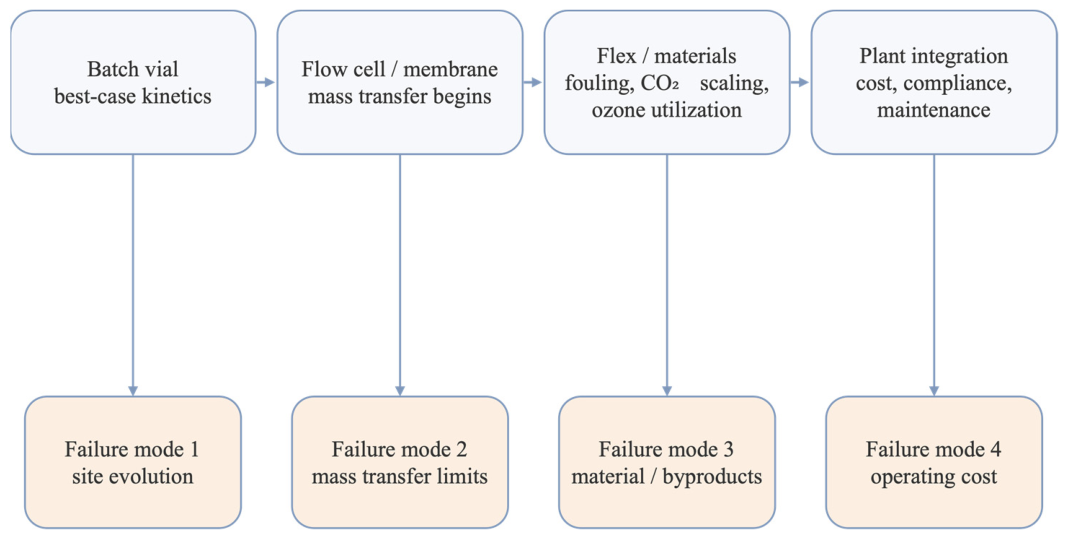
There is therefore a useful asymmetry to keep in mind. Mechanistic elegance is most valuable early, when the field is still learning how a catalyst activates ozone. Engineering realism becomes more valuable later, when the next barrier is no longer “Can the catalyst work?” but “Can the process keep working?” A mature catalytic ozonation paper should ideally contain both. If it contains only one, authors and reviewers should be explicit about which question the paper answers and which it does not. Figure 6 summarizes the translation ladder and the failure modes most likely to be underestimated in catalyst-centered manuscripts.

7. Recommended Reporting Protocols for Publishable Progress

The recent literature suggests a more demanding evaluative standard for catalytic ozonation studies. The following reporting protocol is recommended. First, pathway claims should be graded by evidential strength: if the study relies mainly on quencher logic, the wording should be “consistent with” rather than “demonstrates”. Second, superiority claims should be matrix bounded: a catalyst proven in one pharmaceutical wastewater or one saline stream has not demonstrated universal resilience. Third, removal should be reported together with at least one depth-of-treatment or risk endpoint, such as TOC, COD, bromate, oxyhalides, transformation products, or toxicity. Fourth, any broad claim of wastewater applicability should be benchmarked against pure ozonation under the same matrix and transferred-ozone conditions. Fifth, papers claiming scale-up potential should report ozone utilization, hydrodynamics, pressure drop, catalyst loss or regeneration, metal leaching, operating stability, and a minimal OPEX/cost screen [10,13,14,15,16,17,24,25,48,49,50,51,61,62,70,80,90,126,127,128,129,130,131,132,133].
The distinction between fixable and structural weaknesses is also worth stating plainly. Many current shortcomings can be addressed. Missing byproduct analysis, insufficient ozone-only controls, imprecise mechanistic wording, or the absence of catalyst-aging discussion can often be improved through additional experiments or more rigorous interpretation. Other weaknesses are structural. A paper based entirely on model dye degradation, with no authentic matrix, no mineralization assessment, and no realistic discussion of ozone-transfer limits, is unlikely to become a deployment-oriented catalytic ozonation paper merely by adding more spectroscopy. At most, it remains a preliminary catalyst study. Reviewers are increasingly sensitive to this distinction, and authors should be as well.
A final point concerns topic framing. Much of the recent catalyst literature still relies on broad descriptors such as promising, efficient, sustainable, and suitable for wastewater treatment. These descriptors become less informative when they are not tied to more precise comparative questions. Does a catalyst outperform pure ozonation in authentic wastewater? Does its claimed non-radical pathway reduce bromate formation or byproduct risk? Does the active site remain stable under flow and fouling stress? Does the process improve a downstream treatment metric such as biodegradability, membrane compatibility, or water reuse quality? Reviews and original research that frame the problem in this way are more likely to remain useful after the next wave of catalyst synthesis papers appears.
A related implication is that some directions are better described as adjacent opportunities rather than settled advances. Machine-learning-assisted catalyst screening, intelligent control of integrated ozonation systems, catalytic membranes, waste-derived supports, and hybrid ozone-peroxide or photo-ozone systems may all become important [94]. However, their current contributions are uneven. In several cases, the engineering concept is stronger than the mechanistic evidence; in others, the catalyst narrative is stronger than the systems-level analysis. A critical review becomes more useful when it preserves these differences rather than flattening them.

8. Conclusions

The present review was written around a deliberately restrictive question: whether recent non-radical claims in heterogeneous catalytic ozonation genuinely deliver safer and more transferable wastewater treatment. The answer remains qualified. The recent literature contains clear advances. Single-atom catalysts have made active-site chemistry more legible; oxygen-vacancy and carbon-based systems have expanded the design space; monolithic and pilot studies have made the translation problem harder to ignore; and real-wastewater applications are more frequent than they were only a few years ago. At the same time, the available evidence does not yet support the stronger conclusion that non-radical pathways are generally superior across wastewater contexts. In many studies, the evidence is stronger for performance enhancement than for exclusive pathway assignment, and stronger for bench-scale activity than for broad wastewater transferability.
The more defensible conclusion is narrower and more useful. Non-radical catalytic ozonation can be advantageous when four conditions are met simultaneously: the active site is sufficiently defined to support a pathway argument; the advantage persists in authentic matrix chemistry; the outcome is superior not only in removal but also in risk-relevant endpoints such as bromate, transformation products, intermediate toxicity, or operational stability; and catalyst leaching, aging, and cost do not erase the apparent benefit. Where those conditions are not met, claims of superiority should be stated more cautiously. In a literature crowded with performance claims, the studies that will matter most are those that align catalyst design, evidence quality, safety endpoints, and reactor reality instead of allowing one of the four to substitute for the others.
Four near-term priorities emerge repeatedly from the recent literature: operando-level pathway validation under authentic wastewater chemistry; routine coupling of removal data with bromate, transformation-product, LC-MS/MS, and toxicity endpoints; continuous-flow stability testing with explicit ozone-only benchmarking; and transparent reporting of catalyst leaching, regeneration, and OPEX-sensitive cost drivers. These priorities are not peripheral refinements. They are the conditions under which the next generation of catalytic ozonation studies will become more comparable, more persuasive, and more useful for wastewater treatment practice.

Supplementary Materials

The following supporting information can be downloaded at: https://www.mdpi.com/article/10.3390/catal16050478/s1. Supplementary Table S1: Representative study coding used to support the evidence-grading framework, including benchmark cases, active-site/mechanistic/matrix/endpoint/reactor scores, matrix-retention interpretation, and wastewater-translation variables for the representative studies summarized in Table 3, Table 4 and Table 5; Supplementary Data S1: Source data for Figure 5, including coded research streams, mechanistic evidence strength, wastewater/process relevance, symbol size, risk-endpoint inclusion, marker type, coding basis, and corresponding main-text reference numbers.

Author Contributions

Conceptualization, X.L. and L.L.; Methodology, X.L. and S.Y.; Software, X.L.; Validation, X.L., S.Y., Y.J., Y.W. and H.L.; Formal analysis, X.L.; Investigation, X.L., Y.W. and H.L.; Resources, S.Y., Y.J. and L.L.; Data curation, X.L. and H.L.; Writing—original draft preparation, X.L.; Writing—review and editing, X.L., S.Y., Y.J., Y.W., H.L. and L.L.; Visualization, X.L.; Supervision, S.Y. and L.L.; Project administration, S.Y. and L.L.; Funding acquisition, Y.J. and L.L. All authors have read and agreed to the published version of the manuscript.

Funding

This article was funded by the Heilongjiang Provincial Natural Science Foundation of China (PL2025D007).

Data Availability Statement

Data are available through request to the corresponding author.

Conflicts of Interest

The authors declare no conflicts of interest.

References

  1. Li, X.; Fu, L.; Chen, F.; Zhao, S.; Zhu, J.; Yin, C. Application of Heterogeneous Catalytic Ozonation in Wastewater Treatment: An Overview. Catalysts 2023, 13, 342. [Google Scholar] [CrossRef]
  2. Fallah, N.; Bloise, E.; Santoro, D.; Mele, G. State of Art and Perspectives in Catalytic Ozonation for Removal of Organic Pollutants in Water: Influence of Process and Operational Parameters. Catalysts 2023, 13, 324. [Google Scholar] [CrossRef]
  3. Wang, J.; Yuan, S.; Dai, X.; Dong, B. Application, mechanism and prospects of Fe-based/ Fe-biochar catalysts in heterogenous ozonation process: A review. Chemosphere 2023, 319, 138018. [Google Scholar] [CrossRef]
  4. Ma, H.; Chen, G.; Huang, F.; Li, Y.; Zhang, L.; Jin, Y. Catalytic ozonation of ammonia nitrogen removal in wastewater: A review. J. Water Process Eng. 2023, 52, 103542. [Google Scholar] [CrossRef]
  5. Cardoso, R.M.F.; Esteves da Silva, J.C.G.; Pinto da Silva, L. Application of Engineered Nanomaterials as Nanocatalysts in Catalytic Ozonation: A Review. Materials 2024, 17, 3185. [Google Scholar] [CrossRef] [PubMed]
  6. Dai, M.; Niu, Q.; Wu, S.; Lin, Y.; Biswas, J.K.; Yang, C. Hydroxyl radicals in ozone-based advanced oxidation of organic contaminants: A review. Environ. Chem. Lett. 2024, 22, 3059–3106. [Google Scholar] [CrossRef]
  7. Mahmoodi, M.; Pishbin, E. Ozone-based advanced oxidation processes in water treatment: Recent advances, challenges, and perspective. Environ. Sci. Pollut. Res. 2025, 32, 3531–3570. [Google Scholar] [CrossRef]
  8. Wang, F.; Xiang, Y.; Zhang, Y.; Zhou, X.; Zhang, J.; He, C.; Zhang, H.; Xiong, Z.; Zhou, P.; Zhou, H.; et al. A comprehensive review on oxygen vacancies modified catalysts: Synthesis, characterization, and crucial role in catalytic ozonation. Chin. Chem. Lett. 2026, 37, 111315. [Google Scholar] [CrossRef]
  9. Zhao, R. A review on the catalytic ozonation of pollutants in wastewater by heteroelements-doped biochar: Internal and external doping strategies. Alex. Eng. J. 2025, 119, 35–44. [Google Scholar] [CrossRef]
  10. Wang, F.; Qin, Z.; Yuan, Y.; Cai, Y.; Yu, Y.; Wu, C. Toward efficient catalytic ozonation: Overcoming challenges in real wastewater treatment-A review. J. Water Process Eng. 2025, 77, 108404. [Google Scholar] [CrossRef]
  11. Li, L.; Ma, F.; Zuo, H. Production of a novel bioflocculant and its flocculation performance in aluminum removal. Bioengineered 2016, 7, 98–105. [Google Scholar] [CrossRef]
  12. Yang, J.; Zhang, T.; Ma, S.; Shang, J.; Li, L.; Ning, Y.; Zhao, X. Enhancing microplastic removal and nitrogen mitigation in constructed wetlands: An earthworm-centric perspective. J. Hazard. Mater. 2025, 489, 137540. [Google Scholar] [CrossRef]
  13. Zhou, H.; Ren, W.; Wang, S.; Duan, X. Best practices for advanced oxidation processes. Nat. Sustain. 2025, 8, 1428–1431. [Google Scholar] [CrossRef]
  14. Hübner, U.; Spahr, S.; Lutze, H.; Wieland, A.; Rüting, S.; Gernjak, W.; Wenk, J. Advanced oxidation processes for water and wastewater treatment—Guidance for systematic future research. Heliyon 2024, 10, e30402. [Google Scholar] [CrossRef]
  15. Liu, W.; Lu, Y.; Dong, Y.; Jin, Q.; Lin, H. A critical review on reliability of quenching experiment in advanced oxidation processes. Chem. Eng. J. 2023, 466, 143161. [Google Scholar] [CrossRef]
  16. Wu, J.-H.; Yu, H.-Q. Confronting the Mysteries of Oxidative Reactive Species in Advanced Oxidation Processes: An Elephant in the Room. Environ. Sci. Technol. 2024, 58, 18496–18507. [Google Scholar] [CrossRef]
  17. Wu, J.-H.; Yu, H.-Q. How Do Metal Oxides Mislead Spin-Trapping Electron Paramagnetic Resonance Analysis? Environ. Sci. Technol. Lett. 2024, 11, 370–375. [Google Scholar] [CrossRef]
  18. Liu, Y.; Yang, J.; Wang, Y.; Zhu, W.; Hu, K.; Liu, Z.; Yeung, K.; Zhu, Z.-S.; Chen, C.; Duan, X.; et al. Intrinsic nanoparticle-single-atom interplays steering radical versus nonradical pathways in catalytic ozonation. Nat. Commun. 2025, 16, 8790. [Google Scholar] [CrossRef] [PubMed]
  19. Ma, D.; Lian, Q.; Zhang, Y.; Huang, Y.; Guan, X.; Liang, Q.; He, C.; Xia, D.; Liu, S.; Yu, J. Catalytic ozonation mechanism over M1-N3C1 active sites. Nat. Commun. 2023, 14, 7011. [Google Scholar] [CrossRef] [PubMed]
  20. Ren, T.; Yin, M.; Chen, S.; Ouyang, C.; Huang, X.; Zhang, X. Single-Atom Fe-N4 Sites for Catalytic Ozonation to Selectively Induce a Nonradical Pathway toward Wastewater Purification. Environ. Sci. Technol. 2023, 57, 3623–3633. [Google Scholar] [CrossRef] [PubMed]
  21. Ren, T.; Lu, K.; Yin, M.; Yan, N.; Sai, S.; Huang, X.; Zhang, X. Single-atom cobalt enables efficient catalytic ozonation for advanced wastewater treatment: Mechanisms and application. Chem. Eng. J. 2024, 500, 156805. [Google Scholar] [CrossRef]
  22. Liang, L.; Cao, P.; Bai, H.; Qin, X.; Lu, Z.; Chen, S.; Liu, Y.; Yu, H.; Quan, X. N-coordinated single cobalt atoms catalyst triggering concerted radical-nonradical process in catalytic ozonation for efficient water decontamination. Appl. Catal. B Environ. Energy 2024, 354, 124149. [Google Scholar] [CrossRef]
  23. Ye, G.; Zhou, Z.; Zhao, Z.; Zong, Y.; Chen, Z.; Lei, Z.; Wu, D. High-efficient M-NC single-atom catalysts for catalytic ozonation in water purification: Performance and mechanisms. J. Hazard. Mater. 2024, 477, 135289. [Google Scholar] [CrossRef]
  24. Ren, T.; Lu, K.; Tao, F.; Ren, H.; Yan, N.; Miao, J.; Huang, X.; Zhang, X. Phosphorus-induced single-atom iron coordination symmetry disruption for superior catalytic ozonation. Nat. Commun. 2025, 16, 9037. [Google Scholar] [CrossRef]
  25. Cheng, Y.; Zhou, J.; Chen, Z.; Bi, J.; Ren, S.; Zhong, S.; Yan, P.; Li, Y.; Wang, S.; Duan, X. Single-Atom Copper@Carbon Nanospheres for Catalytic Ozonation: Parallel Dual Surface Oxidation Pathways for Broad-Spectrum Water Pollutant Removal. Environ. Sci. Technol. 2025, 59, 21738–21748. [Google Scholar] [CrossRef]
  26. Kaprara, E.; Belesakos, C.; Kollis, K.; Psaltou, S.; Zouboulis, A.; Mitrakas, M. Evaluation of Heterogeneous Catalytic Ozonation Process for the Removal of Micropollutants from Water/Wastewater: Application of a Novel Pilot-Scale Continuous Flow System. Catalysts 2023, 13, 899. [Google Scholar] [CrossRef]
  27. Jia, Y.; Yue, D.; Cheng, Y.; Wang, Z.; Liu, Y.; Li, C.; Li, F.; Qi, F.; Ikhlaq, A.; Kumirska, J.; et al. Tailoring Mn d-band center and valence cycling for high-efficiency catalytic ozonation of ibuprofen in pharmaceutical wastewater treatment. J. Hazard. Mater. 2026, 505, 141489. [Google Scholar] [CrossRef]
  28. Tariq, M.F.; Javed, F.; Rizzo, L.; Tahir, M.W.; Ikhlaq, A. Textile wastewater treatment by heterogeneous catalytic ozonation using microcellulose loaded ZIF 67 catalyst. J. Environ. Manag. 2025, 380, 125031. [Google Scholar] [CrossRef] [PubMed]
  29. Lu, Z.; Bai, H.; Liang, L.; Chen, S.; Yu, H.; Quan, X. MgO-loaded tubular ceramic membrane with spatial nanoconfinement for enhanced catalytic ozonation in refractory wastewater treatment. J. Hazard. Mater. 2024, 474, 134842. [Google Scholar] [CrossRef]
  30. Ikhlaq, A.; Masood, Z.; Qazi, U.Y.; Raashid, M.; Rizvi, O.S.; Aziz, H.A.; Saad, M.; Qi, F.; Javaid, R. Efficient treatment of veterinary pharmaceutical industrial wastewater by catalytic ozonation process: Degradation of enrofloxacin via molecular ozone reactions. Environ. Sci. Pollut. Res. 2024, 31, 22187–22197. [Google Scholar] [CrossRef] [PubMed]
  31. Yang, Q.; Wei, J.; Chen, Y.; Xu, Z.; Ma, D.; Zheng, M.; Li, J. Continuous operation of nano-catalytic ozonation using membrane separation coupling system: Influence factors and mechanism. Chemosphere 2024, 362, 142117. [Google Scholar] [CrossRef] [PubMed]
  32. Jamil, T. Application of ball Clay/MnO2 based catalytic ozonation process for textile wastewater treatment. Desalination Water Treat. 2024, 318, 100394. [Google Scholar] [CrossRef]
  33. Chen, C.-P.; Chen, Y.-M.; Nguyen, T.N.A.; Chou, S.-S.; Huang, C. Effective treatment of cyanide containing coking wastewater by catalytic ozonation with a novel ruthenium-supported catalyst. J. Environ. Chem. Eng. 2024, 12, 114356. [Google Scholar] [CrossRef]
  34. Ikhlaq, A.; Naeem, A.; Rizvi, O.S.; Akram, A.; Zafar, A.M.; Qi, F.; Aly Hassan, A. Novel Zeolite 5Å-Co-Fe based catalytic ozonation process for the efficient degradation of Oxytetracycline in veterinary pharmaceutical wastewater. Clean. Water 2024, 1, 100017. [Google Scholar] [CrossRef]
  35. Cui, T.; Wang, X.; Chen, Y.; Chen, Y.; Fu, B.; Tu, Y. Reverse Osmosis coupling Multi-Catalytic Ozonation (RO-MCO) in treating printing and dyeing wastewater and membrane concentrate: Removal performance and mechanism. Water Resour. Ind. 2023, 30, 100217. [Google Scholar] [CrossRef]
  36. Liu, F.; Tu, Y.; Chen, J.; Shao, G.; Zhou, Z.; Tian, S.; Ren, Z. Treatment of saline organic wastewater by heterogeneous catalytic ozonation with Al2O3-PEC-CaxOy as catalysts. Chem. Eng. J. Adv. 2023, 14, 100447. [Google Scholar] [CrossRef]
  37. Jamil, T.; Yasin, S.; Ramzan, N.; Aslam, Z.; Ikhlaq, A.; Qazi, U.Y.; Javaid, R. Treatment of Textile Wastewater by a Novel Clay/TiO2/ZnO-Based Catalyst, Applying a Synergic Catalytic Ozonation–Electroflocculation Process. Catalysts 2023, 13, 1315. [Google Scholar] [CrossRef]
  38. Zhang, J.; Yang, L.; Liu, C.; Ma, J.; Yan, C.; Mu, S.; Yu, M. Efficient degradation of tetracycline hydrochloride wastewater by microbubble catalytic ozonation with sludge biochar-loaded layered polymetallic hydroxide. Sep. Purif. Technol. 2024, 340, 126767. [Google Scholar] [CrossRef]
  39. Tsiarta, N.; Morović, S.; Mandić, V.; Panžić, I.; Blažic, R.; Ćurković, L.; Gernjak, W. Catalytic Ozonation of Pharmaceuticals Using CeO2-CeTiOx-Doped Crossflow Ultrafiltration Ceramic Membranes. Nanomaterials 2024, 14, 1163. [Google Scholar] [CrossRef]
  40. Dai, M.; Yang, C.; Yang, L.; Lin, Y.; He, S.; Li, X.; Niu, Q.; Wu, S. Performances and mechanisms of catalytic ozonation for paint wastewater via catalysts of Fe-Mn deposited within graphitized beads of γ-Al2O3. J. Clean. Prod. 2025, 495, 145099. [Google Scholar] [CrossRef]
  41. Yang, D.; Lv, J.; Shi, Y.; Gao, B.; Liu, Z.; Shao, Z.; Yao, H.; Li, X. Three-dimensional electro-catalytic ozonation for efficient treatment of real urine wastewater: Synergistic effects and mechanism investigation. Environ. Funct. Mater. 2025, 4, 138–146. [Google Scholar] [CrossRef]
  42. Zhu, L.; Zhou, S.; Cheng, H.; Ma, J.; Imanova, G.; Komarneni, S. Cu2S/Ni3S2 nanosheets combined with nickel foam substrate for efficient catalytic ozonation of p-nitrophenol in wastewater. J. Environ. Chem. Eng. 2024, 12, 113591. [Google Scholar] [CrossRef]
  43. Wang, S.; Ma, J.; Li, H.; Li, G.; Zhou, L.; Cao, X.; Yun, J. Mineralization of high concentration of aniline and other organics in wastewater by catalytic ozonation on CaMn2O4. J. Water Process Eng. 2024, 60, 105160. [Google Scholar] [CrossRef]
  44. Li, S.; Li, W.; Wu, Y.; Zheng, X.; Zhao, X.; Nan, N.; Zhang, H. Preparation of Mn-Ce oxide-loaded Al2O3 by citric acid-assisted impregnation for enhanced catalytic ozonation degradation of dye wastewater. Chin. J. Chem. Eng. 2024, 76, 237–250. [Google Scholar] [CrossRef]
  45. Cao, X.; Wang, Z.H.; Guo, Z.Y.; Yang, S.Y.; Wu, G.; Hu, J.; Li, W.W.; Liu, X.W. Tuning Fe—O covalency boosts catalytic ozonation over spinel oxide for chemical industrial wastewater decontamination. AIChE J. 2024, 70, e18569. [Google Scholar] [CrossRef]
  46. Zarei, S.; Fallah, N.; Mohseni, M. Catalytic ozonation of a petrochemical wastewater containing high concentration of dinitrotoluene. J. Water Process Eng. 2023, 56, 104355. [Google Scholar] [CrossRef]
  47. Tu, Y.; Shao, G.; Liu, F.; Li, Q.; Zhou, Z.; Ren, Z. Efficient treatment of salty organic wastewater by α-MnO2-N/C synergistic catalytic ozonation: Effect and mechanism. AIChE J. 2023, 69, e18160. [Google Scholar] [CrossRef]
  48. Morrison, C.M.; Hogard, S.; Pearce, R.; Mohan, A.; Pisarenko, A.N.; Dickenson, E.R.V.; von Gunten, U.; Wert, E.C. Critical Review on Bromate Formation during Ozonation and Control Options for Its Minimization. Environ. Sci. Technol. 2023, 57, 18393–18409. [Google Scholar] [CrossRef]
  49. Wu, T. Byproduct formation in heterogeneous catalytic ozonation processes. Environ. Sci. Adv. 2023, 2, 558–569. [Google Scholar] [CrossRef]
  50. Zhang, Y.-J.; Yu, H.-Q. Mineralization or Polymerization: That Is the Question. Environ. Sci. Technol. 2024, 58, 11205–11208. [Google Scholar] [CrossRef]
  51. Dai, Y.; Dong, H.; Liu, F.; Gao, C.; Chen, W.; Wang, X.; Yang, D.; Duan, X.; Guan, X. Selective Generation of Co(IV)–Oxo Species in Catalytic Ozonation Process for Effective Decontamination of High-Salinity Wastewater. Environ. Sci. Technol. 2025, 59, 27763–27773. [Google Scholar] [CrossRef]
  52. Tian, M.; Chang, J.; Ding, J.; Yin, Y. Impact of coexisting components on the catalytic ozonation of emerging contaminants in wastewater. Sep. Purif. Technol. 2025, 362, 131847. [Google Scholar] [CrossRef]
  53. Li, M.; Li, Z.; Fu, L.; Qin, Z.; Wu, C. The role of typical inorganic anions on the transformation of dissolved organic matters in catalytic ozonation. Sep. Purif. Technol. 2025, 375, 133808. [Google Scholar] [CrossRef]
  54. Wang, F.; Liu, Y.; Yin, J.; Xiang, Y.; Yuan, Y.; Zhang, J.; He, C.; Zhang, H.; Xiong, Z.; Lai, B. Critical role of oxygen vacancies in catalytic ozonation: Non-radical pathways and enhanced hydroxyl groups. Chem. Eng. J. 2024, 500, 156952. [Google Scholar] [CrossRef]
  55. Li, P.; Liu, Y.; Yang, Z.; Yang, L.; Liu, P.; Liu, Z.; Li, X. Preparation of high oxygen vacancies catalyst CeO2/Al2O3-SiC and its mechanism in enhancing the catalytic ozonation of organic pollutants in coal chemical wastewater. J. Water Process Eng. 2025, 69, 106684. [Google Scholar] [CrossRef]
  56. Dong, S.; Liu, L.; Xu, W.; Cheng, H.; He, Z.; Dong, F.; Wang, D.; Wang, L.; Song, S.; Ma, J. Explore synergistic catalytic ozonation by dual active sites of oxygen vacancies and defects in MgO/biochar for atrazine degradation. J. Environ. Chem. Eng. 2024, 12, 114221. [Google Scholar] [CrossRef]
  57. Wei, X.; Zhang, H.; Cao, M. Ozone catalyzation modulated by oxygen vacancies over Co/Mg loading on biochar derived from Chlorella pyrenoidosa for wastewater purification. Chem. Eng. J. 2025, 503, 158493. [Google Scholar] [CrossRef]
  58. Zeng, Y.; Zhuo, Q.; Yu, J.; Qi, B.; Yu, B.; Fu, H. Constructing electron-enriched Cu-Mn binuclear sites for enhanced catalytic ozonation toward wastewater purification. Chem. Eng. J. 2024, 501, 157680. [Google Scholar] [CrossRef]
  59. Huang, H.; Li, W.; Chen, X.; Yang, Z.; Chen, M.; Zhang, A.; He, C.; Tian, S. Weakening the Mn–O–Si Interaction via Carbon Intercalation for the Enhanced Catalytic Ozonation of Refractory Pollutants in Environmental Matrices. ACS Appl. Mater. Interfaces 2025, 17, 12177–12188. [Google Scholar] [CrossRef]
  60. Chen, X.; Su, L.; Zhang, S.; Yi, L.; Yang, H.; Wen, Y.; Sun, J.; Lu, Z. Labile oxygen-driven catalytic ozonation via surface peroxide pathway for efficient wastewater treatment. Chem. Eng. J. 2024, 480, 148337. [Google Scholar] [CrossRef]
  61. An, W.; Li, X.; Ma, J.; Ma, L. Advanced treatment of industrial wastewater by ozonation with iron-based monolithic catalyst packing: From mechanism to application. Water Res. 2023, 235, 119860. [Google Scholar] [CrossRef] [PubMed]
  62. Wang, Y.; Ma, L.; Shen, Z.; Liao, S.; An, W. Operation of iron-based monolithic catalyst packing ozonation for industry wastewater advanced treatment: The importance of gas–liquid flow patterns and wastewater flow regimes. Chem. Eng. J. 2024, 494, 153117. [Google Scholar] [CrossRef]
  63. Montenegro-Apraez, D.; Graça, C.A.L.; Machuca-Martinez, F.; Soares, O.S.G.P. Catalytic ozonation of lamotrigine with modified activated carbon: Degradation, mineralization and by-products analysis. J. Water Process Eng. 2025, 77, 108434. [Google Scholar] [CrossRef]
  64. Cheng, T.; Liu, Y.; Miao, F.; Duan, X.; Liu, Y.; Jiao, W. Catalytic ozonation degradation of sulfamethoxazole by high gravity coupled monolithic catalyst Ce-Co/CH: Efficacy, mechanism, pathways and toxicity. Chem. Eng. J. 2025, 515, 163553. [Google Scholar] [CrossRef]
  65. Prada-Vásquez, M.A.; Simarro-Gimeno, C.; Vidal-Barreiro, I.; Cardona-Gallo, S.A.; Pitarch, E.; Hernández, F.; Torres-Palma, R.A.; Chica, A.; Navarro-Laboulais, J. Application of catalytic ozonation using Y zeolite in the elimination of pharmaceuticals in effluents from municipal wastewater treatment plants. Sci. Total Environ. 2024, 925, 171625. [Google Scholar] [CrossRef]
  66. Wen, Q.; An, X.; Huang, B.; Zhang, J.; He, C.-S.; Zou, J.; Xiong, Z.; Lai, B. Catalytic ozonation for hospital wastewater treatment: Challenge of simultaneous removal of pharmaceutical contaminants and pathogenic microorganisms. Chem. Eng. J. 2025, 515, 163644. [Google Scholar] [CrossRef]
  67. Bilińska, M.; Bilińska, L.; Fronczak, M.; Kędzierska-Sar, A.; Kierzkowska-Pawlak, H.; Gmurek, M. Application of metal oxides thin-film catalysts in structured catalytic ozonation reactor for dye and by-product detoxification. Sci. Rep. 2025, 15, 18580. [Google Scholar] [CrossRef]
  68. Zeng, Y.; Yu, J.; Qi, B.; Tao, F.; Yang, X.; Wang, Y.; Duan, X.; Fu, H. Second-shell engineering of single MnN4 sites steering catalytic ozonation from singlet oxygenation toward high-valent Mn(IV)=O-mediated selective oxidation of water pollutants. Appl. Catal. B Environ. Energy 2026, 386, 126433. [Google Scholar] [CrossRef]
  69. Shi, W.; Liu, X.; Liu, Y.; Li, D.; Tong, X.; Ma, J.; Wang, L. Catalytic ozonation of hard COD in coking wastewater with Fe2O3/Al2O3-SiC: From catalyst design to industrial application. J. Hazard. Mater. 2023, 447, 130759. [Google Scholar] [CrossRef] [PubMed]
  70. Kong, X.; Garg, S.; Chen, G.; Waite, T.D. Investigation of the deactivation and regeneration of an Fe2O3/Al2O3•SiO2 catalyst used in catalytic ozonation of coal chemical industry wastewater. J. Hazard. Mater. 2023, 451, 131194. [Google Scholar] [CrossRef]
  71. An, W.; Xiao, S.; Wang, Y.; Zhan, J.; Ma, L. Enhanced biodegradability and ammonia nitrogen removal of high-salinity pharmaceutical wastewater by ozonation with iron-based monolithic catalyst packing. Chem. Eng. J. 2024, 479, 147843. [Google Scholar] [CrossRef]
  72. Chen, P.; Cheng, Z.; Zhang, X.; Zhang, L.; Zhang, X.; Tang, J.; Qiu, F. Efficient degradation of dye wastewater by catalytic ozonation reactive ceramic membrane with facile spraying of nano Ti Mn oxides: A pilot scale attempt. J. Water Process Eng. 2023, 55, 104143. [Google Scholar] [CrossRef]
  73. Baker, M.C.; McCarthy, D.; Taslakyan, L.; Henchion, G.; Mannion, R.; Strawn, D.G.; Möller, G. Iron–ozone catalytic oxidation reactive filtration of municipal wastewater at field pilot and full-scale with high-efficiency pollutant removal and potential negative CO2e with biochar. Water Environ. Res. 2023, 95, e10876. [Google Scholar] [CrossRef]
  74. Liu, Z.; Zhao, L.; Lu, S.; Hou, X.; Hou, D.; Ma, J. Porous ceramsite catalytic ozonation for the treatment of pulp and paper mill wastewater in a continuous-flow reactor. Chem. Eng. Sci. 2024, 288, 119855. [Google Scholar] [CrossRef]
  75. Wang, J.; Fu, L.; Chen, X.; Deng, L.; Wu, C. Catalytic ozonation promoted by Mn-doped sludge-based catalyst treating refractory industrial wastewater. Sep. Purif. Technol. 2025, 354, 128676. [Google Scholar] [CrossRef]
  76. Bashardoust, P.; Giannakis, S.; Dehghanifard, E.; Kakavandi, B.; Dewil, R. Treatment of pharmaceutical wastewater by a sequential KMnO4/CoFe2O4-mediated catalytic ozonation process. Chem. Eng. J. 2024, 490, 151350. [Google Scholar] [CrossRef]
  77. Chen, J.; Qin, J.; Tu, Y.; Shao, G.; Liu, F.; Zhou, Z.; Tian, S.; Ren, Z. Catalytic ozonation with carbon-coated copper-based core-shell catalysts (C/Cu-Al2O3) for the treatment of high-salt petrochemical wastewater. J. Environ. Chem. Eng. 2024, 12, 112303. [Google Scholar] [CrossRef]
  78. Liu, S.; He, Z.; Liao, X.; Liu, X.; Gao, M.; Zhang, H.; Zou, J.; Zhou, Z.; Yuan, B.; Yang, Z. Catalytic ozonation performance and mechanisms of Cu-Co/γ-Al2O3 to achieve antibiotics and ammonia simultaneously removal in aquaculture wastewater. Process Saf. Environ. Prot. 2024, 191, 552–564. [Google Scholar] [CrossRef]
  79. An, W.; Xiao, S.; Liu, H.; Ma, L. UV irradiation enhanced removal of ammonia nitrogen and mineralization of typical organic pollutants of high-chlorine wastewater in catalytic ozonation. J. Environ. Chem. Eng. 2025, 13, 115395. [Google Scholar] [CrossRef]
  80. Mahmood, Z.; Yuan, Y.; Garg, S.; Waite, T.D. Catalytic versus Pure Ozonation: Insights from Real Wastewater Treatment Performance. Environ. Sci. Technol. 2026, 60, 4440–4448. [Google Scholar] [CrossRef]
  81. Liang, L.; Cao, P.; Bai, H.; Du, X.; Chen, S.; Yu, H.; Liu, Y.; Su, Y.; Quan, X. Role of curvature in modulating electronic structure of active sites on hollow carbon spheres for efficient decontamination in catalytic ozonation process. Appl. Catal. B Environ. Energy 2025, 366, 125067. [Google Scholar] [CrossRef]
  82. Chen, J.; Yang, C.; Wu, T.; Wang, J.; Yang, L.; Sun, W.; Li, W.; Wang, A.; Lv, S. Metal-free N-doped spongy carbon recycled from waste MOF for enhanced catalytic ozonation: Mechanistic insights and practical applications. J. Water Process Eng. 2023, 55, 104044. [Google Scholar] [CrossRef]
  83. He, Y.; Chen, Y.; Li, J.; Wang, D.; Song, S.; Dong, F.; He, Z. Efficient degradation of 2,3,5-trimethylpyrazine by catalytic ozonation over MnOx supported on biochar derived from waste tea leaves. Chem. Eng. J. 2023, 464, 142525. [Google Scholar] [CrossRef]
  84. Dong, S.; Xu, W.; Guo, Q.; Luo, K.; Cheng, H.; Tang, J.; Wang, D.; He, Z.; Wang, L.; Song, S.; et al. Enhanced 2, 6-dimethylpyrazine removal by catalytic ozonation with legumes biochar: The roles of oxygen- and nitrogen-containing functional groups. Sep. Purif. Technol. 2024, 334, 125991. [Google Scholar] [CrossRef]
  85. Zhang, S.; Wu, J.; Yang, S.; Li, H.; Li, Y.; Wang, M.; Li, X.; Wu, L. Round-the-clock degradation of pharmaceutical pollutants by photocatalytic and catalytic ozonation based on bifunctional MIL-100(Fe) catalyst. Water Res. 2025, 284, 124017. [Google Scholar] [CrossRef] [PubMed]
  86. Orge, C.A.; Graça, C.A.L.; Restivo, J.; Pereira, M.F.R.; Soares, O.S.G.P. Catalytic ozonation of pharmaceutical compounds using carbon-based catalysts. Catal. Commun. 2024, 187, 106863. [Google Scholar] [CrossRef]
  87. Zhao, H.; Lv, M.; Shang, X.; Liu, Y.; Yu, H. High performance of heterogeneous catalytic ozonation for tetracycline removal by a N-doped biochar derived from co-pyrolysis of sludge and water hyacinth. Chem. Eng. Process.-Process Intensif. 2024, 205, 110031. [Google Scholar] [CrossRef]
  88. Francoeur, M.; Yacou, C.; Petit, E.; Granier, D.; Flaud, V.; Gaspard, S.; Brosillon, S.; Ayral, A. Removal of antibiotics by adsorption and catalytic ozonation using magnetic activated carbons prepared from Sargassum sp. J. Water Process Eng. 2023, 53, 103602. [Google Scholar] [CrossRef]
  89. López-Francés, A.; Bernat-Quesada, F.; Cabrero-Antonino, M.; Ferrer, B.; Dhakshinamoorthy, A.; Baldoví, H.G.; Navalón, S. Nanographite: A highly active and durable metal-free ozonation catalyst with application in natural waters. Appl. Catal. B Environ. 2023, 336, 122924. [Google Scholar] [CrossRef]
  90. Li, M.; Jin, X.; Li, Z.; Fan, Y.; Zeng, Y.; Fu, L.; Wu, C. In-situ recycling of waste ozonation catalysts into N-doped graphitic carbon-alumina structures induces a non-radical pathway towards water purification. Water Res. 2025, 287, 124076. [Google Scholar] [CrossRef] [PubMed]
  91. Xu, H.; Yu, Y.; Ye, T.; Miao, L.; Zhou, B.; Sun, P.; Dong, X. MnO-modified corn stalk biochar for catalytic ozonation of tetracycline hydrochloride: Mechanism, pathways and environmental risk assessments. J. Environ. Chem. Eng. 2026, 14, 121030. [Google Scholar] [CrossRef]
  92. Lv, M. Resource utilization of iron sludge: Synthesis of high performance Fe N internal doped biochar to catalyze the ozonation degradation of tetracycline. J. Water Process Eng. 2025, 70, 106758. [Google Scholar] [CrossRef]
  93. López-Francés, A.; Cabrero-Antonino, M.; Bernat-Quesada, F.; Ferrer, B.; Blanes, M.; García, R.; Almenar, P.; Álvaro, M.; Dhakshinamoorthy, A.; Baldoví, H.G.; et al. Valorization of Field-Spent Granular Activated Carbon as Heterogeneous Ozonation Catalyst for Water Treatment. ChemSusChem 2024, 17, e202400062. [Google Scholar] [CrossRef]
  94. Li, L.; Lv, Y.; Jia, C.; Yin, D.; Dong, Z.; Zhan, Z.; Han, J.; Zhang, J. Preparation of sludge–cyanobacteria composite carbon for synergistically enhanced co-removal of Cu(II) and Cr(VI). Chemosphere 2023, 320, 138043. [Google Scholar] [CrossRef]
  95. Zhou, D.; Li, S.; Chai, L.; Lu, J.; Yu, T.; Sun, Y.; Jing, W. Constructing fast mass-transfer channels with efficient catalytic ozonation activity in 2D manganese dioxide membranes by intercalating Fe/Mn bimetallic MOF. Chin. J. Chem. Eng. 2024, 74, 272–286. [Google Scholar] [CrossRef]
  96. Yang, Y.; Li, H.; Saffarimiandoab, F.; Chen, X.; Tang, T.; Chang, Q. Preparation of catalytic ceramic nanofiber membranes with MnFe dual-active sites enhancing catalytic ozonation of sulfamethoxazole. J. Alloys Compd. 2024, 1004, 175807. [Google Scholar] [CrossRef]
  97. Amini, M.; Hosseini, S.M.P.; Chaibakhsh, N. High-performance NiO@Fe3O4 magnetic core–shell nanocomposite for catalytic ozonation degradation of pharmaceutical pollution. Environ. Sci. Pollut. Res. 2023, 30, 98063–98075. [Google Scholar] [CrossRef] [PubMed]
  98. Ye, G.; Chen, Y.; Tai, W.; He, Q.; Lei, Z.; Wu, D. In situ catalytic ozonation driven by ferrous hydroxyl complex decomplexation for simultaneous removal of heavy metals and organics. Water Res. 2026, 291, 125212. [Google Scholar] [CrossRef]
  99. Huang, S.; Li, B.; Li, G.; Zheng, S.; Tian, K.; Xie, W.; Wu, S.; Wang, J.; Yu, Y.; He, X. Performance and mechanism of ciprofloxacin removal in water via catalytic ozonation using Fe-Mg/PDA@Al2O3. Process Saf. Environ. Prot. 2025, 199, 107281. [Google Scholar] [CrossRef]
  100. Hu, R.; Xie, D.-H.; Zhong, K.-Q.; Zhang, X.; Sheng, G.-P. Modulating Electron Distribution by Codoping N and B on Carbon Surface to Enhance Catalytic Ozonation Performance for Efficient Decontamination. Environ. Sci. Technol. 2025, 59, 23612–23621. [Google Scholar] [CrossRef] [PubMed]
  101. Zhang, J.; Tian, K.; Liu, Y.; Fu, Y.; Ren, Y.; Lai, B. Synergistic effects of metal-carbon composites in catalytic ozonation: Structure, catalytic pathway and application. Chem. Eng. J. 2025, 524, 169455. [Google Scholar] [CrossRef]
  102. Zhang, J.; Shao, S.; Guo, Q.; Duan, X.; Liu, Y.; Jiao, W. Co-removal of phenol and Cr(VI) by high gravity coupled heterogeneous catalytic ozonation-adsorption. Sep. Purif. Technol. 2025, 358, 130297. [Google Scholar] [CrossRef]
  103. Yao, W.; Yang, T.; Liu, D.; Liu, F.; Zhang, L.; Cheng, C.; Hu, J.; Huang, H. Preparation of LMO@FC catalysts and degradation of tetracycline by catalytic ozonation. J. Alloys Compd. 2024, 1004, 175848. [Google Scholar] [CrossRef]
  104. Yu, Y.; Wang, L.; Wu, Z.; Liu, X.; Liu, Z.; Zhang, L.; Li, L. Catalytic Ozonation of Sulfachloropyridazine Sodium by Diatomite-Modified Fe2O3: Mechanism and Pathway. Catalysts 2024, 14, 540. [Google Scholar] [CrossRef]
  105. Chen, R.; Zhang, H.; Shao, S.; Xu, H.; Zhou, K.; Jiang, Y.; Sun, P. Degradation of Sodium Acetate by Catalytic Ozonation Coupled with MnOx/NiOOH-Modified Fly Ash. Toxics 2024, 12, 412. [Google Scholar] [CrossRef] [PubMed]
  106. Chen, X.; Wen, Y.; Wang, Y.; Yi, L.; Yang, H.; Lu, Z. Surface Aerophilicity Engineering of Heterogeneous Catalysts for Enhanced Catalytic Ozonation. Adv. Sustain. Syst. 2024, 8, 2300626. [Google Scholar] [CrossRef]
  107. Rezvani, B.; Nabavi, S.R.; Ghani, M. Magnetic nanohybrid derived from MIL-53(Fe) as an efficient catalyst for catalytic ozonation of cefixime and process optimization by optimal design. Process Saf. Environ. Prot. 2023, 177, 1054–1071. [Google Scholar] [CrossRef]
  108. Yang, D.; Meng, F.; Zhang, Z.; Liu, X. Enhanced Catalytic Ozonation by Mn–Ce Oxide-Loaded Al2O3 Catalyst for Ciprofloxacin Degradation. ACS Omega 2023, 8, 21823–21829. [Google Scholar] [CrossRef]
  109. Zeng, Y.; Zhuo, Q.; Dai, L.; Guan, B. Mn anchored zeolite molecular nest for enhanced catalytic ozonation of cephalexin. Chemosphere 2023, 335, 139058. [Google Scholar] [CrossRef] [PubMed]
  110. Huangfu, Z.; Ju, W.; Jia, Y.; Ren, R.; Wang, Z.; Li, C.; Shang, X.; Li, Y.; Liu, H.; Wang, Y.; et al. A novel insight of degradation ibuprofen in aqueous by catalytic ozonation with supported catalyst: Supports effect on ozone mass transfer. J. Environ. Sci. 2024, 145, 216–231. [Google Scholar] [CrossRef] [PubMed]
  111. Zhou, L.; Wang, S.; Zheng, M.; Han, J.; Liu, R.; Lewis, A.; Huang, Y.; Yun, J. Efficient mineralization of organic pollutants in water via a phenol-responsive catalytic ozonation process. J. Taiwan Inst. Chem. Eng. 2023, 145, 104804. [Google Scholar] [CrossRef]
  112. Ali, Z.; Ikhlaq, A.; Qazi, U.Y.; Akram, A.; Ul-Hasan, I.; Alazmi, A.; Qi, F.; Javaid, R. Removal of Disperse Yellow-42 Dye by Catalytic Ozonation Using Iron and Manganese-Loaded Zeolites. Water 2023, 15, 3097. [Google Scholar] [CrossRef]
  113. Meng, Q.; Li, Z.; Wan, C.; Wu, C.; Liu, X. Catalytic Ozonation Treatment of Polar Antibiotics with Cu-Ce Modified γ-Al2O3 Catalysts: pH Effects and Removal Mechanism. Environ. Eng. Sci. 2023, 40, 244–252. [Google Scholar] [CrossRef]
  114. Kaprara, E.; Psaltou, S.; Salapasidou, M.; Kalandaridis, S.; Palasantza, P.-A.; Germanidis, G.; Diamantopoulos, P.; Mitrakas, M.; Zouboulis, A. Evaluation of Heterogeneous Catalytic Ozonation for Micropollutants Removal from Wastewater: Application of a Pre-Industrial-Scale Unit. Catalysts 2024, 14, 227. [Google Scholar] [CrossRef]
  115. Xiao, S.; Ma, L.; An, W.; Shen, P. Stability optimization of iron-based catalysts: Application of Cr-enriched alloy steel catalyst in ozonation pharmaceutical wastewater. Sep. Purif. Technol. 2025, 354, 129007. [Google Scholar] [CrossRef]
  116. Zhang, C.; Li, S.; Sun, H.; Fu, S.; Jingjing, J.; Cui, H.; Zhou, D. Feasibility of intimately coupled CaO-catalytic-ozonation and bio-contact oxidation reactor for heavy metal and color removal and deep mineralization of refractory organics in actual coking wastewater. Bioresour. Technol. 2024, 408, 131154. [Google Scholar] [CrossRef] [PubMed]
  117. Cai, M.; Miao, X.; Wang, X.; Xue, X.; Zhu, H.; Yang, L.; Zhang, X.; Yin, J. Singlet oxygen-dominated dual-pathways catalytic ozonation of sulfamethoxazole over FeOx-N-BC/O3–MNBs system. J. Environ. Chem. Eng. 2026, 14, 121689. [Google Scholar] [CrossRef]
  118. Chen, S.; Gao, Y.; Sun, W.; Zhou, J.; Sun, Y. Catalytic Ozonation for Reverse Osmosis Concentrated Water Treatment: Recent Advances in Different Industries. Catalysts 2025, 15, 692. [Google Scholar] [CrossRef]
  119. Fernandes, E.; Mazierski, P.; Miodyńska, M.; Klimczuk, T.; Zaleska-Medynska, A.; Oliveira, J.; Matos, A.M.; Martins, R.C.; Gomes, J. Emerging contaminants and pathogenic microorganisms elimination in secondary effluent by graphitic carbon nitride photocatalytic ozonation processes. Catal. Today 2024, 432, 114624. [Google Scholar] [CrossRef]
  120. Nabavi, S.R.; Ghahri, S.; Rangaiah, G.P. Data-Based Modeling, Multi-Objective Optimization and Multi-Criteria Decision Making of a Catalytic Ozonation Process for Degradation of a Colored Effluent. Processes 2024, 12, 515. [Google Scholar] [CrossRef]
  121. He, C.; Zhang, Z.; Wang, J.; Zhang, C.; Wang, S.; Zhang, K.; Wang, L.; Han, J.; Gong, C.; Li, K. Mn–Ce Bicenter of a Dual Single-Atom Catalyst Synergistically Triggers Reactive Oxygen Species Generation for Efficient Ozonation of Emerging Contaminants. ACS EST Eng. 2024, 4, 2002–2014. [Google Scholar] [CrossRef]
  122. Zou, H.-X.; Xu, Y.-Y.; Fan, X.; Ma, F.-Y.; Cao, W.-D.; Li, D.-Q.; Song, J.-F. Catalytic removal of chemical oxygen demand during ozonation of the simulated wastewater from coal chemical industry. J. Water Process Eng. 2024, 64, 105542. [Google Scholar] [CrossRef]
  123. Wu, H.; Han, X.; Guo, X.; Wen, Y.; Zheng, B.; Liu, B. MnFe2O4/MoS2 catalyst used for ozonation: Optimization and mechanism analysis of phenolic wastewater treatment. Environ. Sci. Pollut. Res. 2024, 31, 45588–45601. [Google Scholar] [CrossRef]
  124. Niu, Z.; Han, S.; Qin, W.; Gao, P.; Xiao, F.; Yang, S. Effective advance treatment of secondary effluent from industrial parks by the Mn-based catalyst ozonation process. Front. Environ. Sci. Eng. 2024, 18, 124. [Google Scholar] [CrossRef]
  125. Hu, J.; Wang, Q.; Wang, Y.; Wang, Q.; Li, Z.; Chen, C. Enhanced ozonation of nitrobenzene in water using natural iron ores: Efficiencies, mechanisms and stability. J. Water Process Eng. 2024, 61, 105315. [Google Scholar] [CrossRef]
  126. Mahbub, P.; Duke, M. Scalability of advanced oxidation processes (AOPs) in industrial applications: A review. J. Environ. Manag. 2023, 345, 118861. [Google Scholar] [CrossRef] [PubMed]
  127. Lai, J.; Huangfu, Z.; Jia, Y.; Ning, Y.; Wang, Z.; Liu, Y.; Li, C.; Li, F.; Qi, F.; Ikhlaq, A.; et al. Advanced Purification of Pharmaceutical Wastewater by the Coupling of In Situ Electrocoagulation and Catalytic Ozonation: Multi-Field Synergistic Enhancement of Ozone Mass Transfer. ACS EST. Eng. 2025, 5, 2486–2501. [Google Scholar] [CrossRef]
  128. Geng, G.; Zhao, J.; Cheng, Q.; Yu, S.; Liu, M.; Wu, D.; Gao, C. Integrated membrane catalytic ozonation and nanofiltration for organic removal and purification of salt crystallized from 2,4-dichlorophenoxyacetic acid production wastewater. Sep. Purif. Technol. 2025, 379, 134853. [Google Scholar] [CrossRef]
  129. Ding, J.; Lin, X.; Zhan, J.; Ma, L. Effect of the deposition of Ca2+ on the Fe-based catalyst in the catalytic ozonation of high-salinity wastewater. Sep. Purif. Technol. 2023, 318, 123958. [Google Scholar] [CrossRef]
  130. World Health Organization. Copper in Drinking-Water: Chemical Fact Sheet for the WHO Guidelines for Drinking-Water Quality; World Health Organization: Geneva, Switzerland, 2022. [Google Scholar]
  131. U.S. Environmental Protection Agency. National Primary Drinking Water Regulations and Lead and Copper Rule: Copper Action Level; U.S. Environmental Protection Agency: Washington, DC, USA, 2025.
  132. European Parliament and Council. Directive (EU) 2020/2184 of 16 December 2020 on the Quality of Water Intended for Human Consumption; Official Journal of the European Union: Luxembourg, 2020. [Google Scholar]
  133. Environment and Climate Change Canada; Health Canada. Screening Assessment: Cobalt and Cobalt-Containing Substances; Government of Canada: Ottawa, ON, Canada, 2017.
  134. Jiang, F.; Xu, X.; Feng, X.; Wang, M.; Zhang, C.; Mao, Y.; Xing, M.; Li, P.; Han, Q.; Pan, H.; et al. Ceramsite catalyst derived from printed circuit board sludge for catalytic ozonation treatment of coking wastewater: Performance and mechanism. J. Hazard. Mater. 2025, 497, 139613. [Google Scholar] [CrossRef] [PubMed]
  135. Li, Y.; Li, C.; Jia, Y.; Wang, Z.; Liu, Y.; Zhang, Z.; DuanChen, X.; Ikhlaq, A.; Kumirska, J.; Siedlecka, E.M.; et al. Accurate prediction and intelligent control of COD and other parameters removal from pharmaceutical wastewater using electrocoagulation coupled with catalytic ozonation process. Water Environ. Res. 2024, 96, e11099. [Google Scholar] [CrossRef] [PubMed]
  136. Liao, G.; Qing, X.; Lai, X.; Liang, Z.; Jiang, S.; Xie, Z.; Fang, J.; Lan, B.; Chen, W.; Wang, J.; et al. Efficient treatment of surfactant containing wastewater by photocatalytic ozonation with BiPO4 nanorods. Chemosphere 2024, 346, 140594. [Google Scholar] [CrossRef]
  137. Yuan, S.; Zhu, X.; Zhu, M.; Zhou, H.; Pan, S. Enhanced Catalytic Ozonation of Phenol Degradation by Mn-Loaded γ-Al2O3 Catalyst: A Facile Strategy for Treating Organic Wastewater. Catalysts 2023, 14, 29. [Google Scholar] [CrossRef]
  138. Li, S.; Zhu, T.; Ji, W.; Wu, Z.; Ren, T.; Zhang, S.; Wei, Y. Catalytic ceramic membranes with ozonation for wastewater treatment: Preparations, mechanisms and applications. Chem. Eng. J. 2024, 501, 157689. [Google Scholar] [CrossRef]
  139. Wang, W.; Tai, Y.; Wu, Q.; Shao, S.; Zhao, Y.; Cai, L.; Liu, Q. Design and synthesis of g-C3N4-doped Bi-MOF composites for high-efficient catalytic ozonation of 4-Nitrophenol: Mechanism, effect parameters and degradation pathways analysis. Appl. Water Sci. 2025, 15, 133. [Google Scholar] [CrossRef]
  140. Prasanna, V.L.; Gozlan, I.; Vadivel, V.K.; Braylowski, K.; Avisar, D. Insight into H2O2-mediated catalytic ozonation of cyclophosphamide by zinc peroxide. J. Environ. Chem. Eng. 2023, 11, 109779. [Google Scholar] [CrossRef]
  141. Alhuwaymil, Z. Development, analysis, and effectiveness of an F-C-MgO/rGOP catalyst for the degradation of atrazine using ozonation process: Synergistic effect, mechanism, and toxicity assessment. J. Environ. Manag. 2025, 374, 123990. [Google Scholar] [CrossRef]
  142. Ding, Z.; Liu, S.; Lv, X.; Duan, C.; Liu, F.; Liu, R.; Chen, X. Application of machine learning strategies in screening transition metal oxide based ozonation catalysts for BAA degradation. J. Water Process Eng. 2025, 71, 107411. [Google Scholar] [CrossRef]
  143. Miao, S.; Zhu, K.; An, X.; Lan, H.; Liu, H.; Qu, J. Phytic acid-derived MgZn-P-C as heterogeneous catalysts for the ozonation degradation of 1,4-Dioxane. Chem. Eng. J. 2025, 509, 161159. [Google Scholar] [CrossRef]
  144. Li, K.; Fu, Z.; Han, Y.; Quan, H.; Wang, Y.; Shang, Y.; Shi, J.; Jin, P.; Jin, X.; Wang, Q.; et al. Effect of pH on degradation and mineralization of catechol in calcium-aid ozonation: Performance, mechanism and products analysis. Sep. Purif. Technol. 2024, 349, 127839. [Google Scholar] [CrossRef]
  145. Fallah, N.; Bloise, E.; García-López, E.I.; Mele, G. Carbon-Based Materials in Combined Adsorption/Ozonation for Indigo Dye Decolorization in Constrain Contact Time. Molecules 2024, 29, 4144. [Google Scholar] [CrossRef] [PubMed]
  146. Yang, X.; Chen, C.; Zhang, T.; Tian, X.; Zhang, R.; Manhaeghe, D.; Zhao, Y.; Song, S.; Demeestere, K.; Van Hulle, S.W.H. Low-cost mineral packing materials improve DOM and micropollutants removal from landfill leachate in ozonation bubble columns: Insights into the enhancement mechanisms and applicability of surrogate-based monitoring. Chem. Eng. J. 2023, 458, 141461. [Google Scholar] [CrossRef]
  147. Priyadarshini, M.; Ahmad, A.; Ghangrekar, M.M. Efficacious degradation of ethylene glycol in baffled ozonation reactor in the presence of waste-derived MIL-53(Al/Fe)-metal-organic framework derived Al2O3/Fe3O4. J. Environ. Chem. Eng. 2023, 11, 110754. [Google Scholar] [CrossRef]
  148. Yuan, Q.; Wang, X.; Xu, D.; Liu, H.; Zhang, H.; Yu, Q.; Bi, Y.; Li, L. Machine Learning-Assisted Catalysts for Advanced Oxidation Processes: Progress, Challenges, and Prospects. Catalysts 2025, 15, 282. [Google Scholar] [CrossRef]
Figure 1. The central controversy in recent catalytic ozonation literature. The figure synthesizes recurring claims and recurrent evidential gaps identified in recent best-practice, mechanistic, and wastewater-focused assessments.
Catalysts 16 00478 g001
Figure 2. Representative literature example of catalyst-controlled radical/non-radical pathway switching in catalytic ozonation. The adapted panels illustrate how nanoparticle–single-atom interactions can alter ozone adsorption, electron redistribution, radical formation, and surface-mediated oxidation. The figure is used here as an example of pathway discrimination rather than as a universal schematic for all radical and non-radical mechanisms [18]. Adapted from Liu et al., Nature Communications 16, 8790 (2025), doi:10.1038/s41467-025-63847-8.
Catalysts 16 00478 g002
Figure 3. Representative active-site evidence for ozone adsorption and activation on M-N3C1 single-atom catalysts, including intermediate free energy and electronic-state features. The figure illustrates one high-evidence site-resolved case and is not presented as a universal scheme for all non-radical catalytic ozonation systems. Adapted from Ma et al. (Nat. Commun., 2023) [19,20]. The asterisk (*) in sub-figure (b) of Figure 3 denotes an empty surface catalytic active site/adsorption site. Accordingly, oxygen-containing intermediates such as *O and *O2 represent species adsorbed on this active site. The asterisk is used here as a conventional notation in the catalytic reaction pathway and does not indicate statistical significance.
Catalysts 16 00478 g003
Figure 4. A hierarchy of evidence for non-radical claims in catalytic ozonation. The hierarchy is synthesized from best-practice and mechanism-critiquing papers, radical-diagnostic critiques, byproduct and bromate reviews, and representative catalytic ozonation studies rather than from a single mechanism family [13,14,15,16,17,18,19,20,48,49,50,51,65,66,67].
Catalysts 16 00478 g004
Figure 5. Semi-structured evidence-translation map for major recent research streams in catalytic ozonation. The map summarizes evidence strength and wastewater/process relevance for major coded research streams; it is not a bibliometric trend plot and should not be interpreted as a prevalence estimate.
Catalysts 16 00478 g005
Figure 6. Translation ladder from bench chemistry to plant integration in heterogeneous catalytic ozonation. The dominant failure modes are synthesized from recent scale-up, monolithic, reactor-intensification, and regeneration studies [61,62,70,74,126].
Catalysts 16 00478 g006
Table 1. Representative recent reviews viewed through pathway-evidence and wastewater-translation criteria.
Recent ReviewReview FocusPathway-Evidence HandlingWastewater/Process CoverageGap for This Review
Application of heterogeneous catalytic ozonationCatalyst classes and operational parametersLimited discrimination between stronger and weaker pathway claimsBroad application surveyMaterials coverage exceeds evidence grading [1]
State of the art and operational parametersBibliometric and process-parameter summaryMechanistic claims compiled more than rankedModerate process contextDoes not resolve matrix-bounded validity of claims [2]
Fe-based and Fe-biochar catalystsIron species and biochar architecturesAdsorption/mineral confounding only partly addressedApplication focusedMechanism confidence and wastewater realism remain separated [3]
Ammonia nitrogen catalytic ozonationSelective ammonia removal nicheApplication-specific rather than comparativeHigh relevance within one nicheTransfer beyond niche remains unresolved [4]
Engineered nanomaterials in catalytic ozonationNanocatalyst design and performance rangesActivity emphasized more than evidence hierarchyLimited realism emphasisWastewater translation is secondary [5]
Hydroxyl radicals in ozone-based AOPsOzone chemistry and radical fundamentalsStrong chemistry baseline but not catalyst-centered gradingBroad AOP contextDoes not directly test non-radical claims in catalytic systems [6]
Ozone-based AOPs in water treatmentBroader treatment challenges and AOP comparisonCatalyst-specific evidence remains diffuseStrong treatment contextScale-up and pathway rigor are not jointly framed [7]
Oxygen-vacancy-modified catalystsVacancy engineering strategiesMixed-pathway evidence often accepted at face valueMostly model-system orientedNeeds clearer separation of activity gain from pathway proof [8]
Heteroelement-doped biochar in catalytic ozonationDoped biochar strategies and cost logicMechanism separation remains difficultWaste-derived relevance is clearRobustness in authentic wastewater remains underdeveloped [9]
Real wastewater challenges reviewPractical constraints in real wastewaterMost explicit on realism, less explicit on evidence ladderStrong wastewater/process framingStill stops short of a unified evidence-centered grading framework [10]
Table 2. Common evidence types used to assign radical or non-radical pathways in catalytic ozonation.
Evidence TypeWhat It Can SupportWhat It Cannot Support on Its OwnRepresentative Recent Sources
Scavenger inhibitionPreliminary indication that one reactive route is involvedDominant-pathway proof; adsorption-free selectivity; matrix transferGuidance and critique papers plus representative catalyst studies [13,14,15,16,17,19,20]
Probe compoundsRelative susceptibility of certain oxidants or pathwaysExclusive assignment in mixed or surface-mediated systemsUseful only with adsorption, pH, matrix, and competing-solute controls [14,15,16,17,52,53]
EPR/spin trappingPresence of short-lived radicals or oxidants under defined conditionsQuantitative dominance without accounting for catalyst-induced artifactsRecent EPR critiques and metal-oxide artifact analyses are especially relevant [16,17,54,55,56,57,58]
Active-site coordination analysisWhether catalyst structure could plausibly support a pathwayActual reaction pathway during operation without coupling to operando evidenceMost convincing in atomically defined catalysts when paired with reactivity data [18,19,20,21,22,23,24,25,51]
Operando/in situ spectroscopyTransient intermediates and surface-bound oxygen speciesFull wastewater transfer by itselfStill uncommon but disproportionately informative for surface-bound and high-valent intermediates [19,24,51,68]
Matrix-variation testsWhether a claimed pathway persists under chloride, bicarbonate, DOM, or salinity stressIntrinsic superiority if only one endpoint is measuredImportant for wastewater relevance across bicarbonate, chloride, bromide, DOM, and salinity stress [51,52,53,61,65,66,67,69,70,71,72,73,74,75,76,77,78,79]
Product distribution and TOC/CODWhether disappearance is accompanied by deeper oxidationToxicological safety if hazardous byproducts are not screenedEssential for avoiding false claims of treatment success [48,49,50,63,64,65,66,67]
Toxicity or ecotoxicity assaysWhether treatment reduces biological hazardMechanistic identity of the oxidant by itselfStill underused in catalytic ozonation papers, but required for safety claims [49,50,64,66,67]
Real-wastewater comparison against pure ozonationWhether the catalyst adds value under realistic chemistryDetailed mechanism unless the site chemistry is also resolvedA key control often missing from catalyst-centric studies; increasingly emphasized in real-wastewater comparisons [10,61,65,66,67,69,70,71,72,73,74,75,76,77,78,79,80]
Table 3. Ten benchmarked studies or study classes used to anchor the evidence framework. The selection is not a prevalence ranking; it identifies cases that are especially informative for mechanism assignment, wastewater transfer, risk endpoints, or reactor translation.
Benchmark CaseWhy BenchmarkedStrongest Evidence ContributionMain Limitation
Single-atom Fe-N4 [20]Site-defined non-radical claimCoordination-defined active site and convergent mechanism packageModel-matrix limited
M1-N3C1 site mapping [19]Comparative active-site energeticsOzone adsorption/intermediate free-energy mappingWastewater transfer untested
P-disrupted Fe SAC [24]High-evidence asymmetric siteCoordination symmetry disruption linked to ozonation activityRisk endpoints absent
Co(IV)-oxo saline system [51]Application-bounded high-valent pathwaySelective high-valent metal-oxo evidence in saline wastewaterLong-term leaching and reactor data limited
Single-atom Cu nanospheres [25]Dual surface-oxidation routeBroad pollutant removal with site-defined Cu@C structureCu leaching and matrix persistence require stronger benchmarking
Single-atom cobalt [21]SAC performance and application bridgeCo site definition with mechanistic and application testsCo leaching and durability need explicit standard comparison
Nanoparticle-SAC interplay [18]Pathway switching exampleShows catalyst architecture can shift radical/non-radical balanceRepresentative mechanism case, not universal scheme
Electron-enriched Cu-Mn sites [58]Electron-transfer-relevant binuclear sitesElectronic enrichment linked to ozonation performanceMechanism remains matrix-bounded
Iron monolithic packing [61,62]Reactor-translation benchmarkConnects catalytic ozonation to flow regime and mass-transfer constraintsMechanism resolution secondary
Catalytic versus pure ozonation [80]Real-wastewater control benchmarkDirectly tests added value over ozone aloneLimited active-site specificity
Table 4. Operationalized evidence scoring of representative catalytic ozonation studies. Active-site, mechanistic, and matrix scores are coded on 0–3 scales; endpoint and reactor scores are coded on 0–2 scales. The table is a transparent evidence map rather than a statistical meta-analysis.
Representative SystemClaimed Pathway FocusSite ScoreMechanism ScoreMatrix ScoreEndpoint ScoreInterpretation
Single-atom Fe-N4Surface oxygen/mixed3 (strong)3 (strong)0 (model)1 (partial)Supported, model-matrix limited [20]
M1-N3C1 site mappingSurface-bound oxygen3 (strong)3 (strong)0 (model)0 (none)Supported at site level; transfer untested [19]
Single-atom cobaltMixed non-radical3 (strong)2 (moderate)1 (synthetic)1 (partial)Supported, transfer still limited [21]
Concerted Co single atomsMixed radical/non-radical3 (strong)2 (moderate)0 (model)0 (none)Supported as mixed pathway, matrix-limited [22]
General M-NC SAC comparisonComparative mixed pathways2 (moderate)2 (moderate)0 (model)0 (none)Comparative evidence useful; transfer limited [23]
Vacancy-rich metal oxidesSurface oxygen/mixed2 (moderate)1 (weak)0 (model)0 (none)Performance supported; exclusivity tentative [54]
High-vacancy CeO2/Al2O3-SiCSurface oxygen/mixed2 (moderate)1 (weak)3 (authentic)1 (partial)Matrix relevance improved; pathway still tentative [55]
MgO/biochar dual-defect systemMixed/unresolved2 (moderate)1 (weak)0 (model)0 (none)Tentative [56]
Co/Mg biochar with vacanciesMixed/unresolved2 (moderate)1 (weak)2 (ww-relevant)0 (none)Partial matrix realism; mechanism tentative [57]
Electron-enriched Cu-Mn sitesElectron transfer/mixed2 (moderate)2 (moderate)2 (ww-relevant)1 (partial)Supported for performance; matrix-bounded [58]
Curved hollow carbon spheresElectron transfer/surface oxygen2 (moderate)2 (moderate)1 (synthetic)0 (none)Supported in simplified matrices only [81]
P-disrupted Fe SACHigh-valent metal-oxo/asymmetric site3 (strong)3 (strong)0 (model)0 (none)Strong site/mechanism evidence; wastewater transfer absent [24]
Nanoparticle–SAC interplayPathway switching/mixed3 (strong)2 (moderate)1 (synthetic)1 (partial)Supported for switching logic; transfer limited [18]
Single-atom Cu nanospheresMixed non-radical3 (strong)2 (moderate)1 (synthetic)1 (partial)Supported but not broadly validated [25]
Co(IV)-oxo saline systemHigh-valent metal-oxo2 (moderate)3 (strong)3 (authentic)1 (partial)Strong application-bounded evidence [51]
Table 5. Half-quantitative coding of representative studies testing whether claimed catalytic advantages survive complex matrices. Y = explicitly reported; P = partly or indirectly reported; NR = not clearly reported.
Representative StudyMechanism ClaimO3-OnlyAuth. MatrixTOC/CODOxyhalidesTPs/ToxModeMechanism Retained?
Fe2O3/Al2O3-SiC in coking wastewaterMixed/unresolvedNRYYNRNRBatchPartial [69]
Fe2O3/Al2O3·SiO2 regeneration studyProcess-focusedNRYYNRNRBatchUnresolved [70]
Monolithic packing for industrial wastewaterMixed/processNRYYNRNRContinuousPartial [61]
High-salinity pharmaceutical wastewaterMixed/processNRYYNRNRContinuousPartial [71]
Reactive ceramic membrane, dye wastewaterMixed/processNRYYNRNRPilotUnresolved [72]
Reactive filtration in municipal wastewaterProcess-focusedNRYPNRNRField/pilotPartial [73]
Continuous flow ceramsite reactorMixed/unresolvedNRYYNRNRContinuousPartial [74]
Sequential KMnO4/CoFe2O4 ozonationIntegrated processNRYYNRNRBatchUnresolved [76]
Carbon-coated Cu/Al2O3 in petrochemical wastewaterMixed/unresolvedNRYYNRNRBatchPartial [77]
Y-zeolite in municipal effluentMixed/non-radicalYYNRNRNRBatchPartial [65]
Hospital wastewater treatmentMixed/application-ledYYPNRPBatchPartial [66]
Catalytic versus pure ozonationComparative performanceYYPNRPBatch/flow-relevantPartial [80]
Disclaimer/Publisher’s Note: The statements, opinions and data contained in all publications are solely those of the individual author(s) and contributor(s) and not of MDPI and/or the editor(s). MDPI and/or the editor(s) disclaim responsibility for any injury to people or property resulting from any ideas, methods, instructions or products referred to in the content.