Article

Furan-Based CS@CdS Heterojunction Achieves Fast Charge Separation to Boost Photocatalytic Generation of H2O2 in Pure Water


1
School of Chemistry and Chemical Engineering, Jiangsu University, Zhenjiang 212013, China
2
Henan Key Laboratory of Water Pollution Control and Rehabilitation Technology, School of Municipal and Environmental Engineering, Henan University of Urban Construction, Pingdingshan 467036, China
3
Key Laboratory of the Forensic Science, Hubei University of Police, Wuhan 430034, China
*
Authors to whom correspondence should be addressed.
Catalysts 2026, 16(5), 403; https://doi.org/10.3390/catal16050403
Submission received: 23 March 2026 / Revised: 9 April 2026 / Accepted: 29 April 2026 / Published: 30 April 2026
(This article belongs to the Special Issue Catalytic Carbon Emission Reduction and Conversion in the Environment)

Abstract

The efficient photocatalytic generation of hydrogen peroxide (H2O2) from pure water remains a formidable challenge, primarily due to the rapid recombination of photogenerated electron–hole pairs and insufficient redox potentials inherent in single-component photocatalysts. To address these issues, we designed and synthesized a heterojunction material comprising cadmium sulfide nanoparticles loaded on carbon spheres (CS@CdS). Under conditions utilizing pure water and ambient air, the CS@CdS composite achieves an H2O2 production rate of 1305 μmol·g−1·h−1, which is 3.1 and 3.6 times higher than that of pure CdS and CS, respectively, without the need for any sacrificial agents or external oxygen supply. Systematic characterization reveals that CS and CdS form a tightly coupled electronic interface, which significantly accelerates charge carrier separation and effectively prolongs the lifetime of photogenerated carriers, thereby boosting photocatalytic performance. Furthermore, the CS component extends the visible-light absorption range of the composite and functions as an electron acceptor to suppress charge recombination, collectively endowing CS@CdS with enhanced photocatalytic activity. Mechanistic studies indicate that H2O2 production over CS@CdS proceeds predominantly via a two-step single-electron oxygen reduction reaction (ORR) pathway. This work offers a viable strategy for constructing CS-based heterojunction photocatalysts for efficient H2O2 synthesis.

1. Introduction

The increasingly severe global environmental pollution and energy crises have driven the active exploration of environmentally sustainable solutions to reduce reliance on fossil fuels [1,2]. Hydrogen peroxide (H2O2), a versatile green strong oxidant possessing dual redox characteristics and serving as an energy carrier, plays an indispensable role in environmental protection and industrial production [3,4]. As a green oxidant, H2O2 holds immense potential to replace traditional oxidants, owing to its high reactivity, superior safety in storage and transportation, and the absence of secondary pollution after reaction [5]. As its decomposition yields only water and oxygen without secondary pollution risks, H2O2 is extensively utilized in chemical synthesis, wastewater treatment, medical disinfection, and environmental remediation [6,7,8,9]. Currently, large-scale industrial manufacturing of H2O2 remains dominated by the traditional anthraquinone process [10]. However, this method relies on high energy consumption, complex reaction conditions, and noble metal catalysts, while involving substantial usage of organic solvents and generating significant environmental pollution [11], thereby failing to align with the practical demands of green sustainable development. In contrast, photocatalytic H2O2 production, which utilizes only water, oxygen, and sunlight as feedstocks, offers distinct advantages including low cost, absence of harmful by-products, high energy efficiency, and environmental friendliness. Consequently, it is regarded as one of the most promising strategies for future H2O2 production [12,13]. To date, numerous semiconductor materials, such as TiO2 [14,15], ZnO [16,17], g-C3N4 [18,19], CdS [20,21,22], and In2S3 [23,24], have been employed in photocatalytic fields.
Among various photocatalysts, cadmium sulfide (CdS) has garnered extensive attention due to its exceptional visible-light responsiveness, attributed to a narrow band gap of approximately 2.4 eV [25,26,27]. However, the practical application of pristine CdS is severely hampered by the rapid recombination of photogenerated charge carriers and susceptibility to photocorrosion [28,29], which collectively limit its catalytic activity and long-term stability. To address these challenges, diverse modification strategies—including defect engineering, elemental doping, and heterojunction construction—have been employed to facilitate the separation of photogenerated electron–hole pairs and enhance the structural robustness of CdS-based systems [30,31,32]. In recent years, coupling CdS with carbonaceous materials, such as reduced graphene oxide (rGO) and multi-walled carbon nanotubes (MWCNTs), to form heterojunctions has emerged as a particularly effective strategy [33,34]. This approach leverages the unique physicochemical properties of carbon materials to broaden the light absorption range of CdS and accelerate charge carrier separation, thereby boosting overall photocatalytic performance. For instance, Jiang et al. successfully synthesized CdS-rGO composites via a hydrothermal method, demonstrating that the formed heterostructure significantly improved charge separation efficiency and redox capability, leading to an enhanced rate of photocatalytic H2O2 production [35]. Similarly, Guo et al. fabricated CdS/MWCNT composites through a hydrothermal route; in this system, MWCNTs served as efficient electron transport channels, improving the utilization of photogenerated carriers while increasing the specific surface area and density of active sites, which markedly amplified the photocatalytic activity of CdS [36]. Despite these advances, the high cost, complex synthesis protocols, and energy-intensive production associated with rGO and MWCNTs pose significant barriers to their large-scale application. In contrast, biomass-derived carbon materials offer a compelling alternative, distinguished by their abundant precursors, cost-effectiveness, environmental benignity, and tunable surface chemistry [37].
Among the diverse family of carbon materials, carbon spheres (CS) have emerged as a distinctive class of carbonaceous substances synthesized via hydrothermal treatment of biomass precursors at temperatures ranging from 180 to 300 °C. Structurally, CS are primarily composed of sp2-hybridized polyfuran motifs, endowing them with metal-free characteristics and intrinsic semiconductor properties [38]. These unique attributes position CS as a promising candidate for photocatalytic applications [39,40]. Indeed, recent studies have demonstrated the superior performance of CS in photocatalysis. For instance, Miao et al. developed glucose-derived CS (G-HTC) and verified that their favorable band structure facilitates the two-electron oxygen reduction reaction (ORR). Notably, this material enables the simultaneous generation of H2O2 via both one-electron and two-electron ORR pathways, achieving a remarkable production rate of 480.7 μmol·g−1·h−1, which underscores its high catalytic efficiency [41]. Furthermore, the surface of CS is abundant in oxygen-containing functional groups, such as hydroxyl, carboxyl, and carbonyl moieties. These functionalities not only enhance the hydrophilicity of the material but also serve as critical electron acceptors or donors to modulate charge transfer dynamics [42]. Consequently, constructing heterostructures by integrating CdS with CS possessing suitable band structures represents a promising and feasible strategy to enhance photocatalytic H2O2 production. In this context, a recent study by Tang et al. reported a furan-rich hydrothermal-carbon/In2S3 heterojunction for photocatalytic H2O2 generation in pure water [43]. We clarify here that the present study is not intended as a simple repetition of that design concept with a different semiconductor. Instead, our aim is to examine whether coupling carbon spheres with CdS—a more visible-light-responsive yet photocorrosion-prone semiconductor with a highly negative conduction band—can simultaneously enhance interfacial charge separation, maintain sufficient ORR driving force, suppress H2O2 decomposition, and mitigate CdS deactivation. Nevertheless, to the best of our knowledge, such a synergistic system has not yet been reported.
Based on the aforementioned discussion, we synthesized CS via a facile hydrothermal method, followed by the loading of CdS nanoparticles onto the CS surface through a co-precipitation strategy to fabricate CS@CdS composites. Comprehensive experimental results demonstrate that the constructed CS@CdS heterostructure significantly accelerates charge carrier separation and effectively prolongs the lifetime of photogenerated carriers, thereby enhancing overall photocatalytic performance. Furthermore, the CS component not only extends the visible-light absorption range of the composite but also acts as an electron acceptor to suppress charge recombination, collectively contributing to the superior photocatalytic activity of CS@CdS. Consequently, the CS@CdS composite exhibits markedly higher photocatalytic H2O2 production activity in pure water under ambient air compared to pristine CdS and bare CS. This work provides a viable strategy for constructing CS-based heterojunction photocatalysts for efficient H2O2 synthesis.

2. Results and Discussion

2.1. Preparation and Characterization

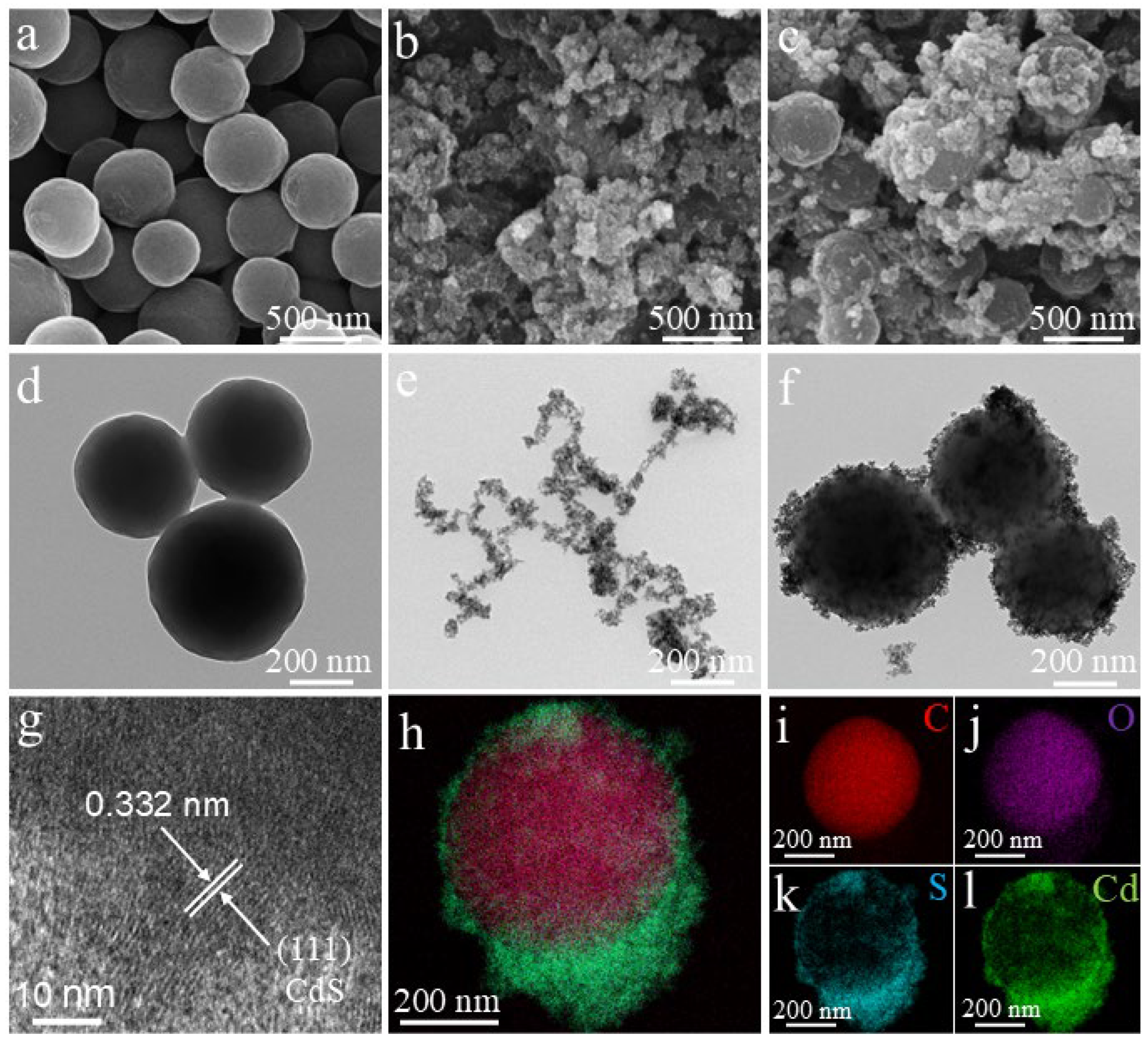
The microstructure and morphology of the as-prepared photocatalysts were systematically characterized using SEM and TEM. Figure 1a and Figure 1d present the SEM and TEM images of the pristine CS, respectively. The CS exhibit a uniform nanospherical morphology with smooth surfaces and excellent dispersion, possessing diameters in the range of 400−500 nm. In contrast, the SEM image of pure CdS (Figure 1b) reveals severe aggregation with a paste-like surface texture. The TEM image of pure CdS (Figure 1e) shows small particles clustered together. Notably, Figure 1f clearly demonstrates that CdS nanoparticles, with sizes ranging from 10 to 20 nm, are uniformly anchored onto the CS surfaces, forming a compact heterostructure. This loading configuration is further corroborated by the SEM image of the CS@CdS composite shown in Figure 1c. HRTEM analysis (Figure 1g) provides direct evidence of a tight and continuous interfacial contact between the CS and CdS components. Specifically, the CS display an amorphous nature, whereas the CdS nanoparticles exhibit distinct lattice fringes with an interplanar spacing of 0.332 nm, corresponding to the (111) crystal plane of CdS [44]. Furthermore, the energy-dispersive X-ray spectroscopy (EDS) elemental mapping images (Figure 1i–l) confirm the homogeneous distribution of C, O, Cd and S throughout the composite, substantiating the successful deposition of CdS nanoparticles on the CS surface.
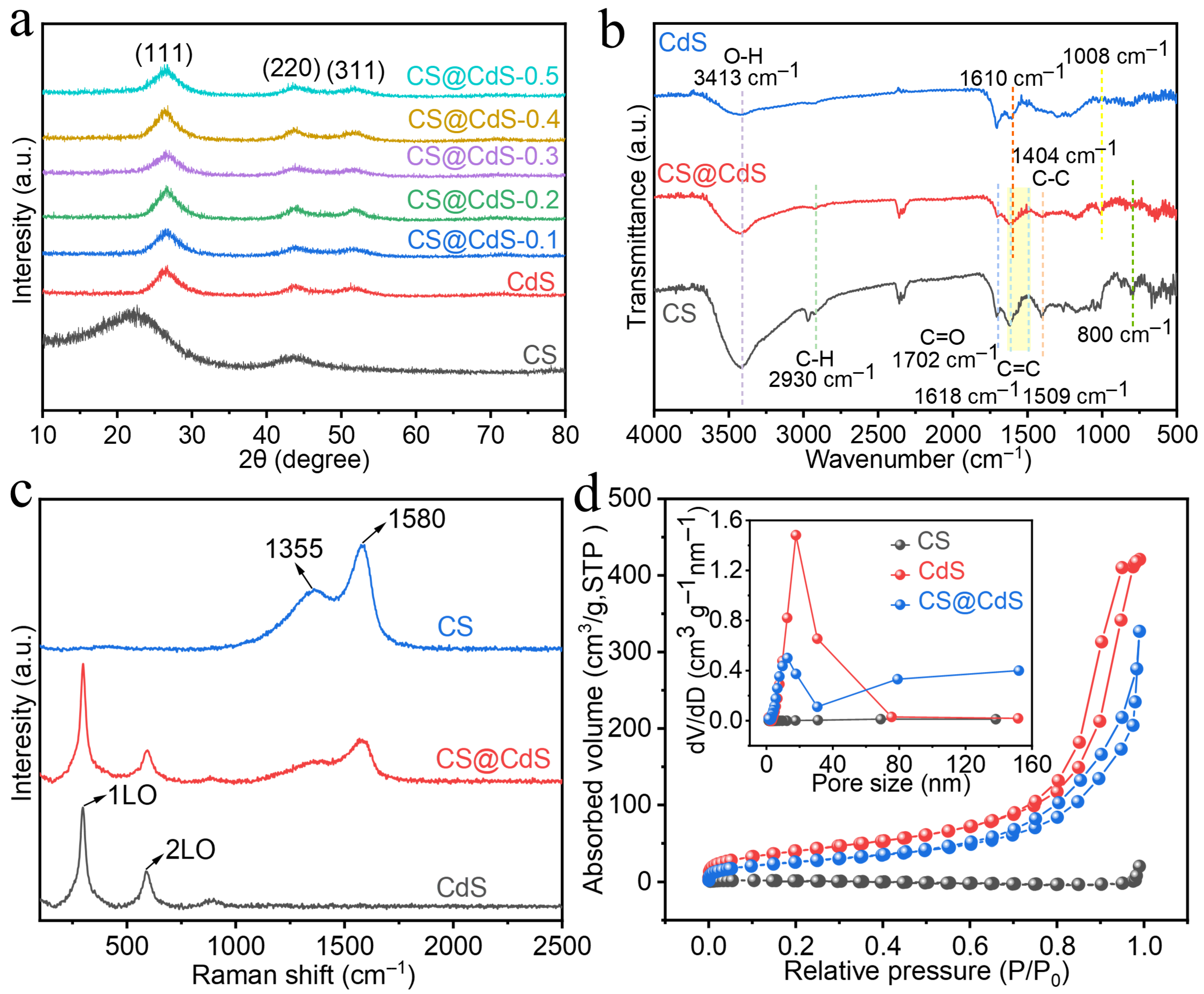
The crystal structures of all as-prepared samples were investigated using X-ray diffraction (XRD). As depicted in Figure 2a, the pristine CS exhibits a broad diffraction peak centered at 2θ = 21°, which is assigned to the (002) plane of amorphous graphitic carbon [41], confirming their amorphous nature. Both the pure CdS and the CS@CdS composite display characteristic diffraction peaks that align well with the standard pattern for cubic phase (zinc blende structure) CdS (PDF No. 10-0454). This correspondence indicates that the incorporation of CS does not compromise the crystalline phase of CdS within the composite, which retains high crystallinity. Notably, the broad diffraction peak of amorphous CS at 21° is not discernible in the XRD pattern of the CS@CdS composite, likely due to its low relative content and the masking effect of the intense CdS peaks [45]. Further structural insights were gained from Fourier transform infrared (FTIR) spectroscopy (Figure 2b). The FTIR spectrum of the CS@CdS composite closely resembles that of pristine CS. The strong absorption band at 3413 cm−1 is attributed to the stretching vibration of O−H groups [46], while the peak at 2930 cm−1 corresponds to the stretching vibration of sp2-hybridized C−H bonds [47]. The absorption peak at 1702 cm−1 arises from the C=O stretching vibration. Additionally, the bands at 1618 and 1509 cm−1 are assigned to the stretching vibrations of C=C bonds within aromatic domains, suggesting that aromatization of glucose occurred during the hydrothermal process [48]. The peak located at 1404 cm−1 is associated with C−C stretching vibrations, whereas the signal at 800 cm−1 stems from α-substitution within the polyfuran structure of the CS [49]. Furthermore, the FTIR spectrum of the CS@CdS composite exhibits additional features characteristic of CdS, with distinct peaks observed at 1008 and 1610 cm−1 [50]. As shown in Figure 2c, both CdS and CS@CdS exhibit two Raman bands at 300 and 600 cm−1, which are attributed to the 1LO and 2LO modes of CdS [51]. The bands observed for CS at 1355 and 1580 cm−1 are assigned to the C–C and C=C stretching vibrations of the furan [49], respectively. Notably, the characteristic peaks of both CdS and CS are present in the Raman spectrum of CS@CdS. These results confirm the successful loading of CdS nanoparticles onto the furan-based CS surface.
Additionally, the BET specific surface area and pore size distribution of the samples were analyzed using N2 adsorption–desorption isotherms. As shown in Figure 2d and Table S1, CS exhibits a typical Type III isotherm with a specific surface area and pore volume of only 1.75 m2/g and 0.04 cm3/g, respectively, indicating that it can be regarded as a non-porous solid [42]. Pure CdS and CS@CdS display typical Type II isotherms with H3 hysteresis loops, which are characteristic of non-porous materials or aggregates with slit-shaped pores [45]. The isotherm of pure CdS shows a high adsorption uptake at high relative pressures (P/P0) approaching 1.0, suggesting the formation of macropores due to the stacking of aggregated CdS nanoparticles, which is consistent with the SEM observations. Compared to pure CdS, the CS@CdS sample exhibits two distinct hysteresis loops in the low P/P0 range (0.6 < P/P0 < 0.8) and high P/P0 range (0.8 < P/P0 < 1.0), indicating a bimodal pore size distribution in the mesoporous (2–50 nm) and macroporous (>50 nm) regions. These pores can facilitate the rapid diffusion of reactants and products during the photocatalytic process, thereby enhancing the reaction rate.
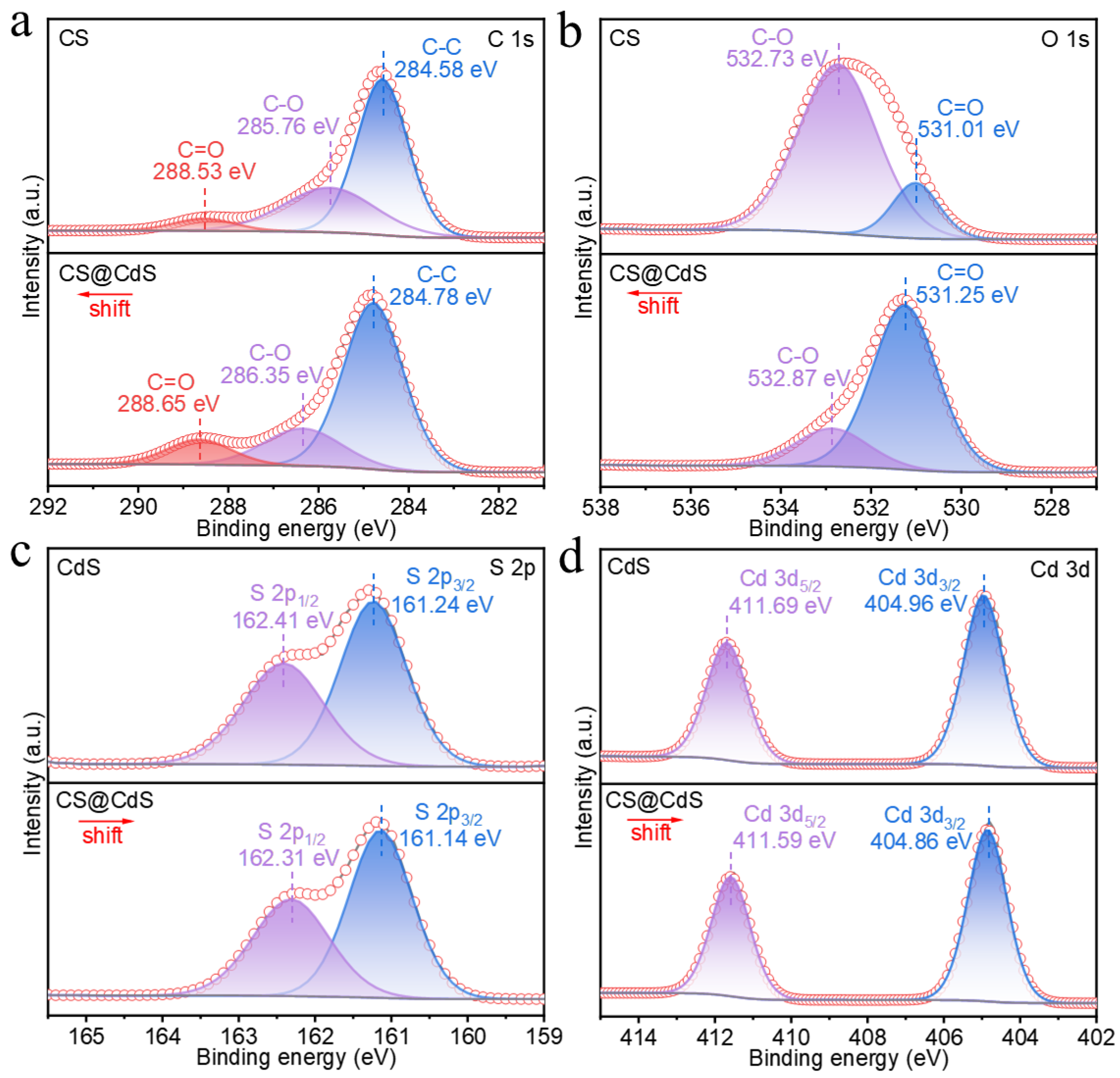
The chemical states and elemental composition of the CS@CdS composite were further elucidated using XPS. Figure 3c,d display the high-resolution S 2p and Cd 3d spectra of pure CdS, respectively. The S 2p spectrum exhibits two distinct peaks at binding energies of 162.41 and 161.24 eV, which are assigned to the S 2p1/2 and S 2p3/2 spin–orbit doublets of sulfide species in CdS. Similarly, the Cd 3d spectrum shows two characteristic peaks at 411.69 and 404.96 eV, corresponding to Cd 3d5/2 and Cd 3d3/2, respectively [52]. Notably, upon loading CdS onto the CS surface, these characteristic Cd and S peaks exhibit a negative shift of approximately 0.1 eV toward lower binding energies, indicating an increase in electron density within the CdS component. Figure 3a,b present the high-resolution C 1s and O 1s spectra of CS. The C 1s spectrum can be deconvoluted into three components at 284.58, 285.76, and 288.53 eV, attributed to C−C, C−O and C=O bonds, respectively. The O 1s spectrum reveals two peaks at 531.01 and 532.73 eV, ascribed to C=O and C−O groups [43]. The CS@CdS composite displays C 1s and O 1s profiles highly similar to those of pure CS, confirming the preservation of the CS structure within the composite. However, in contrast to the shifts observed for CdS, the corresponding peaks in CS@CdS shift toward higher binding energies relative to pristine CS, suggesting a decrease in electron density on the CS surface. This opposing trend in binding energy shifts between the CS and CdS components provides compelling evidence for a strong interfacial interaction within the heterostructure, facilitating electron transfer from CS to CdS.

2.2. Photocatalytic H2O2 Production Performance

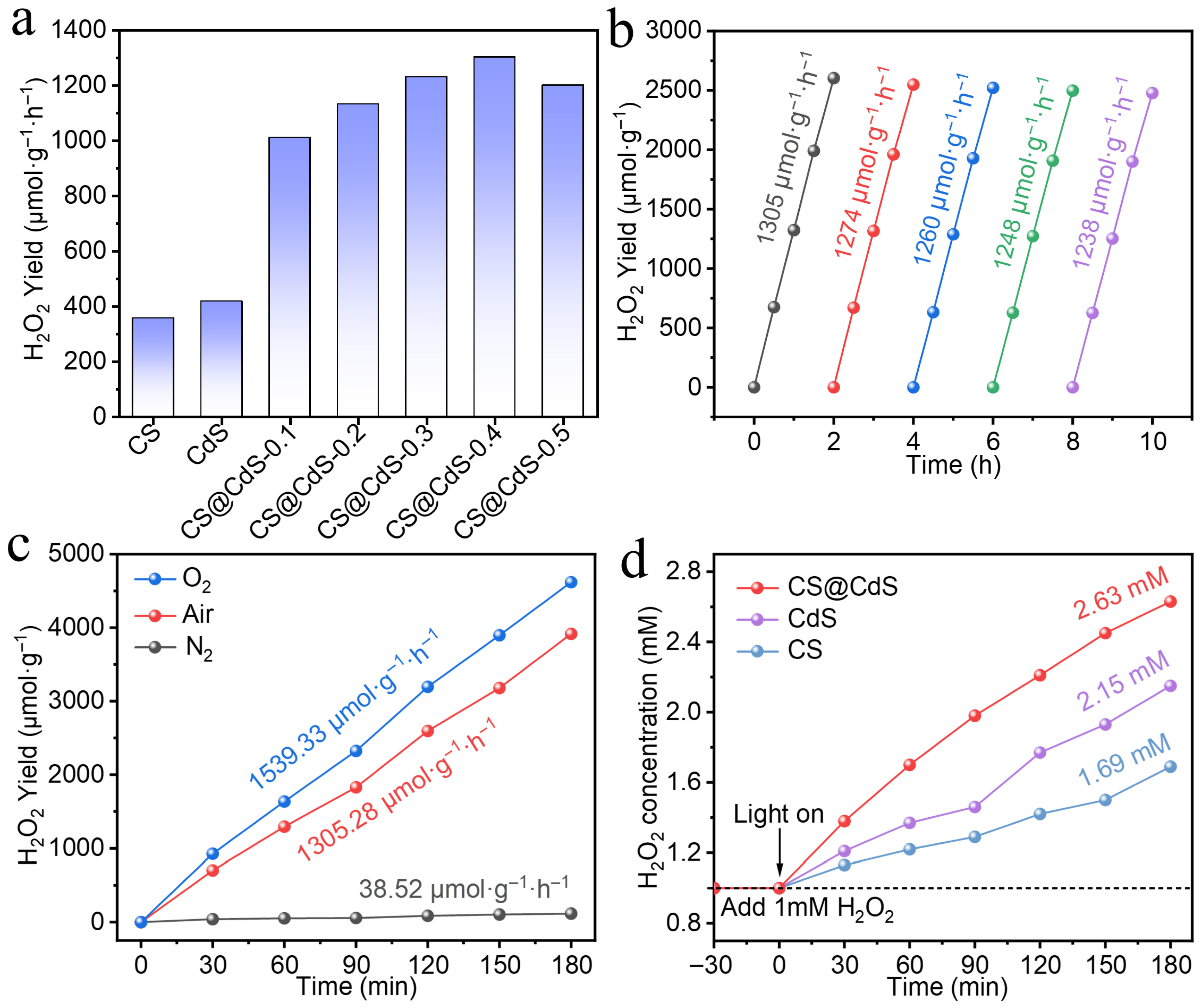
Photocatalytic H2O2 production was conducted in pure water under ambient air irradiation using a xenon lamp (1000 mW cm−2), and the corresponding H2O2 yields were detected by cerium sulfate colorimetry, as shown in Figure S1. As illustrated in Figure 4a, CdS and pure CS exhibited H2O2 production rates of 418 and 357 μmol·g−1·h−1, respectively, after 1 h of continuous irradiation. The performance of the catalysts significantly improved after combining CdS with CS, with the sample CS@CdS-0.4 composite achieving a superior H2O2 production rate of 1305 μmol·g−1·h−1, which is 3.1 and 3.6 times higher than that of pure CdS and CS, respectively. A distinct advantage of this reaction system is its operational simplicity: it proceeds efficiently in pure water under ambient air without the need for sacrificial agents or external O2 bubbling. Consistent with previously reported systems, substituting ambient air with pure O2 did not significantly alter the H2O2 production rate (Figure 4c) [53]. The apparent quantum yields (AQY) for H2O2 production over CS@CdS under monochromatic light of varying wavelengths are presented in Figure S2 and Table S2. The AQY reached 3.34% at 365 nm but declined rapidly with increasing wavelength. This trend correlates closely with the optical absorption properties of the photocatalyst. The consistency between the action spectrum in the visible region and the diffuse reflectance spectrum confirms that the H2O2 production process is primarily driven by visible light excitation.
Given that photocatalytic H2O2 generation involves competing processes of synthesis and decomposition, control experiments were conducted to monitor H2O2 photodecomposition. This was achieved by adding 1 mM H2O2 to dispersions (0.5 mg mL−1) of CS, CdS, and CS@CdS under identical reaction conditions. The results indicate that all three catalysts not only coexist stably with the added H2O2 but also effectively suppress its decomposition, leading to further accumulation of H2O2 even under irradiation (Figure 4d). Among them, CS@CdS demonstrated the most robust capability in stabilizing H2O2 and inhibiting its degradation, thereby contributing substantially to the enhanced overall yield. We further investigated the underlying reasons for the suppression of H2O2 decomposition by CS@CdS. First, the CS component likely attenuates the strong adsorption of H2O2 on active metal sites and its subsequent activation, thereby reducing the propensity for catalytic decomposition. Second, the more efficient charge separation at the CS@CdS interface, coupled with the milder surface reaction environment provided by the carbon matrix, may effectively inhibit side reactions that promote H2O2 decomposition. Consequently, the incorporation of CS not only favors the selective generation of H2O2 but also suppresses its subsequent decomposition, synergistically enhancing the net yield and stability of the system.
It is well recognized that CdS-based photocatalysts generally suffer from severe photocorrosion under irradiation, which compromises their stability and hinders practical applications. However, as shown in Figure 4b, the photocatalyst was evaluated over five consecutive cycles. The H2O2 yields for each cycle were determined to be 1305, 1274, 1260, 1248, and 1238 µmol·g−1·h−1, respectively, corresponding to a negligible activity loss of <5% after 10 h of continuous operation. These results confirm the excellent stability of the catalyst under prolonged reaction conditions. Furthermore, the XRD patterns of the recycled samples (Figure S3) remained virtually unchanged. Collectively, these results indicate that the incorporation of CS effectively mitigates the photocorrosion of CdS. This enhanced stability is primarily attributed to three factors: (1) the formation of intimate interfacial contact between CdS and CS, which facilitates the separation and transfer of photogenerated carriers, thereby reducing charge accumulation on the CdS surface; (2) the dispersion and anchoring of CdS on the CS matrix, which lowers the probability of direct exposure to the oxidative environment; and (3) interfacial electronic interactions that likely suppress the self-oxidation of CdS to a certain extent. Consequently, the introduction of CS not only enhances catalytic activity but also improves the photostability of the material.
Compared to other photocatalysts reported in recent years, CS@CdS developed in this study showed significant performance advantages, suggesting its excellent potential for the photocatalytic production of H2O2 (Table S3). Furthermore, to assess the potential environmental risks associated with cadmium leaching, the concentration of Cd2+ in the post-reaction solution was determined to be 6 mg/L via ICP-OES. This result indicates a relatively low level of Cd2+ leaching under the experimental conditions employed. Although the catalyst exhibits satisfactory photocatalytic performance and cyclic stability in laboratory settings, the inherent presence of cadmium necessitates careful consideration for practical applications. Consequently, future strategies should prioritize metal leaching control, efficient catalyst recovery, and immobilization or encapsulation techniques to mitigate potential environmental hazards.

2.3. Optical and Electrochemical Properties

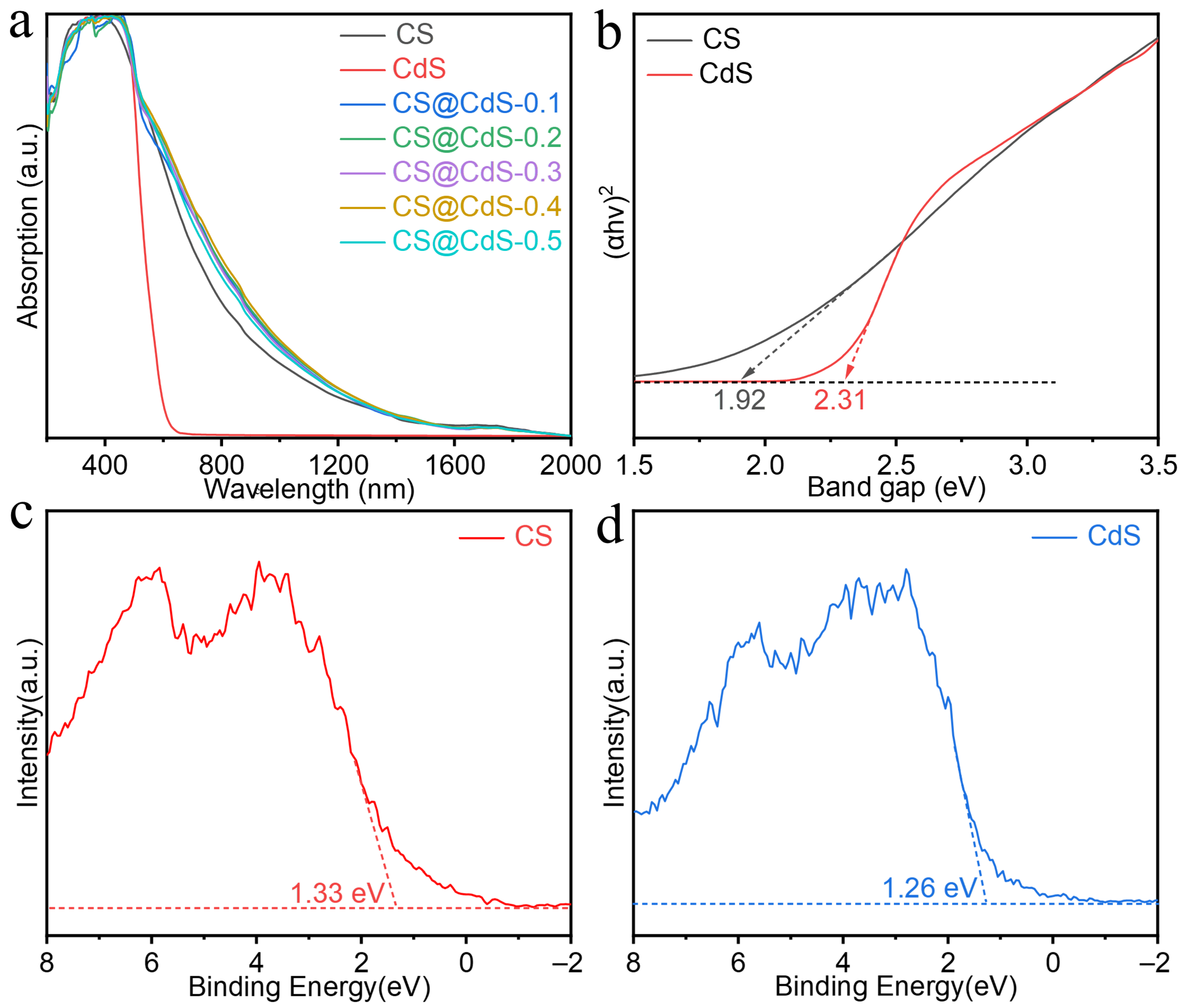
To elucidate the underlying factors contributing to the enhanced photocatalytic H2O2 production efficiency of CS@CdS, a comprehensive analysis of its charge carrier transport mechanism was conducted. The optical properties and band structures of the samples were characterized using UV–vis diffuse reflectance spectroscopy (UV–vis DRS) and X-ray photoelectron spectroscopy valence band (XPS-VB) analysis, thereby establishing the charge transfer pathway across the CS@CdS heterointerface. As shown in Figure 5a, the CS@CdS composites exhibit stronger light absorption in the visible region compared to pristine CdS. Furthermore, with increasing CS content, the visible-light absorption edge of CS@CdS progressively shifts toward longer wavelengths (red-shift), indicating that CS incorporation enhances visible-light harvesting and consequently promotes the generation of photogenerated charge carriers. However, it is noteworthy that an excessive loading of CS can shield CdS from visible light absorption, leading to a reduction in photogenerated electrons and ultimately diminishing the photocatalytic activity. Conversely, the enhanced visible-light absorption by CS may facilitate photon accumulation on the CS surface, potentially inducing a local photothermal effect that generates a thermal field around the CdS domains. This synergistic effect likely improves both the formation and transfer efficiency of photogenerated carriers to a certain extent. The band gap energies of CS and CdS were calculated to be 1.92 and 2.31 eV, respectively, using the Tauc relation (αhν)2 = A(hν–Eg) (Figure 5b). Subsequently, the valence band (VB) potentials of CS and CdS were determined to be 1.33 and 1.26 eV via XPS-VB (Figure 5c,d). Based on the equation Eg = EVB − ECB, the conduction band (CB) potentials for CS and CdS were calculated to be −0.59 and −1.05 eV, respectively.
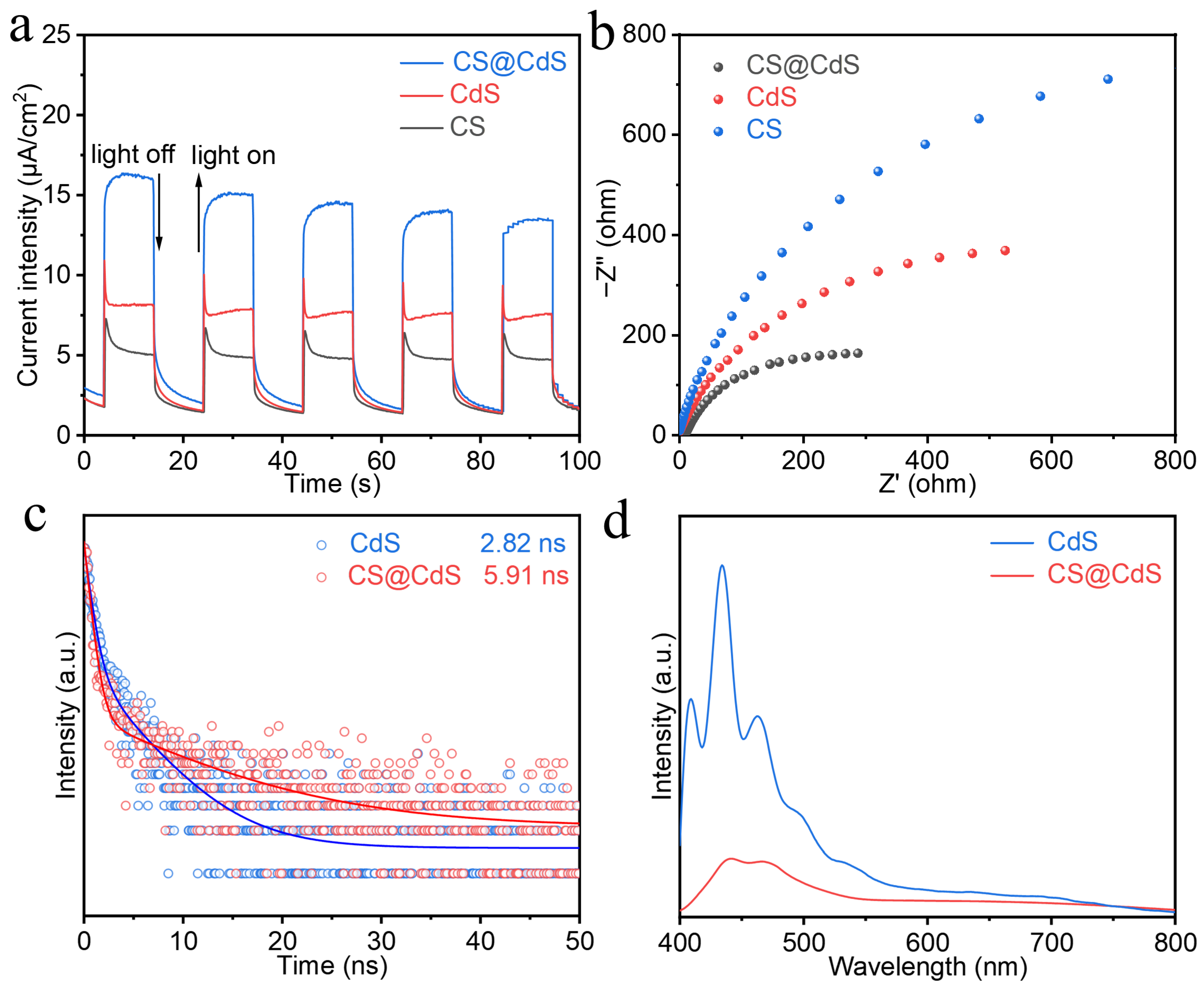
To verify the enhanced charge separation efficiency in the CS@CdS composite, the behavior of photogenerated carriers was first investigated through transient photocurrent response measurements and electrochemical impedance spectroscopy (EIS). A higher photocurrent density generally indicates more efficient separation of photogenerated charge carriers [54]. As illustrated in Figure 6a, all samples exhibited a response to visible-light irradiation; notably, the CS@CdS composite demonstrated a significantly higher photocurrent density than pristine CS and CdS. This enhancement confirms that coupling CS with CdS effectively promotes charge separation within the catalyst. Consistent with these findings, the Nyquist plots (Figure 6b) reveal a smaller arc radius for the composite material, indicative of reduced interfacial charge transfer resistance. The charge separation and transport dynamics were further elucidated using time-resolved photoluminescence (TRPL) spectroscopy. The TRPL decay profiles (Figure 6c and Table S4) show that the average fluorescence lifetime of CS@CdS is 5.91 ns, which is markedly longer than that of pure CdS (2.82 ns). This extended lifetime suggests that photogenerated carriers are separated more rapidly and persist longer before recombination. Furthermore, steady-state photoluminescence (PL) spectra (Figure 6d) exhibit a dramatic quenching of PL intensity for the CS@CdS composite compared to pure CdS. This suppression of emission implies that CS effectively captures photoexcited electrons from CdS, thereby inhibiting the bulk recombination of electron–hole pairs.

2.4. Enhanced Mechanism of Photocatalytic H2O2 Production

To elucidate the catalytic mechanism underlying the enhanced photocatalytic H2O2 production over CS@CdS, we first evaluated the H2O2 evolution performance under varying O2 concentrations. As depicted in Figure 4c, the H2O2 yield of CS@CdS decreases concomitantly with the reduction in O2 concentration, indicating that the oxygen reduction reaction (ORR) serves as the predominant pathway for H2O2 generation. Notably, a trace amount of H2O2 was still detected even in N2-saturated solutions. However, the valence band positions of both CdS and CS do not satisfy the reaction potential for the formation of H2O2 by water oxidation. Therefore, the generation of H2O2 in N2 may be due to the further reduction of the generated O2 to H2O2 by CS@CdS following the oxidation of water to O2.
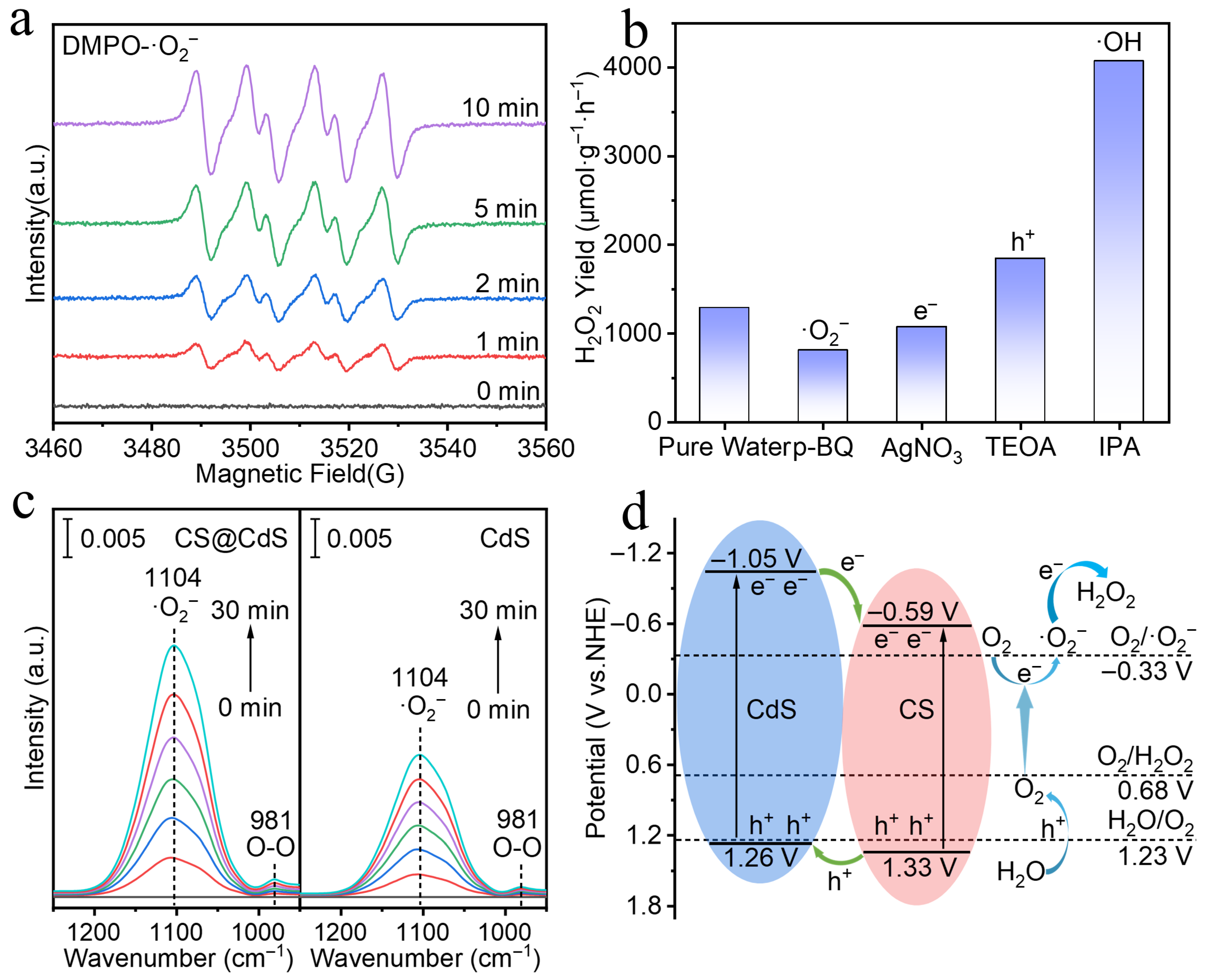
The reactive species involved in the process were further investigated using electron spin resonance (EPR) spectroscopy. As shown in Figure 7a, distinct characteristic signals corresponding to ·O2 were detected over CS@CdS, providing additional evidence for H2O2 generation via an oxygen reduction pathway. To further elucidate the mechanism of photocatalytic H2O2 production over CS@CdS, radical scavenging experiments were conducted. As illustrated in Figure 7b, AgNO3, triethanolamine (TEOA), p-benzoquinone (p-BQ), and isopropanol (IPA) were employed as scavengers for electrons (e), holes (h+), superoxide radicals (·O2), and hydroxyl radicals (·OH), respectively. The addition of IPA, a ·OH scavenger, did not suppress H2O2 production; conversely, a substantial increase in yield was observed. This indicates that ·OH radicals are not involved in the H2O2 formation pathway. Instead, IPA acts as a sacrificial agent that consumes photogenerated holes, thereby increasing the availability of electrons and promoting H2O2 synthesis. Similarly, the introduction of TEOA enhanced the H2O2 yield. This improvement is attributed to the rapid scavenging of holes by TEOA, which facilitates the separation of photogenerated electron–hole pairs and allows more electrons to participate in the oxygen reduction reaction. These results further confirm that holes do not directly contribute to H2O2 generation and rule out the possibility of H2O2 production via a two-electron water oxidation reaction (WOR) over CS@CdS. In contrast, the addition of AgNO3 (electron scavenger) and p-BQ (·O2 scavenger) significantly inhibited H2O2 production. This suppression identifies photogenerated electrons and ·O2 radicals as the critical active species, suggesting that H2O2 is generated primarily through a stepwise two-step single-electron reduction of O2.
Subsequently, in situ Fourier transform infrared spectroscopy (in situ FTIR) was employed to further elucidate the reaction intermediates formed during the photocatalytic process. As depicted in Figure 7c, under continuous irradiation with a 365 nm UV lamp, an absorption band centered at 981 cm−1, associated with O−O bonding, exhibited a marked enhancement [55]. Concurrently, the absorption feature near 1104 cm−1, attributed to superoxide radical (·O2), gradually intensified [56]. This observation provides direct evidence that CS@CdS generates H2O2 via a two-step single-electron oxygen reduction reaction (ORR) pathway under illumination. Notably, the intensity of these characteristic peaks for CS@CdS was significantly higher than that observed for pristine CdS, underscoring the superior catalytic activity of the composite.
Furthermore, the FTIR and XPS data presented in Figure 2 and Figure 3 reveal the presence of various oxygen-containing functional groups on the CS@CdS composite, including –OH, C=O, C–O, and –COOH. Although the conduction-band position of CS suggests only a moderate thermodynamic driving force for O2 activation, the ORR on CS remains kinetically feasible. This is primarily attributed to these oxygenated moieties, which not only facilitate O2 adsorption and stabilize key *OOH-type intermediates to lower the reaction barrier [57,58,59,60], but also provide sufficient protons to promote the conversion of ·O2 into H2O2. In the CS@CdS composite, CdS serves as a light-harvesting antenna to generate photoelectrons, which are subsequently transferred to the CS. There, the abundant surface oxygen functional groups provide sufficient protons to promote the conversion of ·O2 intermediates into H2O2. Consequently, the oxygen-containing groups on the CS surface play an active role in the catalytic mechanism, acting synergistically with the photocatalytic function of CdS. Based on these findings, the proposed catalytic mechanism for CS@CdS is illustrated in Figure 7d: molecular oxygen is initially reduced to form ·O2, which subsequently undergoes protonation to yield hydroperoxyl radicals (*OOH), followed by a final single-electron reduction step to produce H2O2.

3. Experimental Section

3.1. Experimental Reagents

All chemical reagents, including glucose (C6H12O6), sodium polyacrylate (C3H3NaO2), sodium sulfide nonahydrate (Na2S·9H2O), cadmium acetate dihydrate (Cd(Ac)2·2H2O), triethanolaminne (TEOA), isopropanol (IPA), silver nitrate (AgNO3), ceric disulfate (Ce(SO4)2), para-benzoquinone (p-BQ), potassium ferricyanide (K3[Fe(CN)6]), potassium ferrocyanide (K4[Fe(CN)6]), sodium sulfate (Na2SO4), ethylene glycol (EG), ethanol, and Nafion (D520CS-25 mL) were of analytical grade and purchased from Sinopharm Chemical Reagent Co., Ltd. (Shanghai, China). Deionized water with a resistivity ≥18.2 MΩ·cm was used throughout all experiments.

3.2. Synthesis of CS

CS were synthesized via a facile hydrothermal method, according to a previously reported protocol [61]. Typically, 12 g of glucose and 20 mg of sodium polyacrylate (PAANa) were dissolved in 60 mL of deionized water under continuous stirring to form a homogeneous transparent solution. The resulting mixture was transferred into a 100 mL Teflon-lined stainless-steel autoclave and heated at 190 °C for 8 h. After naturally cooling to room temperature, the precipitate was collected by centrifugation and washed repeatedly with anhydrous ethanol and deionized water alternately. Finally, the product was dried in an oven at 80 °C for 12 h.

3.3. Synthesis of CS@CdS

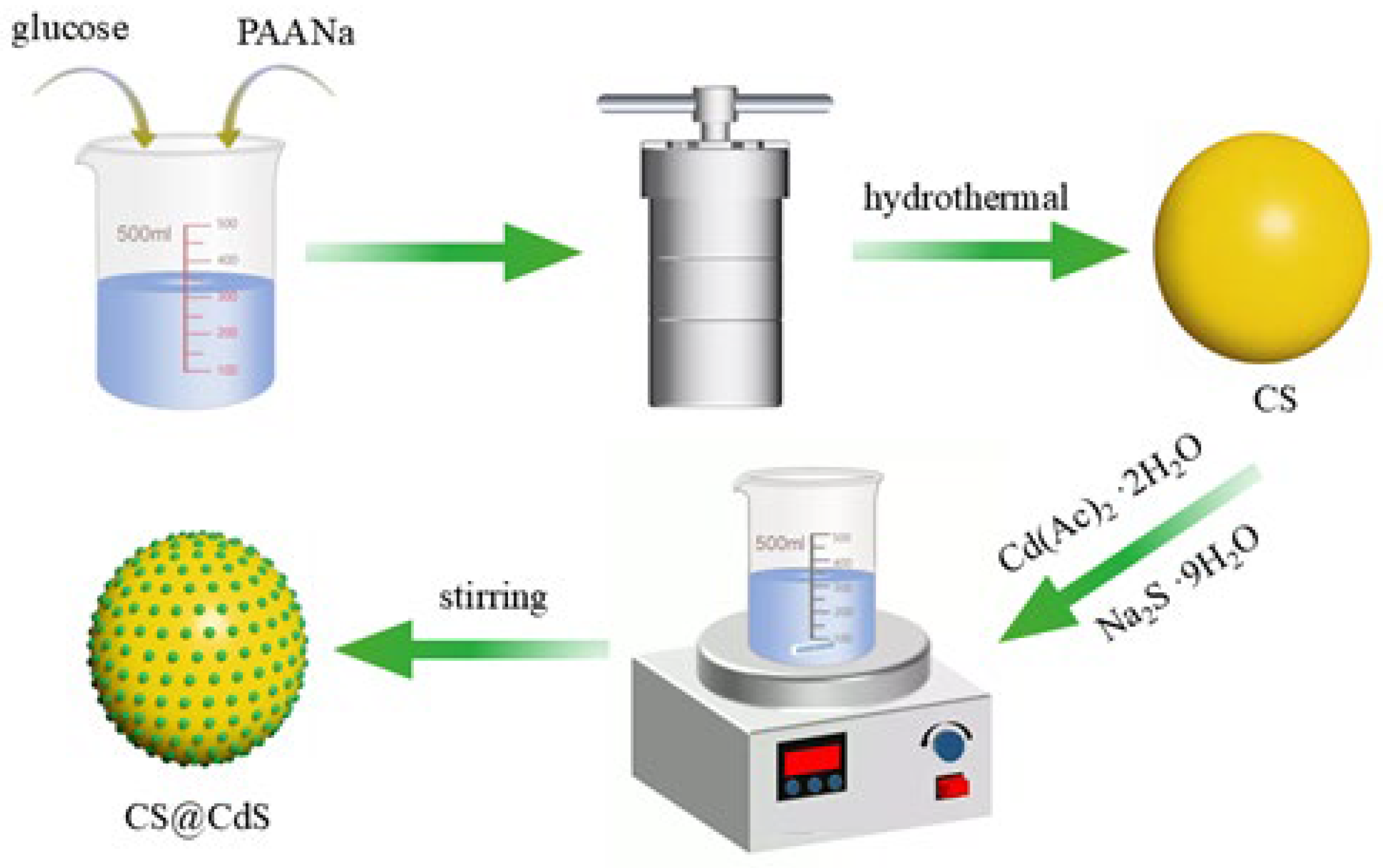
The CS@CdS composites were fabricated via a co-precipitation method coupled with an aging process (Figure 8). Typically, 1 mmol of Cd(CH3COO)2·2H2O was dissolved in 40 mL of deionized water containing a predetermined amount of pre-synthesized carbon spheres (CS). The mixture was stirred at room temperature for 24 h to ensure saturation adsorption of Cd2+ ions onto the CS surface. Subsequently, a solution of 1 mmol Na2S·9H2O in 10 mL of deionized water was added dropwise to the suspension under continuous stirring. The resulting mixture was stirred for an additional 24 h and then allowed to stand undisturbed for 24 h to facilitate the intimate integration of CS and CdS. Upon completion of the reaction, the yellow-green precipitate was collected by centrifugation and washed repeatedly with deionized water and anhydrous ethanol to remove residual impurities. The final products were dried at 60 °C for 12 h. A series of CS@CdS composites with varying CS loadings (0, 15, 30, 45, 60, and 75 mg) was prepared to optimize the composition. The resulting catalysts were designated as pure CdS, CS@CdS-0.1, CS@CdS-0.2, CS@CdS-0.3, CS@CdS-0.4, and CS@CdS-0.5, respectively.

3.4. Materials Characterization

X-ray diffraction (XRD) patterns were recorded on a Rigaku Ultima IV diffractometer with Cu Kα radiation (λ = 1.5406 Å) operated at 40 kV. Data were collected over a 2θ range of 10° to 80° at a scanning speed of 5° min−1. The morphology and microstructure of the samples were characterized via a Hitachi SU8010 scanning electron microscope (SEM) (Tokyo, Japan) and a JEOL JEM-2100 transmission electron microscope (TEM) (Tokyo, Japan). X-ray photoelectron spectroscopy (XPS) measurements were performed on a Thermo Scientific K-Alpha system equipped with a monochromatic Al Kα X-ray source (hν = 1486.6 eV). The X-ray source was operated at 12 kV and 6 mA with a spot size of 400 μm. The analysis chamber was maintained under ultra-high vacuum with a base pressure lower than 5.0 × 10⁻⁷ mbar. Survey scans were acquired at a pass energy of 150 eV and a step size of 1.0 eV, while high-resolution regional scans were conducted with a pass energy of 50 eV and a step size of 0.1 eV. To improve the signal-to-noise ratio, at least five sweeps were accumulated for each high-resolution scan. Photoelectrons were collected at an emission angle of 90° relative to the sample surface, in accordance with the fixed analyzer geometry of the instrument. Charge compensation was realized using a combined low-energy flood gun and argon ion gun system, both positioned at 58°. Prior to analysis, the samples were calibrated by sputtering with gold using an MSBC-12 ion sputtering unit and the binding energy of the Au 4f7/2 peak to 84.00 eV. Spectral deconvolution and fitting were processed using Thermo Avantage software (version 5.932), accompanied by Shirley-type background subtraction and mixed Gaussian–Lorentzian (Voigt) line shapes. Fourier transform infrared (FTIR) spectra were obtained using a Nicolet iS50 FTIR spectrometer (Thermo Scientific, Waltham, MA, USA). UV-Vis diffuse reflectance spectra (UV-Vis DRS) were recorded on a Shimadzu UV-3600 spectrophotometer (Shimadzu, Kyoto, Japan) coupled with an integrating sphere attachment. BaSO4 was employed as the 100% reflectance reference, and the spectra were transformed into the Kubelka–Munk function, F(R), for band gap analysis. Steady-state photoluminescence (PL) and time-resolved photoluminescence (TRPL) spectra were measured using an FS5C fluorescence spectrometer (Edinburgh Instruments).

3.5. Photoelectrochemical Measurements

Photoelectrochemical (PEC) measurements were conducted using a standard three-electrode configuration on a CHI660E electrochemical workstation (Chenhua Instrument Co., Ltd., Shanghai, China). The electrolyte consisted of a 0.5 mol L−1 Na2SO4 aqueous solution. The system comprised a platinum (Pt) foil as the counter electrode, a saturated Ag/AgCl electrode as the reference electrode, and the catalyst-modified indium tin oxide (ITO) glass as the working electrode. The working electrodes were fabricated as follows: 5 mg of the catalyst was dispersed in a mixed solvent containing 50 μL of naphthol and 950 μL of ethylene glycol. The suspension was subjected to ultrasonication for 1 h to ensure homogeneity and then drop-cast onto a clean ITO substrate (geometric area: 2 cm2; effective irradiation area: ~1.0 cm2). The coated electrodes were dried at room temperature before testing. During photocurrent measurements, the working electrode was illuminated by a 300 W xenon lamp positioned at a fixed distance of 10 cm. Transient photocurrent responses were recorded at an applied bias of +0.2 V (vs. Ag/AgCl) under intermittent light irradiation with an on/off cycle of 30 s. Electrochemical impedance spectroscopy (EIS) was performed over a frequency range from 10 mHz to 100 kHz.

3.6. Photocatalytic Measurements

Photocatalytic reactions were carried out in a reaction vessel containing 10 mL of deionized water, in which 5 mg of the catalyst was dispersed under magnetic stirring. The reaction system was maintained under an ambient air atmosphere. Prior to irradiation, the suspension was stirred in the dark for 30 min to establish adsorption–desorption equilibrium. A 300 W xenon lamp served as the light source, with an intensity of 1000 mW/cm2. During the reaction, the temperature of the system was maintained at 8 °C via a cooling circulation system. Following the photocatalytic reaction, the suspension was filtered to remove the solid catalyst, and the resulting supernatant was collected for analysis. The concentration of generated hydrogen peroxide (H2O2) was quantifiably determined by a UV-Vis spectrophotometer (Hitachi High-Tech Corporation, Kyoto, Japan).

3.7. AQY Measurements

The photocatalytic reaction was carried out in pure deionized water (10 mL) and catalyst (5 mg) in a photocatalytic reactor. After adsorption saturation, the bottle was irradiated by an Xe lamp at 365–700 nm (Beijing Perfect Light Technology Co., Ltd., Beijing, China). The AQY of the photocatalyst was measured under the irradiation of a 300 W xenon lamp with band-pass filters (365 nm, 380 nm, 420 nm, 450 nm, 500 nm, 550 nm, 600 nm, and 700 nm). Use the PL-MW2000 optical radiometer (Perfect-light, Beijing, China) to take the average value of monochromatic light intensity at three representative points. Therefore, the light intensity is calculated as 25 mW cm−2. AQY is calculated as follows:
A Q Y = ( N u m b e r   o f   p r o d u c t i o n   H 2 O 2   m o l e c u l e s ) × 2 N u m b e r   o f   i n c i d e n t   p h o t o n s × 100
A Q Y = ( M H 2 O 2 × N A × h × c ) × 2 S × P × T × λ × 100
M is yield of H2O2 (mol); NA is Avogadro constant (6.02 × 10²³ mol−1); h is Planck constant (6.626 × 10⁻³⁴ J·s); c is Speed of light (3 × 10⁸ m/s); S is Irradiation area (3.14 cm2); P is the intensity of irradiation light (25 mW/cm2); T is the photoreaction time (3600 s); λ is the wavelength of the monochromatic light (nm).

4. Conclusions

In summary, we have successfully constructed a CS@CdS heterojunction characterized by CdS nanoparticles uniformly dispersed on the CS surface. Experimental results demonstrate that the formation of a tightly coupled electronic interface between CS and CdS significantly accelerates charge carrier separation and effectively prolongs the lifetime of photogenerated carriers, thereby enhancing overall photocatalytic performance. Furthermore, CS not only broadens the visible-light absorption range of the composite but also acts as an electron acceptor to suppress charge recombination. Consequently, the CS@CdS heterojunction exhibits superior photocatalytic activity for H2O2 production in pure water under ambient air, achieving a rate of 1305 μmol·g−1·h−1, which is 3.1 and 3.6 times higher than that of pure CdS and CS, respectively, while maintaining excellent cyclic stability. Mechanistic investigations confirm that H2O2 generation over CS@CdS proceeds primarily via a two-step single-electron oxygen reduction pathway. This work provides a viable strategy for designing CS-based heterojunctions for efficient photocatalytic H2O2 synthesis.

Supplementary Materials

The following supporting information can be downloaded at: https://www.mdpi.com/article/10.3390/catal16050403/s1. References [62,63,64,65] are cited in the Supplementary Materials.

Author Contributions

Y.H.: investigation and drafted the initial manuscript. Z.L.: performed data curation. Y.Y. (Yan Yan) and X.Y.: resources and methodology. Y.W.: software. E.A.: Visualization. Y.Y. (Yongsheng Yan): formal analysis. W.P.: conceptualization, writing—review and editing. All authors have read and agreed to the published version of the manuscript.

Funding

This research was funded by the Senior Talent Research Foundation of Jiangsu University, grant number 22JDG017, and the APC was funded by the Open Fund of Henan Provincial Key Laboratory of Water Pollution Prevention and Remediation (CJSZ2025001).

Data Availability Statement

The authors confirm that all data substantiating the findings of this investigation are accessible within the main body of the article and its accompanying Supporting Information. Additionally, the raw experimental datasets underpinning these results may be obtained from the corresponding author upon formal request, subject to reasonable justification.

Acknowledgments

We gratefully thank the Senior Talent Research Foundation of Jiangsu University (22JDG017) and the Open Fund of Henan Provincial Key Laboratory of Water Pollution Prevention and Remediation (CJSZ2025001).

Conflicts of Interest

The authors declare no conflicts of interest.

References

  1. Nazir, J.M.; Li, G.; Nazir, M.M.; Zulfiqar, F.; Siddique, H.M.K.; Iqbal, B.; Du, D. Harnessing soil carbon sequestration to address climate change challenges in agriculture. Soil. Tillage Res. 2024, 237, 105959. [Google Scholar] [CrossRef]
  2. Cao, K.S.; Zhang, Y.; Lv, S.K.; Li, Z.Y.; Tang, X.; Xue, L.W.; Li, Y.Y. Graphene oxide as electron bridge in a band-engineered black CN/ZnS Type-II heterojunction for photothermal-enhanced CO2 reduction. J. Alloys Compd. 2026, 1065, 188214. [Google Scholar] [CrossRef]
  3. Siahrostami, S. Rechargeable metal-hydrogen peroxide battery, a solution to improve the metal-air battery performance. ACS Energy Lett. 2022, 7, 2717–2724. [Google Scholar] [CrossRef]
  4. Wen, C.; Zhang, J.; Feng, Y.; Duan, Y.; Ma, H.; Zhang, H. Purification and identification of novel antioxidant peptides from watermelon seed protein hydrolysates and their cytoprotective effects on H2O2-induced oxidative stress. Food Chem. 2020, 327, 127059. [Google Scholar] [CrossRef]
  5. Haider, Z.; Imran, M.; Muhmood, T. Photoelectrochemical Production of Peroxydisulfate (PDS), a Clean Oxidant: Recent Development and Challenges. Int. J. Mol. Sci. 2026, 27, 3066. [Google Scholar] [CrossRef] [PubMed]
  6. Li, X.; Wu, K.; Chen, S.; Yuan, B.; Wang, J.; Tang, C.; Zhang, Q. Hydrogen peroxide-mediated tandem catalysis for electrifying chemical synthesis. Chem Catal. 2024, 4, 100997. [Google Scholar] [CrossRef]
  7. Arshad, L.; Ding, L.; Akram, R.; Zhu, W.; Long, L.; Wang, K. Construction of a novel Au@Os mediated TMB-H2O2 platform with dual-signal output for rapid and accurate detection of ziram in food. Food Chem. 2025, 462, 140988. [Google Scholar] [CrossRef]
  8. Li, J.; Han, F.; Ma, J.; Wang, H.; Pan, J.; Yang, G.; Zhao, H.; Zhao, J.; Liu, J.; Liu, Z.; et al. Targeting Endogenous Hydrogen Peroxide at Bone Defects Promotes Bone Repair. Adv. Funct. Mater. 2022, 32, 2270063. [Google Scholar] [CrossRef]
  9. Liu, Z.; Wang, L.; Liu, P.; Zhao, K.; Ye, S.; Liang, G. Rapid, ultrasensitive and non-enzyme electrochemiluminescence detection of hydrogen peroxide in food based on the ssDNA/g-C3N4 nanosheets hybrid. Food Chem. 2021, 357, 129753. [Google Scholar] [CrossRef]
  10. Miao, R.; Zhang, R.; Hui, T.; Zang, G.; Wang, J.E. The Metal-Based Catalysts for Selective Hydrogenation of Anthraquinone to Produce Hydrogen Peroxide. Catal. Surv. Asia 2023, 27, 115–131. [Google Scholar] [CrossRef]
  11. Meng, F.; Jia, X.; Sun, F.; Sun, B.; Yang, Z. Systemic risk control in anthraquinone-based hydrogen peroxide synthesis: A technical review. J. Loss Prev. Process Ind. 2025, 97, 105689. [Google Scholar] [CrossRef]
  12. Qaiser, A.M.; Khan, S.; Qureshi, A.W.; Haider, N.U.Z.; Wang, W.; Liu, Q. Eco-friendly sacrificial agents-free photocatalytic synthesis of hydrogen peroxide: Recent innovations and future prospects. Int. J. Hydrogen Energy 2024, 95, 935–956. [Google Scholar] [CrossRef]
  13. Qin, L.; Wu, J.; Long, J. Advancements in photocatalytic hydrogen peroxide synthesis: Overcoming challenges for a sustainable future. Chin. J. Struct. Chem. 2025, 44, 100545. [Google Scholar] [CrossRef]
  14. Yao, J.; Kang, S.; Li, Z.; Mao, T.; Tu, Z.; Wu, M.; Bi, J.; Chen, S.; Chen, H.; Yin, H. CuO Nanoparticle-Loaded TiO2 Catalyst for High-Performance Photocatalytic Hydrogen Peroxide Generation. Small 2025, 21, e10644. [Google Scholar] [CrossRef]
  15. Lee, S.; Kim, S.; Park, S.; Gang, D.; Kim, H.S.; Ahn, J.H.; Gu, M. Enhanced Photocatalytic Kinetics of Hybrid TiO2 Photocatalysts Sheathed with Polydopamine toward Efficient H2O2 Production. ACS Appl. Energy Mater. 2024, 7, 8562–8571. [Google Scholar] [CrossRef]
  16. Wang, L.; Fang, C.; Xu, B.; Yu, Y.; Liu, Y.; Fu, X.; Cao, A.; Sun, Q.; Zhou, S. A ZnO-based Catalytic System for the Synthesis of Hydrogen Peroxide from Air. Angew. Chem. 2025, 137, e202424984. [Google Scholar] [CrossRef]
  17. Hu, J.; Zhu, M.; Ghazi, A.Z.; Cao, Y. Restoration mechanism of photocatalytic H2O2/H2 production stability of ZnO/ZnS S-scheme heterojunction. Chin. J. Catal. 2025, 71, 319–329. [Google Scholar] [CrossRef]
  18. Cai, M.; Lv, S.; Li, Y.; Utomo, W.P.; Yan, Y.; Zhu, Z.; Zhao, J. Interfacial Engineering of CN-B/Ti3C2 MXene Heterojunction for Synergistic Solar-Driven CO2 Reduction. Catalysts 2025, 15, 1037. [Google Scholar] [CrossRef]
  19. Zhu, Z.; Xing, X.; Qi, Q.; Li, H.; Han, D.; Song, X.; Tang, X.; Ng, Y.H.; Huo, P. Regulation CN reduction of CO2 products selectivity by adjusting the number of V sites and mechanism exploration. Fuel 2025, 388, 134509. [Google Scholar] [CrossRef]
  20. Dai, J.; Dong, J.; Chang, Y.; Pang, J.; Ma, J.; Wang, Y.; Wu, Z.; Tan, R. Oriented construction of crystal phase homojunction and proton relay on CdS for boosting photocatalytic hydrogen peroxide production. Appl. Catal. A Gen. 2026, 714, 120835. [Google Scholar] [CrossRef]
  21. Shen, W.; Qi, Q.; Hu, B.; Zhu, Z.; Huo, P.; Jiang, J.; Tang, X. Studying bimetals copper-indium for enhancin g-PCN photocatalytic CO2 reduction activity and selectivity mechanism. J. Ind. Eng. Chem. 2025, 13, 116121. [Google Scholar]
  22. Sun, N.; Chen, J.; Zhang, Z.; Feng, X.; Lu, X.; Liu, J.; Zhang, W.; Jiang, Y.; Liu, Y.; Zhang, J. A bifurcated dendritic SrCO3-TiO2/CdS heterostructure with oxygen vacancy for boosting photocatalytic 2e-ORR of H2O2 production and simultaneous antibiotic degradation: Synergy and mechanism insight. Fuel 2025, 386, 134185. [Google Scholar]
  23. Zhu, Q.; Su, J.; Lin, G.; Li, G.; Zhuo, Z.; Wang, W.; Li, J.; Xu, X. Surface indium vacancies promote photocatalytic H2O2 production over In2S3. Nat. Commun. 2025, 16, 10501. [Google Scholar] [CrossRef]
  24. Wang, M.; Xiang, Y.; Dong, X.; Wang, Y. Highly efficient photocatalytic production of H2O2 by polyimide/In2S3 heterostructures under visible-light irradiation. Res. Chem. Intermed. 2025, 51, 3505–3520. [Google Scholar] [CrossRef]
  25. Zhu, B.; Liu, J.; Sun, J.; Xie, F.; Tan, H.; Cheng, B.; Zhang, J. CdS decorated resorcinol—Formaldehyde spheres as an inorganic/organic S-scheme photocatalyst for enhanced H2O2 production. J. Mater. Sci. Technol. 2023, 162, 90–98. [Google Scholar] [CrossRef]
  26. Qi, Q.; Shen, W.; Yan, Y.; Fang, Y.; Zhang, Y.; Tang, X.; Huo, P. Construction of In-modified CN-based photocatalyst with In–N chemical bond for efficient photoreduction of CO2. J. Mater. Sci. Technol. 2026, 261, 161–170. [Google Scholar] [CrossRef]
  27. Wei, Z.; Zhao, S.; Li, W.; Zhao, X.; Chen, C.; Phillips, L.D.; Zhu, Y.; Choi, W. Artificial photosynthesis of H2O2 through reversible photoredox transformation between catechol and o-benzoquinone on polydopamine-coated CdS. ACS Catal. 2022, 12, 11436–11443. [Google Scholar] [CrossRef]
  28. Zhang, Z.J.; O’Neil, R.H.; Roberti, W.T. Femtosecond studies of interfacial electron-hole recombination in aqueous CdS colloids. Appl. Phys. Lett. 1994, 64, 1989–1991. [Google Scholar] [CrossRef]
  29. Matsumoto, H.; Sakata, T.; Mori, H.; Yoneyama, H. Preparation of monodisperse CdS nanocrystals by size selective photocorrosion. J. Phys. Chem. 1996, 100, 13781–13785. [Google Scholar] [CrossRef]
  30. Bo, X.; Yang, C.; Li, B.; Fan, Y.; Li, J.; Huang, H.; Kou, J.; Lu, C. Reverse quantum wells in gradient-doped CdS for photocatalytic H2O2 production. Inorg. Chem. Front. 2025, 12, 5177–5188. [Google Scholar]
  31. Tang, Y.; Ye, F.; Li, B.; Yang, T.; Yang, F.; Qu, J.; Yang, X.; Cai, Y.; Hu, J. Electronic Structure Modulation of Oxygen-Enriched Defective CdS for Efficient Photocatalytic H2O2 Production. Small 2024, 20, 2400376. [Google Scholar] [CrossRef]
  32. Feng, Y.; Gao, M.; Gong, Y.; Wang, J.; Wang, B.; Liu, Y.; Feng, Y.Y.; Sun, C. One-pot combustion synthesis of S-scheme heterostructured CdS/CdMoO4 nanoparticles with tightly bound interface for enhanced photocatalytic H2O2 production. ACS Appl. Nano Mater. 2025, 8, 3426–3435. [Google Scholar] [CrossRef]
  33. Wu, L.H.; Wang, T.T.; Tan, L.C.; Qi, Y.M.; Xu, J.Y.; Tang, R.Z. Efficient photocatalytic synthesis of H2O2 coupled with 3,4-dihydroisoquinoline by rGO-modified CdS catalysts. Chem. Commun. 2026, 62, 2947–2951. [Google Scholar] [CrossRef]
  34. Karamoschos, N.; Katsamitros, A.; Andrikopoulos, K.S.; Tasis, D. Integrated Carbon-Based Nanostructures for Boosting Photocatalytic H2O2 Evolution over CdS@ ZnIn2S4 Heterojunctions. ChemPhotoChem 2026, 10, e202500361. [Google Scholar] [CrossRef]
  35. Jiang, B.; Chen, D.; Li, N.; Xu, Q.; Li, H.; Lu, J. Graphene-encapsulated CdS as a high-performance photocatalyst for H2O2 production from pure water. Ind. Eng. Chem. Res. 2023, 62, 12974–12984. [Google Scholar] [CrossRef]
  36. Guo, H.; Wang, B.; Hu, P.; Wang, H. Enhancing H2 evolution activity of MWCNTs-biphasic CdS photocatalyst through microstructure regulation. J. Environ. Chem. Eng. 2025, 13, 116417. [Google Scholar] [CrossRef]
  37. Yang, P.Y.; Wang, X.Z.; Hu, Z.; Ma, F.L.; Tao, R. Biomass-derived hydrothermal carbonization carbon: A carbon-negative photocatalytic platform. Bioresour. Technol. 2026, 440, 133405. [Google Scholar] [CrossRef]
  38. Falco, C.; Caballero, F.P.; Babonneau, F.; Gervais, C.; Laurent, G.; Titirici, M.-M.; Baccile, N. Hydrothermal carbon from biomass: Structural differences between hydrothermal and pyrolyzed carbons via 13C solid state NMR. Langmuir 2011, 27, 14460–14471. [Google Scholar] [CrossRef]
  39. Ma, J.; Jing, Y.; Li, Y.; Cui, S.; Zhao, X.; Song, J. Eu2O3/carbon-nanospheres for enhanced photocatalytic degradation of rhodamine B dye. Mater. Sci. Semicond. Process. 2025, 192, 109422. [Google Scholar] [CrossRef]
  40. Leng, X.; Nunna, G.P.; Mangiri, P.K.; Yini, C.; Shuang, L.; Pitcheri, R.; Radhalayam, D.; Ko, J.T.; Choi, J. Synergistic zinc molybdate-carbon nanosphere nanocomposites for enhanced electrochemical performance and efficient photocatalytic applications. J. Alloys Compd. 2025, 1021, 179731. [Google Scholar] [CrossRef]
  41. Miao, W.; Yao, D.; Chu, C.; Liu, Y.; Huang, Q.; Mao, S.; Ostrikov, K.K. Highly-efficient photocatalytic H2O2 evolution using hydrothermal carbons with donor-acceptor furan couples. Appl. Catal. B Environ. 2023, 332, 122770. [Google Scholar] [CrossRef]
  42. You, F.L.; Yang, Y.P.; Li, H.; Yuan, Y.; Chen, Y.; Li, S.J.; Wang, C.J.; Li, Y.Z.; Jiang, L.; Tao, R. Acid-modified hydrothermal carbonization carbon from biomass waste: A platform for efficient hydrogen peroxide photogeneration. J. Environ. Chem. Eng. 2025, 13, 118483. [Google Scholar] [CrossRef]
  43. Tang, X.; Yu, C.; Zhang, J.; Liu, K.; Zeng, D.; Li, F.; Li, F.; Ma, G.; Jiang, Y.; Zhu, Y. Furan-based HTCC/In2S3 heterojunction achieves fast charge separation to boost the photocatalytic generation of H2O2 in pure water. ACS Catal. 2024, 14, 16245–16255. [Google Scholar] [CrossRef]
  44. Qin, N.; Li, L.; Zheng, H.; Cui, Q. CdS with tunable crystalline phase structures: Controllable preparation and enhanced photocatalytic properties. Res. Chem. Intermed. 2023, 49, 5505–5516. [Google Scholar] [CrossRef]
  45. Wang, Q.; Lian, J.; Ma, Q.; Zhang, S.; He, J.; Zhong, J.; Li, J.; Huang, H.; Su, B. Preparation of carbon spheres supported CdS photocatalyst for enhancement its photocatalytic H2 evolution. Catal. Today 2017, 281, 662–668. [Google Scholar] [CrossRef]
  46. Yan, Y.; Dai, Y.; Wang, S.; Jia, X.; Yu, H.; Yang, Y. Catalytic applications of alkali-functionalized carbon nanospheres and their supported Pd nanoparticles. Appl. Catal. B Environ. 2016, 184, 104–118. [Google Scholar] [CrossRef]
  47. Wu, J.; Tian, J.; Zhou, W.; Liu, S.; Sun, D. SO2-resistant hollow carbon spheres encapsulated Pt nanoparticles for benzene oxidation. Chem. Eng. J. 2024, 489, 151472. [Google Scholar] [CrossRef]
  48. Luo, Y.; Lu, T.; Jin, S.; Ye, K.; Yu, S.; Zhang, X.; Wu, X.; Ma, P.; Tester, W.J.; Wang, K. Elucidating the intrinsic core-shell structure of carbon nanospheres from glucose hydrothermal carbonization. J. Supercrit. Fluids 2024, 210, 106290. [Google Scholar] [CrossRef]
  49. Xu, L.; Liu, Y.; Li, L.; Hu, Z.; Yu, C.J. Fabrication of a photocatalyst with biomass waste for H2O2 synthesis. ACS Catal. 2021, 11, 14480–14488. [Google Scholar] [CrossRef]
  50. Chand, P.; Ghosh, R.; Sukriti. Investigation of structural, morphological and optical properties of Zn doped CdS nanostructures synthesized via co-precipitation method. Optik 2018, 161, 44–53. [Google Scholar] [CrossRef]
  51. Tudu, P.; Mondal, R.; Santra, S.; Kuiri, B.; Biswas, D.; Kabi, S.; Uddin, M.M.; Chowdhury, S.; Patra, A.S.; Mondal, S. Investigation of annealing effect on the structural and optical properties of CdS nanoparticles prepared through green synthesis approach: A comparative study. MRS Adv. 2025, 10, 1457–1464. [Google Scholar] [CrossRef]
  52. Cui, Y.; Xing, Z.; Guo, M.; Qiu, Y.; Fang, B.; Li, Z.; Wang, Y.; Chen, P.; Zhou, W. Core–shell carbon colloid sphere@ phosphotungstic acid/CdS as a Z-scheme heterojunction with synergistic adsorption, photothermal and photocatalytic performance. Catal. Sci. Technol. 2021, 11, 6080–6088. [Google Scholar] [CrossRef]
  53. Li, K.; Ge, Q.; Liu, Y.; Wang, L.; Gong, K.; Liu, J.; Xie, L.; Wang, W.; Ruan, X.; Zhang, L. Highly efficient photocatalytic H2O2 production in microdroplets: Accelerated charge separation and transfer at interfaces. Energy Environ. Sci. 2023, 16, 1135–1145. [Google Scholar] [CrossRef]
  54. Qin, L.; Yang, J.; Lang, Q.; Zhang, H.; Liu, X.; Li, Z.; Chen, M.; Wei, J.; Yang, P.; Huo, X.; et al. Construction of a sea-urchin liked S-Scheme heterojunction: A case study using 3D CoNiO2/W18O49 composite for efficient CO2 photoreduction. J. Mater. Sci. Technol. 2026, 255, 75–85. [Google Scholar] [CrossRef]
  55. Liu, Y.; Han, W.K.; Chi, W.; Mao, Y.; Jiang, Y.; Yan, X.; Gu, Z.G. Substoichiometric covalent organic frameworks with uncondensed aldehyde for highly efficient hydrogen peroxide photosynthesis in pure water. Appl. Catal. B Environ. 2023, 331, 122691. [Google Scholar] [CrossRef]
  56. Shu, C.; Yang, X.; Liu, L.; Hu, X.; Sun, R.; Yang, X.; Cooper, A.I.; Tan, B.; Wang, X. Mixed-linker strategy for the construction of sulfone-containing D-A-A covalent organic frameworks for efficient photocatalytic hydrogen peroxide production. Angew. Chem. Int. Ed. 2024, 63, e202403926. [Google Scholar] [CrossRef]
  57. Wang, J.; Zhang, C.; Guo, J.; Li, J.; Zhang, X.; Yang, Y.; Wang, P.; Wang, S.; Li, H.; Chen, H.; et al. Alcohol-assisted hydrothermal synthesis of hydroxyl-rich hydrothermal carbon facilitates the oxygen reduction reaction for efficient production of H2O2. Chem. Eng. J. 2025, 521, 167215. [Google Scholar] [CrossRef]
  58. Wang, X.; Yuan, S.; Feng, B.; Qiu, X.; Yu, C.; Lu, W.; Xu, X.; Hu, Y.; Shi, Y. Spent coffee ground-derived hydrochar: An ecologically compatible material for solar-driven H2O2 production and wastewater purification. J. Colloid Interface Sci. 2025, 691, 137371. [Google Scholar] [CrossRef]
  59. Liu, K.; Guo, X.; Liu, Y.; Wang, X.; Wang, J.; Wang, X.; Zhang, L.; Zhu, Y.; Yang, D. White LED driven {010}-faceted BiVO4 mediated electron transfer enables efficient peroxymonosulfate activation for norfloxacin degradation. Adv. Powder Mater. 2026, 5, 100363. [Google Scholar] [CrossRef]
  60. Wang, X.; Guo, X.; Song, Z.; Guan, C.; Yang, C.; Li, T.; Zhu, Y.; Xu, Y. Interface engineering of Co9S8/Ni3S2 heterojunction with robust stability for boosting peroxymonosulfate activation. Chin. J. Struct. Chem. 2025, 45, 100771. [Google Scholar] [CrossRef]
  61. Gong, Y.; Xie, L.; Li, H.; Wang, Y. Sustainable and scalable production of monodisperse and highly uniform colloidal carbonaceous spheres using sodium polyacrylate as the dispersant. Chem. Commun. 2014, 50, 12633–12636. [Google Scholar] [CrossRef] [PubMed]
  62. Cao, J.; Zhou, S.; Cai, J.; Han, J.; Liu, J.; Li, R.; Huang, M. In situ fabrication of Z-scheme C3N4/Ti3C2/CdS for efficient photocatalytic hydrogen peroxide production. Phys. Chem. Chem. Phys. 2023, 25, 25734–25745. [Google Scholar] [CrossRef] [PubMed]
  63. Wang, H.; Zhang, Q.; Yang, Y.; Bian, J.; Li, C. Efficient hydrogen peroxide production: Enhancing electron transfer on PANI/CdS photocatalysts in aqueous solution. J. Environ. Chem. Eng. 2024, 12, 114979. [Google Scholar] [CrossRef]
  64. Yang, Z.; Wang, J. CdS nanoparticles supported on Ti3C2Tx MXene for the efficient photocatalytic production of H2O2: Implications for the photocatalytic degradation of emerging contaminants. ACS Appl. Nano Mater. 2022, 6, 558–572. [Google Scholar] [CrossRef]
  65. Zhang, Q.; Yang, Y.; Wang, H.; Bian, J.; Chen, G.; Li, C. Enhanced photocatalytic H2O2 production by morphology-controlled CdS nanocatalysts. Chin. J. Chem. Eng. 2026, 89, 259–266. [Google Scholar] [CrossRef]
Figure 1. (a) SEM image of CS, (b) SEM image of pure CdS, and (c) SEM image of the CS@CdS composite. (d) TEM image of CS, (e) TEM image of pure CdS, and (f) TEM image of the CS@CdS composite. (g) HRTEM image of the CS@CdS composite. (hl) EDS elemental mapping images of the CS@CdS composite.
Catalysts 16 00403 g001
Figure 2. (a) XRD patterns of all samples. (b) FT-IR spectra of CS, CdS, and CS@CdS. (c) Raman spectra of CdS, CS@CdS, and CS. (d) N2 adsorption–desorption curves and pore size distributions (inset) of CS, CdS, and CS@CdS.
Catalysts 16 00403 g002
Figure 3. High-resolution XPS spectra of CdS, CS, and CS@CdS: (a) C 1s, (b) O 1s, (c) S 2p, (d) Cd 3d.
Catalysts 16 00403 g003
Figure 4. (a) Photocatalytic production of H2O2 under visible-light irradiation for all samples. (b) Cycling test of photocatalytic H2O2 generation with CS@CdS. (c) Kinetic profiles the photocatalytic H2O2 yield with CS@CdS in N2, O2, and air atmospheres. (d) H2O2 decomposition curves using 0.5 mg/mL CS, CdS, and CS@CdS during continuous Xe lamp irradiation (1000 mW/cm2) with the initial H2O2 concentration of 1 mM.
Catalysts 16 00403 g004
Figure 5. (a) UV-vis-DRS absorption spectra for all samples. (b) (αhν)2 curves versus band gap of CS and CdS. (c) XPS-VB spectra of CS and CdS (c,d).
Catalysts 16 00403 g005
Figure 6. (a) Transient photocurrent responses mapping and (b) EIS Nyquist plots of CS, CdS, and CS@CdS. (c) TRPL and (d) PL spectra of samples (λex = 380 nm, λem = 435 nm).
Catalysts 16 00403 g006
Figure 7. (a) EPR spectra of CS@CdS in O2 atmosphere under Xenon lamp irradiation, using DMPO as the spin-trapping chemical in MeOH solution. (b) H2O2 yields of CS@CdS reacted for 1 h in different sacrificial systems. (c) In situ FTIR spectra of CS@CdS and CdS. (d) Schematic diagram of the mechanism of CS@CdS photocatalytic production of H2O2.
Catalysts 16 00403 g007
Figure 8. Schematic illustration of the preparation process of CS@CdS.
Catalysts 16 00403 g008
Disclaimer/Publisher’s Note: The statements, opinions and data contained in all publications are solely those of the individual author(s) and contributor(s) and not of MDPI and/or the editor(s). MDPI and/or the editor(s) disclaim responsibility for any injury to people or property resulting from any ideas, methods, instructions or products referred to in the content.