Review

Catalytic Systems and Mechanistic Insights into Crotonaldehyde Synthesis from Acetaldehyde: A Comprehensive Review


1
Zhejiang Ruizhi Holdings Group Co., Ltd., Hangzhou 311200, China
2
Tianjin Jiuyuan Chemical Engineering Co., Ltd., Tianjin 300084, China
3
Key Laboratory for Green Chemical Technology of the Ministry of Education, Tianjin University, Tianjin 300072, China
*
Authors to whom correspondence should be addressed.
Catalysts 2026, 16(4), 353; https://doi.org/10.3390/catal16040353
Submission received: 23 March 2026 / Revised: 9 April 2026 / Accepted: 10 April 2026 / Published: 15 April 2026
(This article belongs to the Special Issue Heterogeneous Catalysis for Environmental and Energy Sustainability)

Abstract

This paper systematically reviews the recent advances in catalytic systems and reaction mechanisms for the synthesis of crotonaldehyde via aldol condensation using acetaldehyde as the feedstock. Firstly, the structural characteristics, reactivity, and important applications of crotonaldehyde in fine chemicals are outlined, with particular emphasis on the limitations of traditional homogeneous base-catalyzed processes, such as difficulty in separation and environmental pollution caused by waste streams. On this basis, heterogeneous catalytic systems are discussed in detail, focusing on the progress of metal oxides, aluminosilicate zeolites, and heteroatom zeolites in regulating acid–base properties, active site structures, and reaction pathways. Furthermore, the typical carbanion mechanism and direct condensation mechanism in aldol condensation are summarized, and the catalyst deactivation and by-product formation mechanisms are analyzed. Finally, perspectives on the construction of efficient and green catalytic systems and future research directions are proposed, aiming to provide theoretical guidance for process optimization and catalyst design in crotonaldehyde synthesis from acetaldehyde.

1. Introduction

2-Butenal is an important α,β-unsaturated aldehyde with the molecular formula C4H6O and the structural formula CH3CH=CHCHO. It exists as both cis- and trans-isomers. The cis-isomer is thermodynamically unstable and readily converts into the trans-form; therefore, crotonaldehyde generally refers to trans-2-butenal. Industrial-grade crotonaldehyde is a mixture of both isomers, with the trans-isomer accounting for more than 95%.
With the global chemical industry shifting toward green, low-carbon, and high value-added development, the utilization of abundant and inexpensive low-carbon feedstocks to construct key platform molecules has become a major research focus. Acetaldehyde, as a widely available and structurally simple C2 oxygenated compound, can efficiently form C-C bonds via aldol condensation, enabling its transformation into C4 compounds [1,2,3,4]. This pathway features high atom economy and provides key intermediates for downstream fine chemicals. As a core product in this route, crotonaldehyde serves not only as an important intermediate for the synthesis of sorbic acid, higher alcohols, glutaric acid, and functional polymers, but also as a crucial bridge linking basic petrochemicals and fine chemical industries, with increasing market demand and strategic importance.
Although the homogeneous base-catalyzed process (e.g., NaOH, KOH) for crotonaldehyde production from acetaldehyde has been industrialized, it suffers from several inherent drawbacks [4,5]. Firstly, homogeneous catalysts are difficult to separate from products, leading to recovery challenges and contamination. Secondly, strong alkaline conditions cause severe corrosion to equipment, increasing maintenance costs and safety risks. Finally, large amounts of salt-containing wastewater and by-products are generated, which are difficult to treat and fail to meet the stringent requirements of green chemistry for zero emissions. Therefore, developing efficient, recyclable, and environmentally friendly heterogeneous catalytic systems has become a key direction to overcome these limitations and achieve sustainable development [5,6,7].
In recent years, with the rapid advancement of in situ characterization techniques and multiscale theoretical calculations, a deeper understanding of the microscopic mechanisms, dynamic evolution of active sites, and coke-induced deactivation in acetaldehyde aldol condensation has been achieved. These advances provide a solid theoretical foundation for the rational design of high-performance heterogeneous catalysts at the molecular level. Based on this, this review systematically summarizes the progress of representative heterogeneous catalytic systems, including metal oxides and heteroatom zeolites, in crotonaldehyde synthesis from acetaldehyde. The structure-activity relationships, reaction networks, and deactivation mechanisms are analyzed in depth. This work aims to summarize existing findings, identify key scientific challenges, and provide theoretical and technical guidance for overcoming bottlenecks and promoting the green industrialization of this process.

2. Properties and Applications of Crotonaldehyde

2.1. Properties of Crotonaldehyde

The molecular structure of crotonaldehyde consists of a methyl group, a carbon-carbon double bond (C=C), and an aldehyde group (C=O). The conjugation between the double bond and the carbonyl group leads to an uneven distribution of electron density. This unique electronic structure endows crotonaldehyde with high chemical reactivity, enabling it to exhibit both electrophilic behavior (at the carbonyl carbon) and nucleophilic behavior (at the β-carbon). As a result, it can undergo both 1,2-addition (direct addition) and 1,4-addition (conjugate addition), providing a structural basis for diverse chemical transformations [1,2].
Crotonaldehyde participates in various key reactions. In addition reactions, it can react with hydrogen, halogens, and Grignard reagents via 1,2- or 1,4-addition, and can be selectively hydrogenated to butyraldehyde or butanol. In oxidation reactions, the aldehyde group can be selectively oxidized to crotonic acid, extending its applications to resins and pharmaceuticals. In reduction and condensation reactions, it can be reduced to saturated alcohols or act as an intermediate in self- or cross-aldol condensation to efficiently construct C-C bonds and extend carbon chains. Under specific conditions, it can also polymerize to form macromolecular materials.
Due to these versatile reaction pathways, crotonaldehyde has become an indispensable C4 platform molecule in fine chemical and materials science. Its major industrial applications include the synthesis of n-butanol, n-butyraldehyde, and sorbic acid, as well as its use in rubber vulcanization accelerators, denaturants, leather softeners, and intermediates for pharmaceuticals and agrochemicals. As a key node connecting basic petrochemical feedstocks and high value-added products, crotonaldehyde plays an irreplaceable role in constructing complex carbon skeletons and achieving precise functional group transformations.

2.2. Applications of Crotonaldehyde

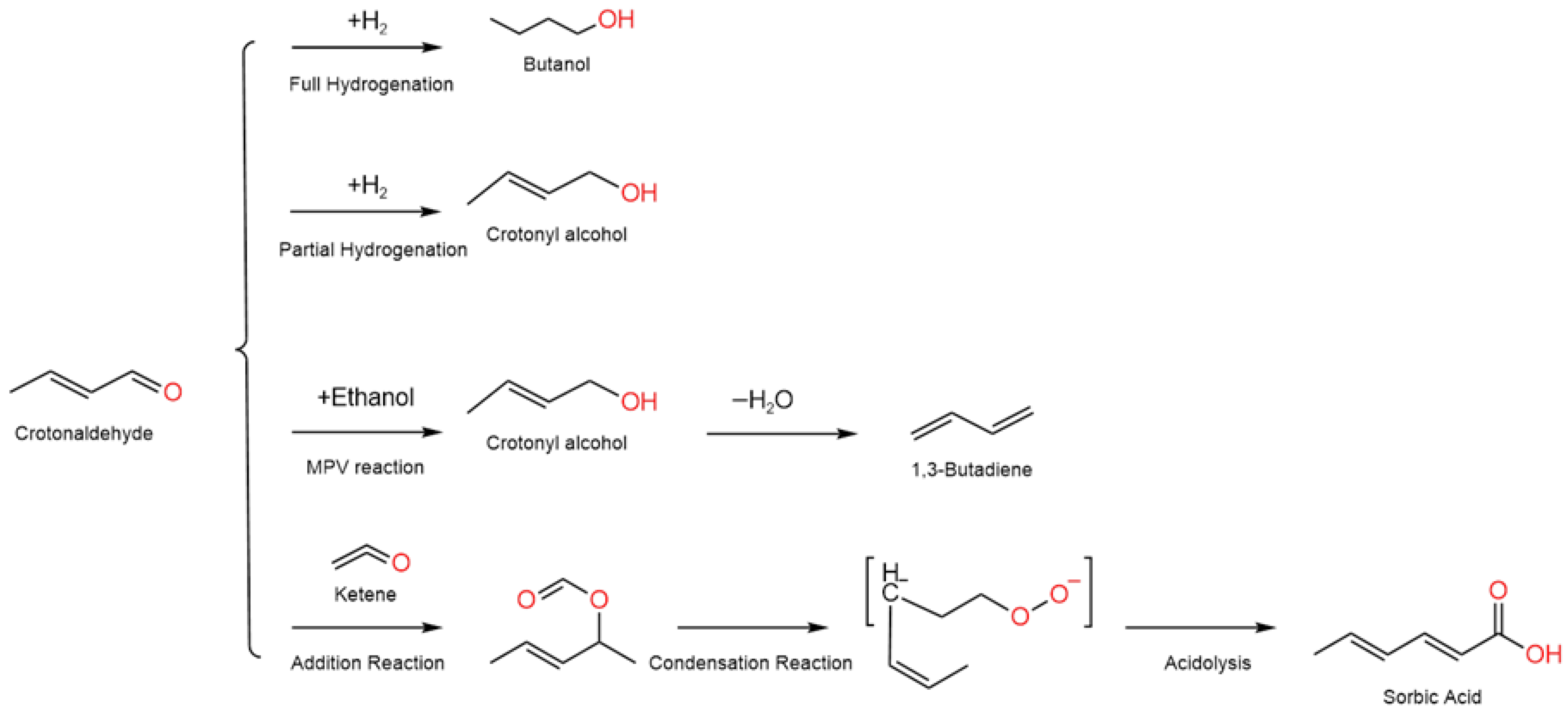
As a typical representative of α,β-unsaturated aldehydes, crotonaldehyde occupies a core position in organic synthesis due to its unique conjugated structure; its downstream derivatives are not only widely applied in key fields such as food preservation, fine chemicals, and pharmaceuticals and fragrances, but also serve as a strategic hub connecting basic petrochemical feedstocks with high-end functional materials, owing to the diversity of its reaction pathways and high value-added characteristics. The catalytic conversion routes and applications of crotonaldehyde are illustrated in Figure 1.

2.2.1. Production of Sorbic Acid and Its Derivatives from Crotonaldehyde

Industrially, crotonaldehyde is mainly used for the synthesis of sorbic acid (2,4-hexadienoic acid) and its derivatives. Sorbic acid and its potassium salt are internationally recognized as Class A1 safe food preservatives. Owing to their broad-spectrum antimicrobial activity and low toxicity in metabolism, they have become preferred alternatives to traditional preservatives such as sodium benzoate in global food additive regulatory systems [8,9,10]. With the global consumption pattern shifting from “quantity satisfaction” to “quality enjoyment,” the expansion of markets for high-end foods, short shelf-life snacks, and ready-to-eat meals, coupled with increasingly stringent food safety regulations, has continuously driven the penetration of sorbic acid and its salts in dairy products, baked goods, beverages, and meat products.
The synthesis of sorbic acid via the condensation of crotonaldehyde with ketene has become the mainstream industrial process due to its advantages of readily available raw materials, short process flow, high yield, and low cost. In this process, acetic acid is pyrolyzed at high temperature to generate ketene, while acetaldehyde undergoes aldol condensation, dehydration, and purification to form crotonaldehyde. Subsequently, ketene reacts with crotonaldehyde in the presence of a catalyst to form polyester intermediates, which are then hydrolyzed and refined to yield sorbic acid [5,11,12]. As a key raw material in this process, the demand for crotonaldehyde will continue to increase with the expansion of the sorbic acid industry. Although alternative routes involving crotonaldehyde with malonic acid or acetic anhydride remain viable under specific conditions, the ketene route dominates industrial production due to its mild reaction conditions, high atom economy, and stable product yield. Therefore, the production capacity and quality of crotonaldehyde directly affect the growth of the downstream sorbic acid industry and the market competitiveness of final products.
The synthesis of sorbic acid from crotonaldehyde and ketene follows a nucleophilic addition-dehydration mechanism under basic catalysis. Initially, under the action of a basic catalyst (e.g., pyridine or organic amines), the α-methylene hydrogen of crotonaldehyde is abstracted to form a resonance-stabilized enolate. This nucleophile attacks the highly electrophilic central carbon atom of ketene (CH2=C=O), undergoing a Michael-type addition to form β-hydroxy acid or β-keto acid intermediates. Subsequently, under heating or acidic post-treatment conditions, the intermediate undergoes elimination or acid-catalyzed dehydration, releasing one molecule of water and forming a new C=C bond to yield sorbic acid. Although this route exhibits high atom economy, the high reactivity of ketene (which tends to dimerize into diketene) and safety concerns necessitate in situ ketene generation or catalyst optimization in industrial applications to suppress side reactions and improve selectivity.

2.2.2. Hydrogenation of Crotonaldehyde to Unsaturated/Saturated Alcohols

The hydrogenation of crotonaldehyde is highly selective, and the product distribution depends on the reaction site. Complete hydrogenation yields n-butanol; selective hydrogenation of the C=C bond produces butyraldehyde; while selective hydrogenation of the aldehyde group yields crotyl alcohol. Notably, although n-butanol is currently mainly produced via biological fermentation, the chemical hydrogenation route based on crotonaldehyde provides an alternative pathway that may optimize production cost and process efficiency under certain conditions.
In the synthesis of higher alcohols, butyraldehyde obtained from selective hydrogenation of crotonaldehyde has significant strategic importance. This butyraldehyde can replace that produced via propylene hydroformylation and serve as a key intermediate in subsequent condensation reactions to efficiently synthesize higher carbon-number alcohols such as octanol (2-ethylhexanol), thereby expanding the feedstock supply system.
In contrast, the selective hydrogenation of crotonaldehyde to crotyl alcohol presents greater technical challenges but higher added value. Crotyl alcohol is an important intermediate in fine chemicals, widely used in pharmaceuticals, fragrances, and specialty materials [13,14,15,16,17]. Due to the stringent requirements on catalyst selectivity and reaction conditions, achieving efficient and highly selective synthesis of crotyl alcohol remains a challenging research topic in catalysis and fine chemical engineering.
The key difficulty in selective hydrogenation lies in the conjugated system formed by the C=C and C=O bonds in crotonaldehyde, leading to significant kinetic and thermodynamic competition [14,15,16,17]. Since the C=C bond typically has lower bond energy than the C=O bond, it is more readily activated under conventional catalytic conditions, resulting in preferential formation of saturated aldehydes (e.g., butyraldehyde) rather than the target crotyl alcohol. To overcome this selectivity limitation, it is essential to develop catalysts with high activity, selectivity, and stability to achieve preferential hydrogenation of the C=O bond while preserving the C=C bond.
In the catalytic hydrogenation of α,β-unsaturated aldehydes, noble metals such as Pt, Au, and Ir serve as the primary active components. Among these, Ir-based catalysts, characterized by a relatively broad d-band width, effectively suppress the activation and adsorption of C=C bonds while maintaining aldehyde reduction activity, thereby significantly enhancing selectivity toward α,βunsaturated alcohols. Investigations into catalyst microstructure and reaction mechanisms have revealed key design strategies: optimizing the metal electronic structure through support and promoter modulation, leveraging strong metal-support interactions (SMSI) and interfacial charge effects to refine active sites, and controlling particle size to utilize steric hindrance for precise pathway regulation. These design principles aim to selectively inhibit the adsorption and hydrogenation of C=C bonds via electronic or steric effects, thereby directing the reaction toward crotyl alcohol formation amidst complex competitive steps, and meeting the demand of downstream pharmaceutical, fragrance, and specialty solvent industries for high-purity products.

2.2.3. Oxidation of Crotonaldehyde to Crotonic Acid

Crotonaldehyde can be oxidized to produce crotonic acid, which serves as a crucial raw material for manufacturing pesticides, coatings, and other chemical products. The copolymer of crotonic acid and vinyl acetate exhibits excellent heat resistance and adhesion properties, making it widely used in the fields of adhesives and coatings. The core of the crotonaldehyde oxidation reaction lies in the precise regulation of the oxidation process using catalysts. In traditional homogeneous catalytic systems, metal salts such as cobalt acetate and manganese acetate facilitate the oxidation process through reversible Co2+/Co3+ or Mn2+/Mn3+ redox cycles. These cycles mediate oxygen activation, abstract the α-hydrogen from crotonaldehyde, generate radical intermediates, and ultimately convert them into crotonic acid. Although this mechanism offers high reaction activity, homogeneous catalysts are difficult to separate from the system after the reaction, leading to metal ion residues that significantly compromise product purity.
To overcome this separation bottleneck, heterogeneous catalysis research has introduced supported Schiff base metal cobalt complexes. Their catalytic mechanism typically involves the coordination of the metal center with the substrate. Through specific steric hindrance and electronic effects, these catalysts preferentially activate the C-H bond while suppressing the excessive oxidation of the C=C bond, thereby achieving high-selectivity conversion of crotonaldehyde to crotonic acid at the solid–liquid interface. While these catalysts offer advantages such as easy separation, reusability, and structural stability, their synthesis often involves complex ligand modification and carrier loading steps, resulting in high production costs. Consequently, current research is dedicated to developing novel heterogeneous catalytic systems with simplified preparation processes. These systems aim to maintain efficient oxidation mechanisms (such as controlled radical chain reactions or metal coordination activation) while reducing synthesis complexity and costs, thereby enabling the green industrialization of crotonic acid production from crotonaldehyde.
Furthermore, in the realm of polymer materials, the addition product of crotonaldehyde and butadiene serves as a key precursor for synthesizing epoxy resins and epoxy plasticizers. Additionally, the condensation reaction between crotonaldehyde and pentaerythritol can produce raw materials for high-performance heat-resistant resins, significantly enhancing the thermal stability of the materials. Crotonaldehyde also plays a vital role in the synthesis of fine chemicals and special chemicals. Its derivatives are widely used in the preparation of frothing agents for mining processes and as intermediates in the dye industry. In the field of functional additives, crotonaldehyde is a core raw material for producing rubber antioxidants, highly efficient pesticides, and various military special chemicals, reflecting its multiple strategic significances in ensuring industrial safety and enhancing material performance.

3. Catalysts for Crotonaldehyde Synthesis from Acetaldehyde

3.1. Homogeneous Catalysts

At present, crotonaldehyde is mainly produced via the homogeneous acetaldehyde condensation process. Under the catalysis of NaOH solution, acetaldehyde undergoes aldol condensation to form 3-hydroxybutanal, which is subsequently dehydrated to produce crotonaldehyde, as shown in Equations (1) and (2).
2 CH 3 CHO 20 60   ,   0.1 0.2   MPa N a O H C H 3 C H O H C H 2 C H O
C H 3 C H O H C H 2 C H O 80 150   ,   0.05 0.2   MPa C H 3 C O O H C H 3 C H = C H C H O + H 2 O
The industrial process of crotonaldehyde production via homogeneous acetaldehyde condensation mainly includes three stages: condensation, dehydration, and distillation. In this process, acetaldehyde and NaOH solution are first mixed and fed into a condensation tower, where 3-hydroxybutanal is formed. The product from the condensation tower is then neutralized with acetic acid and fed into a dehydration tower to obtain crude crotonaldehyde. The crude product contains water, sodium acetate, and organic impurities, and requires further purification via distillation to obtain crotonaldehyde [18].
Industrially, the selectivity of crotonaldehyde from liquid-phase acetaldehyde condensation can exceed 95%; however, the conversion of acetaldehyde cannot reach high levels. This is because the intermediate 3-hydroxybutanal can further react with acetaldehyde to form macromolecular species containing conjugated double bonds, limiting the acetaldehyde conversion in alkaline systems to below 66.6%. In practical industrial operations, the conversion is typically in the range of 50–65%. Experimental studies have also reported the formation of over-condensation products such as hexan-2,4-dienal [19].
The homogeneous process suffers from several drawbacks. The catalyst used in the liquid-phase aldol condensation of acetaldehyde is NaOH solution, which is highly corrosive and difficult to separate from the products, making recycling impossible. During separation, acetic acid must be added to neutralize the base, generating a large amount of wastewater. Approximately 1 ton of wastewater is produced for every ton of crotonaldehyde, mainly containing sodium salts, aldehydes, and heavy components, leading to high costs for product separation and wastewater treatment [20]. In addition, salts formed during neutralization can cause pipeline blockage and affect normal operation.
In homogeneous systems, catalysts for acetaldehyde condensation are typically inorganic bases such as NaOH, KOH, NaHCO3, or their mixtures, as well as organic bases such as triethylamine [18,21,22]. Optimization studies indicate that the type of base and pH value have a decisive influence on reaction performance. Wu et al. [22] reported that strong bases (KOH, NaOH) provide high conversion and selectivity at the initial stage, but excessively high pH values promote over-condensation side reactions, resulting in decreased selectivity. A mixed system of NaOH and Na2CO3 improves selectivity but significantly reduces conversion. When Na2CO3 is used alone, the overall performance is optimal, achieving a crotonaldehyde yield of 46.4% at pH 11~12. Kinetic analysis further shows that the activation energy is minimized at pH 11.4, corresponding to the highest catalytic efficiency.
In summary, although the homogeneous acetaldehyde condensation process is well established, its industrial application faces significant challenges due to difficulties in catalyst recovery and high pollutant emissions. Developing novel heterogeneous catalysts or green catalytic systems to overcome conversion limitations and enable catalyst recyclability is a key direction for future improvements.

3.2. Heterogeneous Catalysts

Compared with traditional homogeneous processes, heterogeneous catalysis can effectively address separation issues, reduce environmental impact, and improve economic and sustainability performance. Research on heterogeneous catalysis for acetaldehyde aldol condensation dates back to the 1960s. In 1964, Scheidt et al. [23] first investigated the catalytic activity of solid lithium phosphate in gas-phase acetaldehyde condensation, laying the foundation for this field.
In recent years, with deeper understanding of reaction mechanisms, various solid catalysts have been introduced into this system. Among them, metal oxides and zeolites have become research hotspots due to their unique acid–base properties. By tuning the distribution and nature of active sites, these materials exhibit great potential in improving acetaldehyde conversion and crotonaldehyde selectivity, providing viable alternatives to conventional homogeneous processes.

3.2.1. Metal Oxide Catalysts

Metal oxides and supported catalysts constitute the core systems in heterogeneous catalysis for acetaldehyde aldol condensation. These include alkaline earth metal oxides (e.g., MgO), transition metal oxides (e.g., ZrO2, TiO2, MoOx), and rare earth oxides (e.g., CeO2, UOx). The key research focus lies in optimizing the acid–base properties of active sites by tuning supports, crystal facets, and oxygen vacancy concentrations to balance activity, selectivity, and stability.
MgO and ZrO2 are widely used due to their strong basicity and amphoteric properties. Shen et al. [24] found that loading MgO onto SiO2 or HY zeolites increases catalytic activity by nearly five times compared with unsupported MgO, owing to enhanced dispersion and increased active site density. Ordomsky et al. [25] compared ZrO2/SiO2 and MgO/SiO2 catalysts and reported the activity order: ZrO2/SiO2 > MgO/SiO2 > SiO2, highlighting the critical role of Lewis acid sites on ZrO2 in acetaldehyde activation. However, Ji et al. [26] observed that although ZrO2 exhibits an initial conversion of ~35%, its stability is poor, with rapid deactivation after 2.5 h. Sulfated ZrO2 (ZrO2-SO42−) increases initial conversion to 70%, but strong acid sites accelerate coke formation. In contrast, single oxides such as MgO, La2O3, Sm2O3, and Nd2O3 exhibit inferior performance in terms of activity, selectivity, and stability compared to modified ZrO2. This indicates that the ZrO2/SiO2 system possesses distinct advantages regarding activity and selectivity; however, its stability bottleneck requires resolution.
Titanium dioxide is not only suitable for gas-phase thermal catalysis but also possesses unique potential for photocatalysis. Idriss et al. [27] pointed out that differences in the surface structure of TiO2 affect the adsorption capacity of acetaldehyde, but have a negligible impact on the condensation reaction pathway. Reaction temperature is a critical variable determining product distribution: ethanol is primarily generated at 370~380 K; crotonaldehyde and by-products are formed at 440 K; and butene is produced via reduction and hydrogenation at 550 K. In terms of photocatalysis, Geng et al. [28] confirmed that anatase TiO2 can catalyze the condensation of acetaldehyde at room temperature under ultraviolet irradiation. Hauchecorne et al. [29] utilized in situ FTIR technology to capture characteristic signals of 3-hydroxybutyraldehyde and crotonaldehyde, elucidating the photo-oxidation reaction pathway of acetaldehyde on the TiO2 surface.
Uranium oxides (UOx), acting as amphoteric oxides, exhibit catalytic performance highly dependent on the O/U ratio and lattice oxygen content. Madhavaram et al. [30] found that strongly reducing UO2 primarily generates ethylene at 400–500 K; α-U3O8 effectively catalyzes the conversion of two acetaldehyde molecules into crotonaldehyde; and the product distribution of β-UO3 correlates with surface coverage, where crotonaldehyde cyclizes to furan at low coverage, while both species coexist at high coverage. This indicates that an appropriate amount of lattice oxygen favors condensation, whereas an excess enhances the oxidizing power of uranium oxides, leading to the cyclization of crotonaldehyde to form furan.
Cerium dioxide (CeO2) with typical oxygen vacancies also exhibits excellent catalytic performance in the aldol condensation of acetaldehyde. Extensive research has been conducted on the catalytic condensation of acetaldehyde over CeO2. Researchers have clarified the active sites of CeO2 by investigating the effects of surface structure and oxygen vacancy concentration on catalytic activity. Furthermore, they have deeply analyzed the reaction mechanism of CeO2-catalyzed reactions by combining in situ characterization techniques with theoretical calculations.
Mann et al. [31] prepared CeO2 crystals with different morphologies, including cubes, octahedra, and rods, to explore the influence of different crystal facets. By employing techniques such as Temperature-Programmed Desorption (TPD), Temperature-Programmed Surface Reaction (TPSR), and Diffuse Reflectance Infrared Fourier Transform Spectroscopy (DRIFTS), they monitored the adsorption process of acetaldehyde on different CeO2 facets and the surface reactions. The study revealed that although all three CeO2 facets exhibited catalytic activity, the specific crystal structure of CeO2 significantly influenced both the acetaldehyde conversion rate and the selectivity toward crotonaldehyde.
Calaza et al. [32] utilized a combined approach of Reflection-Absorption Infrared Spectroscopy (RAIRS) and periodic Density Functional Theory (DFT + U) calculations to systematically analyze the adsorption behavior and reaction process of acetaldehyde on the CeO2 (111) surface. Their findings indicated that on deeply reduced CeO2 (111) surfaces, not only were acetaldehyde dimers observed, formed via coupling between the carbonyl oxygen of one acetaldehyde molecule and the methyl carbon of an adjacent acetaldehyde molecule, but characteristic signals of enol-type products (CH2CHO) resulting from acetaldehyde dehydrogenation were also detected.
To better elucidate the influence of oxygen vacancies on the aldol condensation reaction, Liang et al. [33] constructed CeO2 catalysts with varying oxygen vacancy concentrations. Experimental results demonstrated a positive correlation between aldol condensation activity and the oxygen vacancy concentration of the oxide. Combined with in situ infrared spectroscopy analysis, it was found that oxygen vacancies serve as Lewis acid sites for activating acetaldehyde, while lattice oxygen acts as basic sites for forming enol intermediates. Furthermore, the proposed reaction mechanism indicates that cerium ions, due to their relatively weak Lewis acidity, do not directly participate in the aldol condensation reaction of acetaldehyde.
Rasmussen et al. [34] discovered that MoOx catalysts supported on both γ-Al2O3 and SiO2 exhibit catalytic activity for the condensation of acetaldehyde to crotonaldehyde; however, the interactions between MoOx and these two supports differ significantly. Analysis of TEM, UV-Vis, and FTIR results revealed that there is a strong interaction between MoOx and the γ-Al2O3 support, which endows MoOx with excellent dispersion and uniformity on the γ-Al2O3 surface, yielding high catalytic performance even at low loading levels. In contrast, the interaction between MoOx and the SiO2 support is weaker, meaning that the catalyst only exhibits good activity when the MoOx loading is relatively high.
Beyond traditional metal oxides, solid base catalysts derived from layered double hydroxides (LDHs) have also demonstrated unique catalytic characteristics in the aldol condensation of acetaldehyde. Kagunya et al. [35] investigated LDHs catalysts prepared by calcining precursors such as MgAl silicotungstate, MgAl carbonate, MgCr nitrate, MgFe carbonate, and NiAl nitrate at 450 °C. The study found that while these catalysts could produce both crotonaldehyde and 3-hydroxybutyraldehyde, their performance was limited by complex side reaction pathways, resulting in suboptimal acetaldehyde conversion (approximately 36%) and selectivity (approximately 28%). This research confirmed that basic sites are the core active centers for the catalytic reaction, and the promotional effect correlates positively with basic strength. Two main types of active sites exist within the catalytic system: Brønsted basic sites originating from hydroxyl groups and Lewis basic sites provided by the oxygen atoms at the apexes of metal polyhedra. Although LDH-derived catalysts possess abundant basic sites, their relatively low catalytic performance indicates that future efforts must focus on optimizing their basic site distribution and pore structure to suppress side reactions and improve the yield of target products.
In summary, the design of metal oxide catalysts requires precise regulation of the ratio of acid–base sites, oxygen vacancy concentration, and surface structure. While the ZrO2/SiO2 and CeO2 systems demonstrate superior activity and selectivity, they face challenges regarding stability and coking, respectively. The photocatalytic properties of TiO2 offer a new perspective for low-temperature reactions, whereas the MoOx and LDHs systems require further optimization of support interactions to inhibit side reactions. Future research should focus on constructing heterogeneous catalytic systems that are highly stable, highly selective, and resistant to coking.

3.2.2. Aluminosilicate Zeolite Catalysts

Aluminosilicate zeolites, owing to their well-defined pore structures and tunable acid–base properties, have become important systems for heterogeneous aldol condensation of acetaldehyde, particularly suitable for the transformation of low-carbon aldehydes. According to differences in framework composition and modification methods, these catalysts mainly include HZSM-5 and ion-exchanged X/Y-type zeolites.
Chavez et al. [36] investigated the adsorption and transformation mechanism of acetaldehyde on HZSM-5 using infrared spectroscopy. Under low pressure (2~3 Torr), acetaldehyde interacts with the zeolite surface via proton transfer, as evidenced by the disappearance of the hydroxyl band at 3600 cm−1 and a red shift in the carbonyl stretching frequency. Under these conditions, the spectral features of adsorbed crotonaldehyde are similar to those of acetaldehyde, suggesting that it may exist as a condensation product or intermediate. However, when the pressure exceeds 3 Torr, the strong acidic environment induces polymerization of acetaldehyde, resulting in broad absorption bands corresponding to oligomer formation. Pyridine-adsorbed IR characterization confirms that 94% of the acid sites on HZSM-5 are Brønsted acid sites, indicating their dominant role in catalyzing acetaldehyde condensation to crotonaldehyde. Biaglow et al. [37] further demonstrated via 13C NMR that the reaction rate is strongly influenced by surface coverage of acetaldehyde and temperature. Although HZSM-5 exhibits high catalytic activity, oligomer formation under high pressure limits its industrial applicability.
Ion-exchanged X-type zeolites (KX, NaX, HX) were among the first to be applied in gas-phase acetaldehyde condensation. The primary reaction pathway involves acetaldehyde condensation to form 3-hydroxybutanal, followed by dehydration to crotonaldehyde. Side reactions include isomerization, reduction, cyclodehydration, and cross-condensation. At 400 °C, the conversion is approximately 30% with a selectivity of about 60%. Catalytic activity and product distribution are strongly influenced by basic strength, following the order: KX > NaX > HX. Increasing basic strength enhances the selectivity toward target products (3-hydroxybutanal and crotonaldehyde) while suppressing by-products such as ethylene oxide, propane, and dihydrofuran. Zhang et al. [38] compared NaX and NaY zeolites and found that NaY exhibits superior performance under mild conditions (230 °C, 6 h), achieving 33.2% conversion and 51.3% crotonaldehyde selectivity. The study also indicates that a moderate decrease in the number of basic sites improves the selectivity toward C4 condensation products, highlighting the need for precise control of base site density and strength.
In summary, the catalytic performance of zeolites strongly depends on pore structure, acid–base distribution, and reaction conditions. While HZSM-5 exhibits high activity, it is prone to polymerization side reactions, whereas X/Y-type zeolites offer greater potential for improving selectivity through controlled basicity.

3.2.3. Heteroatom Zeolite Catalysts

Heteroatom zeolites refer to zeolite materials in which elements such as Ti, Zr, Sn, B, Fe, or Ga are incorporated into the framework in addition to conventional elements (Si, Al, O, P). These heteroatoms typically exist in tetrahedral coordination and are electron-deficient, thus exhibiting strong Lewis acidity and serving as active sites for catalytic transformations of oxygenated compounds [39]. This property enables selective polarization of carbonyl groups (C=O) in aldehydes and ketones, facilitating their activation and conversion. Therefore, heteroatom zeolites are widely applied in aldol condensation, Meerwein–Ponndorf–Verley reduction, Baeyer–Villiger oxidation, and ketone ammoximation reactions [40,41,42]. Compared with traditional acid catalysts, they offer milder reaction conditions and higher selectivity, making them a research hotspot in heterogeneous catalysis.
Dumitriu et al. [43] systematically studied MFI-type zeolites modified by ion substitution (H, Ga, Fe, B) in gas-phase aldol condensation of low-carbon aldehydes. By adjusting the Si/Fe ratio during synthesis, the acid strength was tuned. These catalysts contain both Brønsted acid sites (associated with bridging hydroxyl groups) and Lewis acid sites (originating from extra-framework metal cations or oxide clusters). Higher acid strength promotes cross-condensation of aldehydes. In acetaldehyde condensation, the activity order is: B-ZSM-5 > Fe-ZSM-5 > Ga-ZSM-5 > Al-ZSM-5, while selectivity in cross-condensation follows: Al-ZSM-5 > Fe-ZSM-5 > Ga-ZSM-5 > B-ZSM-5. This indicates that heteroatom incorporation significantly alters acid site properties, thereby affecting activity–selectivity balance.
The Ivanova research group [44,45,46] pioneered the investigation of the reaction mechanism for acetaldehyde condensation by utilizing Sn-β, Ti-β, and Zr-β zeolites. By combining steady-state kinetic transient analysis (H-D SSITKA), in situ diffuse reflectance Fourier transform infrared spectroscopy (DRIFTS), and density functional theory (DFT) calculations, they provided deep insights into the process. Their research confirmed that Lewis acid sites play a decisive role in the key steps of catalyzing acetaldehyde aldol condensation and the subsequent conversion of ethanol to butadiene.
The Hermans research group [47,48] further elucidated the synergistic mechanism of Ta-BEA and Zr-BEA zeolites in the conversion of ethanol/acetaldehyde to butadiene through ultraviolet-visible (UV-Vis) spectroscopy, in situ infrared spectroscopy, and in situ extended X-ray absorption fine structure (EXAFS) experiments. They found that while Ta-BEA and Zr-BEA can effectively catalyze acetaldehyde condensation, they exhibit low activity for ethanol dehydrogenation. To address this, the team introduced a silver (Ag) promoter to prepare a bifunctional Ag-Zr-BEA catalyst. Using DRIFTS coupled with mass spectrometry (DRIFTS-MS), they precisely analyzed changes in gas-phase composition and surface species. The results proposed that Lewis acid sites within Zr-Beta and Ta-Beta are primarily responsible for catalyzing the acetaldehyde condensation reaction, whereas the Ag promoter specifically catalyzes the dehydrogenation of ethanol to generate acetaldehyde. This discovery clearly defined the division of labor and synergistic mechanism between different active sites in bifunctional catalysts, providing a theoretical basis for designing efficient conversion systems.
The research group of Li [49,50] constructed a reaction network encompassing key steps such as ethanol dehydrogenation, acetaldehyde condensation, and crotonaldehyde reduction to deeply investigate the mechanism of converting ethanol to butadiene. Based on these insights, they designed a bifunctional Zn-Y/Beta zeolite catalyst. This catalyst ingeniously integrates the high activity of Zn sites for acetaldehyde dehydrogenation with the superior activity of Y sites for acetaldehyde condensation. Through the synergistic effect of these bifunctional sites, catalytic performance was significantly enhanced. Furthermore, using the self-condensation of acetaldehyde and propionaldehyde as a model system, the team demonstrated that the Y/Beta catalyst outperforms other rare-earth zeolites or oxides in aldehyde conversion. Specifically, in propionaldehyde conversion, it achieved a conversion rate of 34% and a selectivity of 95% for 2-methyl-2-pentenal. Combined with DFT calculations, the study further elucidated that the open Y site, Y(OSi)(OH)2, which possesses Lewis acidity, serves as the preferred active center for the reaction. The hydroxyl groups on its surface effectively stabilize the transition state of aldol dimers and lower the energy barrier for dehydration. This accelerates the dehydration process, which is identified as the rate-determining step. These findings provide crucial theoretical support for the design of efficient catalysts for aldehyde conversion.
Gu et al. [51] systematically constructed seven types of M-BEA zeolites doped with transition metals (Sc, Y, Ce, Ti, Zr, Hf, Ta) to deeply investigate the regulation of Lewis acidity by heteroatom substitution and its impact on acetaldehyde conversion. The study revealed that the number of medium-strength Lewis acid sites is the critical factor determining acetaldehyde conversion; increasing the quantity of these medium-strength acid sites significantly enhances catalytic activity. Among the seven catalysts, the Zr-BEA zeolite demonstrated promising development potential, boasting the optimal acetaldehyde conversion rate, crotonaldehyde yield, and favorable economic viability. Temperature-Programmed Surface Reaction (TPSR) experiments further elucidated that excessive aldol condensation of crotonaldehyde is the primary source of by-product formation. Consequently, suppressing this side reaction has emerged as the core strategy for improving catalyst selectivity.
Regarding the deactivation issue of the Zr-BEA catalyst during the reaction process, Jiang et al. [52] confirmed through structural characterization that both the framework structure and the morphology of Zr sites remained intact, thereby ruling out the possibilities of structural collapse or loss of active sites. The deactivation was primarily attributed to the deposition of carbonaceous species, which mainly consisted of unsaturated aldehydes, ketones, and aromatic compounds. The formation mechanism involves strong interactions between by-products and active sites, as well as diffusion limitations imposed by the micropore aperture. The deactivation process exhibited distinct stage-dependent characteristics: in the initial stage, pore blockage was dominant; as the reaction progressed, pore blockage and surface coverage acted synergistically; and in the later stage, the process transitioned to being dominated by surface coverage.
In the precise regulation of active sites, Jiang et al. [53] confirmed that framework tetra-coordinated Zr species serve as the effective active centers for the catalytic condensation of acetaldehyde to crotonaldehyde. By employing a liquid-phase insertion method using different metal precursor salts (such as ZrCl4) and solvents (water, ethanol, isopropanol, and dichloromethane) to control the hydrolysis and dispersion of precursors, they achieved fine-tuning of the Lewis acid strength and distribution. Experimental results indicated that when ZrCl4 was used as the precursor and dichloromethane as the solvent, the resulting Zr-β zeolite exhibited the highest quantity of Lewis acid sites and the most optimized pore structure. Under these conditions, the catalyst achieved a crotonaldehyde selectivity of 86% at an acetaldehyde conversion rate of approximately 15%.
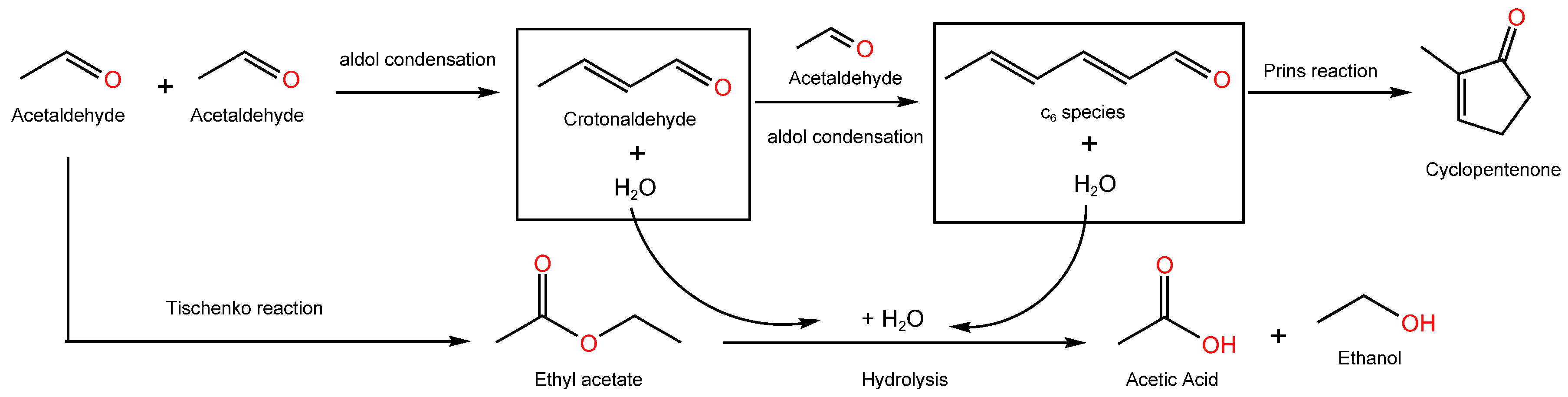
The study also identified that the main by-products in the aldol condensation of acetaldehyde catalyzed by heteroatom-doped Zr-β zeolites include ethanol, acetic acid, ethyl acetate, 1,3-butadiene, and methylcyclopentenone. Combining in situ infrared spectroscopy with mechanistic deduction, the possible reaction pathway for Zr-β zeolite-catalyzed acetaldehyde aldol condensation is illustrated in Figure 2. The reaction network on Zr-β zeolite was clearly elucidated: the main reaction involves the aldol condensation of acetaldehyde to form crotonaldehyde. The side reactions include the Tischenko reaction of acetaldehyde to form ethyl acetate (which subsequently hydrolyzes into acetic acid and ethanol), as well as the further condensation of crotonaldehyde with acetaldehyde to generate C6-enal, which then undergoes a Prins reaction to form methylcyclopentenone, and even heavier fractions. To inhibit the formation of the key by-product methylcyclopentenone, alkali metals (Na, K) were introduced to modify the Zr-β zeolite, successfully suppressing Brønsted acid sites. The modified catalyst maintained an acetaldehyde conversion of approximately 15% after 12 h of reaction, significantly improved the crotonaldehyde selectivity to 94%, and reduced the methylcyclopentenone selectivity from 6.5% to around 2%, demonstrating excellent catalytic performance and stability.
Regarding metal-containing aluminophosphate zeolite, Jeong et al. [54] systematically investigated the adsorption and reaction behavior of acetaldehyde on the surfaces of AlPO4, FeAlPO4, and CoAlPO4 at low temperatures of −100 °C. The study confirmed that the aldol condensation reaction can occur even under extremely low-temperature conditions, and Lewis acid sites are the core active centers for activating acetaldehyde and driving the reaction. Specifically, an increase in the density of Lewis acid sites significantly promoted acetaldehyde conversion. This finding profoundly reveals the decisive role of Lewis acid sites in C-C bond construction under low-temperature conditions. The performance of typical heterogeneous catalysts for the acetaldehyde aldol condensation reaction is listed in Table 1.

4. Reaction Mechanisms for Crotonaldehyde Synthesis from Acetaldehyde

4.1. Homogeneous Reaction Mechanism

Acetaldehyde, due to its reactive α-hydrogen atoms, readily undergoes aldol condensation under acid or base catalysis to form α,β-unsaturated aldehydes. The microscopic mechanisms differ significantly depending on the catalytic environment.
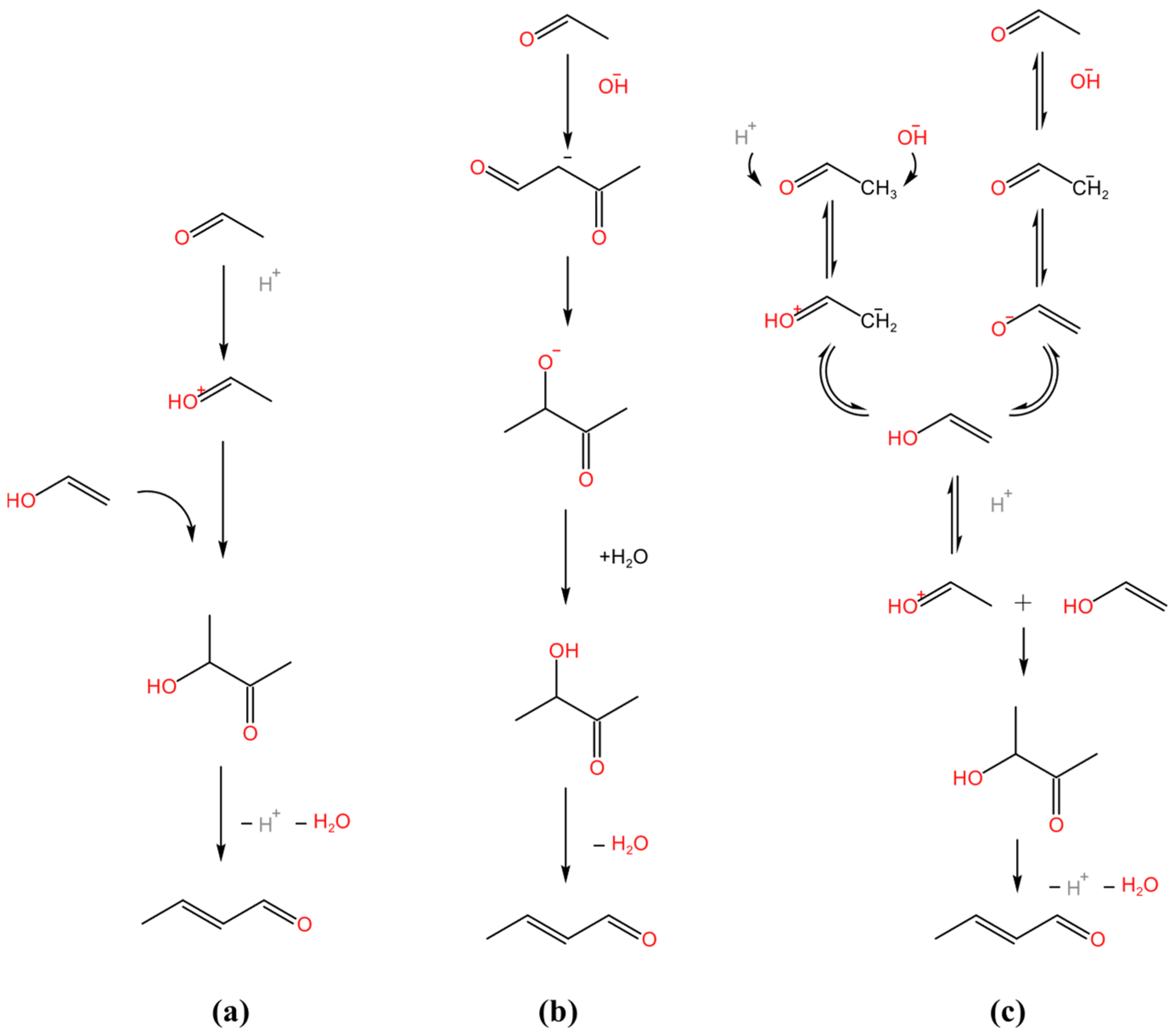
Under acidic catalysis, the reaction primarily follows an enolization pathway. First, the acidic sites on the catalyst protonate the carbonyl oxygen of acetaldehyde, significantly enhancing the electrophilicity of the carbonyl carbon and the acidity of the α-hydrogen. This facilitates α-H dissociation to form an enol intermediate. The enol then acts as a nucleophile and attacks the carbonyl carbon of another protonated acetaldehyde molecule, forming a protonated α-hydroxy aldehyde intermediate. Finally, through proton transfer and dehydration, a thermodynamically stable α,β-unsaturated aldehyde is formed (as shown in Figure 3a).
In basic catalytic systems, the aldol condensation follows a carbanion pathway [56]. The base first abstracts the α-hydrogen from acetaldehyde to form a highly reactive carbanion (enolate). This nucleophilic species attacks the carbonyl carbon of another acetaldehyde molecule, generating an alkoxide intermediate. The alkoxide then abstracts a proton from the solvent (e.g., water) to form α-hydroxy aldehyde. Due to its instability, the α-hydroxy aldehyde readily undergoes dehydration, eliminating one molecule of water to form the conjugated α,β-unsaturated aldehyde (as shown in Figure 3b).
Acid–base bifunctional catalysis optimizes the reaction pathway through the synergistic action of dual active sites. The mechanism generally involves two modes (Figure 3c): Mode I (concerted activation of a single molecule): Acid sites polarize the carbonyl group, while base sites activate the α-hydrogen, jointly facilitating rapid formation of the enol intermediate. Mode II (stepwise activation): Base sites first generate enolate species, which are subsequently converted into enol structures under acid site assistance. In both cases, the enol intermediate acts as a nucleophile and attacks another acetaldehyde molecule activated by acid sites, followed by dehydration to yield crotonaldehyde. This synergistic mechanism effectively lowers the reaction energy barrier and enhances catalytic efficiency [57,58].
The microscopic mechanism of the aldol condensation reaction of acetaldehyde is highly dependent on the acid–base properties of the catalytic environment. Under acidic conditions, the reaction proceeds via an enolization pathway induced by carbonyl protonation, relying on the combination of the electrophilicity of the protonated carbonyl group and the nucleophilicity of the enol. Under alkaline conditions, the reaction follows a carbanion pathway, where a basic site abstracts an α-hydrogen to generate an active carbanion that directly attacks the carbonyl group. In contrast, acid–base synergistic catalysis utilizes the cooperative or stepwise action of bifunctional sites to simultaneously activate the carbonyl group and the α-hydrogen, significantly lowering the reaction energy barrier and accelerating the formation of the enol intermediate. Although the three pathways differ in the mode of intermediate formation (protonated enol, carbanion, or synergistic enol), they all ultimately proceed through nucleophilic addition and dehydration steps to efficiently convert into thermodynamically stable crotonaldehyde.

4.2. Heterogeneous Reaction Mechanism

Regarding the aldol condensation reaction of acetaldehyde, oxide and zeolite catalysts exhibit distinct reaction mechanisms due to differences in their intrinsic structural characteristics, such as the distribution of basic sites, the concentration of oxygen vacancies, and the nature of metal Lewis acid sites. Consequently, the following section will explore these mechanisms in a categorized manner.
In terms of mechanistic research, while in situ infrared spectroscopy is effective in capturing key intermediates during the reaction process to elucidate the catalytic pathway, it still faces challenges in detecting critical species during rapid transient processes such as adsorption, reaction, and desorption. Therefore, the combination of in situ infrared characterization with Density Functional Theory (DFT) calculations is particularly crucial: the former provides experimental evidence, while the latter constructs reasonable reaction pathway models. This synergistic strategy not only compensates for the limitations of single-method approaches but also provides a solid theoretical foundation for the rational design of novel catalysts.

4.2.1. Metal Oxide Catalysts of Reaction Mechanism

Metal oxide catalysts exhibit significant mechanistic differences in the aldol condensation of acetaldehyde. Their catalytic activity is primarily regulated by the synergistic effects of crystal structure, exposed crystal facets, size effects, and surface defects (such as oxygen vacancies).
The catalytic behavior of the TiO2 series is highly dependent on crystal facet structure and surface oxidation states. Pepin et al. [59] confirmed that anatase TiO2 with the (001) facet (plate-like morphology) exhibits higher acetaldehyde conversion and crotonaldehyde selectivity compared to the (101) facet (bipyramid morphology). Furthermore, crotonaldehyde selectivity increases with crystal size, and enhanced surface oxidation levels also improve product selectivity. The reaction mechanism exhibits characteristics similar to homogeneous catalysis; intermediates such as 3-hydroxybutyraldehyde [60] and acetaldehyde dimers [61] can be observed during the reaction. The latter is considered the key factor leading to rapid catalyst deactivation. Kinetic isotope effect studies indicate that the enolization process (C-H bond activation) is not the rate-determining step; rather, the adsorption of acetaldehyde and the desorption of products (crotonaldehyde or water) are the rate-determining steps [62].
The catalytic performance of the CeO2 series is primarily influenced by the strength of surface basic sites, crystal facet structure, and oxygen vacancy concentration. Mann et al. [31] found that while CeO2 with different morphologies (cubes, octahedra, and nanowires) can all produce crotonaldehyde (selectivity approximately 50%), strong basic sites (such as defect sites and (100) facets) significantly promote the formation of the by-product ethanol. The selectivity order is: cubic phase ≈ nanowires >> octahedra. Although octahedral CeO2 exhibits excellent activity at room temperature, it is limited by hindered crotonaldehyde desorption, which easily leads to product accumulation on the surface [63]. Mullins et al. [64] pointed out that crotonaldehyde is primarily generated on fully oxidized CeO2 surfaces, while reduced surfaces show almost no activity. Zhao et al. [65] combined DFT calculations with TPR experiments to reveal that adjacent oxygen vacancy pairs (oxygen vacancy dimers) on partially reduced CeO2-x (111) surfaces can synergistically activate two acetaldehyde molecules: one molecule generates an enol, while the neighboring oxygen vacancy is activated to adsorb the second acetaldehyde molecule. Liang et al. [33] further confirmed that oxygen vacancies act as Lewis acid sites during the reaction, working in synergy with lattice oxygen (basic sites). The total yield of condensation products shows a linear positive correlation with oxygen vacancy concentration; among them, reduced cubic CeO2 exhibits the optimal conversion rate due to its highest oxygen vacancy concentration.
The mechanism of basic oxides (e.g., MgO/SiO2, ZrO2/SiO2) follows a typical base-catalyzed pathway [25,66]. Ordomsky et al. [25] pointed out that strong basic sites on the surface of MgO/SiO2 (such as O2− in MgO clusters) drive the reaction: the α-hydrogen of acetaldehyde binds with the basic site to form a stable carbanion resonance hybrid. This species acts as a nucleophile to attack the carbonyl carbon of another acetaldehyde molecule, generating an alkoxide intermediate. After protonation, 3-hydroxybutyraldehyde is formed, which subsequently dehydrates to produce crotonaldehyde. Ivanova et al. [67], in their study on Ag/ZrO2/SiO2 catalysts, further elucidated that acetaldehyde generated from ethanol dehydrogenation adsorbs onto the Lewis acid sites of Zr to convert into an enol (carbanion). This species then undergoes C-C coupling with gaseous acetaldehyde following the Eley–Rideal mechanism. Kinetic isotope effect analysis showed that the rate of butadiene formation from deuterated CD3CH2OH was significantly lower compared to CH3CH2OH. This significant isotope effect revealed the existence of an enol (carbanion) formation step during the reaction process, while the acetaldehyde condensation step was identified as the rate-determining step for the overall reaction.
In the process of converting ethanol to 1,3-butadiene over MgO, MgO serves as the active site for the critical step of acetaldehyde aldol condensation. DFT-based computational analysis of the reaction network [68,69] indicates that Cu and Zr can significantly modulate the acidity and basicity of the MgO surface. Cu as a promoter can simultaneously lower the energy barrier for the enolization step of acetaldehyde on weak basic sites and the energy barrier for the proton back-transfer step on strong basic sites. Zr as a promoter: Can promote C-C bond formation and proton back-transfer on strong basic sites. Its introduction is expected to eliminate overly strong basic sites, thereby suppressing catalyst deactivation caused by coking due to excessive acetaldehyde condensation.
Furthermore, SiO2 plays a dual promoting role in the MgO/SiO2 system. Structural promoter: It effectively inhibits the agglomeration of MgO particles, maintaining their high dispersion. Electronic promoter: It significantly modulates the electronic structure and acid–base properties of MgO. When MgO is loaded onto the SiO2 surface, the Lewis acidity of Mg ions is enhanced, while the basicity of O anions is weakened. This synergistic regulation helps balance the energy barriers of the enolization and proton back-transfer steps, thereby reducing the overall reaction energy barrier of the aldol condensation. Based on this analysis, Cu exhibits a significant promoting effect on the aldol condensation reaction on both types of coordination structures on the MgO surface. In contrast, the introduction of Zr is more beneficial for enhancing the catalytic performance of strong basic catalysts.
Similarly, studies on the ZrO2 system [70] found that during the acetaldehyde aldol condensation process, the energy barrier for the proton transfer step is the highest. The actual rate-limiting step is the transfer of a proton from the carbon chain to the catalyst surface, rather than the C-C coupling process.
In summary, the TiO2 series relies on the exposure of specific crystal facets and surface oxidation states, exhibiting characteristics similar to homogeneous catalysis, where product desorption is often the rate-determining step. The CeO2 series utilizes acid–base synergistic sites constructed by oxygen vacancies and lattice oxygen, achieving synergistic activation of two acetaldehyde molecules through adjacent oxygen vacancy pairs. Meanwhile, the surface basic strength determines the distribution of by-products. Basic oxides (such as MgO/SiO2, ZrO2/SiO2) follow a typical base-catalyzed pathway, where strong basic sites (O2−) induce carbanion formation and drive C-C coupling, with the acetaldehyde condensation step typically being the rate-determining step. In conclusion, by precisely regulating the crystal facet structure, defect engineering, and distribution of acid–base sites, the reaction pathway can be effectively optimized, significantly improving the efficiency and selectivity of the conversion of acetaldehyde to crotonaldehyde.

4.2.2. Heteroatom Zeolite Catalysts of Reaction Mechanism

In the study of acetaldehyde condensation reactions catalyzed by zeolites, the type of heteroatom exerts a decisive influence on the reaction mechanism. Although Sn-BEA, Ti-BEA, and Zr-BEA all belong to the M-BEA series, their catalytic pathways exhibit significant differences [44,70,71]. Hydrogen-deuterium exchange experiments (using acetaldehyde and D2O) revealed that the H-D exchange rate on Sn-BEA catalysts is one order of magnitude higher than that on Zr-BEA and Ti-BEA, suggesting distinctly different reaction kinetic characteristics. Combined with FTIR characterization results, it was found that on the surface of Sn-BEA, the Si-O-Sn bond undergoes cleavage, and the α-proton of acetaldehyde transfers to the zeolite framework, forming new silanol groups (Si-OH). In contrast, the FTIR spectrum of Zr-BEA did not detect the formation of silanol groups [44]. This phenomenon indicates that Sn-BEA follows a typical enolization mechanism: acetaldehyde molecules adsorb directly onto the framework Sn sites, generating an enolized intermediate via α-H transfer, which subsequently undergoes C-C coupling to form 3-hydroxybutyraldehyde.
Conversely, DFT calculations further confirmed that the energy barrier for the conversion of acetaldehyde to an enol structure on Zr-BEA catalysts is extremely high. Consequently, the enolization pathway is neither thermodynamically nor kinetically favorable, suggesting that the catalytic mechanism of Zr-BEA does not proceed via an enol intermediate.
Based on these differences, researchers proposed a new reaction pathway for the direct condensation of acetaldehyde to crotonaldehyde on Zr-BEA zeolites. This pathway does not rely on an enolization step but instead achieves the reaction through a bimolecular synergistic mechanism: Co-adsorption: Two acetaldehyde molecules undergo co-adsorption on open M(IV) Lewis acid sites. Proton Transfer: Assisted by M-OH groups, a proton transfer occurs between the acetaldehyde molecules to form a transition state, which converts into 3-hydroxybutyraldehyde. Dehydration: Finally, a dehydration step yields crotonaldehyde. In this process, the open M-OH groups play a critical role in stabilizing the adsorbates, significantly lowering the reaction activation energy and thereby enhancing catalytic efficiency.
The Ivanova research group [45,46] employed a combined approach of in situ FTIR spectroscopy and DFT calculations to elucidate the fundamental nature of the active sites in Zr-BEA zeolites during the conversion of ethanol to butadiene. Their study revealed that Zr-BEA zeolites contain both Open and Closed Zr sites. Open Zr Sites: These are isolated Zr atoms coordinated by three siloxane bonds and one hydroxyl group (Zr-OH). Closed Zr Sites: These sites lack the hydroxyl functionality and possess a different coordination environment. Kinetic analysis and active site distribution studies demonstrated a positive correlation between the content of open Zr sites and catalytic activity, whereas closed Zr sites exhibited significantly lower activity during the reaction. Compared to closed sites, open sites not only possess stronger Lewis acidity but also offer a spatial geometric structure that is more favorable for reactant accessibility. Consequently, open sites serve as the primary active centers.
Furthermore, the research team expanded their investigation to the aldol condensation of n-butyraldehyde catalyzed by Zr-β zeolites [42]. Kinetic experiments indicated that the main product of n-butyraldehyde condensation is 2-ethyl-2-hexenal (2-EN). This process is accompanied by side reactions, including Cannizzaro disproportionation and the hydrogenation-dehydration of 2-EN. Isopropanol Temperature-Programmed Desorption (IPA-TPD) experiments confirmed the coexistence of open and closed Zr sites on the surface of Zr-β. By calculating the Turnover Frequency (TOF) for both types of sites, it was found that open sites exhibit significantly higher catalytic activity, acting as the primary drivers for the reaction. These results strongly support the previously proposed mechanistic model that “open sites dominate the reaction,” demonstrating its universality and feasibility in both Zr-BEA and Zr-β zeolite systems. Additionally, DFT calculations have elucidated the positive impact of open Zr sites on the catalytic performance of Zr-BEA [72].
The Li research group [50] systematically investigated the catalytic performance of Beta zeolites modified with various rare earth metals (Y, La, Ce, Sc) in the self-condensation reactions of acetaldehyde and propionaldehyde. The study found that, compared to catalysts modified with other rare earth metals, the Yttrium-loaded Beta zeolite (Y/Beta) exhibited superior catalytic activity.
To deeply elucidate the structure-activity relationship, the team comprehensively employed multiple characterization techniques, including Temperature-Programmed Surface Reaction (TPSR), in situ Diffuse Reflectance Infrared Fourier Transform Spectroscopy (in situ DRIFTS), and in situ Ultraviolet-Visible Diffuse Reflectance Spectroscopy (in situ UV-vis DRS). These methods achieved the synergistic monitoring of the real-time evolution of surface species and the distribution of gaseous products. Based on spectroscopic evidence combined with Density Functional Theory (DFT) calculations, the research team constructed a reaction mechanism model for aldehyde self-condensation on the Y/Beta catalyst.
Taking acetaldehyde self-condensation as an example, the reaction follows a typical acid–base synergistic catalytic pathway: First, acetaldehyde molecules adsorb onto the Y active sites. Subsequently, acetaldehyde removes an α-H to form a carbanion, and the removed proton interacts with the hydroxyl group connected to the Y site. The generated carbanion acts as a nucleophile to attack the carbonyl carbon of another acetaldehyde molecule, undergoing C-C coupling. Finally, proton back-transfer generates the 3-hydroxybutyraldehyde intermediate, which further dehydrates to produce crotonaldehyde.
Meanwhile, Zhang et al. [43] conducted an in-depth study on the kinetics of acetaldehyde aldol condensation and esterification reactions on the surface of Ti-BEA zeolites. Isotope tracing experiments clearly indicated that the removal of the acetaldehyde α-H is the Rate-Determining Step (RDS) of the reaction; in situ IR analysis further confirmed that this dehydrogenation step manifests as an irreversible process under reaction conditions. The study confirmed that Lewis acid–base pairs constitute the core active centers for Ti-BEA catalyzed acetaldehyde conversion, and their synergistic action drives the activation of α-H and the subsequent nucleophilic addition reaction.
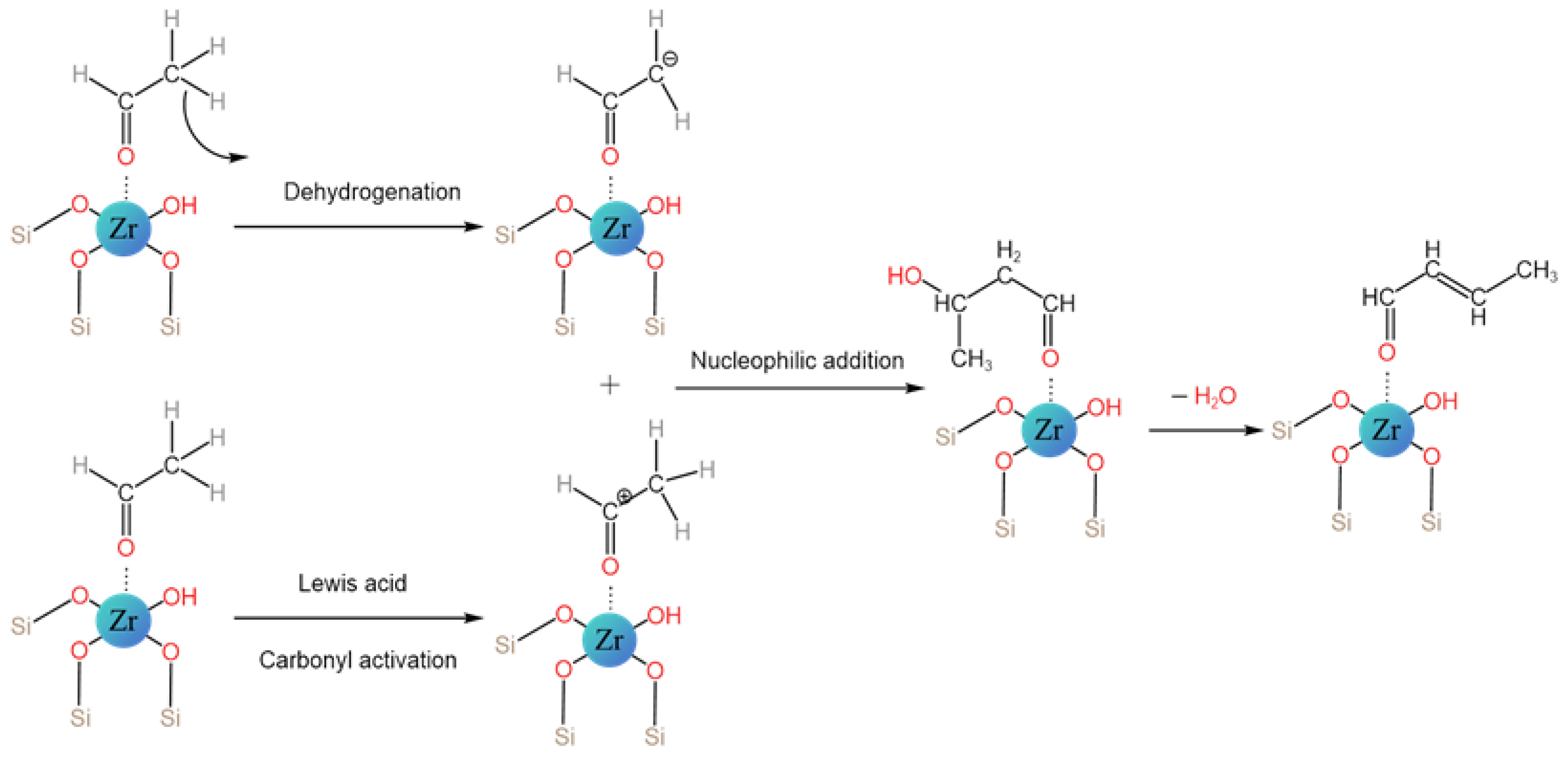
Jiang et al. [53] deeply verified the microscopic reaction mechanism of Zr-β zeolite catalyzing the aldol condensation of acetaldehyde to produce crotonaldehyde based on in situ FTIR experimental results. The study confirmed that acetaldehyde molecules first specifically adsorb onto the Zr active sites within the Zr-β zeolite framework. Under the synergistic effect of these sites, the α-H of the acetaldehyde molecule dissociates to generate carbanion species. These carbanion species can stably adsorb on the active centers of the Zr-β zeolite, thereby effectively promoting the subsequent aldol condensation reaction. Meanwhile, another acetaldehyde molecule in the system has its carbonyl (C=O) bond significantly activated under the Lewis acid effect of the Zr site. Subsequently, the activated carbonyl carbon undergoes nucleophilic attack by the aforementioned carbanion species, resulting in a nucleophilic addition reaction that generates the key intermediate, 3-hydroxybutyraldehyde. Finally, 3-hydroxybutyraldehyde undergoes a dehydration step under reaction conditions to convert into the target product, crotonaldehyde. The aforementioned mechanism is illustrated in Figure 4. This mechanism clearly elucidates the multiple synergistic roles of Zr sites in α-H activation, carbonyl activation, and intermediate stabilization.
The aldol condensation reaction is accompanied by the generation of water molecules, which have a significant impact on the acidic sites and adsorption properties of the catalyst surface. For the acetaldehyde-to-crotonaldehyde system, Geng et al. [73] combined Density Functional Theory (DFT) calculations with Microkinetic Modeling (MKM) to systematically investigate the specific mechanism of water molecules in the Zr-BEA zeolite catalyzed reaction. The study covered key elementary steps including adsorption, dehydrogenation, C-C coupling, and dehydration. The results indicate that co-adsorbed water molecules in the reaction system can effectively promote the dehydration of coupling products through an intermolecular hydrogen transfer mechanism, thereby significantly reducing the reaction energy barrier of this step. Furthermore, the presence of water alters the electron density distribution on the catalyst surface: on one hand, it enhances the activity of the dehydrogenation reaction, while on the other hand, it exerts a slight inhibitory effect on C-C coupling and reactant adsorption processes. Quantitative simulation of all elementary reactions, adsorption, and desorption processes via the microkinetic model revealed that under anhydrous or low-water conditions, water molecules generated by dehydrogenation tend to desorb rapidly, and the condensation process proceeds mainly through an intramolecular hydrogen transfer mechanism. However, when water molecules are present in the reactant environment, the condensation pathway shifts from being dominated by an intramolecular hydrogen transfer mechanism to an intermolecular hydrogen transfer mechanism.
To further reveal the mass transfer behavior of reaction components within the pores and their impact on catalyst lifetime, Geng et al. [74] conducted molecular dynamics simulations based on the ReaxFF reactive force field to deeply investigate the diffusion characteristics of key components in the acetaldehyde aldol condensation within the pores of Zr-BEA zeolites. Simulation results show that the introduction of framework heteroatom Zr significantly alters the diffusion rate and distribution state of molecules within the pores. Specifically, reactant molecules tend to preferentially aggregate in pore regions without Zr, while larger molecules with strong chemical adsorption capabilities (such as methylcyclopentenone) are easily captured by Zr atoms. This strong chemical adsorption leads to the retention of large molecules within the pores, thereby causing pore blocking. Although the presence of Zr atoms provides active centers, it may also cause mass transfer resistance due to the large molecule capture effect. Therefore, in the modification and application of Zr-BEA zeolites, optimizing their pore diffusion performance to alleviate pore blocking is crucial for extending the service life of the catalyst in the acetaldehyde aldol condensation reaction.
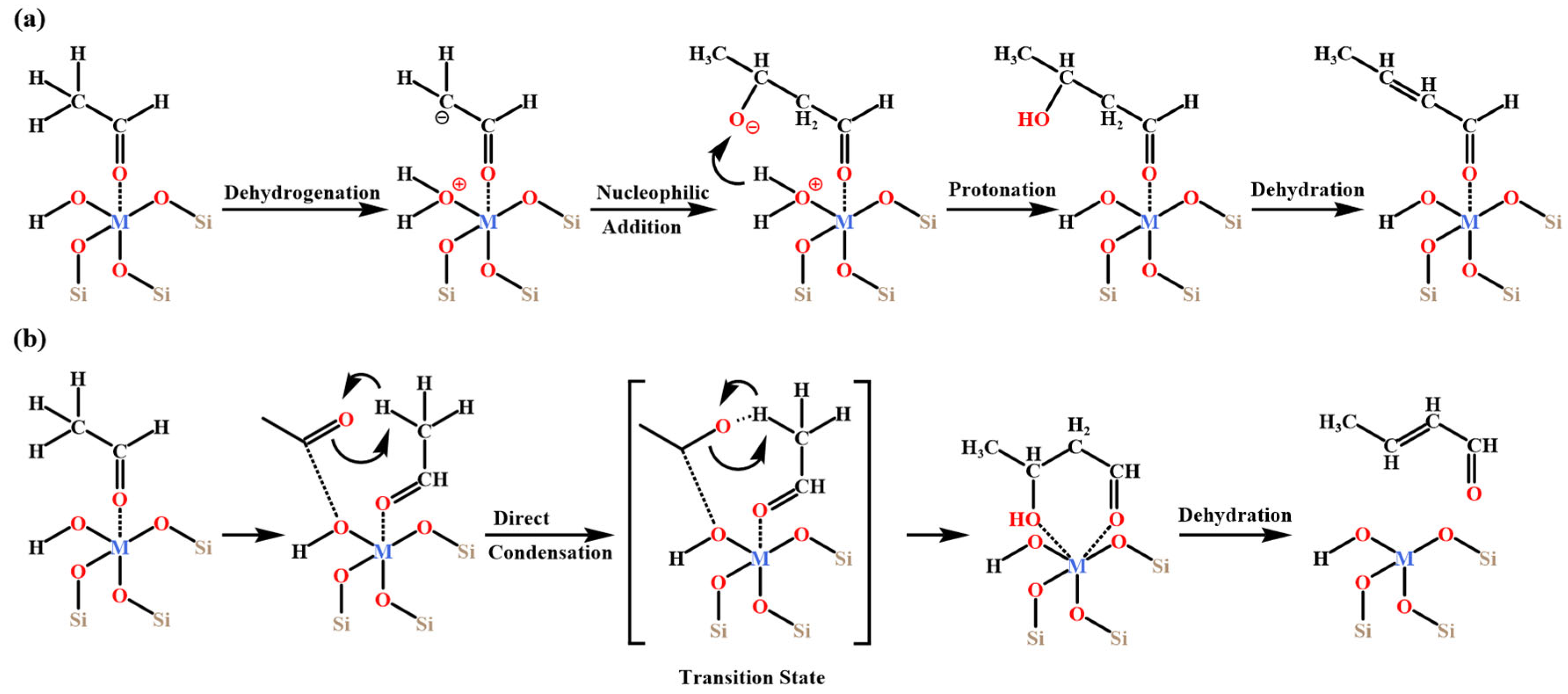
In summary, regarding the reaction mechanism of zeolite-catalyzed acetaldehyde condensation to produce crotonaldehyde, the academic community currently mainly exists two completely different theoretical interpretations. The first is the “Dehydrogenation-Nucleophilic Addition Mechanism,” (as shown in Figure 5a) which proposes that the acetaldehyde molecule first adsorbs onto the active sites on the zeolite surface, undergoes a key dehydrogenation step to generate a highly active carbanion (or enolate) intermediate; subsequently, this nucleophilic species attacks the carbonyl carbon of another acetaldehyde molecule, undergoing a nucleophilic addition reaction to generate 3-hydroxybutyraldehyde, which is finally dehydrated into crotonaldehyde under the synergistic catalysis of acid–base sites, thus completing the catalytic cycle. The second is the “Direct Condensation Mechanism,” (as shown in Figure 5b) which holds that the acetaldehyde molecule does not need to undergo a dehydrogenation process in advance, but directly undergoes a condensation reaction through a bimolecular synergistic action on the zeolite surface via a six-membered ring transition state to generate 3-hydroxybutyraldehyde, which immediately dehydrates to form the target product. The core divergence between these two mechanisms lies in whether the reaction pathway must pass through the rate-determining intermediate state of “dehydrogenation to generate carbanion”; the pore confinement effect of the zeolite, the strength and distribution characteristics of surface acidic sites will significantly influence the selectivity of the reaction pathway. Deeply analyzing these two mechanisms is of important theoretical guiding significance for the rational design of efficient zeolite catalysts, precise regulation of reaction pathways, and optimization of process conditions.

5. Perspectives

Crotonaldehyde, as a key C4 platform molecule connecting basic petrochemical feedstocks with high-value-added fine chemicals, possesses a unique α,β-unsaturated conjugated structure. This structure endows it with high flexibility at both electrophilic and nucleophilic reaction sites, securing its irreplaceable position in the industrial production of core derivatives such as sorbic acid, higher alcohols, and crotonic acid. Industrially, the homogeneous preparation of crotonaldehyde faces multiple severe challenges, including difficulties in catalyst recovery, high energy consumption for product separation, severe equipment corrosion, and high costs for “three waste” treatment. The catalytic system for converting acetaldehyde to crotonaldehyde is currently undergoing a critical transition from homogeneous base catalysis to heterogeneous catalysis.
Metal oxides and their supported catalysts, thanks to their precise regulation of acid–base sites, crystal plane structures, and oxygen vacancy concentrations, have become the core systems for heterogeneous catalysis of acetaldehyde aldol condensation. Existing research confirms that the ZrO2/SiO2 and MgO/SiO2 systems exhibit excellent performance in activity and selectivity due to their rich Lewis acid sites, but they face challenges of deactivation by coke deposition. In contrast, CeO2 relies on the synergistic effect of oxygen vacancies (Lewis acid) and lattice oxygen (base sites) to drive the reaction; its activity is closely related to the concentration of oxygen vacancies and exposed crystal planes. Meanwhile, TiO2 demonstrates unique photocatalytic potential, while MoOx and LDHs systems are limited by carrier interactions and side reaction pathways.
Heteroatom zeolite, endowed with excellent Lewis acidity by electron-deficient four-coordinated species introduced into its framework, has become a key heterogeneous material for catalyzing aldehyde conversion and C-C bond construction. Existing research has systematically elucidated the regulation mechanisms of the heteroatom type (e.g., Zr, Sn, Ti) and introduction strategies (e.g., ion substitution, liquid-phase insertion, bifunctional promoter modification) on the strength and distribution of acid sites. It has been confirmed that medium-strong Lewis acid sites dominate acetaldehyde conversion, while inhibiting Brønsted acid sites can significantly improve crotonaldehyde selectivity (e.g., modified Zr-β can reach 94%). Furthermore, combining in situ spectroscopy with DFT calculations has revealed a complex reaction network involving aldol condensation, Tischenko reactions, and Prins cyclization, and has analyzed the stage-wise deactivation law of “pore blocking-surface coverage” caused by carbonaceous deposition.
Future research should focus on constructing new catalytic systems with clear “structure-activity relationships” to promote the acetaldehyde-to-crotonaldehyde process towards efficiency, greenness, and industrialization. Specific research contents can be summarized in the following three core aspects:
(1)
Precise Regulation of Active Sites and Analysis of Dynamic Evolution Mechanisms
Utilize advanced in situ characterization techniques (such as in situ DRIFTS, in situ XAS, etc.) combined with multi-scale theoretical calculations (such as DFT, microkinetic modeling) to deeply analyze the dynamic evolution behavior of active sites under real reaction conditions. Achieve atomic-level precise regulation of open Lewis acid sites by optimizing their acid strength, acid density, and spatial geometric distribution to construct active centers with specific acid–base synergistic effects. The aim is to balance reaction activity and crotonaldehyde selectivity at the molecular level, thereby suppressing side reactions such as excessive condensation from the source.
(2)
Elucidation of Reaction Pathways and Deep Investigation of Coke Deactivation Mechanisms
Combine in-depth kinetic analysis to establish a full reaction network model covering main reactions, side reactions, and coke formation, accurately identifying the rate-determining step and key intermediates, and elucidating the microscopic pathways for C-C bond construction and C-O bond cleavage. On this basis, systematically investigate the generation sources, chemical structures, evolution pathways of coke species, and their coverage mechanisms on active sites. By clarifying the key factors leading to catalyst deactivation (such as pore blocking or surface coverage), a solid theoretical basis is provided for the rational design of anti-coking catalysts.
(3)
Development of Targeted Regeneration Strategies and Enhancement of Stability
Based on the clarified deactivation mechanisms of coke, develop targeted catalyst regeneration strategies. Explore the efficiency of coke removal, the stability of the catalyst framework structure, and the degree of active site recovery under mild regeneration conditions (such as low-temperature oxidation, gas-phase regeneration, etc.). By optimizing regeneration process parameters, develop composite catalyst systems with excellent anti-coking capabilities and long cycle life, thereby effectively solving the problem of rapid catalyst deactivation in industrial applications.

Author Contributions

Conceptualization, K.Y., L.W. and F.S.; methodology, K.Y., L.W. and F.S.; software, K.Y., L.W. and F.S.; validation, K.Y., L.W. and F.S.; formal analysis, K.Y., L.W. and F.S.; investigation, K.Y., L.W. and F.S.; resources, K.Y., L.W. and F.S.; data curation, K.Y., L.W. and F.S.; writing—original draft preparation, K.Y., L.W. and F.S.; writing—review and editing, K.Y., L.W. and F.S.; visualization, K.Y., L.W. and F.S.; supervision, K.Y., L.W. and F.S.; project administration, K.Y., L.W. and F.S. All authors have read and agreed to the published version of the manuscript.

Funding

This research received no external funding.

Data Availability Statement

Data is available on request from the authors.

Conflicts of Interest

K.Y. was employed by the company Zhejiang Ruizhi Holdings Group Co., Ltd., F.S. was employed by the company Tianjin Jiuyuan Chemical Engineering Co., Ltd. The remaining author declares that the research was conducted in the absence of any commercial or financial relationships that could be construed as a potential conflict of interest.

References

  1. Hester, A.S.; Himmler, K. Staff-Industry Collaborative Report Chemicals from Acetaldehyde. Ind. Eng. Chem. 1959, 51, 1424–1430. [Google Scholar] [CrossRef]
  2. Hayes, R.N.; Grese, R.P.; Gross, M.L. Base-initiated aldol condensations in the gas phase. J. Am. Chem. Soc. 1989, 111, 8336–8341. [Google Scholar] [CrossRef]
  3. Baigrie, L.M.; Cox, R.A.; Slebocka-Tilk, H.; Tencer, M.; Tidwell, T.T. Acid-catalyzed enolization and aldol condensation of acetaldehyde. J. Am. Chem. Soc. 1985, 107, 3640–3645. [Google Scholar] [CrossRef]
  4. Li, H.; Riisager, A.; Saravanamurugan, S.; Pandey, A.; Sangwan, R.S.; Yang, S.; Luque, R. Carbon-increasing catalytic strategies for upgrading biomass into energy-intensive fuels and chemicals. ACS Catal. 2017, 8, 148–187. [Google Scholar] [CrossRef]
  5. Geng, Z.; Sheng, L.; Zhang, K.; Shi, F.; Gong, H. Study on the process of producing crotonaldehyde from acetaldehyde catalyzed by Zr-β zeolite. Sep. Purif. Technol. 2024, 335, 126123. [Google Scholar] [CrossRef]
  6. Li, F.; Wang, B.; Chen, X.; Fan, H.; Yang, X.; Guo, Q. Low-temperature aldol condensation of aldehydes on R-TiO2(100)-(1 × 1): Exceptional selectivity for α,β-unsaturated enal production. J. Phys. Chem. Lett. 2021, 12, 1708–1717. [Google Scholar] [CrossRef] [PubMed]
  7. Madhavaram, H.; Idriss, H. Evidence of furan formation from acetaldehyde over β-UO3. Catal. Today 2000, 63, 309–315. [Google Scholar] [CrossRef]
  8. Daniel, J.W. Metabolic aspects of antioxidants and preservatives. Xenobiotica 1986, 16, 1073–1078. [Google Scholar] [CrossRef] [PubMed]
  9. Schlatter, J.; Würgler, F.E.; Kränzlin, R.; Maier, P.; Holliger, E.; Graf, U. The potential genotoxicity of sorbates: Effects on cell cycle in vitro in V79 cells and somatic mutations in Drosophila. Food Chem. Toxicol. 1992, 30, 843–851. [Google Scholar] [CrossRef]
  10. Jung, R.; Cojocel, C.; Müller, W.; Böttger, D.; Lück, E. Evaluation of the genotoxic potential of sorbic acid and potassium sorbate. Food Chem. Toxicol. 1992, 30, 1–7. [Google Scholar] [CrossRef]
  11. Kim, M.S.; Choi, D.; Ha, J.; Choi, K.; Yu, J.H.; Dumesic, J.A.; Huber, G.W. Catalytic strategy for conversion of triacetic acid lactone to potassium sorbate. ACS Catal. 2023, 13, 14031–14041. [Google Scholar] [CrossRef]
  12. Ohtsuki, T.; Sato, K.; Sugimoto, N.; Akiyama, H.; Kawamura, Y. Absolute quantitative analysis for sorbic acid in processed foods using proton nuclear magnetic resonance spectroscopy. Anal. Chim. Acta 2012, 734, 54–61. [Google Scholar] [CrossRef] [PubMed]
  13. Zhang, Z.H.; Wang, Z.Q.; Li, Z.R.; Zheng, W.B.; Fan, L.P.; Zhang, J.; Hu, Y.M.; Luo, M.F.; Wu, X.P.; Gong, X.Q.; et al. Metal-free ceria catalysis for selective hydrogenation of crotonaldehyde. ACS Catal. 2020, 10, 14560–14566. [Google Scholar] [CrossRef]
  14. Huang, H.; Guo, H.; Pei, Y. Screening of C3N-Supported Monometallic Atom Catalysts for Selective C=O Hydrogenation of Crotonaldehyde. ACS Catal. 2025, 15, 16121–16131. [Google Scholar] [CrossRef]
  15. Tamura, M.; Tokonami, K.; Nakagawa, Y.; Tomishige, K. Effective NbOx-Modified Ir/SiO2 Catalyst for Selective Gas-Phase Hydrogenation of Crotonaldehyde to Crotyl Alcohol. ACS Sustain. Chem. Eng. 2017, 5, 3685–3697. [Google Scholar] [CrossRef]
  16. Lan, X.; Wang, T. Highly Selective Catalysts for the Hydrogenation of Unsaturated Aldehydes: A Review. ACS Catal. 2020, 10, 2764–2790. [Google Scholar] [CrossRef]
  17. Xu, Y.-M.; Zheng, W.-B.; Hu, Y.-M.; Tang, C.; Jia, A.-P.; Lu, J.-Q. The effects of MoOx decoration on the selective hydrogenation of crotonaldehyde over MoOx-promoted Ir/TUD-1 catalysts. J. Catal. 2020, 381, 222–233. [Google Scholar] [CrossRef]
  18. Rolf, P.S.; Jürgen, B.; Christian, K. Crotonaldehyde and crotonic acid. In Ullmann’s Encyclopedia of Industrial Chemistry; Wiley: Hoboken, NJ, USA, 2000; pp. 1–20. [Google Scholar]
  19. Luo, S.; Falconer, J.L. Aldol condensation of acetaldehyde to form high molecular weight compounds on TiO2. Catal. Lett. 1999, 57, 89–93. [Google Scholar] [CrossRef]
  20. Barrett, C.J.; Chheda, J.N.; Huber, G.W.; Dumesic, J.A. Single-reactor process for sequential aldol-condensation and hydrogenation of biomass-derived compounds in water. Appl. Catal. B Environ. 2006, 66, 111–118. [Google Scholar] [CrossRef]
  21. Grunstein, N. Process for the Manufacture of Aldol from Acetaldehyde. U.S. Patent US1437139, 28 November 1922. [Google Scholar]
  22. Wu, Y.H.; Ren, W.H.; Liang, Z.L.; Liu, Z.N.; Wu, G.S. Liquid-Phase Aldol Condesation of Acetaldehyde and Its Kinetics. Chem. React. Eng. Technol. 2013, 29, 75–80. [Google Scholar]
  23. Scheidt, F.M. Vapor-phase aldol condensations over heterogeneous catalysts. J. Catal. 1964, 3, 372–378. [Google Scholar] [CrossRef]
  24. Shen, W.Q.; Tompsett, G.A.; Xing, R.; Conner, W.C.; Huber, G.W. Vapor phase butanal self-condensation over unsupported and supported alkaline earth metal oxides. J. Catal. 2012, 286, 248–259. [Google Scholar] [CrossRef]
  25. Ordomsky, V.V.; Sushkevich, V.L.; Ivanova, I.I. Study of acetaldehyde condensation chemistry over magnesia and zirconia supported on silic. J. Mol. Catal. A Chem. 2010, 333, 85–93. [Google Scholar] [CrossRef]
  26. Ji, W.; Chen, Y.; Kung, H. Vapor phase aldol condensation of acetaldehyde on metal oxide catalysts. Appl. Catal. A 1997, 161, 93–104. [Google Scholar] [CrossRef]
  27. Idriss, H.; Kim, K.S.; Barteau, M.A. Carbon-carbon bond formation via aldolization of acetaldehyde on single crystal and polycrystalline TiO2 surface. J. Catal. 1993, 139, 119–133. [Google Scholar] [CrossRef]
  28. Geng, Z.H.; Chen, X.; Yang, W.S.; Guo, Q.; Dai, D.X.; Yang, X.M. Photoinduced carbonyl coupling of aldehydes on anatase TiO2(101). J. Phys. Chem. C 2016, 120, 9897–9903. [Google Scholar] [CrossRef]
  29. Hauchecorne, B.; Terrens, D.; Verbruggen, S.; Martens, J.A.; Van Langenhove, H.; Demeestere, K.; Lenaerts, S. Elucidating the photocatalytic degradation pathway of acetaldehyde: An FTIR in situ study under atmospheric conditions. Appl. Catal. B Environ. 2011, 106, 630–638. [Google Scholar] [CrossRef]
  30. Madhavaram, H.; Idriss, H. Acetaldehyde reactions over the uranium oxide system. J. Catal. 2004, 224, 358–369. [Google Scholar] [CrossRef]
  31. Mann, A.K.P.; Wu, Z.L.; Calaza, F.C.; Overbury, S.H. Adsorption and reaction of acetaldehyde on shape-controlled CeO2 nanocrystals: Elucidation of structure-function relationships. ACS Catal. 2014, 4, 2437–2448. [Google Scholar] [CrossRef]
  32. Calaza, F.C.; Xu, Y.; Mullins, D.R.; Overbury, S.H. Oxygen vacancy-assisted coupling and enolization of acetaldehyde on CeO2(111). J. Am. Chem. Soc. 2012, 134, 18034–18045. [Google Scholar] [CrossRef]
  33. Liang, Z.; Jiang, D.H.; Fang, G.Q.; Leng, W.H.; Tu, P.X.; Tong, Y.Q.; Liu, L.; Ni, J.; Li, X.N. Catalytic enhancement of aldol condensation by oxygen vacancy on CeO2 catalysts. ChemistrySelect 2019, 4, 4364–4370. [Google Scholar] [CrossRef]
  34. Rasmussen, M.J.; Najmi, S.; Innocenti, G.; Medford, A.J.; Sievers, C.; Medlin, J.W. Supported molybdenum oxides for the aldol condensation reaction of acetaldehyde. J. Catal. 2022, 408, 216–226. [Google Scholar] [CrossRef]
  35. Kagunya, W.; Jones, W. Aldol condensation of acetaldehyde using calcined layered double hydroxides. Appl. Clay Sci. 1995, 10, 95–102. [Google Scholar] [CrossRef]
  36. Chavez Diaz, C.D.; Locatelli, S.; Gonzo, E.E. Acetaldehyde adsorption on HZSM-5 studied by infrared spectroscopy. Zeolites 1992, 12, 851–857. [Google Scholar] [CrossRef]
  37. Biaglow, A.I.; Sepa, J.; Gorte, R.J.; White, D. A 13C NMR study of the condensation chemistry of acetone and acetaldehyde adsorbed at the Brønsted acid sites in H-ZSM-5. J. Catal. 1995, 151, 373–384. [Google Scholar] [CrossRef]
  38. Zhang, L.; Pham, T.N.; Faria, J.; Resasco, D.E. Improving the selectivity to C4 products in the aldol condensation of acetaldehyde in ethanol over faujasite zeolites. Appl. Catal. A Gen. 2015, 504, 119–129. [Google Scholar] [CrossRef]
  39. Zhang, Q.; Gao, S.; Yu, J. Metal sites in zeolites: Synthesis, characterization, and catalysis. Chem. Rev. 2023, 123, 6039–6106. [Google Scholar] [CrossRef] [PubMed]
  40. Lewis, J.D.; Van de Vyver, S.; Román-Leshkov, Y. Acid-base pairs in Lewis acidic zeolites promote direct aldol reactions by soft enolization. Angew. Chem. Int. Ed. 2015, 54, 9835–9838. [Google Scholar] [CrossRef]
  41. Van de Vyver, S.; Odermatt, C.; Romero, K.; Prasomsri, T.; Román-Leshkov, Y. Solid Lewis Acids Catalyze the Carbon–Carbon Coupling between Carbohydrates and Formaldehyde. ACS Catal. 2015, 5, 972–977. [Google Scholar] [CrossRef]
  42. Kots, P.A.; Zabilska, A.V.; Ivanova, I.I. Selective self-condensation of butanal over Zr-BEA zeolites. ChemCatChem 2020, 12, 248–258. [Google Scholar] [CrossRef]
  43. Dumitriu, E.; Hulea, V.; Fechete, I.; Auroux, A.; Lacaze, J.; Guimon, C. The aldol condensation of lower aldehydes over MFI zeolites with different acidic properties. Microporous Mesoporous Mater. 2001, 43, 341–359. [Google Scholar] [CrossRef]
  44. Palagin, D.; Sushkevich, V.L.; Ivanova, I.I. C–C Coupling Catalyzed by Zeolites: Is Enolization the Only Possible Pathway for Aldol Condensation? J. Phys. Chem. C 2016, 120, 23566–23575. [Google Scholar] [CrossRef]
  45. Sushkevich, V.L.; Palagin, D.; Ivanova, I.I. With open arms: Open sites of ZrBEA zeolite facilitate selective synthesis of butadiene from ethanol. ACS Catal. 2015, 5, 4833–4836. [Google Scholar] [CrossRef]
  46. Sushkevich, V.L.; Vimont, A.; Travert, A.; Ivanova, I.I. Spectroscopic evidence for open and closed Lewis acid sites in ZrBEA zeolites. J. Phys. Chem. C 2015, 119, 17633–17639. [Google Scholar] [CrossRef]
  47. Müller, P.; Burt, S.P.; Love, A.M.; McDermott, W.P.; Wolf, P.; Hermans, I. Mechanistic study on the Lewis acid catalyzed synthesis of 1,3-butadiene over Ta-BEA using modulated operando DRIFTS-MS. ACS Catal. 2016, 6, 6823–6832. [Google Scholar] [CrossRef]
  48. Müller, P.; Wang, S.; Burt, S.P.; Hermans, I. Influence of metal doping on the Lewis acid catalyzed production of butadiene from ethanol studied by using modulated operando diffuse reflectance infrared fourier transform spectroscopy and mass spectrometry. ChemCatChem 2017, 9, 3572–3582. [Google Scholar] [CrossRef]
  49. Yan, T.; Dai, W.; Wu, G.; Lang, S.; Hunger, M.; Guan, N.J.; Li, L.D. Mechanistic insights into one-step catalytic conversion of ethanol to butadiene over bifunctional Zn-Y/beta zeolite. ACS Catal. 2018, 8, 2760–2773. [Google Scholar] [CrossRef]
  50. Yan, T.T.; Yao, S.K.; Dai, W.L.; Wu, G.J.; Guan, N.J.; Li, L.D. Self-aldol condensation of aldehydes over Lewis acidic rare-earth cations stabilized by zeolites. Chin. J. Catal. 2021, 42, 595–605. [Google Scholar] [CrossRef]
  51. Gu, H.; Yang, G.; Wang, L.; Jiang, H. Self-aldol condensation of acetaldehyde to crotonaldehyde over Lewis acidic metal incorporated *BEA zeolites. Mol. Catal. 2025, 570, 114666. [Google Scholar] [CrossRef]
  52. Jiang, H.; Gu, H.; Wang, L.; Yang, G. Deactivation mechanism of acetaldehyde self-condensation on Zr-based metelliosilicalites. Mol. Catal. 2024, 557, 113990. [Google Scholar] [CrossRef]
  53. Jiang, H.; Ran, Q.; Zhao, Y.; Yang, G.; Wang, L. Aldol condensation of acetaldehyde over Zr-β zeolites with tailored Lewis acidity and passivated Brønsted sites: Toward environmentally benign crotonaldehyde synthesis. Catal. Sci. Technol. 2025, 16, 176–188. [Google Scholar] [CrossRef]
  54. Jeong, M.S.; Frei, H. Acetaldehyde as a probe for the chemical properties of aluminophosphate molecular sieves. An in situ FT-IR study. J. Mol. Catal. A Chem. 2000, 156, 245–253. [Google Scholar] [CrossRef]
  55. Chang, Y.; Ko, A. Vapor phase reactions of acetaldehyde over type X zeolites. Appl. Catal. A-Gen. 2000, 190, 149–155. [Google Scholar] [CrossRef]
  56. Perrin, C.L.; Chang, K.L. The Complete Mechanism of an Aldol Condensation. J. Org. Chem. 2016, 81, 5631–5635. [Google Scholar] [CrossRef]
  57. Pauli, D.H.; Abraham, C.J.; Scerba, M.T.; Alden-Danforth, E.; Lectka, T. Bifimctional Asymmetric Catalysis: Cooperative Lewis Acid/Base Systems. Acc. Chem. Res. 2008, 41, 655–663. [Google Scholar] [CrossRef]
  58. Climent, M.J.; Corma, A.; Fornés, V.; Guil-Lopez, R.; Iborra, S. Aldol Condensations on Solid Catalysts: A Cooperative Effect between Weak Acid and Base Sites. Adv. Synth. Catal. 2010, 344, 1090–1096. [Google Scholar] [CrossRef]
  59. Pepin, P.A.; Diroll, B.T.; Murray, C.B.; Vohs, J.M. Morphological dependence of the thermal and photochemical reactions of acetaldehyde on anatase TiO2 nanocrystals. Top. Catal. 2018, 61, 365–378. [Google Scholar] [CrossRef]
  60. Singh, M.; Zhou, N.; Paul, D.K.; Klabunde, K.J. IR spectral evidence of aldol condensation: Acetaldehyde adsorption over TiO2 surface. J. Catal. 2008, 260, 371–379. [Google Scholar] [CrossRef]
  61. Stefanov, B.I.; Topalian, Z.; Granqvist, C.G.; Österlund, L. Acetaldehyde adsorption and condensation on anatase TiO2: Influence of acetaldehyde dimerization. J. Mol. Catal. A Chem. 2014, 381, 77–88. [Google Scholar] [CrossRef]
  62. Young, Z.D.; Hanspal, S.; Davis, R.J. Aldol condensation of acetaldehyde over titania, hydroxyapatite, and magnesia. ACS Catal. 2016, 6, 3193–3202. [Google Scholar] [CrossRef]
  63. Bhasker-Ranganath, S.; Rahman, M.S.; Zhao, C.; Calaza, F.; Wu, Z.L.; Xu, Y. Elucidating the mechanism of ambient-temperature aldol condensation of acetaldehyde on ceria. ACS Catal. 2021, 11, 8621–8634. [Google Scholar] [CrossRef]
  64. Mullins, D.R.; Albrecht, P.M. Acetaldehyde adsorption and reaction on CeO2(100) thin films. J. Phys. Chem. C 2013, 117, 14692–14700. [Google Scholar] [CrossRef]
  65. Zhao, C.; Watt, C.; Kent, P.R.; Overbury, S.H.; Mullins, D.R.; Calaza, F.C.; Savara, A.; Xu, Y. Coupling of acetaldehyde to crotonaldehyde on CeO2–x(111): Bifunctional mechanism and role of oxygen vacancies. J. Phys. Chem. C 2018, 123, 8273–8286. [Google Scholar] [CrossRef]
  66. Ignatchenko, A.V. Density Functional Theory Study of Carboxylic Acids Adsorption and Enolization on Monoclinic Zirconia Surfaces. J. Phys. Chem. C 2011, 115, 16012–16018. [Google Scholar] [CrossRef]
  67. Sushkevic, V.L.; Ivanova, I.I. Mechanistic study of ethanol conversion into butadiene over silver promoted zirconia catalysts. Appl. Catal. B Environ. 2017, 215, 36–49. [Google Scholar] [CrossRef]
  68. Dong, X.; Liu, C.; Fan, D.; Yu, Y.; Zhang, M. Insight into the effect of promoters (M = Cu, Ag, Zn, Zr) on aldol condensation reaction based on MgO surface in the process of ethanol to 1, 3-butadiene: A comparative DFT study. Appl. Surf. Sci. 2019, 481, 576–587. [Google Scholar] [CrossRef]
  69. Zhang, W.; Fan, D.; Yu, Y. ADFT study of the aldol condensation reaction in the processing of ethanol to 1,3-butadiene on a MgO/SiO2 surface. New J. Chem. 2022, 46, 559. [Google Scholar] [CrossRef]
  70. Zhang, M.; Zhuang, J.; Yu, Y. A DFT study on ZrO2 surface in the process of ethanol to 1,3-butadiene: A comprehensive mechanism elucidation. Appl. Surf. Sci. 2018, 458, 1026–1034. [Google Scholar] [CrossRef]
  71. Zhang, Z.; Berdugo-Díaz, C.E.; Bregante, D.T.; Zhang, H.B.; Flaherty, D.W. Aldol condensation and esterification over Ti-substituted *BEA zeolite: Mechanisms and effects of pore hydrophobicity. ACS Catal. 2022, 12, 1481–1496. [Google Scholar] [CrossRef]
  72. Zhang, M.; Guan, X.; Zhuang, J.; Yu, Y. Insights into the mechanism of ethanol conversion into 1,3-butadiene on Zr-β zeolite. Appl. Surf. Sci. 2022, 579, 152212. [Google Scholar] [CrossRef]
  73. Geng, Z.; Zhang, Y.; Wang, L.; Gong, H. The role of water during aldol condensation reactions of acetaldehyde on Zr-beta zeolites: Ab initio and microkinetic modeling. Mol. Catal. 2025, 570, 114690. [Google Scholar] [CrossRef]
  74. Geng, Z.; Zhang, Y.; Wang, L.; Gong, H. A theoretical insight into diffusion mechanism of aldol condensation of acetaldehyde in Zr-BEA zeolite. Mol. Catal. 2025, 572, 114770. [Google Scholar] [CrossRef]
Figure 1. Catalytic conversion routes and applications of crotonaldehyde.
Catalysts 16 00353 g001
Figure 2. Proposed reaction pathway for the aldol condensation of acetaldehyde catalyzed by Zr-β zeolite.
Catalysts 16 00353 g002
Figure 3. Reaction mechanism for the homogeneous catalytic synthesis of crotonaldehyde from acetaldehyde: (a) acid-catalyzed mechanism, (b) base-catalyzed mechanism, (c) acid–base synergistic catalytic mechanism.
Catalysts 16 00353 g003
Figure 4. Reaction mechanism of crotonaldehyde production from acetaldehyde catalyzed by heteroatom Zr-β zeolites.
Catalysts 16 00353 g004
Figure 5. Schematic diagrams of two proposed reaction mechanisms for zeolite -catalyzed condensation of acetaldehyde to crotonaldehyde: (a) Dehydrogenation–Nucleophilic Addition Mechanism; (b) Direct Condensation Mechanism.
Catalysts 16 00353 g005
Table 1. Performance Comparison of Typical Heterogeneous Catalysts for Acetaldehyde Aldol Condensation.
Catalyst TypeCatalystReaction PhaseTemperature (K)Pressure (atm)Reaction Time (h)Acetaldehyde Conversion (%)Crotonaldehyde Selectivity (%)References
1Metal Oxide MgO/SiO2Vapor4031- *30.687.6[25]
2ZrO2/SiO2Vapor4031-28.383.4[25]
3Na/SiO2Vapor6431--90[26]
4Cs/SiO2Vapor6231--90[26]
5CeO2Liquid453-1242.694.1[33]
6Mo/Al2O3Vapor5730.810-80[34]
7Mo/SiO2Vapor5730.810-80[34]
8Aluminosilicate Zeolite NaXVapor673-0.2528.660.6[55]
9KXVapor673-0.2530.655.2[55]
10Silicalite-1Vapor5732.47-1580[43]
11SnBEAVapor4731-62.799[44]
12Heteroatom Zeolite ZrBEAVapor4731-46.299[44]
13Zr-BEAVapor4731116.186.7[51]
14Sc-BEAVapor473119.989.3[51]
15Y-BEAVapor473118.890.7[51]
16Ce-BEAVapor473114.392.9[51]
17Ti-BEAVapor4731113.286.5[51]
18Hf-BEAVapor4731115.985.1[51]
19Ta-BEAVapor4731110.182.5[51]
20Al-BEAVapor473114.270.2[51]
21Zr-BEA Vapor473-86.590[52]
* ‘-’ indicates ‘no data’.
Disclaimer/Publisher’s Note: The statements, opinions and data contained in all publications are solely those of the individual author(s) and contributor(s) and not of MDPI and/or the editor(s). MDPI and/or the editor(s) disclaim responsibility for any injury to people or property resulting from any ideas, methods, instructions or products referred to in the content.