1. Introduction
Reforming processes are crucial chemical methods used to produce hydrogen and valuable synthesis gases from hydrocarbon feedstocks, primarily natural gas [
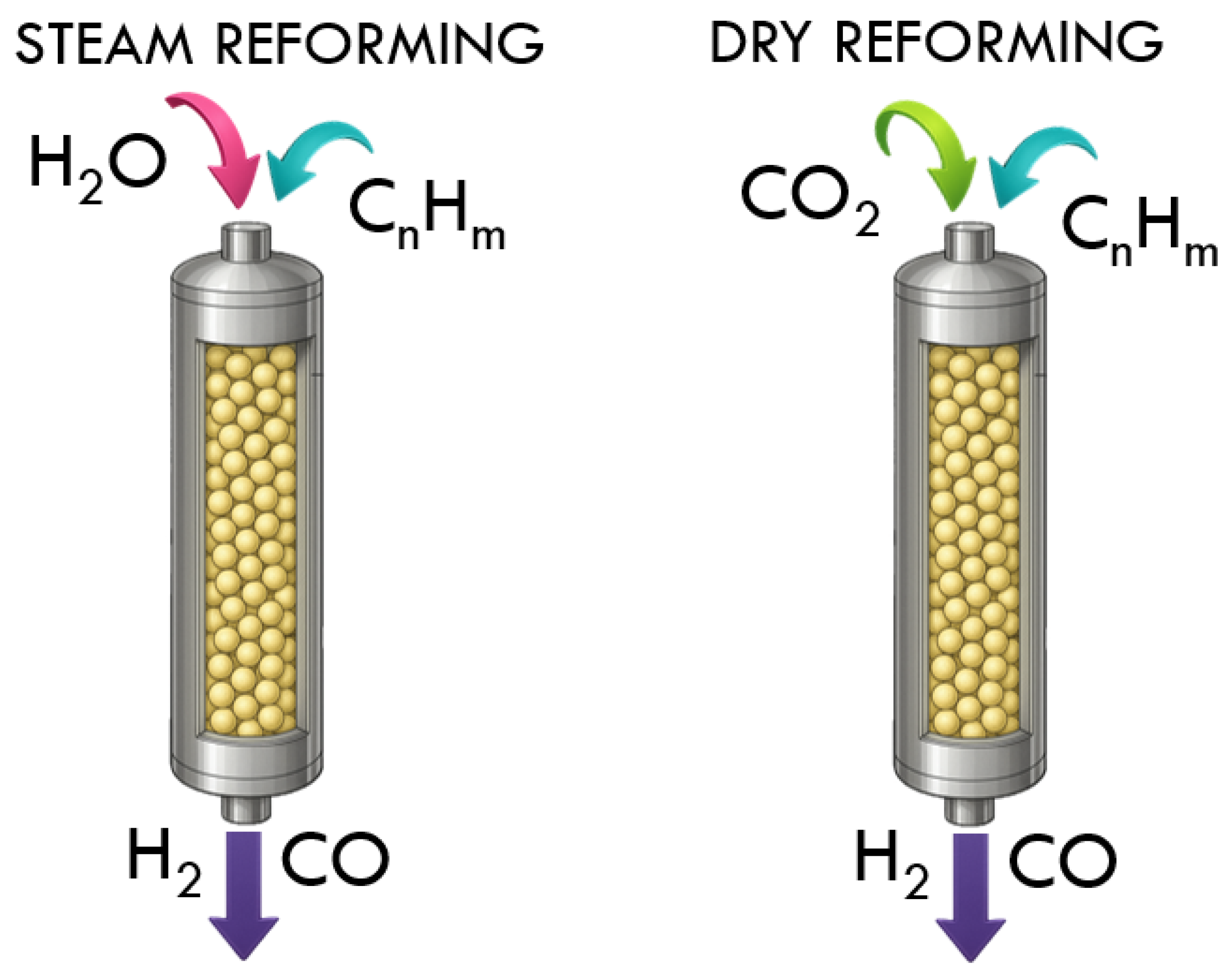
1]. The most common techniques include steam reforming (SR) and dry reforming (DR), each characterized by distinct reactions and operational conditions (
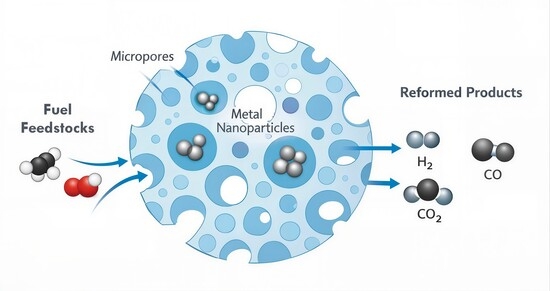
Figure 1). Steam reforming involves reacting methane (CH
4) with high-temperature steam (H
2O) over a catalyst, typically nickel (Ni)-based, to produce hydrogen (H
2), carbon monoxide (CO), and carbon dioxide (CO
2). It is the most widely used method due to its high efficiency and cost-effectiveness, although it results in significant CO
2 emissions, raising environmental concerns [
2]. While steam reforming is currently the most widely used method for hydrogen production due to its high efficiency and economic viability, its environmental advantages are somewhat limited. The process primarily benefits from existing natural gas infrastructure, which allows for decentralized and scalable hydrogen production. However, one notable environmental advantage is that, when combined with carbon capture and storage (CCS) technologies, steam reforming can significantly reduce greenhouse gas emissions, making it more sustainable [
3]. Additionally, utilizing natural gas, a relatively cleaner fossil fuel compared to coal or oil, results in lower emissions of pollutants such as sulphur dioxide (SO
2) and particulate matter. Despite these benefits, the inherent CO
2 emissions from traditional steam reforming remain a concern, highlighting the importance of integrating CCS and developing alternative, greener reforming technologies to fully realize its environmental potential [
4].
On the other side, dry reforming replaces steam with carbon dioxide in the reaction with methane, generating hydrogen and carbon monoxide. This process not only produces syngas suitable for various chemical syntheses but also offers a means of utilizing CO
2, a greenhouse gas, thus contributing to carbon recycling [
5]. However, it typically operates at higher temperatures and faces challenges such as catalyst deactivation [
6].
Overall, reforming processes are vital for hydrogen and syngas production but pose environmental challenges. Ongoing research aims to improve catalyst stability, process efficiency, and integration with carbon capture and storage technologies to enhance the sustainability of these methods.
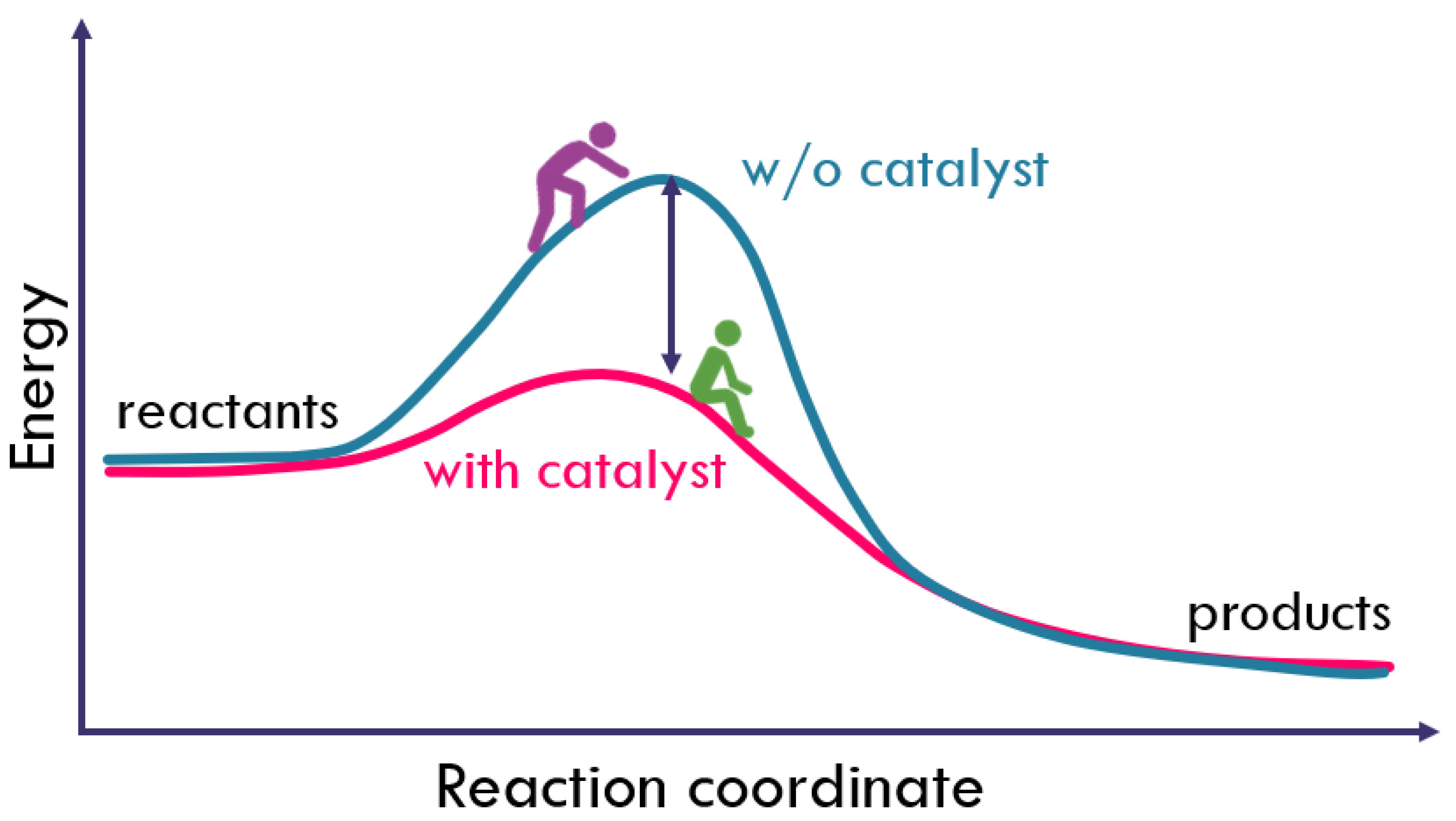
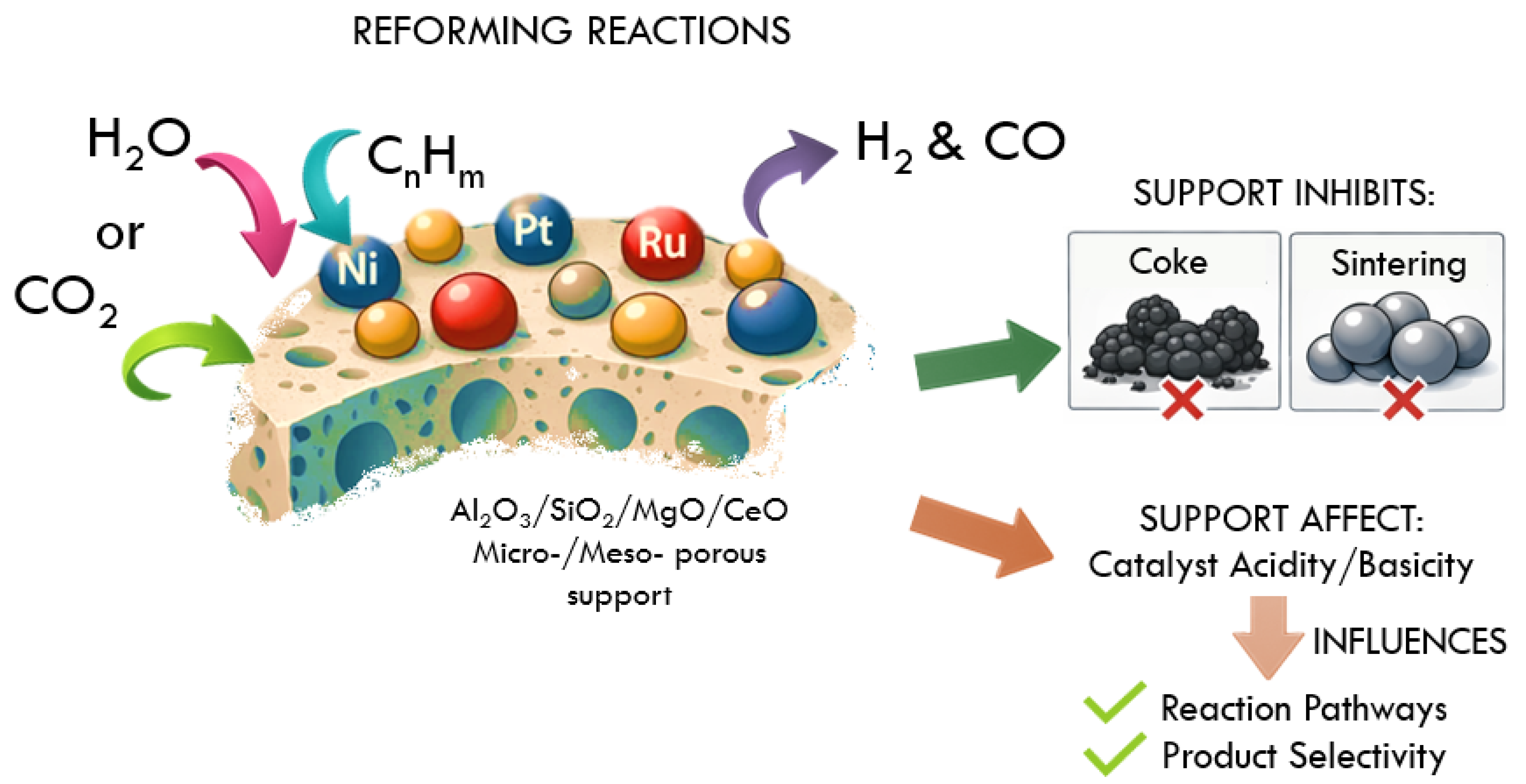
Among all of these, catalysts play a crucial role in reforming processes, significantly impacting their efficiency, selectivity, and feasibility. In reactions such as steam reforming and dry reforming, catalysts facilitate the breaking of strong chemical bonds in hydrocarbons like methane, enabling the formation of hydrogen, carbon monoxide, and other components typically present in syngas, such as carbon dioxide, at achievable temperatures and pressures. They lower energy activation required for the reactions thereby increases reaction rates and reduces energy consumption (
Figure 2). The choice of catalyst, often nickel-based or noble metal-based, is vital for ensuring the high conversion rates, durability, and resistance to deactivation caused by coking or sintering.
Catalysts supported on various materials are integral to reforming processes, enhancing their performance, stability, and selectivity. Supported catalysts consist of active catalytic metals, such as nickel, platinum (Pt), or ruthenium (Ru), dispersed on a solid support material that provides a high surface area and mechanical stability. Common support materials include alumina (Al
2O
3), silica (SiO
2), magnesium oxide (MgO), and ceria (CeO
2), and micro–mesoporous-based materials among others [
7]. The support material plays several crucial roles. It provides a large surface area that allows for the dispersion of the active metal, maximizing the number of active sites available for reforming reactions. Additionally, support can influence the catalyst’s resistance to sintering and coking, two primary causes of catalyst deactivation. Support can also affect the catalyst’s acidity or basicity, which in turn influences the reaction pathways and product selectivity, as depicted in
Figure 3.
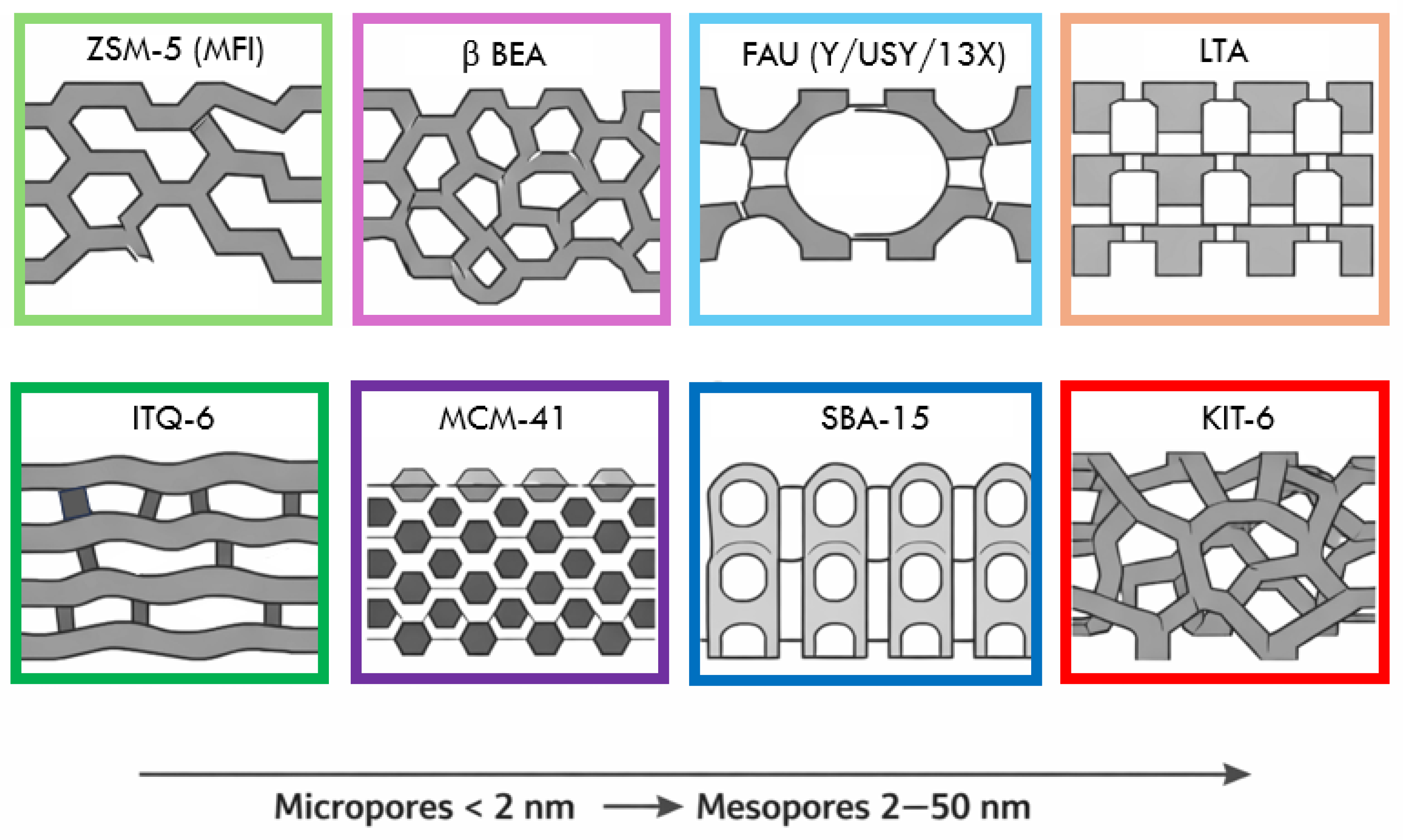
Microporous and mesoporous silica-based materials are widely used as support for catalysts due to their unique structural properties (
Figure 4). Microporous silica materials, such as zeolites, ZSM-5, Beta, FAU and LTA, feature pore sizes less than 2 nanometres, providing a high surface area and molecular sieving capabilities that enhance catalyst dispersion and improve selectivity in various reactions. They are particularly effective in applications requiring precise shape selectivity and stability under harsh conditions. Mesoporous silica materials, including ITQ-6, MCM-41, SBA-15, and KIT-6, possess larger, tuneable pore sizes ranging from 2 to 50 nanometres, facilitating the diffusion of reactants and products in catalytic processes. Their high surface area combined with adjustable pore structure allows for an improved dispersion of active catalytic metal particles and minimizes aggregation or sintering. The surface of mesoporous silica can also be functionalized with various groups to enhance catalytic activity and selectivity. Both microporous and mesoporous silica supports are integral to the development of efficient, stable, and selective catalysts across a broad range of chemical reactions, including reforming, cracking, and environmental catalysis. Ongoing research aims to optimize their pore architecture and surface properties to meet the evolving demands of sustainable and green catalysis.
The present review highlights a novel and comprehensive exploration of various fuel feedstocks tested over different silica-based supports, with a particular interest in alternative and less discussed fuels beyond methane and ethanol [
8,
9]. The significance of this study lies in its focus on elucidating the intricate relationships between the surface characteristics of the supports, their chemical composition, and the presence of additional ions within or outside the framework structure [
10]. By examining multiple types of fuels and support materials, the review aims to uncover how modifications in the support’s surface properties and compositional features influence catalytic activity, stability, and selectivity in reforming processes. This holistic approach provides new insights into tailoring silica-based catalysts for enhanced performance, advancing the development of more efficient and sustainable reforming technologies with a broader range of feedstocks.
2. Steam Reforming
The steam reforming process typically follows the reactions reported in
Table 1, where the main reaction step usually occurs with many side reactions, among which the water–gas shift can be the common one. The reforming and side WGS reactions are outlined in
Table 1.
The steam reforming reactions are strongly endothermic and lead to gas expansion; the process is favored at a low pressure and high temperature.
Metals from group VIII are known to be highly active in the steam reforming of hydrocarbons, and numerous pioneering studies have been conducted to compare their relative activities [
11,
12,
13,
14,
15]. Early research by Rostrup-Nielsen on ethane steam reforming [
11] and later on methane reforming [
12] showed that ruthenium and rhodium (Rh) are the most active metals, followed by Ni, iridium (Ir), platinum, palladium (Pd), and rhenium (Re), which are less active. Cobalt (Co) and iron (Fe) also exhibit activity but tend to oxidize under typical reforming conditions [
11]. These conclusions were supported by methane reforming studies by Kikuchi et al. [
13], which confirmed a similar activity ranking among the transition metals. Interestingly, more recent research by Yamaguchi and Iglesia [
15] indicated that Pt and Ir are the most active metals compared to Rh and Ru, with Ru and Ni showing nearly comparable activity. They also observed that catalytic activity correlates with metal dispersion, suggesting that the local atomic structure of the metal surface plays a crucial role.
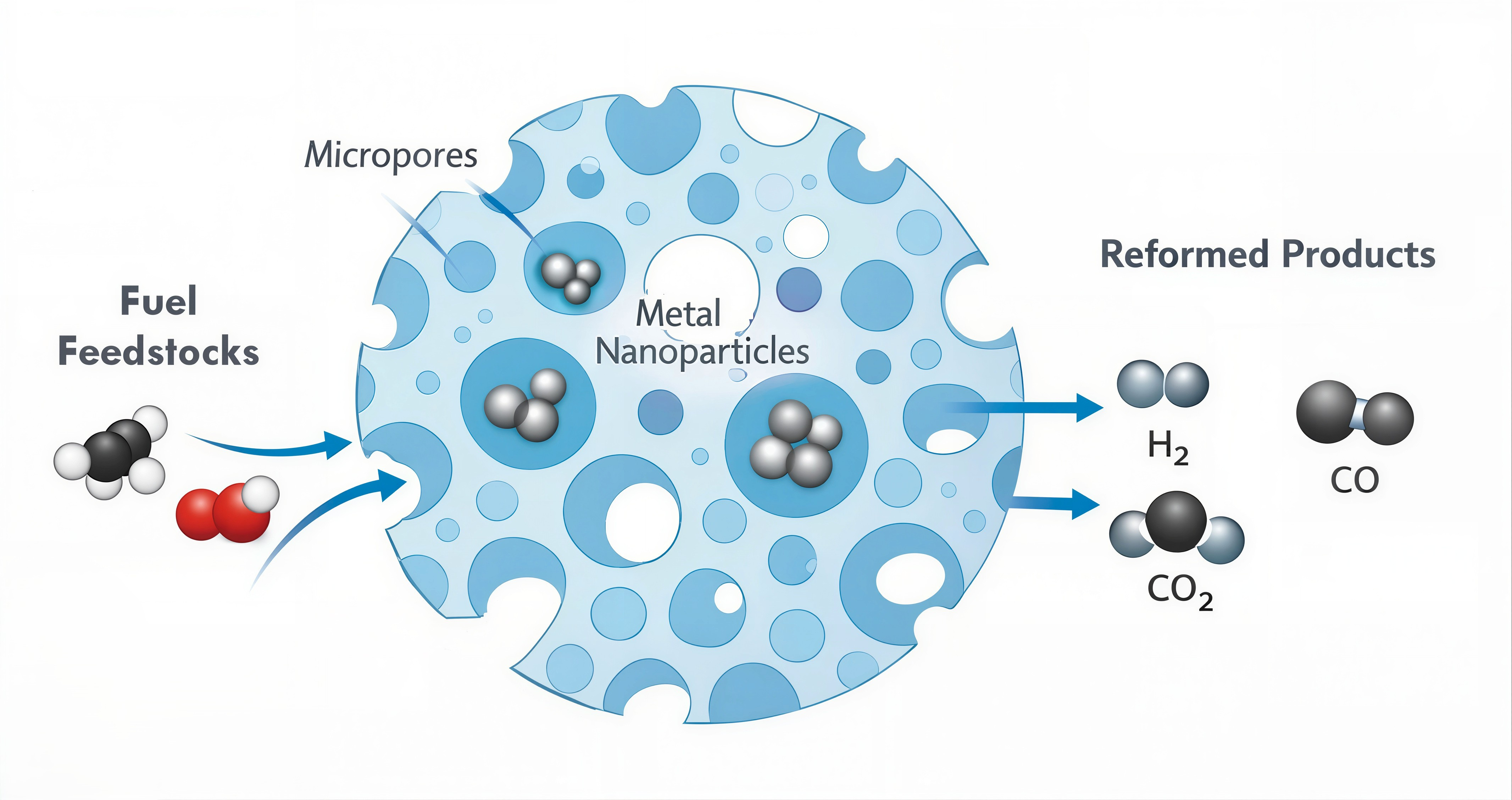
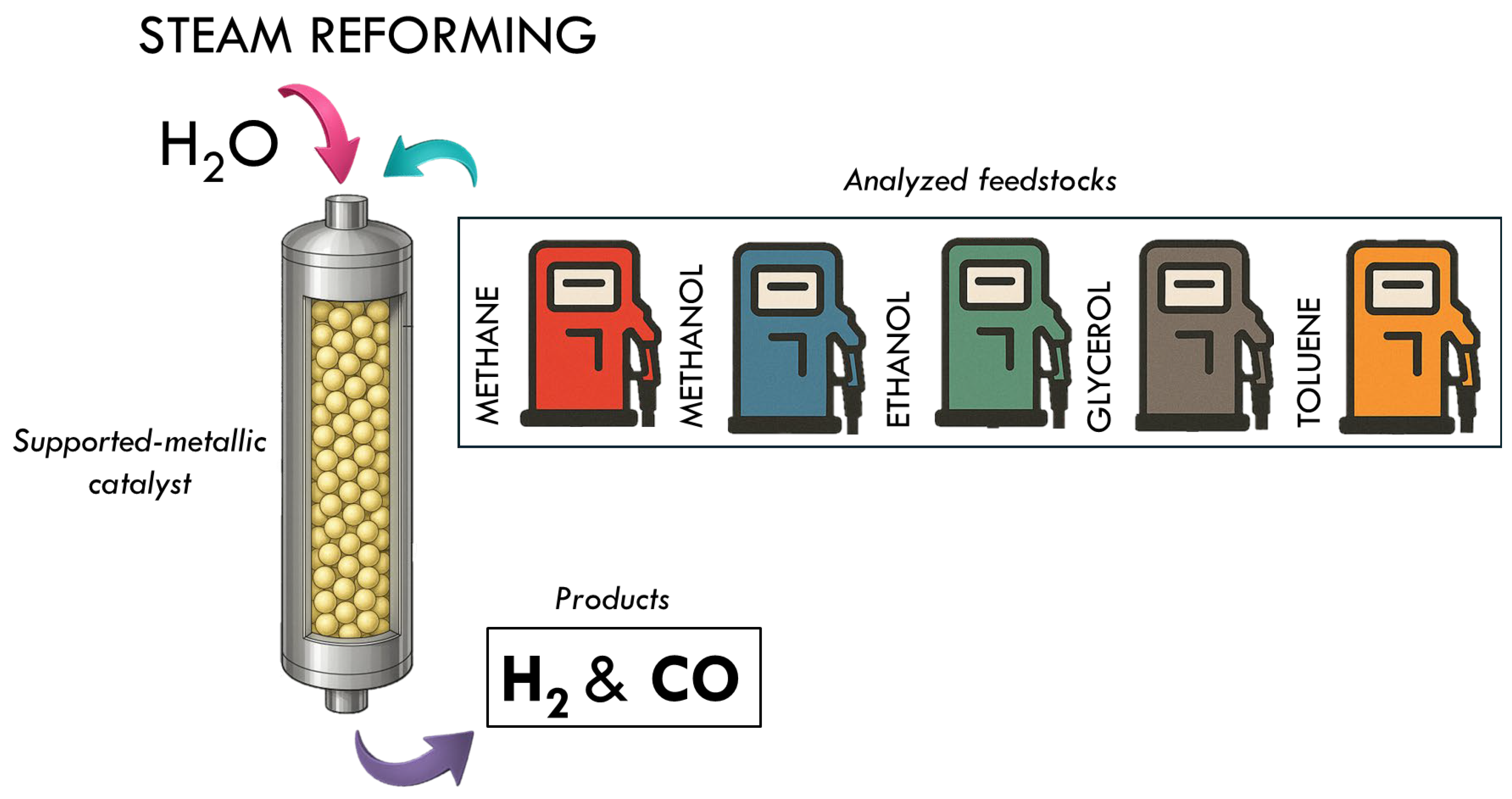
In the following sections, the catalytic behavior of the selected feedstocks, both conventional and alternative, under steam reforming conditions will be analyzed and discussed, with a particular emphasis on the role of the micro- and mesoporous supports and the nature of the metallic active phase. A schematic representation is reported in
Figure 5.
2.1. Methane Steam Reforming
The catalytic reaction of steam and methane (SRM) was first reported in 1924 by Neumann and Jacob [
16], as shown in
Table 2. By 1930, it was introduced into the industry [
17]. The process has significantly improved over the years in terms of reactor design and sizing, thermodynamics, and catalysis. Briefly, the reaction occurs through the adsorption and dissociative activation of methane on the metallic active phase, typically Ni, leading to the formation of surface carbon and hydrogen species. Simultaneously, water is activated on the metal or at metal–support interfacial sites, producing oxygen-containing species that oxidize surface carbon to CO, limiting coke formation. The CO formed may further react via the water–gas shift reaction, contributing to additional hydrogen production depending on the operating conditions.
A pioneering study that involved the zeolite Y as a support catalyst for nickel in the SMR was carried out by Al-Ubaid et al. [
18]. The study explores methane steam reforming using nickel catalysts on Y-faujasite zeolite supports. The most effective catalyst, nickel impregnated on Na-Y zeolite, exhibited the highest initial conversion and lowest deactivation, with deactivation linked to surface oxidation. The deactivation of the catalyst is not mitigated by the support, which probably can explain the refusal to use zeolite as a support in steam reforming. Recently, Sorbino et al. [
19] demonstrated that nickel supported on zeolite USY catalysts, with a loading of 5 and 10% weight-to-weight, showed a contained catalytic activity (see also tables below for the most significant results). Moreover, the sample containing 20% nickel is not active in the steam reforming of methane [
19]. The catalytic stability can be improved by the addition of molybdenum carbide Mo
2C, which also enhances the catalytic activity by promoting CH
4 activation and suppressing Ni sintering. The Ni-Mo
2C/FAU catalyst shows a high activity and stability, with Mo
2C nanoparticles improving the catalytic performance and preventing carbon buildup on the catalyst surface. However, a higher steam-to-carbon ratio is required to balance coke formation and carbon consumption to achieve stable catalyst performance [
20].
The mesoporous structure of materials such as MCM-41 or MCM-48 cannot be effectively used in the steam reforming of methane due to their limited hydrothermal stability [
21,
22]. During the process, high temperatures combined with the presence of steam can cause the mesoporous framework to degrade or collapse, leading to a loss of surface area and porosity [
23]. This structural deterioration reduces the material catalytic activity and lifespan, making it unsuitable for long-term or industrial applications in steam reforming.
To enhance the stability of the Ni/MCM-41 catalyst during the steam reforming of methane, strontium was recently introduced. Although the strontium-promoted catalyst demonstrates an increased efficacy in converting methane into valuable products, there is an observable initial decline in the conversion efficiency within the first 30 min of the steam reforming process, conducted at 1 atm with a S/C ratio equal to 3. Furthermore, the reaction does not reach completion at a temperature of 700 °C [
2].
SBA-type silica groups represent a category of porous-based materials. Among these, SBA-16 mesoporous silica is recognized as a novel structure within this family. It is characterized by its thick pore walls, high surface area, and significant thermal and hydrothermal stability, as well as its three-dimensional cubic structure, making SBA-16 a potential support material. However, SBA-16-supported nickel is limited in the cycle chemical looping of the steam reforming of methane due to its insufficient acidity and susceptibility to coke deposition, indicating a need for modification [
24,
25]. The addition of yttrium plays a crucial role in enhancing the performance of nickel-based oxygen carriers. Incorporating yttrium into the SBA-16 support structure results in the formation of smaller, well-dispersed nickel particles, preventing their agglomeration and increasing the number of active sites available for the reaction. Yttrium incorporation enhances the structural stability, coke resistance, and overall catalytic activity of the oxygen carrier, enabling efficient syngas production through the chemical looping steam methane reforming process [
25]. Also, the incorporation of cerium into catalytic systems, particularly as a component of support materials like SBA-16, has demonstrated a capacity to significantly influence catalytic performance, with methane conversion rates approaching 99.7% at 700 °C under atmospheric pressure and with an S/C ratio of 2, compared to significantly lower values without cerium. The presence of cerium also boosts the hydrogen yield, increasing it from approximately 68% to 85% at 500 °C. Furthermore, coke deposition, a major cause of deactivation, can be reduced from 3.06 wt% to as low as 0.23 wt% with cerium modification, which leads to an improved stability where the catalyst exhibits significantly less activity decline over multiple reaction cycles, maintaining high conversion rates compared to the rapid deactivation observed in cerium-free catalysts [
26].
2.2. Methanol Steam Reforming
The steam reforming of methanol is a promising method for producing high-purity hydrogen. Methanol, a straightforward alcohol characterized by a high hydrogen-to-carbon ratio, can react with water to produce hydrogen at very moderate temperatures (200–300 °C), as shown in
Table 3. Briefly, the reaction proceeds through the adsorption of methanol onto the metallic active sites, followed by successive dehydrogenation steps, leading to the formation of surface intermediates. Concurrently, water is activated on the catalyst surface, providing oxygen-containing species that promote the oxidation of these intermediates to CO
2. Hydrogen is released during each dehydrogenation step, while the balance between methanol decomposition, reforming, and the water–gas shift reaction determines the final hydrogen yield and CO selectivity. The absence of a carbon–carbon bond also facilitates the reaction at comparatively lower temperatures without coke formation [
27].
As reported by [
28], Cu nanoparticles were confined within a siliceous MFI zeolite using a ligand-stabilized approach for methanol steam reforming (MSR). The innovative catalyst exhibited a high activity and stability in MSR, outperforming the conventionally impregnated catalyst, achieving a 72% methanol conversion and 0.2% CO selectivity at 300 °C, with an enhanced Cu dispersion and Cu
+ ratio. Finally, confinement inhibits Cu sintering and coke formation [
28].
The impregnation approach was performed to insert Cu–Zr on attapulgite-based zeolite (AZ) support, a natural clay with a unique structure and large surface area. AZ, created via hydrothermal chloridic acid treatment and TPAOH, inherited a block-like morphology with organized particles. AZ increased the surface area compared to raw attapulgite and promoted Cu–Zr interactions, enhancing reducibility, metal dispersion, and methanol conversion. The catalyst achieved a 90% methanol conversion at 400 °C with 655.1 mmol gcat
−1 h
−1. The spent catalyst characterization indicated limited changes in metal species due to the zeolite-like pore structure and the Cu
0/Cu
+–ZrO
xH
y interfacial sites inhibiting copper metal particles from growing [
29,
30].
Catalyst samples of platinum-loaded NaY zeolite (Pt/NaY) were instead prepared via ion exchange, tested for the aqueous-phase reforming (APR) of methanol to produce hydrogen, and then compared to conventional platinum catalysts. The results showed that Pt/NaY catalysts exhibited a higher catalytic performance for APR with respect to conventional platinum catalysts. The study found that increasing platinum loading increased methanol conversion but had little effect on H
2 selectivity [
31].
Regarding the suitability of mesoporous support for the catalyst, the comparative performance of Cu, Co, Ni, Pd, Zn, and Sn catalysts incorporated in the high-surface-area MCM-41 matrix was investigated for methanol steam reforming under atmospheric pressure and a methanol/water molar ratio of 1/3. Cu-MCM-41 demonstrated a superior performance. It achieved a 68% methanol conversion and 100% hydrogen production with a low CO selectivity and no significant methane formation at around 250 °C. Cu-MCM-41 also effectively enhanced the water–gas shift reaction (WGSR), unlike Pd-MCM-41 and Ni-MCM-41, which had a lower WGSR activity and higher CO selectivity. Cu-MCM-41 was the most stable, maintaining a steady conversion rate of up to 74% over 40 h. Catalyst deactivation was largely due to coking, but thermal sintering and changes in the MCM-41 structure might also contribute [
32].
2.3. Ethanol Steam Reforming
The steam reforming of ethanol (ESR), shown in
Table 4, and bioethanol has recently gained much attention because H
2 production from bioethanol is expected to be a novel method to provide an energy carrier that has a minimum impact on the greenhouse effect.
Ethanol steam reforming proceeds through the adsorption of ethanol onto the metallic active sites, followed by dehydrogenation to form intermediate and surface carbon species. Water is simultaneously activated on the catalyst surface, generating oxygen-containing species that oxidize these intermediates to CO and CO2, while releasing hydrogen. Side reactions, including dehydration to ethylene and the formation of CO via the water–gas shift, can also occur. Overall, the hydrogen yield and CO/CO2 distribution depend on the balance between ethanol decomposition, reforming, and secondary reactions.
A recent review summarizes the use of zeolitic supports for the steam reforming of bioethanol, mostly prepared using base metals as redox sites, highlighting the most important catalyst design features [
33]. Concerning this, zeolite acidity can result in coking and olefin formation; however, the effectiveness of zeolite-based catalysts in the ESR process can be improved by removing the acidic characteristics of zeolite using two primary techniques: alkali doping and lowering the Si/Al ratio in the zeolite support. Indeed, Grzybek et al. [
17] adjusted the Si/Al ratio of the ZSM-5 support for the Co catalyst, resulting in the ESR catalyst’s 100% ethanol conversion, >90% selectivity to H
2, outstanding stability at 500 °C, EtOH:H
2O equal to 1:12, and different pressure values. They enabled the development of competitive catalysts with many applications by challenging the prevailing paradigm of zeolite-based ESR catalysts with a low activity and stability.
The high selectivity and stability of cobalt catalysts on high-silica and pure silica nanometric zeolite substrates result in little carbon deposit development, as shown by post-reaction characterizations. The greatest reducibility and dispersion of the cobalt phase made nanometric zeolite support advantageous [
17].
Very recent research by Da Costa-Serra et al. [
34] focuses attention on the structural morphology of zeolitic frameworks. Delaminated zeolite, like ITQ6, has been used as a support for Ni and Co catalysts in the steam reforming of ethanol. ITQ-6, being a delaminated zeolite with a high surface area and hydroxyl groups, helps to disperse the metal (Ni or Co) more effectively on the catalyst surface. This improved dispersion is crucial for maximizing the number of active sites available for the steam reforming reaction. ITQ-6, due to the excellent physicochemical properties of the delaminated zeolites, providing a high surface area with an amount of hydroxyl groups, stabilizes the metallic particles, preventing agglomeration and resulting in a desired structure with physicochemical properties hindering the promising catalyst support [
34].
Two-dimensional ZSM-5 nanosheets, as reported in [
35], a material with a structure consisting of laminated thin sheets, were used as a catalyst carrier. In situ encapsulation was found to be an effective strategy for producing hydrogen. The resulting ZSM-5 nanosheet-supported Ni catalyst demonstrated a stable performance with an 88% ethanol conversion and 65% H
2 yield during a 48 h test at 550 °C, considering a ratio of steam to carbon for the reaction system equal to 11. The nanosheet reduced carbon deposition and confined the Ni metal nanoparticles, suppressing sintering and carbon deposition. The nanosheet-supported catalyst also showed a high Ni dispersion, high accessibility to Ni sites, and improved activity and stability, while suppressing metal sintering and coking at high temperatures [
35].
Ni and noble metal alloying, core–shell functionalization, and mesopore tuning strategies were applied to develop encapsulated core–shell catalysts for ethanol steam reforming [
36]. At 550 °C and ethanol-WHSV = 21 h
−1, the specific activity and conversion loss (17 h) of the best tested catalyst were 0.42 mol ethanol/(gcat·h) and 10.9%, respectively, considering an ethanol–water solution with an S/C of 2. Furthermore, the confinement effect of SiO
2 encapsulation prevented metal core sintering and leaching. Encapsulating the catalyst metals in a mesoporous structure allows water to diffuse in and carbonaceous products to diffuse out, preventing carbon buildup on metal surfaces and catalyst degradation [
36]. Cerium was incorporated isomorphically into a mesoporous silica structure through ultrasound-assisted micro-mixing during micellar formation. The resulting catalyst achieved complete ethanol conversion with a high hydrogen selectivity (65%) and exhibited no catalyst deactivation. Its stability over a 6 h reaction at 773 K was closely linked to the uniform distribution of cerium within the silica matrix. The inclusion of the heteroatom in the mesoporous sieve altered the catalyst morphology and chemical properties, facilitating an ordered growth of carbon nanofilaments that did not cause catalyst deactivation or poisoning [
37]. Recently, Costa et al. [
38] investigated the performance of Ni-based catalysts produced using LaNiO
3 perovskite supported on SBA-15 mesoporous silica for hydrogen production employing the ethanol steam reforming reaction. The enhanced catalytic performance of this material can be attributed to the dispersion of the perovskite on SBA-15, which leads to smaller Ni metal particles formed during reduction compared to those in the catalyst derived from bulk perovskite [
38]. The SBA-15 support for nickel- and chromium-based catalysts has also proven to be effective in the steam reforming of bioethanol [
39].
2.4. Glycerol Steam Reforming
The steam reforming of glycerol is a process that involves converting glycerol, a byproduct of biodiesel production, into hydrogen gas and other chemicals by reacting it with steam at high temperatures. Glycerol reacts with steam at temperatures typically around 600–900 °C, with nickel-based catalysts commonly used to facilitate the reaction [
40]. The main chemical reactions include the reforming of glycerol into carbon monoxide and hydrogen, followed by the water–gas shift reaction that converts carbon monoxide into carbon dioxide and additional hydrogen, as shown in
Table 5. This method offers the advantage of utilizing renewable biomass, making it an environmentally friendly way to produce hydrogen and value-added chemicals. However, it also presents challenges such as catalyst deactivation due to coking and the need to carefully control reaction conditions to maximize yields. The process is promising for applications like hydrogen production for fuel cells and sustainable energy systems [
41].
A recent study investigates the suitability of active natural zeolites as support for nickel and molybdenum catalysts for the steam reforming of glycerol [
42]. The activation process employs AlCl
3 and Al(OH)
3 to modify the zeolite chemical composition and crystallinity, influencing silica extraction and aluminum removal. NiMo/zeolite catalysts are prepared for glycerol steam reforming and characterized, revealing how the activators affect the zeolite structure [
42].
Also, the suitability of commercial zeolite type LINDE A (LTA) as a support after modification was explored in the steam reforming of glycerol [
43]. The research revealed that modifying Ni/LTA catalysts with alkali and rare earth metals alters their fundamental properties, and that Mo-La oxides and no-skeletal CaO in combination weaken the interaction between the active Ni metal and the LTA support. It was found that boosting the basicity of Ni/LTA catalysts boosts glycerol conversion into syngas while inhibiting the water–gas shift reaction and methanation. The Ni/MoLaCa-LTA catalyst, which forms smaller NiO particles, exhibited a steady gas production, with a hydrogen-to-carbon monoxide ratio of roughly 2.17, and did not deactivate over 100 h, whereas Ni/MoZrCa-LTA deactivated after 40 h due to carbon buildup; however, it could be regenerated by heating it to 700 °C in an air stream.
Zeolite L-supported catalysts were investigated in hydrogen production from a model bio-oil/bio-glycerol mixture using steam reforming (SR). Zeolite L with different sizes and shapes (nanocrystals and discs), with and without alkaline metal exchange (Cs or Na), was used as a catalyst support. The catalysts were modified with CeO
2 to improve the support properties before nickel impregnation. Activity tests showed catalyst deactivation at 973 K. Sodium exchange led to zeolite crystal sintering and a low performance. Cs-containing catalysts had slightly lower hydrogen yields compared to support without Cs. Disc-shaped zeolites were most active for bio-oil SR, under atmospheric pressure and using a steam-to-carbon ratio of 5.0, producing hydrogen yields close to 80% in the first stage at 1073 K and close to 50% in the last stage at 1073 K [
44].
The encapsulation of nickel nanoparticles within a silicalite-1 zeolite support aids in maintaining a high dispersion of Ni nanoparticles, preventing sintering and coking, and contributes to the increased activity. Furthermore, creating a mesoporous hollow structure within the silicalite-1 support enhances molecular diffusion and accessibility to the active Ni sites, leading to an improved glycerol conversion, hydrogen yield, and resistance to deactivation. The choice and modification of the support, therefore, are essential for optimizing the effectiveness and longevity of catalysts in SRG processes [
45].
A recent study [
46] also provides a comprehensive overview of the research on MCM-41 supports for glycerol steam reforming. Since that time, few studies have addressed the use of mesoporous supports for catalysts in the glycerol steam reforming reaction. Abrokwah et al. recently focused on investigating and exploring the structural and thermal stability and long-term activity of chromium (Cr) and cerium oxide, as well as any potential catalytic synergy with the Ni-based mesoporous silica (Ni/SBA-15) framework, for producing renewable hydrogen through glycerol steam reforming [
47]. The shelf-life of Ni-SBA-15 was enhanced by Cr and CeO
2 through different mechanistic pathways. CeO
2 reduces catalyst poisoning by promoting coke oxidation, while Cr enhances catalyst stability by preserving pore sizes and structural integrity, preventing collapse and retarding the sintering of Ni active sites during extended reactions [
47]. The possibility of obtaining mesoporous silica from waste materials has recently attracted the attention of researchers [
48]; specifically, Ni/SBA-15 catalysts have been synthesized from boiler ash for enhanced hydrogen generation from biodiesel waste glycerol, resulting in an outstanding catalytic activity and minimized carbon formation, with a carbon accumulation < 10%.
2.5. Toluene Steam Reforming
The steam reforming of toluene is a chemical process utilized predominantly in the production of hydrogen and synthesis gas, which serves as a precursor for various chemical manufacturing applications. This process involves the reaction of toluene with steam at high temperatures in the presence of a catalyst, typically nickel-based, to produce hydrogen and carbon monoxide [
49]. Secondary reactions, such as the water–gas shift and partial cracking of aromatic intermediates, can also occur. Overall, the hydrogen yield and syngas composition depend on the interplay between toluene decomposition, water activation, and carbon oxidation, as shown in
Table 6. Toluene is commonly used as a molecular model due to its structural similarities and aromatic characteristics. As an aromatic hydrocarbon with a benzene ring and a methyl group attached, toluene mimics the complex mixture of polyaromatic hydrocarbons found in tar, which is a byproduct of wood distillation or fossil fuel processing.
In recent years, natural modified zeolites, including those derived from waste materials, have been favored over synthetic ones to help reduce environmental impacts. These materials not only serve as efficient catalysts or catalyst supports but also promote waste valorization, reducing the need for virgin raw material [
30,
50,
51]. Utilizing natural zeolites like attapulgite-based titanosilicate zeolite (ATS)-supported nickel catalysts for the catalytic steam reforming of toluene to produce hydrogen, the highest toluene conversion, 90.71%, and a H
2 yield of 63.57% after 4 h of reaction were obtained, using a steam-to-carbon ratio of 3. N/ATS exhibited a unique resistance to carbon deposition due to its high surface Ni molar ratio and unique nanocluster-assembled lamellar structure, suggesting that attapulgite-based heteroatom zeolite-supported Ni catalysts are promising for hydrogen production from the steam reforming of biomass-based oxygenates [
30].
A zeolite-based composite material was produced from coal gasification fine slag (CGFS) using a simple NaOH activation and hydrothermal crystallization method, with its structure and catalytic activity influenced by the NaOH-to-CGFS mass ratio; at a ratio of 0.5, a three-dimensional cage-like porous structure of NaAlSiO
4 and ZSM-11 forms, and the reduction of iron ions to metallic Fe on the surface demonstrates an excellent catalytic performance in biomass tar reforming, achieving a toluene conversion rate of around 73% with a high stability over 210 min at 800 °C and an average H
2 yield of 3900 µmol/min, highlighting its potential as a cost-effective catalyst for biomass tar conversion and gasification [
50].
Porous Ni-doped zeolite catalysts were synthesized from CGFS via an ion exchange enhancing their performance in biomass tar reforming. Under optimal conditions, identified as 720 °C, S/C = 1.5, and N
2 flow 25 mL/min, the catalyst achieved a 92% toluene conversion, with yields of 2500 µmol/min CO and 2800 µmol/min H
2, and maintains a high stability, with an 81% conversion sustained over 450 min, due to the formation of a FeNi
3 alloy during continuous steam reforming [
51].
Among the synthetic zeolites, modified ZSM-5 was recently investigated [
52,
53]. A micro–mesoporous Ni/ZSM-5 catalyst was modified to enhance its performance in the steam reforming of toluene, a model compound for biomass tar, with three Ni-based bimetallic catalysts, Ni-Fe/ZSM-5, Ni-Co/ZSM-5, and Ni-Ce/ZSM-5, prepared using a micro–mesoporous ZSM-5 support; among these, Ni-Co/ZSM-5 demonstrated the best catalytic performance and anti-carbon deposition characteristics, maintaining a carbon conversion rate of 90.99% after 11 cycles, using a steam-to-carbon molar ratio set to 3, with an improved stability attributed to the increased proportion of mid-strength acid sites, indicating that the use of micro–mesoporous molecular sieves and tailoring of acid site strength effectively enhance catalyst activity and longevity [
53].
Modified Ni-based catalysts were developed to enhance hydrogen production from toluene steam reforming, with a 3NiFe/CaO-3ZSM-5 catalyst achieving a hydrogen yield of 97.5% at 800 °C and maintaining a high toluene conversion (100%) and a hydrogen yield of 68.6% after 10 cycles, maintaining the steam-to-carbon ratio at 3 under atmospheric pressure. The incorporation of iron and carrier modification promoted the formation of NiFeO
x, significantly improving catalytic performance, while adding CaO increased alkaline sites that facilitated CO
2 capture and CaCO
3 formation, thereby reducing carbon deposition [
52].
In
Table 7, the most significative results from the literature analysis are reported.
3. Dry Reforming
The process of dry reforming involves the reaction between CO
2 and a feedstock to produce a higher value-added product, the synthetic syngas, a blend composed of CO and H
2 [
54],
Table 8. It is usually accompanied by several side reactions, as the reverse water–gas shift reaction (RWGS). As discussed, this adaptable blend is applicable in multiple contexts, including Fischer–Tropsch synthesis, to generate beneficial chemicals such as olefins, alcohols, and liquid hydrocarbon. Additionally, the H
2-rich stream is utilized in refineries for hydroprocessing, hydrocracking, and ammonia synthesis. Finally, hydrogen also serves as a compelling energy vector utilized as fuel in polymer electrolyte membrane fuel cells for energy production [
55,
56].
Among dry reforming processes, the dry reforming of methane (DRM) is a catalytic process generally applied for the sustainable production of syngas [
57]. However, in recent years, the use of renewable feedstock, such as biogas, alcohols, etc., which represent promising but underutilized energy sources, received a great interest due to the consumption of greenhouse gases, such as CO
2 and CH
4 [
58].
It is well known that dry reforming reactions are highly endothermic, requiring high temperatures (typically between 800 and 1000 °C), which poses significant challenges in terms of the thermal stability of the catalyst and resistance to the formation of coke, the carbon deposits that can inactivate active sites. Noble metals such as Rh, Ru, and Pd, considered as the active phase of catalysts, generally exhibit a significant reactivity in reforming, as well as in other different catalytic reactions [
57,
59], but their elevated cost, together with their scarcity, hinders practical applications. In this view, nickel, a highly promising and studied metal in catalysis [
60,
61], is, even in this case, as previously discussed in the
Section 2, more economical and widely accessible. However, as known, the phenomena of coking and sintering result in its rapid deactivation [
62].
To further improve the efficiency and durability of catalysts used in dry reforming, the support material also plays a key role in both catalyst activity and the resistance to coke formation. In this view, advanced porous materials have been extensively studied, in particular, microporous and mesoporous ones [
10,
55,
63,
64,
65,
66,
67,
68,
69].
As previously discussed, microporous crystalline materials such as zeolites offer numerous advantages as catalytic supports, even in dry reforming processes: high thermal stability, the presence of tunable acidity, and the ability to homogeneously disperse active metals [
70]. Due to their confined structure, zeolites can also limit the growth of coke, promoting the greater selectivity of the reaction [
71]. However, a significant limitation of dry reforming reactions through zeolites is the limited diffusion of reactants and products within the micropores, especially when using heavy fuels. Indeed, although dry reforming is traditionally associated with CH
4, recently it has raised a growing interest in applying this process to a wider variety of fuels, biomass converted into pyrolytic gases, waste oils, and even plastic waste [
72]. The basic principle remains the use of CO
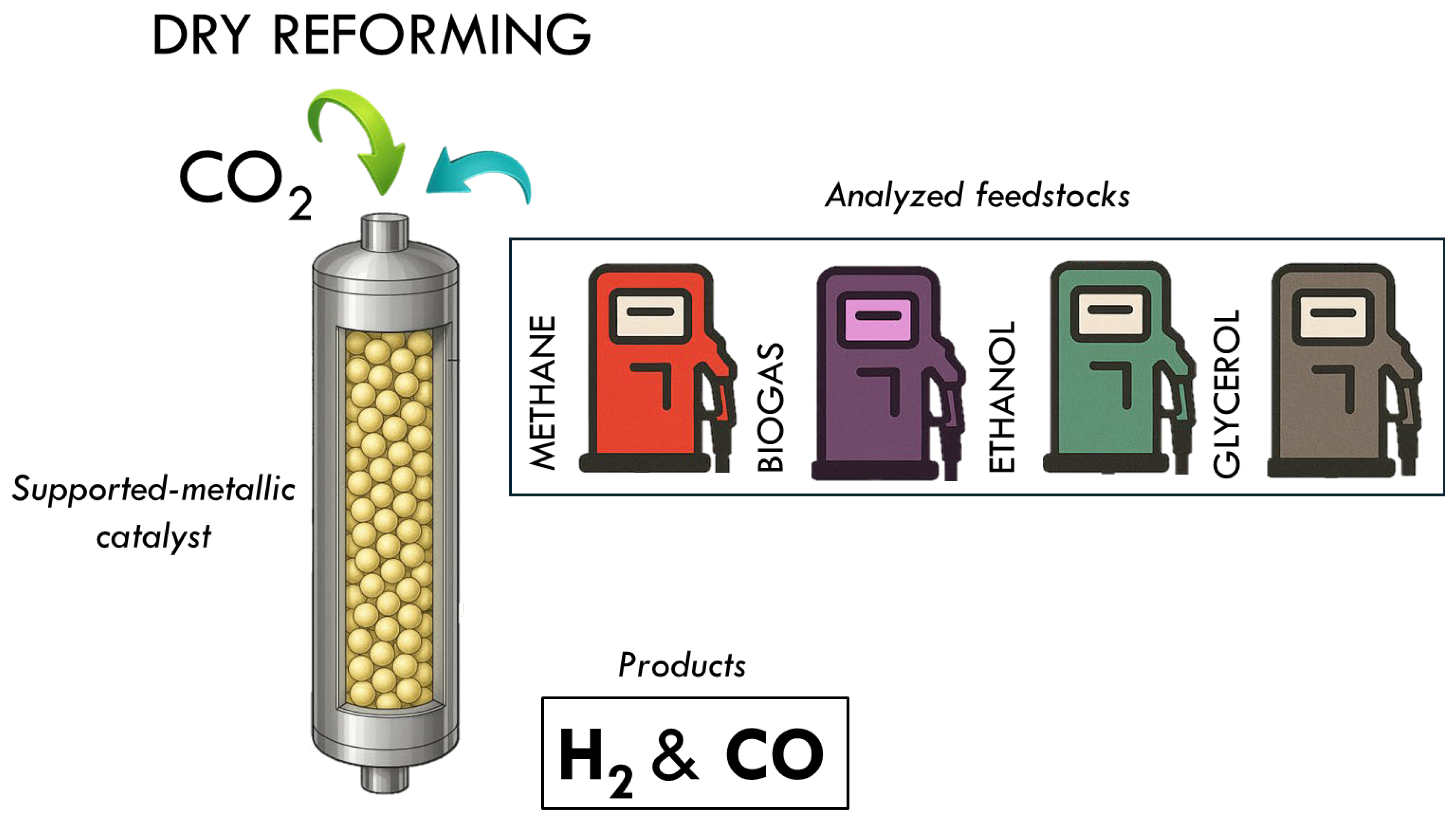
2 as an oxidizing agent to convert a carbon source into syngas, but obviously the challenges increase dramatically as the complexity of the feedstock increases.
Figure 6 schematically depicts the analyzed fuels, consolidated and alternative, in dry reforming.
3.1. Methane Dry Reforming
The methane dry reforming reaction is a catalytic process converting the greenhouse gases methane and carbon dioxide into valuable syngas, as shown in
Table 9.
Methane dry reforming proceeds via the adsorption of methane onto metallic active sites, where stepwise C–H bond cleavage generates surface carbon and hydrogen species. Simultaneously, carbon dioxide is activated on the metal, producing oxygen species that react with the surface carbon to form CO. Additional reactions, such as the reverse water–gas shift and other side reactions, can also take place.
The activity of zeolite-supported Ni catalysts has been widely investigated, and both CH
4 conversion and H
2 yield are strongly governed by the zeolite framework, porosity, metal dispersion, and operating conditions, particularly reaction temperature and space velocity. In the case of hierarchical zeolites, the introduction of secondary mesoporosity significantly improves catalytic performance by enhancing mass transfer and stabilizing smaller Ni particles. For example, Ni catalysts supported on hierarchical ZSM-5 and USY zeolites achieved CH
4 conversions as high as ~80–85% at 700–800 °C, compared with notably lower values for their purely microporous counterparts under identical conditions, while also exhibiting higher and more stable H
2 yields close to the stoichiometric H
2/CO ratio of 1 [
55] when reaction were performed under atmospheric pressure and a molar ratio CH
4:CO
2 = 1. Similar trends were reported using a gas mixture reaction of CO
2 and CH
4 (molar ratio 1:1) for conventional Ni/ZSM-5 systems, with a 5 wt% Ni loading and a Si/Al molar ratio of 30 demonstrating the highest conversions for methane, which increased monotonically with temperature, of approximately 44%, 49%, and 73% at 500, 550, and 600 °C, respectively, with corresponding H
2/CO ratios close to unity at higher temperatures, emphasizing the role of acidity and metal dispersion on activity [
63].
The beneficial role of structural modification was further confirmed for desilicated HZSM-5 supports, where the creation of intracrystalline mesopores resulted in a higher methane conversion and sustained hydrogen production, attributed to the improved Ni dispersion and reduced coke accumulation [
66]. Advanced catalyst architectures, such as zeolite-fixed Co–Ni nanoparticles, demonstrated a superior resistance to sintering and carbon deposition, enabling a stable CH
4 conversion and H
2 yield over extended reaction times, even under harsh DRM conditions exceeding 700 °C [
64]. Moreover, one-pot synthesized Ni–ZSM-5 catalysts showed that tailoring metal–zeolite interactions and acidity can further optimize DRM performance, delivering a high methane conversion and consistent hydrogen yields while minimizing deactivation, particularly at elevated temperatures and optimized gas hourly space velocities [
65]. Overall, these studies clearly indicate that hierarchical or modified zeolite supports outperform conventional microporous zeolites, achieving a higher CH
4 conversion and H
2 yield by facilitating reactant diffusion, enhancing metal stability, and mitigating coke formation under typical DRM operating conditions (500–800 °C).
3.2. Biogas Dry Reforming
Aside from methane dry reforming, a few attempts to use biogas as feedstock were also performed; indeed, biogas could serve as the raw material exactly as methane does, with specific evaluations,
Table 10. This is regarded as one of the most promising ways to exploit renewable sources while consuming greenhouse gases to produce syngas. Raw biogas, typically consisting of approximately 50–70% methane and 30–50% CO
2, is a by-product of the anaerobic digestion of organic waste and biological sludge [
73]. The dry reforming of biogas uses the two main components of biogas simultaneously according to the same DRM reaction.
This reaction is highly endothermic, thus requiring high temperatures (700–900 °C) to achieve significant conversions. It presents the same critical issues of DRM related to the formation of coke, responsible for catalyst deactivation. Some studies focused on the modification of the support; for example, Ni supported on hierarchical ZSM-5 zeolites obtained through alkaline desilication showed a greater catalytic performance, with higher methane conversions up to 75% and a lower carbon production regardless of Ni concentration (3–5%) [
66]. This enhancement was due to the greater Ni dispersion and its narrower particle size distribution along the sample. Xie et al. investigated the impact of Ni content, support structure, and preparation procedure on the performance of Ni-based catalysts supported on hierarchical silicate-1 zeolite [
74]. Additionally, Cunha et al. [
75] demonstrated that 13X zeolite impregnated with Ni and ZnO showed promising catalytic activities, achieving CO
2 conversions in the range of 50–60% at a maximum operating temperature of 800 °C and atmospheric pressure, with molar ratios of hydrogen-to-carbon monoxide close to 2.
3.3. Ethanol Dry Reforming
Ethanol dry reforming (EDR), in which ethanol reacts with carbon dioxide to generate synthesis gas,
Table 11, has attracted increasing attention as an alternative reforming pathway. Thermodynamic analysis suggested a two-step reaction pathway for EDR, in which ethanol initially decomposes into intermediates such as methane and acetaldehyde, followed by their subsequent reforming into syngas. The formation of H
2O was also predicted due to the occurrence of the reverse water–gas shift reaction.
Overall, CO
2-assisted ethanol reforming was found to dominate across the investigated temperature range, although parallel reactions such as direct ethanol decomposition, methane reforming, and reverse WGSR may also contribute [
76]. This process presents several notable advantages. Ethanol is a renewable, biomass-derived feedstock, thereby reducing the reliance on fossil resources and supporting sustainable energy systems. In addition, the utilization of CO
2 as a reactant enables a direct integration with carbon capture and utilization strategies. The syngas produced via EDR typically exhibits a H
2/CO ratio of approximately unity, which is particularly suitable for the synthesis of high-energy-density fuels and value-added chemicals. Moreover, ethanol possesses a lower C–C bond dissociation energy than methane, allowing EDR to proceed at comparatively moderate temperatures (300–600 °C) [
77]. Despite these benefits, the ethanol dry reforming process is limited by catalyst-related challenges. In addition, for EDR, catalyst development must additionally address competing reactions such as ethanol dehydration, cracking, and polycondensation, which can reduce selectivity and accelerate deactivation [
78]. In this case, mesostructured supports, including SBA-15 and KIT-6, have been shown to promote uniform metal distribution and reduce the average size of active metal particles, thereby suppressing sintering and coke formation. Beyond textural characteristics, the catalyst preparation method strongly influences the structural defects of the support. Synthesis routes such as co-precipitation and sol–gel techniques can generate nanostructured supports with high surface areas and abundant defects, which enhance metal dispersion and indirectly strengthen metal–support interactions. The importance of the catalyst structure and thermal treatment was demonstrated in a study on a silica–cobalt–ceria-based core–shell catalyst [
79]. The authors showed that the calcination temperature critically affects the catalytic performance, with treatment at 550 °C preserving the core–shell architecture and promoting the formation of an active interfacial region between Co and CeO
2. Under these optimized conditions, complete ethanol conversion was achieved at 500 °C, along with an excellent catalytic stability. Carbon deposition was limited to less than 1 wt%, considering stoichiometric feedstocks of C
2H
5OH/CO
2/N
2 (1/1/1.5, molar ratio and GHSV of 27,700 mL/g/h) [
79].
The beneficial role of mesoporous supports was also highlighted by Wei et al. [
67], who compared Ni/KIT-6 and Ni/SiO
2 catalysts for ethanol dry reforming. The Ni/KIT-6 catalyst exhibited a markedly higher activity and stability, achieving a complete ethanol conversion at 823 K without noticeable deactivation over 40 h of operation, whereas Ni/SiO
2 underwent rapid deactivation. The superior performance of Ni/KIT-6 was attributed to the smaller Ni particle size stabilized within the mesoporous channels, which effectively limited carbon formation. Furthermore, enhanced metal–support interactions inhibited Ni sintering, resulting in a reduced coke deposition and sustained catalytic activity.
3.4. Glycerol Dry Reforming
A variety of reforming routes for glycerol conversion to syngas, including autothermal, aqueous-phase, steam, as previously discussed, and dry reforming, have been reported in the literature [
80,
81]. Among these, glycerol dry reforming has emerged as a particularly sustainable pathway because it simultaneously valorizes glycerol waste and utilizes CO
2 as a reactant,
Table 12, thereby addressing both environmental and economic concerns.
Similarly to the other reforming processes, even during the glycerol one, dry reforming proceeds via the adsorption of glycerol on metallic active sites of the catalyst where surface carbon and hydrogen species are generated. CO2 is activated, producing oxygen species that react with surface carbon to form additional CO; finally, side reactions, such as cthe racking of oxygenated intermediates, reverse water–gas shift, and carbon deposition, can also occur.
Despite these advantages, even in this case, reforming reactions remain challenged by catalyst deactivation mechanisms, notably metal sintering and coke deposition, which can significantly reduce the availability of active sites. The development and application of suitable catalyst systems are therefore critical for mitigating these issues and enhancing long-term sustainability. In this view, fibrous ZSM-5 and fibrous zeolite Y were investigated as catalyst support for hydrogen production via glycerol dry reforming by [
82]. Both supports were synthesized using a hydrothermal approach and subsequently impregnated with 10 wt% Ni. The catalytic performance was evaluated in a fixed-bed reactor at 800 °C, with a glycerol/CO
2 feed ratio of 1. As a result, Ni supported over zeolite Y demonstrated a superior catalytic activity, achieving a higher glycerol conversion, equal to 52.5%, as well as enhanced H
2 (44.9%) and CO (71.3%) yields, while simultaneously suppressing carbon formation. This enhanced performance was finally attributed to an improved nickel dispersion.
In
Table 13, the most relevant results of different feedstocks, supports, and operating conditions are summarized.
4. Conclusions and Future Perspectives
Reforming processes remain fundamental technologies for hydrogen and syngas production, playing a pivotal role in the transition toward more sustainable energy and chemical systems. As discussed in this review, both steam reforming and dry reforming offer distinct advantages but also suffer from intrinsic limitations, particularly related to CO2 emissions, high energy demand, and catalyst deactivation. In this context, catalyst development emerges as a key factor for improving process efficiency, stability, and environmental performance. Silica-based supports, especially microporous zeolites and mesoporous materials, have shown considerable potential due to their tuneable pore structures, high surface areas, and ability to promote effective metal dispersion while limiting sintering and coke formation. These results highlight the importance of rational catalyst design, in which surface chemistry, porosity, and framework composition are carefully optimized to meet specific reforming requirements, with hierarchical and multifunctional supports representing a promising direction to enhance mass transfer and catalyst lifetime.
The evaluation of different fuel feedstocks, including alternative and less-explored substrates beyond methane and ethanol, further demonstrates how the interaction between active metals and tailored supports strongly influences catalytic activity, selectivity, and durability. Unlike many existing reviews that mainly focus on conventional reactants, this work systematically examines the feasibility of employing non-traditional feedstocks in both steam and dry reforming, paying attention to their specific experimental conditions. Bio-derived molecules and other hydrocarbons, often overlooked despite their increasing availability and relevance to renewable resources, waste valorization, and circular economy strategies, are shown to achieve competitive conversion levels and syngas yields when properly matched with suitable catalytic systems and operating conditions. By broadening the range of considered reactants, this review highlights the adaptability of reforming processes to diverse chemical precursors, enabling more flexible and sustainable syngas production pathways.
Looking ahead, future research should increasingly adopt integrated and adaptive approaches to address both technological and sustainability challenges. The development of next-generation catalysts will require a deeper understanding of structure–performance relationships, supported by advanced synthesis strategies and operando or in situ characterization techniques capable of tracking active phases, metal–support interactions, and deactivation mechanisms under realistic conditions. At the same time, optimizing catalysts and process parameters for alternative feedstocks, including mixed-feed and co-reforming strategies, will be essential to maximize flexibility in the syngas composition and hydrogen yield. Finally, coupling reforming technologies with CO2 utilization, renewable energy inputs, and downstream processes, together with progress in catalyst shaping, reactor–catalyst co-design, and scale-up, will be crucial for translating laboratory advances into industrially viable solutions and reinforcing the role of reforming technologies in future low-carbon energy and chemical production systems.





 ,
,