Article

Tuning Wittig Stereoselectivity in Thienostilbene Synthesis via Optimized Reaction Conditions in Batch and Flow Systems


1
University of Zagreb Faculty of Chemical Engineering and Technology, Trg Marka Marulića 19, HR-10 000 Zagreb, Croatia
2
Research and Development, Pliva Croatia, Prilaz Baruna Filipovića 25, HR-10 000 Zagreb, Croatia
3
University of Zagreb Faculty of Food Technology and Biotechnology, Pierottijeva ulica 6, HR-10 000 Zagreb, Croatia
*
Authors to whom correspondence should be addressed.
Catalysts 2026, 16(2), 151; https://doi.org/10.3390/catal16020151
Submission received: 9 December 2025 / Revised: 8 January 2026 / Accepted: 16 January 2026 / Published: 3 February 2026
(This article belongs to the Special Issue Microflow (Bio)Catalysis—2nd Edition)

Abstract

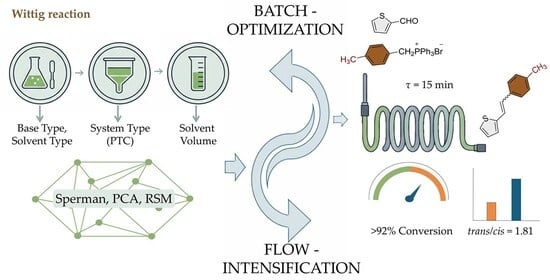
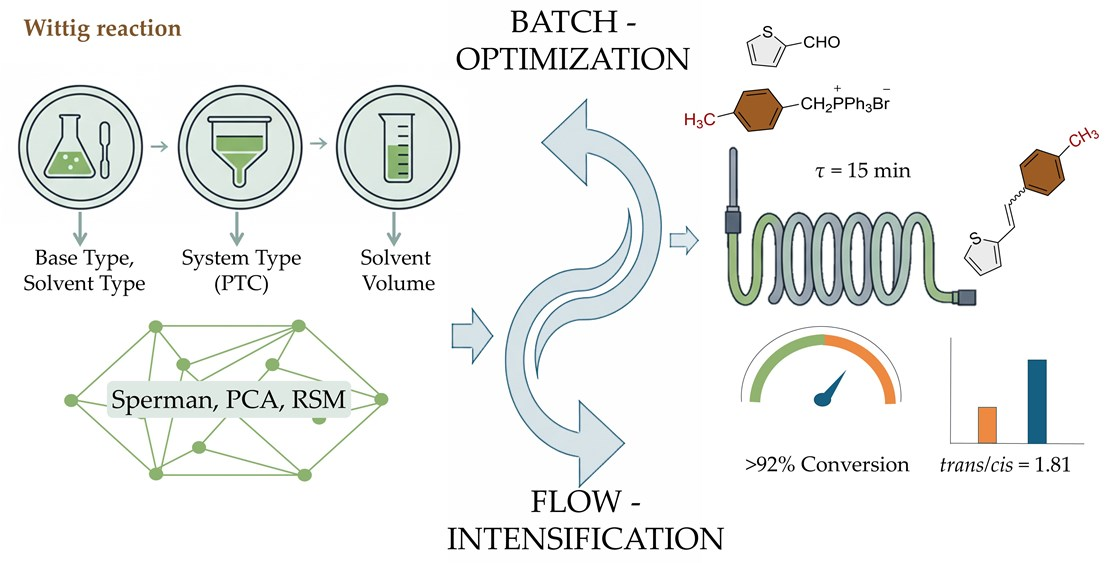
This study investigates the influence of reaction conditions on the stereoselective Wittig synthesis of a thienostilbene analogue of trans-resveratrol. Reaction conditions were systematically varied across batch experiments and analysed using Spearman correlation, principal component analysis (PCA), and response surface methodology (RSM) to identify key factors (base type and amount, solvent type and volume, system configuration, and reaction time) affecting conversion and the trans/cis ratio. The base type, solvent type, and system configuration had the strongest impact on stereoselectivity, while solvent volume proved effective in enhancing the trans-isomer. PCA revealed that cyclic ether solvents combined with medium-strong bases provide the best balance between conversion and selectivity. RSM predicted optimal conditions in a two-phase NaOH system via phase transfer catalysis (PTC) with increased organic solvent volume, which experimentally increased conversion from 35% to over 92% and raised the trans/cis ratio to 1.81. Transferring the optimized process to continuous flow dramatically reduced reaction time, achieving 67.5% conversion in 15 min while maintaining stereoselectivity. These results demonstrate how statistical optimization combined with flow processing can significantly accelerate the development of stereoselective Wittig reactions.

Graphical Abstract

1. Introduction

The Wittig reaction is a cornerstone of organic synthesis, enabling the highly selective formation of alkenes from carbonyl compounds under relatively mild conditions. Its ability to control alkene stereochemistry (trans/cis selectivity) makes it invaluable for constructing of complex natural products and pharmaceuticals. The broad applicability and predictable outcomes of the reaction have been extensively documented and optimized in the literature [1,2].
However, the Wittig reaction remains exceptionally sensitive to the reaction medium and to the combined effects of solvent, temperature, and base. These variables do not act independently; rather, they define a coupled landscape of solvation, ion-pairing, and intermediate energetics that ultimately governs reaction rate, yield, and trans/cis stereoselectivity. Recent studies have shown that deep eutectic solvents (DES) can serve as greener, operationally simple media for Wittig olefinations, improving reagent handling and triphenylphosphine oxide management while enabling room-temperature, air-tolerant protocols with a broad substrate scope [3,4]. Mechanochemical and solvent-minimal approaches, such as high-energy ball milling, liquid-assisted grinding and solvent-free protocols, demonstrate that reducing or eliminating bulk solvent can accelerate ylide formation and alter stereochemical outcomes. In some cases, these methods enable ultrafast Wittig olefinations under ambient conditions without pre-formed ylides, highlighting the physical state of the reaction (solution vs. solid/ball-milled slurry) as a powerful determinant of kinetics and selectivity [5,6]. At the molecular level, ultrafast time-resolved infrared spectroscopy has directly revealed how nascent ylides are solvated and hydrogen-bonded on picosecond-nanosecond timescales. This rapid solvation and cation coordination reshape ylide structure and electronic properties, thereby modulating the activation barrier and the branching between betaine/oxaphosphetane formation and elimination pathways [7]. Computational and theoretical studies complement these findings by showing how relatively small temperature changes can shift the enthalpic and entropic balance of competing transition states, including the elimination step. As a result, thermal control alone can invert trans/cis selectivity depending on ylide type and solvent polarity [8]. In addition, the identity of the base and counter-cation (Li+, Na+, or K+), the use of crown ethers, and the choice between inorganic and organic bases strongly influence ion-pairing, aggregation, and practical reactivity. Recent organosodium/organolithium comparisons and ligand-assisted methylenation studies have reported markedly different reactivity patterns and selectivities upon exchanging Li+ and Na+, pointing to base/cation choice as a critical variable that must be optimized alongside solvent and temperature [9]. Collectively, these experimental, mechanochemical, spectroscopic, and computational studies demonstrate that effective stereochemical control in the Wittig reaction requires co-optimization of solvent, temperature, and base, along with physical state and ion-pairing effects, rather than isolated, stepwise tuning of individual parameters [1,10].
Phase-transfer catalysis (PTC) enables the transfer of reactive anionic species (e.g., halides, enolates, or deprotonated phosphonium salts) from an aqueous into an organic phase using onium carriers such as quaternary ammonium or phosphonium salts. This approach often leads to faster reactions under milder, biphasic, or aqueous conditions. In the context of the Wittig reaction, PTC enables the in situ generation or transport of phosphonium salts/ylides when the base is water-soluble or when reagents form a heterogeneous mixture. An additional advantage is that this strategy allows the use of inexpensive and widely available bases such as sodium hydroxide (NaOH) or potassium hydroxide (KOH), eliminating the need for dry solvents and nitrogen purging, which further enhances the sustainability and operational simplicity of the process. As a result, olefinations can be performed in water or biphasic systems, reducing reliance on aprotic organic solvents and improving operational practicality. Furthermore, recent studies show that the design of catalysts (e.g., functionalized quaternary ammonium/phosphonium species or catalysts that stabilize ion pairs) can influence trans/cis stereoselectivity and functional group tolerance, making PTC an attractive strategy for sustainable and scalable Wittig-type transformations [11,12,13].
A range of heterostilbenes has been synthesized by the Wittig reaction in both batch and flow reactors, with the aim of preferentially obtaining the trans configuration of the carbon-carbon double bond [14,15,16,17]. As the trans configuration is essential for the preparation of analogues of the biologically active trans-resveratrol, reaction conditions must be optimized for each derivative to achieve the highest possible trans/cis ratio. In this work, thienostilbene 1 (Scheme 1), bearing a para-methyl substituent on the aryl subunit, was selected as the target molecule. Further functionalization of thienostilbene 1 may proceed toward oxidation to the corresponding acid followed by conversion to an amide or ester derivative. Alternatively, bromination of the methyl group can yield the corresponding methylene bromide, enabling the synthesis of ether or ester derivatives via a methylene-hydroxy intermediate. For this reason, achieving high trans/cis stereoselectivity in the synthesis of thienostilbene 1 is of particular importance and was addressed through phase-transfer catalysis and systematic optimization of reaction conditions.
Despite numerous studies on the Wittig reaction, a systematic and statistically supported analysis of how reaction parameters jointly influence conversion and stereoselectivity in thienostilbene systems has not yet been reported. In particular, comparison between batch and flow performance under optimized conditions remain scarce, even though two phase-flow systems are known to significantly enhance interphase mass transfer.
To address this gap, we conducted a comprehensive screening of bases, solvents, system types, solvent volumes, and reaction times for the synthesis of compound 1. The resulting dataset was analysed using Spearman correlation, principal component analysis (PCA), and response surface methodology (RSM) to identify key factors governing conversion and stereocontrol and to predict optimal reaction conditions. These conditions were subsequently validated experimentally and successfully translated to a continuous flow millireactor, demonstrating significant reaction intensification compared to batch processing. This integrated experimental–statistical–flow approach provides new insights into multivariate control of Wittig stereoselectivity and establishes a generalizable framework for the design of stereoselective olefinations of thienostilbenes and related stilbenoid derivatives.

2. Results and Discussion

2.1. Experimental Survey of Reaction Conditions

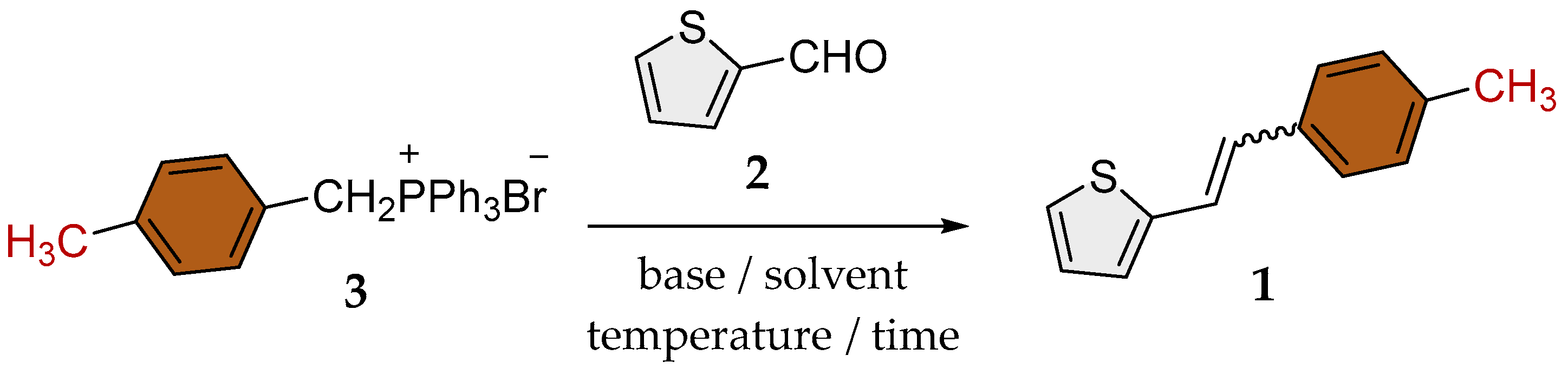
Thienostilbene compound 1 was synthetized in all experiments by a Wittig reaction, as an isomeric mixture of trans-2-(4-methylstyryl)thiophene (trans-1) and cis-2-(4-methylstyryl)thiophene (cis-1). The reaction was performed using aldehyde 2-thiophene carboxaldehyde (2) and the phosphonium salt (4-methylbenzyl)triphenyl phosphonium bromide (3), as outlined in Scheme 1.
The initial reaction conditions for the synthesis of compound 1, using 1.10 mol eq (the number of moles of reagent per mole of the limiting reagent—aldehyde 2) of NaOEt as the base and 115.92 V eq (volume equivalents, expressed as milliliters per gram of the limiting reagent—aldehyde 2) of EtOH as the solvent in a homogeneous solvent system, were selected based on previous work by Mlakić et al. [17]. Under these conditions, aldehyde 2 reached a conversion of 35.19%, with a trans-/cis-isomer ratio of 1.74. To improve conversion and overall process productivity, a series of experiments was conducted in which key reaction parameters were varied. This approach aimed to provide deeper insight into the influence of individual factors on conversion and trans/cis selectivity, thereby enabling more efficient optimization.
The selection of bases and solvents for the Wittig reaction was based on literature data. The bases investigated included KOtBu [18], LiHMDS (as a solution in hexane or THF), KHMDS, and NaHMDS [19]. The solvents selected were THF and DMF as commonly used media [18,19]. Additionally, 2-MeTHF was included due to its recognition as a green solvent in pharmaceutical applications, and ACN was selected as a representative polar aprotic solvent, a class generally considered favorable for Wittig reactions and widely employed in organic synthesis [20,21].
As an alternative to conventional homogenous, non-aqueous conditions, a PTC Wittig approach in a two-phase system was also evaluated. This approach avoids the use of harsh, moisture-sensitive bases and eliminates the need for inert-atmosphere operation, thereby simplifying the process and reducing associated hazards [22]. To establish a suitable liquid–liquid system for the PTC Wittig reaction, the solubility of phosphonium salt 3 was determined in a range of water-immiscible organic solvents, as this salt acts as the phase-transfer catalyst, migrating to the aqueous phase for deprotonation and then returning to the organic phase to react with the aldehyde. The reported solubility values correspond to the maximum concentration of 3 soluble in each solvent. These data, together with the classification of solvents based on the phosphonium salt 3 solubility, are presented in Table 1.
Solubility testing revealed that phosphonium salt 3 exhibited generally low solubility in the evaluated organic solvents. As a result, achieving concentrations comparable to those reported in the literature for PTC Wittig reactions would not be feasible while maintaining a true liquid–liquid system [14,22]. To avoid unnecessarily restricting the experimental space, literature-reported conditions were applied, accepting the formation of a suspension during the initial stages of the reactions. This strategy ensured that potentially relevant reaction regimes were not excluded from screening. For solvent selection, DCM and n-BuOH, which provide at least partial solubility of compound 3, were chosen. In addition, 2-MeTHF was included due to already mentioned frequent recognition as a green solvent in contemporary pharmaceutical practices.
The Wittig reaction experiments in a batch reactor were performed by systematically varying the system type (one-phase or a two-phase system in which an aqueous base solution was added), base type, solvent types, base and solvent quantities, and reaction times. Upon completion of each reaction, samples were analysed to determine the conversion of thienyl aldehyde 2 and the corresponding trans-/cis-isomer ratio. A complete overview of the reaction conditions, conversions, and isomer ratios is presented in Table 2.

2.2. Statistical Analysis of the Experimental Results of the Wittig Reaction

2.2.1. Spearman Correlation Matrix

Spearman’s rank correlation coefficient (r) was used to assess monotonic relationships between selected experimental variables and the primary responses of the Wittig reaction: trans/cis ratio and conversion. The coefficients, ranging from −1.0 to +1.0, reveal both the strength and direction of the associations, providing a robust, non-parametric assessment of factor dependencies. Correlation analysis represents a foundational step in statistical modeling and is particularly useful in experimental chemistry for several reasons. First, it enables preliminary identification of key process drivers by quantifying how changes in an input factor are associated with predictable changes in a response, even when the relationship is not strictly linear. Second, it reveals multicollinearity among independent variables, which is critical for the design of subsequent multivariate optimization experiments (e.g., RSM) and for the correct interpretation of model terms. Identifying such correlations helps ensure that complex models are not constructed from redundant or confounding factors.
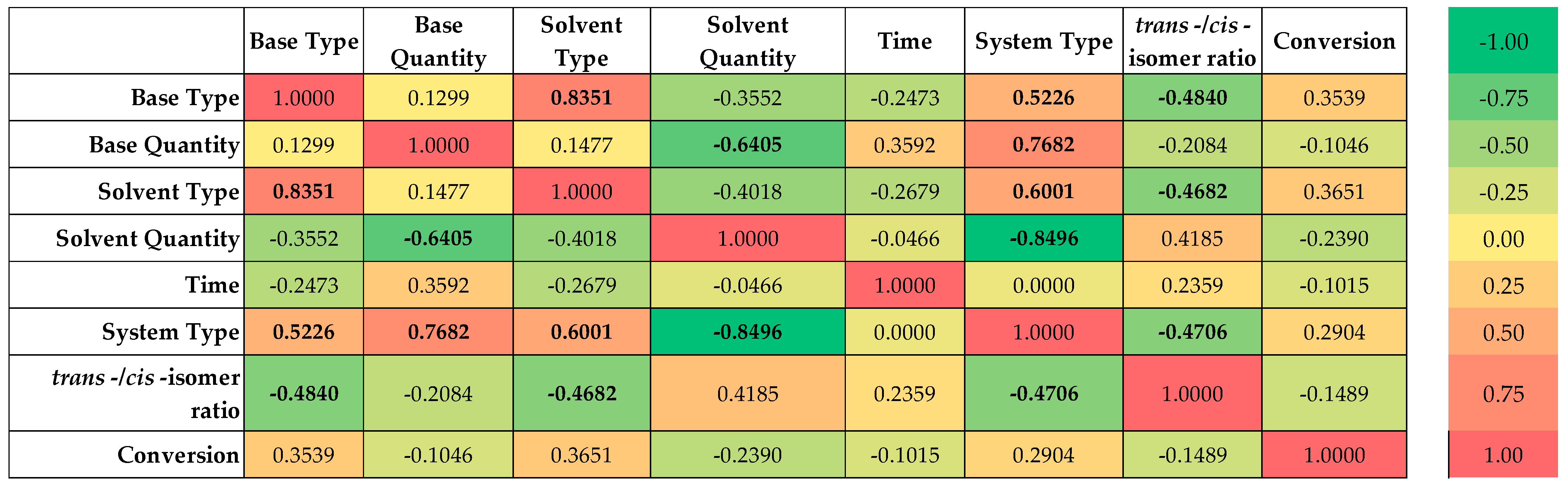
The results obtained (Figure 1) show that the trans-/cis-isomer ratio exhibits the strongest and predominantly negative correlations with several variables. The most pronounced associations are observed for base type (r = −0.494) and, most notably, system type (r = −0.471), indicating that both the choice of base and the use of a two-phase system strongly influence stereoselectivity. An increase in the rank of these variables, for example, switching to a less favorable base or adopting a two-phase setup, is associated with a distinct decrease in the trans-/cis- ratio. A moderate negative correlation is also observed for solvent type (r = −0.468), further underscoring the importance of reaction medium effects. In contrast, solvent volume shows the strongest positive correlation with the trans-/cis- ratio (r = 0.418), suggesting that decreasing reagent concentrations has a beneficial effect on stereoselectivity. For conversion, the correlations are generally weaker, indicating a lower sensitivity to the ranked experimental factors compared with stereoselectivity. The strongest positive correlations are observed for base type (r = 0.354) and solvent type (r = 0.365), confirming that specific combinations of bases and solvents intrinsically promote higher reaction efficiency and faster substrate consumption. Importantly, the trans-/cis-isomer ratio displays only a negligible correlation with conversion (r = −0.149), indicating that these two performance metrics are largely decoupled. This suggests that high selectivity can be achieved over a broad range of conversions, although simultaneous optimization of both objectives requires careful parameter tuning. Significant correlations were also detected between the independent factors themselves. Base type is strongly correlated with solvent type (r = 0.835) and moderately with system type (r = 0.523). The strong association between base and solvent type is expected, as practical experimental design requires pairing specific base chemistries (e.g., strong, non-nucleophilic bases) with suitable solvent classes (such as aprotic or cyclic ether solvents) to avoid side reactions. Furthermore, base quantity and solvent quantity are strongly negatively correlated (r = −0.641), indicating an inverse relationship in which higher base loadings are often combined with lower relative solvent volumes. This trend highlights the complex concentration effects present in the system. Overall, Spearman’s correlation analysis provided a clear, non-parametric overview of the relationships among experimental factors and reaction outcomes. These insights serve as an essential guide for subsequent modeling and optimization efforts.
It should be noted that the correlation analysis is subject to inherent limitations arising from the empirical nature of the experimental dataset and the numerical coding of categorical variables. Non-numerical variables such as base type, solvent type, and system type were rank-coded to enable Spearman’s non-parametric analysis. Consequently, strong correlations observed between certain independent variables, most notably between base type and solvent type, primarily reflect chemically constrained experimental choices and design dependencies, rather than intrinsic physicochemical or mechanistic relationships. Such dependencies are unavoidable in experience-driven reaction development, where incompatible variable combinations are intentionally excluded. Therefore, inter-factor correlations should be interpreted as indicators of practical coupling within the explored experimental space, not as evidence of causality. Despite these limitations, Spearman’s analysis remains valuable as an initial, qualitative tool for identifying monotonic trends and guiding subsequent multivariate modeling. The potential confounding effects of factor interdependence were subsequently addressed through PCA and RSM, which consider the combined influence of variables within a multidimensional framework.

2.2.2. Principal Component Analysis

PCA was applied to reduce the dimensionality of the dataset and to identify underlying patterns in the relationships between process variables and measured responses.
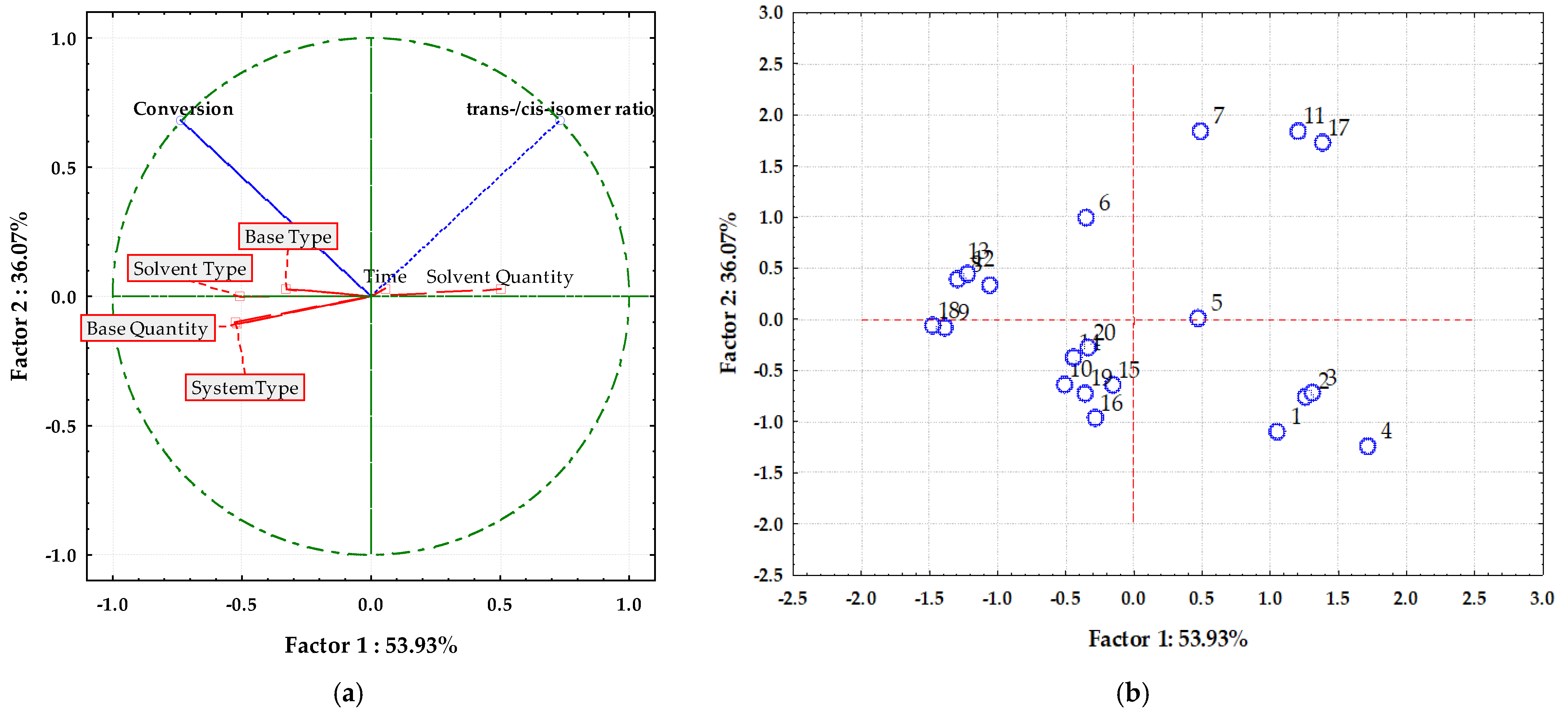
By transforming the original, correlated variables into a smaller set of uncorrelated components, PCA enables visualization of the multivariate structure of the data and highlights the factors that contribute most strongly to system variability. The resulting biplot (Figure 2a) displays the first two principal components. Factor 1 explains 53.93% and Factor 2 explains 36.07% of the variance. Together, these factors capture 89.99% of the total variance. As the PCA was performed using the correlation matrix for the two primary variables, the software internally standardized the data, resulting in eigenvalues that sum to 2.0. The remaining components account for less than 10% of the variability, as detailed in Table 3, likely representing minor noise.
The two response variables, conversion and trans-/cis-isomer ratio, are positioned in opposite directions, indicating that they vary independently and may represent competing performance objectives. Process variables are shown as supplementary (red) vectors, allowing their relationships to both the responses and each other to be examined. Variables such as base type, solvent type, and system type cluster toward the negative side of Factor 1, suggesting similar influence patterns and contributing mainly to the variation captured by this axis. In contrast, reaction time and base quantity are located near the origin, indicating relatively minor contributions to the first two components. The orientation and magnitude of the response vectors further indicate that conversion is primarily associated with factors aligned in the negative direction of Factor 1, whereas the trans-/cis-isomer ratio is driven in the opposite direction.
The distribution of the 20 experimental runs is shown in Figure 2b. The distinct clustering observed confirms that systematic variation in solvent and base combinations leads to fundamentally different reaction outcome profiles, governed mainly by differences in conversion and stereoselectivity. Projection of the experimental data into this two-dimensional space allows the definition of four distinct performance regions. Samples 7, 11, and 17 are clearly isolated in the positive region of Factor 2, while samples 1–4 are prominent in the positive region of Factor 1. The grouping of samples 7, 11, and 17 in the first quadrant is associated with the use of cyclic ether solvents (e.g., tetrahydrofuran) and medium-strong bases (such as KOtBu and NaHMDS) in a single-component system. These conditions define the optimal performance profile, combining high conversion with a maximal trans-/cis-isomer ratio, and thus represent the most favorable balance between reaction efficiency and stereocontrol observed in this study. Samples 1–4 form a distinct cluster in the fourth quadrant. This cluster corresponds to the initial reaction conditions employing a weak base in an aprotic solvent (EtOH in NaOEt). These experiments exhibit low conversions but maintain a notably high trans-/cis-isomer ratio. Their separation from the optimal regime along Factor 2 indicates that, while stereoselectivity is maintained, this dimension is critical for achieving high reaction efficiency. In contrast, samples 6, 8, 12, and 13, which cluster in the second quadrant, confirm that the presence of either a cyclic ether solvent or a strong base alone is sufficient to significantly enhance conversion. However, the accompanying reaction conditions in these systems appear to compromise stereoselectivity, resulting in a low trans-/cis-isomer ratio. Similarly, experiments 9 and 18, conducted in two-phase systems with hydroxide bases and high base equivalents, achieved near-maximal conversions but exhibited a significant loss of stereocontrol. Samples 10, 14, 15, 16, 19, and 20 form a broad cluster in the third quadrant, representing mixed conditions, including strong bases combined with aprotic solvents or weak bases used in protic solvents. These experiments occupy an intermediate performance region, characterized by medium conversions and reduced trans-/cis-isomer ratio. Experiment 5, which utilized an increased base loading relative to cluster 1–4, shows a distinct shift towards the center of the plot, indicating that higher base concentration promotes conversion without a corresponding improvement in stereoselectivity. Overall, PCA effectively maps the explored chemical space and reveals a clear trade-off between reaction efficiency and stereocontrol. The well-defined region in the first quadrant provides empirical evidence for a synergistic effect between cyclic ether solvents and medium-strong bases, identifying this combination as critical for achieving optimal dual performance in the stereoselective Wittig reaction.
Cyclic ethers such as THF and 2-MeTHF provide moderate polarity sufficient for ylide stabilization, while maintaining high ylide reactivity. In contrast, highly polar solvents like ACN and DMF strongly solvate ionic species, reducing nucleophilicity and altering stereoselectivity. Aliphatic ethers, despite being aprotic, generally exhibit lower polarity, which may result in reduced ylide stabilization and conversion. Consequently, cyclic ethers achieve an optimal balance, delivering higher conversion and improved trans/cis selectivity compared to both highly polar solvents and aliphatic ethers. Furthermore, medium-strong bases, such as KOtBu, provide the right balance of basicity and selectivity for Wittig reactions. They are strong enough to ensure efficient ylide formation but not so reactive as to promote side reactions [23].

2.2.3. Response Surface Modelling

RSM comprises a powerful set of statistical and mathematical tools for modelling, analysis, and optimization of processes governed by multiple interacting variables. It is particularly valuable in chemical process development, where complex and often non-linear relationships exist between process parameters and performance outcomes. The strength of RSM lies in its efficiency and predictive capability: it extends beyond initial factor screening to precisely map the response surface using higher-order polynomial equations [24]. In this study, a second-order polynomial model was utilized to describe the complex relationship between Wittig reaction conditions and the critically important trans-/cis-isomer ratio. This second-order fitting enables the identification of true maxima or minima in the response surface and is essential for modelling stereoselectivity, which is especially sensitive to solvent and base environments. The adequacy of the second-order model was evaluated using ANOVA (Table 4). The model for the trans-/cis-isomer ratio was highly significant (p < 0.0001) with an R2 of 0.78, suggesting a strong correlation between the observed and predicted values. The lack-of-fit test yielded a p-value of 0.15, which is non-significant relative to the pure error, indicating the model’s high accuracy in describing the response surface. Additionally, the adjusted R2 of 0.76, confirmed the model’s reliability for predicting stereoselectivity within the experimental design space.
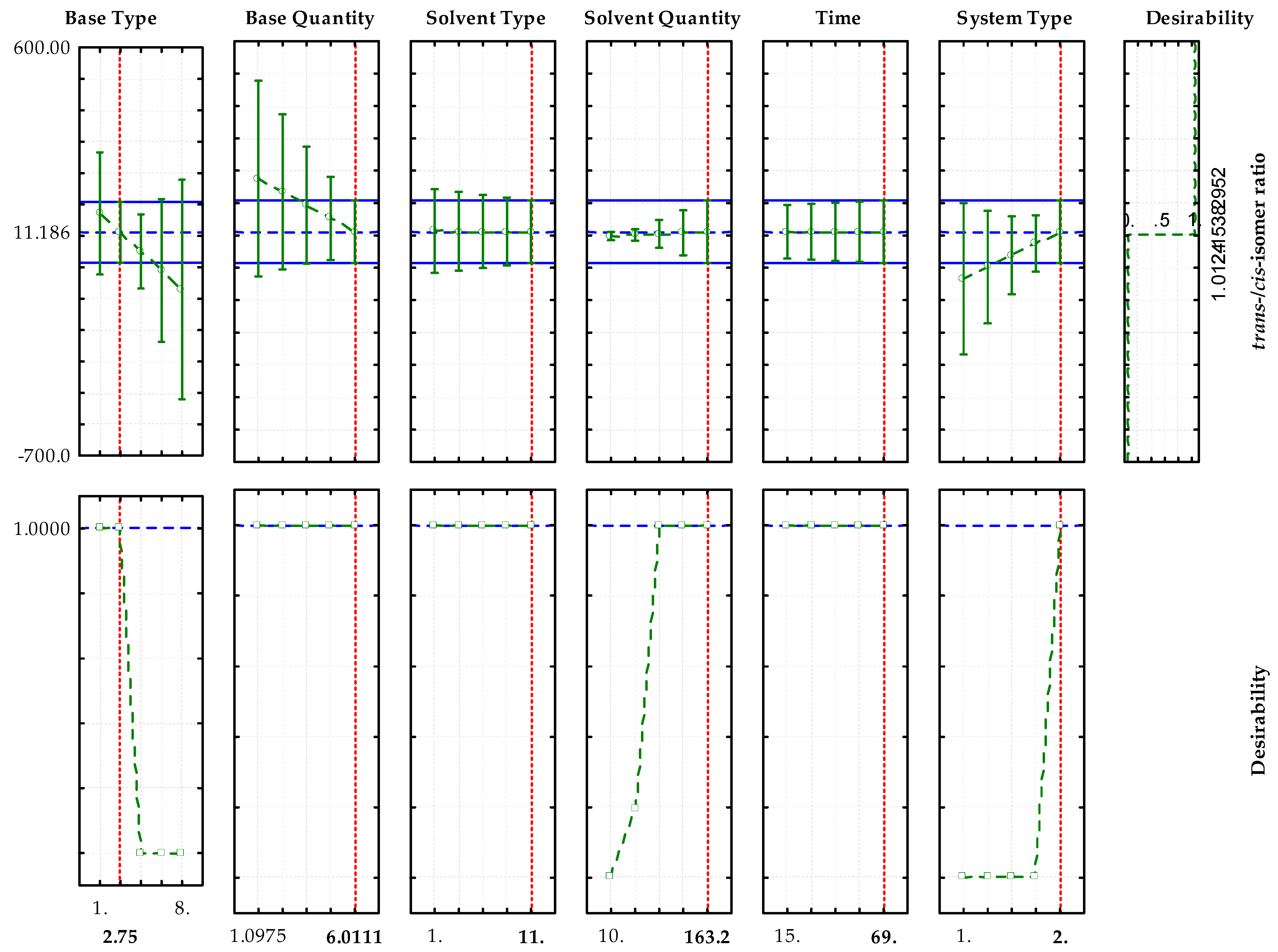
Optimization was performed using a desirability function approach implemented in Statistica 14.0. The predicted optimal conditions correspond to the most favourable operating point within the modelled parameter space (Figure 3). However, it is important to mention that the identified optimum is local and conditional, valid only within the studied domain and constrained by practical process considerations. The analysis identified the following conditions as maximizing overall desirability: (i) base type: NaOH (3 M in water); (ii) base quantity: 6 mol eq; (iii) system type: two-phase system; (iv) time: minimal influence, indicating that time is not a limiting variable within the explored range; (v) solvent quantity: 163 V eq, substantially higher than the optimal conditions suggested by PCA, indicating that maximized overall desirability requires decreased reagent concentrations relative to the “best” exploratory run (Experiment 11); and (vi) solvent type: the model predicts Solvent Type 11 (n-BuOH) to provide the highest theoretical desirability. Importantly, although n-BuOH yields the highest predicted desirability, this solvent presents a practical limitation due to the gradual formation of an additional precipitate, making it unsuitable for continuous flow applications. The model indicates that Solvent Type 10 (DCM) represents a highly acceptable alternative, as evidenced by its position on a relatively flat region of the response surface in the main effect plot, allowing the reaction mixture to remain homogenous through the process. This pragmatic adjustment highlights the distinction between a purely statistical optimum and an industrially viable operating point. Overall, the RSM analysis confirms that high desirability is achieved under two-phase conditions (system type 2) combined with an increased base quantity (6 mol eq of NaOH). Although this two-phase, high-base regime appears to contrast the low-base, single-phase conditions associated with high stereoselectivity in the PCA identified optimal cluster (Experiments 7, 11, and 17), the RSM model successfully quantifies the balance required to leverage the high conversion afforded by elevated base concentrations while mitigating the associated loss of stereocontrol. In doing so, RSM identifies a true manufacturable optimum that reconciles conversion and stereoselectivity within a single, optimized process window.

2.3. Wittig Reaction in a Batch and Flow Reactor Under Optimal Conditions

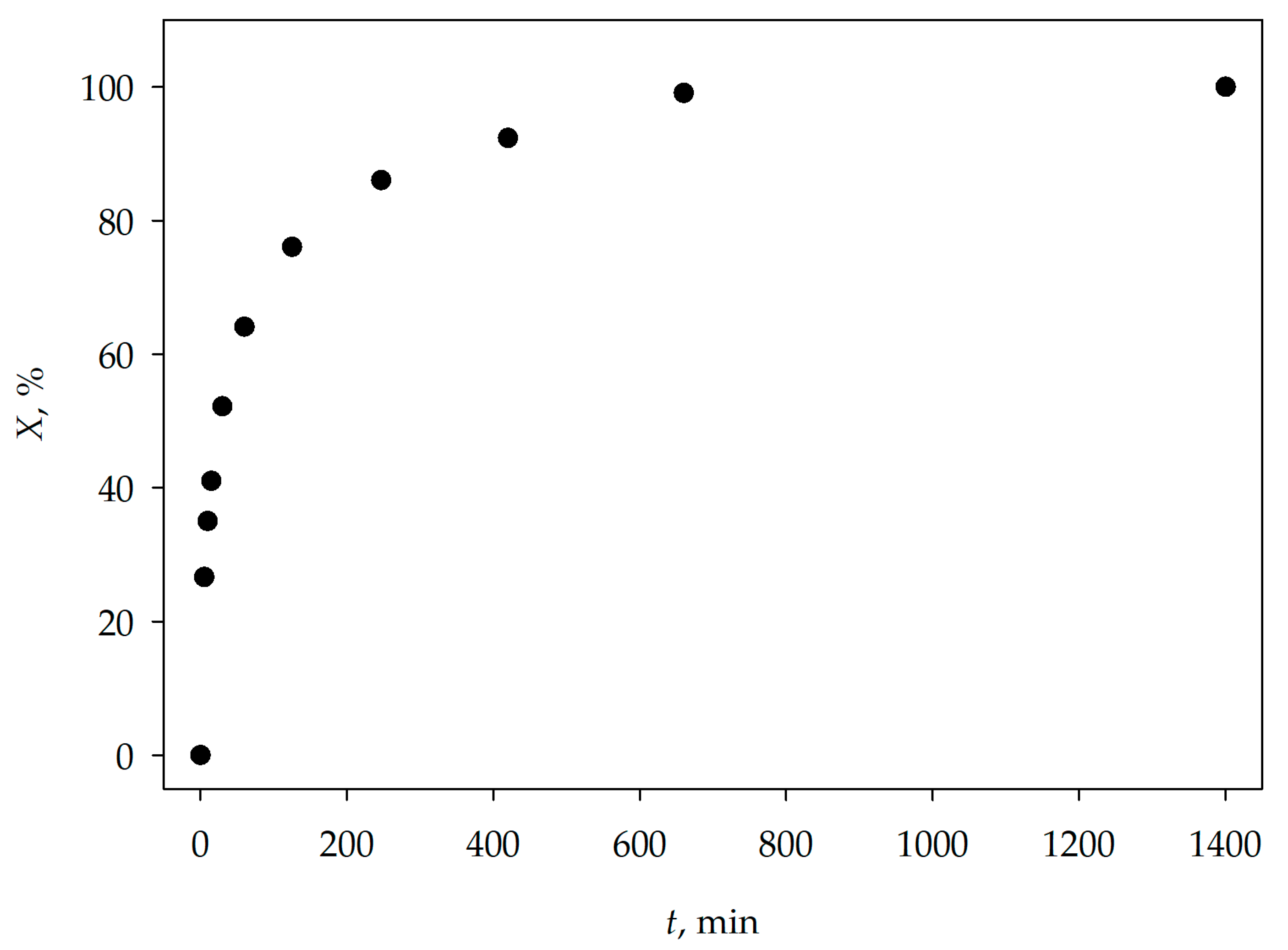
Based on the statistical analysis, an additional batch experiment was performed under the predicted optimal conditions, with the only modification being a reduction in solvent volume. This adjustment was necessary due to technical limitations of the planned flow setup; however, the volume remained increased relative to Experiment 9, in which all other conditions were identical to the proposed optimal conditions. The fully optimized solvent volume of 163 equivalents was deemed impractical, as it would require an excessively high organic-to-aqueous flow ratio to maintain the desired aldehyde-to-base molar balance, thereby complicating reliable pumping of the aqueous phase. Therefore, the organic solvent volume was set to 71 V eq, corresponding to a thienyl aldehyde 2 concentration of 14 mg/mL, which represents the minimum concentration required to ensure complete dissolution of phosphonium salt 3. Aldehyde conversion was monitored at various time points to gain insights into the reaction kinetics and to facilitate successful transfer to a flow reactor. The results of this experiment are presented in Figure 4.
The reaction approaches completion after approximately 7 h, reaching a conversion of 92.35%, and was fully completed after 11 h with a conversion of 99.06%. No further by-product formation was observed beyond this point, indicating good reaction stability. The average trans-/cis-isomer ratio across all monitored time points was 1.81, which represents a significant improvement compared with the value of 1.05 observed in Experiment 9, where a higher concentration of reagents in the organic phase was used. These results confirm the conclusions drawn from the statistical analysis, demonstrating that decreased reagent concentrations have a positive effect on the stereoselectivity. Furthermore, this outcome highlights the effectiveness of data-driven optimization in identifying key factors influencing conversion and stereoselectivity, enabling targeted optimization rather than empirical trial-and-error approaches.
Under the optimized conditions, a reaction was evaluated in continuous flow using an in-house made millireactor operated at a residence time of 15 min to achieve reaction intensification and improved mixing. A conversion of 67.54% was obtained, together with a trans-/cis-isomer ratio of 1.79. These results indicate improved performance of the two-phase systems under slug-flow conditions compared with conventional batch operation. For comparison, a similar conversion was achieved in batch only after 1 h, while after 15 min the batch process reached a conversion of just 41.03%. The superior performance of the Wittig reaction observed under flow conditions can be attributed to several synergistic factors. First, the segmented (slug-flow) regime formed by alternating organic and aqueous phases generates a greatly increased interfacial area compared to mechanically stirred batch systems. This expanded interface enhances mass transfer of the hydroxide base into the organic phase, where the ylide formation occurs, thereby accelerating the overall reaction rate. Second, internal recirculation within slug exhibits, driven by the pressure differential at the front and rear edges of the segment, continuously renews the liquid–liquid interface. This recirculation effectively transforms each slug into a self-contained millireactor with efficient micromixing, minimizing concentration gradients and promoting uniform phase interaction. Third, continuous introduction of the aqueous base stream ensures a constant local base concentration throughout the reactor. This prevents the depletion or dilution that commonly arises in batch, especially in heterogeneous systems subject to mass-transfer limitations. Together, the increased interfacial area, slug-flow-induced internal recirculation, and stable microenvironmental base concentration account for the ability of the flow process to achieve high conversion within only 15 min, whereas the batch system requires approximately 1 h to reach a comparable extent of reaction. It is worth noting that the conversion in flow (67.5%) could potentially be further improved to match the highest batch conversion (99%) through residence time optimization or reactor design based on principles of process intensification. Strategies such as miniaturization of the reactor and consequently improved slug-flow control could significantly enhance phase contact and further increase conversion, as demonstrated in studies of similar biphasic systems [14].

3. Materials and Methods

3.1. Reagents and Solvents

CPME, EtOAc, EtOH, abs., n-BuOH, MEK, MTBE, NaOH, and KOH were purchased from Kemika d.d. (Zagreb, Croatia) and ACN, MeOH, and H3PO4 from Avantor (Radnor, PA, USA). BuOAc, NaOEt, KOtBu, KHMDS, NaHMDS, THF, DCM, 2-MeTHF, and DMF were purchased from Sigma Aldrich (St. Louis, MO, USA). Thiophene-2-carbaldehyde, LiHMDS solution in hexane (1 M) and LiHMDS solution in THF (1.3 M) were obtained from Tokyo Chemical Industry Co., Ltd. (Tokyo, Japan). Deionized water produced in-house was used throughout all experiments. All commercially available chemicals used in this study were of analytical grade and used without further purification. The phosphonium salt employed in the Wittig reaction was synthesized in our laboratory according to a reported procedure [25].

3.2. Solubility Determination

The solubility of 3 was determined gravimetrically by sequentially adding known masses (3–7 mg) of the compound to a vial containing 1 mL of the chosen solvent. Additions continued until a visible suspension formed. The cumulative mass of 3 added was recorded after each addition using an analytical balance. Solubility was defined as be the range between the concentration of 3 in solution before obtaining suspension and the final 3 concentration in the suspension.

3.3. Wittig Reaction Experiments

3.3.1. Batch Experiments

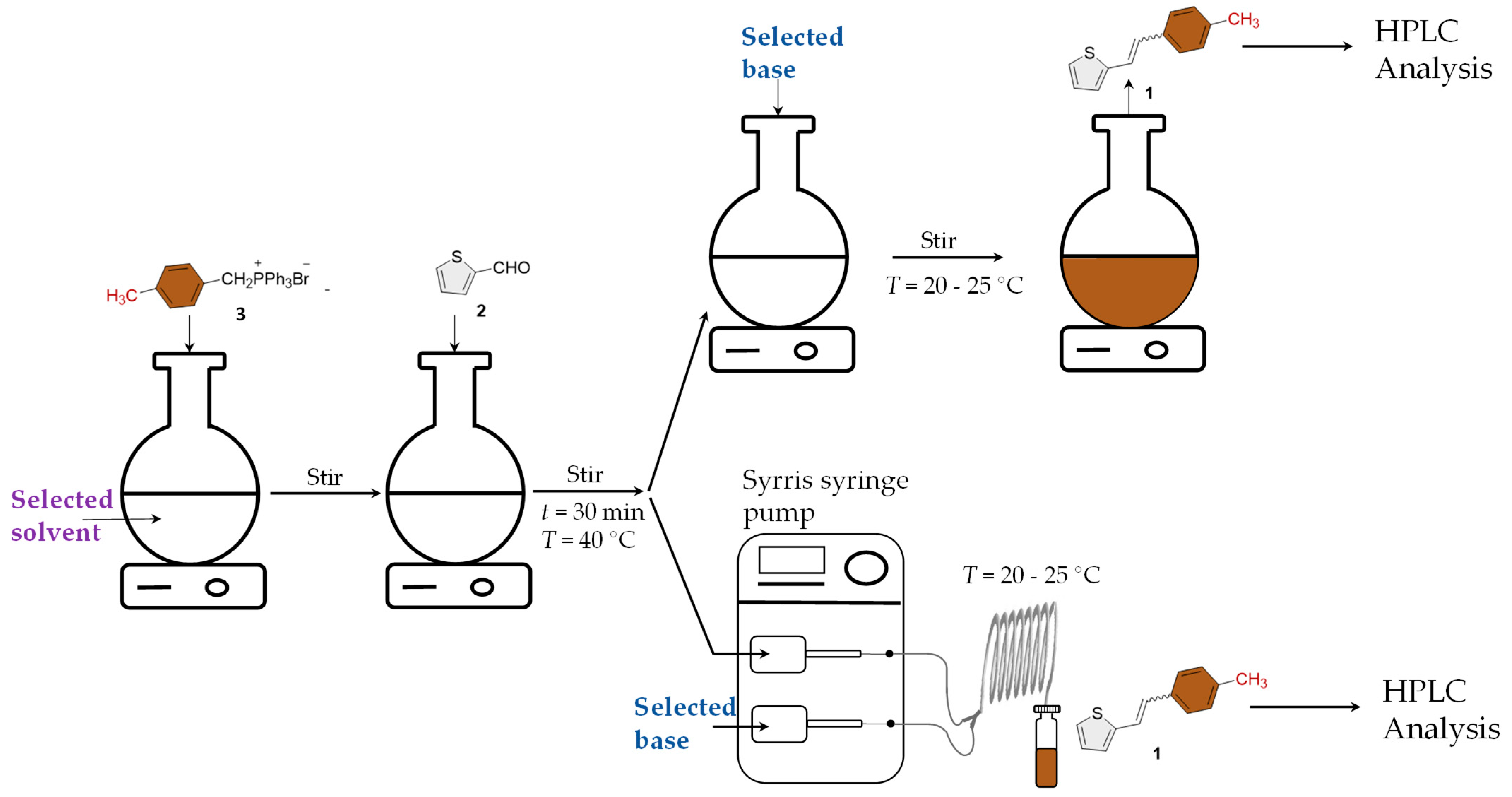
The general procedure for the synthesis of compound 1 under the various system, base, and solvent types, as well as base and solvent quantities and reaction times presented in Table 2, is described below. The phosphonium salt 3 (1.1 mol eq) was added to a round-bottom flask containing the selected solvent. The mixture was stirred on a magnetic stirrer, and after homogenization, aldehyde 2 (0.89 mmol) was added. The reaction mixture was then heated to 40 °C and stirred for 30 min. Subsequently, the required amount of the selected base was added, after which the mixture was cooled to 20–25 °C. The resulting reaction mixture was stirred for a defined time at this temperature. Aliquots were taken and analysed by HPLC (Scheme 2). Molar and volume equivalents for the phosphonium salt, bases, and solvents were calculated and expressed relative to aldehyde 2, which was used as the limiting reactant.

3.3.2. Flow Experiment

Thienostilbene 1 was prepared in the flow reactor using the set-up shown in Scheme 2. The synthesis was performed by pumping a solution of a phosphonium salt 3 and aldehyde 2 in DCM as one stream, along with aqueous NaOH solution (3 mol/L) as the second stream. The aldehyde concentration in the solution was 14 mg/mL, and the phosphonium salt was added in an amount of 1.1 mol eq relative to the aldehyde, consistent with the batch experiments. Both streams were delivered using syringe pump (Asia Syringe Pump, Syrris, Royston, UK) into a Y-shaped inlet made of polyetheretherketone (PEEK), followed by millireactor (I. D. = 1.016 mm) made of perfluoroalkoxyalkane (PFA) tubing (Cole-Parmer, Vernon Hills, IL, USA) in-house with a total volume of 7.5 mL. The flow ratio was set to 3.35:1, corresponding to a residence time of 15 min. Samples were collected in vials at the outlet of the millireactor and analysed by HPLC.

3.4. HPLC Analysis

Reaction mixtures (20 µL) were diluted in 1 mL of MeOH and analysed by HPLC (1100 Series, Agilent, Santa Clara, CA, USA) with a DAD detector and a Waters (Milford, MA, USA) XBridge C18 column (3.5 µm, 4.6 × 150 mm). The mobile phase consisted of solvent A (ACN) and solvent B (0.2% vol. H3PO4 in water) with gradient elution from 90 to 10% B in 15 min, followed by a 3 min hold at 10% B, then replaced by 90% B over 2 min. The flow rate was 1 mL/min, the column temperature was maintained at 35 °C, and UV detection was at 300 nm. All samples were analysed in three parallels, with all results within the confidence interval of ±0.05.

3.5. Statistical Analyses of the Data from the Wittig Reaction Experiments

3.5.1. Spearman Correlation Matrix

Spearman’s rank correlation coefficient was used to examine associations between Wittig reaction experimental conditions (base type, base quantity, solvent type, solvent quantity, system type, and reaction time) and response variables, conversion and trans-/cis-isomer ratio. Prior the statistical analysis, non-numerical variables (base type, solvent type and system type) were encoded numerical. The nonparametric Spearman method was chosen because it does not require normally distributed data and is suitable for ordinal variables and monotonic, non-linear relationships. Before conducting the correlation analysis, each variable was assessed using descriptive statistics (mean, median, standard deviation, range) and graphical methods (histograms, box plots). Normality was tested using the Shapiro–Wilk test and visual inspection. Most variables deviated from a normal distribution (p < 0.05) or were ordinal/categorical in nature, supporting the use of a nonparametric approach instead of Pearson’s correlation. Spearman’s coefficients were calculated based on ranked values, reducing sensitivity to outliers and allowing detection of monotonic relationships. For each pair of variables, the correlation coefficient and corresponding p-value were obtained. Statistical analyses were performed using Statistica 14.0 (Tibco Software Inc., Santa Clara, CA, USA).

3.5.2. Principal Components Analysis

PCA was applied to the same dataset to explore underlying data structure, reduce dimensionality, and identify multivariate patterns not evident from individual variable analysis. PCA transforms the original correlated variables into a smaller set of uncorrelated principal components, each representing a linear combination of the original data. All PCA computations were performed using Statistica 14.0 (Tibco Software Inc., Santa Clara, CA, USA) with default multivariate analysis settings.

3.5.3. Response Surface Modelling

RSM was applied to investigate the relationships between selected process variables and the observed responses, and to predict optimal operating conditions. The experimental conditions were selected empirically based on prior experience with the reaction system and exploratory screening, rather than being generated by a formal design of experiments. RSM was subsequently applied as a retrospective modeling tool to analyze nonlinear trends and identify practical optima within the explored parameter space. The influence of Wittig reaction experimental conditions on the trans-/cis-isomer ratio was modelled using a second-order polynomial response surface model (Equation (1)).
y = β 0 + i = 1 k β i x i + i = 1 k β i i x i 2 + i < j j = 2 β i j x i x j + ε
Here, y is the dependent variable (response), x are the independent variables, β represents the model coefficients, and ε is the residual error. The model coefficients are estimated by minimizing the sum of squared deviations, followed by validation on an independent dataset. Optimization was performed using the desirability function approach implemented in Statistica 14.0.

4. Conclusions

This study provides a comprehensive analysis of how reaction parameters influence stereoselectivity in the Wittig synthesis of a targeted thienostilbene derivative. Through a systematically designed series of batch experiments combined with advanced statistical tools, Spearman correlation analysis, PCA, and RMS, the key variables governing the balance between conversion and trans/cis selectivity were identified. The applied statistical analyses are exploratory in nature and intended to rationalize an empirically generated experimental space rather than to provide confirmatory statistical inference. The results clearly show that the type of base, solvent, and system (one-phase vs. two-phase) exert the strongest influence on stereochemical outcome, while solvent volume serves as an additional, highly effective parameter for fine-tuning trans selectivity.
Statistical evaluation revealed that one-phase systems employing cyclic ether solvents and medium-strong bases (e.g., KOtBu, NaHMDS) provide the most favourable combination of high conversion and enhanced trans selectivity. However, RSM analysis indicated that an industrially feasible optimum can also be achieved in a two-phase system using aqueous NaOH together with increased volumes of organic solvent, i.e., decreased reagent concentrations. This prediction was validated experimentally, highlighting the importance of integrating statistical modelling with practical process constraints.
A particularly significant contribution of this work lies in the successful demonstration of transferring the optimized reaction conditions from batch to flow. Implementing flow technology resulted in a dramatic acceleration of the reaction and substantially improved handling of the biphasic PTC system. In the millireactor, operating under slug-flow conditions, a conversion of 67.54% was achieved in only 15 min as the equivalent to the conversion obtained after one hour in the batch process. This clearly demonstrates that the superior micromixing inherent to continuous flow systems enables faster interphase mass transfer between the aqueous base and the organic phase containing the phosphonium salt and aldehyde.
Moreover, the trans/cis ratio observed in the flow experiment (1.79) remained consistent with the values obtained under optimized batch conditions, confirming that the accelerated kinetics in flow do not compromise stereochemical control. Flow processing thus emerges not only as a mode of reaction intensification but also as a highly reliable and scalable platform—features of critical importance for modern process development and pharmaceutical manufacturing. In conclusion, the results of this study emphasize the necessity of holistic optimization of the Wittig reaction and highlight the strong advantages of flow chemistry for reactions sensitive to mixing efficiency and interphase mass transfer. The integration of statistical modelling, experimental verification, and successful transfer to continuous operation represents a meaningful contribution to the rational design of stereoselective synthetic processes.

Author Contributions

Conceptualization, I.Š. and A.Š.; methodology, A.L., A.J.T., I.Š. and A.Š.; investigation, A.L. and A.J.T.; resources, A.L., A.J.T., I.Š. and A.Š.; writing—original draft preparation, A.L., A.J.T., I.Š. and A.Š.; writing—review and editing, A.L., A.J.T., I.Š. and A.Š.; supervision, I.Š. All authors have read and agreed to the published version of the manuscript.

Funding

This work was supported by grants from the University of Zagreb for institutional research project under the title Synthesis of biologically active cholinesterase inhibitors in flow systems (SynBioFlow, number 112111).

Data Availability Statement

Dataset available on request from the authors.

Conflicts of Interest

Author Anabela Ljubić was employed by the company Pliva Croatia, Zagreb, Croatia. The remaining authors declare that the research was conducted in the absence of any commercial or financial relationships that could be construed as a potential conflict of interest.

Abbreviations

The following abbreviations are used in this manuscript:
CPMECyclopentyl methyl ether
EtOAcEthyl-acetate
EtOH, abs.Absolute ethanol
n-BuOHn-butanol
MEKMethyl ethyl ketone
MTBEMethyl tert-butyl ether
NaOHSodium hydroxide
KOHPotassium hydroxide
ACNAcetonitrile
MeOHMethanol
H3PO4Phosphoric acid
BuOAcButyl acetate
NaOEtSodium ethoxide
KOtBuPotassium tert-butoxide
KHMDSPotassium bis(trimethylsilyl)amide
NaHMDSSodium bis(trimethylsilyl)amide
THFTetrahydrofuran
DCMDichloromethane
2-MeTHF2-methyltetrahydrofuran
DMFN,N-dimethylformamide
LiHMDSLithium bis(trimethylsilyl)amide

References

  1. Cuenca, A.B.; Fernández, E. Boron-Wittig olefination with gem-bis(boryl)alkanes. Chem. Soc. Rev. 2021, 50, 72–86. [Google Scholar] [CrossRef]
  2. Ilia, G.; Simulescu, V.; Plesu, N.; Chiriac, V.; Merghes, P. Wittig and Wittig–Horner Reactions under Sonication Conditions. Molecules 2023, 28, 1958. [Google Scholar] [CrossRef]
  3. De Nardi, F.; Gorreta, G.; Meazzo, C.; Parisotto, S.; Blangetti, M.; Prandi, C. Wittig Reaction in Deep Eutectic Solvents: Expanding the DES Toolbox in Synthesis. Chem. Eur. J. 2024, 30, e202402090. [Google Scholar] [CrossRef] [PubMed]
  4. Wysokowski, M.; Luu, R.K.; Arevalo, S.; Khare, E.; Stachowiak, W.; Niemczak, M.; Jesionowski, T.; Buehler, M.J. Untapped Potential of Deep Eutectic Solvents for the Synthesis of Bioinspired Inorganic-Organic Materials. Chem. Mater. 2023, 35, 7878–7903. [Google Scholar] [CrossRef] [PubMed]
  5. Templ, J.; Michael, S. High-Energy Ball Milling Enables an Ultra-Fast Wittig Olefination under Ambient and Solvent-Free Conditions. Angew. Chem. Int. Ed. 2024, 63, e202411536. [Google Scholar] [CrossRef] [PubMed]
  6. Reynes, J.F.; Leon, F.; Garcia, F. Mechanochemistry for Organic and Inorganic Synthesis. ACS Org. Inorg. Au 2024, 4, 432–470. [Google Scholar] [CrossRef]
  7. Phelps, R.; Orr-Ewing, A.J. Direct Observation of the Dynamics of Ylide Solvation by Hydrogen-Bond Donors Using Time-Resolved Infrared Spectroscopy. J. Am. Chem. Soc. 2022, 144, 9330–9343. [Google Scholar] [CrossRef]
  8. Bofill, J.M.; Severi, M.; Quapp, W.; Ribas-Ariño, J.; Moreira, I.d.P.R.; Albareda, G. Optimal Oriented External Electric Fields to Trigger a Barrierless Oxaphosphetane Ring Opening Step of the Wittig Reaction. Chem. Eur. J. 2024, 30, e202400173. [Google Scholar] [CrossRef]
  9. Davison, N.; McMullin, C.; Zhang, L.; Hu, S.-X.; Waddell, P.; Wills, C.; Casey, D.; Lu, E. Li vs Na: Divergent Reaction Patterns between Organolithium and Organosodium Complexes and Ligand-Catalyzed Ketone/Aldehyde Methylenation. J. Am. Chem. Soc. 2023, 145, 6562–6576. [Google Scholar] [CrossRef]
  10. Farfán, P.; Gómez, S.; Restrepo, A. On the origins of stereoselectivity in the Wittig reaction. Chem. Phys. Lett. 2019, 728, 153–155. [Google Scholar] [CrossRef]
  11. Kumar, A.; Savanura, M.R.S.; Garg, S.; Singh, S.K.; Kumar, M.; Kumar, S. Recent Advances in Phosphonium Salts-Mediated Synthetic Transformations. Asian J. Org. Chem. 2025, 14, e202500211. [Google Scholar] [CrossRef]
  12. Wahart, A.J.C.; Beardmore, L.N.D.; Field, R.A.; Cosgrove, S.C.; Miller, G.J. Tandem One-Pot Biocatalytic Oxidation and Wittig Reaction in Water. Org. Lett. 2024, 26, 6642–6646. [Google Scholar] [CrossRef] [PubMed]
  13. Bogatyrev, E.; Kodkin, V. A Minireview of Phase-Transfer Catalysis and Recent Trends. Biomedres 2022, 45, 36691–36702. [Google Scholar] [CrossRef]
  14. Ljubić, A.; Vušak, V.; Cingesar, I.K.; Vrsaljko, D.; Šalić, A.; Škorić, I. Application of natural deep eutectic solvents in the continuous process for synthesis of resveratrol analogues by the Wittig reaction. J. Flow Chem. 2025, 15, 99–114. [Google Scholar] [CrossRef]
  15. Ljubić, A.; Šalić, A.; Škorić, I. Synthesis of Hydroxylated Stilbenes in a Batch and Flow Reactor: An Overview. ChemistrySelect 2023, 8, e20230337. [Google Scholar] [CrossRef]
  16. Kikaš, I.; Horváth, O.; Škorić, I. Functionalization of the benzobicyclo[3.2.1]octadiene skeleton via photocatalytic and thermal oxygenation of a furan derivative. Tetrahedron Lett. 2011, 52, 6255–6259. [Google Scholar] [CrossRef]
  17. Mlakić, M.; Čadež, T.; Barić, D.; Puček, I.; Ratković, A.; Marinić, Ž.; Lasić, K.; Kovarik, Z.; Škorić, I. New Uncharged 2-Thienostilbene Oximes as Reactivators of Organophosphate-Inhibited Cholinesterases. Pharmaceuticals 2021, 14, 1147. [Google Scholar] [CrossRef] [PubMed]
  18. Roman, B.I.; De Coen, L.M.; Mortier, S.T.F.C.; De Ryck, T.; Vanhoecke, B.W.A.; Katritzky, A.R.; Bracke, M.E.; Stevens, C.V. Design, synthesis and structure-activity relationships of some novel, highly potent anti-invasive (E)- and (Z)-stilbenes. Bioorg. Med. Chem. 2013, 17, 5054–5063. [Google Scholar] [CrossRef]
  19. Byrne, P.A.; Rajendran, K.V.; Muldoon, J.; Gilheany, D.G. A convenient and mild chromatography-free method for the purification of the products of Wittig and Appel reactions. Org. Biomol. Chem. 2012, 10, 3531–3537. [Google Scholar] [CrossRef]
  20. Sathiyamoorthy, V.; Bairwa, K.; Duche, S.; Roy, A.; Mathur, A. 2-Methyl tetrahydrofuran: A green organic modifier for eco-friendly, cost-effective, and rapid purification in drug discovery. Anal. Methods 2025, 15, 2938–2947. [Google Scholar] [CrossRef]
  21. Ali Khan, Z.; Iqbal, A.; Shahzad, S.A. Synthetic approaches toward stilbenes and their related structures. Mol. Divers. 2017, 21, 483–509. [Google Scholar] [CrossRef] [PubMed]
  22. Šinkovec, E.; Krajnc, M. Phase Transfer Catalyzed Wittig Reaction in the Microtube Reactor under Liquis-Liquid Slug-Flow Pattern. Org. Process Res. Dev. 2011, 15, 817–823. [Google Scholar] [CrossRef]
  23. Byrne, P.A.; Gilheany, D.G. The modern interpretation of the Wittig reaction mechanism. Chem. Soc. Rev. 2013, 42, 6670–6696. [Google Scholar] [CrossRef]
  24. Chen, H.-Y.; Chen, C. Importance of Using Modern Regression Analysis for Response Surface Models in Science and Technology. Appl. Sci. 2025, 15, 7206. [Google Scholar] [CrossRef]
  25. Mlakić, M.; Faraho, I.; Odak, I.; Talić, S.; Vukovinski, A.; Raspudić, A.; Bosnar, M.; Zadravec, R.; Ratković, A.; Lasić, K.; et al. Synthesis, photochemistry and computational study of novel 1,2,3-triazole heterostilbenes: Expressed biological activity of their electrocyclization photoproducts. Bioorg. Chem. 2022, 121, e105701. [Google Scholar] [CrossRef] [PubMed]
Scheme 1. Wittig reaction for the preparation of thienostilbene compound 1.
Catalysts 16 00151 sch001
Figure 1. Spearman correlation matrix for analysis of the Wittig reaction selected variables. Significant correlations for p < 0.05 are marked bold.
Catalysts 16 00151 g001
Figure 2. PCA (a) biplot and (b) score plot of the selected variables and experimental results for the Wittig reaction.
Catalysts 16 00151 g002
Figure 3. Desirability profile for the trans-/cis-isomer ratio of the Wittig reaction.
Catalysts 16 00151 g003
Figure 4. Thienyl aldehyde 2 conversion at various time-points in a Wittig reaction batch experiment under proposed optimal conditions.
Catalysts 16 00151 g004
Scheme 2. Experimental set-up for batch experiments (upper stream) and the flow experiment (lower stream).
Catalysts 16 00151 sch002
Table 1. Solubility of phosphonium salt 3 for the synthesis of thienostilbene 1 in a series of organic solvents immiscible with water— not soluble (less than 10 mg/mL), soluble (10–100 mg/mL), and very soluble (more than 100 mg/mL) with solubility value range (the highest possible salt concentration) given in brackets where the salt is soluble.
SolventSolubility
BuOAc
n-BuOH (157–162 mg/mL)
CPME
DCM (91–94 mg/mL)
EtOAc
MEK
2-MeTHF
MTBE
Table 2. Experimental conditions for Wittig reaction experiments * and corresponding results of HPLC analyses (trans/cis ratio and conversion).
ExperimentBase TypeBase Quantity, mol eqSolvent TypeSolvent Quantity,
V eq
System Type **Time, htrans-/cis-Isomer RatioConversion, %
1NaOEt1.10EtOH116one-phase161.7435.2
2NaOEt1.16EtOH116one-phase452.0137.4
3NaOEt1.16EtOH116one-phase452.0637.2
4NaOEt1.16EtOH116one-phase452.0021.9
5NaOEt1.99EtOH116one-phase692.0063.0
6KOtBu1.10EtOH116one-phase692.0892.8
7KOtBu1.10THF116one-phase152.9192.9
8KOtBu1.10DCM116one-phase151.3298.4
9NaOH (3 mol/L water solution)6.01DCM10.0two-phase15.51.0592.2
10KOtBu1.10ACN116one-phase151.2068.5
11KOtBu1.102-MeTHF116one-phase153.2681.0
12KOtBu1.10DMF116one-phase631.3998.1
13NaOH (3 mol/L water solution)6.012-MeTHF10.0two-phase631.4193.6
14LiHMDS (1.3 mol/L THF solution)1.10DMF109one-phase161.3771.8
15LiHMDS (1 mol/L hexane solution)1.10DMF163one-phase151.3862.6
16KHMDS1.132-MeTHF116one-phase211.1659.4
17NaHMDS1.102-MeTHF116one-phase213.3076.2
18KOH (2 mol/L water solution)6.01DCM45.0two-phase211.0194.0
19KOH (2 mol/L water solution)6.01n-BuOH45.00two-phase161.2464.6
20NaOH (3 mol/L water solution)6.01n-BuOH45.00two-phase161.4771.6
* Phosphonium salt (1.1 mol eq) and aldehyde (0.89 mmol) were reacted in the chosen solvent at 40 °C, then cooled. The selected base was added and the mixture stirred at 20–25 °C for the specified time. ** One-phase system contains one liquid phase, while two-phase system consists of two immiscible liquid phases.
Table 3. Loading values and cumulative explained variance of PCA.
Value NumberEigenvalue% Total
Variance
Cumulative
Eigenvalue
Cumulative %
11.078753.93421.078753.9349
20.721336.06501.800089.9992
30.18239.11521.982399.1144
40.01770.88562100
Table 4. ANOVA table of the RSM model (L-linear term, Q-Quadratic term, SS—Sum of Squares, df—Degrees of Freedom, and MS—Mean Square).
VariableSSdfMSF-Valuep-Value
(1) Base Type (L)0.856710.8567989.80.0010
(2) Base Quantity (L)2.068512.06852389.90.0004
(3) Solvent Type (L)0.020610.020623.80.0396
(4) Solvent Quantity (L)1.055611.05561219.60.0008
(5) Time (L)0.016710.016719.30.0481
(6) System Type (L)1.863311.86332152.90.0005
1L by 2L2.200312.20032542.20.0004
1L by 3L0.085110.085198.30.0100
1L by 4L1.387711.38771603.40.0006
1L by 5L0.021510.021524.90.0379
1L by 6L1.364611.36461576.60.0006
2L by 3L0.008010.00809.20.0935
2L by 4L1.388711.38871604.50.0006
2L by 5L0.030710.030735.50.0271
3L by 5L0.214910.2149248.30.0040
Lack of Fit0.013920.067737.60.1505
Pure Error0.001720.0009
Disclaimer/Publisher’s Note: The statements, opinions and data contained in all publications are solely those of the individual author(s) and contributor(s) and not of MDPI and/or the editor(s). MDPI and/or the editor(s) disclaim responsibility for any injury to people or property resulting from any ideas, methods, instructions or products referred to in the content.