


Abstract
Cu-SSZ-13, the most widely used catalyst in diesel selective catalytic reduction (SCR) systems, often suffers severe deactivation, including hydrothermal aging and ash poisoning. In comparison with traditional impregnation in laboratory work, a more realistic solid-state diffusion method was employed to simulate K2SO4 poisoning on a commercial Cu-SSZ-13 catalyst with high aluminum and copper contents. Hydrothermal aging at 650 °C alone induces severe framework dealumination and transformation of isolated Cu2+ ions to copper aluminate (CuAlOx) species. K2SO4 poisoning alone is more prone to detached Cu2+ ions and aluminum terminal hydroxyl group to form CuSO4 and Al2(SO4)3. The presence of water vapor during K2SO4 poisoning dramatically reduces SCR activity by accelerating the ion-exchange between K+ and Cu2+ and zeolite dealumination. These synergistic effects promote extensive detachment of active Cu species, resulting in the formation of predominating inert sulfates, along with a small amount of CuOx clusters. These findings are expected to provide a theoretical basis for designing catalysts with enhanced resistance to both hydrothermal aging and ash poisoning in diesel aftertreatment applications.
1. Introduction
With the progressive tightening and full implementation of emission standards such as China VI and Euro VI, efficient removal of nitrogen oxides (NOx) in diesel vehicle exhaust faces unprecedented challenges [1,2,3]. Ammonia selective catalytic reduction (NH3-SCR) has been widely regarded as the primary NOx mitigation technology in the past decades [4]. Among various NH3-SCR catalysts, copper-based zeolite, particularly Cu-SSZ-13 with a chabazite (CHA) structure, has become the mainstream choice for meeting China VI requirements due to its excellent NOx conversion over a wide temperature range (especially at low temperatures), high N2 selectivity, and superior hydrothermal stability [5,6].
However, the stability and poison resistance of these catalysts remain severe challenges in practical applications. During diesel operation, sulfur-containing components in the fuel are oxidized to sulfur oxides [7]. These sulfur oxides can further react with impurities such as alkali metals (e.g., K) originating from lubricating oil and residual urea, to form sulfates (e.g., K2SO4). In some diesel aftertreatment systems, SCR catalyst is coated onto a wall-flow diesel particulate filter (DPF) to form a selective catalytic reduction filter (SCRF), promoting heating to reduce NOx emissions during cold-start and low-load conditions, and minimizing system volume [8]. Consequently, thermally stable sulfates gradually accumulate as ash on the SCRF sidewalls, leading to both physical blockage and chemical deactivation of the catalyst [8]. Additionally, biodiesel, as a renewable alternative to crude oil-refined diesel, is gradually being promoted worldwide. Its production introduces alkaline catalysts and herein contains more K and Na than regular diesel, resulting in an increase in alkali content in the ash from 0.2% to 6% [9]. Previous studies generally attribute alkali-induced deactivation to several mechanisms [8,10,11]. First, alkali species promote the transformation of isolated Cu2+ into aggregated CuOx or copper aluminate species (i.e., CuAl2O4 and CuAlO2), which not only reduce the number of active sites but also enhance side reactions of NH3 oxidation. Second, alkali species or copper-derived compounds may physically block zeolite micropores. Third, alkali metal ions can undergo ion exchange with Brønsted acid sites, weakening NH3 storage capacity. Fourth, severe alkali poisoning can directly damage the zeolite framework and eventually cause complete catalyst deactivation.
At present, wet impregnation is the most commonly employed method for simulating ash poisoning in laboratory work because it is operationally simple and allows precise control of loading [12,13,14]. However, this method causes the dissociation of soluble salt cations and anions in the water and completes the liquid-state ion exchange to a large extent in the suspension, greatly accelerating the poisoning of the catalyst. This scenario differs substantially from real operating conditions, where alkaline impurities in the form of aerosols in exhaust gradually accumulate on the catalyst coating and progressively diffuse into the zeolite channels in the solid state under hydrothermal environments. Although aerosol deposition and solid-state diffusion have been used in some studies, most of them focus on vanadium-based catalyst systems. For example, Lei et al. [15] compared the deactivation of V2O5-WO3/TiO2 exposed to KCl introduced by wet impregnation, vapor deposition, and solid-state diffusion. They found that wet impregnation induced deactivation primarily through the formation of V2O3 caused by the interaction of potassium with oxygen in vanadium oxides, while vapor deposition and solid-state diffusion mainly produced a K2S2O7-V2O5 eutectic phase that led to deactivation. Larsson et al. [16] reported that wet impregnation had more severe poisoning effects than the aerosol method, whereas Ali et al. [17] concluded that V2O5-WO3/TiO2 catalysts subjected to prolonged KCl solid-state diffusion showed a greater decrease in denitration activity compared to the impregnation method based on activity tests and DFT calculations, demonstrating the importance of poisoning treatment parameters. Few systematic investigations about ash poisoning methods have been performed on zeolite-based catalysts. By using the aerosol method to simulate potassium poisoning, Shwan et al. [18] found that the deactivation of Fe-BEA zeolites was also caused by the exchange of potassium with isolated iron ions. Kern et al. [19] explored the effects of various alkali elements (K, Na, Mg, and Ca) on Fe-BEA and Fe-MFI using wet impregnation and aerosol treatments, and obtained that these zeolites had better resistance to alkali poisoning than vanadium-based catalysts. Particularly, no similar solid-state diffusion methods were applied to Cu-SSZ-13 to simulate ash poisoning.
Diesel vehicle exhaust typically contains approximately 10 vol.% water vapor. In particular, Cu-SSZ-13 with a low Si/Al ratio contains a high proportion of hydrolysis-susceptible bonds with great hydrophilicity, which accelerates framework dealumination and ultimately leads to structural collapse [20]. Although the influence of water vapor on hydrothermal aging has been widely investigated, it is often neglected as an essential environmental factor in simulating ash poisoning. Tarot et al. [21,22] reported that impregnation of Cu/FER catalysts in water caused more severe deactivation than impregnation in ethanol, attributing the effect to water-facilitated migration of Cu species and enhanced formation of extra-framework CuOx species. Wang et al. [23] compared the effects of different alkali metal elements (Na and K) impregnated on the hydrothermal stability of Cu-SSZ-13 and found that alkali poisoning significantly decreased hydrothermal stability and resulted in severe deactivation. Zhang et al. [24] reported the combined effects of hydrothermal aging and SO2 poisoning on Cu/SSZ-13. Nevertheless, current research has not yet provided an investigation into the ash poisoning under wet conditions or using solid-state diffusion method on Cu-SSZ-13 catalysts.
Using potassium sulfate as a typical ash component, this work employs a solid-state diffusion approach to simulate ash poisoning of a commercial Cu-SSZ-13, aiming to elucidate the synergistic deactivation effects of hydrothermal aging and ash poisoning. By comparing diffusion behavior under wet and dry conditions, the influence of water vapor on potassium migration and Cu-species evolution along a diffusion-dominated poisoning pathway was clarified.
2. Results
2.1. Catalytic Activity
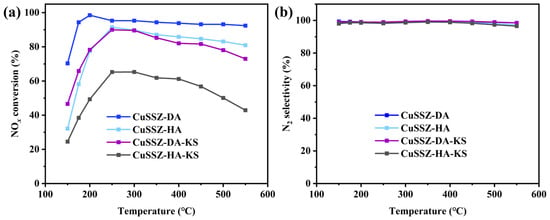
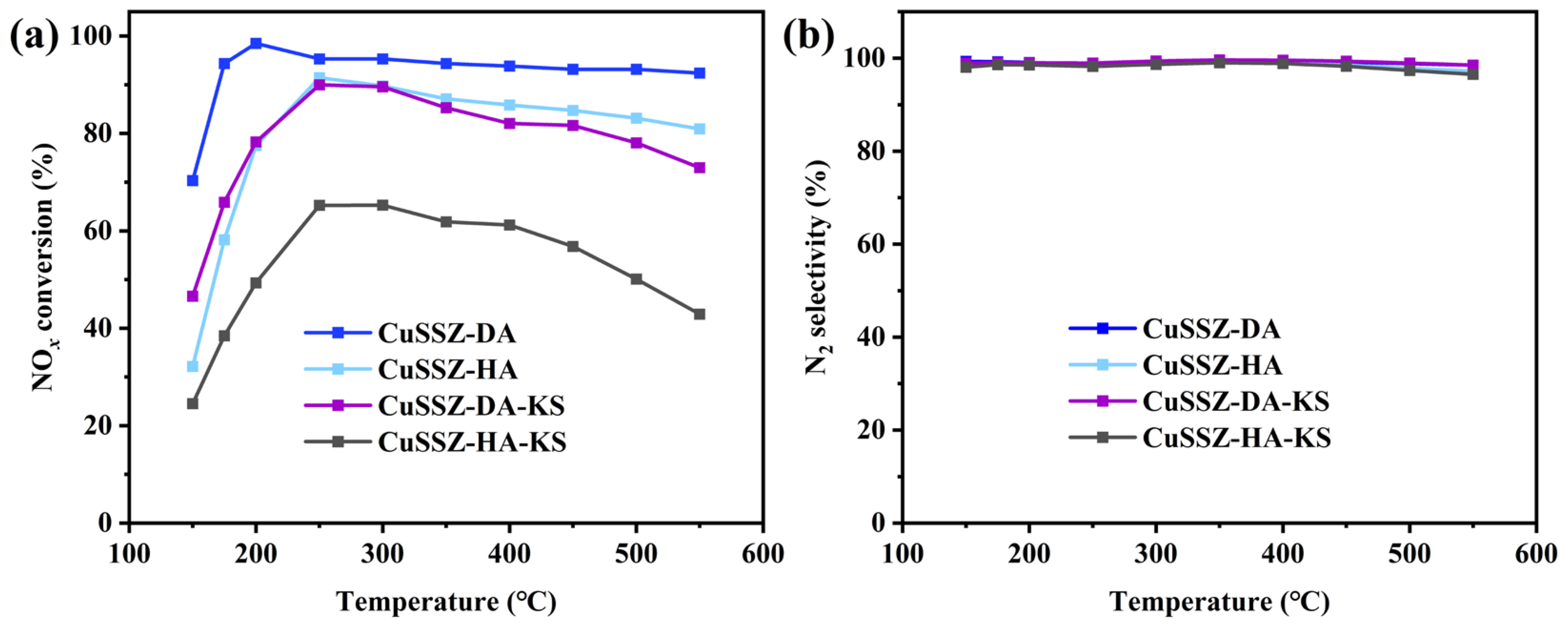
Figure 1a shows the NH3-SCR activities of Cu-SSZ-13 catalyst after different deactivation treatments. After aging in dry air at 650 °C for 10 h, CuSSZ-DA exhibits even better activity than the pristine catalyst (Figure S1a), with a broad temperature window of 175–550 °C. It has been reported that Cu-CHA zeolites with high Cu and Al content, particularly those prepared by the one-pot method, inevitably contain residual CuOx that can be redispersed into isolated Cu2+ ions under mild thermal treatments, leading to an enhancement in catalytic activity [25,26]. Such a reactivation is confirmed by the UV-vis spectra (Figure S1b) in which CuOx signals at ~260 nm and 400–500 nm are weakened to some extent and, correspondingly, the Cu2+ signal at 205 nm is strengthened over CuSSZ-DA. However, the NOx conversion of CuSSZ-HA decreases across the whole temperature range, and the temperature window is narrowed to 250–550 °C, demonstrating the importance of water vapor in thermal deactivation. Notably, CuSSZ-DA-KS, chemical poisoned under dry conditions, displays deactivation characteristics similar to CuSSZ-HA, although its low-temperature (<200 °C) NOx conversion is slightly higher and the loss of high-temperature (>300 °C) activity is more pronounced. In contrast, CuSSZ-HA-KS subjected to K2SO4 solid-state diffusion poisoning in hydrated conditions shows the most severe performance deterioration, with a maximum NOx conversion of only 65% at 250 °C. All the catalysts maintain high N2 selectivity above 95% (Figure 1b).
Figure 1.
(a) NOx conversion and (b) N2 selectivity of the catalysts obtained under different poisoning conditions. Reaction conditions: 500 ppm NO, 500 ppm NH3, 5 vol.% O2, 3 vol.% H2O, and N2 in balance, GHSV = 120,000 h−1.
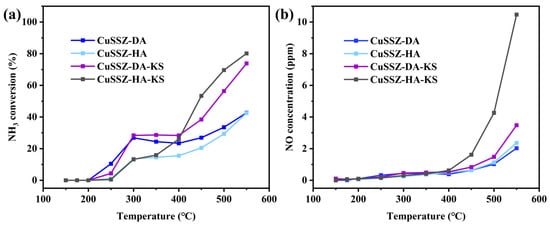
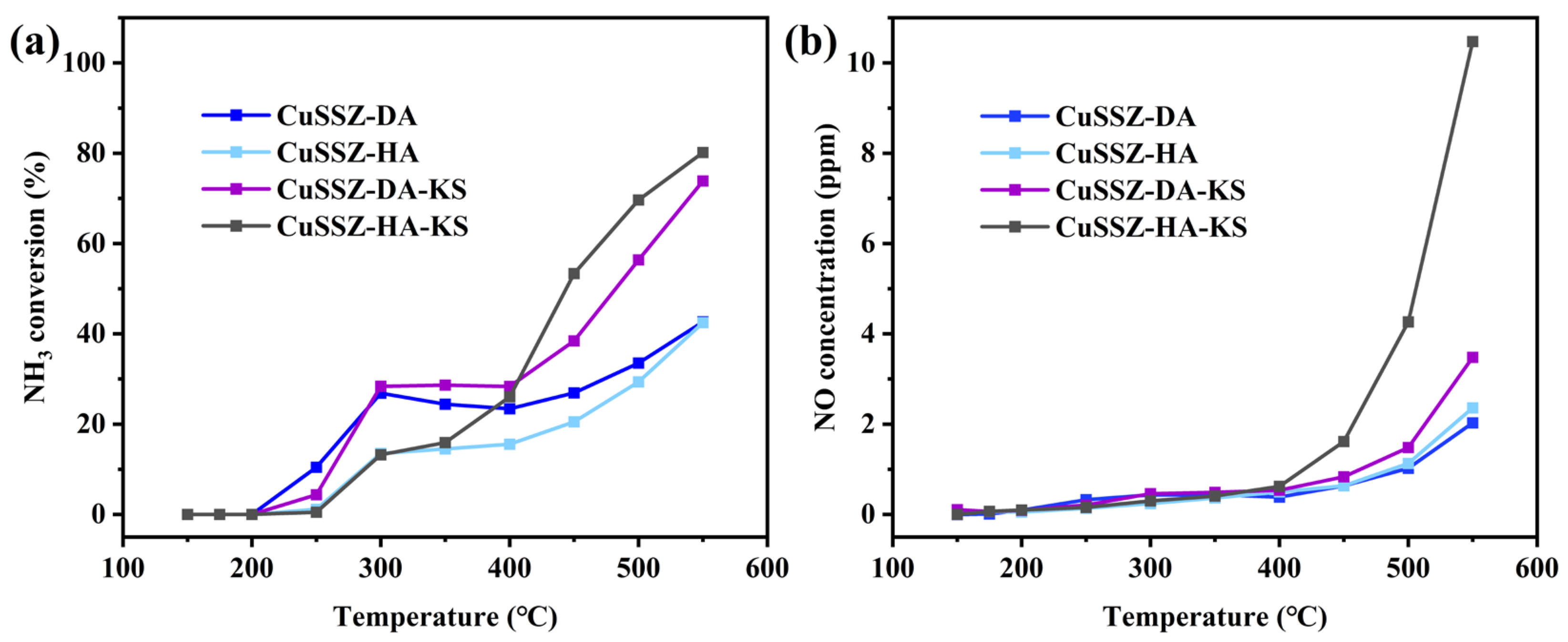
In the SCR reaction, NH3 oxidation serves as a major competitive reaction, particularly at high temperatures, where it accelerates NH3 consumption and consequently reduces reductant availability. As shown in Figure 2a, CuSSZ-DA exhibits a seagull-shaped profile due to various dominating active sites in different temperature regions. Low-temperature (<350 °C) NH3 oxidation is primarily attributed to isolated Cu2+ sites, with N2 as the dominant product. In contrast, the high-temperature (>350 °C) reaction is governed by both Cu2+ and CuOx species, with NO being a characteristic product of CuOx-catalyzed NH3 oxidation [27,28]. After hydrothermal aging, CuSSZ-HA exhibits suppressed activity within the whole temperature range, implying a depletion of isolated Cu2+ active sites. Meanwhile, the NO formation remains comparable to that of CuSSZ-DA, indicating that the detached Cu2+ does not convert into CuOx but instead forms other relatively inert copper species. Upon the introduction of K2SO4, the low-temperature NH3 conversion declines over CuSSZ-DA-KS due to the loss of isolated Cu2+ species. The Cu2+ loss would definitely lead to a reduction in high-temperature NH3 conversion. However, its high-temperature NH3 oxidation activity increases, and trace NO is produced (Figure 2b), indicating the formation of limited CuOx species. Consequently, it shows a severe loss in high-temperature SCR activity due to limitations on reductant availability with stronger NH3 oxidation side reaction. Upon poisoning in the presence of water, the low-temperature NH3 conversion suffers similar severe suppression to that of CuSSZ-HA, but the conversion above 350 °C markedly increases, accompanied by increased NO formation. This observation reveals that poisoning under wet conditions promotes the transfer of isolated Cu2+ to CuOx species. Nevertheless, the maximum NO concentration is only 11 ppm, indicating that the amount of CuOx remains quite low and other copper species, such as copper aluminates, may be the predominant products.
Figure 2.
(a) NH3 conversion and (b) NO yield of the catalysts obtained under different poisoning conditions. Reaction conditions: 500 ppm NH3, 5 vol.% O2, 3 vol.% H2O and N2 in balance, GHSV = 120,000 h−1.
2.2. Structural Characterization of the Catalysts
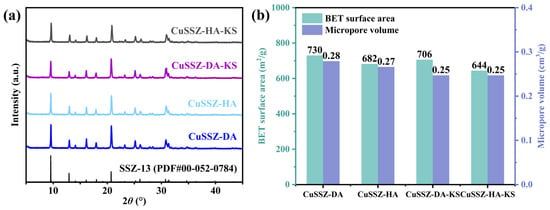
XRD was conducted to explore possible phase changes in the catalyst treated under different conditions. As shown in Figure 3a, all the samples exhibit typical diffraction features of the CHA framework [29,30], indicating that neither K2SO4 poisoning nor high-temperature hydrothermal aging causes significant changes in the bulk structure of the SSZ-13 zeolite. However, the diffraction peaks of the other three samples decrease in intensity to varying degrees in comparison with CuSSZ-DA, suggesting that the framework has undergone a certain degree of damage. In addition, no diffraction peaks related to Cu (CuO, CuAl2O4, or CuAlO2) or other elements (K, S, Al, or Si) are observed in any sample, implying that even if these compounds were formed, their quantities are too low or highly dispersed to be detected.
Figure 3.
(a) XRD patterns and (b) textural properties of the catalysts.
The collapse of the zeolite framework and the formation or introduction of additional species inevitably leads to changes in the textural properties of the catalysts. As shown in Figure 3b, the specific surface area of CuSSZ-HA decreases significantly compared with CuSSZ-DA, while the reduction in pore volume is relatively minor. In contrast, K2SO4 poisoning results in an opposite trend for CuSSZ-DA-KS, where the zeolite framework remains largely intact, but the introduced salt blocks the pore channels. Under wet poisoning conditions, both the declines in the textural features become more marked due to simultaneous partial framework collapse and pore blockage.
2.3. Evolution of Copper Species
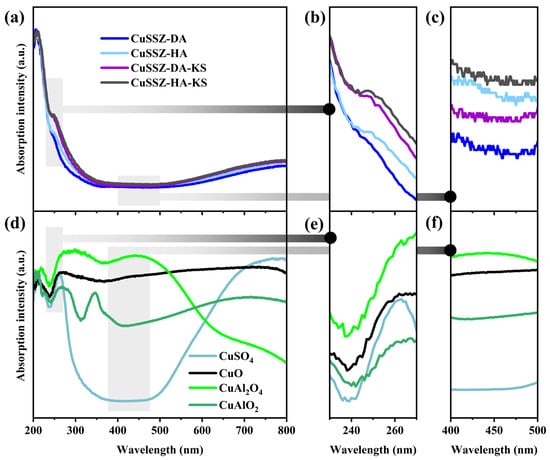
UV-vis spectroscopy was applied to identify different copper species with characteristic absorption behaviors [31]. As shown in Figure 4a, all the samples display pronounced absorption bands near 205 nm and 800 nm, corresponding to ligand-to-metal charge transfer (LMCT) transitions from framework O2− to coordinated isolated Cu2+ and d-d electronic transitions of Cu2+, respectively [32], indicating that isolated Cu2+ is the dominant copper species in Cu-SSZ-13. As enlarged in Figure 4b, the feature centered at 253 nm is attributed to CuOx [33], copper aluminate (CuAl2O4 and CuAlO2) [34], and copper sulfate [8]. To further track copper evolution, reference materials including CuSO4, CuO, CuAl2O4, and CuAlO2 were analyzed (Figure 4d). Compared with CuSSZ-DA, the signal at 253 nm increases in intensity over CuSSZ-HA, due to the relatively poor hydrothermal stability of the zeolite in which partial framework dealumination facilitates the formation of additional copper aluminate species. It shows much stronger adsorption in the 400–500 nm region than CuSSZ-DA, coinciding with the absorption characteristics of CuAl2O4 and CuAlO2. Both the poisoned samples exhibit stronger absorption intensity at 253 nm than their thermally aged counterparts, while the strengthening in the 400–500 nm region is not obvious. are noted correspondingly. These features are consistent with the characteristic fingerprints of CuSO4 as established in the literature [8,35] instead of copper aluminate, and the results in Figure 4d. It means that the detached Cu2+ ions are predominantly captured by extra-framework sulfate species in the poisoned samples. Additionally, the formation of CuOx cannot be excluded, as mentioned in the NH3 oxidation measurement (Figure 2b).
Figure 4.
(a,d) UV-vis spectra of the samples and magnified regions at (b,e) 230–270 nm and (c,f) 400–500 nm.
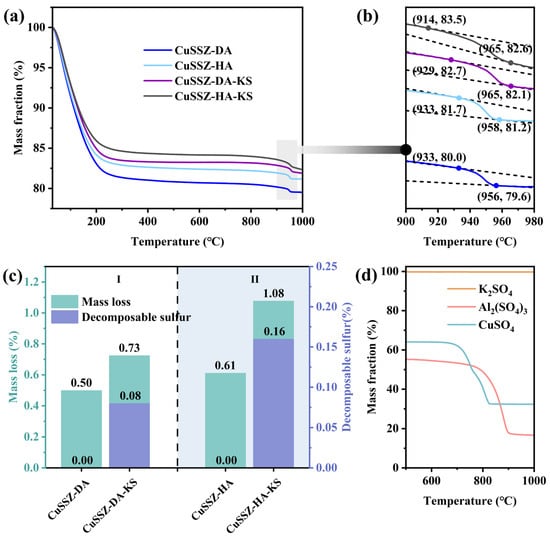
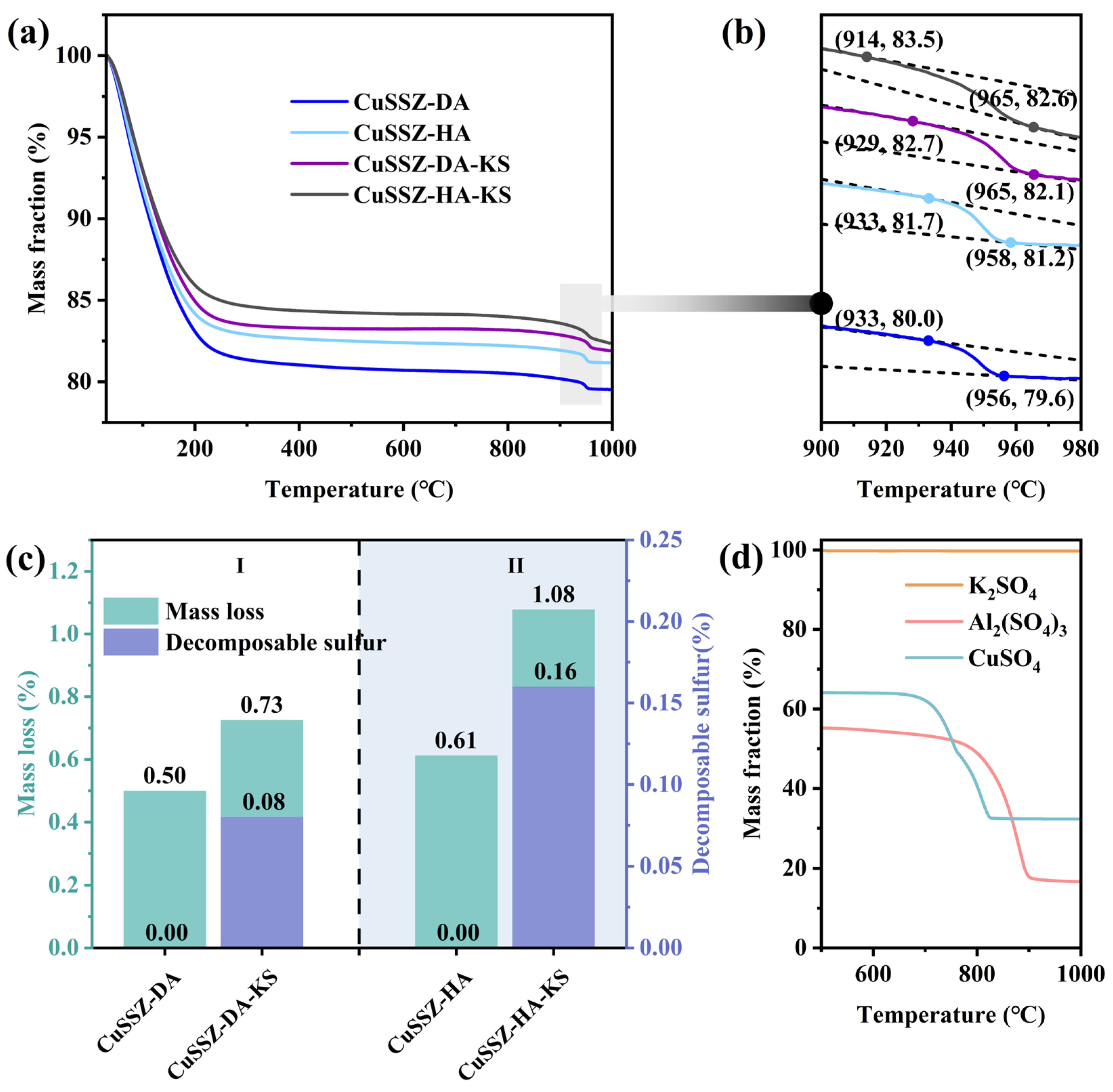
Thermogravimetric analysis was employed to monitor the thermal decomposition behavior of the catalysts and some reference sulfates. As shown in Figure 5a, the thermal decomposition process of Cu-SSZ-13 can be divided roughly into two stages. Stage I (50–300 °C) corresponds to the removal of adsorbed water and physically adsorbed species, while Stage II (900–980 °C) in Figure 5b reflects framework collapse accompanied by de-hydroxylation and associated release of O2 [35]. As shown in Figure 5d, K2SO4 remains stable even at 1000 °C due to its exceptionally high thermal stability in air. Al2(SO4)3 and CuSO4 exhibit mass losses of 68% and 50% within 730–900 °C and 660–830 °C, respectively, corresponding to the thermal decomposition into Al2O3 [36] and SO3 [37] with the release of sulfur oxides and oxygen. The onset temperature for mass loss is defined as the temperature at which the DTG curve begins to decline, while the end temperature corresponds to where the DTG curve levels off. CuSSZ-HA shows similar mass loss features to CuSSZ-DA, while the onset temperature of the two poisoned catalysts shifts towards lower temperatures. Given that the reference materials Al2(SO4)3 and CuSO4 decompose in lower temperature regions, these observed shifts are likely attributed to the formation of analogous sulfates. The interaction of the sulfates with zeolite may delay their thermal decomposition temperature. The mass gap between the onset and end points in Figure 5b was drawn to represent the total mass loss associated with framework de-hydroxylation and decomposition of sulfate species, and the results are summarized in Figure 5c.
Figure 5.
(a,d) TG curves of the samples and (b) magnified regions at 900–980 °C; (c) mass loss and derived decomposable sulfur content.
The difference in mass loss between the two aged catalysts reflects the influence of water on framework dealumination. Meanwhile, the increased mass loss of the two poisoned catalysts in comparison with their thermally aged counterparts can be considered the content of thermally decomposable sulfur species in the samples (Figure 5c), formed by solid-state ion-exchange of K+ and trapping of sulfate radicals on the zeolite surface. The detailed calculation method was described in the support information. Considering that the total sulfur content in the catalyst-salt mixture is 0.82 wt.%, the decomposable sulfur fraction in CuSSZ-DA-KS and CuSSZ-HA-KS accounts for only approximately 10% and 20%, respectively, indicating the presence of substantial amounts of thermally stable K2SO4. Notably, the decomposable sulfur content in CuSSZ-HA-KS is twice that of CuSSZ-DA-KS, which further confirms the synergistic interaction between water vapor and K2SO4. The presence of water vapor promotes K+ diffusion, while aluminum species released during framework collapse and active Cu2+ ions are captured by SO42−, forming larger quantities of Al2(SO4)3 and CuSO4.
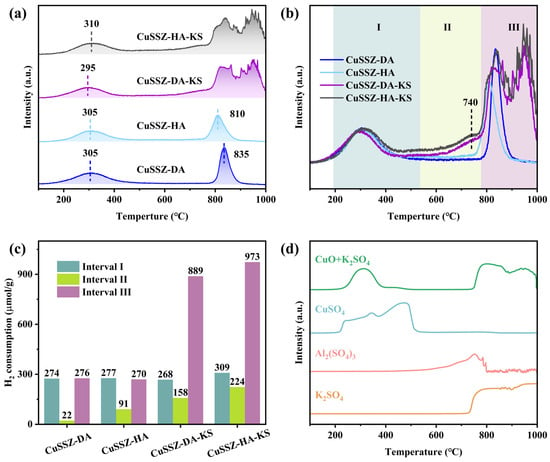
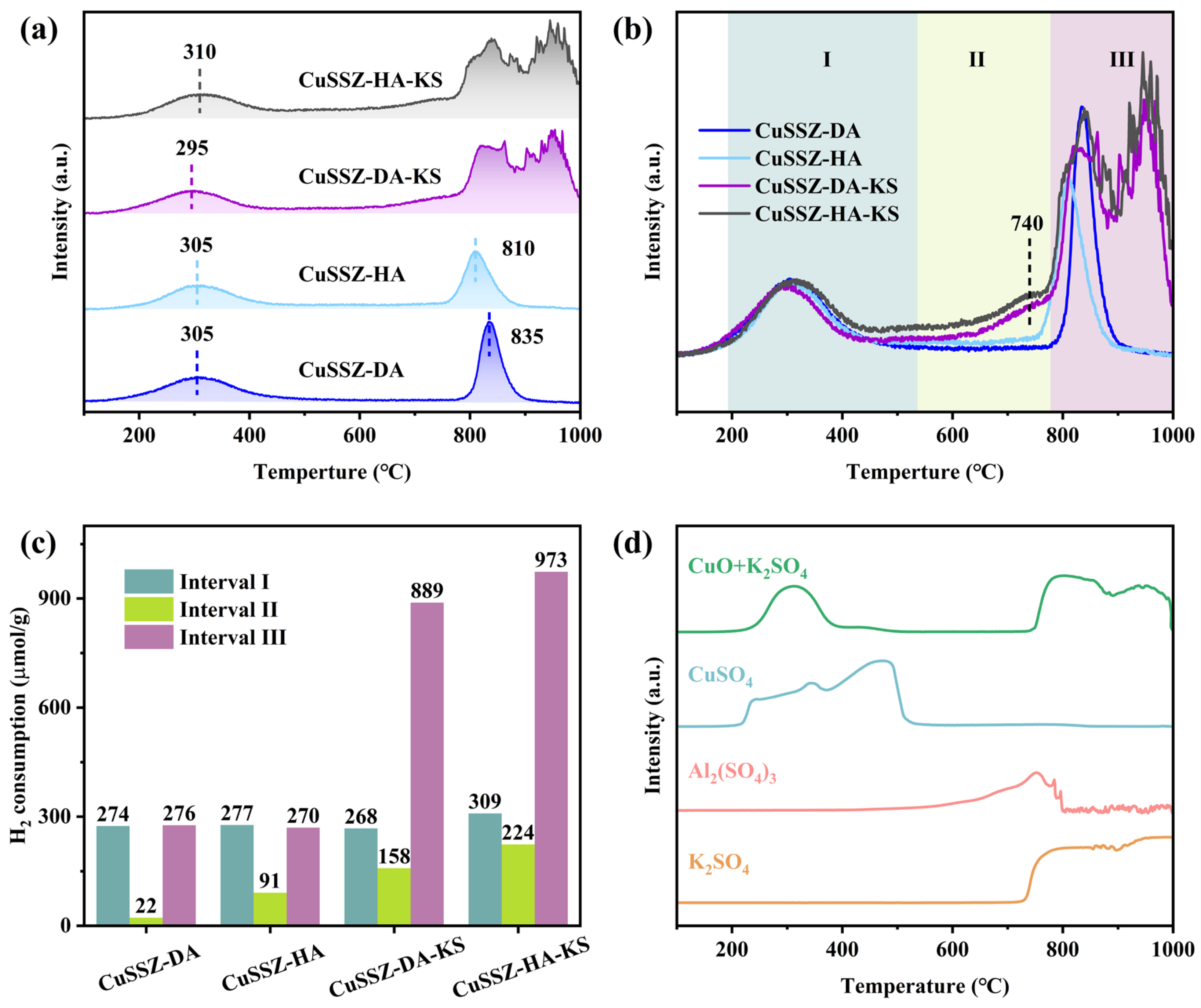
Hydrogen temperature-programmed reduction (H2-TPR) was used not only to assess the effects of K2SO4 and water vapor on the redox behavior of the catalysts, but also to identify different copper and sulfate species based on their characteristic reduction temperatures. As shown in Figure 6b, the H2-TPR profiles of CuSSZ-DA and CuSSZ-HA display clearly separated temperature regions: 150–500 °C (region I) corresponds to the reduction in isolated Cu2+ species (ZCuOH and Z2Cu) to Cu+ and the reduction in CuOx species to Cu0; 500–760 °C (region II) is associated with the reduction in copper aluminate species (CuAl2O4 and CuAlO2) [28]; and 760–1000 °C (region III) reflects the reduction in Cu+ to Cu0 [38]. Specifically, the Cu-SSZ-13 contains a relatively high Cu loading and a low Si/Al ratio, which unavoidably leads to the presence of CuOx and especially copper aluminate species during catalyst synthesis. This feature is consistent with the UV-vis spectra (Figure 4). The H2 consumption ratio between the low- and high-temperature peaks is approximately 1:1 (Figure 6c), indicating that reduction is dominated by isolated Cu2+. With partial severe framework damage, ZCuOH and Z2Cu can further convert to CuOx or copper aluminate phases (CuAl2O4 and CuAlO2) [28], resulting in an obvious increase in H2 consumption in region II for CuSSZ-HA. The high-temperature reduction peak for CuSSZ-HA shifts to lower temperatures, which may be related to decreased copper dispersion and weakened interactions between copper species and damaged zeolite framework.
Figure 6.
(a,b,d) H2-TPR curves of the samples and (c) derived H2 consumption in different temperature ranges.
The high-temperature peaks of the poisoned catalysts become much more complicated, and thus, H2-TPR was also conducted on some reference sulfates. As shown in Figure 6d, the reduction in K2SO4, Al2(SO4)3 and CuSO4 are above 730 °C, within 500–800 °C, and within 200–500 °C, respectively. The low-temperature peak of CuSSZ-DA-KS and CuSSZ-HA-KS shifts to 295 °C and 310 °C, respectively. These shifts are attributable to the evolution of copper species, likely involving the loss of isolated Cu2+ and formation of copper sulfate, whose reduction temperature typically falls within this range [39,40]. The identification of the exact contribution of each species is complex due to their peaks overlapping. However, it is noted that a marked increase in H2 consumption in region I occurs on CuSSZ-HA-KS (Figure 6c), which is ascribed to the formation of more CuSO4 that requires two-electron reduction to Cu0 at relatively higher temperatures. Meanwhile, K2SO4 poisoning also develops a new reduction signal near 740 °C (Figure 6b), which is tentatively assigned to the reduction in aluminum sulfate species based on the results in Figure 6d and Du et al.’s study [41]. The largest H2 consumption in region II is obtained under wet poisoning, indicating that the framework is more susceptible to dealumination under water vapor attack and formation of more sulfates and aluminates. Correspondingly, the H2 consumption above 800 °C should decrease substantially for CuSSZ-HA-KS with the reservation of less K2SO4. Interestingly, an inverse sequence is observed. As shown in Figure 6d, H2-TPR measurement was performed on a mixture of K2SO4 + CuO at a mass ratio of 1:1. The low- and high-temperature peaks correspond to a complete reduction in CuO and about 88 wt.% of K2SO4, respectively. The latter value is larger than the reduction ratio of pure K2SO4 (64 wt.%), suggesting a promoted reduction of K2SO4 in the presence of copper oxide. Correspondingly, the larger H2 consumption in region III over CuSSZ-HA-KS could be attributable to the more complete reduction in residual K2SO4 catalyzed by CuOx clusters.
3. Discussion
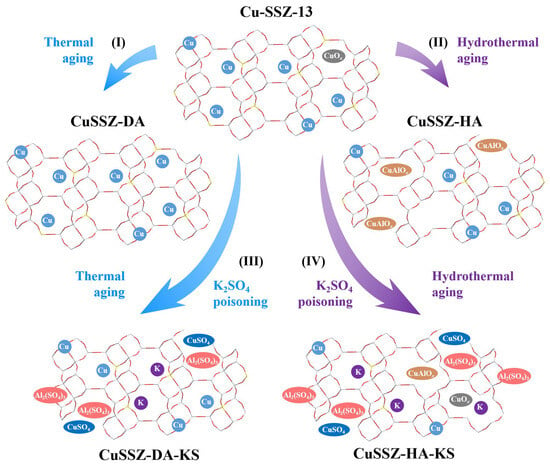
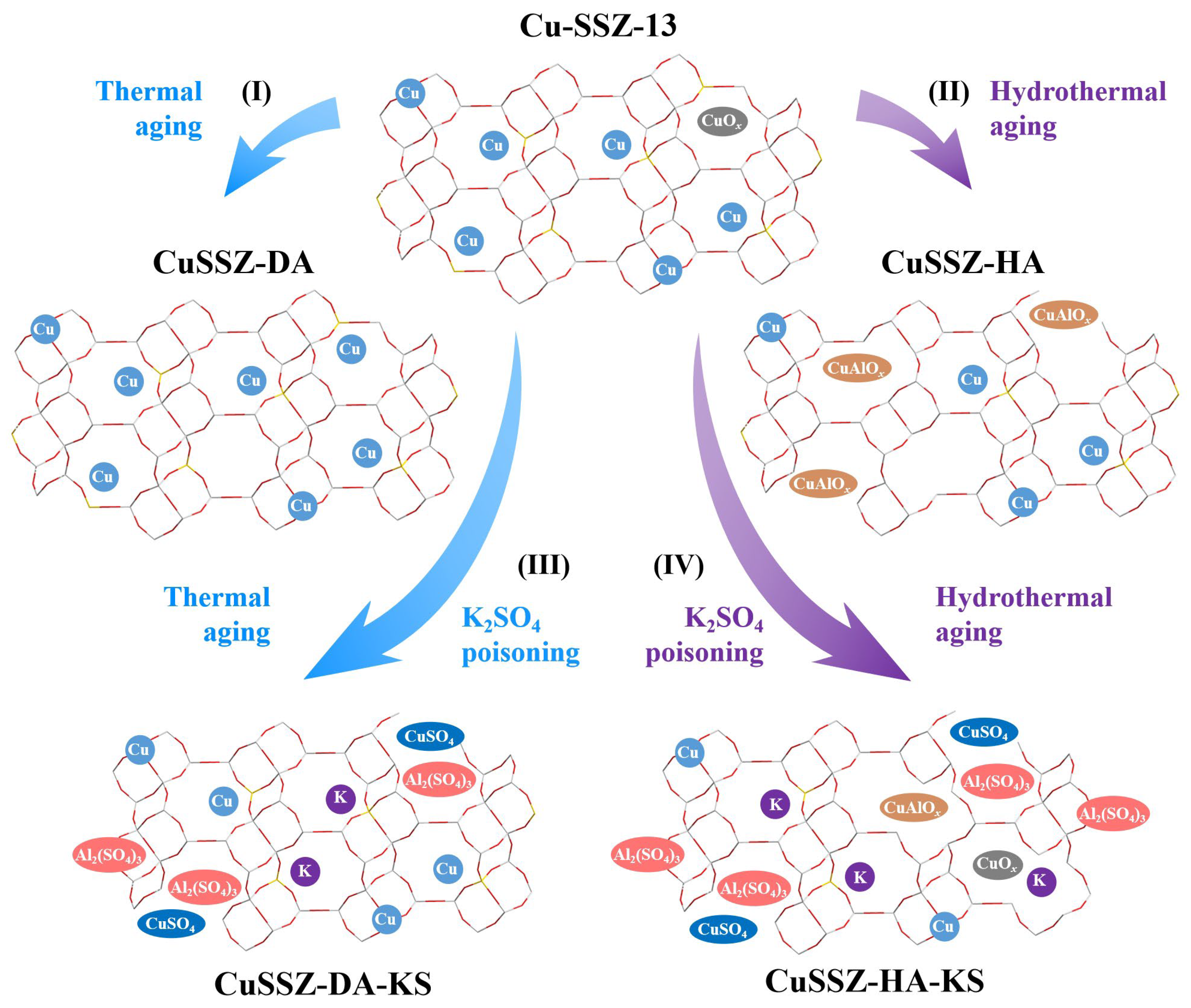
Although Cu-SSZ-13 retains the characteristic CHA framework after hydrothermal aging and K2SO4 poisoning (Figure 3a), these treatments result in catalyst deactivation to different degrees (Figure 1). Detailed deactivation mechanisms are shown in Scheme 1. First, the copper- and aluminum-rich Cu-SSZ-13 prepared by the one-pot method inevitably contains a trace amount of CuOx (Figure S1b). After mild thermal treatment in dry air at 650 °C for 10 h, these CuOx clusters can diffuse into the SSZ-13 and be reactivated to form isolated Cu2+ ions [25,26].
Scheme 1.
Supposed deactivation mechanisms of Cu-SSZ-13 under hydrothermal aging and K2SO4 poisoning, particularly involving (I) reactivation, (II) dealumination, (III) sulfation, and (IV) co-deactivation.
However, with the introduction of H2O, framework Si-O(H)-Al bonds undergo hydrolytic cleavage by water, producing Al-OH defect sites and further forming Al(OH)3, leading to framework dealumination of the hydrothermally aged sample [42]. Meanwhile, a fraction of isolated Cu2+ ions detach from ion-exchange sites and are subsequently captured by extra-framework Al species, leading to the formation of copper aluminates (Figure 4a and Figure 6c) rather than CuOx (Figure 2b) [43]. Compared with Cu-SSZ-13 with high Si/Al (>6) and low Cu loading (<3 wt.%), the commercial catalyst in this study exhibits stronger hydrophilicity and more significant dealumination and copper loss [44,45]. Given that copper aluminate phases are essentially inert for SCR, their formation is considered a primary deactivation factor of CuSSZ-HA.
Compared with H2O attack, K+ can diffuse more readily into the zeolite and exchange with isolated Cu2+ and H+ at Brønsted acid sites [12], while the comparatively large sulfate anions (with an effective radius ≈ 3.8 Å) are difficult to diffuse into the negatively charged SSZ-13 micropores (with a similar pore diameter ≈ 3.8 Å). UV-vis spectra show a preferential enhancement at ~253 nm compared to the 400–500 nm range (Figure 4), a feature associated with copper sulfate [8,46]. Meanwhile, the poisoned catalysts show more mass loss in the temperatures above 900 °C in the TGA curves (Figure 5), as characteristics of decomposition of CuSO4 and Al2(SO4)3 [47], and quantified decomposable sulfur contents were estimated. Moreover, H2-TPR (Figure 6) reveals the emergence of a reduction peak centered at 740 °C, aligning with the reduction in Al2(SO4)3, and an obvious increase in low-temperature H2 consumption, probably attributed to CuSO4 reduction [41]. Consequently, free Al and Cu species are likely trapped by these extra-framework sulfate anions to form Al2(SO4)3 and CuSO4 (Figure 5c and Figure 6d). These inactive sulfate salts block the zeolite channels and further reduce pore volume (Figure 3b). The ion-exchange efficiency depends greatly on the diffusion process parameters [17], and the deactivation of K2SO4 is limited in this work.
The chemical poisoning effect of K2SO4 is further accelerated in the presence of H2O. The SCR activity of CuSSZ-HA-KS is approximately 25–50% lower than that of CuSSZ-DA-KS in the whole temperature range (Figure 1). As isolated Cu2+ ions serve as the active sites for SCR reactions [48,49], they suffer more significant loss under wet conditions, as implied by the sharply reduced NH3 oxidation activity at low temperatures (Figure 2a). The absence of stabilizing neighboring Cu2+ further facilitates dealumination [28]. In addition to the formation of copper aluminates, these leached Cu and Al species are mainly captured by surface SO42− to form CuSO4 and Al2(SO4)3, respectively (Figure 4, Figure 5c and Figure 6c). This may be ascribed to the enhanced mobility of K+ and Cu2+ ions in the presence of water and require further investigation.
4. Materials and Methods
4.1. Catalyst Preparation
A commercially available Cu-SSZ-13 (Weifu Environmental Catalysts Co., Ltd., Wuxi, China, synthesized via a one-pot synthesis method [50]), featuring a low Si/Al ratio (Si/Al = 4.9) and high copper loading (3.9 wt.%), was used as the pristine material and denoted as CuSSZ. The catalyst was calcined at 650 °C for 10 h in flowing air and 10 vol.% H2O/air in a tubular furnace, and the obtained catalysts were denoted as CuSSZ-DA and CuSSZ-HA, respectively. For ash loading, CuSSZ powder and K2SO4 (2 wt.%) were manually mixed in a mortar for 10 min using a spatula to ensure sufficient contact and then treated at 650 °C for 10 h in flowing air and 10 vol.% H2O/air by solid-state diffusion. The dry poisoned and wet poisoned catalysts were denoted as CuSSZ-HA-KS and CuSSZ-DA-KS, respectively.
The aging and poisoning conditions were selected based on testing protocols commonly used to simulate long-term severe exposure. Similar parameters (10 vol.% H2O/air, 600–850 °C, 0.5–5.7 wt.% alkali loading) have been widely adopted in the literature to evaluate catalyst durability under harsh environments [8,10,23,46,51,52,53,54]. A summary of these literature conditions was presented in Table S1.
4.2. Activity Measurements
NH3-SCR activity tests were evaluated in a quartz reactor loaded with 250 mg of catalyst (60–80 mesh). Before testing, the catalyst was pretreated in flowing air (250 mL/min) at 550 °C for 20 min. During the measurements, the total gas flow rate was maintained at 1 L/min, with a feeding gas consisting of 500 ppm NO, 500 ppm NH3, 5 vol.% O2, 3 vol.% H2O, and N2 in balance, corresponding to a gas hourly space velocity (GHSV) of 120,000 h−1. The concentrations of reactants and products in the outlet gas were monitored using a 6030 Fourier transform infrared spectrometer (MKS Instruments, Andover, MA, USA). Activity tests were conducted over the temperature range of 150–550 °C, with intervals of 25 °C below 200 °C and 50 °C above 200 °C. At each temperature, the concentrations of N2O, NO, NO2, and NH3 in the outlet gas were stabilized (with the variation less than 5 ppm) after 20–90 min, depending on reaction temperature, and the steady-state data were recorded. The NOx (NO + NO2) conversion and N2 selectivity were calculated using Equations (1) and (2), respectively. NH3 oxidation activity was measured using the same procedure, except that the feed gas did not contain any NO. NH3 conversion was calculated according to Equation (3).
4.3. Characterizations
X-ray diffraction (XRD) patterns were collected on a D8 ADVANCE diffractometer (Bruker, Mannheim, Germany) using Cu Kα radiation (λ = 1.5406 Å) and continuous scanning in the range of 5–45° at a rate of 6°/min. N2 adsorption-desorption isotherms were measured using a JW-BK200C-02 analyzer (Beijing JWGB, Beijing, China). Before testing, the samples were degassed at 220 °C for 8 h, and measurements were conducted at −196 °C. The specific surface area (SBET) and total pore volume (Vtotal) of the catalysts were calculated using the Brunauer-Emmett-Teller (BET) method and the t-plot model, respectively. Ultraviolet-visible (UV-vis) spectra were recorded at room temperature using a UV-vis 2600 spectrophotometer (Shimadzu, Tokyo, Japan) with BaSO4 powder as the reference, scanning over the wavelength range 200–800 nm. Thermogravimetric analysis (TGA) was carried out on a TGA/DSC 1 system (Mettler Toledo, Greifensee, Switzerland). Approximately 20 mg of sample was heated in air (50 mL/min) at a ramp rate of 10 °C/min, and thermogravimetry (TG) was recorded. H2 temperature-programmed reduction (H2-TPR) experiments were conducted on an AutoChem II 2920 chemisorption analyzer (Micromeritics, Norcross, GA, USA) equipped with a thermal conductivity detector (TCD). Typically, 100 mg of catalyst was loaded into a U-shaped quartz reactor and pretreated in 10% O2/He (50 mL/min) at 300 °C for 30 min. After cooling to room temperature, the gas was switched to 3% H2/Ar (50 mL/min), and the temperature was increased to 1000 °C at a rate of 10 °C/min. An isopropyl alcohol cold trap was installed between the quartz reactor and the TCD to condense volatile components during reduction.
5. Conclusions
In this work, the deactivation mechanisms of a Cu-SSZ-13 catalyst during hydrothermal aging and/or K2SO4 poisoning simulated by a solid-state diffusion method were investigated. Some findings are drawn as follows:
(1) The studied one-pot-synthesized Cu-SSZ-13 with a high copper loading (3.9 wt.%) and a low Si/Al ratio (Si/Al = 4.9) undergoes severe dealumination and framework collapse after hydrothermal aging at 650 °C for 10 h, leading to transformation of isolated Cu2+ ion to copper aluminates, while the thermal aging in dry air even reactivates residual CuOx in the pristine zeolite to Cu2+.
(2) Using the solid-state diffusion method, K2SO4 poisoning under dry conditions forces some Cu2+ to detach from ion-exchange sites. Different from thermal aging, the detached Cu and Al species are mostly captured by SO42− anions on the external surface to form CuSO4 and Al2(SO4)3.
(3) The presence of water vapor during the solid-state diffusion process results in further deterioration of SCR performance, because it significantly accelerates the diffusion of K+ and Cu2+ as well as zeolite structural damage. Consequently, more CuOx clusters and especially inert sulfates are produced.
It should be noted that the severe dealumination and copper loss observed here are mostly attributable to the relatively low hydrothermal stability of the one-pot synthesized catalyst with a low Si/Al ratio and high Cu loading. Future studies on hydrothermally stable Cu-SSZ-13 catalysts should be conducted to generalize these findings and explore possible roles of water on the solid-state diffusion process of ash salts.
Supplementary Materials
The following supporting information can be downloaded at: https://www.mdpi.com/article/10.3390/catal16020150/s1, Figure S1: (a) NOx conversion and (b) UV-vis spectra of fresh Cu-SSZ-13 catalyst with CuSSZ-DA for comparison. Reaction conditions: 500 ppm NO, 500 ppm NH3, 5 vol.% O2, 3 vol.% H2O and N2 in balance, GHSV = 120,000 h−1. Table S1. Comparison of aging and poisoning conditions on Cu-CHA deactivation. Refs. [8,10,23,46,51,52,53,54] are cited in the Supplementary Materials.
Author Contributions
Conceptualization, Z.J. and X.W.; methodology, X.W.; software, Z.J.; validation, Z.J.; formal analysis, Z.J. and Y.M.; investigation, Z.J.; resources, R.R., C.Z. and L.H.; data curation, Z.J. and X.W.; writing—original draft preparation, Z.J.; writing—review and editing, Z.J., X.W. and Y.M.; visualization, Z.J.; supervision, X.W.; project administration, L.H.; funding acquisition, C.Z. All authors have read and agreed to the published version of the manuscript.
Funding
This work was financially supported by a project of the National Key Research and Development Program of China (No. 2023YFC3707204).
Data Availability Statement
Data are contained within the article and Supplementary Materials.
Acknowledgments
The authors would like to thank the help from Hongmei Sun and Guisheng Xu.
Conflicts of Interest
The authors declare no conflicts of interest.
References
- Yang, W.W.; Gong, J.; Wang, X.; Bao, Z.H.; Guo, Y.B.; Wu, Z.L. A review on the impact of SO2 on the oxidation of NO, hydrocarbons, and CO in diesel emission control catalysis. ACS Catal. 2021, 11, 12446–12468. [Google Scholar] [CrossRef] [Scilit]
- Li, P.; Xin, Y.; Zhang, H.X.; Yang, F.Z.; Tang, A.; Han, D.X.; Jia, J.X.; Wang, J.; Li, Z.G.; Zhang, Z.L. Recent progress in performance optimization of Cu-SSZ-13 catalyst for selective catalytic reduction of NOx. Front. Chem. 2022, 10, 1033255. [Google Scholar] [CrossRef] [Scilit]
- Duan, C.M.; Zhang, Y.; Han, S.C.; Shan, Y.L.; Du, J.P.; Wang, M.; Shan, W.P. Recent advances in zeolites for the selective catalytic reduction of NOx with NH3. Catal. Rev. 2024, 1–62. [Google Scholar] [CrossRef] [Scilit]
- Han, J.F.; Li, D.; Yu, J.H. Tailoring Cu-based small-pore zeolites towards NH3-SCR for NOx abatement. Chem. Soc. Rev. 2025, 54, 7933–7965. [Google Scholar] [CrossRef] [Scilit]
- Fickel, D.W.; D’Addio, E.; Lauterbach, J.A.; Lobo, R.F. The ammonia selective catalytic reduction activity of copper-exchanged small-pore zeolites. Appl. Catal. B 2011, 102, 441–448. [Google Scholar] [CrossRef] [Scilit]
- Shan, Y.L.; Du, J.P.; Zhang, Y.; Shan, W.P.; Shi, X.Y.; Yu, Y.B.; Zhang, R.D.; Meng, X.J.; Xiao, F.S.; He, H. Selective catalytic reduction of NOx with NH3: Opportunities and challenges of Cu-based small-pore zeolites. Natl. Sci. Rev. 2021, 8, nwab010. [Google Scholar] [CrossRef] [Scilit] [PubMed]
- Jangjou, Y.; Do, Q.; Gu, Y.T.; Lim, L.G.; Sun, H.; Wang, D.; Kumar, A.; Li, J.; Grabow, L.C.; Epling, W.S. Nature of Cu active centers in Cu-SSZ-13 and their responses to SO2 exposure. ACS Catal. 2018, 8, 1325–1337. [Google Scholar] [CrossRef] [Scilit]
- Liu, L.P.; Wu, X.D.; Ma, Y.; Zhang, X.; Ran, R.; Si, Z.C.; Weng, D. Potassium deactivation of Cu-SSZ-13 catalyst for NH3-SCR: Evolution of salts, zeolite and copper species. Chem. Eng. J. 2020, 383, 123080. [Google Scholar] [CrossRef] [Scilit]
- Morcos, M.; Ayyappan, P.; Harris, T. Characterization of DPF Ash for Development of DPF Regeneration Control and Ash Cleaning Requirements; SAE Tecnical Paper; SAE International: Warrendale, PA, USA, 2011; p. 1. [Google Scholar] [CrossRef] [Scilit]
- Wang, C.; Wang, J.; Wang, J.Q.; Wang, Z.X.; Chen, Z.X.; Li, X.L.; Shen, M.Q.; Yan, W.J.; Kang, X. The role of impregnated sodium ions in Cu/SSZ-13 NH3-SCR catalysts. Catalysts 2018, 8, 593. [Google Scholar] [CrossRef] [Scilit]
- Guan, B.; Chen, J.Y.; Guo, J.F.; Liu, Z.Q.; Zheng, C.Z.; Zhou, J.F.; Su, T.X.; Zhang, Y.Y.; Yuan, Y.H.; Dang, H.T.; et al. Study on effect and mechanism of alkaline earth metal poisoning on Cu/SSZ-13 catalysts for selective catalytic reduction of NOx with NH3. Ind. Eng. Chem. Res. 2023, 62, 9662–9672. [Google Scholar] [CrossRef] [Scilit]
- Zhu, N.; Shan, W.P.; Shan, Y.L.; Du, J.P.; Lian, Z.H.; Zhang, Y.; He, H. Effects of alkali and alkaline earth metals on Cu-SSZ-39 catalyst for the selective catalytic reduction of NO with NH3. Chem. Eng. J. 2020, 388, 124250. [Google Scholar] [CrossRef] [Scilit]
- Han, L.P.; Cai, S.X.; Gao, M.; Hasegawa, J.Y.; Wang, P.G.; Zhang, J.P.; Shi, L.Y.; Zhang, D.S. Selective catalytic reduction of NOx with NH3 by using novel catalysts: State of the art and future prospects. Chem. Rev. 2019, 119, 10916–10976. [Google Scholar] [CrossRef] [Scilit]
- Mohan, S.; Dinesha, P.; Kumar, S. NOx reduction behaviour in copper zeolite catalysts for ammonia SCR systems: A review. Chem. Eng. J. 2020, 384, 123253. [Google Scholar] [CrossRef] [Scilit]
- Lei, T.Y.; Li, Q.C.; Chen, S.F.; Liu, Z.Y.; Liu, Q.Y. KCl-induced deactivation of V2O5-WO3/TiO2 catalyst during selective catalytic reduction of NO by NH3: Comparison of poisoning methods. Chem. Eng. J. 2016, 296, 1–10. [Google Scholar] [CrossRef] [Scilit]
- Larsson, A.C.; Einvall, J.; Andersson, A.; Sanati, M. Targeting by comparison with laboratory experiments the SCR catalyst deactivation process by potassium and zinc salts in a large-scale biomass combustion boiler. Energy Fuels 2006, 20, 1398–1405. [Google Scholar] [CrossRef] [Scilit]
- Ali, Z.; Fang, L.P.; Sun, H.D.; Wu, Y.W.; Panjwani, M.K.; Ali, K.H.; Liu, J.; Lu, Q. Investigating the effects of K species on V2O5-WO3/TiO2 catalyst: A DFT-supported comparative analysis of poisoning methods. Asia-Pac. J. Chem. Eng. 2025, 20, e70002. [Google Scholar] [CrossRef] [Scilit]
- Shwan, S.; Jansson, J.; Olsson, L.; Skoglundh, M. Chemical deactivation of H-BEA and Fe-BEA as NH3-SCR catalysts—Effect of potassium. Appl. Catal. B 2015, 166–167, 277–286. [Google Scholar] [CrossRef] [Scilit]
- Kern, P.; Klimczak, M.; Heinzelmann, T.; Lucas, M.; Claus, P. High-throughput study of the effects of inorganic additives and poisons on NH3-SCR catalysts. Part II: Fe-zeolite catalysts. Appl. Catal. B 2010, 95, 48–56. [Google Scholar] [CrossRef] [Scilit]
- Gao, F.; Wang, Y.L.; Washton, N.M.; Kollár, M.; Szanyi, J.; Peden, C.H.F. Effects of alkali and alkaline earth cocations on the activity and hydrothermal stability of Cu/SSZ-13 NH3-SCR catalysts. ACS Catal. 2015, 5, 6780–6791. [Google Scholar] [CrossRef] [Scilit]
- Tarot, M.L.; Barreau, M.; Duprez, D.; Lauga, V.; Iojoiu, E.E.; Courtois, X.; Can, F. Influence of the sodium impregnation solvent on the deactivation of Cu/FER-exchanged zeolites dedicated to the SCR of NOx with NH3. Catalysts 2017, 8, 3. [Google Scholar] [CrossRef] [Scilit]
- Tarot, M.L.; Can, F.; Iojoiu, E.E.; Lauga, V.; Courtois, X. Influence of sodium and/or phosphorus addition on the deactivation of Cu-FER zeolites for SCR of NOx with NH3. Top. Catal. 2018, 62, 72–78. [Google Scholar] [CrossRef] [Scilit]
- Wang, C.; Yan, W.J.; Wang, Z.X.; Chen, Z.X.; Wang, J.Q.; Wang, J.; Wang, J.M.; Shen, M.Q.; Kang, X. The role of alkali metal ions on hydrothermal stability of Cu/SSZ-13 NH3-SCR catalysts. Catal. Today 2020, 355, 482–492. [Google Scholar] [CrossRef] [Scilit]
- Zhang, Y.; Zhu, H.; Zhang, T.; Li, J.; Chen, J.; Peng, Y.; Li, J. Revealing the synergistic deactivation mechanism of hydrothermal aging and SO2 poisoning on Cu/SSZ-13 under SCR condition. Environ. Sci. Technol. 2021, 56, 1917–1926. [Google Scholar] [CrossRef] [Scilit] [PubMed]
- Han, D.X.; Xin, Y.; Jia, J.X.; Wang, J.; Zhang, Z.L. Mild thermal treatment-driven transformation of CuOx assisted with the rearrangement of Al sites in Cu-SSZ-13. Appl. Catal. O Open 2025, 205, 207054. [Google Scholar] [CrossRef] [Scilit]
- Vennestrøm, P.N.R.; Katerinopoulou, A.; Tiruvalam, R.R.; Kustov, A.; Moses, P.G.; Concepcion, P.; Corma, A. Migration of Cu ions in SAPO-34 and its impact on selective catalytic reduction of NOx with NH3. ACS Catal. 2013, 3, 2158–2161. [Google Scholar] [CrossRef] [Scilit]
- Olsson, L.; Wijayanti, K.; Leistner, K.; Kumar, A.; Joshi, S.Y.; Kamasamudram, K.; Currier, N.W.; Yezerets, A. A multi-site kinetic model for NH3-SCR over Cu/SSZ-13. Appl. Catal. B 2015, 174–175, 212–224. [Google Scholar] [CrossRef] [Scilit]
- Ma, Y.; Wu, X.D.; Cheng, S.Q.; Cao, L.; Liu, L.P.; Xu, Y.F.; Liu, J.B.; Ran, R.; Si, Z.C.; Weng, D. Relationships between copper speciation and Brønsted acidity evolution over Cu-SSZ-13 during hydrothermal aging. Appl. Catal. A 2020, 602, 117650. [Google Scholar] [CrossRef] [Scilit]
- Ren, L.M.; Zhu, L.F.; Yang, C.G.; Chen, Y.M.; Sun, Q.; Zhang, H.Y.; Li, C.J.; Nawaz, F.; Meng, X.J.; Xiao, F.S. Designed copper-amine complex as an efficient template for one-pot synthesis of Cu-SSZ-13 zeolite with excellent activity for selective catalytic reduction of NOx by NH3. Chem. Commun. 2011, 47, 9789. [Google Scholar] [CrossRef] [Scilit] [PubMed]
- Beale, A.M.; Gao, F.; Lezcano-Gonzalez, I.; Peden, C.H.F.; Szanyi, J. Recent advances in automotive catalysis for NOx emission control by small-pore microporous materials. Chem. Soc. Rev. 2015, 44, 7371–7405. [Google Scholar] [CrossRef] [Scilit]
- Garbowski, E.D.; Mirodatos, C. Investigation of structural charge transfer in zeolites by UV spectroscopy. J. Phys. Chem. 1982, 86, 97–102. [Google Scholar] [CrossRef] [Scilit]
- Korhonen, S.T.; Fickel, D.W.; Lobo, R.F.; Weckhuysen, B.M.; Beale, A.M. Isolated Cu2+ ions: Active sites for selective catalytic reduction of NO. Chem. Commun. 2011, 47, 800–802. [Google Scholar] [CrossRef] [Scilit]
- El-Trass, A.; ElShamy, H.; El-Mehasseb, I.; El-Kemary, M. CuO nanoparticles: Synthesis, characterization, optical properties and interaction with amino acids. Appl. Surf. Sci. 2012, 258, 2997–3001. [Google Scholar] [CrossRef] [Scilit]
- Zhang, J.X.; Zhao, Z.Y.; Yang, T.L.; Yang, J.; Zhang, J.; Liu, Q.J.; Kuang, Y.B. Harnessing intrinsic defect complexes for visible-light-driven photocatalytic activity in delafossite CuAlO2. Acta Mater. 2024, 269, 119801. [Google Scholar] [CrossRef] [Scilit]
- Yong, X.; Chen, H.; Zhao, H.W.; Wei, M.; Zhao, Y.N.; Li, Y.D. Insight into SO2 poisoning and regeneration of one-pot synthesized Cu-SSZ-13 catalyst for selective reduction of NOx by NH3. Chin. J. Chem. Eng. 2022, 46, 184–193. [Google Scholar] [CrossRef] [Scilit]
- Chou, K.S.; Soong, C.S. Kinetics of the thermal decomposition of aluminum sulfate. Thermochim. Acta 1984, 78, 285–295. [Google Scholar] [CrossRef] [Scilit]
- El-Houte, S.; El-Sayed Ali, M.; Sørensen, O.T. Dehydration of CuSO4·5H2O studied by conventional and advanced thermal analysis techniques. Thermochim. Acta 1989, 138, 107–114. [Google Scholar] [CrossRef] [Scilit]
- Zhang, T.; Qiu, F.; Chang, H.Z.; Li, X.; Li, J.H. Identification of active sites and reaction mechanism on low-temperature SCR activity over Cu-SSZ-13 catalysts prepared by different methods. Catal. Sci. Technol. 2016, 6, 6294–6304. [Google Scholar] [CrossRef] [Scilit]
- Yang, G.P.; Du, X.S.; Ran, J.Y.; Wang, X.M.; Chen, Y.R.; Zhang, L.; Rac, V.; Rakic, V.; Crittenden, J. Irregular influence of alkali metals on Cu-SAPO-34 catalyst for selective catalytic reduction of NOx with ammonia. J. Hazard. Mater. 2020, 387, 122007. [Google Scholar] [CrossRef] [Scilit]
- Shan, Y.L.; Du, J.P.; Yu, Y.B.; Shan, W.P.; Shi, X.Y.; He, H. Precise control of post-treatment significantly increases hydrothermal stability of in-situ synthesized Cu-zeolites for NH3-SCR reaction. Appl. Catal. B 2020, 266, 118655. [Google Scholar] [CrossRef] [Scilit]
- Du, J.; Shi, X.; Shan, Y.; Xu, G.; Sun, Y.; Wang, Y.; Yu, Y.; Shan, W.; He, H. Effects of SO2 on Cu-SSZ-39 catalyst for the selective catalytic reduction of NOx with NH3. Catal. Sci. Technol. 2020, 10, 1256–1263. [Google Scholar] [CrossRef] [Scilit]
- Silaghi, M.C.; Chizallet, C.; Petracovschi, E.; Kerber, T.; Sauer, J.; Raybaud, P. Regioselectivity of Al-O bond hydrolysis during zeolites dealumination unified by Brønsted-Evans-Polanyi relationship. ACS Catal. 2014, 5, 11–15. [Google Scholar] [CrossRef] [Scilit]
- Schmidt, J.E.; Oord, R.; Guo, W.; Poplawsky, J.D.; Weckhuysen, B.M. Nanoscale tomography reveals the deactivation of automotive copper-exchanged zeolite catalysts. Nat. Commun. 2017, 8, 1666. [Google Scholar] [CrossRef] [Scilit]
- Gao, F.; Szanyi, J. On the hydrothermal stability of Cu/SSZ-13 SCR catalysts. Appl. Catal. A 2018, 560, 185–194. [Google Scholar] [CrossRef] [Scilit]
- Fan, C.; Chen, Z.; Pang, L.; Ming, S.J.; Zhang, X.F.; Albert, K.B.; Liu, P.; Chen, H.P.; Li, T. The influence of Si/Al ratio on the catalytic property and hydrothermal stability of Cu-SSZ-13 catalysts for NH3-SCR. Appl. Catal. A 2018, 550, 256–265. [Google Scholar] [CrossRef] [Scilit]
- Liu, L.; Gao, Y.; Ma, Y.; Wu, X.; Yang, L.; Meng, X.; Ran, R.; Weng, D. Tolerance of Cu-SSZ-13 catalysts to potassium sulfate: Strong Brønsted acid sites and copper species. J. Environ. Chem. Eng. 2024, 12, 114463. [Google Scholar] [CrossRef] [Scilit]
- Su, W.; Li, Z.; Zhang, Y.; Meng, C.; Li, J. Identification of sulfate species and their influence on SCR performance of Cu/CHA catalyst. Catal. Sci. Technol. 2017, 7, 1523–1528. [Google Scholar] [CrossRef] [Scilit]
- Ma, Y.; Cheng, S.Q.; Wu, X.D.; Ma, T.X.; Liu, L.P.; Jin, B.F.; Liu, M.H.; Liu, J.B.; Ran, R.; Si, Z.C.; et al. Improved hydrothermal durability of Cu-SSZ-13 NH3-SCR catalyst by surface Al modification: Affinity and passivation. J. Catal. 2022, 405, 199–211. [Google Scholar] [CrossRef] [Scilit]
- Gao, F.; Walter, E.D.; Karp, E.M.; Luo, J.Y.; Tonkyn, R.G.; Kwak, J.H.; Szanyi, J.; Peden, C.H.F. Structure-activity relationships in NH3-SCR over Cu-SSZ-13 as probed by reaction kinetics and EPR studies. J. Catal. 2013, 300, 20–29. [Google Scholar] [CrossRef] [Scilit]
- Xie, L.; Liu, F.; Ren, L.; Shi, X.; Xiao, F.S.; He, H. Excellent performance of one-pot synthesized Cu-SSZ-13 catalyst for the selective catalytic reduction of NOx with NH3. Environ. Sci. Technol. 2013, 48, 566–572. [Google Scholar] [CrossRef] [Scilit]
- Albert, K.B.; Fan, C.; Pang, L.; Chen, Z.; Ming, S.; Albert, T.; Li, T. The influence of chemical poisoning, hydrothermal aging and their co-effects on Cu-SAPO-34 catalyst for NOx reduction by NH3-SCR. Appl. Surf. Sci. 2019, 479, 1200–1211. [Google Scholar] [CrossRef] [Scilit]
- Ma, J.; Si, Z.; Weng, D.; Wu, X.; Ma, Y. Potassium poisoning on Cu-SAPO-34 catalyst for selective catalytic reduction of NO with ammonia. Chem. Eng. J. 2015, 267, 191–200. [Google Scholar] [CrossRef] [Scilit]
- Kim, Y.J.; Lee, J.K.; Min, K.M.; Hong, S.B.; Nam, I.S.; Cho, B.K. Hydrothermal stability of CuSSZ13 for reducing NOx by NH3. J. Catal. 2014, 311, 447–457. [Google Scholar] [CrossRef] [Scilit]
- Wang, B.; Feng, X.; Xu, Y.; Shi, J.W. Role of Ce in Promoting Low-temperature performance and hydrothermal stability of Ce/Cu-SSZ-13 in the selective catalytic reduction of NOx with NH3. Sep. Purif. Technol. 2023, 315, 123679. [Google Scholar] [CrossRef] [Scilit]
Disclaimer/Publisher’s Note: The statements, opinions and data contained in all publications are solely those of the individual author(s) and contributor(s) and not of MDPI and/or the editor(s). MDPI and/or the editor(s) disclaim responsibility for any injury to people or property resulting from any ideas, methods, instructions or products referred to in the content. |
© 2026 by the authors. Licensee MDPI, Basel, Switzerland. This article is an open access article distributed under the terms and conditions of the Creative Commons Attribution (CC BY) license.