Article

Fe-NC@NiFe-LDH Derived from Iron-Based Metal–Organic Frameworks as an Efficient Bifunctional Oxygen Electrocatalyst for Zn–Air Batteries


1
College of Materials Science and Engineering, Qingdao University of Science and Technology, Qingdao 266042, China
2
Shandong Engineering Research Center of Green and High-Value Marine Fine Chemical, Weifang University of Science and Technology, Shouguang 262700, China
3
Department of Physics, Hamline University, Saint Paul, MN 55104, USA
*
Authors to whom correspondence should be addressed.
These authors contributed equally to this work.
Catalysts 2026, 16(2), 152; https://doi.org/10.3390/catal16020152
Submission received: 18 December 2025 / Revised: 16 January 2026 / Accepted: 19 January 2026 / Published: 3 February 2026

Abstract

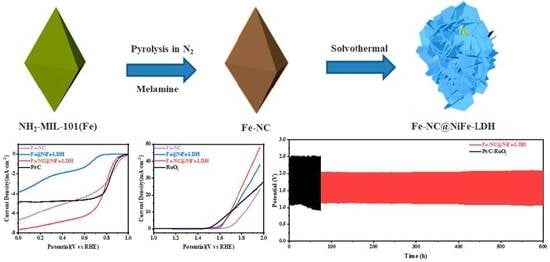
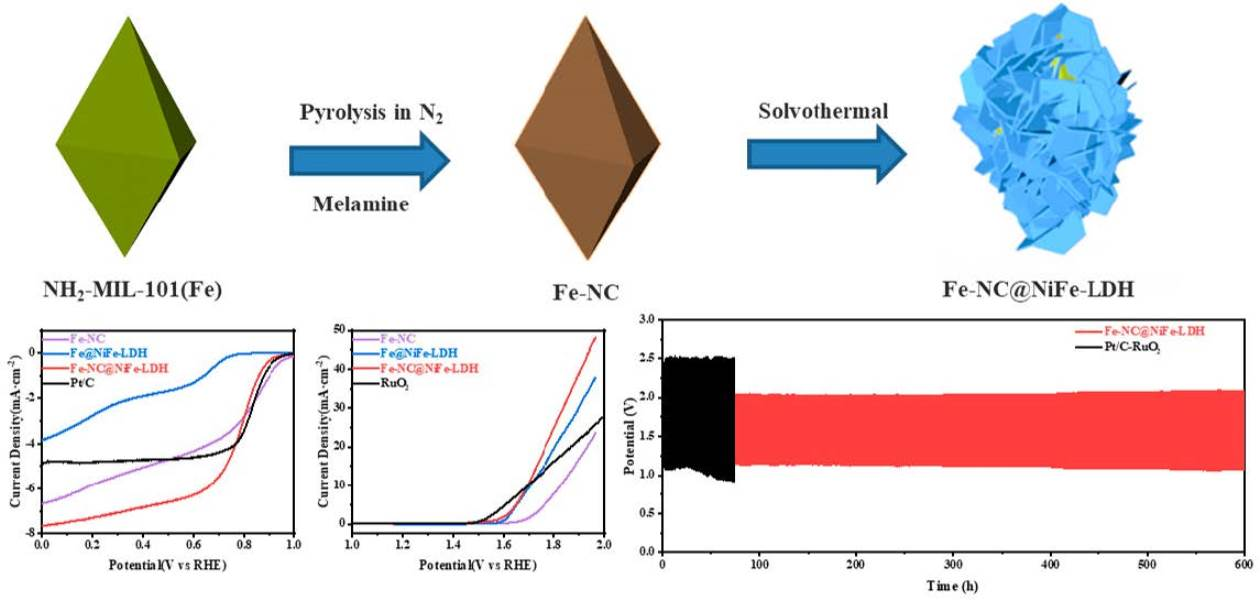
The rational design and synthesis of efficient and durable bifunctional electrocatalysts for oxygen reduction reaction (ORR) and oxygen evolution reaction (OER) is of great significance and challenging for rechargeable zinc–air batteries. While much attention has been devoted to enhancing ORR performance in recent studies, the effectiveness of OER is equally crucial for charging performance of Zn–air batteries. In this work, NH2-MIL-101(Fe) is employed as a precursor to derive Fe-NC through a straightforward pyrolysis method. Subsequently, NiFe-LDH is synthesized on the surface of Fe-NC via a wet-chemical process to obtain Fe-NC@NiFe-LDH. Capitalizing on the synergistic interplay between Fe-NC, serving as the ORR active site, and NiFe-LDH, acting as the OER active site, Fe-NC@NiFe-LDH demonstrates remarkable bifunctional electrocatalytic performance, boasting a positive half-wave potential of 0.83 V for ORR and a low potential of 1.68 V for OER at a current density of 10 mA cm−2, alongside exceptional stability in alkaline environments. Furthermore, the Fe-NC@NiFe-LDH-based Zn–air battery exhibits outstanding discharge and charge performance, maintaining excellent cycling stability over 600 h (3600 cycles).

Graphical Abstract

1. Introduction

In recent decades, the excessive exploitation of traditional fossil fuels has led to an energy crisis intertwined with environmental challenges. To address these issues, the development of sustainable energy conversion and storage technologies is paramount [1,2,3]. Zinc–air batteries (ZABs), as a highly promising metal–air battery system, have attracted considerable attention from both academia and industry due to their notable advantages in energy density, safety, cost- effectiveness, and environmental compatibility. With a remarkable theoretical energy density of about 1086 Wh kg−1, substantially exceeding that of conventional lithium-ion batteries, ZABs also benefit from the abundance, low cost, and low toxicity of zinc [4]. Moreover, the use of aqueous electrolytes eliminates the flammability risks associated with organic electrolytes, thereby enhancing operational safety and economic viability [5]. These intrinsic advantages make ZABs attractive candidates for a wide range of applications, including wearable electronics, grid-scale energy storage, and backup power systems [6]. The performance of ZABs hinges directly on the efficiency of the oxygen reduction reaction (ORR) and oxygen evolution reaction (OER) [7]. However, the sluggish reaction kinetics resulting in high reaction potentials limit the efficiency of ORR and OER, necessitating the utilization of effective catalysts [8]. While commercial catalysts typically rely on noble metals such as Pt/C for ORR and RuO2 for OER, their widespread adoption is hindered by their high cost and limited availability [9,10]. Ideally, catalysts for ZABs should facilitate both ORR and OER activities. Thus, a promising approach to overcoming this challenge is the development of efficient bifunctional electrocatalysts based on non-noble metals for both ORR and OER [11,12].
Carbon-based nanomaterials have emerged as promising catalyst candidates due to their versatility in heteroatom doping, including elements such as Fe, Co, Ni, N, O, and S. This doping strategy alters the electronic structure of the carbon matrix, thereby enhancing conductivity, catalytic activity, and generating synergistic effects by converting defect sites into active sites [13,14,15]. However, a significant challenge arises during electrochemical processes, where the metal-based active sites tend to aggregate and migrate onto the carbon substrates, leading to degradation in the long-term stability of these carbon-hybrid materials [16,17].
Due to their unique two-dimensional layered structure, substantial specific surface area, and outstanding OER activity, electrocatalysts based on NiFe layered double hydroxides (NiFe-LDHs) have attracted significant attention [18,19,20]. However, despite these advantages, LDHs face several challenges: their ORR performance remains unsatisfactory, and the tendency for unfixed 2D LDH nanosheets to agglomerate into thick formations when used as electrodes in practical applications leads to decreased active surfaces and sluggish ion transport kinetics [20]. Recent studies have explored the synthesis of bimetallic hydroxides with large specific surface areas and high porosity by substituting organic ligands in metal–organic frameworks (MOFs) with OH, aiming to achieve enhanced catalytic efficiency through increased specific surface area and tunable pore sizes [21,22]. For example, Rajendran et al. employed a hydrothermal technique to convert Ni-MOF into NiCo-LDH [23], while Shi et al. synthesized NiFe-LDH hydrothermally from MIL-100(Fe) [24]. Concurrently, Fe/N co-doped carbon materials (Fe-NC) have emerged as promising ORR electrocatalysts due to their unique electronic structure and stability in both alkaline and acidic electrolytes [19]. However, their monofunctional ORR performance falls short of meeting the requirements for cathode materials. To address these challenges and design bifunctional electrocatalysts, heterostructure engineering has been proposed as an efficient approach, involving the integration of heteroatom-doped carbon-based materials such as Fe-NC with ORR activity and NiFe-LDH with OER activity [25,26].
In this work, we aim to develop a heterostructured electrocatalyst with exceptional bifunctional oxygen catalytic activity by seamlessly integrating Fe-NC and NiFe-LDH through a facile strategy. NH2-MIL-101(Fe) is employed as a self-sacrificial template and precursor to generate a highly graphitized and nitrogen-rich carbon matrix (Fe-NC) with abundant Fe-N active sites via controlled pyrolysis. Subsequently, NiFe-LDH nanosheets are grown in situ on the conductive Fe-NC scaffold through a migration-assisted hydrothermal process, wherein the Fe species in NiFe-LDH originate entirely from the pre-formed Fe-NC substrate. This process promotes strong interfacial coupling and constructs a hierarchical architecture with enhanced electron transfer pathways. The resulting synergistic heterostructure effectively integrates the high ORR activity of Fe-NC with the superior OER performance of NiFe-LDH, while simultaneously mitigating component aggregation, interfacial resistance, and LDH instability under anodic conditions. Consequently, the optimized Fe-NC@NiFe-LDH exhibits remarkable bifunctional ORR/OER activity compared with commercial catalysts. Furthermore, ZABs employing Fe-NC@NiFe-LDH as the cathode achieve a peak power density of 99.8 mW cm−2 and excellent cycling stability over 600 h (3600 cycles), highlighting their great potential for practical applications. This work provides new insights into the rational design of highly efficient and durable heterostructured electrocatalysts for advanced metal–air batteries.

2. Results and Discussion

2.1. Structural Characterizations and Composition Analysis

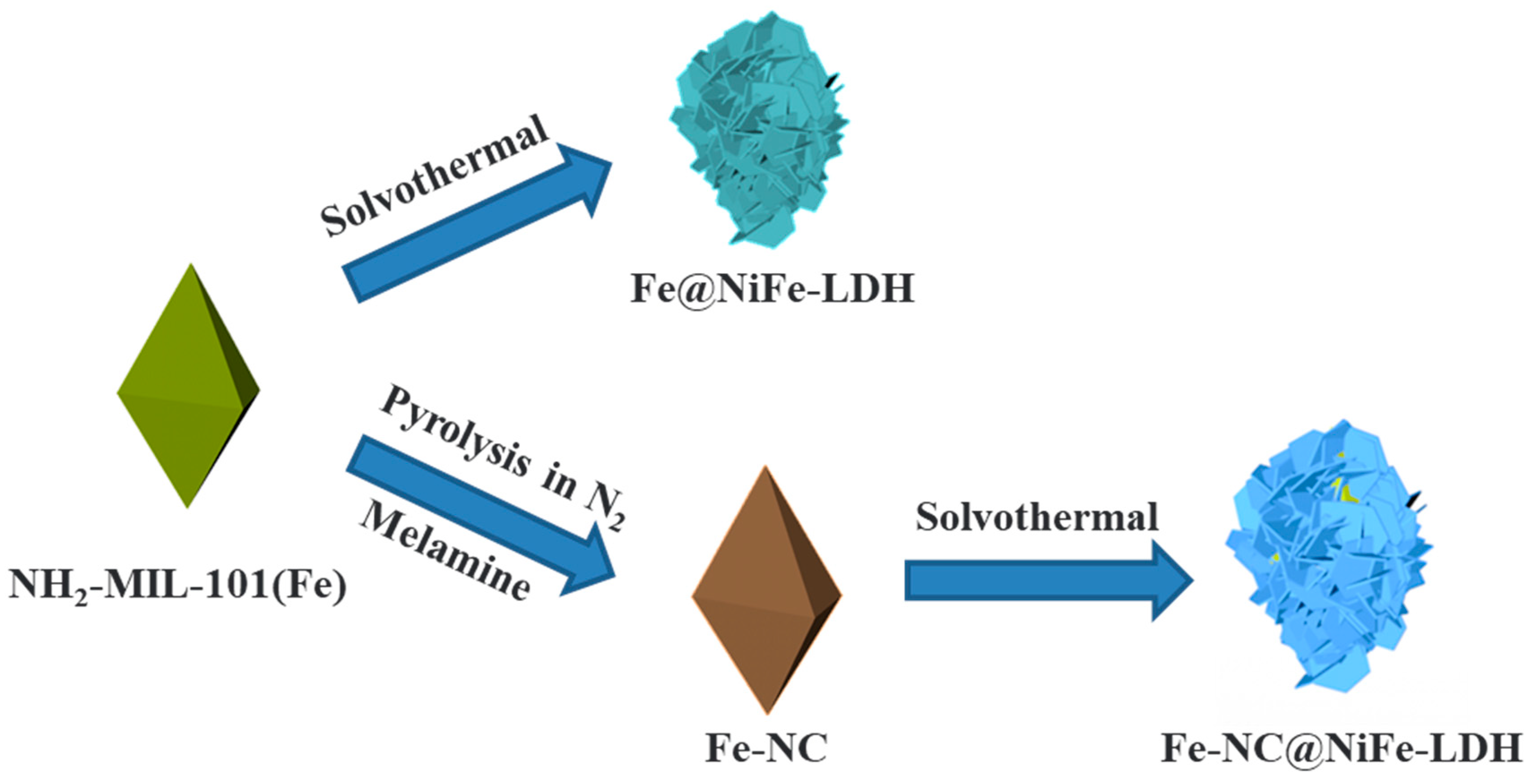
In this work, we present the construction of Fe-NC@NiFe-LDH, incorporating Fe-NC and NiFe-LDH as active catalysts for the ORR and OER in ZABs. The synthesis process is outlined in Scheme 1. NH2-MIL-101 (Fe) was synthesized via a solvothermal technique using ferric chloride hexahydrate and aminoterephthalic acid in DMF. Subsequently, NH2-MIL-101 (Fe) underwent pyrolysis with melamine to produce Fe-NC. NiFe-LDH was synthesized through a straightforward hydrothermal method with the addition of the nickel salt.
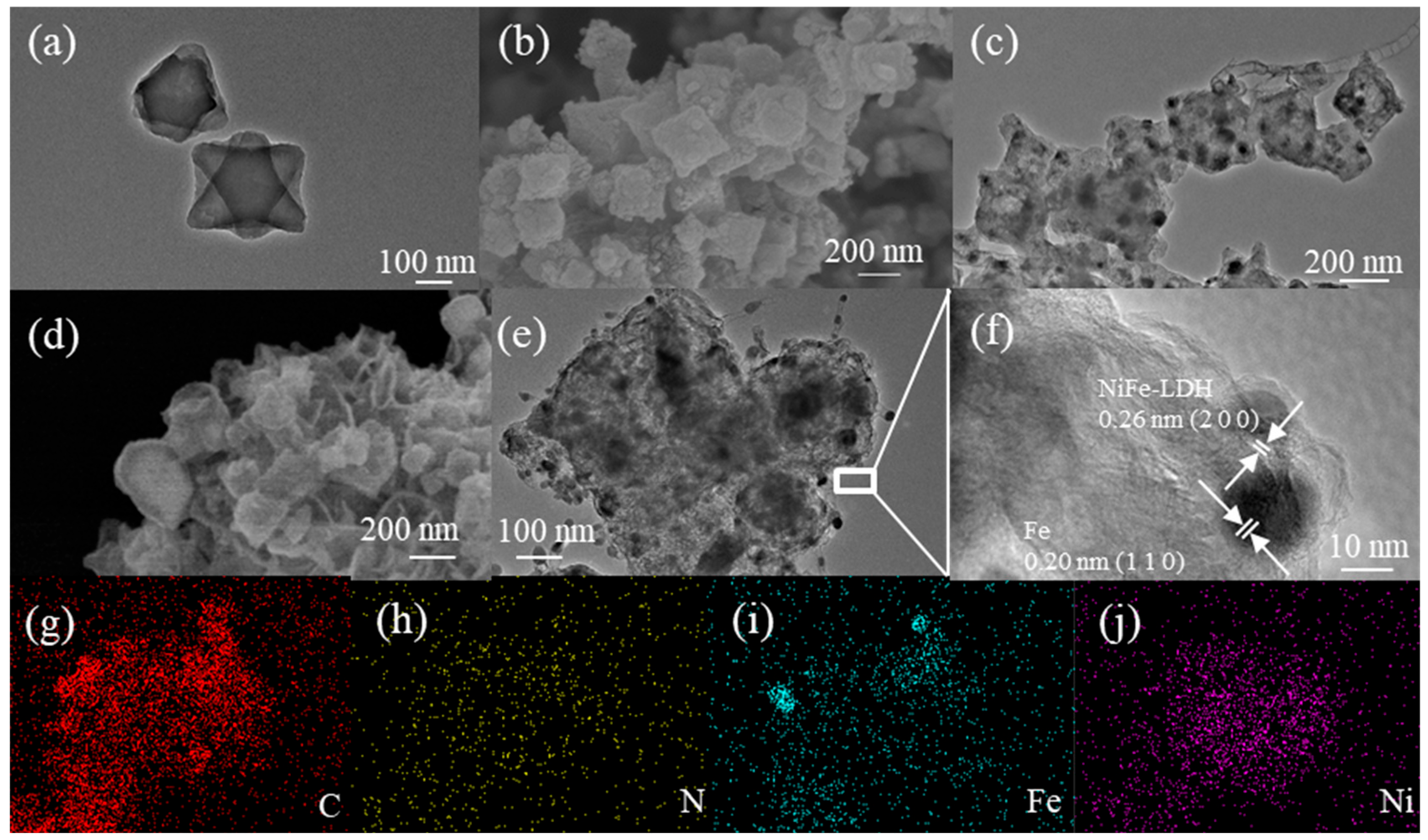
The results from scanning electron microscopy (SEM) reveal a smooth and polyhedral surface for NH2-MIL-101(Fe) (Figure S1), while transmission electron microscopy (TEM) image (Figure 1a) shows uniform dispersion resembling cube-like structures around 200 nm in size. Upon pyrolysis of NH2-MIL-101(Fe) at high temperatures, Fe-NC maintains the precursor’s shape and generates metal particles (Figure 1b,c). Formation of NiFe-LDH occurs through hydrothermal reaction of Ni2+ and H2ATA with Fe on the surface of Fe-NC (Figure 1d). The resultant composite, Fe-NC@NiFe-LDH, exhibits a synergistic effect, with Fe-NC and NiFe-LDH serving as primary active sites for ORR and OER, respectively. However, excess reactant completely covers the Fe-NC surface with LDH (Figure S2), emphasizing the importance of carefully regulating LDH concentration to expose catalytic sites fully. TEM images further reveal the microstructure of Fe-NC@NiFe-LDH, displaying homogeneous distribution of Fe nanoparticles (Figure 1e,f) forming three-dimensional flower-like microspheres, consistent with SEM observations (Figure 1d). Lattice fringe spacing of 0.18 nm and 0.26 nm (Figure 1e) correspond to the (110) and (200) planes of Fe-NC and NiFe-LDH, respectively. Energy dispersive X-ray spectroscopy (EDS) elemental mapping confirms consistent distribution of C, O, N, Fe, and Ni elements in Fe-NC@NiFe-LDH particles (Figure 1g–j), although the weak N signal suggests coverage by NiFe-LDH nanosheets. Notably, Ni components are predominantly found at the margins, supporting the decoration of NiFe-LDH on the Fe-NC surface. Meanwhile, the uniform presence of Fe throughout the structure suggests that the iron in NiFe-LDH originates from the Fe-NC substrate, evidencing a migration-assisted in situ growth mechanism that enhances interfacial interactions and structural integrity.
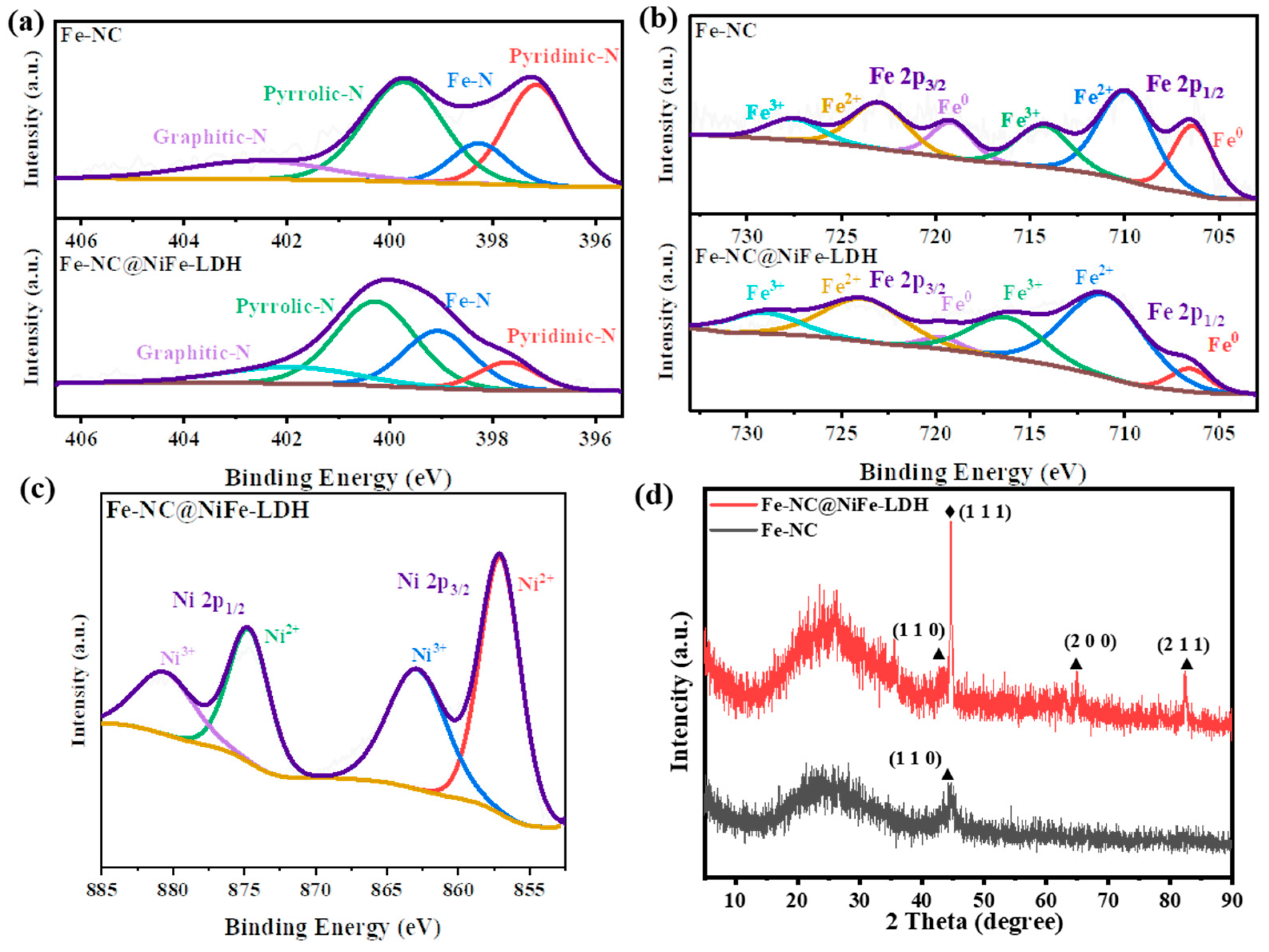
The elemental compositions of Fe-NC@NiFe-LDH were examined using X-ray photoelectron spectroscopy (XPS). As shown in Figure S3, Ni, Fe, N, C and O are identified in Fe-NC@NiFe-LDH, consistent with the EDS results, whereas Fe, N, C and O are present in Fe-NC (Figure S4). High resolution N 1s spectra of Fe-NC@NiFe-LDH and Fe-NC (Figure 2a) exhibit four distinct peaks: pyridinic-N (397.71 eV), M–N (399.06 eV), pyrrolic-N (400.28 eV) and graphitic-N (401.95 eV) [27]. The proportion of M-N in Fe-NC@NiFe-LDH (Table S1) significantly increases with the addition of Ni, demonstrating the enhancement of ORR active sites [28]. Fe 2p spectra (Figure 2b) displays peaks at 716.27 eV and 729.11 eV for Fe3+, peaks at 711.03 eV and 723.83 eV for Fe2+, and peaks at 706.52 eV and 719.70 eV for Fe0 [29,30], with distinct binding energy shifts to high binding energy for Fe-NC@NiFe-LDH. Furthermore, Table S2 compares the iron concentrations for Fe-NC@NiFe-LDH and Fe-NC under various configurations, revealing that the introduction of Ni reduces the percentage of Fe0 while increasing the content of Fe3+ and Fe2+. This phenomenon may result from a portion of iron in the 0-valence state reacting with Ni to form NiFe-LDH through hydrothermal reaction, thus improving the performance of OER. In the Ni 2p spectrum (Figure 2c), distinct peaks are observed at 857.05 eV and 874.68 eV corresponding to Ni 2p1/2 and Ni 2p3/2, respectively, indicative of Ni2+. Peaks at 862.89 eV and 880.56 eV correspond to Ni 2p1/2 and Ni 2p3/2 associated with Ni3+, indicating that Ni exists as ions in Fe-NC@NiFe-LDH [31], consistent with the chemical state of Ni in NiFe-LDH and similar to other reported NiFe-LDH [20,32]. Overall, XPS analysis demonstrates that heterostructure formation induces pronounced changes in the N 1s, Ni 2p, and Fe 2p spectra, accompanied by a significant increase in M–N species serving as ORR active sites (Table S1). Concurrently, a substantial fraction of Fe0 is converted to higher valence Fe2+/Fe3+ species (Table S2), which are widely recognized as intrinsic OER-active centers [12]. These electronic and compositional modulations collectively demonstrate that the integration of Fe-NC and NiFe-LDH facilitates interfacial charge transfer and synergistic interactions among active sites, thereby contributing to the enhanced overall electrocatalytic performance.
X-ray diffraction (XRD) analysis was used to examine the phase composition and structural characteristics of the samples. Both Fe-NC and Fe-NC@NiFe-LDH (Figure 2d) exhibit diffraction peaks at circa 26° and 44°, corresponding to the (002) planes of graphitic carbon and the (110) plane of Fe (JCPDS card no. 06-0696), respectively [33]. In contrast to Fe-NC, the diffraction peaks observed at 45°, 65°, and 82° for Fe-NC@NiFe-LDH align with the (111), (200), and (211) planes of NiFe-LDH (JCPDS card no. 37-0474), confirming the successful synthesis of NiFe-LDH while retaining part of the Fe-NC structure. These findings are consistent with the results obtained from XPS and TEM analyses.

2.2. Electrocatalytic Properties

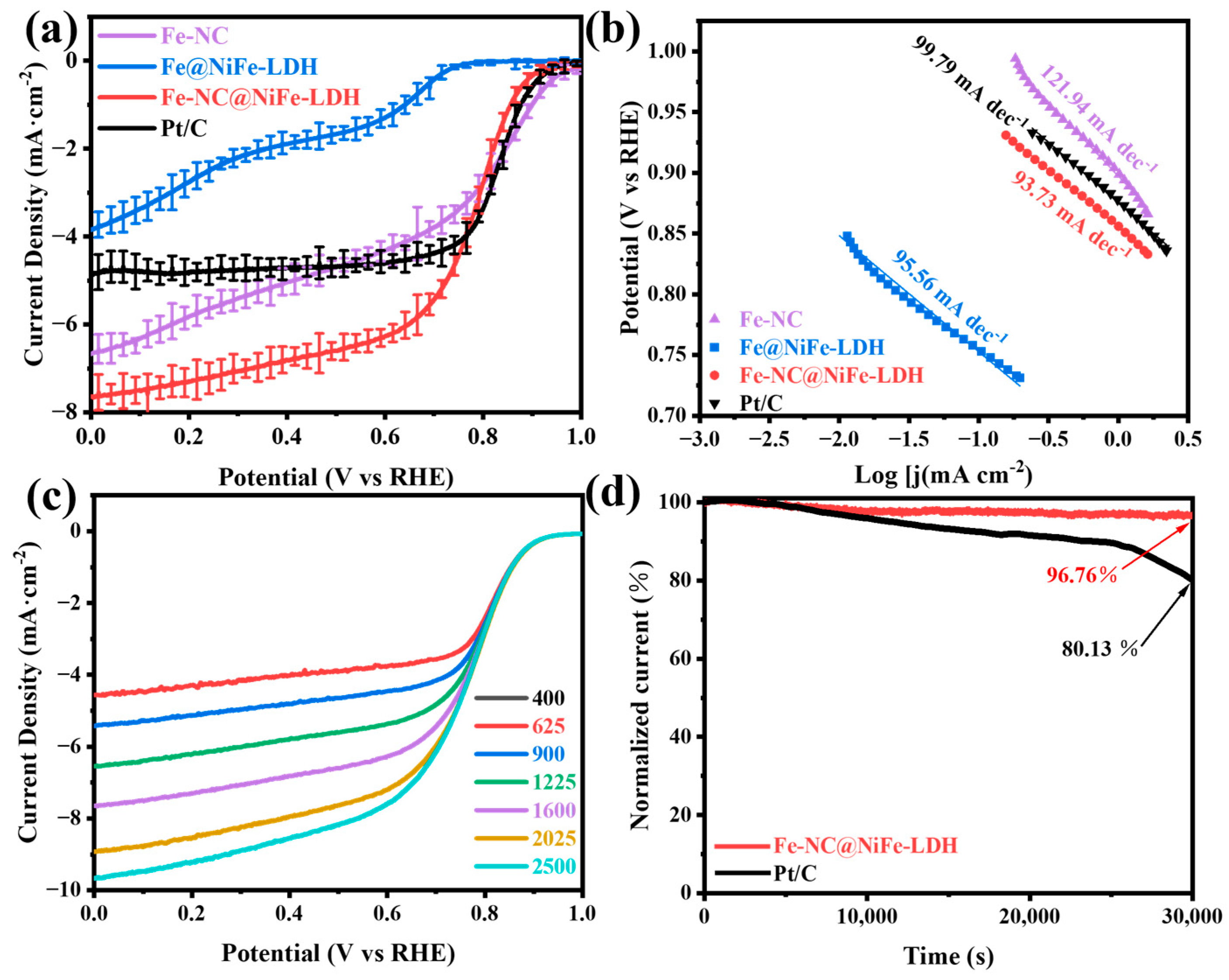
The ORR and OER capabilities of the samples were evaluated in an O2-saturated 0.1 M KOH solution. As depicted in Figure 3a, Fe-NC@NiFe-LDH shows a half-wave potential of 0.83 V, comparable to Pt/C (0.84 V). According to recently published studies, this value ranks among the higher reported values (Table S3). Moreover, the limiting current density (jL) of Fe-NC@NiFe-LDH is 7.69 mA cm−2, outperforming Pt/C (4.86 mA cm−2). This excellent ORR catalytic performance is attributed to the higher content of M-N in Fe-NC@NiFe-LDH compared to Fe-NC (Table S1), a characteristic typically associated with active ORR sites [34]. The calcination process prior to LDH synthesis plays a crucial role in forming Fe-NC@NiFe-LDH and Fe@NiFe-LDH. The disparity in ORR performance emphasizes the significance of the carbonization process for MOFs before LDH support, enhancing catalyst conductivity [35]. Additionally, the formation of metallic active sites in Fe-NC post-calcination of NH2-MIL-101(Fe) is evident from TEM comparisons (Figure 1a and Figure 1c). Consequently, the poor electrical conductivity and insufficient active sites for ORR on the NH2-MIL-101(Fe) substrate contribute to the inferior ORR catalytic performance of Fe@NiFe-LDH. Furthermore, Fe-NC@NiFe-LDH exhibits the lowest Tafel slope value (93.73 mV dec−1) among catalyst materials, lower than Pt/C (99.79 mV dec−1), indicative of its superior ORR dynamic performance (Figure 3b). The synergistic interaction between Fe-NC and NiFe-LDH likely underlies the exceptional ORR performance for Fe-NC@NiFe-LDH, where Fe-NC provides conductivity and ORR activity, and NiFe-LDH offers active surface exposure and OER activity. Likewise, an increase in cathodic current (from 400 to 2500 rpm) in Figure 3c indicates enhanced mass transport at the electrode surface with rotation rate. A linearly fitted Koutecky–Levich (K-L) plot Figure S5 shows the ORR catalytic reaction pathway of Fe-NC@NiFe-LDH. The number of electrons transferred per oxygen molecule, determined to be between 3.5 and 3.7 in the potential range of 0.2–0.6 V (vs. RHE), closely approximates the theoretical value of Pt/C, suggesting a prominent four-electron reduction pathway in the ORR process for Fe-NC@NiFe-LDH [36]. Furthermore, Fe-NC@NiFe-LDH maintains 96.76% of its initial current density after 30,000 s of continuous reaction, in contrast to Pt/C with a current density drop of 19.87% (Figure 3d), suggesting its excellent long-term stability.
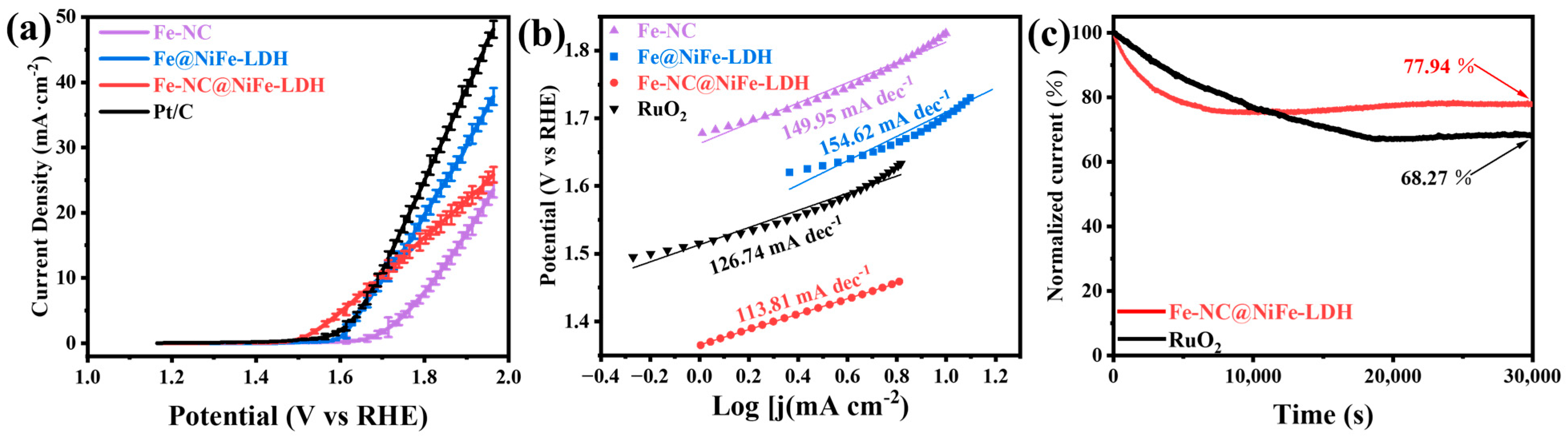
The charging mechanism of ZAB also depends on the efficacy of OER. In Figure 4a, the LSV curves for Fe-NC, Fe@NiFe-LDH, Fe-NC@NiFe-LDH, and RuO2 are presented. Fe-NC@NiFe-LDH requires 1.68 V to reach 10 mA cm−2, much lower than Fe-NC (1.82 V), and even marginally lower than RuO2 (1.69 V). The rapid increase in current density of Fe-NC@NiFe-LDH with increasing overpotential signifies improved OER performance facilitated by NiFe-LDH support. Tafel curves further demonstrate the kinetics of OER (Figure 4b). Compared to Fe@NiFe-LDH (154.62 mV dec−1) and RuO2 (126.74 mV dec−1), the Tafel slope of Fe-NC@NiFe-LDH catalyst is the lowest (113.81 mV dec−1), suggesting its efficient utilization as a non-precious metal OER catalyst. The remarkable OER performance is predominantly attributed to the loaded NiFe-LDH, as Fe-NC alone shows sluggish OER activity with an overpotential as high as 590 mV and a Tafel slope of 149.95 mV dec−1. To evaluate the OER stability of Fe-NC@NiFe-LDH, current retention-time (i-t) experiments were performed at a potential of 1.63 V (Figure 4c). Fe-NC@NiFe-LDH exhibits exceptional OER durability, sustaining 77.94% of the initial current density after 30,000 s of continuous operation, while RuO2 maintains only 68.27%. The Nyquist plots in Figure S6 provide further insight into the OER kinetics of the different samples. Together with the fitted EIS parameters listed in Table S4, Fe-NC@NiFe-LDH is shown to exhibit the smallest charge-transfer resistance compared with Fe@NiFe-LDH and Fe-NC, indicating accelerated OER kinetics for the Fe-NC@NiFe-LDH composite. The superior bifunctional oxygen electrocatalytic performance of Fe-NC@NiFe-LDH arises from the synergistic interaction and enhanced charge transfer between NiFe-LDH and Fe-NC. XPS analysis reveals pronounced modifications in the interfacial electronic structure at the Fe-NC/NiFe-LDH junction. Specifically, the increased proportion of M-N coordination sites in Fe-NC@NiFe-LDH correlates well with the improved ORR activity. Meanwhile, the shift in Fe 2p binding energies and the substantial decrease in metallic Fe0 content indicate oxidation to higher valence Fe2+/Fe3+ species (Table S2), which serve as additional OER-active centers [12]. These interfacial electronic modulations facilitate efficient charge transfer across the heterojunction, while the reduced Tafel slopes for both ORR and OER further confirm accelerated charge-transfer kinetics. Consequently, the enhanced bifunctional performance can be attributed to (1) an increased density of M-N ORR active sites, (2) the formation of Fe2+/Fe3+ OER-active species through interfacial charge redistribution, and (3) optimized electron-transfer pathways enabled by the intimate heterostructure interface.

2.3. Aqueous Zn–Air Battery Performance

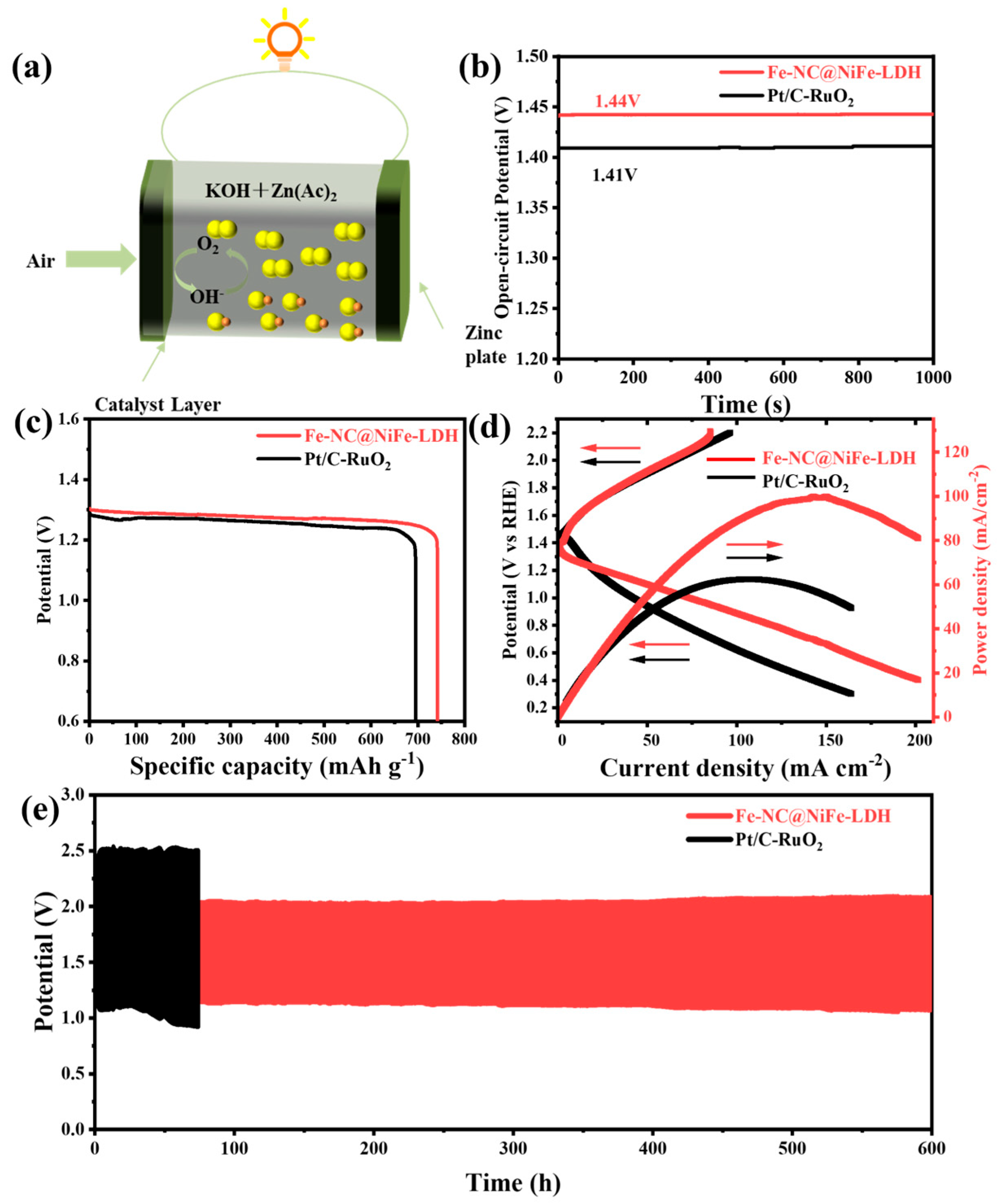
To investigate the practical applications of Fe-NC@NiFe-LDH as an air electrode electrocatalyst in metal–air batteries, a rechargeable ZAB device was constructed, capitalizing on Fe-NC@NiFe-LDH’s demonstrated bifunctional catalytic activity and robust endurance for both ORR and OER. The ZAB configuration included a zinc plate as the anode, catalyst-loaded carbon paper as the cathode, and 6 M KOH + 0.2 M Zn(OAc)2 as the electrolyte (Figure 5a). For comparative analysis, a ZAB device based on Pt/C-RuO2 was also constructed. The Fe-NC@NiFe-LDH-based battery exhibited an open circuit potential (OCP) of 1.44 V, surpassing Pt/C-RuO2 (1.41 V) (Figure 5b). Calculating the mass of consumed Zn flake revealed a specific capacity of 741.7 mAh g−1 for the Fe-NC@NiFe-LDH-based battery (Figure 5c), higher than the 695.4 mAh g−1 achieved with commercial Pt/C-RuO2. Additionally, polarization and power density curves (Figure 5d) demonstrated a minimal voltage differential between charge and discharge curves, particularly at high current densities, indicating excellent energy storage and release capabilities, with NC@NiFe-LDH-based ZAB achieving a power density of 99.8 mW cm−2, surpassing Pt/C-RuO2 (62.4 mW cm−2). Durability, a critical factor for practical electrocatalyst application, was evaluated by continuous charging and discharging at a current density of 5 mA cm−2. As depicted in Figure 5e, the Fe-NC@NiFe-LDH-based ZAB exhibited a narrower charge–discharge gap than Pt/C-RuO2. Remarkably, even after a 600 h stability test (equivalent to over 3600 cycles), it demonstrated outstanding durability without notable voltage degradation, outperforming Pt/C-RuO2. The exceptional electrocatalytic activity of Fe-NC@NiFe-LDH-based ZAB can be attributed to the synergistic interaction between Fe-NC with its high conductivity and ORR capabilities, and NiFe LDH with its substantial specific surface area and significant OER attributes. Moreover, the flower-like morphology, exposing active sites fully, along with comparably low catalyst impedance facilitating rapid electron transfer rate, also contribute significantly. Thus, Fe-NC@NiFe-LDH shows considerable potential as a high performance bifunctional electrocatalyst in energy storage devices.

3. Experimental

3.1. Materials

FeCl3∙6H2O (AR, 99%), ethyl alcohol (EtOH), methanol (MeOH), N, N-dimethylformamide (DMF) and methenamine were obtained from Sinopharm Chemical Reagent Corporation (Beijing, China). Ni (NO3)2∙6H2O (AR, 98%) and RuO2 (99.9%) were purchased from Aladdin Industrial Corporation (Beijing, China). Commercial Pt/C (20 wt.%) and melamine were bought from Alfa Aesar (Shanghai, China). 2-aminoterephthalic acid (H2ATA) and Nafion117 solution (5 wt.%) were obtained from Shanghai Macklin Biochemical Corporation and Sigma-Aldrich (Shanghai, China), respectively.

3.2. Synthesis of NH2-MIL-101(Fe)

NH2-MIL-101(Fe) was prepared following established procedures [37]. Briefly, 2.5 mmol FeCl3·6H2O and 1.25 mmol 2-aminoterephthalic acid were dissolved in 15 mL N, N-dimethylformamide (DMF) and stirred at room temperature for 1 h until a homogeneous solution was formed. The reaction mixture was then sealed in a stainless Teflon-lined autoclave and heated at 110 °C for 24 h. The resulting product was collected, washed thrice with DMF and methanol, and subsequently dried at 60 °C under vacuum.

3.3. Synthesis of Fe-NC

NH2-MIL-101(Fe) (50 mg) and melamine (500 mg) were placed at the downstream and upstream sections of a furnace, respectively, and heated to 800 °C for 2 h at a heating rate of 2 °C/min under a N2 atmosphere. After cooling to room temperature, Fe-NC samples were obtained.

3.4. Synthesis of Fe-NC@NiFe-LDH

Fe-NC (50 mg) was dispersed in a mixture of 15 mL deionized water and 15 mL EtOH, followed by ultrasonication for 10 min. 50 mg methenamine and 25 mg Ni(NO3)2·6H2O were added to the solution, and the mixture was stirred for 30 min. The reaction mixture was then sealed in a stainless Teflon-lined autoclave and heated at 110 °C for 6 h. The resulting product was collected, washed thrice with deionized water and EtOH, and dried at 60 °C under vacuum to obtain Fe-NC@NiFe-LDH.
For comparison, Fe@NiFe-LDH was prepared using a similar procedure as Fe-NC@NiFe-LDH, with Fe-NC replaced by NH2-MIL-101(Fe).

3.5. Electrochemical Measurements

The electrocatalytic activities toward the ORR and OER were evaluated using a standard three-electrode configuration on a CHI 760D (CH Instruments, Inc., Shanghai, China) electrochemical workstation at ambient temperature. A catalyst-coated glassy carbon electrode (GC, 3 mm diameter), a graphite rod, and an Ag/AgCl electrode served as the working, counter, and reference electrodes, respectively.
The catalyst ink was prepared by dispersing 4 mg of catalyst powder and 1 mg of carbon black (XC-72) in a mixed solvent containing 800 μL deionized water, 200 μL isopropanol, and 20 μL Nafion117 solution (5wt.%). The suspension was ultrasonicated for 30 min to obtain a homogeneous ink. An aliquot (3 μL) of the ink was drop-cast onto the glassy carbon electrode surface and dried at room temperature to form a uniform catalyst layer, yielding a catalyst loading of approximately 0.17 mg cm−2.
ORR and OER polarization curves were recorded using a rotating disk electrode system (RDE-3A, ALS Co., Salt Lake City, UT, USA) in O2-saturated 0.1 M KOH at a rotation speed of 1600 rpm, over a potential range of 0.2 V to 2 V (vs. Ag/AgCl) at 5 mV s−1. The data were collected without iR compensation. Electrochemical impedance spectroscopy (EIS) measurements were conducted at 1.59 V (vs. RHE) over a frequency range from 100 kHz to 0.01 Hz with an AC amplitude of 5 mV. All potentials reported herein were converted to the reversible hydrogen electrode (RHE) scale. For each catalyst, key electrochemical tests, including linear sweep voltammetry (LSV) for ORR and OER and the corresponding Tafel analyses, were performed in triplicate.
For zinc–air battery assembly in a two-electrode configuration, polished zinc foil (thickness: 0.08 mm) was employed as the anode, and the electrolyte consisted of 6 M KOH and 0.2 M Zn(Ac)2. The air electrode was fabricated by coating carbon fiber cloth (W1S1009, Cetech, Taizhong, China) with a slurry composed of catalyst, aqueous polytetrafluoroethylene (PTFE), carbon black, and activated carbon in a mass ratio of 10:35:25:30. The active material loading was approximately 3 mg cm−2. Power density and charge–discharge polarization curves were measured using a CHI 760E (CH Instruments, Inc., Shanghai, China) electrochemical workstation. Cycling performance, including specific capacity and long-term stability, was evaluated at room temperature under a current density of 5 mA cm−2 using a battery testing system (Neware CT-4008, Shenzhen, China) [38].

4. Conclusions

In this work, a bifunctional Fe-NC@NiFe-LDH catalyst was successfully engineered via a migration-assisted interfacial growth strategy. The resulting heterostructure comprises NiFe-LDH nanosheets grown in situ on the surface of Fe-NC derived from NH2-MIL-101(Fe). Notably, the iron species within NiFe-LDH are entirely supplied through migration from the Fe-NC matrix, ensuring strong interfacial coupling and forming an integrated architecture with enhanced electron transfer pathways and structural robustness. This rational design not only affords a high specific surface area enriched with active sites for both ORR and OER but also facilitates rapid charge transport through the conductive Fe-NC framework. Consequently, Fe-NC@NiFe-LDH exhibits excellent bifunctional catalytic activity in 0.1 M KOH, with an E1/2 of 0.83 V and overpotential of 0.45 V for ORR and OER, respectively, alongside superior long-term stability compared to commercial Pt/C and RuO2 catalysts. When employed as the cathode catalyst in ZABs, Fe-NC@NiFe-LDH exhibits enhanced charge–discharge stability (≥600 h) and higher power density compared to Pt/C-RuO2-based counterparts. This research advances the development of air-cathode bifunctional electrocatalysts for ZABs, harnessing the synergistic effects of LDH and M-N-C materials.

Supplementary Materials

The following supporting information can be downloaded at https://www.mdpi.com/article/10.3390/catal16020152/s1: Figure S1: SEM image of NH2-MIL-101(Fe); Figure S2: TEM image of Fe-NC@NiFe-LDH; Figure S3: XPS survey spectrum of Fe-NC@NiFe-LDH; Figure S4: XPS survey spectrum of Fe-NC; Figure S5: K–L fitting lines at various potentials of Fe-NC@NiFe-LDH; Figure S6: Nyquist plots of Fe-NC@NiFe-LDH, Fe @NiFe-LDH and Fe-NC; Table S1: Nitrogen configuration composition in Fe-NC@NiFe-LDH and Fe-NC catalysts; Table S2: Iron configuration composition in Fe-NC@NiFe-LDH and Fe-NC catalysts. Table S3: Comparison of half-wave potentials for recently reported catalysts; Table S4: The Rs and Rct values of Fe-NC@NiFe-LDH, Fe @NiFe-LDH and Fe-NC.

Author Contributions

P.S.: Conceptualization, Investigation, Writing—original draft. Z.L.: Investigation, Writing—original draft, Software. K.L.: Conceptualization. D.C.: Investigation, Conceptualization. B.P.: Investigation, Conceptualization. F.Y.: Visualization. J.S.: Investigation, Q.Z.: Investigation. J.Y.: Conceptualization, Methodology, Writing—review and editing. L.Y.: Project administration, Funding acquisition. L.D.: Project administration, Funding acquisition, Supervision, Writing—review and editing, Resources. All authors have read and agreed to the published version of the manuscript.

Funding

This work was supported by the National Natural Science Foundation of China (21776147, 21905153, 61604086, 22378221, 22308183, 52002198), the Natural Science Foundation of Shandong Province (ZR2021YQ32, ZR2022QB164, ZR2023QB070), the Taishan Scholar Project of Shandong Province (tsqn201909117), the Qingdao Science and Technology Benefit the People Demonstration and Guidance Special Project (23-2-8-cspz-11-nsh), the Qingdao Natural Science Foundation (23-2-1-241-zyyd-jch), and the China Postdoctoral Science Foundation (2023M731856). L. F. Dong also thanks financial support from the Malmstrom Endowed Fund at Hamline University.

Data Availability Statement

The authors can confirm that all relevant data are included in the article. Further inquiries can be directed to the corresponding author(s).

Conflicts of Interest

The authors do not have any financial or non-financial interests that are directly or indirectly related to the work submitted for publication.

References

  1. Li, T.; Zhang, D.; Zhang, Y.; Yang, D.; Li, R.; Yu, F.; Zhong, K. A pH-dependent microkinetic modeling guided synthesis of porous dual-atom catalysts for efficient oxygen reduction in Zn–air batteries. Energy Environ. Sci. 2025, 18, 4949–4961. [Google Scholar] [CrossRef]
  2. Xu, L.; Mao, Z.; Liu, J.; Bi, M.; Tu, T.; Tian, Y.; Zhou, X.; Wu, J.; Wu, Y.; Su, J.; et al. Carbon-Encapsulated CeO2-Co Heterostructure via Tight Coupling Enables Corrosion-Resistant Bifunctional Catalysis in Zinc-Air Battery. Adv. Energy Mater. 2025, 15, 2501790. [Google Scholar] [CrossRef]
  3. Wan, Z.; Ma, Z.; Deng, X.; Wu, Y.; Li, J.; Wang, X. Weakening the Dissociation Barrier of Hydroxyl in Fe–N–C Catalysts via Precisely Manipulating d–p Orbital Hybridization Behaviors for Efficient Oxygen Reduction Reaction. Adv. Energy Mater. 2025, 27, 2501630. [Google Scholar] [CrossRef]
  4. Zhang, H.; Chen, H.C.; Feizpoor, S.; Li, L.; Zhang, X.; Xu, X. Tailoring oxygen reduction reaction kinetics of Fe−N−C catalyst via spin manipulation for efficient zinc–air batteries. Adv. Mater. 2024, 36, 2400523. [Google Scholar] [CrossRef]
  5. Ming, L.; Qi, L.; Xu, X.; Xue, M.; Xiao, X. CoTe2/NiTe2 heterojunction embedded in N-doped hollow carbon nanoboxes as high-efficient ORR/OER catalyst for rechargeable zinc-air battery. Chem. Eng. J. 2024, 486, 150256. [Google Scholar]
  6. Cha, Y.; Jang, H.; Noh, D.; Seong, Y.; Choi, J.; Kim, T. Precisely controllable microwave-driven reconstruction of Ni-Co-Fe trimetallic needle structures on nitrogen-doped carbon as bifunctional oxygen catalysts for Zn-air batteries. Adv. Compos. Hybrid Mater. 2025, 8, 335. [Google Scholar] [CrossRef]
  7. Wu, Q.; Jiang, J.; Gao, H.; Jia, H.; Wu, C.; Deng, C.; Xu, G.; Ammar, M.; Jiang, H.; Zhang, L. Carbon cloth-based nitrogen-doped carbon nanotube-encapsulated Co nanoparticles as bifunctional oxygen electrocatalysts for flexible Zn-air batteries. J. Mater. Sci. Technol. 2026, 255, 65–74. [Google Scholar] [CrossRef]
  8. Lun, L.; Zian, X.; Yu, X.; Mei, G.; Qin, J.; Bao, Z.; Chong, L.; Shao, C.; Zhe, Z.; Wang, H.-L. Conjugated microporous polymer derived hierarchically porous N-rich nanocarbon as a durable electrocatalyst for oxygen reduction reaction in Zn-air battery. Chem. Eng. J. 2024, 497, 155560. [Google Scholar]
  9. Ren, S.; Duan, X.; Liang, S.; Zhang, M.; Zheng, H. Bifunctional electrocatalysts for Zn–air batteries: Recent developments and future perspectives. J. Mater. Chem. A 2020, 8, 6144–6182. [Google Scholar] [CrossRef]
  10. Mao, M.; Wu, X.; Hu, Y.; Yuan, Q.; He, Y.-B.; Kang, F. Charge storage mechanism of MOF-derived Mn2O3 as high performance cathode of aqueous zinc-ion batteries. J. Energy Chem. 2021, 52, 277–283. [Google Scholar] [CrossRef]
  11. Kim, T.; Muthurasu, A.; Ko, T.H.; Chae, S.-H.; Kim, H.Y. Metal-Organic Framework Supported Dual Functional Air Cathode Carbon Nanofiber as an Efficient Electrocatalyst for the Rechargeable Zinc-Air Batteries. Small 2025, 21, 2500033. [Google Scholar] [CrossRef]
  12. Liu, L.; Hu, J.; Rao, X.; Zhu, Y.; Li, P.; Chen, S.; Zhang, S. Revealing the dependence of oxygen reduction mechanism and activity on the D-band center difference of Fe-M bimetallic sites. Appl. Catal. B Environ. 2025, 11, 126191. [Google Scholar] [CrossRef]
  13. Lan, L.; Wu, Y.; Pei, Y.; Wei, Y.; Hu, T.; Lützenkirchen-Hecht, D.; Yuan, K.; Chen, Y. High-Density Accessible Iron Single-Atom Catalyst for Durable and Temperature-Adaptive Laminated Zinc-Air Batteries. Adv. Mater. 2025, 37, 2417711. [Google Scholar] [CrossRef] [PubMed]
  14. Tsai, J.-E.; Hong, W.-X.; Pourzolfaghar, H.; Wang, W.-H.; Li, Y.-Y. A Fe-Ni-Zn triple single-atom catalyst for efficient oxygen reduction and oxygen evolution reaction in rechargeable Zn-air batteries. Chem. Eng. J. 2023, 460, 141868. [Google Scholar] [CrossRef]
  15. Qiao, G.; Rui, Y.; Yu, Z.; Ying, Y.; Jie, F.; Long, C. Performance of Nitrogen-Doped Carbon Nanoparticles Carrying FeNiCu as Bifunctional Electrocatalyst for Rechargeable Zinc-Air Battery. Small 2024, 20, 2400830. [Google Scholar]
  16. Li, X.; Wei, J.; Li, Q.; Zheng, S.; Xu, Y.; Du, P. Nitrogen-Doped Cobalt Oxide Nanostructures Derived from Cobalt-Alanine Complexes for High-Performance Oxygen Evolution Reactions. Adv. Funct. Mater. 2018, 28, 1800886. [Google Scholar] [CrossRef]
  17. Yang, M.; Hu, X.; Fang, Z.; Sun, L.; Yuan, Z.; Wang, S. Bifunctional MOF-Derived Carbon Photonic Crystal Architectures for Advanced Zn–Air and Li–S Batteries: Highly Exposed Graphitic Nitrogen Matters. Adv. Funct. Mater. 2017, 27, 1701971. [Google Scholar] [CrossRef]
  18. Wang, X.; Shan, Y.; Wang, L.; Chen, K.; Yu, X. Self-Supporting 3D Cross-linked NiFe-Co/NC@ NiMoO4 Electrode for Efficient Overall Water Splitting and Rechargeable Zn-air Batteries. Appl. Catal. B Environ. 2025, 25, 125406. [Google Scholar] [CrossRef]
  19. Wang, W.H.; Han, C.H.; Hong, W.X.; Chiu, Y.C.; Tseng, I.H. NiFe Layered Double Hydroxide (LDH) Anchored, Fe Single Atom and Nanoparticle Embedded on Nitrogen-Doped Carbon-CNT (Carbon Nanotube) Framework as a Bifunctional Catalyst for Rechargeable Zinc-Air Batteries. J. Energy Storage 2024, 85, 111058. [Google Scholar] [CrossRef]
  20. Gan, M.; Lu, C.; Feng, W.; He, C.; Hu, J.; Xie, F.; He, W.; Sun, Z. Rational Design of Efficient Zn–CoNi/Air Hybrid Batteries via Charge Redistribution in Iron Phthalocyanine Modified Cobalt-Nickel Layered Double Hydroxide. Energy Storage Mater. 2025, 20, 104755. [Google Scholar] [CrossRef]
  21. Dang, D.; Zhang, L.; Long, G.; Liu, C.; Fan, W.; Zheng, J.; Wang, T.; Liu, Q.; Han, X. Modulation the Coordination of Fe-Co Diatomic Sites with Boron Atom for Fuel Cells and Zn-Air Battery. Appl. Catal. B Environ. 2025, 379, 125679. [Google Scholar] [CrossRef]
  22. Xue, Y.; Guo, Y.; Zhang, Q.; Xie, Z.; Wei, J.; Zhou, Z. MOF-Derived Co and Fe Species Loaded on N-Doped Carbon Networks as Efficient Oxygen Electrocatalysts for Zn-Air Batteries. Nano-Micro Lett. 2022, 14, 162. [Google Scholar] [CrossRef]
  23. Ramachandran, R.; Thangavel, S.; Li, M.; Shan, H.; Xu, Z.-X.; Wang, F. Efficient Degradation of Organic Dye Using Ni-MOF Derived NiCo-LDH as Peroxymonosulfate Activator. Chemosphere 2021, 271, 128509. [Google Scholar] [CrossRef] [PubMed]
  24. Shi, S.; Zhang, W.; Wu, H.; Li, Y.; Ren, X.; Li, M. In Situ Cascade Derivation Toward a Hierarchical Layered Double Hydroxide Magnetic Absorbent for High-Performance Protein Separation. ACS Sustain. Chem. Eng. 2020, 8, 4966–4974. [Google Scholar] [CrossRef]
  25. Dong, Y.; Komarneni, S.; Zhang, F.; Wang, N.; Terrones, M.; Hu, W. “Structural Instability” Induced High-Performance NiFe Layered Double Hydroxides as Oxygen Evolution Reaction Catalysts for pH-Near-Neutral Borate Electrolyte: The Role of Intercalates. Appl. Catal. B Environ. 2020, 263, 118343. [Google Scholar] [CrossRef]
  26. Feng, X.; Jiao, Q.; Chen, W.; Dang, Y.; Dai, Z.; Suib, S.L. Cactus-like NiCo2S4@NiFe LDH Hollow Spheres as an Effective Oxygen Bifunctional Electrocatalyst in Alkaline Solution. Appl. Catal. B Environ. 2021, 286, 119869. [Google Scholar] [CrossRef]
  27. Zhang, X.; Hu, X.; Lv, S.; Li, Y.; Ren, J.; Huang, Y. Hollow NH2-MIL-101@TA Derived Electrocatalyst for Enhanced Oxygen Reduction Reaction and Oxygen Evolution Reaction. Int. J. Hydrogen Energy 2021, 46, 38692–38700. [Google Scholar] [CrossRef]
  28. Ge, X.; Sumboja, A.; Wuu, D.; An, T.; Li, B.; Goh, F.W.T. Oxygen Reduction in Alkaline Media: From Mechanisms to Recent Advances of Catalysts. ACS Catal. 2015, 5, 4643–4667. [Google Scholar] [CrossRef]
  29. Xun, S.; Xu, Y.; He, J.; Jiang, D.; Yang, R.; Li, D. MOF-Derived Cobalt Oxides Nanoparticles Anchored on CoMoO4 as a Highly Active Electrocatalyst for Oxygen Evolution Reaction. J. Alloys Compd. 2019, 806, 1097–1104. [Google Scholar] [CrossRef]
  30. Huang, L.-B.; Zhao, L.; Zhang, Y.; Luo, H.; Zhang, X.; Zhang, J. Engineering Carbon-Shells of M@NC Bifunctional Oxygen Electrocatalyst Towards Stable Aqueous Rechargeable Zn-Air Batteries. Chem. Eng. J. 2021, 418, 129409. [Google Scholar] [CrossRef]
  31. Pan, M.; Qian, G.; Yu, T.; Chen, J.; Luo, L.; Zou, Y. Ni Modified Co2VO4 Heterojunction with Poor/Rich-Electron Structure for Overall Urea-Rich Wastewater Oxidation. Chem. Eng. J. 2022, 435, 134986. [Google Scholar] [CrossRef]
  32. Zou, Y.; Xiao, B.; Shi, J.-W.; Hao, H.; Ma, D.; Lv, Y. 3D Hierarchical Heterostructure Assembled by NiFe LDH/(NiFe)Sx on Biomass-Derived Hollow Carbon Microtubes as Bifunctional Electrocatalysts for Overall Water Splitting. Electrochim. Acta 2020, 348, 136339. [Google Scholar] [CrossRef]
  33. Li, Z.Q.; Lu, C.J.; Xia, Z.P.; Zhou, Y.; Luo, Z. X-ray Diffraction Patterns of Graphite and Turbostratic Carbon. Carbon 2007, 45, 1686–1695. [Google Scholar] [CrossRef]
  34. Gao, C.; Mu, S.; Yan, R.; Chen, F.; Ma, T.; Cao, S. Recent Advances in ZIF-Derived Atomic Metal–N–C Electrocatalysts for Oxygen Reduction Reaction: Synthetic Strategies, Active Centers, and Stabilities. Small 2022, 18, 2105409. [Google Scholar] [CrossRef]
  35. Xiao, L.; Wang, Z.; Guan, J. 2D MOFs and their derivatives for electrocatalytic applications: Recent advances and new challenges. Coord. Chem. Rev. 2022, 472, 214777. [Google Scholar] [CrossRef]
  36. Pegis, M.L.; Wise, C.F.; Martin, D.J.; Mayer, J.M. Oxygen Reduction by Homogeneous Molecular Catalysts and Electrocatalysts. Chem Rev. 2018, 118, 2340–2391. [Google Scholar] [CrossRef]
  37. Taha, A.A.; Huang, L.; Ramakrishna, S.; Liu, Y. MOF [NH2-MIL-101(Fe)] as a Powerful and Reusable Fenton-Like Catalyst. J. Water Process Eng. 2020, 33, 101004. [Google Scholar] [CrossRef]
  38. Chen, D.; Chen, X.; Cui, Z.; Li, G.; Han, B.; Zhang, Q. Dual-Active-Site Hierarchical Architecture Containing NiFe-LDH and ZIF-Derived Carbon-Based Framework Composite as Efficient Bifunctional Oxygen Electrocatalysts for Durable Rechargeable Zn-Air Batteries. Chem. Eng. J. 2020, 399, 125718. [Google Scholar] [CrossRef]
Scheme 1. Schematic illustration depicting the synthesis process of Fe-NC@NiFe-LDH.
Catalysts 16 00152 sch001
Figure 1. (a) TEM image of NH2-MIL-101(Fe). (b) SEM and (c) TEM images of Fe-NC. (d) SEM, (e,f) TEM, and (gj) EDS elemental mapping images of C, N, Fe and Ni of Fe-NC@NiFe-LDH.
Catalysts 16 00152 g001
Figure 2. High-resolution XPS spectra of (a) N 1s and (b) Fe 2p for Fe-NC@NiFe-LDH and Fe-NC, along with (c) Ni 2p spectrum for Fe-NC@NiFe-LDH. (d) XRD patterns of Fe-NC@NiFe-LDH and Fe-NC.
Catalysts 16 00152 g002
Figure 3. (a) ORR linear sweep voltammetry (LSV) curves and (b) Tafel plots of Fe-NC, Fe@NiFe-LDH, Fe-NC@NiFe-LDH and Pt/C at a rotation rate of 1600 rpm with a scan rate of 10 mV s−1. (c) Polarization curves of Fe-NC@NiFe-LDH at different rotation speeds. (d) Current retention-time (i-t) curves at 0.715 V (vs. RHE) for Fe-NC@NiFe-LDH and Pt/C catalysts.
Catalysts 16 00152 g003
Figure 4. (a) OER catalytic performances and (b) Tafel plots of Fe-NC, Fe@NiFe-LDH, Fe-NC@NiFe-LDH and RuO2 in O2-saturated 0.1 M KOH solution with a sweeping rate of 10 mV s−1. (c) Current retention-time (i-t) curves of Fe-NC@NiFe-LDH and RuO2 at 1.6 V (vs. RHE) over a period of 30,000 s.
Catalysts 16 00152 g004
Figure 5. (a) Schematic diagram of the ZAB setup, (b) open circuit potential curves, (c) charge–discharge and power density plots, (d) specific capacities, and (e) galvanostatic cycling stability of ZABs employing Fe-NC@NiFe-LDH and Pt/C-RuO2 as cathode catalysts.
Catalysts 16 00152 g005
Disclaimer/Publisher’s Note: The statements, opinions and data contained in all publications are solely those of the individual author(s) and contributor(s) and not of MDPI and/or the editor(s). MDPI and/or the editor(s) disclaim responsibility for any injury to people or property resulting from any ideas, methods, instructions or products referred to in the content.