Article

The Synthesis of Bis(α-aryl-methylphosphonoyl)amines by the Microwave-Assisted Catalyst-Free Tandem Kabachnik–Fields Reaction


by
Bence Bajusz
1,
Konstantin Karaghiosoff
2,*,
László Drahos
3,
Ágnes Gömöry
3 and
György Keglevich
1,*
1
Department of Organic Chemistry and Technology, Faculty of Chemical Technology and Biotechnology, Budapest University of Technology and Economics, Műegyetem rkp. 3., 1111 Budapest, Hungary
2
Department of Chemistry, Ludwig-Maximilian-University of Munich, Butenandtstr. 5-13, 81377 Munich, Germany
3
MS Proteomics Research Group, HUN-REN Research Centre for Natural Sciences, 1117 Budapest, Hungary
*
Authors to whom correspondence should be addressed.
Catalysts 2026, 16(2), 148; https://doi.org/10.3390/catal16020148
Submission received: 12 January 2026 / Revised: 28 January 2026 / Accepted: 30 January 2026 / Published: 3 February 2026
(This article belongs to the Section Catalysis in Organic and Polymer Chemistry)

Abstract

Potentially biologically active α-aminophosphonic derivatives were prepared by the Kabachnik–Fields condensation of α-amino-α-aryl-methylphosphonates, arylaldehydes, and diethyl phosphite to afford bis(α-aryl-methylphosphonoyl)-amines as a mixture of racemic and meso isomers. To go “green”—performing the transformations under microwave irradiation—there was no need for a catalyst. On the other hand, the phospha-Mannich reaction of α-amino-α-phenyl-methylphosphonate with arylaldehydes led to (α-aryl-methylphosphonoyl)-(α-phenyl-methylphosphonoyl)-amines as a mixture of SS/RR and SR/RS racemates. Moreover, the respective symmetric products with identical aryl groups were also present. The outcome was similar, when α-amino-α-aryl-methyl-phosphonates were condensed with benzaldehyde and diethyl phosphite. The products were analyzed by 1D and 2D NMR spectroscopy. The combined NMR analysis of the products confirmed their structure.

Graphical Abstract

1. Introduction

Due to their importance, α-aminophosphonates represent a prominent class of phosphonic ester derivatives. A great number of α-aminophosphonates are known to have biological activity [1] that is the consequence of their enzyme inhibitory effect [2]. Among others, antibacterial [2], antiviral [3], antiinflammatory [4], antihypertensive [5], and cytotoxic [6,7] properties have been noted. The α-aminophosphates are most often synthesized by the three-component Kabachnik–Fields condensation of a primary or secondary amine, an aldehyde or ketone, and a dialkyl phosphite [8,9,10,11,12,13]; however, the aza-Pudovik reaction—comprising the addition of a >P(O)H reagent to an imine—is also a suitable method [9].
A lot of articles on simple metal-free and non-toxic catalysts have been published, such as p-toluenesulfonic acid [14,15], oxalic acid [16], phenylboronic acid [17] and phenylphosphonic acid [18]. A series of more sophisticated catalysts, such as gallium triiodide, samarium diiodide, indium(III) chloride, magnesium perchlorate, metal triflates (e.g., indium triflate), bismuth-nitrate and chloride, iron(III) chloride, lanthanide chloride, CAN and ionic liquids were also described as promoting the condensation [19,20,21,22,23,24,25,26,27,28,29,30,31,32,33]. However, this article’s senior author discovered that when applying microwave (MW) irradiation—in most cases—there was no need for a catalyst [34]. This method meant a “green” innovation, as there was no need for costly and environment-burdening catalysts. We are eager to extend the sphere of the catalyst-free, MW-promoted phospha-Mannich condensations. The green procedures leading to α-aminophosphonates were surveyed by Kafarski [35]. It is also a challenge to find newer α-aminophosphonic derivatives with bioactivity, especially with anticancer effects. The Keglevich group elaborated the acylation [36] and phosphorylation [37] of the α-aminophosphates obtained by the Kabachnik–Fields reaction [8,9]. Furthermore, the primarily synthesized aminophosphonic esters were involved in a second phospha-Mannich condensation to afford bis(phosphonoyl)amines [36,38]. These modifications of the basic α-aminophosphate scaffold led to new species which displayed pronounced cytostatic activity against breast adenocarcinoma and prostatic carcinoma cells [39], along with an antiproliferative effect on multiple myeloma and pancreatic adenocarcinoma cells [37,38]. The cytotoxic effect of coumarin-containing aminophosphonates was also described.
In this article we further explore the possibilities given by the new tandem Kabachnik–Fields protocol developed by the Keglevich group. Our aim was to make available bis(α-aryl-methylphosphonoyl)-amines and (α-aryl-methylphosphonoyl)-(α-phenyl-methyl-phosphonoyl)-amines with the catalyst-free MW-assisted method, as well as a detailed NMR characterization of the prepared compounds.

2. Results and Discussion

2.1. Kabachnik–Fields Reaction of the α-Amino-Benzylphosphonates

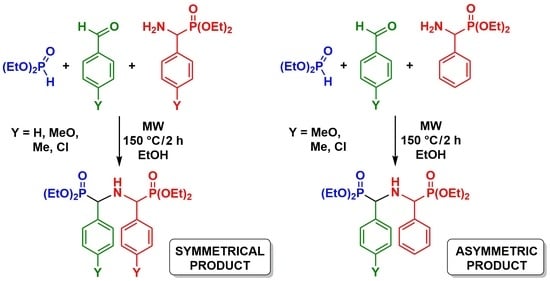
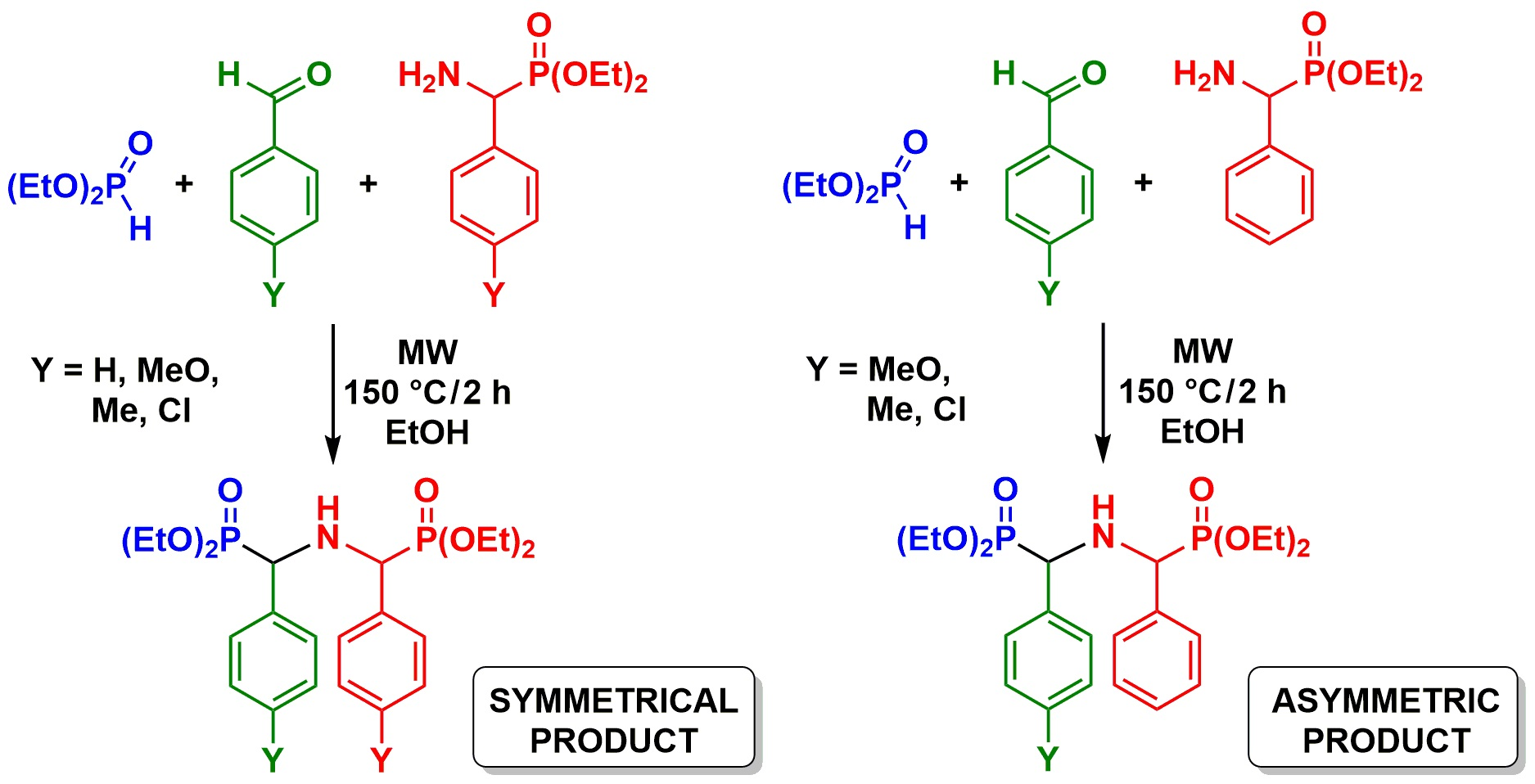
The starting diethyl α-amino-benzylphosphonates (1ad) were prepared according to a method described in [40,41], which was then refined by us [37]. Then, the unsubstituted-, 4-methoxy-, 4-methyl- and 4-chloro α-amino-benzylphosphonates (1ad) were reacted with 1 equivalent of the corresponding unsubstituted and 4-substituted benzaldehydes, and 1 equivalent of diethyl phosphite in ethanol at 150 °C under microwave (MW) irradiation for 2 h. The products obtained after column chromatography in 64–75% yields were bis(α-aryl-methyl-phosphonoyl)amines (2ad) comprising the racemic (RR/SS) and the meso (RS/SR) isomers in a 1:1 ratio (Scheme 1). Isomers of the products (2ad) were characterized by 31P, 13C and 1H NMR spectroscopy applying sophisticated 2D techniques.
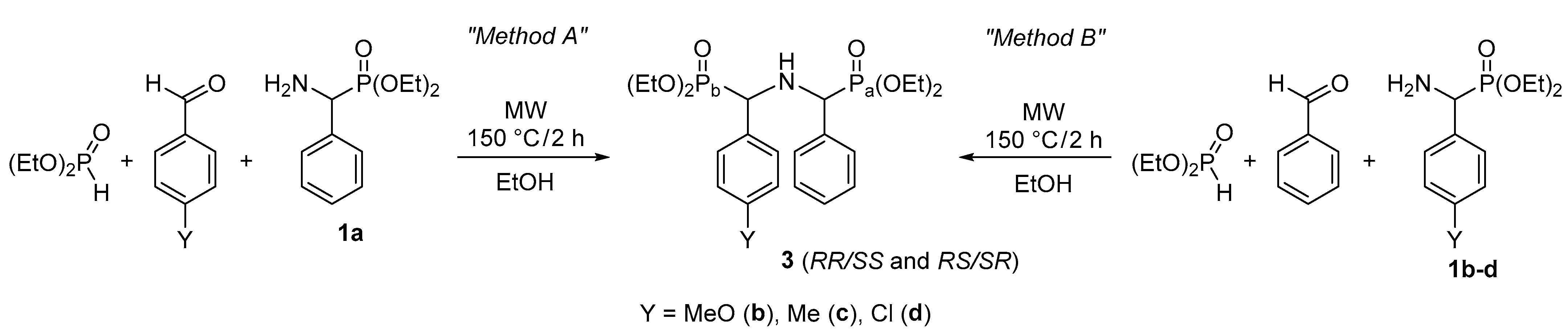
In the next stage of our work, α-amino-benzylphosphonate 1a was condensed with the 4-substituted benzylaldehydes and diethyl phosphite under the conditions outlined above. 31P NMR and LC-MS analysis of the crude mixtures obtained after flash chromatography suggested the presence of the expected (α-aryl-methylphosphonoyl)-(α-phenyl-methylphosphonoyl)amines (3bd) as the major components (Scheme 2/Method A); however, to our surprise, the corresponding symmetrical bis(α-aryl-methylphosphonoyl)amine pairs including 2a, together with 2b, 2c or 2d as minor components (all together in 6–18%), were also present in the mixtures (see Table 1). All crude reaction mixtures comprised three components, a major and two minor actors, each consisting of 2 isomers (31 and 32/21 and 22) (see Table 1). The yields of the (α-aryl-methylphosphonoyl)-(α-phenyl-methylphosphonoyl)amines (3bd) fell in the range of 70–74%.
The presence of minor by-products (e.g., 2a and 2b from the reaction of aminophosphonate 1a, 4-methoxybenzaldehyde and diethyl phosphite may suggest that aminophosphonate 1a probably decomposes to benzaldehyde, diethyl phosphite, and ammonia under the conditions of the reaction. If these components are present in the closed vessel, the formation of unsubstituted 2a, and lesser quantity from bis(methoxyphenyl) derivative 2b, is also possible.
It was also possible to prepare the (α-aryl-methylphosphonoyl)-(α-phenyl-methylphosphonoyl)-amines (3bd) by the phospha-Mannich condensation of α-amino-arylmethylphosphonates (1bd), benzaldehyde and diethyl phosphite under similar conditions as the analogous syntheses (Scheme 2/Method B). The experiences regarding the composition were similar to those observed in the other approach.

2.2. NMR Identification of the Products

The identity of compounds 2 and 3 results unambiguously from a detailed NMR study of the isolated products using multinuclear (1H, 13C, 31P) 1D and 2D NMR experiments. The strategy followed for the full assignment of the NMR data was to include correlations of the protons to phosphorus, which allows for an assignment of the 31P NMR signals to the individual isomers. Thus, in addition to the usual 2D correlation experiments (1H,1H-COSY, 1H,13C-HSQC and 1H,13C-HMBC) 1H,31P-HMBC experiments were also performed. This allowed an unambiguous assignment of the signals to the protons of the P-bonded CH groups, as well as to the corresponding phosphorus nuclei in the vicinity. For all compounds 2 and 3 1H-J-resolved NMR spectra were also recorded and evaluated. This NMR experiment elegantly resolves the problem of signal overlapping due to scalar coupling in the δ1H dimension by placing the multiplets along the J-axis, and leaving the 1H decoupled 1H NMR spectrum along the δ1H axis. In addition, homonuclear and heteronuclear coupling can be separated by this experiment, allowing the differentiation of JHH and JPH. The 1H-J-resolved NMR spectra were extremely useful for the assignment of the NMR data of the numerous diastereotopic ethoxy groups present in the compounds 2 and 3. The full 1H, 13C and 31P NMR data together with the corresponding assignments are compiled in the Experimental section. Figures of all NMR spectra can be found in the Supporting Information.

2.3. Bis(α-aryl-methylphosphonoyl)-amines 2ad

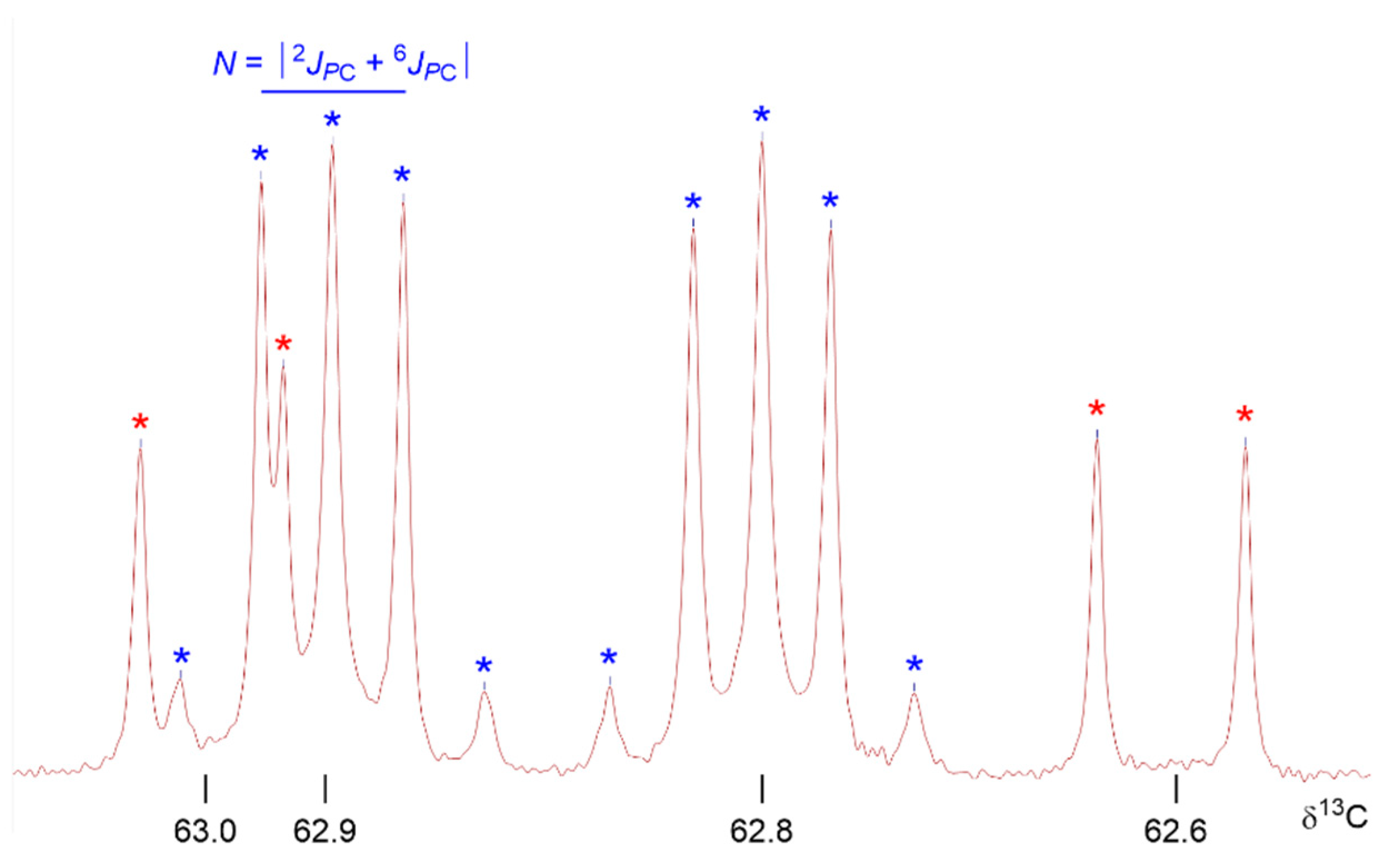
The amines 2ad incorporate two chiral centers at both α-carbon atoms with respect to phosphorus, and are formed as a mixture of NMR spectroscopically distinguishable of racemic (RR/SS) and meso (RS/SR) forms. In the 31P{1H} NMR spectra of the compounds two signals, corresponding to these two isomers, were observed (Table 2). The NMR spectroscopically most interesting feature of the amines 2 are their 13C NMR spectra. All carbon nuclei in 2 are located unsymmetrically with respect to the isochronous phosphorus nuclei and form together with the P-atoms AA’X spin systems [42,43] of high order (A, A’: 31P, X: 13C). In these spin systems the two isochronous phosphorus nuclei are anisogamous, which results in NMR spectra of high order. Depending on the coupling in the strongly coupled part of the spin system (JAA’ = 4JPP) relative to the weak couplings JAX and JA’X five-line (Figure 1) or three-line (pseudo triplets) signal patterns are observed. In these cases, only N = |JAX + JA’X| can be extracted from the spectra. In cases where JAA’ is (negligibly) small in comparison to JAX and JA’X, the line splitting of the 13C NMR signals approaches expected patterns and the JPC coupling constants can be extracted. These two cases are shown for the amine 2b in Figure 1. The two methylene groups at each phosphorus atom are diastereotopic displaying one individual 13C NMR signal each. The signals of the main isomer show a five-line pattern indicating a strongly coupled system, while the corresponding 13C NMR signals of the minor isomer are simple doublets (Figure 1).
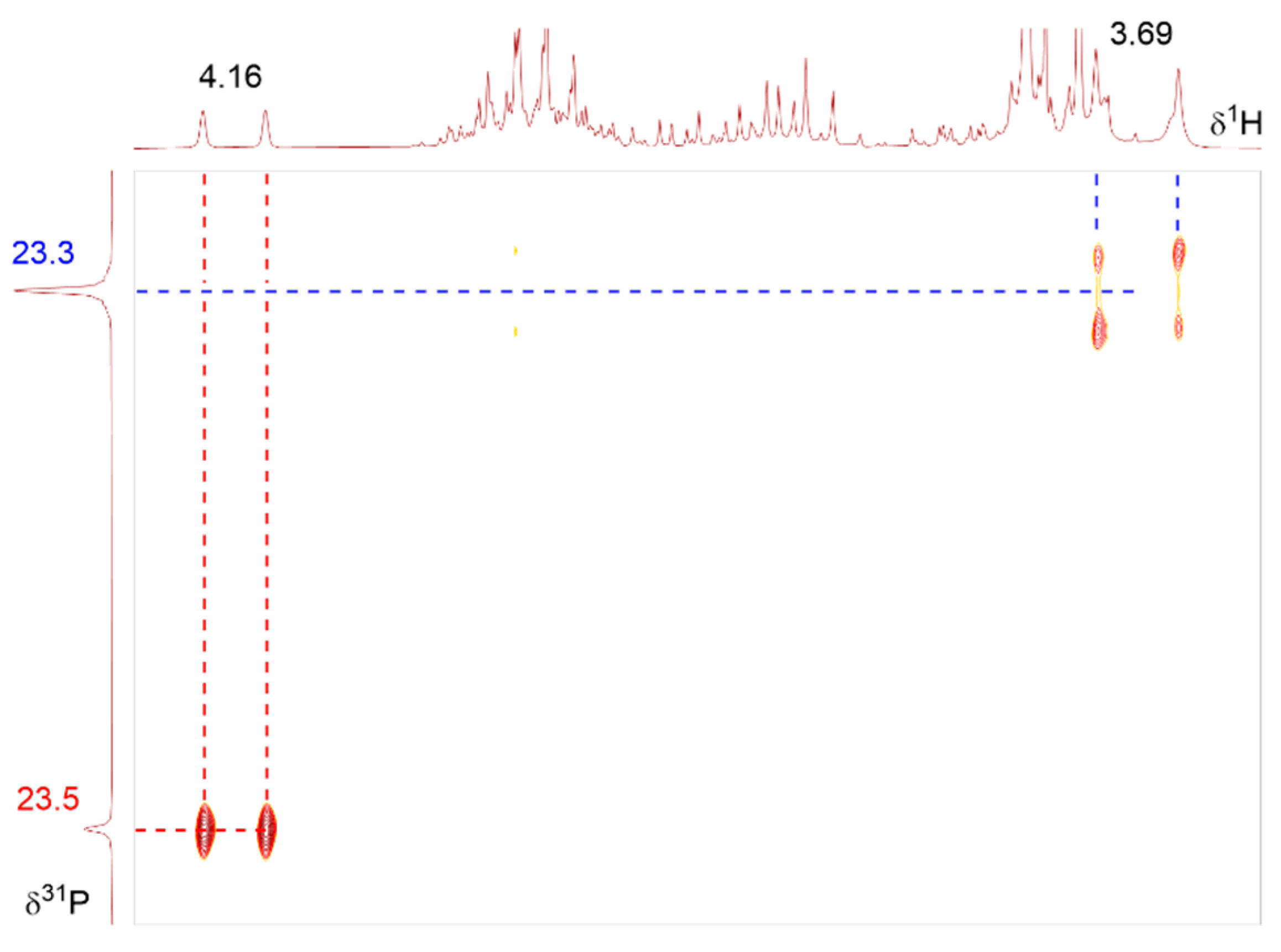
Figure 2 shows a view of one part of the 1H,31P-HSQC NMR spectrum of amine 2b illustrating the correlation between the 31P nuclei and the respective protons at the chiral α-carbon atoms. Based on this correlation, and with the help of 1H,1H-COSY, 1H,13C-HSQC and 1H,13C-HMBC spectra, the 1H and 13C, the NMR signals of all nuclei in the two isomers could be assigned.
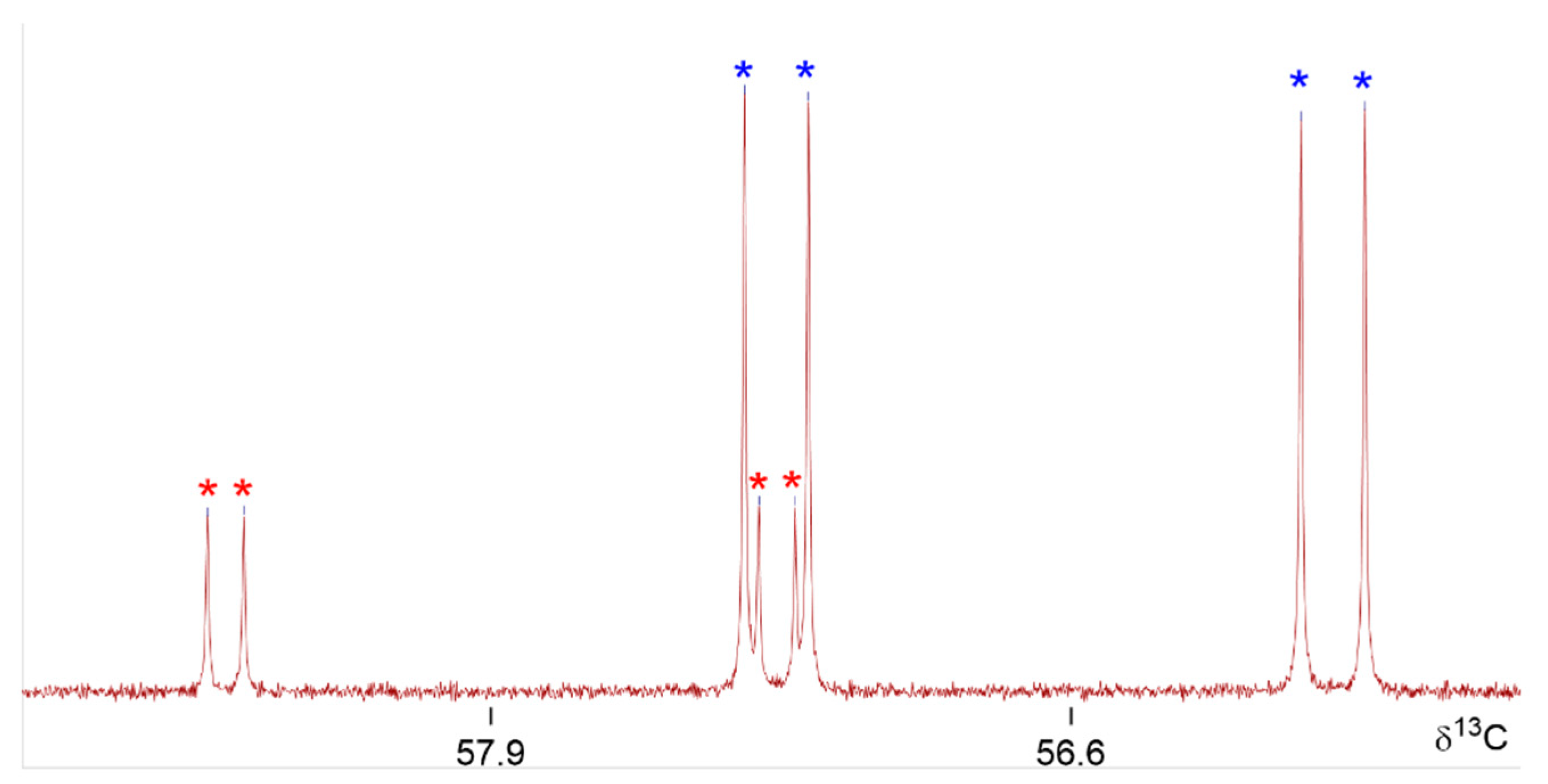
Selected NMR data of the amines 2ad are presented in Table 2. The 31P NMR chemical shifts in both isomers are found in a narrow range of 22.0–23.5 ppm, as expected [44]. The two isomers differ strongly in the position of the signal for the α-CH proton, resonating at higher field for the major isomer (3.68–3.82) and at lower field for the minor isomer (4.16–4.30). The 13C NMR signal of the α-carbon atom is observed for both isomers in the range of 56.6–58.8 ppm (Figure 3); the value of 1JPC is with 152.7–156.7 Hz large and as expected [45]. The difference between the two isomers becomes evident looking at the P,C coupling over three bonds, which is larger for the major isomer (17.6–18.0 Hz) and clearly smaller for the minor isomer (10.1–10.3 Hz).

2.4. (α-Aryl-methylphosphonoyl)-(α-phenyl-methylphosphonoyl)-amines 3bd

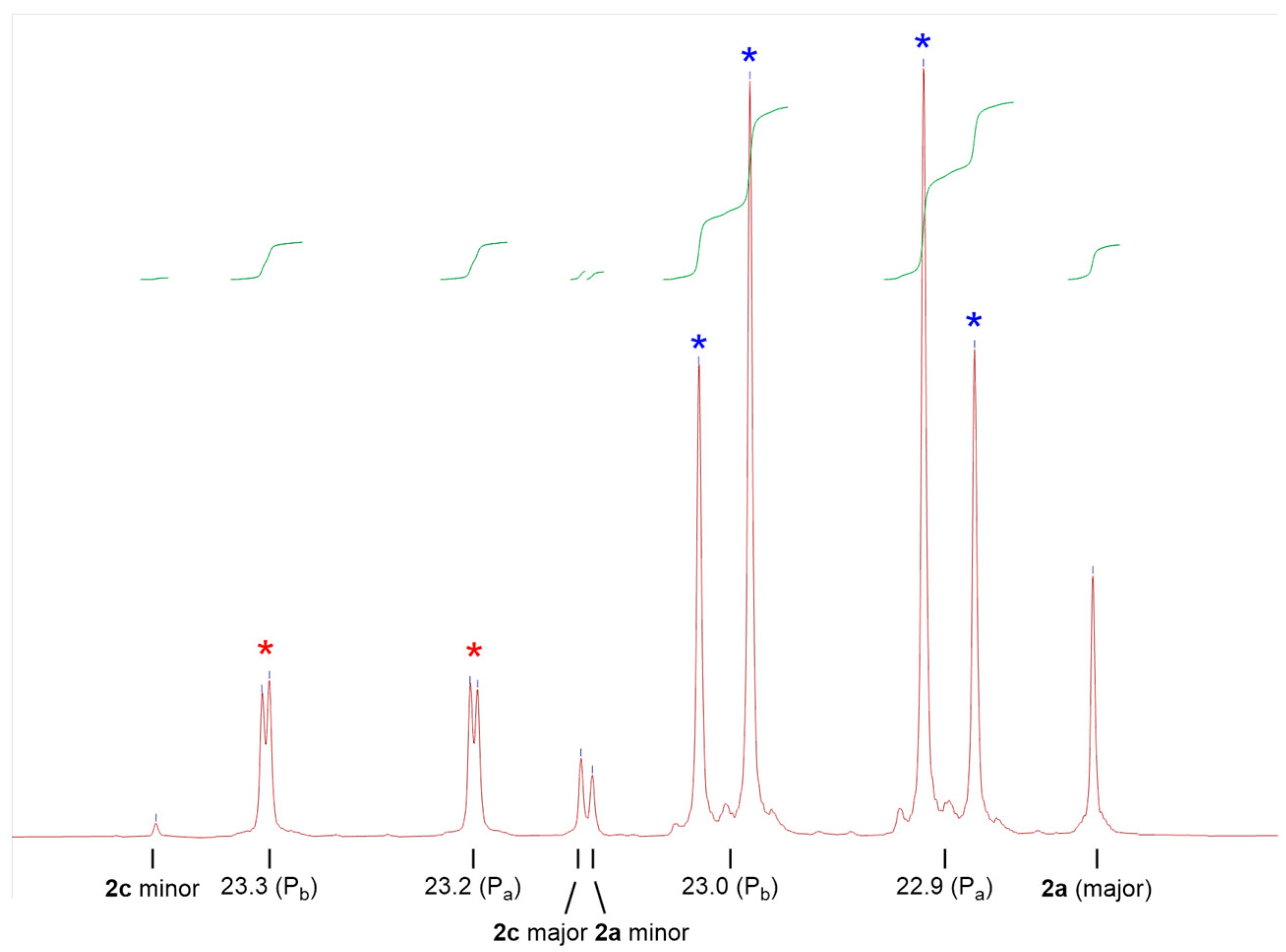
In the amines 3bd the two phosphorus atoms differ by the p-substituent at the aryl ring bonded to the respective α-carbon atom. Although this difference is small, the two phosphorus are chemically inequivalent and display different signals in the 31P NMR spectra. Due to the chiral α-carbon atoms a racemic and a meso form is observed again. The 31P NMR spectra of the amines 3 show characteristic AB type spectra for the two forms. A typical 31P NMR spectrum is shown in Figure 4 for amine 3c as an example. The major isomer (marked in blue) and the minor isomer (marked in red) differ strongly in the value of 4JPP (6.8 Hz for the major isomer and only 1.0 Hz for the minor isomer, Table 3). The large P,P coupling constant observed for the major isomer is remarkable [46]. The presence of small amounts of the symmetric amines 2a and 2c is also notable, which were unambiguously identified by their characteristic chemical shifts (Table 2).
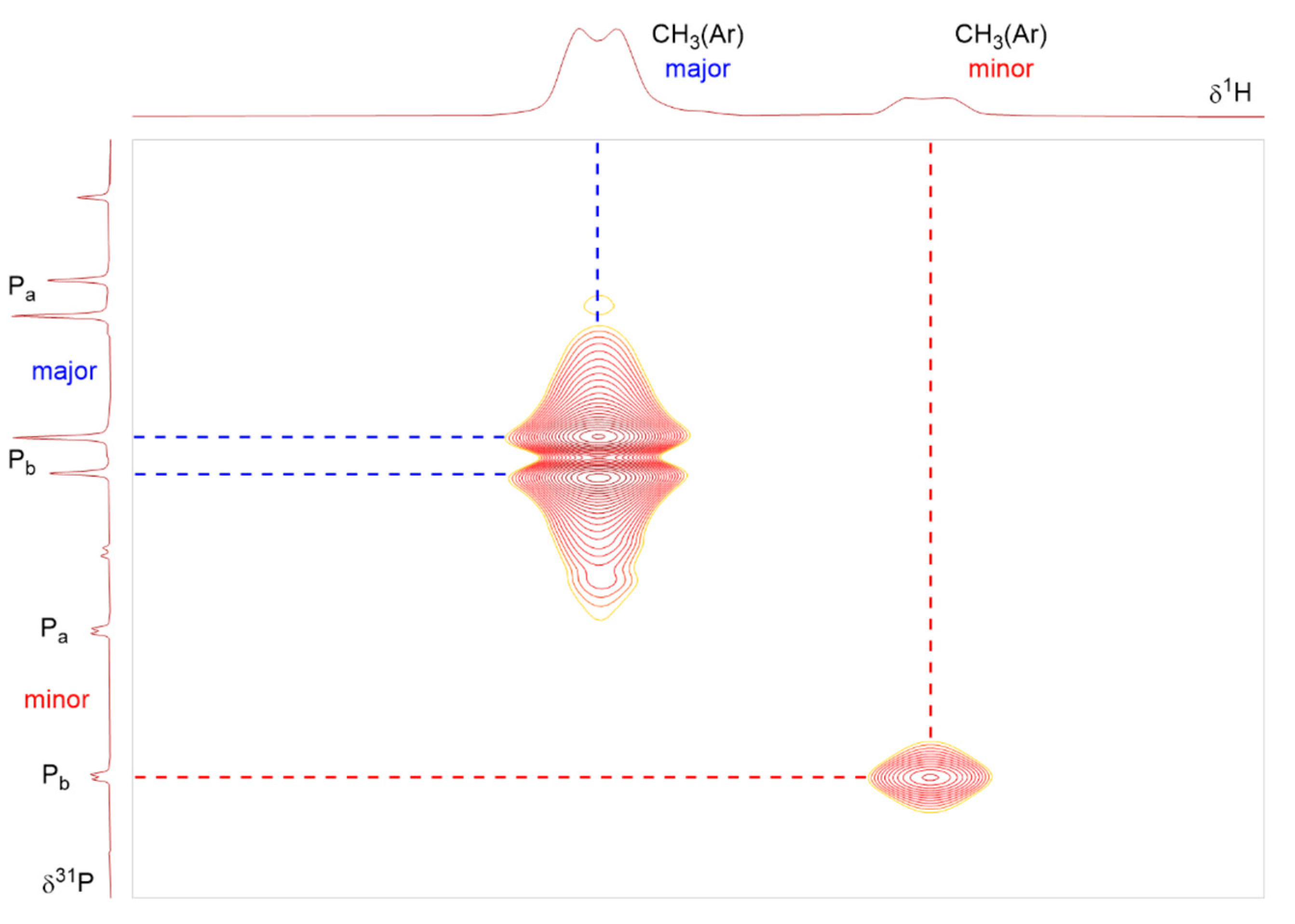
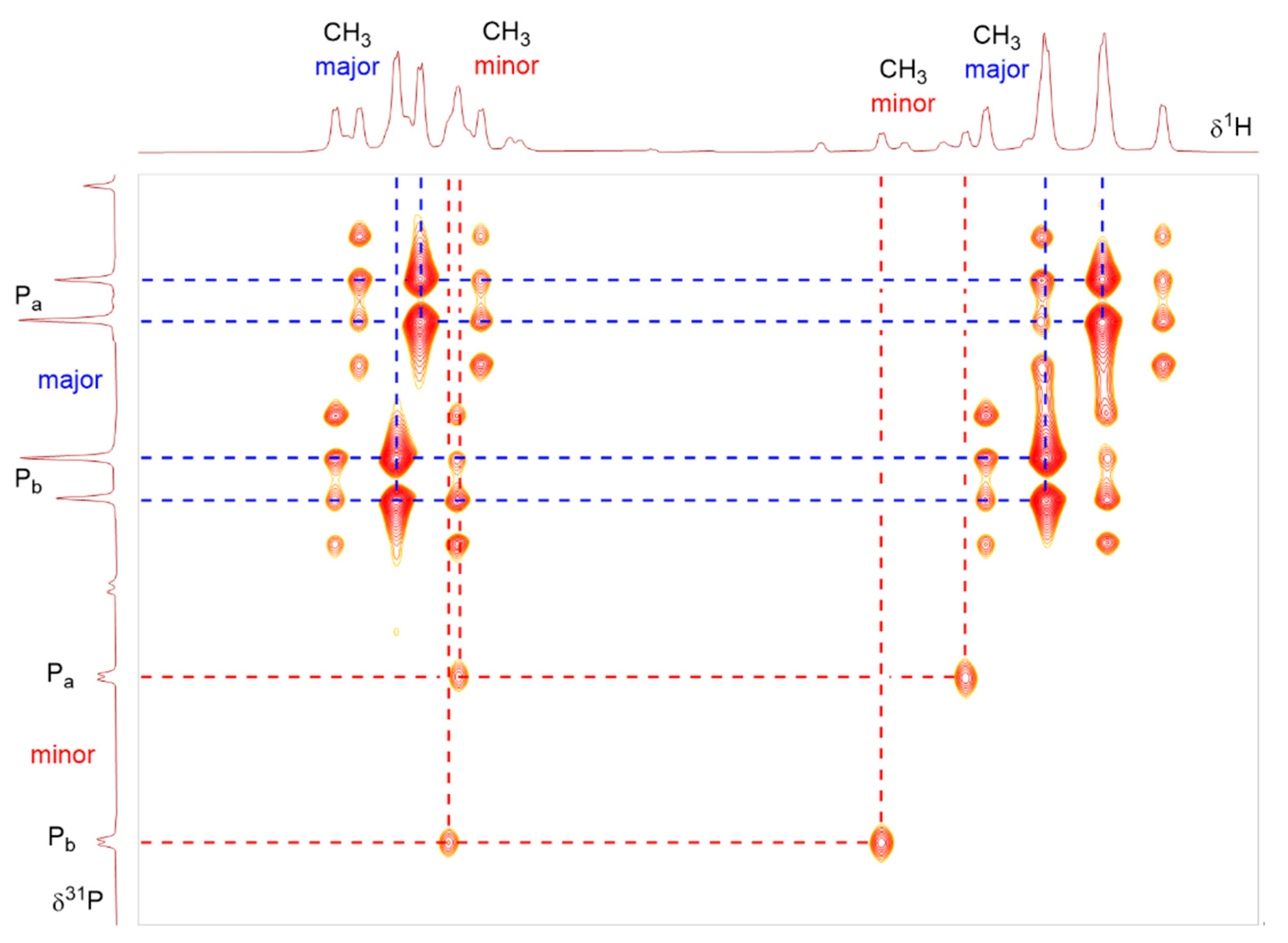
Two dimensional 1H,31P-HMBC NMR spectra were extremely helpful for the assignment of the 31P NMR signals to the phosphorus atoms, bearing the respective aryl substituents. Figure 5 shows the part of the 1H,31P-HMBC NMR spectrum of amine 3c displaying the correlation of δ31P with the methyl protons of the tolyl substituent. This correlation is present only for the phosphorus atoms Pb of the two isomers and is remarkable, because it demonstrates the presence of a long range P,H-coupling over seven (!) bonds. This coupling (1.7 Hz for both isomers) is also clearly observed in the 1H NMR spectrum. The observed correlation allowed for the distinction between the two phosphorus atoms of the amine, and is the basis for all further assignments.
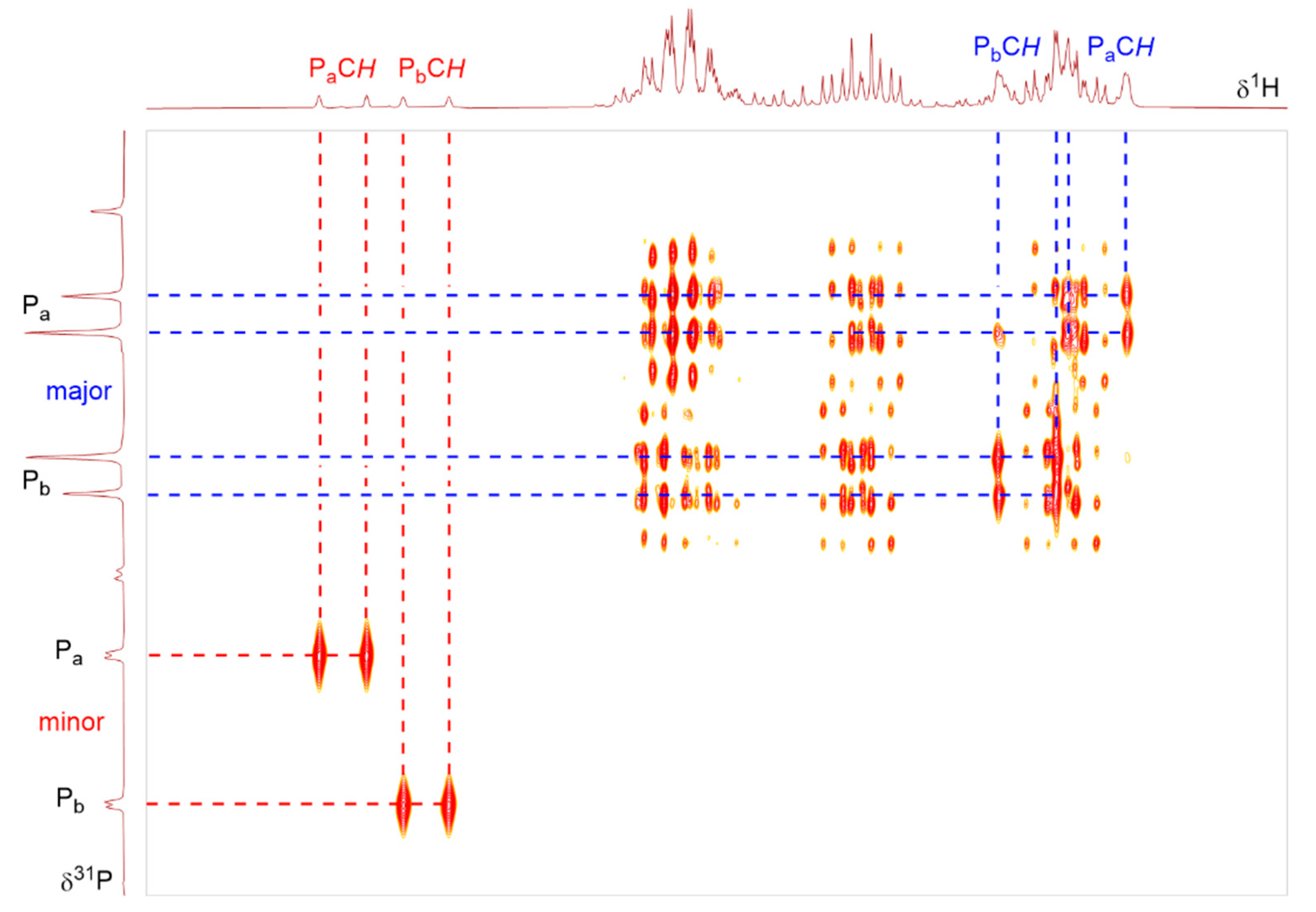
The 1H,31P-HMBC NMR spectra were also very helpful in identifying the 1H NMR signals of the α-CH protons, particularly in cases when they were overlapping with the signals of the OCH2 protons. As an example, the corresponding part of the 1H,31P-HMBC NMR spectrum of amine 3c is presented in Figure 6. The spectrum not only allows the 1H NMR signals of the α-CH protons of the major isomer to be located, but it also delivers the assignment to which phosphorus atom the respective α-CH group is bonded.
The assignment of the 1H NMR signals of the methyl protons of the ethoxy groups also unambiguously results from the 1H,31P-HMBC NMR spectrum; the corresponding part is shown for the amine 3c in Figure 7. The methyl groups at each phosphorus atom are diastereotopic and, therefore, four distinct sets of signals are observed for each of the two isomers. Remarkably, the shift difference between the 1H NMR signals of the two methyl groups belonging to the same phosphorus atom is quite large and clearly observable.
Selected NMR data of the unsymmetrically substituted amines 3 are presented in Table 3. In addition to the difference in 4JPP, the two isomers of each compound also differ in the coupling parameters of the α-CH units at phosphorus. The major isomer exhibits larger values of 2JPH (20.4–18.9 Hz) and of 3JPC (17.7–18.6 Hz) as compared to the minor isomer with 16.1–17.7 Hz for 2JPH and 10.0–10.6 Hz for 3JPC.

3. Materials and Methods

3.1. General Information

In regard to the detailed NMR study, the spectra were obtained with a Bruker Avance NEO 500 instrument (Bruker, Mannheim, Germany) operating at 500.13 MHz for 1H, 202.46 MHz for 31P, and 125.76 MHz for 13C. Chemical shifts were reported relative to TMS (1H, 13C) and 85% H3PO4 (31P) as external standards. The couplings are given in Hz. All NMR experiments were performed using the corresponding pulse sequences provided by Bruker. For processing of the NMR spectra the MestReNova software, version 15.1.0-38027, 2024, was used. For the NMR spectra, samples of the compounds 2 and 3 were dissolved in CDCl3 and carefully degassed by holding the open NMR tubes in an ultrasonic bath for about 20 s. In the case of the symmetrical compounds 2, the number of hydrogen atoms presented in the NMR data below are based on the relative integral intensities and, therefore, account for only half of the compound.
The routine 31P, 13C, 1H NMR spectra were taken on a Bruker (Boston, MA, USA) DRX-500 or Bruker Avance-300 spectrometer operating at 202, 126, and 500 MHz or 122, 75, and 300 MHz, respectively. HPLC-MS measurements were performed using a Shimadzu (Tokyo, Japan) LCMS-2020 device equipped with a Reprospher 100 C18 (5 μm; 100 × 3 mm) column and positive-negative double ion source (DUIS±) with a quadrupole MS analyser in a range of 50–1000 m/z. High-resolution mass spectrometric measurements were performed using a Q-TOF Premier mass spectrometer (Waters Corporation, 34 Maple St, Milford, MA, USA) in positive electrospray mode.
All reagents were purchased from commercial sources and used without further purification.

3.2. Syntheses

3.2.1. General Method for the Preparation of Bis(α-aryl-methylphosphonoyl)-amines (2ad)

A mixture of 1.0 mmol α-amino-α-aryl-methylphosphonate (1b: 0.27 g, 1c: 0.26 g, 1d: 0.28 g), 1.0 mmol of the corresponding arylaldehyde pair (benzaldehyde: 0.11 g, 4-methoxy-benzaldehyde: 0.14 g, 4-methyl-benzaldehyde: 0.12 g, 4-chloro-benzaldehyde: 0.14 g,) 1.0 mmol (0.15 mL) of diethyl phosphite in 2 mL of ethanol was irradiated in a sealed tube in a CEM microwave reactor (CEM Corporation, Matthews, NC, USA) equipped with a pressure controller at 150 °C for 2 h. The volatile components were removed under reduced pressure. The residue obtained was purified by column chromatography (silica gel, ethyl acetate–hexane 3:2) to give the products as dense colorless oils.
The following products were thus prepared:
2a: yield: 64%; M+H = 470; [M+Na]+found = 492.1678, C22H33NO6P2Na requires 492.1681.
2a/isomer 1: (55%); 31P NMR (CDCl3) δ 22.8; 13C NMR (CDCl3) 16.2 (X-part of AA’X, 5 line pattern, N = |3JPC + 7JPC| = 5.8 Hz, CH3CH2O), 16.4 (X-part of AA’X, 5 line pattern, N = |3JPC + 7JPC| = 6.1 Hz, CH3CH2O), 57.6 (dd, 1JPC = 155.0 Hz, 3JPC = 17.8 Hz, CNH), 62.8 (X-part of AA’X, 5 line pattern, N = |2JPC + 6JPC| = 6.7 Hz, CH3CH2O), 63.0 (X-part of AA’X, 5 line pattern, N = |2JPC + 6JPC| = 7.0 Hz, CH3CH2O), 128.1 (X-part of AA’X, 3 line pattern, N = |5JPC + 7JPC| = 2.6 Hz, C-p), 128.5 (X-part of AA’X, 3 line pattern, N = |4JPC + 6JPC| = 2.4 Hz, C-m), 129.0 (X-part of AA’X, 5 line pattern, N = |3JPC + 5JPC| = 6.2 Hz, C-o), 134.5 (X-part of AA’X, 5 line pattern, N = |2JPC + 4JPC| = 4.5 Hz, C-i); 1H NMR (CDCl3) δ 1.12 (t, 3JHH = 7.1 Hz, 3H, CH3), 1.28 (t, 3JHH = 7.1 Hz, 3H, CH3), 2.3–3.1 (broad signal, NH), 3.80 (ddq, 3JPH = 8.3 Hz, 2JHH = 10.1 Hz, 3JHH = 7.1 Hz, 1H, CH2CH3), 3.82 (d, 2JPH = 21.8 Hz, 1H, CHNH), 3.94 (ddq, 3JPH = 7.1 Hz, 2JHH = 10.1 Hz, 3JHH = 7.1 Hz, 1H, CH2CH3), 4.03 (ddq, 3JPH = 7.1 Hz, 2JHH = 10.1 Hz, 3JHH = 7.1 Hz, 1H, CH2CH3), 4.09 (ddq, 3JPH = 8.3 Hz, 2JHH = 10.1 Hz, 3JHH = 7.0 Hz, 1H, CH2CH3), 7.26 (m, 1H, ArH), 7.30 (m, 2H, ArH), 7.33 (m, 2H, ArH).
2a/isomer 2: (45%); 31P NMR (CDCl3) δ 23.1; 13C NMR (CDCl3) 16.3 (d, 3JPC = 5.9 Hz, CH3CH2O), 16.4 (d, 3JPC = 6.1 Hz, CH3CH2O), 58.8 (dd, 1JPC = 153.4 Hz, 3JPC = 10.3 Hz, CNH), 62.7 (d, 2JPC = 7.3 Hz, CH3CH2O), 63.1 (d, 2JPC = 7.1 Hz, CH3CH2O), 128.0 (X-part of AA’X, 3 line pattern, N = |5JPC + 7JPC| = 3.2 Hz, C-p), 128.4 (X-part of AA’X, 3 line pattern, N = |4JPC + 6JPC| = 2.4 Hz, C-m), 128.6 (d, 3JPC = 6.2 Hz, C-o), 135.9 (dd, 2JPC = 3.7 Hz, 4JPC = 0.9 Hz, C-i); 1H NMR (CDCl3) δ 1.16 (td, 3JHH = 7.1Hz, 4JPH = 0.4 Hz, 3H, CH3), 1.28 (td, 3JHH = 7.1 Hz, 4JPH = 0.4 Hz, 3H, CH3), 2.3–3.1 (broad signal, NH), 3.85 (ddq, 3JPH = 8.3 Hz, 2JHH = 10.1 Hz, 3JHH = 7.1 Hz, 1H, CH2CH3), 4.00 (ddq, 3JPH = 7.1 Hz, 2JHH = 10.1 Hz, 3JHH = 7.1 Hz, 1H, CH2CH3), 4.06 (ddq, 3JPH = 7.1 Hz, 2JHH = 10.1 Hz, 3JHH = 7.1 Hz, 1H, CH2CH3), 4.09 (ddq, 3JPH = 8.9 Hz, 2JHH = 10.1 Hz, 3JHH = 7.1 Hz, 1H, CH2CH3), 4.30 (d, 2JPH = 16.8 Hz, 1H, CHNH), 7.25–7.36 (m, 3H, ArH) 7.29 (m, 2H, ArH).
2b: yield: 71%; M+H = 530; [M+Na]+found = 552.1906, C24H37NO8P2Na requires 552.1892.
2b/major isomer: (80%); 31P NMR (CDCl3) δ 23.3; 13C NMR (CDCl3) 16.3 (X-part of AA’X, 5 line pattern, N = |3JPC + 7JPC| = 5.9 Hz, CH3CH2O), 16.5 (X-part of AA’X, 5 line pattern, N = |3JPC + 7JPC| = 6.0 Hz, CH3CH2O), 55.3 (s, CH3Ar), 56.6 (dd, 1JPC = 156.7 Hz, 3JPC = 18.0 Hz, CNH), 62.8 (X-part of AA’X, 5 line pattern, N = |2JPC + 6JPC| = 6.8 Hz, CH3CH2O), 62.9 (X-part of AA’X, 5 line pattern, N = |2JPC + 6JPC| = 7.0 Hz, CH3CH2O), 114.0 (X-part of AA’X, 3 line pattern, N = |4JPC + 6JPC| = 2.3 Hz, C-m), 126.2 (X-part of AA’X, 5 line pattern, N = |2JPC + 4JPC| = 4.7 Hz, C-i), 130.1 (X-part of AA’X, 5 line pattern, N = |3JPC + 5JPC| = 6.2 Hz, C-o), 159.5 (X-part of AA’X, 3 line pattern, N = |5JPC + 7JPC| = 2.9 Hz, C-p); 1H NMR (CDCl3) δ 1.07 (t, 3JHH = 7.1 Hz, 3H, CH3), 1.22 (t, 3JHH = 7.1 Hz, 3H, CH3), 2.22 (broad signal, NH), 3.69 (d, 2JPH = 21.3 Hz, 1H, CHNH), 3.73 (ddq, 3JPH = 8.1 Hz, 2JHH = 10.2 Hz, 3JHH = 7.1 Hz, 1H, CH2CH3), 3.75 (s, 3H, CH3OAr), 3.87 (ddq, 3JPH = 7.2 Hz, 2JHH = 10.2 Hz, 3JHH = 7.1 Hz, 1H, CH2CH3), 3.99 (ddq, 3JPH = 7.1 Hz, 2JHH = 10.2 Hz, 3JHH = 7.1 Hz, 1H, CH2CH3), 4.02 (ddq, 3JPH = 7.9 Hz, 2JHH = 10.2 Hz, 3JHH = 7.1 Hz, 1H, CH2CH3), 6.81 (B-part of AA’BB’, 2H, ArH), 7.15 (A-part of AA’BB’, 2H, ArH).
2b/minor isomer: (20%): 31P NMR (CDCl3) δ 23.5; 13C NMR (CDCl3) 16.37 (d, 3JPC = 7.1 Hz, CH3CH2O), 16.46 (d, 3JPC = 6.1 Hz, CH3CH2O), 55.2 (s, CH3Ar), 57.9 (dd, 1JPC = 155.3 Hz, 3JPC = 10.2 Hz, CNH), 62.6 (d, 2JPC = 7.3 Hz, CH3CH2O), 63.0 (d, 2JPC = 7.1 Hz, CH3CH2O), 113.8 (X-part of AA’X, 3 line pattern, N = |4JPC + 6JPC| = 1.6 Hz, C-m), 127.9 (X-part of AA’X, 5 line pattern, N = |2JPC + 4JPC| = 4.6 Hz, C-i), 129.8 (d, 3JPC = 6.4 Hz, C-o), 159.3 (d, 5JPC = 2.9 Hz, C-p); 1H NMR (CDCl3) δ 1.20 (t, 3JHH = 7.1 Hz, 3H, CH3), 1.21 (t, 3JHH = 7.1 Hz, 3H, CH3), 2.2 (broad signal, NH), 3.72 (s, 3H, CH3Ar), 3.78 (ddq, 3JPH = 8.2 Hz, 2JHH = 10.2 Hz, 3JHH = 7.1 Hz, 1H, CH2CH3), 3.93 (ddq, 3JPH = 7.2 Hz, 2JHH = 10.2 Hz, 3JHH = 7.1 Hz, 1H, CH2CH3), 3.99 (ddq, 3JPH = 6.9 Hz, 2JHH = 10.2 Hz, 3JHH = 7.1 Hz, 1H, CH2CH3), 4.03 (ddq, 3JPH = 7.9 Hz, 2JHH = 10.2 Hz, 3JHH = 7.1 Hz, 1H, CH2CH3), 4.16 (d, 2JPH = 16.3 Hz, 1H, CHNH), 6.75 (B-part of AA’BB’, 2H, ArH), 7.14 (A-part of AA’BB’, 2H, ArH).
2c: yield: 69%; M+H = 498; [M+Na]+found = 520.1991, C24H37NO6P2Na requires 520.1994.
2c/major isomer: (86%): 31P NMR (CDCl3) δ 23.1; 13C NMR (CDCl3) 16.3 (X-part of AA’X, 5 line pattern, N = |3JPC + 7JPC| = 5.9 Hz, CH3CH2O), 16.4 (X-part of AA’X, 5 line pattern, N = |3JPC + 7JPC| = 6.0 Hz, CH3CH2O), 21.19 (X-part of AA’X, 3 line pattern, N = |6JPC + 8JPC| = 1.1 Hz, CH3Ar), 57.1 (dd, 1JPC = 155.6 Hz, 3JPC = 18.0 Hz, CNH), 62.8 (X-part of AA’X, 5 line pattern, N = |2JPC + 6JPC| = 6.8 Hz, CH3CH2O), 62.9 (X-part of AA’X, 5 line pattern, N = |2JPC + 6JPC| = 7.0 Hz, CH3CH2O), 128.9 (X-part of AA’X, 5 line pattern, N = |3JPC + 5JPC| = 6.2 Hz, C-o), 129.3 (X-part of AA’X, 3 line pattern, N = |4JPC + 6JPC| = 2.4 Hz, C-m), 131.2 (X-part of AA’X, 5 line pattern, N = |2JPC + 4JPC| = 4.6 Hz, C-i), 137.9 (X-part of AA’X, 3 line pattern, N = |5JPC + 7JPC| = 3.2 Hz, C-p); 1H NMR (CDCl3) δ 1.07 (t, 3JHH = 7.0 Hz, 3H, CH3), 1.22 (t, 3JHH = 7.1 Hz, 3H, CH3), 2.28 (d, 7JPH = 1.0 Hz, 3H, CH3Ar), 2.3 (broad signal, NH), 3.71 (d, 2JPH = 22.0 Hz, 1H, CHNH), 3.73 (ddq, 3JPH = 8.0 Hz, 2JHH = 10.2 Hz, 3JHH = 7.1 Hz, 1H, CH2CH3), 3.88 (ddq, 3JPH = 7.1 Hz, 2JHH = 10.2 Hz, 3JHH = 7.1 Hz, 1H, CH2CH3), 3.99 (ddq, 3JPH = 7.2 Hz, 2JHH = 10.2 Hz, 3JHH = 7.1 Hz, 1H, CH2CH3), 4.02 (ddq, 3JPH = 7.9 Hz, 2JHH = 10.0 Hz, 3JHH = 7.1 Hz, 1H, CH2CH3), 7.07 (B-part of AA’BB’, 2H, Ar), 7.11 (A-part of AA’BB’, 2H, Ar).
2c/minor isomer: (14%); 31P NMR (CDCl3) δ 23.4; 13C NMR (CDCl3) 16.35 (d, 3JPC = 5.9 Hz, CH3CH2O), 16.44 (d, 3JPC = 6.1 Hz, CH3CH2O), 21.16 (X-part of AA’X, 3 line pattern, N = |6JPC + 8JPC| = 1.1 Hz, CH3Ar), 58.2 (dd, 1JPC = 154.1 Hz, 3JPC = 10.1 Hz, CNH), 62.6 (d, 2JPC = 7.4 Hz, CH3CH2O), 63.0 (d, 2JPC = 7.1 Hz, CH3CH2O), 128.5 (d, 3JPC = 6.3 Hz, C-o), 129.1 (X-part of AA’X, 3 line pattern, N = |4JPC + 6JPC| = 2.4 Hz, C-m), 132.8 (X-part of AA’X, 5 line pattern, N = |2JPC + 4JPC| = 2.9 Hz, C-i), 137.6 (X-part of AA’X, 3 line pattern, N = |5JPC + 7JPC| = 3.3 Hz, C-p); 1H NMR (CDCl3) δ 1.10 (t, 3JHH = 7.1 Hz, 3H, CH3), 1.20 (t, 3JHH = 7.0 Hz, 3H, CH3), 2.25 (d, 7JPH = 1.4 Hz, 3H, CH3Ar), 2.3 (broad signal, NH), 3.79 (ddq, 3JPH = 8.1 Hz, 2JHH = 10.1 Hz, 3JHH = 7.1 Hz, 1H, CH2CH3), 3.94 (ddq, 3JPH = 6.9 Hz, 2JHH = 10.1 Hz, 3JHH = 7.1 Hz, 1H, CH2CH3), 3.99 (ddq, 3JPH = 7.6 Hz, 2JHH = 10.0 Hz, 3JHH = 7.1 Hz, 1H, CH2CH3), 4.03 (ddq, 3JPH = 7.9 Hz, 2JHH = 10.0 Hz, 3JHH = 7.1 Hz, 1H, CH2CH3), 4.20 (d, 2JPH = 16.4 Hz, 1H, CHNH), 7.02 (B-part of AA’BB’, 2H, Ar), 7.11 (A-part of AA’BB’, 2H, Ar).
2d: yield: 75%; M+H = 538; [M+Na]+found = 560.0905, C22H31Cl2NO6P2Na requires 560.0901 for the 35Cl isotopes.
2d/major isomer: (73%); 31P NMR (CDCl3) δ 22.0; 13C NMR (CDCl3) 16.3 (X-part of AA’X, 5 line pattern, N = |3JPC + 7JPC| = 5.8 Hz, CH3CH2O), 16.4 (X-part of AA’X, 5 line pattern, N = |3JPC + 7JPC| = 6.0 Hz, CH3CH2O), 57.0 (dd, 1JPC = 155.8 Hz, 3JPC = 17.6 Hz, CNH), 63.0 (X-part of AA’X, 5 line pattern, N = |2JPC + 6JPC| = 6.9 Hz, CH3CH2O), 63.2 (X-part of AA’X, 5 line pattern, N = |2JPC + 6JPC| = 7.0 Hz, CH3CH2O), 128.9 (X-part of AA’X, 3 line pattern, N = |4JPC + 6JPC| = 2.5 Hz, C-m), 130.2 (X-part of AA’X, 5 line pattern, N = |3JPC + 5JPC| = 6.1 Hz, C-o), 132.9 (X-part of AA’X, 5 line pattern, N = |2JPC + 4JPC| = 4.7 Hz, C-i), 134.2 (X-part of AA’X, 3 line pattern, N = |5JPC + 7JPC| = 3.7 Hz, C-p); 1H NMR (CDCl3) δ 1.09 (t, 3JHH = 7.1 Hz, 3H, CH3), 1.22 (t, 3JHH = 7.1 Hz, 3H, CH3), 2.6 (broad signal, NH), 3.68 (d, 2JPH = 22.2 Hz, 1H, CHNH), 3.78 (ddq, 3JPH = 8.5 Hz, 2JHH = 10.1 Hz, 3JHH = 7.1 Hz, 1H, CH2CH3), 3.90 (ddq, 3JPH = 7.3 Hz, 2JHH = 10.1 Hz, 3JHH = 7.1 Hz, 1H, CH2CH3), 4.00 (ddq, 3JPH = 7.3 Hz, 2JHH = 10.2 Hz, 3JHH = 7.0 Hz, 1H, CH2CH3), 4.03 (ddq, 3JHH = 7.3 Hz, 2JHH = 10.2 Hz, 3JHH = 7.1 Hz, 1H, CH2CH3), 7.17 (A-part of AA’BB’, 2H, ArH), 7.26 (B-part of AA’BB’, 2H, ArH).
2d/minor isomer: (27%); 31P NMR (CDCl3) δ 22.3; 13C NMR (CDCl3) 16.36 (d, 3JPC = 5.7 Hz, CH3CH2O), 16.42 (d, 3JPC = 5.9 Hz, CH3CH2O), 58.2 (dd, 1JPC = 152.7 Hz, 3JPC = 10.2 Hz, CNH), 62.8 (d, 2JPC = 7.3 Hz, CH3CH2O), 63.2 (d, 2JPC = 7.1 Hz, CH3CH2O), 128.6 (d, 4JPC = 2.5 Hz, C-m), 129.8 (d, 3JPC = 6.0 Hz, C-o), 133.9 (d, 5JPC = 3.7 Hz, C-p), 134.4 (dd, 2JPC = 3.8 Hz, 4JPC = 0.7 Hz, C-i); 1H NMR (CDCl3) δ 1.13 (t, 3JHH = 7.0 Hz, 3H, CH3), 1.21 (t, 3JHH = 7.0 Hz, 3H, CH3), 2.6 (broad signal, NH), 3.84 (ddq, 3JPH = 8.3 Hz, 2JHH = 10.1 Hz, 3JHH = 7.1 Hz, 1H, CH2CH3), 3.96 (ddq, 3JPH = 7.0 Hz, 2JHH = 10.1 Hz, 3JHH = 6.9 Hz, 1H, CH2CH3), 3.98 (ddq, 3JPH = 6.3 Hz, 2JHH = 10.2 Hz, 3JHH = 7.0 Hz, 1H, CH2CH3), 4.01 (ddq, 3JPH = 8.1 Hz, 2JHH = 10.2 Hz, 3JHH = 7.0 Hz, 1H, CH2CH3), 4.16 (d, 2JPH = 17.4 Hz, 1H, CHNH), 7.18 (A-part of AA’BB’, 2H, ArH), 7.20 (B-part of AA’BB’, 2H, ArH).

3.2.2. General Method for the Preparation of Bis(α-aryl-methylphosphonoyl)-(α-phenyl-methylphosphonoyl)-amines (3bd)

A mixture of 1.0 mmol (0.25 g) α-amino- α-phenyl-methylphosphonate (1a), 1.0 mmol of arylaldehyde (4-methoxy-benzaldehyde: 0.14 g, 4-methyl-benzaldehyde: 0.12 g, and 4-chloro-benzaldehyde: 0.14 g), and 1.0 mmol (0.15 mL) of diethyl phosphite in 2 mL of ethanol was irradiated in a sealed tube in a CEM microwave reactor equipped with a pressure controller at 150 °C for 2 h. The volatile components were removed under reduced pressure. The residue obtained was purified by column chromatography (silica gel, ethyl acetate–hexane 3:2) to afford the products as dense colorless oils.
The following products were thus prepared:
3b: yield: 70%; M+Na = 500; [M+H]+found = 522.1788, C23H35NO7P2Na requires 522.1786.
3b/major isomer: (86.9%); 31P NMR (CDCl3) δ 22.8 (Pa), 22.9 (Pb), 4JPP = 6.7 Hz; 13C NMR (CDCl3) δ 16.2 (d, 3JPC = 5.9 Hz, CH3CH2O at Pa), 16.28 (d, 3JPC = 5.8 Hz, CH3CH2O at Pb), 16.43 (d, 3JPC = 6.0 Hz, CH3CH2O at Pa), 16.45 (d, 3JPC = 6.0 Hz, CH3CH2O at Pb), 55.26 (s, CH3Ar), 56.8 (dd, 1JPC = 156.8 Hz, 3JPC = 17.8 Hz, PbCH), 57.4 (dd, 1JPC = 155.3 Hz, 3JPC = 17.7 Hz, PaCH), 62.78 (d, 2JPC = 6.8 Hz, CH3CH2O at Pa), 62.80 (d, 2JPC = 6.8 Hz, CH3CH2O at Pb), 62.9 (d, 2JPC = 7.0 Hz, CH3CH2O at Pa), 63.0 (d, 2JPC = 7.0 Hz, CH3CH2O at Pb), 114.0 (d, 4JPC = 2.3 Hz, C-m of Ar), 126.1 (d, 2JPC = 4.5 Hz, C-i of Ar), 128.2 (d, 5JPC = 3.1 Hz, C-p of Ph), 128.55 (d, 4JPC = 2.4 Hz, C-m of Ph), 129.0 (d, 3JPC = 6.1 Hz, C-o of Ph), 130.1 (d, 3JPC = 6.2 Hz, C-o of Ar), 134.5 (d, 2JPC = 4.0 Hz, C-i of Ph), 159.5 (d, 5JPC = 2.9 Hz, C-p of Ar); 1H NMR (CDCl3) δ 1.13 (td, 3JHH = 7.1 Hz, 4JPH = 0.6 Hz, 3H, CH3 at Pa), 1.15 (td, 3JHH = 7.1 Hz, 4JPH = 0.6 Hz, 3H, CH3 at Pb), 1.30 (td, 3JHH = 7.1 Hz, 4JPH = 0.6 Hz, 3H, CH3 at Pa), 1.31 (td, 3JHH = 7.1 Hz, 4JPH = 0.6 Hz, 3H, CH3 at Pb), 2.1–2.9 (broad, overlapping, NH), 3.77 (dd, 2JPH = 18.9 Hz, 4JHH = 1.1 Hz, 1H, CHNH at Pb), 3.81 (ddq, 3JPH = 8.1 Hz, 2JHH = 10.1 Hz, 3JHH = 7.1 Hz, 1H, CH2CH3 at Pa), 3.815 (ddq, 3JPH = 8.1 Hz, 2JHH = 10.2 Hz, 3JHH = 7.1 Hz, 1H, CH2CH3 at Pb), 3.83 (s, 3H, CH3Ar), 3.83 (dd, 2JPH = 20.2 Hz, 4JHH = 1.1 Hz, 1H, CHNH at Pa), 3.95 (ddq, 3JPH = 9.8 Hz, 2JHH = 10.1 Hz, 3JHH = 7.1 Hz, 1H, CH2CH3 at Pa), 3.96 (ddq, 3JPH = 7.5 Hz, 2JHH = 10.2 Hz, 3JHH = 7.1 Hz, 1H, CH2CH3 at Pb), 4.069 (ddq, 3JPH = 7.1 Hz, 2JHH = 10.1 Hz, 3JHH = 7.1 Hz, 1H, CH2CH3 at Pa), 4.073 (ddq, 3JPH = 6.8 Hz, 2JHH = 10.1 Hz, 3JHH = 7.1 Hz, 1H, CH2CH3 at Pa), 4.104 (ddq, 3JPH = 7.5 Hz, 2JHH = 10.1 Hz, 3JHH = 7.1 Hz, 1H, CH2CH3 at Pb), 4.108 (ddq, 3JHH = 8.4 Hz, 2JHH = 10.1 Hz, 3JHH = 7.1 Hz, 1H, CH2CH3 at Pb), 6.89 (B-part of AA’BB’, 2H, H-m of Ar), 7.23 (B-part of AA’BB’, 2H, H-o of Ar), 7.31 (m, 1H, H-p of Ph), 7.32 (m, 2H, H-o of Ph), 7.35 (m, 2H, H-m of Ph).
3b/minor isomer: (13.3%); 31P NMR (CDCl3) δ 23.2 (Pa), 23.4 (Pb), 4JPP = 0.8 Hz; 13C NMR (CDCl3) 16.32 (d, 3JPC = 5.6 Hz, CH3CH2O at Pa), 16.37 (d, 3JPC = 5.7 Hz, CH3CH2O at Pb), 16.44 (d, 3JPC = 5.8 Hz, CH3CH2O at Pa), 16.46 (d, 3JPC = 6.0 Hz, CH3CH2O at Pb), 55.23 (s, CH3Ar), 58.0 (dd, 1JPC = 155.2 Hz, 3JPC = 10.0 Hz, PbCH), 58.6 (dd, 1JPC = 153.7 Hz, 3JPC = 10.6 Hz, PaCH), 62.6 (d, 2JPC = 7.2 Hz, CH3CH2O at Pa), 62.7 (d, 2JPC = 7.3 Hz, CH3CH2O at Pb), 62.996 (d, 2JPC = 7.0 Hz, CH3CH2O at Pa), 63.02 (d, 2JPC = 6.9 Hz, CH3CH2O at Pb), 113.8 (d, 4JPC = 2.3 Hz, C-m of Ar), 127.8 (d, 2JPC = 4.0 Hz, C-i of Ar), 127.9 (d, 5JPC = 3.0 Hz, C-p of Ph), 128.4 (d, 4JPC = 2.4 Hz, C-m of Ph), 128.59 (d, 3JPC = 6.8 Hz, C-o of Ph), 129.8 (d, 3JPC = 6.3 Hz, C-o of Ar), 136.0 (d, 2JPC = 3.2 Hz, C-i of Ph), 159.3 (d, 5JPC = 2.8 Hz, C-p of Ar); 1H NMR (CDCl3) δ 1.17 (td, 3JHH = 7.1 Hz, 4JPH = 0.6 Hz, 3H, CH3 of Pa), 1.19 (td, 3JHH = 7.1 Hz, 4JPH = 0.5 Hz, 3H, CH3 of Pb), 1.29 (td, 3JHH = 7.1 Hz, 4JPH = 0.5 Hz, 3H, CH3 of Pa), 1.297 (td, 3JHH = 7.1 Hz, 4JPH = 0.8 Hz, 3H, CH3 of Pb), 2.1–2.9 (broad, overlapping, NH), 3.80 (s, 3H, CH3Ar), 3.86 (ddq, 3JPH = 8.5 Hz, 2JHH = 10.2 Hz, 3JHH = 7.1 Hz, 1H, CH2CH3 of Pa), 3.87 (ddq, 3JPH = 8.3 Hz, 2JHH = 10.2 Hz, 3JHH = 7.1 Hz, 1H, CH2CH3 at Pb), 4.01 (ddq, 3JPH = 7.0 Hz, 2JHH = 10.2 Hz, 3JHH = 7.1 Hz, 1H, CH2CH3 at Pa), 4.02 (ddq, 3JPH = 7.6 Hz, 2JHH = 10.2 Hz, 3JHH = 7.1 Hz, 1H, CH2CH3 at Pb), 4.069 (ddq, 3JPH = 7.3 Hz, 2JHH = 10.1 Hz, 3JHH = 7.0 Hz, 1H, CH2CH3 at Pb), 4.074 (ddq, 3JPH = 7.1 Hz, 2JHH = 10.1 Hz, 3JHH = 7.1 Hz, 1H, CH2CH3 at Pb), 4.104 (ddq, 3JPH = 7.8 Hz, 2JHH = 10.0 Hz, 3JHH = 7.1 Hz, 1H, CH2CH3 at Pa), 4.113 (ddq, 3JPH = 7.9 Hz, 2JHH = 10.2 Hz, 3JHH = 7.1 Hz, 1H, CH2CH3 at Pa), 4.26 (d, 2JPH = 16.1 Hz, 1H, PbCH), 4.30 (d, 2JPH = 17.1 Hz, PaCH), 6.83 (B-part of AA’BB’, 2H, H-m of Ar), 7.24 (A-part of AA’BB’, 2H, H-o of Ar), 7.29–7.37 (m, 5H, overlapping with signals of major isomer, Ph).
3c: yield: 74%; M+H = 484; [M+Na]+found = 506.1837, C23H35NO6P2Na requires 506.1837.
3c/major isomer: (82%); 31P NMR (CDCl3) δ 22.9 (Pa), 23.0 (Pb), 4JPP = 6.8 Hz); 13C NMR (CDCl3) δ 16.22 (d, 3JPC = 5.9 Hz, CH3CH2O at Pa), 16.25 (d, 3JPC = 5.8 Hz, CH3CH2O at Pb), 16.42 (d, 3JPC = 6.0 Hz, CH3CH2O at Pa), 16.43 (d, 3JPC = 6.0 Hz, CH3CH2O at Pb), 21.2 (d, 6JPC = 1.1 Hz, CH3Ar), 57.2 (dd, 1JPC = 155.6 Hz, 3JPC = 17.8 Hz, PbCH), 57.4 (dd, 1JPC = 155.1 Hz, 3JPC = 17.8 Hz, PaCH), 62.78 (d, 2JPC = 6.8 Hz, CH3CH2O, at Pa and Pb, overlapping), 62.94 (d, 2JPC = 6.9 Hz, CH3CH2O at Pa), 63.0 (d, 2JPC = 7.0 Hz, CH3CH2O at Pb), 128.14 (d, 5JPC = 3.0 Hz, C-p of Ph), 128.5 (d, 4JPC = 2.4 Hz, C-m of Ph), 128.9 (d, 3JPC = 6.1 Hz, C-o of Ar), 129.0 (d, 3JPC = 6.0 Hz, C-o of Ph), 129.3 (d, 4JPC = 2.4 Hz, C-m of Ar), 131.2 (d, 2JPC = 4.4 Hz, C-i of Ar); 134.5 (d, +JPC = 4.3 Hz, C-i of Ph), 137.9 (d, 5JPC = 3.2 Hz, C-p of Ar); 1H NMR (CDCl3) δ 1.14 (t, 3JHH = 7.1 Hz, 3H, CH3 at Pa), 1.15 (t, 3JHH = 7.1 Hz, 3H, CH3 at Pb), 1.29 (t, 3JHH = 7.1 Hz, 3H, CH3 at Pa), 1.30 (t, 3JHH = 7.1 Hz, 3H, CH3 at Pb), 2.19 (broad, NH), 2.36 (d, 7JPH = 1.7 Hz, 3H, CH3Ar), 3.79 (d, 2JPH = 22.0 Hz, 1H, PbCH), 3.81 (ddq, 3JPH = 8.0 Hz, 2JHH = 10.1 Hz, 3JHH = 7.1 Hz, 1H, CH2CH3 at Pa), 3.82 (ddq, 3JPH = 8.0 Hz, 2JHH = 10.2 Hz, 3JHH = 7.1 Hz, 1H, CH2CH3 at Pb), 3.84 (d, 2JPH = 22.0 Hz, 1H, PaCH), 3.95 (ddq, 3JPH = 7.5 Hz, 2JHH = 10.1 Hz, 3JHH = 7.1 Hz, 1H, CH2CH3 at Pa), 3.96 (ddq, 3JPH = 7.5 Hz, 2JHH = 10.2 Hz, 3JHH = 7.1 Hz, 1H, CH2CH3 at Pb), 4.065 (ddq, 3JPH = 7.5 Hz, 2JHH = 10.1 Hz, 3JHH = 7.1 Hz, 1H, CH2CH3 at Pa), 4.070 (ddq, 3JPH = 7.0 Hz, 2JHH = 10.2 Hz, 3JHH = 7.1 Hz, 1H, CH2CH3 at Pb), 4.10 (ddq, 3JPH = 7.5 Hz, 2JHH = 10.1 Hz, 3JHH = 7.1 Hz, 1H, CH2CH3 at Pa), 4.11 (ddq, 3JPH = 8.0 Hz, 2JHH = 10.1 Hz, 3JHH = 7.1 Hz, 1H, CH2CH3 at Pb), 7.15 (B-part of AA’BB’, 2H, H-m of Ar), 7.20 (A-part of AA’BB’, 2H, H-o of Ar), 7.27–7.38 (m, 5H, Ph).
3c/minor isomer: (18%); 31P NMR (CDCl3) δ 23.2 (Pa), 23.3 (Pb), 4JPP = 1.0 Hz; 13C NMR (CDCl3) δ 16.31 (d, 3JPC = 5.7 Hz, CH3CH2O at Pa), 16.35 (d, 3JPC = 5.7 Hz, CH3CH2O at Pb), 16.43 (d, 3JPC = 6.0 Hz, CH3CH2O at Pa), 16.44 (d, 3JPC = 6.0 Hz, CH3CH2O at Pb), 21.2 (d, 6JPC = 1.1 Hz, CH3Ar), 58.3 (dd, 1JPC = 154.2 Hz, 3JPC = 10.3 Hz, PbCH), 58.6 (dd, 1JPC = 153.3 Hz, 3JPC = 10.0 Hz, PaCH), 62.6 (d, 2JPC = 6.6 Hz, CH3CH2O at Pb), 62.7 (d, 2JPC = 6.6 Hz, CH3CH2O at Pa), 63.1 (d, 2JPC = 7.0 Hz, CH3CH2O at Pa and Pb, overlapping), 128.0 (d, 5JPC = 3.0 Hz, C-p of Ph), 128.38 (d, 4JPC = 4.2 Hz, C-m of Ph), 128.44 (d, 3JPC = 6.1 Hz, C-o of Ar), 128.6 (d, 3JPC = 6.2 Hz, C-o of Ph), 129.1 (d, 4JPC = 2.4 Hz, C-m of Ar), 132.8 (dd, 2JPC = 3.7 Hz, 4JPC = 0.6 Hz, C-i of Ar), 136.0 (dd, 2JPC = 3.3 Hz, 4JPC = 0.6 Hz, C-i of Ph), 137.7 (d, 5JPC = 3.1 Hz, C-p of Ar); 1H NMR (CDCl3) δ 1.17 (t, 3JHH = 7.1 Hz, 3H, CH3 at Pa), 1.19 (t, 3JHH = 7.1 Hz, 3H, CH3 at Pb), 1.286 (t, 3JHH = 7.1 Hz, 3H, CH3 at Pa), 1.288 (t, 3JHH = 7.1 Hz, 3H, CH3 at Pb), 2.33 (d, 7JPH = 1.7 Hz, 3H, CH3Ar), 2.87 (broad, NH), 3.86 (ddq, 3JPH = 7.5 Hz, 2JHH = 10.1 Hz, 3JHH = 7.1 Hz, 1H, CH2CH3 at Pa), 3.88 (ddq, 3JPH = 8.0 Hz, 2JHH = 10.2 Hz, 3JHH = 7.1 Hz, 1H, CH2CH3 at Pb), 4.01 (ddq, 3JPH = 7.0 Hz, 2JHH = 10.1 Hz, 3JHH = 7.1 Hz, 1H, CH2CH3 at Pa), 4.02 (ddq, 3JPH = 7.0 Hz, 2JHH = 10.2 Hz, 3JHH = 7.1 Hz, 1H, CH2CH3 at Pb), 4.06–4.11 (4H, CH2CH3 at Pa and Pb, overlapping with the signals of the major isomer), 4.27 (d, 2JPH = 16.3 Hz, 1H, PbCH), 4.33 (d, 2JPH = 16.9 Hz, PaCH), 7.10 (B-part of AA’BB’, 2H, H-m of Ar), 7.27–7.38 (7H, Ph and H-o of Ar, overlapping with the signals of the major isomer).
3d: yield: 72%; M+H = 504; [M+Na]+found = 526.1288, C22H32ClNO6P2Na requires 526.1291 for the 35Cl isotope.
3d/major isomer: (71%); 31P NMR (CDCl3) δ 22.1 (Pb), 22.6 (Pa), 4JPP = 6.6 Hz; 13C NMR (CDCl3) 16.21 (d, 3JPC = 5.9 Hz, CH3CH2O at Pb), 16.26 (d, 3JPC = 5.8 Hz, CH3CH2O at Pa), 16.41 (d, 3JPC = 6.0 Hz, CH3CH2O at Pa), 16.43 (d, 3JPC = 6.1 Hz, CH3CH2O at Pb), 56.9 (dd, 1JPC = 154.3 Hz, 3JPC = 18.6 Hz, PbCH), 57.6 (dd, 1JPC = 155.1 Hz, 3JPC = 18.3 Hz, PaCH), 62.91 (d, 2JPC = 6.9 Hz, CH3CH2O at Pa), 62.92 (d, 2JPC = 6.9 Hz, CH3CH2O at Pb), 63.0 (d, 2JPC = 7.1 Hz, CH3CH2O at Pb), 63.1 (d, 2JPC = 7.1 Hz, CH3CH2O at Pa), 128.3 (d, 5JPC = 3.0 Hz, C-p of Ph), 128.7 (d, 4JPC = 2.4 Hz, C-m of Ph), 128.8 (d, 4JPC = 2.6 Hz, C-m of Ar), 128.9 (d, 3JPC = 6.1 Hz, C-o of Ph), 130.3 (d, 3JPC = 6.0 Hz, C-o of Ar), 133.1 (d, 2JPC = 4.8 Hz, C-i of Ar), 134.0 (d, 5JPC = 3.8 Hz, C-p of Ar), 134.2 (d, 2JPC = 3.9 Hz, C-i of Ph); 1H NMR (CDCl3) δ 1.12 (t, 3JHH = 7.1 Hz, 3H, CH3 at Pb), 1.17 (t, 3JHH = 7.1 Hz, 3H, CH3 at Pa), 1.29 (t, 3JHH = 7.1 Hz, 3H, CH3 at Pa), 1.30 (t, 3JHH = 7.1 Hz, 3H, CH3 at Pb), 2.80 (broad signal, NH), 3.61 (d, 2JPH = 19.0 Hz, 1H, PbCH), 3.76 (d, 2JPH = 20.4 Hz, 1H, PaCH), 3.78 (ddq, 3JPH = 8.2 Hz, 2JHH = 10.2 Hz, 3JHH = 7.1 Hz, 1H, CH2CH3 at Pa), 3.87 (ddq, 3JPH = 8.3 Hz, 2JHH = 10.2 Hz, 3JHH = 7.1 Hz, 1H, CH2CH3 at Pb), 3.94 (ddq, 3JPH = 7.4 Hz, 2JHH = 10.2 Hz, 3JHH = 7.1 Hz, 1H, CH2CH3 at Pa), 3.98 (ddq, 3JPH = 6.4 Hz, 2JHH = 10.2 Hz, 3JHH = 7.1 Hz, 1H, CH2CH3 at Pb), 4.06 (ddq, 3JPH = 6.9 Hz, 2JHH = 10.2 Hz, 3JHH = 7.1 Hz, 1H, CH2CH3 at Pb), 4.08 (ddq, 3JPH = 6.0 Hz, 2JHH = 10.2 Hz, 3JHH = 7.1 Hz, 1H, CH2CH3 at Pa), 4.09 (ddq, 3JPH = 8.2 Hz, 2JHH = 10.2 Hz, 3JHH = 7.1 Hz, 1H, CH2CH3 at Pb), 4.11 (ddq, 3JPH = 7.8 Hz, 2JHH = 10.2 Hz, 3JHH = 7.1 Hz, 1H, CH2CH3 at Pa), 7.23–7.37 (9H, Ph, H-o and H-m of Ar, overlapping).
3d/minor isomer: (29%); 31P NMR (CDCl3) δ 22.5 (Pb), 22.9 (Pa), 4JPP = 0.6 Hz; 13C NMR (CDCl3) 16.31 (d, 3JPC = 5.4 Hz, CH3CH2O at Pa), 16.35 (d, 3JPC = 5.8 Hz, CH3CH2O at Pb), 16.41 (d, 3JPC = 5.9 Hz, CH3CH2O at Pa), 16.43 (d, 3JPC = 6.0 Hz, CH3CH2O at Pb), 58.2 (dd, 1JPC = 153.3 Hz, 3JPC = 10.1 Hz, PbCH), 58.8 (dd, 1JPC = 153.0 Hz, 3JPC = 10.5 Hz, PaCH), 62.7 (d, 2JPC = 7.3 Hz, CH3CH2O at Pa), 62.8 (d, 2JPC = 7.2 Hz, CH3CH2O at Pb), 63.0 (d, 2JPC = 7.1 Hz, CH3CH2O at Pb), 63.1 (d, 2JPC = 7.1 Hz, CH3CH2O at Pa), 128.0 (d, 5JPC = 3.0 Hz, C-p of Ph), 128.4 (d, 4JPC = 2.4 Hz, C-m of Ph), 128.5 (d, 3JPC = 6.1 Hz, C-o of Ph), 128.6 (d, 4JPC = 2.5 Hz, C-m of Ar), 129.9 (d, 3JPC = 6.1 Hz, C-o of Ar), 133.8 (d, 5JPC = 3.7 Hz, C-p of Ar), 134.6 (dd, 2JPC = 3.5 Hz, 4JPC = 0.7 Hz, C-i of Ar), 135.7 (dd, 2JPC = 3.6 Hz, 4JPC = 0.6 Hz, C-i of Ph); 1H NMR (CDCl3) δ 1.16 (t, 3JHH = 7.1 Hz, 3H, CH3 of Pa), 1.20 (t, 3JHH = 7.1 Hz, 3H, CH3 of Pb), 1.29 (t, 3JHH = 7.1 Hz, 3H, CH3 of Pa), 1.30 (t, 3JHH = 7.1 Hz, 3H, CH3 of Pb), 2.80 (broad signal, NH), 3.85 (ddq, 3JPH = 7.8 Hz, 2JHH = 10.2 Hz, 3JHH = 7.1 Hz, 1H, CH2CH3 at Pa), 3.92 (ddq, 3JPH = 7.9 Hz, 2JHH = 10.2 Hz, 3JHH = 7.1 Hz, 1H, CH2CH3 at Pb), 4.00 (ddq, 3JPH = 6.0 Hz, 2JHH = 10.2 Hz, 3JHH = 7.1 Hz, 1H, CH2CH3 at Pa), 4.037 (ddq, 3JPH = 7.7 Hz, 2JHH = 10.2 Hz, 3JHH = 7.1 Hz, 1H, CH2CH3 at Pb), 4.042 (ddq, 3JPH = 7.5 Hz, 2JHH = 10.2 Hz, 3JHH = 7.1 Hz, 1H, CH2CH3 at Pa), 4.076 (ddq, 3JPH = 7.9 Hz, 2JHH = 10.2 Hz, 3JHH = 7.1 Hz, 1H, CH2CH3 at Pb), 4.079 (ddq, 3JPH = 6.3 Hz, 2JHH = 10.2 Hz, 3JHH = 7.1 Hz, 1H, CH2CH3 at Pa), 4.11 (ddq, 3JPH = 8.5 Hz, 2JHH = 10.2 Hz, 3JHH = 7.1 Hz, 1H, CH2CH3 at Pb), 4.23 (d, 2JPH = 16.8 Hz, 1H, PaCH), 4.30 (d, 2JPH = 17.7 Hz, PbCH), 7.23–7.37 (9H, Ph, H-o and H-m of Ar, overlapping with the signals of the major isomer).

3.3. Alternative Procedure for the Synthesis of Compounds 3bd

A mixture of 1.0 mmol α-amino-α-aryl-methylphosphonate (1b: 0.27 g, 1b: 0.26 g, 1c: 0.28 g), 1.0 mmol (0.11 g) of benzaldehyde, and 1.0 mmol (0.15 mL) of diethyl phosphite in 2 mL of ethanol was irradiated in a sealed tube in a CEM microwave reactor equipped with a pressure controller at 150 °C for 2 h. The volatile components were removed under reduced pressure. The residue obtained was purified by column chromatography (silica gel, ethyl acetate–hexane 3:2) to afford the products as dense colorless oils.
Products 3b, 3c and 3d were obtained in a similar manner as those from the reaction of α-amino-α-phenyl-methylphosphonate (1a) with arylaldehydes and diethyl phosphite.

4. Conclusions

Bis(α-aryl-methylphosphonoyl)amines were synthesized by the MW-assisted 3-component Kabachnik–Fields reaction of different α-amino-α-aryl-methylphosphonates, substituted benzaldehydes and diethyl phosphite. MW irradiation substituted the otherwise necessary catalysts, meaning that our method can be regarded “green”. The symmetrical products were obtained as a mixture of racemic and meso isomers. As a variation, the phospha-Mannich condensation of α-amino-α-phenyl-methylphosphonate with a series of arylaldehydes provided asymmetric products, such as (α-aryl-methylphosphonoyl)-(α-phenyl-methylphosphonoyl)amines. On this occasion, the bis(methylphosphonoyl)amines were formed as a mixture of SS/RR and SR/RS racemic pairs. Surprisingly, the corresponding symmetrical products with identical aryl groups also appeared in the mixtures as minor by-products. The result was similar, when, in another variation, α-amino-α-aryl-methylphosphonates were reacted with benzaldehyde and diethyl phosphite. The structure of the products was carefully identified by 1D and 2D (1H,1H-COSY, 1H,13C-HSQC, 1H,13C-HMBC, 1H,31P-HMBC, 1H-J-resolved) NMR spectroscopy.

Supplementary Materials

The following supporting information can be downloaded at: https://www.mdpi.com/article/10.3390/catal16020148/s1: 31P, 13C, and 1H NMR spectra comprising the 2D spectra.

Author Contributions

Experimental work, writing the draft ms, B.B.; NMR evaluation, writing the draft and the final ms, K.K.; MS analyses, L.D. and Á.G.; project supervision, fund raising, writing the draft and the final ms, G.K. All authors have read and agreed to the published version of the manuscript.

Funding

This project was supported by the National Research, Development and Innovation Office/NKKP ADVANCED-149447. Project no. RRF 2.3.1-21-2022-00015 has been implemented with the support provided by the European Union.

Data Availability Statement

Experimental data are available in the Supplementary Material.

Acknowledgments

This project was supported by the National Research, Development and Innovation Office (NKKP ADVANCED-149447).

Conflicts of Interest

The authors declare no conflicts of interest.

References

  1. Dormán, G.; Szalai, Z.; Keglevich, G. Cytotoxic activity of distinct families of phosphonic acid derivatives—A chemocentric approach to assess their molecular action. ChemMedChem 2024, 19, e202400370. [Google Scholar] [CrossRef] [PubMed]
  2. Mucha, A.; Kafarski, P.; Berlicki, L. Remarkable potential of the α-aminophosphonate/phosphinate structural motif in medicinal chemistry. J. Med. Chem. 2011, 54, 5955–5980. [Google Scholar] [CrossRef]
  3. Kang, S.-U.; Shi, Z.-D.; Worthy, K.M.; Bindu, L.K.; Dharmawardana, P.G.; Choyke, S.J.; Bottaro, D.P.; Fisher, R.J.; Burke, T.R. Examination of phosphoryl-mimicking functionalities within a macrocyclic Grb2 SH2 domain-binding platform. J. Med. Chem. 2005, 48, 3945–3948. [Google Scholar] [CrossRef][Green Version]
  4. Robbins, B.L.; Srinivas, R.V.; Kim, C.; Bischofberger, N.; Fridland, A. Anti-human immunodeficiency virus activity and cellular metabolism of a potential prodrug of the acyclic nucleoside phosphonate 9-R-(2-phosphonomethoxypropyl)adenine (PMPA), Bis(isopropyloxymethylcarbonyl)PMPA. Antimicrob. Agents Chemother. 1998, 42, 612–617. [Google Scholar] [CrossRef]
  5. Sienczyk, M.; Oleksyszyn, J. Irreversible inhibition of serine proteases-design and in vivo activity of diaryl α-aminophosphonate derivatives. Curr. Med. Chem. 2009, 16, 1673–1687. [Google Scholar] [CrossRef] [PubMed]
  6. Kafarski, P.; Lejczak, B. Aminophosphonic acids of potential medical importance. Curr. Med. Chem. Anticancer. Agents 2001, 1, 301–312. [Google Scholar] [CrossRef]
  7. Varga, P.R.; Dinnyési, E.; Tóth, S.; Szakács, G.; Keglevich, G. Optimized synthesis and cytotoxic activity of α-aminophosphonates against a multidrug resistant uterine sarcoma cell line. Lett. Drug Des. Discov. 2023, 20, 365–371. [Google Scholar] [CrossRef]
  8. Keglevich, G.; Bálint, E. The Kabachnik–Fields reaction; mechanism and synthetic use. Molecules 2012, 17, 12821–12835. [Google Scholar] [CrossRef]
  9. Varga, P.R.; Keglevich, G. The last decade of optically active α-aminophosphonates. Molecules 2023, 28, 6150. [Google Scholar] [CrossRef]
  10. Kukhar, V.P.; Hudson, H.R. Aminophosphonic and Aminophosphinic Acids: Chemistry and Biological Activity; John Wiley & Sons: Chichester, UK, 2000. [Google Scholar]
  11. Naydenova, E.D.; Todorov, P.T.; Troev, K.D. Recent synthesis of aminophosphonic acids as potential biological importance. Amino Acids 2009, 38, 23–30. [Google Scholar] [CrossRef]
  12. Abdel-Rahman, R.M.; Ali, T.E.; Abdel-Kariem, S.M. Methods for synthesis of N-heterocyclyl/heteroaryl-α-aminophosphonates and α-(azaheterocyclyl)phosphonates. Arkivoc 2016, 2016, 183–211. [Google Scholar] [CrossRef]
  13. Shastri, R.A. Review on the synthesis of α-aminophosphonate derivatives. Chem. Sci. Trans. 2019, 8, 359–367. [Google Scholar] [CrossRef]
  14. Cherkasov, R.A.; Garifzyanov, A.R.; Koshkin, S.A. Synthesis of optically active α-aminophosphine oxides and enantioselective membrane transport of acids with their participation. Russ. J. Gen. Chem. 2011, 81, 773–774. [Google Scholar] [CrossRef]
  15. Vagapova, L.I.; Burilov, A.R.; Voronina, J.K.; Syakaev, V.V.; Sharafutdinova, D.R.; Amirova, L.R.; Pudovik, M.A.; Garifzyanov, A.R.; Sinyashin, O.G. Phosphorylated aminoacetal in the synthesis of new acyclic, cyclic, and heterocyclic polyphenol structures. Heteroat. Chem. 2014, 25, 178–185. [Google Scholar] [CrossRef]
  16. Hellal, A.; Chafaa, S.; Chafai, N.; Touafri, L. Synthesis, antibacterial screening and DFT studies of series of α-amino-phosphonates derivatives from aminophenols. J. Mol. Struct. 2017, 1134, 217–225. [Google Scholar] [CrossRef]
  17. Ordonez, M.; Tibhe, G.; Bedolla-Medrano, M.; Cativiela, C. Phenylboronic acid as efficient and eco-friendly catalyst for the one-pot, three-component synthesis of α-aminophosphonates under solvent-free conditions. Synlett 2012, 23, 1931–1936. [Google Scholar] [CrossRef]
  18. Ordóñez, M.; Bedolla-Medrano, M.; Hernández-Fernández, E. Phenylphosphonic acid as efficient and recyclable catalyst in the synthesis of α-aminophosphonates under solvent-free conditions. Synlett 2014, 25, 1145–1149. [Google Scholar] [CrossRef]
  19. Sun, P.; Hu, Z.; Huang, Z. Gallium triiodide catalyzed organic reaction: A convenient synthesis of α-amino phosphonates. Synth. Commun. 2004, 34, 4293–4299. [Google Scholar] [CrossRef]
  20. Xu, F.; Luo, Y.; Deng, M.; Shen, Q. One-pot synthesis of α-amino phosphonates using samarium diiodide as a catalyst precursor. Eur. J. Org. Chem. 2003, 35, 4728–4730. [Google Scholar] [CrossRef]
  21. Ranu, B.C.; Hajra, A.; Jana, U. General procedure for the synthesis of α-amino phosphonates from aldehydes and ketones using indium(III) chloride as a catalyst. Org. Lett. 1999, 1, 1141–1143. [Google Scholar] [CrossRef]
  22. Lee, S.-G.; Park, J.H.; Kang, J.; Lee, J.K. Lanthanide triflate-catalyzed three component synthesis of α-aminophosphonates in ionic liquids. A catalyst reactivity and reusability study. Chem. Commun. 2001, 47, 1698–1699. [Google Scholar] [CrossRef] [PubMed]
  23. Lee, S.-G.; Lee, J.K.; Song, C.E.; Kim, D.-C. Microwave-assisted Kabachnik-Fields reaction in ionic liquid. Bull. Korean Chem. Soc. 2002, 23, 667–668. [Google Scholar] [CrossRef]
  24. Matveeva, E.D.; Podrugina, T.A.; Tishkovskaya, E.V.; Tomilova, L.G.; Zefirov, N.S. A novel catalytic three-component synthesis (Kabachnick-Fields reaction) of α-aminophosphonates from ketones. Synlett 2003, 2003, 2321–2324. [Google Scholar] [CrossRef]
  25. Bhagat, S.; Chakraborti, A.K. An extremely efficient three-component reaction of aldehydes/ketones, amines, and phosphites (Kabachnik–Fields Reaction) for the synthesis of α-aminophosphonates catalyzed by magnesium perchlorate. J. Org. Chem. 2007, 72, 1263–1270. [Google Scholar] [CrossRef]
  26. Wu, J.; Sun, W.; Xia, H.-G.; Sun, X. A facile and highly efficient route to α-amino phosphonates via three-component reactions catalyzed by Mg(ClO4)2 or molecular iodine. Org. Biomol. Chem. 2006, 4, 1663–1666. [Google Scholar] [CrossRef]
  27. Firouzabadi, H.; Iranpoor, N.; Sobhani, S. Metal triflate-catalyzed one-pot synthesis of α-aminophosphonates from carbonyl compounds in the absence of solvent. Synthesis 2004, 2004, 2692–2696. [Google Scholar] [CrossRef]
  28. Ghosh, R.; Maiti, S.; Chakraborty, A.; Maiti, D.K. In(OTf)3 catalysed simple one-pot synthesis of α-amino phosphonates. J. Mol. Catal. A 2004, 210, 53–57. [Google Scholar] [CrossRef]
  29. Bhattacharya, A.K.; Kaur, T. An efficient one-pot synthesis of α-amino phosphonates catalyzed by bismuth nitrate pentahydrate. Synlett 2007, 38, 745–748. [Google Scholar] [CrossRef]
  30. Zhan, Z.-P.; Li, J.-P. Bismuth(III) chloride–catalyzed three-component coupling: Synthesis of α-amino phosphonates. Synth. Commun. 2005, 35, 2501–2508. [Google Scholar] [CrossRef]
  31. Wu, J.; Sun, W.; Wang, W.-Z.; Xiu, H.-G. A highly efficient catalyst FeCl3 in the synthesis of α-amino phosphonates via three-component reactions. Chin. J. Chem. 2006, 24, 1054–1057. [Google Scholar] [CrossRef]
  32. Xu, F.; Luo, Y.; Wu, J.; Shen, Q.; Chen, H. Facile one-pot synthesis of α-amino phosphonates using lanthanide chloride as catalyst. Heteroat. Chem. 2006, 17, 389–392. [Google Scholar] [CrossRef]
  33. Ravinder, K.; Vijender Reddy, A.; Krishnaiah, P.; Venkataramana, G.; Niranjan Reddy, V.L.; Venkateswarlu, Y. CAN Catalyzed one-pot synthesis of α-amino phosphonates from carbonyl compounds. Synth. Commun. 2004, 34, 1677–1683. [Google Scholar] [CrossRef]
  34. Keglevich, G.; Szekrényi, A. Eco-friendly accomplishment of the extended Kabachnik–Fields reaction; a solvent- and catalyst-free microwave-assisted synthesis of α-aminophosphonates and α-aminophosphine oxides. Lett. Org. Chem. 2008, 5, 616–622. [Google Scholar] [CrossRef]
  35. Kafarski, P.; Gorniak, M.G.V.; Andrasiak, I. Kabachnik-Fields reaction under green conditions—A critical overview. Curr. Green Chem. 2015, 2, 218–222. [Google Scholar] [CrossRef]
  36. Varga, P.R.; Karaghiosoff, K.; Sári, É.V.; Simon, A.; Hegedűs, L.; Drahos, L.; Keglevich, G. New N-acyl-, as well as N-phosphonoylmethyl-and N-phoshinoylmethyl-α-amino-benzylphosphonates by acylation and a tandem Kabachnik–Fields protocol. Org. Biomol. Chem. 2023, 21, 1709–1718. [Google Scholar] [CrossRef] [PubMed]
  37. Bircher, M.; Karaghiosoff, K.; Czugler, M.; Takács, A.; Kőhidai, L.; Drahos, L.; Keglevich, G. New cytotoxic derivatives by the phosphorylation and phosphinoylation of diethyl α-amino-α-aryl-methylphosphonates. Chem. Eur. J. 2025, 31, e202500370. [Google Scholar] [CrossRef]
  38. Bajusz, B.; Nagy, D.; Tóth, R.; Szalai, Z.; Gömöry, Á.; Takács, A.; Kőhidai, L.; Keglevich, G. Synthesis of alkyl α-amino-benzylphosphinates by the aza-Pudovik reaction; the preparation of the butyl phenyl-H-phosphinate starting P-reagent. Molecules 2025, 30, 339. [Google Scholar] [CrossRef] [PubMed]
  39. Varga, P.R.; Oláhné Szabó, R.; Dormán, G.; Bősze, S.; Keglevich, G. Cytotoxyc activity of α-aminophosphonic derivatives coming from the tandem Kabachnik–Fields reaction and acylation. Pharmaceuticals 2023, 16, 506. [Google Scholar] [CrossRef]
  40. Li, Y.-J.; Ye, M.-Y.; Huang, R.-Z.; Yao, G.-Y.; Pan, Y.-M.; Liao, Z.-X.; Wang, H.-S. Coumarin-containing aminophosphonates bridged with chiral side chain: Synthesis and influence of chirality on cytotoxicity and DNA binding. Med. Chem. Res. 2014, 23, 3144–3156. [Google Scholar] [CrossRef]
  41. Li, Y.-J.; Wang, C.-Y.; Ye, M.-Y.; Yao, G.-Y.; Wang, H.-S. Novel coumarin-containing aminophosphonatesas antitumor agent: Synthesis, cytotoxicity, DNA-binding and apoptosis evaluation. Molecules 2015, 20, 14791–14809. [Google Scholar] [CrossRef]
  42. Schmidpeter, A.; Zirzow, K.-H. Dilithium-diphenyltetraseleno-hypodiphosphonat, demonstration eines AA’X spinsystems. Phosphorus Sulfur Silicon Relat. Elem. 1988, 36, 15–21. [Google Scholar] [CrossRef]
  43. Radeglia, A. On the NMR spectrum of the X part of an AA’X spin system. J. Prakt. Chem. 1989, 331, 863–866. [Google Scholar] [CrossRef]
  44. Zhou, Y.; Zhou, M.; Chen, M.; Su, J.; Du, J.; Song, Q. β-Ketophosphonates formation via deesterification or deamidation of cinnamyl/alkynyl carboxylates or amides with H-phosphonates. RSC Adv. 2015, 5, 103977. [Google Scholar] [CrossRef]
  45. Bagan, A.; Lopez-Ruiz, A.; Abas, S.; Molins, E.; Perez, B.; Muneta-Arrate, I.; Callado, L.F.; Escolano, C. Synthesis of diversely substituted diethyl (pyrrolidin-2-Yl)Phosphonates. Molecules 2025, 30, 2078. [Google Scholar] [CrossRef] [PubMed]
  46. Karaghiosoff, K. Phosphorus-31 NMR. In Encyclopedia of Nuclear Magnetic Resonance; Grant, D.M., Harris, R.K., Eds.; Wiley: Chichester, UK, 1996; Volume 6, pp. 3612–3619. [Google Scholar]
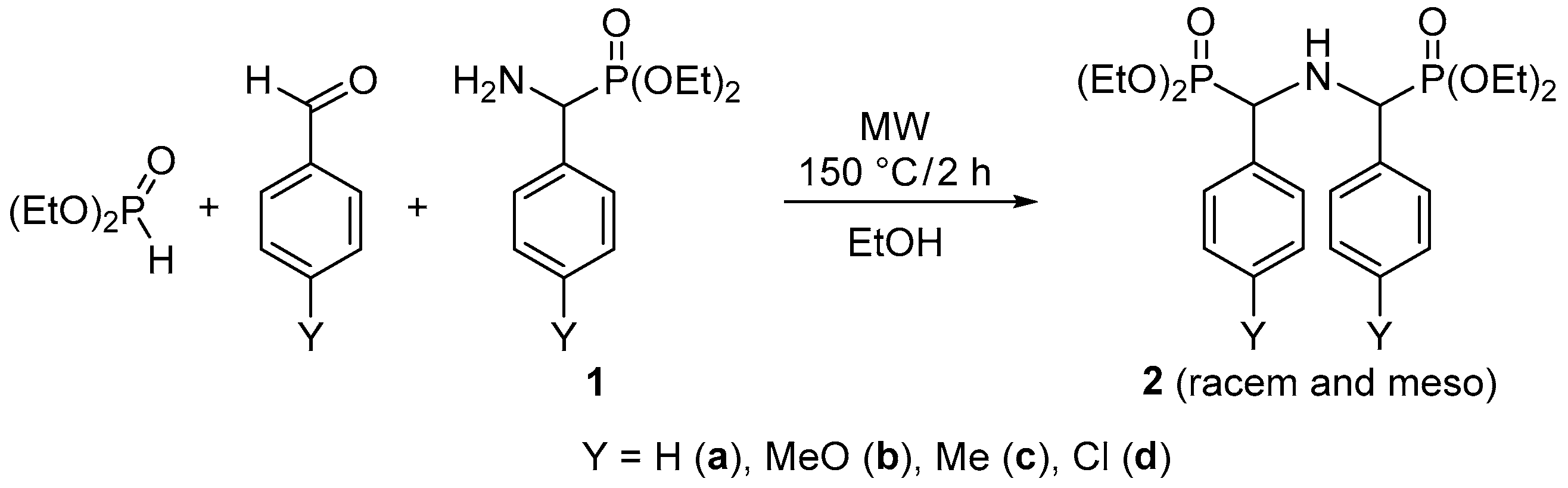
Scheme 1. Kabachnik–Fields reaction with the participation of α-amino-benzylphosphonates (1ad) and benzaldehydes with identical aryl groups.
Catalysts 16 00148 sch001
Scheme 2. Kabachnik–Fields reaction with the participation of α-amino-benzylphosphonates (1ad) and benzaldehydes with different aryl groups.
Catalysts 16 00148 sch002
Figure 1. 13C{1H} NMR spectrum of amine 2b, view of the signals of OCH2 of the major isomer (marked in blue) and of the minor isomer (marked in red).
Catalysts 16 00148 g001
Figure 2. 1H,31P-HMBC spectrum of amine 2b, showing the correlation of the phosphorus nuclei to the protons at the α-carbon atom.
Catalysts 16 00148 g002
Figure 3. 13C{1H} NMR spectrum of amine 2b, view of the NMR signals of α-CH group; major isomer marked in blue, minor isomer marked in red.
Catalysts 16 00148 g003
Figure 4. 31P{1H} NMR spectrum of the product obtained in the synthesis of 3c. The main components are the two isomers (major marked blue) and minor marked red) of the unsymmetric amine 3c. To a smaller extent the symmetric compounds 2a and 2c were also detected.
Catalysts 16 00148 g004
Figure 5. 1H,31P-HMBC NMR spectrum of compound 3c; correlation between the δ31P and δ1H of the methyl protons of the tolyl substituent (major isomer marked in blue and minor isomer marked in red).
Catalysts 16 00148 g005
Figure 6. 1H,31P-HMBC NMR spectrum of compound 3c, showing the correlation between δ31P and δ1H of the protons of α-CH (major isomer marked blue and minor isomer marked red).
Catalysts 16 00148 g006
Figure 7. 1H,31P-HMBC NMR spectrum of compound 3c; correlation of δ31P with δ1H of the methyl protons of the ethoxy groups (major isomer marked in blue, minor isomer marked in red).
Catalysts 16 00148 g007
Table 1. Outcome of the Kabachnik–Fields reaction of 1a + 4-YC6H4CHO + (EtO)2P(O)H; 31P NMR and LC-MS of the components.
Y = MeO 3b13b22b12b22a12a2
composition (%)7421~5 <1
δP (CDCl3)22.76 and 22.98
(J = 7.0 Hz)
23.02 and 23.25
[M+H] (m/z)500 530 470
Y = Me 3c13c22c12c22a12a2
composition (%)6526<1 5 *4 *
δP (CDCl3)22.76 and 22.91
(J = 7.0 Hz)
23.06 and 23.19 22.6722.99
[M+H] (m/z)484 500 470
Y = Cl 3d13d22d12d22a12a2
composition (%)59233 *1 *9 *5 *
δP (CDCl3)22.08 and 22.52
(J = 6.0 Hz)
22.44 and 22.8421.8922.2622.7223.05
[M+H] (m/z)504 538 470
* assignments of the % proportions to the components is tentative.
Table 2. Selected NMR data of the symmetrically substituted compounds 2.
2a2b2c2d
δ31P22.8 (55%)23.1 (45%)23.3 (80%)23.5 (20%)23.1 (86%)23.4 (14%)22.0 (73%)22.3 (27%)
δ1HPCH3.824.303.694.163.714.203.684.16
2JPH (Hz)21.816.821.316.322.016.422.217.4
δ13CPCH57.658.856.657.957.158.257.058.2
1JPC (Hz)155.0153.4156.7155.3155.6154.1155.8152.7
3JPC (Hz)17.810.318.010.218.010.117.610.2
Table 3. Selected NMR data of the unsymmetrically substituted compounds 3.
3b3c3d
amount of isomer (%)86.913.382.018.07129
δ31P22.9 (Pa)23.222.9 (Pa)23.2 (Pa)22.6 (Pa)22.9 (Pa)
22.8 (Pb)23.423.0 (Pb)23.3 (Pb)22.1 (Pb)22.5 (Pb)
4JPP (Hz)6.70.86.81.06.60.6
δ1HPaCH3.834.303.844.333.764.23
2JPH (Hz)20.217.122.016.920.416.8
δ1HPbCH3.774.263.794.273.614.30
2JPH (Hz)18.916.122.016.319.017.7
δ13CPaCH57.458.657.458.657.658.8
1JPC (Hz)155.3153.7155.1153.3155.1153.0
3JPC (Hz)17.710.617.810.018.310.5
δ13CPbCH56.858.057.258.356.958.2
1JPC (Hz)156.8155.2155.6154.2154.3153.3
3JPC (Hz)17.810.017.810.318.610.1
Disclaimer/Publisher’s Note: The statements, opinions and data contained in all publications are solely those of the individual author(s) and contributor(s) and not of MDPI and/or the editor(s). MDPI and/or the editor(s) disclaim responsibility for any injury to people or property resulting from any ideas, methods, instructions or products referred to in the content.