

Skip to Content
CatalystsCatalysts
  • Article
  • Open Access

29 January 2026

A Novel Polyaniline Gadolinium Oxide Coated Reduced Graphene Oxide Nanocomposite: A Sustainable, Cost-Effective and High-Performance Counter Electrode for Dye-Sensitized Solar Cells

,
,
,
,
,
and
1
Institute of Chemical Sciences, University of Peshawar, Peshawar 25120, KPK, Pakistan
2
Department of Geography, College of Humanities and Social Sciences, King Saud University, Riyadh 11451, Saudi Arabia
3
Faculty of Engineering Sciences, Ghulam Ishaq Khan Institute of Engineering Sciences and Technology, District Swabi, Topi 23640, KPK, Pakistan
4
Key Laboratory of Agro-Forestry Environmental Processes and Ecological Regulation of Hainan Province, School of Environmental Science and Engineering, Hainan University, Haikou 570228, China

Abstract

A novel ternary nanocomposite, comprising reduced graphene oxide/polyaniline/gadolinium oxide (RGO-PANI-Gd2O3), was successfully synthesized using the Hummers method, followed by in situ emulsion polymerization of polyaniline. The final composite was produced by hydrothermally adding gadolinium nitrate. The composite was subjected to a systematic analysis that included optical, microstructural, physical, and Raman spectroscopic analysis, as well as current-voltage (J-V) measurements. The morphology of this composite material was investigated using scanning electron microscopy (SEM). The addition of Gd2O3 nanoparticles decreases the band gap energy from 3.5 eV (PANI) to 2.7 eV (RGO-PANI-Gd2O3). The UV–Vis spectra revealed a redshift in the π-π* transition peak from 318 nm (PANI) to 346 nm, indicating increased conjugation length and synergistic effects. This eco-friendly material has excellent catalytic activity for triiodide reduction. The manufactured counter-electrode (CE) demonstrated remarkable transparency and conversion efficiency comparable to platinum, with a current density of 11.7 mA·cm−2 versus 8.2 mA·cm−2 for platinum. Under simulated solar light (AM 1.5 G, 100 mW·cm−2), the RGO-PANI-Gd2O3 based nanocomposite CE achieved an excellent 4.3% photo conversion efficiency. These findings indicate that RGO-PANI-Gd2O3 nanocomposites have potential as efficient, platinum-free counter electrodes in dye-sensitized solar cells (DSSCs).

1. Introduction

The growing environmental concerns and need for sustainable energy solutions have highlighted the significance of researching efficient and sustainable conversion of energy and storage technologies. DSSCs are a promising third-generation solar cell technology that has gained popularity since their first introduction by M. Gratzel and B. O’Regan in 1991 because of their low cost, simple construction, and excellent photo-conversion efficiency (PCE). They reported an efficiency of 7% [1,2,3]. DSSCs have proven potential cost savings compared to regular semiconductor solar cells [4].
The main components of DSSC are the semiconductor photoanode, sensitizer dye, electrolyte, and CE, which enhance photo-electrochemical performance and stability [5,6]. The electrolyte is present between a dye-adsorbed TiO2, which acts as a photoanode, and a platinum CE. The mechanism of DSSC involves photon-induced dye oxidation at the TiO2 photoanode and redox couple reduction at the CE to replenish the dye. Typically, iodide and triiodide (I/I3−) redox couples are utilized to renew dye molecules [7]. Platinum (Pt) has long been the material of choice for CE due to its ability to reduce triiodide ions in the redox pair. However, because of its high cost, chemical breakdown in the corrosive iodine environment needs more cost-effective, electrolyte-resistant, and earth-abundant replacements [8,9]. Carbonaceous materials are a promising replacement for Pt due to their excellent electrical conductivity and resistance to iodine. Carbon nanotubes, carbon black, graphene, activated carbon, and carbon-based composites have been studied as Pt-free CE [10,11].
Graphene, a 2-D carbon material with a honeycomb lattice structure [12], has exceptional properties, like greater surface area (2630 m2 g−1) [13], superior carrier mobility (10,000 cm2 V−1 s−1) [14], increased thermal conductivity (3000–5000 Wm−1 K−1), and improved optical transparency [15]. However, its practical uses are hampered by poor solvent dispersibility, limited active sites, and low electrocatalytic efficacy [16,17]. To overcome these restrictions, graphene oxide is frequently added to conducting polymers (CPs) to make nanohybrids, which improves the material’s functionality and possible uses [18].
Conducting polymers have garnered attention as promising CE materials, including polythiophene (PT), polypyrrole (PPy), and polyaniline (PANI) [19,20]. PANI is one of the most recommended options among them because of its environmental stability, high conductivity, stability, and ease of synthesis [21,22]. Additionally, the PANI network facilitates effective charge transfer by blocking graphene oxide (GO) aggregation through π-π stacking interactions [23]. When PANI nanotubes (NTs) with high surface area and catalytic activity [24] are added to conductive graphene oxide (GO), the reduction kinetics of triiodide ions (I3−) in the I3−/I redox pair electrolyte can be greatly improved [25,26]. However, a problem that prevents large-scale processability is PANI’s restricted solubility in a small spectrum of solvents [27]. Therefore, new techniques for designing, developing, and engineering devices are needed to effectively utilize PANI’s potential for practical purposes.
Gadolinium (Gd) is one of the rare earth metals that has drawn a lot of attention because of its special physical, magnetic, luminous, electromagnetic, and catalytic characteristics along with a strong crystalline structure [28,29,30]. Gadolinium oxide (Gd2O3) has become an essential part of modern technology, including medical gadgets, wind turbines, cellphones, and electric cars [31,32,33,34,35]. Gd2O3’s distinctive qualities, like its unusual electronic arrangement with half-filled f-orbitals ([Xe] 4f7), can result in electron-accepting characteristics, allowing for the reduction of oxidized species at the cathode. This feature benefits cathode materials in DSSCs [36]. Some other properties of Gd2O3 are its broadband gap, high electrocatalytic activity, and high relative permittivity, which make it a desirable material for several uses [37,38]. The addition of Gd2O3 to reduce graphene oxide polyaniline composites (RGOP) enhances photocurrent density brought about by better light harvesting and charge separation. Additionally, Gd2O3 doping results in a larger surface area, which enhances photon absorption and improves dye adsorption. Furthermore, the Gd2O3 increases the electron lifespan and decreases charge recombination by acting as a barrier [39]. Notably, incorporating Gd2O3 into RGOP composites greatly improves DSSCs’ performance [40,41].
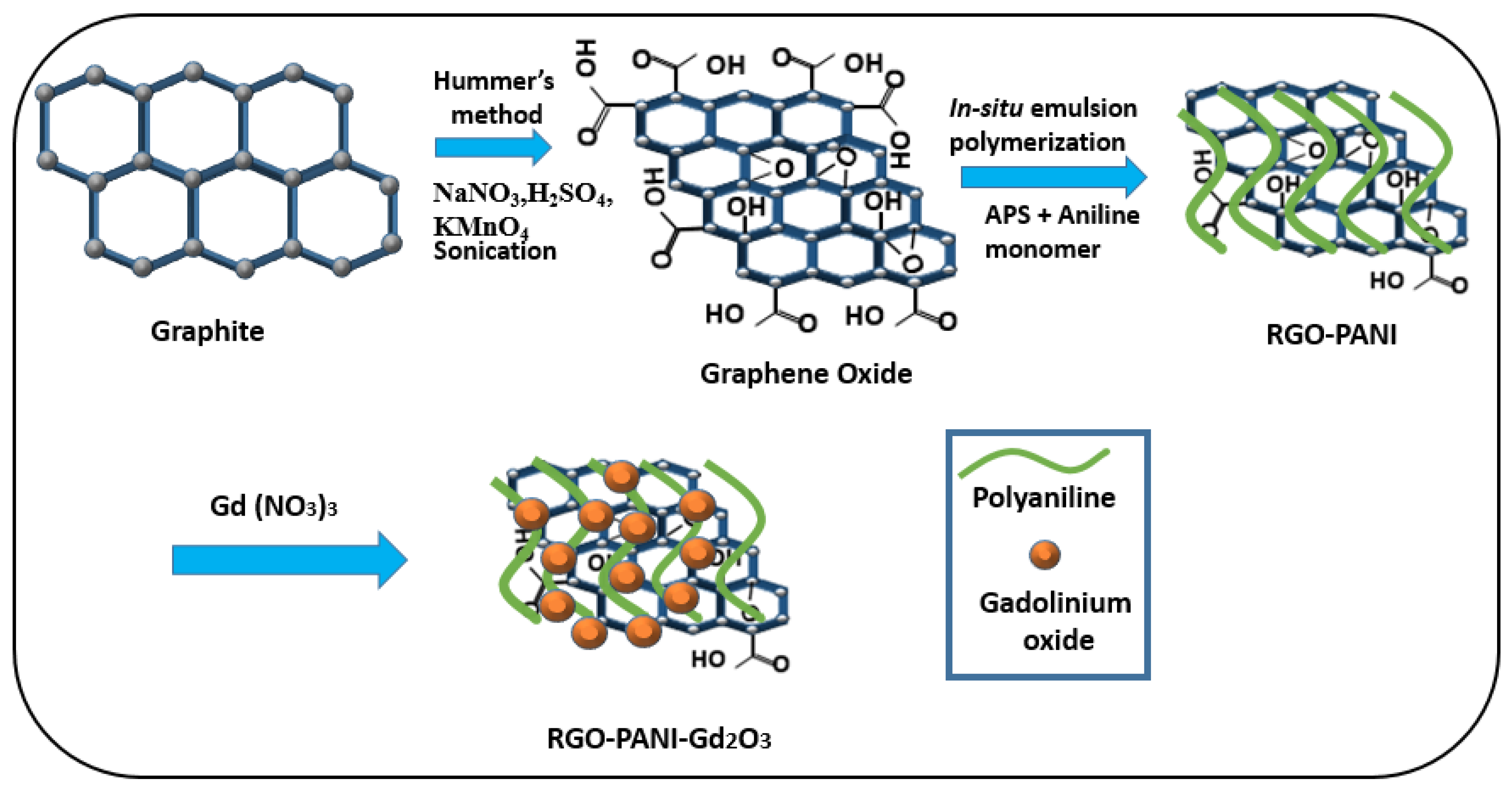
One of the most significant obstacles in the development of DSSCs is the scarcity of efficient, cost-effective, and sustainable CE materials to replace the existing Pt-based CE. Existing CE materials frequently have low catalytic activity, poor stability, and high cost, limiting the general adoption of DSSCs. This study addresses a critical knowledge gap in the development of efficient, cost-effective, and sustainable CE materials for DSSCs by developing a novel RGO-PANI-Gd2O3 nanocomposite. The synergistic combination of RGO, PANI, and Gd2O3 improves ease of synthesis, catalytic activity, stability, and conductivity, yielding a high-performance CE material. This study is planned with objectives to (i) develop an innovative RGO-PANI-Gd2O3 nanocomposite (Figure 1) as an economical and environmentally friendly counter electrode (CE) material for DSSCs; (ii) study the combined effects of RGO, PANI, and Gd2O3 on the CE material’s conductivity, stability, and catalytic activity; and (iii) evaluate the performance and stability of the RGO-PANI-Gd2O3-based DSSC, to achieve efficient and cost-effective energy conversion device, demonstrating the material’s potential for efficient, cost-effective, and long-term DSSC applications.
Figure 1. Preparation of RGO-PANI-Gd2O3 NPs nanocomposite from graphite.

2. Experimental

2.1. Materials and Reagents

Reagents used included graphite powder (lead pencil sika), sulfuric acid (95–98%), ammonium persulfate ((NH4)2S2O8), hydrochloric acid (36–37%), sodium dodecyl sulfate (CH3 (CH2)11SO4Na), potassium permanganate (99.9%), aniline monomer (C6H5NH2 ≥ 99.5%), gadolinium nitrate (Gd (NO3)3), hydrogen peroxide (H2O2), and acetone (≥99.9%); all were bought from Sigma Aldrich (St. Louis, MO, USA), Meltonix 1170-60 Gaskets (60 μm). Some other materials used for DSSC studies were procured from Solaronix, Aubonne, Switzerland. These included N719 (Ruthenizer 535-bisTBA), fluorine-doped tin oxide (FTO) glass, Iodolyte Z-100, and mesoporous titania-coated photoanodes. The photoanodes were made out of a 3 μm scattering layer and a thick, transparent layer of TiO2 (11.5 μm).

2.2. Synthesis of Graphene Oxide

GO was prepared by using Hummer’s method [42,43]. This method involved adding 1 g of graphite powder to 50 mL of concentrated sulfuric acid (H2SO4) and stirring the mixture for 30 min with a magnetic stirrer until it became homogeneous. Next, 1.5 g of sodium nitrate (NaNO3) was added. Again, after stirring, the mixture was put in an ice bath. Then gradually added 6 g of potassium permanganate (KMnO4) and agitated the solution for 30 to 45 min. Once KMnO4 has been added, take it off the ice bath and stir it for 24 h. After 24 h, distilled water was added dropwise to dissolve the thick dark sludge that had formed. The entire mixture was then gradually mixed with 5 mL of hydrogen peroxide (H2O2). A greenish-yellowish hue was noticed, signifying the development of GO. Distilled water was then repeatedly added and removed to neutralize the GO solution. Pure GO was obtained after neutralization.

2.3. Synthesis of Polyaniline by In Situ Emulsion Polymerization

Polyaniline was prepared using in situ emulsion polymerization [44]. Briefly, 2.15 g of sodium dodecyl sulfate (SDS) is gently dissolved in 50 mL of chloroform at room temperature while constantly stirring, followed by the addition of 1.5 mL of aniline. In the next step, a 12.50 mmol H2SO4 (aq) solution was added dropwise. A homogeneous mixture was prepared by continuously agitating this solution. In a separate beaker, prepare an ammonium persulfate (APS) solution by combining pre-cooled 25 mL of 1.25 mmol APS solution. Pour this solution into the preceding solution, and the milky color will appear. For polymerization to complete, the solution was magnetically stirred at room temperature for 24 h. The product obtained is of dark green color. Repeatedly wash this dark green product with acetone in a separating funnel. The bottom phase is then cleaned with deionized water after many acetone washes. After gathering the organic layer (lower phase), filter this layer and let it dry in a vacuum oven at 60 °C temperature. Finally, the green powder of polyaniline was obtained.

2.4. Synthesis of RGO-PANI Nanocomposite

In this process, graphene oxide was utilized as a precursor. Firstly, 3.55 g of graphene oxide and 1 g of PANI were combined. The mixture was stirred for 24 h at room temperature (RT) to finish the polymerization. The color of the solution changed from dark brown to black. To remove the contaminants, the solution was then filtered through filter paper and repeatedly cleaned with ethanol and water. After washing, the filtrate was dried at 60 °C in an oven. A composite of graphene and polyaniline was produced.

2.5. Synthesis of RGO-PANI-Gd2O3 Composite

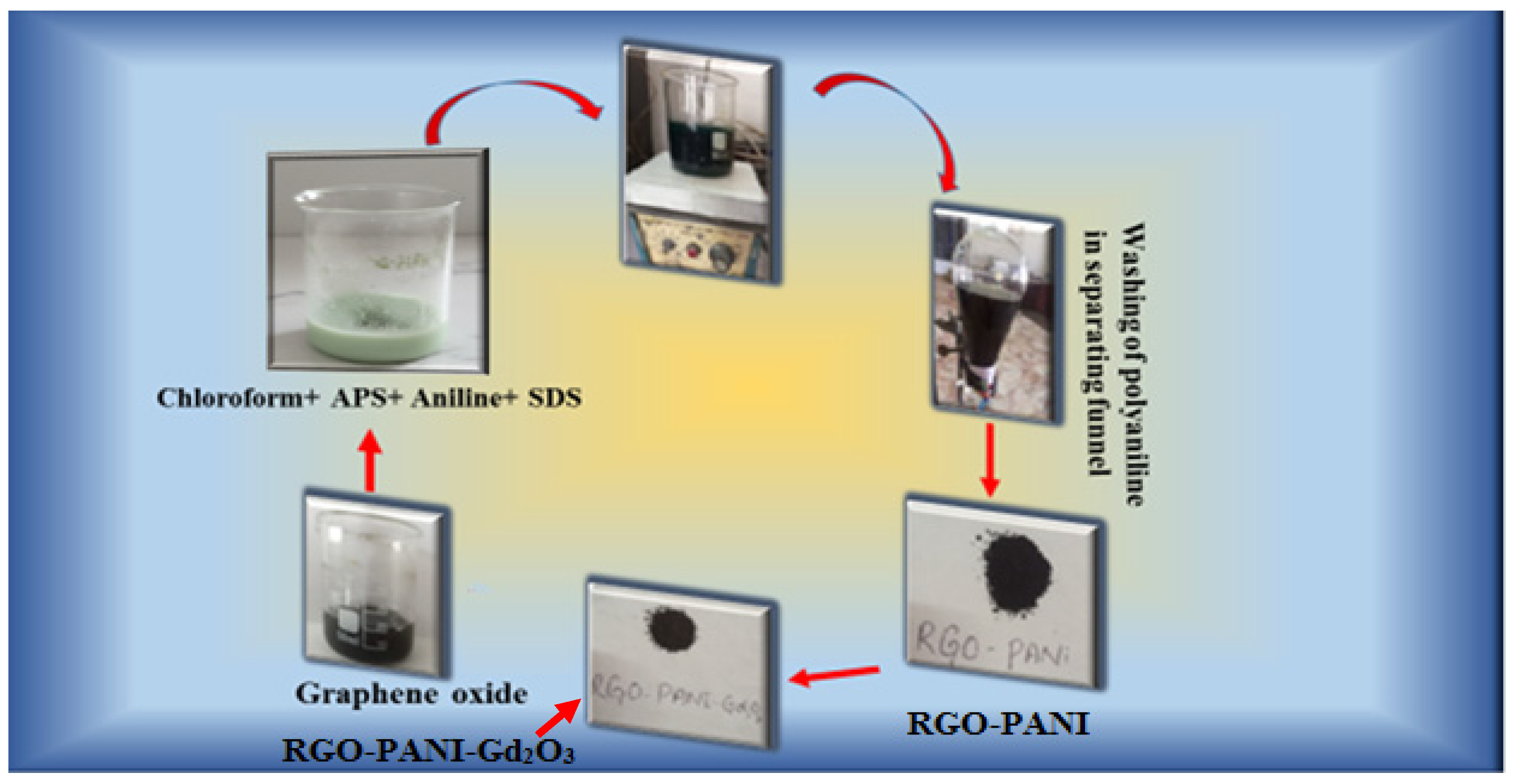
For the preparation of the RGO-PANI-Gd2O3 ternary composite, RGO-PANI (aq) and Gd(NO3)3·6H2O were combined in a 1:2 ratio at RT for 30 min at pH 3. After centrifugation, the RGO-PANI-Gd3+ nanocomposite was washed three times with deionized water. Next, 1 g/L H2O2 was added to the RGO-PANI-Gd3+ solution. Then sodium hydroxide was added to the above solution, and the pH of this solution was adjusted to 9. Gd2O3 particles can be formed from gadolinium cations and then adsorbed on the RGO-PANI surface. After centrifuging the RGO-PANI-Gd2O3 composite and washing it three times with DI water, the suspension was placed in an autoclave for 2 h at 200 °C. The resulting RGO-PANI-Gd2O3 composite powder is displayed in Figure 2 [45,46].
Figure 2. Schematic representation of the synthesis of RGO/PANI/Gd2O3 composite.

2.6. Cell Fabrication

2.6.1. Working Electrode

The working electrode was formed of fluorine-doped tin oxide (FTO) glass covered with mesoporous titanium oxide (TiO2), which is mostly made up of two layers of titanium. The thick, transparent TiO2 layer, which measures 11.5 μm, and the scattering layer, which is around 3 μm, make up these layers, which are bought from Solara Nix Switzerland.

2.6.2. Fabrication of the Counter Electrodes

A 0.05-weight percent dispersion of RGO-PANI and RGO-PANI-Gd2O3 composites in ethanol was prepared using an ultrasonic bath to create a stable dispersion. After dropping the doped dispersions onto FTO substrates that had been previously cleaned, the CEs were prepared and dried at room temperature.

2.6.3. DSSC Assembly and Its Mechanism

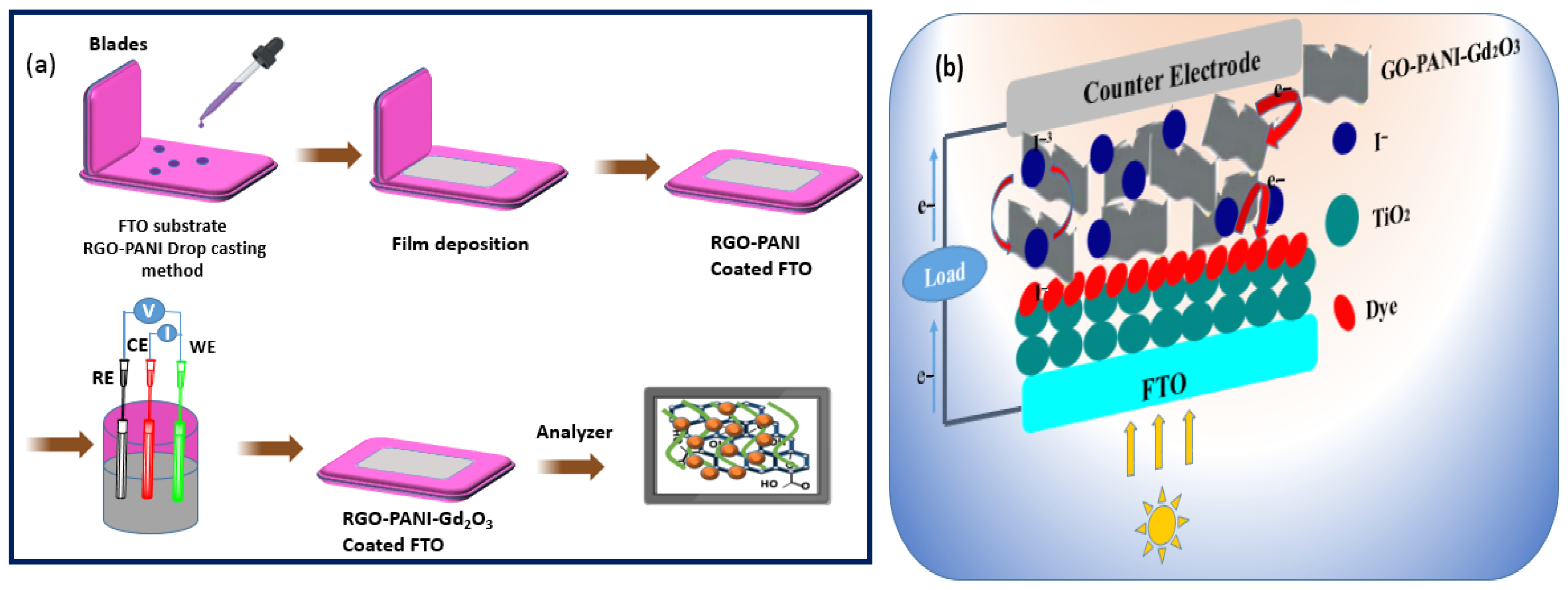
The photoanode made of mesoporous titania was sintered for around half an hour at 450 °C. Following cooling to 80 degrees Celsius, the photoanodes were submerged in an N-719 dye solution (0.5 mM) and allowed to rest at room temperature for 24 h in the dark. After the photoanodes were stained and cleaned using ethanol, they were dried using nitrogen gas. Following that, the 60 μm thick Meltonix 1170-60 gasket was carefully positioned on the active side of the photoanode. The CE was then positioned over the gasket with its active side facing the photoanode and heated to 100 °C to guarantee a perfect seal. Following sealing, a spot sealing tape was used to quickly seal the injected electrolyte of iodide and triiodide through the CE’s drilled hole. The cell’s active area was 0.7 cm2. The design and mechanism of DSSC using RGO-PANI-Gd2O3 nanocomposite CE and their mechanism are shown in Figure 3a,b.
Figure 3. (a) Schematic fabrication of RGO/PANI/Gd2O3-coated FTO film including RGO-PANI deposition on FTO substrate and analysis of substrate (b) Mechanism of DSSC.

2.7. Characterization and Measurements

The crystalline size and interfacial spacing are examined using a Philips (Singapore) PW 1820 diffractometer, which uses Cu Kα radiation with a range of 10° to 80°. The prepared samples UV–Vis data were collected using a UV spectrophotometer (model no. LAMBDA 365+, Perkin Elmer, USA) with an absorbance range of 200 to 800. A scanning electron microscope (JEM-5910 model, Osaka, Japan) was employed to collect SEM data to examine the surface morphology and microstructural analysis of the prepared samples. A spectrometer (Perkin Elmer 283B, Waltham, MA, USA) was used to collect FTIR data in the 500–4000 cm−1 range to look into the functional groups of the prepared materials.

3. Results and Discussion

3.1. FTIR Spectra

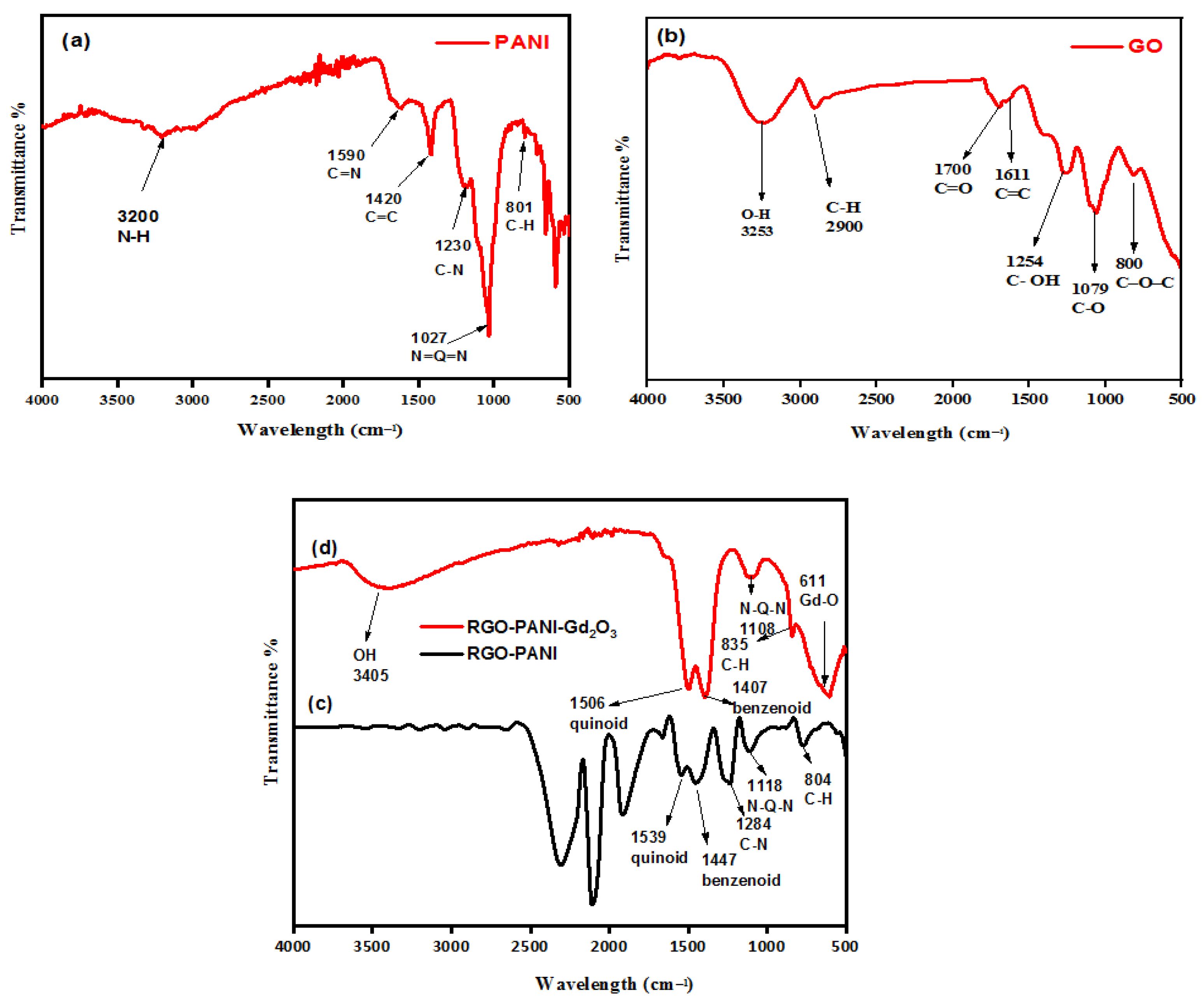
The FT-IR spectroscopic analysis was used to investigate the chemical structure and composition of the produced materials. Figure 4a–d shows the FT-IR spectra of PANI, GO, RGO-PANI, and RGO-PANI-Gd2O3 composites. The functional group assignments are reported in Table 1.
Figure 4. FTIR spectra of (a) PANI, (b) GO, (c) RGO-PANI, and (d) RGO-PANI-Gd2O3.
Table 1. FTIR peak positions and functional groups for GO, PANI, RGO-PANI, and RGO-PANI-Gd2O3.
The spectra of polyaniline (PANI) (Figure 4 (a)) show a large distinctive band at 3200 cm−1, which shows N-H stretching vibration. The C=N and C=C stretching vibrations are represented by the distinct peaks at 1590 cm−1 and 1420 cm−1, respectively.
These peaks represent the quinoid (Q) and benzenoid (B) skeletons found in the PANI structure. Additional signals are seen at 1230 cm−1, corresponding to C-N stretching vibrations, and at 801 cm−1, corresponding to C-H bending vibrations. These signals confirm the existence of PANI. Furthermore, the band at 1027 cm−1 is ascribed to the N-Q-N stretching vibration, providing additional confirmation of the PANI structure [47,48,49]. The FT-IR spectrum of GO (Figure 4 (b)) shows a large hydroxyl group absorption band at about 3253 cm−1, showing the presence of hydroxyl groups on the GO surface. Aromatic C=C bond stretching and C-OH group bending vibrations occur at 1611 cm−1 and 1254 cm−1, respectively [50]. Additional peaks at 1700 cm−1, 1079 cm−1, 2900 cm−1, and 800 cm−1 correspond to stretching vibrations of the C=O, C-O, C-H, and C-O-C groups [51]. The RGO-PANI nanocomposite (Figure 4 (c)) shows absorption peaks at 1539 cm−1, 1447 cm−1, and 1284 cm−1, which correspond to C=N, C=C, and C-N bond stretching vibrations [52]. The peak at 1118 cm−1 corresponds to N-Q-N bond stretching vibrations from quinonoid rings, while the peak at 804 cm−1 relates to out-of-plane C-H bending vibrations of benzene, showing PANI covalently grafted onto RGO sheets [53]. The FT-IR spectra of RGO-PANI-Gd2O3 (Figure 4 (d)) display peaks at 1506 cm−1 and 1407 cm−1, corresponding to the stretching vibrations of C=N and C=C [41,42,43,52]. A peak at 3405 cm−1 indicates stretching vibration of the O-H bonds. The peak at 611 cm−1 corresponds to the Gd-O stretching frequency, demonstrating that the RGO-PANI composite was successfully coated with Gd2O3 particles.
The peak shifting in the FT-IR spectra of the RGO-PANI-Gd2O3 composite can be attributed to increased electron density, conjugation effects, hydrogen bonding, stabilization, and bond order alterations. Because of increased electron density and conjugation, the stretching vibrations of the C=N and C=C bond shift from 1590 cm1 and 1420 cm1 (PANI) to 1506 cm1 and 1407 cm1 (RGO-PANI-Gd2O3). The presence of starching vibration peaks of O-H at 3405 cm1 suggests hydrogen bonding between Gd2O3 and RGO-PANI, whereas the Gd-O stretching frequency peak at 611 cm−1 validates Gd2O3 inclusion. These modifications show that Gd2O3 was successfully integrated into the RGO-PANI composite, resulting in a novel material with distinct vibrational characteristics [54].

3.2. XRD Patterns

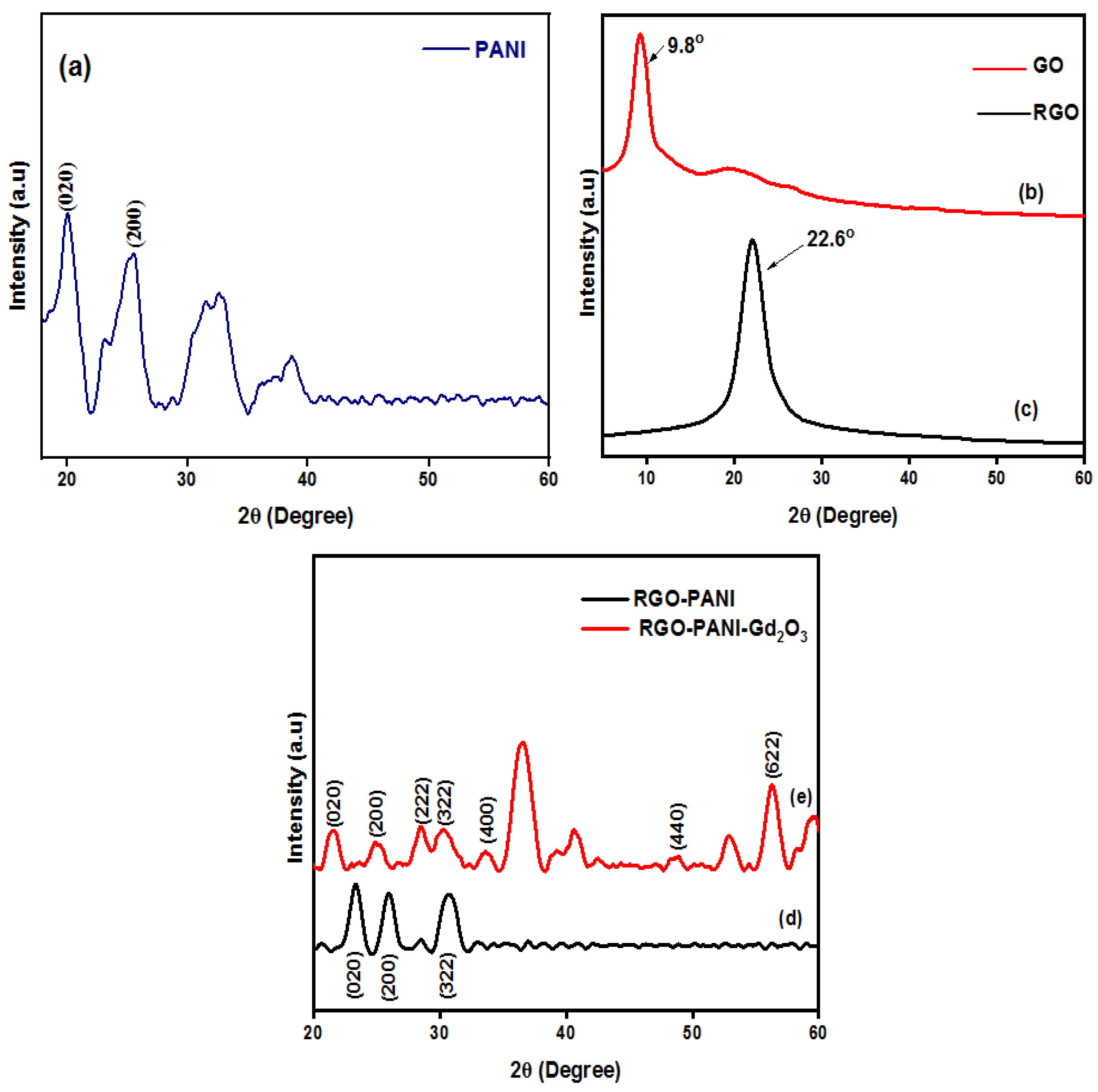
The X-ray diffraction study of RGO, GO, PANI, RGO-PANI, and RGO-PANI-Gd2O3 composites (Figure 5 (a)–(e)) was studied to investigate the crystalline structure and phase composition. The XRD spectrum of PANI (Figure 5 (a)) shows a large peak at 2θ = 20.01°, which corresponds to the (020) plane and indicates a semi-crystalline structure. This peak is due to the periodic recurrence of benzenoid and quinonoid rings in the PANI chain. The peak at 2θ = 25.4° corresponds to (200), indicating the amorphous nature of PANI [55]. The broad and weak character of these peaks indicates that PANI has a low level of crystallinity, which is consistent with its amorphous structure. The XRD analysis of GO (Figure 5 (b)) shows a pronounced peak at 2θ = 9.8°, indicating enlarged interlayer space due to the introduction of oxygen-containing functional groups. This distinguishes it from pristine graphite.
Figure 5. XRD spectra of (a) PANI, (b–c). RGO and GO, (d–e) RGO-PANI and RGO-PANI-Gd2O3.
The XRD spectrum of RGO (Figure 5 (c)) shows a broad and weak peak at 2θ = 22.6°, which corresponds to the (002) plane and indicates a partially recovered graphitic structure. The absence of the characteristic GO peak at 2θ = 10–12° verifies the reduction in GO, which results in the elimination of oxygen-containing functional groups and the restoration of the graphitic lattice [56]. The RGO/PANI composite (Figure 5 (d)) consists of three broad diffraction peaks at 2θ = 23.2°, 25.9°, and 30.67°, which are attributed to the PANI’s (020), (200), and (322) Millar planes, respectively [57,58]. RGO sheets typically have a pronounced diffraction peak at 2θ = 24.5°. However, RGO/PANI lacks this characteristic band. One explanation for this observation is that the RGO characteristic peak at 2θ = 24.5 disappeared because the RGO sheets’ surface was entirely covered with PANI [59]. In other words, aniline monomers were successfully polymerized on the surface of RGO sheets to produce an RGO-PANI composite, resulting in the exfoliation of GO sheets.
The XRD analysis of the RGO-PANI-Gd2O3 composite (Figure 5 (e)) regarding the spectrum of standard cubic phase Gd2O3 (JCPDS No.86–2477). The main diffraction peaks appear at 2θ ≈ 28.7°, 33.8°, 47.8°, and 56.1°, corresponding to the (222), (400), (440), and (622) planes, respectively [60]. These XRD patterns suggest that Gd nanoparticles were effectively deposited on the RGO-PANI. Peak shifting in the composite materials relative to their constituent parts shows changes in interplanar distances and lattice characteristics. For example, in the case of RGO, peak shifts from 22.6° to 23.2° in the RGO-PANI composite, showing a change in the structure of graphite. Similarly, the presence of additional peaks in the RGO-PANI-Gd2O3 composite, such as those associated with cubic phase Gd2O3, indicates the successful incorporation of Gd2O3 nanoparticles into the RGO-PANI matrix [61].
The PANI, GO, RGO, RGO-PANI, and RGO-PANI-Gd2O3 were found to have a single, broad peak at 20.1, 9.8, 22.6, 25.9, and 33.8, respectively, for each filled ratio. The full width at half maximum (FWHM) of the primary XRD peak was used to calculate the crystallite size using the Debye–Scherrer equation.
D = 0.9 λ/β cos θ
where D represents the crystallite size, θ is the Bragg angle, λ is the wavelength of X-ray, and β is the full peak width at half-maximum (FWHM). Table 2 summarizes the samples’ average grain size as computed using the Debye–Scherrer formula.
Table 2. Crystallite size as determined by utilizing XRD and the Debye–Scherrer formula.

3.3. UV Analysis

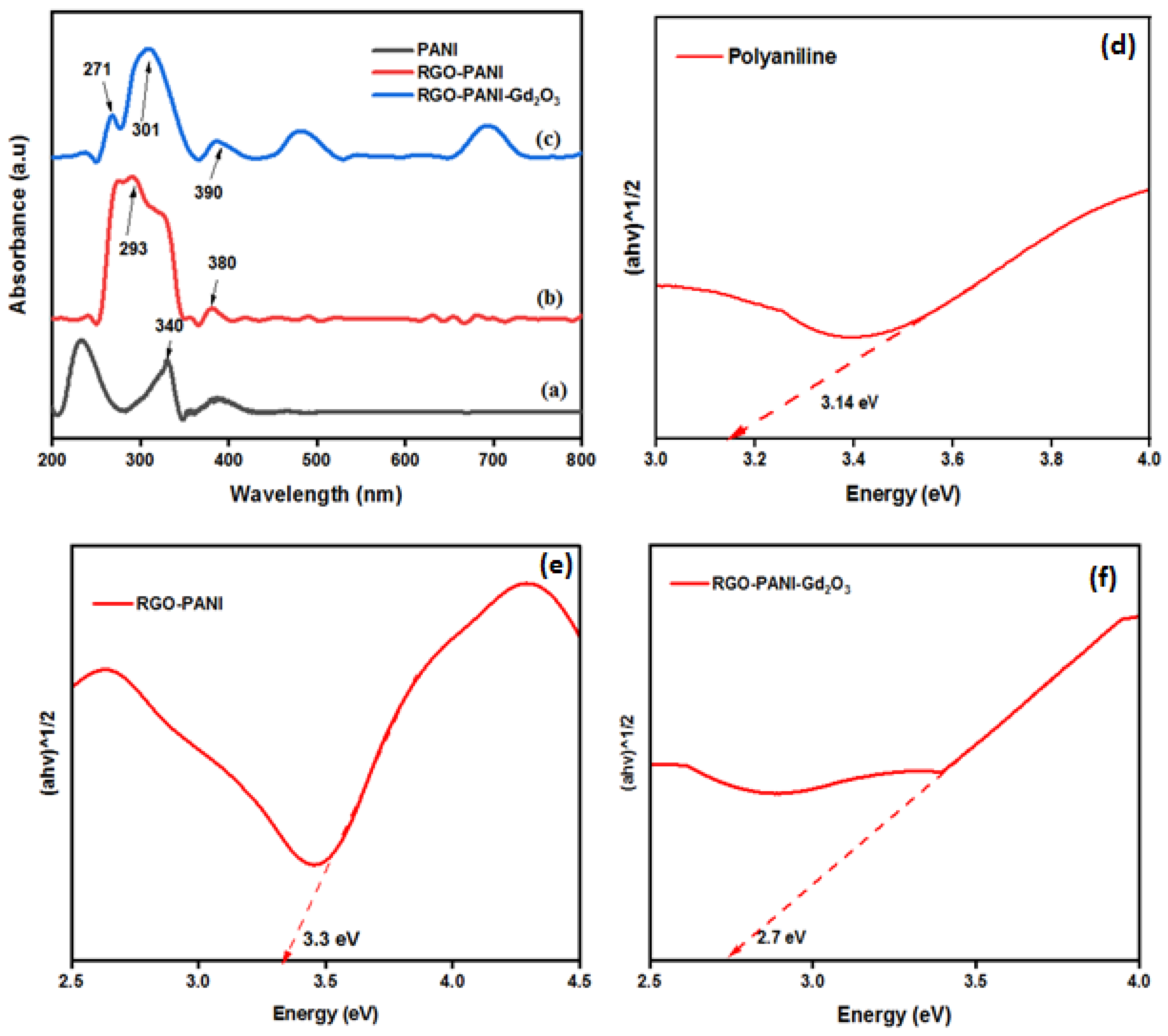
The UV-visible spectra of PANI, RGO-PANI, and RGO-PANI-Gd2O3 (Figure 6 (a)–(c)) were examined to explore their optical properties.
Figure 6. (a) UV/Vis absorption spectra of (a) PANI, (b) RGO-PANI, (c) RGO-PANI-Gd2O3, and band gap energy of (d) PANI, (e) RGO-PANI, and (f) RGO-PANI-Gd2O3 nanocomposites.
In Figure 6 (a), the UV–Vis spectra of pure PANI reveal an absorption peak at 340 nm. This is due to the π-π* transition of the PANI chains [62,63,64]. The UV-visible spectrum of RGO-PANI (Figure 6 (b)), on the other hand, displays a red-shifted absorption peak at about 380 nm. This indicates that the interaction with RGO lengthens the conjugation length of the PANI chains, and in the π-π interactions between the two components, the PANI acts as an electron donor, and the RGO is thought of as the electron acceptor, leading to an increase in electrical conductivity [65,66]. In RGO-PANI, the absorption peak at about 293 nm is more noticeable, suggesting that the absorption of the RGO sheets may have increased.
Additionally, the RGO-PANI-Gd2O3 nanocomposite’s UV-visible spectrum (Figure 6 (c)) displays an additional red-shifted absorption peak at approximately 390 nm, suggesting that the interaction with Gd2O3 nanoparticles may have increased the conjugation length of the PANI chains. The inclusion of Gd2O3 nanoparticles may boost the absorption of the RGO sheets, as seen by the more pronounced absorption peak at about 301 nm in RGO-PANI-Gd2O3. The Gd3+ ions’ 4f-4f transitions are responsible for the peak at 271 nm [67]. Overall, incorporating RGO and gadolinium oxide into PANI increases the electrical conductivity of the material, making it a potential material for a variety of applications.
The most crucial factor in determining the area of light absorption is the energy gap. Tauc’s formula yielded the energy gap as follows:
(α) = A/hv (hv − Eg)−1/2
This equation uses the following: light frequency (v), absorption coefficient (α), Planck constant (h), constant (A), and band gap (Eg). To compute the energy gap, the graph was plotted between (αhv)2 versus hv, as shown in Figure 6. Extrapolating the plot for (αhv)2 = 0 yields the value of Eg [68]. The optical direct transition energies obtained in Figure 6 (d)–(f) are 3.14, 3.3, and 2.7 eV for PANI, RGO-PANI, and RGO-PANI-Gd2O3, respectively. Compared to the literature, when RGO-PANI is doped with Gd2O3, the band gap reduces [69]. The energy gap is critical in influencing a material’s electrical conductivity and optical absorption properties [70]. Thus, the RGO-PANI-Gd2O3 composite has a lower electron excitation energy than RGO-PANI [62,71], supporting our suggestion to create ternary nanocomposites for DSSC and supercapacitance.

3.4. Raman Analysis

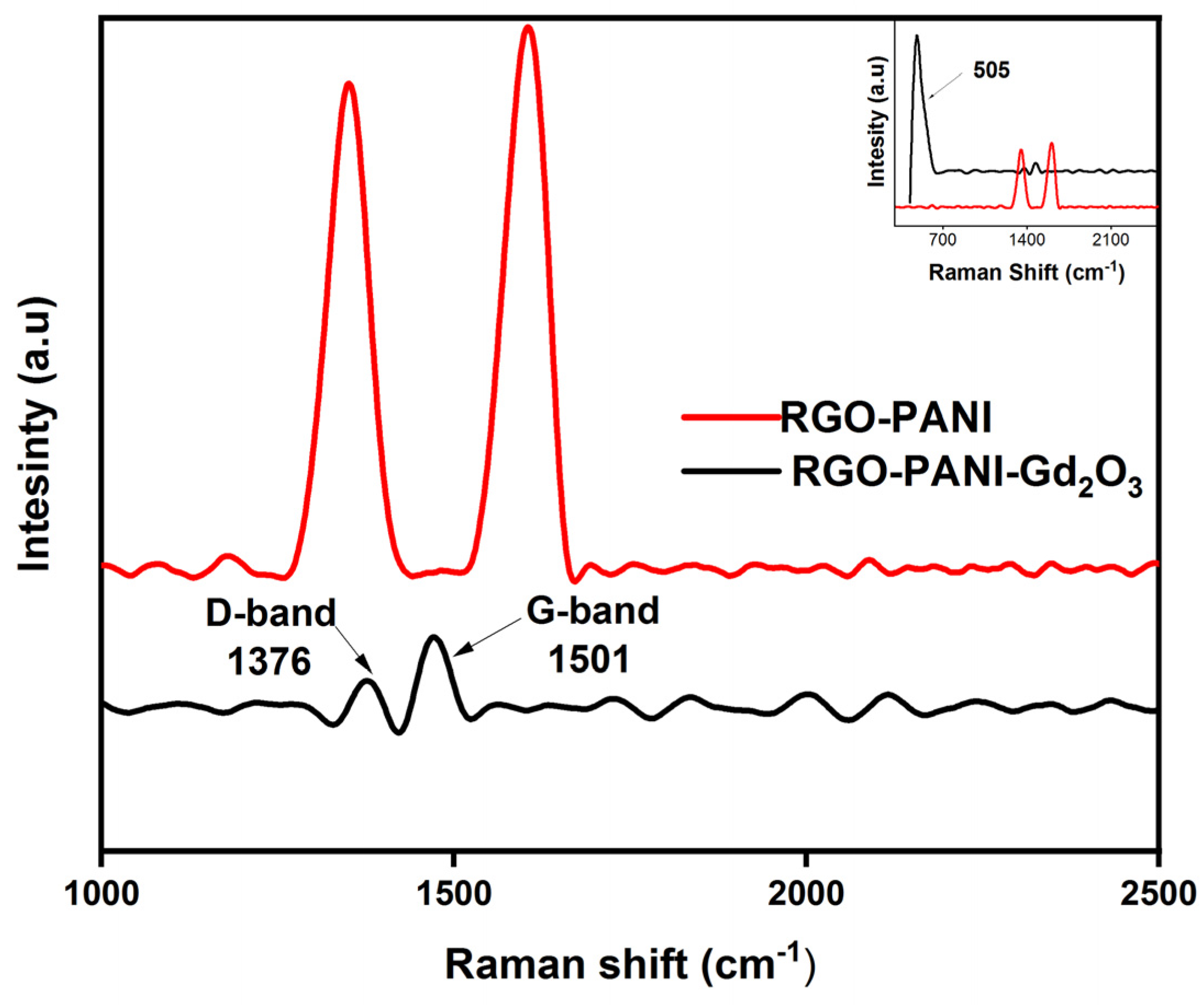
Raman spectroscopy, an important method for characterizing graphene, reveals different structural changes in an RGO-PANI composite with the addition of gadolinium oxide (Gd2O3) (Figure 7).
Figure 7. Raman spectra of RGO-PANI and RGO-PANI-Gd2O3.
In the first RGO-PANI composite, D and G bands are seen at 1349 cm−1 and 1604 cm−1, respectively, with the D band intensity already lower than the G band, indicating a lower initial defect density and an estimated ID/IG ratio of 0.5 to 0.8. With the addition of Gd2O3, the D band is shifted to 1376 cm−1 and the G band to 1501 cm−1. The presence of Gd2O3 does not considerably enhance the total defect density, as evidenced by the lower intensity of the D band compared to the G band. A gadolinium-related signal at 505 cm−1 indicates the existence of Gd2O3. These findings indicate that Gd2O3 interacts with the RGO-PANI matrix, potentially influencing electrical properties or slightly altering structural arrangements without introducing a significant number of new defects, potentially leading to the stabilization or even passivation of existing defects. The composite material has a low defect density and a specific interaction with the RGO-PANI structure. The estimated ID/IG ratio likely remains in a similar range (0.5–0.8) or may decrease slightly (0.3–0.6) if the D band intensity diminishes further relative to the G band. The maintenance of a low defect density is critical because structural flaws can drastically alter graphene’s fundamental properties, such as electrical and magnetic activity.

3.5. SEM, TEM, and EDX Analysis

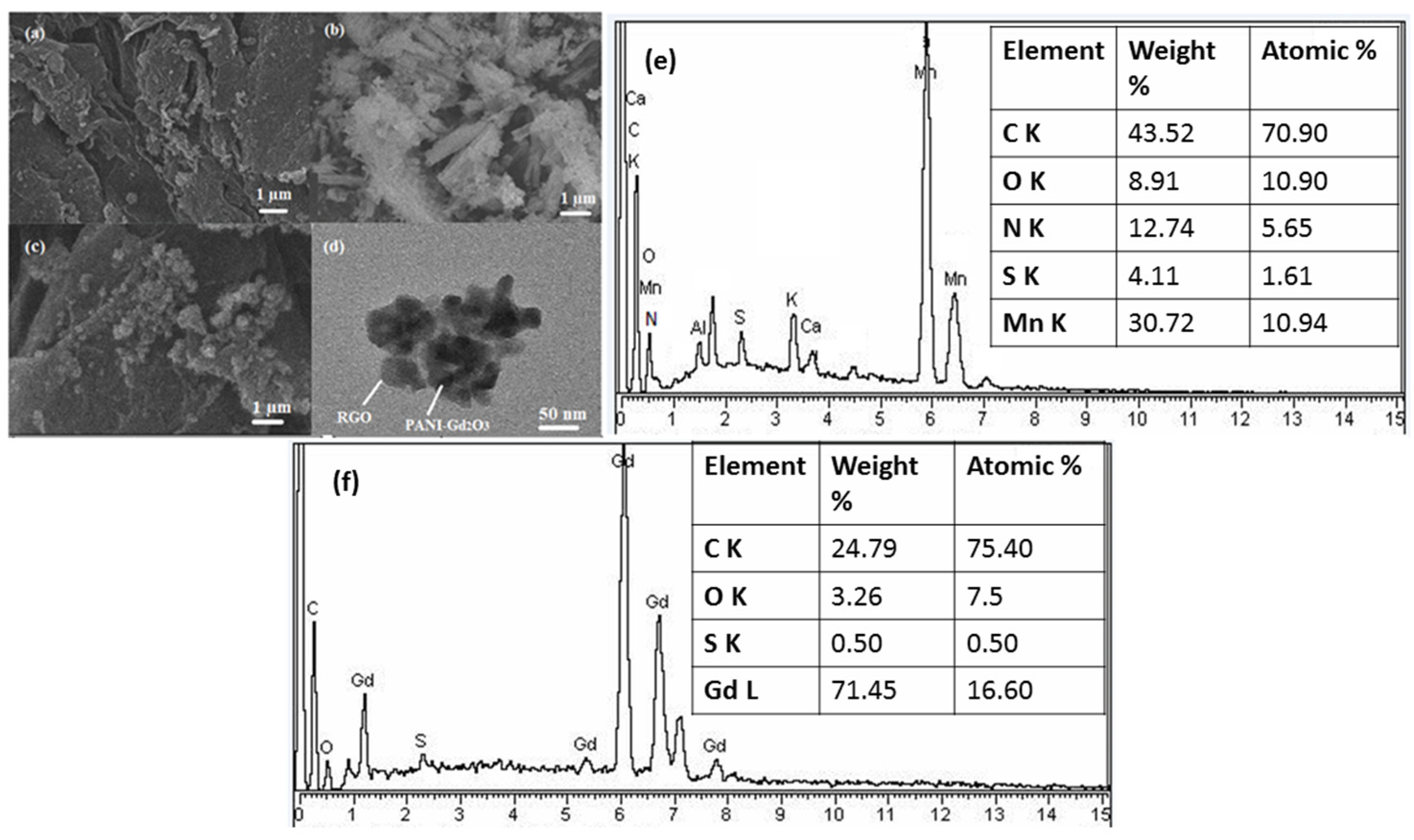
The Scanning Electron Microscopy images in Figure 8a–c show the morphological properties of the composite, revealing a homogeneous distribution of elements throughout the structure. The RGO-PANI shows a characteristic sheet-like shape and increased active specific surface area due to the long alkyl chain.
Figure 8. SEM images of (a,b) RGO-PANI, (c) RGO-PANI-Gd2O3, (d) TEM image of RGO-PANI-Gd2O3, EDX of (e) RGO-PANI, (f) RGO-PANI-Gd2O3.
Furthermore, the PANI-SDS particles also polymerize to coat the graphene oxide surface, since graphene oxide might function as a template to form micelles in the presence of a surfactant, thereby further enhancing the effective intercalation and promoting the subsequent coating by PANI-SDS (Figure 8a,b) [72,73]. In the meantime, the gadolinium oxide particles (Figure 8c) were embedded on the RGO’s surface and showed spherical shape particles (Figure 8a) [74]. Interestingly, the dark areas in the pictures show stacked layers of reduced graphene oxide with functional groups that include oxygen, while the transparent parts show single layers of RGO (Figure 8d) [75,76]. The SEM analysis demonstrated that Gd2O3 particles and PANI were uniformly distributed on the RGO surface. The morphology of the composite consisted of folded and wrinkled RGO sheets, string-like PANI structures, and spherical Gd2O3 particles. The excellent inclusion and dispersion of these components on the RGO surface indicate a high potential for improved characteristics in the composite material.
Transmission electron microscopy (TEM) was used to examine the RGO-PANI-Gd2O3 composite’s morphology and structure. In the RGO-PANI-Gd2O3 composite (Figure 8d), the black inner core of Gd2O3 is elliptical or spherical in shape, and the PANI’s gray shell loosely surrounds the Gd2O3 particles, forming the core–shell structure of the PANI-Gd2O3 composite. This PANI-Gd2O3 was then dispersed on the RGO sheets, demonstrating that the components have been successfully integrated [77,78]. The core shell structure provides stability and prevents aggregation in the composite, and the combination of RGO, PANI, and Gd2O3 improved electrical, thermal, and magnetic properties, making it a feasible material for catalysis, biomedicine, and energy storage devices.
The Energy-Dispersive X-ray Spectroscopy (EDX) spectrum of RGO-PANI (Figure 8e) reveals the presence of three primary elements: Carbon (C), indicating the presence of the polymer backbone; Nitrogen (N), confirming the presence of the amine groups in the PANI structure; and Oxygen (O), most likely owing to the presence of leftover oxygen from the synthesis process or impurities. The EDX spectrum of RGO-PANI-Gd2O3 (Figure 8f) confirms the presence of Gd, C, S, and O, and shows the successful incorporation of Gd2O3 nanoparticles into the RGO-PANI matrix. The presence of C, N, and O is expected from the RGO and PANI components, while S may be due to the use of sulfuric acid during synthesis. The presence of Gd confirms the incorporation of Gd2O3 nanoparticles, demonstrating the composite nature of the material.

3.6. Current-Voltage (IV) Measurements

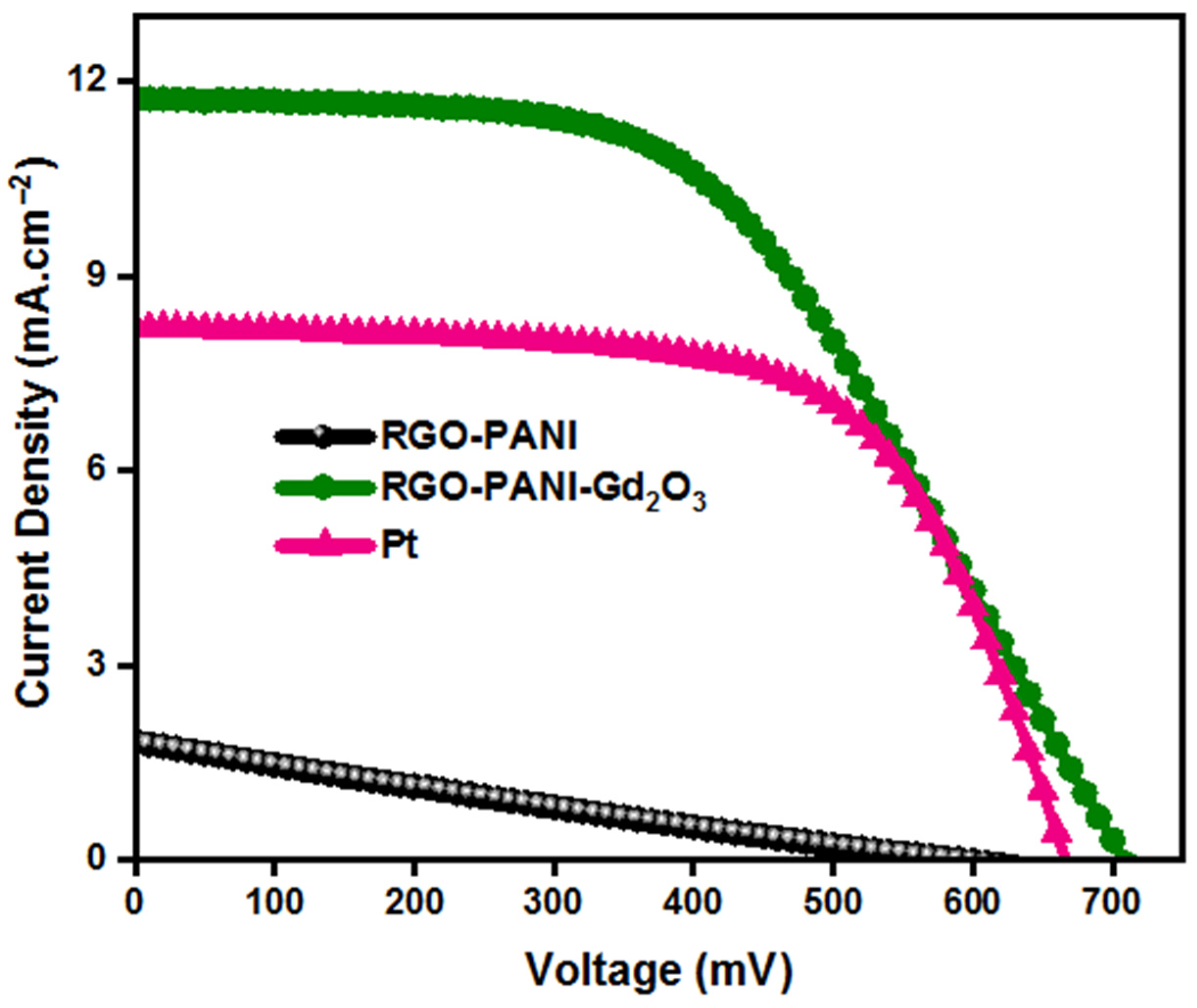
The photovoltaic performance of DSSC incorporating RGO-PANI and RGO-PANI-Gd2O3 composite (Figure 9) CE was evaluated under AM 1.5G illumination (100 mW·cm−2). Table 3 summarizes the photovoltaic parameters (Voc, FF, Jsc, and η).
Figure 9. Photocurrent density and voltage (J-V) characteristics of the DSSCs with CEs with the films of GO-PANI and RGO-PANI-Gd2O3 at 100 mW·cm−2 illumination.
Table 3. Parameters of undoped and doped photo-cathode-based DSSC.
The characteristic photovoltaic parameters obtained from these curves enable the comparison of solar cell performance. DSSC efficiency (η) is calculated by using the following formula:
η = Pmax/Pin × 100 = Jsh × Voc × FF/Pin × 100
where the maximum current produced by a solar cell per unit area is known as the short circuit current density (Jsc). Pin represents the incident light intensity. The greatest output power divided by the product of short circuit current (ISC) and open circuit voltage (VOC) is called the fill factor, which is a metric used to quantify the efficiency of DSSC. It is calculated by finding the greatest rectangular area that fits inside the current-voltage curve.
FF = Jmax × Vmax/Jsc × Voc
where Vmax and Imax denote the voltage and current at the cell’s maximum power output, respectively. The results showed that the RGO-PANI-Gd2O3 composite CE exhibited superior photovoltaic performance compared to the RGO-PANI electrode material.
The J-V curves of RGO-PANI and RGO-PANI-Gd2O3 composite counter electrodes showed that the latter had a higher VOC of 690 mV, FF of 52%, η of 4.3%, and Jsc of 11.7 mA·cm−2. Compared to the RGO-PANI CE (Voc of 590 mV, FF of 23.4%, η of 0.25%, and Jsc of 1.821 mA·cm−2), all metrics are greater [82,83]. Also, the RGO-PANI-Gd2O3 composite CE offers a compelling combination of high performance, cost-effectiveness, and eco-friendliness. Compared to the platinum CE, our composite achieves a 175% increase in efficiency (η), reaching 4.3% versus platinum’s 1.57%. Moreover, the composite exhibits a 43% higher short-circuit current density (Jsc) than platinum, achieving 11.7 mA·cm−2. Notably, our composite CE is anticipated to be 10–20 times cheaper than platinum, making it an appealing option for large-scale applications. Furthermore, the use of eco-friendly components and a simple fabrication process minimizes the environmental footprint of our composite, in line with the expanding demand. The RGO-PANI-Gd2O3 composite CE has greater photovoltaic performance due to increased electrical conductivity, lower electron recombination rate, and improved electrocatalytic activity for triiodide reduction. The introduction of Gd2O3 nanoparticles results in a confined impurity band, which facilitates electronic transitions and contributes to increased performance. Overall, the RGO-PANI-Gd2O3 composite shows significant potential as a material for DSSC applications in sustainable energy solutions. The photovoltaic efficiency of the RGO-PANI-Gd2O3 CE was compared to other graphene-based counter electrodes, and the results were equivalent or even superior, as shown in Table 3. Although certain graphene-based materials outperformed it, this can be due to differences in experimental conditions. Notably, the RGO-PANI-Gd2O3 offers a significant advantage due to its cost-effective and environmentally friendly synthesis process, making it a promising option for large-scale applications where scalability and sustainability are essential.

4. Conclusions

A novel RGO-PANI-Gd2O3 composite was successfully prepared by decorating the surface of GO with PANI using an in situ emulsion polymerization method, followed by the addition of Gd2O3 by the hydrothermal method, showcasing its exceptional potential as a DSSC CE that is free of platinum. The resulting RGO-PANI-Gd2O3 composite was analyzed using UV-visible, XRD, TEM, SEM, FT-IR, EDX, and Raman techniques. When incorporated as a CE in a DSSC, the RGO-PANI-Gd2O3 composite demonstrated a significant enhancement in performance, achieving an efficiency of 4.3%. This represents an 8.6-fold improvement compared to the RGO-PANI composite, which had an efficiency of 0.24%. The increased efficiency is attributed to the large catalytic activity and improved charge-transfer mechanism of the gadolinium composite, combined with a simple and cost-effective fabrication process. Furthermore, it is estimated to be 10–20 times more cost-effective than platinum and is also eco-friendly, making it suitable for large-scale applications. Overall, the RGO-PANI-Gd2O3 composite is a promising material for DSSCs, offering a sustainable and efficient solution for solar energy.

Author Contributions

K.F.: Writing—Original Draft, Formal Analysis, Software. H.S.: Conceptualization, Methodology, Supervision. S.K.: Software, Visualization. A.S.: Formal Analysis, Resources. M.O.M.: Analysis, A.A.A.: Revisions, Resources, and Funding. F.A.: Revisions, Resources, and Funding. All authors have read and agreed to the published version of the manuscript.

Funding

The authors extend their appreciation to the financial support extended by the HEC Pakistan project number 7737/KPK/NRPU/R&D/HEC/2017. We also acknowledge the support of the ongoing research funding program (ORF-2025-896), King Saud University, Riyadh, Saudi Arabia.

Data Availability Statement

Data will be made available on request.

Conflicts of Interest

The authors declare that they have no known competing financial interests or personal relationships that could have appeared to influence the work reported in this paper.

References

  1. O’Regan, B.C.; Scully, S.; Mayer, A.; Palomares, E.; Durrant, J. The effect of Al2O3 barrier layers in TiO2/dye/CuSCN photovoltaic cells explored by recombination and DOS characterization using transient photovoltage measurements. J. Phys. Chem. B 2005, 109, 4616–4623. [Google Scholar] [PubMed]
  2. Cheng, Y.; Guo, M.; Zhai, M.; Yu, Y.; Hu, J. Nickel nanoparticles anchored onto Ni foam for supercapacitors with high specific capacitance. J. Nanosci. Nanotechnol. 2020, 20, 2402–2407. [Google Scholar] [CrossRef]
  3. Bach, U.; Lupo, D.; Comte, P.; Moser, J.-E.; Weissörtel, F.; Salbeck, J.; Spreitzer, H.; Grätzel, M. Solid-state dye-sensitized mesoporous TiO2 solar cells with high photon-to-electron conversion efficiencies. Nature 1998, 395, 583–585. [Google Scholar]
  4. Nazeeruddin, M.K.; Baranoff, E.; Grätzel, M. Dye-sensitized solar cells: A brief overview. Sol. Energy 2011, 85, 1172–1178. [Google Scholar] [CrossRef]
  5. D’Souza, L.P.; Shwetharani, R.; Amoli, V.; Fernando, C.; Sinha, A.K.; Balakrishna, R.G. Photoexcitation of neodymium doped TiO2 for improved performance in dye-sensitized solar cells. Mater. Des. 2016, 104, 346–354. [Google Scholar] [CrossRef]
  6. Sharma, S.; Soni, S.; Sharma, K. Study of photovoltaic parameters of dye-sensitized solar cells based on Ti(acac)2oiPr2 treated working electrode. Adv. Sci. Eng. Med. 2018, 10, 1051–1054. [Google Scholar]
  7. Kebede, Z.; Lindquist, S.-E. Donor–acceptor interaction between non-aqueous solvents and I2 to generate I3, and its implication in dye sensitized solar cells. Sol. Energy Mater. Sol. Cells 1999, 57, 259–275. [Google Scholar]
  8. Sun, P.; Wang, K.; Wei, J.; Zhong, M.; Wu, D.; Zhu, H. Magnetic transitions in graphene derivatives. Nano Res. 2014, 7, 1507–1518. [Google Scholar] [CrossRef]
  9. Kay, A.; Grätzel, M. Low cost photovoltaic modules based on dye sensitized nanocrystalline titanium dioxide and carbon powder. Sol. Energy Mater. Sol. Cells 1996, 44, 99–117. [Google Scholar] [CrossRef]
  10. Zhang, D.; Li, X.; Li, H.; Chen, S.; Sun, Z.; Yin, X.; Huang, S. Graphene-based counter electrode for dye-sensitized solar cells. Carbon 2011, 49, 5382–5388. [Google Scholar]
  11. Brown, P.; Takechi, K.; Kamat, P.V. Single-walled carbon nanotube scaffolds for dye-sensitized solar cells. J. Phys. Chem. C 2008, 112, 4776–4782. [Google Scholar]
  12. Wallace, P.R. The band theory of graphite. Phys. Rev. 1947, 71, 622. [Google Scholar]
  13. Stoller, M.D.; Park, S.; Zhu, Y.; An, J.; Ruoff, R.S. Graphene-based ultracapacitors. Nano Lett. 2008, 8, 3498–3502. [Google Scholar] [CrossRef]
  14. Novoselov, K.S.; Geim, A.K.; Morozov, S.V.; Jiang, D.; Zhang, Y.; Dubonos, S.V.; Grigorieva, I.V.; Firsov, A.A. Electric field effect in atomically thin carbon films. Science 2004, 306, 666–669. [Google Scholar] [CrossRef]
  15. Yang, Y.; Han, C.; Jiang, B.; Iocozzia, J.; He, C.; Shi, D.; Jiang, T.; Lin, Z. Graphene-based materials with tailored nanostructures for energy conversion and storage. Mater. Sci. Eng. R Rep. 2016, 102, 1–72. [Google Scholar] [CrossRef]
  16. Hwang, S.-H.; Lee, D.-W.; Baek, J.-B.; Shin, H.-S.; Park, Y.-B. Effect of Graphene Oxide on the Properties of Its Composite Fibers with PMMA and Nylon 6,6. Compos. Res. 2011, 24, 1–4. [Google Scholar]
  17. Veerappan, G.; Bojan, K.; Rhee, S.-W. Sub-micrometer-sized graphite as a conducting and catalytic counter electrode for dye-sensitized solar cells. ACS Appl. Mater. Interfaces 2011, 3, 857–862. [Google Scholar] [CrossRef]
  18. Geeta, B.; Bikshalu, K.; Rajendar, V.; Rao, K.V. Nanostructured conducting polyaniline (NSPANI)/CeO2 nanocomposites for humidity sensors application. J. Mater. Sci. Mater. Electron. 2018, 29, 374–381. [Google Scholar] [CrossRef]
  19. Bu, C.; Tai, Q.; Liu, Y.; Guo, S.; Zhao, X. A transparent and stable polypyrrole counter electrode for dye-sensitized solar cell. J. Power Sources 2013, 221, 78–83. [Google Scholar] [CrossRef]
  20. Wang, H.; Hao, Q.; Yang, X.; Lu, L.; Wang, X. A nanostructured graphene/polyaniline hybrid material for supercapacitors. Nanoscale 2010, 2, 2164–2170. [Google Scholar] [CrossRef]
  21. Park, Y.; Numan, A.; Ponomarev, N.; Iqbal, J.; Khalid, M. Enhanced photocatalytic performance of PANI-rGO-MnO2 ternary composite for degradation of organic contaminants under visible light. J. Environ. Chem. Eng. 2021, 9, 106006. [Google Scholar] [CrossRef]
  22. Huang, J. Syntheses and applications of conducting polymer polyaniline nanofibers. Pure Appl. Chem. 2006, 78, 15–27. [Google Scholar] [CrossRef]
  23. Sekar, P.; Anothumakkool, B.; Kurungot, S. 3D polyaniline porous layer anchored pillared graphene sheets: Enhanced interface joined with high conductivity for better charge storage applications. ACS Appl. Mater. Interfaces 2015, 7, 7661–7669. [Google Scholar] [CrossRef]
  24. Rahmawati, R.; Suendo, V.; Hidayat, R. Reduced graphene oxide/polyaniline nanocomposite as efficient counter electrode for dye sensitized solar cells. IOP Conf. Ser. Mater. Sci. Eng. 2018, 384, 012040. [Google Scholar]
  25. Tai, Q.; Chen, B.; Guo, F.; Xu, S.; Hu, H.; Sebo, B.; Zhao, X.-Z. In situ prepared transparent polyaniline electrode and its application in bifacial dye-sensitized solar cells. ACS Nano 2011, 5, 3795–3799. [Google Scholar] [CrossRef]
  26. Ameen, S.; Akhtar, M.S.; Kim, Y.S.; Yang, O.-B.; Shin, H.-S. Sulfamic acid-doped polyaniline nanofibers thin film-based counter electrode: Application in dye-sensitized solar cells. J. Phys. Chem. C 2010, 114, 4760–4764. [Google Scholar]
  27. Hussin, H.; Gan, S.N.; Mohamad, S.; Phang, S.W. Synthesis of water-soluble polyaniline by using different types of cellulose derivatives. Polym. Polym. Compos. 2017, 25, 515–520. [Google Scholar] [CrossRef]
  28. Ujwal, M.P.; Yashas, S.R.; Shivaraju, H.P.; Swamy, N.K. Gadolinium ortho-ferrite interfaced polyaniline: Bi-functional catalyst for electrochemical detection and photocatalytic degradation of acetaminophen. Surf. Interfaces 2022, 30, 101878. [Google Scholar] [CrossRef]
  29. Fu, X.; Xi, X.; Bi, K.; Zhou, J. Temperature-dependent terahertz magnetic dipole radiation from antiferromagnetic GdFeO3 ceramics. Appl. Phys. Lett. 2013, 103, 211108. [Google Scholar]
  30. Negi, P.; Dixit, G.; Agrawal, H.; Srivastava, R. Structural, optical and magnetic properties of multiferroic GdMnO3 nanoparticles. J. Supercond. Nov. Magn. 2013, 26, 1611–1615. [Google Scholar] [CrossRef]
  31. Cherepovitsyn, A.; Solovyova, V. Prospects for the development of the Russian rare-earth metal industry in view of the global energy transition—A review. Energies 2022, 15, 387. [Google Scholar]
  32. Tantawi, O.; Hua, I. Temporal evolution of metallic element composition and environmental impact in consumer electronic devices: A study of smartphones. Resour. Conserv. Recycl. 2021, 175, 105886. [Google Scholar] [CrossRef]
  33. Yu, G.; Xiong, C.; Xiao, J.; He, D.; Peng, G. Evolutionary analysis of the global rare earth trade networks. Appl. Math. Comput. 2022, 430, 127249. [Google Scholar] [CrossRef]
  34. Nishiura, M.; Hou, Z. Novel polymerization catalysts and hydride clusters from rare-earth metal dialkyls. Nat. Chem. 2010, 2, 257–268. [Google Scholar] [CrossRef]
  35. Huang, Y.; Saito, K.; Tanaka, T.; Guo, Q. Strategy toward white LEDs based on vertically integrated rare earth doped Ga2O3 films. Appl. Phys. Lett. 2021, 119, 062107. [Google Scholar] [CrossRef]
  36. Harini, G.; Balasurya, S.; Khan, S.S. Recent advances on gadolinium-based nano-photocatalysts for environmental remediation and clean energy production: Properties, fabrication, defect engineering and toxicity. J. Clean. Prod. 2022, 345, 131139. [Google Scholar] [CrossRef]
  37. Azeem, M.; Abbas, Q.; Abdelkareem, M.; Olabi, A. Band gap and pseudocapacitance of Gd2O3 doped with Ni0.5Zn0.5Fe2O4. Phys. Scr. 2022, 98, 015838. [Google Scholar] [CrossRef]
  38. Meitei, P.N.; Singh, N.K. Effect of annealing on forming-free bipolar resistive switching of Gd2O3 thin films. J. Alloys Compd. 2023, 941, 168900. [Google Scholar]
  39. Khan, M.; Iqbal, M.A.; Malik, M.; Hashmi, S.U.M.; Bakhsh, S.; Sohail, M.; Qamar, M.T.; Al-Bahrani, M.; Capangpangan, R.Y.; Alguno, A.C. Improving the efficiency of dye-sensitized solar cells based on rare-earth metal modified bismuth ferrites. Sci. Rep. 2023, 13, 3123. [Google Scholar] [CrossRef]
  40. Chen, Z.-X.; Liu, W.; Guo, S.-P. A review of structures and physical properties of rare earth chalcophosphates. Coord. Chem. Rev. 2023, 474, 214870. [Google Scholar]
  41. Wu, B.; Xiao, L.; Zhang, M.; Yang, C.; Li, Q.; Li, G.; He, Q.; Liu, J. Facile synthesis of dendritic-like CeO2/rGO composite and application for detection of uric acid and tryptophan simultaneously. J. Solid State Chem. 2021, 296, 122023. [Google Scholar]
  42. Seema, H.; Reshma; Zafar, Z.; Shah, M. Fabrication of nanostructured V2O5 decorated RGO-polyaniline sensor for trace level NH3 detection. J. Mater. Sci. Mater. Electron. 2023, 34, 1850. [Google Scholar]
  43. Zaaba, N.; Foo, K.; Hashim, U.; Tan, S.; Liu, W.-W.; Voon, C. Synthesis of graphene oxide using modified hummers method: Solvent influence. Procedia Eng. 2017, 184, 469–477. [Google Scholar] [CrossRef]
  44. Bilal, S.; Gul, S.; Holze, R. An impressive emulsion polymerization route for the synthesis of highly soluble and conducting polyaniline salts. Synth. Met. 2015, 206, 131–144. [Google Scholar] [CrossRef]
  45. Ramezanzadeh, B.; Bahlakeh, G.; Ramezanzadeh, M. Polyaniline-cerium oxide (PAni-CeO2) coated graphene oxide for enhancement of epoxy coating corrosion protection performance on mild steel. Corros. Sci. 2018, 137, 111–126. [Google Scholar]
  46. Seema, H.; Fouzia, K.; Khan, S.; Licheng, P.; HassanSayyad, M.; Shahab, A.; Idris, A.M. Polyaniline-cerium oxide (PANI-CeO2) nanocomposite coated reduce graphene oxide for transparent films as counter electrodes for dye-sensitized solar cells. Inorg. Chem. Commun. 2025, 181, 115140. [Google Scholar]
  47. Seema, H.; Zafar, Z.; Samreen, A. Evaluation of solution processable polymer reduced graphene oxide transparent films as counter electrodes for dye-sensitized solar cells. Arab. J. Chem. 2020, 13, 4978–4986. [Google Scholar] [CrossRef]
  48. Kulakarni, Y.A.; Jagadeesh, M.; Jambaladinni, S.; Kumar, H.S.; Vasanthkumar, M.; Shivakumara, S. Frequency dependence of AC conductivity and dielectric properties evaluation of in-situ prepared polyaniline/manganese dioxide composite. J. Mater. Sci. Mater. Electron. 2020, 31, 7226–7231. [Google Scholar] [CrossRef]
  49. Mohammadi Nodeh, M.K.; Gabris, M.A.; Rashidi Nodeh, H.; Esmaeili Bidhendi, M. Efficient removal of arsenic(III) from aqueous media using magnetic polyaniline-doped strontium–titanium nanocomposite. Environ. Sci. Pollut. Res. 2018, 25, 16864–16874. [Google Scholar]
  50. Rana, U.; Malik, S. Graphene oxide/polyaniline nanostructures: Transformation of 2D sheet to 1D nanotube and in situ reduction. Chem. Commun. 2012, 48, 10862–10864. [Google Scholar] [CrossRef]
  51. Zhang, H.; Hines, D.; Akins, D.L. Synthesis of a nanocomposite composed of reduced graphene oxide and gold nanoparticles. Dalton Trans. 2014, 43, 2670–2675. [Google Scholar] [CrossRef]
  52. Wang, L.; Ye, Y.; Lu, X.; Wen, Z.; Li, Z.; Hou, H.; Song, Y. Hierarchical nanocomposites of polyaniline nanowire arrays on reduced graphene oxide sheets for supercapacitors. Sci. Rep. 2013, 3, 3568. [Google Scholar] [CrossRef] [PubMed]
  53. Vinoth, R.; Babu, S.G.; Bharti, V.; Gupta, V.; Navaneethan, M.; Bhat, S.V.; Muthamizhchelvan, C.; Ramamurthy, P.C.; Sharma, C.; Aswal, D.K. Ruthenium based metallopolymer grafted reduced graphene oxide as a new hybrid solar light harvester in polymer solar cells. Sci. Rep. 2017, 7, 43133. [Google Scholar] [CrossRef] [PubMed]
  54. Liu, H.; Liu, J. Hollow mesoporous Gd2O3: Eu3+ spheres with enhanced luminescence and their drug releasing behavior. RSC Adv. 2016, 6, 99158–99164. [Google Scholar]
  55. Ambalagi, S.M.; Devendrappa, M.; Nagaraja, S.; Sannakki, B. Dielectric properties of PANI/CuO nanocomposites. IOP Conf. Ser. Mater. Sci. Eng. 2018, 310, 012081. [Google Scholar]
  56. Stobinski, L.; Lesiak, B.; Malolepszy, A.; Mazurkiewicz, M.; Mierzwa, B.; Zemek, J.; Jiricek, P.; Bieloshapka, I. Graphene oxide and reduced graphene oxide studied by the XRD, TEM and electron spectroscopy methods. J. Electron Spectrosc. Relat. Phenom. 2014, 195, 145–154. [Google Scholar] [CrossRef]
  57. Liu, H.; Hu, X.; Wang, J.; Boughton, R. Structure, conductivity, and thermopower of crystalline polyaniline synthesized by the ultrasonic irradiation polymerization method. Macromolecules 2002, 35, 9414–9419. [Google Scholar] [CrossRef]
  58. Bhowmik, K.L.; Deb, K.; Bera, A.; Nath, R.K.; Saha, B. Charge transport through polyaniline incorporated electrically conducting functional paper. J. Phys. Chem. C 2016, 120, 5855–5860. [Google Scholar] [CrossRef]
  59. Trung, N.B.; Van Tam, T.; Kim, H.R.; Hur, S.H.; Kim, E.J.; Choi, W.M. Three-dimensional hollow balls of graphene–polyaniline hybrids for supercapacitor applications. Chem. Eng. J. 2014, 255, 89–96. [Google Scholar]
  60. Whba, F.; Mohamed, F.; Rosli, N.R.A.M.; Rahman, I.A.; Idris, M.I. The crystalline structure of gadolinium oxide nanoparticles (Gd2O3-NPs) synthesized at different temperatures via X-ray diffraction (XRD) technique. Radiat. Phys. Chem. 2021, 179, 109212. [Google Scholar]
  61. Heydari, H.; Gholivand, M.B. A novel high-performance supercapacitor based on high-quality CeO2/nitrogen-doped reduced graphene oxide nanocomposite. Appl. Phys. A 2017, 123, 187. [Google Scholar]
  62. Athawale, A.A.; Kulkarni, M.V.; Chabukswar, V.V. Studies on chemically synthesized soluble acrylic acid doped polyaniline. Mater. Chem. Phys. 2002, 73, 106–110. [Google Scholar] [CrossRef]
  63. Solonaru, A.; Grigoras, M. Water-soluble polyaniline/graphene composites as materials for energy storage applications. Express Polym. Lett. 2017, 11, 127. [Google Scholar]
  64. Dennany, L.; Innis, P.; McGovern, S.; Wallace, G.G.; Forster, R.J. Electronic interactions within composites of polyanilines formed under acidic and alkaline conditions. Conductivity, ESR, Raman, UV-vis and fluorescence studies. Phys. Chem. Chem. Phys. 2011, 13, 3303–3310. [Google Scholar] [CrossRef]
  65. Chen, N.; Ren, Y.; Kong, P.; Tan, L.; Feng, H.; Luo, Y. In situ one-pot preparation of reduced graphene oxide/polyaniline composite for high-performance electrochemical capacitors. Appl. Surf. Sci. 2017, 392, 71–79. [Google Scholar]
  66. Kumar, V.; Gupta, R.K.; Gundampati, R.K.; Singh, D.K.; Mohan, S.; Hasan, S.H.; Malviya, M. Enhanced electron transfer mediated detection of hydrogen peroxide using a silver nanoparticle–reduced graphene oxide–polyaniline fabricated electrochemical sensor. RSC Adv. 2018, 8, 619–631. [Google Scholar]
  67. Dhanalakshmi, S.; Senthil Kumar, P.; Karuthapandian, S.; Muthuraj, V.; Prithivikumaran, N. Design of Gd2O3 nanorods: A challenging photocatalyst for the degradation of neurotoxicity chloramphenicol drug. J. Mater. Sci. Mater. Electron. 2019, 30, 3744–3752. [Google Scholar] [CrossRef]
  68. Muhammad, F.F.; Sulaiman, K. Utilizing a simple and reliable method to investigate the optical functions of small molecular organic films–Alq3 and Gaq3 as examples. Measurement 2011, 44, 1468–1474. [Google Scholar]
  69. Jia, D.; Lu, L.; Yen, W. Erbium energy levels relative to the band gap of gadolinium oxide. Opt. Commun. 2002, 212, 97–100. [Google Scholar] [CrossRef]
  70. Baker, A.G. The study of optical energy gap, refractive index, and dielectric constant of pure and doped polyaniline with HCl and H2SO4 acids. ARO-Sci. J. Koya Univ. 2019, 7, 47–52. [Google Scholar]
  71. Mathai, C.J.; Saravanan, S.; Anantharaman, M.; Venkitachalam, S.; Jayalekshmi, S. Effect of iodine doping on the bandgap of plasma polymerized aniline thin films. J. Phys. D Appl. Phys. 2002, 35, 2206. [Google Scholar]
  72. Li, R.; Liu, L.; Yang, F. Preparation of polyaniline/reduced graphene oxide nanocomposite and its application in adsorption of aqueous Hg(II). Chem. Eng. J. 2013, 229, 460–468. [Google Scholar] [CrossRef]
  73. Ansari, M.O.; Khan, M.M.; Ansari, S.A.; Amal, I.; Lee, J.; Cho, M.H. pTSA doped conducting graphene/polyaniline nanocomposite fibers: Thermoelectric behavior and electrode analysis. Chem. Eng. J. 2014, 242, 155–161. [Google Scholar]
  74. Zhou, L.; Gu, Z.; Liu, X.; Yin, W.; Tian, G.; Yan, L.; Jin, S.; Ren, W.; Xing, G.; Li, W. Size-tunable synthesis of lanthanide-doped Gd2O3 nanoparticles and their applications for optical and magnetic resonance imaging. J. Mater. Chem. 2012, 22, 966–974. [Google Scholar]
  75. Iskandar, F.; Hikmah, U.; Stavila, E.; Aimon, A.H. Microwave-assisted reduction method under nitrogen atmosphere for synthesis and electrical conductivity improvement of reduced graphene oxide (rGO). RSC Adv. 2017, 7, 52391–52397. [Google Scholar] [CrossRef]
  76. Akbar, S.; Farrukh, M.A.; Chong, K.-K. Facile synthesis of Gd2O3/rGO nanocomposite: Optical, thermal, morphological, structural, and catalytic studies. Russ. J. Phys. Chem. A 2023, 97, 722–734. [Google Scholar] [CrossRef]
  77. Jiang, J.; Li, L.; Xu, F. Novel Gd-substituted LiNi ferrite/polyaniline composite prepared by in situ polymerization. J. Appl. Polym. Sci. 2007, 105, 944–950. [Google Scholar] [CrossRef]
  78. Manavalan, S.; Rajaji, U.; Chen, S.-M.; Chen, T.-W.; Ramalingam, R.J.; Maiyalagan, T.; Sathiyan, A.; Hao, Q.; Lei, W. Microwave-assisted synthesis of gadolinium(III) oxide decorated reduced graphene oxide nanocomposite for detection of hydrogen peroxide in biological and clinical samples. J. Electroanal. Chem. 2019, 837, 167–174. [Google Scholar]
  79. Wei, L.; Wu, Q.; Yang, Y.; Jiang, B.; Sun, G.; Feng, J.; Yu, F.; Kang, Y.; Dong, G. One-step synthesis of nitrogen-decorated CeO2/reduced graphene oxide nanocomposite and its electrocatalytic activity for triiodide/iodide reduction. J. Mater. Res. 2020, 35, 1461–1471. [Google Scholar] [CrossRef]
  80. Singh, P.K.; Singh, U.; Bhattacharya, B.; Rhee, H.-W. Electrochemical synthesis of graphene oxide and its application as counter electrode in dye sensitized solar cell. J. Renew. Sustain. Energy 2014, 6, 013125. [Google Scholar] [CrossRef]
  81. Yu, M.; Zhang, J.; Li, S.; Meng, Y.; Liu, J. Three-dimensional nitrogen doped holey reduced graphene oxide framework as metal-free counter electrodes for high performance dye-sensitized solar cells. J. Power Sources 2016, 308, 44–51. [Google Scholar]
  82. Zhang, J.; Peng, W.; Chen, Z.; Chen, H.; Han, L. Effect of cerium doping in the TiO2 photoanode on the electron transport of dye-sensitized solar cells. J. Phys. Chem. C 2012, 116, 19182–19190. [Google Scholar]
  83. Kim, S.; Choi, M.; Park, J. Cerium-Doped Oxide-Based Materials for Energy and Environmental Applications. Crystals 2023, 13, 1631. [Google Scholar] [CrossRef]
Disclaimer/Publisher’s Note: The statements, opinions and data contained in all publications are solely those of the individual author(s) and contributor(s) and not of MDPI and/or the editor(s). MDPI and/or the editor(s) disclaim responsibility for any injury to people or property resulting from any ideas, methods, instructions or products referred to in the content.

Article Metrics

Citations

Article Access Statistics

Multiple requests from the same IP address are counted as one view.