NiCoP: A Highly Active Catalyst for Hydrogenation of Ethyl Levulinate to γ-Valerolactone in Liquid Phase


Abstract
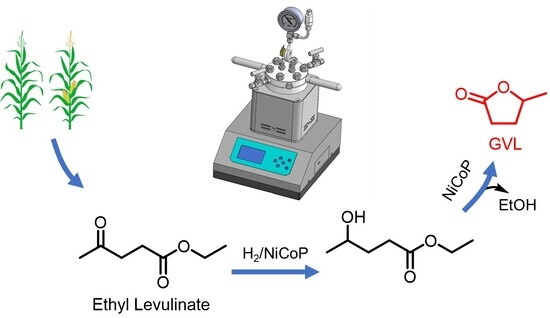
1. Introduction
2. Results and Discussions
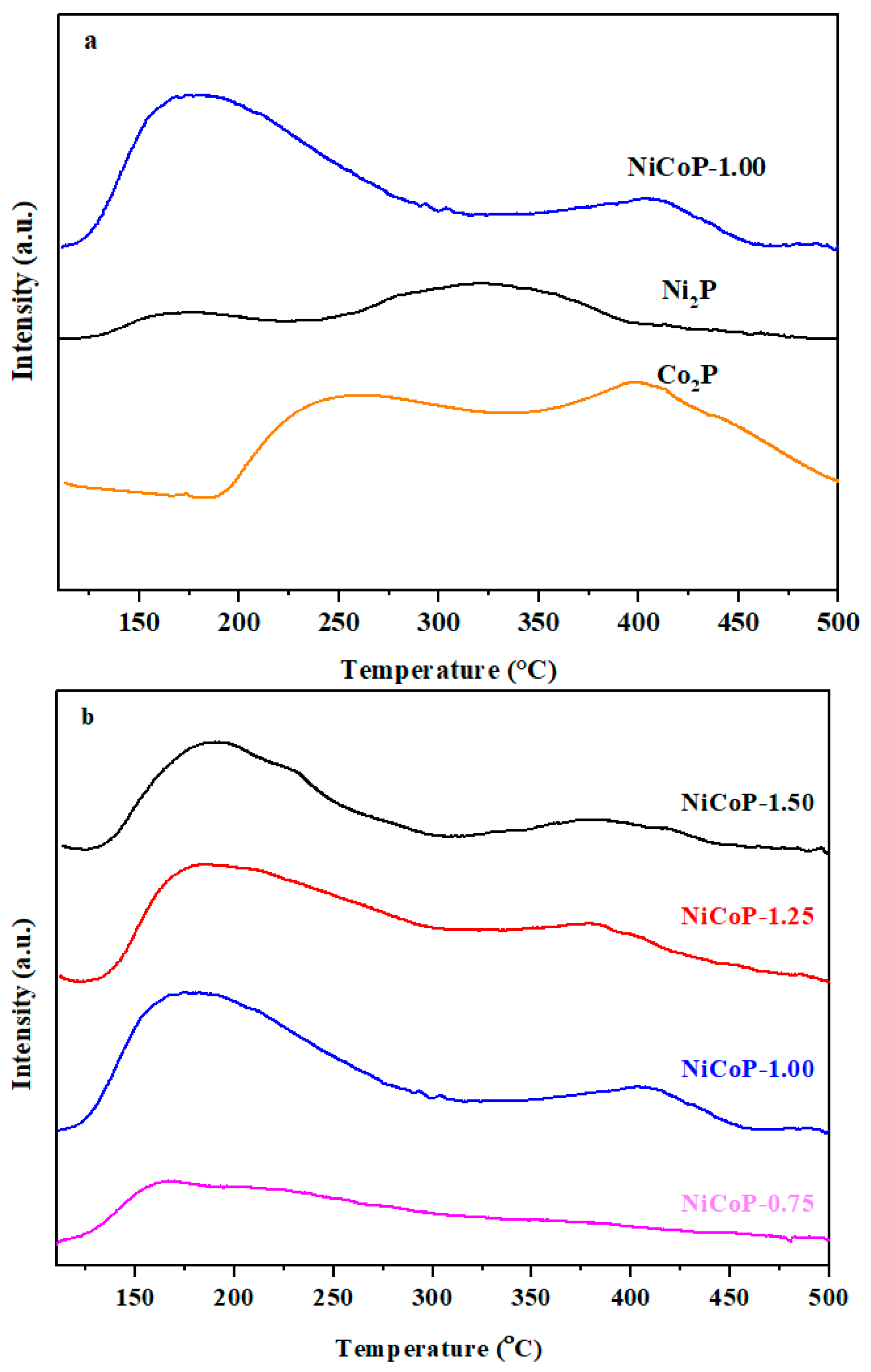
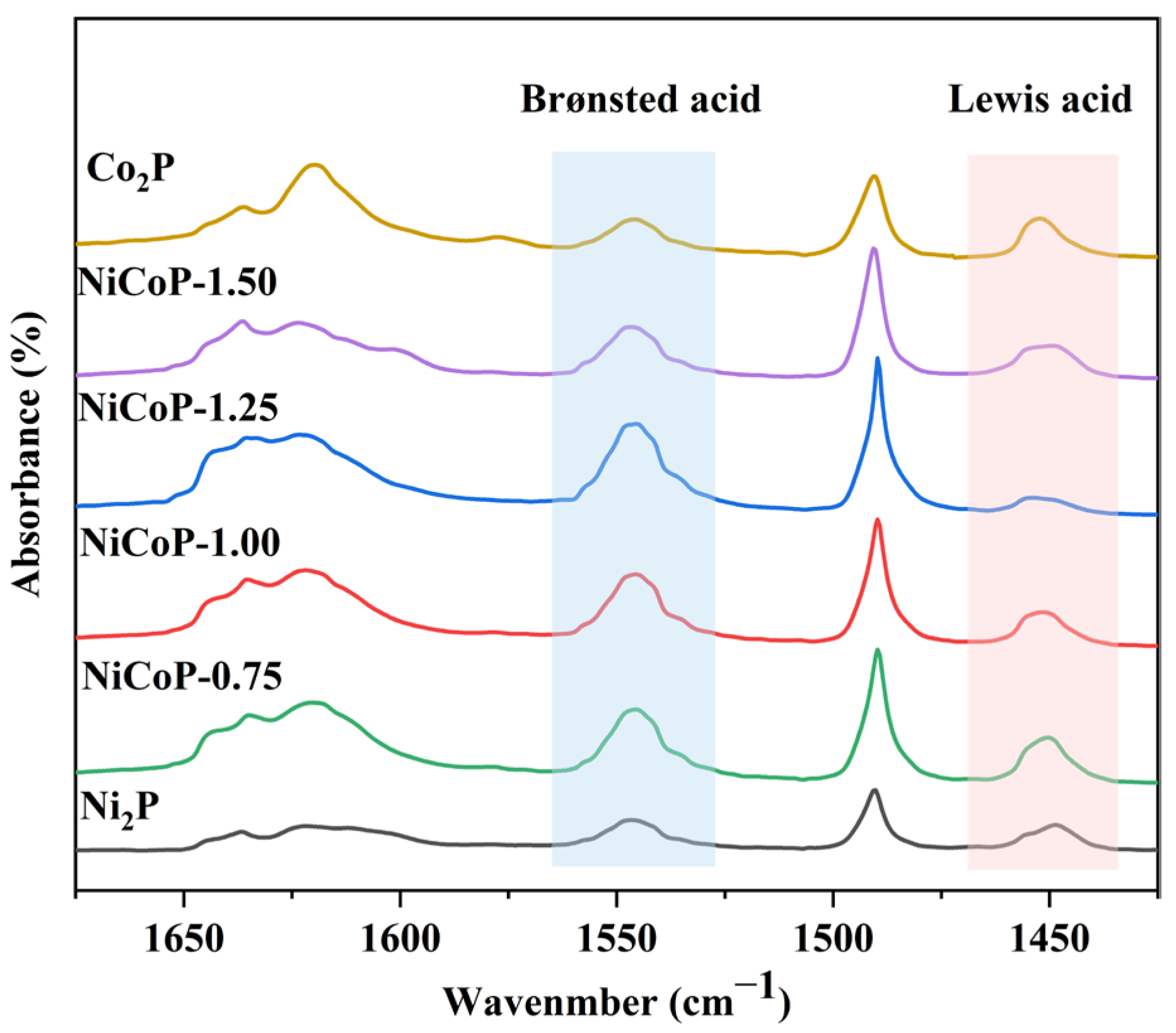
2.1. Catalyst Characterizations
2.2. Catalyst Performance
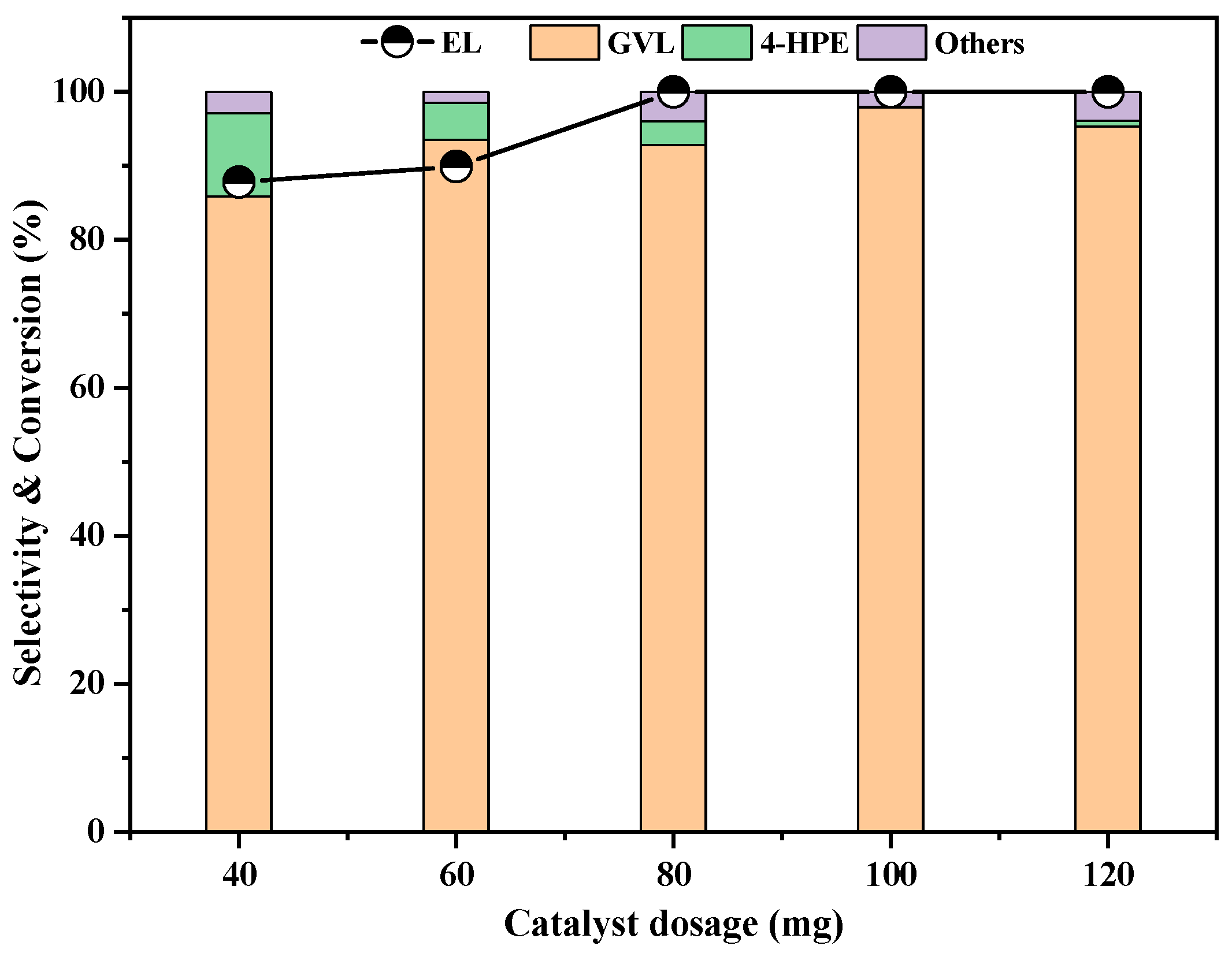
2.3. Effect of Catalyst Dosage
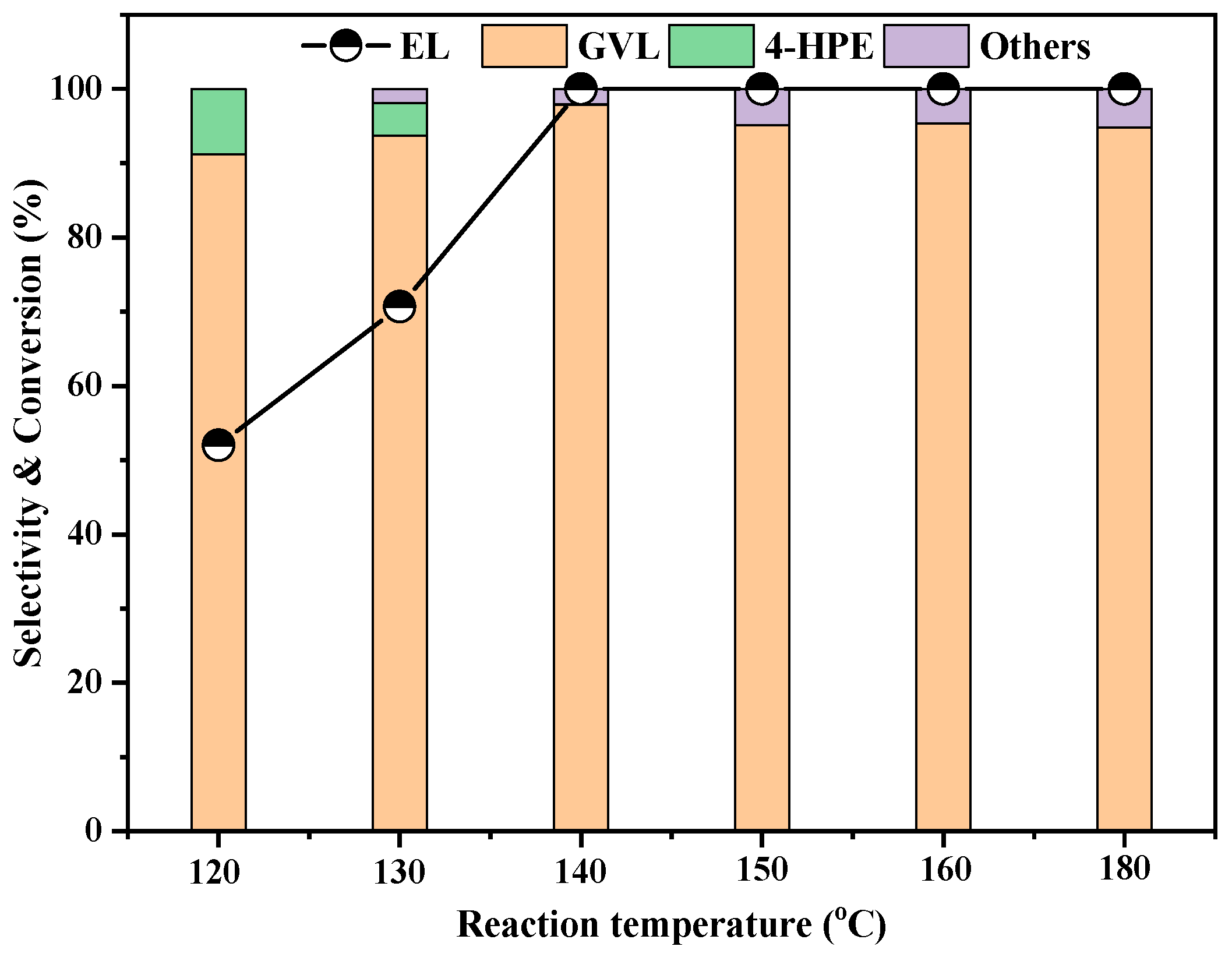
2.4. Effect of Reaction Temperature
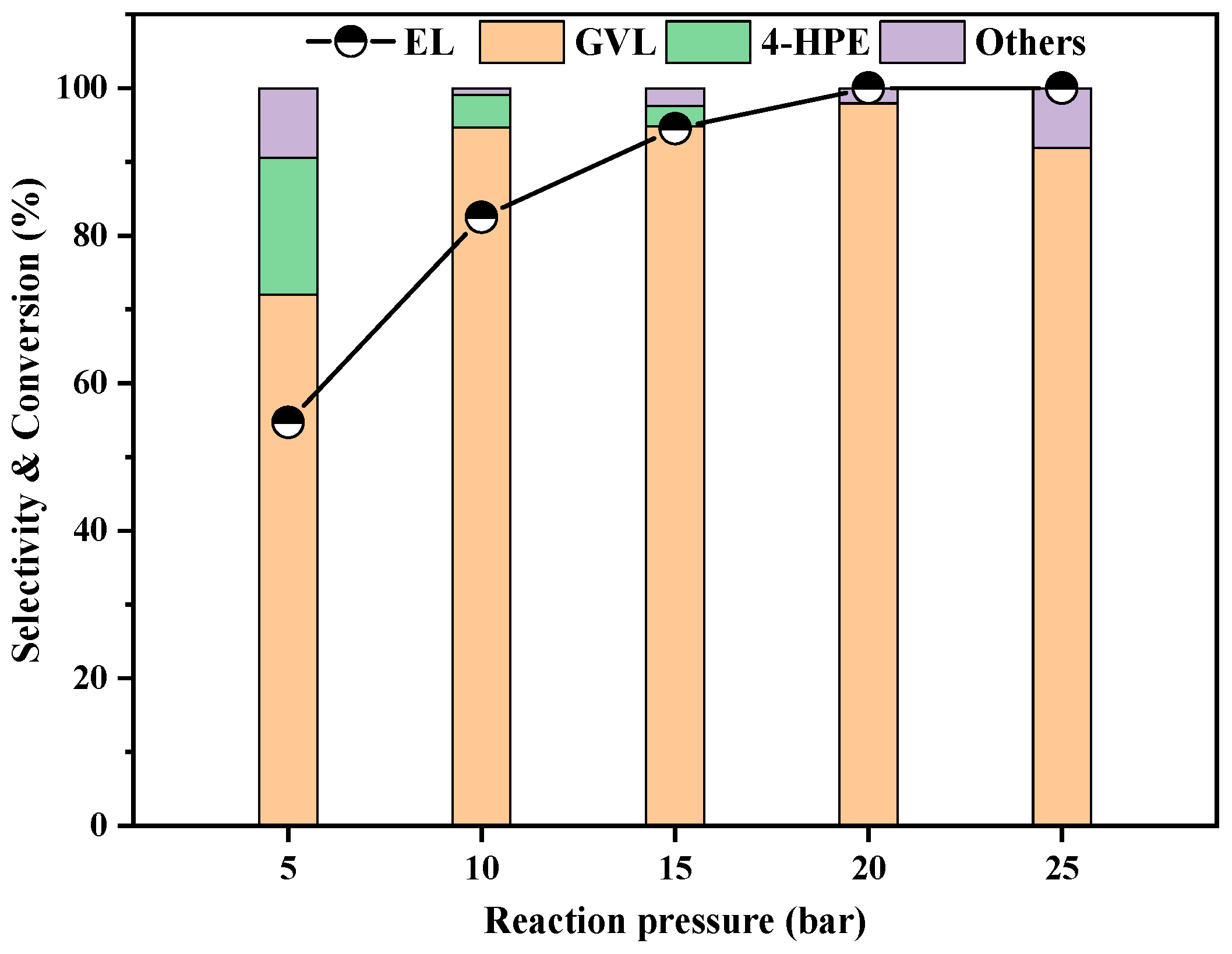
2.5. Effect of H2 Pressure
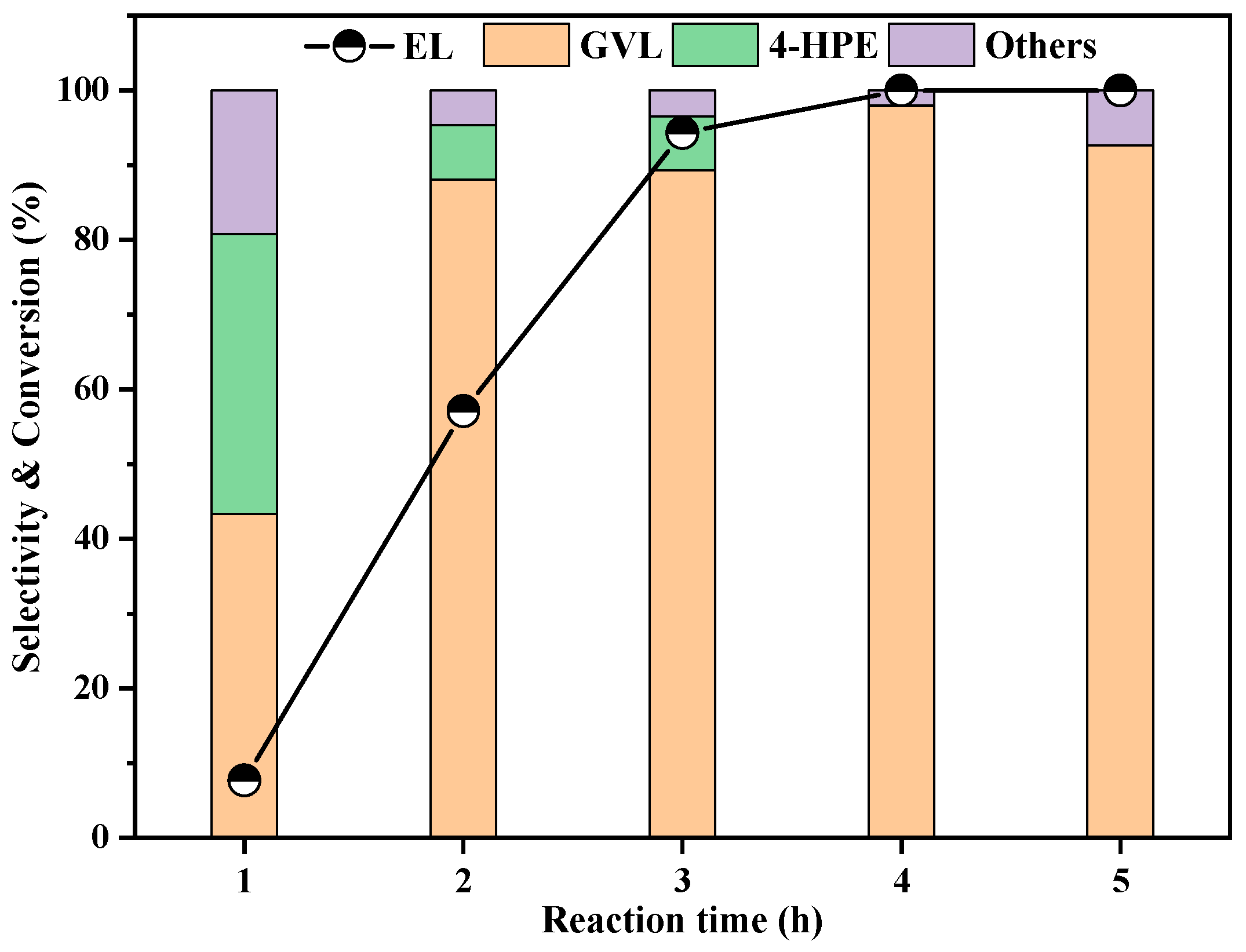
2.6. Effect of Reaction Time
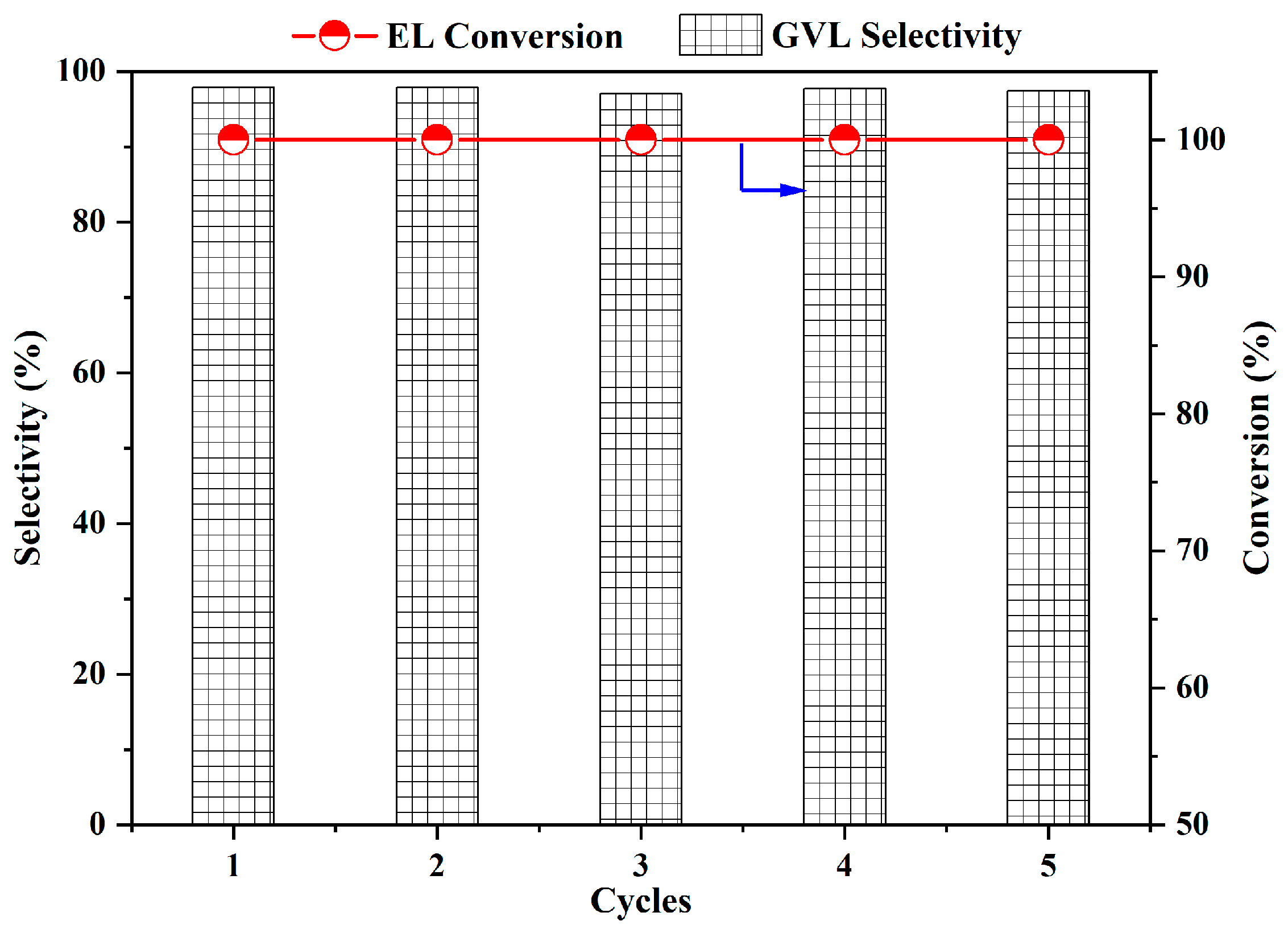
2.7. Reusability of the Catalyst
3. Materials and Methods
3.1. Materials
3.2. Catalyst Preparation
3.3. Catalyst Characterization
3.4. Catalytic Performance of NiCoP for Hydrogenation of EL
4. Conclusions
Supplementary Materials
Author Contributions
Funding
Data Availability Statement
Acknowledgments
Conflicts of Interest
References
- Serrano-Ruiz, J.C.; Dumesic, J.A. Catalytic routes for the conversion of biomass into liquid hydrocarbon transportation fuels. Energy Environ. Sci. 2011, 4, 83–99. [Google Scholar] [CrossRef]
- Van Putten, R.-J.; Van Der Waal, J.C.; De Jong, E.; Rasrendra, C.B.; Heeres, H.J.; de Vries, J.G. Hydroxymethylfurfural, a versatile platform chemical made from renewable resources. Chem. Rev. 2013, 113, 1499–1597. [Google Scholar] [CrossRef]
- Wettstein, S.G.; Alonso, D.M.; Chong, Y.; Dumesic, J.A. Production of levulinic acid and gamma-valerolactone (GVL) from cellulose using GVL as a solvent in biphasic systems. Energy Environ. Sci. 2012, 5, 8199–8203. [Google Scholar] [CrossRef]
- Yan, K.; Yang, Y.; Chai, J.; Lu, Y. Catalytic reactions of gamma-valerolactone: A platform to fuels and value-added chemicals. Appl. Catal. B Environ. 2015, 179, 292–304. [Google Scholar] [CrossRef]
- Wang, J.; Dong, X.; Fan, Y.; Wang, Y.; Guo, X. Stable RuIr Nanoalloy Catalyst for Levulinic Acid Hydrogenation Reaction. Molecules 2025, 30, 93. [Google Scholar] [CrossRef]
- Dao, Z.; Wang, Y.; Yang, C.; Pu, S.; Yan, W.; Tian, D.; Min, C.; Zhao, J.; Zhuang, C. Synergistic catalysis of Ru0-Ru3+ in MOF supported ultrafine Ru nanoparticles catalyst promotes ethyl levulinate to γ-valerolactone. Appl. Catal. A Gen. 2024, 677, 119705. [Google Scholar] [CrossRef]
- Yan, K.; Lafleur, T.; Wu, G.; Liao, J.; Ceng, C.; Xie, X. Highly selective production of value-added γ-valerolactone from biomass-derived levulinic acid using the robust Pd nanoparticles. Appl. Catal. A Gen. 2013, 468, 52–58. [Google Scholar] [CrossRef]
- Shan, J.; Chen, Z.; Wang, D.; Zhang, G.; Li, S.; Sun, C.; Wang, D.; Ju, C.; Zhang, X.; Li, L. Boosting γ-valerolactone production from ethyl levulinate hydrogenation over Pd catalyst via alloying with Co and synergistic catalysis with HZSM-5. Appl. Catal. B Environ. 2025, 362, 124769. [Google Scholar] [CrossRef]
- Hsiao, C.-Y.; Chiu, H.-Y.; Lin, T.-Y.; Lin, K.-Y.A. A comparative study on microwave-assisted catalytic transfer hydrogenation of levulinic acid to γ-valerolactone using Ru/C, Pt/C, and Pd/C. Chem. Eng. Commun. 2021, 208, 1511–1522. [Google Scholar] [CrossRef]
- Lü, Z.; Zhu, S.; Dong, M.; Qin, Z.; Fan, W.; Wang, J. Synthesis of γ-Valerolactone through coupling of methyl levulinate hydrogenation with aqueous phase reforming of methanol over Pt/CoxAl catalyst. J. Fuel Chem. Technol. 2024, 52, 1266–1279. [Google Scholar] [CrossRef]
- Chen, B.; Guo, H.; Wan, Z.; Xu, X.; Zhang, H.; Zhao, D.; Chen, X.; Zhang, N. Efficient catalytic hydrogenation of butyl levulinate to γ-valerolactone over a stable and magnetic CuNiCoB amorphous alloy catalyst. Energy Fuels 2018, 32, 5527–5535. [Google Scholar] [CrossRef]
- Kong, X.; Wu, S.; Jin, Y.; Liu, L.; Liu, J. Continuous hydrogenation of ethyl levulinate to γ-valerolactone over Cu-Zn/ZrO2 catalyst with alumina binder. Energy Fuels 2017, 31, 12232–12237. [Google Scholar] [CrossRef]
- Yue, Y.; Zhu, G.; Liu, M.; Zhu, Y.; Ji, W.; Si, X.; Lu, T. Catalytic Conversion of Ethyl Levulinate to γ-Valerolactone Under Mild Conditions over Zr-Beta Acidic Zeolite Prepared by Hydrothermal Method. Catalysts 2024, 14, 924. [Google Scholar] [CrossRef]
- Ding, H.; Yang, C.; Jiang, C.; Luo, W.; Wang, Q.; Guo, X. Ion-Exchange Synthesis of Surrounded CoNi@Al2O3 Catalyst for Levulinic Acid Hydrogenation to γ-Valerolactone under Mild Conditions. Catalysts 2024, 14, 113. [Google Scholar] [CrossRef]
- Christian, R.V., Jr.; Brown, H.D.; Hixon, R. Derivatives of γ-Valerolactone, 1,4-Pentanediol and 1,4-Di-(β-cyanoethoxy)-pentane. J. Am. Chem. Soc. 1947, 69, 1961–1963. [Google Scholar] [CrossRef]
- Yang, Z.; Huang, Y.-B.; Guo, Q.-X.; Fu, Y. RANEY® Ni catalyzed transfer hydrogenation of levulinate esters to γ-valerolactone at room temperature. Chem. Commun. 2013, 49, 5328–5330. [Google Scholar] [CrossRef]
- Mohan, V.; Venkateshwarlu, V.; Pramod, C.V.; Raju, B.D.; Rao, K.S.R. Vapour phase hydrocyclisation of levulinic acid to γ-valerolactone over supported Ni catalysts. Catal. Sci. Technol. 2014, 4, 1253–1259. [Google Scholar] [CrossRef]
- Liu, X.; Li, Z. Efficient transfer hydrogenation of levulinic acid (LA) to γ-valerolactone (GVL) over Ni/NiO-MC (MC= mesoporous carbon). Sustain. Energy Fuels 2021, 5, 3312–3320. [Google Scholar] [CrossRef]
- Shao, Y.; Sun, K.; Fan, M.; Wang, J.; Gao, G.; Zhang, L.; Zhang, S.; Hu, X. Selective conversion of levulinic acid to gamma-valerolactone over Ni-based catalysts: Impacts of catalyst formulation on sintering of nickel. Chem. Eng. Sci. 2022, 248, 117258. [Google Scholar] [CrossRef]
- Li, H.; Fang, Z.; Yang, S. Direct conversion of sugars and ethyl levulinate into γ-valerolactone with superparamagnetic acid-base bifunctional ZrFeOx nanocatalysts. ACS Sustain. Chem. Eng. 2016, 4, 236–246. [Google Scholar] [CrossRef]
- Kondeboina, M.; Enumula, S.S.; Gurram, V.R.B.; Chada, R.R.; Burri, D.R.; Kamaraju, S.R.R. Selective hydrogenation of biomass-derived ethyl levulinate to γ-valerolactone over supported Co catalysts in continuous process at atmospheric pressure. J. Ind. Eng. Chem. 2018, 61, 227–235. [Google Scholar] [CrossRef]
- Zhou, H.; Song, J.; Fan, H.; Zhang, B.; Yang, Y.; Hu, J.; Zhu, Q.; Han, B. Cobalt catalysts: Very efficient for hydrogenation of biomass-derived ethyl levulinate to gamma-valerolactone under mild conditions. Green Chem. 2014, 16, 3870–3875. [Google Scholar] [CrossRef]
- Liu, M.; Li, S.; Fan, G.; Yang, L.; Li, F. Hierarchical flower-like bimetallic NiCu catalysts for catalytic transfer hydrogenation of ethyl levulinate into γ-valerolactone. Ind. Eng. Chem. Res. 2019, 58, 10317–10327. [Google Scholar] [CrossRef]
- Oyama, S.T.; Gott, T.; Zhao, H.; Lee, Y.-K. Transition metal phosphide hydroprocessing catalysts: A review. Catal. Today 2009, 143, 94–107. [Google Scholar] [CrossRef]
- Pei, Y.; Cheng, Y.; Chen, J.; Smith, W.; Dong, P.; Ajayan, P.M.; Ye, M.; Shen, J. Recent developments of transition metal phosphides as catalysts in the energy conversion field. J. Mater. Chem. A 2018, 6, 23220–23243. [Google Scholar] [CrossRef]
- Wang, Y.; Liu, F.; Han, H.; Xiao, L.; Wu, W. Metal Phosphide: A Highly Efficient Catalyst for the Selective Hydrodeoxygenation of Furfural to 2-Methylfuran. ChemistrySelect 2018, 3, 7926–7933. [Google Scholar] [CrossRef]
- Wang, Y.; Nuzhdin, A.L.; Shamanaev, I.V.; Bukhtiyarova, G.A. Flow synthesis of N-alkyl-5-methyl-2-pyrrolidones over Ni2P/SiO2 catalyst. Mol. Catal. 2021, 515, 111884. [Google Scholar] [CrossRef]
- Topalian, P.J.; Liyanage, D.R.; Danforth, S.J.; d’Aquino, A.I.; Brock, S.L.; Bussell, M.E. Effect of particle size on the deep HDS properties of Ni2P catalysts. J. Phys. Chem. C 2019, 123, 25701–25711. [Google Scholar] [CrossRef]
- Tian, Y.; Wang, Y.; Zhang, H.; Xiao, L.; Wu, W. Novel C@Ni3P Nanoparticles for Highly Selective Hydrogenation of Furfural to Furfuryl Alcohol. Catal. Lett. 2021, 152, 883–894. [Google Scholar] [CrossRef]
- Wang, Y.; Nuzhdin, A.L.; Shamanaev, I.V.; Kodenev, E.G.; Gerasimov, E.Y.; Bukhtiyarova, M.V.; Bukhtiyarova, G.A. Effect of Phosphorus Precursor, Reduction Temperature, and Support on the Catalytic Properties of Nickel Phosphide Catalysts in Continuous-Flow Reductive Amination of Ethyl Levulinate. Int. J. Mol. Sci. 2022, 23, 1106. [Google Scholar] [CrossRef]
- Burns, A.W.; Gaudette, A.F.; Bussell, M.E. Hydrodesulfurization properties of cobalt–nickel phosphide catalysts: Ni-rich materials are highly active. J. Catal. 2008, 260, 262–269. [Google Scholar] [CrossRef]
- Fang, M.; Tang, W.; Yu, C.; Xia, L.; Xia, Z.; Wang, Q.; Luo, Z. Performance of Ni-rich bimetallic phosphides on simultaneous quinoline hydrodenitrogenation and dibenzothiophene hydrodesulfurization. Fuel Process. Technol. 2015, 129, 236–244. [Google Scholar] [CrossRef]
- Bao, T.; Song, L.; Zhang, S. Synthesis of carbon quantum dot-doped NiCoP and enhanced electrocatalytic hydrogen evolution ability and mechanism. Chem. Eng. J. 2018, 351, 189–194. [Google Scholar] [CrossRef]
- Pan, Z.; Wang, R.; Nie, Z.; Chen, J. Effect of a second metal (Co, Fe, Mo and W) on performance of Ni2P/SiO2 for hydrodeoxygenation of methyl laurate. J. Energy Chem. 2016, 25, 418–426. [Google Scholar] [CrossRef]
- Movick, W.J.; Yun, G.-N.; Vargheese, V.; Bando, K.K.; Kikuchi, R.; Oyama, S.T. Hydrodeoxygenation of benzofuran on novel CoPdP catalysts supported on potassium ion exchanged ultra-stable Y-zeolites. J. Catal. 2021, 403, 160–172. [Google Scholar] [CrossRef]
- Chouki, T.; Machreki, M.; Emin, S. Solvothermal synthesis of iron phosphides and their application for efficient electrocatalytic hydrogen evolution. Int. J. Hydrogen Energy 2020, 45, 21473–21482. [Google Scholar] [CrossRef]
- Huo, D.; Song, F.; Hu, J.; Yuan, J.; Niu, L.; Wang, A.-J. One-step synthesis of carbon-encapsulated nickel phosphide nanoparticles with efficient bifunctional catalysis on oxygen evolution and reduction. Int. J. Hydrogen Energy 2021, 46, 8519–8530. [Google Scholar] [CrossRef]
- Chen, L.; Ren, J.-T.; Yuan, Z.-Y. Interface engineering for boosting electrocatalytic performance of CoP-Co2P polymorphs for all-pH hydrogen evolution reaction and alkaline overall water splitting. Sci. China Mater. 2022, 65, 2433–2444. [Google Scholar] [CrossRef]
- Tang, X.; Gao, S.; Zhang, D.; Xia, X.; Wang, J.; She, W.; Yang, B.; Meng, X.; Wang, K.; Han, Z. One-step solid-state synthesis of NixPy@C nanocomposites for high-performance hybrid supercapacitor. J. Alloys Compd. 2022, 923, 166289. [Google Scholar] [CrossRef]
- Kang, Y.; Du, H.; Jiang, B.; Li, H.; Guo, Y.; Amin, M.A.; Sugahara, Y.; Asahi, T.; Li, H.; Yamauchi, Y. Microwave one-pot synthesis of CNT-supported amorphous Ni–P alloy nanoparticles with enhanced hydrogenation performance. J. Mater. Chem. A 2022, 10, 6560–6568. [Google Scholar] [CrossRef]
- Sun, L.; Xiang, X.; Wu, J.; Cai, C.; Ao, D.; Luo, J.; Tian, C.; Zu, X. Bi-Metal Phosphide NiCoP: An Enhanced Catalyst for the Reduction of 4-Nitrophenol. Nanomaterials 2019, 9, 112. [Google Scholar] [CrossRef] [PubMed]
- Ding, L.; Shu, Y.; Wang, A.; Zheng, M.; Li, L.; Wang, X.; Zhang, T. Preparation and catalytic performances of ternary phosphides NiCoP for hydrazine decomposition. Appl. Catal. A Gen. 2010, 385, 232–237. [Google Scholar] [CrossRef]
- Cai, Z.; Wu, A.; Yan, H.; Xiao, Y.; Chen, C.; Tian, C.; Wang, L.; Wang, R.; Fu, H. Hierarchical whisker-on-sheet NiCoP with adjustable surface structure for efficient hydrogen evolution reaction. Nanoscale 2018, 10, 7619–7629. [Google Scholar] [CrossRef]
- Li, K.; Wang, R.; Chen, J. Hydrodeoxygenation of Anisole over Silica-Supported Ni2P, MoP, and NiMoP Catalysts. Energy Fuels 2011, 25, 854–863. [Google Scholar] [CrossRef]
- Schmidt, F.; Hoffmann, C.; Giordanino, F.; Bordiga, S.; Simon, P.; Carrillo-Cabrera, W.; Kaskel, S. Coke location in microporous and hierarchical ZSM-5 and the impact on the MTH reaction. J. Catal. 2013, 307, 238–245. [Google Scholar] [CrossRef]
- Lee, Y.K.; Oyama, S.T. Bifunctional nature of a SiO2-supported Ni2P catalyst for hydrotreating: EXAFS and FTIR studies. J. Catal. 2006, 239, 376–389. [Google Scholar] [CrossRef]
- Wang, Y.; Chen, M.; Zhang, K.; Wu, H.; Wang, J.; Cheng, Y.; Wei, Z. CoNi alloy nanoparticles confined in N-doped porous carbon as an efficient and versatile catalyst for reductive amination of levulinic acid/esters to N-substituted pyrrolidones. ACS Catal. 2023, 13, 12601–12616. [Google Scholar] [CrossRef]
- Li, F.; France, L.J.; Cai, Z.; Li, Y.; Liu, S.; Lou, H.; Long, J.; Li, X. Catalytic transfer hydrogenation of butyl levulinate to γ-valerolactone over zirconium phosphates with adjustable Lewis and Brønsted acid sites. Appl. Catal. B Environ. 2017, 214, 67–77. [Google Scholar] [CrossRef]
- Yun, G.-N.; Takagaki, A.; Kikuchi, R.; Oyama, S.T. Hydrodeoxygenation of gamma-valerolactone on transition metal phosphide catalysts. Catal. Sci. Technol. 2017, 7, 281–292. [Google Scholar] [CrossRef]
- Ye, F.; Zhang, D.; Xue, T.; Wang, Y.; Guan, Y. Enhanced hydrogenation of ethyl levulinate by Pd-AC doped with Nb2O5. Green Chem. 2014, 16, 3951–3957. [Google Scholar] [CrossRef]
- Gilkey, M.J.; Xu, B. Heterogeneous catalytic transfer hydrogenation as an effective pathway in biomass upgrading. ACS Catal. 2016, 6, 1420–1436. [Google Scholar] [CrossRef]
- Zuo, H.; Liu, Q.; Wang, T.; Ma, L.; Zhang, Q.; Zhang, Q. Hydrodeoxygenation of methyl palmitate over supported Ni catalysts for diesel-like fuel production. Energy Fuels 2012, 26, 3747–3755. [Google Scholar] [CrossRef]
- Chen, J.; Shi, H.; Li, L.; Li, K. Deoxygenation of methyl laurate as a model compound to hydrocarbons on transition metal phosphide catalysts. Appl. Catal. B Environ. 2014, 144, 870–884. [Google Scholar] [CrossRef]
- Chen, C.-B.; Chen, M.-Y.; Zada, B.; Ma, Y.-J.; Yan, L.; Xu, Q.; Li, W.-Z.; Guo, Q.-X.; Fu, Y. Effective conversion of biomass-derived ethyl levulinate into γ-valerolactone over commercial zeolite supported Pt catalysts. RSC Adv. 2016, 6, 112477–112485. [Google Scholar] [CrossRef]
- Yan, K.; Lafleur, T.; Jarvis, C.; Wu, G. Clean and selective production of γ-valerolactone from biomass-derived levulinic acid catalyzed by recyclable Pd nanoparticle catalyst. J. Clean. Prod. 2014, 72, 230–232. [Google Scholar] [CrossRef]
- Yan, K.; Chen, A. Selective hydrogenation of furfural and levulinic acid to biofuels on the ecofriendly Cu-Fe catalyst. Fuel 2014, 115, 101–108. [Google Scholar] [CrossRef]
- Li, J.-F.; Zhao, L.; Li, J.; Li, M.; Liu, C.-L.; Yang, R.-Z.; Dong, W.-S. Highly selective synthesis of γ-valerolactone from levulinic acid at mild conditions catalyzed by boron oxide doped Cu/ZrO2 catalysts. Appl. Catal. A Gen. 2019, 587, 117244. [Google Scholar] [CrossRef]
- Li, C.; Xu, G.; Zhai, Y.; Liu, X.; Ma, Y.; Zhang, Y. Hydrogenation of biomass-derived ethyl levulinate into γ-valerolactone by activated carbon supported bimetallic Ni and Fe catalysts. Fuel 2017, 203, 23–31. [Google Scholar] [CrossRef]
- Hengst, K.; Schubert, M.; Carvalho, H.W.; Lu, C.; Kleist, W.; Grunwaldt, J.-D. Synthesis of γ-valerolactone by hydrogenation of levulinic acid over supported nickel catalysts. Appl. Catal. A Gen. 2015, 502, 18–26. [Google Scholar] [CrossRef]
- Pinto, B.P.; Fortuna, A.L.L.; Cardoso, C.P.; Mota, C.J. Hydrogenation of levulinic acid (LA) to γ-valerolactone (GVL) over Ni-Mo/C catalysts and water-soluble solvent systems. Catal. Lett. 2017, 147, 751–757. [Google Scholar] [CrossRef]
- Zhao, H.; Hao, J.; Ban, Y.; Sha, Y.; Zhou, H.; Liu, Q. Novel and efficient cobalt catalysts synthesized by one-step solution phase reduction for the conversion of biomass derived ethyl levulinate. Catal. Today 2019, 319, 145–154. [Google Scholar] [CrossRef]
- Li, Y.; Liu, B.; Wang, Y.; Wang, S.; Lan, X.; Wang, T. High-Performance Ni3P Catalyst for C=O Hydrogenation of Ethyl Levulinate: Niδ+ as Outstanding Adsorption Sites. ACS Catal. 2022, 12, 7926–7935. [Google Scholar] [CrossRef]
- Li, Y.; Lyu, K.; Liu, D.; Lan, X.; Wang, T. Metal-modified Ni phosphides: Highly efficient catalysts for the hydrogenation of ethyl levulinate. Catal. Today 2024, 442, 114938. [Google Scholar] [CrossRef]
- Zheng, J.; Zhu, J.; Xu, X.; Wang, W.; Li, J.; Zhao, Y.; Tang, K.; Song, Q.; Qi, X.; Kong, D. Continuous hydrogenation of ethyl levulinate to γ-valerolactone and 2-methyltetrahydrofuran over alumina doped Cu/SiO2 catalyst: The potential of commercialization. Sci. Rep. 2016, 6, 28898. [Google Scholar] [CrossRef] [PubMed]
- Wang, Y.; Feng, X.; Yang, S.; Xiao, L.; Wu, W. Influence of acidity on the catalytic performance of Ni2P in liquid-phase hydrodeoxygenation of furfural to 2-methylfuran. J. Nanopart. Res. 2020, 22, 67. [Google Scholar] [CrossRef]



| Entry | Samples | Peak Temperature a (°C) | Density of Acid Sites (μmol·g−1) | |||
|---|---|---|---|---|---|---|
| L.T. | L.T. | Brønsted b | Lewis b | Total b | ||
| 1 | Ni2P | 174 | 322 | 25 | 20 | 48 |
| 2 | NiCoP-0.75 | 166 | 348 | 235 | 56 | 291 |
| 3 | NiCoP-1.00 | 179 | 401 | 259 | 20 | 279 |
| 4 | NiCoP-1.25 | 186 | 377 | 134 | 53 | 187 |
| 5 | NiCoP-1.50 | 194 | 377 | 94 | 54 | 148 |
| 6 | Co2P | 256 | 398 | 93 | 21 | 114 |
| Entry | Catalyst | Conversion/% | Selectivity/% | |||
|---|---|---|---|---|---|---|
| GVL | 4-HPE | 2-MeTHF | Others b | |||
| 1 | Ni2P | 11.4 | 60.7 | 5.9 | 0 | 33.4 |
| 2 | Co2P | 75.1 | 89.8 | 2.3 | 2 | 5.9 |
| 3 | NiCoP-0.75 | 100 | 93.7 | 4.0 | 0 | 6.3 |
| 4 | NiCoP-1.00 | 100 | 97.9 | 0.1 | 0 | 2.0 |
| 5 | NiCoP-1.25 | 100 | 92.8 | 4.2 | 0 | 3 |
| 6 | NiCoP-1.50 | 100 | 90.2 | 2.0 | 1.2 | 6.6 |
| Catalysts | Reaction Conditions | Conversion (Substrate) % | Selectivity of GVL % | Ref. |
|---|---|---|---|---|
| 1% Pt/ZSM-35 | 200 °C, 60 bar H2, 6 h, EtOH | 100 (EL) | 99.0 | [54] |
| 5 wt% Pd/MCM-41 | 240 °C, 60 bar H2, 10 h, H2O | >99 (LA a) | 97.3 | [55] |
| Cu-Fe | 220 °C, 70 bar H2, 14 h, H2O | 98.7 (LA) | 91.3 | [56] |
| Cu/ZrO2 | 200 °C, 34 bar H2, 5 h, H2O | 100 (LA) | 99.9 | [57] |
| Cu0.5Ni1Co3B | 200 °C, 30 bar H2, 3 h, cyclohexane | 99.7 (BL b) | 89.8 | [11] |
| Ni-Fe/AC | 100 °C, 40 bar H2, 6 h, H2O | 99.3 (EL) | 99.7 | [58] |
| Co0.52Ni0.48@Al2O3 | 130 °C, 20 bar H2, 4 h, 2-PrOH | 100 (LA) | 99.9 | [14] |
| 3% Ni/Al2O3 | 200 °C, 50 bar H2, 4 h, H2O | 100 (LA) | 92 | [59] |
| Ni-Mo/C | 200 °C, 100 bar, 2 h H2, Dioxane | 100 (LA) | 100 | [60] |
| Co(ethanol) | 150 °C, 30 bar H2, 4 h, H2O | 99 (EL) | 92 | [61] |
| 10% Ni-0.38P/Al2O3 | 140 °C, 25 bar H2, 4 h, n-hexane | 99.2 (EL) | 98.4 | [62] |
| 10% Ni-P-Cu/Al2O3 | 140 °C, 25 bar H2, 4 h, n-hexane | 99.3 (EL) | 98.2 | [63] |
| NiCoP-1.00 | 140 °C, 20 bar H2, 4 h, H2O | 100 (EL) | 97.9 | This work |
Disclaimer/Publisher’s Note: The statements, opinions and data contained in all publications are solely those of the individual author(s) and contributor(s) and not of MDPI and/or the editor(s). MDPI and/or the editor(s) disclaim responsibility for any injury to people or property resulting from any ideas, methods, instructions or products referred to in the content. |
© 2026 by the authors. Licensee MDPI, Basel, Switzerland. This article is an open access article distributed under the terms and conditions of the Creative Commons Attribution (CC BY) license.
Share and Cite
Ji, Y.; Wang, S.; Yuan, X.; Bing, Y.; Chen, L.; Lu, X.; Zhao, T.; Xiao, L.; Wang, Y. NiCoP: A Highly Active Catalyst for Hydrogenation of Ethyl Levulinate to γ-Valerolactone in Liquid Phase. Catalysts 2026, 16, 86. https://doi.org/10.3390/catal16010086
Ji Y, Wang S, Yuan X, Bing Y, Chen L, Lu X, Zhao T, Xiao L, Wang Y. NiCoP: A Highly Active Catalyst for Hydrogenation of Ethyl Levulinate to γ-Valerolactone in Liquid Phase. Catalysts. 2026; 16(1):86. https://doi.org/10.3390/catal16010086
Chicago/Turabian StyleJi, Yonggang, Siqi Wang, Xiaolu Yuan, Yan Bing, Li Chen, Xuefeng Lu, Tan Zhao, Linfei Xiao, and Yazhou Wang. 2026. "NiCoP: A Highly Active Catalyst for Hydrogenation of Ethyl Levulinate to γ-Valerolactone in Liquid Phase" Catalysts 16, no. 1: 86. https://doi.org/10.3390/catal16010086
APA StyleJi, Y., Wang, S., Yuan, X., Bing, Y., Chen, L., Lu, X., Zhao, T., Xiao, L., & Wang, Y. (2026). NiCoP: A Highly Active Catalyst for Hydrogenation of Ethyl Levulinate to γ-Valerolactone in Liquid Phase. Catalysts, 16(1), 86. https://doi.org/10.3390/catal16010086