
Article

CO2 Valorization by CH4 Tri-Reforming on Al2O3-Supported NiCo Nanoparticles
by
Daniela Pietrogiacomi
1,2,*,
Chiara Caponera
1,
Michele Leone
1,
Maria Cristina Campa
3,
Mariangela Bellusci
4 and
Francesca Varsano
4
1
Chemistry Department, Sapienza University of Rome, P.le Aldo Moro 5, 00185 Roma, Italy
2
Research Center for Nanotechnologies Applied to Engineering, CNIS Sapienza University of Rome, P.le Aldo Moro 5, 00185 Roma, Italy
3
CNR-ISMN (Institute of Nanostructured Materials), c/o Chemistry Department, Sapienza University of Rome, P.le Aldo Moro 5, 00185 Roma, Italy
4
ENEA (Italian National Agency for New Technologies, Energy and Sustainable Economic Development), C.R. Casaccia, Via Anguillarese 301, 00123 Roma, Italy
*
Author to whom correspondence should be addressed.
Catalysts 2026, 16(1), 62; https://doi.org/10.3390/catal16010062
Submission received: 15 November 2025 / Revised: 20 December 2025 / Accepted: 25 December 2025 / Published: 4 January 2026
(This article belongs to the Special Issue Catalysis Accelerating Energy and Environmental Sustainability)

Abstract

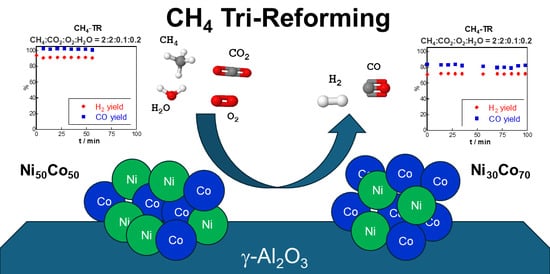
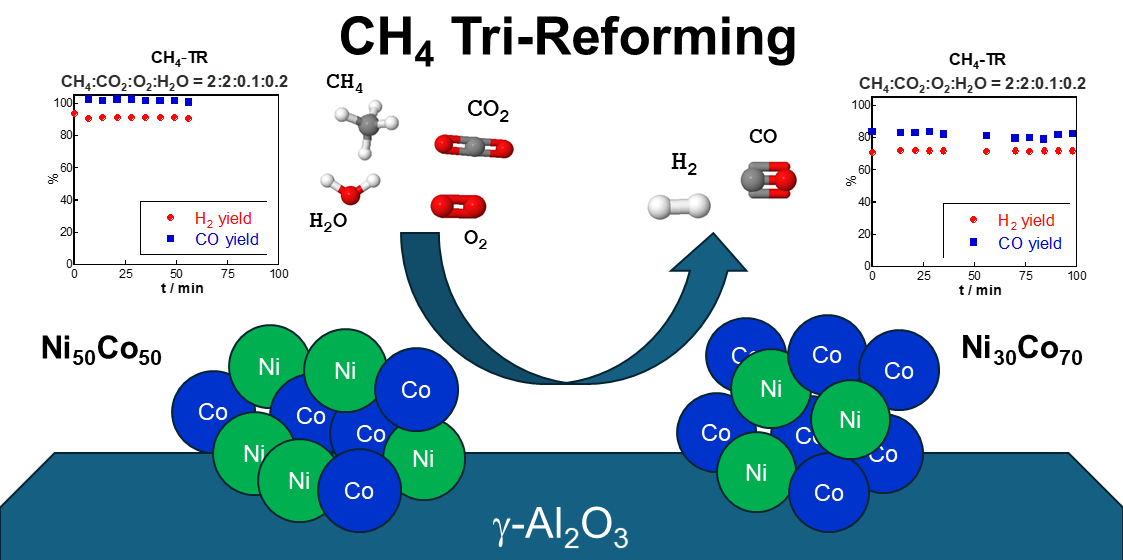
CO2 valorization from real feedstocks through CH4 tri-reforming (CH4-TR), combining steam reforming (SR), dry reforming (DR), and partial oxidation (CPO) of methane in a single process, is a desirable strategy for greenhouse gas mitigation and syngas (CO + H2) production. NiCo/γ−Al2O3 catalysts prepared by impregnation at different relative metal contents (Ni50Co50 and Ni30Co70) were investigated for CH4-TR in a fixed-bed reactor under conventional heating and characterized by XRD, FESEM, and Raman spectroscopy after catalytic runs. This study focused on the role of the Ni/Co ratio and feed composition on selectivity for CO2 valorization, syngas yield, and deactivation resistance. Both the catalysts showed high activity, with a superior performance of Ni50Co50 confirming Ni metal species as the active sites. While in DR, a slow deactivation occurred due to coke deposition, in CH4-TR, the addition of small O2 and/or H2O amounts stabilized activity and selectivity due to surface carbon removal. Large O2 and H2O amounts strongly inhibited CO2 conversion due to competition with CPO and SR, in the order CPO ≥ DR > SR. Interestingly, the stoichiometric CH4-to-oxidants ratio favored the DR pathway, giving very high CO2 conversion. Modulating CH4 addition into real flue mixtures renders CH4-TR on NiCo/γ-Al2O3 catalysts a favorable strategy for effective valorization of CO2 industrial or biomass-derived streams.

Graphical Abstract

1. Introduction

CO2 valorization using real feedstocks, including industrial exhaust gases from power plants and renewable biogas from organic waste, is a desirable approach to mitigate the concentration of this greenhouse gas in the atmosphere, thereby integrating the concepts of carbon emission reduction, reuse, recycling, and the circular economy [1]. Among the catalytic processes for the conversion of CO2 into value-added products, the tri-reforming (TR) of CH4 is expected to contribute significantly to the development of renewable energy carriers such as syngas (CO + H2), accompanied by a reduction in CO2 emissions [2,3].
The tri-reforming process combines, within a single reactor, steam reforming (SR: CH4 + H2O ⟶ 3H2 + CO), dry Reforming (DR: CH4 + CO2 ⟶ 2H2 + 2CO), and catalytic partial oxidation of methane (CPO: CH4 + 1/2O2 ⟶ 2H2 + CO) reactions to produce syngas [4], using gas mixtures containing CO2, H2O, and O2 co-fed with natural gas. Compared with the individual reactions, the integrated CH4-TR process brings some advantages by improving the sustainability of the endothermic CH4 SR and DR reactions due to the CPO exothermicity and by minimizing the catalyst poisoning through the gasifying effects of both O2 and H2O. The possibility of using feeds with various compositions also allows modulation of the H2/CO syngas ratio for specific downstream applications, making this process attractive for the direct utilization of industrial flue gas or biogas, whose composition depends on fuel type or fermentation feedstock [5,6,7].
A number of studies have been devoted to the development and optimization of catalytic systems suitable for methane tri-reforming, which must be thermally stable, resistant to coke deposition, and active for efficient CO2 and CH4 conversion in the presence of steam and oxygen [8,9,10,11,12,13,14,15]. Ni-based catalysts, consisting of Ni metal particles supported on various oxides and their mixed oxides (Al2O3, CeO2, ZrO2, TiO2, MgO, SiO2, and La2O3) with or without addition of promoters (Pt, Rh, Ru, Ir, Au, K, Li, Mg, and Ca), are the most widely studied for the TR process [12,14,15]. However, the main drawbacks of Ni-based catalysts arise from their rapid deactivation due to carbon deposition and sintering of the active metal. The introduction of a second active metal, such as cobalt, has been shown to enhance activity and stability through synergistic effects, alloy formation, and modifications of metal–support interactions [16]. In particular, supported Ni–Co bimetallic catalysts have been extensively studied for the dry reforming, as summarized in several reviews [17,18,19]. Their superior performances compared with Ni or Co monometallic catalysts are primarily attributed to Ni–Co alloy formation, which leads to smaller metal particles, improves oxygen mobility, and facilitates carbon gasification, thereby mitigating deactivation [20]. In supported Ni-Co based catalysts, both the preparation method and the Ni/Co ratio play a significant role in enhancing catalytic activity and stability, by promoting both alloy formation and the reactivity of surface sites in contact with the CH4/CO2 feed. The excellent activity and high resistance to deactivation of Ni–Co catalysts result from the complementary roles of the two metals: Ni efficiently activates CH4, while Co’s strong affinity for oxygen enhances CO2 adsorption, thereby boosting the removal of carbon deposited on adjacent Ni sites [21].
Beyond catalyst development, another key challenge for the industrial-scale application of new processes lies in identifying novel approaches for energy input into the catalytic process that reduce greenhouse gas emissions and the global C footprint. Since CH4-TR operating conditions require high temperatures (700–900 °C) because of reactants’ stability, the heat of the reaction is typically supplied by fuel combustion, which negatively contributes to the overall CO2 balance. Recently, the electrification of catalytic processes using green electricity from renewable sources has emerged as an innovative strategy for energy input into the system using new methodologies, such as direct electrical heating, magnetic induction heating, electro-catalysis, and plasma activation [22]. Among them, magnetic induction heating offers several advantages, such as high energy efficiency, improved reaction rates, reduced heat transfer limitations, and potential for process intensification [23].
Catalysts combining both magnetic and catalytic properties, mainly based on Fe, Ni, and Co metals, have been employed in various syngas production and conversion processes, focusing on the effect of the application of an external magnetic field on the performance of the magnetic materials [24]. Unsupported ferromagnetic Ni–Co alloy nanoparticles have been found effective under magnetic induction heating for both the industrially relevant CH4-SR [25] and the innovative CH4-DR with CO2 [26]. In these systems, Co, acting as a dissipative agent, enables high temperatures (>750 °C) to be reached through interaction with the electromagnetic field, while Ni provides the active sites for reforming reactions. The Co loading and the Ni/Co ratio proved to be critical factors in catalyst design, influencing both catalytic activity and magnetic heating efficiency. Ni–Co alloy nanoparticles supported on γ-Al2O3 (NiCo/γ-Al2O3) proved active under magnetic induction heating for syngas production by the SR [27,28], CPO [15], and CH4 bi-reforming (BR) processes [29], where CO2 and H2O reactants performed the SR and DR reactions concomitantly, resulting in desired CO2 utilization.
In this paper, the supported NiCo/γ-Al2O3 catalysts, previously characterized and proven effective for the SR and BR of CH4 under magnetic induction heating [29], were investigated for the first time for the CH4-TR in a flow reactor under a conventional thermal heating setup. Considering that similar steady-state catalytic performances have been found under thermal and magnetic activation [30], the results presented here can be reasonably extended to magnetically activated TR, expanding their applicability to different operating conditions.
To elucidate the role of the main parameters influencing the selectivity toward CO2 conversion, syngas yield, and resistance to deactivation, the catalytic performances of NiCo/γ-Al2O3 catalysts were studied using CO2, H2O, and O2 co-fed with CH4 at different O2/CO2, H2O/CO2 and CH4/(oxidants) ratios, with particular emphasis on concentrated feeds whose composition mimic those of industrial off-gases or biogas. Indeed, it is well established that for Ni-based catalysts, both activity and stability in the reforming of CH4 strongly depend on feed composition [9], as the presence of O2 and H2O oxidants, while mitigating carbon deposition, decreases CO2 conversion and induces metal sites oxidation with subsequent deactivation. Since alloy surface properties are, in principle, dependent on the alloy composition, the reactivity of NiCo/γ-Al2O3 catalysts with two different Ni/Co ratios (50:50 or 30:70) was compared. The catalyst properties after catalytic tests were characterized by XRD, FESEM, and Raman spectroscopy to assess how the structural and morphological properties of nanoparticles were affected by the reaction conditions.

2. Results and Discussion

2.1. Characterization of NiCo/γ-Al2O3 Catalysts

2.1.1. Fresh Samples

The main features of the fresh samples are summarized hereafter to be compared with those of the samples after catalytic runs (used samples).
The fresh NiCo/γ-Al2O3 samples, Ni50Co50 and Ni30Co70, showed a similar total metal loading (~25 wt%) and a relative metal content (Ni/Co) that closely corresponded to the nominal values in the impregnating solutions (Table 1), suggesting a similar metal-support interaction for Ni2+ and Co2+ species with the γ-Al2O3 support. Both samples had similar surface area and pore volume values (about 140 m2 g−1 and 0.51cm3/g, respectively) but lower than those of the γ-Al2O3 support (250 m2 g−1 and 0.84 cm3/g). This result is consistent with the partial pore occlusion of the support by the metal species (Table 1).
FESEM images of fresh samples showed spherical-like particles distributed over the support surface and fairly uniform in size, although slightly smaller and more homogeneous in the Ni50Co50 sample than in the Ni30Co70 one, the mean and maximum diameters being 37 and 70 nm vs. 42 and 90 nm, respectively (Table 1 and Figure S1).
The XRD patterns of fresh samples exhibited the reflections of the γ-Al2O3 support and of the NiCo metal alloy (fcc phase). The NiCo metal alloy reflections appeared at intermediate 2θ position with respect to those of pure Ni (fcc) [JCPDS 4-850] and Co (fcc) [JCPDS 15-806]. The mean crystallite size (dXRD; Table 1) of both the Ni50Co50 and Ni30Co70 samples, calculated by the Scherrer equation for the (111) reflection, was comparable to the mean particle size obtained by FESEM analysis. It can be concluded that the alloy nanoparticles consist mostly of single crystallites strongly interacting with the support surface and, therefore, are resistant to sintering under high-temperature reduction treatment (900 °C). Additionally, a preferential growth of the alloy crystallites along the (111) direction is evidenced by the higher-than-expected relative intensity of this reflection. These findings suggest the formation of fcc crystallites with a truncated-octahedron geometry, preferentially exposing hexagonal (111) planes [31], consistent with the roughly spherical particles imaged by FESEM. Furthermore, in a magnified image of the fresh Ni30Co70 sample (Figure S1c, inset), the presence of a well-defined particle with a regular-hexagonal shape (of a long diagonal length of 87 nm, corresponding to twice the side length of 43 nm), confirms the hypothesis of a truncated-octahedron geometry.

2.1.2. Used Samples

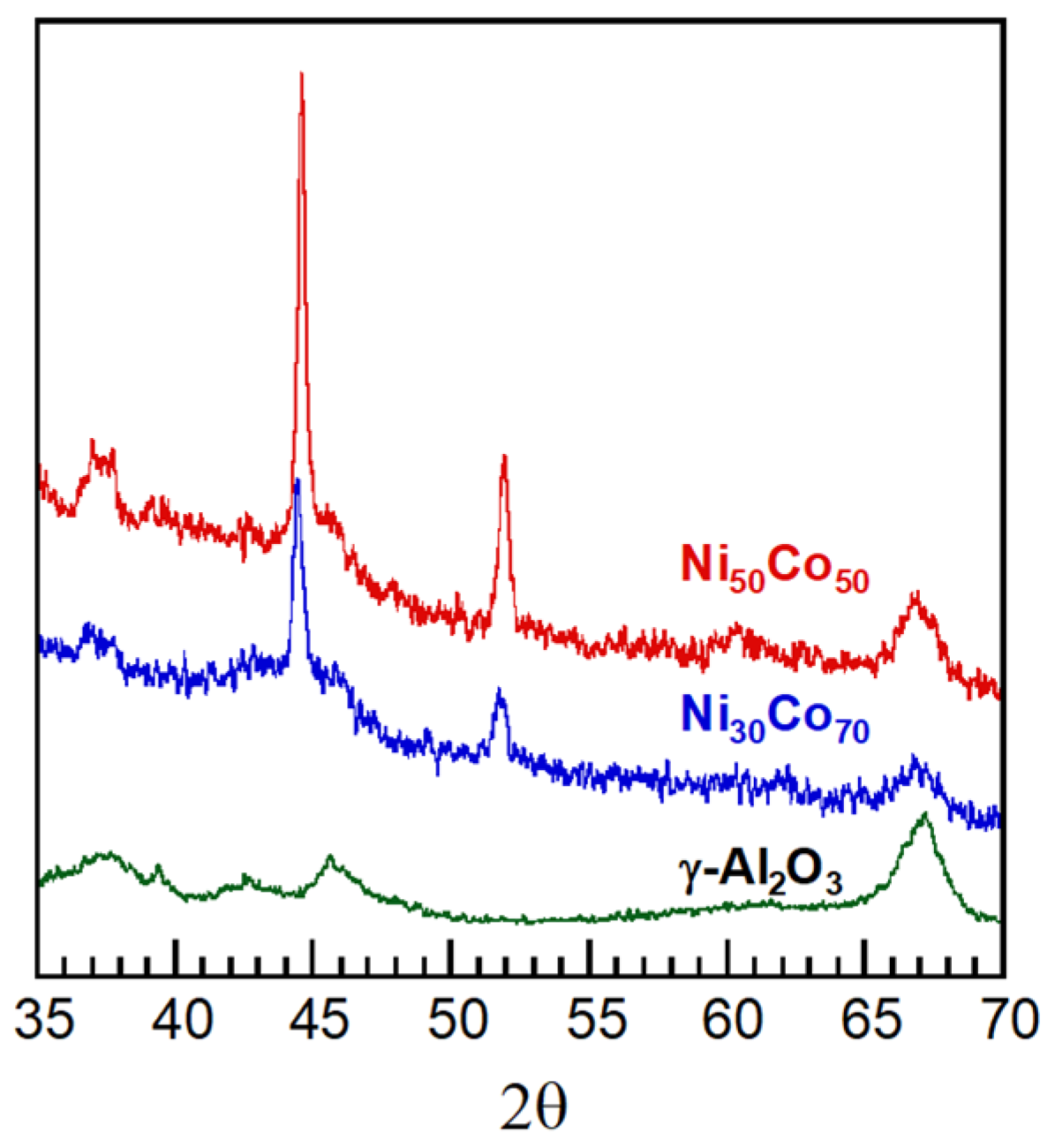
The catalytic reactions (at least 15 catalytic runs) had little influence on the structural features of the samples but somewhat affected their morphological properties. Specifically, the XRD patterns of both used samples correspond to those of the NiCo alloy and the γ-Al2O3 support (Figure 1), indicating, as for the fresh samples [29], the retention of the Ni–Co alloy phase without detectable segregation of pure Ni or Co phases nor the appearance of reaction products of metal with the substrate.
The mean crystallite size, calculated from the (111) reflection (Table 1), was slightly larger for the used Ni50Co50 (37 vs. 30 nm), but smaller for the used Ni30Co70 (26 vs. 40 nm).
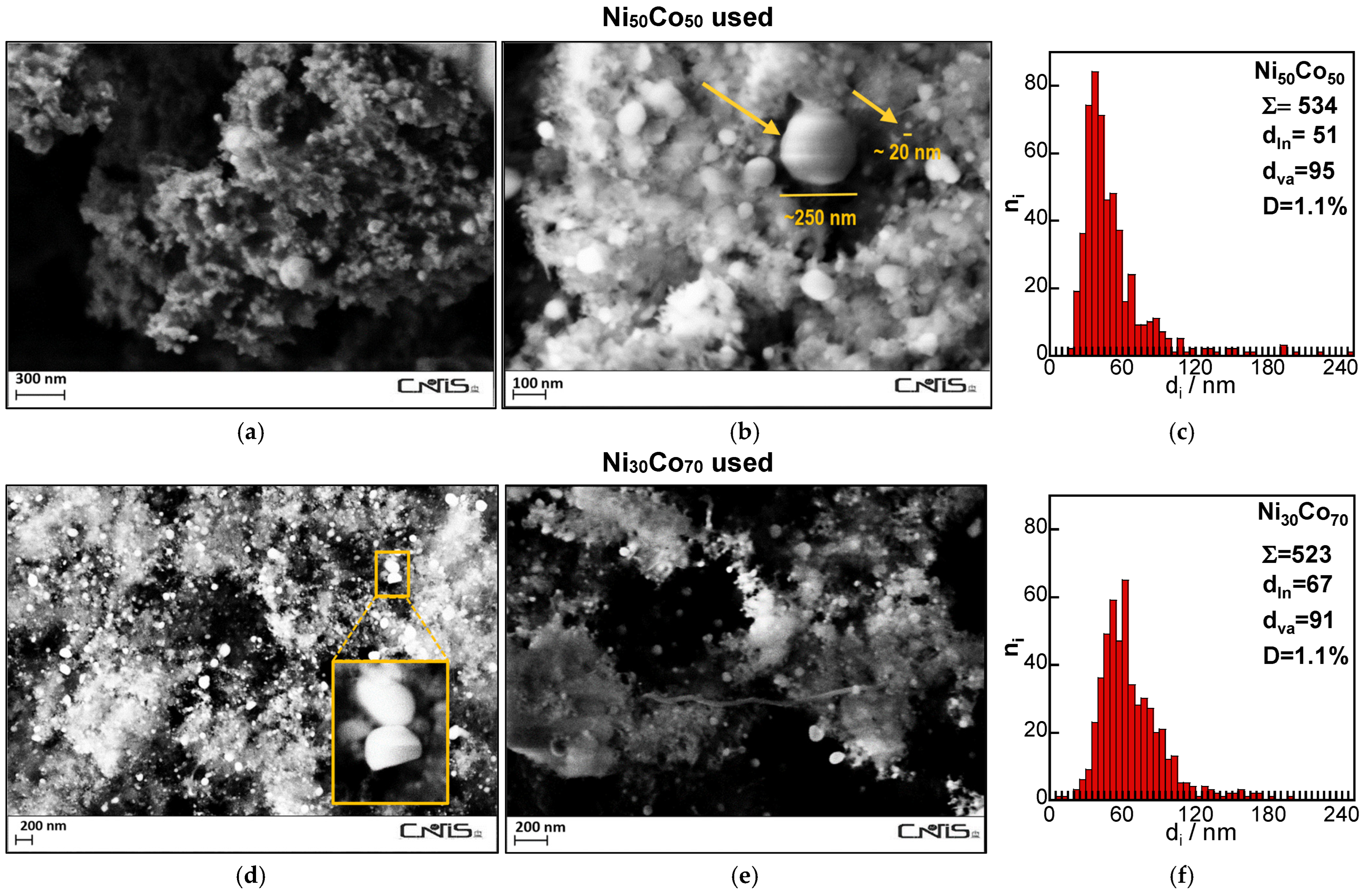
The morphological features observed in the FESEM images of the used Ni50Co50 and Ni30Co70 samples reveal a more heterogeneous particle size distribution compared with the fresh catalysts, with dimensions of up to 250 nm and larger average values (51 nm and 67 nm, respectively). These results indicate particle aggregation, which is more pronounced in Ni30Co70 than in Ni50Co50 (Figure 2 and Table 1), although both samples exhibit similar metal dispersion (D = 1.1%).
For the larger nanoparticles (Figure S2), EDX elemental analysis confirmed the mixed composition of the alloy, indicating that the aggregation of small particles does not lead to significant segregation of pure monometallic oxides under the catalytic conditions.
The larger increase in particle size observed by FESEM compared with the small variation in crystallite size determined by XRD analysis indicates that particle growth occurs through a coalescence process rather than via the Ostwald ripening mechanism. Since both the Ni30Co70 and Ni50Co50 catalysts did not suffer from significant particle growth after steam- or bi-reforming in rich CH4 + H2O or CH4 + CO2 + H2O feeds at temperatures of up to 800 °C [29], the more significant sintering observed in the used samples can be ascribed to the presence of O2 in the reactant mixture. Accordingly, it has been reported that molecular oxygen at elevated temperatures can bind to surface defects, attenuating particle–support interactions and thereby promoting particle mobility and coalescence [32]. However, since our catalysts were subjected to several oxidative–reductive activation treatments, the effect of these treatments on particle coalescence cannot be ruled out.
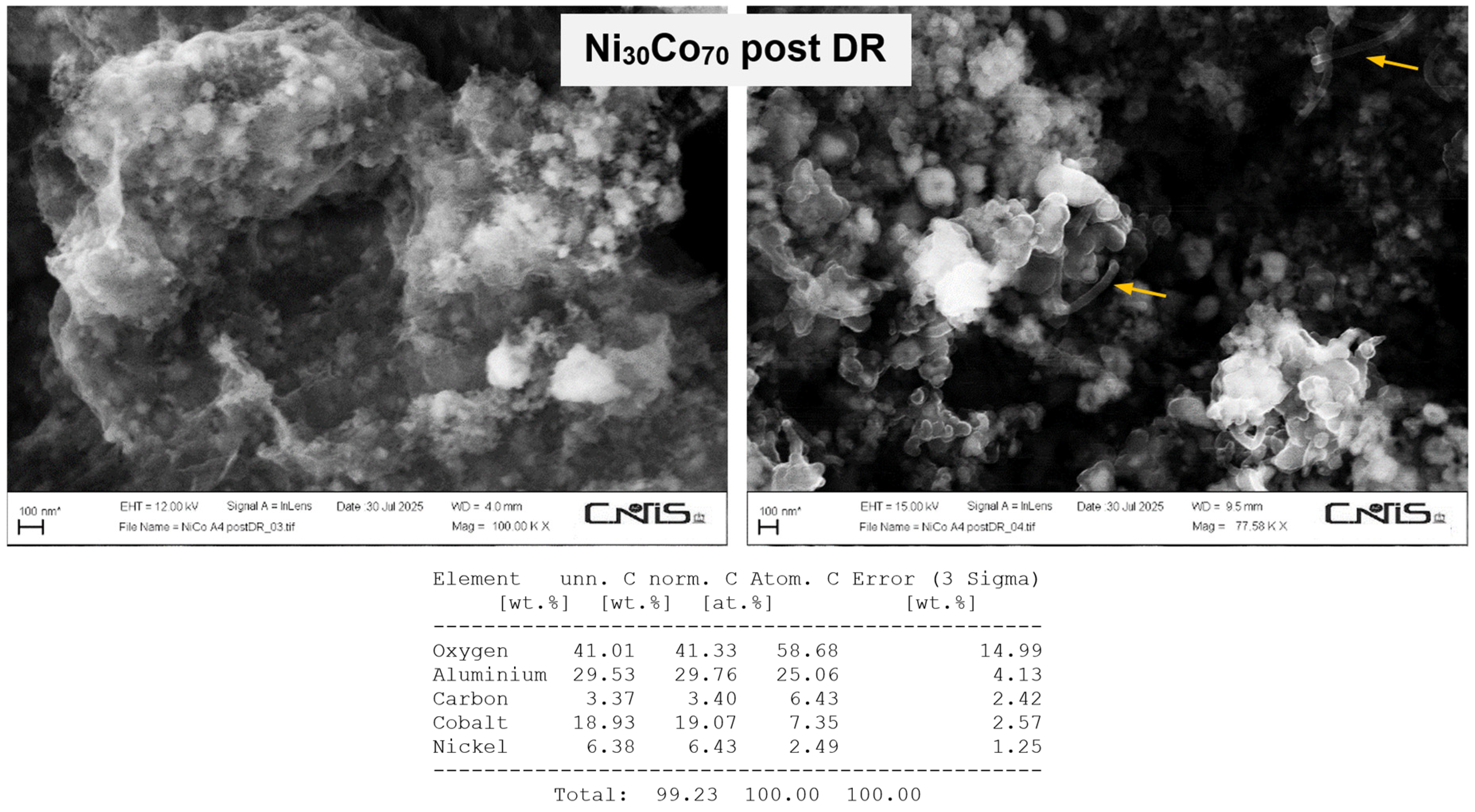
The oxidative–reductive activation treatments were sufficient to restore the catalyst activity when the specific catalytic run led to carbon deposition. In fact, for the Ni30Co70 catalysts inspected at an intermediate state of aging after the dry reforming at 750 °C (Section 2.2), for which a slow deactivation was observed (see Section 3.2), FESEM images revealed the presence of small carbon nanotubes and of a thin shading masking the particles, probably consisting of carbonaceous species (Figure 3). However, the amount of carbon-containing species was limited, as suggested by the EDX analysis and by the modest extent of catalyst deactivation.

2.1.3. Raman Characterization

Further insight into the structural properties of the fresh and used catalysts was obtained using Raman spectroscopy. Its high sensitivity to intermediate-range order without long-range periodicity makes Raman spectroscopy complementary to XRD analysis, which discloses only long-range ordered entities, thus providing a detailed picture of local structures.
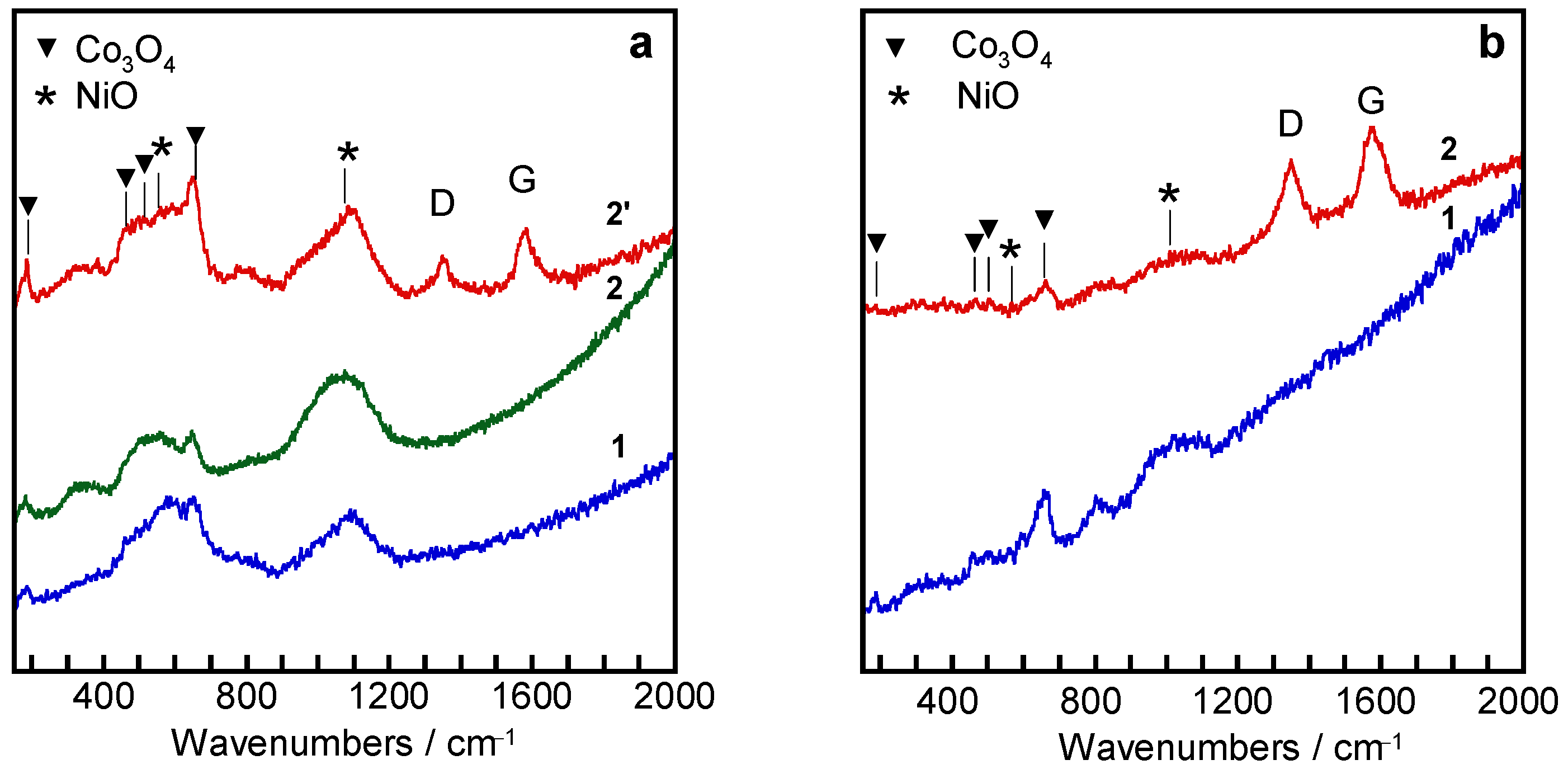
In both the fresh Ni50Co50 and Ni30Co70 samples (Figure 4a,b, curves 1), Raman spectra analysis of the several broad bands detected in the range of 150–1200 cm−1 disclosed the presence of Co3O4- and NiO-like structures. The Raman bands located at about 185, 465, 510, and 670 cm–1 are in agreement with those expected for the most intense vibrational modes of the Co3O4 spinel structure [33]. The band broadening and the apparent shift to lower wavenumbers are attributed to the decrease in particle size and to surface defects. The pronounced and broad band at about 1080 cm−1 (2LO mode) identifies the presence of nanosized NiO [34], whose vibrational modes in the range of 200–750 cm−1 [34,35] are obscured by those of Co3O4.
The Raman detection of oxidic phases in the metal alloy-based samples, due to some surface oxidation under air exposure, suggests the formation of a slightly non-homogeneous alloy, with oxidic clusters having a size below the XRD detection limit (about 4 nm).
For the used catalysts (Figure 4a,b), Raman spectroscopy, in addition to the vibrational modes of Co3O4- and NiO-like structures (150–1200 cm−1), clearly revealed carbonaceous deposits identified by G and D bands in the range of 1200–2000 cm−1. The G band at about 1580 cm−1 (“graphite band”) is characteristic of a perfect graphite lattice, whereas the D band at about 1370 cm−1 (“defect band”) is related to a defective graphitic lattice. The relative D/G band intensity ratio is indicative of the degree of structural disorder of the carbon deposits [36]. A high D/G ratio indicates a large amount of graphitic edges and defects and/or a high degree of amorphization, typical of relatively small carbon deposits compared with a low D/G ratio. For the used Ni50Co50 sample (Figure 4a, curves 2 and 2′), Raman analysis revealed two distinct pictures, one consisting of sample areas with completely carbon-free deposits (curve 2), while the other one showed non-overlapping small intensities of D and G bands. A low D/G ratio, ID/IG = 0.53, was found, suggesting the presence of a few graphitic-like patches. On the contrary, for the used Ni30Co70 sample (Figure 4b, curve 2), D and G bands were detected in all the analyzed areas, yielding a high D/G ratio, ID/IG = 1.15, indicative of the prevailing formation of small defective carbon deposits.

2.2. Catalytic Performances for CO2 Valorization Across Reforming Processes

To identify the most favorable operating conditions for CO2 conversion to syngas over NiCo/γ-Al2O3 catalysts, the specific reforming pathways contributing to methane tri-reforming (TR: CH4 + CO2 + H2O + O2)—namely, dry reforming (DR: CH4 + CO2), oxidative fry reforming (ODR: CH4 + CO2 + O2), and bi-reforming (BR: CH4 + CO2 + H2O)—were first investigated separately. All catalytic experiments were carried out using a reactant CH4 + CO2 feed at the stoichiometric ratio for DR (CH4/CO2 = 1), while the effect of adding controlled, small amounts of co-oxidants (O2 and/or H2O) was systematically evaluated.
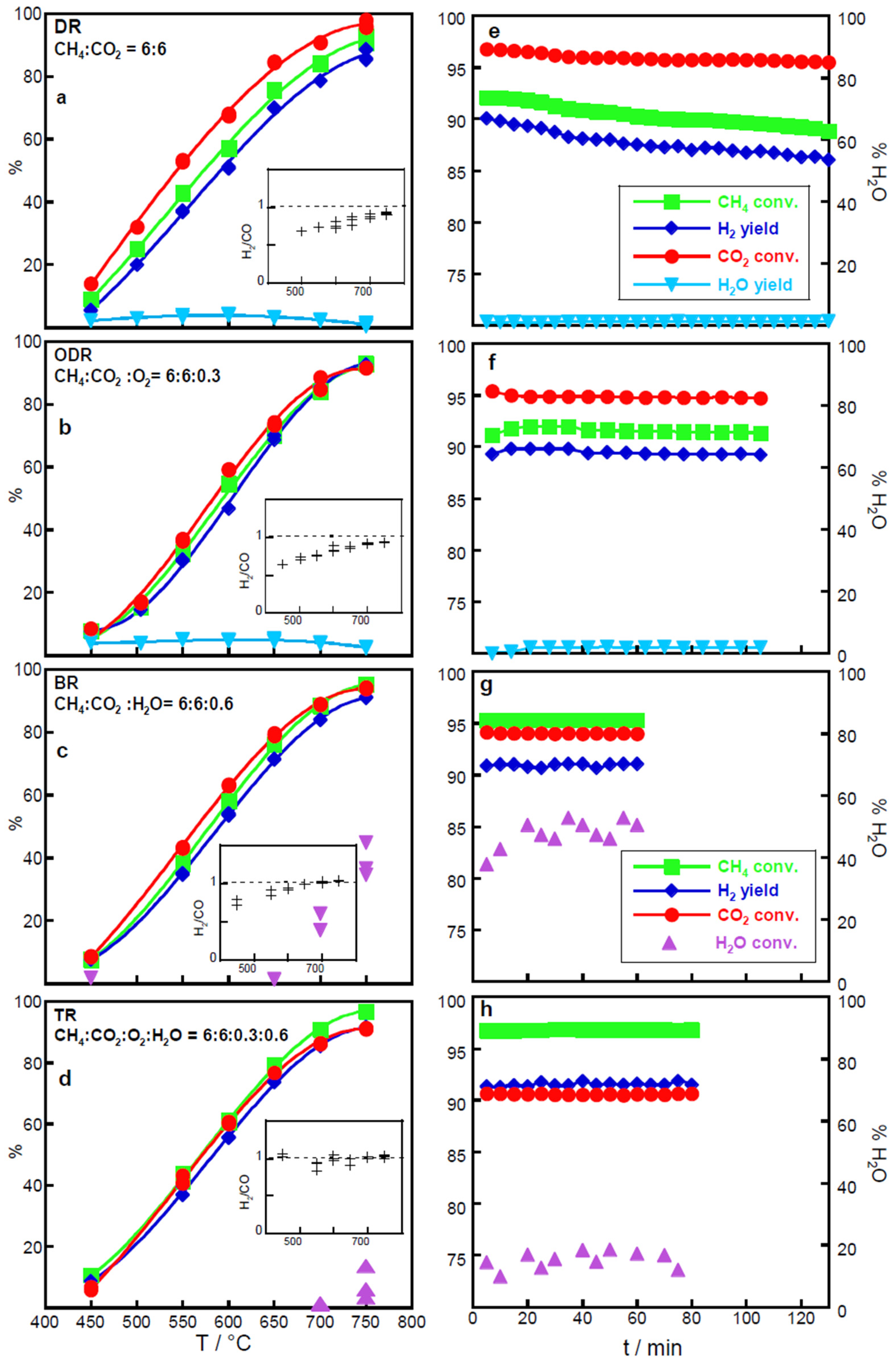
A comparison of these CH4 reforming processes over Ni50Co50 shows that the catalyst is highly active for syngas production under all the investigated conditions (Figure 5a–d).
Specifically, at 750 °C, the highest temperature explored, the conversion of CH4 and CO2 always exceeded 90%, and the H2 yield exceeded 85%, with all values progressively and concomitantly decreasing as the temperature decreased. However, the relative contributions of the reforming reactions varied depending on the oxidant content, affecting both syngas composition and catalyst stability.
For the dry reforming feed (CH4 + CO2; Figure 5a), the H2/CO molar ratio was about ~0.9 at 750 °C, slightly decreasing with decreasing temperature to about 0.7 (see inset). This deviation from the stoichiometric value of the DR reaction (H2/CO = 1) indicates the occurrence of a parallel side-reaction, probably the reverse water gas shift (RWGS: CO2 + H2 ⟶ CO + H2O), reducing the H2 yield relative to CO production. This interpretation is further supported by the poor superimposition of the conversions and H2 yield curves with the following order: CO2 conversion > CH4 conversion > H2 yield. A slight but consistent decrease in activity over time (Figure 5e) was observed, indicating a slow catalyst deactivation. As reported for the DR on Ni-based catalysts [37], the deactivation was likely due to coke deposition from the carbon-rich feed and to active phase sintering.
The addition of a second oxidant, O2 or H2O, in a small concentration (0.3% or 0.6%v/v, respectively) to the CH4 + CO2 feed increased the selectivity to syngas over the whole temperature range due to catalytic partial oxidation and steam reforming occurrence and to the inhibition of the RWGS side-reaction, as evidenced by the proximity of the curves of CH4 and CO2 conversions and H2 yield in the ODR (Figure 5b) and in the BR (Figure 5c) processes. An even stronger overlap of the curves was observed when both the O2 and H2O were added to the feed, also causing the H2/CO values to be around 1 in the whole temperature range (Figure 5d and inset).
Significantly, unlike DR, the catalytic activity at 750 °C in the ODR, BR, and TR processes remained stable over time-on-stream (Figure 5f–h). Since in these consecutive catalytic runs, the conversions and yields were similar to the initial values for the DR, the deactivation occurring under DR conditions can be considered reversible. Therefore, it can be ruled out that it originates from the limited alloy sintering (SEM characterization); rather, it is attributable to carbon-species deposition on the active sites, which can be gasified during the redox activation carried out between two consecutive runs. In the ODR, BR, and TR processes, the presence of small amounts of O2 and/or H2O enhances catalyst stability by increasing the rate of CO formation, which continuously removes the surface carbon intermediates.
In the combined TR process (Figure 5d), the interplay among DR, SR, and CPO becomes highly composition-dependent. In particular, a preliminary analysis of the results at 750 °C shows that, with a limited amount of O2 and H2O in the feed, the Ni50Co50 catalyst remains selective toward DR over SR, but exhibits low selectivity toward DR with respect to CPO, which becomes the predominant reaction. Based on simple mass balance, taking into account the CH4 conversion (97%), and neglecting the minor contribution of RWGS and other side-reactions, the observed H2 yield (92%) can be mainly attributed to DR (90% CO2 conversion), with CPO occurring to its maximum extent (100% O2 conversion) and SR to a limited extent (20% H2O conversion). Assuming H2O’s complete consumption (100%), the CO2 conversion would be expected to decrease to about 72–77% (depending on the calculation procedure adopted; see Table S2), whereas the observed value is significantly higher (90%). The increasing separation between CO2 and CH4 conversion curves above 650 °C (Figure 5d) suggests that competition between DR and CPO becomes more pronounced with temperature. These results indicate that the strength of oxidant interaction with the metallic active sites, leading to dissociative chemisorption, follows the order of O2 ≥ CO2 > H2O, in agreement with the observed activity trend CPO ≥ DR > SR and with thermodynamic analysis [38].

2.2.1. Effect of O2 and H2O Co-Reactants

To investigate the effect of the concentration of a single co-oxidant (O2 or H2O) on the DR reaction, the ODR and BR processes on the Ni50Co50 catalyst were first studied.
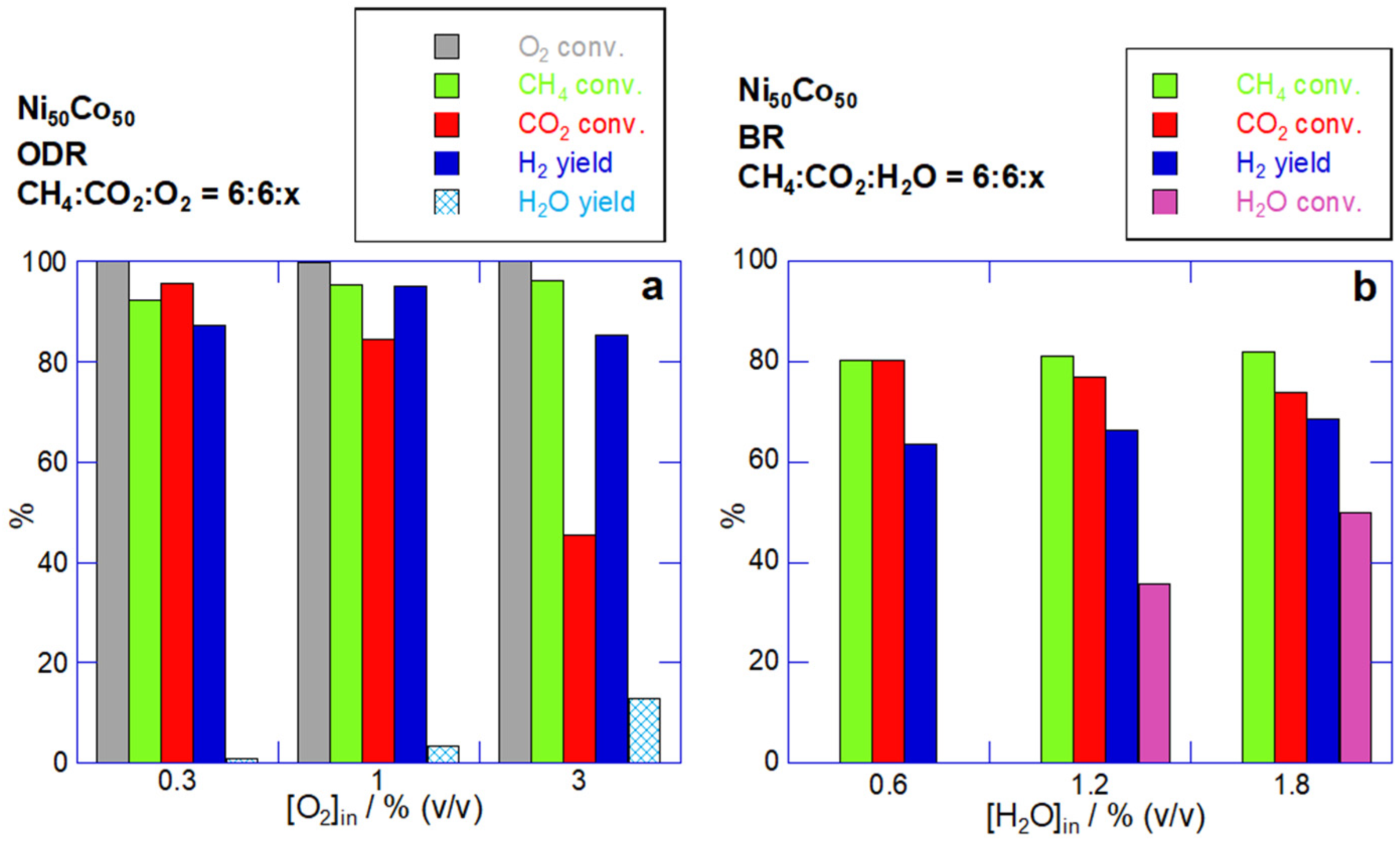
In the CH4 + CO2 + O2 (ODR) reactant mixture, increasing the amount of O2 up to the stoichiometric value (3%) required for the competing CH4-CPO reaction resulted in a strong inhibition of the CO2 valorization by CH4 (Figure 6a). In particular, at 750 °C, the CO2 conversion markedly decreased (from ~95% to ~45%), whereas the CH4 conversion remained essentially unchanged, and the O2 was always completely converted. These results confirm that the DR reaction was partly replaced by CH4-CPO as well as by CH4 oxidation, yielding 100% O2 conversion. Accordingly, the H2 yield increased from about 90 to 95% at O2 = 1%, due to the boosting effect of CPO, and it slightly decreased at O2 = 3%, due to the light-off of total CH4 combustion, as indicated by the larger H2O formation (Figure 6a).
For the BR feed (CH4 + CO2 + H2O), increasing the amount of H2O (from 0.6% to 1.8%) resulted in a slight inhibition of the CO2 valorization, which was less pronounced than that caused by O2 (Figure 6b). More specifically, at 650 °C, the inlet H2O was only partially converted (50% maximum), leading to a slight decrease in CO2 conversion (from 80 to about 74%) and an increase in H2 yield (from 63 to 68%), while CH4 conversion remained unchanged. This experimental evidence confirms that, unlike O2, only a minor fraction of H2O competes with CO2 for interaction with the active sites, causing the SR pathway to occur to a limited extent related to DR and resulting in a slight increase in the H2/CO ratio from ~1 to about 1.1.

2.2.2. Effect of Feed Concentration and Contact Time

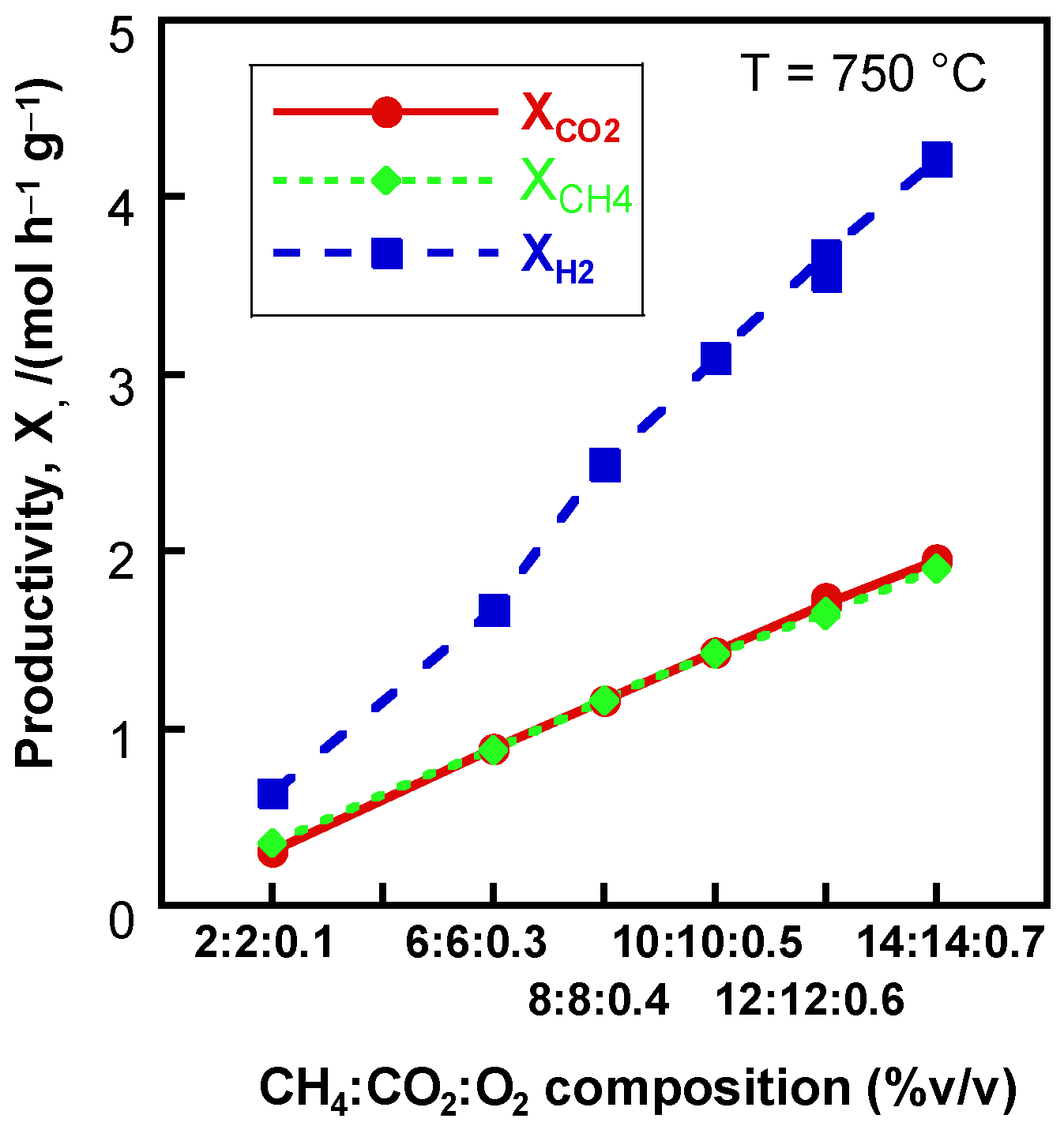
The effect of the feed concentration on CO2 conversion was determined by studying the activity of the Ni50Co50 catalyst for a selected reforming process (ODR) using mixtures with the same reactant ratio (starting from CH4:CO2:O2 = 2:2:0.1, %v/v) but progressively enriched in reactant amounts, up to 14% of CO2, which corresponds approximately to the levels found in industrial flue gases [4,39,40]. Up to a 10% CO2 inlet concentration (CH4:CO2:O2 = 10:10:0.5, %v/v), conversions and yields remained unchanged over time on stream, showing very similar values (see data for 2% and 8% mixtures shown in Figure S3), whereas only a slight decrease occurred for CO2 concentrations of ≥12%.
The dependence of catalyst performances on the various mixtures was evaluated by calculating the productivity (Xi, molecules per time per catalyst mass) parameters, intended as a measure of the specific amount of product (H2) or reactant converted (CH4 and CO2) over time. Although the physical dimensions of Xi are the same as those of the specific reaction rate (molecules per time per mass), the Xi parameter does not have a kinetic meaning because diffusion effects become significant at the high conversion levels used for its calculation. However, it allows comparison, at the application level, of the overall process efficiency over time under the adopted real operating conditions, as it reflects a cumulative phenomenon occurring on a time scale much larger than that of an intrinsic activity evaluation (hours vs. seconds). As for the ODR on the Ni50Co50, all the productivity Xi parameters increased almost linearly with reactant concentration in the feed (Figure 7). This behavior indicates that, even at 14% of reactant concentration, the catalyst is not operating at the maximum site occupancy, i.e., the active sites have not yet reached full coverage as the residence time on the catalytic bed is much larger than that required for the catalytic cycle.
To clarify whether the type of regime is kinetic or diffusional in our experimental conditions, the performance of the Ni50Co50 sample was evaluated by varying the total flow rate from 150 to 400 cc/min, while maintaining constant the temperature (650 °C) and the feed composition (CH4:CO2:H2O = 6:6:0.6, %v/v). Under these conditions, CH4 and CO2 conversion and H2 yield depended on the catalyst mass to total feed flow rate ratio, W/F (parameter proportional to the residence time, τ, of the feed on the catalyst layer), with a bent trend (Figure S4), far from the linear relationship expected for a reaction under kinetic control. The non-linear behavior reveals that the catalyst operates under diffusion-limited conditions, likely due to its very high intrinsic activity. As a consequence, the productivity values Xi, calculated from conversions under our experimental conditions, are much lower than the true reaction rates. However, although diffusion limitation under our high reactivity conditions precludes a reliable kinetic analysis for active sites and reaction mechanism elucidation, the productivity data allow us to make deductions about the overall performance.

2.3. Catalytic Performances of NiCo Catalysts for CH4 Tri-Reforming (TR)

2.3.1. Effect of Reactant Mixture Composition

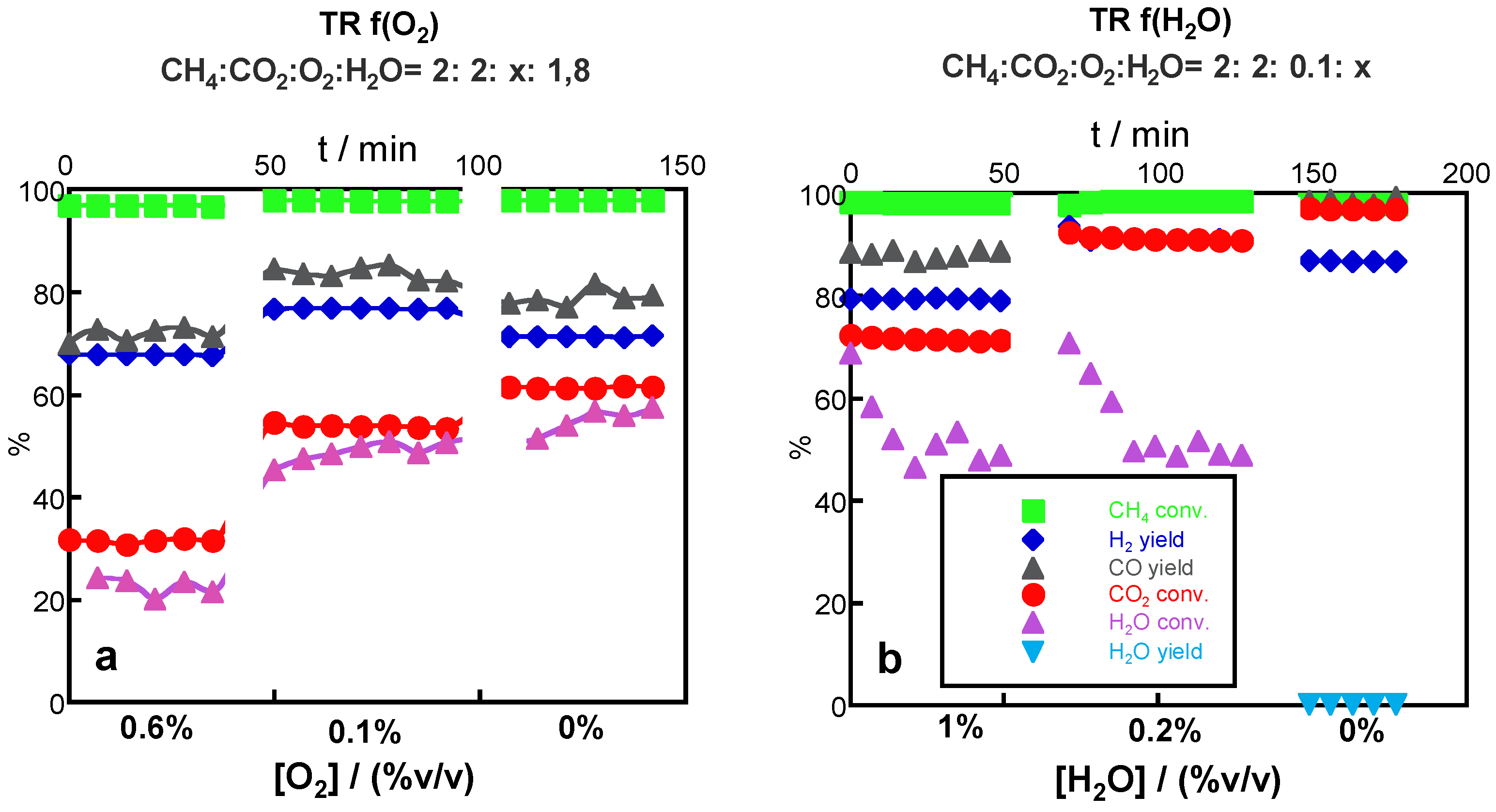
To evaluate the adaptability of NiCo catalysts for CO2 valorization in real feeds containing CO2, H2O, and O2 in variable amounts, such as tail gases from industrial plants or biogas from waste treatment, the CH4-TR activity was followed using reactant mixtures at various oxidant contents. Specifically, the O2/CO2 and H2O/CO2 ratios were changed from 0.3 to 0 (Figure 8a) and from 0.9 to 0, respectively (Figure 8b), the larger values being similar to those in a typical industrial exhaust (13% CO2, 9% H2O, and 4% O2 [4], where O2/CO2 ~ 0.3 and H2O/CO2 ~ 0.7). The experiments were carried out with a diluted feed (2% in CO2 and CH4/CO2 = 1), as it allows the composition to be stabilized more effectively over time.
In the TR feed with the larger H2O and O2 content (CH4:CO2:O2:H2O = 2:2:0.6:1.8, %v/v) (namely, with oxidant ratios close to real exhausts), CH4 was almost completely converted, but the CO2 conversion was low (~35%) (Figure 8a). As for the single ODR and BR processes (see Section 2.2.1), also in the CH4-TR, the CPO and SR reactions competed with DR, with CPO prevailing over SR, as revealed by the total O2 conversion (100%) and much lower H2O conversion value (~20%). Accordingly, when the amount of O2 in the TR feed was reduced to 0.1% and 0%, CO2 conversion improved up to 50% and 60%, respectively. The maximum H2 yield was instead obtained in the presence of a small amount of O2 (0.1%), suggesting a faster regeneration of the active sites through carbon-adsorbed species gasification under the CPO mechanism.
Keeping this optimal O2 content (0.1%, relative to CO2 conversion and H2 yield), we decreased the H2O amount to 1%, 0.2%, and 0% in the TR feed, resulting in a further improvement of CO2 conversion to about 71, 92, and 97%, respectively (Figure 8b). Also in this case, a minimal amount of H2O was also beneficial for maximizing the H2 yield, being the highest (91%) at a H2O content of 0.2%. In all experiments, the activity remained stable over time on stream.
On the whole, for the TR process, the maximum CO2 valorization occurred with the CH4:CO2 = 1:1 mixture co-fed with co-oxidants O2 and H2O in a minimal amount, as found for the ODR and BR processes. These conditions minimize the competition of oxidants with CO2 for reforming, while ensuring stable activity and boosting the H2 yield.

2.3.2. Effect of Ni/Co Ratio

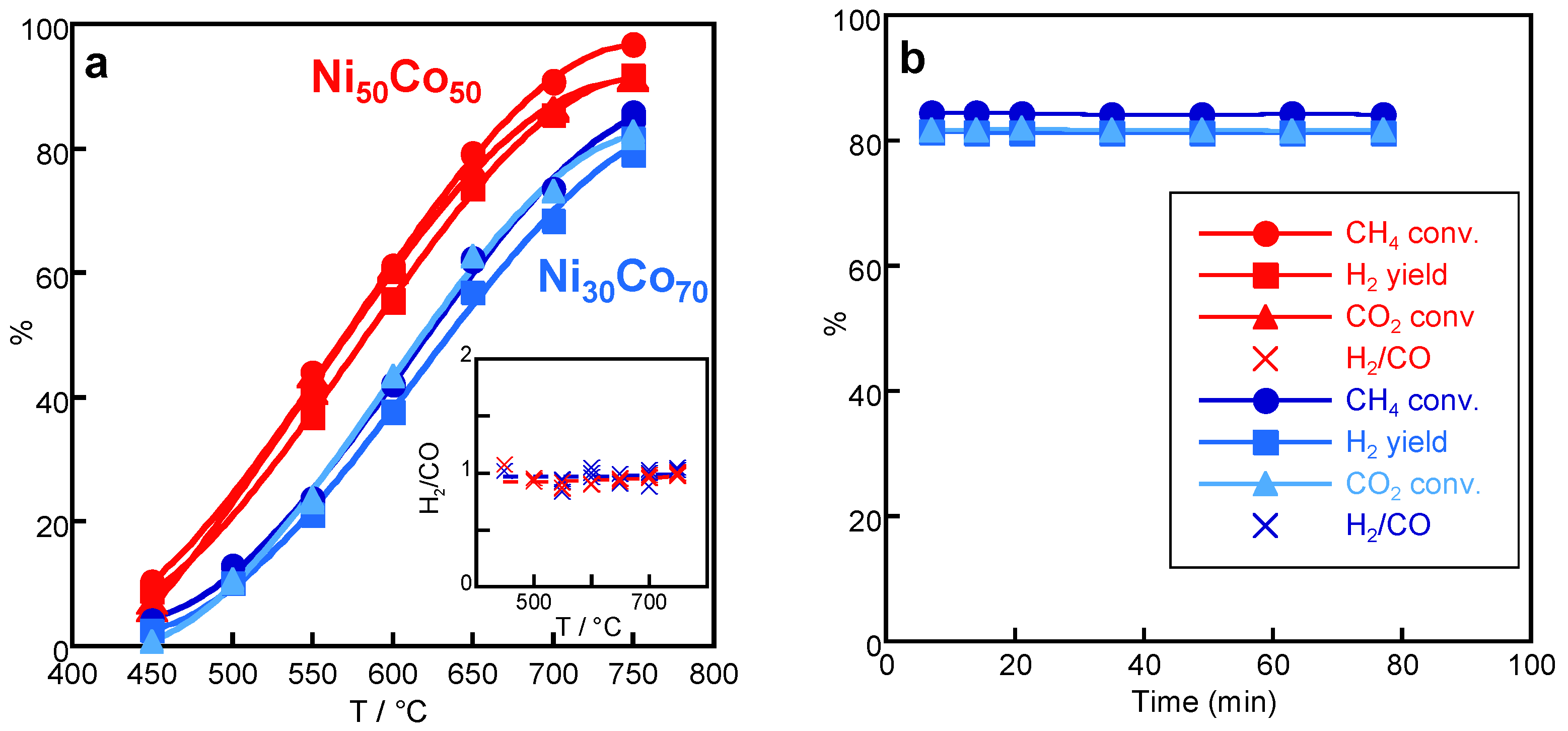
The effect of the Ni/Co ratio on the CH4-TR performances of the Ni50Co50 and Ni30Co70 catalysts was evaluated by comparing conversions, since the used samples have a similar metal dispersion (D = 1.1%), assuming homogeneous alloy nanoparticles. The catalysts exhibited a similar selectivity toward the DR with respect to the CPO and SR, shown by the overlapping of the conversion and H2 yield curves for each catalyst in the whole temperature range (Figure 9a). However, the activity of the Ni30Co70 catalyst (low Ni loading) was lower than that of Ni50Co50’s one (~10% lower CH4 and CO2 conversions and H2 yield), consistent with the lower amount of active Ni sites on the surface of the alloy nanoparticles. This lower activity is in agreement with the widely accepted role of Ni in methane activation [21], suggesting that the Co surface sites contribute less to the rate-determining step of the reforming mechanism.
As for activity stability, the Ni30Co70 catalyst exhibited constant conversion and yield values over time on stream during CH4–TR (Figure 9b), as well as during the other reforming processes, including DR (Figure S5b). The different behavior of Ni30Co70 with respect to Ni50Co50, which showed partial and reversible deactivation during DR (see Figure 5e and Figure S5a) due to carbon species deposition, is consistent with the lower Ni/Co ratio in Ni30Co70, which is commonly recognized to favor carbon species gasification. Such an effect is attributed to the high oxygen affinity of Co metal sites, which favors CO2 activation and leads to a higher abundance of CoOx islands on the alloy surface, thereby enhancing the conversion of carbon species to CO on adjacent Ni sites [16,19,20,21].
For the Ni30Co70 catalyst, the TR activity depended on the O2 and H2O contents in the feed (Figure S6) with a trend similar to that of the Ni50Co50 catalyst. The inhibition of CO2 valorization occurred as the oxidant amount increased due to competition of CPO and SR, but with conversions and yields values lower than those in Ni50Co50, in agreement with the lower content of the Ni active phase.

2.3.3. Effect of CH4 Content

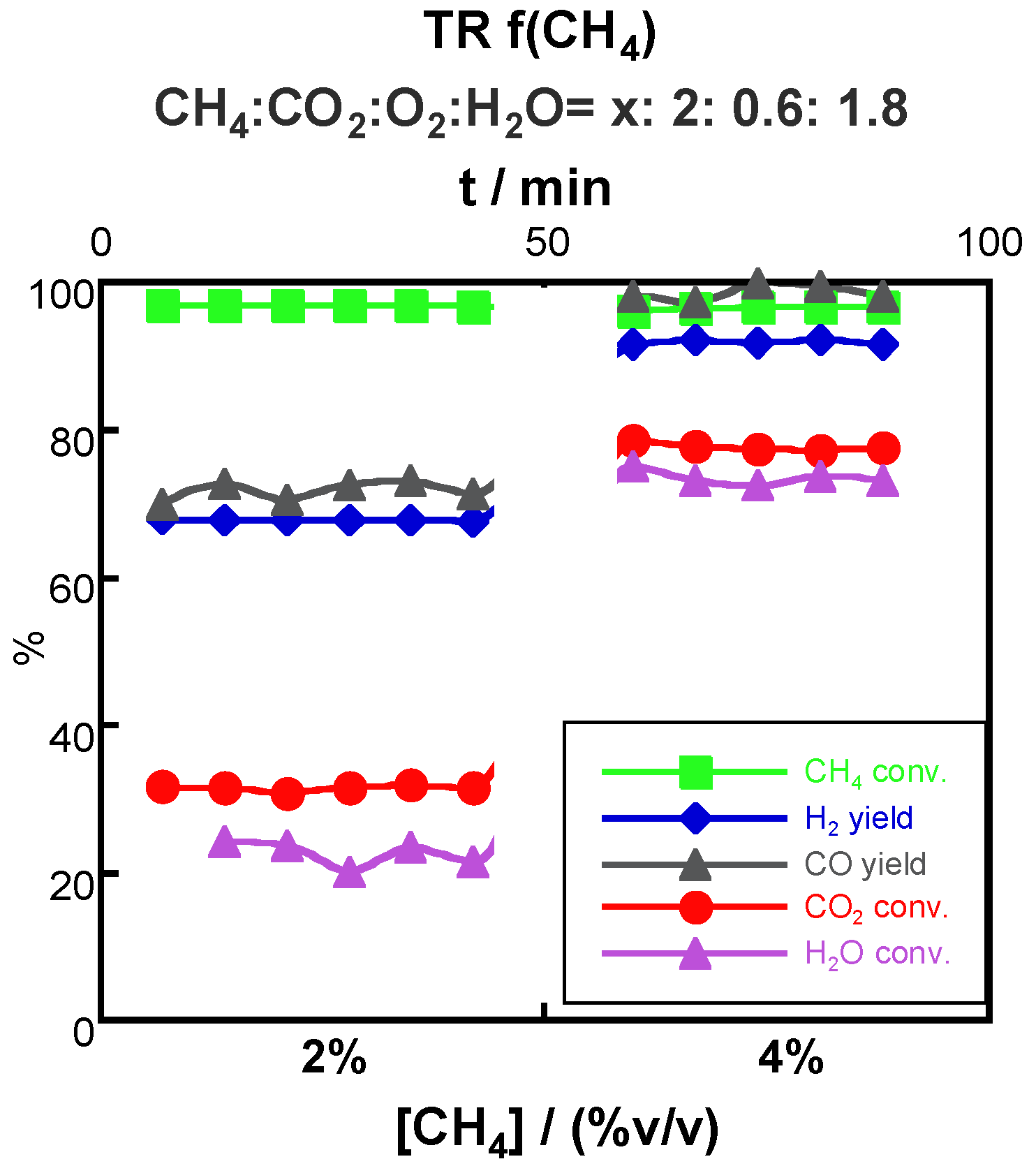
In TR experiments, all performed with a ratio of CH4/CO2 = 1, CH4 acted as the limiting reactant. To enhance CO2 conversion on the Ni50Co50 catalyst, the CH4 amount was increased up to the stoichiometric CH4-to-oxidants ratio corresponding to DR, SR, and CPO stoichiometries. Under this optimized condition, in the TR feed CH4:CO2:O2:H2O = 4:2:0.6:1.8 (oxidants relative composition resembling real exhaust gases), the CH4 conversion was >96%, as in the mixture where CH4 was limiting (CH4:CO2:O2:H2O = 2:2:0.6:1.8), but CO2 and H2O conversions (~80 and ~75%, respectively) and H2 yield (~92%) were significantly higher (Figure 10). The presence of some residual O2 (O2 conversion ~90%) suggests that the increase in the CH4 concentration favored DR and SR more than CPO, indicating a CH4 reaction order higher in the reforming reactions than in the partial oxidation.
Therefore, a real chance to effectively valorize CO2 by the TR process relies on the possibility to properly modulate CH4 addition in the real feeds on the basis of the composition of oxidants.

3. Materials and Methods

3.1. Materials

Supported NiCo/γ-Al2O3 catalysts were prepared following a conventional impregnation process [29]. Cylindrical γ-Al2O3 granules (Alfa Aesar, Ward Hill, MA, USA; specific surface area: 250 m2g−1), evacuated at 300 °C (3 h), were stirred (~12 h) in a 8 M solution containing Ni(NO3)2·6H2O and Co(NO3)2·6H2O (Merck-EMSURE, Darmstadt, Germany) in different relative molar percentages (50:50 or 30:70), filtrated, dried overnight (85 °C), and heated at 600 °C in air flow (1 h). The samples were subsequently reduced in Ar-H2 (3% v/v) flow at 900 °C (heating ramp: 10 °C/min) for 5 h and referred to as fresh samples.
The Ni and Co contents (wt%; Table 1) were determined by atomic absorption spectroscopy (AAS, Varian Spectra AA-220, Varian, Mulgrave, VIC, Australia). The samples considered in this paper had a total metal content of about 25 wt%, and they were named NiaCob, where a and b represent the relative Ni/Co atomic % in solution.

3.2. Catalysts Characterization

The main structural and morphological properties of the fresh samples (XRD, FESEM, and N2 physisorption) are summarized in Table 1.
Samples after catalytic tests, referred to as used catalysts, were characterized by XRD, FESEM, and Raman spectroscopy. X-ray diffraction (XRD) patterns were obtained using a Philips PW 1729 diffractometer (Philips, Almelo, The Netherlands) with Cu Kα (Ni-filtered) radiation (40 kV and 20 mA) in the 10–70° 2θ range (step size: 0.02°; step time: 1.25 s).
Field-emission scanning electron microscopy (FESEM) images were obtained by an AURIGA Zeiss 405 HR-FESEM instrument (Carl Zeiss, Oberkochen, Germany) equipped with an energy-dispersive X-ray spectroscopy apparatus (EDXS, Bruker, Billerica, MA, USA) for elemental detection. Particles with a minimum diameter of about 5 nm could be discriminated. Images were processed via the ImageJ free software-version 1.53h [41] to determine particle diameter, di, the di distribution, and the length–number mean diameter (Σinidiini, dLN [42]). The metal alloy dispersion, D (percent ratio of the exposed metal atoms to the total ones; Table 1), was evaluated using the approximation of spherical particles as D = 100·6·(vm/am)/dVA [42], where vm is the atomic volume in the bulk metal, am is the area occupied by a surface atom, and dVA is the volume–area mean diameter (dVA = Σinidi3inidi2). The vm and am values of the metal alloy at various compositions (Table 1) were calculated as a mean value between those of pure Ni and Co [42], assuming a linear lattice parameter variation with the alloy composition (Table S1).
Raman spectra were recorded at room temperature, in back-scattering geometry, with an inVia Renishaw micro-Raman spectrometer (Renishaw, Wotton-under-Edge, UK), using the 488.0 nm emission line from an Ar ion laser as the exciting source. The power of the incident beam was about 5 mW. Repeated accumulations (10 or 20 scans × 10 s) were generally acquired in at least four regions of each sample using 20× or 5× objectives to check the sample homogeneity. Spectra were calibrated using the 520.5 cm−1 line of a silicon wafer.

3.3. Catalytic Activity Measurements

The NiCo/γ-Al2O3 catalysts (25 mg) were tested using a fixed-bed tubular reactor consisting of two coaxial quartz tubes (i.d. 20 and 10 mm), allowing preheating of the feed gas under conventional heating in a tubular oven equipped with a K-type thermocouple positioned adjacent to the catalytic bed. High-purity gas mixtures of CH4/N2, O2/N2, CO2/N2, and H2/N2 (Nippon Gases) were used without further purification. The H2O/N2 mixture was obtained using a saturator by bubbling a pure N2 (SOL) stream through distilled water maintained at a constant temperature (40 °C).
Before each catalytic run, all catalysts were subjected to an oxidative–reductive activation procedure, consisting of an oxidative step under a 10% (v/v) O2/N2 flow from room temperature to 650 °C (heating rate: 10 °C min−1, held at 650 °C for 1 h), followed by a purging step under N2 flow with increasing temperature up to 750 °C (heating rate: 10 °C min−1) and an isothermal reductive step under a 10% H2/N2 flow (750 °C for 40 min). After activation, the reactor was isolated at 750 °C using a bypass valve, while the reactant mixture was stabilized in a parallel line. Once the feed composition was verified by gas chromatography, the mixture was fed into the reactor to start the catalytic run.
A typical run (generally lasting some hours) consisted of steady-state activity measurements under continuous flow of the reactant mixture performed either (i) at various temperatures, starting from 750 °C and decreasing to 450 °C in a random sequence (each temperature was maintained for at least 15 min, corresponding to three consecutive GC analyses), or (ii) at a selected temperature, monitoring the activity as a function of time on stream for up to 150 min. At the end of each run, the reactor was purged with an N2 flow for 10 min and allowed to cool to room temperature under static conditions by natural convection. The oxidative step of the activation procedure applied between runs ensured the removal of any possible carbon deposits. For each catalyst, at least 15 catalytic runs were performed, the last one in a tri-reforming mixture; the catalyst recovered from the reactor after this sequence was designated as “used”.
The inlet and the outlet reactant mixture were analyzed by a Varian Micro-GC CP-4900 gas chromatograph equipped with two columns (10 m Molsieve 5A BF, for H2, O2, and CO; 10 m Poraplot Q for CH4, CO2, and H2O) and TCD detectors. The conversion of CH4 and CO2 and the yields of H2 and CO were calculated as percentages using the following equations:
C CH 4 = 100 × F t o t i n C H 4 i n F t o t o u t C H 4 o u t F t o t i n C H 4 i n
C CO 2 = 100 × F t o t i n C O 2 i n F t o t o u t C O 2 o u t F t o t i n C O 2 i n
Y H 2 = 100 × F t o t o u t H 2 o u t 2 F t o t i n C H 4 i n + ( 2 F t o t i n H 2 O i n )
Y CO = 100 × F t o t o u t C O o u t F t o t i n ( C H 4 i n + C O 2 i n )
where Ftotin is the total inlet flow, and Ftotout is the total outlet flow; CH4in/out, CO2in/out, H2out, and COout are the volumetric fractions (ppm) entering and leaving the reactor. The productivity Xi (mol of i-species, converted or produced, per hour per gram) was calculated from Ci or Yi values.
The inlet total flow rate was 150 cm3 (STP) min−1 (space velocity: 3.6·105 NL·kgcat−1·h−1), except for one experiment (bi-reforming of CH4), in which it was changed in the range of 150–400 cm3 (STP) min−1.
All experiments yielded a good carbon, hydrogen, and oxygen balance (100 ± 5, as percentage).

4. Conclusions

The NiCo alloy supported on γ-Al2O3 proved to be an effective catalyst for the CO2 valorization into syngas through the tri-reforming of CH4 under conventional heating using a gas mixture containing up to 14% v/v of CO2 in the presence of H2O and O2. Since similar NiCo alloy-based catalysts have shown comparable reforming performance under thermal and magnetic activation [30], these results highlight the strong potential of NiCo/γ-Al2O3 catalysts for the industrial electrification of the CH4 tri-reforming process via magnetic induction heating.
While the activity for DR of NiCo/γ-Al2O3 catalysts gradually decreased with time on stream due to coke deposition, the presence of small amounts of O2 and H2O in the TR feed rendered the activity stable over time by improving carbon species gasification, boosted syngas production, and minimally inhibited CO2 conversion.
The selectivity toward CO2 conversion in the TR mixture strongly depended on the relative amount of oxidants and on the CH4-to-oxidants ratio. Large amounts of O2 and H2O caused a marked decrease in the selectivity toward CO2 conversion due to the competition among oxidants for the metal active sites, favoring CPO and SR reactions. The increase in the CH4 content in the feed up to the stoichiometric value with respect to oxidant amounts preferentially favored the DR pathway, leading to very high CO2 conversion.
The Ni/Co ratio in NiCo nanoparticles negligibly affects the selectivity toward CO2 conversion, varying the feed composition. Instead, a high Co content in the alloy decreases the overall activity, confirming Ni metal species as active sites.
From an application perspective, NiCo/γ-Al2O3 catalysts render CH4 tri-reforming a promising approach for CO2 valorization in industrial off-gases or biogas streams, owing to their ability to maintain high activity across different CO2 + H2O + O2 feeds by adjusting CH4 addition.

Supplementary Materials

The following supporting information can be downloaded at https://www.mdpi.com/article/10.3390/catal16010062/s1. Table S1: Density, atomic volume, and atomic surface for pure metal and alloy particles; Figure S1: FESEM image and the particle size distribution of fresh Ni50Co50 and Ni30Co70 samples; Figure S2: FESEM images and EDX analysis of the Ni50Co50 and Ni30Co70 samples after catalytic runs; Figure S3: Activity for the CH4-ODR process as a function of time on stream in Ni50Co50 catalyst at different ODR feed concentrations; Figure S4: Activity for the CH4-ODR process as a function of mass/total flow ratio (W/F) in the Ni50Co50 catalyst; Figure S5: H2 yield as a function of time on stream in the various CH4-reforming processes in activated Ni50Co50 and Ni30Co70 catalysts; Table S2. Data obtained in the CH4-TR at 750 °C for Ni50Co50 catalyst; Figure S6: Conversions and yields for Ni30Co70 catalyst at 750 °C in the CH4-TR feed at the maximum H2O content (1.8%) and decreasing O2 content, and at optimal O2 content and decreasing H2O content.

Author Contributions

Conceptualization, D.P. and F.V.; methodology, D.P.; software, M.L.; validation, M.B. and M.C.C.; formal analysis, M.C.C. and D.P.; investigation, C.C. and M.L.; resources, D.P. and M.C.C.; data curation, C.C. and M.B.; writing—original draft preparation, D.P.; writing—review and editing, D.P. and M.L.; visualization, M.L.; supervision, D.P. and F.V.; funding acquisition, F.V. All authors have read and agreed to the published version of the manuscript.

Funding

This research was funded by the MASE (Italian Ministry for the Environment and Energy Security) (grant number: PTR25-27, Project 1.4-9).

Data Availability Statement

The raw data supporting the conclusions of this article will be made available by the authors upon request.

Acknowledgments

The authors thank Francesco Mura (Sapienza Nanotechnology and Nanoscience Laboratory—SNN-Lab, Sapienza University of Rome) for FESEM analyses, Lorenzo Ruggeri for catalytic measurements, and Delia Gazzoli for helpful discussions.

Conflicts of Interest

The authors declare no conflicts of interest. The funders had no role in the design of this study; in the collection, analyses, or interpretation of the data; in the writing of this manuscript; or in the decision to publish the results.

References

  1. Wang, N.; Bai, Y.; Guo, Z.; Fan, Y.; Meng, F. Synergies between the circular economy and carbon emission reduction. Sci. Total Environ. 2024, 951, 175603. [Google Scholar] [CrossRef] [PubMed]
  2. Olajire, A.A. Valorization of greenhouse carbon dioxide emissions into value-added products by catalytic processes. J. CO2 Util. 2013, 3-4, 74–92. [Google Scholar] [CrossRef]
  3. Zhang, H.; Wei, Z.; Hao, D.; Jing, L.; Liu, Y.; Dai, H.; Wei, W.; Deng, J. Recent advances in synergistic catalytic valorization of CO2 and hydrocarbons by heterogeneous catalysis. Acta Phys.-Chim. Sin. 2025, 41, 100073. [Google Scholar] [CrossRef]
  4. Song, C.; Pan, W. Tri-reforming of methane: A novel concept for catalytic production of industrially useful synthesis gas with desired H2/CO ratios. Catal. Today 2024, 98, 463–484. [Google Scholar] [CrossRef]
  5. Soleimani, S.; Lehner, M. Tri-Reforming of Methane: Thermodynamics, Operating Conditions, Reactor Technology and Efficiency Evaluation-A Review. Energies 2022, 15, 7159. [Google Scholar] [CrossRef]
  6. Lino, A.V.P.; Assaf, E.M.; Assaf, J.M. Adjusting Process Variables in Methane Tri-reforming to Achieve Suitable Syngas Quality and Low Coke Deposition. Energy Fuels 2020, 34, 16522−16531. [Google Scholar] [CrossRef]
  7. Sunkara, S.; Pankhedkar, N.; Gudi, R. Valorization of refinery flue gas through tri-reforming and direct hydrogenation routes. Can. J. Chem. Eng. 2024, 102, 2136–2150. [Google Scholar] [CrossRef]
  8. Schmal, M.; Toniolo, F.S.; Kozonoe, C.E. Perspective of catalysts for (Tri) reforming of natural gas and flue gas rich in CO2. Appl. Catal. A Gen. 2018, 568, 23–42. [Google Scholar] [CrossRef]
  9. Minh, D.P.; Pham, X.-H.; Siang, T.J.; Vo, D.-V.N. Review on the catalytic tri-reforming of methane—Part I: Impact of operating conditions, catalyst deactivation and regeneration. Appl. Catal. A Gen. 2021, 621, 118202. [Google Scholar] [CrossRef]
  10. Pham, X.-H.; Ashik, U.P.M.; Hayashi, J.-I.; Alonso, A.P.; Pla, D.; Gómez, M.; Minh, D.P. Review on the catalytic tri-reforming of methane—Part II: Catalyst development. Appl. Catal. A Gen. 2021, 623, 118286. [Google Scholar] [CrossRef]
  11. Alli, R.D.; de Souza, P.A.L.; Mohamedali, M.; Virla, L.D.; Mahinpey, N. Tri-reforming of methane for syngas production using Ni catalysts: Current status and future Outlook. Catal. Today 2023, 407, 107–124. [Google Scholar] [CrossRef]
  12. Boakye, O.Y.; Hashemi, S.M.; Mahinpey, N. Investigation of Al2O3, ZrO2, SiO2, and CeO2 supported nickel catalysts for tri-reforming of Methane. Int. J. Hydrogen Energy 2025, 109, 802–812. [Google Scholar] [CrossRef]
  13. de Medeiros, F.G.M.; Lopes, F.W.B.; Lotfi, S.; de Vasconcelos, B.R. One-step upgrading of real flue gas streams into syngas over alumina-supported catalysts. Fuel 2023, 338, 127324. [Google Scholar] [CrossRef]
  14. Gao, J.; Hou, Z.; Liu, X.; Zeng, Y.; Luo, M.; Zheng, X. Methane autothermal reforming with CO2 and O2 to synthesis gas at the boundary between Ni and ZrO2. Int. J. Hydrogen Energy 2009, 34, 3734–3742. [Google Scholar] [CrossRef]
  15. Foo, S.Y.; Cheng, C.K.; Nguyen, T.-H.; Adesina, A.A. Oxidative CO2 Reforming of Methane on Alumina-Supported Co−Ni Catalyst. Ind. Eng. Chem. Res. 2010, 21, 10450–10458. [Google Scholar] [CrossRef]
  16. Al-Fatesh, A.S.; Patel, N.; Fakeeha, A.H.; Alotibi, M.F.; Alreshaidan, S.B.; Kumar, R. Reforming of methane: Effects of active metals, supports, and promoters. Catal. Rev. 2024, 66, 2209–2307. [Google Scholar] [CrossRef]
  17. Guo, S.; Sun, Y.; Zhang, Y.; Zhang, C.; Li, Y.; Bai, J. Review article. Bimetallic Nickel-Cobalt catalysts and their application in dry reforming reaction of methane. Fuel 2024, 358, 130290. [Google Scholar] [CrossRef]
  18. Huang, L.N.; Li, D.; Tian, D.; Jiang, L.; Li, Z.; Wang, H.; Li, K. Optimization of Ni-Based Catalysts for Dry Reforming of Methane via Alloy Design: A Review. Energy Fuels 2022, 36, 5102−5151. [Google Scholar] [CrossRef]
  19. Bian, Z.; Das, S.; Wai, M.H.; Hongmanorom, P.; Kawi, S. A Review on Bimetallic Nickel-Based Catalysts for CO2 Reforming of Methane. ChemPhysChem 2017, 18, 3117–3134. [Google Scholar] [CrossRef]
  20. Wu, Z.; Yang, B.; Miao, S.; Liu, W.; Xie, J.; Lee, S.; Pellin, M.J.; Xiao, D.; Su, D.; Ma, D. Lattice Strained Ni-Co Alloy as High-Performance Catalyst for Catalytic Dry-Reforming of Methane. ACS Catal. 2019, 9, 2693–2700. [Google Scholar] [CrossRef]
  21. Horlyck, J.; Lawrey, C.; Lovell, E.C.; Amal, R.; Scott, J. Elucidating the impact of Ni and Co loading on the selectivity of bimetallic NiCo catalysts for dry reforming of methane. Chem. Eng. J. 2018, 352, 572–580. [Google Scholar] [CrossRef]
  22. Centi, G.; Perathoner, S. Catalysis for an electrified chemical production. Catal. Today 2023, 423, 113935. [Google Scholar] [CrossRef]
  23. Bordet, A.; Leitner, W.; Chaudret, B. Magnetically Induced Catalysis: Definition, Advances, and Potential. Angew. Chem. Int. Ed. 2025, 64, e202424151. [Google Scholar] [CrossRef]
  24. Chidhambaram, N.; Kay, S.J.J.; Priyadharshini, S.; Meenakshi, R.; Sakthivel, P.; Dhanbalan, S.; Shanavas, S.; Kamaraj, S.-K.; Thirumurugan, A. Magnetic Nanomaterials as Catalysts for Syngas Production and Conversion. Catalysts 2023, 13, 440. [Google Scholar] [CrossRef]
  25. Vinum, M.G.; Almind, M.R.; Engbæk, J.S.; Vendelbo, S.B.; Hansen, M.F.; Frandsen, C.; Bendix, J.; Mortensen, P.M. Dual-Function Cobalt–Nickel Nanoparticles Tailored for High Temperature Induction-Heated Steam Methane Reforming. Angew. Chem. Int. Ed 2018, 57, 10569–10573. [Google Scholar] [CrossRef] [PubMed]
  26. Varsano, F.; Bellusci, M.; La Barbera, A.; Petrecca, M.; Albino, M.; Sangregorio, C. Dry reforming of methane powered by magnetic induction. Int. J. Hydrogen Energy 2019, 44, 21037–21044. [Google Scholar] [CrossRef]
  27. Scarfiello, C.; Bellusci, M.; Pilloni, L.; Pietrogiacomi, D.; La Barbera, A.; Varsano, F. Supported catalysts for induction-heated steam reforming of methane. Int. J. Hydrogen Energy 2021, 46, 134–145. [Google Scholar] [CrossRef]
  28. Poletto Dotsenko, V.; Bellusci, M.; Masi, A.; Pietrogiacomi, D.; Varsano, F. Improving the performances of supported NiCo catalyst for reforming of methane powered by magnetic induction. Catal. Today 2023, 418, 114049. [Google Scholar] [CrossRef]
  29. Malandrino, S.; Bellusci, M.; Campa, M.C.; Pietrogiacomi, D.; Varsano, F. Bi-reforming of Methane Powered by Induction heating on Supported Magnetic NiCo Nanoparticles. Emerg. Mater. 2026, unpublished. [Google Scholar]
  30. Varsano, F.; Bellusci, M.; Provino, A.; Petrecca, M. NiCo as catalyst for magnetically induced dry reforming of methane. IOP Conf. Ser. Mater. Sci. Eng. 2018, 323, 012005. [Google Scholar] [CrossRef]
  31. Divi, S.; Chatterjee, A. Generalized nano-thermodynamic model for capturing size-dependent surface segregation in multi-metal alloy nanoparticles. RSC Adv. 2018, 8, 10409–10424. [Google Scholar] [CrossRef]
  32. Hu, K.-J.; Plant, S.R.; Ellis, P.R.; Brown, C.M.; Bishop, P.T.; Palmer, R.E. Atomic Resolution Observation of a Size-Dependent Change in the Ripening Modes of Mass-Selected Au Nanoclusters Involved in CO Oxidation. J. Am. Chem. Soc. 2015, 137, 15161−15168. [Google Scholar] [CrossRef]
  33. Hadjiev, V.G.; Iliev, M.N.; Vergilov, I.V. The Raman spectra of Co3O4. J. Phys. C Solid State Phys. 1988, 21, L199–L201. [Google Scholar] [CrossRef]
  34. Mironova-Ulmane, N.; Kuzmin, A.; Steins, I.; Grabis, J.; Sildos, I.; Pärs, M. Raman scattering in nanosized nickel oxide NiO. J. Phys. Conf. Ser. 2007, 93, 012039. [Google Scholar] [CrossRef]
  35. Bala, N.; Singh, H.K.; Verma, S.; Rath, S. Magnetic-order induced effects in nanocrystalline NiO probed by Raman spectroscopy. Phys. Rev. B 2020, 102, 024423. [Google Scholar] [CrossRef]
  36. Vogel, R.; Versluis, C.; Frijsen, R.; Prins, P.T.; Vogt, E.T.C.; Rabouw, F.T.; Weckhuysen, B.M. The Coking of a Solid Catalyst Rationalized with Combined Raman and Fluorescence Lifetime Microscopy. Angew. Chem. Int. Ed. 2024, 63, e202409503. [Google Scholar] [CrossRef]
  37. Xu, Z.; Park, E.D. Recent Advances in Coke Management for Dry Reforming of Methane over Ni-Based Catalysts. Catalysts 2024, 14, 176. [Google Scholar] [CrossRef]
  38. Szczygieł, J.; Postawa, K.; Chojnacka, K.; Skrzypczak, D.; Izydorczyk, G.; Kułażyński, M. Thermodynamical Analysis and Optimization of Dry Reforming and Trireforming of Greenhouse Gases: A Statistical Approach. ACS Omega 2025, 10, 33536–33547. [Google Scholar] [CrossRef] [PubMed]
  39. Halmann, M.; Steinfeld, A. Thermoneutral tri-reforming of flue gases from coal- and gas-fired power stations. Catal. Today 2006, 115, 170–178. [Google Scholar] [CrossRef]
  40. Jilani, S.; Kumar, A. Simulation of Tri-Reforming Reaction Using Flue Gases of Thermal Power Plant (Natural Gas Fired). Inter. J. Appl. Eng. Res. 2020, 15, 953–959. [Google Scholar] [CrossRef]
  41. Schneider, C.A.; Rasband, W.S.; Eliceiri, K.W. NIH Image to ImageJ: 25 years of image analysis. Nat. Methods 2012, 9, 671–675. [Google Scholar] [CrossRef] [PubMed]
  42. Bergeret, G.; Gallezot, P. Particle size and dispersion measurement. In Handbook of Heterogeneous Catalysis; Ertl, G., Knozinger, H., Weitkamp, J., Eds.; Wiley-VCH: Weinheim, Germany, 1997; Volume 2, pp. 439–464. [Google Scholar]
Figure 1. XRD profiles for γ-Al2O3 support and used Ni50Co50 and Ni30Co70 catalysts.
Catalysts 16 00062 g001
Figure 2. FESEM images at different magnifications, related particle size distributions, and mean values for the used Ni50Co50 (section (ac)) and Ni30Co70 (section (df)) catalysts after the last catalytic run (CH4-TR at 750 °C for 80 min). Σ is the particles’ total number. For dLN, dVA, and D, definitions are in the Experimental Section.
Catalysts 16 00062 g002
Figure 3. FESEM images and EDX analysis of Ni30Co70 catalyst after the CH4-DR reaction at 750 °C for 130 min. Arrows indicate nanotubes.
Catalysts 16 00062 g003
Figure 4. Raman spectra of the Ni50Co50 (section (a)) and Ni30Co70 (section (b)) catalysts before (fresh, curves 1) and after catalytic runs (used, curves 2 and 2′).
Catalysts 16 00062 g004
Figure 5. Catalytic activity and stability for Ni50Co50 catalyst in the various CH4 reforming processes. Conversions, yields, and H2/CO ratio (insets) as a function of temperature (sections (ad)) and as a function of time at 750 °C (sections (eh)). Reactant mixture: [CH4] = [CO2] = 6%, [O2] = 0.3%, and [H2O] = 0.6% (%v/v, N2 as balance). Total flow rate = 150 cm3 (STP)·min−1.
Catalysts 16 00062 g005
Figure 6. Conversions and yields for Ni50Co50 catalyst at 750 °C in the CH4-ODR (a) and at 650 °C in the CH4-BR (b) processes at increasing content of O2 or H2O co-oxidant. Reactant mixture: [CH4] = [CO2] = 6%; [O2] and [H2O] as specified (%v/v, N2 as balance). Total flow rate = 150 cm3 (STP)·min−1.
Catalysts 16 00062 g006
Figure 7. Productivity (Xi, molecules converted or produced per s per g) at 750 °C for Ni50Co50 catalyst in the CH4-ODR process with mixtures at the same reactant ratio and at increasing reactant concentrations, from CH4:CO2:O2 = 2:2:0.1 to CH4:CO2:O2 = 14:14:0.7 (%v/v, N2 as balance). Total flow rate = 150 cm3 (STP)·min−1.
Catalysts 16 00062 g007
Figure 8. Conversions and yields for Ni50Co50 catalyst at 750 °C in the CH4-TR feed at the maximum H2O content (1.8%) and decreasing O2 contents (section (a)), and at the optimal O2 content (0.1%) and decreasing H2O content (section (b)). Reactant mixture: [CH4] = [CO2] = 2%; [O2] and [H2O] as specified (%v/v, N2 as balance). Total flow rate = 150 cm3 (STP)·min−1.
Catalysts 16 00062 g008
Figure 9. CH4 and CO2 conversions and H2 yield for Ni50Co50 and Ni30Co70 catalysts in the CH4-TR process as a function of temperature (section (a)) and for the Ni30Co70 as a function of time on stream at 750 °C (section (b)). Reactant mixture: [CH4] = [CO2] = 6%; [O2] = 0.3% (%v/v, N2 as balance). Total flow rate = 150 cm3 (STP)·min−1.
Catalysts 16 00062 g009
Figure 10. Conversions and yields for Ni50Co50 catalyst at 750 °C as a function of time on stream in the CH4-TR process at increasing CH4 contents and fixed oxidant contents. Reactant mixture: [CH4] = 2 or 4%; [CO2] = 2%, [O2] = 0.6%; and [H2O] = 1.8% (%v/v, N2 as balance). Total flow rate = 150 cm3 (STP)·min−1.
Catalysts 16 00062 g010
Table 1. Chemical, structural, and morphological parameters of fresh [29] and used samples: specific surface area (SA), pore volume (Vtot), total metal content (%wttot), relative metal percentage (Ni/Co), crystallite mean size (dXRD), and particle mean size (dSEM) for NiCo alloy.
Sample S.A.
(m2/g) a
Vtot
(cm3/g) b
%wttot
(AAS)
Ni/Co
(AAS)
dXRD/
(nm)
dSEM (nm)
Ni50Co50Fresh1450.5124.251:493037
Used 3751
Ni30Co70Fresh1400.5124.431:694042
Used 2667
a ±5 m2/g; b ±0.05 cm3/g.
Disclaimer/Publisher’s Note: The statements, opinions and data contained in all publications are solely those of the individual author(s) and contributor(s) and not of MDPI and/or the editor(s). MDPI and/or the editor(s) disclaim responsibility for any injury to people or property resulting from any ideas, methods, instructions or products referred to in the content.