Review

Advances in Strategies for In Vivo Directed Evolution of Targeted Functional Genes

State Key Laboratory of Materials-Oriented Chemical Engineering, College of Biotechnology and Pharmaceutical Engineering, Nanjing Tech University, Nanjing 211816, China
*
Author to whom correspondence should be addressed.
Catalysts 2025, 15(12), 1127; https://doi.org/10.3390/catal15121127
Submission received: 21 October 2025 / Revised: 21 November 2025 / Accepted: 25 November 2025 / Published: 2 December 2025

Abstract

Enzymes are indispensable in fields such as biotechnology, medicine, and industrial manufacturing due to their high catalytic specificity and efficiency under mild conditions. However, their natural versions often suffer from limitations, including low activity toward non-natural substrates, poor stability under extreme conditions, and narrow substrate spectra. Directed evolution, a key protein engineering strategy that optimizes protein function via genetic diversity introduction and directed selection, has become the primary solution to these limitations. Among its mature methodological systems, in vivo evolution platforms (advanced by synthetic biology) are particularly efficient, as they integrate in-cell mutation, translation, selection, and replication into an automated process, significantly improving experimental efficiency. This review will focus on two core strategies that enhance these platforms: in vivo targeted gene hypermutation and heterologous polymerase-mediated targeted hypermutation. These techniques enable the rapid optimization of enzymes to acquire novel functions, as well as the comprehensive engineering of microbial strains to enhance their performance and stress tolerance. Analyzing these strategies provides a robust technical framework for enzyme engineering and promises to drive future innovations across multiple fields.

1. Introduction

Enzymes, as biological catalysts with high specificity and efficiency, play indispensable roles in numerous fields such as biotechnology, medicine, and industrial manufacturing [1,2,3,4]. Their exceptional catalytic efficiency and specificity under mild conditions offer sustainable alternatives to conventional chemical processes. However, natural enzymes often fail to meet the diverse and stringent requirements of practical applications [5]. For example, some enzymes exhibit low catalytic activity towards non-native substrates, poor stability under extreme industrial conditions (e.g., high temperature, high concentration of organic solvents), or narrow substrate spectra [6]. In order to overcome the limitations of natural enzymes, researchers have developed various enzyme property modification strategies to meet the practical needs of food processing, pharmaceutical synthesis, environmental science, and other fields more widely. Currently, there are three core methods for modifying enzyme function: rational design, directed evolution, and semi-rational design. Semi-rational design combines the first two technologies [7,8,9,10,11].
Among them, rational design is a protein engineering approach. It relies on in-depth knowledge, such as the three-dimensional structure of enzymes, their catalytic mechanisms, and sequence alignment. This knowledge is used to accurately predict and modify specific amino acid residues [12]. This method not only enables efficient modification of key sites but also requires a much smaller mutant library size compared to directed evolution [13,14]. Consequently, it reduces screening workload. Additionally, it allows for systematic modification of multiple sites simultaneously to pursue synergistic improvements in enzyme performance. For instance, the research team led by Iva Pichová focused on castor stearoyl Δ9-desaturase [15]. Through structural analysis of this enzyme, they identified four amino acid residues: His203, Asp101, Thr206, and Cys222. These residues are core components involved in the key plasmid transfer chain. After replacing these residues with the corresponding ones from soluble methane monooxygenase, the results showed that this mutation inhibited the natural desaturase activity. At the same time, it significantly enhanced hydroxylase activity. However, this modification method requires complex computational tools and simulations to support prediction [16,17]. Its success rate is also limited by computational models and theoretical understanding. With the development of computational biology, this technology is constantly advancing and may become the primary solution for enzyme modification [18].
Semi-rational design, combining rational design and directed evolution, is an enzyme engineering method. It identifies key target residues via sequence/structural information to construct small, focused mutant libraries for modification [19,20,21]. For example, Yao Ni et al. made semi-rational modifications to L-isoleucine dioxygenase (IDO) [22]. Through molecular dynamics simulations, researchers found a key factor regulating substrate specificity. This factor is the distance between Fe2+, α-ketoglutarate C2, and the amino acid chain C4. Furthermore, based on the polar pocket residues and their free energy, the mutation sites were screened. Single-point saturation mutations were then implemented. Ultimately, mutants capable of catalyzing aromatic amino acids were obtained, expanding the substrate spectrum of the enzyme. The strengths of semi-rational design include high efficiency and precision. Computational pre-screening of beneficial sites reduces library size and workload [23,24]. It also offers information-driven flexibility, overcoming pure rational design’s reliance on complete data. For example, homology modeling can aid the process even without the full enzyme structure, thereby boosting success rates. Limitations persist: dependence on structural or computational data, and pre-screening may exclude unpredicted beneficial mutations.
Directed evolution is an enzyme engineering strategy that simulates natural evolution in the laboratory [25]. It involves introducing random mutations into the target enzyme gene to build a large mutation library. Then, high-throughput screening is used to identify enzyme variants with improved activity, stability, and other performance metrics [26]. Its core advantage is that it does not require prior knowledge, such as the precise three-dimensional structure or catalytic mechanism of enzymes. It has strong versatility and can detect unexpected beneficial mutations. This allows for efficient optimization of various enzyme properties, such as substrate specificity and thermal stability. However, it has obvious drawbacks. The large mutation library leads to cumbersome screening. It also relies heavily on high-throughput screening techniques, which involves a huge workload. Furthermore, the process is characterized by strong randomness and is largely blind. Even after multiple rounds of iterations, there may still be no ideal results [27]. Among the above strategies, directed evolution has become one of the most widely applied and fruitful. This is due to its universality and powerful efficacy, which do not rely on prior knowledge of protein structure. Especially with the development of synthetic biology, directed evolution technology has demonstrated its unique advantages.
Directed evolution is a powerful protein engineering strategy. Its principle is to accelerate the functional optimization of proteins in the laboratory. This is achieved by deliberately introducing genetic diversity and then applying directed selection pressures [28,29]. A standard directed evolution workflow typically iterates through the three key steps. Initially, a large and diverse gene mutant library is constructed using various molecular biology techniques. Subsequently, an efficient screening or selection system is established to identify variants exhibiting improved or desired functional traits. Finally, the selected superior mutants serve as templates for subsequent rounds of evolution. Through multiple iterative cycles, beneficial mutations are accumulated progressively until an enzyme variant with the desired performance characteristics is obtained [30].
Over the past three decades, the methodological toolkit for directed evolution has matured significantly. Advancements have primarily emerged from both in vitro and in vivo evolutionary strategies. In vitro evolution systems are characterized by high controllability and the ability to operate outside cellular environments [31]. In terms of mutant library construction, the range of techniques has expanded considerably. Early methods included random mutagenesis techniques such as error-prone PCR. Now, more refined strategies are available, including site-saturation mutagenesis for systematic exploration of specific amino acid positions and DNA shuffling for efficient recombination of beneficial mutations [32,33]. Figure 1 shows different types of in vitro mutagenesis techniques. Taken together, these methods enable broad scanning and focused optimization of protein sequence space, greatly enhancing the likelihood of isolating high-performance variants. Over the past decade, synthetic biology has advanced rapidly. During this time, continuous in vivo evolution platforms anchored in cells have emerged as powerful tools. These tools significantly accelerate directed evolution [26]. These systems introduce specific gene mutations directly within the cell. They seamlessly integrate mutation, translation, selection, and replication into an automated cycle. Thereby, they bypass the need for gene cloning and transformation [34]. Notably, by strategically coupling gene variant survival or replication to host fitness, such platforms facilitate the directed evolution of proteins toward complex physiological functions. This integrated approach substantially shortens the experimental timeline. It also effectively overcomes the throughput limitations of traditional in vitro screening [25].
This review aims to systematically summarize the main strategies of in vivo directed evolution. Additionally, the applications of these strategies in microbial genome directed evolution and enzyme directed evolution will be discussed. Finally, the current challenges and future prospects of enzyme directed evolution will be prospected. The goal is to provide a comprehensive reference for researchers in this field.

2. In Vivo Targeted Gene Hypermutation

The development of an in vivo mutation system that meets the criteria of “precise targeting, high efficiency and controllability, and host-friendliness” has become a major challenge in laboratory adaptive evolution.
Historically, researchers discovered that Escherichia coli DNA polymerase I participated in DNA replication while also play a vital role in ColE1 plasmid replication [35]. Camps et al. capitalized on this by engineering a highly error-prone variant of Pol I (carrying the low-fidelity mutations D424A, I709N, and A759R). Expression of this mutant polymerase in vivo resulted in exceptionally strong mutagenesis. The mutation rate reached 8.1 × 10⁻⁴ substitutions per base, representing an increase of up to 80,000-fold over the wild-type. Furthermore, this mutagenesis was specifically targeted to sequences encoded on a co-resident ColE1 plasmid. This targeted mutagenesis system thus exploited the natural substrate specificity of Pol I for plasmid replication. This inherent specificity was further amplified by deliberate fidelity-reducing mutations. Together, they enabled the localized evolution of genes carried on the plasmid. This represented a pioneering system for achieving targeted mutagenesis in vivo. However, despite Pol I’s non-essential role in chromosomal replication, this system also showed an increase in chromosomal mutagenesis. This occurred when manipulating endogenous proteins involved in core DNA metabolism. This experimental idea inspired subsequent research on targeted mutations, shifted gradually to the heterologous protein system.

2.1. Phage-Assisted Continuous Evolution

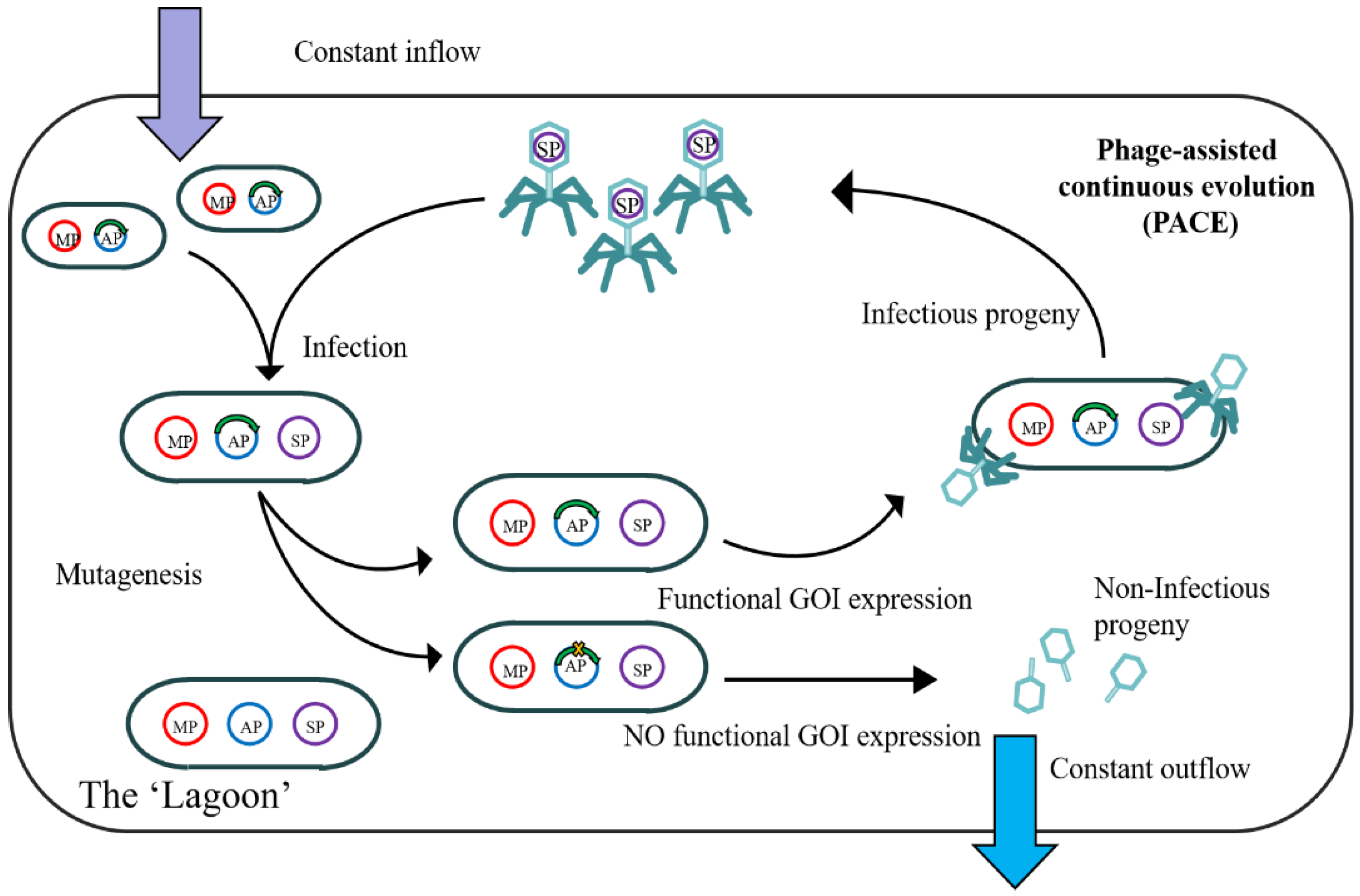
Bacteriophages are a type of bacterial virus that can infect prokaryotes. They utilized the host’s metabolic machinery to synthesize viral structural components and genomic material, ultimately assembling into progeny virions [36,37]. While many phages propagated through host lysis, filamentous phages such as M13 were continually secreted from infected cells without immediate lysis, enabling sustained production of viral particles [36,38]. Inspired by the rapid replication dynamics of bacteriophages, early innovators like Yuzuru Husimi developed the “cellstat”. This was a flow-based fermentation device designed to continuously culture bacteriophages infecting E. coli. Its development laid the conceptual groundwork for evolution in a controlled bioreactor setting [39]. Figure 2 shows a schematic diagram of the PACE system’s working principle.
Based on these foundations, Kevin M. Esvelt et al. developed a phage-assisted continuous evolution (PACE) method for the continuous directed evolution of biomolecules [40]. In a typical PACE setup, a selection phage (SP) was engineered to carry the gene of interest (GOI). Meanwhile, the gene encoding the essential protein III (pIII) was deleted from the phage genome. This gene was instead integrated into the host cell’s accessory plasmid (AP). The expression of pIII was placed under the control of the activity of the GOI-encoded protein. Thus, only functional GOI variants that adequately triggered pIII production permitted the generation of infectious phage particles. Phages with improved GOI activity were preferentially propagated, while non-functional or weak variants were competitively eliminated. To accelerate evolution, a mutagenesis plasmid (MP) encoding error-prone DNA polymerase was introduced, elevating mutation rates approximately 100-fold. The system operated in a continuous-flow bioreactor (e.g., a lagoon or chemostat), where fresh host cells continuously replenished the culture. Given that M13 completed a replication cycle in about 10 min—much faster than the 20 min division time of E. coli—the flow rate could be tuned to retain only phage particles. This setup enabled continuous and targeted evolution of the GOI over hundreds of generations without manual intervention [41,42].
Despite its power, the reliance on specialized continuous-flow equipment limits PACE’s accessibility. To address this, Dieter Söll’s et al. developed phage-assisted non-continuous evolution (PANCE), which adapted the core PACE logic to shaking flask cultures using serial passaging rather than continuous flow [43]. While PANCE offered greater flexibility in tuning selection pressures and required no complex hardware, it sacrificed automation and speed, often necessitating more time and manual handling to achieve comparable evolution outcomes.
Recent advances have further refined PACE into more versatile and scalable platforms. For instance, Phage- and Robotics-assisted Near-continuous Evolution (PRANCE) employed a 96-well robotic platform. This platform featured liquid handling controlled by Python for Hamilton liquid handling robots (PyHamilton), a program developed based on Python 3.8, and real-time luminescence feedback. (e.g., dynamically adjusting selection stringency based on luminescent signals). This system enabled high-throughput parallel evolution of hundreds of independent lineages with only once-daily manual intervention [44,45]. eVOLVER-supported Phage-Assisted Continuous Evolution (ePACE) integrated the eVOLVER culturing system with millifluidic devices, supporting automated parallel evolution under 8 different selection conditions, drastically shortening the cycle for multi-target experiments [46]. Spatial Phage-Assisted Continuous Evolution (SPACE) innovatively utilized bacterial range expansion and phage spatial competition on semisolid agar, enabling 96 parallel experiments without complex fluidic handling, thus reducing equipment barriers [47]. Alternating Phage-Assisted Non-Continuous Evolution (Alt-PANCE) decoupled mutagenesis and selection phases to alleviate fitness burdens when evolving toxic genes [48]. Integrase Phage-Assisted Continuous Evolution (IntePACE) used a split-pIII system to evolve large-cargo integrases with high specificity [49]. Collectively, these next-generation systems are shifting PACE from a low-throughput, equipment-heavy approach toward a high-throughput, automated, and broadly accessible platform, greatly expanding its utility in protein engineering, enzyme optimization, and synthetic biology.
Nevertheless, a fundamental limitation of all phage-based systems is their restriction to prokaryotic hosts. The inability to apply PACE directly in eukaryotic models, such as Saccharomyces cerevisiae, is a key constraint. This limitation restricts its utility for evolving proteins that are intended for eukaryotic expression or function. Future efforts to adapt phage-assisted principles to more organisms would substantially broaden the scope and impact of continuous evolution technologies.

2.2. Orthogonal DNA Replication Systems

Orthogonal DNA replication systems represent a groundbreaking approach. They achieve targeted gene mutagenesis while preserving host genomic integrity [50]. These systems function through engineered plasmid–polymerase pairs that operate independently of the host’s native replication machinery. The fundamental principle involves utilizing heterologous replication components. These components, such as DNA polymerases derived from bacteriophages or yeast plasmids, specifically replicate exogenous plasmids that contain compatible origins of replication [51]. Through strategic engineering, these polymerases are converted into error-prone variants. Consequently, target genes encoded on the orthogonal plasmids continuously accumulate mutations during replication cycles. This process enables sustained in vivo continuous evolution.

2.2.1. Yeast Orthogonal System: OrthoRep

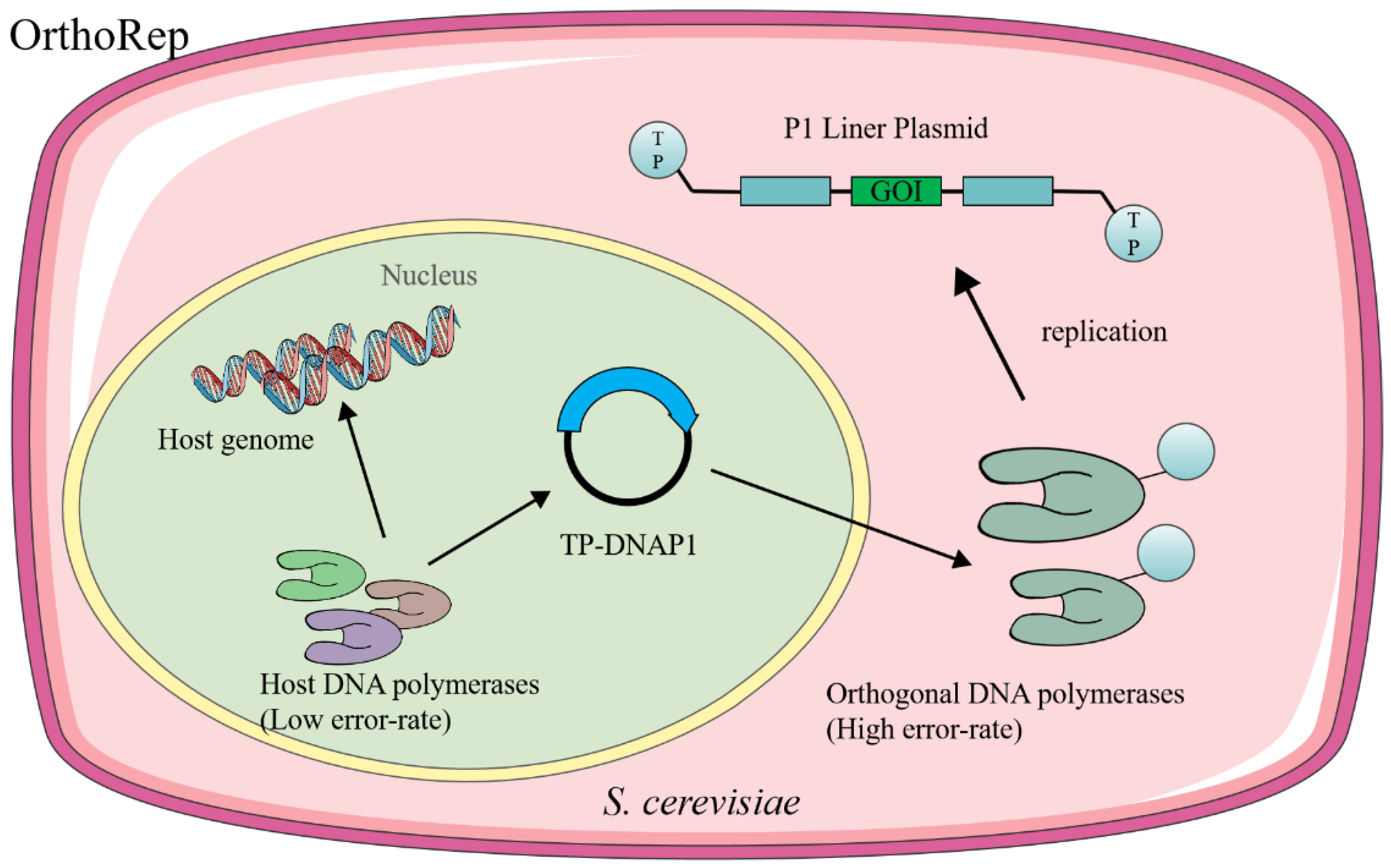
The yeast orthogonal replication system, OrthoRep, utilizes the cytoplasmic linear plasmids pGKL1 and pGKL2 from Kluyveromyces lactis. Replication initiates through a terminal protein (TP) mechanism. The terminal protein–DNA polymerase 1 (TP-DNAP1), encoded by pGKL1, exclusively replicates its native plasmid. Crucially, this process does not interfere with the host’s nuclear DNA replication [51]. The companion plasmid pGKL2 provides other essential auxiliary factors for replication and transcription. Figure 3 shows a structural schematic of the orthogonal mutagenesis replication system.
Initial engineering efforts focused on developing TP-DNAP1 variants with enhanced mutagenesis capabilities. While the single-point mutant Y427A showed modest improvement, its mutation rate remained limited and recombination with wild-type plasmids posed significant challenges [50]. To address these limitations, researchers employed nuclear plasmid trans-expression systems, which enabled precise targeting of mutations. This approach resulted in an approximately 25-fold enhancement in the mutation rate, reaching 3.99 × 10⁻⁸ substitutions per base. Subsequently, the team further engineered TP-DNAP1 by introducing multiple mutations into the key domains of DNA polymerase fidelity. Among them, the mutation rate of the mutant TP-DNAP1-4-2 (L477V/L640Y/I777K/W814N) was reported to reach 1 × 10⁻⁵ substitutions per base. This represented a 105-fold increase over the wild-type. This variant was reported to exhibit a distinct mutational spectrum dominated by T:A→A:T transversions (60%) followed by T:A→G:C transversions (24%). Additionally, OrthoRep demonstrates substantial practical utility. It is capable of stably maintaining DNA sequences up to 18 kb. It also supports the continuous evolution of both single genes and multigene pathways.
However, the optimized high mutation rate revealed a key bottleneck: OrthoRep’s original expression system failed to convert mutational diversity into selectable function. This was due to two main issues. First, error-prone TP-DNAP1 variants drastically reduced plasmid copy number. Simultaneously, natural upstream control regions (UCRs) provided only weak-to-moderate expression. Together, these factors further lowered target gene output [52]. Second, OrthoRep transcripts lacked poly(A) tails, leading to poor mRNA stability and inefficient translation. Additionally, the narrow expression range of natural UCRs was insufficient for diverse evolutionary applications, such as yeast surface display or fine-tuned multigene pathway regulation [53].
To break this bottleneck and expand OrthoRep’s applicability, optimizing the expression system became a necessary next step [52]. For example, further optimization was achieved through promoter engineering and genetically encoded poly(A) tails [54,55]. Specifically, screening identified UCR mutants like 10B2, which increased expression by 3-fold compared to wild-type K2O10. The addition of poly(A) tails, such as in A75-RZ, boosted expression by 10–20-fold. Combined, these strategies enhanced gene expression levels by 43-fold. This optimized level matched the expression range of endogenous yeast genes, which spans about 280-fold and is equivalent to the full strength of nuclear constitutive promoters. Importantly, high expression was maintained stable during extended passaging (≥60 generations). These advancements establish OrthoRep as a powerful platform for targeted mutagenesis with high parallelism and tunable expression in eukaryotic systems.

2.2.2. Bacterial Orthogonal Systems

Continuous evolution systems based on orthogonal error-prone DNA replication machinery were also developed for bacteria [56]. These systems are particularly notable for their ability to efficiently mutate long target genes while maintaining straightforward operational procedures. The BacORep system, constructed using elements from Bacillus thuringiensis and temperate phage GIL16, employed an orthogonal DNA polymerase (ODNAP) that specifically recognized inverted terminal repeats (ITRs) and terminal proteins (TP) at plasmid ends. Through TP-primed initiation, replication proceeded in complete isolation from host genome replication [57,58]. Researchers first replaced non-essential phage structural and cleavage genes. Subsequently, the target gene was integrated into an editable linear plasmid backbone derived from this modified phage [59]. Furthermore, error-prone variants of ODNAP (e.g., D18A/D70A/Y442N) were developed to increase the mutation rate of target genes during plasmid replication. The mutation rate of the linear plasmid reached 6.82 × 10⁻⁷ substitutions per base, which was 6700-fold above genomic background levels. Deep sequencing confirmed comprehensive mutational coverage across all 12 base substitution types, with even distribution along the 7.7 kb linear plasmid. However, BacORep’s reliance on B. thuringiensis as host and the practical limitations of linear plasmid manipulation have constrained its widespread adoption.
EcORep represented a synthetic orthogonal system designed for E. coli [60]. Its core innovation was a host-independent replication unit that expressed the PRD1 phage replicase system. This system exclusively replicated linear replicons containing an 18 bp ITR origin [61]. EcORep demonstrates significant application advantages: (1) enhanced host compatibility through E. coli’s rapid growth (20 min doubling time) and extensive genetic toolkits; (2) expanded cargo capacity supporting fragments ≥ 16.5 kb, enabling multigene pathway evolution; and (3) Regulating plasmid copy number and mutation rate through inducible systems to optimize the diversity-generation-screening-efficiency balance. Practically, EcORep has achieved 150-fold enhanced tigecycline resistance through tetA evolution and 1000-fold fluorescence improvement in GFP through synergistic promoter and coding region mutations.
However, the linear replicons used by EcORep exhibit lower transformation efficiency compared to the circular plasmids commonly used in laboratories [62]. Additionally, they require artificial regulation, such as the over-expression of Gam, SSB, and DSB repair proteins. This requirement imposes a certain burden on the integration of diverse libraries. To address these limitations, Peter G. Schultz et al. developed the T7-ORACLE system based on the replication origin of bacteriophage T7, which is naturally unrecognized by E. coli [63]. This system utilized a highly error-prone T7 DNA polymerase to achieve a mutation rate of approximately 1.7 × 10⁻⁵ substitutions per base. This rate represented a 100,000-fold increase over the genomic background. It also marked a 2.2-fold improvement over EcORep’s maximum rate. T7-ORACLE operated through the co-expression of T7 replisome genes and a hydrolytically deficient lysozyme fusion protein. This enabled the specific recognition and replication of circular plasmids containing T7 origins [64,65]. The use of conventional circular plasmids provided exceptionally high transformation efficiency and seamless integration with standard molecular biology workflows. These advantages made it particularly suitable for large-scale parallel evolution experiments. Table 1 shows the details of the orthogonal mutation replication system.
Orthogonal DNA replication systems have now been developed for multiple host organisms. Their development has established a versatile toolkit for continuous in vivo evolution. Each platform offers distinct advantages: OrthoRep for eukaryotic applications [50], BacORep for Bacillus species [56], and EcORep/T7-ORACLE for E. coli-based engineering [60,63]. These systems collectively enable targeted mutagenesis with minimal impact on host genomic stability, supporting both fundamental research and applied protein engineering. Future developments will likely focus on three key areas: expanding the host range, improving mutational control, and enhancing compatibility with high-throughput screening methodologies [52,53,66,67]. The continued refinement of orthogonal replication technologies promises to further accelerate advances in protein engineering, metabolic optimization, and synthetic biology.

3. Heterologous Polymerase-Mediated Targeted Hypermutation

3.1. Transcriptional Targeted Mutation System

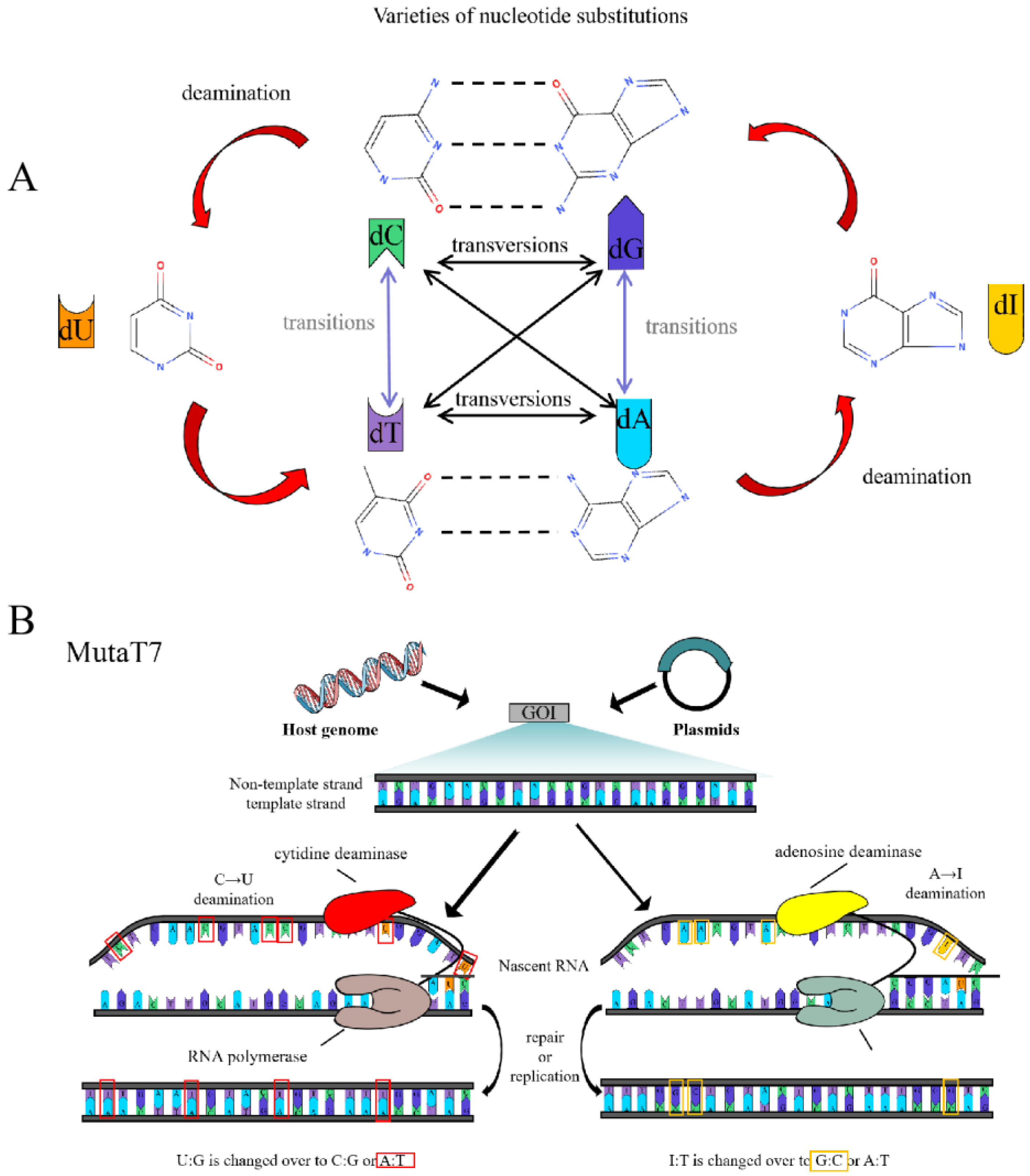
The intrinsic differences between transcription and replication processes provide distinct advantages for targeted mutagenesis strategies. Replication-based mutagenesis methods, such as the MP6 plasmid, often introduce deleterious mutations in essential genes and generate false positives. In contrast, transcription-coupled mutagenesis offers precise spatial control. It restricts mutations to specific transcriptional units through promoter specificity. Building on this principle, Matthew D. shoulders et al. developed the MutaT7 system [68]. Figure 4 shows the types of nucleotide interconversion and the operating mechanism of the MutaT7 system. This system was pioneered by fusing cytidine deaminase (rApo1) to the N-terminus of T7 RNA polymerase (T7 RNAP). This design leverages T7 RNAP’s strong promoter recognition to generate transcription bubbles. Within these bubbles, the fused activation-induced cytidine deaminase (AID) introduces mutations primarily in the transcribed region. The initial system achieved a mutation rate of 6.7 × 10⁻⁶ substitutions per base. It exhibited minimal off-target effects, which were comparable to wild-type levels. The mutations were predominantly C→T (90%) and G→A (10%) transitions. Subsequent optimizations included two key improvements. First, reverse T7 promoters were incorporated to enable bidirectional mutagenesis. Second, the uracil glycosylase inhibitor (UGI) was co-expressed to prevent uracil repair. Together, these enhancements increased the overall efficiency. Overall, MutaT7 successfully demonstrated the potentiality of transcription-coupled mutagenesis to achieve targeted mutagenesis with minimal off-target effects, avoiding the drawbacks of replication-based methods.
Nonetheless, the mutation rate of MutaT7 remained relatively lower than in vitro mutagenesis technology. To address this limitation, Seokhee Kim et al. developed eMutaT7 [69]. For increasing mutation efficiency, eMutaT7 replaced the original rApo1 with the more efficient PmCDA1 cytidine deaminase. This change resulted in a mutation rate multiple folds higher than that of MutaT7. Furthermore, the original weak promoter was replaced with an arabinose-inducible promoter to allow flexible regulation of mutation intensity. In addition, extended Recombinant Polypeptide linkers were designed to optimize the fusion protein structure without affecting catalytic activity. Through this series of constructions and regulatory optimizations, the mutation rate of eMutaT7 reached 9.4 × 10⁻⁵ substitutions per base. To achieve a more balanced mutational profile, Kim et al. further engineered the eMutaT7 system, and generated the eMutaT7transition system [70]. This variant co-expresses two distinct fusion proteins. The first was a TadA-8e adenosine deaminase-T7 RNAP chimera (eMutaT7TadA−8e). The second was the original PmCDA1 cytidine deaminase-T7 RNAP chimera (eMutaT7PmCDA1). This dual-system approach achieved a more balanced mutational profile. Specifically, C:G→T:A and A:T→G:C transitions occurred at a nearly 1:1 frequency. However, this balance came at the cost of a slightly reduced mutation rate of 3.6 × 10⁻⁵ substitutions per base. Meanwhile, the ribosome binding site (RBS) for the uracil glycosylase inhibitor (UGI) was optimized. This optimization further enhanced the net mutation efficiency of PmCDA1 by preventing the repair of deaminated cytosines. However, in the E. coli genome, targeted mutations may involve essential regulatory elements or coding sequences downstream of the 3 ’end of the target gene. Inserting a T7 terminator could directly cut off gene continuity. Therefore, Luis Ángel Fernández and colleagues used an inactive dCas9 protein and CRISPR RNA (crRNA) to target the region. This complex acts as a transcriptional “roadblock”. It confines the mutation range without the need to insert termination sequences [71]. In a Δung strain, the T7-targeted dCas9-limited in vivo mutagenesis (T7-DIVA) system achieved remarkable targeting precision. The PmCDA1-T7RNAP fusion within this system increased the mutation rate of the target gene (URA3) to approximately 10−1 substitutions per base. That was approximately 105-fold higher than its spontaneous background (−10−6). In contrast, the mutation rate in the off-target rpoB gene was only 2- to 20-fold above its spontaneous background. This resulted in an exceptional on-target to off-target ratio of ≥103.
Certainly, the MutaT7 system has been successfully implemented in other Gram-positive bacteria as well. Rao et al. constructed the CgMutaT7 system in Corynebacterium glutamicum. Its core design involved the sequential fusion of pmCDA1 and uracil glycosylase inhibitor (UGI) to T7RNAP via flexible linkers [72]. The researchers developed the CgMutaT7 system through multiple rounds of optimization. These optimizations included screening a 26-amino-acid flexible linker, introducing the G645A/Q649S/Q744R combination mutations into T7RNAP, and modifying the temperature-sensitive plasmid. This system exhibited excellent performance: it increased the mutation frequency of the target gene uracil phosphoribosyltransferase(upp) by a factor of 1.12 × 10⁴ compared to the blank control (containing only T7RNAP). Furthermore, the mutation frequency reached 1.0 × 10⁻⁵, whereas that in the wild-type control was only 1.0 × 10⁻⁹. High-throughput sequencing further confirmed the mutation profile of CgMutaT7. It introduced C→T mutations, which accounted for 90% of all mutations, across a continuous DNA region of at least 1.8 kb downstream of the T7 promoter. This was demonstrated in experiments targeting the 636 bp upp gene. Liu et al. established a Bacillus subtilis MutaT7 (BS-MutaT7) system [73]. To achieve this, they constructed a mutant library containing 7 types of deaminases, including adenosine deaminases TadA8e/TadA9 and cytosine deaminase PmCDA1. They also screened 14 types of fusion protein linkers with different structural characteristics, such as flexibility and length. Through this process, the study identified two optimal mutants: BS-MutaT7A (TadA8e-T7RNAP) and BS-MutaT7C (PmCDA1-(GGGGS)-T7RNAP + UGI). Their target mutation rates reached 1.2 × 10⁻⁵ and 5.8 × 10⁻⁵ substitutions per base, representing 7000-fold and 37,000-fold increases over the wild-type level of the B. subtilis genome (1.5 × 10⁻⁹ substitutions per base). In subsequent experiments, researchers adjusted the distance between the T7 promoter and the target gene locus. This adjustment expanded the editing window to 5 kb. Despite this expansion, both systems still retained approximately 50% of their initial activity. They also maintained a low off-target mutation rate, between 3.1 × 10⁻⁹ and 1.7 × 10⁻⁸ substitutions per base. The MutaT7 system was successfully reproduced in these two bacterial strains. This success provides a reusable technical framework for the evolutionary engineering of other Gram-positive bacteria.
However, the efficiency of T7 RNAP-deaminase fusions is significantly compromised in non-model microbial strains such as Halomonas bluephagenesis.
To overcome this limitation, Chen et al. developed an orthogonal transcription mutagenesis (OTM) system. This system employs bacteriophage-derived RNA polymerases—such as MmP1, K1F, and VP4—which are fused to deaminase domains [74]. Among the constructed variants, a dual-type OTM mutant achieved a mutation rate of 2.64 transition mutations per day per kb, outperforming both the eMutaT7transition system (1.58/day/kb) and the MutaT7GDE system (1.28/day/kb). This orthogonal strategy substantially broadens the applicability of targeted transcriptional hypermutation. It now extends to a wider range of non-model industrial and environmental microbes [75].
At present, the MutaT7 system has now been successfully extended to eukaryotic organisms. For example, in S. cerevisiae, the TRIDENT system (Targeted In vivo Diversity ENabled by T7 RNAP) has demonstrated exceptional performance, achieving mutation rates exceeding 10−3 substitutions per base, representing a million-fold increase over natural genomic error rates [76]. This system maintains remarkable targeting precision with >1000-fold specificity relative to off-target sites. Through strategic regulation of DNA repair factors, TRIDENT enables comprehensive mutagenesis across all four nucleotide types (A, T, C, G). This capability provides a versatile platform for protein engineering in yeast. In human cell systems, the TRACE platform utilizes a mechanism of continuous editing driven by T7 RNAP coupled with the C-terminal truncated version of AID (AID*Δ). Through this mechanism, it enables targeted mutagenesis across regions of approximately 2 kb. [77]. Both TRIDENT and TRACE exhibit mutation rates above 10−3 substitutions per base. They also possess over 1000-fold targeting specificity and maintain low off-target effects. These combined properties underscore their robustness for precision genome engineering in eukaryotic contexts. Table 2 shows the details of the MutaT7 system and its related variants.

3.2. Retron-Mediated Evolution Systems

In contrast to transcriptional mutagenesis strategies, retroelement-based evolution system represents a novel paradigm for programmable and autonomous continuous evolution [78,79]. This approach leverages natural bacterial retron elements. These are genetic modules that encode a reverse transcriptase. This enzyme produces multicopy single-stranded DNA (msDNA) molecules through RNA-templated reverse transcription. These msDNA transcripts serve as endogenous repair templates for precise homology-directed genetic editing [79].
Table 2. Performance metrics of the transcriptional targeted mutation system and retron-mediated evolution system.
HostMutation Rate (Substitutions per Base)Evolution Speed (Days)FoldTarget Gene Length CapacityMutational
Spectrum
Mutator ModuleFeatureReference
MutaT7E. coli6.7 ×10−67–15 38,00010 kbC→TrApo1, UGIHigh targeting, low off-target mutations, suitable for multi-KB regions, and dependent on Δung or UGI.[68]
eMutaT7E. coli9.4 × 10−51−2 340,0005 kbC→TPmCDA1Strong gene specificity, adjustable induction, low cytotoxicity, and dependent on the T7 promoter.[69]
eMutaT7transitionE. coli3.6 × 10−52−3 130,0005 kbC:G→T:A, A:T→G:CPmCDA1, TadA-8eIt can target multiple genes, but long-term culture is prone to recombination.[70]
T7-DIVAE. coli10−12−3 100,0002 kbC:G→T:A, A:T→G:CpmCDA1, TadA, crRNAdCas9 defines the mutation boundary, cross-bacterial/eukaryotic host potential, but relies on genomic integration.[71]
CgMutaT7C. glutamicum1 × 10−5–1.2 × 10−510−15 12,0001.8 kbC→TPmCDA1, UGIAdapt to specific hosts and fill the gap in tools. However, the target length is insufficient and the evolution cycle is relatively slow.[72]
BS-MutaT7A,
BS-MutaT7C
B. subtilis1.2 × 10−5,
5.8 × 10⁻⁵
3−10 7000 folds and 37,0005 kbA:T→G:C, C:G→T:ATadA8e, PmCDA1It is suitable for the evolution of long segments of genes and has high sustainability. However, the system needs to be screened and adapted.[73]
OTME. coli, H. bluephagenesis3.9 × 10−4 1 1,500,0005 kbA:T→G:C, C:G→T:APmCDA1, TadA8e, UGIHigh orthogonality but dependent on specific phage promoters.[74]
TRIDENTS. cerevisiae>10−31−11 10,000,0003 kbWidePmCDA1, yeTadA1.0, Msh6p and Apn2pHigh mutation specificity, needs genomic modification, exogenous promoter-dependent.[76]
TRACEHuman Embryonic Kidney 293T cells>10−33−714.7–312 kbC→T, G→AAID*Δ, UGIHuman cell-applicable, with continuous mutation, dynamically controllable; relies on genomic integration, narrow mutation spectrum.[77]
RetroelementE. coli6.3 × 10−71−2 390100 bpwideEP-T7RNAPSupports insertion/deletion/multi-point programming editing, but the editing length is short and depends on specific strains.[80]
The editing efficiency of retron systems was enhanced by up to 78-fold through systematic engineering [80]. These optimizations included promoter optimization, elimination of host exonucleases (e.g., ExoX), and inactivation of mismatch repair proteins (e.g., MutS). The optimized platform demonstrated remarkable versatility. It was capable of introducing up to 13 programmed nucleotide substitutions within a 31 bp genomic segment and also supported targeted insertions and deletions. These capabilities collectively significantly expanded its editing scope. This enables continuous self-evolution of selected phenotypes without the need for exogenous oligonucleotide templates or double-strand breaks. It is worth noting that this system can be coupled with an error-prone T7 RNA polymerase. Under this condition, it introduces unprogrammed random mutations within a specific genomic region. The achieved mutation rate is 190-fold higher than the background cellular mutation rate [80]. Its capacity for continuous, autonomous mutagenesis within specific genomic loci offers a powerful alternative to existing genome editing technologies. This is particularly valuable in contexts that require sustained evolutionary pressure without repeated external intervention [81,82,83]. Details of the reverse transcription mutation system are shown in Table 2.

3.3. CRISPR/Cas-Mediated Continuous Evolution Systems

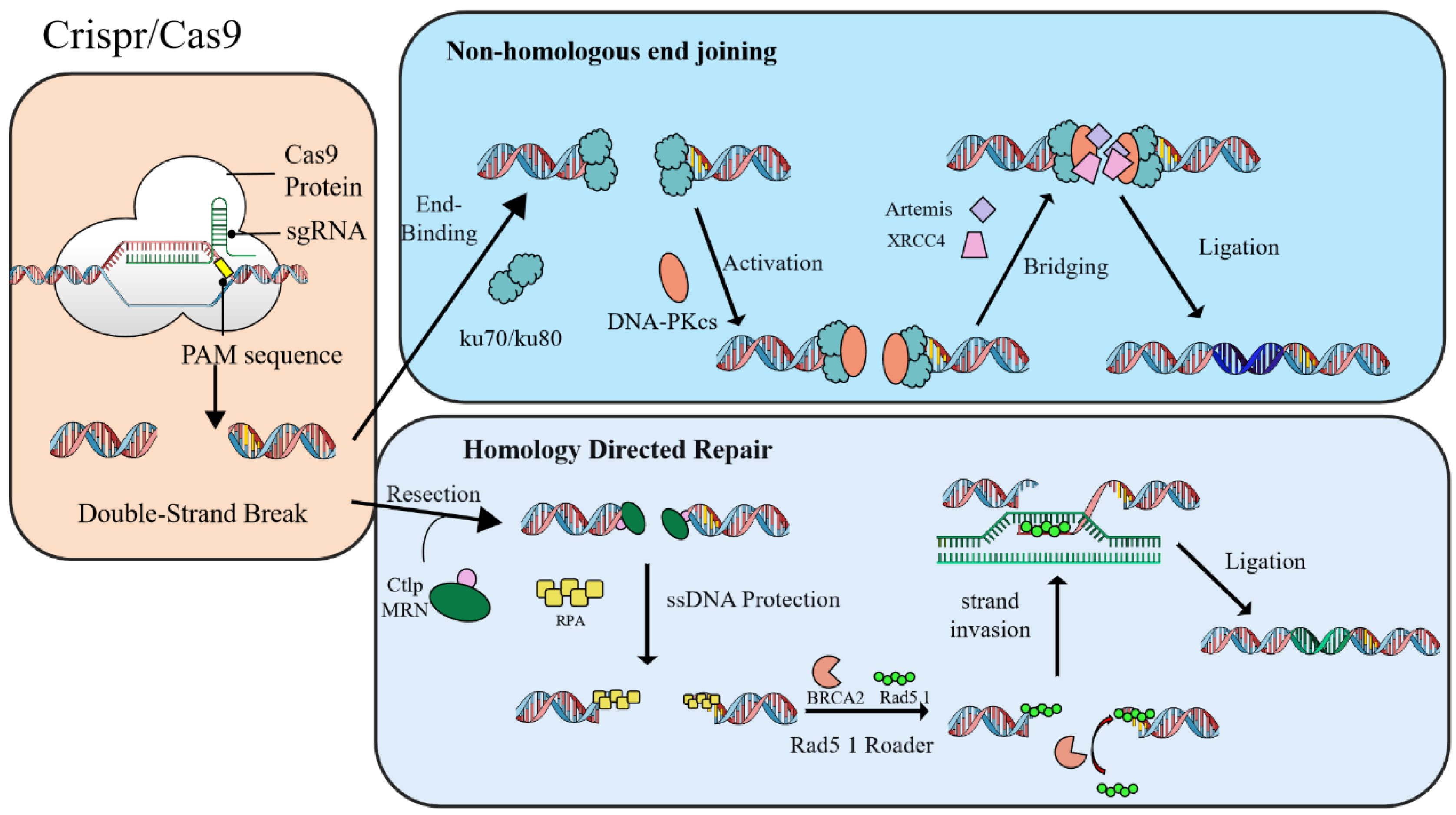
The CRISPR/Cas9 system represents a transformative genome editing platform derived from bacterial adaptive immunity [84]. This system utilizes a single guide RNA (sgRNA) of approximately 20 nucleotides to direct the Cas9 nuclease to specific genomic loci, where it induces precise double-strand breaks. Cellular repair mechanisms, including homology-directed repair (HDR) and error-prone non-homologous end joining (NHEJ), then mediate various genetic modifications ranging from targeted knockouts to precise insertions [85,86]. Figure 5 illustrates the two main repair pathways of CRISPR/Cas9. The CRISPR-Cas9 system is highly programmable and precise. These characteristics have established it as a powerful tool for controlled genome manipulation across diverse biological systems [87,88].
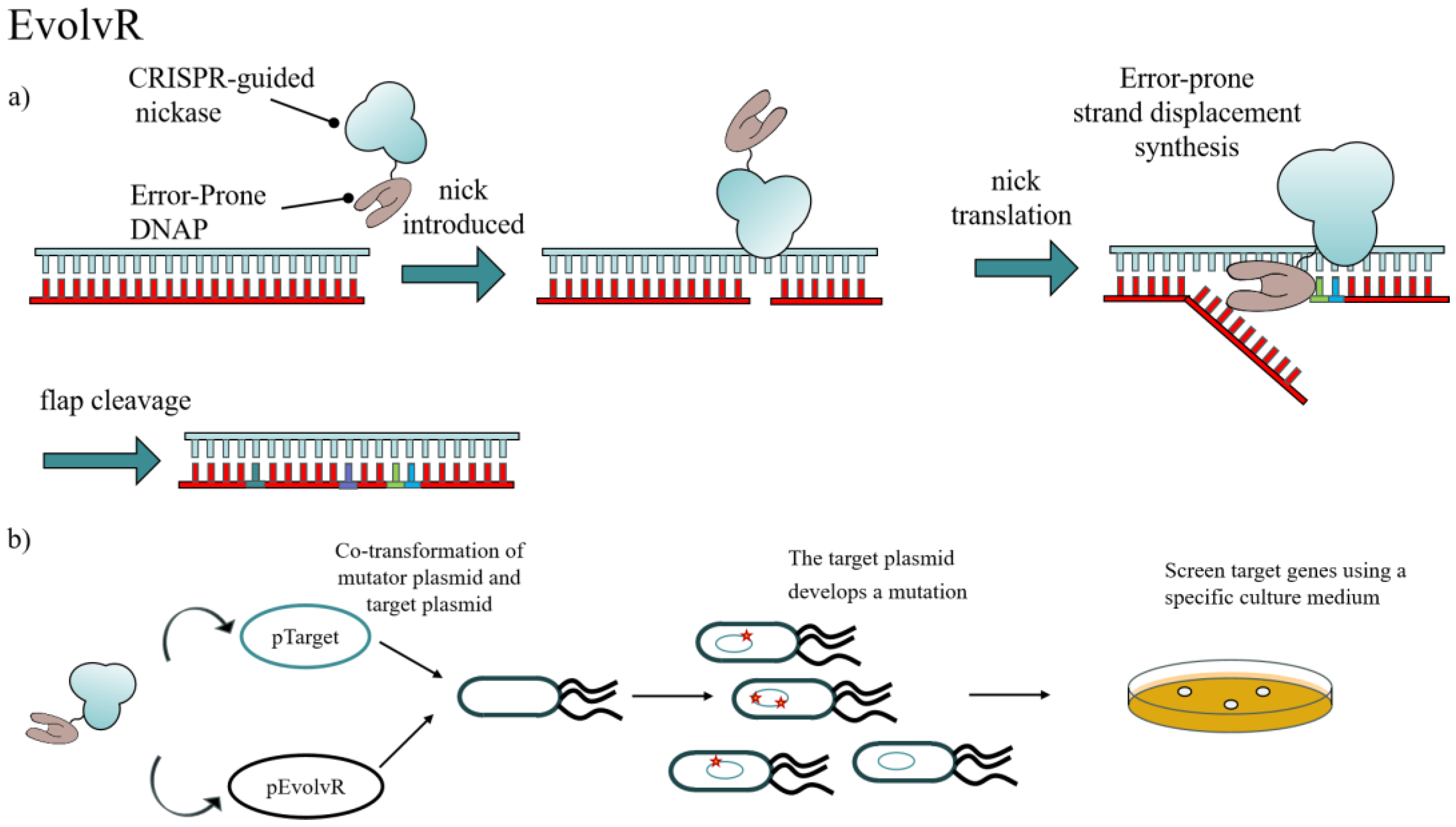
Based on its characteristics, John E. Dueber’s team developed the EvolvR system for continuous in vivo mutagenesis [89]. This platform employs a fusion protein combining catalytically impaired Cas9 nickase (nCas9) with an engineered error-prone DNA polymerase. Figure 6 illustrates the operation and application cases of EvolvR. Guided by sgRNA, the nCas9 created single-strand breaks at target sites. At these sites, the tethered low-fidelity polymerase introduceD random substitutions and deletions during repair-associated DNA synthesis. The initial EvolvR construct (nCas9-PolI3M) achieved a mutation rate of approximately 2.45 × 10⁻⁶ substitutions per base, 24,500-fold higher than background, while maintaining minimal off-target effects (1.2 × 10⁻⁸ substitutions per base) within a 17-nucleotide window. Subsequent iterations incorporated processive DNA polymerases from bacteriophage Phi29 carrying additional fidelity-reducing mutations (F742Y, P796H), significantly expanding the editing window and enhancing mutation rates. Further optimization through multiple-site engineering of nCas9 improved targeting efficiency several-fold, demonstrating the system’s capacity for continuous refinement.
Based on the design logic of E. coli EvolvR, further functional validation of yeast EvolvR (yEvolvR) was achieved [90]. yEvolvR retained the core design of CRISPR-guided nicking and error-prone polymerase activity. However, it exhibited unique characteristics in yeast. These included an expanded mutational window, which spanned 40 bp downstream and an additional 10–15 bp upstream of the nick site. This system efficiently generated 11 out of 12 possible base substitutions, with transitions representing 71.3% of mutations, and achieved a mutation rate 12,450 folds higher than that of the wild-type strain (10−10 substitutions per base). Implementation of dual-gRNA expression cassettes enabled simultaneous targeting of multiple genomic loci (e.g., URA3 and CAN1), providing enhanced flexibility for chromosome-scale diversification. A key advantage of EvolvR systems is their capacity for sustained mutagenesis without requiring repeated oligonucleotide delivery or dependence on HDR pathways. As long as cells proliferate and the system components are expressed, continuous nicking and error-prone synthesis enable progressive accumulation of mutations, effectively addressing the limitation of “discrete mutagenesis” inherent in many conventional genome editing approaches.
In yeast, systems based on fusing dCas9 with hyperactive deaminases provide another efficient continuous evolution solution [91]. The system developed by Skrekas et al. linked dCas9 to either the AID*Δ or adenine deaminase TadA8e via a 100-amino-acid flexible linker, with expression induced by the GAL1 promoter. Phenotypically, this system showed exceptional efficiency. Targeting the CAN1 gene with a single gRNA raised the resistance mutation rate to 10−4. This was nearly 100-fold higher than the wild-type background (10−6). Furthermore, multiplexing three gRNAs through the Csy4 ribozyme boosted the mutation rate to 10−2, representing a 10,000-fold increase over wild-type. Genetically, NGS analysis revealed that dCas9- AID*Δ has an effective editing window of approximately ±20 bp around the PAM site, and synergistic multiple gRNAs significantly broadened and enhanced mutation frequencies within this window. In terms of mutation spectrum, dCas9-AID*Δ mainly induced C→G/T→A and C→A/T→G transitions but also produced a considerable proportion of C→G/T→A and C→A/T→G transversions, exhibiting greater diversity than traditional base editors, whereas dCas9-TadA8e highly specifically mediated A→G (T→C on the coding strand) transitions.
Despite these advances, EvolvR systems remain constrained by relatively narrow operational windows and rapidly declining mutation frequencies with increasing distance from the nick site. To overcome these limitations for larger-scale applications, the CoMuTER (Continuous Mutagenesis Using Type I-E CRISPR) platform was developed [92]. This system harnessed the Type I-E CRISPR-Cas machinery, fusing the processive helicase-nuclease Cas3 with cytidine deaminase and combining it with the multi-subunit Cascade complex. CoMuTER enabled targeted cytidine deamination across genomic regions up to 55 kb, achieving a 350-fold increase in mutation frequency within target loci compared to background rates, with an average of 0.3 mutations per kb. Current CRISPR-deaminase fusions remain predominantly limited to cytidine deaminases. The future incorporation of adenine deaminases or other DNA-modifying enzymes promises to substantially broaden the mutational spectrum. This could enable comprehensive nucleotide diversification. Consequently, it would significantly expand the applicability of CRISPR-based continuous evolution platforms for complex metabolic engineering and whole-pathway optimization.
While EvolvR generates random diversity, an alternative strategy focuses on driving evolution through precise base substitutions. This is exemplified by the work of Tian et al., who implemented a CRISPR-Cas9 cytidine base editor (CBE)-mediated continuous evolution system in Aspergillus nidulans [93]. By performing iterative transformations with a combinatorial sgRNA library, they accumulated C-to-T mutations in 46 targeted gene clusters, effectively cleansing the metabolic background and boosting the production of Echinocandin B. This approach demonstrates the power of continuous evolution for complex phenotype optimization, even in genetically stubborn hosts like filamentous fungi. Details of the CRISPR/Cas9-mediated mutation system are shown in Table 3.

4. Applications of In Vivo Chromosomal Hypermutation

Recent advances in evolutionary exploration have enabled the development of sophisticated in vivo continuous evolution systems. These systems achieve sustained gene diversification, transformation, and screening/selection within single-cell hosts. These integrated platforms eliminate the need for time-consuming cyclic operations between in vitro and in vivo steps while overcoming the DNA transformation bottlenecks inherent in traditional directed evolution approaches. Detailed application cases are shown in Table 4.

4.1. Directed Evolution of Enzymes

In vivo continuous evolution systems enable comprehensive enzyme engineering by coupling enzyme activity to cellular growth conditions. Researchers used the OrthoRep orthogonal hypermutation system in S. cerevisiae to conduct efficiency engineering of aminoacyl-tRNA synthetases (aaRS). This work aimed at genetic code expansion [94]. They encoded aaRS on p1 plasmids and implemented 8 independent evolution experiments. These experiments combined ratiometric RXG reporter genes (RFP-GFP with amber codons) with fluorescence-activated cell sorting (FACS). Through this approach, they evolved aaRS variants that achieved high-efficiency, high-fidelity incorporation of non-canonical amino acids (ncAAs). Some variants exhibited relative readthrough efficiency (RRE) values approaching 1.0. For instance, MaPylRS/PhK-A demonstrated amber codon translation efficiency comparable to natural codons at a 1 mM PhK concentration. Its limit of detection (LOD) was also 29- to 8500-fold lower than the parental strains. Notably, several variant maintained function in E. coli, highlighting their cross-species compatibility.
The eMutaT7 system has facilitated activity restoration of functionally impaired heat shock protease DegP mutants [69]. Researchers employed continuous directed evolution with a gradient temperature selection. The temperature was increased by 1 °C every 4 h, from 37 °C to 44 °C. This process identified clones capable of surviving at 44 °C. It also led to the discovery of a novel allosteric activation site, P231. This site regulates activity through conformational changes without direct substrate interaction. This discovery breaks previous paradigms regarding DegP activation mechanisms. The PACE system has proven invaluable for enhancing CRISPR-based technologies [46,95]. Researchers aimed to address a key limitation: existing Cas9 variants struggle to target pyrimidine-enriched PAM sequences without compromising specificity. To this end, they employed PACE combined with the eVOLVER high-throughput platform. This approach isolated four highly active variants. These variants exhibited off-target ratios of 52:1, which was 43-fold superior to existing editors (1.2:1). At the same time, they maintained a 3.4-fold higher nuclease activity.
Continuous evolution systems provide powerful platforms for developing entirely new enzyme functions. Through PACE, researchers successfully evolved T7 RNA polymerase to recognize T3 promoters, a decades-old challenge in polymerase engineering [40]. The evolution lasted for 8 days and 200 rounds. It used a system where gene III (gIII) expression on accessory plasmids was driven by T3 promoters. Ultimately, they obtained variants with 89-fold higher in vitro activity than wild-type T7 RNAP. This achievement solved long-standing technical barriers in polymerase specificity reprogramming. Similarly, TEV protease has been re-engineered to cleave the HPLVGHM sequence in human inflammatory cytokine IL-23 instead of its natural ENLYFQS recognition sequence [96]. Researchers designed a linker that tightly binds T7 lysozyme and T7 RNAP to accessory plasmids. In this design, gIII expression—and consequently phage survival—depends on the cleavage of this linker. Using this system, they evolved highly active TEV protease variants. After approximately 2500 generations, the efficiency of these variants approached that of natural enzymes.
Base editor optimization has also benefited from continuous evolution approaches. Using PACE and PANCE systems to address the limited compatibility of adenine base editor (ABE) TadA-7.10, researchers evolved TadA-8e, containing 8 additional mutations, with 590-fold enhanced deamination kinetics compared to the original [97]. Further engineering produced the TadA-derived Cytosine Base Editor (CBE) [96]. This CBE contains only 166 amino acids, which is two-thirds the size of traditional CBEs. They also created the TadA dual base editor [97]. This is the first dual-functional editor based on a single evolved deaminase. Its development breaks the size limitations of traditional dual editors.

4.2. Directed Evolution of Target Genes for Improved Strain Performance

The in vivo evolution systems have demonstrated significant utility in metabolic pathway optimization and compound tolerance engineering. For example, the functionality of continuous evolution systems is most readily demonstrated through the selection of antibiotic or chemical resistance mutations in targeted genes. In E. coli, both eMutaT7 and eMutaT7transition systems have been applied to evolve TEM-1 β-lactamase, which exhibits minimal natural resistance to third-generation cephalosporins such as cefotaxime (CTX) and ceftazidime (CAZ) [69,70]. The eMutaT7 system underwent 8 rounds of in vivo mutagenesis cycles over 32 h. The antibiotic concentration was progressively increased during these cycles. This process achieved approximately 10,000-fold enhancements in resistance to multiple cephalosporins. This result far exceeds the capabilities of traditional in vitro mutagenesis. The eMutaT7transition system, leveraging dual deaminases, further increased the CTX minimal inhibitory concentration (MIC) to 4000 μg/mL within 48 h, breaking the efficacy ceiling observed with eMutaT7 alone. The TRACE technology platform has similarly proven effective in mammalian cells, identifying critical resistance mutations and their synergistic mechanisms [77]. In one application, researchers integrated T7 promoter-regulated MEK1 into experimental cells. The cells underwent three days of mutagenesis followed by two weeks of selection with 1 μM selumetinib or trametinib. Subsequent high-throughput sequencing revealed a core mutation: E38K+V211D. This mutation confers resistance to both inhibitors.
CRISPR/Cas9-mediated EvolvR systems have enabled continuous directed evolution of dual antibiotic resistance in ribosomal protein genes rpsL and rpsE [89]. Researchers co-expressed dual guide RNAs and performed selection in media containing both streptomycin and spectinomycin. This approach demonstrated simultaneous targeting of both resistance genes. The control groups showed no growth, which confirmed successful multi-locus genomic evolution. The CoMuTER system has been deployed in S. cerevisiae to target SEC14, encoding a phosphatidylinositol transfer protein that serves as the sole target for nitrophenyl(4-(2-methoxyphenyl)piperazin-1-yl)methanones (NPPMs) class antifungal inhibitors [92]. Following 48 h of mutagenesis, multiple resistant strains were isolated from 3 μM NPPM plates, leading to the identification of three previously unreported resistance sites. The transient sgRNA expression system was applied in Aspergillus nidulans NRRL 8112. Based on the simplified assembly of the combined sgRNA library, mutation modifications were simultaneously carried out on the core genes of 46 BGCS, which overcame the size limitations of traditional plasmids. After the 6th round of evolution, the ECB yield of the three engineered strains increased to approximately 120 mg/L, which was about 2.3-folds higher than that of the wild-type strain (52.3 mg/L), while cell growth was not affected [93]. The OrthoRep system has been successfully applied to study pyrimethamine resistance in Plasmodium falciparum dihydrofolate reductase (PfDHFR) [50]. Researchers used an error-prone orthogonal DNA polymerase (EP-ODNAP) to drive PfDHFR mutagenesis on p1 plasmids. This was performed across 90 independent replicate populations. These populations were continuously subcultured for 87 generations under increasing pyrimethamine concentrations, from 100 µM to 3 mM. Ultimately, 78 populations adapted to the maximum drug solubility.
Having demonstrated the capacity of continuous evolution systems for elucidating resistance mechanisms and optimizing individual enzymes, these platforms were also applied to enable systematic cellular reprogramming. Wei et al. has employed MutaT7 variant systems for in vivo directed evolution of the L-homoserine transporter RhtA in E. coli [98]. They employed an iterative process of “LB-induced mutation→M9 gradient concentration screening”. The L-homoserine concentration in the screening was increased from 4 to 6 to 8 g/L. Through this process, they obtained RhtA mutants with breakthrough functional improvements. At 8 g/L L-homoserine—a concentration that completely inhibits wild-type growth—mutant strains not only grew normally but demonstrated significantly enhanced growth rates, with specific mutants (rhtA-Mut2 and rhtA-Mut3) increasing OD600 values from 0.2 to 2.5 within 72 h. In B. subtilis, researchers targeted codY. This gene encodes the central global regulator of carbon–nitrogen metabolism. They used MutaT7-mediated continuous mutagenesis and multi-round screening to identify optimal regulatory mutants [73]. This approach increased β-lactoglobulin production to 3.92 g/L, demonstrating the system’s utility in metabolic engineering. The ALT-PANCE system has been utilized to optimize the pyrrolysine (Pyl) biosynthetic pathway [48]. Researchers cloned the pylBCD pathway into a selection phage (SP) vector. They also coupled Pyl production to phage gIII protein expression through amber codon suppression. Under progressively stringent selection conditions—which involved reducing BocK concentrations and increasing gIII amber codons—this system achieved multiple improvements: a 32-fold enhancement in pathway efficiency, a 4.5-fold increase in intracellular Pyl levels, and a 2.2-fold improvement in protease resistance. Shao et al. employed the orthogonal transcription mutagenesis (OTM) system for cellular morphology remodeling through targeted mutagenesis of cytoskeleton and cell division gene clusters [74]. In H.bluephagenesis TD01, precise mutation of the mreBCD cluster, which is cytoskeleton-associated, yielded spherical cells. In contrast, mutation of the ftsQAZ cluster, which is related to cell division, produced elongated rods exceeding 20 μm in length. Co-mutation of both clusters generated cells with irregular mixed morphologies. This morphological engineering process was completed within a single day. The same phenotypes were also achievable in E. coli under antibiotic selection. This demonstrates the OTM system’s broad adaptability across diverse microbial hosts.
Table 4. Summary of strategy for directed protein evolution.
Evolution SystemEvolved TargetPerformance MetricImprovement/Final PerformanceEvolution DurationSelection PressureReference
PACET7 RNA Polymerase Activity on T3 promoter>200-fold increase8 days (200 generations)Promoter swapping[40]
PANCEaaRs Combining binding affinity and catalytic efficiencytRNAPyl binding affinity and catalytic efficiency improved by up to 10-fold72–84 hPhage survival[43]
ALT-PANCEPyrrolysine pathway Intracellular Pyl level4.5-fold increase34–40 roundsReduced BocK, increased amber codons[48]
IntePACEPhiC31 Serine Integrase Recombination efficiency15.4- to 70.2-fold increase over initial mutant212 hSplit-pIII system[49]
IntePACEBxb1 Serine Integrase Recombination efficiency in HEK293T cells80% integration efficiency9 daysSplit-pIII system[49]
OrthoRepDihydrofolate reductase (PfDHFR) Pyrimethamine resistance87% populations (78/90) adapted to 3 mM87 generationsGradient pyrimethamine (100 μM to 3 mM)[50]
BacORepMethanol assimilation pathway Methanol consumption7.4-fold increase (to 8.3 g/L)20 passagesMethanol as sole carbon source[56]
EcOReptetATigecycline resistance150-fold increase (to 37 μg/mL)12 daysGradient antibiotic[60]
T7-ORACLETEM β-lactamase Resistance to aztreonam & cephalosporins5000-fold increase<1 weekAntibiotic gradient[63]
OrthoRepMucinivorans hirudinis THI4 Growth rate in thiamine-free mediumShow similar activity to yeast THI4Several weeksThiamine-free MOPS minimal medium[67]
eMutaT7TEM β-lactamase Cefotaxime (CTX) MIC10,000-fold
increase
32 h (8 rounds)Gradient CTX concentration[68]
eMutaT7DegP protease Growth at 44 °CRestored function of impaired mutant32 hGradient temperature (37 °C to 44 °C)[68]
eMutaT7transitionTEM β-lactamase Cefotaxime (CTX) MIC>10,000-fold increase (to 4000 μg/mL)48 hGradient CTX concentration[70]
CgMutaT7XylAEnzyme activity23.68% increase246 hGrowth rate[72]
BsMutaT7tetKTigecycline resistanceMIC increased from 0.25 to 8 μg/mL10 daysGradient antibiotic[73]
TRIDENTDihydrofolate reductase Pyrimethamine resistance98% populations (177/180) resistant to 3 mM11 days (5 rounds)3 mM pyrimethamine[76]
OTMRpoD Cell growth in 6 g/L L-arginine84% increase in cell mass<24 hHigh L-arginine concentration[74]
TRACEMEK1Resistance to selumetinib/trametinibSurvival under 1 μM inhibitor3 days mutagenesis + 2 weeks selection1 μM inhibitor[77]
EvolvRrpsL/rpsESpectinomycin resistanceGrowth at 1000 μg/mL36 hDual antibiotic selection[89]
targeted mutagenesis toolkitCAN1CAN formation rateFrom WT background (-10−6) to 10−2, 104-fold improvement2 daysSD-Arg+Can agar plates (60 mg/L canavanine, arginine depletion)[91]
CoMuTERSEC14Resistance to NPPM antifungalsGrowth in 3 μM NPPM 481 (no growth in control)48 h3 μM NPPM[92]
sgRNA transient expressionnatural product biosynthetic gene clustersEchinocandin B (ECB)
production
ECB production: From 52.3 mg/L to 120 mg/L, 2.3-fold improvement24 daysScreening for colonies with reduced byproducts and enhanced ECB production[93]
OrthoRepaaRS Relative Readthrough Efficiency (RRE)
Limit of Detection (LOD) for ncAA concentration
ncAA-dependent fluorescence ratio
RRE: Exhibited 2.42 to 31.26-fold increase
LOD: Reduced 29 to 8500-fold
ncAAs: 13 identified with functional variants in E. coli
Several weeksFACS with ratiometric reporter[94]
PACETEV Protease Cleavage of HPLVGHM sequenceActivity comparable to wild-type on native substrate2500 generationsPhage survival coupled to cleavage[96]
PACE, PANCEABE (TadA) Deamination kinetics590-fold increase25 generations + 84 hPhage survival[97]
BE-PACECBE Editing efficiency at marginal GC sitesBetter than APOBEC1, eliminated GC preferenceHundreds of hoursPhage survival[99]
PANCEBacillus methanolicus methanol dehydrogenase 2 In vitro enzyme kinetic parameters and the assimilation rate of methanol to the central metabolite3.5-fold Vmax boost and 2-fold higher methanol assimilation70 generationsMethanol concentration gradient[100]
PACEBicyclomycin biosynthetic gene cluster Increase the yield t of BCMBCM yield in E. coli: 20-fold increase (0.03→0.6 μg/mL)216 hSplit-pIII system[101]
PACECRISPR-associated transposases
(CAST)
Gene integration efficiency, transgenic expression level420-fold more active than wild-type296 h of PACE + 76 PANCE passagesTransposition activity is coupled with phage proliferation[102]
OrthoReptryptophan synthase β-subunit Standalone tryptophan synthesis activity, Thermoadaptation signaturesGained standalone function in yeast, enriched mesophilic amino acid replacements;3 monthsgradually reducing exogenous tryptophan and indole supply[103]
OrthoRepPrime Editor Base editing efficiencyEditing efficiency is 3.5-folds that of PEmaxSeveral weeksHistidine-deficient medium and long fragment insertion screening[104]
OrthoRepThermotoga maritima HisA Growth rateSupports the growth of yeast under histidine free conditions600 hHistidine concentration gradually decreased[105]
These diverse applications demonstrate that continuous directed evolution is a versatile and powerful strategy. Its utility extends beyond the engineering of single expression elements. It enables comprehensive engineering of microbial genomes, metabolic pathways, and enzymatic functions across diverse biological contexts.

5. Challenges and Future Perspectives

Although in vivo directed evolution has become a powerful tool, its future development depends on whether several key challenges can be addressed. First of all, expanding the host range is an important consideration. Currently, mature platforms such as E. coli and S. cerevisiae are mainly used in the laboratory. Future efforts should aim to cover a wider range of prokaryotic and eukaryotic hosts. Additionally, most current systems are good at evolving individual genes. However, engineering complex phenotypes requires the simultaneous coordination and evolution of multiple genetic elements. These phenotypes include metabolic pathways, regulatory circuits or cellular behaviors. Therefore, the key direction is to develop systems that can target parallel mutations at multiple genomic loci.
Scalability and metabolic burden are also major obstacles. Maintaining large mutant plasmids and highly active mutagenesis mechanisms may distort the selection results [19]. This will also limit the evolutionary ability of large DNA fragments. To address this, future work should focus on two strategies. First, developing minimal, chromosomally integrated mutagenesis systems to reduce the cellular burden. Second, leveraging stable orthogonal replication systems that offer higher cargo capacity. This is crucial for the evolution of entire biosynthetic gene clusters or large protein complexes.
Another important direction is to combine with artificial intelligence and predictive design [14]. The large amount of mutant data generated by continuous evolution is highly suitable for machine learning. Closely integrating the evolutionary cycle with machine learning models can yield multiple benefits. It helps predict beneficial mutations and design smarter libraries. Ultimately, it can guide the entire evolutionary trajectory from random exploration toward intelligent directed evolution.
Finally, translating laboratory-evolved variants to industrial settings remains challenging. This is mainly caused by the physiological differences in the hosts. Therefore, an important future goal is to perform continuous evolution directly in robust, non-model industrial strains. Examples include Bacillus species, C. glutamicum, and H. bluephagenesis. Systems such as OTM and CgMutaT7 have pioneered this approach [63,72,73]. Only through this direct approach can variants be optimized within their actual application environment.

6. Conclusions

In conclusion, continuous in vivo directed evolution has matured from a conceptual breakthrough into a transformative toolkit that is fundamentally reshaping protein and metabolic engineering. These platforms—including phage-assisted evolution, orthogonal DNA replication, and targeted hypermutation systems—seamlessly integrate mutagenesis, selection, and replication within living cells. This integration has successfully overcome the throughput and operational bottlenecks inherent in traditional directed evolution. This review has highlighted how these systems enable the rapid optimization of enzymes for novel functions and the comprehensive engineering of microbial strains for enhanced performance and tolerance.
In addition, the field is poised to tackle several key challenges and opportunities. A major future goal is to expand these systems into a broader range of hosts. Particular focus should be placed on higher eukaryotes, which would significantly widen their applicability in therapeutic and agricultural biotechnology. Enhancing the controllability and broadening the mutational spectra of these platforms will be crucial for more precise and comprehensive exploration of fitness landscapes. Furthermore, integrating continuous evolution with machine learning and real-time biosensing promises a fundamental shift. It moves the paradigm from random exploration toward intelligently guided evolution. This approach is poised to dramatically accelerate the design–build–test cycle.

Author Contributions

H.W.: Writing—original draft, Writing—review and editing. L.Y.: Writing—review and editing. J.C.: Writing—review and editing. X.W.: Writing—review and editing, Writing—Supervision, Conceptualization. K.C.: Writing—review and editing, Funding acquisition, Conceptualization. All authors have read and agreed to the published version of the manuscript.

Funding

The National Key Research and Development Program of China (Grant No. 2024YFA0916800). The National Nature Science Foundation of China (Grant No. 22278218).

Data Availability Statement

No data was used for the research described in the article.

Conflicts of Interest

The authors declare that they have no conflicts of interest.

References

  1. Movahedpour, A.; Ahmadi, N.; Ghalamfarsa, F.; Ghesmati, Z.; Khalifeh, M.; Maleksabet, A.; Shabaninejad, Z.; Taheri-Anganeh, M.; Savardashtaki, A. β-Galactosidase: From its source and applications to its recombinant form. Biotechnol. Appl. Biochem. 2022, 69, 612–628. [Google Scholar] [CrossRef]
  2. Song, P.; Zhang, X.; Wang, S.; Xu, W.; Wang, F.; Fu, R.; Wei, F. Microbial proteases and their applications. Front. Microbiol. 2023, 14, 1236368. [Google Scholar] [CrossRef]
  3. Naim, M.; Mohammat, M.F.; Mohd Ariff, P.N.A.; Uzir, M.H. Biocatalytic approach for the synthesis of chiral alcohols for the development of pharmaceutical intermediates and other industrial applications: A review. Enzym. Microb. Technol. 2024, 180, 110483. [Google Scholar] [CrossRef]
  4. Lin, J.L.; Wu, W.K.; Nie, G.B.; Li, J.X.; Fang, X.; Sheng, Y.G.; Wang, M.M.; Zheng, Q.Y.; Guo, X.X.; Huang, J.F.; et al. A dirigent protein redirects extracellular terpenoid metabolism for defense against biotic challenges. Nat. Commun. 2025, 16, 9270. [Google Scholar] [CrossRef]
  5. Wohlgemuth, R. Enzyme Catalysis for Sustainable Value Creation Using Renewable Biobased Resources. Molecules 2024, 29, 5772. [Google Scholar] [CrossRef]
  6. Zimmermann, A.; Prieto-Vivas, J.E.; Voordeckers, K.; Bi, C.; Verstrepen, K.J. Mutagenesis techniques for evolutionary engineering of microbes—Exploiting CRISPR-Cas, oligonucleotides, recombinases, and polymerases. Trends Microbiol. 2024, 32, 884–901. [Google Scholar] [CrossRef]
  7. Vázquez-Salazar, A.; Chen, I.A. In vitro evolution: From monsters to mobs. Curr. Biol. 2022, 32, R580–R583. [Google Scholar] [CrossRef]
  8. Korendovych, I.V. Rational and Semirational Protein Design. Methods Mol. Biol. 2018, 1685, 15–23. [Google Scholar] [CrossRef] [PubMed]
  9. Hammer, S.C.; Knight, A.M.; Arnold, F.H. Design and evolution of enzymes for non-natural chemistry. Curr. Opin. Green Sustain. Chem. 2017, 7, 23–30. [Google Scholar] [CrossRef]
  10. Acevedo-Rocha, C.G.; Ferla, M.; Reetz, M.T. Directed Evolution of Proteins Based on Mutational Scanning. Methods Mol. Biol. 2018, 1685, 87–128. [Google Scholar] [CrossRef] [PubMed]
  11. Zeymer, C.; Hilvert, D. Directed Evolution of Protein Catalysts. Annu. Rev. Biochem. 2018, 87, 131–157. [Google Scholar] [CrossRef]
  12. Adolf-Bryfogle, J.; Teets, F.D.; Bahl, C.D. Toward complete rational control over protein structure and function through computational design. Curr. Opin. Struct. Biol. 2021, 66, 170–177. [Google Scholar] [CrossRef]
  13. Huang, B.; Fan, T.; Wang, K.; Zhang, H.; Yu, C.; Nie, S.; Qi, Y.; Zheng, W.M.; Han, J.; Fan, Z.; et al. Accurate and efficient protein sequence design through learning concise local environment of residues. Bioinformatics 2023, 39, btad122. [Google Scholar] [CrossRef] [PubMed]
  14. Wang, J.; Ouyang, X.; Meng, S.; Zhao, B.; Liu, L.; Li, C.; Li, H.; Zheng, H.; Liu, Y.; Shi, T.; et al. Rational multienzyme architecture design with iMARS. Cell 2025, 188, 1349–1362.e1317. [Google Scholar] [CrossRef] [PubMed]
  15. Tupec, M.; Culka, M.; Machara, A.; Macháček, S.; Bím, D.; Svatoš, A.; Rulíšek, L.; Pichová, I. Understanding desaturation/hydroxylation activity of castor stearoyl Δ(9)-Desaturase through rational mutagenesis. Comput. Struct. Biotechnol. J. 2022, 20, 1378–1388. [Google Scholar] [CrossRef]
  16. Gardiner, S.; Talley, J.; Haynie, C.; Ebbert, J.; Kubalek, C.; Argyle, M.; Allen, D.; Heaps, W.; Green, T.; Chipman, D.; et al. Advancing Luciferase Activity and Stability beyond Directed Evolution and Rational Design through Expert Guided Deep Learning. Biorxiv Prepr. Serv. Biol. 2025. [Google Scholar] [CrossRef]
  17. Wu, Z.; Chen, W.; Hong, Y.; Wang, Y.; Xu, P. Machine learning-assisted rational design and evolution of novel signal peptides in Yarrowia lipolytica. Synth. Syst. Biotechnol. 2025, 10, 1275–1283. [Google Scholar] [CrossRef]
  18. Song, Z.; Zhang, Q.; Wu, W.; Pu, Z.; Yu, H. Rational design of enzyme activity and enantioselectivity. Front. Bioeng. Biotechnol. 2023, 11, 1129149. [Google Scholar] [CrossRef] [PubMed]
  19. Xia, Y.; Li, X.; Yang, L.; Luo, X.; Shen, W.; Cao, Y.; Peplowski, L.; Chen, X. Development of thermostable sucrose phosphorylase by semi-rational design for efficient biosynthesis of alpha-D-glucosylglycerol. Appl. Microbiol. Biotechnol. 2021, 105, 7309–7319. [Google Scholar] [CrossRef]
  20. Zhou, Y.; Jiao, L.; Shen, J.; Chi, H.; Lu, Z.; Liu, H.; Lu, F.; Zhu, P. Enhancing the Catalytic Activity of Type II L-Asparaginase from Bacillus licheniformis through Semi-Rational Design. Int. J. Mol. Sci. 2022, 23, 9663. [Google Scholar] [CrossRef]
  21. Qin, W.; Xu, L.; Cheng, K.; Lu, Y.; Yang, Z. Enhancing the imidase activity of BpIH toward 3-isobutyl glutarimide via semi-rational design. Appl. Microbiol. Biotechnol. 2024, 108, 474. [Google Scholar] [CrossRef]
  22. An, J.; Guan, J.; Nie, Y. Semi-Rational Design of L-Isoleucine Dioxygenase Generated Its Activity for Aromatic Amino Acid Hydroxylation. Molecules 2023, 28, 3750. [Google Scholar] [CrossRef]
  23. Sequeiros-Borja, C.E.; Surpeta, B.; Brezovsky, J. Recent advances in user-friendly computational tools to engineer protein function. Brief. Bioinform. 2021, 22, bbaa150. [Google Scholar] [CrossRef]
  24. Cai, Y.; Zhang, T.; Lin, F. [Semi-rational design improves the catalytic activity of butyrylcholinesterase against ghrelin]. Sheng Wu Gong Cheng Xue Bao = Chin. J. Biotechnol. 2024, 40, 4228–4241. [Google Scholar] [CrossRef]
  25. Wu, Y.; Jameel, A.; Xing, X.H.; Zhang, C. Advanced strategies and tools to facilitate and streamline microbial adaptive laboratory evolution. Trends Biotechnol. 2022, 40, 38–59. [Google Scholar] [CrossRef]
  26. Molina, R.S.; Rix, G.; Mengiste, A.A.; Alvarez, B.; Seo, D.; Chen, H.; Hurtado, J.; Zhang, Q.; Donato García-García, J.; Heins, Z.J.; et al. In vivo hypermutation and continuous evolution. Nat. Rev. Methods Primers 2022, 2, 36. [Google Scholar] [CrossRef]
  27. Li, Z.; Deng, Y.; Yang, G.Y. Growth-coupled high throughput selection for directed enzyme evolution. Biotechnol. Adv. 2023, 68, 108238. [Google Scholar] [CrossRef] [PubMed]
  28. Arnold, F.H. Directed Evolution: Bringing New Chemistry to Life. Angew. Chem. 2018, 57, 4143–4148. [Google Scholar] [CrossRef] [PubMed]
  29. Nearmnala, P.; Thanaburakorn, M.; Panbangred, W.; Chaiyen, P.; Hongdilokkul, N. An in vivo selection system with tightly regulated gene expression enables directed evolution of highly efficient enzymes. Sci. Rep. 2021, 11, 11669. [Google Scholar] [CrossRef]
  30. Sánchez, Á.; Vila, J.C.C.; Chang, C.Y.; Diaz-Colunga, J.; Estrela, S.; Rebolleda-Gomez, M. Directed Evolution of Microbial Communities. Annu. Rev. Biophys. 2021, 50, 323–341. [Google Scholar] [CrossRef] [PubMed]
  31. Alpay, B.A.; Desai, M.M. Effects of selection stringency on the outcomes of directed evolution. PLoS ONE 2024, 19, e0311438. [Google Scholar] [CrossRef]
  32. Sellés Vidal, L.; Isalan, M.; Heap, J.T.; Ledesma-Amaro, R. A primer to directed evolution: Current methodologies and future directions. RSC Chem. Biol. 2023, 4, 271–291. [Google Scholar] [CrossRef]
  33. Wang, B.; Liu, Y.; Bai, X.; Tian, H.; Wang, L.; Feng, M.; Xia, H. In vitro generation of genetic diversity for directed evolution by error-prone artificial DNA synthesis. Commun. Biol. 2024, 7, 628. [Google Scholar] [CrossRef]
  34. Lee, S.; Kim, P. Current Status and Applications of Adaptive Laboratory Evolution in Industrial Microorganisms. J. Microbiol. Biotechnol. 2020, 30, 793–803. [Google Scholar] [CrossRef]
  35. Yi, X.; Khey, J.; Kazlauskas, R.J.; Travisano, M. Plasmid hypermutation using a targeted artificial DNA replisome. Sci. Adv. 2021, 7, abg8712. [Google Scholar] [CrossRef]
  36. Conners, R.; León-Quezada, R.I.; McLaren, M.; Bennett, N.J.; Daum, B.; Rakonjac, J.; Gold, V.A.M. Cryo-electron microscopy of the f1 filamentous phage reveals insights into viral infection and assembly. Nat. Commun. 2023, 14, 2724. [Google Scholar] [CrossRef]
  37. Taslem Mourosi, J.; Awe, A.; Guo, W.; Batra, H.; Ganesh, H.; Wu, X.; Zhu, J. Understanding Bacteriophage Tail Fiber Interaction with Host Surface Receptor: The Key “Blueprint” for Reprogramming Phage Host Range. Int. J. Mol. Sci. 2022, 23, 12146. [Google Scholar] [CrossRef] [PubMed]
  38. Cahill, J.; Young, R. Phage Lysis: Multiple Genes for Multiple Barriers. Adv. Virus Res. 2019, 103, 33–70. [Google Scholar] [CrossRef] [PubMed]
  39. Yoshiyama, T.; Ichii, T.; Yomo, T.; Ichihashi, N. Automated in vitro evolution of a translation-coupled RNA replication system in a droplet flow reactor. Sci. Rep. 2018, 8, 11867. [Google Scholar] [CrossRef] [PubMed]
  40. Miller, S.M.; Wang, T.; Liu, D.R. Phage-assisted continuous and non-continuous evolution. Nat. Protoc. 2020, 15, 4101–4127. [Google Scholar] [CrossRef]
  41. Tan, Z.L.; Zheng, X.; Wu, Y.; Jian, X.; Xing, X.; Zhang, C. In vivo continuous evolution of metabolic pathways for chemical production. Microb. Cell Factories 2019, 18, 82. [Google Scholar] [CrossRef]
  42. Wang, Y.; Xue, P.; Cao, M.; Yu, T.; Lane, S.T.; Zhao, H. Directed Evolution: Methodologies and Applications. Chem. Rev. 2021, 121, 12384–12444. [Google Scholar] [CrossRef] [PubMed]
  43. Suzuki, T.; Miller, C.; Guo, L.T.; Ho, J.M.L.; Bryson, D.I.; Wang, Y.S.; Liu, D.R.; Söll, D. Crystal structures reveal an elusive functional domain of pyrrolysyl-tRNA synthetase. Nat. Chem. Biol. 2017, 13, 1261–1266. [Google Scholar] [CrossRef]
  44. Aoudjane, S.; Golas, S.; Ather, O.; Hammerling, M.J.; DeBenedictis, E. A Practical Guide to Phage- and Robotics-assisted Near-continuous Evolution. J. Vis. Exp. JoVE 2024, 203, e65974. [Google Scholar] [CrossRef] [PubMed]
  45. DeBenedictis, E.A.; Chory, E.J.; Gretton, D.W.; Wang, B.; Golas, S.; Esvelt, K.M. Systematic molecular evolution enables robust biomolecule discovery. Nat. Methods 2022, 19, 55–64. [Google Scholar] [CrossRef]
  46. Huang, T.P.; Heins, Z.J.; Miller, S.M.; Wong, B.G.; Balivada, P.A.; Wang, T.; Khalil, A.S.; Liu, D.R. High-throughput continuous evolution of compact Cas9 variants targeting single-nucleotide-pyrimidine PAMs. Nat. Biotechnol. 2023, 41, 96–107. [Google Scholar] [CrossRef]
  47. Wei, T.; Lai, W.; Chen, Q.; Zhang, Y.; Sun, C.; He, X.; Zhao, G.; Fu, X.; Liu, C. Exploiting spatial dimensions to enable parallelized continuous directed evolution. Mol. Syst. Biol. 2022, 18, e10934. [Google Scholar] [CrossRef] [PubMed]
  48. Ho, J.M.L.; Miller, C.A.; Smith, K.A.; Mattia, J.R.; Bennett, M.R. Improved pyrrolysine biosynthesis through phage assisted non-continuous directed evolution of the complete pathway. Nat. Commun. 2021, 12, 3914. [Google Scholar] [CrossRef]
  49. Hew, B.E.; Gupta, S.; Sato, R.; Waller, D.F.; Stoytchev, I.; Short, J.E.; Sharek, L.; Tran, C.T.; Badran, A.H.; Owens, J.B. Directed evolution of hyperactive integrases for site specific insertion of transgenes. Nucleic Acids Res. 2024, 52, e64. [Google Scholar] [CrossRef]
  50. Ravikumar, A.; Arzumanyan, G.A.; Obadi, M.K.A.; Javanpour, A.A.; Liu, C.C. Scalable, Continuous Evolution of Genes at Mutation Rates above Genomic Error Thresholds. Cell 2018, 175, 1946–1957.e1913. [Google Scholar] [CrossRef]
  51. Arzumanyan, G.A.; Gabriel, K.N.; Ravikumar, A.; Javanpour, A.A.; Liu, C.C. Mutually Orthogonal DNA Replication Systems In Vivo. ACS Synth. Biol. 2018, 7, 1722–1729. [Google Scholar] [CrossRef]
  52. Zhong, Z.; Ravikumar, A.; Liu, C.C. Tunable Expression Systems for Orthogonal DNA Replication. ACS Synth. Biol. 2018, 7, 2930–2934. [Google Scholar] [CrossRef]
  53. Paulk, A.M.; Williams, R.L.; Liu, C.C. Rapidly Inducible Yeast Surface Display for Antibody Evolution with OrthoRep. ACS Synth. Biol. 2024, 13, 2629–2634. [Google Scholar] [CrossRef]
  54. Sýkora, M.; Pospíšek, M.; Novák, J.; Mrvová, S.; Krásný, L.; Vopálenský, V. Transcription apparatus of the yeast virus-like elements: Architecture, function, and evolutionary origin. PLoS Pathog. 2018, 14, e1007377. [Google Scholar] [CrossRef]
  55. Tudek, A.; Krawczyk, P.S.; Mroczek, S.; Tomecki, R.; Turtola, M.; Matylla-Kulińska, K.; Jensen, T.H.; Dziembowski, A. Global view on the metabolism of RNA poly(A) tails in yeast Saccharomyces cerevisiae. Nat. Commun. 2021, 12, 4951. [Google Scholar] [CrossRef] [PubMed]
  56. Tian, R.; Zhao, R.; Guo, H.; Yan, K.; Wang, C.; Lu, C.; Lv, X.; Li, J.; Liu, L.; Du, G.; et al. Engineered bacterial orthogonal DNA replication system for continuous evolution. Nat. Chem. Biol. 2023, 19, 1504–1512. [Google Scholar] [CrossRef] [PubMed]
  57. van Nies, P.; Westerlaken, I.; Blanken, D.; Salas, M.; Mencía, M.; Danelon, C. Self-replication of DNA by its encoded proteins in liposome-based synthetic cells. Nat. Commun. 2018, 9, 1583. [Google Scholar] [CrossRef] [PubMed]
  58. Knipe, D.M.; Prichard, A.; Sharma, S.; Pogliano, J. Replication Compartments of Eukaryotic and Bacterial DNA Viruses: Common Themes Between Different Domains of Host Cells. Annu. Rev. Virol. 2022, 9, 307–327. [Google Scholar] [CrossRef]
  59. Mäntynen, S.; Sundberg, L.R.; Oksanen, H.M.; Poranen, M.M. Half a Century of Research on Membrane-Containing Bacteriophages: Bringing New Concepts to Modern Virology. Viruses 2019, 11, 76. [Google Scholar] [CrossRef]
  60. Tian, R.; Rehm, F.B.H.; Czernecki, D.; Gu, Y.; Zürcher, J.F.; Liu, K.C.; Chin, J.W. Establishing a synthetic orthogonal replication system enables accelerated evolution in E. coli. Science 2024, 383, 421–426. [Google Scholar] [CrossRef]
  61. Yoo, S.K.; Ito, J. Initiation of bacteriophage PRD1 DNA replication on single-stranded templates. J. Mol. Biol. 1991, 222, 127–131. [Google Scholar] [CrossRef]
  62. Williams, R.L.; Liu, C.C. Accelerated evolution of chosen genes. Science 2024, 383, 372–373. [Google Scholar] [CrossRef]
  63. Diercks, C.S.; Sondermann, P.; Rong, C.; Gillis, T.G.; Ban, Y.; Wang, C.; Dik, D.A.; Schultz, P.G. An orthogonal T7 replisome for continuous hypermutation and accelerated evolution in E. coli. Science 2025, 389, 618–622. [Google Scholar] [CrossRef]
  64. Borkotoky, S.; Murali, A. The highly efficient T7 RNA polymerase: A wonder macromolecule in biological realm. Int. J. Biol. Macromol. 2018, 118, 49–56. [Google Scholar] [CrossRef] [PubMed]
  65. Wang, W.; Li, Y.; Wang, Y.; Shi, C.; Li, C.; Li, Q.; Linhardt, R.J. Bacteriophage T7 transcription system: An enabling tool in synthetic biology. Biotechnol. Adv. 2018, 36, 2129–2137. [Google Scholar] [CrossRef] [PubMed]
  66. Wong, B.G.; Mancuso, C.P.; Kiriakov, S.; Bashor, C.J.; Khalil, A.S. Precise, automated control of conditions for high-throughput growth of yeast and bacteria with eVOLVER. Nat. Biotechnol. 2018, 36, 614–623. [Google Scholar] [CrossRef] [PubMed]
  67. García-García, J.D.; Van Gelder, K.; Joshi, J.; Bathe, U.; Leong, B.J.; Bruner, S.D.; Liu, C.C.; Hanson, A.D. Using continuous directed evolution to improve enzymes for plant applications. Plant Physiol. 2022, 188, 971–983. [Google Scholar] [CrossRef]
  68. Moore, C.L.; Papa, L.J., 3rd; Shoulders, M.D. A Processive Protein Chimera Introduces Mutations across Defined DNA Regions In Vivo. J. Am. Chem. Soc. 2018, 140, 11560–11564. [Google Scholar] [CrossRef]
  69. Park, H.; Kim, S. Gene-specific mutagenesis enables rapid continuous evolution of enzymes in vivo. Nucleic Acids Res. 2021, 49, e32. [Google Scholar] [CrossRef]
  70. Seo, D.; Koh, B.; Eom, G.E.; Kim, H.W.; Kim, S. A dual gene-specific mutator system installs all transition mutations at similar frequencies in vivo. Nucleic Acids Res. 2023, 51, e59. [Google Scholar] [CrossRef]
  71. Álvarez, B.; Mencía, M.; de Lorenzo, V.; Fernández, L. In vivo diversification of target genomic sites using processive base deaminase fusions blocked by dCas9. Nat. Commun. 2020, 11, 6436. [Google Scholar] [CrossRef]
  72. Wang, Q.; You, J.; Li, Y.; Zhang, J.; Wang, Y.; Xu, M.; Rao, Z. Continuous Evolution of Protein through T7 RNA Polymerase-Guided Base Editing in Corynebacterium glutamicum. ACS Synth. Biol. 2025, 14, 216–229. [Google Scholar] [CrossRef]
  73. Wang, B.; Wu, Y.; Lv, X.; Liu, L.; Li, J.; Du, G.; Chen, J.; Liu, Y. T7 RNA polymerase-guided base editor for accelerated continuous evolution in Bacillus subtilis. Synth. Syst. Biotechnol. 2025, 10, 876–886. [Google Scholar] [CrossRef]
  74. Shao, M.; Zhang, Z.; Jin, X.; Ding, J.; Chen, G.Q. An orthogonal transcription mutation system generating all transition mutations for accelerated protein evolution in vivo. Nat. Commun. 2025, 16, 6041. [Google Scholar] [CrossRef]
  75. Mengiste, A.A.; McDonald, J.L.; Nguyen Tran, M.T.; Plank, A.V.; Wilson, R.H.; Butty, V.L.; Shoulders, M.D. MutaT7(GDE): A Single Chimera for the Targeted, Balanced, Efficient, and Processive Installation of All Possible Transition Mutations In Vivo. ACS Synth. Biol. 2024, 13, 2693–2701. [Google Scholar] [CrossRef]
  76. Cravens, A.; Jamil, O.K.; Kong, D.; Sockolosky, J.T.; Smolke, C.D. Polymerase-guided base editing enables in vivo mutagenesis and rapid protein engineering. Nat. Commun. 2021, 12, 1579. [Google Scholar] [CrossRef]
  77. Chen, H.; Liu, S.; Padula, S.; Lesman, D.; Griswold, K.; Lin, A.; Zhao, T.; Marshall, J.L.; Chen, F. Efficient, continuous mutagenesis in human cells using a pseudo-random DNA editor. Nat. Biotechnol. 2020, 38, 165–168. [Google Scholar] [CrossRef] [PubMed]
  78. Inouye, M. The first demonstration of the existence of reverse transcriptases in bacteria. Gene 2017, 597, 76–77. [Google Scholar] [CrossRef] [PubMed]
  79. Simon, A.J.; Ellington, A.D.; Finkelstein, I.J. Retrons and their applications in genome engineering. Nucleic Acids Res. 2019, 47, 11007–11019. [Google Scholar] [CrossRef] [PubMed]
  80. Simon, A.J.; Morrow, B.R.; Ellington, A.D. Retroelement-Based Genome Editing and Evolution. ACS Synth. Biol. 2018, 7, 2600–2611. [Google Scholar] [CrossRef]
  81. Schubert, M.G.; Goodman, D.B.; Wannier, T.M.; Kaur, D.; Farzadfard, F.; Lu, T.K.; Shipman, S.L.; Church, G.M. High-throughput functional variant screens via in vivo production of single-stranded DNA. Proc. Natl. Acad. Sci. USA 2021, 118, e2018181118. [Google Scholar] [CrossRef]
  82. Liu, W.; Zuo, S.; Shao, Y.; Bi, K.; Zhao, J.; Huang, L.; Xu, Z.; Lian, J. Retron-mediated multiplex genome editing and continuous evolution in Escherichia coli. Nucleic Acids Res. 2023, 51, 8293–8307. [Google Scholar] [CrossRef]
  83. Farzadfard, F.; Gharaei, N.; Citorik, R.J.; Lu, T.K. Efficient retroelement-mediated DNA writing in bacteria. Cell Syst. 2021, 12, 860–872.e865. [Google Scholar] [CrossRef]
  84. Yan, M.; Li, J. The evolving CRISPR technology. Protein Cell 2019, 10, 783–786. [Google Scholar] [CrossRef]
  85. Miyaoka, Y.; Berman, J.R.; Cooper, S.B.; Mayerl, S.J.; Chan, A.H.; Zhang, B.; Karlin-Neumann, G.A.; Conklin, B.R. Systematic quantification of HDR and NHEJ reveals effects of locus, nuclease, and cell type on genome-editing. Sci. Rep. 2016, 6, 23549. [Google Scholar] [CrossRef]
  86. Nambiar, T.S.; Billon, P.; Diedenhofen, G.; Hayward, S.B.; Taglialatela, A.; Cai, K.; Huang, J.-W.; Leuzzi, G.; Cuella-Martin, R.; Palacios, A.; et al. Stimulation of CRISPR-mediated homology-directed repair by an engineered RAD18 variant. Nat. Commun. 2019, 10, 3395. [Google Scholar] [CrossRef] [PubMed]
  87. Batool, A.; Malik, F.; Andrabi, K.I. Expansion of the CRISPR/Cas Genome-Sculpting Toolbox: Innovations, Applications and Challenges. Mol. Diagn. Ther. 2021, 25, 41–57. [Google Scholar] [CrossRef] [PubMed]
  88. Simon, A.J.; d’Oelsnitz, S.; Ellington, A.D. Synthetic evolution. Nat. Biotechnol. 2019, 37, 730–743. [Google Scholar] [CrossRef]
  89. Halperin, S.O.; Tou, C.J.; Wong, E.B.; Modavi, C.; Schaffer, D.V.; Dueber, J.E. CRISPR-guided DNA polymerases enable diversification of all nucleotides in a tunable window. Nature 2018, 560, 248–252. [Google Scholar] [CrossRef]
  90. Tou, C.J.; Schaffer, D.V.; Dueber, J.E. Targeted Diversification in the S. cerevisiae Genome with CRISPR-Guided DNA Polymerase I. ACS Synth. Biol. 2020, 9, 1911–1916. [Google Scholar] [CrossRef] [PubMed]
  91. Skrekas, C.; Limeta, A.; Siewers, V.; David, F. Targeted In Vivo Mutagenesis in Yeast Using CRISPR/Cas9 and Hyperactive Cytidine and Adenine Deaminases. ACS Synth. Biol. 2023, 12, 2278–2289. [Google Scholar] [CrossRef]
  92. Zimmermann, A.; Prieto-Vivas, J.E.; Cautereels, C.; Gorkovskiy, A.; Steensels, J.; Van de Peer, Y.; Verstrepen, K.J. A Cas3-base editing tool for targetable in vivo mutagenesis. Nat. Commun. 2023, 14, 3389. [Google Scholar] [CrossRef]
  93. Tian, Y.; Xu, Q.; Pang, M.; Ma, Y.; Zhang, Z.; Zhang, D.; Guo, D.; Wang, L.; Li, Q.; Li, Y.; et al. CRISPR-Cas9 Cytidine-Base-Editor Mediated Continuous In Vivo Evolution in Aspergillus nidulans. ACS Synth. Biol. 2025, 14, 621–628. [Google Scholar] [CrossRef]
  94. Furuhata, Y.; Rix, G.; Van Deventer, J.A.; Liu, C.C. Directed evolution of aminoacyl-tRNA synthetases through in vivo hypermutation. Nat. Commun. 2025, 16, 4832. [Google Scholar] [CrossRef] [PubMed]
  95. Hu, J.H.; Miller, S.M.; Geurts, M.H.; Tang, W.; Chen, L.; Sun, N.; Zeina, C.M.; Gao, X.; Rees, H.A.; Lin, Z.; et al. Evolved Cas9 variants with broad PAM compatibility and high DNA specificity. Nature 2018, 556, 57–63. [Google Scholar] [CrossRef] [PubMed]
  96. Packer, M.S.; Rees, H.A.; Liu, D.R. Phage-assisted continuous evolution of proteases with altered substrate specificity. Nat. Commun. 2017, 8, 956. [Google Scholar] [CrossRef] [PubMed]
  97. Richter, M.F.; Zhao, K.T.; Eton, E.; Lapinaite, A.; Newby, G.A.; Thuronyi, B.W.; Wilson, C.; Koblan, L.W.; Zeng, J.; Bauer, D.E.; et al. Phage-assisted evolution of an adenine base editor with improved Cas domain compatibility and activity. Nat. Biotechnol. 2020, 38, 883–891. [Google Scholar] [CrossRef]
  98. Wei, Z.; Zhao, D.; Wang, J.; Li, J.; Xu, N.; Ding, C.; Liu, J.; Li, S.; Zhang, C.; Bi, C.; et al. Targeted C-to-T and A-to-G dual mutagenesis system for RhtA transporter in vivo evolution. Appl. Environ. Microbiol. 2023, 89, e0075223. [Google Scholar] [CrossRef]
  99. Thuronyi, B.W.; Koblan, L.W.; Levy, J.M.; Yeh, W.H.; Zheng, C.; Newby, G.A.; Wilson, C.; Bhaumik, M.; Shubina-Oleinik, O.; Holt, J.R.; et al. Continuous evolution of base editors with expanded target compatibility and improved activity. Nat. Biotechnol. 2019, 37, 1070–1079. [Google Scholar] [CrossRef]
  100. Roth, T.B.; Woolston, B.M.; Stephanopoulos, G.; Liu, D.R. Phage-Assisted Evolution of Bacillus methanolicus Methanol Dehydrogenase 2. ACS Synth. Biol. 2019, 8, 796–806. [Google Scholar] [CrossRef]
  101. Johnston, C.W.; Badran, A.H.; Collins, J.J. Continuous bioactivity-dependent evolution of an antibiotic biosynthetic pathway. Nat. Commun. 2020, 11, 4202. [Google Scholar] [CrossRef]
  102. Witte, I.P.; Lampe, G.D.; Eitzinger, S.; Miller, S.M.; Berríos, K.N.; McElroy, A.N.; King, R.T.; Stringham, O.G.; Gelsinger, D.R.; Vo, P.L.H.; et al. Programmable gene insertion in human cells with a laboratory-evolved CRISPR-associated transposase. Science 2025, 388, eadt5199. [Google Scholar] [CrossRef] [PubMed]
  103. Rix, G.; Williams, R.L.; Hu, V.J.; Spinner, A.; Pisera, A.O.; Marks, D.S.; Liu, C.C. Continuous evolution of user-defined genes at 1 million times the genomic mutation rate. Science 2024, 386, eadm9073. [Google Scholar] [CrossRef] [PubMed]
  104. Weber, Y.; Böck, D.; Ivașcu, A.; Mathis, N.; Rothgangl, T.; Ioannidi, E.I.; Blaudt, A.C.; Tidecks, L.; Vadovics, M.; Muramatsu, H.; et al. Enhancing prime editor activity by directed protein evolution in yeast. Nat. Commun. 2024, 15, 2092. [Google Scholar] [CrossRef] [PubMed]
  105. Zhong, Z.; Wong, B.G.; Ravikumar, A.; Arzumanyan, G.A.; Khalil, A.S.; Liu, C.C. Automated Continuous Evolution of Proteins in Vivo. ACS Synth. Biol. 2020, 9, 1270–1276. [Google Scholar] [CrossRef]
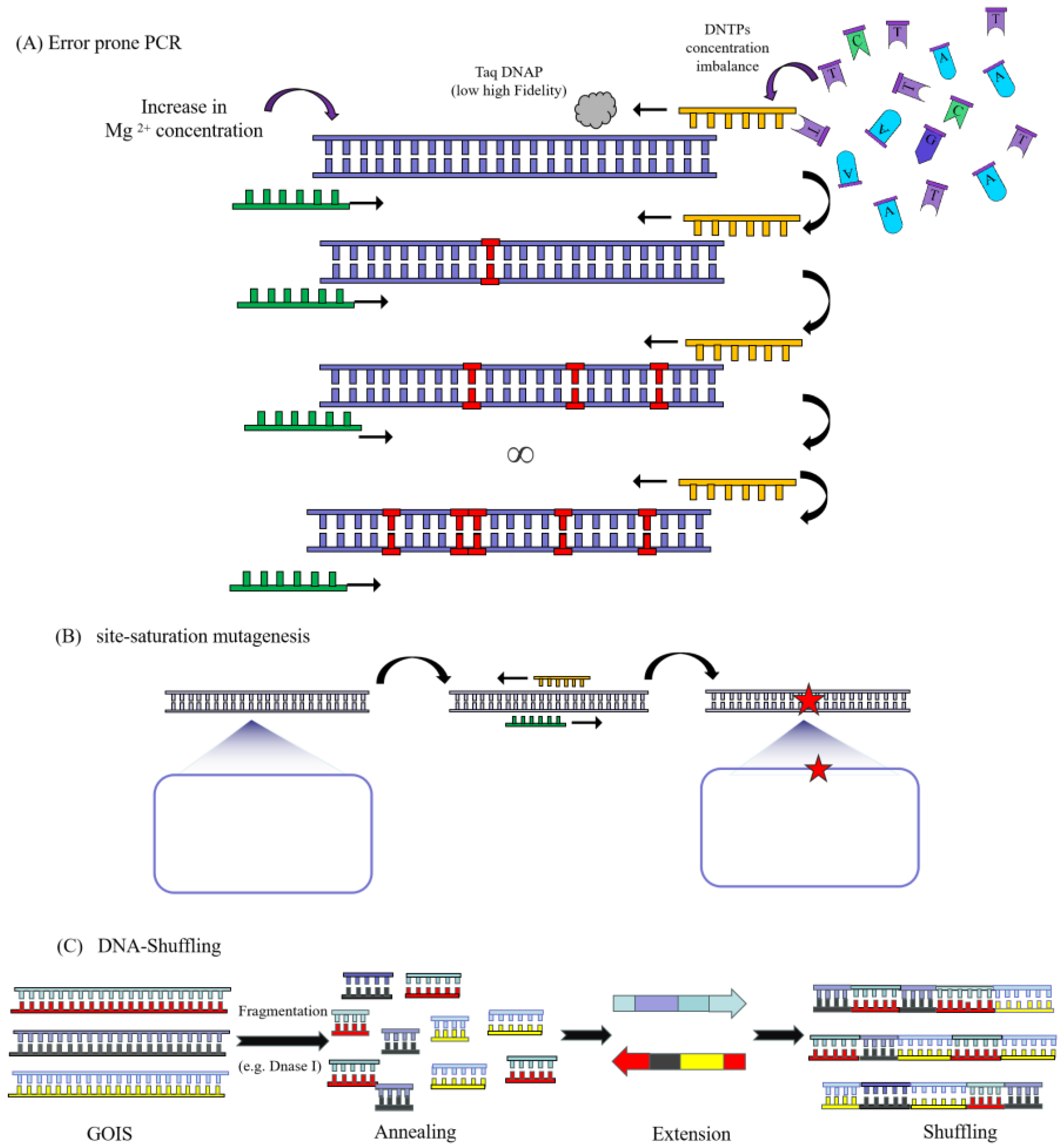
Figure 1. (A) Error-Prone PCR: This method randomly introduces mutations during gene amplification by PCR. It reduces the fidelity of DNA synthesis through adjusted reaction conditions, such as employing DNA polymerases lacking 3′→5′ exonuclease proofreading activity (e.g., Taq polymerase), increasing the concentration of Mg2+, adding Mn2+, or using an unbalanced dNTP mixture. These conditions promote the random incorporation of incorrect bases into the newly synthesized DNA strand. Arrows: The curved black arrows represent the repeated cycles of PCR. Red blocks: Mutations introduced during amplification. ∞: Denotes the exponential and repeated cycles of PCR. (B) Saturation Mutagenesis: This technique aims to replace the codon(s) of one or more specific amino acid residues in a gene with codons for all or a subset of the other amino acids. It is typically achieved by using PCR with specifically designed degenerate primers. Green and yellow: Primers contains degenerate nucleotides to introduce a diversity of mutations at a specific site. Red star: Marks the target site for mutagenesis, where a wide range of amino acid substitutions are intentionally introduced. (C) DNA Shuffling: A set of homologous gene fragments carrying diverse mutations is first randomly fragmented. These fragments are then subjected to a primer-free PCR reaction. Due to their sequence homology, the fragments can anneal to each other and serve as mutual primers and templates for repeated cycles of extension. This process ultimately leads to the homologous recombination of mutations from different parent fragments, generating novel chimeric genes. This figure was created by the authors.
Catalysts 15 01127 g001
Figure 2. Schematic overview of PACE. This figure was created by the authors.
Catalysts 15 01127 g002
Figure 3. Conceptual illustration of OrthoRep. The core mechanism of this system is to express a positive strand error DNA polymerase (DNAP) targeting the P1-liner nature plasmid in S. cerevisiae, and introduce mutations into the orthogonal P1-liner nature plasmid through this enzyme. This figure was created by the authors.
Catalysts 15 01127 g003
Figure 4. MutaT7 mutagenesis mechanisms for in vivo hypermutation systems. (A) The Mechanism of Nucleotide Base Mutation. (B) The target gene, derived from a plasmid or the genome, is efficiently transcribed by T7 RNA polymerase. During this process, cytidine deaminase or adenosine deaminase simultaneously induces deamination mutations on the non-template strand. These colored marks indicate that during subsequent DNA replication, this mismatch either gives rise to mutations in the daughter DNA or is corrected by the cell’s mismatch repair mechanism, thereby preventing mutations from arising. This figure was created by the authors.
Catalysts 15 01127 g004
Figure 5. CRISPR-Cas9: Two Major Repair Mechanisms. This figure was created by the authors.
Catalysts 15 01127 g005
Figure 6. (a) The EvolvR system is composed of two key components: a CRISPR-guided nickase, which nicks the target locus, and a fused DNA polymerase, which carries out error-prone nick translation. Different colors on the DNA strand indicate that a error-prone DNAP has introduced a mutation at that position. (b) Mutant libraries of multiple target genes were constructed in E. coli, and genes that met the requirements were screened through antibiotic resistance. The red star indicates the position where a missense mutation occurs in the target gene. This figure was created by the authors.
Catalysts 15 01127 g006
Table 1. Performance metrics of orthogonal DNA replication systems.
HostMutation Rate (Substitutions per Base)Evolution Speed (Days)FoldTarget Gene Length CapacityMutational SpectrumMutator ModuleFeatureReference
OrthoRepS. cerevisiae1 × 10−57–14100,000 18 kbwideTP-DNAP1High eukaryotic mutation rate but narrow yeast-only host range.[50]
BacORepB. thuringiensis6.82 × 10−73–14 670015 kbwidemutant O-DNAPStable in Gram-positive bacteria yet low mutation rate.[56]
EcORepE. coli9.13 × 10−75–12 102016.5 kbwideError-prone ODNAPTunable E. coli copy number, needs helper plasmids for transformation.[60]
T7-ORACLEE. coli1.7 × 10−5<7 100,000 13 kbwideError-prone T7RNAPEase of use in E. coli, but a lack of inducible replisome control.[63]
Table 3. Performance metrics of CRISPR/Cas-mediated continuous evolution systems.
HostMutation Rate (Substitutions per Base)Evolution Speed (Days)FoldTarget Gene Length CapacityMutational SpectrumMutator ModuleFeatureReference
EvolvRE. coli7.77 × 10−44–5 7,770,000 350 bpWideNickase, Error-prone DNAPAdjustable mutation rate, multiple targeting, non-cytotoxic, but dependent on bacterial PolI and requiring codon optimization to reduce off-target.[89]
yEvolvRS. cerevisiae1.24 × 10−62–3 12,43460 bpWideError-prone
E. coli DNAP
Eukaryotic host adaptation, dual gRNA multi-targeting, and full nucleotide mutation, but the bacterial PolI has limited activity in yeast.[90]
targeted mutagenesis toolkitS. cerevisiae1–2 × 10⁻³ 110,00014–20 bpC:G→T:A, A:T→G:CdCas9-AID*Δ, dCas9-TadA8e, dCas9-TadA8eV106WgRNA multiplexing (Csy4-mediated) enhances efficiency, especially for proximal gRNAs.[91]
CoMuTERS. cerevisiae3 × 10−47–8 35055 kbpC:G→T:ACas3-base editorThe large target range is sufficient to cover the entire metabolic pathway, but only the mutation spectrum is single and the deaminase is inherently low off-target.[92]
sgRNA transient expressionAspergillus nidulans NRRL 81129.34 × 10−224 9,340,00020 bpC→TCRISPR-Cas9 cytidine-base editor + combinatorial sgRNA libraryTransient sgRNA expression system (pUC vector) enables easy library construction.[93]
Disclaimer/Publisher’s Note: The statements, opinions and data contained in all publications are solely those of the individual author(s) and contributor(s) and not of MDPI and/or the editor(s). MDPI and/or the editor(s) disclaim responsibility for any injury to people or property resulting from any ideas, methods, instructions or products referred to in the content.