Article

The Conversion of Syngas to Long-Chain α-Olefins over Rh-Promoted CoMnOx Catalyst

1
State Key Laboratory of Coal Conversion, Institute of Coal Chemistry, Chinese Academy of Sciences, Taiyuan 030001, China
2
School of Chemical Engineering, University of Chinese Academy of Sciences, Beijing 100049, China
3
National Energy Center for Coal to Clean Fuels, Beijing 101400, China
*
Authors to whom correspondence should be addressed.
These authors contributed equally to this work.
Catalysts 2025, 15(12), 1122; https://doi.org/10.3390/catal15121122
Submission received: 28 October 2025 / Revised: 16 November 2025 / Accepted: 25 November 2025 / Published: 1 December 2025
(This article belongs to the Special Issue Feature Papers in "Industrial Catalysis" Section, 2nd Edition)

Abstract

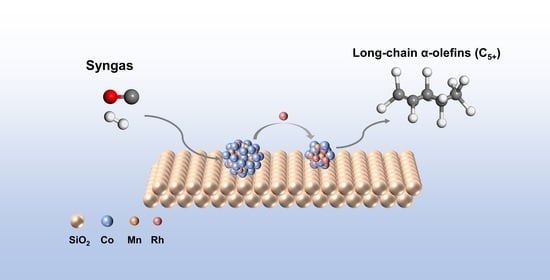
The direct synthesis of long-chain α-olefins from syngas offers a strategically vital pathway for producing high-value chemicals from alternative carbon resources. However, achieving high selectivity toward C5+ olefins remains challenging due to competing paraffin formation and difficulties in precisely regulating chain growth kinetics. To mitigate these critical challenges, a series of Rh-promoted Co-Mn catalysts supported on SiO2 were synthesized using a carbon-mediated impregnation strategy for the direct conversion of syngas to long-chain α-olefins (C5+). The introduction of Rh significantly enhanced both catalytic activity and C5+ olefin selectivity. The optimal 1.1 wt% Rh-loaded catalyst achieved 24.6% CO conversion and 46.0% total olefin selectivity, with 34.2% of the selectivity toward C5+ olefins, while maintaining low CH4 (6.2%) and CO2 (<1%) selectivity. Comprehensive characterization techniques, including XRD, H2-TPR, XPS, and TEM/HAADF-STEM, revealed that the carbon-mediated method facilitated the formation of highly dispersed Co3O4 nanoparticles with abundant oxygen vacancies and strengthened the Co-MnOx interface. Rh promotion modulated the cobalt speciation (Co0/Co2+), improved reducibility, and enhanced the metal-support interaction. This promoted chain growth and olefin desorption while suppressing over-hydrogenation. This study demonstrates the efficacy of Rh promotion and carbon mediation in designing high-performance Fischer-Tropsch catalysts for selective α-olefin synthesis, offering new insights into the design of efficient metal-oxide interfacial catalysts.

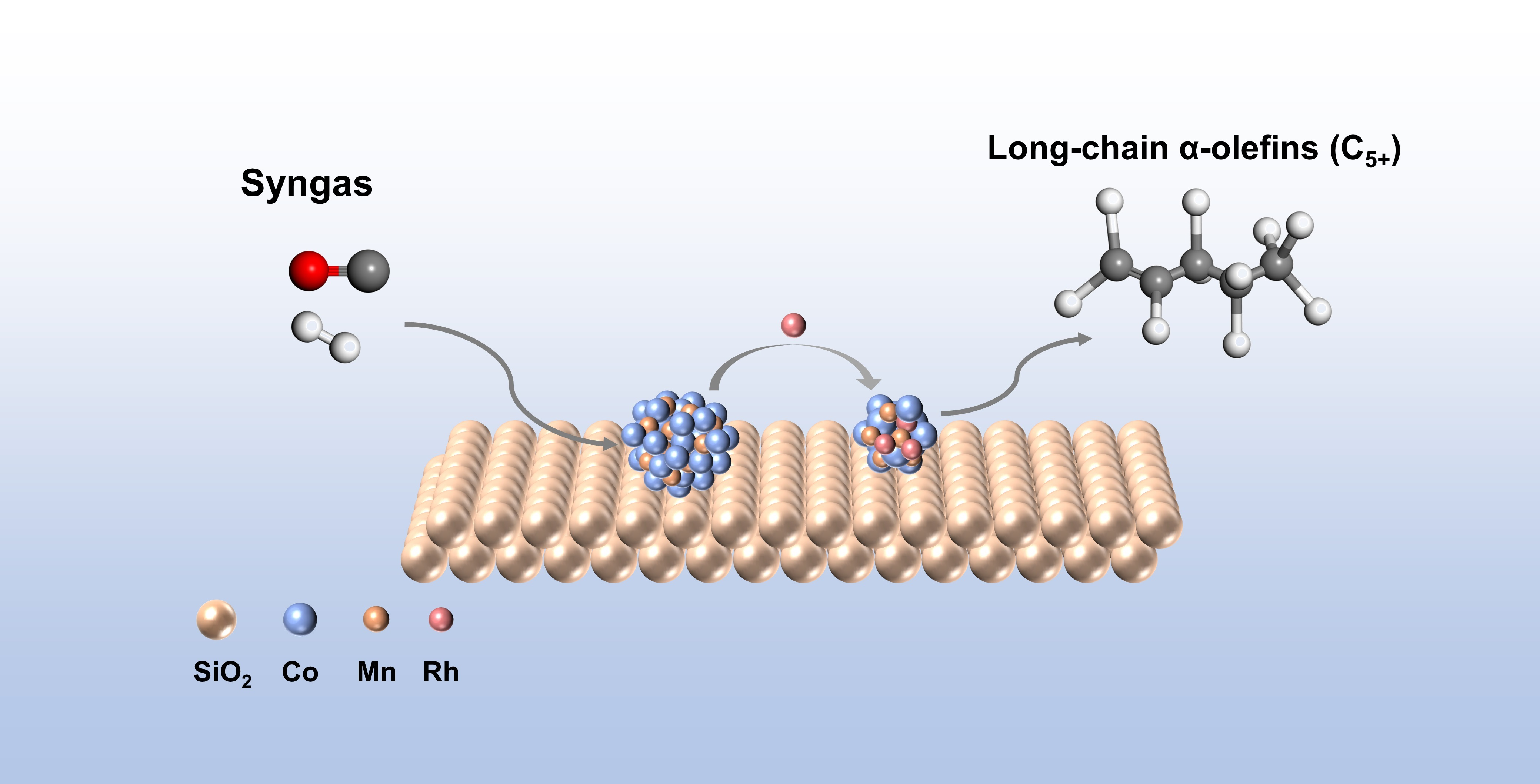
Graphical Abstract

1. Introduction

Long-chain olefins, especially linear alpha-olefins (LAOs), are straight-chain hydrocarbons with a terminal double bond, typically referring to C5+ chains [1,2]. These olefins are essential feedstocks in the chemical industry [3,4,5,6,7]. Commercially, lower olefins are primarily produced by naphtha cracking or the pyrolysis of light alkanes. Oligomerization of these lower olefins produces high-value long-chain olefins [8,9]. Limited petroleum resources and the growing market demand for olefins have spurred the development of alternative production routes using nonpetroleum feedstocks. Fischer-Tropsch synthesis (FTS) provides a promising alternative for the direct conversion of syngas (H2 + CO) into a wide variety of hydrocarbon products, including both paraffins and olefins of varying chain lengths [10]. In FTS, the product distribution follows the Anderson-Schulz-Flory (ASF) model, making it challenging to obtain a single carbon-chain-length product [11,12,13,14].
In recent years, significant progress has been achieved in controlling the product distribution of Fischer-Tropsch synthesis (FTS) [15,16,17,18]. A hydrophobic core–shell FeMn@Si catalyst was developed, achieving 68.2% selectivity for α-olefins and less than 22.5% selectivity for C1 byproducts [19]. For long-chain α-olefins, a modified Co/γ-Al2O3 catalyst achieved 19.9% selectivity for C5+ olefins with minimal C1 byproduct formation (<10%) [20]. However, novel strategies are still required to modulate product distribution for the high-yield production of long-chain α-olefins. Cobalt-based catalysts mainly produce linear paraffins because of their high chain-growth probability and strong hydrogenation ability. Introducing promoters is an effective strategy to maximize catalytic activity and tune product distribution by modifying the electronic structure and chemical properties of cobalt. Among the reported promoters, manganese oxide (MnOx) has proven effective in enhancing the CO consumption rate and improving selectivity for olefins [21,22]. Based on the polymerization kinetics of Fischer-Tropsch synthesis (FTS), carbon chain growth occurs via stepwise polymerization on the catalyst surface. Chain termination proceeds through two main pathways: hydrogenation of adsorbed hydrocarbon fragments to yield n-paraffins, or β-hydride elimination to generate α-olefins (Figure 1). The primary α-olefins can subsequently undergo secondary reactions, including hydrogenation and repolymerization. Consequently, the product distribution is determined by the relative surface reaction rates between chain propagation and termination. Under conditions of higher surface coverage of CO* (or C*)/H*, both chain growth and β-hydride elimination are promoted, leading to significantly enhanced selectivity toward long-chain olefins [23,24,25,26,27]. Based on this understanding, interfacial catalysts rich in Co-MnOx nano-interfaces could enhance long-chain olefin selectivity by increasing the surface CO(C)/H* ratio [28,29,30,31,32]. Accordingly, the Co-MnOx interaction has been optimized by spatially engineering the metal oxides using various methods, such as strong electrostatic adsorption, pretreatment, and support modification. However, under typical FTS conditions, MnOx tends to segregate and agglomerate from metallic cobalt during catalyst reduction, hindering the full exploitation of its promotional effect [31,33,34,35].
To overcome these challenges, Liu et al. proposed a carbon-mediated strategy to construct a robust Co-MnOx-(C)/SiO2 nano-interfacial catalyst. Glucose and metal precursors were co-impregnated onto a SiO2 support, followed by pyrolysis (carbonization) and calcination (oxidation) to yield the oxidized Co-MnOx-(C)/SiO2 catalyst. The resulting small Co3O4 particles, rich in surface oxygen vacancies (low-coordination octahedral Co2+ sites), facilitated MnOₓ dispersion and anchoring. After reduction, stable and abundant Co-MnOx nano-interfaces formed between cobalt nanoparticles and MnOx islands under FTS conditions, imparting high activity and long-term stability to the catalyst. This catalyst achieved 37% selectivity for C5+ olefins at 11% CO conversion [36]. Furthermore, Wang et al. reported that noble metals (e.g., Rh, Ru, Re, Ir) can significantly enhance the activity, selectivity, and stability of cobalt-based FTS catalysts by stabilizing the hexagonal close-packed cobalt structure [37]. It is well-established that rhodium enhances CO insertion kinetics. Its distinct electronic properties, often through electronic ligand effects, can also favorably modify the cobalt surface to improve catalytic selectivity. Despite these advances, carbon efficiency remains low, and maximizing olefin selectivity (especially for C5+) and conversion still presents major challenges for current FTO technologies.
This work employs a carbon-mediated method to synthesize a series of rhodium-promoted cobalt-manganese catalysts and evaluates their catalytic performance in the direct conversion of syngas to long-chain α-olefins. The effects of rhodium incorporation were systematically investigated using transmission electron microscopy (TEM), H2 temperature-programmed reduction (H2-TPR), and X-ray photoelectron spectroscopy (XPS). By comparing a series of different catalysts, it is inferred that the introduction of Rh and the carbon-mediated method increase the oxygen vacancy content and enhances the reduction degree of cobalt oxides to active metallic cobalt. This subsequently modulates the relative abundance of different cobalt species (Co0 and Co2+), and the synergistic interaction between these species contributes to an optimal balance between olefin selectivity and catalytic activity. The optimal Rh loading effectively improves the selectivity towards long-chain α-olefins. This strategy provides a promising and industrially feasible method for preparing efficient metal-oxide nano-interfacial catalysts. This work offers fundamental insights into the role of introducing a third metal (Rh) in governing the product distribution of syngas conversion towards long-chain α-olefins, providing valuable guidance for the rational design of advanced Fischer-Tropsch catalysts.

2. Results and Discussion

2.1. Catalyst Synthesis and Characterization

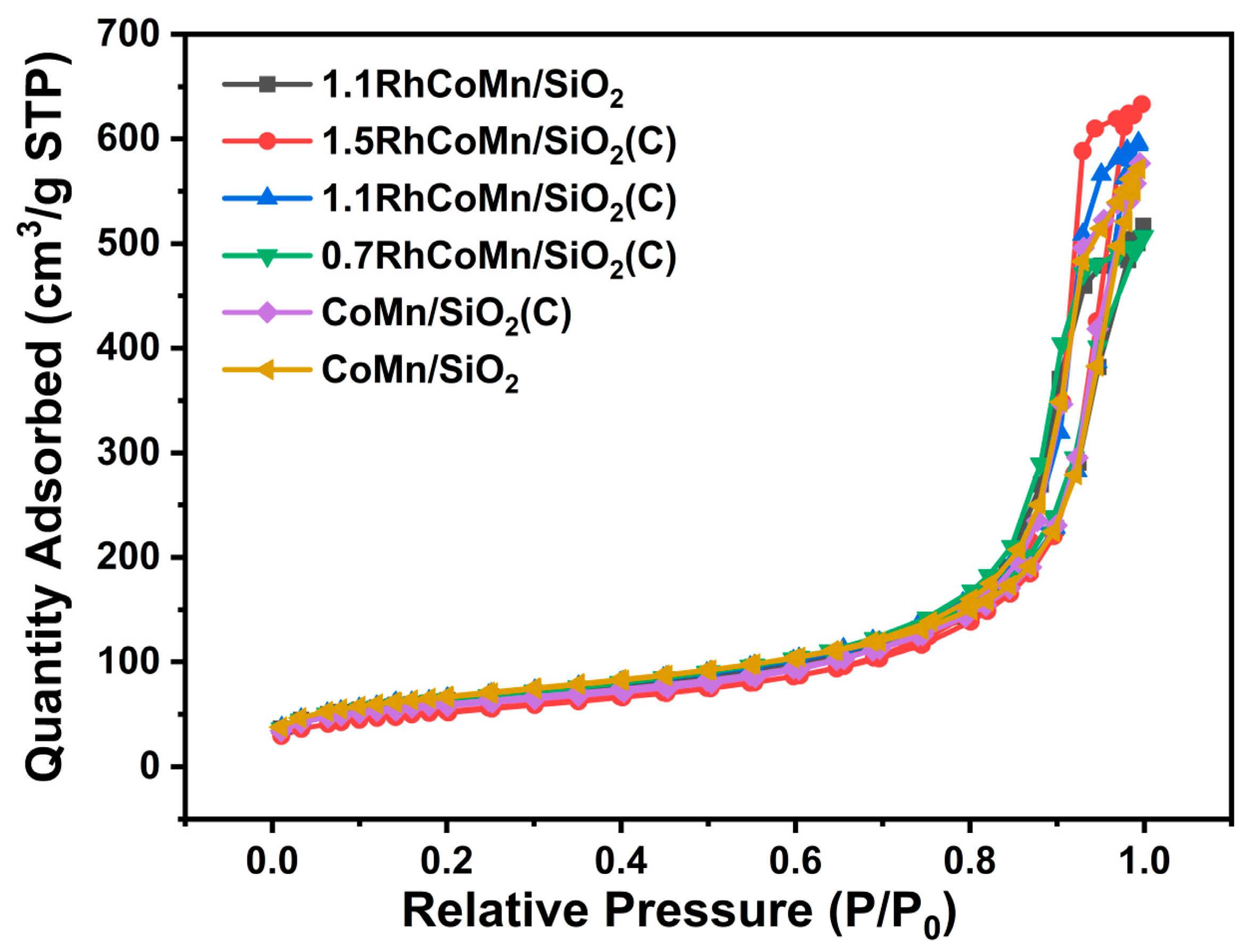
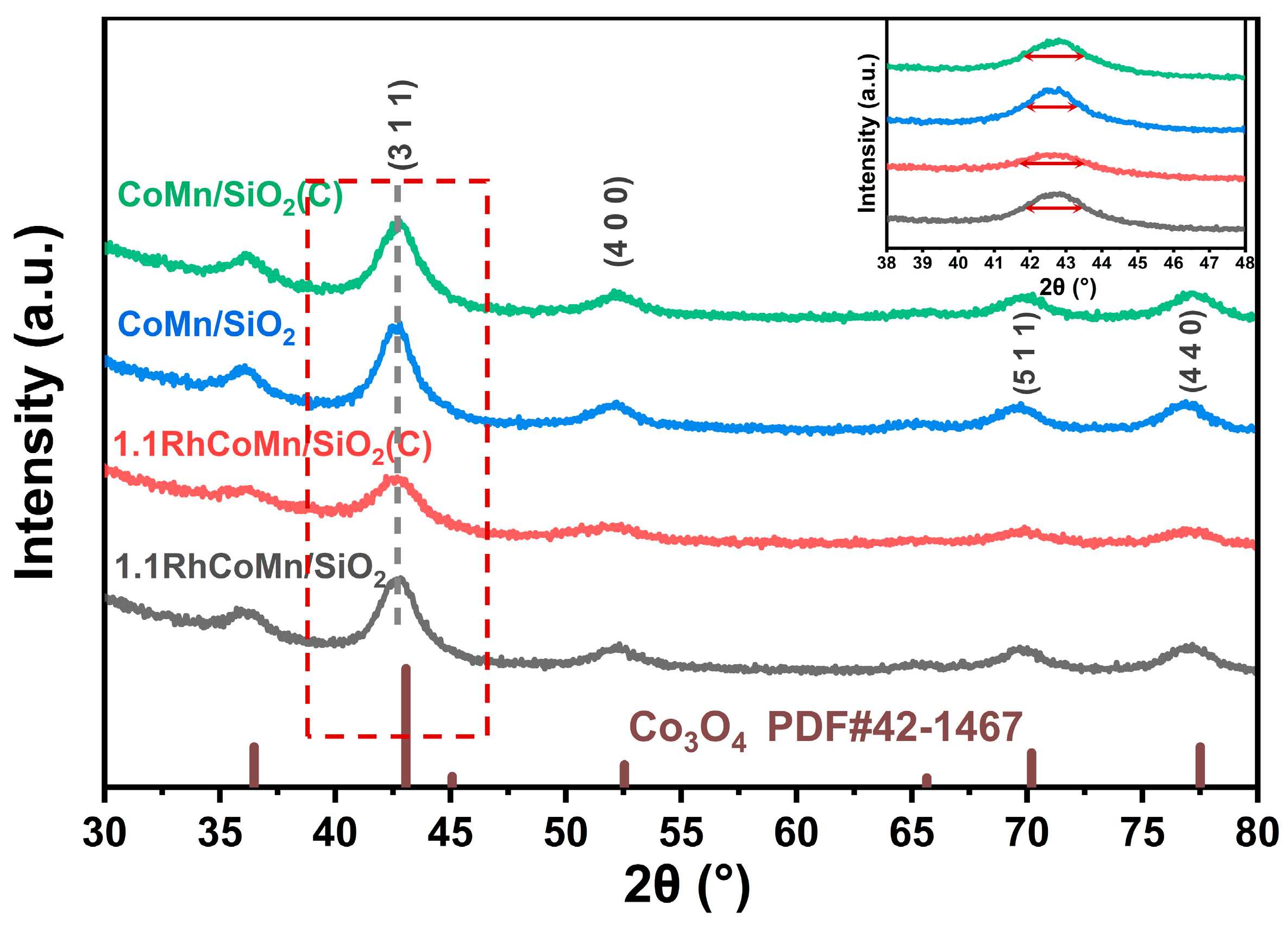
A series of Rh-promoted CoMn catalysts with varying Rh loadings were synthesized using a carbon-mediated impregnation method, which involves the co-impregnation of metal precursors (Co, Mn, Rh) and glucose onto a SiO2 support, followed by pyrolysis and calcination. In this strategy, glucose acts as a carbon source that, upon pyrolysis, helps to spatially confine the metal precursors, thereby facilitating the formation of highly dispersed metal oxide nanoparticles and strengthening the Co-MnOx interface during subsequent calcination. For comparison, the corresponding catalysts without glucose were prepared using identical synthesis parameters via conventional co-impregnation. These catalysts are denoted as RhCoMn/SiO2(C) for the carbon-mediated versions and RhCoMn/SiO2 for those prepared without glucose. Unless otherwise specified, the Rh loading in the discussed RhCoMn/SiO2 catalysts is 1.1 wt%. These catalysts were used for the direct conversion of syngas to long-chain α-olefins. To preliminarily investigate the metal loading and porous structure, we used inductively coupled plasma optical emission spectroscopy (ICP-OES) and N2 physical adsorption to determine the elemental composition and specific surface area (Figure 2, Table 1). ICP-OES results confirmed the actual Rh loadings (0, 0.7, 1.1, and 1.5 wt%) in different catalysts, ensuring a reliable comparison of their catalytic performance in subsequent sections. As illustrated in Figure 2, the nitrogen adsorption–desorption isotherms of all tested catalyst samples conform to the Type IV classification with H1-type hysteresis loops—an archetypal feature indicative of mesoporous material architectures. Notably, this characteristic isotherm profile is consistently observed across the full set of samples, encompassing both Rh-promoted and Rh-free Co-Mn/SiO2 catalysts, as well as those fabricated via the carbon-mediated impregnation protocol and the conventional (non-carbon-mediated) method. Quantitative analysis of the sorption data reveals that the specific surface areas of all catalysts are uniformly distributed around 200 m2·g−1, with no statistically significant variations detected between different sample groups. This experimental observation provides direct evidence that neither the adoption of the carbon-mediated synthesis strategy nor the incorporation of Rh as a promoter exerts appreciable influence on the intrinsic porous structure of the Co-Mn/SiO2 catalyst system [38]. The crystal structure of the prepared catalysts was confirmed by powder X-ray diffraction (XRD). The XRD patterns of calcined catalysts (Figure 3) showed distinct diffraction peaks at 36.5°, 43.1°, 52.5°, 70.2°, and 77.5°, indicating the presence of a cubic Co3O4 spinel structure. Notably, no distinct diffraction peaks corresponding to Rh or Rh2O3 were detected at 41.1° and 37.7°, suggesting that Rh is either highly dispersed on the support or incorporated into Co3O4 in an amorphous form. Although the introduction of Rh did not alter the overall crystal structure, peak broadening at 43.1° in the RhCoMn/SiO2 and RhCoMn/SiO2(C) samples indicated reduced crystallinity and decreased crystallite size of Co3O4. Additionally, the diffraction peaks at 43.1° for CoMn/SiO2(C) and RhCoMn/SiO2(C) catalysts showed significant broadening compared to their glucose-free counterparts, indicating that the carbon-mediated synthesis route also affects Co3O4 nanoparticle crystallinity and dispersion, confirming the effectiveness of this catalyst preparation strategy [36].
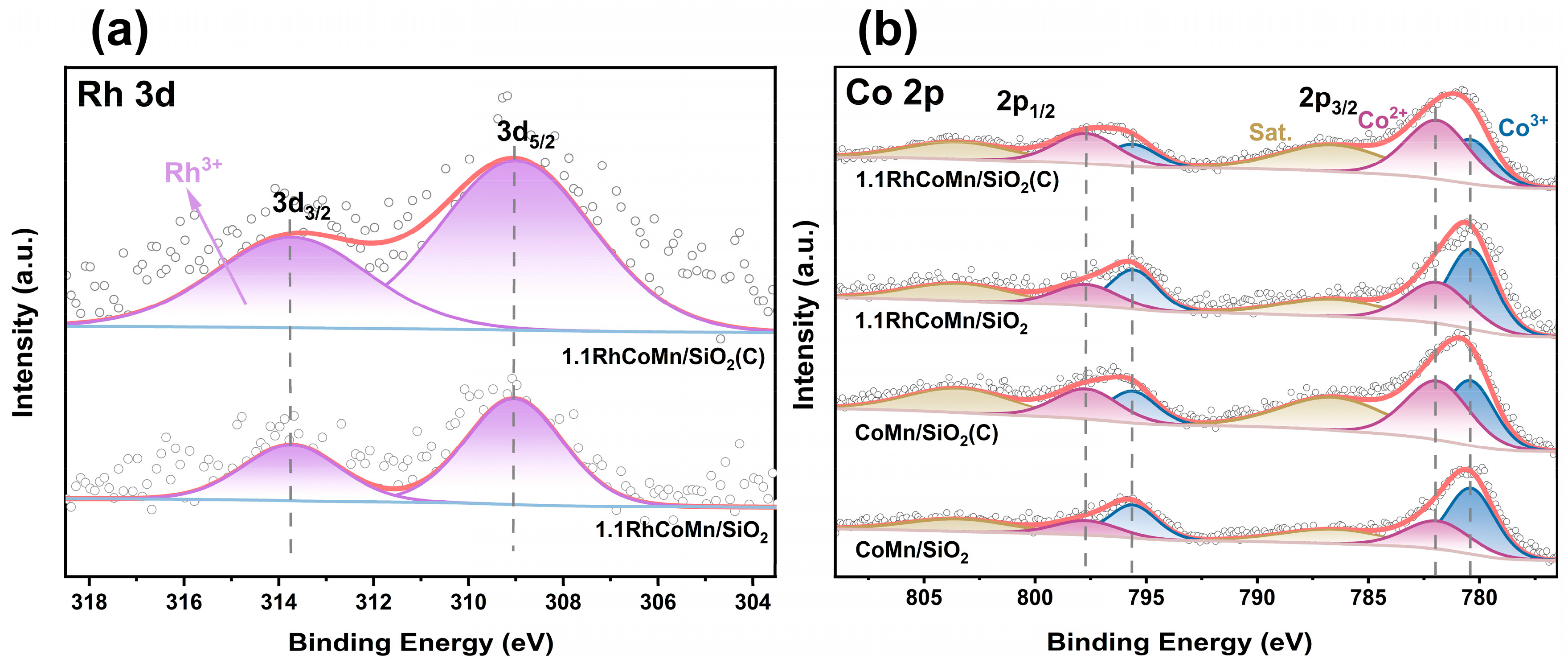
To elucidate the function of Rh species and determine the influence of Rh incorporation on the chemical environment of the catalysts, a series of characterizations were performed to probe the electronic and geometric structures of the Rh and Co species. XPS spectra of the calcined catalysts were recorded in the Rh 3d and Co 2p regions to determine the valence states of Rh species and assess the effect of Rh incorporation on Co species. As shown in Figure 4a, the XPS spectra of RhCoMn/SiO2 and RhCoMn/SiO2(C) were deconvoluted, revealing two distinct peaks at approximately 309.0 eV and 313.7 eV, corresponding to Rh3+ 3d5/2 and Rh3+ 3d3/2, respectively [39]. Peak fitting results indicate that Rh exists primarily in the Rh3+ state in the calcined Rh-containing catalysts, suggesting the conclusion that Rh species in RhCoMn/SiO2 and RhCoMn/SiO2(C) are likely predominantly Rh2O3. As shown in Figure 4b, the Co 2p XPS spectra of all catalysts were deconvoluted, showing two prominent peaks near 781.9 eV and 797.7 eV corresponding to Co2+ 2p3/2 and Co2+ 2p1/2, respectively, and two additional peaks near 780.4 eV and 795.6 eV corresponding to Co3+ 2p3/2 and Co3+ 2p1/2, respectively. Furthermore, the presence of Co2+ gives rise to characteristic satellite peaks at higher binding energies. Compared to reference data, the deconvoluted Co 2p XPS spectra show significantly enhanced Co2+ peaks and more intense Co2+ satellite features in RhCoMn/SiO2 and RhCoMn/SiO2(C). The integrated area ratios of Co2+/Co3+ peaks for CoMn/SiO2, CoMn/SiO2(C), RhCoMn/SiO2, and RhCoMn/SiO2(C) were calculated as 1:1.8, 1.2:1, 1:1.5, and 1.8:1, respectively (Table 2). These ratios are higher than the theoretical Co2+/Co3+ ratio (1:2) for stoichiometric Co3O4, suggesting a reduction in the average cobalt valence [40,41]. This suggests that both Rh incorporation and the carbon-mediated route induce modifications in the catalyst’s electronic structure, promoting the formation of additional surface Co2+ species. Since the typical Co3O4 spinel structure comprises tetrahedral Co2+ and octahedral Co3+ ions, the observed increased surface Co2+/Co3+ ratio indicates the presence of low-coordination octahedral Co2+ ions associated with oxygen vacancies [42,43,44,45].
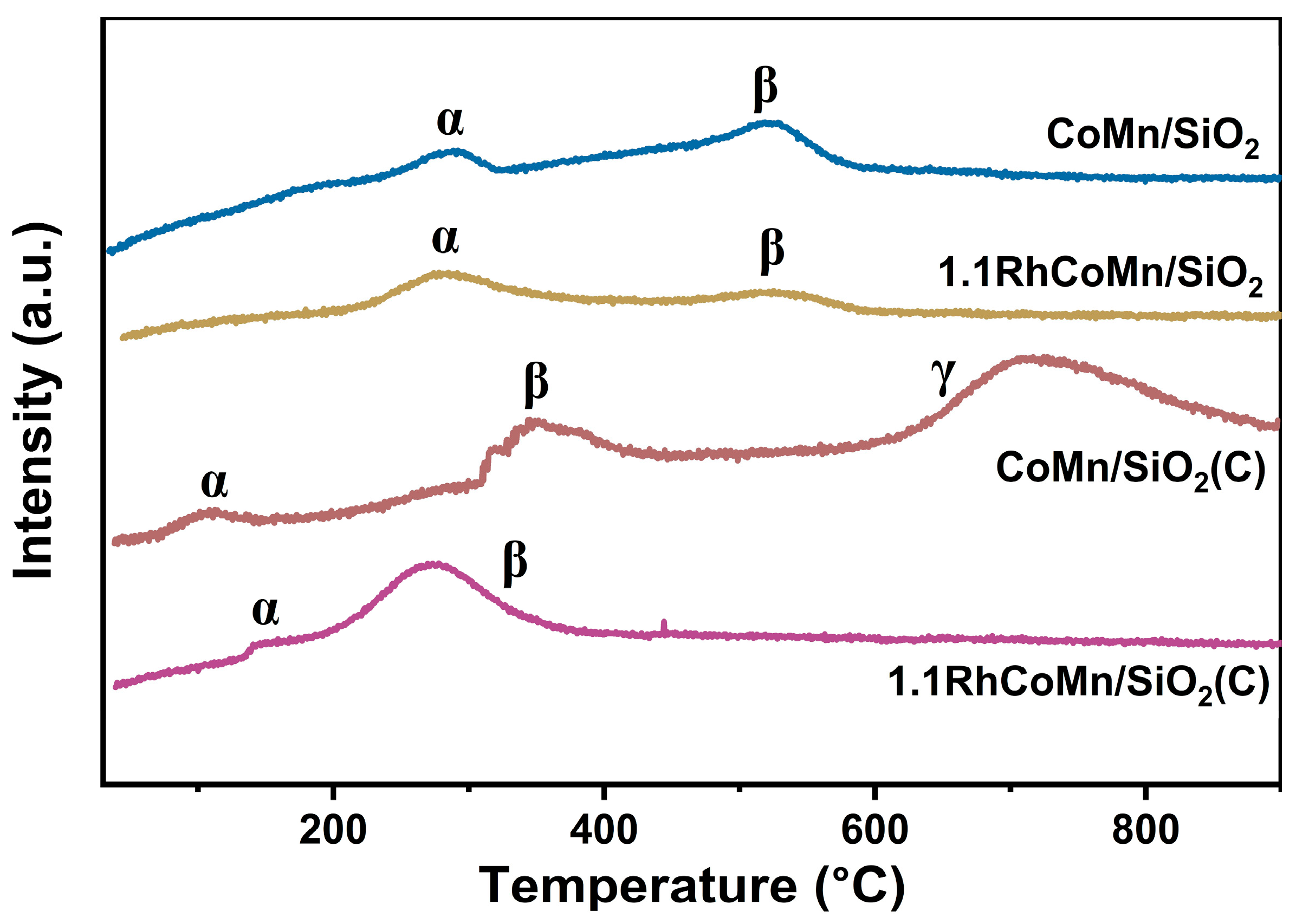
To investigate the influence of Rh species on the reduction process of cobalt oxides, the reduction behavior of the catalysts was probed by H2-TPR. The H2-TPR profiles (Figure 5) exhibit three hydrogen consumption peaks, corresponding to the stepwise reduction of Co3O4 to CoO (α), CoO to metallic Co (β), and the reduction of cobalt species interacting strongly with the SiO2 support (γ) [46]. Compared to the Rh-free catalyst and the catalyst prepared without the carbon-mediated method, the carbon-mediated catalyst CoMn/SiO2(C) and RhCoMn/SiO2(C) displays a broader and more intense β reduction peak (CoO → Co0). This indicates a higher content of CoO species in the RhCoMn/SiO2(C) catalyst. Notably, the addition of glucose facilitated the reduction process, as evidenced by a general shift in the peaks to lower temperatures, which can be attributed to strong interactions between the cobalt oxides and the highly dispersed Rh species [47,48].
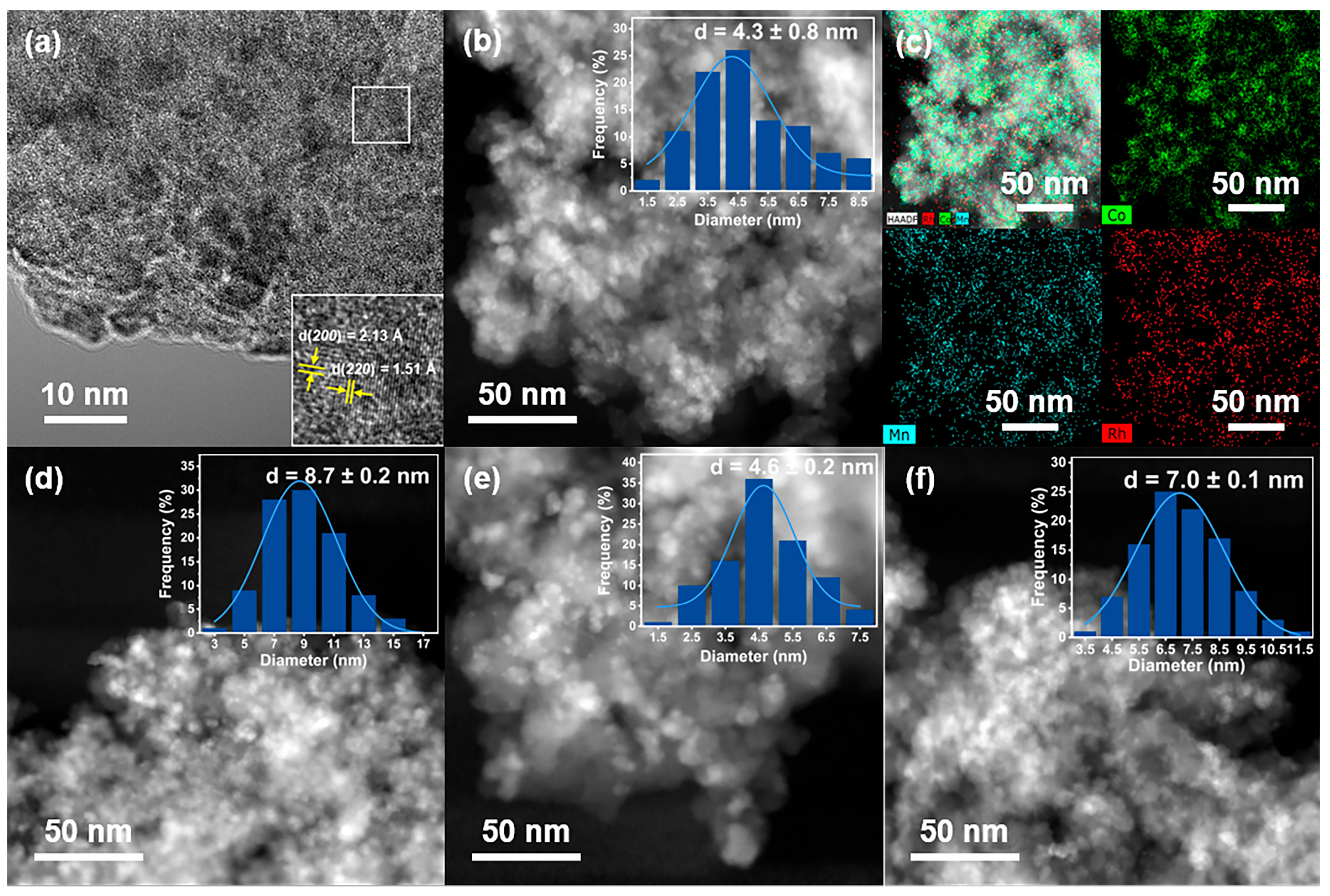
To further clarify the impact of Rh incorporation, examining its dispersion within the catalyst is essential. As shown in the TEM images of the reduced catalysts (Figure 6a), the RhCoMn/SiO2(C) catalyst still retained well-dispersed CoO nanoparticles, evidenced by lattice fringes of 2.13 Å and 1.51 Å, assigned to the (200) and (220) planes of CoO, respectively [49]. The spatial distribution of the elements was further characterized by high-magnification HAADF-STEM and corresponding energy-dispersive X-ray spectroscopy (EDS) mapping performed on randomly selected areas of the RhCoMn/SiO2(C) catalyst (Figure 6b,c). The results clearly show that the CoO species are distributed relatively uniformly, with an average size of 4.3 nm. Additionally, the Mn, Co, and Rh nanoparticles are in close contact and exhibit high dispersion. Furthermore, the Mn, Co, and Rh nanoparticles remain in close contact and exhibit high dispersion. As shown in Figure 6d–f, the measured metal particle sizes for CoMn/SiO2, CoMn/SiO2(C), and RhCoMn/SiO2 are 8.7 nm, 4.6 nm, and 7.0 nm, respectively, all larger than that of RhCoMn/SiO2(C). These results suggest that both Rh incorporation and the carbon-mediated synthesis route contribute to the enhanced dispersion of metallic Co species [50,51]. This conclusion is supported by the XRD discussed in the previous section.

2.2. Catalytic Performance Evaluation

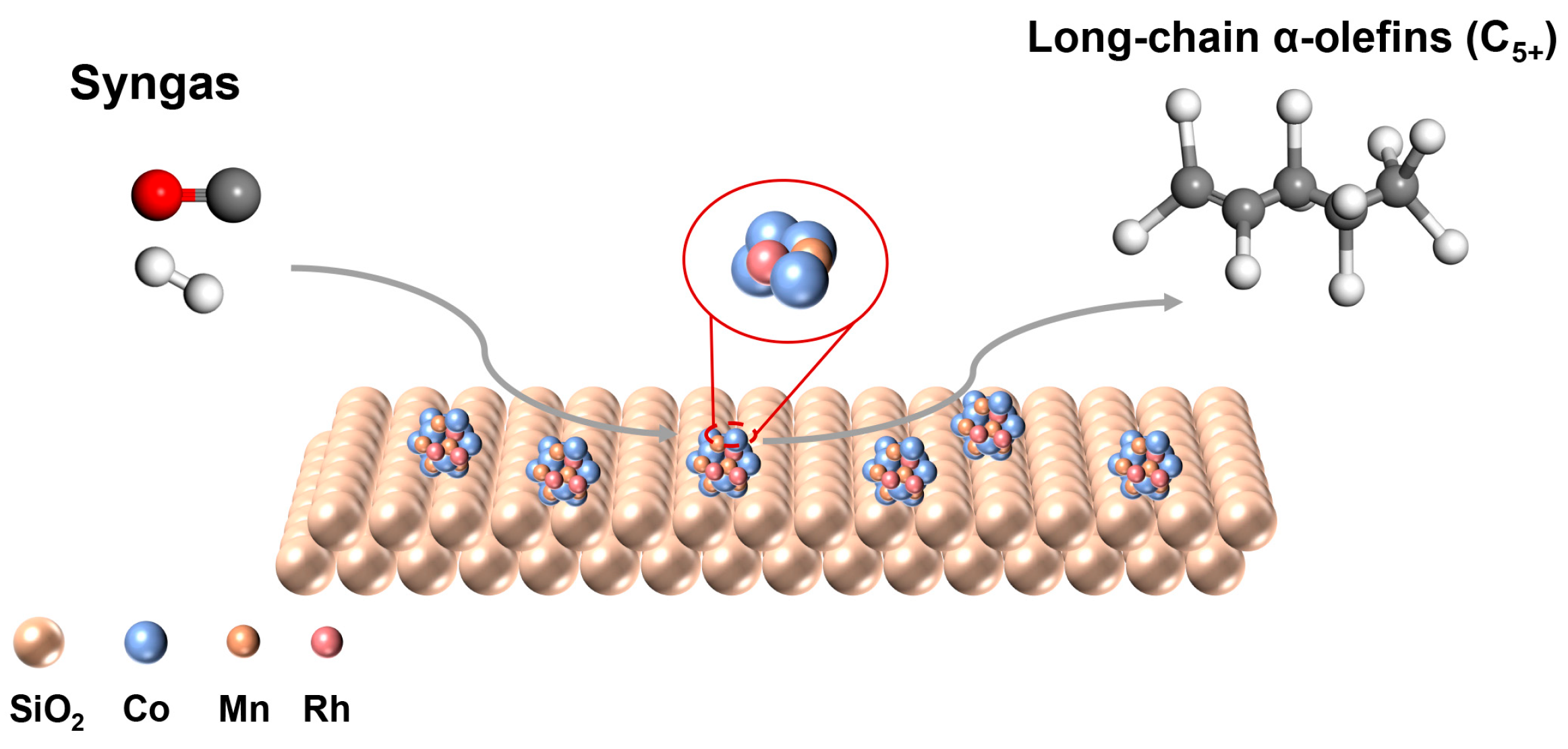
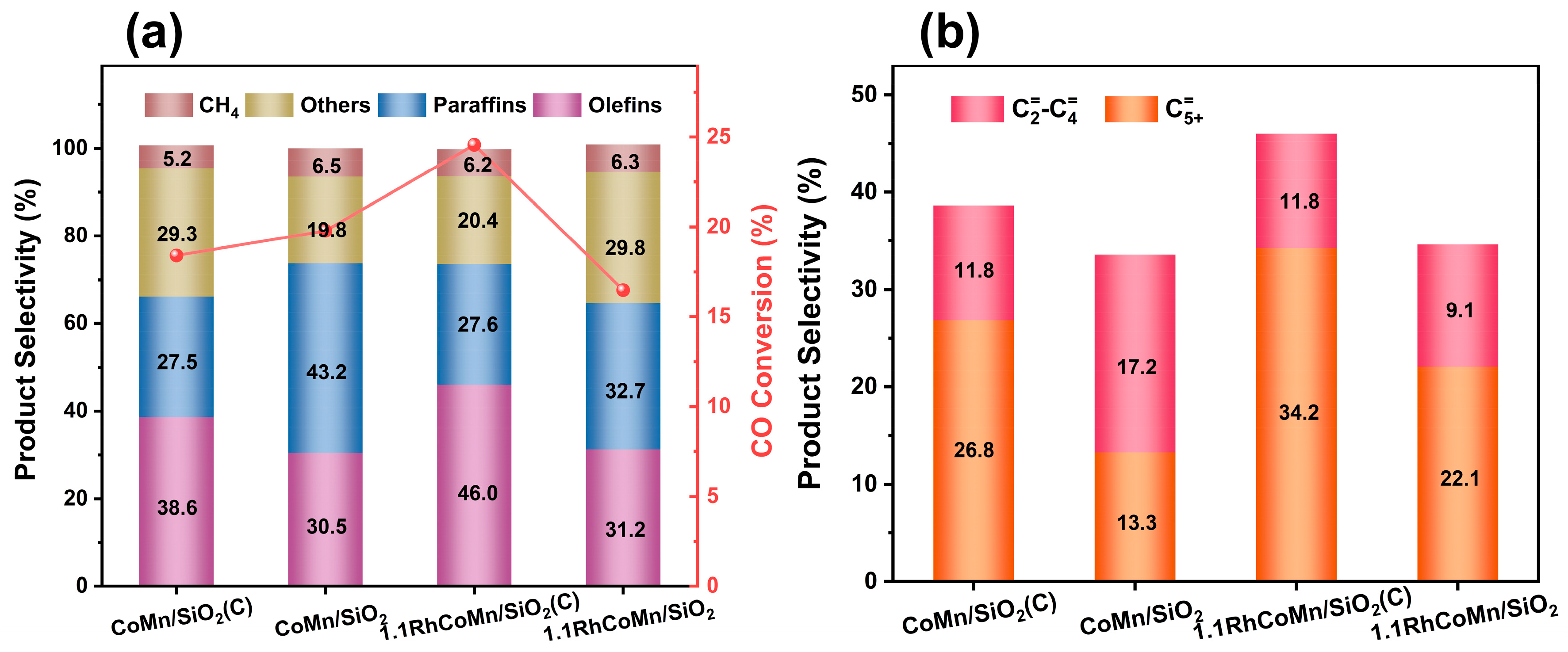
For all synthesized catalysts, the nominal cobalt loading was maintained at 13.0 wt% and the Mn/Co molar ratio was fixed at 0.2, ensuring a consistent baseline for comparison. Inductively Coupled Plasma Optical Emission Spectroscopy (ICP-OES) analysis confirmed these values, verifying the precise metal loadings. The primary products of the Fischer-Tropsch synthesis (FTS) reaction, analyzed by online and offline gas chromatography (GC), are CO2, alkanes, olefins, and minor oxygenates. Figure 7 shows the reaction pathway for olefin formation from syngas over the RhCoMn/SiO2(C) catalyst. This study systematically investigates the crucial role of rhodium in modulating catalytic performance, with a particular focus on its effect on CO conversion and olefin selectivity. As shown in Figure 8a, the olefin selectivities of RhCoMn/SiO2 and RhCoMn/SiO2(C) were 34.6% and 46.0%, respectively, exceeding those of CoMn/SiO2 (33.6%) and CoMn/SiO2(C) (38.6%). Furthermore, as shown in Figure 8b, the proportions of C5+ olefins among total C2+ olefins for RhCoMn/SiO2 and RhCoMn/SiO2(C) reached 63.8% and 74.5%, respectively. These values are significantly higher than those of CoMn/SiO2 (39.5%) and CoMn/SiO2(C) (63.8%), highlighting the strong promoting effect of rhodium on heavy olefin formation.
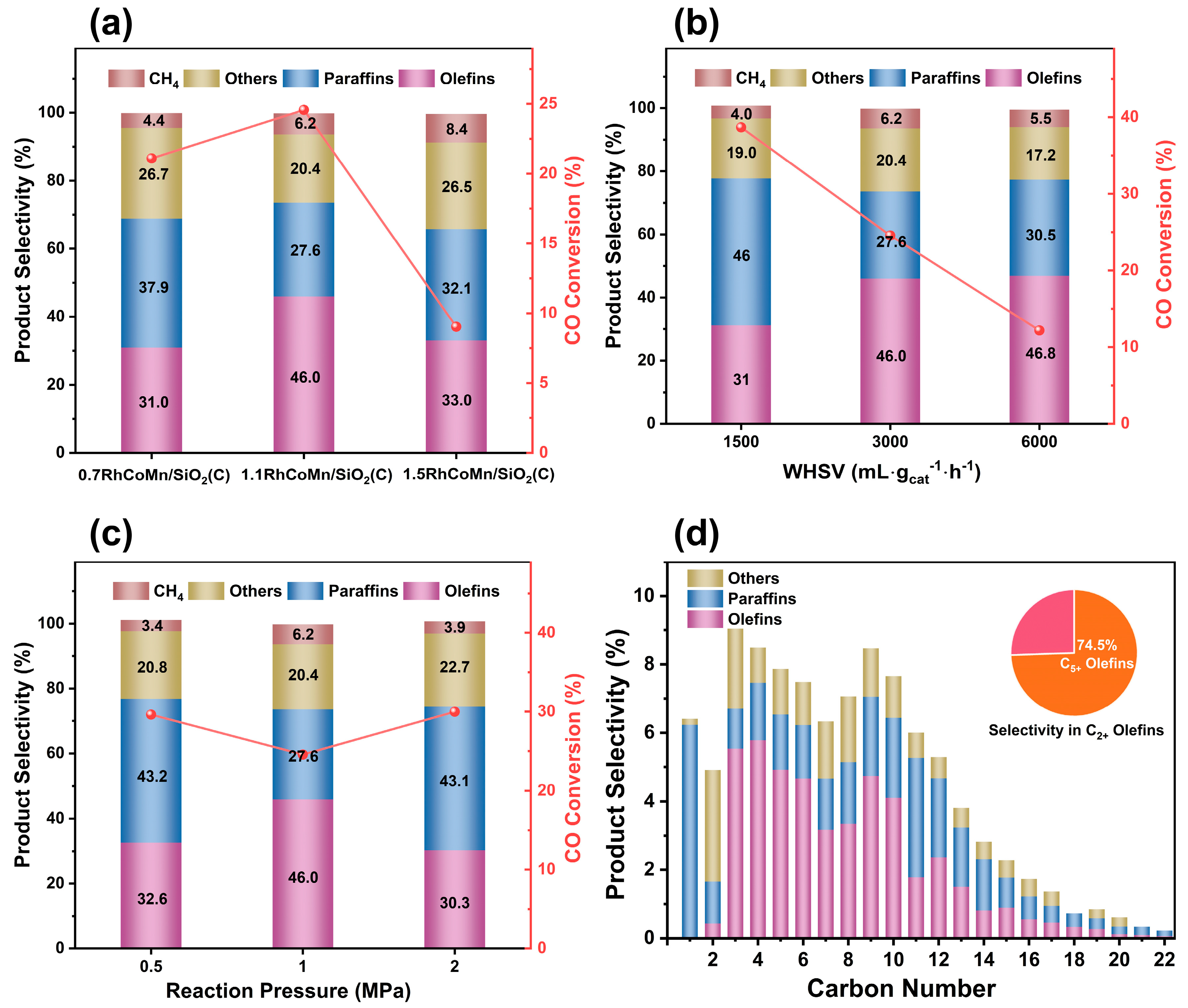
To elucidate the structure-activity relationship, catalytic evaluations were performed on a series of catalysts with varying Rh loadings (Figure 9a). Interestingly, both CO conversion and total olefin selectivity exhibited a clear volcano-type trend. The optimal Rh loading of 1.1 wt% was determined, at which the catalyst showed synergistic maxima in both CO conversion (24.6%) and olefin selectivity (46.0%). The non-monotonic behavior underscores the structural sensitivity of the Co-MnOx interface, which can be compromised at high Rh loadings due to aggregation, diminishing its synergistic effect and impairing olefin selectivity. Additionally, Figure 9b reveals the characteristic trade-off between reactant conversion and selectivity when the weight hourly space velocity (WHSV) was adjusted from 1500 to 6000 mL·gcat.−1·h−1. CO conversion decreased from 38.7% to 12.2%, while the selectivity for C2+ olefins increased from 31.2% to 46.9%. This inverse relationship indicates that at lower residence times, the secondary hydrogenation and re-adsorption of α-olefins are suppressed, thus preserving the olefin products. The effect of reaction pressure (0.5–2.0 MPa) on the performance of the optimal RhCoMn/SiO2(C) catalyst was also studied (Figure 9c). Although CO conversion increased from 24.6% to 29.6% and 30.0% at reaction pressures of 0.5 MPa and 2 MPa, respectively, the selectivity for olefins decreased to 32.6% and 30.3%, respectively. Ultimately, the optimal conditions for the RhCoMn/SiO2(C) catalyst were found to be a Rh loading of 1.1%, WHSV of 3000, and a reaction pressure of 1 MPa. Regarding the C1 byproducts, all catalysts exhibited very similar and low methane selectivity (6.0 ± 1.0%) and negligible CO2 formation (below 1%). This finding is significant as it ultimately demonstrates that the introduced Rh species do not promote non-selective methane formation or water-gas shift reactions to a perceptible extent. More importantly, rhodium promotion significantly enhanced olefin formation. The C2+ olefin selectivity of the RhCoMn/SiO2(C) catalyst was 7.4%, 11.4%, and 12.4% higher than that of CoMn/SiO2(C), CoMn/SiO2, and RhCoMn/SiO2 benchmarks, respectively. For this already optimized catalyst, the olefin product distribution heavily favored heavier hydrocarbons, with C5+ olefins accounting for 74.5% of the total olefins (Figure 9d), and the C5+ olefin selectivity reaching 34.2%, surpassing all other catalysts in this study [52].
The experimental results clearly demonstrate the outstanding performance of the RhCoMn/SiO2(C) catalyst in the selective synthesis of C5+ olefins, with a C5+ olefin selectivity of 34.2% and a C2+ olefin selectivity of 46.0%, while maintaining a low methane selectivity of 6.2%. A comparative analysis with cobalt-based Fischer-Tropsch synthesis catalysts reported in the literature shows that this catalyst design achieves a significant enhancement in catalytic activity and C5+ olefin selectivity, while simultaneously suppressing the formation of methane and CO2 byproducts. Although a general negative correlation between olefin selectivity and CO conversion was observed for all catalysts, the RhCoMn/SiO2(C) catalyst consistently exhibited superior olefin selectivity at the same conversion levels, especially for the high-value C5+ olefins. Further quantification of catalytic performance using mass-based production rates (space-time yield, STY) confirmed the excellent intrinsic activity of this catalyst for olefin production. The conclusions indicate that the RhCoMn/SiO2(C) catalyst, synthesized through a simple and scalable method, demonstrates exceptional performance in selectively producing C5+ olefins. With its high activity, excellent selectivity control, and synergistic advantages in minimizing byproduct formation, this catalyst highlights its immense potential as an industrially feasible solution for advanced Fischer-Tropsch synthesis. This study provides important theoretical foundations and a promising material platform for the rational design of next-generation catalysts for the production of high-value chemicals from syngas.

3. Experimental Section

3.1. Synthesis of Catalysts

The Rh-promoted CoMn/SiO2(C) catalysts with nominal Rh loadings of 0, 0.7, 1.1, and 1.5 wt% (default: 1.1 wt%) were synthesized via a co-impregnation method. Typically, 1.48 g of Co(NO3)2·6H2O (99.9%, Innochem, Beijing, China), 0.25 g of Mn(CH3COO)2·4H2O (> 99.9%, Aladdin, Brussels, Belgium), a stoichiometric amount of RhCl3·xH2O (Rh > 38.5%, Innochem, Beijing, China), and 0.4 g of glucose (AR, Sinopharm Chemical Reagent Co., Ltd., Shanghai, China) were dissolved in 20 mL of deionized water. Then, 2.0 g of aerosol silica (99.9%, Aladdin, Brussels, Belgium) was introduced into the resulting aqueous precursor solution. The impregnation process was carried out at 60 °C under constant stirring at 400 rpm for 90 min, followed by drying at 80 °C for 10 h. The dried solid was ground and subsequently pyrolyzed in a tubular furnace at 400 °C (5 °C·min−1) for 5 h under an Ar flow of 50 mL·min−1. Finally, the pyrolyzed sample was calcined at 400 °C (5 °C·min−1) in static air for 3 h to obtain the final RhCoMn/SiO2(C) catalyst.
For comparative purposes, the reference catalysts were prepared without the addition of glucose as the carbon source during the impregnation step. Specifically, 2.0 g of SiO2 powder was impregnated with an aqueous solution containing 1.48 g of Co(NO3)2·6H2O and 0.25 g of Mn(CH3COO)2·4H2O in 20 mL of deionized water to obtain CoMn/SiO2. Similarly, RhCoMn/SiO2 was synthesized using the same procedure but including RhCl3·xH2O as the rhodium precursor. To minimize potential variations, all steps including impregnation, drying, pyrolysis, and calcination were strictly controlled using identical parameters across all catalysts synthesized via the carbon-mediated strategy and the reference systems.

3.2. Characterization Methods

Powder X-ray diffraction (XRD) measurements were performed using a Bruker D8 diffractometer (Bruker, Karlsruhe, Germany) equipped with Co Kα radiation (λ = 0.179 nm). The instrument operated at 35 kV and 40 mA. Data were collected in continuous scan mode with a step size of 0.02° and a dwell time of 0.2 s over a 2θ range of 5–90°.
The actual loadings of the metallic components (Rh, Co, Mn) were determined by inductively coupled plasma optical emission spectrometry (ICP-OES) on a PerkinElmer Optima 2100DV system, following complete acid digestion of the catalyst samples.
Nitrogen physisorption analyses were carried out on a MicroActive ASAP 2420 analyzer (Micromeritics, Norcross, GA, USA). Approximately 100 mg of sample was degassed under vacuum at 350 °C for 5 h prior to measurement. N2 adsorption–desorption isotherms were collected at −196 °C. The specific surface area was determined using the Brunauer–Emmett–Teller (BET) method, while the micropore area, external surface area, and pore volume were obtained via the Brunauer-Joyner-Halenda (BJH) model.
Scanning electron microscopy (SEM) imaging was conducted using an FEI Quanta 400 field-emission microscope (FEI Company, Hillsboro, OR, USA) operating at 10 kV. Samples were dispersed by ultrasonication for 1 h in 5 mL ethanol, and several drops of the suspension were deposited onto a silicon support plate. After drying, the samples were sputter-coated with gold prior to observation.
The spatial distribution of metallic species was examined by Transmission electron microscopy (TEM) and high-angle dark field Scanning electron microscopy (HAADF-STEM) using an FEI-Tecnai-Talos transmission microscope (FEI Company, Hillsboro, OR, USA) operated at 200 kV with a resolution of 1.4 Å. Samples were ultrasonically dispersed for 1 h in 7 mL dichloromethane (CH2Cl2), and four drops of the suspension were placed onto an ultrathin carbon-coated copper grid. After drying under red light, the samples were imaged. Particle size distributions were calculated from measurements of over 100 particles using ImageJ 1.54g software.
X-ray Photoelectron Spectroscopy (XPS) measurements were performed on a Thermo Scientific K-Alpha spectrometer (Thermo Fisher Scientific, Waltham, MA, USA) with Al Kα radiation (hν = 1486.6 eV). Samples were handled in a glovebox to avoid oxidation. The C 1s peak at 284.6 eV was used as a reference for energy calibration.
H2 temperature programmed reduction (H2-TPR) experiments were conducted on a Micromeritics AutoChem II ASAP 2920 analyzer. Approximately 100 mg of sample was pretreated under He at 500 °C for 1 h, then cooled to 40 °C before reduction. The reduction was carried out in a 10% H2/Ar flow (50 mL·min−1) while heating from 40 °C to 1000 °C at a rate of 10 °C·min−1. Hydrogen consumption was simultaneously monitored using a thermal conductivity detector (TCD) and a mass spectrometer (MS).

3.3. Catalytic Performance Evaluation

Catalytic performance was assessed in a micro-fixed-bed reactor. The reactor consisted of a stainless-steel tube housing a quartz liner (inner diameter: 6 mm), with the temperature monitored by a thermocouple inserted into the stainless-steel wall. Typically, 0.2 g of catalyst (40–60 mesh) was diluted with 0.1 g of silicon carbide (SiC) and loaded into the isothermal zone of the reactor.
Prior to reaction, the catalyst was reduced in pure H2 (40 mL·min−1) at 400 °C and 0.1 MPa for 5 h. After reduction, a syngas mixture with an H2/CO ratio of 1 (H2/CO/Ar = 48/48/4) was introduced at a total flow rate of 10 mL·min−1, corresponding to a weight hourly space velocity (WHSV) of 3000 mL·gcat.−1·h−1. Unless otherwise stated, reactions were carried out at 483 K, 1.0 MPa, and an H2/CO ratio of 1. Argon served as the internal standard for determining CO conversion and product selectivity.
Reaction effluents passed through sequential hot (160 °C) and cold (0 °C) traps, allowing phase separation of solid waxes, liquid hydrocarbons, and aqueous fractions. These condensed products were subsequently analyzed offline using an HP-PONA 19091S-001 gas chromatograph after dissolution in CS2.
Continuous gas-phase monitoring was performed on an Agilent 8890 GC equipped with two independent channels. C1-C5 hydrocarbons were analyzed using a GasPro column coupled to a flame ionization detector (FID), while permanent gases (H2, CO, CO2, Ar) were separated on a combined PLOT/Q and MolSieve 5 Å column system and quantified using a thermal conductivity detector (TCD). Ar was employed as the internal standard for conversion and selectivity calculations.
Catalytic performance was evaluated at the steady-state stage after 12 h on stream, based on gas-phase analysis. The overall mass, carbon, and oxygen balances were maintained within 100 ± 5%. Triplicate experiments under identical conditions confirmed excellent reproducibility. Both CO conversion and hydrocarbon selectivity were calculated on a carbon-atom basis. The selectivity toward oxygenates was below 1% and therefore omitted from product selectivity data unless otherwise noted.

4. Conclusions

In this study, a series of Rh-promoted CoMn-based catalysts were successfully synthesized via a carbon-mediated impregnation strategy and systematically evaluated for the direct conversion of syngas to long-chain α-olefins. The introduction of rhodium significantly enhanced both the catalytic activity and the selectivity toward C5+ olefins. Comprehensive characterization techniques, including XRD, H2-TPR, XPS, and electron microscopy, confirmed that the carbon-mediated approach facilitated the formation of highly dispersed Co3O4 nanoparticles with abundant surface oxygen vacancies and strengthened the interfacial interaction between cobalt and manganese oxide species. The optimal catalyst with 1.1 wt% Rh loading exhibited the highest CO conversion and olefin selectivity, which is attributed to the modulation of cobalt chemical states (Co0 and Co2+) and the promotion of a stable Co-MnOx nano-interface under reaction conditions. Furthermore, the glucose-assisted route not only improved metal dispersion and reducibility but also effectively suppressed the formation of undesired byproducts such as CH4 and CO2. The synergistic effect between Rh and CoMnOx played a critical role in enhancing chain propagation for olefins, as evidenced by the distinct product distribution. The catalyst also demonstrated good reproducibility and stability throughout the testing period. Overall, this study highlights the effectiveness of combining noble metal promotion with carbon-mediated synthesis strategies to design high-performance Fischer-Tropsch catalysts. It provides fundamental insights into the role of Rh in modulating catalytic performance and suggests a promising strategy for the rational design of advanced metal-oxide interface catalysts.

Author Contributions

Conceptualization, P.H. and Z.C.; investigation, Y.D.; software, L.Z., X.C. and Y.D.; validation, F.Q. and X.L.; data curation, X.C., F.Q. and X.L.; writing—original draft preparation, Y.D. and X.C.; writing—review and editing, P.H. and C.S.; project administration, P.H. All authors have read and agreed to the published version of the manuscript.

Funding

We acknowledge support from National Key R&D Program of China (2023YFB4103100), the National Natural Science Foundation of China (92477203, 22525205), Fundamental Research Program of Shanxi Province (202403021223010, 202403021224011), Beijing Natural Science Foundation(L245019) and Strategic Priority Research Program of the Chinese Academy of Sciences (No. XDA0400402).

Data Availability Statement

Data is contained within the article.

Acknowledgments

We gratefully acknowledge Ying Liu and Xiaofeng Li at Synfuels China Technology Co., Ltd., for assistance in performing SEM and GC analysis.

Conflicts of Interest

The authors declare no conflict of interest.

References

  1. Skupinska, J. Oligomerization of alpha-olefins to higher oligomers. Chem. Rev. 1991, 91, 613–648. [Google Scholar] [CrossRef]
  2. Corma, A. Inorganic Solid Acids and Their Use in Acid-Catalyzed Hydrocarbon Reactions. Chem. Rev. 1995, 95, 559–614. [Google Scholar] [CrossRef]
  3. Zhai, P.; Li, Y.; Wang, M.; Liu, J.; Cao, Z.; Zhang, J.; Xu, Y.; Liu, X.; Li, Y.-W.; Zhu, Q.; et al. Development of direct conversion of syngas to unsaturated hydrocarbons based on Fischer-Tropsch route. Chem 2021, 7, 3027–3051. [Google Scholar] [CrossRef]
  4. Zhou, W.; Cheng, K.; Kang, J.; Zhou, C.; Subramanian, V.; Zhang, Q.; Wang, Y. New horizon in C1 chemistry: Breaking the selectivity limitation in transformation of syngas and hydrogenation of CO2 into hydrocarbon chemicals and fuels. Chem. Soc. Rev. 2019, 48, 3193–3228. [Google Scholar] [CrossRef]
  5. An, Y.; Lin, T.; Yu, F.; Yang, Y.; Zhong, L.; Wu, M.; Sun, Y. Advances in direct production of value-added chemicals via syngas conversion. Sci. China Chem. 2017, 60, 887–903. [Google Scholar] [CrossRef]
  6. Zhou, Z.Y.; Zhang, K.; He, P.; Chang, H.Y.; Zhang, M.; Yan, T.; Zhang, X.J.; Li, Y.W.; Cao, Z. Reactive Intermediate Confinement in Beta Zeolites for the Efficient Aerobic Epoxidation of α-Olefins. Angew. Chem.-Int. Ed. 2025, 64, e202419900. [Google Scholar] [CrossRef] [PubMed]
  7. Li, X.; Li, P.; Xie, Y.; Dai, Y.; Tang, K.; Huang, X.; Hu, C.; Chen, Y.; He, P.; Wang, J. Enhancement of propane activation and aromatization through DME participation over Ga modified HZSM-5. Fuel 2025, 401, 135854. [Google Scholar] [CrossRef]
  8. Gollwitzer, A.; Dietel, T.; Kretschmer, W.P.; Kempe, R. A broadly tunable synthesis of linear α-olefins. Nat. Commun. 2017, 8, 1–6. [Google Scholar] [CrossRef]
  9. Keim, W. Oligomerization of Ethylene to α-Olefins: Discovery and Development of the Shell Higher Olefin Process (SHOP). Angew. Chem. Int. Ed. Engl. 2013, 52, 12492–12496. [Google Scholar] [CrossRef] [PubMed]
  10. Galvis, H.M.T.; de Jong, K.P. Catalysts for Production of Lower Olefins from Synthesis Gas: A Review. ACS Catal. 2013, 3, 2130–2149. [Google Scholar] [CrossRef]
  11. Förtsch, D.; Pabst, K.; Groß-Hardt, E. The product distribution in Fischer–Tropsch synthesis: An extension of the ASF model to describe common deviations. Chem. Eng. Sci. 2015, 138, 333–346. [Google Scholar] [CrossRef]
  12. Lin, T.; An, Y.; Yu, F.; Gong, K.; Yu, H.; Wang, C.; Sun, Y.; Zhong, L. Advances in Selectivity Control for Fischer–Tropsch Synthesis to Fuels and Chemicals with High Carbon Efficiency. ACS Catal. 2022, 12, 12092–12112. [Google Scholar] [CrossRef]
  13. Schulz, H. Short history and present trends of Fischer–Tropsch synthesis. Appl. Catal. A Gen. 1999, 186, 3–12. [Google Scholar] [CrossRef]
  14. Zhang, Q.; Kang, J.; Wang, Y. Development of Novel Catalysts for Fischer–Tropsch Synthesis: Tuning the Product Selectivity. ChemCatChem 2010, 2, 1030–1058. [Google Scholar] [CrossRef]
  15. Khodakov, A.Y.; Chu, W.; Fongarland, P. Advances in the Development of Novel Cobalt Fischer−Tropsch Catalysts for Synthesis of Long-Chain Hydrocarbons and Clean Fuels. Chem. Rev. 2007, 107, 1692–1744. [Google Scholar] [CrossRef] [PubMed]
  16. Yu, X.; Zhang, J.; Wang, X.; Ma, Q.; Gao, X.; Xia, H.; Lai, X.; Fan, S.; Zhao, T.-S. Fischer-Tropsch synthesis over methyl modified Fe2O3@SiO2 catalysts with low CO2 selectivity. Appl. Catal. B Environ. 2018, 232, 420–428. [Google Scholar] [CrossRef]
  17. Liu, Y.; Xu, M.; Yang, Z.; Ding, X.; Zhu, M.; Han, Y.-F. Syngas to olefins with low CO2 formation by tuning the structure of FeCx-MgO-Al2O3 catalysts. Chem. Eng. J. 2022, 450, 137167. [Google Scholar] [CrossRef]
  18. Zhai, P.; Xu, C.; Gao, R.; Liu, X.; Li, M.; Li, W.; Fu, X.; Jia, C.; Xie, J.; Zhao, M.; et al. Highly Tunable Selectivity for Syngas-Derived Alkenes over Zinc and Sodium-Modulated Fe5C2 Catalyst. Angew. Chem.-Int. Ed. 2016, 55, 9902–9907. [Google Scholar] [CrossRef]
  19. Xu, Y.; Li, X.; Gao, J.; Wang, J.; Ma, G.; Wen, X.; Yang, Y.; Li, Y.; Ding, M. A hydrophobic FeMn@Si catalyst increases olefins from syngas by suppressing C1 by-products. Science 2021, 371, 610–613. [Google Scholar] [CrossRef]
  20. Jeske, K.; Kizilkaya, A.C.; López-Luque, I.; Pfänder, N.; Bartsch, M.; Concepción, P.; Prieto, G. Design of Cobalt Fischer–Tropsch Catalysts for the Combined Production of Liquid Fuels and Olefin Chemicals from Hydrogen-Rich Syngas. ACS Catal. 2021, 11, 4784–4798. [Google Scholar] [CrossRef] [PubMed]
  21. Mejía, C.H.; van Deelen, T.W.; de Jong, K.P. Activity enhancement of cobalt catalysts by tuning metal-support interactions. Nat. Commun. 2018, 9, 4459. [Google Scholar] [CrossRef]
  22. Gholami, Z.; Tišler, Z.; Rubáš, V. Recent advances in Fischer-Tropsch synthesis using cobalt-based catalysts: A review on supports, promoters, and reactors. Catal. Rev. 2020, 63, 512–595. [Google Scholar] [CrossRef]
  23. Chen, W.; Filot, I.A.W.; Pestman, R.; Hensen, E.J.M. Mechanism of Cobalt-Catalyzed CO Hydrogenation: 2. Fischer–Tropsch Synthesis. ACS Catal. 2017, 7, 8061–8071. [Google Scholar] [CrossRef]
  24. Johnson, G.R.; Bell, A.T. Effects of Lewis acidity of metal oxide promoters on the activity and selectivity of Co-based Fischer–Tropsch synthesis catalysts. J. Catal. 2016, 338, 250–264. [Google Scholar] [CrossRef]
  25. Lin, T.; Liu, P.; Gong, K.; An, Y.; Yu, F.; Wang, X.; Zhong, L.; Sun, Y. Designing silica-coated CoMn-based catalyst for Fischer-Tropsch synthesis to olefins with low CO2 emission. Appl. Catal. B Environ. 2021, 299, 120683. [Google Scholar] [CrossRef]
  26. Lin, T.; Yu, F.; An, Y.; Qin, T.; Li, L.; Gong, K.; Zhong, L.; Sun, Y. Cobalt Carbide Nanocatalysts for Efficient Syngas Conversion to Value-Added Chemicals with High Selectivity. Accounts Chem. Res. 2021, 54, 1961–1971. [Google Scholar] [CrossRef]
  27. Pedersen, E.Ø.; Svenum, I.-H.; Blekkan, A. Mn promoted Co catalysts for Fischer-Tropsch production of light olefins – An experimental and theoretical study. J. Catal. 2018, 361, 23–32. [Google Scholar] [CrossRef]
  28. Feltes, T.E.; Espinosa-Alonso, L.; de Smit, E.; D’sOuza, L.; Meyer, R.J.; Weckhuysen, B.M.; Regalbuto, J.R. Selective adsorption of manganese onto cobalt for optimized Mn/Co/TiO2 Fischer–Tropsch catalysts. J. Catal. 2010, 270, 95–102. [Google Scholar] [CrossRef]
  29. Bezemer, G.; Radstake, P.; Falke, U.; Oosterbeek, H.; Kuipers, H.; Vandillen, A.; Dejong, K. Investigation of promoter effects of manganese oxide on carbon nanofiber-supported cobalt catalysts for Fischer–Tropsch synthesis. J. Catal. 2006, 237, 152–161. [Google Scholar] [CrossRef]
  30. Salazar-Contreras, H.G.; Martínez-Hernández, A.; Boix, A.A.; Fuentes, G.A.; Torres-García, E. Effect of Mn on Co/HMS-Mn and Co/SiO2-Mn catalysts for the Fischer-Tropsch reaction. Appl. Catal. B Environ. 2019, 244, 414–426. [Google Scholar] [CrossRef]
  31. Koshy, D.M.; Johnson, G.R.; Bustillo, K.C.; Bell, A.T. Scanning Nanobeam Diffraction and Energy Dispersive Spectroscopy Characterization of a Model Mn-Promoted Co/Al2O3 Nanosphere Catalyst for Fischer–Tropsch Synthesis. ACS Catal. 2020, 10, 12071–12079. [Google Scholar] [CrossRef]
  32. Bezemer, G.L.; Bitter, J.H.; Kuipers, H.P.C.E.; Oosterbeek, H.; Holewijn, J.E.; Xu, X.; Kapteijn, F.; van Dillen, A.J.; de Jong, K.P. Cobalt Particle Size Effects in the Fischer−Tropsch Reaction Studied with Carbon Nanofiber Supported Catalysts. J. Am. Chem. Soc. 2006, 128, 3956–3964. [Google Scholar] [CrossRef]
  33. Morales, F.; Grandjean, D.; de Groot, F.M.F.; Stephan, O.; Weckhuysen, B.M. Combined EXAFS and STEM-EELS study of the electronic state and location of Mn as promoter in Co-based Fischer–Tropsch catalysts. Phys. Chem. Chem. Phys. 2005, 7, 568–572. [Google Scholar] [CrossRef]
  34. Sun, F.; Sun, X.; Jin, Y.; Yang, R.; Zhang, H.; Liu, Y.; Song, F.; Li, X.; Wu, D.; Zhao, T.; et al. Microstructure Evolution of a Co/MnO Catalyst for Fischer-Tropsch Synthesis Revealed by In Situ XAFS Studies. ChemCatChem 2019, 11, 2187–2194. [Google Scholar] [CrossRef]
  35. Dinse, A.; Aigner, M.; Ulbrich, M.; Johnson, G.R.; Bell, A.T. Effects of Mn promotion on the activity and selectivity of Co/SiO2 for Fischer–Tropsch Synthesis. J. Catal. 2012, 288, 104–114. [Google Scholar] [CrossRef]
  36. Zhu, M.-L.; Liu, X.; Niu, Y.; Yang, G.-Q.; Bao, J.; Song, Y.-H.; Yan, Y.-F.; Du, N.; Shui, M.-L.; Zhu, K.; et al. Long-chain α-olefins production over Co-MnOx catalyst with optimized interface. Appl. Catal. B: Environ. 2024, 346, 123783. [Google Scholar] [CrossRef]
  37. Kang, J.; Fan, Q.-Y.; Zhou, W.; Zhang, Q.; He, S.; Yue, L.; Tang, Y.; Nguyen, L.; Yu, X.; You, Y.; et al. Iridium boosts the selectivity and stability of cobalt catalysts for syngas to liquid fuels. Chem 2022, 8, 1050–1066. [Google Scholar] [CrossRef]
  38. Cao, X.; Zhang, K.; Wang, Y.; He, P. Boosting the Production of Glycolic Acid from Formaldehyde Carbonylation via the Bifunctional PdO/ZSM-5 Catalyst. Ind. Eng. Chem. Res. 2023, 62, 17671–17680. [Google Scholar] [CrossRef]
  39. Zhang, X.; Yan, T.; Hou, H.; Yin, J.; Wan, H.; Sun, X.; Zhang, Q.; Sun, F.; Wei, Y.; Dong, M.; et al. Regioselective hydroformylation of propene catalysed by rhodium-zeolite. Nature 2024, 629, 597–602. [Google Scholar] [CrossRef]
  40. Wang, Y.; Jia, B.; Qin, W.; Wang, Y.; Liu, S.; Qin, Y.; Zhao, Y.; Liu, L.; Zhang, D.; Liu, H.; et al. High-Density W Single Atoms in Two-Dimensional Spinel Oxide Break the Structural Integrity for Enhanced Oxygen Evolution Catalysis. J. Am. Chem. Soc. 2025, 147, 32249–32262. [Google Scholar] [CrossRef]
  41. Wu, J.; Wang, X.; Zheng, W.; Sun, Y.; Xie, Y.; Ma, K.; Zhang, Z.; Liao, Q.; Tian, Z.; Kang, Z.; et al. Identifying and Interpreting Geometric Configuration-Dependent Activity of Spinel Catalysts for Water Reduction. J. Am. Chem. Soc. 2022, 144, 19163–19172. [Google Scholar] [CrossRef]
  42. Tan, B.J.; Klabunde, K.J.; Sherwood, P.M.A. XPS studies of solvated metal atom dispersed (SMAD) catalysts. Evidence for layered cobalt-manganese particles on alumina and silica. J. Am. Chem. Soc. 1991, 113, 855–861. [Google Scholar] [CrossRef]
  43. Dong, C.; Li, R.; Qu, Z.; Fan, Y.; Wang, J.; Du, X.; Liu, C.; Feng, X.; Ning, Y.; Mu, R.; et al. Oxide Support Inert in Its Interaction with Metal but Active in Its Interaction with Oxide and Vice Versa. J. Am. Chem. Soc. 2025, 147, 13210–13219. [Google Scholar] [CrossRef]
  44. Zhang, Y.; Hu, Y.X.; Wang, Z.L.; Lin, T.G.; Zhu, X.B.; Luo, B.; Hu, H.; Xing, W.; Yan, Z.F.; Wang, L.Z. Lithiation-Induced Vacancy Engineering of Co3O4 with Improved Faradic Reactivity for High-Performance Supercapacitor. Adv. Func. Mater. 2020, 30, 2004172. [Google Scholar] [CrossRef]
  45. Yan, T.; Hou, H.; Wu, C.; Cai, Y.; Yin, A.; Cao, Z.; Liu, Z.; He, P.; Xu, J. Unraveling the molecular mechanism for enhanced gas adsorption in mixed-metal MOFs via solid-state NMR spectroscopy. Proc. Natl. Acad. Sci. USA 2024, 121, e2312959121. [Google Scholar] [CrossRef]
  46. Zhang, L.; Wang, S.; Lv, L.; Ding, Y.; Tian, D.; Wang, S. Insights into the Reactive and Deactivation Mechanisms of Manganese Oxides for Ozone Elimination: The Roles of Surface Oxygen Species. Langmuir 2021, 37, 1410–1419. [Google Scholar] [CrossRef]
  47. Prieto, G.; Martínez, A.; Concepción, P.; Moreno-Tost, R. Cobalt particle size effects in Fischer–Tropsch synthesis: Structural and in situ spectroscopic characterisation on reverse micelle-synthesised Co/ITQ-2 model catalysts. J. Catal. 2009, 266, 129–144. [Google Scholar] [CrossRef]
  48. Bulavchenko, O.A.; Afonasenko, T.N.; Ivanchikova, A.; Murzin, V.Y.; Kremneva, A.M.; Saraev, A.A.; Kaichev, V.V.; Tsybulya, S. In Situ Study of Reduction of MnxCo3-xO4 Mixed Oxides: The Role of Manganese Content. Inorg. Chem. 2021, 60, 16518–16528. [Google Scholar] [CrossRef] [PubMed]
  49. Chang, J.H.; Cheong, J.Y.; Kim, S.J.; Shim, Y.S.; Park, J.Y.; Seo, H.K.; Dae, K.S.; Lee, C.W.; Kim, I.D.; Yuk, J.M. Graphene Liquid Cell Electron Microscopy of Initial Lithiation in Co3O4 Nanoparticles. Acs Omega 2019, 4, 6784–6788. [Google Scholar] [CrossRef] [PubMed]
  50. Su, Q.; Zhang, J.; Wu, Y.; Du, G. Revealing the electrochemical conversion mechanism of porous Co3O4 nanoplates in lithium ion battery by in situ transmission electron microscopy. Nano Energy 2014, 9, 264–272. [Google Scholar] [CrossRef]
  51. Zhang, K.; Dou, X.; Zhou, Z.; Wang, Y.; Hou, H.; Meira, D.M.; Liu, L.; He, P. Tuning the size and spatial distribution of Pt in bifunctional Pt-zeolite catalysts for direct coupling of ethane and benzene. Chem. Eng. J. 2024, 497, 154874. [Google Scholar] [CrossRef]
  52. Lögdberg, S.; Lualdi, M.; Järås, S.; Walmsley, J.C.; Blekkan, A.; Rytter, E.; Holmen, A. On the selectivity of cobalt-based Fischer–Tropsch catalysts: Evidence for a common precursor for methane and long-chain hydrocarbons. J. Catal. 2010, 274, 84–98. [Google Scholar] [CrossRef]
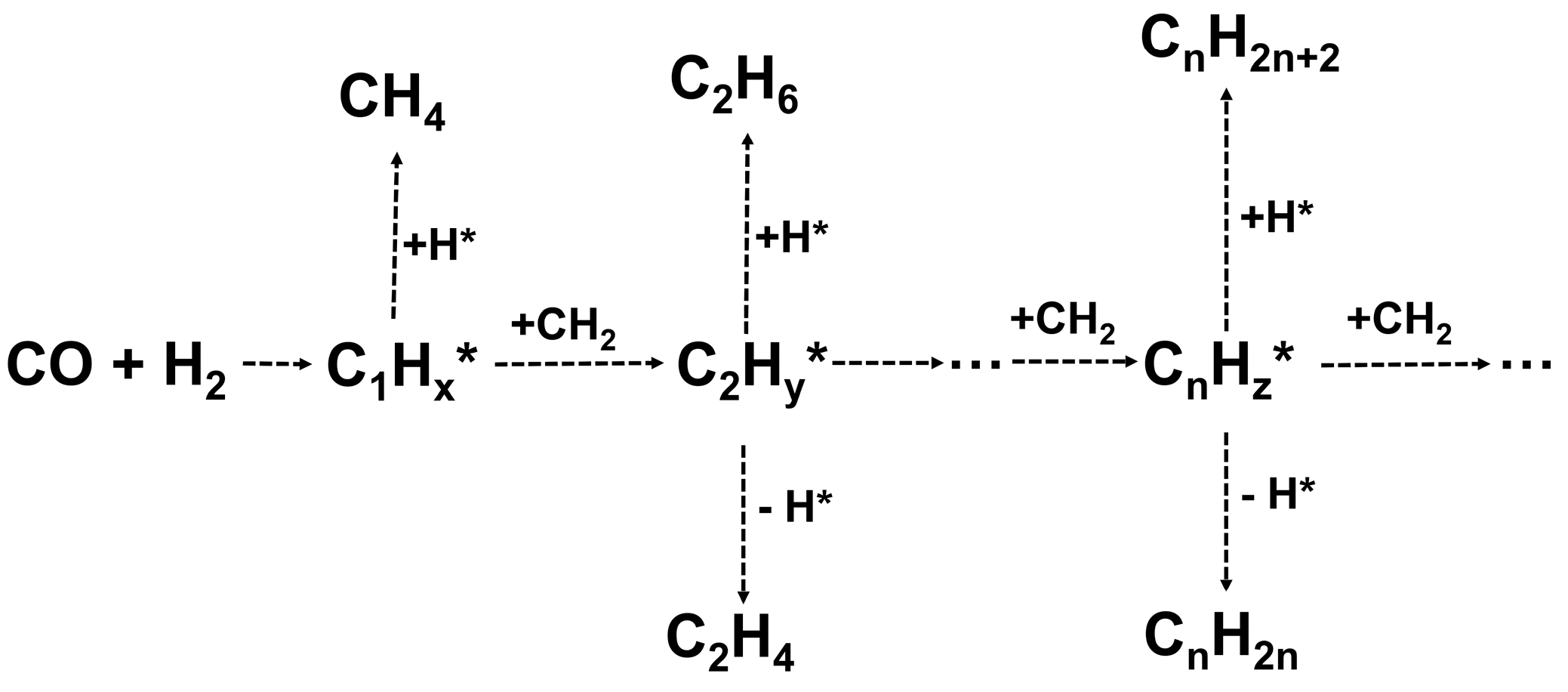
Figure 1. Mechanism for the Fischer-Tropsch synthesis.
Catalysts 15 01122 g001
Figure 2. N2 sorption isotherms of different catalysts.
Catalysts 15 01122 g002
Figure 3. XRD patterns of 1.1RhCoMn/SiO2, 1.1RhCoMn/SiO2(C), CoMn/SiO2, and CoMn/SiO2(C). The XRD patterns in the 38–48° range (presented in the upper right corner) are extracted from the area magnified in the red frame.
Catalysts 15 01122 g003
Figure 4. XPS spectra of the different calcined catalysts. (a) Rh 3d region. Experimental, fitted, and baseline curves are displayed in gray, red, and blue, respectively. (b) Co 2p region. Experimental, fitted, and baseline curves are displayed in gray, red, and brown, respectively.
Catalysts 15 01122 g004
Figure 5. H2-TPR profiles of the different catalysts. The three reduction peaks (α, β, and γ) correspond to the sequential reduction of Co3O4 to CoO, CoO to metallic Co, and the reduction of Co species interacting with the SiO2 support, respectively.
Catalysts 15 01122 g005
Figure 6. Structural characterization of the reduced catalysts. (a) HR-TEM image of 1.1RhCoMn/SiO2(C). (b,c) HAADF-STEM images of 1.1RhCoMn/SiO2(C) with corresponding particle size distribution and EDS elemental mapping. (df) HAADF-STEM images and particle size distributions of (d) CoMn/SiO2, (e) CoMn/SiO2(C), and (f) 1.1RhCoMn/SiO2.
Catalysts 15 01122 g006
Figure 7. Schematic Illustration of the RhCoMn/SiO2(C) for Syngas to Long-Chain α-Olefins.
Catalysts 15 01122 g007
Figure 8. Catalytic performances. (a) Product selectivity and CO conversion (represented by the red curve) over different catalysts at 483 K, H2/CO ratio of 1, 3000 mL·gcat.−1·h−1 and 1.0 MPa. (b) Detailed olefin distribution over these catalysts.
Catalysts 15 01122 g008
Figure 9. Catalytic performances. (a) Product selectivity and CO conversion of catalysts with different Rh loadings. (b) Product selectivity and CO conversion at different space velocities over 1.1RhCoMn/SiO2(C) catalyst at 483 K, H2/CO ratio of 1 and 1.0 MPa. (c) Product selectivity and CO conversion at different reaction pressure over 1.1RhCoMn/SiO2(C) catalyst at 483 K, H2/CO ratio of 1 and 3000 mL·gcat.−1·h−1. (d) Detailed product distribution and selectivity of olefins (inset) over 1.1RhCoMn/SiO2(C) catalyst.
Catalysts 15 01122 g009
Table 1. Surface Area and Elemental Composition of Catalysts.
CatalystsSurface Area (m2·g−1)ICP Elemental Analysis (wt%)
TotalExternalMicroCoMnRh
CoMn/SiO22221744813.00.25
CoMn/SiO2(C)1901652512.90.25
0.7RhCoMn/SiO2(C)2281854312.90.240.69
1.1RhCoMn/SiO2(C)2291943513.00.251.10
1.5RhCoMn/SiO2(C)2131654813.20.261.53
1.1RhCoMn/SiO22381845413.10.261.11
Table 2. Area ratio of Co2+ and Co3+ peaks calculated from XPS spectra.
CatalystsCo2+ Area (%)Co3+ Area (%)Co2+/Co3+ Ratio
CoMn/SiO236641:1.8
CoMn/SiO2(C)55451.2:1
1.1RhCoMn/SiO241591:1.5
1.1RhCoMn/SiO2(C)64361.8:1
Disclaimer/Publisher’s Note: The statements, opinions and data contained in all publications are solely those of the individual author(s) and contributor(s) and not of MDPI and/or the editor(s). MDPI and/or the editor(s) disclaim responsibility for any injury to people or property resulting from any ideas, methods, instructions or products referred to in the content.