Article

Maximizing Anilinium Ionic Solid Mineralization Using RSM: A COD and TOC Study of Photocatalytic Degradation


by
Vuyolwethu Tokoyi
1,*,
Emmanuel Kweinor Tetteh
2,* and
Nirmala Deenadayalu
1
1
Department of Chemistry, Faculty of Applied Sciences, Durban University of Technology, P.O. Box 1334, Durban 4000, South Africa
2
Green Engineering Research Group, Research and Postgraduate Support, Faculty of Engineering and Built Environment, Durban University of Technology, P.O. Box 1334, Durban 4000, South Africa
*
Authors to whom correspondence should be addressed.
Catalysts 2025, 15(12), 1109; https://doi.org/10.3390/catal15121109
Submission received: 11 October 2025 / Revised: 23 November 2025 / Accepted: 24 November 2025 / Published: 28 November 2025

Abstract

The toxicity of anilinium-based compounds continues to increase with their prevalence in industrial effluents, posing a significant threat to aquatic ecosystems. To address this, a photocatalytic system comprising UV/H2O2/Ti-MOF was developed and optimized for the degradation of ionic solids (ISs). The synthesized Ti-MOF was characterized for its absorption and energy transmission capacity, morphological and elemental properties, thermal stability, and phase behavior, with UV-Vis, SEM-EDX, XRD, and TGA-DSC, respectively. The degradation experiment under UV irradiation in the presence of hydrogen peroxide (H2O2) and Ti-MOF illustrated an enhanced catalytic efficiency of the system when compared to blank experiments without the MOF catalyst. A response surface methodology (RSM) based on the Box–Behnken design (BBD) was then employed to evaluate and optimize key parameters, including IS concentration (150–650 mg/mL), time (1–5 h), and H2O2 (1–5%), in terms of the degradation efficiency. At optimal conditions for an IS concentration of 650 mg/mL, time of 3 h, and H2O2 concentration of 5%, an actual degradation efficiency of 57.5% was obtained, with 55.52% predicted by the RSM model at a 95% confidence level. Analysis of variance revealed statistical significance in the response models, with a coefficient of determination (R2) greater than 0.94, in agreement with the adjusted R2 value of less than 0.89. Kinetic analysis revealed that the degradation followed pseudo-first-order kinetics, exhibiting good reusability over multiple cycles. The study shows the potential of the UV/H2O2/Ti-MOF system as a sustainable and highly efficient approach to treating recalcitrant IS pollutants in wastewater.

1. Introduction

Scientists globally have been persuaded and are slowly migrating to the necessary application of green solvents, from the laboratory scale to industrial applications. Green solvents are supposedly environmentally friendly, having low health risks and improved safety profiles [1]. Traditional organic solvents are recognized as significant sources of hazardous waste due to their volatility; however, ionic liquids (ILs) represent an excellent alternative to traditional solvents, with greener properties [2]. ILs are characterized by properties such as negligible vapor pressure, non-flammability under ambient conditions, high thermal conductivity, a wide electrochemical window, high polarity, and a melting point below 100 °C [3,4]. ILs can also dissolve a wide diversity of materials, including salts, fats, proteins, amino acids, surfactants, sugars, polysaccharides, and organic solvents [5,6]. However, the most important attribute of ILs is the possibility of designing their properties for a particular application [7].
The enormous number of cation and anion combinations enable ILs to possess a wide spectrum of physical and chemical properties (solubility, polarity, viscosity, solvent miscibility, solid or liquid state, and melting point) [8], and they are already recognized by the chemical industry as new, target-oriented reaction media [3]. Although the low vapor pressure of ILs may reduce air pollution concerning the typical volatile organic solvents, it is not sufficient to justify calling them “green” solvents [9]. It must be considered that the release of ILs in industrial processes into aquatic environments may lead to water pollution because of their high solubility in water [10].
Since several reported ILs show either low biodegradability [11] and considerable toxicity [12,13,14] or are not readily biodegradable [15], several recovery methods, like extraction [2], adsorption [16], membrane separation [17], and advanced oxidation processes (AOPs), are frequently suggested and reported as alternative disposal strategies to handle this character of ILs [10,18,19]. However, some of the limitations include difficulties in completely removing low concentrations of ILs from the aquatic environment, which pose serious toxic issues. With the world currently focusing on sustainability because of depleting natural resources like water [3,20], on a microbial scale, the discovery of the ILs’ antimicrobial action against several microbial strains is an advantage, especially for potential application in the wastewater treatment process, but is also a disadvantage in an aquatic environment. There is a need for effective methods to recover or degrade these compounds from aquatic environments.
At present, the photodegradation process using UV–Visible light, hydrogen peroxide (H2O2), titanium(IV)dioxide (TiO2), or a recombinant has been the most used method for degrading these compounds [7,21,22]. The application of this approach has been reported for several ILs and has been proven to mainly produce transformation products (TPs) during the degradation process [3,9], and the identified or formed TPs have provided important information in helping to deduce the potential degradation pathway leading to their formation and how they may have a very different impact on the environment compared to the parent compound [1]. Since photodegradation can be either a heterogenous or a homogenous technique, it is easy to work with, and with the use of a photocatalyst, recovery and reusability can be achieved.
Several experiments have reported target degradation of imidazolium, pyridinium, ammonium, etc., -based ILs in a liquid state, but for the first time, to our knowledge, this study aims at evaluating the capability of photocatalytic degradation (photolysis and photocatalytic) of an anilinium-based ionic solid (IS) by employing a recombinant process composed of H2O2/UV/Ti-MOF. The specific selection of Ti-MOF is attributed to its ability to leverage the high porosity and surface area of the framework structure, allowing for greater accessibility to active titanium centers as compared to TiO2. The crystalline structure and porous nature can also improve charge separation and transport, resulting in more efficient generation of reactive oxygen species (ROS) [23]. The work further investigates the influence of the process on the stability and degradation degree of the compound. Based on the obtained results, this process was shown to be an alternative that can be quite helpful, especially in wastewater treatment industries, in predicting the consequences and the environmental fate (in the case of pollution instances) through estimation of the long-term degradation of the analyzed compounds.

2. Results and Discussion

2.1. Characterization of Catalysts

2.1.1. UV–Vis and FTIR

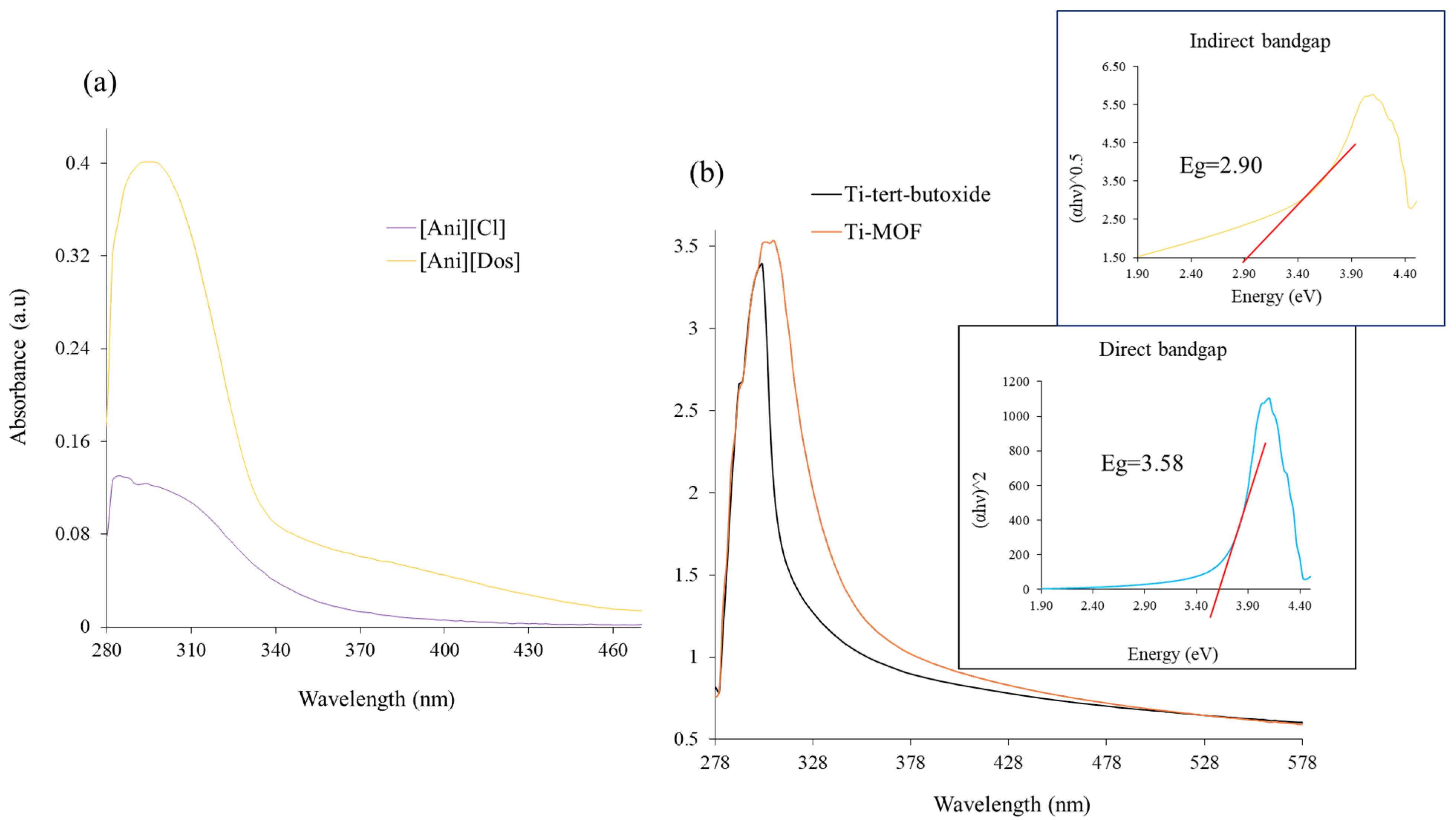
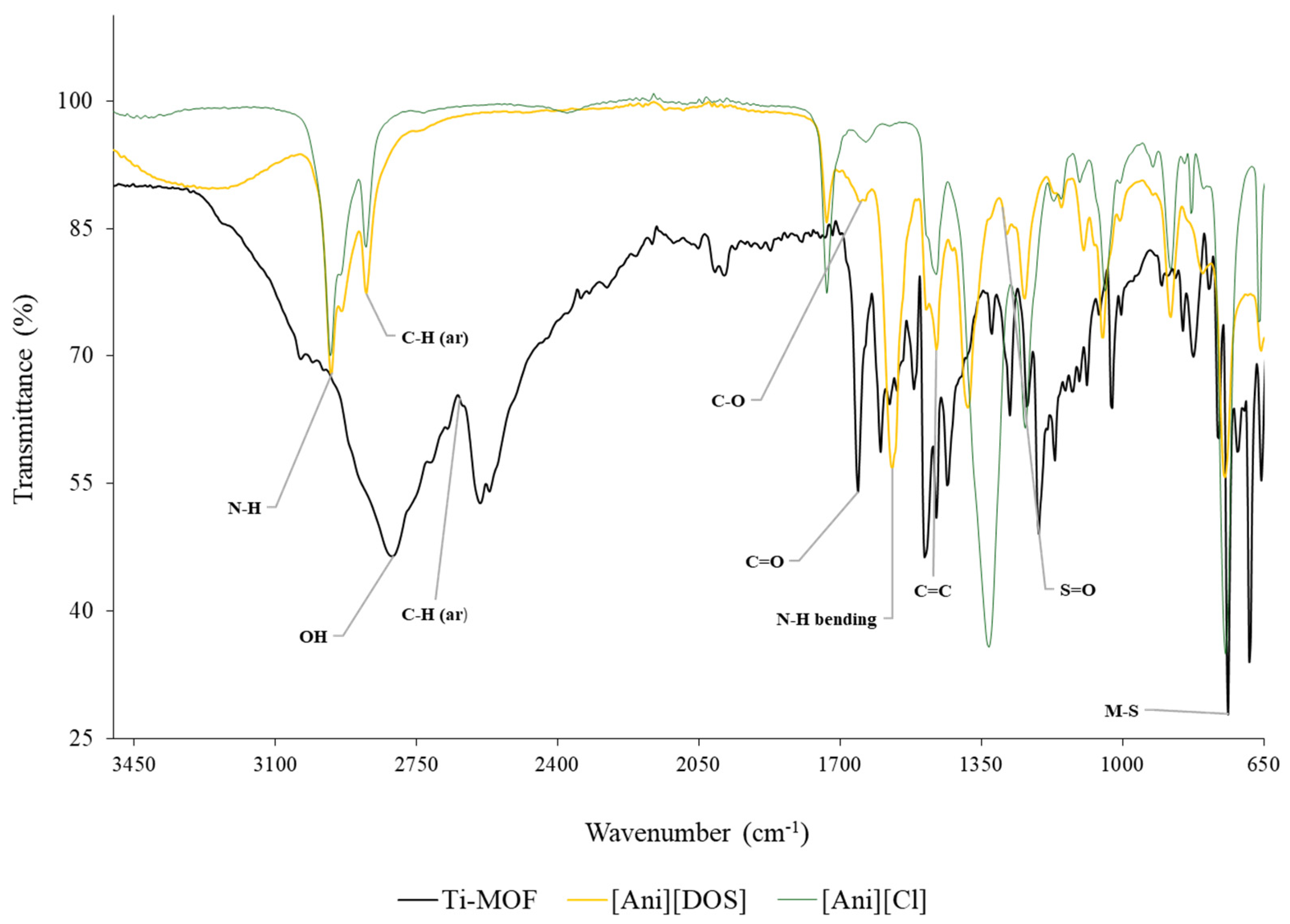
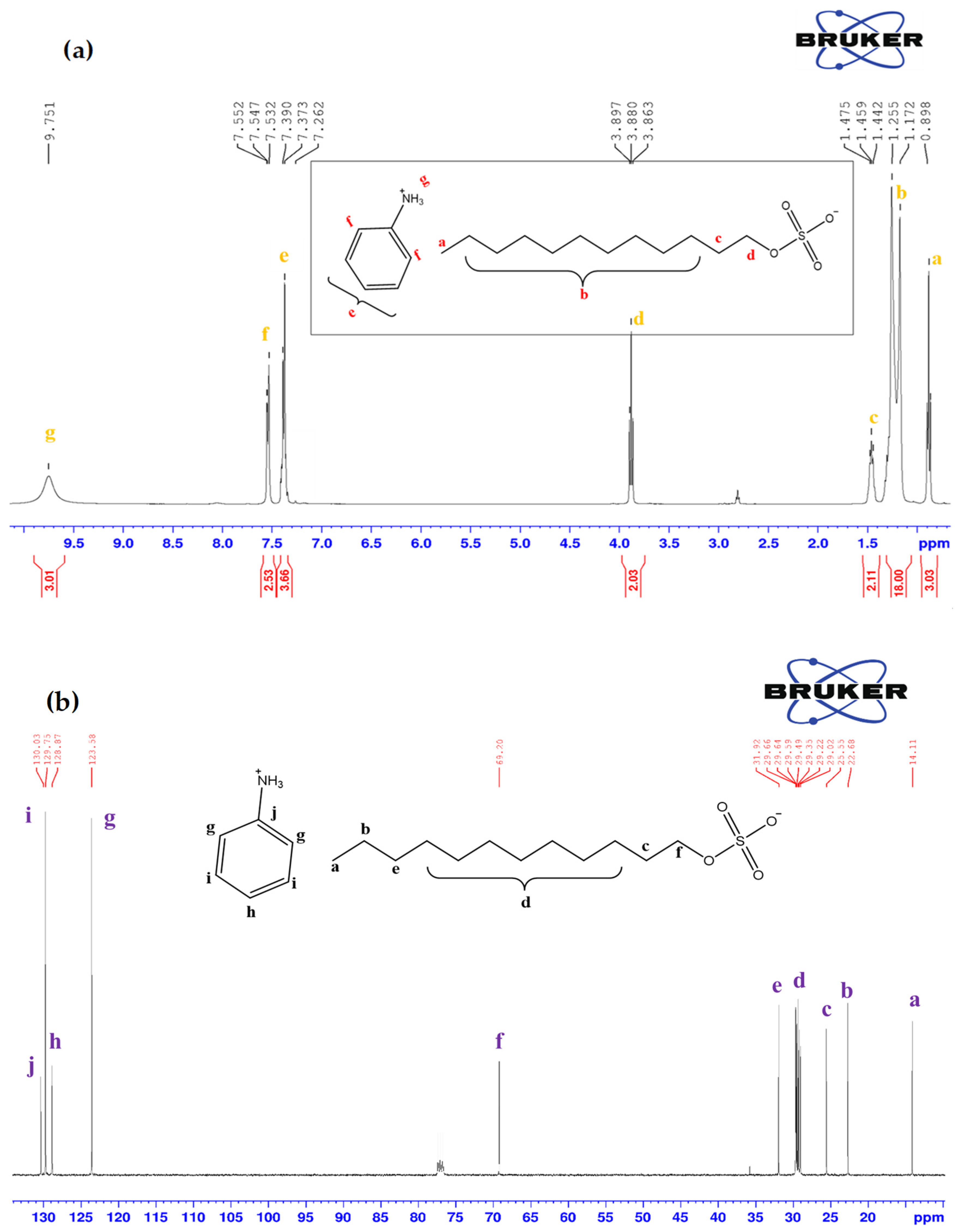
The UV–Vis absorption spectra for [Ani][Dos] and Ti-MOF were recorded from 200 to 600 nm (Figure 1). As per Figure 1a, a maximum absorption band located at 298 nm is attributed to the π→π* and n→π* transitions, with a calculated molar absorption coefficient (Ɛ, using Equation (1)) of 2142.81 L mol−1 cm−1. These transitions are a result of the aromatic ring representing an aromatic content (π→π*) as well as the electron pair on oxygen atom(s) located on the anion O–S–O and C–O moieties, resulting in an interaction with an antibonding π-orbital of the carbon atom. In Figure 1b, a maximum absorption band located at 308 nm is attributed to the TSA organic linker’s π→π* and n→π* transitions. In the visible region, no absorption bands attributed to metal-to-ligand charge transfer (MLCT) and d-d transitions (t2g↔eg) were recorded. This is attributed to the empty d−orbitals (do), which should result in a colorless catalyst, but instead an orange precipitate was obtained. This observation corresponds to the very high Ti4+ oxidation state, which results in very high energy molecular orbitals of the organic linker, favoring a ligand-to-metal charge transfer transition (LMCT). The calculated molar absorption coefficient (Equation (1)) and the measured electron conjugation of the catalyst reveal that both compounds have aromatic rings with distinct substituents and bonds. Consequently, an FTIR spectra (Figure 2) revealed the presence of the functional groups (N-H, C-H, C=C, C=O). The carbon and hydrogen framework of the synthesized IS was characterized and the resultant spectra is presented in Figure 3.
Molar   absorption   coefficient   ( Ɛ ) = A l × C
where A = absorbance, l = path length (1 cm), and C = concentration (mol/L).
The optical band gap of Ti-MOF was calculated based on UV–Vis (Figure 1b) using the Tauc Plot (inset in Figure 1b). The Ti-MOF shows an absorption maxima at 357 nm, which corresponds to the d-d transition of Ti-based compounds [24] and is attributed to the ligand-to-metal charge transfer [25]. Remarkably, different metal ions and ligands in MOF have varied interactions and distinct optical absorption, which make them suitable photocatalysts [25,26]. Compared to the pristine material (Ti-tert-butoxide), the synthesis of Ti-MOF resulted in a redshift of the d-d transition due to light-harvesting of the MOF [26]. Based on the UV–Vis spectra (Figure 1b), the optical bandgap energy was determined using the Tauc plot by Equation (3) [27,28]:
( α hv ) n   =   A ( h v E g )
The absorption coefficient is represented as α, the frequency of light is v, and β is the bandgap tailing parameter. The plank constant and optical band gap energy are represented as h and Eg, respectively. The n symbol in Equation (2) represents the transition probability index for direct and indirect allowed electronic transitions, with n values of 1/2 and 2, respectively. The (αhυ)2 versus eV was plotted using data achieved from the UV–Vis spectrum, and the Eg values presented in Figure 1b insert (Eg = 3.58 eV and 2.90 eV) for direct and indirect allowed electronic transitions of Ti-MOF were estimated using the straight-line intercept. The obtained values indicated that Ti-MOF can be activated by light [26] under a direct allowed transition and that there are some new electronic states between the valence and conduction bands of Ti-MOF [29,30]; this increases the photoactivity of the material, which is favorable in achieving better performance in photocatalytic reactions [28].

2.1.2. BET Analysis and Particle Size Distribution

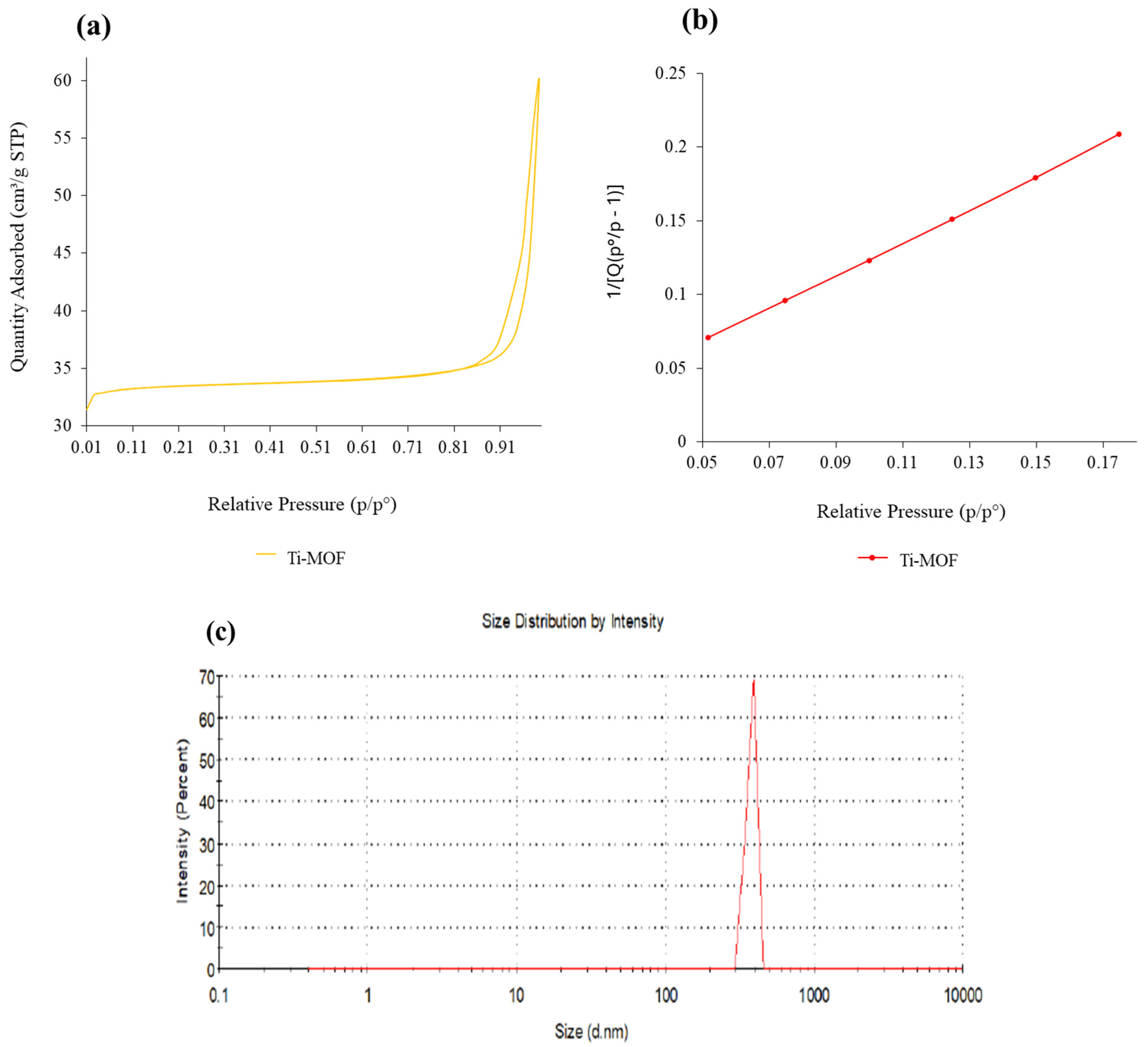
BET analysis and dynamic light scattering (DLS) were performed to determine the hydrodynamic size and size distribution of the synthesized IS, specific surface area, pore volume, pore width, and pore-size distribution of the Ti-MOF catalyst. Figure 4a,b demonstrated that the adsorption isotherm of the catalyst was type II (with an H3 hysteresis loop, suggesting the existence of nature in the sample, according to the IUPAC classification) [31]. Utilizing the BET straight-line fit (Figure 4b), the obtained surface area for Ti-MOF was 126.59 m2/g, with a pore volume of 0.37 cm3/g. According to the pore size distribution curve, obvious microporous–mesoporous distribution can be seen, indicating a strong physisorption property.
DLS analysis of the IS revealed a hydrodynamic diameter (dh) of 397.4 nm intensity-weighted size distribution graph (Figure 4c), with a single, sharp peak within the nanometer range, corroborating the monodispersity of the particles within the material. Since the IS is surfactant-based, this distribution is critical for determining predictable behaviors like mineralization or the potential self-assembly into aggregates such as micelles [32].

2.1.3. SEM-EDX

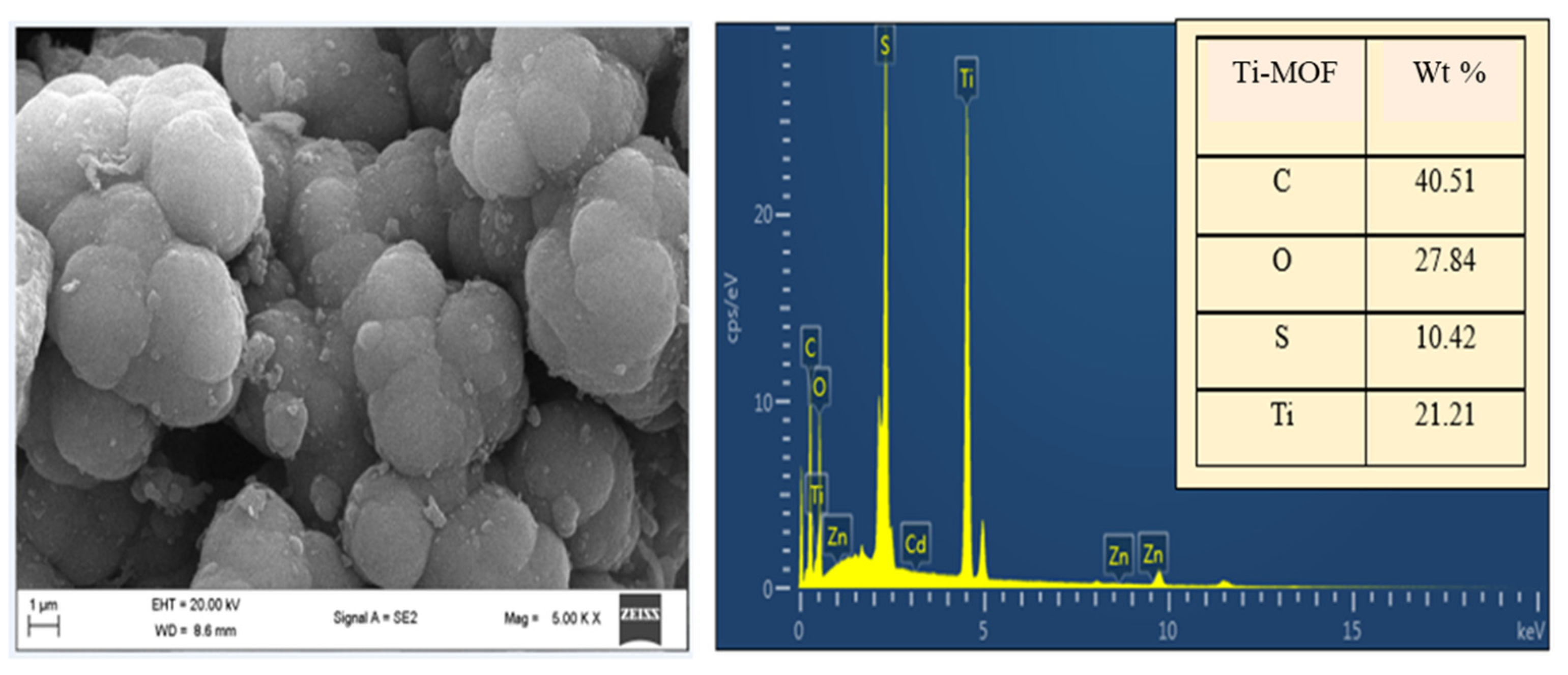
Surface morphology and elemental composition of the synthesized Ti-MOF was determined using the FESEM and EDX mapping analysis, and the obtained results are displayed in Figure 5. The illustrated morphological image shows well-distributed spherical particles, 1 µm in size, conglomerated and stacked, with smooth surfaces. The corresponding EDX elemental mapping confirmed the presence of Ti (IV), O, C, and S elements within the framework.

2.1.4. XRD

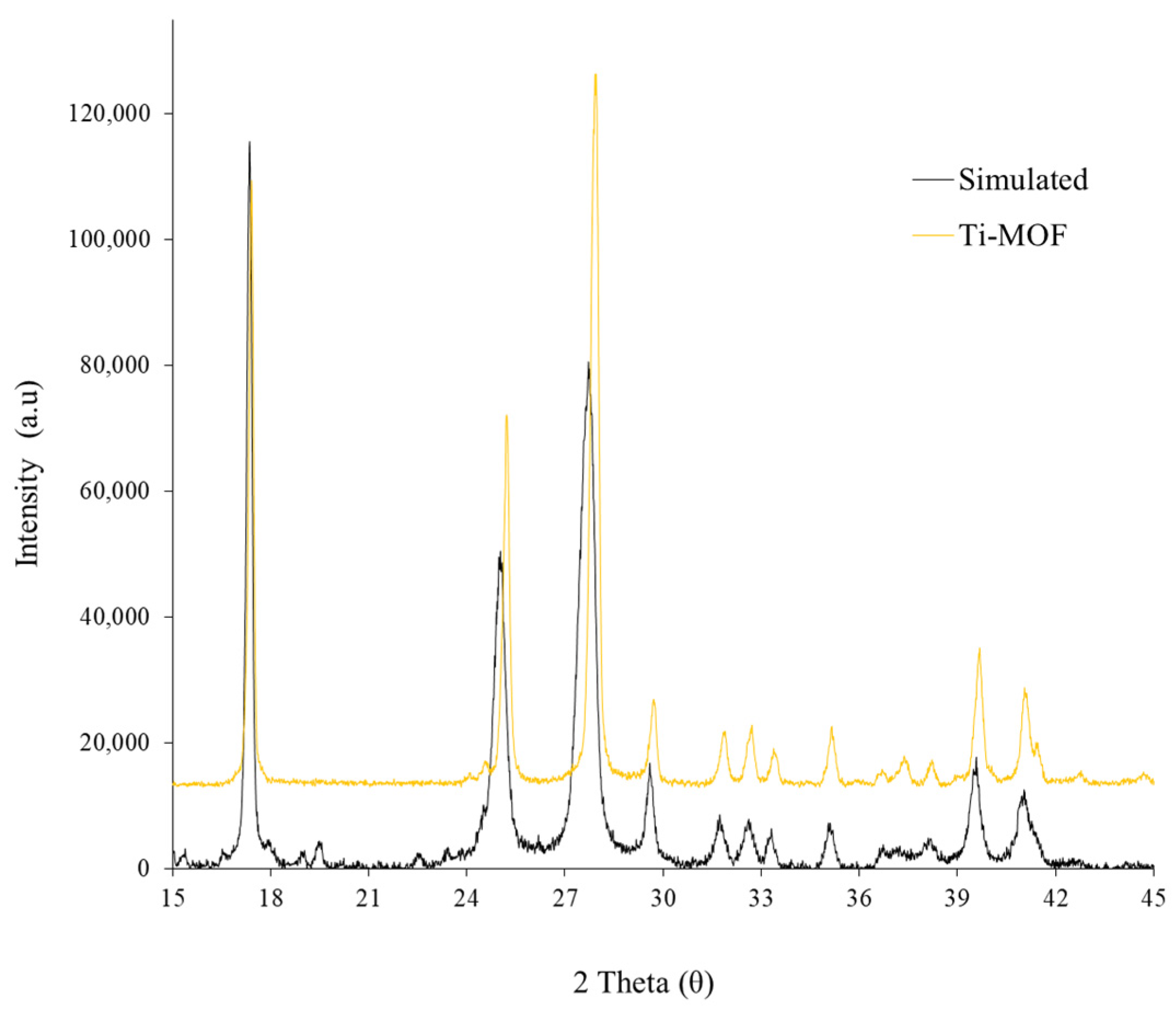
The XRD analysis confirms the crystalline nature and successful formation of the synthesized Ti-MOF, as shown in Figure 6, with diffraction peaks that are almost identical to the simulated peaks but with higher intensities. The experimental spectra showed distinct low-angle diffraction peaks at 2θ = 6.8° and 8.2°, characteristic of the porous framework commonly observed in MOFs. This similarity suggests that these materials maintain a high level of crystallinity. The prominent diffraction peaks observed in the prepared materials were located at 2θ, with four characteristic diffraction peaks at 2θ = 17.14°, 25.84°, 28.17°, and 30.17–41.18°, corresponding to the crystallographic planes (101), (004), (200), (105), and (204), respectively. These peaks closely match the simulated XRD pattern generated from the reported Ti-MOF structure, confirming structural integrity and phase formation [24,33,34,35]. The alignment between experimental and simulated patterns strongly supports the successful synthesis of the Ti-MOF [36,37,38]. Importantly, no additional peaks corresponding to impurities or secondary phases were detected, indicating high phase purity.

2.1.5. Thermal Stability Studies

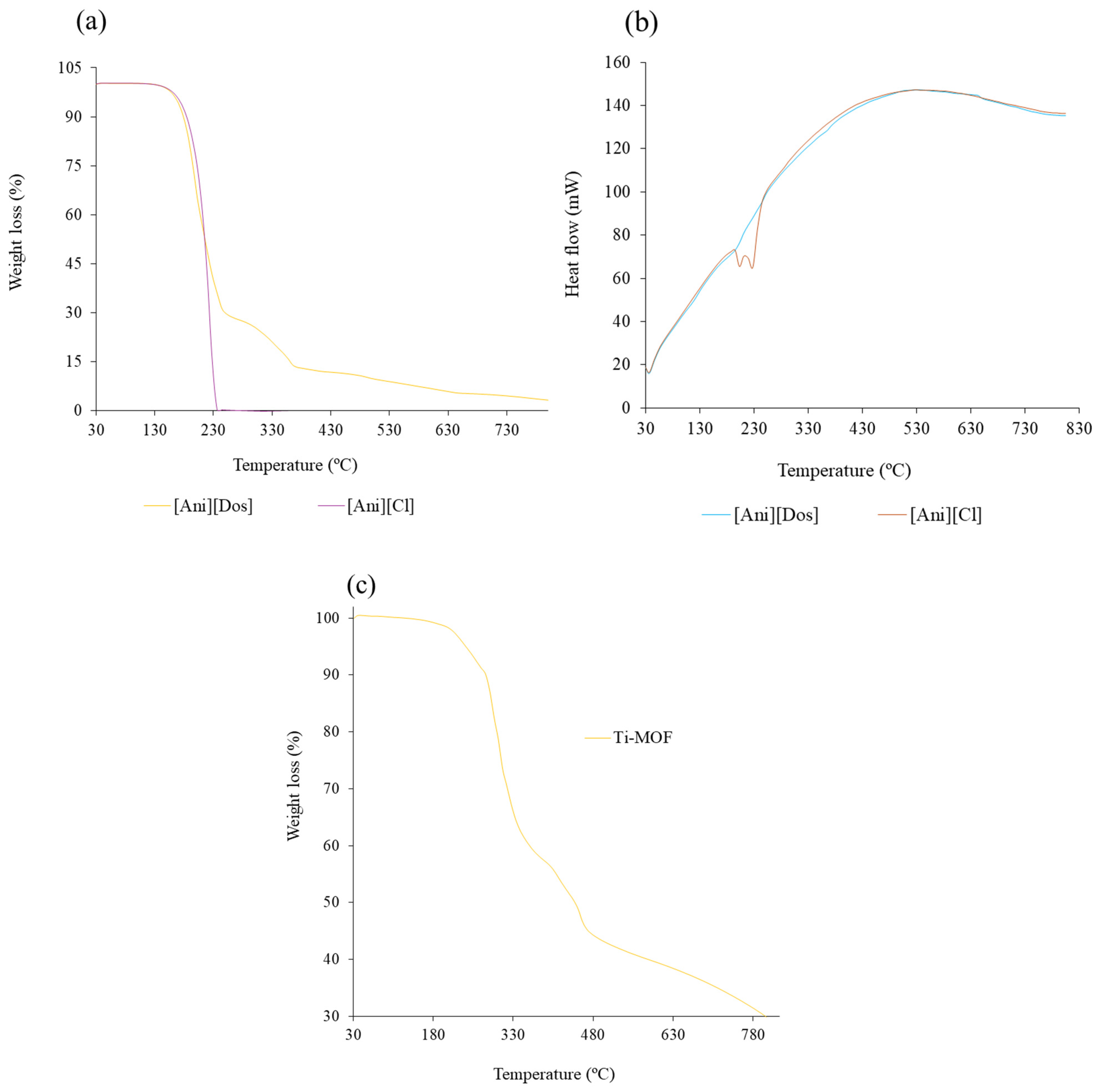
Thermal stability and phase behavior of the anilinium-based ISs were studied using TGA and DSC, and the thermograms (Figure 7a,b) were recorded and analyzed using STARe software (version 9.20). The overall thermal stability or phase behavior of the resultant ionic compounds is greatly impacted by alkyl substituents, functional groups, coupled anions, and cations, causing higher or lower decomposition temperatures (Td) [39] or compounds to melt (Tm) or crystallize (Tc) [40]. Figure 7a recorded a Td for [Ani][Cl] at 245 °C (mass loss of ± 100%) and for [Ani][Dos] at 261 °C (71.2% mass loss) and 381 °C (87% mass loss). Thus, thermal stabilities of the ISs show the following ascending trend: [Ani][Cl] < [Ani][Dos]. In Figure 7b, all the examined ISs exhibited a glass transition phase (Tg) at 36 °C, and upon further heating, only [Ani][Cl] exhibited a semicrystalline nature, with endothermic peaks at 203.47 °C and 228 °C, which are associated with the crystalline transition phase tendency caused by melting (Tm). At the same time, [Ani][Dos] showed an amorphous nature.
Figure 7c illustrates the TGA curve with three-phase degradation steps for Ti-MOF. The first weight loss (~9.88%) observed at 277.97 °C is attributed to the endothermic reaction process, which removed moisture contained within the material [41]. The second approximately 42.09% weight loss at 381.31 °C is attributed to the volatilization of the surplus organic linker thiosalicylic acid (TSA) in the Ti-MOF [41]. The last degradation phase observed at 475.50 °C, with a mass loss of about 55.38%, can also be attributed to the excess TSA present in the MOF [42,43].

2.2. Photodegradation Evaluation

The combination of Ti-MOF, UV light, and H2O2 forms a highly potent Advanced Oxidation Process (AOP), with several key advantages over the conventional TiO2 or single-component systems (Table 1). The performance of Ti-MOF was evaluated as an index to ascertain its ability under and not under UV irradiation for the degradation of ISs. This section discusses photostability, photodegradability, and recyclability in terms of the kinetics index of the catalyst.

2.2.1. Photostability of the IS

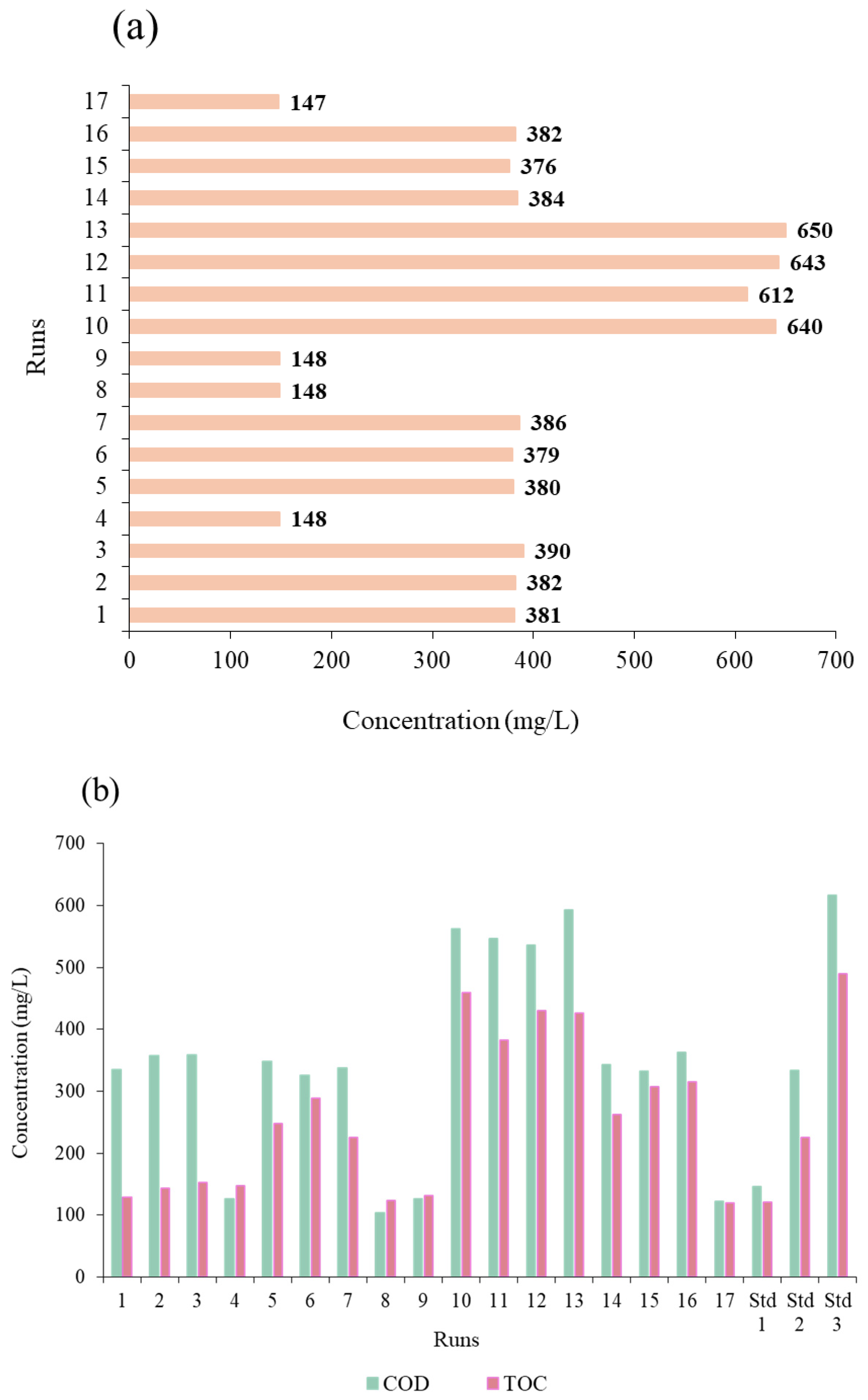
The thermal stability of ISs has been studied and reported previously [49], although not under irradiation for the determination of chemical stability, to the best of our knowledge. Figure 8 summarizes the reduction in IS concentrations, COD, and TOC after a period of irradiation in the absence of the catalyst. As shown in Figure 8a,b, all runs demonstrate a reduction in IS concentrations; compared to the control solutions, run 13 (650 mg/L) exhibited high stability, with a COD value of 592 mg/L and a TOC value of 426 mg/L, while run 6 (400 mg/L decreased to 379 mg/L) showed the least stability, with a COD value of 326 mg/L and a TOC value of 288 mg/L. This can be attributed to both the degradation and mineralization of the IS in solution [50,51]. It can also be observed that stability increases as the concentration of the solution rises, which can be attributed to the ion–ion interaction (cations and anions). This leads to a greater occurrence of direct electrostatic, van der Waals, and potentially hydrogen bonding interactions among the ions themselves. These strong inter-ionic forces within the IL can “outcompete” weaker interactions with the solvent molecules (e.g., water), making the IL structure more cohesive and less prone to degradation. Since [Ani][DOS] has a longer alkyl chain, it exhibits amphiphilic behavior [52], and as per stability studies, in a concentrated solution above 400 mg/L, this compound potentially self-assembles into aggregates such as micelles or even a more complex structure that can essentially “protect” the hydrophobic or reactive parts of the IS ions from degradation [52].

2.2.2. Photocatalytic Efficiency of the Ti-MOF-Based Process

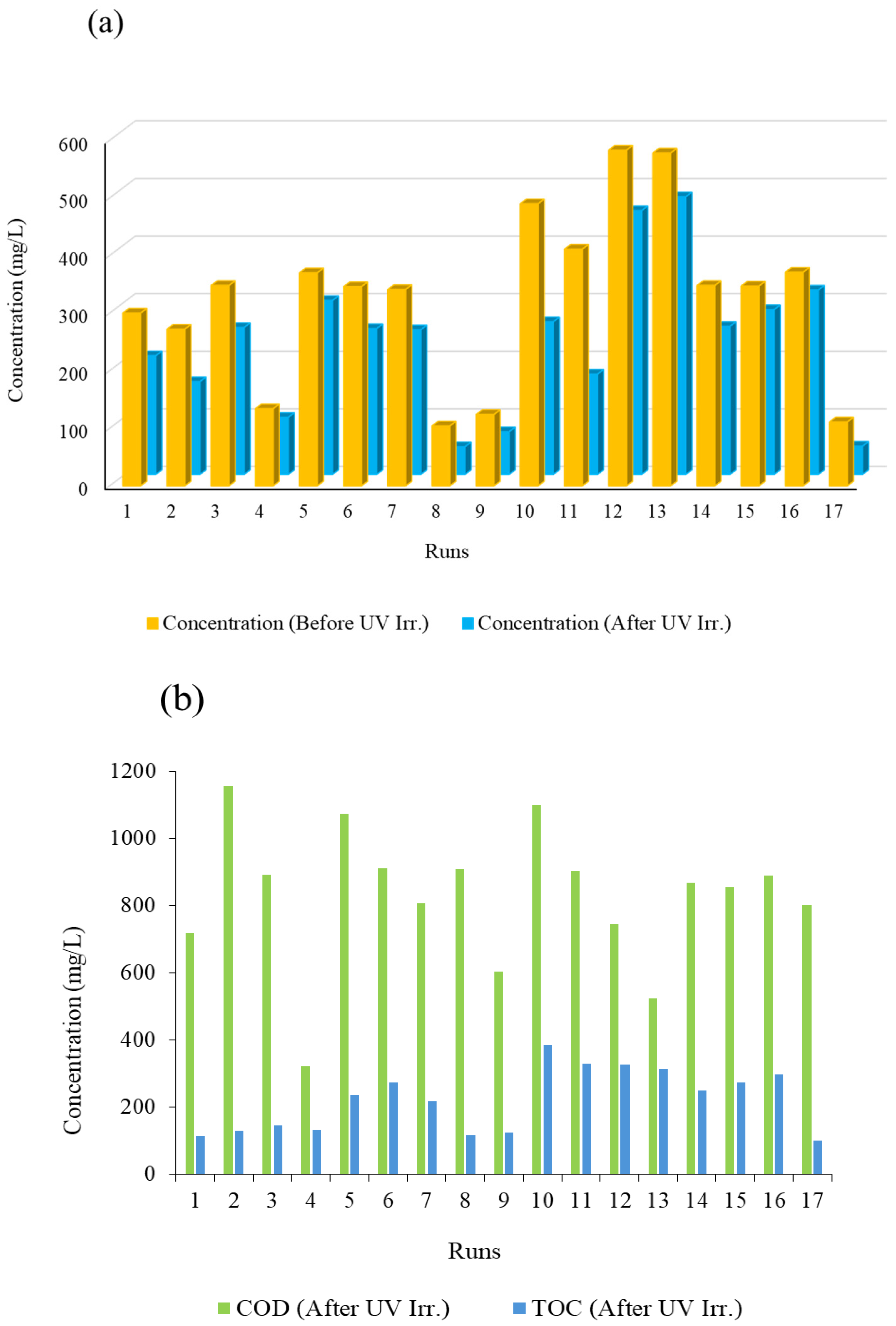
Figure 9a below illustrates that some portion of the IS was indeed adsorbed by the catalyst and mineralized in the presence of H2O2, with a maximum reduction of 150–104 mg/L (run 8), 400–272 mg/L (run 2), and 650–411 mg/L (run 11). This can be attributed to the IS interaction with the catalyst surface, and this observation is in good agreement with the previous study of N.Borhani, Tavakoli [21] as well as the effect of hydrogen peroxide addition on the percentage degradation obtained [53]. After 2 h of stirring for adsorption equilibrium, the mixtures were irradiated for 1, 3, or 5 h. The results obtained from the concentration quantification reported below illustrate the efficiency of the recombinant system with UV irradiation, with an optimum reduction of 104–69 mg/L (run 8), 272–237 mg/L (run 2), and 411–276 mg/L (run 11). Figure 9b illustrates run 4 (COD = 321 mg/L) as an optimum experiment, with a corresponding TOC value of 132 mg/L, while in run 17, analysis produced a maximum TOC value of 102 mg/L, with a corresponding COD value of 803 mg/L. Compared to the COD values obtained from the stock solutions (Figure 8), the observed fluctuations in both TOC and COD can be attributed to the potential result of chemical intermediates that can accumulate, thereby initially decreasing the values [54,55], while the adsorbed IS on the MOF’s surface may desorb back to the solution, therefore increasing the values [56]. Even though not detected, the potential leaching of the catalyst into the solution, particularly the organic linker, can also contribute to these fluctuations [57].
Also, the addition of H2O2 can have a negative or inhibitory effect on the photocatalytic process by interfering particularly with the COD value and causing a dynamic impact on the degrading process [58]. This can be achieved by scavenging the very reactive hydroxyl radicals ·OH that are key to the degradation process, forming less reactive perhydroxyl radicals HO2· or other species, leading to a reduction in the overall degradation rate and efficiency of the recombinant process [59]. Hydrogen peroxide itself can undergo decomposition on the catalyst surface or through photolysis (if exposed to UV light), producing water and oxygen (O2), which means less H2O2 is available to act as an effective oxidant or electron acceptor [60]. The effect is highly dependent on the specific contaminant, solution pH, catalyst type, and concentration of H2O2 used [61].

2.2.3. Recyclability and Kinetics Study

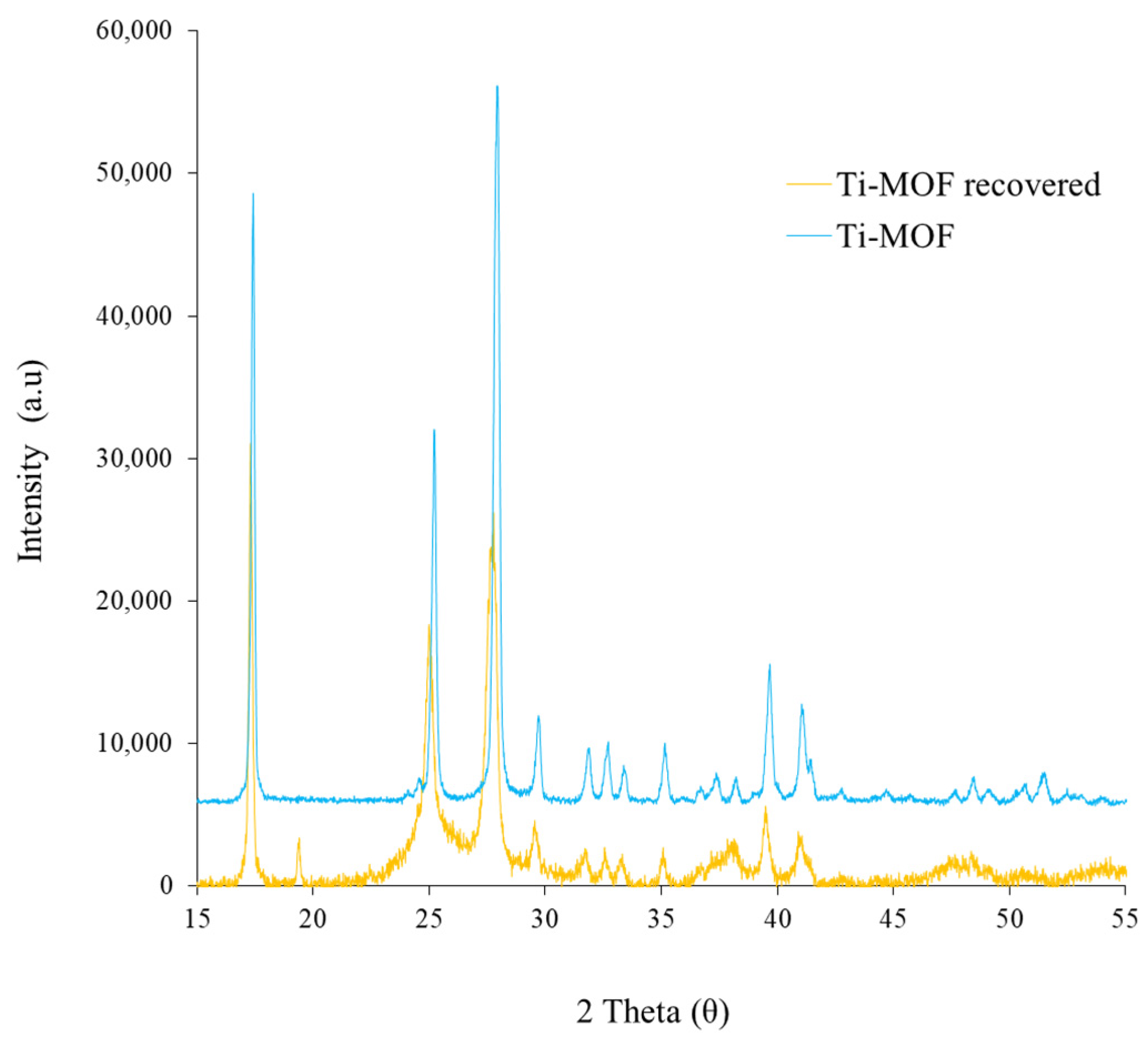
Post-reaction characterization was conducted on the recovered catalyst using PXRD to determine the material’s crystallinity and stability. The Ti-MOF demonstrated excellent recyclability for IS degradation without requiring catalyst regeneration. As shown in Figure 10, PXRD thermograms recorded for the catalyst before and after the photocatalytic reaction still showed the four characteristic diffraction peaks at 2θ = 17.14°, 25.84°, 28.17°, and 30.17–41.18°, suggesting the catalyst’s chemical stability [30]. Even though the diffractogram illustrated that the material maintains its crystallinity, the intensity of the peaks was lower compared to the pristine MOF, and this observation can be associated with an excess H2O2 that can also cause a reduction of the catalyst’s surface [62].
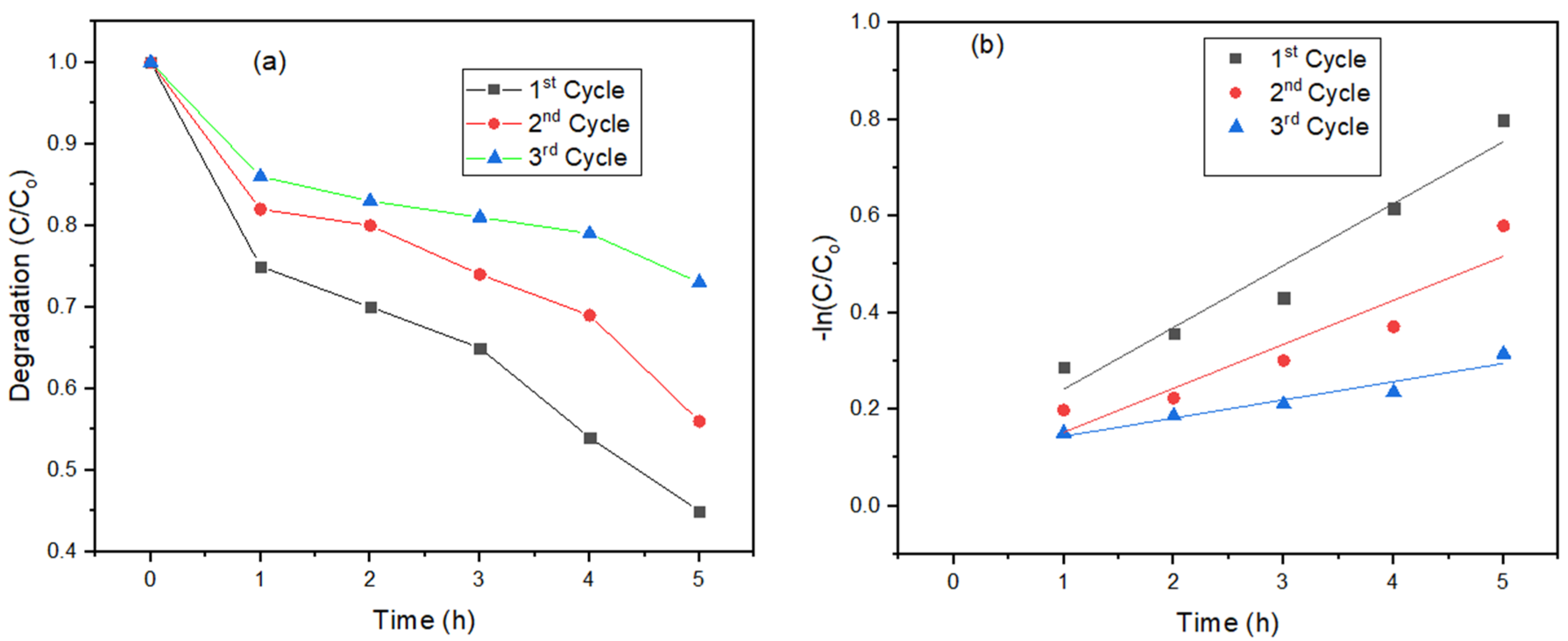
Figure 11 illustrates the decrease in degradation activity with increasing catalyst recycling activity. Its robust structural integrity and photochemical stability sustained catalytic activity across the three-cycle usage [63,64]. Unlike conventional photocatalysts, which require post-treatment to restore performance, the Ti-MOF maintained over 75% of its initial degradation efficiency, with minimal loss in activity (Figure 11a). This non-regenerative stability makes Ti-MOF a viable candidate for scalable water treatment applications, especially in resource-limited settings [63,64,65]. It has the potential to resist fouling and structural degradation, offering operational simplicity, cost-effectiveness, and environmental sustainability [66,67].
The photocatalytic degradation kinetics of the catalytic performance and reaction mechanisms were carried out using linear regression analysis (Table 2). The fundamental step for the reaction pathway was assumed to be the rate-limiting step (RLS), while other parameters were treated as equilibrium processes [68]. Based on the assumption that the rate of degradation was directly proportional to the concentration of the pollutants. The data obtained from the recyclability runs were fitted to a first-order kinetic model (3) to validate recyclability performance (Figure 11a).
ln ( C 0 C t ) = k t
where C 0   a n d   C t   ( m g m L ) , are the initial and time-dependent concentrations of the pollutant, respectively, k is the apparent first-order rate constant (1/h), and t is the time (h) elapsed.
A linear plot of the ln ( C 0 C t ) vs. time (t) is shown in Figure 11b, with the concentration of the catalyst kept constant. The reaction involved a chemisorption of electron transfer between the catalyst surface and the pollutant availability [69,70]. The rate constants estimated in the order of 0.037 < 0.091 < 0.128 h−1, respectively, for the 3rd, 2nd, and 1st cycles support the reusability effectiveness of the catalyst [71]. The 1st cycle exhibiting the highest rate constant of 0.128 h−1 suggests a faster rate of removing the pollutants as compared to the 2nd and 3rd cycle with a lower rate, which amounts to longer retention time [68]. The enhanced rate of retention can be attributed to the synergistic effect of the heterojunction, which improved the charge separation and light absorption, thereby increasing the degradation process [72]. Also, the applicability of the model with a high correlation coefficient (R2) indicated a good fit to the experimental data [73]. The strong linearity of the kinetics and the comparative rate constants are presented in Table 2.

2.3. Optimization Using RSM

The response surface methodology (RSM), using Design Expert software (version 13, Stat-Ease Inc., Minneapolis, MA, USA), was explored to analyze the influence of the factors (H2O2, concentration, and time) on the degradation efficiency. A Box–Behnken design (BBD) was employed to establish the interaction between the reaction parameters as a function of maximizing the degradation efficiency of IS in the aqueous solutions. The RSM BBD generated 17 sets of experimental runs, with 5 duplicated center points (3, 6, 7, 14, and 15) at three different normalized levels, coded as −1, 0, and +1, corresponding to the minimum, central, and maximum points for each of the factors. Table 3 presents the experimental matrix of the factors considered, with the actual and predicted response (degradation efficiency) results and the difference (residual). Based on the results (Table 3), a second-order polynomial equation was obtained to express the relationship between degradation efficiency and the input factors. The Akaike information criterion (AICc) with correction for a small design was employed for automatic selection and modification of the best model [74]. The model equations, represented in coded (4) and actual (5), are expressed with independent variables (A, B, C), interaction (AC), and quadratic terms (AC, A2C) as a function of the response (Y). The positive sign (+) indicates the synergistic effect of the term on the response, while the negative sign (−) shows the antagonistic effect of the model. Herein, the increasing order of the terms’ influence on degradation was A2 > B > A2C > AC > C2 > C > A, where based on degradation efficiency, the most influenced interaction factor was the AC (H2O2 and the concentration).
Degradation (Ycoded) = 23.51 − 4.35A + 12.34B + 1.12C + 5.58AC + 14.09A2 + 4.10C2 + 11.45A2C
Degradation (Yactual) = 23.51 − 0.01136 Concentration (A) + 6.171 Time (B) + 4.608 H2O2(C) − 0.0621AC + 14.09A2 + 4.10C2 + 11.45A2C

2.3.1. Analysis of Variance (ANOVA)

The magnitude of the response model terms and the validity were tested via ANOVA for statistical accuracy and significance, as depicted in Table 4. ANOVA features, such as Fisher variation ratio (F-value), adequate precision (Adeq precision), coefficients of variance (CV), probability value (p-value), and lack of fit (LOF) were employed to ascertain model robustness. The fit statistics features of the coefficient of determination (R2) and adjusted R2, with an estimated difference of less than 0.2, confirmed the accurate predictability and validity of the model. As shown in Table 4, in the model, the F-value was greater than the p-value (P > F). This makes it significant, with only a 0.01% chance that an F-value this large could occur due to noise. The p-values for most model terms less than 0.05 were considered significant [71,75]. Nonetheless, model terms with p-values over 0.05, despite lacking significance, were seen as indicative of a hierarchical structure within a broader design spectrum of interest.
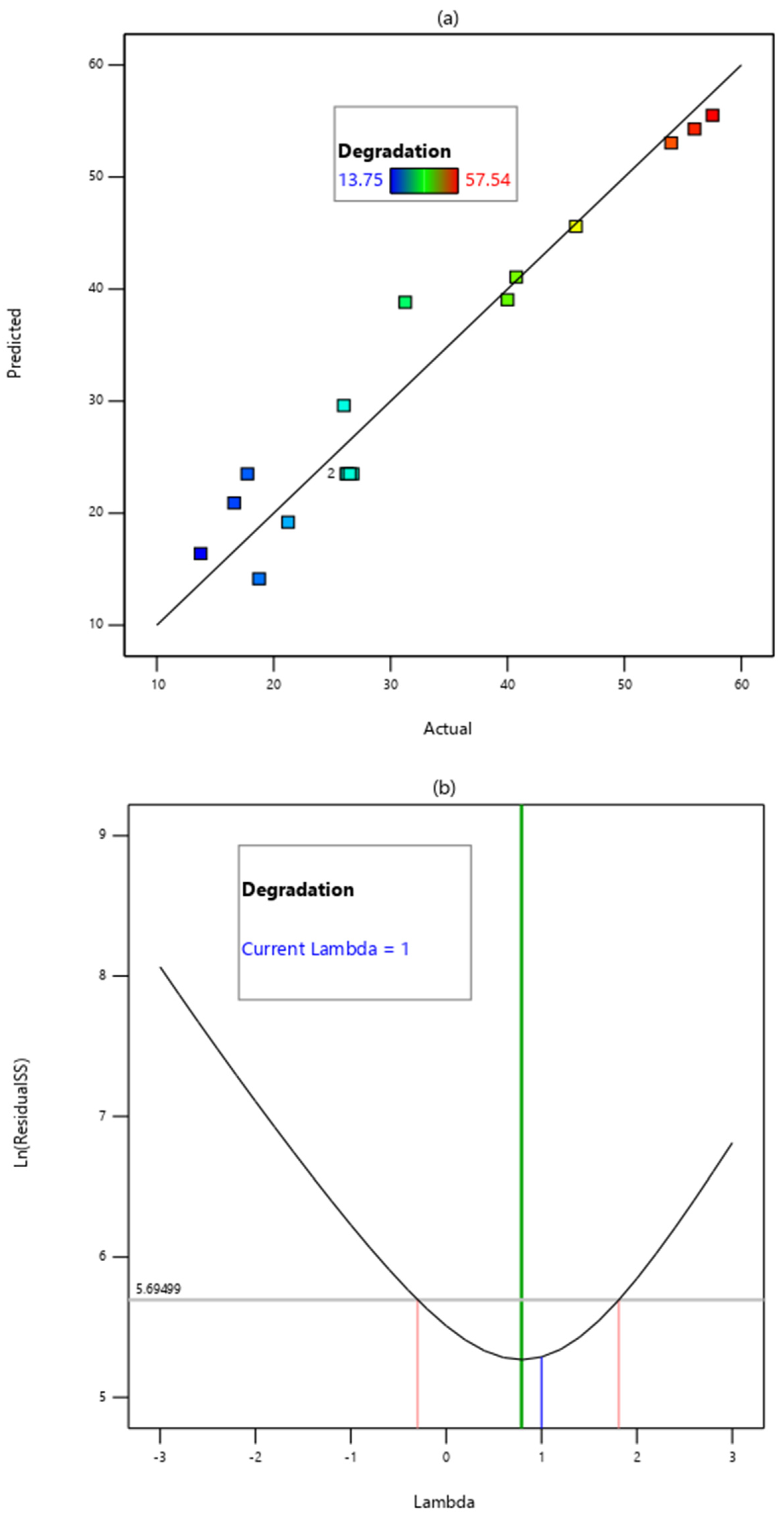
Furthermore, the model p-value (<0.0001) was less than 0.05, indicating the model terms were significant, with a broader range of interest. As shown in Table 4, the R2 value (0.939) and the adjusted R2 (0.892) have a difference of less than 0.2, suggesting that the developed statistical model fitted well with the obtained data. This value is of immense statistical significance, as it gives a clear indication of how well the dataset fits a model [71,74,75]. The quality and validity of the model were examined with diagnostic plots (Figure 12). As shown in Figure 12a, the plot of the actual versus predicted degradation shows a close correlation, indicating the model’s applicability to the empirical data. The data points aligning with the regression line signify a strong correlation between the response and predicted values, indicating that the model accurately predicts the response to changes in the independent variables. The Box–Cox plot (Figure 12b) for power transformation indicated a lambda value of 1, suggesting that no transformation is necessary for the response concerning the degradation efficiency.

2.3.2. Influence of Interaction on the Response

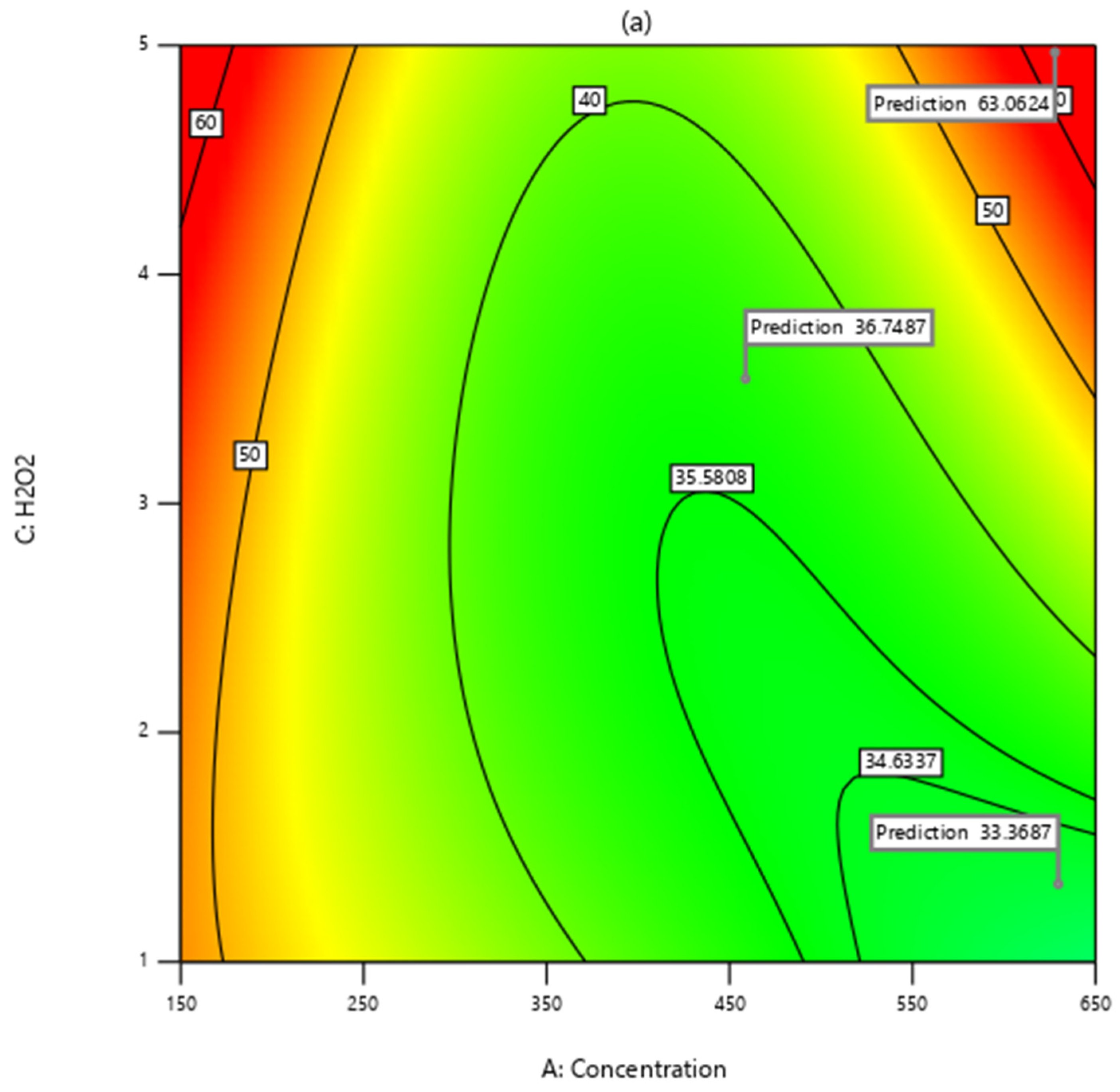
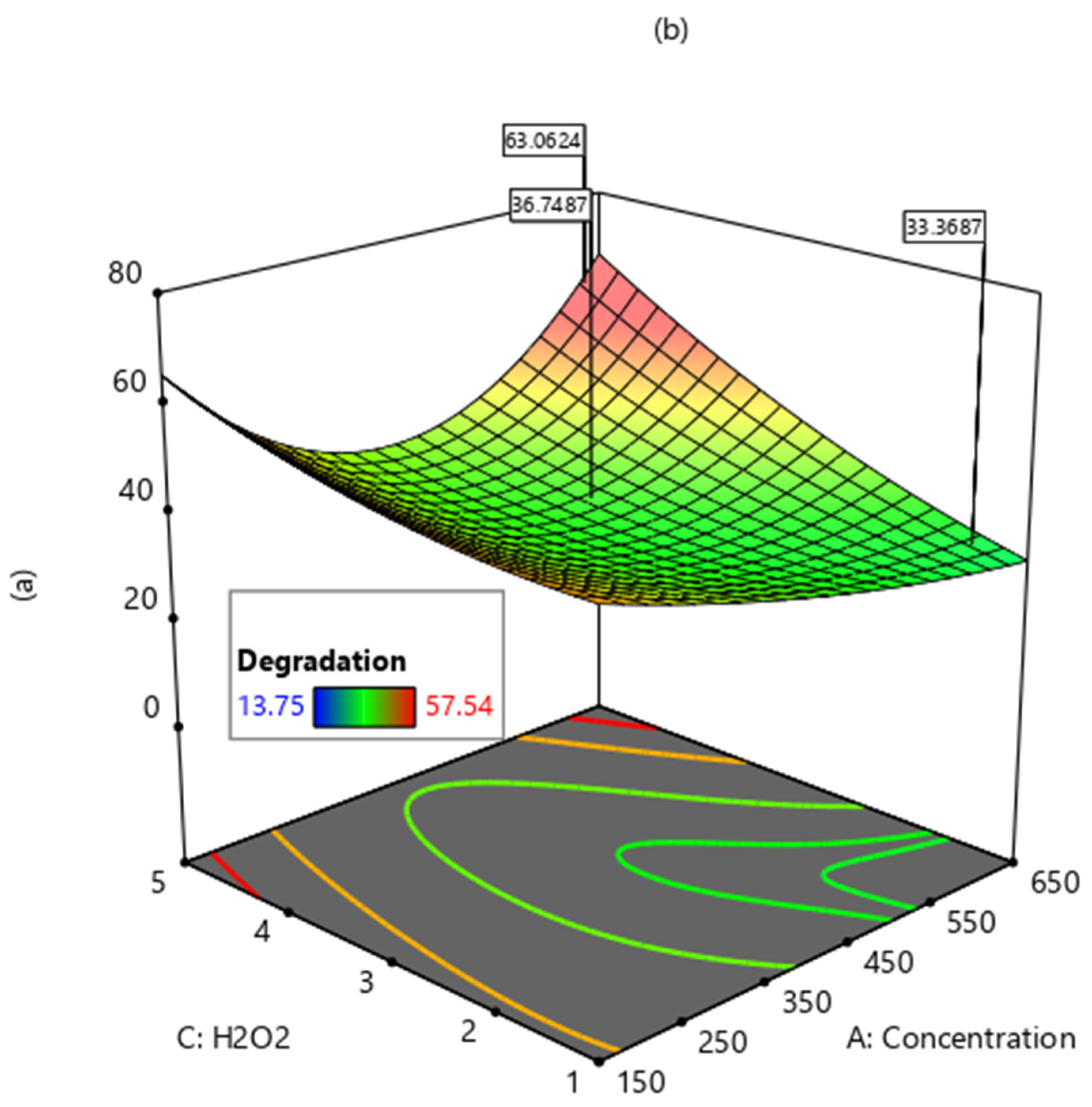
Two (Figure 13a) and three (Figure 13b) -dimensional (2D and 3D) surface plots were generated to understand the interactions of the input factors on the response (degradation efficiency). Figure 12 shows the interaction between the initial concentration of IS (A) and H2O2 (C) with regard to degradation efficiency. From the plot (Figure 13a,b), it is evident that the interaction of AB has a significant influence on the photocatalytic degradation process. At a lower level of A (150–250 mg/mL) and a moderate level of C (3–5%), an optimal degradation efficiency of above 55% was achieved. This can be attributed to the sufficient generation of hydroxyl radicals from H2O2 decomposition [76,77], which actively participated in the degradation of the IS. However, as the initial concentration of IS increases (250–600 mg/mL), the removal tends to decrease, even at a moderate concentration (3–5%) of H2O2. This may be due to the saturation of active sites on the catalyst surface and the competitive absorption of IS molecules, which limits the availability of reactive sites for degradation. Additionally, excess H2O2 acted as a scavenger for hydroxyl radicals, forming less reactive species and thereby reducing overall efficiency. The response surface plots confirm that the interactive effects (AB) are more significant than the individual effects of H2O2 or IS concentration alone. This suggests that balancing the oxidant dosage with pollutant load is critical for achieving high rates in photocatalytic systems.

2.3.3. Numerical Optimization

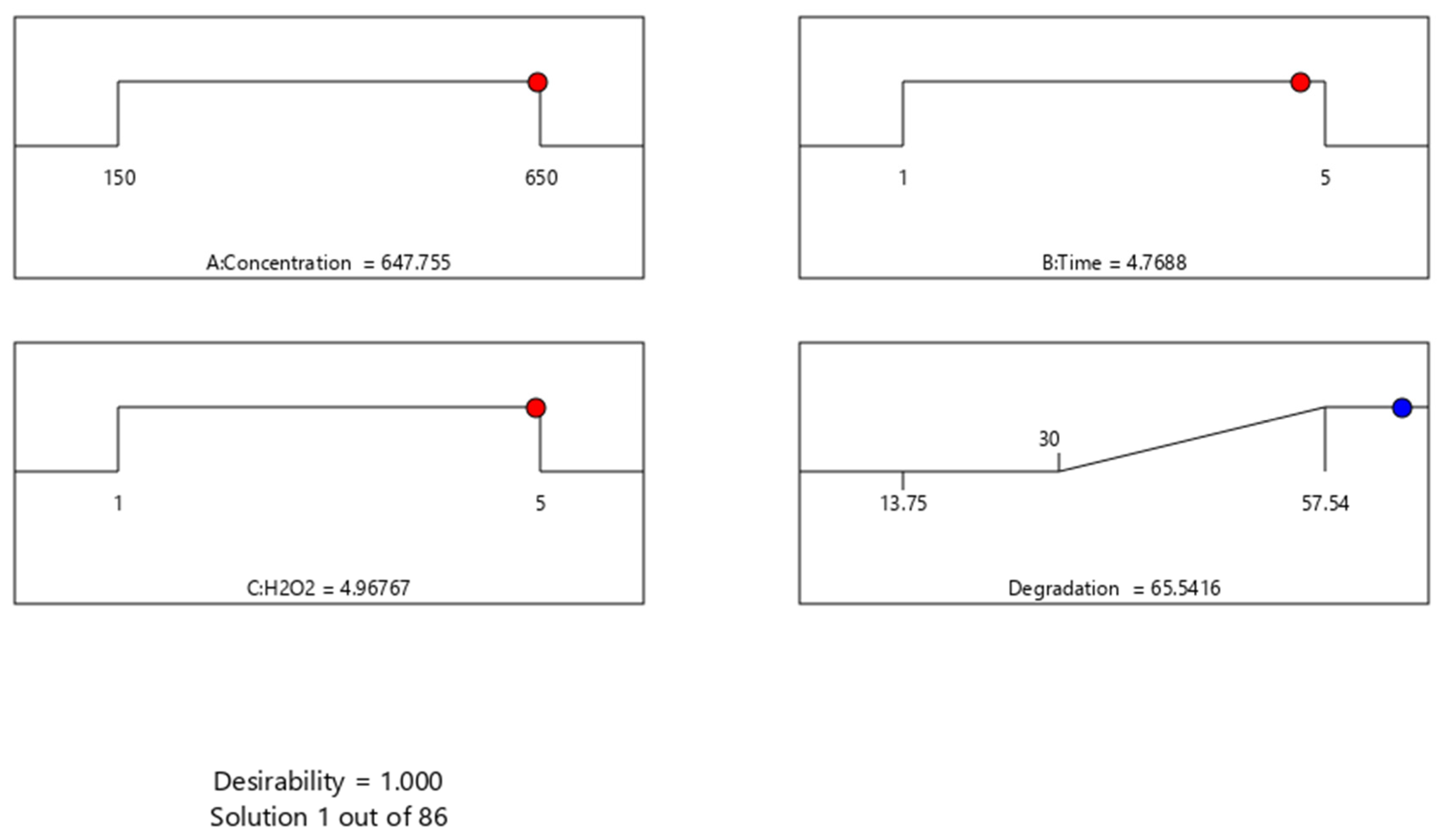
The RSM numerical optimization technique was used to identify the optimal conditions for the photocatalytic system. Based on the designed space, the photocatalytic degradation of an anilinium ionic solid using a UV/H2O2/Ti-MOF system, offering a promising approach for treatability, was optimized within the designed ranges. At a 95% confidence level, a desirability of one was achieved, with a degradation efficiency of 57.54%. Table S1 (Supplementary Materials), which presents the optimal conditions of the 86 dataset solutions, shows the most considerable conditions: an IS concentration of 647.8 mg/mL, a time of 4.8 h, and an H2O2 concentration of 65.5%, as illustrated in Figure 14. The best 10 conditions are presented in Table 5. Furthermore, the optimized condition was validated experimentally, with a deviation of less than 2% from the predicted results. This suggests good agreement between the dataset and the model, making the RSM a viable experimental optimization tool due to its predictive precision.

3. Materials and Methods

3.1. Materials

All the chemicals were purchased from Sigma-Aldrich (South Africa) and used without further purification. These included sodium dodecyl sulphate (NaDos, reagentplus® GC, ≥98.5%), anilinium chloride [Ani][Cl] (for synthesis), chloroform (HPLC ≥ 95.0%), Titanium (IV)tert-butoxide (≥95%), thiosalicylic acid (TSA, for synthesis), methanol (MeOH, Chromsolv., ≥98.5%, GC, HPLC), and N, N-dimethylformamide (DMF).

3.2. Characterization Instrumentation

The spectroscopic characterization of both IS and Ti-MOF was determined using ultraviolet–visible spectroscopy (Genesy 50 UV–Vis, Thermofisher Scientific, Waltham, MA, USA) in the range of (200–600) nm, with 1 mL of a solution containing a sample transferred to a 1 cm cuvette and scanned. Fourier FTIR (Agilent Cary 360, Agilent Technologies, Johannesburg, South Africa) at 4 cm−1 resolution and 120 scans per sample, and 1H-NMR (Brucker Avance, 600 MHz, Bruker Corporation, Billerica, MA, USA) with a required amount (~5 mg) of a sample dissolved in 1.5 mL of deuterated dimethyl sulfoxide solvent and transferred to an NMR tube for analysis, were employed. TGA and DSC were carried out using the TGA/DSC1, ISF Model 1346 (Mettler Toledo, Columbus, OH, USA), with STARe software version 9.20. Ten milligrams of each sample were weighed and placed on the equipment, with a temperature range of 30 to 900 °C. The purity and crystallinity of the samples were characterized by powder X-ray crystallography (PXRD) using a Bruker D8 Advance model diffractometer (Bruker Corporation, Karlsruhe, Germany). Measurements were taken in the 2θ range of 9–80°, using Cu-Kα1 radiation at a scan rate of 2°/min, and the average crystallite size was determined based on Scherrer’s formula from the line broadening of the peak.

3.3. Synthesis of [Anilinium][Dodecylsulphate] and Photocatalyst (Ti-MOF)

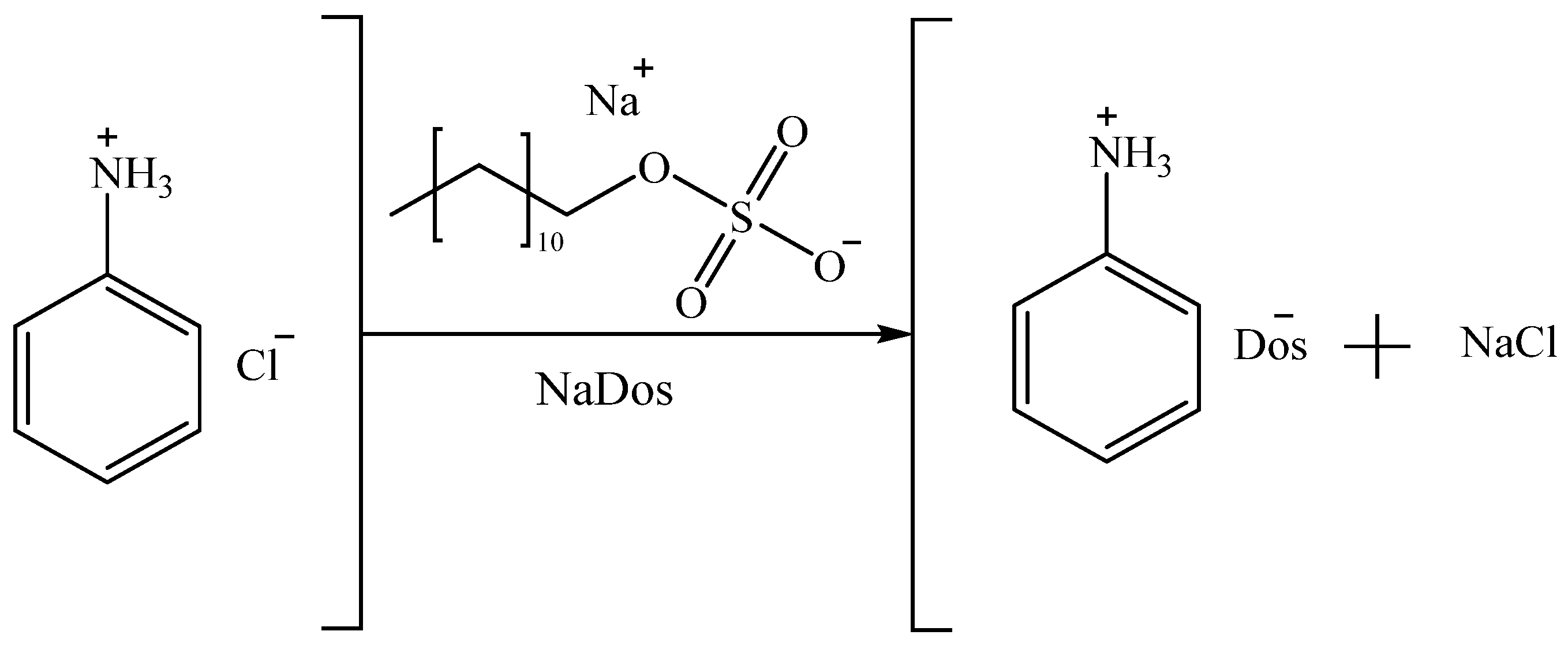
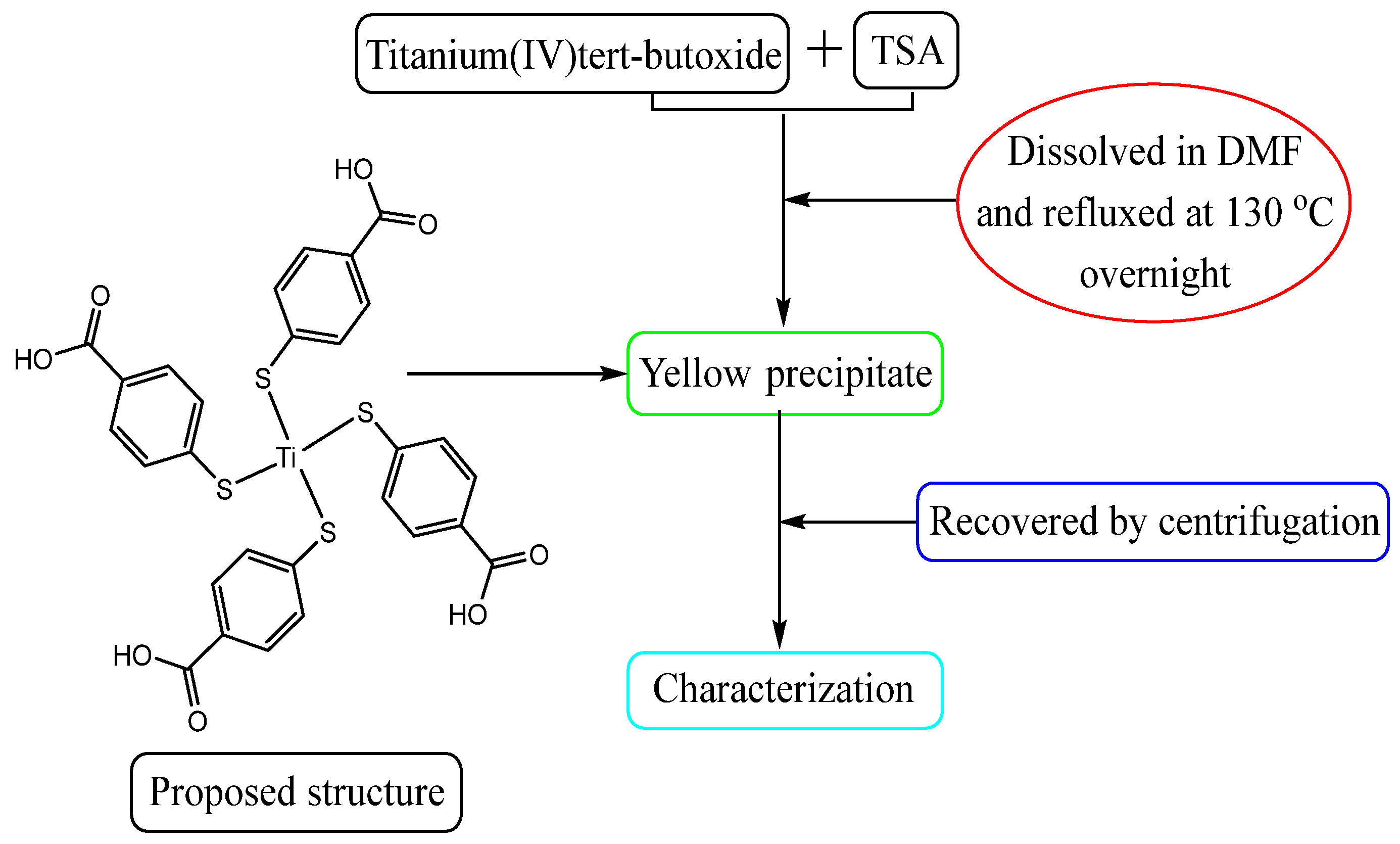
The IS composition was synthesized using the counterion metathesis method previously reported by Hassan, Nazir [78]. A required amount of NaDos (0.02 mol) was transferred into a 250 mL round bottom flask (RBF), and 100 mL of deionized water was added, forming a solution. Separately, [Ani][Cl] (0.02 mol) was dissolved in 50 mL of methanol (MeOH) and added to the mixture dropwise. The reaction was maintained at room temperature overnight and monitored by thin-layer chromatography (TLC) to completion. After completion, the mixture was extracted with 10 mL (3X) of chloroform, and the organic layer was collected, dried in an oven at 35 °C overnight, and then placed in a desiccator. The synthetic product was obtained; its structure illustrated as Figure 15 was characterized using FTIR, 1H-NMR, TGA, and DSC. In addition, the Ti-MOF catalyst was synthesized using a modified method previously reported by Wang, Reinsch [79]; depicted in Figure 16 is the synthetic route used to prepare the catalyst.

3.4. Photodegradation Test

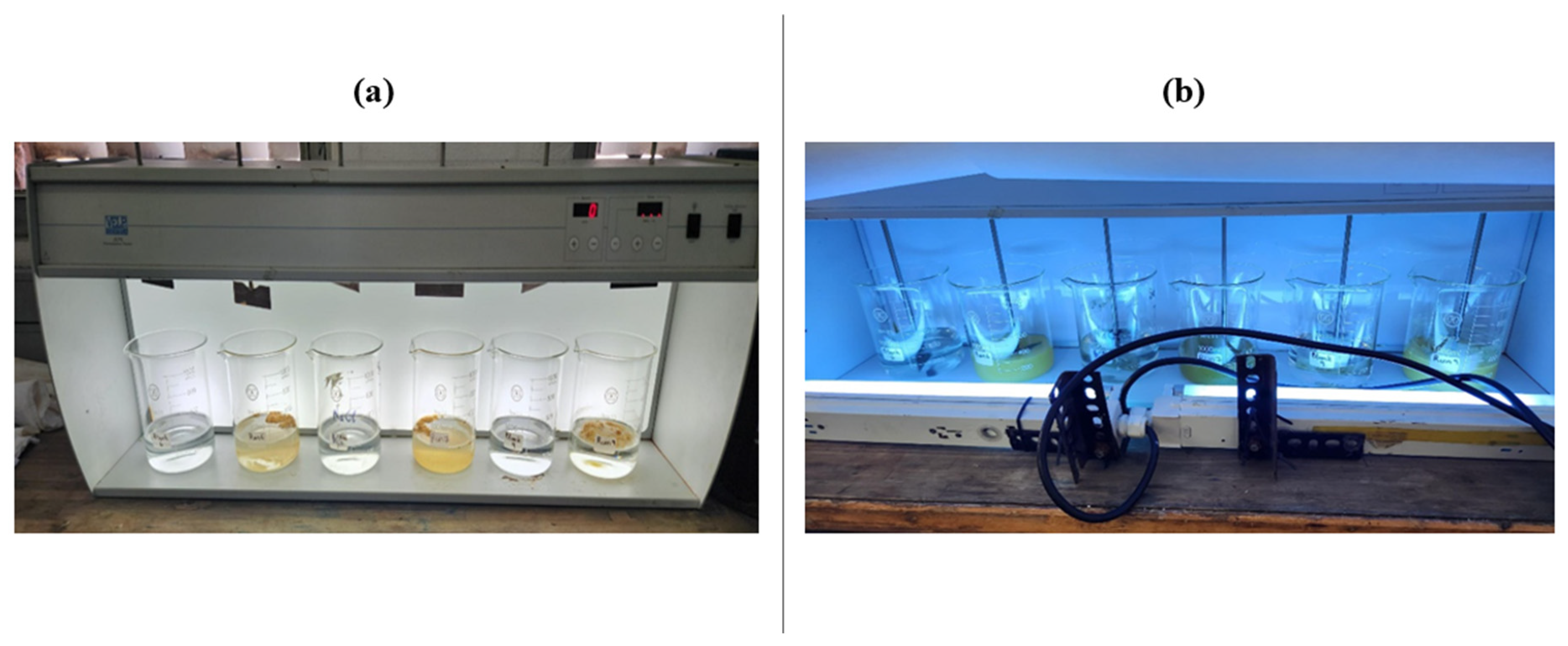
The photocatalytic degradation process of the IS in solution was performed in a JLT6 digital flocculator (VELP Scientifica Srl, Usmate, Italy) fitted with 600 mL glass beakers, magnetic stirrers, and a UV lamp (250 Watts; Wavelength range of 250–450 nm) for irradiation. The photocatalytic experiments were performed using the JLT6 digital flocculator, stirred at 90 rpm for the required period (Figure 16). Two types of tests were performed: (i) photolysis tests, in the absence of a photocatalyst, to assess the stability of the IS in solution under irradiation, and (ii) photocatalytic tests, where Ti-MOF (Figure 17) together with UV and H2O2 were used as a recombinant for the degradation of the IS aqueous solutions. It is known that most photocatalytic reactions occur on the surface of the catalyst, where the reactants are adsorbed. Thus, before irradiation, adsorption tests were carried out in the dark for 2 h in parallel to each experiment. In both tests, the reaction volume was 300 mL and the initial concentration of the IS aqueous solutions was 150 mg/mL, 400 mg/mL, and 650 mg/mL (used as control concentrations). After conducting the tests, the degradation efficiency (D%) was then calculated according to Equation (1) using UV–Vis absorbance values:
D% = (Co − Cf)/Co × 100
where Co is the initial concentration of the reaction mixture and Cf is the final concentration of the reaction after irradiation for a selected time interval (1–5 h).
(i)
Photostability test
In each test run, the aqueous IS solution (200 mL) with H2O2 (100 mL) was subsequently exposed to UV irradiation, in the absence of the catalyst, for the required time. After the irradiation period, 50 mL of the reaction aliquot was collected, and the degradation efficiency was calculated using the measured absorbances from UV–Vis spectroscopy scans; this was conducted in parallel with the chemical oxygen demand (COD, using a HR Hach kit from Universal Water Solution, UWS, Durban, South Africa), and total organic carbon (TOC, using a HR TNT plus 811 kit from Universal Water Solution, UWS, South Africa) analysis for each sample. The detection wavelength for the IS was set according to the maximum UV–Vis absorption band (Figure 1) recorded in a UV–Vis spectrophotometer (Genesy 50, Thermofisher Scientific, Waltham, MA, USA).
(ii)
Photocatalyst test
In the tests, 0.5 g of Ti-MOF was dispersed in 200 mL of aqueous IS solution with 100 mL of H2O2. Before each photocatalytic experiment, the suspension was stirred in the dark for 2 h to achieve adsorption equilibrium and was sampled (10 mL). Subsequently, the suspension was exposed to UV irradiation for the required period. After irradiation, 50 mL (2X) of the suspension was collected, and the photocatalyst was removed by filtration using 0.22 μm nylon filters. The resultant filtrate was quantified using UV–Vis spectroscopy concurrently with COD and TOC measurements, and the degradation efficiency was calculated based on the absorbance values from UV–Vis spectra.

3.5. Experimental Design

The influence of IS concentration (150–650 mg/mL), time (1–5 h), and concentration of H2O2 (1–3%) on the photocatalytic performance of Ti-MOF towards degrading IS was investigated using Response Surface methodology (RSM) with the Box–Behnken design. The experimental design was carried out with the Design Expert software (version 13, Minneapolis, MN, USA). The interaction between the factors as a function of the response based on the RSM-BBD models developed was statistically evaluated and validated. The experimental data were adequately optimized with the objective of maximizing the photodegradation efficiency. The interaction between the individual and multiple factors associated with the synergistic effect on the responses were examined, with the conditions provided by the analysis of variance (ANOVA).

4. Conclusions

This study demonstrated the photocatalytic degradation of an anilinium ionic solid using an UV/H2O2/Ti-MOF system, offering a promising approach for the treatment of emerging organic pollutants in aqueous environments. The integration of titanium metal with TSA to form Ti-MOF significantly enhances its photocatalytic properties, especially in terms of light absorption, charge separation, and structural stability. The characterization confirmed the MOF’s strong optical response, robust morphology, elemental uniformity, and thermal resilience, which support photocatalytic degradation applications.
The degradation mechanism was driven by the synergistic interaction between UV irradiation and H2O2, which facilitated the generation of highly reactive hydroxyl radicals. These radicals played a key role in breaking down over 60% of the IS, a compound known for its persistence and resistance to conventional treatment methods. The Ti-MOF served as an efficient catalyst, which accelerated the reaction kinetics and enhanced the overall degradation efficiency. The kinetic modelling provided insight into the reaction dynamics. By using the linear regression analysis, a high correlation coefficient (R2 0.974) for the first recyclability, indicating a surface-mediated reaction pathway (interaction between the pollutant and the catalyst surface), governed the overall rate.
Furthermore, response surface methodology (RSM) based on a Box–Behnken design (BBD) was employed for systematic optimization. This statistical approach enabled the evaluation of key operational parameters (IS concentration, time, and H2O2 dosage) and their interactive effects on degradation efficiency. The RSM model predicted a degradation efficiency of 57.4% under optimal conditions of 647.8 mg/mL IS concentration, 4.8 h reaction time, and 5% H2O2 dosage, with a 95% confidence level. The results were consistent with the experimental observations, validating the reliability of the RSM model and highlighting its potential for process optimization in environmental applications.
Beyond the immediate findings, this study contributes to the broader field of MOF-based photocatalysis by demonstrating the adaptability and effectiveness of Ti-ZIF-8 in degrading complex organic contaminants. The material’s tuneable structure and stability in aqueous media make it a strong candidate for future water treatment technologies. Additionally, the integrated UV/H2O2/Ti-ZIF-8 MOF system offers a viable strategy in alignment with green chemistry for the degradation of persistent organic pollutants, reducing energy-intensive processes. The study also provides a holistic framework for future research and the development of next-generation photocatalysts through material science, kinetic modelling, and process optimization, addressing water quality through sustainable and efficient technologies.

Supplementary Materials

The following supporting information can be downloaded at: https://www.mdpi.com/article/10.3390/catal15121109/s1, Table S1. RSM optimum conditions for degradation of ionic solids.

Author Contributions

Conceptualization, V.T., E.K.T. and N.D.; methodology, V.T.; validation, V.T. and E.K.T.; formal analysis, V.T.; resources, V.T., E.K.T. and N.D., writing—original draft preparation, V.T.; writing—review and editing, E.K.T. and N.D.; supervision, N.D. All authors have read and agreed to the published version of the manuscript.

Funding

This research was funded by the National Research Foundation (NRF), and the APC was funded by the Durban University of Technology.

Data Availability Statement

All data are presented in the manuscript and available upon request.

Acknowledgments

The authors would like to acknowledge the Durban University of Technology and NRF for financial funding.

Conflicts of Interest

The authors declare no conflicts of interest. The funders had no role in the design of the study, in the collection, analysis or interpretation of data, or in the writing of the manuscript. The authors declare that AI tools, such as Design Expert software, were used for the experimental design and computational analysis of the data, while the Grammarly Pro version was employed for composition and editing. After using these tools/services, the authors reviewed and edited the content as needed and take full responsibility for its publication.

References

  1. Liang, H.; Jiao, J.; Dou, D.; Li, S. Cheap and efficient strategy for photocatalytic degradation of ionic liquids by La/Ce-codoped TiO(2)@PAM composites. Water Sci. Technol. 2024, 89, 976–988. [Google Scholar] [CrossRef]
  2. Gu, J.; Zang, H.; Yao, S.; Wang, X.; Zhu, M.; Song, H. Study on Degradation of Benzothiazolium-Based Ionic Liquids by UV-H2O2. Appl. Sci. 2020, 10, 894. [Google Scholar] [CrossRef]
  3. Shahhiran, A.F.; Ramli, R.M.; Zaid, H.F.M. Development of photocatalytic degradation and kinetic study for imidazolium based ionic liquids in Fe-Cu/TiO2-AC system. IOP Conf. Ser. Earth Environ. Sci. 2020, 442, 12001. [Google Scholar] [CrossRef]
  4. Maximo, G.J.; Santos, R.J.B.N.; Brandão, P.; Esperança, J.M.S.S.; Costa, M.C.; Meirelles, A.J.A.; Freire, M.G.; Coutinho, J.A.P. Generating Ionic Liquids from Ionic Solids: An Investigation of the Melting Behavior of Binary Mixtures of Ionic Liquids. Cryst. Growth Des. 2014, 14, 4270–4277. [Google Scholar] [CrossRef]
  5. He, T.; Yan, J.; Xiao, W.; Sun, J. Latest advances in ionic liquids promoted synthesis and application of advanced biomass materials. Front. Chem. Sci. Eng. 2023, 17, 798–816. [Google Scholar] [CrossRef]
  6. Tan, S.S.; Macfarlane, D.R. Ionic liquids in biomass processing. Top. Curr. Chem. 2010, 290, 311–339. [Google Scholar] [CrossRef] [PubMed]
  7. Huang, L.; Yu, Y.; Fu, C.; Guo, H.; Li, X. Photocatalytic degradation of imidazolium ionic liquids using dye sensitized TiO2/SiO2 composites. RSC Adv. 2017, 7, 32120–32125. [Google Scholar] [CrossRef]
  8. Hart, W.E.S.; Harper, J.B.; Aldous, L. The effect of changing the components of an ionic liquid upon the solubility of lignin. Green Chem. 2015, 17, 214–218. [Google Scholar] [CrossRef]
  9. Kurata, A.; Shimizu, S.; Shiraishi, Y.; Abe, M.; Naito, N.; Shimada, M.; Kishimoto, N. Degradation of ionic liquids by a UV/H2O2process and CMCase from novel ionic liquid-tolerant alkaliphilic Nocardiopsis sp. SSC4. Biotechnol. Biotechnol. Equip. 2017, 31, 749–755. [Google Scholar] [CrossRef]
  10. Bedia, J.; Rodriguez, J.J.; Moreno, D.; Palomar, J.; Belver, C. Photostability and photocatalytic degradation of ionic liquids in water under solar light. RSC Adv. 2019, 9, 2026–2033. [Google Scholar] [CrossRef]
  11. Stolte, S.; Steudte, S.; Igartua, A.; Stepnowski, P. The Biodegradation of Ionic Liquids—The view from a chemical structure. Curr. Org. Chem. 2011, 15, 1946–1973. [Google Scholar] [CrossRef]
  12. Pernak, J.; Borucka, N.; Walkiewicz, F.; Markiewicz, B.; Fochtman, P.; Stolte, S.; Steudte, S.; Stepnowski, P. Synthesis, toxicity, biodegradability and physicochemical properties of 4-benzyl-4-methylmorpholinium-based ionic liquids. Green Chem. 2011, 13, 2901–2910. [Google Scholar] [CrossRef]
  13. Kuroda, K. A simple overview of toxicity of ionic liquids and designs of biocompatible ionic liquids. New J. Chem. 2022, 46, 20047–20052. [Google Scholar] [CrossRef]
  14. Flieger, J.; Flieger, M. Ionic Liquids Toxicity-Benefits and Threats. Int. J. Mol. Sci. 2020, 21, 6267. [Google Scholar] [CrossRef]
  15. Liwarska-Bizukojc, E.; Maton, C.; Stevens, C.V. Biodegradation of imidazolium ionic liquids by activated sludge microorganisms. Biodegradation 2015, 26, 453–463. [Google Scholar] [CrossRef]
  16. Yu, F.; Zhou, Y.; Qiao, H.; Sun, L.; Li, L.; Feng, C.; Li, Y. Adsorption of ionic liquid from aqueous solutions using functional corncob-cellulose nanocrystals. RSC Adv. 2016, 6, 106547–106554. [Google Scholar] [CrossRef]
  17. Sosa, F.H.B.; Carvalho, P.J.; Coutinho, J.A.P. Recovery of ionic liquids from aqueous solutions using membrane technology. Sep. Purif. Technol. 2023, 322, 124341. [Google Scholar] [CrossRef]
  18. Ponnusami, A.B.; Sinha, S.; Ashokan, H.; Paul, M.V.; Hariharan, S.P.; Arun, J.; Gopinath, K.P.; Le, Q.H.; Pugazhendhi, A. Advanced oxidation process (AOP) combined biological process for wastewater treatment: A review on advancements, feasibility and practicability of combined techniques. Environ. Res. 2023, 237, 116944. [Google Scholar] [CrossRef]
  19. Tokoyi, V.; Deenadayalu, N. Ti-Bimetallic MOFs as Photo-Reformers and Degraders of Emerging Water Contaminants. In Titanium Alloys—Research and Future Trends; Baltatu, M.S., Vizureanu, P., Eds.; IntechOpen: Rijeka, Croatia, 2025. [Google Scholar]
  20. Boutiti, A.; Zouaghi, R.; Bendjabeur, S.E.; Guittonneau, S.; Sehili, T. Photodegradation of 1-hexyl-3-methylimidazolium by UV/H2O2 and UV/TiO2: Influence of pH and chloride. J. Photochem. Photobiol. A Chem. 2017, 336, 164–169. [Google Scholar] [CrossRef]
  21. Borhani, M.N.; Tavakoli, A.; Mollaei, A.M.; Borhani, T.N. Visible light photodegradation of methylene blue by ionic liquid based TiO2/Fe3O4 nanophotocatalysts. Opt. Mater. 2024, 154, 115627. [Google Scholar] [CrossRef]
  22. Corchero, R.; Rodil, R.; Soto, A.; Rodil, E. Nanomaterial Synthesis in Ionic Liquids and Their Use on the Photocatalytic Degradation of Emerging Pollutants. Nanomaterials 2021, 11, 411. [Google Scholar] [CrossRef]
  23. Ratnamala, A.; Reddy, G.D.; Noorjahaan, M.; Manjunatha, H.; Janardan, S.; Kumar, N.S.; Chandra Babu Naidu, K.; Khan, A.; Asiri, A.M. Titanium-based metal-organic frameworks for photocatalytic applications. In Metal-Organic Frameworks for Chemical Reactions; Khan, A., Verpoort, F., Asiri, A.M., Hoque, M.E., Bilgrami, A.L., Azam, M., Naidu, K.C.B., Eds.; Elsevier: Amsterdam, The Netherlands, 2021; pp. 37–63. [Google Scholar]
  24. Alwin, S.; Ramasubbu, V.; Shajan, X.S. TiO2 aerogel–metal organic framework nanocomposite: A new class of photoanode material for dye-sensitized solar cell applications. Bull. Mater. Sci. 2018, 41, 27. [Google Scholar] [CrossRef]
  25. Zhang, Y.; Guo, J.; Shi, L.; Zhu, Y.; Hou, K.; Zheng, Y.; Tang, Z. Tunable chiral metal organic frameworks toward visible light-driven asymmetric catalysis. Sci. Adv. 2017, 3, e1701162. [Google Scholar] [CrossRef] [PubMed]
  26. Mahmoodi, N.M.; Abdi, J. Nanoporous metal-organic framework (MOF-199): Synthesis, characterization and photocatalytic degradation of Basic Blue 41. Microchem. J. 2019, 144, 436–442. [Google Scholar] [CrossRef]
  27. So, M.C.; Wiederrecht, G.P.; Mondloch, J.E.; Hupp, J.T.; Farha, O.K. Metal-organic framework materials for light-harvesting and energy transfer. Chem. Commun. 2015, 51, 3501–3510. [Google Scholar] [CrossRef] [PubMed]
  28. Ramaripa, P.S.; Modibane, K.D.; Makgopa, K.; Seerane, O.A.; Maubane-Nkadimeng, M.S.; Makhado, E.; Hato, M.J.; Ramoroka, M.E.; Molapo, K.M.; Balakrishnan, D.; et al. Fabrication, characterization, and photovoltaic performance of titanium dioxide/metal-organic framework composite. J. Photochem. Photobiol. 2022, 12, 100142. [Google Scholar] [CrossRef]
  29. Li, M.; Yuan, J.; Wang, G.; Yang, L.; Shao, J.; Li, H.; Lu, J. One-step construction of Ti-In bimetallic MOFs to improve synergistic effect of adsorption and photocatalytic degradation of bisphenol A. Sep. Purif. Technol. 2022, 298, 121658. [Google Scholar] [CrossRef]
  30. Fan, Y.; Zhang, W.; He, K.; Wang, L.; Wang, Q.; Liu, J. Half-salen Fe(III) covalently post-modified MIL-125(Ti)-NH2 MOF for effective photocatalytic peroxymonosulfate activation. Appl. Surf. Sci. 2022, 591, 153115. [Google Scholar] [CrossRef]
  31. Thommes, M.; Kaneko, K.; Neimark, A.V.; Olivier, J.P.; Rodriguez-Reinoso, F.; Rouquerol, J.; Sing, K.S.W. Physisorption of gases, with special reference to the evaluation of surface area and pore size distribution (IUPAC Technical Report). Pure Appl. Chem. 2015, 87, 1051–1069. [Google Scholar] [CrossRef]
  32. Deng, Z.; Tang, S.; Ou, M.; Wang, Z. Ionic liquids self-assembled micelles for transdermal delivery: Characterization, functions and applications. Int. J. Pharm. X 2025, 10, 100350. [Google Scholar] [CrossRef] [PubMed]
  33. Torkashvand, Z.; Sepehrmansourie, H.; Zolfigol, M.A.; Gu, Y. Ti-based MOFs with acetic acid pendings as an efficient catalyst in the preparation of new spiropyrans with biological moieties. Sci. Rep. 2024, 14, 14101. [Google Scholar] [CrossRef]
  34. Kumar, P.M.; Badrinarayanan, S.; Sastry, M. Nanocrystalline TiO2 studied by optical, FTIR and X-ray photoelectron spectroscopy: Correlation to presence of surface states. Thin Solid Films 2000, 358, 122–130. [Google Scholar] [CrossRef]
  35. Liu, S.; Li, X.; Wang, X.; Li, Y.; Zhang, F.; Li, L.; Li, J.; Yang, J. Construction of a Ti-based bimetallic metal–organic framework using a one-pot method for efficient C2H2/C2H4 and C2H2/CO2 separation. Chem. Bio. Eng. 2024, 1, 439–447. [Google Scholar] [CrossRef]
  36. Carraro, F.; Velasquez-Hernandez, M.J.; Astria, E.; Liang, W.; Twight, L.; Parise, C.; Ge, M.; Huang, Z.; Ricco, R.; Zou, X.; et al. Phase dependent encapsulation and release profile of ZIF-based biocomposites. Chem. Sci. 2020, 11, 3397–3404. [Google Scholar] [CrossRef]
  37. James, J.B.; Lin, Y.S. Kinetics of ZIF-8 thermal decomposition in inert, oxidizing, and reducing environments. J. Phys. Chem. C 2016, 120, 14015–14026. [Google Scholar] [CrossRef]
  38. Balliana, E.; Marchand, M.; Di Matteo, V.; Ballarin, B.; Cassani, M.C.; Panzavolta, S.; Zendri, E. Application of zinc-based metal-organic framework ZIF-8 on paper: A pilot study on visual appearance and effectiveness. Polymers 2025, 17, 1369. [Google Scholar] [CrossRef] [PubMed]
  39. Sardar, S.; Wilfred, C.D.; Mumtaz, A.; Rashid, Z.; Leveque, J.-M. Synthesis, thermophysical properties, Hammett acidity and COSMO-RS study of camphorsulfonate-based Brönsted acidic ionic liquids. J. Mol. Liq. 2018, 271, 621–630. [Google Scholar] [CrossRef]
  40. Meng, Y.; Liu, J.; Li, Z.; Wei, H. Synthesis and Physicochemical Properties of Two SO3H-Functionalized Ionic Liquids with Hydrogen Sulfate Anion. J. Chem. Eng. Data 2014, 59, 2186–2195. [Google Scholar] [CrossRef]
  41. Kegere, J.; Alneyadi, S.S.; Paz, A.P.; Siddig, L.A.; Alblooshi, A.; Alnaqbi, M.A.; Alzamly, A.; Greish, Y.E. Titanium metal-organic frameworks for photocatalytic CO2 conversion through a cycloaddition reaction. Nanoscale Adv. 2024, 6, 4804–4813. [Google Scholar] [CrossRef] [PubMed]
  42. Myakala, S.N.; Ladisich, M.; Ayala, P.; Rabl, H.; Batool, S.; Elsaesser, M.S.; Cherevan, A.; Eder, D. Harnessing a Ti-based MOF for selective adsorption and visible-light-driven water remediation. J. Mater. Chem. A 2024, 12, 19924–19934. [Google Scholar] [CrossRef]
  43. Wang, J.; Cherevan, A.S.; Hannecart, C.; Naghdi, S.; Nandan, S.P.; Gupta, T.; Eder, D. Ti-based MOFs: New insights on the impact of ligand composition and hole scavengers on stability, charge separation and photocatalytic hydrogen evolution. Appl. Catal. B Environ. 2021, 283, 119626. [Google Scholar] [CrossRef]
  44. Fan, Y.; Chen, G.; Li, D.; Luo, Y.; Lock, N.; Jensen, A.P.; Mamakhel, A.; Mi, J.; Iversen, S.B.; Meng, Q.; et al. Highly selective deethylation of Rhodamine B on prepared in supercritical fluids. Int. J. Photoenergy 2012, 2012, 173865. [Google Scholar] [CrossRef]
  45. Qin, Y.; Yang, S.; You, X.; Liu, Y.; Qin, L.; Li, Y.; Zhang, W.; Liang, W. Carbon nitride coupled with Fe-based MOFs as an efficient photoelectrocatalyst for boosted degradation of ciprofloxacin: Mechanism, pathway and fate. Sep. Purif. Technol. 2022, 296, 121325. [Google Scholar] [CrossRef]
  46. Rana, A.G.; Minceva, M. Analysis of photocatalytic degradation of phenol with exfoliated graphitic carbon nitride and light-emitting diodes using response surface methodology. Catalysts 2021, 11, 898. [Google Scholar] [CrossRef]
  47. Öztekin, R.; Sponza, D.T. Photocatalytic degradation of a herbicide namely glyphosate and hexazinone from the surface water which will be used as drinking water via polyaniline/ZnWO4/WO3 and evaluation of acute toxicity assays. Int. J. Chem. Eng. Mater. 2024, 3, 66–100. [Google Scholar] [CrossRef]
  48. Gan, L.; Nord, M.T.; Lessard, J.M.; Tufts, N.Q.; Chidambaram, A.; Light, M.E.; Huang, H.; Solano, E.; Fraile, J.; Suarez-Garcia, F.; et al. Biomimetic photodegradation of glyphosate in carborane-functionalized nanoconfined spaces. J. Am. Chem. Soc. 2023, 145, 13730–13741. [Google Scholar] [CrossRef] [PubMed]
  49. Tokoyi, V.; Kabane, B.; Deenadayalu, N. Should “Ionic Liquids” also be used for solid ionic compounds: Synthesis and characterization of p-anisidinium-based ionic compounds. Chem. Eng. Process Tech. 2025, 10, 1097. [Google Scholar]
  50. Munien, C.; Tetteh, E.K.; Rathilal, S. Response surface optimization of CuS Photocatalytic process using UV-vis irradiation for wastewater treatment. Energy Sci. Eng. 2025, 13, 2922–2939. [Google Scholar] [CrossRef]
  51. Luan, J.; Wei, Z.; Niu, B.; Yang, G.; Huang, C.; Ma, B.; Liu, W. Synthesis, property characterization and photocatalytic activity of the Ag3PO4/Gd2BiTaO7 heterojunction catalyst under visible light irradiation. Catalysts 2022, 12, 22. [Google Scholar] [CrossRef]
  52. Dutta, R.; Kundu, S.; Sarkar, N. Ionic liquid-induced aggregate formation and their applications. Biophys. Rev. 2018, 10, 861–871. [Google Scholar] [CrossRef]
  53. Kabir, M.F.; Vaisman, E.; Langford, C.H.; Kantzas, A. Effects of hydrogen peroxide in a fluidized bed photocatalytic reactor for wastewater purification. Chem. Eng. J. 2006, 118, 207–212. [Google Scholar] [CrossRef]
  54. Noroozi, R.; Gholami, M.; Oskoei, V.; Hesami Arani, M.; Mousavifard, S.A.; Nguyen Le, B.; Fattahi, M. Fabrication of new composite NCuTiO2/CQD for photocatalytic degradation of ciprofloxacin and pharmaceutical wastewater treatment: Degradation pathway, toxicity assessment. Sci. Rep. 2023, 13, 16287. [Google Scholar] [CrossRef] [PubMed]
  55. Khan, S.; Noor, T.; Iqbal, N.; Yaqoob, L. Photocatalytic dye degradation from textile wastewater: A review. ACS Omega 2024, 9, 21751–21767. [Google Scholar] [CrossRef]
  56. Kaur, H.; Devi, N.; Siwal, S.S.; Alsanie, W.F.; Thakur, M.K.; Thakur, V.K. Metal–organic framework-based materials for wastewater treatment: Superior adsorbent materials for the removal of hazardous pollutants. ACS Omega 2023, 8, 9004–9030. [Google Scholar] [CrossRef]
  57. Bogacki, J.; Marcinowski, P.; El-Khozondar, B. Treatment of landfill leachates with combined acidification/coagulation and the Fe0/H2O2 process. Water 2019, 11, 194. [Google Scholar] [CrossRef]
  58. Feilizadeh, M.; Attar, F.; Mahinpey, N. Hydrogen peroxide-assisted photocatalysis under solar light irradiation: Interpretation of interaction effects between an active photocatalyst and H2O2. Can. J. Chem. Eng. 2019, 97, 2009–2014. [Google Scholar] [CrossRef]
  59. Rosa, D.; Lattanzio, S.; Bavasso, I.; Di Palma, L. Investigation of the synergistic effect of hydrogen peroxide and ultrasound on the photocatalytic treatment under visible light of dyes wastewater. Chem. Eng. Sci. 2023, 282, 119290. [Google Scholar] [CrossRef]
  60. Saha, D.; Desipio, M.M.; Hoinkis, T.J.; Smeltz, E.J.; Thorpe, R.; Hensley, D.K.; Fischer-Drowos, S.G.; Chen, J. Influence of hydrogen peroxide in enhancing photocatalytic activity of carbon nitride under visible light: An insight into reaction intermediates. J. Environ. Chem. Eng. 2018, 6, 4927–4936. [Google Scholar] [CrossRef]
  61. Dionysiou, D.D.; Suidan, M.T.; Baudin, I.; Laîné, J.-M. Effect of hydrogen peroxide on the destruction of organic contaminants-synergism and inhibition in a continuous-mode photocatalytic reactor. Appl. Catal. B Environ. 2004, 50, 259–269. [Google Scholar] [CrossRef]
  62. Gundekari, S.; Desai, H.; Ravi, K.; Mitra, J.; Srinivasan, K. In situ generated Ru(0)-HRO@Na-beta from hydrous ruthenium oxide (HRO)/Na-beta: An energy-efficient catalyst for selective hydrogenation of sugars. Front. Chem. 2020, 8, 525277. [Google Scholar] [CrossRef] [PubMed]
  63. Zhou, Q.; Fang, Z.; Wang, J.; Zhang, W.; Liu, Y.; Yu, M.; Ma, Z.; Qiu, Y.; Liu, S. Z-Scheme ZIF-8/Ag3PO4 heterojunction photocatalyst for high-performance antibacterial food packaging films. Materials 2025, 18, 2544. [Google Scholar] [CrossRef] [PubMed]
  64. Sadiq, S.; Khan, I.; Humayun, M.; Wu, P.; Khan, A.; Khan, S.; Khan, A.; Khan, S.; Alanazi, A.F.; Bououdina, M. Synthesis of Metal–Organic Framework-Based ZIF-8@ZIF-67 Nanocomposites for Antibiotic Decomposition and Antibacterial Activities. ACS Omega 2023, 8, 49244–49258. [Google Scholar] [CrossRef] [PubMed]
  65. Zhong, W.; Wang, N.; Huang, F.; Nie, B.; Lei, Y.; Qin, W.; Tiwari, S.K.; Ola, O.; Wang, X.; Zhu, Y. Rational design of heterostructured MOF-on-MOF (NH2-MIL-125(Ti)@ZIF-8) nanocomposites with synergistic ion-exchange for efficient cesium sequestration in wastewater treatment. Chem. Eng. J. 2025, 522, 166789. [Google Scholar]
  66. Zhang, J.; Han, J.; Chen, X.; Xu, D.; Wen, X.; Zhao, Y.; Huang, Y.; Ding, X.; Chen, G.; Xu, D. Recent Advances in ZIF Membrane: Fabrication, Separation Ability and Its Application. Nanomaterials 2025, 15, 239. [Google Scholar] [CrossRef]
  67. Behera, D.; Priyadarshini, P.; Parida, K. ZIF-8 metal–organic frameworks and their hybrid materials: Emerging photocatalysts for energy and environmental applications. Dalton Trans. 2025, 54, 2681–2708. [Google Scholar] [CrossRef]
  68. Das, A.; Adak, M.K.; Mahata, N.; Biswas, B. Wastewater treatment with the advent of TiO2 endowed photocatalysts and their reaction kinetics with scavenger effect. J. Mol. Liq. 2021, 338, 116479. [Google Scholar] [CrossRef]
  69. Javed, K.; Abbas, N.; Bilal, M.; Alshihri, A.A.; Rab Nawaz, H.Z.; Ramadan, M.F.; Naqvi, S.A.R. Fabrication of a ZnFe2O4@Co/Ni-MOF nanocomposite and photocatalytic degradation study of azo dyes. RSC Adv. 2024, 14, 30957–30970. [Google Scholar] [CrossRef]
  70. Lotfi, H.; Heydarinasab, A.; Mansouri, M.; Hosseini, S.H. Kinetic modeling of removal of aromatic hydrocarbons from petroleum wastewaters by UiO-66-NH2/TiO2/ZnO nanocomposite. J. Environ. Chem. Eng. 2022, 10, 107066. [Google Scholar] [CrossRef]
  71. Bhuyan, A.; Mishra, S.R.; Gadore, V.; Ahmaruzzaman, M. Hydrolyzed MOF based Mo@h-ZIF-8/ZnS composite for enhanced photodegradation of dye pollutants using a combined experimental and RSM approach. Sci. Rep. 2025, 15, 30181. [Google Scholar] [CrossRef]
  72. de Mello Peters, R.F.; dos Santos, P.A.M.; Machado, T.C.; Lopez, D.A.R.; Machado, Ê.L.; Rodriguez, A.d.A.L. Photocatalytic degradation of methylene blue using TiO2 supported in ceramic material. Eclética Química 2018, 43, 26–32. [Google Scholar]
  73. Mecha, A.C.; Onyango, M.S.; Ochieng, A.; Fourie, C.J.S.; Momba, M.N.B. Synergistic Effect of UV–vis and Solar Photocatalytic Ozonation on the Degradation of Phenol in Municipal Wastewater: A Comparative Study. J. Catal. 2016, 341, 116–125. [Google Scholar] [CrossRef]
  74. Tetteh, E.K.; Obotey Ezugbe, E.; Rathilal, S.; Asante-Sackey, D. Removal of COD and SO42− from Oil Refinery Wastewater Using a Photo-Catalytic System—Comparing TiO2 and Zeolite Efficiencies. Water 2020, 12, 214. [Google Scholar] [CrossRef]
  75. Kweinor Tetteh, E.; Obotey Ezugbe, E.; Asante-Sackey, D.; Armah, E.K.; Rathilal, S. Response Surface Methodology: Photocatalytic Degradation Kinetics of Basic Blue 41 Dye Using Activated Carbon with TiO2. Molecules 2021, 26, 1068. [Google Scholar] [CrossRef]
  76. Jin, L.; Deng, M.; Gao, J.; Wang, L.; Zhou, Q.; Tang, X.; Li, Q.; Du, H.; Hao, D.; Wang, Q. A crystalline triazine covalent organic framework with partial fluorination for efficient hydrogen peroxide production toward water treatment. Chem. Eng. J. 2025, 515, 163722. [Google Scholar] [CrossRef]
  77. Liu, A.; Ma, X.; Shen, B.; Du, H.; Jiang, X.; Wu, Y.; Jin, Y.; Li, J.; Zhu, H.; Wang, Q. Sustainable dual-cathode photoelectro-Fenton system enabling oxidative and reductive removal of pollutants via visible light driving Fe sites conversion. Chem. Eng. J. 2025, 504, 158929. [Google Scholar] [CrossRef]
  78. Hassan, R.; Nazir, F.; Iqbal, M.; Roosh, M.; Qaisar, A.; Habib, U.; Sajini, A.A. Synthesis, Characterization, Biological Evaluation, and In Silico Studies of Imidazolium-, Pyridinium-, and Ammonium-Based Ionic Liquids Containing n-B. Molecules 2022, 22, 6650. [Google Scholar] [CrossRef] [PubMed]
  79. Wang, S.; Reinsch, H.; Heymans, N.; Wahiduzzaman, M.; Martineau-Corcos, C.; De Weireld, G.; Maurin, G.; Serre, C. Toward a rational design of titanium metal-organic frameworks. Matter 2020, 2, 440–450. [Google Scholar] [CrossRef]
Figure 1. UV-Vis spectra of (a) ISs and (b) optical absorption spectra of Ti-MOF (the insets are optical band gap spectra).
Catalysts 15 01109 g001
Figure 2. FTIR spectra of ISs and Ti-MOF catalyst.
Catalysts 15 01109 g002
Figure 3. 1H−NMR (a) and (b) 13C−NMR spectra of [Ani][Dos] IS. [Ani][Dos]: solid; 1H−NMR (400 MHz, D6) δ (ppm): 0.9 (3H), 1.17–1.26 (18H), 1.44–1.48 (2H), 3.86–3.90 (2H), 7.26–7.39 (3H), 7.53–7.55 (2H), and 9.75 (NH3, 3H). 13 C−NMR (400 MHz, D6) δ (ppm): δ 14.11 (a), 22.68 (b), 25.55 (c), 29.02–29.66 (d), 31.92 (e), 69.20 (f), 123.58 (g), 128.87 (h), 129.75 (i), and 130.03 (j). FTIR: (νmax/cm–1): 3090 (N-H), 2963 (C-H, ar), 2840 (C-H, sp3), 1321 (S=O), 1459 (C=C), 1570 (N-H, bending), and 1640 (C-O). Melting point: 121 °C.
Catalysts 15 01109 g003
Figure 4. N2 adsorption-desorption isotherm (a), BET fitted data for Ti-MOF (b), and (c) particle distribution profile for [Ani][Dos] IS.
Catalysts 15 01109 g004
Figure 5. SEM and EDX mapping images for Ti-MOF.
Catalysts 15 01109 g005
Figure 6. XRD patterns for the synthesized Ti-MOF compared with the simulated pattern.
Catalysts 15 01109 g006
Figure 7. TGA (a) and DSC (b) thermograms of ISs and (c) TGA thermogram of Ti-MOF.
Catalysts 15 01109 g007
Figure 8. Quantified (a) IS concentrations and (b) COD and TOC measured values.
Catalysts 15 01109 g008
Figure 9. Quantified (a) IS concentrations with Ti-MOF before and after UV irradiation and (b) COD and TOC measured values after irradiation.
Catalysts 15 01109 g009
Figure 10. Post-PXRD diffractogram for the recovered Ti-MOF catalyst.
Catalysts 15 01109 g010
Figure 11. Photocatalytic degradation activity of UV/H2O2/Ti-MOF system: (a) recycling of Ti-MOF and (b) kinetic degradation rate.
Catalysts 15 01109 g011
Figure 12. (a) Diagnostic plots of predicted vs. actual results and (b) Box–Cox plot for power transforms.
Catalysts 15 01109 g012
Figure 13. Two-dimensional (a,b) three-dimensional surface plots of parameter interaction responses.
Catalysts 15 01109 g013aCatalysts 15 01109 g013b
Figure 14. Ramp plot of the selected optimized conditions for the photodegradation of IS.
Catalysts 15 01109 g014
Figure 15. Schematic diagram of the synthesis of the [Ani][DOS] ionic solid.
Catalysts 15 01109 g015
Figure 16. Proposed synthetic route and proposed structure for the Ti-MOF catalyst.
Catalysts 15 01109 g016
Figure 17. Photocatalytic degradation experimental setup (a) before UV irradiation and (b) during UV irradiation.
Catalysts 15 01109 g017
Table 1. Comparison table of other photocatalytic systems used.
System TypeCatalystOxidant/EnhancerLight SourceTarget Pollutant
Example
Key Performance
Degradation (%)
Reference
Current StudyTi-MOFUV/H2O2UVAnilinium dodecylsulphate57.54% degradation rate (RSM optimized)This study
Traditional (AOP)TiO2 (P25)UVUVDyes (Rhodamine B)High e/h+ generation; Wide bandgap, with 20.6% degradation rate[44]
Heterogeneous (Fenton)Fe-MOF (MIL-101)H2O2Visible LightPharmaceuticals (Ciprofloxacin)Enhanced ·OH production via Fe(II)/Fe(III) cycle, with degradation rate ~87.55%[45]
Non-Metal CatalystGraphitic Carbon Nitride (g-C3N4)None/O2LEDPhenol~83.75% degradation (RSM optimized), good visible light absorption[46]
Advanced MOF SystemUiO-66 (Zr-MOF)
and
Polyaniline/ZnWO4/WO3
UV/SolarUVHerbicides (Glyphosate and hexazinone)~96% for hexazinone and ~69% for glyphosate, attributed to high stability, large surface area, and tunable defects[47,48]
Table 2. Kinetic and rate constant properties for the recyclability of the catalysts.
Recycle RunsRate Constant (k) 1/hR2Adj Square
10.1280.9740.932
20.0910.9420.849
30.0370.9670.913
Table 3. Box–Behnken design with experimental and predicted results.
Factor 1Factor 2Factor 3Response–Degradation
RunA: IS ConcentrationB: TimeC: H2O2ActualRSM-Predicted Residual
mg/mLHours%%%%
14005131.2538.83−7.58
24005540.7541.08−0.33
34003326.5023.512.99
41501326.0029.61−3.61
54001118.7514.154.60
64003326.7523.513.24
74003326.2523.512.74
81503554.0053.050.95
91503140.0039.050.95
106505345.8545.600.25
116503557.5455.522.02
126503121.2319.212.02
136501316.6220.92−4.30
144003326.2523.512.74
154003317.7523.51−5.76
164001513.7516.40−2.65
171505356.0054.291.71
Table 4. Analysis of variance (ANOVA) and statistical fitness.
SourceSum of SquaresdfMean SquareF-Valuep-Value
Model3071.487438.7819.96<0.0001significant
A-Concentration151.031151.036.870.0278
B-Time1218.4511218.4555.43<0.0001
C-H2O25.0615.060.23030.6427
AC124.431124.435.660.0413
A2838.681838.6838.150.0002
C271.02171.023.230.1058
A2C262.321262.3211.930.0072
Residual197.83921.98
Lack of Fit137.28527.461.810.2919not significant
Pure Error60.55415.14
Cor Total3269.3116
Statistical Fits
C.V. 14.62%Std. Dev. 4.69Mean 32.07Adeq Precision12.863
R20.939 Adjusted R20.892Predicted R20.719
Table 5. The best 10 optimized conditions selected for the photodegradation of IS.
NumberConcentration (mg/mL)Time (h)H2O2 (%)Degradation (%)Desirability
1647.84.85.065.51.00Selected
2649.04.94.966.31.00
3643.45.05.066.31.00
4642.84.95.065.61.00
5647.24.95.066.61.00
6649.64.75.065.91.00
7638.25.05.065.41.00
8642.94.95.065.51.00
9649.94.94.965.51.00
10649.55.05.067.41.00
Disclaimer/Publisher’s Note: The statements, opinions and data contained in all publications are solely those of the individual author(s) and contributor(s) and not of MDPI and/or the editor(s). MDPI and/or the editor(s) disclaim responsibility for any injury to people or property resulting from any ideas, methods, instructions or products referred to in the content.