Article

Direct Z-Scheme Heterojunction α-MnO2/BiOI with Oxygen-Rich Vacancies Enhanced Photoelectrocatalytic Degradation of Organic Pollutants under Visible Light

1
State Key Laboratory of High-Efficiency Utilization of Coal and Green Chemical Engineering, National Demonstration Center for Experimental Chemistry Education, School of Chemistry and Chemical Engineering, Ningxia University, Yinchuan 750021, China
2
State Key Laboratory of Urban Water Resource and Environment, Harbin Institute of Technology, Harbin 150090, China
3
Hunan Provincial Key Laboratory of Materials Protection for Electric Power and Transportation, School of Chemistry and Chemical Engineering, Changsha University of Science and Technology, Changsha 410114, China
*
Authors to whom correspondence should be addressed.
Catalysts 2022, 12(12), 1596; https://doi.org/10.3390/catal12121596
Submission received: 17 October 2022 / Revised: 26 November 2022 / Accepted: 5 December 2022 / Published: 6 December 2022
(This article belongs to the Section Photocatalysis)

Abstract

:
The degradation efficiency of photoelectrocatalytic (PEC) processes for the removal of organic pollutants is highly dependent on the performance of the photoelectroanode catalyst. The design of PEC systems with a direct Z-scheme charge transfer mechanism and visible light excitation is essential to enhance the degradation efficiency of organic compounds. Here, a α-MnO2/BiOI direct Z-scheme heterojunction photocatalyst was successfully synthesized through a convenient and feasible method. It is remarkable that the photoanode exhibited excellent PEC performance under visible light irradiation; a 95% removal rate of tetracycline (TC) pollutants was achieved within 2 h, and it had excellent stability and reusability, which was expected to degrade antibiotics efficiently and environmentally in harsh environments. The presence of oxygen vacancies (OVs) in the α-MnO2/BiOI heterojunction was confirmed by electron spin resonance technique, and the OVs acted as electron traps that contributed substantially to the separation efficiency of photogenerated carriers. ESR characterization showed that the main reactive radicals during TC degradation were •OH and •O2. By analyzing the intermediates, the possible degradation pathways of TC were further analyzed and a suitable degradation mechanism was proposed. The toxicity changes in the degradation process were explored by evaluating the toxicity of the intermediates. This study provides a new way to enhance the performance of Bi-based semiconductor photocatalysts for the effective degradation of TC in water.

1. Introduction

Antibiotics are very bioaccumulative and hard to degrade due to their stable chemical structure, thus posing a risk to human health and the water ecological environment. Antibiotics have been reported to have been detected in groundwater and lakes in significant concentrations [1,2]. In recent decades, tetracycline (TC), as a typical antibiotic, has been widely used in medical, aquaculture, and animal husbandry due to its low cost and broad-spectrum quality [3,4]. However, due to its high water solubility and difficult biodegradability properties, it easily concentrates in wastewater. Therefore, it causes significant environmental problems due to its toxicity [5,6,7]. To solve these problems, it is becoming increasingly urgent to remove TC from the water environment by using new treatment technologies [8]. In order to minimize environmental pollution, various treatments (such as physical adsorption [9], membrane separation [10], microbiological methods [11], photocatalytic (PC) [12], electrocatalytic (EC) [13], and PEC [14] processes) have developed rapidly. As a result of their low cost, high efficiency, environmentally benign photo-oxidation, and sustained solar energy collection, PEC processes are largely recognized as a highly promising solution.
It is noteworthy that photoelectrocatalysis is an advanced oxidation technology in which solar energy and electrical energy act synergistically to maximize the use of photogenerated carriers, thus substantially increasing the preference of PEC processes in the treatment of wastewater with organic pollutants, such as antibiotics and drugs [15]. Considered from the perspective of the three basic steps of the PC process, in order to enhance the PEC performance of photocatalysts, the design principles of photocatalysts usually focus on how to maximize the use of sunlight, promote the separation and migration of photogenerated e/h+ pairs, and accelerate the reaction rate of the active species with the target [16]. Therefore, researchers are committed to solving these problems, such as noble metal deposition [17], the introduction of defects [18], doping impurities [19], photosensitization [20], engineering heterojunction [21], etc. Engineering heterojunctions and introducing defects in photoelectrocatalysts have proven to be one of the most effective solutions.
Currently, the construction of direct Z-scheme heterojunctions by compounding two semiconductors with highly matched energy band structures has attracted extensive research interest. This is because direct Z-scheme heterojunctions promote the separation of photogenerated carriers while enhancing the reduction of photogenerated e and the oxidation of photogenerated h+, which are both essential for enhancing PEC performance. In the direct Z-scheme PEC system, the built-in electric field (IEF) formed by the two semiconductors due to the difference in the work function drives the decelerated separation and migration of the photogenerated carriers. As a result, e are enriched in the conduction band (CB) of one semiconductor with a more negative potential, and h+ are enriched in the valence band (VB) of the other semiconductor with a more positive potential. Finally, the photogenerated carriers are efficiently separated and have a stronger redox capability [22,23]. In addition, the introduction of defects on the surface of semiconductor materials to improve PEC performance has attracted increasingly more attention because it can change the semiconductor material’s electronic band structure, atomic coordination number, carrier concentration, or optical absorption characteristics. OVs, as one of the most common anionic vacancies, can not only form OVs states between CB and VB of semiconductors, which can expand the visible light absorption range, but also act as charge scavengers [24]. OVs can also optimize the adsorption energy of reactant molecules on the catalyst surface and, thus, promote molecular activation, while promoting free radical generation to accelerate the reaction rate [25,26]. Notably, the localized surface plasmon resonance (LSPR) effect induced by the preparation of OVs on the photocatalyst surface, which enhances the absorption of visible light and promotes the migration of photogenerated charges, would be another effective strategy to improve the PEC performance of photocatalysts [27]. Therefore, it is theoretically feasible to improve the PEC performance through the synergistic effect of the two strategies.
In recent years, BiOI with Sill’en structure and narrow energy band gap (Eg) has been considered as an excellent semiconductor material [28]. Therefore, BiOI with a strong absorption capacity for visible light has great potential in the field of PEC hydrolysis and organic pollutant degradation. Unfortunately, however, the disadvantages of BiOI, such as poor electrical conductivity and high photogenerated carrier complexation rate, severely limit its PEC activity. In the past few years, manganese oxides have been successfully used in PEC technology due to their low toxicity and high natural abundance. MnO2, as the most common manganese oxide, has various crystal types, mainly including α-MnO2, β-MnO2, γ-MnO2, and δ-MnO2 [29]. Notably, α-MnO2 has an excellent specific capacitance capability, which is beneficial for the PEC process. This means that α-MnO2 can act as a charge acceptor to store the charge generated by photoexcitation, which can facilitate the separation and migration of photogenerated charges. In addition, due to the inherent OVs defects within the α-MnO2 lattice, it has strong oxygen mobility and oxygen storage capacity, which can accelerate the charge reduction process with oxygen [30]. In addition, α-MnO2 has excellent optical properties and a narrow energy band gap (Eg) (1.83 eV) [31] and is a visible light-absorbing semiconductor material, an advantage that is highly advantageous in PEC because it can enhance the utilization of sunlight [32]. On the basis of the above excellent properties of α-MnO2, α-MnO2 is compounded with BiOI so that the e generated by light irradiation of BiOI excitation can be transferred to α-MnO2 for a short period of time, thus significantly improving the separation efficiency of photogenerated e/h+ pairs and the PEC degradation performance of BiOI. Therefore, the idea of using BiOI and α-MnO2 to synthesize OV-enriched binary heterojunctions and conform to the direct Z-scheme heterogeneous PEC systems are reasonable and feasible based on the already reported Eg and redox potentials of BiOI and α-MnO2. This idea, if realized, would not only solve the application-limiting problems of Bi-based semiconductors (BiOI) but also provide a novel way of applying PEC to environmental water treatment.
In view of the above considerations, combining α-MnO2 and BiOI together to construct a direct Z-scheme heterojunction can significantly enhance the photogenerated carrier separation efficiency of BiOI and its redox ability. This makes the α-MnO2/BiOI heterojunction PEC degradation system promising as an efficient treatment for TC in water. We first synthesized one-dimensional (1D) α-MnO2 by a simple hydrothermal method, and then successfully synthesized α-MnO2/BiOI binary composite catalysts (Scheme 1) by in situ growth of OV-enriched 2D flakes of BiOI on the α-MnO2 surface. Excitingly, the α-MnO2/BiOI composite exhibited excellent PEC degradation performance for TC under visible light, with nearly twofold improvement in TC degradation rate compared with pure BiOI. The improvement of PEC performance depends on the following aspects. Firstly, α-MnO2 has good charge storage and transport ability. The OV-enriched fraction can be used as an active site for the SPR effect to enhance light absorption and as a charge carrier to effectively separate photogenerated e/h+ pairs. Secondly, the separation efficiency and redox ability of photogenerated carriers are enhanced because the α-MnO2/BiOI composites conform to the direct Z-scheme charge transfer mechanism. In addition, the intermediate products in TC degradation were determined by liquid chromatography–mass spectrometry, and possible TC degradation pathways were speculated. The biotoxicity of the degradation intermediates was also analyzed by biological toxicity evaluation software. The results demonstrated that the α-MnO2/BiOI direct Z-scheme PEC system could remove TC efficiently, and the toxicity of the degradation products was significantly reduced compared with that of TC.

2. Results and Discussion

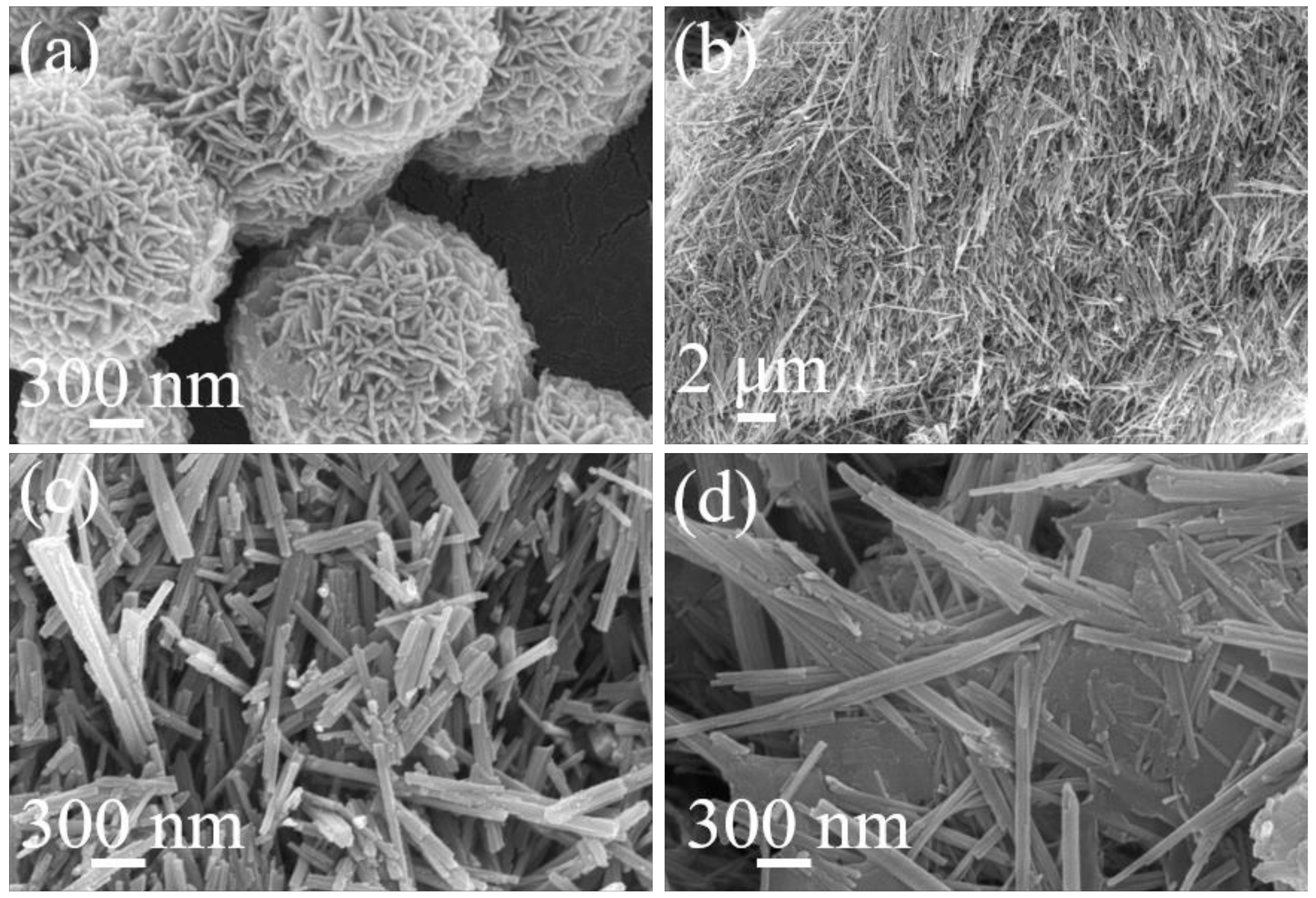
SEM was used to examine the microscopic morphologies of the prepared pure BiOI, pure α-MnO2, and α-MnO2/BiOI nanocomposites (Figure 1). As seen in Figure 1a, BiOI is a collection of nanosheet-based 3D flower-shaped microspheres with sizes ranging from 500 to 900 nm. The morphology of α-MnO2 is remarkably uniform nanorods, as seen in Figure 1b,c. The nanorods are smooth on the outside, have diameters of approximately 75 nm, and lengths between 4 and 5 μm. The microstructure of α-MnO2/BiOI composites is shown in Figure 1d. BiOI no longer exhibits a flowery spherical structure but grows into irregular nanosheets, and thin BiOI nanosheets closely cover the surfaces of α-MnO2 nanorods, connecting the α-MnO2 nanorods together. This structure of the composite facilitates charge transport and mass transfer processes, which are very favorable for catalytic reactions.
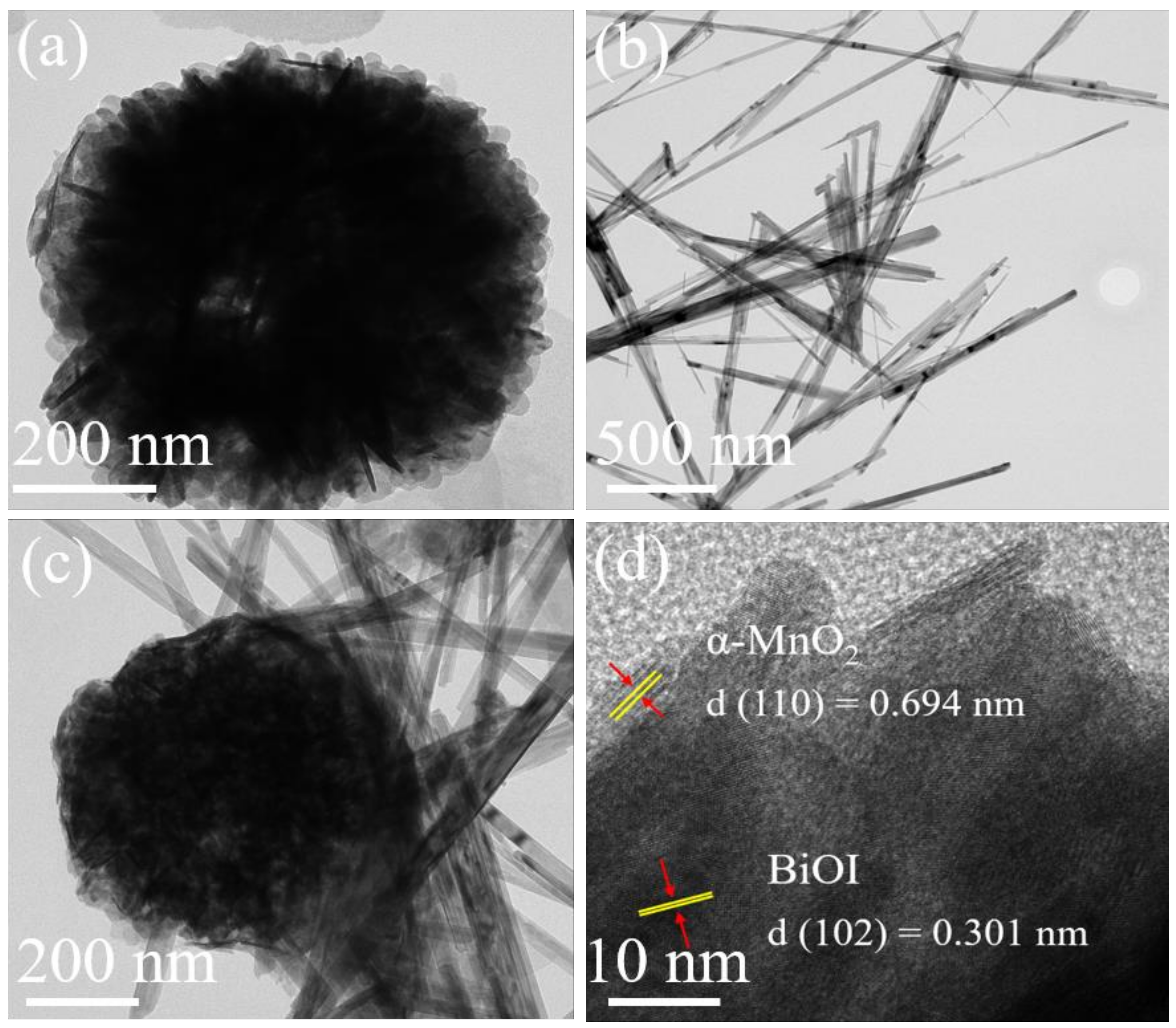
The microscopic morphology of the prepared material was further determined using TEM. As shown in Figure 2a, the monomeric BiOI is in the shape of a 3D flower sphere with lamellae stacked. The lattice stripe of 0.301 nm was observed by HRTEM image, which coincides with the (102) crystal plane of BiOI (Figure S1). Figure 2b shows α-MnO2 as a rod-like structure. A lattice stripe of 0.695 nm is observed by HRTEM image, which coincides with the (110) crystal plane of α-MnO2 (Figure S2). Figure 2c shows the TEM image of the MBI2 composite, where the tightly connected relationship between BiOI and α-MnO2 is evident. Additionally, the lattice stripes of 0.694 nm and 0.301 nm are observed by HRTEM images (Figure 2d), which correspond to the (110) crystal plane of α-MnO2 and the (102) crystal plane of BiOI, respectively. In addition, the elemental composition of the MBI2 composites was further analyzed by EDS mapping. The results show that Mn, Bi, I, and O are uniformly distributed in the composites (Figure S3); thus, it can be shown again that α-MnO2/BiOI composites have been successfully prepared.
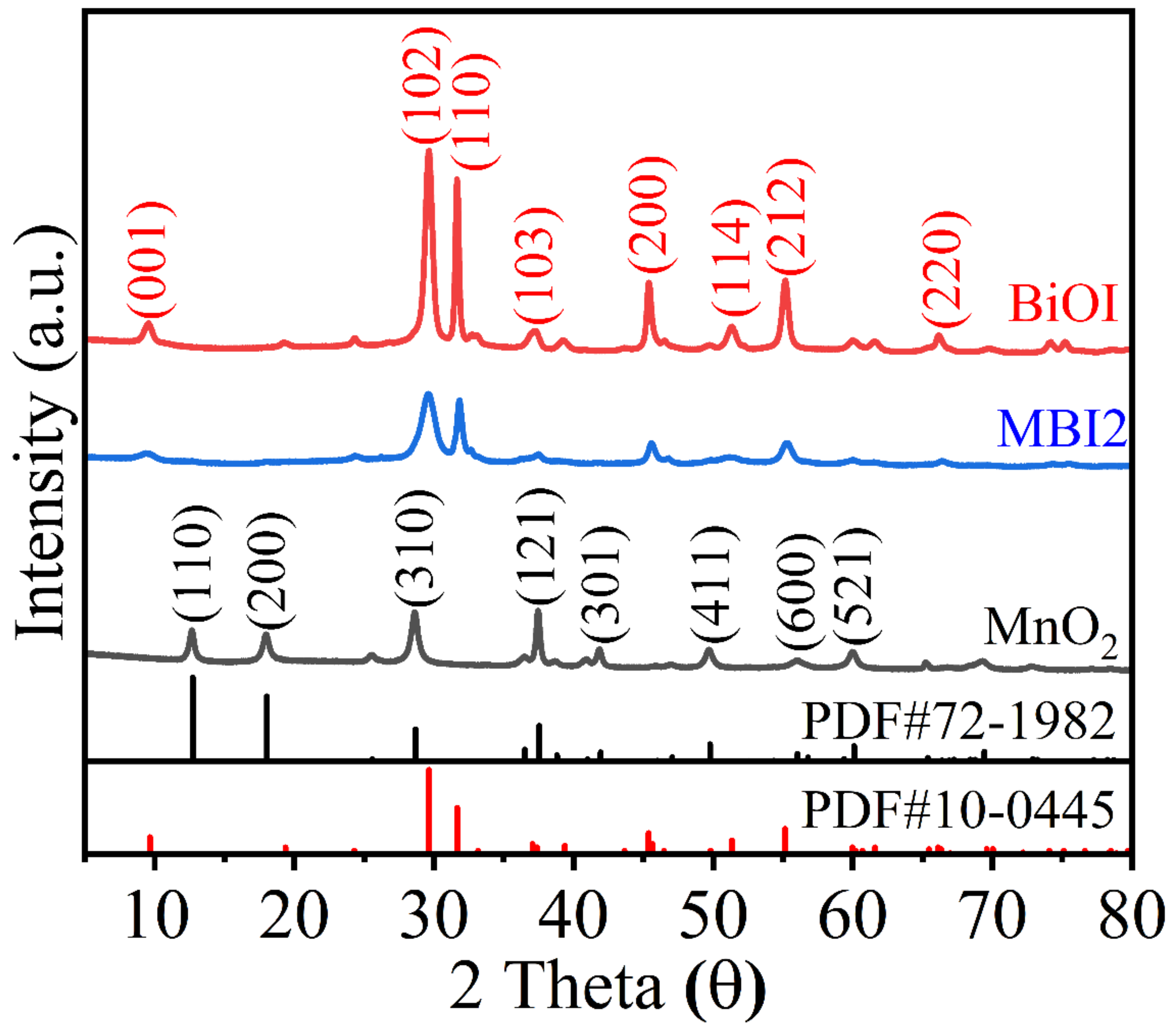
The crystal structure of the synthesized samples was determined by XRD (Figure 3). For the pure BiOI, all diffraction peaks can correspond to the BiOI of the tetragonal phase (JCPDS No.10-0045) [33]. The sharp peaks at ~9.5°, 29.6°, 31.6°, 37.2°, 45.4°, 51.4°, 55.2°, and 66.1° can be attributed to the (001), (102), (110), (103), (200), (114), (212), and (220) crystallographic planes of the BiOI, respectively [34]. The sharp diffraction peaks of BiOI indicates high crystallinity. For pristine α-MnO2, the observed peaks match JCPDS No. 72-1982 and the peaks at ~12.6°, 17.9°, 28.7°, 37.4°, 41.7°, 49.8°, 56.0°, and 59.9° can be attributed to α-MnO2 at (110), (200), (310), (121), (301), (411), (600), and (521) crystallographic planes of α-MnO2 [35], respectively. In the α-MnO2 and BiOI composites MBI2, although the (310) and (121) crystallographic planes of α-MnO2 overlap with the (102) and (103) crystallographic planes of BiOI, these characteristic peaks can still be clearly identified. It can also be observed that in the MBI2 composite sample, the intensity of the XRD diffraction peaks is significantly weaker than that of the single material, which may be due to the close contact between α-MnO2 and BiOI and the presence of residual stresses, leading to a decrease in the crystallinity of the material. In addition, no other impurity peaks were observed in MBI2, confirming the coexistence of α-MnO2 and BiOI in the composite.
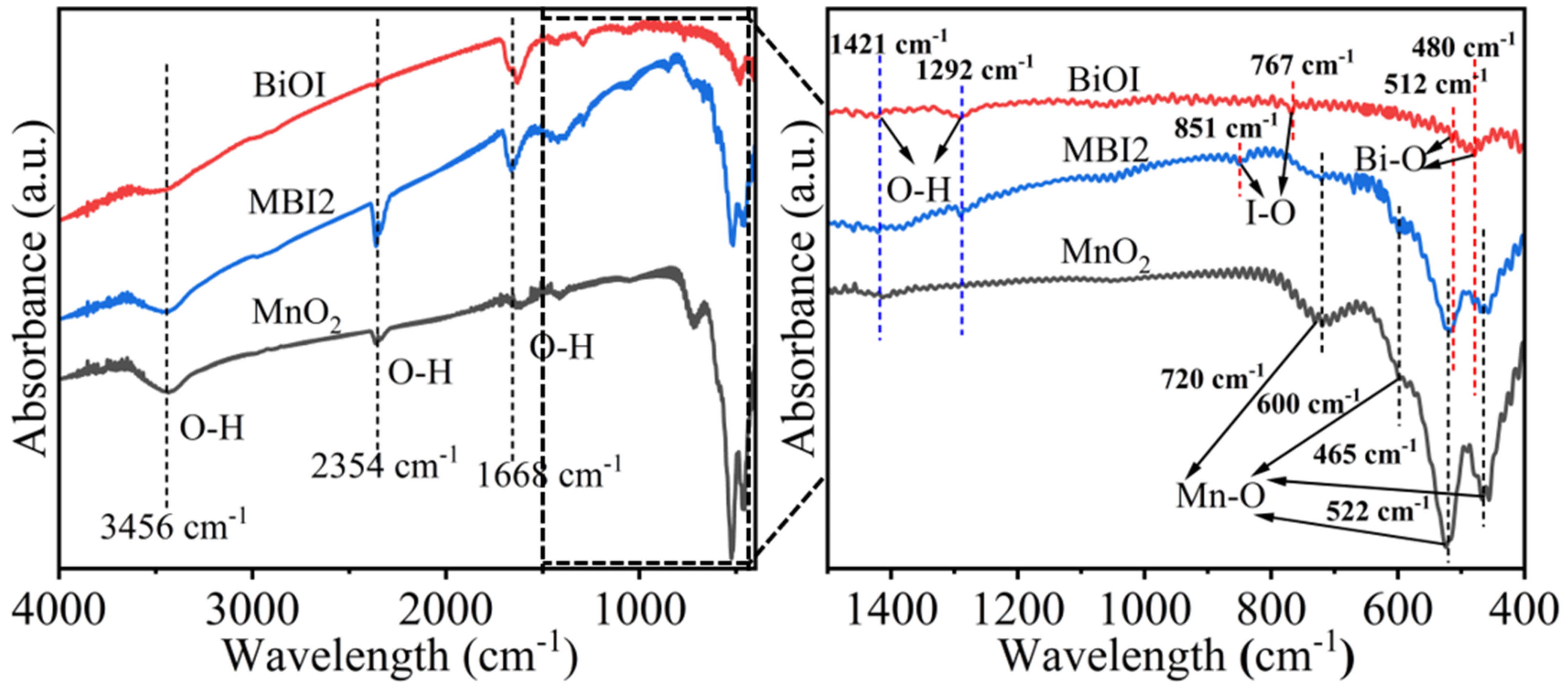
By using infrared spectroscopy, the chemical structures of composites made of α-MnO2, BiOI, and MBI2 were further examined. The acquired samples’ infrared spectra are displayed in Figure 4. The three strong characteristic absorption peaks appearing at 3456, 1668, and 1625 cm−1 correspond to the stretching and bending vibrations of the O-H bond in the H2O adsorbed by the as-prepared material, respectively. In addition, more detailed results can be obtained from the amplified IR spectra in the range of 400~1500 cm−1 (red dashed line corresponds to BiOI and black dashed line to α-MnO2). For α-MnO2, the peaks at 720, 600, 522, and 465 cm−1 are attributed to the stretching vibrations of the Mn-O bond [36]. For the BiOI samples, the peaks at 483 and 512 cm−1 correspond to the Bi-O bond, while the peak at 767 cm−1 is attributed to the I-O bond. The peaks at 1421 and 1292 cm−1 are also attributed to the O-H bond [37]. In addition, all major characteristic absorption peaks of α-MnO2 and BiOI can be observed in the spectra of MBI2 composites. This confirms that α-MnO2 and BiOI have been successfully coupled together.
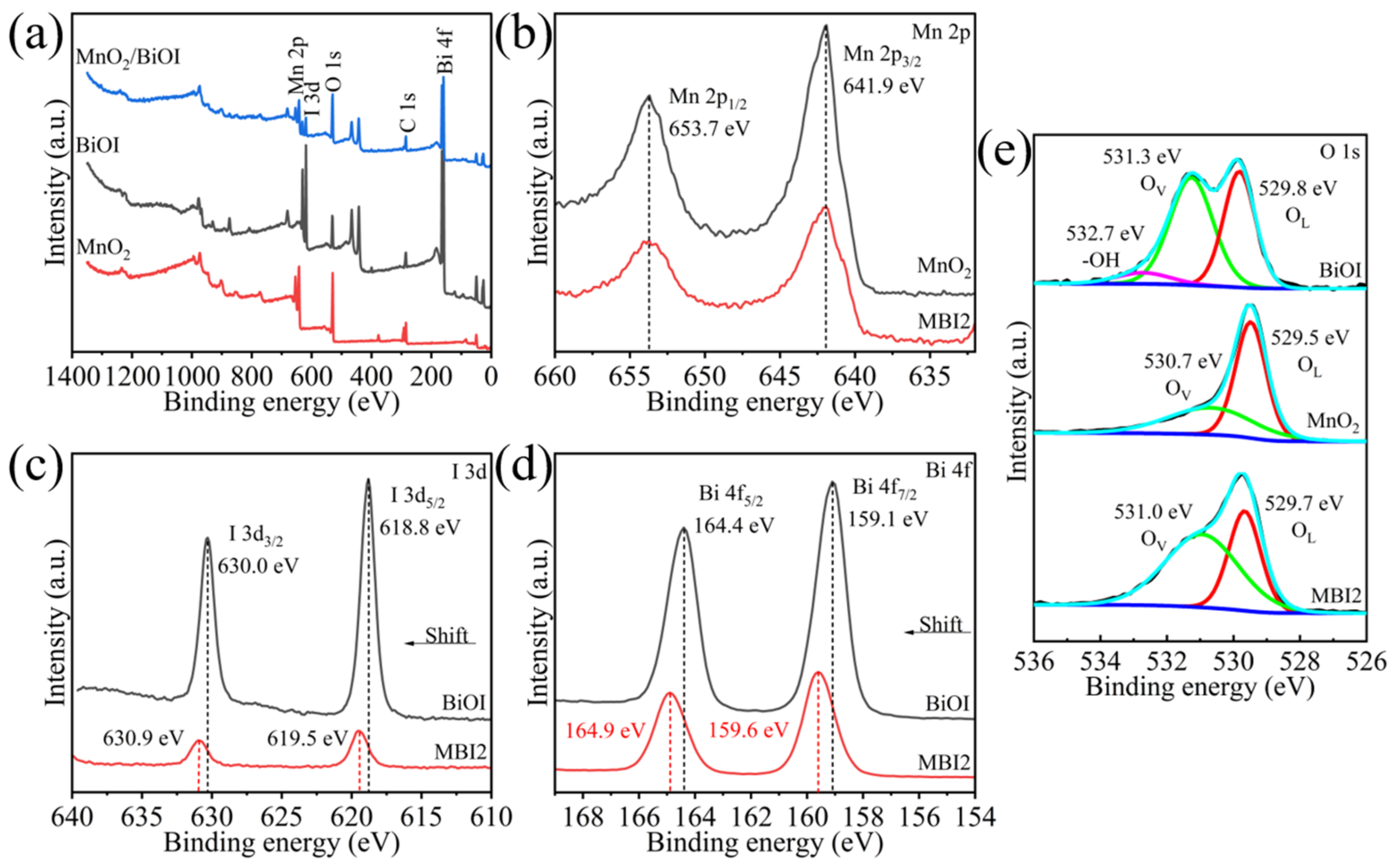
The XPS measurements reveal the surface composition and chemical state of α-MnO2, BiOI, and MBI2 composites and are shown in Figure 5. The measured spectra (Figure 5a) show that the MBI2 sample is composed mainly of Mn, Bi, I, and O. All elements in α-MnO2 and BiOI are present in the MBI2 composite sample, and there are no detectable impurities. Figure 5b–e show the detailed scanning spectra of Mn 2p, Bi 4f, I 3d, and O 1s, and the MBI2 composites were selected for comparison with a single material. The peaks of Mn 2p spectra (Figure 5b) in the original α-MnO2 and MBI2 composite samples, where two major peaks of 641.9 eV and 653.7 eV can be observed, correspond to 2p3/2 and 2p1/2 of Mn4+ [38], respectively. The peaks of Bi 4f spectra (Figure 5c) of the original BiOI are divided into two main peaks of 159.1 eV and 164.4 eV [39], corresponding to the binding energy of Bi 4f in MBI2, which is slightly positively shifted after complexation with α-MnO2. This shift was also present in the I 3d detail scan spectra (Figure 5d). In the original BiOI, I 3d5/2 and I 3d3/2 are located at 618.8 eV and 630.0 eV [34], respectively, while in the MBI2 composite, these corresponding peaks are shifted in the positive direction to 619.5 eV and 630.9 eV. This shift implies that the tight bonding between the two components enhances the surface electron binding energy of the material, indirectly demonstrating that the successful preparation of α-MnO2/MBI2 composite was successfully prepared. Comparison of the O 1s spectra in α-MnO2, BiOI and MBI2 composites shows (Figure 5e) that three peaks were fitted in the pure BiOI O 1s spectrum, located at 529.8 eV, 531.3 eV, and 532.7 eV, which can be attributed to lattice oxygen (OL), OVs, and surface hydroxyl oxygen (-OH) [28], respectively. The characteristic peaks of O 1s in α-MnO2 are two peaks of 529.5 and 530.7 eV, corresponding to OL and OVs in metal oxides, respectively. The positions of both OL and OVs are slightly shifted in the negative direction by 0.3 eV and 0.6 eV, respectively. The characteristic peaks of O 1s in MBI2 composites can be divided into two peaks of 529.7 eV and 531.0 eV, which correspond to OL and OVs, respectively. Both characteristic peaks are slightly shifted to the negative direction position compared with the pure BiOI. This shift implies that there is the charge transfer between the two components [31].

2.1. Photoelectric Properties of Different Photoelectrocatalysts

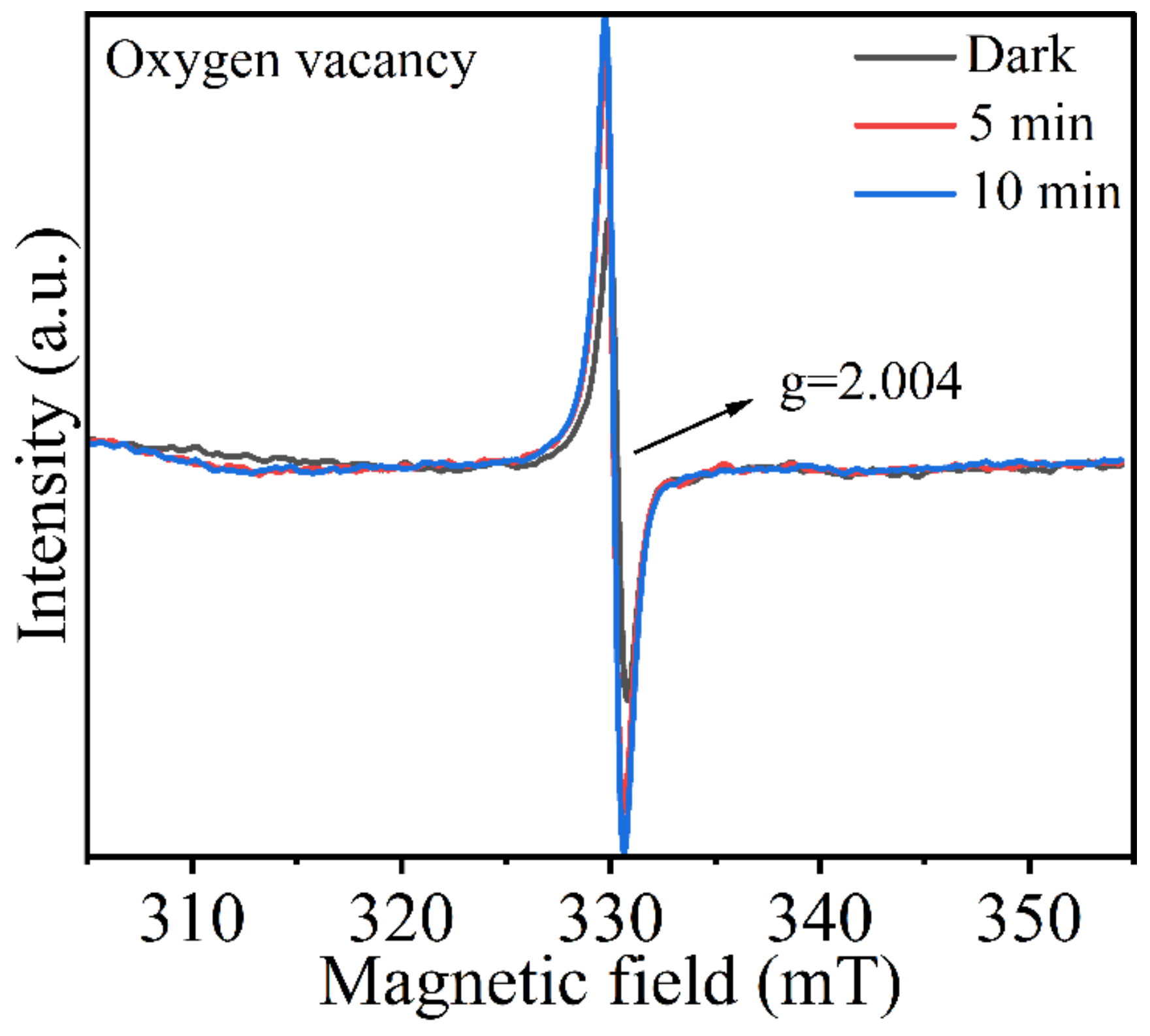
The presence or absence of OVs in catalysts can usually be detected by electron paramagnetic resonance to detect the signature of unpaired electrons, and the presence of OVs is usually considered if the characteristic peak of strong unpaired electrons appears at g = 2.004. As shown in Figure 6, a relatively strong signal peak was recorded in MBI2 at 2.004, corresponding to the abundance of unpaired electrons, which is typical of OVs, indicating the presence of OVs in MBI2 and the presence of a large number of OVs in the composite. In addition, it can be seen that the signal intensity of OVs increases with increasing light time. This indicates that ionized OVs (OVs+) can act as trap sites, continuously trapping e and rapidly transporting e [40,41].
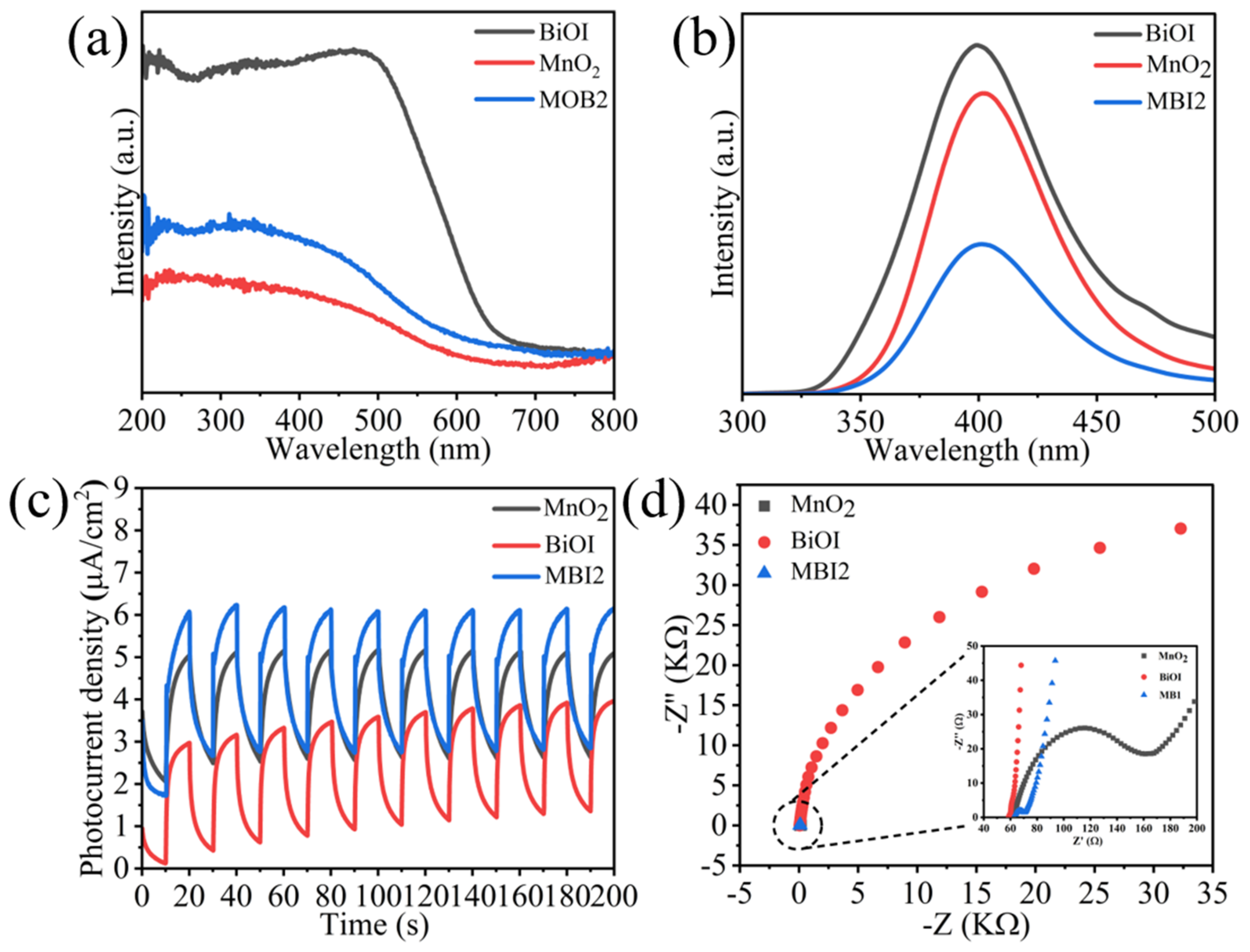
The photoelectric properties of the resulting samples were studied comparatively by UV–VIS, IT, PL EIS, CV, and LSV. The light absorption capacity of the as-prepared material was measured by UV–VIS. As shown in Figure 7a, the light absorption range of pure α-MnO2 was concentrated mainly in the UV region, and the light absorption ability in the visible region was weak. Compared with pure α-MnO2, BiOI has a higher light absorption capacity in the UV to visible range. For the MBI2 composites, the absorption edge of MBI2 composites showed a significant red shift, and its light absorption ability was significantly enhanced compared with α-MnO2. This implies that the enhanced visible light absorption ability is likely to be beneficial for the later PEC performance improvement [5]. The Eg is determined by the Tauc relation: (αhν)1/n = A(hν-Eg). For α-MnO2 and BiOI with an indirect band gap, n is chosen to be 2 [42,43]. As shown in Figure S4, the Eg of pure α-MnO2 and BiOI are 2.05 eV and 1.80 eV, respectively, which is in agreement with the previous results.
Furthermore, in order to be able to accurately study the migration and compounding processes of photogenerated charges, we first demonstrate the separation of photogenerated carriers by analyzing the PL spectra, as shown in Figure 7b. The emission peak positions of α-MnO2, BiOI, and MBI2 composites were similar, but the peak intensity of MBI2 composites was significantly lower compared with the pure pristine material. The above results indicate that α-MnO2 and BiOI can effectively hinder the complexation of photogenerated e/h+ after the successful construction of heterojunctions. To further verify the results, the effective migration efficiency of photogenerated charges in α-MnO2/BiOI heterojunctions was demonstrated by measuring the IT. As shown in Figure 7c, once activated by light irradiation, the α-MnO2, BiOI, and MBI2 composites all show a stable photocurrent response. The photocurrent response density of MBI2 composites is much higher than that of pure BiOI, which implies that α-MnO2/BiOI heterojunctions have a strong ability to migrate with photogenerated charge separation. As shown in Figure 7d, the Nyquist plot is composed of a semicircle in the high-frequency region and a straight line in the low-frequency region. The high-frequency region is controlled by the charge transfer process and the low-frequency region is controlled by the diffusion of reactants or products. The MBI2 composites exhibit a smaller radius of arc (Rct) than pure α-MnO2 and BiOI. It is well known that the smaller the Rct, the lower the charge transfer resistance of the surface material [44]. This implies that a more efficient e/h+ separation occurs after α-MnO2 and BiOI composite.
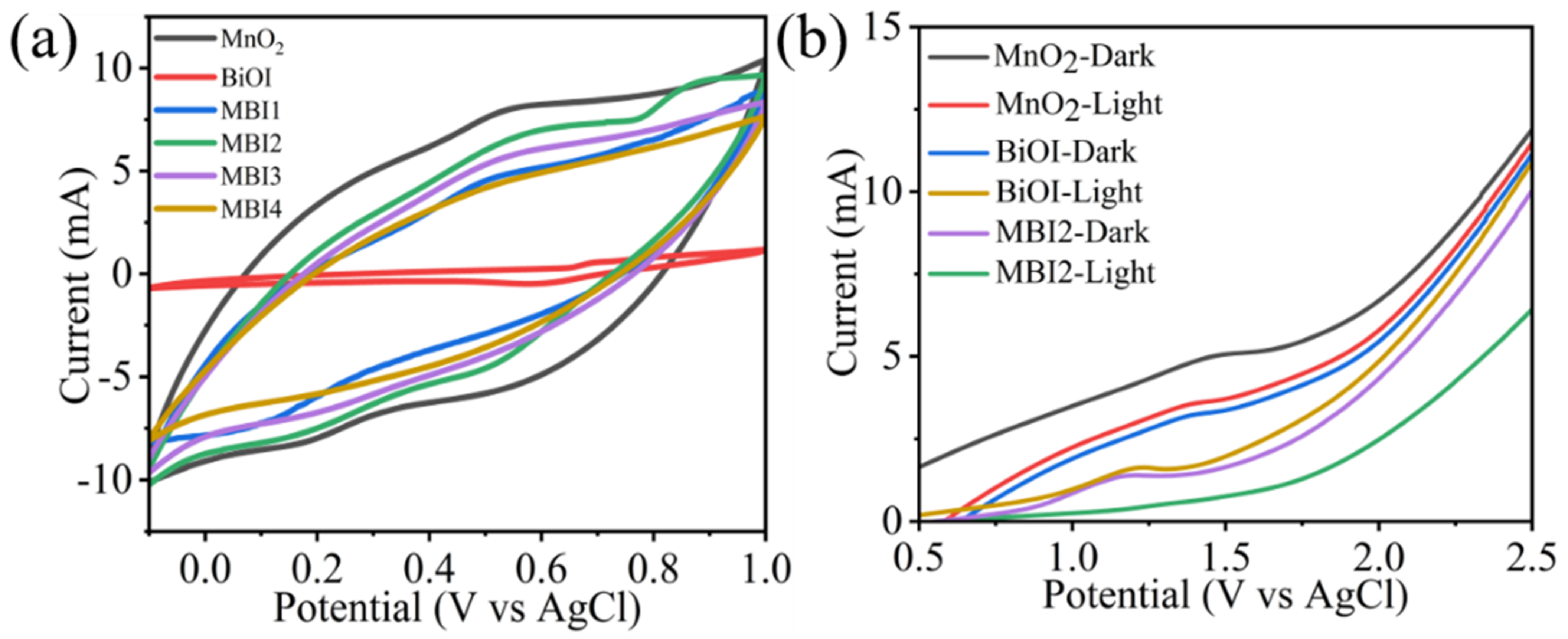
The CV curves were recorded at 25 °C in 0.1 M NaCl solution at a scan rate of 50 mV/s over the potential range from −0.1 to 1.0 V (vs. Ag/AgCl). It is well known that in the field of supercapacitors, the specific capacitance can be calculated by CV curves [45], and it can be seen from Figure 8a that the integrated area of the CV curve for α-MnO2 is larger than that of BiOI, confirming that α-MnO2 has a higher specific capacitance than BiOI. For the MBI composites, it can be seen that the specific capacitance of MBI2 is the largest. This means that the α-MnO2 in the MBI2 composite can store the photoexcited e in the BiOI and, thus, can inhibit the composite of photogenerated carriers. The electrochemical oxidation properties of the prepared materials were tested by steady-state polarization curves. The results show that MBI2 has the highest water oxidation potential (OEP). This allows it to inhibit the water oxidation reaction in favor of the formation of active species •OOH, •OH, and •O2 (Figure 8b) [46].
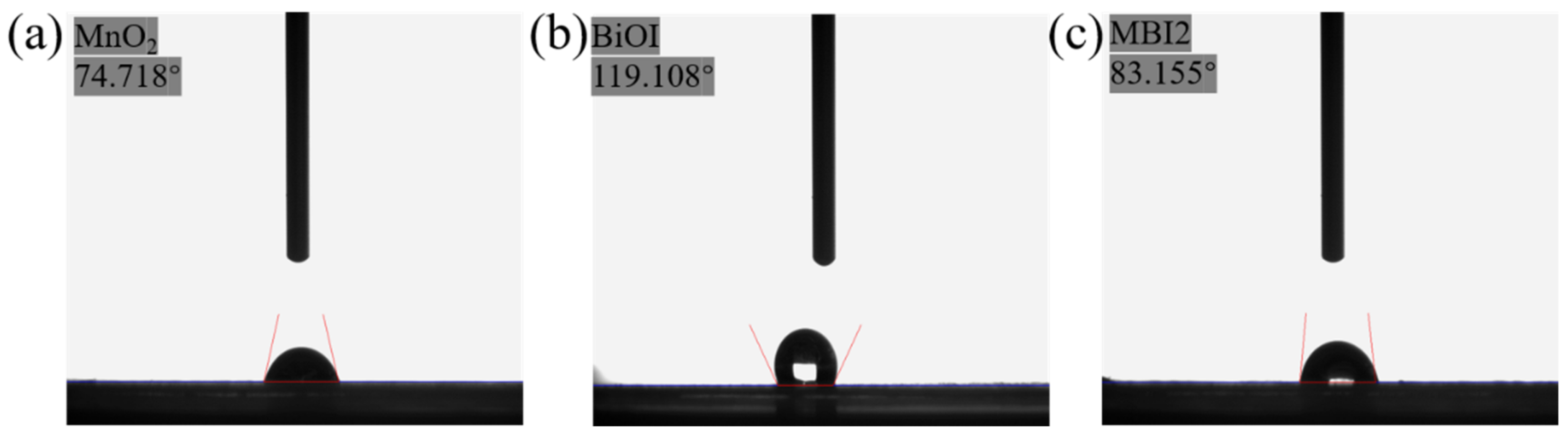
Usually, PEC reactions are solid–liquid reactions. Therefore, the hydrophobicity of the photoanode catalyst largely affects its PEC performance. This is because, in the PEC process, the catalytic properties first reach an adsorption–desorption equilibrium with the reactants, and then the photogenerated e/h+ generated are further reacted under the light. The reactive oxygen species (ROS) are generated either by direct interaction with the reactants or by reaction with e acceptors (O2) or h+ acceptors (H2O, inorganic anions, etc.). Therefore, hydrophilic materials tend to favor the migration of photogenerated holes. It is well known that the contact angle of a material is a key indicator for evaluating hydrophobicity. As shown in Figure 9, we tested the contact angles of α-MnO2, BiOI, and MBI2 composites at 74.7°, 119.1°, and 83.2°, respectively. It was reported that larger contact angles indicate that the materials are more hydrophobic and less hydrophilic. Interestingly, when BiOI with a large contact angle and α-MnO2 with a relatively small contact angle were compounded, the contact angle of the composite MBI2 was significantly reduced, and the hydrophilicity was enhanced compared with that of pure BiOI, a phenomenon that is beneficial to the PEC degradation performance. Combining the results of the above studies, it can be concluded that the composite of α-MnO2 and BiOI can, indeed, effectively prevent the complexation of photogenerated carriers and promote the separation and migration of photogenerated carriers, which is expected to enhance the PEC degradation performance [47].

2.2. PEC Performances and Recyclability Test

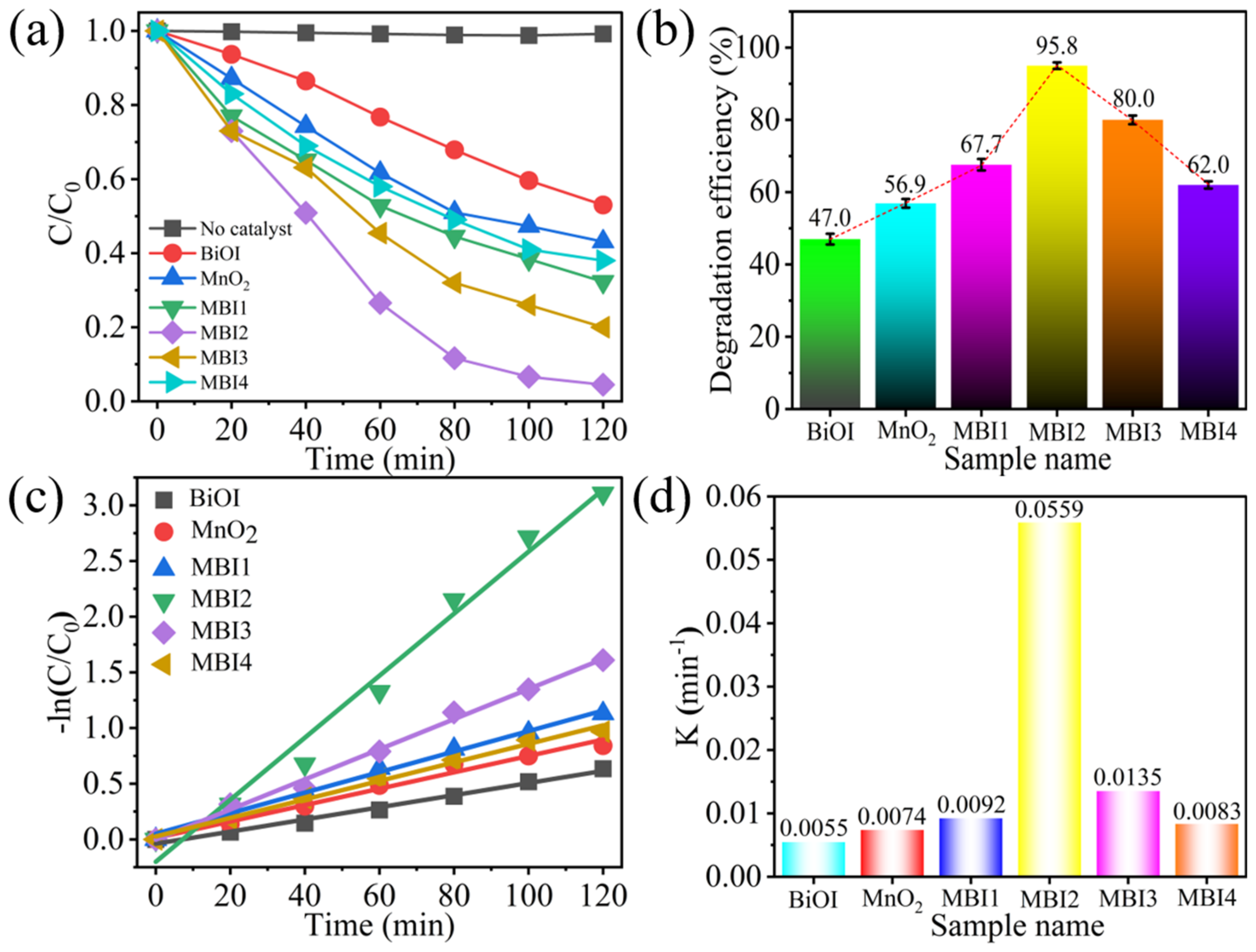
The above series of studies show that MBI2 composites possess significantly higher optical and electrical properties than pure α-MnO2 and BiOI. This result is very favorable for the improvement of PEC performance of MBI2 composites. Therefore, we tested the PEC degradation performance of MBI2. As shown in Figure 10a,b, pure BiOI could degrade only 47.0% of TC. Pure α-MnO2 also exhibited a lower PEC efficiency under the same conditions, whereby only 56.9% of TC solution could be degraded after 120 min of light exposure. For the MBI composites, the MBI2 composite exhibited the highest PEC efficiency, which could reach 95.8% degradation efficiency under the same light exposure time, which was two times higher than that of monomeric BiOI. The UV absorption pattern of the TC degradation process is shown in Figure S5. However, in the MBI composites, the PEC degradation efficiency was much lower than that of the MBI2 composites, whether increasing or decreasing the content ratio of α-MnO2 for BiOI—especially when increasing the content of α-MnO2, the PEC efficiency decreased significantly, which may be due to the aggregation of a large number of α-MnO2 nanorods, leading to the decrease of the specific surface area and the deterioration of both the active sites and the light absorption capacity. To further demonstrate the efficient degradation activity of MBI2 composites, we simulated the kinetic curve of PEC degradation of TC by pseudo-first-order kinetic: −ln(C/C0) = kt, where k, C0, and C are the reaction kinetic constant and the TC concentrations at the radiation time of 0 and t, respectively. The results are shown in Figure 10c,d, where it can be seen that the TC degradation concentration versus time is in accordance with the pseudo-first-order model. The highest rate constant of the MBI2 material is 0.0559 min−1, which is approximately ten times higher than that of the monomeric BiOI. This indicates that the prepared MBI2 composite exhibits better activity for the removal of TC.
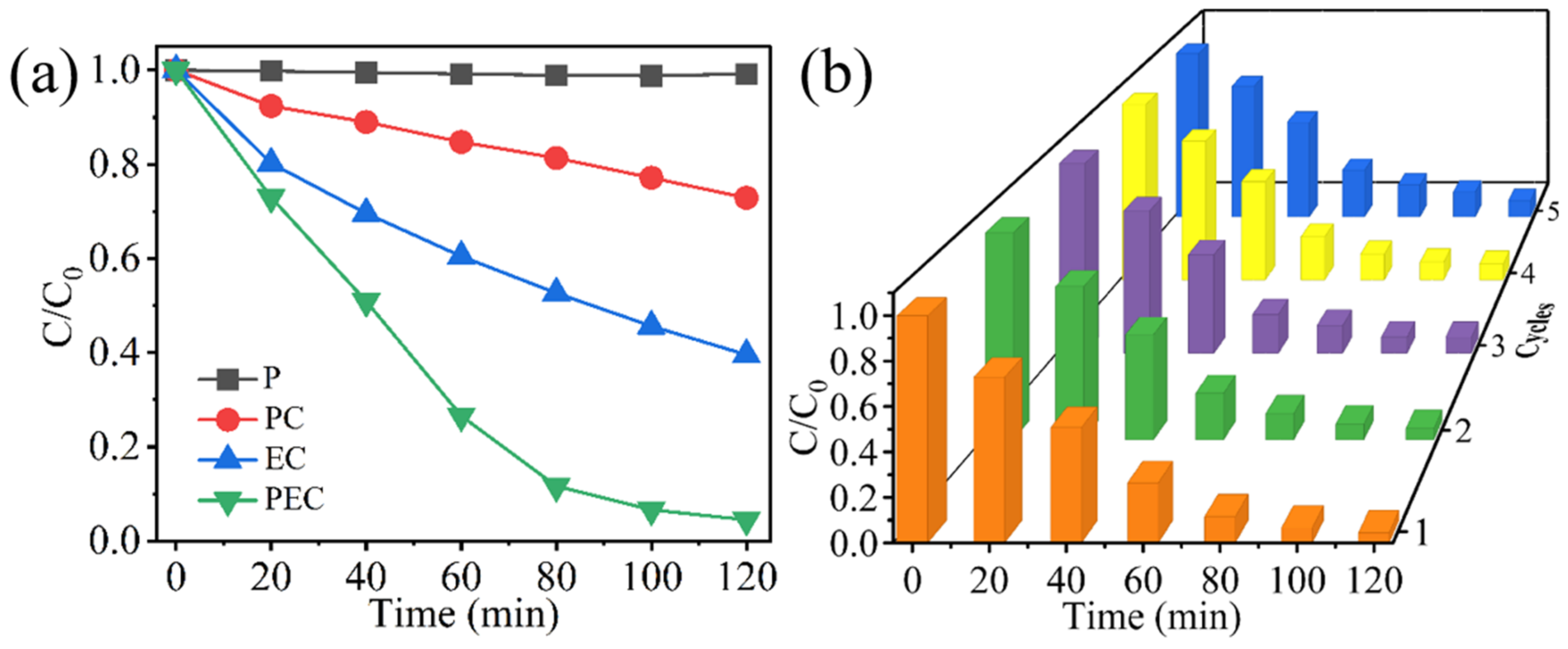
In order to investigate the advantages of catalytic degradation by the synergistic action of light and electricity, the degradation efficiency of TC by four different systems of P, PC, EC, and PEC was investigated with 30 mg/L TC as the target pollutant, and the results are shown in Figure 11a. Under the same conditions, the degradation efficiency of TC by PEC was as high as 96%, which was 3.5 times and 1.6 times higher than that by PC (27.2%) and EC (60.5%), respectively. Meanwhile, we investigated the kinetics of TC degradation by the four modalities, and it can be seen that the degradation process of TC by all four modalities conforms to quasi-primary kinetics, and PEC has the largest reaction rate constant (Figure S6). It is demonstrated that the applied anode bias voltage well promotes the separation of photogenerated carriers in the PEC system, which results in a high PEC performance.
In addition, catalyst stability and reusability are important criteria for evaluating catalyst performance. Therefore, five cycles of experiments were performed on MBI2 composites. The results of the experiment are shown in Figure 11b. The PEC activity of the MBI2 samples was not significantly deactivated after five consecutive recycling runs, confirming the high stability of the MBI2 composites in the PEC reaction. Figure S7 shows the XRD patterns of MBI2 catalyst after five cycling experiments. The XRD patterns of the MBI2 samples before and after the cycling experiments did not change significantly, and the diffraction peaks were still sharp and clear, indicating that the crystal structure of the MBI2 samples was not destroyed during the degradation process. This result also reaffirms the good stability and reusability of the MBI2 catalyst.
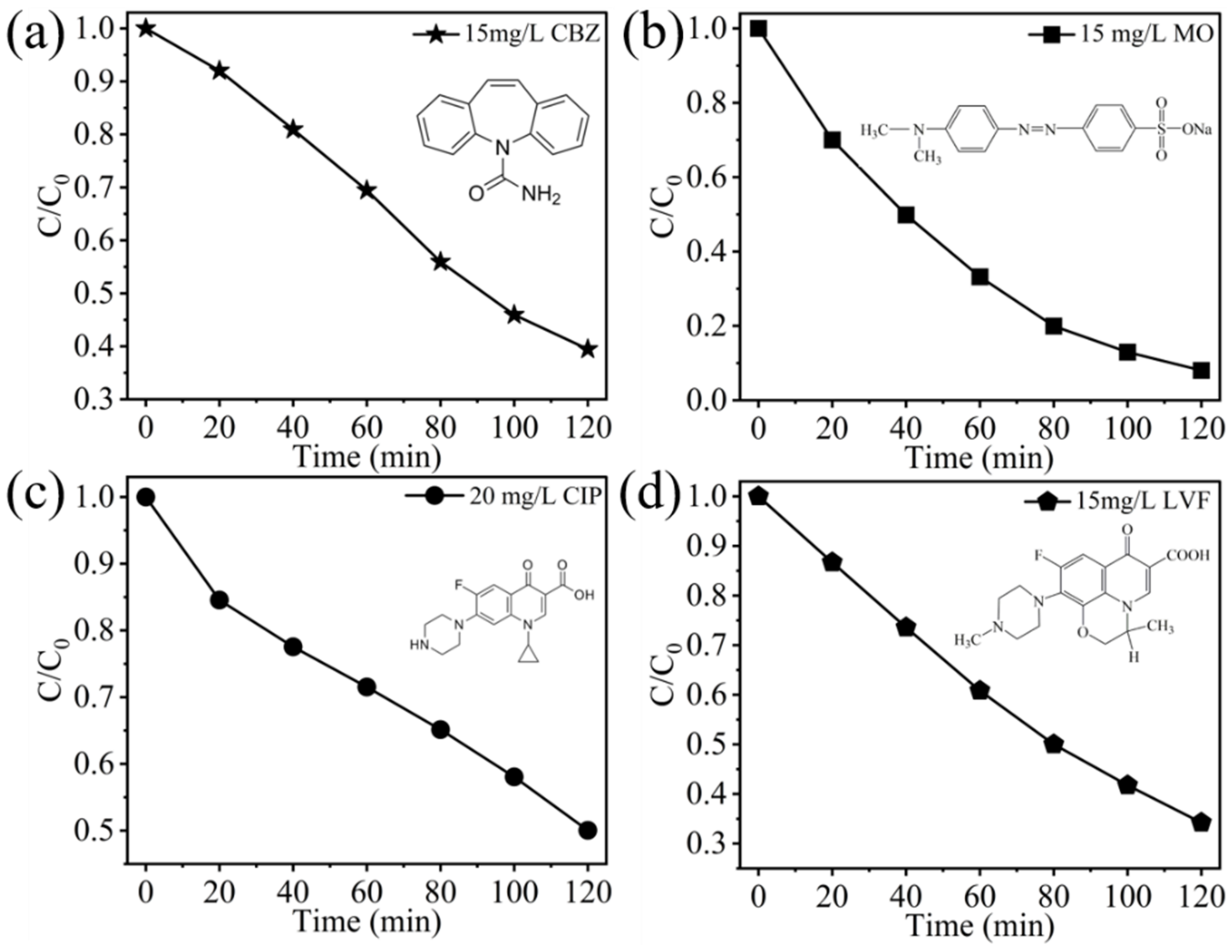
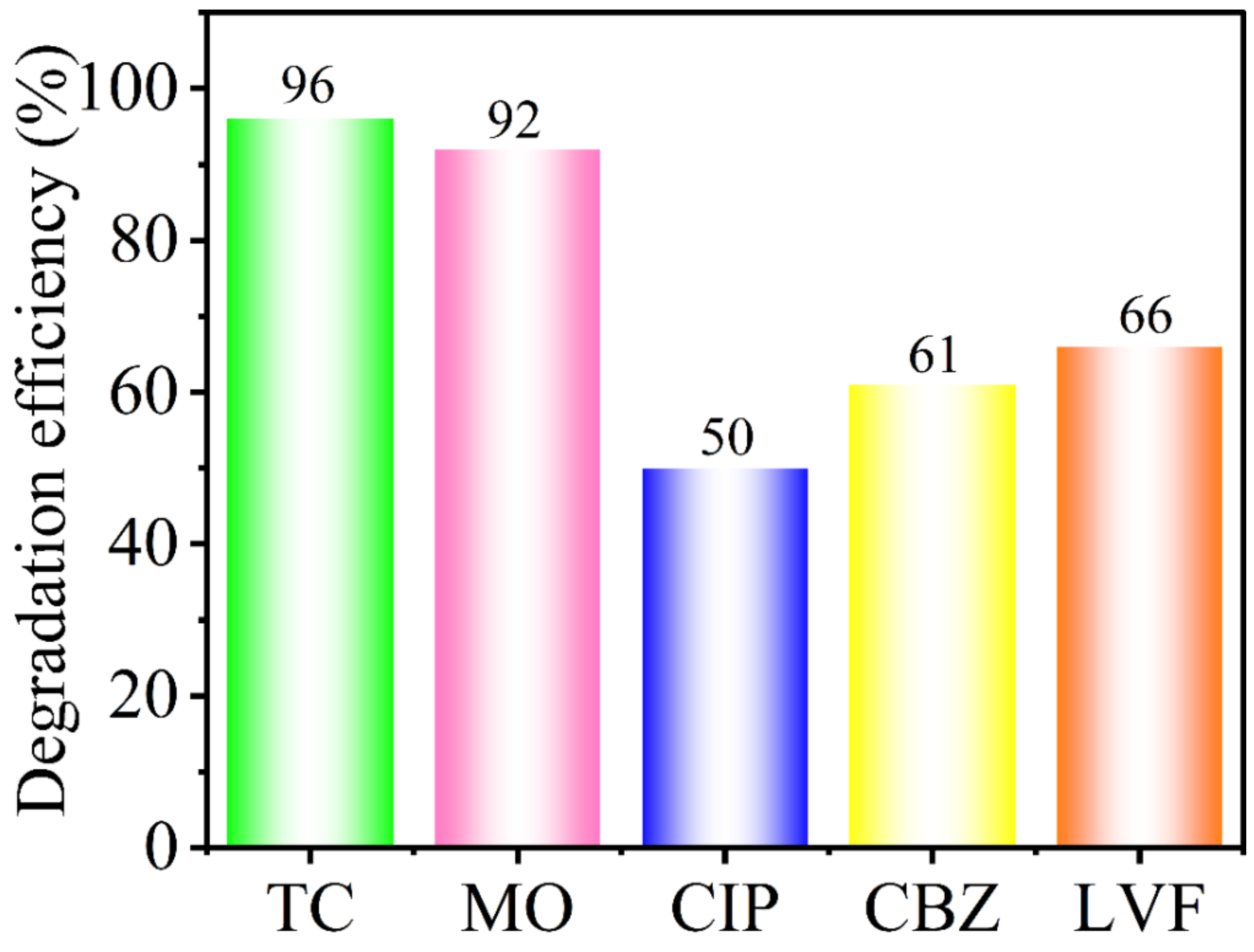
To evaluate the PEC degradation performance of MBI2 composite against organic pollutants, PEC degradation experiments were also conducted for CBZ, MO, LVF, and CIP under the same conditions. The degradation efficiencies are shown in Figure 12a–d, and the degradation UV absorption spectra are shown in Figure S8a–d. It can be seen that all the above four organic pollutants showed efficient degradation efficiencies (Figure 13). This indicates that the prepared α-MnO2/BiOI heterojunction composites have general PEC degradation performance for organic pollutants.

2.3. PEC Degradation Mechanism Study

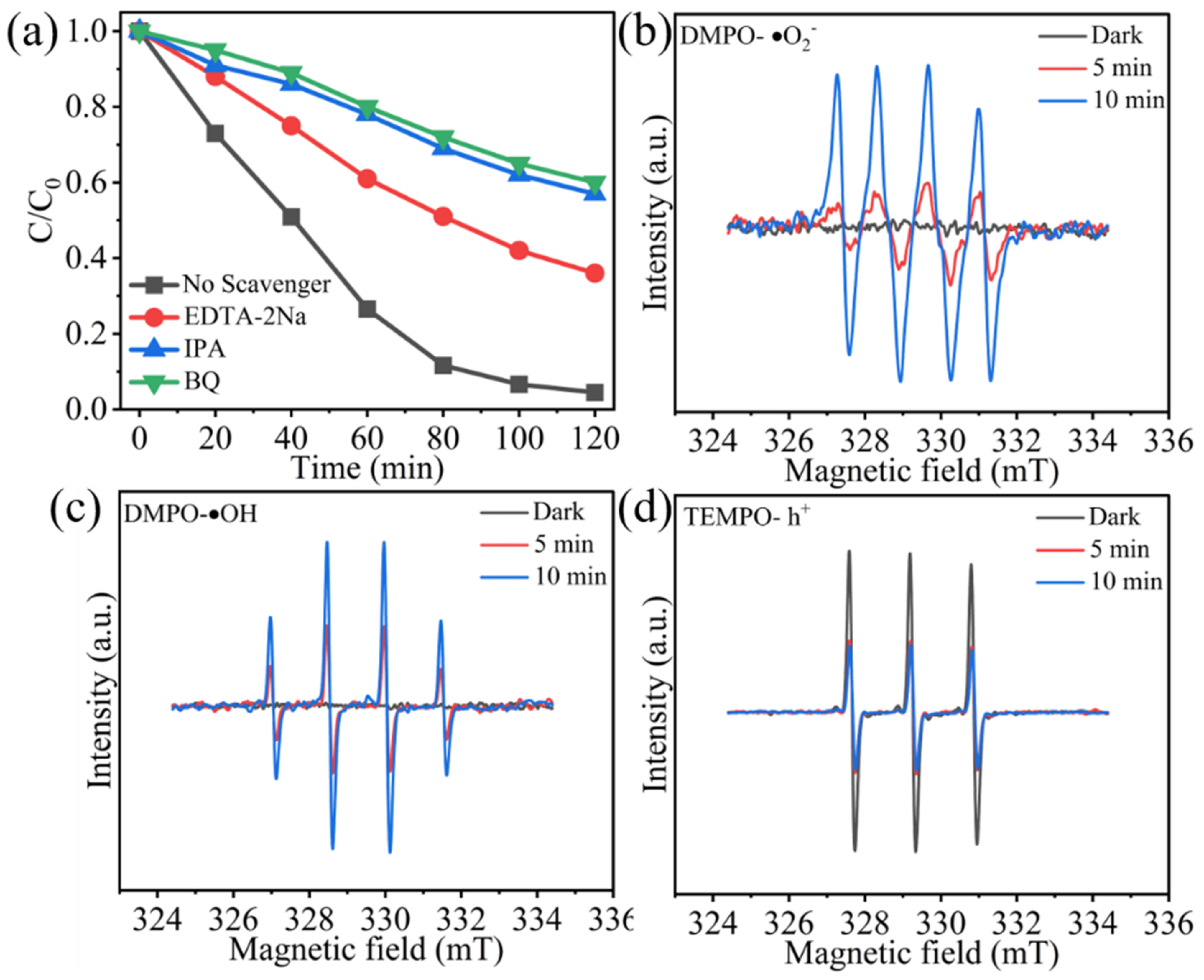
The mechanistic study of PEC includes mainly the detection of the radicals that play a major role in the reaction process, the calculation of the energy band structure of semiconductor heterojunctions, and the investigation of the separated migration paths of photogenerated charges. First, in order to verify the main radicals generated by MBI2 materials during the PEC degradation of organic pollutants, we have tested them by radical capture experiments, which are the same processes as the organic pollutant degradation experiments. By adding p-BQ (10 mM), EDTA-2Na (10 mM), and IPA (10 mM) as masking agents, the •O2, •OH, and h+ active species that may be present during the degradation of organic pollutants by PEC were masked, respectively. As shown in Figure 14a, the efficiency of PEC degradation of TC decreased significantly when p-BQ and IPA masking agents were added. This implies that both •O2 and •OH are the main active species in the degradation reaction. However, EDTA-2Na was much less inhibited than the other two masking agents, indicating that h+ plays a minor role in the PEC reaction.
To confirm the results of the above free radical tests, we tested the MBI2 material using EPR for the active species produced under visible light irradiation conditions. Figure 14b shows the characteristic signal of •O2, where the characteristic peak of DMPO-•O2 can be observed under visible light irradiation, and the signal becomes stronger with the increase of light irradiation time. As shown in Figure 14c, it can be seen that DMPO-•OH is the same as DMPO-•O2, and the characteristic peak exists and becomes stronger under light conditions. Figure 14d shows the production of h+ during the reaction. The above results are in full agreement with the radical trapping experiment. Once again, it is confirmed that •O2 and •OH play a dominant role in the PEC degradation of TC in MBI2 samples, while h+ plays a secondary role, and h+ production occurs mainly through the interaction with water to produce •OH.
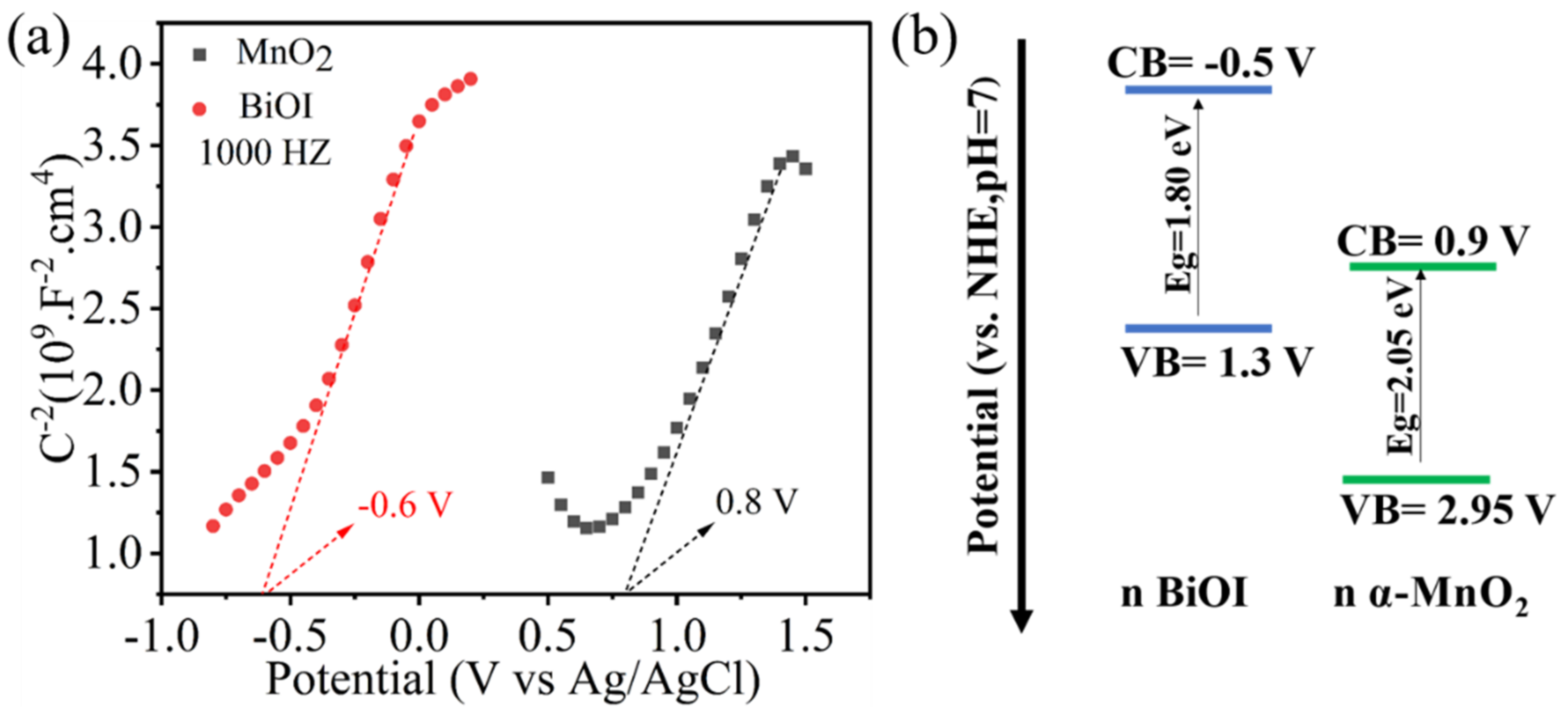
The flat-band potential (Efb) and semiconductor type of α-MnO2 and BiOI were analyzed using the Mott–Schottky (M-S) test (Figure 15a). It can be seen that both α-MnO2 and BiOI are n-type semiconductors, which is consistent with the previously reported results [48]. Furthermore, the Efb of α-MnO2 and BiOI can be derived by plotting the tangents of the M-S diagram as 0.8 V and −0.6 V (vs. Ag/AgCl, pH = 7), respectively, converting to 1.0 V and −0.4 V (vs. NHE, pH = 7). The Efb of the n-type semiconductor was reported to be positive 0.1 V over its CB [49]. Thus, the CB potentials of α-MnO2 and BiOI can be derived as −0.9 V and −0.5 V (vs. NHE), respectively. Then, on the basis of their Eg values, the VB of α-MnO2 and BiOI can be determined to be 2.95 V and 1.30 V (vs. NHE), respectively. Finally, the energy band structure of α-MnO2/BiOI is calculated as shown in Figure 15b.
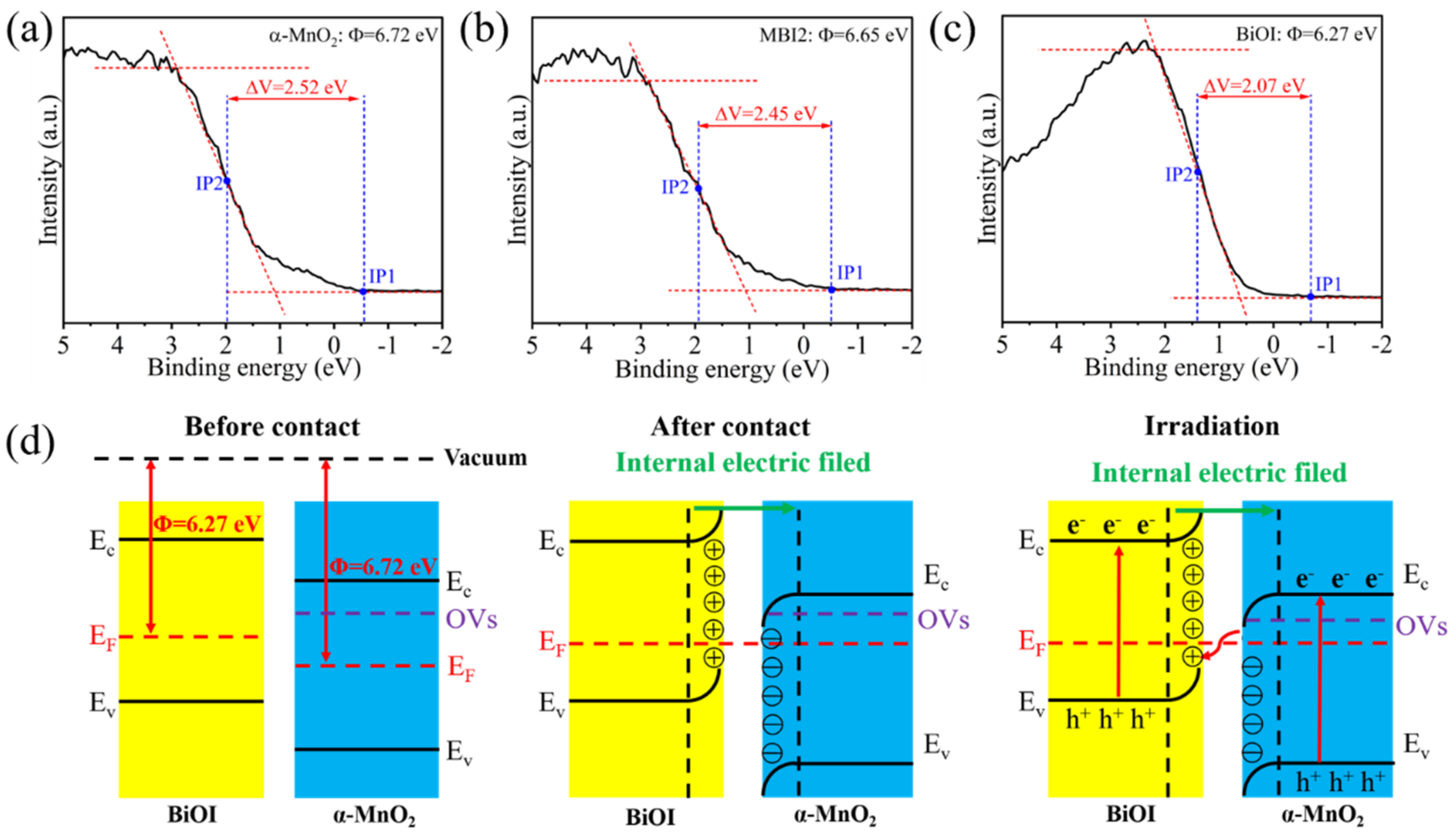
The calculation of the work function is important to study the charge transfer at the α-MnO2/BiOI heterojunction interface. In the VB-XPS test, the work function of the material can be calculated on the basis of the relationship: hν = Ek + Eb + Φ. Figure 16 shows the work function for α-MnO2 (a), BiOI (b), composite MBI2 (c), and the schematic diagram of the electric field and charge transfer measurements inside the α-MnO2/BiOI heterojunction (d) [50]. Due to the difference in the work function, the contact potential difference ΔV = Φ − φ (φ is the instrumental work function and takes the value of 4.2 eV) changes the kinetic energy of free electrons and, finally, the binding energy of electrons. VB-XPS detects the change in the binding energy, and ΔV can be obtained from the distance of the inflection point (IP), then Φ can be calculated [50,51]. In this way, the work functions of α-MnO2, BiOI, and the composite MBI2 are 6.72, 6.27, and 6.65 eV, respectively. Since BiOI has a smaller work function than α-MnO2, when α-MnO2 and BiOI are in contact under dark conditions, e are transferred from BiOI to α-MnO2, thus establishing a new equilibrium state [52]. When the charge transfer reaches equilibrium, at the α-MnO2/BiOI heterojunction interface, the BiOI surface accumulates positive charge, and the α-MnO2 surface accumulates negative charge, forming the IEF direction from BiOI to α-MnO2. The effect of the IEF induces the photogenerated charge transferred from α-MnO2 to BiOI [53].
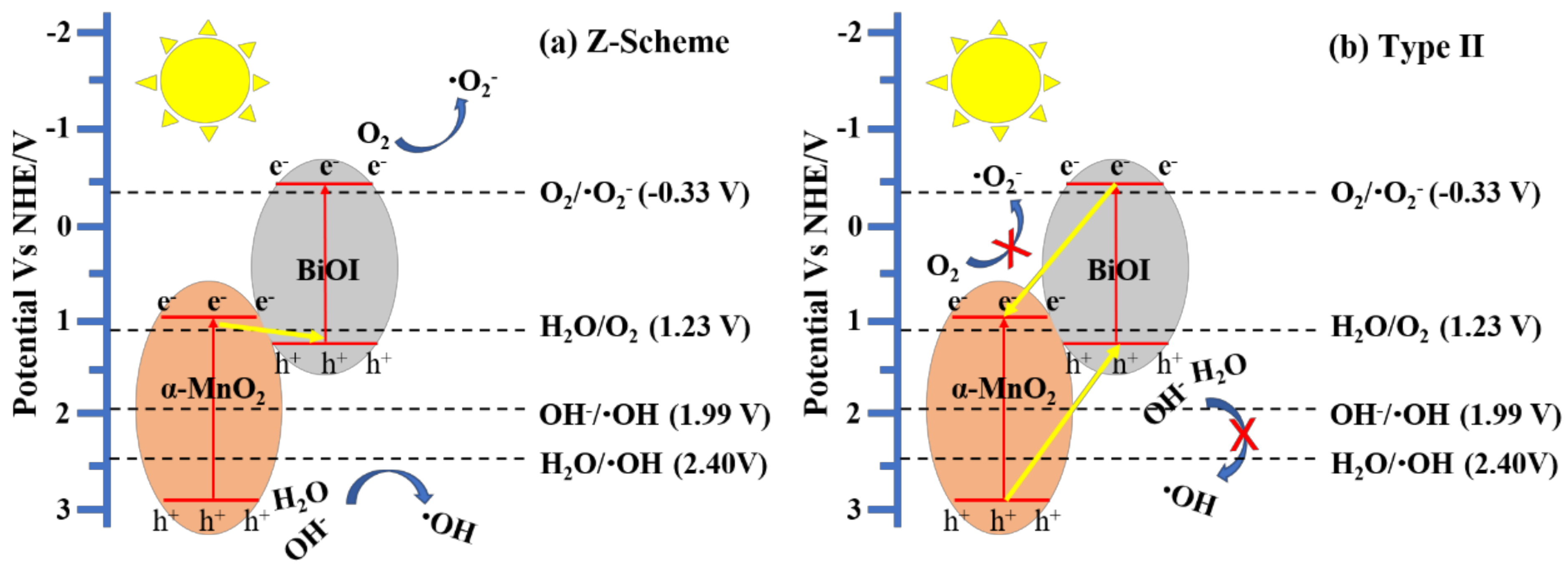
According to the results discussed above, the energy band arrangement of α-MnO2 and BiOI satisfies the requirement of generating ROS for degradation of TC under visible light irradiation (λ > 420 nm). Therefore, assuming that the transfer path of photogenerated charges in α-MnO2/BiOI heterojunctions follows the conventional type II mechanism, the e will migrate from the CB of BiOI to the CB of α-MnO2, while h+ will migrate from the VB of α-MnO2 to the VB of BiOI. This will lead to the accumulation of e and h+ in the CB of α-MnO2 (0.9 V vs. NHE) and the VB of BiOI (1.3 V vs. NHE), respectively. Unfortunately, due to the lower CB and VB potential than the theoretical value, the system theoretically does not produce •O2 and •OH. This contradicts the results of radical trapping experiments and ESR tests, and, therefore, this hypothesis is not valid. So, the direct Z-scheme charge transfer mechanism would be the explanation for the most complex experimental results of α-MnO2/BiOI heterojunctions (Scheme 1). In the presence of IEF, the e in the CB of α-MnO2 combine directly with the h+ in the VB of BiOI, thus retaining the h+ in the VB of α-MnO2 and the e in the CB of BiOI. Since the VB of α-MnO2 (+2.95 V vs. NHE) is more positive than H2O/•OH (+2.4 V vs. NHE), h+ can oxidize H2O to form •OH or directly oxidize TC. In addition, the CB of BiOI (−0.36 V vs. NHE) is more negative than O2/•O2 (−0.33 V vs. NHE), and photogenerated e can reduce the O2 in air to •O2. So, the system can theoretically produce •OH and •O2, which is consistent with the results of the EPR and active species test. Therefore, the α-MnO2/BiOI heterojunction is consistent with a direct Z-scheme charge transfer mechanism.
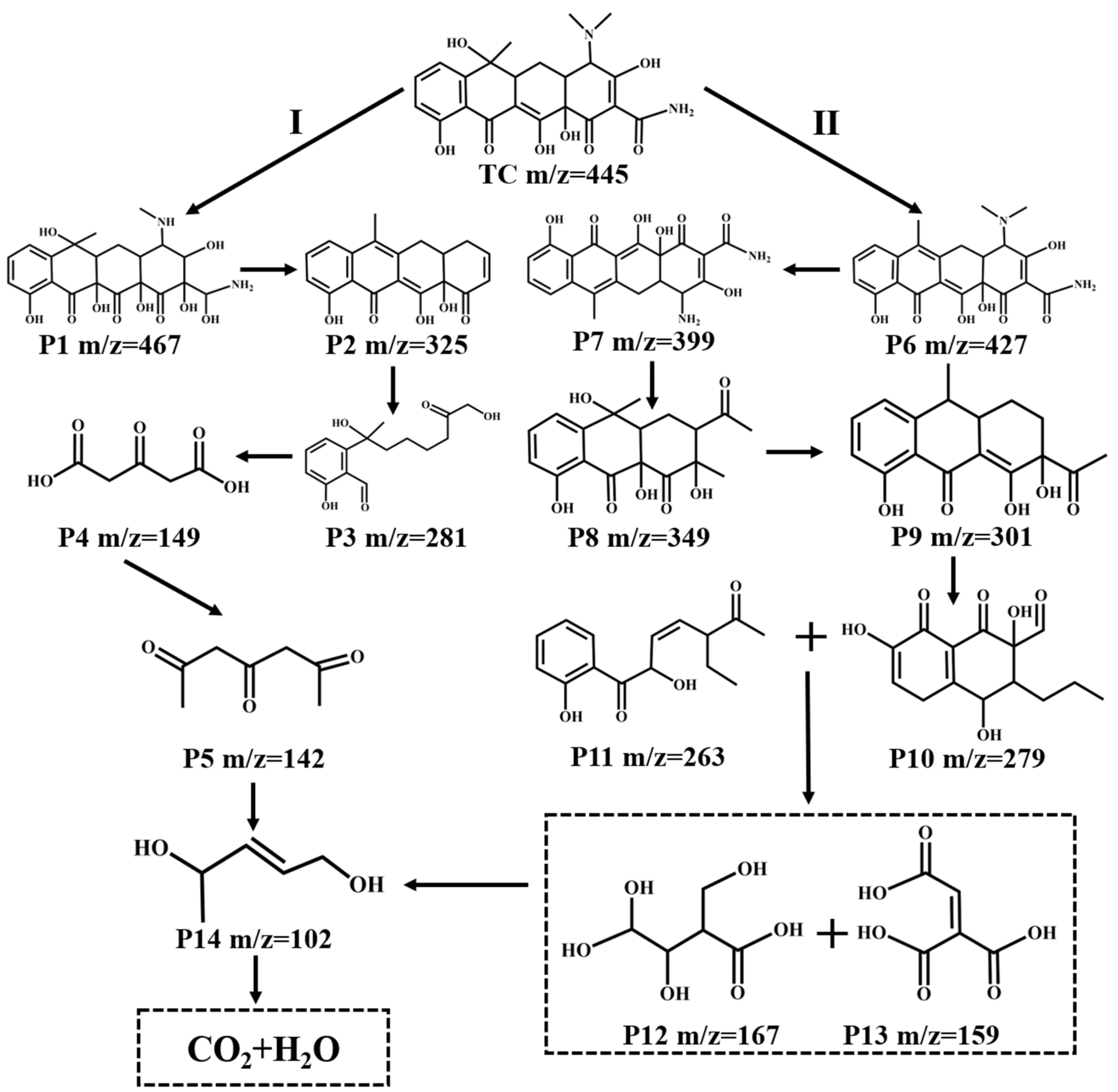
To further understand the oxidation process of TC, the HPLC-MS technique was used to identify the generated intermediates and infer the possible pathways of TC degradation. The detailed test conditions of LC-MS are shown in Table S1. The mass spectra of these intermediates are shown in Figures S9–S12. Fourteen major TC degradation products were identified by the assay (Table S2) and two possible decomposition pathways were inferred, as shown in Figure 17. In Pathway I, the intermediate product P1 (m/z = 467) is produced due to the double bond attack of the •OH radical on TC. Next, P1 is converted to P2 (m/z = 325) by dehydroxylation and deamination reactions. P2 undergoes ring opening to produce P3 (m/z = 281). P3 is split by loss of hydroxyl group, carbonyl group, and breakage of benzene ring to P4 (m/z = 149), P4 is dehydroxylated to P5 (m/z = 142), and the carbonyl group of P5 is attacked by •OH to produce P14 (m/z = 102). Pathway II is initiated by a dehydration process, leading to the transformation of TC into the intermediate product P6 (m/z = 427). The N-methyl substituent of P6 is removed to produce intermediate P7 (m/z = 399). P7 undergoes a deamination reaction and breaks the c=c double bond to produce P8 (m/z = 349), P8 undergoes a dehydroxylation reaction to P9 (m/z = 301), and P9 undergoes carbon bad cracking and undergoes carbon rearrangement to produce P10 (m/z = 279) and P11 (m/z = 263). P10 and P11 undergo ring opening, dihydroxylation, and carbonylation to produce P12 (m/z = 167) and P13 (m/z = 159). P12 and P13 undergo decarboxylation, decarbonylation, and dehydroxylation to produce P14 (m/z = 102). Eventually, the above products can be turned into harmless substances (CO2 and H2O) under the attack of the free radicals generated in the reaction system, completely destroying the TC structure.
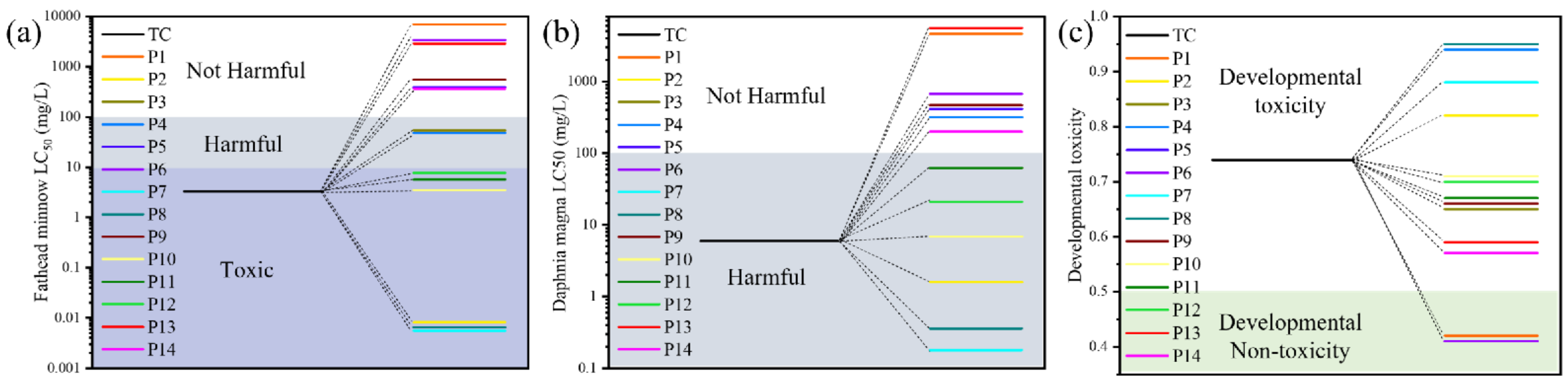
The biological toxicity of TC and its intermediates during the degradation of α-MnO2/BiOI direct Z-scheme PEC was assessed by acute toxicity and developmental toxicity using the Toxicity Evaluation Software Tool (T.E.S.T). The results are shown in Figure 18 and Table S3. As can be seen in Figure 18a, for acute toxicity (fathead minnow LC50), all the remaining intermediates except intermediates P2, P7, and P8 exhibited much lower acute biotoxicity than TC. As can be seen from Figure 18b, in the evaluation index of daphnia magna LC50, all intermediates except P2, P7, and P8 showed a decreasing trend in acute toxicity after PEC degradation. In contrast to the acute toxicity results, as shown in Figure 18c, TC was evaluated as a “developmental toxicant”, and all intermediates exhibited higher or lower developmental toxicity than TC, except for P1 and P6, which were non-developmental toxicants. On the basis of the above analysis, it can be concluded that the acute toxicity of both TC solution and its degradation intermediates had a substantial decrease after TC solution was treated by MBI2 PEC system, although for developmental toxicity, there was no significant decrease, as they were basically maintained at lower levels. Therefore, the constructed MBI2 PEC system has great advantages in treating wastewater containing TC without secondary pollution and can effectively reduce biological toxicity, which is an efficient method that can be practically applied to wastewater treatment.

3. Experimental Section

3.1. Chemicals and Reagents

Potassium permanganate (KMnO4, purity 99%), potassium iodide (KI, purity 99%), acetic acid (CH3COOH, purity 99%), polyvinylpyrrolidone (PVP, K30, average mw: 58,000, purity 99%), isopropyl alcohol (C3H8O, purity 99%), N, N-dimethylformamide (DMF, purity 99%), p-benzoquinone (p-BQ, purity 99%), disodium ethylenediaminetetraacetate (EDTA-2Na, purity 99%), isopropyl alcohol (IPA, purity 99%), carbamazepine (CBZ, purity 99%), methyl orange (MO, purity 99%), levofloxacin (LVF, purity 99%), and ciprofloxacin (CIP, purity 99%) were obtained from China National Pharmaceutical Chemical Reagent Co (Beijing, China). Bi(NO3)3•5H2O was purchased from Aladdin Industrial Company (Shanghai, China). Carbon paper was purchased from Toray Fuel Cell Factory Online Shop, Tokyo, Japan.

3.2. Preparation of 1D α-MnO2 Nanorods

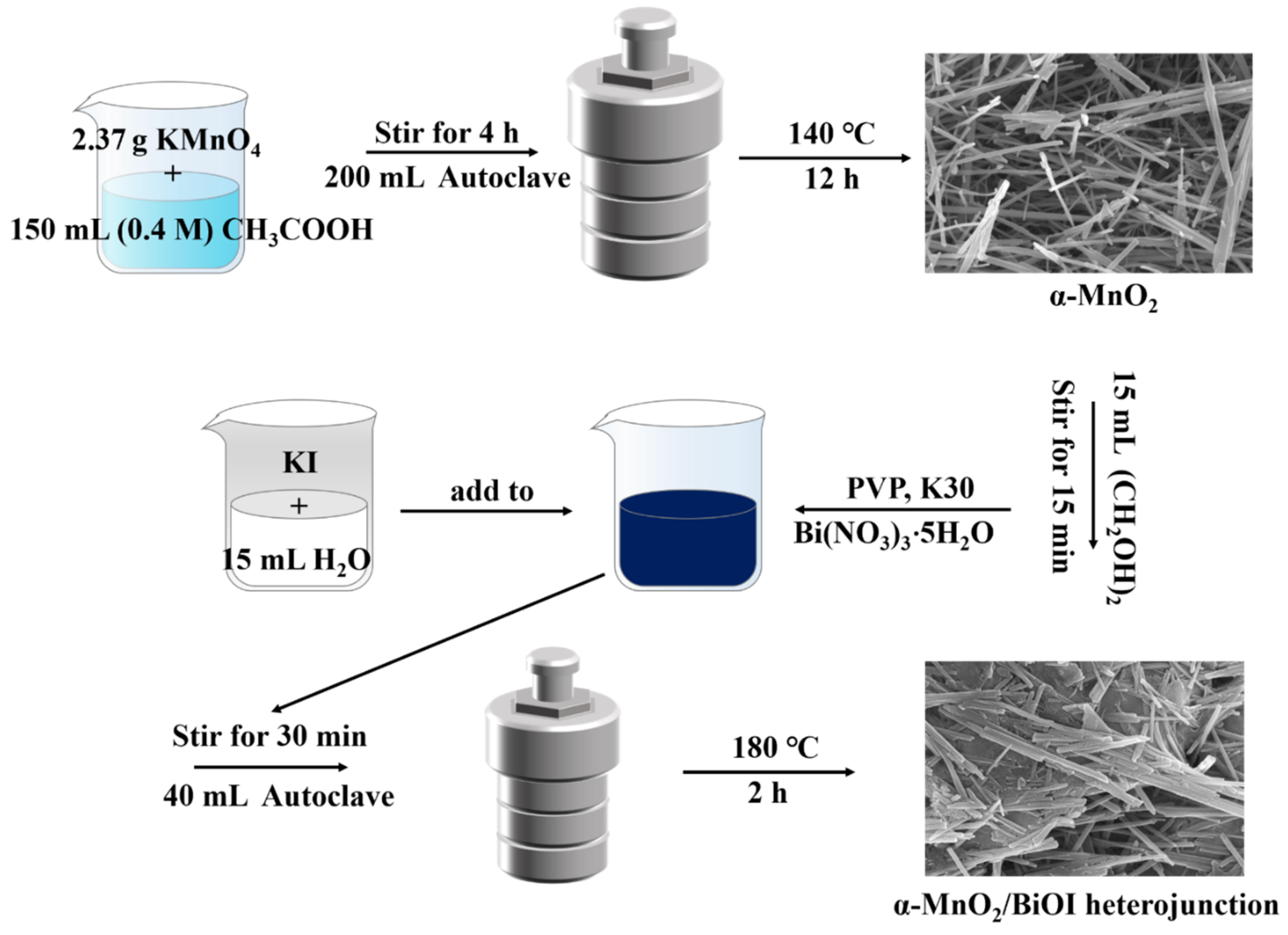
In brief, 2.37 g of KMnO4 was dissolved in 150 mL (0.4 M) of acetic acid solution and magnetically agitated for approximately 4 h. The suspension was then put into a 200 mL Teflon-lined stainless autoclave, which was heated for 12 h at 140 °C. The finished product was then gathered, centrifuged 5 times (8000 r/min, 5 min), and water bath was cleaned. After that, the finished product was gathered, centrifuged, and dried at 60 °C [45].

3.3. Preparation of α-MnO2/BiOI

A certain amount of α-MnO2 nanorods (17.5, 35, 70, and 105 mg) was first ultrasonically dispersed in 15 mL of ethylene glycol for 30 min. Then, 0.1 mm Bi(NO3)3•5H2O and 2 mg PVP were added, in turn, with vigorous stirring for 30 min. The amount of 0.1 mm KI was dissolved in 15 mL of H2O at room temperature, and the above solution was added drop by drop with stirring for 30 min. The resulting suspension was then delicately transferred to a 40 mL Teflon-lined stainless steel autoclave. Following sealing, the stainless autoclave was heated to 120 °C for 2 h to facilitate a solvent heat reaction before being allowed to naturally cool to ambient temperature. The resultant precipitate was filtered and repeatedly washed with anhydrous ethanol and deionized water. The α-MnO2/BiOI composite photocatalysts were obtained by vacuum-drying at 60 °C for 6 h. The mass ratios of α-MnO2 to BiOI were 0.5:1, 1:1, 2:1, and 3:1, respectively, and were named MBI1, MBI2, MBI3, and MBI4 (Scheme 2). The synthesis of BiOI is the same as above except that α-MnO2 was not added.

3.4. Characterizations

Crystallographic phase analysis was performed using a Cu Kα radiation X-ray diffractometer (XRD) (D8 ADVANCE A25, Bruker AXS, Karlsruhe, Germany). The surface properties of the materials were investigated with an Al Kα X-ray photoelectron spectrometer (XPS) (Thermo K-Alpha, Waltham, MA, USA). FT-IR spectra were recorded on a Nicolet Thermo 360 spectrometer using the KBr particle technique. The morphologies and structures of the materials were characterized by scanning electron microscopy (SEM, Model Regulus 8220, Hitachi, Tokyo, Japan) and transmission electron microscopy (TEM, F200X, FEI, Hillsboro, OR, USA). Using a scanning UV–VIS spectrophotometer (UV2550, Shimadzu, Kyoto, Japan) with an integrating sphere assembly, ultraviolet diffuse reflectance spectroscopy (UV-VIS DRS) was obtained. Steady-state fluorescence emission spectra were recorded with a spectrofluorometer (Hitachi, FL4600, Tokyo, Japan) at room temperature. Photocurrent response spectra (I-T), volt–ampere curve (CV), linear volt–ampere curves (LSV), electrochemical impedance spectroscopy (EIS), and Mott–Schottky curves (M-S) were obtained on Chenhua CHI660E electrochemical workstation. Electron paramagnetic resonance (EPR) signals were detected by a (JES X310, JEOL, Tokyo, Japan) spectrometer: liquid chromatography–mass spectrometer (LC-MS, 6470B, Santa Clara, Agilent, CA, USA).

3.5. PEC Degradation Experiment

First, 15 mg/mL MBI2 composites were dispersed in 300 μL H2O + 300 μL isopropanol + 300 μL DMF + 100 μL Nafion solvent mixture for 1 h by sonication. Subsequently, the MBI2 solution was dropped directly onto the carbon paper surface (2 × 3 cm). After drying at 60 °C for 2 h, α-MnO2/BiOI films were prepared.
PEC experiments were carried out in a rectangular quartz reactor equipped (Figure S13) with cooling water and stirring (200 r/min), and the PEC degradation process was carried out in a three-electrode system with a bias voltage of 1.0 V (vs. Ag/AgCl). α-MnO2/BiOI films, Ag/AgCl, and Pt filaments were used as working electrodes, reference electrodes, and counter electrodes, respectively. A 300 W Xe lamp source (PLS-SXE300) was used to simulate sunlight (light power density: 300 mW/cm2), and the degradation process was irradiated with visible light (λ ≥ 420 nm). Then, 30 mg/L TC, 20 mg/L CIP, 15 mg/L CBZ, 15 mg/L MO, and 15 mg/L LVF solution (50 mL) were used as the intention pollutants, and 0.1 M NaCl was added as the supporting electrolyte. Every 10 min, 1.0 mL of the sample was taken, and the concentration was measured by UV-VIS spectroscopy.

4. Conclusions

In this work, we have successfully constructed a direct Z-scheme α-MnO2/BiOI heterojunction PEC system driven by visible light (λ > 420 nm). By adjusting the mass ratio of α-MnO2 to BiOI, an optimal composite MBI2 (α-MnO2/BiOI) was found with higher PEC for tetracycline (TC) activity than pure MnO2 and BiOI. The MBI2 material has excellent light absorption ability and photogenerated carrier separation efficiency. In addition, the direct Z-scheme charge transfer mechanism was shown to enhance the redox ability of photogenerated e/h+ pairs. The PEC degradation percent of TC by MBI2 composites was up to 95.8% within two hours. The photoelectrocatalysts also showed high degradation performance for MO, CBZ, LVF, and CIP. The large amount of •OH, h+, •O2, and e produced during the PEC process contributed to the effective removal of organic pollutants. Moreover, the possible degradation pathways of TC in the direct Z-scheme α-MnO2/BiOI PEC system were tested by LC-MS and the biotoxicity of the degradation intermediates was also evaluated. The results showed that the biotoxicity of TC in the PEC degradation process was significantly reduced. This work provides a new example to explore the future environmental applications of efficient and stable artificial visible-light-driven Z-scheme PEC systems.

Supplementary Materials

The following supporting information can be downloaded at: https://www.mdpi.com/article/10.3390/catal12121596/s1, Figure S1: HRTEM images of pure BiOI; Figure S2: HRTEM images of pure α-MnO2; Figure S3: EDS mapping image of α-MnO2/BiOI; Figure S4: Plots of (αhv)1/2 versus hν of pure α-MnO2 and BiOI; Figure S5: UV-vis absorption profile of TC during PEC degradation within 120 min; Figure S6: Kinetic rate constants of TC over P, PC, EC and PEC; Figure S7: XRD patterns of MBI2 material before and after therecycle experiment; Figure S8: UV absorption mapping of organic pollutants during PEC degradation (a) CBZ; (b) MO; (c) CIP and (d) LVF; Figure S9: The MS spectra of the TC at 0 min over MBI2; Figure S10: The MS spectra of the TC at 30 min over MBI2; Figure S11: The MS spectra of the TC at 60 min over MBI2; Figure S12: The MS spectra of the TC at 120 min over MBI2; Figure S13: PEC degradation system. Table S1: The gradient program during the LC-MS test; Table S2: Detailed information of TC and its intermediates; Table S3: Toxicity prediction values and results of TC and its intermediates calculated by T.E.S.T.

Author Contributions

Conceptualization, L.J. and C.Y.; methodology, X.Y.; software, B.K.; validation, Y.X., J.P. and G.N.; formal analysis, S.Z.; investigation, T.Z.; resources, Z.C.; data curation, L.J.; writing—original draft preparation, L.J.; writing—review and editing, F.L. and X.J.; visualization, F.L.; supervision, X.J.; project administration, X.J.; funding acquisition, X.J. All authors have read and agreed to the published version of the manuscript.

Funding

This work was supported by the project of Natural Science Foundation of Ningxia Province (22132003, 2020AAC03013, 2022AAC03035), Key R & D Program of the Ningxia Hui Autonomous Region (Special Talents, 2021BEB04018), the West Light Foundation of the Chinese Academy of Sciences (XAB2019AW08), and the Lifting Project for Young Scientific and Technological Talents of Ningxia Province (TJGC2019010). It was also supported by the Hunan Provincial Key Laboratory of Materials Protection for Electric Power and Transportation (2020CL05). Fanghua Li acknowledges the funding support from Harbin Institute of Technology, China, grant Number FRFCU5710053121.

Conflicts of Interest

The authors declare that they have no known competing financial interests or personal relationships that could have appeared to influence the work reported in this paper.

References

  1. Bhoyar, T.; Vidyasagar, D.; Umare, S.S. Mitigating phytotoxicity of tetracycline by metal-free 8-hydroxyquinoline functionalized carbon nitride photocatalyst. J. Environ. Sci. 2023, 125, 37–46. [Google Scholar] [CrossRef] [PubMed]
  2. Chen, P.; Dong, N.; Zhang, J.; Wang, W.; Tan, F.; Wang, X.; Qiao, X.; Keung Wong, P. Investigation on visible-light photocatalytic performance and mechanism of zinc peroxide for tetracycline degradation and Escherichia coli inactivation. J. Colloid Interface Sci. 2022, 624, 137–149. [Google Scholar] [CrossRef] [PubMed]
  3. Li, S.; Cai, M.; Wang, C.; Liu, Y.; Li, N.; Zhang, P.; Li, X. Rationally designed Ta3N5/BiOCl S-scheme heterojunction with oxygen vacancies for elimination of tetracycline antibiotic and Cr(VI): Performance, toxicity evaluation and mechanism insight. J. Mater. Sci. Technol. 2022, 123, 177–190. [Google Scholar] [CrossRef]
  4. Li, S.; Wang, C.; Cai, M.; Liu, Y.; Dong, K.; Zhang, J. Designing oxygen vacancy mediated bismuth molybdate (Bi2MoO6)/N-rich carbon nitride (C3N5) S-scheme heterojunctions for boosted photocatalytic removal of tetracycline antibiotic and Cr(VI): Intermediate toxicity and mechanism insight. J. Colloid Interface Sci. 2022, 624, 219–232. [Google Scholar] [CrossRef] [PubMed]
  5. Oluwole, A.O.; Olatunji, O.S. Photocatalytic degradation of tetracycline in aqueous systems under visible light irridiation using needle-like SnO2 nanoparticles anchored on exfoliated g-C3N4. Environ. Sci. Eur. 2022, 34, 5–12. [Google Scholar] [CrossRef]
  6. Perumal, K.; Shanavas, S.; Ahamad, T.; Karthigeyan, A.; Murugakoothan, P. Construction of Ag2CO3/BiOBr/CdS ternary composite photocatalyst with improved visible-light photocatalytic activity on tetracycline molecule degradation. J. Environ. Sci. 2023, 125, 47–60. [Google Scholar] [CrossRef]
  7. Zheng, J.; Fan, C.; Li, X.; Yang, Q.; Wang, D.; Duan, A.; Ding, J.; Rong, S.; Chen, Z.; Luo, J.; et al. Enhanced photodegradation of tetracycline hydrochloride by hexameric AgBr/Zn-Al MMO S-scheme heterojunction photocatalysts: Low metal leaching, degradation mechanism and intermediates. Chem. Eng. J. 2022, 446, 137371. [Google Scholar] [CrossRef]
  8. Niu, J.; Song, Z.; Gao, X.; Ji, Y.; Zhang, Y. Construction of Bi2WO6 composites with carbon-coated Cu2O for effective degradation of tetracycline. J. Alloys Compd. 2021, 884, 161292. [Google Scholar] [CrossRef]
  9. Wang, T.; Zheng, J.; Cai, J.; Liu, Q.; Zhang, X. Visible-light-driven photocatalytic degradation of dye and antibiotics by activated biochar composited with K+ doped g-C3N4: Effects, mechanisms, actual wastewater treatment and disinfection. Sci. Total Environ. 2022, 839, 155955. [Google Scholar] [CrossRef]
  10. Li, H.; Xu, X.; Wang, J.; Han, X.; Xu, Z. A Robust PVDF-Assisted Composite Membrane for Tetracycline Degradation in Emulsion and Oil-Water Separation. Nanomaterials 2021, 11, 3201. [Google Scholar] [CrossRef]
  11. Cheng, S.; Zhang, C.; Li, J.; Pan, X.; Zhai, X.; Jiao, Y.; Li, Y.; Dong, W.; Qi, X. Highly efficient removal of antibiotic from biomedical wastewater using Fenton-like catalyst magnetic pullulan hydrogels. Carbohydr. Polym. 2021, 262, 117951. [Google Scholar] [CrossRef]
  12. Li, Y.; Fu, M.; Wang, R.; Wu, S.; Tan, X. Efficient removal TC by Zn@SnO2/PI via the synergy of adsorption and photocatalysis under visible light. Chem. Eng. J. 2022, 444, 136567. [Google Scholar] [CrossRef]
  13. Su, P.; Fu, W.; Hu, Z.; Jing, J.; Zhou, M. Insights into transition metal encapsulated N-doped CNTs cathode for self-sufficient electrocatalytic degradation. Appl. Catal. B Environ. 2022, 313, 121457. [Google Scholar] [CrossRef]
  14. Ma, E.; Sun, G.; Duan, F.; Wang, H.; Wang, H. Visible-light-responsive Z-scheme heterojunction MoS2 NTs/CuInS2 QDs photoanode for enhanced photoelectrocatalytic degradation of tetracycline. Appl. Mater. Today 2022, 28, 101504. [Google Scholar] [CrossRef]
  15. Deng, W.; Xiong, K.; Ge, N.; Yu, M.; Chen, L.; Wang, J. Cobalt and titanium co-doped zinc ferrite film photoanode with boosted interfacial photoelectrocatalytic activity for efficient degradation of tetracycline via the covalency competition in the Zn-O-Fe backbone. Chem. Eng. J. 2022, 433, 134456. [Google Scholar] [CrossRef]
  16. Ancy, K.; Bindhu, M.R.; Bai, J.S.; Gatasheh, M.K.; Hatamleh, A.A.; Ilavenil, S. Photocatalytic degradation of organic synthetic dyes and textile dyeing waste water by Al and Fe co-doped TiO2 nanoparticles. Environ. Res. 2022, 206, 112492. [Google Scholar] [CrossRef]
  17. Zabelin, D.; Zabelina, A.; Miliutina, E.; Trelin, A.; Elashnikov, R.; Nazarov, D.; Maximov, M.; Kalachyova, Y.; Sajdl, P.; Lancok, J.; et al. Design of hybrid Au grating/TiO2 structure for NIR enhanced photo-electrochemical water splitting. Chem. Eng. J. 2022, 443, 136440. [Google Scholar] [CrossRef]
  18. Yan, L.; Ni, C.; Duan, Y.; Tian, Z.; Zhang, K.; Li, B.; Liang, J.; Feng, H.; Deng, X.; Zhang, H.; et al. Surface plasmon resonance and oxygen vacancy on Bi/BiO1−y ClxBr1−x synergistically boost high-efficiently photodegradation acetaminophen in waste water. Colloids Surf. A Physicochem. Eng. Asp. 2022, 648, 129310. [Google Scholar] [CrossRef]
  19. Jiang, G.; Zhu, B.; Sun, J.; Liu, F.; Wang, Y.; Zhao, C. Enhanced activity of ZnS (111) by N/Cu co-doping: Accelerated degradation of organic pollutants under visible light. J. Environ. Sci. 2023, 125, 244–257. [Google Scholar] [CrossRef]
  20. Liu, X.; Li, F.; Liu, Y.; Li, P.; Chen, L.; Li, B.; Qian, T.; Liu, W. Degradation of diclofenac in a photosensitization-like photocatalysis process using palladium quantum dots deposited graphite carbon nitride under solar light. J. Environ. Chem. Eng. 2022, 10, 107545. [Google Scholar] [CrossRef]
  21. Ye, X.; Wu, J.; Chen, F. Bifunctional metastable LaOCl@hcp-Ni nanocomposite via Mott-Schottky effect for improved photoelectrocatalytic and photocatalytic activities. J. Alloys Compd. 2022, 912, 165032. [Google Scholar] [CrossRef]
  22. Feng, X.; Yu, Z.; Shan, M.; Long, R.; Li, X.; Liao, K. Z-type ZnAl-LDO/Ag2S heterojunction activated peroxysulfate to degrade tetracycline hydrochloride under visible light efficiently. Chem. Eng. J. 2022, 443, 136422. [Google Scholar] [CrossRef]
  23. Li, M.; Xing, Z.; Zhang, Z.; Wang, Y.; Liu, M.; Li, Z.; Wang, N.; Zhou, W. Hollow core-shell Z-scheme heterojunction on self-floating carbon fiber cloth with robust photocatalytic-photothermal performance. J. Clean. Prod. 2022, 360, 132166. [Google Scholar] [CrossRef]
  24. Xiong, J.; Di, J.; Xia, J.; Zhu, W.; Li, H. Surface Defect Engineering in 2D Nanomaterials for Photocatalysis. Adv. Funct. Mater. 2018, 28, 1801983. [Google Scholar] [CrossRef]
  25. Shaddad, M.N.; Arunachalam, P.; Hezam, M.; Al-Saeedan, N.M.; Gimenez, S.; Bisquert, J.; Al-Mayouf, A.M. Unprecedented solar water splitting of dendritic nanostructured Bi2O3 films by combined oxygen vacancy formation and Na2MoO4 doping. Int. J. Hydrogen Energy 2021, 46, 23702–23714. [Google Scholar] [CrossRef]
  26. Wang, Y.; Zhang, J.; Balogun, M.S.; Tong, Y.; Huang, Y. Oxygen vacancy–based metal oxides photoanodes in photoelectrochemical water splitting. Mater. Today Sustain. 2022, 18, 100118. [Google Scholar] [CrossRef]
  27. Sayed, M.; Ren, B.; Ali, A.M.; Al-Anazi, A.; Nadagouda, M.N.; Ismail, A.A.; Dionysiou, D.D. Solar light induced photocatalytic activation of peroxymonosulfate by ultra-thin Ti3+ self-doped Fe2O3/TiO2 nanoflakes for the degradation of naphthalene. Appl. Catal. B Environ. 2022, 315, 121532. [Google Scholar] [CrossRef]
  28. Yang, J.; Su, H.; Wu, Y.; Li, D.; Zhang, D.; Sun, H.; Yin, S. Facile synthesis of kermesinus BiOI with oxygen vacancy for efficient hydrogen generation. Chem. Eng. J. 2021, 420, 127607. [Google Scholar] [CrossRef]
  29. Liu, X.; Sui, B.; Camargo, P.H.C.; Wang, J.; Sun, J. Tuning band gap of MnO2 nanoflowers by Alkali metal doping for enhanced Ferroptosis/phototherapy synergism in Cancer. Appl. Mater. Today 2021, 23, 101027. [Google Scholar] [CrossRef]
  30. Salari, H.; Yaghmaei, H. Z-scheme 3D Bi2WO6/MnO2 heterojunction for increased photoinduced charge separation and enhanced photocatalytic activity. Appl. Surf. Sci. 2020, 532, 147413. [Google Scholar] [CrossRef]
  31. Jing, Y.; Fan, A.; Guo, J.; Shen, T.; Yuan, S.; Chu, Y. Synthesis of an ultrathin MnO2 nanosheet-coated Bi2WO6 nanosheet as a heterojunction photocatalyst with enhanced photocatalytic activity. Chem. Eng. J. 2022, 429, 132193. [Google Scholar] [CrossRef]
  32. Liang, Z.; Wang, H.; Zhang, K.; Ma, G.; Zhu, L.; Zhou, L.; Yan, B. Oxygen-defective MnO2/ZIF-8 nanorods with enhanced antibacterial activity under solar light. Chem. Eng. J. 2022, 428, 131349. [Google Scholar] [CrossRef]
  33. Ma, S.; Luo, X.; Ran, G.; Li, Y.; Cao, Z.; Liu, X.; Chen, G.; Yan, J.; Wang, L. Defect engineering of ultrathin 2D nanosheet BiOI/Bi for enhanced photothermal-catalytic synergistic bacteria-killing. Chem. Eng. J. 2022, 435, 134810. [Google Scholar] [CrossRef]
  34. Zhang, L.; Wu, X.; Li, J. Sn-doped BiOI assisted the excellent photocatalytic performance of multi-shelled ZnO microspheres under simulated sunlight. Chemosphere 2022, 290, 133309. [Google Scholar] [CrossRef]
  35. Du, C.; Zhang, Z.; Tan, S.; Yu, G.; Chen, H.; Zhou, L.; Yu, L.; Su, Y.; Zhang, Y.; Deng, F. Construction of Z-scheme g-C3N4/MnO2/GO ternary photocatalyst with enhanced photodegradation ability of tetracycline hydrochloride under visible light radiation. Environ. Res. 2021, 200, 111427. [Google Scholar] [CrossRef]
  36. Shaheen, S.; Iqbal, A.; Ikram, M.; Ul-Ain, K.; Naz, S.; Ul-Hamid, A.; Shahzadi, A.; Haider, A.; Nabgan, W.; Haider, J. Effective Disposal of Methylene Blue and Bactericidal Benefits of Using GO-Doped MnO2 Nanorods Synthesized through One-Pot Synthesis. ACS Omega 2021, 6, 24866–24878. [Google Scholar] [CrossRef]
  37. Zheng, X.; Chu, Y.; Miao, B.; Fan, J. Ag-doped Bi2WO6/BiOI heterojunction used as photocatalyst for the enhanced degradation of tetracycline under visible-light and biodegradability improvement. J. Alloys Compd. 2022, 893, 162382. [Google Scholar] [CrossRef]
  38. Ding, D.; Zhou, Y.; He, T.; Rong, S. Facet selectively exposed alpha-MnO2 for complete photocatalytic oxidation of carcinogenic HCHO at ambient temperature. Chem. Eng. J. 2022, 431, 133737. [Google Scholar] [CrossRef]
  39. Sarker, S.; Macharia, D.K.; Zhang, Y.; Zhu, Y.; Li, X.; Wen, M.; Meng, R.; Yu, N.; Chen, Z.; Zhu, M. Synthesis of MnO2-Ag Nanojunctions with Plasmon-Enhanced Photocatalytic and Photothermal Effects for Constructing Rewritable Mono-/Multi-Color Fabrics. ACS Appl. Mater. Interfaces 2022, 14, 5545–5557. [Google Scholar] [CrossRef]
  40. Bao, X.; Zhang, M.; Wang, Z.; Dai, D.; Wang, P.; Cheng, H.; Liu, Y.; Zheng, Z.; Dai, Y.; Huang, B. Molten-salt assisted synthesis of Cu clusters modified TiO2 with oxygen vacancies for efficient photocatalytic reduction of CO2 to CO. Chem. Eng. J. 2022, 445, 136718. [Google Scholar] [CrossRef]
  41. Yang, G.; Xiong, J.; Lu, M.; Wang, W.; Li, W.; Wen, Z.; Li, S.; Li, W.; Chen, R.; Cheng, G. Co-embedding oxygen vacancy and copper particles into titanium-based oxides (TiO2, BaTiO3, and SrTiO3) nanoassembly for enhanced CO2 photoreduction through surface/interface synergy. J. Colloid Interface Sci. 2022, 624, 348–361. [Google Scholar] [CrossRef]
  42. Huang, Y.; Lai, J.; Huang, Y.; Luo, X.; Yang, X.; Liu, Z.; Duan, Y.; Li, C. Response mechanism of Chlamydomonas reinhardtii to nanoscale bismuth oxyiodide (nano-BiOI): Integrating analysis of mineral nutrient metabolism and metabolomics. J. Environ. Sci. 2022, 121, 13–24. [Google Scholar] [CrossRef] [PubMed]
  43. Liu, H.; Zou, X.; Chen, Q.; Fan, W.; Gong, Z. Pumice-loaded rGO@MnO2 nanomesh photocatalyst with visible light response for rapid degradation of ciprofloxacin. Sep. Purif. Technol. 2022, 297, 121502. [Google Scholar] [CrossRef]
  44. Zhang, K.; Chen, H.; Liu, Y.; Deng, J.; Jing, L.; Rastegarpanah, A.; Pei, W.; Han, Z.; Dai, H. Two-dimensional Bi2WxMo1−xO6 solid solution nanosheets for enhanced photocatalytic toluene oxidation to benzaldehyde. Appl. Catal. B Environ. 2022, 315, 121545. [Google Scholar] [CrossRef]
  45. Wang, X.; Sun, K.; Gu, S.; Zhang, Y.; Wu, D.; Zhou, X.; Gao, K.; Ding, Y. Construction of a novel electron transfer pathway by modifying ZnIn2S4 with α-MnO2 and Ag for promoting solar H2 generation. Appl. Surf. Sci. 2021, 549, 149341. [Google Scholar] [CrossRef]
  46. Zhao, F.; Song, Y.; Liu, X.; Zhang, X.; Ma, C.; Wang, G.; Fu, Y.; Ma, H. Unraveling Electron-deficient Setaria-viridis-like Co3O4@MnO2 heterostructure with superior photoelectrocatalytic efficiency for water remediation. Appl. Surf. Sci. 2022, 573, 151473. [Google Scholar] [CrossRef]
  47. Sukidpaneenid, S.; Chawengkijwanich, C.; Pokhum, C.; Isobe, T.; Opaprakasit, P.; Sreearunothai, P. Multi-function adsorbent-photocatalyst MXene-TiO2 composites for removal of enrofloxacin antibiotic from water. J. Environ. Sci. 2023, 124, 414–428. [Google Scholar] [CrossRef]
  48. Dong, H.; Zuo, Y.; Song, N.; Hong, S.; Xiao, M.; Zhu, D.; Sun, J.; Chen, G.; Li, C. Bimetallic synergetic regulating effect on electronic structure in cobalt/vanadium co-doped carbon nitride for boosting photocatalytic performance. Appl. Catal. B Environ. 2021, 287, 119954. [Google Scholar] [CrossRef]
  49. Ouyang, C.; Quan, X.; Zhang, C.; Pan, Y.; Li, X.; Hong, Z.; Zhi, M. Direct Z-scheme ZnIn2S4@MoO3 heterojunction for efficient photodegradation of tetracycline hydrochloride under visible light irradiation. Chem. Eng. J. 2021, 424, 130510. [Google Scholar] [CrossRef]
  50. Xiong, J.; Li, X.; Huang, J.; Gao, X.; Chen, Z.; Liu, J.; Li, H.; Kang, B.; Yao, W.; Zhu, Y. CN/rGO@BPQDs high-low junctions with stretching spatial charge separation ability for photocatalytic degradation and H2O2 production. Appl. Catal. B Environ. 2020, 266, 118602. [Google Scholar] [CrossRef]
  51. Huang, W.; Gao, Y.; Wang, J.; Ding, P.; Yan, M.; Wu, F.; Liu, J.; Liu, D.; Guo, C.; Yang, B.; et al. NIR Photocatalysis: Plasmonic Enhanced Reactive Oxygen Species Activation on Low-Work-Function Tungsten Nitride for Direct Near-Infrared Driven Photocatalysis. Small 2020, 16, 2070247. [Google Scholar] [CrossRef]
  52. Shen, S.; Zhang, H.; Xu, A.; Zhao, Y.; Lin, Z.; Wang, Z.; Zhong, W.; Feng, S. Construction of NiSe2/BiVO4 Schottky junction derived from work function discrepancy for boosting photocatalytic activity. J. Alloys Compd. 2021, 875, 160071. [Google Scholar] [CrossRef]
  53. Zeng, Y.; Xu, Y.; Zhong, D.; Yao, H.; Zhong, N. Peroxymonosulfate activated by photocatalytic fuel cell with g-C3N4/BiOI/Ti photoanode to enhance rhodamine B degradation and electricity generation. J. Hazard. Mater. 2022, 425, 127967. [Google Scholar] [CrossRef]
Scheme 1. Proposed (a) Z-scheme and (b) type-II charge transfer mechanisms for α-MnO2/BiOI heterojunction in the PEC system.
Catalysts 12 01596 sch001
Figure 1. SEM images of as-prepared samples: (a) pure BiOI; (b,c) pure α-MnO2; and (d) MBI2 composite.
Catalysts 12 01596 g001
Figure 2. TEM images of as-prepared samples: (a) pure BiOI; (b) pure α-MnO2; and (c,d) TEM and HRTEM images of MBI2 composite.
Catalysts 12 01596 g002
Figure 3. XRD patterns of pure α-MnO2, pure BiOI, and MBI2(α-MnO2/BiOI) composites.
Catalysts 12 01596 g003
Figure 4. FT-IR patterns of pure α-MnO2, pure BiOI, and MBI2 composites.
Catalysts 12 01596 g004
Figure 5. (a) XPS survey spectra and high-resolution XPS spectra of (b) Mn 2p, (c) I 3d, (d) Bi 4f, and (e) O 1s for α-MnO2, BiOI, and MBI2 composites (The colored lines represent the fitted curves, blue for O 1s, red for OL, green for OV and purple for −OH).
Catalysts 12 01596 g005
Figure 6. EPR spectra for MBI2 composite under dark and after light exposure (λ > 420 nm) for 5 and 10 min.
Catalysts 12 01596 g006
Figure 7. (a) UV–VIS absorption spectra; (b) PL spectra; (c) IT; and (d) EIS of pure α-MnO2, BiOI, and MBI2 composite materials.
Catalysts 12 01596 g007
Figure 8. (a) CV and (b) LSV curve of pure α-MnO2, BiOI, and MBI composites.
Catalysts 12 01596 g008
Figure 9. The contact angle of (a) pure α-MnO2, (b) BiOI, and (c) MBI2 composite.
Catalysts 12 01596 g009
Figure 10. (a) PEC activities of different samples for the degradation of 30 mg/L TC under visible light irradiation (λ > 420 nm); (b) histogram of the degradation efficiency of different samples to TC; (c) kinetic rate constants of TC over different samples; and (d) histogram of degradation rate constants of different samples to TC (30 mg/L, pH = 6.58).
Catalysts 12 01596 g010
Figure 11. (a) Different degradation systems (P: photolytic, PC: photocatalytic, EC: electrocatalytic, and PEC: photoelectrocatalytic) and (b) reliability experiments of the MBI2 sample for the PEC degradation of TC under visible light (λ > 420 nm).
Catalysts 12 01596 g011
Figure 12. PEC degradation performance of (a) carbamazepine (CBZ, 15 mg/L); (b) methyl orange (MO, 15 mg/L); (c) ciprofloxacin (CIP, 20 mg/L); and (d) levofloxacin (LVF, 15 mg/L).
Catalysts 12 01596 g012
Figure 13. PEC degradation efficiency of different organic pollutants (30 mg/L TC, 20 mg/L CIP, 15 mg/L CBZ, 15 mg/L MO, and 15 mg/L LVF solution for 50 mL).
Catalysts 12 01596 g013
Figure 14. (a) Trapping experiment of active species during the PEC degradation of TC over MBI2 sample; (b) ESR spectra of TEMPO—h+ adduct; (c) DMPO—•O2 adduct; and (d) DMPO—•OH adduct over MBI2 sample.
Catalysts 12 01596 g014
Figure 15. (a) Mott–Schottky plots of α-MnO2 and BiOI; (b) energy band structure of α-MnO2 and BiOI.
Catalysts 12 01596 g015
Figure 16. The work function of (a) α-MnO2, (b) BiOI, and (c) MBI2 composite measured by VB XPS; (d) mechanism of internal electric field and charge transfer.
Catalysts 12 01596 g016
Figure 17. Possible pathways for TC PEC degradation under visible–light irradiation.
Catalysts 12 01596 g017
Figure 18. (a) Fathead minnow LC50; (b) Daphnia magna LC50; and (c) developmental toxicity assessment.
Catalysts 12 01596 g018
Scheme 2. Schematic of the preparation process of OV–enriched α-MnO2/BiOI direct Z-scheme heterojunctions.
Catalysts 12 01596 sch002
Publisher’s Note: MDPI stays neutral with regard to jurisdictional claims in published maps and institutional affiliations.