


Photocatalytic Inactivation of Viruses Using Graphitic Carbon Nitride-Based Photocatalysts: Virucidal Performance and Mechanism

 ,
, 
 ,
,  ,
, 
 ,
, 
Abstract
1. Introduction
2. Photocatalytic Virus Inactivation: Mechanism
3. Antiviral Characteristics of Graphitic Carbon Nitride
4. Antiviral Performance of Graphitic Carbon Nitride-Based Photocatalysts
5. Promising Role of Graphitic Carbon Nitride-Based Photocatalysts in Healthcare
- Pathogenic biofilm control: The issue of the unwanted growth of pathogenic biofilms on surfaces raises crucial health concerns since these bacteria can persist for a prolonged time. The most commonly contaminated surfaces are those of hospital equipment, packaging materials, and food-processing facilities, which can become vulnerable routes for disease transmission. The conventional disinfection strategies include UV-light irradiation, mechanical cleaning, and chemical sprays, which need to be frequently applied to maintain the efficacy of biofilm control. The photocatalysis process holds promise in biofilm control due to its broad-spectrum effectiveness under room conditions (ambient light/sunlight), simplicity, good recyclability, and low cost. For instance, the biofilm-dispersing ability of a Ag/g-C3N4 photocatalyst was assessed, wherein the attack of O2●− radicals resulted in complete degradation of the protein coating, exopolysaccharides, and nucleic acid of S. aureus biofilms [61]. The promising role of a g-C3N4/chitosan photocatalyst was revealed by the biofilm inhibition of S. epidermidis, P. aeruginosa, and E. coli in urine samples. The 1O2 radicals released under visible light irradiation were dominant in the biofilms’ eradication [62].
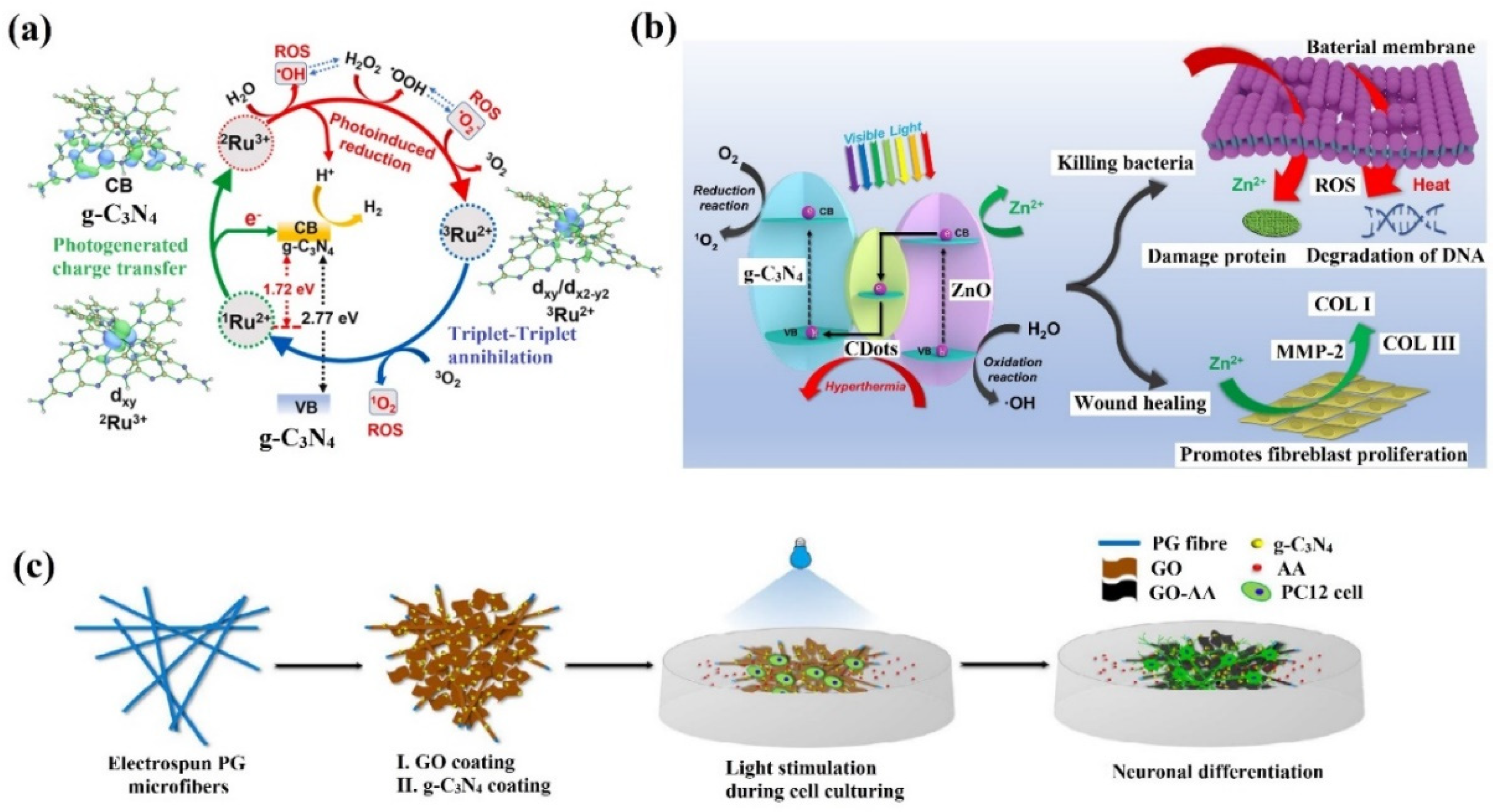
- Photodynamic therapy: The property of ROS generation under light illumination makes g-C3N4 a suitable candidate for destroying tumor cells by damaging the gene structure. Principally, the phenomena of photodynamic therapy involve the production of ROSs (O2●− and OH● radicals), which block the electron transport chain in mitochondria, resulting in a lack of supply of energy and nutrients to tumor cells, leading to cell death. The photosensitization effect of Ru coordinated to g-C3N4 has been exploited for the photodynamic therapy of hypoxic tumor cells as explained in the mechanism shown in Figure 5a. The invasion of hypoxic tumor cells by Ru+2-g-C3N4 occurs under visible light irradiation involving photoinduced reduction of the Ru+3 center to the Ru+2 center to generate multiple cytotoxic ROSs (OH●, O2●−, and 1O2), which causes mitochondrial dysfunction leading to apoptosis [63].
- Wound healing: The ROSs generated under light irradiation tend to inhibit the growth of bacteria and act as wound healers. The accelerated wound healing performance was evaluated for a Z-scheme ZnO/C-dots/g-C3N4 ternary heterojunction (Figure 5b), wherein C-dots serve as a bridge to reduce electron–hole pair recombination for the migration of electrons from the conduction band of ZnO to the valence band of g-C3N4. The subsequent production of OH● and 1O2 radicals resulted in 99.97% and 99.8% disinfection of Streptococcus aureus and Escherichia coli, respectively. The released Zn+2 intruded into the bacteria and exhibited a hyperthermia effect, triggering the growth of fibroblasts for a rapid wound healing process [64].
- Bioimaging: The quantum confinement and edge effects of g-C3N4 photocatalysts limit the electron mobility, contributing to fluorescence emissions. In addition, g-C3N4 emits wavelengths of blue and green light that can be optically tuned to enhance the fluorescence quantum efficiency for cell imaging to display a contrasting image. Zhang et al. performed neuronal differentiation of PC12 cells using the phenomena of non-invasive light stimulation. Under visible light irradiation (450 nm), the biocompatible interface of g-C3N4/graphene photocatalysts dispersed on polycaprolactone/gelatin fibers exhibited distinguished outgrowth of neurite while simultaneously improving the electron–hole pair charge carrier separation as demonstrated in Figure 5c [65].
6. Challenges and Sustainable Solutions
- Insufficient validation of the reaction mechanism: our understanding of the characterization techniques for validating the photocatalytic virus disinfection mechanism is insufficient to support: (i) the extent of ROS generation; (ii) the co-existing action of O2●− and OH● radicals in attacking the virus cell wall; (iii) the pathway selectivity during viral mutation; and (iv) the offensive response of the virus upon exposure to light irradiation. Another significant challenge involves the stronger resistance of certain viruses to UVC (200–280 nm), UVB (280–320 nm), and UVA (320–400 nm) light, which requires the development of visible-light-active or near-infrared-responsive photocatalysts [66]. It is thus necessary to precisely identify and characterize the role of participating ROSs to obtain a reasonable photocatalytic virus disinfection mechanism for the amendment of a practical photocatalysis process.
- Photostability, recyclability, and scalable production are the most crucial factors in the enhancement of the efficacy and robustness of g-C3N4-based photocatalysts that target virus eradication [67]. Considering the extended time during which viruses persist in the environment (air, water, and infected surfaces), the stability of g-C3N4 photocatalysts needs to be enhanced to overcome the economic barriers. The improvement of the current separation techniques for recovery of g-C3N4 photocatalysts from wastewater and photoreactors is recommended to solve the challenging issue of photocatalysts’ recyclability [68]. In accordance, magnetic isolation via the incorporation of nanosized suspended particles into the contaminated reaction mixture has been explored [69]. In terms of the large-scale production and applicability of g-C3N4 photocatalysts, cost-effective engineering strategies should be practiced, and photoreactor designs need to be optimized for extended solar energy utilization. Hence, the commercialization of metal-free g-C3N4 material is vital at the industrial scale for the future mass utilization of solar energy with a minimal environmental impact. The photoreactor design needs to be optimized for an increased light-capturing rate with the maximum use of renewable sunlight to achieve the sustainable disinfection of viruses. The most suitable photoreactor is the compound parabolic collector (CPC), which effectively utilizes diffuse and direct solar irradiation. Hence, the commercialization of photoreactors is vital at the industrial scale for the future mass utilization of solar energy with a minimal environmental impact [42].
- Conflicting band edge modulation achieves broad-spectrum solar energy absorption while maintaining a high redox potential with a reduced electron–hole pair recombination rate. The type II and Z-scheme charge transfer routes are two cutting-edge strategies for solving these predicaments [70,71]. Based on our critical assessment, it is not surprising that g-C3N4-based photocatalysts have benefitted a diverse range of photocatalytic fields. As a matter of course, it is expected that the above challenges will be resolved with advances in research. Even though various disinfection technologies have been developed to mitigate the spread of viruses, photocatalytic virus disinfection is a sustainable alternative that may lessen the environmental impact.
7. Conclusions
Author Contributions
Funding
Conflicts of Interest
References
- Perkins, K.M.; Munguia, N.; Ellenbecker, M.; Eraso, R.M.; Velazquez, L. COVID-19 pandemic lessons to facilitate future engagement in the global climate crisis. J. Clean. Prod. 2021, 290, 125178. [Google Scholar] [CrossRef] [Scilit]
- Covid, W. Coronavirus Pandemic. Available online: https://www.worldometers.info/coronavirus (accessed on 28 July 2021).
- Lewis, D. Is the coronavirus airborne? Experts can’t agree. Nature 2020, 580, 175. [Google Scholar] [CrossRef] [Scilit]
- Kumar, A.; Singh, P.; Raizada, P.; Hussain, C.M. Impact of COVID-19 on greenhouse gases emissions: A critical review. Sci. Total Environ. 2022, 860, 150349. [Google Scholar] [CrossRef] [Scilit] [PubMed]
- World Health Organization. WHO Coronavirus (COVID-19) Dashboard; World Health Organization: Geneva, Switzerland, 2021; Available online: https://covid19.who.int/ (accessed on 10 June 2021).
- Srivastava, A.K.; Dwivedi, N.; Dhand, C.; Khan, R.; Sathish, N.; Gupta, M.K.; Kumar, R.; Kumar, S. Potential of graphene-based materials to combat COVID-19: Properties, perspectives and prospects. J. Mater. Today Chem. 2020, 18, 100385. [Google Scholar] [CrossRef] [Scilit]
- Seifi, T.; Kamali, A.R. Antiviral performance of graphene-based materials with emphasis on COVID-19: A review. Int. J. Drug Discov. 2021, 11, 100099. [Google Scholar] [CrossRef] [Scilit]
- Innocenzi, P.; Stagi, L. Carbon-based antiviral nanomaterials: Graphene, C-dots, and fullerenes. A perspective. Chem. Sci. 2020, 11, 6606–6622. [Google Scholar] [CrossRef] [Scilit] [PubMed]
- Tseng, C.; Li, C. Inactivation of surface viruses by gaseous ozone. J. Environ. Health 2008, 70, 56–63. [Google Scholar]
- Hasija, V.; Nguyen, V.H.; Kumar, A.; Raizada, P.; Krishnan, V.K.; Khan, A.A.P.; Singh, P.; Lichtfouse, E.; Wang, C.; Huong, P.T. Advanced activation of persulfate by polymeric g-C3N4 based photocatalysts for environmental remediation: A review. J. Hazard. Mater. 2021, 413, 125324. [Google Scholar] [CrossRef] [Scilit] [PubMed]
- Nandan, A.; Siddiqui, N.A.; Singh, C.; Aeri, A.; Gwenzi, W.; Ighalo, J.O.; Nagliate, P.; Singh, P. COVID-19 pandemic in Uttarakhand, India: Environmental recovery or degradation? J. Environ. Chem. Eng. 2021, 9, 106595. [Google Scholar] [CrossRef] [Scilit]
- Mahmoudian, L.; Jashni, A.K.; Hosseini, S.N.; Paryan, M. Optimization of rDNA degradation in recombinant Hepatitis B vaccine production plant wastewater using visible light excited Ag-doped TiO2 nano-photocatalyst. Process Saf. Environ. Prot. 2019, 122, 328–338. [Google Scholar] [CrossRef] [Scilit]
- Zan, L.; Fa, W.; Peng, T.; Gong, Z.K. Photocatalysis effect of nanometer TiO2 and TiO2-coated ceramic plate on Hepatitis B virus. J. Photochem. Photobiol. 2007, 86, 165–169. [Google Scholar] [CrossRef] [Scilit] [PubMed]
- Guo, B.; Snow, S.D.; Starr, B.J.; Xagoraraki, I.; Tarabara, V.V. Photocatalytic inactivation of human adenovirus 40: Effect of dissolved organic matter and prefiltration. Sep. Purif. Technol. 2018, 193, 193–201. [Google Scholar] [CrossRef] [Scilit]
- Hajkova, P.; Spatenka, P.P.; Horsky, J.; Horska, I.; Kolouch, A. Photocatalytic effect of TiO2 films on viruses and bacteria. Plasma Process Polym. 2007, 4, S397–S401. [Google Scholar] [CrossRef] [Scilit]
- Cui, H.; Jiang, J.; Gu, W.; Sun, C.; Donglai, W.; Yang, T.; Yang, G. Photocatalytic Inactivation Efficiency of Anatase Nano-TiO2 Sol on the H9N2 Avian Influenza Virus. Photochem. Photobiol. 2010, 86, 1135–1139. [Google Scholar] [CrossRef] [Scilit]
- Nakano, R.; Ishiguro, H.; Yao, Y.; Kajioka, J.; Fujishima, A.; Sunada, K.; Minoshima, M.; Hashimoto, K.; Kubota, Y. Photocatalytic inactivation of influenza virus by titanium dioxide thin film. Photochem. Photobiol. Sci. 2012, 11, 1293–1298. [Google Scholar] [CrossRef] [Scilit]
- Park, D.; Shahbaz, H.M.; Kim, S.H.; Lee, M.; Lee, W.; Oh, J.W.; Lee, D.U.; Park, J. Inactivation efficiency and mechanism of UV-TiO2 photocatalysis against murine norovirus using a solidified agar matrix. Int. J. Food Microbiol. 2016, 238, 256–264. [Google Scholar] [CrossRef] [Scilit]
- Moon, W.E.; Hae, L.W.; Jeong, R.H.; Ji, H.H. Photocatalytic inactivation of viral particles of human norovirus by Cu-doped TiO2 non-woven fabric under UVA-LED wavelengths. Sci. Total Environ. 2020, 749, 141574. [Google Scholar] [CrossRef] [Scilit]
- Jeong, K.M.; Lee, J.E.; Seok, K.S.; Kim, K.H.; Seung, M.C.; Lee, G. Effects of Calcination Temperature on the Phase Composition, Photocatalytic Degradation, and Virucidal Activities of TiO2 Nanoparticles. ACS Omega 2021, 6, 10668–10678. [Google Scholar]
- Mahon, M.; Joanne, S.C.; Kelly, P.J.M.; Gill, L.W. Solar photocatalytic disinfection of E. coli and bacteriophages MS2, ΦX174 and PR772 using TiO2, ZnO and ruthenium-based complexes in a continuous flow system. J. Photochem. Photobiol. 2017, 170, 79–90. [Google Scholar] [CrossRef] [Scilit]
- Hu, X.; Hu, C.; Peng, T.; Zhou, X.; Qu, J. Plasmon-induced inactivation of enteric pathogenic microorganisms with Ag-AgI/Al2O3 under visible-light irradiation. Enviro. Sci. Technol. 2010, 44, 7058–7062. [Google Scholar] [CrossRef] [Scilit]
- Takehara, K.; Yamazaki, K.; Miyazaki, M.; Yamada, Y.; Ruenphet, S.; Jahangir, A.; Shoham, D.; Okamura, M.; Nakamura, M. Inactivation of avian influenza virus H1N1 by photocatalyst under visible light irradiation. Virus Res. 2010, 151, 102–103. [Google Scholar] [CrossRef] [Scilit]
- Käsermann, F.; Kempf, C. Photodynamic inactivation of enveloped viruses by buckminsterfullerene. Antivir. Res. 1997, 34, 65–70. [Google Scholar] [CrossRef] [Scilit]
- Moor, K.J.; Kim, J.H. Simple synthetic method toward solid supported C60 visible light-activated photocatalysts. Environ. Sci. Technol. 2014, 48, 2785–2791. [Google Scholar] [CrossRef] [Scilit] [PubMed]
- Moor, K.J.; Valle, D.C.; Li, C.; Kim, J.-H. Improving the visible light photoactivity of supported fullerene photocatalysts through the use of [C70] fullerene. Environ. Sci. Technol. 2015, 49, 6190–6197. [Google Scholar] [CrossRef] [Scilit]
- Zhang, C.; Li, Y.; Zhang, W.; Wang, P.; Wang, C. Metal-free virucidal effects induced by g-C3N4 under visible light irradiation: Statistical analysis and parameter optimization. Chemosphere 2018, 195, 551–558. [Google Scholar] [CrossRef] [Scilit] [PubMed]
- Li, Y.; Zhang, C.; Shuai, D.; Naraginti, S.; Wang, D.; Zhang, W. Visible-light-driven photocatalytic inactivation of MS2 by metal-free g-C3N4: Virucidal performance and mechanism. Water Res. 2016, 106, 249–258. [Google Scholar] [CrossRef] [Scilit]
- Cheng, R.; Liang, S.J.; Yu, J.H.; Shao, X. Photocatalytic inactivation of bacteriophage f2 with Ag3PO4/g-C3N4 composite under visible light irradiation: Performance and mechanism. Catalysts 2018, 8, 406. [Google Scholar] [CrossRef] [Scilit]
- Zhang, C.; Li, Y.; Danmeng, S.; Wenlong, Z.; Lihua, N.; Longfe, W.; Huanjun, Z. Visible-light-driven, water-surface-floating antimicrobials developed from graphitic carbon nitride and expanded perlite for water disinfection. Chemosphere 2018, 208, 84–92. [Google Scholar] [CrossRef] [Scilit]
- Zhang, C.; Mengyang, Z.; Yi, L.; Danmeng, S. Visible-light-driven photocatalytic disinfection of human adenovirus by a novel heterostructure of oxygen-doped graphitic carbon nitride and hydrothermal carbonation carbon. Appl. Catal. B Environ. 2019, 248, 11–21. [Google Scholar] [CrossRef] [Scilit]
- Kessler, F.K.; Zheng, Y.; Schwarz, D.; Merschjann, C.; Schnick, W.; Wang, X.; Bojdys, M.J. Functional carbon nitride materials—design strategies for electrochemical devices. Nat. Rev. Mater. 2017, 2, 17030. [Google Scholar] [CrossRef] [Scilit]
- Liu, J.; Wang, H.; Antonietti, H.M. Graphitic carbon nitride “reloaded”: Emerging applications beyond (photo) catalysis. Chem. Soc. Rev. 2016, 45, 2308–2326. [Google Scholar] [CrossRef] [Scilit] [PubMed]
- Hasija, V.; Raizada, P.; Sudhaik, A.; Singh, P.; Thakur, V.K.; Khan, A.A.P. Fabrication of Ag/AgI/WO3 heterojunction anchored P and S co-doped graphitic carbon nitride as a dual Z scheme photocatalyst for efficient dye degradation. J. Solid State Sci. 2020, 100, 106095. [Google Scholar] [CrossRef] [Scilit]
- Raizada, P.; Nguyen, V.H.; Patial, S.; Singh, P.; Bajpai, A.; Khan, A.A.P.; Rangabhashiyam, S. Toward practical solar-driven photocatalytic water splitting on two-dimensional MoS2 based solid-state Z-scheme and S-scheme heterostructure. Fuel 2021, 303, 121302. [Google Scholar] [CrossRef] [Scilit]
- Hasija, V.; Raizada, P.; Singh, P.; Verma, N.; Khan, A.A.P.; Singh, A.; Selvasembian, R. Progress on the photocatalytic reduction of hexavalent Cr (VI) using engineered graphitic carbon nitride. Process Saf. Environ. Prot. 2021, 152, 663–678. [Google Scholar] [CrossRef] [Scilit]
- Mallakpour, S.; Azadi, E.; Hussain, C.M. The latest strategies in the fight against the COVID-19 pandemic: The role of metal and metal oxide nanoparticles. New J. Chem. 2021, 45, 6167–6179. [Google Scholar] [CrossRef] [Scilit]
- Soni, V.; Raizada, P.; Kumar, A.; Hasija, V.; Singal, S.; Singh, P.; Bandegharaei, A.H.; Thakur, V.K.; Huy, V.H. Indium sulfide-based photocatalysts for hydrogen production and water cleaning: A review. Environ. Chem. Lett. 2021, 19, 1065–1095. [Google Scholar] [CrossRef] [Scilit]
- Mallakpour, S.; Elham, A.; Chaudhery, M.H. Fight against COVID-19 pandemic with the help of carbon-based nanomaterials. New J. Chem. 2021, 45, 8832–8846. [Google Scholar] [CrossRef] [Scilit]
- Sjogren, J.C.; Sierka, R.A. Inactivation of phage MS2 by iron-aided titanium dioxide photocatalysis. Appl. Environ. Microbiol. 1994, 60, 344–347. [Google Scholar] [CrossRef] [Scilit]
- Upadhyay, R.K.; Soin, N.; Roy, S.S. Role of graphene/metal oxide composites as photocatalysts, adsorbents and disinfectants in water treatment: A review. RSC Adv. 2014, 4, 3823–3851. [Google Scholar] [CrossRef] [Scilit]
- Cho, M.; Lee, J.; Mackeyev, Y.; Wilson, L.J.; Alvarez, P.J.; Hughes, J.B.; Kim, J.-H. Visible light sensitized inactivation of MS-2 bacteriophage by a cationic amine-functionalized C60 derivative. Environ. Sci. Technol. 2010, 44, 6685–6691. [Google Scholar] [CrossRef] [Scilit]
- Zhang, C.; Li, Y.; Shuai, D.; Shen, Y.; Wang, D. Progress and challenges in photocatalytic disinfection of waterborne viruses: A review to fill current knowledge gaps. Chem. Eng. J. 2019, 355, 399–415. [Google Scholar] [CrossRef] [Scilit]
- Raizada, P.; Hasija, V.; Singh, P.; Thakur, V.K. Carbon Nitride/Metal Oxide Hybrids for Visible Light Harvesting and Water Remediation. In Water Pollution and Remediation: Photocatalysis; Environmental Chemistry for a Sustainable World, Springer: Berlin, Germany, 2021; Volume 57, pp. 53–79. [Google Scholar]
- Hasija, V.; Raizada, P.; Thakur, V.K.; Khan, A.A.P.; Asiri, A.M.; Singh, P. An overview of strategies for enhancement in photocatalytic oxidative ability of MoS2 for water purification. J. Environ. Chem. Eng. 2020, 8, 104307. [Google Scholar] [CrossRef] [Scilit]
- Nasir, A.M.; Awang, N.; Hubadillah, S.K.; Jaafar, J.; Othman, M.H.D.; Salleh, W.N.W.; Ismail, A.F. A review on the potential of photocatalysis in combatting SARS-CoV-2 in wastewater. J. Water Process Eng. 2021, 42, 102111. [Google Scholar] [CrossRef] [Scilit]
- Wigginton, K.R.; Tamar, K. Virus disinfection mechanisms: The role of virus composition, structure, and function. Curr. Opin. Virol. 2012, 2, 84–89. [Google Scholar] [CrossRef] [Scilit] [PubMed]
- Costa, L.; Faustino, M.A.F.; Neves, M.G.P.; Cunha, Â.; Almeida, A. Photodynamic inactivation of mammalian viruses and bacteriophages. Viruses 2012, 4, 1034–1074. [Google Scholar] [CrossRef] [Scilit]
- Korneev, D.; Kurskaya, O.; Sharshov, K.; Eastwood, J.; Strakhovskaya, M. Ultrastructural aspects of photodynamic inactivation of highly pathogenic avian H5N8 influenza virus. Viruses 2019, 11, 955. [Google Scholar] [CrossRef] [Scilit] [PubMed]
- Kumar, A.; Raizada, P.; Bandegharaei, A.H.; Thakur, V.K.; Nguyen, V.H.; Singh, P. C-, N-Vacancy defect engineered polymeric carbon nitride towards photocatalysis: Viewpoints and challenges. J. Mater. Chem. A 2021, 9, 111–153. [Google Scholar] [CrossRef] [Scilit]
- Raizada, P.; Kumar, A.; Singh, P. Graphitic carbon nitride-based new advanced materials for photocatalytic applications. J. Curr. Anal. Chem. 2020, 16, 1-00. [Google Scholar] [CrossRef] [Scilit]
- Zhang, C.; Li, Y.; Shuai, D.; Shen, Y.; Xiong, W.; Wang, L. Graphitic carbon nitride (g-C3N4)-based photocatalysts for water disinfection and microbial control: A review. Chemosphere 2019, 214, 462–479. [Google Scholar] [CrossRef] [Scilit]
- Xu, J.; Wang, Z.; Zhu, Y. Enhanced visible-light-driven photocatalytic disinfection performance and organic pollutant degradation activity of porous g-C3N4 nanosheets. Appl. Mater. Interfaces 2017, 9, 27727–27735. [Google Scholar] [CrossRef] [Scilit]
- Hasija, V.; Patial, S.; Raizada, P.; Khan, A.A.P.; Asiri, A.M.; Nguyen, Q.V.L.V.H.; Singh, P. Covalent organic frameworks promoted single metal atom catalysis: Strategies and applications. Coord. Chem. Rev. 2022, 452, 214298. [Google Scholar] [CrossRef] [Scilit]
- Murugesan, P.; Moses, J.; Anandharamakrishnan, C. Photocatalytic disinfection efficiency of 2D structure graphitic carbon nitride-based nanocomposites: A review. J. Mater. Sci. 2019, 54, 12206–12235. [Google Scholar] [CrossRef] [Scilit]
- Kumar, A.; Hasija, V.; Sudhaik, A.; Raizada, P.; Quyet, V.L.; Singh, P.; Pham, T.H.; Young, T.Y.; Ghotekar, S.; Nguyen, V.H. Artificial leaf for light-driven CO2 reduction: Basic concepts, advanced structures and selective solar-to-chemical products. Chem. Eng. J. 2021, 430, 133031. [Google Scholar] [CrossRef] [Scilit]
- Hasija, V.; Kumar, A.; Sudhaik, A.; Raizada, P.; Singh, P.; Quyet, V.L.; Le, T.T.; Nguyen, V.H. Step-scheme heterojunction photocatalysts for solar energy, water splitting, CO2 conversion, and bacterial inactivation: A review. Environ. Chem. Lett. 2021, 19, 2941–2966. [Google Scholar] [CrossRef] [Scilit]
- Raizada, P.; Kumar, A.; Hasija, V.; Singh, P.; Thakur, V.K.; Khan, A.A.P. An overview of converting reductive photocatalyst into all solid-state and direct Z-scheme system for water splitting and CO2 reduction. J. Ind. Eng. Chem. 2021, 93, 1–27. [Google Scholar] [CrossRef] [Scilit]
- Khan, A.A.P.; Singh, P.; Raizada, P.; Asiri, A.M. Converting Ag3PO4/CdS/Fe doped C3N4 based dual Z-scheme photocatalyst into photo-Fenton system for efficient photocatalytic phenol removal. J. Ind. Eng. Chem. 2021, 98, 148–160. [Google Scholar] [CrossRef] [Scilit]
- Chan, M.H.; Liu, R.S.; Hsiao, M. Graphitic carbon nitride-based nanocomposites and their biological applications: A review. Nanoscale 2019, 11, 14993–15003. [Google Scholar] [CrossRef] [Scilit] [PubMed]
- Zhou, Z.; Zhang, Y.; Shen, Y.; Liu, S.; Zhang, Y. Molecular engineering of polymeric carbon nitride: Advancing applications from photocatalysis to biosensing and more. Chem. Soc. Rev. 2018, 47, 2298–2321. [Google Scholar] [CrossRef] [Scilit]
- Bing, W.; Chen, Z.; Sun, H.; Shi, P.; Gao, N.; Ren, J.; Qu, X. Visible-light-driven enhanced antibacterial and biofilm elimination activity of graphitic carbon nitride by embedded Ag nanoparticles. Nano Res. 2015, 8, 1648–1658. [Google Scholar] [CrossRef] [Scilit]
- Shen, H.; Durkin, D.P.; Aiello, A.; Diba, T.; Lafleur, J.; Zara, J.M.; Shen, Y.; Shuai, D. Photocatalytic graphitic carbon nitride-chitosan composites for pathogenic biofilm control under visible light irradiation. J. Hazard. Mater. 2021, 408, 124890. [Google Scholar] [CrossRef] [Scilit]
- Wei, F.; Kuang, S.; Rees, T.W.; Liao, X.; Liu, J.; Luo, D.; Wang, J.; Zhang, X.; Ji, L.; Chao, H. Ruthenium (II) complexes coordinated to graphitic carbon nitride: Oxygen self-sufficient photosensitizers which produce multiple ROS for photodynamic therapy in hypoxia. Biomaterials 2021, 276, 121064. [Google Scholar] [CrossRef] [Scilit]
- Xiang, Y.; Zhou, Q.; Li, Z.; Cui, Z.; Liu, X.; Liang, Y.; Zhu, S.; Zheng, Y.; Yeung, K.W.; Wu, S. A Z-scheme heterojunction of ZnO/CDots/C3N4 for strengthened photoresponsive bacteria-killing and acceleration of wound healing. J. Mater. Sci. 2020, 57, 1–11. [Google Scholar] [CrossRef] [Scilit]
- Zhang, Z.; Xu, R.; Wang, Z.; Dong, M.; Cui, B.; Chen, M. Visible-light neural stimulation on graphitic-carbon nitride/graphene photocatalytic fibers. Appl. Mater. Interfaces 2017, 9, 34736–34743. [Google Scholar] [CrossRef] [Scilit]
- Wang, W.; Zhou, C.; Yang, Y.; Zeng, G.; Zhang, C.; Zhou, Y.; Yang, J.; Huang, D.; Wang, H.; Xiong, W. Carbon nitride based photocatalysts for solar photocatalytic disinfection, can we go further? J. Chem. Eng. J. 2021, 404, 126540. [Google Scholar] [CrossRef] [Scilit]
- Wang, L.; Wang, K.; He, T.; Zhao, Y.; Song, H.; Wang, H. Graphitic Carbon Nitride-Based Photocatalytic Materials: Preparation Strategy and Application. Sustain. Chem. Eng. 2020, 8, 16048–16085. [Google Scholar] [CrossRef] [Scilit]
- Jia, C.; Yang, L.; Zhang, Y.; Zhang, X.; Xiao, K.; Xu, J.; Liu, J. Graphitic carbon nitride films: Emerging paradigm for versatile applications. Appl. Mater. Interfaces 2020, 12, 53571–53591. [Google Scholar] [CrossRef] [Scilit] [PubMed]
- Sudhaik, A.; Raizada, P.; Shandilya, P.; Singh, P. Magnetically recoverable graphitic carbon nitride and NiFe2O4 based magnetic photocatalyst for degradation of oxytetracycline antibiotic in simulated wastewater under solar light. J. Environ. Chem. Eng. 2018, 6, 3874–3883. [Google Scholar] [CrossRef] [Scilit]
- He, D.; Zhang, Z.; Xing, Y.; Zhou, Y.; Yang, H.; Liu, H.; Qu, J.; Yuan, X.; Guan, J.; Zhang, Y. Black phosphorus/graphitic carbon nitride: A metal-free photocatalyst for “green” photocatalytic bacterial inactivation under visible light. Chem. Eng. J. 2020, 384, 123258. [Google Scholar] [CrossRef] [Scilit]

| Photocatalyst | Virus | Light Source | Wavelength | Virus Level | Major Reactive Species | Inactivation Efficiency/Time | Ref. |
|---|---|---|---|---|---|---|---|
| Ag doped TiO2 | Hepatitis B | UV cut-off filter | 420 nm | 1g/L | OH●, O2●− | 81.7 %/12 h | [12] |
| TiO2 coated ceramic | Hepatitis B | Hg lamp (125 W) | 365 nm | - | OH●, HOO● | 97 % /240 min | [13] |
| TiO2 | Human adenovirus 40 | UV lamp | 254 nm | 1 × 10⁸ PFU/mL | OH● | 0.49 log/14.3 min | [14] |
| TiO2 | Herpes simplex virus | UV-A lamp (Philips TLD 15 W/05) | 365 nm | 109–1010 PFU/mL | OH●, O2●− | 100 %/360 min | [15] |
| TiO2 | Influenza virus H9N2 | UV (Black light 20W) | 365 nm | 1 × 10⁴ PFU/mL | OH● | 4-log/150 min | [16] |
| TiO2 | Influenza virus H1N1 | UV-A light (Tubular 20 W black light fluorescent lamps) | 352 nm | 1 × 10⁸ PFU/mL | OH●, O2●− | 5.2-log/480 min | [17] |
| TiO2 | Murine Norovirus | UV lamp (8 W) | 385 nm | 7.8 PFU/mL | OH● | 4 log/10 min | [18] |
| Cu-doped TiO2 | Norovirus | UVA-LED | 373 nm | 2.89 ± 0.11 log10 | OH●, O2●− | 5 log/60 min | [19] |
| TiO2 | Bacteriophage MS2, Murine Norovirus, Influenza | UV light Blacklight Blue lamps (BLB,4 W, Philips Co. | 360 nm | 1 × 10⁶ PFU/mL | OH● | 1.5 × 10⁻⁵ mg/L/36 min, 1.4 × 10⁻⁵ mg/L /32 min, 1.7 ×10⁻⁵ mg/L/40 min | [20] |
| ZnO | Bacteriophage MS2, ΦX174, PR772 | UV-B | 295 nm | 1 × 10⁵ PFU/mL | OH● | 0.37, 0.67, 0.59 L/kJ /360 min | [21] |
| Ag-AgI/Al2O3 | Human rotavirus type-II Wa | 350-W Xe-arc lamp | 450 nm | 3.2 × 10³ PFU/mL | O2●−, h+ | 3.2 log/40 min | [22] |
| Pt/WO3 films | Influenza virus H1N1 | Fluorescentlamps (FL20SS W/18) 1000 lx | 470 nm | 1 × 10⁷ PFU/mL | OH● | >5.5 log/120 min | [23] |
| C60 | Rhabdoviridae | Hg lamp (350 W) | 495 nm | 10 log TCID 50/mL | 1O2 | 7 log10 /360 min | [24] |
| C60/SiO2 | Bacteriophage MS2 | Fluorescent bulbs | 470 nm | 5 × 10⁴ PFU/mL | 1O2 | 3.55 log/75 min | [25] |
| C70/SiO2 | Bacteriophage MS2 | Visible, Sunlight | 420 nm | 3 × 10⁸ PFU/mL | 1O2 | 4.35 log; 4.4 log/90 min | [26] |
| g-C3N4 | Bacteriophage MS2 | Xenon lamp | 400 nm | 1 × 10⁸ PFU/mL | O2●− | 6.58 log/180 min | [27] |
| g-C3N4 | Bacteriophage MS2 | 300 W Xenon lamp | 450 nm | 1 × 10⁸ PFU/mL | O2●− | 8 log/360 min | [28] |
| Ag3PO4/g-C3N4 | Bacteriophage f2 | UVA lamp (8W) | 500 nm | 3 × 10⁷ PFU/mL | h+ | 6.5 log/80 min | [29] |
| g-C3N4/Expanded perlite | Bacteriophage MS2 | Xenon lamp (300 W) | 300 nm | 1 × 10⁸ PFU/mL | OH●, O2●− | 8 log/240 min | [30] |
| O-doped g-C3N4 | Human adenovirus | 7 W LED lamp | 450 nm | - | OH●, O2●−, H2O2 | 5 log/120 min | [31] |
Publisher’s Note: MDPI stays neutral with regard to jurisdictional claims in published maps and institutional affiliations. |
© 2021 by the authors. Licensee MDPI, Basel, Switzerland. This article is an open access article distributed under the terms and conditions of the Creative Commons Attribution (CC BY) license (https://creativecommons.org/licenses/by/4.0/).
Share and Cite
Hasija, V.; Patial, S.; Singh, P.; Nguyen, V.-H.; Le, Q.V.; Thakur, V.K.; Hussain, C.M.; Selvasembian, R.; Huang, C.-W.; Thakur, S.; et al. Photocatalytic Inactivation of Viruses Using Graphitic Carbon Nitride-Based Photocatalysts: Virucidal Performance and Mechanism. Catalysts 2021, 11, 1448. https://doi.org/10.3390/catal11121448
Hasija V, Patial S, Singh P, Nguyen V-H, Le QV, Thakur VK, Hussain CM, Selvasembian R, Huang C-W, Thakur S, et al. Photocatalytic Inactivation of Viruses Using Graphitic Carbon Nitride-Based Photocatalysts: Virucidal Performance and Mechanism. Catalysts. 2021; 11(12):1448. https://doi.org/10.3390/catal11121448
Chicago/Turabian StyleHasija, Vasudha, Shilpa Patial, Pardeep Singh, Van-Huy Nguyen, Quyet Van Le, Vijay Kumar Thakur, Chaudhery Mustansar Hussain, Rangabhashiyam Selvasembian, Chao-Wei Huang, Sourbh Thakur, and et al. 2021. "Photocatalytic Inactivation of Viruses Using Graphitic Carbon Nitride-Based Photocatalysts: Virucidal Performance and Mechanism" Catalysts 11, no. 12: 1448. https://doi.org/10.3390/catal11121448
APA StyleHasija, V., Patial, S., Singh, P., Nguyen, V.-H., Le, Q. V., Thakur, V. K., Hussain, C. M., Selvasembian, R., Huang, C.-W., Thakur, S., & Raizada, P. (2021). Photocatalytic Inactivation of Viruses Using Graphitic Carbon Nitride-Based Photocatalysts: Virucidal Performance and Mechanism. Catalysts, 11(12), 1448. https://doi.org/10.3390/catal11121448

