1. Introduction
Two cryptographic transitions are now underway at once, and they are on a collision course. The first is the migration to post-quantum cryptography (PQC): with the first NIST standards finalized in 2024 (FIPS 203/ML-KEM for key establishment and FIPS 204/ML-DSA and FIPS 205/SLH-DSA for signatures [
1,
2,
3]), the United States has set civilian deadlines, deprecating quantum-vulnerable algorithms by 2030 and disallowing them by 2035 for non-national-security systems (the dates proposed in the Initial Public Draft of NIST IR 8547 [
4]), against a federal civilian migration whose cost OMB and ONCD have estimated—as an initial rough-order-of-magnitude projection, not a settled program budget—at roughly
$7.1 billion [
5]. The second is the rapid operational adoption of agentic AI: in a 2026 survey, 85% of organizations reported running AI agents in production [
6]. These transitions are being planned independently: PQC migration as an estate-modernization exercise, agentic AI as a productivity and security-governance problem. Yet they intersect directly, because every networked agent is a dense consumer of exactly the public-key cryptography that PQC migration must replace. And because an adversary can record protected material today and break it once a cryptographically relevant quantum computer (CRQC) exists [
7], the migration clock for agentic systems has already started.
Agentic AI systems depend on classical public-key cryptography across their entire operating loop: for agent identity, inter-agent coordination, tool invocation, model integrity, and persistent state. A CRQC threatens these foundations along two distinct axes that this paper keeps separate throughout. The confidentiality axis is harvest-now-decrypt-later (HNDL): ciphertext and recorded sessions collected today become readable once key agreement is broken. The integrity axis is harvest-now-forge-later (HNFL): signatures, certificates, and issuer-signed tokens become forgeable once the underlying signing keys can be recovered. For systems whose identity and authority are established almost entirely through signatures and issued tokens, the forge-later axis is the more consequential, and it is the one the existing literature most neglects.
Neither body of guidance that should cover this case actually does. The post-quantum migration literature (government readiness reporting, NIST practice guidance, and the canonical organizational treatments [
8]) assumes a largely static, data-at-rest, operator-controlled estate, and does not treat non-human-identity-dense, runtime-negotiated systems as a distinct class. The emerging agent-identity work, including the NIST NCCoE concept paper on software and AI-agent identity [
9], adapts conventional identity and access management to agents but omits post-quantum cryptography entirely. To our knowledge, no prior work treats agentic AI as a post-quantum migration class in its own right; the existing efforts sharpen the gap rather than close it (
Section 2.3).
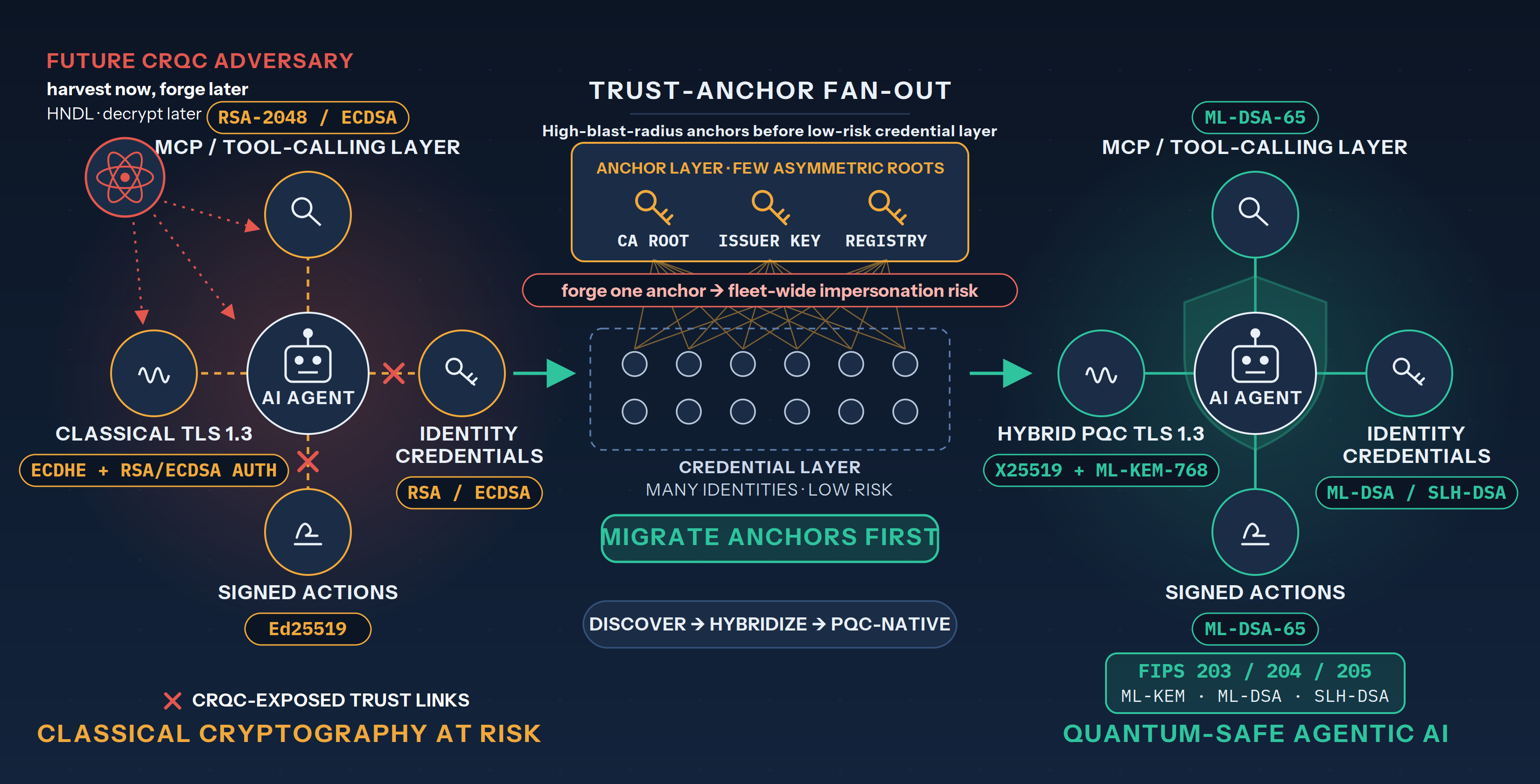
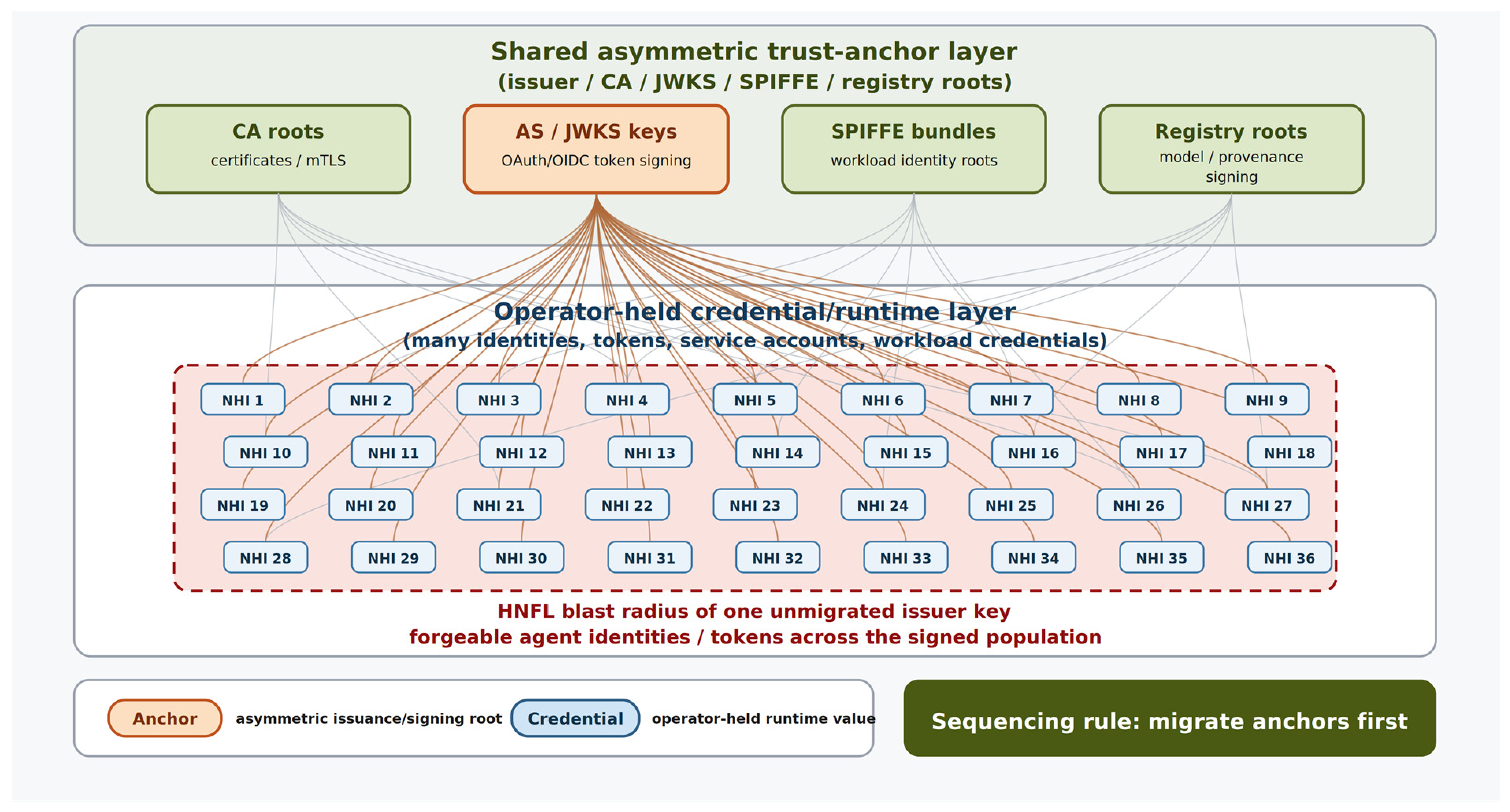
This paper argues that agentic AI changes post-quantum migration in kind, not only in degree. Classical enterprise migration is dominated by static, operator-controlled, data-at-rest cryptography; agentic migration is runtime-negotiated, dependency-coupled, and driven by a non-human identity (NHI) population that vastly outnumbers human users. The sharper structural claim is that the migration burden is layered. Each agent identity decomposes into a credential layer (what the agent holds, largely symmetric and cheap to re-issue) and a trust-anchor layer (the asymmetric issuance, signing, and transport roots that underwrite the whole fleet). These layers scale inversely: a handful of trust anchors carries a forge-later blast radius equal to the entire population beneath it, so the components smallest in number are largest in risk, and they are disproportionately owned by vendors and identity providers rather than the operator. The magnitude of the resulting expansion in migration surface is something this paper models rather than asserts (
Section 8).
This paper makes six contributions; the first, third, and sixth are, to our knowledge, novel, and the other three operationalize and ground them:
A layered migration framework that decomposes each agent identity into an operator-held credential layer and a shared trust-anchor layer and organizes agentic cryptography into seven surfaces, isolating the trust-anchor fan-out (a few asymmetric roots underwriting the entire fleet) as the dominant concentration of forge-later risk;
A discriminating migration matrix mapping each surface to its primitive class, dominant threat axis (HNDL versus HNFL), exposure layer, cryptographic timing, dependency ownership, and migration difficulty;
A parametric effort-and-risk model that separates credential-layer and anchor-layer terms with opposite cost and risk curves, yielding the paper’s central result: migration effort and forge-later risk rank the work in opposite orders, so the smallest, highest-leverage set of trust anchors should migrate first;
A grounded analysis of classical-cryptographic technical debt and a worked HNFL threat scenario in named, current systems (the Model Context Protocol (MCP), agent-to-agent protocols, and model registries);
Oversight and procurement implications for federal post-quantum readiness, addressed to GAO, NIST, and CISA;
A reframing of migration into two populations (remediating the installed base versus preventing new classical-cryptographic debt in future deployments) that recasts it as a continuously regenerating problem rather than a finite inventory.
Approach. This is a conceptual, analytical paper: it develops and argues a framework rather than reporting an empirical study, and the choice is deliberate. Agentic AI in production is recent, post-quantum migration of any system has barely begun, and no organization has completed a post-quantum migration of an agentic estate, so there is no population of completed migrations to sample, and an empirical design would have nothing to measure. What a field needs at this stage is a way to structure the problem, identify what must be inventoried and sequenced, and generate testable claims; that is what a conceptual framework provides, and what this paper offers in place of measurement it cannot yet take.
Derivation of the surfaces. The seven cryptographic surfaces were derived analytically by tracing the agent operating loop (
Section 2.1) and asking, at each stage, which cryptographic operation the stage depends on and which primitive secures it. Identity issuance, tool invocation, inter-agent messaging, model loading, memory and state, orchestration, and logging and provenance each rest on a distinct cryptographic dependency; grouping by dependency, rather than by component or vendor, yields the seven. The taxonomy is proposed as discriminating and useful, not exhaustive or uniquely correct (
Section 13); its test is whether it separates surfaces that migrate differently, which the migration matrix (
Section 6) makes explicit.
Evidence. Three kinds of evidence ground the analysis, each used within its limits. Normative and technical sources—the FIPS standards [
1,
2,
3], NIST and GAO guidance [
10,
11,
12], and the protocol specifications the surfaces actually use (OAuth, the Model Context Protocol authorization specification, and the relevant RFCs)—establish what the cryptography is and what it must become. Peer-reviewed and preprint literature [
7,
8,
13] positions the work and supplies the shelf-life and migration models it builds on. Industry telemetry and the CSA practitioner survey [
6,
14,
15,
16,
17] supply the scale premise; because these are not peer-reviewed and use inconsistent methods, they are treated as a caveated spread rather than measurements (
Section 2.4 and
Section 13). The parametric model (
Section 8) is illustrative by construction: its structure is the claim, its coefficients are placeholders, and only the orderings it produces are asserted.
The remainder of the paper is organized as follows.
Section 2 reviews agentic architectures, post-quantum cryptography, the related literature, and the NHI density that motivates the analysis.
Section 3 defines the seven cryptographic surfaces, and
Section 4 grounds them in the classical cryptography of current systems and their technical debt.
Section 5 develops why migration is harder in kind for agentic systems, and
Section 6 presents the migration matrix.
Section 7 gives a phased roadmap, and
Section 8 develops the parametric effort-and-risk model, its worked example, and the timeline implications.
Section 9 presents the threat model and the worked forge-later scenario,
Section 10 distinguishes remediation of the installed base from prevention in new deployments,
Section 11 draws out oversight and procurement implications,
Section 12 sets out open research questions,
Section 13 states the limitations, and
Section 14 concludes.
3. Cryptographic Surfaces in Agentic AI
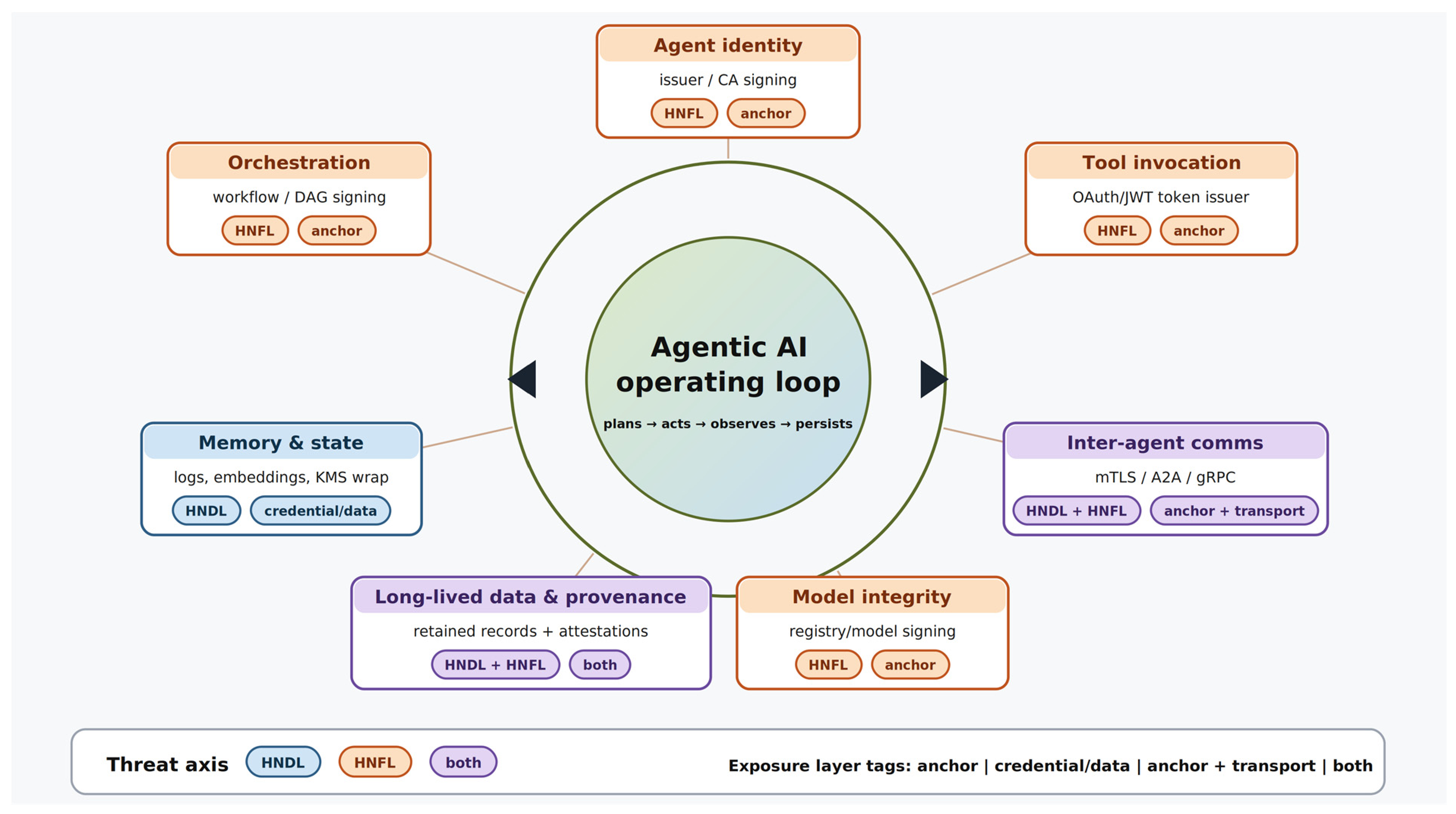
Agentic AI introduces no new cryptographic primitives; it redistributes existing ones across a wider and more runtime-exposed set of surfaces. This section defines seven such surfaces (
Figure 2) and, for each, identifies the primitive at risk, the dominant threat axis—HNDL (confidentiality) versus HNFL (integrity)—and whether the exposure sits in the operator-held credential layer or the shared trust-anchor layer (
Section 2.4). The surfaces are not disjoint: model integrity, orchestration, and provenance all rest on signing and overlap at the edges; where they couple, the coupling is named rather than hidden. Together, they form the migration scope that
Section 6 tabulates and
Section 8 quantifies. The contribution is therefore organizational and analytical rather than a new primitive: proposing a new identity or signature protocol is out of scope, and the novelty claimed is the treatment of agentic systems as a distinct post-quantum migration class, with the analysis built on the OAuth and SPIFFE architectures that are actually deployed. The stage-by-stage derivation is given in
Table 1.
Agent identity. Every agent that authenticates to anything must hold an identity credential that was issued to it and is validated on use. In current practice, these are SPIFFE/SPIRE SVIDs, cloud workload identities (managed identities, IAM roles, service-account keys), or OAuth client credentials, with attestation binding the credential to a workload or node. The credential the agent presents is often short-lived and symmetric-or-hash-based, but it is issued and validated against an asymmetric signing key—an identity-provider or certificate-authority root—and that anchor is the quantum-vulnerable component. The dominant axis is therefore HNFL: a CRQC that recovers an issuer signing key forges identities for the entire fleet beneath it, not merely one agent. Because the anchor is typically shared with and operated by an identity provider (IdP) or cloud provider, this surface is both high-blast-radius and externally timed (
Section 5.2)—the reason the matrix rates it anchor-layer, HNFL, runtime, and high-difficulty.
Inter-agent communication. When agents negotiate and exchange messages directly—over service-mesh mTLS, gRPC, or emerging agent-to-agent protocols—they establish session keys and authenticate peers at runtime. Key agreement today is ephemeral Diffie–Hellman and peer authentication is an RSA or ECDSA certificate, so this surface carries both axes at once: recorded sessions are HNDL-exposed (decryptable once the key agreement is broken) and the certificate/CA path is HNFL-exposed (forgeable peer identities). It is distinguished from tool invocation by symmetry—both endpoints are agents negotiating as equals rather than a client presenting a token to a service—and it is the least standardized surface: the core Model Context Protocol is silent on server-to-server authentication, and the Agent2Agent (A2A) effort that fills the gap is still maturing (
Section 4.1). A surface with no stable standard cannot be migrated to a post-quantum target that does not yet exist, which is why the matrix marks it as under-standardized as well as high-difficulty.
Tool invocation. This is the surface where an agent exercises delegated authority—calling an API, a database, or an SaaS platform—and it is dominated by the OAuth 2.1/OpenID Connect token flow on which the Model Context Protocol authorization model rests (
Section 4.1). The agent presents a bearer- or sender-constrained token; in the common issuer-signed JWT pattern, the resource server validates it against the authorization server’s signing key, and in the opaque-token alternative it introspects the token at the authorization server—either way, the trust roots in the same vendor-held anchor. As with agent identity, the token may be short-lived but the issuer key that underwrites every token is a long-lived asymmetric anchor, making the axis HNFL and the exposure anchor-layer. What sets this surface apart is ownership: the authorization server and the SaaS resource servers are vendor-operated, so the operator can inventory the dependency but cannot set its migration timeline—the matrix records it as vendor-owned, and
Section 5.2 treats that externality as the binding constraint.
Model integrity. Model weights, checkpoints, and artifacts are signed with classical elliptic-curve schemes—key-based signing (e.g., Ed25519) or sigstore-style keyless signing, in which a Fulcio-issued short-lived certificate binds an OIDC identity to an ephemeral key (commonly ECDSA P-256), with transparency-log inclusion; the algorithm varies by ecosystem and tooling, so that a consumer can verify a model came from its claimed publisher and was not tampered with. Whatever the variant, the signature chain is the quantum-vulnerable element and the axis is HNFL: an adversary able to forge the registry signing key—or, in keyless flows, the certificate-authority root and identity-provider keys that underwrite the certificates—post-CRQC can substitute a poisoned model that still verifies. This surface differs from the runtime surfaces in timing—signing happens once, at publish time—but verification must keep succeeding for as long as the model is deployed, which can be years, so the signature’s effective exposure window is the deployment lifetime, not the signing instant. Because a registry signing root underwrites every artifact it serves, this too is an anchor-layer surface, though its static timing and partially operator-controlled registry make it medium rather than high difficulty.
Memory and state. Agents persist state—vector databases and embeddings for retrieval, conversation and tool-call logs, and cached intermediate results—and that data is encrypted at rest, typically with symmetric AES-GCM under keys wrapped by a cloud KMS (envelope encryption). This is the paper’s clearest HNDL surface and its clearest credential-layer surface: the at-rest data is confidentiality-exposed, the key-wrapping step uses asymmetric or KEM mechanisms that a CRQC threatens, and the exposure is operator-controlled rather than vendor-gated. Its severity is governed by secrecy lifetime—embeddings derived from sensitive corpora and retained logs can carry multi-year confidentiality requirements, so ciphertext harvested today remains valuable when a CRQC arrives. The matrix rates it HNDL, credential/data-layer, static, self-owned, and medium difficulty precisely because the operator both holds the risk and controls the fix.
Orchestration. Multi-step agent workflows are increasingly expressed as execution graphs—DAGs of tool calls, sub-agent invocations, and conditional branches—and the integrity of that control flow can be signed so that a step cannot be injected, reordered, or replayed. This is distinct from provenance: orchestration integrity attests to what the system is authorized to execute now (control-flow authenticity), whereas provenance attests to what happened in the past (historical record). The signing key over workflow definitions is the asymmetric anchor and the axis is HNFL—forged workflow signatures let an adversary inject execution steps—while the signed-and-stored graph also has a static, at-rest aspect, giving the surface a runtime-plus-static timing. It is largely self- or platform-owned, placing its difficulty between the operator-controlled credential surfaces and the vendor-gated identity and tool surfaces.
Long-lived data and provenance. Audit trails, provenance attestations (in-toto/SLSA-style), and retained compliance artifacts carry the longest exposure windows in the system, and they carry both axes at once. As confidentiality-bearing retained data they are HNDL-exposed; as signed attestations that must remain verifiable across a retention lifetime of potentially decades, they are HNFL-exposed, and a forged historical attestation is uniquely corrosive because it rewrites the record used to investigate every other failure. This surface spans both exposure layers—the provenance signing anchor and the data itself—and is where the gap between when material is created and when it must still be trusted is widest, which is why the matrix marks its window the longest and its difficulty high despite static timing.
Scope and overlap. These seven surfaces expand migration scope relative to classical enterprise systems for two structural reasons the rest of the paper develops: several operate at runtime rather than over data at rest (
Section 5.1), and several root in trust anchors that vendors or identity providers—not the operator—control (
Section 5.2). They also overlap by design: agent identity, tool invocation, model integrity, orchestration, and provenance are all signature surfaces underwritten by a small number of asymmetric anchors, which is exactly why the trust-anchor fan-out of
Section 2.4 dominates the analysis.
Section 6 tabulates the seven against primitive, threat axis, exposure layer, timing, ownership, and difficulty;
Section 8 models the magnitude.
8. Cost, Complexity, and Timeline Model
This section presents a parametric structure for estimating agentic migration effort and forge-later risk relative to a classical baseline; the scenarios are illustrative and the coefficients are pending calibration, and no specific magnitude or year-count is asserted as a finding. Its contribution is the factor decomposition—especially the separation of credential-layer and anchor-layer terms with opposite cost and risk curves—and the sequencing rule that follows from it.
8.1. Parametric Effort Model
Express agentic migration effort relative to a classical enterprise baseline as a product of named amplification factors—splitting the former identity factor into a credential term and a trust-anchor term—with an explicit cross term that couples anchor blast radius to dependency externality:
with all factors ≥ 1, each reducing to 1 in the classical limit:
fcred—Credential/runtime population term: Scales with the NHI population (the vendor range of
Section 2.4 as an upper-bound proxy, expressed as a range). Captures distribution, rotation, and re-issuance of agent-held credentials. Because this layer is largely symmetric/hash-based, its PQC weight derives mainly from re-binding credentials to post-quantum issuance and transport, not from the credential value itself: per-unit burden is low but volume is high, so this term grows roughly linearly with identity count.
fanchor—Trust-anchor term: Scales with the number and reuse breadth of asymmetric trust anchors (CA roots, authorization-server signing keys, JWKS keys, SPIFFE trust bundles). Effort is sub-linear in identity count (few keys), but each anchor carries an HNFL blast radius equal to the population it underwrites, and these anchors are disproportionately vendor- or IdP-owned (couples to fdepend). This term, not fcred, concentrates catastrophic forge-later risk.
Opposite curves: fcred and fanchor move oppositely with respect to identity count—credential-layer effort rises with the fleet while anchor-layer effort stays small but its risk weight rises with the fleet. The model must not collapse them: a fleet can be cheap to re-credential yet catastrophically exposed through a handful of unmigrated anchors.
fchurn—Key/identity ephemerality (re-issuance and attestation load). fsurface—Count and coverage of the seven surfaces in scope. fdepend—Dependency depth and externality (fraction of surfaces, especially anchors, whose timeline is vendor-/peer-controlled). fruntime—Fraction of cryptographic operations that are runtime-negotiated rather than static.
Δ—Anchor-externality cross term, γ · (bmax/N) · d, where bmax/N is the fraction of the fleet underwritten by the single largest trust anchor (its normalized blast radius) and d is the externality fraction. It corrects the independence assumption between blast radius and ownership: it is near zero when no anchor dominates the fleet (bmax/N → 0) or when crypto is operator-controlled (d → 0), and rises only when catastrophic blast radius sits in externally owned anchors. It is bounded by γ (its ceiling, reached only when the entire fleet roots in a single fully external anchor), so the correction stays small outside that pathology. γ is an illustrative coupling coefficient (here 0.5), calibratable like the others; per-anchor ownership weights bmax/N by that anchor’s own externality where the inventory records it, falling back to the aggregate d otherwise.
Ebaseline is anchored to the established enterprise-PQC-migration literature—for the federal case, the OMB/ONCD rough-order estimate of roughly
$7.1B for civilian-agency migration through 2035 [
5] is the cleanest available decade-scale figure, cited as an external estimate rather than presented as a finding of this paper. The contribution is the structure and the factor decomposition; coefficient calibration is identified as future work and as a sensitivity analysis, not presented as settled numbers. The category of this baseline is acknowledged: the roughly
$7.1B figure is a civilian-estate rough-order estimate, and using it to anchor an agentic-estate multiplier is a deliberate approximation. It fixes only the order of magnitude of the classical baseline against which the relative multiplier is expressed; the model asserts the multiplier and the orderings it produces, not an absolute agentic-estate cost.
Remaining independence caveat. With the bmax × d interaction now carried explicitly as Δ, the multiplicative core still treats its six factors as independent, which is a first-order approximation: churn and runtime fraction interact (ephemeral, runtime-negotiated identities amplify each other), and fdepend partially overlaps the externality that Δ also uses. These lower-order interactions are left for calibration to resolve—if a regression shows them material, add the corresponding cross terms—rather than being pre-specified here. The Δ term is included because the blast-radius/externality coupling is the one interaction large enough to change the sequencing decision.
8.2. Illustrative Worked Example
The α values below are arbitrary placeholders chosen only to exercise the model; none is empirical and no magnitude is a finding. The purpose is to demonstrate the model’s behavior—in particular the opposite cost and risk curves of the credential and anchor layers. The count-driven factors use log10 deliberately: raw credential-migration work grows roughly linearly with fleet size, but its amplification over a baseline that already automates identity management grows sub-linearly as tooling amortizes. Linear-versus-log is itself the first calibration decision.
Each factor is driven by one observable from the Phase 1 inventory and a single fitting coefficient (
Table 4):
Two scenarios hold the fleet constant (
ρ = 100) so the contrast is topology, not size:
A, a centralized OAuth/OpenID Connect deployment whose tokens root in a handful of shared anchors, and
B, a distributed SPIFFE/SPIRE workload-identity mesh with many small anchors and high credential churn (
Table 5). Because
ρ is held at 100 in both,
fcred evaluates to 2.00 in each scenario, so the credential term is constant across A and B, contributes nothing to the contrast between them, and is retained only to anchor the baseline magnitude; the contrast is carried by the anchor, churn, dependency, and runtime terms and by the cross term. Read as use cases, A is the operator running tool-using agents behind a single vendor OAuth authorization server, and B is the operator running a self-hosted SPIFFE and SPIRE mesh; in each, the operator collects the Phase 1 inventory inputs of
Table 5, computes the adjusted effort (
Table 6), and reads the sequencing output (
Table 7) to decide its first move.
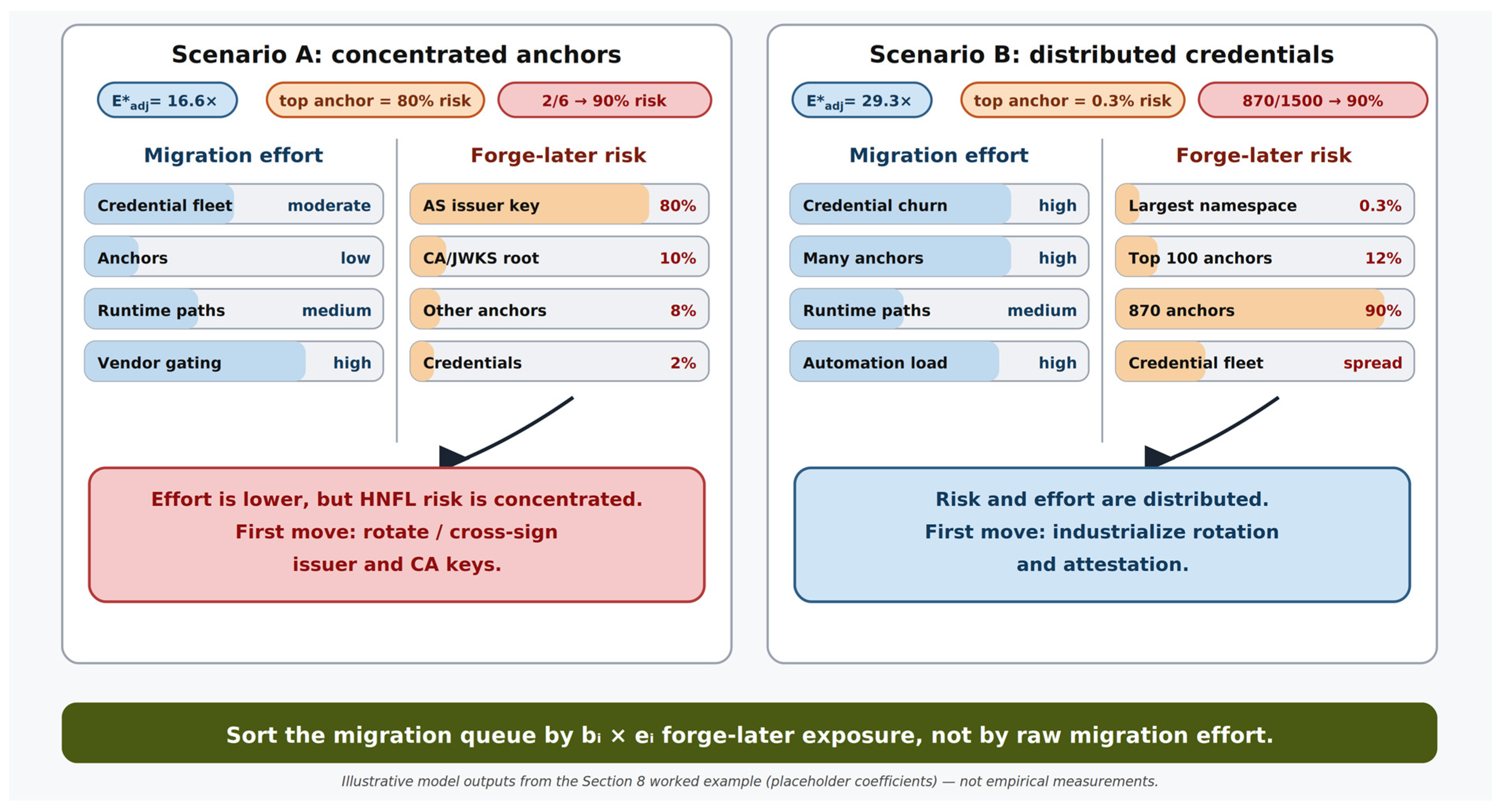
Before the cross term, B is roughly 2.4 times harder than A. The interaction Δ then adds 35% to A’s effective effort—its entire fleet roots in a single externally owned issuer key, so bmax/N = 1.0 and d = 0.7—while barely touching B, narrowing the effective-effort gap to about 1.8×. The cross term thus pulls part of the concentrated-external exposure into the effort estimate, a first-order nudge toward the risk ranking; it does not replace the separate forge-later exposure metric below, which remains the sequencing key.
Effort is the wrong sort key. The companion output is forge-later exposure: for each unmigrated anchor i,
Ri =
bi ·
ei (blast radius × externality), dominated by concentration (
Table 7).
These exposure figures—the 80% top-anchor share, the 2-of-6 sequencing count, and the 870-of-1500 count—are products of the assumed exposure distributions, not measurements; change the assumed distribution and the numbers change with it. They rest on two modeling conventions. In A, the anchors overlap in coverage—each agent roots in several of them (its identity issuer, a certificate authority, and the token issuer)—so the per-anchor blast radii sum to more than the population, and share of total risk is each anchor’s externality-weighted exposure Ri = bi · ei as a fraction of the summed Σ Ri. The OAuth issuer key alone reaches the whole fleet (so bmax/N = 1.0), yet it accounts for 80% rather than 100% of that weighted sum because the other overlapping anchors also carry exposure, with two of the six together reaching 90%. B instead assumes a moderately skewed, long-tailed distribution of anchor sizes rather than a uniform one—most per-namespace anchors small, a minority larger—so retiring 90% of its risk takes 870 of the 1500 anchors, far more than A’s two but well short of the roughly 1350 a uniform distribution would require.
The two outputs rank the work in opposite orders (
Figure 3). In
A, total effort is lower, yet a single unmigrated issuer key would let a CRQC forge any of 50,000 agents, two anchors carry 90% of that risk, and
d = 0.7 means the operator likely does not control their timeline—so the first move is to pressure the IdP/CA and cross-sign those anchors immediately; the binding constraint is external control of a tiny critical set, not labor. In
B, no single anchor is catastrophic; risk reduction means working through hundreds of anchors and a high-churn fleet, and the binding constraint is throughput and automation, which the operator largely owns.
Risk-quantification outputs and an order-independence result. The model’s risk-quantification indicators are explicit and distinct from the effort multiplier: the per-anchor forge-later exposure Ri = bi · ei (blast radius times externality) and the normalized worst-anchor blast radius bmax/N. These, not the effort total, drive the sequencing output. The central claim the structure supports is coefficient-independent and is stated as follows.
Proposition 1 (Order independence). For any positive coefficients, the migration-effort ranking and the forge-later-risk ranking over a fixed inventory are governed by different monotone functions of that inventory, so the two orderings need not coincide and, in concentrated-anchor topologies, invert. Argument. Effort aggregates across all factors and rises with the identity population through the credential term, whereas forge-later risk is governed by per-anchor exposure Ri = bi · ei, which is largest at the smallest, highest-fan-out anchors; one quantity increases in population and the other in concentration, so their maxima fall on different elements of the inventory whenever a small anchor underwrites a large sub-fleet.
What survives calibration. The robust, coefficient-independent claim is the ordering behavior, not the magnitudes: effort and forge-later risk are different functions of the same inventory. This holds for any positive coefficients; only the numbers move. The model therefore earns its keep by dissociating
how much total work (the E* multiplier) from
what to sequence first (sort anchors by
bi ·
ei descending)—the credential-versus-anchor tension the
Section 6 matrix encodes.
Calibration targets, in priority order: bi first—which identities each anchor underwrites is directly measurable in discovery and is the inventory output most organizations lack; then αc and αa from per-identity and per-anchor migration labor across pilots; γ from observed schedule slippage on vendor-gated anchor migrations specifically—the coordination cost it stands in for, distinct from the labor the α terms capture; and the remainder (αr, αs, αd, αq) from a regression once two or three migration data points exist.
8.3. Cost and Complexity Drivers
Beyond the factor structure, five concrete drivers determine where the effort and overhead actually land. The first is inventory: an agentic estate must discover not only its identities but the anchors that underwrite them (
Section 7.1), and the anchor-to-population mapping is the costliest item to produce because current tooling rarely captures it. The second is runtime performance: post-quantum primitives carry larger keys and signatures and higher verification cost (
Section 2.2), and because agentic cryptography sits on the critical path of every action (
Section 5.1), that overhead is paid per operation rather than amortized in a background job. The third is governance and attestation at machine scale—issuing, rotating, and attesting credentials for a high-churn population (
Section 5.3) demands automation most identity programs do not yet have. The fourth is orchestration refactoring: signed execution graphs and the systems that verify them must be reworked for post-quantum signatures. The fifth is re-encryption of long-lived state (
Section 5.5), a bulk cost that scales with data volume and is where deferral is most expensive. These drivers map back onto the model’s factors—inventory and governance to the credential and anchor terms, performance to the runtime factor, and re-encryption to the long-lived-data surface—and together they explain why the headline multiplier is dominated by different components in different topologies (
Section 8.2).
Runtime performance, quantified. The performance envelope of the standardized primitives is now measurable from the published literature, and it bears out the runtime-versus-long-lived split this paper draws (
Section 2.2). Hybrid key establishment adds a larger handshake on the wire (the X25519MLKEM768 client share is roughly 1.2 kB versus 32 bytes for X25519 alone), while operators deploying it at Internet scale report the principal trade-off as the larger handshake rather than added latency, with a major content-delivery network already protecting a substantial and growing share of its connections through hybrid post-quantum key agreement [
34], using the IETF-defined X25519MLKEM768 named group [
35]. On signatures, FIPS 204/ML-DSA produces signatures of roughly 2.4 to 4.6 kB depending on parameter set (about 3.3 kB for ML-DSA-65, roughly fifty times a P-256 ECDSA signature) with fast verification suited to runtime token validation, whereas FIPS 205/SLH-DSA produces signatures of roughly 7 to 49 kB with substantially slower signing and verification [
2,
3]. This is precisely why the roadmap assigns FIPS 204/ML-DSA to performance-sensitive runtime signing and FIPS 205/SLH-DSA to long-lived, low-frequency signatures such as model checkpoints and provenance (
Section 7.2). The mitigations follow from the same envelope: hybrid handshakes during the transition, amortized and cached verification for repeatedly validated anchors, session resumption to avoid repeated full handshakes, and capacity planning where signatures exceed typical network MTUs. Full end-to-end benchmarking of these primitives across MCP, mTLS, and SPIFFE or SPIRE under representative agent workloads requires design choices the field has not yet settled (the inter-agent surface still lacks a standardized post-quantum target,
Section 4.1 and
Section 5.4) and is identified as future work (
Section 12).
8.4. Timeline: A Compressed Window and Lengthened Work
Read as schedule rather than effort, the same structure pushes the two migratable terms of Mosca’s shelf-life condition [
7]—migrate before an asset’s secrecy-or-trust lifetime plus its migration time exceeds the time remaining to a CRQC—in opposite, unfavorable directions.
A compressed window. Agentic AI shortens the time available. The harvest-now clock is already running on a population that is growing quickly, so the window is not merely finite but contracting as adoption adds exposure faster than remediation removes it. And the operator does not fully control the schedule: because the highest-blast-radius anchors are vendor- and IdP-owned (
Section 5.2), the effective start of migration is gated by external roadmaps it can influence but not set. The time remaining before harvested material becomes forgeable or readable is therefore effectively shorter for agentic systems than a calendar date suggests, because the material whose trust must outlast T
q is being created continuously.
Lengthened work. At the same time, agentic AI lengthens the work. The amplification factors of
Section 8.1, read as schedule, are sources of delay: runtime-negotiated cryptography must be migrated on live critical paths rather than in background jobs (
Section 5.1); high churn means migrated primitives are exercised and re-attested continuously rather than once (
Section 5.3); protocol diversity forces a protocol-by-protocol sequence gated by the least-agile link (
Section 5.4); and the trust-anchor fan-out makes the first, most schedule-critical moves the ones that depend on third parties. The migration-time term is thus larger for agentic systems than for the conventional estate the federal deadlines were scoped to.
Two clocks, and a deadline that fits only one. The two movements compound: a contracting window and an expanding task mean the effective deadline for the agentic installed base is earlier, and its effective duration longer, than the 2030/2035 horizon implies for conventional systems. The more consequential point is structural. A fixed deadline is a stock instrument—it disciplines a finite estate toward a date—and it does not govern a flow, which agentic adoption makes the unmigrated population into (
Section 10). For the installed base the deadline still applies but is tighter than it appears; for new deployments it is the wrong instrument entirely, because nothing about a 2035 date stops a classical-by-default agent shipped in 2034 from starting its own harvest-now clock. This also reframes cost as partly recurring: the effort E of
Section 8.1 prices remediating the stock, but governing the inflow—keeping new agents off classical defaults—is an ongoing operating cost the static-N worked example does not capture. A timeline that counts only one-time remediation against a single date understates both the urgency for the installed base and the duration of the obligation for everything built after it.
10. Remediation and Prevention: Two Migration Populations
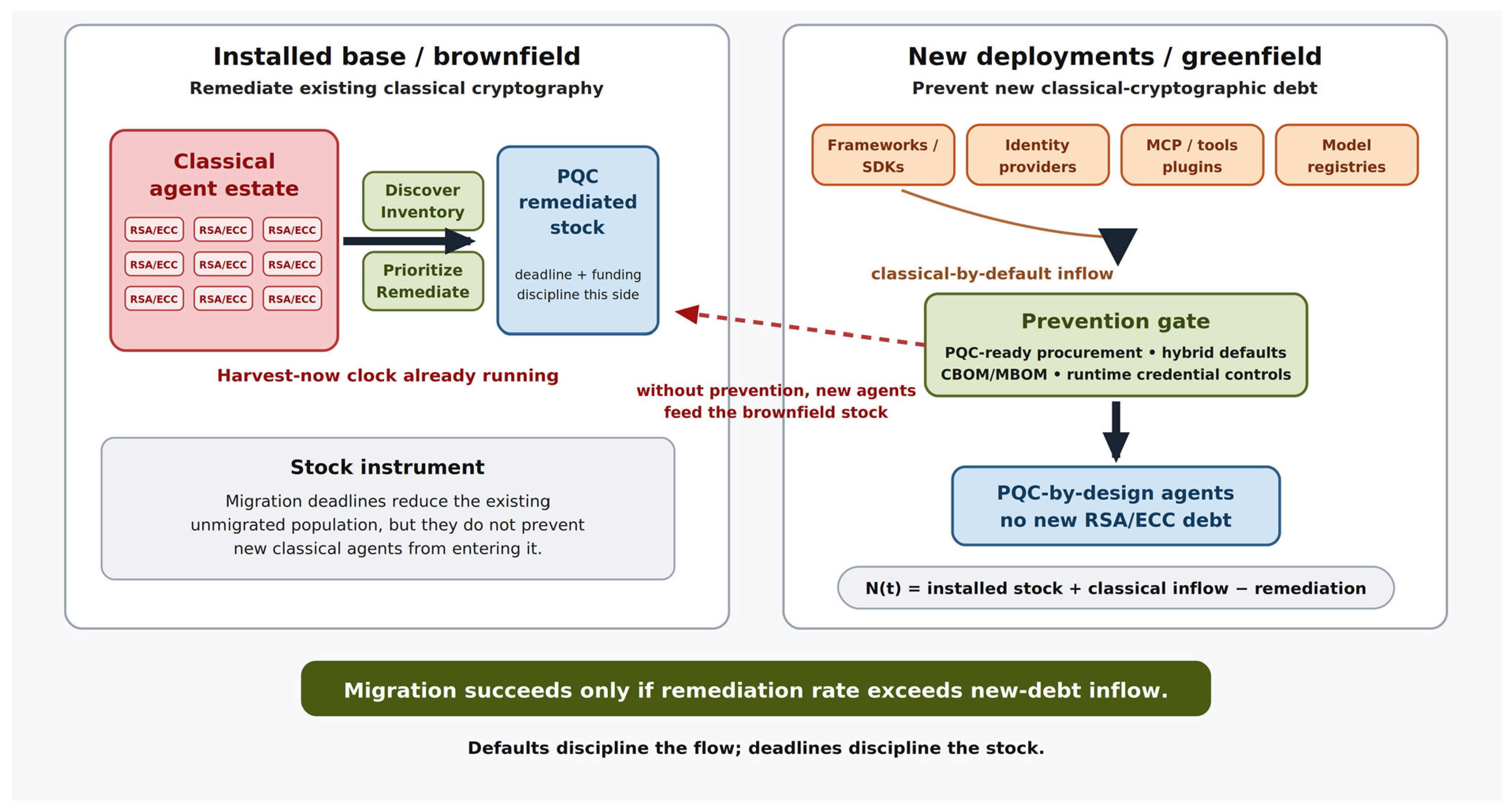
The framework, matrix, roadmap, and model developed so far describe a single task: remediating an installed base of agents that already depend on classical cryptography. But agentic adoption is rapid and ongoing, so the migration target is not a fixed stock—it is a flow. That distinction separates two populations with two different sets of implications, and conflating them understates the problem. Put sharply, agentic AI turns post-quantum migration from a finite inventory problem into a continuously regenerating identity, credential, and protocol migration problem.
The installed base—a stock to remediate. The agents in production today are a stock (the brownfield problem): a finite, if poorly inventoried, set of identities, anchors, and surfaces to discover, hybridize, and cut over. Everything in
Section 6,
Section 7,
Section 8 and
Section 9 addresses this population. Two features define it. First, the harvest-now clock has already started for it—its signed and encrypted material is already observable and storable, so its forge-later and decrypt-later exposure is accruing now. Second, its hardest constraint is dependency coupling, because many of its highest-blast-radius anchors are vendor-owned (
Section 5.2). The instruments that fit a stock are remediation instruments: inventory mandates of the kind the federal government already imposes under OMB M-23-02 [
36], prioritized migration deadlines (the 2030/2035 horizon), and the funding to execute them. The open question this surfaces is whether agents are actually inside those inventories—the failure mode is that they are omitted from the cryptographic inventory entirely.
New deployments—a flow to govern. Agents deployed from here on are a flow (the greenfield problem), and the flow itself splits in two. An agent built to be PQC-native or crypto-agile from inception never becomes migration debt and never starts a harvest-now clock at all; prevention eliminates the exposure rather than deferring it. An agent built to be classical—still the default, because the prevailing agent frameworks, SDKs, identity libraries, and protocols use classical cryptography out of the box—becomes new debt added to the stock the moment it ships. The instruments that fit a flow are prevention instruments, and they are different ones with different owners: procurement language requiring post-quantum readiness in new systems, and a shift in the defaults of the tooling itself—the Model Context Protocol authorization stack, agent platforms, identity providers, and model registries—toward hybrid and post-quantum modes. Concretely, prevention means PQC-capable or hybrid transport paths by default, short-lived and uniquely attributable agent identities, cryptographic bills of materials (CBOM/MBOM) that enumerate each agent’s cryptographic dependencies [
24], and runtime controls that stop agents from minting unmanaged or classical-only credentials.
The two populations differ across every dimension that matters for planning (
Table 8):
Why the distinction matters: Debt can accrue faster than it retires. Because the two populations are governed by different instruments, an organization can be remediating the installed base and falling behind at the same time. Every quarter that agent tooling defaults to classical cryptography manufactures new migration debt, and if the inflow rate exceeds the remediation rate the unmigrated population grows even as remediation proceeds (
Figure 5). A deadline disciplines the stock; nothing in the current posture disciplines the inflow. This reframes the central quantity of the model: the population is not the static N of the worked example (
Section 8.2) but a time-varying N(t) with a debt-accrual inflow governed by the fraction of new agents still built classical—a fraction that prevention instruments, not remediation deadlines, control. The highest-leverage intervention is therefore also the cheapest and the one most absent from current guidance: stop creating new debt by changing the defaults, which is the prevention face of the crypto-agility argument of
Section 5 and
Section 7, not a separate idea. The agency-specific implications that follow (
Section 11) divide along the same line—remediation instruments for the stock, prevention instruments for the flow.
13. Limitations
This paper is a conceptual framework, and its limitations follow from that choice and from the state of the evidence it draws on.
Conceptual, not empirical. The framework, matrix, and model are analytical instruments, not validated artifacts. The paper offers no implementation, no measurement of a real migration, and no case study; its claims concern how to structure the problem and sequence the work, not observed outcomes. It should be judged on whether it organizes the problem more usefully than the alternatives, not on predictive accuracy, which it does not claim.
The model is uncalibrated. The coefficients in
Section 8 are illustrative placeholders, and the worked example demonstrates the model’s behavior rather than real magnitudes. The robust, coefficient-independent claim is the ordering—that migration effort and forge-later risk rank the work in opposite orders, and that in concentrated topologies a few anchors dominate risk—not any multiplier value. Calibration requires per-identity and per-anchor migration-labor data from real pilots, which does not yet exist (
Section 8.2); until it does, the model is a structure for reasoning, not a costing tool. Three further limitations bound the model. The baseline is a civilian-estate figure used to anchor an agentic-estate multiplier, a deliberate category approximation (
Section 8.1). The sequencing guarantee rests on the coefficient-independent ordering of Proposition 1 rather than on validated coefficients, so it asserts the direction of the ranking, not the size of any gap. And the worked-example exposure figures depend on assumed anchor-size and fan-out distributions that a given real inventory may not match.
Reliance on heterogeneous, industry-sourced data. The scale premise rests on vendor telemetry and an industry-sponsored survey (
Section 2.4), which are not peer-reviewed, use inconsistent definitions and methodologies, and are not scoped to cryptographic reliance. The paper treats these as a caveated spread rather than measurements, but a firmer empirical basis for the NHI population and its anchor distribution remains an open need (
Section 12).
A moving target. The agentic ecosystem and the post-quantum standards are both evolving. Protocol specifics (the Model Context Protocol authorization revision, the maturity of agent-to-agent protocols) and standards status (NIST IR 8547 as an Initial Public Draft, FIPS 206/FN-DSA forthcoming) are stated as of writing and may date quickly; the inter-agent surface in particular has no stable standard to migrate to, so claims about it are necessarily provisional.
Timeline assumptions. The urgency case rests on the harvest-now premise and is deliberately agnostic about when—or whether—a CRQC arrives (
Section 9.1). For assets whose secrecy or trust lifetime is short, the decrypt-later and forge-later risks are correspondingly smaller; the paper assumes the conservative case, in which long-lived signatures and retained data outlast the migration window.
Scope and decomposition. The analysis adopts the civilian non-NSS framing throughout; national-security systems and their CNSA 2.0 scope are out of scope. The seven-surface taxonomy and the credential/anchor split are proposed organizing schemes, not claimed to be exhaustive or uniquely correct; other decompositions are possible, and the paper argues only that this one is discriminating and useful. Symmetric and hash-based (Grover-class) exposure is acknowledged but treated as secondary, consistent with the focus on the asymmetric migration driver.