
Human–Computer Interaction in Smart Greenhouses: A Review of Interfaces, Technologies, and User-Centered Approaches


Abstract
1. Introduction
2. Materials and Methods
2.1. Search Strategy and Scope
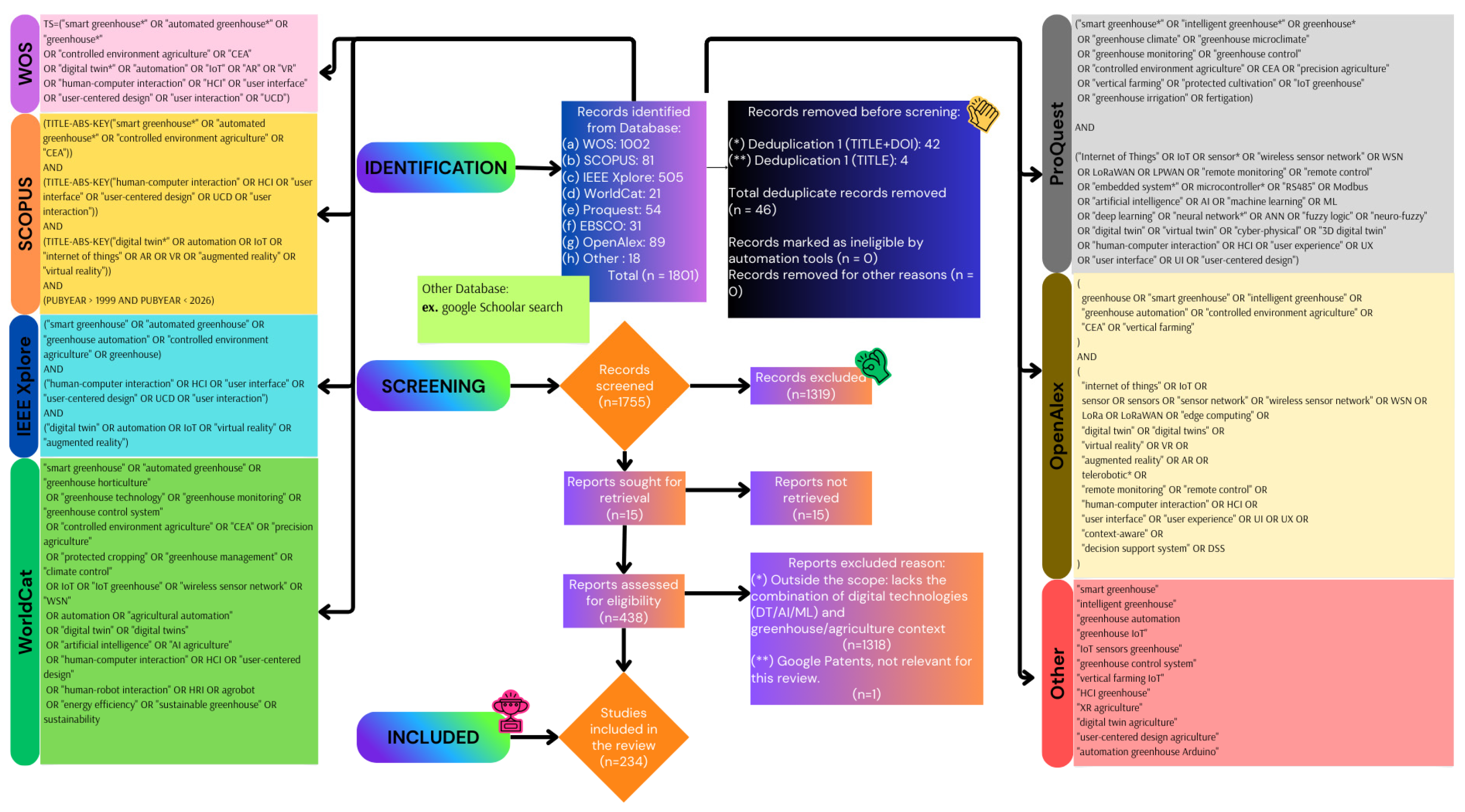
2.2. Keyword Formulation and Search Execution
- Domain and core technology: “smart greenhouse”, “automation”, and “digital twin”.
- Interface and interaction: “human-computer interaction”, “user interface”, and “user-centered design”.
- Advanced visualization: “AR/VR in agriculture”.
2.3. Selection and Filtering Procedure
- Articles retrieved through database search;
- Articles identified through expert judgment and targeted narrative expansion;
- Studies extracted from existing SLRs that provided consolidated trend data.
3. Interfaces and Technologies in Smart Greenhouses
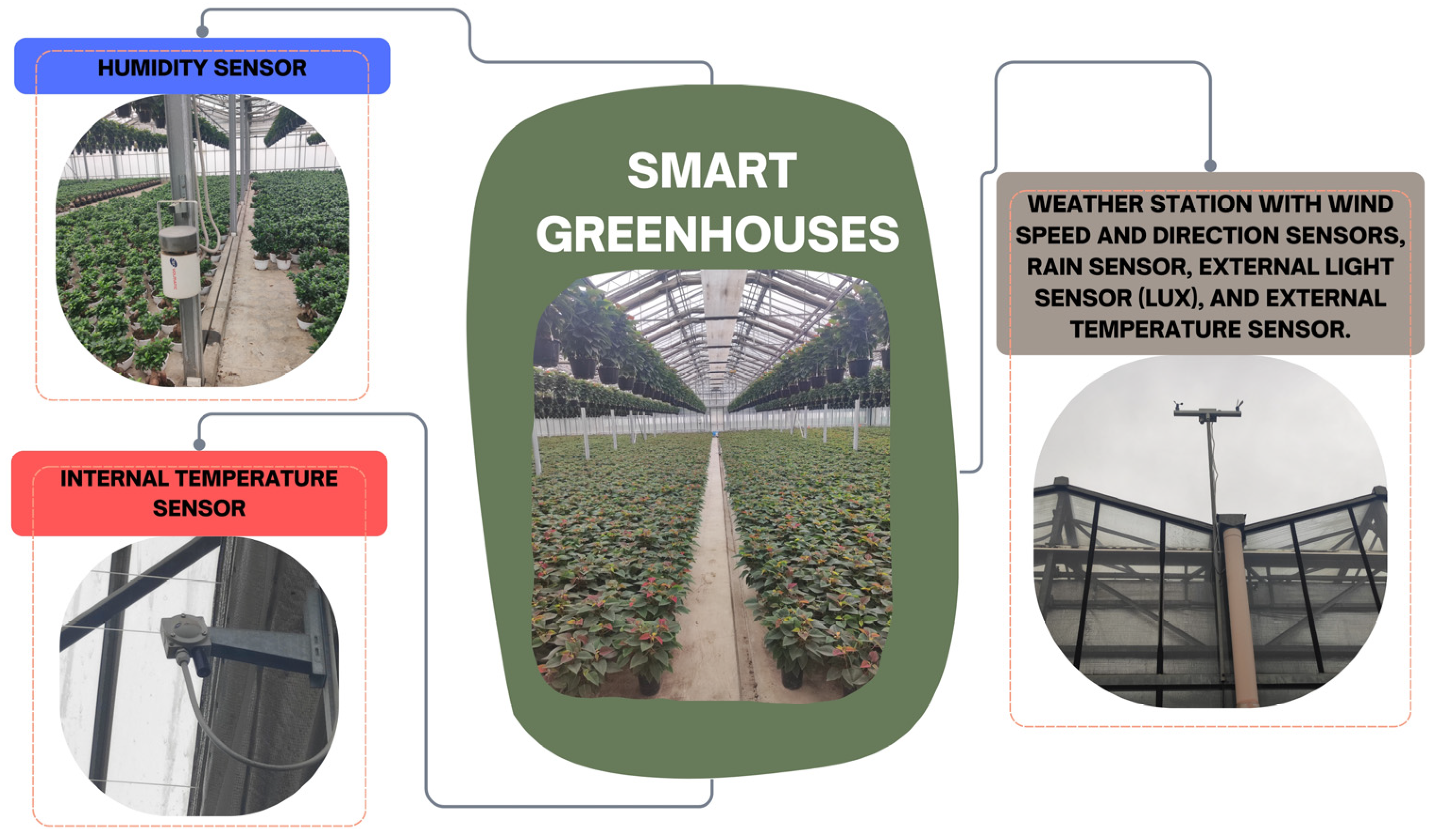
3.1. Sensors and IoT Networks
3.2. Mobile and Web Applications
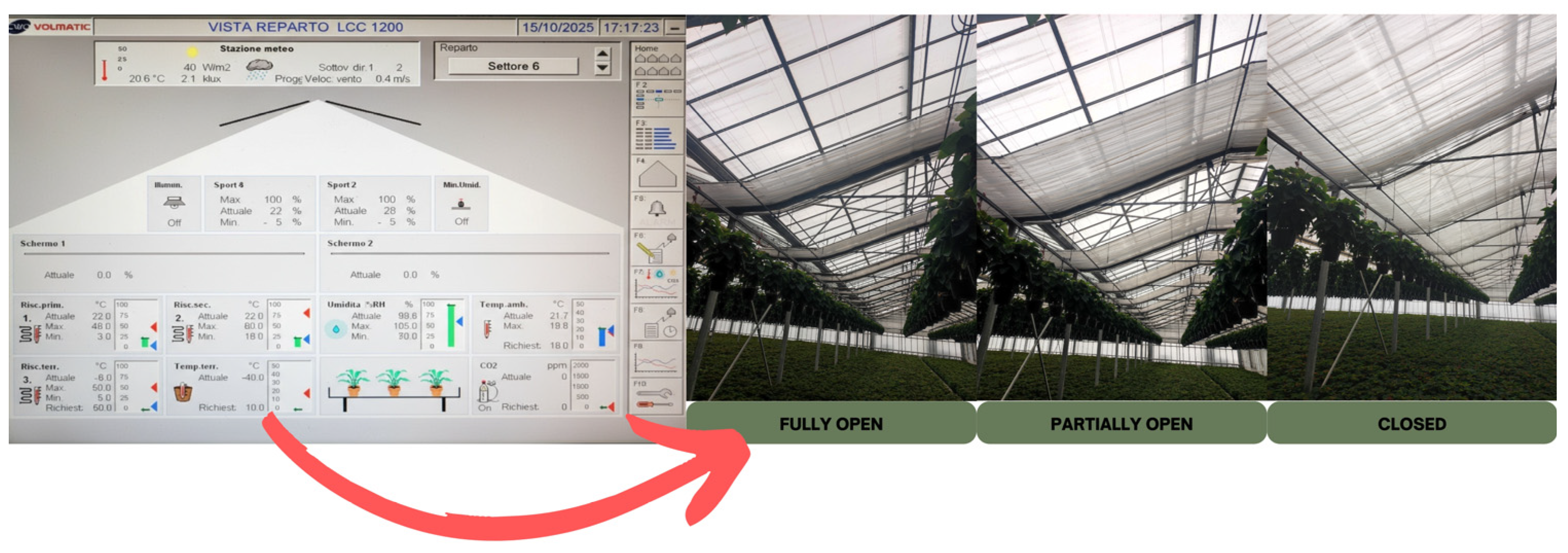
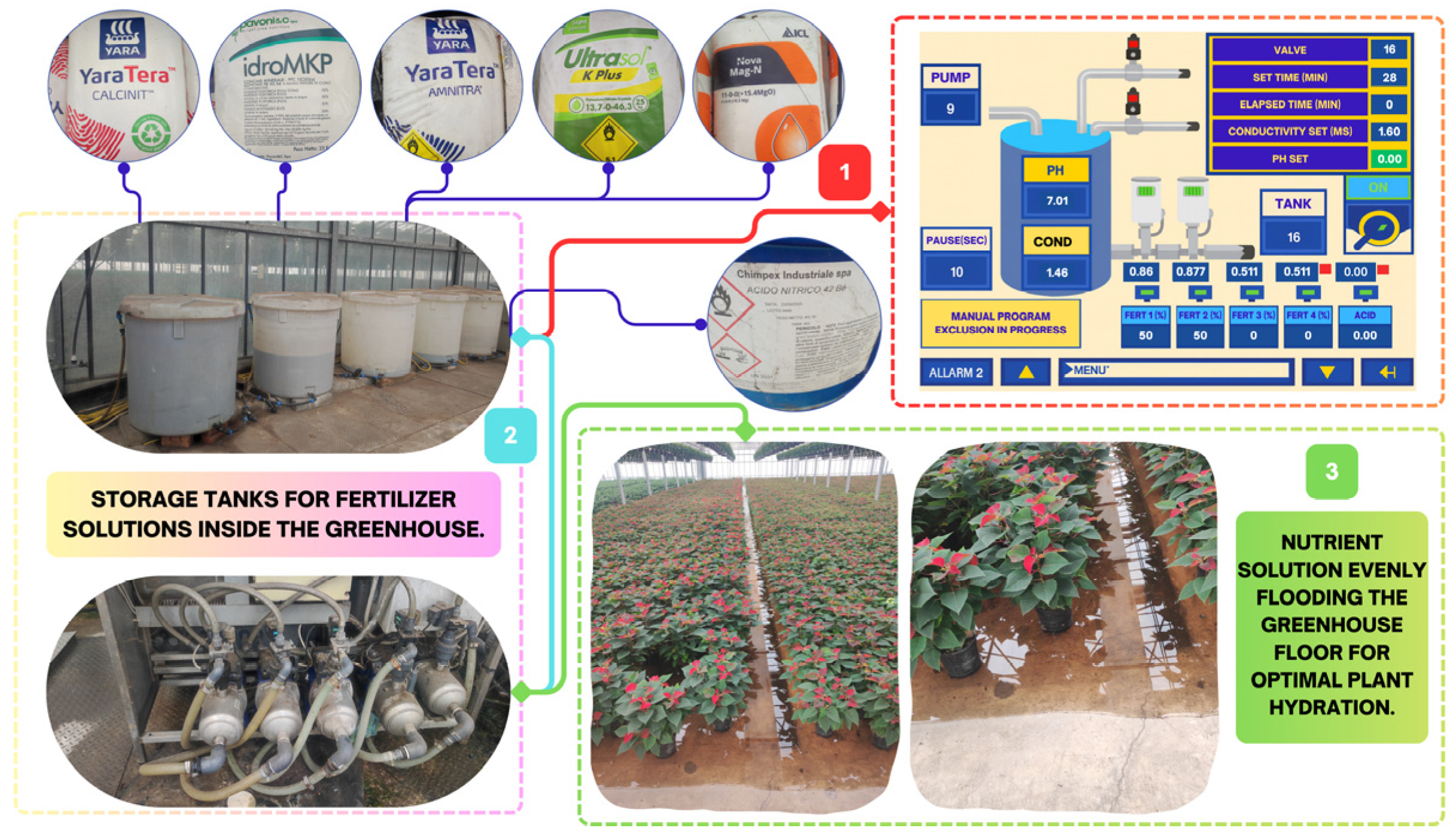
3.3. Physical Panels and Embedded Interfaces
3.4. Multimodal Interfaces
3.5. Virtual and Augmented Reality (AR/VR)
3.6. Digital Twins (DTs)
3.7. Artificial Intelligence and Machine Learning
- Predictive crop modeling and forecasting: AI algorithms predict yield, growth, and quality based on environmental factors and sensor data [2].
3.8. Automation and Robotics
3.9. Cloud and Edge Computing
3.10. Dominant Trends, Integration, Gaps, and Sustainability
3.11. Comparative Performance Analysis of HCI-Related Technologies in Smart Greenhouse Systems
4. User-Centered Design for Smart Greenhouse Technology
4.1. Participatory Design
4.2. Context-Aware Interfaces
4.3. Ergonomics and User Experience (UX)
4.4. Specific Challenges
4.5. Quantitative and Comparative Analysis of User-Centered Design Approaches in Smart Greenhouse Systems
5. Comparative Analysis of Human–Computer Interaction Paradigms in Smart Greenhouse Systems
6. Challenges and Future Directions
6.1. Technological and Infrastructure Challenges
6.1.1. Interoperability Issues Between Heterogeneous Systems
6.1.2. Data Security and Privacy in IoT-Based Greenhouses
6.1.3. High Costs, Digital Literacy, and Infrastructure Gaps
- High Costs: High initial investment costs and technical complexity are major challenges to the adoption of greenhouse technology [2]. The cost of IoT applications, particularly for highly functional sensors (which can exceed 1000 USD per sensor), impedes commercialization by smallholder farmers and limits widespread adoption [19,83].
- Digital Literacy: Many farmers, especially older generations, often have low levels of education and lack the necessary knowledge to manage modern control systems (e.g., climate control or fertigation systems), contributing to a lack of innovation culture [24]. Designing interfaces that cater to the broad spectrum of technical literacy within the agricultural workforce requires careful consideration [21].
- Infrastructure Gaps: The digital divide is critical. Rural areas, where agriculture is concentrated, often suffer from limited technological infrastructure, insufficient internet connectivity, and unreliable power supply, hindering the seamless integration of sophisticated technologies [19,21]. The efficacy of IoT systems is limited by internet instability, particularly when managing many devices [17]. Future research must validate solutions like Low-Earth Orbit (LEO) constellations, which promise global broadband internet coverage with low latency, potentially eliminating infrastructural barriers to mass IoT adoption in remote areas [19].
6.2. Human-Centered and Interface Development Directions
6.2.1. Lack of HCI Standards Specific to Agriculture
6.2.2. Adaptive and Predictive Interfaces
6.2.3. Personalization According to User Role and Expertise
6.2.4. Reliable Multimodal Systems
6.3. Sustainability and Evaluation Gaps
6.3.1. Energy Efficiency and Digital Inclusion
6.3.2. Standardization and Longitudinal Evaluations in Real-World Environments
7. Conclusions
Supplementary Materials
Funding
Data Availability Statement
Acknowledgments
Conflicts of Interest
Abbreviations
| AI | Artificial Intelligence |
| ANFIS | Adaptive Neuro-Fuzzy Inference System |
| ANN | Artificial Neural Network |
| AR | Augmented reality |
| BIM | Building Information Model |
| CC | Cloud computing |
| CCT | Cycle Completion Time |
| CEA | Controlled-Environment Agriculture |
| CI | Collaborative Intelligence |
| CO2 | Carbon Dioxide |
| DL | Deep learning |
| DT | Digital twins |
| ECD | Experience-centered design |
| ECS | Electronic control system |
| GHG | Greenhouse gas |
| GI | Graphical interface |
| GUI | Graphical user interface |
| HCI | Human–computer interaction |
| HRC | Human–robot collaboration |
| HRI | Human–robot interaction |
| HUB-CI | Human-based collaborative intelligence |
| ICT | Information and Communication Technologies |
| IoT | Internet of Things |
| LCOE | Levelized cost of energy |
| LPL | Low-power listening |
| LTES | Latent thermal energy storage |
| ML | Machine learning |
| MySQL | Structured Query Language (MySQL Database) |
| NASA-TX | NASA Task Load Index |
| NB-IoT | Narrowband Internet of Things |
| NN | Neural network |
| NNARX | Nonlinear AutoRegressive with eXogenous Inputs Neural Network |
| PA | Precision agriculture |
| PD | Participatory design |
| PRISMA | Preferred reporting items for systematic reviews and meta-analyses |
| PV | Photovoltaic |
| R2 | Coefficient of determination |
| RNN | Recurrent Neural Network |
| RMSE | Root Mean Square Error |
| SLR | Systematic literature review |
| SMEs | Small- and medium-sized enterprises |
| SHCI | Sustainable human–computer interaction |
| SSQ | Simulator Sickness Questionnaire |
| SUS | System Usability Scale |
| UI | User interface |
| UCD | User-centered design |
| UEQ | User experience questionnaire |
| UX | User experience |
| VF | Vertical farming |
| VR | Virtual Reality |
| WOS | Web of Science |
| WSN | Wireless Sensor Network |
| XR | Extended reality |
References
- Setiawan, D.Y.; Warsito, W.; Marjunus, R.; Nurfiana, N.; Syahputri, R. A Systematic literature review: Internet of things on smart greenhouse. Int. J. Adv. Comput. Sci. Appl. 2022, 13, 672–679. [Google Scholar] [CrossRef]
- Singh, K.A.P.; Goutam, P.K.; Xaxa, S.; Nasima, S.P.; Panotra, N.; Rajesh, G. The role of greenhouse technology in streamlining crop production. J. Exp. Agric. Int. 2024, 46, 776–798. [Google Scholar] [CrossRef]
- Ariesen-Verschuur, N.; Verdouw, C.; Tekinerdogan, B. Digital Twins in greenhouse horticulture: A review. Comput. Electron. Agric. 2022, 199, 107183. [Google Scholar] [CrossRef]
- Maraveas, C.; Karavas, C.S.; Loukatos, D.; Bartzanas, T.; Arvanitis, K.G.; Symeonaki, E. Agricultural greenhouses: Resource management technologies and perspectives for zero greenhouse gas emissions. Agriculture 2023, 13, 1464. [Google Scholar] [CrossRef]
- Bersani, C.; Ruggiero, C.; Sacile, R.; Soussi, A.; Zero, E. Internet of things approaches for monitoring and control of smart greenhouses in industry 4.0. Energies 2022, 15, 3834. [Google Scholar] [CrossRef]
- Huynh, H.X.; Tran, L.N.; Duong-Trung, N. Smart greenhouse construction and irrigation control system for optimal Brassica Juncea development. PLoS ONE 2023, 18, e0292971. [Google Scholar] [CrossRef]
- Ferrández-Pastor, F.J.; Alcañiz-Lucas, S.; García-Chamizo, J.M.; Platero-Horcajadas, M. Smart environments design on industrial automated greenhouses. Proceedings 2019, 31, 36. [Google Scholar] [CrossRef]
- Zou, H.; Wang, F.; Zeng, Z.; Zhu, J.; Zha, L.; Huang, D.; Li, J.; Wang, R. Next-generation water-saving strategies for greenhouses using a nexus approach with modern technologies. Nat. Commun. 2025, 16, 2091. [Google Scholar] [CrossRef]
- Miljic, T. Design and Fabrication of Farming Greenhouses. Master’s Thesis, Universidade do Minho, Braga, Portugal, 2023. [Google Scholar]
- Vanegas-Ayala, S.C.; Barón-Velandia, J.; Leal-Lara, D.D. A systematic review of greenhouse humidity prediction and control models using fuzzy inference systems. Adv. Hum.-Comput. Interact. 2022, 2022, 8483003. [Google Scholar] [CrossRef]
- Aznar-Sánchez, J.A.; Velasco-Muñoz, J.F.; López-Felices, B.; Román-Sánchez, I.M. An analysis of global research trends on greenhouse technology: Towards a sustainable agriculture. Int. J. Environ. Res. Public Health 2020, 17, 664. [Google Scholar] [CrossRef] [PubMed]
- Koukounaras, A. Advanced greenhouse horticulture: New technologies and cultivation practices. Horticulturae 2020, 7, 1. [Google Scholar] [CrossRef]
- Carruth, D.W.; Hudson, C.; Fox, A.A.; Deb, S. User interface for an immersive virtual reality greenhouse for training precision agriculture. In International Conference on Human-Computer Interaction; Springer International Publishing: Cham, Switzerland, 2020; pp. 35–46. [Google Scholar] [CrossRef]
- Wu, Y.; Li, L.; Li, M.; Zhang, M.; Sun, H.; Sygrimis, N.; Lai, W. Remote-control system for greenhouse based on open source hardware. IFAC-PapersOnLine 2019, 52, 178–183. [Google Scholar] [CrossRef]
- Escamilla-García, A.; Soto-Zarazúa, G.M.; Toledano-Ayala, M.; Rivas-Araiza, E.; Gastélum-Barrios, A. Applications of artificial neural networks in greenhouse technology and overview for smart agriculture development. Appl. Sci. 2020, 10, 3835. [Google Scholar] [CrossRef]
- Slob, N.; Hurst, W.; Van de Zedde, R.; Tekinerdogan, B. Virtual reality-based digital twins for greenhouses: A focus on human interaction. Comput. Electron. Agric. 2023, 208, 107815. [Google Scholar] [CrossRef]
- Costa, E.; Martins, M.B.; Vendruscolo, E.P.; da Silva, A.G.; Zoz, T.; Binotti, F.F.d.S.; Witt, T.W.; Seron, C.d.C. Greenhouses within the Agricultura 4.0 interface. Rev. Ciência Agronômica 2020, 51, e20207703. [Google Scholar] [CrossRef]
- Ruizhou, C.H.E.N.; Ming, K.O.N.G.; Pengcheng, J.I.; Hengxing, L.I.U. Design of Intelligent Agricultural Greenhouse Environment Monitoring System. Instrumentation 2023, 10, 40–48. [Google Scholar] [CrossRef]
- Maraveas, C.; Bartzanas, T. Application of Internet of Things (IoT) for optimized greenhouse environments. AgriEngineering 2021, 3, 954–970. [Google Scholar] [CrossRef]
- Pino, A.F.S.; Agudelo, A.F.; Ruiz, P.H.; Mon, A.; Collazos, C.A.; Moreira, F. Implementation human-computer interaction on the internet of things technologies: A bibliometric analysis. In World Conference on Information Systems and Technologies; Springer Nature: Cham, Switzerland, 2024; pp. 194–203. [Google Scholar] [CrossRef]
- Ibrahim, U.; Danmaigoro, A. Human-computer interaction in agricultural user interfaces. Int. J. Appl. Sci. 2024, 2, 187–198. [Google Scholar] [CrossRef]
- Zhao, Y.; Zhang, X. Human-Computer Interaction and user experience in smart home research: A critical analysis. Issues Inf. Syst. 2016, 17, 11–19. [Google Scholar] [CrossRef]
- Brenes, J.A.; López, G.; Ferrández-Pastor, F.J.; Marín-Raventós, G. Usability assessment of a greenhouse context-aware alert system for small-scale farmers. Front. Comput. Sci. 2024, 6, 1412913. [Google Scholar] [CrossRef]
- Kavga, A.; Thomopoulos, V.; Barouchas, P.; Stefanakis, N.; Liopa-Tsakalidi, A. Research on innovative training on smart greenhouse technologies for economic and environmental sustainability. Sustainability 2021, 13, 10536. [Google Scholar] [CrossRef]
- Basyouny, M.; Männik, A. Unleashing the Awareness of Sustainable Human-Computer Interaction (HCI) Among Youth: Bridging the Knowledge Gap and EmpoweringFuture Sustainable Designers. In Proceedings of the 2023 ACM Conference on Human Factors in Computing Systems (CHI’ 23), Hamburg, Germany, 23–28 April 2023. [Google Scholar]
- Xiaohui, Q.; Shangfeng, D.; Yaofeng, H.; Meihui, L. Development and design of mobile terminal APP for greenhouse environment control. IFAC-PapersOnLine 2018, 51, 822–825. [Google Scholar] [CrossRef]
- Hananto, A.L.; Tirta, A.; Herawan, S.G.; Idris, M.; Soudagar, M.E.M.; Djamari, D.W.; Veza, I. Digital twin and 3D digital twin: Concepts, applications, and challenges in industry 4.0 for digital twin. Computers 2024, 13, 100. [Google Scholar] [CrossRef]
- Zeidler, C.; Kuhr, L.; Callaham, J.B.; Schöning, J. Mobile plant health visualizer based on SI-NDVI imaging and augmented reality visualization for space greenhouses. In Proceedings of the SpaceCHI 2023: Conference on Human-Computer Interaction for Space Exploration, Cambridge, MA, USA, 22–23 June 2023; ACM: New York, NY, USA, 2023. [Google Scholar]
- Plexousaki, A.; Leonidis, A.; Korozi, M.; Stephanidis, C. Towards User-Centered XR Solutions for Smart Agriculture: A Work-in-Progress Design Approach. In Proceedings of the 21st EuroXR International Conference, Athens, Greece, 27–29 November 2024. [Google Scholar]
- Akkaş, M.A.; Sokullu, R. An IoT-based greenhouse monitoring system with Micaz motes. Procedia Comput. Sci. 2017, 113, 603–608. [Google Scholar] [CrossRef]
- Siregar, R.R.A.; Seminar, K.B.; Wahjuni, S.; Santosa, E. Vertical farming perspectives in support of precision agriculture using artificial intelligence: A review. Computers 2022, 11, 135. [Google Scholar] [CrossRef]
- Udekwe, D.; Seyyedhasani, H. Virtual Reality-Enabled remote Human-Robot interaction for strawberry cultivation in greenhouses. Comput. Electron. Agric. 2025, 237, 110567. [Google Scholar] [CrossRef]
- Gračić, S. Maximizing the amount of picked fruit regardless of species and varying characteristics by implementing principles of Human–Robot Interaction in greenhouses–model Multihbot. In Proceedings of the 2nd International Scientific Conference on Recent Advances in Information Technology, Tourism, Economics, Management and Agriculture, Graz, Austria, 8 November 2018; p. 974. [Google Scholar] [CrossRef]
- Nanda, M.A.; Amaru, K.; Dwiratna, S.; Jamaludin, S.F.Y. Design of Microclimate Monitoring and Graphical Interface System for Indoor Vertical Hydroponic Based on User-Centered Design Technique. J. Keteknikan Pertan. 2025, 13, 74–97. [Google Scholar] [CrossRef]
- Sutton-Parker, J. Can Computer Processor Component Choice Enable Greenhouse Gas Abatement? University of Warwick: Warwick, UK, 2023. [Google Scholar]
- Sutton-Parker, J. Can analytics software measure end user computing electricity consumption? Clean Technol. Environ. Policy 2022, 24, 2441–2458. [Google Scholar] [CrossRef]
- Rigby, J.M.; Preist, C. Towards user-centred climate services: The role of human-computer interaction. In Proceedings of the 2023 CHI Conference on Human Factors in Computing Systems, Hamburg, Germany, 23–28 April 2023; pp. 1–14. [Google Scholar] [CrossRef]
- Torsi, S.; Incrocci, L.; Chessa, S.; Kocian, A.; Milazzo, P.; Cela, F.; Carmassi, G. Farming and Automation. How Professional Visions Change with the Introduction of ICT in Greenhouse Cultivation. In World Conference on Information Systems and Technologies; Springer Nature: Cham, Switzerland, 2024; pp. 187–193. [Google Scholar] [CrossRef]
- Abioye, T.E.; Arogundade, O.T.; Misra, S.; Adesemowo, K.; Damaševičius, R. Cloud-based business process security risk management: A systematic review, taxonomy, and future directions. Computers 2021, 10, 160. [Google Scholar] [CrossRef]
- Oviatt, S.; Cohen, P.; Wu, L.; Duncan, L.; Suhm, B.; Bers, J.; Holzman, T.; Winograd, T.; Landay, J.; Larson, J.; et al. Designing the user interface for multimodal speech and pen-based gesture applications: State-of-the-art systems and future research directions. Hum.-Comput. Interact. 2000, 15, 263–322. [Google Scholar] [CrossRef]
- Jensen, S.; Kanstrup, A.M.; Nohr, C. User driven development and high fidelity testing. In Proceedings of the Eleventh Danish HCI Research Symposium, Frederiksberg, Denmark, 23 November 2011. [Google Scholar]
- Rayhana, R.; Xiao, G.; Liu, Z. Internet of things empowered smart greenhouse farming. IEEE J. Radio Freq. Identif. 2020, 4, 195–211. [Google Scholar] [CrossRef]
- Tzounis, A.; Katsoulas, N.; Bartzanas, T.; Kittas, C. Internet of Things in agriculture, recent advances and future challenges. Biosyst. Eng. 2017, 164, 31–48. [Google Scholar] [CrossRef]
- Houborg, R.; Fisher, J.B.; Skidmore, A.K. Advances in remote sensing of vegetation function and traits. Int. J. Appl. Earth Obs. Geoinf. 2015, 43, 1–6. [Google Scholar] [CrossRef]
- García-Ruiz, R.A.; López-Martínez, J.; Blanco-Claraco, J.L.; Pérez-Alonso, J.; Callejón-Ferre, Á.J. On air temperature distribution and ISO 7726-defined heterogeneity inside a typical greenhouse in Almería. Comput. Electron. Agric. 2018, 151, 264–275. [Google Scholar] [CrossRef]
- Benyezza, H.; Bouhedda, M.; Faci, N.; Aissani, M.; Rebouh, S. Greenhouse monitoring and fuzzy control system based on wsan and iot. In Proceedings of the 2019 International Conference on Applied Automation and Industrial Diagnostics (ICAAID), Elazig, Turkey, 25–27 September 2019; IEEE: New York, NY, USA, 2019; Volume 1, pp. 1–5. [Google Scholar] [CrossRef]
- Zhao, R.; Ding, Y.; Ma, S.; Wang, M. Design of intelligent greenhouse control system based on Internet of Things. In Proceedings of the 2019 2nd International Conference on Information Systems and Computer Aided Education (ICISCAE), Dalian, China, 28–30 September 2019; IEEE: New York, NY, USA, 2019; pp. 117–121. [Google Scholar] [CrossRef]
- Ganesh, V.S.; Ganesh, S.R.; Hamza, F.; Sandeep, D.; Ghosh, S. Wi-Fi enabled IoT based smart greenhouse. Int. J. Recent Technol. Eng. 2019, 8, 3539–3543. [Google Scholar] [CrossRef]
- Jaiswal, H.; Singuluri, R.; Sampson, S.A. IoT and machine learning based approach for fully automated greenhouse. In Proceedings of the 2019 IEEE Bombay Section Signature Conference (IBSSC), Mumbai, India, 26–28 July 2019; IEEE: New York, NY, USA, 2019; pp. 1–6. [Google Scholar] [CrossRef]
- Hadabas, J.; Hovari, M.; Vass, I.; Kertész, A. IoLT Smart Pot: An IoT-Cloud Solution for Monitoring Plant Growth in Greenhouses. In Proceedings of the 9th International Conference on Cloud Computing and Services Science (CLOSER), Crete, Greece, 2–4 May 2019; pp. 144–152. [Google Scholar] [CrossRef]
- Hemming, S.; Zwart, F.D.; Elings, A.; Petropoulou, A.; Righini, I. Cherry tomato production in intelligent greenhouses—Sensors and AI for control of climate, irrigation, crop yield, and quality. Sensors 2020, 20, 6430. [Google Scholar] [CrossRef] [PubMed]
- Verdouw, C.; Tekinerdogan, B.; Beulens, A.; Wolfert, S. Digital twins in smart farming. Agric. Syst. 2021, 189, 103046. [Google Scholar] [CrossRef]
- Chaux, J.D.; Sanchez-Londono, D.; Barbieri, G. A digital twin architecture to optimize productivity within controlled environment agriculture. Appl. Sci. 2021, 11, 8875. [Google Scholar] [CrossRef]
- Andrianto, H.; Faizal, A. Development of smart greenhouse system for hydroponic agriculture. In Proceedings of the 2020 International Conference on Information Technology Systems and Innovation (ICITSI), Online, 19–23 October 2020; IEEE: New York, NY, USA, 2020; pp. 335–340. [Google Scholar] [CrossRef]
- Codeluppi, G.; Cilfone, A.; Davoli, L.; Ferrari, G. Ai at the edge: A smart gateway for greenhouse air temperature forecasting. In Proceedings of the 2020 IEEE International Workshop on Metrology for Agriculture and Forestry (MetroAgriFor), Trento, Italy, 4–6 November 2020; IEEE: New York, NY, USA, 2020; pp. 348–353. [Google Scholar] [CrossRef]
- Drakulić, U.; Mujčić, E. Remote monitoring and control system for greenhouse based on IoT. In Proceedings of the International Symposium on Innovative and Interdisciplinary Applications of Advanced Technologies, Sarajevo, Bosnia, 20–23 June 2019; Springer International Publishing: Cham, Switzerland, 2019; pp. 481–495. [Google Scholar] [CrossRef]
- Durão, L.F.C.; Haag, S.; Anderl, R.; Schützer, K.; Zancul, E. Digital twin requirements in the context of industry 4.0. In Proceedings of the IFIP International Conference on Product Lifecycle Management, Turin, Italy, 2–4 July 2018; Springer International Publishing: Cham, Switzerland, 2018; pp. 204–214. [Google Scholar] [CrossRef]
- Jahnavi, V.S.; Ahamed, S.F. Smart wireless sensor network for automated greenhouse. IETE J. Res. 2015, 61, 180–185. [Google Scholar] [CrossRef]
- Bajer, L.; Krejcar, O. Design and realization of low cost control for greenhouse environment with remote control. IFAC-PapersOnLine 2015, 48, 368–373. [Google Scholar] [CrossRef]
- Rao, K.; Srijana, K.; Prasad, D.; Chandrasekaran, K. Ubiquitous greenhouse monitoring system. In Proceedings of the 2015 International Conference on Emerging Research in Electronics, Computer Science and Technology (ICERECT), Mandya, India, 17–19 December 2015; IEEE: New York, NY, USA, 2015; pp. 335–339. [Google Scholar] [CrossRef]
- Lachouri, C.E.; Mansouri, K.; Lafifi, M.M. Adaptive neuro-fuzzy inference systems for modeling greenhouse climate. Int. J. Adv. Comput. Sci. Appl. 2016. [Google Scholar] [CrossRef]
- Maher, A.; Kamel, E.; Enrico, F.; Atif, I.; Abdelkader, M. An intelligent system for the climate control and energy savings in agricultural greenhouses. Energy Effic. 2016, 9, 1241–1255. [Google Scholar] [CrossRef]
- Halim, A.A.A.; Hassan, N.M.; Zakaria, A.; Kamarudin, L.M.; Bakar, A.H.A. Internet of Things Technology for Greenhouse Monitoring and Management System Based on Wireless Sensor Network. Doctoral Dissertation, School of Computer and Communication Engineering, University Malaysia Perlis, Perlis, Malaysia, 2017. [Google Scholar]
- Li, Z.; Wang, J.; Higgs, R.; Zhou, L.; Yuan, W. Design of an intelligent management system for agricultural greenhouses based on the internet of things. In Proceedings of the 2017 IEEE International Conference on Computational Science and Engineering (CSE) and IEEE International Conference on Embedded and Ubiquitous Computing (EUC), Guangzhou, China, 21–24 July 2017; IEEE: New York, NY, USA, 2017; Volume 2, pp. 154–160. [Google Scholar] [CrossRef]
- Faouzi, D.; Bibi-Triki, N.; Mohamed, B.; Abène, A. Optimization, Modeling and Simulation of Microclimate and Energy Management of the Greenhouse by Modeling the Associated Heating and Cooling Systems and Implemented by a Fuzzy Logic Controller using Artificial Intelligence. Informatica 2017, 41, 259–274. [Google Scholar]
- Monteiro, J.; Barata, J.; Veloso, M.; Veloso, L.; Nunes, J. Towards sustainable digital twins for vertical farming. In Proceedings of the 2018 Thirteenth International Conference on Digital Information Management (ICDIM), Berlin, Germany, 24–26 September 2018; IEEE: New York, NY, USA, 2018; pp. 234–239. [Google Scholar] [CrossRef]
- Zhou, M.; Bie, Y.; Wang, Q.; Zou, Z. Design and Testing of a monitoring system for mushroom planting greenhouse. In Proceedings of the 2018 IEEE 4th Information Technology and Mechatronics Engineering Conference (ITOEC), Chongqing, China, 14–16 December 2018; IEEE: New York, NY, USA, 2018; pp. 1658–1661. [Google Scholar] [CrossRef]
- Guerrero-Santana, A.; López-Cruz, I.; Ruíz-García, A.; Fitz-Rodríguez, E.; Salazar-Moreno, R. Prediction of air temperature and relative humidity in a solar greenhouse dryer using neuro-fuzzy models. In Proceedings of the 2018 ASABE Annual International Meeting, Detroit, MI, USA, 29 July–1 August 2018; American Society of Agricultural and Biological Engineers: Saint Joseph, MI, USA, 2018; p. 1. [Google Scholar] [CrossRef]
- Nair, A.S.; Bechar, A.; Tao, Y.; Nof, S.Y. The HUB-CI model for telerobotics in greenhouse monitoring. Procedia Manuf. 2019, 39, 414–421. [Google Scholar] [CrossRef]
- Zeidler, C.; Zabel, P.; Vrakking, V.; Dorn, M.; Bamsey, M.; Schubert, D.; Ceriello, A.; Fortezza, R.; Simone, D.D.; Stanghellini, C.; et al. The plant health monitoring system of the EDEN ISS space greenhouse in Antarctica during the 2018 experiment phase. Front. Plant Sci. 2019, 10, 1457. [Google Scholar] [CrossRef] [PubMed]
- Dharmasena, T.; de Silva, R.; Abhayasingha, N.; Abeygunawardhana, P. Autonomous cloud robotic system for smart agriculture. In Proceedings of the 2019 Moratuwa Engineering Research Conference (MERCon), Moratuwa, Sri Lanka, 3–5 July 2019; IEEE: New York, NY, USA, 2019; pp. 388–393. [Google Scholar] [CrossRef]
- Singh, R.K.; Aernouts, M.; De Meyer, M.; Weyn, M.; Berkvens, R. Leveraging LoRaWAN technology for precision agriculture in greenhouses. Sensors 2020, 20, 1827. [Google Scholar] [CrossRef]
- Cumo, F.; Piras, G.; Pennacchia, E.; Cinquepalmi, F. Optimization of design and management of a hydroponic greenhouse by using BIM application software. Int. J. Sustain. Dev. Plan. 2020, 15, 157–163. [Google Scholar] [CrossRef]
- Ren, L.; Zhai, X.; Yang, Y.; Xu, J. Design of horticultural wireless intelligent maintenance system based on STM32 and Android. In Proceedings of the IOP Conference Series: Earth and Environmental Science, Hangzhou, China, 10–12 April 2020; IOP Publishing: Bristol, UK, 2020; Volume 474, p. 032016. [Google Scholar] [CrossRef]
- Howard, D.A.; Ma, Z.; Jørgensen, B.N. Digital twin framework for energy efficient greenhouse industry 4.0. In Proceedings of the International Symposium on Ambient Intelligence, L’Aquila, Italy, 17–19 June 2020; Springer International Publishing: Cham, Switzerland, 2020; pp. 293–297. [Google Scholar] [CrossRef]
- Martin, G.; Poppe, A.; Schöps, S.; Kraker, E.; Marty, C.; Soer, W.; Yu, J. AI-TWILIGHT: AI-digital TWIn for LIGHTing—A new European project. In Proceedings of the 2021 27th International Workshop on Thermal Investigations of ICs and Systems (THERMINIC), Online, 23 September–8 October 2021; IEEE: New York, NY, USA, 2021; pp. 1–6. [Google Scholar] [CrossRef]
- Howard, D.A.; Ma, Z.; Aaslyng, J.M.; Jørgensen, B.N. Data architecture for digital twin of commercial greenhouse production. In Proceedings of the 2020 RIVF International Conference on Computing and Communication Technologies (RIVF), Ho Chi Minh City, Vietnam, 14–15 October 2020; IEEE: New York, NY, USA, 2020; pp. 1–7. [Google Scholar] [CrossRef]
- Pylianidis, C.; Osinga, S.; Athanasiadis, I.N. Introducing digital twins to agriculture. Comput. Electron. Agric. 2021, 184, 105942. [Google Scholar] [CrossRef]
- Ghandar, A.; Ahmed, A.; Zulfiqar, S.; Hua, Z.; Hanai, M.; Theodoropoulos, G. A decision support system for urban agriculture using digital twin: A case study with aquaponics. IEEE Access 2021, 9, 35691–35708. [Google Scholar] [CrossRef]
- Hurst, W.; Mendoza, F.R.; Tekinerdogan, B. Augmented reality in precision farming: Concepts and applications. Smart Cities 2021, 4, 1454–1468. [Google Scholar] [CrossRef]
- Huang, Z.; Shen, Y.; Li, J.; Fey, M.; Brecher, C. A Survey on AI-Driven Digital Twins in Industry 4.0: Smart Manufacturing and Advanced Robotics. Sensors 2021, 21, 6340. [Google Scholar] [CrossRef] [PubMed]
- Setiadi, D.R.I.M.; Susanto, A.; Nugroho, K.; Muslikh, A.R.; Ojugo, A.A.; Gan, H.S. Rice yield forecasting using hybrid quantum deep learning model. Computers 2024, 13, 191. [Google Scholar] [CrossRef]
- Lu, Z. A Review of Intelligent Greenhouse Systems Based on Internet of Things Control Technology. Appl. Comput. Eng. 2025, 148, 44–50. [Google Scholar] [CrossRef]
- Meirieta, H.N.; Nugroho, A.P.; Sutiarso, L.; Falah, M.A.F. Application of user interface and user experience for smart greenhouse mobile application design. In IOP Conference Series: Earth and Environmental Science; IOP Publishing: Bristol, UK, 2024; Volume 1290, p. 012011. [Google Scholar] [CrossRef]
- Xiao, Y.; Zhang, Z.; Wang, Y.; Zhu, K. Design of a greenhouse remote measurement and control system based on internet of things technology. In Journal of Physics: Conference Series; IOP Publishing: Bristol, UK, 2019; Volume 1303, p. 012117. [Google Scholar] [CrossRef]
- Turk, A.M.; Gunal, E.S.; Gurel, U. An automation system design for greenhouses by using DIY platforms. In Proceedings of the International Conference on Science, Ecology and Technology (Iconsete’2015–Vienna), Barcelona, Spain, 22–24 August 2016; pp. 257–266. [Google Scholar]
- Zhang, J.; Li, Y.; Liu, W.; Shao, Z.; Pan, Z. Design of greenhouse fixed-point spraying system based on ultra-wideband indoor positioning technology. Eng. Agrícola 2025, 45, e20240141. [Google Scholar] [CrossRef]
- Shan, H.; Zhang, C.; Li, C.; Zhao, H.; Wei, Y.; Guo, X. Design of Automatic Control System for Greenhouse Environment. J. Henan Agric. Sci. 2021, 50, 174. [Google Scholar] [CrossRef]
- Sumalan, R.L.; Stroia, N.; Moga, D.; Muresan, V.; Lodin, A.; Vintila, T.; Popescu, C.A. A Cost-effective embedded platform for greenhouse environment control and remote monitoring. Agronomy 2020, 10, 936. [Google Scholar] [CrossRef]
- Li, F.; Wang, H.; Sun, L.; Wang, Z.; Ran, Y.; Xia, Y. Data Collection of Digital Monitoring System for Agricultural Facilities Environment. In Journal of Physics: Conference Series; IOP Publishing: Bristol, UK, 2021; Volume 1952, p. 042138. [Google Scholar] [CrossRef]
- De Silva, L.C.; Morikawa, C.; Petra, I.M. State of the art of smart homes. Eng. Appl. Artif. Intell. 2012, 25, 1313–1321. [Google Scholar] [CrossRef]
- Mi, H.O.N.G. Human machine interactive system on smart home of IoT. J. China Univ. Posts Telecommun. 2013, 20, 96–99. [Google Scholar] [CrossRef]
- Kühnel, C.; Westermann, T.; Hemmert, F.; Kratz, S.; Müller, A.; Möller, S. I’m home: Defining and evaluating a gesture set for smart-home control. Int. J. Hum.-Comput. Stud. 2011, 69, 693–704. [Google Scholar] [CrossRef]
- Shaikh, T.A.; Rasool, T.; Lone, F.R. Towards leveraging the role of machine learning and artificial intelligence in precision agriculture and smart farming. Comput. Electron. Agric. 2022, 198, 107119. [Google Scholar] [CrossRef]
- Sood, M.; Singh, P.K. Hybrid system for detection and classification of plant disease using qualitative texture features analysis. Procedia Comput. Sci. 2020, 167, 1056–1065. [Google Scholar] [CrossRef]
- Pranta, A.S.U.K.; Fardin, H.; Debnath, J.; Hossain, A.; Sakib, A.H.; Ahmed, R.; Haque, R.; Reza, A.W.; Dewan, M.A.A. A Novel MaxViT Model for Accelerated and Precise Soybean Leaf and Seed Disease Identification. Computers 2025, 14, 197. [Google Scholar] [CrossRef]
- Delfani, P.; Thuraga, V.; Banerjee, B.; Chawade, A. Integrative approaches in modern agriculture: IoT, ML and AI for disease forecasting amidst climate change. Precis. Agric. 2024, 25, 2589–2613. [Google Scholar] [CrossRef]
- Márquez-Vera, M.A.; Ramos-Fernández, J.C.; Cerecero-Natale, L.F.; Lafont, F.; Balmat, J.F.; Esparza-Villanueva, J.I. Temperature control in a MISO greenhouse by inverting its fuzzy model. Comput. Electron. Agric. 2016, 124, 168–174. [Google Scholar] [CrossRef]
- Chen, Q.; Li, L.; Chong, C.; Wang, X. AI-enhanced soil management and smart farming. Soil Use Manag. 2022, 38, 7–13. [Google Scholar] [CrossRef]
- Franchetti, B.; Ntouskos, V.; Giuliani, P.; Herman, T.; Barnes, L.; Pirri, F. Vision based modeling of plants phenotyping in vertical farming under artificial lighting. Sensors 2019, 19, 4378. [Google Scholar] [CrossRef]
- Wickramaarachchi, P.; Balasooriya, N.; Welipenne, L.; Gunasekara, S.; Jayakody, A. Real-time greenhouse environmental conditions optimization using neural network and image processing. In Proceedings of the 2020 20th International Conference on Advances in ICT for Emerging Regions (ICTer), Colombo, Sri Lanka, 4–7 November 2020; IEEE: New York, NY, USA, 2020; pp. 232–237. [Google Scholar] [CrossRef]
- Harjunowibowo, D.E.W.A.N.T.O.; Ding, Y.; Omer, S.; Riffat, S. Recent active technologies of greenhouse systems—A comprehensive review. Bulg. J. Agric. Sci. 2018, 24, 158–170. [Google Scholar]
- Lei, W. The design of greenhouse environment control system based on LabVIEW and ZigBee. In Proceedings of the 2nd International Conference on Modelling, Identification and Control, Paris, France, 9 August 2015; Atlantis Press: Dordrecht, The Netherlands, 2015; pp. 74–77. [Google Scholar] [CrossRef][Green Version]
- Yang, Y.; Ding, S.; Liu, Y.; Meng, S.; Chi, X.; Ma, R.; Yan, C. Fast wireless sensor for anomaly detection based on data stream in an edge-computing-enabled smart greenhouse. Digit. Commun. Netw. 2022, 8, 498–507. [Google Scholar] [CrossRef]
- Choi, T.; Park, J.; Kim, J.J.; Shin, Y.S.; Seo, H. Work efficiency analysis of multiple heterogeneous robots for harvesting crops in smart greenhouses. Agronomy 2022, 12, 2844. [Google Scholar] [CrossRef]
- Corbett, J.; Lakshmi, V. Combining design thinking and the socio-technical-ecological systems perspective to understand greenhouse growers’ experiences with energy management solutions. In Proceedings of the 55th Hawaii International Conference on System Sciences, Maui, HI, USA, 4–7 January 2022. [Google Scholar] [CrossRef]
- Raghu, R.; Jayaramaan, V.; Jayaraman, J.; Nukala, S.S.V.; Montenegro-Marin, C.E. A User-Centered Security Approach to Create an IoT Based Multi-Layered Fog-Cloud Architecture for Data Optimization in Raised Bed Farming. Int. J. Saf. Secur. Eng. 2022, 12, 767–776. [Google Scholar] [CrossRef]
- Qureshi, I. Integrating Few-Shot Learning and Multimodal Image Enhancement in GNut: A Novel Approach to Groundnut Leaf Disease Detection. Computers 2024, 13, 306. [Google Scholar] [CrossRef]
- Inie, N.; Falk, J.; Selvan, R. The HCI GenAI CO2ST Calculator: A Tool for Calculating the Carbon Footprint of Generative AI Use in Human-Computer Interaction Research. arXiv 2025, arXiv:2504.00692. [Google Scholar] [CrossRef]
- López, P.; Bernardos, A.M.; Casar, J.R. Cognitive Load in Mixed Reality: Technology Order and Prior Experience in Eye-Tracking. In Proceedings of the 21st EuroXR International Conference, Athens, Greece, 27–29 November 2024. [Google Scholar] [CrossRef]
- Roth, C.; Koenitz, H. Evaluating the user experience of interactive digital narrative. In Proceedings of the 1st international workshop on multimedia alternate realities, Seoul, Republic of Korea, 22–26 October 2016; pp. 31–36. [Google Scholar] [CrossRef]
- Seaborn, K.; Miyake, N.P.; Pennefather, P.; Otake-Matsuura, M. Voice in human–agent interaction: A survey. ACM Comput. Surv. (CSUR) 2021, 54, 1–43. [Google Scholar] [CrossRef]
- Seaborn, K.; Urakami, J. Measuring voice UX quantitatively: A rapid review. In Proceedings of the Extended abstracts of the 2021 CHI conference on human factors in computing systems, Yokohama, Japan, 8–13 May 2021; pp. 1–8. [Google Scholar] [CrossRef]
- Abras, C.; Maloney-Krichmar, D.; Preece, J. User-centered design. In Encyclopedia of Human-Computer Interaction; Bainbridge, W., Ed.; Sage Publications: Thousand Oaks, CA, USA, 2004; Volume 37, pp. 445–456. [Google Scholar]
- Lundström, C.; Lindblom, J. Considering farmers’ situated knowledge of using agricultural decision support systems (AgriDSS) to Foster farming practices: The case of CropSAT. Agric. Syst. 2018, 159, 9–20. [Google Scholar] [CrossRef]
- Bechar, A.; Meyer, J.; Edan, Y. An objective function to evaluate performance of human–robot collaboration in target recognition tasks. IEEE Trans. Syst. Man Cybern. Part C (Appl. Rev.) 2009, 39, 611–620. [Google Scholar] [CrossRef]
- Cha, K.J.; Kim, Y.S.; Park, B.; Lee, C.K. Knowledge management technologies for collaborative intelligence: A study of case company in Korea. Int. J. Distrib. Sens. Netw. 2015, 11, 368273. [Google Scholar] [CrossRef][Green Version]
- Teitel, M. The effect of insect-proof screens in roof openings on greenhouse microclimate. Agric. For. Meteorol. 2001, 110, 13–25. [Google Scholar] [CrossRef]
- Thomas, R.J.; O’Hare, G.; Coyle, D. Understanding technology acceptance in smart agriculture: A systematic review of empirical research in crop production. Technol. Forecast. Soc. Change 2023, 189, 122374. [Google Scholar] [CrossRef]
- Oviatt, S. Human-centered design meets cognitive load theory: Designing interfaces that help people think. In Proceedings of the 14th ACM International Conference on Multimedia, Santa Barbara, CA, USA, 23–27 October 2006; pp. 871–880. [Google Scholar] [CrossRef]
- Nelson, B.C.; Erlandson, B.E. Managing cognitive load in educational multi-user virtual environments: Reflection on design practice. Educ. Technol. Res. Dev. 2008, 56, 619–641. [Google Scholar] [CrossRef]
- Peladarinos, N.; Piromalis, D.; Cheimaras, V.; Tserepas, E.; Munteanu, R.A.; Papageorgas, P. Enhancing smart agriculture by implementing digital twins: A comprehensive review. Sensors 2023, 23, 7128. [Google Scholar] [CrossRef]
- Rao, S.; Neethirajan, S. Computational Architectures for Precision Dairy Nutrition Digital Twins: A Technical Review and Implementation Framework. Sensors 2025, 25, 4899. [Google Scholar] [CrossRef]
- Abdulhayan, S.; Quadri, S.A. Artificial Intelligence, IoT, and Fuzzy Systems for Sustainable Development and Industry 5.0; Deep Science Publishing: San Francisco, CA, USA, 2025. [Google Scholar] [CrossRef]
- Taheri Hosseinkhani, N. Artificial Intelligence Applications and Economic Impacts in Sustainable Agriculture; SSRN eLibrary: Rochester, NY, USA, 2025. [Google Scholar] [CrossRef]
- Luo, X.; Xiong, S.; Jia, X.; Zeng, Y.; Chen, X. AIoT-Enabled Data Management for Smart Agriculture: A Comprehensive Review on Emerging Technologies. IEEE Access 2025, 13, 102964–102993. [Google Scholar] [CrossRef]
- Zude-Sasse, M.; Fountas, S.; Gemtos, T.A.; Abu-Khalaf, N. Applications of precision agriculture in horticultural crops. Eur. J. Hortiv. Sci. 2016, 81, 78–90. [Google Scholar] [CrossRef]
- Wang, K.; Xie, W.; Wang, B.; Pei, J.; Wu, W.; Baker, M.; Zhou, Q. Simulation-based digital twin development for blockchain enabled end-to-end industrial hemp supply chain risk management. In Proceedings of the 2020 Winter Simulation Conference (WSC), virtual, 14–18 December 2020; IEEE: New York, NY, USA, 2020; pp. 3200–3211. [Google Scholar] [CrossRef]
- Liu, Y.; Razman, M.R.; Zakaria, S.Z.S.; Lee, K.E.; Khan, S.U.; Albanyan, A. Personalized context-aware systems for sustainable agriculture development using ubiquitous devices and adaptive learning. Comput. Hum. Behav. 2024, 160, 108375. [Google Scholar] [CrossRef]
- Kjær, K.E. Designing middleware for context awareness in agriculture. In Proceedings of the 5th Middleware Doctoral Symposium, Leuven, Belgium, 1–5 December 2008; pp. 19–24. [Google Scholar] [CrossRef]
- Aqeel-ur-Rehman, Z.A.S.; Shaikh, N.A.; Islam, N. An integrated framework to develop context-aware sensor grid for agriculture. Aust. J. Basic Appl. Sci. 2010, 4, 922–931. [Google Scholar]
- Stephanidis, C.; Salvendy, G. (Eds.) Designing for Usability, Inclusion and Sustainability in Human-Computer Interaction; CRC Press: Boca Raton, FL, USA, 2024. [Google Scholar] [CrossRef]
- Sikorski, M. HCI and the Economics of User Experience. In Maturing Usability: Quality in Software, Interaction and Value; Springer: London, UK, 2008; pp. 318–343. [Google Scholar] [CrossRef]
- Apostolidou, E.; Fokaides, P.A. Enhancing accessibility: A comprehensive study of current apps for enabling accessibility of disabled individuals in buildings. Buildings 2023, 13, 2085. [Google Scholar] [CrossRef]
- Petrie, H. Accessibility and usability requirements for ICTs for disabled and elderly people: A functional classification approach. In Inclusive Design Guidelines for HCI 2001; CRC Press: Boca Raton, FL, USA, 2001; pp. 29–60. [Google Scholar]
- Galitz, W.O. The Essential Guide to User Interface Design: An Introduction to GUI Design Principles and Techniques; John Wiley & Sons: Hoboken, NJ, USA, 2007. [Google Scholar]
- Ulfada, E.; Nurfiana, N.; Handayani, R.D. Perancangan DesaiN UI/UX Pada Implementasi Sistem Kontrol Smart Farming Berbasis Internet of Things (IoT). In Prosiding Seminar Nasional Darmajaya; IIB Darmajaya: Bandar Lampung, Indonesia, 2020; Volume 1, pp. 145–155. [Google Scholar]
- Arif, K.I.; Abbas, H.F. Design and implementation a smart greenhouse. Int. J. Comput. Sci. Mob. Comput. 2015, 4, 335–347. [Google Scholar]
- Tando, E. Pemanfaatan teknologi greenhouse dan hidroponik sebagai solusi menghadapi perubahan iklim dalam budidaya tanaman hortikultura. Buana Sains 2019, 19, 91–102. [Google Scholar] [CrossRef]
- Barricelli, B.R.; Fogli, D. Digital twins in human-computer interaction: A systematic review. Int. J. Hum.–Comput. Interact. 2024, 40, 79–97. [Google Scholar] [CrossRef]
- Wong, P.; Abbasnejad, B. A systematic review of criteria influencing the integration of bim and immersive technology in building projects. J. Inf. Technol. Constr. 2025, 30, 243–297. [Google Scholar] [CrossRef]
- Rehman, S.U.; Kim, I.; Hwang, K.E. Advancing BIM and game engine integration in the AEC industry: Innovations, challenges, and future directions. J. Comput. Des. Eng. 2025, 12, 26–54. [Google Scholar] [CrossRef]
- Baedeker, C.; Piwowar, J.; Themann, P.; Grinewitschus, V.; Krisemendt, B.; Lepper, K.; Zimmer, C.; von Geibler, J. Interactive design to encourage energy efficiency in offices: Developing and testing a user-centered building management system based on a living lab approach. Sustainability 2020, 12, 6956. [Google Scholar] [CrossRef]
- Suresh, S. User-Centered Design and Construction of a Modular Biofilter System for Reduction of Greenhouse Gas Emissions. Master’s Thesis, The Pennsylvania State University, University Park, PA, USA, 2023. [Google Scholar]
- Sharma, V.; Kumar, N.; Nardi, B. Post-growth human–computer interaction. ACM Trans. Comput.-Hum. Interact. 2023, 31, 1–37. [Google Scholar] [CrossRef]
- Sutton-Parker, J. The Impact of End User Computing Carbon Footprint Information on Human Behavioural Change and Greenhouse Gas Emission Abatement. Doctoral Dissertation, University of Warwick, Coventry, UK, 2022. [Google Scholar]
- Anwar, S.; Riskiawan, H.Y.; Hariono, B.; Setyohadi, D.P.S.; Kurniasari, A.A.; Hakim, M.R. Automatic security system architecture for smart greenhouse using face recognition approach. In IOP Conference Series: Earth and Environmental Science; IOP Publishing: Bristol, UK, 2022; Volume 980, p. 012058. [Google Scholar] [CrossRef]
- Sharma, V.; Kumar, N. Sustainability, Development, and Human–Computer Interaction. In Proceedings of the 2025 CHI Conference on Human Factors in Computing Systems, Yokohama, Japan, 26 April–1 May 2025; pp. 1–21. [Google Scholar] [CrossRef]
- Bendic, V.; Dobrotă, D.; Dobrescu, T.; Enciu, G.; Pascu, N.E. Rheological issues of phase change materials obtained by the complex coacervation of butyl stearate in poly methyl methacrylate membranes. Energies 2019, 12, 917. [Google Scholar] [CrossRef]
- Cori, E.; Fraticelli, F. Digitizing cultural heritage: Evidence from Italian museums. In Proceedings of the 2nd International Scientific Conference ITEMA 2018, Graz, Austria, 8 November 2018; Volume 65, pp. 66–70. [Google Scholar] [CrossRef]
- Clemmensen, T. Human Work Interaction Design; Springer: Berlin/Heidelberg, Germany, 2021. [Google Scholar] [CrossRef]



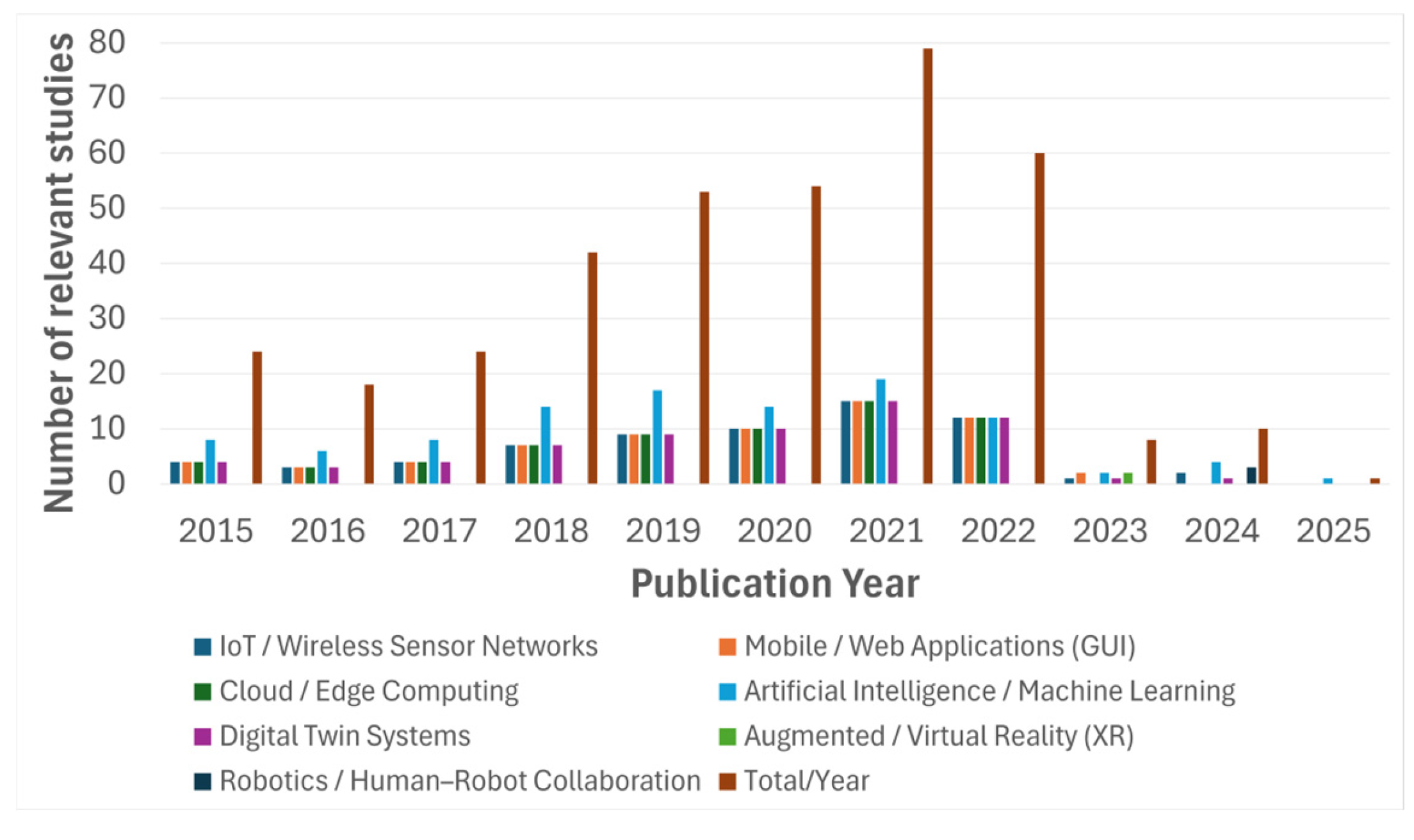
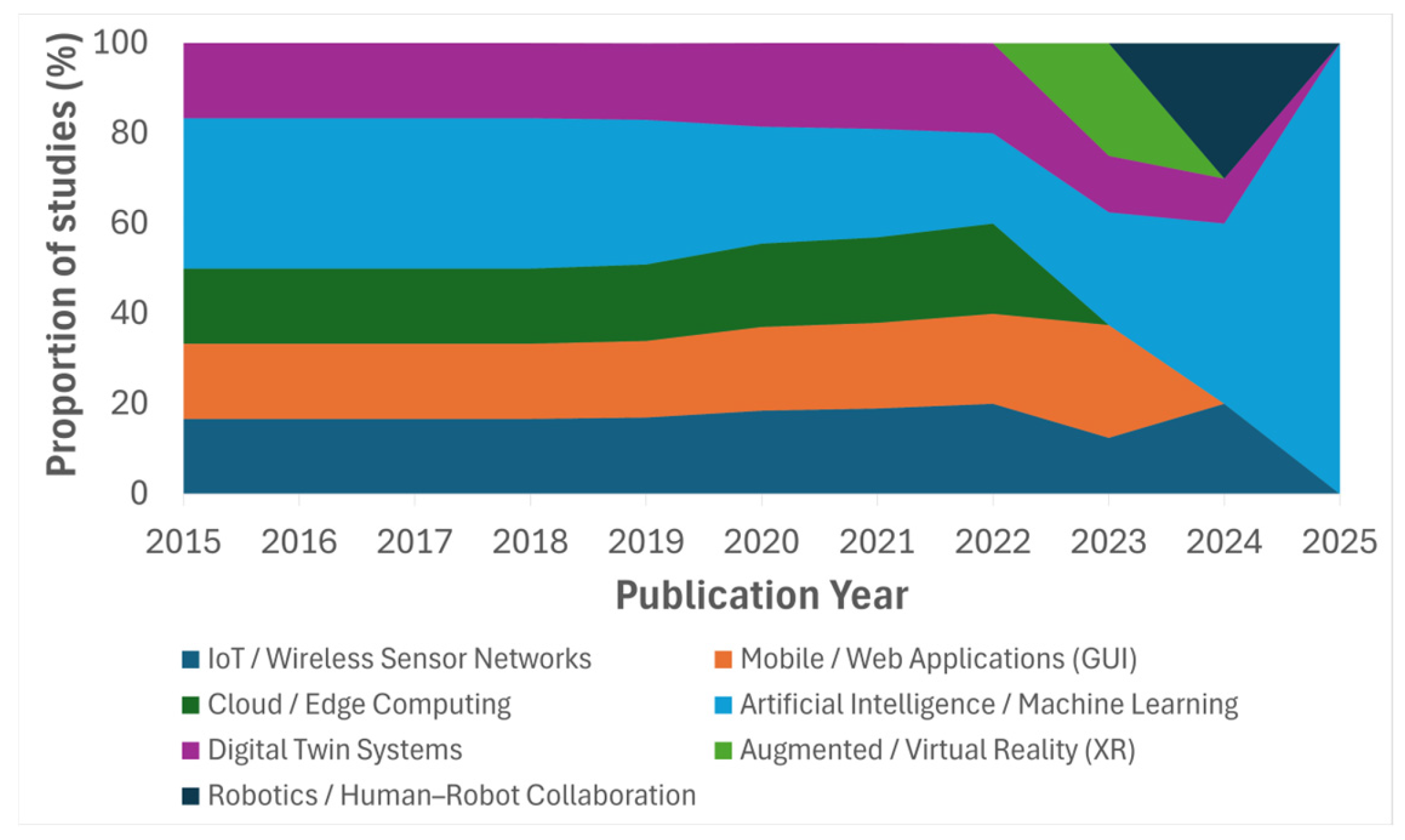
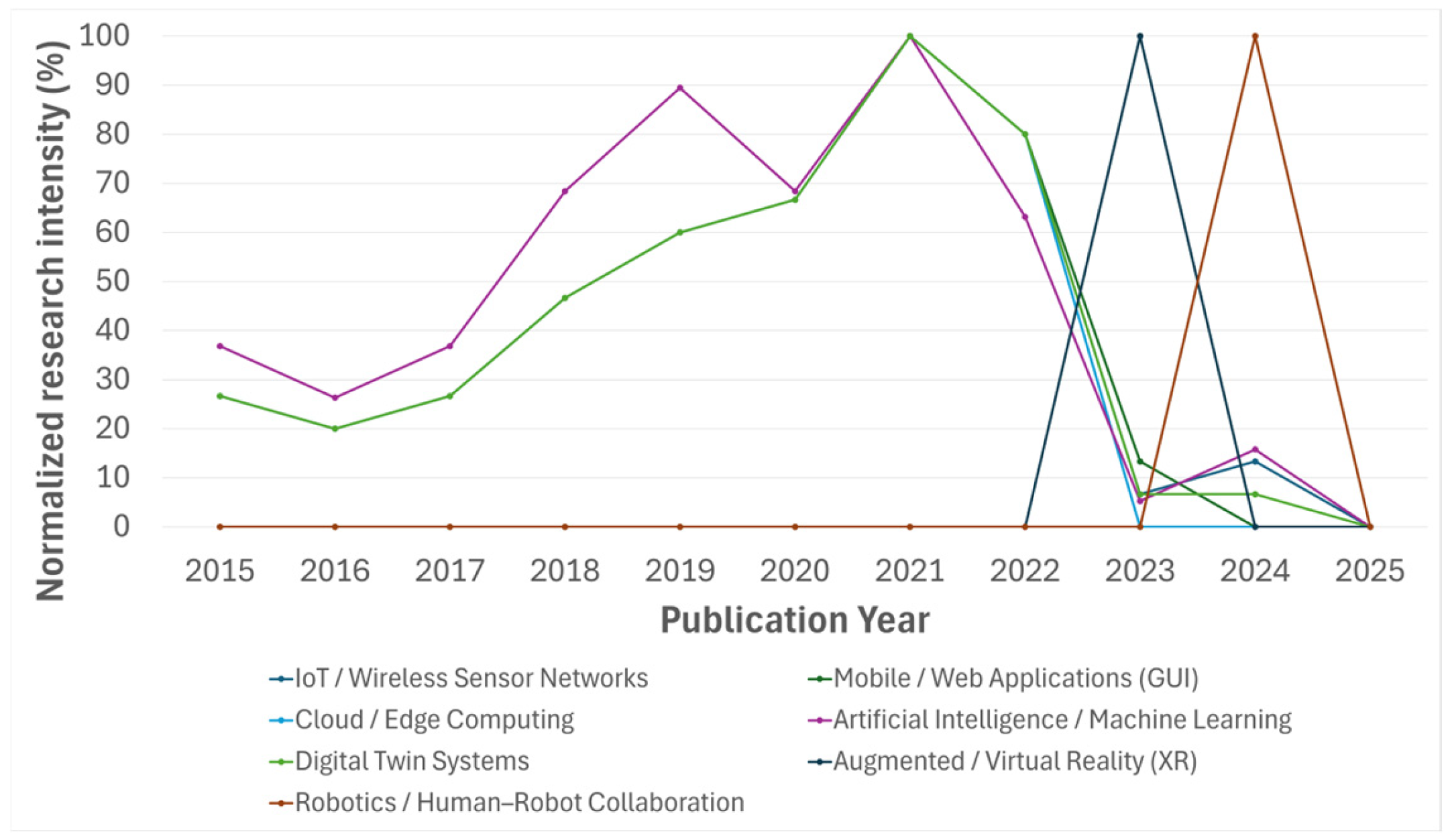
| Technology Category | Count/Reference Base (n) * | Approximate Relevance | Major Growth Period (2015–2025) | Ref. |
|---|---|---|---|---|
| IoT/WSN | ≥115 implicit IoT/WSN occurrences in DT-related studies; based on n ≈ 123 in Ariesen-Verschuur et al. [3] | Dominant infrastructural foundation. | Continuous; sharp increase from ≈2016. | [1,3,5,11,20,42,43,44,45] |
| AI/ML (incl. fuzzy logic) | 47% ML usage in vertical farming studies (n ≈ 68) according to Siregar et al.; 19% predictive DT type (n ≈ 123) according to Ariesen-Verschuur et al. [3] | High, essential for control and prediction. | Sharp acceleration from ≈2018. | [1,3,4,15,31,46,47,48,49,50,51] |
| Digital Twins (DT) | 8 explicit DT mentions; 6.5% of n ≈ 123 according to Ariesen-Verschuur et al. [3] | Emerging concept | Emerging, sharp increase from 2018. | [3,27,51,52,53] |
| Mobile/Web Apps (GUI) | 88.1% GUI usage in DT studies (as reported by Slob et al. [16], based on Ariesen-Verschuur et al. [3], n ≈ 123) | Dominant HCI paradigm for remote control. | Consistently high use throughout the period. | [6,14,16,26] |
| Cloud/Edge Computing | Frequently incorporated in IoT architecture; no explicit quantification in source SLRs. | High (central storage/processing for DT/AI). | Consistent integration; edge emerging 2019–2021. | [3,5,15,20,50,51,54,55,56,57] |
| Robotics/HRC | 22% robotic automation in vertical farming 2016–2022 (n ≈ 68) according to Siregar et al. | Moderate/Increasing importance for automation. | Steady rise, focus on HRC/teleoperation post-2019. | [16,20,28,31,32] |
| AR/VR | 1 explicit VR paper in DT context; 2.4% 3D visualization (reported by Slob et al., [16], based on the Ariesen-Verschuur et al. [3] SLR, n ≈ 123). | Nascent, primary focus on simulation/training. | Early stages, emerging post-2020 (especially AR/VR for DT visualization). | [16,20,28,32] |
| Year | IoT/Cloud Technologies * | AI/ML Approaches * | DT * | AR/VR and Robotics (HRC) * | Highlights * | Ref. |
|---|---|---|---|---|---|---|
| 2015 | Steady IoT monitoring systems. High volume GT articles (n * ≈ 54). | Fuzzy logic systems established. | - | - | Low-cost control design prevalent. | [58,59,60] |
| 2016 | IoT systems show strong growth (n ≈ 63 GT articles). | Adaptive Neuro-Fuzzy Inference System (ANFIS) modeling techniques adopted. | - | - | Focus on relevant wireless monitoring systems. | [61,62] |
| 2017 | Peak GT articles (n ≈ 71). IoT is utilized for integrated management. | Fuzzy logic widely applied. | - | - | Robotics for crop monitoring continues. | [63,64,65] |
| 2018 | Sharp increase in IoT/implicit DT papers begins. Android APP development widespread. | ANN/Fuzzy models for microclimate prediction common. | First explicit DT paper published (Monteiro et al.). | VR/augmented reality (AR) conceptualized for simulation. | Robotics for harvesting (dual arm). | [26,66,67,68] |
| 2019 | Peak HCI/IoT production. | Deep learning/ML approaches prominent (47% in Vertical Farming-VF). | Predictive DT gains prominence. | Mobile Plant Health Visualizer (AR). Human–robot interaction (HRI) system Human-based collaborative intelligence (HUB-CI). | Autonomous Cloud Robotic System demonstrated. | [14,20,31,69,70,71] |
| 2020 | Wide IoT/Cloud platform adoption. Edge AI applications begin. | AI/ML models applied for energy optimization. | Imaginary DT (Building Information Model-BIM). Predictive DT research expands. | VR training simulators developed. Collaborative Intelligence (HRC) exploration. | - | [54,55,72,73,74] |
| 2021 | Peak vertical farming/AI publications (32%). | Focus on DL/Hybrid models (e.g., hybrid neuro-fuzzy). | DT Architecture/frameworks proposed for optimization. | AR in precision farming noted. Robotic 3DS system proposed. | DT acknowledged as next smart farming phase. | [53,75,76,77,78,79,80,81] |
| 2022 | Edge computing is utilized for AI inference. | ML/Deep learning (DL) confirmed superior in accuracy. | Confirmation of DT concepts in initial phase. | - | Robotics automation confirmed (22% in VF studies). | [1,3,5,31] |
| 2023+ | Narrowband Internet of Things (NB-IoT) and secure platforms. | Hybrid quantum deep learning emerging. | VR/DT interaction barriers investigated (simulation sickness). | AR/VR confirmed as visualization future. Remote HRI and VR for strawberry picking validated. | Focus on User Experience (UX) and simulation sickness in XR. | [6,16,32,82] |
| Component/Function | Typical Location (Cloud/Edge) | Rationale/Constraints | Typical Latency Target * | Ref. |
|---|---|---|---|---|
| Low-Level Environmental Control Loops (e.g., PID for Fertigation, On/Off Actuation) | Edge (Local Controller/Gateway: Raspberry Pi, PLC, Microcontroller) | Hardware must be low-power for remote/off-grid locations, and resilient to harsh environments. | Milliseconds to Seconds (e.g., Solenoid valve closing ≤0.3 s; PID control stability/response time ≈ 150 s for EC/pH regulation. | [6,14,21,86] |
| Real-Time Sensor Data Processing, Filtering and Critical Event Detection/Inference | Edge (Gateway/Fog Node) | Reduces high bandwidth demand and load on the central cloud server by preprocessing, aggregating and transferring only essential data. Supports low-latency, real-time interactions for event detection. | Low Latency (Near Real-Time, <1 s to minimize delays in control actions). | [19,107,108] |
| Historical Data Storage, Visualization and Remote Monitoring | Cloud (Public/Private Platform) | Provides highly scalable and reliable storage for large volumes of historical and real-time data for retrospective analysis. Enables centralized remote access and control via web/mobile interfaces for users globally. | High Latency Tolerated (Near Real-Time for display, usually seconds or minutes for monitoring updates). | [2,14,26,86] |
| Technology Category | Key Metrics * | Typical Performance Values * | HCI Limitations and Technical Barriers | Ref. |
|---|---|---|---|---|
| IoT/WSN | Accuracy, Data Loss Rate, Latency, Energy Consumption. | Sensor accuracy highly variable: 2–25% to >90%. Data loss rate (gateway to server): 0.4%. Successful data storage rate: 99.76%. Wireless transmission reliability: No data packet loss (using Low-Power Listening-LPL technology). | Variable sensor quality; cost constraints; reliance on stable network connectivity. | [3,5,15,19,30] |
| Mobile/Web interfacce | Usability (System Usability Scale-SUS Score), User Experience (UX/User Experience Questionnaire-UEQ). | SUS Score: 82.75 (Categorized as Excellent). UEQ Score: Excellent for attractiveness, perspicuity, efficiency, stimulation, novelty; good for dependability. Prototype User Interface (UI) average score: 49 (design A superior to design B, 43.4). | Limited features and visual constraint compared to 3D systems; usability dependent on UCD rigor. | [23,34,84,90] |
| Embedded panels | Classification Accuracy, Root Mean Square Error (RMSE). | Overall microclimate classification accuracy: 97.33%. RMSE (Temperature): 2.398; RMSE (Humidity): 1.483; RMSE (Light): 392.225. | Limited computational power for complex AI; data compression required for cloud transfer. | [10,15,82,107,108] |
| AI/ML | Prediction Accuracy, Coefficient of Determination (R2), Energy Savings, Error Reduction. | DL disease detection accuracy: 99%. CO2 prediction R2: 0.97. Internal temperature prediction error: <1 °C (Nonlinear AutoRegressive with eXogenous Inputs Neural Network-NNARX model). Energy prediction accuracy: 95%. Recurrent Neural Network-RNN control error (Ec): 344.12 (compared to Ec =533.31 for simple NN). | Difficulty in generalizing models to different greenhouse contexts; dependence on massive datasets for DL. | [15,82,107,108] |
| DT | Visualization Preference, Predictive Capability (% of applications). | DT purpose: Monitoring (73%), Prediction (19%). Representation: 88.1% via dashboard; 2.4% via 3D visualization. | Conceptual phase; current focus limited to monitoring state visualization; advanced prescriptive capabilities are still emerging. | [3,16,52,53] |
| AR/VR | Simulator Sickness Questionnaire-SSQ, User Evaluation Score, Convenience/Quality correlation. | Increase in SSQ score leads to lower overall evaluation score. Convenience (realism/playability) has a positive statistical influence on evaluation; visual quality does not. | Risk of simulation sickness/cybersickness; specialized hardware required; low overall application rate (<3% of DT studies use 3D/VR). | [13,16] |
| Robotics/HRC | Detection Accuracy Gain, Error Rate, Operational Efficiency (Cycle Completion Time-CCT). | Detection increase using HRC (HUB-CI): 4% (vs. human alone); 14% (vs. fully autonomous system). Collaboration yields significantly fewer errors. Yield monitoring CCT (eg., strawberry): Measured across two trials for eight plant groups. | High complexity in managing physical collaboration tasks requires robust workflow protocols to minimize conflicts and errors. | [32,69] |
| Cloud/Edge Computing | Latency, Cost Efficiency (Levelized Cost of Energy-LCOE). | Data loss rate (gateway to server): 0.4%. LCOE (Photovoltaic-PV system with Latent Thermal Energy Storage-LTES storage): 0.068 USD/kWh (70% reduction vs. diesel system: 0.230 USD/kWh). | Dependence on network stability; data security concerns; high energy consumption for Generative AI models. | [3,4,15,82,109] |
| Multimodal (voice/gesture) | Cognitive Load (Fixation Frequency Correlation). | Transition from web to Mixed Reality impacts fixation frequency (correlation with cognitive load). | Lack of widespread application data; technical difficulty in accurate gesture/voice recognition in noisy greenhouse settings. | [110,111,112,113,114] |
| Evaluation/ Design Type | Context | Frequency/Year * | Ref. |
|---|---|---|---|
| UX/Usability | DT Visualization | Dashboard interface dominant (88.1% of 123 reviewed articles). | [16] |
| 3D Visualization (2.4%, or 2 articles). | |||
| VR/DT Interface | Only one paper (out of 123) implicitly addressed VR | ||
| Usability (SUS) | Mobile App Design | Achieved an excellent usability score of 82.75 (evaluated by 10 potential users). | [84] |
| Participatory/Qualitative | VR/DT Experiment | Limited sample size of 30 participants (all from one university/WUR) noted as a limitation. | [16,38] |
| Grower Cognition | Qualitative work based on 11 expert interviews to isolate constants for improving technology usability. | ||
| Participatory (UCD) | Microclimate GUI | Study involved 10 respondents (three hydroponic practitioners, three agricultural technology users and others) for needs analysis. | [34] |
| Collaborative HRI | Target Recognition | Collaboration increased detection probability by 4% compared to a human alone and 14% compared to a fully autonomous system | [33,69] |
| UX/Cognitive Load | Alert System Assessment | NASA Task Load Index (NASA-TLX) and UEQ employed found that alert delivery mechanisms generated a similar mental workload. | [23] |
| Paradigm | Focus Area | Evaluation | Interface Types | Ref. |
|---|---|---|---|---|
| User-Centered Design (UCD) | System development, ensuring usability, functionality and utility for the end-user (e.g., microclimate monitoring). | Usability Testing, Surveys/Questionnaires, System Usability Scale (SUS). | Graphical User Interfaces (GUIs), Mobile Applications (Android), Web Interfaces. | [6,7,14,34,84] |
| Participatory Design (PD)/Design Thinking | Collaborative creation, identifying user problems and needs, incorporating stakeholder knowledge (agronomists, technicians, growers). | Interviews (semi-structured), Qualitative Data Analysis (affinity mapping, empathy maps), Persona/Journey Mapping. | Conceptual Models, Prototypes (low and high-fidelity), Mobile App Mockups (Figma). | [7,38,84,106] |
| Experience-Centered Design (ECD)/UX | Holistic user perception, focusing on the quality of interaction, emotional inclusion and avoiding negative consequences like simulator sickness. | Simulation Sickness Questionnaire (SSQ), User Experience Questionnaire (UEQ), Qualitative feedback. | Virtual Reality environments, 3D visualizations, Interactive prototypes. | [16,23,143] |
| Cognitive Ergonomics | Optimizing system interaction to reduce cognitive load, match technology to existing professional heuristics, and minimize errors in complex tasks. | NASA Task Load Index (NASA-TLX), Error rates, Qualitative analysis of professional routines/practices. | Alert Systems (multi-modal delivery: voice, sound, text), Process control interfaces (fuzzy logic, AI models for prediction). | [16,23,143] |
| Human–Robot Interaction (HRI) | Enabling remote control and collaborative intelligence between human operators and robotic platforms for tasks like monitoring or harvesting. | Detection accuracy, Cycle completion times, Error reduction quantification, Performance metrics. | Virtual Reality teleoperation interfaces, Wi-Fi consoles, robotic vision feeds, digital twin replicas of robot status. | [32,33,69] |
| Feature | Conventional GUI-Based Interaction | Immersive and Multimodal Interaction | AI-Driven Adaptive and Predictive Interfaces (DT/DSS) | Ref. |
|---|---|---|---|---|
| Interaction mode | 2D graphics, direct manipulation, menu navigation, remote manual control. | 3D immersive (VR/AR), gesture, voice, telerobotics/HRI, simulated physical action. | System suggestions, predictive visualization, autonomous execution, prescription of optimal strategies. | [3,22,26,28,32] |
| Cognitive load | Moderate/High (requires manual synthesis of data, heuristic decision-making). | Variable (can be reduced by visualization/AR; increased by cybersickness or complex controls). | Low (automates decision-making; predictive alerts minimize surprises). | [3,16,21,38,83] |
| Automation level | Low/Medium (automated data acquisition; manual setpoint control). | Medium (automated tasks via HRI/teleoperation; human-in-the-loop control). | High/Autonomous (self-adjusting algorithms, predictive control, optimization models). | [3,7,32,69,83] |
| Adoption potential | High (low cost, high familiarity, mobile device accessibility). | Medium/Emerging (limited by simulation sickness, specialized hardware costs/complexity). | Medium (high initial cost, requirement for skilled staff, generalization issues). | [13,15,16,26,84,89,106] |
| Sustainability impact | Generally neutral/positive (enables monitoring resource use, UCD focus). | Positive (enables efficient HRI for precision tasks, reducing waste). | Variable (high positive impact via resource optimization; negative impact from AI/GenAI energy consumption). | [4,5,6,15,21,33,109] |
| System | Technology/Core Function | Interface Type | HCI Role | Ref. |
|---|---|---|---|---|
| Android remote control | IoT, Raspberry Pi, MySQL database for remote control of fertigation (Subsystem D). | 2D mobile GUI (Android) | Remote monitoring and control | [14,26] |
| VR greenhouse training | Virtual Reality (VR), Electronic Control System (ECS) simulation | 3D immersive (HMD, controllers) | Training/simulation | [13,16] |
| Hub-CI (telerobotics) | Collaborative Intelligence (CI), Telerobotics (spectral imaging, workflow protocols). | Cyber-augmented collaboration (web-based/remote) | Human–robot supervision | [69] |
| Fuzzy logic control | AI (Fuzzy Inference Systems, ANFIS), IoT sensing for climate control. | Embedded/2D dashboards (often remote access) | Adaptive automation | [5,10,89] |
| Mobile Plant Health Visualizer (MPHV) | Augmented reality (AR), SI-NDVI imaging. | AR (HMD/smartphone display) | Context-aware visualization | [28] |
| System | Advantages | Limitations | Ref. |
|---|---|---|---|
| Android remote control | Real-time monitoring, visualization, remote adjustment of fertigation/settings. | Requires network status for access, limited functionality compared to advanced systems. | [14,26] |
| VR greenhouse training | Risk-free training environment, replicating real-world ECS interfaces, fosters engagement. | Challenges in mimicking physical actions, risk of simulation sickness, hardware dependent. | [13,16] |
| Hub-CI, telerobotics | Improves detection accuracy (14% over autonomous systems), optimizes collaboration tasks, decision support. | Requires complex management/coordination protocols to prevent errors | [69] |
| Fuzzy logic control | High interpretability, better performance for nonlinear systems, potential resource savings (22% energy, 33% water) | Reluctance in adoption due to complexity/non-standardization compared to PID. | [5,10,89] |
| Mobile Plant Health Visualizer (MPHV) | Enables quick visualization of plant health (PHM) status in cultivation area; remote monitoring. | Complexity, cost, dependence on wireless signals, and limited optical resolution (future concern). | [28] |
Disclaimer/Publisher’s Note: The statements, opinions and data contained in all publications are solely those of the individual author(s) and contributor(s) and not of MDPI and/or the editor(s). MDPI and/or the editor(s) disclaim responsibility for any injury to people or property resulting from any ideas, methods, instructions or products referred to in the content. |
© 2025 by the author. Licensee MDPI, Basel, Switzerland. This article is an open access article distributed under the terms and conditions of the Creative Commons Attribution (CC BY) license (https://creativecommons.org/licenses/by/4.0/).
Share and Cite
Brăileanu, P.I. Human–Computer Interaction in Smart Greenhouses: A Review of Interfaces, Technologies, and User-Centered Approaches. Computers 2025, 14, 553. https://doi.org/10.3390/computers14120553
Brăileanu PI. Human–Computer Interaction in Smart Greenhouses: A Review of Interfaces, Technologies, and User-Centered Approaches. Computers. 2025; 14(12):553. https://doi.org/10.3390/computers14120553
Chicago/Turabian StyleBrăileanu, Patricia Isabela. 2025. "Human–Computer Interaction in Smart Greenhouses: A Review of Interfaces, Technologies, and User-Centered Approaches" Computers 14, no. 12: 553. https://doi.org/10.3390/computers14120553
APA StyleBrăileanu, P. I. (2025). Human–Computer Interaction in Smart Greenhouses: A Review of Interfaces, Technologies, and User-Centered Approaches. Computers, 14(12), 553. https://doi.org/10.3390/computers14120553