Article

Employing Different Algorithms of Lightweight Convolutional Neural Network Models in Image Distortion Classification


by
Ismail Taha Ahmed
1,*,
Falah Amer Abdulazeez
2 and
Baraa Tareq Hammad
1
1
College of Computer Sciences and Information Technology, University of Anbar, Anbar 55431, Iraq
2
College of Education Pure Sciences, University of Anbar, Anbar 55431, Iraq
*
Author to whom correspondence should be addressed.
Computers 2024, 13(10), 268; https://doi.org/10.3390/computers13100268

Submission received: 18 September 2024 / Revised: 6 October 2024 / Accepted: 8 October 2024 / Published: 12 October 2024
(This article belongs to the Special Issue Machine Learning Applications in Pattern Recognition)

Abstract

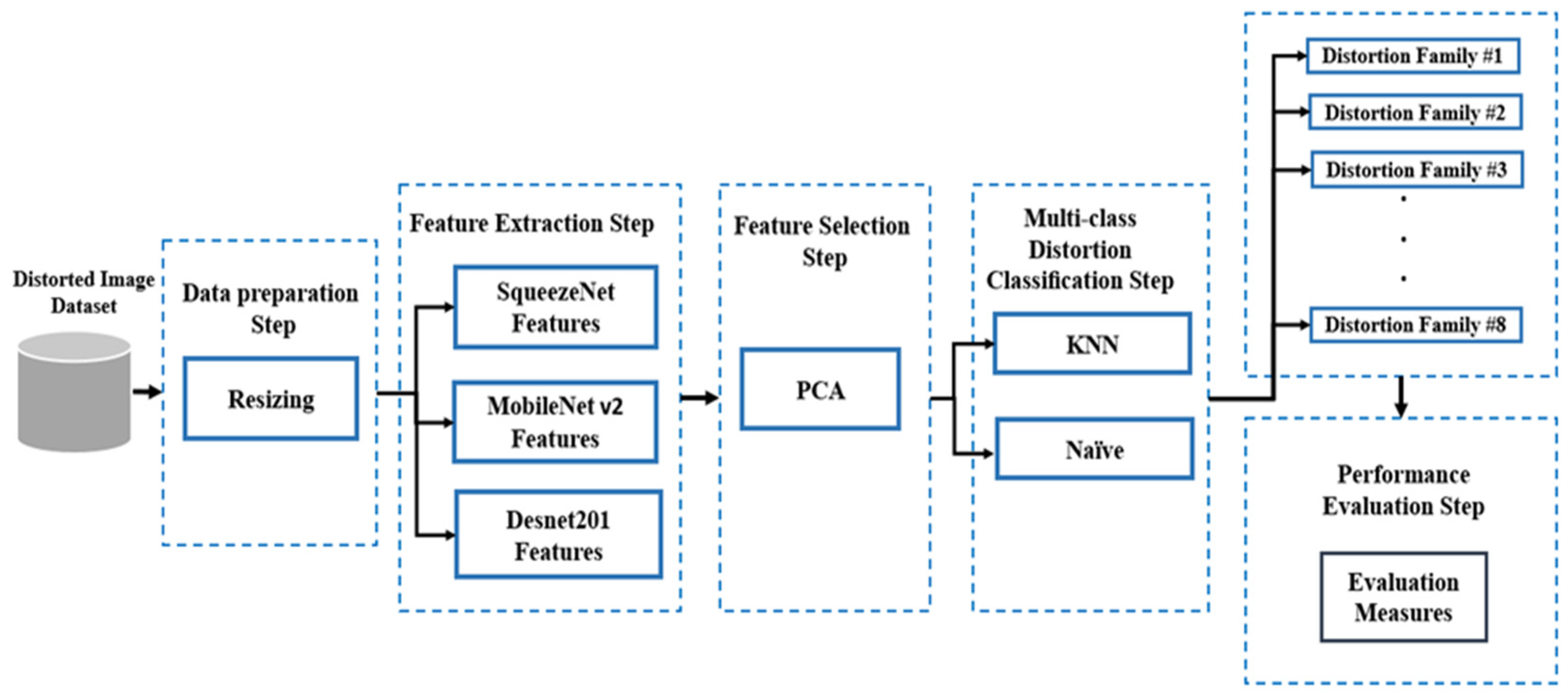
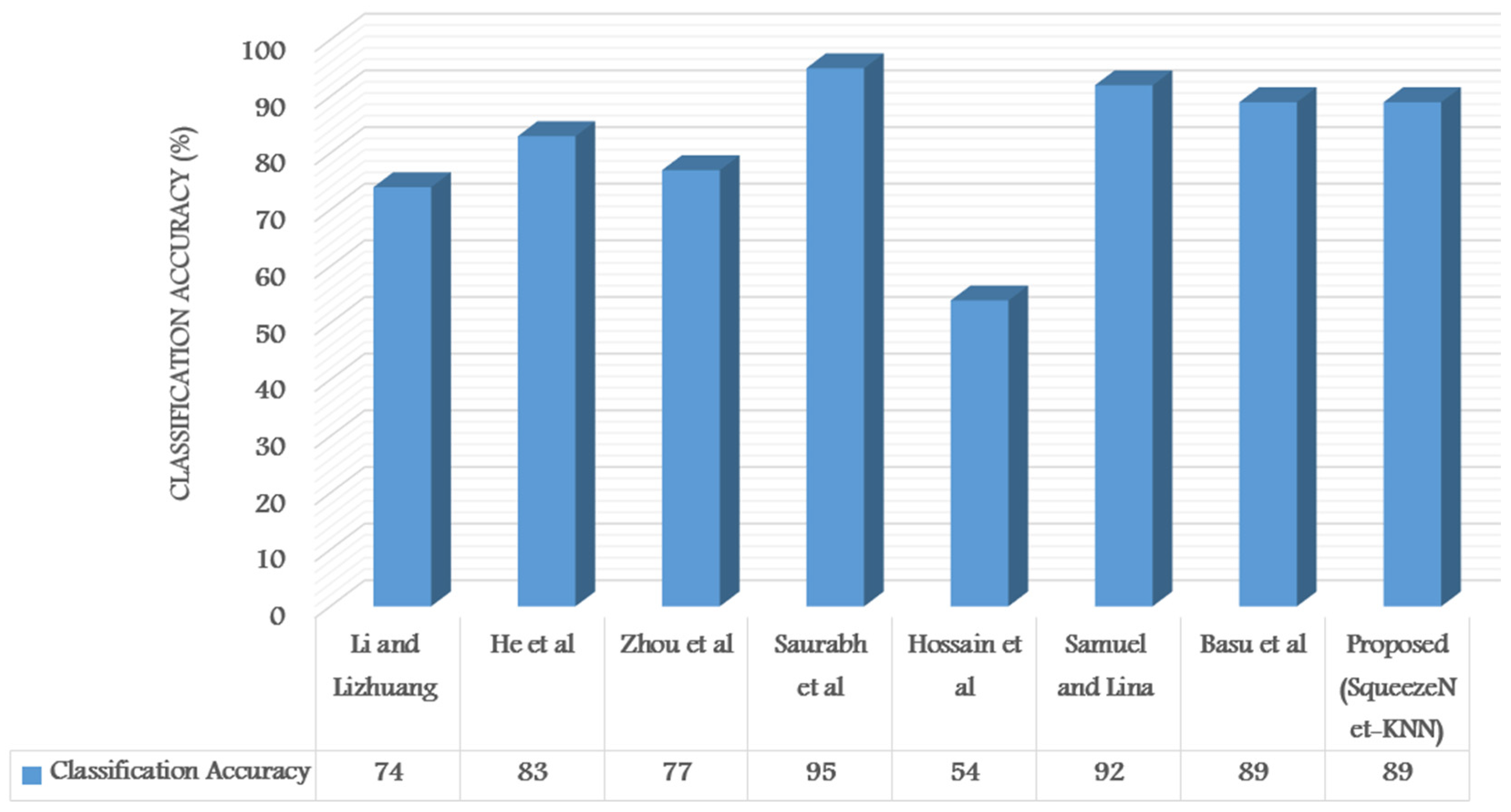
The majority of applications use automatic image recognition technologies to carry out a range of tasks. Therefore, it is crucial to identify and classify image distortions to improve image quality. Despite efforts in this area, there are still many challenges in accurately and reliably classifying distorted images. In this paper, we offer a comprehensive analysis of models of both non-lightweight and lightweight deep convolutional neural networks (CNNs) for the classification of distorted images. Subsequently, an effective method is proposed to enhance the overall performance of distortion image classification. This method involves selecting features from the pretrained models’ capabilities and using a strong classifier. The experiments utilized the kadid10k dataset to assess the effectiveness of the results. The K-nearest neighbor (KNN) classifier showed better performance than the naïve classifier in terms of accuracy, precision, error rate, recall and F1 score. Additionally, SqueezeNet outperformed other deep CNN models, both lightweight and non-lightweight, across every evaluation metric. The experimental results demonstrate that combining SqueezeNet with KNN can effectively and accurately classify distorted images into the correct categories. The proposed SqueezeNet-KNN method achieved an accuracy rate of 89%. As detailed in the results section, the proposed method outperforms state-of-the-art methods in accuracy, precision, error, recall, and F1 score measures.
Keywords: distortion image classification; non-lightweight; lightweight; convolutional neural network (CNN) models; SqueezeNet; MobileNet-v2; DenseNet201; K-nearest neighbor (KNN) classifier distortion image classification; non-lightweight; lightweight; convolutional neural network (CNN) models; SqueezeNet; MobileNet-v2; DenseNet201; K-nearest neighbor (KNN) classifier