
Article

Deep Learning Ensemble Model for the Prediction of Traffic Accidents Using Social Media Data

by
Camilo Gutierrez-Osorio
*,
Fabio A. González
and
Cesar Augusto Pedraza
Departamento de Ingeniería de Sistemas e Industrial, Universidad Nacional de Colombia, Cra 45 No. 26-85, Bogotá 111321, Colombia
*
Author to whom correspondence should be addressed.
Computers 2022, 11(9), 126; https://doi.org/10.3390/computers11090126

Submission received: 20 June 2022 / Revised: 27 July 2022 / Accepted: 29 July 2022 / Published: 23 August 2022
(This article belongs to the Special Issue Machine Learning for Traffic Modeling and Prediction)

Abstract

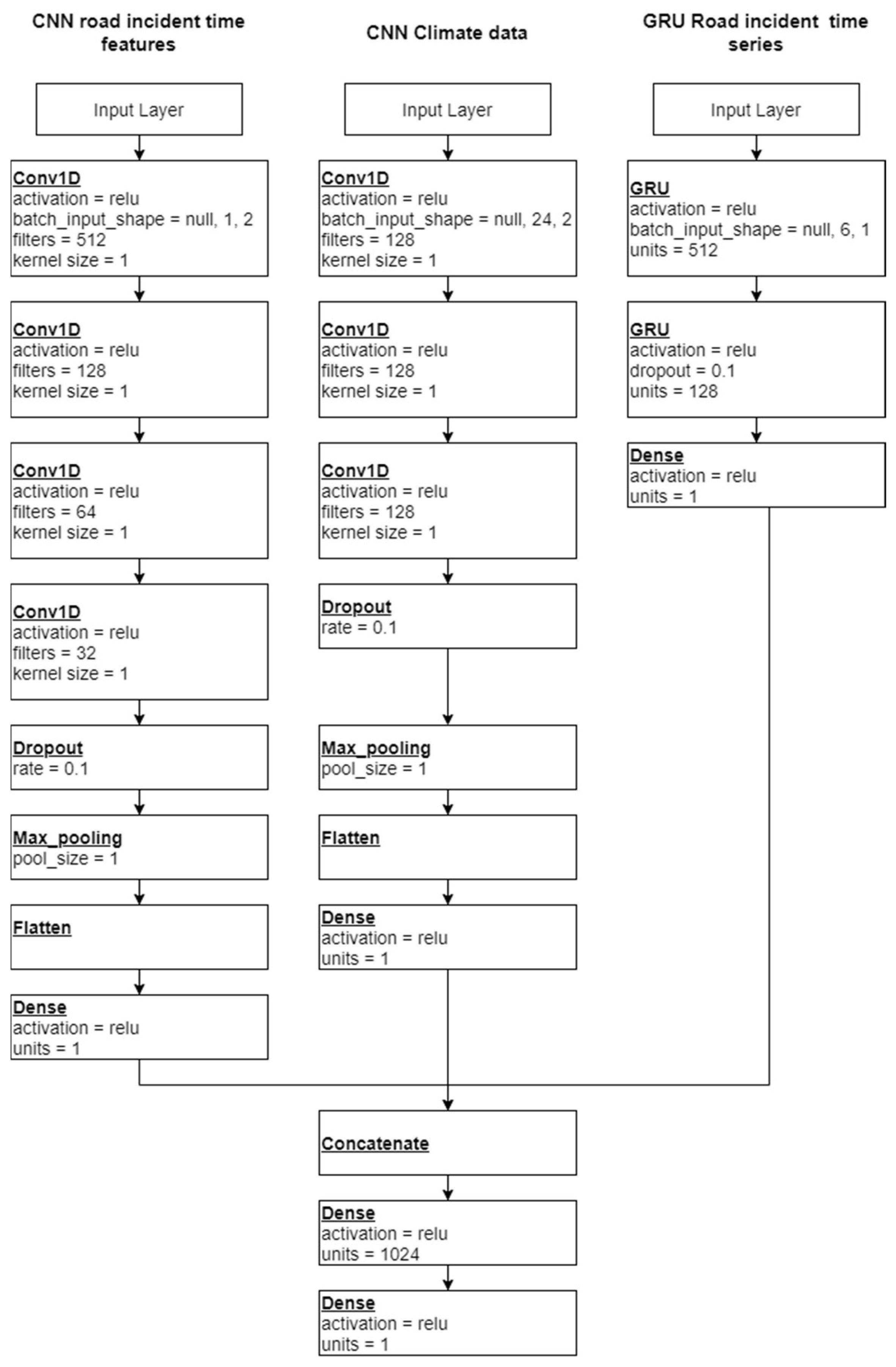
Traffic accidents are a major concern worldwide, since they have a significant impact on people’s safety, health, and well-being, and thus, they constitute an important field of research on the use of state-of-the-art techniques and algorithms to analyze and predict them. The study of traffic accidents has been conducted using the information published by traffic entities and road police forces, but thanks to the ubiquity and availability of social media platforms, it is possible to have detailed and real-time information about road accidents in a given region, which allows for detailed studies that include unrecorded road accident events. The focus of this paper is to propose a model to predict traffic accidents using information gathered from social media and open data, applying an ensemble Deep Learning Model, composed of Gated Recurrent Units and Convolutional Neural Networks. The results obtained are compared with baseline algorithms and results published by other researchers. The results show promising outcomes, indicating that in the context of the problem, the proposed ensemble Deep Learning model outperforms the baseline algorithms and other Deep Learning models reported by literature. The information provided by the model can be valuable for traffic control agencies to plan road accident prevention activities.
Keywords: machine learning; traffic accident risk prediction; traffic accidents machine learning; traffic accident risk prediction; traffic accidents