Article

Germline BRCA1/2 Mutations in a Large Clinic-Based Cohort of Patients with Metastatic Breast Cancer in France


by
Guillaume Meynard
1,
Victor Pereira
1,2,*,
Sophie Paget-Bailly
2,3,
Elodie Klajer
1,
Laura Mansi
1,
Loïc Chaigneau
1,
Nathalie Meneveau
1,
Marie Justine Paillard
1,
Fernando Bazan
1,
Erion Dobi
1,
Cristian Villanueva
4,
Zohair Selmani
1,
Julien Viot
1,
Lorraine Dalens
1,
Morgan Goujon
1,
Marie-Agnès Collonge-Rame
5,
Céline Populaire
5,
Aurélia Meurisse
2,
Xavier Pivot
6 and
Elsa Curtit
1,2
1
Department of Medical Oncology, Jean-Minjoz University Hospital Centre, F-25000 Besançon, France
2
Marie et Louis Pasteur University, EFS, INSERM, UMR RIGHT, F-25000 Besançon, France
3
Department of Methodology and Quality of Life in Oncology, Jean Minjoz University Centre, F-25000 Besançon, France
4
Montpellier Cancer Centre, Clémentville Clinic, Medical Oncology, 34070 Montpellier, France
5
Department of Oncobiology, Jean Minjoz University Hospital, 25000 Besançon, France
6
Department of Medical Oncology, ICANS, 67200 Strasbourg, France
*
Author to whom correspondence should be addressed.
Cancers 2026, 18(5), 851; https://doi.org/10.3390/cancers18050851
Submission received: 22 January 2026 / Revised: 19 February 2026 / Accepted: 22 February 2026 / Published: 6 March 2026
(This article belongs to the Section Molecular Cancer Biology)

Simple Summary

Inherited mutations in the BRCA1 and BRCA2 genes are well known in early breast cancer, but much less is known about how often they occur in patients with metastatic breast cancer, especially in routine clinical practice. In this study, we offered genetic testing to a large group of patients with metastatic breast cancer treated in several hospitals in eastern France, regardless of their age or family history. We found that a small but clinically important proportion of patients carried a BRCA1 or BRCA2 mutation, and nearly half of them would not have been identified using standard referral criteria. These results suggest that broader access to genetic testing could help better identify patients who may benefit from targeted treatments, such as PARP inhibitors, and support more equitable implementation of precision medicine in metastatic breast cancer.

Abstract

Objectives: This study aimed to fill the data gap regarding the prevalence of germline (g) BRCA1/2 mutations in patients with metastatic breast cancer (mBC) in France. Methods: A prospective gBRCA1/BRCA2 mutation analysis was proposed to all patients with mBC treated in seven French centers between 19 February and 30 November 2015. The BRCA TrueTM test (Pathway Genomics®, San Diego, CA, USA) analyzed the coding and flanking regions of BRCA1 and BRCA2 genes using next-generation sequencing, Sanger sequencing, and multiplex ligation-dependent probe amplification. Results: Among 407 included mBC patients, 11 (2.7%) carried pathogenic gBRCA1/2 mutations. Of these, five (45%) would not have met standard criteria for genetic screening. Compared with non-carriers, gBRCA1/2 carriers were significantly younger at mBC diagnosis (47.5 vs. 60.7 years, p = 0.0006), had higher-grade tumor histology (p = 0.044), and had a higher rate of contralateral recurrence (36.4% vs. 11.6%, p = 0.035), with comparable adjusted survival (median overall survival 74.9 vs. 100.1 months, p = 0.97). Variants of uncertain significance were identified in 17 (4.2%) patients. Conclusions: The 2.7% prevalence of gBRCA1/2 mutations in this prospective French mBC cohort was relatively low. Nearly half of the mutation carriers would not have been routinely referred for oncogenetic counseling, underscoring the potential value of broader genetic screening in this population.

1. Introduction

Genetic susceptibility to breast cancer is linked to several genes associated with well-established hereditary cancer syndromes, including the BRCA1 and BRCA2 tumor suppressor genes [1,2]. Germline mutations in BRCA1 and BRCA2 account for approximately 5–10% of familial breast cancer cases [3]. Women carrying BRCA1 or BRCA2 mutations face an estimated lifetime breast cancer risk ranging from 50% to 80% [4,5].
The reported prevalence of germline BRCA1/2 (gBRCA1/2) mutations varies between 1.7 and 33.3% across different populations of patients with breast cancer [6,7,8,9,10]. Higher gBRCA1/2 mutation rates have been reported in patients with a strong family history of breast cancer [6,7,11], triple-negative disease (i.e., estrogen-receptor-negative, progesterone-receptor-negative, and human epidermal growth factor receptor type 2 [HER2]-negative) [7,8,12], younger age at diagnosis [6,7,8,11,12], and Ashkenazi Jewish ancestry [6,11]. The prevalence of gBRCA1/2 mutations in metastatic breast cancer (mBC) patients has been reported to be 21% in a US-based single-center study [13] and 9.7% in an international multicenter study [14]. However, to date, the prevalence of gBRCA1/2 mutations in mBC patients in France remains unknown. Identifying gBRCA1/2 mutations in this population has significant implications, particularly for treatment with poly (ADP–ribose) polymerase (PARP) inhibitors.
BRCA1 and BRCA2 genes encode proteins involved in the repair of DNA double-strand breaks through the homologous recombination repair pathway. Genomic aberrations disrupting DNA repair mechanisms have been associated with sensitivity to platinum-based chemotherapy [15,16] and to poly (ADP–ribose) polymerase (PARP) inhibitor therapy [17,18,19]. PARP inhibitors, such as olaparib and talazoparib, are approved for the treatment of HER2-negative mBC patients with gBRCA1/2 mutations based on OlympiAD and EMBRACA trials, respectively [20,21,22]. According to the guidelines from the European Society of Medical Oncology (ESMO), the American Society of Clinical Oncology (ASCO), and the National Comprehensive Cancer Network (NCCN), patients with pathogenic gBRCA1/2 mutations and HER-2-negative mBC should be considered for PARP inhibitor treatment, regardless of their hormone receptor status, as an alternative to chemotherapy [23,24]. This present study aimed to determine the frequency of gBRCA1/2 mutations using full-sequence analysis and multiplex ligation-dependent probe amplification (MLPA) in a large, unselected, clinic-based cohort of patients with mBC.

2. Materials and Methods

2.1. Study Design

This was a prospective, multicenter cohort study conducted in seven centers located in the Franche-Comté region of France, which has a population of over 1.1 million people.

2.2. Patients and Procedures

Patients eligible for inclusion in the study had histologically confirmed mBC and unknown gBRCA1/2 mutational status; thus, no pre-study sample size calculation was performed. Study participants were enrolled between 19 February and 30 November 2015 and followed as part of routine care at each site until death, withdrawal of consent, or for up to five years. All participants provided written informed consent. According to French legislation applicable at the time of the study, this non-interventional research did not require approval from a Comité de Protection des Personnes (CPP). The study was conducted in accordance with the ethical principles of the Declaration of Helsinki and applicable institutional requirements.
Participants provided a blood sample for germline BRCA1/2 DNA analysis. Patient demographics, family history of cancer, and treatment data were collected using an electronic case report form.

2.3. BRCA1 and BRCA2 Testing

Germline DNA (gDNA) was extracted from peripheral blood samples and analyzed by next-generation sequencing (NGS) and Sanger sequencing at the Pathway Genomics Laboratories (San Diego, CA, USA) using the BRCA TrueTM test (Pathway Genomics Laboratories, San Diego, CA, USA). The test targeted the coding and flanking regions of the BRCA1 and BRCA2 genes. The gDNA was first assessed for quality and quantity, then enriched for the targeted exons and flanking regions using polymerase chain reaction (PCR) with specific primers. NGS was performed on the enriched DNA to detect variants. Sanger sequencing was used for regions insufficiently covered by NGS and to confirm suspected pathogenic or novel variants.
Large rearrangements, deletions, and duplications in BRCA1/2, which are missed by direct sequencing [25], were identified via MLPA.
Results were classified according to the American College of Medical Genetics (ACMG) guidelines as pathogenic mutation or variants of uncertain significance (VUS). Patients with pathogenic mutations or VUS were referred for genetic counseling. Patients were classified into two groups: BRCA1/2-positive (those with a pathogenic gBRCA 1/2 mutation) or BRCA1/2-negative (those without a pathogenic gBRCA1/2 mutation or with VUS).

2.4. Study Outcomes

Baseline demographics (age at diagnosis of primary breast cancer and of mBC) and disease characteristics (histological grade, HER-2 and hormone-receptor status, the presence of breast cancer in the contralateral breast, and the presence of metachronous ovarian cancer) were evaluated in both groups, BRCA1/2-positive and BRCA1/2-negative groups. Overall survival (OS), defined as the time from mBC diagnosis until death from any cause, was also analyzed. Patients alive were censored at the date of their last follow-up.

2.5. Statistical Analysis

The primary goal of the study was to assess the prevalence of gBRCA1/2 mutations among patients with unknown gBRCA1/2 status in the local mBC population. Comparisons between BRCA1/2-positive and BRCA1/2-negative groups were descriptive due to the non-randomized design. Because of the small sample size across strata, we used Fisher’s exact test to compare the distribution of selected categorical variables between the two groups. The Kruskal–Wallis test was used to compare continuous variables. The Kaplan–Meier method was employed to estimate median OS with 95% confidence intervals (CIs). The log-rank test was used to compare survival between groups. The reverse Kaplan–Meier method was used to estimate median follow-up time. Given the limited number of gBRCA1/2 mutation carriers, all comparative and survival analyses were considered exploratory and hypothesis-generating. No formal sample size calculation was performed, and no multivariable modeling was conducted due to limited statistical power.

3. Results

3.1. gBRCA1/2 Status in the mBC Population

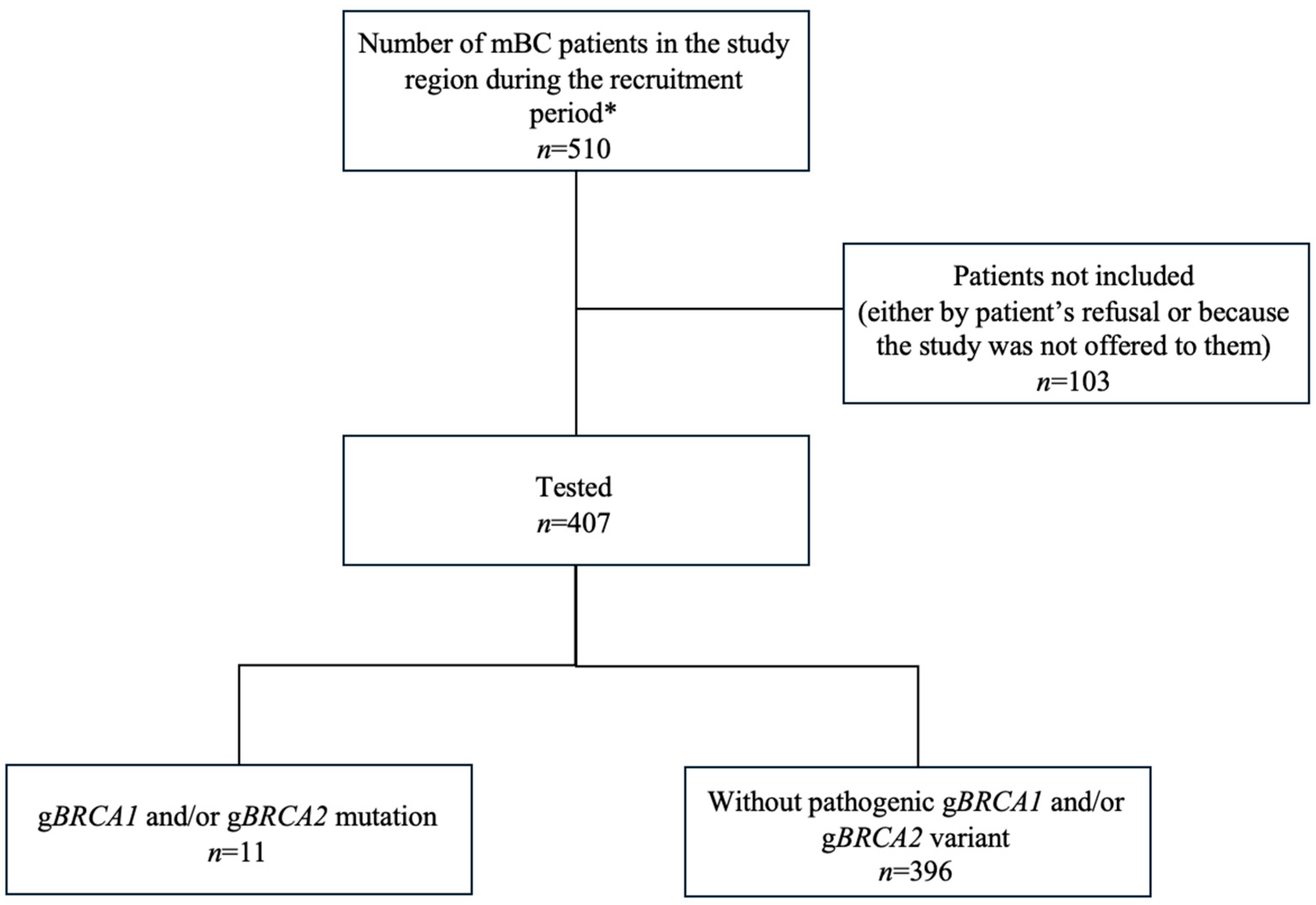
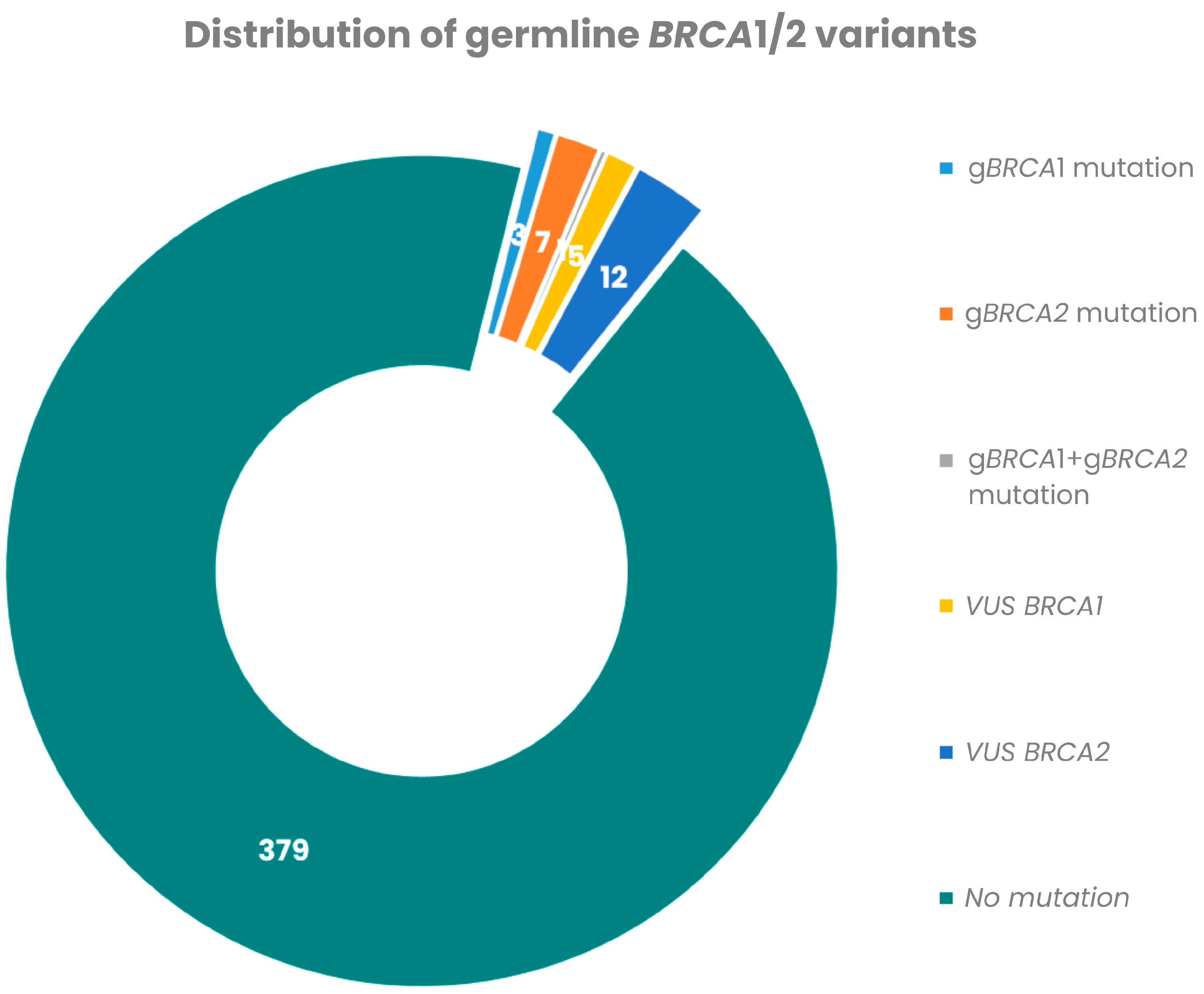
A total of 510 mBC patients from the seven participating hospitals were potentially eligible for participation in the study, based on the number of patients with mBC whose records were available in the regional health database. Of these, 407 patients underwent testing of gBRCA1/BRCA2 mutations, and the mutational status was successfully determined for all. Pathogenic gBRCA1/2 mutations were identified in 11/407 patients (2.7%) (Figure 1). BRCA2-only (n = 7) mutations were the most common, affecting 7/407 patients (1.7% of the cohort, 63.6% of gBRCA1/2 carriers). Three patients were BRCA1-only mutation carriers (0.7% of the cohort, 27.3% among gBRCA1/2 carriers), while one patient had both BRCA1 and BRCA2 germline mutations (Figure 2). Each mutation carrier harbored a unique pathogenic variant (Supplementary Table S1). VUS were found in 17/407 patients (4.2%) (Figure 2).

3.2. Patients and Tumor Characteristics According to BRCA1/2 Status

Compared to non-carriers, gBRCA1/2 carriers were significantly younger at diagnosis of primary breast cancer (median age 56.6 years versus 45.0 years, respectively, p = 0.0029) and at diagnosis of mBC (median age 60.7 years versus 47.5 years, respectively, p = 0.0006) (Table 1). There were several significant clinical and pathological differences between BRCA1/2-positive and BRCA1/2-negative patients. gBRCA1/2 mutations were significantly associated with a high histological grade (p = 0.044) compared to non-carriers. All gBRCA1/2 mutation carriers had HER2-negative breast cancer. All patients with a gBRCA2 mutation (n = 7) presented with hormone receptor-positive mBC, whereas all patients with a gBRCA1 mutation (n = 4) had triple-negative mBC. The prevalence of gBRCA gene mutations among the metastatic HER2-negative breast cancer patient population was 3.0% (11/368). Contralateral breast tumors occurred more frequently in 4/11 (36.4%) patients with gBRCA1/2 mutation and 46/396 (11.6%) patients without gBRCA1/2 mutation (p = 0.035) (Table 2). None of the patients in the gBRCA1/2-positive or gBRCA1/2-negative groups developed metachronous ovarian cancer.

3.3. Universal BRCA1/2 Mutation Screening

Universal BRCA1/2 mutation screening in this mBC patient population detected 11 gBRCA1/2 mutations. In 2015, the Manchester score (based on personal and family history) was widely applied in oncogenetics to help make decisions about performing oncogenetic research. A family or individual score ≥ 16 is a “strong indication for genetic research,” corresponding to a gBRCA1/2 mutation probability of 10%. Based on the Manchester score, only 6/11 patients with a gBRCA1/2 mutation identified in our study would have been assessed for genetic predisposition to breast cancer. Universal screening, irrespective of the Manchester score, allowed detection of gBRCA1/2 mutations in five additional patients.

3.4. Survival Data

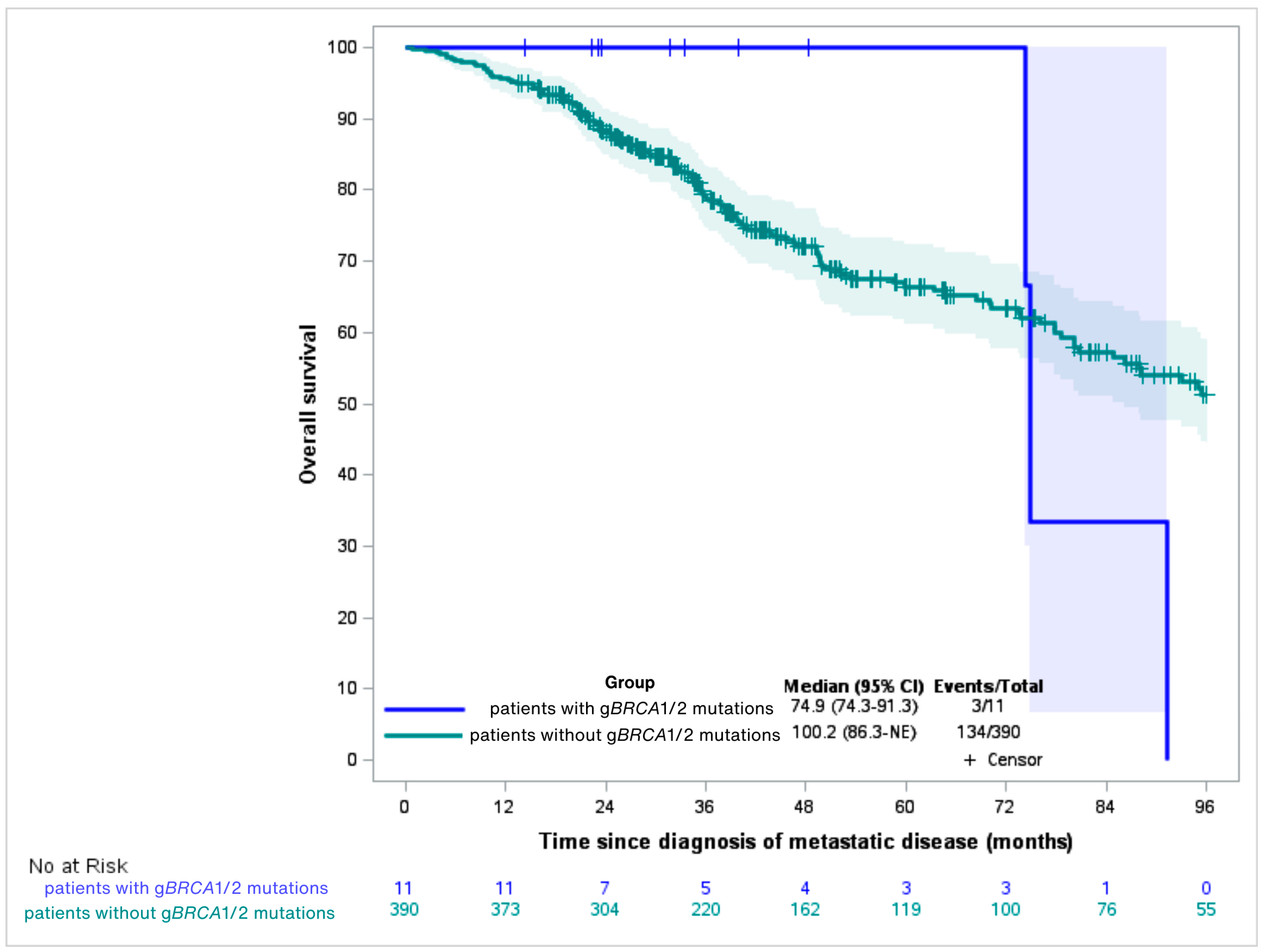
Median follow-up was 53.3 months (95% CI: 47.64–65.54); eight patients (2%) were lost to follow-up. Median OS was 74.9 months in gBRCA1/2-positive (95% CI: 74.3–91.3) and 100.1 months in gBRCA1/2-negative patients (95% CI: 84.9–170.4), with no statistically significant difference between the two groups (logRank = 0.97) (Figure 3).

4. Discussion

This was the first prospective study to assess the prevalence of germline BRCA1/2 (gBRCA1/2) mutations in a large, clinic-based cohort of unselected patients with mBC in France. Full sequencing of the BRCA1/2 genes was performed using next-generation sequencing (NGS), supplemented by Sanger sequencing and multiplex ligation-dependent probe amplification (MLPA). We identified that pathogenic gBRCA1/2 mutations were found in 2.7% of patients, a considerably lower prevalence compared to international and U.S. mBC cohorts, where gBRCA1/2 mutation prevalence was reported at 9.7% and 21%, respectively [13,14]. Notably, none of the patients with HER2-positive tumors in our cohort carried a gBRCA mutation. Among those with HER2-negative mBC, the prevalence of gBRCA mutations was 3% (11/368). Importantly, about half the mutation carriers would not have routinely been referred for oncogenetic counseling.
Several clinical observations in our cohort are consistent with previous reports. gBRCA1/2 carriers were younger at diagnosis and experienced more contralateral events, findings that align with other studies [6,7,8,11,12,26,27,28]. We also found an association between gBRCA1/2 mutations and higher histological tumor grade, consistent with the international BREAKOUT study, which reported a higher incidence of poorly differentiated tumors in gBRCA1/2 mutation carriers [14]. Additionally, our results support the established link between BRCA1 mutations and triple-negative breast cancer with a basal-like profile [29,30,31] as well as the association of BRCA2 mutations with estrogen receptor-positive, HER2-negative tumors exhibiting a luminal profile [30,32].
One patient in our cohort presented with the rare occurrence of double heterozygosity for BRCA1 and BRCA2 pathogenic variants, a mutation pattern that the same author group had previously published as a case study. This rare co-occurrence is particularly uncommon in non-Ashkenazi individuals [33]. In the international BREAKOUT study, 1.5% of patients had mutations in both BRCA1 and BRCA2 [14], compared to 0.3% in our cohort. The ethnicity of the patients with double heterozygosity in the BREAKOUT study was not reported. Notably, no such cases were identified in a smaller North American mBC cohort [13].
Universal gBRCA1/2 sequencing in patients with mBC is crucial for optimizing care for both the patient and their family. In 2015, our genetic counseling services used the Manchester Scoring System to determine eligibility for BRCA1/2 testing [34]. In our cohort, 5 of 11 gBRCA1/2 mutation carriers would not have met these criteria, suggesting that universal screening could detect 45% more gBRCA1/2 mutations. However, the relationship between gBRCA1/2 mutations and prognosis remains complex and likely influenced by tumor subtype and treatment exposure. In our study, no survival difference was observed between carriers and non-carriers. These findings must be interpreted cautiously, as no multivariable analyses were performed and important confounders—including tumor subtype, number of treatment lines, platinum exposure, and PARP inhibitor use—were not adjusted for. Recent large cohort analyses have suggested that BRCA mutation carriers, particularly younger patients, may experience worse outcomes depending on clinical context [35]. Therefore, our results should be considered exploratory and hypothesis-generating rather than definitive. In our study, survival outcomes were similar between mutation carriers and non-carriers, in contrast with the findings by Bayraktar et al., who reported worse outcomes for gBRCA1 mutation carriers compared to gBRCA2 mutation carriers and non-carriers [13]. However, Maillez et al. recently emphasized that the prognostic impact of gBRCA1/2 status is likely influenced by tumor subtype (e.g., triple-negative, HER2 status) rather than mutation status alone [36].
Tumors associated with BRCA1/2 mutations have been shown to be more sensitive to PARP inhibitors. Both olaparib and talazoparib are approved in the European Union, including France, for treating patients with gBRCA1/2 mutations and HER-2-negative mBC. The OlympiAD trial demonstrated that olaparib significantly improved progression-free survival compared to chemotherapy in these patients [21,22]. Similarly, talazoparib showed significant benefits in the EMBRACA trial [20]. A recent meta-analysis of 43 interventional studies found that PARP inhibitors achieved an objective response rate of 57% and a clinical benefit rate of 73% among mostly germline BRCA1/2 mutation carriers with mBC, with no significant differences between BRCA1 and BRCA2 mutation carriers [37]. According to current international guidelines (2024–2025 updates from ESMO, ASCO, and NCCN), germline BRCA1/2 testing is recommended for patients with HER2-negative metastatic breast cancer in order to guide therapeutic decision-making, particularly regarding PARP inhibitor eligibility [23,24,38]. Our findings, showing that nearly half of mutation carriers would not have been identified using historical referral criteria, support the shift toward broader and more systematic genetic testing in this setting. Despite these advances, gBRCA1/2 testing remains underutilized [39].
This study has several limitations. First, patient inclusion was conducted in 2015 and therefore reflects genetic testing practices and therapeutic standards of that period. Since then, access to multigene panel testing has expanded, referral criteria have evolved, and PARP inhibitors have become integrated into routine clinical practice. Consequently, the present prevalence estimates may not fully reflect current testing strategies in metastatic breast cancer. In addition, the relatively small number of mutation carriers limits the strength of subgroup and survival analyses. Another important limitation concerns the absence of detailed treatment exposure data, particularly regarding platinum-based chemotherapy. As the primary objective of this study was to determine the prevalence of germline BRCA1/2 mutations, systemic treatment variables were not prospectively collected in a standardized manner. In addition, patient inclusion occurred prior to the approval of PARP inhibitors in metastatic breast cancer, and BRCA status did not influence therapeutic decision-making at that time. Therefore, survival comparisons between mutation carriers and non-carriers could not be adjusted for treatment exposure and should be interpreted cautiously as exploratory and hypothesis-generating.
Breast cancer genetic susceptibility may also be linked to mutations in genes beyond BRCA1/2, some of which are involved in known hereditary cancer syndromes, such as TP53, PTEN, CDH1, and PALB2 [40]. The role of genes like ATM, CHEK2, and RAD51 in breast cancer risk is still being investigated [41,42]. While our study did not assess mutations in these genes, the BREAKOUT study reported that mutations in ATM, CHEK2, and RAD51 were found in less than 3.1% of patients [14]. Importantly, expanding genetic testing to include additional genes may increase the detection of variants of uncertain significance (VUS). Most VUS do not confer a high cancer risk; however, misinterpretation could lead to inappropriate management of the patient and their relatives. Patients with VUS identified in the BRCA genes should be referred to specialized genetic counseling services. Further research is needed to clarify the importance of germline gene panel sequencing, somatic sequencing, and clinical VUS interpretation.

5. Conclusions

In summary, this study is the first to assess the prevalence of gBRCA1/2 mutations in a large, prospective, clinic-based cohort of unselected patients with mBC in France. The overall mutation rate of 2.7% reflects the real-world prevalence of gBRCA1/2 mutations in French mBC patients, which is lower than reported in other countries. Nearly half of the mutation carriers in our cohort would not have been routinely referred for oncogenetic counseling. The 3% prevalence of gBRCA1/2 gene mutations in HER2-negative mBC patients highlights a subset of individuals who may benefit from treatment with PARP inhibitors.

Supplementary Materials

The following supporting information can be downloaded at https://www.mdpi.com/article/10.3390/cancers18050851/s1. Table S1: Listing of germline mutation of BRCA1 and BRCA2.

Author Contributions

Conceptualization: E.C., G.M. and V.P.; Data curation: E.C., G.M. and V.P.; Formal analysis: E.C., G.M. and V.P.; Investigation: M.-A.C.-R. and Z.S.; Methodology: S.P.-B. and A.M.; Writing—original draft, review, and editing: G.M., V.P., S.P.-B., E.K., L.M., L.C., N.M., M.J.P., F.B., E.D., C.V., Z.S., J.V., L.D., M.G., M.-A.C.-R., C.P., A.M., X.P. and E.C. contributed to drafting the manuscript and approved its final version for publication. All authors have read and agreed to the published version of the manuscript.

Funding

Sequencing of the BRCA genes was supported by Biomarin. The funders had no role in study design, data collection and analysis, decision to publish, or preparation of the manuscript. E.C. received a grant from Fondation Nuovo-Soldati, which allowed her to dedicate time to research and training in oncogenetics. However, this grant did not fund this project.

Institutional Review Board Statement

Institutional Review Board Statement: According to French legislation applicable at the time of the study, this non-interventional research did not require approval from a Comité de Protection des Personnes (CPP). The study was conducted in accordance with the Declaration of Helsinki and applicable institutional regulations.

Informed Consent Statement

Informed consent was obtained from all individual participants included in the study.

Data Availability Statement

Anonymized data analyzed during the current study are available from the corresponding author on reasonable request.

Acknowledgments

The authors would like to thank Pierre Lebahar for his contribution to the project and Karolina Badora for medical writing.

Conflicts of Interest

E.C. declares no conflict of interest associated with this manuscript. E.C. has attended professional meetings organized by Novartis and Astra Zeneca. She received payment for delivering talks from Exact Sciences, Astra Zeneca, and Novartis. F.B. declares no conflict of interest associated with this manuscript. F.B. has attended professional meetings organized by Astra Zeneca, Novartis, Pfizer, and Menarini. The remaining authors declare no conflicts of interest.

Abbreviations

The following abbreviations are used in this manuscript:
ACMGAmerican College of Medical Genetics
ASCOAmerican Society of Clinical Oncology
CIConfidence interval
ESMOEuropean Society of Medical Oncology
gGermline
HER2Human epidermal growth factor receptor type 2
mBCMetastatic breast cancer
MLPAMultiplex ligation-dependent probe amplification
NCCNNational Comprehensive Cancer Network
NGSNext generation sequencing
OSOverall survival
PARPPoly (ADP–ribose) polymerase
PCRPolymerase chain reaction
VUSVariant of uncertain significance

References

  1. Hall, J.M.; Lee, M.K.; Newman, B.; Morrow, J.E.; Anderson, L.A.; Huey, B.; King, M.-C. Linkage of Early-Onset Familial Breast Cancer to Chromosome 17q21. Science 1990, 250, 1684–1689. [Google Scholar] [CrossRef] [Scilit]
  2. Cybulski, C.; Kluźniak, W.; Huzarski, T.; Wokołorczyk, D.; Kashyap, A.; Rusak, B.; Stempa, K.; Gronwald, J.; Szymiczek, A.; Bagherzadeh, M.; et al. The Spectrum of Mutations Predisposing to Familial Breast Cancer in Poland. Int. J. Cancer 2019, 145, 3311–3320. [Google Scholar] [CrossRef] [Scilit]
  3. Mavaddat, N.; Antoniou, A.C.; Easton, D.F.; Garcia-Closas, M. Genetic Susceptibility to Breast Cancer. Mol. Oncol. 2010, 4, 174–191. [Google Scholar] [CrossRef] [Scilit]
  4. Liebens, F.P.; Carly, B.; Pastijn, A.; Rozenberg, S. Management of BRCA1/2 Associated Breast Cancer: A Systematic Qualitative Review of the State of Knowledge in 2006. Eur. J. Cancer 2007, 43, 238–257. [Google Scholar] [CrossRef] [Scilit]
  5. Kuchenbaecker, K.B.; Hopper, J.L.; Barnes, D.R.; Phillips, K.-A.; Mooij, T.M.; Roos-Blom, M.-J.; Jervis, S.; van Leeuwen, F.E.; Milne, R.L.; Andrieu, N.; et al. Risks of Breast, Ovarian, and Contralateral Breast Cancer for BRCA1 and BRCA2 Mutation Carriers. JAMA 2017, 317, 2402–2416. [Google Scholar] [CrossRef] [Scilit] [PubMed]
  6. Malone, K.E.; Daling, J.R.; Doody, D.R.; Hsu, L.; Bernstein, L.; Coates, R.J.; Marchbanks, P.A.; Simon, M.S.; McDonald, J.A.; Norman, S.A.; et al. Prevalence and Predictors of BRCA1 and BRCA2 Mutations in a Population-Based Study of Breast Cancer in White and Black American Women Ages 35 to 64 Years. Cancer Res. 2006, 66, 8297–8308. [Google Scholar] [CrossRef] [Scilit] [PubMed]
  7. Abdel-Razeq, H.; Abujamous, L.; Abunasser, M.; Edaily, S.; Bater, R. Prevalence and Predictors of Germline BRCA1 and BRCA2 Mutations among Young Patients with Breast Cancer in Jordan. Sci. Rep. 2021, 11, 14906. [Google Scholar] [CrossRef] [Scilit]
  8. Engel, C.; Rhiem, K.; Hahnen, E.; Loibl, S.; Weber, K.E.; Seiler, S.; Zachariae, S.; Hauke, J.; Wappenschmidt, B.; Waha, A.; et al. Prevalence of Pathogenic BRCA1/2 Germline Mutations among 802 Women with Unilateral Triple-Negative Breast Cancer without Family Cancer History. BMC Cancer 2018, 18, 265. [Google Scholar] [CrossRef] [Scilit] [PubMed]
  9. Armstrong, N.; Ryder, S.; Forbes, C.; Ross, J.; Quek, R.G. A Systematic Review of the International Prevalence of BRCA Mutation in Breast Cancer. Clin. Epidemiol. 2019, 11, 543–561. [Google Scholar] [CrossRef] [Scilit]
  10. Bhaskaran, S.P.; Chandratre, K.; Gupta, H.; Zhang, L.; Wang, X.; Cui, J.; Kim, Y.C.; Sinha, S.; Jiang, L.; Lu, B.; et al. Germline Variation in BRCA1/2 Is Highly Ethnic-specific: Evidence from over 30,000 Chinese Hereditary Breast and Ovarian Cancer Patients. Int. J. Cancer 2019, 145, 962–973. [Google Scholar] [CrossRef] [Scilit]
  11. Stadler, Z.K.; Salo-Mullen, E.; Patil, S.M.; Pietanza, M.C.; Vijai, J.; Saloustros, E.; Hansen, N.A.L.; Kauff, N.D.; Kurtz, R.C.; Kelsen, D.P.; et al. Prevalence of BRCA1 and BRCA2 Mutations in Ashkenazi Jewish Families with Breast and Pancreatic Cancer. Cancer 2012, 118, 493–499. [Google Scholar] [CrossRef] [Scilit] [PubMed]
  12. Villarreal-Garza, C.; Weitzel, J.N.; Llacuachaqui, M.; Sifuentes, E.; Magallanes-Hoyos, M.C.; Gallardo, L.; Alvarez-Gómez, R.M.; Herzog, J.; Castillo, D.; Royer, R.; et al. The Prevalence of BRCA1 and BRCA2 Mutations among Young Mexican Women with Triple-Negative Breast Cancer. Breast Cancer Res. Treat. 2015, 150, 389–394. [Google Scholar] [CrossRef] [Scilit] [PubMed]
  13. Bayraktar, S.; Gutierrez-Barrera, A.M.; Lin, H.; Elsayegh, N.; Tasbas, T.; Litton, J.K.; Ibrahim, N.K.; Morrow, P.K.; Green, M.; Valero, V.; et al. Outcome of Metastatic Breast Cancer in Selected Women with or without Deleterious BRCA Mutations. Clin. Exp. Metastasis 2013, 30, 631–642. [Google Scholar] [CrossRef] [Scilit] [PubMed]
  14. O’Shaughnessy, J.; Brezden-Masley, C.; Cazzaniga, M.; Dalvi, T.; Walker, G.; Bennett, J.; Ohsumi, S. Prevalence of Germline BRCA Mutations in HER2-Negative Metastatic Breast Cancer: Global Results from the Real-World, Observational BREAKOUT Study. Breast Cancer Res. 2020, 22, 114. [Google Scholar] [CrossRef] [Scilit]
  15. Byrski, T.; Huzarski, T.; Dent, R.; Marczyk, E.; Jasiowka, M.; Gronwald, J.; Jakubowicz, J.; Cybulski, C.; Wisniowski, R.; Godlewski, D.; et al. Pathological Complete Response to Neoadjuvant Cisplatin in BRCA1-Positive Breast Cancer Patients. Hered. Cancer Clin. Pract. 2015, 13, A8. [Google Scholar] [CrossRef] [Scilit]
  16. Tutt, A.; Tovey, H.; Cheang, M.C.U.; Kernaghan, S.; Kilburn, L.; Gazinska, P.; Owen, J.; Abraham, J.; Barrett, S.; Barrett-Lee, P.; et al. Carboplatin in BRCA1/2-Mutated and Triple-Negative Breast Cancer BRCAness Subgroups: The TNT Trial. Nat. Med. 2018, 24, 628–637. [Google Scholar] [CrossRef] [Scilit]
  17. Cardoso, F.; Costa, A.; Senkus, E.; Aapro, M.; André, F.; Barrios, C.H.; Bergh, J.; Bhattacharyya, G.; Biganzoli, L.; Cardoso, M.J.; et al. 3rd ESO–ESMO International Consensus Guidelines for Advanced Breast Cancer (ABC 3). Ann. Oncol. 2017, 28, 16–33. [Google Scholar] [CrossRef] [Scilit]
  18. Farmer, H.; McCabe, N.; Lord, C.J.; Tutt, A.N.J.; Johnson, D.A.; Richardson, T.B.; Santarosa, M.; Dillon, K.J.; Hickson, I.; Knights, C.; et al. Targeting the DNA Repair Defect in BRCA Mutant Cells as a Therapeutic Strategy. Nature 2005, 434, 917–921. [Google Scholar] [CrossRef] [Scilit]
  19. Tutt, A.; Robson, M.; Garber, J.E.; Domchek, S.M.; Audeh, M.W.; Weitzel, J.N.; Friedlander, M.; Arun, B.; Loman, N.; Schmutzler, R.K.; et al. Oral Poly(ADP-Ribose) Polymerase Inhibitor Olaparib in Patients with BRCA1 or BRCA2 Mutations and Advanced Breast Cancer: A Proof-of-Concept Trial. Lancet 2010, 376, 235–244. [Google Scholar] [CrossRef] [Scilit]
  20. Litton, J.K.; Rugo, H.S.; Ettl, J.; Hurvitz, S.A.; Gonçalves, A.; Lee, K.-H.; Fehrenbacher, L.; Yerushalmi, R.; Mina, L.A.; Martin, M.; et al. Talazoparib in Patients with Advanced Breast Cancer and a Germline BRCA Mutation. N. Engl. J. Med. 2018, 379, 753–763. [Google Scholar] [CrossRef] [Scilit]
  21. Robson, M.; Im, S.-A.; Senkus, E.; Xu, B.; Domchek, S.M.; Masuda, N.; Delaloge, S.; Li, W.; Tung, N.; Armstrong, A.; et al. Olaparib for Metastatic Breast Cancer in Patients with a Germline BRCA Mutation. N. Engl. J. Med. 2017, 377, 523–533. [Google Scholar] [CrossRef] [Scilit]
  22. Senkus, E.; Delaloge, S.; Domchek, S.M.; Conte, P.; Im, S.-A.; Xu, B.; Armstrong, A.; Masuda, N.; Fielding, A.; Robson, M.; et al. Olaparib Efficacy in Patients with Germline BRCA-Mutated, HER2-Negative Metastatic Breast Cancer: Subgroup Analyses from the Phase III OlympiAD Trial. Int. J. Cancer 2023, 153, 803–814. [Google Scholar] [CrossRef] [Scilit] [PubMed]
  23. Gennari, A.; André, F.; Barrios, C.H.; Cortés, J.; De Azambuja, E.; DeMichele, A.; Dent, R.; Fenlon, D.; Gligorov, J.; Hurvitz, S.A.; et al. ESMO Clinical Practice Guideline for the Diagnosis, Staging and Treatment of Patients with Metastatic Breast Cancer. Ann. Oncol. 2021, 32, 1475–1495. [Google Scholar] [CrossRef] [Scilit]
  24. Henry, N.L.; Somerfield, M.R.; Dayao, Z.; Elias, A.; Kalinsky, K.; McShane, L.M.; Moy, B.; Park, B.H.; Shanahan, K.M.; Sharma, P.; et al. Biomarkers for Systemic Therapy in Metastatic Breast Cancer: ASCO Guideline Update. JCO 2022, 40, 3205–3221. [Google Scholar] [CrossRef] [Scilit]
  25. Balmaña, J.; Díez, O.; Rubio, I.T.; Cardoso, F. BRCA in Breast Cancer: ESMO Clinical Practice Guidelines. Ann. Oncol. 2011, 22, vi31–vi34. [Google Scholar] [CrossRef] [Scilit] [PubMed]
  26. Hyder, Z.; Harkness, E.F.; Woodward, E.R.; Bowers, N.L.; Pereira, M.; Wallace, A.J.; Howell, S.J.; Howell, A.; Lalloo, F.; Newman, W.G.; et al. Risk of Contralateral Breast Cancer in Women with and without Pathogenic Variants in BRCA1, BRCA2, and TP53 Genes in Women with Very Early-Onset (<36 Years) Breast Cancer. Cancers 2020, 12, 378. [Google Scholar] [CrossRef] [Scilit] [PubMed]
  27. Haffty, B.G.; Harrold, E.; Khan, A.J.; Pathare, P.; Smith, T.E.; Turner, B.C.; Glazer, P.M.; Ward, B.; Carter, D.; Matloff, E.; et al. Outcome of Conservatively Managed Early-Onset Breast Cancer by BRCA1/2 Status. Lancet 2002, 359, 1471–1477. [Google Scholar] [CrossRef] [Scilit]
  28. van den Broek, A.J.; van ’t Veer, L.J.; Hooning, M.J.; Cornelissen, S.; Broeks, A.; Rutgers, E.J.; Smit, V.T.H.B.M.; Cornelisse, C.J.; van Beek, M.; Janssen-Heijnen, M.L.; et al. Impact of Age at Primary Breast Cancer on Contralateral Breast Cancer Risk in BRCA1/2 Mutation Carriers. J. Clin. Oncol. 2016, 34, 409–418. [Google Scholar] [CrossRef] [Scilit]
  29. Atchley, D.P.; Albarracin, C.T.; Lopez, A.; Valero, V.; Amos, C.I.; Gonzalez-Angulo, A.M.; Hortobagyi, G.N.; Arun, B.K. Clinical and Pathologic Characteristics of Patients With BRCA-Positive and BRCA-Negative Breast Cancer. J. Clin. Oncol. 2008, 26, 4282–4288. [Google Scholar] [CrossRef] [Scilit]
  30. Lakhani, S.R.; Jacquemier, J.; Sloane, J.P.; Gusterson, B.A.; Anderson, T.J.; van de Vijver, M.J.; Farid, L.M.; Venter, D.; Antoniou, A.; Storfer-Isser, A.; et al. Multifactorial Analysis of Differences between Sporadic Breast Cancers and Cancers Involving BRCA1 and BRCA2 Mutations. J. Natl. Cancer Inst. 1998, 90, 1138–1145. [Google Scholar] [CrossRef] [Scilit]
  31. Robertson, L.; Hanson, H.; Seal, S.; Warren-Perry, M.; Hughes, D.; Howell, I.; Turnbull, C.; Houlston, R.; Shanley, S.; Butler, S.; et al. BRCA1 Testing Should Be Offered to Individuals with Triple-Negative Breast Cancer Diagnosed below 50 Years. Br. J. Cancer 2012, 106, 1234–1238. [Google Scholar] [CrossRef] [Scilit]
  32. Larsen, M.J.; Kruse, T.A.; Tan, Q.; Lænkholm, A.-V.; Bak, M.; Lykkesfeldt, A.E.; Sørensen, K.P.; Hansen, T.v.O.; Ejlertsen, B.; Gerdes, A.-M.; et al. Classifications within Molecular Subtypes Enables Identification of BRCA1/BRCA2 Mutation Carriers by RNA Tumor Profiling. PLoS ONE 2013, 8, e64268. [Google Scholar] [CrossRef] [Scilit] [PubMed]
  33. Meynard, G.; Mansi, L.; Lebahar, P.; Villanueva, C.; Klajer, E.; Calcagno, F.; Vivalta, A.; Chaix, M.; Collonge-Rame, M.-A.; Populaire, C.; et al. First Description of a Double Heterozygosity for BRCA1 and BRCA2 Pathogenic Variants in a French Metastatic Breast Cancer Patient: A Case Report. Oncol. Rep. 2017, 37, 1573–1578. [Google Scholar] [CrossRef] [Scilit] [PubMed]
  34. US Preventive Services Task Force; Owens, D.K.; Davidson, K.W.; Krist, A.H.; Barry, M.J.; Cabana, M.; Caughey, A.B.; Doubeni, C.A.; Epling, J.W.; Kubik, M.; et al. Risk Assessment, Genetic Counseling, and Genetic Testing for BRCA-Related Cancer: US Preventive Services Task Force Recommendation Statement. JAMA 2019, 322, 652–665. [Google Scholar] [CrossRef] [Scilit]
  35. Tinterri, C.; Di Maria Grimaldi, S.; Sagona, A.; Barbieri, E.; Darwish, S.; Bottini, A.; Canavese, G.; Gentile, D. Comparison of Long-Term Oncological Results in Young Women with Breast Cancer between BRCA-Mutation Carriers Versus Non-Carriers: How Tumor and Genetic Risk Factors Influence the Clinical Prognosis. Cancers 2023, 15, 4177. [Google Scholar] [CrossRef] [Scilit]
  36. Mailliez, A.; D’Hondt, V.; Lusque, A.; Caron, O.; Cabel, L.; Goncalves, A.; Debled, M.; Gladieff, L.; Ferrero, J.; Petit, T.; et al. Survival Outcomes of Metastatic Breast Cancer Patients by Germline BRCA1/2 Status in a Large Multicenter Real-world Database. Int. J. Cancer 2023, 152, 921–931. [Google Scholar] [CrossRef] [Scilit] [PubMed]
  37. Desnoyers, A.; Nadler, M.; Wilson, B.E.; Stajer, S.; Amir, E. Associations with Response to Poly(ADP-Ribose) Polymerase (PARP) Inhibitors in Patients with Metastatic Breast Cancer. NPJ Breast Cancer 2022, 8, 43. [Google Scholar] [CrossRef] [Scilit]
  38. Gradishar, W.J.; Moran, M.S.; Abraham, J.; Abramson, V.; Aft, R.; Agnese, D.; Allison, K.H.; Anderson, B.; Bailey, J.; Burstein, H.J.; et al. Breast Cancer, Version 3.2024, NCCN Clinical Practice Guidelines in Oncology. NCCN Clin. Pract. Guidel. Oncol. 2024, 22, 331–357. [Google Scholar] [CrossRef] [Scilit]
  39. Tung, N.; Garber, J.E. PARP Inhibition in Breast Cancer: Progress Made and Future Hopes. NPJ Breast Cancer 2022, 8, 47. [Google Scholar] [CrossRef] [Scilit]
  40. Antoniou, A.C.; Casadei, S.; Heikkinen, T.; Barrowdale, D.; Pylkäs, K.; Roberts, J.; Lee, A.; Subramanian, D.; De Leeneer, K.; Fostira, F.; et al. Breast-Cancer Risk in Families with Mutations in PALB2. N. Engl. J. Med. 2014, 371, 497–506. [Google Scholar] [CrossRef] [Scilit]
  41. Couch, F.J.; Shimelis, H.; Hu, C.; Hart, S.N.; Polley, E.C.; Na, J.; Hallberg, E.; Moore, R.; Thomas, A.; Lilyquist, J.; et al. Associations Between Cancer Predisposition Testing Panel Genes and Breast Cancer. JAMA Oncol. 2017, 3, 1190–1196. [Google Scholar] [CrossRef] [Scilit] [PubMed]
  42. Easton, D.F.; Pharoah, P.D.P.; Antoniou, A.C.; Tischkowitz, M.; Tavtigian, S.V.; Nathanson, K.L.; Devilee, P.; Meindl, A.; Couch, F.J.; Southey, M.; et al. Gene-Panel Sequencing and the Prediction of Breast-Cancer Risk. N. Engl. J. Med. 2015, 372, 2243–2257. [Google Scholar] [CrossRef] [Scilit] [PubMed]
Figure 1. Population flowchart.
Cancers 18 00851 g001
Figure 2. gBRC1/2 variants in unselected patients with mBC.
Cancers 18 00851 g002
Figure 3. Overall survival from diagnosis of metastatic disease, by gBRCA1/2 mutational status.
Cancers 18 00851 g003
Table 1. Patients and tumour characteristics considering gBRCA1/2 mutational status.
No Mutation
n = 396
gBRCA1/2 Mutation
n = 11
Total
n = 407
Characteristicsn%n%p Valuen%
Median age at diagnosis of
early breast cancer, y
Median
56.6 45 0.0029 *56.3
Median age at diagnosis of
metastatic breast cancer, y
60.7 47 0.0006 *60.3
T stage 0.5705
- T020.60020.5
- T174212207621
- T213237.622013437.1
- T38123.13308423.3
- T46217.73306518
- Missing45 1 46
N stage 0.7729
- N010429.933010729.9
- N116346.855016846.9
- N24512.92204713.1
- N33610.3003610.1
- Missing48 1 49
M status 1
- Primary17645.4544.418144.5
- Secondary22054.6655.622655.5
Histologic grade 0.0158 *
- 14011.7004011.4
- 221162.133021461.1
- 38926.27709627.4
- Missing56 1 57
Hormonal receptor status 0.3887
- Positive33384.7872.734184.4
- Negative6015.3327.36315.6
- Missing2 3
Triple negative 0.0135 *
- Yes348.6436.4389.4
- No36091.4763.636790.6
- Missing2 2
HER2 status 0.6102
- Positive399.900399.6
- Negative35590.11110036690.4
- Missing2 2
gBRCA1/2: presence of germline mutation of BRCA1 or BRCA2; HER2: Human Epidermal Receptor growth factor type 2; M: metastasis; N: nodal; n: number; T: tumour; y: year. *: Significant value.
Table 2. Personal and familial histories considering BRCA mutational status.
No Mutation
n = 396
gBRCA1/2 Mutation
n = 11
Total
n = 407
Characteristicsn%n%p Valuen%
Personal history of cancer 0.4162
No31782.8872.732582.5
Yes6617.2327.36917.5
Unknown13 13
Contralateral cancer 0.035 *
No34988.4763.635687.7
Yes4611.6436.45012.3
Unknown1 0 1
Familial history of breast cancer 0.0022 *
No28380.4436.428779.1
Yes6919.6763.67620.9
Unknown44 0 44
Familial history of ovarian cancer 0.0161 *
No34898.6981.835798.1
Yes51.4218.271.9
Unknown43 0 42
Familial history of other cancer 0.0129 *
No28480.3545.528979.2
Yes7019.7654.57620.8
Unknown42 0 42
gBRCA1/2: presence of germline mutation of BRCA1 or BRCA2. *: Significant value.
Disclaimer/Publisher’s Note: The statements, opinions and data contained in all publications are solely those of the individual author(s) and contributor(s) and not of MDPI and/or the editor(s). MDPI and/or the editor(s) disclaim responsibility for any injury to people or property resulting from any ideas, methods, instructions or products referred to in the content.