Cost Effectiveness Analysis of an AI-Assisted Breast Cancer Screening Programme in Singapore: An Early Health Technology Assessment


Simple Summary
Abstract
1. Introduction
2. Materials and Methods
2.1. Population and Setting
2.2. Comparator and Intervention
- Standard double-reading (comparator): Two radiologists independently interpret each mammogram, with discordant cases resolved by a third reader. This is a non-directive strategy in which full clinical autonomy is retained by human readers;
- AI-companion: One radiologist is replaced by AI. A radiologist performs the initial read, and discordant cases are arbitrated by another radiologist. Decision-making authority remains with the radiologist, with AI serving as a supportive tool;
- AI-standalone: The AI system interprets the mammogram without a human reader in the initial decision. This directive strategy leaves no clinical autonomy to the user, with AI directly determining the screening outcome.

| Domain | Description |
|---|---|
| Population | Singaporean women aged 50 to 69 years, consistent with the HealthierSG mammographic screening guidelines. Screening occurs every 2 years. |
| Intervention | Three breast cancer screening strategies evaluated: (1) AI Standalone (no reading by radiologist), (2) AI as Companion Reader (assisting 1 radiologist). AI systems modelled from published Asian datasets; assumes integration into national workflow. |
| Comparator | Standard of care: Double reading by two consultant radiologists, with arbitration for discordant cases. |
| Outcomes | Health: False negatives, false positives, cancers detected, stage distribution shift, False positives requiring unnecessary investigations (including ultrasound and biopsy), Quality-Adjusted Life Years (QALYs) Costs: screening, diagnostics, treatment by stage |
| Time Horizon & Model | Lifetime horizon: 50 years |
| Perspective | Health system perspective |
2.3. Outcomes and Costs
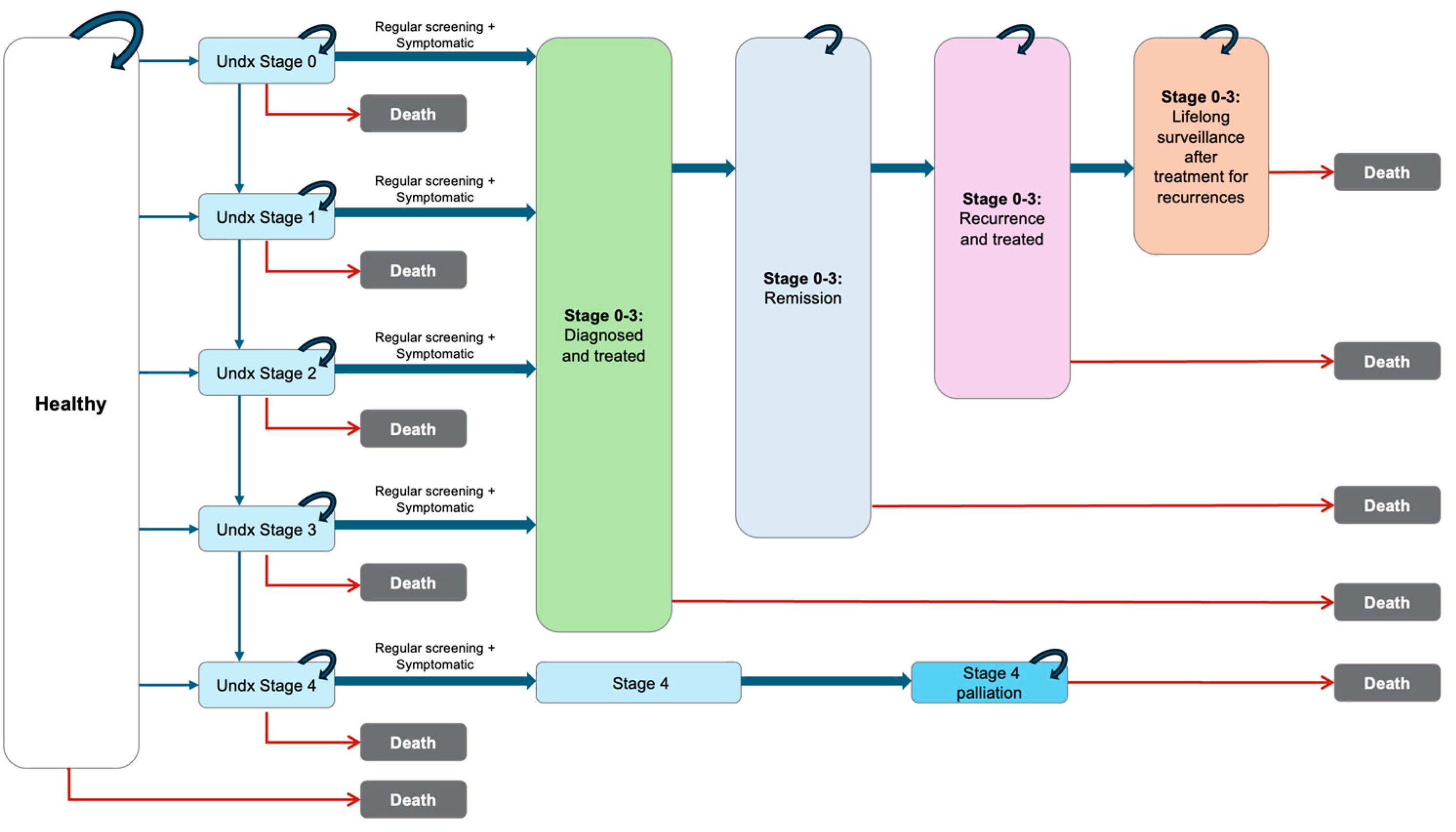
2.4. Model Structure
2.5. Information Source
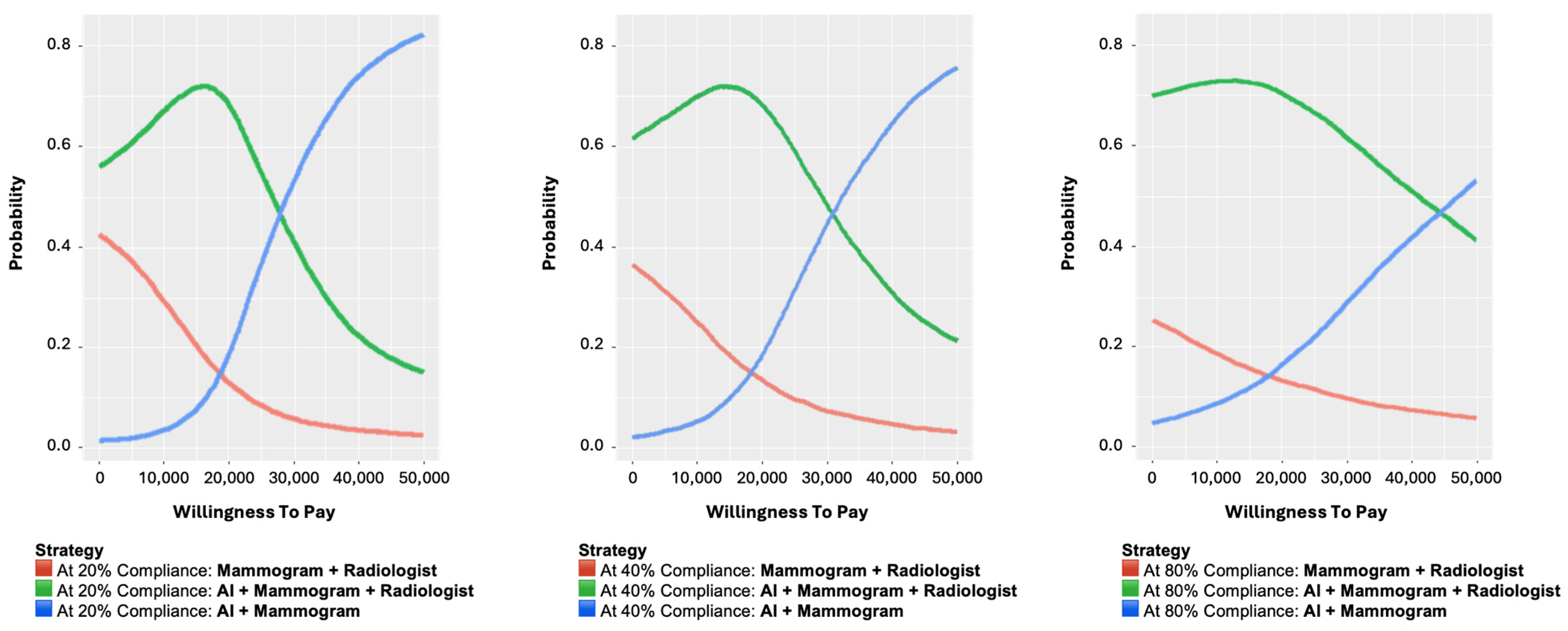
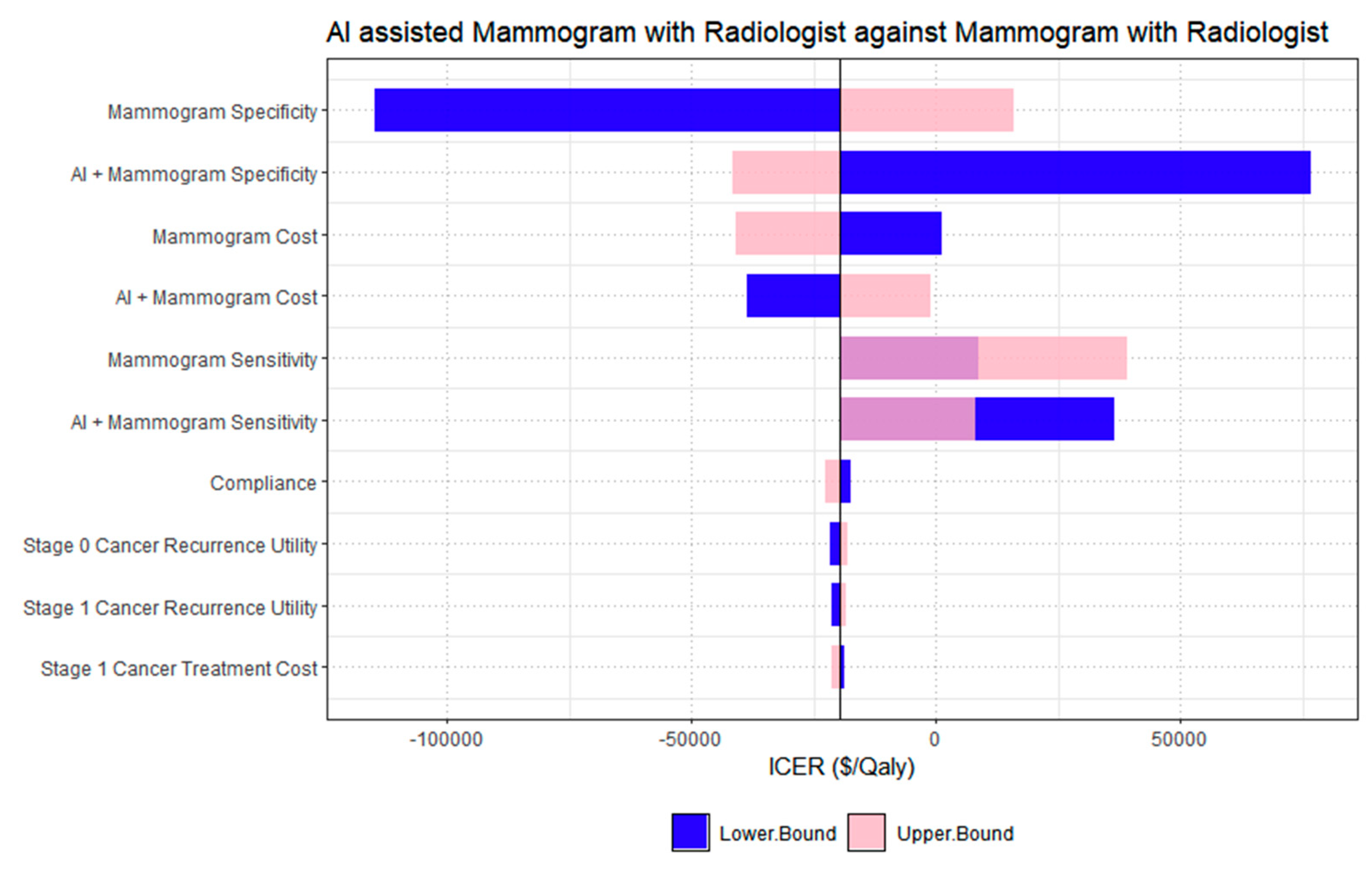
2.6. Uncertainty Analysis
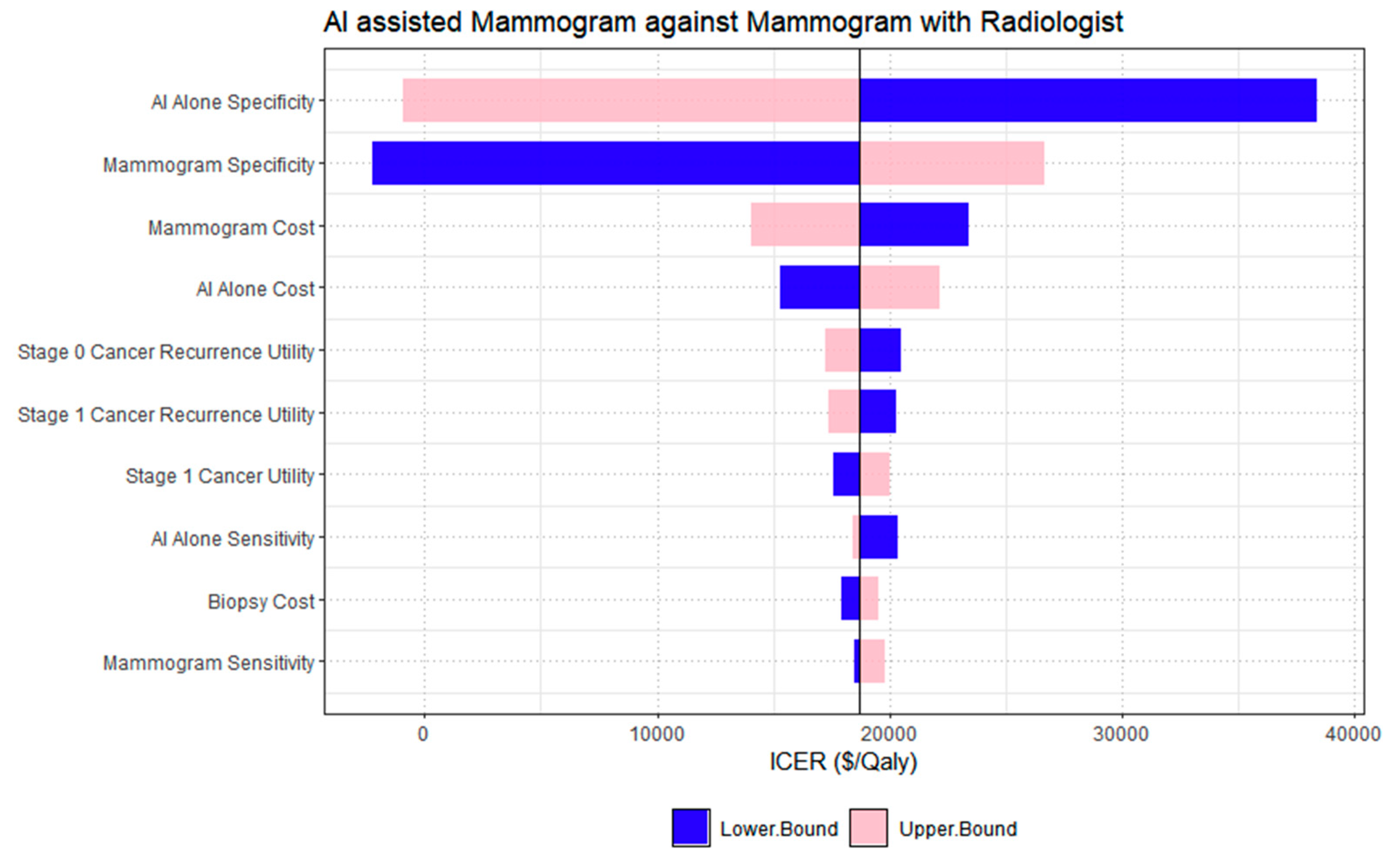
3. Results
4. Discussion
5. Conclusions
Author Contributions
Funding
Data Availability Statement
Conflicts of Interest
Appendix A
| Section/Topic | No. | Guidance for Reporting | AI Elaboration | Reported in Section |
|---|---|---|---|---|
| Title | 1 | Identify the study as an economic evaluation and specify the interventions being compared. | Indicate that the intervention involves an AI component that is under evaluation. | 1 |
| Abstract | 2 | Provide a structured summary that highlights context, key methods, results, and alternative analysis. | Specify the purpose of the intervention with an AI component, and the AI technique used. | 1 |
| Background and study objectives | 3 | Give the context for the study, the study question, and its practical relevance for decision making in policy or practice. | 2 | |
| Health economic analysis plan | 4 | Indicate whether a health economic analysis plan was developed and where available. | 3 | |
| Study population | 5 | Describe characteristics of the study population (such as age range, demographics, socioeconomic, or clinical characteristics). | 3 | |
| Setting and location | 6 | Provide relevant contextual information that may influence findings. | 3 | |
| Comparators | 7 | Describe the interventions or strategies being compared and why chosen. | Describe key details of the AI component of the intervention (and comparators, if appropriate), including: (a) the classification by intended purpose and risk tier (for digital health technologies); (b) the AI technique used; (c) whether it is “locked” (static) or adaptive; (d) the version under evaluation; (e) the purpose of the intervention, including its potential impact on care; (f) the intended user(s), and how users interact with it; (g) additional requirements to use it; (h) how it is expected to provide benefit over the standard of care. | 3 |
| User autonomy | AI 1 | Indicate whether the AI intervention (and comparators, if appropriate) is directive, or whether the user(s) retains autonomy to make the care decision. | 3 | |
| Perspective | 8 | State the perspective(s) adopted by the study and why chosen. | 4 | |
| Time horizon | 9 | State the time horizon for the study and why appropriate. | 4 | |
| Discount rate | 10 | Report the discount rate(s) and reason chosen. | 4 | |
| Selection of outcomes | 11 | Describe what outcomes were used as the measure(s) of benefit(s) and harm(s). | Describe whether the measure(s) chosen to indicate the benefits and harms of the AI intervention (and comparators) relates to health outcomes, diagnostic outcomes, process outcomes, or other/multiple outcomes. | 4 |
| Measurement of outcomes | 12 | Describe how outcomes used to capture benefit(s) and harm(s) were measured. | For model-based analysis, describe any assumptions used to inform the potential benefit(s) and harm(s) of the AI intervention in the model (and comparators, if appropriate). Describe the plausibility of analyst assumptions, citing any supportive evidence. | 4 |
| Measurement of AI effect | AI 2 | Describe the data sources (assessment studies) for the AI intervention’s impact on outcomes. | 2 | |
| Measurement of AI learning over time | AI 3 | If the AI intervention (and comparators, if appropriate) learns over time, explain how this affects its performance at the individual level and how this was measured. | N.A. | |
| Development of AI component | AI 4 | Describe how the AI component of the intervention (and comparators, if appropriate) was developed, including the training data used and how errors and biases were identified, or cite a source that provides this information. | 3 | |
| Validation of AI component | AI 5 | Describe how the AI component of the intervention (and comparators, as appropriate) and its performance estimates were validated, or cite a source that provides this information. | 2,3 | |
| Health benefit | AI 6 | Describe how the AI intervention (and comparators, if appropriate) could directly or indirectly provide a health benefit. | 3 | |
| Population differences | AI 7 | Describe important differences between the data sources (assessment studies) for the AI intervention’s impact on outcomes and the data set that was used to develop the AI intervention (training data set). | 3 | |
| Valuation of outcomes | 13 | Describe the population and methods used to measure and value outcomes. | 3 | |
| Measurement and valuation of resources and costs | 14 | Describe how costs were valued. Describe the purchase cost of the AI intervention (and comparators, if appropriate) and what it is composed of. Describe any additional implementation and maintenance costs. | 3 | |
| Currency, price date, and conversion | 15 | Report the dates of the estimated resource quantities and unit costs, plus the currency and year of conversion. | 3 | |
| Rationale and description of model | 16 | If modeling is used, describe in detail and why used. Report if the model is publicly available and where it can be accessed. Describe if the AI component of the intervention has influenced the choice of health economic model and explain why. | 3 | |
| Analytics and assumptions | 17 | Describe any methods for analysing or statistically transforming data, any extrapolation methods, and approaches for validating any model used. | 3 | |
| Modelling of AI learning over time | AI 8 | If the AI intervention (and comparators, if appropriate) learns over time at the individual level, describe any assumptions used to model how this learning affects its performance over time. | NA | |
| Characterizing heterogeneity | 18 | Describe any methods used for estimating how the results of the study vary for subgroups. | 3 | |
| Characterizing distributional effects | 19 | Describe how impacts are distributed across different individuals or adjustments made to reflect priority populations. | 3 | |
| Characterizing uncertainty | 20 | Describe methods to characterize any sources of uncertainty in the analysis. | 3 | |
| Approach to engagement | 21 | Describe any approaches to engage patients or service recipients, the general public, communities, or stakeholders (such as clinicians or payers) in the design of the study. | 1 | |
| Study parameters | 22 | Report all analytic inputs (such as values, ranges, and references) including uncertainty or distributional assumptions. | 3 | |
| Summary of main results | 23 | Report the mean values for the main categories of costs and outcomes of interest and summarize them in the most appropriate overall measure. | 7 | |
| Effect of uncertainty | 24 | Describe how uncertainty about analytic judgments, inputs, or projections affect findings. Report the effect of choice of discount rate and time horizon, if applicable. | 7 | |
| Impact of AI uncertainty | AI 9 | Indicate the extent to which features of the AI intervention may contribute to increased uncertainty about its cost-effectiveness. | 7 | |
| Effect of engagement | 25 | Report on any difference patient/service recipient, general public, community, or stakeholder involvement made to the approach or findings of the study. | 7 | |
| Study findings, limitations, generalizability, and current knowledge | 26 | Report key findings, limitations, ethical or equity considerations not captured, and how these could affect patients, policy, or practice. | Comment on potential biases associated with the AI intervention (e.g., algorithmic bias) and implications for the generalizability and interpretation of results (e.g., reinforcing existing health inequalities). | 11 |
| Implementation of AI | AI 10 | Comment on any requirements needed to integrate the AI intervention (and comparators, as appropriate) into practice, and other implementation considerations relating to the AI component of the intervention, including implications for the interpretation of cost-effectiveness results. | 11 | |
| Source of funding | 27 | Describe how the study was funded and any role of the funder in the identification, design, conduct, and reporting of the analysis. | 12 | |
| Conflicts of interest | 28 | Report authors conflicts of interest according to journal or International Committee of Medical Journal Editors requirements. | 12 |
Appendix B
| Variables | Baseline | Minimum Within SD | Maximum Within SD | Distribution | Reference Link |
|---|---|---|---|---|---|
| Age Specific Incidence Rates | https://www.restoredcdc.org/www.cdc.gov/united-states-cancer-statistics/publications/metastatic-breast-cancer.html (accessed on 28 February 2026) | ||||
| 50–54 | 0.004983 | 0.00473385 | 0.00523215 | Beta | |
| 55–59 | 0.006058 | 0.0057551 | 0.0063609 | Beta | |
| 60–64 | 0.007765 | 0.00737675 | 0.00815325 | Beta | |
| 65–100 | 0.009771 | 0.00928245 | 0.01025955 | Beta | |
| Age Specific Death Rates | https://www.singstat.gov.sg/-/media/files/publications/population/excel/lifetable2003-2024.ashx (accessed on 28 February 2026) | ||||
| 50–54 | 0.0016 | 0.00152 | 0.00168 | Beta | |
| 55–59 | 0.0024 | 0.00228 | 0.00252 | Beta | |
| 60–64 | 0.0039 | 0.003705 | 0.004095 | Beta | |
| 65–69 | 0.0066 | 0.00627 | 0.00693 | Beta | |
| 70–74 | 0.0109 | 0.010355 | 0.011445 | Beta | |
| 75–79 | 0.0188 | 0.01786 | 0.01974 | Beta | |
| 80–84 | 0.0389 | 0.036955 | 0.040845 | Beta | |
| 85–89 | 0.0743 | 0.070585 | 0.078015 | Beta | |
| 90–100 | 0.1528 | 0.14516 | 0.16044 | Beta | |
| Stage Specific Mortality Rates | https://www.nrdo.gov.sg/docs/librariesprovider3/Publications-Cancer/cancer-registry-annual-report-2015_web.pdf?sfvrsn=10 (accessed on 28 February 2026) | ||||
| Stage 0 | 0.00404 | 0.003838 | 0.004242 | Beta | |
| Stage 1 | 0.02 | 0.019 | 0.021 | Beta | |
| Stage 2 | 0.044 | 0.0418 | 0.0462 | Beta | |
| Stage 3 | 0.083 | 0.07885 | 0.08715 | Beta | |
| Stage 4 | 0.268 | 0.2546 | 0.2814 | Beta | |
| Stage specific check-up Rates | https://www.nrdo.gov.sg/docs/librariesprovider3/Publications-Cancer/cancer-registry-annual-report-2015_web.pdf?sfvrsn=10 (accessed on 28 February 2026) | ||||
| Stage 0 | 0.004 | 0.0038 | 0.0042 | Beta | |
| Stage 1 | 0.004 | 0.0038 | 0.0042 | Beta | |
| Stage 2 | 0.014 | 0.0133 | 0.0147 | Beta | |
| Stage 3 | 0.38 | 0.361 | 0.399 | Beta | |
| Stage 4 | 1 | 0.95 | 1 | Beta | |
| Stage Specific Recurrence Rates | |||||
| Stage 0 | 0.002 | 0.0019 | 0.0021 | Beta | https://pubmed.ncbi.nlm.nih.gov/34406870/ (accessed on 28 February 2026) |
| Stage 1 | 0.0236 | 0.02242 | 0.02478 | Beta | https://pubmed.ncbi.nlm.nih.gov/20607258/ (accessed on 28 February 2026) |
| Stage 2 | 0.0763 | 0.072485 | 0.080115 | Beta | |
| Stage 3 | 0.1453 | 0.138035 | 0.152565 | Beta | |
| Stage Specific Utility Values | https://scholarbank.nus.edu.sg/handle/10635/166355 (accessed on 28 February 2026) | ||||
| Stage 0 | 0.731 | 0.69445 | 0.76755 | Beta | |
| Stage 1 | 0.731 | 0.69445 | 0.76755 | Beta | |
| Stage 2 | 0.731 | 0.69445 | 0.76755 | Beta | |
| Stage 3 | 0.599 | 0.56905 | 0.62895 | Beta | |
| Stage 4 | 0.352 | 0.3344 | 0.3696 | Beta | |
| Stage Specific Escalation Rates | https://www.nrdo.gov.sg/docs/librariesprovider3/Publications-Cancer/cancer-registry-annual-report-2015_web.pdf?sfvrsn=10 (accessed on 28 February 2026) | ||||
| Stage 0 to Stage 1 | 0.1 | 0.095 | 0.105 | Beta | |
| Stage 1 to Stage 2 | 0.06 | 0.057 | 0.063 | Beta | |
| Stage 2 to Stage 3 | 0.11 | 0.1045 | 0.1155 | Beta | |
| Stage 3 to Stage 4 | 0.15 | 0.1425 | 0.1575 | Beta | |
| Stage Specific Recurrence Utility Values | https://www.oncotarget.com/article/16985/text/ (accessed on 28 February 2026) | ||||
| Stage 0 | 0.73 | 0.6935 | 0.7665 | Beta | |
| Stage 1 | 0.73 | 0.6935 | 0.7665 | Beta | |
| Stage 2 | 0.73 | 0.6935 | 0.7665 | Beta | |
| Stage 3 | 0.58 | 0.551 | 0.609 | Beta | |
| Long Term Care Specific Utility Values | https://ascopubs.org/doi/10.1200/JCO.2006.10.4190 (accessed on 28 February 2026) | ||||
| Stage 0 | 0.79 | 0.7505 | 0.8295 | Beta | |
| Stage 1 | 0.79 | 0.7505 | 0.8295 | Beta | |
| Stage 2 | 0.79 | 0.7505 | 0.8295 | Beta | |
| Stage 3 | 0.79 | 0.7505 | 0.8295 | Beta | |
| Stage 4 | 0.352 | 0.3344 | 0.3696 | Beta | |
| Stage Specific Direct Medical Cost | https://scholarbank.nus.edu.sg/handle/10635/166355 (accessed on 28 February 2026) | ||||
| Stage 0 | 19,759.37698 | 17,783.43928 | 21,735.31468 | Gamma | |
| Stage 1 | 37,970.27732 | 34,173.24958 | 41,767.30505 | Gamma | |
| Stage 2 | 53,567.78373 | 48,211.00536 | 58,924.56211 | Gamma | |
| Stage 3 | 68,168.28852 | 61,351.45967 | 74,985.11738 | Gamma | |
| Stage 4 | 74,887.86218 | 67,399.07596 | 82,376.64839 | Gamma | |
| Stage Specific Remission Cost | https://pmc.ncbi.nlm.nih.gov/articles/PMC4822976/ (accessed on 28 February 2026) | ||||
| Stage 0 | 881.3300622 | 793.197056 | 969.4630684 | Gamma | |
| Stage 1 | 1712.06321 | 1540.856889 | 1883.269531 | Gamma | |
| Stage 2 | 2415.347957 | 2173.813162 | 2656.882753 | Gamma | |
| Stage 3 | 3696.525508 | 3326.872957 | 4066.178059 | Gamma | |
| Stage 4 | 11,383.47 | 10,245.123 | 12,521.817 | Gamma | |
| Recurrence | 13,240.15 | 11,916.135 | 14,564.165 | Gamma | |
| Screening Metrics | https://papers.ssrn.com/sol3/papers.cfm?abstract_id=4664541 (accessed on 28 February 2026) | ||||
| Sensitivity | |||||
| Mammogram + Radiologist | 0.691 | 0.6219 | 0.7601 | Beta | |
| AI + Mammogram + Radiologist | 0.715 | 0.6435 | 0.7865 | Beta | |
| AI + Radiologist | 0.805 | 0.7245 | 0.8855 | Beta | |
| Specificity | |||||
| Mammogram + Radiologist | 0.954 | 0.8586 | 0.99 | Beta | |
| AI + Mammogram + Radiologist | 0.968 | 0.8712 | 0.99 | Beta | |
| AI + Radiologist | 0.893 | 0.8037 | 0.9823 | Beta | |
| Screening Cost | https://papers.ssrn.com/sol3/papers.cfm?abstract_id=4664541 (accessed on 28 February 2026) | ||||
| Mammogram + Radiologist | 110 | 99 | 121 | Gamma | |
| AI + Mammogram + Radiologist | 97.5 | 87.75 | 107.25 | Gamma | |
| AI + Radiologist | 80 | 72 | 88 | Gamma | |
| Biopsy | 1075 | 967.5 | 1182.5 | Gamma | https://isomer-user-content.by.gov.sg/3/a7305a12-e9c2-4d88-ad13-ed753d054416/MOH-Fee-Benchmarks-(wef-1-Jan-2025)-Publication.xlsx (accessed on 28 February 2026) |
| Ultrasound | 230 | 207 | 253 | Gamma | https://bmchealthservres.biomedcentral.com/articles/10.1186/s12913-021-06396-2 (accessed on 28 February 2026) |
| Compliance | 0.4 | 0.36 | 0.44 | Beta | https://ink.library.smu.edu.sg/soss_research/2180/#:~:text=The%20objective%20of%20the%20Singapore,mammogram%20at%20the%20current%20rates (accessed on 28 February 2026). |
References
- Jara-Lazaro, A.R.; Thilagaratnam, S.; Tan, P.H. Breast cancer in Singapore: Some perspectives. Breast Cancer 2010, 17, 23–28. [Google Scholar] [CrossRef] [PubMed]
- Phoenix Medical Group. Screen for Life Programme. Available online: https://phoenixmedical.sg/screen-for-life-programme-singapore/ (accessed on 21 August 2025).
- Coldman, A.; Phillips, N.; Wilson, C.; Decker, K.; Chiarelli, A.M.; Brisson, J.; Zhang, B.; Payne, J.; Doyle, G.; Ahmad, R. Pan-Canadian study of mammography screening and mortality from breast cancer. J. Natl. Cancer Inst. 2014, 106, dju261. [Google Scholar] [CrossRef] [PubMed]
- Hofvind, S.; Ursin, G.; Tretli, S.; Sebuødegård, S.; Møller, B. Breast cancer mortality in participants of the Norwegian Breast Cancer Screening Program. Cancer 2013, 119, 3106–3112. [Google Scholar] [CrossRef]
- Goh, C.X.Y.; Ho, F.C.H. The Growing Problem of Radiologist Shortages: Perspectives From Singapore. Korean J. Radiol. 2023, 24, 1176–1178. [Google Scholar] [CrossRef]
- DeStigter, K.; Pool, K.L.; Leslie, A.; Hussain, S.; Tan, B.S.; Donoso-Bach, L.; Andronikou, S. Optimizing integrated imaging service delivery by tier in low-resource health systems. Insights Imaging 2021, 12, 129. [Google Scholar] [CrossRef]
- Hovda, T.; Larsen, M.; Romundstad, L.; Sahlberg, K.K.; Hofvind, S. Breast cancer missed at screening; hindsight or mistakes? Eur. J. Radiol. 2023, 165, 110913. [Google Scholar] [CrossRef]
- Pisano, E.D.; Gatsonis, C.; Hendrick, E.; Yaffe, M.; Baum, J.K.; Acharyya, S.; Conant, E.F.; Fajardo, L.L.; Bassett, L.; D’Orsi, C.; et al. Diagnostic performance of digital versus film mammography for breast-cancer screening. N. Engl. J. Med. 2005, 353, 1773–1783. [Google Scholar] [CrossRef]
- Martin, L.R.; Williams, S.L.; Haskard, K.B.; DiMatteo, M.R. The challenge of patient adherence. Ther. Clin. Risk Manag. 2005, 1, 189–199. [Google Scholar]
- Sickles, E.A.; Wolverton, D.E.; Dee, K.E. Performance parameters for screening and diagnostic mammography: Specialist and general radiologists. Radiology 2002, 224, 861–869. [Google Scholar] [CrossRef]
- McKinney, S.M.; Sieniek, M.; Godbole, V.; Godwin, J.; Antropova, N.; Ashrafian, H.; Back, T.; Chesus, M.; Corrado, G.S.; Darzi, A.; et al. International evaluation of an AI system for breast cancer screening. Nature 2020, 577, 89–94. [Google Scholar] [CrossRef]
- Lotter, W.; Diab, A.R.; Haslam, B.; Kim, J.G.; Grisot, G.; Wu, E.; Onieva, J.O.; Boyer, Y.; Boxerman, J.L.; Wang, M.; et al. Robust breast cancer detection in mammography and digital breast tomosynthesis using an annotation-efficient deep learning approach. Nat. Med. 2021, 27, 244–249. [Google Scholar] [CrossRef]
- Dembrower, K.; Wåhlin, E.; Liu, Y.; Salim, M.; Smith, K.; Lindholm, P.; Eklund, M.; Strand, F. Effect of artificial intelligence-based triaging of breast cancer screening mammograms on cancer detection and radiologist workload: A retrospective simulation study. Lancet Digit. Health 2020, 2, e468–e474. [Google Scholar] [CrossRef] [PubMed]
- Goh, S.; Du, H.; Tan, L.Y.; Seah, E.; Lau, W.K.; Ng, A.; Lim, S.; Ong, H.; Lau, S.; Tan, Y.; et al. Impact of AI on breast cancer detection rates in mammography by radiologists of varying experience levels in Singapore: Preliminary comparative study. JMIR Form. Res. 2025, 9, e66931. [Google Scholar] [CrossRef]
- Goh, S.; Sze, R.; Chong, B.; Ng, Q.X.; Hartman, M. Challenges in implementing artificial intelligence in breast cancer screening programs: A systematic review and framework for safe adoption. J. Med. Internet Res. 2025, 27, e62941. [Google Scholar] [CrossRef]
- Elvidge, J.; Hawksworth, C.; Avşar, T.S.; Zemplenyi, A.; Chalkidou, A.; Petrou, S.; Petykó, Z.; Srivastava, D.; Chandra, G.; Delaye, J.; et al. Consolidated Health Economic Evaluation Reporting Standards for Interventions That Use Artificial Intelligence (CHEERS-AI). Value Health 2024, 27, 1196–1205. [Google Scholar] [CrossRef]
- Fathom X Pte Ltd. FathomX. Available online: https://www.fathomx.co/ (accessed on 8 August 2025).
- Centers for Disease Control and Prevention. Metastatic Female Breast Cancer Incidence. United States Cancer Statistics. Available online: https://www.cdc.gov/united-states-cancer-statistics/publications/metastatic-breast-cancer.html (accessed on 20 November 2024).
- Singapore Department of Statistics. Complete Life Tables, 2003–2024. Available online: https://www.singstat.gov.sg/-/media/files/publications/population/excel/lifetable2003-2024.ashx (accessed on 21 August 2025).
- National Registry of Diseases Office. Singapore Cancer Registry Annual Registry Report 2015. Available online: https://www.nrdo.gov.sg/docs/librariesprovider3/Publications-Cancer/cancer-registry-annual-report-2015_web.pdf (accessed on 21 August 2025).
- McCormick, B.; Winter, K.A.; Woodward, W.; Kuerer, H.M.; Sneige, N.; Rakovitch, E.; Smith, B.L.; Germain, I.; Hartford, A.C.; O’Rourke, M.A.; et al. Randomized phase III trial evaluating radiation following surgical excision for good-risk ductal carcinoma in situ: Long-term report from NRG Oncology/RTOG 9804. J. Clin. Oncol. 2021, 39, 3574–3582. [Google Scholar] [CrossRef] [PubMed]
- Leong, S.P.L.; Shen, Z.Z.; Liu, T.J.; Agarwal, G.; Tajima, T.; Paik, N.S.; Sandelin, K.; Derossis, A.; Cody, H.; Foulkes, W.D. Is breast cancer the same disease in Asian and Western countries? World J. Surg. 2010, 34, 2308–2324. [Google Scholar] [CrossRef]
- Wong, X.Y. Moving Towards a Personalized Approach to Breast Cancer Screening: Are We Ready? National University of Singapore, Singapore, 2025, PhD Thesis. Available online: https://scholarbank.nus.edu.sg/handle/10635/166355 (accessed on 21 August 2025).
- Seferina, S.C.; Ramaekers, B.L.T.; de Boer, M.; Dercksen, M.W.; van den Berkmortel, F.; van Kampen, R.J.W.; van de Wouw, A.J.; Voogd, A.C.; Tjan Heijnen, V.C.G.; Joore, M.A. Cost and cost-effectiveness of adjuvant trastuzumab in the real-world setting: A study of the Southeast Netherlands Breast Cancer Consortium. Oncotarget 2017, 8, 79223–79233. [Google Scholar] [CrossRef] [PubMed]
- Wolowacz, S.E.; Cameron, D.A.; Tate, H.C.; Bagust, A. Docetaxel in combination with doxorubicin and cyclophosphamide as adjuvant treatment for early node-positive breast cancer: A cost-effectiveness and cost-utility analysis. J. Clin. Oncol. 2008, 26, 925–933. [Google Scholar] [CrossRef][Green Version]
- Blumen, H.; Fitch, K.; Polkus, V. Comparison of treatment costs for breast cancer, by tumor stage and type of service. Am. Health Drug Benefits 2016, 9, 23–32. [Google Scholar]
- Ministry of Health. Doctors’ Fee Benchmarks for Surgeries. Available online: https://isomer-user-content.by.gov.sg/3/a7305a12-e9c2-4d88-ad13-ed753d054416/MOH-Fee-Benchmarks-(wef-1-Jan-2025)-Publication.xlsx (accessed on 4 August 2025).
- Wong, J.Z.Y.; Chai, J.H.; Yeoh, Y.S.; Mohamed Riza, N.K.; Liu, J.; Teo, Y.Y.; Wee, H.L.; Hartman, M. Cost-effectiveness analysis of a polygenic risk-tailored breast cancer screening programme in Singapore. BMC Health Serv. Res. 2021, 21, 379. [Google Scholar] [CrossRef] [PubMed]
- Seow, A.; Straughan, P.T.; Ng, E.H.; Emmanuel, S.C.; Tan, C.H.; Lee, H.P. Population-based mammographic screening in Singapore: What are participants’ views? Ann. Acad. Med. Singap. 1998, 27, 154–160. [Google Scholar] [PubMed]
- Engel-Nitz, N.M.; Hao, Y.; Becker, L.K.; Gerdes, R. Costs and mortality of recurrent versus de novo hormone receptor-positive/HER2- metastatic breast cancer. J. Comp. Eff. Res. 2015, 4, 303–314. [Google Scholar] [CrossRef] [PubMed]
- Breast Cancer Foundation. Breast Cancer Screening Rates Lowest Among Malay Women in Singapore: Press Release. Available online: https://bcf.org.sg/wp-content/uploads/2024/08/Press-Release-Breast-Cancer-Screening-Rates-Lowest-among-Malay-Women-in-Singapore-Breast-Cancer-Found.pdf (accessed on 21 August 2025).
- Kim, S.H.; Jo, M.W.; Ock, M.; Lee, H.J.; Lee, J.W. Estimation of health state utilities in breast cancer. Patient Prefer. Adherence 2017, 11, 531–536. [Google Scholar] [CrossRef]
- Weinstein, M.C. Recommendations of the panel on cost-effectiveness in health and medicine. JAMA 1996, 276, 1253–1258. [Google Scholar] [CrossRef]
- Caro, J.J.; Briggs, A.H.; Siebert, U.; Kuntz, K.M. ISPOR-SMDM Modeling Good Research Practices Task Force. Modeling good research practices—Overview: A report of the ISPOR-SMDM Modeling Good Research Practices Task Force-1. Value Health 2012, 15, 796–803. [Google Scholar] [CrossRef]
- Hatswell, A.J.; Bullement, A.; Briggs, A.H.; Paulden, M.; Stevenson, M.D. Probabilistic sensitivity analysis in health economic models: How many simulations should we run? Value Health 2017, 20, A746. [Google Scholar] [CrossRef]
- Hernström, V.; Josefsson, V.; Sartor, H.; Schmidt, D.; Larsson, A.M.; Hofvind, S.; Andersson, I.; Rosso, A.; Hagberg, O.; Lång, K. Screening performance and characteristics of breast cancer detected in the Mammography Screening with Artificial Intelligence trial (MASAI). Lancet Digit. Health 2025, 7, e123–e135. [Google Scholar] [CrossRef]
- Davenport, T.; Kalakota, R. The potential for artificial intelligence in healthcare. Future Healthc. J. 2019, 6, 94–98. [Google Scholar] [CrossRef]
- Nair, M.; Nygren, J.; Nilsen, P.; Gama, F.; Neher, M.; Larsson, I.; Svedberg, P. Critical activities for successful implementation and adoption of AI in healthcare: Towards a process framework for healthcare organizations. Front. Digit. Health 2025, 7, 1550459. [Google Scholar] [CrossRef]
- Lång, K.; Josefsson, V.; Larsson, A.M.; Larsson, S.; Högberg, C.; Sartor, H.; Hofvind, S.; Andersson, I.; Rosso, A. Artificial intelligence-supported screen reading versus standard double reading in the Mammography Screening with Artificial Intelligence trial (MASAI): A clinical safety analysis. Lancet Oncol. 2023, 24, 936–944. [Google Scholar] [CrossRef]
- Vargas-Palacios, A.; Sharma, N.; Sagoo, G.S. Cost-effectiveness requirements for implementing artificial intelligence technology in the UK national breast cancer screening service. Nat. Commun. 2023, 14, 6110. [Google Scholar] [CrossRef] [PubMed]
- Matza, L.S.; Howell, T.A.; Fung, E.T.; Janes, S.M.; Seiden, M.; Hackshaw, A.; Nadauld, L.; Karn, H.; Chung, K.C. Health state utilities associated with false-positive cancer screening results. Pharmacoecon. Open 2024, 8, 263–276. [Google Scholar] [CrossRef] [PubMed]
- Wang, Y.; Liu, C.; Hu, W.; Luo, L.; Shi, D.; Zhang, J.; Yin, Q.; Zhang, L.; Han, X.; He, M. Economic evaluation for medical artificial intelligence: Accuracy vs cost-effectiveness in a diabetic retinopathy screening case. npj Digit. Med. 2024, 7, 10. [Google Scholar] [CrossRef] [PubMed]
- Har, C.E.; Gao, Q.; Chen, W.; Wang, Y. Public preferences for emerging cancer screening modalities: A systematic review of discrete choice experiments. Patient 2025, 19, 181–196. [Google Scholar]
- Lyth, J.; Gialias, P.; Husberg, M.; Bernfort, L.; Bjerner, T.; Wiberg, M.K.; Levin, L.Å.; Gustafsson, H. Results from a Swedish model-based analysis of the cost-effectiveness of AI-assisted digital mammography. Eur. Radiol. 2026, 36, 754–764. [Google Scholar] [CrossRef]
- Andersen, M.; Kunst, N.; Richman, I.B. Long-Term Outcomes and Cost-Effectiveness of Artificial Intelligence for Breast Cancer Screening: A Modeling Study. Value Health 2026, 29, 179–188. [Google Scholar] [CrossRef]


| Metric | Conventional Strategy: 2 Radiologists | Hybrid Strategy: 1 Radiologist & AI | Standalone Strategy: AI Alone |
|---|---|---|---|
| Total Mammograms Completed | 38,628 | 38,621 | 38,598 |
| Total True Positive mammograms | 343 | 349 | 372 |
| Total True Negative mammograms | 36,379 | 36,915 | 34,044 |
| Total False Positive mammograms | 1761 | 1225 | 4096 |
| Total False Negative mammograms | 144 | 131 | 85 |
| Total Undiagnosed Cancer Cases | 1201 | 1191 | 1155 |
| Early Stage Cancer Patients | 227 | 231 | 246 |
| Late Stage Cancer Patients | 116 | 118 | 126 |
| Total Cost | 19,179,907.50 | 18,863,817.90 | 20,529,718.70 |
| Total QALYS (SGD) | 218,460.4 | 218,476.3 | 218,532.4 |
| ICER | - | −19,846.08 | 18,743.39 |
Disclaimer/Publisher’s Note: The statements, opinions and data contained in all publications are solely those of the individual author(s) and contributor(s) and not of MDPI and/or the editor(s). MDPI and/or the editor(s) disclaim responsibility for any injury to people or property resulting from any ideas, methods, instructions or products referred to in the content. |
© 2026 by the authors. Licensee MDPI, Basel, Switzerland. This article is an open access article distributed under the terms and conditions of the Creative Commons Attribution (CC BY) license.
Share and Cite
Goh, S.S.N.; Lim, Y.Z.; Ong, C.; Hartman, M.; Wang, Y. Cost Effectiveness Analysis of an AI-Assisted Breast Cancer Screening Programme in Singapore: An Early Health Technology Assessment. Cancers 2026, 18, 836. https://doi.org/10.3390/cancers18050836
Goh SSN, Lim YZ, Ong C, Hartman M, Wang Y. Cost Effectiveness Analysis of an AI-Assisted Breast Cancer Screening Programme in Singapore: An Early Health Technology Assessment. Cancers. 2026; 18(5):836. https://doi.org/10.3390/cancers18050836
Chicago/Turabian StyleGoh, Serene Si Ning, Yuan Zheng Lim, Clarence Ong, Mikael Hartman, and Yi Wang. 2026. "Cost Effectiveness Analysis of an AI-Assisted Breast Cancer Screening Programme in Singapore: An Early Health Technology Assessment" Cancers 18, no. 5: 836. https://doi.org/10.3390/cancers18050836
APA StyleGoh, S. S. N., Lim, Y. Z., Ong, C., Hartman, M., & Wang, Y. (2026). Cost Effectiveness Analysis of an AI-Assisted Breast Cancer Screening Programme in Singapore: An Early Health Technology Assessment. Cancers, 18(5), 836. https://doi.org/10.3390/cancers18050836