


Behaviour Change for Physical Activity Is Feasible and Effective in Women Living with Metastatic Breast Cancer: A Pilot Two-Arm Randomised Trial


Simple Summary
Abstract
1. Introduction
2. Materials and Methods
2.1. Design
2.2. Participants
2.3. Intervention
2.4. Measurement
2.4.1. Primary: Feasibility Outcomes
2.4.2. Secondary: Efficacy Outcomes
2.5. Data Analysis
Sample Size
3. Results
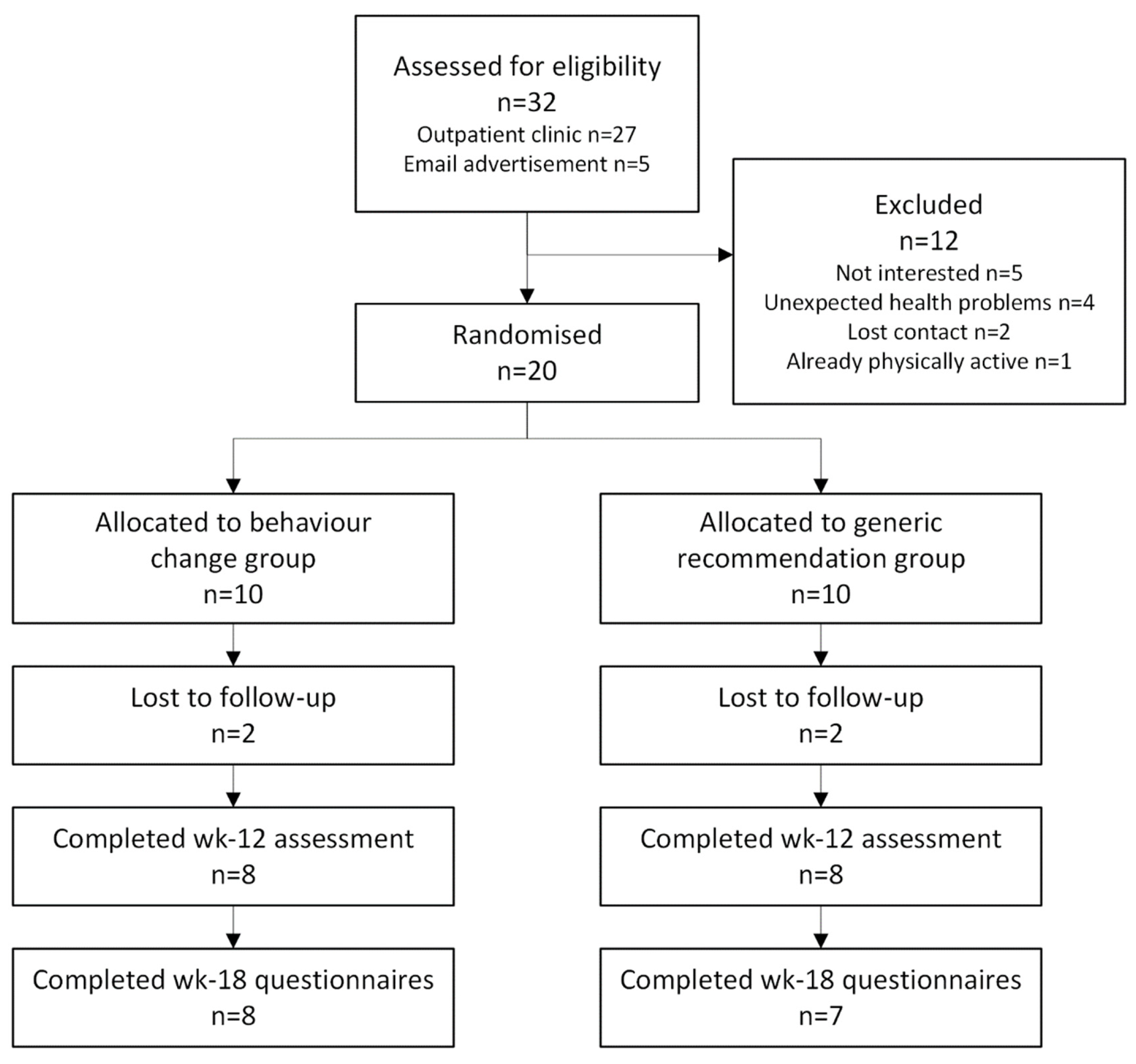
3.1. Recruitment, Retention and Adherence
Adverse Events
3.2. Acceptability
3.2.1. Trial Processes
3.2.2. Assessments
3.2.3. Sessions
3.2.4. Resources (Diary and Fitbit®)
3.2.5. Sustainability
3.2.6. Other Feedback
3.3. Efficacy Findings
Patient-Specific Functional Scale Activities
4. Discussion
5. Conclusions
Supplementary Materials
Author Contributions
Funding
Institutional Review Board Statement
Informed Consent Statement
Data Availability Statement
Acknowledgments
Conflicts of Interest
References
- Lahart, I.; Metsios, G.; Nevill, A.; Carmichael, A. Physical activity for women with breast cancer after adjuvant therapy. Cochrane Database Syst. Rev. 2018, 2018, CD011292. [Google Scholar] [CrossRef] [Scilit]
- Hart, N.; Crawford-Williams, F.; Crichton, M.; Yee, J.; Smith, T.; Koczwara, B.; Fitch, M.I.; Crawford, G.B.; Mukhopadhyay, S.; Mahony, J.; et al. Unmet supportive care needs of people with advanced cancer and their caregivers: A systematic scoping review. Crit. Rev. Oncol. Hematol. 2022, 176, 103728. [Google Scholar] [CrossRef] [Scilit]
- Willis, K.; Lewis, S.; Ng, F.; Wilson, L. The experience of living with metastatic breast cancer—A review of the literature. Health Care Women Int. 2015, 36, 514–542. [Google Scholar] [CrossRef] [Scilit]
- Wilk, M.; Kepski, J.; Kepska, J.; Casselli, S.; Szmit, S. Exercise interventions in metastatic cancer disease: A literature review and a brief discussion on current and future perspectives. BMJ Support. Palliat. Care 2020, 10, 404–410. [Google Scholar] [CrossRef] [Scilit]
- Chen, Y.; Li, X.; Ma, H.; Zhang, X.; Wang, B.; Guo, T.; Xiao, Y.; Bing, Z.T.; Ge, L.; Yang, K.H.; et al. Exercise training for improving patient-reported outcomes in patients with advanced-stage cancer: A systematic review and meta-analysis. J. Pain Symptom Manag. 2020, 59, 734–749.e10. [Google Scholar] [CrossRef] [Scilit] [PubMed]
- Ligibel, J.; Giobbie-Hurder, A.; Shockro, L.; Campbell, N.; Partridge, A.; Tolaney, S.; Lin, N.U.; Winer, E.P. Randomized trial of a physical activity intervention in women with metastatic breast cancer. Cancer 2016, 122, 1169–1177. [Google Scholar] [CrossRef] [Scilit]
- Sweegers, M.; Depenbusch, J.; Kampshoff, C.; Aaronson, N.; Hiensch, A.; Wengström, Y.; Backman, M.; Gunasekara, N.; Clauss, D.; Pelaez, M.; et al. Perspectives of patients with metastatic breast cancer on physical exercise programs: Results from a survey in five European countries. Support. Care Cancer 2023, 31, 694. [Google Scholar] [CrossRef] [Scilit] [PubMed]
- Covington, K.; Hidde, M.; Pergolotti, M.; Leach, H. Community-based exercise programs for cancer survivors: A scoping review of practice-based evidence. Support. Care Cancer 2019, 27, 4435–4450. [Google Scholar] [CrossRef] [Scilit] [PubMed]
- Grimmett, C.; Corbett, T.; Brunet, J.; Shepherd, J.; Pinto, B.; May, C.R.; Foster, C. Systematic review and meta-analysis of maintenance of physical activity behaviour change in cancer survivors. Int. J. Behav. Nutr. Phys. Act. 2019, 16, 37. [Google Scholar] [CrossRef] [Scilit]
- Liu, M.; Davis, G.; Kilbreath, S.; Yee, J. Physical activity interventions using behaviour change theories for women with breast cancer: A systematic review and meta-analysis. J. Cancer Surviv. 2021, 16, 1127–1148. [Google Scholar] [CrossRef] [Scilit]
- Liu, M.; Kilbreath, S.; Yee, J.; Beith, J.; McNab, J.; Dylke, E. Motivations and perceptions for physical activity in women living with metastatic breast cancer: A qualitative interview study. BMC Cancer 2025, 25, 80. [Google Scholar] [CrossRef] [Scilit]
- Liu, M.; Kilbreath, S.; Yee, J.; Beith, J.; McNab, J.; Dylke, E. Practical factors that influence physical activity in women living with metastatic breast cancer: A qualitative interview study. BMC Cancer 2025, 25, 48. [Google Scholar] [CrossRef] [Scilit]
- Cane, J.; Richardson, M.; Johnston, M.; Ladha, R.; Michie, S. From lists of behaviour change techniques (BCTs) to structured hierarchies: Comparison of two methods of developing a hierarchy of BCTs. Br. J. Health Psychol. 2015, 20, 130–150. [Google Scholar] [CrossRef] [Scilit] [PubMed]
- Michie, S.; Richardson, M.; Johnston, M.; Abraham, C.; Francis, J.; Hardeman, W.; Eccles, M.P.; Cane, J.; Wood, C.E. The behavior change technique taxonomy (v1) of 93 hierarchically clustered techniques: Building an international consensus for the reporting of behavior change interventions. Ann. Behav. Med. 2013, 46, 81–95. [Google Scholar] [CrossRef] [Scilit] [PubMed]
- Cormie, P.; Atkinson, M.; Bucci, L.; Cust, A.; Eakin, E.; Hayes, S.; McCarthy, A.L.; Murnane, A.; Patchell, S.; Adams, D. Clinical Oncology Society of Australia position statement on exercise in cancer care. Med. J. Aust. 2018, 209, 184–187. [Google Scholar] [CrossRef] [Scilit]
- Hayes, S.; Newton, R.; Spence, R.; Galvão, D. The Exercise and Sports Science Australia position statement: Exercise medicine in cancer management. J. Sci. Med. Sport 2019, 22, 1175–1199. [Google Scholar] [CrossRef] [Scilit]
- Morrison, K.; Paterson, C.; Toohey, K. The feasibility of exercise interventions delivered via telehealth for people affected by cancer: A rapid review of the literature. Semin. Oncol. Nurs. 2020, 36, 151092. [Google Scholar] [CrossRef] [Scilit]
- van Dongen, S.; de Nooijer, K.; Cramm, J.; Francke, A.; Oldenmenger, W.; Korfage, I.; Witkamp, F.; Stoevelaar, R.; van der Heide, A.; Rietjens, J.A. Self-management of patients with advanced cancer: A systematic review of experiences and attitudes. Palliat. Med. 2020, 34, 160–178. [Google Scholar] [CrossRef] [Scilit]
- Ferguson, T.; Olds, T.; Curtis, R.; Blake, H.; Crozier, A.; Dankiw, K.; Dumuid, D.; Kasai, D.; O’COnnor, E.; Virgara, R.; et al. Effectiveness of wearable activity trackers to increase physical activity and improve health: A systematic review of systematic reviews and meta-analyses. Lancet Digit. Health 2022, 4, e615–e626. [Google Scholar] [CrossRef] [Scilit]
- Eldridge, S.; Lancaster, G.; Campbell, M.; Thabane, L.; Hopewell, S.; Coleman, C.; Bond, C.M. Defining feasibility and pilot studies in preparation for randomised controlled trials: Development of a conceptual framework. PLoS ONE 2016, 11, e0150205. [Google Scholar] [CrossRef] [Scilit] [PubMed]
- Eldridge, S.M.; Chan, C.L.; Campbell, M.J.; Bond, C.M.; Hopewell, S.; Thabane, L.; Lancaster, G.A.; PAFS Consensus Group. CONSORT 2010 statement: Extension to randomised pilot and feasibility trials. BMJ 2016, 355, i5239. [Google Scholar] [CrossRef] [Scilit] [PubMed]
- Aycock, D.; Hayat, M.; Helvig, A.; Dunbar, S.; Clark, P. Essential considerations in developing attention control groups in behavioral research. Res. Nurs. Health 2018, 41, 320–328. [Google Scholar] [CrossRef] [Scilit]
- Exercise & Sport Science Australia: Adult Pre-Exercise Screening System. 2019. Available online: https://www.essa.org.au/Web/Web/Resources/Tools-and-templates/Adult-Pre-Exercise-Screening-System-User-Guide.aspx (accessed on 26 February 2020).
- Aaronson, N.; Ahmedzai, S.; Bergman, B.; Bullinger, M.; Cull, A.; Duez, N.; Filiberti, A.; Flechtner, H.; Fleishman, S.B.; De Haes, J.C.J.M.; et al. The European Organization for Research and Treatment of Cancer QLQ-C30: A quality-of-life instrument for use in international clinical trials in oncology. J. Natl. Cancer Inst. 1993, 85, 365–376. [Google Scholar] [CrossRef] [Scilit] [PubMed]
- Lion, A.; Backes, A.; Duhem, C.; Ries, F.; Delagardelle, C.; Urhausen, A.; Vögele, C.; Theisen, D.; Malisoux, L. Motivational interviewing to increase physical activity behavior in cancer patients: A pilot randomized controlled trial. Integr. Cancer Ther. 2020, 19, 1534735420914973. [Google Scholar] [CrossRef] [Scilit] [PubMed]
- Abbott, J. The distinction between randomized clinical trials (RCTs) and preliminary feasibility and pilot studies: What they are and are not. J. Orthop. Sports Phys. Ther. 2014, 44, 555–558. [Google Scholar] [CrossRef] [Scilit]
- Sasaki, J.; John, D.; Freedson, P. Validation and comparison of ActiGraph activity monitors. J. Sci. Med. Sport 2011, 14, 411–416. [Google Scholar] [CrossRef] [Scilit]
- Knaier, R.; Höchsmann, C.; Infanger, D.; Hinrichs, T.; Schmidt-Trucksäss, A. Validation of automatic wear-time detection algorithms in a free-living setting of wrist-worn and hip-worn ActiGraph GT3X. BMC Public Health 2019, 19, 244. [Google Scholar] [CrossRef] [Scilit] [PubMed]
- Choi, L.; Liu, Z.; Matthews, C.; Buchowski, M. Validation of accelerometer wear and nonwear time classification algorithm. Med. Sci. Sports Exerc. 2011, 43, 357–364. [Google Scholar] [CrossRef] [Scilit]
- Craig, C.; Marshall, A.; Sjöström, M.; Bauman, A.; Booth, M.; Ainsworth, B.; Pratt, M.; Ekelund, U.L.; Yngve, A.; Sallis, J.F.; et al. International physical activity questionnaire: 12-country reliability and validity. Med. Sci. Sports Exerc. 2003, 35, 1381–1395. [Google Scholar] [CrossRef] [Scilit]
- Rikli, R.; Jones, C. The reliability and validity of a 6-minute walk test as a measure of physical endurance in older adults. J. Aging Phys. Act. 1998, 6, 363–375. [Google Scholar] [CrossRef] [Scilit]
- Jones, C.; Rikli, R.; Beam, W. A 30-s chair-stand test as a measure of lower body strength in community-residing older adults. Res. Q. Exerc. Sport 1999, 70, 113–119. [Google Scholar] [CrossRef] [Scilit]
- Stratford, P.; Gill, C.; Westaway, M.; Binkley, J. Assessing disability and change on individual patients: A report of a patient-specific measure. Physiother. Can. 1995, 47, 258–263. [Google Scholar] [CrossRef] [Scilit]
- Weis, J.; Tomaszewski, K.; Hammerlid, E.; Arraras, J.; Conroy, T.; Lanceley, A.; Schmidt, H.; Wirtz, M.; Singer, S.; Pinto, M.; et al. International psychometric validation of an EORTC quality of life module measuring cancer-related fatigue (EORTC QLQ-FA12). J. Natl. Cancer Inst. 2017, 109, djw273. [Google Scholar] [CrossRef] [Scilit]
- Cancer Prevention Research Center: Transtheoretical Model. Available online: https://web.uri.edu/cprc/transtheoretical-model (accessed on 13 September 2021).
- Sallis, J.; Grossman, R.; Pinski, R.; Patterson, T.; Nader, P. The development of scales to measure social support for diet and exercise behaviors. Prev. Med. 1987, 16, 825–836. [Google Scholar] [CrossRef] [Scilit] [PubMed]
- Whitehead, A.; Julious, S.; Cooper, C.; Campbell, M. Estimating the sample size for a pilot randomised trial to minimise the overall trial sample size for the external pilot and main trial for a continuous outcome variable. Stat. Methods Med. Res. 2016, 25, 1057–1073. [Google Scholar] [CrossRef] [Scilit]
- Nadler, M.; Desnoyers, A.; Langelier, D.; Amir, E. The effect of exercise on quality of life, fatigue, physical function, and safety in advanced solid tumor cancers: A meta-analysis of randomized control trials. J. Pain Symptom Manag. 2019, 58, 899–908.e7. [Google Scholar] [CrossRef] [Scilit]
- Sheill, G.; Guinan, E.; Brady, L.; Hevey, D.; Hussey, J. Exercise interventions for patients with advanced cancer: A systematic review of recruitment, attrition, and exercise adherence rates. Palliat. Support. Care 2019, 17, 686–696. [Google Scholar] [CrossRef] [Scilit]
- Bourke, L.; Doll, H.; Crank, H.; Daley, A.; Rosario, D.; Saxton, J. Lifestyle intervention in men with advanced prostate cancer receiving androgen suppression therapy: A feasibility study. Cancer Epidemiol. Biomark. Prev. 2011, 20, 647–657. [Google Scholar] [CrossRef] [Scilit]
- Lowe, S.; Watanabe, S.; Baracos, V.; Courneya, K. Home-based functional walking program for advanced cancer patients receiving palliative care: A case series. BMC Palliat. Care 2013, 12, 22. [Google Scholar] [CrossRef] [Scilit]
- Groen, W.; ten Tusscher, M.; Verbeek, R.; Geleijn, E.; Sonke, G.; Konings, I.; Van der Vorst, M.J.; van Zweeden, A.A.; Schrama, J.G.; Vrijaldenhoven, S.; et al. Feasibility and outcomes of a goal-directed physical therapy program for patients with metastatic breast cancer. Support. Care Cancer 2020, 29, 3287–3298. [Google Scholar] [CrossRef] [Scilit] [PubMed]
- Bower, P.; Gilbody, S. Stepped care in psychological therapies: Access, effectiveness and efficiency: Narrative literature review. Br. J. Psychiatry 2005, 186, 11–17. [Google Scholar] [CrossRef] [Scilit]
- But-Hadzic, J.; Dervisevic, M.; Karpljuk, D.; Videmsek, M.; Dervisevic, E.; Paravlic, A.; Hadzic, V.; Tomazin, K. Six-minute walk distance in breast cancer survivors—A systematic review with meta-analysis. Int. J. Environ. Res. Public Health 2021, 18, 2591. [Google Scholar] [CrossRef] [Scilit] [PubMed]
- Hashemzadeh, M.; Rahimi, A.; Zare-Farashbandi, F.; Alavi-Naeini, A.; Daei, A. Transtheoretical model of health behavioral change: A systematic review. Iran J. Nurs. Midwifery Res. 2019, 24, 83–90. [Google Scholar] [CrossRef] [Scilit] [PubMed]

| Week | 0 | 1 | 2–6 | 7–12 | 13 | 18 |
|---|---|---|---|---|---|---|
| Type (Frequency) | Baseline Assessments | Initial Education (Single) | Introducing the Behaviour (Weekly) | Embedding the Behaviour (Fortnightly) | Post-Trial Assessments | Follow-Up Assessments |
| Delivery | In-person | Video or phone call | In-person | Remote, email | ||
| Generic recommendation group | Physical activity: 5-day Actigraph wear, IPAQ Physical function: 6MWT, 30s STS, PSFS Health factors: EORTC QLQ-C30, FA12 Behavioural factors: Stage of Change, Self-Efficacy, Decisional Balance, Processes of Change, Social Support for Exercise |
|
|
| Physical activity: 5-day Actigraph wear, IPAQ Physical function: 6MWT, 30s STS, PSFS Health factors: EORTC QLQ-C30, FA12 Behavioural factors: Stage of Change, Self-Efficacy, Decisional Balance, Processes of Change, Social Support for Exercise | Physical activity: IPAQ Physical function: PSFS Health factors: EORTC QLQ-C30, FA12 Behavioural factors: Stage of Change, Self-Efficacy, Decisional Balance, Processes of Change, Social Support for Exercise |
| Behaviour change group |
|
|
| |||
| Assessment of feasibility | Rates of recruitment, retention and adherence. | Acceptability: Structured interview | ||||
| Characteristic, Median (IQR) | All (n = 20) | Behaviour Change Group (n = 10) | Generic Recommendation Group (n = 10) |
|---|---|---|---|
| Age, years | 62 (60–66) | 63 (59–76) | 61 (60–64) |
| BMI, kg/m2 | 26 (24–28) | 26 (24–27) | 24 (23–26) |
| Years since metastatic diagnosis | 4.0 (1.3–5.0) | 2.0 (1.0–5.0) | 4.0 (3.6–4.3) |
| Years since initial diagnosis | 12 (8–14) | 9 (5–14) | 13 (11–14) |
| ECOG Grade 1 | |||
| 0 | 8 | 4 | 4 |
| 1 | 10 | 5 | 5 |
| 2 | 2 | 1 | 1 |
| Metastatic sites | |||
| Bone, lumbar/hip/femoral | 8 | 5 | 3 |
| Liver | 7 | 4 | 3 |
| Lung | 5 | 2 | 3 |
| Other (e.g., cranial, lymphatic) | 4 | 2 | 2 |
| Current treatment(s) 2 | |||
| Chemotherapy | 10 | 5 | 5 |
| Hormone therapy | 7 | 3 | 4 |
| Targeted therapy | 7 | 5 | 2 |
| Comorbidities 2 | |||
| Musculoskeletal | 10 | 6 | 4 |
| Cardiovascular | 6 | 3 | 3 |
| Gastrointestinal | 5 | 3 | 2 |
| Endocrine/Thyroid | 3 | 2 | 1 |
| Anaemia | 1 | 1 | 0 |
| Lower limb oedema | 1 | 1 | 0 |
| Psychological | 1 | 0 | 1 |
| Respiratory | 1 | 0 | 1 |
| Surgery in the past 6 months | 1 | 1 | 0 |
| Baseline objective measures, median (IQR) | |||
| Actigraph MVPA minutes | 61 (38–76) | 58 (43–66) | 65 (37–95) |
| Actigraph step count | 5685 (3461–6888) | 5311 (3612–6313) | 6061 (4200–7124) |
| 6 min walk distance (m) | 529 (426–577) | 515 (444–583) | 544 (375–573) |
| Sit-to-stands in 30s | 11 (8–13) | 11 (9–13) | 11 (8–14) |
| Behaviour Change Group Mean (SD) | Generic Recommendation Group Mean (SD) | Between-Group Difference (95% CI) | Effect Size (Cohen’s d) | |
|---|---|---|---|---|
| Actigraph MVPA minutes | −2 (16) | −31 (17) | 29 (2 to 55) | 1.72 |
| Actigraph step count | 108 (1254) | −1284 (1778) | 1392 (164 to 4619) | 0.90 |
| 6 min walk distance (m) | 48 (43) | 16 (55) | 32 (−37 to 102) | 0.66 |
| Sit-to-stands in 30s | 2 (4) | −1 (3) | 3 (−2 to 8) | 0.90 |
| Baseline to 12 Weeks | Baseline to 18 Weeks | |||||||
|---|---|---|---|---|---|---|---|---|
| Behaviour Change Group Mean (SD) | Generic Recommendation Group Mean (SD) | Between-Group Difference (95% CI) | Effect Size (Cohen’s d) | Behaviour Change Group Mean (SD) | Generic Recommendation Group Mean (SD) | Between-Group Difference (95% CI) | Effect Size (Cohen’s d) | |
| IPAQ (MET minutes/week) | 755 (683) | 217 (1463) | 538 (−1118 to 2195) | 0.47 | 749 (1829) | −191 (1828) | 940 (−4622 to 6502) | 0.51 |
| Patient-Specific Functional Scale (0–10) | 2.0 (1.0) | −0.9 (1.0) | 2.9 (2.1 to 3.8) | 2.83 | 1.7 (1.5) | −1.2 (1.5) | 2.8 (1.5 to 4.1) | 1.89 |
| EORTC QLQ−Core 30 (0–100) | ||||||||
| Summary score | 7 (19) | 5 (7) | 2 (−17 to 21) | 0.14 | 11 (21) | 5 (7) | 6 (−19 to 30) | 0.38 |
| Global health status | 15 (38) | 3 (7) | 12 (−24 to 47) | 0.43 | 19 (45) | 6 (5) | 14 (−66 to 94) | 0.43 |
| Physical functioning | −3 (11) | 8 (11) | −10 (26 to 6) | −0.90 | 1 (5) | 9 (10) | −8 (−35 to 19) | −0.97 |
| Role functioning | 6 (20) | 14 (16) | −8 (−33 to 17) | −0.42 | 3 (27) | 28 (10) | −25 (−78 to 28) | −1.25 |
| Emotional functioning | 4 (39) | 10 (15) | −6 (−45 to 34) | −0.19 | 7 (48) | 3 (5) | 4 (−90 to 89) | 0.12 |
| Cognitive functioning | 15 (26) | 3 (7) | 12 (−13 to 36) | 0.62 | 25 (29) | 0 (0) | 25 (−27 to 77) | 1.20 |
| Social functioning | 10 (22) | 6 (9) | 5 (−17 to 27) | 0.29 | 14 (13) | 0 (17) | 14 (−33 to 61) | 0.94 |
| EORTC QLQ−Fatigue 12 (0–100) 1 | ||||||||
| Physical fatigue | −18 (30) | −16 (15) | −3 (−34 to 29) | −0.12 | −22 (35) | −13 (0) | −9 (−46 to 28) | −0.35 |
| Emotional fatigue | −13 (30) | −7 (9) | −5 (−34 to 24) | −0.23 | −19 (36) | −7 (6) | −11 (−50 to 28) | −0.43 |
| Cognitive fatigue | −6 (15) | −3 (7) | −3 (−19 to 12) | −0.29 | −19 (25) | −6 (10) | −14 (−43 to 16) | −0.75 |
| Interference with daily life | −4 (33) | 0 (30) | −4 (−48 to 39) | −0.13 | −11 (34) | 0 (33) | −11 (−72 to 50) | −0.33 |
| Social sequelae | −25 (39) | −22 (27) | −3 (−48 to 43) | −0.08 | −28 (39) | −11 (19) | −17 (−67 to 33) | −0.54 |
| Behavioural factor scales (1–5) | ||||||||
| Stage of Change 2 | 0.8 (1.4) | 0.5 (0.5) | 0.3 (−1.1 to 1.6) | 0.24 | 0.5 (1.5) | 0 (2.0) | 0.5 (−2.9 to 3.9) | 0.28 |
| Self-Efficacy | −0.1 (0.7) | 0.8 (0.7) | −0.9 (−1.9 to 0.1) | −1.22 | −0.3 (0.9) | 0.7 (0.1) | −1.0 (−2.0 to 0) | −1.49 |
| Decisional Balance | 0.1 (0.4) | 0.5 (1.3) | −0.4 (−1.8 to 1.0) | −0.44 | −0.1 (0.4) | 0.2 (0.3) | −0.3 (−1.0 to 0.3) | −0.90 |
| Processes of Change | 0.1 (0.4) | 0.7 (1.4) | −0.6 (−2.2 to 0.9) | −0.60 | 0.2 (0.3) | 0 (0.2) | 0.1 (−0.3 to 0.5) | 0.51 |
| Social Support for Exercise (8–104) | ||||||||
| Family | 5 (17) | 2 (3) | 4 (−28 to 36) | 0.30 | 8 (8) | −1 (2) | 9 (10 to 27) | 1.46 |
| Friends | −7 (15) | −2 (4) | −4 (27 to 18) | −0.38 | −6 (18) | −6 (5) | −1 (−36 to 35) | −0.05 |
Disclaimer/Publisher’s Note: The statements, opinions and data contained in all publications are solely those of the individual author(s) and contributor(s) and not of MDPI and/or the editor(s). MDPI and/or the editor(s) disclaim responsibility for any injury to people or property resulting from any ideas, methods, instructions or products referred to in the content. |
© 2026 by the authors. Licensee MDPI, Basel, Switzerland. This article is an open access article distributed under the terms and conditions of the Creative Commons Attribution (CC BY) license.
Share and Cite
Liu, M.; Kilbreath, S.; Yee, J.; Beith, J.; Dylke, E. Behaviour Change for Physical Activity Is Feasible and Effective in Women Living with Metastatic Breast Cancer: A Pilot Two-Arm Randomised Trial. Cancers 2026, 18, 338. https://doi.org/10.3390/cancers18020338
Liu M, Kilbreath S, Yee J, Beith J, Dylke E. Behaviour Change for Physical Activity Is Feasible and Effective in Women Living with Metastatic Breast Cancer: A Pilot Two-Arm Randomised Trial. Cancers. 2026; 18(2):338. https://doi.org/10.3390/cancers18020338
Chicago/Turabian StyleLiu, Mark, Sharon Kilbreath, Jasmine Yee, Jane Beith, and Elizabeth Dylke. 2026. "Behaviour Change for Physical Activity Is Feasible and Effective in Women Living with Metastatic Breast Cancer: A Pilot Two-Arm Randomised Trial" Cancers 18, no. 2: 338. https://doi.org/10.3390/cancers18020338
APA StyleLiu, M., Kilbreath, S., Yee, J., Beith, J., & Dylke, E. (2026). Behaviour Change for Physical Activity Is Feasible and Effective in Women Living with Metastatic Breast Cancer: A Pilot Two-Arm Randomised Trial. Cancers, 18(2), 338. https://doi.org/10.3390/cancers18020338

