QSOX1: A Mysterious Golgi-Localized Disulfide Bond Catalyst and an Emerging Cancer Regulator



Simple Summary
Abstract
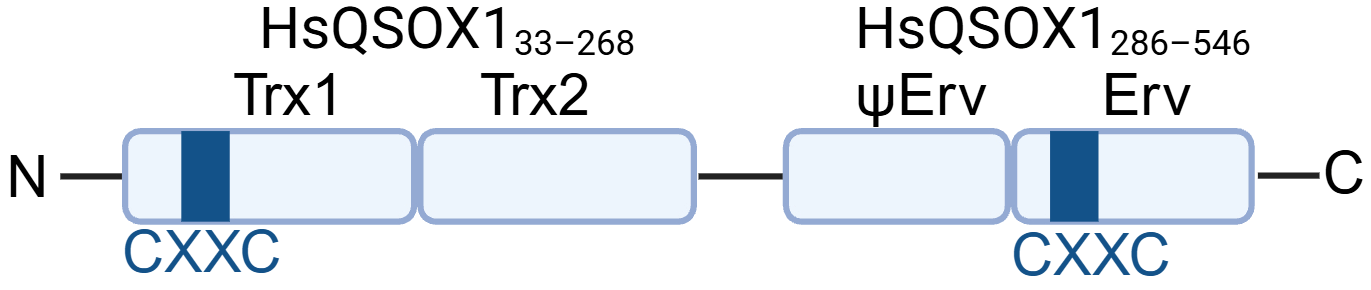
1. Introduction
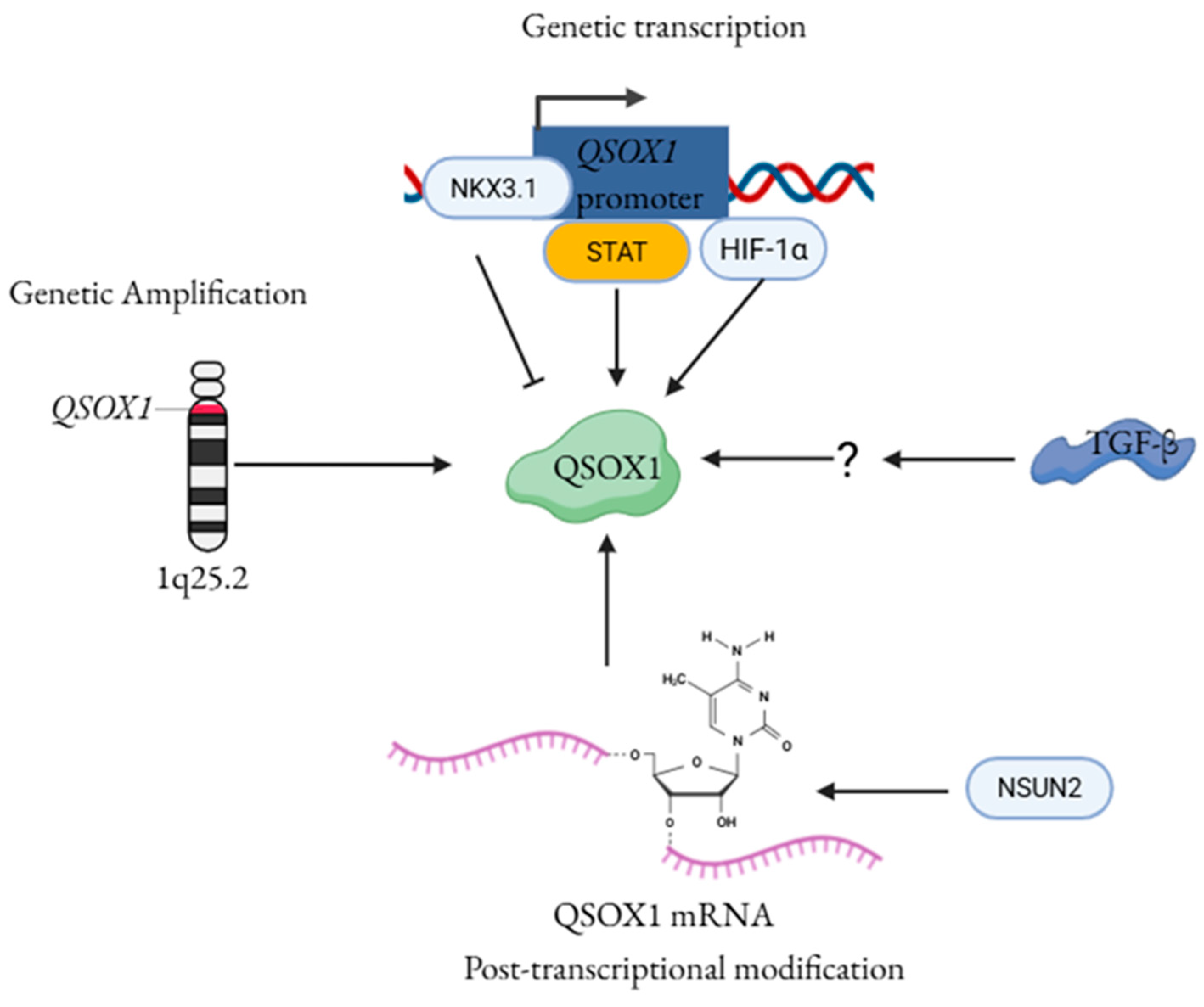
2. Mechanisms Regulating Aberrant QSOX1 Expression in Cancer
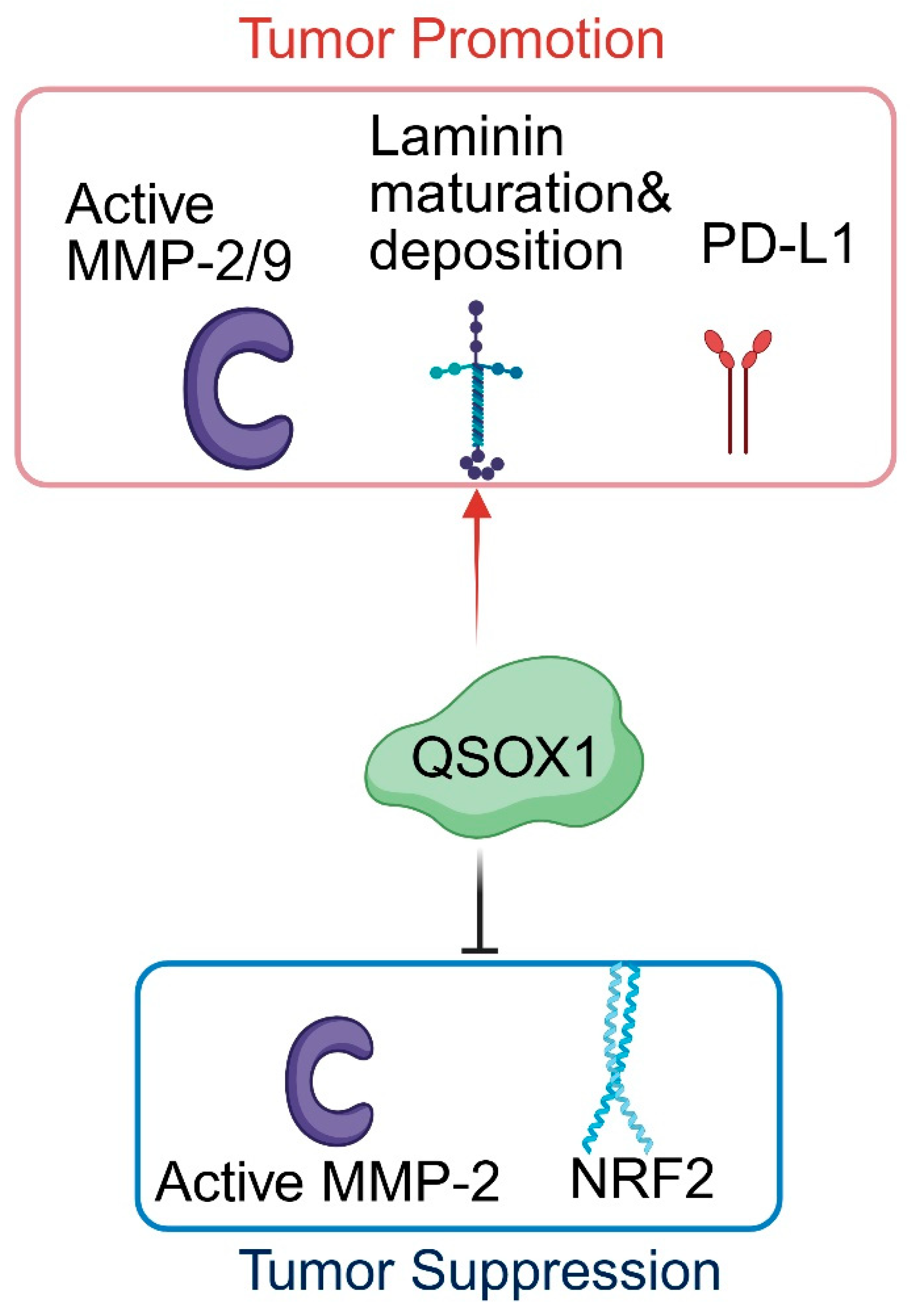
3. The Biological Function of QSOX1 in the Context of Cancer
3.1. QSOX1 Mediates Activation of Matrix Metalloproteinases (MMPs)
3.2. QSOX1 Enhances Tumor Cell Survival Under Oxidative Stress
3.3. QSOX1 Modulates Laminin Maturation and Deposition
3.4. QSOX1 Influences Paracrine Signaling and Immune Modulation
3.5. QSOX1 Functions as a Tumor Suppressor
4. Diagnostic and Therapeutic Potential of QSOX1 in Cancer
4.1. QSOX1 as a Biomarker in Cancer Diagnosis
4.2. QSOX1 as a Therapeutic Target for Cancer Treatment
5. Discussion
6. Conclusions
Author Contributions
Funding
Data Availability Statement
Acknowledgments
Conflicts of Interest
References
- Bechtel, T.J.; Weerapana, E. From structure to redox: The diverse functional roles of disulfides and implications in disease. Proteomics 2017, 17, 1600391. [Google Scholar] [CrossRef] [PubMed]
- Kuzu, O.F.; Granerud, L.J.T.; Saatcioglu, F. Navigating the landscape of protein folding and proteostasis: From molecular chaperones to therapeutic innovations. Signal Transduct. Target. Ther. 2025, 10, 358. [Google Scholar] [CrossRef]
- Zhang, L.; Moo-Young, M.; Chou, C.P. Molecular manipulation associated with disulfide bond formation to enhance the stability of recombinant therapeutic protein. Protein Expr. Purif. 2011, 75, 28–39. [Google Scholar] [CrossRef]
- Vogel, N.; Kluck, C.J.; Melzer, N.; Schwarzinger, S.; Breitinger, U.; Seeber, S.; Becker, C.M. Mapping of disulfide bonds within the amino-terminal extracellular domain of the inhibitory glycine receptor. J. Biol. Chem. 2009, 284, 36128–36136. [Google Scholar] [CrossRef]
- Wu, C.H.; Yuen, K.L.; Molony, R.D.; Silvers, C.R.; Akash, M.M.H.; Messing, E.M.; Lee, Y.F. Protein disulfide isomerase-enriched extracellular vesicles from bladder cancer cells support tumor survival and malignant transformation in the bladder. Oncogene 2025, 44, 2158–2169. [Google Scholar] [CrossRef]
- Hatahet, F.; Ruddock, L.W. Protein disulfide isomerase: A critical evaluation of its function in disulfide bond formation. Antioxid. Redox Signal. 2009, 11, 2807–2850. [Google Scholar] [CrossRef]
- Frand, A.R.; Kaiser, C.A. Ero1p oxidizes protein disulfide isomerase in a pathway for disulfide bond formation in the endoplasmic reticulum. Mol. Cell 1999, 4, 469–477. [Google Scholar] [CrossRef] [PubMed]
- Limor-Waisberg, K.; Ben-Dor, S.; Fass, D. Diversification of quiescin sulfhydryl oxidase in a preserved framework for redox relay. BMC Evol. Biol. 2013, 13, 70. [Google Scholar] [CrossRef] [PubMed]
- Ilani, T.; Alon, A.; Grossman, I.; Horowitz, B.; Kartvelishvily, E.; Cohen, S.R.; Fass, D. A secreted disulfide catalyst controls extracellular matrix composition and function. Science 2013, 341, 74–76. [Google Scholar] [CrossRef]
- Coppock, D.L.; Cina-Poppe, D.; Gilleran, S. The quiescin Q6 gene (QSCN6) is a fusion of two ancient gene families: Thioredoxin and ERV1. Genomics 1998, 54, 460–468. [Google Scholar] [CrossRef]
- Chakravarthi, S.; Jessop, C.E.; Willer, M.; Stirling, C.J.; Bulleid, N.J. Intracellular catalysis of disulfide bond formation by the human sulfhydryl oxidase, QSOX1. Biochem. J. 2007, 404, 403–411. [Google Scholar] [CrossRef]
- Rudolf, J.; Pringle, M.A.; Bulleid, N.J. Proteolytic processing of QSOX1A ensures efficient secretion of a potent disulfide catalyst. Biochem. J. 2013, 454, 181–190. [Google Scholar] [CrossRef][Green Version]
- Alon, A.; Heckler, E.J.; Thorpe, C.; Fass, D. QSOX contains a pseudo-dimer of functional and degenerate sulfhydryl oxidase domains. FEBS Lett. 2010, 584, 1521–1525. [Google Scholar] [CrossRef]
- Pernodet, N.; Hermetet, F.; Adami, P.; Vejux, A.; Descotes, F.; Borg, C.; Adams, M.; Pallandre, J.R.; Viennet, G.; Esnard, F.; et al. High expression of QSOX1 reduces tumorogenesis, and is associated with a better outcome for breast cancer patients. Breast Cancer Res. 2012, 14, R136. [Google Scholar] [CrossRef]
- Katchman, B.A.; Ocal, I.T.; Cunliffe, H.E.; Chang, Y.H.; Hostetter, G.; Watanabe, A.; LoBello, J.; Lake, D.F. Expression of quiescin sulfhydryl oxidase 1 is associated with a highly invasive phenotype and correlates with a poor prognosis in Luminal B breast cancer. Breast Cancer Res. 2013, 15, R28, Correction to Breast Cancer Res. 2018, 20, 89. [Google Scholar] [CrossRef]
- Das, P.; Siegers, G.M.; Postovit, L.M. Illuminating luminal B: QSOX1 as a subtype-specific biomarker. Breast Cancer Res. 2013, 15, 104. [Google Scholar] [CrossRef] [PubMed]
- Araujo, D.G.; Nakao, L.; Gozzo, P.; Souza, C.D.; Balderrama, V.; Gugelmin, E.S.; Kuczynski, A.P.; Olandoski, M.; de Noronha, L. Expression level of quiescin sulfhydryl oxidase 1 (QSOX1) in neuroblastomas. Eur. J. Histochem. 2014, 58, 2228. [Google Scholar] [CrossRef] [PubMed]
- Knutsvik, G.; Collett, K.; Arnes, J.; Akslen, L.A.; Stefansson, I.M. QSOX1 expression is associated with aggressive tumor features and reduced survival in breast carcinomas. Mod. Pathol. 2016, 29, 1485–1491. [Google Scholar] [CrossRef] [PubMed]
- Zhou, L.; Chen, H.M.; Qu, S.; Li, L.; Zhao, W.; Liang, Z.G.; Yu, B.B.; Chen, K.H.; Lu, Q.T.; Lin, G.X.; et al. Reduced QSOX1 enhances radioresistance in nasopharyngeal carcinoma. Oncotarget 2018, 9, 3230–3241. [Google Scholar] [CrossRef]
- Katchman, B.A.; Antwi, K.; Hostetter, G.; Demeure, M.J.; Watanabe, A.; Decker, G.A.; Miller, L.J.; Von Hoff, D.D.; Lake, D.F. Quiescin sulfhydryl oxidase 1 promotes invasion of pancreatic tumor cells mediated by matrix metalloproteinases. Mol. Cancer Res. 2011, 9, 1621–1631. [Google Scholar] [CrossRef]
- Soloviev, M.; Esteves, M.P.; Amiri, F.; Crompton, M.R.; Rider, C.C. Elevated transcription of the gene QSOX1 encoding quiescin Q6 sulfhydryl oxidase 1 in breast cancer. PLoS ONE 2013, 8, e57327. [Google Scholar] [CrossRef]
- Baek, J.A.; Song, P.H.; Ko, Y.; Gu, M.J. High expression of QSOX1 is associated with tumor invasiveness and high grades groups in prostate cancer. Pathol. Res. Pract. 2018, 214, 964–967. [Google Scholar] [CrossRef]
- Chen, J.W.; Dhahbi, J. Lung adenocarcinoma and lung squamous cell carcinoma cancer classification, biomarker identification, and gene expression analysis using overlapping feature selection methods. Sci. Rep. 2021, 11, 13323. [Google Scholar] [CrossRef]
- Geng, Y.; Xu, C.; Wang, Y.; Zhang, L. Quiescin Sulfhydryl Oxidase 1 Regulates the Proliferation, Migration and Invasion of Human Glioblastoma Cells via PI3K/Akt Pathway. Onco Targets Ther. 2020, 13, 5721–5729. [Google Scholar] [CrossRef] [PubMed]
- Wiechec, E.; Overgaard, J.; Kjeldsen, E.; Hansen, L.L. Chromosome 1q25.3 copy number alterations in primary breast cancers detected by multiplex ligation-dependent probe amplification and allelic imbalance assays and its comparison with fluorescent in situ hybridization assays. Cell Oncol. 2013, 36, 113–120. [Google Scholar] [CrossRef] [PubMed]
- Alers, J.C.; Rochat, J.; Krijtenburg, P.J.; Hop, W.C.; Kranse, R.; Rosenberg, C.; Tanke, H.J.; Schroder, F.H.; van Dekken, H. Identification of genetic markers for prostatic cancer progression. Lab. Investig. 2000, 80, 931–942. [Google Scholar] [CrossRef] [PubMed][Green Version]
- The ICGC/TCGA Pan-Cancer Analysis of Whole Genomes Consortium. Pan-cancer analysis of whole genomes. Nature 2020, 578, 82–93. [CrossRef]
- Antao, A.M.; Ramakrishna, S.; Kim, K.S. The Role of Nkx3.1 in Cancers and Stemness. Int. J. Stem. Cells 2021, 14, 168–179. [Google Scholar] [CrossRef]
- Anderson, P.D.; McKissic, S.A.; Logan, M.; Roh, M.; Franco, O.E.; Wang, J.; Doubinskaia, I.; van der Meer, R.; Hayward, S.W.; Eischen, C.M.; et al. Nkx3.1 and Myc crossregulate shared target genes in mouse and human prostate tumorigenesis. J. Clin. Investig. 2012, 122, 1907–1919. [Google Scholar] [CrossRef]
- Martinez, E.E.; Anderson, P.D.; Logan, M.; Abdulkadir, S.A. Antioxidant treatment promotes prostate epithelial proliferation in Nkx3.1 mutant mice. PLoS ONE 2012, 7, e46792. [Google Scholar] [CrossRef]
- Wei, J.R.; Zhang, B.; Zhang, Y.; Chen, W.M.; Zhang, X.P.; Zeng, T.T.; Li, Y.; Zhu, Y.H.; Guan, X.Y.; Li, L. QSOX1 facilitates dormant esophageal cancer stem cells to evade immune elimination via PD-L1 upregulation and CD8 T cell exclusion. Proc. Natl. Acad. Sci. USA 2024, 121, e2407506121. [Google Scholar] [CrossRef]
- Coppock, D.; Kopman, C.; Gudas, J.; Cina-Poppe, D.A. Regulation of the quiescence-induced genes: Quiescin Q6, decorin, and ribosomal protein S29. Biochem. Biophys. Res. Commun. 2000, 269, 604–610. [Google Scholar] [CrossRef]
- Feldman, T.; Grossman-Haham, I.; Elkis, Y.; Vilela, P.; Moskovits, N.; Barshack, I.; Salame, T.M.; Fass, D.; Ilani, T. Inhibition of fibroblast secreted QSOX1 perturbs extracellular matrix in the tumor microenvironment and decreases tumor growth and metastasis in murine cancer models. Oncotarget 2020, 11, 386–398, Correction to Oncotarget 2020, 11, 3687. [Google Scholar] [CrossRef]
- Shi, C.Y.; Fan, Y.; Liu, B.; Lou, W.H. HIF1 contributes to hypoxia-induced pancreatic cancer cells invasion via promoting QSOX1 expression. Cell. Physiol. Biochem. 2013, 32, 561–568. [Google Scholar] [CrossRef]
- Millar-Haskell, C.S.; Thorpe, C.; Gleghorn, J.P. Matrix mechanics, not hypoxia, modulate quiescin sulfhydryl oxidase 1 (QSOX1) in pancreatic tumor cells. bioRxiv 2022. [Google Scholar] [CrossRef]
- Morel, C.; Adami, P.; Musard, J.F.; Duval, D.; Radom, J.; Jouvenot, M. Involvement of sulfhydryl oxidase QSOX1 in the protection of cells against oxidative stress-induced apoptosis. Exp. Cell Res. 2007, 313, 3971–3982. [Google Scholar] [CrossRef]
- Li, F.; Liu, T.; Dong, Y.; Gao, Q.; Lu, R.; Deng, Z. 5-Methylcytosine RNA modification and its roles in cancer and cancer chemotherapy resistance. J. Transl. Med. 2025, 23, 390. [Google Scholar] [CrossRef] [PubMed]
- Wang, Y.; Wei, J.; Feng, L.; Li, O.; Huang, L.; Zhou, S.; Xu, Y.; An, K.; Zhang, Y.; Chen, R.; et al. Aberrant m5C hypermethylation mediates intrinsic resistance to gefitinib through NSUN2/YBX1/QSOX1 axis in EGFR-mutant non-small-cell lung cancer. Mol. Cancer 2023, 22, 81. [Google Scholar] [CrossRef]
- Poillet, L.; Pernodet, N.; Boyer-Guittaut, M.; Adami, P.; Borg, C.; Jouvenot, M.; Delage-Mourroux, R.; Despouy, G. QSOX1 inhibits autophagic flux in breast cancer cells. PLoS ONE 2014, 9, e86641. [Google Scholar] [CrossRef] [PubMed]
- Sun, J.; Zhou, C.; Zhao, Y.; Zhang, X.; Chen, W.; Zhou, Q.; Hu, B.; Gao, D.; Raatz, L.; Wang, Z.; et al. Quiescin sulfhydryl oxidase 1 promotes sorafenib-induced ferroptosis in hepatocellular carcinoma by driving EGFR endosomal trafficking and inhibiting NRF2 activation. Redox Biol. 2021, 41, 101942. [Google Scholar] [CrossRef]
- Dutt, R.; Thorpe, C.; Galileo, D.S. QSOX1 Modulates Glioblastoma Cell Proliferation and Migration In Vitro and Invasion In Vivo. Cancers 2024, 16, 3620. [Google Scholar] [CrossRef] [PubMed]
- Millar-Haskell, C.S.; Sperduto, J.L.; Slater, J.H.; Thorpe, C.; Gleghorn, J.P. Secretion of the disulfide bond generating catalyst QSOX1 from pancreatic tumor cells into the extracellular matrix: Association with extracellular vesicles and matrix proteins. J. Extracell. Biol. 2022, 1, e48. [Google Scholar] [CrossRef] [PubMed]
- Zhang, X.F.; Wang, J.; Jia, H.L.; Zhu, W.W.; Lu, L.; Ye, Q.H.; Nelson, P.J.; Qin, Y.; Gao, D.M.; Zhou, H.J.; et al. Core fucosylated glycan-dependent inhibitory effect of QSOX1-S on invasion and metastasis of hepatocellular carcinoma. Cell Death Discov. 2019, 5, 84. [Google Scholar] [CrossRef]
- Ma, Q.; Yu, M.; Zhou, B.; Zhou, H. QSOX1 promotes mitochondrial apoptosis of hepatocellular carcinoma cells during anchorage-independent growth by inhibiting lipid synthesis. Biochem. Biophys. Res. Commun. 2020, 532, 258–264. [Google Scholar] [CrossRef]
- Sung, H.J.; Ahn, J.M.; Yoon, Y.H.; Na, S.S.; Choi, Y.J.; Kim, Y.I.; Lee, S.Y.; Lee, E.B.; Cho, S.; Cho, J.Y. Quiescin Sulfhydryl Oxidase 1 (QSOX1) Secreted by Lung Cancer Cells Promotes Cancer Metastasis. Int. J. Mol. Sci. 2018, 19, 3213. [Google Scholar] [CrossRef]
- Antwi, K.; Hostetter, G.; Demeure, M.J.; Katchman, B.A.; Decker, G.A.; Ruiz, Y.; Sielaff, T.D.; Koep, L.J.; Lake, D.F. Analysis of the plasma peptidome from pancreas cancer patients connects a peptide in plasma to overexpression of the parent protein in tumors. J. Proteome Res. 2009, 8, 4722–4731. [Google Scholar] [CrossRef]
- Fifield, A.L.; Hanavan, P.D.; Faigel, D.O.; Sergienko, E.; Bobkov, A.; Meurice, N.; Petit, J.L.; Polito, A.; Caulfield, T.R.; Castle, E.P.; et al. Molecular Inhibitor of QSOX1 Suppresses Tumor Growth In Vivo. Mol. Cancer Ther. 2020, 19, 112–122. [Google Scholar] [CrossRef]
- Hanavan, P.D.; Borges, C.R.; Katchman, B.A.; Faigel, D.O.; Ho, T.H.; Ma, C.T.; Sergienko, E.A.; Meurice, N.; Petit, J.L.; Lake, D.F. Ebselen inhibits QSOX1 enzymatic activity and suppresses invasion of pancreatic and renal cancer cell lines. Oncotarget 2015, 6, 18418–18428. [Google Scholar] [CrossRef] [PubMed]
- Grossman, I.; Alon, A.; Ilani, T.; Fass, D. An inhibitory antibody blocks the first step in the dithiol/disulfide relay mechanism of the enzyme QSOX1. J. Mol. Biol. 2013, 425, 4366–4378. [Google Scholar] [CrossRef]
- Tong, Y.; Gibaut, Q.M.R.; Rouse, W.; Childs-Disney, J.L.; Suresh, B.M.; Abegg, D.; Choudhary, S.; Akahori, Y.; Adibekian, A.; Moss, W.N.; et al. Transcriptome-Wide Mapping of Small-Molecule RNA-Binding Sites in Cells Informs an Isoform-Specific Degrader of QSOX1 mRNA. J. Am. Chem. Soc. 2022, 144, 11620–11625. [Google Scholar] [CrossRef] [PubMed]
- Javitt, G.; Kinzel, A.; Reznik, N.; Fass, D. Conformational switches and redox properties of the colon cancer-associated human lectin ZG16. FEBS J. 2021, 288, 6465–6475. [Google Scholar] [CrossRef]
- Ilani, T.; Reznik, N.; Yeshaya, N.; Feldman, T.; Vilela, P.; Lansky, Z.; Javitt, G.; Shemesh, M.; Brenner, O.; Elkis, Y.; et al. The disulfide catalyst QSOX1 maintains the colon mucosal barrier by regulating Golgi glycosyltransferases. EMBO J. 2023, 42, e111869. [Google Scholar] [CrossRef] [PubMed]
- Fan, J.; Huang, S.; Cao, C.; Jin, X.; Su, Y. The roles of ST3Gal1-6 in cancer: Expression profiles and functional implications. Carbohydr. Res. 2025, 559, 109740. [Google Scholar] [CrossRef]
- Zhang, J.; Huang, Y.; Li, H.; Xu, P.; Liu, Q.; Sun, Y.; Zhang, Z.; Wu, T.; Tang, Q.; Jia, Q.; et al. B3galt5 functions as a PXR target gene and regulates obesity and insulin resistance by maintaining intestinal integrity. Nat. Commun. 2024, 15, 5919. [Google Scholar] [CrossRef] [PubMed]



| Cancer Types | QSOX1 Expression | Effect on Cancer Cells | Potential Mechanisms | References |
|---|---|---|---|---|
| Breast Cancer | ↑ | Reduce cell proliferation and invasion, increase cell adhesion | MMP-2 activity ↓, p62 ↑, Autophagosome/Lysosome Fusion ↓ | [14] [39] |
| ↑ | Cell proliferation and invasion | MMP-9 activity ↑ | [15] | |
| Lung Cancer | ↑ | Gefitinib resistance | Unknown | [38] |
| ↑ | Cell proliferation, migration, invasion | Unknown | [40] | |
| Esophageal cancer | ↑ | Cancer stem cell dormancy | ROS ↑, PD-L1 ↑, CD8+ T cells infiltration ↓ | [31] |
| Glioblastoma | ↑ | Cell proliferation, colony formation, invasion | PI3K/Akt pathway ↓ | [41] |
| HCC | ↑ | Reduce cell invasion and metastasis | Integrinβ1/FAK and EGFR/Raf/ERK signaling pathway ↓ | [42] |
| Ferroptosis | ROS ↑, EGFR activation ↓, NRF2 activation ↓ | [43] | ||
| Anoikis | Intracellular fatty acids and cholesterol ↓ | [44] | ||
| PDAC | ↑ | Cell proliferation and invasion | MMP-2/9 activity ↑ | [20] |
Disclaimer/Publisher’s Note: The statements, opinions and data contained in all publications are solely those of the individual author(s) and contributor(s) and not of MDPI and/or the editor(s). MDPI and/or the editor(s) disclaim responsibility for any injury to people or property resulting from any ideas, methods, instructions or products referred to in the content. |
© 2026 by the authors. Licensee MDPI, Basel, Switzerland. This article is an open access article distributed under the terms and conditions of the Creative Commons Attribution (CC BY) license.
Share and Cite
Wang, S.; Xiao, G.-Y.; Tan, X. QSOX1: A Mysterious Golgi-Localized Disulfide Bond Catalyst and an Emerging Cancer Regulator. Cancers 2026, 18, 339. https://doi.org/10.3390/cancers18020339
Wang S, Xiao G-Y, Tan X. QSOX1: A Mysterious Golgi-Localized Disulfide Bond Catalyst and an Emerging Cancer Regulator. Cancers. 2026; 18(2):339. https://doi.org/10.3390/cancers18020339
Chicago/Turabian StyleWang, Shike, Guan-Yu Xiao, and Xiaochao Tan. 2026. "QSOX1: A Mysterious Golgi-Localized Disulfide Bond Catalyst and an Emerging Cancer Regulator" Cancers 18, no. 2: 339. https://doi.org/10.3390/cancers18020339
APA StyleWang, S., Xiao, G.-Y., & Tan, X. (2026). QSOX1: A Mysterious Golgi-Localized Disulfide Bond Catalyst and an Emerging Cancer Regulator. Cancers, 18(2), 339. https://doi.org/10.3390/cancers18020339