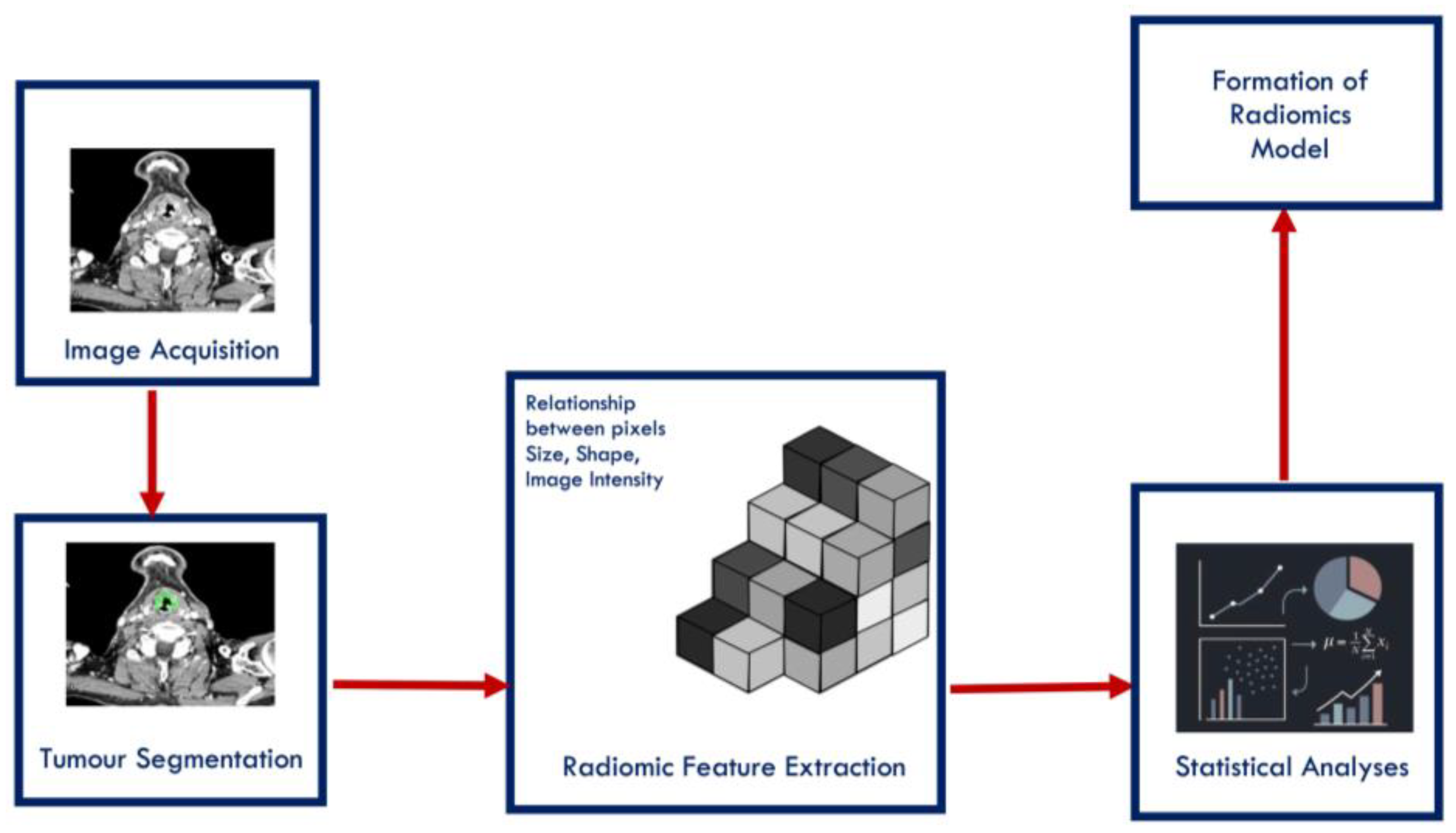
Radiomics from Routine CT and PET/CT Imaging in Laryngeal Squamous Cell Carcinoma: A Systematic Review with Radiomics Quality Score Assessment
 , , , , , and
Simple Summary
Abstract
1. Introduction
2. Materials and Methods
2.1. Data Sources and Searches
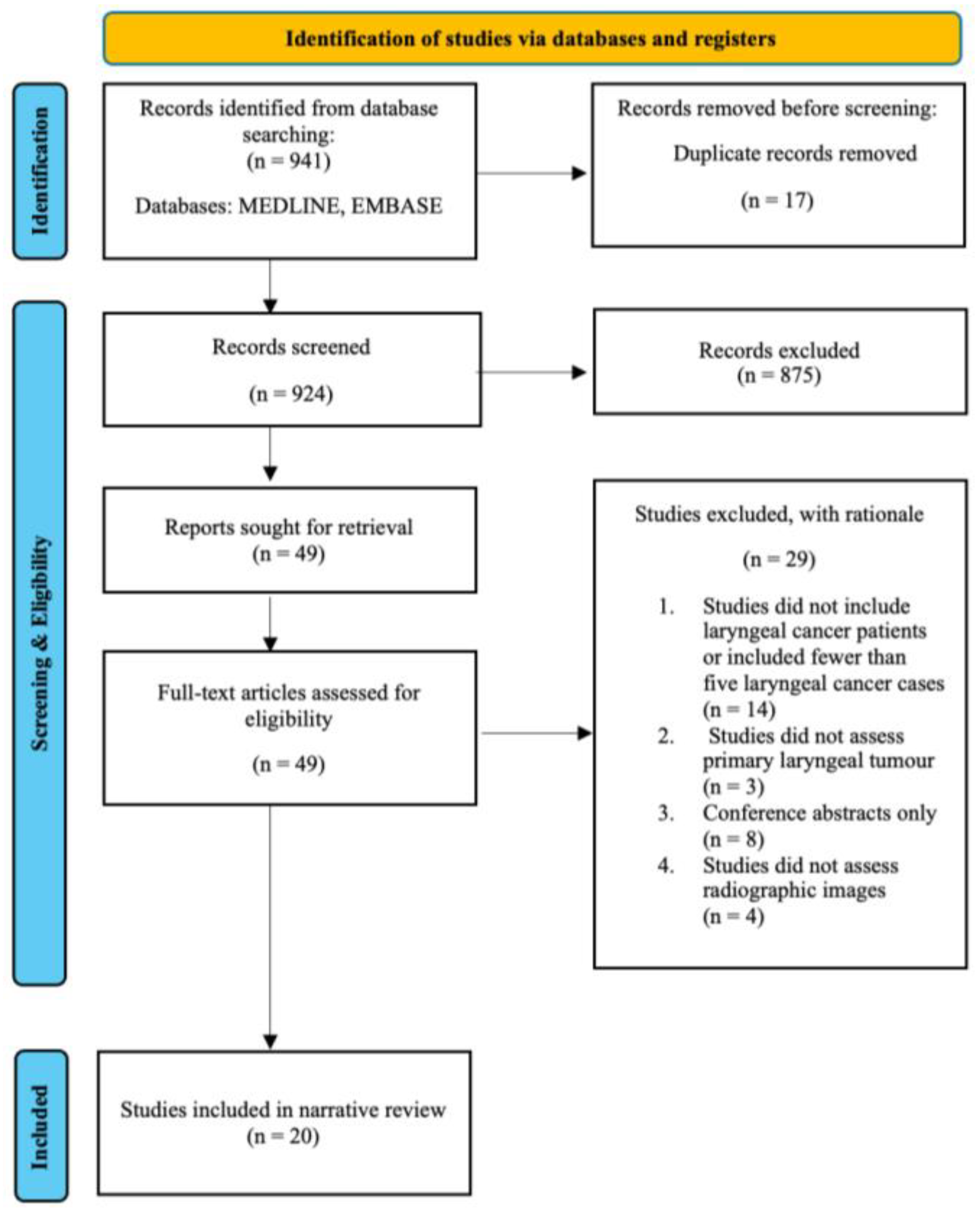
2.2. Study Selection
- Included human patients diagnosed with laryngeal squamous cell carcinoma (LSCC) (or a clearly defined subsite within a broader head and neck cohort).
- Employed radiomic feature extraction from CT, PET/CT, or MRI scans.
- Investigated outcomes related to diagnosis, staging, survival, recurrence, treatment response, or prognosis.
- Used a defined and reproducible image analysis pipeline.
- Provided statistical evaluation of radiomic model performance (e.g., AUC, concordance index, and accuracy).
- Were original, peer-reviewed full-text articles published in English.
2.3. Data Extraction and Risk of Bias Assessment
2.4. Radiomics Quality Score Assessment
3. Results
3.1. Study Characteristics
- Tumour staging and histological grading.
- Survival prediction (overall and disease-specific).
- Recurrence and progression modelling.
- Treatment response prediction, including CRT failure.
3.2. Radiomics for Tumour Staging and Histopathological Grading
3.3. Radiomics for Survival Prediction and Recurrence
3.4. Radiomics for Treatment Response Prediction and Failure

| Author, Year, and Theme | Study Aim | Study Type and Design | Imaging Modality | Radiomics Software Used | Exclusively Laryngeal Cancer Patients | Total Patients (n) | Laryngeal Cancer Patients (n) | Primary Treatment | Model Validation Strategy | Radiomics Feature Selection and Signature Construction | Significant Radiomic Features | Model Performance/ Statistical Outcomes | Limitations | Conclusions |
|---|---|---|---|---|---|---|---|---|---|---|---|---|---|---|
| CT Radiomics for Staging and Grading in Laryngeal Cancer | ||||||||||||||
| Wang et al. [6] 2019 Staging | To determine whether CT radiomics can improve T-stage classification (T3 vs. T4) in advanced laryngeal cancer. | Retrospective single-institution cohort with internal validation using a train–test division. | Contrast-enhanced CT | Pyradiomics | Yes | 211 | n = 211 (T1–2: 0, T3–4: 211) | Surgery ± adjuvant therapy | Internal validation: 70/30 train–test split (n = 150/61) | Feature selection: ICC filtering (threshold ≥ 0.75) to retain stable features; LASSO used to reduce dimensionality and identify significant predictors Signature construction: Selected features used to train an SVM model; model parameters optimised via grid search and cross-validation; radiomics signature derived from trained SVM | T Stage Classification (T3 vs. T4): First-order: Skewness, 2D mean intensity Shape: Least axis length, Sphericity Wavelet (LLH): Kurtosis (first-order), IDN (GLCM), Median (first-order) Wavelet (LLL): IMC (GLCM) | T-stage Classification (Nomogram + Radiologist Assessment): AUC (Training): 0.899 (95% CI: 0.850–0.947) AUC (Validation): 0.892 (95% CI: 0.811–0.974) | Retrospective, single centre study. No external validation performed. | Integrating CT radiomics with radiologist assessment significantly improved T-stage classification accuracy in advanced laryngeal cancer, demonstrating strong predictive performance in both training and validation cohorts. |
| Guo et al. [7] 2020 Staging | To evaluate the potential of CT-based radiomic features in predicting thyroid cartilage invasion in laryngeal cancer. | Retrospective single-institution cohort with internal validation using cross-validation. | Contrast-enhanced CT | Radcloud and Anaconda3 (Python 3.6-based) | Yes | 236 | n = 236 (T1–2: 0 T3–4: 236) | Not applicable (Diagnostic) | Internal validation: 5-fold cross-validation | Feature selection: Standardisation followed by Kruskal–Wallis test to exclude scanner-dependent features; LASSO with 10-fold CV applied; features retained if LASSO coefficients > 0.04; SVMSMOTE used to address class imbalance Signature construction: Logistic regression models built on LASSO-selected and LASSO + SVMSMOTE feature sets; evaluated using 5-fold cross-validation | Distinguishing Thyroid Cartilage Invasion: Shape: LeastAxis, Elongation, Flatness FO: Kurtosis (logarithm, LLH, LLL), 10Percentile (square), Skewness (LHL, HHL), Energy (HLL) GLCM: Imc1 (exponential), ClusterShade (LHH), ClusterProminence (LLH), Correlation (LLL) GLRLM: HGLRE (logarithm), SRHGLE (square), LRE, LRLGLE (exponential), SRLGLE (HHL) GLSZM: GLNU, LGZE, SALGLE (all HHH) | Thyroid Cartilage Invasion: AUC (LR): 0.876 (95% CI: 0.830–0.913) AUC (LR + SVMSMOTE): 0.905 (95% CI: 0.863–0.937) AUC (Radiologist): 0.721 (95% CI: 0.663–0.774) | Retrospective, single-centre study. Manual slice-by-slice tumour delineation (time-consuming). Only venous phase contrast-enhanced CT images analysed; other phases not compared. CT scans acquired using three different scanners with varying parameters. Radiologist assessments performed by junior radiologists. No external validation performed. | CT radiomics-based models demonstrated high accuracy in predicting thyroid cartilage invasion, outperforming radiologist assessment and showing potential to aid diagnostic decision-making. |
| Rao et al. [8] 2023 Staging and Histopathology | To assess whether CT radiomic features (pre-biopsy) can classify T-stage and histological grade in supraglottic laryngeal tumours. | Retrospective single-institution cohort with internal validation using a train–test division. | Contrast-enhanced CT | Pyradiomics | Yes | 20 | n = 20 | Not applicable (Diagnostic) | Internal validation: 80/20 train–test split (n = 16/4) | Feature selection: mRMR algorithm used to rank features by relevance and redundancy. Signature construction: Selected features used to train SVM models for T-stage (T1–T2 vs. T3–T4) and grade (Grade II vs. Grade III). | Staging (T1–T2 vs. T3–T4): Shape: Max3D, Max2D (row), Flatness FO: Energy, Skewness GLCM: Contrast, DiffAvg, DiffEntropy, Id, Idm, ClusterShade GLRLM: GLNU, LRE, LRHGE GLSZM: LAHGLE NGTDM: Contrast Grading (Grade II vs. Grade III): GLRLM: RLNUN, RP, RV, SRE GLSZM: LAE, LALGLE, ZP, ZV GLDM: DNU, GLNU NGTDM: Busyness, Coarseness, Complexity GLCM: ClusterShade | T-stage Classification (Low vs. High): Accuracy: 74.5% (Training), 69.5% (Validation) AUC (Training): 0.788 (95% CI: 0.698–0.862) AUC (Validation): 0.787 (95% CI: 0.634–0.898) Threshold: 0.49 (Youden Index) Grade Classification (Grade II vs. Grade III): Accuracy: 74.5% (Training), 69.5% (Validation) | Retrospective, single-centre study. Small sample size (<50 laryngeal cancer patients). Manual tumour segmentation by single radiologist. High dimensional feature space relative to sample size. Potential variability in CT imaging protocols not fully addressed. No external validation performed. | CT radiomic features demonstrated moderate discriminatory performance for both T-stage and histological grade classification in supraglottic laryngeal cancer, suggesting potential for non-invasive diagnostic stratification. Validation is necessary on larger data sets. 1 |
| Author | Study Aim | Study Type and Design | Imaging Modality | Radiomics Software Used | Exclusively Laryngeal Cancer Patients | Total Patients (n) | Laryngeal Cancer Patients (n) | Primary Treatment | Model Validation Strategy | Radiomics Feature Selection and Signature Construction | Significant Radiomic Features | Model Performance/Statistical Outcomes | Limitations | Conclusions |
|---|---|---|---|---|---|---|---|---|---|---|---|---|---|---|
| PET Radiomics for Prognosis in Laryngeal Cancer | ||||||||||||||
| Bogowicz et al. [11] 2017 Prognosis | To evaluate the association between post-CRT 18F-FDG PET radiomics and local tumour control in HNSCC, and to compare two software implementations. | Retrospective single-institution cohort with internal validation using a train–test division | 18F-FDG PET/CT | In-house developed software from MAASTRO and University Hospital Zurich | No | 178 | n = 11 | CRT | Internal validation: 70/30 train–test split (n = 128/50) | Feature selection: ICC > 0.8 for reproducibility; dimensionality reduction via PCA Signature construction: LASSO regression used to construct final model | Local Control/Recurrence: Histogram: Range (USZ) GLCM: Difference Entropy (MAASTRO) | Local Control (Radiomic Models—MAASTRO and USZ): C-index (Training): 0.75–0.76 C-index (Validation): 0.71–0.73 Calibration slope (Validation): 1.02–1.13 (well calibrated) | Retrospective, single-centre study. Heterogeneous population including both laryngeal and hypopharyngeal cancers (<50 laryngeal cancer patients). Tumour delineation differences between implementations impacted feature extraction. No external validation performed | An increased histogram range and elevated GLCM difference entropy are associated with a higher risk of tumour recurrence. Both post-treatment PET-CT radiomic models demonstrated prognostic value for local tumour control and showed comparable performance. |
| Feliciani et al. [12] 2018 Prognosis | To assess the value of pre-treatment 18F-FDG PET texture analysis in predicting treatment failure in primary HNSCC treated with concurrent CRT. | Retrospective single-institution cohort with internal validation using cross-validation | 18F-FDG PET/CT | CGITA v1.3 | No | 90 | n = 14 | CRT | Internal validation: 10-fold cross-validation | Feature selection: LASSO regression (1000 iterations); features selected based on occurrence >500/1000 runs Signature construction: Multivariate Cox regression using top imaging and clinical features; performance evaluated with Harrell’s C-index and 10-fold cross-validation; Kaplan–Meier used for stratification analysis | Local Failure: GLRLM: LILRE | Local Failure: C-index: 0.76 (radiomics model) vs. 0.65 (clinical model) Multivariate Cox Model: LILRE independently predictive (p = 0.001) | Retrospective, single-centre study. Small sample size (<50 laryngeal cancer patients). Heterogeneous patient population and disease sites. Potential treatment selection bias. HPV status not determined for all patients and not included as a predictive factor. No external validation performed. | LILRE from pre-treatment 18F-FDG PET/CT independently predicts local failure in HNSCC patients undergoing CRT. Incorporating texture analysis with clinical variables may improve local control prediction. |
| Guezennec et al. [13] 2018 Prognosis | To assess the prognostic value of texture features from 18F-FDG PET/CT in a large cohort of HNSCC patients across all subsites and stages. | Retrospective single-institution cohort with internal validation using cross-validation | 18F-FDG PET/CT | LIFEx | No | 284 | n = 32 | Mixed Modalities | Internal validation: 30-fold cross-validation | Feature selection: Pearson correlation clustering (r > 0.8); representative features selected based on prior evidence and statistical relevance Signature construction: Final features (e.g., SUVmax, MTV, texture) chosen via univariate significance and multivariate relevance | Overall Survival: MTV, GLCM: Correlation | Overall Survival: Multivariate Cox regression: Treatment (HR = 2.01, 95% CI: 1.29–3.13, p = 0.002) MTV (HR = 1.012, 95% CI: 1.003–1.021, p = 0.008) GLCM Correlation (HR = 4.51, 95% CI: 1.18–17.24, p = 0.02) AUC performance: MTV: AUC = 0.68 (95% CI: 0.62–0.74) GLCM Correlation: AUC = 0.66 (95% CI: 0.60–0.72) | Retrospective, single-centre study. Heterogeneous population including multiple head and neck cancer subsites, not exclusively laryngeal cancer (<50 laryngeal cancer patients). Textural indices not calculable in 26% of patients due to small lesion volume. Use of fixed 40% SUVmax threshold for lesion segmentation, which may require manual adjustment in heterogeneous tumours. No consensus on segmentation. resampling, or calculation parameters for texture analysis applied. No external validation performed. | MTV and GLCM correlation derived from pre-treatment 18F-FDG PET/CT were independent prognostic factors for overall survival in patients with head and neck squamous cell carcinoma. |
| Choi et al. [15] 2023 Prognosis | To evaluate whether combining pre- and post-treatment 18F-FDG PET/CT radiomics with clinical data improves prognostic accuracy in laryngeal and hypopharyngeal cancer. | Retrospective single-institution cohort with internal validation using a train–test division | 18F-FDG PET/CT | PET Edge (MIM v7.1.7) for VOI segmentation; CGITA toolbox (via MATLAB 2012a) for radiomic feature extraction, following IBSI guidelines. | No | 91 | n = 57 | CRT | Internal validation: 70/30 train–test split (n = 61/30; includes hypopharyngeal cancer) | Feature selection: LASSO regression with n-fold cross-validation used to select PET features associated with PFS/OS Signature construction: Delta pre/post radiomic features used to compute Rad-score from non-zero LASSO coefficients; patients stratified via X-tile analysis | Progression-Free Survival: Co-occurrence: Normalized Second Angular Moment, Correlation SUV Statistics: SUV Variance Overall Survival: Co-occurrence: Contrast SUV Statistics: SUV Variance, SUV Kurtosis, SUV Bias-Corrected Skewness Texture Feature Coding: Co-occurrence Second Angular Moment | Progression-Free Survival: Rad-score: HR = 2.15, 95% CI [1.10–4.21], p = 0.025 Combined model: C-index = 0.802–0.889 Overall Survival: Rad-score: HR = 33.89, 95% CI [2.89–397.18], p = 0.005 Combined model: C-index = 0.860–0.958 | Retrospective, single-centre study. Small sample size. Heterogeneous population including multiple head and neck cancer subsites, not exclusively laryngeal cancer. Lack of scanner harmonization. Software not fully IBSI-compliant. Potential influence of pre-treatment imaging on treatment decisions. No external validation performed. | Combining delta radiomic features from pre- and post-treatment 18F-FDG PET/CT with clinical data significantly improved prognostic performance for both progression-free and overall survival in laryngeal and hypopharyngeal cancer. |
| Nakajo et al. [16] 2023 Prognosis | To assess whether 18F-FDG PET/CT radiomic features can predict survival and disease progression in laryngeal cancer. | Retrospective single-institution cohort with internal validation using a train–test division | 18F-FDG PET/CT | LIFEx | Yes | 49 | n = 49 (T1–2: 20, T3–4: 29) | Mixed Modalities | Internal validation: 70/30 train–test split (n = 34/15) | Feature selection: Gini impurity ranking of radiomic and clinical features; top 10 subsets (5–47 features) evaluated Signature construction: Stratified 10-fold cross-validation; CPH and RSF models selected by peak C-index | Disease Progression: GLCM: Entropy GLZLM: ZLNU Progression-Free Survival: GLCM: Entropy GLZLM: ZLNU GLRLM: LRHGE, SRHGE | Disease Progression: AUC (Training): 0.805 AUC (Testing): 0.842 Progression-Free Survival: C-index (Training): 0.840 C-index (Testing): 0.808 | Retrospective, single-centre study. Small sample size (<50 laryngeal cancer patients). Mixed treatment methods may affect analysis. Radiomic features correlated with tumour size, potentially confounding results. Variable follow-up durations. No external validation performed. | Machine learning models using 18F-FDG PET radiomic and clinical features demonstrated strong predictive performance for disease progression and progression-free survival in laryngeal cancer patients. |
| Bogowicz et al. [11] 2017 Prognosis | To investigate the value of pre-treatment 18F-FDG PET radiomics in modelling local tumour control. | Retrospective single-institution cohort with internal validation using a train–test division | 18F-FDG PET/CT and Contrast-enhanced CT | In-house developed software (Python-based) | No | 172 | n = 10 | CRT | Internal validation: 70/30 train–test split (n = 121/51) | Feature selection: PCA applied to 569 CT and 18F-FDG PET/CT features Signature construction: Separate multivariable Cox models (CT, PET, PET/CT) built with backward selection | Local Control: CT—GLSZM: Size Zone Entropy PET—GLSZM: Small ZoneLow Grey-Level Emphasis (SZLGE) | Local Control: C-index (Training): CT Model = 0.72, PET Model = 0.74, PET-CT Combined Model = 0.77 C-index (Validation): CT Model = 0.73, PET Model = 0.71, PET-CT Combined Model = 0.73 | Retrospective, single-centre study. Limited sample size (<50 laryngeal cancer patients). Heterogeneous population including both laryngeal and hypopharyngeal cancers. GTV delineation subject to inter-observer variability. Autosegmentation may miss metabolically inactive tumour regions. Potential bias from temporal differences between CT and PET acquisitions. Clinical factors such as smoking status and performance status not integrated with radiomic analysis. No external validation performed. | Tumours exhibiting more homogeneous CT density and concentrated areas of high FDG uptake were associated with better prognosis. Radiomic analyses from both CT and PET demonstrated similarly strong ability to discriminate local tumour control in HNSCC. |
| Vallieres et al. [14] 2017 Prognosis | Radiomics combined with clinical data improves prediction of recurrence risk in head and neck cancer. Specific texture features from PET/CT are associated with locoregional recurrence and distant metastases, demonstrating good predictive performance in external validation cohorts. | Retrospective multicentre cohort divided into training and external validation cohorts | 18F-FDG PET/CT and Contrast-enhanced CT | In-house developed software (MATLAB-based) | No | 300 | n = 45 | CRT | Internal and external validation: Training cohort (n = 194); external validation on independent cohort (n = 106) | Feature selection: Imbalance-adjusted logistic regression with bootstrapping Signature construction: Radiomic and clinical features combined using imbalance-adjusted random forest with stratified subsampling validation | Locoregional Recurrence: GLSZM: LZHGE Distant Metastases: GLSZM: ZSN Overall Survival: GLRLM: GLV | Locoregional Recurrence: AUC (Validation): 0.69 C-index (Validation): 0.67 Distant Metastasis: AUC (Validation): 0.86 C-index (Validation): 0.88 | Retrospective study. Heterogeneous population including multiple head and neck cancer subsites, not exclusively laryngeal cancer (<50 laryngeal cancer patients). Inter-observer variability in tumour delineation not fully addressed. Key clinical factors like smoking and performance status excluded. Variability from imaging protocols and feature extraction needs standardisation | Radiomics offers valuable prognostic insights for locoregional recurrence and distant metastases in head and neck cancer. |
| CT Radiomics for Prognosis in Laryngeal Cancer | ||||||||||||||
| Zhang et al. [9] 2013 Prognosis | To evaluate the association between CT radiomics and overall survival in locally advanced HNSCC patients treated with induction chemotherapy. | Retrospective single-institution study; no internal or external validation. | Contrast-enhanced CT | TexRad | No | 72 | n = 21 | Induction Chemotherapy ± Definitive Treatment | No formal validation: Multivariate Cox regression | Feature selection: No formal selection; predefined texture (entropy) and histogram features extracted using TexRAD at multiple spatial scales. Signature construction: Cox proportional hazards models used to assess associations between imaging features and overall survival, adjusted for clinical covariates. | Overall Survival: First order: Entropy, Skewness | Overall Survival (Multivariate Cox Regression): Tumour size: HR = 1.58, p = 0.018 N stage (N3 vs. N0/N1): HR = 8.77, p = 0.002 N stage (N3 vs. N2): HR = 4.99, p = 0.001 Entropy: HR = 2.10, p = 0.036 Skewness: HR = 3.67, p = 0.009 | Retrospective, single-centre study. Small sample size (<50 laryngeal cancer patients). Heterogeneous population including multiple head and neck cancer subsites, not exclusively laryngeal cancer. Single-user semi-automated segmentation; interobserver variability not assessed. Unclear reproducibility of CT texture parameters across institutions and different scanning protocols. Clinical and pathological treatment response not incorporated into analysis. No internal or external validation performed. | CT radiomic features, specifically entropy and skewness, alongside clinical factors including tumour size and nodal stage, were independently associated with overall survival in locally advanced HNSCC patients treated with induction chemotherapy. No formal validation was performed. |
| Ou et al. [10] 2017 Prognosis | To evaluate the prognostic value of radiomics in locally advanced HNSCC treated with CRT or BRT. | Retrospective single-institution cohort with internal validation using cross-validation. | Contrast-enhanced CT | Oncoradiomics (MATLAB-based) | No | 120 | n = 18 | CRT or bioradiotherapy | Internal validation: 10-fold cross-validation | Feature selection: 24 radiomic features selected after FDR correction; dimensionality reduced using PCA. Signature construction: Radiomics signature developed from first principal component (PC1); optimal cutoff defined using Youden index on ROC for 5-year OS. | Overall Survival and Progression-Free Survival: Shape: MaxDiameter2Dy, MaxDiameter2Dz, MaxDiameter3D, Sphericity Disproportion, Surface, Volume FO: Range, Total Energy, Min (HLL), Energy (HHL), Total Energy (HHL, LLL) GLCM (HLL): Autocorrelation, Sum Average, Sum Squares, Sum Variance GLSZM: High Intensity Large Area Emphasis; High Intensity Small Area Emphasis (HHL, HLL); High Intensity Emphasis (HLL); High Intensity Large Area Emphasis (LLL) GLRLM (HLL): HGRE, LRHGE, SRHGE | Overall Survival: HR = 0.30, p = 0.02 Progression-Free Survival: HR = 0.30, p = 0.01 5-year AUC: Combined (Radiomics + p16): 0.78 p16 alone: 0.64 (p = 0.01) Radiomics alone: 0.67 (p = 0.01) Additional Findings: Patients with high radiomic scores benefited significantly from CRT over BRT (p = 0.004) Signature with p16 stratification showed significant OS/PFS differences (p < 0.001) | Retrospective, single-centre study. Small sample size (<50 laryngeal cancer patients). Heterogeneous population including multiple head and neck cancer subsites, not exclusively laryngeal cancer. Variability in CT acquisition protocols over study period. HPV status determined by p16; IHC only without confirmatory testing. No external validation performed. | A radiomics signature derived from CT features significantly predicted overall and progression-free survival in locally advanced HNSCC treated with CRT or BRT. Combining radiomics with p16 status improved prognostic accuracy, and patients with high radiomic scores showed greater benefit from CRT over BRT. |
| Kuno et al. [21] 2017 Prognosis | To assess the prognostic value of radiomic texture features from pre-treatment CT in HNSCC patients treated with CRT. | Retrospective single-institution study; no internal or external validation. | Contrast-enhanced CT | In-house developed software (MATLAB-based) | No | 62 | n = 19 | CRT | No formal validation: Univariate and multivariate Cox regression | Feature selection: Texture features associated with local failure identified via Mann–Whitney U test. Signature construction: Univariate and multivariate Cox regression models used; ROC analysis applied to define optimal thresholds. | Local Failure: Histogram: Geometric Mean, Harmonic Mean, Fourth Moment GLRLM: SRE, GLN, RLN, SRLGLE | Local Failure: Multivariate Cox model predictors: Histogram: Geometric Mean (HR = 4.68, p = 0.026), Harmonic Mean (HR = 8.61, p = 0.004), Fourth Moment (HR = 4.56, p = 0.048) GLRLM: SRE (HR = 3.75, p = 0.044), GLN (HR = 5.72, p = 0.004), RLN (HR = 4.15, p = 0.043), SRLGE (HR = 5.94, p = 0.035) ROC performance: AUC (RLN): 0.82 Sensitivity: 77.3% Specificity: 77.5% | Retrospective, single-centre study. Small sample size (<50 laryngeal cancer patients). Heterogeneous population including multiple head and neck cancer subsites, not exclusively laryngeal cancer. Non-uniform CT protocols (scanner types, section thickness, reconstruction) potentially affecting texture analysis. Single-user semiautomated segmentation. interobserver variability not assessed. Exclusion of necrotic/ulcerated tumour areas from analysis, which may impact texture features related to hypoxia/radiosensitivity. No internal or external validation performed. | Pre-treatment CT radiomic texture features independently predicted local failure in HNSCC. Key predictors included histogram and GLRLM metrics. Findings highlight potential for non-invasive risk stratification, though no external validation was conducted. |
| Chen et al. [22] 2020 Prognosis | To evaluate the prognostic value of a CT-based radiomics signature and nomogram in patients with laryngeal cancer following surgical resection. | Retrospective single-institution cohort with internal validation using a train–test division. | Contrast-enhanced CT | LIFEx | Yes | 136 | n = 136 (T1–2: 83, T3–T4: 53) | Surgery ± adjuvant therapy | Internal validation: Train–test split (n = 96/40) | Feature selection: Stable features retained using ICC > 0.8; LASSO Cox regression used to select six features with non-zero coefficients. Signature construction: Rad-score calculated from selected features; integrated with clinical variables into a prognostic nomogram. | Overall Survival: GLRLM: HGRE, LRHGE GLZLM: ZLNU | Overall Survival: Radiomics Signature: C-index (Training): 0.782 (95% CI: 0.656–0.909, p = 0.170) C-index (Validation): 0.752 (95% CI: 0.614–0.891, p = 0.456) Clinical Nomogram: C-index (Training): 0.802 (95% CI: 0.690–0.914, p = 0.007) C-index (Validation): 0.807 (95% CI: 0.630–0.985, p = 0.192) Radiomics Nomogram: C-index (Training): 0.817 (95% CI: 0.693–0.942, p = 0.009) C-index (Validation): 0.913 (95% CI: 0.833–0.992, p = 0.019) AJCC Staging System: C-index (Training): 0.682 (95% CI: 0.553–0.812) C-index (Validation): 0.699 (95% CI: 0.458–0.941) | Retrospective, single-centre study. Small sample size. Variability in tumour delineation despite use of computer-aided software. Potential confounding from variations in therapeutic strategies and complications. Lack of standardisation in texture feature extraction and image processing software. No external validation performed. | Integrating radiomic features into a prognostic nomogram significantly improved overall survival prediction accuracy in laryngeal cancer patients post-surgery, outperforming both clinical-only models and AJCC staging. |
| Agarwal et al. [19] 2020 Prognosis | To determine whether pre-treatment CT texture features can predict long-term local control and laryngectomy-free survival in locally advanced laryngopharyngeal carcinoma. | Retrospective single-institution cohort with internal validation using cross-validation.. | Contrast-enhanced CT | Pyradiomics | No | 60 | n = 31 | CRT | Internal validation: 10-fold cross-validation | Feature selection: ANOVA F-test followed by LASSO regression. Signature construction: Random forest and logistic regression models trained on selected features. | Laryngectomy-Free Survival: FO (medium texture): Entropy, Kurtosis, Skewness, Standard Deviation Local Control: FO (medium texture): Entropy, Skewness | Laryngectomy-Free Survival: Medium filter Entropy ≥ 4.54: p = 0.006 Kurtosis ≥ 4.18: p = 0.019 Skewness ≤ −0.59: p = 0.001 Standard deviation ≥ 43.18: p = 0.009 Independent predictor: Medium filter Entropy (p < 0.001) Local Control: Medium filter Entropy ≥ 4.54: p = 0.01 Skewness ≤ −0.59: p = 0.02 Fine filter Entropy ≥ 4.29 and Kurtosis ≥ −0.27: p = 0.01 (both) Independent predictor: Medium filter Entropy (p = 0.001) | Retrospective, single-centre study. Small sample size (<50 laryngeal cancer patients). Heterogeneous population including multiple head and neck cancer subsites, not exclusively laryngeal cancer. Tumour delineation performed by a single operator. Single-slice tumour delineation instead of full volumetric analysis. No external validation performed. | Medium-filtered CT texture features, particularly entropy, were significant independent predictors of both local control and laryngectomy-free survival in patients with locally advanced laryngopharyngeal carcinoma. |
| Keek et al. [23] 2020 Prognosis | To investigate whether CT radiomics of peritumoural tissue can predict overall survival, locoregional recurrence, and distant metastases in advanced HNSCC treated with CRT. | Retrospective multicentre cohort combining DESIGN and BD2Decide datasets with internal validation using a train–test division. | Contrast-enhanced CT | RadiomiX Discovery Toolbox (Oncoradiomics) | No | 444 | n = 57 | CRT | Internal validation: 100-repeat 2-fold cross-validation | Feature selection: Univariate Cox regression (FDR-adjusted p < 0.05); features retained if selected in >50% of 100 CV runs. Signature construction: Multivariate Cox and RSF models using top-ranked features; clinical and radiomic models developed separately and compared. | No features reached statistical significance | Clinical Model (Best Performance): C-index (Validation): 0.75 (Cox), 0.65 (RSF) Peritumoral Radiomics Models: C-index (Validation): 0.32–0.61 | Retrospective study. Heterogeneous population including multiple head and neck cancer subsites, not exclusively laryngeal cancer. Differences in clinical variables between training and validation sets. Radiomics focused on peritumoral regions with limited volume affecting feature extraction reliability. Potential biological complexity of recurrence limits predictive power of bulk tumour radiomics. No external validation performed. | Radiomic features from the peritumoral regions are not useful for the prediction of time to OS, LR, and DM. |
| Meneghetti et al. [20] 2020 Prognosis | To develop and validate a CT-based radiomics signature for predicting locoregional control in HNSCC patients treated with primary CRT. | Retrospective multicentre cohort with internal cross-validation and external validation. | Contrast-enhanced CT | MIRP (Medical Imaging Radiomics Processor), Python-based | No | 318 | n = 8 | CRT | Internal and external validation: 3-fold cross-validation (n = 233); external validation on independent cohort (n = 85) | Feature selection: ICC filtering, Spearman, MRMR, and LASSO across repeated 3-fold CV. Signature construction: Cox, boosted Cox, and RSF models; final signature selected by highest median C-index. | Local Control: Shape: GTV First-order: stat_p10 Texture (GLDM, log): High Dependence High Grey-Level Emphasis | Clinical Model (GTV-only): C-index (Training): 0.59 (95% CI: 0.53–0.65) C-index (Validation): 0.61 (95% CI: 0.51–0.71) Clinical–Radiomics Model: C-index (Training): 0.63 (95% CI: 0.58–0.69) C-index (Validation): 0.66 (95% CI: 0.55–0.75) | Retrospective study. Heterogeneous population including multiple head and neck cancer subsites, not exclusively laryngeal cancer (<50 laryngeal cancer patients). Moderate sample size although very small number of laryngeal cancer patients. Underreporting of some model details as per TRIPOD recommendations. Complex modelling approach may limit reproducibility in other settings. Limited prospective validation; external validation cohort relatively small. | The final signature combined tumour volume with two independent radiomic features, achieving moderate discriminatory performance for predicting locoregional control in a validation cohort. |
| Kang et al. [17] 2023 Prognosis | To develop a radiomics nomogram for predicting pathological response and overall survival after induction chemotherapy in advanced laryngeal cancer. | Retrospective single-institution cohort with internal validation using a train–test division. | Contrast-enhanced CT | 3D-Slicer | Yes | 114 | n = 114 (T1–2: 0, T3–4: 114) | Mixed Modalities | Internal validation: 70/30 train–test split (n = 81/33) | Feature selection: Stable features (ICC > 0.8) selected; LASSO regression with 100 iterations of 10-fold CV applied. Signature construction: Rad-score computed from selected features; patients stratified by median score; nomogram built with radiomic and clinical features. | Overall Survival: GLSZM: SizeZoneNonUniformity GLCM: ClusterProminence GLDM (LHH): LargeDependenceEmphasis GLDM (HHL): LargeDependenceEmphasis GLDM: LargeDependenceEmphasis NGTDM: Complexity | Overall Survival (1-year): AUC (Training): 0.802 AUC (Validation): 0.735 Overall Survival (3-year): AUC (Training): 0.789 AUC (Validation): 0.746 | Retrospective, single-centre study. Limited sample size. Mixed treatment methods may affect analysis. No integration of gene transcriptome data. No external validation performed. | Radiomics-enhanced nomogram moderately improved overall survival prediction in advanced laryngeal cancer, demonstrating potential for non-invasive, individualized treatment planning. |
| Woolen et al. [18] 2021 Prognosis | To evaluate whether CT perfusion and radiomic features from pre- and post-treatment imaging can predict one-year disease-free survival in laryngeal and hypopharyngeal cancer. | Retrospective secondary analysis of a phase II trial with internal validation via cross-validation. | Contrast-enhanced CT and CT perfusion | In-house developed software | No | 44 | n = 42 (T1–2: 0, T3–4: 42) | Induction Chemotherapy ± Definitive Treatment | Internal validation: Two-loop leave-one-out cross-validation | Feature selection: Two-loop leave-one-out cross-validation. Signature construction: Linear discriminant analysis classifier used to build a combined response index from selected radiomic, perfusion, and laryngoscopic features. | Disease-Free Survival: Change in blood flow, Percent change in tumour volume (pre- vs. post-therapy), delta radiomics | Disease Progression: AUC (Training): 0.68 (95% CI: 0.50–0.85) AUC (Validation): 0.69 (95% CI: 0.50–0.85) Laryngoscopic Assessment: AUC (Validation): 0.40 | Retrospective, single-centre study. Small sample size (<50 laryngeal cancer patients). Heterogeneous population including both laryngeal and hypopharyngeal cancers. Semi-autonomous segmentation with potential inter- and intra-observer variability, though not statistically significant. Limited evaluation of imaging protocol variability. No external validation performed | Combined CT perfusion and radiomic features modestly improved prediction of one-year disease-free survival compared to laryngoscopic assessment. |
| Cozzi et al. [24] 2019 Prognosis | To evaluate whether a CT-based radiomics signature can predict clinical outcomes following CRT in stage III–IV HNSCC. | Retrospective single-institution cohort with internal validation using a train–test division. | Non-contrast CT | LIFEx | No | 110 | n = 11 | CRT | Internal validation: Train–test split (n = 70/40) | Feature selection: Univariate analysis (FDR < 0.2) followed by Elastic Net regularisation. Signature construction: Multivariate Cox regression used to build Rad-score; patients stratified by median value. | Overall Survival: GLRLM: RLNU GLZLM: GLNU NGLDM: Coarseness Progression-Free Survival: Shape: Compacity GLCM: Correlation Local Control: Shape: Volume NGLDM: Coarseness | Overall Survival: C-index (Training): 0.88 C-index (Validation): 0.90 Progression-Free Survival: C-index (Training): 0.72 C-index (Validation): 0.80 Local Control: C-index (Training): 0.72 C-index (Validation): 0.82 | Retrospective, single-centre study. Limited sample size (<50 laryngeal cancer patients). Heterogeneous population including multiple head and neck cancer subsites, not exclusively laryngeal cancer. Single-expert manual segmentation without assessment of inter-observer variability. Differing CT acquisition parameters and resampling methods on feature extraction. Feature selection methods may overlook complex feature interactions. Did not include higher-order or wavelet features. Absence of artifact correction and test–retest stability assessment. Use of simple statistical models; different machine learning methods might yield different results. No external validation performed. | CT-based radiomics signature demonstrates strong predictive ability for overall survival, progression-free survival, and local control in advanced HNSCC patients treated with CRT. This non-invasive tool may enhance risk stratification and support personalized treatment planning. 1 |
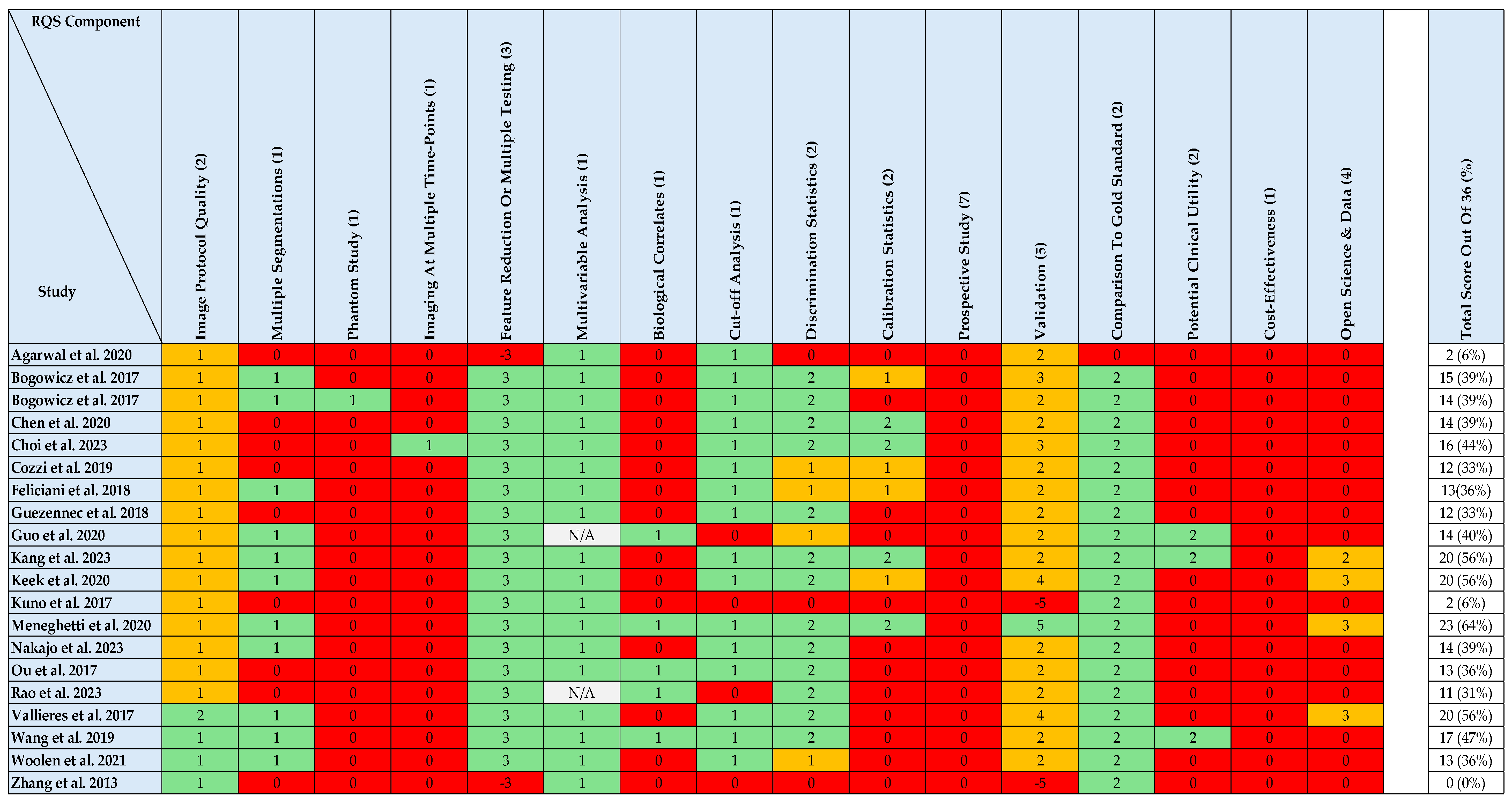
3.5. Methodological Quality Assessment (Radiomics Quality Score)

4. Discussion
4.1. Synthesis of Key Findings
4.2. Strengths and Limitations of the Current Evidence
4.3. Limitations of This Review
4.4. Clinical Applicability and Generalisability
5. Conclusions
Supplementary Materials
Author Contributions
Funding
Institutional Review Board Statement
Informed Consent Statement
Data Availability Statement
Conflicts of Interest
Abbreviations
| AUC | Area Under Curve |
| BRT | Bioradiotherapy |
| CI | Confidence Interval |
| CLAIM | Checklist for Artificial Intelligence in Medical Imaging |
| CPH | Coz Proportional Hazards |
| CRT | Chemoradiotherapy |
| CT | Computed Tomography |
| DFS | Disease-Free Survival |
| FO | First Order |
| FDG | Fluorodeoxyglucose |
| GLCM | Grey-Level Co-Occurrence Matrix |
| GLDM | Grey-Level Dependence Matrix |
| GLRLM | Grey-Level Run-Length Matrix |
| GLSZM | Grey-Level Size Zone Matrix |
| GTV | Gross Tumour Volume |
| HNSCC | Head and Neck Squamous Cell Carcinoma |
| HR | Hazard Ratio |
| IBSI | Image Biomarker Standardisation Initiative |
| ICC | Intraclass Correlation Coefficient |
| IHC | Immunohistochemistry |
| LASSO | Least Absolute Shrinkage and Selection Operator |
| LC | Local Control |
| LFS | Laryngectomy-Free Survival |
| LSCC | Laryngeal Squamous Cell Carcinoma |
| MRI | Magnetic Resonance Imaging |
| mRMR | Minimum Redundancy Maximum Relevance |
| MTV | Metabolic Tumour Volume |
| NGTDM | Neighbouring Grey-Tone Difference Matrix |
| OS | Overall Survival |
| PCA | Principal Component Analysis |
| PET | Positron Emission Tomography |
| PFS | Progression-Free Survival |
| Rad-score | Radiomic score |
| ROC | Receiver Operating Characteristic |
| RSF | Random Survival Forest |
| SUV | Standardised Uptake Value |
| SVM | Support Vector Machine |
| SVM-SMOTE | Support Vector Machine—Synthetic Minority Over-sampling Technique |
| TRIPOD | Transparent Reporting of a multivariable prediction model for Individual Prognosis Or Diagnosis |
| VOI | Volume of Interest |
| ZLNU | Zone Length Non-Uniformity |
References
- Lambin, P.; Leijenaar, R.T.H.; Deist, T.M.; Peerlings, J.; De Jong, E.E.C.; Van Timmeren, J.; Sanduleanu, S.; Larue, R.T.H.M.; Even, A.J.G.; Jochems, A.; et al. Radiomics: The Bridge between Medical Imaging and Personalized Medicine. Nat. Rev. Clin. Oncol. 2017, 14, 749–762. [Google Scholar] [CrossRef] [Scilit]
- Limkin, E.J.; Sun, R.; Dercle, L.; Zacharaki, E.I.; Robert, C.; Reuzé, S.; Schernberg, A.; Paragios, N.; Deutsch, E.; Ferté, C. Promises and Challenges for the Implementation of Computational Medical Imaging (Radiomics) in Oncology. Ann. Oncol. 2017, 28, 1191–1206. [Google Scholar] [CrossRef] [Scilit] [PubMed]
- Rajgor, A. Radiomics-Risk Model for Larynx Cancer (AIRSPACE). Available online: https://research.ncl.ac.uk/airspace/ (accessed on 10 October 2025).
- Page, M.J.; McKenzie, J.E.; Bossuyt, P.M.; Boutron, I.; Hoffmann, T.C.; Mulrow, C.D.; Shamseer, L.; Tetzlaff, J.M.; Akl, E.A.; Brennan, S.E.; et al. The PRISMA 2020 Statement: An Updated Guideline for Reporting Systematic Reviews. BMJ 2021, 372, n71. [Google Scholar] [CrossRef] [Scilit]
- Zwanenburg, A.; Vallières, M.; Abdalah, M.A.; Aerts, H.J.W.L.; Andrearczyk, V.; Apte, A.; Ashrafinia, S.; Bakas, S.; Beukinga, R.J.; Boellaard, R.; et al. The Image Biomarker Standardization Initiative: Standardized Quantitative Radiomics for High-Throughput Image-Based Phenotyping. Radiology 2020, 295, 328–338. [Google Scholar] [CrossRef] [Scilit]
- Wang, F.; Zhang, B.; Wu, X.; Liu, L.; Fang, J.; Chen, Q.; Li, M.; Chen, Z.; Li, Y.; Dong, D.; et al. Radiomic Nomogram Improves Preoperative T Category Accuracy in Locally Advanced Laryngeal Carcinoma. Front. Oncol. 2019, 9, 1064. [Google Scholar] [CrossRef] [Scilit]
- Guo, R.; Guo, J.; Zhang, L.; Qu, X.; Dai, S.; Peng, R.; Chong, V.F.H.; Xian, J. CT-Based Radiomics Features in the Prediction of Thyroid Cartilage Invasion from Laryngeal and Hypopharyngeal Squamous Cell Carcinoma. Cancer Imaging 2020, 20, 81. [Google Scholar] [CrossRef] [Scilit] [PubMed]
- Rao, D.; Koteshwara, P.; Singh, R.; Jagannatha, V. Exploring Radiomics for Classification of Supraglottic Tumors: A Pilot Study in a Tertiary Care Center. Indian J. Otolaryngol. Head Neck Surg. 2023, 75, 433–439. [Google Scholar] [CrossRef] [Scilit] [PubMed]
- Zhang, H.; Graham, C.M.; Elci, O.; Griswold, M.E.; Zhang, X.; Khan, M.A.; Pitman, K.; Caudell, J.J.; Hamilton, R.D.; Ganeshan, B.; et al. Locally Advanced Squamous Cell Carcinoma of the Head and Neck: CT Texture and Histogram Analysis Allow Independent Prediction of Overall Survival in Patients Treated with Induction Chemotherapy 1. Radiology 2013, 269, 801–809. [Google Scholar] [CrossRef]
- Ou, D.; Blanchard, P.; Rosellini, S.; Levy, A.; Nguyen, F.; Leijenaar, R.T.H.; Garberis, I.; Gorphe, P.; Bidault, F.; Ferté, C.; et al. Predictive and Prognostic Value of CT Based Radiomics Signature in Locally Advanced Head and Neck Cancers Patients Treated with Concurrent Chemoradiotherapy or Bioradiotherapy and Its Added Value to Human Papillomavirus Status. Oral Oncol. 2017, 71, 150–155. [Google Scholar] [CrossRef] [Scilit]
- Bogowicz, M.; Riesterer, O.; Stark, L.S.; Studer, G.; Unkelbach, J.; Guckenberger, M.; Tanadini-Lang, S. Comparison of PET and CT Radiomics for Prediction of Local Tumor Control in Head and Neck Squamous Cell Carcinoma. Acta Oncol. 2017, 56, 1531–1536. [Google Scholar] [CrossRef] [Scilit] [PubMed]
- Feliciani, G.; Fioroni, F.; Grassi, E.; Bertolini, M.; Rosca, A.; Timon, G.; Galaverni, M.; Iotti, C.; Versari, A.; Iori, M.; et al. Radiomic Profiling of Head and Neck Cancer: 18F-FDG PET Texture Analysis as Predictor of Patient Survival. Contrast Media Mol. Imaging 2018, 2018, 3574310. [Google Scholar] [CrossRef] [Scilit]
- Guezennec, C.; Robin, P.; Orlhac, F.; Bourhis, D.; Delcroix, O.; Gobel, Y.; Rousset, J.; Schick, U.; Salaün, P.Y.; Abgral, R. Prognostic Value of Textural Indices Extracted from Pretherapeutic 18-F FDG-PET/CT in Head and Neck Squamous Cell Carcinoma. Head Neck 2019, 41, 495–502. [Google Scholar] [CrossRef] [Scilit] [PubMed]
- Vallières, M.; Kay-Rivest, E.; Perrin, L.J.; Liem, X.; Furstoss, C.; Aerts, H.J.W.L.; Khaouam, N.; Nguyen-Tan, P.F.; Wang, C.S.; Sultanem, K.; et al. Radiomics Strategies for Risk Assessment of Tumour Failure in Head-and-Neck Cancer. Sci. Rep. 2017, 7, 10117. [Google Scholar] [CrossRef] [Scilit]
- Choi, J.H.; Choi, J.Y.; Woo, S.K.; Moon, J.E.; Lim, C.H.; Bin Park, S.; Seo, S.; Ahn, Y.C.; Ahn, M.-J.; Moon, S.H.; et al. Prognostic Value of Radiomic Analysis Using Pre- and Post-Treatment 18F-FDG-PET/CT in Patients with Laryngeal Cancer and Hypopharyngeal Cancer. J. Pers. Med. 2024, 14, 71. [Google Scholar] [CrossRef] [Scilit] [PubMed]
- Nakajo, M.; Nagano, H.; Jinguji, M.; Kamimura, Y.; Masuda, K.; Takumi, K.; Tani, A.; Hirahara, D.; Kariya, K.; Yamashita, M.; et al. The Usefulness of Machine-Learning-Based Evaluation of Clinical and Pretreatment18F-FDG-PET/CT Radiomic Features for Predicting Prognosis in Patients with Laryngeal Cancer. Br. J. Radiol. 2023, 96, 20220772. [Google Scholar] [CrossRef] [Scilit] [PubMed]
- Kang, C.; Sun, P.; Yang, R.; Zhang, C.; Ning, W.; Liu, H. CT Radiomics Nomogram Predicts Pathological Response after Induced Chemotherapy and Overall Survival in Patients with Advanced Laryngeal Cancer: A Single-Center Retrospective Study. Front. Oncol. 2023, 13, 1094768. [Google Scholar] [CrossRef] [Scilit]
- Woolen, S.; Virkud, A.; Hadjiiski, L.; Cha, K.; Chan, H.P.; Swiecicki, P.; Worden, F.; Srinivasan, A. Prediction of Disease Free Survival in Laryngeal and Hypopharyngeal Cancers Using CT Perfusion and Radiomic Features: A Pilot Study. Tomography 2021, 7, 10–19. [Google Scholar] [CrossRef] [Scilit]
- Prakash Agarwal, J.; Sinha, S.; Sastri Goda, J.; Joshi, K.; Mhatre, R.; Kannan, S.; Ghosh Laskar, S.; Gupta, T.; Murthy, V.; Budrukkar, A.; et al. Tumor Radiomic Features Complement Clinico-Radiological Factors in Predicting Long-Term Local Control and Laryngectomy Free Survival in Locally Advanced Laryngo-Pharyngeal Cancers. Br. J. Radiol. 2020, 93, 20190857. [Google Scholar] [CrossRef] [Scilit] [PubMed]
- Rabasco Meneghetti, A.; Zwanenburg, A.; Leger, S.; Leger, K.; Troost, E.G.C.; Linge, A.; Lohaus, F.; Schreiber, A.; Kalinauskaite, G.; Tinhofer, I.; et al. Definition and Validation of a Radiomics Signature for Loco-Regional Tumour Control in Patients with Locally Advanced Head and Neck Squamous Cell Carcinoma. Clin. Transl. Radiat. Oncol. 2021, 26, 62–70. [Google Scholar] [CrossRef] [Scilit]
- Kuno, H.; Qureshi, M.M.; Chapman, M.N.; Li, B.; Andreu-Arasa, V.C.; Onoue, K.; Truong, M.T.; Sakai, O. CT Texture Analysis Potentially Predicts Local Failure in Head and Neck Squamous Cell Carcinoma Treated with Chemoradiotherapy. Am. J. Neuroradiol. 2017, 38, 2334–2340. [Google Scholar] [CrossRef] [Scilit] [PubMed]
- Chen, L.; Wang, H.; Zeng, H.; Zhang, Y.; Ma, X. Evaluation of CT-Based Radiomics Signature and Nomogram as Prognostic Markers in Patients with Laryngeal Squamous Cell Carcinoma. Cancer Imaging 2020, 20, 28. [Google Scholar] [CrossRef] [Scilit] [PubMed]
- Keek, S.; Sanduleanu, S.; Wesseling, F.; De Roest, R.; Van Den Brekel, M.; Van Der Heijden, M.; Vens, C.; Giuseppina, C.; Licitra, L.; Scheckenbach, K.; et al. Computed Tomography-Derived Radiomic Signature of Head and Neck Squamous Cell Carcinoma (Peri)Tumoral Tissue for the Prediction of Locoregional Recurrence and Distant Metastasis after Concurrent Chemoradiotherapy. PLoS ONE 2020, 15, e0232639. [Google Scholar] [CrossRef] [Scilit]
- Cozzi, L.; Franzese, C.; Fogliata, A.; Franceschini, D.; Navarria, P.; Tomatis, S.; Scorsetti, M. Predicting Survival and Local Control after Radiochemotherapy in Locally Advanced Head and Neck Cancer by Means of Computed Tomography Based Radiomics. Strahlenther. Onkol. 2019, 195, 805–818. [Google Scholar] [CrossRef] [Scilit] [PubMed]
- Bogowicz, M.; Leijenaar, R.T.H.; Tanadini-Lang, S.; Riesterer, O.; Pruschy, M.; Studer, G.; Unkelbach, J.; Guckenberger, M.; Konukoglu, E.; Lambin, P. Post-Radiochemotherapy PET Radiomics in Head and Neck Cancer—The Influence of Radiomics Implementation on the Reproducibility of Local Control Tumor Models. Radiother. Oncol. 2017, 125, 385–391. [Google Scholar] [CrossRef] [Scilit] [PubMed]
- Zhang, Y.P.; Zhang, X.Y.; Cheng, Y.T.; Li, B.; Teng, X.Z.; Zhang, J.; Lam, S.; Zhou, T.; Ma, Z.R.; Sheng, J.B.; et al. Artificial Intelligence-Driven Radiomics Study in Cancer: The Role of Feature Engineering and Modeling. Mil. Med. Res. 2023, 10, 22. [Google Scholar] [CrossRef] [Scilit]
- Nardone, V.; Reginelli, A.; Rubini, D.; Gagliardi, F.; Del Tufo, S.; Belfiore, M.P.; Boldrini, L.; Desideri, I.; Cappabianca, S. Delta Radiomics: An Updated Systematic Review. Radiol. Medica 2024, 129, 1197–1214. [Google Scholar] [CrossRef] [Scilit]
- Moskowitz, C.S.; Welch, M.L.; Jacobs, M.A.; Kurland, B.F.; Simpson, A.L. Radiomic Analysis: Study Design, Statistical Analysis, and Other Bias Mitigation Strategies. Radiology 2022, 304, 265–273. [Google Scholar] [CrossRef] [Scilit]
- Johnson, D.E.; Burtness, B.; Leemans, C.R.; Lui, V.W.Y.; Bauman, J.E.; Grandis, J.R. Head and Neck Squamous Cell Carcinoma. Nat. Rev. Dis. Primers 2020, 6, 92. [Google Scholar] [CrossRef] [Scilit]
- Horng, H.; Singh, A.; Yousefi, B.; Cohen, E.A.; Haghighi, B.; Katz, S.; Noël, P.B.; Shinohara, R.T.; Kontos, D. Generalized ComBat Harmonization Methods for Radiomic Features with Multi-Modal Distributions and Multiple Batch Effects. Sci. Rep. 2022, 12, 4493. [Google Scholar] [CrossRef] [Scilit]
- Bettinelli, A.; Marturano, F.; Sarnelli, A.; Bertoldo, A.; Paiusco, M. The ImSURE Phantoms: A Digital Dataset for Radiomic Software Benchmarking and Investigation. Sci. Data 2022, 9, 695. [Google Scholar] [CrossRef] [Scilit]
- Ho, S.Y.; Phua, K.; Wong, L.; Bin Goh, W.W. Extensions of the External Validation for Checking Learned Model Interpretability and Generalizability. Patterns 2020, 1, 100129. [Google Scholar] [CrossRef] [Scilit] [PubMed]
- Collins, G.S.; Moons, K.G.M.; Dhiman, P.; Riley, R.D.; Beam, A.L.; Van Calster, B.; Ghassemi, M.; Liu, X.; Reitsma, J.B.; Van Smeden, M.; et al. TRIPOD+AI Statement: Updated Guidance for Reporting Clinical Prediction Models That Use Regression or Machine Learning Methods. BMJ 2024, 385, e078378. [Google Scholar] [CrossRef] [Scilit] [PubMed]
- Tejani, A.S.; Klontzas, M.E.; Gatti, A.A.; Mongan, J.T.; Moy, L.; Park, S.H.; Kahn, C.E. Checklist for Artificial Intelligence in Medical Imaging (CLAIM): 2024 Update. Radiol. Artif. Intell. 2024, 6, e240300. [Google Scholar] [CrossRef] [Scilit] [PubMed]

Disclaimer/Publisher’s Note: The statements, opinions and data contained in all publications are solely those of the individual author(s) and contributor(s) and not of MDPI and/or the editor(s). MDPI and/or the editor(s) disclaim responsibility for any injury to people or property resulting from any ideas, methods, instructions or products referred to in the content. |
© 2026 by the authors. Licensee MDPI, Basel, Switzerland. This article is an open access article distributed under the terms and conditions of the Creative Commons Attribution (CC BY) license.
Share and Cite
Rajgor, A.; Gill, T.; Aboagye, E.; Mill, A.; Rushton, S.; Obara, B.; Hamilton, D.W. Radiomics from Routine CT and PET/CT Imaging in Laryngeal Squamous Cell Carcinoma: A Systematic Review with Radiomics Quality Score Assessment. Cancers 2026, 18, 237. https://doi.org/10.3390/cancers18020237
Rajgor A, Gill T, Aboagye E, Mill A, Rushton S, Obara B, Hamilton DW. Radiomics from Routine CT and PET/CT Imaging in Laryngeal Squamous Cell Carcinoma: A Systematic Review with Radiomics Quality Score Assessment. Cancers. 2026; 18(2):237. https://doi.org/10.3390/cancers18020237
Chicago/Turabian StyleRajgor, Amar, Terrenjit Gill, Eric Aboagye, Aileen Mill, Stephen Rushton, Boguslaw Obara, and David Winston Hamilton. 2026. "Radiomics from Routine CT and PET/CT Imaging in Laryngeal Squamous Cell Carcinoma: A Systematic Review with Radiomics Quality Score Assessment" Cancers 18, no. 2: 237. https://doi.org/10.3390/cancers18020237
APA StyleRajgor, A., Gill, T., Aboagye, E., Mill, A., Rushton, S., Obara, B., & Hamilton, D. W. (2026). Radiomics from Routine CT and PET/CT Imaging in Laryngeal Squamous Cell Carcinoma: A Systematic Review with Radiomics Quality Score Assessment. Cancers, 18(2), 237. https://doi.org/10.3390/cancers18020237