Holistic Management of Obesity in Patients with Incidental Cancer After Unprovoked Deep Vein Thrombosis: A Cardiometabolic and Antithrombotic Framework

 , , , ,
  and
and 
Simple Summary
Abstract
1. Introduction
Literature Search Strategy
2. The Oncobiological Milieu of Obesity: Shared Pathways with Thrombosis and Cancer
2.1. Adipose Tissue as an Active Endocrine Organ
2.2. Insulin Resistance, Hyperinsulinemia, and the IGF-1 Axis
2.3. Visceral Adiposity, Epicardial Fat, and Endothelial Dysfunction
2.4. Platelet Hyperreactivity, Tissue Factor Overexpression, and Impaired Fibrinolysis
2.5. The Tumor Microenvironment Modulated by Adiposity
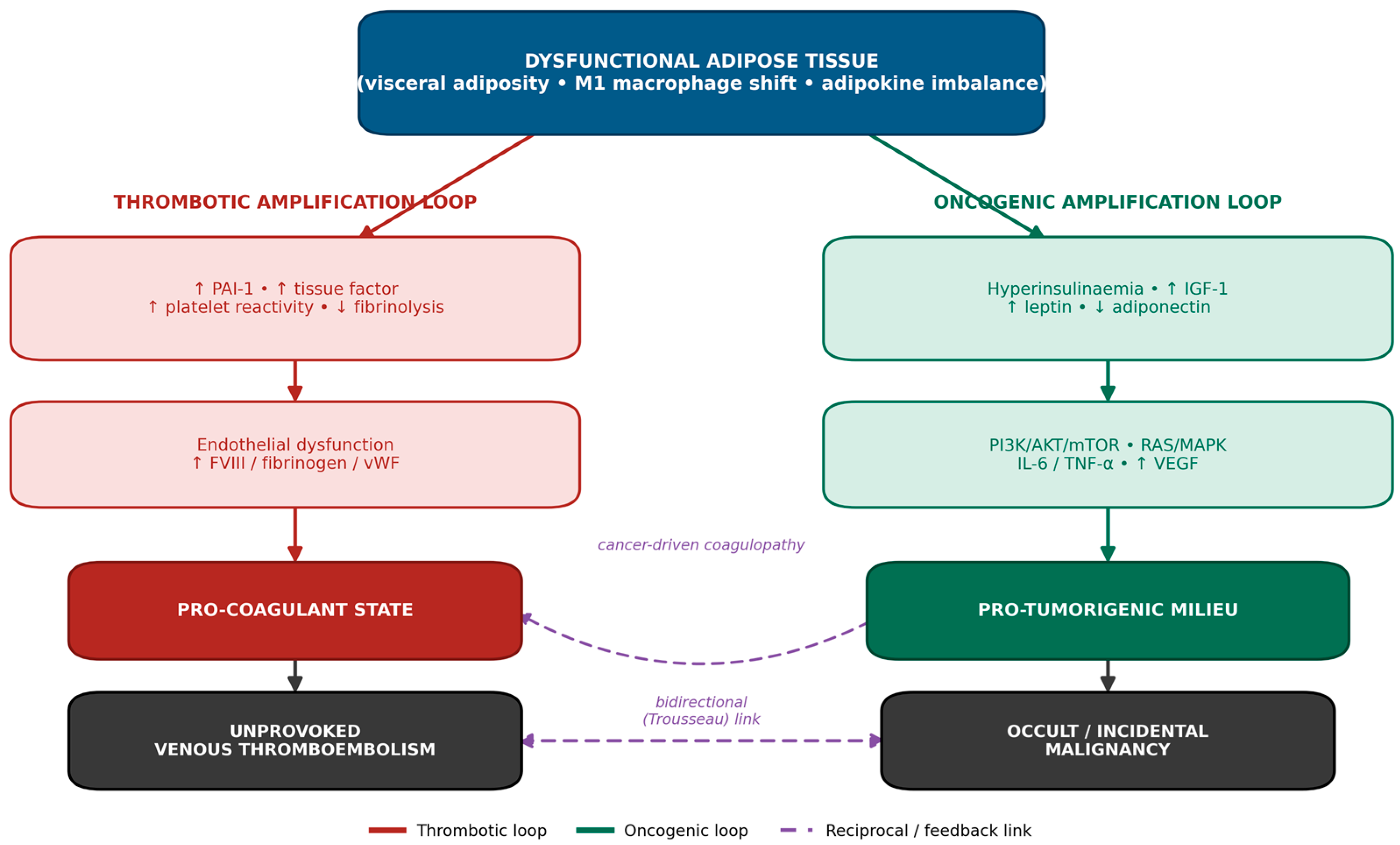
2.6. Synthesis: Obesity as the Dual Amplifier
3. Occult Cancer Screening After Unprovoked DVT in the Obese Patient
3.1. Epidemiology and Risk Stratification
3.2. ISTH Limited Screening and the Role of FDG-PET/CT
3.3. Why Obesity Lowers the Threshold for FDG-PET/CT
4. GLP-1 and Dual GLP-1/GIP Receptor Agonists at the Crossroads of Oncology
4.1. Mechanism of Action
4.2. Semaglutide: Cardiovascular and Metabolic Outcomes
4.3. Tirzepatide: SURMOUNT and SURPASS Programs
4.4. Oncologic Signals: Evidence Synthesis and Critical Appraisal
4.5. Thyroid Cancer: Pharmacovigilance Context
4.6. Anti-Inflammatory and Antitumorigenic Mechanisms
4.7. GLP-1/GIP Therapy in Active Cancer: Sarcopenia, Cachexia, and Timing
4.8. Renal Function: Use in Advanced CKD and Dialysis
5. SGLT2 Inhibitors: Cardio- and Nephroprotection in the Obese Oncologic Patient
5.1. Rationale and Position Within the Obesity–VTE–Cancer Triad
5.2. Cardiovascular and Renal Outcome Evidence
5.3. Relevance During Cancer Therapy
5.4. Safety Integration with Anticoagulation and Incretin Therapy
6. Anticoagulation for Cancer-Associated Thrombosis in Obesity
6.1. From Unprovoked VTE to Cancer-Associated Thrombosis
6.2. Choice of Agent: DOACs vs. LMWH
6.3. LMWH Dosing Uncertainty in Severe Obesity
6.4. Drug–Drug Interactions with Anticancer Therapy
6.5. Duration of Anticoagulation
6.6. Reduced-Dose Maintenance: The API-CAT Evidence
6.7. Renal Function Estimation in Obesity
6.8. Thrombophilia Testing and Who Manages Anticoagulation
7. An Integrated, Case-Based Management Framework
7.1. Convergence of the Four Domains
7.2. Roles Within the Multidisciplinary Team
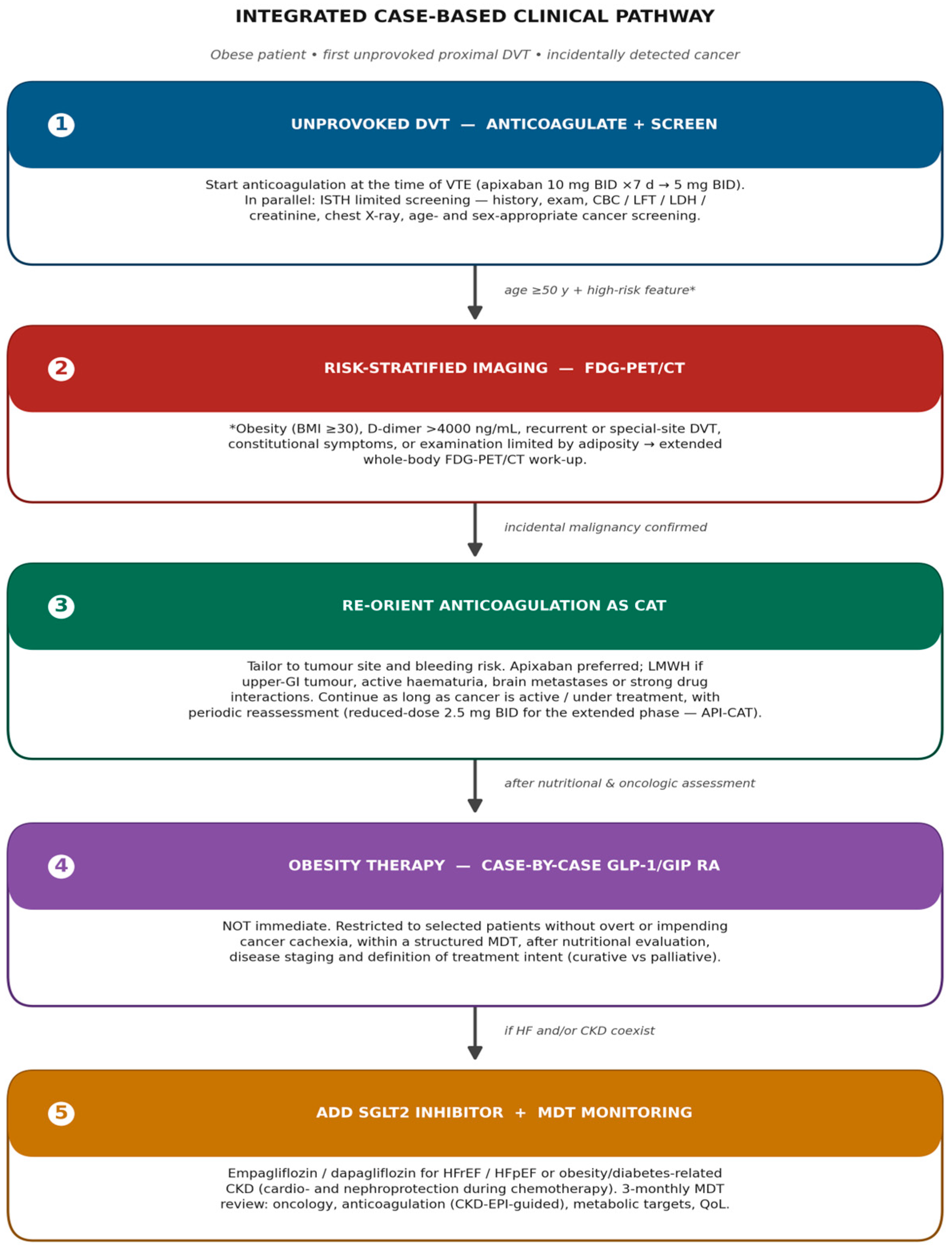
7.3. A Case-Based Clinical Pathway
7.4. Digital Health and Longitudinal Monitoring
7.5. Research Agenda
8. Conclusions
Author Contributions
Funding
Institutional Review Board Statement
Data Availability Statement
Conflicts of Interest
References
- NCD Risk Factor Collaboration (NCD-RisC). Worldwide trends in underweight and obesity from 1990 to 2022: A pooled analysis of 3663 population-representative studies with 222 million children, adolescents, and adults. Lancet 2024, 403, 1027–1050. [Google Scholar] [CrossRef] [PubMed]
- De Pergola, G.; Silvestris, F. Obesity as a major risk factor for cancer. J. Obes. 2013, 2013, 291546. [Google Scholar] [CrossRef] [PubMed] [PubMed Central]
- Gallagher, E.J.; LeRoith, D. Obesity and Diabetes: The Increased Risk of Cancer and Cancer-Related Mortality. Physiol. Rev. 2015, 95, 727–748. [Google Scholar] [CrossRef] [PubMed] [PubMed Central]
- Ageno, W.; Di Minno, M.N.; Ay, C.; Jang, M.J.; Hansen, J.B.; Steffen, L.M.; Vayà, A.; Rattazzi, M.; Pabinger, I.; Oh, D.; et al. Association between the metabolic syndrome, its individual components, and unprovoked venous thromboembolism: Results of a patient-level meta-analysis. Arterioscler. Thromb. Vasc. Biol. 2014, 34, 2478–2485. [Google Scholar] [CrossRef] [PubMed] [PubMed Central]
- Mariman, E.C.; Wang, P. Adipocyte extracellular matrix composition, dynamics and role in obesity. Cell Mol. Life Sci. 2010, 67, 1277–1292. [Google Scholar] [CrossRef] [PubMed] [PubMed Central]
- Wen, J.; Zhang, C.; Wu, F.; Zeng, Q. Advances in occult cancer screening for patients with unprovoked venous thromboembolism: A narrative review of epidemiology, risk, and clinical strategies. J. Vasc. Surg. Venous Lymphat. Disord. 2026, 14, 102439. [Google Scholar] [CrossRef] [PubMed] [PubMed Central]
- D’Astous, J.; Carrier, M. Screening for Occult Cancer in Patients with Venous Thromboembolism. J. Clin. Med. 2020, 9, 2389. [Google Scholar] [CrossRef] [PubMed] [PubMed Central]
- van Es, N.; Le Gal, G.; Otten, H.M.; Robin, P.; Piccioli, A.; Lecumberri, R.; Jara-Palomares, L.; Religa, P.; Rieu, V.; Rondina, M.; et al. Screening for Occult Cancer in Patients with Unprovoked Venous Thromboembolism: A Systematic Review and Meta-analysis of Individual Patient Data. Ann. Intern. Med. 2017, 167, 410–417. [Google Scholar] [CrossRef] [PubMed]
- Carrier, M.; Lazo-Langner, A.; Shivakumar, S.; Tagalakis, V.; Zarychanski, R.; Solymoss, S.; Routhier, N.; Douketis, J.; Danovitch, K.; Lee, A.Y.Y.; et al. Screening for occult cancer after unprovoked venous thromboembolism. Eur. J. Haematol. 2022, 110, 226–232. [Google Scholar] [CrossRef] [PubMed]
- Robin, P.; Carrier, M. Revisiting occult cancer screening in patients with unprovoked venous thromboembolism. Thromb. Res. 2018, 164, S7–S11. [Google Scholar] [CrossRef] [PubMed]
- Zawadzka, P.S.; Imiela, A.M.; Pruszczyk, P. The Interplay Between Obesity and Venous Thromboembolism: From Molecular Aspects to Clinical Issue. Int. J. Mol. Sci. 2025, 26, 10292. [Google Scholar] [CrossRef] [PubMed] [PubMed Central]
- Deng, T.; Lyon, C.J.; Bergin, S.; Caligiuri, M.A.; Hsueh, W.A. Obesity, Inflammation, and Cancer. Annu. Rev. Pathol. 2016, 11, 421–449. [Google Scholar] [CrossRef] [PubMed]
- Iyengar, N.M.; Gucalp, A.; Dannenberg, A.J.; Hudis, C.A. Obesity and Cancer Mechanisms: Tumor Microenvironment and Inflammation. J. Clin. Oncol. 2016, 34, 4270–4276. [Google Scholar] [CrossRef] [PubMed] [PubMed Central]
- Kim, J.W.; Kim, J.H.; Lee, Y.J. The Role of Adipokines in Tumor Progression and Its Association with Obesity. Biomedicines 2024, 12, 97. [Google Scholar] [CrossRef] [PubMed] [PubMed Central]
- Quail, D.F.; Dannenberg, A.J. The obese adipose tissue microenvironment in cancer development and progression. Nat. Rev. Endocrinol. 2019, 15, 139–154. [Google Scholar] [CrossRef] [PubMed] [PubMed Central]
- Avgerinos, K.I.; Spyrou, N.; Mantzoros, C.S.; Dalamaga, M. Obesity and cancer risk: Emerging biological mechanisms and perspectives. Metabolism 2019, 92, 121–135. [Google Scholar] [CrossRef] [PubMed]
- Prandoni, P.; Falanga, A.; Piccioli, A. Cancer and venous thromboembolism. Lancet Oncol. 2005, 6, 401–410. [Google Scholar] [CrossRef] [PubMed]
- Robin, P.; Le Roux, P.Y.; Planquette, B.; Accassat, S.; Roy, P.M.; Couturaud, F.; Ghazzar, N.; Prevot-Bitot, N.; Couturier, O.; Delluc, A.; et al. Limited screening with versus without (18)F-fluorodeoxyglucose PET/CT for occult malignancy in unprovoked venous thromboembolism: An open-label randomised controlled trial. Lancet Oncol. 2016, 17, 193–199. [Google Scholar] [CrossRef] [PubMed]
- Lincoff, A.M.; Brown-Frandsen, K.; Colhoun, H.M.; Deanfield, J.; Emerson, S.S.; Esbjerg, S.; Hardt-Lindberg, S.; Hovingh, G.K.; Kahn, S.E.; Kushner, R.F.; et al. SELECT Trial Investigators. Semaglutide and Cardiovascular Outcomes in Obesity without Diabetes. N. Engl. J. Med. 2023, 389, 2221–2232. [Google Scholar] [CrossRef] [PubMed]
- Jastreboff, A.M.; Aronne, L.J.; Ahmad, N.N.; Wharton, S.; Connery, L.; Alves, B.; Kiyosue, A.; Zhang, S.; Liu, B.; Bunck, M.C.; et al. SURMOUNT-1 Investigators. Tirzepatide Once Weekly for the Treatment of Obesity. N. Engl. J. Med. 2022, 387, 205–216. [Google Scholar] [CrossRef] [PubMed]
- Frías, J.P.; Davies, M.J.; Rosenstock, J.; Manghi, F.P.; Fernández Landó, L.; Bergman, B.K.; Liu, B.; Cui, X.; Brown, K. SURPASS-2 Investigators. Tirzepatide versus Semaglutide Once Weekly in Patients with Type 2 Diabetes. N. Engl. J. Med. 2021, 385, 503–515. [Google Scholar] [CrossRef] [PubMed]
- Dai, H.; Li, Y.; Lee, Y.A.; Lu, Y.; George, T.J.; Donahoo, W.T.; Lee, K.P.; Nakshatri, H.; Allen, J.; Guo, Y.; et al. GLP-1 Receptor Agonists and Cancer Risk in Adults with Obesity. JAMA Oncol. 2025, 11, 1186–1193. [Google Scholar] [CrossRef] [PubMed] [PubMed Central]
- Zinman, B.; Wanner, C.; Lachin, J.M.; Fitchett, D.; Bluhmki, E.; Hantel, S.; Mattheus, M.; Devins, T.; Johansen, O.E.; Woerle, H.J.; et al. EMPA-REG OUTCOME Investigators. Empagliflozin, Cardiovascular Outcomes, and Mortality in Type 2 Diabetes. N. Engl. J. Med. 2015, 373, 2117–2128. [Google Scholar] [CrossRef] [PubMed]
- McMurray, J.J.V.; Solomon, S.D.; Inzucchi, S.E.; Køber, L.; Kosiborod, M.N.; Martinez, F.A.; Ponikowski, P.; Sabatine, M.S.; Anand, I.S.; Beňővá, J.; et al. DAPA-HF Trial Committees and Investigators. Dapagliflozin in Patients with Heart Failure and Reduced Ejection Fraction. N. Engl. J. Med. 2019, 381, 1995–2008. [Google Scholar] [CrossRef] [PubMed]
- Heerspink, H.J.L.; Stefánsson, B.V.; Correa-Rotter, R.; Chertow, G.M.; Greene, T.; Hou, F.F.; Mann, J.F.E.; McMurray, J.J.V.; Lindberg, M.; Rossing, P.; et al. DAPA-CKD Trial Committees and Investigators. Dapagliflozin in Patients with Chronic Kidney Disease. N. Engl. J. Med. 2020, 383, 1436–1446. [Google Scholar] [CrossRef] [PubMed]
- Fujisaki, T.; Sueta, D.; Yamamoto, E.; Buckley, C.; Sacchi de Camargo Correia, G.; Aronson, J.; Tallón de Lara, P.; Fujisue, K.; Usuku, H.; Matsushita, K.; et al. Comparing Anticoagulation Strategies for Venous Thromboembolism Associated with Active Cancer: A Systematic Review and Meta-Analysis. JACC Cardio Oncol. 2024, 6, 99–113. [Google Scholar] [CrossRef] [PubMed] [PubMed Central]
- Qureshi, M.R.; Barsoum, M.; Salim, D.; Mudika, S.E.M.; Barakat, A.; Reghu Nair, N.; Ahmed, T.F.; Nayyar, S.; Dahleh, A.H.; Ambreen, S.; et al. The Role of Direct Oral Anticoagulants (DOACs) in Cancer-Associated Thrombosis: A Comprehensive Review of the Literature. Cureus 2025, 17, e83956. [Google Scholar] [CrossRef] [PubMed] [PubMed Central]
- Agnelli, G.; Becattini, C.; Meyer, G.; Muñoz, A.; Huisman, M.V.; Connors, J.M.; Cohen, A.; Bauersachs, R.; Brenner, B.; Torbicki, A.; et al. Apixaban for the Treatment of Venous Thromboembolism Associated with Cancer. N. Engl. J. Med. 2020, 382, 1599–1607. [Google Scholar] [CrossRef] [PubMed]
- Potere, N.; Di Nisio, M.; Porreca, E.; Wang, T.F.; Tagalakis, V.; Shivakumar, S.; Delluc, A.; Mallick, R.; Wells, P.S.; Carrier, M. Apixaban thromboprophylaxis in ambulatory patients with cancer and obesity: Insights from the AVERT trial. Thromb. Res. 2023, 226, 82–85. [Google Scholar] [CrossRef] [PubMed]
- Mahé, I.; Carrier, M.; Mayeur, D.; Chidiac, J.; Vicaut, E.; Gornik, H.L.; Kakkar, A.K.; Falvo, N.; Sanchez, O.; Grange, C.; et al. API-CAT Investigators. Extended Reduced-Dose Apixaban for Cancer-Associated Venous Thromboembolism. N. Engl. J. Med. 2025, 392, 1363–1373. [Google Scholar] [CrossRef] [PubMed]
- Lyman, G.H.; Carrier, M.; Ay, C.; Di Nisio, M.; Hicks, L.K.; Khorana, A.A.; Leavitt, A.D.; Lee, A.Y.Y.; Macbeth, F.; Morgan, R.L.; et al. American Society of Hematology 2021 guidelines for management of venous thromboembolism: Prevention and treatment in patients with cancer. Blood Adv. 2021, 5, 927–974, Erratum in Blood Adv. 2021, 5, 1953. https://doi.org/10.1182/bloodadvances.2021004734. [Google Scholar] [CrossRef] [PubMed] [PubMed Central]
- MVTEP2 Trial—FDG-PET/CT. Screening for Occult Malignancy in Unprovoked VTE. ClinicalTrials.gov NCT04304651. Available online: https://clinicaltrials.gov/study/NCT04304651 (accessed on 10 June 2026).
- Ko, A.; Chang, Y.C.; Bahar, F.; Wang, T.H.; Xanthavanij, N.; Yu, C.C.; Hsieh, R.J.; See, X.Y.; Lo, S.W.; Song, J.; et al. Risk for Cancer with Glucagon-Like Peptide-1 Receptor Agonists and Dual Agonists: A Systematic Review and Meta-analysis. Ann. Intern. Med. 2026, 179, 216–229. [Google Scholar] [CrossRef] [PubMed]
- Levy, S.; Attia, A.; Elshazli, R.M.; Abdelmaksoud, A.; Tatum, D.; Aiash, H.; Toraih, E.A. Differential Effects of GLP-1 Receptor Agonists on Cancer Risk in Obesity: A Nationwide Analysis of 1.1 Million Patients. Cancers 2024, 17, 78. [Google Scholar] [CrossRef] [PubMed] [PubMed Central]
- Lyon, A.R.; López-Fernández, T.; Couch, L.S.; Asteggiano, R.; Aznar, M.C.; Bergler-Klein, J.; Boriani, G.; Cardinale, D.; Cordoba, R.; Cosyns, B.; et al. 2022 ESC Guidelines on cardio-oncology developed in collaboration with the European Hematology Association (EHA), the European Society for Therapeutic Radiology and Oncology (ESTRO) and the International Cardio-Oncology Society (IC-OS). Eur. Heart J. 2022, 43, 4229–4361. [Google Scholar] [CrossRef] [PubMed]
- Dutka, M.; Bobiński, R.; Francuz, T.; Garczorz, W.; Zimmer, K.; Ilczak, T.; Ćwiertnia, M.; Hajduga, M.B. SGLT-2 Inhibitors in Cancer Treatment-Mechanisms of Action and Emerging New Perspectives. Cancers 2022, 14, 5811. [Google Scholar] [CrossRef] [PubMed] [PubMed Central]
- Greco, A.; Canale, M.L.; Quagliariello, V.; Oliva, S.; Tedeschi, A.; Inno, A.; De Biasio, M.; Bisceglia, I.; Tarantini, L.; Maurea, N.; et al. SGLT2 Inhibitors in Cancer Patients: A Comprehensive Review of Clinical, Biochemical, and Therapeutic Implications in Cardio-Oncology. Int. J. Mol. Sci. 2025, 26, 4780. [Google Scholar] [CrossRef] [PubMed] [PubMed Central]
- Sun, M.; Sun, J.; Sun, W.; Li, X.; Wang, Z.; Sun, L.; Wang, Y. Unveiling the anticancer effects of SGLT-2i: Mechanisms and therapeutic potential. Front. Pharmacol. 2024, 15, 1369352. [Google Scholar] [CrossRef] [PubMed] [PubMed Central]
- Catella, J.; Bertoletti, L.; Mismetti, P.; Ollier, E.; Samperiz, A.; López-Jiménez, L.; González-Martínez, J.; Galeano-Valle, F.; Pesavento, R.; Pace, F.; et al. Severe renal impairment and risk of bleeding during anticoagulation for venous thromboembolism. J. Thromb. Haemost. 2020, 18, 1728–1737. [Google Scholar] [CrossRef] [PubMed]



| Domain | Trial | Design & Population | Key Result | Implication for Proposed Framework |
|---|---|---|---|---|
| Occult cancer screening | SOME [9] | RCT; first unprovoked VTE | Adding thoraco-abdomino-pelvic CT to limited screening did not reduce missed cancers (Δ2%, p = 0.81) | Limited screening remains the standard first step |
| MVTEP [18] | RCT; unprovoked VTE | Negative FDG-PET/CT associated with fewer subsequent cancers (1/186 vs. 9/193; p = 0.02) | FDG-PET/CT reserved for selected high-risk patients | |
| Obesity/metabolic treatment | SELECT (semaglutide) [19] | RCT; 17,604 overweight/obese with CVD, no diabetes | Semaglutide 2.4 mg ↓ MACE 20% (HR 0.80; 95% CI 0.72–0.90); hsCRP ↓ ≈40% | GLP-1RA preferred where cardiovascular risk is high |
| SURMOUNT-1 (tirzepatide) [20] | RCT; 2539 obesity, no diabetes | Tirzepatide 15 mg: −20.9% body weight at 72 weeks | Dual GLP-1/GIP agonist highly effective for weight reduction | |
| SURPASS-2 (tirzepatide) [21] | RCT; 1879 type 2 diabetes | Tirzepatide superior to semaglutide 1 mg for HbA1c and weight | Supports twincretin efficacy when diabetes coexists | |
| JAMA Oncology cohort 2025 [22] | Retrospective cohort; 86,632 adults with overweight/obesity | GLP-1RA use associated with 17% lower overall cancer incidence (HR 0.83; 95% CI 0.76–0.91) | Reassuring—though not antineoplastic—oncologic safety profile | |
| Cardiorenal protection (SGLT2 inhibitors) | EMPA-REG OUTCOME (empagliflozin) [23] | RCT; type 2 diabetes + CVD | ↓ CV death 38%, ↓ HF hospitalization 35%, renal benefit | Establishes cardiorenal role of SGLT2 inhibitors during cancer therapy |
| DAPA-HF (dapagliflozin) [24] | RCT; HFrEF, with/without diabetes | ↓ CV death/worsening heart failure | Extends cardioprotection to HF independent of diabetes | |
| DAPA-CKD (dapagliflozin) [25] | RCT; CKD, with/without diabetes | ↓ sustained eGFR decline, ESKD, CV death | Supports renal protection during cancer therapy | |
| Cancer-associated thrombosis (CAT) | HOKUSAI-VTE Cancer (edoxaban) [26] | RCT; CAT | Noninferior to dalteparin; higher major GI bleeding | Early DOAC evidence; GI-bleeding signal informs agent selection |
| SELECT-D (rivaroxaban) [27] | RCT; CAT | ↓ 6-month recurrence (4% vs. 11%); more CRNMB | Confirms DOAC efficacy with a bleeding trade-off | |
| CARAVAGGIO (apixaban) [28] | RCT; 1170 CAT | Noninferior to dalteparin; no excess upper-GI bleeding | Preferred DOAC for established CAT | |
| AVERT—obesity subgroup (apixaban) [29] | Primary thromboprophylaxis; ambulatory cancer on chemotherapy | ↓ VTE in obese (HR 0.26) and non-obese (HR 0.54); not a CAT-treatment trial | Prophylactic—not CAT-treatment—efficacy consistent across BMI strata | |
| API-CAT (apixaban) [30] | RCT; 1766 active cancer, extended phase | Reduced-dose 2.5 mg BID noninferior to 5 mg BID; less clinically relevant bleeding | Supports reduced-dose extended-phase strategy (see body-weight caveat, Section 6.6) |
| Interaction Class | Representative Anticancer Agents | Net Effect/Action |
|---|---|---|
| Strong CYP3A4 + P-gp inducers | Enzalutamide, apalutamide (AR inhibitors); dexamethasone | ↓ Apixaban exposure: thrombotic risk; prefer LMWH or avoid combination |
| Strong CYP3A4 + P-gp inhibitors | Itraconazole, posaconazole; ritonavir; idelalisib | ↑ Apixaban exposure: bleeding risk; prefer LMWH or avoid combination |
| Mucosal/vascular bleeding risk | Bevacizumab and other VEGF inhibitors | ↑ Mucosal bleeding independent of PK; reassess agent and intensity |
Disclaimer/Publisher’s Note: The statements, opinions and data contained in all publications are solely those of the individual author(s) and contributor(s) and not of MDPI and/or the editor(s). MDPI and/or the editor(s) disclaim responsibility for any injury to people or property resulting from any ideas, methods, instructions or products referred to in the content. |
© 2026 by the authors. Licensee MDPI, Basel, Switzerland. This article is an open access article distributed under the terms and conditions of the Creative Commons Attribution (CC BY) license.
Share and Cite
Geraci, C.; Cannarella, R.; Morello, V.; Paternò, V.; Petrina, S.M.; Esposito, R.; Geraci, G.; Condorelli, R.A.; La Vignera, S.; Calogero, A.E. Holistic Management of Obesity in Patients with Incidental Cancer After Unprovoked Deep Vein Thrombosis: A Cardiometabolic and Antithrombotic Framework. Cancers 2026, 18, 2212. https://doi.org/10.3390/cancers18142212
Geraci C, Cannarella R, Morello V, Paternò V, Petrina SM, Esposito R, Geraci G, Condorelli RA, La Vignera S, Calogero AE. Holistic Management of Obesity in Patients with Incidental Cancer After Unprovoked Deep Vein Thrombosis: A Cardiometabolic and Antithrombotic Framework. Cancers. 2026; 18(14):2212. https://doi.org/10.3390/cancers18142212
Chicago/Turabian StyleGeraci, Calogero, Rossella Cannarella, Valentina Morello, Valentina Paternò, Salvatore Massimo Petrina, Roberta Esposito, Giulio Geraci, Rosita A. Condorelli, Sandro La Vignera, and Aldo E. Calogero. 2026. "Holistic Management of Obesity in Patients with Incidental Cancer After Unprovoked Deep Vein Thrombosis: A Cardiometabolic and Antithrombotic Framework" Cancers 18, no. 14: 2212. https://doi.org/10.3390/cancers18142212
APA StyleGeraci, C., Cannarella, R., Morello, V., Paternò, V., Petrina, S. M., Esposito, R., Geraci, G., Condorelli, R. A., La Vignera, S., & Calogero, A. E. (2026). Holistic Management of Obesity in Patients with Incidental Cancer After Unprovoked Deep Vein Thrombosis: A Cardiometabolic and Antithrombotic Framework. Cancers, 18(14), 2212. https://doi.org/10.3390/cancers18142212