Review

Focus on the Interactive Cooperation Among Mechanotransduction and Biochemical Processes in Pancreatic Ductal Adenocarcinoma Development and Possible Adjuvant Role of Retinoic Acid for Its Treatment: A Narrative Review


1
Internal Medicine Unit, Budrio Hospital, Budrio (Bologna), Azienda USL, 40065 Bologna, Italy
2
Department of Gastroenterology and Hepatology, The First Affiliated Hospital of Wenzhou Medical University, Wenzhou 325015, China
3
Department of Pharmacy and Biotechnology (FaBit), University of Bologna, 40126 Bologna, Italy
4
Solid Tumor Molecular Pathology Laboratory, IRCCS Azienda Ospedaliero-Universitaria di Bologna, 40138 Bologna, Italy
5
Department of Surgery, AOU Sant’Orsola Malpighi, IRCCS Azienda Ospedaliera Universitaria, 40138 Bologna, Italy
6
Department of Radiological, Oncological and Pathological Sciences, Umberto I Hospital, Sapienza University of Rome, 00161 Rome, Italy
7
Unit of General Surgery, Sandro Pertini Hospital, 00157 Rome, Italy
8
Pathology Unit, DIAP—Dipartimento Interaziendale Anatomia Patologica, Maggiore Hospital-AUSL Bologna, 40133 Bologna, Italy
9
Unit of Gastroenterology and Digestive Endoscopy, Sandro Pertini Hospital, 00157 Rome, Italy
*
Author to whom correspondence should be addressed.
Cancers 2026, 18(12), 1932; https://doi.org/10.3390/cancers18121932 (registering DOI)
Submission received: 25 February 2026 / Revised: 5 June 2026 / Accepted: 9 June 2026 / Published: 13 June 2026

Simple Summary

Pancreatic ductal adenocarcinoma (PDAC) is a highly lethal cancer characterized by complex genetic mutations and a harsh tumor microenvironment. The disease involves molecular networks driven by key regulators like KRAS and p53, with KRAS mutations initiating uncontrolled growth and p53 loss removing cellular control mechanisms. PDAC’s environment includes severe hypoxia and oxidative stress, where cancer cells adapt redox pathways to survive high reactive oxygen species and promote invasion and therapy resistance. The synergy between KRAS signaling and redox imbalance forms a metabolic shield against conventional treatments, underscoring the need for therapeutic strategies that target this crosstalk and metabolic adaptations to hypoxia.

Abstract

Background: Pancreatic ductal adenocarcinoma (PDAC) belongs to the group of killer human cancers. Its ferocity is sustained by an unusual mix of genetic changes—primarily in KRAS and TP53—a hypoxic as well as desmoplastic tumor microenvironment, plus metabolic and redox adaptations that allow tumor life amidst intense stress situations. Content: This paper will discuss the molecular networks of wild-type and mutant p53, wild-type and mutant KRAS, PUMA, TIGAR, PRMT5, NRF2, oxygen tension, reactive oxygen species (ROS), and oxidative stress pathways that contribute to pancreatic cancer. It will describe how these factors help set the tumor’s redox state and control apoptosis and therapeutic resistance. This shall therefore specifically discuss what role oxygen gradients play in pancreatic tissues, as well as retinoic acid, together with redox-targeted therapies that are specific to vulnerabilities within such types of networks. Summary and Outlook: An understanding of the crosstalk of these molecular pathways will be critical in designing rational therapeutic strategies. Genetics, metabolism, and microenvironmental integration may open a path toward combinatorial therapies that would resensitize PDAC to apoptosis and overcome resistance to current treatments.

1. Introduction

Pancreatic ductal adenocarcinoma (PDAC) accounts for approximately 90% of neoplasms affecting the pancreas, and at present, it ranks as the sixth leading cause of cancer-related mortality in the world. However, the incidence of this malignancy is projected to progressively increase in the period ranging from 2030 to 2050, becoming the third most common cause of death [1]. This unfavorable scenario is further complicated by the fact that advances in surgical procedures and chemotherapy regimens have not resulted in a significant improvement in the outcome of patients suffering from this malignancy [2]. Their long-term prognosis has remained very poor worldwide over the years, with an estimated 5-year survival rate ranging from 5 to 8% [3,4]. The aggressive biological behavior of this neoplasm is caused by a combination of factors, including progressive, cumulative metabolic alterations in pancreatic cells undergoing malignant transformation, a tissue reaction characterized by dense stromal production, early systemic dissemination, an asymptomatic course with late diagnosis, and resistance to treatment [5]. All these factors allow cancer cells to survive and thrive in an unfavorable, hypoxic environment with reduced nutrient supply and an acidic pH [6,7]. The molecular pattern of PDAC is characterized by mutations developing in the KRAS, TP53, CDKN2A, and SMAD4 genes [8,9,10,11,12]. In particular, activating changes in KRAS are detectable in approximately 90% of patients and represent early events in pancreatic carcinogenesis. About 10% of subjects with PDAC harbor wild-type KRAS [13]. These patients generally have a more favorable clinical course and longer survival compared with individuals with mutated KRAS [9,10]. On the other hand, changes in TP53, detectable in about 50-70% of individuals with PDAC, as well as in the CDKN2A and SMAD4 genes, occur during the invasive and metastatic stages of this malignancy [10,14]. In particular, the interplay between the mutated KRAS (mKRAS), the product of the changed KRAS gene, and the mutated p53 (mp53), the protein originating from the changed TP53 gene, represents a crucial event in pancreatic carcinogenesis [9,15]. The activation of mKRAS promotes pro-oncogenic signaling, whereas mp53 is associated with the reprogramming of metabolism and oxidative stress in cells undergoing malignant transformation [8,13,16]. Overall, these events enable these cells to adapt to the modified chemical, biochemical, and physical conditions developing in their nuclear and cytoplasmatic compartments, as well as in neoplastic pancreatic stroma, during the process of carcinogenesis [17,18]. Malignant cells require elevated levels of biomolecules to survive, grow, and proliferate, including glucose, amino acids, lipids, nucleotides, and energy substrates such as adenosine triphosphate (ATP) [17,18,19]. The supply of these substrates strongly depends on the functional intrinsic changes in a wide series of cancer cells’ activities, including glucose uptake, glycolysis (mainly aerobic glycolysis, also known as the Warburg effect), pentose phosphate pathway, tricarboxylic acid cycle [17,19,20], metabolism of amino acids (in particular glutamine) and lipids [21,22]. These biological processes generate elevated levels of reactive oxygen species (ROS) under low-oxygen tension in pancreatic tissue, which can have potentially harmful effects on cancer cells [23,24]. ROS can both foster and restrain the progression of tumors in general and of PDAC in particular, depending on their type and on their stage of development [23,24,25]. Therefore, malignant cells activate antioxidant systems present in normal cells, such as NRF2 and TIGAR, and promote mitochondrial adaptations to mitigate potential damage and maintain redox balance [26,27,28]. Additional factors are involved in this highly complex molecular landscape, such as PUMA [29], a master regulator of apoptosis, and PRMT5 [30], an enzyme that catalyzes the dimethylation of the amino acid arginine on histone and non-histone proteins in the cell genome. In particular, PUMA is involved in the processes regulating cell survival or death as it controls, via a p53-mediated pathway, the integrity of mitochondrial structure and function [29,31]. A wide range of harmful stimuli may cause injury in biomolecules, DNA, and micro-organelles [26,28]. These events generally trigger the activation of a series of cellular defense systems to repair the damage and restore normal cell activity [26,27,28]. However, if the injury is irreparable, an enzymatic cascade is activated, inducing PUMA-mediated mitochondrial damage with subsequent cell apoptosis [29,32]. On the other hand, PRMT5 modulates chromatin remodeling, RNA maturation, gene transcription, and intracellular signaling cascades [30,33]. Key roles in this complex interaction are played by the oxygen gradient among pancreatic epithelial cells [7,34] and the dense stromal microenvironment [20,34,35]. The normal pancreatic tissue is physiologically characterized by a low-oxygen tension, and one of the crucial PDAC features is the presence of a dense fibrotic stroma. This type of structure further decreases oxygen availability by compressing blood vessels, thereby reducing perfusion [34,35]. Overall, this type of confirmation and spatial orientation both promote selective pressure on malignant cells that develop strong redox control responses, thereby enabling their survival under conditions of vigorous oxidative stress [23,34,35,36]. This microenvironment creates a compartmentalized metabolic network and is strongly involved in PDAC resistance to treatment [17,19,20,21,22,24,36]. Retinoic acid, a compound derived from vitamin A, has been proposed as a potential agent for inducing cell differentiation and modulating redox balance in some malignancies, including PDAC [37]. Preliminary studies have reported that this fat-soluble vitamin exerts several functions, including suppression of cancer-associated fibroblast activities, regulation of ROS levels, and restoration of cell differentiation pathways [37,38]. Several early-phase clinical trials are assessing its use alone or in association with chemotherapy [38,39].
This narrative review examines and summarizes current knowledge on the complex interaction among several players involved in the complex process of pancreatic carcinogenesis, progression, metastasis generation, and response to therapy. These factors, including wild-type or mutant KRAS [16,18,19,28,31,40], wild-type or mutant p53 [8,10,15], PUMA [29,32], TIGAR [26,27,41], NRF-2 [28,40], PRMT5 [30], and Reactive Oxygen Species [23,26,42], normally act as master regulators of a wide series of crucial cell functions, such as metabolism, redox status, motility, proliferation and differentiation [40,41,42]. Our paper also describes other important factors involved in pancreatic carcinogenesis, such as mechanotransduction in cell biology, extracellular matrix organization, stromal stiffness, and viscosity. Furthermore, retinoic acid biology, its potential role as a therapeutic strategy for pancreatic cancer, and its limitations and potential adverse effects in its treatment are widely discussed. Mutations in these players, as well as their dysregulated activities, alter their biological functions, leading step by step to PDAC development.

2. The Concept of Malignant Microenvironment in Neoplasms and in Pancreatic Cancer

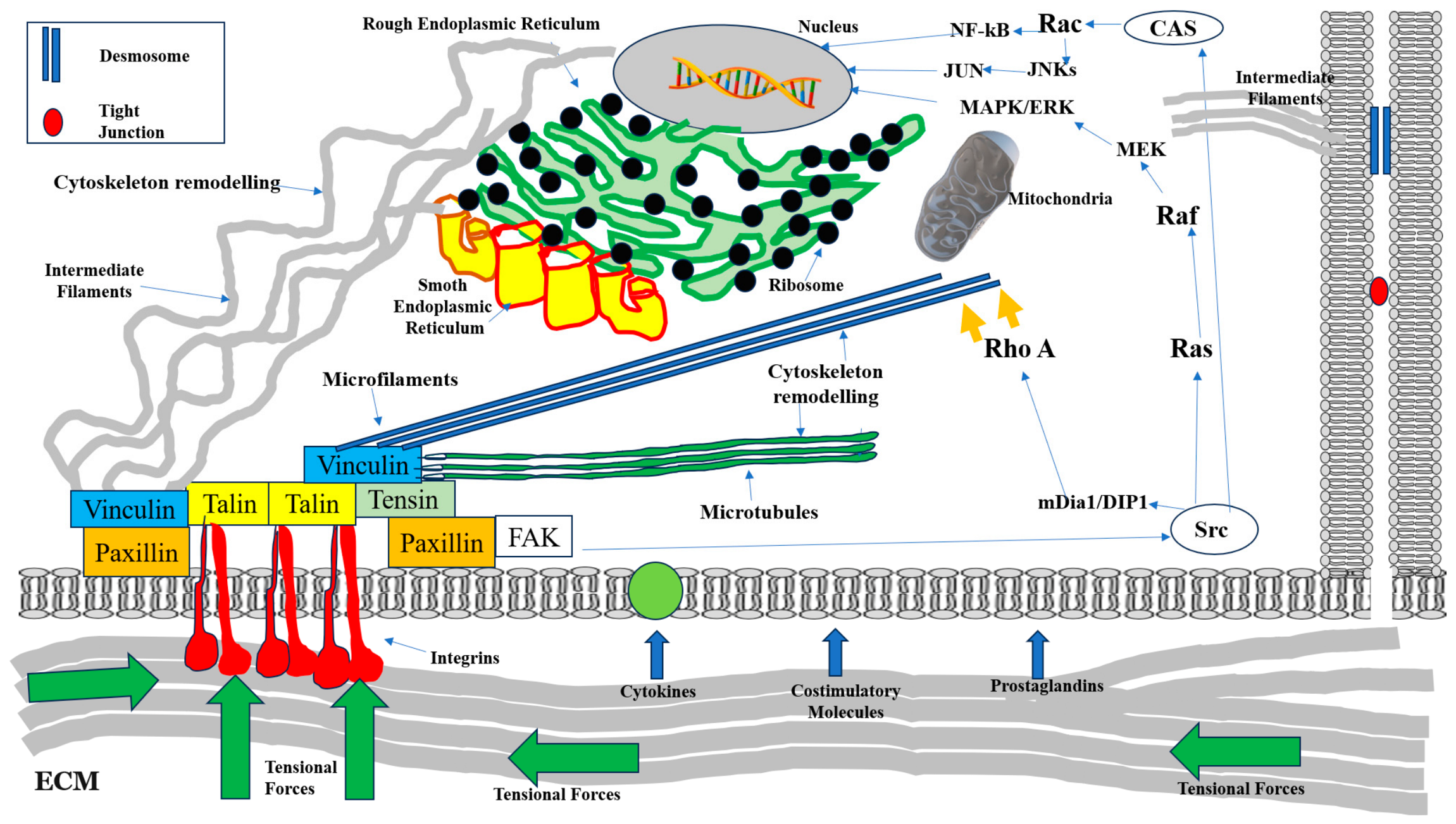
Homeostasis and proper function of mammalian tissues depend on maintaining normal cell shape and extracellular matrix (ECM) architecture, as well as adequate dynamic interactions among their constitutive elements. For several years, Researchers have focused their efforts on studying these components at the molecular level, combining chemical, biochemical, physical, and mathematical concepts. A wide range of human tissues contain epithelial cells, arranged into thin, continuous, protective, and closely interconnected layers. These groups of epithelial cells, with well-ordered organization and spatial disposition and associated with underlying supporting structures such as the basement membrane (MB) and ECM, are referred to as epithelial tissues or epithelia. Epithelial cells interact with one another and with the basement membrane and/or extracellular matrix through specialized components. In particular, these elements are represented by desmosomes and tight junctions, which connect the plasma membranes of adjacent epithelial cells, and by integrin-anchored focal adhesion receptors, which allow epithelial cells to adhere to the basement membrane and the ECM. Furthermore, desmosomes, tight junctions, and Integrins are connected with the cytoskeleton, a supportive element detectable in the cytoplasm of each eukaryotic cell [43]. On the whole, these components cooperate to form a single functional unit composed of epithelial cells with their intracellular micro-organelles, basement membrane, and ECM. This very interesting concept was introduced by Ingber et al. In the 1980s, he applied physical and mathematical principles to the study of biological systems and proposed the “tensional integrity or tensegrity” model. According to his hypothesis, in the tissues of all living organisms, cells with their cytoskeletons and micro-organelles, as well as ECM and connective tissues, constitute tense structures and are subjected to both physical and chemical stimuli. The first group of signals includes tensional and compressive forces, whereas the second group comprises chemical compounds, such as reactive oxygen species (ROS), and biochemical mediators and soluble factors, such as chemokines, cytokines, costimulatory molecules, and prostaglandins. Therefore, cells control and determine their biological behavior and fate by modulating and integrating the activities of their metabolic and signal transduction machinery. Cells sense mechanical signals originating both within their microenvironment and in the extracellular compartment, via integrins. These receptors, in association with desmosomes, tight junctions, the cytoskeleton, the basement membrane, and the extracellular matrix, generate a bidirectional pathway through which physical stimuli are transmitted synchronously and ubiquitously to all cells of the tissue and to the underlying supporting structures [44]. Therefore, each tissue and cell, in its context, is subjected to endogenous and exogenous forces. The first class is characterized by forces largely produced by cytoskeletal contractility within the cells, whereas the second one includes a variety of forms, such as gravity, shear stress, tensile, and compressive forces. Cells sense exogenous forces through their interaction with the basement membrane and the ECM. Several local stiffnesses of the ECM are important mechanical effectors of cell behavior. On the whole, this three-dimensional, dynamic macromolecular framework helps stabilize tissue architecture and provides mechanical resistance to deformation. Therefore, changes in the structural components of the connective tissue and of the extracellular matrix (such as modification in type of collagens or of matricellular proteins) as well as in the structure of the cellular microenvironment (changes in the composition of cytoskeletal microfilaments or microtubules), as occurs, for example, in diseases characterized by persistent tissue inflammation, determine an alteration of some biophysical tissue parameters, such as its stiffness, viscosity and geometry [45]. Under normal conditions, the mutual cooperation among cells, their organelles, the ECM, and connective tissue is associated with a self-maintaining biochemical and biomechanical loop. This continuous cycle preserves normal morphology, spatial disposition, and activity of cells embedded in tissues, proper shape and intracellular localization of their micro-organelles, such as the nucleus, mitochondria, rough and smooth endoplasmic reticulum, Golgi apparatus, lysosomes, and cytoskeleton, as well as ECM composition, its three-dimensional arrangement in organs, and its function [46,47]. In recent years, oncologists have focused on these topics as crucial elements in cancer development. Carcinogenesis is a highly complex and dynamic process in which a wide range of cellular and non-cellular components exert cooperative effects to modulate the initiation, growth, progression, and spread of malignancies [48]. Several elements, closely interconnected and forming a self-maintaining loop, are involved in the development of tumors in general and of pancreatic adenocarcinoma in particular. These components are represented by different sets of cells (cells undergoing malignant transformation, immune cells, cancer-associated fibroblasts, i.e., CAFs, endothelial cells/vessels and stromal cells) and their intracelluar elements (cytoskeleton and micro-organuli, such as nucleus, mitocondria, endoplasmic reticulum) as well as soluble mediators, (chemokines, cytokines, costimulatory molecules, reactive oxygen species and prostaglandins) structural- (such as collagens, proteoglycans and glycoproteins) [49], and regulatory proteins (such as matricellular proteins) [50] in concentration and in composition different from those detectable in normal tissues [51] as well as intracellular and dysregulated physical-stimuli (microenvironment stiffness and tensional/compression forces). All these elements, in concert, generate a self-maintaining and supportive dynamic niche in which cancer cells can survive, evade immune system surveillance, proliferate, and spread to distant sites. Recent evidence suggests that niche stiffness promotes and preserves the stemness of malignant stem cells and determines their fate [52]. This concept applies to both primary tumor development and metastatic disease [53,54]. According to our current knowledge, the process of carcinogenesis in general and in PDAC, in particular, are characterized by a large series of intracellular and extracellular modifications. Changes in matrix stiffness and viscosity alter the transcriptome of PDAC cells. The progressive development of genomic mutations in cells that are undergoing malignant transformation is associated with cellular and tissue remodeling, with modification of cytoskeleton composition, structure, and grade of tensional forces, with subsequent changes in intracellular disposition of micro-organuli, such as mitochondria, endoplasmic reticulum, and nucleus. Available studies suggest that mechanical loading is coupled with cellular regulation and that this process is crucial for maintaining tissue homeostasis. An imbalance between these two elements is associated with the development of pathological conditions, including carcinogenesis. Changes in nuclear morphology may determine a remodeling of chromatin conformation with an increase or an inhibition in transcriptional activities of a wide range of genes, with significant modifications in the synthesis and release of structural and non-structural proteins [55]. In particular, stiffness-related signaling cascades modulate epigenetic events, such as DNA methylation, histone modifications, and non-coding RNAs, and influence the synthesis of crucial ECM elements and matrix-modifying enzymes, leading to pathological tissue remodeling and cancer development [56]. Furthermore, malignant cells are characterized by alterations in the activity of mitochondria and other organelles, with significant remodeling and rewiring of numerous functions, including signaling pathways, metabolism, motility, differentiation, and apoptosis [57]. Cancer cells may be regarded as learning structures, able to sense alterations in physical stimuli in their intra- and extracellular microenvironments, such as stiffness-induced mechanical stresses. These changes are stored in a sort of transient or persistent mechanical memory system. Interestingly, the intensity and duration of mechanical stress have important effects in this setting, as long-term, strong stimuli induce irreversible mutations [58]. The introduction of 3D cell culture systems has improved our understanding of these processes with the purpose of mimicking a pathological mechanical environment to understand how malignant cells adapt their metabolism to physical stimuli of the cellular microenvironment. Available studies using these models have demonstrated that some metabolic activities, such as glycolysis, are regulated by the viscoelastic properties of the substrates where cells are cultured, including stiffness and viscosity. In particular, HepG2 cells grown in soft media have exhibited significant mitochondrial membrane depolarization and downregulation of mitochondrially encoded cytochrome c oxidase I, with upregulation of glycolysis [59]. Furthermore, according to current evidence, all malignant tissues, and PDAC in particular, exhibit varying degrees of heterogeneity in structure and spatial arrangement, depending on the distribution of their constituent elements. For example, the different types of collagen and matricellular proteins present in PDAC tissue can differ significantly, both quantitatively and structurally, from those observed in normal pancreatic tissue. This circumstance depends on several factors. These proteins may be synthesized in greater quantities in different, normal polymorphic forms, or they may arise from abnormal transcription or splicing of the genes that encode them. This variability is associated with heterogeneity in stiffness, geometry, viscoelastic properties, and interstitial fluid pressure, even within different areas of the same malignant lesion. Similar considerations can also be proposed for other structural components of tumor tissue. Overall, these characteristics also modulate cellular dormancy and properties of cancer stem cells as well as influence their ability to survive and to disseminate to distant organs [60]. Furthermore, in vitro and in vivo studies support the concept that collagen density and fiber alignment type induce an immunosuppressive microenvironment in PDAC, even in the early phases of carcinogenesis. In particular, increased collagen alignment in histological specimens from patients with this malignancy is associated with a poor prognosis. Macrophagic infiltration of the periductal space adjacent to pancreatic intraepithelial neoplasia (PanIN) is an early event in pancreatic carcinogenesis, and it supports the establishment of a cancer-permissive, immunosuppressive microenvironment. This event is associated with the impairment of the immune response against malignant cells, and it is characterized by the inhibition of T cells’ influx into the tissue, by the prevention of their killing, and by the promotion of tumor growth. It has been reported that PDAC tissue specimens from patients with this disease are richer in collagen (primarily type I collagen) and exhibit increased fiber alignment in the tumor microenvironment, compared with non-neoplastic tissue [61]. Recent studies have proposed a more realistic model, termed “collective migration,” to describe how PDAC cells generate metastases. According to this paradigm, the population of these neoplastic cells may be subdivided into two groups with a different functional hierarchy. In particular, during migration, a group of these cells acts as the leaders, whereas the other cluster acts as the followers. In the first group, cells need more ATP and produce energy through oxidative phosphorylation in comparison with the subset of follower cells. However, the increase in collagen alignment reduces metabolic differences between these two cell subsets, strongly suggesting that the composition and arrangement of extracellular matrix fibers alter tumor cell metabolism [62]. Furthermore, in recent years, researchers have focused their attention on understanding how physical stimuli, primarily stiffness, can impact the structure and arrangement of individual cellular components, including proteins or enzymes (KRAS and p53), receptors, or micro-organelles (mitochondria), in a wide range of malignancies. Currently, few studies have been conducted with this aim, not only in PDAC, but also in tumors affecting other organs. This strategy could be useful for developing a common model for the study not only of PDAC but also of malignancies that arise in sites other than the pancreas. Some researchers have investigated the role that mutations in the KRAS gene may exert in the mechanics of cancer cells. Changes occurring in this gene result in altered cytoskeletal rearrangement and actomyosin contractility of neoplastic cells. These modifications, in turn, reprogram the mechanical properties of cells undergoing cancer transformation and alter the modality of interaction with the surrounding mechanical microenvironment. It may also be supposed that the increase in stiffness itself may induce mutations in the KRAS gene, and the KRAS-mutated protein, through cytoskeleton remodeling, contributes to promoting malignant transformation of cells. This event generates a self-maintaining mechanical memory loop and contributes to the survival and spreading of cancer cells [63,64]. Furthermore, physical stimuli may also influence p53 intracellular localization and its related functions. In a recent in vitro study, primary murine chondrocytes were cultured on substrates with different stiffness. Cell growth in soft medium (0.5 kPa) has been associated with nuclear translocation of p53. On the other hand, p53 extranuclear localization has been observed in chondrocytes cultured in stiffer substrates [65]. Mitochondria are also strongly involved in the processes of cancer development and spreading. Current evidence suggests that a wide spectrum of stimuli from intracellular and extracellular microenvironments, respectively, including mtROS tone, mtDNA integrity, epigenetic rewiring, cellular stiffness, genome mutations, and oxygen–nutrient supply, ECM mechanics, stromal/inflammatory markers, act in concert and modulate mitochondrial control systems. Therefore, mitochondria regulate cellular homeostasis by driving bioenergetics, redox status, metabolic rewiring, fission–fusion processes, mechanosensitive components, EMT plasticity, and Ca2+ balance [66]. Recently, in vitro studies have suggested that breast cancer cells grown on soft substrates exhibit increased levels of F-actin in the peri-mitochondrial regions. Variation in mitochondrial dynamics is associated with increased mitochondrial-induced ROS generation and stimulates NRF2-mediated programs of antioxidant transcriptional response, leading to an increase in cystine uptake and glutathione metabolism. On the whole, these events, such as mitochondrial fission, represent a link connecting processes of mechanotransduction in the microenvironment to cellular metabolism and redox status, as well as a significant impact on metastases generation and chemotherapeutic resistance (Figure 1) [67]. Taking advantage of all this evidence, we have examined several processes involved in the development of PDAC.

3. KRAS and TP53 Role in PDAC: Signaling and Metabolic Rewiring

Activating mutations in the KRAS oncogene are observed in the majority of PDACs, mainly at codon 12 [8,13,68]. This alteration represents the earliest and most frequent event during the dynamic process, leading to the occurrence of pancreatic cancer [6,7,8,9]. In normal pancreatic cells, the KRAS protein switches between an inactive “off” state (bound to GDP) and an active “on” state (bound to GTP) [8,13,68]. This complex controls the activity of some signaling pathways, including the RAF–MEK–ERK, MAPK, and PI3K–AKT–mTOR cascades, and promotes fine-tuned modulation of crucial cell functions, such as metabolism, proliferation, differentiation, motility, survival, and anticancer treatments [69,70,71].
The mutated KRAS (mKRAS) protein is locked in an active status, and this event constitutively induces the activation of its GTPase function. This event prevents efficient hydrolysis of GTP back to GDP, leads to the persistent induction of gene transcriptional programs, and promotes malignant transformation [68,72].

3.1. KRAS Mutation and Metabolic Reprogramming

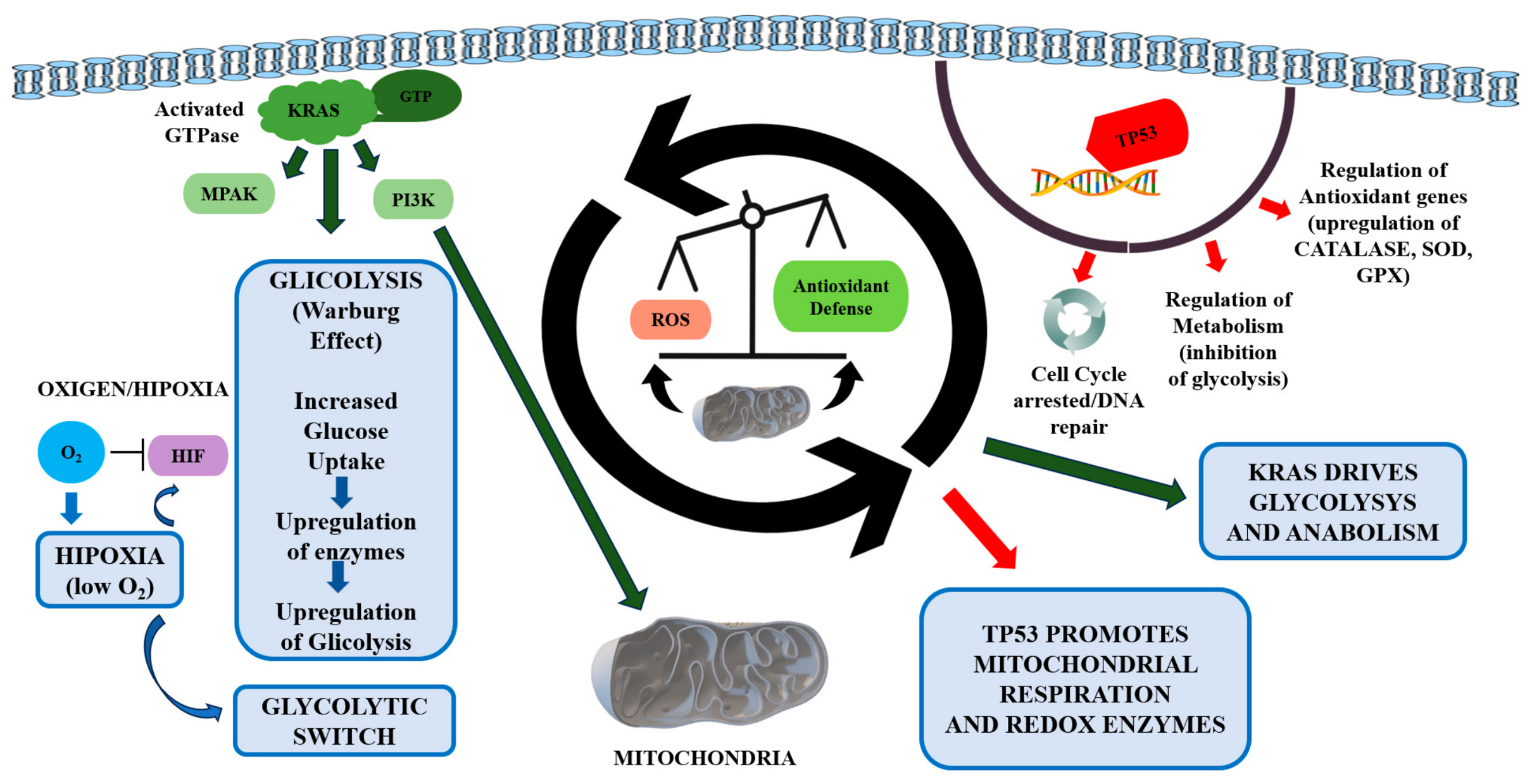
The ability of the mKRAS protein to rewire cellular metabolism of glucose, lipids, and amino acids is one of the distinctive features of pancreatic carcinogenesis [17,18,19,20,21,73]. Malignant pancreatic cells exhibit a switch in the anabolic and catabolic programs of these biomolecules with an increase in glucose uptake, preferential aerobic glycolysis (known as the Warburg effect), activation of the enzymatic cascade, as well as conversion of pyruvate into lactate even in the presence of normal oxygen tension levels within tissue and cells [17,18,19,20,21,26,28,73,74]. This metabolic reprogramming allows cancer cells to shunt substrates generated by glycolysis toward the biosynthesis of crucial metabolites, such as nucleotides, amino acids, and NADPH, via the pentose phosphate and serine/glycine pathways [75,76]. Furthermore, the mKRAS protein modulates glutamine metabolism via a non-canonical cascade [18,19]. Specifically, in normal cells, glutamine is generally converted to α-ketoglutarate by glutamate dehydrogenase [21,22], whereas in malignant pancreatic cells, it mainly activates the aspartate transaminase (GOT1) pathway [21,77]. The activation of this enzymatic cascade generates large amounts of NADPH [20,78,79]. The increased levels of this cofactor contribute to inducing an antioxidant status in malignant cells and tissues. By counteracting ROS generation, this event promotes their survival and spreading (see paragraph 3 “The complex interplay among Reactive Oxygen Species, NRF2, and TIGAR in metabolic adaptation of malignant pancreatic cells”). This product plays a crucial role in counteracting ROS and in preserving antioxidant status in malignant cells and tissues. This event is essential for promoting tumor survival and its spreading [80,81].
In addition to glycolysis upregulation, the mKRAS protein also modulates mitochondrial activity [82].

3.2. Wild-Type p53: A Metabolic Master Regulator

The wild-type form of p53, a crucial regulatory protein, acts as a master tumor suppressor by counteracting many of the metabolic functions stimulated by mKRAS [10,15,83,84]. In particular, a wide range of genes controlling key cellular processes, such as glycolysis (e.g., TIGAR), the mitochondrial respiratory chain and oxidative phosphorylation [19,20,21,85,86], antioxidant defense, and ROS production, are transcriptionally modulated by p53 [15,87]. Overall, this regulatory protein helps maintain cellular homeostasis by preventing excessive activation of these pathways [15,88].
Furthermore, p53 induces upregulation of PUMA and other pro-apoptotic genes in response to metabolic or oxidative stress [15,29,32,89]. In physiological conditions, these events lead to apoptosis in cells experiencing damaged mitochondria or excessive ROS production [90,91] (see paragraph 3 “The complex interplay among Reactive Oxygen Species, NRF2, and TIGAR in metabolic adaptation of malignant pancreatic cells”). Overall, these tightly regulated processes ensure that cells undergoing activation of pro-oncogenic programs and critical metabolic alterations are either repaired or eliminated, thereby preventing cancer transformation [19,20,21,28,92].

3.3. KRAS–p53 Cooperation in Tumor Progression

The cooperative interplay between mKRAS and p53 is a crucial axis in the onset and development of PDAC [15,93,94]. Whereas the constitutive activity of the mKRAS protein represents the starting point in the process of pancreatic carcinogenesis as it causes metabolic rewiring and proliferation of cells [24,28], mutated p53 removes the apoptotic checkpoint and establishes a metabolically favorable microenvironment for cancer cells [15], increasing their aggressivity and making them resistant to anticancer treatment [95,96] (Figure 2). Studies in mouse models have shown that the KRAS mutation alone can induce PanIN formation, and that the progression to invasive malignancy occurs in the presence of the TP53 mutation [97,98]. This tandem interaction between the two proteins encoded by the KRAS [16,18] and TP53 [8,10,15] genes induces a series of crucial metabolic effects [99]. Mutant p53–mediated antioxidant responses promote KRAS protein-mediated glycolysis and glutamine metabolism [100]. All these events enable cancer cells to tolerate the elevated levels of ROS generated during rapid cell proliferation [101,102]. The interplay between mKRAS and p53 forms an axis characterized by elevated glycolytic flux, preserved redox balance, and flexible mitochondrial function, enabling survival of PDAC cells under harmful conditions [16,103].

4. The Complex Interplay Among Reactive Oxygen Species, NRF2, Mitochondria, and TIGAR in Metabolic Adaptation of Malignant Pancreatic Cells

In biological systems, ROS are involved in the modulation of several essential physiological intracellular processes, such as energy production, mitoptosis, autophagy, molecule synthesis, proliferation, apoptosis, migration, adhesion, energy metabolism, and cytoskeletal rearrangements, as well as extracellular events, including immune response, inflammation, fibrosis, and tissue repair. As previously reported, these chemical mediators, by acting as second messengers in interactive cooperation with physical stimuli, regulate the activity of a large series of cell signaling cascades, such as mitogen-activated protein kinases (MAPK)s and phosphoinositide 3-kinase (PI3K)/protein kinase B (Akt) as well as transcription factors such as nuclear factor erythroid 2-related factor 2 (NRF2), hypoxia-inducible factor 1α (HIF-1α), activator protein 1 (AP-1) and nuclear factor kappa-light-chain-enhancer of activated B cells (NF-κB). The acronym ROS defines a framework of highly reactive oxygen-derived molecules, including both free radical and non-radical elements. The first group includes superoxide anion (O2•) and the perhydroxyl radical (HO2•), the hydroxyl radical (HO•), the peroxyl radical (ROO•) and the alkoxyl radical (RO•), whereas hydrogen peroxide (H2O2), singlet molecular oxygen (1 O2), hypochlorous acid (HOCl), and organic hydroperoxides (ROOH) are enclosed in the second one [104]. Given their chemical and physical properties, they can interact with crucial macromolecules both within and outside the cells, such as ribonucleic and nucleic acids, lipids, structural and non-structural proteins, resulting in oxidative stress and irreversible cell—as well as tissue—damage and triggering programmed cell death through necroptosis, apoptosis, or other pathways. Therefore, normal mammalian cells have evolved tightly regulated mechanisms to safeguard their redox status by controlling the balance between ROS synthesis and removal. The generation of reactive oxygen-derived molecules during normal cellular activities occurs in concert with the activation of cellular antioxidant systems, which serve as defenses at the cellular and tissue levels. In this intricate context, ROS themselves also play a crucial role in cancer biology, exhibiting dual function. These chemical compounds may act as both tumor-promoting and tumor-suppressive mediators, depending on several factors, including their concentrations in the neoplastic microenvironment. In particular, low levels of ROS promote carcinogenesis by stimulating malignant cells to divide, migrate, invade adjacent areas, or metastasize to distant sites and develop drug resistance. On the other hand, high levels of these chemical mediators damage organelles and membranes, triggering programmed cell death [105].
Therefore, tumor cells have to strictly regulate their oxidant and antioxidant processes to maintain ROS production at proper levels, thus ensuring their survival in a microenvironment, compromising metabolism and oxygen supply [16,103,106,107]. ROS are produced mainly via mitochondrial oxidative phosphorylation, involving NADPH oxidases, under both physiological conditions and oncogene-driven metabolic processes [108,109]. Moderate ROS levels act as signaling molecules, promoting proliferation and adaptation [110]. However, the excessive ROS production generally causes oxidative damage, senescence, or apoptosis [85,111]. Therefore, PDAC cells have developed sophisticated mechanisms to buffer ROS without eliminating their growth-promoting signaling roles [26,27,28,29,112]. Mitochondria play a crucial role in PDAC cells, as they are involved in both anabolic processes, supplying intermediate metabolites for lipid, amino acid, and nucleotide production, and ROS generation, thereby regulating oncogenic pathways [113,114]. Mitochondria remain functional and play key roles in both the biosynthesis of substrates for rapid malignant cell proliferation and the regulation of their redox status, rather than in ATP generation [115,116,117]. This “hybrid metabolism” further promotes PDAC cell survival under fluctuating oxygen tension [118].

4.1. ROS Generation in Pancreatic Cancer

The most important effect of the mKRAS protein is the development of a hypermetabolic state, characterized by increased glycolysis, glutamine metabolism, and mitochondrial activity [18,19,20,21,119,120]. Furthermore, although glycolysis is the primary pathway for energy production, oxidative phosphorylation in mitochondria remains active and is a major source of ROS [121,122]. Mutant KRAS disrupts mitochondrial activities by enhancing mitochondrial biogenesis and by preventing mitophagy [113,123,124]. These events promote mitochondrial hyperactivity, which makes mitochondria stress-tolerant [125,126]. Mutant p53 also enhances mitochondrial adaptation to the malignant microenvironment by increasing the transcription of genes that regulate ROS detoxification and mitochondrial metabolism [127,128]. All these events ensure the survival of pancreatic cancer cells in the hypoxic, nutrient-poor, and unfavorable dense stromal tissue [20,115,129]. The dense, hypovascularized PDAC microenvironment is characterized by fluctuating oxygen tension levels [34,35,36,130]. A similar tissue pattern results in increased mitochondrial ROS production during intermittent hypoxia and reperfusion [23,24,74,131]. Furthermore, NADPH oxidases (NOX), particularly NOX4, are upregulated in PDAC cells, thereby promoting the synthesis of superoxide and hydrogen peroxide [21,75,76,77,117,132,133]. These ROS sources, in association with alterations in redox enzyme expression, generate a dynamic redox microenvironment [24,42,134,135]. Malignant cells have evolved tightly controlled mechanisms to reduce or buffer ROS levels, thereby preventing cell death [24,42,136,137].

4.2. NRF2: A Master Regulator of Antioxidant Responses

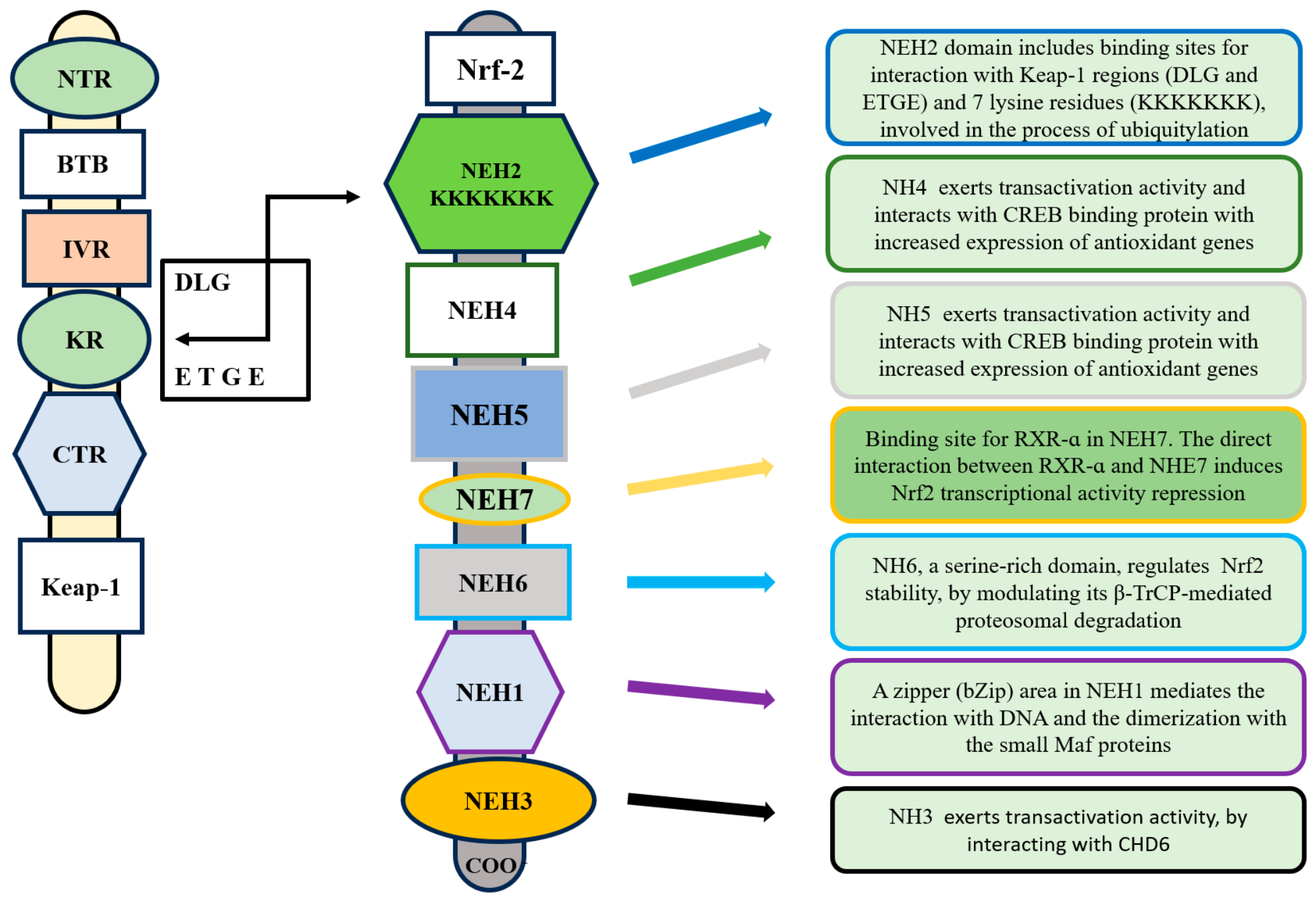
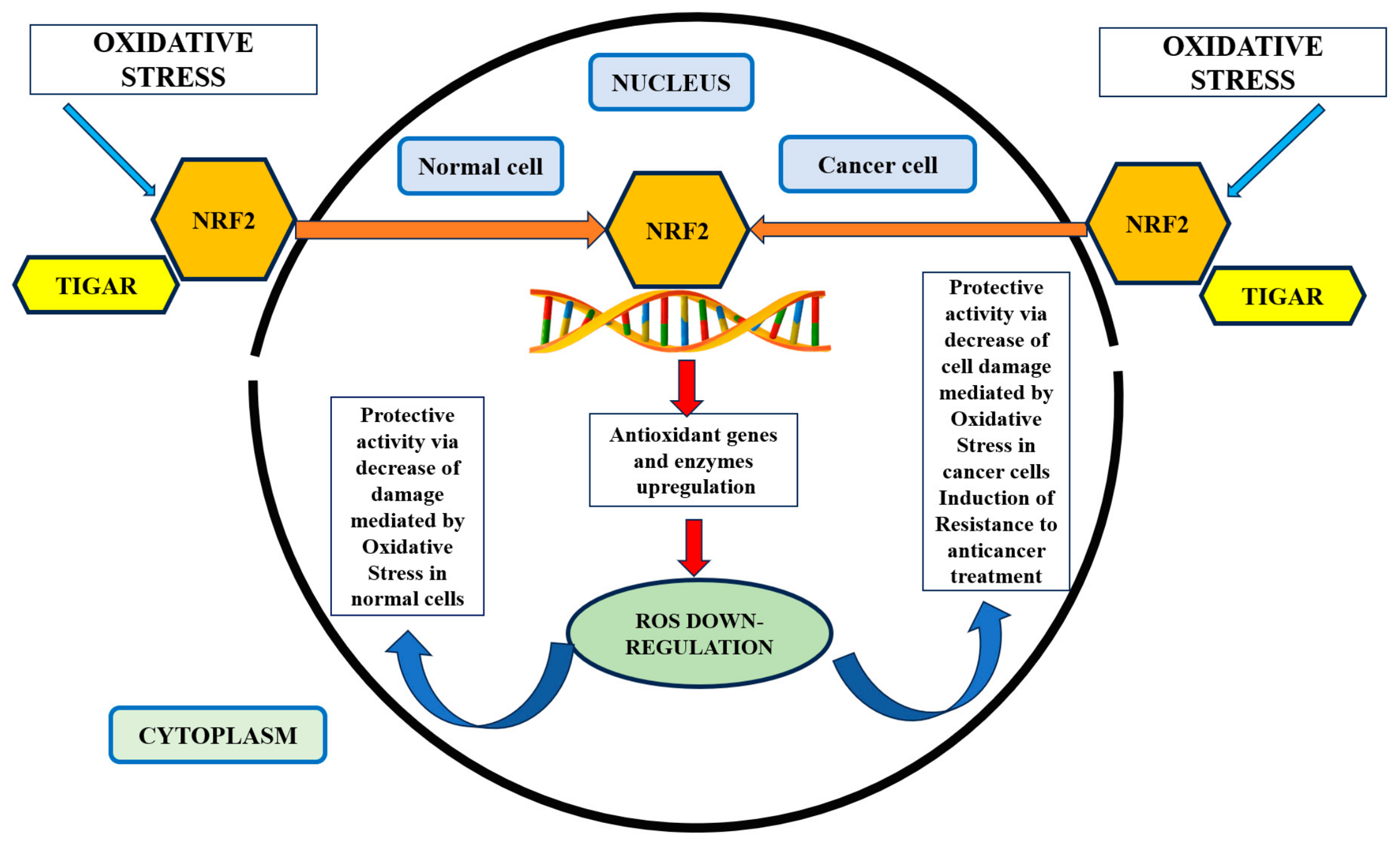
Nuclear factor erythroid 2-related factor 2 (NRF2) is a transcription factor modulating the expression of approximately 200 genes with antioxidant and cytoprotective functions [28,138,139,140,141,142] (Figure 2 and Figure 3). The majority of these genes encode enzymes involved in glutathione production, thioredoxin metabolism, and detoxification [138,139,140,141]. Under normal conditions, NRF2 associates with KEAP1 in the cytoplasm and undergoes proteasomal degradation [139,140,143,144]. Under oxidative stress, NRF2 dissociates from KEAP1, translocates to the nucleus, binds to the transcription-dependent antioxidant response element (ARE), and upregulates the synthesis of enzymes involved in the antioxidant response [139,140,143,144]. In patients with PDAC, NRF2 pathway activity is generally increased in comparison with normal pancreatic cells [143,145,146]. This event may be driven by various mechanisms, such as mutations in NRF2, which promote tumor survival by enhancing cellular antioxidant capacity [146,147]. This occurrence enables malignant cells to counteract the persistent oxidative stress, detectable in the cancer microenvironment [146,147]. In particular, NRF2 activity is a key and required event in KRAS-induced tumors to preserve redox homeostasis and promote tumor growth; genetic ablation of NRF2 prevents the development of PDAC in experimental mouse models [148,149].
Mutated-p53 (mp53) stimulates NRF2 activity through the disruption of its negative modulatory function or through NRF2 target gene expression [148,150]. The induction of the KRAS–p53–NRF2 pathway supports pancreatic malignant cells with strong adaptive mechanisms [28,151,152]. The activation of this axis counteracts ROS production and promotes cell survival and proliferation under metabolic and hypoxic stress [153,154].

4.3. TIGAR: Modulator of Glycolysis and ROS

TP53-induced glycolysis and apoptosis regulator (TIGAR) represents a further key master metabolic regulator downstream of p53 [26,27,155]. TIGAR exhibits a fructose-2,6-bisphosphatase activity and exerts a wide series of functions [156,157,158]. This enzyme decreases fructose-2,6-bisphosphate levels, suppresses glycolysis, and shifts glucose-6-phosphate into the pentose phosphate pathway (PPP) [155,159]. This diversion of intracellular metabolism enhances NADPH generation, strengthens antioxidant defenses, and lowers ROS within cells [41,159,160]. In normal cells, wild-type p53-induced TIGAR expression plays a key role in protecting against oxidative stress and preserving metabolic balance [26,27,161]. Furthermore, the dynamic modulation of ROS production by TIGAR is a crucial event in pancreatic carcinogenesis, both at initiation and during progression, and multiple mechanisms contribute to this complex scenario [26,27,41,161,162]. In particular, oncogenic KRAS protein and mutated p53 increase TIGAR levels and upregulate its activity. TIGAR forms a tightly regulated axis with Kras protein and mutated-p53, modulating ROS generation [15,18,21,41,161,162]. According to experimental mouse and human models, levels of TIGAR expression fluctuate as PDAC arises and develops, depending on different phases of carcinogenesis [26,27]. As a consequence, the amounts of ROS in the pancreatic microenvironment also oscillate with different effects on the initiation and progression of pancreatic cancer [155,161]. In particular, TIGAR increases levels that support cancer cell survival and proliferation, as well as the development of premalignant lesions in the early stages of pancreatic carcinogenesis [155,162]. On the other hand, the levels of this enzyme decrease in advanced stages of PDAC development [163,164]. Increased TIGAR levels have been described in the PDAC microenvironment and are associated with elevated PPP flux, ROS scavenging, and resistance to apoptosis [26,27,41]. Furthermore, TIGAR functions in concert with NRF2, and both downstream cascades converge on the generation of NADPH and glutathione [26,27,163,165]. As a consequence, an epigenetic and metabolic autoregulatory loop between NRF2 and TIGAR emerges, generating an antioxidant network that enables malignant cells to preserve their redox balance even under severe oxidative conditions and is involved in PDAC resistance to chemotherapeutic treatments [166,167].

4.4. ROS Buffering and Resistance to Therapy

The increase in antioxidant capacity mediated by NRF2, TIGAR, and metabolic remodeling has profound implications for the development of effective therapeutic strategies against pancreatic malignancy [167,168,169,170,171] (Figure 4). Current conventional pharmacological treatments (e.g., gemcitabine) and radiotherapy exert their antineoplastic activity, in part, by inducing oxidative damage [172]. This process generally causes cancer cells to die. PDAC exhibits the ability to buffer ROS generation, thereby promoting innate resistance to these treatments [173]. Furthermore, NRF2 activation can induce drug-metabolizing enzymes and efflux pumps, thereby decreasing the intracellular concentration and efficacy of anticancer drugs [174,175]. Redox homeostasis targeting has been proposed as a therapeutic approach for the treatment of PDAC. The most studied strategies include inhibition of glutathione synthesis, suppression of NRF2 signaling, or increasing ROS generation beyond the buffering capacity of cells [176,177]. These approaches require an adequate, well-defined target to prevent injury to normal tissues. Therefore, a proper understanding of the ROS–NRF2–TIGAR network is essential for designing studies that evaluate the efficacy of combination therapies for the treatment of pancreatic cancer [143,178].

5. PUMA- and PRMT5-Mediated Regulation of Mitochondrial Function in PDAC

In pancreatic ductal adenocarcinoma (PDAC), a very fine balance exists between malignant cell survival and apoptosis [91,94,95,96,176], which is modulated by several factors, such as oncogenic signaling, redox adaptation, regulators of mitochondrial integrity, and epigenetic control [16,97,98,99,100,101,102,179]. Two crucial elements are involved in this complex network: PUMA (p53 upregulated modulator of apoptosis) [27,91,178] and PRMT5 (protein arginine methyltransferase 5) [30,180]. Both these players interact with the KRAS–p53–ROS pathway and modulate cell fate, mitochondrial metabolism, and PDAC resistance to chemotherapeutic drugs [181,182].

5.1. PUMA: p53-Mediated Mitochondrial Apoptosis

PUMA is a component of the BCL-2 family and exerts a highly efficient pro-apoptotic activity [90,183]. In the presence of intracellular stress conditions, wild-type p53 at the transcriptional level induces the upregulation of PUMA [184]. This mediator binds anti-apoptotic factors, such as BCL-2 and BCL-XL [185,186], and counteracts their inhibitory function, inducing the release of some pro-apoptotic proteins such as BAX and BAK [185,187]. Overall, these events induce mitochondrial outer membrane permeabilization, cytochrome c leakage, and caspase activation [185,186,187].
In normal pancreatic cells, PUMA acts as a crucial defense against oncogenic stimuli [188]. Excessive ROS generation, metabolic derangement, or DNA injury caused by abnormal KRAS signaling can stimulate the p53-mediated expression of PUMA, triggering the apoptosis of damaged cells [189]. Nevertheless, in PDAC, this safeguard activity is frequently overcome. The following mechanisms are involved in this process: TP53 mutation, epigenetic silencing of PUMA, or abnormal high expression of anti-apoptotic proteins [190]. As a result, cells harboring mutated KRAS and elevated ROS amounts do not undergo apoptosis but survive and promote cancer progression [184]. PUMA may also be activated via a ROS-dependent signaling cascade, independently of the p53-mediated induction [191]. Furthermore, PUMA may be stimulated by the upregulation of JNK and other transcription factors [192,193]. This event links intracellular redox stress to mitochondrial apoptosis [194,195].
In PDAC, this pathway is often downregulated by the constitutively increased NRF2 activity, with its antioxidant function [194]. This event prevents ROS-induced death of malignant cells [196].

5.2. PRMT5: Epigenetic and Metabolic Regulator

PRMT5 is an arginine methyltransferase [179]. It exerts its activity via the dimethylation of arginine residues in histones and non-histone proteins and plays a crucial role in several cellular processes, such as transcriptional regulation, splicing, DNA repair, and metabolism [197]. PRMT5 is frequently upregulated in PDAC, and its overexpression is associated with a poor outcome in patients suffering from this malignancy and with resistance to current chemotherapeutic regimens [198,199]. PRMT5 affects PDAC biological behaviour via multiple mechanisms [200], such as: (1) repression of genes mediating tumor suppression via histone methylation and induction of apoptotic and cell cycle regulatory cascades silencing [33]; (2) modulation of the oxidative stress status in malignant cells via methylation of crucial transcriptional regulatory factors, this event causes the expression of several antioxidant genes and promotes cancer cells survival under conditions of redox stress [201]; (3) regulation of mitochondrial metabolism, by influencing the activity of genes involved in oxidative phosphorylation and ROS detoxification [202].
Recent reports suggest that in KRAS-mutated PDAC cells, PRMT5 plays a crucial role in maintaining redox homeostasis and mitochondrial activity [203]. Therefore, PRMT5 is a particularly promising potential target for the treatment of this malignancy [204,205]. PRMT5 inhibition enhances mitochondrial ROS generation, promotes PUMA expression, and sensitizes PDAC cells to apoptotic stimuli [206,207,208].

5.3. Mitochondrial Activity and Metabolic Flexibility

Although aerobic glycolysis (known as the Warburg effect) represents one of the most important metabolic processes through which PDAC cells synthesize ATP for their energy needs and substrates for their proliferation [209,210], additional intracellular signaling and micro-organelles play a crucial role in supporting the biosynthesis of these compounds, in maintaining redox balance, and in ensuring the survival of neoplastic cells [211,212,213]. PUMA serves as a crucial checkpoint in this network. When redox stress exceeds the buffering capacity, or when mitochondrial activity is altered, PUMA-driven apoptosis is triggered [189,190]. However, in the presence of mutated p53 [13,182], overstimulated NRF2 [25,135,155], and overactivated PRMT5 [166,169,170], this control checkpoint is overwhelmed, leading to persistent mitochondrial stress [29,82,192,214]. This event prevents the elimination of malignant cells via apoptosis [215].

5.4. Therapeutic Implications

The interplay among PUMA, PRMT5, and mitochondrial activity is a vulnerability element for PDAC and can be exploited for therapeutic purposes [216,217]. Current studies are exploring strategies to treat this malignancy effectively. Therapeutic approaches that restore PUMA activity, suppress PRMT5 function, or impair redox adaptation in mitochondria are under active consideration in experimental and clinical studies to overcome resistance of PDAC cells to anticancer agents [29,90,218,219]. For example, treatment schedules that combine PRMT5 inhibitors with ROS-inducing drugs have been shown to be effective in KRAS-mutant malignancies [218,220,221]. Furthermore, restoration of normal p53 function or pharmacologic activation of PUMA can sensitize PDAC cells to chemotherapy and oxidative stress [222,223].

6. Oxygen Tension in Pancreatic Cells and Malignant Stroma

The presence of a dense stromal reaction (desmoplasia) is one of the most important structural characteristics, detectable in the PDAC microenvironment [20,115,116,224]. The change in the composition of malignant pancreatic tissue is associated with the alteration of its oxygenation and nutrient intake [85,118,225]. In particular, a heterogeneous distribution and strongly reduced oxygen tension are among the most evident characteristics of the microenvironment of pancreatic cancer [82,226]. This event has a significant impact on metabolic adaptation, ROS generation, response to treatment, as well as cellular interplay between malignant cells and stroma [85,110,111,112,120,227,228].

6.1. Baseline Oxygen Tension in Normal Pancreatic Tissue

In a healthy pancreas, a relatively elevated oxygen tension is detectable in the exocrine acinar regions, whereas a lower one is observed in the ductal epithelium [85,110,111,112,120]. This pattern is consistent with physiological variations in vascularization and metabolic activity across the different tissue compartments of the organ [229,230]. Pancreatic epithelial cells meet their energy needs via oxidative phosphorylation under normoxic conditions and preserve their redox homeostasis [85,86,87,88,89] via a tightly regulated balance between production of mitochondrial ROS and activation of antioxidant systems [230,231]. Stromal oxygen afflux is finely modulated by a rich capillary network, thereby providing sufficient oxygen to support both endocrine and exocrine activities [35,232,233].

6.2. Hypoxia and Oxygen Gradients in PDAC

The process of pancreatic carcinogenesis is characterized by the extensive deposition of a desmoplastic stroma, consisting of fibroblasts, extracellular matrix (ECM), immune cells, and a poor vascularization pattern [78,80,116,234,235]. The composition and spatial disposition of this network in PDAC is associated with a remarkable decrease in oxygen levels [25], with the detection in both preclinical studies and patient samples of oxygen tension within the cancer equal to 1–2% (7–15 mmHg), in comparison with 5–7% in normal pancreatic tissue [34,236,237]. It is well known that pancreatic stromal cells enhance collagen synthesis in response to hypoxic conditions. This event promotes the formation of fibrotic tissue and hampers immune cell recruitment, thereby inducing resistance to chemotherapy and radiotherapy [224,230,231].
Furthermore, oxygen levels are heterogeneously distributed in the different regions of malignant pancreatic lesions [118,136,238,239]. Perivascular compartments are characterized by the maintenance of moderate oxygenation [159,165,166,239,240]. On the other hand, severe hypoxemia is observed in the innermost regions of PDAC, particularly in the stroma, where Cancer-Associated Fibroblasts (CAFs) are often detected in low-oxygen tension areas, and this condition affects their metabolism, extracellular matrix deposition, and paracrine pathways [35,241,242].

6.3. Effects of Hypoxia on PDAC Metabolism and ROS Generation

Hypoxia strongly modulates PDAC metabolism via stabilization of hypoxia-inducible factors (HIFs) [243,244]. This event induces transcriptional reprogramming in tumor cells and promotes the processes of glycolysis, proliferation, survival, and angiogenesis under hypoxic conditions [245,246]. In pancreatic cancer cells, stabilization of HIF-1α further increases glycolytic flux and non-canonical glutamine metabolism, already increased by KRAS mutation [247,248]. This metabolic rewiring enables malignant cells to survive despite a persistent oxygen-poor supply [20,78,92,249]. Furthermore, hypoxia can be associated with increased ROS generation within mitochondria due to decreased efficiency of the electron transport chain, intermittent phases of tissue reperfusion, and the promotion of oxidative bursts [250,251]. ROS act as signaling regulators that activate NRF2 and other antioxidant cascades, reinforcing and promoting cancer adaptation [252,253]. Induction of these pathways leads to the generation of antioxidant enzymes and molecules that buffer redox stress in the tumor epithelium [254,255,256,257]. Cancer-associated fibroblasts (CAFs) [20] adapt to decreased oxygen tension through the upregulation of glycolysis and the secretion of several substrates, such as lactate, pyruvate, and alanine [258,259,260,261,262].

6.4. Oxygen Levels in the Stroma: Interactions Among Fibroblasts and Immune Cells

As in other types of human malignancies, a dynamic interaction also exists in PDAC among stroma and epithelial tumor cells via an oxygen-dependent metabolic crosstalk [253,254,255,256,257]. Cancer-associated fibroblasts (CAFs) [20] adapt to decreased oxygen tension through the upregulation of glycolysis and the secretion of several substrates, such as lactate, pyruvate, and alanine [259,260]. The metabolic pathways of these compounds are highly interconnected [258]. These molecules serve as alternative fuel sources for tumor cells, providing metabolites to meet their energy needs and to support the biosynthesis of substrates essential for their survival and proliferation [19,31,261,262]. This type of metabolic pattern remodeling enables cancer cells to preserve mitochondrial metabolism and redox balance even in hypoxic regions of malignant tissue [7,253,254,263,264].
Furthermore, immune cells, such as Tumor-Associated Macrophages (TAMs) and T cells in the hypoxic stroma [17,265], detectable in PDAC, undergo metabolic and functional rewiring in response to low oxygen levels [19,31,180,266]. Hypoxia tends to induce an immunosuppressive microenvironment in cancer tissue [1,6,7] via several mechanisms, such as HIF stabilization, upregulation of adenosine pathways, and impairment of cytotoxic T-cell activity [267,268,269]. Together, all these factors contribute to tumor immune evasion and resistance to anticancer treatments [1,269,270].

6.5. Implications for Therapy

The condition of hypoxia and oxygen-heterogeneous distribution in pancreatic cancer tissue is associated with significant challenges for its treatment [7,268,269,270]. The rationale for the use of radiotherapy in the treatment of human malignancies is based on the assumption that oxygen generates DNA-damaging free radicals, leading cancer cells to death [7,268,269,270,271,272]. However, hypoxic PDAC tissue is generally radioresistant [103,273,274]. Furthermore, a poor vascularization network and high-density ECM hamper the influx of chemotherapeutic drugs to malignant pancreatic lesions, decreasing drug penetration into these sites [274,275,276]. Several therapeutic strategies focused on modifying oxygen tissue levels or on modulating metabolism in hypoxic pancreatic cancer tissue have been assessed [277,278]. These approaches include the potential usefulness of hypoxia-activated prodrugs [279], HIF inhibitors [280], stromal remodeling pharmacological agents [281,282], and metabolic treatments to discontinue stromal–epithelial crosstalk [283]. Retinoic acid, discussed in Section 6, has shown promising activities in normalization of stromal function [284] and in modulation of oxygen-dependent signaling, potentially increasing the probability of response to anticancer treatment [285,286].

7. Retinoic Acid: Modulation of Microenvironment Composition, Redox Status in Pancreatic Cancer

Retinoic acid (RA), a derivative of vitamin A, has been shown to act as a pleiotropic modulator of several crucial cell functions, such as differentiation, redox homeostasis, and stromal signaling in PDAC [287,288,289]. Although RA use in clinical practice for solid tumors has historically been limited [219,290], several studies are clarifying its possible role in the modulation of biological processes within the tumor microenvironment (TME) and in regulating its metabolic adaptation. These reports are promoting a renewed interest in RA as a potentially effective adjuvant drug for the treatment of PDAC [291,292,293].

7.1. Retinoic Acid Signaling in Normal Pancreas and in Pancreatic Cancer

In the normal pancreas, RA signaling modulates epithelial cell differentiation, acinar-to-ductal cell ratio, and stromal homeostasis via the induction of nuclear retinoic acid receptors (RARs) and retinoid X receptors (RXRs) [294,295]. RAR/RXR heterodimers interact with retinoic acid response elements (RAREs) in gene promoters, controlling the transcription of genes involved in cell differentiation, cell cycle arrest, and redox homeostasis [294,296,297].
In pancreatic cancer, a profound alteration of retinoid signaling is often detectable. Reduced expression of cellular retinoic acid-binding proteins (CRABPs) and of RA in the cancer tissue is associated with loss of epithelial cell differentiation and induction of stromal fibroblast activity [292,297]. Moreover, KRAS-driven metabolic rewiring can dysregulate retinoid-metabolizing enzymes such as ALDH1A and CYP26, leading to RA depletion and cell signaling impairment [294,295]. All these events induce a permissive tissue microenvironment for cancer progression and stromal remodeling.

7.2. Modulation of Redox Cell Biology by Retinoic Acid

RA exhibits a crucial role in modulating oxidative stress via both direct and indirect mechanisms [288,289]. This fat-soluble vitamin stimulates transcription of antioxidant enzymes such as superoxide dismutase (SOD) [298], catalase [299], and glutathione peroxidase [300,301] via RAR-mediated expression [294,296]. It can also downregulate NADPH oxidase function, thereby reducing ROS generation from non-mitochondrial origins [302,303,304]. Furthermore, RA interacts with NRF2 signaling [305]: it can enhance NRF2 transcription under physiological conditions, but paradoxically, it normalizes aberrant NRF2 activation in malignant cells, restoring redox balance without fostering their survival [306,307]. In PDAC, KRAS and mutated TP53 stimulate persistent ROS generation and induce cell stress [9,22,23,24]. RA can attenuate oncogenic ROS signaling and, in turn, sensitize cells to oxidative injury and apoptosis [294,295,296,308]. This fat-soluble vitamin regulates mitochondrial biogenesis and antioxidant capacity [309]. Therefore, it influences the mitochondrial setpoint of cellular redox balance [310,311] and shifts cancer cells away from a state of elevated tolerance to ROS that promotes the development of aggressive phenotypes [23,311,312]. Overall, these events have a profound impact on malignant cell survival and on the response to ROS-dependent treatments, such as radiotherapy and certain chemotherapeutic drugs [313,314].

7.3. Effects on Stromal Remodeling and CAF Biology

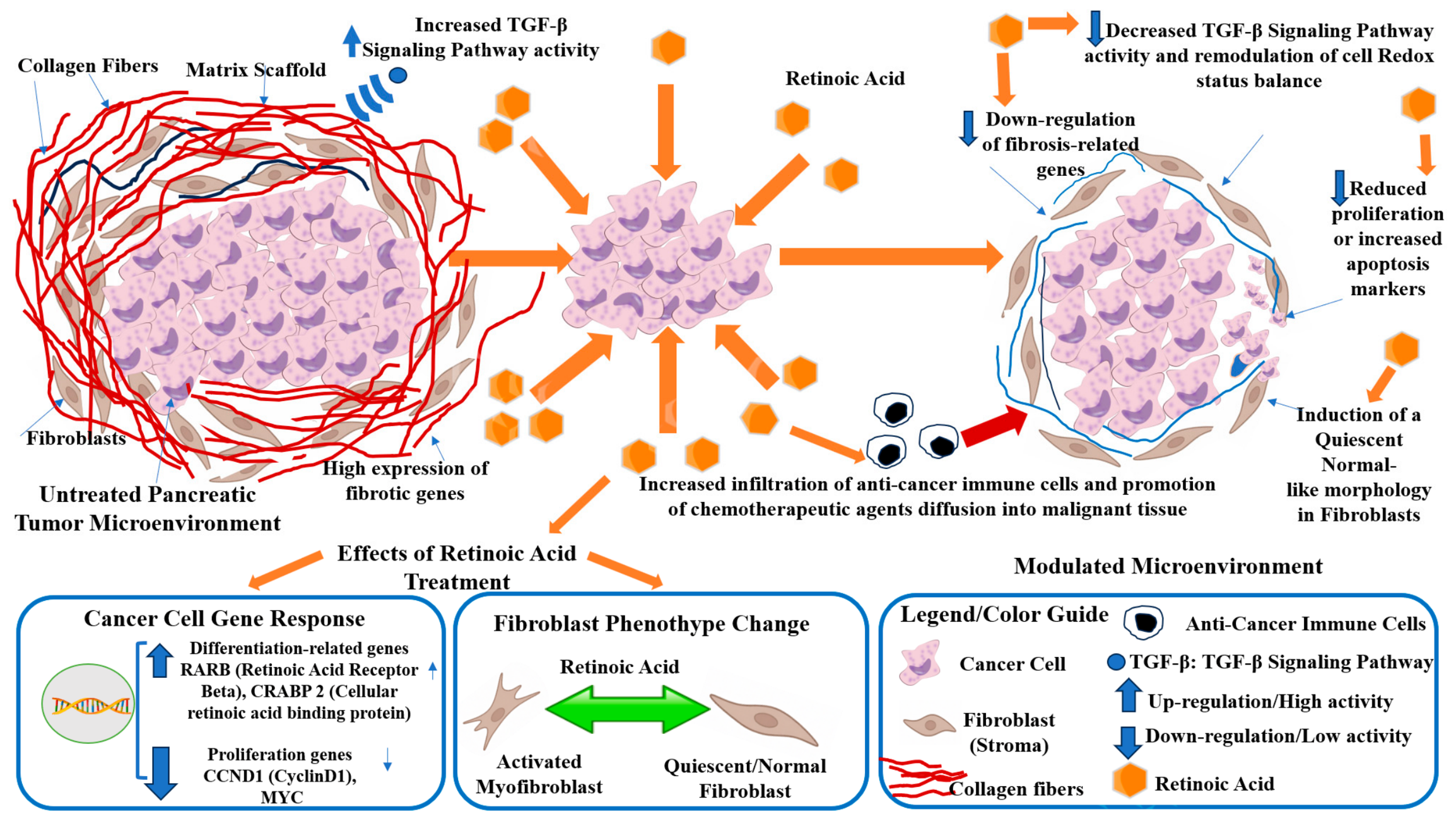
One of the most intriguing roles of RA in PDAC hinges on its ability to rewire tumor-associated fibroblasts (CAFs) [315,316]. These cells are crucial contributors to desmoplasia, hypoxia, and treatment resistance to [7,35,281,282,283]. RA may promote a quiescent status in pancreatic stellate cells and activated CAFs [317]. The features of this phenotype include a reduced production of α-smooth muscle actin (α-SMA) and ECM, as well as the normalization of oxygen diffusion in pancreatic cancer tissue [318]. This “stromal reprogramming” is associated with the restoration of tissue perfusion, the reduction in hypoxia, and the modification of metabolic interplay between cancer cells and the stroma [291,319].
Overall, RA acts via the RARβ pathway in CAFs, decreasing pro-fibrotic signaling, such as TGF-β and Hedgehog cascades [236,285,320]. It also downregulates CAF-mediated release of cytokines, including IL-6 and CXCL12 [320,321]. These processes attenuate two crucial events in carcinogenesis: the pro-tumorigenic inflammation and the immune exclusion [322,323]. Therefore, RA does not merely function as a cytotoxic drug, but it reprograms the malignant microenvironment, making it more permissive to the diffusion and infiltration of anticancer agents and to the infiltration of immune cells into neoplastic tissue [22,265,324,325] (Figure 5).
In particular, Retinoic Acid orchestrates proper immune function across both its innate and adaptive arms. In particular, dendritic cells and macrophages are the major sources of retinoic acid for the various subsets of B and T cells. During the early steps of the immune response, these phagocytes interact with naive T cells in the presence of a wide range of biochemical and physical stimuli in the microenvironment, such as cytokines, ROS, costimulatory molecules, retinoic acid, as well as tissue stiffness, viscosity, and shear stress. This complex interplay orchestrates differentiation of T lymphocytes into distinct subclasses, each with different specificities of action. According to the current evidence the effects mediated by this micronutrient are dose-dependent, in permissive contexts, low levels of retinoic acid stimulate T cells to differentiate towards a Th17 phenotype, whereas higher amounts of this compound induce the generation of Th2 and T regulatory cells, therefore preventing strong and potentially dangerous immune responses for the host, Therefore, retinoic acid may contribute to overcome the Cancer Associated Fibroblasts-mediated exhaustion of specific T subsets, rebalancing immune cells function and promoting restoration of immune system homeostasis. These processes have been described in patients suffering from both infectious diseases and malignancies. Strategies combining RA with antineoplastic drugs may make tumor cells more sensitive to treatment and improve progression-free survival in patients [326,327,328,329,330].

7.4. Therapeutic Potential in Preclinical PDAC Models

In preclinical PDAC studies, RA use has been shown to be associated with promising results in a wide series of contexts [37,38,331]. RA administration in human and animal cell cultures has been shown to modulate the expression of over 300 miRNAs, thereby reducing tumor cell invasion and inhibiting tumor growth [332,333]. In murine models, stromal remodeling may improve intratumoral oxygenation by promoting the entry of chemotherapeutic drugs such as gemcitabine into tumor tissue [334,335]. Furthermore, RA can synergize with therapies that stimulate ROS generation [335,336]. These treatments exploit the cancer vulnerability originating from the shift in redox balance [137,337].
Moreover, RA modulates the metabolic interplay existing between cancer and stroma, reversing the Warburg effect and decreasing lactate transport from CAFs to malignant cells [246,320]. These events modulate mitochondrial metabolism [31,311] and can alter the redox-adapted state of KRAS-mutated malignant cells [8,103,327]. In combination with PRMT5 inhibitors or p53-reactivating drugs, RA may further enhance PUMA-mediated apoptosis, underscoring the cross-talk between metabolic and apoptotic networks [338,339,340].

7.5. Clinical Trials of Retinoic Acid and Retinoids in PDAC

Despite very interesting reports on the possible anticancer activity of RA, clinical trials assessing its anticancer activity in PDAC remain limited, but some studies suggest a potentially interesting application in the management of this malignancy [341]. However, to date, the results of both in vitro and in vivo studies remain preliminary, and further research is needed to either confirm them or refute them. Early phase studies investigated all-trans retinoic acid (ATRA) as a therapy to induce cell differentiation in advanced PDAC, with modest activity and good tolerability [292,342]. Recent studies have focused on combination strategies. For example, ATRA administration in combination with gemcitabine and nab-paclitaxel has been assessed in phase I/II settings [156,334,335,338] and has shown improved stromal restoration and increased drug penetration compared with chemotherapy alone [343,344]. Biomarker analyses from trials suggest that ATRA may increase RARβ expression and promote stromal quiescence in patients who respond to this treatment [317,318]. Furthermore, synthetic agents and RAR agonists with improved pharmacokinetic properties and increased selectivity, as well as nanoparticle delivery systems, are being investigated in clinical trials to overcome the limitations in the anticancer efficacy of currently available drugs [345,346,347].
Although the clinical efficacy of RA remains under investigation, these strategies underscore the translational potential of RA-based stromal targeting in PDAC [39,341].

7.6. Cross-Talk Among KRAS, p53, PUMA, PRMT5, Retinoic Acid and Mitochondrial Activity

Vitamin A affects mitochondrial activity and reactivates a stromal quiescent phenotype in malignant tissue [315,317,348,349], via modulation of NRF2 [28,143,145]. In particular, this fat-soluble vitamin indirectly sensitizes KRAS-mutant cells to oxidative stress and p53-mediated cancer cell deaths [349,350]. RA-mediated modulation of redox balance can promote PUMA activation, thereby inducing mitochondrial outer membrane permeabilization and apoptosis in resistant malignant cells [351,352]. Furthermore, RA has been shown to downregulate PRMT5 expression in certain contexts by reducing histone protein methylation, which mediates the activation of metabolic genes [338,339,340]. Through this multifaceted crosstalk, RA disrupts the integrated metabolic–apoptotic–stromal network that supports the aggressiveness of pancreatic ductal carcinoma, making it plausible that this fat-soluble vitamin acts as a therapeutic modulator rather than a direct cytotoxic agent [103,327,338,339,340].

8. Discussion

PDAC remains one of the most severe and therapy-resistant cancers, driven by a complex cross-talk among a wide series of factors, including oncogenic mutations, metabolic rewiring, redox adaptation, and malignant microenvironment remodeling therapies [176,190,291,320]. The interplay developing among KRAS and TP53 mutations, mitochondria, hypoxia, ROS, and stroma orchestrates tumor onset, progression, spreading, and response to therapies [349,353]. A proper understanding of these interconnected networks is critical to uncovering points of cancer susceptibility and designing adequate and effective treatments against PDAC [349,353].
KRAS mutations are common in PDAC and induce constitutive activation of the MAPK and PI3K pathways, promoting cell proliferation and metabolic restoration [69,70,71,157]. Furthermore, TP53 mutations, detectable in 50–75% of patients with pancreatic cancer, alter a crucial apoptotic checkpoint and promote adaptation of malignant cells to metabolic and oxidative stress [1,6,7,15,16,17,18,19]. Overall, these changes cause a shift toward aerobic glycolysis, known as the Warburg effect, and also maintain mitochondrial function, promoting the anabolic function and redox regulation of malignant cells [20,21,22,23,24,25]. KRAS-mediated metabolic cell remodulation increases glucose uptake, the glycolytic rate, and the diversion of glutamine metabolism via anaplerosis, thereby generating ATP and precursor molecules [18,19,21,40,68,353]. Furthermore, mitochondrial function is preserved to meet anabolic needs and produce ROS, which act as second messengers to promote tumor development [82,84,85,86,117,301,354]. Mutant p53 further enhances mitochondrial fitness and antioxidant activity, enabling cells to survive in oxidative and nutrient-deprived environments [351,353,354]. Overall, these events promote a pro-oxidant, highly buffered state that suppresses apoptosis and promotes the progression of malignancy [26,27,355].
The microenvironment in PDAC consists of a poorly perfused, fibrous stroma with extreme heterogeneity in oxygen distribution within the malignant tissue [281,356]. Hypoxic regions stabilize the HIF transcription factor, increasing glycolysis and promoting an aggressive biological behavior [85,115,116,118,280]. Cancer-associated fibroblasts metabolically support malignant cells via the production and release of lactate and alanine. These substrates act as energy suppliers for tumor cells [73,257,258,260]. Hypoxia also suppresses immune system activity via adenosine signaling and alters T cell function [7,73,98,334,354,355,356]. These events further promote PDAC resistance to the host’s anticancer mechanisms and to specific anti-neoplastic treatment [70,79,130]. Oxygen gradients between the malignant epithelium and the stroma strongly influence redox metabolism [79,82,85,118,356]. PDAC cells located in moderately oxygenated regions can still support mitochondrial activity and ROS signaling. On the other hand, the metabolism of tumor cells residing in severely hypoxic regions strongly depends on glycolysis and stromal support [6,349,357].
A crucial link between metabolism and apoptosis is modulated by PUMA, a BH3-only proapoptotic protein. Its activity is regulated by p53 and oxidative stress [29,31,32,35,36]. Under normal conditions, PUMA functions as a redox checkpoint, triggering the early steps of mitochondrial apoptosis in cells undergoing to excessive oxidative stress [32,33,34,35]. However, in PDAC, this checkpoint is frequently suppressed by TP53 mutations, PUMA silencing, and excessive activation of the antioxidant network [29,31,32]. PRMT5, an epigenetic modulator, further increases cancer resistance by suppressing proapoptotic genes and activating antioxidant cascades [30,70,179,197,198,199,200,308]. This enzyme promotes the survival of KRAS-mutated cells by regulating mitochondrial metabolism and redox buffering capacity [352,358]. The combination of two events, including suppression stress of PUMA [304] and activation stress of PRMT5 [204,218], allows malignant pancreatic cancer cells to survive in hostile, potentially lethal tissues and to develop treatment-resistant cellular phenotypes [85,112,120,199].
Taking into account all the considerations reported in this article, multiple possible antitumor therapeutic options and strategies can be developed. An appropriate strategy is to target mitochondrial metabolism or antioxidant defense systems to selectively kill redox-dependent KRAS-mutated malignant pancreatic cells [353,354,355,359]. Drugs with PRMT5 inhibitory activity can disrupt epigenetic and metabolic support networks [179,197,198,199,200], promoting ROS generation and restoring apoptotic cascades [33,201,202,203,216]. p53 recovery strategies (e.g., APR-246) can restore PUMA-induced and mitochondrial-mediated apoptosis [360]. Retinoic acid (RA) plays a unique role as a non-cytotoxic regulator of redox and matrix biology [289,290]. RA may increase the sensitivity of malignant cells to chemotherapy and radiotherapy by promoting a quiescent phenotype in cancer-associated fibroblasts (CAFs) [291,317,318], normalizing oxygen delivery, and reprogramming antioxidant signaling cascades [287,290,291,294,297,302,303,304]. A therapeutic strategy combining RA, ROS-generating drugs, PRMT5 inhibitors, or metabolic treatments can induce synergistic effects by simultaneously altering cancer cell metabolism and restoring sensitivity to apoptotic mechanisms [290,291]. Furthermore, strategies aimed at modulating oxygen tension delivery in neoplastic pancreatic tissue [361], including stromal depletion [193,332], vascular normalization, or the use of hypoxia-activated compounds, may overcome intrinsic resistance to anti-cancer treatment by modifying the characteristics of the redox environment [287,290,291,294,297].
Despite these promising findings, several challenges persist. Three points have been underlined: (1) the metabolic plasticity of PDAC ensures a rapid adaptation to antineoplastic therapeutic action, requiring multidisciplinary strategies [70,308]; (2) heterogeneity in pancreatic cancer tissue oxygenation and stromal composition across patients and tumors prevents the use of common anticancer strategies [199,359]; (3) drug entry in malignant lesions remains limited by desmoplasia, although stromal reprogramming with RA and similar drugs may provide useful effects [36,37,308,346,347].
However, despite the aforementioned therapeutic benefits, some studies have reported that Vitamin A and retinoic acid may exhibit non-univocal effects, including acute metabolic dysregulation and a delayed cancer-promoting effect [362]. Some cohort studies and meta-analyses have suggested that both excessive and insufficient vitamin A intake may increase cancer risk in various malignancies. Therefore, further in vitro and in vivo studies are needed to improve our understanding of the potential role of this micronutrient, in combination with chemotherapy, for the treatment of human malignancies in general and for the management of pancreatic cancer in particular.

9. Conclusions

PDAC provides an example of the convergence of oncogenic signaling, metabolic adaptation, cellular redox status modulation, and stromal remodeling in driving malignancy initiation and spread, as well as the development of therapeutic resistance in neoplasms. Central elements in this network are represented by mutated KRAS and p53, which, in concert, reprogram glucose and glutamine metabolism, support mitochondrial activity under stress, and reshape the cellular redox balance. This metabolic rewiring promotes aggressive cancer behavior in the presence of a hypoxic microenvironment, nutrient reduction, and dense desmoplasia, characteristics that would normally induce apoptosis in non-neoplastic cells.
Some regulatory molecules, such as PUMA and PRMT5, function as molecular switchers linking redox stress and apoptosis. Meanwhile, oxygen gradients within the malignant tissue and CAF-mediated metabolic supply generate spatial recesses with distinct vulnerabilities, emphasizing the need for therapies that target intra-neoplastic heterogeneity.
Future trials should focus on the use of integrated treatment approaches with the aim of defining metabolic, redox, epigenetic, and stromal pathways. The possible therapeutic options should consider combinations of the following measures: PRMT5 inhibition + RA, p53 reactivation + ROS-inducing chemotherapy, and stromal normalization + immunotherapy. Well-designed precision trials, including patients with PDACs with properly profiled metabolic, genetic, and stromal characteristics, may enable stratification of patients who will likely benefit from these interventions and identify a useful and effective dosage of vitamin A for this type of malignancy. Clinical trials should be designed to include assessment of redox status, oxygenation, and stromal activity to predict response to therapy and patient outcomes.

Author Contributions

Conceptualization, S.F. and M.Z.; data curation, W.H., D.d.B., C.B. and A.G.; writing—original draft preparation, S.F., M.Z., D.d.B. and W.H.; bibliography search, A.G., F.A., F.M., F.L. and L.P.; writing—review and editing, L.M., E.J., C.B., A.G., F.A., F.M., F.L. and L.P.; supervision, S.F. and M.Z. All authors have read and agreed to the published version of the manuscript.

Funding

This research received no external funding.

Institutional Review Board Statement

Not applicable.

Informed Consent Statement

Not applicable.

Data Availability Statement

No new data were created or analyzed in this study.

Acknowledgments

The authors thank Simonetta Righi, Biblioteca Centralizzata, Policlinico S. Orsola-Malpighi, Università di Bologna, Bologna, Italy, for her support in the search for scientific bibliography.

Conflicts of Interest

The authors declare no conflicts of interest.

Abbreviations

The following abbreviations are used in this manuscript:
AKTProtein kinase B
ATPAdenosine Triphosphate
BAKBcl-2 homologous antagonist/killer
BAXBcl-2-associated X protein
BCL-2B-cell lymphoma 2
CAFCancer-associated Fibroblast
CDKN2ACyclin-dependent kinase inhibitor 2A,
ERKExtracellular signal-regulated kinase
GCLCGlutamate–cysteine ligase catalytic subunit
GDPGuanosine Diphosphate
GTPGuanosine Triphosphate
HIF-1αHypoxia-inducible factor 1-alpha
HO-1Heme oxygenase 1
KEAP1Kelch-Like ECH-Associated Protein 1
KRASKirsten rat sarcoma viral oncogene homolog
mTORMammalian Target of Rapamycin
MEKMitogen-activated protein kinase kinase
NQ01Nicotinamide adenine dinucleotide (phosphate) reduced:quinone oxidoreductase
Nrf2Nuclear factor erythroid 2-related factor 2
p53Protein p53
PDACPancreatic ductal adenocarcinoma
PI3KPhosphoinositide 3-kinase
PRMT5Protein Arginine Methyltransferase 5
PUMAp53-upregulated modulator of apoptosis
RARetinoic Acid
RAFRapidly Accelerated Fibrosarcoma
ROSReactive oxygen species
RXRRetinoid X Receptors
SMAD4Mothers against decapentaplegic homolog 4
TAMTumor-associated macrophages
TMETumor microenvironment
TIGARTP53-Induced Glycolysis and Apoptosis Regulator
TP53Tumor Protein 53

References

  1. Sarantis, P.; Koustas, E.; Papadimitropoulou, A.; Papavassiliou, A.G.; Karamouzis, M.V. Pancreatic ductal adenocarcinoma: Treatment hurdles, tumor microenvironment and immunotherapy. World J. Gastrointest. Oncol. 2020, 12, 173–181. [Google Scholar] [CrossRef] [PubMed] [PubMed Central]
  2. Pavlidis, E.T.; Galanis, I.N.; Pavlidis, T.E. Updates in the diagnosis and management of ductal adenocarcinoma of the pancreas. World J. Clin. Oncol. 2025, 16, 105601. [Google Scholar] [CrossRef] [PubMed] [PubMed Central]
  3. American Cancer Society. Cancer Facts & Figures 2024; American Cancer Society: Atlanta, GA, USA, 2024. [Google Scholar]
  4. Fiorino, S.; Bacchi-Reggiani, L.; Pontoriero, L.; Gallo, C.; Chili, E.; Masett, M.; Zanini, N.; Grondona, A.; Silvestri, T.; Deleonardi, G.; et al. Pancreatic carcinoma development: New etiological and pathogenetic evidence. Ital. J. Med. 2013, 7, 242–252. [Google Scholar] [CrossRef]
  5. Fry, L.C.; Mönkemüller, K.; Malfertheiner, P. Molecular markers of pancreatic cancer: Development and clinical relevance. Langenbeck’s Arch. Surg. 2008, 393, 883–890. [Google Scholar] [CrossRef] [PubMed]
  6. Gardner, G.L.; Stuart, J.A. Tumor microenvironment-like conditions alter pancreatic cancer cell metabolism and behavior. Am. J. Physiol. Cell Physiol. 2024, 327, C959–C978. [Google Scholar] [CrossRef] [PubMed]
  7. Yamasaki, A.; Yanai, K.; Onishi, H. Hypoxia and pancreatic ductal adenocarcinoma. Cancer Lett. 2020, 484, 9–15. [Google Scholar] [CrossRef] [PubMed]
  8. Stefanoudakis, D.; Frountzas, M.; Schizas, D.; Michalopoulos, N.V.; Drakaki, A.; Toutouzas, K.G. Significance of TP53, CDKN2A, SMAD4 and KRAS in Pancreatic Cancer. Curr. Issues Mol. Biol. 2024, 46, 2827–2844. [Google Scholar] [CrossRef] [PubMed] [PubMed Central]
  9. Waddell, N.; Pajic, M.; Patch, A.M.; Chang, D.K.; Kassahn, K.S.; Bailey, P.; Johns, A.L.; Miller, D.; Nones, K.; Quek, K.; et al. Whole genomes redefine the mutational landscape of pancreatic cancer. Nature 2015, 518, 495–501. [Google Scholar] [CrossRef] [PubMed] [PubMed Central]
  10. Masetti, M.; Acquaviva, G.; Visani, M.; Tallini, G.; Fornelli, A.; Ragazzi, M.; Vasuri, F.; Grifoni, D.; Di Giacomo, S.; Fiorino, S.; et al. Long-term survivors of pancreatic adenocarcinoma show low rates of genetic alterations in KRAS, TP53 and SMAD4. Cancer Biomark. 2018, 21, 323–334. [Google Scholar] [CrossRef]
  11. Malvi, D.; Vasuri, F.; Maloberti, T.; Sanza, V.; De Leo, A.; Fornelli, A.; Masetti, M.; Benini, C.; Lombardi, R.; Offi, M.F.; et al. Molecular Characterization of Pancreatic Ductal Adenocarcinoma Using a Next-Generation Sequencing Custom-Designed Multigene Panel. Diagnostics 2022, 12, 1058. [Google Scholar] [CrossRef]
  12. de Biase, D.; de Luca, C.; Gragnano, G.; Visani, M.; Bellevicine, C.; Malapelle, U.; Tallini, G.; Troncone, G. Fully automated PCR detection of KRAS mutations on pancreatic endoscopic ultrasound fine-needle aspirates. J. Clin. Pathol. 2016, 69, 986–991. [Google Scholar] [CrossRef] [PubMed]
  13. Hu, H.F.; Ye, Z.; Qin, Y.; Xu, X.W.; Yu, X.J.; Zhuo, Q.F.; Ji, S.R. Mutations in key driver genes of pancreatic cancer: Molecularly targeted therapies and other clinical implications. Acta Pharmacol. Sin. 2021, 42, 1725–1741. [Google Scholar] [CrossRef] [PubMed] [PubMed Central]
  14. Visani, M.; Acquaviva, G.; De Leo, A.; Sanza, V.; Merlo, L.; Maloberti, T.; Brandes, A.A.; Franceschi, E.; Di Battista, M.; Masetti, M.; et al. Molecular alterations in pancreatic tumors. World J. Gastroenterol. 2021, 27, 2710–2726. [Google Scholar] [CrossRef] [PubMed]
  15. Freed-Pastor, W.A.; Prives, C. Mutant p53: One name, many proteins. Genes Dev. 2012, 26, 1268–1286. [Google Scholar] [CrossRef] [PubMed] [PubMed Central]
  16. Kim, M.P.; Li, X.; Deng, J.; Zhang, Y.; Dai, B.; Allton, K.L.; Hughes, T.G.; Siangco, C.; Augustine, J.J.; Kang, Y.; et al. Oncogenic KRAS Recruits an Expansive Transcriptional Network through Mutant p53 to Drive Pancreatic Cancer Metastasis. Cancer Discov. 2021, 11, 2094–2111. [Google Scholar] [CrossRef] [PubMed] [PubMed Central]
  17. Fu, Y.; Liu, S.; Zeng, S.; Shen, H. The critical roles of activated stellate cells-mediated paracrine signaling, metabolism and onco-immunology in pancreatic ductal adenocarcinoma. Mol. Cancer 2018, 17, 62. [Google Scholar] [CrossRef]
  18. Ying, H.; Kimmelman, A.C.; Lyssiotis, C.A.; Hua, S.; Chu, G.C.; Fletcher-Sananikone, E.; Locasale, J.W.; Son, J.; Zhang, H.; Coloff, J.L.; et al. Oncogenic Kras maintains pancreatic tumors through regulation of anabolic glucose metabolism. Cell 2012, 149, 656–670. [Google Scholar] [CrossRef] [PubMed]
  19. Pupo, E.; Avanzato, D.; Middonti, E.; Bussolino, F.; Lanzetti, L. KRAS-Driven Metabolic Rewiring Reveals Novel Actionable Targets in Cancer. Front. Oncol. 2019, 9, 848. [Google Scholar] [CrossRef] [PubMed] [PubMed Central]
  20. Pavlides, S.; Whitaker-Menezes, D.; Castello-Cros, R.; Flomenberg, N.; Witkiewicz, A.K.; Frank, P.G.; Casimiro, M.C.; Wang, C.; Fortina, P.; Addya, S.; et al. The reverse Warburg effect: Aerobic glycolysis in cancer associated fibroblasts and the tumor stroma. Cell Cycle 2009, 8, 3984–4001. [Google Scholar] [CrossRef] [PubMed]
  21. Son, J.; Lyssiotis, C.A.; Ying, H.; Wang, X.; Hua, S.; Ligorio, M.; Perera, R.M.; Ferrone, C.R.; Mullarky, E.; Shyh-Chang, N.; et al. Glutamine supports pancreatic cancer growth through a KRAS-regulated metabolic pathway. Nature 2013, 496, 101–105, Erratum in Nature 2013, 499, 504. [Google Scholar] [CrossRef]
  22. Punnasseril, J.M.J.; Auwal, A.; Gopalan, V.; Lam, A.K.; Islam, F. Metabolic Reprogramming of Cancer Cells and Therapeutics Targeting Cancer Metabolism. Cancer Med. 2025, 14, e71244. [Google Scholar] [CrossRef]
  23. Hayes, J.D.; Dinkova-Kostova, A.T.; Tew, K.D. Oxidative Stress in Cancer. Cancer Cell 2020, 38, 167–197. [Google Scholar] [CrossRef] [PubMed] [PubMed Central]
  24. Storz, P. KRas, ROS and the initiation of pancreatic cancer. Small GTPases 2017, 8, 38–42. [Google Scholar] [CrossRef] [PubMed] [PubMed Central]
  25. Koong, A.C.; Mehta, V.K.; Le, Q.T.; Fisher, G.A.; Terris, D.J.; Brown, J.M.; Bastidas, A.J.; Vierra, M. Pancreatic tumors show high levels of hypoxia. Int. J. Radiat. Oncol. Biol. Phys. 2000, 48, 919–922. [Google Scholar] [CrossRef] [PubMed]
  26. Cheung, E.C.; DeNicola, G.M.; Nixon, C.; Blyth, K.; Labuschagne, C.F.; Tuveson, D.A.; Vousden, K.H. Dynamic ROS Control by TIGAR Regulates the Initiation and Progression of Pancreatic Cancer. Cancer Cell 2020, 37, 168–182.e4. [Google Scholar] [CrossRef] [PubMed]
  27. Fendt, S.M.; Lunt, S.Y. Dynamic ROS Regulation by TIGAR: Balancing Anti-cancer and Pro-metastasis Effects. Cancer Cell 2020, 37, 141–142. [Google Scholar] [CrossRef]
  28. Rapozzi, V.; Comuzzi, C.; Di Giorgio, E.; Xodo, L.E. Correction: KRAS and NRF2 drive metabolic reprogramming in pancreatic cancer cells: The influence of oxidative and nitrosative stress. Front. Cell Dev. Biol. 2025, 13, 1661525, Erratum in Front. Cell Dev. Biol. 2025, 13, 1547582. https://doi.org/10.3389/fcell.2025.1547582. [Google Scholar] [CrossRef] [PubMed] [PubMed Central]
  29. Villunger, A.; Michalak, E.M.; Coultas, L.; Müllauer, F.; Böck, G.; Ausserlechner, M.J.; Adams, J.M.; Strasser, A. p53- and drug-induced apoptotic responses mediated by BH3-only proteins Puma and Noxa. Science 2003, 302, 1036–1038. [Google Scholar] [CrossRef]
  30. Song, P.; Yang, F. Protein arginine methyltransferase 5 as a novel therapeutic target in solid tumors. Genes Dis. 2025, 13, 101796. [Google Scholar] [CrossRef] [PubMed]
  31. Espindola-Netto, J.M.; Iovanna, J.L. KRAS-driven metabolic rewiring in PDAC: Mitochondrial dynamics and ROS. Cancer Metab. 2020, 8, 12. [Google Scholar]
  32. Roufayel, R.; Younes, K.; Al-Sabi, A.; Murshid, N. BH3-Only Proteins Noxa and Puma Are Key Regulators of Induced Apoptosis. Life 2022, 12, 256. [Google Scholar] [CrossRef] [PubMed]
  33. Alipourgivi, F.; Su, J.; Lu, T. Cracking PRMT5: Mechanistic insights, clinical advances, and AI-driven strategies. Cancer Lett. 2025, 634, 218075. [Google Scholar] [CrossRef] [PubMed]
  34. Lohse, I.; Lourenco, C.; Ibrahimov, E.; Pintilie, M.; Tsao, M.S.; Hedley, D.W. Assessment of hypoxia in the stroma of patient-derived pancreatic tumor xenografts. Cancers 2014, 6, 459–471. [Google Scholar] [CrossRef] [PubMed] [PubMed Central]
  35. Clifford, J.W.; Caroline, H.D.; Jiang, P.; Aprill, W.; Janine, L.; Chao, S.; Galen, H.; Shepard, H.M.; Daniel, D.V.H.; Haiyong, H. Desmoplasia in Primary Tumors and Metastatic Lesions of Pancreatic Cancer. Clin. Cancer Res. 2015, 21, 3561–3568. [Google Scholar] [CrossRef] [PubMed]
  36. Marlene, G.; Daniel, S.; Lisa-Marie, G.; Susanne, P.; Christian, P.; Karla, Q. A microfluidic-based PDAC organoid system reveals the impact of hypoxia in response to treatment. Cell Death Discov. 2023, 9, 20. [Google Scholar] [CrossRef]
  37. Tang, X.H.; Gudas, L.J. Retinoids, retinoic acid receptors, and cancer. Annu. Rev. Pathol. 2011, 6, 345–364. [Google Scholar] [CrossRef]
  38. Taneja, A.; Menon, S.; Bhatia, V. The role of retinoic acid in cancer therapy. Cancer Lett. 2013, 341, 1–7. [Google Scholar]
  39. Kocher, H.M.; Sasieni, P.; Corrie, P.; McNamara, M.G.; Sarker, D.; Froeling, F.E.M.; Christie, A.; Gillmore, R.; Khan, K.; Propper, D.; et al. Study protocol: Multi-centre, randomised controlled clinical trial exploring stromal targeting in locally advanced pancreatic cancer; STARPAC2. BMC Cancer 2025, 25, 106. [Google Scholar] [CrossRef] [PubMed] [PubMed Central]
  40. Di Giorgio, E.; Choudhary, H.; Ferino, A.; Cortolezzis, Y.; Dalla, E.; D’Este, F.; Comelli, M.; Rapozzi, V.; Xodo, L.E. Suppression of the KRAS- NRF2 axis shifts arginine into the phosphocreatine energy system in pancreatic cancer cells. iScience 2023, 26, 108566. [Google Scholar] [CrossRef] [PubMed] [PubMed Central]
  41. Song, Y.; Wang, P.Y.; Zheng, Y.; Liu, C.; Wang, X.M. Expression of TIGAR and its correlation with clinicopathology, prognosis, and 18F-FDG PET/CT parameters in patients with resectable pancreatic ductal adenocarcinoma. Nucl. Med. Commun. 2021, 42, 528–534. [Google Scholar] [CrossRef] [PubMed]
  42. Sastre, J.; Pérez, S.; Sabater, L.; Rius-Pérez, S. Redox signaling in the pancreas in health and disease. Physiol. Rev. 2025, 105, 593–650. [Google Scholar] [CrossRef] [PubMed]
  43. Ingber, D.E.; Tensegrity, I. Cell structure and hierarchical systems biology. J. Cell Sci. 2003, 116, 1157–1173. [Google Scholar] [CrossRef]
  44. Ingber, D.E. Tensegrity II. How structural networks influence cellular information processing networks. J. Cell Sci. 2003, 116, 1397–1408. [Google Scholar] [CrossRef]
  45. Peerani, E.; Candido, J.B.; Maniati, E.; Tomas-Bort, E.; Sharma, S.; Clegg, J.; Kocher, H.M.; Wang, J.; Curvello, R.; Loessner, D. Matrix stiffness shapes transcriptional profiles and drug responses of pancreatic cancer cells. Acta Biomater. 2026, 210, 67–81. [Google Scholar] [CrossRef]
  46. Park, S.; Jung, W.H.; Pittman, M.; Chen, J.; Chen, Y. The Effects of Stiffness, Fluid Viscosity, and Geometry of Microenvironment in Homeostasis, Aging, and Diseases: A Brief Review. J. Biomech. Eng. 2020, 142, 100804. [Google Scholar] [CrossRef]
  47. Handorf, A.M.; Zhou, Y.; Halanski, M.A.; Li, W.J. Tissue stiffness dictates development, homeostasis, and disease progression. Organogenesis 2015, 11, 1–15. [Google Scholar] [CrossRef] [PubMed]
  48. Yang, D.; Liu, J.; Qian, H.; Zhuang, Q. Cancer-associated fibroblasts: From basic science to anticancer therapy. Exp. Mol. Med. 2023, 55, 1322–1332. [Google Scholar] [CrossRef] [PubMed]
  49. Fiorino, S.; Zippi, M.; Benini, C.; Occhigrossi, G.; Masetti, M.; Lerro, M.F.; Lazzari, A.; Lombardi, R.; Zanello, M.; Mastrangelo, L.; et al. Tissue Stiffness as a Risk of Cancer Development and Impact on Clinical Outcome in Solid Tumors; Nova Science Publishers Inc.: Hauppauge, NY, USA, 2020. [Google Scholar]
  50. Fiorino, S.; Bacchi-Reggiani, M.L.; Birtolo, C.; Acquaviva, G.; Visani, M.; Fornelli, A.; Masetti, M.; Tura, A.; Sbrignadello, S.; Grizzi, F.; et al. Matricellular proteins and survival in patients with pancreatic cancer: A systematic review. Pancreatology 2018, 18, 122–132. [Google Scholar] [CrossRef] [PubMed]
  51. Fiorino, S.; Visani, M.; Masetti, M.; Acquaviva, G.; Tallini, G.; De Leo, A.; Fornelli, A.; Ragazzi, M.; Vasuri, F.; Grifoni, D.; et al. Periostin, tenascin, osteopontin isoforms in long- and non-long survival patients with pancreatic cancer: A pilot study. Mol. Biol. Rep. 2020, 47, 8235–8241. [Google Scholar] [CrossRef]
  52. Liu, X.; Ye, Y.; Zhu, L.; Xiao, X.; Zhou, B.; Gu, Y.; Si, H.; Liang, H.; Liu, M.; Li, J.; et al. Niche stiffness sustains cancer stemness via TAZ and NANOG phase separation. Nat. Commun. 2023, 14, 238. [Google Scholar] [CrossRef]
  53. Okura, G.C.; Bharadwaj, A.G.; Waisman, D.M. The Role of Extracellular Proteases and Extracellular Matrix Remodeling in the Pre-Metastatic Niche. Biomolecules 2025, 15, 1696. [Google Scholar] [CrossRef]
  54. Takeishi, S.; Nakayama, K.I. To wake up cancer stem cells, or to let them sleep, that is the question. Cancer Sci. 2016, 107, 875–881. [Google Scholar] [CrossRef]
  55. Gilbert, H.T.J.; Mallikarjun, V.; Dobre, O.; Jackson, M.R.; Pedley, R.; Gilmore, A.P.; Richardson, S.M.; Swift, J. Nuclear decoupling is part of a rapid protein-level cellular response to high-intensity mechanical loading. Nat. Commun. 2019, 10, 4149. [Google Scholar] [CrossRef]
  56. Kamal, K.M.; Ghazali, A.R.; Selvarajah, G.T.; Mutalib, N.S.A.; Abu, N.; Chua, E.W.; Masre, S.F. The extracellular matrix: Structure, composition, biological functions, diseases, and therapeutic targets. Mol. Biomed. 2026, 7, 38. [Google Scholar] [CrossRef]
  57. Chen, Y.; Li, P.; Chen, X.; Yan, R.; Zhang, Y.; Wang, M.; Qin, X.; Li, S.; Zheng, C.; You, F.; et al. Endoplasmic reticulum-mitochondrial calcium transport contributes to soft extracellular matrix-triggered mitochondrial dynamics and mitophagy in breast carcinoma cells. Acta Biomater. 2023, 169, 192–208. [Google Scholar] [CrossRef] [PubMed]
  58. Mierke, C.T. Impact of the ECM on the Mechanical Memory of Cancer Cells. Cells 2025, 14, 1707. [Google Scholar] [CrossRef] [PubMed]
  59. Frtus, A.; Smolkova, B.; Uzhytchak, M.; Lunova, M.; Jirsa, M.; Petrenko, Y.; Dejneka, A.; Lunov, O. Mechanical Regulation of Mitochondrial Dynamics and Function in a 3D-Engineered Liver Tumor Microenvironment. ACS Biomater. Sci. Eng. 2023, 9, 2408–2425. [Google Scholar] [CrossRef]
  60. Santha, P.; Lenggenhager, D.; Finstadsveen, A.; Dorg, L.; Tondel, K.; Amrutkar, M.; Gladhaug, I.P.; Verbeke, C. Morphological Heterogeneity in Pancreatic Cancer Reflects Structural and Functional Divergence. Cancers 2021, 13, 895. [Google Scholar] [CrossRef]
  61. Callaway, M.K.; Noonan, B.J.; Schwertfeger, K.L.; Provenzano, P.P. Extracellular matrix architecture promotes immunosuppressive microenvironments in pancreatic cancer. Matrix Biol. 2025, 141, 114–126. [Google Scholar] [CrossRef] [PubMed]
  62. Pickett, M.R.; Kamra, M.; Castilla-Casadiego, D.A.; Noori, S.; Matsui, W.; Rosales, A.M.; Zoldan, J.; Parekh, S.H. Collagen nanofiber alignment attenuates leader-follower energetic and metabolic differences during collective migration in pancreatic cancer. Acta Biomater. 2026, 209, 183–193. [Google Scholar] [CrossRef]
  63. Nyga, A.; Ganguli, S.; Matthews, H.K.; Baum, B. The role of RAS oncogenes in controlling epithelial mechanics. Trends Cell Biol. 2023, 33, 60–69. [Google Scholar] [CrossRef]
  64. Plekhanov, A.A.; Kozlov, D.S.; Shepeleva, A.A.; Kiseleva, E.B.; Shimolina, L.E.; Druzhkova, I.N.; Plekhanova, M.A.; Karabut, M.M.; Gubarkova, E.V.; Gavrina, A.I.; et al. Tissue Elasticity as a Diagnostic Marker of Molecular Mutations in Morphologically Heterogeneous Colorectal Cancer. Int. J. Mol. Sci. 2024, 25, 5337. [Google Scholar] [CrossRef] [PubMed]
  65. Zu, Y.; Du, J.; Xu, Y.; Niu, M.; Hong, C.; Yang, C. Change in p53 nuclear localization in response to extracellular matrix stiffness. Smart Med. 2024, 3, e20240026. [Google Scholar] [CrossRef] [PubMed]
  66. Mao, B.H.; Su, B.K.; Wang, Y.J.; Tu, T.Y. Mitophagy and Ubiquitination Coordinate Context-Specific Mitochondrial Quality Control and EMT/MET Plasticity to Drive Cancer Cell Invasion. Adv. Sci. 2026, 13, e19792. [Google Scholar] [CrossRef]
  67. Romani, P.; Nirchio, N.; Arboit, M.; Barbieri, V.; Tosi, A.; Michielin, F.; Shibuya, S.; Benoist, T.; Wu, D.; Hindmarch, C.C.T.; et al. Mitochondrial fission links ECM mechanotransduction to metabolic redox homeostasis and metastatic chemotherapy resistance. Nat. Cell Biol. 2022, 24, 168–180. [Google Scholar] [CrossRef]
  68. Jiang, L.; Chen, Y.; Zhao, J.; Zhou, L.; Zhou, Q.; Jiang, H.; Lou, D.; Huang, W.; Zhang, Y. Research progress of direct and indirect KRAS-targeting protein degraders in KRAS-mutant cancers. Bioorg. Chem. 2025, 166, 109161. [Google Scholar] [CrossRef] [PubMed]
  69. Chappell, W.H.; Steelman, L.S.; Long, J.M.; Kempf, R.C.; Abrams, S.L.; Franklin, R.A.; Bäsecke, J.; Stivala, F.; Donia, M.; Fagone, P.; et al. Ras/Raf/MEK/ERK and PI3K/PTEN/Akt/mTOR inhibitors: Rationale and importance to inhibiting these pathways in human health. Oncotarget 2011, 2, 135–164. [Google Scholar] [CrossRef] [PubMed] [PubMed Central]
  70. McCubrey, J.A.; Steelman, L.S.; Abrams, S.L.; Lee, J.T.; Chang, F.; Bertrand, F.E.; Navolanic, P.M.; Terrian, D.M.; Franklin, R.A.; D’Assoro, A.B.; et al. Roles of the RAF/MEK/ERK and PI3K/PTEN/AKT pathways in malignant transformation and drug resistance. Adv. Enzym. Regul. 2006, 46, 249–279. [Google Scholar] [CrossRef] [PubMed]
  71. Mortazavi, M.; Moosavi, F.; Martini, M.; Giovannetti, E.; Firuzi, O. Prospects of targeting PI3K/AKT/mTOR pathway in pancreatic cancer. Crit. Rev. Oncol. Hematol. 2022, 176, 103749. [Google Scholar] [CrossRef] [PubMed]
  72. Ostrem, J.M.; Peters, U.; Sos, M.L.; Wells, J.A.; Shokat, K.M. K-Ras(G12C) inhibitors allosterically control GTP affinity and effector interactions. Nature 2013, 503, 548–551. [Google Scholar] [CrossRef]
  73. Cheng, W.; Lai, P.; Liu, X.; Wang, Y.; Du, X. Lactate as a Metabolic Regulator in the Tumor Microenvironment: Linking Immunosuppression to Epigenetic Reprogramming. Curr. Pharm. Biotechnol. 2025, 27. [Google Scholar] [CrossRef]
  74. Abdel Hadi, N.; Reyes-Castellanos, G.; Carrier, A. Targeting Redox Metabolism in Pancreatic Cancer. Int. J. Mol. Sci. 2021, 22, 1534. [Google Scholar] [CrossRef] [PubMed]
  75. Bedard, K.; Krause, K.H. The NOX family of ROS-generating NADPH oxidases: Physiology and pathophysiology. Physiol. Rev. 2007, 87, 245–313. [Google Scholar] [CrossRef]
  76. Liu, M.; Wang, D.; Luo, Y.; Hu, L.; Bi, Y.; Ji, J.; Huang, H.; Wang, G.; Zhu, L.; Ma, J.; et al. Selective killing of cancer cells harboring mutant RAS by concomitant inhibition of NADPH oxidase and glutathione biosynthesis. Cell Death Dis. 2021, 12, 189. [Google Scholar] [CrossRef] [PubMed]
  77. García, J.G.; Ansorena, E.; Izal, I.; Zalba, G.; de Miguel, C.; Milagro, F.I.J.S. Structure, regulation, and physiological functions of NADPH oxidase 5 (NOX5). Physiol. Biochem. 2023, 79, 383–395. [Google Scholar] [CrossRef] [PubMed]
  78. Öhlund, D.; Elyada, E.; Tuveson, D. Fibroblast heterogeneity in the cancer wound. J. Exp. Med. 2014, 211, 1503–1523. [Google Scholar] [CrossRef] [PubMed] [PubMed Central]
  79. Semenza, G.L. Hypoxia-inducible factors in physiology and medicine. Cell 2012, 148, 399–408. [Google Scholar] [CrossRef] [PubMed] [PubMed Central]
  80. Haqq, J.; Howells, L.M.; Garcea, G.; Metcalfe, M.S.; Steward, W.P.; Dennison, A.R. Pancreatic stellate cells and pancreas cancer: Current perspectives and future strategies. Eur. J. Cancer 2014, 50, 2570–2582. [Google Scholar] [CrossRef] [PubMed]
  81. Sherman, M.H.; Yu, R.T.; Engle, D.D.; Ding, N.; Atkins, A.R.; Tiriac, H.; Collisson, E.A.; Connor, F.; Van Dyke, T.; Kozlov, S.; et al. Vitamin D receptor-mediated stromal reprogramming suppresses pancreatitis and enhances pancreatic cancer therapy. Cell 2014, 159, 80–93. [Google Scholar] [CrossRef] [PubMed] [PubMed Central]
  82. Murphy, M.P. How mitochondria produce reactive oxygen species. Biochem. J. 2009, 417, 1–13. [Google Scholar] [CrossRef] [PubMed] [PubMed Central]
  83. Douglas, H.; Robert, A.W. Hallmarks of cancer: The next generation. Cell 2011, 144, 646–674. [Google Scholar] [CrossRef] [PubMed]
  84. Poh, A.R.; Ernst, M. Targeting macrophages in cancer: From bench to bedside. Front. Oncol. 2018, 8, 49. [Google Scholar] [CrossRef] [PubMed] [PubMed Central]
  85. Reczek, C.R.; Chandel, N.S. The Two Faces of Reactive Oxygen Species in Cancer. Annu. Rev. Cancer Biol. 2017, 1, 79–98. [Google Scholar] [CrossRef] [PubMed] [PubMed Central]
  86. Liu, Y.; Lu, S.; Wu, L.L.; Yang, L.; Yang, L.; Wang, J. The diversified role of mitochondria in ferroptosis in cancer. Cell Death Dis. 2023, 14, 519. [Google Scholar] [CrossRef] [PubMed]
  87. Jomova, K.; Alomar, S.Y.; Valko, R.; Fresser, L.; Nepovimova, E.; Kuca, K.; Valko, M. Interplay of oxidative stress and antioxidant mechanisms in cancer development and progression. Arch. Toxicol. 2025, 100, 27–73. [Google Scholar] [CrossRef] [PubMed]
  88. Trachootham, D.; Alexandre, J.; Huang, P. Targeting cancer cells by ROS-mediated mechanisms: A radical therapeutic approach? Nat. Rev. Drug Discov. 2009, 8, 579–591. [Google Scholar] [CrossRef] [PubMed]
  89. Tat, S.S.; Mandal, K.; Sharma, T.; Ghate, N.B.; Barik, G.K.; Gachhe, R.N.; Santra, M.K. The multifaceted role of PUMA in cell death pathways: Its therapeutic potential across cancer types. Cell Commun. Signal. 2025, 23, 499. [Google Scholar] [CrossRef] [PubMed] [PubMed Central]
  90. Mansour, M.A.; El-Salamoni, M.A.; Mostafa, H.N. Harnessing PUMA’s lethal potential: BCL-2 family dynamics and novel strategies to combat cancer recurrence. Cancer Treat. Res. Commun. 2025, 44, 100975. [Google Scholar] [CrossRef] [PubMed]
  91. Sarkar, S.; Dubaybo, H.; Ali, S.; Goncalves, P.; Kollepara, S.L.; Sethi, S.; Philip, P.A.; Li, Y. Down-regulation of miR-221 inhibits proliferation of pancreatic cancer cells through up-regulation of PTEN, p27(kip1), p57(kip2), and PUMA. Am. J. Cancer Res. 2013, 3, 465–477. [Google Scholar] [PubMed] [PubMed Central]
  92. Limbu, K.R.; Chhetri, R.B.; Oh, Y.S.; Oak, M.H.; Beak, D.J.; Park, E.Y. Oxidative stress and pancreatic cancer: A dual role in tumorigenesis and drug toxicity. Toxicol. Res. 2025, 41, 533–551. [Google Scholar] [CrossRef] [PubMed] [PubMed Central]
  93. Bailey, J.M.; Hendley, A.M.; Lafaro, K.J.; Pruski, M.A.; Jones, N.C.; Alsina, J.; Younes, M.; Maitra, A.; McAllister, F.; Iacobuzio-Donahue, C.A.; et al. p53 mutations cooperate with oncogenic Kras to promote adenocarcinoma from pancreatic ductal cells. Oncogene 2016, 35, 4282–4288. [Google Scholar] [CrossRef] [PubMed]
  94. Mello, S.S.; Flowers, B.M.; Mazur, P.K.; Lee, J.J.; Müller, F.; Denny, S.K.; Ferreira, S.; Hanson, K.; Kim, S.K.; Greenleaf, W.J.; et al. Multifaceted role for p53 in pancreatic cancer suppression. Proc. Natl. Acad. Sci. USA 2023, 120, e2211937120. [Google Scholar] [CrossRef] [PubMed] [PubMed Central]
  95. Bieging, K.T.; Mello, S.S.; Attardi, L.D. Unravelling mechanisms of p53-mediated tumour suppression. Nat. Rev. Cancer 2014, 14, 359–370. [Google Scholar] [CrossRef] [PubMed] [PubMed Central]
  96. Shen, X.; Niu, N.; Xue, J. Oncogenic KRAS triggers metabolic reprogramming in pancreatic ductal adenocarcinoma. J. Transl. Int. Med. 2022, 11, 322–329. [Google Scholar] [CrossRef] [PubMed] [PubMed Central]
  97. Caporali, S.; Butera, A.; Ruzza, A.; Zampieri, C.; Bantula, M.; Scharsich, S.; Ückert, A.K.; Celardo, I.; Kouzel, I.U.; Leanza, L.; et al. Selective metabolic regulations by p53 mutant variants in pancreatic cancer. J. Exp. Clin. Cancer Res. 2024, 43, 310. [Google Scholar] [CrossRef] [PubMed] [PubMed Central]
  98. Wang, C.A.; Hou, Y.C.; Hong, Y.K.; Tai, Y.J.; Shen, C.; Hou, P.C.; Fu, J.L.; Wu, C.L.; Cheng, S.M.; Hwang, D.Y.; et al. Intercellular TIMP-1-CD63 signaling directs the evolution of immune escape and metastasis in KRAS-mutated pancreatic cancer cells. Mol. Cancer 2025, 24, 25. [Google Scholar] [CrossRef] [PubMed] [PubMed Central]
  99. Panatta, E.; Zampieri, C.; Melino, G.; Amelio, I. Understanding p53 tumour suppressor network. Biol. Direct 2021, 16, 14. [Google Scholar] [CrossRef] [PubMed] [PubMed Central]
  100. Wang, M.; Ji, A.; Gao, R.; Hu, S. Coexistence of P53 and KRAS mutations enhances ERK1/2 signaling by inducing EGR1 expression through mutp53 and c-JUN interaction. Oncogene 2025, 44, 3787–3798. [Google Scholar] [CrossRef] [PubMed]
  101. Liang, C.; Shi, S.; Liu, M.; Qin, Y.; Meng, Q.; Hua, J.; Ji, S.; Zhang, Y.; Yang, J.; Xu, J.; et al. PIN1 Maintains Redox Balance via the c-Myc/NRF2 Axis to Counteract Kras-Induced Mitochondrial Respiratory Injury in Pancreatic Cancer Cells. Cancer Res. 2019, 79, 133–145. [Google Scholar] [CrossRef] [PubMed]
  102. Lim, J.K.M.; Leprivier, G. The impact of oncogenic RAS on redox balance and implications for cancer development. Cell Death Dis. 2019, 10, 955. [Google Scholar] [CrossRef] [PubMed] [PubMed Central]
  103. Mueller, S.; Engleitner, T.; Maresch, R.; Zukowska, M.; Lange, S.; Kaltenbacher, T.; Konukiewitz, B.; Öllinger, R.; Zwiebel, M.; Strong, A.; et al. Evolutionary routes and KRAS dosage define pancreatic cancer phenotypes. Nature 2018, 554, 62–68. [Google Scholar] [CrossRef] [PubMed] [PubMed Central]
  104. Averill-Bates, D. Reactive oxygen species and cell signaling. Review. Biochim. Biophys. Acta Mol. Cell Res. 2024, 1871, 119573. [Google Scholar] [CrossRef] [PubMed]
  105. Bardaweel, S.K.; Gul, M.; Alzweiri, M.; Ishaqat, A.; ALSalamat, H.A.; Bashatwah, R.M. Reactive Oxygen Species: The Dual Role in Physiological and Pathological Conditions of the Human Body. Eurasian J. Med. 2018, 50, 193–201. [Google Scholar] [CrossRef]
  106. Hamada, S.; Matsumoto, R.; Masamune, A. HIF-1 and NRF2; Key Molecules for Malignant Phenotypes of Pancreatic Cancer. Cancers 2022, 14, 411. [Google Scholar] [CrossRef] [PubMed] [PubMed Central]
  107. Ranbhise, J.S.; Singh, M.K.; Ju, S.; Han, S.; Yun, H.R.; Kim, S.S.; Kang, I. The Redox Paradox: Cancer’s Double-Edged Sword for Malignancy and Therapy. Antioxidants 2025, 14, 1187. [Google Scholar] [CrossRef] [PubMed] [PubMed Central]
  108. Li, G.; Qin, Y. Mitochondrial translation factor EF4 regulates oxidative phosphorylation complexes and the production of ROS. Free Radic. Res. 2018, 52, 1250–1255. [Google Scholar] [CrossRef] [PubMed]
  109. Malla, S.; Neupane, R.; Sood, S.; Hussein, N.; Abou-Dahech, M.; Terrero, D.; Ashby, C.R., Jr.; Babu, R.J.; Tiwari, A.K. Mitochondria as Regulators of Nonapoptotic Cell Death in Cancer. MedComm 2025, 6, e70244. [Google Scholar] [CrossRef] [PubMed] [PubMed Central]
  110. Tiwari, R.; Mondal, Y.; Bharadwaj, K.; Mahajan, M.; Mondal, S.; Sarkar, A. Reactive Oxygen Species (ROS) and Their Profound Influence on Regulating Diverse Aspects of Cancer: A Concise Review. Drug Dev. Res. 2025, 86, e70107. [Google Scholar] [CrossRef] [PubMed]
  111. Chaiswing, L.; St Clair, W.H.; St Clair, D.K. Redox Paradox: A Novel Approach to Therapeutics-Resistant Cancer. Antioxid. Redox Signal. 2018, 29, 1237–1272. [Google Scholar] [CrossRef] [PubMed] [PubMed Central]
  112. Park, M.N.; Choi, J.; Ribeiro, R.; Delfino, D.V.; Ko, S.G.; Kim, B. The Redox-Adhesion-Exosome (RAX) Hub in Cancer: Lipid Peroxidation-Driven EMT Plasticity and Ferroptosis Defense with HNE/MDA Signaling and Lipidomic Perspectives. Antioxidants 2025, 14, 1474. [Google Scholar] [CrossRef] [PubMed] [PubMed Central]
  113. Humpton, T.J.; Alagesan, B.; DeNicola, G.M.; Lu, D.; Yordanov, G.N.; Leonhardt, C.S.; Yao, M.A.; Alagesan, P.; Zaatari, M.N.; Park, Y.; et al. Oncogenic KRAS Induces NIX-Mediated Mitophagy to Promote Pancreatic Cancer. Cancer Discov. 2019, 9, 1268–1287. [Google Scholar] [CrossRef] [PubMed] [PubMed Central]
  114. Hung, W.C.; Lee, D.Y.; Chiang, E.I.; Syu, J.N.; Chao, C.Y.; Yang, M.D.; Tsai, S.Y.; Tang, F.Y. Docosahexaenoic acid inhibits the proliferation of Kras/TP53 double mutant pancreatic ductal adenocarcinoma cells through modulation of glutathione level and suppression of nucleotide synthesis. PLoS ONE 2020, 15, e0241186. [Google Scholar] [CrossRef] [PubMed] [PubMed Central]
  115. Hwang, R.F.; Moore, T.; Arumugam, T.; Ramachandran, V.; Amos, K.D.; Rivera, A.; Ji, B.; Evans, D.B.; Logsdon, C.D. Cancer-associated stromal fibroblasts promote pancreatic tumor progression. Cancer Res. 2008, 68, 918–926. [Google Scholar] [CrossRef] [PubMed] [PubMed Central]
  116. Kalluri, R. The biology and function of fibroblasts in cancer. Nat. Rev. Cancer 2016, 16, 582–598. [Google Scholar] [CrossRef] [PubMed]
  117. Sena, L.A.; Chandel, N.S. Physiological roles of mitochondrial reactive oxygen species. Mol. Cell 2012, 48, 158–167. [Google Scholar] [CrossRef] [PubMed] [PubMed Central]
  118. Muz, B.; de la Puente, P.; Azab, F.; Azab, A.K. The role of hypoxia in cancer progresion, angiogenesis, metastasis and resistance to therapy. Hypoxia 2015, 3, 83–92. [Google Scholar] [CrossRef] [PubMed]
  119. Qiao, J.; Liu, S.; Huang, Y.; Zhu, X.; Xue, C.; Wang, Y.; Xiong, H.; Yao, J. Glycolysis-non-canonical glutamine dual-metabolism regulation nanodrug enhanced the phototherapy effect for pancreatic ductal adenocarcinoma treatment. J. Colloid Interface Sci. 2024, 665, 477–490. [Google Scholar] [CrossRef] [PubMed]
  120. Schumacker, P.T. Reactive oxygen species in cancer cells: Live by the sword, die by the sword. Cancer Cell 2006, 10, 175–176. [Google Scholar] [CrossRef] [PubMed]
  121. Cordani, M.; Rumio, C.; Bontempi, G.; Strippoli, R.; Marcucci, F. Oxidative and Glycolytic Metabolism: Their Reciprocal Regulation and Dysregulation in Cancer. Cells 2025, 14, 1177. [Google Scholar] [CrossRef] [PubMed] [PubMed Central]
  122. Labusca, L.; Zara-Danceanu, C.M. Mitochondria and pluripotency: From established models to emerging roles in adult stem cells. Front. Bioeng. Biotechnol. 2025, 13, 1654593. [Google Scholar] [CrossRef] [PubMed] [PubMed Central]
  123. Mann, K.M.; Ying, H.; Juan, J.; Jenkins, N.A.; Copeland, N.G. KRAS-related proteins in pancreatic cancer. Pharmacol. Ther. 2016, 168, 29–42. [Google Scholar] [CrossRef] [PubMed]
  124. Viale, A.; Pettazzoni, P.; Lyssiotis, C.A.; Ying, H.; Sánchez, N.; Marchesini, M.; Carugo, A.; Green, T.; Seth, S.; Giuliani, V.; et al. Oncogene ablation-resistant pancreatic cancer cells depend on mitochondrial function. Nature 2014, 514, 628–632. [Google Scholar] [CrossRef] [PubMed] [PubMed Central]
  125. Chen, Z.; Chen, M.; Fu, Y.; Zhang, J. The KRAS signaling pathway’s impact on the characteristics of pancreatic cancer cells. Pathol. Res. Pract. 2023, 248, 154603. [Google Scholar] [CrossRef] [PubMed]
  126. Zhang, M.; Xiang, R.; Glorieux, C.; Huang, P. PLA2G2A Phospholipase Promotes Fatty Acid Synthesis and Energy Metabolism in Pancreatic Cancer Cells with K-ras Mutation. Int. J. Mol. Sci. 2022, 23, 11721. [Google Scholar] [CrossRef] [PubMed] [PubMed Central]
  127. Ghiglione, N.; Abbo, D.; Bushunova, A.; Costamagna, A.; Porporato, P.E.; Martini, M. Metabolic plasticity in pancreatic cancer: The mitochondrial connection. Mol. Metab. 2025, 92, 102089. [Google Scholar] [CrossRef] [PubMed] [PubMed Central]
  128. Poles, M.; Pacchiana, R.; Mortali, C.; Cisterna, B.; Mullappilly, N.; Celesia, A.; Danzi, F.; Gaspari, M.; Cecconi, D.; Donadelli, M.; et al. Mutant p53 affects the mitochondrial proteome, promoting mitochondrial fragmentation and OXPHOS in pancreatic ductal adenocarcinoma cells. FEBS J. 2026, 293, 156–174. [Google Scholar] [CrossRef] [PubMed]
  129. Capeloa, T.; Van de Velde, J.A.; d’Hose, D.; Lipari, S.G.; Derouane, F.; Hamelin, L.; Bedin, M.; Vazeille, T.; Duhoux, F.P.; Murphy, M.P.; et al. Inhibition of Mitochondrial Redox Signaling with MitoQ Prevents Metastasis of Human Pancreatic Cancer in Mice. Cancers 2022, 14, 4918. [Google Scholar] [CrossRef] [PubMed] [PubMed Central]
  130. Hakim, F.; Kaitsuka, T.; Raeed, J.M.; Wei, F.Y.; Shiraki, N.; Akagi, T.; Yokota, T.; Kume, S.; Tomizawa, K. High oxygen condition facilitates the differentiation of mouse and human pluripotent stem cells into pancreatic progenitors and insulin-producing cells. J. Biol. Chem. 2014, 289, 9623–9638. [Google Scholar] [CrossRef] [PubMed] [PubMed Central]
  131. Kaitsuka, T.; Hakim, F. Response of Pluripotent Stem Cells to Environmental Stress and Its Application for Directed Differentiation. Biology 2021, 10, 84. [Google Scholar] [CrossRef] [PubMed] [PubMed Central]
  132. Grubelnik, V.; Zmazek, J.; Gosak, M.; Marhl, M. The role of anaplerotic metabolism of glucose and glutamine in insulin secretion: A model approach. Biophys. Chem. 2024, 311, 107270. [Google Scholar] [CrossRef] [PubMed]
  133. Grubelnik, V.; Zmazek, J.; Marhl, M. The Synergistic Impact of Glycolysis, Mitochondrial OxPhos, and PEP Cycling on ATP Production in Beta Cells. Int. J. Mol. Sci. 2025, 26, 1454. [Google Scholar] [CrossRef] [PubMed] [PubMed Central]
  134. Khadim, R.R.; Vadivelu, R.K.; Utami, T.; Torizal, F.G.; Nishikawa, M.; Sakai, Y. Integrating Oxygen and 3D Cell Culture System: A Simple Tool to Elucidate the Cell Fate Decision of hiPSCs. Int. J. Mol. Sci. 2022, 23, 7272. [Google Scholar] [CrossRef] [PubMed] [PubMed Central]
  135. Ma, N.; Wang, Y.; Li, X.; Xu, M.; Tan, D. Reactive oxygen species in cancer: Mechanistic insights and therapeutic innovations. Cell Stress Chaperones 2025, 30, 100108. [Google Scholar] [CrossRef] [PubMed] [PubMed Central]
  136. Nakamura, H.; Takada, K. Reactive oxygen species in cancer: Current findings and future directions. Cancer Sci. 2021, 112, 3945–3952. [Google Scholar] [CrossRef] [PubMed] [PubMed Central]
  137. Nigam, M.; Punia, B.; Dimri, D.B.; Mishra, A.P.; Radu, A.F.; Bungau, G. Reactive Oxygen Species: A Double-Edged Sword in the Modulation of Cancer Signaling Pathway Dynamics. Cells 2025, 14, 1207. [Google Scholar] [CrossRef] [PubMed] [PubMed Central]
  138. Baiskhanova, D.; Schäfer, H. The Role of Nrf2 in the Regulation of Mitochondrial Function and Ferroptosis in Pancreatic Cancer. Antioxidants 2024, 13, 696. [Google Scholar] [CrossRef] [PubMed]
  139. Jaramillo, M.C.; Zhang, D.D. The emerging role of the Nrf2-Keap1 signaling pathway in cancer. Genes Dev. 2013, 27, 2179–2191. [Google Scholar] [CrossRef] [PubMed] [PubMed Central]
  140. Kensler, T.W.; Wakabayashi, N.; Biswal, S. Cell survival responses to environmental stresses via the Keap1-Nrf2-ARE pathway. Annu. Rev. Pharmacol. Toxicol. 2007, 47, 89–116. [Google Scholar] [CrossRef] [PubMed]
  141. Moi, P.; Chan, K.; Asunis, I.; Cao, A.; Kan, Y.W. Isolation of NF-E2-related factor 2 (Nrf2), a NF-E2-like basic leucine zipper transcriptional activator that binds to the tandem NF-E2/AP1 repeat of the beta-globin locus control region. Proc. Natl. Acad. Sci. USA 1994, 91, 9926–9930. [Google Scholar] [CrossRef]
  142. O’Connell, M.A.; Hayes, J.D. The Keap1/Nrf2 pathway in health and disease: From the bench to the clinic. Biochem. Soc. Trans. 2015, 43, 687–689. [Google Scholar] [CrossRef] [PubMed]
  143. Cykowiak, M.; Krajka-Kuźniak, V. Role of Nrf2 in Pancreatic Cancer. Antioxidants 2021, 11, 98. [Google Scholar] [CrossRef] [PubMed] [PubMed Central]
  144. Yan, R.; Lin, B.; Jin, W.; Tang, L.; Hu, S.; Cai, R. NRF2, a Superstar of Ferroptosis. Antioxidants 2023, 12, 1739. [Google Scholar] [CrossRef] [PubMed]
  145. Hayes, J.D.; Dinkova-Kostova, A.T. The Nrf2 regulatory network provides an interface between redox and intermediary metabolism. Trends Biochem. Sci. 2014, 39, 199–218. [Google Scholar] [CrossRef] [PubMed]
  146. Ryoo, I.G.; Lee, S.H.; Kwak, M.K. Redox Modulating NRF2: A Potential Mediator of Cancer Stem Cell Resistance. Oxid. Med. Cell Longev. 2016, 2016, 2428153. [Google Scholar] [CrossRef] [PubMed]
  147. Emanuele, S.; Celesia, A.; D’Anneo, A.; Lauricella, M.; Carlisi, D.; De Blasio, A.; Giuliano, M. The Good and Bad of Nrf2: An Update in Cancer and New Perspectives in COVID-19. Int. J. Mol. Sci. 2021, 22, 7963. [Google Scholar] [CrossRef] [PubMed] [PubMed Central]
  148. Althaiban, A.; Thyagarajan, A.; Sahu, R.P. KRAS Pathway-based Therapeutic Approaches in Pancreatic Cancer. Mini Rev. Med. Chem. 2023, 23, 953–961. [Google Scholar] [CrossRef] [PubMed]
  149. Choi, B.H.; Kim, J.M.; Kwak, M.K. The multifaceted role of NRF2 in cancer progression and cancer stem cells maintenance. Arch. Pharm. Res. 2021, 44, 263–280. [Google Scholar] [CrossRef] [PubMed]
  150. Todoric, J.; Antonucci, L.; Di Caro, G.; Li, N.; Wu, X.; Lytle, N.K.; Dhar, D.; Banerjee, S.; Fagman, J.B.; Browne, C.D.; et al. Stress-Activated NRF2-MDM2 Cascade Controls Neoplastic Progression in Pancreas. Cancer Cell 2017, 32, 824–839.e8. [Google Scholar] [CrossRef] [PubMed] [PubMed Central]
  151. Liou, G.Y.; Döppler, H.; Necela, B.; Edenfield, B.; Zhang, L.; Dawson, D.W.; Storz, P. Mutant KRAS-induced expression of ICAM-1 in pancreatic acinar cells causes attraction of macrophages to expedite the formation of precancerous lesions. Cancer Discov. 2015, 5, 52–63. [Google Scholar] [CrossRef] [PubMed] [PubMed Central]
  152. Luchkova, A.; Mata, A.; Cadenas, S. Nrf2 as a regulator of energy metabolism and mitochondrial function. FEBS Lett. 2024, 598, 2092–2105. [Google Scholar] [CrossRef] [PubMed]
  153. Hallis, S.P.; Kim, J.M.; Kwak, M.K. Emerging Role of NRF2 Signaling in Cancer Stem Cell Phenotype. Mol. Cells 2023, 46, 153–164. [Google Scholar] [CrossRef] [PubMed] [PubMed Central]
  154. Payandeh, Z.; Pirpour Tazehkand, A.; Barati, G.; Pouremamali, F.; Kahroba, H.; Baradaran, B.; Samadi, N. Role of Nrf2 and mitochondria in cancer stem cells; in carcinogenesis, tumor progression, and chemoresistance. Biochimie 2020, 179, 32–45. [Google Scholar] [CrossRef] [PubMed]
  155. Geng, J.; Yuan, X.; Wei, M.; Wu, J.; Qin, Z.H. The diverse role of TIGAR in cellular homeostasis and cancer. Free Radic. Res. 2018, 52, 1240–1249. [Google Scholar] [CrossRef] [PubMed]
  156. Chang, C.; Li, X.; Cheng, K.; Cai, Z.; Xiong, J.; Lv, W.; Li, R.; Zhang, P.; Cao, D. A Phase I Study of Gemcitabine/Nab-Paclitaxel/S-1 Chemotherapy in Patients With Locally Advanced or Metastatic Pancreatic Ductal Adenocarcinoma. Oncologist 2023, 28, e575–e584. [Google Scholar] [CrossRef] [PubMed] [PubMed Central]
  157. Xie, D.; Bu, C. TIGAR Alleviates Acute Pancreatitis by Suppressing Glycolysis Through the LAMP2/PI3K/Akt Axis. Biotechnol. Appl. Biochem. 2025, 73, 288–301. [Google Scholar] [CrossRef] [PubMed]
  158. Yang, Y.; Wu, Y.; Chen, H.; Xu, Z.; Lu, R.; Zhang, S.; Zhan, R.; Xi, Q.; Jin, Y. Research progress on the interaction between glucose metabolic reprogramming and lactylation in tumors. Front. Immunol. 2025, 16, 1595162. [Google Scholar] [CrossRef] [PubMed] [PubMed Central]
  159. Simon-Molas, H.; Sánchez-de-Diego, C.; Navarro-Sabaté, À.; Castaño, E.; Ventura, F.; Bartrons, R.; Manzano, A. The Expression of TP53-Induced Glycolysis and Apoptosis Regulator (TIGAR) Can Be Controlled by the Antioxidant Orchestrator NRF2 in Human Carcinoma Cells. Int. J. Mol. Sci. 2022, 23, 1905. [Google Scholar] [CrossRef] [PubMed] [PubMed Central]
  160. Xie, J.M.; Li, B.; Yu, H.P.; Gao, Q.G.; Li, W.; Wu, H.R.; Qin, Z.H. TIGAR has a dual role in cancer cell survival through regulating apoptosis and autophagy. Cancer Res. 2014, 74, 5127–5138. [Google Scholar] [CrossRef] [PubMed]
  161. Cheung, E.C.; Strathdee, D.; Stevenson, D.; Coomes, J.; Blyth, K.; Vousden, K.H. Regulation of ROS signaling by TIGAR induces cancer-modulating responses in the tumor microenvironment. Proc. Natl. Acad. Sci. USA 2024, 121, e2416076121. [Google Scholar] [CrossRef] [PubMed] [PubMed Central]
  162. Al Maazmi, F.I.; Bou Malhab, L.J.; ElDohaji, L.; Saber-Ayad, M. Deciphering the Controversial Role of TP53 Inducible Glycolysis and Apoptosis Regulator (TIGAR) in Cancer Metabolism as a Potential Therapeutic Strategy. Cells 2025, 14, 598. [Google Scholar] [CrossRef]
  163. Bensaad, K.; Tsuruta, A.; Selak, M.A.; Vidal, M.N.; Nakano, K.; Bartrons, R.; Gottlieb, E.; Vousden, K.H. TIGAR, a p53-inducible regulator of glycolysis and apoptosis. Cell 2006, 126, 107–120. [Google Scholar] [CrossRef] [PubMed]
  164. Yang, J.; Ren, B.; Yang, G.; Wang, H.; Chen, G.; You, L.; Zhang, T.; Zhao, Y. The enhancement of glycolysis regulates pancreatic cancer metastasis. Cell. Mol. Life Sci. 2020, 77, 305–321. [Google Scholar] [CrossRef] [PubMed] [PubMed Central]
  165. Rojo de la Vega, M.; Chapman, E.; Zhang, D.D. NRF2 and the Hallmarks of Cancer. Cancer Cell 2018, 34, 21–43. [Google Scholar] [CrossRef] [PubMed] [PubMed Central]
  166. Wang, H.; Wang, Q.; Cai, G.; Duan, Z.; Nugent, Z.; Huang, J.; Zheng, J.; Borowsky, A.D.; Li, J.J.; Liu, P.; et al. Nuclear TIGAR mediates an epigenetic and metabolic autoregulatory loop via NRF2 in cancer therapeutic resistance. Acta Pharm. Sin. B 2022, 12, 1871–1884. [Google Scholar] [CrossRef] [PubMed] [PubMed Central]
  167. Iessi, E.; Vona, R.; Cittadini, C.; Matarrese, P. Targeting the Interplay between Cancer Metabolic Reprogramming and Cell Death Pathways as a Viable Therapeutic Path. Biomedicines 2021, 9, 1942. [Google Scholar] [CrossRef] [PubMed] [PubMed Central]
  168. Rojo, A.I.; Buttari, B.; Cadenas, S.; Carlos, A.R.; Cuadrado, A.; Falcão, A.S.; López, M.G.; Georgiev, M.I.; Grochot-Przeczek, A.; Gumeni, S.; et al. Model organisms for investigating the functional involvement of NRF2 in non-communicable diseases. Redox Biol. 2025, 79, 103464, Erratum in Redox Biol. 2025, 80, 103496. https://doi.org/10.1016/j.redox.2025.103496. [Google Scholar] [CrossRef] [PubMed] [PubMed Central]
  169. Altanam, S.Y.; Darwish, N.; Bakillah, A. Exploring the Interplay of Antioxidants, Inflammation, and Oxidative Stress: Mechanisms, Therapeutic Potential, and Clinical Implications. Diseases 2025, 13, 309. [Google Scholar] [CrossRef] [PubMed] [PubMed Central]
  170. Choudhury, S.; Ghosh, S.; Gupta, P.; Mukherjee, S.; Chattopadhyay, S. Inflammation-induced ROS generation causes pancreatic cell death through modulation of Nrf2/NF-κB and SAPK/JNK pathway. Free Radic. Res. 2015, 49, 1371–1383. [Google Scholar] [CrossRef] [PubMed]
  171. Bai, X.; Chen, Y.; Hou, X.; Huang, M.; Jin, J. Emerging role of NRF2 in chemoresistance by regulating drug-metabolizing enzymes and efflux transporters. Drug Metab. Rev. 2016, 48, 541–567. [Google Scholar] [CrossRef] [PubMed]
  172. Duzgun, D.; Oltean, S. Aberrant Splicing as a Mechanism for Resistance to Cancer Therapies. Cancers 2025, 17, 1381. [Google Scholar] [CrossRef] [PubMed] [PubMed Central]
  173. Tarek, H.; Cho, S.S.; Hossain, M.S.; Yoo, J.C. Attenuation of Oxidative Damage via Upregulating Nrf2/HO-1 Signaling Pathway by Protease SH21 with Exerting Anti-Inflammatory and Anticancer Properties In Vitro. Cells 2023, 12, 2190. [Google Scholar] [CrossRef] [PubMed] [PubMed Central]
  174. Tunc, R.; Ates, I.; Yılmaz, B.; Medoro, A.; Davinelli, S.; Suzen, S.; Saso, L. Modulating Nrf2 to control lipid peroxidation and ferroptosis: Implications for cancer management. Front. Oncol. 2025, 15, 1701249. [Google Scholar] [CrossRef] [PubMed] [PubMed Central]
  175. Iovanna, J.; Estaras, M.; Grasso, D.; Fernández Zapico, M.E.; Neira, J.L.; Santofimia-Castaño, P. Oncogenic stress response mechanisms as new therapeutic targets in cancer treatment: A review. Medicine 2025, 104, e42857. [Google Scholar] [CrossRef] [PubMed] [PubMed Central]
  176. Roy, R.; Adhikary, A.; De, R.; Ghosh, S. Mitochondria-ER crosstalk via MAMS: Bridging cellular homeostasis and cancer progression. Apoptosis 2026, 31, 43. [Google Scholar] [CrossRef] [PubMed]
  177. Zhou, J.; Li, J.; Lu, H.; Hong, Y. Deciphering the secrets of tumor-initiating cells in pancreatic ductal adenocarcinoma microenvironment: Mechanisms and therapeutic opportunities. Front. Immunol. 2025, 16, 1614707. [Google Scholar] [CrossRef] [PubMed] [PubMed Central]
  178. Bhandari, K.; Aravindan, S.; Xu, C.; Fung, K.M.; Ding, W.Q. Nuclear Symmetric Dimethylarginine Staining is Indicative of Pancreatic Ductal Adenocarcinoma. Pancreas 2025, 54, e776–e785. [Google Scholar] [CrossRef] [PubMed]
  179. Motolani, A.; Martin, M.; Sun, M.; Lu, T. The Structure and Functions of PRMT5 in Human Diseases. Life 2021, 11, 1074. [Google Scholar] [CrossRef] [PubMed] [PubMed Central]
  180. Singhal, A.; Li, B.T.; O’Reilly, E.M. Targeting KRAS in cancer. Nat. Med. 2024, 30, 969–983. [Google Scholar] [CrossRef] [PubMed] [PubMed Central]
  181. Fricker, M.; O’Prey, J.; Tolkovsky, A.M.; Ryan, K.M. Phosphorylation of Puma modulates its apoptotic function by regulating protein stability. Cell Death Dis. 2010, 1, e59. [Google Scholar] [CrossRef] [PubMed] [PubMed Central]
  182. Zhang, J.; Huang, K.; O’Neill, K.L.; Pang, X.; Luo, X. Bax/Bak activation in the absence of Bid, Bim, Puma, and p53. Cell Death Dis. 2016, 7, e2266. [Google Scholar] [CrossRef] [PubMed] [PubMed Central]
  183. Singh, R.; Letai, A.; Sarosiek, K. Regulation of apoptosis in health and disease: The balancing act of BCL-2 family proteins. Nat. Rev. Mol. Cell Biol. 2019, 20, 175–193. [Google Scholar] [CrossRef] [PubMed] [PubMed Central]
  184. Hikisz, P.; Kiliańska, Z.M. PUMA, a critical mediator of cell death—One decade on from its discovery. Cell. Mol. Biol. Lett. 2012, 17, 646–669. [Google Scholar] [CrossRef] [PubMed] [PubMed Central]
  185. Czabotar, P.E.; Garcia-Saez, A.J. Mechanisms of BCL-2 family proteins in mitochondrial apoptosis. Nat. Rev. Mol. Cell Biol. 2023, 24, 732–748. [Google Scholar] [CrossRef] [PubMed]
  186. Edison, N.; Curtz, Y.; Paland, N.; Mamriev, D.; Chorubczyk, N.; Haviv-Reingewertz, T.; Kfir, N.; Morgenstern, D.; Kupervaser, M.; Kagan, J.; et al. Degradation of Bcl-2 by XIAP and ARTS Promotes Apoptosis. Cell Rep. 2017, 21, 442–454. [Google Scholar] [CrossRef] [PubMed] [PubMed Central]
  187. Hao, Q.; Chen, J.; Lu, H.; Zhou, X. The ARTS of p53-dependent mitochondrial apoptosis. J. Mol. Cell Biol. 2023, 14, mjac074. [Google Scholar] [CrossRef] [PubMed] [PubMed Central]
  188. Rassy, E.; Delaloge, S.; Slaouti, Y.; Pudlarz, T.; Lekens, B.; Boilève, A.; Michiels, S.; Karimi, M. Identifying health conditions associated with an increased risk of pancreatic ductal adenocarcinoma at medium term in nationwide electronic health records of primary care physicians. Br. J. Cancer 2025, 133, 1317–1325. [Google Scholar] [CrossRef] [PubMed] [PubMed Central]
  189. Yu, J.; Wang, Z.; Kinzler, K.W.; Vogelstein, B.; Zhang, L. PUMA mediates the apoptotic response to p53 in colorectal cancer cells. Proc. Natl. Acad. Sci. USA 2003, 100, 1931–1936. [Google Scholar] [CrossRef] [PubMed] [PubMed Central]
  190. Hong, S.H.; Lee, D.H.; Lee, Y.S.; Jo, M.J.; Jeong, Y.A.; Kwon, W.T.; Choudry, H.A.; Bartlett, D.L.; Lee, Y.J. Molecular crosstalk between ferroptosis and apoptosis: Emerging role of ER stress-induced p53-independent PUMA expression. Oncotarget 2017, 8, 115164–115178, Erratum in Oncotarget 2018, 9, 24869. https://doi.org/10.18632/oncotarget.25365. [Google Scholar] [CrossRef] [PubMed] [PubMed Central]
  191. Yu, J.; Zhang, L. PUMA, a potent killer with or without p53. Oncogene 2008, 27, S71–S83. [Google Scholar] [CrossRef] [PubMed] [PubMed Central]
  192. Gallenne, T.; Gautier, F.; Oliver, L.; Hervouet, E.; Noël, B.; Hickman, J.A.; Geneste, O.; Cartron, P.F.; Vallette, F.M.; Manon, S.; et al. Bax activation by the BH3-only protein Puma promotes cell dependence on antiapoptotic Bcl-2 family members. J. Cell Biol. 2009, 185, 279–290. [Google Scholar] [CrossRef] [PubMed] [PubMed Central]
  193. Liszewski, W.; Naym, D.G.; Biskup, E.; Gniadecki, R. Psoralen with ultraviolet A-induced apoptosis of cutaneous lymphoma cell lines is augmented by type I interferons via the JAK1-STAT1 pathway. Photodermatol. Photoimmunol. Photomed. 2017, 33, 164–171. [Google Scholar] [CrossRef] [PubMed]
  194. Xu, Y.; Hu, S.; Chen, R.; Xu, S.; Yu, G.; Ji, L. Interplay between Nrf2 and ROS in regulating epithelial-mesenchymal transition: Implications for cancer metastasis and therapy. Mol. Biol. Rep. 2025, 52, 628. [Google Scholar] [CrossRef] [PubMed] [PubMed Central]
  195. Mrakovcic, M.; Kleinheinz, J.; Fröhlich, L.F. p53 at the Crossroads between Different Types of HDAC Inhibitor-Mediated Cancer Cell Death. Int. J. Mol. Sci. 2019, 20, 2415. [Google Scholar] [CrossRef] [PubMed] [PubMed Central]
  196. Chen, D.; Guo, Z.; Yao, L.; Sun, Y.; Dian, Y.; Zhao, D.; Ke, Y.; Zeng, F.; Zhang, C.; Deng, G.; et al. Targeting oxidative stress-mediated regulated cell death as a vulnerability in cancer. Redox Biol. 2025, 84, 103686. [Google Scholar] [CrossRef] [PubMed] [PubMed Central]
  197. Hamard, P.J.; Santiago, G.E.; Liu, F.; Karl, D.L.; Martinez, C.; Man, N.; Mookhtiar, A.K.; Duffort, S.; Greenblatt, S.; Verdun, R.E.; et al. PRMT5 regulates DNA Repair by Controlling the Alternative Splicing of Histone-Modifying Enzymes. Cell Rep. 2018, 24, 2643–2657. [Google Scholar] [CrossRef] [PubMed] [PubMed Central]
  198. Feng, M.; Jiao, Q.; Ren, Y.; Liu, X.; Gao, Z.; Li, Z.; Wang, Y.; Zhao, M.; Bi, L. The interaction between UBR7 and PRMT5 drives PDAC resistance to gemcitabine by regulating glycolysis and immune microenvironment. Cell Death Dis. 2024, 15, 758. [Google Scholar] [CrossRef] [PubMed] [PubMed Central]
  199. Qin, Y.; Hu, Q.; Xu, J.; Ji, S.; Dai, W.; Liu, W.; Xu, W.; Sun, Q.; Zhang, Z.; Ni, Q.; et al. PRMT5 enhances tumorigenicity and glycolysis in pancreatic cancer via the FBW7/cMyc axis. Cell Commun. Signal 2019, 17, 30. [Google Scholar] [CrossRef] [PubMed] [PubMed Central]
  200. Lee, J.; Kim, J.; Hwang, I. PRMT5 targeting in cancer: Mechanistic insights and clinical progress. Biomed. Pharmacother. 2025, 193, 118754. [Google Scholar] [CrossRef] [PubMed]
  201. Xiao, W.; Chen, X.; Liu, L.; Shu, Y.; Zhang, M.; Zhong, Y. Role of protein arginine methyltransferase 5 in human cancers. Biomed. Pharmacother. 2019, 114, 108790. [Google Scholar] [CrossRef] [PubMed]
  202. Lin, H.; Luengo, J.I. Nucleoside protein arginine methyltransferase 5 (PRMT5) inhibitors. Bioorg. Med. Chem. Lett. 2019, 29, 1264–1269. [Google Scholar] [CrossRef] [PubMed]
  203. Shen, N.Y.; Ng, S.Y.; Toepp, S.L.; Ljubicic, V. Protein arginine methyltransferase expression and activity during myogenesis. Biosci. Rep. 2018, 38, BSR20171533. [Google Scholar] [CrossRef] [PubMed] [PubMed Central]
  204. Wang, Y.; Hu, W.; Yuan, Y. Protein Arginine Methyltransferase 5 (PRMT5) as an Anticancer Target and Its Inhibitor Discovery. J. Med. Chem. 2018, 61, 9429–9441. [Google Scholar] [CrossRef] [PubMed]
  205. Chen, Y.; Shao, X.; Zhao, X.; Ji, Y.; Liu, X.; Li, P.; Zhang, M.; Wang, Q. Targeting protein arginine methyltransferase 5 in cancers: Roles, inhibitors and mechanisms. Biomed. Pharmacother. 2021, 144, 112252. [Google Scholar] [CrossRef] [PubMed]
  206. Degorre, C.; Lohard, S.; Bobrek, C.N.; Rawal, K.N.; Kuhn, S.; Tofilon, P.J. Targeting enhances the radiosensitivity of tumor cells grown in vitro and in vivo. Sci. Rep. 2024, 14, 17316. [Google Scholar] [CrossRef] [PubMed] [PubMed Central]
  207. Stopa, N.; Krebs, J.E.; Shechter, D. The arginine methyltransferase: Many roles in development, cancer and beyond. Cell. Mol. Life Sci. 2015, 72, 2041–2059. [Google Scholar] [CrossRef] [PubMed] [PubMed Central]
  208. Yi, M.; Ma, Y.; Chen, Y.; Liu, C.; Wang, Q.; Deng, H. Glutathionylation Decreases Methyltransferase Activity of and Inhibits Cell Proliferation. Mol. Cell. Proteom. 2020, 19, 1910–1920. [Google Scholar] [CrossRef] [PubMed] [PubMed Central]
  209. Murugan, S.; Sewaroop, B.S.S.; Gopinath, P.; Saravanan, R.; Sundaram, S.; Shanmugasundaram, G.; Venkatraman, G.; Rayala, S.K. Pak1 dysregulates pyruvate metabolism in PDAC cells by exerting a phosphorylation-mediated regulatory effect on PDHA1. J. Biol. Chem. 2025, 301, 108409. [Google Scholar] [CrossRef] [PubMed] [PubMed Central]
  210. Chan, A.K.; Bruce, J.I.; Siriwardena, A.K. Glucose metabolic phenotype of pancreatic cancer. World J. Gastroenterol. 2016, 22, 3471–3485. [Google Scholar] [CrossRef] [PubMed] [PubMed Central]
  211. Azizzadeh, B.; Majidinia, M.; Gheysarzadeh, A. The reciprocal effects of autophagy and the Warburg effect in pancreatic ductal adenocarcinoma: An in vitro study. Med. Oncol. 2025, 42, 86. [Google Scholar] [CrossRef] [PubMed]
  212. Li, C.; Zhao, Z.; Zhou, Z.; Liu, R. PKM2 Promotes Cell Survival and Invasion Under Metabolic Stress by Enhancing Warburg Effect in Pancreatic Ductal Adenocarcinoma. Dig. Dis. Sci. 2016, 61, 767–773. [Google Scholar] [CrossRef] [PubMed]
  213. Olivares, O.; Vasseur, S. Metabolic rewiring of pancreatic ductal adenocarcinoma: New routes to follow within the maze. Int. J. Cancer 2016, 138, 787–796. [Google Scholar] [CrossRef] [PubMed]
  214. Kobayashi, A.; Waku, T. New addiction to the NRF2-related factor NRF3 in cancer cells: Ubiquitin-independent proteolysis through the 20S proteasome. Cancer Sci. 2020, 111, 6–14. [Google Scholar] [CrossRef] [PubMed] [PubMed Central]
  215. Fan, K.; Zhang, S.; Ni, X.; Shen, S.; Wang, J.; Sun, W.; Suo, T.; Liu, H.; Ni, X.; Liu, H. KRAS G12D mutation eliminates reactive oxygen species through the Nrf2/CSE/H 2S axis and contributes to pancreatic cancer growth. Acta Biochim. Biophys. Sin. 2022, 54, 1731–1739. [Google Scholar] [CrossRef] [PubMed] [PubMed Central]
  216. Schneider, C.; Spielmann, V.; Braun, C.J.; Schneider, G. inhibitors: Therapeutic potential in pancreatic cancer. Transl. Oncol. 2025, 55, 102366. [Google Scholar] [CrossRef] [PubMed] [PubMed Central]
  217. Sif, S.; Al Alawneh, M. Aberrant miRNA expression and protein arginine methyltransferase 5 (PRMT5) in cancer: A review. Biochim. Biophys. Acta Mol. Cell Res. 2025, 1872, 119923. [Google Scholar] [CrossRef] [PubMed]
  218. Richters, A. Targeting protein arginine methyltransferase 5 in disease. Future Med. Chem. 2017, 9, 2081–2098. [Google Scholar] [CrossRef] [PubMed]
  219. Sarkar, P.; Sultana, N.; Debnath, P.K.; Rouf, R.; Mubarak, M.S.; Uddin, S.J.; Popa, D.; Calina, D.; Sharifi-Rad, J. Isotretinoin as a Multifunctional Anticancer Agent: Molecular Mechanisms, Pharmacological Insights and Therapeutic Potential. Arch. Pharm. 2025, 358, e70084. [Google Scholar] [CrossRef] [PubMed]
  220. Lee, M.K.C.; Grimmond, S.M.; McArthur, G.A.; Sheppard, K.E. PRMT5: An Emerging Target for Pancreatic Adenocarcinoma. Cancers 2021, 13, 5136. [Google Scholar] [CrossRef] [PubMed] [PubMed Central]
  221. Wei, X.; Yang, J.; Adair, S.J.; Ozturk, H.; Kuscu, C.; Lee, K.Y.; Kane, W.J.; O’Hara, P.E.; Liu, D.; Demirlenk, Y.M.; et al. Targeted CRISPR screening identifies as synthetic lethality combinatorial target with gemcitabine in pancreatic cancer cells. Proc. Natl. Acad. Sci. USA 2020, 117, 28068–28079. [Google Scholar] [CrossRef]
  222. Du, Q.H.; Zhang, K.J.; Jiao, X.L.; Zhao, J.; Zhang, M.; Yan, B.M.; Xu, Y.B. Prognostic significance of PUMA in pancreatic ductal adenocarcinoma. J. Int. Med. Res. 2012, 40, 2066–2072. [Google Scholar] [CrossRef] [PubMed]
  223. Duffy, M.J.; Synnott, N.C.; O’Grady, S.; Crown, J. Targeting p53 for the treatment of cancer. Semin. Cancer Biol. 2022, 79, 58–67. [Google Scholar] [CrossRef] [PubMed]
  224. Sigirli, S.; Karakas, D. Fibrotic Fortresses and Therapeutic Frontiers: Pancreatic Stellate Cells and the Extracellular Matrix in Pancreatic Cancer. Cancer Med. 2025, 14, e70788. [Google Scholar] [CrossRef] [PubMed]
  225. Liao, Z.; Chua, D.; Tan, N.S. Reactive oxygen species: A volatile driver of field cancerization and metastasis. Mol. Cancer 2019, 18, 65. [Google Scholar] [CrossRef] [PubMed] [PubMed Central]
  226. Arcucci, A.; Ruocco, M.R.; Granato, G.; Sacco, A.M.; Montagnani, S. Cancer: An Oxidative Crosstalk between Solid Tumor Cells and Cancer Associated Fibroblasts. BioMed Res. Int. 2016, 2016, 4502846. [Google Scholar] [CrossRef] [PubMed] [PubMed Central]
  227. Farran, B.; Nagaraju, G.P. The dynamic interactions between the stroma, pancreatic stellate cells and pancreatic tumor development: Novel therapeutic targets. Cytokine Growth Factor Rev. 2019, 48, 11–23. [Google Scholar] [CrossRef] [PubMed]
  228. Piersma, B.; Hayward, M.K.; Weaver, V.M. Fibrosis and cancer: A strained relationship. Biochim. Biophys. Acta Rev. Cancer 2020, 1873, 188356. [Google Scholar] [CrossRef] [PubMed] [PubMed Central]
  229. Fraker, C.A.; Ricordi, C.; Inverardi, L.; Domínguez-Bendala, J. Oxygen: A master regulator of pancreatic development? Biol. Cell 2009, 101, 431–440, Erratum in Biol. Cell 2009, 101, 555. [Google Scholar] [CrossRef] [PubMed]
  230. Bonilla, M.E.; Radyk, M.D.; Perricone, M.D.; Elhossiny, A.M.; Harold, A.C.; Medina-Cabrera, P.I.; Kadiyala, P.; Shi, J.; Frankel, T.L.; Carpenter, E.S.; et al. Metabolic landscape of the healthy pancreas and pancreatic tumor microenvironment. JCI Insight 2024, 9, e180114. [Google Scholar] [CrossRef] [PubMed] [PubMed Central]
  231. Venditti, P.; Napolitano, G. Mitochondrial Management of ROS in Physiological and Pathological Conditions. Antioxidants 2025, 14, 43. [Google Scholar] [CrossRef] [PubMed] [PubMed Central]
  232. Azizoglu, D.B.; Cleaver, O. Blood vessel crosstalk during organogenesis-focus on pancreas and endothelial cells. Wiley Interdiscip. Rev. Dev. Biol. 2016, 5, 598–617. [Google Scholar] [CrossRef] [PubMed] [PubMed Central]
  233. Daniel, E.; Cleaver, O. Vascularizing organogenesis: Lessons from developmental biology and implications for regenerative medicine. Curr. Top. Dev. Biol. 2019, 132, 177–220. [Google Scholar] [CrossRef] [PubMed]
  234. Sato, H.; Hara, T.; Meng, S.; Tsuji, Y.; Arao, Y.; Saito, Y.; Sasaki, K.; Kobayashi, S.; Doki, Y.; Eguchi, H.; et al. Multifaced roles of desmoplastic reaction and fibrosis in pancreatic cancer progression: Current understanding and future directions. Cancer Sci. 2023, 114, 3487–3495. [Google Scholar] [CrossRef] [PubMed] [PubMed Central]
  235. Ahmad, R.S.; Eubank, T.D.; Lukomski, S.; Boone, B.A. Immune Cell Modulation of the Extracellular Matrix Contributes to the Pathogenesis of Pancreatic Cancer. Biomolecules 2021, 11, 901. [Google Scholar] [CrossRef] [PubMed] [PubMed Central]
  236. Onishi, H.; Kai, M.; Odate, S.; Iwasaki, H.; Morifuji, Y.; Ogino, T.; Morisaki, T.; Nakashima, Y.; Katano, M. Hypoxia activates the hedgehog signaling pathway in a ligand-independent manner by upregulation of Smo transcription in pancreatic cancer. Cancer Sci. 2011, 102, 1144–1150. [Google Scholar] [CrossRef] [PubMed]
  237. Vaupel, P.; Thews, O.; Kelleher, D.K. Pancreatic tumors show high levels of hypoxia: Regarding Koong et al. IJROBP 2000;48:919–922. Int. J. Radiat. Oncol. Biol. Phys. 2001, 50, 1099–1100. [Google Scholar] [CrossRef] [PubMed]
  238. Ohara, Y.; Liu, H.; Moreno, P.; Suzuki, S.; Hussain, S.P. Molecular, metabolic, and histological subtypes of pancreatic ductal adenocarcinoma and its tumor microenvironment: Insights into tumor heterogeneity and clinical implications. Pharmacol. Ther. 2025, 277, 108946. [Google Scholar] [CrossRef] [PubMed]
  239. Lagerlöf, J.H.; Kindblom, J.; Cortez, E.; Pietras, K.; Bernhardt, P. Image-based 3D modeling study of the influence of vessel density and blood hemoglobin concentration on tumor oxygenation and response to irradiation. Med. Phys. 2013, 40, 024101. [Google Scholar] [CrossRef] [PubMed]
  240. von Ahrens, D.; Bhagat, T.D.; Nagrath, D.; Maitra, A.; Verma, A. The role of stromal cancer-associated fibroblasts in pancreatic cancer. J. Hematol. Oncol. 2017, 10, 76. [Google Scholar] [CrossRef] [PubMed] [PubMed Central]
  241. Kharaishvili, G.; Simkova, D.; Bouchalova, K.; Gachechiladze, M.; Narsia, N.; Bouchal, J. The role of cancer-associated fibroblasts, solid stress and other microenvironmental factors in tumor progression and therapy resistance. Cancer Cell Int. 2014, 14, 41. [Google Scholar] [CrossRef] [PubMed] [PubMed Central]
  242. Zhuang, H.; Wang, S.; Chen, B.; Zhang, Z.; Ma, Z.; Li, Z.; Liu, C.; Zhou, Z.; Gong, Y.; Huang, S.; et al. Prognostic Stratification Based on HIF-1 Signaling for Evaluating Hypoxic Status and Immune Infiltration in Pancreatic Ductal Adenocarcinomas. Front. Immunol. 2021, 12, 790661. [Google Scholar] [CrossRef] [PubMed] [PubMed Central]
  243. Li, N.; Li, Y.; Li, Z.; Huang, C.; Yang, Y.; Lang, M.; Cao, J.; Jiang, W.; Xu, Y.; Dong, J.; et al. Hypoxia Inducible Factor 1 (HIF-1) Recruits Macrophage to Activate Pancreatic Stellate Cells in Pancreatic Ductal Adenocarcinoma. Int. J. Mol. Sci. 2016, 17, 799. [Google Scholar] [CrossRef] [PubMed] [PubMed Central]
  244. Fuentes, N.R.; Phan, J.; Huang, Y.; Lin, D.; Taniguchi, C.M. Resolving the HIF paradox in pancreatic cancer. Cancer Lett. 2020, 489, 50–55. [Google Scholar] [CrossRef] [PubMed] [PubMed Central]
  245. Basheeruddin, M.; Qausain, S. Hypoxia-Inducible Factor 1-Alpha (HIF-1α) and Cancer: Mechanisms of Tumor Hypoxia and Therapeutic Targeting. Cureus 2024, 16, e70700. [Google Scholar] [CrossRef] [PubMed] [PubMed Central]
  246. Erkan, M.; Reiser-Erkan, C.; Michalski, C.W.; Deucker, S.; Sauliunaite, D.; Streit, S.; Esposito, I.; Friess, H.; Kleeff, J. Cancer-stellate cell interactions perpetuate the hypoxia-fibrosis cycle in pancreatic ductal adenocarcinoma. Neoplasia 2009, 11, 497–508. [Google Scholar] [CrossRef] [PubMed] [PubMed Central]
  247. Estaras, M.; Gonzalez, A. Modulation of cell physiology under hypoxia in pancreatic cancer. World J. Gastroenterol. 2021, 27, 4582–4602. [Google Scholar] [CrossRef] [PubMed]
  248. Hao, X.; Ren, Y.; Feng, M.; Wang, Q.; Wang, Y. Metabolic reprogramming due to hypoxia in pancreatic cancer: Implications for tumor formation, immunity, and more. Biomed. Pharmacother. 2021, 141, 111798. [Google Scholar] [CrossRef] [PubMed]
  249. Suzuki, T.; Kishikawa, T.; Sato, T.; Takeda, N.; Sugiura, Y.; Seimiya, T.; Sekiba, K.; Ohno, M.; Iwata, T.; Ishibashi, R.; et al. Mutant KRAS drives metabolic reprogramming and autophagic flux in premalignant pancreatic cells. Cancer Gene Ther. 2022, 29, 505–518. [Google Scholar] [CrossRef] [PubMed]
  250. Semenza, G.L. Oxygen-dependent regulation of mitochondrial respiration by hypoxia-inducible factor 1. Biochem. J. 2007, 405, 1–9. [Google Scholar] [CrossRef] [PubMed]
  251. Wardyn, J.D.; Ponsford, A.H.; Sanderson, C.M. Dissecting molecular cross-talk between Nrf2 and NF-κB response pathways. Biochem. Soc. Trans. 2015, 43, 621–626. [Google Scholar] [CrossRef] [PubMed] [PubMed Central]
  252. Estaras, M.; Martinez-Morcillo, S.; García, A.; Martinez, R.; Estevez, M.; Perez-Lopez, M.; Miguez, M.P.; Fernandez-Bermejo, M.; Mateos, J.M.; Vara, D.; et al. Pancreatic stellate cells exhibit adaptation to oxidative stress evoked by hypoxia. Biol. Cell 2020, 112, 280–299. [Google Scholar] [CrossRef] [PubMed]
  253. Semenza, G.L. HIF-1 and mechanisms of hypoxia sensing. Curr. Opin. Cell Biol. 2001, 13, 167–171. [Google Scholar] [CrossRef] [PubMed]
  254. Gu, X.; Mu, C.; Zheng, R.; Zhang, Z.; Zhang, Q.; Liang, T. The Cancer Antioxidant Regulation System in Therapeutic Resistance. Antioxidants 2024, 13, 778. [Google Scholar] [CrossRef] [PubMed] [PubMed Central]
  255. Lorestani, P.; Dashti, M.; Nejati, N.; Habibi, M.A.; Askari, M.; Robat-Jazi, B.; Ahmadpour, S.; Tavakolpour, S. The complex role of macrophages in pancreatic cancer tumor microenvironment: A review on cancer progression and potential therapeutic targets. Discov. Oncol. 2024, 15, 369. [Google Scholar] [CrossRef] [PubMed] [PubMed Central]
  256. Bisht, V.S.; Giri, K.; Kumar, D.; Ambatipudi, K. Oxygen and metabolic reprogramming in the tumor microenvironment influences metastasis homing. Cancer Biol. Ther. 2021, 22, 493–512. [Google Scholar] [CrossRef] [PubMed] [PubMed Central]
  257. Mohammad, G.H.; Olde Damink, S.W.; Malago, M.; Dhar, D.K.; Pereira, S.P. Pyruvate Kinase M2 and Lactate Dehydrogenase A Are Overexpressed in Pancreatic Cancer and Correlate with Poor Outcome. PLoS ONE 2016, 11, e0151635. [Google Scholar] [CrossRef] [PubMed] [PubMed Central]
  258. Gao, F.; Sun, K.; Wang, S.; Zhang, X.; Bai, X. Lactate metabolism reprogramming in PDAC: Potential for tumor therapy. Biochim. Biophys. Acta Rev. Cancer 2025, 1880, 189373. [Google Scholar] [CrossRef] [PubMed]
  259. Halbrook, C.J.; Lyssiotis, C.A.; Pasca di Magliano, M.; Maitra, A. Pancreatic cancer: Advances and challenges. Cell 2023, 186, 1729–1754. [Google Scholar] [CrossRef] [PubMed] [PubMed Central]
  260. Nagana Gowda, G.A.; Lusk, J.A.; Pascua, V. Intracellular pyruvate-lactate-alanine cycling detected using real-time nuclear magnetic resonance spectroscopy of live cells and isolated mitochondria. Magn. Reson. Chem. 2024, 62, 84–93. [Google Scholar] [CrossRef] [PubMed] [PubMed Central]
  261. Sun, H.; Zhang, B.; Li, H. The Roles of Frequently Mutated Genes of Pancreatic Cancer in Regulation of Tumor Microenvironment. Technol. Cancer Res. Treat. 2020, 19, 1533033820920969. [Google Scholar] [CrossRef] [PubMed] [PubMed Central]
  262. Whittle, M.C.; Hingorani, S.R. Fibroblasts in Pancreatic Ductal Adenocarcinoma: Biological Mechanisms and Therapeutic Targets. Gastroenterology 2019, 156, 2085–2096. [Google Scholar] [CrossRef] [PubMed] [PubMed Central]
  263. Hollinshead, K.E.R.; Parker, S.J.; Eapen, V.V.; Encarnacion-Rosado, J.; Sohn, A.; Oncu, T.; Cammer, M.; Mancias, J.D.; Kimmelman, A.C. Respiratory Supercomplexes Promote Mitochondrial Efficiency and Growth in Severely Hypoxic Pancreatic Cancer. Cell Rep. 2020, 33, 108231. [Google Scholar] [CrossRef] [PubMed] [PubMed Central]
  264. Stouten, I.; van Montfoort, N.; Hawinkels, L. The Tango between Cancer-Associated Fibroblasts (CAFs) and Immune Cells in Affecting Immunotherapy Efficacy in Pancreatic Cancer. Int. J. Mol. Sci. 2023, 24, 8707. [Google Scholar] [CrossRef] [PubMed] [PubMed Central]
  265. Yang, S.; Liu, Q.; Liao, Q. Tumor-Associated Macrophages in Pancreatic Ductal Adenocarcinoma: Origin, Polarization, Function, and Reprogramming. Front. Cell Dev. Biol. 2021, 8, 607209. [Google Scholar] [CrossRef] [PubMed] [PubMed Central]
  266. Garcia Garcia, C.J.; Huang, Y.; Fuentes, N.R.; Turner, M.C.; Monberg, M.E.; Lin, D.; Nguyen, N.D.; Fujimoto, T.N.; Zhao, J.; Lee, J.J.; et al. Stromal HIF2 Regulates Immune Suppression in the Pancreatic Cancer Microenvironment. Gastroenterology 2022, 162, 2018–2031. [Google Scholar] [CrossRef]
  267. Abdo, E.; Ismail, M.A.; Al Hadidi, S.; Al-Mrahleh, M.; Saleh, T.; Zihlif, M.; Ababneh, N.A. Effect of cytotoxic CD8+ T-cells secretory proteins on hypoxic pancreatic cancer cells. PLoS ONE 2025, 20, e0311615. [Google Scholar] [CrossRef] [PubMed] [PubMed Central]
  268. Sadozai, H.; Acharjee, A.; Kayani, H.Z.; Gruber, T.; Gorczynski, R.M.; Burke, B. High hypoxia status in pancreatic cancer is associated with multiple hallmarks of an immunosuppressive tumor microenvironment. Front. Immunol. 2024, 15, 1360629. [Google Scholar] [CrossRef] [PubMed] [PubMed Central]
  269. Getachew, F.; Hu, J.; Benamar, M. Metabolic regulation of regulatory T cells: Mechanisms, heterogeneity, and implications in disease. Front. Immunol. 2025, 16, 1729690. [Google Scholar] [CrossRef] [PubMed] [PubMed Central]
  270. Abou Khouzam, R.; Lehn, J.M.; Mayr, H.; Clavien, P.A.; Wallace, M.B.; Ducreux, M.; Limani, P.; Chouaib, S. Hypoxia, a Targetable Culprit to Counter Pancreatic Cancer Resistance to Therapy. Cancers 2023, 15, 1235. [Google Scholar] [CrossRef] [PubMed] [PubMed Central]
  271. Helm, J.S.; Rudel, R.A. Adverse outcome pathways for ionizing radiation and breast cancer involve direct and indirect DNA damage, oxidative stress, inflammation, genomic instability, and interaction with hormonal regulation of the breast. Arch. Toxicol. 2020, 94, 1511–1549. [Google Scholar] [CrossRef] [PubMed] [PubMed Central]
  272. Feldmann, K.; Maurer, C.; Peschke, K.; Teller, S.; Schuck, K.; Steiger, K.; Engleitner, T.; Öllinger, R.; Nomura, A.; Wirges, N.; et al. Mesenchymal Plasticity Regulated by Prrx1 Drives Aggressive Pancreatic Cancer Biology. Gastroenterology 2021, 160, 346–361.e24. [Google Scholar] [CrossRef] [PubMed]
  273. Kessler, C.; Cadacio, F.; Maurer, C.; Schäfer, A.; Orben, F.; Fischer, J.C.; Schilling, D.; Fricke, L.; Rasch, S.; Demir, I.E.; et al. Development of a translational radiobiology platform using pancreatic cancer patient-derived organoids for personalized radiation oncology. Transl. Oncol. 2025, 62, 102535. [Google Scholar] [CrossRef] [PubMed] [PubMed Central]
  274. Chitty, J.L.; Cox, T.R. The extracellular matrix in cancer: From understanding to targeting. Trends Cancer 2025, 11, 839–849. [Google Scholar] [CrossRef] [PubMed]
  275. Huo, T.; Zhang, X.; Qian, M.; Nie, H.; Liang, D.; Lin, C.; Yang, Y.; Guo, W.; Lächelt, U.; Huang, R. A Space-Time Conversion Vehicle for Programmed Multi-Drugs Delivery into Pancreatic Tumor to Overcome Matrix and Reflux Barriers. Adv. Sci. 2022, 9, e2200608. [Google Scholar] [CrossRef] [PubMed] [PubMed Central]
  276. Vaskovich-Koubi, D.; Green Buzhor, M.; Krinsky, A.; Roth, Y.; Salomon, K.; Kleiner, R.; Sevostianov, R.; Hasin, O.; Khoury, R.; Satchi-Fainaro, R. Patient-Derived 3D-Bioprinted Models of Pancreatic Cancer: Toward Personalized Therapy and Overcoming Tumor Microenvironment Challenges. Adv. Drug Deliv. Rev. 2025, 225, 115670. [Google Scholar] [CrossRef] [PubMed]
  277. Parvaneh, S.; Miklós, V.; Páhi, Z.G.; Szűcs, D.; Monostori, T.; Póliska, S.; Venglovecz, V.; Pankotai, T.; Kemény, L.; Veréb, Z. Chemoresistance in Pancreatic Cancer: The Role of Adipose-Derived Mesenchymal Stem Cells and Key Resistance Genes. Int. J. Mol. Sci. 2025, 26, 390. [Google Scholar] [CrossRef] [PubMed] [PubMed Central]
  278. Eckert, F.; Zwirner, K.; Boeke, S.; Thorwarth, D.; Zips, D.; Huber, S.M. Rationale for Combining Radiotherapy and Immune Checkpoint Inhibition for Patients With Hypoxic Tumors. Front. Immunol. 2019, 10, 407. [Google Scholar] [CrossRef] [PubMed] [PubMed Central]
  279. Liu, A.; Gammon, S.T.; Pisaneschi, F.; Boda, A.; Ager, C.R.; Piwnica-Worms, D.; Hong, D.S.; Curran, M.A. Hypoxia-activated prodrug and antiangiogenic therapies cooperatively treat pancreatic cancer but elicit immunosuppressive G-MDSC infiltration. JCI Insight 2024, 9, e169150. [Google Scholar] [CrossRef] [PubMed] [PubMed Central]
  280. Qannita, R.A.; Alalami, A.I.; Harb, A.A.; Aleidi, S.M.; Taneera, J.; Abu-Gharbieh, E.; El-Huneidi, W.; Saleh, M.A.; Alzoubi, K.H.; Semreen, M.H.; et al. Targeting Hypoxia-Inducible Factor-1 (HIF-1) in Cancer: Emerging Therapeutic Strategies and Pathway Regulation. Pharmaceuticals 2024, 17, 195. [Google Scholar] [CrossRef] [PubMed] [PubMed Central]
  281. Zhou, Y.; Ma, Y.; Sheng, J.; Ma, Y.; Ding, J.; Zhou, W. Breaking Down Barriers in Drug Delivery by Stromal Remodeling Approaches in Pancreatic Cancer. Mol. Pharm. 2024, 21, 3764–3776. [Google Scholar] [CrossRef] [PubMed]
  282. Sarcar, B.; Li, X.; Fleming, J.B. Hypoxia-Induced Autophagy Degrades Stromal Lumican into Tumor Microenvironment of Pancreatic Ductal Adenocarcinoma: A Mini-Review. J. Cancer Treat. Diagn. 2019, 3, 22–27. [Google Scholar] [CrossRef] [PubMed] [PubMed Central]
  283. Zhang, Q.; Cao, Z.; Yan, S.; Chen, B.; Wu, H.; Cao, H.; Lin, C.; Liu, Z. Metabolic and immune crosstalk between cancer-associated fibroblasts and pancreatic cancer cells. J. Transl. Med. 2025, 23, 1118. [Google Scholar] [CrossRef] [PubMed] [PubMed Central]
  284. Bynigeri, R.R.; Jakkampudi, A.; Jangala, R.; Subramanyam, C.; Sasikala, M.; Rao, G.V.; Reddy, D.N.; Talukdar, R. Pancreatic stellate cell: Pandora’s box for pancreatic disease biology. World J. Gastroenterol. 2017, 23, 382–405. [Google Scholar] [CrossRef] [PubMed] [PubMed Central]
  285. Sun, L.; Zheng, M.; Gao, Y.; Brigstock, D.R.; Gao, R. Retinoic acid signaling pathway in pancreatic stellate cells: Insight into the anti-fibrotic effect and mechanism. Eur. J. Pharmacol. 2024, 967, 176374. [Google Scholar] [CrossRef] [PubMed]
  286. Fernandes-Silva, H.; Alves, M.G.; Garcez, M.R.; Correia-Pinto, J.; Oliveira, P.F.; Homem, C.C.F.; Moura, R.S. Retinoic Acid-Mediated Control of Energy Metabolism Is Essential for Lung Branching Morphogenesis. Int. J. Mol. Sci. 2024, 25, 5054. [Google Scholar] [CrossRef] [PubMed] [PubMed Central]
  287. Ademowo, O.S.; Oyebode, O.; Edward, R.; Conway, M.E.; Griffiths, H.R.; Dias, I.H.K. Effects of carotenoids on mitochondrial dysfunction. Biochem. Soc. Trans. 2024, 52, 65–74. [Google Scholar] [CrossRef] [PubMed] [PubMed Central]
  288. Bandral, M.; Sussel, L.; Lorberbaum, D.S. Retinoid signaling in pancreas development, islet function, and disease. Curr. Top. Dev. Biol. 2025, 161, 297–318. [Google Scholar] [CrossRef] [PubMed]
  289. Carazo, A.; Macáková, K.; Matoušová, K.; Krčmová, L.K.; Protti, M.; Mladěnka, P. Vitamin A Update: Forms, Sources, Kinetics, Detection, Function, Deficiency, Therapeutic Use and Toxicity. Nutrients 2021, 13, 1703. [Google Scholar] [CrossRef] [PubMed] [PubMed Central]
  290. Álvarez, R.; Vaz, B.; Gronemeyer, H.; de Lera, Á.R. Functions, therapeutic applications, and synthesis of retinoids and carotenoids. Chem. Rev. 2014, 114, 1–125. [Google Scholar] [CrossRef] [PubMed]
  291. Chronopoulos, A.; Robinson, B.; Sarper, M.; Cortes, E.; Auernheimer, V.; Lachowski, D.; Attwood, S.; García, R.; Ghassemi, S.; Fabry, B.; et al. ATRA mechanically reprograms pancreatic stellate cells to suppress matrix remodelling and inhibit cancer cell invasion. Nat. Commun. 2016, 7, 12630. [Google Scholar] [CrossRef] [PubMed] [PubMed Central]
  292. Mere Del Aguila, E.; Tang, X.H.; Gudas, L.J. Pancreatic Ductal Adenocarcinoma: New Insights into the Actions of Vitamin A. Oncol. Res. Treat. 2022, 45, 291–298. [Google Scholar] [CrossRef] [PubMed] [PubMed Central]
  293. Guan, J.; Zhang, H.; Wen, Z.; Gu, Y.; Cheng, Y.; Sun, Y.; Zhang, T.; Jia, C.; Lu, Z.; Chen, J. Retinoic acid inhibits pancreatic cancer cell migration and EMT through the downregulation of IL-6 in cancer associated fibroblast cells. Cancer Lett. 2014, 345, 132–139. [Google Scholar] [CrossRef] [PubMed]
  294. Vašková, J.; Stupák, M.; Vidová Ugurbaş, M.; Židzik, J.; Mičková, H. Therapeutic Uses of Retinol and Retinoid-Related Antioxidants. Molecules 2025, 30, 2191. [Google Scholar] [CrossRef] [PubMed] [PubMed Central]
  295. Esposito, M.; Amory, J.K.; Kang, Y. The pathogenic role of retinoid nuclear receptor signaling in cancer and metabolic syndromes. J. Exp. Med. 2024, 221, e20240519. [Google Scholar] [CrossRef] [PubMed] [PubMed Central]
  296. Uray, I.P.; Dmitrovsky, E.; Brown, P.H. Retinoids and rexinoids in cancer prevention: From laboratory to clinic. Semin. Oncol. 2016, 43, 49–64. [Google Scholar] [CrossRef] [PubMed] [PubMed Central]
  297. Kurogi, S.; Tsukamoto, Y.; Yamamura, J.; Nakada, C.; Uchida, T.; Kamiyama, N.; Nakamura, S.; Hirashita, Y.; Hirashita, T.; Kobayashi, T.; et al. Annexin A8 drives MEK inhibitor resistance, providing a druggable target for pancreatic ductal adenocarcinoma. Mol. Cancer Ther. 2026. [Google Scholar] [CrossRef] [PubMed]
  298. Kiningham, K.K.; Cardozo, Z.A.; Cook, C.; Cole, M.P.; Stewart, J.C.; Tassone, M.; Coleman, M.C.; Spitz, D.R. All-trans-retinoic acid induces manganese superoxide dismutase in human neuroblastoma through NF-kappaB. Free Radic. Biol. Med. 2008, 44, 1610–1616. [Google Scholar] [CrossRef] [PubMed] [PubMed Central]
  299. Glorieux, C.; Buc Calderon, P. Targeting catalase in cancer. Redox Biol. 2024, 77, 103404. [Google Scholar] [CrossRef] [PubMed] [PubMed Central]
  300. El Haddad, M.; Jean, E.; Turki, A.; Hugon, G.; Vernus, B.; Bonnieu, A.; Passerieux, E.; Hamade, A.; Mercier, J.; Laoudj-Chenivesse, D.; et al. Glutathione peroxidase 3, a new retinoid target gene, is crucial for human skeletal muscle precursor cell survival. J. Cell Sci. 2012, 125, 6147–6156. [Google Scholar] [CrossRef] [PubMed]
  301. Jomova, K.; Alomar, S.Y.; Alwasel, S.H.; Nepovimova, E.; Kuca, K.; Valko, M. Several lines of antioxidant defense against oxidative stress: Antioxidant enzymes, nanomaterials with multiple enzyme-mimicking activities, and low-molecular-weight antioxidants. Arch. Toxicol. 2024, 98, 1323–1367. [Google Scholar] [CrossRef] [PubMed] [PubMed Central]
  302. Chandimali, N.; Bak, S.G.; Park, E.H.; Lim, H.J.; Won, Y.S.; Kim, E.K.; Park, S.I.; Lee, S.J. Free radicals and their impact on health and antioxidant defenses: A review. Cell Death Discov. 2025, 11, 19. [Google Scholar] [CrossRef] [PubMed] [PubMed Central]
  303. Li, B.; Ming, H.; Qin, S.; Nice, E.C.; Dong, J.; Du, Z.; Huang, C. Redox regulation: Mechanisms, biology and therapeutic targets in diseases. Signal Transduct. Target. Ther. 2025, 10, 72. [Google Scholar] [CrossRef] [PubMed] [PubMed Central]
  304. Pervin, M.; de Haan, J.B. Dysregulated Redox Signaling and Its Impact on Inflammatory Pathways, Mitochondrial Dysfunction, Autophagy and Cardiovascular Diseases. Antioxidants 2025, 14, 1278. [Google Scholar] [CrossRef] [PubMed] [PubMed Central]
  305. Juszczak, M.; Tokarz, P.; Woźniak, K. Potential of NRF2 Inhibitors-Retinoic Acid, K67, and ML-385-In Overcoming Doxorubicin Resistance in Promyelocytic Leukemia Cells. Int. J. Mol. Sci. 2024, 25, 10257. [Google Scholar] [CrossRef] [PubMed] [PubMed Central]
  306. Kang, J.S.; Nam, L.B.; Yoo, O.K.; Keum, Y.S. Molecular mechanisms and systemic targeting of NRF2 dysregulation in cancer. Biochem. Pharmacol. 2020, 177, 114002. [Google Scholar] [CrossRef] [PubMed]
  307. Ngo, V.; Duennwald, M.L. Nrf2 and Oxidative Stress: A General Overview of Mechanisms and Implications in Human Disease. Antioxidants 2022, 11, 2345. [Google Scholar] [CrossRef] [PubMed] [PubMed Central]
  308. Cui, Q.; Wang, J.Q.; Assaraf, Y.G.; Ren, L.; Gupta, P.; Wei, L.; Ashby, C.R., Jr.; Yang, D.H.; Chen, Z.S. Modulating ROS to overcome multidrug resistance in cancer. Drug Resist. Updates 2018, 41, 1–25. [Google Scholar] [CrossRef] [PubMed]
  309. Song, P.; Zhao, J.; Li, F.; Zhao, X.; Feng, J.; Su, Y.; Wang, B.; Zhao, J. Vitamin A regulates mitochondrial biogenesis and function through p38 MAPK-PGC-1α signaling pathway and alters the muscle fiber composition of sheep. J. Anim. Sci. Biotechnol. 2024, 15, 18. [Google Scholar] [CrossRef] [PubMed] [PubMed Central]
  310. Chiu, H.J.; Fischman, D.A.; Hammerling, U. Vitamin A depletion causes oxidative stress, mitochondrial dysfunction, and PARP-1-dependent energy deprivation. FASEB J. 2008, 22, 3878–3887. [Google Scholar] [CrossRef] [PubMed] [PubMed Central]
  311. Xun, Z.; Lee, D.Y.; Lim, J.; Canaria, C.A.; Barnebey, A.; Yanonne, S.M.; McMurray, C.T. Retinoic acid-induced differentiation increases the rate of oxygen consumption and enhances the spare respiratory capacity of mitochondria in SH-SY5Y cells. Mech. Ageing Dev. 2012, 133, 176–185. [Google Scholar] [CrossRef] [PubMed] [PubMed Central]
  312. Doldo, E.; Costanza, G.; Agostinelli, S.; Tarquini, C.; Ferlosio, A.; Arcuri, G.; Passeri, D.; Scioli, M.G.; Orlandi, A. Vitamin A, cancer treatment and prevention: The new role of cellular retinol binding proteins. BioMed Res. Int. 2015, 2015, 624627. [Google Scholar] [CrossRef] [PubMed] [PubMed Central]
  313. Rao, E.; Hou, Y.; Huang, X.; Wang, L.; Wang, J.; Zheng, W.; Yang, H.; Yu, X.; Yang, K.; Bugno, J.; et al. All-trans retinoic acid overcomes solid tumor radioresistance by inducing inflammatory macrophages. Sci. Immunol. 2021, 6, eaba8426. [Google Scholar] [CrossRef] [PubMed] [PubMed Central]
  314. He, H.; Zheng, Y.; Ji, J.; Ye, C.; Sun, Y.; Peng, Y.; Zhang, Y.; Zhong, Z. Liposomal all-trans retinoic acid boosts anti-tumor immunity of radiotherapy via mitigating cancer stemness and remedying tumor microenvironment. J. Control. Release 2025, 385, 113995. [Google Scholar] [CrossRef] [PubMed]
  315. Shihadeh, H.; Yousef, A.; Al-Leimon, A.; Abu-Rumman, H.; Kreshan, L. Targeting stromal components in pancreatic ductal adenocarcinoma: A review. Ecancermedicalscience 2025, 19, 1996. [Google Scholar] [CrossRef] [PubMed] [PubMed Central]
  316. Kwon, J.Y.; Vera, R.E.; Fernandez-Zapico, M.E. The multi-faceted roles of cancer-associated fibroblasts in pancreatic cancer. Cell. Signal. 2025, 127, 111584. [Google Scholar] [CrossRef] [PubMed] [PubMed Central]
  317. Froeling, F.E.; Feig, C.; Chelala, C.; Dobson, R.; Mein, C.E.; Tuveson, D.A.; Clevers, H.; Hart, I.R.; Kocher, H.M. Retinoic acid-induced pancreatic stellate cell quiescence reduces paracrine Wnt-β-catenin signaling to slow tumor progression. Gastroenterology 2011, 141, 1486–1497.E14. [Google Scholar] [CrossRef] [PubMed]
  318. Matellan, C.; Lachowski, D.; Cortes, E.; Chiam, K.N.; Krstic, A.; Thorpe, S.D.; Del Río Hernández, A.E. Retinoic acid receptor β modulates mechanosensing and invasion in pancreatic cancer cells via myosin light chain 2. Oncogenesis 2023, 12, 23. [Google Scholar] [CrossRef] [PubMed] [PubMed Central]
  319. Hessmann, E.; Buchholz, S.M.; Demir, I.E.; Singh, S.K.; Gress, T.M.; Ellenrieder, V.; Neesse, A. Microenvironmental Determinants of Pancreatic Cancer. Physiol. Rev. 2020, 100, 1707–1751. [Google Scholar] [CrossRef] [PubMed]
  320. Luo, J.; Xiang, X.; Gong, G.; Jiang, L. Cancer-associated fibroblast-mediated immune evasion: Molecular mechanisms of stromal-immune crosstalk in the tumor microenvironment. Front. Immunol. 2025, 16, 1617662. [Google Scholar] [CrossRef] [PubMed] [PubMed Central]
  321. Lan, X.; Li, W.; Zhao, K.; Wang, J.; Li, S.; Zhao, H. Revisiting the role of cancer-associated fibroblasts in tumor microenvironment. Front. Immunol. 2025, 16, 1582532. [Google Scholar] [CrossRef] [PubMed] [PubMed Central]
  322. Greten, F.R.; Grivennikov, S.I. Inflammation and Cancer: Triggers, Mechanisms, and Consequences. Immunity 2019, 51, 27–41. [Google Scholar] [CrossRef] [PubMed] [PubMed Central]
  323. Bruni, S.; Mercogliano, M.F.; Mauro, F.L.; Cordo Russo, R.I.; Schillaci, R. Cancer immune exclusion: Breaking the barricade for a successful immunotherapy. Front. Oncol. 2023, 13, 1135456. [Google Scholar] [CrossRef] [PubMed] [PubMed Central]
  324. Sabu, A.; Yang, Y.C.; Sarma, R.R.; Ramesan, L.; Lin, Y.H.; Chiu, H.C. Targeted nanotheranostics mitigates radiation-induced fibrosis to promote immune infiltration and enhance radio-chemotherapy in pancreatic ductal adenocarcinoma. Biomater. Adv. 2025, 182, 214677. [Google Scholar] [CrossRef] [PubMed]
  325. Zhang, L.; Ren, S.; Li, Y.; Chen, R.; Qiu, L.; Tan, Y.; Chen, S.; Wu, H.; Mai, L.; Tan, X.; et al. Retinoic Acid Reprograms Mast Cells Toward a Proinflammatory State to Enhance Antitumor Immunity. Adv. Sci. 2025, 13, e09340. [Google Scholar] [CrossRef] [PubMed]
  326. Fiorino, S.; Hong, W.; de Biase, D.; Lari, F.; Sbrignadello, S.; Gallo, C.G.; Grottesi, A.; Zippi, M. Fat-soluble vitamin A, D and E in HBV and SARS-CoV-2 infections: A narrative review. Future Virol. 2026, 21, 43–69. [Google Scholar] [CrossRef]
  327. Lavudi, K.; Nuguri, S.M.; Olverson, Z.; Dhanabalan, A.K.; Patnaik, S.; Kokkanti, R.R. Targeting the retinoic acid signaling pathway as a modern precision therapy against cancers. Front. Cell Dev. Biol. 2023, 11, 1254612. [Google Scholar] [CrossRef]
  328. Fiorino, S.; Zippi, M.; Gallo, C.; Sifo, D.; Sabbatani, S.; Manfredi, R.; Rasciti, E.; Rasciti, L.; Giampieri, E.; Corazza, I.; et al. The rationale for a multi-step therapeutic approach based on antivirals, drugs and nutrients with immunomodulatory activity in patients with coronavirus-SARS2-induced disease of different severities. Br. J. Nutr. 2021, 125, 275–293. [Google Scholar] [CrossRef] [PubMed]
  329. Fiorino, S.; Gallo, C.; Zippi, M.; Sabbatani, S.; Manfredi, R.; Moretti, R.; Fogacci, E.; Maggioli, C.; Travasoni Loffredo, F.; Giampieri, E.; et al. Cytokine storm in aged people with CoV-2: Possible role of vitamins as therapy or preventive strategy. Aging Clin. Exp. Res. 2020, 32, 2115–2131. [Google Scholar] [CrossRef]
  330. Fiorino, S.; Conti, F.; Gramenzi, A.; Loggi, E.; Cursaro, C.; Di Donato, R.; Micco, L.; Gitto, S.; Cuppini, A.; Bernardi, M.; et al. Vitamins in the treatment of chronic viral hepatitis. Br. J. Nutr. 2011, 105, 982–989. [Google Scholar] [CrossRef]
  331. Piotrowsky, A.; Burkard, M.; Schmieder, H.; Venturelli, S.; Renner, O.; Marongiu, L. The therapeutic potential of vitamins A, C, and D in pancreatic cancer. Heliyon 2024, 11, e41598. [Google Scholar] [CrossRef] [PubMed] [PubMed Central]
  332. Lima, L.; de Melo, T.C.T.; Marques, D.; de Araújo, J.N.G.; Leite, I.S.F.; Alves, C.X.; Genre, J.; Silbiger, V.N. Modulation of all-trans retinoic acid-induced MiRNA expression in neoplastic cell lines: A systematic review. BMC Cancer 2019, 19, 866. [Google Scholar] [CrossRef] [PubMed] [PubMed Central]
  333. Balasubramanian, S.; Chandraratna, R.A.; Eckert, R. Suppression of human pancreatic cancer cell proliferation by AGN194204, an RXR-selective retinoid. Carcinogenesis 2004, 25, 1377–1385. [Google Scholar] [CrossRef] [PubMed]
  334. Wang, K.; Huynh, N.; Wang, X.; Baldwin, G.; Nikfarjam, M.; He, H. Inhibition of p21 activated kinase enhances tumour immune response and sensitizes pancreatic cancer to gemcitabine. Int. J. Oncol. 2018, 52, 261–269. [Google Scholar] [CrossRef] [PubMed]
  335. Philip, P.A.; Lacy, J.; Portales, F.; Sobrero, A.; Pazo-Cid, R.; Manzano Mozo, J.L.; Kim, E.J.; Dowden, S.; Zakari, A.; Borg, C.; et al. Nab-paclitaxel plus gemcitabine in patients with locally advanced pancreatic cancer (LAPACT): A multicentre, open-label phase 2 study. Lancet Gastroenterol. Hepatol. 2020, 5, 285–294. [Google Scholar] [CrossRef]
  336. Ma, Y.; Nikfarjam, M.; He, H. The trilogy of P21 activated kinase, autophagy and immune evasion in pancreatic ductal adenocarcinoma. Cancer Lett. 2022, 548, 215868. [Google Scholar] [CrossRef] [PubMed]
  337. Ju, S.; Singh, M.K.; Han, S.; Ranbhise, J.; Ha, J.; Choe, W.; Yoon, K.S.; Yeo, S.G.; Kim, S.S.; Kang, I. Oxidative Stress and Cancer Therapy: Controlling Cancer Cells Using Reactive Oxygen Species. Int. J. Mol. Sci. 2024, 25, 12387. [Google Scholar] [CrossRef] [PubMed] [PubMed Central]
  338. He, R.; Liu, Y.; Fu, W.; He, X.; Liu, S.; Xiao, D.; Tao, Y. Mechanisms and cross-talk of regulated cell death and their epigenetic modifications in tumor progression. Mol. Cancer 2024, 23, 267. [Google Scholar] [CrossRef] [PubMed] [PubMed Central]
  339. Grigoreva, T.A.; Romanova, A.A.; Tribulovich, V.G.; Pestov, N.B.; Oganov, R.A.; Kovaleva, D.K.; Korneenko, T.V.; Barlev, N.A. p53: The Multifaceted Roles of Covalent Modifications in Cancer. Pharmaceuticals 2024, 17, 1682. [Google Scholar] [CrossRef] [PubMed] [PubMed Central]
  340. Tuval, A.; Strandgren, C.; Heldin, A.; Palomar-Siles, M.; Wiman, K.G. Pharmacological reactivation of p53 in the era of precision anticancer medicine. Nat. Rev. Clin. Oncol. 2024, 21, 106–120. [Google Scholar] [CrossRef] [PubMed]
  341. Kocher, H.M.; Basu, B.; Froeling, F.E.M.; Sarker, D.; Slater, S.; Carlin, D.; deSouza, N.M.; De Paepe, K.N.; Goulart, M.R.; Hughes, C.; et al. Phase I clinical trial repurposing all-trans retinoic acid as a stromal targeting agent for pancreatic cancer. Nat. Commun. 2020, 11, 4841. [Google Scholar] [CrossRef] [PubMed] [PubMed Central]
  342. Bleul, T.; Rühl, R.; Bulashevska, S.; Karakhanova, S.; Werner, J.; Bazhin, A.V. Reduced retinoids and retinoid receptors’ expression in pancreatic cancer: A link to patient survival. Mol. Carcinog. 2015, 54, 870–879. [Google Scholar] [CrossRef] [PubMed]
  343. Wang, K.; Baldwin, G.S.; Nikfarjam, M.; He, H. Antitumor effects of all-trans retinoic acid and its synergism with gemcitabine are associated with downregulation of p21-activated kinases in pancreatic cancer. Am. J. Physiol.-Gastrointest. Liver Physiol. 2019, 316, G632–G640. [Google Scholar] [CrossRef] [PubMed]
  344. Kang, M.J.; Li, H.X.; Gan, Y.; Fang, C.; Yang, X.L.; Li, B.; Su, S. Efficacy and safety of first-line chemotherapies for patients with advanced pancreatic ductal adenocarcinoma: A systematic review and network meta-analysis. Heliyon 2024, 10, e27679. [Google Scholar] [CrossRef] [PubMed] [PubMed Central]
  345. Skorupan, N.; Palestino Dominguez, M.; Ricci, S.L.; Alewine, C. Clinical Strategies Targeting the Tumor Microenvironment of Pancreatic Ductal Adenocarcinoma. Cancers 2022, 14, 4209. [Google Scholar] [CrossRef] [PubMed] [PubMed Central]
  346. Ferreira, R.; Napoli, J.; Enver, T.; Bernardino, L.; Ferreira, L. Advances and challenges in retinoid delivery systems in regenerative and therapeutic medicine. Nat. Commun. 2020, 11, 4265. [Google Scholar] [CrossRef] [PubMed] [PubMed Central]
  347. Ibrahim, E.; Mansour, Y.E.; Soror, S.; Haffez, H. New Fluorescent Synthetic Retinoids as Potential RAR Agonists with Anticancer, Molecular Docking and ADME Assessments. J. Fluoresc. 2025, 35, 11103–11134. [Google Scholar] [CrossRef] [PubMed] [PubMed Central]
  348. Xie, G.; Cao, S.; Wang, G.; Zhang, X.; Zhang, Y.; Wu, H.; Shen, S.; Le, J.; Li, K.; Huang, Z. Vitamin A and its influence on tumour extracellular matrix. Discov. Oncol. 2025, 16, 16. [Google Scholar] [CrossRef] [PubMed] [PubMed Central]
  349. Wang, C.Y.; Chao, C.H. p53-Mediated Indirect Regulation on Cellular Metabolism: From the Mechanism of Pathogenesis to the Development of Cancer Therapeutics. Front. Oncol. 2022, 12, 895112. [Google Scholar] [CrossRef] [PubMed] [PubMed Central]
  350. Stramucci, L.; Pranteda, A.; Bossi, G. Insights of Crosstalk between p53 Protein and the MKK3/MKK6/p38 MAPK Signaling Pathway in Cancer. Cancers 2018, 10, 131. [Google Scholar] [CrossRef] [PubMed] [PubMed Central]
  351. Chipuk, J.E.; Green, D.R. PUMA cooperates with direct activator proteins to promote mitochondrial outer membrane permeabilization and apoptosis. Cell Cycle 2009, 8, 2692–2696. [Google Scholar] [CrossRef] [PubMed] [PubMed Central]
  352. Foo, B.J.; Eu, J.Q.; Hirpara, J.L.; Pervaiz, S. Interplay between Mitochondrial Metabolism and Cellular Redox State Dictates Cancer Cell Survival. Oxid. Med. Cell. Longev. 2021, 2021, 1341604. [Google Scholar] [CrossRef] [PubMed] [PubMed Central]
  353. Hafner, P.; Keller, S.J.; Chen, X.; Alrawashdeh, A.; Jumaa, H.; Nollmann, F.I.; Besson, S.; Kemming, J.; Gorka, O.; Das, T.; et al. Vertical RAS pathway inhibition in pancreatic cancer drives therapeutically exploitable mitochondrial alterations. Signal Transduct. Target. Ther. 2026, 11, 33. [Google Scholar] [CrossRef] [PubMed] [PubMed Central]
  354. Li, J.; Lim, J.Y.S.; Eu, J.Q.; Chan, A.; Goh, B.C.; Wang, L.; Wong, A.L. Reactive Oxygen Species Modulation in the Current Landscape of Anticancer Therapies. Antioxid. Redox Signal. 2024, 41, 322–341. [Google Scholar] [CrossRef] [PubMed]
  355. Ueda, Y.; Kiyonaka, S.; Mori, Y.; Takahashi, N. Oxidative stress in metastatic progression. Trends Cell Biol. 2025, 36, 494–506. [Google Scholar] [CrossRef] [PubMed]
  356. Shiau, C.; Cao, J.; Gong, D.; Gregory, M.T.; Caldwell, N.J.; Yin, X.; Cho, J.W.; Wang, P.L.; Su, J.; Wang, S.; et al. Spatially resolved analysis of pancreatic cancer identifies therapy-associated remodeling of the tumor microenvironment. Nat. Genet. 2024, 56, 2466–2478. [Google Scholar] [CrossRef] [PubMed]
  357. Gao, M.; Liu, Y.; Wu, J.; Zhang, P.; Liu, J.; Guo, K.; Sun, B.; Ling, S.; Wang, L. Stemness- and hypoxia-based prognostic stratification index reveals G6PD as a regulator of hypoxia-driven stemness in hepatocellular carcinoma. Front. Immunol. 2025, 16, 1669275. [Google Scholar] [CrossRef] [PubMed]
  358. Drizyte-Miller, K.; Engstrom, L.D.; Klomp, J.A.; Stalnecker, C.A.; Stamey, A.G.; Taylor, K.E.; Roach, M.K.; Robb, R.; Waters, L.M.; Calinisan, A.; et al. Combination of the MTA-Cooperative Inhibitor BMS-986504 and KRAS Inhibitors Is an Effective Treatment Strategy for MTAP-Deleted KRAS-Mutant Pancreatic Cancer. Cancer Res. 2025, 85, 3540–3557. [Google Scholar] [CrossRef] [PubMed] [PubMed Central]
  359. Krupa, K.; Fudalej, M.; Miski, H.; Włoszek, E.; Szymczak, M.; Badowska-Kozakiewicz, A.; Czerw, A.; Deptała, A. KRAS-Wild Pancreatic Cancer-More Targets than Treatment Possibilities? Cancers 2025, 17, 3769. [Google Scholar] [CrossRef] [PubMed] [PubMed Central]
  360. Michaeli, O.; Luz, I.; Vatarescu, M.; Manko, T.; Weizman, N.; Korotinsky, Y.; Tsitrina, A.; Braiman, A.; Arazi, L.; Cooks, T. APR-246 as a radiosensitization strategy for mutant p53 cancers treated with alpha-particles-based radiotherapy. Cell Death Dis. 2024, 15, 426. [Google Scholar] [CrossRef] [PubMed] [PubMed Central]
  361. Joo, K.S.; Sym, S.J.; Kim, K.M.; Khang, D. Strategies for Pancreatic Cancer-Responsive Nanodrug Platforms Targeting Tumor Hypoxic Environments. Int. J. Nanomed. 2025, 20, 13457–13488. [Google Scholar] [CrossRef] [PubMed] [PubMed Central]
  362. Mezquita, B.; Mezquita, C. Two Opposing Faces of Retinoic Acid: Induction of Stemness or Induction of Differentiation Depending on Cell-Type. Biomolecules 2019, 9, 567. [Google Scholar] [CrossRef] [PubMed]
Figure 1. Epithelial cells, found in human tissues, are arranged into continuous, well-ordered, and closely interconnected layers with proper organization and spatial disposition, and adhere to underlying supporting substrates, such as the basement membrane (MB) and ECM. On the whole, these structures are defined as epithelial tissues or epithelia. Epithelial cells interact with one another and with the basement membrane and/or the extracellular matrix through specialized components. In particular, these elements, including desmosomes and tight junctions, connect the plasma membranes of adjacent epithelial cells, and integrin-anchored focal adhesion receptors allow epithelial cells to adhere to the basement membrane and the ECM. Desmosomes (via Intermediate filaments), tight junctions (via actin component of the cytoskeleton), and Integrins (via microfilaments) are bound to the cytoskeleton, a supportive cellular element detectable in the cytoplasm of each eukaryotic cell [43]. On the whole, these components cooperate to form a single functional unit composed of epithelial cells with their intracellular micro-organelles, basement membrane, and ECM. According to the “tensional integrity or tensegrity” model, in tissues of all living organisms, cells with their cytoskeleton and micro-organelles, as well as ECM and connective tissue, represent tensed structures and are subjected to both physical (tensional and compressive forces) and chemical/biochemical stimuli (such as ROS, as well as chemokines, cytokines, costimulatory molecules, and prostaglandins). Integrins connect cells to extracellular compartments. Tensional forces, focused within focal adhesion structures, induce engagement and clustering of these receptors. This event is associated with the recruitment of some signaling proteins, including talin, paxillin, tensin, and alpha-actinin, and promotes a connection with actin cytoskeletal filaments, microfilaments, intermediate filaments, and microtubules, leading to cytoskeleton rearrangement. Furthermore, several enzymes, including Focal Adhesion Tyrosine Kinase (FAK), c-Jun N-terminal Kinase (JNK), mitogen-activated protein kinase (MAPK), mitogen-activated protein kinase (MEK), extracellular signal-regulated kinase (ERK), and the non-receptor tyrosine kinase family, known as Src Family Kinases (Src) and Diaphanous-related formin-1 (mDia1/DIP1), are also concentrated at focal adhesions, where they transfer ECM-originated stimuli to cellular signaling cascades. Several components of the Rho family of small GTPases are additional important enzymes that modulate this complex process. In particular, Src may directly activate Ras, Raf, MEK, MERK, MAPK, or indirectly, via CAS and Rac, nuclear factor kB (NF-kB), JNK, and JUN. On the whole, these enzymes modulate genome transcription and protein synthesis.
Cancers 18 01932 g001
Figure 2. Some of the crucial events arising in pancreatic cells during the process of carcinogenesis. The majority of PDACs exhibit activating mutations in the KRAS oncogene, mainly at codon 12. In normal pancreatic cells, the KRAS protein controls the activity of some signaling pathways, such as RAF–MEK–ERK, MAPK, and PI3K–AKT–mTOR cascades, involved in the regulation of some key cell functions, such as metabolism, proliferation, differentiation, motility, survival, and anticancer treatments. Mutations in the KRAS gene are associated with the generation of an altered protein (mKRAS) that is constitutively active. This condition causes persistent stimulation of the above-reported enzymatic pathways and promotes malignant transformation. In particular, the mKRAS protein rewires cell metabolism of glucose, lipids, and amino acids, inducing an increase in glucose uptake, preferential aerobic glycolysis (known as the Warburg effect), activation of the enzymatic cascade, and conversion of pyruvate into lactate even in the presence of normal oxygen tension levels within tissue and cells. This metabolic reprogramming allows cancer cells to shunt glycolytic substrates toward the biosynthesis of key metabolites, including nucleotides, amino acids (such as glutamine), and NADPH, via the pentose phosphate and serine/glycine pathways. Mutated-p53 (mp53) stimulates NRF2 activity through the disruption of its negative modulatory function or through NRF2 target gene expression. The activation of the KRAS–p53–NRF2 axis counteracts ROS generation and promotes cell survival and proliferation under conditions of metabolic and hypoxic stress. Furthermore, during carcinogenesis, pancreatic cells accumulate mutations in the TP53 gene. Wild-type p53 protein is a master tumor suppressor, as it counteracts a large series of metabolic cell functions stimulated by mKRAS, including glycolysis, mitochondrial respiratory chain, oxidative phosphorylation, antioxidant defense, and ROS generation. In normal conditions, this regulatory protein prevents abnormal activity of these cascades, upregulating PUMA and other pro-apoptotic genes in response to metabolic or oxidative stress. Therefore, damaged cells undergo apoptosis, thereby preventing cancer transformation. During pancreatic carcinogenesis, KRAS- and p53-mutated proteins cooperate in the development of this malignancy. In particular, the constitutive activity of the mKRAS protein is an early event in PDAC onset, as it induces metabolic rewiring and cell proliferation. On the other hand, the mutated p53 protein eliminates the apoptotic checkpoint and promotes a metabolically favorable microenvironment for malignant cells, enabling them to tolerate the elevated ROS amounts generated during rapid cell proliferation, enhancing their aggressiveness and making them resistant to anticancer therapies.
Cancers 18 01932 g002
Figure 3. Structure of NRF2 and KEAP1. Nrf2 includes seven NEH components, each of which exhibits distinct activities. The NEH1 domain consists of a basic leucine zipper (bZip) area, mediating both the interaction with DNA via basic region and the dimerization with the small Maf proteins (musculoaponeurotic fibrosarcoma proteins are basic region leucine zipper-type transcription factors) via the bZip motif. The NEH2 domain includes the DLG and ETGE regions, by which it interacts with KEAP1 and seven lysine residues (K), involved in the process of ubiquitylation. NEH3, NEH4, and NEH5 domains exert transactivation activities. In particular, NEH3 interacts with CHD6 (a chromo-ATPase/helicase DNA-binding protein), whereas NEH4 and NEH5 include binding sites for CREB binding protein (CBP). The interaction among these elements increases the expression of antioxidant genes. NEH6 region is a serine-rich region. It regulates NRF2 stability by modulating its β-TrCP-mediated proteasomal degradation (beta-transducin repeat protein). NHE7 includes a binding site for RXR-α. The direct interaction between RXR-α and NHE7 induces NRF2 transcriptional activity repression. Overall, NRF2 regulates the expression of key components of the glutathione (GSH) and thioredoxin (TXN) antioxidant systems and of enzymes, thereby modulating NADPH regeneration, ROS production, xenobiotic detoxification, and heme metabolism. Nrf2 promotes NADPH production via the activation of key NADPH-generating enzymes: glucose-6-phosphate dehydrogenase (G6pd), 6-phosphogluconate dehydrogenase (Pgd), isocitrate dehydrogenase 1 (Idh1), and malic enzyme 1 (Me1). Keap-1 consists of five regions, including the N-terminal region (NTR), Broad-Complex Tramtrack and bric-à-brac (BTB) domain, the intervening region (IVR), double glycine repeats (DGR or Kelch domain), and the C-terminal region (CTR). The BTB domain interacts with Keap1 and promotes binding to IVR with Cul3/RBX1 complex. Under normal conditions, the binding of Nrf-2 to Keap1 in the cytoplasm induces the formation of a ubiquitin ligase complex, resulting in the proteasomal ubiquitin-dependent degradation of NRF2, while Keap1 becomes available again. After oxidative stress, Nrf2 dissociates from Keap1, enters the cell nucleus, and induces the expression of antioxidant genes.
Cancers 18 01932 g003
Figure 4. Mechanisms associated with resistance to anti-cancer therapy. The TP53-induced glycolysis and apoptosis regulator (TIGAR)-mediated epigenetic autoregulatory loop contributes to the development of therapeutic resistance in malignant cells. TIGAR and NRF2 are two key members of this network, as they control the transcription of a large series of antioxidant genes. Under oxidative stress, both elements, normally detectable in the cytoplasm, interact. This process is associated with NRF2 translocation into the nucleus, and it leads to the synthesis of antioxidant enzymes. Overall, this autoregulatory loop plays a protective role in normal cells undergoing oxidative stress, limiting ROS production and thereby attenuating injury. The activation of this network in malignant cells induces a significant decrease in ROS synthesis, prevents cancer cells’ death, and promotes resistance to anti-cancer treatment.
Cancers 18 01932 g004
Figure 5. Potential role of RA in counteracting pancreatic carcinogenesis. This fat-soluble vitamin modulates cellular oxidative stress, as it reduces ROS generation through several mechanisms: (1) by increasing the transcription of antioxidant enzymes, such as superoxide dismutase (SOD), catalase, and glutathione peroxidase via RA-mediated expression; (2) by downregulating the activity of NADPH oxidase; (3) by influencing NRF2 signaling, as it can enhance NRF2 transcription under physiological conditions, it normalizes dysregulated NRF2 activation in cancer cells, restoring redox balance without hampering their survival. In PDAC cells, mKRAS and mutated p53 promote persistent ROS production and induce cell stress. RA downregulates oncogenic ROS signaling, sensitizing cells to oxidative damage and apoptosis, influences the mitochondrial setpoint of cellular redox balance [283,284], and shifts cancer cells away from the state of elevated tolerance to ROS associated with more aggressive phenotypes. In PDAC tissue, RA reprograms tumor-associated fibroblasts (CAFs), which are crucial components of desmoplasia, hypoxia, and treatment resistance. RA may induce a quiescent status in pancreatic stellate cells and activated CAFs, promoting: (1) decreased synthesis of α-smooth muscle actin (α-SMA) and ECM; (2) normalization of oxygen diffusion in pancreatic cancer tissue; (3) downregulation of some pro-fibrotic signaling pathways, such as TGF-β and Hedgehog cascades; (4) reduction in CAF-mediated release of cytokines, such as IL-6 and CXCL12. This “stromal rewiring” may improve tissue perfusion, thereby decreasing hypoxia and remodulating metabolic interplay between cancer cells and the stroma. Overall, these events attenuate two crucial steps in carcinogenesis: the pro-tumorigenic inflammation and the immune exclusion. Therefore, RA rewires the malignant microenvironment, making it more permissive to the diffusion of anticancer drugs and to the infiltration of immune cells into neoplastic tissue. RA can synergize with therapies that stimulate ROS production, reversing the Warburg effect and reducing lactate transport from CAFs to malignant cells. These events modulate mitochondrial metabolism and can alter the redox-adapted state of KRAS-mutated malignant cells. In combination with PRMT5 inhibitors or p53-reactivating drugs, RA may increase PUMA-mediated apoptosis. Vitamin A affects mitochondrial activity and reactivates a stromal quiescent phenotype in malignant tissue via modulation of NRF2, thereby sensitizing KRAS-mutant cells to oxidative stress and p53-mediated cancer cell death. RA-mediated modulation of redox balance can promote PUMA activation, thereby inducing mitochondrial outer membrane permeabilization and apoptosis in resistant malignant cells. Furthermore, RA downregulates PRMT5 expression in certain contexts by reducing histone protein methylation and by activating genes involved in metabolic processes. Through this multifaceted interplay, RA disrupts the integrated metabolic–apoptotic–stromal network that supports the aggressiveness of pancreatic ductal carcinoma. This fat-soluble vitamin acts as a therapeutic modulator rather than a direct cytotoxic agent.
Cancers 18 01932 g005
Disclaimer/Publisher’s Note: The statements, opinions and data contained in all publications are solely those of the individual author(s) and contributor(s) and not of MDPI and/or the editor(s). MDPI and/or the editor(s) disclaim responsibility for any injury to people or property resulting from any ideas, methods, instructions or products referred to in the content.