Minimally Invasive Surgery in Gastric Cancer


1
Department of Surgery, Seoul National University Hospital, Seoul 03080, Republic of Korea
2
Department of Surgery, Seoul National University College of Medicine, Seoul 03080, Republic of Korea
3
Cancer Research Institute, Seoul National University College of Medicine, Seoul 03080, Republic of Korea
*
Author to whom correspondence should be addressed.
Cancers 2026, 18(12), 1876; https://doi.org/10.3390/cancers18121876
Submission received: 2 May 2026
/
Revised: 7 June 2026
/
Accepted: 7 June 2026
/
Published: 9 June 2026
(This article belongs to the Special Issue Gastric Cancer Surgery: Gastrectomy, Risk, and Related Prognosis)
Simple Summary
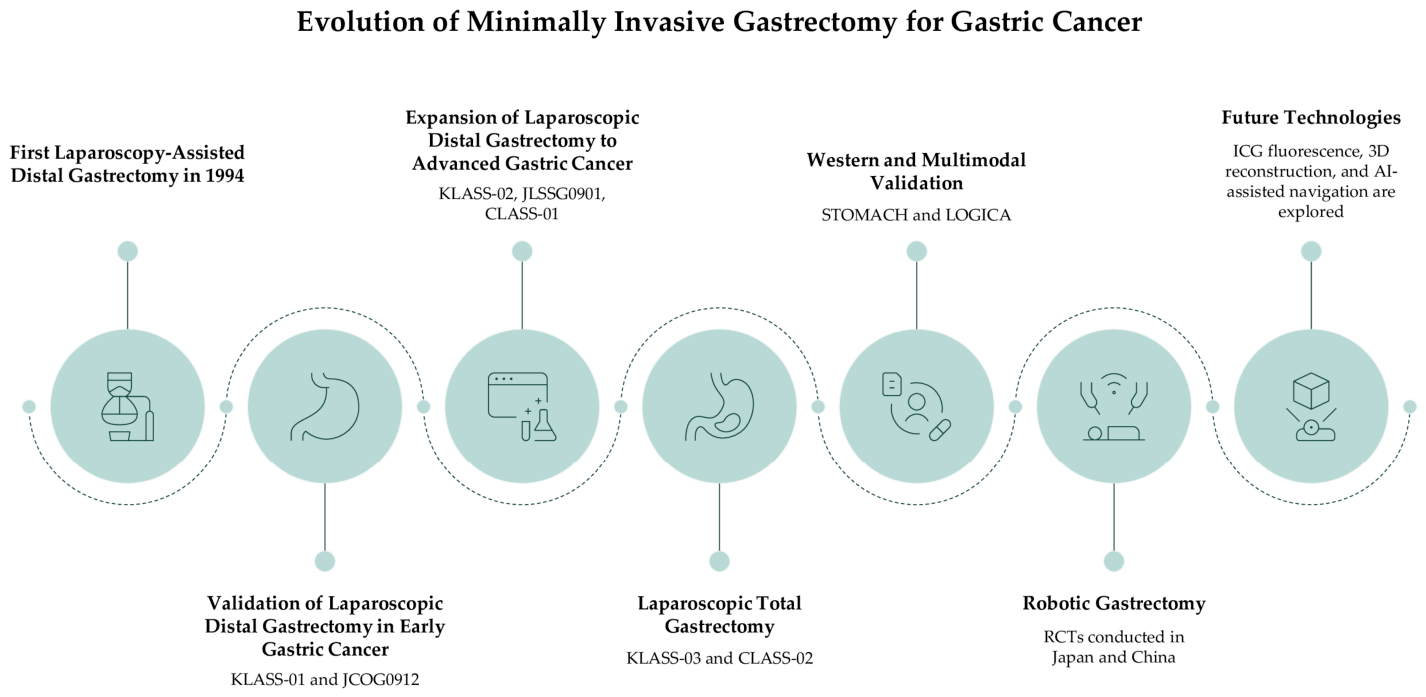
Minimally invasive surgery is widely used to treat gastric cancer as it can reduce surgical trauma while maintaining similar cancer outcomes to open surgery. Its use has expanded from early-stage disease to more complex procedures, including total gastrectomy, with the development of robotic and reduced-port techniques. This review summarizes current evidence and discusses how these approaches can be applied in practice. When introducing or expanding minimally invasive gastrectomy, factors such as patient selection, surgeon experience, learning curve, hospital volume, and quality control should be considered to ensure safe and effective treatment.
Abstract
Minimally invasive gastrectomy has become an established surgical approach for gastric cancer, supported by randomized trials demonstrating oncologic outcomes comparable to open surgery. Initially applied mainly to early-stage disease, laparoscopic gastrectomy has gradually expanded to selected patients with advanced gastric cancer and to more complex procedures, including total gastrectomy. In parallel, robotic surgery and reduced-port techniques have further broadened the technical spectrum of minimally invasive gastric cancer surgery. This review summarizes current evidence on laparoscopic, robotic, and reduced-port gastrectomy, with emphasis on randomized trials, large-scale clinical studies, and recent guideline recommendations. Laparoscopic distal gastrectomy has shown robust oncologic equivalence in early and selected advanced gastric cancer, while evidence for laparoscopic total gastrectomy continues to grow, particularly in experienced centers. Robotic and reduced-port approaches appear feasible and safe in selected settings, although clear superiority over standard laparoscopy has not been established. As minimally invasive techniques are adopted more widely, careful consideration is needed during program development and expansion. Patient selection, surgeon experience, learning curve, institutional volume, standardized operative procedures, quality control, and multidisciplinary support are important factors for safe implementation. Future studies should focus not only on comparing surgical approaches, but also on defining how minimally invasive gastrectomy can be applied safely and consistently across diverse clinical settings.