Beyond Precision: Ambiomic Survivorship in Childhood and AYA Cancer
by
 , , , , and
Juan Antonio Ortega-García
1,2,* ,
,
Omar Shakeel
3 ,
,
Nicole M. Wood
4 ,
,
Antonio Pérez-Martínez
5 ,
,
Jose Luís Fuster-Soler
2 and
Mark D. Miller
6 1
Pediatric Environmental Health Specialty Unit, Department of Pediatrics, Hospital Clínico Universitario Virgen de la Arrixaca (HCUVA), 30120 Murcia, Spain
2
Pediatric Hemato-Oncology, Clinical Hospital University Virgen Arrixaca, Instituto Murciano de Investigación Biosanitaria (IMIB) Pascual Parrilla, University of Murcia, 30120 Murcia, Spain
3
Texas Children’s Cancer and Hematology Center, Baylor College of Medicine, Houston, TX 77030, USA
4
MidAmerica Pediatric Environmental Health Specialty Unit, Children’s Mercy Kansas City, Kansas City, MO 64108, USA
5
Pediatric Hemato-Oncology Department, IdiPAZ-CNIO Pediatric Oncology Clinical Research Unit Hospital University La Paz, 28046 Madrid, Spain
6
Western States Pediatric Environmental Health Specialty Unit, University of California, San Francisco, CA 94143, USA
*
Author to whom correspondence should be addressed.
Cancers 2026, 18(1), 7; https://doi.org/10.3390/cancers18010007
Submission received: 20 November 2025
/
Revised: 14 December 2025
/
Accepted: 16 December 2025
/
Published: 19 December 2025
(This article belongs to the Special Issue Advancements in Child, Adolescent, and Young Adult Cancer Survivorship)
Simple Summary
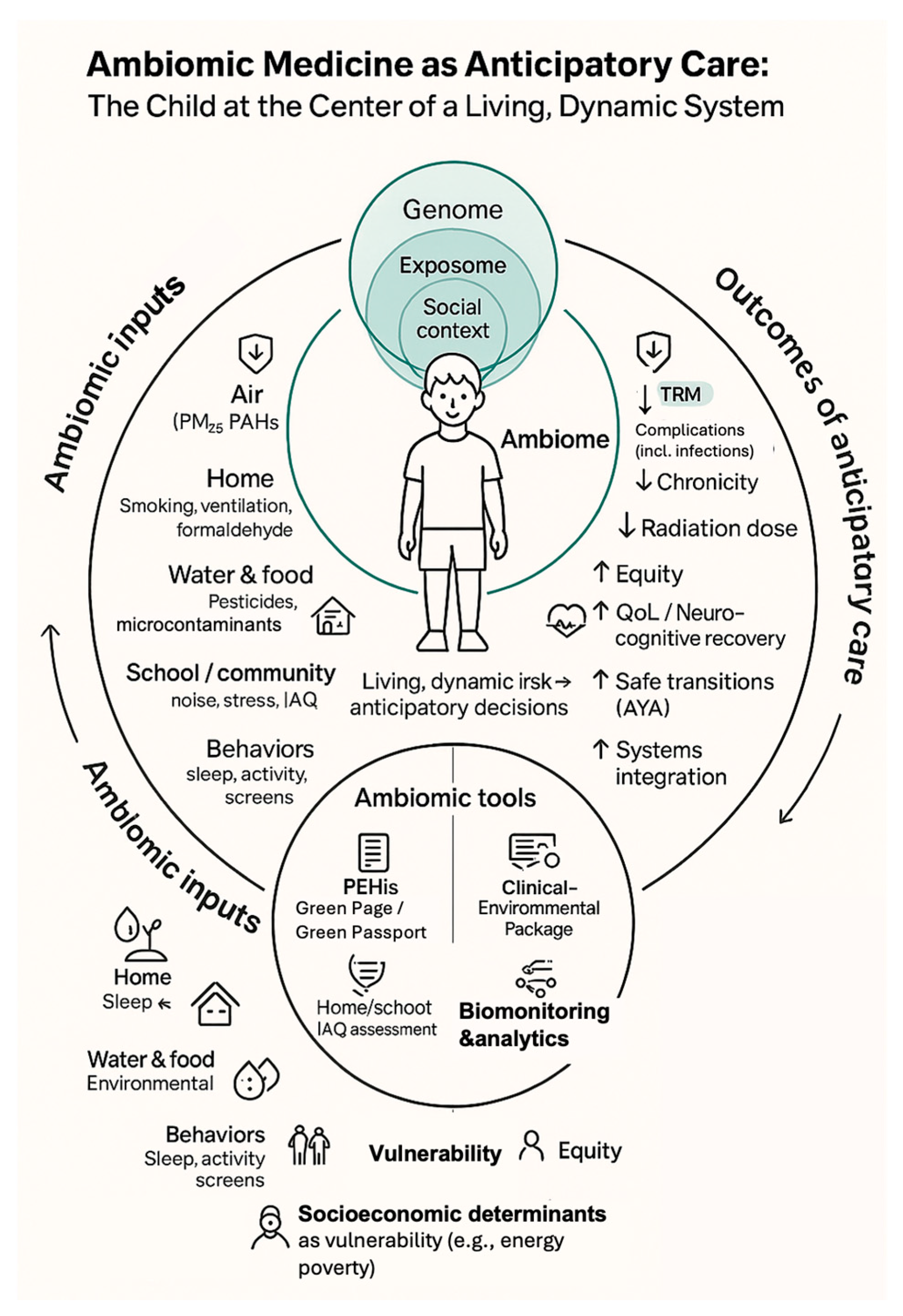
Survival after childhood and adolescent and young adult (AYA) cancer has improved markedly, but many survivors still face serious complications, chronic health problems and social inequalities. Most survivorship programs begin after treatment and focus on organs and chemotherapy doses, rather than on the real environments in which children live. In this review, we describe an “ambiomic” survivorship model that starts at the day of diagnosis (day 0) and follows children and families across their whole lives. The model combines medical information with structured genomic, exposomic, environmental and social data, and uses and expands international survivorship guidelines by adding layers on air pollution, housing, school, lifestyle and social conditions, through tools such as the Pediatric Environmental History and the Ambiomic Health Compass. These tools help anticipate preventable complications, reduce treatment-related deaths, support healthier behaviors and improve quality of life. We also show how new science on environmental exposures and cancer biology can help make prevention and prognosis more precise. All of this is framed along the cancer continuum within a global and planetary health perspective, recognizing that children with cancer are affected not only by their genes and treatments, but also by the quality of the environments and societies in which they grow up. Our proposal offers a practical roadmap for health systems to build fairer, more proactive survivorship care for children and AYA with cancer in Europe and beyond.
Abstract
Background: Survival among children and adolescents and young adults (AYA) with cancer has improved substantially over recent decades; however, dominant survivorship models remain reactive—activated post-treatment and anchored to static exposure- and organ-based screening. This design underuses the anticipatory window at diagnosis and overlooks environmental and social determinants that modulate outcomes across the life course. Methods: We narratively reviewed international frameworks including the Children’s Oncology Group (COG), the International Late Effects of Childhood Cancer Guideline Harmonization Group (IGHG), the Pan-European Network for Care of Survivors after Childhood and Adolescent Cancer (PanCare) and the National Comprehensive Cancer Network (NCCN), and synthesized evidence on environmental determinants, exposomics, toxicogenomics, and implementation. Building on two decades of real-world practice, we describe the evolution from the Pediatric Environmental History (PEHis) to the Ambiomic Health Compass (AHC), integrating genomic, exposomic, geospatial, clinical, and biomonitoring layers into routine care. In this framework, survivorship is conceptualized as beginning at the time of cancer diagnosis (“day 0”). Results: PEHis operationalizes guideline-based care with structured environmental and social assessment, personalized plans, and community integration, contributing to improved survival, healthier behaviors, reduced treatment-related mortality and stronger oncology–primary-care coordination. AHC extends PEHis with dynamic risk recalibration, contextual alerts, targeted biomonitoring, and toxicogenomic interpretation, enabling anticipatory decisions from day 0. The manuscript summarizes the paradigm shift (current vs. Ambiomic models), the domain-specific expansion over existing guidelines, the core clinical/system tools, and time-bound metrics (12, 24, 60 months) to support implementation and evaluation. Conclusions: Survivorship should move upstream—from late surveillance to ambiomic, exposure-aware care beginning at diagnosis. Integrating advanced exposomics, mutational epidemiology, and explainable analytics can reduce preventable events and chronicity, enhance equity, and align pediatric oncology with planetary health. The PEHis–AHC continuum offers a scalable blueprint for next-generation survivorship programs in Europe and beyond. Ambiomic medicine does not replace precision medicine—it completes and extends it by integrating exposomics, social context, and anticipatory analytics from day 0.