Outcomes for Medicaid Patients with Colorectal Cancer Are Improved in Affluent Neighborhoods, but Disparities Persist
by
 ,
,
Kaelyn C. Cummins
, 
Mohamad El Moheb
,
Chengli Shen
,
Susan J. Kim
,
Russell Witt
, 
Samantha M. Ruff
and
Allan Tsung
* Department of Surgery, University of Virginia, Charlottesville, VA 22903, USA
*
Author to whom correspondence should be addressed.
Cancers 2025, 17(9), 1399; https://doi.org/10.3390/cancers17091399
Submission received: 14 March 2025
/
Revised: 8 April 2025
/
Accepted: 17 April 2025
/
Published: 22 April 2025
(This article belongs to the Special Issue Impact of Social Determinants on Cancer Care)
Simple Summary
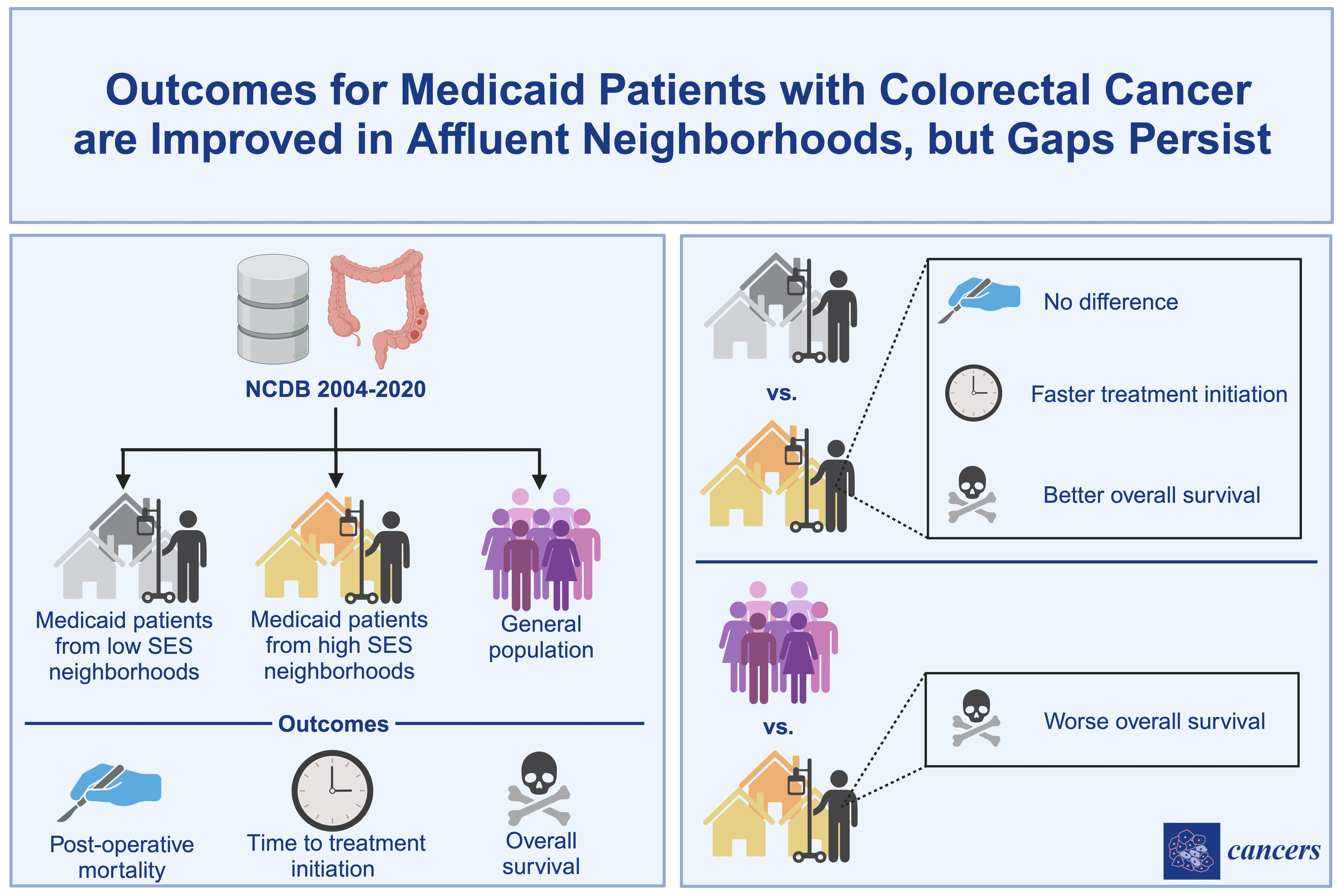
Outcomes in colorectal cancer patients are significantly influenced by patients’ socioeconomic status, but interplay between individual and neighborhood socioeconomic status is not well characterized. The goal of this retrospective study was to shed light on this interplay by investigating the effect of neighborhood socioeconomic status in colorectal cancer patients with low individual socioeconomic status. Patients living in affluent neighborhoods had faster treatment initiation and better overall survival than those living in low-socioeconomic status areas, but their outcomes remained worse than the general population. These findings can be used to inform future study, develop targeted interventions, and help close the survival gap related to socioeconomic inequality in these vulnerable patients.
Abstract
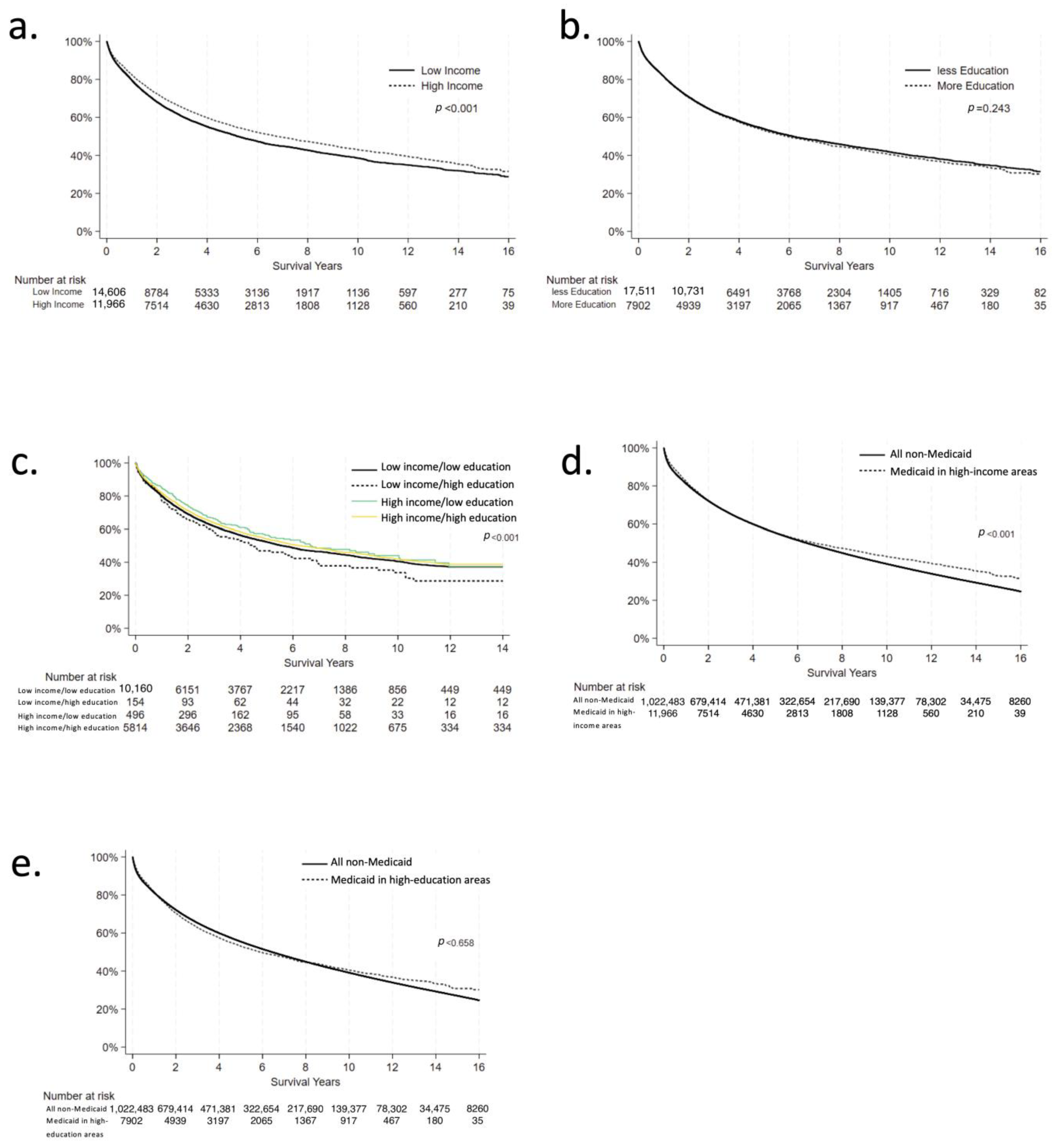
Background: Socioeconomic status (SES) significantly influences outcomes in colorectal cancer (CRC) patients, with those from low-SES backgrounds facing worse prognoses. However, living in an affluent neighborhood may mitigate some of these disparities through environmental advantages. This study investigates whether Medicaid-insured CRC patients, as a proxy for low individual SES, experience better outcomes when residing in high-SES neighborhoods. Methods: Using the National Cancer Database, we examined Medicaid CRC patients, stratifying them by neighborhood SES indicators: median household income and education level. Patients in the highest and lowest quartiles of income and education were compared. Medicaid patients from the highest-SES neighborhoods were compared to the general population. Multivariable regression models analyzed 30- and 90-day postoperative mortality, overall survival (OS), and time from diagnosis to treatment initiation and surgery. Results: CRC patients in high-income neighborhoods began treatment earlier (coefficient −1.847, p = 0.015) and exhibited improved OS (HR 0.810, p < 0.001) compared to those in low-income neighborhoods, irrespective of education level. Similarly, patients in high-education neighborhoods started treatment sooner (coefficient −3.926, p < 0.001) and had better OS (HR 0.897, p < 0.001). No differences were observed in time to surgery or postoperative mortality. Despite these advantages, Medicaid patients in high-income (HR 1.130, p < 0.001) and high-education (HR 1.209, p = 0.002) areas still had worse OS compared to non-Medicaid patients. Conclusions: Higher neighborhood SES is associated with a significant survival benefit for Medicaid CRC patients, but these patients still lag behind their non-Medicaid counterparts. Understanding the mechanisms by which neighborhood SES influences cancer outcomes could inform targeted interventions to close the survival gap.