Periostin from Tumor Stromal Cells Might Be Associated with Malignant Progression of Colorectal Cancer via Smad2/3
by

Canfeng Fan
1,2, 
Qiang Wang
1,2,
Saki Kanei
1,2,
Kyoka Kawabata
1,2,
Hinano Nishikubo
1,2,
Rika Aoyama
1,2,
Zhonglin Zhu
1,2,
Daiki Imanishi
1,2,3,
Takashi Sakuma
1,2,3,
Koji Maruo
1,2,3,
Gen Tsujio
1,2,3,
Yurie Yamamoto
1,2,
Tatsunari Fukuoka
1,2,3 and
Masakazu Yashiro
1,2,3,* 1
Molecular Oncology and Therapeutics, Osaka Metropolitan University Graduate School of Medicine, 1-4-3 Asahimachi, Abeno-ku, Osaka 545-8585, Japan
2
Cancer Center for Translational Research, Osaka Metropolitan University Graduate School of Medicine, 1-4-3 Asahimachi, Abeno-ku, Osaka 545-8585, Japan
3
Department of Gastroenterological Surgery, Osaka Metropolitan University Graduate School of Medicine, 1-4-3 Asahimachi, Abeno-ku, Osaka 545-8585, Japan
*
Author to whom correspondence should be addressed.
Cancers 2025, 17(3), 551; https://doi.org/10.3390/cancers17030551
Submission received: 21 December 2024
/
Revised: 22 January 2025
/
Accepted: 3 February 2025
/
Published: 6 February 2025
(This article belongs to the Collection New Treatment for Colorectal Cancer)
Simple Summary
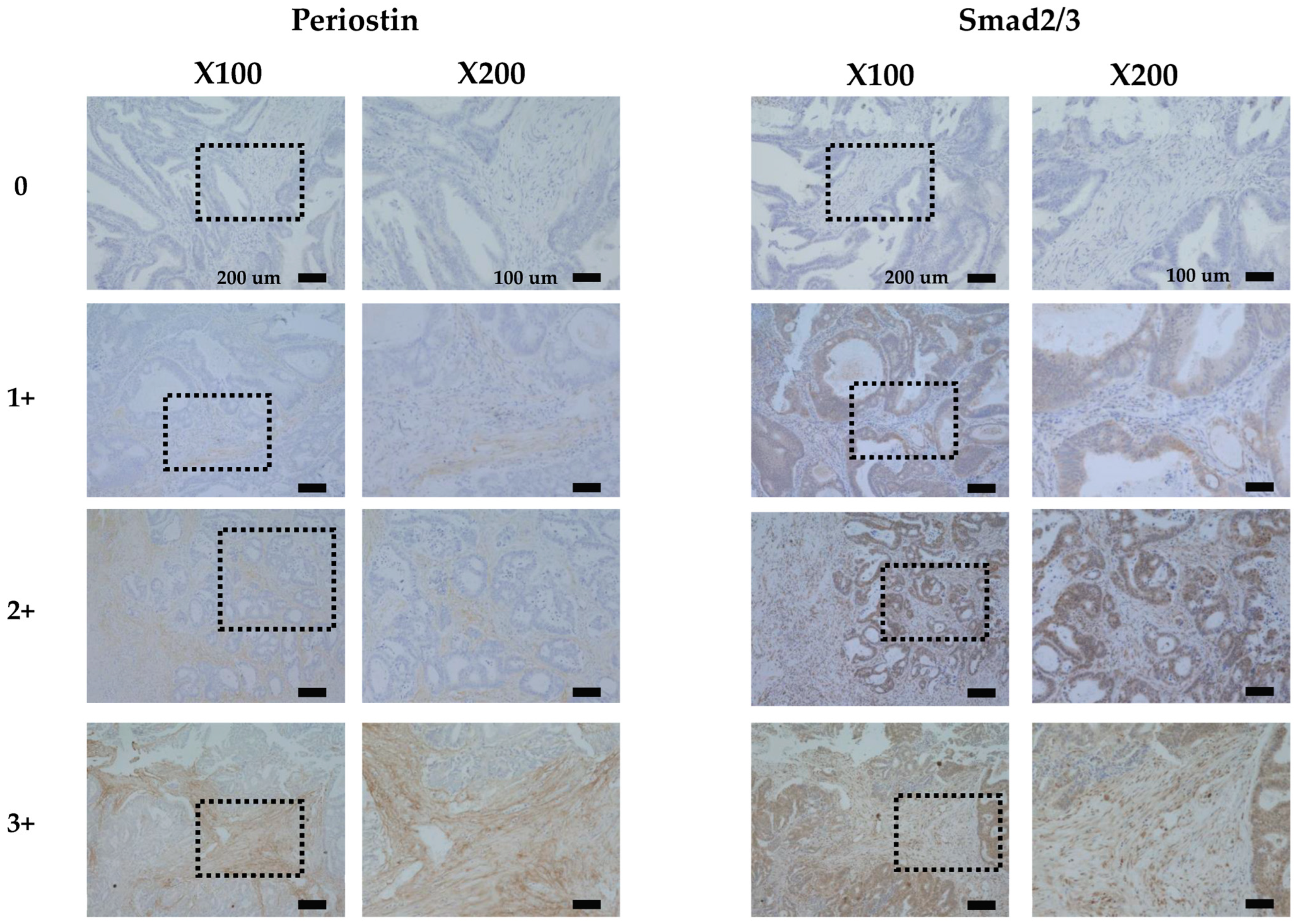
Periostin has been shown to be abnormally expressed in cancer-associated fibroblasts (CAFs) across various cancer types and is regulated by the TGFβ/Smad signaling pathway. However, the patterns of periostin and Smad2/3 expression and their relationship in colorectal cancer have not yet been reported. In this study, we analyzed tissue samples from 351 colorectal cancer patients and found that periostin is predominantly expressed in CAFs rather than cancer cells. Moreover, its expression is strongly associated with Smad2/3 expression in CAFs.
Abstract
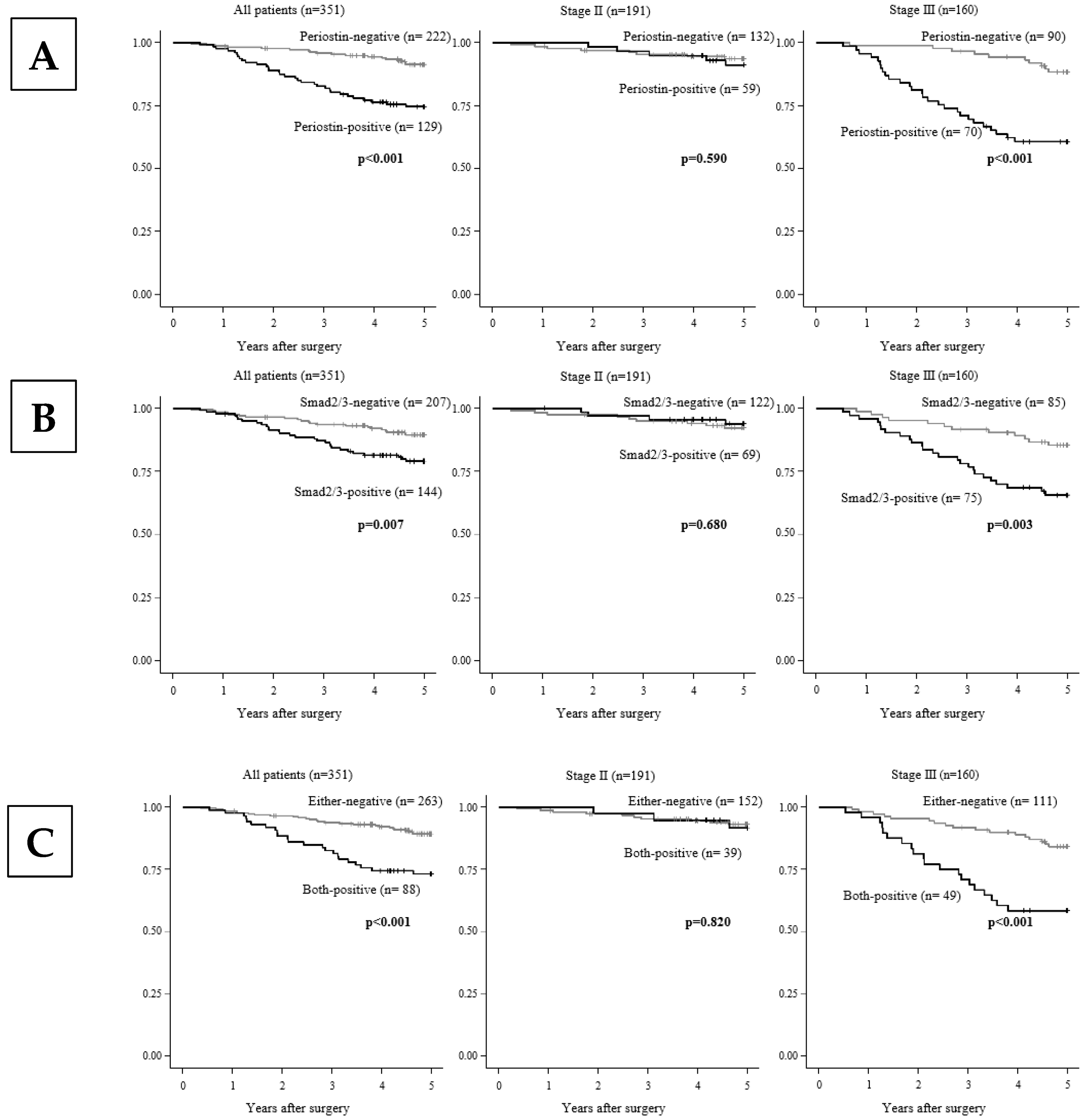
Background/Objectives: Cancer-associated fibroblasts (CAFs) in the tumor microenvironment have been reported to be closely associated with tumor progression in various types of cancer, including colorectal cancer (CRC). Periostin, a matricellular protein, was reported to be expressed on both cancer cells and surrounding tumor stromal cells, such as CAFs, and is regulated by Smad2/3 signaling. In this study, we aimed to clarify the clinicopathologic significance of periostin and Smad2/3 expression in CRC, with a particular focus on the tumor microenvironment. Methods: A total of 351 CRC patients were enrolled according to the inclusion and exclusion criteria. The expressions of periostin and Smad2/3 in the tumor specimens were examined by immunohistochemistry. Results: Periostin expression of CAFs and cancer cells in the 351 CRC cases was observed at 36.8% and 0.6%, respectively. Smad2/3 expression of CAFs and cancer cells was observed in 41.0% and 90.0%, respectively. In CAFs, high periostin expression was significantly correlated with high Smad2/3 expression, increased invasion depth, lymph node metastasis, venous invasion, advanced disease stage, and a higher rate of relapse. The prognoses of patients with periostin-positive CAFs were significantly poorer than those with periostin-negative CAFs (p < 0.001). The survival outcomes of stage 3 CRC patients with co-expression of periostin and Smad2/3 were significantly worse compared to those with stage 2 CRC. In the stage 3 group, multivariate analysis revealed that periostin was an independent prognostic factor, while univariate analysis showed that both periostin and Smad2/3 were significantly correlated with poor survival. Conclusions: These findings suggest that periostin is expressed mainly in CAFs in CRC and is correlated with Smad2/3 expression in CAFs. Periostin from CAFs might be associated with the malignant progression of CRC via Smad2/3 signaling.