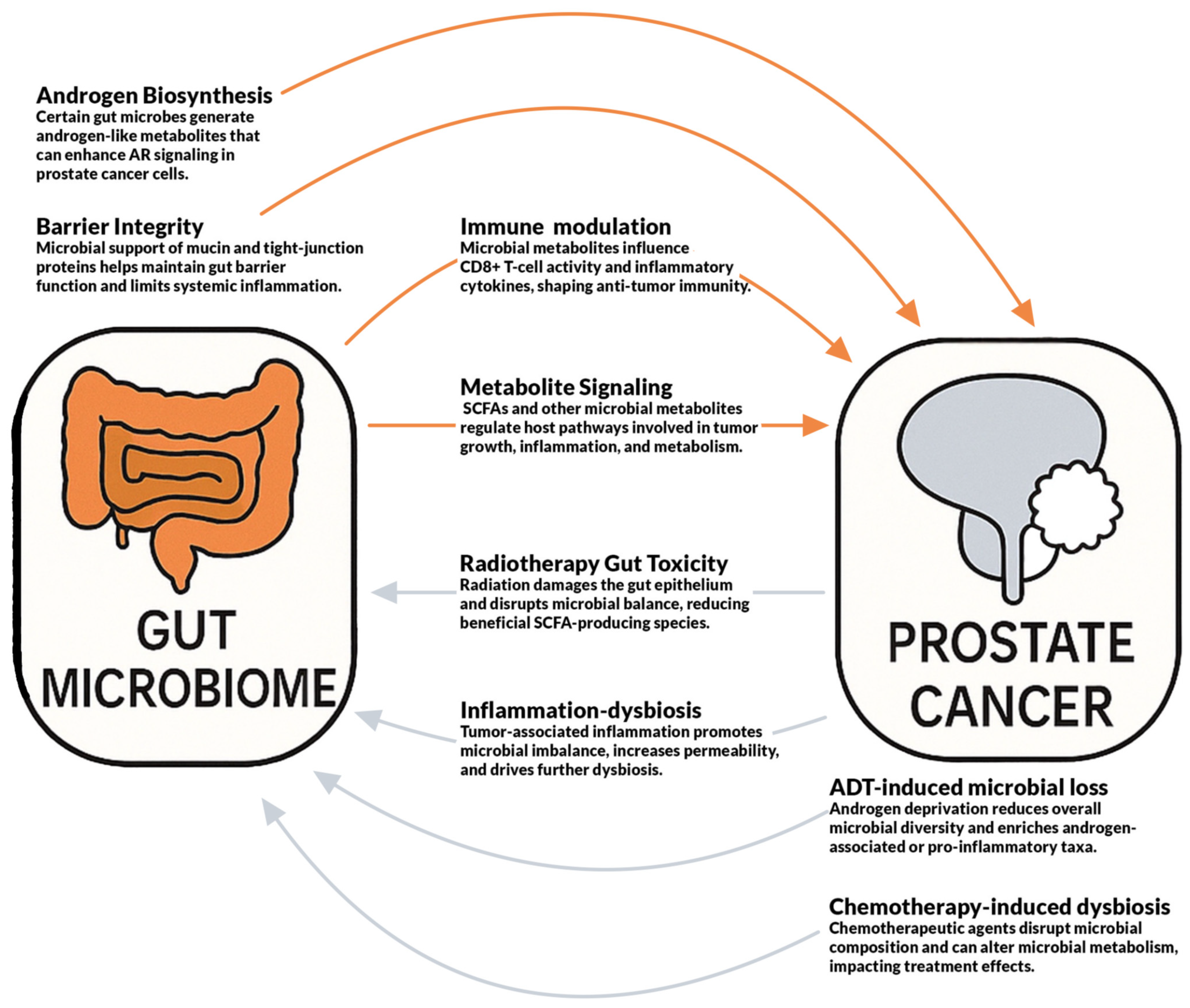
Modulating Prostate Cancer Therapy Through the Gut Microbiome: A Comprehensive Review


Simple Summary
Abstract
1. Introduction
2. Materials and Methods
2.1. Literature Search
2.2. Study Selection Criteria
3. Overview of the Gut Microbiome
4. Biological Mechanisms of Gut Microbiota Influence on Therapy
4.1. Immune System Modulation
4.2. Microbial Metabolism of Therapeutics
4.3. Metabolite Production
4.4. Intestinal Permeability and Inflammation

| Mechanism | Description | Implications for Prostate Cancer | Therapy Context |
|---|---|---|---|
| Immune modulation | Altered Th1/Th17/Treg balance; CD8+ T cell activation [27,28,31,39] | Enhances or suppresses anti-tumor immunity | ADT, Immunotherapy |
| Androgen biosynthesis | Microbial conversion of precursors (e.g pregnenolone→ DHEA/testosterone) [5,45] | Promotes CRPC and therapy resistance | ADT |
| Metabolic regulation | SCFA production, IGF-1 stimulation, tryptophan metabolism [16,29,37,41,42] | Influences tumor growth, immune activity | ADT, Chemotherapy |
| Inflammation | NF-κB activation, ↑ pro-inflammatory cytokines, dysbiosis-induced permeability [12,22,32,43,44] | Promotes carcinogenesis and reduces treatment efficacy | General, Radiotherapy, Chemotherapy |
| Drug metabolism (activation/inactivation) | Β-glucuronidase activation of irinotecan; microbial inactivation of gemcitabine [22,30,33,40] | Increases toxicity or decreases drug efficacyIncreases toxicity or decreases drug efficacy | Chemotherapy |
| Barrier integrity maintenance | SCFA-mediated mucin secretion and epithelial protection [33] | Reduces GI toxicity and systemic inflammation | Radiotherapy |
| Epigenetic & metabolite effects | HDAC inhibition, AHR ligands, in spine signaling [29] | Affects immune cell differentiation and function | Immunotherapy |
5. Impact on Prostate Cancer Therapy
5.1. Androgen Deprivation Therapy
5.2. Chemotherapy
5.3. Immunotherapy
5.4. Radiotherapy
| Therapy | Microbiome Influence | Key Mechanisms | Supporting Species/Metabolites |
|---|---|---|---|
| Androgen Deprivation Therapy (ADT) | Enhances or undermines therapy | Androgen biosynthesis, immune modulation | Akkermansia [27], Ruminococcus gnavus [45] |
| Chemotherapy | Modifies efficacy and toxicity | IL-6/STAT3 axis, drug metabolism | Lactobacillus spp. [33], Mycoplasma hyorhinis [22] |
| Immunotherapy | Affects ICI response | Inosine, SCFA production, antigen presentation | Bifidobacterium [30], Faecalibacterium [57], inosine [51], SCFAs [57] |
| Radiotherapy | Modulates GI toxicity | SCFA production, inflammation | Alistipes onderdonkii [34], lactobacillus spp. [34], butyrate [64] |
6. Microbiome Based Therapeutic Strategies
6.1. Probiotics and Prebiotics
6.2. Fecal Microbiota Transplantation
6.3. Diet and Lifestyle
6.4. Challenges in Microbiome-Based Therapeutics
| Intervention | Mechanism | Supporting Evidence | Application |
|---|---|---|---|
| Probiotics | Restore microbial balance; reduce inflammation; enhance barrier integrity | Lactobacillus spp. reduced irinotecan- induced toxicity [33]; shown to prevent epithelial apoptosis post-radiotherapy | Mitigating GI toxicity during Chemo/RT |
| Prebiotics | Promote SCFA production; support growth of beneficial microbes | Stabilised TNF-α and IL-6 levels during pelvic RT; improved mucosal regulation via SCFAs [34] | Supportive during RT |
| FMT | Recolonize gut with healthy microbiota; introduce beneficial metabolites | Proposed for PCa based on success in GI cancers and Melanoma [45]; donor selection and safety under study | Experimental; potential across therapies |
| Dietary Modification | Modulates microbial diversity; influences inflammation and metabolism | HFD reduced alpha- Diversity [16]; Japanese prudent diet linked to lower PCa incidence [68] | Preventive and adjunct across all therapies |
| Exercise | Improves microbial diversity and systemic inflammation | Increased gut diversity and lean mass in ADT patients; reduced inflammatory markers [70] | Adjunct to ADT and metabolic management |
7. Evidence to Date
8. Future Directions and Research Gaps
9. Conclusions
Funding
Data Availability Statement
Acknowledgments
Conflicts of Interest
Abbreviations
| A. muciniphila | Akkermansia muciniphila |
| ADT | Androgen deprivation therapy |
| AR | Androgen receptor |
| AHR | Aryl hydrocarbon receptor |
| CRPC | Castration-resistant prostate cancer |
| Dehydroepiandrosterone | DHEA |
| FMT | Fecal microbiota transplantation |
| GI | Gastrointestinal |
| GZMB | Granzyme B |
| GM | Gut microbiome |
| HFD | High-fat diet |
| HSPC | Hormone-sensitive prostate cancer |
| ICI | Immune checkpoint inhibitors |
| IGF-1 | Insulin-like growth factor 1 |
| IL-2 | Interleukin-2 |
| IL-6 | Interleukin-6 |
| IL-12 | Interleukin-12 |
| LPS | Lipopolysaccharide |
| mTOR | Mechanistic target of rapamycin |
| NK | Natural killer |
| PAMPs | Pathogen-associated molecular patterns |
| PRRs | Pattern-recognition receptors |
| PD | Pharmacodynamics |
| PK | Pharmacokinetics |
| PTEN | Phosphatase and tensin homolog |
| PI3K | Phosphatidylinositol 3-kinase |
| PAHs | Polycyclic aromatic hydrocarbons |
| PIA | Proliferative inflammatory atrophy |
| PIN | Prostatic intraepithelial neoplasia |
| PSA | Prostate specific antigen |
| SCC | Prostatic small cell carcinoma |
| AKT | Protein kinase B |
| RT | Radiotherapy |
| SCFAs | Short-chain fatty acids |
| TPH1 | Tryptophan hydroxylase 1 |
| TNF | Tumor necrosis factor |
| TME | Tumor-promoting microenvironment |
References
- Siegel, R.L.; Kratzer, T.B.; Giaquinto, A.N.; Sung, H.; Jemal, A. Cancer statistics, 2025. CA Cancer J. Clin. 2025, 75, 10–45. [Google Scholar] [CrossRef] [PubMed]
- Ferlay, J.; Ervik, M.; Lam, F.; Laversanne, M.; Colombet, M.; Mery, L.; Piñeros, M.; Znaor, A.; Soerjomataram, I.; Bray, F. Global Cancer Observatory: Cancer Today. Lyon, France: International Agency for Research on Cancer. 2024. Available online: https://gco.iarc.who.int/today (accessed on 3 October 2025).
- Jemal, A.; Fedewa, S.A.; Ma, J.; Siegel, R.; Lin, C.C.; Brawley, O.; Ward, E.M. Prostate Cancer Incidence and PSA Testing Patterns in Relation to USPSTF Screening Recommendations. JAMA 2015, 314, 2054–2061. [Google Scholar] [CrossRef]
- Kustrimovic, N.; Bombelli, R.; Baci, D.; Mortara, L. Microbiome and Prostate Cancer: A Novel Target for Prevention and Treatment. Int. J. Mol. Sci. 2023, 24, 1511. [Google Scholar] [CrossRef] [PubMed]
- Terrisse, S.; Zitvogel, L.; Kroemer, G. Effects of the intestinal microbiota on prostate cancer treatment by androgen deprivation therapy. Microb. Cell 2022, 9, 190–194. [Google Scholar] [CrossRef] [PubMed]
- Kodama, H.; Koie, T.; Oikawa, M.; Narita, T.; Tanaka, T.; Noro, D.; Iwamura, H.; Tobisawa, Y.; Yoneyama, T.; Hashimoto, Y.; et al. Castration-resistant prostate cancer without metastasis at presentation may achieve cancer-specific survival in patients who underwent prior radical prostatectomy. Int. Urol. Nephrol. 2020, 52, 671–679. [Google Scholar] [CrossRef]
- Chen, A.C.; Petrylak, D.P. Complications of androgen deprivation therapy in men with prostate cancer. Curr. Oncol. Rep. 2004, 6, 209–215. [Google Scholar] [CrossRef]
- Cresci, G.A.; Bawden, E. Gut Microbiome. Nutr. Clin. Pr. 2015, 30, 734–746. [Google Scholar] [CrossRef]
- Bäckhed, F.; Ley, R.E.; Sonnenburg, J.L.; Peterson, D.A.; Gordon, J.I. Host-Bacterial Mutualism in the Human Intestine. Science 2005, 307, 1915–1920. [Google Scholar] [CrossRef]
- Xu, W.; Li, Y.; Liu, L.; Xie, J.; Hu, Z.; Kuang, S.; Fu, X.; Li, B.; Sun, T.; Zhu, C.; et al. Icaritin-curcumol activates CD8+ T cells through regulation of gut microbiota and the DNMT1/IGFBP2 axis to suppress the development of prostate cancer. J. Exp. Clin. Cancer Res. 2024, 43, 149. [Google Scholar] [CrossRef]
- Newton, R.U.; Christophersen, C.T.; Fairman, C.M.; Hart, N.H.; Taaffe, D.R.; Broadhurst, D.; Devine, A.; Chee, R.; Tang, C.I.; Spry, N.; et al. Does exercise impact gut microbiota composition in men receiving androgen deprivation therapy for prostate cancer? A single-blinded, two-armed, randomised controlled trial. BMJ Open 2019, 9, e024872. [Google Scholar] [CrossRef]
- Huang, H.; Liu, Y.; Wen, Z.; Chen, C.; Wang, C.; Li, H.; Yang, X. Gut microbiota in patients with prostate cancer: A systematic review and meta-analysis. BMC Cancer 2024, 24, 261. [Google Scholar] [CrossRef]
- Lacroix, V.; Cassard, A.; Mas, E.; Barreau, F. Multi-Omics Analysis of Gut Microbiota in Inflammatory Bowel Diseases: What Benefits for Diagnostic, Prognostic and Therapeutic Tools? Int. J. Mol. Sci. 2021, 22, 11255. [Google Scholar] [CrossRef]
- Frank, D.N.; St Amand, A.L.; Feldman, R.A.; Boedeker, E.C.; Harpaz, N.; Pace, N.R. Molecular-phylogenetic characterization of microbial community imbalances in human inflammatory bowel diseases. Proc. Natl. Acad. Sci. USA 2007, 104, 13780–13785. [Google Scholar] [CrossRef]
- Albillos, A.; de Gottardi, A.; Rescigno, M. The gut-liver axis in liver disease: Pathophysiological basis for therapy. J. Hepatol. 2020, 72, 558–577. [Google Scholar] [CrossRef]
- Fujita, K.; Matsushita, M.; Banno, E.; De Velasco, M.A.; Hatano, K.; Nonomura, N.; Uemura, H. Gut microbiome and prostate cancer. Int. J. Urol. 2022, 29, 793–798. [Google Scholar] [CrossRef] [PubMed]
- Porter, C.M.; Shrestha, E.; Peiffer, L.B.; Sfanos, K.S. The microbiome in prostate inflammation and prostate cancer. Prostate Cancer Prostatic Dis. 2018, 21, 345–354. [Google Scholar] [CrossRef] [PubMed]
- Boursi, B.; Mamtani, R.; Haynes, K.; Yang, Y.-X. Recurrent antibiotic exposure may promote cancer formation – Another step in understanding the role of the human microbiota? Eur. J. Cancer 2015, 51, 2655–2664. [Google Scholar] [CrossRef] [PubMed]
- Mizutani, S.; Yamada, T.; Yachida, S. Significance of the gut microbiome in multistep colorectal carcinogenesis. Cancer Sci. 2020, 111, 766–773. [Google Scholar] [CrossRef]
- Yang, J.; Tan, Q.; Fu, Q.; Zhou, Y.; Hu, Y.; Tang, S.; Zhou, Y.; Zhang, J.; Qiu, J.; Lv, Q. Gastrointestinal microbiome and breast cancer: Correlations, mechanisms and potential clinical implications. Breast Cancer 2016, 24, 220–228. [Google Scholar] [CrossRef]
- Plottel, C.S.; Blaser, M.J. Microbiome and Malignancy. Cell Host Microbe 2011, 10, 324–335. [Google Scholar] [CrossRef]
- Sha, S.; Ni, L.; Stefil, M.; Dixon, M.; Mouraviev, V. The human gastrointestinal microbiota and prostate cancer development and treatment. Investig. Clin. Urol. 2020, 61, S43–S50. [Google Scholar] [CrossRef]
- Althuis, M.D.; Fergenbaum, J.H.; Garcia-Closas, M.; Brinton, L.A.; Madigan, M.P.; Sherman, M.E. Etiology of Hormone Receptor–Defined Breast Cancer: A Systematic Review of the Literature. Cancer Epidemiol. Biomark. Prev. 2004, 13, 1558–1568. [Google Scholar] [CrossRef]
- Elkrief, A.; El Raichani, L.; Richard, C.; Messaoudene, M.; Belkaid, W.; Malo, J.; Belanger, K.; Miller, W.; Jamal, R.; Letarte, N.; et al. Antibiotics are associated with decreased progression-free survival of advanced melanoma patients treated with immune checkpoint inhibitors. OncoImmunology 2019, 8, e1568812. [Google Scholar] [CrossRef] [PubMed]
- Netto Candido, T.L.; Bressan, J.; de Alfenas, R.C.G. Dysbiosis and metabolic endotoxemia induced by high-fat diet. Nutr. Hosp. 2018, 35, 1432–1440. [Google Scholar] [CrossRef] [PubMed]
- Crocetto, F.; Boccellino, M.; Barone, B.; Di Zazzo, E.; Sciarra, A.; Galasso, G.; Settembre, G.; Quagliuolo, L.; Imbimbo, C.; Boffo, S.; et al. The Crosstalk between Prostate Cancer and Microbiota Inflammation: Nutraceutical Products Are Useful to Balance This Interplay? Nutrients 2020, 12, 2648. [Google Scholar] [CrossRef]
- Luo, Z.-W.; Xia, K.; Liu, Y.-W.; Liu, J.-H.; Rao, S.-S.; Hu, X.-K.; Chen, C.-Y.; Xu, R.; Wang, Z.-X.; Xie, H. Extracellular Vesicles from Akkermansia muciniphila Elicit Antitumor Immunity Against Prostate Cancer via Modulation of CD8+ T Cells and Macrophages. Int. J. Nanomed. 2021, 16, 2949–2963. [Google Scholar] [CrossRef]
- Comito, G.; Giannoni, E.; Segura, C.P.; Barcellos-De-Souza, P.; Raspollini, M.R.; Baroni, G.; Lanciotti, M.; Serni, S.; Chiarugi, P. Cancer-associated fibroblasts and M2-polarized macrophages synergize during prostate carcinoma progression. Oncogene 2013, 33, 2423–2431. [Google Scholar] [CrossRef]
- Dong, F.; Perdew, G.H. The aryl hydrocarbon receptor as a mediator of host-microbiota interplay. Gut Microbes 2020, 12, 1859812. [Google Scholar] [CrossRef]
- Lee, S.-H.; Cho, S.-Y.; Yoon, Y.; Park, C.; Sohn, J.; Jeong, J.-J.; Jeon, B.-N.; Jang, M.; An, C.; Lee, S.; et al. Bifidobacterium bifidum strains synergize with immune checkpoint inhibitors to reduce tumour burden in mice. Nat. Microbiol. 2021, 6, 277–288. [Google Scholar] [CrossRef]
- Radej, S.; Szewc, M.; Maciejewski, R. Prostate Infiltration by Treg and Th17 Cells as an Immune Response to Propionibacterium acnes Infection in the Course of Benign Prostatic Hyperplasia and Prostate Cancer. Int. J. Mol. Sci. 2022, 23, 8849. [Google Scholar] [CrossRef] [PubMed]
- Flemer, B.; Lynch, D.B.; Brown, J.M.R.; Jeffery, I.B.; Ryan, F.J.; Claesson, M.J.; O’Riordain, M.; Shanahan, F.; O’Toole, P.W. Tumour-associated and non-tumour-associated microbiota in colorectal cancer. Gut 2017, 66, 633–643. [Google Scholar] [CrossRef]
- Mahdy, M.S.; Azmy, A.F.; Dishisha, T.; Mohamed, W.R.; Ahmed, K.A.; Hassan, A.; El Aidy, S.; El-Gendy, A.O. Irinotecan-gut microbiota interactions and the capability of probiotics to mitigate Irinotecan-associated toxicity. BMC Microbiol. 2023, 23, 53. [Google Scholar] [CrossRef]
- Yu, Y.; Park, S.; Jeon, J.; Lee, S.-H.; Kim, H.; Seo, D.; Park, M.; Park, E.; Kim, J.Y.; Cho, S.-J.; et al. The radioprotective role of human Alistipes onderdonkii identified by multi-omic analysis in patients with prostate cancer. Discov. Oncol. 2025, 16, 1142. [Google Scholar] [CrossRef]
- Martin, C.R.; Osadchiy, V.; Kalani, A.; Mayer, E.A. The Brain-Gut-Microbiome Axis. Cell. Mol. Gastroenterol. Hepatol. 2018, 6, 133–148. [Google Scholar] [CrossRef]
- Li, M.; Van Esch, B.C.A.M.; Wagenaar, G.T.M.; Garssen, J.; Folkerts, G.; Henricks, P.A.J. Pro- and anti-inflammatory effects of short chain fatty acids on immune and endothelial cells. Eur. J. Pharmacol. 2018, 831, 52–59. [Google Scholar] [CrossRef]
- Matsushita, M.; Fujita, K.; Hayashi, T.; Kayama, H.; Motooka, D.; Hase, H.; Jingushi, K.; Yamamichi, G.; Yumiba, S.; Tomiyama, E.; et al. Gut Microbiota–Derived Short-Chain Fatty Acids Promote Prostate Cancer Growth via IGF1 Signaling. Cancer Res. 2021, 81, 4014–4026. [Google Scholar] [CrossRef]
- Pungsrinont, T.; Kallenbach, J.; Baniahmad, A. Role of PI3K-AKT-mTOR Pathway as a Pro-Survival Signaling and Resistance-Mediating Mechanism to Therapy of Prostate Cancer. Int. J. Mol. Sci. 2021, 22, 11088. [Google Scholar] [CrossRef] [PubMed]
- Wang, S.; Gao, J.; Wang, Z. Outer membrane vesicles for vaccination and targeted drug delivery. WIREs Nanomed. Nanobiotechnol. 2018, 11, e1523. [Google Scholar] [CrossRef] [PubMed]
- Tung, W.; Wang, Y.; Gout, P.W.; Liu, D.; Gleave, M.; Wang, Y. Use of irinotecan for treatment of small cell carcinoma of the prostate. Prostate 2010, 71, 675–681. [Google Scholar] [CrossRef] [PubMed]
- Yan, J.; Chen, D.; Ye, Z.; Zhu, X.; Li, X.; Jiao, H.; Duan, M.; Zhang, C.; Cheng, J.; Xu, L.; et al. Molecular mechanisms and therapeutic significance of Tryptophan Metabolism and signaling in cancer. Mol. Cancer 2024, 23, 1–32. [Google Scholar] [CrossRef]
- Ge, C.; Yan, J.; Yuan, X.; Xu, G. A positive feedback loop between tryptophan hydroxylase 1 and β-Catenin/ZBP-89 signaling promotes prostate cancer progression. Front. Oncol. 2022, 12, 923307. [Google Scholar] [CrossRef] [PubMed]
- Poutahidis, T.; Cappelle, K.; Levkovich, T.; Lee, C.-W.; Doulberis, M.; Ge, Z.; Fox, J.G.; Horwitz, B.H.; Erdman, S.E. Pathogenic Intestinal Bacteria Enhance Prostate Cancer Development via Systemic Activation of Immune Cells in Mice. PLoS ONE 2013, 8, e73933. [Google Scholar] [CrossRef]
- Liss, M.A.; White, J.R.; Goros, M.; Gelfond, J.; Leach, R.; Johnson-Pais, T.; Lai, Z.; Rourke, E.; Basler, J.; Ankerst, D.; et al. Metabolic Biosynthesis Pathways Identified from Fecal Microbiome Associated with Prostate Cancer. Eur. Urol. 2018, 74, 575–582. [Google Scholar] [CrossRef] [PubMed]
- Gut Microbiota Drive Androgen Resistance in Prostate Cancer. Cancer Discov. 2021, 11, 2959. [CrossRef]
- Terrisse, S.; Goubet, A.-G.; Ueda, K.; Thomas, A.M.; Quiniou, V.; Thelemaque, C.; Dunsmore, G.; Clave, E.; Gamat-Huber, M.; Yonekura, S.; et al. Immune system and intestinal microbiota determine efficacy of androgen deprivation therapy against prostate cancer. J. Immunother. Cancer 2022, 10, e004191. [Google Scholar] [CrossRef]
- Quistini, A.; Chierigo, F.; Fallara, G.; Depalma, M.; Tozzi, M.; Maggi, M.; Jannello, L.M.I.; Pellegrino, F.; Mantica, G.; Terracciano, D.; et al. Androgen Receptor Signalling in Prostate Cancer: Mechanisms of Resistance to Endocrine Therapies. Res. Rep. Urol. 2025, 17, 211–223. [Google Scholar] [CrossRef]
- Zhong, W.; Wu, K.; Long, Z.; Zhou, X.; Zhong, C.; Wang, S.; Lai, H.; Guo, Y.; Lv, D.; Lu, J.; et al. Gut dysbiosis promotes prostate cancer progression and docetaxel resistance via activating NF-κB-IL6-STAT3 axis. Microbiome 2022, 10, 94. [Google Scholar] [CrossRef]
- Don-Doncow, N.; Marginean, F.; Coleman, I.; Nelson, P.S.; Ehrnström, R.; Krzyzanowska, A.; Morrissey, C.; Hellsten, R.; Bjartell, A. Expression of STAT3 in Prostate Cancer Metastases. Eur. Urol. 2017, 71, 313–316. [Google Scholar] [CrossRef]
- Tinsley, N.; Zhou, C.; Tan, G.; Rack, S.; Lorigan, P.; Blackhall, F.; Krebs, M.; Carter, L.; Thistlethwaite, F.; Graham, D.; et al. Cumulative Antibiotic Use Significantly Decreases Efficacy of Checkpoint Inhibitors in Patients with Advanced Cancer. Oncologist 2020, 25, 55–63. [Google Scholar] [CrossRef]
- Sivan, A.; Corrales, L.; Hubert, N.; Williams, J.B.; Aquino-Michaels, K.; Earley, Z.M.; Benyamin, F.W.; Lei, Y.M.; Jabri, B.; Alegre, M.-L.; et al. Commensal Bifidobacterium promotes antitumor immunity and facilitates anti-PD-L1 efficacy. Science 2015, 350, 1084–1089. [Google Scholar] [CrossRef] [PubMed]
- Vétizou, M.; Pitt, J.M.; Daillère, R.; Lepage, P.; Waldschmitt, N.; Flament, C.; Rusakiewicz, S.; Routy, B.; Roberti, M.P.; Duong, C.P.M.; et al. Anticancer immunotherapy by CTLA-4 blockade relies on the gut microbiota. Science 2015, 350, 1079–1084. [Google Scholar] [CrossRef]
- Deng, H.; Li, Z.; Tan, Y.; Guo, Z.; Liu, Y.; Wang, Y.; Yuan, Y.; Yang, R.; Bi, Y.; Bai, Y.; et al. A novel strain of Bacteroides fragilis enhances phagocytosis and polarises M1 macrophages. Sci. Rep. 2016, 6, 29401. [Google Scholar] [CrossRef] [PubMed]
- Jin, Y.; Dong, H.; Xia, L.; Yang, Y.; Zhu, Y.; Shen, Y.; Zheng, H.; Yao, C.; Wang, Y.; Lu, S. The Diversity of Gut Microbiome is Associated With Favorable Responses to Anti–Programmed Death 1 Immunotherapy in Chinese Patients With NSCLC. J. Thorac. Oncol. 2019, 14, 1378–1389. [Google Scholar] [CrossRef] [PubMed]
- Barry, K.C.; Hsu, J.; Broz, M.L.; Cueto, F.J.; Binnewies, M.; Combes, A.J.; Nelson, A.E.; Loo, K.; Kumar, R.; Rosenblum, M.D.; et al. A natural killer–dendritic cell axis defines checkpoint therapy–responsive tumor microenvironments. Nat. Med. 2018, 24, 1178–1191. [Google Scholar] [CrossRef]
- Routy, B.; le Chatelier, E.; DeRosa, L.; Duong, C.P.M.; Alou, M.T.; Daillère, R.; Fluckiger, A.; Messaoudene, M.; Rauber, C.; Roberti, M.P.; et al. Gut microbiome influences efficacy of PD-1–based immunotherapy against epithelial tumors. Science 2018, 359, 91–97. [Google Scholar] [CrossRef]
- Gopalakrishnan, V.; Spencer, C.N.; Nezi, L.; Reuben, A.; Andrews, M.C.; Karpinets, T.V.; Prieto, P.A.; Vicente, D.; Hoffman, K.; Wei, S.C.; et al. Gut microbiome modulates response to anti–PD-1 immunotherapy in melanoma patients. Science 2018, 359, 97–103. [Google Scholar] [CrossRef]
- Mager, L.F.; Burkhard, R.; Pett, N.; Cooke, N.C.A.; Brown, K.; Ramay, H.; Paik, S.; Stagg, J.; Groves, R.A.; Gallo, M.; et al. Microbiome-derived inosine modulates response to checkpoint inhibitor immunotherapy. Science 2020, 369, 1481–1489. [Google Scholar] [CrossRef]
- Wang, T.; Gnanaprakasam, J.N.R.; Chen, X.; Kang, S.; Xu, X.; Sun, H.; Liu, L.; Rodgers, H.; Miller, E.; Cassel, T.A.; et al. Inosine is an alternative carbon source for CD8+-T-cell function under glucose restriction. Nat. Metab. 2020, 2, 635–647. [Google Scholar] [CrossRef]
- Bird, L. Microbial metabolite boosts immunotherapy. Nat. Rev. Immunol. 2020, 20, 648–649. [Google Scholar] [CrossRef]
- Zagato, E.; Pozzi, C.; Bertocchi, A.; Schioppa, T.; Saccheri, F.; Guglietta, S.; Fosso, B.; Melocchi, L.; Nizzoli, G.; Troisi, J.; et al. Endogenous murine microbiota member Faecalibaculum rodentium and its human homologue protect from intestinal tumour growth. Nat. Microbiol. 2020, 5, 511–524. [Google Scholar] [CrossRef] [PubMed]
- Kim, M.; Qie, Y.; Park, J.; Kim, C.H. Gut Microbial Metabolites Fuel Host Antibody Responses. Cell Host Microbe 2016, 20, 202–214. [Google Scholar] [CrossRef]
- Lu, Y.; Yuan, X.; Wang, M.; He, Z.; Li, H.; Wang, J.; Li, Q. Gut microbiota influence immunotherapy responses: Mechanisms and therapeutic strategies. J. Hematol. Oncol. 2022, 15, 47. [Google Scholar] [CrossRef] [PubMed]
- Iacovacci, J.; Serafini, M.S.; Avuzzi, B.; Badenchini, F.; Cicchetti, A.; Devecchi, A.; Dispinzieri, M.; Doldi, V.; Giandini, T.; Gioscio, E.; et al. Intestinal microbiota composition is predictive of radiotherapy-induced acute gastrointestinal toxicity in prostate cancer patients. eBioMedicine 2024, 106, 105246. [Google Scholar] [CrossRef]
- Jang, B.; Chung, M.G.; Lee, D.S. Association between gut microbial change and acute gastrointestinal toxicity in patients with prostate cancer receiving definitive radiation therapy. Cancer Med. 2023, 12, 20727–20735. [Google Scholar] [CrossRef] [PubMed]
- Budäus, L.; Bolla, M.; Bossi, A.; Cozzarini, C.; Crook, J.; Widmark, A.; Wiegel, T. Functional Outcomes and Complications Following Radiation Therapy for Prostate Cancer: A Critical Analysis of the Literature. Eur. Urol. 2012, 61, 112–127. [Google Scholar] [CrossRef] [PubMed]
- Ney, L.-M.; Wipplinger, M.; Grossmann, M.; Engert, N.; Wegner, V.D.; Mosig, A.S. Short chain fatty acids: Key regulators of the local and systemic immune response in inflammatory diseases and infections. Open Biol. 2023, 13, 230014. [Google Scholar] [CrossRef]
- Tian, T.; Zhao, Y.; Yang, Y.; Wang, T.; Jin, S.; Guo, J.; Liu, Z. The protective role of short-chain fatty acids acting as signal molecules in chemotherapy- or radiation-induced intestinal inflammation. Am. J. Cancer Res. 2020, 10, 3508–3531. [Google Scholar]
- Pernigoni, N.; Guo, C.; Gallagher, L.; Yuan, W.; Colucci, M.; Troiani, M.; Liu, L.; Maraccani, L.; Guccini, I.; Migliorini, D.; et al. The potential role of the microbiota in prostate cancer pathogenesis and treatment. Nat. Rev. Urol. 2023, 20, 706–718. [Google Scholar] [CrossRef]
- Redman, M.; Ward, E.; Phillips, R. The efficacy and safety of probiotics in people with cancer: A systematic review. Ann. Oncol. 2014, 25, 1919–1929. [Google Scholar] [CrossRef]
- Akmansu, M.; Dincer, S.; Saglam, E.K.; Akgun, Z.; Pasaoglu, H. The Effects of Probiotic–Prebiotic Use on Acute Inflammatory Parameters in Patients Receiving Pelvic Radiotherapy: A Prospective Multicenter Study. Mediat. Inflamm. 2025, 2025, 1441225. [Google Scholar] [CrossRef]
- Rosli, D.; Shahar, S.; Manaf, Z.A.; Lau, H.J.; Yusof, N.Y.M.; Haron, M.R.; Majid, H.A. Randomized Controlled Trial on the Effect of Partially Hydrolyzed Guar Gum Supplementation on Diarrhea Frequency and Gut Microbiome Count Among Pelvic Radiation Patients. J. Parenter. Enter. Nutr. 2020, 45, 277–286. [Google Scholar] [CrossRef]
- Ebrahimi, R.; Nejad, S.S.; Fekri, M.; Nejadghaderi, S.A. Advancing prostate cancer treatment: The role of fecal microbiota transplantation as an adjuvant therapy. Curr. Res. Microb. Sci. 2025, 9, 100420. [Google Scholar] [CrossRef]
- Zhang, X.; Luo, X.; Tian, L.; Yue, P.; Li, M.; Liu, K.; Zhu, D.; Huang, C.; Shi, Q.; Yang, L.; et al. The gut microbiome dysbiosis and regulation by fecal microbiota transplantation: Umbrella review. Front. Microbiol. 2023, 14, 1286429. [Google Scholar] [CrossRef]
- Karimi, M.; Shirsalimi, N.; Hashempour, Z.; Omran, H.S.; Sedighi, E.; Beigi, F.; Mortezazadeh, M. Safety and efficacy of fecal microbiota transplantation (FMT) as a modern adjuvant therapy in various diseases and disorders: A comprehensive literature review. Front. Immunol. 2024, 15, 1439176. [Google Scholar] [CrossRef]
- Yadegar, A.; Bar-Yoseph, H.; Monaghan, T.M.; Pakpour, S.; Severino, A.; Kuijper, E.J.; Smits, W.K.; Terveer, E.M.; Neupane, S.; Nabavi-Rad, A.; et al. Fecal microbiota transplantation: Current challenges and future landscapes. Clin. Microbiol. Rev. 2024, 37, e0006022. [Google Scholar] [CrossRef] [PubMed]
- Shin, S.; The JPHC Study Group; Saito, E.; Sawada, N.; Ishihara, J.; Takachi, R.; Nanri, A.; Shimazu, T.; Yamaji, T.; Iwasaki, M.; et al. Dietary patterns and prostate cancer risk in Japanese: The Japan Public Health Center-based Prospective Study (JPHC Study). Cancer Causes Control. 2018, 29, 589–600. [Google Scholar] [CrossRef] [PubMed]
- Matsushita, M.; Fujita, K.; Nonomura, N. Influence of Diet and Nutrition on Prostate Cancer. Int. J. Mol. Sci. 2020, 21, 1447. [Google Scholar] [CrossRef] [PubMed]
- Allen, J.M.; Mailing, L.J.; Cohrs, J.; Salmonson, C.; Fryer, J.D.; Nehra, V.; Hale, V.L.; Kashyap, P.; White, B.A.; Woods, J.A. Exercise training-induced modification of the gut microbiota persists after microbiota colonization and attenuates the response to chemically-induced colitis in gnotobiotic mice. Gut Microbes 2017, 9, 115–130. [Google Scholar] [CrossRef]
- Galvão, D.A.; Spry, N.; Denham, J.; Taaffe, D.R.; Cormie, P.; Joseph, D.; Lamb, D.S.; Chambers, S.K.; Newton, R.U. A Multicentre Year-long Randomised Controlled Trial of Exercise Training Targeting Physical Functioning in Men with Prostate Cancer Previously Treated with Androgen Suppression and Radiation from TROG 03.04 RADAR. Eur. Urol. 2014, 65, 856–864. [Google Scholar] [CrossRef]
- Galvão, D.A.; Taaffe, D.R.; Cormie, P.; Spry, N.; Chambers, S.K.; Peddle-McIntyre, C.; Baker, M.; Denham, J.; Joseph, D.; Groom, G.; et al. Efficacy and safety of a modular multi-modal exercise program in prostate cancer patients with bone metastases: A randomized controlled trial. BMC Cancer 2011, 11, 517. [Google Scholar] [CrossRef]

| Microbial Species | Role | Associated Mechanism | Therapy Context |
|---|---|---|---|
| Akkermansia muciniphila | Enhances antitumor activity | Activates CD8+ T cells [27], ↑ IFN-γ and GZMB [27], ↑M1/M2 macrophage Ratio [28] | ADT, Immunotherapy |
| Ruminococcus gnavus | Promotes tryptophan- mediated tumor modulation | Produces AHR ligands from tryptophan [29] | General (Tryptophan metabolism) |
| Bifidobacterium bifidum | Enhances immunotherapy response | ↑ IFN-γ production, synergies with immune checkpoint inhibitors [30] | Immunotherapy |
| Cutibacterium spp. | Promotes immunosuppressive environment | ↑ IL-17 producing Th17 Cells [31], ↑ Treg Infiltration [31] | General Inflammation |
| Faecalibacterium spp. | Pro-inflammatory in cancer context | Activates NF-κB [32]; ↑ pro-inflammatory cytokines [32] | Inflammation, Colorectal cancer (linked) |
| Prevotella spp. | Associated with inflammation and dysbiosis | Enriched in prostate cancer; ↑ intestinal permeability, inflammation [15] | Inflammation, PCa association |
| Lactobacillus spp. | Reduces chemotherapy- induced toxicity | ↑ Mucin secretion [33], ↓ IL-6 and TNF-α, anti-inflammatory effects [33] | Chemotherapy, Radiotherapy |
| Alistipes onderdonkii | Radioprotective | ↓ oxidative stress [34]; ↑ mucosal barrier integrity [34] | Radiotherapy |
| Mycoplasma hyorhinis | Reduces efficacy of gemcitabine | Metabolizes gemcitabine into inactive form [22] | Chemotherapy |
Disclaimer/Publisher’s Note: The statements, opinions and data contained in all publications are solely those of the individual author(s) and contributor(s) and not of MDPI and/or the editor(s). MDPI and/or the editor(s) disclaim responsibility for any injury to people or property resulting from any ideas, methods, instructions or products referred to in the content. |
© 2025 by the authors. Licensee MDPI, Basel, Switzerland. This article is an open access article distributed under the terms and conditions of the Creative Commons Attribution (CC BY) license (https://creativecommons.org/licenses/by/4.0/).
Share and Cite
Magashi Ali, M.A.; Abdulkadir, S.A. Modulating Prostate Cancer Therapy Through the Gut Microbiome: A Comprehensive Review. Cancers 2025, 17, 3842. https://doi.org/10.3390/cancers17233842
Magashi Ali MA, Abdulkadir SA. Modulating Prostate Cancer Therapy Through the Gut Microbiome: A Comprehensive Review. Cancers. 2025; 17(23):3842. https://doi.org/10.3390/cancers17233842
Chicago/Turabian StyleMagashi Ali, Mohammed A., and Sarki A. Abdulkadir. 2025. "Modulating Prostate Cancer Therapy Through the Gut Microbiome: A Comprehensive Review" Cancers 17, no. 23: 3842. https://doi.org/10.3390/cancers17233842
APA StyleMagashi Ali, M. A., & Abdulkadir, S. A. (2025). Modulating Prostate Cancer Therapy Through the Gut Microbiome: A Comprehensive Review. Cancers, 17(23), 3842. https://doi.org/10.3390/cancers17233842