Article

Genitourinary Microbiome and Volatilome: A Pilot Study in Patients with Prostatic Adenocarcinoma Submitted to Radical Prostatectomy


1
Department of Public Health and Infectious Diseases, Microbiology Section “Sapienza” University of Rome, P. le Aldo Moro 5, 00185 Rome, Italy
2
Department of Pediatric Surgery, San Camillo-Forlanini Hospital, Circonvallazione Gianicolense 87, 00152 Rome, Italy
3
Department of Maternal-Infant and Urologic Sciences, “Sapienza” University of Rome, Viale Policlinico 155, 00161 Rome, Italy
4
Department of Chemistry and Technologies of Drug, “Sapienza” University of Rome, P.le Aldo Moro 5, 00185 Rome, Italy
*
Author to whom correspondence should be addressed.
These authors contributed equally to this work.
Cancers 2025, 17(23), 3841; https://doi.org/10.3390/cancers17233841 (registering DOI)
Submission received: 24 October 2025 / Revised: 18 November 2025 / Accepted: 26 November 2025 / Published: 29 November 2025
(This article belongs to the Section Cancer Therapy)

Simple Summary

Prostate cancer may be influenced not only by genetics and hormones but also by the microorganisms and metabolic substances present in the prostate and in urine. Understanding how these elements interact could help researchers better describe the biological environment associated with this disease. In this study, we examined prostate tissue and urine from men with prostate cancer and compared them with samples from men with non-cancerous prostate enlargement. We looked for viruses, analyzed bacterial communities, and studied the volatile molecules released in urine. While prostate tissue showed no major differences between diseased and non-diseased areas, urine samples from patients displayed greater microbial diversity and distinct metabolic patterns. These results offer early insights into how microbes and metabolism may be linked to prostate cancer and provide a basis for future research.

Abstract

Background/Objectives: The genitourinary microbiome and metabolome may contribute to prostate cancer (PC) biology, but evidence remains limited. This pilot study characterizes the urinary microbiota and volatilome in men with PC and investigates microbial and viral DNA in prostate tissue, comparing findings with benign prostatic hyperplasia (BPH). Methods: We prospectively enrolled 21 non-metastatic PC patients undergoing radical prostatectomy and 17 BPH controls. Lesional and non-lesional prostate tissues and urine were collected from PC patients, as well as urine samples from BPH participants. DNA samples were tested for sexually transmitted pathogens by multiplex real-time PCR. Urine and prostate tissue were analyzed for human polyomaviruses (JCPyV, BKPyV, MCPyV) by qPCR, bacterial profiles via 16S rRNA gene sequencing, and urinary volatile organic metabolites (VOMs) using HS-SPME/GC-MS. Microbial and metabolic profiles were compared, and taxa–metabolites were assessed. Results: JCPyV and BKPyV were detected in urine and tissue from PC patients; MCPyV was detected only in tissue, at low frequency. In BPH, viral prevalence was lower and MCPyV was absent. JCPyV/BKPyV co-infection was common in cancer. No sexually transmitted pathogen emerged. PC patients showed greater urinary microbial diversity and five enriched genera, along with specific metabolic pathways. 36 urinary VOMs were identified, with 14 differing significantly, with positive correlations between PC-associated genera and metabolites. In contrast, prostate tissue was low-biomass, dominated by Pseudomonas, and showed no significant differences between lesional and non-lesional areas. Conclusions: This preliminary, hypothesis-generating study indicates that urinary, rather than tissue, microbial and volatilome signatures show clearer differences between PC and BPH. These findings suggest possible microbiota–metabolite interactions in PC but require validation in larger cohorts.

1. Introduction

Prostate cancer (PC) is the second most common malignancy in men and the third leading cause of cancer-related death worldwide [1,2]. It is a multifactorial disease, influenced by genetic, environmental, and immunological determinants [3,4]. Established risk factors include age, family history, ethnicity, diet, and microbial infections [3,4,5,6,7,8,9]. Among infectious agents, bacteria, including Cutibacterium (Propionibacterium) acnes, Neisseria gonorrhoeae, Escherichia coli, and Mycoplasma spp., have been implicated in prostate carcinogenesis, although evidence remains limited [8,9]. A possible viral contribution has also been investigated [10]. Human Papillomavirus (HPV), Epstein–Barr virus (EBV), several human herpesviruses (HHVs), such as Cytomegalovirus (CMV) and Kaposi’s sarcoma-associated herpesvirus (KSHV), have been detected in prostate tumor tissue [11,12,13]. Human Polyomaviruses (HPyVs) have also been investigated in prostate carcinogenesis [14,15]. Among them, only Merkel cell polyomavirus (MCPyV) has a proven oncogenic role in humans (Merkel cell carcinoma) [16]. JC and BK polyomavirus (JCPyV and BKPyV) display oncogenic properties [17], and their DNA or proteins have been detected in both malignant and benign prostate tissues [15,18]. In particular, JCPyV has been associated with higher prostate-specific antigen (PSA) and Gleason scores [19,20,21,22], but evidence remains inconsistent. Several studies reported no significant differences in prevalence between cancerous and benign prostates, or no association with BKPyV [19]. MCPyV DNA has occasionally been identified in prostate tumors [19,23,24]. Recent attention has focused on microbial dysbiosis as a potential driver of cancer onset and progression [25,26,27], though findings remain inconsistent [19]. Beyond taxonomic composition, microbial metabolic output may be critical, as distinct communities can produce convergent metabolic profiles [28]. Notably, altered levels of citrate, leucine, valine, and taurine have been detected in both prostate tissue and urine, indicating potential for non-invasive metabolic biomarkers [29]. Yet, validation and standardization challenges persist [30,31]. Further exploratory work integrating microbial and metabolic analyses may help clarify these interactions [32,33]. Accordingly, this exploratory pilot study aims to characterize the microbial signatures of prostate tissue and urine and to delineate the urinary volatilome profile of men with histologically confirmed PC, comparing these findings with those of patients with benign prostatic hyperplasia (BPH). By integrating viral, bacterial, and metabolomic assessments across tissue and urine, the study sought to provide a comprehensive overview of the genitourinary microenvironment in PC.

2. Materials and Methods

2.1. Study Design

This prospective, single-center study was conducted at “Sapienza” University—Policlinico Umberto I in accordance with the Declaration of Helsinki after receiving ethics approval (Protocol No. 0309/2023, Approval No. 7084), and enrollment took place from January 2023 to January 2024.

2.2. Patient Selection Criteria

Cases included men of any age or ethnicity undergoing radical prostatectomy (RP) for a non-metastatic prostate adenocarcinoma. Exclusion criteria included any previous or current oncologic treatment or history, inflammatory or infectious conditions, hormonal/steroid therapy, recent antibiotics, or microbiota-modifying drugs. Controls were represented by men affected by benign prostatic hyperplasia (BPH). No formal sample size calculation was performed. This investigation was conceived as an exploratory, pilot study, and the sample size was determined by feasibility and by the number of eligible patients available during the recruitment period.

2.3. Clinical Procedures and Follow-Up

All patients underwent serum PSA testing and multiparametric magnetic resonance imaging (mpMRI). When PC was suspected, a targeted MRI/ultrasound fusion-guided biopsy was performed. Tumor risk was stratified according to European Association of Urology (EAU) guidelines and, bone scintigraphy or positron emission tomography-computed tomography (PET-CT) were performed in high-risk cases. Robotic-assisted laparoscopic (RP) followed multidisciplinary discussion. Tumors were histologically graded per the International Society of Urological Pathology (ISUP) system [34]. Postoperative monitoring included PSA every three months for two years and biochemical recurrence was defined as PSA > 0.2 ng/mL. Prostate-Specific Membrane Antigen (PSMA) PET-CT was used to assess recurrence or progression.

2.4. Specimen Collection

After overnight fasting, 100 mL of urine was collected by catheterization. Following prostatectomy, two tissue samples (~1 g each) were obtained: one from the lesional area and one from a macroscopically tumor-free zone (non-lesional), both confirmed by histology. In controls, urine was collected using the same procedure. All specimens were refrigerated at 4 °C, transported within 30 min, and stored at −20 °C until processing.

2.5. DNA Extraction from Urine and Prostate Tissue

DNA was extracted from urine (500 µL) and tissue using Quick-DNA MiniPrep Kit and Quick-DNA FFPE Kit (Zymo Research, Irvine, CA, USA), respectively, following the manufacturer’s instructions. The final elution volume was 200 µL DNA yield and purity were measured with a Synergy HT Take3 Microplate Reader (BioTek, Winooski, VT, USA).

2.6. Detection and Quantification of HPyVs DNA

Quantitative polymerase chain reaction (qPCR) was used to assess the prevalence and viral load of JCPyV, BKPyV, and MCPyV, targeting Large T Antigen (LTAg), Viral Protein 1 (VP1), and small T antigen (sTAg), respectively [35,36]. Viral loads (copies/mL) were derived from standard curves of ten-fold serial dilutions (108–101 copies/mL) of full-length genome plasmids. Reactions were run in triplicate with positive and negative controls.

2.7. Sexually Transmitted Pathogen Detection

DNA samples were tested for Chlamydia trachomatis, Neisseria gonorrhoeae, Trichomonas vaginalis, Mycoplasma genitalium, Mycoplasma hominis, Ureaplasma urealyticum, and Ureaplasma parvum, using the multiplex real-time PCR assay Anyplex II STI-7 Detection Kit (Seegene, Seoul, Republic of Korea) according to the manufacturer’s instructions. Each run included positive/negative extraction controls, and a no-template control (ultrapure PCR-grade water). Samples were analyzed in triplicate.

2.8. 16S rRNA Gene Sequencing, Processing, and Metagenomic Analysis

The V3–V4 regions of the 16S rRNA gene were PCR-amplified and sequenced via Illumina MiSeq (2 × 300 bp). Raw reads were merged using Usearch v.11 [37], primer-stripped via Cutadapt v.4 [38], and quality filtered via Trimmomatic v. 0.39 [39], setting “SLIDINGWINDOW:5:30, MINLEN:50”.
Reads were imported into QIIME2 [40] v2022.2 and denoised via DADA2 [41]. Reads were clustered into OTU97 using an open reference approach, using the Greengenes v13_8 database. OTUs found in <4 samples, having <50 reads, and representing <0.05% in each group were discarded.
Observed features, Chao1, Shannon, Faith’s PD indexes were computed for the α-diversity, while Bray–Curtis and Weighted UniFrac distances for the β-diversity. Taxonomic classification was performed with a Naive Bayes classifier, built upon the Greengenes rDNA v13_8 database. Functional inference was performed using PICRUSt2 [42].

2.9. Urine Metabolomics HS-SPME/GC-MS Analysis

2 mL of urine supernatant (centrifuged at 4000 rpm, 4 °C, 20 min) was placed in 6 mL vials, added with NaCl (0.57 g), acidified to pH 2 with 7 µL of HCl, and equilibrated for 30 min at 50 °C under continuous stirring at 200 rpm [43]. A DVB-PDMS fiber (Merck Life Science S.R.L.) was exposed in the headspace for 45 min at 50 °C to extract the volatile organic metabolites (VOMs) fraction of the sample to be introduced into the gas chromatograph (GC) inlet for 0.5 min. All the analyses were performed in triplicate using an Agilent Technologies 6850 GC combined with an Agilent Technologies 5975 mass spectrometer (Santa Clara, CA, USA). The following chromatographic conditions were employed: capillary column, HP-5MS (30 m × 0.25 mm inner diameter, film thickness 0.25 μm); inlet temperature, 250 °C; injection mode, splitless (valve opening after 0.2 min, split ratio 10/1); carrier gas, helium (99.995% purity) with a 1.0 mL/min flow; temperature programming, oven was kept at 40 °C for 5 min, then increased by 5 °C/min up to 200 °C, and maintained at this final temperature for 30 min. The mass spectrometer operating values were set as follows: EI energy, 70 eV; source and quadrupole temperatures, 230 °C and 150 °C, respectively; mass scan range, 50–350 m/z.

2.10. Data Pre-Processing

Data was converted to mzData (Chemstation software, E.02.00 version, Agilent Technologies) and processed using XCMS-online platform [44] to correct and align the retention times of the chromatograms. All the generated peak groups were normalized, obtaining the metabolite area expressed as percentage abundances for statistical testing.

2.11. R-Based Statistical Analysis

Statistical analyses were performed using R v.4.1.2. Friedman’s test (>2 dependent groups), followed by Wilcoxon rank sum test, and Mann–Whitney U-test (2 independent groups) were used to compare continuous variables. Permanova (1000 permutations) was calculated on β-diversity distance matrices. Differential abundance analysis (DAA) of taxa and functional pathways was carried out using Aldex2 [45]. Correlations between genera and metabolites were computed using the Kendall coefficient. When necessary, p-values were adjusted using the Benjamini–Hochberg FDR correction. p-values ≤ 0.05 were considered statistically significant.

3. Results

3.1. Participant Characteristics

Clinical and pathological features of the 21 PC patients and 17 BPH controls are summarized in Table 1. The groups were comparable in terms of age, BMI, and comorbidities, though prostate volume was significantly smaller and PSA levels significantly higher in the PC group. Most PC patients were classified as intermediate risk per EAU criteria, with tumors mainly staged as pT2 or pT3a and graded as ISUP 2. Following RP, positive surgical margins were observed in one-third of cases. During follow-up, three patients (14.3%) developed biochemical progression, while the remainder maintained undetectable PSA levels.

3.2. Detection of HPyVs in Urine and Prostatic Tissue from PC Patients

Among 21 PC patients, 13 (61.9%) were positive for JCPyV, 13 (61.9%) for BKPyV, and 2 (9.5%) for MCPyV. JCPyV and BKPyV were mainly detected in urine (61.9% and 57.1%), with lower prevalence in tissues: JCPyV in 19% non-lesional and 9.5% lesional samples, and BKPyV in 33.3% and 9.5%, respectively. JCPyV was significantly more prevalent in urine than in both non-lesional (p < 0.05) and lesional (p ≤ 0.001) tissues, whereas BKPyV differed only between urine and lesional samples (p < 0.05). qPCR confirmed this trend: JCPyV median viral load was 8.7 × 10⁶ copies/mL in urine vs. 1.38 × 10³ and 4.65 × 10² copies/mL in non-lesional and lesional areas; BKPyV 1.33 × 10⁵ copies/mL in urine vs. 1.2 × 10² and 8.5 × 10 in non-lesional and lesional samples. Both viruses showed significantly higher loads in urine than tissues (p < 0.05), with no difference between lesional and non-lesional areas (p > 0.05). MCPyV was undetectable in urine and detected at low copy numbers in 1 non-lesional (4.8%) and 2 lesional (9.5%) samples (Table 2).

3.3. Detection of HPyVs in Urine from BPH Controls

Among 17 urine samples from controls, 4 (23.5%) were positive for JCPyV (median 2 × 10⁶ copies/mL; CI 95% 2.1 × 10⁴–7.5 × 10⁶) and 4 (23.5%) for BKPyV (median 4.8 × 10⁶ copies/mL; CI 1.3 × 10⁴–9.2 × 10⁵). No significant differences in viral load were observed between PC and BPH patients (p > 0.05). MCPyV was not detected in any BPH sample.

3.4. HPyVs Coinfection Patterns in PC Patients

Several viral coinfection patterns were identified. JCPyV and BKPyV were the most frequent, co-detected in 10 patients (47.6%), while BKPyV and MCPyV coinfection occurred in only 2 (9.5%). No triple infections were detected. In addition, 2 patients (9.5%) showed JCPyV and BKPyV coinfection across multiple anatomical sites (urine, non-lesional and/or lesional tissues).

3.5. Detection of Sexually Transmitted Pathogens in Urine and Prostate Tissue

All urine and prostate tissue samples tested negative for C. trachomatis, N. gonorrhoeae, T. vaginalis, M. genitalium, M. hominis, U. urealyticum, and U. parvum.

3.6. Sequencing and Bioinformatics Analysis

Of the 80 metagenomic samples, only 78 were eligible for analysis. These included 20 lesional and 21 non-lesional prostatic samples, 21 catheterized urine samples from patients, and 16 urine samples from BPH controls. A total of 9,474,652 sequences were generated (median: 107,346.5; IQR: 68,462–258,580), which were reduced to 6,663,561 (median: 66,879.5; IQR: 38,875.7–127,262.7) after the initial filtering steps and resulting in 359 OTUs across the prostatic (OTUs = 353) and urine microbiome (OTUs = 351).

3.7. Comparisons Between Lesional and Non-Lesional Prostate Tissue Microbiota

First, we compared the prostate microbiota between the lesional and non-lesional areas. Although no statistically significant differences in composition were found between the two areas, a total of 80 distinct genera were detected, with 78 in the non-lesional area and 75 in the lesional area. As shown in Figure 1A, the microbial composition of lesional and non-lesional samples is very similar, with Pseudomonas representing the most abundant genus in both groups. Furthermore, Pseudomonas and Staphylococcus are the only genera found in all prostatic samples.

3.8. Comparisons of Microbiota in Prostate Tissue and Catheterized Urine

Urine and prostate tissue are anatomically and functionally connected, but whether urine can reflect the prostate tissue microbiome remains to be resolved. In our study, significant intra-individual differences were detected between prostate and urine samples. Compared to the prostate, α-diversity analysis revealed that the urine microbiome was characterized by lower richness (Figure 1B), a more even distribution of microbial abundances, and a community composed of more closely related microorganisms. Regarding β-diversity, statistically significant differences in composition were found between the prostatic and urine microbiomes, both in terms of microbial abundance (Bray–Curtis distance, plesion vs. urine and pnonlesion vs. urine: 0.0015) and phylogenetic relationships (Weighted Unifrac distance, plesion vs. urine and pnonlesion vs. urine: 0.0015) (Figure 1C).
A total of 78 genera were found in the urine microbiome (Figure 1A). DAA evidenced that Ralstonia was the only genus significantly more enriched in the prostatic samples (plesion vs. urine: 0.002, ES: −1.77; pnonlesion vs. urine: 0.001, ES: −1.87), while Delftia (plesion vs. urine: 0.0003, ES: 1.65; pnonlesion vs. urine: 0.0003, ES: 1.40) and Sphingobium (plesion vs. urine: 0.0008, ES: 1.06; pnonlesion vs. urine: 0.0001, ES: 1.24) were significantly more depleted. Furthermore, Sediminibacterium was found to be significantly more enriched in the non-lesional prostatic microbiome than in urine (p = 0.003, ES: 1.16) (Figure 1D).

3.9. Comparisons of Urine Microbiota in PC and BPH Patients

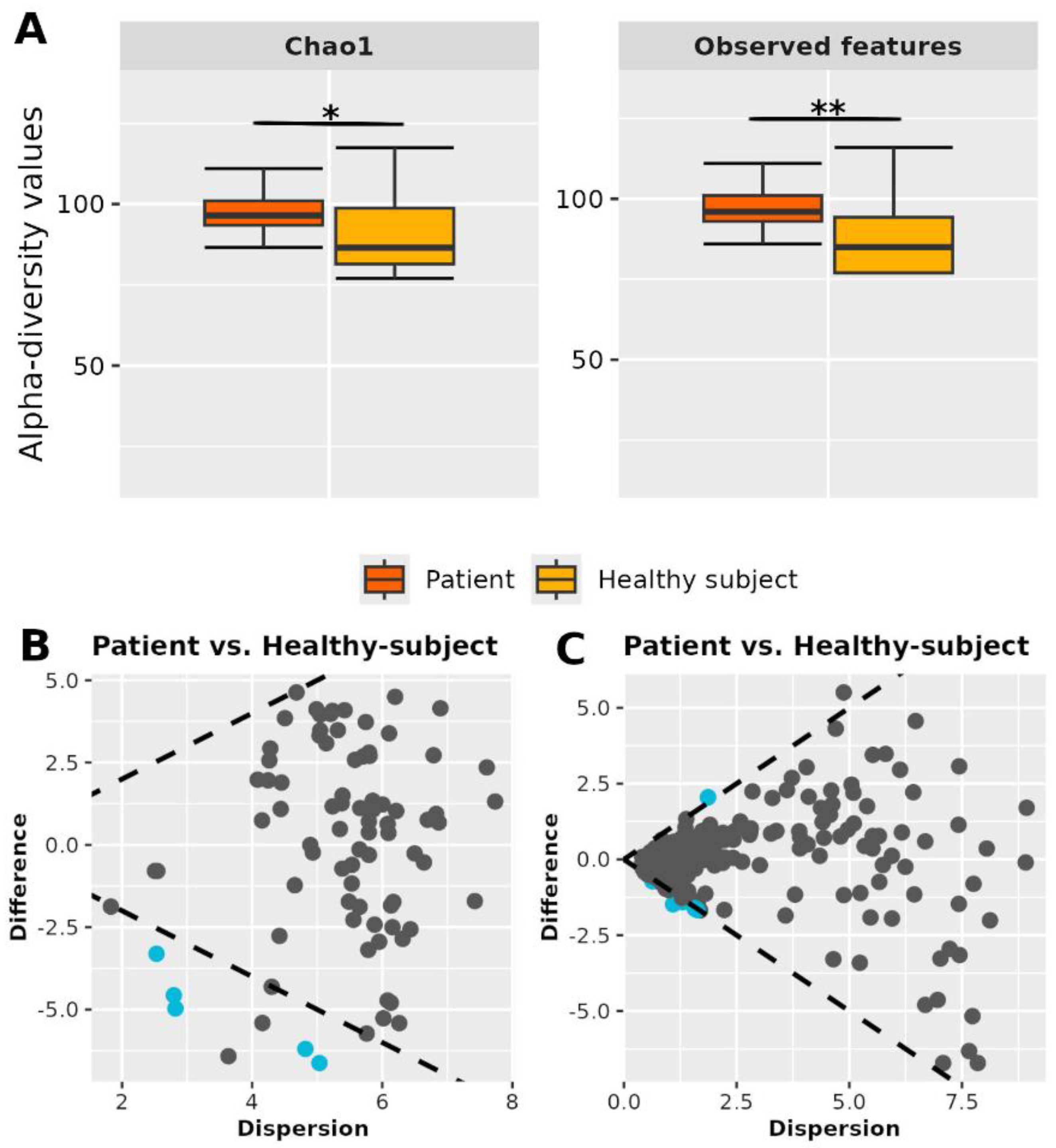
Patients exhibited significantly higher richness in their urine microbiota (Figure 2A). Additionally, statistically significant differences in microbial composition were found between the groups, based on both microbial abundance (Bray–Curtis distance, p < 0.001) and phylogenetic relationships (Weighted UniFrac distance, p < 0.001) (Figure 1B). The urine microbiome of both patients and healthy individuals comprised 85 genera, 72 of which were found in healthy subjects. DAA identified 5 of these bacterial genera being significantly more enriched in patients, namely Delftia (p < 0.0001, ES: −1.34), Sphingobium (p < 0.0001, ES: −1.70), Stenotrophomonas (p < 0.0001, ES: −1.70), Sphingopyxis (p = 0.0004, ES: −1.17), and Parvibaculum (p = 0.001, ES: −1.18) (Figure 2B). Assessment of the functional potential of the urine microbiome revealed the presence of 6 pathways significantly associated with patients, namely ectoine biosynthesis (p < 0.0001, ES: −1.33), 4-aminobutanoate degradation V (p = 0.0006, ES: −1.07), octane oxidation (p = 0.0003, ES: −1.07), vanillin and vanillate degradation I (p = 0.0009, ES: −1.04), superpathway of vanillin and vanillate degradation (p = 0.0008, ES: −1.04) and vanillin and vanillate degradation II (p = 0.0008, ES: −1.01), while Bifidobacterium shunt (p = 0.0003, ES: 1) and heterolactic fermentation (p = 0.0002, ES: −1.02) pathways were significantly associated with healthy subjects (Figure 2C).

3.10. HS-SPME/GC-MS Analysis of the Urine VOM Fraction

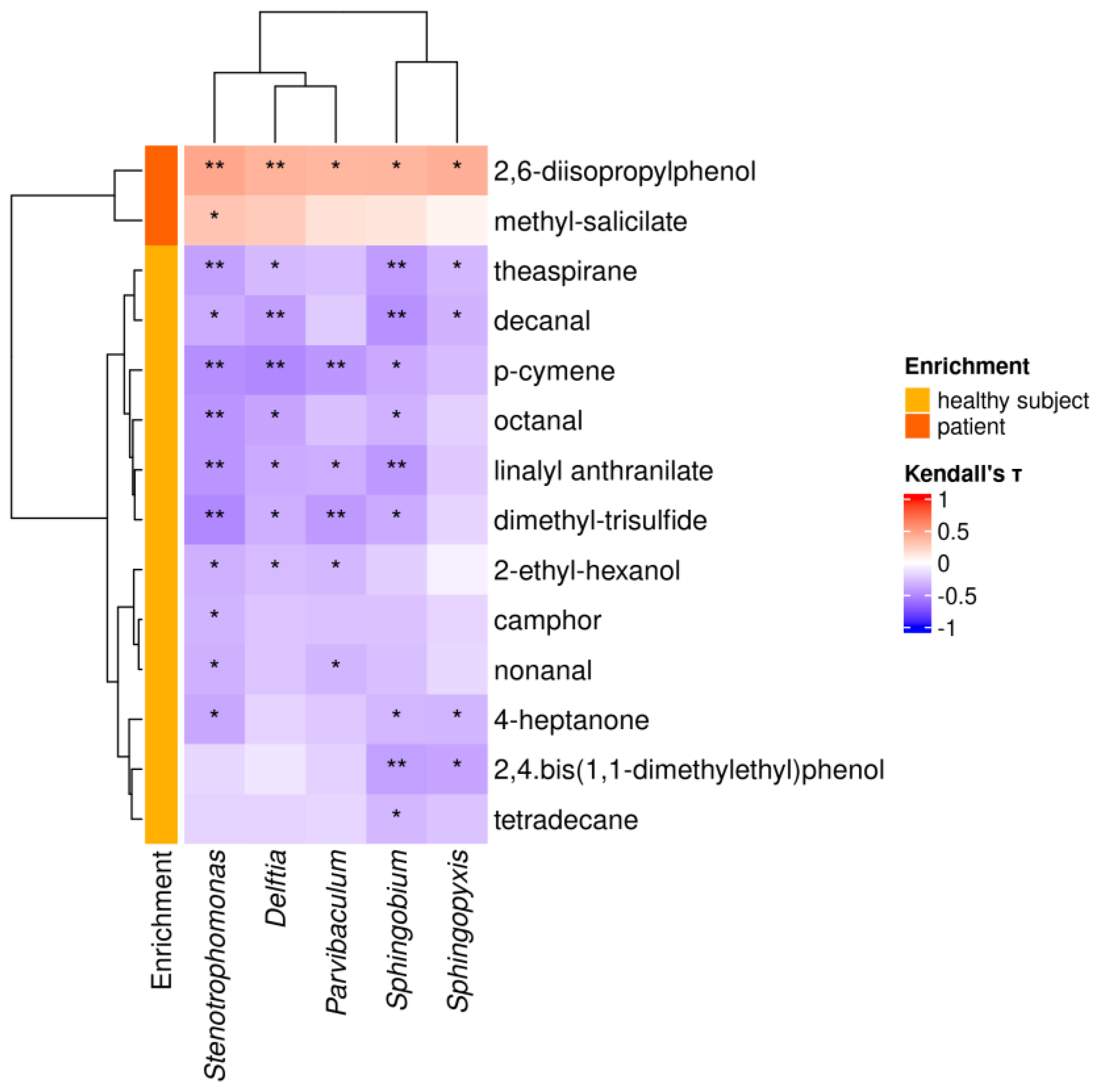
HS-SPME/GC-MS was employed to extract and assess potential biomarkers of PC within the VOM fraction of the collected urine samples. A total of 36 volatile compounds were detected, of which 14 remained differentially enriched after removing column-bleeding peak areas (Table 3). As the enrichment (or depletion) of particular bacterial genera and metabolites turn out to be significantly associated with the urine of PC patients, we sought to evaluate whether the variation in abundance of these two components might be correlated. Statistically significant correlations showing a weak strength (∣τ∣ ∈ [0.3,0.5]) were found between the 5 PC-associated genera and 14 of the differentially enriched metabolites (Figure 3).
Among the PC-associated metabolites, we observed significant positive correlations between 2,6-diisopropylphenol and all 5 PC-associated genera (τ ∈ [0.37,0.45]), while methyl-salicylate showed a significant positive correlation only with Stenotrophomonas (τ = 0.30). Negative correlations were found with the 12 PC-depleted metabolites, where the highest number of significant correlations were found with Stenotrophomonas (τ ∈ [−0.51,−0.32]), Sphingobium (τ ∈ [−0.47,−0.30]) and Delftia genera (τ ∈ [−0.50,−0.30]).

4. Discussion

This study integrated viral, bacterial, and metabolomic profiling of prostate tissue and urine to investigate the genitourinary microenvironment in PC. We initially hypothesized that microbial alterations within prostatic tissue could differ between lesional and non-lesional areas, as suggested in previous reports. However, our findings did not reveal significant differences between malignant and non-malignant regions, with all samples showing a low-biomass microbial profile dominated by Pseudomonas. These observations do not support a major intraprostatic dysbiosis in our cohort and reflect the variability reported across previous tissue-based analyses. Cavarretta et al. showed minimal differences among tumor and adjacent regions [46]; Feng et al. identified no α-diversity changes, with a core microbiome featuring Pseudomonas, Escherichia, Acinetobacter, and Propionibacterium spp., and suggested possible negative correlations between Pseudomonas abundance and metastatic progression [47]. In line with this, Gonçalves et al. observed higher Pseudomonas levels in non-cancerous tissues and linked Cutibacterium and Staphylococcus to aggressiveness [48,49]. Li et al. later described Pseudomonas enrichment in BPH, suggesting a role in progression through NF-κB activation by lipopolysaccharide [50].
Taken together, these negative findings argue against a major tissue-level dysbiosis in our cohort. In addition, the low-biomass nature of prostate tissue increases the risk of environmental or reagent-derived contamination, and genera such as Pseudomonas are known reagent contaminants [51]. For these reasons, we interpreted tissue-derived microbial signals with caution.
In light of the absence of clear tissue-level distinctions in our dataset, we focused subsequent analyses on urinary samples, which exhibited clearer group-level differences and higher microbial richness. Urine, therefore, provided a more informative matrix for detecting both microbial and metabolomic alterations associated with PC, allowing a more meaningful interpretation of potential microbiota–metabolite interactions. The hypothesis that the urinary tract may serve as a primary route for microbial colonization of the prostate led to a comparison between prostatic tissue and catheterized urine microbiota from the same individuals [50,52]. α-diversity analysis indicated lower richness and a more even abundance distribution in the urinary microbiome, whereas significant differences in microbial composition and phylogenetic structure were observed in β-diversity analysis. Ralstonia was significantly more abundant in prostate samples, in contrast to Delftia and Sphingobium found more in urine. These patterns parallel prior findings from Okada and Li et al., who reported clear distinctions between urinary and prostatic microbiota in patients with BPH [50,53]. Our detection of Ralstonia corroborates Yow et al., who identified this genus in high-grade PC [54], and aligns with reports of Ralstonia pickettii prevalence in tumor tissue [55].
In the urinary microbiome, 85 genera were identified with five—Sphingobium, Stenotrophomonas, Sphingopyxis, Parvibaculum, and Delftia—showing increased abundance in PC patients. Gonçalves’s study linked urinary dysbiosis to PC, potentially fostering chronic prostatic inflammation [48]. Urine, being metabolically rich, contains both host and microbial by-products. Shifts in gut microbiota may influence PC through a proposed “gut–prostate axis” [56]. Among enriched taxa, members of the Sphingomonadaceae family—such as Sphingobium and Sphingopyxis—are recognized for thriving in contaminated environments and participating in heavy-metal phytoremediation [57]. Heavy metal exposure has been implicated in prostate disease pathogenesis and shown to alter gut microbiota, whereas probiotics may counteract such dysbiosis [58,59].
While VOM profiles can reflect metabolic activity of both microbial and host origin, their interpretation in small exploratory cohorts should remain cautious [29,60,61,62,63,64]. Findings in this cohort revealed reduced aldehydes in PC patients, alongside a noted correlation between increased aldehyde dehydrogenase activity and tumor progression [65,66]. Other compounds like nonanal and octanal, generated through host or bacterial metabolism or the auto-oxidation of unsaturated fatty acids [67], have been recognized as non-specific inflammatory mediators [68] with pro-inflammatory effects [68,69]. In the literature, Stenotrophomonas maltophilia has been associated with aggressive PC features such as including Gleason score, TNM stage, PSA levels, and androgen receptor expression [70]. In our cohort, however, correlations between this genus and individual metabolites were weak (τ ≈ 0.3–0.5) and should therefore be considered preliminary and hypothesis-generating rather than clinically meaningful. Additionally, urinary 4-heptanone levels were reduced in PC patients, potentially stemming from the decarboxylation of plasticizer-related metabolites [71,72]. Similarly, decreased levels of 2-ethyl-1-hexanol may reflect metabolic alterations but cannot be interpreted as causally linked to tumor biology [73]. P-cymene, a monoterpene found in various foods [61,74] processed by cytochrome P450 enzymes, whose dysregulation in PC could impact its urinary excretion [75], showed lower urinary levels in PC patients, aligning with previously documented research [61]. Although p-cymene displays anti-invasive effects in vitro [76,77], such experimental data cannot be extrapolated to our clinical cohort. In BPH subjects, p-cymene has shown negative correlations with Stenotrophomonas, Parvibaculum, and Delftia. Delftia, enriched in the urine of PC patients in our study cohort, has been linked to cervical intraepithelial neoplasia [78]. D. acidovorans in PC tissue correlated with regulatory T-cell infiltration and downregulation of immune-related genes including LPCAT2, TL3, and TGFB2. These cross-study associations suggest possible immune–microbiota interactions, though the mechanistic relevance for PC remains uncertain [79].
The research also proposed that p-cymene may inhibit tumor development by enhancing the composition of intestinal flora, thus fostering the growth of beneficial probiotics like bifidobacteria, isobacteria, and clostridium IV in the intestinal tract [44,80]. Additionally, a positive association between Bifidobacterium-linked metabolic pathways and healthy urinary microbiota was noted [81,82]. However, these pathways cannot be inferred as protective in our dataset and should be interpreted as preliminary associations only. Of particular interest is the observation that certain viruses may act synergistically, leading to distinct alterations in the enteric bacteriome of immunocompromised individuals infected with these viruses [83].
Our study investigated the prevalence of HPyVs-JCPyV, BKPyV, and MCPyV in PC patients. JCPyV and BKPyV exhibited higher positivity rates and urine viral loads compared to tissues, consistent with their urinary tropism [84,85]. The presence of viral DNAs in urine may suggest a role in prostate carcinogenesis, particularly given that the intraprostatic reflux of infected urine could provoke inflammation, a recognized risk factor for PC [19,24,84,85,86]. Detection in BPH subjects and higher isolation in non-lesional versus lesional samples weakens a direct correlation [84]. However, the absence of viral DNA in lesional samples might be explained by the hypothesized hit-and-run mechanism in which the virus contributes to oncogenic transformation but is no longer detectable in tumor tissues [19,24,84,85]. MCPyV was not highly detected, supporting its limited tropism and lack of involvement in PC [87]. Focusing on HPyVs co-infections, JCPyV and BKPyV were found as the most common combination, consistent with their widespread distribution among the population [88]. Our findings support the renal epithelium as a preferential infection site for JCPyV and BKPyV, rather than MCPyV [87]. Moreover, the isolation of JCPyV and BKPyV in prostatic tissues confirms these viruses as common inhabitants of the prostate and suggests they may represent components of the prostate virome rather than direct oncogenic drivers. Since HPyVs-positivity alone is insufficient to establish a direct link to tumorigenesis, further research is needed to determine whether they are part of the normal prostate virome or contribute to carcinogenesis. This study has several limitations that should be carefully acknowledged. First, the sample size was limited, and no formal power calculation was performed; the study was conceived as an exploratory, pilot investigation, and the number of participants was determined by feasibility within the recruitment period.
Second, prostate tissue is intrinsically low-biomass matrix, increasing susceptibility to environmental or reagent-derived contamination. In this context, the predominance of Pseudomonas should be interpreted cautiously, as this genus is well-recognized contaminant in low-biomass microbiome studies.
Third, dedicated extraction blanks or reagent-only negative controls were not included in the sequencing workflow, limiting the ability to distinguish true prostatic taxa from potential background contaminants. This constraint may partly explain the absence of significant differences between lesional and non-lesional samples.
Fourth, correlations between urinary bacterial genera and volatile metabolites were modest in strength (Kendall τ ≈ 0.3–0.5). These associations should therefore be viewed as preliminary, hypothesis-generating signals rather than evidence of validated biological or clinical relationships.
Finally, the cross-sectional design prevents causal inference, and the multi-omic integration—although informative—should be confirmed in larger, independently replicated cohorts using optimized microbiological controls and high-resolution sequencing before any diagnostic implications can be considered.

5. Conclusions

In-depth research on the microbial community in PC, its intricate ecological interactions, and its influence on the prostate microenvironment is essential to advance prevention, diagnosis, treatment, and patient outcomes. Although no significant differences were observed between lesional and non-lesional tissues in this study, the consistent dominance of Pseudomonas highlights the challenges inherent to low-biomass prostatic samples and underscores the need for cautious interpretation.
In contrast, urinary samples showed clearer group-level differences, with several bacterial genera enriched in PC and associated with specific volatile metabolites. These observations, although not indicative of validated biomarkers, are preliminary and hypothesis-generating, suggesting that urinary microbiota and volatilome may reflect disease-related microbial–metabolic shifts.
Taken together, our findings support the concept that prostate carcinogenesis may involve complex interactions among host factors, microorganisms, and metabolic pathways; however, causality cannot be inferred. Larger, independently replicated studies are required to validate these exploratory signals and determine their potential clinical applications.

Author Contributions

Conceptualization, L.M. (Layla Musleh), S.P., L.M. (Linda Maurizi), G.B., A.F., M.P.C., V.P., M.D.P. and C.L.; methodology, S.P., F.B., L.M. (Linda Maurizi), L.S., C.F., S.F. and M.D.P.; software, F.B.; validation, L.M. (Layla Musleh)., L.M. (Linda Maurizi), M.P.C., V.P., A.S. and C.L.; formal analysis, F.B., C.F. and S.F.; investigation, S.P., G.B., L.S., B.S., M.M., A.S. and C.L.; resources, F.B., G.B., L.S. and M.M.; data curation, L.M. (Layla Musleh), S.P. and F.B.; writing—original draft preparation, B.S., M.M., C.F., A.F., M.D.P. and S.F.; writing—review and editing, L.M. (Layla Musleh), S.P., F.B., L.M. (Linda Maurizi), G.B., M.P.C., V.P., A.S. and C.L.; visualization, L.M. (Layla Musleh), L.M. (Linda Maurizi)., A.F. and M.P.C.; supervision, A.S. and C.L.; project administration, A.S. and C.L.; funding acquisition, C.L. All authors have read and agreed to the published version of the manuscript.

Funding

This research was funded by Ricerca Scientifica 2023 “Sapienza” University of Rome, to C. Longhi (Funding number: RM123188E89E940B).

Institutional Review Board Statement

The study was conducted in accordance with the Declaration of Helsinki and its later amendments. The protocol was approved by the Institutional Review Board of Sapienza University—Policlinico Umberto I (Protocol No. 0309/2023, Approval No. 7084). Enrollment took place from January 2023 to January 2024, and written informed consent was obtained from all participants.

Informed Consent Statement

Informed consent was obtained from all subjects involved in the study.

Data Availability Statement

The raw data supporting the conclusions of this article will be made available by the authors on request.

Conflicts of Interest

The authors declare no conflicts of interest.

Abbreviations

The following abbreviations are used in this manuscript:
BPHbenign prostatic hyperplasia
VOMsvolatile organic metabolites
PCProstate cancer
HPVHuman Papillomavirus
EBVEpstein–Barr virus
HHVshuman herpesviruses
CMVCytomegalovirus
KSHVKaposi’s sarcoma-associated herpesvirus
HPyVsHuman Polyomaviruses
MCPyVMerkel cell polyomavirus
JCPyVJC polyomavirus
BKPyVBK polyomavirus
RPradical prostatectomy
STsexually transmitted
PSAprostate-specific antigen
mpMRImultiparametric magnetic resonance imaging
EAUEuropean Association of Urology
PET-CTpositron emission tomography-computed tomography
RPRobotic-assisted laparoscopic
ISUP International Society of Urological Pathology
PSMAProstate-Specific Membrane Antigen
qPCRQuantitative polymerase chain reaction
LTAgLarge T Antigen
VP1Viral Protein 1
sTAgsmall T antigen
GCgas chromatograph/ chromatography
DAADifferential abundance analysis
EAUrisk classification, tumor staging
ISUPgrade, surgical margins, and biochemical recurrence
OSASObstructive Sleep Apnea Syndrome
COPDChronic Obstructive Pulmonary Disease

References

  1. Prostate Cancer Burden in EU-27. Available online: https://ecis.jrc.ec.europa.eu/sites/default/files/2023-12/prostate_cancer_En-Nov_2021.pdf (accessed on 29 July 2025).
  2. World Cancer Research Fund. Available online: https://www.wcrf.org/cancer-trends/prostate-cancer-statistics (accessed on 1 September 2025).
  3. Cooperberg, M.R.; Carroll, P.R. Trends in Management for Patients With Localized Prostate Cancer, 1990–2013. JAMA 2015, 314, 80–82. [Google Scholar] [CrossRef]
  4. Wang, G.; Zhao, D.; Spring, D.J.; DePinho, R.A. Genetics and Biology of Prostate Cancer. Genes. Dev. 2018, 32, 1105–1140. [Google Scholar] [CrossRef]
  5. Chang, A.J.; Autio, K.A.; Roach, M., 3rd; Scher, H.I. High-Risk Prostate Cancer-Classification and Therapy. Nat. Rev. Clin. Oncol. 2014, 11, 308–323. [Google Scholar] [CrossRef]
  6. Barry, M.J.; Simmons, L.H. Prevention of Prostate Cancer Morbidity and Mortality: Primary Prevention and Early Detection. Med. Clin. N. Am. 2017, 101, 787–806. [Google Scholar] [CrossRef]
  7. Mollica, V.; Rizzo, A.; Massari, F. The Pivotal Role of TMPRSS2 in Coronavirus Disease 2019 and Prostate Cancer. Future Oncol. 2020, 16, 2029–2033. [Google Scholar] [CrossRef]
  8. Shrestha, E.; Coulter, J.B.; Guzman, W.; Ozbek, B.; Hess, M.M.; Mummert, L.; Ernst, S.E.; Maynard, J.P.; Meeker, A.K.; Heaphy, C.M.; et al. Oncogenic Gene Fusions in Nonneoplastic Precursors as Evidence That Bacterial Infection Can Initiate Prostate Cancer. Proc. Natl. Acad. Sci. USA 2021, 118, e2018976118. [Google Scholar] [CrossRef]
  9. Lawson, J.S.; Glenn, W.K. Multiple Pathogens and Prostate Cancer. Infect. Agent. Cancer 2022, 17, 23. [Google Scholar] [CrossRef]
  10. Abumsimir, B.; Almahasneh, I.; Kasmi, Y.; Hammou, R.A.; Ennaji, M.M. Chapter 15—Prostate Cancer and Viral Infections: Epidemiological and Clinical Indications. In Oncogenic Viruses Volume 1: Fundamentals of Oncoviruses 2023; Elsevier: Amsterdam, The Netherlands; pp. 263–272.
  11. Tsydenova, I.A.; Ibragimova, M.K.; Tsyganov, M.M.; Litviakov, N.V. Human Papillomavirus and Prostate Cancer: Systematic Review and Meta-Analysis. Sci. Rep. 2023, 13, 16597. [Google Scholar] [CrossRef]
  12. Liao, H.; Wang, Z.; Qian, Y.; Chen, H.; Shi, Y.; Huang, J.; Guo, X.; Yu, M.; Yu, Y. Unveiling the Impact of Epstein-Barr Virus on the Risk of Prostate Cancer: A Mendelian Randomization Study. Nutr. Cancer 2025, 77, 93–101. [Google Scholar] [CrossRef]
  13. Todorova, E.; Kavrakova, A.; Derimachkovski, G.; Georgieva, B.; Odzhakov, F.; Bachurska, S.; Terziev, I.; Boyadzhieva, M.-E.; Valkov, T.; Popov, E.; et al. Human Herpes Virus Genotype and Immunological Gene Expression Profile in Prostate Cancer with Prominent Inflammation. Int. J. Mol. Sci. 2025, 26, 4945. [Google Scholar] [CrossRef]
  14. Zambrano, A.; Kalantari, M.; Simoneau, A.; Jensen, J.L.; Villarreal, L.P. Detection of Human Polyomaviruses and Papillomaviruses in Prostatic Tissue Reveals the Prostate as a Habitat for Multiple Viral Infections. Prostate 2002, 53, 263–276. [Google Scholar] [CrossRef]
  15. Shen, C.; Tung, C.; Chao, C.; Jou, Y.; Huang, S.; Meng, M.; Chang, D.; Chen, P. The Differential Presence of Human Polyomaviruses, JCPyV and BKPyV, in Prostate Cancer and Benign Prostate Hypertrophy Tissues. BMC Cancer 2021, 21, 1141. [Google Scholar] [CrossRef]
  16. Feng, H.; Shuda, M.; Chang, Y.; Moore, P.S. Clonal Integration of a Polyomavirus in Human Merkel Cell Carcinoma. Science 2008, 319, 1096–1100. [Google Scholar] [CrossRef]
  17. Prado, J.C.M.; Monezi, T.A.; Amorim, A.T.; Lino, V.; Paladino, A.; Boccardo, E. Human Polyomaviruses and Cancer: An Overview. Clinics 2018, 73, e558s. [Google Scholar] [CrossRef]
  18. Anzivino, E.; Rodio, D.M.; Mischitelli, M.; Bellizzi, A.; Sciarra, A.; Salciccia, S.; Gentile, V.; Pietropaolo, V. High Frequency of JCV DNA Detection in Prostate Cancer Tissues. Cancer Genom. Proteom. 2015, 12, 189–200. [Google Scholar]
  19. Delbue, S.; Matei, D.-V.; Carloni, C.; Pecchenini, V.; Carluccio, S.; Villani, S.; Tringali, V.; Brescia, A.; Ferrante, P. Evidence Supporting the Association of Polyomavirus BK Genome with Prostate Cancer. Med. Microbiol. Immunol. 2013, 202, 425–430. [Google Scholar] [CrossRef]
  20. Balis, V.; Sourvinos, G.; Soulitzis, N.; Giannikaki, E.; Sofras, F.; Spandidos, D.A. Prevalence of BK Virus and Human Papillomavirus in Human Prostate Cancer. Int. J. Biol. Markers 2007, 22, 245–251. [Google Scholar] [CrossRef]
  21. Das, D.; Wojno, K.; Imperiale, M.J. BK Virus as a Cofactor in the Etiology of Prostate Cancer in Its Early Stages. J. Virol. 2008, 82, 2705–2714. [Google Scholar] [CrossRef]
  22. Russo, G.; Anzivino, E.; Fioriti, D.; Mischitelli, M.; Bellizzi, A.; Giordano, A.; Autran-Gomez, A.; Di Monaco, F.; Di Silverio, F.; Sale, P.; et al. p53 Gene Mutational Rate, Gleason Score, and BK Virus Infection in Prostate Adenocarcinoma: Is There a Correlation? J. Med. Virol. 2008, 80, 2100–2107. [Google Scholar] [CrossRef]
  23. Csoboz, B.; Rasheed, K.; Sveinbjørnsson, B.; Moens, U. Merkel Cell Polyomavirus and Non-Merkel Cell Carcinomas: Guilty or Circumstantial Evidence? APMIS 2020, 128, 104–120. [Google Scholar] [CrossRef]
  24. Bluemn, E.G.; Paulson, K.G.; Higgins, E.E.; Sun, Y.; Nghiem, P.; Nelson, P.S. Merkel Cell Polyomavirus Is Not Detected in Prostate Cancers, Surrounding Stroma, or Benign Prostate Controls. J. Clin. Virol. 2009, 44, 164–166. [Google Scholar] [CrossRef]
  25. Massari, F.; Mollica, V.; Di Nunno, V.; Gatto, L.; Santoni, M.; Scarpelli, M.; Cimadamore, A.; Lopez-Beltran, A.; Cheng, L.; Battelli, N.; et al. The Human Microbiota and Prostate Cancer: Friend or Foe? Cancers 2019, 11, 459. [Google Scholar] [CrossRef]
  26. Ferreira, R.M.; Pereira-Marques, J.; Pinto-Ribeiro, I.; Costa, J.L.; Carneiro, F.; Machado, J.C.; Figueiredo, C. Gastric Microbial Community Profiling Reveals a Dysbiotic Cancer-Associated Microbiota. Gut 2018, 67, 226–236. [Google Scholar] [CrossRef]
  27. Ocáriz-Díez, M.; Cruellas, M.; Gascón, M.; Lastra, R.; Martínez-Lostao, L.; Ramírez-Labrada, A.; Paño, J.R.; Sesma, A.; Torres, I.; Yubero, A.; et al. Microbiota and Lung Cancer. Opportunities and Challenges for Improving Immunotherapy Efficacy. Front. Oncol. 2020, 10, 568939. [Google Scholar] [CrossRef]
  28. Visconti, A.; Le Roy, C.I.; Rosa, F.; Rossi, N.; Martin, T.C.; Mohney, R.P.; Li, W.; de Rinaldis, E.; Bell, J.T.; Venter, J.C.; et al. Interplay between the Human Gut Microbiome and Host Metabolism. Nat. Commun. 2019, 10, 4505. [Google Scholar] [CrossRef]
  29. Lima, A.R.; Pinto, J.; Amaro, F.; Bastos, M.d.L.; Carvalho, M.; Guedes de Pinho, P. Advances and Perspectives in Prostate Cancer Biomarker Discovery in the Last 5 Years through Tissue and Urine Metabolomics. Metabolites 2021, 11, 181. [Google Scholar] [CrossRef]
  30. Dinges, S.S.; Hohm, A.; Vandergrift, L.A.; Nowak, J.; Habbel, P.; Kaltashov, I.A.; Cheng, L.L. Cancer Metabolomic Markers in Urine: Evidence, Techniques and Recommendations. Nat. Rev. Urol. 2019, 16, 339–362. [Google Scholar] [CrossRef]
  31. Kumar, D.; Nath, K.; Lal, H.; Gupta, A. Noninvasive Urine Metabolomics of Prostate Cancer and Its Therapeutic Approaches: A Current Scenario and Future Perspective. Expert. Rev. Proteom. 2021, 18, 995–1008. [Google Scholar] [CrossRef]
  32. Marchesi, J.R.; Adams, D.H.; Fava, F.; Hermes, G.D.A.; Hirschfield, G.M.; Hold, G.; Quraishi, M.N.; Kinross, J.; Smidt, H.; Tuohy, K.M.; et al. The Gut Microbiota and Host Health: A New Clinical Frontier. Gut 2016, 65, 330–339. [Google Scholar] [CrossRef]
  33. Ding, X.; Li, Q.; Li, P.; Chen, X.; Xiang, L.; Bi, L.; Zhu, J.; Huang, X.; Cui, B.; Zhang, F. Fecal Microbiota Transplantation: A Promising Treatment for Radiation Enteritis? Radiother. Oncol. 2020, 143, 12–18. [Google Scholar] [CrossRef]
  34. van Leenders, G.J.L.H.; van der Kwast, T.H.; Grignon, D.J.; Evans, A.J.; Kristiansen, G.; Kweldam, C.F.; Litjens, G.; McKenney, J.K.; Melamed, J.; Mottet, N.; et al. The 2019 International Society of Urological Pathology (ISUP) Consensus Conference on Grading of Prostatic Carcinoma. Am. J. Surg. Pathol. 2020, 44, e87–e99. [Google Scholar] [CrossRef]
  35. Delbue, S.; Franciotta, D.; Giannella, S.; Dolci, M.; Signorini, L.; Ticozzi, R.; D’Alessandro, S.; Campisciano, G.; Comar, M.; Ferrante, P.; et al. Human Polyomaviruses in the Cerebrospinal Fluid of Neurological Patients. Microorganisms 2019, 8, 16. [Google Scholar] [CrossRef]
  36. Passerini, S.; Babini, G.; Merenda, E.; Carletti, R.; Scribano, D.; Rosa, L.; Conte, A.L.; Moens, U.; Ottolenghi, L.; Romeo, U.; et al. Merkel Cell Polyomavirus in the Context of Oral Squamous Cell Carcinoma and Oral Potentially Malignant Disorders. Biomedicines 2024, 12, 709. [Google Scholar] [CrossRef]
  37. Edgar, R.C. Search and Clustering Orders of Magnitude Faster than BLAST. Bioinformatics 2010, 26, 2460–2461. [Google Scholar] [CrossRef]
  38. Martin, M. Cutadapt Removes Adapter Sequences from High-Throughput Sequencing Reads. EMBnet J. 2011, 17, 10–12. [Google Scholar] [CrossRef]
  39. Bolger, A.M.; Lohse, M.; Usadel, B. Trimmomatic: A flexible trimmer for Illumina sequence data. Bioinformatics 2014, 30, 2114–2120. [Google Scholar] [CrossRef]
  40. Bolyen, E.; Rideout, J.R.; Dillon, M.R.; Bokulich, N.A.; Abnet, C.C.; Al-Ghalith, G.A.; Alexander, H.; Alm, E.J.; Arumugam, M.; Asnicar, F.; et al. Reproducible, Interactive, Scalable and Extensible Microbiome Data Science Using QIIME 2. Nat. Biotechnol. 2019, 37, 852–857. [Google Scholar] [CrossRef]
  41. Callahan, B.J.; McMurdie, P.J.; Rosen, M.J.; Han, A.W.; Johnson, A.J.A.; Holmes, S.P. DADA2: High-Resolution Sample Inference from Illumina Amplicon Data. Nat. Methods 2016, 13, 581–583. [Google Scholar] [CrossRef]
  42. Douglas, G.M.; Maffei, V.J.; Zaneveld, J.R.; Yurgel, S.N.; Brown, J.R.; Taylor, C.M.; Huttenhower, C.; Langille, M.G.I. PICRUSt2 for Prediction of Metagenome Functions. Nat. Biotechnol. 2020, 38, 685–688. [Google Scholar] [CrossRef]
  43. Monteiro, M.; Carvalho, M.; Henrique, R.; Jerónimo, C.; Moreira, N.; de Lourdes Bastos, M.; de Pinho, P.G. Analysis of Volatile Human Urinary Metabolome by Solid-Phase Microextraction in Combination with Gas Chromatography-Mass Spectrometry for Biomarker Discovery: Application in a Pilot Study to Discriminate Patients with Renal Cell Carcinoma. Eur. J. Cancer 2014, 50, 1993–2002. [Google Scholar] [CrossRef]
  44. Tautenhahn, R.; Patti, G.J.; Rinehart, D.; Siuzdak, G. XCMS Online: A Web-Based Platform to Process Untargeted Metabolomic Data. Anal. Chem. 2012, 84, 5035–5039. [Google Scholar] [CrossRef]
  45. ALDEx2. Available online: http://bioconductor.org/packages/ALDEx2/ (accessed on 4 September 2025).
  46. Cavarretta, I.; Ferrarese, R.; Cazzaniga, W.; Saita, D.; Lucianò, R.; Ceresola, E.R.; Locatelli, I.; Visconti, L.; Lavorgna, G.; Briganti, A.; et al. The Microbiome of the Prostate Tumor Microenvironment. Eur. Urol. 2017, 72, 625–631. [Google Scholar] [CrossRef]
  47. Feng, Y.; Ramnarine, V.R.; Bell, R.; Volik, S.; Davicioni, E.; Hayes, V.M.; Ren, S.; Collins, C.C. Metagenomic and Metatranscriptomic Analysis of Human Prostate Microbiota from Patients with Prostate Cancer. BMC Genom. 2019, 20, 146. [Google Scholar] [CrossRef] [PubMed]
  48. Gonçalves, M.F.M.; Pina-Vaz, T.; Fernandes, Â.R.; Miranda, I.M.; Silva, C.M.; Rodrigues, A.G.; Lisboa, C. Microbiota of Urine, Glans and Prostate Biopsies in Patients with Prostate Cancer Reveals a Dysbiosis in the Genitourinary System. Cancers 2023, 15, 1423. [Google Scholar] [CrossRef] [PubMed]
  49. D’Antonio, D.L.; Marchetti, S.; Pignatelli, P.; Piattelli, A.; Curia, M.C. The Oncobiome in Gastroenteric and Genitourinary Cancers. Int. J. Mol. Sci. 2022, 23, 9664. [Google Scholar] [CrossRef] [PubMed]
  50. Li, J.; Li, Y.; Zhou, L.; Li, H.; Wan, T.; Tang, J.; Zhou, L.; Xie, H.; Wang, L. Microbiome Analysis Reveals the Inducing Effect of on Prostatic Hyperplasia via Activating NF-κB Signalling. Virulence 2024, 15, 2313410. [Google Scholar] [CrossRef]
  51. Weyrich, L.S.; Farrer, A.G.; Eisenhofer, R.; Arriola, L.A.; Young, J.; Selway, C.A.; Handsley-Davis, M.; Adler, C.J.; Breen, J.; Cooper, A. Laboratory contamination over time during low-biomass sample analysis. Mol. Ecol. Resour. 2019, 19, 982–996. [Google Scholar] [CrossRef]
  52. Katongole, P.; Sande, O.J.; Joloba, M.; Reynolds, S.J.; Niyonzima, N. The Human Microbiome and Its Link in Prostate Cancer Risk and Pathogenesis. Infect. Agent. Cancer 2020, 15, 53. [Google Scholar] [CrossRef]
  53. Okada, K.; Takezawa, K.; Tsujimura, G.; Imanaka, T.; Kuribayashi, S.; Ueda, N.; Hatano, K.; Fukuhara, S.; Kiuchi, H.; Fujita, K.; et al. Localization and Potential Role of Prostate Microbiota. Front. Cell Infect. Microbiol. 2022, 12, 1048319. [Google Scholar] [CrossRef]
  54. Yow, M.A.; Tabrizi, S.N.; Severi, G.; Bolton, D.M.; Pedersen, J.; Australian Prostate Cancer BioResource; Giles, G.G.; Southey, M.C. Characterisation of Microbial Communities within Aggressive Prostate Cancer Tissues. Infect. Agent. Cancer 2017, 12, 4. [Google Scholar] [CrossRef]
  55. Higuchi, R.; Goto, T.; Hirotsu, Y.; Otake, S.; Oyama, T.; Amemiya, K.; Mochizuki, H.; Omata, M. Streptococcus australis and Ralstonia pickettii as Major Microbiota in Mesotheliomas. J. Pers. Med. 2021, 11, 297. [Google Scholar] [CrossRef]
  56. Fujita, K.; Matsushita, M.; De Velasco, M.A.; Hatano, K.; Minami, T.; Nonomura, N.; Uemura, H. The Gut-Prostate Axis: A New Perspective of Prostate Cancer Biology through the Gut Microbiome. Cancers 2023, 15, 1375. [Google Scholar] [CrossRef]
  57. Gatheru Waigi, M.; Sun, K.; Gao, Y. Sphingomonads in Microbe-Assisted Phytoremediation: Tackling Soil Pollution. Trends Biotechnol. 2017, 35, 883–899. [Google Scholar] [CrossRef] [PubMed]
  58. Coradduzza, D.; Sanna, A.; Di Lorenzo, B.; Congiargiu, A.; Marra, S.; Cossu, M.; Tedde, A.; De Miglio, M.R.; Zinellu, A.; Mangoni, A.A.; et al. Associations between Plasma and Urinary Heavy Metal Concentrations and the Risk of Prostate Cancer. Sci. Rep. 2025, 15, 14274. [Google Scholar] [CrossRef] [PubMed]
  59. Anchidin-Norocel, L.; Iatcu, O.C.; Lobiuc, A.; Covasa, M. Heavy Metal-Gut Microbiota Interactions: Probiotics Modulation and Biosensors Detection. Biosensors 2025, 15, 188. [Google Scholar] [CrossRef] [PubMed]
  60. Khalid, T.; Aggio, R.; White, P.; De Lacy Costello, B.; Persad, R.; Al-Kateb, H.; Jones, P.; Probert, C.S.; Ratcliffe, N. Urinary Volatile Organic Compounds for the Detection of Prostate Cancer. PLoS ONE 2015, 10, e0143283. [Google Scholar] [CrossRef]
  61. Riccio, G.; Berenguer, C.V.; Perestrelo, R.; Pereira, F.; Berenguer, P.; Ornelas, C.P.; Sousa, A.C.; Vital, J.A.; Pinto, M.D.C.; Pereira, J.A.M.; et al. Differences in the Volatilomic Urinary Biosignature of Prostate Cancer Patients as a Feasibility Study for the Detection of Potential Biomarkers. Curr. Oncol. 2023, 30, 4904–4921. [Google Scholar] [CrossRef]
  62. Dawson, J.; Green, K.; Lazarowicz, H.; Cornford, P.; Probert, C. Analysis of Urinary Volatile Organic Compounds for Prostate Cancer Diagnosis: A Systematic Review. BJUI Compass 2024, 5, 822–833. [Google Scholar] [CrossRef]
  63. Lima, A.R.; Pinto, J.; Azevedo, A.I.; Barros-Silva, D.; Jerónimo, C.; Henrique, R.; de Lourdes Bastos, M.; Guedes de Pinho, P.; Carvalho, M. Identification of a Biomarker Panel for Improvement of Prostate Cancer Diagnosis by Volatile Metabolic Profiling of Urine. Br. J. Cancer 2019, 121, 857–868. [Google Scholar] [CrossRef]
  64. Berenguer, C.V.; Pereira, F.; Pereira, J.A.M.; Câmara, J.S. Volatilomics: An Emerging and Promising Avenue for the Detection of Potential Prostate Cancer Biomarkers. Cancers 2022, 14, 3982. [Google Scholar] [CrossRef]
  65. Yan, J.; De Melo, J.; Cutz, J.-C.; Aziz, T.; Tang, D. Aldehyde Dehydrogenase 3A1 Associates with Prostate Tumorigenesis. Br. J. Cancer 2014, 110, 2593–2603. [Google Scholar] [CrossRef] [PubMed]
  66. Xia, J.; Li, S.; Liu, S.; Zhang, L. Aldehyde Dehydrogenase in Solid Tumors and Other Diseases: Potential Biomarkers and Therapeutic Targets. MedComm 2023, 4, e195. [Google Scholar] [CrossRef] [PubMed]
  67. Tomono, S.; Miyoshi, N.; Ohshima, H. Comprehensive Analysis of the Lipophilic Reactive Carbonyls Present in Biological Specimens by LC/ESI-MS/MS. J. Chromatogr. B Analyt Technol. Biomed. Life Sci. 2015, 988, 149–156. [Google Scholar] [CrossRef]
  68. Goertzen, A.; Kidane, B.; Ahmed, N.; Aliani, M. Potential Urinary Volatile Organic Compounds as Screening Markers in Cancer—A Review. Front. Oncol. 2024, 14, 1448760. [Google Scholar] [CrossRef]
  69. Lee, H.S.; Yoon, J.-S.; Song, M.; Shin, C.-Y.; Chung, H.S.; Ryu, J.-C. Gene Expression Profiling of Low Dose Exposure of Saturated Aliphatic Aldehydes in A549 Human Alveolar Epithelial Cells. Toxicol. Environ. Health Sci. 2012, 4, 211–217. [Google Scholar] [CrossRef]
  70. Garbas, K.; Zapała, P.; Zapała, Ł.; Radziszewski, P. The Role of Microbial Factors in Prostate Cancer Development-An Up-to-Date Review. J. Clin. Med. 2021, 10, 4772. [Google Scholar] [CrossRef]
  71. Janfaza, S.; Khorsand, B.; Nikkhah, M.; Zahiri, J. Digging Deeper into Volatile Organic Compounds Associated with Cancer. Biol. Methods Protoc. 2019, 4, bpz014. [Google Scholar] [CrossRef]
  72. Riccio, G.; Baroni, S.; Urbani, A.; Greco, V. Mapping of Urinary Volatile Organic Compounds by a Rapid Analytical Method Using Gas Chromatography Coupled to Ion Mobility Spectrometry (GC-IMS). Metabolites 2022, 12, 1072. [Google Scholar] [CrossRef]
  73. Liu, Q.; Fan, Y.; Zeng, S.; Zhao, Y.; Yu, L.; Zhao, L.; Gao, J.; Zhang, X.; Zhang, Y. Volatile Organic Compounds for Early Detection of Prostate Cancer from Urine. Heliyon 2023, 9, e16686. [Google Scholar] [CrossRef]
  74. Balahbib, A.; El Omari, N.; Hachlafi, N.E.; Lakhdar, F.; El Menyiy, N.; Salhi, N.; Mrabti, H.N.; Bakrim, S.; Zengin, G.; Bouyahya, A. Health Beneficial and Pharmacological Properties of P-Cymene. Food Chem. Toxicol. 2021, 153, 112259. [Google Scholar] [CrossRef]
  75. Tokizane, T.; Shiina, H.; Igawa, M.; Enokida, H.; Urakami, S.; Kawakami, T.; Ogishima, T.; Okino, S.T.; Li, L.-C.; Tanaka, Y.; et al. Cytochrome P450 1B1 Is Overexpressed and Regulated by Hypomethylation in Prostate Cancer. Clin. Cancer Res. 2005, 11, 5793–5801. [Google Scholar] [CrossRef]
  76. Aarnoutse, R.; Ziemons, J.; Penders, J.; Rensen, S.S.; de Vos-Geelen, J.; Smidt, M.L. The Clinical Link between Human Intestinal Microbiota and Systemic Cancer Therapy. Int. J. Mol. Sci. 2019, 20, 4145. [Google Scholar] [CrossRef] [PubMed]
  77. Zhu, S.; He, J.; Yin, L.; Zhou, J.; Lian, J.; Ren, Y.; Zhang, X.; Yuan, J.; Wang, G.; Li, X. Matrix Metalloproteinases Targeting in Prostate Cancer. Urol. Oncol. 2024, 42, 275–287. [Google Scholar] [CrossRef] [PubMed]
  78. Wu, M.; Gao, J.; Wu, Y.; Li, Y.; Chen, Y.; Zhao, F.; Li, C.; Ying, C. Characterization of Vaginal Microbiota in Chinese Women with Cervical Squamous Intra-Epithelial Neoplasia. Int. J. Gynecol. Cancer 2020, 30, 1500–1504. [Google Scholar] [CrossRef] [PubMed]
  79. Ma, J.; Gnanasekar, A.; Lee, A.; Li, W.T.; Haas, M.; Wang-Rodriguez, J.; Chang, E.Y.; Rajasekaran, M.; Ongkeko, W.M. Influence of Intratumor Microbiome on Clinical Outcome and Immune Processes in Prostate Cancer. Cancers 2020, 12, 2524. [Google Scholar] [CrossRef]
  80. Jin, H.; Leng, Q.; Zhang, C.; Zhu, Y.; Wang, J. P-Cymene Prevent High-Fat Diet-Associated Colorectal Cancer by Improving the Structure of Intestinal Flora. J. Cancer 2021, 12, 4355–4361. [Google Scholar] [CrossRef]
  81. Pessione, E. Lactic Acid Bacteria Contribution to Gut Microbiota Complexity: Lights and Shadows. Front. Cell Infect. Microbiol. 2012, 2, 86. [Google Scholar] [CrossRef]
  82. O’Callaghan, A.; van Sinderen, D. Bifidobacteria and Their Role as Members of the Human Gut Microbiota. Front. Microbiol. 2016, 7, 925. [Google Scholar] [CrossRef]
  83. Stern, J.; Miller, G.; Li, X.; Saxena, D. Virome and Bacteriome: Two Sides of the Same Coin. Curr. Opin. Virol. 2019, 37, 37–43. [Google Scholar] [CrossRef]
  84. Bergh, J.; Marklund, I.; Gustavsson, C.; Wiklund, F.; Grönberg, H.; Allard, A.; Alexeyev, O.; Elgh, F. No Link between Viral Findings in the Prostate and Subsequent Cancer Development. Br. J. Cancer 2007, 96, 137–139. [Google Scholar] [CrossRef]
  85. Demey, B.; Aubry, A.; Descamps, V.; Morel, V.; Le, M.H.H.; Presne, C.; Brazier, F.; Helle, F.; Brochot, E. Molecular Epidemiology and Risk Factors Associated with BK and JC Polyomavirus Urinary Shedding after Kidney Allograft. J. Med. Virol. 2024, 96, e29742. [Google Scholar] [CrossRef]
  86. Safwat, A.S.; Hasanain, A.; Shahat, A.; AbdelRazek, M.; Orabi, H.; Abdul Hamid, S.K.; Nafee, A.; Bakkar, S.; Sayed, M. Cholecalciferol for the Prophylaxis against Recurrent Urinary Tract Infection among Patients with Benign Prostatic Hyperplasia: A Randomized, Comparative Study. World J. Urol. 2019, 37, 1347–1352. [Google Scholar] [CrossRef]
  87. Ciotti, M.; Prezioso, C.; Pietropaolo, V. An Overview on Human Polyomaviruses Biology and Related Diseases. Future Virol. 2019, 14, 487–501. [Google Scholar] [CrossRef]
  88. Kamminga, S. Polyomaviruses in Blood Donors: Detection, Prevalence and Blood Safety. Ph.D. Thesis, University of Amsterdam, Amsterdam, The Netherlands, 2022. [Google Scholar]
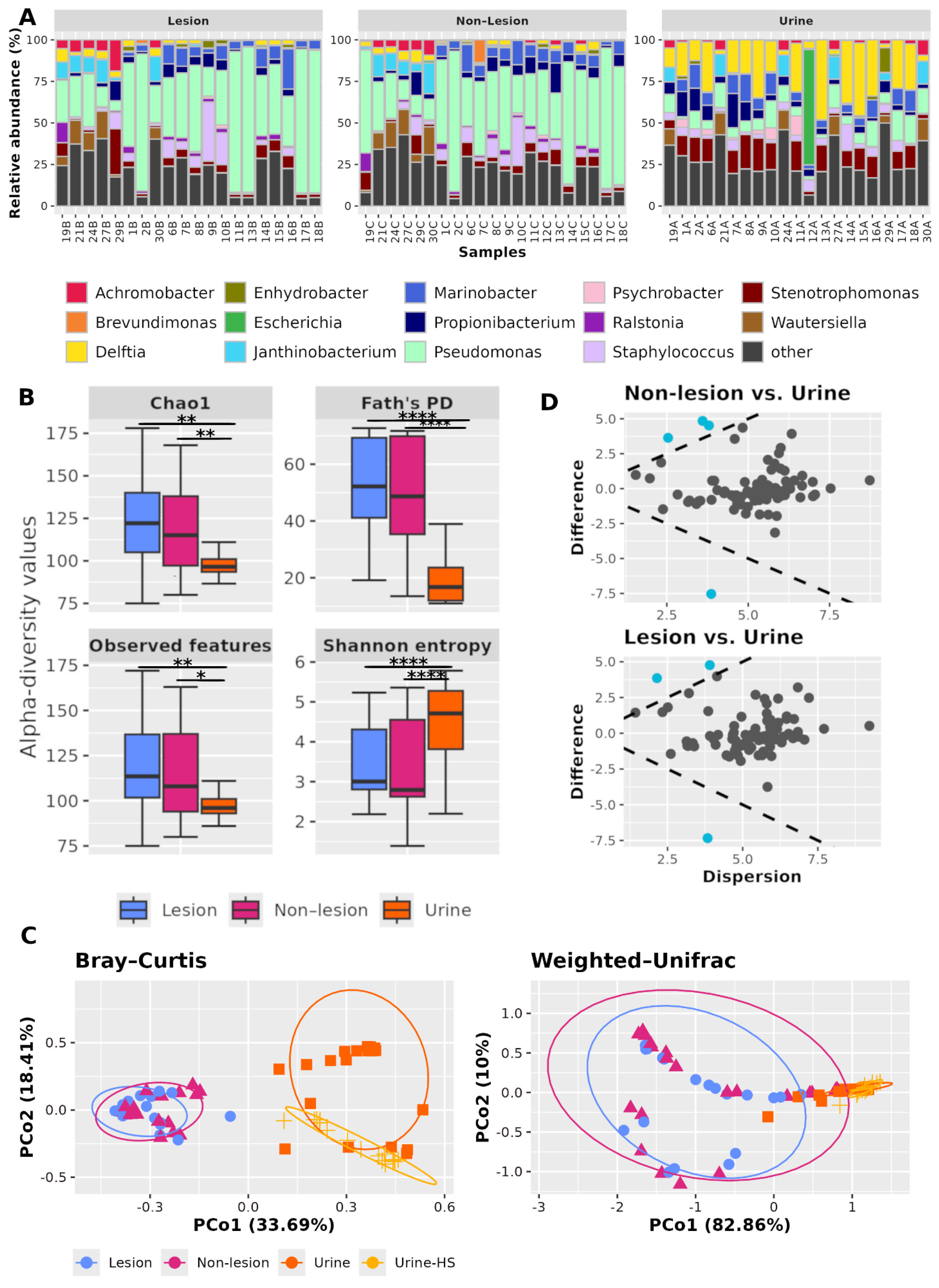
Figure 1. Comparisons between prostate and urine microbiota. (A) Microbial composition of prostate and urine microbiome in patients. Genus accounting for <10% in all groups was aggregated and labeled as “other”. (B) α-diversity boxplots, where asterisks indicate p significance. (C) β-diversity PCoA, where each sample for this study corresponds to a single dot. The percentage of total variance explained by the principal coordinates is reported on both axes. (D) DAA effect plot. Each dot represents one of the 85 bacterial genera, displaying on the x-axis its median difference in pairwise comparisons between groups (difference) and on the y-axis the maximum within-group variance (dispersion). Difference > 0 means that the genus is more abundant in urine samples than in the prostate. Blue dots represent the differentially enriched genera (p < 0.05 and ES > |1|). Notation: lesion: prostate sample from lesional areas; non-lesion: prostate sample from non-lesional areas; Urine: urine sample from patients; Urine-HS: urine sample from BPH subjects; *: p < 0.05; **: p < 0.01; ****: p < 0.0001.
Cancers 17 03841 g001
Figure 2. Urine sample comparisons between patients and healthy subjects. (A) α-diversity boxplot where the asterisk denotes p-value significance. (B,C) Effect plot representing the DAA (B) and functional analysis (C) results. Each dot represents a single genus or pathway, displaying on the x-axis its median difference in pairwise comparisons between groups (difference) and on the y-axis the maximum within-group variance (dispersion). Difference > 0 means that the genus or the pathway is more enriched in patients. Blue dots represent the differentially enriched genera or pathways (p < 0.05 and ES > |1|). Notation: *: p < 0.05; **: p < 0.01.
Cancers 17 03841 g002
Figure 3. Genus–metabolite correlation analysis. Heatmap reporting correlations between the abundance of differentially enriched genera and metabolites in urine. Asterisks indicate statistically significant correlations. Dendrograms were generated using the Ward’s D2 hierarchical clustering method. Notation: *: p < 0.05; **: p < 0.01.
Cancers 17 03841 g003
Table 1. Clinical and pathological characteristics of the study population. (A) Clinical comparison between patients with histologically confirmed PC (n = 21) and individuals with BPH (n = 17). Continuous variables are expressed as mean ± standard deviation (SD), with median and range when appropriate. Categorical variables are reported as counts and percentages. Statistical comparisons were performed using Mann–Whitney U test for continuous variables and the chi-square test for categorical variables. (B) Pathological characteristics of the prostate cancer group, including EAU risk classification, tumor staging, ISUP grade, surgical margins, and biochemical recurrence. PC: Prostate Cancer; BPH: Benign Prostatic Hyperplasia; OSAS: Obstructive Sleep Apnea Syndrome; COPD: Chronic Obstructive Pulmonary Disease; PSA: Prostate-Specific Antigen; EAU: European Association of Urology; ISUP: International Society of Urological Pathology; R0: negative surgical margins; R1: positive surgical margins. * Statistically significant (p < 0.05).
A. Clinical Comparison Between PC Patients and BPH Controls
CharacteristicPC Group (n = 21)BPH Group (n = 17)p-Value
Age (years)65.50 ± 5.98 (67.0; 55–73)64.70 ± 4.25 (64.0; 55–72)0.6334
Weight (kg)81.70 ± 16.18 (80.0; 65–110)84.30 ± 12.35 (82.0; 75–110)0.5779
Height (m)1.74 ± 0.06 (1.73; 1.65–1.86)1.76 ± 0.05 (1.74; 1.68–1.85)0.2699
BMI (kg/m2)26.90 ± 4.56 (26.64; 21.95–40.47)26.30 ± 3.84 (26.40; 21.45–40.25)0.6624
Smoking statusYes: 5 (23.8%)
No: 12 (57.1%)
Ex-smoker: 4 (19.1%)
Yes: 4 (23.5%)
No: 10 (58.8%)
Ex-smoker: 3 (17.6%)
0.9926
Family history of PCYes: 3 (14.3%)
No: 18 (85.7%)
Yes: 2 (11.8%)
No: 15 (88.2%)
0.8192
Family history of other cancersYes: 10 (47.6%)
No: 11 (52.4%)
Yes: 8 (47.0%)
No: 9 (53.0%)
0.9726
ComorbiditiesHypertension: 16 (76.2%)
Dyslipidemia: 5 (23.8%)
Diabetes mellitus II: 1 (4.8%)
OSAS: 1 (4.8%)
COPD: 1 (4.8%)
Allergic asthma: 2 (9.5%)
Hypertension:15 (88.2%)
Dyslipidemia: 4 (23.5%)
Diabetes mellitus II: 4 (23.5%)
OSAS: 0 (0%)
COPD: 0 (0%)
Allergic asthma: 0 (0%)
0.3409
0.9839
0.0888
0.3619
0.3619
0.1911
Prostate volume (cc)52.23 ± 24.20 (51.0;: 18.4–113.0)77.42 ± 21.35 (80.0; 55.0–120.0)0.0016 *
Total PSA (ng/mL)8.10 ± 4.32 (6.80; 3.8–17.0)4.24 ± 3.12 (4.80; 2.70–8.0.)0.0029 *
B. Pathological characteristics of PC group
CharacteristicDistribution (n = 21)
EAU Risk ClassificationLow: 3 (14.3%)
Intermediate: 17 (80.9%)
High: 1 (4.8%)
Pathologic stagepT2: 12 (57.1%)
pT3a: 8 (38.1%)
pT3b: 1 (4.8%)
ISUP Grade (at surgery)Grade 1: 3 (14.3%)
Grade 2: 14 (66.7%)
Grade 3: 4 (19.0%)
Grade 4: 0 (0%)
Surgical marginsNegative (R0): 14 (66.7%)
Positive (R1): 7 (33.3%)
Biochemical progressionNo: 18 (85.7%)—PSA: 0.03 ± 0.01 (0.04; 0.01–0.05)
Yes: 3 (14.3%)—PSA: 0.47 ± 0.12 (0.5; 0.4–0.6)
Table 2. HPyVs median viral load in urine, non-lesional and lesional samples in prostate cancer patients. n: number of patients.
UrineNon-Lesional SamplesLesional Samples
n (%)Viral Load (Copies/mL), Median (CI 95%)n (%)Viral Load (Copies/mL), Median (CI 95%)n (%)Viral Load (Copies/mL), Median (CI 95%)
JCPyV13/21 (61.9%)8.7 × 10⁶ (2.25 × 10⁵–1.5 × 10⁶)4/21 (19%)1.38 × 10³ (1.4 × 10²–3.5 × 10³)2/21 (9.5%)4.65 × 10² (2.5 × 10²–6.8 × 10²)
BKPyV12/21 (57.1%)1.33 × 10⁵ (3.2 × 10⁴–2.4 × 10⁵)7/21 (33.3%)1.2 × 10² (9 × 10–2 × 102)2/21 (9.5%)8.5 × 10 (8 × 10–9 × 10)
MCPyV--1/21 (4.8%)1 × 10²²/21 (9.5%)1.16 × 10² (1.1 × 10²–1.2 × 10²)
Table 3. List of VOMs significantly discriminating between the PC and the control group.
Metabolite TagIUPAC or Common NameClassEnrichment in PC Patients ap-Value
12,6-diisopropylphenolAlcohol<0.0001
4methyl-salicylateOther<0.0001
27octanalAldehyde<0.0001
34p-cymeneTerpene<0.0001
31decanalAldehyde0.0003
22camphorc-Ketone0.0004
9nonanalAldehyde0.001
102,4.bis(1,1-dimethylethyl)phenolAlcohol0.001
64-heptanoneKetone0.002
21theaspiraneTetrahydrofurane0.002
182-ethyl-hexanolAlcohol0.012
33dimethyl-trisulfideSulfide0.031
20tetradecaneAlkane0.034
39pentadecaneAlkane0.037
a The symbols ↑ and ↓ denote higher and lower concentration, respectively, of the specified metabolite in PC patients compared to the control group.
Disclaimer/Publisher’s Note: The statements, opinions and data contained in all publications are solely those of the individual author(s) and contributor(s) and not of MDPI and/or the editor(s). MDPI and/or the editor(s) disclaim responsibility for any injury to people or property resulting from any ideas, methods, instructions or products referred to in the content.