No Correlation Between Proteinuria and Renal Function in Patients with Unresectable Hepatocellular Carcinoma Treated with Atezolizumab Plus Bevacizumab: ARISE Study †


 ,
,  , ,
, ,  ,
, 
Simple Summary
Abstract
1. Introduction
2. Materials and Methods
2.1. Study Design and Patients
2.2. Endpoints and Data Collection
2.3. Statistical Analyses
3. Results
3.1. Patients
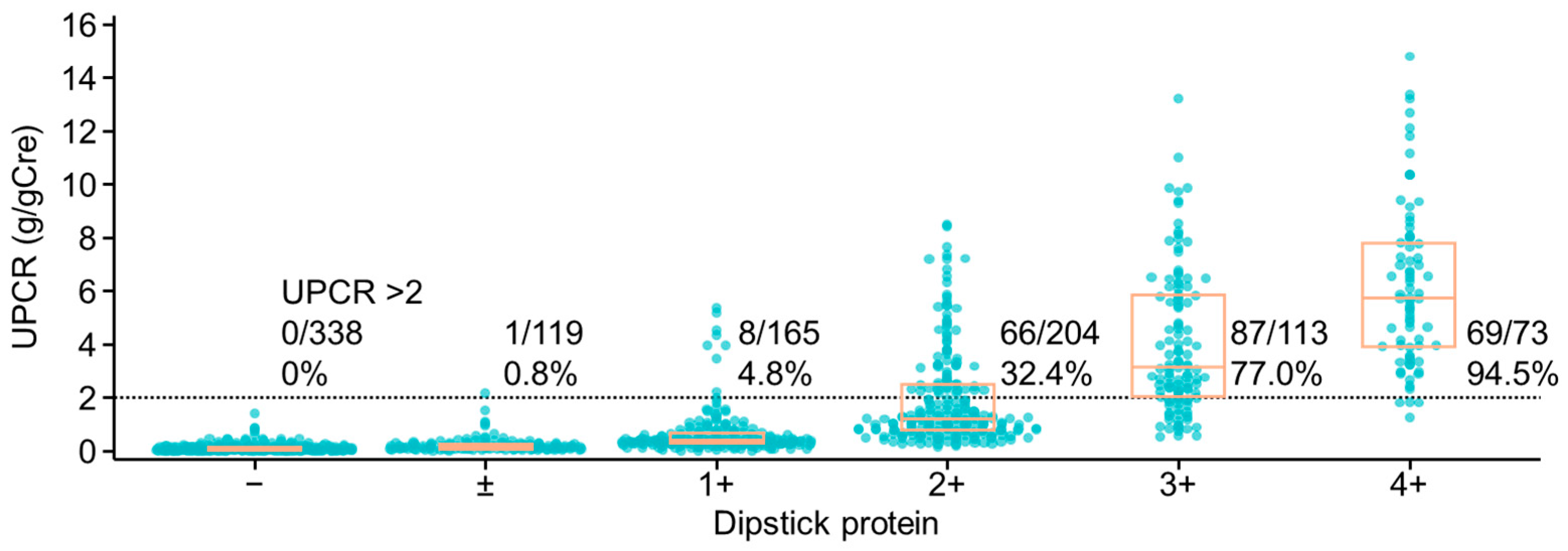
3.2. Correlation Between UPCR and Urine Dipstick Test
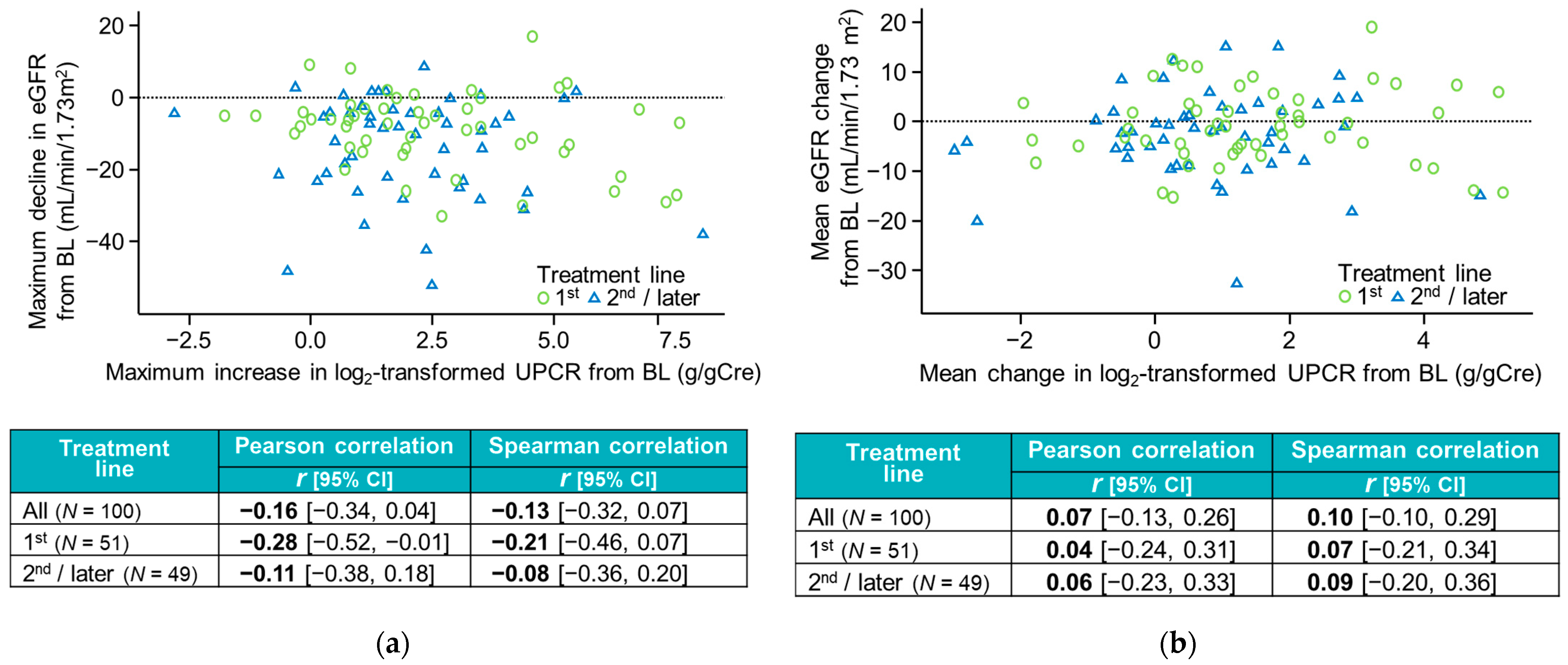
3.3. Correlation Between Changes in UPCR and eGFR from Baseline
3.4. Risk Factors for the Decline in Renal Function
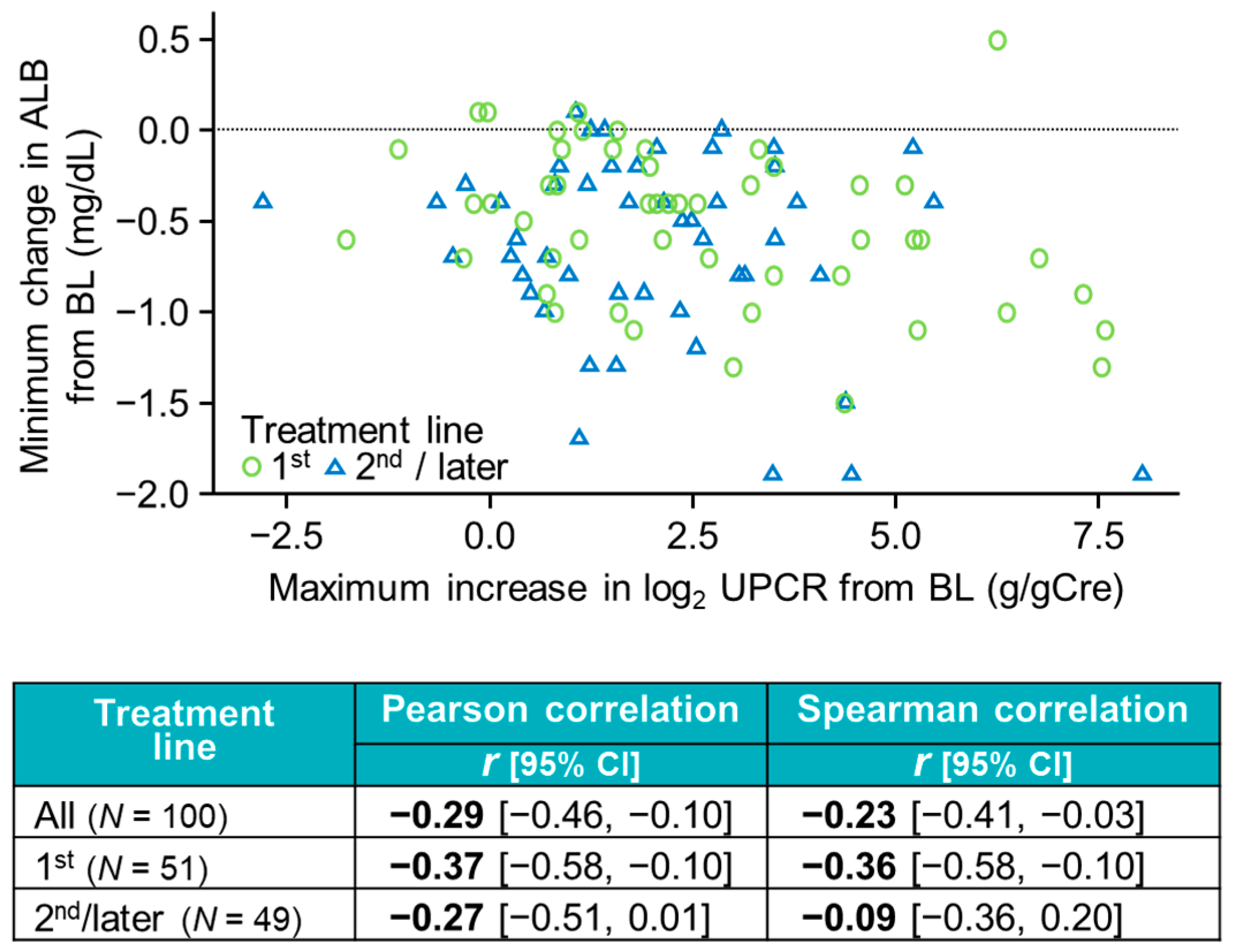
3.5. Correlation Between Changes in UPCR and Serum Albumin Levels from Baseline
3.6. Exploratory Analysis of the Association Between Renal Function Decline and OS
3.7. Risk Factors for Hypoalbuminemia
4. Discussion
Limitations
5. Conclusions
Supplementary Materials
Author Contributions
Funding
Institutional Review Board Statement
Informed Consent Statement
Data Availability Statement
Acknowledgments
Conflicts of Interest
Abbreviations
| AE | adverse event |
| ALBI | albumin-bilirubin |
| Atezo | atezolizumab |
| BCLC | Barcelona Clinic Liver Cancer |
| Bev | bevacizumab |
| BUN | blood urea nitrogen |
| CI | confidence interval |
| Cre | creatinine |
| ECOG PS | Eastern Cooperative Oncology Group performance status |
| EGD | esophagogastroduodenoscopy |
| eGFR | estimated glomerular filtration rate |
| HCC | hepatocellular carcinoma |
| HR | hazard ratio |
| ICI | immune checkpoint inhibitor |
| OR | odds ratio |
| OS | overall survival |
| PD-L1 | programmed cell death ligand-1 |
| TACE | transcatheter arterial chemoembolization |
| uHCC | unresectable hepatocellular carcinoma |
| UPCR | urine protein creatinine ratio |
| VEGF | vascular endothelial growth factor |
References
- Cheng, A.L.; Qin, S.; Ikeda, M.; Galle, P.R.; Ducreux, M.; Kim, T.Y.; Lim, H.Y.; Kudo, M.; Breder, V.; Merle, P.; et al. Updated efficacy and safety data from IMbrave150: Atezolizumab plus bevacizumab vs. sorafenib for unresectable hepatocellular carcinoma. J. Hepatol. 2022, 76, 862–873. [Google Scholar] [CrossRef]
- Finn, R.S.; Qin, S.; Ikeda, M.; Galle, P.R.; Ducreux, M.; Kim, T.Y.; Kudo, M.; Breder, V.; Merle, P.; Kaseb, A.O.; et al. Atezolizumab plus bevacizumab in unresectable hepatocellular carcinoma. N. Engl. J. Med. 2020, 382, 1894–1905. [Google Scholar] [CrossRef]
- Abd El Aziz, M.A.; Facciorusso, A.; Nayfeh, T.; Saadi, S.; Elnaggar, M.; Cotsoglou, C.; Sacco, R. Immune checkpoint inhibitors for unresectable hepatocellular carcinoma. Vaccines 2020, 8, 616. [Google Scholar] [CrossRef]
- Abou-Alfa, G.K.; Lau, G.; Kudo, M.; Chan, S.L.; Kelley, R.K.; Furuse, J.; Sukeepaisarnjaroen, W.; Kang, Y.K.; Van Dao, T.; De Toni, E.N.; et al. Tremelimumab plus durvalumab in unresectable hepatocellular carcinoma. NEJM Evid. 2022, 1, EVIDoa2100070. [Google Scholar] [CrossRef] [PubMed]
- Yau, T.; Galle, P.R.; Decaens, T.; Sangro, B.; Qin, S.; da Fonseca, L.G.; Karachiwala, H.; Blanc, J.F.; Park, J.W.; Gane, E.; et al. CheckMate 9DW investigators. Nivolumab plus ipilimumab versus lenvatinib or sorafenib as first-line treatment for unresectable hepatocellular carcinoma (CheckMate 9DW): An open-label, randomised, phase 3 trial. Lancet 2025, 405, 1851–1864. [Google Scholar] [CrossRef] [PubMed]
- Kudo, M. A new treatment option for intermediate-stage hepatocellular carcinoma with high tumor burden: Initial lenvatinib therapy with subsequent selective TACE. Liver Cancer 2019, 8, 299–311. [Google Scholar] [CrossRef]
- Kudo, M.; Ueshima, K.; Chan, S.; Minami, T.; Chishina, H.; Aoki, T.; Takita, M.; Hagiwara, S.; Minami, Y.; Ida, H.; et al. Lenvatinib as an initial treatment in patients with intermediate-stage hepatocellular carcinoma beyond Up-To-Seven criteria and Child-Pugh A liver function: A proof-of-concept study. Cancers 2019, 11, 1084. [Google Scholar] [CrossRef]
- Kudo, M.; Ueshima, K.; Tsuchiya, K.; Yamashita, T.; Shimose, S.; Numata, K.; Kodama, Y.; Itoh, S.; Tanaka, Y.; Kuroda, H.; et al. Primary analysis of a Phase II study of atezolizumab plus bevacizumab for TACE-unsuitable patients with tumor burden beyond Up-To-Seven criteria in intermediate-stage hepatocellular carcinoma: REPLACEMENT study. Liver Cancer 2025. [Google Scholar] [CrossRef]
- Sangro, B.; Kudo, M.; Erinjeri, J.P.; Qin, S.; Ren, Z.; Chan, S.L.; Arai, Y.; Heo, J.; Mai, A.; Escobar, J.; et al. EMERALD-1 investigators. Durvalumab with or without bevacizumab with transarterial chemoembolisation in hepatocellular carcinoma (EMERALD-1): A multiregional, randomised, double-blind, placebo-controlled, phase 3 study. Lancet 2025, 405, 216–232. [Google Scholar] [CrossRef] [PubMed]
- Kudo, M.; Ren, Z.; Guo, Y.; Han, G.; Lin, H.; Zheng, J.; Ogasawara, S.; Kim, J.H.; Zhao, H.; Li, C.; et al. LEAP-012 investigators. Transarterial chemoembolisation combined with lenvatinib plus pembrolizumab versus dual placebo for unresectable, non-metastatic hepatocellular carcinoma (LEAP-012): A multicentre, randomised, double-blind, phase 3 study. Lancet 2025, 405, 203–215. [Google Scholar] [CrossRef] [PubMed]
- Lee, M.S.; Ryoo, B.Y.; Hsu, C.H.; Numata, K.; Stein, S.; Verret, W.; Hack, S.P.; Spahn, J.; Liu, B.; Abdullah, H.; et al. Atezolizumab with or without bevacizumab in unresectable hepatocellular carcinoma (GO30140): An open-label, multicentre, phase 1b study. Lancet Oncol. 2020, 21, 808–820. [Google Scholar] [CrossRef] [PubMed]
- KDIGO 2024 Clinical Practice Guideline for the Evaluation and Management of Chronic Kidney Disease. Kidney Int. 2024, 105, S117–S314. [CrossRef]
- Jeon, S.Y.; Lee, N.R.; Yim, C.Y. Successful re-administration of pazopanib in a patient with metastatic renal cell carcinoma and a history of pazopanib-induced nephrotic syndrome: A case report. BMC Nephrol. 2019, 20, 1. [Google Scholar] [CrossRef] [PubMed]
- Takahashi, D.; Nagahama, K.; Tsuura, Y.; Tanaka, H.; Tamura, T. Sunitinib-induced nephrotic syndrome and irreversible renal dysfunction. Clin. Exp. Nephrol. 2012, 16, 310–315. [Google Scholar] [CrossRef]
- Ando, Y.; Nishiyama, H.; Shimodaira, H.; Takano, N.; Sakaida, E.; Matsumoto, K.; Nakanishi, K.; Sakai, H.; Tsukamoto, S.; Komine, K.; et al. Chapter 3: Management of kidney injury caused by cancer drug therapy, from clinical practice guidelines for the management of kidney injury during anticancer drug therapy 2022. Int. J. Clin. Oncol. 2023, 28, 1315–1332. [Google Scholar] [CrossRef] [PubMed]
- Yanagita, M.; Muto, S.; Nishiyama, H.; Ando, Y.; Hirata, S.; Doi, K.; Fujiwara, Y.; Hanafusa, N.; Hatta, T.; Hoshino, J.; et al. Clinical questions and good practice statements of clinical practice guidelines for management of kidney injury during anticancer drug therapy 2022. Clin. Exp. Nephrol. 2024, 28, 85–122. [Google Scholar] [CrossRef] [PubMed]
- Abraham, S.; Samson, A. Case report: Successful treatment of a patient undergoing haemodialysis with multifocal hepatocellular carcinoma using atezolizumab and bevacizumab. Front. Oncol. 2023, 13, 1279501. [Google Scholar] [CrossRef] [PubMed]
- Kawamura, Y.; Akuta, N.; Fujiyama, S.; Suzuki, F.; Kumada, H. Two cases of advanced hepatocellular carcinoma who responded well to the combination of durvalumab plus tremelimumab after disease progression during atezolizumab plus bevacizumab therapy under bevacizumab withdrawal. Cureus 2023, 15, e45385. [Google Scholar] [CrossRef]
- Kudo, M.; Han, K.H.; Ye, S.L.; Zhou, J.; Huang, Y.H.; Lin, S.M.; Wang, C.K.; Ikeda, M.; Chan, S.L.; Choo, S.P.; et al. A changing paradigm for the treatment of intermediate-stage hepatocellular carcinoma: Asia-Pacific primary liver cancer expert consensus statements. Liver Cancer 2020, 9, 245–260. [Google Scholar] [CrossRef] [PubMed]
- Llovet, J.M.; Villanueva, A.; Marrero, J.A.; Schwartz, M.; Meyer, T.; Galle, P.R.; Lencioni, R.; Greten, T.F.; Kudo, M.; Mandrekar, S.J.; et al. AASLD panel of experts on trial design in HCC. Trial design and endpoints in hepatocellular carcinoma: AASLD consensus conference. Hepatology 2021, 73 (Suppl. 1), 158–191. [Google Scholar] [CrossRef]
- European Association for the Study of the Liver. EASL clinical practice guidelines on the management of hepatocellular carcinoma. J. Hepatol. 2025, 82, 315–374. [Google Scholar] [CrossRef]
- Saif, M.W.; Mehra, R. Incidence and management of bevacizumab-related toxicities in colorectal cancer. Expert Opin. Drug Saf. 2006, 5, 553–566. [Google Scholar] [CrossRef] [PubMed]
- Baek, S.H.; Kim, H.; Lee, J.; Kim, D.K.; Oh, K.H.; Kim, Y.S.; Han, J.S.; Kim, T.M.; Lee, S.H.; Joo, K.W. Renal adverse effects of sunitinib and its clinical significance: A single-center experience in Korea. Korean J. Intern. Med. 2014, 29, 40–48. [Google Scholar] [CrossRef] [PubMed]
- Elyan, B.M.P.; Sullivan, M.K.; Hedley, J.; De La Mata, N.; Webster, A.C.; Venugopal, B.; Jones, R.J.; Lang, N.N.; Mark, P.B.; Lees, J.S. The impact of VEGF signalling pathway inhibitors and/or immune checkpoint inhibitors on kidney function over time: A single centre retrospective analysis. BJC Rep. 2024, 2, 57. [Google Scholar] [CrossRef] [PubMed]
- Horsley, L.; Marti, K.; Jayson, G.C. Is the toxicity of anti-angiogenic drugs predictive of outcome? A review of hypertension and proteinuria as biomarkers of response to anti-angiogenic therapy. Expert Opin. Drug Metab. Toxicol. 2012, 8, 283–293. [Google Scholar] [CrossRef]
- Kataoka, S.; Nishikawa, Y.; Funakoshi, T.; Horimatsu, T.; Sakuragi, M.; Uchino, E.; Hiragi, S.; Yamamoto, S.; Sakai, K.; Matsubara, T.; et al. Proteinuria frequency and subsequent renal dysfunction in bevacizumab-treated patients: A single center, retrospective, observational study. Int. J. Clin. Oncol. 2024, 29, 398–406. [Google Scholar] [CrossRef]
- Miyake, H.; Harada, K.; Imai, S.; Miyazaki, A.; Fujisawa, M. Non-significant impact of proteinuria on renal function in Japanese patients with metastatic renal cell carcinoma treated with axitinib. Int. J. Clin. Oncol. 2015, 20, 796–801. [Google Scholar] [CrossRef]
- Sorich, M.J.; Rowland, A.; Kichenadasse, G.; Woodman, R.J.; Mangoni, A.A. Risk factors of proteinuria in renal cell carcinoma patients treated with VEGF inhibitors: A secondary analysis of pooled clinical trial data. Br. J. Cancer 2016, 114, 1313–1317. [Google Scholar] [CrossRef] [PubMed]
- Masaki, C.; Sugino, K.; Kobayashi, S.; Hosoi, Y.; Ono, R.; Yamazaki, H.; Akaishi, J.; Hames, K.Y.; Tomoda, C.; Suzuki, A.; et al. Impact of lenvatinib on renal function: Long-term analysis of differentiated thyroid cancer patients. BMC Cancer 2021, 21, 894. [Google Scholar] [CrossRef]
- Sasaki, R.; Fukushima, M.; Haraguchi, M.; Honda, T.; Miuma, S.; Miyaaki, H.; Nakao, K. Impact of lenvatinib on renal function compared to sorafenib for unresectable hepatocellular carcinoma. Medicine 2022, 101, e29289. [Google Scholar] [CrossRef]
- Shibutani, Y.; Suzuki, S.; Sagara, A.; Enokida, T.; Okano, S.; Fujisawa, T.; Sato, F.; Yumoto, T.; Sano, M.; Kawasaki, T.; et al. Impact of lenvatinib-induced proteinuria and renal dysfunction in patients with thyroid cancer. Front. Oncol. 2023, 13, 1154771. [Google Scholar] [CrossRef]
- Japanese Society of Nephrology. Essential points from evidence-based clinical practice guideline for chronic kidney disease 2023. Clin. Exp. Nephrol. 2024, 28, 473–495. [Google Scholar] [CrossRef]
- Kudo, M. Recent advances in systemic therapy for hepatocellular carcinoma in an aging society: 2020 update. Liver Cancer 2020, 9, 640–662. [Google Scholar] [CrossRef]
- Astor, B.C.; Matsushita, K.; Gansevoort, R.T.; van der Velde, M.; Woodward, M.; Levey, A.S.; Jong, P.E.; Coresh, J.; El-Nahas, M.; Eckardt, K.U.; et al. Lower estimated glomerular filtration rate and higher albuminuria are associated with mortality and end-stage renal disease. A collaborative meta-analysis of kidney disease population cohorts. Kidney Int. 2011, 79, 1331–1340. [Google Scholar] [CrossRef]
- Izzedine, H.; Massard, C.; Spano, J.P.; Goldwasser, F.; Khayat, D.; Soria, J.C. VEGF signalling inhibition-induced proteinuria: Mechanisms, significance and management. Eur. J. Cancer 2010, 46, 439–448. [Google Scholar] [CrossRef]
- Ando, Y.; Kawaoka, T.; Kosaka, M.; Shirane, Y.; Johira, Y.; Miura, R.; Murakami, S.; Yano, S.; Amioka, K.; Naruto, K.; et al. Risk factors for early onset of proteinuria in patients receiving atezolizumab plus bevacizumab for unresectable hepatocellular carcinoma. Liver Cancer 2023, 12, 251–261. [Google Scholar] [CrossRef] [PubMed]
- Kudo, M.; Finn, R.S.; Cheng, A.L.; Zhu, A.X.; Ducreux, M.; Galle, P.R.; Sakamoto, N.; Kato, N.; Nakano, M.; Jia, J.; et al. Albumin-bilirubin grade analyses of atezolizumab plus bevacizumab versus sorafenib in patients with unresectable hepatocellular carcinoma: A post hoc analysis of the phase III IMbrave150 study. Liver Cancer 2023, 12, 479–493. [Google Scholar] [CrossRef]
- Núñez, K.G.; Sandow, T.; Patel, J.; Hibino, M.; Fort, D.; Cohen, A.J.; Thevenot, P. Hypoalbuminemia is a hepatocellular carcinoma independent risk factor for tumor progression in low-risk bridge to transplant candidates. Cancers 2022, 14, 1684. [Google Scholar] [CrossRef]
- Schütte, K.; Tippelt, B.; Schulz, C.; Röhl, F.W.; Feneberg, A.; Seidensticker, R.; Arend, J.; Malfertheiner, P. Malnutrition is a prognostic factor in patients with hepatocellular carcinoma (HCC). Clin. Nutr. 2015, 34, 1122–1127. [Google Scholar] [CrossRef] [PubMed]
- Cangemi, R.; Raparelli, V.; Talerico, G.; Basili, S.; Violi, F. Hypoalbuminemia and risk of portal vein thrombosis in cirrhosis. Gastro. Hep. Adv. 2024, 3, 646–653. [Google Scholar] [CrossRef] [PubMed]



| Characteristic | Value | |
|---|---|---|
| N | 100 | |
| Age, years, median [range] | 74.0 [41.0–89.0] | |
| Sex, male, n (%) | 75 (75.0) | |
| ECOG PS 0, n (%) | 88 (88.0) | |
| Etiology of HCC, n (%) | ||
| HBV | 21 (21.0) | |
| HCV | 32 (32.0) | |
| Alcohol | 16 (16.0) | |
| NAFLD & NASH | 4 (4.0) | |
| BCLC stage, n (%) | ||
| B | 62 (62.0) | |
| C | 38 (38.0) | |
| Child–Pugh class, n (%) | ||
| A5 | 61 (61.0) | |
| A6 | 29 (29.0) | |
| B | 10 (10.0) | |
| Treatment line, n (%) | ||
| 1st | 51 (51.0) | |
| 2nd/later | 49 (49.0) | |
| Hypertension, yes, n (%) | 60 (60.0) | |
| Diabetes, yes, n (%) | 37 (37.0) | |
| Chronic kidney failure, yes, n (%) | 6 (6.0) | |
| Cre, mg/dL | ||
| Mean (SD) | 0.87 (0.31) | |
| Median [range] | 0.80 [0.42–2.46] | |
| UPCR, g/gCre | ||
| Mean (SD) | 0.52 (1.07) | |
| Median [range] | 0.10 [0.02–5.68] | |
| Urine dipstick protein, n (%) | ||
| − | 55 (55.0) | |
| ± | 14 (14.0) | |
| 1+ | 13 (13.0) | |
| 2+ | 11 (11.0) | |
| ≥3+ | 7 (7.0) | |
| eGFR, mL/min/1.73 m2 | ||
| Mean (SD) | 67.8 (19.7) | |
| Median [range] | 68.5 [21.0–113.0] | |
| BUN, mg/dL | ||
| Mean (SD) | 18.7 (6.9) | |
| Median [range] | 17.5 [8.0–43.0] | |
| Serum albumin, g/dL | ||
| Mean (SD) | 3.7 (0.5) | |
| Median [range] | 3.7 [2.5–4.7] | |
| History of TACE, yes, n (%) | 50 (50.0) | |
| Variable | Univariate | Multivariable | ||
|---|---|---|---|---|
| OR [95% CI] | p | OR [95% CI] | p | |
| Age (≥75 vs. <75 years) | 1.09 [0.39, 3.03] | 0.875 | – | – |
| Sex (female vs. male) | 2.60 [0.88, 7.70] | 0.085 | – | – |
| Hypertension (yes vs. no) | 3.99 [1.19, 13.34] | 0.025 | 2.70 [0.74, 9.83] | 0.132 |
| Diabetes (yes vs. no) | 0.42 [0.12, 1.40] | 0.156 | – | – |
| BCLC stage (C vs. B) | 0.52 [0.18, 1.55] | 0.242 | – | – |
| Child–Pugh class (B vs. A) | 3.81 [0.70, 20.71] | 0.121 | – | – |
| Treatment line (2nd or later vs. 1st) | 2.20 [0.77, 6.33] | 0.142 | – | – |
| UPCR (≥0.15 vs. <0.15) * | 3.15 [0.75, 13.17] | 0.117 | – | – |
| eGFR (≤60 vs. >60 mL/min/1.73 m2) | 5.50 [1.75, 17.26] | 0.0035 | 3.72 [1.10, 12.61] | 0.035 |
| Serum albumin (≤3.5 vs. >3.5 g/dL) | 1.18 [0.39, 3.58] | 0.771 | – | – |
| BUN (>17.5 vs. ≤17.5 mg/dL) | 1.32 [0.47, 3.68] | 0.602 | – | – |
| History of TACE (yes vs. no) | 3.60 [1.16, 11.19] | 0.027 | 2.98 [0.90, 9.91] | 0.075 |
| Variable | Univariate | |
|---|---|---|
| OR [95% CI] | p | |
| Age (≥75 vs. <75 years) | 0.57 [0.23, 1.44] | 0.233 |
| Sex (female vs. male) | 1.14 [0.42, 3.08] | 0.797 |
| Hypertension (yes vs. no) | 1.19 [0.47, 3.02] | 0.707 |
| Diabetes (yes vs. no) | 0.73 [0.28, 1.94] | 0.530 |
| Chronic kidney failure (yes vs. no) | 2.50 [0.47, 13.26] | 0.282 |
| BCLC stage (C vs. B) | 1.49 [0.59, 3.74] | 0.394 |
| Treatment line (2nd or later vs. 1st) | 1.09 [0.44, 2.69] | 0.854 |
| UPCR (≥0.15 vs. <0.15) * | 3.31 [0.91, 12.01] | 0.068 |
| eGFR (≤60 vs. >60 mL/min/1.73 m2) | 0.84 [0.32, 2.24] | 0.731 |
| Serum albumin (≤3.5 vs. >3.5 g/dL) | 1.92 [0.70, 5.26] | 0.203 |
| BUN (>17.5 vs. ≤17.5 mg/dL) | 1.26 [0.51, 3.11] | 0.613 |
| Cre (<1.5 vs. ≥1.5 mg/dL) | 0.62 [0.10, 3.97] | 0.618 |
| History of TACE (yes vs. no) | 1.35 [0.55, 3.32] | 0.519 |
Disclaimer/Publisher’s Note: The statements, opinions and data contained in all publications are solely those of the individual author(s) and contributor(s) and not of MDPI and/or the editor(s). MDPI and/or the editor(s) disclaim responsibility for any injury to people or property resulting from any ideas, methods, instructions or products referred to in the content. |
© 2025 by the authors. Licensee MDPI, Basel, Switzerland. This article is an open access article distributed under the terms and conditions of the Creative Commons Attribution (CC BY) license (https://creativecommons.org/licenses/by/4.0/).
Share and Cite
Ueshima, K.; Nishida, N.; Hagiwara, S.; Minami, Y.; Ida, H.; Takita, M.; Chishina, H.; Morita, M.; Aoki, T.; Hamano, T.; et al. No Correlation Between Proteinuria and Renal Function in Patients with Unresectable Hepatocellular Carcinoma Treated with Atezolizumab Plus Bevacizumab: ARISE Study. Cancers 2025, 17, 3826. https://doi.org/10.3390/cancers17233826
Ueshima K, Nishida N, Hagiwara S, Minami Y, Ida H, Takita M, Chishina H, Morita M, Aoki T, Hamano T, et al. No Correlation Between Proteinuria and Renal Function in Patients with Unresectable Hepatocellular Carcinoma Treated with Atezolizumab Plus Bevacizumab: ARISE Study. Cancers. 2025; 17(23):3826. https://doi.org/10.3390/cancers17233826
Chicago/Turabian StyleUeshima, Kazuomi, Naoshi Nishida, Satoru Hagiwara, Yasunori Minami, Hiroshi Ida, Masahiro Takita, Hirokazu Chishina, Masahiro Morita, Tomoko Aoki, Tetsutaro Hamano, and et al. 2025. "No Correlation Between Proteinuria and Renal Function in Patients with Unresectable Hepatocellular Carcinoma Treated with Atezolizumab Plus Bevacizumab: ARISE Study" Cancers 17, no. 23: 3826. https://doi.org/10.3390/cancers17233826
APA StyleUeshima, K., Nishida, N., Hagiwara, S., Minami, Y., Ida, H., Takita, M., Chishina, H., Morita, M., Aoki, T., Hamano, T., Take, R., Watanabe, C., Asoh, K., Tanaka, A., & Kudo, M. (2025). No Correlation Between Proteinuria and Renal Function in Patients with Unresectable Hepatocellular Carcinoma Treated with Atezolizumab Plus Bevacizumab: ARISE Study. Cancers, 17(23), 3826. https://doi.org/10.3390/cancers17233826