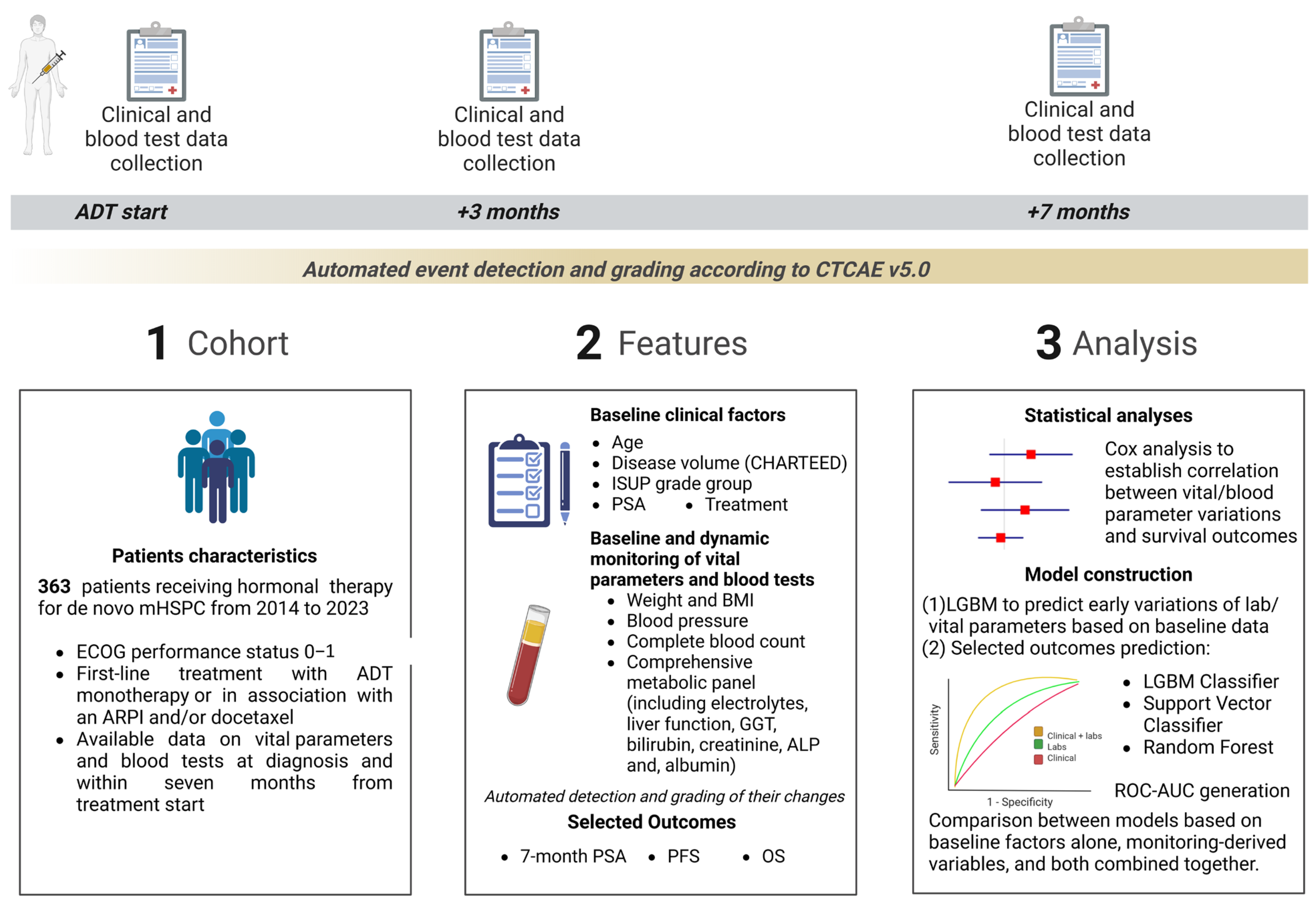
Predicting Toxicities and Survival Outcomes in De Novo Metastatic Hormone-Sensitive Prostate Cancer Using Clinical Features, Routine Blood Tests and Their Early Variations
 , , , , , , , , and
Simple Summary
Abstract
1. Introduction
2. Materials and Methods
2.1. Clinical Measurements and Variable Definition
2.2. Study End Points and Outcomes
2.3. Statistical Analyses
2.4. Model Development and Evaluation
3. Results
3.1. Study Population Characteristics
3.2. Incidence of Early-Onset AEs According to the Treatment Regimen
3.3. Integrating Baseline Clinical Factors with Baseline Blood Exams and Vitals Data to Predict Early Onset Biochemical Alterations
3.4. Impact of Early-Onset Biochemical Alterations on Survival Outcomes
3.5. Integrating Clinical Prognostic Factors with Early Monitoring Data into ML Models to Predict Survival Outcomes
4. Discussion
Limitations and Future Perspectives
5. Conclusions
Supplementary Materials
Author Contributions
Funding
Institutional Review Board Statement
Informed Consent Statement
Data Availability Statement
Conflicts of Interest
Correction Statement
References
- Culp, M.B.; Soerjomataram, I.; Efstathiou, J.A.; Bray, F.; Jemal, A. Recent Global Patterns in Prostate Cancer Incidence and Mortality Rates. Eur. Urol. 2020, 77, 38–52. [Google Scholar] [CrossRef] [Scilit]
- Siegel, R.L.; Miller, K.D.; Wagle, N.S.; Jemal, A. Cancer Statistics, 2023. CA Cancer J. Clin. 2023, 73, 17–48. [Google Scholar] [CrossRef] [Scilit]
- Turco, F.; Gillessen, S.; Herrmann, K.; Paone, G.; Omlin, A. Treatment Landscape of Prostate Cancer in the Era of PSMA Radiopharmaceutical Therapy. J. Nucl. Med. 2025, 66, 665–672. [Google Scholar] [CrossRef] [Scilit]
- Sweeney, C.J.; Chen, Y.-H.; Carducci, M.; Liu, G.; Jarrard, D.F.; Eisenberger, M.; Wong, Y.-N.; Hahn, N.; Kohli, M.; Cooney, M.M.; et al. Chemohormonal Therapy in Metastatic Hormone-Sensitive Prostate Cancer. N. Engl. J. Med. 2015, 373, 737–746. [Google Scholar] [CrossRef] [Scilit] [PubMed]
- Gravis, G.; Boher, J.-M.; Chen, Y.-H.; Liu, G.; Fizazi, K.; Carducci, M.A.; Oudard, S.; Joly, F.; Jarrard, D.M.; Soulie, M.; et al. Burden of Metastatic Castrate Naive Prostate Cancer Patients, to Identify Men More Likely to Benefit from Early Docetaxel: Further Analyses of CHAARTED and GETUG-AFU15 Studies. Eur. Urol. 2018, 73, 847–855. [Google Scholar] [CrossRef] [Scilit]
- Parker, C.C.; James, N.D.; Brawley, C.D.; Clarke, N.W.; Hoyle, A.P.; Ali, A.; Ritchie, A.W.S.; Attard, G.; Chowdhury, S.; Cross, W.; et al. Radiotherapy to the Primary Tumour for Newly Diagnosed, Metastatic Prostate Cancer (STAMPEDE): A Randomised Controlled Phase 3 Trial. Lancet 2018, 392, 2353–2366. [Google Scholar] [CrossRef] [Scilit]
- Finianos, A.; Gupta, K.; Clark, B.; Simmens, S.J.; Aragon-Ching, J.B. Characterization of Differences Between Prostate Cancer Patients Presenting With De Novo Versus Primary Progressive Metastatic Disease. Clin. Genitourin. Cancer 2018, 16, 85–89. [Google Scholar] [CrossRef] [Scilit] [PubMed]
- Bernard, B.; Burnett, C.; Sweeney, C.J.; Rider, J.R.; Sridhar, S.S. Impact of Age at Diagnosis of de Novo Metastatic Prostate Cancer on Survival. Cancer 2020, 126, 986–993. [Google Scholar] [CrossRef] [Scilit] [PubMed]
- Swami, U.; Jo, Y.; Narang, A.; Plets, M.; Hage Chehade, C.; Gebrael, G.; Gupta, S.; Myint, Z.; Tangen, C.; Lara, P.N.; et al. Correlation of Body Mass Index with Overall Survival Among Patients with Metastatic Hormone-Sensitive Prostate Cancer: Analysis of Patient-Level Data from SWOG-1216. Eur. Urol. Oncol. 2024, 8, 612–615. [Google Scholar] [CrossRef] [Scilit]
- Fisher, D.J.; Vale, C.L.; Rydzewska, L.H.; Godolphin, P.; Agarwal, N.; Attard, G.; Chi, K.N.; Clarke, N.W.; Davis, I.D.; Fizazi, K.; et al. Which Patients with Metastatic Hormone-Sensitive Prostate Cancer (MHSPC) Benefit More from Androgen Receptor Pathway Inhibitors (ARPIs)? STOPCAP Meta-Analyses of Individual Participant Data (IPD). J. Clin. Oncol. 2025, 43, 20. [Google Scholar] [CrossRef] [Scilit]
- Hussain, M.; Tangen, C.M.; Higano, C.; Schelhammer, P.F.; Faulkner, J.; Crawford, E.D.; Wilding, G.; Akdas, A.; Small, E.J.; Donnelly, B.; et al. Absolute Prostate-Specific Antigen Value After Androgen Deprivation Is a Strong Independent Predictor of Survival in New Metastatic Prostate Cancer: Data From Southwest Oncology Group Trial 9346 (INT-0162). J. Clin. Oncol. 2006, 24, 3984–3990. [Google Scholar] [CrossRef] [Scilit]
- Harshman, L.C.; Chen, Y.-H.; Liu, G.; Carducci, M.A.; Jarrard, D.; Dreicer, R.; Hahn, N.; Garcia, J.A.; Hussain, M.; Shevrin, D.; et al. Seven-Month Prostate-Specific Antigen Is Prognostic in Metastatic Hormone-Sensitive Prostate Cancer Treated with Androgen Deprivation with or Without Docetaxel. J. Clin. Oncol. 2018, 36, 376–382. [Google Scholar] [CrossRef] [Scilit] [PubMed]
- Matsubara, N.; Chi, K.N.; Özgüroğlu, M.; Rodriguez-Antolin, A.; Feyerabend, S.; Fein, L.; Alekseev, B.Y.; Sulur, G.; Protheroe, A.; Li, S.; et al. Correlation of Prostate-Specific Antigen Kinetics with Overall Survival and Radiological Progression-Free Survival in Metastatic Castration-Sensitive Prostate Cancer Treated with Abiraterone Acetate plus Prednisone or Placebos Added to Androgen Deprivation Therapy: Post Hoc Analysis of Phase 3 LATITUDE Study. Eur. Urol. 2020, 77, 494–500. [Google Scholar] [CrossRef] [Scilit]
- Chowdhury, S.; Bjartell, A.; Agarwal, N.; Chung, B.H.; Given, R.W.; Pereira de Santana Gomes, A.J.; Merseburger, A.S.; Özgüroğlu, M.; Juárez Soto, Á.; Uemura, H.; et al. Deep, Rapid, and Durable Prostate-Specific Antigen Decline with Apalutamide plus Androgen Deprivation Therapy Is Associated with Longer Survival and Improved Clinical Outcomes in TITAN Patients with Metastatic Castration-Sensitive Prostate Cancer. Ann. Oncol. 2023, 34, 477–485. [Google Scholar] [CrossRef] [Scilit]
- Sharifi, N. Androgen Deprivation Therapy for Prostate Cancer. JAMA 2005, 294, 238. [Google Scholar] [CrossRef] [Scilit]
- Taylor, L.G.; Canfield, S.E.; Du, X.L. Review of Major Adverse Effects of Androgen-deprivation Therapy in Men with Prostate Cancer. Cancer 2009, 115, 2388–2399. [Google Scholar] [CrossRef] [Scilit]
- Challa, A.A.; Calaway, A.C.; Cullen, J.; Garcia, J.; Desai, N.; Weintraub, N.L.; Deswal, A.; Kutty, S.; Vallakati, A.; Addison, D.; et al. Cardiovascular Toxicities of Androgen Deprivation Therapy. Curr. Treat. Options Oncol. 2021, 22, 47. [Google Scholar] [CrossRef] [Scilit] [PubMed]
- Fizazi, K.; Tran, N.; Fein, L.; Matsubara, N.; Rodriguez-Antolin, A.; Alekseev, B.Y.; Özgüroğlu, M.; Ye, D.; Feyerabend, S.; Protheroe, A.; et al. Abiraterone plus Prednisone in Metastatic, Castration-Sensitive Prostate Cancer. N. Engl. J. Med. 2017, 377, 352–360. [Google Scholar] [CrossRef] [Scilit]
- Chi, K.N.; Agarwal, N.; Bjartell, A.; Chung, B.H.; Pereira de Santana Gomes, A.J.; Given, R.; Juárez Soto, Á.; Merseburger, A.S.; Özgüroğlu, M.; Uemura, H.; et al. Apalutamide for Metastatic, Castration-Sensitive Prostate Cancer. N. Engl. J. Med. 2019, 381, 13–24. [Google Scholar] [CrossRef] [Scilit]
- Saad, F.; Vjaters, E.; Shore, N.; Olmos, D.; Xing, N.; Pereira de Santana Gomes, A.J.; Cesar de Andrade Mota, A.; Salman, P.; Jievaltas, M.; Ulys, A.; et al. Darolutamide in Combination With Androgen-Deprivation Therapy in Patients With Metastatic Hormone-Sensitive Prostate Cancer From the Phase III ARANOTE Trial. J. Clin. Oncol. 2024, 42, 4271–4281. [Google Scholar] [CrossRef] [Scilit] [PubMed]
- Iacovelli, R.; Ciccarese, C.; Bria, E.; Romano, M.; Fantinel, E.; Bimbatti, D.; Muraglia, A.; Porcaro, A.B.; Siracusano, S.; Brunelli, M.; et al. The Cardiovascular Toxicity of Abiraterone and Enzalutamide in Prostate Cancer. Clin. Genitourin. Cancer 2018, 16, e645–e653. [Google Scholar] [CrossRef] [Scilit] [PubMed]
- Lai, L.Y.; Oerline, M.K.; Caram, M.E.V.; Tsao, P.A.; Kaufman, S.R.; Hollenbeck, B.K.; Shahinian, V.B. Risk of Metabolic and Cardiovascular Adverse Events With Abiraterone or Enzalutamide Among Men With Advanced Prostate Cancer. JNCI J. Natl. Cancer Inst. 2022, 114, 1127–1134. [Google Scholar] [CrossRef] [Scilit]
- Cao, B.; Kim, M.; Reizine, N.M.; Moreira, D.M. Adverse Events and Androgen Receptor Signaling Inhibitors in the Treatment of Prostate Cancer: A Systematic Review and Multivariate Network Meta-Analysis. Eur. Urol. Oncol. 2023, 6, 237–250. [Google Scholar] [CrossRef] [Scilit]
- Tannock, I.F.; de Wit, R.; Berry, W.R.; Horti, J.; Pluzanska, A.; Chi, K.N.; Oudard, S.; Théodore, C.; James, N.D.; Turesson, I.; et al. Docetaxel plus Prednisone or Mitoxantrone plus Prednisone for Advanced Prostate Cancer. N. Engl. J. Med. 2004, 351, 1502–1512. [Google Scholar] [CrossRef] [Scilit]
- Bertsimas, D.; Wiberg, H. Machine Learning in Oncology: Methods, Applications, and Challenges. JCO Clin. Cancer Inform. 2020, 4, 885–894. [Google Scholar] [CrossRef] [Scilit]
- Goldenberg, S.L.; Nir, G.; Salcudean, S.E. A New Era: Artificial Intelligence and Machine Learning in Prostate Cancer. Nat. Rev. Urol. 2019, 16, 391–403. [Google Scholar] [CrossRef] [Scilit]
- Yoo, S.-K.; Fitzgerald, C.W.; Cho, B.A.; Fitzgerald, B.G.; Han, C.; Koh, E.S.; Pandey, A.; Sfreddo, H.; Crowley, F.; Korostin, M.R.; et al. Prediction of Checkpoint Inhibitor Immunotherapy Efficacy for Cancer Using Routine Blood Tests and Clinical Data. Nat. Med. 2025, 31, 869–880. [Google Scholar] [CrossRef] [Scilit]
- Eisenhauer, E.A.; Therasse, P.; Bogaerts, J.; Schwartz, L.H.; Sargent, D.; Ford, R.; Dancey, J.; Arbuck, S.; Gwyther, S.; Mooney, M.; et al. New Response Evaluation Criteria in Solid Tumours: Revised RECIST Guideline (Version 1.1). Eur. J. Cancer 2009, 45, 228–247. [Google Scholar] [CrossRef] [Scilit]
- Tilki, D.; van den Bergh, R.C.N.; Briers, E.; Van den Broeck, T.; Brunckhorst, O.; Darraugh, J.; Eberli, D.; De Meerleer, G.; De Santis, M.; Farolfi, A.; et al. EAU-EANM-ESTRO-ESUR-ISUP-SIOG Guidelines on Prostate Cancer. Part II—2024 Update: Treatment of Relapsing and Metastatic Prostate Cancer. Eur. Urol. 2024, 86, 164–182. [Google Scholar] [CrossRef] [Scilit] [PubMed]
- Ke, G.; Meng, Q.; Finley, T.; Wang, T.; Chen, W.; Ma, W.; Liu, T.-Y. Lightgbm: A Highly Efficient Gradient Boosting Decision Tree. Adv. Neural Inf. Process Syst. 2017, 30, 3146–3154. [Google Scholar]
- Pedregosa, F.; Varoquaux, G.; Gramfort, A.; Michel, V.; Thirion, B.; Grisel, O.; Blondel, M.; Prettenhofer, P.; Weiss, R.; Dubourg, V.; et al. Scikit-Learn: Machine Learning in Python. J. Mach. Learn. Res. 2011, 12, 2825–2830. [Google Scholar]
- Mori, K.; Janisch, F.; Parizi, M.K.; Mostafaei, H.; Lysenko, I.; Enikeev, D.V.; Kimura, S.; Egawa, S.; Shariat, S.F. Prognostic Value of Alkaline Phosphatase in Hormone-Sensitive Prostate Cancer: A Systematic Review and Meta-Analysis. Int. J. Clin. Oncol. 2020, 25, 247–257. [Google Scholar] [CrossRef] [Scilit]
- Robinson, D.; Sandblom, G.; Johansson, R.; Garmo, H.; Stattin, P.; Mommsen, S.; Varenhorst, E. Prediction of Survival of Metastatic Prostate Cancer Based on Early Serial Measurements of Prostate Specific Antigen and Alkaline Phosphatase. J. Urol. 2008, 179, 117–123. [Google Scholar] [CrossRef] [Scilit]
- Sonpavde, G.; Pond, G.R.; Berry, W.R.; de Wit, R.; Armstrong, A.J.; Eisenberger, M.A.; Tannock, I.F. Serum Alkaline Phosphatase Changes Predict Survival Independent of PSA Changes in Men with Castration-Resistant Prostate Cancer and Bone Metastasis Receiving Chemotherapy. Urol. Oncol. Semin. Orig. Investig. 2012, 30, 607–613. [Google Scholar] [CrossRef] [Scilit] [PubMed]
- Gupta, D.; Lis, C.G. Pretreatment Serum Albumin as a Predictor of Cancer Survival: A Systematic Review of the Epidemiological Literature. Nutr. J. 2010, 9, 69. [Google Scholar] [CrossRef] [Scilit] [PubMed]
- Viganó, A.; Bruera, E.; Jhangri, G.S.; Newman, S.C.; Fields, A.L.; Suarez-Almazor, M.E. Clinical Survival Predictors in Patients With Advanced Cancer. Arch. Intern. Med. 2000, 160, 861. [Google Scholar] [CrossRef] [Scilit] [PubMed]
- Salciccia, S.; Frisenda, M.; Bevilacqua, G.; Viscuso, P.; Casale, P.; De Berardinis, E.; Di Pierro, G.B.; Cattarino, S.; Giorgino, G.; Rosati, D.; et al. Prognostic Value of Albumin to Globulin Ratio in Non-Metastatic and Metastatic Prostate Cancer Patients: A Meta-Analysis and Systematic Review. Int. J. Mol. Sci. 2022, 23, 11501. [Google Scholar] [CrossRef] [Scilit]
- Kaya, C.; Caliskan, S.; Sungur, M.; Aydın, C. HALP Score and Albumin Levels in Men with Prostate Cancer and Benign Prostate Hyperplasia. Int. J. Clin. Pract. 2021, 75, e13766. [Google Scholar] [CrossRef] [Scilit]
- Ghoshal, A.; Garmo, H.; Hammar, N.; Jungner, I.; Malmström, H.; Walldius, G.; Van Hemelrijck, M. Can Pre-Diagnostic Serum Levels of Sodium and Potassium Predict Prostate Cancer Survival? BMC Cancer 2018, 18, 1169. [Google Scholar] [CrossRef] [Scilit]
- Salfi, G.; Pedrani, M.; Candan, S.; Urechie, V.; Merler, S.; Ruinelli, L.; Colombo, A.; Castelo-Branco, L.; Testi, I.; Turco, F.; et al. Treatment-Related Hypertension as a Prognostic Factor for De Novo Metastatic Hormone-Sensitive Prostate Cancer: A Retrospective Real-World Evidence Study. Eur. Urol. Open Sci. 2024, 71, 1–10. [Google Scholar] [CrossRef] [Scilit]
- Grist, E.; Dutey-Magni, P.; Mendes, L.; Parry, M.A.; Sachdeva, A.; Proudfoot, J.; Hamid, A.A.; Amos, C.L.; Cross, W.; Gillessen, S.; et al. 1596O Decipher MRNA Score for Prediction of Survival Benefit from Docetaxel at Start of Androgen Deprivation Therapy (ADT) for Advanced Prostate Cancer (PC): An Ancillary Study of the STAMPEDE Docetaxel Trials. Ann. Oncol. 2024, 35, S961–S962. [Google Scholar] [CrossRef] [Scilit]
- Grist, E.; Dutey-Magni, P.; Parry, M.; Mendes, L.; Sachdeva, A.; Proudfoot, J.A.; Hamid, A.; Ismail, M.; De Paula Oliveira, L.; Dairo, O.; et al. Transcriptome Classification of PTEN Inactivation to Predict Survival Benefit from Docetaxel at Start of Androgen Deprivation Therapy (ADT) for Metastatic Prostate Cancer (PC): An Ancillary Study of the STAMPEDE Trials. J. Clin. Oncol. 2025, 43, 5003. [Google Scholar] [CrossRef] [Scilit]
- Pedrani, M.; Salfi, G.; Merler, S.; Testi, I.; Agrippina Clerici, C.M.; Pecoraro, G.; Castelo-Branco, L.; Turco, F.; Tortola, L.; Vogl, U.; et al. Integrating Aggressive-Variant Prostate Cancer-Associated Tumor Suppressor Gene Status with Clinical Variables to Refine Prognosis and Predict Androgen Receptor Pathway Inhibitor Response in Metastatic Hormone-Sensitive Setting. Int. J. Mol. Sci. 2025, 26, 5309. [Google Scholar] [CrossRef] [Scilit] [PubMed]
- Pedrani, M.; Barizzi, J.; Salfi, G.; Nepote, A.; Testi, I.; Merler, S.; Castelo-Branco, L.; Mestre, R.P.; Turco, F.; Tortola, L.; et al. The Emerging Predictive and Prognostic Role of Aggressive-Variant-Associated Tumor Suppressor Genes Across Prostate Cancer Stages. Int. J. Mol. Sci. 2025, 26, 318. [Google Scholar] [CrossRef] [Scilit]
- Davidson-Pilon, C. Lifelines: Survival analysis in Python. J. Open Source Softw. 2019, 4, 1317. [Google Scholar] [CrossRef] [Scilit]


| Variable | Total Population | ADT | ADT + ARPI | ADT + Docetaxel ± ARPI | p-Value |
|---|---|---|---|---|---|
| Overall patients | 363 | 245 (67.5%) | 82 (22.6%) | 36 (9.9%) | |
| CHAARTED | p < 0.01 | ||||
| High volume | 205 (56.5%) | 124 (50.6%) | 51 (62.2%) | 30 (83.3%) | |
| Low volume | 158 (43.5%) | 121 (49.4%) | 31 (37.8%) | 6 (16.7%) | |
| Age at diagnosis | 75, | 77, | 76, | 66, | p < 0.01 |
| (median, IQR) - | 67–82 | 69–83 | 67.0–81.0 | 63–72 | |
| Age at diagnosis | p < 0.01 | ||||
| ≥70 years old | 246 (67.8%) | 176 (71.8%) | 57 (69.5%) | 13 (36.1%) | |
| <70 years old | 117 (32.2%) | 69 (28.2%) | 25 (30.5%) | 23 (63.9%) | |
| Baseline PSA | 70 | 100.0, | 38.0, | 60.0, | p < 0.01 |
| (median, 95% CI) | 26–330 | 32.0–438 | 18.0–156 | 13–209 | |
| ISUP grade group | p = 0.30 | ||||
| 5 | 203 (55.9%) | 114 (46.5%) | 63 (76.8%) | 26 (72.2%) | |
| <5 | 42 (11.6%) | 29 (11.8%) | 9 (11.0%) | 4 (11.1%) | |
| Unknown | 118 (32.5%) | 102 (41.6%) | 10 (12.2%) | 6 (16.7%) | |
| 7-month PSA | p < 0.01 | ||||
| >0.2 | 129 (35.5%) | 87 (35.5%) | 29 (35.3%) | 13 (36.1%) | |
| <0.2 | 72 (19.8%) | 21 (85.7%) | 42 (51.2%) | 9 (25.0%) | |
| Unknown | 162 (44.6%) | 137 (55.9%) | 11 (13.4%) | 14 (38.9%) |
| Variable | Median PFS [months, 95% CI] | HR (95% CI) | p Value |
| Electrolyte disturbances | p = 0.011 | ||
| 0 | 22.8 [19.2–39.3] | ||
| 1 | 15.4 [10.1–21.3} | 1.47 (1.09–1.99) | |
| Hematologycal toxicity | p = 0.02 | ||
| 0 | 23.4 [19.2–32.9] | ||
| 1 | 12.4 [9.7–20.2] | 1.56 (1.18–2.08) | |
| Liver toxicity | p = 0.0073 | ||
| 0 | 20.5 [17–26.6] | ||
| 1 | 15 [10.4–22.4] | 1.31 (0.98–1.75) | |
| Kidney-related toxicity | p = 0.174 | ||
| 0 | 20.5 [17–26.9] | ||
| 1 | 15.4 [9.7–23.4] | 1.28 (0.90–1.82) | |
| Variable | Median OS [months, 95% CI] | HR (95% CI) | p Value |
| Electrolyte disturbances | p = 0.001 | ||
| 0 | 44.4 [35.4–63.9] | ||
| 1 | 26.7 [19.8–35.7] | 1.73 (1.24–2.40) | |
| Hematological toxicity | p = 0.001 | ||
| 0 | 43.7 [38–54.7] | ||
| 1 | 23.2 [18.5–34.4] | 1.72 (1.27–2.34) | |
| Liver toxicity | p = 0.099 | ||
| 0 | 39.3 [31.9–48.1] | ||
| 1 | 32.1 [19.8–43.9] | 1.30 (0.95–1.78) | |
| Kidney-related toxicity | p = 0.012 | ||
| 0 | 41.5 [34.4–48.1] | ||
| 1 | 25.9 [18.2–39.3] | 1.60 (1.11–2.30) |
| Target | Dataset | LGBM ROC AUC | LGBM Brier Score | SVC ROC AUC | SVC Brier Score | RF ROC AUC | RF Brier Score |
|---|---|---|---|---|---|---|---|
| PSA 7 months < 0.2 | Clinical | 0.62 | 0.24 | 0.54 | 0.26 | 0.58 | 0.27 |
| PSA 7 months < 0.2 | Monitoring | 0.60 | 0.27 | 0.60 | 0.26 | 0.60 | 0.27 |
| PSA 7 months < 0.2 | Combined | 0.68 | 0.24 | 0.63 | 0.26 | 0.67 | 0.25 |
| Higher 25% PFS | Clinical | 0.68 | 0.14 | 0.64 | 0.14 | 0.68 | 0.16 |
| Higher 25% PFS | Monitoring | 0.54 | 0.16 | 0.51 | 0.15 | 0.57 | 0.15 |
| Higher 25% PFS | Combined | 0.54 | 0.15 | 0.54 | 0.14 | 0.53 | 0.14 |
| Lower 25% PFS | Clinical | 0.89 | 0.19 | 0.79 | 0.18 | 0.86 | 0.16 |
| Lower 25% PFS | Monitoring | 0.80 | 0.17 | 0.84 | 0.13 | 0.85 | 0.15 |
| Lower 25% PFS | Combined | 0.94 | 0.14 | 0.91 | 0.14 | 0.92 | 0.12 |
| Higher 25% OS | Clinical | 0.68 | 0.12 | 0.61 | 0.12 | 0.71 | 0.14 |
| Higher 25% OS | Monitoring | 0.79 | 0.10 | 0.83 | 0.09 | 0.80 | 0.12 |
| Higher 25% OS | Combined | 0.69 | 0.12 | 0.80 | 0.11 | 0.86 | 0.11 |
| Lower 25% OS | Clinical | 0.54 | 0.21 | 0.62 | 0.22 | 0.62 | 0.22 |
| Lower 25% OS | Monitoring | 0.69 | 0.21 | 0.71 | 0.22 | 0.71 | 0.19 |
| Lower 25% OS | Combined | 0.67 | 0.19 | 0.66 | 0.19 | 0.59 | 0.19 |
Disclaimer/Publisher’s Note: The statements, opinions and data contained in all publications are solely those of the individual author(s) and contributor(s) and not of MDPI and/or the editor(s). MDPI and/or the editor(s) disclaim responsibility for any injury to people or property resulting from any ideas, methods, instructions or products referred to in the content. |
© 2025 by the authors. Licensee MDPI, Basel, Switzerland. This article is an open access article distributed under the terms and conditions of the Creative Commons Attribution (CC BY) license (https://creativecommons.org/licenses/by/4.0/).
Share and Cite
Salfi, G.; Pedrani, M.; Colombo, A.; Ruinelli, L.; Brenna, D.; Clerici, C.M.A.; Pecoraro, G.; Merler, S.; Erhart, C.-C.; Puglisi, M.; et al. Predicting Toxicities and Survival Outcomes in De Novo Metastatic Hormone-Sensitive Prostate Cancer Using Clinical Features, Routine Blood Tests and Their Early Variations. Cancers 2025, 17, 3806. https://doi.org/10.3390/cancers17233806
Salfi G, Pedrani M, Colombo A, Ruinelli L, Brenna D, Clerici CMA, Pecoraro G, Merler S, Erhart C-C, Puglisi M, et al. Predicting Toxicities and Survival Outcomes in De Novo Metastatic Hormone-Sensitive Prostate Cancer Using Clinical Features, Routine Blood Tests and Their Early Variations. Cancers. 2025; 17(23):3806. https://doi.org/10.3390/cancers17233806
Chicago/Turabian StyleSalfi, Giuseppe, Martino Pedrani, Amos Colombo, Lorenzo Ruinelli, Daniele Brenna, Chiara Maria Agrippina Clerici, Giovanna Pecoraro, Sara Merler, Caroline-Claudia Erhart, Marialuisa Puglisi, and et al. 2025. "Predicting Toxicities and Survival Outcomes in De Novo Metastatic Hormone-Sensitive Prostate Cancer Using Clinical Features, Routine Blood Tests and Their Early Variations" Cancers 17, no. 23: 3806. https://doi.org/10.3390/cancers17233806
APA StyleSalfi, G., Pedrani, M., Colombo, A., Ruinelli, L., Brenna, D., Clerici, C. M. A., Pecoraro, G., Merler, S., Erhart, C.-C., Puglisi, M., Turco, F., Tortola, L., Vogl, U., Gillessen, S., & Pereira Mestre, R. (2025). Predicting Toxicities and Survival Outcomes in De Novo Metastatic Hormone-Sensitive Prostate Cancer Using Clinical Features, Routine Blood Tests and Their Early Variations. Cancers, 17(23), 3806. https://doi.org/10.3390/cancers17233806