Artificial Intelligence for Lymph Node Detection and Malignancy Prediction in Endoscopic Ultrasound: A Multicenter Study
by
 , , , , , , , , , , , and add
Show full author list
, , , , , , , , , , , and add
Show full author list
Belén Agudo Castillo
1,†,
Miguel Mascarenhas Saraiva
2,*,† ,
,
António Miguel Martins Pinto da Costa
1,
João Ferreira
3,
Miguel Martins
2,
Francisco Mendes
2,
Pedro Cardoso
2,
Joana Mota
2,
Maria João Almeida
2,
João Afonso
2,
Tiago Ribeiro
2,
Marcos Eduardo Lera dos Santos
4,5,
Matheus de Carvalho
4,
María Morís
6,
Ana García García de Paredes
7,
Daniel de la Iglesia García
1,
Carlos Estebam Fernández-Zarza
1,
Ana Pérez González
1,
Khoon-Sheng Kok
8,
Jessica Widmer
9,
Uzma D. Siddiqui
10,
Grace E. Kim
10,
Susana Lopes
2,
Pedro Moutinho Ribeiro
2,
Filipe Vilas-Boas
2,
Eduardo Hourneaux de Moura
4,5,
Guilherme Macedo
2 and
and
Mariano González-Haba Ruiz
1add
Show full author list
1
Hospital Universitario Puerta de Hierro Majadahonda, 28222 Madrid, Spain
2
Centro Hospitalar Universitário São João, 4200-319 Porto, Portugal
3
Department of Mechanical Engineering, Faculty of Engineering, The University of Porto, 4200-465 Porto, Portugal
4
Hospital das Clínicas da Faculdade de Medicina da USP, São Paulo 05403-010, Brazil
5
Vila Nova Star Hospital, São Paulo 04544-000, Brazil
6
Hospital Universitario Marqués de Valdecilla, 39008 Santander, Spain
7
Hospital Universitario Ramon y Cajal, 28034 Madrid, Spain
8
Royal Liverpool Hospital, Liverpool L7 8YE, UK
9
NYU Langone Health, New York, NY 10016, USA
10
Center for Endoscopic Research and Therapeutics (CERT), University of Chicago, Chicago, IL 60637, USA
*
Author to whom correspondence should be addressed.
†
These authors contributed equally to this work.
Cancers 2025, 17(21), 3398; https://doi.org/10.3390/cancers17213398
Submission received: 28 August 2025
/
Revised: 12 October 2025
/
Accepted: 17 October 2025
/
Published: 22 October 2025
(This article belongs to the Special Issue Application of Artificial Intelligence-Based Approaches in Cancer Diagnosis, Treatment and Prognosis)
Simple Summary
Endoscopic ultrasound is fundamental for lymph node assessment, being pivotal in oncological staging and treatment guidance. However, significant limitations are observed when considering EUS criteria for prediction of lymph node malignancy. The authors aimed to develop a YOLO convolutional neural network for artificial intelligence-based prediction of lymph node malignancy during EUS. The model had an overall accuracy over 98% for prediction of lymph node malignancy, with an image processing time that favors its clinical applicability. This is the first study worldwide study evaluating deep learning models for lymph node assessment using EUS imaging, enabling artificial intelligence-assisted EUS has a novel tool for achieving a more accurate and tailored patient management.
Abstract
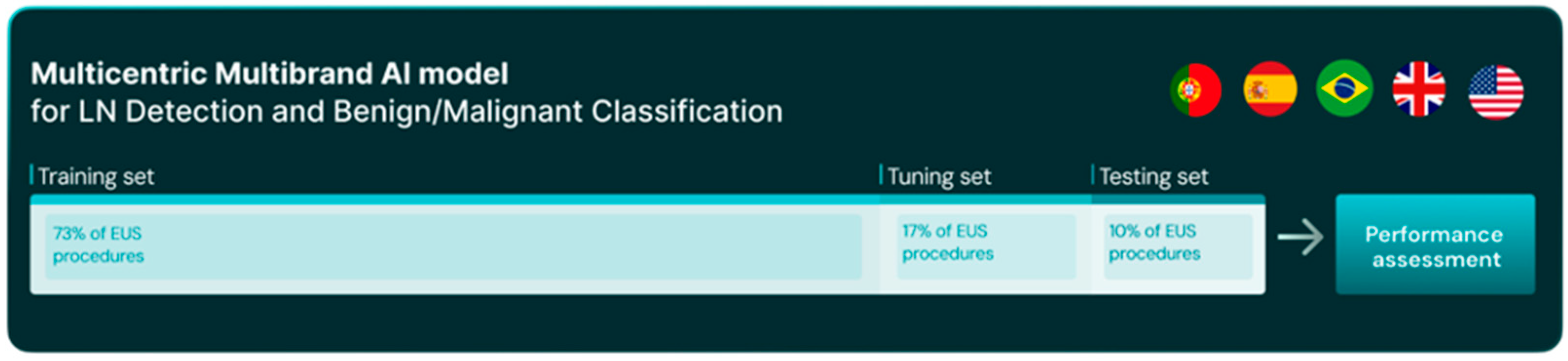
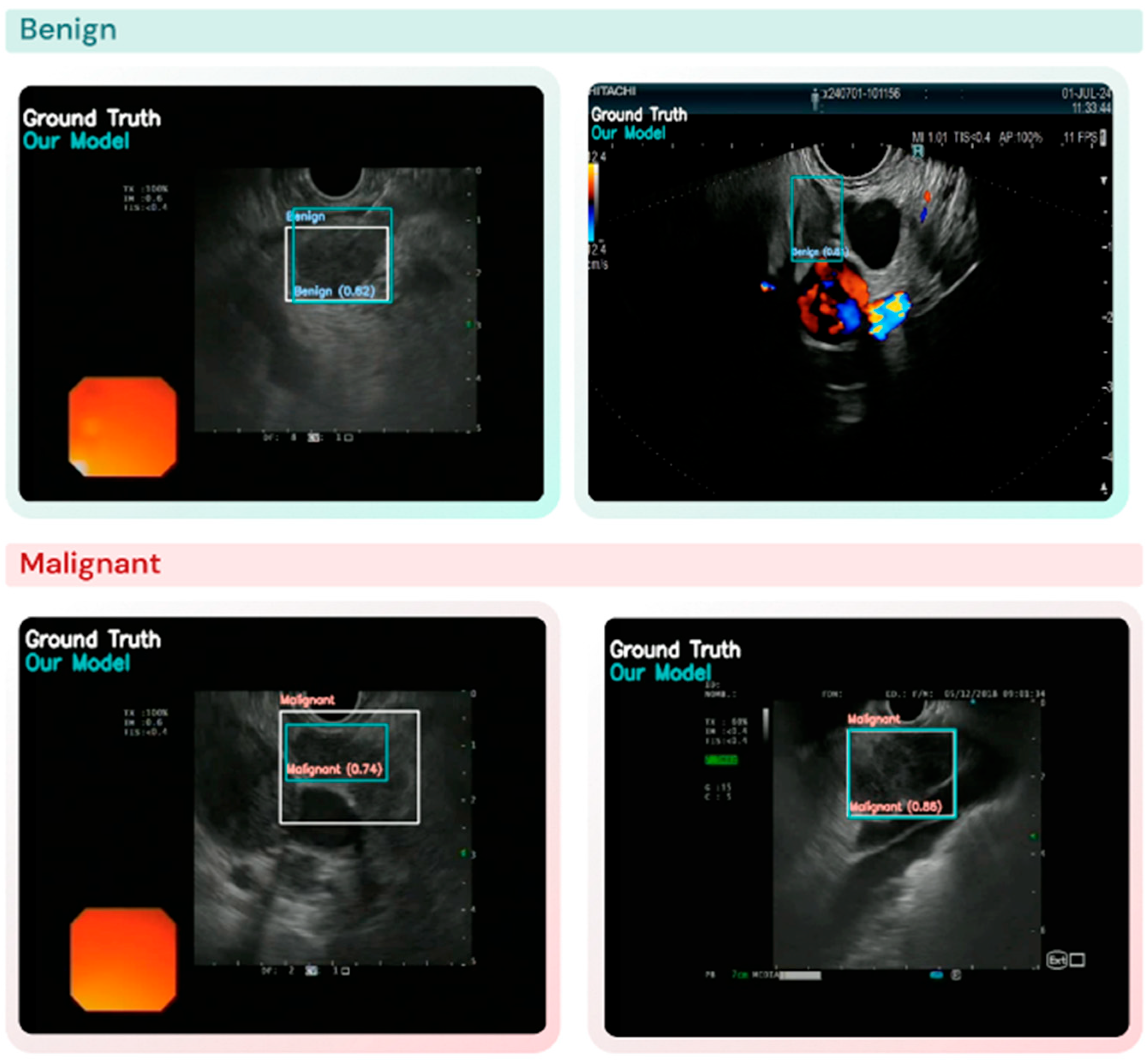
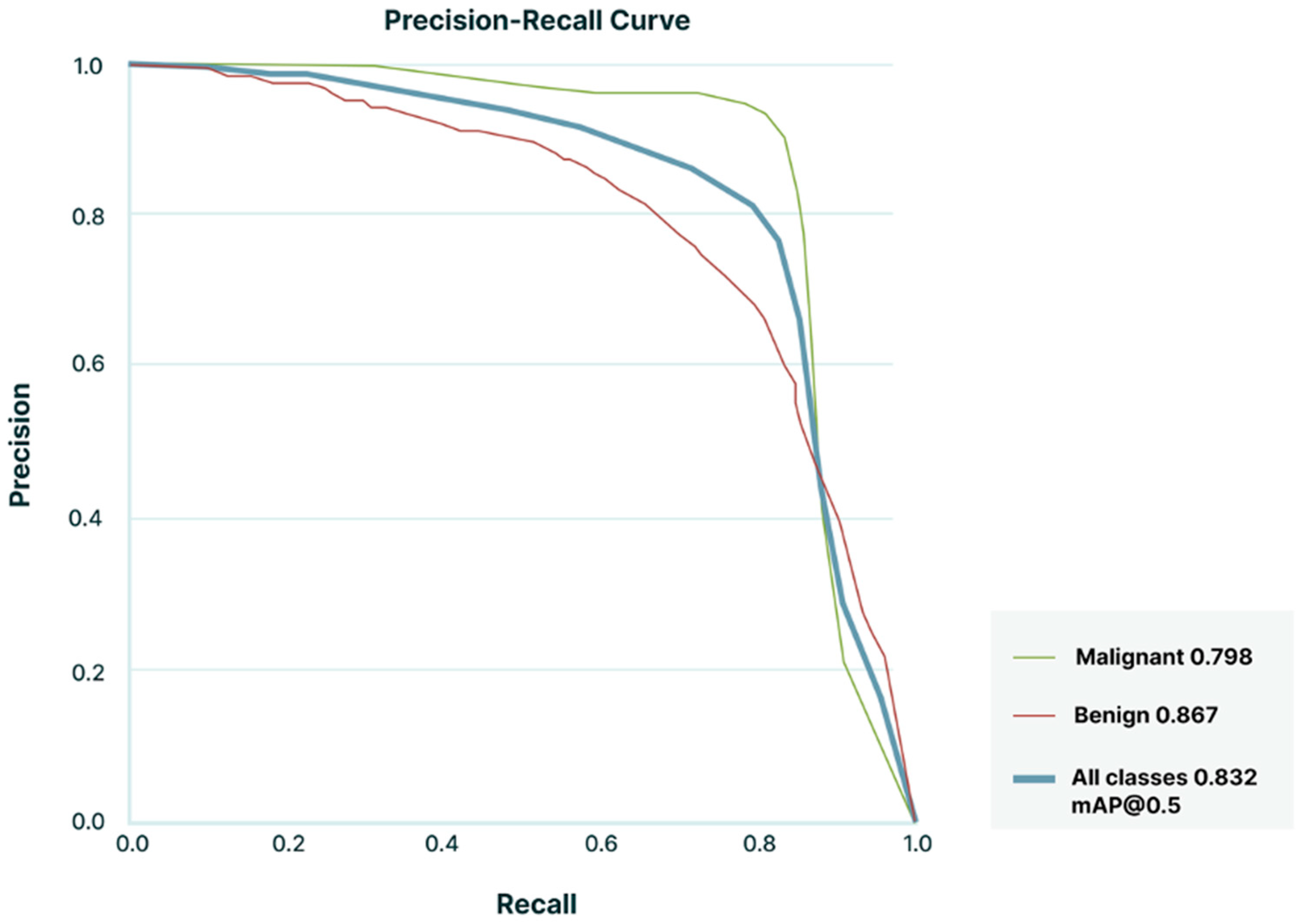
Background/Objectives: Endoscopic ultrasound (EUS) is crucial for lymph node (LN) characterization, playing a key role in oncological staging and treatment guidance. EUS criteria for predicting malignancy are imprecise, and histologic diagnosis may have limitations. This multicenter study aimed to evaluate the effectiveness of a novel artificial intelligence (AI)–based system in predicting LN malignancy from EUS images. Methods: This multicenter study included EUS images from nine centers. Lesions were labeled (“malignant” or “benign”) and delimited with bounding boxes. Definitive diagnoses were based on cytology/biopsy or surgical specimens and, if negative, a minimum six-month clinical follow-up. A convolutional neural network (CNN) was developed using the YOLO (You Only Look Once) architecture, incorporating both detection and classification modules. Results: A total of 59,992 images from 82 EUS procedures were analyzed. The CNN distinguished malignant from benign lymph nodes with a sensitivity of 98.8% (95% CI: 98.5–99.2%), specificity of 99.0% (95% CI: 98.3–99.7%), and precision of 99.0% (95% CI: 98.4–99.7%). The negative and positive predictive values for malignancy were 98.8% and 99.0%, respectively. Overall diagnostic accuracy was 98.3% (95% CI: 97.6–99.1%). Conclusions: This is the first study evaluating the performance of deep learning systems for LN assessment using EUS imaging. Our AI-powered imaging model shows excellent detection and classification capabilities, emphasizing its potential to provide a valuable tool to refine LN evaluation with EUS, ultimately supporting more tailored, efficient patient care.